DIAGRAM FOR 1983 0902a
Class
Friday, September 2nd, 1983
Verbatim, unedited transcriptClick the series name to view more
CLASS at Wisdom's Goldenrod, Hector, NY
with Anthony Damiani (AD)
September 2a, 1983
PB PARAS; MEDITATION; VOID/INSIGHT
TOPIC: PB Paras
SUBJECT: Meditation
SUBSUBJECTS: The Void, Three Primal Hypostases, Insight, Stages of Insight
CONTENTS:
THE THREE PRIMAL HYPOSTASES CAN BE REFERRED TO AS THE VOID
THE DISCOVERY THAT YOU ARE MIND, MIND-IN-ITSELF, IS INSIGHT
OTHER TRADITIONS RESTRICT THEIR USE OF THE TERM "EMPTINESS" TO BEING, BUT THE TERM HERE IS BEING EXTENDED EVEN TO THE ONE
EACH HYPOSTASIS IS VOID BECAUSE IT IS AN IMMATERIAL PRINCIPLE OF KNOWLEDGE, OR A PRINCIPLE IN ITS OWN RIGHT
FOUR STAGES OF DEEPER PENETRATION INTO THE VOID: IDENTIFICATION WITH SOUL (INSIGHT), THEN RECOGNITION OF ABSOLUTE SOUL, NOUS, AND THE ONE IS A DEEPENING OF INSIGHT
BOOKS READ FROM OR REFERENCED:
- Paul Brunton, Notebooks [V16, 25:2.109 & Persp., Ch. 25, #32]
DIAGRAM appended to this transcript:
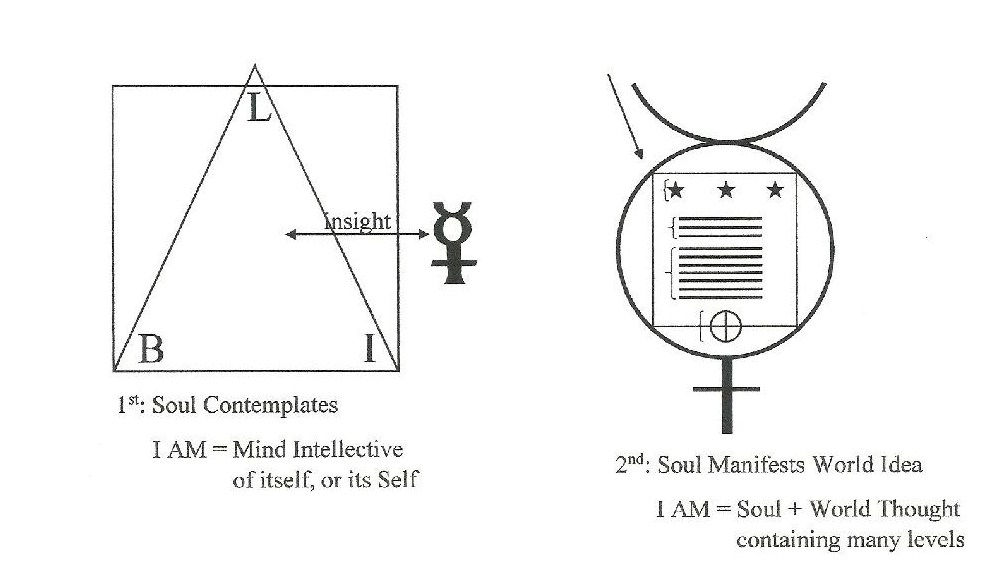
- FIGURE 1983 0902a-1. Soul's Double Act. Originally found in AD/AS paper "Parmenides and the Authentic Existents".
[Transcriber note: If someone is drawing or writing, with audible sounds of chalk on a blackboard, I indicate this by [drawing] or [writing].]
NOTES:
This is beginning of class (8 1/2 pages) – discussion of PB quote (p. 348 Perspectives); cf. Wed night class of 1983 08/31 PB Paras: Meditation.
Partial transcript for 9/2, 9/9, and 9/16/83 exists (Scan File 1983 0902 0909 0916-8hyp P1 TO 150.PDF). Pp. 1-10 covers this portion of the class.
On differences between V14a and V14.1a (this version), from IT: Two more passes were done in 2021 because there were many little formatting discrepancies and errors in the prefatory matter and some listening and other errors throughout the transcript (mislabeled diagram etc.), and also because this is part of 9/2, the second part of which also got two more passes and is now V12a. The audio files have been renamed to correspond to the new format. I got rid of the note at the bottom of page 4 of V14a. On relistening multiple times, the word is clearly "this" and not "his" (12:16 mark).
As of Feb 2020, it has now been divided off as 1983 0902a, PB Paras; Meditation. The rest of the class on Plato's Parmenides is now 1983 0902b, Plato; Parmenides; 8 Hypotheses, Hyp. 1-2A.
TRANSCRIBED Verbatim by IT 2019; IT does two more passes 2021 on V14a; reformatted by JRM & JF 2019-20. TOC and Subheads by JF. In 2025, MW expands Subsubjects and alters Subheads to make more accurate, IT updates audio file markers to match new REP audio. Archival Verbatim Transcript - V14.1a.
AUDIO FILES: 1983 0902a(1). [Note: In 2024, REP Studio splits Audio File 1983 0902a into a(1) and a(2).]
1983 09/02a at Wisdom's Goldenrod
PB Paras: Meditation; Void/ Insight
Archival verbatim transcript
[Audio File 1983 0902a(1) Begins]
THE THREE PRIMAL HYPOSTASES CAN BE REFERRED TO AS THE VOID
[PB para V16, 25:2.109 & Persp., Ch. 25, #32-- not read here, but referred to and read later:]
The deeper one penetrates into the Void the more he is purified of the illusions of personality, time, matter, space, and causality. Between the second and third stages of insight's unfoldment there are really two further subsidiary stages which are wrapped in the greatest mystery and are rarely touched by the average mystic or yogi. For both of them are stages which lead further downwards into the Void. The yogi touches the edge of the Void, as it were, but not its centre. These two stages are purificatory ones and utterly annihilate the last illusions and the last egoisms of the seeker. They are dissolved forever and cannot revive again. Nothing more useful can and may be said about it here. For this is the innermost holy of holies, the most sacred sanctuary accessible to man. He who touches this grade touches what may not be spoken aloud for sneering ears, nor written down for sneering eyes. Consequently none has ever ventured to explain publicly what must not be so explained.
AH: --so we had spoken about that [S, faint: (Did it) last week.] during meditation. This quote seems to suggest that state when it cannot be revived but is like a permanent resolution of the problem of the ego. That-- now that's one thing that is a new idea for me. [student assents, faint] Discussions (later). That's not to say it's not just the meditative experience but a change whereby the ego cannot be revived.
[short pause]
S: Anthony, if-- but you said Wednesday night that there aren't grades of insight, that there wasn't a deepening, it was a widening.
AS (faint): No.
[short pause]
AD: Well he speaks about here as a developing insight into these different grades that will accord with the penetration into the Void. Now, what he's talking about here you're very familiar with, you've been speaking about it for years. Just think of what does Plotinus speak about. What is half the book about?
S: The soul.
AD: Yes. I won't disagree with that, what else?
[short pause]
S: A union with that soul.
AD: Yes.
VM: Say the attainment of the Intellectual vision? Is that one way to frame it?
AD: Well, I mean, well that's true. All these things that you're gonna say are true but wouldn't you say that Plotinus is really concerned with really understanding the three primal Hypostases? And that these three primal Hypostases can be referred to as the Void?
AH: Anthony?
AD: Yeah?
AH: The no-- the notion or the word "Void" is used in so many different applications, could you define how you use it?
THE DISCOVERY THAT YOU ARE MIND, MIND-IN-ITSELF, IS INSIGHT
AD: I pointed out-- I pointed out that insofar that we're speaking about, not now, I pointed it out in the past, again and again, that these three principles can be referred to as void. Absolute Soul, the Intellectual-Principle, the One, these are void. There's nothing there for you to grasp, see, touch, taste, smell. There's nothing material whatsoever. There's no causality with any of these things. They were pure principles, you remember, we spoke about them in that way. And consequently all three of them together could be spoken of as the Absolute too. True, the Absolutely Absolute would be the One. But you could speak about these three principles as Absolute. As far as you and I are concerned, they certainly are. They're eternal, immortal, immaterial principles. They have an existence in, by, and for themselves independent of everything else. So you could speak about them as void. Now if you think of the Void, the way PB speaks about it there, that a developing insight brings you into contact with Absolute Soul. With further development of that insight, and developing here doesn't mean a linear time-frame at all, it's a deepening, will bring you in contact with the Divine Mind. The third time will bring you directly to the One. These are the three principles that Plotinus is talking about.
VM: Anthony, it's hard for me to appreciate this kind of discussion after we've been emphasizing so hard the idea that all you ever contact is your own soul. Now you seem to be opening up. You're saying, yes, that's an important thing to realize at a certain stage in your understanding but now I want to open up the horizon again like--
AD: Well, let's say you've contacted your soul, alright? And by that I'd assume that you mean that self-recognition is there. Ok? Self-recognition means insight, the discovery that you are Mind, Mind-in-Itself, alright. This is insight. Now the deepening of this insight will initiate you into these three primal Hypostases. And each one is an initiation. And so Plotinus very carefully and cautiously, you know, speaks about these principles.
AH: Anthony, you're using the notion of "the Void" as the Void Mind.
AD: I'm using the notion as referring to these three primal Hypostases, these three principles.
LD: The way he speaks of the most holy sanctuary that was (the most--)
AD: The Holiest of Holies, yeah.
LD: That most (significant) [couple words inaudible] in that, you know, I believe he's speaking of the Absolute.
AD: How many Plotinuses do you think there are? How many Sages do you think there really are around? I mean, of course, Plotinus with great circumspection speaks about it, you know, and-- Nonetheless, I think you can see what PB's referring to, these sneering eyes and-- All you have to do is read some commentaries on Plotinus and they're all trying to tell Plotinus how he should have said it. They think they're going to improve on what he had to say. But if you understand this much, then you understand what Plotinus refers to as the union with the One. [short pause] No? If you penetrate right into the core of the Void, where do you think Plotinus got his, you know, information, if you can use that word? Yeah, (Dave).
DB: So-- so are you saying that-- that it's his penetration or association with the One-- with the One which is going to bring about this everlasting annihilation of the egocentric point of view? [S, very faint: Yeah.] With-- I mean these two subsidiary stages are the-- are what actually makes possible that third level of insight and that it's the association with the individual consciousness (to/so) the One which--
AD: It's the other way around Dave, it's the deepening of the insight which makes unnecessary and which destroys permanently the notion of egotism.
[short pause]
LDS: Anthony would it-- would it be wrong to say that this deepening insight has to do with the person, the individual, appreciating or recognizing the mark of the One and the mark of the Intellectual-Principle within the soul, that from that--
AD: No, that's something else.
LDS: That is something else.
AD (simultaneously): That's something else now.
LDS: Ok. [students assent, very faint] Ok.
JL: Yes that--
LDS: That's--
PD: That's [one/two words inaudible]
AD (simultaneously): On the one hand, on the one hand, imagine a triangle, alright, and you have One, alright, Intellectual-Principle, and Absolute Soul, alright, then off that triangle imagine all these little Mercuries, all individual soul. [student assents] And within those souls you're going to see the-- that it has Intellectual Being and etc. all the way in it, ok. [Note: See diagram appended to this transcript, FIGURE 1983 0902a-1, Soul's Double Act; originally in AD/AS paper "Parmenides and the Authentic Existents".] So that this-- you can see how on one sense there's something here which tries to point out how unbridgeable is the gap between the individual soul and the Void, alright, but on the other hand that there is some way that the deepening of insight would take a person to understand something about the Void because without that nothing-- anything that Plotinus said about the three primal Hypostases will be meaningless.
OTHER TRADITIONS RESTRICT THEIR USE OF THE TERM "EMPTINESS" TO BEING, BUT THE TERM HERE IS BEING EXTENDED EVEN TO THE ONE
AH: Anthony? You use the term "the Void" and also used the notion of something being void. Like, I'm still not clear, are you using the term "Void" in the way that the notion of emptiness is used in other traditions?
AD: I think I'm using it more comprehensively because they restrict themselves to Being.
AH: Emptiness of Being.
AD: They restrict their use of the term "emptiness" to Being. The term here is being extended even to the One.
AH: As a des-- as a way of speaking about the One.
AD: Well, way of speaking about the One, yes. But it shouldn't cause you no surprise and no shock to understand that these three primal Hypostases are the Void, if you follow.
S (faint): Uh-hm.
LDS: Anthony, I-- it seems that I remember you speaking of this expression that we get from Plotinus, the explication of the three initial Hypostases as revealed to him. And-- and this would be rare or unique in terms of most people's experience [AD, faint: Yeah.] on the quest, in other words, the topography of the One, the Intellectual-Principle and so on the way he laid it out would not be available to most. That was his-- one--
AD (simultaneously): That's a rare achievement, sure.
LDS: So, what's the difference between saying that, that something of the topography of these metaphysical principles was revealed to him, and the experience that PB's speaking of in this quote?
AD: Evidently it was revealed to PB too. I didn't see the point you're making (Lou).
LDS: Well, I thought there was something different in-- in the sense of-- You said something about Plotinus was given this--
AD: Yeah, it was a revelation, yeah.
LDS: And that for most yogis or mystics who-- who would contact Void--
AD: They contact the void of their own soul.
LDS: Yeah, and they would not--
AD: They don't-- this is something else. Avery, would you put a circle up there on one side and a triangle on the other? I mean put the triangle and the circle, the Mercury circle. [Note: See diagram appended to this transcript, FIGURE 1983 0902a-1, Soul's Double Act.]
AS (very faint): Uh-hm. [drawing]
AD (very faint): Ok.
S (very faint): Ok.
AD: You think-- if you think of that, alright, as the three primal Hypostases and the same as the Void, the same as the Absolute. As far as we are concerned, that is the Absolute that-- Yeah? And now if you put inside the Mercurial circle everything that we put in it, you know, all the stars in there and then one of those stars is the Sun and you're within that Sun, alright, then you begin to get a-- a feeling or a kind of rough schematism what we're-- what they're talking about. PB also had this classification. His wording is different, you know, he uses his own way of saying things and expressing himself. But the ideas behind the two of them are the same. A Sage won't disagree with another Sage. They may explain it a little differently but they won't disagree.
AH: Anthony, could you say a little more please about your earlier statement that these three-- these three Hypostases are the Void?
AD: Well what do you want me to say?
S (faint): Yeah.
AH: Like you--
AD (simultaneously): I mean that--
AH: Is it logical-- like there's a logical conclusion within them that inexorably leads to the notion of Void, is--
AD: Well everything that we read about these three primal Hypostases would tell you that they're the Void.
AH: Certainly the logic of them points there. But--
EACH HYPOSTASIS IS VOID BECAUSE IT IS AN IMMATERIAL PRINCIPLE OF KNOWLEDGE, OR A PRINCIPLE IN ITS OWN RIGHT
AD: I mean what you're asking me to do is to repeat everything we've, you know, have spoken about when we went through the three primal Hypostases. And I summarized it by simply pointing out that they're immaterial. Each one is an immaterial principle of knowledge, or a principle in its own right. Infinite, eternal, etc, all the attributes that you could add, alright, and we spoke about these things. And anything-- as soon as you say anything is in Being or the realm of Being, that it's infinite and eternal and all that, it has to be void. It can't have no size, no shape, no color, none of these things are attributes that you can impose on it.
AH: Would it be correct to think of that as the extremity of-- of metaphysical expression or as far as the conceptual mind could go in regards to expressing this truth, something to that effect?
AD: Well, I suppose you could do that. They're the extremities of metaphysical knowledge because it is the extremity of metaphysics. [short pause] Go ahead David.
DB: Anthony, would the-- the two aspects of this subsidiary development be the association with the Absolute-- Assuming that the second stage of insight would mean the individual has found the voidness of his own soul, would-- and the last one would be a complete understanding of Reality or insight unfolded totally, would the two other stages refer to a Absolute Soul and-- and the Intellectual-Principle?
AD: Yeah, the way I understand it is that the first penetration is the Absolute Soul, then the Intellectual-Principle, and then the One. Can I ask you to read me once more that--
[short pause]
FOUR STAGES OF DEEPER PENETRATION INTO THE VOID: IDENTIFICATION WITH SOUL (INSIGHT), THEN RECOGNITION OF ABSOLUTE SOUL, NOUS, AND THE ONE IS A DEEPENING OF INSIGHT
PB [V16, 25:2.109 & Persp., Ch. 25, #32, CDA reading]: "The deeper one penetrates into the Void the more he is purified of the illusions of personality, time, matter, space, and causality. Between the second and third stages of insight's unfoldment there are really two further subsidiary stages which are wrapped in the greatest mystery and are rarely touched by the average mystic or yogi. For both of them are stages which lead further downwards into the Void. [The yogi touches the edge of the Void], as it were, but not its centre. These two stages are purificatory ones and utterly annihilate the last illusions and the last egoisms of the seeker. They are dissolved forever and cannot revive again. Nothing more useful can and may be said about it here. For this is the innermost holy of holies, the most sacred sanctuary accessible to man. He who touches this grade touches what may not be spoken aloud for sneering ears, nor written down for sneering eyes. Consequently none has ever ventured to explain publicly what must not be so explained."
[short pause]
S (faint): Yeah.
S: This may be somewhat irrelevant to the main idea of the quote but, when he talks about there are two-- these two hidden stages in the developing of insight or the unfoldment of insight, I understand that the stage that comes before that he was talking about would be this penetration of soul. And then the two hidden stages would be the Intellectual-Principle and the One. I don't understand what could be higher than that.
CDA: No I think this--
AS (simultaneously, faint): I think-- I think that-- oh.
CDA: It's-- it was two subsidiary stages, it's between the second and third stages. So he's not at all speaking about the level of the One there as far as I understand.
AS: I-- I think the four-- I'm not sure but, the four stages, he has this essay on insight and he goes through those four stages, I think, I mean I think that's what the reference to the four stages is. The first stage of which he speaks of as the first glimpse (and/as) he calls that the soul's (f--) By the fourth stage, the fourth stage is Sahaja, where he's established in Reality whether the world is going on or not. At the second-- the second stage, and he seems to describe as the-- these glimpses become more frequent. And in that essay, the third stage, and he doesn't describe how you go from two to three, but in the third stage he says the-- when you get to the third stage this is where the ego has been completely-- there's no possibility of the egoism returning at all, in the third stage. So the fourth-- the nor-- the fourth stage as he's referring to in that o-- in the other essay seems to refer to this-- the making permanent of that insight, but not to a deepening of that insight in terms of the Nous or the One. Whereas here he seems to be bringing in this other notion which he doesn't talk about in that other essay at all, that there's a deeper-- you know, just a deeper penetration into the Void. And I think the point was-- that we were making also was that-- what Anthony made was that the annihilation, the complete cessation and the impossibility of return of that egoism is the result only of that deeper penetration. It seems also you could say like the mystic would normally get to the first two stages. But that to go beyond that would be-- 'cause, you know, he's maybe satisfied with-- with the knowledge of his own soul's essence. But the Sage let's say or the philosopher is interested in an understanding of the Divine Mind itself and so by its Grace he (holes/holds) further into the Void. But, I just thought the clearing up those four stages that are mentioned-- are mentioned in the-- that essay, in the unrevised essay, he goes through the four. And they're kind of--
AD (simultaneously): Yeah, they corr-- they correlate with what he says here.
RC: How do you relate those four stages to the interpretation that you're giving to this one here?
AS (faint): That's just--
AD: That's what he just did.
AS (simultaneously): That's what I just did.
AD: What he just did.
S (faint): Yeah.
AS (faint): But--
AD: Go over it, Avery.
AS: Well, in this-- in the-- well, in the Plotinus-- in that article, the-- those four stages you described are-- insight there is of a uniform (let/what)-- deepness let's say, that he's really-- in the stages of unfoldment of insight he's talking about making insight permanent [student assents] from the first stage of a first glimpse.
S (simultaneously): Yeah.
RC: Yeah, in that article he talks about basically four levels of effect of insight.
AS: Well, he has that in there too but I understood that the first level referred to-- he said that's the glimpse, your first glimpse. In other words, a glimpse into the reality of your own soul. [RC assents] At the fourth stage he says now you're fully established, you're in Sahaja. He-- it's unbroken, you never leave that even when the world appears and so on. Now in between he has those two other stages, the second of which seemed to be-- he seemed in terms of experience to get these glimpses into the soul's essence more and more frequently, you can go into the Void, you know, more often, [RC assents] you're working it back. The third stage seems mysterious 'cause he says the result of-- at the third stage, he's at the third stage when the effect is his ego is-- there's no more egoism whatsoever.
RC (simultaneously): He says there's no more arisal of lust, passion, and no possibility of anger.
AS: Yeah, there's no po--
S: Well I have to read (him).
S (faint): Uh-hm.
AD: You could very easily do it this way. The identification with the soul is the first stage. There you're established or you have insight. The deepening of that insight is a recognition of the absolute source-- or I should say the Absolute Soul as the source of the soul. A deepening of that leads to the Intellectual-Principle, alright, which then culminates in the deepening [RC simultaneously, faint: Ok.] until it reaches the One, you could make these rough correlations. And, I don't think any of us know what it means to say a deepening of insight.
S (faint): (Ok.)
LD: But when-- when you're identified with the soul in the first stage, egoism can still be alive (in a way)?
AD (simultaneously): And still is, yeah, it still is.
S (very faint): (There's) no doubt, uh-hm.
RC: Yeah, the way he puts it [AS simultaneously: Yeah that--] in that essay it says first let's see-- how-how do you know if you've-- if you've reached insight? Well you can tell by its effects that you bring. First level, selfishness has been dealt a blow from which it won't recover and you can no longer be as selfish as you were before. Then he says at the second stage lust, passion, and anger come fitfully but they don't last long and they don't get very intense. [AS assents, faint] And then he says at the third stage, lust, passion, and an-- lust and passion are gone completely and there's no possibility of anger. [AS, faint: That's right.] I'm having trouble putting those together with that [S, faint: Yeah.] other one.
AS (simultaneously): But Randy-- Randy what I said didn't-- you didn't-- that didn't make sense to you? Because he also, in the essay, you remember, he also describes it in terms of the frequency. If the first one is the first glimpse and at the end he's talking about established in Sahaja. [RC assents] And I-- this quote to me seems to mean also that you won't be established, you won't be es-- you can't be established in Sahaja when you come back if you have any-- if there's any egotism, that is, any of that desire, tendency, desire for separative existence. And that won't be obliterated unless he actually goes beyond just knowing the essence of his own soul and actually recognizes a deeper-- or experiences a deeper penetration which even goes beyond your soul in a way.
PC: Wait a minute.
S (very faint): That sounds too hard.
PC: I don't-- I don't-- yeah, I don't see that because--
AS: Ok.
PC: What about a Sage like Ramana, would you say that he penetrated into the Divine Mind and the One?
AD: He what?
S: No.
AS (simultaneously): I would-- I would say yes, at some time.
AB: The distinction we made between the philosophic Sage and the [AS simultaneously: And a Sage, yeah.] Sage was in the ability to develop a subtle thinking and explain the principles but perhaps not-- but perhaps a Sage and the philosophic Sage would both have these four levels of insight available to them. The difference is in being able to unfold it as Plotinus or PB would have done.
PC: I see. So you-- you're saying that you couldn't really go to the third and fourth stages without going through these subsidiary-- subsidiary penetration(s).
AB: And I'm guessing that perhaps the Sage goes through all four of these as well as the philosophic Sage but the philosophic Sage can express it through his refined thinking.
S: If-- that's not there for most people.
AD: Yeah, you could see also in the example of Ramakrishna, [AB assents, faint] who was brought to that ultimate state by Totapuri, in spite the fact that some of his students disagree with that. But I would say Ramakrishna was brought to that last state by this teacher of the Advaita who brought him all the way through.
[Audio File 1983 0902a(1) Ends; end of PB Paras; Meditation; Void/Insight portion of class]
1983 09/02a V14.1a: CLASS: PB Paras; Meditation; Void/Insight. Copyright 2021 Wisdoms Goldenrod. p. ii