DIAGRAM AND CHARTS FOR 1983 0905a
Class
Monday, September 5th, 1983
Verbatim, unedited transcriptClick the series name to view more
CLASS at Wisdom's Goldenrod, Hector, NY
with Anthony Damiani (AD);
September 5a, 1983
ASTROLOGY; THEORY; DRAGON; SYMBOLIZATION
TOPIC: Astrology
SUBJECT: Theory
SUBSUBJECTS: Dragon, Symbolization, 360 Degrees, Cosmology, Epistemology
CONTENTS:
Teilhard de Chardin: biosphere and noosphere
Dragon as Earth's aura, extends out to the Moon
Earth Soul as traces of life activity
Earth Mind as seven planets; these are also powers of the Sun soul
Sun is the distributor of the Ideas to all the planets
Activity of all the planets is felt within Earth's aura
Dragonic world-image given to individual mind, not to senses
Functioning of psychosomatic and appearance of world are concomitant
Infinite Mind of Earth is constantly reorganizing Earth's memory images
Dragonic world-image given to reproductive phase of soul from moment of birth
Animate
Destiny of body is predetermined; soul is not in the same situation, can rebel against that
Destiny predetermined unless gurukula in chart
Chart indicates dominant ideas manifesting as one's life from which the mind will extract meaning
Body and life of body coming from Earth; body as embodied reason-principles
Individual mind has to understand experiences body has and even influence the course of events
Sage has available multiple states of being
Heart center = mind
Soul has simultaneous knowledge of all levels of World-Idea within itself
All of our understanding is inside the Dragon
Natal chart is mirror for reproductive phase of soul
It is possible to organize a way of seeing into the Sabian symbol
Clairvoyant penetrates into the astral realm and gives us an interpretation of Earth's memories; general level of culture, refinement, understanding of clairvoyant will determine the kinds of symbols that are produced
PB is only interested in the highest truth, not in the psychical
There is a need for astrology to be given a spiritual, not merely a psychical, basis
When you truly understand something, you are beyond space and time
Reading C.G. Jung on symbolism
Reading Eliade, Myths, Dreams, and Mysteries, on myth and symbol
Myth equated with zodiacal degree
Each degree is a self-subsistent reality, is creative and exemplary
A degree is the model on which your behavior is based
Each degree is a universal and unveils a mystery/idea
You are living the mystery, the Parmenides is a corpse by comparison
360 degrees give stability and significance to experience
More discussion of Eliade on myth and symbol
Degrees are most pivotal thing about a chart; planets in aspect without degrees are meaningless
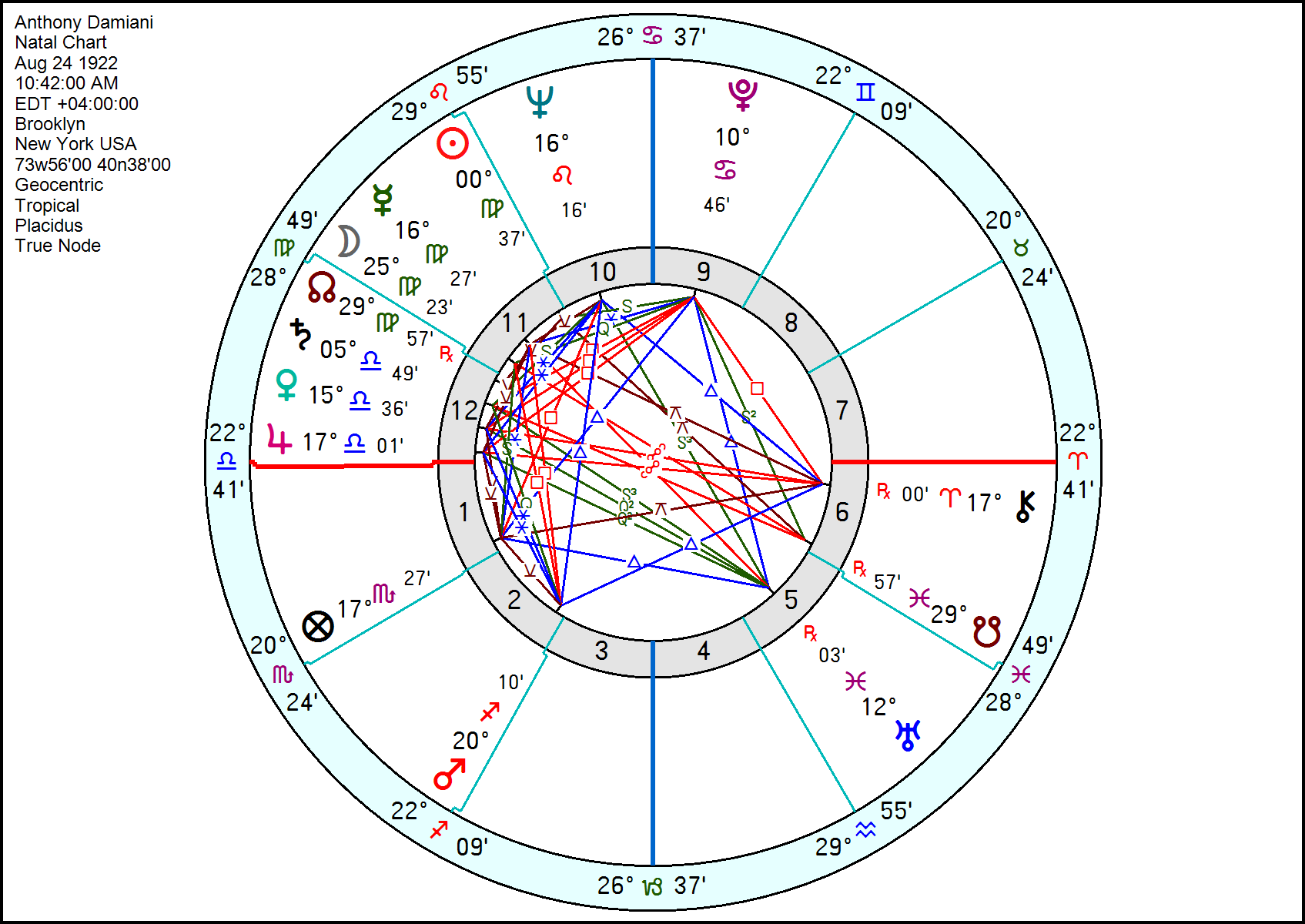
Discussion of AD Mercury at Virgo 17
Virgo 17: getting to the bottom of something
When AD thinks about something, has to get to the bottom; may take years
Greatest miracle of all is the gift of Being
Why is it that the very simplicity of Truth is always beyond us?
Dalai Lama can visualize all 360 Gods
PB: Meditation on Sun must be done for a whole year
When reading a degree, pick up whole matrix and see which way you're led
BOOKS READ FROM OR REFERENCED:
Paul Brunton, The Hidden Teaching Beyond Yoga
Paul Brunton, The Notebooks
Desiderius Erasmus, Erasmus' Annotations on the New Testament
Rene Guenon, The Multiple States of the Being
C.G. Jung, CW 16, The Practice of Psychotherapy, "The Practical Use of Dream-Analysis"
C.G. Jung, CW 18, The Symbolic Life, "Symbols and the Interpretation of Dreams"
Mircea Eliade, Myths, Dreams, and Mysteries: The Encounter Between Contemporary Faiths and Archaic Realities
Marc Edmund Jones, The Astrology of Concepts
Marc Edmund Jones, The Sabian Symbols in Astrology
Isidore Kozminsky, Zodiacal Symbology and its Planetary Power
Plato, Parmenides
Plotinus, The Enneads (MacKenna translation, 4th ed.)
PLOTINUS QUOTES READ OR REFERENCED: I.1.7, IV.3.13
SABIAN SYMBOLS: Virgo 17, Libra 24
DIAGRAM and CHARTS appended to this transcript:
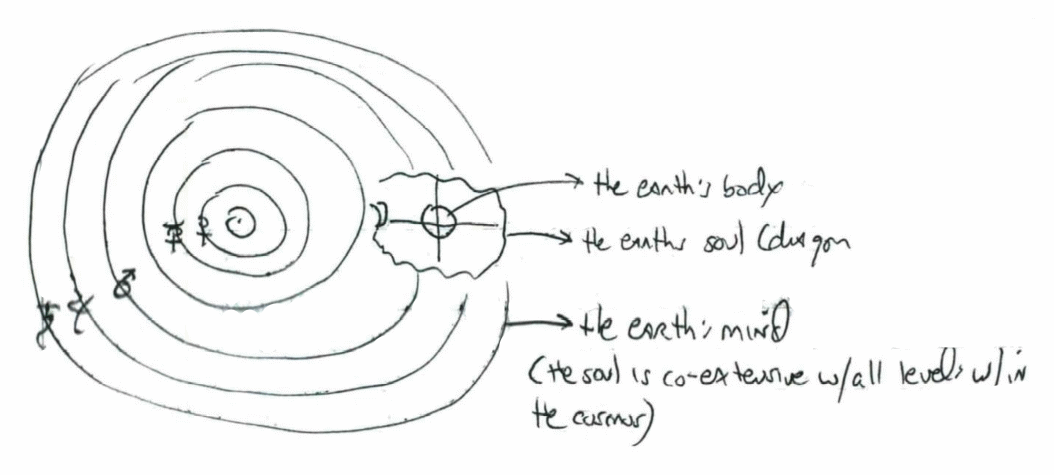
FIGURE 1983 0905a-1-AB. Earth Body, Soul, and Mind.
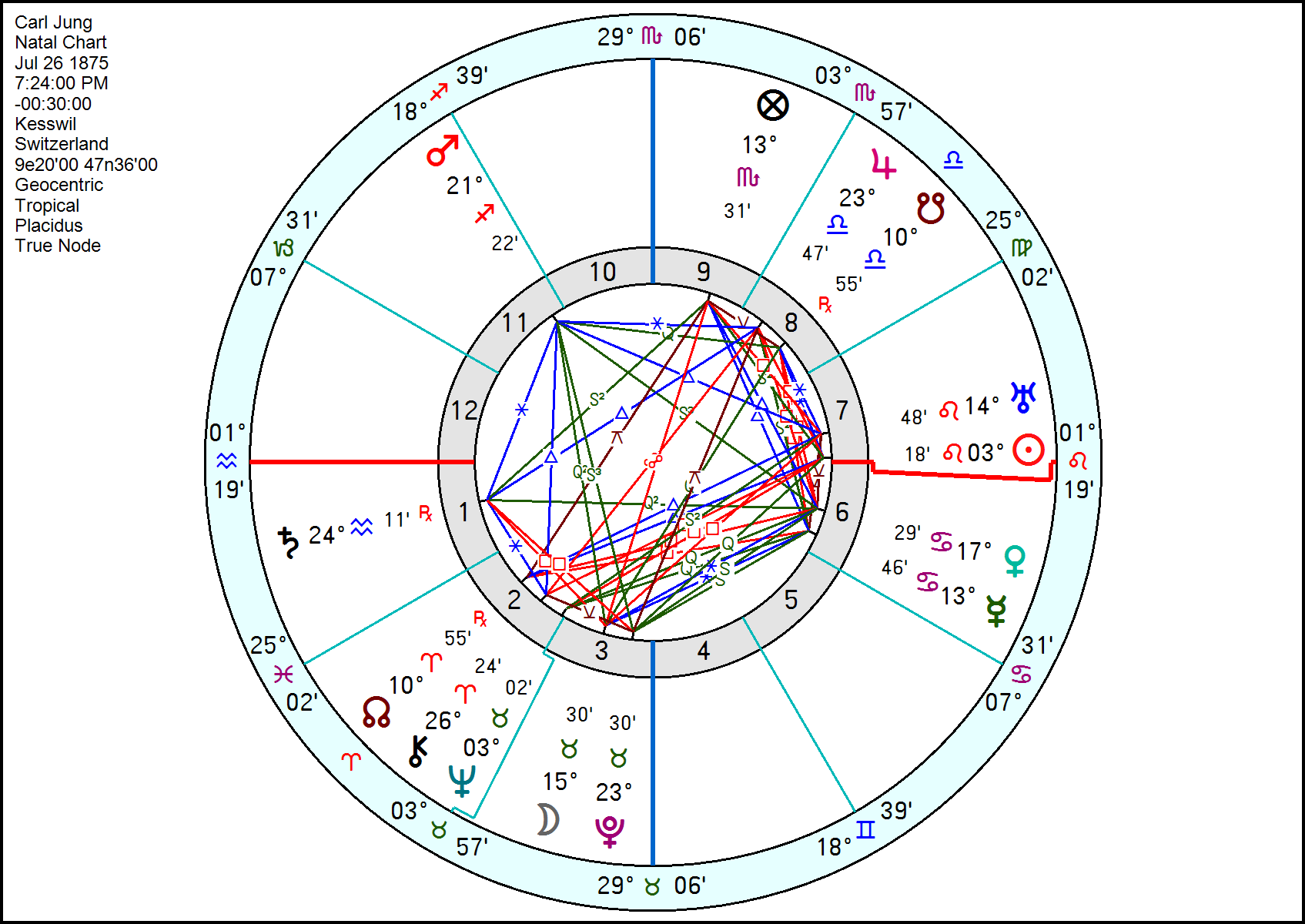
FIGURE 1983 0905a-2. Carl Jung Natal Chart (astro.com).
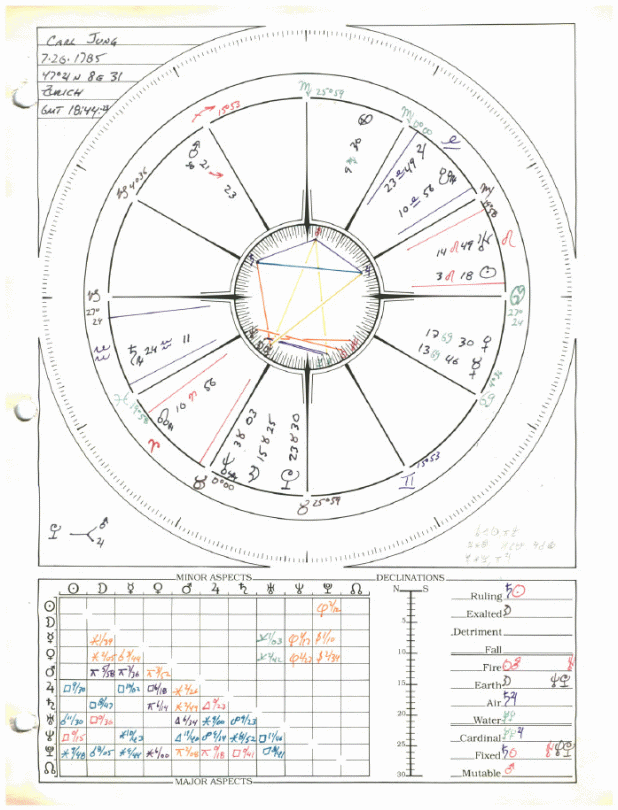
FIGURE 1983 0905a-3. Carl Jung Natal Chart (WG version).
FIGURE 1983 0905a-4. Anthony Damiani Natal Chart.
Other diagrams also referred to are not with this transcript version. [Transcriber note: [diagram] means the speaker is referencing a diagram as he or she is speaking. If someone is drawing or writing, with audible sounds of chalk on a blackboard, I indicate this by [drawing] or [writing].]
AD PAPER referred to in class:
- "Astrology Outline". Retyped as ASL Astrology - Theory - Outline V09P from Scan File ASL theory outline astrology N 9p.PDF.
NOTES:
This is 1983 09/05a, Astrology; Theory; Dragon; Symbolization Class, and the first entry associated with this date. 1983 09/05b = Astrology; Theory Seminar from earlier in the day, for which we have no audio, just JF notes.
MONDAY night class, usual night for ASTROLOGY.
TRANSCRIBED Verbatim by IT prior to 2018 (V11a). This is V12a (2023) and has: updated prefatory matter, footer, and audio file name; Book List and TOC completed; new notes within transcript; diagram from AB notes added and reference in transcript to this diagram, Jung and AD charts replaced. Archival verbatim transcript – V12a.
AUDIO FILES: 1983 0905a, 1983 0905b. [Note: "Tape" and "Side" refer to original audio cassette tapes that were later digitized into .MP3 Audio Files.]
1983 09/05a at Wisdom's Goldenrod
Astrology; Theory; Dragon; Symbolization
[Audio File 1983 0905a Begins]
RG: --um, and three levels of ideas. And then we'd talk ab-- then we're going to talk about the epistemology and how to read your degree symbols in a chart. So that's where we're up to [S, faint: Thank you.] in the subset of this outline thing--"How to read a symbol, deal with world of images…" [Note: See "Astrology Outline," section I.D.1. Retyped as ASL Astrology - Theory - Outline V09P from Scan File ASL theory outline astrology N 9p.PDF.] So we're (talking) about the idea of symbols, how to read them and how to-- what's the mechanism of [one word inaudible] out in the Sabian symbols or any other set of symbols.
AS: Do you think it might be more [couple words inaudible] setting them in a context [couple words inaudible]
RG: Anthony, what do you think?
AD: I didn't hear you.
RG: Do you want some context of the discussion we're going to have about symbols or just want to-- to jump into the symbols, the idea of symbols?
AD: Well, do you want to go over some of the points in Guenon?
RG: Today?
AD: Yeah.
S (very faint): Yeah.
S (faint): Just today.
AD: And if it, you know, altered or anything, see if we, you know, like still agree with what we said.
S: If we still agree with what we said? Well it seems-- and if we--
AS: [one/two words inaudible] just a benchmark.
S: Yeah.
S (faint): Yeah.
AS: Well--
[short pause]
S: Carol, I can just read the notes here.
AS: As long as (we getting them).
S (faint): I'm ok.
S (very faint): Uh-hm.
RG (faint): Can't think of any symbol(s).
S (faint): Alright.
LR: I mean the problem is-- actually Anthony's writing is, you know, beginning to reflect [couple words inaudible] the Dragon is. But the issue that we're concerned with is not the Ideas per se because that's going to be fully explained in another book, but the World-Idea specifically because that's what we concerned ourselves with [couple/three words inaudible] epistemology and astrology. So, the first question is-- was, the image is first and then our experience arises. That's a PB quote. [Note: Paul Brunton, The Hidden Teaching Beyond Yoga, p. 303, New York: E.P. Dutton & Co., Inc., 1969.] So the question is, what is that image that is first that gives rise to our experience. You're already disagreeing? You disagree with-- (LR laughs a bit)
AD (faint): I didn't say anything.
AS: Did I?
LR: Oh I don't know, I thought you were shaking your head. So, right there in that context (with Uranus) we saw at the level of [couple/three words inaudible] and we haven't solved in many different ways but we were speaking about this, the part of the soul which desires earthly life, we're talking about that part which is embodied. And the background for that of course would be that the inerratic spheres project the life and the Ideas and the planetary spheres are continually reconstituting this image, that basically the image is what we're calling the Dragon, given by the Dragon, the belt surrounding the Earth. And that's what we were trying to restrict ourselves to, that level, in terms of describing what is. [short pause] And in the investigation of some other people's language concerning a description of what that level of the World-Idea, this guy Chardin talks about the biosphere and the noosphere.
S (faint): Ok.
S (faint): Yeah.
LR: Biosphere and noosphere.
VM: Nous?
LR: Noosphere, by which he means a belt of concepts, accrued concepts from all the images, and the biosphere being the vitality, the stored vitality (of life).
S: Who speaks about that?
RG: Teilhard de Chardin.
S: Oh him.
LR (simultaneously): Is that (wrong)?
AS: No.
S (faint): Yes.
S: Who?
LR: [few words inaudible]
RG (simultaneously): Teilhard de Chardin, you know, the Christian [couple/three words inaudible]
AS (simultaneously): It must just be my face, I can't help (it all). (some laughter, student assents)
VM (very faint): It's a very popular name in France.
AD(?): Look, (if/it)--
LR: It is a popular name?
VM: Well actually, a lot of his work has been popular with the students and stuff like that. Some of it has now seemed to really caught on but I don't know anything about him.
LR: Ok. So, now we're in the realm of discussing the Dragon and what that-- what the Dragon [couple/three words inaudible] we mean by it(,) having--
AS: Well, just, there was also that-- that other one, that the world is presented to the mind.
TS (faint): Uh-hm. More like (an) [one word inaudible]
AS: That other quote you read, this world is presented individually.
[students assent, very faint]
LR: Yeah.
AS (simultaneously): That could go in a lot of stuff.
S (faint): It might.
S (very faint): What'd you say Avery?
AS/S(?) (faint): Well, (here's) the quote.
[short pause with faint background student talking, flipping of pages]
LR: Um-- [short pause] So, we said then that the organism is the way in which the Dragon is constantly viewing himself, in other words, the life of this entity that we call the Dragon which-- his life is like a culmination of all the lives lived and is constantly alive by virtue of all the lives that are being, so it's through every creature that the Dragon (permits this, so) that the Dragon draws its ideas, for instance. Is that right? Are you ok?
TS (faint): I always think of it a little (different/differently) [possibly one word inaudible] And it's how he says that the planetary spheres are constantly reconstituting the memories of the Earth and so really there's an image which was a living entity surrounded by (all of them).
CDA: Can't hear you. Sorry.
AD: Repeat.
TS (faint): Once again. And I-- I thought that the Dragon was said as the-- this biosphere of the Dragon was some authentic living entity which we-- which is part of the Earth Soul and which is-- and which is constituted by the activity of the planetary spheres arranging or rearranging the organism, the memory traces within the Earth Soul, within the Dragon.
S: Uh-hm.
TS: Yeah. And that the individual living creatures, together with the totality of their life experience, were specific-- specifications because of their animal body, animal experience, from that field which we call the Dragon, and hence that Dragon, the Dragonic consciousness, overrides or infuses itself into both the percept of the animal and the (perceiving) consciousness (of--)
[short pause]
S: Question? Ok, I want more of this theory--(where/what) is this Dragon? Is-- [TS simultaneously: Here we go.] does it go-- is it-- no, no-- I'm-- no. Does it-- is it within the Moon, do you know what I mean? It's got to stop somewhere. [student assents] You can't say it goes all the way out to Saturn.
TS: No, no, it's a-- as I understand it, it is a part of the actual aura or field of life of this particular Earth. I think that would be sub-lunar.
S: Yeah, ok. Or it's got to stop somewhere even closer to Earth than that, I--
TS (simultaneously): Well, I wonder about the Dragon (den).
AD: Maybe he goes up to the Van Allen belt?
S: I don't [VM simultaneously: Maybe.] know Van Allen. Is that somebody we know?
AD (simultaneously): You don't know Mr. Van Allen?
VM: Oh, Mr. Van Allen's a very sweet man from Indiana [Note: Iowa]. How many Earth radii this cloud, that's what we want to know. (some laughter, student words) Is it outside of the (Florida) Space Shuttle?
S (faint): I don't know. (some laughter)
S: I don't know.
S: Uh-hm.
S: [couple words inaudible]
PD (simultaneously): (Can be a drummer?) Can you say [S simultaneously: It's known by (couple/three words inaudible) the Moon.] it's like the concept of the aura as applied to the Earth?
AD: Yeah, it's-- it's the Earth's aura we're talking about as the Dragon.
S (faint): Yeah.
S: Yeah, that's what I know, but I want to know how far.
RG: How far?
AD: To the Moon.
S: Uh-hm.
S: To the Moon, but not beyond it.
AD: Not beyond the Moon.
S: No. Ok, thank you.
S (very faint): Thank you.
S: Ok.
S: We're going to draw [one/two words inaudible]
VM: The only trouble is [AD simultaneously: (couple words inaudible) no more.] if you go there-- I know, [someone drawing] probably sooner than I like. But if you actually were to leave, let's say-- I'm sorry, this may sound crazy. Let's say if you got in a spaceship, which is obviously not hard to understand or to imagine, and you actually left Earth's gravitational field and went beyond the Moon, insofar as you take your psychology with you in some ways, you still never left the Dragon. [student assents] Wouldn't you say? I mean, Dragon consciousness anyway. [S: Right.] Physically you've really left the Earth but you take the Mother with you.
AD (faint): They go with you.
VM: Right, ok. That was my bow and arrow. (some laughter)
AD: You won't be alone. (some laughter)
RG (faint): [couple/three words inaudible]
[10 second pause]
[Note: See FIGURE 1983 0905a-1-AB, Earth Body, Soul, and Mind, appended to this transcript for the following.]
AD: Alright, we're saying that this is the Dragon [diagram], it goes around the-- goes around the (Moon/Earth).
S (very faint): Yeah.
[short pause]
JC: Can we say the Moon is the principle of the Dragon, that's its organizing the whole of the 360 degrees of the tropical zodiac?
AD: I don't know, uh-- Jeff you should be able to say that now but you don't have that [one/two words inaudible]
[few seconds of faint background student talking, laughter]
JC: Well, I mean, the Moon rules I think the animal, vegetable, mineral, and all of what's under the sphere.
AD: Yeah, but if you take the-- if you take the impress that the Earth's rotation around the Sun or the Sun going around the Earth makes on the Earth, you get that strange serpent coiled around the Earth.
JC: Yeah, it's based on the relationship of the-- the tropical zodiac's based on the equator and the ecliptic [one word inaudible] or the relationship of the Earth's equator with its path around the Sun. [AD and student assent, faint] Determines that-- the Aries points. On the other hand, the Head and Tail of the Dragon that we referred to is a particular lunar phenomena. It has to do with-- and in fact if the Moon-- it certainly is one of the seven spheres but it's the Ear-- but it's the Moon of the Earth. Mars has Moons and other planets have Moons, so in some way it is the-- purely concerned with the life, the animal life, the organisms that will live on that planet that the Moon is associated with. So--
AD: Are you asking, what is the origin of the tropical zodiac, to come from the Moon or the Earth?
JC: Well--
AS: I think that the difference [one/two words inaudible] to the origin Sun. [AD simultaneously, very faint: Yes.] The life traces are deposited by the Sun but once they are deposited on the Earth they're governed by the rotation of the Moon in some way. In other words, once they're-- once they're no longer the original, you know, energy, it's the-- all the life must come from the Sun, [JC: Right.] but once they actually are life deposits then it seems that-- that means their organization would be determined by the Moon, but not their origin. Once they're left behind they-- Yeah it just de-- depends on [few words inaudible] instead of calling it [couple/three words inaudible]
JC: Are you saying sort of like, [AS simultaneously: (couple/three words inaudible) sphere.] as memory traces they may be under the rulership of the Moon, [AS simultaneously: The Moon, yeah.] but as the creative process of the Sun [AS simultaneously: They come from the Sun, oh yeah.] projecting the images they'd be Solar?
AS (simultaneously): They're traces of life activity. [student assents, faint] But once they're instantiated as it were, now they're memory traces and in a sense like they're under the influence of the Moon.
AD: But they do belong to the Earth.
AS: But belong to the Earth.
AD: Uh-hm, yeah.
VM: What do you mean "belongs to the Earth"? Right?
AD (very faint): Go ahead.
S (very faint): I-- I don't know.
AD: I don't know. In the same way that you could say the seven planets belong to the Earth too, uh-hm.
JC: Because they seem to go around the Earth?
AD: Well, insofar that you-- if you speak about the Infinite Mind and you're referring to our Earth, that would be the seven planets. But on the other hand, the seven planets are powers of the Soul of the Sun. Now who do they belong to? If you-- if you start this kind of enquiry you get nowhere, because the point here is to bring out-- to bring out all the-- all the ideas and the connectedness. But if you think that you're going to be able to achieve that, you know, you're crazy. Web of relationship extends from one end of the universe to the other, you'd never be able to do that, but we can at least try to get some of the pivotal ideas that we have to have in order to understand something about astrology. So, if we think about the Sun as basically the lens through which the Ideas get focused, and these Ideas let's say get-- organize life on the Earth and then we-- this life on the Earth remains as part of the Earth's substratum and we think of this as the Soul of the Earth, then you could think of all the planets as the Mind of the Earth. [VM assents, faint] Alright. But you could also think the other way, you could think of the seven powers-- all the planets as representing the powers of the Soul of the Sun. And, though they sound-- they sound contradictory, they're not. And these two things are going on at the same time. So if I say thank you to the Mind of the World for this food, ok, it could be referring to the Infinite Mind of the World, it could also be referring to the powers of the Soul of the Sun.
PD: Well maybe I'm-- I misunderstood Jeff but I thought you were trying to come from actual astronomical symbolism, that the Moon is a satellite of the Earth and when you take like the heliocentric point of view, you no longer speak of the Moon as one of the seven pla-- principles, but the Earth has to take its place, if you-- if you have a centric point of view. So the Earth, Moon, Head, and Tail all have a specific relationship to the entity-hood of Earthness.
[short pause]
AD: I don't think I understand your point of view, try again. Try again.
PD: From the heliocentric point of view, you really can't speak of the Moon as the principle, you have-- [AD or student assents] the Earth has to take its place. And from the geocentric point of view, from the Earth's point of view, and speaking about the Dragon, it seems like we could-- we have three or four factors involved, you had the Earth Moon relationship, then we had the Head Tail relationship, and all of them are part of that complex of the Dragon or the Earth's own being.
AD: Well I don't know if the Head Tail is an--
PD: Well I'm just coming astronomically, I'm not--
AD: Yeah, astronomically, I don't know what that means. I don't know what the Head Tail means astronomically. [student assents] But, if for instance, if this is the Sun [diagram], alright, we can take the position and imagine everything going around the Earth or we can imagine, here's Mars [diagram] and Mars as it moves [one word inaudible] going around and that's not important, but from point of view of Mars, alright, it has its own auric belt around it and the life peculiar to Mars is determined by the auric belt, alright, and so that would be true of every planet. In other words, the inhabitants or the kind of life that's living on each planet is basically coming from the Sun because it's the Sun that is, let's say, the focus of the Ideas which get, let's say, rayed into a planet. So I'm thinking of the Sun basically as the distributor of the Ideas to all the planets. But at the same time that doesn't prevent us from saying that each planet, alright, can also conceive of the whole working on it. So this is a reciprocal thing that happens with all of them. Each planet could be the center, could be a geocentric position, alright, [S simultaneously, very faint: I see.] and we also have the heliocentric position, ok, position of the Sun. So, you can-- you could look at it that way. But the point-- the point that we're really interested in it is this here [diagram], they call it the-- the aura of the Earth, and this is supposed to be the belt, the life belt around the Earth, and the only reason I had Avery read the Chardin was to-- well-- Because here's a man who's written this book in 1950 and he-- and people get excited, biosphere, noosphere, what a great idea! The damn thing's been around for thousands of years. They call it-- they don't call it the biosphere, they call it the Dragon. Just change the word and you can get very popular.
VM: It's really surprising how little seems to have been written about it, or at least what's readily available.
S (very faint): Yeah.
AD: Yeah.
VM: Because we're swimming around in it so we can't objectify it at all?
AD: No, I-- If it's true, but how much has been written about the astral world with any-- any [student assents] kind of understanding?
VM (faint): Yeah, ok.
RC: Anthony, that-- the picture of like the aura that's around the Earth, I wonder if-- if that's possibly a little misleading in the sense that-- that isn't-- don't you (use) to include in that the fact that each of the planets actually does appear to be where it does appear?
AD: It what?
RC: That-- like the trop-- basically the positions of the tropical zodiac appear only from the point of view of the Earth. And so the very constitution of the tropical zodiac regardless of how far the planets might be away in space at any given time are included within that interpretive or network of the Earth in the sense that--
AD (simultaneously): Well, what we would say would be something like that. We would say that any activity that goes on within the aura of the Earth is going to be the activity of all the planets.
RC: Right, but like specifically that two of them might happen to be in square from that perspective would be a phenomena within the Earth's aura and not within the heliocentric (perspective/point of view).
AD (simultaneously): Well, it'll also be a phenomena going out outside the Earth's aura but [student assents] it will also-- the effects will be felt within the aura or, let's say, within the Dragon. So [RC simultaneously: Keep going.] if you have a square out in the sky, alright, you say that square belongs to the Earth. But at the same time, everything-- the effect it has upon us would not be the one out here [diagram], it would be the one inside this [diagram].
RC: I guess that I'm trying to say a little bit more in the sense that that square doesn't exist except in relation to the Earth, that it's the Earth that interprets that as a square and that in the heliocentric zodiac it would not be a square.
S (faint): Yeah.
AD: Yes but, I wouldn't put it that way, I would say it exists, and more besides. I mean a square is a phenomenon which is associated with the position, the relative position, of the Earth, granted. If the Earth wasn't there, there would be no square, granted. Sure but, we're not talking about those kind of ifs. We'll-- we'll also say that every other planet could have these aspects, all planets will have aspects. [AS simultaneously: Yeah but--] And if we zero in just on the Earth, alright, then we could say the Earth has a square.
AS: Yeah. And if you-- if we were really going to follow the, would you say, precision of our terminology, the square actually belongs to the Earth Mind, [student assents] not to the biosphere, because it's for the Earth entity, that Earth entity in a sense, but its point of view extends out beyond what we just calling the biosphere to consider the Earth Mind. So the square is like that to the Earth Mind.
S: But now what does that mean?
S: When you say the World-Idea is presented to the mind, what is the World-Idea then?
AD (simultaneously): (Well) wait, wait, wait, wait, we're coming to that.
LR (faint): Yeah.
S (faint): Uh-hm.
AS: That was the point. That was the main point--
S: Right, but I don't un-- What is the World-Idea then?
AS (simultaneously): --what's the World-Idea and what is the mind.
S: Right.
AS: Well--
S: Um--
AS (faint): [one/two words inaudible]
S (very faint): Right.
AD: Because the-- the question, when PB says that the World-Idea or the world-image is given to the individual mind, the question we ask is, what does that mean, what is he saying?
S: Well that it's [one/two words inaudible] we limited that to the Earth point of view, particularly [one/two words inaudible]
AD (simultaneously): Well isn't that enough? Isn't that enough?
S (faint): Possibly. [couple inaudible student words] If that's the way you want to go.
AD: Alright, so when PB says that, when he says that the World-Idea is simultaneously given to each individual mind, alright, so that each individual mind is given the World-Idea, what is he saying? And that was the point that we were discussing [one/two words inaudible]
S: But you're saying it's something that's reflective. If you say that it's contained within the biosphere or within the Dragon then you're saying that the World-Idea that's presented is only a reflected idea in the [one word inaudible]
AD: Well I didn't-- I didn't say it exactly that way. [student assents] I think Linda should be able to explain it. [couple inaudible student words] [short pause] Look, let's go over this. We spoke about every creature that exists on the Earth, a product or included or is a part of the Dragon. [S, faint: Ok.] That's really important here. Each and every body on the Earth is made from the very material of the Earth. This body is composed of five sense functions or five sense-organs. Now, our notion is that it is the senses that see the world and deliver the reports to the mind. [student assents, faint] PB said, "No, it isn't that way. The World-Idea is given to the mind, not to the senses." [Note: PB, V13, 21:2.33.] Now, what does that mean? Now that would mean that you would have to have a picture of the world with your body in that world and these two simultaneously, the world being a correlate to the functioning of the senses, alright, so that any modification in the sense structures produces certain appearances, you know, like you rub your eye, you get a blotch of light, alright. Those two are correlate, you get-- if you have one you get the other. It is these two which are given to the mind. [VM assents, faint] Is that so? You follow that?
S (simultaneously, faint): That's so, yeah.
VM: [one/two words inaudible] one of the things that you're making in this discussion of the Dragon might be that the point you were trying to emphasize is that granted that the-- the world is given to the mind and that the mind interprets that particular input according to the structures within this Dragon according to what you'd call the path of tropes and so on?
AD: No, I'm leaving that out now-- right now, Victor.
VM: Ok.
AD: I'm just saying, you have a picture of the world, right? Sights, sounds, smells, odors, etc, feels, touches. [student assents] All that, alright? You have a body that's part of that world. [S, faint: Ok.] And because the body functions in a certain way, certain appearances arise, alright, so these two are always together, you don't have one without the other. Now, this is the image of the world, this is the World-Idea. This is given to the mind. [S, faint: Ok.] Forget about the Dragon now. [S: (He's gone.)] [student assents] It's given to your mind. It's-- isn't that analogous to when we spoke about, you're looking at a dream image and you perceive both the dream subject and the dream environment without, you know, any intermediary, we were-- alright. So then the dream image is directly given to the dream mind. Then could we go this-- use the analogy here and say the imaged world is given to the individual mind.
S (very faint): [one/two words inaudible]
VM (faint): Go ahead Avery.
AS: And I think you made a point there, all these individual bodies, these individual organs, the psychosomatic organs or organized bodies, are like eruption(s) out of that aura of the Earth. They're-- every single bodily organism is an eruption or is composed of all the tropes or composed of a certain subset of the tropes. And so when the World-Idea is energized continually by the planets, the bodies themselves are energized and produce a concomitant image, the world that-- that whole biosphere is energized and all of the individual bodies, bodily receiving organisms or apparatuses, are themselves [AD or student assents, faint] stimulated to have a concomitant image. Now, all of that doesn't consider yet the mind to which-- awareness or whatever, (to/through) which this all occurs, because all of that, the whole thing, is given to a mind which knows-- which in a sense has in it both the receiving apparatus and the concomitant world-image. All of that is part of that World-Idea that's given from both sides. [S simultaneously: And you're (three/few words inaudible)] Like the ego and its world. (Ok/Go ahead).
S (simultaneously): Which one?
AS: Like the ego and its world or the bodily organism, the organized body, and its concomitant world (as) imaged according to (its structure). That's-- both of those are given to your individual mind.
AH: In this view that [S simultaneously, faint: (No kidding.)] you've described Avery, in there-- 'cause there's nothing to speak of that wouldn't be given to that mind. There's no part of the discussion that is exempt from being part of that mind.
S (faint): Yeah, and also--
AS: I'm not sure what you mean by there's nothing that isn't given.
AH: Well, you spoke of the eruptions in the tropes. All of that is--
VM: Any imaginary content.
S: (I've said it) before.
AH: Yeah, everything that fundamentally is given is part of that World-Idea in a mind.
AS: Everything (is/that's) within that.
JA (simultaneously): I don't think so.
AD: So-- now let's try again. So, if this is the Dragon [diagram], alright, and within-- within the life belt or the belt of life of the Earth, alright, all kinds of species are fabricated there, but in turn this is affected by the Mind of the Earth, let's say this is the Mind of the Earth [diagram]. Sure, in one way it's the powers of the Soul, the Sun Soul, but another way, this is the Mind of the Earth, [drawing] all these planets represent that Infinite Undivided Mind of the Earth, ok? Now, its activity, so to speak, is bringing about changes in the Dragonic life.
AH: The activity of the Mind of the Earth.
AD: Yeah, the activity of the planets is bringing about changes within the Dragonic belt. Any change that takes place in the body has a corresponding altering world-view. I mean, if-- if you get a speck of dust in your eye your world-view changes, the image changes, alright. If you're born with eyes that can't see red and they can only see green, then your world-view is changing. So these two things-- In other words, you could think of this as the-- you could think of someone's horoscope here or the native chart here [diagram], alright, and you can say well anything that happens within this Dragonic belt is going to affect that psychosomatic entity.
[VM assents, faint]
AH: I'm confused about-- well--
AD: Well, go ahead.
AH: There's two levels of cause that-- you have [one word inaudible] it's two levels.
AD: Oh there's going to be more than two levels.
AH: But, so far--
AD: We're saying that this here [diagram], the Infinite Mind of the Earth, is constantly shuffling, reorganizing, the memory images of the Earth, alright, which in turn means that species are being formed, alright, entities, creatures, are being formed and that they live and die, ok. So on the one hand, this is causing them the changes that take place within the Dragonic belt. It's reorganizing the memories constantly, alright. But on the other hand we're saying that all the Earth's memories is what is constitutive of the psychosomatic creature. [student assents, faint] It's-- look, it could be just a nice term, that's all. But, Chardin for instance calls this the biosphere [diagram]. And he calls this here the noosphere [diagram]. Sounds real fancy, doesn't it? Noos-sphere.
S: (Well) me too.
BS (simultaneously): The planetary spheres are the noosphere?
S (faint): I don't know.
AD: Let's make one more move now. The-- this is the hard part and you've got to understand it. This whole thing is given to the mind. And [LR simultaneously: What's the word "given" mean?] every mind simultaneously.
LR: What does the word 'given' mean in your (opinion)? (bit of laughter)
S: Yeah.
AD: Imposed.
S (faint): Yeah.
LR: From within.
AD: I don't know what that means.
LR (simultaneously): From (without). Well, at what point in the epistemology do you suppose that's given? Is it-- you said at birth that's given to the mind and at every instant that [one word inaudible]
AD (simultaneously): The moment that that secondary soul or reproductive phase of the soul gets embodied, from that moment on the world-image is given to it.
S (very faint): Yeah.
LR: Ok. So what it seems to me then is that you're really trying to separate something which in our [student assents] experience is inexplicable, any-- keep kind of a dualistic framework and talk about two separate principles as converging. [AD simultaneously: Yeah, converging.] One is the objective World-Idea and the other would be the light of the soul and you're trying to speak entirely of that objective part of it.
AD: No, no, you have to speak of the two of them.
LR: Well, you can't do them both at once.
AD: Yeah. But if we're given this here [diagram], alright, and then we says a light or soul inhabits a certain body, immediately we got to draw a person's natal chart.
LR (simultaneously): Ok. Right but, your discussion so far is strictly about the objective zodiac, [AD: (Yeah.)] strictly about the World-Idea, what is given to the mind, and I'm taking that mind to be the light of the soul or what I'm calling the subjective pole here in the discussion.
AD: We said before, alright, that the soul has knowledge at all these levels, at the level of the inerratic, at the level of the rational, and at the level of the sensitive. Now the reproductive soul, remember, that phase of the soul which seeks earthly re-embodiment, gets identified with this body. That's the light which Plotinus speaks about which is given to the body and now you have the animate. [Note: Plotinus, I.1.7.] It is not the light up here [diagram]. And at the same time that this is going on, if you remember Plotinus, the soul knows at the highest level [diagram]; the soul knows at the intermediate level [diagram]; the soul is going to know now the lowest level. [LR: I think--] [couple inaudible student words simultaneous with AD] The simultaneity of the multiple states of being for the soul does not bring a hiatus in its knowledge, does not break its knowledge up. Go ahead.
LR: Why are you bringing in this now?
AS (simultaneously): Might-- maybe-- maybe--
AD (simultaneously): Because if I don't bring it up in the next minute you're going to be bringing in something which is irrelevant.
LR: How do you know what I was going to ask you?
AS: No, it just-- it just avoids further-- just (avoids) [couple words inaudible] of the problem. (VM laughs)
LR (simultaneously): And I was trying to not talk about that stuff 'cause you didn't want to talk about it.
AS: No, but-- he just did bring it in when he talked about it being presented to a mind. I just-- I just want to make the comment, maybe it's wrong but, I was thinking that this phase-- maybe it's helpful to note that he speaks of this phase as containing certain of the powers, namely he says all the ones from the sense downward are vested in this-- in this reproductive principle that's present with the actual body. The only thing that's just aware of a con-- just a pure content without reasoning on that, sense and all the powers downward from there he says the-- he says (it/this) some place, are vested in this animate principle, whereas he reserves for what's above that the reasoning. Now--
AD: So now let's do one other thing, alright. So now we got the individual in here [diagram], ok, and we've got his natal chart. And we say that this soul is embodied, right? [student assent] And you've got this natal chart. And this natal chart you could see the planets organized in a certain way, so that whatever experience this entity is going to go through which is living for the life in the Dragon, alright, is-- this soul has to understand. On the one hand, on the one hand, the psychosomatic organism is part of the Earth, is part of the life of the Earth as a determined-- a determined course of life given to it by the very structure of the natal chart. So that the experiences that it has, alright, would be on the one hand predetermined by the degrees [drawing] and the aspectual relationship which constitute his chart. Follow that?
[student assents, faint]
S: [couple words inaudible]
S (simultaneously): Again.
AD: This is the mind of an individual inhabiting this body [diagram]. The moment that body is born you make out a chart. Right? [student assents, faint] "Ah, my baby," make out a chart right away. "Ah," ok, now he's got all these degrees, [drawing] the planets sitting on them in certain aspectual relation. That means that there's a prescribed or a predetermined destiny of that body because it's part of the cosmic circuit. It's not going to do what it wants to do, it can't do what it want(s). It's absolutely [AD hitting board with chalk for emphasis] and rigidly determined by the activity-- I sound like myself now, hold on.
VM (simultaneously): Hey, now, if you're old-- (some laughter)
S (faint): Go ahead.
VM: Go ahead, alright.
AD (simultaneously): I'm sorry, I take it back.
S: You don't have to.
[couple students at once, few words inaudible]
VM: This is one side of it, just play that line.
AD: In other words, that body won't be except where the Dragon says it's supposed to be, at this time and at that place it'll be there, alright, so to that extent the body is subject to the-- [VM simultaneously: To that--] to the cosmic circuit's functioning. [student assents, very faint] It isn't free from that. I'm not saying now that the soul is also in that situation, the soul could rebel and say, "No, even if you-- even if you shoot me I'm not going to agree with you." The soul could disagree with that. But I'm saying as far as the body which is part of the cosmic circuit, its destiny is predetermined. Everyone's destiny is predetermined except if they got the gurukula, as far as I know.
S: Got the what?
LR: Gurukul [couple words inaudible]
S (simultaneously): [one/two words inaudible]
AD: It's supposed to-- PB says that in certain charts there's a-- a gurukula which means that if this person accepts the Grace that will flow into him, his destiny is changed. But for the rest of us who don't have a gurukula, we just got to do what the chart says.
S (simultaneously): What as-- what degree is that guru at?
AD: We don't know. (laughter) I can't-- we can't figure out what it means. He speaks about it as a (confrontation) of planets. Well I don't know--
S (simultaneously): [one/two words inaudible] concatenation [one/two words inaudible]
AD (simultaneously): (Contation.) I think-- [one inaudible student word] what did he say Paul?
LR (simultaneously): He said all Masters have it because-- Ramana had it and all Masters have it.
S (simultaneously): So we just got to figure out what everybody has in common.
S: Yeah [couple words inaudible]
S (simultaneously): Well, we tried [couple inaudible student words simultaneous with S] Terry but you go right ahead. (some laughter)
RG: Just give it a try.
AD: You can join, you can join, maybe you could see it, it's possible, you know, but we tried, we looked at a few charts, we haven't been able to see. But anyway [couple inaudible student words simultaneous with AD] now, to get back to this point. If we-- if we follow this much-- and this is not a detail, you know, to the nth degree, I mean it's just a general groove the way we see it. We're saying then this-- [chalk on board sounds] this chart here of this person indicates that certain ideas will be dominant over all of the other ideas, alright, and we look at his chart and we try to see what basic ideas are manifesting as his life and from that the mind is learning something.
S: Yeah.
S: Are these degrees-- can-- are these degrees enlivened by the Soul of the Earth or by the individual mind that-- that it is given to?
AD: Well--
S: You know what I--
AD: First of all, we said that the body is something which is organized by Nature or by the Earth.
S: Right.
AD: The vitality, the life in the body, is coming from the Earth. [S, faint: Ok.] And the interpretation of that activity may be coming from the mind itself or the individual soul inhabiting that body. So it's going to be again a confluence of, you know, guiding influences. On the one hand, the Earth, the body, the psychosomatic organism, has its own destiny, it lives out its own life, a life which is the ideas getting, let's say, blossomed or manifested because the body isn't anything but embodied reason-principles. In this case the embodied reason-principles are within the tropes.
S (very faint): Ok.
LDS: Anthony, when (you initially) start talking about this image that produces our experience, the image that contains both the receptive apparatus and its world, its environment, are you saying now--
AD (simultaneously): Say that again.
LDS: You talked earlier about the image [AD, faint: Yeah.] that you're going to [one word inaudible] introduce in the book and the image is one that contains both the receptive apparatus, the sense-organ, and its world, its environment. Now are you saying that this image is constitutive of the belt of the Dragon? And what are you then saying about the natal chart of an individual within that when you say the image is given to the individual mind? Are you calling the individual mind the natal chart of the individual or are you--
AD: No, I'm not calling the chart of the individual the individual mind.
LDS: No. [AS: No.] Because that would be a--
AD (simultaneously): Because that is given to the individual mind.
LDS (simultaneously): Ok, ok.
AS: That was what you called--
[tape get weird and rewinds and repeats the last few lines again then jumps forward]
AD: So then, then maybe now it's more clearly understood when PB says that the image, the idea, the World-Idea, is given to the individual mind, alright. That is, this here [diagram], whole thing, has to be given to the individual mind. [AS simultaneously: Is it--] The body with the appearance that arises from its functioning, that whole thing is given to the individual mind. And now from the experiences that body has, alright, the individual mind has to try to understand what's going on and it has to-- and even influence the course of events.
S (simultaneously): Yeah.
BS: But why do you call the planets the Infinite Mind of the Earth? I-- I could see the way they all converge.
AD (simultaneously): But isn't that-- isn't that infinite enough for you?
BS: Yeah, you could say that.
AD: I know the astronomers today will consider this a minute cell in the vast organism of the galaxies upon galaxies, but for you and I this is infinite enough.
LR (very faint): Yeah.
BS: The Infinite Mind of the Earth, and then did you also say that the Earth had something opposed to that, like its own individual Mind or a ref--
AD: No, we're saying this is the Earth, [BS: Yeah.] the body [diagram], this is the Soul, [BS simultaneously: Alright, the Soul.] the life belt [diagram], and this is its Mind [diagram]. [LR assents, very faint] And you could say that of every planet. [students assent, very faint] Now, we could change the whole perspective and we'd say here's the Sun [diagram], alright--
BS (simultaneously): Well, I got you.
AD: You want to go into that?
S (very faint, possibly part of background): (I forgot.)
BS: No, no, that's enough right there.
AD (simultaneously): But if I do that, you see, and I do that with other things, it isn't a question that the thing becomes contradictory, it just becomes so unwieldy you can't-- you can't hold all these points of view together but the interconnectedness is there. The web of relationship is just throughout the universe everywhere. So if on one hand this is the Mind of the Earth but on the other hand it's the Soul of the Sun, it's no par-- it's not a contradiction, it's a paradox but not a contradiction.
BS: And we are-- we're leaving out the inerratic sphere for the time being.
AD: Well, for now, but we could [BS simultaneously: Yeah.] bring that in very easily.
BS: No, I-- unless there's a special reason.
AD: If you call this the Intellect of the Earth [diagram], alright, then this would be the human [diagram]. But we're not-- we're not working that way, the way we're working is different, alright. What we're working with is all this is within an individual soul. This individual soul could be located or its knowing could be located at all these levels [diagram]. It could be located in the sensible, like when the world-image is given to it. It could be located or identified with the rational powers of the Soul of the Sun or it could be intuiting the Ideas. And from the point of view of the soul, all these states of knowledge can exist for it simultaneous. That's what you mean when you say a Sage. [student assents, faint] For an individual this is the only thing that he (gets/fits), this world-image which is operative for him right then and there.
AH: I wanted to see if it's possible to discriminate a-- levels of mind in order to speak of an individual mind. Is it-- is it possible to speak (of--) like say there's World-Idea in its presentation, you can speak of the heliocentric universe. But, as soon as you cast the individual's horoscope it of necessity is the geocentric perspective. But then is that a way of speaking about an individual mind's reception of the cosmic Idea, of the World-Idea? In fact if we switch perspective to geocentric point of view--
AD (simultaneously): No, it isn't that you switch perspective. It's that the geocentric point of view is located in a person any time he assumes identification with the physical body, but if he starts identifying himself with the rational mind, then he's going to assume the heliocentric point of view. But no matter how intensely he identifies with the rational mind's functioning, he's not going to do anything but see the Sun rise. The two of them are going to be simultaneous. On the one hand you see the Sun rise and on the other hand you know it's not rising.
AH: Is it-- Anthony, is it-- is it the-- the body's point of space and time that determines or-- [air conditioner turns on; class becomes harder to hear] or is it just a way of speaking of the individual mind?
S (faint): Yeah.
AD (faint): [one word inaudible] which--
AH: The fact that the body is born in a point in space and time geocentrically, is that a way of speaking about individual mind's--
S (very faint): You don't know [one/two words inaudible]
AH: The fact that--
AD: Yeah, I hear what you're saying, perception is immersed in this individual body and [few words inaudible]
AH: But an individual mind is the larger concept of mind or idea of mind.
[students assent, faint]
S (faint): It's (not that) [one word inaudible]
AH: Well, from the point of view of mentalism though, pure mentalism--
AD: (No.) I'm not arguing from the point of view of men-- mentalism because all sack of baloney, I don't need it. I don't need it. I don't need any of this here because from the point of view of mentalism-- [S: (I got--)] I'm quite happy and satisfied to say you can't prove to me that any experience I have is outside my mind and I walk away from you. I wouldn't even argue with a person about that. What we're talking about now, what we're talking about now [couple inaudible student words] (is) something really really very very drastic in the sense we want to understand what the basis of astrology is, what it's built, where its validity is coming from, what is the philosophy bes-- behind astrology. I'm not interested in, you know, justifying mentalism, I got no doubts. I mean as a matter of fact, as soon as you start reading the chart, the very first thing you do, as soon as you open-- you take a-- you take a horoscope, the very first thing you--
(Side 1 of original cassette tape digitized as 1983 0905a Ends; Side 2 Begins)
AD: I'm not going to worry about mentalism now. Right now I'm more interested in trying to figure out the-- what's the Latin term? Modus operandi.
S (simultaneously): [one/two words inaudible]
S (very faint): Yeah.
PC: Anthony, in terms of the-- [S simultaneously: What (is that)?] in terms--
AD: Speak louder.
PC: In terms of the fixed destiny of the individual within the Dragon, if the embodied soul operates according to-- it really gets to operate according to reason, can it modify that psycho-physical karma?
AD: Can it--
PC: Modify that psycho-physical karma?
AD: Yeah. I suppose in a future incarnation.
S (faint): Pardon?
PC: Do you want to do anything (to back up) this part of mind?
AD: Well, there I'm uttering an opinion. I don't think so.
S (very faint): Ok, (in my) soul.
AD: Because I think [PC simultaneously: So--] the destiny of a body is fixed. If at a certain time you suddenly decide to start practicing some form of posi-- positive thinking and it brings about changes in your bodily organization, I would say at that moment it was destined that your free will would oper-- cooperate with the destiny of the cosmic soul.
S (faint): So your request for--
AD: One way or another I'm going to stay in a deterministic framework. I'm not a free soul, I got the right to do that.
LR: But Anthony I just read (the part) that (describes) this image that-- I mean, he talks about this image being given within the heart. Except [AD simultaneously: Well--] it's not anything like that.
AD: When he speaks about, he says that the [LR, very faint: The seed form.] seed form is given to the heart center, what is the heart center? [one/two inaudible student words] Is it different from mind?
LR: Well--
AD: He certainly-- he certainly doesn't mean the physical heart, I mean the world-image isn't in the physical heart, right? So we know that's not it. Then [LR: Well--] what does he mean it's given to the heart?
LR: No, no, but in your explanation now, this is an actual physical world that he sees. You're saying this world is coming in through the (sense-organ--)
AD (simultaneously): It's not a physical world, it's a world of thought. If it's constituted by the memories of the Earth, it can't be physical, it is always mental, it's never been anything (but/by) mental, even now when you go over and kick the pole and tell me I'm wrong.
S (very faint): Yeah.
LR: Ok. I'll use "mental" right now. But you're talking about a sense world. That's what I mean by "physical".
RG: But aren't you [one word inaudible]
LR (simultaneously): You even drew a picture of this barrel that I was with five holes in it.
AD: Did you like that? (AD laughing)
TS (simultaneously, faint): He's got a poor shot.
S (faint): Ok.
S (very faint): [few words inaudible]
AD (simultaneously): Did you like that? I thought that was cute.
LR: I mean I didn't know you liked that [couple words inaudible]
AD: Let me (draw/show)--
S (simultaneously, faint): Let me show you a picture (together). (laughter)
AD: Let me draw you a picture of Linda.
S: Oh no.
LR: No, no. I'm not going to do that again.
AD (simultaneously): This is-- this is Linda. (laughter)
S (amidst laughter, faint): This is all the same thing.
AD: Now, imagine this to be a barrel.
S: Can we get a flashlight?
BS: Get some more light on that board?
AD: See, that's a barrel and this barrel has five openings. It's got an opening here, an opening here, an opening here, an opening here, and an opening here [diagram]. And inside this barrel there's this light which shines out in all directions, ok. Now, alright, the result, if you combine these five lights, they produce a certain image or-- No. Like if you combine a seeing, a smelling, a tasting, a certain appearance, the total totality of these five sense functions, a certain appearance results from the combination of these five. So I was trying to explain to Linda, [drawing] that is an appearance of the functioning of this body with its five sense organs and this is what we mean by the world-image. Right?
S (very faint): Pretty smooth.
LR: (Those--) those little holes are senses.
AD: Opening for the senses.
LR (simultaneously): Sense organs.
AD (faint): Yeah, yeah.
LR: Now, are those not the sense organs like (in here)? What do you mean by sense organs?
S (faint): They're exits.
LR: They're exits of (light/life) and entrances?
AD: Here's one sense organ [diagram]. (laughter)
LR: Wait a minute, that's what I thought you were talking about. Now you say this is not in any way-- Oh, [couple/few faint inaudible student words simultaneous with LR] see. Is that the right senses?
S: Not that.
VM: When he pushes-- when you squeeze the analogy, that's the interpretation-- the thing.
LR: (It's/That's) no interpretation, [VM: No.] he erased my nose. (laughter, student words)
VM: (In) principle.
S (simultaneously): Those are your thought-forms.
RG: There's a [couple/three inaudible student words simultaneous with RG] principle of (sound) in there. (RG laughs)
VM (very faint): It won't sell.
LR: And you think that's what he means by that?
VM: Well, I think you have to be able to hold on to several levels at once. You also have physical nose and you have the sensible [one/two words inaudible]
S (very faint): Right.
S (faint): Yeah, ok.
S (very faint): Yeah, right.
LR: See I'm trying to figure out what--
VM (simultaneously): You're saying which is the world-image, this-- his nose or [couple words inaudible]
LR (simultaneously): I'm trying to figure out what realm he's talking about. [S: He sees-- he--] From everything I can gather of the soul that (he's) talking about real empirical-- real stuff, not, you know-- and that is what we're calling the subtle organ. What you know--
VM (faint): I think there's a subtle [one word inaudible] distinction between subtle and gross here.
S: [few words inaudible]
LR (simultaneously): The actual organ you're building what provides this-- the World-Idea for that instant [one/two words inaudible] image. [student assents] I think that's right.
PD: Well can we distinguish between the world-image--
LR (simultaneously): I don't know what in the heck this means but I think that's what he's talking about.
PD: Can we distinguish between the world-image and projected functioning senses and then the World-Idea that's given to the mind? So we're speaking of two levels to the experience. When you're speaking of image you're speaking of it as projected through the individual mind at rest whereas you're speaking the term 'idea', you're speaking of that karmic potential. The other term he used is "which is given to the mind".
AD: No.
VM: Could I try? In terms of this diagram Paul, I would s-- I would speculate that the seed-like thought-form we say is given right here [diagram], then it's projected and amplified through the-- through the brain and the layers of the brain which are part of this image that Anthony's speaking about, part of the production of-- of the Dragon. The net result of that amplification and projection is the sense perceived world.
PD: Yeah, let's just-- [VM simultaneously: Ok, so--] this is the body-thought, whatever it includes, and that could include multiple levels of [VM assents] functioning-- functioning.
AH (faint): If the brain--
VM: I don't know, I mean--
S (very faint): (That doesn't) say anything.
AH (simultaneously): Makes the brain-- brain a p-- a priori to that thought bursting from the heart center or is the brain part of that whole? (We/You) always exclude the brain to be part of this Dragonic theory.
LR (faint): I don't think (it's part of it).
AH: Pardon?
S (faint): Well, what part is it?
AH: Let me see if I-- [one/two inaudible LR words] Any reference to the-- any part of the physical, those feelings, is after the reference to the heart center.
[short pause]
BS: But we're not [couple inaudible student words simultaneous with BS] talking about a physical thing or a sensible.
VM: I don't see why not. [student assents, faint] I don't see that you draw this picture of a barrel with holes in it.
VM/S(?): Sounds pretty good.
TS: Oh, I [LR simultaneously: Because--] mean the way you've been doing it, and the way I understand what is being said is that the-- that picture together with the senses and the image experienced are together given to the individual mind.
VM: Yes, that's what I was trying to say with Paul, that the whole physiological structure is part of the Dragonic production, [TS simultaneously: But it's just given.] and then-- and along with the image that you like to manifest through it.
TS: No.
VM (very faint): What do you mean no?
TS: Well no, that's what I mean.
VM: Explain why.
TS: That senses can be-- senses in this apparatus can be experienced sort of as concomitant with and inevitably coordinate with [one/two words inaudible] and simultaneously given to the individual mind and not being [one word inaudible] spoken here as going out to peruse any-- to form that experience. But the experience [couple words inaudible] is going to arise, not only is it put together, as in a dream, where a dream the senses-- sense experience of a dream together with the dream image are not-- you know, (they're divisible), ok, that's the [VM: I agree.] (whole thing, and they) caught up in any kind of [student assents, very faint] form.
VM: I agree with that Tim, I'm-- I think you divided, you know, for the purposes of analysis, I don't really think of the world-image as being really like sense organs, sense functioning with some world which appears sort of external or through a sense organ, sight and sound-- let's say the sight and the (fixed meaning) coming together or sound and earth come together [couple/three words inaudible]
TS (simultaneously): And then that same combination, the sense organ--
VM (simultaneously): Which is given to the--
TS: Yeah, because what is-- that that complete organization of the sense apparatus together with this experience, what is being provided by the Dragon, and the individual mind is being given that, (you know, they are being forced upon you), ok, and once that's given that in some ways might im-- imply there's a certain inevitable determina-- determinative perspective, a deter-- deterministic perspective on that experience. The individual mind can know that experience and be aware of it but, you know, once that mind energy has begun going to like [few words inaudible]
LDS: Tim, you're saying that this image, this image that-- is of one tissue, that is, both subject and object are working within this-- within this image, and that is given to the individual mind. Now the individual mind can and does work through that or [TS simultaneously: It works right over.] knows-- knows-- knows through that but is not limited to that. [TS simultaneously, faint: No, no.] The determine-- the determinism comes in with that image, [S, faint: The body.] the fixation of that image in the natal chart. [TS, faint: Yeah.] That would be what determines this but the individual mind that is going to know that or know through that, assimilate whatever that is going to go through, is not limited to that necessarily, it's not necces--
TS (simultaneously): Yeah, however it may take a little work for it to be free.
LDS (simultaneously): Yeah, I'm just saying we can't close all doors and [one/two words inaudible]
LR: No, because we're not talking about the whole-- we're not talking from the side [couple/three words inaudible]
LDS: Right, right.
LR (faint): This is only just describing the Dragon, [S, very faint: I understand.] what's given to the mind or that part of the soul which (gets/gives), you know, the [few words inaudible] and I think, I think--
AD: But this is exactly where we have to pick up the study of astrology, at that point. Because now we can see that if we make a chart within the Dragonic belt, then it's a question of, well, when I have these aspects going on, what does it mean for (me/you)? It's like the mind wants to know before the event takes place in the cosmic circuit, what does this mean for this individual mind? I'm thinking this is where the astrologer should take off from, because there you would have the 360 degrees inside the Dragonic belt and you have to work off from that so the, you know, the aspects, the-- the aspects that are within the natal chart and the way the Infinite Mind of the Earth is going to affect that.
AH (faint): Alright, is it being suggested that the deterministic quality, we cannot restrict it to the belt [couple words inaudible] but almost a higher level of the presentation of mind.
AD: Well, for now, for now, it's enough to say that it's determined within the Dragon's belt. All that happens to that creature is already predetermined.
VM: Anthony, couldn't we say that any-- any en-- entity, let's say any individual mind that was thoroughly identified with any particular planetary point of view would be in a deterministic situation? Let's say if you have an incarnation on Mars or some other planet that's like it, as long as that individual mind is-- is identified thoroughly with that picture or locus of consciousness and so on, the determinism of that particular sort [couple/three words inaudible]
AD (simultaneously): As long as it's determined-- as long as it's identified with [VM simultaneously: Yeah, the Dragon.] a determinate part of the, let's say if Mars had a Dragon, [VM: Yeah.] then yeah, yeah.
VM: I mean it's almost like-- maybe I'm going too far afield but I can think of almost like this inexorable type of these planets and that's--
AD: But all we're simply really saying and it comes to the fact of saying that that represents an organized system of destinies for individual soul. That's all we're really saying.
S (faint): Yeah.
JC: The mind that this organized system of destiny is given to, the mind that that is given to, this is the mind that you've written off on the side there [diagram] "light as it's projected from the soul". That contains the sense powers, senses as powers, not as sense organs. So, they're the things-- they're the faculties by which the input of the-- the Dragon will be portrayed as an image through the functioning of the individual mind's senses, that the world-image that's given will be picture(ed), see objectified.
S (faint): The sensing of the mind.
AS (faint): That's the perception, perception of the world of sense. You're speaking of the world of sense is that Dragon (with which) your sense organ(--/.) Perception is above that, it belongs to the mind, 'cause that's what the mind is doing when-- even when you have the world of sense.
LR: And what is that light in the diagram?
AS (faint): What?
LR: The light in the diagram.
S (very faint): (Oh.)
S (very faint): Same thing.
AD: That was a restricted analogy in the sense that I was just trying to show you, Linda, that insofar that a body functions, that functioning is-- brings about an appearance which is concomitant with the body so the body and its functioning, parenthesis, appearances that arise. These two things are concomitant. This is-- this is the way you can grasp the meaning of the World-Idea, the ego and its world together. And this is what's given to the individual mind. I wasn't trying to work from the center of the heart, alright, [LR, faint: No.] and the-- because I consider that very confusing in that chapter. And this whole business of the world is given to the heart, well what heart? The world is given to the mind. And even he, you know, had suggested some of these changes because it could be very misleading. But as soon as you say the world is given to the mind and you know that the world has got to include the-- your ego in it or the psychosomatic organism, then he's saying in a sense, well the world-picture that the psychosomatic organism's functioning brings about, these two are, so to speak, what is given to your individual mind. The individual mind identifying with that psychosomatic organism must now understand what is going to happen to that psychosomatic organism, and only by this intense identification of feeling yourself to be the psychosomatic organism will it take those reason-principles which are embodied within its life and which manifest as its life, will it take them seriously. No other way will it do so. Because as long as I think, "Well that's not really me," then anything that happens to that I'm not going to be worried about. If its knees hurts, I could just walk away from it.
RG: Uh-hm.
RC: I thought I mentioned to David after this weekend that related in my mind to that notion of each individual receiving an image of the world from his Overself. He says that, since when karma has brought him to this planet, which means that the infinite wisdom of his Overself brought him to this particular place at this particular time, the unfoldment of a particular [couple words inaudible] So it-- so it seems to me that that presentation of the world from the Overself is like exactly what you're describing here. Provision of the organism and the structures is exactly what (does/doesn't) present the image and I guess his vasanas force (imagination)(--/.)
AD: Yeah, what he would call the Overself is where on the side I bracket everything under soul [diagram], alright, that soul (here), the Overself, alright, will bring him to that time and that space and that body. You remember like Plotinus said, it's not that you're far away from it, you're as close as your desires are. That's how close you are to the-- the image of the body. You're as close to it as your desires. [Note: Plotinus, IV.3.13.] Or the way Augustine put it, the soul is near what it loves. It could be a million miles away from it but the soul is right there with it. [Note: Desiderius Erasmus also uses this phrase in his commentary on Romans 6:11. See Erasmus' Annotations on the New Testament, p. 538, edited by Anne Reeve and M.A. Screech, published by E.J. Brill, 1990: "…just as the soul of a lover is not where he lives, fed where he loves…"] So in a sense he's-- I think he's saying there, if you think of the soul as containing this whole World-Idea within it, and that within the World-Idea there are varying-- various levels of being, and within these various levels of being of course there would be accompanying it various levels of knowledge, and that all this is present simultaneously to the soul, alright. Guenon calls this multiple states of being, one and the same being. You know, the way he says it, after you read the chapter, you know, like whatever I knew I didn't understand anymore. [Note: Rene Guenon, The Multiple States of the Being.] I mean after reading this chapter, he makes it so confusing. But in this-- in this example, this diagram, you could see, well of course, the soul then has simultaneous knowledge of all these various levels of being. If we are ignorant of that fact that's-- that's besides the point because we're identified right now with the lowest level, sense-knowledge, and this-- this is the phase of the soul that's dominant in us and this is all we're interested in, so that phase becomes dominant and we think we are that. But that doesn't mean that the higher levels of knowledge aren't operative at the same time that you have sense-knowledge. They're right there, the soul is constantly intuiting the whole thing. So it brings you at this level, says "Alright, now this is your body," and the reproductive part of the soul, the reproductive soul, identifies with that and must go through those experiences. It must experience those reason-principles that are embodied in that body. It must incar-- unless it commits suicide, that's the only way out.
LR: And if you talk about natal aspects in that chart which is given(--/?) Would you have to say that in the natal as-- well, would you say that the natal aspects are a picture of say that World-Idea which is given to-- the particular modification of the World-Idea (is being portrayed), or would you speak of those natal aspects as conscious? In other words, the light of the soul or that part of the soul, the reproductive soul, which then gets identified with, (you know), the World-Idea [one/two words inaudible] Wouldn't these natal aspects describe that identification rather than just one side of this or the other side?
AD: Tell me in one sentence, the natal aspects are--
LR: What are the natal aspects describing?
AD: Oh that's better. Well I think we've been working on that. In trying to understand the regular aspects and the quintiles and the septiles we started coming to an understanding of the way this ego which we said is constituted or is a matrix of possibilities, what these tendencies are that constitute this ego. I think we tried to understand it that way. So that the configuration which we look at in a chart is basically the relationship of many ideas.
S (very faint, possibly part of background): Right [couple words inaudible]
AS (faint): But I-- I bet you're (not seeing more than) one thing.
AD: Go ahead.
AS: And I don't disagree that that natal chart is a certain interrelation of these tropes, it's-- it's like an eruption out of the Dragon. But I would say al-- it seems like you can also say that its-- that organization of tropes as conjoined with the very lowest, the reproductive phase of the soul, insofar as its birth, that reproductive phase of the soul gets wedded inextribly-- inextricably to that field of generation. However, insofar as it's some kind of form, particular animals and all this other stuff, particular tropes, we only see that from the Dragon, the objective side, this body. Yeah, I think you have to say that the reproductive phase of the soul is wedded to [couple/few words inaudible]
AD (simultaneously): Yes, well I don't-- I-- there would be no problem there and you can go further, get really nasty and say that all our understanding of this is really inside the Dragon.
AS: Yeah, I'm saying the-- the Dragon-- the-- it's almost like saying that that particular Dragonic configuration is a mirror for the reproductive phase of your soul. It's like, your reproductive phase of your soul there's a certain desire for earthly existence. The particular configuration you choose is the closest representation of its desires [couple words inaudible]
AD (simultaneously): Yeah, of its status, of its status, yeah. Ok, fine.
AS (very faint): I mean I think that's [few words inaudible]
LR: Yeah. But I like that.
AD (simultaneously): Alright, that's-- that was supposed to be just one paragraph. Right? I mean [S simultaneously: Well--] one topic.
AH: And is it suggested that the natal chart would-- is actually a way to beef up the strength for the individual mind's experience of the sense-world [one word inaudible] his ego composition, ego--
AD: Yeah, sure, you could put it that way.
AH: Alright, so--
AS: You mean like--
AH: So, shall we use the chart to see avenues of-- of access from that constraint, when you're speaking of septiles and quintiles, or is it possible to speak of alternatives? [one/two inaudible] the example of Gandhi or in others, sort of it being suggested that there was the negation of that kind of constraint in the chart.
AD: Well, yeah, but that would be a topic that would come up later, you see, we don't want to-- we don't want to get into the aspects because the first part, you just want to try to lay the general context within which the chart can be placed. In other words, the context. Other sections or other chapters will deal with aspects and planets and all that. So the first topic was restricted to trying to lay-- lay down the foundation or the general context in which to put a natal chart, alright, and the most important point was to try to get some insight into the nature of those degrees which surround the Earth, alright, if we consider the degrees which relate to the aura of the Earth, and that means that we had to go to the symbols, the 360 degrees, to try to understand precisely what these things are telling us or try to at least-- They may not be precise but our understanding of what their function is should be a little more accurate, so that when we look at a degree and we try to read that degree, alright, there's going to be a lot of disagreement, I mean, we'll often say, "Well I think it means this," and the other person would say, "No, it means that," and they'll be arguments about that and we're going to have to see if we could organize our understanding as to how to interpret those symbols. Otherwise it's going to be based on a very personal way.
S (faint): Like Rorschach test.
AD: Yeah, it can become a Rorschach test. But, I am of the opinion that it is possible to organize our way of seeing or I should say seeing into a symbol and getting to-- I try to disown the conceptual determinations that make it impossible for you to see the image which is behind the symbol, and image here is not optical, so that you could try to get a feeling of what those tendencies are which that symbol has brought together under one notion. So when you read a symbol, you know, there's many possible tendencies that are included within that one symbol and in-- in one person's chart it seems that certain tendencies are emphasized, in another, another set of tendencies are emphasized and yet it's that same symbol. So that was the point we got to.
S: I know we've clearly used the Jones symbols and that PB spoke at one time that he liked Kozminsky. And there are other clairvoyants that have put out other symbols, some of which we will-- we think were more influenced by their set(--) mindset than what they may have seen. So, are you using, going to use just Jones?
AD (faint): Yeah.
S: Because one way that I've tried to do the symbols is look at just Kozmi-- Kozminsky and Jones and try to find out what they have in common and that kind of worked too. But, I read a book by a girl that did this and of course I didn't like what she came up with so I'm not for sure that this is (helpful).
AD (simultaneously): I think what you say is true.
S (very faint): I see.
AD: I don't have enough experience to be able to, you know, do that. In other words, if I read a person's chart and I use one set of symbol-- symbols, the Jones symbol, it's because of the greater familiarity that I have with them. But I could do that if I insisted, let's say I do it with another set of symbols and ignore Jones and just work with this (one) set of symbols and after a period of time, a certain familiarity, I start getting a feeling of his system. Because, you have to remember, these symbols or these images are perceived by clairvoyants. Now what does that mean when we say a clairvoyant perceives this image?
S (faint): [few words inaudible]
S (simultaneously): But of course they visualize. It's what they visualize and try to write down and try to interpret, you know, what they visualize. That's if I understand (it/them).
AD (simultaneously): Well on the one hand, we would say that there is some sort of objective thing in the Dragon, and on the other hand, the clairvoyant with his sensing apparatus tries to reach out to it and give it to us so that means he has to put it in some kind of verbal form.
S: Right.
AD: But the important thing to notice here is that the clairvoyant is penetrating into the astral or the psychic realm and what he's giving us is an interpretation of tendencies or thoughts, if you want to call it the noosphere, I don't care what, but basically tendencies which have been left behind in the Earth as the Earth's memories and these tendencies are being interpreted by the general level, let's say, of culture and refinement and understanding and intellectuality that this clairvoyant works with.
S: Yeah.
AD: And if he should be a little demented, we're going to get a pretty nasty set of symbols [one/two words inaudible]
S (simultaneously): That's what I was saying like, some of them we have are so (set).
AD: Yeah, I come across symbols that I thought the fellow, you know, was writing them in his spare time in Willard. (laughter)
S: I've come across those also. (AD laughing) So-- so you prefer we stick to Jones, but you got to have some good reasons for that.
AD: I think so, I think Jones psychologically worked out-- He spent 20, 25 years working them out.
S: But I-- as I understand the clairvoyants, that car down by--
VM (faint): Don't go in the car (Terry).
AD: Sorry, (it's important).
S (simultaneously): Yeah but, that car down by San Diego [few words inaudible]
RG: Yeah.
S (faint): So what?
S (very faint): There's nothing to [one/two words inaudible]
S: Anthony [few words inaudible]
S (faint): That's what I'd have to say [one/two words inaudible]
AD: (Well) being-- you must remember, again, we're getting back to the discussion before. When we're talking about PB, you're talking about a man who's only interested in one thing, the highest truth. The highest truth is beyond time, any psychical manifestation. He's not interested in this here. I think he would think I'm crazy to waste all this time. But I don't think so because like I tried to point out, that there's a need for astrology to be based on a spiritual basis so that it becomes meaningful. It's too big a subject to be ignored anymore and it should be given a philosophic basis. And-- and the preoccupation here was, first of all you have to understand, soon as you look at a degree symbol, alright, that means you're in some way or another, you're getting involved with the psychical. That's not the spiritual. The spiritual utterly transcends anything in time, space, causality, all that's out of the range, alright-- I should say it's-- the spiritual is beyond all that. So as soon as we're dealing with this we're no longer in the spiritual, alright, it's not the highest philosophy, ok.
AH: Well then what do you mean by a spiritual basis?
AD: The way the spiritual, the-- ultimately, the way the Ideas from a transcendental region have worked themselves all the way down into the ordinary individual life of an individual and the way these ideas are blossoming as his life and the way his mind has to understand the meaning of these ideas and he could do so either through a series of steps or directly pierce through the events in his life and get to the idea which is being manifested. If we could do that, then we would have a transcendental interpretation of astrology, it would be basically spiritual. If we can't do that, then we're back where we started, alright, interpreting astrology at the psychical level which means a lot of, yeah, you know what it means.
AH: Anthony, is it-- is it that the degrees themselves are those Ideas?
AD: The degrees themselves are the sediments, the vestiges, of the Ideas.
[student assent, very faint]
AH: Insofar as we could approach those degrees accurately in terms of (the/this) interpretation--
AD: I'm sorry.
AH: Insofar as it would be possible to approach those degrees in this intuitive accurate way, then you have-- you have a possibility of a spiritual (basis/raising).
AD: Then you-- yes, then you have the possibility of spiritual knowledge, yeah. If they're inaccurately understood, or if let's say they are interfered with because the psychical subject is more interested in the little petty visions that go on, you know, within the mind, visions, fantasies, all these, you know, sensations that might come up, auditory experiences, if he's interested in that, he won't get to the truth that is buried in the ideas. Because there's always between the spiritual and the sensible, there's always this intermediary realm. It's the realm of delusion. Everybody has to go through that. Now you can go directly through it or you could wander around in it. But I can assure you, it's endless, there's no end in it. Anyone who gets caught up in psychic phenomena knows that this boat can go on forever, there's no stopping it. But if you go directly to the spiritual, that's all-- you'll go right through it and beyond it if you get to the realm beyond space and time. And when you truly understand something, you are beyond space and time. And the-- you know, we're using the example of many of these people who was-- when a septile came into operation, momentarily they were true knowers and they were beyond space and time. Then, of course, they had to translate that into the language, into the sensible language. But, let's not be there anymore, let's go back, read the first part, you know. What was the first part of the outline, it was supposed to be dealing with--
RG: You wanted to do [LR simultaneously: Degrees?] symbology?
AD: Is it [S simultaneously, faint: No.] the Dragon, the degrees, or whatever?
[IT/JF note: RG is reading from section I. B. and I.D. of "Astrology Outline" (simply "OUTLINE" as originally typed by JF). This is retyped from the carbon copy of a paper typed by JF, possibly per the request of TS, in 1982. It itself was retyped from an earlier draft of an Astrology Outline, generated in a work session ~1982 (per JF's recollection). LR and TS were involved in writing it.]
AD ["Astrology Outline," RG reading]: "I. B. World Idea given to each individual mind…"
S: Louder.
AD ["Astrology Outline," RG reading]: "I. B. 2. [The] contents of each individual life are from the ideas in the dragon."
RG: And then you wanted to go to the symbology.
AD: Yeah.
AD ["Astrology Outline," RG reading]: "I. D. 1. How to read a symbol, deal with world of images: prepositions. 2. Sabian astrology 3. Various sets of symbols"
AD: No, that's it.
RG: No? You want to start [LR simultaneously: Do you want to--] reading some things about symbols?
AD: Yeah, if--
LR: Do you want to read-- just to read a few of the points we said about this (stage)?
S (very faint): Uh-uh.
AD: I've got some things on symbolism, you?
RG: Yeah, Jung [one word inaudible]
AD: Ok, we'll start reading a little bit because you have to try to understand symbolism.
TS (very faint): [three/few words inaudible]
AD: Huh? You might have to work a chart up but first of all we're-- we get an i-- general idea of some of this.
S (very faint): I didn't (complete--)
AD: You read what you've got.
RG: This is from Jung.
C.G. Jung [CW 18, The Symbolic Life, "Symbols and the Interpretation of Dreams," pp. 185-186, paragraphs 416, 417, RG reading]: "What we call a symbol is a term, a name, or an image which in itself may be familiar to us, but its connotations, use, and application are specific or peculiar and hint at a hidden, vague, or unknown meaning. …
"A term or image is symbolic when it means more than it denotes or expresses. It has a wider"unconscious" aspect--an aspect that can never be precisely defined or fully explained. This peculiarity is due to the fact that, in exploring the symbol, the mind is finally led towards ideas of a transcendent nature, where our reason must capitulate."
AD: (It's enough), fine.
C.G. Jung [CW 18, The Symbolic Life, "Symbols and the Interpretation of Dreams," p. 186, paragraph 417, RG reading]: "The wheel, for instance, may lead our thoughts to the idea of a"divine" sun, but at this point reason has to admit its inadequacy, for we are unable to define…"
S (very faint, possibly part of background): [couple/three words inaudible]
RG: Um--
[short pause]
C.G. Jung [CW 18, The Symbolic Life, "Symbols and the Interpretation of Dreams," p. 186, paragraph 418, RG reading]: "Because there are innumerable things beyond the range of human understanding, we constantly use symbolic expressions and images when referring to them… But this conscious use of symbolism is only one aspect of a psychological fact of great importance: we also produce symbols unconsciously and spontaneously [in our dreams]."
[31 second pause while AD looks for quote]
AD: No, I didn't find it yet, no.
RG: Oh, you didn't find it.
RG/S(?): Uh-huh.
[short pause]
AH (very faint): I would need to see that quote.
C.G. Jung [CW 18, The Symbolic Life, "Symbols and the Interpretation of Dreams," p. 186, paragraph 419, RG reading]: "Each act of apperception, or cognition, accomplishes its task only partially; it is never complete. First of all, sense-perception, fundamental to all experience, is restricted by the limited number and quality of our senses, which can however be compensated to a certain extent by the use of instruments… Moreover apperception translates the observed fact into a seemingly incommensurable medium--into a psychic event, the nature of which is unknowable. Unknowable, because cognition cannot cognize itself--the psyche cannot know its own psychic substance. There is thus an indefinite number of unknown factors in every experience, in addition to which the object of cognition is always unknown in certain respects since we cannot know the ultimate nature of matter itself."
[14 second pause with very faint inaudible backgrounds student talking]
TS (very faint): Probably from some(--) jumping off like this.
AD: We get anything (there)?
TS: Yeah, I've got a coup-- this is from the physic-- "The Practical Use of Dream-Analysis". Jung also.
AD: Go ahead.
C.G. Jung [CW 16, The Practice of Psychotherapy, "The Practical Use of Dream-Analysis," pp. 155-156, paragraph 338, TS reading]: "For dream-contents to be assimilated, it is of overriding importance that no real values of [the] conscious personality should be damaged, much less destroyed, otherwise there is no one left to do the assimilating. The recognition of the unconscious is not a Bolshevist experiment which puts the lowest on top and thus re-establishes the very situation it [TS adds: is] intended to correct. We must see to it that the values of the conscious personality remain intact, for unconscious compensation is only effective when it co-operates with an integral consciousness. Assimilation is never a question of"this or that," but always of "this and that."
TS (faint): Um-- Now he goes through this several--
AD: Let me read something from Eliade which maybe is more difficult but I think it's so much more comprehensive. But it's difficult so you're going to have to pay attention, you're going to have to shut the air conditioner and concentrate, a couple of beads of sweat would be good. [9 second pause] He's re-- speaking about the myth here and you can also refer to the symbol. They're both the same [possibly one word inaudible]
[Transcriber note: I am using Myths, Dreams, and Mysteries: The Encounter Between Contemporary Faiths and Archaic Realities by Mircea Eliade, New York: Harper & Row, 1967.]
Mircea Eliade [Myths, Dreams, and Mysteries, p. 14, AD reading]: "The myth [AD adds: or the symbol] defines itself…"
AD: Now think of the degree, think of the degree. [more intensely] Actually look at a degree in the book.
Mircea Eliade [Myths, Dreams, and Mysteries, pp. 14-18, AD reading]: "The myth [AD adds: or symbol] defines itself by its own mode of being. It can only be grasped, [as a myth], in so far as it reveals something as having been fully manifested, and [AD adds: then] this manifestation is at the same time creative and exemplary, since it is the foundation of a structure of reality [AD: And we put here sensible reality.] as well as [of] a kind of human behaviour. A myth [AD adds: or symbol] always narrates something as having really happened, as an event that took place, in the plain sense of the term… The very fact of saying what happened reveals how the thing in question was realised… For the act of coming to be is, at the same time, the emergence of a reality and the disclosure of its fundamental structures. … Myths reveal [AD reads: Myth or symbol reveals] the structure of reality, and the multiple modalities of being in the world. That is why they are [the] exemplary models for human behaviour… [14 second pause] … There is no myth [AD adds: or symbol] which is not the unveiling of a"mystery", the revelation of a primordial event which inaugurated either a constituent structure of reality or a kind of human behaviour. Thence it follows that, because of its own mode of being, the myth [AD adds: or symbol] cannot be particular, private or personal. It can establish itself as a myth [AD adds: or symbol] only to the extent that it reveals the existence and the activity of super-human beings [AD: The Ideas, ok.] behaving in an exemplary manner; and this--at the level of primitive spirituality--[AD adds: (one word inaudible)] is as much as to say, behaving in a universal manner, for a myth [AD adds: or symbol] becomes a model for "the whole world"…
"No long analysis is needed to show that a dream cannot attain to any such ontological status. It is not lived by the whole man and therefore cannot succeed in transforming a particular [situation] into one that is exemplary and universally valid. … …the dream lacks the constitutive dimensions of the myth [AD adds: or symbol]--those of the exemplary and the universal. … For all primitive mankind, it is religious experience which lays the foundation of the World. It is ritual orientation, with the structures of scared space which it reveals, that transforms"Chaos" into the "Cosmos" and, therefore, renders human existence possible--prevents it, that is, from regression to the level of zoological existence. Every religion, even the most elementary, is an ontology: it reveals the being of the sacred things and the divine Figures, it shows forth that which really is, and in doing so establishes a World which is no longer evanescent and incomprehensible, as it is in nightmares, and as it again becomes [AD reads: becomes again] whenever existence is in danger of foundering in the "Chaos" of total relativity, where no "Centre" emerges to ensure orientation."
AD: You get enough? [short pause] If you don't give this kind of status to the degrees of the zodiac, you got a lot to (learn). If you give it Jung's interpretation, you're in trouble. As a matter of fact, he calls-- he calls that degrees of existence, if I remember, these are the 3-- 360 degrees of existence. It shows you where his ontology is coming from.
S: Yeah.
AH: May I ask further understanding of that passage? It made a comparison, this is not like a dream because a dream the symbol is rep-- it stands for something else, the-- the symbol is a way of speaking about something else. Is it so that Eliade is speaking of symbol here as what is rather than what is as standing for something else? I-- I guess I missed the flavor.
AD (simultaneously): Well, let's go over it now sentence by sentence. Because if you can grasp what he's talking about I think you'll have a good insight into what a degree symbol is.
Mircea Eliade [Myths, Dreams, and Mysteries, p. 14, AD reading]: "The myth [AD adds: or symbol] defines itself by its own mode of being."
[short pause]
AH: That's not to suggest that it's going to define itself in abstract or obscure way.
VM: Could we say something like this, that the symbol is easy to determine by the level of--
[Audio File 1983 0905a Ends]
[Audio File 1983 0905b Begins]
AD: --doesn't need anybody, doesn't need anything, alright. Now you can see this is the highest level of the being of an idea, self-subsistent, eternal, immutable.
S (faint): Right.
VM: Do you think he's talking about the 360 degrees of the sidereal zodiac as opposed to the tropical?
AD (simultaneously): No, he's not talking about the zodiac at all.
VM: I understand that but I'm saying can you transpose what he's saying, he's speaking about the 360 of the sidereal where Jung was speaking about the tropical zodiac?
AD: He will tend to fall back on the sidereal.
VM: Eliade?
AD: Yeah. Because basically, he would say that you-- what establishes sensible reality for us would be-- has an ontological status. But, let's do this a little at a time [VM simultaneously: I'm sorry, I jumped.] so that we can penetrate. He says it defines itself by its own me-- mode of being, right away he's saying they're self-subsistent, so every one of those degrees that you're reading about, alright, is a self-subsistent reality. Then he goes on and he says--
Mircea Eliade [Myths, Dreams, and Mysteries, p. 14, AD reading]: "…in so far as it reveals something as having been fully manifested, and this manifestation is at the same time creative and exemplary, since it is the foundation of a structure of reality as well as of a kind of human behaviour."
VM: I don't understand the thing about fully manifested. I don't understand it.
RG: Do it.
AD: Well, could part of the idea be manifest?
S: No.
VM: Yeah. It seems like if I'm only able to express a certain small fraction of the idea that's trying to come through me, the idea's [couple words inaudible]
LR: Yeah but the symbol expresses something of the whole. The symbol is something of this-- a total pie-- a-- a part of reality which is wholly [one word inaudible] (but--) not impartial.
VM (simultaneously): [couple words inaudible] (then he) tries to say, well, when you read this guy's chart you really have a hard time because he's not able to really [LR simultaneously: We're not talking about you.] (objectify) a certain vast--
LR (simultaneously): Talking about a symbol in the chart say, that which the man is say trying to uphold.
AH: Well how is it manifest?
AB: The symbol as a total-- represents a total given which is unto itself. [LR assents] It might not be manifested completely in someone's life or in an example but the symbol [couple inaudible student words simultaneous with AB] would have symbolized itself.
VM: It's fully manifest.
AB: Yeah, what it symbolized itself is something that is fully manifest, that's why the symbol has such power.
TS (faint): Yeah, but then the idea is fully manifested in the symbol (but) the symbol may not be fully manifested into the [one/two words inaudible]
VM (simultaneously): Ok, that part.
AD: Alright so, just opened blindly--
Marc Edmund Jones [The Sabian Symbols in Astrology, Libra 24, AD reading]: "A third wing on the left side of a butterfly."
[short pause]
AD: It's-- this is fully manifested, alright, and at the same time it is creative and exemplary. It's creative in the sense that we said, for instance, if this idea-- if a planet is sitting on this idea, then this idea is creative in the sense that it's living itself out or forcing you to live out this idea. To that extent, alright, it's creative. But it's exemplary because insofar that you turn back and you look back and you say that's the ideal that's trying to work itself out, so you look to that as a paradigm which is governing the behavior that you would want to operate. So, now remember this isn't direct-- directly pointed to the zodiac, I just pulled this out of a-- a preface to one of his books. He's got-- he's got a lot of good stuff on symbolism and I prefer him to Jung.
LD: Wouldn't that be like Jung when Jung speaks of the archetypes as repositories and determinative, that the traces do get deposited but they also are creative and determinative of life? [student assents] Isn't he saying the same thing as him?
AD: Yeah, uh-hm. If Jung said that.
LD: Yes.
AH: Anthony, in the example of the butterfly, what was fully manifested there?
AD: Well look, the symbol is fully manifested, it doesn't-- you can't add to it or take away from it.
AH: But-- so you used the image as an example of full manifestation and we know that we can't use the visual image as the example of this full manifestation. Isn't that the point of the discussion?
AD: Well, I told you, the point of the discussion is, if we interpreted that the third wing represents-- I don't know what it represented. (Did/Could) we have the whole symbol?
LR: Yes.
RG (simultaneously): Yes, his Jupiter on--
TS (simultaneously, faint): He had his Saturn [couple/three words inaudible]
S (simultaneously): Psychic balance, right.
RG: Jup-- Jupiter, yeah. Do you want the whole symbol?
TS (simultaneously, very faint): [few words inaudible] no.
S: No.
AD (simultaneously): Yeah.
RG: This is (the) [couple inaudible LR words simultaneous with RG] [one/two words inaudible] degree.
AS (very faint): The left side. It was the left side?
S: What was that?
AD (simultaneously): It was 24 Libra.
RG: 24 Libra, [S simultaneously: Oh.] his Jupiter.
S: Ok.
RG: You want the whole thing read?
AD: Yeah, please.
Marc Edmund Jones [The Astrology of Concepts, Libra 24, RG reading]: "A marvelously colored and figured butterfly is spread before the eyes; on its left side is an extra and third wing."
LR (faint): Isn't that-- well, do you want to talk about his chart?
AH: I was curious what--
LR: Oh, we've said that that was the way his instinctual energy was modalized and that he was able to make-- in other words that gave him a view of the abnormality of the psyche as being something that was meaningful. And that from the aspects to it, for instance the exact trine to Saturn, he was able to have reflec-- have understanding, oh, well, like the unconscious or the symbols of the unconscious [couple words inaudible] kind of strange and irregular (forms) that he had a knack for.
AD: Alright, so [LR simultaneously: Vehicle attached to this whole--] if we read this-- yeah, so if we read this sentence now which, Andrew's question.
Mircea Eliade [Myths, Dreams, and Mysteries, p. 14, AD reading]: "…in so far as it reveals something as having been fully manifested…"
AH: See, if you-- see, if you--
AD (simultaneously): Uh, how about you interpret that?
AH: I can see if you're talking about the years of his life rather than picture of a butterfly as full manifestation.
AD: I'm sorry?
AH: I just-- I don't understand what is meant by notion of fully manifest and using as an example the visual image of the third wing on the butterfly. Now certainly with his explanation is a way of speaking about how something was manifest through the years of Jung's life, but that seems a partial manifestation insofar as it's a man's life.
PD: Right, but the point is that a symbol, like he has like a circle, you don't get part of a circle. To get the meaning of circle you get the whole meaning as present or no meaning at all, and that that's the way you have to grasp any symbol. [AH, faint: Ok.] It's a unit meaning that manifests as a unit or you're not catching the intuitive quality of the symbol.
LD: It would seem like with anything, I mean you know, an image of a tree doesn't manifest partial idea of the tree, it manifests the whole idea.
AD: So-- so then Paul you're saying that what he means here is, having been fully manifested the symbol is either completely manifested or not at all.
PD: Let's say it's a whole unit meaning.
AD (simultaneously): If it isn't-- if it isn't completely manifested, alright, then it can not be exemplary nor can it be creative.
AH: It's a whole unto itself.
AD: Yeah. As you said, it's a unit meaning which is complete in all its parts and if you have that symbol, alright, in your chart, then on the one hand it's an exemply paradigm-- it's an exemplary paradigm, you look up to it for guidance, whether you're aware of it or not is irrelevant, alright, and it's creative because your-- your life is being manifested through that-- through the structure that that symbol lays out for you to follow. So on the one hand, it's fully manifested and because it's fully manifested it's exemplary and creative. I-- I think that's wonderful, the way he's saying it.
Mircea Eliade [Myths, Dreams, and Mysteries, p. 14, AD reading]: "…it reveals something as having been fully manifested, [AD: Alright, the symbol is fully manifest.] and [this manifestation] is at the same time creative and exemplary, since it is the foundation of a structure of reality as well as of a kind of human behaviour."
AD: Now, we could ignore the first part because that would get us into ritual and all that but the second part you can see very clearly that the degree symbol, alright, is determinative as to the kind of behavior you're going to operate with. Now we're not saying that you got an opposition or a square. We're just talking about the degree as they exist in themselves.
S: It would--
AH: We are not speaking of human behavior as a manifestation of that symbol.
AD: Well we are!
AH: A complete-- a complete total.
RG: No, no.
AD: But we are, we're saying that that's exactly what your behavior is based on, on the organization of that idea, alright, which constitutes your personality, your behavior is based on the activity of this idea. That's exactly what we're saying and that's why it's so appropriate.
RC: Yeah but I think the way Andrew is commenting, he didn't really pick up on what Paul said in terms of, within the symbol, I think, would be fully manifested all that you would find possible in the behavior, not that the behavior would manifest the symbol. So if you took that behavior trait and now you've manifested [couple words inaudible, possibly another student] that the symbol which is given is fully manifest what will be implicit in the behavior.
AH: I guess my r-- my confusion is, what does the manifestation confer? What is being manifested there?
S: The [one word inaudible]
PD: Ideas.
S (very faint): Yes, that (would be nice) [couple words inaudible]
AS (simultaneously, faint): That's the Ideas. Andrew [three/few words inaudible] Andrew, it is fully manifest [couple words inaudible] And I think all of the particular behavior that anybody who's got that in their chart could exhibit has that full unit meaning as the basis (to reach) the same thing. In each particular life that meaning is present entire. We can't break it apart even though you say this guy is [couple words inaudible] this guy-- the basis of this guy's behavior and that guy's behavior. What it is in itself [few words inaudible]
LD: But that's not to say though that it cannot be clouded, like we spoke of-- But, no--
AD (simultaneously): I s-- we're speaking about the aspects, [LD simultaneously: Yeah.] we are speaking about the symbol itself.
LD (simultaneously): I'm just saying like when we spoke of more highly evolved men, they shown through clearer because there was less murkiness--
AD: Or because [LD simultaneously: In--] they were more highly evolved, [student assents] exactly.
LD: But--
AD: But we-- well, we don't want to bring that out now, you know, that if you have aspects to that degree the-- this symbol is not going to shine through, I mean, we don't want to--
LD: But I think that's what he's getting to [couple/three words inaudible] seen it.
AS: Isn't he more talking about the symbol in itself, not the way it's manifested in particular charts, but this is really talking about what-- we're reading a symbol and-- [student assents] and it's representing that idea itself.
AH: That's why the reference to a behavior is not-- I was following that defining just to express and then-- but then he insists on catching that in his behaviors.
AS (very faint): To [one word inaudible] foundation [couple/three words inaudible] Well that (is) the foundation of any particular person who's child has that symbol [couple words inaudible]
AD (simultaneously): Let me read just at little bit more then.
Mircea Eliade [Myths, Dreams, and Mysteries, p. 15, AD reading]: "Myths reveal [AD reads: The myth or symbol reveals] the structure of reality and the multiple modalities of being in the world. That is why they are the exemplary models for human behaviour…"
AD: So he's saying that this here, a symbol here, a degree here, alright, is the model on which your behavior is going to be based.
Mircea Eliade [Myths, Dreams, and Mysteries, p. 15, AD reading]: "Myths reveal [AD reads: It reveals] the structure of reality and the multiple modalities of being in the world."
AD: The different ways that this degree can manifest itself in the world.
Mircea Eliade [Myths, Dreams, and Mysteries, p. 15, AD reading]: "[AD adds: And] That is why they are the [exemplary] models for human behavior…"
RC: Look at those charts where they do really show up in dreams transparently. It seems like you could take a whole block of years--
AD (simultaneously): A whole what?
RC: You could take a whole block of years, like seven years of the person's life, certain aspects of the way they act, and gee, that it's perfect, this is a perfect symbol for that activity.
AD: Yeah, yeah.
RC (simultaneously): Everything that went on in a sense is those images.
AD: Are you getting a feeling of the symbol, what it's supposed to do? But then he goes on, it was-- I'm just trying to pick out the easier parts.
Mircea Eliade [Myths, Dreams, and Mysteries, p. 16, AD reading]: "There is no myth [AD adds: or symbol] which is not the unveiling of a"mystery", the revelation of a primordial event which inaugurated either a constituent structure of reality or a kind of human behaviour. Thence [AD reads: So] it follows that, because of its own mode of being, the myth [AD adds: or symbol] cannot be something particular, private or personal."
AD: So every one of these degrees then is a universal, he's saying, alright. And he says that it unveils a reality, a mystery, a primordial event. [short pause] What mystery could it be unveiling?
HS: The reception (influx) into soul of the World-Idea?
AD: I'm sorry?
HS: Reception into soul of the World-Idea.
AD: I think you're right there Herbie but could you be more empirical?
AB: The fact that it's going to (be) constitutive of the psyche.
Mircea Eliade [Myths, Dreams, and Mysteries, p. 16, AD reading]: "…the unveiling of a"mystery", the revelation of a primordial event…"
[short pause]
AD (faint): Well keeps me (wondering). Keeps me wondering, degrees--
S: [one/two words inaudible] the ideas-- [S: (And) (one word inaudible)] the ideas and more?
AD: He says here that--
Mircea Eliade [Myths, Dreams, and Mysteries, p. 16, AD reading]: "There is no myth [AD adds: nor symbol] which is not the unveiling of a"mystery"…"
AD: What does that mean?
BS: Something primordial or eternal that is revealed in time.
AD: Again.
BS: Something eternal or universally-- yeah well if it's universal it has to be eternal, that has been revealed at a certain time as an event. That would be its symbol.
AD: Do you think that anybody here would accept such a prosaic interpretation of the mystery?
S (faint): One of the things that I mean, it's beyond what you see. It's a mystery because it's beyond your-- you have to look beyond what you see, beyond what the symbol is. (You do) find out what the symbol (means if you look in his books).
AD: Well, I think-- I think-- I think Bert smells it.
S (very faint, possibly part of background): I'll stay here longer.
VM: Can I say it but in a different language what I think?
AD: Sure.
VM: I think it's going to-- when you say that this-- these particular myth-symbols are an incarnation of the transcendent Ideas in the individual, the reason they're a mystery is that they're constituted from our very nature so we can't just pull ourselves up by our bootstraps and actually see them and objectively know them. They structure our very knowing and understanding.
AH: As far as we have (in) the natal chart the planets that relate those [one word inaudible]
AD: Would you say, would you go so far, a little further and say, and that is the unveiling of a mystery?
[student assents, very faint]
VM: Well I mean the Ideas themselves it seems were a mystery.
AD (simultaneously): I thought it was too prosaic.
S (very faint): [one/two words inaudible]
S (very faint): [one/two words inaudible]
VM: I mean I'm willing to grant you that the Ideas are a transcendent mystery and that these symbols are expressions.
AD (simultaneously): And that-- and that your life [VM simultaneously: Is a living out of those.] is unveiling that.
VM: Is a living out of those.
AD (faint): Do you remember, you were talking about the Parmenides with PB? Let's exaggerate what you were actually (student laughs) talking about.
RC (very faint): Well he wanted to do something less (mundane). (bit of laughter)
AD/S(?) (very faint): Uh-hm. (bit of laughter)
S: Say it (again), [CDA simultaneously: No.] I'm kind of a--
S (very faint): That's [one word inaudible]
S (very faint): Yeah.
S (very faint): That's ok.
S (very faint): Uh-oh.
S (very faint): Oh ok.
S: [couple words inaudible]
PD (simultaneously): So it wasn't Parmenides is an unveiling of the mystery but it's really the mundane unveiling of the mystery.
AS: Living your life is an unveiling of them. Is that what you're saying, Paul?
S: Yeah.
AS: The living of your life is continuously unveiling the mystery because otherwise it's not manifest fully.
AD: The Parmenides he considered, alright, to be mundane.
S: Insofar as it was conceptual.
AD (very faint): Yeah.
S (faint): (Right.)
AD: Yeah, insofar that it was a corpse, whereas you are actually living it!
S (faint): Yeah.
AD: But of course, as I say, [AS simultaneously: In other words--] this is too prosaic, let's go on.
AS (simultaneously): In other words, you are much more mysterious than the Parmenides.
AD: I think so. (AD laughs a bit) Let-- a little bit more.
Mircea Eliade [Myths, Dreams, and Mysteries, p. 16, AD reading]: "Thence it follows that, because of its own mode of being, the myth cannot be particular, private or personal. It can establish itself as a myth [AD adds: or symbol] only to the extent that it reveals the existence and the activity of super-human beings [AD: Who's a God, Mr. Jung would say a God.] behaving [AD: the Gods behaving] in an exemplary manner…"
S (very faint): (Incredible.)
AD/S(?) (very faint): [one/two words inaudible] look into this?
AS (faint): No, based on Ran-- based on (what) Randy was saying that, insofar as these are exemplary, the purpose of our-- these lives we have is to-- becomes to build up an image of God from life [one/two words inaudible] it refers to one of the ideas. If you take a person who is an exemplary human, (like one) of the Sages, he will be the best revelation of these ideas [few words inaudible] The ideas are almost transparent when you read his chart because he is-- he has become them.
S (very faint): (That's) so, exactly.
AS (faint): (And) again, the ideas really fully most-- (mostly remember that).
AD (simultaneously): Didn't-- didn't we-- didn't we experience that with Emerson?
AS (faint): Yeah, yeah but--
AD: Emerson was a-- I mean (he/it) was actually experiencing these things come through him and what was it he said? Well, I always had this feeling about Emerson, and maybe that's where I picked it up from, like he was always waiting as though-- I mean you get the feeling he was saying, "Well when's the show over?" [student assents] Do you ever get that feeling as you're reading him? [student assents] He's smiling, serene, happy. "Ok, but when's this thing over?" So-- (alright). (some laughter) Alright.
S (very faint): That's what I'm saying.
AD: Now over he says--
Mircea Eliade [Myths, Dreams, and Mysteries, p. 16, AD reading]: "No long analysis is needed to show that a dream cannot attain to any such ontological status. It is [AD: the dream is] not lived by the whole man and therefore cannot succeed in transforming a particular situation into one that is exemplary and universally valid."
RG (faint): Uh-hm.
AD: You see that?
S (faint): Yeah.
RG (faint): Uh-hm. When you tell him to act on the dream (interpretation).
LD: But isn't the dream also very personal and [student assents] there's no universal interpretation of dreaming.
S: [couple words inaudible] put the archetype.
LD: But yeah, but [S: Can--] your image of an archetypal would-- might be very different than my image of it even though it's the same archetype kind of and insofar as that imagery is very personal, there's no [one/two words inaudible] on interpreting it.
S (very faint): [couple words inaudible]
VM: I thought the issue was that the dream personality, dream state, is not a-- (sometimes) the whole imagery to be a manifestation of the individual. Therefore it can't be a true symbol because a true symbol must be an application of man in that way.
[short pause]
AH: (Well), if the dream doesn't refer to the whole, why (should--) (laughter)
VM: Something about [couple words inaudible] and I-- I've been covering myself.
AD: Alright, let me read one more sentence.
Mircea Eliade [Myths, Dreams, and Mysteries, p. 17, AD reading]: "Every religion…"
AD: And you know, astrology one-- was one of the greatest religions of [one word inaudible] medieval and prior to that, the astral religion.
Mircea Eliade [Myths, Dreams, and Mysteries, p. 17, AD reading]: "Every religion, even the most elementary, is an ontology: it reveals the being of the sacred things and the divine Figures, it shows forth that which really is, and in doing so establishes a World which is no longer evanescent and incomprehensible…"
[students assent, very faint]
AD: In other words, I think what he's saying there is those 360 degrees establish the structure of our reality, how you behave and all that, and because it does so, it gives it some kind of stability and some kind of significance is included in that stability so that it isn't just a whirling mass of sensations, you know, blowing-- blowing-- blooming and tossing you all around.
S (very faint): Yeah.
S (very faint): Yeah, but what--
S: If it's this kind of particular symbology where you're taking 360 very particular ideas and the symbolism-- or the idea of symbolic functioning that we see in Plotinus, alright, or in somebody that-- there's a symbolism going on there and that it's a pointing to a-- a reality beyond-- I'm trying to understand what this kind of symbol-- what this kind of symbolism is, what this-- [short pause] what symbolism means. I guess I don't still understand what symbolism means yet. When I think about somebody's writing it's a symbol to me as well, this kind of very distinct reflection of an idea. You know what I'm saying?
AD: I'm sorry, I didn't follow you, except I gathered that you didn't understand what we've been talking about. I thought maybe we can discuss it just for a few minutes without the book now, you know, just, you know, off the top of our heads.
S: Speak up.
AH: (Similar) way Eliade describes it, how would you speak of approaching a sym-- how would you-- how would you be able to speak of understanding a symbol, like in a sense that we would try to--
AD: I thought you would tell me now that I-- we've read it what you think a symbol is or a degree.
AH: That's what I did. You're describing something [one/two words inaudible] really whole way and I--
LR (faint): Well one thing you said that made sense, that--
AD: Huh, was--
LR (faint): There had to be a certain infocusing, whether it's a symbol or-- because if you [one word inaudible] is already [inaudible] so that using words [few words inaudible] unfocussed, unformed in a way, so it's part of the learning (of that assimilating). Isn't that what you-- that's--
AH: There's a [S simultaneously, faint: Go ahead.] way we speak of that I have certain planets on certain degrees and I try to understand a degree in regard to what you just said about [air conditioner turns off; becomes easier to hear] the mind being unfocussed. Like how shall I approach the meaning of this? Is there any way you can approach the meaning of symbol in your own chart?
S: Well [couple words inaudible]
AD (simultaneously): Well, what I want to do now is go over what these meanings are that we extracted from these statements and see if we could repeat them to ourselves and enlarge them a little before you start thinking of applying them, because, like, when I read this I realized that this was one of the presuppositions in the way I read the symbol. I recognized right away this man got right to the implications of what it means to look at a symbol. So, why don't we try to just review what he's saying really.
S (faint): Yeah.
PD: Well let's say, [AD (simultaneously): Go ahead, yeah.] the unit meaning symbol is a self-contained totality, seems to manifest itself in any given set of circumstances and organize those circumstances according to its own integrity.
AB: Then isn't-- just to-- con-- consistent with that, that there--
AD (simultaneously): Yeah, and add-- go ahead, add, [AB simultaneously: There's an--] elaborate, sure.
AB: There's an underlying structure of reality which is constitutive of our experience and which is normally unavailable to us and that is manifested to us through the symbol with all of the qualities Paul gave it. So for instance, it is universal not individual. It has some kind of truth about it but Linda was saying it's not conceptual. And it reveals that real to us.
[student assents, faint]
AD: Go ahead.
WY: I got out of it that the-- that the twofold nature of the symbol being fully manifest in itself being, in that it's a-- a universal whole to itself in its creative aspect there's this power to instantiate into life, you know, over, you know, (seventy) years, that the variety of particular be-- behaviors have their unity, sort of their causal unity, in this fully manifest symbol in itself, but the creative aspect of it is that power to instill that within the prolonged and spread out space-time of life. And that's how I saw the-- it being talked about as fully manifest is not how it's-- as it is within itself, a complete whole and self-sufficient.
AD: Doesn't it seem as though we're repeating everything that Plato said about the Ideas and--
S: Hm.
[students assent, very faint]
AD: It's not strange(./?)
AS: Uh-hm, that's what he-- [S simultaneously: Ok, the point.] And I thought that was talking about the reason-principles.
AD: Alright. Do you want to add to it anymore?
S: Bottom up instructions.
S: Right.
AD: No, I think now you'll see why I'm, you know, saying all that came from the inerratic sphere. That Dragon is the formation of the Ideas and the retention of those Ideas has to be in living matter. That living matter which is constitutive of our psychosomatic organism, alright, already has these reason-principles embodied within it. This body now has a pre-determined destiny. I mean, now we're beginning to-- now we can take the nativity of, you know, a person, and begin to understand that we're talking about all the time is these reason-principles living themselves out. We're not-- we haven't brought in the soul yet and its reactions to it and how it's guided by that, alright. If we say like for instance the cosmos is the idea of justice, then we can understand how in a sense the eventual outcome of the cosmos' functioning is to bring the soul to a self-recognition and intelligence and the World-Idea gets more and more fully manifested, you can begin to understand me. But first we have to understand these degrees, you know. And until-- I think that's the most basic, the most pivotal thing about the whole chart. Without them the chart is utterly insignificant. When someone co-- comes over and tells me, "I got square-- Saturn square Jupiter," I don't know what he's talking about. But if he tells me, "I don't know whether to hate my wife or love her," then I got an idea what he's talking about. Well he's got a square going on, hate and love, conflict, alright, something like that. I can understand ideas but I can't understand Saturn Jupiter square, never. I don't know what they're talking about. The first thing that people come over and tell you, "I got Pluto opposite my Mars." Good, now tell me, where's Pluto and where's Mars sitting on. Without that I can't understand anything. Because, even in ordinary conversation we assume if I'm going to talk to you, that I'm going to communicate a piece of knowledge of some kind and that means that transmission of an idea is taking place. And that's all we're ever doing! We're not doing anything else ever! (bit of laughter, student assents) So, why not start with that as the basis to interpret the chart?
S (faint): What do you mean by that?
AD: If we do that then of course it makes a lot of sense to say, "Well, these certain tendency I-- this tendency I have with that one, they're in conflict or they're being manifested or something's being cancelled out." (They/It'll) become certainly much more meaningful to look at a chart that way. [short pause] Alright, let's take-- Dickie, pick out one of the symbols we've read. Let's go over it. I mean, I-- I know, you may find this infantile but you really have to do it before you, you know, begin to get a feeling for it. Go ahead, Tim.
TS: I'm wondering if I can make a suggestion like that the horoscope of the woman who got these symbols is in the book. [RG assents] I wondered if it would be instructive to apply it to herself.
[9½ second pause with background student talking]
AD: Well, alright, but let's first do one that we already finished.
RG: Ok.
AD: Let's do one that we already (finished/did).
S (very faint): Ok.
RG: Well we could do that 24 Libra. Want to do that one?
Marc Edmund Jones [The Astrology of Concepts, Libra 24, RG reading]: "A marvelously colored and figured butterfly is spread before the eyes; on its left side is an extra and third wing."
AD: Wait, could I ask you, would you do the 17 Virgo because I think that could answer one-- Terry's question.
RG: 17 Virgo, ok.
S (very faint): Perfect. We know that one.
S (faint): We know that.
Marc Edmund Jones [The Astrology of Concepts, Virgo 17, RG reading]: "A vast…"
AD (simultaneously): And it's also one that, you know, you're-- is available.
TS (very faint): [couple words inaudible]
Marc Edmund Jones [The Astrology of Concepts, Virgo 17, RG reading]: "A vast display of cosmic force is seen in the eruption of a volcano with dust clouds, flowing lava, [RG adds: and] earth rumblings." (some laughter)
[few seconds of background student talking, laughter]
AD: Well Louis--
VM: Huh? Can't hear you, [S simultaneously: What?] (little/load) louder.
[11¾ second pause with faint background student talking]
AD: Terry, did you-- do you remember Koz-- Kozminsky's symbol?
S: Yeah, I'll read it to you.
[short pause with faint background student talking]
Isidore Kozminsky [Zodiacal Symbology and its Planetary Power, Virgo 17, S reading]: "An astrologer seated at a desk, his head resting on his left hand, judging a nativity."
S: Uh-hm.
S: Uh-hm.
S: Isn't that nice. (laughter, student words) [one/two words inaudible]
AD (simultaneously): What do both-- what do they both have in common?
S: Well that they're reaching out towards the cosmos.
AD: Well in the case-- in the case of the astrologer, alright, it seems like he's trying to penetrate into the depths or the secrets that are buried in the chart of-- whatever chart he's looking at. [student assents, faint] But what does this got in common with a volcano?
RG: That's the other side of the degree, that's the eruption of those cosmic forces which the astrologer's reading in the other degree.
S: Yeah.
S (faint): Uh-hm.
S: They're both expressions of something primordial.
AD: Well how does a volcano work?
RG: By building up a lot of pressure inside.
S: Say something. (laughter)
S (amidst laughter): I think they both--
S (amidst laughter): It takes a long time. (S laughing)
S: That's good.
S (simultaneously): That's a good-- uh-hm.
AD: Well wouldn't you say like for instance what first comes out of from the volcano is the top layer; then it goes in deeper, deeper layers come out, then it goes in even deeper and deeper layers of the volcano, so that it's constantly going down deeper and deeper and throwing it out?
S: Yes, but it's also doing exactly the other, it's going up higher and higher and higher and higher.
AD: Wait, I don't know what you mean, it's going up higher and higher.
S: The astrologer is reaching to the cosmos as the eruption of the volcano spits out also.
LR: I don't think it works that way.
S: Well, (so), that's all [couple words inaudible]
AD (simultaneously): The way I'm-- the way I'm interpreting this, 'cause I want to see if there's something common in both symbols [S simultaneously: I'm sure there is.] even though they're two different pictures, that in the same way that the astrologer has to penetrate into the depths of a nativity and that means he has to know the-- like he has to go right down to the bottom to get to the secret meanings in it, in a similar way a volcano keeps going down and [student assents] bringing lower and lower, going-- and throwing all that stuff out, [student assents] so that it too is in its own way penetrating downward. So it seems that this degree seems to be concerned with trying to get to the bottom of something.
S (faint): Uh-hm.
AS: [one/two words inaudible] [S simultaneously: Ok.] the [RG simultaneously: But--] Jones interpretation seems to speak of this constructive externalization of the creative inner reality. So now he's bringing up-- you said he's bringing up [one/two words inaudible] deeper and deeper levels of this inner reality.
RG: But that could be from the arising side. I mean it seems to be from the side of projection. I mean (listen), I mean [one word inaudible]
AD: Well, I see what you're saying but what I'm saying is that the volcano basically depends upon its penetrating into a deeper and deeper core of itself.
RG: Yeah but Anthony, the whole symbol of-- [student assents] ok. And you don't want to (abstract/extract)-- your rule about not extracting the thing from the symbol, I mean--
AD (simultaneously): Yeah.
RG: If the vast display of cosmic force is seen in the eruption of the volcano with dust clouds, lava, and earth rumblings, it doesn't seem to be the--
VM: Yes, but when there is a penetration into one of these ideas, emotionally it must be felt as an eruption, as a earth-shaking event of real intuition.
S: That's not fair.
S: Yeah.
S: Yeah. Yeah.
S (faint): I don't see that.
VM: So I mean, I'm trying to tie [S simultaneously: Yeah, this is nice.] this earth shaking, earth shattering event with the penetration of the deeper level.
[student assents, very faint]
AS: I mean, I thought there was-- as Vic was saying, if you read the person's chart you're trying to bring up to the surface or externalize the inner realities that are carried in the person. [student assents, faint] And here the volcano [RG simultaneously: I'm just saying (one/two words inaudible)] is saying that there is seen a vast eruption or display [student assents] of what's buried within the volcano. I think the part about there being a person there to interpret it or not, I mean--
RG: Yeah, I think one's from a conscious side and one from more the-- the creative side and the--
LR: Actually, right.
S (very faint): Yeah.
RG: Yeah, and I think they both are talking about the same thing.
LR: I-- I-- a volc-- that stuff about the dust clouds and the lava flows, that-- that's like a symbol for what's really going on inside the mountain, just the way the chart or the thing we could see (was) symbolizing something which isn't visible. I mean-- Actually I don't think that a volcano works exactly as you described it Anthony, I think it starts way way down deep in the mountain and what you see is just what work-- the press-- the internal pressure becomes so great that you just kind of get the manifestation or the appearance of something that's actually going on very very deep down and inaccessible. And that's--
AD: Yes, but wouldn't what is deep down be the last to come up and out?
LR: Well, yes.
AD: Just like for instance the astrologer looking at a chart, alright, that when he-- in order for him to really understand the chart he has to penetrate it to the very foundations. And wouldn't both degrees be saying something like this then, that it's a process that has to go on until the bottom is un-- is reached. Or something like that. Look, let me put it this way, personally: can I stop when I'm thinking about something? Do you know where I'm going to stop? I don't. I know that I can't stop until I reach the bottom and that mean-- that may take years, I'll keep circling around it. I've got to get to the bottom. When I can see the whole thing laid out there then I say, "Now I know, this is the bottom," now I could rest or start working horizontally. But until I reach that bottom I can't stop. Now it's not a personal thing. It's not something that I said when I'm born with I'm going to bring this along, this is the degree that that Mercury was on and this is the way the-- the Mercury has to operate. So on the one hand it's a universal thing because there's others here with that degree, alright. On the other hand, it's creative. Well let's say, let's start out by saying it's exemplary because it's like a paradigm, I got to do that, that's-- that's the idea in the back of the mind, alright. And it's creative because it has its own momentum. And as soon as there's any aspects to it, you know, I got to do it. Now, that shows right away, it's impersonal, it's universal, alright, I got nothing to say about that. I may inherit certain tendencies and that entitle me to have Mercury sitting on that degree but that degree is squared and has oppositions too so, you know-- Well that's besides the point but the point here is, can we see these things that he spoke about? These points that he made, can we see it in-- in that degree? I hate to make myself the subject of this thing but it's something that I inflict on all of you so you got to know about it.
LR: Can I be a little disagreeable and--
AD: Sure, be disagreeable for a change.
LR: [couple/three words inaudible] that's what you mean. I don't think that is besides the point, that that degree has certain aspects. I mean I think the degree itself has a great deal to do with getting, you know, the pre-- the internal pressure, I mean the compulsion and total [one word inaudible] But I think the opposition has a lot to do with having to nail this thing down to its core because of the-- the symbol of the opposite planet to that. And I think what you're describing is the Mercury opposition too at the same time. I believe [couple/three words inaudible]
AD (simultaneously): Well, I-- I didn't want to say that it was irrelevant, I'm trying to understand this degree in abstraction, you know, [LR simultaneously: I know (couple words inaudible)] without considering the aspects.
S (very faint): Yeah [one/two words inaudible]
LR (simultaneously): I know [few words inaudible]
AD (simultaneously): Now-- alright, and--
LR: I'm just saying, and this is um-- I'm saying, I suppo-- it's [one word inaudible] that what you described as that degree I see as both that degree and the degree that Uranus is sitting on. What you-- your description of that particular degree I see a lot of the Uranus degree in. And if I were to just isolate the Mercury degree I would say that there's-- that the Mercury processes-- that the Mercurial processes generated came from extremely deep internal source, that-- that the appearances were poin-- could point to but never get. But then if you bring in the degree of--
RG: That's the sword in the museum.
LR (simultaneously): The sword, that sword in the museum, [S, faint: Yeah.] and you combine that with the--
AD: Well I'm not going to disagree with you. It's so much the better that those things could highlight that Mercury degree. The point I want to get to is, alright, is this here. Does this degree, for instance, have its own mode of being?
LR: Well--
HS: I don't see how-- in the way you're describing, you described it in terms of the particular manifestation, how you-- in your life. I don't see how you got to the universal part of the degree in the way you described it.
AD: Well, anyone else who has that degree for instance would have to operate in that way too.
HS: Ok, which way now? The way what?
AD (simultaneously): The way we spoke about, getting to the bottom of something.
HS: Getting to the bottom is what-- is what exhibits-- in a degree, what exhibits an idea, there's like an idea--
AD (simultaneously): Yeah, the idea that it seems to be working with is that you got to get to the bottom of this problem that you're thinking about.
HS: That's-- and that's what you're calling the idea itself, that kind of meaning?
AD: Well I'm saying that that's the universality of the meaning in that idea and that it's applicable to anyone who has that degree.
HS: So, a little more, like-- so like in someone's life if someone has that degree there's a set-- whatever's on that degree that particular functioning will-- will-- will be mandated to, so to say, go to the depth?
AD: Yeah, [student assents] that he has to do it.
HS: And that-- and that's what you mean by a meaning now, that kind of--
AD: Well, that's the meaning behind it, yeah, that the person has to go to the foundations of a problem and not give it up before that.
S: [few words inaudible]
HS (simultaneously): And a certain behavior will be necessary to dev-- you know, they'll have to live up-- to live up to that degree, certain behavior will have to follow.
AD: Yeah.
HS: And that's what you-- and that's what you mean by a meaning. I'm just [S simultaneously: (Yeah/Yet) I don't know.] trying to give a flavor of what (you) [one word inaudible]
AD: Well no, the [S simultaneously: Go ahead.] behavior that [couple inaudible student words simultaneous with AD] follows is a manifestation of that meaning.
HS: Ok, but the meaning in this particular case is the demand to get to the depth.
AD: Yeah, let's say that's the meaning.
RG: Yeah.
S: Yeah.
RG (simultaneously): And Jones has a couple of good lines on it, I mean--
Marc Edmund Jones [The Sabian Symbols in Astrology, Virgo 17, RG reading]: "This is [RG reads: Here's] a symbol of that constant expansion of self and nature which constitutes reality in its most fundamental terms… His irresistible outbursts may be merely the total mobilization of his deeper potentials. When positive, the degree is creative passion as a rejection of superficiality…"
S (faint): Uh-hm.
RC: There's one total mobilization of inner potential?
RG: There's total mobilization.
Marc Edmund Jones [The Sabian Symbols in Astrology, Virgo 17, RG reading]: "His irresistible outbursts may be [merely] the total mobilization of his deeper potentials."
AD: Uh-hm.
S (faint): That's pretty good.
S (faint): Square Mars and opposite Uranus.
RC: That sounds (which is) common to both.
RG: To both degrees.
RC (simultaneously): Similar, yeah.
RG: Right, right, yeah, I think that is common, yeah.
AH: If-- the example, the specific example of Mercury on that degree, in regards to Herbert's question and comment, what if Saturn's on that degree?
RG: Yeah.
AH: How would you speak of the meaning-- how would you speak of meaning--
AD (simultaneously): Well if my uncle had mammary glands, he'd be my aunt. Let's continue with this one! (laughter)
AH: But Anthony (one--)
AD: Continue with this one!
AH: Alright, let's continue--
(Side 1 of original cassette tape digitized as 1983 0905b Ends; Side 2 Begins)
WY: --that is seemed like what Herbert was bringing up was most of the things that were said were about it were talking from the-- the form side of the-- life, you know, the creative process that's involved, but it seems like the-- the idea in its own unique modality is talking about a sort of pure intentionality that is the prior to process [AD: Ok.] that unfolds.
AD: Alright, what you just said, would that answer to this here?
Mircea Eliade [Myths, Dreams, and Mysteries, p. 14, AD reading]: "…defines itself by its own mode of being."
AD: Exactly.
WY: Yeah, yeah.
AD: Yeah. And then he goes on, he says--
Mircea Eliade [Myths, Dreams, and Mysteries, p. 14, AD reading]: "…it reveals something as having been fully manifested, and this manifestation is at the same time creative and exemplary…"
AD: Does that follow? Let's read again.
Mircea Eliade [Myths, Dreams, and Mysteries, p. 15, AD reading]: "The very fact of saying what happened…"
AD: I'm sorry.
Mircea Eliade [Myths, Dreams, and Mysteries, p. 15, AD reading]: "Myths reveal [AD reads: It reveals] the structure of reality, and [the] multiple modalities of being in the world."
AD: And is that exemplified?
S (very faint): Uh-hm.
HS: Could you say how?
Mircea Eliade [Myths, Dreams, and Mysteries, p. 15, AD reading]: "Myths reveal [AD reads: It reveals] the structure of reality, and [HS simultaneously: And multiple, yeah.] [the] multiple modalities of being in the world."
AD: Now, multiple modalities of being in the world, would you read the quote that you just read? There's different ways of being in the world. This is one way of being in the world. Would you read the one way of being in the world?
Marc Edmund Jones [The Sabian Symbols in Astrology, Virgo 17, RG reading]: "The constant expansion of self and nature which constitutes reality in its most fundamental terms… His [irresistible] outbursts may be merely the mobilization of his deeper potentials. …[RG adds: And] the degree is creative passion as a rejection of superficiality and a genuine ordering of self…"
S (faint): Uh-hm.
AD: That's a modality, a way of existing, of being. Ok? [student assents, very faint] So then it's does fit-- it does fit this definition that he's speaking of. Again-- [short pause while looking for quote] Where was it in here?
[short pause while looking for quote]
Mircea Eliade [Myths, Dreams, and Mysteries, p. 16, AD reading]: "…the radical di… There is no myth or symbol which is not the unveiling of a"mystery", the revelation of a primordial event which inaugurated either a constituent structure of reality or a kind of human behaviour."
S: So--
S: So--
HS: So [one word inaudible]
Mircea Eliade [Myths, Dreams, and Mysteries, p. 16, AD reading]: "There is no myth which is not the unveiling of a"mystery"…"
AD: Let's stop there.
HS: If I was truant before, the soul receives the World-Idea, it has to be manifested in terms of your life. This is-- and that-- and that's like the absolute mystery, how it appears in some sense.
AD: It's what?
HS: That's absolutely a mystery, totally mysterious, spirituality of mundane a mystery.
AD: This revelation [HS: Yeah.] of this kind of an idea which is your life [HS simultaneously: Your life.] being manifested [HS: Right.] is a mystery being unveiled to you.
HS (faint): Yeah.
AD: But, you know, like we tried to point out before, this would be too prosaic for most people.
HS: What do you-- what's "prosaic" mean? (bit of laughter)
AD: Common.
HS: Oh.
RG (simultaneously): Ordinary.
S (faint): Ordinary.
AD: Ordinary.
HS: Isn't it-- they say the everyday--
S (very faint): Yeah.
AD: Mundane, too mundane, you know, how could that be a mystery? I thought a mystery was when I was able to see the Gods manufacturing ice, you know, or something like that, or I could manipulate the-- the world-image so that the mountain can come before the river of red and vice versa.
HS: It seems like the most mundane is the most mysterious.
AD: Don't you think so?
HS: Oh yeah.
[students assent, faint]
AD: Otherword-- otherwise this wouldn't be a miracle-- miracle at all.
HS: You mean each in--
AD: Each life. The greatest miracle of all is the gift of Being. For Heaven's sakes, what do you want, a letter!?
[short pause]
S: So--
AD: See why I don't want to do it, Vic?
VM: It is exhausting Anthony but I appreciate your efforts. And I'm sure we [AD simultaneously: It's--] all-- we all do here.
AD: I think you'll so-- I think if you go through some of the writings of Eliade or even Cassirer, alright, where they get into this notion of symbolic functioning. We're touching on the greatest mysteries and people read them as though they belong to the comic strips. Now, why is that, why-- why is it that the very simplicity of Truth is always beyond us? Is it that we've become so complicated and so immune and so insensitive? Has television really taken over so completely? I don't mean the TV, I'll (put/pull) the electric plug.
RG: Seems to be concepts.
[student assents, faint]
AS: Computers.
S (whispering): Computers.
S: Yeah. (bit of laughter)
AS: I know the [one word inaudible]
AD: And then he goes on to say--
Mircea Eliade [Myths, Dreams, and Mysteries, p. 16, AD reading]: "…which inaugurated [AD reads: inaugurates] [either] a constituent structure of reality…"
AD: These degrees are structures of reality. Everything that we could know about each other, alright, we would have to trace back to these de-- degrees.
Mircea Eliade [Myths, Dreams, and Mysteries, p. 16, AD reading]: "…or a kind of human behaviour."
AD: Any-- any type of human behavior that's available to us we'd have to trace back to those degrees. Now I'm not talk-- I'm not bringing in the aspects because that immensely complicates the whole thing. So if we just look at them in isolation, each degree by itself, we begin to get that feeling. So that the next time you come over to-- you know, and you talk to me, alright, I'll remind you that you're an idea. (bit of laughter)
AH: Anthony, the one-- the one description of exemplary and we've spoken of these degrees as maybe being Gods or virtues perhaps, essences. I don't understand what it means to speak of 360 of them. Why the necessity to number or--
AD: Well, that's just a convenient-- Actually, we don't know if they're 360. We do know that the Sun goes around and makes a circle and that each one of those degrees represent an idea. The Tibetans have a formula for manifesting or-- I mean for visualizing each one of those degrees, [student assents] alright, and they say that there are 360 Gods that you have to visualize and there's only one man that I know who could do that, from what I heard, was the Dalai Lama himself.
AB: Wouldn't that be symbolic itself, that--
AD (simultaneously): Huh?
AB: Wouldn't the fact that there are 360 be symbolic itself? In other words, that reveals an aspect of reality, it's not arbitrary that there's 360? That is a symbol itself.
AD (simultaneously): That might-- that might be too, it might be too. But it could be a conventional thing too. But nonetheless, I think that there's a very profound reason why PB suggests that if you do the Solar exercise you do it for a full year in order to gain the full benefit, otherwise it doesn't work. I used to point out that one of the ancients, especially the Egyptians, this practice was carried on very intensely, you know, the sunrise exercise.
AH: Is there any-- is there any necessity in regards to astrological symbolism, Sabian symbols, to see these in any kind of hierarchical re-- relationship to each other or--
AD: Well, I don't think that's important right now. The important thing right now is that by getting-- getting some kind of a glimpse as to the depths of meaning, that the profundities that are hidden in these symbols, alright, we begin to get a-- an acquaintance with the ideas which are dominant in our life and of which our life is the unfoldment thereof. And so, remember there was a very nice quote that Eleanor put up on the board where PB spoke about each individual life is a pattern of experiences that is strictly applicable only to you and no one else, alright. [Note: See PB, V9, 13:1.46 and Perspectives, Ch. 13, #3.] And here again would be an application that when you study your chart, if you cannot find the meaningfulness of the experiences that are occurring to you, the (significant/significance), then the lessons that you're supposed to learn you're missing. And so he makes a point that, if you haven't-- Well, he made it very-- very trenchantly when he says, "In suffering, if you miss the point, then your suffering was in vain." [Note: See PB, V9, Category 13, "Human Experience," Ch. 1.] I mean, nothing could be more drastic than that. Well, the whole purpose in this here was to give you an idea of the depth of meaning that is involved in the symbolism. Maybe next week we could-- we'll try-- try to work out or show the method how to read the symbol, and there's going to be a lot of argument about that but that's alright. But you at least have to catch this little bit that-- You see why I disregard Jung.
S: Uh-hm.
AD: This man has a grasp.
RC: Is it a question that there was [one/two words inaudible] and I would like to ask about, in the sense of when say it's a wholly manifested, [S: Yeah, as a whole.] they say equally there's nothing there that isn't necessary, like that the symbol doesn't contain an excess either.
[short pause]
AD: Any--
RC: Excess, like there's-- [S: Yeah.] [AD simultaneously: Oh yeah, yeah.] there's nothing there that isn't-- that isn't needed, it's just that there isn't any left. Sort of like to pick up on a part of a symbol would-- would not be to really approach that symbol, and you've got to take the whole thing.
[student assents, faint]
AD: And that's why-- that's why we have to try to pick it up as this bundle when we pick up the symbol, pick up the bundle, the-- the whole matrix and then see which way you're led. Oh that book was Myths, Dreams, and Mysteries by Eliade. And he also has another one I didn't get a chance to go through. And Cassirer has some very good things on symbolism but, if you got this here, you got the kernel.
JC: Anthony?
AD (faint): Save it, (yeah/Jeff).
JC: When you did your Mercury degree, I could see the volcano or the astrologer represents a process of getting to the bottom that's adequate [one/two words inaudible]
AD (simultaneously): Yeah, well that's, [JC: Ok.] you know, just--
JC: But I have trouble understanding getting to the bottom as an idea. [student assents] I mean I could see it as the activity of an idea but I don't understand it as the idea itself. [student assents] That may be the proper activity of that intelligence represented by the degree, that it-- you know, a function on that degree would be one that it (was/would) constantly trying to bring out the inner core of--
AS: Maybe it's the idea [S simultaneously, faint: But--] that every experience or event has an idea underlying it. So when you say getting to the bottom, be the ontological principle of that and that there is a reality or an idea underlying. [S, faint: (Avery?/Uh-hm.)] (In that case) [couple/three words inaudible] what is the-- what is--
JC (simultaneously): Yeah, I'm trying to get something more like that.
RG: So that [AD simultaneously: Well, yeah, exactly.] there's a cosmic ordering, that there's a cosmic ordering to events that's implicit in the manifestation. And then Jones seems to try to bring that part out.
AD: Yeah, that there's a cosmic significance to every event and [RG assents] therefore until you reach that, you know, you're still on the surface.
RG: On the superficial level.
S (faint): Yeah.
HS (faint): But what is the idea, I mean [one word inaudible]
S (simultaneously): Or even if you take--
AS (simultaneously): In other words, you're looking for the guiding idea in something [AD/S(?): Yeah.] [few words inaudible]
AD (simultaneously): Yeah, well until I-- I know that in principle, that unless I get to the principle, I know I haven't succeeded [RG simultaneously: Right, in your thinking.] in this and I'm at the superficial level.
S: Right.
AS: I think that's the idea that that Mercury embodies.
AD: Or let's say that that's the way Mercury is organized to function, according to that idea, because we said that a planet on a degree is organized by that degree, it must function according to the way that i-- the content of that degree or that idea. So that particular Mercurial function would be organized to function in that particular way. Now I don't know if another degree-- I'd have to see it, I mean if the Saturn was there, I'd have to see in the person's chart to understand. I can't understand these things too abstractly. [student assents] [RG simultaneously: Is that (few words inaudible)] I need to put the image to the charts.
S: Uh-hm.
S: [couple words inaudible]
TS (simultaneously): So you would say with the [one word inaudible] he had--
RG (simultaneously): [one/two words inaudible] has Saturn on that degree.
AD: I'm sorry?
TS: You would say with that degree, that with Mercury there then that intuition would be understood as being fulfilled only in the dianoetic act of the soul, that the reasoning of your-- the reasoning of-- of the interior mind on the idea is the direct experie-- expression of the idea.
AD: Try again.
TS (faint): Um--
S (faint): Say the same thing. (bit of laughter)
TS: That-- well, Jeff asked what is the idea there in that degree and I was trying to see if I could say that the idea in that degree was that the reason-principle as a dianoetic process in the soul itself was--
AD: Is-- is that in the soul itself or is that in the psychosomatic organism?
TS: Well, it's an image in the psychosomatic [AD simultaneously: Organism.] organism of the i-- the fact that the truth of the idea, [RG simultaneously: No, no, no.] truth of something lies in the soul, not in the psychosomatic. Because it's the magma coming up from a-- The constant dissatisfaction with anything within that-- within the Dragon, [RG assents] alright, the intuition had [RG simultaneously: Yeah, the Dragon.] to burst through and attain order.
VM (simultaneously): It's always beneath-- it's always beneath the surface, whether it's beneath the surface in the symbolism of the chart of an individual or beneath the surface of the Earth, but then, let's say, the reality or the force of it-- it's just not in what's obviously [TS simultaneously: (It's the) (one word inaudible)] [one/two words inaudible] apparent on the surface.
LR: Yeah, and it's just like in that symbol, the dust clouds and the lava, that's not the vol-- that's not [student assents] the volcano.
S (faint): No, no.
TS: So the intuition's always inclined to penetrate beyond the Dragon into the I-- the reason-principles outside of the Dragon.
AD: See, I-- I don't follow you there. See, I didn't think that it was intuitive.
TS: Well Mercury [S simultaneously: Mercury.] I was saying is intuition. We said Mercury--
AD (simultaneously): I didn't think it was.
TS: What?
AD: I didn't think it was, I think that's where her explanation comes in, [RG simultaneously: The Uran-- yeah (the) Uranus.] that Uranus.
TS: Well I'd say the intuition is directed towards philosophy would be the way the Uranus degree-- but it's still Mercury in rulership and exaltation in Virgo is-- would seem to have some-- a certain intuitive mode working in some--
[11¼ second pause]
AD: Alright, we'll try next week with the symbol reading. I'll see if I can get that paper together now. [short pause] It's pretty late, I'm sorry.
S (faint): Thank you.
[Audio File 1983 0905b Ends]
1983 09/05a V12a: CLASS: Astrology; Theory. Copyright 2023 Wisdom's Goldenrod p. iv