DIAGRAM FOR 1983 0909b
APPENDIX: EIGHT HYPOTHESES (Cornford trans.)
HYPOTHESIS I
2. The One (having no parts) is without limits.
3. The One (being without parts) has no extension or shape.
4. The One (being without parts or extension) is nowhere, neither in itself nor in another.
5. The One (not being a physical body in space) is neither in motion nor at rest.
6. The One (lacking the above qualifications) is not the same as, or different from, itself or another.
7. The One is not like, or unlike, itself or another.
8. The One is not equal, or unequal, to itself or to another.
9. The One cannot be, or become, older or younger than, or of the same age as, itself or another, or be in time at all.
10. Since it is not in time, the One in no sense 'is', and it cannot even be named or in any way known.
HYPOTHESIS II
2. A 'One Entity' is a whole of parts (both one and many).
3. A One Entity (having parts) is indefinitely numerous and also limited.
4. A One Entity (being limited) can have extension and shape [AD handwrites 'schema' above 'extension and shape'].
5. A One Entity (being an extended magnitude) can be both in itself and in another.
6. A One Entity (being a physical body in space) can have motion and rest [AD handwrites 'Power + being' above 'motion and rest'].
7. A One Entity (as above qualified) is the same as, and different from, itself and the Others.
8. A One Entity (as above qualified) is like and unlike itself and Others.
9. A One Entity (as above qualified) has, and has not, contact with itself and with the Others.
10. A One Entity (as continuous quantity or magnitude) is equal and unequal both to itself and to the Others.
11. A One Entity (as discrete quantity or number) is equal and unequal both to itself and to the Others.
12. A One Entity (as above qualified) exists in Time, and is and is becoming, and is not and is not becoming, older and younger than itself and the Others.
13. A One Entity (being in Time) has existence and becomes. It can be the object of cognition and the subject of discourse.
HYPOTHESIS IIA
COROLLARY ON BECOMING IN TIME
2. The transition in becoming and change is instantaneous.
HYPOTHESIS III
2. When the element of unity is abstracted from any one whole or one part, what remains is an element of unlimited multitude.
3. The combination of the unlimited element with limit or unity yields the plurality of other ones.
4. The Others, so defined, have all the contrary characters proved to belong to the One Entity of Hyp. II.
HYPOTHESIS IV
2. The Others, having no unity, cannot possess any of the contrary characters.
HYPOTHESIS V
2. A Non-existent Entity, being knowable and distinguishable from other things, can have many characters.
3. A Non-existent Entity has unlikeness to the Others and likeness to itself.
4. A Non-existent Entity (being a quantity) has inequality to the Others, and has greatness and smallness and equality.
5. A Non-existent Entity has being in a certain sense.
6. A Non-existent Entity can pass from the state of non-existence to the state of existence, but cannot change or move in any other way.
HYPOTHESIS VI
2. A Nonentity cannot begin or cease to exist or change in any way.
3. A Nonentity cannot have any character.
4. A Nonentity cannot be specified as distinct from other things, or stand in any relation to them, or exist at any time, or be the object of any cognition or the subject of discourse.
HYPOTHESIS VII
2. The Others will differ from each other as masses unlimited in multitude.
3. Such masses will present an appearance of unity and number.
4. There will be an appearance of greatness, smallness, and equality.
5. There will be an appearance of limitedness and unlimitedness.
6. There will be an appearance of likeness and of unlikeness and of all the other contraries.
HYPOTHESIS VIII
2. The Others cannot even appear one or many, or as having any character. There is nothing that has any being whatsoever.
Class
Friday, September 9th, 1983
Verbatim, unedited transcriptClick the series name to view more
CLASS at Wisdom's Goldenrod, Hector, NY
with Anthony Damiani (AD)
September 9b, 1983
PLATO; PARMENIDES;
Eight Hypotheses, Hyp. 3-4
with Appendix: Eight Hypotheses (Cornford translation).
TOPIC: Plato
SUBJECT: Parmenides
SUBSUBJECTS: Eight Hypotheses Hyp. 3-4, Soul, Omnipresence, Double Knower, Mentalism, Astrology
CONTENTS:
Review of Hypotheses 1-2A
Eight hypotheses can be applied to anything that is a unity
Reading AD/AS paper, "Parmenides and the Authentic Existents," Hypothesis 3
Third hypothesis: because soul is omnipresent, the reason-principles which define it can participate in it, each becoming a one-being
I AM is dominant principle in third hypothesis, pervading and differentiating the parts which are dependent on it
Extended discussion of third hypothesis
Neo-Platonic tradition: all you can know is your own soul
Reading AD/AS paper, "Parmenides and the Authentic Existents," Hypothesis 4
Fourth hypothesis: although the reason-principles are participants in soul, they are not soul; multiplicity is absorbed by soul, not the reverse
Rereading AD/AS paper, "Parmenides and the Authentic Existents," Hypotheses 3-4
AD reviews Hypotheses 1-3; emphasizes all you can know is your own soul
More reading and discussion of Hypotheses 3-4
Hypotheses 3 and 4 seem to contradict each other; both together express paradoxical nature of soul
Reading/discussing Collected Dialogues of Plato, Hypotheses 3-4
Reading Plotinus, VI.5.2, 3
More discussion of Hypotheses 3-4
Reading/discussing Brumbaugh, Hypothesis 4
Only paradox can explain the soul; "who" and "what" both necessary
Different psychics will produce different sets of 360 images
Appendix: Eight Hypotheses (Cornford translation)
BOOKS READ FROM OR REFERENCED:
Paul Brunton, Notebooks
Plotinus, The Enneads (MacKenna translation, 4th ed.)
Mircea Eliade, Myths, Dreams, and Mysteries: The Encounter Between Contemporary Faiths and Archaic Realities
Francis MacDonald Cornford, Plato and Parmenides: Parmenides' Way of Truth and Plato's Parmenides
Plato, Parmenides, in The Collected Dialogues of Plato, Edith Hamilton, Huntington Cairns (eds.)
Vyasa, Bhagavad Gita
Plato, Parmenides, translated by, and found in Robert S. Brumbaugh, Plato on the One: The Hypotheses in the Parmenides
PLOTINUS QUOTES READ OR REFERENCED: III.5.10, IV.2.1, V.1.2, VI.4.12, VI.5.2, VI.5.3, VI.5.6, VI.5.9, VI.5.12
DIAGRAM appended to this transcript:
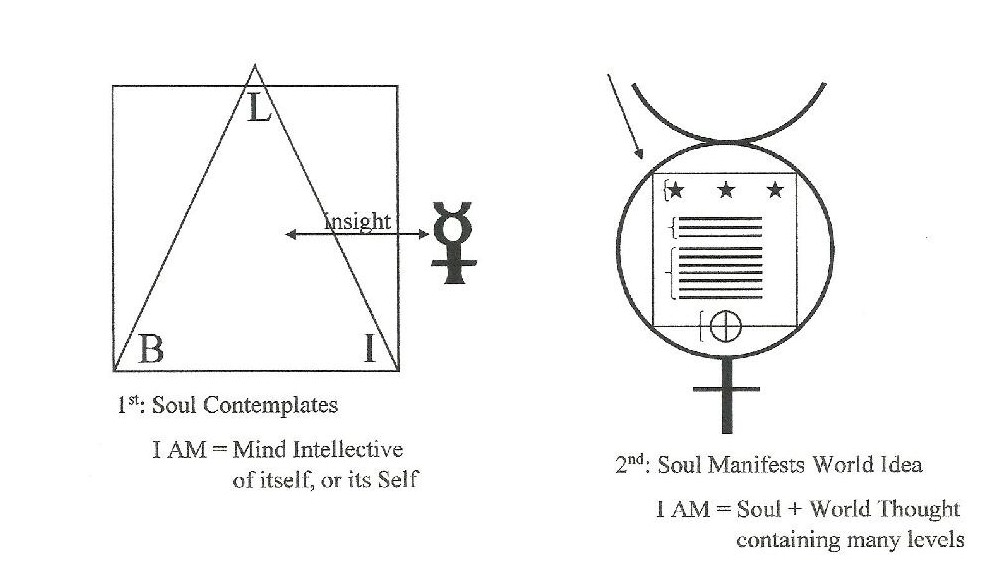
- FIGURE 1983 0909b-1. Soul's Double Act. Originally found in AD/AS paper "Parmenides and the Authentic Existents".
Other diagrams also referred to are not with this transcript version. [Transcriber note: [diagram] means the speaker is referencing a diagram as he or she is speaking. If someone is drawing or writing, with audible sounds of chalk on a blackboard, I indicate this by [drawing] or [writing].]
AD PAPER read in class:
- "Parmenides and the Authentic Existents" (co-authored by AD and AS). Retyped as PLA Parmenides & the Authentic Existents - AD Supp 1034-1053 (Ver. 1) - V09MP.
NOTES:
This is 1983 09/09b, Plato; Parmenides; Eight Hypotheses, Hyp. 3-4, and the second entry associated with this date. 1983 09/09a = Astrology; Theory, for which we have no audio, just JF notes.
Plato's Parmenides Hyp. 1-2A discussed in WG CLASS 1983 09/02b; Plato's Parmenides Hyp. 5-8 discussed in WG CLASS 1983 09/16.
The paper read in this class was originally written by AS. There are multiple versions of this paper at different stages of revision. The latest version of the paper has AD's class commentary incorporated into it and can be found in AD Supplementary Material, pp. 1034-1053.
The Eight Hypotheses, as translated by F.M. Cornford in Plato and Parmenides, is appended. It was typed out and used in WG Eight Hypotheses classes. AD made some handwritten edits and these are noted accordingly.
Partial transcript for 9/2, 9/9, and 9/16/83 exists (Scan File 1983 0902 0909 0916-8hyp P1 TO 150.PDF). Pp. 52-90 covers this class.
TRANSCRIBED Verbatim by IT 2021. Archival verbatim transcript with AD Paper – V11ap.
AUDIO FILES: 1983 0909a (formerly 1983 0909b), 1983 0909b (formerly 1983 0909a). [Note 1: "Tape" and "Side" refer to original audio cassette tapes that were later digitized into .MP3 Audio Files. Note 2: In 2024, REP Studio improves the sound quality of file a.]
| NEW FILE NAME | OLD FILE NAME |
| 1983 0909a | 1983 0909b |
| 1983 0909b | 1983 0909a |
1983 09/09b at Wisdom's Goldenrod
Plato; Parmenides; 8 Hypotheses Hyp. 3-4
[Audio File 1983 0909a (formerly 1983 0909b) Begins]
AS (faint): --in order to-- [S, faint: Go ahead.] in order to really philosophize about Being you'd have to [couple words inaudible] (equation).
S (faint): Huh.
[short pause with very faint background student talking]
AS (faint): I tried to write some things up for the li-- to go on from where we left off which was Hypothesis 2A. And then, I tried to do an example using the chart but I don't really know if I succeeded. So, I don't know.
S (simultaneously, faint): What do you think?
AS (faint): Anthony, do you have-- can you make any suggestions?
S (very faint): Anthony?
AS (faint): I probably didn't wonder-- wonder when it would be.
[short pause]
AD (faint): Wasn't it alright the way (you/we) did it last week?
AS: Hm?
AD: Wasn't it alright the way you did it [AS simultaneously: Yeah, yeah.] last week? Well why not continue [student assents, faint] that way?
AS (faint): Ok. Well in that case, I'll start with a-- I'll bri-- I'll briefly review the first two, and then go on and-- I'll read this little thing that I had on the rest of them, although I-- very hesitant about it but I'll read it. [Note: The following is a summary of Hypotheses 1-2A from "Parmenides and the Authentic Existents" (AD/AS paper). Please see WG Class 1983 0902b for more details.] You remember that in-- in this application we were trying to understand a one as the unit soul or the I AM. And so the first-- all-- all the Hypotheses are-- are going to be applied to this individual self. And in the First Hypothesis, he talks about the unific or void essence of this I AM without any qualifications. And perhaps we could simply say that, to paraphrase it, that mind is or soul is. And this implies a self-sufficiency, unmanifestable nature of the soul. And, this might also be equivalent to what we were talking of as soul as contemplating its own nature; insight, knowing-by-being. And here we said that the mind or the soul is non-dual. And, in a sense, in that void state it's inseparable from the Intellectual Presence, because in fact the soul is an Intellectual Essence and when it knows itself it is knowing (through) Intellectual Essence. And, while the later Hypotheses allow for multiplicity, the First still leaves this essence of soul intact.
In the Second Hypothesis we move from the position of pure essence itself, and, he says now we consider that if the one has being. And so we're going to now consider that the soul has a certain existence which it's gotten through the-- through the World-Idea being conjoined with it. But now instead of speaking of the pure essence of soul, we're now going to speak about this I AM as a wedding or welding of these two distinct aspects--soul and its Ideas. Now we speak about the I AM as a whole. So as previously in the First, we can't really (learn) anything about it or attribute any of these characteristics, once you bring in the World-Idea, you can now attribute all kinds of characteristics to this-- to this whole. And in this whole, the World-Idea which is being manifested gives existence to the soul, which in its turn is giving a certain unity to that World-Idea.
Now, maybe we could do alongside of this in mind that the-- I-- I tried to bring it to a more concrete or mundane example. I don't know if I've succeeded but I-- I'll just go along with it and try that. If you think of-- if we think of the First as just pure mind. And then PB says that the World-Idea is given to the mind. And when it's given to the mind, now we have this indissoluble welding of that mind with the World-Idea in it. Even at the level of the world-image. So, in other words, once we speak of the Second Hypothesis, we could speak of this immaterial or unmanifestable soul conjoined with some chart. So let's say now we say that this soul has existence. Before this, it doesn't have any existence. And (when) we [S simultaneously, faint: For you.] have to speak about it as not, you know, as beyond existence. But now, it takes into itself, is welded, some aspect of it is welded to this World-Idea, and now we can speak of the appearance of a world because the soul is welded to a certain living reason-principle. And there I think you see very clearly that it's the soul itself, this native or this unity of this native, which gives a unity to that chart. On the other hand, the chart is giving a definition or existence to that native which it otherwise does not have. So we can even bring it right down to this level (in the soul). Ok now we speak about this entity as a one-whole in which there's unity and there's being.
And a unity is the unity of the soul and it pervades the whole thing. And no matter what you read about that you're really reading that soul. That's the unity all the time. On the other hand, anything you really say about it you're talking [drawing] about some aspect of the existence. You really have to talk about that existent nature in order to say anything. So you have the two of them wedded or welded together. In the more primitive example, in the more primary example, we would say that this life intelligence of soul is permanently welded to this-- welded to the World-Idea which is planted into it and now we can speak of the human soul or a one-being. And, we also spoke about this Idea as this defining Logos, reason-form. Then he has some quotes here, the "Soul which [AS reads: with], taken as one all, is Aphrodite, while in it may be distinguished the Reason-Principles…produced by the downflow of [the] Nectar of [AS reads: from] the over realm." (Plotinus, III.5.10, second para) We said the downflow of Nectar is these reason-principles pervading soul and in which the soul is omnipresent, it is now [couple/three words inaudible] [student assents, very faint] So-- so-- Alan was thinking about his Tail.
So in-- in the dialogue he says: "the one [AS: Which we interpreted as soul.] gives unity to the being which is one", [Note: Exact wording of Plato quote not found.] and that we interpreted as the soul or one life is pervading and giving unity to the multiple reason-principles. In turn, the indeterminate essence or life of soul is given a determined definition or existence because of its participation in a World-Idea. So Plato says that being, the Ideas, give existence to the one which has being. The Ideas are giving a kind of existence to that soul. Otherwise it would be unmanifest. In itself it's not manifested. And, just read-- but we had-- there were several analogies (we talked here). Some of them were nice. We didn't read this one from PB but it's more an analogy than (empirical). It's "Mind alone, in itself, knows"--
PB [V16, 28:1.45 & Persp., Ch. 28 #18, AS reading]: "…Mind alone knows all things and itself. When it knows them in time, it is World Mind; when it knows itself alone, it is the unknown to man and unknowable Godhead."
AS (faint): And, this is somewhere also going to be the two states of Mind, not two different things, so-- And one would be analogous to Mind, and in the other case-- (another place) conjoined with a cosmos analogous to the World-Mind or manifesting (it). Well--
And then, in one of the-- in one of the-- we (have tons of) quotes, he emphasizes that within this reason-principle there are many levels. Ok and this-- this leads us-- whereas in the first-- in the first state, the state of the First Hypothesis, we're just speaking of contemplation or insight, and we've wiped out all the contents. When we have all the contents, the soul is still omnipresent and in that sense, it leads us to suspect that even though Hypothesis Two talks about the soul having existence, even while it has existence, in some sense it doesn't have existence. It never had existence. And there seems to be an instantaneous kind of transition that he speaks about, well, yeah, an instantaneous transition between the state of the World-Idea coming into it and leaving, or between existence and non-existence. And therefore somehow that the notion would be entire soul is present simultaneously to the various levels of existence that are possible within that existence because it never enters them.
And so, then he brings in this Hypothesis which he calls 2A which allows us to sometimes declare one or the other of contrary predicates, but also allows this instantaneous change of state between the soul and its stillness or eternity of contemplation and the activity of reason receiving and manifesting the cosmos in time. And this transition from one state to the other, unmanifest and manifest, is not in it-- not in itself in time but it's instantaneous. And we ha-- (and/we) even [one word inaudible] it as-- For example he says soul becomes like and unlike itself; like itself when the World-Idea leaves and unlike itself when it has this World-Idea come into it and (then) manifest. And so on, um-- It could rest one instant in itself and the next instant it goes from one to a many by manifesting this World-Idea. And-- so, the mind is going to both have and not have a determination by the Ideas. And, I think this is possible to bring those two-- this point of view of the Now, or the possibility of both of these states being simultaneous, or the possibility of the simultan-- simultaneity of knowledge through all the various levels of the cosmos because the knower itself is outside of (World-Idea/being that unity), really caught up in (a different) level. In other words, side-by-side would be Authentic and the entire cosmos, and that side-by-sideness is not (a stable) side-by-sideness. [couple words inaudible] co-presence.
LR (faint): Avery? Can you just please repeat? Can the World-Idea be conceived of as a one? Or--
AS (simultaneously, faint): No. I'm not sure I-- Meaning in itself? You mean why do we keep referring the oneness of it to the soul('s) side.
LR: I mean (if/it)--
S (faint): Yeah.
AS (faint): Well when he says that unity gives-- or the one part gives unity to that which has being or being-- or the Ideas give existence to that which is one. I think-- I think he's-- I think he's not saying that it gives it absolute unity. I think he's saying that the World-Idea for each soul is a unity. I don't think he's saying that the World-Idea-- But you could ask the question differently and say the World-Idea has its unity in the Intelligible Cosmos. In other words, (if/that) the World-Idea is an instantiation of that Intelligible World. We're not saying that the soul is giving it its absolute unity. [LR simultaneously, faint: No, I'm saying that (you--)] But as a World-Idea, it is giving it a unity.
LR (faint): Well it's giving it unity as soul, I mean it provided its unity.
AS: Because I think you would say otherwise it would just be-- you('d) have to be locating it further, in one of the further Hypotheses, that without this kind of appearance of a cosmos, it would just be an abs-- it will just be a multiplicity with no unity.
LR (faint): That's why I asked (you).
AS (simultaneously): Once that Idea has manifested, it's a multiplicity, it's a multiple living organism which is u-- it gets its unity-- Well, I-- I thought the chart example might be a good one there.
LR (faint): Right, but we speak of it versus the Ideas as a unity in some way.
AS (simultaneously, faint): I see what you're saying.
LR (faint): That's why I'm asking.
AS: You mean in themselves. [drawing] In itself.
LR (simultaneously): I mean, they are a being. All together they seem to have unity, self-subsistent unity. And that's why--
AS (simultaneously): I--
LR/S(?) (very faint): Go ahead.
AS (faint): I would say if you-- Ok, I'll try. I would say that the unity which they have as a 360 is granted by the World-Soul. But the-- You're talking about 360, you're not talking about the I-- the Intelligible Cosmos in itself, you're talking about the Ideas of this cosmos. Either you're talking about it within your soul or maybe even higher as one of those inerratic or speak of it as in a Sun Soul, it's still-- it's still within the soul. To say 3-- I mean just to say 360, there's no 360 [drawing] in the Intelligible World, right, I mean-- I mean I'm talking about the-- in the Divine Mind per se. So this multiple reason-principle is given-- the Idea of the World is given a certain unity by being within the soul that unifies it.
S (faint): Right.
S (very faint): (What's that?)
AS (simultaneously, faint): I guess I'm-- I'm not-- maybe I don't quite hitting your question but I-- Do it again?
S (very faint): Yeah.
JA (very faint): But it also seems-- you could look at it, sometimes the soul is (the same). [inaudible]
S (very faint): Yeah.
JA (very faint): Manifest these parts of soul [couple words inaudible] unity [few words inaudible] unity. And that Avery was saying, you know, unity (could be helpful), and that, you know, multiplicity (can) [one word inaudible] (uh-hm).
AS: No, I wasn't saying it was [one/two words inaudible]
JA (faint): Well you-- I do-- I don't know, [AS simultaneously, faint: I just can't say that--] I can't (believe) (it/you). I was going to-- I mean you [AS simultaneously: Ok.] said that the unity might be something [couple words inaudible]
AS: (No/Right). She was asking about the 360 [JA simultaneously: Right.] degrees as a total, and even if I want to conceive it not as the 360 degrees in my soul. Although, remember this is the I AM and we ha-- if-- if this (is) your mind here [diagram], [drawing] the 360 degrees are within your mind.
LR (faint): But we speak of them-- we speak of the I AM, if you want to speak that way, you say the Logos in it.
AS (faint): Yes, that's-- [drawing] that's the Logos.
LR (faint): Ok. And I see-- and I somehow think of that Logos as having-- as being a unity in its own right, you know, and I--
AS (simultaneously): No.
LR: Well--
AS: [drawing] I would say no. I-- I mean I would say if you-- if you-- what you might-- you can mean two things by that. If you meant that the Lo-- we said this Logos is an emanation from the Nous.
LR (faint): Yeah.
AS: And as an emanant, the unity of it is that unit soul in which it is the Logos. If you want to go a different way and say well its unity is in the Intellectual-Principle, I wouldn't deny that. But as soon as you speak about this emanant here, I think, if I am interpreting the Hypothesis consistently with the way you were doing it, that the unity aspect comes from this I AM which pervades it.
LR (faint): Yeah I know.
AS: Namely this-- this one Intelligible Cosmos will be received slightly differently into a different I AM.
VM (faint): (It seems to be) in some way [AS simultaneously: But--] in time, unrolled in soul.
AS: That's-- that's another--
VM: In soul, I mean--
AS (simultaneously): In fact, I-- I would say that also, I don't know about in time, but [VM simultaneously: Ok.] when he says [drawing] unrolled, the ideal [VM simultaneously: Unrolled.] forms in the soul are unrolled and separate, I think that's the level we're speaking of as they're unrolled and separate, discrimin-- discriminated. And therefore it's a multiplicity. But--
S (faint): [couple words inaudible] to manage to get them in the soul. (S laughs)
S (very faint): Go ahead.
AS: I--
S (very faint): Go ahead, (Avery).
VM (simultaneously, faint): (David, you--)
JA (faint): I-- I don't know Avery. Are you trying to (suggest) the unity comes from the I AM principle or the--
AS: Yes.
JA (very faint): I see.
AS: That-- the way we interpreted this was the First-- that in the Hypothesis where it says "the one has being", or we said the oneness is the unity of the soul's essence and the being [JA: Yeah.] is being or existence granted by this World-Idea or this multiple reason-principle. And he says the unity gives a unity to the being which is one. [student assents, faint] The Ideas give existence to the one which has being. So this whole thing, this I AM essence [AS indicates on diagram], this wedding here is a one-being, a one and a being, he says there are two parts now to consider, it's a whole of parts. And the parts are soul essence on the one hand, and the reason-principles on the other. And if we (try to interpret/reinterpret) what he says, I understand it as saying that the reason-principles are giving existence to what is otherwise an unmanifest soul essence. On the other hand, because they're manifested in soul, this multiple reason-principle gets a kind of unity from that soul. It may not be the unity that the [drawing] Intelligible Cosmos has in Nous, but it does have a kind of unity which its gotten because it is now the informing principle of soul.
JA (faint): Ok, (I mean--)
AS (simultaneously): Namely the soul essence is unified, is in some sense homogeneous. It's (just a) unified although unde-- unmanifested life principle. [JA, faint: Ok then--] Whereas the reason form flowing in is not a unity, it's a multiplicity of all these different degrees.
AD/S(?) (very faint): [one word inaudible] go ahead.
S (very faint): Go ahead, continue.
JA (very faint): Ok but, you can still-- 360 degrees, I mean [couple words inaudible] as being (360 degrees), you know, (parts).
AS (faint): Well, I-- (sure).
JA (simultaneously, very faint): [few words inaudible] would be two of them. I thought you were saying in a sense that you wouldn't speak of 360 degrees unless you were speaking of, I mean, certain world that soul is manifesting.
LR (faint): I was thinking of the individual's 360 degrees [JA assents, very faint] as (Demiurgic/Demiurgis).
AD (faint): No, no, no, no.
S (very faint): Do it again.
AD: You're missing the whole point of the Eight Hypotheses as soon as you give unity to anything else but the One itself.
AS (very faint): [couple words inaudible]
LR (faint): As the soul itself (a unit).
AS (faint): What we're (speaking/seeking).
LR (faint): Yeah. But what--
AS (simultaneously): There's only one One.
AD (simultaneously, faint): Because this is a principle that you're going to be able to apply indiscriminately up and down the line, whether you speak about the One itself, if you s-- if you speak about, for instance, the unity of the Earth, its being or intellect, right, soul and body, then you have to start out with the unity. You have to-- you have to take this as fundamental, that there is such a thing as a unity. In the same way like when you speak about I perceive the world and Avery perceives the world. It is your-- it is the consciousness or your mind which gives unity to the differentia within it. If you speak of any other unities you missed the point here. This is the fundamental unity, the one that you're talking about now. If you want to go to another unity, like the unity of the Earth, then you got-- you got a different way of working at that. If you want to go to the unity of the One itself you got that you could work with. If you want to speak about the unity of the Intellectual-Principle you could do that. But first let's-- first work with the simplest version--soul is a unity. Each mind is a unity and insofar that each mind is a unity, then we can speak about the contents within it in any way you wish.
AS (very faint): Ok.
LR: Well--
AS (faint): And in particular if we want to speak about the contents as having a unity, that there's only one "one" in consideration, there's only one thing that we call a unity, then we can say Intellectual soul, then it's that soul. And if those parts or contents have a unity, the unity they have is the unity of the soul. That was the unity here. (If/It)-- it-- maybe-- maybe it helps to say that what we're speaking of is the [drawing] appearance of the Ideas within a soul. And we're not speaking of the Ideas per se, I mean, although we could go on and say that that is the state of the unity. But I think-- I thought Vic's point is good for that because-- He has that line where he says the Divine Mind is possessed of unity but the Ideas in the soul are not. Like we said, unrolled and separate, and that they have a unity. [few words inaudible] a unity then they present (that/as) World-Idea as in soul.
TS (faint): (A different) unity where the-- it's only in soul that they are unrolled. [one/two words inaudible]
AS (simultaneously): That's right, so-- so prior to that you don't have to [RG/S(?) simultaneously, faint: Right but (couple words inaudible)] worry about them getting unity from somewhere else.
S (very faint): (Interesting.)
VM (simultaneously, faint): If they were (the Hypotheses), they don't exist prior to that. Maybe you can do-- [short pause] I think I know.
AS (very faint): That's [couple/three words inaudible]
LR (faint): Well no. But the question isn't applicable right now.
AS (faint): It was. I thought that's (why/what) Anthony made (those/them). It was applicable. And I-- I guess one-- the meaning of the labels.
LR (simultaneously, faint): It's not when-- you say it's not applicable to this discussion because here the unity [AS simultaneously: Yes.] [couple/three words inaudible] (apply).
AS (faint): Yeah. If you asked of [LR simultaneously: Well--] the unity of the Ideas, you might say it was the Idea of Man. But then you would be doing the Hypo-- I think you'd be examining something else.
LR (simultaneously, faint): Right. It would have to do with a different viewpoint (than) [couple words inaudible] but--
AD (faint): Your point-- the point here is that the Eight Hypotheses could be applied to anything that is a one or a unity. They-- you could take an Idea, the Idea of Man for instance, say that's a unity, and then apply all Eight Hypotheses to it. But if you start with the Idea of Man, then keep to that, that is the [LR simultaneously, faint: Yeah I understand.] unity and everything has got to be within that, alright. If you're speaking about soul, make that the unity and everything within it would be a manifestation within that principle.
[short pause]
LR (faint): You're saying [couple inaudible student words simultaneous with LR] [one/two words inaudible] one affect the other. But if you do take the point of view of soul being a unity, what's wrong with like two unities?
[short pause]
AD (faint): But you can't have two unities.
S: Two.
S: Uh-hm.
AS/S(?) (faint): Only one.
S: Yeah.
AD (faint): Only had one unity. The contents of your mind are a multiplicity. It is your mind which is [couple inaudible LR words simultaneous with AD] their unity.
[short pause]
LR (faint): Ok, I'll drop it [one/two words inaudible] temporary [few words inaudible]
AD: Yes.
S: And (I'll hold back at some point).
AS (simultaneously): Oh.
RG: Yeah.
AS (simultaneously): Linda, you know--
RG: Right.
AS (faint): I think I see what the problem is. It's that there's the inter-participation of unities at a different level from what you're saying. [LR simultaneously, faint: They have soul.] It's like-- it's like the analogy he gave was, the soul is an indeterminate life. Remember he says it looks to unity. Even if you say it's looking to unity, what it receives is received as a multiplicity, like the Intellectual-Principle looking to the One. But in that sense what it received or the way it receives it is there's a multitude, it can't receive it as unity. So if the soul couldn't get that unity from the Intellectual-Principle I distinguish(--/.) You have an extra one.
S (very faint): Go ahead.
AS (faint): Well, should we go on a little bit? Ok. Let me go to Three and Four. Maybe we could treat those kind of together since they are complementary. I'll just read this short thing and then we could discuss it or discuss it as both-- Read the one [couple words inaudible] I don't know if we started (these). I think what I thought--
[Transcriber note: The following paper is titled "Parmenides and the Authentic Existents" and was originally written by AS. There are multiple versions of this paper at different stages of revision. The latest version of the paper has AD's class commentary incorporated into it and can be found in AD Supplementary Material, pp. 1034-1053. It has also been retyped as PLA Parmenides & the Authentic Existents - AD Supp 1034-1053 (Ver. 1) - V09MP. I transcribe the paper exactly as AS reads it, including any alterations made during re-reading.]
AD/AS Paper ["Parmenides and the Authentic Existents," AS reading]: "Hypotheses 3 and 4 now treat in further detail what will be true of the others -- the various parts, Reason Principles, that are parts of the Universal-- of-- that are parts of the World Idea that is being manifested in the Soul, and they say what will happen if the Soul is a one. Since these parts or others are other than the Soul essence, they are not the unity of Soul, but he says they are"not wholly destitute of unity", they partake of unity in a way. So in 3, the World Idea or Reason Principle which is a multiplicity giving existence to Soul, partakes in the life intelligence of the Soul entire. Each of the many reason principles that comprise the World Idea are also participants in the Soul essence entire, or in the wholeness, and so each is itself a wholeness. Each of the parts itself becomes a kind of one-being. In the tractate in VI.5.9 he says, "…it must be [AS reads as, and substitutes in paper with: The Authentic is] similarly entire in each several entity…" (VI.4.12) "…its nature must be such that it can appear as a whole at every point…" (VI.5.9) They have to realize because of this omnipresence of the I AM, each of the reason principles will participate in all the properties that were attributed to the whole. In a sense, each of them will get its unity from the One-unity. Each of the reason principles will therefore be both a multiplicity of expression, and also be a whole. We can now conceive of 360 degrees of existence, as it were, each a reason principle considered as a living whole and having its own definition. Each of these represents a unique Idea, which will be a defined and limited Form, and also express an unlimited and infinite power of Soul."
[9¾ second pause]
AD: (You) [one word inaudible] to go over that again now, the next [couple words inaudible]
S (very faint): Uh-hm.
AS: This is on Three.
S (very faint): Well do it again.
S (very faint): Do it again (please).
AD/AS Paper ["Parmenides and the Authentic Existents," AS reading]: "Hypotheses 3 and 4 will treat in further detail of what is now to be taken as true of the others if soul is a unity. And these others are other than that unity. That is, we can consider the various reason principles that are parts of the Universal Reason Principle or the World Idea which is being manifested in the Soul. Since these others are other than Soul essence, they are not the unity of Soul, but he says they are"not wholly destitute of unity", they partake of the unity in a way. The World Idea giving existence to Soul itself is partaking of the life intelligence of the Soul entire. Each of the many reason principles, that is these others, that comprise the World Idea are therefore each participants in the Soul essence entire, and therefore each will itself be a wholeness, a reason principle and authentic Soul. In this tractate in VI.5.9 for example, we read that "…it must be [AS reads as, and substitutes in paper with: The Authentic is] similarly entire in each several entity…" (VI.4.12) "…its nature must be [such] that it can appear as a whole at every point…" (VI.5.9) So here we're saying that the wholeness of the I AM can appear at every reason principle. The omnipresent I AM, present in each reason principle, therefore each reason principle will participate in all the properties which were attributed to the wholeness of the I AM. Each is granted these properties by its participation in the whole. Now we can conceive of 360 degrees of existence. Each reason principle can be considered as a living whole in its own right with a kind of being or definition. Each of these will represent a unique Idea, or reason principle, which will be a defined and limited Form, but also will express the unlimited and infinite power of Soul."
[short pause]
AS (faint): Ok, just a little more.
AD/AS Paper ["Parmenides and the Authentic Existents," AS reading]: "The I AM as a whole is the dominant principle in this Hypothesis. It is the source of the unity of the whole and contributes to any of the parts, any definiteness they may possess. Each part or many are not in themselves separate identifiable units, but become so by participating in the omnipresent unity of the whole I AM. The"others" than the One are these very parts of the World Idea. They participate in the one as entire, and all the contraries which the whole or All has, they too will have."
[short pause]
AD: Alright, did yous follow? It was pretty straightforward.
[17 second pause]
JL (very faint): Well did you say--
AS: Yeah.
TS (faint): You're saying that each degree as that-- if you take the 360 degrees as distinct each from each other, that those are the "others" of the Third Hypothesis. And that because the soul is immanent in the 360 degrees as a whole, then each degree has within itself the-- all the characteristics of soul in itself.
AS: Yeah. You know I would-- I-- I thought that Eliade thing that Anthony read [Note: Mircea Eliade, Myths, Dreams, and Mysteries: The Encounter Between Contemporary Faiths and Archaic Realities, pp. 14-18. Please see 9/5/83 verbatim transcript, about halfway through.] was a very beautiful exposition of how now-- how-- that each one of these reason principles or each image [few words inaudible] reason principle is itself-- has its own kind of being. It's the defining or exemplary character. It gives rise to a multiplicity of existences and so on. And he seems to be saying here that in itself it-- it doesn't do that so much as it gains that power as it were because of this omnipresence of soul entire [someone drawing] in each of those.
S (very faint): Yeah.
AS: It's almost like each one of those becomes a miniature now of the whole of the I AM, but only granted that wholeness because of the omnipresence. [someone drawing] It's as if the one is, is the supposition. And there-- it's only in that granting that that each (of the others--) only granting that the one, the I AM (remains) entire, can you conceive now that each of these itself will participate in both the limiting-- will show up as the limiting [someone drawing] or differentiating character as well as being able to express the infinite power of soul. And then we have those quotes also where he says soul is entire in each particular life (Plotinus, V.1.2, fifth para) and that it can appear as a whole at every point (Plotinus, IV.2.1, third para from end).
AD: Let me try this picture, ok. Let's imagine you're dreaming, ok, and there's twenty characters in your dream. Each one of those characters, alright, is fully developed, articulated being. Now, behind each one of those characters is the whole of your mind, not a piece, not a part, not ninety percent, not eighty percent. The whole of your mind is behind each one of those twenty characters. Now of course this is not Aristotelian logic, right?
[students assent, very faint]
AS/S(?) (faint): Yeah, it's not.
AD: Now, you could see therefore behind each character there will be the unity of your mind. And each character will be the being, let's say, attached to that unity, and these two would be a whole of parts. And each one is distinct from every other one. Now, you've got to work into this to get an idea, to get the-- the way Plotinus put it, the wonder and marvel of what the soul is. [Note: See Plotinus, IV.2.1, "To have penetrated this idea is to know the greatness of the Soul and its power, the divinity and wonder of its being, as a nature transcending the sphere of Things."] Like for instance, when he says--
Plotinus [VI.5.3, AD reading]: "There is a unity, numerically identical, undistributed, an unbroken entire, which yet stands remote from nothing that exists by its side; but it does not, for that, need to pour itself forth: it is not necessary either that certain portions of it enter into things, or again that, while it remains wholly self-abiding, something produced and projected from it enter at various points into that other order."
AD: So, this was the definition of soul, you remember we tried to point out how important it was to understand his definition of soul. That the soul, or in the case of the dream analogy, the totality of your mind was in each and every character, alright, and in no way does the distribution, what seems like the distribution of your mind in twenty characters, disturb the unity of that soul. You got the picture?
S (faint): What's that?
S (very faint): (Yeah, what?)
AH: Anthony, you (said/say) the distribution is related to the notion of your mind rather than mind?
AD: This what?
AH: Distribution you just described as being related to the notion of your mind, rather than the mind, is that a significant--
AD (simultaneously): Yes, your mind. Yeah go ahead.
AH: The distinctness--
AD: You're supposed to-- you're supposed to be flabbergasted [AH assents] when I-- when I made this picture for you. That's the whole point, the grandeur and-- the grandeur and the immensity of the soul is something that we can hardly conceive. I'm leaving out imagination altogether.
AH: The aspect of distinctness, does that belong to the unity?
AD: What makes each character to be itself and not another, alright, on the one hand is the fact that there's the unity of mind behind it and on the other hand that it is an idea in its own right. The combination of these two is necessary in order to be able to distinguish one character in your dream from another character in your dream. Now if you just, you know, multiply that infinitely, and within your soul, alright, the entire world is manifested within your soul or within your mind, and each one of the-- each one of the Ideas or points of light that you call stars, are manifested by your soul. And each one of them is given the unity it has by your mind, the characteristic it has by its-- by its own being insofar that it is this Idea and not another, and these two things are necessary in order to start speaking about your soul being a whole of parts, one part being the unity, the other part being the World-Idea which is infused into it. And it is these two things that have to be grasped and understood. Take away the unity of the mind, you can't speak about any manifested world in itself. Unity of your mind. You can't even speak about the unity of the 360 degrees of existence. There's nothing to speak about. So that's why we're using this here, the soul, because this is fundamental, your mind, [AH simultaneously: Yeah.] your experience now.
AH: I'm-- I'm unable to understand the connection to your mind.
[short pause]
AD: We're back to the doctrine of mentalism.
AH: Why not mind rather than your mind?
AD: Insofar that I'm referring to mind as individual, I'm speaking about your mind. We spoke about each Overself as being an individual Overself, as an emanant from the Intellectual-Principle, from the Absolute Soul, alright? Insofar that each Overself is an I AM, within it there will take place manifestation. [student assents, faint] Think of each Overself in itself as non-manifestable, but a principle that can manifest others. But it itself is not manifestable. Mind itself cannot be manifested but it does manifest its content or show something of the Ideas that are within it.
AH: So to say your mind is actually to speak about the product of mind's manifesting.
AD: Yeah, of your mind.
S (very faint): Right. I think he's coming [one/two words inaudible]
AD: I know. I'm saying your mind. Immediately bring in "your".
S (faint): Yeah.
AD: I'm not worried about, you know, your soul being saved, I'm worried about my soul being saved. And you're going to have the same problem.
AH: Are they saved in bundles? (bit of laughter) Anthony--
AD: They're not saved at all. They don't need to be saved.
[short pause]
AH: I just don't-- I struggled with this for years really, the notion of individual mind and your mind. The possessive aspect of that phraseology bothers me. I-- I'm not able to understand that.
RC (faint): I saw one thing in-- in an essay last week and I thought it was very interesting, (he said exception). First you see that all the things are thoughts in your mind. And then that multiplicity of thoughts is traced to its unity which is your mind and it's still small 'm'. Then he says that-- and it's only after that that you can then take the next step and trace small 'm' mind to its own essence and source, the-- the capital 'M' Mind. But first you resolve the multiplicity into the individual's [one word inaudible] [9¾ second pause] I guess that's equivalent to saying that-- with that mind has to stop its thinking, or all the-- the appearance that it produced has to be withdrawn [short pause] before you can even start to talk about trying to establish unity of any kind of mind beyond (this).
AH: Maybe it's just the semantics of it that bother me personally more (than) the concept of the mind.
AD (simultaneously): No, it keeps coming up, Andrew, and I think Randy answered your question. You first have to reach the substratum of your soul, your mind, alright, before you start speaking about Mind capitalized.
[short pause]
AS: But in this discussion we are speaking of unific aspect which is [AD, faint: Yeah.] a unity. [short pause] And you, I think, indicated the importance of holding that idea with this idea of individual mind.
[students assent, very faint]
AS (faint): That unity is the unity of your individual mind. That-- as far as I can understand it that's the point of this whole discussion. You don't have to speak of capital 'M' Mind (as a-- if you) speak about your mind as a unity.
AH (faint): Whenever they--
AS: If it's not a unity then it clearly isn't. In order to even be it must be a unity.
S (possibly part of background): Put it down.
AS (faint): Absolutely.
HS: When you speak of the contents of mind or the-- the Ideas, and then you said multiple Ideas in the one World-Idea, right?
AS: Yeah, the--
HS (simultaneously): In the World-Idea.
AS: The World-Idea-- World-Idea is a little misleading. For him reason-principle is always-- [HS simultaneously, faint: Multiple.] implicitly means the multiplicity.
HS: Now [couple words inaudible]
(Side 1 of original cassette tape digitized as 1983 0909a (formerly 1983 0909b) Ends; Side 2 Begins)
HS (faint): --of the 360 degrees.
AS: Uh-hm.
HS: Now that image, each one's unity is the individual mind that (gives) it the unity?
AS: Yeah, I-- I think Anthony said the same, that each-- this Hypothesis is saying that each one of those can be now considered in its own right as a whole. It's a wedded-- it's-- each-- the whole I AM is a welding of the World-Idea with soul, and each of the parts of that World-Idea, each reason-principle will be-- will have a mani-- will be a power, will be-- have both a being and a power. It'll have a certain definition and will ha-- inherit or participate in the entire essence or power of soul. Now that definition comes with the World-Idea. The World-Idea itself has a multiplicity of defined parts. But they only gain a kind of unity and power from the soul.
HS (faint): And what do you think [AS simultaneously, very faint: From the soul.] is being united with-- what do you think the parts of the World-Idea or the World-Idea as a World-Idea, whatever unity is in now the discussion is given by the unity-- by the soul.
AS: Yeah. You can't in this discussion-- And I think the chart example would be good too, the mind example would be good, as Anthony said, each of the characters in a dream have-- I mean let's say it has its own particular character from your vasanas. You know, it has a particular defined character. But that character itself only has the unity of your mind, there's no other real unity there. Whatever unity any of the characters have--
HS: Within your world.
AS: Yeah within your own world.
HS (simultaneously): They'll only have a unity of your mind, right.
AS: I-- I thought the chart example was good too where you say, you can only interpret the de-- each-- you know, you have each planet on a degree. You can't really isolate it, you have to understand that it is a degree and a planet of this entity. You have to be looking at an enti-- a-- this-- this native. It's (more/almost) like his soul is lending something particular to that degree.
HS: Could you say when you say-- you say, to speak of unity of your mind (means)?
AS: No but when he says that your mind is present entire in each thought that's produced. Aware-- like awareness-- Think of the characteristics [couple words inaudible] the intelligence and life, awareness.
HS: The being of an Idea-Form-- of one of these degrees has-- is not given by the unity of your mind.
AS: You see, by being he means there's certain definite characteristics that matter.
HS (simultaneously): Yes, a special characteristic.
AS: I think that would come from itself whereas if you speak about the tremendous power of soul and that it has-- that would have to come from soul.
HS: Ok and there's no particular necessity of pursuing the unity of each individual Idea unrelated to your mind.
AS: I think not.
HS: Ok.
AS: That there is no necessity to do that.
RC (faint): It seems the way you were going with what (Andrew's saying), if you said (that) reason-principle is the tree. That the tree that you see, the one you actually see, that's given unity by your mind. Somebody else in a different (animal) with a-- you know, a whole different bag of tricks to bring would be united into this perception [one/two words inaudible]
S (simultaneously, faint): [one word inaudible]
HS: When we speak of the unity part we're doing-- is it equatable to meaning or it's different (than/from) meaning?
RC: That would make those parts into the wholeness that's particular to you. Like when you say your world, I think that's more meaningful to me than World-Idea. Like if you say your World-Idea, it gets abstract. But if you say like-- (you said) your world, and your mind is the unity of your world, it seems a lot less abstract.
AH (faint): Randy, in your example of a tree, what would you say about using that as an analogy for the degrees? What would you say about the tree? I mean, is there a one in itself in the tree?
RC (faint): Well the only one that I could know is the one that I'm knowing. [student assents, very faint] Yeah, I--
AS (simultaneously): He's just saying, whenever you know a tree or anything in the world, you're knowing-- in one sense you just only know your mind.
RC: The substrate of the known tree is it's the only tree you could ever contact. It's going to be the only thing that I know.
AS: But, on the other hand-- but I think it's really a fusion of both you're saying. All you ever know is your mind, but, you know, a very definite form. Now that definite form that your mind takes is given by the Idea side in this example, part of the reason-principle. But, what-- you know, the substance of what you're really knowing or the ground of it is your mind. So it's proper to say both: all you ever know is your mind, and yet you're knowing very definite particular form. I think that would apply here. All you're ever knowing is your soul, but the particularity of the forms that are there is given by the World-Idea. And that goes right back to the Second Hypothesis where he says the World-Idea gives existence and the soul (its/is) unity. Now that's just saying that each one of the parts of that World-Idea itself will have a certain definite definition but its ground is only in the soul. If you really ask in another sense what is it, it's only the soul that you're always knowing 'cause it can't be anything outside.
RC (faint): Seems to be a very good point in terms of the degrees in the chart, that-- that the reason different people have the same degree and-- and the symbol means something different in one person than it did in somebody else. Like, a certain degree in Wagner's chart comes out different than it comes out in somebody else's chart. Wouldn't it be the unity of his soul that's forcing it to take the particular meaning that it has in-- in context of his life?
S: Yeah but--
AH: But if you speak that way, it's increasingly difficult to see the degree as itself.
AS: Right. Right but we're saying what it means to say the degree itself as a distinct thing is already we're speaking within the context of mind. It's like you said meaning. To say meaning already is supposing there's two sides of it--the soul which is its ground, and the particularity which is the defining characteristic giving it existence. You can't separate them. We're not going to go to a position where we're talking about a thing-in-itself outside of the soul. There's no-- there's no prior unific Idea that is outside of the soul, Andrew.
AH: No I think that--
AS: Its ontic status is the status of the soul.
AH: That's the part that I can't--
AS: Your mind, I mean if you look at something in your mind, what status does it have? We're saying that you--
S (simultaneously): There's (really) no other way.
S: You couldn't do that.
S (simultaneously, faint): [one/two words inaudible]
S (faint): Well if you [one word inaudible]
MC (simultaneously): [one/two words inaudible] (because) you're only knowing the World-Ideas as they are presented through your [TS: Mind.] mind?
AS: Yes. I'll say yes seriously. That's what I'm saying. And the only way you're going to know the World-Idea is through your mind.
AH: Avery would you say exactly, try to establish the-- you're not going to establish the thing-in-itself, but you do establish its particularity. It depends then how you differentiate.
AS: Establishing the thing in your mind. Well, I'm going-- I'm taking the model of the Second-- the Second. I think what he's doing in the Third and the Fourth is the-- is a play on the Second. It's a further elaboration, it's adding something to the Second. He's talking about what we can say about the World-Idea we spoke of in this-- And we said that that World-Idea is not a unity, it's a multiplicity. In the Second you're just-- you're content just to say that it forms a whole with soul. Now there's the mind and all its possible thoughts or ideas is a wholeness. Now each one of those parts of that World-Idea itself will have a certain kind of subsistence on its own.
Now I think he's saying that in each of the parts there are two-- two parts to consider. Each of the parts is a whole. What is it a whole of? It's a whole of two distinct natures, just as the whole was a whole of two distinct things. And what each of those is a whole of is first of the definition. I guess you could say that's defining character. And, on the other hand, on the other side, this unity, this ground awareness, this consciousness or life-essence, which we're calling soul. Now if you try to conceive of one without the other, I think you wouldn't-- you wouldn't have a reason-principle in that sense, a living whole.
Well if you had-- if you just had the soul essence in itself it would have no defining character at all. You wouldn't have distinct thoughts. If you just had thoughts, as he's going to say in a later Hypothesis, you won't-- and not the unity, then you're not going to-- you're just going to have a sheer appearance. There'd be no meaning there. I mean meaning in a sense of no substance behind it, no light behind it. I'll just be a dead appearance, just projection on a screen or something.
These reason-principles aren't dead, they're living reason-principles. Now why do they have such power? I think-- I-- and I-- I think he's saying but, you know, I'm at the-- that this power, this life is breathed into them by the soul, he says the soul. But if you speak about the specificity of each one, since the soul in itself is indeterminate, that can't be what's giving the specificity to each of the 360. It has that in a sense already. Maybe it needs the soul to grow and to bring it out. Possible, it seems that these will need each other.
HS: But in the notion of specificity there, it seems that the unit does give specificity in terms of the example through different individuals having the same degree.
AD: No.
AS: I wasn't going to use it that way. [S simultaneously, faint: (Right.)] No that was Ra-- Randy's example, I didn't follow.
AD (simultaneously): The unity which it provides to every reason-principle does not give it the specificity that we're [AS simultaneously, faint: That's right.] speaking about here.
AS (faint): Yeah.
HS: It's a different kind of spec--
AS: Yeah I would--
AD (simultaneously): If we're speaking about each reason-principle as a reason-principle, alright, coming from the World-Idea itself, alright, and then you speak about the unity which the soul essence provides it--
S: Uh-hm.
AD: Ok? Then the specificity that we're speaking about is the one that is given to it by the World-Idea.
HS: Ok but now in that [one word inaudible]
S (simultaneously): [one/two words inaudible]
AS: I'm sorry, you know, in-- I-- I want to slightly disagree with Randy's example because I didn't-- I wouldn't have brought in different entities. I would have said that let's just consider the 360 period, and that each one of those 360 has a unity to it. And I would have rather said in the example that unity of it-- that unity remains what it is no matter whose chart it manifests. I think that's the level we're speaking of. Whereas it also has this specificity of its essence, it also [one/two words inaudible]
HS (simultaneously): That remains what it is-- [student assents] it-- no matter whose chart it is found within.
AS: Yeah, and in a sense that you need-- you know, you have to put those both together at that level. I wouldn't have used the example of an individual chart until Hypothesis Four but--
TS (simultaneously): You're saying that the unity of the soul is-- from one soul, individual soul, to another unit soul there is no characteristic, [AS simultaneously, faint: (couple words inaudible) right.] there could be no characteristic mark in the unity of the soul, that it is the unity of the soul which provides for the distinct otherness of the reason-principles one from each other. So to one--
LR/S(?) (simultaneously): No.
S: No, no.
S (simultaneously, faint): [couple words inaudible] exactly.
S (faint): (Say it again.)
S (simultaneously, faint): What?
S (faint): (Anthony/Randy) go ahead.
S (faint): I'm sorry.
AD (faint): No it's up to you.
AS (faint): Maybe we should start--
S (faint): Still following it, um--
TS: So any unit soul quantified in the reason-principles is already to know them, each one in itself separate from the other reason-principles would-- would be an-- an identical act.
S: [one/two words inaudible] (backwards).
TS/S(?) (faint): Go ahead.
S (faint): Go ahead.
TS: Why is it backwards?
S (very faint): [few words inaudible]
VM (simultaneously): I thought the actual statement in-- Let's say the unity comes from soul, I think we all agree on that. But--
S (simultaneously): The unity of each of the parts.
VM: That the unity of each-- each Idea comes from the soul. But I thought the specific nature of each of the degrees was the contribution [student assents, faint] of the World-Soul.
TS: Yeah like [one word inaudible]
AS: World-Idea.
VM (simultaneously): World-Idea, sorry. [S, very faint: Yeah.] World-Idea. So I thought you were turning it around but maybe not, maybe I--
TS: No I meant to say that, maybe I didn't but I meant to say that (the/these)-- it's the unity of the soul which gives-- which is-- the specificity of each reason-principle is some exi-- as being part of the World-Idea.
VM (faint): Fine, go ahead.
TS: But the unity which makes a whole out of each reason-principle, which is like the other reason-principles, is the soul's contribution, and that that contribution doesn't vary from one soul to the other. So that one soul knowing a reason-principle-- contemplating the reason-principle, and-- and another soul doing the same thing it would seem it's the same-- it would be the same knowledge for either.
S: You're saying--
BS: Are we also say-- is this--
AS (simultaneously, very faint): You mean the specificity [three/few words inaudible]
BS: Is this saying there's no, let's say-- that to me there's been like a secondary differentiation within the unity of the soul of each part-- each part of the World-Idea, correct? Are you saying that there's none?
AS: No he-- I think there is. You're saying that-- if you would say that, is there a corres-- corresponding to the levels in the World-Idea or distinct reason-principles, is the soul itself in some way exhibiting a multiple nature. And I would say yes. [TS/S(?) simultaneously: Right.] The soul in itself, the soul essence is divisible and indivisible. And so--
TS (simultaneously, faint): But it's not the unity of the soul that has been (conflated/inflated) from specificity.
AS (simultaneously): Right. Yeah.
S: I'm sorry, repeat.
TS (faint): It's not the unity of the soul which the-- which is this specificity in that unit soul.
S: What?
S (very faint): Unity?
S: Unity.
S: Unity.
S (faint): Uh-hm.
S (simultaneously, faint): (Say it again.)
S (faint): I think it's the question.
LR: You're saying it's not the I AM that makes the I AM? What do you mean?
AB: No. The different--
TS (simultaneously): It distinguishes one I AM from another I AM.
LH: Well aren't you-- aren't you just [LR simultaneously: But rather the Logos within it or something?] saying that whether you're talking about-- whether you're talking about a reason-principle or an individual or an object, although the characteristics come from the World-Idea, you couldn't distinguish them without the unity which the soul gives it.
LR (faint): Yeah but that would be the [S simultaneously, faint: (Go.)] soul's unity.
TS (faint): Yeah [few words inaudible]
LR (simultaneously, faint): That would be the--
S: Yeah but it's not--
LR: Different from what?
LH: [couple words inaudible] [few inaudible TS words simultaneous with LH] it's not with the [one word inaudible]
S (very faint): That's true.
TS: No, but I wouldn't [one/two words inaudible]
LR (simultaneously): You're saying the specificity of the-- of each I AM comes from the particular collocation of the Ideas that it holds. Is that what you're saying?
TS: Well I'm not sure where it comes from but I didn't think that it came from the-- it wouldn't be-- I would have a hard time understanding how the-- the unity of the I AM could be distinguished, would have a characteristic mark that made it distinguishable from the unity of another I AM. I thought that the point of unity is it's uniform. That's the participation in unity and I don't-- And they had participation in unity that can-- [S, faint: Yeah.] or gives rise to the pure 360 degrees or the reason-principles within it.
AS: Yeah. And-- and in this Hypothesis we go further and say the soul doesn't [drawing] make one reason-principle distinct from the other. It gives its unity entire to each one. If you come from the side of your soul, from-- as soul or as parts of the Wor-- as parts of the whole, you can't distinguish reason-principle(s) from the side of soul. They all inherit the living quality of soul equally. But what distinguishes them is their specificity which they get as parts of the World-Idea. From that side you can distinguish them. Just as if we take the Second Hypothesis, from the point of soul [drawing] you can't distinguish one unit soul from the other but only in terms World-Idea. How-- [S, faint: Yeah.] like-- like in here [diagram]. Each of these reason-principles is a distinct content, but its life can't be distinguished from another. In other words, one reason-principle has just as much power in that than-- than the other one does, it has the power of soul. And it has all of the power of soul and all living or it-- all the mind entire is present with it. And that's where you could speak about, you know, like-- you know, the power or whatever, but its particularity or distinctness would be because of the World-Idea would be here.
S: Do you think--
AS (simultaneously, faint): Now that-- ok. I'm saying, I'm just trying to [three words inaudible]
AB: Isn't it actually the World-Idea which gives the specificity, you know, the differentiation for the soul so that if you would characterize the soul, that's when it's wedded to the World-Idea.
AS/S(?) (faint): (What did he say?)
HS: (Controversial.)
AB: Ok.
JL (faint): Go ahead, go.
JC: Wouldn't you say that the unity makes them distinct but not distinguishable? Makes souls distinct but not distinguishable and makes the Ideas [one/two words inaudible] all distinct but not distinguishable? Because if you're going to say distinguishable, you're bringing in meaning and Idea. But yet their unity has got to be what makes them distinct or (they/there) wouldn't be distinguishable.
S: Uh-hm.
AS (simultaneously): Not distinguishable in terms of unity though. I don't see how you can distinguish the unity of one from the unity of the other.
JC: No. If they're not distinguishable you want to bring in-- you want to bring in categories to distinguish unities, you can't do it.
LDS: Is it possible that both parts, the unity and its being or definition, have to be called upon in order to allow for distinction?
S (faint): Well yeah, that's what we--
LDS (simultaneously): I mean, rather than (picking/taking) one side or the other, [AS, faint: We are.] it-- it seems like this whole of parts that we've been speaking of, the Ideas, is a unity and its definition or being, and-- and you have to have both of those elements there to speak of something distinct.
AS: No. You have to have both those elements to speak of it.
LDS: Speak of it as [AS simultaneously: No, no, (but--)] an authentic-- Ok, go on.
AS: That's different, it's different. To speak of it, to give it a meaning. But now if we want to distinguish the different things that make it, [LDS: Ok.] now I have to distinguish unity from [one/two words inaudible]
LDS: Within itself, within one Idea.
AS: Yeah, and [LDS simultaneously: Yeah.] the Third Hypothesis is speaking of each one of these as a whole, [LDS: Yes.] just the whole or the wholeness. [student assents, faint] And that wholeness includes two aspects [LDS assents] we're speaking about, that's a good point, yeah. But again, I don't see that the oneness makes it distinct. From the point of view of the oneness of the soul, there is no distinction between (just) the Third, unless he means makes it a "one", which--
TS (simultaneously): Would you say that it's by virtue of the unity of the soul, you're making a reason-principle a whole, that all of the re-- soul powers have-- are capable of elaborating that reason-principle?
[10¾ second pause]
AS: Well, I--
S (very faint): Yeah.
TS: Or is that not right to ask now?
AS (faint): No I just think that-- I-- I'm not sure it's because of the first granting oneness that the powers can operate, I think it is because the World-Idea conjoined with the soul that the powers can now be exercised. And obviously if the World-Idea was just a one, it didn't have a multiplicity, its powers couldn't be invoked and actualized. That's true too. But you-- I-- and I think it would also (be a put--) you seem to be saying that the unity of soul is necessary to become the present prior to speaking of power.
TS: So that in other words, if you take the Ideas as degrees and then planets on the degrees, that-- that [one/two words inaudible] everything that each planet as it goes by (a degree) is going to pull out as being applied to that reason-principle is first-- the potential for that is first provided by the unity of the soul being conjoined with the reason-principle. It is not innate in the reason-principle but-- but provided by the soul's identity with that reason-principle.
AS: Well I just think that once you say that the soul is omnipresent (to) each reason-principle then you can-- then automatically all the powers of soul can operate in a context of that reason-principle. Once you say that that soul is present in the 360 degrees, then any particular planet that's on that degree can be organized by the degree [three/few words inaudible] Once that happens, all the powers of soul can operate and unfold that. They're all present. And that principle [few words inaudible] I mean that's the way I would--
S (faint): Yeah.
JA (very faint): I thought Tim was just saying that to [couple words inaudible]
S (very faint): [one/two words inaudible]
JA (faint): I'm not sure, but-- You're trying to say that there would be no way to consider a degree by itself. And that's what you're speaking of. They operate in soul [couple words inaudible] that you wouldn't speak of the particular by itself?
S (very faint): Uh-hm.
S (faint): Right, (yeah).
JA (simultaneously, faint): You would include (the objective) particular, and at that-- and there's no Idea here. Because that's-- [S, very faint: I mean--] I didn't quite get--
S (very faint): Yeah.
TS/S(?) (very faint): Well we'll try and do it, yeah.
AS: Let me just read a little from (this/the)-- this Cornford translation of this particular [one word inaudible] which I think we can work with. He says, "Therefore…" And I-- this is 157E.
[Transcriber note: I am using Plato and Parmenides: Parmenides' Way of Truth and Plato's Parmenides, translated with an Introduction and a Running Commentary by Francis MacDonald Cornford, London: Routledge & Kegan Paul LTD, 1939.]
Francis M. Cornford [Plato and Parmenides, 157D-158A, p. 207, AS reading]: "Therefore a part is part not of many or of all, but of a single entity or 'one' which we call [AS reads: we have called] a whole, a complete 'one' composed of all. Hence if the Others have parts, they must also possess wholeness and unity [AS adds: from this one].
"Therefore, the things [AS adds: that are] other than the One must be one complete whole having parts. …
"[AS adds: And] Further, the same reasoning holds of each part: it is also true of each part that it must have unity. For if each of them is a part, 'each' means that it is one thing, distinct from the rest and having its independent being, if we are to call it 'each'. As having unity, it will plainly be other than unity; otherwise it would not have unity, but simply be unity itself; whereas nothing but [AS adds: the] unity can itself be unity. But both the whole and the part must have unity: for the whole is one whole, of which the parts are parts; while [AS reads: and] every part that is part of a whole is one part of that whole."
AH: Is it so that this passage is verifying the distinctness is dependent upon unity?
AS: I-- that seems a correct, I mean-- He's saying-- I think Tim's point there was that, if you did-- couldn't even posit unity of a reason-principle you couldn't speak about it at all as distinct. I think that was really the point here. But, to now further say what is the de-- what are the defining characteristics of that unity, now you have to bring in the specificity from the World-Idea. In other words, for something to be at all it must first be a one. But to say what the thing is, then you have to bring in the World-Idea. So that it is, that it-- that it has anything at all, that it is at all, is dependent on its being a one, a oneness.
AH (simultaneously): And insofar as it's one thing, [AS simultaneously: That-- yes (couple words inaudible)] it has unity thing. But what that thing is [AS simultaneously: Is something else.] does not depend upon unity.
AS: Yes, that-- what that thing is is something else, that's its-- that's its definition or what he called in the Second Hypothesis its existence. So in a sense Three is mirroring Two as applying it to each one of these as now a kind of a one. And unless you first say it's a one you can't say anything at all about a reason-principle. Because it-- it'll fall apart right-- you-- you can't even hold it for a second if it isn't a one. Like an I-- any Idea.
HS (faint): And it can't a be one if it (is a) one in your mind, given the oneness that your mind bestows. And it-- it won't be a one unless the one supplied by your mind.
AS (simultaneously): Right, yeah. Because we're in the context of there's only this one which will give it that oneness. Right, that's the other point. It can't have it of itself.
HS: And would you say-- you're forced to say-- couldn't you say anyway, what the unity does is give your life to these Ideas?
AS: I would think that it could be put in that way in terms of life, just as in terms of mind we're saying these Ideas only appear in your mind. Any life that they have is the one life. When he says "each separate life lives by Soul entire", (Plotinus, V.1.2, fifth para) I could say each one of these [drawing] reason-principles is a separate-- lives by the entire I AM. I mean any living (there) as it were is through (this/the) soul.
LR: So isn't it saying there then that that-- the coherence of any life is by virtue of the one but also the-- the coherence of any of the parts is also the entire unity within?
AS: Yeah. That's the coherence.
LR (simultaneously): So, anything you looked at or anything your mind entertains would be the whole of the soul.
AS: Anything that your mind entertain--
LR (simultaneously): The fact that it had any coherence at all [AS: Would be because--] you call the soul. And if you were to look at the whole life as a whole of all the parts of your life it would be that same soul giving it unity.
AS: Right. And then we'd back in the Second Hypothesis.
LR (simultaneously): In a sense if you were to limit it to one part in your life, or one experience [student assents] you had it would be this life.
AS: Now-- now we're in the Fourth Hypothesis. (But) what you said prior, that would be Second Hypothesis, if we looked at the whole of the life as a whole, defined as life.
LR (simultaneously): Well no but what you just read we-- there was [AS simultaneously: Oh, oh, yes, yes, yes.] one sentence you read that said either the whole or any [AS simultaneously: Yeah.] of the parts of the whole have unity by virtue of this--
AS (simultaneously): Right. In either case, [LR: --unity.] it would be the unity of soul which gives them their coherence.
JL (faint): I do-- I don't understand.
S (faint): Yeah you do.
AS: Say it again?
JL (faint): How can the soul give itself entire (to) [couple words inaudible]
LR (simultaneously): (Well), I think I was giving the answer to your question I guess.
AS: John, what did you say? How can the soul give itself entire?
S (very faint): (Except/Leave some) for me.
AS: That-- that-- That's it! That's exactly what he's saying! The soul gives itself entire.
JL (simultaneously): Yeah I know but-- but he's also saying-- he's also saying that it-- that it has unity, you know, it is a unity [AS simultaneously: Yeah.] in itself, he's speaking of wholes that are-- that are--
AS: (Trick/Tricky).
JL: You know, it's not--
AS: Yes. That's the tricky thing about this omnipresence, that he keeps this fine line, I-- I mean he's saying it about as clearly as he could: it isn't unity but it has unity. I think we really have to understand what that means to say that it's omnipresent. Each reason-principle is not the unity of soul but it has its unity from soul. Granted its unity by soul, but it is not that unity. As he's going to say in the Fourth, that's because soul can never become something other. Even when each of those reason-principles takes its entire life in the soul, doesn't bother the soul at all. Because the si-- the co-- the presence, it's a side-by-side, these are co-present as it were. The reason-principle gains all its life from the soul but the soul gives up nothing and doesn't enter into that reason-principle (at all/or) become it. Since it doesn't become it, the reason-principle is not unity but has unity. That's why he's trying to explain what it means to say it participates in unity. And exactly what he says, it can give itself entire to each part because in doing so it doesn't really give itself.
TS/S(?) (simultaneously): Give itself [one word inaudible] period.
AS: Well it doesn't become anything else.
S: Uh-hm.
LR (simultaneously): Or he would-- he put it the other way, you think of participation of the parts in the whole. In other words-- [S, faint: Yeah.] (and you're going to) run into the problem it's harder to see how the soul could be, I mean-- The-- like we said last week, the converse of omnipresence is participation. Each of the parts participates in all the-- of the entirety (and) just like the whole of the parts participates in unity.
RG: But when-- when you [S simultaneously, faint: Ok.] say that these-- [LR simultaneously: Uh-hm.] when you say that these Ideas are on the side of the World-Idea, do you mean to say they're not aspects of the soul?
AS: Well, do I mean to say they're not aspects of the soul. [S: Would--] You mean the World-Idea or you mean soul?
AD (simultaneously): But that's axiomatic-- let--
RG (very faint): (No), I think I'm--
AD (simultaneously): Uh, let's make this remark. It's axiomatic in the Neo-Platonic tradition, and especially in Plotinus and Plato and Aristotle. As a matter of fact I'll quote Aristotle: All that you could know is your soul.
S: That's right.
AD: You can't know anything else.
RG: Good.
AD: So, why-- why can't you put on-- why can't we put on the horse blinkers and push right through the Eight Hypotheses.
RG/S(?) (faint): I thought we were.
AD (simultaneously): Because, like before Andrew was coming out with a problem of mentalism. We gotta go back and review mentalism, alright. Now we gotta go back and try to review the infusion of the World-Idea into the individual soul. All these problems [S simultaneously: (Do it.)] are irrelevant to understand how the Eight Hypotheses could be applied.
RG: We did do it.
AD: Because it is taking for granted, Dickie, for instance, in order for us to be able to do what we're doing with a chart that those Eight Hypotheses are absolutely applicable. That you have to be able to see the one in terms of its contradictory qualities, the one soul. You're not getting a chance to get it out. [short pause] You remember one of the first things we did, and this was about three weeks ago, or four, we sat down and we tried to pull out every important quote about soul. And I said, if you don't understand these definitions as to what soul is, you won't be able to move from here on because the Eight Hypotheses absolutely require that you understand the soul as Plotinus defines it. Without that definition you can't go ahead. Now ask yourself, and I'll give you a minute, what do you remember of that definition? And if you can't remember anything about that definition of soul then discussion is going to be meaningless. [48¼ second pause] Well in that case let's go on, Avery. Push through to what-- what you've done, and then we could discuss it.
AS (faint): Well, one more I could do and after that I think maybe-- Ok. So following that-- (this one is) up to Three. [student assents, faint] Um-- [S, faint: Yeah.] Oh.
S (very faint): Uh-hm.
AS (faint): (Thanks.) Ok.
[short pause]
AD/AS Paper ["Parmenides and the Authentic Existents," AS reading]: "But, on the other side, Plato makes clear in the Fourth Hypothesis that these others or reason principles, though they are participants in Soul…"
[short pause]
AD/AS Paper ["Parmenides and the Authentic Existents," AS reading]: "On the other side, Plato makes clear in Hypothesis 4, that though these others or reason principles-- that these others or reason principles, though they are participants in Soul, are not the unity of Soul. They are distinct from it. The others are other than the unific essence of Soul, and he points out there is no third thing in which both can reside. Soul must, as an unchangeable essence, remain always distinct from the multiplicity that it manifests. Soul cannot enter--either entire or as part--into any of its manifestations, nor become subjugated to them.
"Were the universe to vanish, it would be of no concern to Soul. There can only be one One in our consideration of a Unit Soul -- there are no true ones within it other than the oneness which is the Soul essence. Therefore in Four he makes clear that any of these parts of the World Idea or the others are not in themselves unities. They cannot appropriate the Soul, or actually in themselves as distinct have any property of the Authentic. As he [Plotinus] points out very succinctly:"It is not that the Soul is absorbed by the multiplicity, but the multiplicity is absorbed by Soul." (VI.5.6, last para) "…if its fixed seat were shaken, all the rest would fall with the fall of [AS reads: would fall with] their foundation and stay…" (VI.5.9, last para) There would be no others if there were no Mind or Unit Soul-Awareness as their substratum. And this is the result of Hypothesis Four.
"In other words, in brief, because the Mind or Soul is omnipresent, the Ideas which define it can participate in this unific essence. But because the Soul never becomes other, or multiple, or separates itself, these others or the ideal forms or Ideas never are or become separate self-subsistent principles apart from their grounding in the Authentic I AM, nor can they appropriate that unific essence or unity."
[short pause]
AS (faint): And now I gotta do Four.
S (very faint): (Still?)
S (very faint): Uh-hm [couple words inaudible]
AD (simultaneously): Avery, I'm going to ask you, just the annoyance I'm going to cause, I'm going to ask you to read what you started from the beginning and read it right through.
AS: Ok.
AD: I worked with these Hypotheses a long time and I have trouble breaking it up and following the thread of conversation that's going on, I mean, I have to hear the whole paper. You people hear two lines and-- and you wa-- you want to start fighting.
[13½ second pause]
AS: Ok. Um-- It's going to be a little bit choppy after this, we'll have to--
AD (simultaneously): That's alright, just read it through, Avery. Read it through, I didn't get a chance to read it or look at it.
AS (faint): Yeah. I'm a little worried about the next week.
S (faint): Just like the first time when we did it last week.
AS: What?
S (faint): Wait, let me hear the Second.
S: Ok.
AS: Ok. Let me start from Three.
AD/AS Paper ["Parmenides and the Authentic Existents," AS reading]: "Hypotheses 3 and 4 treat in further detail of what will be true of the others if the Soul is a unity. That is, it speaks of the various reason principles that are parts of the Universal Reason Principle or World Idea that is being manifested in the Soul. Since these are other than the Soul essence, they are not the unity of Soul, but in 3 they are said to be"not wholly destitute of the unity", they still partake of it in a way. The World Idea giving existence to Soul partakes in this life intelligence of the Soul entire. Each of the many reason principles or Ideas that comprise the World Idea are also participants in the Soul essence entire, and therefore each is itself a wholeness, a wholeness of Soul's essence and its own distinct nature. In the tractate we read: "…it must be [AS reads as, and substitutes in paper with: The Authentic is] similarly entire in each several entity…" (VI.4.12) "…its nature must be such that it can appear as a whole at every point…" (VI.5.9) From this omnipresence of the I AM each reason principle will participate in all the properties which were attributed to the whole of the I AM. Each of these reason principles will have a multiplicity of expression, and will also have a unific kind of being. We can now conceive of 360 degrees of existence, each a definite reason principle in itself considered as a living whole in its own right. Each reason principle will be a unique Idea, will represent a unique Idea, a definite defined and limited Form, and also will express the unlimited and infinite power of Soul.
"The I AM as a whole is the dominant principle, source of the unity. The many are not of themselves separate identifiable units, but become so through the participation in the omnipresent unity of Soul. The"others" than the One are these parts of the World Idea or the Cosmos. They participate in the one as entire [AS: The one Soul.] -- and all the contraries which the whole or All has, they have too.
"But, on the other side, Plato makes clear in Hypothesis 4, that these others or reason principles, though they are participants in Soul are not the unity of Soul. The others are other than Soul essence, and there is no third thing in which they can reside. Therefore Soul must, in this Hypothesis, remain as an unchangeable essence, distinct from the multiplicity of forms, and it cannot enter--either entire or as a part--into any of these manifestations. It does not become the contents, and it is not subjugated to them.
"Were the universe to vanish, it would be of no concern to the Soul. In other words, there can only be one true One in our consideration of a Unit Soul -- there are no other true ones within it other than the oneness which is the Soul essence. Therefore the parts of the World Idea are not in themselves unities. They cannot appropriate Soul, nor are they truly Authentic except as they are Soul. So Plotinus succinctly points out:"It is not that the Soul is absorbed by the multiplicity, but the multiplicity is absorbed by Soul." (VI.5.6, last para) Then, "…if its fixed seat were shaken, all the rest would fall with the fall of [AS reads: would fall with] their foundation and stay…" (VI.5.9, last para) There would be no others at all if there were no Mind or Unit Soul-Awareness as their substratum.
"So in brief, because the Mind or Soul is omnipresent, the Ideas which define it can participate in its oneness. But because the Soul never becomes other, or separates itself from itself, these others can never become nor are they separate self-subsistent principles apart from their grounding in the Authentic I AM, nor do they appropriate or become that unific essence."
[short pause]
AD: Uh-hm. Alright, let's-- let's have the discussion now. I think I followed it and I-- I think that's pretty good, Avery. [one/two words inaudible] considering how difficult it is, you could spend years on this one.
VM (faint): Yeah they're all difficult. Four is difficult, seems to undo what you tried to do in Three it seems. I mean that's typical of these [S simultaneously, faint: That's the same thing.] Hypotheses (where) [TS simultaneously, very faint: Yeah, right, (or--)] one plays off the other. But, I thought in Three you were trying to establish that the individual unities, let's say the 360 Ideas or any of these reason-principles within the World-Idea, its unity is given to it by its participation in the unity of the soul. Maybe participation isn't the correct way to try to (figure it out).
AD (simultaneously): Or-- or we could-- we could state it the other way like, in the analysis of, you know, when I gave the example of the [VM simultaneously, faint: The dream, right.] twenty characters. [VM assents, faint] Now, soul entire is present behind each one of them, alright, and can-- you can think of that as participation. You can look at it these two ways to help us understand, but the definition of soul is going to include contradiction.
VM (faint): Yes, (well/or) the [few words inaudible]
AD (simultaneously): Yeah.
VM (faint): And then in Four he says, on the other hand, the only real unity is soul and the apparent-- the appearance of unity, and that's not quite the word to use but, like the appearance of unity in the parts is not a genuine unity. The only unity is soul, so in some ways he's trying to retract the idea or hint--
AS: He says in the Hypothesis here--
VM (simultaneously): (Well could we go/Would you read over) try it again?
AS: Yeah. He says here also we have [VM/S(?) simultaneously, faint: I have no idea (one/two words inaudible)] to admit, in Four--
VM (faint): (What) in Four?
S (faint): In Four?
VM (faint): Four what?
S: Or Hypotheses--
S (simultaneously, faint): [couple words inaudible]
S: Four.
S: Yeah.
S (very faint): You have to do the idea.
AS (simultaneously): Oh. Oh I remember, 169b but-- but--
[Transcriber note: I am using The Collected Dialogues of Plato, including the Letters, edited by Edith Hamilton and Huntington Cairns, Bollingen Series LXXXI, Princeton University Press, Princeton, New Jersey, 1961.]
Hamilton, Cairns (eds.) [Collected Dialogues of Plato, Parmenides, 159c, p. 950, AS reading]: "[Also ] we cannot admit that what is really and truly one has parts. Therefore the one cannot be in the others as a whole, nor can parts of it be so, if it is separate from the others [AS: as we postulate here] and also has no parts."
RG: You think that--
Hamilton, Cairns (eds.) [Collected Dialogues of Plato, Parmenides, 159c-d, p. 950, AS reading]: "Consequently, the things other than the one, not possessing unity either in [AS adds: the] part or [as a] whole, can have no unity in any way."
AS (faint): So (it's) one [couple words inaudible]
AD (simultaneously): Let's try. Let's-- let's try by starting this way, you remember, we did something like this, that referred to the board: One, Being, Intellect, Soul [diagram], ok? Now the strange thing about this is that this [diagram] is going to imitate that [diagram]. This [diagram], alright, is going to imitate that [diagram]. It's going to have a unity, it's going to have being, it's going to have life, and it's going to have a body. So, if we keep this analogy in mind then we can understand what they mean when they say that Man was made in the image of God. This-- this is the Man they're talking about, the Overself, [student assents, very faint] alright. Now this is the fundamental concept. Without understanding this, you can't go anywhere, you can't understand anything, alright. So this is an Overself [diagram], or, use another word, mind, soul, I don't care. Whatever you want to use. But this is what has to be understood. Until this is realized, the man can't think his own thoughts, right Andrew?
[Audio File 1983 0909a (formerly 1983 0909b) Ends]
[Audio File 1983 0909b (formerly 1983 0909a) Begins]
AD: --as the nature of our Intellectual Essence, unity of soul, that-- that's the unity we're going to talk about. Do you want to talk about the unity of the Ideas? We could do that, sure. You want to talk about the unity of Numbers? We could do that. You want to talk about the unity of the One? We could do that. But let's make up our mind once we start with one, we gotta go all the way through with the Eight Hypotheses. Don't stop in the middle and start bringing in well what about the World-Idea, isn't that one? Because there are n+1 souls. Your soul is not my soul, despite of what Andrew thinks. My sensations of the world are mine, they're not yours. They may be similar but they're not the same, they're not identical. Right away it shows that there isn't one receiving apparatus, there's as many as there are souls. So this is one soul [diagram] but there could be many. I'll just make out you're Robinson Crusoe [AD pronounces as Carusoe], you're utterly alone. [S, faint: Carusoe.] [S, faint: Carusoe. (bit of laughter)] Absolutely alone, nobody else [couple words inaudible] You are it. Ok? [couple seconds of background student talking, laughter]
The aura of the-- or the emanation from the Intellectual-Principle brings in the World-Idea, ok, to this soul. Or, we could express it differently, we could say this principle is going to manifest the World-Idea. And if you remember he speaks about that as an effusion, an emanation. Remember the way he spoke about emanation as this power? And we use(d) the notion of a hot-- [one/two inaudible student words] You remember the-- what was it that we used?
S (very faint): Glowing (rock).
S (faint): A hot [few words inaudible]
AD (simultaneously): A glowing-- a glowing rock or a glowing star and you can't-- (ok/alright). So that's the Idea coming in. The Idea coming into it would be the Second Hypothesis, ok? But, let's do this here now. This is [drawing] our Sun, ok, this is our Sun here [diagram]. So, let's do this here. This is our Sun, alright. And then this is our Earth and you're situated in here. [students assent, very faint] So now we got-- we got the notion that all the Ideas are within this Intellectual Essence. Alright? Including in all the Ideas, one of these Ideas is our Sun. They call that the Solar Logos, ok, and within that Solar Logos [drawing] we have the powers of the Soul and the Earth. And within the Earth we're going to have 360 degrees, right? They're not going to be unity that's here, they're going to be the 360 degrees that this principle is manifesting. So the degrees in my chart, they'll-- will never be the degrees in your chart. [RG assents] Ok. [RG assents]
Then the Second, the 2A Hypothesis, [drawing] going there [diagram]. The idea keeps going. There's a moment when the I AM is in existence. That means it's manifesting the Ideas, and in manifesting the Ideas because soul is a principle of manifestation, it now exists, alright. The 2A Hypothesis says exactly that at the interval between manifestation and non-manifestation, you have the instant or the (self). This can only operate in those two ways--either it manifests something or it doesn't. So this principle is really non-manifestable. It can never be in manifestation. Everything else will be in manifestation but it never will be.
AH: What (does that leave)?
AD: Hm?
AH: What [few words inaudible] soul?
AD: (Soul/Self). Your mind or your soul, your I AM, Overself. Alright. Then in Three-- Avery, pick it up from here.
AS: In Three now he speaks about that each of the parts of this World-Idea now, for example your Solar Logos or one of those reason-principles--
AD: Ok.
AS: I guess there Solar Logos would be good as any, you say [AD simultaneously: Yeah.] now that itself is a whole and will have parts too, and it's a wholeness of its own specificity and the unity of the entire I AM is also present [couple words inaudible]
AD (simultaneously): So now if we think of this as our solar system [diagram], alright, and we're located within this, alright, we have to first of all keep in mind that this solar system is manifested within my mind, and yours is manifested within your mind. If you don't keep this in mind, you're going to keep tripping over this. So the solar system that I see is within my soul, within my mind. This solar system, alright, that is manifested in my mind, now get-- get this straight, its unity depends upon my soul [AD tapping on board], not on the unity of the Solar Logos. In other words, if I-- if I perceive an object, let's say a table, a chair, a doll, the unity of that object depends upon my perception of it and not on the object! Because the object is not the way I perceive it, the object could be just a congerie of energies! But the unity that I'm talking about is what my soul is manifesting. I see that the-- the unity that that object has is a manifestation of my own soul. Again, even though Aristotle's intellect was a little bit extroverted and daemonic, it was still to the point when he says this is all you're going to know is your soul. You're never going to know anything else. And even PB points out that all you could know about this [diagram], alright, is the soul's penetration into that, and the deepening penetration or the deepening into that. And he spoke about that as the, you know, digging into it.
Alright, now the Third Hypothesis says it has parts. Each one of these parts, [drawing] alright, on the one hand, insofar that it's part of the World-Idea, alright, each one is a part, [writing] one, two, three, and then four [diagram]. We pick on three. That's a part of the World-Idea. But, the unity that that has is given to it by my soul. The specific characteristics that define this reason-principle to be what it is is not from my soul, but I wouldn't know anything about it unless my soul manifested it. Alright. So that means that this here [diagram] or this here [diagram] has the unity which the substratum or the primal datum gives to it and then this is a whole of parts, alright. In other words, it has the unity that my mind provides with it and it is made up of many parts. So you have on the one hand the unity which is given to it, on the other hand, this being or this Idea, alright, these two together [AD indicates on diagram] is a whole of parts. The same way like this [diagram] is a whole of parts. And we pointed out that this here [diagram] participated in the unity or we could reverse it and say that the unity of the soul is present in each and every one in a total way. And again, I remind you, you've got to keep in mind the way Plotinus defined soul. Let's go on with the Three, from your paper. Go ahead.
AS: Yeah. In Three? Ok, um--
AD: We got to get all the way down here where you can read 2 degrees Aries in your chart. You got to get all the way down. The other point we made, and this was very important, because some people-- [AS, faint: (When he says--)] to some people this is the only thing that's of value. Notice, the soul has all this knowledge. It has knowledge of [drawing] all the realms. It has intuition of the Ideas, it has a reason as to what's going on, and it has sense knowledge in it. So, all these various degrees of existence and the nec-- the knowledge dependent upon them is all simultaneously available to the soul. Do you have a concept of soul like this? [S, very faint: Uh-hm.] Think of-- think of the notion of soul that you were brought up with. And all of us have been subjected to our environment, schooling, parents, education, books we read. You have any kind of concept like this? So then allow this concept to get worked out before you start fighting with it. Because if you don't grasp the whole thing, you're going to be making ludicrous mistakes. Now, as I said, you can't believe (it/this). Nobody could believe this. Even the mystics who (had/have) the experience come out and say "I don't believe it!" You got to be crazy to believe that! They even come out saying "I am God." (bit of laughter)
AH: That's right.
S (very faint): That's (true).
RG: Uh-hm.
AD: Read them some more from your paper.
AS: On that Third. Ok, for example--
AD/AS Paper ["Parmenides and the Authentic Existents," AS reading]: "We now can consider each of the 360 degrees each a reason principle in its own right considered as a living whole. Each reason principle represents a unique Idea. It will be a defined and limited Form, and is also expressing the unlimited and infinite power of Soul."
AD: Any problem there? [short pause] Some more.
AS: And I-- I mentioned, I didn't in here--
AD/AS Paper ["Parmenides and the Authentic Existents," AS reading]: "Any solar system itself could be considered as one of these parts within our I AM. It is a multiple-unity. And he also says that each particular life lives by the Soul entire. [AS: So in Three--]
"The I AM as a whole is the dominant principle, the source of unity of the whole and of any of the parts. The many are not of themselves separate identifiable units, but become so through the participation in the omnipresent unity of the Soul."
AD: Alright, so if we take that dream analysis where twenty characters appear. And we say, each of these here have no identifiable identity or unity except insofar that the-- your mind that dreams them is behind and in a total way is behind each one of them. Now this unity makes it possible to identify this as a unity which is different from this unity.
AB: Could you summarize this by saying that each of the--
AD: Could you summarize this?
AB: Well-- (RG laughs)
AD: I want to elaborate it! Alright, go ahead.
AB: Each of the-- the Ideas to which the soul is wedded in Hypothesis Two fully participates in that soul. So each of them has unity, it has parts, it's a whole of parts. Isn't Three in a sense elaborating the notion [AD simultaneously: Yeah.] of participation of the Ideas in the soul?
AD: Yeah that's-- that's what we want, elaboration.
S (faint): Yeah.
S (very faint): Go ahead.
AB: And then [one word inaudible]
AD (simultaneously): You know, this is a classical work. Twenty-three hundred years, nobody understands what the hell he's saying. All you have to do is read the preface to that. Read the preface to that damn thing and you'd be ashamed. [Note: Reference is to prefatory note to Parmenides in The Collected Dialogues of Plato, edited by Edith Hamilton and Huntington Cairns.]
S (faint): Yeah.
AD: Let's read some more.
AS: Um-- Ok.
AD/AS Paper ["Parmenides and the Authentic Existents," AS reading]: "The many are not of themselves separate identifiable units, but become so through the participation in the omnipresent unity of Soul. The"others" then, the parts of the World Idea, participate in the one as entire--all the contraries which the whole or All has, they too will have."
AD: Now, repeat that last sentence?
AD/AS Paper ["Parmenides and the Authentic Existents," AS reading]: "All the"others", or parts of this World Idea, participate in this one Soul as entire. All the contraries, all the contrary properties which the whole or All have, they have too."
AS (faint): For example limited and unlimited, multiplicity, unity and so on.
AB: Those are (other) ones [one/two inaudible AS words simultaneous with AB] in Hypothesis Three right here?
AS: Yeah, like and unlike.
S (very faint): Uh-hm.
[short pause]
S: What?
RG/S(?): I thought we're supposed to [one word inaudible] on Three.
AD (simultaneously): Alright, just-- just some of the-- (Go ahead.)
AS (simultaneously): You want to go to-- That was just mostly (of) Three. Um [one word inaudible]
AD (simultaneously): Read a little bit from Four.
AS (faint): And I think that you-- I think you read that. "Therefore a part is…" Well--
Hamilton, Cairns (eds.) [Collected Dialogues of Plato, Parmenides, 157e-158a, p. 948, AS reading]: "Therefore, the things other than the one must be [one] complete whole having parts.
"Further [AS reads: For], the same reasoning holds of each parts. It is also true of each part that it [AS reads: It is also true that each part of it] must have unity [AS adds: but is not unity]."
AD: There's no [one word inaudible] in this.
AS (faint): It's not the unity.
AD: It's not this unity here that we refer to as Mercurius.
AS (simultaneously, faint): [couple words inaudible] Ok, now the next one--
S (very faint): Read it again.
S (very faint): Yeah.
AD/AS Paper ["Parmenides and the Authentic Existents," AS reading]: "But, on the other side, Plato seems to make clear in Hypothesis 4 that if the One is, these others or reason-principles are not that One. The others are not the essence of Soul though they participate in Soul."
S (very faint): Yeah.
S (faint): Yeah.
AD: Then it's obvious these others [drawing] are not the unity or Mercurius.
AD/AS Paper ["Parmenides and the Authentic Existents," AS reading]: "Insofar as the others are other than the essence of Soul, and there is no third thing in which Soul and others can reside, then we must distinguish between Soul…"
AD: There's no third thing between soul and World-Idea.
AS: Yeah.
AD: Ok.
AS: And he's saying-- in the dialogue he says, if this one is-- is the unity, and the others are other than the one, therefore there's no third or medium (to) which these others(') [AD/S(?): Uh-hm.] consideration can be truly one.
AD/AS Paper ["Parmenides and the Authentic Existents," AS reading]: "In other words, we must distinguish Soul as an unchangeable essence as distinct from the multiplicity of forms, and this Soul cannot enter--either entire or as a part--into any of its manifestations."
AS: That's what--
AD (simultaneously): Alright, that part there?
AS (very faint): Yeah.
AH/S(?) (faint): How do you--
AD: It seems, it seems as though if we go back to the example when you have these twenty characters, alright, it seemed from the example and because of the bias, you know, of our intellect, that the mind enters into each character, alright? In each one, the twenty characters. Now obviously, even from the point of view of Aristotle's categories, you can't use it. How could the mind totally, be present totally in each one of the twenty characters? [S, very faint: Yeah.] Can't be. Even from a sensory point of view. But this is the definition of soul and he's saying the mind can't be in each of these others. And we try to understand it by saying well then maybe these others participate in the mind. But no matter which way you twist and turn, alright, unless you get away from the doxastic way of trying to understand the soul, you'll never be able to grasp this.
S (very faint): Uh-hm, yeah.
AS: That--
AD: In that same way, how could the soul be present in-- how could the soul be intuitive, rational, and sensible all at the same time if you have this concept of the soul that it's a unit kind of thing?
RC (faint): It seems different to say that the whole of the soul is present wherever there is an appearance than to say that the soul gives its essence. It seems that this one is saying that it doesn't get objectified, uh, but-- the soul.
AD: Yeah.
RC (faint): But that doesn't contradict the fact [AD simultaneously: That it could be present (everywhere).] that-- that wherever there is object the whole of soul is present.
AD (simultaneously): Yeah.
AS: And that's why he puts Three and Four together.
S: Yeah, that's why.
AS: Three says it's present but Four says-- but it's not [RC: Not over (there).] in them, but it's not--
S: Uh-hm.
AD (simultaneously): Now, right away you would say well this is a contradiction. No, this is the nature of soul.
S (faint): Uh-hm.
AB: Isn't this saying that the participation of the Ideas in the soul is not reciprocal. In other words, although the Ideas partake of soul, [AD: Yeah.] soul does not participate in the Ideas, it remains soul.
AD (faint): Now this-- this is a very difficult problem that they worked on for a thousand years as to what the nature of participation is. And I'm trying to do it in ten years.
AS: I also quote-- for this one I quoted that VI.5.3 that you read earlier, when he says--
Plotinus [VI.5.3, AS reading]: "…yet [AS reads: it] stands remote from nothing that exists by its side; but [it] does not, for that, need to pour itself forth: it is not necessary either that certain portions of it enter into things, or again that, while it remains wholly self-abiding, something produced and projected from it enter [AS reads: enters] [at] various points into [AS reads: in] that [other] order."
AS: And here in the Hypo-- in the Hypothesis he says--
Hamilton, Cairns (eds.) [Collected Dialogues of Plato, Parmenides, 159c, p. 950, AS reading]: "Therefore the one cannot be in the others as a whole, nor can parts of it be so, if it is [AS adds: to be] separate from the others and also has no parts."
AD: You followed that?
S (faint): Uh-hm.
AS/S(?) (faint): It's almost the-- the identity.
AD: It's not a tongue-twister, it's a brain-twister. If your right side and your left side of the brain never learned to operate they're going to unlearn, (yeah). (AD laughs a bit) Go ahead.
JL (faint): In what way then, in the two Hypotheses in Three and Four, sort of complement each other? I mean it seems that the-- that, you know, Three is saying something specific in relationship to that which is participated and the Four is saying something about that order.
AD: Alright, you try to explain it to yourself or to us. [short pause] No, not--
S (faint): [one word inaudible]
AD (faint): Read a little bit from Three, little-- read a little bit about-- from Four. See if John could put together why this is being done in this way.
S (very faint): Yeah.
AS (faint): In the same way it's taken here, in Three he says that each-- I think this is the most [one word inaudible] thing when he says that each of the parts will have unity.
Hamilton, Cairns (eds.) [Collected Dialogues of Plato, Parmenides, 158a, pp. 948-949, AS reading]: "[For] each of them is a part, 'each' means [that] it is one thing, distinct from the rest [and] having its independent being, if we are to call it 'each'. [AS adds: But] As [AS emphasizes next word] having unity, it will plainly be [AS emphasizes next word] other than unity; otherwise it would not [AS emphasizes next word] have unity, but simply [AS emphasizes next word] be unity itself…"
AS: And he's saying it does-- this is the sense in which Ideas do participate in the unity of soul. And in the next one he's telling us that--
AD (simultaneously): Now Four. Go ahead.
AS: In Four he's telling you the sense in which they can't participate because they can't appropriate soul at all 'cause it remains. He says in Four--
Hamilton, Cairns (eds.) [Collected Dialogues of Plato, Parmenides, 159c-d, p. 950, AS reading]: "[Also] we cannot admit that what is really and truly one [AS emphasizes next word] has parts. Therefore the one [AS: From its side.] cannot be in the others as a whole, nor can parts of it be so, if it is to be separate from the others and [also] has no parts.
"Consequently, the things that are other than the one, not possessing unity either in part or as a whole, can have [no] unity in any way."
S (very faint): (Can't) have unity.
S (faint): Well Three would [RG: Uh-hm.] (really) be different.
S: Uh-hm.
AD (simultaneously, faint): That would be (being).
S (very faint): Uh-hm.
S: [couple words inaudible]
AS (simultaneously): Alan's point I think was very good-- a good one to-- a good way to get out of that in a sense. In Three it's from the side of the others and participating in unity. From Four it's saying what about from the side of unity? No it doesn't participate at all in the others. I think-- I think that was a good-- a good [couple/few words inaudible]
AD (simultaneously): And you have to-- you have to combine both of these, alright, to get a feeling of what [RC assents, faint] this-- thi-- this thing that he's working with, this unity is like.
JL: I mean and I-- in fact you don't have others without-- without that-- that soul or the-- you know-- you know, within which they participate. I mean you can't speak-- it's like--
S (very faint, possibly part of background): [one/two words inaudible]
AS: Well let's take a later Hypothesis, what you could say about them if there were no one. You try to think about them without being a one or soul at all he'll tell you what-- what kind of-- what you'll get, and-- What you see is what you'll get. (AS laughs)
JL (faint): No but the-- that could be probably even brought up on this one too, you know, the-- the Third Hypothesis. But, um--
[short pause]
S (very faint): This is different though.
RC (faint): It almost seems like-- like Three is That Thou Art, Four is Neti Neti.
S: Is the what Randy?
AD (simultaneously): (Got) a strange way of putting it but yeah, that's the idea.
S: We hear it over?
S (very faint): Right.
RC: Yeah it seems like Three is That Thou Art and then Four is Neti Neti.
S (very faint): [few words inaudible]
S (faint): (Prove it.)
AS (faint): I-- I think I got (drift of that).
S (faint): Uh-hm.
S (simultaneously, faint): Yeah.
LR: Well, we could just go right on, (Ave).
S: Right.
AS (faint): Right, Plotinus might just go [few words inaudible]
AD (simultaneously): Now, would you read-- [S: Uh-hm.] after you-- that quote you read from Plotinus, will you read the following sentence?
S (faint): (But) [AS simultaneously, faint: Uh-hm.] (exactly).
AS: In the book.
AD: Yeah, in the book.
AS: Um--
S: Could you--
AS (faint): I have to read the sentence again to continue on to do that. Or it could be--
AD (faint): (I'll read you) [one word inaudible] (based on if) we had to?
AS: Oh that, no that's a different one, yeah. Um--
Plotinus [VI.5.2, 3, AS reading]: "In every entity the essential nature is the governing principle and, as we are told, a sound definition brings to light many even of the concomitants: where the essential nature is the entire being, we must be all the more careful to keep to that…to refer all to that. … This is a reasoning, surely, founded on the thing itself and its essential nature, not introducing anything foreign, anything belonging to the other order."
AD: In other words, if you want to reason about this here, alright, don't bring in anything from the sensible world. Now, the o-- the other thing I'd like you-- I'd like to remind you, Plotinus in a way must have been British because he-- (laughter) he's-- he's-- [S simultaneously: (couple/three words inaudible) for that.] he's really (on the stage), you see. He's so cautious, he doesn't want to, you know, like throw you a whale. (bit of laughter) So more often than not it's like an underestimation of what he's trying to say because it's too big to say it. What amazes me he got away with it. [S simultaneously: Avery?] Alright, now--
AH (faint): Alright.
JL: Anthony, [AD simultaneously: Time to push--] I'm kind of not following this (example).
AD: Huh?
VM (faint): Just (got a passive) mind, you see.
JL: Yeah, (on a--)
S (faint): But-- (bit of laughter)
S (faint): What time is it [one/two words inaudible]
JL (simultaneously): If-- if we took-- if you took the-- the Third Hypothesis in any particular sense, otherness exists by virtue of the soul's presence.
S: (Hold on.)
AS: I-- but that's-- I don't think quite he's saying that. The-- the otherness remember we said is the virtue of the World-Idea's presence. The question in Three and Four is the relation of the otherness to the oneness.
JL: Yeah but I don't see-- I really don't know--
AS (simultaneously): To the parts of the others.
JL: Yeah but he said there's no third-- there is no third thing (there/then).
AS: Yeah.
AD/S(?) (very faint): Yeah.
AS: There's no third thing.
JL (simultaneously): It's not a direct-- it's not-- it's not a direct correlative relationship in any sense at all. If it's any-- if-- if there's anything in terms of this contrast of the one with the-- (of/with) the otherness, the otherness must be substantiated by the one and it is primary in-- in this whole sequence, this whole-- this whole logic of the Parmenides, the one is essential to every step of the way, [AS assents] you know, whether it's-- whether it's a denial of the one or an affirmation of the one in the parts or in the-- in the-- in-- in the whole.
AD (simultaneously): Yeah. The First Hypothesis is the keystone.
AS/S(?): Yeah.
AD: Sure.
JL: It's like-- [AS simultaneously: Yeah.] it's a positive emphasis in every case [AS, faint: Yep.] of the oneness in-- in-- in specific-- let's just take it-- let's say in the Third Hypothesis in order to speak of parts and-- and otherness that exclu-- in virtue of the oneness.
AS: Well let's say in light of the one. In virtue of-- Um-- See, in virtue of-- I-- you're almost saying that the oneness causes the otherness.
JL: No.
AS: When you say "in virtue of" I'm not really-- Say one more what you mean by "in virtue of", that's (the part when you) got that one, when you said-- say that more specifically. When you said the-- the otherness is in virtue of the oneness.
JL: The oneness is in virtue of the--
AS: What did you say?
JL (simultaneously): The other-- the otherness-- the otherness-- You can't speak of the otherness with-- without the one.
AS (faint): Ok.
JL: And yet the oneness is not aspect of otherness.
AS: Yeah, ok, good, that's kind of-- that would be a kind of paraphrase of Three and Four. Three would say you can't speak of the others without their oneness [JL: Yeah.] being imparted and Four would say the second thing you said, [S simultaneously: Just say the second thing you just said there.] that the one doesn't--
S (simultaneously): Yeah, say the second thing again. Avery.
HS: Well it was-- what's Four?
JL: Four is-- Four is that-- that one-- or otherness is a-- I-- particulars in themselves do not have-- in themselves have unity, it's by participation in the-- the one that they have unity. And the unity is not-- is not in them.
AS (simultaneously): The unity never participates in the others as a part but the parts participate in the others the way that Alan was saying. Three says the others do participate in the unity. [student assents, very faint] Three says that the parts do participate in the unity. And Four says that in fact that the unity never enters into those parts even when the parts participate in it.
S (very faint): Uh-hm.
VM (faint): No but he just-- maybe it's Randy, he said before (around the--) doesn't Krishna say to Arjuna that "I am you, [AS simultaneously: Oh yeah.] you are not me"?
AB/S(?) (simultaneously, faint): Yeah.
AS: Yeah.
AB (faint): All things are [couple/three words inaudible]
VM (simultaneously): This sounds exactly like the distinction [couple inaudible student words simultaneous with VM] [few words inaudible]
JL (simultaneously): Yeah but-- but how [AS simultaneously: Yeah that's it.] are we to accept [VM simultaneously: Right.] both of the statements as positive-- as positive-- um--
VM: Ok.
AD: Go over them in your mind.
AS (faint): It is not the soul as the world [few words inaudible]
AD (simultaneously): It's not a question of accepting the statement according to the logic of the categories. It's a question that this is the nature of soul.
S (faint): Uh-hm.
AH: Can you say that this soul can never be made an object? That you start with Three [AS, faint: I'm not going to (one word inaudible)] and go to Four as a way of speaking about the necessity of soul never being made an object.
AS: Yes but you might think after Three that since these Ideas are manifested in the soul that they actually do make the soul into something else, you know. Four just wants to reiterate that even after you consider that, still Three does not make the soul into anything else, it remains what it is, even when all these Ideas appear within it. They don't make it become apparent. [couple words inaudible] manifesting [couple words inaudible] soul.
AH (simultaneously): But it is related. But it is related. Therefore, it's capable of immediate perceptual use but it's-- it's not to be an object.
AS: Um--
SD: Isn't that capability of immediate perceptual use Three? And the non-objectifiability of it--
AD: Whoa, whoa, whoa, (laughter) whoa.
AS: Most true.
AD: Come on, say what you mean, never mind the definition you memorized.
AH: I said it's not a re-- I know (it is). It's not a reciprocal relationship. It's the quote that Vic made, "All things are in Me but I am not in them." Very mysterious kind of relationship. [student assents, faint] It's not--
AD (simultaneously): Mysterious?
AH: Mysterious in the sense that one whole of the discussion is forever and always must remain non-objective.
AD: One could say thoughts are an expression of the Mind but that doesn't mean that thoughts are Mind.
HS: That second phrase, that doesn't mean that thoughts are Mind [one word inaudible]
AD (simultaneously): Just like for instance when I speak about day, I mean light and darkness. Right? I don't mean darkness, I don't mean light, I mean light and darkness. [students assent, faint] Is the day part of the light? Is the day part of the darkness? [short pause] You'll probably come up and say well day is constituted of half light and half darkness. (bit of laughter)
[short pause]
AS: That's why--
S (faint): (Then/When) you have a cloud or two.
AS (simultaneously): John, I think that's probably why I objected in a sense to your-- the fir-- the very first statement you made about the otherness, um-- implication was that the-- it was because of the oneness that there's otherness.
JL: I was coming from Four and you were really talking [AS simultaneously: Yeah.] about Three.
AS: Well, I'm-- I don't see (what--) what the cause is. I mean right in Two, the World-Idea doesn't cause the unity. In fact that's the [one word inaudible] not in virtue-- not in virtue of oneness that the one is different from being nor in virtue of being that being is different from the oneness, they-- they just are different. I think he's also implying there that, it's not that the oneness causes the otherness, or that the otherness causes the oneness.
HS: But-- but you go back until you made it real clear how the unity does partake of the World-Idea.
AS: In what way?
HS: In what way? Is-- that was the point, in what way?
AS: Gives it existence.
HS: Gives it existence.
AS: But that's-- Exactly, and he's trying in Three and Four to make very explicit what he said in Two in a kind of general way as well.
HS: Well but yeah. How do you do Four--
AS: What do you mean by [HS: Yeah.] partake?
LR: Isn't this a-- isn't the Four, when Plotinus says--
Plotinus [VI.5.9, LR reading]: "The unity is in this way saved from the local division of the things in which it appears; and, of course, existing before all that is in place, it could never be founded upon anything belonging to that order…"
S (very faint): Yeah, uh-hm.
AS: That's a good one, I mean--
LR: I mean isn't that Four the point that even though all those things are in that soul, you couldn't divide soul and place it in the place.
AS: Yep. Well ok.
JL: Between Two in terms of this--
LR: Does that make sense [student assents, very faint] to you now?
HS (faint): Yeah but you could use that.
S (faint): (Right/Yeah).
LR: Say that again? Is that what you said?
S (very faint): No.
LH (faint): Yeah, you do lose a certain sense of contradiction unless you in Three hold on to both sides, that [LR simultaneously: Well yeah, then you've got--] the Idea participates in the unity, but also the unity entire invested in each Idea.
S (faint): What do you mean the unity entire?
LH (faint): I don't know what I mean.
S: And how do you mean by an investment?
LH: Well, when you know an object you don't have to know it, you-- [S simultaneously: You know it.] you know it with all of your knowing.
S (faint): Uh-hm.
S (very faint): I know.
S (faint): That includes your-- your mind, your-- and the I AM too. And that doesn't become the object.
LH (simultaneously): Yeah, it's all-- it's all there. Right. When you shift your attention to something else, that's Four. But your attention (is/has) moved. The content (is the same).
S (simultaneously, faint): But it doesn't-- doesn't then become the object.
LH (simultaneously): The attention-- your attention is totally unaffected. And yet it's so invested in the object that--
S: But it doesn't become the object.
LH: No.
S: [one word inaudible] that's--
AS: Poor thing, if he could do it. (AS laughs)
S (faint): Uh-hm.
S (simultaneously, very faint): Oh yeah.
S: [few words inaudible]
AH (simultaneously): You don't see but in order to have thought of each object (as itself--)
JL: Or just spurious unity then that--
LH: I don't think (convert it).
JL (simultaneously): [few words inaudible] others.
S: Yeah.
LH: It's a total involvement of knowing with its object. Don't think it's spurious at all.
JL: Then it's not a question of something becoming [AS simultaneously, faint: Of course, it's always that.] other, it's always-- it's always a question of there being a-- a substratum or a total context within which this happens.
LH: Yeah well that's-- that's saying the object is partaking in the mind or in the knowing. But also that knowing is in the object. Your mind in a sense becomes the object. That's what I was saying about this.
S (very faint): (Right/Yeah).
AS: You know, in some ways Four is saying your mind doesn't become that object [HS/S(?) simultaneously: Yeah (few words inaudible)] even when it manifests, that's part of the point, I-- I think what Randy was getting at with Neti Neti was to put it in English. It's saying that in Four that since the others are other than the one, they really are other in Four, there's the contents are other than the Authentic, you do have a technique whereby you could wipe them away and be left with the essence of soul. And that's the kind of thing when he says it's not by gaining more Being that we become soul but by putting aside non-Being. [Note: See Plotinus, VI.5.12, "It is not by some admixture of non-Being that one becomes an entire, but by putting non-Being away. By the lessening of the alien in you, you increase. Cast it aside and there is the All within you; engaged in the alien, you will not find the All."] Then Four would apply and say-- that would be the one that Linda said. And this is the foundation and ground, if all the other things are removed from it, it doesn't affect it at all, in fact it's as Authentic as it was. (I mean) now it could be recognized that way. Even-- even when you say the thoughts are in the mind, the mind cannot become those thoughts. [RG simultaneously: But, (you know--)] Can't become anything and it has to-- it has to remain what it is.
RG: But you know, Avery, but it still seems to me, I mean-- that part seems clearer and easier to get to, [AS assent, faint] that reverse-- that non-reciprocal [AS, faint: Yeah.] relation. But in Four he also seems to be saying that in fact the others do not participate in the one in any way and it's not-- doesn't seem complete to just speak of it from the side of the one not participating in the other.
AS (simultaneously, faint): Well look, I said that.
RG: No but how is it that the others don't participate in the one without explaining it from the side of the one's non-participation in the other?
S (very faint): [few words inaudible]
AS (simultaneously): By saying that the-- that these others never are the Authentic.
RG: No but we--
TS (simultaneously, faint): Is-- is he saying there--
RG: But we-- but--
AS (simultaneously, faint): And I don't think anybody's trying to say that.
RG: Right but he's saying they don't even participate in that.
VM/S(?) (faint): That's a weaker statement. But Dickie's saying [few words inaudible]
AB (simultaneously): No, but Dickie's saying is that Fourth is not--
RG: Whoa, whoa, whoa, [S simultaneously, faint: Go ahead.] one at a time. (bit of laughter)
S (faint): I think the one in (front of him--)
S: What--
RC (very faint): In unity below the Ideas I think is what-- I think that's all he's saying.
AS (simultaneously, faint): That's another thing.
TS (faint): No I think he's saying that not only are the unity of reason-principles only due to their participation in the one or-- I mean the one of the soul, but that the many of the reason-principles also derive it only from the immanence of the soul in (them/that). I thought that's what he was trying to say. And when he's saying they take (apart) the others, said that they don't participate in the-- in the unity and the whole, they-- they are not a whole, they are not even-- they're not same-- well but--
LR (simultaneously, faint): No but Dickie's not doing that one.
TS: Well, I thought he was doing Four.
S (simultaneously, very faint): (He's not doing.)
LR: Do you have any certain (wor--) Right.
RG (simultaneously): Yeah I'm trying but-- right, but from the Fourth side--
AS (simultaneously): I still don't get your point, Richard. Pardon.
RG (simultaneously): Go-- go ahead.
S (faint): Tim, I don't think we need [one/two words inaudible]
TS: I thought-- I thought I had the same question Richard did which is what does Four say about the others.
RG: Right.
TS: And I thought that what it said about the others was that the others got their manyness from the immanence of the soul and that they were u-- that the others were indeterminate save for the immanence of the one, of soul.
RG (simultaneously): But-- but Tim he seems to deny that in Four by saying therefore the others are not many either. He seems [TS simultaneously: Right.] [AS simultaneously: Nothing.] to be denying the manyness of the others.
AS: Any properties, [TS simultaneously: Yes, right.] like we [RG simultaneously: Right.] said here.
RG: And we're denying the many.
TS (simultaneously): (Of course) and the manyness of it comes from the soul.
AS: That parts of the World-Idea are in themselves not unity, cannot appropriate soul, and therefore have none of the properties and none of the contradictory properties of--
TS: But all the contradictions--
AB (simultaneously): Isn't that a contradiction of Three?
TS: No all those contradictory properties [AS simultaneously: The thing itself.] come from--
S: Soul.
TS: Soul.
AS: No! I would deny-- That last conclusion I don't follow. That the many contrary characters come from soul I would deny. The unity of soul, I think it'd be the same point again and I-- I would try and emphasize that each of these reason-principles, if it first has a unity then it can exhibit its own particular nature. If it doesn't have even that-- if it doesn't have unity, it falls apart completely. But that's not to say that the unity gives it the specific character of manyness. The specific character of manyness it does have from somewhere--
RG (simultaneously): From where?
AS: Well, I'm not sure what you [S simultaneously: He said--] mean from where.
RG: He seems to deny that here.
AS (simultaneously): It's not imparted by soul.
RG: He seems to deny that you can even consider the manyness.
AS: Right. You can't consider the manyness unless you first talk about it having a unity and get this unity from soul. But I don't think he implies there that it gets manyness from soul.
RG: Well I think he does because he [AS simultaneously: Ok well I (disagree).] says the others are not many. If they were many, each of them would be a one and they would participate in soul. But since they're not many, they don't get their manyness from the soul, and therefore you can't even speak of them as one or many. [SD simultaneously: Yeah but that--] He denies both.
SD: That's not quite the same as saying they get [S simultaneously: Jung's quote.] their manyness from the one.
RG/S(?): Look.
RG: Why don't you explain [SD simultaneously: He's--] that paragraph to me.
AS: I did.
S (faint): (Well), you know, we're still in [one word inaudible]
AS: Well, you don't have to agree, that's ok.
RG (simultaneously): No, I don't get it. Maybe you could--
AS (simultaneously): Ok, try again.
TS/S(?) (simultaneously with RG and AS, faint): [few words inaudible]
AS: Yeah Alan [one word inaudible]
AB (simultaneously): In Three-- ok, in Three we're saying the way in which the others participate in the one. And in Four we're saying the one doesn't participate in the others. But there's another half of Four that causes a problem. In the other half of Four he also says the others don't participate in the one at all. So we seem to have denied what we just said in Three when we get to Four. [student assents, faint] I mean he says the others would not partake of the one in any way whatsoever. So, that's what I thought Dickie you were raising as [RG assents] the problem. [RG simultaneously: Yeah.] The question is, how can we understand Four as a non-participation of the others in the one, as not-- in a way that's not inconsistent with the way we just understood Three.
RG: Uh-hm.
AS (simultaneously, faint): You just said it.
AB: Oh I didn't get it.
AS (faint): Well I--
AB: I got the first half of that, that [PD/BS(?) simultaneously, faint: Well, I understood it.] one isn't qualified but--
AD (simultaneously): Well, Dickie, what's the-- I-- what part of the Four is it?
RG: Uh--
AD: Read it to us.
[Transcriber note: I am using Plato's Parmenides, translated by and found in Robert S. Brumbaugh, Plato on the One: The Hypotheses in the Parmenides, New Haven, Yale University Press, 1961.]
Plato (Brumbaugh tr.) [Parmenides, 159d4, p. 160, RG reading]: "Therefore, the others are not many, either; for if they were many, each of them would be one, as parts of the whole; but now the others than the one are neither one nor many nor whole nor parts, since they do not participate in it in any way."
TS (faint): Ok.
AS: (It's funny.)
S (very faint): Uh-hm.
RG: Well what I'm-- what I'm asking is that, even manyness, to get manyness demands a partici-- because to speak about manyness means to speak about parts, to speak about parts means to speak about participating in some kind of unity. By denying that the others participate in unity-- in unity at all, you're den-- denying that the others are even many.
AS: I agree.
S (very faint): Uh-hm.
S (very faint): Well, that's [one word inaudible]
AS (simultaneously): I mean I can't disagree, you just-- you just par-- you just paraphrased what he said.
RG: Right [S simultaneously: Uh-hm.] but then-- right. And then you said, but their manyness doesn't come from their participation in soul. And I think this paragraph says exactly the opposite, in fact, the manyness he's denying. He's saying the manyness has to come. Because they're parts and because they have to relate to an idea of unity, they have to come from their participation in soul. And from taking the point of view of this Fourth Hypothesis, you don't even-- you don't even take the point of view of a participation in soul and you completely take the point of view of the others, and therefore you can't even speak about manyness. I mean--
AS: I-- I don't think that's quite what he-- I don't think this one is taking the point of view of just the manyness without the others, I think that--
RG (simultaneously): No I don't he's taking point of view of manyness at all.
AS (simultaneously): I mean [one word inaudible] (didn't) say anything about the one. That's-- that's in-- in Eight or a later one.
RG: He seems-- well--
AS: He's still take-- he's still talking about it in relation to unity.
RG: They do not par-- well, I don't see how.
SD: In relation to a unity though as being other than that unity.
AS: As other--
RG: What is the [AS simultaneously: I--] relationship of "as other" if it doesn't participate in it at all? I don't understand that as a relationship. If it had any [couple inaudible AS words simultaneous with RG] kind of relationship, it has to participate [AS simultaneously, faint: Ok, (you--)] in the other term of the relationship, and he's denying that relationship in-- in that-- in that paragraph.
AD: Let's [AS simultaneously: I--] go over it step by step, Dickie, ok?
RG (faint): Go ahead.
Plato (Brumbaugh tr.) [Parmenides, 157b5, 159b7, pp. 151, 159, AD reading]: "(157b5) Let us say again, if the one is; what properties must the others than the one have? …
"(159b7) Now is not the one separate from the others…"
AD: Alright, that Mercury sign [diagram] is separate from all the others? [Note: See diagram appended to this transcript, FIGURE 1983 0909b-1, Soul's Double Act.]
S: Yeah.
Plato (Brumbaugh tr.) [Parmenides, 159b7, p. 159, AD reading]: "…and the others from the one?
RG (faint): Uh-hm.
AD: Ok?
RG (faint): Uh-hm.
AD: No-- no problem there.
RG (faint): Great.
Plato (Brumbaugh tr.) [Parmenides, 159c5, p. 160, AD reading]: "And we say the truly one has no parts."
AD: Mercurius has no parts, right?
Plato (Brumbaugh tr.) [Parmenides, 159c6, p. 160, AD reading]: "The one would neither be in the others as a whole…"
AD: So now we're saying that the unit soul is not in any of the Ideas. Ok?
RG: Uh-hm.
AS: Either as a whole or as parts.
RG: Right.
AD: Ok. Then the next--
Plato (Brumbaugh tr.) [Parmenides, 159d1, p. 160, AD reading]: "Therefore the others would not partake of the one in any way; [RG: Way.] partaking neither in some part of it nor [of] the whole."
RG: Right.
AD: Ok.
LR (faint): I don't follow that.
AD: "In no way…" Wait, wait, just--
Plato (Brumbaugh tr.) [Parmenides, 159d3, p. 160, AD reading]: "In no way, therefore, are the others one…"
AD: In no way, for instance, are any of those degrees, you're looking at your chart now, can you say that they are one.
RG: Uh-hm.
AD: Right?
RG: Uh-hm.
Plato (Brumbaugh tr.) [Parmenides, 159d3, p. 160, AD reading]: "…nor do they have one in them in any way."
RG: Right.
AD: There is no unit soul in 1 degree Libra.
RG: Uh-hm.
Plato (Brumbaugh tr.) [Parmenides, 159d4, p. 160, AD reading]: "Therefore, the others are not many…"
AD: All these other degrees are not many. [student assents, very faint] There isn't anything there. If they were many, each of them would have to be a one.
RG: Right, as parts of a whole.
AD: As parts of the whole.
Plato (Brumbaugh tr.) [Parmenides, 159d4, p. 160, AD reading]: "…but now the others than the one are neither one…"
RG (faint): Right. Nor many.
AS (faint): Nor many.
Plato (Brumbaugh tr.) [Parmenides, 159d4, p. 160, AD reading]: "…are neither one nor many [RG, faint: Nor whole.] nor whole nor [AD reads: of] parts, since they do not participate in it in any way."
RG: Right.
S (faint): Wow.
AS: [one/two words inaudible]
AD: Now what's the problem?
VM: How do you square that with Three?
RG: Well, the problem-- wait we-- well-- The one problem that we have here is that-- It seems to me in here he's-- he's-- he's talking about no relation between the others and the one.
AD: Uh-hm.
RG (simultaneously): If there were any relation they would have to participate in the one in some way.
AD: And then you can speak about 1 degree Aries, 2 degrees Aries, right?
RG (simultaneously): Right. But there is no relationship in the Fourth Hypothesis.
AD (simultaneously): Yeah.
RG: And because there's no relationship, there's not even a concept of many degrees, [AD: Uh-hm.] manyness, [AD: Yeah.] because the concept of manyness invokes the participation in unity. Because it invokes it because you're speaking about parts to a whole.
AD: Fine. Good, [couple inaudible student words simultaneous with AD] alright, let's go, ok.
RG (simultaneously): But Avery doesn't like that, Avery doesn't--
AD (simultaneously): Now Three.
AS (simultaneously): I like that one.
AD (simultaneously): Now Three. Now wait-- wait a minute.
RG: Just-- just Three?
AD (simultaneously): Now Three. You were contrasting that with Three?
RG: I wasn't, they were. I mean I'm happy with it.
VM: Yeah I don't understand how you can [one word inaudible] that.
RG/S(?) (simultaneously, faint): Just wait.
AD: Well--
VM: Seems like the position of Three is to establish that indeed the soul (can grasp), if you like, present to each of the others and thereby makes them a unity. In some sense a lesser unity than itself, but at least makes them a-- a different unity where you can refer to them as (an entity).
AD: Now isn't that [VM simultaneously: But that seems undone--] just-- isn't that exactly what you want?
RG/S(?) (faint): Yeah.
VM: I want that but it seems entirely undone by Four.
AD: No, it's not! But this is the point we're making! It's the very nature of the paradox and only the paradox that could expl-- explain the soul.
VM: You say it's-- you thought they were in harmony but you didn't understand.
S (faint): Right. Uh-hm.
AD (simultaneously, intensely): No, I'm saying if you only saw one side of it you didn't understand.
VM: Ok.
AD: You have to see both sides. [VM, faint: Ok.] That degree, 1 degree Aries can be one degree because of the one, alright, and because--
(Side 1 of original cassette tape digitized as 1983 0909b (formerly 1983 0909a) Ends; Side 2 Begins)
AD: It's the paradox that he's working with which is revealing what the nature of the soul is. If you try to correlate and say, "Ah, look, now I got these two sides and they harmonize," that-- that's not what we're interested in. [AS/RG(?) simultaneously: But-- but (one/two words inaudible)] We're interested in the fact that the unity, if it's present in a degree, then you could speak about 1 degree Aries. If the unity is not present in the deg-- in degree, you got nothing there. And it's both these aspects that gives us an idea of what the soul, the nature of soul.
RG: But-- ok. But if-- if the nature of soul is of the nature of the essence of soul, and this Fourth Hypothes-- Hy-- Hypothesis is denying any relationship between the Ideas and the World-Idea and the soul, that doesn't seem as-- to effect the-- that doesn't seem to be a paradox in the soul, it seems to be a paradox from within the standpoint of the Fourth Hypothesis.
AD: It seems to be a paradox in our understanding.
RG (simultaneously): Right, right, but not-- right.
AD: Yeah.
RG: But our understanding (taking/taken) the point of view that-- that the I-- that the World-I-- that those Ideas are totally cut off from the unity. I mean, so isn't it a difference in the point of view you're-- you're standing in?
AD (simultaneously): Well, for instance, alright, you go into Nirvikalpa. You got no degrees. (students assent, bit of laughter)
AS/S(?) (faint): No problem.
S (faint): Uh-hm.
AD: The next instant you're out of it, you got 'em again. And both these are necessary in order to explain-- It's the old problem of the Who and the What all the time. And, this question of "Who Am I?" unless it's accompanied by "What Am I?" always leaves us in a lurch. If we explain one and leave the other unexplained we're always in trouble. It's the most beautifully-- This is one of the quotes from PB: Truth can only be expressed through paradox. [Note: This is not an exact quote. PB has many quotes on paradox in his Notebooks, see especially Categories 19-23, 25-28.]
S (very faint): Yeah.
AS (faint): (It's a wild) quote.
JL: Anthony, what's interesting about the-- the contrast [one word inaudible]
[bell rung to signal end of class, bit of laughter]
VM (very faint): [couple words inaudible] that, right?
AD: Go ahead, John, finish it.
JL (faint): --is not only-- not only is the-- the paradoxical nature of soul but also-- it also characterizes the nature of particulars.
AD: What?
JL: It all char-- it also characterizes the nature of particulars in light of soul.
AD (simultaneously): Yeah and you can't explain the-- you can't explain the many without the one, alright, and there's no understanding of the one, you know, in the sense of the faculty of understanding [one/two words inaudible] without the many. But we've been-- we've been, you know, hitting that over and over again, the notion of the two knowers. The lower knower is always going to be concerned with the many, the higher know-- higher knower doesn't care.
AH (faint): Anthony, what does the psy--
AD (simultaneously): And the two, these two contradictory qualities are one and the same soul!
AH: What is it psyche-- psychics discovered under the bridge in San Diego, that the degree is only meaningful--
RC (faint): (They/We) finally figured out why.
RG (faint, possibly part of background): That's pretty dumb [few words inaudible]
BS (simultaneously): But wait a minute. You had to be--
AB: Do you want to--
AD: That one's out of here, I'm lost.
PD (simultaneously): Let's get the psychic. (laughter)
AD: I just found myself in San Diego and I don't know what I'm doing there! (AD laughing, laughter)
AH: Maybe the psychics-- the psychic went into trance to get these degree meanings?
AD: Yeah.
S (faint): Within their own soul.
AH (simultaneously): Apart from anybody's natal horoscope.
AD: Yeah.
RG: Right.
S (very faint): In each soul.
AH (simultaneously): What is it that they-- what is it that they found?
RG: Not apart from their own soul though.
AS: No.
S (simultaneously, very faint): Right [couple words inaudible] forgot [AS simultaneously: No?] [few words inaudible]
S: But--
S (faint): Yeah.
RG: (And in) their vision. We'll go read their chart and see how they got it.
AD (simultaneously): Yeah, because you get somebody else, [S simultaneously, faint: Right.] they'll come up with 360 degrees or pictures that are quite different.
S: Yeah.
RG (simultaneously): They do, all the time. Thirty sets of symbols, I mean--
AH: Well, what faith do you have in them?
AD: What faith (for what)?
AS: They got a soul too.
RG (simultaneously): They wo-- they work.
AS (simultaneously): Their soul is authentic and it has the reason-principles, [student assents, faint] so it's ok.
AB: Their soul has enough in common with ours that--
AD (simultaneously): You did-- you did put me in San Diego.
VM/S(?): Yeah. (bit of laughter)
[Audio File 1983 0909b (formerly 1983 0909a) Ends]
1983 09/09b V11ap: CLASS: Plato: Parmenides, Hyp. 3-4. Copyright 2021 Wisdom's Goldenrod p. iii