DIAGRAM FOR 1983 0916
APPENDIX: EIGHT HYPOTHESES (Cornford trans.)
HYPOTHESIS I
2. The One (having no parts) is without limits.
3. The One (being without parts) has no extension or shape.
4. The One (being without parts or extension) is nowhere, neither in itself nor in another.
5. The One (not being a physical body in space) is neither in motion nor at rest.
6. The One (lacking the above qualifications) is not the same as, or different from, itself or another.
7. The One is not like, or unlike, itself or another.
8. The One is not equal, or unequal, to itself or to another.
9. The One cannot be, or become, older or younger than, or of the same age as, itself or another, or be in time at all.
10. Since it is not in time, the One in no sense 'is', and it cannot even be named or in any way known.
HYPOTHESIS II
2. A 'One Entity' is a whole of parts (both one and many).
3. A One Entity (having parts) is indefinitely numerous and also limited.
4. A One Entity (being limited) can have extension and shape [AD handwrites 'schema' above 'extension and shape'].
5. A One Entity (being an extended magnitude) can be both in itself and in another.
6. A One Entity (being a physical body in space) can have motion and rest [AD handwrites 'Power + being' above 'motion and rest'].
7. A One Entity (as above qualified) is the same as, and different from, itself and the Others.
8. A One Entity (as above qualified) is like and unlike itself and Others.
9. A One Entity (as above qualified) has, and has not, contact with itself and with the Others.
10. A One Entity (as continuous quantity or magnitude) is equal and unequal both to itself and to the Others.
11. A One Entity (as discrete quantity or number) is equal and unequal both to itself and to the Others.
12. A One Entity (as above qualified) exists in Time, and is and is becoming, and is not and is not becoming, older and younger than itself and the Others.
13. A One Entity (being in Time) has existence and becomes. It can be the object of cognition and the subject of discourse.
HYPOTHESIS IIA
COROLLARY ON BECOMING IN TIME
2. The transition in becoming and change is instantaneous.
HYPOTHESIS III
2. When the element of unity is abstracted from any one whole or one part, what remains is an element of unlimited multitude.
3. The combination of the unlimited element with limit or unity yields the plurality of other ones.
4. The Others, so defined, have all the contrary characters proved to belong to the One Entity of Hyp. II.
HYPOTHESIS IV
2. The Others, having no unity, cannot possess any of the contrary characters.
HYPOTHESIS V
2. A Non-existent Entity, being knowable and distinguishable from other things, can have many characters.
3. A Non-existent Entity has unlikeness to the Others and likeness to itself.
4. A Non-existent Entity (being a quantity) has inequality to the Others, and has greatness and smallness and equality.
5. A Non-existent Entity has being in a certain sense.
6. A Non-existent Entity can pass from the state of non-existence to the state of existence, but cannot change or move in any other way.
HYPOTHESIS VI
2. A Nonentity cannot begin or cease to exist or change in any way.
3. A Nonentity cannot have any character.
4. A Nonentity cannot be specified as distinct from other things, or stand in any relation to them, or exist at any time, or be the object of any cognition or the subject of discourse.
HYPOTHESIS VII
2. The Others will differ from each other as masses unlimited in multitude.
3. Such masses will present an appearance of unity and number.
4. There will be an appearance of greatness, smallness, and equality.
5. There will be an appearance of limitedness and unlimitedness.
6. There will be an appearance of likeness and of unlikeness and of all the other contraries.
HYPOTHESIS VIII
2. The Others cannot even appear one or many, or as having any character. There is nothing that has any being whatsoever.
Class
Friday, September 16th, 1983
Verbatim, unedited transcriptClick the series name to view more
CLASS at Wisdom's Goldenrod, Hector, NY
with Anthony Damiani (AD)
September 16, 1983
PLATO; PARMENIDES;
Eight Hypotheses, Hyp. 5-8
with Appendix: Eight Hypotheses (Cornford translation).
TOPIC: Plato
SUBJECT: Parmenides
SUBSUBJECTS: Eight Hypotheses Hyp. 5-8, Soul
CONTENTS:
Hypotheses 5-8: "if the One is not"; two distinct ways in which the soul is not
Reading AD/AS paper, "Parmenides and the Authentic Existents," Hypothesis 5
Fifth hypothesis: soul in itself is not in existence, is principle of existence; soul has principle of non-being which allows for manifestation
Extensive discussion of fifth hypothesis
Reading/discussing Brumbaugh, Hypothesis 5
The things which are manifested are different than the principle of manifestation which manifests them; everything in manifestation grants me the knowledge that the principle of manifestation is
If the principle of manifestation manifests the World-Idea, then it will also partake of its attributes
Principle of manifestation alters and does not alter
Reading AD/AS paper, "Parmenides and the Authentic Existents," Hypothesis 6
Sixth hypothesis: the principle of manifestation in its intrinsic nature considered as void
Discussion of sixth hypothesis
Eight Hypotheses give you a complete definition of soul
Distinguishing first and sixth hypothesis
Reading/discussing AD/AS paper, "Parmenides and the Authentic Existents," Hypothesis 7
Reading/discussing Brumbaugh, Hypothesis 7
Seventh hypothesis: not possible for manifestation to be one; possibility of relative knowledge arises because principle of manifestation grants to each part a seeming unity; if the principle of manifestation is, the many are
Reading AD/AS paper, "Parmenides and the Authentic Existents," Hypothesis 8
Eighth hypothesis: if the soul is not, then nothing is
Only an initiate who knows what the "One" is can write the Eight Hypotheses
Question on two kinds of difference in Hypothesis 5
Appendix: Eight Hypotheses (Cornford translation)
BOOKS READ FROM OR REFERENCED:
Plotinus, The Enneads (MacKenna translation, 4th ed.)
Francis MacDonald Cornford, Plato and Parmenides: Parmenides' Way of Truth and Plato's Parmenides
Plato, Parmenides, translated by, and found in Robert S. Brumbaugh, Plato on the One: The Hypotheses in the Parmenides
Plato, Parmenides, in The Collected Dialogues of Plato, Edith Hamilton, Huntington Cairns (eds.)
PLOTINUS QUOTES READ OR REFERENCED: III.3.4, V.1.3, VI.4.2, VI.5.12
DIAGRAM appended to this transcript:
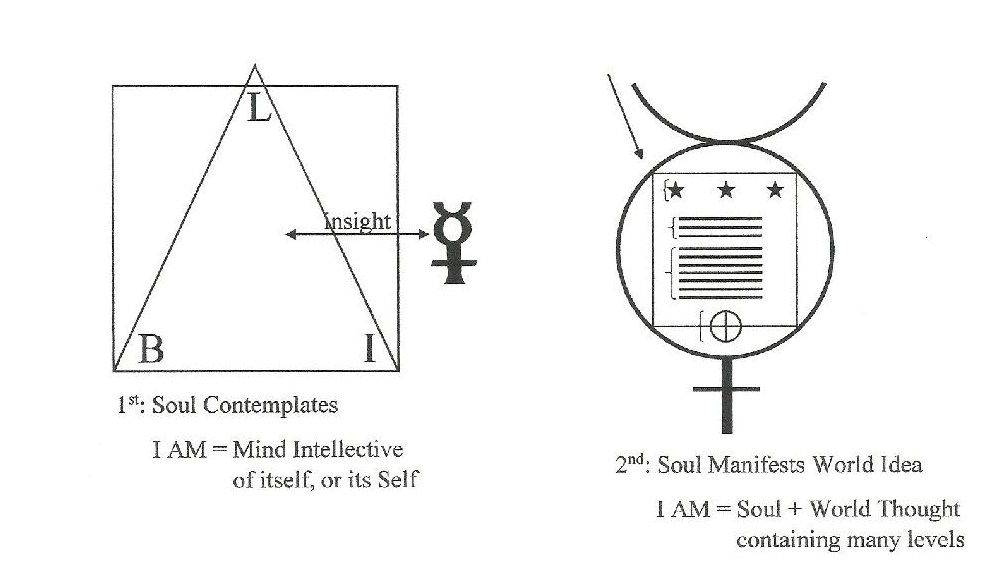
- FIGURE 1983 0916-1. Soul's Double Act. Originally found in AD/AS paper "Parmenides and the Authentic Existents".
Other diagrams also referred to are not with this transcript version. [Transcriber note: [diagram] means the speaker is referencing a diagram as he or she is speaking. If someone is drawing or writing, with audible sounds of chalk on a blackboard, I indicate this by [drawing] or [writing].]
AD PAPER read in class:
- "Parmenides and the Authentic Existents" (co-authored by AD and AS). Retyped as PLA Parmenides & the Authentic Existents - AD Supp 1034-1053 (Ver. 1) - V09MP.
NOTES:
Plato's Parmenides Hyp. 1-2A discussed in WG CLASS 1983 09/02b; Plato's Parmenides Hyp. 3-4 discussed in WG CLASS 1983 09/09b.
The paper read in this class was originally written by AS. There are multiple versions of this paper at different stages of revision. The latest version of the paper has AD's class commentary incorporated into it and can be found in AD Supplementary Material, pp. 1034-1053.
The Eight Hypotheses, as translated by F.M. Cornford in Plato and Parmenides, is appended. It was typed out and used in WG Eight Hypotheses classes. AD made some handwritten edits and these are noted accordingly.
Partial transcript for 9/2, 9/9, and 9/16/83 exists (Scan File 1983 0902 0909 0916-8hyp P1 TO 150.PDF). Pp. 91-150 covers this class.
TRANSCRIBED Verbatim by IT 2021. Archival verbatim transcript with AD Paper – V11ap.
AUDIO FILES: 1983 0916a, 1983 0916b. [Note 1: "Tape" and "Side" refer to original audio cassette tapes that were later digitized into .MP3 Audio Files. Note 2: In 2024, REP Studio improves the sound quality of file b.]
1983 09/16 at Wisdom's Goldenrod
Plato; Parmenides; 8 Hypotheses Hyp. 5-8
[Audio File 1983 0916a Begins]
LR: --but we never actually read the actual Hypothesis, Avery.
AS: Yeah.
LR: Is that because it's too hard?
AS: No we read part-- I read parts of it.
LR: I know, it's the other part that I was wondering about.
AS: Oh. Are those the unific part, the aspect?
LR (simultaneously): Well--
AS: Well if you have a question on those other parts, I think we should probably go on anyway.
LR (simultaneously): There's more things (student laughs) about similars and dissimilars, you know, and all that, and uh--
AS: Yeah. All that stuff about similars and dissimilars should follow similarly to Hypothesis Two, and I think Severin made a good point which bears mentioning, that there's kind of a symmetry in those four-- first four in that-- and in fact in the whole thing, that the first two mention "if the One is" and in one case none of the-- none of the attributes, the be-ness and all the others things can be attributed to it. And in the Second it do-- if it has being, all of the attributes can be attributed to this I AM.
LR (faint): That's true.
AS: And then in Three and Four he says what happens about the others. And the same idea in Three, all of the attri-- if-- if the one has being, then the others than the one also are ones in some way and they all have these attributes, similar, dissimilar, and all of that. But in Four, in another way, since the one never becomes these others, these others or the many don't have any of these contrary characters. And he follows-- he goes through the same kind of argument. Because they're not one, therefore they can't even have being, they can't be a many, they can't have any of the contrary characters, they can't be like each other or dislike or anything else. I agree. [students assent, very faint] They're probably not in this one.
LR: That's right.
S (very faint): Uh-hm.
AS: Also one other thing, are you reading it from the-- just that short list? Oh. See that-- one of the problems with the short list, the Brumbaugh, is that in the actual Dialogue he does give more filler. You know, you can see more clearly how he gets from one of the stages to another, and that, you know, on and on down the line. And in the short form, it's-- it's rather-- he just-- the short form just summarizes the results as it were and it doesn't show you why because it's like and unlike, therefore it-- it also is whatever the next thing he says. It doesn't-- doesn't really show you how different characteristics follow. So that was (kind of) [one/two words inaudible]
S (very faint): Ok, yeah.
AS: (On your altars.) But-- Ok, maybe-- maybe if we have time later we can go-- we can go back and read some of them. I think Anthony (wouldn't) want(--/.) We should try and go through the last, the Five, Six, Seven, and Eight. And they-- they laid out like the One, Two, Three, Four except-- No, not really. They're not laid out but similar. But the whole-- the crucial thing in interpreting Five, Six, Seven, Eight is-- I think is just-- is right in-- right there in number Five. And I guess if you get that right, you can follow the interpretation right on down through. Because Five begins, instead of saying "if the One is"--
So the key thing in Two, Three, and Four was to understand the interpretation that isness meant existence, that, though unity was soul, and what he meant by the being or the existence given to that was the World-Idea coming into the soul. And that gets you Two, Three, and Four when he says "if the One is".
Now in Five, and in the subsequent ones, the Hypothesis is "if the One is not". So right off the bat, when we have the first-- when you have-- state definitively what we mean by saying if soul is not. And it may vary from one Hypothesis to the other just as 'exists' varies at least from the First to the Second. 'Cause in the First (one/when) he said "if the One is", he meant that the one-- the essence of the soul which is not in existence. In the Second Hypothesis he seems to mean existence now. The soul is given being. The First ends "if the One is" in some sense can't be characterized at all. But then the Second, Third, and Fourth went on to say "if the One is" indicates existence.
Now I think we're going to have a similar thing here, that there are two distinct ways in which "is not". There are two distinct ways in which the soul is not. And one is relative and the other one is kind of absolute. But, I'll try this way.
[Transcriber note: The following paper is titled "Parmenides and the Authentic Existents" and was originally written by AS. There are multiple versions of this paper at different stages of revision. The latest version of the paper has AD's class commentary incorporated into it and can be found in AD Supplementary Material, pp. 1034-1053. It has also been retyped as PLA Parmenides & the Authentic Existents - AD Supp 1034-1053 (Ver. 1) - V09MP. I transcribe the paper exactly as AS reads it, including any alterations made during re-reading.]
AD/AS Paper ["Parmenides and the Authentic Existents," AS reading]: "So in the next Hypothesis, and in 5 and 6, we consider that the Soul is characterized by non-being."
AS: In other words, what will follow if the one is not. And we're still interpreting the one here as the soul or the I AM.
AD/AS Paper ["Parmenides and the Authentic Existents," AS reading]: "So he states -- if Soul"is not" we are still saying something definite about it. In positing that it is not in existence we are saying that it always remains unmanifest in relation to the Cosmos or the World Idea. And further, he says this non-existence of the unity of Soul is something quite different from the non-existence of some "thing". For example, if we say some thing does not exist we usually mean something like a Horn's Hare, it's nothing. But here in positing that the unity of Soul does not exist, this One which is not is in fact the true person or the authentic Soul, the unmanifestable essence, of which we are still saying something. In this postulate it seems he's saying that the non-objective and unmanifest principle of awareness is still in relation to the existence of the World Idea, but it itself is non-existent. Existence does tell us something about the Unit Soul which is itself never in existence. But this existence or manifestation cannot exhaust or really affect that true essence.
"In a very complicated interplay of being and non-being Plato tries to show…"
AS: Or in the interpretation we're given, or un-given--
AD/AS Paper ["Parmenides and the Authentic Existents," AS reading]: "…shows that both the unmanifest Soul and the manifest cosmos have an interrelation to the other's mode of being."
AS: Ok? "The Soul…" He says-- we're interpreting the dialogue--
AD/AS Paper ["Parmenides and the Authentic Existents," AS reading]: "The Soul essence is not in existence, but positively it is something defined as what is unmanifest. It is non-existent. Similarly the cosmos both is and is not. The cosmos is not the unmanifest Soul essence, but it is a definite existence."
AS: Ok? He goes through this in a little place in the dialogue where he says the one is not in some way and it is. It is not in existence, but, saying that it is not in existence is also saying that it is. It is defined as what is unmanifest.
AD/AS Paper ["Parmenides and the Authentic Existents," AS reading]: "Because the Soul is not existent, and is never altered or changed by any of the appearances, the Soul then [AS: he says] can pass from the state of unmanifest essence to a kind of existence as the manifesting Principle which is still not in existence. Since…"
PD (simultaneously): Avery? Could you go a little slower?
AS: Yeah I'm sorry.
S (very faint): Uh-hm.
AS: Read from-- Back up.
S: You could start it (right) by--
AD (simultaneously): A lot slower.
AS: Let me start from the beginning.
S: Oh.
AS: And I'm not sure this is so clear. Do I need to be? [short pause] Ok. Putting it simply, the fir-- there-- I think there are two ways to interpret Five and the way-- the first way I tried to interpret it here is that by saying if the soul is not, if we still referring this to existence, then what he's saying in Five is that this soul essence is never-- is not in existence. And this is relative to the manifestation of the cosmos. [student assents, very faint] Ok? Says--
AD/AS Paper ["Parmenides and the Authentic Existents," AS reading]: "…if the Soul"is not" we are still saying something definite about it."
AS: In other words, the soul is non-existent. And that's a definite statement.
VM: Yeah.
S (faint): Yeah.
AS: Non-existent is saying that it's not the cosmic manifestation. [VM simultaneously: Soul is not these.] And he's saying that it definitely is the non-existent. So in order-- in order to say that it is non-existent, it has to be juxtaposed to the existence of the cosmos in order to make this statement. And therefore also it's a positive statement. It is non-existent. Ok, so it's-- it's a relative non-being that he's speaking of. Ok.
AD/AS Paper ["Parmenides and the Authentic Existents," AS reading]: "In positing that the Soul is not in existence we are saying in this Hypothesis that it always remains unmanifest in relation to the Cosmos or World Idea which is manifest. For this non-existence of the unity of Soul is something quite different from the non-existence of a"thing"."
AS: For example, when we try and say that a hare's horn is non-existent. You mean something quite different when we say that the one or soul is non-existent.
AD/AS Paper ["Parmenides and the Authentic Existents," AS reading]: "The One or Soul which is not is in fact the true essence of which we are saying something when we say it is not in existence. In other words, in this postulate, this non-objective principle of awareness is being pointed to in relation to the existence of the World Idea which it is not."
VM: Avery could we say that this is pointing to the imparticipable nature of that unity of soul?
AS: Not imparticipable in this one. I think in the next one it's imparticipable. Here it is participable in that the whole-- Well, I'll say it a little later.
VM: Alright, well maybe it's in-- inappropriate.
AS: No, not imparticipable. Here's it's non-existence.
S (faint): Yeah.
S (faint): [three words inaudible]
AS: No.
S (faint): How (so)?
AS: Here he's just saying that this-- this essence of soul is not the existence. And yet, by saying it's not the existence, we don't-- we're going to be able to say a lot by juxtaposing it to existence. It's not existence but it's the principle of existence. And therefore by saying it's non-existent here we are going to be able to say a lot of things about it. So it is participable, and I think that the existence does reveal something about it, it's non-existence. Whereas in the ne-- in Six, he's going to talk about the absolute non-existence. Well let me try 'cause I think there are two things in Five, I just can't--
AD/AS Paper ["Parmenides and the Authentic Existents," AS reading]: "The One which is not is the true per…"
AS: This one here which is not is in fact the true essence.
AD/AS Paper ["Parmenides and the Authentic Existents," AS reading]: "In this postulate, the non-objective principle of awareness is still in relation, in relation to the existence of the World Idea, but it itself is non-existent. Saying non-existent is defining it in terms of existence as being the principle of existence or not (existence/existent). We can further say that the existence here does tell us something about the Soul essence which is itself never in existence, but the manifestation or existence of the cosmos cannot exhaust or really affect that true essence.
"In this complicated interplay of being and non-being, as we're interpreting it, the Hypothesis shows that both the unmanifest Soul and the manifest cosmos have an inter-relation, one to the other's mode of being."
AS: Ok? Soul-- he says--
AD/AS Paper ["Parmenides and the Authentic Existents," AS reading]: "The One is not and also is. Namely, the Soul essence is not in existence…"
AS: Well, is not but does not have it too.
AD/AS Paper ["Parmenides and the Authentic Existents," AS reading]: "…but positively it is defined as something which the manifestation is not. It is non-existent. On the other hand, the cosmos is not the unmanifest, but it is a definite or defined existence. [short pause]
"Because it is not existent, Soul could pass from one state to the other, that of unmanifest to the support or ground of manifestation. Since it is not existent, it can be simultaneously present with the whole of existence without being anywhere in the cosmos of existence. Thus for example he says"side by side will stand the Authentic All and the cosmos." [Note: Plotinus, VI.4.2, "Side by side exist the Authentic All and its counterpart, the visible universe."] In its relation to existence, the non-existent Soul will then be seen to have various complementary qualities."
AS: So-- I think that one further point here is that, for example--
AD/AS Paper ["Parmenides and the Authentic Existents," AS reading]: "In the tractate in VI.5, Plotinus speaks of the presence of"non-being within being". [Note: Plotinus, VI.5.12, "…for the addition was not from the realm of Being--you can add nothing to Being--but from non-Being."] And this seems to indicate that in this Hypothesis, Plato is also pointing to the principle of non-existence being within the principle of non-being, that is, within each Soul. In other words, that the Soul has within it a principle of manifestness, or a tendency to divisional existence."
AS: I thought this was another alternate interpretation.
CDA: So you're-- you're equating the principle of non-being with the principle of manifestness?
AS: Yeah. See two-- he has two ways of speaking of it as non-existent, both within this Hypothesis. He says it is not existent, and it is not the existence. Now by saying it is not the existence, I could take that to mean that he's saying that the soul essence is not the manifested cosmos. (It/It's) never existence. But then he also says it is non-existent. Now under that-- under that "is non-existent", I thought that's-- see Plotinus says for example that within being is lodged non-being. [Note: Plotinus, VI.4.2, "…since Being cannot lodge in non-Being, but, if anything, non-Being within Being."] And I thought it possible that he was trying to indicate here that although the soul was not in existence, it has within itself a principle of manifestness or a tendency towards divisional existence.
AD/AS Paper ["Parmenides and the Authentic Existents," AS reading]: "So this principle of non-being in the Being of Soul is the source for the manifesting of the existence of the cosmos."
AS: There's a play here on being and existence.
S: Uh-hm.
AD/AS Paper ["Parmenides and the Authentic Existents," AS reading]: "Through an extension of this tendency or desire for separation, Soul does come into relation with the manifest cosmos which appears within it. The fact of the non-existence of Soul allows the existence of the cosmos to stand within it and to have a relative truth without it being absolute naught, as he will further demonstrate in 7 and 8."
AS: Now, maybe I could-- The analysis might've been-- And I'm-- [drawing] If this-- the cosmos or the World-Idea, the appearance of the cosmos is existent, ok, and now if he's-- if we're considering the soul in itself, in itself the soul is non-existent. [drawing] Ok. Now let's imagine the soul without the cosmos, it's non-existent. But, on the other hand, the soul has real being, whereas the cosmos which appears within it is [drawing] non-being. So I just thought one of the things in the Hypothesis is he's showing there inter-relation between the being of soul and the existence of the cosmos. Soul itself is non-existent insofar as it is not the existent. But on the other hand lodged within the soul is the principle of non-being. Within the being of the soul is lodged the principle of manifestness which allows for there to be non-being. Non-being [drawing] equals existence, just as non-existence equals being, you know. In that sense, what he's speaking of is a relative-- it's a relative non-existence. Either one is relative. To speak of the non-existence of soul, you have to speak of it [chalk on board sounds] non-existent. So it's relative to the existence of the cosmos. [drawing/writing] And speaking of the non-- speaking of the being of non-being or the non-being lodged within soul it's relative [drawing/writing] to the being of the soul.
DH: Avery--
S (faint): Uh-hm, go ahead.
S: Go ahead.
DH: I-- I got lost there somewhere.
S: Yeah.
S (very faint): (I don't understand.)
DH (simultaneously): Um, what-- where did you bring this-- the-- the being up there, the no-- this-- this--
AS: Well--
DH: He does talk about it as positive step, you know. It must in some sense even possess being.
[timer going off in background]
AS: Right.
DH (faint): In-- in one second. (laughter, student words)
AS (amidst laughter): Yeah.
S (amidst laughter): There you go Dave.
AS (simultaneously): [few words inaudible] (more laughter)
VM: (Right), Dave. Plus you said something crazy [DH simultaneously: Let me--] David too.
AS: Yeah.
DH: I mean he has this sentence where he says--
AS: Yes.
[Transcriber note: I am using Plato and Parmenides: Parmenides' Way of Truth and Plato's Parmenides, translated with an Introduction and a Running Commentary by Francis MacDonald Cornford, London: Routledge & Kegan Paul LTD, 1939.]
Francis M. Cornford [Plato and Parmenides, 162B, p. 226, DH reading]: "Thus it appears that the One has being, if it is non-existent…"
AS: Exactly, that's where I'm coming from.
Francis M. Cornford [Plato and Parmenides, 162B, p. 226, DH reading (simultaneously with AS above)]: "…and also, since it is not existent, [DH adds: it] has not-being."
AS (simultaneously): Right. It has non-being. That's-- right, and that's what I was trying to explain, that in it-- in this-- in-- in starting off by saying that the soul is not, or is non-being, non-existent, we will eventually come also to the fact that it is in some way. In other words, it's not an abs-- he's not talking about absolute non-being of soul here. He's saying it is in a certain way. It is non-existent taking it as it has the property of non-being lodged within it. Whereas is not existent-- we're-- ok, I'm just-- The-- the interpretation we're using is that existence is equal to the cosmos, [student assents] [AD, very faint: Alright.] [student assents, very faint] the appearance. So by saying that the soul-- first of all, by saying that the soul is non-existence, or just the-- is not the existence, we're saying that the soul essence is never in existence, just-- I'll say that. It's unmanifested.
S (faint): Uh-hm.
AH: Avery?
AS: But saying that isn't quite the same as the First Hypothesis. 'Cause in the First Hypothesis when he ends up by saying "if the One is" (as) knowing, known and so on, it's not even in relation to the cosmos, as he says. Here it's-- it's a juxtaposition to existence. On the other hand, because it is not the existence, and it has this relation, it also is or has the principle of non-existence lodged within it. It is non-existent and that's saying something positive about it. And it seemed to me that what it's leading to is that saying it is non-existent or it has the principle of non-existence in it is like saying it has this principle of manifestness within it. Otherwise you could never even allow the appearance of the universe at all. So even though it's not existent, it can still-- within it-- within it can still appear the cosmos. The World-Idea can appear within its own non-existence.
DH: So are we saying that the-- this fact that it's-- it's set up there in this Hypothesis in relationship to existence, that in that-- in that setting it has being. I mean it has being as non-existent.
AS: Yeah, something like-- yes.
DH (faint): Ok.
AS: That's what I'm trying to say, I don't know-- [DB/S(?) simultaneously: Doesn't that mean--] Because I think in Six he's going to go on and say that it-- it also has it-- it absolutely is not affected at all, is non-related at all, absolutely non-existent. Ok.
PC (simultaneously): I don't-- I don't really understand the use of being and non-being this way though because, in the earlier Hypotheses, when we said the soul has being we were referring to the existence of the cosmos in it.
AS: Right.
PC: Now you seem to be saying that that's the non-being whereas the soul's being is its non-existence.
AS: Ok. Maybe I shouldn't have used being and I'll-- I'll throw that-- I-- I didn't mean that to be in his terminology 'cause that's e-- it's a real essence. Maybe we should go to the--
LDS: Did you mean unity at that level?
AS: No, what I meant was-- I was-- I was playing off the line in Plotinus where he says it's not that being lodges within non-being, but non-being within being. Ok? And I took that to be the positive sense. After saying-- he interprets this [writing] "is non-existent" or "is not existent" in two ways. First the negative way, it is not what's existent. So the soul is not what's in existence means that the soul essence is not the manifest cosmos. But this [writing] also says that the soul is non-existent. That's-- that follows from that, if you're saying something definite about that relation, that you can also say that it is non-existent and in that sense it's like saying that within being there lodges the non-being.
VM: I don't see how that follows from that.
PD: Yeah that [PC, faint: Yeah.] step in the logic, Avery.
VM (simultaneously): I mean I agree with you that like, you know, Plotinus also says each soul contains its own matter. [Note: VM probably thinking of III.3.4, fourth para from end.] In that sense it (could--) it had a potentiality to manifest. You know, I don't argue with that, it's just that I don't see how you get from your different interpretation of "is non-existent" to the idea that the soul contains within itself the principle of non-being which abhorred the possibility of manifestation. In some ways I guess-- maybe it's silly to bicker because I agree with what you're trying to say, I just don't see how you get it.
AS (simultaneously): Well, ok, I try. Well-- um--
VM: If it's just for my benefit I could see it through.
AS (simultaneously): No, no, I don't think it's [PD simultaneously: No.] just for you benefit, [VM simultaneously: No I--] it's for my benefit (too). (AS laughing)
PD: No I-- I think we see the statement (as/is) a positive and negative statement. On one hand the soul is not the manifest cosmos. [VM assents, faint] Anything objectifiable, the essence of consciousness isn't. [student assents, very faint] That's what it's saying soul is not. [VM, faint: First off.] On the other hand it's saying that soul is the uncreate. The soul is not is a positive statement about the nature of soul. "It is not" is referring to its uncreated, unmanifest nature. But to the point you brought out, Vic, that soul containing the principle of non-being in it as the principle of manifestation I don't see coming from there.
VM (faint): And it's hard to see that one.
AS: Well, maybe it's the next Hypothesis.
TS (faint): I thought you were saying that the essence of soul or being of soul had within it the characteristic of being non-existent or having no reference to existence. And by virtue of it not-- its essence having some reference to existence by being what is not existent, that made it the immediate prior of that which is non-existent.
EMD: We can't hear you, Tim.
AS: Yeah say it louder Tim, that's--
TS: Ok. I thought he was saying that the essence of soul is-- has within it the characteristic of being non-existent or not being in existence. And that would make it the immediate prior of that which has existence or is being.
BS: Ok, once more please.
S (very faint): I don't get it.
AS: That's [TS simultaneously, faint: Well, I want to see if it makes sense but--] something like that. When he says the-- the being of non-existence, it's like he's saying-- ok. Let me try it again. It is [drawing/writing] not existent, we agreed with that. Now, because of that it also is non-existent or it has-- it itself has this principle of non-existence. But here non-existent means relating to the cosmos as not-being. In other words, it has within it the principle of relating to the cosmos as not it. In other words, of manifesting it, that's-- In a sense that's what it means to be able to manifest the cosmos within it as other. [S: Right.] Because it is non-existent, in other words, because it has the quality of non-existence, which is a positive-- [writing] a positive standing-off from an existence, if you want to put it that way, that the cosmos can then appear within it as other and there's no problem with that. If it didn't have the property of non-existence it would get caught up with all of its manifestation. And then it wouldn't be the proper-- it wouldn't be able-- you wouldn't be able to have this co-- omnipresence of the soul to the entirety of manifestation. And in some sense that principle of non-- 'cause it is non-existent the cosmos can manifest.
JC: We've used that example of the mind as not having a form of its own and the imagination not having a form of its own, therefore it could take any form.
AS (faint): Yeah [couple/three words inaudible] I go back (to/through) what I did.
BS (simultaneously): Yeah.
DB: Yeah it-- Avery I-- I could see how it-- how you could say that the soul's non-existence would allow for it not to be, so to speak, caught up within-- within the manifested world but I'm not sure I can follow precisely how it is that that non-existence is equal to-- the soul's non-existence is equal to the soul's power to manifest the cosmos.
AS: Well you know, directly following that he goes into this argument about a non-existent entity can pass from the state of non-existence to the state of existence without being (really) moved in any other way. Alright, he says-- anything that both is and is not in such condition implies transition, the transition is motion.
DB: Right.
AS: So on.
DB: Yes, now that transition, that motion would seem to be the possibility of-- of unfolding the manifest-- the world.
AS (simultaneously): That-- that's what I'm saying, I'm saying that that possibility is directly based upon this principle of non-existence which lodges within it because it is non-existent. [one word inaudible]
DB (simultaneously): Yeah, granted it is but I mean if-- I mean just in terms of the categories of Being is that if we want to speak of that non-existence as the soul's being in this sense, its transcendent being in relation to the cosmos, then the Motion being the other category, one of the other categories of Being, it would seem to be that which allows for the unfoldment of the universe. And the-- the being allows that lack of ultimately being caught up in the-- in its own motion but nonetheless it doesn't seem to be equal to it. But--
AS: Equal to?
DB: Or the same.
AS: As?
DB: As the principle of motion. That is, because of its status as-- because of its status as being non-existent, it can remain, so to speak, unaffected by the manifestness of the world. It's not going to get caught up in it. But it doesn't seem to me that that-- perhaps I don't understand, but it doesn't seem to me that that exempt status is equivalent to its power to manifest the world.
AS: No, you're right, it doesn't necessarily mean that. I could-- I could easily withdraw that interpretation.
DB: No I mean [AS simultaneously: In other words, from that--] that it-- it allows-- it allows for it. I mean it's that exempt status that allows for the-- the other principle of-- of motion to take place it seems.
AS: Yes.
SD: I think the missing thing would be to-- to show how that's different from other principles which are not in manifestation and yet which aren't directly related to it which-- Ok, in what sense this is non-existent in a different way than let's say Intellectual-Principle is not existent or the Absolute is not existent.
AS: In a different way.
AH: May I ask a question about the use of "is" or-- When you said the soul is not existent, we are saying something positive about it, that seems pretty--
AS: Yeah.
AH: The logical correlate of that, I think, you have to say that manifestation is not. It exists but it is not?
AS: [few words inaudible]
AH: It has existence but it lacks that quality of-- of-- of isness that we described positive side of soul. So when we talk about the soul being responsible for the manifestation of that which it is not-- See I'm trying to see that logic as a correlate. We establish the soul by saying it is not existent. That's saying something positive about it. See you'd have to say that, that the existent is not.
AS: And that's what he's-- you know, that's-- what he says in here is exactly like that. He says, the only way to secure-- he says--
Francis M. Cornford [Plato and Parmenides, 162A, p. 226, AS reading]: "Accordingly, if it is not to exist, it must have the fact of being non-existent to secure its non-existence, just as the existent [AS: I'm taking the cosmos.] must have the fact of not being non-existent, in order…for it completely to [AS reads: to completely] exist. The only way to secure that the existent shall exist, and that the non-existent shall not exist, is this…"
AS: Each of the two, the existence and non-existence we have to attribute that it both is and is not. And in this way--
Francis M. Cornford [Plato and Parmenides, 162A, p. 226, AS reading]: "…the existent must have the 'being' [AS adds: or isness] implied in 'being existent'…"
AS: So it's that kind of existence, a rela-- we could say a relative existence.
Francis M. Cornford [Plato and Parmenides, 162A, p. 226, AS reading]: "…and [AS adds: it has] the 'not-being' implied in 'not-being non-existent'…"
AS: In other words, in not being essence. But here he's defining relative truth, if you want to put it that way. Now--
Francis M. Cornford [Plato and Parmenides, 162B, p. 226, AS reading]: "…and the non-existent, [AS: on the other hand] if it is to have complete non-existence, must [AS adds: first of all] have the 'not-being' [AS reads: 'non-being'] implied in [AS reads: by] 'not being existent'…"
AS: It is not the existence, it is not the cosmos.
Francis M. Cornford [Plato and Parmenides, 162B, p. 226, AS reading]: "…and the [AS reads: this] non-existent [AS: The soul.]…must [AS adds: also] have…'being' implied in 'being non-existent'."
AS: Or is the non-(existent/existence). [student assents, very faint] Ok? And the-- This he says in order for it "to have complete non-existence". In order for it to be completely a pure essence or not be the--
Francis M. Cornford [Plato and Parmenides, 162B, p. 226, AS reading]: "Thus, since the existent has not-being and [AS adds: since] the non-existent has being, [AS adds: then] the One also, since it does not exist, must have being in order to be non-existent."
AH: The last phrase please.
AS: Yeah. (some laughter)
S: Well--
S (faint): And after that?
Francis M. Cornford [Plato and Parmenides, 162B, p. 226, AS reading]: "Thus, since the existence [AS: The cosmos.] has not-being and the non-existent has being, the One also, [AS: Of which we are positing that it has non-existence.] [student assents, very faint] since it does not exist [AS adds: positively, it] must have being in order to [AS emphasizes following word] be non-existent.
"Thus it appears that the One [AS: The soul.] has being, if it is non-existent, and also, since it is not existent, [AS adds: it] has not-being."
AS: In its relation to the cosmos or existence you can see that it both has non-being because it is not that kind of existence. But also positively it is the non-existent.
VM/S(?) (faint whisper): Wild.
S: [one word inaudible]
AS: Yeah.
VM/S(?) (faint whisper): Wild.
S (faint): [few words inaudible]
AH (simultaneously): I-- I can't-- I can't express what-- what it is I'm trying to say but--
VM: It's ok [few words inaudible] (bit of laughter)
AH: When you speak about this being the principle of manifestation, it seems that there's a-- a necessity to-- to speak in a very precise way in regards to this logic, you know.
S: Correct.
AH: Like when you speak about its being a principle or the cause of or how did the world arise or something like that, it just seems inappropriate to not consider that except in the context of this-- this very strict kind of logic being expressed. And I don't know how to express it that way. But it does bother me to-- not to-- not to do that. How-- how is that idea expressed in the tradition?
BS: What idea?
AH: That the soul is the principle of non-being.
AS: Non-existence.
AH: Non-existence.
JL: I think-- I think [couple inaudible AS words simultaneous with JL] Plato-- Plato explains it in the very passage. I don't think you have to go any-- beyond that.
AH (simultaneously): Where you reading from?
S (faint): Which one was that from?
AS (simultaneously): The one we just read. Oh.
LR (faint): Yeah well we (can) get that here.
S (faint): (Was) the Cornford (translation).
AS (simultaneously): The same-- it's the Cornford, the same--
S: But where is it exactly?
AS: Oh. [few faint words inaudible]
DH (faint): 162.
SD (faint): Page 950 [couple words inaudible] intellectual [couple/three words inaudible]
JL (simultaneously): Logic is peerless.
S: 952?
DH (faint): [one/two words inaudible] paragraph 160E.
LR (faint): Paragraph--
AS: It's 160E and 161.
AH: See, it's not as if you talk about the soul being creative principle for that which is not.
AS (simultaneously, faint): 162.
S (very faint): (Good to know.)
AS (faint): But--
VM (faint): Let's just read that. Maybe you read that thing again, Avery?
AS (faint): You want to read it again [one/two words inaudible]
VM (simultaneously): That was a real mouthful.
AS: One six-- I meant-- I'm trying--
VM (simultaneously): Yeah but you don't want to but I'm not--
AS (simultaneously): Yeah, that's fine.
VM (faint): I don't want to (push) (it/you).
AS (simultaneously): No, reading it's fine, I-- I try-- I-- I would try and point it out on a diagram if that helps but I'm just going [VM simultaneously: Only if you do it.] with my own faulty interpretation so I don't know. So, I mean, [drawing] see, here's what we call the existent [diagram], ok, that which gives existence. Now the I AM has this existence because of the World-Idea. And I'm still taking-- [S, faint: Or just--] keeping with that interpretation. Now, as the-- the soul, the essence of the soul itself is non-existent now. [drawing/writing] We're now considering that it's non-existent. And that's varied very little from the First Hypothesis where he said there's nothing at all you can say about it. But now, it's slightly different because in saying that it is non-- it is non-existent, you are talking about its non-existence in relation to the existence of the cosmos and trying to get at it through that kind of relation of a non-existent to the (existent/existence), and saying that it is non-existent insofar as what appears, appears within it but it is not that. Rather than saying positively it is the Absolute or something like that, it is the non-existent. And that has implications for its nature and relation to the existent. Again whereas before the existence was characterizing the soul directly to say now the I AM has being, he's saying-- in this case he seems to be saying that even when this cosmos appears or even when there's existence, the soul itself is non-existent. What will be true about the one or the soul essence if it is non-existent. I mean that's-- Anthony did-- do you have some people we-- Or do you want us to just go on [couple words inaudible]
AD (simultaneously): No, wear them out.
AS: Wear them out and then you could go ahead. (some laughter)
S (faint): If I could start last week.
AS: Ok.
S: Um--
AS: So anyway, then I'm going to try and use this-- the picture there to understand what he says. And here it seems to be a crucial point of the thing. Because it's easy enough to understand that the soul just is non-existent if existence means the cosmos, but he says now further this implies, even if you posit that it is non-existent or it is not existent, it also is non-existent. Now that's the hard one, what does he mean here. Ok well-- So he goes here.
Francis M. Cornford [Plato and Parmenides, 162A, p. 226, AS reading]: "So it appears…"
AS: Maybe we should-- maybe we should go back to the beginning of the--
Francis M. Cornford [Plato and Parmenides, 161E, p. 225, AS reading]: "Further, it must in some sense even possess being."
AS: We've just-- the Hypothesis says that "if the One is not".
VM: Correct.
AS: And even if it-- it's so, we get to (the/this) point where he says--
Francis M. Cornford [Plato and Parmenides, 161E, p. 225, AS reading]: "Further, it must in some sense even possess being. For it must be in the state we are ascribing to it…"
AS: It must be in such a way that it is non-existent.
Francis M. Cornford [Plato and Parmenides, 161E, pp. 225-226, AS reading]: "…otherwise we should not be speaking the truth in saying that the One does not exist. If we are speaking the truth, evidently the things we are speaking of must be."
AS: I think he's just saying here, it's the same argument, that we're not speaking of something absolute non-existent as when we says a horn's hare. We're speaking of some essence or ontic reality that is non-existent. [couple inaudible TS words simultaneous with AS] And he wants to point out that what is not existent still has a status, in fact has a higher status than existence.
S (very faint): [one/two words inaudible]
AS: Ok. So--
Francis M. Cornford [Plato and Parmenides, 161E, p. 226, AS reading]: "If we are [AS reads: we're] speaking the [AS reads: of] truth…we are speaking of [AS adds: what] must be."
AS: The soul must be.
Francis M. Cornford [Plato and Parmenides, 161E, p. 226, AS reading]: "[So], since we do not claim to be-- since we do claim to be speaking the truth…" (AS laughing)
VM: I see. (some laughter)
AS: He claims to be speaking the truth.
Francis M. Cornford [Plato and Parmenides, 161E-162A, p. 226, AS reading]: "…we must [also] assert that we are speaking of things that are. [AS adds: And] So it appears that the One is non-existent. If it is not non-existent, if it somehow slips away from being so [AS adds: as] to not being so, it will at once follow that it is existent."
AS: If we claim that it is not non-existent then it must be existent. In other words we land right back by saying the soul is this manifested appearance. Now this won't be very good, 'cause--
Francis M. Cornford [Plato and Parmenides, 162A, p. 226, AS reading]: "Accordingly, if it is not to exist, it must have the fact of being non-existent to secure its non-existence, just as the existent must have the fact of not being the non-existent…"
AS: The appearance of the cosmos must have the quality of not being the soul essence. [students assent, very faint] We're equating essence with non-existence.
Francis M. Cornford [Plato and Parmenides, 162A, p. 226, AS reading]: "…in order that it may be possible for it completely to exist."
AS: Now I think right here is the point where he's saying, as opposed to Parmenides, because he holds this view of the soul as a non-existent, the cosmos can have a genuine kind of existence. If it weren't for this kind of logic, the cosmos would be naught, you'd be one-- in one of these schools where either the cosmos would have absolutely no status-- Ok? It would-- it would have to have no status because the only kind of being would be [VM simultaneously: The Transcendent, yeah, right.] the genuine being and the existent which is not the non-existent would have no status whatsoever, it would have the status of naught.
VM (simultaneously): And the other side of that, Avery, is that insofar as the non-(existent/existence) has a certain positive quality which we are saying it is, that it has the being of non-existence in some sense, [AS assents, faint] then that-- that keeps the transcendent from being completely removed from-- from-- from manifestation.
AS: Ok yeah, that too, yeah. So, if we follow this then--
Francis M. Cornford [Plato and Parmenides, 162A, p. 226, AS reading]: "Accordingly, if it is not to exist…"
AS: If the soul is not to exist, that it's not the manifestation--
Francis M. Cornford [Plato and Parmenides, 162A, p. 226, AS reading]: "…it must have the fact of being [AS adds: the] non-existent [AS: Or non-appearance.] [AS adds: in order] to secure its non-existence [AS reads: this non-appearance, non-existence, unmanifested], just as the existent [AS: The appearance of the cosmos.] must have the fact of not being the non-existent [AS reads: the unmanifest or the non-existent]…"
S (very faint): (Right/Yeah).
AS: If it were the unmanifest then how could it manifest?
S (very faint): (Right, yeah.)
Francis M. Cornford [Plato and Parmenides, 162A, p. 226, AS reading]: "…in order that it may be possible for it completely to exist."
AS: If the cosmos were the unmanifested, it couldn't manifest, it couldn't be in existence. So that would mean one of two things, either it's absolutely nothing, or the unmanifest would have to be becoming and there would be no real being. So, this allows for that-- this allows for that possibility of the cosmos to exist.
Francis M. Cornford [Plato and Parmenides, 162A, p. 226, AS reading]: "The only way to secure that the existent [AS: The cosmos.] shall [AS adds: in fact] exist, and that the non-existent [AS: The soul.] shall [AS emphasizes following word] not exist, [AS: That is not be manifested.] is this…"
AS: That's the only way to secure these two truths in a way, that the soul may be non-existent and the cosmos may exist side by side in some way. He says--
Francis M. Cornford [Plato and Parmenides, 162A, p. 226, AS reading]: "…the existent must have the 'being' implied in 'being [AS adds: an] existent'…"
AS: [couple words inaudible] And it also has--
Francis M. Cornford [Plato and Parmenides, 162A, p. 226, AS reading]: "…the"not-being' implied in 'not-being non-existent' [AS reads: 'not-being the unmanifest or not-being the non-existent']…"
AS: So the cosmos both is and is not. It is the existence or the appearance and it is not the unmanifest, soul. Now similarly--
Francis M. Cornford [Plato and Parmenides, 162B, p. 226, AS reading]: "…the non-existent, [AS: The essence.] if it is to have complete non-existence [AS reads: essence or non-existence, ok], [AS adds: it] must have the 'not-being' [AS reads: 'non-being'] implied in 'not being existent' [AS: Or being other than the manifestation.] and [AS adds: it must have] the 'being' implied in 'being non-existent' [AS reads: 'being the non-existent' or the essence]. [VM assents, faint] Thus, since the existent [AS: The cosmos.] has not-being [AS reads: non-being] and the non-existent [AS: The soul.] has being, [AS adds: then] the One also, [AS: Soul.] since it does not exist, must have being in order to [AS emphasizes following word] be [S simultaneously, faint: That's just beautiful.] non-existent."
S (very faint): Yeah.
S (very faint): Oh yeah.
S (faint): Ok.
S (very faint): Uh-hm.
VM/S(?): That's great.
AS: In order to be the essence that it is, it can never at any time be the existent cosmos, 'cause if it ever did become the existent cosmos, it would not be what it is, the unmanifest essence. On the other hand the cosmos can never become the unmanifest essence, because if it were in any way that unmanifest essence, it couldn't be the existence or appearance of a cosmos.
S (very faint): Yeah.
LDS: Avery, what he's saying the [HS simultaneously: But if--] being of the cosmos is?
BS: Sounds right but I can't believe it.
S (faint): Uh-hm. (bit of laughter)
S: Uh-hm.
S (faint): Yeah.
LH: Isn't he also going on though [few inaudible student words simultaneous with LH] to say that--
(Side 1 of original cassette tape digitized as 1983 0916a Ends; Side 2 Begins)
AS: Well in a--
DR (simultaneously, faint): In the manifestation.
AS: Yeah, in a funny way participates. Not that it participates in it but it allows-- [S, faint: I think--] seems to me it's allowing for the appearance or manifestation to it because it has-- it definitely has non-existence. [drawing] Then it's possible for the existence to be within it and to retain that quality of not being the existence. Like the mind, I mean we could take the mind and thoughts the same way too. The mind is never in exis-- it's never existent, even when the thoughts appear within it.
VM: Actually, you know, I think the whole discussion, Avery, I-- [AS simultaneously: Yeah Vic, go on.] I really like the way you're doing it but it would seem to be-- it would be a lot easier to follow if every place we see existence when referring to manifestation we use the word 'appearance' [AS: Yeah.] and save 'being' [AS simultaneously: Well, yeah.] for a more traditional use. [AS simultaneously: Or just--] (Hard to/I don't) know.
AS: Or just save 'being' for "it is", you know, [VM assents] for the-- for the verb [VM assents] or-- Well we could-- [student assents] we could try reading it again, let--
VM: I don't know if we have to read it again.
AS (simultaneously): Try reading non-existent as mind, [VM: Yeah.] and try reading the existent as cosmos. [VM assents] [short pause] So, it appears that mind is-- and non-existent as essence.
VM (faint): Uh-hm.
TS: Let me see if I could ask my question.
AS (simultaneously): Ok, go on. Go on Tim.
TS: It seems like there are four terms that are being-- trying-- trying to be established in relationship. That which is-- which has being--
VM (faint): If I could say it louder then you could say it twice as loud.
TS: That which has being, (bit of laughter) that which has non-being, that which is manifest, and that which is unmanifest.
AS: Yeah.
TS: And it seems like he's tr-- what is being said in this Hypothesis here is that, that which is unmanifest must have the character of being. [VM assents, faint] That which is manifest must have the character of non-being, ok. That non-being which has the character of being un-- that non-being (some laughter) which has a character of--
AS (simultaneously): Stop there, it was good. (AS laughing, some laughter)
TS: --manifestness must depend directly from that which has being, which has the character [AS simultaneously: Of non-manifest.] of non-manifestation.
S (simultaneously, very faint): Uh-hm, I see.
AS (simultaneously): Right, but--
DR/BS(?): How do you get the dependence? Or is that just brought in?
TS: That's what it says in the book.
DR: But that's not four things, that's only two.
S (faint): Uh-hm, yeah.
TS (simultaneously): No that's four. There's being--
DR (simultaneously): Well you used four-- four attributes but you're only referring to [VM simultaneously: Two principles.] the two.
AS: (That's) right.
S (very faint): I see.
S: Yeah but--
DR: But that was not always the case. That's where I'm getting a little confused.
DH: But I think he's saying that these two-- these two things, the-- the manifestation and the soul are each considered in two ways.
AS: Yeah.
S: Yeah.
VM (simultaneously): Uh-hm.
DH: Because they're-- they are in this-- I mean, we're [VM simultaneously: In its own way.] considering it in this relationship, [students assent] it's crucial in order to under-- understand it in that sense, that-- that they both are what-- you know, for both of them they are what they are and they are not something else.
AD: Good.
AS: And, I think--
TS (faint): Yeah, that's good.
S (simultaneously, very faint): Yeah, (yeah).
S (simultaneously with TS and S, very faint): Yeah, together.
AS: Go on, go on.
DH: Yeah, and so, I mean, seems to me [AS drawing/writing] that that's what he's saying here, that there-- that there are, you know-- I mean, [AS: Yeah.] they're both-- the-- for the cosmos it is existent, and, I mean it's-- and it is not the soul essence. And that [DR simultaneously: But then you're only (one word inaudible)] both of those are crucial.
AS: Yes. And that further that the cosmos gets it's "is not"-- whatever-- whenever it says something about "is not" or is non-existent, [DH simultaneously: Yes, yeah.] that is what comes from the one side here, from the side of soul. [DH assents] So when he says the cosmos is not e-- when he say that the cosmos is not the non-existent-- [VM simultaneously: Solution is from soul.] any time he says "is not" it has to get it from the soul. In other words, just as in Hypo-- maybe it's like analogous to Hypothesis Two where the unity comes-- the unity of the whole comes from the soul and the being of it comes from the cosmos. In this case he's saying-- you may be-- you might interpret that because of this relation of the non-existent to the existent, the non-existent positively is not the existent. But to say that it is the non-existent, as soon as you're positing it is the non-existent, it is so because of that-- you can say that because of its relation to the existent. Whereas for the existent, if you say positively "is the existent", that's ok because of itself. But to say that it is not the non-existent, then you're referring back to the soul. So any time you say either of the two principles "is not", you're referring it to soul, and every time you say either of the two principles "is" in some way, you're referring it to existence.
DR: Avery, I didn't follow.
AS: I think that's the-- that's the essence [TS assents] of what Tim was-- I think that's what [TS assents, faint] Tim was trying to get at too.
DR: Avery, when you refer to the cosmos as being the existent, [AS/S(?): Yeah.] then that's-- that's one thing. If you say it's not the essence, you're still referring to the same thing, the cosmos.
AS (simultaneously): Right, but now you speak--
DR (simultaneously): You're just-- you're just calling it something else.
AS: No. But when you--
DR (simultaneously): But when you do the soul that way it's quite different.
AS (simultaneously): But you missed-- but the point-- no but the point there was that you can speak about the cosmos when you say it is existent. You could speak about that quality it has in itself. When you say it is not non-existent you have to refer to it in relation to the soul.
DR: I don't follow you.
AS: When you say it is not the non-existent, you're saying it is not. [writing] This both is and is not in some way and the soul both is and is not, or both is not and is.
DR: Ok and I-- and I see those two as-- as coming out being somewhat different so let's do [AS simultaneously: Yes.] the cosmos first.
AS: They are somewhat different here too.
DR: When you say that the cosmos is, that seems fine.
AS: It is existent. [writing]
DR: It exists.
AS: It exists. There is, see.
DR (simultaneously): It exists as an appearance, that's what you mean.
VM/S(?): No don't need it.
AS: Ok, or just it exists, [DR simultaneously: Right, ok.] like the thought exists in a mind.
DR (simultaneously): Alright. Now when you say it's-- when--
AS (simultaneously): (But) that [chalk on board sounds] thought is not the mind. It is not the non-existent.
DR: You-- you really haven't changed its status at all [couple words inaudible]
AS (simultaneously): Right. But in saying it is existent you can refer it to itself almost and in saying it isn't--
DR (simultaneously): Do you really?
AS: Yeah because remember, where did existence come from?
DR (simultaneously): You don't really have a principle of being there.
AS: But where did existence come from the way we're using existence? It comes from the World-Idea.
DR: You mean you're claiming you're giving it a different status by giving it existence as opposed to giving it not-- not-existence?
S (faint): Yeah.
AS: Not that it has a different status but we're s-- Maybe I'm not saying this right but it-- we're still speaking in Five of this rela-- there is still a relation to existence for the soul. And insofar as there is, there's a relation of the existence to the non-existence or the soul. Both of these take on a certain character through that relation, [BS simultaneously: It exists--] or it is defined in a certain way.
BS: It exists because non-being is embedded in it and (and/or) (does) non-being refers to the soul which "is not" and therefore "is"?
AS: I'm saying in-- yes, in this Hypothesis you can make these positive statements like it is non-existent. You can make that positive statement about the soul because of the manifestation of a cosmos. If the cosmos didn't manifest there, you wouldn't be able to make that positive statement that it is non-existent, (when/or) you would be in another Hypothesis. You'd be in Hypothesis One where there's nothing really you can say about it or you'd be in Hypothesis Six, where in Six he says forget about this is non-existent business. It simply is not existent, period. Forget about the cosmos. It's just absolutely unmanifestable. [BS simultaneously: (And--)] So because he's saying it is non-existent, it is so in re-- in relation to or in reference to the cosmos which is existent.
DR: And when you say that, aren't you actually-- isn't there some other status of the soul that you're referring to there?
AS: Yes.
DR: Some actual status, not just a matter of reference.
AS: Yes. And I claim that the actual status [drawing/writing] there is the status of that principle of manifestness, which--
DR (simultaneously): I don't-- see, that's what I'm-- that's what's not clear. It seems like [S simultaneously: But (couple words inaudible)] when you say that it's-- that it is this non-being, when you call it this non-existent, it seems like you're not really referring to the principle anymore.
AS: But I'm giving--
DR: It's now some other status that is really in existence, and existence as some non-existent is not really the principle when you say that.
AS: See, but I'm (dealing) from this line from the cosmos, says, if the cosmos is not really, the soul is not non-existent. [students assent, faint] Oh no.
Francis M. Cornford [Plato and Parmenides, 162A, p. 226, AS reading]: "…[AS adds: it is] just as the existent [AS: The cosmos.] must have the [AS emphasizes following word] fact of not being non-existent, in order that it may be possible for it [completely] to exist."
AS: So in my understanding, saying that the cosmos is existent [drawing/writing] can refer to itself. But again, saying that it is not the non-existent is a reference, has got to be a reference to the soul. It's juxtaposition to the soul. [S simultaneously: Ok (couple words inaudible)] And he says that in virtue of it not being the non-existent-- if it were the non-existent, if it were the unmanifestable essence of soul, you'd never have an appearance of a cosmos. So the cosmos has to be other than that. And he says it's in virtue of this that it can secure its complete existence.
DR: Could you go over that again?
S (faint): But, would you read the--
AS (faint): Yeah I'm sorry [couple/three words inaudible]
S (faint): Right.
DR: Just do that one part again, not the whole thing.
S (very faint): Yeah.
AS: When he says that--
Francis M. Cornford [Plato and Parmenides, 162A, p. 226, AS reading]: "…just as the existent [AS: The appearance of the cosmos.] must have the [AS emphasizes following word] fact of not being [AS adds: the] non-existent…"
AS: The cosmos is an [chalk on board sounds] existent appearance and it is not the unmanifest soul essence. It is not non-(existent/existence).
DR: Are you saying that that's a reference to something other than the status as the-- as the cosmos, it's some other referent?
AS: It's a reference to the fact that it's manifested in the soul. If it weren't manifested in the soul, it would just be existent. Here, it is existent. Now I don't have to speak about mind that it's manifested in but as soon as I say also it is not [chalk on board sounds] the non-existent, that "is not" is a relation. It's a relation to the-- to the soul or the mind in which it is existent, and which it is not. It is not the mind in which it man-- it's manifested, but it is a manifested existence. [S: You're saying--] Now in order to secure a real status, it seems to have to put-- I mean and this is (speculating) that the Hypothesis earlier referring to the one, the oneness.
S (very faint): Ok, I--
JA: Avery, could I try?
AS: I'm sorry, do it, (go ahead).
JA: It seems that what-- expressing it this way is setting an-- existence and non-existence as mutually limiting. And--
AS (simultaneously): In this Hypothesis I would say yes.
JA (simultaneously): Right, in this Hypothesis.
AS: Yes.
JA: But when you actually [AS simultaneously: Ok.] follow the logic out, what happens is that non-existence becomes unlimited and existence becomes limited. And that's [AS drawing/writing] [AS: Fine.] why you could make non-existence the principle of be-- you know, of becoming a limited existence.
AS: Sure. I follow. That's a good point, yes, they're not of equal status. When I-- when [JA simultaneously, faint: Right.] I agreed to mutually limiting, no, they're not-- The fir-- (but) first of all it's because the Hypothesis begins, "If the One is not".
JA (faint): Right.
AS: So it's the one which is non-existent. And I-- maybe I'm-- maybe I'm wrong in the-- in finding the implication that within the soul the manifestation can occur, I mean-- But I think it's [JA simultaneously: Well that part--] in this Hypothesis.
VM/S(?): Why?
AS: Well I-- I tried to bring out the couple of lines where it seem-- he seems to say that, that it is in virtue of this that it can exist at all. [student assents, very faint] And--
TS: But it (seems/seemed) like--
JA (simultaneously): Well, (just what you mean).
AS (simultaneously): But I think that's a side issue because he's really talking about the one as the soul.
JA (simultaneously, faint): I wa-- I was trying to think of that because you had made that statement (more recently). At least on the basis of, you know, a principle that is unlimited, it would, you know, in some sense logically exceed anything you could (name it).
AS: Yeah, I agree, and that-- See that's-- that's what he's saying too, it's-- it is not existent so that means it is not (the limited/delimited). But since it is the non-existent-- and that-- I-- it just follows to me very-- it seems to be consistent. When he says it is not the existence, [writing] that's its unlimited nature.
JA: Right.
AS: But when he says it is the non-existent, and it's not really a limitation to have manifestation occur within it, but saying that is the non-existence--
JA: That's its positive nature.
AS: Is a positive nature which evidently is still a reference to the fact that it's not whatever is manifested within it, it's still a reference to the manifestation.
JA (faint): Direct reference to something, (yeah/yes), uh-hm [one/two words inaudible]
AS (simultaneously): That's-- that's the way I-- yeah. That's the way I understood it.
AH: But-- but is it correct to assume at this point that existence is in so-- is in some way synonymous with objectivity?
AS: Sure.
AH: Alright.
AS (simultaneously): I think it would follow [couple/three words inaudible] the other point(s).
AH: So when (we/you) say "it is"-- as we conclude that it is because it-- it is not the existent, that its positive status is established but never as an object or never as a manifest principle. It must forever remain the subjective pole in truth, if you want to use that kind of description.
CDA: Avery?
AS: Well--
AH (simultaneously): When you say that objects occur within it, [S, faint: Yeah (one/two words inaudible)] in order for object-- in order to know an object would have to be the other-- the other (route/way).
DH: But, I think one [couple/few words inaudible] that the existence of the cosmos in it implies the mind, I mean, like it-- it gets a status from that objective (existence/existent).
AH: It gets its status--
DH: No, gets a status. I mean there is a--
TS/S(?) (simultaneously, faint): [few words inaudible]
DH: Yeah. There is an aspect to the one from that that it is not the existence.
CDA: I'm not [one word inaudible]
AS (simultaneously): Have we tired ourselves out yet enough, Anthony? (AS laughing)
AD: Well, she's got a question.
CDA (simultaneously): I have a question.
AS: Oh ok, we'll wait for all the-- we'll wait for the exhaustion.
CDA (simultaneously): This is just in-- in a slight-- a different vein than what you're--
AS: Sure.
CDA: But when I re-- read the Fifth Hypothesis, in the third section, he says--
AS: Say-- say it again, when you read the--
CDA (simultaneously): In-- in the Hypothesis, in the Fifth Hypothesis, in [AS simultaneously: Yeah.] the third-- in the third line, third section--
AS: You have the Brumbaugh?
CDA (simultaneously): He says in the-- in the-- yes.
AS: Just-- ok then read it.
CDA: He says--
[Transcriber note: I am using Plato's Parmenides, translated by and found in Robert S. Brumbaugh, Plato on the One: The Hypotheses in the Parmenides, New Haven, Yale University Press, 1961.]
Plato (Brumbaugh tr.) [Parmenides, 160c7, p. 166, CDA reading]: "[And] in the first place, we speak of something knowable and different from the others, when we say"one," whether we combine it with being or nonbeing; for it is no less comprehensible to say that something is not, and that it differs from the others…"
AS: Uh-hm.
CDA: I want-- I wonder what you think he means when he says "we speak of something knowable".
AS: Um--
CDA: He refers to knowledge again later.
Plato (Brumbaugh tr.) [Parmenides, 160d8, p. 166, CDA reading]: "So there is otherness in it in addition to knowledge."
CDA: And I just can't-- within the context that you're doing, I can't see how that knowledge is applicable.
AS: Well, say more, maybe you got a point there, go on.
CDA: Well, I mean I follow what you're doing but [AS simultaneously: No but--] then when I read this and that there's-- it-- it seems to-- I can't do the logic, but it seems to me that when-- that he-- see he's speaking about non-being and he's speaking about knowledge, and that non-being is-- is necessary for the knowledge to occur.
AS: Yes.
CDA: That's not a new idea for us.
AS: Yes, that's what--
CDA: But then to apply that to what you--
AS: Same thing. Well, how? He's saying something positive, he's saying that it is non-existence. It's not saying--
CDA (simultaneously): But he's saying it is knowable.
AS: Because he's-- I-- I think he's saying here as-- This doesn't have the whole argument, see, it's just got a bare outline. And in the Dialogue he says, saying that the one is non-existent is quite different from saying that some other thing is non-existent. This is a different meaning. So we're saying something about it, obviously. Because if we weren't saying something specific about the one, it would be the same thing to say the one is not existent or this is-- or an object is non-existent, or some other is non-existent. So it's saying something very definite about it. In other words, just saying that it is non-existent is saying something definite. You have knowledge about it. You automatically have a knowledge. You must have a knowledge or you couldn't say what you said.
CDA (simultaneously): Wait, you're logically inferring but that's different than knowledge.
AS: Not logically occurring, you--
CDA: Inferring.
AS: No, no, not logically inferring. He's saying this is a reasoning based on the thing itself, remember we spoke-- this is based on the essence of soul. It's not an inference that the soul is non-existent.
CDA: No, no, what I'm saying is an inference is-- is that you know something about it because you can say that it's non-existent.
AS: But that's-- that's what he says in the Dialogue.
CDA (simultaneously): I don't see how that's knowledge.
PD: Knowledge of absence, I mean-- [AS and CDA assent] Why do you want to restrict knowledge to [one word inaudible]
AS (simultaneously): It's-- it's quite a big knowledge to know.
CDA (simultaneously): So you think that's how he's using it here?
AS: Yes, it's quite a big knowledge to know that the soul is not-- is a e-- is an unmanifest essence.
DB: Is it possible--
AS (simultaneously): If that's what he means, I mean we--
PD (simultaneously): In fact that-- [S, faint: Yeah.] without that knowledge, you'll keep thinking the soul is a thought or an image that comes up.
AS: Yeah.
DB: Is it-- is it possible that in that quote that it might be [AS/S(?): Well--] better understood as being translated as intelligence rather than knowledge?
[9 second pause]
AS: Say it again David, I'm sorry, I didn't (hear).
DB: Well, every time-- I-- I thought that what-- what Carol was objecting to was the fact that when knowledge was spoken of in this context it seemed to infer some form of objectifiable consideration, whereas I was just wondering if it were possible to translate that as intelligence. Every time you have knowledge there, replace it with intelligence and-- and just see if that didn't make-- fit in more with-- with what you were doing.
JL: But that destroys the logic of it. I-- I think your Cornford in 160B pretty much clarifies that.
S (simultaneously): Yeah.
AS: Yeah. And we can read it.
S (simultaneously): Yeah I know 'cause that-- yeah. (CDA laughs)
CDA: That helps a lot there.
S (simultaneously): (Incredible), right. (CDA laughing)
JL: I mean other than, you know, just saying that it's knowledge. I mean he means it in a very specific way.
AS (simultaneously): Yeah the way I-- I think the way I was trying to explain it but [couple words inaudible] [S simultaneously: Sure.] [couple words inaudible]
LH: Actually what she's saying really points up what the secondary point you made about the non-existent, that it has both non-being and being, that it's a real knowledge that you have of the existent.
AS: From within non-exis-- from-- a real knowledge that you have of the non-existence from relation to the existence. I can [LH simultaneously: Well, of course.] take knowledge in one of two ways there but they're probably both wrong. One is that because it's-- it is non-existent, in relation-- from within the cosmos you have some knowledge, that kind of knowledge, about.
CDA: Yeah I--
AS: But it could also mean that you're a-- enabled to say this because even though it's nonobjective, you do have a real knowledge about that principle.
CDA: And what do you mean real knowledge about that principle?
S (faint): Uh-hm, that--
AS (simultaneously): Just-- just the fact that-- you know, what Andrew's always getting at. Andrew always says, well, it's not objectifiable, how can I know it? But it's the most immediate thing in your-- in your experience is the non-existent part of it. The awareness is non-- is the-- is not ever in existence and it's always the most immediate. [CDA simultaneously: Well that makes more sense to me.] Therefore it's a very definite thing that you're speaking about.
CDA (faint): That makes more sense.
DB: Yeah but that's--
AS: Even though it's not objective. And that's-- if-- so he says, even though we're saying it's not existent we don't mean by this that it's a nothing.
S (faint): Uh-hm.
VM: Sort of like--
AS: Quite real-- it's quite real.
AH: But you have-- you have to specify that you mean something different by knowledge in order to make any sense.
AS (simultaneously): But he does!
PD: That's Plato!
AS (simultaneously): He specifies that he means what is not existent by this non-existence. I'm sorry.
PD: Pl-- in Plato that's consistent, knowledge is not opinion or belief or perception.
S (faint): That's right.
AS: But--
PD: I mean I don't see an inconsistency with his use of the term knowledge.
S: Yeah.
AS: Although--
DB: Well, I mean, but with-- within the context of the discussion about it, it does take on a certain reflective cast to it which doesn't seem to be the same thing as what he normally means by knowledge.
S: Carol, could you read the quote again?
S (very faint): Louder.
Plato (Brumbaugh tr.) [Parmenides, 160c7-160d8, p. 166, CDA reading]: "(160c7) [And] in the first place, we speak of something knowable and different from the others, when we say"one," whether we combine it with being or nonbeing; for it is no less comprehensible to say that something is not, and that it differs from the others… …
"(160d3) …what must be if the one is not. [And] in the first place this must be such, I think, that there is knowledge of it… …
"(160d6) And the others are other than it, or it could not be said to be other than these? …
"(160d8) So there is otherness in it in addition to knowledge."
S (faint): Right.
S: Well--
S (faint): Uh-hm.
DH (very faint): That's right.
AS: Well, other(--/.)
HS: Now what's the content of the knowledge that you're after here?
S: Yeah.
AS: Knowledge of it, of the soul, of the one.
VM: That it's other than the others, that's one content of knowledge.
AS: And you're not [one/two words inaudible]
VM/S(?) (simultaneously): And what you interpret.
S: Go away.
AB: The others are still the Ideas we said?
VM: No I would say the-- I was thinking of the others in this case as the existent world.
AS: The Ideas, or the World-Idea.
VM (faint): [one/two words inaudible] either one I guess.
AS (faint): Well, but--
HS: But you're after-- you're after what the one is if it is not.
AS: Right.
HS: And then he says you could have knowledge of it.
AS: Right. I think that's what he's saying, yes. He's saying that there must be knowledge of it.
Francis M. Cornford [Plato and Parmenides, 160D-E, p. 221, AS reading]: "[First, it] seems, this [AS reads: that] must be true of it, that there is knowledge of it; otherwise the very meaning of the supposition that 'a One does not exist' would be unknown. [HS simultaneously: So a con--]
"Also, it must be true that other things are different from it… [So], besides [being] knowable, it must have [AS emphasizes following word] difference in character…"
AS: And so on but--
DH: I-- here's a sentence from Plato that seems to me to say it very clearly.
Francis M. Cornford [Plato and Parmenides, 160D-E, p. 221, DH reading]: "[So], besides being knowable, it must have difference in character; for when you speak of the One as different from the Others, you are speaking of its difference in character, not of theirs."
VM: Uh-hm.
S (very faint): Yeah.
DH: So when you're speaking of the one as being different from others, you're speaking of a difference that belongs to the one, you're not speaking of something that belongs to [student assents, faint] the others.
S (faint): Yeah.
S (faint): Yeah.
DH (faint): (Yeah, uh-hm.)
CDA: So what--
DH (faint): Character of the one is the point (here).
AH: Does it follow that the others are not-- the others are not different than the one, but the one is different from the others?
DH: No.
AS/S(?): No.
S (very faint): But--
S (faint): Uh-hm.
DH (faint): I don't-- I don't think that's possible.
AH: Seems that would be a logical necessity.
DH: (Uh-hm, right.) Maybe she's (torn). It's just a question of which difference you're talking about, you know.
AH: Well then what is that-- [one/two inaudible student words simultaneous with AH] Would you read your sentence again please?
AS (faint): See, I-- I see what David's getting at.
DH: Um--
VM: Where is this from, David, exactly?
AS: It's right at the beginning of there, 160 D and E.
DH: This is 160(D), at the end of 160E.
Francis M. Cornford [Plato and Parmenides, 160D-E, p. 221, DH reading]: "So, besides being knowable, it must have difference in character; for when you speak of the One as different from the Others, you are speaking of its difference in character, not of theirs."
AS: See, he's saying that there is something known about the one, that it's something, some character you actually know about a non-existent.
DH: And that's some property, character of the one. It's not something-- you're not saying something about the others.
DB: And further--
DH/S(?) (simultaneously): [couple words inaudible]
S: No I--
HS (simultaneously): But what property can the one have, what character [AS simultaneously: Well like, I--] can the one have?
AS: You know I'll go back to Andrew's thing again, that this-- Maybe it's the wrong example but it seems similar. When you say that an object is known or you're-- is made aware of, that awareness is not really a character of the object. When you say that awareness is other than the object, you can't get at the awareness objectively. But to say that it's other than the awareness is really (a property/properties) (as/that) it is having, and you are knowing that(--/.) See, but you can't say that the awareness is unknown even though it's o-- even though it's not objective, you can't say it's unknown for that reason. Saying it's not objective in Andrew's terminology is like saying it's non-existent. Saying that it's non-existent is not saying that it's unknowable. And that's-- Andrew's always getting at that. Here he's saying, yes, it's non-existent but that doesn't mean (it's/as) unknowable.
[students assent, very faint]
S: (Andrew--)
AH (simultaneously): It's knowable by-- knowable via difference.
AS: It's almost-- it-- it may even be knowable in the fact that it's lighting up all the objects of your experience, and in that way it becomes known. But that still that known-ness character isn't a character given to it by the object. It's a character it has in itself.
AB: Aren't we saying that the-- whichever negative we're referring to, the soul's non-existence or manifestation's non-being, the negative is the positive content of knowledge that gives you something. It's not like you've said, you know, that-- the horn of a hare. That's a non-existent which is a not-- not knowable, it's meaningless. [AS simultaneously, faint: (But they--)] This is giving us something knowable when we say these four terms.
AS: Ok. But they-- [CDA simultaneously: But wait a minute, what--] nobody disagrees with that, Alan, but what is the nature-- I think they were getting at, but is [AB simultaneously: More (one word inaudible) Five.] his-- is he speaking of an opinion knowledge?
CDA (simultaneously): Yeah, this is consistent, you-- what you just des--
AS (simultaneously): In other words, do we know this only [AB simultaneously: Yeah what--] conceptually [AB simultaneously: Or is it a real--] or is it a real know-- I would contend [AB simultaneously: It's a real knowledge.] why not-- why not be a real knowledge [AB simultaneously: Right. That's what I was trying to say.] if it is based on the thing itself.
CDA. But [AB simultaneously: Positive knowledge.] then if it's real knowledge, what Alan just said can't apply.
AS: Why not?
CDA: I mean that-- Because--
AS: What do you mean?
CDA: That it's non-exis-- the words you say, what you just said was concept. That's not real knowledge.
AS: Well I don't think--
CDA: You don't have the real knowledge that non-exi-- that non-being is somehow [AS simultaneously: No, but we don't have any o--] [one/two words inaudible] within your soul.
AS (simultaneously): (Look now.) (laughter) Real knowledge. With any of the other real knowledge we have. (AS laughing)
AB: That's what Avery [AS simultaneously: I'll bring (couple/three words inaudible)] was trying to say is that-- [TS, laughing: Yeah.] with the [AS, faint: Think we (misunderstood).] example of the non-objectifiable consciousness, to say the negative implies something positive that you know. So that's knowledge. It's not nothing.
CDA (simultaneously): But I am saying [S simultaneously: But--] that that is conceptual and that's not (the real).
AB (simultaneously): Well it's also (conceptual).
PD (simultaneously): I would say it's dialectical and [couple inaudible student words simultaneous with PD] not necessarily conceptual or verbal.
CDA: Well--
PD: But nor is it absolute.
HS/S(?): Maybe it's just a fact [couple/three words inaudible]
AS (simultaneously): Well, I think [couple words inaudible]
PD (simultaneously): Why are you negating dialectical knowledge?
AS: Carol I think--
CDA (simultaneously): Well, I am simply trying to-- I'm not negating dialectical knowledge but I don't believe you necessarily. [S, faint: Well, so--] So-- (laughter)
PD (amidst laughter): You use the word belief!! What has that got to do with anything!?
AB: No he's-- what she's saying [CDA simultaneously: I--] is she does believe you but you don't know. (laughter)
S (faint): That's possible.
CDA: I mean I--
AB: Believe (you).
CDA (simultaneously): I'm not con-- I'm not convinced that that's what he means by knowledge so I'm just arguing.
AS (simultaneously): No, I'm not either, Carol. I mean I--
CDA: You know?
DH: But I think I understand what Carol's--
AS: Yeah, [S simultaneously: (Then--)] can you try and bring it out, Dave? [couple inaudible student words simultaneous with AS] Linda also understands. (bit of laughter) Maybe after you try she--
DH: Yeah, I think what you're saying-- You know, it seems that-- it appears for you that they-- that this kind of-- this knowledge of the one that's being brought out here is something that we're only inferring from-- that we're-- that-- that he's not-- I mean what you're saying it appears that it-- it's only something that's being inferred rather than something that's being known directly.
CDA: Yes, yeah, that--
DH: And [AS simultaneously, faint: (That's good.)] that's not-- and I--
AS: That may be.
HS: What's wrong with that though?
DH (simultaneously): It (wou--)
AS: Nothing.
HS: That's knowl-- isn't it? Can't you have like correct opinion?
AS (simultaneously): Go on Dave, go on, go on.
S (faint): Well, yeah.
DH (simultaneously): Yeah but I-- I think [one inaudible DR word simultaneous with DH] it's not just-- just that, I mean it's-- I mean that's one way of-- that's one way of looking at it but it-- it's actually-- I mean to know it positively you can't-- you know, you can't know it directly (in) existence but it's just one existence but it's still, um-- (that's another process).
AS/S(?) (faint): Go ahead.
DH: We still-- even when we talk about mind and thought, use that-- that analogy. We used to all talk about having a-- you know, you still-- and, we can e-- you can experience your mind, and (there's/that's) one of the things that we do in meditation is we try to get back to that.
CDA: But you don't experience [couple inaudible DB words simultaneous with CDA] it as something knowable or--
DH (simultaneously): What?
CDA: It's not experienced as something knowable. It's not [S: Right.] knowable.
BS (simultaneously): But what does knowable mean [DH simultaneously, faint: What do you mean by that?] to you now, I don't follow.
CDA: Knowable means an object.
BS: Excuse me?
AS (faint): Yeah I think that's the same [one word inaudible]
CDA (simultaneously): The object of [one word inaudible]
PD: Then what would [VM simultaneously: Oh no.] real knowledge-- but no. [few students at once, few words inaudible simultaneous with PD] It's the relation of the object that you're calling the experience.
VM: You're taking the Bhattacharyya position at too low a level I thought. (some laughter)
S (faint): Yeah.
AS: Maybe you got that also but it's beautiful.
CDA (simultaneously): Well, I-- you know, I don't know, I don't know what he mean-- [AS simultaneously: I think you call it a (one word inaudible)] I have no idea what he means. Now-- and you haven't-- you haven't (bit of laughter) really helped me at all so I'll just drop it.
AS: (Hey/Here) listen.
S (faint): Thank you.
CDA (laughing): (I keep it!)
AS: One-- one more try. Linda-- (CDA laughing) Linda-- I think Linda understands what you're saying.
VM (simultaneously): It's ok to introduce you to--
AS: You want to try it? No you said-- what you said be-- (bit of laughter) No she was just saying something up here and she doesn't want to say it out loud but-- but, I thought it was-- Never mind, ok.
S (faint): Never mind.
HS: I would like to--
AS: Herbert?
HS: Yeah (I/I'd) like to. I don't understand what's wrong with the-- with having, so to say, a possibility to have correct opinion. I see-- well, opinion, so to say--
CDA (simultaneously): I just don't think that's what he means.
AD (simultaneously): You're getting away from the Hypotheses.
CDA (simultaneously): Yeah.
LR: Right.
HS: Huh?
AD: We're talking off the tangent.
HS: Why? Why can't you have a spurious reason?
AD (simultaneously): Stick to the Hypotheses. [AS simultaneously: Yeah, the knowable--] Try to understand the Hypotheses.
AS: The knowable part is just real(--) (unless) we try but, (bit of laughter) now-- then we-- Well, I don't know, Anthony.
VM: Just read--
AS/S(?): [couple/three inaudible student words]
AD (simultaneously): Well I can't do [S simultaneously: Read your paper.] better than you, Avery, because [AS: Excuse me?] these people have too much energy but why don't we start reading it, ok?
AS: Ok.
AD: We'll use this brief-- the outline, Brumbaugh, [AS simultaneously: Sure.] which isn't the best but you could fill in when I get stuck.
Plato (Brumbaugh tr.) [Parmenides, 160b5, p. 165, AD reading]: "Now, after this, we must investigate what the consequences are if the one is not [AD reads: if the principle of manifestation is itself not in manifestation or existence]?"
AD: Is that clear?
S (very faint): Not really.
S (very faint): (Ok.)
CDA (faint): It's not clear.
VM (faint): (Why/I) just change (it to make--)
AH: Would you read it again?
S (very faint): Yeah. (bit of laughter)
S (faint): That was just--
Plato (Brumbaugh tr.) [Parmenides, 160b5, p. 165, AD reading]: "Now, after this, we must investigate what the consequences are if the one is not [AD reads: if the principle of manifestation itself is not in manifestation or existence]?"
[short pause]
AD: Now it is clear we are predicating of this principle of-- this principle of manifestation which itself is not in manifestation something other than those things which are in existence. In other words, in manifestation. When we say, if the one is not, or if the principle of manifestation itself is not in manifestation, then we know what we said. So in the first place, he's speaking of something knowable and different from the others. Is that right, Carol? (Well yous--)
CDA (simultaneously): Is what right? (CDA laughs) It's of something knowable meaning the principle of manifestation?
AD (simultaneously): And different from the others, yes. The principle of manifestation which itself is not in manifestation is different from everything else which is in manifestation.
CDA: Well, I can accept that, I-- I mean I-- but, I don't--
AD (simultaneously): Yes, no, perhaps?
CDA: I don't--
AD: In-between?
CDA: What does knowable mean? That-- that we know? You're saying (you/we) don't--
AD (simultaneously): (Well) just take it-- just take it in the sense like we're two human beings and we say that it's possible for us to know something, alright, so we're speaking in the realm of human knowledge.
CDA: Ok.
Plato (Brumbaugh tr.) [Parmenides, 160c7, p. 166, AD reading]: "…we speak of something knowable and different from the others…"
AD: When we speaking about the principle of manifestation, we're speaking about something which is different from everything else because everything else is manifested.
Plato (Brumbaugh tr.) [Parmenides, 160c7, 160d3, p. 166, AD reading]: "(160c7) …when we say"one," [AD: or the principle of manifestation] whether we combine it with being [AD: That is, with the Intellectual-Principle.] or [AD adds: we combine it with] non-being; [AD: The sensible.] [for] it is no less comprehensible to say that something is not, and that it differs from the others… …
"(160d3) …[AD adds: now] what must be if the one is not [AD reads: if the principle of manifestation itself is not manifested or not in existence]. [And] in the first place this must be such, I think, that there is [AD emphasizes following word] knowledge of it…"
AD: Is that so, Carol, or isn't it?
CDA: Anthony, I'm really stuck.
AD: What are you stuck about? Isn't there a [CDA simultaneously: My brain.] difference between, like Avery's been trying to point out, between awareness and that which awareness makes you aware of. Underlying everything that you can be aware of is awareness. You have [CDA simultaneously: (Right.)] knowledge of that. You know that.
CDA: I here have knowledge of that.
AD: Huh?
AS: Yeah.
CDA (simultaneously): Again you're speaking of just sensible [AS: No.] embodied knowledge.
AD: I'm speaking to you like one human being to another.
CDA: That I'm-- that I know-- that I know (the awareness)(--/.)
AD (simultaneously): That [AS simultaneously: You don't really know.] you know that the principle of awareness [CDA, faint: Ok.] illuminates everything else but it itself is not illuminated.
CDA: Ok.
AD: You know that.
CDA (faint): Ok. (CDA laughs) Ok.
AD: What must be if this principle of awareness or this principle of manifestation which itself is not in manifestation, in other words, does not exist. And I'm repeating this purposely. I lost the place.
S (very faint): Yeah, uh-hm.
LR: I don't see where it follows what you're s-- what they're saying there.
AD: Well you just follow me and you'll follow.
AS: You got it for me?
LR (faint): Why not? [three/few words inaudible]
AD: I lost the place [possibly one word inaudible]
JB: With the three dots, the line with the three dots.
S (very faint): [one/two words inaudible]
MW: Not at all.
AS: "What must be…"
AD (simultaneously): Oh yeah, "What must be…" alright.
Plato (Brumbaugh tr.) [Parmenides, 160d3, p. 166, AD reading]: "And [AD reads: Now] in the first place this must be such, I think, that there is knowledge of it…"
AD: To deny this principle which is self-evident I wouldn't-- I wouldn't have [CDA simultaneously: That's--] any more discussion. [CDA: That--] I'd stop the-- I'd stop discussing right here.
CDA: Excuse me but that's not what I was questioning. I--
AS: Yeah but that--
CDA: I-- my-- the basis of my problem was what did he mean by knowledge.
AD: Alright.
CDA: Ok?
AD: Ok, you following though, aren't you?
CDA (simultaneously): Drop it, just drop it.
AD: You follow me.
CDA (simultaneously): Sure, I follow the way you're doing it.
AD (simultaneously): Ok, good.
CDA: Sure, I accept.
Plato (Brumbaugh tr.) [Parmenides, 160d6, p. 166, AD reading]: "And the others are other than it…"
LR: Wait.
AD: Are the others other than it?
CDA: Yes.
AS: Necessary.
LR: I'm sorry but-- I mean--
AD: Since when do you apologize when you're going to take a shot at me? (some laughter) Go ahead.
LR: It seems like what he's saying is there's a-- here's the logic. If the one-- if-- if the principle of existence is not in existence then it follows that there's knowledge of it.
AS: Yeah but, Linda--
LR: What kind of knowl-- what kind [AS simultaneously: Linda?] of logic is that? (bit of laughter)
AS: Can I answer? (bit more laughter)
CDA: You gotta accept it Linda.
AS (simultaneously): The problem-- the--
LR: No I'm not accepting it!
AS (simultaneously): No, Linda--
AD (simultaneously): Not a question of accepting. [AS simultaneously: The problem--] If this isn't a self-evident truth, let's stop talking.
LR: Wait. Knowledge of it.
AD: What is the most logical, non-contradictory [LR simultaneously, faint: It.] [S, faint: Yeah.] hypothesis that you could think of, Linda?
LR: I'm sorry Anthony?
AD: What is the most logical non-contradictory hypothesis? What is the most self-evident truth that you could think of?
[9¾ second pause]
S (faint): (This insight.)
S (faint): I AM. I AM.
S: That's good.
AD (simultaneously): Hm?
S: I AM.
AD: Yeah. [student assents, very faint] Principle of awareness. Like the Dalai Lama said, anyone who denies his own existence is the greatest fool. Or like Shankara said, the more you affirm it, the greater it is. (AD laughs a bit) [LR simultaneously: Anthony, I'm not trying to--] I mean the more you deny it.
AS/S(?) (simultaneously, faint): The more you deny it. (laughter)
S: Is the quote--
S (simultaneously): Both-- both are true.
PD/S(?) (simultaneously): All that you know [one/two words inaudible] (more laughter)
LR: Anthony? I'm not trying to deny the I AM, really.
AS: No we know you wouldn't do that.
LR: I-- I just don't un-- I don't see the logic of saying because-- because the I AM is not in existence therefore it's known.
AS: Yeah but, Linda--
AD (simultaneously): Yeah but, I didn't put it that way, Linda. I put it in a very specific way so you wouldn't have to struggle with his words. I put it this way, that the principle of manifestness, alright, which is awareness, alright, the principle of manifestness which itself [LR simultaneously, faint: Is not--] does not exist. Alright? That-- that's easy to follow, right? I lost it.
[short pause]
AS: Three dots.
AD: Three dots. Oh this is [one/two words inaudible] (laughter)
AS: That's the logic, the three dots is what-- he left out all the-- the logical steps (so) that's why [S simultaneously, faint: (The) connection.] three dots is a--
Plato (Brumbaugh tr.) [Parmenides, 160d3, p. 166, AD reading]: "…what must be if the one is not."
AD: Alright, let's-- let's do this one and let's just keep going on. What must be if the principle of manifestation itself is not in manifestation? Obviously everything that is in manifestation which is distinct from it grants me the knowledge that it is. [short pause] Ok? Let's go on.
Plato (Brumbaugh tr.) [Parmenides, 160d6, p. 166, AD reading]: "And the others are other than it, or it could not [AD reads: cannot] be said to be other than these?"
AD: Obviously those things which are manifested are different than the principle of manifestation which grants them existence.
AS: And, what you just said about the-- everything in existence gives me-- grants that it is the non-existent, that's [AD simultaneously: Yeah, yeah, yeah, yeah.] just what he said. It's not only that it is not existence but that it is the non-existent means that from the appearance you get the principle of awareness, that you get to know about it, (yeah).
CDA: Does that have a-- does that n--
Plato (Brumbaugh tr.) [Parmenides, 160d8, p. 166, AD reading]: "So there is otherness in it…"
AD: Instead of you asking questions, I ask you now, what does he mean, "So there is otherness in it"?
VM: Principle of, say-- well we spoke about it in two or three different ways, the principle of manifest--
AD (simultaneously): The principle of manifestness.
S (simultaneously): Yeah.
VM: The principle of manifestness is in the soul or you could say the soul and its own non-being--
AD (simultaneously): It's the princip-- it's the otherness in it.
VM (faint): Right.
S (faint): Right.
AD: Good.
CDA: And if that weren't there, the others-- from this point of view--
AD (simultaneously): I wouldn't be talking [S simultaneously, very faint: Right.] to you and you wouldn't be talking to me either.
CDA (simultaneously): And-- but nei-- (CDA laughs)
S (very faint): Be with the others.
CDA/S(?) (faint): Oh I see.
S (very faint): The others, right, yeah.
PD: Avery, is that where you were deriving the power to manifest, the soul?
AS (simultaneously): Yeah.
VM: Right.
AS: He's-- that's what he's saying. If that power of manifestness weren't in the soul, there wouldn't be any existence. So when he says this is not the non-existence, he means that if it weren't for that power of manifestness, you wouldn't have any-- any appearance of a cosmos at all.
AD (simultaneously): I'm not saying anything different than Avery said, [AS assents] I'm just trying to state it a little--
AS (simultaneously): The same thing.
AD: I'm trying to use different words. Because these words are like a Rorschach test, it brings all the blood up to your head. (bit of laughter)
Plato (Brumbaugh tr.) [Parmenides, 160e2, p. 167, AD reading]: "[And] so the one that is not…"
AD: The one that is not, the principle of manifestation which itself is not in manifestation, alright?
Plato (Brumbaugh tr.) [Parmenides, 160e2, p. 167, AD reading]: "[And] so the one that is not partakes of this, and something, and such like, and properties, and all such attributes…"
AD: Could you give me an easier way of saying that?
CDA: No, I have--
AD (simultaneously): So mind partakes of its expressions, and such like, and properties, and all such attributes, for this principle of manifestness has to partake in some way [CDA: Right.] in that which it's not.
Plato (Brumbaugh tr.) [Parmenides, 161c8, 161d3, 161d9, pp. 169, 170, AD reading]: "(161c8) So the one partakes of inequality [AD adds: etc]… …
"(161d3) So in the one there is greatness and smallness [AD adds: etc]. …
"(161d9) So [AD adds: in] the one…"
AD (faint): I'm sorry, no, I mean--
Plato (Brumbaugh tr.) [Parmenides, 161d9, p. 170, AD reading]: "So the one that is not will, [as] I think, partake of equality and greatness and smallness."
AD: Now it follows all that you've said. If the principle of manifestness manifests the World-Idea, then it will also partake in greatness, smallness, minuteness, largeness, etc, all these contradictory qualities.
Plato (Brumbaugh tr.) [Parmenides, 161e1, p. 170, AD reading]: "And also [AD reads: And the one]…"
AD: Oh wait.
Plato (Brumbaugh tr.) [Parmenides, 161e1, 162a2, pp. 170, 171, AD reading]: "(161e1) And also it must somehow partake of existence. …
"(162a2) So the one that is not is, as I think."
AD: Well, that's crazy sentence.
S: I thought you get a period.
S (faint): Uh-hm.
AD: Well--
S: Ok.
AS/S(?) (faint): Uh-hm.
Plato (Brumbaugh tr.) [Parmenides, 162b4, p. 172, AD reading]: "…the one, since it is not, necessarily partakes of being in its nonbeing."
AD: I don't know, is that the way it runs in the text?
AS/S(?): Uh-hm.
S: I only have the original with a capital D (and a) period.
S (very faint): Uh-hm.
S (very faint): What?
VM/S(?) (faint): Uh-hm.
AD: Avery, I can't make that out. Do you--
BS (simultaneously): Oh so the one there is not is.
AS (simultaneously): No.
Plato (Brumbaugh tr.) [Parmenides, 162a2, 162b4, pp. 171, 172, AS reading (simultaneously with BS above)]: "(162a2) So the one that is not [AS emphasizes following word] is, as I think. … [TS assents] [AS: And--]
"(162b4) …the one, since it is not, necessarily partakes of being in its nonbeing."
AS: Since it is not being, therefore it partakes in being even in its nonbeing. Not only is it-- "is not" (existent/existence) but it is [HS, faint: Non-existent.] non-(existent/existence).
AD: Alright.
AS (faint): Well--
Plato (Brumbaugh tr.) [Parmenides, 162b7, p. 172, AD reading]: "And the one seems to exist…"
AD: And this principle of manifestation seems to exist--
Plato (Brumbaugh tr.) [Parmenides, 162b7, 162b8, p. 172, AD reading]: "(162b7) …if it is not. … [AD, faint: It-- alright?]
"(162b8) And also…"
[Audio File 1983 0916a Ends]
[Audio File 1983 0916b Begins]
S (very faint): Yeah that's what Vic said.
S (faint): (Uh-hm.)
AD (faint): Go ahead now.
CDA (faint): I don't-- I don't-- I just didn't understand it but it seems that it was just from the point of view that we could see that it is non-existent and it's partaking in existence. But why does moving necessarily follow from that?
AD: Well doesn't the expression, your mind when it expresses itself, doesn't it seem that there is movement involved? What was unexpressible or inexpressible gets expressed and that transposition is or implies movement from a state of unmanifestness to a state of manifesting.
[short pause]
JL (faint): I think what's interesting is that it's probably one of the most accurate descriptions of what movement is, is that transposition.
AD (faint): Yeah it's the same thing the Buddhists do, yeah.
Plato (Brumbaugh tr.) [Parmenides, 162d4, p. 173, AD reading]: "Therefore the nonexistent one [AD reads: this principle of manifestation] will not be able to rotate in something in which it does not exist."
AD: It here, the principle of manifestation, does not exist in that which it manifests.
Plato (Brumbaugh tr.) [Parmenides, 162d5, p.173 , AD reading]: "But neither could the one alter itself…"
AD: The one or this principle of manifestation cannot alter itself or change itself in any way. So therefore there is no way it can move--
Plato (Brumbaugh tr.) [Parmenides, 162e1, 162e3, 163a4, 163a5, p. 174, AD reading]: "(162e1) And what is not moving is necessarily resting… …
"(162e3) The one which is not, [AD: Or the principle of manifestation.] therefore, [as I think], both rests and moves. …
"(163a4) [Therefore] the one that is not, in the respects [AD reads: respect] in which it moves, alters; but in those in which it is immovable, does not alter. …
"(163a5) So the one that is not [AD: The principle of manifestation.] alters and does not alter."
AD: It has to alter in order to express something, but it has to remain as the principle of manifestation in order for the manifestation to occur.
Plato (Brumbaugh tr.) [Parmenides, 163b3, p. 174, AD reading]: "[And] so the one that is [AD emphasizes following word] not as altering is becoming and ceasing to be, but as [AD emphasizes following word] not altering is neither becoming nor ceasing to be. [And] thus the one that is not both is becoming and ceasing to be…"
AD: Alright? Thus the principle of manifestation which is this-- which itself is like he's juxtaposing it, so to speak, between you might say being and non-being, the Overself [CDA simultaneously, faint: How-- yeah, how is this--] as an emanant.
CDA (faint): How is this different than 2A? I mean 2A it seems--
AD (simultaneously): Well I'm-- I'm not concerned with 2A now. [CDA simultaneously, faint: You're not.] (Now) I'm going to go right through.
CDA (faint): It seems the same.
AD: Avery's going to go right through. Number Six, Avery, pick it up.
S (very faint): Ok.
AS (faint): Ok well, let's see. Um-- But I could use the new [three words inaudible] Well--
AD/AS Paper ["Parmenides and the Authentic Existents," AS reading]: "The Sixth Hypothesis continues from here by interpreting the non-existence of the Soul or the I AM as an absolute non-existence. In other words, that as juxtaposed to Five, this principle of the I AM is uncharacterizable, completely, by any of the complementary characteristics that may appear in manifestation. It simply is not any kind of existent. This means first of all that the I AM principle, considered as apart from any of the Ideas it will manifest, is not any sort of definable existence. You could say it is a pure void. If we remove all the qualitative distinctions in the I AM, i.e., any ideal form, and we say that it simply is not, we are left with an indefinable presence of Reality only, which even though numerically distinct as he sometimes says, is no longer distinguishable at all from the Intellectual Essence, no longer has any of these varying or contradictory qualities."
AS (faint): Second thing that comes out of this-- and I'm (biased). This is an example. Second thing is that--
AD/AS Paper ["Parmenides and the Authentic Existents," AS reading]: "He is also saying here that there is pure non-being lodged in the I AM. There's an eternal and undefinable distinction of the I AM from other existents, other Authentic Beings. For example on this point he says that"nothing separates the soul or the I AM from the Nous but the fact that they are not one and the same". [Note: Plotinus, V.1.3, "…nothing separates them but the fact that they are not one and the same…"] And perhaps this is the only thing we (can/should) say about it if we posit absolute non-existence of it.
VM/S(?) (faint): Where-- where is that?
AS (faint): This is from Plotinus. (This is referring) (here/to)--
AS/S(?) (faint): That's soul.
S (very faint): Yes it is.
AS (faint): There's a-- there's a quote in his book. But the main point is [one/two words inaudible] The second thing is just my own. I think that comes out of it too but, first-- the first one is that here--
AD/AS Paper ["Parmenides and the Authentic Existents," AS reading]: "…by interpreting the non-existence of the I AM as an absolute non-existence, he says that it's absolutely uncharacterizable by any of the qualities of existence or manifestation. It simply is not any kind of existence, which means first of all that the I AM principle considered as apart from any of its Ideas that it manifests in Five is not any sort of definable being at all. In other words, it is pure void. If we remove all the qualitative distinctions from the I AM, that is, any of the Ideal Forms which it manifests, we're left with an indefinable presence of Reality only, which even though as he sometimes says, Plotinus sometimes says is numerically distinct, it is no longer distinguishable from the Intellectual Essence. And so he ends up the Hypothesis saying,"Thus the One that is not, is in no way.""
AS (faint): In other words, it's completely unmanifestable.
HS (faint): And "is in no way" there (just) is-- would you say it's pointing to the unity of the soul now? Sheer unity without (having anything in it)?
AS (simultaneously, faint): Yeah, the pure void essence of it, yeah. Here's he's not saying that "is not" means something positive in the sense of existence. But is, it's simply saying, it "is not" means that it never in any way shares in existence, [HS, faint: So-- so does--] and existence takes nothing from it. And as he says, the existence were to go-- come or go it would mean that-- it would mean nothing at all to the soul.
HS (faint): That's why you want (for that--) the soul in Being, in the Intellectual-Principle.
AS (faint): No I-- I just-- I-- [HS simultaneously, faint: But (one word inaudible)] Maybe this isn't directly from-- from the Hypothesis but it seems that the conclusion is, if we're left with an undefinable presence of the Reality only, which he says in no way is, that means it never has any kind of existence. Then insofar as you don't have any Ideas of manifestation appearing within it, it's now no longer distinguishable from the Intellect-- from-- from the Intellectual Essence.
HS (faint): So you're talking-- yeah you're talking about what-- what you call the Saturn-Jupiter in-- in-- in the second quadrant [diagram], something like that? That kind? [couple inaudible AS words simultaneous with HS] Completely divorced from the principle of manifestation itself.
AS (faint): No, no, no. If you-- if you consider the principle of manifestation or the I AM as characterized by non-being, by non-existence, [HS, faint: (Well/But) can you?] (I mean) just as absolute non-existence means it never really has anything to do with existence. Existence can't take anything away from it. It's like considering the pure awareness in itself. It simply is not any of the contents. What would you be left with? You'd be left with a principle which you couldn't describe in any way.
HS (faint): Well could you-- right, then could you call that (a/the) principle I AM or a principle of manifestness?
AS (faint): Well, that's it.
AD (simultaneously, faint): Yes, the principle of manifestness, if I follow you Avery, I think what Avery is saying that-- is that he's considering now the principle of manifestation your soul. He's considering it in its absolute essence and integrity.
S (very faint): [couple words inaudible]
S (very faint): Uh-hm.
S (very faint): Uh-hm.
AS (faint): In Five he says that when it's the principle of manifestation but it's not in manifestation, that still implies a relation to the cosmos. [HS, faint: Is aware.] Because awareness lights up content, you get to say a lot of things about that awareness. But now, let's consider it again though, do you really say anything about awareness? Contents have really in a sense nothing at all to do with the awareness, and in that sense you're speaking about just the pure void nature of awareness which is uncharacterizable in any way. Isn't characterizable by any kind of contents that could appear in it. And therefore it in no way is. Neither moves, relates, has greatness, smallness, it doesn't have any-- any characterize-- any characteristics whatsoever. Your mind considered in its purity is simply non-existent and there-- therefore there's nothing you can say about it.
DB (faint): Would that-- would that be to include that you couldn't even say that it was no-- would it be in this sense that you would speak of it as unknowable because it is absolutely unrelated and--
Plato (Brumbaugh tr.) [Parmenides, 164a7, p. 178, AS reading]: "…or [AS reads: nor] will knowledge or opinion or perception or definition or name or anything else there is apply to not-being? [Ar]: They [AS reads: You could say] will not."
DB (faint): No, it's in this instance though where we-- it's not fair to speak of a principle of manifestation.
AD: Yes, it's [AS simultaneously, faint: Yes it--] legitimate, [AS simultaneously, faint: That's it, yeah.] it's legitimate. [PC/S(?), faint: Is it?] Principle [DB simultaneously, faint: But--] of manifestation in its intrinsic nature considered as void.
DB (faint): Ok, then--
AD (simultaneously): That's all, period.
DB (faint): Well I'm not-- I'm not-- I just (need) to say that-- I mean if it's absolutely unrelated to everything else, why define it as being--
AD: It can be considered under this aspect. Because you have to try to remember, when he's running through these Eight Hypotheses, he's giving you a definition of the soul from 360 degrees. By the time you get finished with the Eight Hypotheses, if you understand and apply each one of them to the soul, you will have a complete definition, an all-around definition from all facets. So now he's just zeroing in on this intrinsic nature of the soul in itself which can be referred to as the principle of manifestation, which in itself is never in the realm of manifestation, is always in a void condition.
AS/DB(?) (faint): And is-- is absolutely unrelated to anything (within it).
AD: The-- the way he's considering it now.
DB: Right.
HS (faint): But-- but if you would, I-- I want to go (into) [one/two words inaudible] real quick, I-- but-- and is it-- is-- how is this distinct from One? It's--
S (very faint): How is what distinct?
HS (faint): It seems to me didn't we characterize the unity there too, in the First Hypothesis.
[9¼ second pause]
JL (faint): I mean I don't think there's anything important, except that it's a different emphasis.
HS (faint): Ok well, how? Except that you come away-- we've come away now from the one has being--
CDA (simultaneously): That it's not.
HS: No it is and the way is not.
CDA (simultaneously): The difference is that it's not and in the First Hypothesis it is.
HS (faint): No I-- I know.
JL (very faint): He says in the First Hypothesis that it is not.
CDA (very faint): At the end of--
SD (very faint): Yeah. But that still didn't (conceptually) posit what (it/is) intrinsically is the one.
[short pause]
AS (faint): You know, it-- well, you know, you could go back to the One. We're on the Sixth.
S (faint): But you know--
AS (faint): But if you didn't have that One first and you just had the Sixth, you would just-- you would have nothing. You would have a nothing. The-- the conclusion, "the One that is not is in no way". [S simultaneously: And (one/two words inaudible)] Now I'll have to distinguish it from being nothing. You have to keep in mind-- you have to keep in mind that there is (the First). First really is different, (yeah/yes).
SD (faint): Well what you're saying is that you have to bring in the One to understand the Sixth but then you have to say in what way they're-- they're different, because you ended up describing this Sixth the same way you're talking about that I AM principle in itself, completely devoid of any contents. And that's what you said about the First. But this-- I mean-- I don't know, maybe I'm wrong.
AS (simultaneously): This is in relation to existence too so it's non-(existent/existence). Beginning of this Hypothesis he says the one is not existent. First Hypothesis doesn't talk about existence at all.
S (very faint): Uh-hm.
SD (faint): Well--
JB (faint): Well that could be the point, Avery, that it may be a-- a different meaning of "is" that allows the First Hypothesis and the Fifth-- the Sixth to come to the same conclusion, one from the side of "if the One is" and the other from the side "is not" and there's some maturing, it seems to me, through the Five of what we mean by "isness". You start naively with Hypothesis One and it's almost like the existence of God as opposed to Nothingness. Later there's an interpretation of existence that allows for non-existence to be authentic. I know, (I didn't) put that well but what--
AD (simultaneously): If-- if you read the First Hypothesis, alright, [S, faint: Yeah.] and you read the Sixth or the Fifth one (he/we) just read, I mean I really don't like to do that, I'd like to get through with the darn thing before we--
Plato (Brumbaugh tr.) [Parmenides, 137c4, 137d3, pp. 55, 58, AD reading]: "(137c4) If one is, [AD: If the principle of manifestation is.] it certainly will not be many. …
"(137d3) Therefore,"if one [AD reads: the principle of manifestation] is," the one [AD reads: it] will neither be a whole nor have parts."
AD: Now you notice as he goes along, he's giving you a positive way of approaching it. In the Sixth he gives you a negative way because he's only-- he's like enquiring into the intrinsic nature of this one. You come up with something when you finish the First Hypothesis. You come up with nothing when you read the Sixth.
AS: Yeah, and if you just had Six without One that's--
AD: You can't.
AS (simultaneously): You would-- you would just have nothing.
AD (faint): You can't.
AS (faint): You-- you wouldn't-- you wouldn't be talking about a reality, if-- if Six were taken out of context.
DR (simultaneously, faint): No I [few words inaudible] but I can't see how you have nothing, I mean-- When you say that the one is not, or you say the soul is not--
AD: Because the only [AS simultaneously: If you're referring to existence--] way you can understand these things is in terms of polarity.
DR (faint): But even if it's in polarity and you reject one side and say that it's not in any way, and I'm-- from the discussion we've been having I don't see how that's nothing.
PD: Well without the First (I/but)--
AD (simultaneously): Well, you read it, you read it and tell me what you come up with.
PD: Without the First I would interpret the Sixth Hypothesis as nihilistic.
AD: Exactly.
DH/S(?) (faint): You can't make--
JL (faint): Yeah.
S: Exactly.
JL (faint): A lot-- a lot of modern commentators do-- do that then.
AS/S(?) (faint): [couple/three words inaudible] out of them.
DH (faint): You take the full version of it isn't-- isn't clear here (yet).
Francis M. Cornford [Plato and Parmenides, 164A, p. 233, DH reading]: "Again, we cannot attribute to 'what is not' anything that is…"
DH (faint): That is, give him a bunch of opinions, goes on.
Francis M. Cornford [Plato and Parmenides, 164B, p. 234, DH reading]: "…any knowledge or opinion, or perception of it--or that it has anything, even a name, so as to be the subject of discourse."
S (very faint): Right.
DH (faint): But that's-- that's the conclusion, otherwise it can't be-- you have nothing to-- to even make it the subject of [one word inaudible]
AS (faint): And that's why I think this-- this one is referring to the ab-- I think he says abs-- the absolute non-existence. The other, Five, is still a relative kind of non-existence. It's still relative to existence. One may start with Five but then you say that it's absolutely uncharacterizable.
SD (faint): I guess the question I had was, when he's--
AD (simultaneously, faint): That's also an experience, that Hypothesis, by the way--the reduction in the mystical states to absolute nothingness. But, can we go on? Which one were you doing now?
AS (faint): Seven.
CDA (faint): Seven, right onto Seven.
AD (simultaneously, faint): Let's go right onto Seven. We'll get finished with Eight and then yous could yap. (bit of laughter)
S (faint): Ok.
S (very faint): Yeah.
[short pause]
AD: Avery, you want to pick it up?
AS (faint): Ok. If so--
AD: The one. Let's say it once more.
AS (simultaneously, faint): And so this-- in these last two, we still some way in consideration "if the One is not" and now he's going to investigate what properties the others must have.
AD/AS Paper ["Parmenides and the Authentic Existents," AS reading]: "So he tells us if the Soul is not, and we apply this principle to the plurality of others. Again it is helpful here to consider the others as the manifestation of all the reason principles in the cosmos which the Soul has manifested within itself. Because the very nature of the Mind or the I AM is never itself in existence, it will allow these key-- it however allows the simultaneous appearance of the many levels of the cosmos within it, or of the others, without detracting from its own essence in any way. If the One is not, or the Soul or I AM is not, and the manifested cosmos, thought-forms, are taken as other than the unity of this Mind, and the unity, Mind itself, is not existing, then these thoughts considered in themselves deliver only opinion and appearances. The various levels of the cosmos can appear or exist within the Mind's own non-appearance or non-existence, and they can appear to have all the contrary characteristics. They appear to be one and many, have motion and rest and so on. And he continually uses the word 'appearance' or 'seems-to-be'. They will give a semblance of Reality, which only the Mind or Soul can have. So this Hypothesis does seem to allow for some relative truth to the appearance of these others or the cosmos. But we have to remember that while all of this appearance does convey or portray a semblance of the nature of the Authentic and seems to take on various qualities, the appearance obscures and distorts as much or more than it reveals."
[short pause]
AS (very faint): A little more. There's also a little more but I-- I [few words inaudible] Eight.
AD/AS Paper ["Parmenides and the Authentic Existents," AS reading]: "It seemed that in this Hypothesis he's saying that-- you can also say that opinion takes its stand on the denial of the unity, focuses on the specific differences of the parts or the many, and the separateness of many lives and many thoughts, ignoring the unified essence, namely because he says"if the One is not", not in existence. You thenceforth would have-- An example we could take is that each ego, or if we use the natal chart, is in fact uniquely different from every other. And thenceforth we have all kinds of contradictory conjectures about Reality which are based on appearing, or more precisely are based on each individual's own contradictory and many vasanas. So in this view, we could for example interpret Plato's words, "If the One is not, then the others can still exhibit various qualities as being other than the One." [Note: Exact wording of Plato quote not found.] In PB's terminology it's saying that where the ego and its properties are, the Overself is not. Taking the unific essence of Soul to "not be" relativizes all of existence and opinion…"
[12¼ second pause]
AH (faint): Is that to say to ignore the existence of soul? [9¼ second pause] The last sentence, Avery.
AS (faint): Oh.
AD (very faint): Please go on.
AS: Um--
[11 second pause]
AH (faint): Something about opinion.
AS (faint): Yes, if we start with the Hypothesis that the Soul is non-existent, is not, and we-- and there is no unity to the others, that you relativize all of existence and opinion. Relativize all of existence to (his) opinion.
S (very faint): (What does that mean?)
[short pause]
SD (very faint): Avery--
AS (very faint): Yeah?
SD (very faint): You spoke earlier, you were talking of Five in particular about a relative or an absolute denial of that unity, of the existence of it. And in Seven it sounds like there's a relative denial of it in a sense that it's-- it's a pseudo-unity assumed by each ego [one/two words inaudible] that it has an appearance of unity, it claims that for itself, and so it doesn't absolutely deny it. [couple words inaudible]
AS (faint): Yeah, it's talking about the relative existence of the others if the one is not, and the others are other than that one. You see, in other words, (this/it's)-- if the appearance of the cosmos or all the-- the appearance of all (these subtle reasons), if taken to be something, so on-- Let me say it this way. He starts out by saying that if this principle of-- if the soul is non-existent or if the one is not, but the others or the appearance are other than it, I mean the first one here-- [16½ second pause] In Seven and Eight he's talking about what the consequences are for the appearance or for otherness over the cosmos if we posit that the one is not as opposed to positing if the one is. Now, when you posit "if the One is", then we have that each of these parts of the cosmos is a-- is a unity or participates in unity, so on. Ok? But in this one he's saying, since the one is not, the others are not participating in this unity.
So we start from the point of view that there's multiplicity, as if appearance of all this multiplicity, and we don't take into account that it's being unified, that it has a unification behind it. Therefore the result is that the others can't be other than the one, so they can't even be related to the one. The only thing they can be related to is each other. Ok? So it's like saying, in this-- in this example, it's not that we're seeing, say in a chart, [drawing] natal chart, it's not that we're seeing that all of those degrees are revealing something of this unified whole which is the native, but they only have a relational existence to each other. We're not even seeing the unity there. Since the one is not, he's saying in this view-- in this Hypothesis, the others cannot even have any relation to unity, therefore they can only have relation to each other. So, and if these manifested thoughts of the cosmos are taken as other than this unity of mind and have no unity, these thoughts deliver only opinion and appearance.
AD/AS Paper ["Parmenides and the Authentic Existents," AS reading]: "The various levels of the cosmos can still appear to have all kinds of contrary characteristics: they appear to be a one and many, have motion and rest, and so on. But this motion, rest, one and many is not in relation to a one or a whole but is only so in relation to each other. Therefore these appearances give a semblance of the Reality which only the Mind or Soul which is non-existent can have. This does seem to allow for some kind of relative or relational truth. So we have to remember that while the imagination or appearance does convey or portray a semblance of the nature of the Authentic, it obscures or distorts more than it reveals."
[10½ second pause]
TS (very faint): Are you taking these "others" to be a series of natal charts, series of egos? That as other than the soul they are only relatable to each other?
AS (faint): Yeah, or relatable or even the parts of-- of--
VM/S(?) (faint): This one too?
AS (faint): Yeah, or even the parts of it. I-- I was trying to use that example to-- to make some sense 'cause we used it in another Hypothesis, over here it's just different. If you relate them in the other one to the unity of that soul then the whole thing came together and it makes sense, if every-- all of the parts are in relation to a unity. But if you posit that there is no unity or say unity is non-existent and not-- and non-participable, that's what he means by-- what he means by saying there must be others but they can't be other than the one if there is no one. So all they can be is other than each other, that means-- He's saying they can't be other than the one means they can't even be related to the one in any way, therefore they're only related to each other. And every-- and it's just like looking at separate complexes where, you know, you got a disjointed entity (with/just) a bunch of--
S (very faint): Uh-hm.
S (very faint): (Go again.)
VM (very faint): Once more Avery?
LR/S(?) (very faint): Yeah except [one/two words inaudible] too.
S (very faint): [one/two words inaudible]
AS (faint): Yeah that was the other thing that-- the other point was-- I think you're getting at the second thing that I was trying to say here, that each ego now will have its own-- because there is no unity of soul, each ego will now have its own opinions, based upon its own peculiar differences. But having opinions based on its own peculiar differences without recognizing the unity means that all you have is a semblance here. You have opinion, semblance of Reality, and you can have all these contrary characters but none of them have any actual [one word inaudible] any Reality, they only have seeming and that's why he uses the word 'seeming' throughout the whole Hypothesis.
S (very faint): Yeah.
HS (very faint): Ok but the way you've been running it is-- would seem to refer to the unity of soul and the World-Idea [AS, faint: Yeah.] coming into it. Would you say that of the World-Idea?
AS: Yeah.
HS (faint): There's (no) hierarchy of relativity?
AS (faint): If you take the point of view that the one is not, that there's no one that the others can participate in, then what do these-- then what do these others say? What is true about these others or the appearance of the cosmos? [one/two inaudible student words] It's just like the point of view of somebody who said that all-- the only thing you can know is appearance, stuck completely within appearance. And all of your philosophy is based on that appearance. Because you say that-- you say-- you say here, if the one is not, the others can't be related to it, therefore all we can talk about is a relative kind of knowledge.
HS (faint): The sheer relativity.
AS (faint): Yeah.
Plato (Brumbaugh tr.) [Parmenides, 164c2, 164c4, p. 180, AS reading]: "(164c2) Therefore the others, if they are to be others, will be other than something that [AS emphasizes following word] is. …
"(164c4) What, [then], can this be? For they are not other than the one, if that does not exist."
AS: You can't speak of existence as other than the unity of soul if there is no [HS assents, faint] unity of soul.
Plato (Brumbaugh tr.) [Parmenides, 164c5, p. 181, AS reading]: "Therefore, they are other than one another…"
AD: Alright, let's read Seven then.
AS (very faint): Doesn't say (the page).
Plato (Brumbaugh tr.) [Parmenides, 164b5, 164b6, 164c2, 164c4, 164c7, pp. 180, 181, AD reading]: "(164b5) Let us say once more, if the one is not [AD reads: if the principle of manifestation itself is not in manifestation]; what properties must the others have [AD reads: must those things which are in manifestation have]? …
"(164b6) There must always be others… [AD: We're speaking about things that are manifest.] …
"(164c2) Therefore the others, [AD: Those things which are in manifestation.] [if they] are to be others, will be other than something that is [AD reads: than this principle]. …
"(164c4) For they are not other than the one [AD reads: this principle], if that does not exist [AD adds: neither will they]. …
"(164c7) As multiplicities [AD reads: multiplicity], [AD adds: as things] then, each [AD adds: thing] is other than the others; but as one, there is no way for it to be so, since the one [AD: The principle of manifestation.] is non-existent [AD reads: is not in existence]."
S (faint): Uh-hm.
AS (faint): From its point of view there is no multiplicity.
AD: Well, yeah, but--
AS (simultaneously, faint): From the point of view of the one.
[short pause]
AD: I think he's also saying that it's not possible for the manifestation to be one.
AS: Yeah.
S: Right.
AS (faint): And therefore it can only be [one/two words inaudible] If there's nothing to unify it, then you'll always be speaking of relative and relational existence.
Plato (Brumbaugh tr.) [Parmenides, 164c7, p. 181, AD reading]: "But, as I think, each particle of these [AD: Referring to the others as manifested.] is an infinite multiplicity; and if one thinks he has taken a smallest part…"
AD: He'll find out that there's quite a multiplicity within it.
S (very faint): Right.
DB (faint): So that--
AD (simultaneously, faint): Yeah.
DB (faint): So that these-- these parts, they're-- they're absolutely characterized by otherness because you can't-- you can't bring those to a point of-- of unity, I mean-- If one is an infinite multiplicity and so forth, you can never-- you'll never come up with a unity but just more otherness.
JB (faint): Well what kind of otherness is that if there's no one there? They can't partake of the essence of otherness like you said if there is no one.
DB: Not-- yeah.
JB (very faint): If the one is not in existence.
DB (faint): Doesn't have to be. [short pause] I mean it wouldn't be at all if it wasn't for (the principle) of manifestation.
S (faint): Right.
CDA (faint): But it seems like what's also characterizing them as others is that they're not one. And so because they're not one they're infinitely divisible.
VM (faint): Sounds like elementary particle physics. Every time you think you have the most fundamental particle, you bang it a little harder, it comes apart, there's a whole lot more so-called elementary particles, it goes on indefinitely.
AS (faint): Yeah but-- Or opinion.
VM (faint): Or opinion. The same way if you dig in a little deeper and they multiply. I mean I'm just taking particle in a very literal way, I-- Even at that level it makes sense.
AD: Alright, then let's repeat this. As things then, each thing is different from one another, but all these things cannot in any way be one because to be this-- like this one is to be non-existent.
VM/S(?) (very faint): Uh-hm.
AD (faint): Ok?
VM/S(?) (very faint): Uh-hm.
Plato (Brumbaugh tr.) [Parmenides, 164d7, 164e1, p. 181, AD reading]: "(164d7) So now there will be many volumes [AD reads: things], each seeming one… …
"(164e1) …since each is believed one."
[10¾ second pause]
AD (faint): Any problem?
DB (faint): Is he just saying that-- that even in this apparent or-- even in this multiplicity (the) fact of-- the fact of being able to seemingly apprehend them as one due to-- due to the fact of the non-existence of the principle of-- of manifestation.
AD (faint): I'm sorry?
S (very faint): [one word inaudible]
DB (faint): Even-- even within this multiplicity, the-- the-- the ap-- apprehension of these otherness as-- as a seeming one is due to the fact of-- of their-- is due to the fact of non-existence of principle of manifestation.
AD (faint): [one/two words inaudible] More simply you could say that things appear as things because they're granted (their/that) unity from the principle of manifestation.
DB (faint): Right.
AD (very faint): Yeah.
Plato (Brumbaugh tr.) [Parmenides, 164e1-165a1, pp. 181-182, AD reading]: "(164e1) And they will be thought to [AD reads: And so we'll think that they] have number, being many, since each is believed one. …
"(164e2) And some will seem even, others odd [AD: etc, etc]… …
"(164e3) And further we say [AD adds: that] there will seem to be a smallest unit in them; but this will appear many and great compared to the smallness of each of the many. …
"(165a1) And each of the volumes will be thought to be equal to a multiplicity of these many and small units…"
AD (faint): And he goes on. And I think the point that Avery made here was adequate. That the possibility of relative knowledge arises because this principle of manifestation grants to each particle or each particle within the manifested realm a seeming unity.
Plato (Brumbaugh tr.) [Parmenides, 165d3, 165d5, pp. 183-184, AD reading]: "(165d3) Thus these volumes [AD reads: So these things will] necessarily seem similar and dissimilar to themselves and to one another. …
"(165d5) And so they will seem same and other than one another, and touching and separate from themselves, and moving with all motions and resting in every place, and being generated and perishing and neither, and all such properties as these…"
AD (faint): Each-- you can summarize by saying here, if the principle of manifestation is, the many are.
AS (faint): But is not. If the principle of manifestation is not.
AD: If the principle of manifestation is not?
AS (faint): He says "if the one is not" (they/there) will be one.
AD (simultaneously): Yeah, which is the same as the principle of manifestation.
AS: Yeah.
S (very faint): Yeah.
AD: The many are. Because there is such a principle, the possibility must(--) multiplicity--
S (simultaneously, very faint): You have a book(./?)
S (faint): Yeah.
EMD: You and Avery said two different things, Tony.
LDS (faint): Yeah [couple/three words inaudible]
AD: We did?
LR (simultaneously): Uh-oh!
S (very faint): Yeah, for sure. (laughter)
AD: We did say [S simultaneously: Yeah.] two different things?
S: I didn't hear (any of this).
AS (simultaneously): Well you know [one/two words inaudible]
VM (simultaneously, faint): Yours is downward-shifted, that's all [couple/few words inaudible]
AD (simultaneously): Well, let's go back to it Avery.
S (simultaneously, very faint): Yes. It's--
AS: No, no, [CDA simultaneously, faint: It's not (valid) (few words inaudible)] you-- it's just this one line.
CDA (faint): It's just--
Plato (Brumbaugh tr.) [Parmenides, 165d5, p. 184, AS reading (simultaneously with CDA above)]: "…if the one is not, [AS adds: then] many are."
S (faint): You didn't write it.
S (very faint): No [one word inaudible]
AS (faint): No, I didn't read what it (says/said).
AD: If the principle of manifestation is, the many are. (laughter)
AB (amidst laughter): (No.)
S (amidst laugher, faint): Who's idea?
S: Why don't (you) read?
S (simultaneously): Definitely not.
Plato (Brumbaugh tr.) [Parmenides, 165d5, p. 184, AD reading]: "…if the one is not, [AD adds: the] many are." (bit of laughter)
S (very faint): Yeah.
S: So--
DB: It's both similar and dissimilar.
AD: Now, now, now wait a minute, [AS simultaneously, faint: It's (always) the same.] right here.
Plato (Brumbaugh tr.) [Parmenides, 165d5, p. 184, AD reading]: "…if the one is not, [AD adds: the] many [AD emphasizes following word] are."
AD: Now if the one is not, the one is not, what is he referring to here?
CDA (very faint): Any principle of manifestation.
S (faint): The one.
AD: Principle of manifestation.
AS (simultaneously): Principle of manifestation which is not in existence.
AD: Yeah.
AS: If that is--
S (faint): True.
AD: If that is--
AS: True, if it's true, the principle--
AD (simultaneously): --then the many can be.
S (very faint): Yeah, right.
AD: Yeah.
CDA/S(?) (very faint): You said (that) last week.
AD: I thought we did. [couple/three inaudible AS words simultaneous with AD] But it doesn't matter, alright, [one inaudible student word simultaneous with AD] volume Eight. I mean theme number Eight.
[few seconds of background student talking, laughter]
AS: If the one is not, nothing is. The last Hypothesis.
AD/AS Paper ["Parmenides and the Authentic Existents," AS reading]: "We must not be left at the point of view that the appearance can have a true separate existence apart from the unity of the I AM. In the last Hypothesis he simply says if the I AM is not, then nothing is, no things are. The very ground is taken away from the image if its principle is withdrawn. There can no longer be even an appearance if there is no awareness by which it can appear. There can be consciousness or mind standing without its content but there cannot be any contents without the awareness seems to be the conclusion of this Hypothesis. In other words, this echoes back to the First in the sense that the unity of Soul is restored as the alone reality of any multiplicity."If the Soul is not, then nothing is." Only the imagination could conceive of a whole cosmos of thought as altogether separate from Soul anyway. In the last Hypothesis we find that the Soul or the I AM is the very source of even existence for the cosmos.
AD: Well that pretty well summarizes it, Avery. Now, in a couple of months we'll come back to this and go over it.
VM: Gets better.
AD: Huh?
VM: Gets better.
AD: It gets better, yeah.
S (simultaneously, very faint): Certainly does.
VM: It does.
AD: And I'll become clearer as we get through. (AS laughs)
VM: That's right.
S (faint): Uh-hm. Gives you opportunity.
S (very faint): (You've/We've) already (gained it).
AD: Obviously you can see Plato, the Initiate. Only an initiate could write this. Not a philosopher like they think he is. Because unless you know what that one is, it's over. That's why a lot of the Neo-Platonists went off the wrong-- they went off a tangent when they try to apply it to the Hypostases without first understanding how to apply it to this, [few inaudible student words simultaneous with AD] the soul. Yeah go ahead.
DB: Could I ask, what-- what is the nature of the distinction between the difference between (the--) (laughter) Hey look, I actually sat down and tried to think about how to ask the question.
AD (simultaneously): When you leave a Parmenides class you do get tongue twisted.
DB: What?
AD: When you leave the Parmenides class you get tongue twisted.
JL/S(?): That's right.
DB: Alright. But he speaks I think in-- I'll-- I'll ask it real-- real simple. In number Five he talks about two kinds of difference: difference of the others to themselves and the difference of the others to the principle of manifestation or the one. And I would like to understand what is the nature of the distinction of those two forms of difference, because I can see it, alright.
AD: Well you see the one between the principle of manifestation and the Idea, don't you?
DB: Yes.
AS (faint): Well--
AD: Now the Idea, insofar that it gets manifested, that which is manifested is different from the Idea, so you have a further difference there.
DB: Yes, right, but it seems that, I mean the one-- the one difference is ontological distinction between the-- the-- the unmanifest and the manifest, whereas the-- the secondary form of difference is all within the realm of manifestation. And that's-- it seems like it's two-- there's the different (quality/qualities) to the nature of that difference. And that's what I don't understand here.
AD (faint): No, there isn't a difference in quality. The same principle is involved when we speak about the principle of manifestation manifests the Logos within itself, the Ideas. Each of these eternal and immutable Ideas will manifest itself, and in manifesting itself producing or is the cause thorough a series of-- (no, no), hierarchical causes, is the ultimate cause of the object which gets manifested. There is the same principle at work and they're both ontological.
DB (faint): Even the-- the distinction between the two objects, the difference between two objects.
AD: Well, now, [DB, faint: Ok.] let's go back to what you said. Principle of manifestation manifests the World-Idea. Alright, that's one-- one kind of difference.
DB: Right.
AD: Now, within the World-Idea, many Ideas. If you take one Idea and it manifests an object, the manifestation-- that object which is manifested is different from the principle which manifests it.
DB: Yes.
AD: Again, you have a difference. But they're both ontological.
DB: Ok. Now what about-- or perhaps this is outside of the context of the quote, but what about the difference, the-- the apparent difference between two manifested objects? [short pause] Same difference. Or--
AD (faint): What about the apparent difference between two manid-- ob-- manifested objects. What is it that manifests that difference? It's another ontological principle, the same one. The principle of difference is the revelation or the operation of the principle of awareness. That's what's manifesting the difference. There is no third thing which is getting manifested which you can say this is the difference.
[Audio File 1983 0916b Ends]
1983 09/16 V11ap: CLASS: Plato: Parmenides, Hyp. 5-8. Copyright 2021 Wisdom's Goldenrod p. iii