DIAGRAM FOR 1983 0921
Class
Wednesday, September 21st, 1983
Verbatim, unedited transcriptClick the series name to view more
CLASS at Wisdom's Goldenrod, Hector, NY
with Anthony Damiani (AD)
September 21, 1983
PB PARAS; MEDITATION; INTERIOR WORD
TOPIC: PB Paras
SUBJECT: Meditation
SUBSUBJECTS: Awareness of Awareness, I AM, 360 Archetypal Gods, Mental Being, Interior Word, Glimpses
CONTENTS:
THE GREAT LIGHT-EXPERIENCE IS THE LAST EXPERIENCE OF THE AWARENESS OF AWARENESS BEFORE THE REALIZATION OF MIND
THE ARCHETYPAL DEGREES, THE MENTAL BEING, IS THE AWARENESS OF AWARENESS, BUT THE PURE AWARENESS IS THE SAME AS YOUR SELF, YOUR I AM, AND IT'S THE SAME AS THE GOD IN THE SUN
THE DIAMOND MIND MEANS YOU ARE ESTABLISHED IN THE SOUL'S VIRTUES
IS COMPLETE IMPERSONALITY POSSIBLE OUTSIDE OF NIRVIKALPA SAMADHI?
THE EGO WILL ALWAYS FEEL PRESSED FOR TIME, BUT THE OTHER FELLOW, THE HIGHER SELF—HE MINTS TIME
PB PARAS ON MEDITATION
FOR MEDITATION, IT IS FITTING TO FACE EAST, WEST, OR SOUTH, BUT NOT NORTH
TAKING ATTENTION AWAY FROM THE EGOISTIC SELF VS. LETTING ATTENTION BE HELD BY A GLIMPSE
THE INTERIOR WORD IS A REAL DIALOGUE WITH YOUR OVERSELF, BUT IT'S NOT YET THE STILLNESS
THE INTERIOR WORD IS AN IMPRESSION MADE ON YOUR MENTALITY BY THE OVERSELF, WHICH YOUR MIND TRANSLATES INTO WORDS
THE INTERIOR WORD TELLS YOU PRECISELY WHAT TO DO
SPIRITISTIC MEDIUMS SHOULD AVOID MEDITATION UNTIL THEY HAVE STRENGTHENED THEIR HIGHER NATURE, PURIFIED THEIR FEELINGS, AND OBTAINED SUFFICIENT KNOWLEDGE
IF YOU HAVEN'T HAD A GLIMPSE, IT WOULD BE VERY DIFFICULT TO UNDERSTAND HOW YOU COULD BE IN A STATE OF ABSOLUTE PEACE AND STILL BE VERY BUSY
BOOKS READ FROM OR REFERENCED:
Paul Brunton, Notebooks. 16 vols; Vol. 1 entitled Perspectives [Persp.], published 1984-1988. Some Paul Brunton Notebook paras are, as of 2018, unpublished, and are noted as such.
D.T. Suzuki, Studies in the Lankavatara Sutra
Charles Luk (tr.), The Surangama Sutra
Muhammad, Koran
Paul Brunton, Essays on the Quest, "The Interior Word" (new edition entitled Instructions for Spiritual Living)
W.J. Macmillan, This is My Heaven
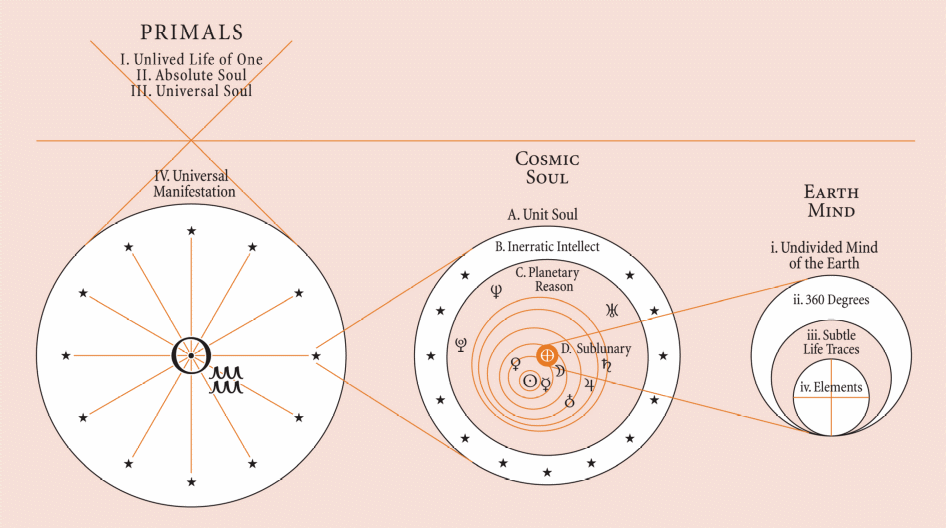
DIAGRAM appended to this transcript:
- FIGURE 1983 0921-1. Nested Levels.
This diagram is from Astronoesis, p. 250. [Transcriber note: [diagram] means the speaker is referencing a diagram as he or she is speaking.]
NOTES:
Pat Campbell transcript from 1983 exists; other, earlier transcript versions exist, including one done in 1993 from audio cassette tapes by hp, jf, et al.
Unpublished PB paras should be sourced and proofread.
TRANSCRIBED Verbatim by IT 2019. Reformatted by JRM & JF 2019-2020, with Subheads and Table of Contents added by JRM. In 2023, IT fixes prefatory matter and footer, updates audio file name, completes Book List, adds new note within transcript, fixes minor errors, adds diagram and reference within transcript to this diagram. In 2025, MW expands Subsubjects and alters Subheads to make more accurate. Archival verbatim transcript – V14.1a.
AUDIO FILES: 1983 0921a, 1983 0921b. [Note 1: "Tape" and "Side" refer to original audio cassette tapes later digitized into .MP3 Audio Files. Note 2: The tapes were also consulted for this transcript.]
1983 09/21 at Wisdom's Goldenrod
PB Paras; Meditation; Interior Word
Archival verbatim transcript
[Audio File 1983 0921a Begins]
S (faint): (What's up?/Think so.)
S (very faint): Yeah.
PB [V4, Part 1, 4:1.209, RC reading a part of]: "Attention passes through two progressive stages. The first holds it intently on an image, an idea, [RC reads: on an idea, an image] or an object. The second keeps these out and holds it in a sublime empty stillness."
[10 second pause]
PB [V4, Part 1, 4:1.209, RC rereads]: "Facility comes with time, provided [RC adds: that] all other conditions and requirements are fulfilled. Attention passes through two progressive stages. The first holds it intently on an image, an idea, or an object. The second keeps these out and holds it in a sublime empty stillness."
[12¾ second pause]
S (very faint): Do another (short one/shorty).
RC: It's an interesting comparison.
PB [V15, 23:8.195, RC reading]: "The contemplative inner work of a Buddha, as exemplified by his seated statues, is a gentle one, not like the austere determined self-combative yogi's. It is also a patient one, as if he had all the time in the world."
[14¾ second pause]
PB [V15, 23:8.195, RC rereads]: "The contemplative inner work of a Buddha, as exemplified by his seated statues, is a gentle one, not like the austere determined self-combative yogi's. It is also a patient one, as if he had all the time in the world."
[10¾ second pause]
THE GREAT LIGHT-EXPERIENCE IS THE LAST EXPERIENCE OF THE AWARENESS OF AWARENESS BEFORE THE REALIZATION OF MIND
PB [V4, Part 1, 4:1.402, RC reading]: "The great Light-experience is uncommon. If it happens once in a lifetime that is enough, for it will never be forgotten. But the Stillness experience can happen every day, if you seek it by retreating inward."
[9 second pause]
PC (very faint): Randy? Do you have an idea of what the two refer to or is this the one we talked about before?
RC (faint): Give me a hint, the way we talked about [PC simultaneously: Well--] which?
PC (faint): Uh-- [short pause] Well it talked about (three) stages of concentration, meditation and contemplation.
S: Can we hear it too?
PC: Sorry, we were talking about the stages of concentration, meditation, and contemplation. Um-- [short pause] I don't honestly remember if the Stillness referred to a particular part of that progression and I don't know-- have any idea what the Light experience is referring to. [short pause] I would think that the Stillness would refer to contemplation but that's the highest of those three levels so I don't really know.
RC: It seems that-- that both of them are acts of Grace. [S: Yes.] In a way you don't really-- you can't really make yourself (grow) unless it's granted from a deeper level. And, I also think that it's unlikely that the Light experience would come in life at least momentarily each day. But it seems that you can enter the Stillness if the Light experience doesn't necessarily come. You might wait for a long time, that--
PC: Do you think the--
S (simultaneously, faint): So it's the light of the Sun again.
RC (faint): Well there are a lot of quotes we could read on that. I don't have them tonight but if you do want to get into that there are quite a few. I've actually been reading at least thirty or forty pages (on that).
BS (simultaneously): Well just a little.
S: Well--
BS: Since you brought it in.
LR: I mean, from what Anthony said, it's not just one Light, (there's) [RC assents, faint] many different experiences of Light and each one of them refers to something different so obviously we're not going to get enough from this quote to--
RC (faint): Yeah.
AD: You got enough in that quote.
S (very faint): Yeah.
S: Yeah.
RC: He's calling it the great and the-- the Light is capitalized.
RG: So what does it refer to then?
[short pause]
LR: What light is it, Anthony?
AD: Read the quote.
PB [V4, Part 1, 4:1.402, RC rereads]: "The great Light-experience is uncommon. If it happens once in a lifetime that is enough, for it will never be forgotten. But the Stillness experience can happen every day, if you seek it by retreating inward."
[17¾ second pause]
AD: It's the last experience of the awareness of the awareness. It's a clairvoyant experience of consciousness as the ultimate-- consciousness ultimate before the realization of Mind.
[11¾ second pause]
CDA: Do you mean there consciousness as the I AM before the-- before the realization of the Void? [student assents, very faint] [few words inaudible]
AD: I'm sorry, try again.
CDA: When you're saying there--
RG: Louder Carol.
S (simultaneously, faint): Can't hear.
CDA: When you say it's the last experience of consciousness before the realization of Mind, would that mean last experience of the I AM before the realization of the Void or before the penetration into the Divine Mind?
AD: No, it's not--
CDA (simultaneously): No?
AD: It's-- if you go to the notion of the awareness of awareness, and then after that follows just pure awareness. Now, the last experience of the awareness of awareness is what he's referring to as the great Light. After that, the next experience, if one followed, would be that of Mind in itself. The Mind here of course, your Mind. [short pause] It's actually a clairvoyant perception.
[17 second pause]
LR: So it is light of the-- of one's own soul?
AD: Yeah.
LR: As opposed to the Intellectual Light you've spoken of and the natural light you've spoken of?
AD: No, I'm sorry now, I don't follow that.
LR: Well, whenever we've raised the issue of experiencing light in meditation you've always pointed out that there are many lights you can see in meditation.
AD: Yeah.
LR: There's the Intellectual Light, there's the light of the soul, there's the natural light, and that each kind of light is experienced a little bit differently.
AD (faint): Yeah.
[short pause]
LR: You're saying that this light that he calls the great Light is the light of the soul?
AD: Yeah, don't change the words I use. It's the last experience that you can have of the consciousness of consciousness.
[16¼ second pause]
MB: Anthony, what do you mean when you use the term 'clairvoyant'?
[short pause]
AD: It's like a clairvoyant perception but you could forget that now, just-- just concentrate on that.
MB: The last experience of the consciousness of consciousness.
AD: Yeah.
MB: Are you saying that after that there's just consciousness, there's no consciousness of consciousness?
AD: Exactly.
[short pause]
MB: Is it that the-- the apperception passively disappears or fades out?
[short pause]
AD: You know I have to ask you, what is the apperceptive faculty and what are you referring to? Whereas I think it would-- it'd be wiser to follow the thread-- the track I laid down. There's no-- there's no apperception.
MB: Well what is the difference between consciousness and consciousness of consciousness? Is there some content when we speak of consciousness of consciousness? There's some content there other than just consciousness. Something else there in this-- the "of".
AD: Consciousness of consciousness.
MB: Yeah.
AD: Uh-hm. And then after that there's no more consciousness of consciousness, there's just pure consciousness. Now, you're asking me--
MB: How do we describe the difference.
AD(?) (faint): Hm?
MB: How do we describe the difference(s).
AD: Describe the difference?
MB: Between those two states.
[14 second pause]
AD: You're still in a dualistic framework in the first. [MB assents, faint] You're in a non-dual situation in the second.
MB: So there's still some shred of subjectivity, not in the higher sense of subjectivity but some-- some--
AD: When you're conscious of consciousness?
MB: Yeah, there's some [AD simultaneously: Yeah.] sort of subject that takes himself to be somewhat separate.
RG (faint): Probably, or I think at least in the quote, the content of that "of" is light, and that is-- that is a-- void of-- void of light, void consciousness per se. So the content of the consciousness "of" is this light as being an image of consciousness.
MB: Uh-hm.
RG (faint): It's not conscious(ness).
[44¼ second pause]
PB [V4, Part 1, 4:1.128 & Persp., Ch. 4 #8, RC reading]: "The true state of meditation is reached when there is awareness of awareness, without the intrusion of any thoughts whatever [RC reads: whatsoever]. But this condition is not the ultimate. Beyond it lies the [RC reads: Beyond it there lies a] stage where all awareness vanishes without the total loss of consciousness that this normally brings."
[short pause]
RG/S(?) (faint): Good work. (laughter)
RG: That's right. That's what Anthony just--
S (faint): Right.
RG: He's saying the highest stage of meditation, he's saying there's still imagery, some sort of image connected with it. Right?
S (very faint): Uh-hm, well--
RC: If you're going to call light an image of--
RG: But that [one word inaudible]
AD (simultaneously): No there's-- there's no imagery there, Dickie.
RG: No that's the point, I would just take light as an image.
AD: Oh ok.
RG: No I-- you know-- no particular imagery.
AD: Yeah, no image.
S (very faint): Can I hear it again?
PB [V4, Part 1, 4:1.128 & Persp., Ch. 4 #8, RC rereads]: "The true state of meditation is reached when there is awareness of awareness, without the intrusion of any thoughts whatever. But this condition is not the ultimate. Beyond it lies the stage where all awareness vanishes without the total loss of consciousness that this normally brings."
JfL (faint): Uh-hm.
LR: How can you understand the difference between awareness and consciousness?
RC: Well I think maybe one way to do it would be to speak of the-- the first level which he's speaking of as not the ultimate. There is an experience, and, even though what's felt as being experience is also felt as being oneself, there is an experience of its presence. You call that an experience, I think that's-- The stage that he's talking about he's really pretty properly calling experience.
LR: So you're equating awareness with there being an experience "of" and consciousness is not having separate experiences?
RC: Say it again more slowly.
LR: You're equating there being an experience "of" with awareness.
RC: Yes, self--
LR (simultaneously): Whereas in the--
RC: Self-experience, it's self-aware self-experience.
LR: Whereas "where all awareness vanishes without the loss of consciousness" there's no experience, there's no experience "of". There's just the experience. Is that what you're saying?
RC: I guess what I'm trying to say is that what-- what remains is not characterizable by the [short pause] term 'experience'. [short pause] So maybe you could call it non-experience.
[short pause]
S (faint): Andrew.
AH: Would it-- would it be helpful to think of the first experience as in some way dual and the second one non-dual?
RC: That's what Anthony said, yeah. In that first there still is a dualism. It's not a duality but it's a dualism.
DB (faint): Well, Randy could-- would you please repeat the last?
S (faint): Yeah.
DB/S(?) (simultaneously, very faint): I didn't catch that one.
PB [V4, Part 1, 4:1.128 & Persp., Ch. 4 #8, RC rereads]: "The true state of meditation is reached when there is awareness of awareness, without the intrusion of any thoughts whatever. But this condition is not the ultimate. Beyond it lies the stage where all awareness vanishes without the total loss of consciousness that this normally brings."
DB: Well could I ask a question about that? Normally this awareness that is consciousness "of", like as in deep sleep, that's what he's saying? [student assents, very faint] Right? I mean that's the normal, you know, concern here. So in this instance something's very-- something is very differently happening because that consciousness has not vanished, it's remained. [RC assents, faint] So I mean, it's-- it's almost like saying prior to-- prior to this state, awareness-- the polarized, this dualistic framework is necessary for the appearance of consciousness or for consciousness. [S, faint: Right.] Whereas after this, that is no longer necessary, consciousness in some sense can persist.
RC (faint): Is-- yeah, there you could say that it-- in those-- in the dualistic mode consciousness still has some sort of-- It's at least meaningful to talk about there being some sort of mystic form being taken as light. It's an infinite extension-- But I think that the stage that he's talking about afterwards, (form's) simply even closer. Like, the way that mental processes are disposed to always operate in terms of forms get old.
[9¼ second pause]
AH: Randy you're speak-- you speak of form as like one side of the dualistic situation. Form is (object)?
RC (simultaneously): Well it-- it is a necessary-- I could-- there's an integral element to experience of any kind 'cause the experience must have some kind of form, even if it be light, infinite extension, the most abstract form you can conceive.
AH: To speak properly of an experience you of necessity speak of some form.
RC: Yeah.
AH: But in the second case it's formless?
[short pause]
S (faint): Yeah.
AH: And cannot properly be spoken of as an experience.
RC: Exactly. PB talked a few times with me about Jnana and, we've mentioned it a couple of times before how what these people use as their--what's the word--standard of verification to whether or not the Ultimate has been-- whether or not they had any contact with the Ultimate or whether-- And he-- he al-- always spoke slightly [one word inaudible] about those who use experience as a-- as a measure. And he would talk in terms of how, if we got to use words at all of that ilk that 'non-experience' would be more appropriate. You can't say you've had it because part of-- part of its [short pause] emergence is that it's cancellation of that-- at the very core of what PB called "you".
[12¾ second pause]
BS: (Sounds so) (Randy/random). The implication so far is that awareness of awareness is awareness of a form, I can't follow that at all because if awareness itself has no form how could awareness of awareness be awareness of form?
RC: Yeah, I agree that it's-- it's difficult but, you're trying to distinguish two things that really are appropriately formless. One would seem to be less formless than the other. (bit of laughter)
PC (faint): Randy maybe it's a (contrast), but earlier you said object. Instead of that seed there's a subject and an object (equivalent) to that.
S (very faint): [couple words inaudible]
RC: No, I don't think it's appropriate to say subject and an object, more like--
S (faint): Why?
[short pause]
RC: Not in the sense of subject being in one side, object being on the other and there being a relation. But the separation of subject and object [couple words inaudible] relation is one level. But then it seems if you take out the-- the relation and you still have like an experience there even though it's very difficult to characterize the experience of anything other than oneself.
PC: Experiencer or experience is something that doesn't appear to be other than itself. But then the stage beyond that, you know, you'll have that experience.
RC: Yes I think the necessary reference to experiencers no longer means (anything).
THE ARCHETYPAL DEGREES, THE MENTAL BEING, IS THE AWARENESS OF AWARENESS, BUT THE PURE AWARENESS IS THE SAME AS YOUR SELF, YOUR I AM, AND IT'S THE SAME AS THE GOD IN THE SUN
[Note: See FIGURE 1983 0921-1, Nested Levels, appended to this transcript for the following. This diagram is from Astronoesis, p. 250.]
AD: If you want to rise-- if you want to ride off the formalism of the chart, (just/you) take a look at the highest level, what we refer to as the archetypal degrees of the cosmic soul, the soul of our Earth, ok. That would be awareness (or) consciousness. Above it would be the Sun, the powers of the soul, and that would be the awareness or consciousness. Now that has for its object the mental being, all those degrees, [student assents, faint] which in their totality constitute your mental being. So you can have an awareness of awareness. But, as I-- as we said, that could be dropped off, the awareness as a content could be dropped off, and you could remain identified with the powers of the soul or the Sun or the Undivided Mind of the Earth, alright. That would be equivalent to going into samadhi; that would be equivalent to your Overself. You have to remember that, in a sense, the God in the Sun is your I AM. [short pause] So, in that sense you could use that diagram. It's-- remember it's only a diagram, it's a picture. Don't turn it into a reality. Over here [diagram], in this realm here where the Gods are, ok, these three realms, three levels of degrees, the realm where the Gods are, this is the mental being that you are [diagram], and this is like a form of consciousness. Then the difficulty would be to understand that as a form. But basically this is consciousness. This is consciousness [diagram]. Now, you have consciousness of consciousness. This [diagram] could drop away and then you're in a state where you're ident-- identified with the God of the Sun or your I AM, your pure Overself.
[11½ second pause]
AH: Anthony, did you say that consciousness of consciousness, archetypal degrees?
AD: I'm sorry?
AH: Did you say that the consciousness of consciousness was referring to those archetypal degrees?
AD: Yeah.
AH: Could you explain that a little?
AD: Well--
RC: Well it was actually quite involved, there's the level above having those archetypal degrees as their object.
S (faint): Yeah.
AH: Is that--
AD (simultaneously): In case-- yeah, yes what he said and also if you want to, you could think of those 360 degrees as a modalization of consciousness. They're a peculiar kind of consciousness. It isn't the consciousness, for instance, that belongs to the God in the Sun properly speaking. But it is a-- it is a consciousness to that.
AH: I was curious if you had spoken of those lately as being void.
AD: Why should you be-- why should it be curious?
AH: It's hard to think of that as being any kind of content or any kind of form if it has the nature of voidness. It really is awareness of awareness but mind looking at mind?
AD: Well you could say that you have a void objective consciousness which is the content of a void subjective consciousness.
S (very faint): Yeah. (bit of laughter)
S: Uh-hm.
RG: Right, and-- and in that example I think the-- the void objective content are the 360 degrees and the void subjective consciousness is the modalized I AM (as) showing all the forms.
AD: No. It's not modalized there.
RG: But that's talking about the upper one now.
AD: Oh, oh, you mean within the 360 that could be modalized.
RG: If you-- yeah, that could--
AD (simultaneously): Yeah. But not above it. In [RG assents, faint] the Undivided Mind itself it's un-- undivided.
RG: And that's where you speak of pure consciousness, [AD simultaneously: Yeah.] not consciousness of consciousness.
AD: To us it is pure consciousness. That's the same as your Self, your I AM. And it's the same as the God in the Sun. So in a sense, when he's saying that you have awareness of awareness, the diagram might help a little bit, alright. The mental being that you are is the content of an awareness. [RG assents, very faint] This content is a kind consciousness, ok, [RG, faint: Yeah.] but then even that's dropped and you just become this pure awareness, the seven powers of the Sun, which is the Earth's Undivided Mind but seven powers of the Sun soul.
RG/S(?) (faint): It's peculiar.
RC: So those-- those archetypal-- those archetypal degrees are the-- the-- the structures that actually generate what we call awareness.
S (faint): Uh-hm.
AD: For us here, yeah.
RC (simultaneously): Exactly. It's like what generates what we call awareness.
AD (faint): Uh-hm.
RC: And, to go beyond those structural forms is to go beyond what we ordinarily call awareness.
AD: Uh-hm.
[student assents, very faint]
EC: Randy? A few weeks ago you read the quote that-- where PB mentioned that it would be-- would be worthwhile to make the Mind the object of attention. Is-- is that the 360 degrees, the mental being that-- is that the Mind that he was referring to in that? [couple words inaudible]
RC: (Where/Well) you keep backing up and what-- whatever the next step was we start there, that we can keep backing up a lot more. [student assents] He's got one here that says--
PB [V4, Part 1, 4:3.102 & Persp., Ch. 4 #51, RC reading]: "This [RC reads: The] work of pushing attention inwards, back to its very source, and the sense of"I-ness" back with it, is to be accompanied by thinking only until the latter can be stopped or itself stops. This work is then continued [RC, faint: This is the interesting part. "This work is then continued] by a stilled and steady search. When the need of search comes to an end, the searcher vanishes, the"I" becomes pure "Being," has found its source. In these daily or nightly sessions, it is his work to turn away from the diffused attention which is his normal condition to the concentrated attention which is indispensable for progress, and to sustain it."
[short pause]
AH: Would you mind reading that one again please?
PB [V4, Part 1, 4:3.102 & Persp., Ch. 4 #51, RC rereads]: "This work of pushing attention inwards, back to its very source, and the sense of"I-ness" back with it, is to be accompanied by thinking only until the latter can be stopped or itself stops. This work is then continued by a stilled and steady search. When the need of search comes to an end, the searcher vanishes, the "I" becomes pure "Being," has found its source. In these daily or nightly sessions, it is his work to turn away from the diffused attention which is his normal condition to the concentrated attention which is indispensable for progress, and to sustain it."
[1 minute 11½ second pause]
THE DIAMOND MIND MEANS YOU ARE ESTABLISHED IN THE SOUL'S VIRTUES
PB [V15, 23:7.49, RC reading]: "When he is settled down in this final stage, his mind takes on a diamond-like quality--hard and unchangeable in its identification with its deepest layer, bright and positive in its radiation."
[24 second pause]
PB [V4, Part 1, 4:2.344, RC reading]: "Relax from your own selfhood, let the ego go, and discover the peace which can then well up from within. It is yours, a covered hidden part of your being, unknown before because ignored and unsearched for."
[9¼ second pause]
S (faint): Again.
PB [V4, Part 1, 4:2.344, RC rereads]: "Relax from your own selfhood, let the ego go, and discover the [RC reads: a] peace which can then well up from within. It is yours, a covered hidden part of your being, unknown before because ignored and unsearched for."
[58 second pause]
RC: Anthony, would you say that that-- that peace also comes from the realm outside the-- the archetypal Gods?
AD: Yes but it's also there too.
[short pause]
RC: It seems like-- why I asked is it seems like the very purpose of those archetypal Gods is to generate awareness-- or to generate experience and a certain kind of awareness along with it. And that possibly one of the things that distinguishes the-- the presence of the peace from the absence of the peace is that the peace itself is peace from the desire to experience, or freedom from the desire to experience.
[18½ second pause]
AD: You're saying that in the Undivided Mind you find the deep-- deepest level of peace. But the nature of the archetypal Gods is also peace. That's their nature, alright. And what you say is true, that combined in a variety of ways they produce the image which is the cause of our experience, alright. But in themselves they are of peace, they're void in their nature, there's no lack of harmony of any kind. It is true, when you go beyond it, it's much deeper. That's true. [RC: I guess--] But you could also understand that they-- they could also be aware of that too.
RG: Yeah. What we're calling their nature--
AD (simultaneously): What you're calling the deeper peace, these Gods would also know of it. They're not excluded from there. But what about the one before? [S, very faint: Right.] I mean you got quite a few Buddhists here. You must have thought that that was a little fairy tale the Buddhists were speaking about.
AH: Yeah, in reference to the diamond mind?
AD: Yeah, in reference to the diamond mind.
S (faint): Yeah, yeah.
AH: The crystal palace. [RG: Well--] It's referred to in different ways.
AD: Now of course you understand you can't go buy this in a jewelry store.
[short pause]
AH: Anthony, that state of-- (you/he) described of the clear hard diamond mind-- mind, that's not the ultimate state. That's prior to it?
AD: No he's not speaking about a state there in terms of processes and goals or anything like that. He's speaking the result of one-- one of the results or one of the characteristic marks of a Buddha is that he has this kind of a mind. Have Randy read it again.
RG(?) (faint): (Go ahead/Good).
PB [V15, 23:7.49, RC rereads]: "When he is settled down in this final stage, his mind takes on a diamond-like quality--hard and unchangeable in its identification with its deepest layer, bright and positive in its radiation."
[14 second pause]
RC: It's interesting, he said in some other places that the adept can conceal himself in the physical world, but he can't conceal himself in the spiritual world. That in the spiritual world his light can't be obscured.
[short pause]
AD: I don't think he can conceal himself in the physical world. It's really the other way around: the others can't see. (laughter, student assents) [10 second pause] Anyway you could search around some of that Buddhist literature and see what you can get on the diamond mind.
[short pause]
AH: That's distinct from the notion of the diamond body?
AD (very faint): Yeah.
AH: Same-- same idea? They do talk about that as building a diamond body in regards to a process.
S (very faint): Yeah.
AD: Yeah a lot of work goes into making it.
[13 second pause]
AD: Alright Randy, let's continue.
[short pause]
JfL (faint): Sounds a little bit like the body of light that we discussed a little while ago.
[short pause]
AD: You have to be more specific. I don't know what you mean "a little while ago".
S (faint): [one/two words inaudible]
S (faint): Uh-oh.
LR (faint): Archaeology.
BS: Did you hear the question?
S: No.
S (very faint): Yeah.
RG: He said it sounded like the body of light.
JfL (faint): Yeah, the diamond body. I (remember/never)-- I never heard about the diamond body but it sounds like it's a body of light. You purify and cultivate until the light shines. [S, faint: Uh-hm.] (And it/I mean) doesn't sound like it's completely peculiar to Buddhism. That's (necessarily) what he was saying.
AD: I don't remember coming across references to the diamond mind or the diamond body anywhere except Buddhism.
JfL: But you remember the body of light.
AD: Yeah I remember the body of light.
JfL: Are they associated?
AD: You-- you want to go into a comparative analysis of what the Sufis mean by the body of light and what the Buddhists mean? [JfL simultaneously: No I (just--)] Yes, yes, they're associated, sure.
S (faint): (Right.)
JfL (simultaneously, faint): Well I wasn't trying to bring in the Buddhists, they-- ('cause/so) they know nothing about that.
AD: Well, they speak a lot about the vajra, the diamond. And they often leave it very obscure, you know, they don't fill in, they don't give any details. They don't tell you anything about it. But they do speak about the need to develop such a-- a mind, diamond-like in quality. [short pause] It's a whole subject by itself, we'll get to that sooner or later.
JfL (faint): So is the hardness of it that's going to be the strength that you get from having had such [couple/few words inaudible] itself(./?)
AD: There's no hardness in the diamond mind.
JfL (simultaneously, faint): But isn't it hard in [one/two words inaudible]
AD: (No.) Not at all. Hard and unchanging.
JfL (faint): I was-- I was coming from what that would mean for us.
AD: You would be established in vir-- in the virtues of the soul.
JfL/S(?) (faint): Or the strength [couple words inaudible]
RG/S(?) (faint): Uh-hm.
AH: I have a short quote from the Lankavatara Sutra if you'd like to take it up tonight.
AD: Yeah that's the mixed-up sutra, go ahead. (bit of laughter)
S (faint): Yeah.
S (very faint): Uh-hm.
[Transcriber note: I am using Studies in the Lankavatara Sutra by Daisetz Teitaro Suzuki, George Routledge & Sons, Ltd., London, 1930.]
D.T. Suzuki [Studies in the Lankavatara Sutra, p. 199, AH reading]: ""Again, O Mahamati, gold, [AH adds: and] diamond, and the Buddha's [sarira] [bony relics] equally pass through ages of existence and show the unique character of indestructibility. If the wise who have attained enlightenment have the nature of momentariness they must be said to be lacking in wisdom. Gold and diamond, however long they may be in existence, remain the same; they show no sign of increase or decrease. How can the ignorant be expected to understand my [AH reads: this] esoteric doctrine, who, discriminating in all things inner and outer, cherish the thought of momentariness!""
AH: In that reference it's used as unchanging. Gold and diamond don't increase or decrease. There's lots of other references but that's just one I opened.
AD: Uh-hm. That must have been a student's notebook, that sutra. (laughter, student words)
S (faint): Anyways, that's true, (yeah/right). (some laughter)
S (faint): Was it to you?
S (very faint): It makes sense.
AD: Let's get to the real stuff, go ahead. (AD laughs a bit)
RC: I guess--
PB [unpublished, RC reading]: "Drawing from its own deeper levels of being, the mind has to deliver itself of truth and goodness or beautiful presence and peacefulness. Whoever comes within the aura which emanates from it comes into blessed moments and happy feelings. Such is the work of enlightenment."
[12¾ second pause]
(Side 1 of original cassette tape digitized as 1983 0921a Ends; Side 2 Begins)
PB [unpublished, RC rereads]: "[Drawing from its own deeper levels of being, the mind has to deliver itself of truth and goodness or beautiful presence and peacefulness. Whoever] comes within the aura which emanates from it comes into blessed moments and happy feelings. Such is the work of enlightenment."
[1 minute 2½ second pause]
PB [V4, Part 1, 4:4.245, RC reading]: "All will come under review periodically--the management of his relationships with others, his personal, social, and professional activities, the management of his life. But all this scrutiny is to be done from a [RC reads: the] standpoint higher than the ordinary [one], less ego-governed and more impersonal. Therefore it should be done only and preferably at such times as this mood is upon him, if it is to be effectively done."
[short pause]
S (very faint): Can you read that again?
S (very faint): Uh-hm.
S (very faint): Can you read that again?
PB [V4, Part 1, 4:4.245, RC rereads]: "All will come under review periodically--the management of his relationships with others, his personal, social, and professional activities, the management of his life. But all this scrutiny is to be done from a standpoint higher than the ordinary one, less ego-governed and more impersonal. Therefore it should be done only and preferably at such times as this mood is upon him, if it is to be effectively done."
[14 second pause]
RC: This is one related to that where he talks about taking the sense of "I-ness" back, "to be accompanied by thinking only until the latter can be stopped or stops. This work is then continued by a still but steady search."
PB [V15, 23:7.265, RC reading]: "It is no longer a matter of discursive thinking which flows by orderly and logical transition from one idea to the next--that was proper until grace came in--but of putting all thoughts aside and waiting passively, quietly, letting [RC adds: the] awareness sink deeper."
[27½ second pause]
IS COMPLETE IMPERSONALITY POSSIBLE OUTSIDE OF NIRVIKALPA SAMADHI?
RC (faint): Here's an interesting one. It's a question.
PB [unpublished, RC reading]: "Who has achieved complete impersonality outside of those nirvikalpic samadhis and outside of the imaginations of adoring disciples?" (bit of laughter)
[18½ second pause]
PD: I don't understand the quote.
S (very faint): Go ahead.
S: (Again.)
PB [unpublished, RC rereads]: "Who has achieved complete impersonality outside of those nirvikalpic samadhis and outside of the imaginations [RC reads: imaginings] of adoring disciples?"
LD: Even the Sage has preferences and tastes and likes and dislikes. Some like tea and some like water.
PD: What's tea and water got to do with Nirvikalpa?
RG: Well, I think he's asking-- (bit of laughter)
S (very faint): Yeah [couple/few words inaudible]
RG: I mean--
S (faint): It could come out though [one word inaudible]
RG (simultaneously): Isn't he asking, I mean, how many philosophic Sages are there, the ones who can also have impersonality while in the world and how many only have it in the imaginations of their disciples.
PD: You mean in the world, Nirvikalpa samadhi's in the world [one word inaudible]
RG (simultaneously): No he's saying outside of Nirvikalpa samadhis how many people have it. In other words how many philosophic Sages is there.
PD: Or is it possible.
RG: Well he asked who has achieved. Or--
S (simultaneously, very faint): [few words inaudible]
RG: Yeah, could be-- yeah. Well, I mean he seems to say possible. Other words-- otherwise the highest attainment would be Nirvikalpa.
LD: But-- but insofar as the-- even the-- the Sage has two or three percent ego he has that much personality or personal nature to him and certain tastes and likes and dislikes. And only in Nirvikalpa is that complete perfect state of impersonality attainable. That's the way I understand it.
RG (simultaneously, faint): I don't-- I don't [AH simultaneously: He--] see it that way (Lou).
AH: Only-- only in Nirva--
RG (simultaneously): I think you could have the preferences of the body and still just stay with the impersonal viewing of it. But I don't think the preferences are his as-- as the Sage.
RC/S(?) (faint): Yeah.
RC: Richard Platek once made a really good remark about PB. When he came back he said that-- Richard had been thinking about impersonality and personality. And he realized that-- Richard realized that like he had been taking his impersonality as something inside the personality. And (so that/certainly) when he met PB he realized that personality was something inside impersonality.
S (very faint): Uh-hm, sure.
[10 second pause]
S (very faint, possibly part of background): I think so.
AH: Well, the quote could be understood and in-- in regards to what Louis said I think that complete impersonality is impossible except in Nirvikalpa or in imaginations of adoring students, [student assents, faint] that--
[student assents, faint]
LD: Because if we look at the number of lives of a-- a few different Sages they definitely seem to have, you know, some amount of personal--
RG: But Lou-- yeah. But I'm trying to make the distinction that the level he's talking about as impersonality applies to his awareness and not to the preferences of his-- of the particular body and vehicle that he's incarnated in.
LD: Yeah and I would maintain that that awareness which you're talking about, that perfect complete state of awareness is only attainable in Nirvikalpa.
RG: And I disagree. If you couldn't bring that awareness into every moment's existence you wouldn't have the applica-- the next stage of philosophic yoga that he talks about.
LD: Then who's tastes are they that the Sage has?
RG (simultaneously): The vehicle's. The vehicle's tastes.
LD: The vehicle's.
RG: Not his consciousness.
LD: And that's other than-- than-- that's outside of him.
RG: It's other than his consciousness.
MB (faint): But I--
LD (simultaneously): But is it outside of him?
MB: But I think what Randy said was that the personality or the personal tastes are somehow included within the impersonal viewpoint and-- and if you think of what it was like to converse with PB about matters of cooking or things like that, he had very particular preferences for things. But it wasn't-- there didn't seem to be real strong attachment or it didn't seem to be that that was really him. It just seemed like that it was very objective. You know?
LD (simultaneously): Well, I would definitely agree with that [MB simultaneously: But he--] but just in your use of the words "real strong attachments". But there was still a slight attachment to this [MB simultaneously: Well--] tea in (preference/prevalence) to that tea.
MB (simultaneously): He even-- even seemed to have sentiments, you know, which is a-- like from time to time, which was sort of surprising and I think (that's) sort of um-- sentimental feeling about going to Cabbagetown and things like that but-- (bit of laughter) Well I always sort of thought that this was, you know, something that PB wouldn't have indulged in or whatever and yet it was included in his personality but in an impersonal sort of way, I don't think that he was, you know-- (the interview) was good or bad, I mean it wasn't really that important but it was the way he functioned.
LD: Well I agree that 99% he's impersonal. But I'm going to maintain 1%.
MB: Yeah.
LD: You know--
S (simultaneously): But, I think that's--
LD: Of course [MB simultaneously: But it--] I'm not going to argue with that the Sage is objective and-- and pretty much impersonal but that complete impersonality is only maintained in the imaginations of adoring disciples I-- I also might consider. (bit of laughter)
RG (simultaneously): Louis whi-- which percent of his con-- which percent of his consciousness is personal?
LD: Which percent?
RG: Yeah which one percent there?
LD (simultaneously): 47, I mean--
RG: No which one? (laughter)
LD (amidst laughter): [couple/three words inaudible] say.
RG: That's ex-- that's right. That's the pro-- I don't see how you could [one/two words inaudible]
LD (simultaneously): What do you want me to come up into a hundred and fifty percent?
RG (simultaneously): You're doing that by saying there's a part of it that's personal and a part of it that isn't.
LD (simultaneously): Well what do we mean then when we say that the ego, there's two percent ego left? Would you disagree with that now?
RG: I would have to ask to who. Who is the "who" in this-- in this question; that the two percent ego doesn't apply to the "who" that can have the state of impersonality.
LD (simultaneously): Well if there is two percent ego there's two percent identification with that ego.
RG: That doesn't necessarily follow, that there's a necessary identification with two percent. [LDS simultaneously: Yeah but he--] Why can't the consciousness be free of that identification and the two percent ego remains as part of the vehicles and functions in the body?
LD: Because-- Well, look from--
S (faint): [one word inaudible]
S (simultaneously): [one word inaudible] Richard.
BS: There could be two percent ego and a hundred percent Sage. You can't go-- you can't-- (laughter, student words) Ego is one factor that equals a hundred percent Sage.
S (simultaneously): Well that one was a-- (bit more laughter)
RG (faint): Maybe you'll go higher some day. Go ahead.
AH: Would you read the quote once [RG simultaneously: Stay here.] more please? And I'll (get to) understand.
S (simultaneously): What's (there) tonight? (bit of laughter)
S (faint): There's a-- there's--
LD (simultaneously): I-- I don't--
PB [unpublished, RC rereads]: "Who has achieved complete impersonality outside of those nirvikalpic samadhis and outside of the imaginations [RC reads: imaginings] of adoring disciples?"
LD: You may be totally right (there). [RG simultaneously, faint: Well (one word inaudible)] I have no idea.
RG (faint): Yeah me too, I don't know, let's ask. (bit of laughter) Anthony what-- what's the answer?
AD: I would simply say that it's not possible to have complete impersonality--[RG simultaneously, faint: Ok.] [student assents, faint] period.
[38¾ second pause]
THE EGO WILL ALWAYS FEEL PRESSED FOR TIME, BUT THE OTHER FELLOW, THE HIGHER SELF—HE MINTS TIME
PB [V15, 23:7.29, RC reading]: "In this condition, with mind shifted away from sensory experience into a fixed self-absorption and stilled to the utmost degree, the meditator may be said to have mastered contemplation."
[19¾ second pause]
PB [V15, 23:7.278, RC reading]: "The truth germinates in Silence."
[15 second pause]
PB [V4, Part 1, 4:2.331, RC reading]: "The attitude that you have all the time you need is not only a necessary one but also a delightful one."
[students assent, very faint]
S (faint): Wait a minute.
RG: Hm.
DB: The attitude that you have all the time you need?
S: Uh-hm. (laughter)
DB (amidst laughter): (Can we try this again?)
S (faint): Uh-hm.
PB [V4, Part 1, 4:2.331, RC rereading]: "The attitude that you have all the time you need…"
DB: Oh. Ok.
S (faint): Uh-hm.
LR: Finish it up. (bit of laughter)
S (faint): Ok.
PB [V4, Part 1, 4:2.331 cont., RC rereading]: "…is not only a necessary one but [also] a delightful one."
LR (faint): I just read a quote that said it is good to wonder every now-- periodically how much more time do I have in this life to get where I'm going?
CDA: I think he might-- yeah I was wondering what he meant by time there, it-- it might be just that moment-to-moment life of not being in a hurry, you know, physical. That you have all the time in the world to wash the dishes or--
S (faint): You never know.
S (faint): (Right.)
S (simultaneously): No I think that's [one word inaudible]
DB (simultaneously): No! (laughter)
CDA (amidst laughter): I'm wondering. (more laughter) We don't have all the time in the world to--
RC: No he says all [CDA simultaneously: Yeah.] the time you need. (some more laughter) I had a very-- I had a really interesting experience one day in Switzerland. I had gotten up-- I had stayed up late and gotten up early several times already and each time there were more things to do in the morning than there had been the day before and I would get more and more frantic about trying to get all those things done in the course of the day. Course of the morning, till 11 o'clock. The stores opened at eight and I was usually there waiting for somebody to open the door. This one particular morning I had a lot of things to do and the night before I was already thinking that, "There's no way I'm going to get all those things done and get there by 11 o'clock." It turned out that I actually overslept and I didn't even get started until 8:30. I started out the door and said "Wait a minute"--this is just going on, it happened to me--"Not even for PB am I going to run around like a fool for the next two and a half hours, I'll do what he gave me to do and when it's done I'll get there. And then I'm not going to run around like an idiot." I didn't waste any time but there were a lot of things to do and I put my watch in my bag and didn't look at it and did each thing one at a time. It ended up when I got to the door and knocked on the door I took my watch out. And it wasn't just 11 o'clock. It was like one of those digital watches, it was like 11:00:00. (laughter) And he opened the door with this big smile. (laughter.)
Sara S: When you read that quote I was reminded of the one you read about the way a Buddha as well he has all the time in the world. [RC assents, faint] And I suppose [one/two words inaudible] frantic one was sitting, it's like I made the connection between the feelings and those that have all the time in the world and when you say-- not of course the Buddha-- Buddha.
S (very faint): Right.
[12¾ second pause]
RC (faint): Yeah.
[10¾ second pause]
AD: But did he add that you need all the time you can get? (laughter)
JB: It seems like you must act as if you don't have much time but always feel as if you have all the time in the world. (laughter)
RC (faint): Yeah it seems to be really different to think of having all the time you need as opposed to having time to waste.
[short pause]
AH: Randy--
JB (simultaneously): [one word inaudible]
RC (faint): Yeah.
JB: Any time-- that rushing or being afraid is when you wasted the time.
RC (faint): Uh-hm. There used to be a sign-- when L.L. Bean first started out I think [couple words inaudible] store. (bit of laughter) The guy used to run it himself and he's just starting to hire help and one of the problems is having to deal with people working by the hour clock. And he put a sign up that was made by hand, almost like a magic marker on a piece of paper next to the cash register. "If you don't have time to do it right, how are you going to find time to do it twice?" (laughter)
PA (faint): But doesn't the quote also [one word inaudible] a certain inner attitude of patience that you have to cultivate when you're sitting through each [three/few words inaudible]
[short pause]
[student assents, very faint]
AH: I got-- I got the flavor from the quote that it's from the perspective of the Sage actually, you know. It's like not-- not an attitude that-- that I enjoy or-- but one that the Sage might where it's a delightful one in the sense that everything is-- is as it should be. Would you-- would you agree that there's a-- a reference there to the Sage's understanding of manifestation? Sounds like a total acceptance and (resignation in fact) as well as a delightful attitude.
RC (faint): Yeah. Yeah that does.
S (very faint): [couple words inaudible]
S (simultaneously, very faint): [few words inaudible]
[short pause]
RC/S(?): Yeah.
JB (simultaneously): But then-- then [S simultaneously: (Thirty.)] it would stand against Linda's observation that you have to take a responsibility to act.
AH: Well I think-- I think all that Linda said is certainly true but I just caught a flavor in this quote that-- just a-- a little different than what was said.
RC: Yeah--
PB [V4, Part 1, 4:2.331, RC rereads]: "The attitude that you have all the time you need is not only a necessary one but also a delightful one."
RC: He's saying that if you experience it as delightful that automatically means that you're in the perspective of--
AH: Determinate-- (some laughter)
JB: Well, no.
[short pause]
AH: Well see it's some-- certainly some relinquishment of the can-do kind of philosophy.
DB: Well, isn't it-- isn't it more a question of you sit down every day at 12:30 and you, whatever, at 5:30, meditate and you get up and nothing happens, then you do it the next day and nothing happens. I mean, the tendency is to-- well-- when-- when they're thinking about the down drift and-- (laughter) Well, whatever, I mean you do the same thing with a focus, keep trying to study it and you can't figure out one (paragraph) but the idea is you've got a (thinking phase) that, alright well, the-- the point is that you have to keep working at it and you have this attitude that sooner or later the Grace is going to unfold. I mean it seems to be a-- the reason that he speaks of it as being necessary is because it does inculcate a lack of-- not-- it's trying to overcome the ego's felt sense of responsibility for the-- for the results of [couple words inaudible] you know, I mean I think that's part of what it's trying to get rid of. Because the ego's always going to try to get itself invested in there, and that could amount to (mass representations) or-- or, you know, hysteria. Hold on, uh-hm. I think part of the reason he's talking about that as being necessary is that, you know, the whole point is to get rid of that perspective.
S (simultaneously, faint): Uh-hm.
RC: Well I think really it makes you more efficient. I don't think there's any implication of wasting time, I mean-- You've got ten minutes to do ten minutes worth of stuff, that you have all the time you need. [one/two words inaudible] quiet across the board.
[short pause]
AH: But [one word inaudible] I guess we're concluding that this attitude can be assimilated psychologically. It's like an attitude that we could work with in regards to our psychological states. Perhaps a helpful and efficacious (attitude).
[short pause]
RC: He had-- there's some-- in the books that are in the library there's-- I don't know (what/where) Anthony's [one word inaudible] (them) but he had me read through a couple of them by (Annie) [one word inaudible] (Hall). And she was one of the New Thought people, sort of I guess apparently some of the ideas she expressed and agreed with, that she was talking a lot about the difference between hurrying physically and straining psychically. And there's a lot of stuff in those books that-- her whole trip in the-- you could make money going as fast as you had to go. You can drive your car as fast as your car had to go. But you don't have to be wired in the process of doing it.
[13 second pause]
AD: Of course you can see that fundamentally that comes down to what you're identified with. If you're identified with the ego, you don't have all the time you need.
RC (faint): Uh-hm. There's one I just lost, (he says) if-- if you have-- if you have surrendered to the Overself, then there is no need to worry about anything. On the other hand if you haven't, then you have a lot to worry about.
S: Right. (laughter)
AD: Well any time the-- any shift in your identification with your higher self or your lower self, the ego will always feel pressed for time, that it just doesn't have enough time. But the other fellow: he mints time. [students assent, faint] He mints as much as he needs. [24½ pause with some faint background student talking] And after all that is true anyway: the ego does have an end.
[short pause]
LD: Excuse me, the ego does have what?
AD: Does have an end. [short pause] You know, beginning, end. (laughter)
LD: Yeah I agree. (bit more laughter)
AH: It's appropriate that the ego should worry about time.
AD: Yeah, the ego will worry. (bit of laughter)
[short pause]
HS: Does the ego have a middle? (laughter)
AD: Itself.
[11¾ second pause]
PB PARAS ON MEDITATION
PB [V4, Part 1, 4:1.345, RC reading]: "The ecstasy which the beginner so eagerly welcomes is regarded as a disturbance by the proficient meditator."
[short pause]
PB [V4, Part 1, 4:3.213, RC reading]: "Most of these techniques are preliminary, intended to bring the mind into one-pointed concentration. They do not lead to [the] real enlightenment."
[short pause]
AD: Would you read the one before again? (laughter) Did he say disturbance or annoyance?
RC: Disturbance.
AD: Disturbance.
PB [V4, Part 1, 4:1.345, RC rereads]: "The ecstasy which the beginner so eagerly welcomes is regarded as a disturbance by the proficient meditator."
AD: "Ah, there I go again, into ecstasy!" (AD laughing, laughter) [S: Uh-huh.] You've got to do something about these regressive movements! (laughter)
S (faint): So--
PB [V4, Part 1, 4:1.185, RC reading]: "This is the paradox of the contemplative: that he shuts himself within himself in order to get away from himself!" (laughter)
[15¾ second pause]
AH: I think that paradox is referred to a little more subtly in one of the first quotes we read where he talks about the search for this "I" that's searching. [RC assents, faint] And like the object of his search is over when the object becomes the subject of his search.
RC: Well actually I think the way he put it was the searcher dissolves.
AH: Yeah.
LR (faint): I didn't follow, what is this paradox of what?
RC: The contemplative.
[short pause]
PB [V4, Part 1, 4:0.2, RC reading]: "It is habitual, hence called natural, for present-day humanity to go along with the mental flow to outside things. Meditation reverses this direction and tries to bring the little mind back to its origin--[RC adds: big] Mind."
[short pause]
DB: Um, could you just-- can I ask a-- a little bit about that? Because it seems that with this-- the context that he's speaking it's not so much from the point of view of the unfoldment of the world, you know, that the manifestation of the-- of the World-Idea through consciousness but something has happened once that's been established. Because that other one would seem to be-- fall under the category of natural, whereas this thing is just habitual, I mean, that is, the situation, something to do with the current state of humanity, you know, for how many thousands of years we're talking about. But, I mean is that the case or-- or not?
RC (simultaneously): Yeah I think the difference between what you were calling the natural appearance of the World-Idea within the I AM as opposed to what he's critical of here, going out [DB assents] with the mental flow of (it). The World-Idea can appear (regardless of the--) you know the centeredness (of/in) the individual self (even) surrenders.
DB (faint): Right, right, ok.
[short pause]
PB [V15, 23:7.208, RC reading]: "Trace consciousness back to itself, unmixed with bodily sense-reports, emotional moods, or mental thoughts. This can be done successfully only by withdrawing it inwards as you analyse. The [RC reads: This] process becomes a meditation. In the final term you are aware of nothing else, that is, of nothing but being aware. But at this point you cannot know it as a second thing, an object, but only by being it."
[short pause]
PB [V15, 23:7.208, RC rereads]: "Trace consciousness back to itself, unmixed with bodily sense-reports, emotional moods, or mental thoughts. This can be done successfully only by withdrawing it inwards as you analyse. The [RC reads: This] process becomes a meditation. In the final term you are aware of nothing else, that is, of nothing but being aware. But at this point you cannot know it as a second thing, an object, but only by being it."
[short pause]
S (possibly part of background): Give it to him.
S (very faint, possibly part of background): Give it to him, it's not enough.
S (faint, possibly part of background): Yeah.
S (faint, possibly part of background): Uh-hm.
JB: Well so here awareness of awareness loses its two-- its two-termness in-- Pure awareness of awareness is becoming and not the-- and not as we've suggested before a dualism.
RC: I think that's why I was trying to use the word 'dualism' rather than 'duality'.
S (faint): Yeah.
RC: That, I think at the level that he's calling awareness of awareness that it still is an experiencer, it doesn't really leave off anywhere [one/two words inaudible] (anywhere). I mean--
JB: Is there a relationship there [RC simultaneously, faint: No, (I don't think so).] to "of"? So the "of" is not a relationship.
RC (faint): I wouldn't-- well-- In any sense we'd normally use it I wouldn't [three/few words inaudible] And like (we/you) might have to even insert another thing like the awareness of being aware.
[short pause]
AD: Jon if you follow that path he's just suggesting you will traverse that realm which he refers to as awareness of awareness. You start out with your attention on analyzing any part of the perception, and you go deeper and you analyze the moods away, and you go deeper and you ana-- analyze the possibility of understanding the process itself; you go deeper, you'll become aware of the fact that you are consciousness. In other words you will be conscious of consciousness before you become aware of just consciousness and sink into that. I mean you will traverse that. You will cross that realm.
[short pause]
DB: Is the description here when he speaks of the process of analysis as one goes inward what distinguishes this type of yoga, I mean, would this be the-- the distinction of philosophic yoga as opposed to an unreflective sort of meditation exercise?
[short pause]
AD: I don't think so. This is a description of the interiorization of your consciousness and what happens as you inwardize your attention more and more. It will apply both to the philosophic yogi and the mystical yogi. It'll apply to both.
[short pause]
PB [V4, Part 1, 4:2.275, RC reading]: "Meditation needs a loving commitment to it and a warm devotion to its object if success is to be achieved. Merely to practise it mechanically like a physical exercise is not enough."
[9 second pause]
PB [Persp., Ch. 4 #53, RC reading]: "Others know the condition in which the yogi is, when they are so absorbed in the story of a book as not to hear when spoken to; when they are so lost in a line of thought that the immediate surroundings are banished; when the imagined is the real; when tranced feeling and held mind alone exist, separated from the physical actuality. But there is this vital difference--that their total absorption usually concerns a personal or [a] worldly matter, whereas the yogi's concerns That which transcends both."
[52¾ second pause]
PB [V4, Part 1, 4:2.298, RC reading]: "He should approach the meditation seat with gentle reverence, with subdued delight in the opportunity it gives him."
[14 second pause]
PB [V4, Part 1, 4:1.29, RC reading]: "If the work and result of meditation seem strange and unearthly, artificial and abnormal, this is only because the average person is not yet a fully human being but is only in the process of becoming one."
[9¼ second pause]
PB [V4, Part 1, 4:6.41, RC reading]: ""Hum" in the famous Tibetan mantram stands for the heart, whereas the [first] word "OM" stands for the inner reality, the unseen power behind all things."
[19 second pause]
FOR MEDITATION, IT IS FITTING TO FACE EAST, WEST, OR SOUTH, BUT NOT NORTH
PB [V4, Part 1, 4:2.72 & Persp., Ch. 4 #29, RC reading]: "For meditation or [RC reads: and] worship it is a fitting posture to face the east where the sun rises, the west where it sets, or the south where it is strongest. But the north is less desirable, not only because it is sunless but because it is the direction whence come the powers active in the body during sleep."
[15¼ second pause]
CDA (faint): Read it again. What-- I-- I think I missed that.
PB [V4, Part 1, 4:2.72 & Persp., Ch. 4 #29, RC rereads]: "For meditation or worship it is a fitting posture to face the east where the sun rises, the west where it sets, or the south where it is [RC adds: the] strongest. But the north is less desirable, not only because it is sunless but because it is the direction whence come the powers active in the body during sleep."
CDA: Now I've always-- I've understood that as-- this is something different but that it's good to sleep with your head facing north.
S (faint): Uh-hm.
S (faint): Yeah.
AS: Yeah that's what he said.
S (faint): He (says/said) that, (doesn't/didn't) he?
CDA: Power acts--
AD: Is that meditation?
CDA: No it's [one/two words inaudible] (laughter) He's saying that was a difference between which meditation. But the powers--
AD (simultaneously, quietly): It's a-- and it's a little-- it's a little (perverse to worship) kundalini.
CDA: (Say it again.)
AD (quietly): To-- to meditate with kundalini.
CDA (simultaneously): But [background student talking simultaneous with CDA] why would it then-- I mean it's [S simultaneously: What?] a little off the point but why would it then-- why is it-- [AD simultaneously: Why would it?] why is it good to sleep with your head facing the north?
AD (quietly): Well it's alright for you-- for your body to get rebuilt by these-- by these powers.
CDA (simultaneously, faint): I see, ok, ok.
AD: But you don't want to worship them. (AD laughs a bit)
CDA (faint): Ok.
MB (faint): Anthony, we can't hear you.
AD: Good.
MB: Could-- could you say something about meditating facing the north because it seems that, (you know--)
AD (simultaneously): He just advised you not to.
MB: Not to. But it seems that there was some place that I read where it was advisable, not in PB's notes but maybe some text on meditation where it was considered the direction where spiritual force comes from. I can't remember but the-- well that--
S (simultaneously): (Wait/What--) maybe they were wrong.
RG (faint): Or maybe they were asleep [one/two words inaudible]
AD: I don't know that you would want to worship those forces coming from the north.
MB: Ok. Is it a danger of falling asleep or is there more a danger--
AD: No, no. No it's not a question of sleep. But like he pointed out, the powers that are coming from there are equivalent to like the kundalini of the Earth. If you know enough about kundalini, you don't go around worshipping it. You pay due respect but, you don't worship it. At any rate, if you did read that it was mistaken.
MB: I-- I seem to remember very clearly reading that the one direction not to meditate was facing the south.
AD: You must be thinking about the fact that most people recommend that you sleep with your head to the north if possible because it is a way of receiving, alright, sustenance and strength. But I-- I mean I don't know of any books that tell you to do that or any literature.
MB (simultaneously, faint): Try to go find the (reference), I can't remember the reference.
S (very faint): Read it again.
AD: You know they have the south-facing Shiva and the Western lands, but never the north.
[short pause]
TAKING ATTENTION AWAY FROM THE EGOISTIC SELF VS. LETTING ATTENTION BE HELD BY A GLIMPSE
PB [V15, 23:7.209, RC reading]: "Take attention away from the everyday egoistic self and you may open a gate to the Overself. [AD: That's nice.] This is one method--and the harder one. Let attention be held by a glimpse so that the everyday self drifts out of focus. This is another method--and [the] easier. The first is yoga and depends on active personal effort. The second is passive and depends on absorption in art, music, landscape, or a visitation."
[short pause]
S: Would you read that again Randy?
PB [V15, 23:7.209, RC rereads]: "Take attention away from the everyday egoistic self and you may open a gate to the Overself. [RC: Or you may collapse.] This is one method--and the harder one. Let attention be held by a glimpse so that the everyday self drifts out of focus. This is another method--and the easier. The first is yoga and depends on active personal effort. The second is passive and depends on absorption in art, music, landscape, or a visitation."
[short pause]
LR (faint): What does that mean, "Let attention (remain) by a glimpse"?
RC: Would attention be held by--
LR (faint): Is held by a glimpse? [S: Uh-oh.] "Let attention be held by a glimpse". I don't get what that means.
S (faint): Well, (meditation).
S (faint): [couple words inaudible] again [couple words inaudible] takes your breath away. Play that. Don't go to the next one. Just play it.
LR: Oh I see, you get (rapt/wrapped) in attention and (retains) the attention is how he--
DB: Right in that [one word inaudible]
LR: And in that moment it's not ego attention, is that what he's saying?
RC/S(?) (faint): Yeah, I think so.
S (simultaneously, faint): Uh-hm.
S (faint): Well he does do exercises where he talks about (being around Sages). You know, you looked at that far distant point you'll get it.
[student assents, very faint]
[10½ second pause]
PB [V4, Part 1, 4:1.178, RC reading]: "He cannot really get closer to what he is already, his self, but he can push away the distractions which obscure it. And this is precisely what meditation does."
[12 second pause]
S: That's [one/two words inaudible]
[short pause]
THE INTERIOR WORD IS A REAL DIALOGUE WITH YOUR OVERSELF, BUT IT'S NOT YET THE STILLNESS
PB [V4, Part 1, 4:7.43, RC reading]: "Meditation may begin as a dialogue between the meditator and his imagined higher self; it may pass beyond that into a real dialogue with his Overself. But if he is to go farther [RC reads: further] all dialogue must cease, all attempt to communicate must end in the Stillness."
[short pause]
AH: What's the distinction there between the higher self and Overself?
[short pause]
[Audio File 1983 0921a Ends]
[Audio File 1983 0921b Begins]
AH: How-- how would you have a dialogue with the Overself? That seems to me--
RC: Every time you really try to think about anything, that's what we try to study here. That-- that's sort of what you're trying to precipitate, you're trying to get a specific answer to a specific question or--
S (faint): Yeah.
AH: But, I really don't see how that fits having a dialogue with my imagined higher self.
[short pause]
DB (faint): Well is it possible that, I mean, to bring in reflection into Interior Word with respect to a psychological process?
RC (faint): Yeah you could but that would (spoil your price). You'd spend a lot of time.
DB (faint): Well I mean we've read that-- read the quote, I mean it does sound sort of like a dialogue with the Overself [RC assents, faint] [one/two words inaudible]
LR (faint): But he usually uses-- reserves Interior Word, at least in the quotes I've read, for direct instruction. So that-- I mean what are-- he says dialogue, what I take that to mean is opening up an avenue between the lower mind and something you conceive as high. So first you imagine that avenue of relationship-- avenue, and then actually could open up. [DB assents, faint] But, I don't know, maybe actually (that was) good analogy but every quote I've read about the Interior Word really seems to have some kind of instruction of permitting, you know, wisdom. This doesn't necessarily apply, [DB, faint: Yeah.] I don't think.
HS: So now are you saying-- are you saying something like this dialogue is-- is this etherealization of the consciousness, something like that?
LR: I'm sorry Herb.
HS: Are you saying something like this dialogue that-- the way you're talking about it is this etherealization of the consciousness that you were talking about before, the retraction [couple inaudible LR words simultaneous with HS] of the subjective identification with the lower level to more refined level?
S (very faint): Yeah.
HS: That would (be) something that has (to) dialogue?
RC: Yeah I think that like the first level is-- I agree that what Jung calls active imagination you could say is the beginning of you trying to meditate. If you get sufficiently concentrated and inwardized, you might go beyond that imagery and actually gets-- actually get an intuition.
AH: See that-- that's what I was trying to get to today. We so-- so frequently spoke about the Overself, contact with the Overself is incompatible with any sort of mental activity. Like the Overself (communicates) Mind, you know. And this quote seems to talk about three stages, the stage where there's an imagined higher self, then there's this other stage where there's some sort of dialogue with (you can) call it the Overself. And see that has to be given up also in order to achieve the Stillness. I would think the contact with the Overself would be the fourth stage beyond Stillness. Certainly not indicating the middle. [RC assents, very faint] That's why I was confused about a dialogue of the Overself.
LR: Well, you know the As-If exercise [AH simultaneously: Yes.] PB talks about?
AH: Yes that's-- I would-- I would say that that was a reference to the first there.
LR: Right.
S: Right.
LR: But then don't you think-- You know, it's like imaging yourself to be a more maybe-- I mean-- The As-If exercise begins where he speaks about imagining that you really were other than pure egoity. [AH assents, very faint] And so you imagine that you're compassionate, a whole lot of other things, I don't know, whatever that leads to but-- He just seems to say there's a certain force in the thinking itself which will actually open up those very things, objects of your thought. And that's I think what he's talking about, that there is-- you're-- you are trying to commune with the power that's within you. But then he seems to say that effort to commune in the end is no longer necessary.
PD(?): Could we hear it once more, please?
PB [V4, Part 1, 4:7.43, RC rereads]: "Meditation may begin as a dialogue between the meditator and his imagined higher self; it may pass beyond that into a real dialogue with his Overself. But if he is to go farther [RC reads: further] all dialogue must cease, all attempt to communicate must end in the Stillness."
LDS: Andrew why couldn't you think of that actual dialogue as when the ego really does receive intimations or it appreciates intimations from the Overself and is moved by those rather than itself but still the-- the stand or the identification is with that ego. In other words--
AH (simultaneously): But, I think that-- I think it-- I think it's [one word inaudible] that-- let's say it's his own selfish. Like the Overself would-- not the Overself, the individual Overself.
LDS: Yeah the point is the individual is not identified or it does not remain in a state of the Overself but there's some kind of avenue opened up whereby he can receive some kind of intimations about what to do next or answers to questions or so on that are actual, that really come through.
AH: See what provoked my question is a personal thing, a very personal curiosity. I'd like to be able to know for myself the difference between the first and the second stage.
LDS: The first stage would be there-- there's no actual intimations by an Overself. In other words--
AH (simultaneously): But how-- how do you know the difference?
RC: [couple words inaudible]
LDS (simultaneously): I think trial and error. (student laughs a bit)
LD: Do you think the three states might correspond to what we call the psychical, and then we go to the mental and then after that we would go more into the Undivided Mind, whereas the imagined would be in the psychical and then the actual dialogue between maybe the-- the e-- that part of the ego which is more purified with the Overself or the Undivided Mind? And then the actual experiencing of the rational or Undivided Mind as a fixed state that he seems to be speaking of? You know what I'm saying?
LDS: I didn't catch all of it, I think I (smell) the drift.
JfL (simultaneously): Well I--
LD: I might be off.
JfL (simultaneously, faint): I was-- I was thinking that the first stage the object would be ego. The second stage the object was the Overself. And in the third stage, [S simultaneously, faint: No.] a whole different [couple words inaudible] have any object.
S (very faint): Uh-hm.
LD: Yeah and that applies-- it would be the Undivided Mind.
JfL (faint): I don't know if that's the Undivided Mind. Closest you get is contemplation.
[short pause]
HE (faint): Randy? With someone like Brother Lawrence, would you say he was having an actual dialogue with the Overself, is that how you characterize that-- that he practiced more or [three/few words inaudible]
AD (simultaneously): Harriet, can't hear you.
HE: Oh ok. (bit of laughter)
RC: (Till you saw) [one/two words inaudible] (some laughter)
HE: It's good. (laughter) I was wondering how-- whether Brother Lawrence's practice would fit into the middle category here of the actual dialogue with the Overself. Not that there was any advice passing down there but just the expression, the constant communication of love. Or whether that was not relevant to this quote.
[25½ second pause]
AD: I guess you're waiting for me. (some laughter) Well it's very obvious, isn't it? First dialogue, you sit down and meditate and you're talking to yourself. (bit of laughter) A dialogue with an imaginary self you have. The second one is the Interior Word, a dialogue with the Overself is with the Interior Word. The Interior Word is given to you by the Overself and it is a dialogue between you and the Overself. But, I think Louis correctly surmised, that is, you're-- you're not-- you're not at the-- you're not in the Stillness. Even the Interior Word has to cease in order for you to be-- to have the third dialogue. Now the Interior Word is a very advanced mystical phenomena. I mean that's actual guidance you get as to what to do. So those are three dialogues basically, the first one you're talking to yourself, the second one the Overself is talking to you--the intermediary is the Interior Word, and the third one, you're not talking at all.
AH: Anthony, could you say a little more about transition from one to two? Like--
AD: One to two?
AH: Yeah from stage one to stage two. You described two as an advanced mystical phenomena.
AD: Well what do you want me to say, Andrew?
AH: Um-- Is it a trance state?
AD: No, it's not a trance state.
HS: Is the Interior Word actual language?
AD: Yes. In English usually.
S: In English?
S: Yeah. (laughter, student words)
LR: No that's-- I would have asked that too because most of his quotes on the Interior Word say that that-- the Interior Word only comes in the absolute stillness.
THE INTERIOR WORD IS AN IMPRESSION MADE ON YOUR MENTALITY BY THE OVERSELF, WHICH YOUR MIND TRANSLATES INTO WORDS
AD: No. The Interior Word is an impression which is made on your mentality by the Overself. And you receive that impression in your mentality. It's not an external word, it's not something you hear outside, it's something that I can only say you're translating a mental impression into words for yourself. But the mental impression is the Interior Word. It's not something spoken.
S: But you have to be very very very quiet in order to hear it, right?
AD: It'll help.
S (faint): Ok. (laughter)
LD: Wouldn't that be the stage of most great artists, where they receive their inspirations, you know--
AD: Well not being a great artist I can't tell you that. Why don't you ask the artist? (AD laughs a bit)
WY: Anthony, would this Interior Word be-- could we correlate it with the second stage in the process of getting to contemplation, the first one being concentration where you're working in your imagination too and you have to dispose of feelings and thoughts and so forth. The second stage is what-- how you characterized as real thinking, that there's no resistance from the imagination and there's a force of its own momentum in the-- in the realm of ideas as you have described it. And then of course the third stage being where all thinking stops and slips into silence or contemplation. But would the second--
AD: Yeah it's in the second stage.
[short pause]
LR: You know, he says it-- he says it somewhere, the silence within becomes audible with clear voice. That's the way he describes the Interior Word. It was an interesting--
AD: I'm sorry, Linda, would you say that louder?
LR: Well, I should have the quote. That the silence within becomes audible with clear voice.
AD: Yes. Again, that silence within is an impression being made on your mind by the Overself and it is translated into words for you by your own mind and it's guidance for you. Right, you don't-- I mean, you don't believe the Overself actually speaks to you.
S (very faint): Uh-hm.
S (faint): But I don't.
AD: It's your mind that speaks to you.
S: But the impression (could it/couldn't)--
AD: The same way like it plants the Norwegian flag on the North Pole. (laughter)
S (faint): Norwegian.
AD: The mind does these things for you. It has to make a transcript of what is transpiring.
LR: So that's why you say the mind speaks in English. Or whatever it has [one/two words inaudible]
AD (simultaneously): Well naturally, I mean, I would have difficulty if it spoke in German or French. (some laughter) And it wouldn't be guidance, you know. (laughter) And it has to use a simple English, too.
LR (faint): Use a fake voice.
S (very faint): [one/two words inaudible]
S: Does--
S: Does it pronounce things properly?
AD (simultaneously): But it actually, it actually-- you might at times even recognize that it's your voice. Not necessarily all the time but simes-- sometimes you'll recognize it as your voice. But it is your mind. But the third dialogue is beyond that. There's no transcript. There's direct, immediate communication. It's actual touching. The second one, you're not touching it yet.
AH: Anthony, when you describe the second one as advanced mystical phenomenon, would-- would that be a way of speaking that it's-- it only speaks in regards to spiritual guidance? Like what is it-- its modus of operation, it certainly is restricted like to spiritual practice uh-- It wouldn't tell me what kind of tires to buy for my car for instance. (laughter)
S (very faint): [three words inaudible]
AD: Generally the advice would be pertinent to what it is you're trying to do. [short pause] And I say "advanced", I mean relatively of course.
S: But could an equally valid impression be given visually or, you know, there's [couple/few words inaudible] as valid?
AD: It's usually auditory.
[10¼ second pause]
S: But sometimes otherwise?
AD: Hm?
S: But sometimes otherwise?
AD: I don't know, I haven't come across that.
S: I'm wondering too about the quote we read last week about the hearing, that that-- the attention?
S (very faint): Uh-hm.
AD: I don't remember last week but you have to refresh my memory.
S (simultaneously, faint): Well, you know [couple words inaudible] in the past week.
AD: Huh?
S (faint): One-- one [one/two words inaudible] in the past week
LR: The aim [RC simultaneously: Surangama.] of meditation [S simultaneously, faint: Surangama.] (sort of) introverted, (internalizing) sense of feeling.
AD: What's that got to do with this?
LR: She's asking if (it does).
AD (simultaneously): Oh that's [S simultaneously: Why (couple words inaudible)] got nothing to do with this.
S: Sure.
S (faint): Yeah.
AD: The Interior Word is very distinct, you'll know it when it happens, don't-- don't worry about it.
S: Yeah but it seems in both those cases that the hearing seems to be the superior form of-- of receiving or somehow becoming open to your Overself.
THE INTERIOR WORD TELLS YOU PRECISELY WHAT TO DO
AD: Well, I don't know about the superiority there. It's just that I think words are a little more precise. [S, faint: (Certainly are.)] You get a vision, it could lead to a calamity. St. Paul had a vision on the road to Damascus and from then on we had the belief in the resurrection of Christ. Whereas if it was an auditory revelation it might have been something quite different. [students assent, faint] The auditory is much more precise. It tells you precisely what to do. It can give you an indication of the things you're to do for a dozen years ahead--or for the next day. [short pause] No, the point is that in the quote, that's the second dialogue that can take place and you can see that that's relatively a much more real dialogue than the first one which is like really talking to yourself, and of course you know the kind of answers you can expect. (laughter) But in this one you get actual help, guidance, information, what to do, what to avoid.
S: In a way Andrew was asking before how you know the difference between the two as--
AD: Between what?
S: Between the first and the second.
AD: You'll know, don't worry.
S (simultaneously): And then the quote of PB's saying that-- that the second is sense of total-- total peace whereas with the first there's an agitation and an excitement, (saying that it's a-- a very difficult feat).
AD: That last? It's-- it has-- the Word is communicated in the silence, yes, you're quiet in the third. And in the first (state/stage) well you're still trying to get quiet. But you will know the difference between the three.
LR: Anthony? Does the Interior Word often come in terms of telling you what not to do, like in the case of Socrates?
AD: Oh yes, yes.
LR: Rather than what to do?
AD: Yes.
LR: Would that be the instance of Socrates in the dialogue where he-- he's not [AD simultaneously: Uh--] told not to drink the poison?
AD: No the-- Not to drink the poison?
LR: He was not told not to drink the poison.
AD: Oh yeah. Yeah that was guidance, again, coming from within but-- It's definitive, it's very, very strict, very clear. I mean you can disobey it. But you can hardly doubt what it's telling you.
LR: My question was does it often come by-- through the negation rather than the affirmation of a certain--
AD (simultaneously): I can't say, Linda, I don't know, I-- I mean, I have no idea of how I would be able to find out if it comes out more positively than negatively. I would be inclined to say it comes out usually much more positive. In other words it comes out and actually tells you what to do. Not so much concern is what you shouldn't do but this is what you should do. And sometimes it could tell you what you have to do for the next few years. And sometimes it'll tell you, you know, what you sh-- you should do for the next month or the next week. There's no prescribing, you know, or restricting its realm of operation.
LR: Would you say-- may I ask you? [S, very faint: (Go ahead.)] Would you say that the reception of the Interior Word-- You said that the Interior Word is always very clear. Would you further say or could you say that depending on the degree of concentration the command is not clearly received in all cases?
AD: Well I assume that there was inward concentration. You'd have to be quiet inwardly to hear the Word. Because you're speaking about something very delicate here, your mind is making a transcript or translating the imprint that it received from a higher source and then has to communicate that to you. And so you-- you're aware of the mind's functioning at what I might call a primeval level. [LR simultaneously: And how--] Whereas the awareness of the mind's functioning at this level is secondary and tertiary.
LR: And you would distinguish it from an intuition in terms of its content?
AD: Oh yes, very, very much.
LR: What about insight?
AD: Well they're different things.
PD(?): This becoming a multiple choice?
S (faint): Yeah.
AD: No, Linda, it's very clear. When you have the experience of the Interior Word, it is like someone speaking to you, very clearly. And usually just to listen to it is a blissful, you know-- it's an enjoyment, it's a delight, just to listen to it. Even-- even if he gives you-- tells you something to do that's unpleasant, [RG assents] it's very delightful. And it is very clear as to what it's telling you to do. You won't have no doubt about it. Now, the doubt may come when you come out of that quiet, that peaceful state, and you're trying to recall what it told you to do, that's where some doubt may come. There may be some error. There's always a problem when you come from the subtle to the gross, there's always that problem that you may have forgotten something or something slipped your mind or you didn't grasp the entire sense of it, but there's no doubt when you're there as to what is being told you.
GH: Anthony? Is that the same thing as what would happen in something like the Prophet Mohammed or anybody who gets revealed things for other people, was that a similar thing or different?
AD: You tell me a little more?
GH: Well, and insofar as he got supposed revelations in actual words that he was supposed to take down for the Koran, which literally means the recitation.
AD (simultaneously): Oh. Oh the writing of the Koran.
GH: Uh-hm.
S (very faint): (Well, yeah.)
S (very faint): [one/two words inaudible]
[9 second pause]
AD (faint): I don't know.
S (faint): Yeah.
RC (faint): Mohammed's one of the people that-- that PB uses as an example in that essay on the Interior Word. [Note: See Paul Brunton, Essays on the Quest, now called Instructions for Spiritual Living, chapter titled "The Interior Word".]
AD: Pardon me? Well maybe you might be able to find the answer there, Gretchen, you know, PB's writing. It's not beyond realms of possibility. He himself referred to himself as a Messenger. [student assents] [25 second pause] Also we might include here it's no kind of autosuggestion. It's not that at all, in any way. And as a matter of fact very often when you see the kind of instructions you're getting or guidance, you know it's not auto-suggestion. (AD laughs a bit)
[students assent, faint]
EM: Anthony, does this come only in a-- in a moment of mental silence or is this the-- I guess I'm trying to distinguish it from-- from experience that-- from lower life forms like we might have. (EM laughs a bit) Does this also come in-- just in a moment of living, I mean there's a-- this-- this is something that comes out of a deep silent meditation.
AD: (Yeah/You're) very, very quiet, you're extremely quiet. [student assents, faint] [EM simultaneously: So--] Remember I told you some of the ways of recognizing it but it's really-- joy it gives you and the bliss in just listening to it, alright, the precise knowledge it operates with. And there is no uncertainty about it. [short pause] Is isn't-- it is not definitely-- it is not any kind of hallucinatory experience. There's something there, I mean, it isn't that there isn't anything there, something there. In hallucination there's nothing there. You making-- you're manufacturing it. But this, like I said, is an [AD claps hands] actual imprint on the mind done by the higher self, the Overself, and the mind translates it. And you're close enough to experience it and feel it.
LDS: Anthony could it happen in dream or come through dream?
[short pause]
AD: I don't know, uh--
LDS: In other words the-- the impress may be made in that stillness or in silence. But the-- the translation may come through simultaneously in a dream form?
AD: I don't know, I-- I really don't know. I'm so skeptical about dreams giving me information, pace Mr. Jung. [short pause] I'm quite sure that they del-- deliver a lot of misinformation.
S (faint): Yeah.
S (very faint): Yeah.
MB: Anthony, when PB describes developing the intuition as opposed to this-- the Interior Word, it seems like the intuition can come to you when you're not in a deep mystical state.
AD: Intuition can come any time.
MB: Any time and it's--
AD: Any time.
MB: --quiet like and it doesn't necessarily bear that affirmation with it, in other words you have to train yourself to listen to it and try to figure out whether it's giving the intuition or not.
RC (faint): Yeah. He states explicitly what he calls the Interior Word is not intuition [few words inaudible]
MB: Does it differ-- do you think it differs in source or in the state that communicates with it or--
RC: He refers to it as a power of the Overself.
MB: You mean PB.
RC (faint): Yeah. And I guess he's speaking of this one distinction maybe that Overself has that communicates to the ego without any (appearance). It would seem like it has-- it does get across. Whether you can hold it (to some degree) or not hold it seems to be secondary. But if it happens at all, at least when I read about it, if it happens at all you'd know it as to what was said. Then you'd ask (him about it). Some of the other things you might not ever want to show [few words inaudible] (who's/he's) talking.
AH: Yeah we're talking about this as a-- as a phenomena. But it was-- in the quote it was referred to as a stage in meditation. I wonder if we could hear the quote again, that--
RC: Ok says--
PB [V4, Part 1, 4:7.43, RC rereads]: "Meditation may begin as a dialogue between the meditator and his imagined higher self; it may pass beyond that into a real dialogue with his Overself. But if he is to go farther all dialogue must cease, all attempt [RC reads: attempts] to communicate must end in the Stillness."
RC: You know Corbin has a really nice footnote on that, um, mystical imagination is (even wider), where he-- he says modern-- in his opinion modern philosophy begins when the form changed so that the thinker supposedly was getting these ideas of getting (the/these) intuition(s). But in older philosophy you had things like with the-- the yogi met a certain God or the saint was visited by a certain angel or something along those lines and there was a dialogue going on between this like spirit from a-- a higher realm than-- than the human realm. Um-- [10 second pause] He says that all we have left-- at the stage that we're at now all that we have left of that earlier stage is what we refer to somewhat poetically as the spirit world. But he says at one time it was recognized as much more literal in terms of there being a communication from the spirit to-- to the person who received it (in). PB says in the beginning this voice really does seem to be as if it is coming or is it-- in the beginning it (seems/seemed) as if it clearly was not your own. Later on as you begin to recognize it for what it is you'd realize that it is the voice of your own true self. [short pause] And it will call-- the comment Paul made on the Surangama last week is also appropriate when he said that there was a-- a Bodhisattva Avalokiteshvara who was learning from the Buddha Avalokiteshvara, that there he's like personified this drama in a certain-- he's being given the exercise (which is) communicated through (infinity).
S (faint): Which is (in it, uh-hm).
[9¼ second pause]
AH: It really seems like especially an important thing to understand what the As-If exercise is, what it's effi-- efficacy is, [RC, faint: Yeah.] what the next stage-- how the next stage can be verified experientially. There's a lot of people that relate to (the inner/their own) (voices blindly).
RC/S(?) (very faint): Yeah. (bit of laughter)
RC: Yeah. But I think what, I mean-- the thing that really makes the difference is-- is Anthony's been saying that-- or the way PB talks about it in a number of places, that it is only received in a state of, you know, [S, faint: Yeah.] stillness.
ME: Randy? You know that-- there's that little book that PB wrote the introduction to, This is My Heaven by Macmillan or the-- the healer. [Note: See W.J. Macmillan, This is My Heaven.] And in there there's a very long dialogue between Macmillan and some entity that he says is his higher self. [RC assents, faint] I mean, that does not seem to be this state of receiving the Interior Word.
RC (faint): [few words inaudible]
AD: Would you repeat that, I didn't hear you.
ME: In that-- in that little book This is My Heaven by-- that PB wrote the introduction to by [AD simultaneously: Yes.] the healer, do you think that that dialogue in there between the healer and, you know, the higher self, that does-- that's-- that dialogue, it does not seem to be the state of the Interior Word. Or would you say it would be a communication?
AD: I'm really skeptical that Macmillan had the Interior Word.
ME: Would you that say would be his-- like that-- that was the imaginative--
AD: I-- I think that was more the subconscious coming through. But, the advantage of course of the Interior Word is you could dispense with all teachers. [student assents, faint] [RC: There's one--] Just think of how fortunate that would be. (bit of laughter, student words)
HS: For you you mean?
AD: Me? (laughter) That is your teacher. Once it speaks to you that's your teacher.
RC: There's one point where PB says he actually would like to apologize to a number of his critics who criticized his writing for being so high sounding and authoritative. But he said unfortunately that's the way it was spoken to me and that's the way I had to write it down. (laughter) [student assents, very faint] [short pause] But there's a little difference in this (thing) [couple words inaudible]
AH (simultaneously): Is there-- is there any reference to the natal daimon or some sort of idea how to speak about the Interior Word? Like is there another way of speaking about it just for the sake of-- to understand a little better?
RC: But we could-- I mean that-- maybe at another time it-- it would be good to dig out some of the stuff that's written on it so we can actually deal with the specific words that he says [AH, faint: Ok.] and stay grounded in them. I'd be willing to do that at some point. [couple words inaudible] by itself. These things (come and) [one word inaudible] to sort of the other side.
SPIRITISTIC MEDIUMS SHOULD AVOID MEDITATION UNTIL THEY HAVE STRENGTHENED THEIR HIGHER NATURE, PURIFIED THEIR FEELINGS, AND OBTAINED SUFFICIENT KNOWLEDGE
PB [V4, Part 1, 4:7.64, RC reading]: "A mind filled with thoughts about things, persons, [and] events, [with] desires, passions, [and] moods, with worries, fears, and disturbances, is in no fit condition to make contact with that which transcends them all. It must first be quietened and [RC adds: then] emptied."
PB [Persp., Ch. 4 #40, RC reading]: "There are certain persons who belong by birth and temperament to the type of spiritistic medium. Until they have strengthened their higher nature, purified their feelings, and obtained sufficient knowledge, they should avoid meditation. [RC adds: For] The risk of being used by inferior spirits, even of obsession, is present."
[10 second pause]
DB: Randy do you think that when he said strengthen their higher nature he means strengthen their (accessibility/receptibility) to their higher nature?
RC (faint): Rational faculties, like [S, faint: No.] [couple/three words inaudible]
[student assents, faint]
[short pause]
AH: What-- in the first part of that quote in that-- they describe something by birth?
RC: By birth and temperament?
AD: It's a kind of [RC simultaneously: Yeah.] body you inherit in order to be a medium.
AH: Oh mediumistic kind of--
[15¼ second pause]
IF YOU HAVEN'T HAD A GLIMPSE, IT WOULD BE VERY DIFFICULT TO UNDERSTAND HOW YOU COULD BE IN A STATE OF ABSOLUTE PEACE AND STILL BE VERY BUSY
S (faint): Go ahead.
PB [V4, Part 1, 4:1.299 & Persp., Ch. 4 #15, RG reading]: "If in meditation he goes down sufficiently far through the levels of consciousness, he will come to a depth where the phenomenal world disappears from consciousness, where time, thoughts, and place cease to exist, where the personal self dissolves and seems no more. If there is no disturbance caused by violent intrusion from the physical world, this phase of complete inner thought-free stillness may continue for a long period; but in the end Nature reclaims the meditator and brings him back to this world. It is only an experience, with the transiency of all experiences. But it will make its contribution to the final State, which is permanent establishment in the innermost being, whether in the depth [RG reads: depths] of silent meditation or in the midst of worldly turmoil and activity."
[19¾ second pause]
NH (faint): What is-- just is there any reference point in that state? In other words what-- what would distinguish it from sleep? That state sounds as though there's nothing to grasp onto, there's nothing to know, even [couple words inaudible] what was there. [10¾ second pause] And it doesn't seem to be really referring to (what was/the cause) there, seems to be [couple words inaudible] explanation. Do you understand me?
S (very faint): [couple words inaudible]
RG (faint): [few words inaudible]
NH (faint): What I think is there? Anthony? (bit of laughter)
AD: I can't hear you!
NH: I'm wondering what the meditator has to grasp onto in that state. Doesn't sound like it's talking about the Void. But it-- I'm wondering how someone could distinguish that state from sleep state, how a person (familiar) there or-- and then--
AD: What state are you referring to?
NH: He's talking about this-- well-- well here again it's(--) with the senses switched off.
S (faint): Could you do it again?
PB [V4, Part 1, 4:1.299 & Persp., Ch. 4 #15, RG rereads]: "If in meditation he goes down sufficiently far through the levels of consciousness, he will come to a depth where the phenomenal world disappears from consciousness, where time, thoughts, and place cease to exist, where the personal self dissolves and seems no more. If there is no disturbance [caused by violent intrusion] from the physical world, this phase of complete inner thought-free stillness may continue for a long period; but in the end Nature reclaims the meditator and brings him back to this world. It is only an experience, with the transiency of all experiences. But it will make its contribution to the final State, which is permanent establishment in the innermost being, whether in the depth of silent meditation or in the midst of worldly turmoil and activity."
[28¾ second pause]
RG: Well, awareness doesn't disappear (in other words, yet) it doesn't experience [few words inaudible]
NH (faint): It's (on) this(--/.)
AD: Yeah.
RG: Well it's assumed.
NH (simultaneously): For a certain quote, I--
RG: You're talking about a state of meditation, not at stage two.
NH/S(?) (very faint): Right.
AH: But it does seem a very accurate description, it's exactly like in this state except [couple words inaudible]
RG: Well, in many places PB does discuss (RG laughs) [S: Wait.] that state as that with a-- with awareness present. I mean he does, you know. And what I'm-- in the chapter on sleep he says if you could stay awake like while you fall asleep you have it. (bit of laughter) But-- (bit of laughter)
S (faint): Yeah.
HS: I'd like to say that contributes to-- to permanent, though, leading nature say [couple words inaudible]
RG (simultaneously): Oh. This experience of complete inner thought-free stillness will make its contribution to the final state?
HS: Yeah. Anthony how would you say that contributes to the final state, the permanent thought of (freedom) which is the--
RG (simultaneously): Which is permanent establishment.
S (very faint): Right.
AD: Well you have some-- you'll have a-- a clue, you'll have some vision, you'll have some understanding of how you could be in a state of Being, alright, or natural peace and still be active. You'll be able to understand, if you have that experience, how the Sage could be always at peace regardless of how busy he is. But if you haven't had any of such glimpses it would be very difficult to understand how you could be in a state of absolute equanimity, serenity, and peace, and still be very busy. So it's-- it contra-- it contributes towards an understanding of the goal. [short pause] You know people will sometimes speak and say: "I was very quiet and peaceful. Everything was going on: I heard everybody, I heard what they were saying, and yet it seemed that I was completely removed and far away from-- from it all." So in that experience, it's like-- it's like an indication of how a person would be at peace regardless of what is happening. And he'll have some idea of the Sage's peace, how he could be utterly serene while all this activity is going on. Or, if none is going on, that's alright too.
HD: And you learn about this peace in deep meditation?
AD: Well, [HS simultaneously, faint: In meditation(al) (awareness)?] the example he gave there is that if you should have that experience in deep meditation, alright, then you could see how it could be-- how it's possible that it might be actually available to you. In other words, you're sitting there, you're meditating, alright, and let's say the bell rings and people get up and walk away and are making noise and--
(Side 1 of original cassette tape digitized as 1983 0921b Ends; Side 2 Begins)
AD: --into the ordinary everyday world and you experience the agitation of the mind--your mind--as well as the agitation all around you. But you have-- you have some indication of what it is that the mind could be at one and the same time in absolute peace and very active. Otherwise it's very hard to grasp. Sahaja is supposed to be that state. [HS: Yeah.] The second-- the last part of that quote refers to Sahaja, the achieved, the state where the Sage is always at peace regardless.
HS: Yeah, so if I was to say that by a-- by the cognitions of the peace all in terms of the meditation?
AD: I can't-- try again.
HS: The possibility of having the awareness during waking life is built up by having familiarity with what the peace is in the meditation.
AD: Yeah.
HS: So-- so you could so to say recognize it [couple words inaudible]
AD: Yeah. A glimpse is necessary to give you a feeling of what the goal is, even if it's only a glimpse, you know. It gives you some idea of what the goal is you're working towards.
HS: Pre-- previously when you spoke of-- if you will, when you spoke of awareness of consciousness in-in terms of the, you know, you say like the etherealization or the retraction of consciousness to deeper level. When you-- when you're aware of the consciousness or aware of the awareness spoken as consciousness, is it known at the time? Like, at the time you're aware of the consciousness do you know you're aware of consciousness? Like if there's "I'm aware of consciousness"? [short pause] That of course would be unity.
[15¼ second pause]
JfL (faint): I think the quote was referring (to--) and more specifically to-- to Nirvikalpa the way I think it was when David said when we talked about how in Nirvikalpa there's a weakening of the ego and the persistence and practices that you draw these (out) [couple words inaudible] Wasn't that the quote Randy read this afternoon?
S (very faint): Yeah.
JfL/S(?) (faint): Sounded like this [one word inaudible]
S (very faint): Uh-hm.
AD: I don't know. [11¼ second pause] I don't know what you're referring to Jeff, you'd have to be more specific.
RG: This quote we just read over.
AD: Yeah but I don't know what he was referring to.
S (very faint): Oh.
AD: Refers to Nirvikalpa, say more.
JfL (faint): Well I thought you were [one/two words inaudible] and (the Sage was just trying to--) he wants to hold a-- a glimpse in the meditation where that would be a-- a-- make some sort of example of what you have to work for. As long as I not have the feeling it was just discourse, that it was a little more advanced state. Like that quote is just, you know, talking to. And it talks [one/two words inaudible] And I was bringing from an earlier quote where PB-- PB-- he was just saying-- he's saying that Nirvikalpa (as the--) the final way and that Nirvikalpa is not-- is not final, it's only a temporary state in which you can maintain that. We could sustain that peace in the daily life. Alright, I felt that was a big quote [one word inaudible] You were wondering. [S, faint: (Yeah.)] Do you (remember) the quote?
AD: Well, I remember this one.
RG/S(?) (faint): Right.
JfL: You don't see the [one/two words inaudible] in the Nirvikalpa?
AD: Well I don't know specifically what you're referring to. I know in the first part of the quote the reference there is to the possibility of having a glimpse of the higher self and through that glimpse acquiring some understanding of what the final goal is. And, without that glimpse, you simply do not understand at all, in any fashion whatsoever, what it is like to be conscious and yet without any thoughts. You simply have no idea what that is, alright. A glimpse will give you some idea of what that is and will also provide you with an idea of what the ultimate goal is. What, for instance, does it mean when someone is a Buddha or a Sage? That he does not think. What does that mean? He doesn't think? For ordinary mortals that means he doesn't function. So that's all I was trying to point out, that he's pointing out that the glimpse is necessary to give you some idea of how a Sage operates. And as far as a Sage is concerned, he has established peace--or a thought-free state which is what they refer to as Sahaja, it's a natural state for them. That's the state they're always in. And it is inconceivable. Don't ever make the mistake of thinking that you can conceive this. Without an experience, you cannot conceive it. I don't care how many times you say "thought-free state, thought-free state, thought- free state". (bit of laughter) You won't be able to conceive it. [RG assents] Ok? That's all Jeff.
[15½ second pause]
PB [V15, 23:7.197, RC reading]: "When self-absorption is somewhat advanced and concentration fairly steady, we are ready for the third [RC reads: next] stage. Here, personal effort should cease. An intuition will gently make itself manifest and the moment it does we must let it affect us by being as inwardly submissive as possible. If we can follow it up, it will increase in strength and clearness. It is not at all easy to arrive at this profound submissiveness within ourself and [RC adds: to] let go of all the egoistic resistances which we unconsciously harbour. There should be a glad self-yielding to this intuition, which is a harbinger of the soul whose presence and power we had so long to accept on trusting faith alone. As it develops, some ethereal presence seems to come over us, a diviner happier nobler self than your common one. An ethereal feeling will echo throughout your inner being. It seems to come from some far-off world yet it will be like some mysterious half-remembered music in its paradoxical mixture of strangeness and familiarity. We are then on the threshold of that in us [RC reads: you] which links us with God."
[10 second pause]
AD: Sounds a great deal like reminiscence, doesn't it? [13 second pause] Let's have that once more, Randy, it's very good and we can close with that.
PB [V15, 23:7.197, RC rereads]: "When self-absorption is somewhat advanced and concentration fairly steady, we are ready for the third stage. Here, personal effort should cease. An intuition will gently make itself manifest and the moment it does we must let it affect us by being as inwardly [RC reads: inwardly as] submissive as possible. If we can follow it up, it will increase in strength and clearness. It is not at all easy to arrive at this profound submissiveness within ourself and [RC adds: to] let go of all the egoistic resistances which we unconsciously harbour. There should be a glad self-yielding to this intuition, which is a harbinger of the soul whose presence and power we had so long to accept on trusting faith alone. As it develops, some ethereal presence seems to come over us, a diviner happier nobler self than your common one. An ethereal feeling will echo throughout your inner being. It seems to come from some far-off world yet it will be like some mysterious half-remembered music in its paradoxical mixture of strangeness and familiarity. We are then on the threshold of that in us [RC reads: you] which links us with God."
[40¾ second pause]
[bell rung]
[Audio File 1983 0921b Ends]
1983 09/21 V14.1a: CLASS: PB Paras; Meditation; Interior Word. Copyright 2023 Wisdom's Goldenrod p. iii