DIAGRAM FOR 1983 0922
Class
Thursday, September 22nd, 1983
Verbatim, unedited transcriptCLASS at Wisdom's Goldenrod, Hector, NY
with Anthony Damiani (AD)
September 22, 1983
PLOTINUS: NATURE
TOPIC: Plotinus
SUBJECT: Nature
SUBSUBJECTS: Soul, Cosmology, Parmenides, World-Idea, Reason-Principles, Evolution, Idea of Man, Gods, Sage, Symbol
CONTENTS:
Reading/discussing Plotinus, II.3.9
Twofoldness of human soul, cosmic soul, Universal Soul
Cosmic soul's relation to its body different than human's
Discussion of "the sun and stars communicate no baseness"
Lower Logos as Nature principle
Difference between Universal, cosmic, human soul is in terms of vehicle
Each star soul a principle of intellectuality, has its own version of manifestation
Authentic essence of soul not affected by cosmic circuit
Universal soul within cosmic soul, both within human soul; this is like second hypothesis
Inerratic, Sun soul, and sublunary represented within Authentic Man; three grades of knowledge at each of three levels
Your I AM conjoined with authentic essence of cosmic and Universal souls
Rereading/discussing Plotinus, II.3.9
Universal Soul as twofold Zeus
Second phase of cosmic soul can elaborate its own interiority
Human soul, due to desire for separation, enters deeper into manifestation
Soul's intellection intuits Ideas but can also be concerned with rational and sensible
Reading/discussing Plotinus, II.3.13
I AM knows your karmic destiny, adjusts necessity according to World-Idea, karma can't always be instantly fulfilled
World-Idea governs all the parts within it; analogy with reason-principle of a man
Absolute/Universal Souls govern unfolding of World-Idea
Reading/discussing Plotinus, VI.7.7
World-Idea manifested by your soul is superior to and guiding your soul to realization
Eight Hypotheses required in order to understand definition of soul
Plotinus, II.3.13, continued
Universal relativity preordained and prefigured in the World-Idea itself
AD's koan: the use of free will is in accordance with a predetermined plan
Can't be any alteration of World-Idea; no permanent possibility can be altered
Traditional vs. modern theory of evolution; eternal recurrence; embryology parallel to cosmology
Idea of Man–has to include all the animal intelligences
Blavatsky: all mammals evolved from man
Reading/discussing Plotinus, II.3.18
Demiurge contemplates Intellectual-Principle; reflex of this contemplation is power to project universal plan
Hindu scripture: a lot of general statements, not a lot of detail
Each star embodies an Idea; totality of stars represent wisdom of the Nous
Term 'World-Idea' dependent on context
Vision of stars (World-Idea) from within sublunary is non-being; stars as pin-light
Normally we only participate in Earth's World-Idea
Sages can transmit philosophic knowledge from outside the Dragon; communicate parts of Intelligible World, knowledge of spiritual realities
Reading Plotinus, II.9.8, whole of manifestation as a symbol of the Real
Stars as bodies of Gods
Among the ancients, body was incorporeal
Reading Plotinus, IV.3.11
Ecology; sensible world best representation that could be made of Intellectual Divinities
Sage primarily concerned with grasping Intelligible World
Music example; sound is not the beauty
Plotinus is a man who directly deals with the Intelligible
Conceptual understanding not equivalent to spiritual experience of grasping the Intelligible
BOOKS READ FROM OR REFERENCED:
Plotinus, The Enneads (MacKenna translation, 4th ed.)
Plato, Parmenides
Paul Brunton, Notebooks
H.P. Blavatsky, The Secret Doctrine, Vol. 2 (Anthropogenesis)
Vyasa, Bhagavata Purana
Vyasa, Bhagavad Gita
PLOTINUS QUOTES READ OR REFERENCED: II.3.9, II.3.13, II.3.18, II.9.8, IV.3.11, IV.4.10, VI.7.6, VI.7.7
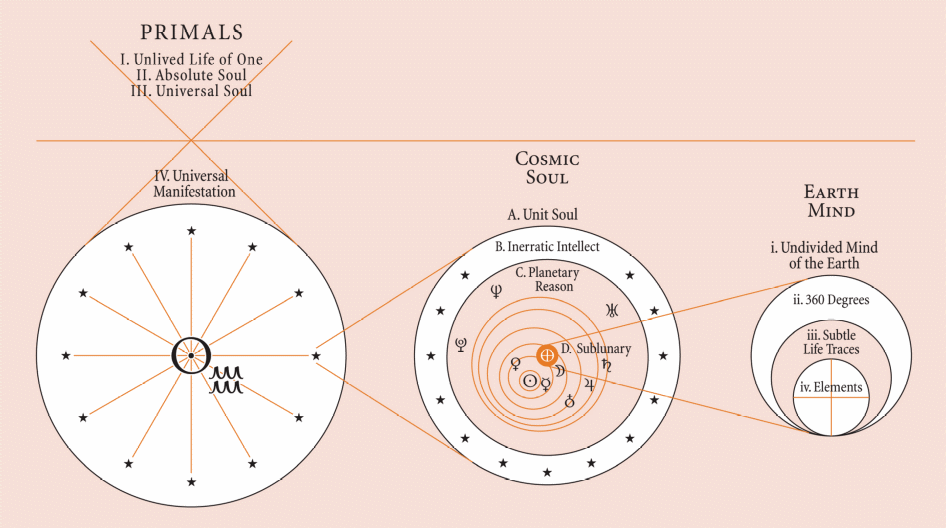
DIAGRAM appended to this transcript:
- FIGURE 1983 0922-1. Nested Levels.
This diagram is from Astronoesis, p. 250. [Transcriber note: [diagram] means the speaker is referencing a diagram as he or she is speaking. If someone is drawing or writing, with audible sounds of chalk on a blackboard, I indicate this by [drawing] or [writing].]
NOTES:
We have a partial transcript for this class. It is located in AD Supplementary Material, pp. 1208-1213. It has no AD edits and was originally typed by JF.
This date is a Thursday, not Friday as the usual for Plotinus classes. There was a note about a possible misdating in Blue Book. Also, AB notes indicate that AB missed a 9/21 and 9/23 class, nothing is mentioned about 9/22. However, since both the partial transcript and the audios are dated 1983 09/22, I am leaving as 9/22/83. Anthony sometimes did swap class nights around for special events.
TRANSCRIBED Verbatim by IT 2021. Archival verbatim transcript – V11a.
AUDIO FILES: 1983 0922a, 1983 0922b. [Note: "Tape" and "Side" refer to original audio cassette tapes that were later digitized into .MP3 Audio Files.]
1983 09/22 at Wisdom's Goldenrod
Plotinus: Nature
[Audio File 1983 0922a Begins]
S (faint): Hm?
AS (faint): You could direct your hostility here for a while or the group. (laughter)
S (very faint): Well, that's right.
S (very faint): Oh yeah.
AS (faint): And then maybe the [one/two word inaudible] would arise.
S (faint): Yeah.
S (very faint): I see one.
S (very faint): Uh-huh.
AS (faint): There's a-- there's quite a number of quotes that deal with the system of Nature. I think you've probably got a list of them at some time, a while ago.
TS (faint): Yeah.
AS (faint): And we were going to go through some of them in some-- try-- I guess we're trying one thing, to put them in some kind of a-- first put them in some kind of order that makes sense in terms of outline that I gave you. So, these are just-- I'm just going to read quotes. Read one at a time. And, [short pause] the order little-- may be a little different from what we've done before. The first one is in II.3.9 and that we have read a lot. That one we've read [one/two words inaudible] Maybe you'll see the relation to this-- the way we've done (to the existence of the All). [short pause] Should we just go right into it (maybe)?
S (very faint): Yeah.
AD (very faint): Many.
AS (faint): Ok, this on page 98, II.3.9. [short pause] This-- it's just this one little part. [short pause] Well I should do more but--
Plotinus [II.3.9, AS reading]: "For every human Being is of twofold character; there is that compromise-total and there is the Authentic Man…"
S (very faint): Ok.
S (very faint): Pardon me?
AS (faint): Page 98, near the top. Around the middle of 300.
Plotinus [II.3.9, AS reading]: "…there is that compromise-total and there is the Authentic Man: and it is so with the Cosmos as a whole; it is in the one phase a conjunction of body with a certain form of the Soul bound up in body; in the other phase it is the Universal Soul, that which is not itself embodied but flashes down its rays into the embodied Soul: and the same twofold quality belongs to the Sun and the other members of the heavenly system. [short pause] [AS, faint: Now you--]
"To the remoter Soul, the pure, [AS adds: the] sun and stars communicate no baseness."
[short pause]
AS (faint): Maybe we should stop and just concentrate on the first-- [AD, very faint: Yeah.] first paragraph (really). There's no such--
S (faint): Isn't that that picture?
[Note: See FIGURE 1983 0922-1, Nested Levels, appended to this transcript for the following. This diagram is from Astronoesis, p. 250.]
S (simultaneously, very faint): Yeah.
S (very faint): Uh-hm.
S (faint): Nature.
[45 second pause while AS draws]
S (faint): [couple/three words inaudible] ok.
[short pause]
AS: Hm.
RC (very faint): Would you repeat the first part of that?
AS: I remember we had another picture too.
S (very faint): Yeah.
AD: Make 'em all stars.
AS: Make them--
AD: All stars.
AS (simultaneously): All stars, yeah. But-- [drawing] I wanted to draw two pictures there and we could see the analysis. [student assents, very faint] Each of these [diagram]. Well-- [short pause while drawing] Alright, Absolute Soul, yeah.
AD: Uh-hm.
AS (faint): And this-- in-- in one way this is the entirety of the universal manifestation here [diagram], cosmos. And then included [drawing] are all of these individual or cosmic stars, cosmic souls or star souls. And each of those is a soul which will have, as he said, the twofold character to them. So, the Universal Soul, or Universal, [student assents, very faint] Universal Soul is pure in itself and has this other character of being associated with a cosmos, and each cosmic soul, Sun soul as he says, and the other members of the heavenly system also have a twofold quality.
[short pause]
VM: Avery, but when you [AS simultaneously: But that--] have the diagram on the right, the compromise?
AS: Um--
VM: Compromise-total in a sense that the soul has involved itself with matter, manifestation and the limitations thereof?
AS (faint): Yeah if you-- for the individual and for this-- Yeah, I think, um-- Well, yes. And he says every human Being is of a twofold character and so it is with the cosmos I think-- think we could use possibly that analogy we did with Parmenides, [Note: See WG Classes 1983 0902b, 0909b, and 0916 for discussion of Plato's 8 Hypotheses.] that the soul in one aspect is free of the World-Idea, [VM assents, faint] (of/that's) the I AM, and you can get to it. And similar is the Universal Soul itself in itself is also free of any manifestation. But then outwardly, as PB says too, it's always bound up with manifestation, (that's got) the World-Mind in back of that (sense), it's never apart from the universe and it's always bound up with it. And in that sense it's a conjunction of the whole of the cosmos, a body, with a certain form he says. And that-- And I thought the Authentic Man in the quote would be like the I AM, (already) spoke of the I AM principle as pure in itself. And the compromise-total-- it's a funny way to speak about it. And, in some way he's-- in some way he's speaking of the ab-- the Authentic Man and the compromise-total leaves out that middle ground and you have to jump right from the I AM to the compromise-total, the guy that's in--
VM (simultaneously): How you understand the compromise-total, the guy in the sublunar realm or [AS simultaneously: No that's--] do you want include the reason-- the planetary spheres and the inerratic sphere as part of the compromise-total? Because in a way you could say that the Ideas are manifesting there under constraints of manifestation there. Would-- It's not quite the right word but subservient to the dictates of matter.
AS: Well, in the-- in the sense that we've said that there the soul is given existence by its conjunction with a World-Idea. But there's some question as to whether you want to call that a compromise-total. I mean I could read it that way or we could read it that the-- the middle kind of existence is left out here.
HS/S(?): Which would be the middle, Avery?
S (very faint): Yeah.
AS: Well, when he-- if we consider the compromise-total to be just the sublunar, those three levels of sublunar [diagrams], then the Authentic Man begins above the lunar sphere, [student assents, faint] includes the heavens. [student assents, very faint] Because that in a sense isn't so separate from Authentic. But if you consider it from the side of the Authentic Man, then you have to say the Authentic Man is only-- it is the pure I AM or the soul, and anything else than that is a compromise.
VM: How about this though, Avery? It seems like he wants to do the same thing for the solar system. Or, let's not say the solar system, for the [student assents, faint] stars and heavenly bodies. So perhaps the distinction he's drawing is between the tropical zodiac and the sidereal zodiac?
AS: I-- I don't think so. At least not for the cosmos as a whole. I mean that's why I'm cautious about the analogy which has been made with the sublunary.
VM: Yeah.
AS: Because when he says--
Plotinus [II.3.9, AS reading]: "…it is so with the Cosmos as a whole; it is in the one phase [AS reads: in one phase it is] a conjunction of body with a certain form of [the] Soul bound up in body; in the other phase [it is] the Universal Soul, [that] which is not itself embodied but flashes down its rays into the embodied Soul…"
AS: I would take that, Universal Soul, to be the Universal Soul as completely free.
S (faint): Universal.
AS: Yeah. Well, I would say completely free and in [one/two words inaudible] And then in the case of the Universal Soul, the form of Soul bound up in body would be the Life-- when he says there's Life principle of the cosmos, it's bound up with the entirety of the mahabhutas, at least. It's the entire cosmic manifestation. And then he says "the same twofold quality belongs to the Sun and the other members of the heavenly system." I think he's saying that each star has a twofold aspect. It's an [drawing] authentic soul in itself. We wouldn't say it's an Authentic Man in the sense of the empirical individual but it's an authentic soul. In other words, there's a Saturn [one word inaudible] phase and a Jupiter phase or even it's own I AM principle, pure essence. [student assents, faint] It's authentic soul.
But its second phase is its rational activity conjoined with-- once-- once it puts itself in association with that whole World-Idea, [drawing/writing] if you go with their-- he calls it the universal reason-principle, now it acts as a part of that, it's conjoined with that and has a particular view of that universal reason-principle, it's going to give it its existence. So now it can be seen to have existence and to operate with that universal reason-principle, whereas considered in itself it's an authentic essence, omnipresent and so on, absolutely untouched by that.
Now the same analogy would have to hold for the cosmos as a whole. The whole cosmos is a universal reason-principle conjoined with a certain aspect of the Universal Soul. But that Universal Soul is not itself bound by that cosmos so it too must have an inner aspect which is purely absolute or universal and is not conjoined with the World-Idea at all. Even the Universal Soul in one sense-- in one aspect is manifesting or illumining that universal reason-principle (in order), in the other aspect it's free.
The same with each star soul. It's an authentic essence. But it's also bound up with the manifesting of that World-Idea and same with a individual (human/unit). [student assents, very faint] He also has an authentic essence and is bound up with the manifestation. Now I think that's true. In another place-- I think the reason why he says for the human it's a little different. That's why he says compromise-total. Because the hu-- for the-- for these cosmic soul, the Absolute Soul or the star soul, they don't go that further step to actually identify with a part-- a partial body, a sublunar body. [drawing] When a human does, then that's his second phase of where he (is bound).
S (very faint): Uh-hm.
LR: No.
CDA (simultaneously): But you don't--
LR: Repeat what you just--
AS: Yeah. I think I see--
VM (simultaneously): For a human it's reflected again.
AS: Yeah. I think I see why for the human he calls the lower the compromise-total. Because as long as he is here in the sublunar with a sublunar body, that is his lower aspect, it's going to be where-- I mean the-- the upper one, the Authentic Man is not going to be affected no matter where the lower tends to identify. The Authentic Man will be what he is. But the character of the second phase will depend upon where it's identified, and as identified here he is a cos-- a compromise-total. For the cosmic soul as a whole, there is not-- it's not a-- it's not the same thing. We discussed that before, (that) its relation to its body is different from our relation to our body. So there the twofold of an Authentic-- of a star soul or the Universal Soul, the second aspect of it, the one that's involved with manifestation, has a little bit different status so you-- (if--) it's on top of the quote, a compromise-total. It governs its-- its manifestation without having to be com--
LR: Less compelled?
VM (simultaneously): Compelled by it let's say.
AS: Yeah, compelled, there's no compulsion in the soul when it governs it.
HS: I was going to say, well it doesn't--
AS (simultaneously): Or it doesn't have to compromise the soul.
HS: Soul has no dragging [one/two words inaudible] (would you) say? [student assents, very faint] No--
AS (simultaneously): It-- not that it-- yes but-- It's not-- it doesn't have any compulsions or vasanas.
S (faint): Yeah and then what?
HS: Being buried in the task.
AS: Yeah but that's not saying--
VM: It does have vasanas in the sense that it must be-- its present [AS simultaneously, faint: The lower.] condition must be linked to its past and so on but I think, if I understand what you're trying to say, it's not bound or it's not compelled the way we are when we're identified with our tropes or vasanas.
AS: Actually I thought he said it nicely, he does have to compromise itself. [student assents] [S, very faint: Yeah but--] It-- it doesn't have to compromise itself to govern the-- well, but he says the star souls govern their bodies without compromise, he's saying that the Universal Soul [one/two words inaudible]
TS (faint): Would you say that it directs [couple word inaudible] (partial--) direct your vehicle so you don't take the ability to be as within those vehicles?
AS (faint): Oh no. Still think they'd be directed, uh-hm.
S (very faint): Ok.
AS (faint): Yeah.
S (very faint): Go ahead.
S (very faint): Go ahead.
DB (faint): But what-- how about the baseness part?
AS (faint): Baseness?
DB (faint): Yes.
AS: Oh, "to the remoter Soul, the pure, the sun and stars communicate no baseness."
DB (faint): Yeah. Now, I mean, is that in contradistinction to-- you know?
AS: No, in contradistinction to what they communicate to the body.
DB (faint): They communicate baseness to the body? No I don't understand.
S (faint): Yeah.
AS: I see your point there. (AS laughs a bit) It doesn't say they do communicate baseness, it says they don't communicate it to the pure Soul.
DB (faint): Right. Which would-- which would (be) more sense.
AS: Well, maybe we shouldn't have read that line but I-- (laughter) I thought--
CDA: Hey sweetie?
AS (faint): [one/two words inaudible] that line [couple words inaudible] that out.
CDA: Censorship. (CDA laughs)
AS: But you know in-- in (one place) he does say that the rea-- he has, in the questions on evil, in some way-- once you're talking about conjoining with a reason-principle, these reason-principles themselves contain the opposites. [student assents, very faint] Ok? [student assents, faint] And for example if they're the agents of karma, and in some way-- I mean maybe baseness is a funny way to put it but they have to distribute the just-- justice, they have to distribute justice, just-- distribute your just desserts or-- And in that sense, distributing baseness can just mean the affects of matter or el-- or body.
DB (faint): See that-- that was-- I guess my problem is that I normally tend to associate that notion of baseness or whatever (sublunarian), and I don't [AS assents, faint] know how to think of it beyond that, you know. So from-- from the point of view of a star, you know, just what you see there, its association with a-- with a-- its vehicle would-- would be of such nature that there would be any baseness there to communicate.
S (simultaneously, faint): No, the principle.
AS: Right, but he-- he's gonna explain and we shouldn't have read more to-- to another point, he's gonna explain that these-- [drawing] in their-- in their activity in the second aspect of them as cosmic souls, these solar systems here, these Sun souls, also have a twofold activity. They organize bodies, and they're also vehicles or agents for the higher will. Insofar as they're agents for the higher will or Providence they-- they don't communicate baseness. [DB assents] But insofar as they reorganize or rearrange bodies, they are. [S, faint: Maybe.] Communicate baseness is--
JC: Another way to try to look at that would be that the-- the soul of a star does not receive any baseness-- baseness from its starry vehicle, whereas for a human soul, [student assents, faint] the life that's present in the sublunary body does communicate [one inaudible AS word] baseness insofar as that soul takes that vehicle to be itself [AS, faint: Good.] in whatever-- however you want to (explain that.
S: Capeesh.
DB: Yeah, [S simultaneously: But--] but would you say that--
AS (simultaneously): And that's a compromise-total.
JC: That's the--
S: The [one word inaudible]
JC (simultaneously): Yes, the [few words inaudible]
AS (simultaneously): That soul does take something back.
DB: Yeah but that doesn't-- is it that baseness (say/then) communicated to the-- to the higher.
JC: No he said-- [AS simultaneously: No.] the baseness-- the starry-- a star body is not a base vehicle.
DB: Right, it--
JC: As he said, it responds to the will of the soul of that star.
DB: Yes.
JC: Perfectly.
DB: Right.
JC: Or as perfectly as that body can.
DB: Well--
AS (simultaneously): Ok if--
JC: Well yeah, go ahead.
AS: No go. No, no, I wouldn't want to add something, I wanted to retract it.
JC: Ok.
S: Uh-hm.
S (faint): (Spread) that line.
AS (faint): They were going to strike that last line. (some laughter)
JC (amidst laughter, faint): Oh, yeah.
S (very faint): That'd be good.
JC: But, Avery, what is the light that's in the star different from the soul of that star? What does this certain kind of light light up with the body in the case of the soul of a star?
AS (faint): Well, is it here, does he mention that here because--
S (very faint): Uh-hm.
DR: [one word inaudible]
JC: He says there's a compro-- you know, he-- [AS simultaneously: Oh, yeah.] he makes an analogy, and he says that for every kind of soul in that-- in its involvement with the universe, it doesn't involve itself directly in, but with whatever body is, doesn't involve itself directly in that but only through a kind of soul which is tied up with the body.
AS: Right, in the other phase it is that which is not itself embodied but flashes down into the embodied (Soul principle).
S: (very faint): Yeah.
AS/S(?) (very faint): Soul principle.
JC: And I'm interpreting soul bound up with body as in the case of human we have a-- a soul that's projected from [one/two words inaudible] lesser form of life that is the thing that animates the body. [S, very faint: Ok.] And I assume that that follows for a star soul too, it has a-- a lesser form of soul it communicates to-- to body or molds a body out of you might say a-- That it-- that in that case you said it's communicated to the baseness, [student assents, very faint] it moves with (the other) body accordingly, you know.
AS (simultaneously): That's (true). And you know even in some way, if you ask what is that phase of the Soul, of the Universal Soul, that's bound up with the whole cosmos, I could almost see calling that Nature.
JC: Nature itself, yeah. Right.
AS: Saying what is the phase of the al-- the Universal Soul that's bound up and always conjoined with the entirety of the cosmos. [student assents, very faint] And, I could see some sense in calling that Nature and they-- the higher Logos is the pure soul itself [couple words inaudible] phases, but the lower Logos is the entirety of Nature principle.
CDA: Avery, you--
AS (faint): Yeah.
S (very faint): That's (true).
AS (faint): And I think-- maybe he makes that more clear, I don't know.
CDA: Are-- when you say that are you making a distinction between the individual star souls and the Universal Soul? I assume that you are.
AS: Yeah.
CDA: But I don't see what-- how you are doing that, making that distinction.
AS: And it's just an analogy. I'm (not doing--) He says the cosmos as a whole. And they're saying-- remember the universe-- the Universal Soul is concerned with illuminating the entirety of the cosmic manifestation.
S (faint): Right.
AS: And the individual Sun souls are concerned with a portion of that universal reason-principle. So (isn't there) analogy but it's not the identical thing, just as for the individual human soul it's slightly different again. I would-- I-- I don't know. From-- from the quote it seems like the distinctions can be made at second phase, it's like the authentic essence of any star soul and the authentic essence of the Universal Soul or the authentic essence of a individual soul seem to be pretty closely the same or I mean in terms of their inner essence. But the second phase really seems to differ quite a lot. Maybe the first one too. But the second phase seems more clearly to differ in that again, individual soul is bound up with a particular sublunary body. The star souls govern their bodies or govern their universe [few words inaudible] without being compromised by it, whereas the Universal Soul considered as a whole seems to just be concerned with [drawing] not even the particular bodies that are fabricated by cosmic souls but like the entirety or the seats of the Gods. Or the job of the Universal Soul is just to establish these seats for the individual cosmic soul and that's where its job in manifestation stops as it were. From there it's the job of the star soul take over further from there all the way down to these bodies and then it's the job of the individual soul or whatever [student assents, faint] [CDA simultaneously: But if you--] to inhabit those bodies. [student assents, very faint] There's a difference in terms of the vehicle or the body.
CDA (simultaneously): But if you stopped at the level of the I AM or let's say the cosmos for the individual soul, [AS: Yes.] if you stopped at that level and didn't speak about the-- the relation to the body, it doesn't seem like you could really make a distinction.
AS: It wouldn't be much.
CDA: Yeah. So--
AS (simultaneously): And I think then we'd have that picture we had before with-- [drawing] just to have these inerratic and the-- the Sunlike spheres, and if you didn't descend further, he says other places the individual is conjoined with the cosmic soul and governs the universe in this [CDA: So--] happier state.
CDA: So since the-- since the identification with the body for an individual soul has to do with the reproductive phase, it seems that-- that it's there that this distinction will come out and not with the soul itself.
AS: No, I agree, that's what I said, I--
CDA: Ok. I just want to [one word inaudible]
AS (simultaneously): The twofold nature is very similar for any individual soul and the cosmic-- and a Sun [CDA assents] soul, which is also an individual. But I think here [drawing] that the point is, in its second aspect, the second, whatever it is, the second phase is-- in the second phase these star souls are almost as parts of this universal reason-principle. They play the role of the transmitter. Remember we once talked about how each of these star souls is itself transmitting some aspect of the-- of the reason-principle or the Ideas. And in a funny-- in a-- in a funny juxtaposition, his soul-- the entire universal reason-principle [drawing] and a part of it.
LR: You're saying, Avery-- I mean, what you just said, [AS/S(?), very faint: Yeah.] is that what you're calling the inerratic sphere for the individual human?
AS: For the star soul, for each star soul.
LR (simultaneously): No, for the human.
AS: Well, I don't [LR simultaneously: When you said each of--] think a human has a--
LR: When you said that each star soul, [AS, faint: Yeah.] each star there, according to that, [AS simultaneously: Yeah.] is radiating a certain Intellectual-Principle.
AS: Certain intellectuality which is--
LR (faint): Right.
AS: Which is on the one hand its own [LR assents] and on the other hand it's [drawing] part of the universal.
LR: Right. Now wouldn't that be what we've called the inerratic sphere for the individual? [AS simultaneously: No I think--] Are you saying the inerratic sphere for the individual is not-- is less than.
AS: Well, wouldn't you say that each star soul itself now interpenetrates [drawing] with the enti-- you have the totality of the star souls which are universal reason-principle, and each of those star souls itself is an intellectuality which has a vision or view of all the others and that's its peculiar interpretation. It has its own participation in the inerratic sphere.
LR: And then you put the--
AS (simultaneously): And then the human, [LR simultaneously: Is inside.] his intellectuality, participates in that one. [LR simultaneously: See, but--] But that's only from this point of view of the second phase.
LR: Yeah I know.
AS: In only second phase. But from the point of view of the first phase, he encom-- he's omnipresent in the--
LR (simultaneously): No I'm asking about the second (one).
AS: Yeah.
LR: Are you putting-- it seems you're putting the individual inside that star, that one star. So what he sees is the reflection of that one star in the midst of all-- of the total. Is that what-- this point--
AS (simultaneously): You can say that, yeah.
LR: The absolute.
AS: Yes, yes, I-- I would-- I would put--
LR (simultaneously): You put him in there somewhere.
AS: Sure, of course. [drawing] And here's our (sign) [diagram].
LR: So what-- what would be the difference between-- I'm not sure what the difference between-- between the stars going around that Sun and the stars going around the larger circle.
AS: No these are the same. Oh, I get what you mean.
LR: Yeah.
AS: You mean, each of these stars is itself a twofold, it's just an authentic essence of soul and it's conjoined with the universal reason-principle. Now it's not governing or conjoined with [one word inaudible] the entirety of the Universal Soul in its second phase. It's gotta be as it were participating in it or only in a-- in some as-- in some part of it, if you want to put it that way. It has a particular locus where it's going to manifest. And that locus-- from that locus it has a particular peculiar view of the rest of the universal reason-principle. See the word 'peculiar' would be like saying it's the Universal Soul and it would just have the whole thing, entirety of it, absolutely. I mean it's the same problem we had back at the other end when we said somehow the soul, [LR simultaneously: Yeah.] you know, is the Intellectual-Principle [LR simultaneously: I know, I put--] but it isn't the Intellectual-Principle.
LR: I know. But what I'm asking is-- When you draw all the stars around that star and you'd say then a human participates in its vision of what all the other stars. But each one of these stars like the Sun has a pure mind, [AS: Right.] and its mind is a pure-- So I don't, again, see really what the difference is between-- I don't-- I'm not sure this isn't-- even appropriate.
AS (simultaneously): Well each star comes in with its own intellectuality, which is conjoined with that World-Idea. I mean, when we use that Parmenides thing, said that the World-Idea comes into the soul and now there's a conjunction. First it's a pure essence and now I have the World-Idea conjoined with it. Ok? Now, I would just-- it would seem to me that that pure essence of soul in some way is an intellectual essence. And so it's going to interpret-- when that World-Idea comes into it it's going to have a peculiar view of it. I don't see anything wrong in saying it doesn't have the entirety of the World-Idea or universal reason-principle the way it is. I forgot what your-- [S, very faint: Well, I don't--] I don't-- maybe somebody wants to--
LR: Well it's ok. I don't think it's that--
RG (simultaneously): But, I don't see-- I don't see where the distinction of the two-- of the difference between the two is really brought out here.
AS: Between the two, which-- Between the Universal and the--
RG: No that is brought out but it seems that principle is applied to any-- any entity, whether human, [AS: Right.] star or--
AS: Yeah, [S, very faint: Sure.] yeah, I agree, they're twofold.
RG: Right.
AS: Yeah. It's [RG simultaneously: But it's both.] true. That isn't the point here to distinguish the individual, the star soul, or the Universal Soul because they-- they all have--
RG (simultaneously): Right. They both-- they all have two phases.
AS: Yeah. He's making a point and in one phase they're conjoined with the World-Idea or reason-principle, cosmos, and in the other phase, they're not.
RG: Right.
HS: Ok but you did make a distinction between the human soul or the hu-- this conjunction is a compromise (where/or) I think you just (said the-- you've made it perfect).
AS: Maybe that was a mistake.
RG: But you know, do--
HS (simultaneously): Or the soul bound up with body.
RG: But you know, if you-- if you read this again, [S simultaneously: No.] I mean--
AS/S(?) (very faint): (Never mind.)
Plotinus [II.3.9, RG reading (simultaneously with AS above)]: "…there is that [RG reads: the] compromise-total and [there is] the Authentic Man: and it is so with the Cosmos as a whole…"
RG: I don't see why you don't read it is also so that one aspect of the cosmos is a compromise-total and the other aspect is the World-Soul.
VM (simultaneously): I don't see why it's not a compromise insofar as the [AS simultaneously: Ok.] Ideas have to, [S simultaneously: Yeah.] let's say, limit themselves because they have to operate through man, and that [AS simultaneously, faint: That's fine.] is a compromise.
AS (faint): That's fine, I-- I don't care. You're right, there's no need to make those distinctions in [one/two words inaudible] in the cosmos, in terms of (inside/insight).
RG: Yeah but, I mean, do you think it's in there? I mean I don't even think-- do you think it's--
AS: No not necessarily.
HS (faint): Yeah.
JC: Depends what you mean by communicating baseness, you mean like the one [few words inaudible]
RG: No, no, but the baseness isn't communicated to either remoter soul if the remoter soul is a human or a-- [AS: Right.] a star or soul.
AS (simultaneously): It's only communicated to the lower aspect.
RG: Right, of both in some-- I mean--
AS: Well it has to be in the sense that it's conjoined with the cosmos.
RG: Right.
S (faint): Oh yeah.
AS: Has something to do with that. You're right Richard, I would agree with that, yeah.
RG: Because the remoter soul in the next paragraph refers to the Universal Soul which is the principle of both-- is the highest principle of the human as well as the cosmic soul, yeah.
AS: The Absolute Soul.
RG: Yeah, the Absolute Soul.
AS: The absolute essence, the essence or authentic essence.
RG: Right.
AS: I think better we say authentic essence. I agree, in that line the remoter soul means the authentic essence of Sun soul, an individual soul, or the cosmic soul or the Universal Soul as a whole.
RG: Uh-hm.
AS: There's no baseness communicated to that. And no matter-- he's trying to say there, no matter what goes on in the world, the authentic essence of soul isn't affected by it. [RG assents, faint] No matter what goes on in the circuit. And I think that's important 'cause that's just gonna keep-- he's gonna keep that all the time, that there's an aspect of the authentic essence of soul-- or the authentic essence of soul itself is not affected by the cosmic circuit at all.
HS: And then there you'd say there's a part of soul that is affected. [few words inaudible] what?
AS (simultaneously): Well, that's where the--
S: Uh-hm.
AS: There's something that's affected. And, inso-- if it's-- even if it's just the body that is affected, then insofar as a phase of the soul is bound up with a body, in some ways it-- it too-- that lower phase of soul too will have some (affects) on it.
HS: But [couple inaudible AS words simultaneous with HS] there's two phases, in [AS assents, faint] and outside of manifestation.
AD/S(?) (simultaneously, faint): Ok.
AS (faint): Yeah. I think we said [one word inaudible] in that (passage there).
S (very faint): Yes.
AH/S(?) (very faint): (Correct.)
[short pause]
AS: Anthony could--
[24½ second pause]
TS (faint): Would it be like in the distinction between the soul [one/two words inaudible] in the-- and the star soul [couple words inaudible]
AS: Well, I-- probably we could say right here he is. I still question on the second aspect.
TS (faint): And I think that you would be saying--
AS (faint): (That/If) there is a distinction but-- I mean in some other-- I'm coming from other places where there is a distinction on the-- on the second-- the second phase of an individual human soul. But here, these two things that-- Tim but did you have some questions from the [couple words inaudible]
TS (simultaneously, faint): I don't know [three words inaudible] what these-- these passages bring in.
AS: Mainly just that-- this first paragraph.
S: I'm a little excited.
[short pause]
AD: Well what was the idea here? You have Absolute Soul, Universal Soul, on the one hand. And then you have a soul, second aspect of that same soul which includes within it the World-Idea or the reason-principles.
AS: Right.
AD: Then you have the s-- next in the hierarchy you have a Sun soul, and it has one phase which remains above and another phase which projects its version of that universal manifestation.
AS: Right, and that's--
AD: And then you have the human soul within that realm, and one phase of it remains self-identical, the I AM, [AS/S(?), very faint: Yeah, ok.] and another phase of it manifests the World-Idea for it.
RG: Right.
AD: So that you have in a sense then, you have the Universal Soul, alright, within the star soul, and that within the individual soul.
AS: Or, "within" the other way. You have the Universal-- if I erase the diagram and then-- You have the Universal Soul with its authentic essence and its second phase, which is entire World-Idea.
AD (faint): Yeah.
AS: And then you have star souls with their authentic essence [drawing] and their second phase, which is their own inerratic version of that World-Idea.
AD: Well, just put one star down and [AS assents] that one star would have to have its interpretation [AS drawing] of the whole.
AS: Right. And then you have an individual in that, a human--
AD: A human soul.
AS (simultaneously): --which is an Authentic Man or authentic essence and has his own version.
AD: Version of all that [one word inaudible]
AS (simultaneously): Of the whole-- of the whole business, of the World-Idea, which is-- You're saying that this twofold applies to every one of those three different [AD simultaneously: Uh-huh.] grades or natures [AD: Yeah.] of soul.
AD: Yeah. In other words, the Universal Soul portrays or manifests the reason-principle [AS drawing] or the World-Idea. Each star soul does the same. And then the individual soul has those two priors as its content and manifests that.
AS: I-- maybe we could use some terminology and call the biggest one the universal reason-principle.
AD: Yeah.
AS: And the second one, the solar inerratic or sidereal. Maybe solar inerratic here. I don't know.
AD: Alright. And the third would be an individual. Now, the point here is that-- well this is almost like the Second Hypothesis. [Note: See WG Classes 1983 0902b, 0909b, and 0916 for discussion of Plato's 8 Hypotheses.]
AS: Yes well-- And-- well, the First and this-- in the Second is the second phase of it where the World-Idea is conjoined with soul-- with soul, the essence of soul to give it existence. Without that, it doesn't have any (particular from) manifestation. Except I just keep drawing a whole lot [couple/three words inaudible]
LR: So our World-Idea is the body of the cosmic soul?
AS (very faint): The World-Idea of (this Earth/the Sun).
LR: Is that right?
AD: I don't think so.
AS (faint): Part--
AD: Our World-Idea is the body?
LR: Yeah, when we-- when we-- when you talk about incarnati-- receiving the World-Idea for individual human soul, that World-Idea, if I'm following the diagram tonight, is the bodily phase of a-- the cosmic soul. Second phase of the cosmic soul.
AS (faint): Conjoined with the second phase.
AD: I'm sorry, I still didn't grasp what I'm reading.
LR: Say there's this Universal Soul. And then its second phase is the en-- all the stars, all those reason-principles, right?
AD: Second phase? Yeah.
LR: Yeah.
AD: The second phase of the Universal Soul will be Soul joined to reason-principles or [LR: Right.] these two together would be like (the/a) World-Mind.
LR: Right. Then-- then you say well there's a cosmic soul or a star soul, [AD: Uh-hm.] and its bodily phase is a reproduction within that total reason-principle of them. Or--
AD (simultaneously): Well that star soul, yeah, has its seat within that total, alright, and manifests its-- its body within that total (realm).
LR: And its body is a reflection of all those reason-principles.
AD: No, not its body but it would reflect all those reason-principles. It would know. In other words, if you think of it as an individual [LR simultaneously: (Alright, reason.)] mind, it has to have its own version of universal manifestation.
LR: I-- right, I'm using the body, the word 'body' incorrectly, I guess. What I mean is its second phase of its--
AD (simultaneously): Its-- its second phase would be soul conjoined to body. First phase is soul pure. Second phase is soul conjoined to body.
LR (simultaneously): Right. And its body is--
AD: Would be the actual star.
LR: The actual star.
AD (faint): Uh-hm.
LR: And it would have as its intellectuality, that's what I want to say, an image of all the other stars, all the other reason-principles.
AD (simultaneously): That's-- that's what we mean, yeah.
LR: Now, third, now you got a human.
AD: Human soul, uh-huh.
LR/S(?) (faint): (Ok.)
LR: And essentially the same as the Authentic Man.
AD: Yeah.
LR (simultaneously): Right? Now he's going to be conjoined with the body.
AD: He's going to be conjoined--
LR: With body.
AD: Well, first the Authentic Man manifests all that which we just spoke about. Right? Authentic Man will manifest the universal reason-principles and the Universal Soul, alright, which would include naturally the star souls with their body. Now, Authentic Man will manifest these two priors, right? Included in that manifestation would be his particular star or Sun. (You) place him conjoined to that, now if you want to speak about him having a body he has [LR simultaneously: That's within that.] to descend all the way down through the sublunary realm of that star and identify with a body.
LR: Which is-- with-- right, so the-- so his body is within the body of that star which is in the body of the universe.
AD (faint): Yeah.
LR: Yes?
S: (Yeah/Right).
AD: Uh-hm.
DB: Ok, so basically the indi-- the-- just talking about the lower phase of-- the lower phase of the individual soul has the same relation to the lower phase of-- of a star soul as that star soul has to the entirety of universal manifestation.
JB: Yeah but saying that doesn't define whether they're all in the lower phase of each other or not, it just sounded like you have a [one word inaudible]
DB: No, the-- I mean, well (good).
JB (simultaneously): There's a relationship at each level. The lower phase of man is not just in the lower phase of the Sun which is not just in the lower phase of the universal reason-principle.
AD (faint): Alright.
S (very faint): What are you going to do?
JB: You go to (a climb). (laughter)
S (faint): It's the other one.
DB (faint): Not that funny. (laughter)
S (faint): What about--
JB (simultaneously): Yeah but that wasn't where you were heading. You know, it certainly confused me from what you were saying but maybe not from what Avery's (doing). I thought you were calling out the suggestion [LR simultaneously: That-- just repeat, I didn't--] that the-- that-- that the lower phase of the-- of this human soul, which is connected with his body--
LR: Is within.
JB: Is within the body of the Sun, within [LR simultaneously: Yes, I would--] the lower phase of the-- of this-- of the Sun phase.
LR (simultaneously): Which was within-- yes, I was saying that.
JB (simultaneously): Which is in also the lower phase of the Universal.
LR: That's what I was asking.
JB: Oh, then good. (bit of laughter)
LR: That's exactly--
JB (simultaneously): So then, so then you could answer David's (hump).
S (faint): What?
DB: Well that's what I said [one/two words inaudible]
RG (laughing): King David.
AD: Well, the important point here and it had to be made was that those two priors get manifested by the Authentic Man. And that means that there is a representation within Authentic Man of the inerratic sphere and included within that would be the-- the particular Sun or soul that he's conjoined to. I want to stop right there for a moment, ok, and say the Authentic Man is manifesting the inerratic sphere, all the stars, and one of them is his Stun-- Sun soul, ok? Now, at that level, alright, soul has three levels of knowledge. He's either identified with the Nous; he's either identified with the rational soul of that Sun; or he's identified with a sublunary realm. Ok?
[short pause while AS draws]
AS: So, in a sense you're saying the higher phase for an individual, an authentic essence of the Man, is omnipresent with that whole prior.
AD: Is omnipresent--
AS: Is omnipresent with the whole of the priors.
AD: Uh-huh.
AS: But in his second aspect he will be conjoined with a particular body within [AD simultaneously: That whole, yeah.] that whole manifestation. Now in some way you could say that the Solar Logos--step up one--in its authentic essence is also conjoined with the whole of the universal reason-principle. The Sun's I AM too encompasses all of universal manifestation but its second phase is conjoined only with (its/the) solar system.
AD: Yeah.
CDA (faint): I'm sorry, I didn't catch that.
(Side 1 of original cassette tape digitized as 1983 0922a Ends; Side 2 Begins)
AS: --it's that star body and that solar system. Now an individual authentic essence is also conjoined with its priors as-- as an I AM, as an authentic I AM, but as this manifesting principle now is going to operate in that, it's conjoined only with a sublunar.
AD: It can [RG simultaneously, faint: (Not the point.)] be conjoined to any of them, alright?
AS (simultaneously): It could be, yeah. [knocks on board]
AD: So, if we keep in mind that the I AM of an individual soul has present within it the inerratic sphere and Sun star to which it is conjoined, now that particular individual soul, let's say, could be identified with just the star, Sun's rational powers, and just remain [AS assents, faint] there. Or, if it descends further, then it must be embodied, physically embodied. Then that means it goes into the sublunary realm and now its point of view is within that sublunary realm. There it would have three grades of knowledge within the sensible. But prior [AS assents, faint] to that it had three grades of knowledge within the rational and prior to that it had three grades of knowledge within the intellectual.
LR: And you're calling both those intellectual grades inerratic, that's where I got confused.
AD: Calling both those grades--
LR (simultaneously): You're calling the inerratic both-- both the totality of the reason-principles within the Universal Soul and those reason-principles within the Sun.
AS (faint): Yeah, we could do that.
LR: You know what I mean?
AD: Yeah.
LR: I'm just saying you're using the word inerratic for both those things?
AD (simultaneously): Yeah. [LR simultaneously: Ok.] Your Sun is a star, your-- the Sun is as-- as much in the Nous as any other star is in the Nous. And if your soul is conjoined to the Sun, then your soul is in the Nous, whether you want to think of it as (in) your individual star or the Nous in general, all the stars.
LR: And the Nous you're equating with inerratic sphere?
AD: Yeah.
LR (faint): Ok, that's-- People are getting confused by that (terminology).
AD: Well you shouldn't get confused. (bit of laughter)
LR (faint): Well I have a choice then [few words inaudible]
AD (faint): Go ahead, David.
DB: Is-- is it that the-- this conjunction of-- or not conjunction, I'm sorry, the association of the individual soul, the human soul, that-- that's with the-- the second aspect now of that star soul, right? I mean it's actually with that body. Is that-- is that correct?
AD: Try again.
S (simultaneously, faint): [couple words inaudible]
DB: I'm-- I'm sorry?
AD: I didn't hear you. Try again.
DB: Ok, I'm-- see from-- from the authentic side it seems like in some sense they have to be considered as having the same status. But when the individual soul is associated with the universe, it's initially associated with the body of a specific Sun soul or Solar Logos. Is that-- I mean it's associated with the second phase of [couple words inaudible]
AD (simultaneously): No, then you're not talking about the I AM.
DB: Ok. So then, the hi-- then would it be the higher phase of the individual soul is associated specifically with the higher phase of a star soul. I mean it-- it's a-- it-- its participation in universal manifestation is through an association at a-- at that level?
[short pause]
AD: Avery, you follow? I don't.
AS: Yeah well, I-- I think I follow it but I--
S (very faint): [couple words inaudible]
DB (simultaneously): I mean it-- the I AM of the individual is associated with the I AM of-- of a star soul.
AD: Yeah.
DB: Ok. Now that's not--
AS (faint): That's fine, go ahead.
DB (simultaneously): Ok. Right, now is-- I--
AS (simultaneously): Now the thing is here, the I AM is the higher, as I understand it anyway, it's the higher of the two phases he's speaking of.
DB: Yeah.
AS: The lower of the two phases of either an individual or a star soul now what's operative within-- it's within the World-Idea, within the manifestation.
DB: Right.
AS: So your I AM, and [DB simultaneously: My--] your true I AM [one/two inaudible student words simultaneous with AS] is conjoined with the I AM of this Solar Logos, [DB: Ok.] which is itself I would say conjoined with the authentic essence of the Universal Soul too. I don't-- I mean at that level the U-- the-- they're all Soul, they're all the authentic essence of Soul, and your I AM and the cosmic souls and the Universal Soul are omnipresent, [DB simultaneously: Yes right.] (they're) outside of the whole business, [DB simultaneously: Right, but you see--] but distinguished.
DB: That's the thing that confused me because it seems like you have the-- all the starry souls having the same relationship to-- to the-- and this is what-- I don't know why I tried to ask this one earlier. On a lower level, ok, all of the individual human souls have the same relationship to say our star as those Suns-- as all the stars have to the universal totality, ok, the universal reason-principle. And now this is [few words inaudible] and I was asking-- now you're saying the same thing applies to the I AM, the relationship of the individual--
AS (very faint): I don't think it's [couple words inaudible]
S (very faint): Uh-hm.
DB (faint): Ok, that's what I'm trying to get at, get clear on that.
AD: Alright, let's repeat this, Avery, let's go over this now. [AS, faint: I--] See if we follow this here.
Plotinus [II.3.9, AD reading]: "For every human Being [AS, faint: Yeah.] is of twofold character; there is that compromise-total and there is the Authentic Man: and it is so [AD reads: and so it is] with the Cosmos as a whole; it is in the one phase a conjunction of body with a certain form of the Soul bound up in [AD adds: that] body; in the other phase it is the Universal Soul, that which is not itself embodied but flashes down…"
AS: So, I-- I mean I would start from the Universal Soul, [AD: Yeah, go ahead.] it would be easier. That each of these three, Universal, Sun soul and individual man are going to have a double phase (to) them.
AD: Yeah.
AS: And for the-- for each of them, if you take (the quote), starting with the Universal Soul, the Universal Soul in itself in its higher phase is not embodied, it's unmanifest or an authentic soul essence.
AD: Is that-- do you think that quote, Zeus, twofold Zeus-- [Note: See Plotinus, Enneads, IV.4.10, "The ordering principle is twofold…"]
AS: I think it's exactly the twofold Zeus.
AD (simultaneously): The same thing here?
AS: Yeah. For the Universal Soul, the reference is to the twofold Zeus. In one aspect he's completely outside and free.
AD: Uh-huh, yeah.
AS: Either [one/two words inaudible]
AD (simultaneously): Free of all process and content, [AS assents] etc, ok.
AS: And in the other one we sometimes he says refer to that principle or Life of the universe. Now it's-- Zeus is the Life of the universe, therefore he's conjoined with the World-Idea that is being manifested. In this case however, that's-- for the Universal Soul that's as far as he goes, the entire universal reason-principle or this entire World-Idea, [AD simultaneously, faint: Yes.] not with any particular part of it. Even insofar as the solar system or anything, the entirety is his second phase.
S (very faint): Uh-hm.
AS: And--
AD: So the World-Idea is first conjoined to the Demiurgic Soul.
AS (faint): That's what I think.
AD: And then that is conjoined to the individual star souls.
AS: Right. And that individual star soul in its first phase is an authentic essence.
AD: Uh-huh.
AS: And it-- its second phase is also conjoined to the World-Idea. Now the World-Idea for it is an aspect or a-- a part, probably wrong but is a participation in the universal World-Idea which the Universal Soul already (has/had). But its second phase goes a little further because now it's also got, you know, a whole solar system.
AD: Yeah its-- [few inaudible AS words simultaneous with AD] its own powers.
AS: Its own powers.
AD: It can elaborate its own interiority.
AS: Yeah.
AD: And then--
AS (simultaneously): And now the individual soul, the human soul also is an authentic I AM or authentic essence but in its second phase it's conjoined with the World-Idea in-- in its own peculiar way which seems to bring, because of its own desire nature for separation, seems to bring it even further down or [student assents, faint] deeper into the process of manifestation. Although in some way not only that. As he says it's not only the third but in some way contains all three. Even the individual soul in a way contains all three, the intellectual, rational and so on [AS indicates on diagram].
AD: Ok. I'm satisfied with that paragraph now. We'll try [CDA simultaneously: Wait.] 3-- 3.13?
S (simultaneously, very faint): [couple words inaudible]
AS: [one/two words inaudible] (AS laughs a bit)
AD: What? What's the matter?
CDA: It was that last thing that Avery just said briefly. I just wanted to make sure I understood that (first). You're saying that what-- the quote where he says though-- though each soul has all three though in under-parallel [Note: See Plotinus, Enneads, VI.7.6, second para.], (then you're stuck) in the experiences, then you're equating that while the individual soul is-- has its-- [S: Oh.] Its three phases are clearly primarily the three phases we've been talk-- speaking about in the sublunary realm. It has these other phases also though in the way you're just describing, that's what Avery's--
AS: Yeah, that's what I was speaking about them, yeah.
CDA: That is-- if that is--
AS (simultaneously, faint): Yeah, (try) [one word inaudible]
CDA (faint): Ok.
AS (faint): Two.
CDA: So--
AS: But as long as it's the compromise-total the way it has them is as those sublunary [CDA simultaneously: Yeah. But--] three levels and its three.
S (very faint): Uh-hm.
S: Yes.
CDA: But I want-- ok, then my question-- I have a question about, would-- would it-- not that I would want you to now but would it be possible to elaborate these-- (CDA laughs) these other two levels in that sense, [AD simultaneously: Yeah, some other time.] you know.
S (very faint): Yeah.
AS: Yeah, [CDA simultaneously: But--] I guess, sure.
AD (simultaneously): Some other time, not now. We have [CDA simultaneously: But--] to work that out.
CDA: But for the moment, could I think about, would it be correct to think about this higher phase as primarily the intellectuality of the Universal Soul? I mean that-- that's what you're speaking about. Or is it--
AD (simultaneously): The highest-- the highest phase of the individual soul?
CDA: The way you just spoke of these three levels was Universal Soul, individual [AD simultaneously, faint: Yeah, yeah.] star soul-- Ok. Now, as the individual soul participates in these-- these two levels of Soul, it sounds-- sounds like you're saying that the highest phase of the individual soul we're going to point to its relationship primarily with the Universal Soul [AD, faint: (No.)] and not with a star soul.
AS (simultaneously): Let me just modify-- I think I follow what you're saying. If I could modify it a little, I think it's a good point. I think you're saying something, in the threefold we just laid out, primarily the Universal Soul is laying down the intellectuality or bringing in the whole World-Idea. [CDA assents] Now, a star soul is conjoined with that intellectuality, it has its own, but it as it were also manifests all its rational powers, ok. And then you're saying primarily the individual soul now will have those also [couple words inaudible] and reason, but it will be identified primarily with the bodily aspect.
VM: Ok. I thought you were asking a slightly different [CDA simultaneously: Yeah, I am, yeah.] question and that is, [couple inaudible AS words simultaneous with VM] when you say that the World-Idea is given to the individual from within, let's just take-- start from that level. The World-Idea is given to the individual from within and he manifests his, you know, space-time existence. Is he getting that from his participation in the Sun soul or [AS simultaneously, faint: Oh (yeah).] the Universal Soul?
LR: From either.
AS (simultaneously): From Sun soul.
VM: The Sun soul.
S: What?
AS (simultaneously): But the Sun soul is participating in the Universal Soul that--
VM (simultaneously): No, no, I understand that.
AS: I think only indirect-- only through the Sun soul.
VM: Yeah, it's like a nested set of spheres and he's getting his from the Sun soul.
AS: I would say, I mean I don't [VM simultaneously: Ok.] see how-- I don't see how [VM simultaneously, faint: Alright, no, I don't--] you directly-- Unless you became a Sun soul.
S (very faint): Uh-hm.
BS (very faint): (Say more than) the Buddhist.
AS (simultaneously, faint): (That was--) Is that what you're asking?
AD (faint): Aren't you asking me is the highest phase of the-- phase of the soul's intellection concerned with the Ideas? [one/two words inaudible] was, can it also be concerned with what's going on within its solar system.
CDA (faint): The first. I mean-- I mean the first, that it can be concerned with the Ideas on the--
AD (faint): Yeah I-- I would suspect that it's concerned with both. [CDA simultaneously: No I--] The highest phase or the intellection is-- at the highest level of the soul would be concerned with intuiting the Ideas, but it would also be concerned with what the meaning of some sensible situation or object is about.
CDA: No, I didn't-- I didn't mean to say either-or, no, this is getting (away).
AD (faint): I know, Carol. I-- were you trying to prescribe the range of its operation?
CDA: Of the-- of the individual soul, and I just wanted to get more-- yeah, yeah.
AD (simultaneously): Well, ok, I'm say-- it's the same thing, I'm asking, it's still the same thing. The-- the Intellect of the soul or the highest phase of the soul, which is basically intuitive or intellective, what is it concerned with? So, if we say the Ideas, alright, then we would be leaving out the sublunary realm and the rational realm?
CDA (faint): No, no, you can't leave them out, (yeah/no).
AD (simultaneously): No, you can't leave them out so you can't say that. I don't think we have to worry right now about the scope or the-- where in the intuitive part of the soul is operative, we won't worry. [AS simultaneously: Want to go to 13?] The next quote.
AS: 13?
AD: Uh-huh.
AS: That's the next one, um-- Yeah that-- it's near the end on page 100. Oh, no I'm sorry, it's near the beginning of it. [S, faint: (Go ahead.)] Page 99, the second paragraph. There's also something on 100.
S: What's the number?
AS: Oh.
S: Not the page number.
AS (simultaneously): II.3.13.
S (very faint): (Ok/Uh-hm).
AS: I don't know, he says--
Plotinus [II.3.13, AS reading]: "The gist of the whole matter lies in the consideration that Soul governs this All by the plan contained in the Reason-Principle and plays in the All exactly the part of the particular principle which in every living-thing forms the members of the organism and adjusts them to the unity of which they are portions; the entire force of the Soul is represented in the All but, in the parts, Soul is present only in proportion to the degree of essential reality held by each of such partial objects."
[short pause]
AD: Ok let's go ahead.
S (very faint): Uh-hm, ok.
S (faint): (Go ahead/Uh-huh).
AS: Well--
AD: The Soul governs the All by the plan contained in the Reason-Principle.
[short pause]
AS: Yeah. I took the reason-principle here to be the universal reason-principle, the World-Idea.
AD: Yeah. So the World-Idea within the Absolute Soul--
Plotinus [II.3.13, AD reading]: "…plays in the All [AD: Or the entirety of manifestation.] exactly the part of the particular principle [AD reads: principles] which in every living-thing forms the members of the organism and adjusts them to the unity of which they are portions…"
AD: Let's go after that.
S (very faint, possibly part of background): (Paul's here.)
AD: It's easier to put up a log cabin, isn't it?
S (faint): It's a lot easier, right.
VM (simultaneously): It's easier to take one apart and put it back together.
LR: Isn't it here [CDA simultaneously: Don't speak too soon. (CDA laughs)] that you're considering All and you're considering Soul?
AS: Well, the reason-principle is what I started with, that the plan in the reason-principle, that's the total World-Idea. And the Soul governs the All, the entire cosmos--
LR: The cosmos?
AS: --by the plan contained in that universal reason-principle.
AD: See the strange thing here, the same way that the whole of the World-Idea is in the Universal Soul, alright, and the entirety of manifestation is governed by that Universal Soul, we're going to have a-- this reduplicated on the individual level. It's like when we said, the First Hypothesis you have a one in itself. The second, the one has being, something comes into it, alright. Third Hypothesis is going to be how it's distributed.
S (faint): Uh-hm.
VM: (I--)
AS: Right here it's the soul which plays the part of the-- when he says "plays the part of the particular principle," I think that soul plays "the part of the particular principle which in every living-thing forms the members and adjusts them to the unity". I think he's saying it's the job of soul to adjust the manifestation of the cosmos to that unified reason-principle or World-Idea. In other words, everything that's manifested must conform to that World-Idea and soul will guarantee that.
AD: Yeah.
AS: That's what he calls necessity, you know what's adjusting it.
AD: Now, the next part.
Plotinus [II.3.13, AD reading]: "…exactly the part of the particular principle which in every living-thing forms the members of the organism…"
S (faint): Well--
AS (very faint): [couple words inaudible]
[short pause]
VM: Are you saying that [couple inaudible student words simultaneous with VM] of the individual soul-- if you take a man for example, couldn't that particular thing be the individual soul that uses let's say the Idea of-- well, maybe we shouldn't go as high as the Idea of Man but, its particular grouping of reason-principles which are then used to organize every member of that body and all its vehicles?
[short pause]
LR: In other words [one/two words inaudible] that seem to affect soul is the central ordering principle of a world, just like in each individual living form the I AM is the central princ-- you know, around which [student assents, very faint] all the other [one word inaudible] will stop.
S (faint): (Where proceed.)
LR: Isn't that what he's doing, he's just coming into that kind of [one word inaudible] [AD/S(?): (Uh-hm.)] Or is it more complicated than that? Seems like he's saying that that Soul which governs the world plays the same part in making all the parts of the world (contained mutually) as in the individual soul the I AM is the axis around which the other members are rotating.
AD: Well let's pick it up again from there, your individual I AM, yeah.
LR: Yeah. The individual I AM--
AD: Uh-hm.
LR: --is the central axis--
AD: Or that principle [LR: --of--] within you which makes all the necessary adjustments as far as your place or your role in the World-Idea.
LR (simultaneously): World-Idea, right.
S (very faint): Ok.
[short pause]
JL: But it also-- doesn't it also say that the-- determined by the level of that soul it participates in-- in (the/a) higher Idea? To the degree that it-- that it participates in the-- in the unity of that soul?
AD: Come again John, try again.
JL: The last part of that quotation that-- who knows what exactly?
Plotinus [II.3.13, LR reading]: "…plays in the All exactly the part of the particular principle which in every living-thing forms the members of the organism and adjusts them to the unity of which they are portions…"
[short pause]
JL: My question really had to do with the last phrase of that--"…adjusts them to the unity of which they…"
LR (faint): "…are portions…"
JL: "…are portions…"
AD: Well, then what you're basically saying is that that individual I AM knows its role in the scheme of the World-Idea.
CDA: But, in order for it to know its scheme, its part in the World-Idea, it must have its version of the World-Idea to know its part.
AD (very faint): Yes.
CDA: I mean the part implies the World-Idea.
AD (simultaneously, faint): And that goes without saying naturally.
CDA (faint): Well, goes without saying but [few words inaudible]
AD: No but the point-- the point here is that the I AM principle-- the I AM principle evidently knows precisely the role, the-- your karmic destiny and that it's constantly making the adjustments that you have-- have to be correlated with the World-Idea, it's-- it's always working that out. [student assents, very faint] So--
AS: Karma is a good-- I think karma is a good word 'cause in another place he said soul is exactly the principle that mediates between reason and necessity.
AD: Yeah.
AS: That mediates reason and necessity.
AD (simultaneously): Necessity.
AS: And adjusts necessity according to reason as the universal reason-principle or World-Idea and necessity is--
AD: And adjusts necessity according to the World-Idea. Yeah because your karma can't be always instantly fulfilled. [AS assents, faint] So it has to make the adjustment in terms of a longer plan or a bigger plan.
LR: So the u-- the word 'unity' in this phrasing here you're relating to the World-Idea, unity [students assent, faint] of the World-Idea.
AS: Yeah, the unity of what's there-- all the organisms are really a part of the World--
LR (simultaneously): "…adjusts them to the unity of which they are portions…", and you're saying in-- the parts of that organism are-- are portions of the World-Idea. In other words, the vehicles that the I AM takes up or uses are manifested by the World-Idea itself, are manifest portions of the World-Idea. That seems to be the implication of what you're saying. And then the I AM organizes those vehicles which are manifestations of the World-Idea and in fact, by trying to manage those vehicles that would be its con-- consequent job for the World-Idea. Because those vehicles are part of that World-Idea.
CDA: But [one word inaudible]
AH: Anthony--
LR: Pursue it.
S (simultaneously, faint): What?
LR: Wait, wait, wait.
AH (simultaneously): Could I ask--
LR (faint): Wait.
S (faint): Good.
AD (very faint): I do have [few words inaudible]
RG/S(?) (simultaneously): Go ahead.
LR: So, in a sense, when you said the body is really like the World-Idea for an individual entity, that's almost saying the same thing. Because if you take body to include all levels of body, and that bo-- it includes all the vehicles which are manifest portions of the World-Idea, so trying to organize that whole system would be bringing that all into some of this.
S (very faint): I see.
CDA: Wait, I don't--
JL (simultaneously): There s-- there seems to be a-- a certain variability here though. Because it says to the degree--
LR: No, I didn't get to that part yet. I mean I'm just sticking with what we read so far.
JB (faint): But I have totally different views.
AS (faint): Uh-hm. Go ahead, Andrew. (Are you done?) Jon wanted to-- Jon wanted to ask (you something).
S: Jeff?
AS: Jon? No this Jon.
S: Go ahead.
AS: Jon?
JL: Hm?
AS (faint): (I thought) the other Jon [couple words inaudible] (laughter)
JL: Go ahead.
JB (faint): What?
S (very faint): Next time you can call me [couple/three words inaudible]
S: Ok.
JB: Well I-- it's a different interpretation, it seems that the middle part, that-- it seems that you-- Linda you've got a middle term (that is/there that's) actually absent here and that this analogy is between the organizing principle of the All with the organizing principle of a particular organism, [LR: Right.] not man in his world, [LR simultaneously: But you can do it--] but for instance a heart in a body. I mean, I should just try to show my interpretation. (Incidentally), the part played is--
Plotinus [II.3.13, JB reading]: "…the part of the [particular] principle which in every living-thing [JB: That's in each living thing.] [forms] the members of the organism…"
JB: That's part of one organism, like a heart or lungs being organized in relation to each other.
Plotinus [II.3.13, JB reading]: "…adjusts [JB reads: adjusting] them to the unity of which they are portions…"
JB: That unity is a single organism and they're portions of a single organism. The middle term, man in relation to his world, is not in this analogy in my meaning of it.
LR (simultaneously): Well it depends how you take the word 'particular principle'.
JB: Well, in this--
LR (simultaneously): We're interpreting the particular principle differently I think.
JB: I like the idea that all three are analogous relationships. There's an organizing principle in which the Soul orders the All. It's related to the organizing principle that relates man to his world. And that's parallel to the organizing principle that relates the members of an organism to the whole organism. And I think that this language, unless it's the translator's error, the use of the word 'member' and 'organism' and 'every living-thing' and 'unity' and 'portion' are all very body-centered and just would seem to confirm that (point).
LR (simultaneously): But Jon, it says--
Plotinus [II.3.13, LR reading]: "…the particular principle which in every living-thing [LR emphasizes following word] forms the members of the organism and [LR emphasizes following word] adjusts [JB assents, faint] them to the unity of which they are portions…"
JB: Yeah.
LR: So it doesn't imply to me that that's necessarily a part-- one of those members itself. But, I'm not disagreeing.
JB (simultaneously): No, no, it's the organizing plan of the whole body, the way Natures makes bodies, if you will. Yeah, I know.
LR (simultaneously): Ok I-- you know-- I can see it on all three.
JB: Yeah, I like it on all three too, I just think the two that are here are in some way the highest and then the most concrete. I mean that is Plotinus is making a parallel between the Soul organizing the All and a very concrete example. No less mysterious I think the way the-- a particular organism is organized, [student assents, faint] but not the level of man and his world.
AH: May-- may I ask a question, I'm not sure at all that I know what's being talked about now. Maybe. (bit of laughter) If-- in regards to I AM that was mentioned a while ago, we spoke of that I AM as having a particular portion of (a unity). Is that a way of speaking about, that we had been speaking lately, of the natal degrees of the horoscope? Is that what you're talking about? [S, faint: (Yeah/No).] Is that the level of this conversation? Like where--
AD: No I think Jonathan is right. The first-- in the first part of that quote that we just read, he speaks about the Logos of the universe, and in the second part he gives an example of a-- the reason-principle of a man governs the relationship of all the functions in the body of man to one another and governs its growth and all that. But the former part, he's saying in the same way the universal reason-principle, the World-- the World-Idea governs all the parts within it. [student assents, very faint] [AH: But--] I think-- I think that's the interpretation.
AS: Yeah, and then he says stuff like at a later-- a later sentence there too.
AH: How did the I AM principle (get) [couple words inaudible]
AD (simultaneously): No, I'm saying leave that out. That's not the analogy, that was wrong.
AH (faint): Ok. That--
AD: He's al-- he's basically saying there's the World-Idea. It governs everything within it. In the same way like you have an individual man, let's say a-- the reason-principle of a man which governs the entire manifestation and the functioning of his body, the way it's going to grow, the way the functions are going to be related to each other, etc, in the same way, the World-Idea governs the universal.
LR: He says Soul, not World-Idea.
JL: I don't-- I think yeah [couple words inaudible]
AH: I would agree with that interpretation though.
S: Yeah but it's--
JL: Maybe that's a complex sentence and it-- it-- it almost could--
LR (simultaneously): [one word inaudible] Like he was saying--
AD (simultaneously): Again, again, Soul here is Intellectual-Principle. It's the Intellectual-Principle in Soul we're talking about.
S (very faint): Or Universal Soul.
AD: In the [S simultaneously, faint: Right, (uh-hm).] same way that the Intellectual-- that the whole of the World-Idea is within an individual soul, we're speaking now of the Intellectual Idea, alright, the whole of it, in the Universal Soul, in Absolute Soul. So Absolute Soul is what governs that unfolding of the World-Idea.
S (very faint): Ok.
AS: That's the same-- He-- the s-- the e-- the Universal Soul is governing this entire manifestation according to the one World-Idea or at-- or universal reason-principle that it contains. [student assents, faint] And it will adjust the whole of it to that. In particular at the level of the Universal Soul it's adjusting the seats of the Gods, that is the star souls. Those are the parts of [AD simultaneously: Uh-hm.] that All. And that's it, it [student assents, faint] doesn't really go any further than that because any-- you know, in that case it's kind of--
AD: Then in that case the fo-- the quote that should follow would be the quote where he speaks about the individual star souls come in and elaborate. That quote should follow this one here.
AS: Ok. [student assents, very faint] The one in VI.7.7 where he says the Universal Soul lays down the reason-principle.
AD: Yeah.
AS: The illumined matter?
AD: Go on.
AS: And it's each individual--
AD: Stars-- each individual soul elaborates [AS assents] and articulates that Idea.
AS: Yeah, VI.7.7, we should--
AD: Yeah, and then that would be the quote that follows.
Plotinus [VI.7.7, AS reading (simultaneously with AD above)]: "The power of the All-Soul, as Reason-Principle of the universe, may be considered as laying down a pattern before the effective separate powers go forth [from it]: this [AS reads: and the] plan would be something like a tentative illumining [of Matter]; the elaborating soul would follow the tracings [and] give them minute articulation; every separate effective soul would become that towards which it tended, assuming that particular form as the choral dancer adapts himself to the action set down for him."
S (very faint): Uh-hm.
AD: Doesn't that seem to follow, Avery?
AS: Yes. That's very good. And--
JL: Anthony, are you saying it's arbitrary on our part to separate the soul from its reason-principle, that is, everything reason-principle within it?
AD: Yeah.
JL: That-- that it is a-- it is a continuum between soul and its-- and its [one word inaudible]
AD (simultaneously): Well that was part of the thing that we learned from the Eight Hypotheses, the First Hypothesis spoke about the soul as one, [JL assents] and the Second Hypothesis spoke about the reception of the World-Idea in that one. Alright, now the one has being. Now, it's going to manifest that being, that World-Idea. Now the World-Idea is what is superior, if we were to be-- if we were to evaluate. [JL assents] Just like your soul is manifesting the World-Idea for you. But the World-Idea which your soul is manifesting is superior to the soul which is manifesting it and guiding that soul.
JL/S(?) (very faint): Yeah.
S (very faint): Yeah.
HS: But can you say that again?
S (faint): (Yeah.)
AD: In the same way that we spoke about the Hypothesis, the first one spoke about the unity or a one. The Second Hypothesis spoke about the reception of the World-Idea within the soul, ok? Now the World-Idea which is received by the soul and manifested by the soul, alright, at the same time that it's manifested by the soul, that World-Idea is determining that soul. Now that soul is being guided by the World-Idea. Its evolution, growth, you know, and unfoldment is being guided by the World-Idea. Now from one point of view, the highest in you is your I AM. But from another point of view, it's the World-Idea which is ultimately guiding that I AM to its own realization. [students assent, very faint] Now the whole idea of those Eight Hypotheses, if you remember the first four were concerned with the one if it is, and the second-- the second part, the last four Hypotheses, if a one is not. And all these contradictory characters about the soul had to be understood in order to follow his definition of soul.
LR: So you're talking about the part where each in some way grants existence to the other.
AD: Yes. On [LR simultaneously: That the--] the one hand the soul manifests the World-Idea and causes it, so to speak, to become an appearance but on the other hand the World-Idea is molding and guiding that I AM principle. [student assents, very faint] Now--
AS (faint): And that's what he means by making them parts.
AD: Yeah.
AS: And I think that was the point here was that, as an authentic essence, the soul of a star is outside of this manifestation but as conjoined with the manifestation, this seat that is given by the Demiurge is now determining the very center of its being there, is getting molded according to that.
AD: And its relationship to all the others and [AS simultaneously: Yeah, yeah, I--] etc, whatever the universal multiplicity and relativism that's implied there.
AS: I think we should read on in II.3 (to/for) the next page.
AD (simultaneously): But what-- what do you think Avery, are-- I mean, should that follow right where we finish [AS simultaneously: Yeah.] the quote previous?
AS: Yeah. I would [AD simultaneously: Ok.] do that part of II.3.13 and then the VI.7. And then I'd read the-- the rest of-- on the next page of II.3.13.
AD (simultaneously): Start, go ahead now.
S (simultaneously, very faint): Right.
AS: That's near the top where he says on page 100--
Plotinus [II.3.13, AS reading]: " Thus the All stands as one all-complete Life, whose members, to the measure in which each contains within itself the Highest, effect all that is high and noble: and the entire scheme must be subordinate to its Dirigeant as an army to its general, 'following upon Zeus'…"
AS: This coordinates with our interpretation of Zeus [couple words inaudible]
S (very faint): Uh-hm.
Plotinus [II.3.13, AS reading]: "…it has been said--as he proceeds towards the Intelligible Kind.
"Secondary in the All are those of its parts which possess a less exalted nature just as in us there are the secondary faculties of the Soul; and so all through, there is a general analogy between the things of the All and our own members--[AS adds: but] none of quite equal rank.
"All living things, then--all in the heavens and all elsewhere--fall under the general Reason-Principle of the All…"
AD: The World-Idea.
AS: World-Idea.
Plotinus [II.3.13, AS reading]: "…[AS adds: and] they have been made parts with a view to the whole: not one [AS reads: none] of these parts, however exalted, has power to effect any alteration of these Reason-Principles…"
AD: None of these can in any way alter the World-Idea.
AS (faint): Yeah. But I think that was-- I think that (one) should follow.
S (very faint): Yeah.
AH: These parts are a reference to that earlier definition of parts of an individual body?
AS: Yeah, I think he's saying that these star seats are the parts of the universal reason-principle or total World-Idea. And therefore, even when you say that star soul as it were is conjoined with its particular seat or part of the universal reason-principle, that universal reason-principle remains-- that reason-principle remains a part of the entire. [AH simultaneously: I'm just cur--] In other words, at the highest level the parts of the universal reason-principle would be these star souls.
AH: I'm just curious about the definition [couple words inaudible]
AD (simultaneously): Are you peoples being stupid tonight?
S (very faint): Uh-hm.
AS: I'm sorry, Andrew.
AD (simultaneously): Huh?
AH: Portions of the-- another quote that-- that we decided upon is portions of the unity. That was a way of speaking about the individual organs of a [AS: Yeah.] particular organism.
S (faint whisper): Yeah.
AS: Yeah. And the point here is that these star souls are part of that one organism, the entire cosmos.
AH: So now the organism is not an individual body but--
AS: He-- I think we agreed with Jon that even in the prior paragraph there was this analogy going on. The entire universal reason-principle is to its parts, which are primarily those star souls, see, the stars, as an individual reason-principle, like the reason-principle of Jeff Cox is to the parts of it, you know, and so on, all it-- all its organs and so on. He's always making the analogy. And here he-- he's just furthering it.
AH: I think you understand that--
AS (simultaneously): There's a general analogy between the things of the All and our own members. And I-- I just thought primarily the parts of that All, the parts of the universal reason-principle at the level of the Demiurge and the [drawing] Universal Soul are these-- the parts are those star souls as their second phase, the reason-principle(s) [one/two words inaudible]
AD (simultaneously): In other words universal manifestation is the Body of God. Use the analogy. Just like your body has parts within it that are all related according to a certain organic plan, similarly the entirety of universal manifestation, all the stars that are within it, each are, so to speak, related to each other in a certain way which is predetermined by the World-Idea.
HS: Is that different than the World-Idea, the way you're using it? Is that the World-Idea or is that the World-Idea manifest?
AD: That's the World-Idea manifest.
HS: And in r-- and references to what-- what you would take to be the totality of the stars?
AD: Yeah. Everything that you can see. You look out into space, all that you can see, you can only see 6,000 stars, right? Or 5,822.
HS: And that's what you take [couple words inaudible] we're calling the All?
AD (simultaneously): But, with a telescope you see a few more. This? Yeah.
HS: That's what you're calling the All.
AD: Yeah.
HS: And it's a particular--
AD: Well don't-- don't make the mistake now of tagging that word 'the All' with this connotation.
HS: With what? I think it's the All of (somebody), it's the All or what?
AD (simultaneously, intensely): Because is-- he's gonna use the word 'All' in a different way altogether in other passages.
HS: Forget the word, what are you talking about?
AD (simultaneously): Ok, good. Forget the word.
HS: We're talking about the totality of the cosmos taken as an entity.
AD: Yeah.
HS: Right? And-- and it's configured in a particular way.
AD: Yeah.
HS: It's a particular plan, right?
AD: Yeah. In other words the prevalence of universal relativism among the Ideas is a preordained prefigured, preplanned in the World-Idea itself. It's part of the World-Idea.
HS: Now--
S (simultaneously): (Well-- uh-hm.)
AH: When you speak of parts in regards to that All, you're speaking of the star soul?
AD: Yeah, all the stars.
S (very faint): Right.
JL: Now, you said that the parts can't affect any change in the whole.
AD: Cannot affect the World-Idea.
JL: Ok. Can-- can the unit-- let's say the-- the aspect to which an entity participates in its own unity be-- be modified?
AD: I'm sorry, I don't-- I don't understand.
JL (simultaneously): Can-- can the degree to which a particular soul participates in its own unity, can that be changed?
AD: I don't understand John, how could a soul participate in its own unity?
JL/S(?): I see.
JL: Because it suggested it here in one of the previous paragraphs, didn't it Linda?
LR: In what unity are you [one word inaudible]
JL: To--
LR: Which--
JL: Hm?
LR (very faint): I'm sorry.
JL: In its own unity.
LR/S(?) (very faint): In its own unity.
AD: I'm--
AS: Well you know-- ok.
AD: Yeah.
AS: John you know I think he means something else by that thing about-- not-- not something else but, when he says no alteration of the reason-principles, yeah actually in a couple of tractates, paragraphs back, he speaks about something like suppose you have a human-- the human-- a human reason-principle. No matter what may go on in the environment or anything like that, it cannot affect the essential nature of that reason-principle. I mean you can think the guy is changed or he's altered or whatever, you know, and his arm gets hurt or broken or anything like that. There's never really an effect on the reason-principle of man or the reason-principle of horse or any of these reason-principles which are parts of that World-Idea. In some way they cannot be changed. [student assents, very faint] You can re-- maybe you could replace one with another, another could be replaced, but--
JL: I don't know.
S: Oh yeah?
JL: Well, I'm not-- I'm not suggesting that-- that the-- the essential nature of the soul is-- could necessarily be changed, what I'm-- what I'm asking basically is, can one's partici-- it's a funny way of asking it. 'Cause one-- can one's participation in-- in that essence be-- be modified in any way, any lesser or greater, to a lesser or greater extent?
DB: Are you a-- John, are you asking what-- whether the-- the evolution of a individual soul (contained within) in the World-Idea?
JL: No, no, the (everlasting) phase.
DB: I'm sorry?
JL: In your own essence.
DB: Yeah my own-- right.
AS: Can an entity participate to a more or less degree in its own essence?
S (faint): Yeah.
S: Right.
JL: Yeah.
DB: Well that-- but that's the point, I mean--
HS: That one seemed like--
JL (simultaneously): I know it's tau-- it's-- [S, faint: Yeah.] it's tautologous but what I'm also asking is kind of a-- a deterministic question, you know.
DB: Oh I'm (sorry).
JL: What is the point of study, meditation, [S simultaneously: Don't you become more--] aspiring, I mean if everything's predetermined, you know.
S (simultaneously, very faint): Oh, (see--)
HS: See now (he asks).
S (simultaneously): [couple words inaudible]
AS: Should've asked [few words inaudible] (laughter, student words)
AD (simultaneously, amidst laughter): By the way, by the way, don't-- don't-- don't make the mistake, although you know my attitude, don't make the mistake of thinking you know what predetermined means. Don't make that mistake.
S: Yeah.
JL: Well, the whole argument implies that.
AD: I may be fatalistic in my attitude. But I've been shoveling away with pick and hammer for a long time to understand what that fatalism is all about. [RG assents] That's a very difficult concept, predetermination. Because even the use of your free will is in accordance with a plan that's already been predetermined and your free will is required in order to fulfill that predetermined plan. [S: Yeah. (laughter)] So don't think it's a simple idea.
AS: Well, you know Anthony that-- that came up with a couple of those pre-- the PB quotes that we read at one time where he spoke about the World-Idea not only contern-- contains within itself determination, it also contains free will within itself also and that the free will-- just as you're saying, the free will is itself part of the plan. [Note: See Paul Brunton, Notebooks, V6, Category 9, Chapters 3 and 4 for a discussion of karma, fate, free will, destiny and World-Idea.]
AD (simultaneously): But that's how predetermination is accomplished, [AS simultaneously: Yeah. Through your own free will.] through our free will. (bit of laughter) [RG assents] And [S simultaneously, faint: (So that--)] the point here is how is that free then?
MB (very faint): Yeah.
AS: Freedom to--
S (faint): [couple/three words inaudible]
AD (simultaneously): So, if that's my koan, let-- just let it be mine, alright, don't [AS simultaneously: (No) I--] take it on, you know.
AS: No (I--) (bit of laughter)
AD: (Or that) other people want to be fatalists now, they want to be deterministic.
AS (faint): Go on. (John/Jon) [HS simultaneously: Is it--] and I had this argument a long time ago.
HS: But that's--
AD (simultaneously): Huh?
HS: But the point you're making then is what you said before, that the soul manifests [AD simultaneously: The point--] the World-Idea but the World-Idea is actually con-- guiding the manifestation of the soul.
AD (simultaneously): Yeah. And there can't be no alteration of that World-Idea.
[Audio File 1983 0922a Ends]
[Audio File 1983 0922b Begins]
AS: That is, the entire cosmos.
Plotinus [II.3.13, AS reading]: "…whose members, to the measure in which each contains within itself the Highest, effect all that is high and noble: and the entire scheme must be subordinate to its Dirigeant [AS reads: Director] as an army to its general, 'following upon Zeus' [AS: Universal Soul.]--it has [AS reads: and it's] been said--as he proceeds towards the Intelligible Kind.
"Secondary in the All are those of its parts which possess a less exalted nature just as in us there are the secondary faculties of the Soul; and so all through, there is a general analogy between the things of the All and our own members--none of quite equal rank."
AS: I-- I think here-- secondary, the primary would be the stars, they would be the ones that are pretty much the highest and [AD: Uh-hm.] secondary would be, you know, like the human so on all the way down who in some way are secondary, corresponds to the secondary aspect, to the lower aspect of this World-Idea, none of-- not a (playful range).
HS (faint): Why wouldn't you take it to be a particular cosmos, secondary (then)?
S (faint): Uh-hm.
AS: Well--
S (very faint): Yeah.
HS: You know, a particular star with its, (you know--)
AD: Louder, Herbie.
HS: Why wouldn't you take that secondary to be a particular Sun with its sta-- planetary system here?
AD: Well, in the hierarchy he established himself such a thing as Absolute Soul, cosmic souls and individual souls, he established that hierarchy in another quote.
HS: Yeah, so why wouldn't you take secondary within the All to be this-- this-- a particular Sun soul? That would be like a secondary system within the All.
AD: Uh-hm.
AS (faint): Ok, yeah. No problem, yeah.
Plotinus [II.3.13, AD reading]: "Secondary in the All are those of its parts which possess a less exalted nature just as in us…"
AD: Alright, so you're suggesting that the secondary is like our Sun [HS: Yeah it would be--] or any inerratic-- any of the stars.
HS: Yeah.
AD: They would be a secondary soul in comparison to the Universal Soul which-- yeah.
HS (simultaneously): Well, yeah, on the analogy of the bo-- of the person's [AD simultaneously: Ok.] parts.
AS (simultaneously): Yeah, yeah.
S (very faint): Uh-hm.
AD: How about the next paragraph, "All living things"?
Plotinus [II.3.13, AS reading]: "All living things, then--all in the heavens and all elsewhere--fall under the general Reason-Principle of the All…"
AS: So, again, all the stars and everything else that's part of this one World-Idea or universal reason-principle. And--
Plotinus [II.3.13, AS reading]: "…they have been made parts with a view to the whole…"
S (very faint): What is that?
S (faint): Yeah.
AD: "…not one of these parts…"
Plotinus [II.3.13, AS reading]: "…not one of these parts, however exalted, has [AS adds: any] power to effect any alteration of these Reason-Principles or of things shaped by them and to them; some modification one part may work upon another…there is no power that can wrest anything outside of its distinct nature."
AS: I-- I thought he meant that if we consider each of these parts even as Herbert suggested that each of the stars souls, and now within that whole they have a mutual inter-reaction with each other, still you can't-- you can't take it that any of the things that go on within it are removed-- or moving that soul from its essential nature or-- or are modifying that reason-principle that it's conjoined to.
AD: That World-Idea in any-- any way, yeah.
AS: Yes, the whole World-Idea. And-- and even in some way he seems to be saying reason-principle(s), that in some way you can't even really modify a true reason-principle. I don't know-- I-- I'm just picking that up from prior, like if you say the Id-- the reason-principle of a man, in some way that remains what it is. Say like, we even have this idea, each individual life has a reason-principle, now--
AD: Yeah.
AS: That may get played out but it doesn't really get altered.
AD: No, no permanent possibility can be altered, [AS assents] no archetype can be altered.
AS (faint): No archetype.
S (very faint): Yeah.
AD: That's why, that's why the Traditionalists are so loud and voracious, I mean ferocious about the evolution theory, the trans-- what they call the transformative theory, that species alter [one/two words inaudible]
S (very faint): Right.
AS: I think--
AD (simultaneously): In other words, this grade of animal becomes that grade, they-- they absolutely reject that notion.
AS: Think-- (I guess) maybe at this level you would say that each star as itself manifesting a particular reason-principle [AD simultaneously: Yeah.] or part of that is inalterable in that (way/sense).
AD (simultaneously): Yeah, it an eternal archetype. It never will be altered. Now the modern evolutionists believe that these species are being altered.
MB (faint): Oh.
AD: So from the point of view of the Traditionalists, and I would say from traditional philosophy too, that's impossible. A permanent possibility in the Intellectual-Principle will never be altered, will never evolve. It probably would never even be perfectly manifested. So it always has to remain what it is and that's why Eckhart for instance pointed out that the archetype of a-- of a gnat and the archetype of a human being enjoy the same status ontologically.
MB (faint): But, is the kangaroo a permanent archetype?
AD: I can't hear you, will you yell at me!? (bit of laughter)
MB (faint): I'm (very/getting) mad at you. (laughing)
AD (amidst laughter): Go ahead, get mad Myra, get mad.
MB: Is a kangaroo a permanent archetype and a gnat a permanent archetype?
AD: I don't know if they are permanent archetypes.
MB: I mean I think it's [one/two words inaudible]
AD: But if it is a certain kind of species, if it represents a certain Idea, it's permanent.
S: Oh.
MB (faint): Well maybe they're just expressions say, one form-- you know, one way that that Idea is expressing [DB simultaneously, faint: But that--] itself in that way.
AD: That could be, that's why I said I don't know. [DB simultaneously, faint: But, you said--] The animal representation of that archetype may not have reached its full manifestation.
LR: Right, so it's evolving.
JB: Yeah, that's a nice justification for evolution.
AD: Huh?
LR: So it's evolving.
DB: Yeah, but even if it-- [S simultaneously: Uh-hm.] even if it--
CDA (simultaneously): The manifestation is evolving.
AD (simultaneously): No, that's not what they mean by evolving, what they mean by evolving, the transformative theories in biology, is that this species A becomes this species B. [S, faint: That's ok.] They're s-- they're speaking about the transformation of species. What these people are saying is that species always will be that species and never any other. That's quite different.
LR: But within that there is room for--
AD (simultaneously): Now within that there could be room for the manifestation just like the Idea of Man in prehistoric times or, you know, in the earlier stages of man's-- of-- of the Earth's history, he did not have the appearance he has now. He's reaching towards that. [student assents, very faint] And the appearance here, I mean in a general sense the inclusion of mental faculties, powers of the soul, etc. [student assents, faint] So don't think only in terms of sensible manifestation.
AS: Yeah but we would-- but the point against the evolutionists is that all of these stages of the seen evolution of man are pre-contained already in that one reason-principle. [MB assents, very faint] And no matter what kinds of variations and changes go on in the manifestation they're all-- they're included in the reason-principle [AD simultaneously: Within that reason-principle, yeah.] and have no affect on it and that it's intrinsic.
AD (simultaneously): In other words, an orangutan [AD pronounces: orang-u-tang] (bit of laughter) is not going to become a human being.
LR: But the s-- 'cause that's--
S (faint, possibly part of background): Yeah.
AD: But the light-- the soul that inhabits that, alright, can evolve and does evolve to higher forms or higher archetypes that are more inclusive.
AS: And when it does evolve, [LR simultaneously: So I could have been an orangutan.] it's not like the reason-principle--
AD (simultaneously, to LR): You could have been-- yes, [AS simultaneously, faint: Yeah.] definitely. (laughter)
AS: But when it does evolve, the form or reason-principle of orangutan has not changed. That soul has just put aside that form of orangutan and has now associated or brought out from within itself the form of man, which it always had.
LR: Right, and that would be the--
AD: So when they say for instance that the human soul has evolved from the mineral kingdom into the vegetable kingdom into the animal kingdom into the human kingdom, it's the soul that's making these all changes, alright, it's not the vehicles that are changing. Anyway--
LR (simultaneously, faint): Vehicles wait there for the next guy.
AD: I'm sorry?
LR: The vehicles wait there for the next guy.
AD: Yeah, they wait for the next guy, and they even in the next Mana-- Manvantara there's similar vehicles waiting for the next soul. [S simultaneously: Oh yes.] Remember, we went through that? Ok.
LR (simultaneously): One of our favorite descriptions.
AS (simultaneously): The re-- the eternal recurrence.
AD: Eternal recurrence, poor Nietzsche, he's still screaming.
LD (simultaneously): But, if in the-- (if a) vehicle is not changing like why (the--) in the-- you watch the fetus maybe growing but-- but it seems to show different [LR, faint: Stages (one/two words inaudible)] stages representing the different animal kingdoms.
AD: That the human kingdom includes all and or many species goes without saying.
LD: Yeah but, the-- it's more than the Idea, it's the physical manifestation shows this evolution right within the fetus.
CDA: But that's different than the evolution of the archetypes, I thought that was the point. That the man-- right?
AD (simultaneously): No, he's trying-- he's trying to say that the fetus shows that [LR simultaneously, faint: That distinction.] we rise from mineral to human.
LD: I'm not trying to say that, I'm just asking.
LR (faint): We say that too.
AD (simultaneously): Well that's what-- yeah that's a good point. Sure that's a good point.
JL: I think-- he's saying Anthony that the-- the reason-principle contains a potentiality that is inconceivable.
S (very faint): Uh-hm.
AD: Well, if it's-- if-- if you speak about a reason-principle is an Idea in the Intellectual Realm, or the way others have put it, (as/is) a permanent possibility, (as/is) a celestial archetype, and we haven't reached that status exactly yet, you know, as, you know, be supermen, and we got a-- a long way to go yet. So I would be inclined to say that there might be some alterations made along the way to fulfill that Idea more and more. But, they don't necessarily have to be physical either. Your senses could develop, you know, like your regular hearing could become clairaudience, and it would be a further development of that Idea. But, if-- if we get back to Louis's point, how would you answer that? He says that the fetus shows the development-- that man goes through all these various developments.
VM: I would say the Idea of Man includes all these Ideas within it. And that the evolution of the fetus and the expression (of/are) just that point.
LD: Yeah but it's still the physical entity evolved from one type to another within the very lifespan. So now why can't an orangutan physically evolve into a physical man? I'm just [couple words inaudible]
JB (simultaneously): And yet-- yet the DNA of that fetus--
VM (simultaneously): I don't know though, I'm just saying the argument or, you know--
JB: The DNA of that fetus is always man and the ordering principles of the man include that its embryonic nature will take on those forms. I think-- I think you're making a category error suggesting that a human is in fact a fish at a certain point embryonically (some laughter) [RG simultaneously, laughing: Only if he's a Pisces.] (and he also) has gill slits. [S, very faint: Yeah.] It's a man the whole time, right? I mean not to cast the abortion question but what I mean is there is no change-- (laughter) there is no change in that nature. [RG simultaneously: Who is this guy?] It's just an inclu-- (bit more laughter)
RC (faint): You're missing it.
JB: You are re-- you're referring to like gill slits and tail and [LD simultaneously: Yeah, (right).] so on, right? Ok but tho-- I mean there appears to be a parallel there with a phylo-genetic hierarchy.
JL: But-- but the [JB simultaneously: This notion that there--] phylogeny doesn't-- doesn't imply causality.
JB: Oh, not only that but there isn't even a change in the kind of organism just because in the formative stage it goes through that developmental process.
MB (faint): But I think I detect (the new) interpretation of evolutionary theory.
VM: Ah, (yes). (bit of laughter)
MB: Not that I'm friends with Darwin but [S simultaneously: Ah.] he doesn't [few words inaudible] (laughter)
S (simultaneously): Oh.
MB: He never said that an orangutan becomes a man, I mean, you-- no one has ever seen that happen I hope, right? It's just not likely.
S (faint): The other way around (I think).
RG (simultaneously): We've seen men become orangutans.
MB: The other way around, right.
[few seconds of background student talking, laughter]
HS: Now, now Avery, all this is a footnote to which sentence? (laughter) Which sentence are you (to) [AS simultaneously: Um--] understand [couple words inaudible]
AS (faint): There-- it's on the bottom, ok, "…there is no power…" I'm going to get it right.
S: Not one of these [one word inaudible] that control--
Plotinus [II.3.13, AS reading (simultaneously with S above)]: "…there is no power that can wrest anything outside of its distinct nature."
AS: There can be no--
Plotinus [II.3.13, AS reading]: "…power to effect any alteration of these Reason-Principles [S, faint: (What page?)] or of things shaped by them and to them…"
S (simultaneously, faint): Yes.
S: Stop.
TS: What does that mean when he says that-- that [AS simultaneously, faint: Or any shape, power--] there is no--
Plotinus [II.3.13, TS reading]: "…power [students assent, faint] to effect any alteration of these Reason-Principles or of things shaped by them and to them…"
AD/S(?) (very faint): Yeah.
TS (faint): He's saying that those parts of the manifested cosmos which are shaped directly by the principle cannot be altered by anything within the cosmos. And those parts of the cosmos which are shaped too, which are directed to becoming and forming with the reason-principles cease to be altered by other parts of the cosmos?
S: Yeah.
S: Uh-hm.
JB: Or they would be modified [couple/few words inaudible]
AS (simultaneously): I would-- I would agree that you as participating in the Idea of Man say, insofar as that Idea of Man has shaped you, can change into something else. And we could-- we could affect the other parts of you that are not essential but that reason-principle, insofar as you conform to a reason-principle you can't go, I mean, just-- you know, I could-- you could break a bone or you could lose hair or whatever you want but you won't-- (laughter)
S: Relax.
S (faint): Tim won't. (laughter)
AS: You won't change into-- it won't change you into something else.
TS (faint): But, you were saying that the Overself-- I mean to try to put it another way which is if the Overself actually directly intervenes in the-- in the lower individual's evolution, that that'll-- that that's going to (quite) [couple/three words inaudible] that that-- the fate of that lower-- that the fate of the lower entity is no longer going to be linked to an extrinsic life (in sensible), [S, faint: Right.] that the higher soul can actually directly inhibit any alteration, any unnecessary alteration.
JB (faint): Wow.
AS (faint): That's interesting Tim.
TS (faint): And that if the individual, you know, just kind of could be (and effectively determine) [one/two words inaudible] or an individual by totally directing his contemplation to that reason-principle could also become protected from any alteration, [S: Yeah.] might see a path on quite-- [AS assents] quite (an addition).
AS: Yes (he/it) does say that later on but I-- I just-- I don't-- I follow the point. I don't think you have to go apply it to the gurukulu idea because the place where he talks about the [one/two words inaudible] so on later on he says but if the man holds to his essential nature he's (protected/effective), but there-- if the spell can affect his body [one/two words inaudible]
S (faint): Towards the Gods.
AS: I think again he's just saying though, because you know the start of-- Yes he's talking about what can be effective, the plan, I think-- thought he was getting at what parts are causes, what is it that the powers of the stars can effect the change on and what [students assent, faint] can they not.
TS (faint): Yeah.
AD: I'm sorry, I really didn't hear you, Tim. (some laughter) I heard Avery but I didn't hear you.
TS: That's all I got. See, I'm asking about this quote, he says--
Plotinus [II.3.13, TS reading]: "All living things, then…have been made parts with a view to the whole: not one of these parts, however exalted, has the power to effect any alteration of these Reason-Principles…"
TS: So far so good. He's saying no part of the manifest cosmos can affect the reason-principles which order that cosmos. Then he says--
Plotinus [II.3.13, TS reading]: "..or of [TS adds: the] things shaped by them and [TS reads: or] to them…"
S (very faint): Yeah.
AD/S(?) (very faint): Very good.
TS: And my que--
AD (simultaneously): Or by the what?
TS: I'll read the whole thing again maybe.
AD: No, just where you started now.
TS: No thing--
Plotinus [II.3.13, TS reading]: "…has [TS adds: the] power to effect any alteration of these Reason-Principles or of things shaped by them and [TS reads: or] to them…"
TS: And I'm trying to understand what he means by those things shaped by them or to them. And I was wondering if the-- when he says that is he saying that the parts of the cosmos which are directly shaped by the vital force of the reason-principle(s) are no longer-- are in some way or to some extent protected from being modified or altered even adjectivally by other parts of the manifested World-Idea, manifestation of the World-Idea. And I was suggesting something like the gurukula where the power of the individual is changed radically from an inner rebirth.
AS: And I-- and I [TS simultaneously: (Anyways--)] was just suggesting that I think it is referred to any individual soul that is conjoined with the-- some reason-principle, and that insofar as that reason-principle is molding his distinct nature, you can't change it. But anything else which might be superficial could be changed. And I'm just try-- I thought it was more general than that, but--
TS: Well I thought he already said that before he got to that point in the sentence and that's why I was [AS simultaneously: Ok.] trying to see if there was something more being added there.
JB (faint): But if even the most exalted influence can have no effect then he must just be referring to those elements of the reason-principle itself that are immutable. Because there's no problem (with) your notion of, [S simultaneously: Then don't--] (you know, the--) (laughter)
PD: You know what, I just think it's-- I-- isn't the paragraph kind of tautol-- a tautology? If you say something is its essential nature, then it [RG simultaneously: (couple words inaudible) saying.] cannot be modified into something else 'cause then it isn't its essential nature.
AS (faint): Uh-hm, yeah, exactly, that's right.
PD: So, it goes back to the definition or meaning of form. If it is that definition, it's not going to be other than that definition. Or it's not that form.
S (faint): Uh-hm.
DB: But the result--
PD (simultaneously): I mean it's just a tautology this-- the paragraph.
JB: Although there is something said about freedom because the parts may modify each other but only within the extent that they-- that the things remain in their distinct nature. There are-- there are restrictive definitions of this freedom.
PD: Yeah like the wagon wheel could be a different size but it's still [student assents] a circle.
AS/S(?) (faint): Right.
S (faint): Uh-hm.
S (very faint): Right.
JB: So it's a little better than a tautology then.
RC: Which part would you say was the free part?
Plotinus [II.3.13, JB reading]: "…there is no power than can wrest anything outside of its distinct nature."
JB: But some modification-- one-- but one part may work some modification upon another, even for better or worse.
RC: Uh-hm.
JB: That's free. But within the restriction that it cannot change-- it can't work outside of its own nature, nor can it wrest something outside of its own nature. The last sentence threw me to which is the object and which (is) doing the action but--
RC: It's interesting 'cause in his context it-- I get the impression that he says like, in your essential nature is where the freedom lies. In your ability to be affected or modified by outer things, [AS assents] that's where your freedom stops.
S (faint): Yeah. Yeah.
AH: So the freedom is not in regards to the parts but only in regards to the center.
RC: That's what I would think, yeah.
[short pause with faint background student talking]
S: [couple words inaudible]
AD (simultaneously): How about Louis' question, how did we answer it then?
S (very faint): (We didn't.) (AS laughs)
AS: Louis, could you repeat your-- (AS laughs)
S (faint): Great.
AD: The fetus repeats or is parallel to-- embryology is [student assents] parallel to cosmology.
AH: But if all things of parts have names, if a-- if a-- if all things are included within the Idea of Man, it is the observed changes at the level of those parts. Those essential qualities are not going to be disturbed along with the Idea of Man.
AD: Remember that quotation, remember that quotation from Plato when he tells him, he says well look, let's make for ourselves a man with words. And we'll take a certain part, and he refers to Leo. [students assent, very faint] He says, we'll take the Lion, include it in the Idea of Man, you know, and then we'll take the Dragon, and that means the realm from Cancer all the way to Scorpio, we'll include that in the Idea of Man. And I don't know what else he put in-- included in the Idea [AS simultaneously: The outer form.] of Man. And now we put this all together and we get a picture of Man. Remember that quote? [students assent, very faint] So, what-- what do you think he was saying there then? What did the Idea of Man include?
VM: Includes all those [AS simultaneously: The whole zodiac.] forms of life.
PD: So all [AS simultaneously, faint: The whole thing.] the animal forms are different forms that are contained within the Idea of Man which the manifestation of that Idea has sh-- has shed in its exfoliation.
AD: So in order-- it almost seems that in order to reach the Idea of Man you have to go through this development through all these various levels or kingdoms that Nature provides in order to reach the level of man. Man has to include all the animal intelligences.
AH/S(?) (faint): Yes.
VM: You could say Anthony, and so we have said before, you use this in mythological language sometimes about start out as an amoeba and you evolve up to a-- so on through man. But in a sense you can take that in a very literal way if you say the Idea of Man includes all these forms within it that show up in the evolution of the fetus but also in a longer time scale you could say that actually all these various organic life forms that we find on the Earth can be viewed in a larger sense as the attempt at the evolution-- as the attempt of the Idea of Man to manifest itself and allow for that soul to evolve.
S: Right.
S: Or--
AD: Now--
VM: Are you going to take it that far?
AD (simultaneously): (There's/Does)-- there's an interesting theory by Blavatsky, she-- she says that all animal forms evolve(d) from man. [Note: See H.P. Blavatsky, The Secret Doctrine, Vol. 2, Anthropogenesis, pp. 180 ff., 635.]
VM: Well that's just the point I'm making, [student assents] isn't it?
S: Yeah.
S (simultaneously): Yeah.
AD (faint): Yeah, yeah.
AS: Yeah.
VM: Alright, go on.
AD/S(?) (faint): [couple words inaudible]
JB (simultaneously): Yeah because the Idea of Man is--
VM (simultaneously): Is the-- is the subord-- superior Idea and all these other lesser manifestations are like cells in the larger body.
TS (faint): I thought you said that all-- it's all warm-blooded animals or only--
S (very faint): Yeah, right.
AD: I think she says all warm-blooded animals [AS assents] or mammals, I'm not-- I don't remember the exact quote.
VM (simultaneously): Oh I see, the snakes don't come from the Idea of Man?
AS (simultaneously with AD and VM): It's a different [S simultaneously: Right.] life form. (student laughs)
S (amidst laughter): Yeah.
AS: It's-- but he said it's a [VM simultaneously: Spiders?] different life wave, they're evolving towards a different--
TS (faint): In other words, it's not going to recapitulate [few words inaudible]
AS: Yeah.
S (faint): I see.
AS: Yeah, if you look at the embryology--
VM (simultaneously): Fetus now looks like a crayfish, [AS assents] you know.
TS/S(?) (faint): Yeah.
JB: Oh, oh, so that's the usefulness of evolution, tracing that part that is our proper path, exactly.
AD: Alright, that's enough for evolution, let's go to the next quote, huh?
VM (simultaneously): [few words inaudible]
AS (simultaneously): You know he does have this quote where he says the Idea in all its fullness includes everything that from the beginning belongs to Man, [students assent, very faint] the Idea of Man includes [one word inaudible]
AD: I was right then [few inaudible student words simultaneous with AD] when I told-- (bit of laughter) when I told my biology teacher "Maybe you came from an orangutan. The orangutan came from me!!" (laughter)
S: Poor Anthony.
LR: No wonder you were thrown out of class.
AS (faint): Poor orangutan.
AD: She thought I was being witty.
AH: Right, it's interesting I-- I was reading some ancient-- ancient Buddhist material, you know, and one of the qualifications for entering the Order, they ask the aspirant, are you really a man, you know. They had this idea that there are people that can identify with various lower life forms that may have looked physically like man but [couple words inaudible]
AD (simultaneously): Well they didn't have any in their-- they didn't have any membership did they? (bit of laughter)
AH: It was a small club I think. (laughter)
AD: Yeah, with zero membership.
S (faint): That's good, yeah.
AD: Let's go to another quote, Avery.
AS (faint): Ok the next one is 18, II.3.18. In fact I-- Bottom of 104. [short pause] Uh--
Plotinus [II.3.18, AS reading]: "If all this is so, then (the secret of creation [AS, faint: We did evolution so we'll do creation. (some laughter)] is that) the Soul of the All abides in contemplation of the Highest and Best, ceaselessly striving towards the Intelligible Kind and towards God: but, thus absorbing and filled full, it overflows--so to speak--and the image it gives forth, its last utterance towards the lower, will be the creative puissance [AS reads: power].
"This, then, is the ultimate Maker, secondary to that aspect of the Soul which is primarily saturated from the Divine Intelligence. But the Creator above all is the Intellectual-Principle, as giver, to the Soul that follows it, of those gifts whose traces exist in the [AS reads: a] Third Kind.
"Rightly, therefore, is this Cosmos described as an image continuously being imaged, the First and [the] Second Principles immobile, the Third, too, immobile essentially, but, accidentally and in Matter, having motion.
"For as long as divine Mind and Soul exist, the divine Thought-Forms (Reason-Principles) will pour forth into that phase of the Soul: as long as there is a sun, all that streams from it will be some form of Light."
AD (faint): Ok let's-- let's go ahead and try this one.
S (faint): Yeah.
[short pause]
AS: I-- I think the similar-- he's using the similar for Soul of the All would you say again that he means the Universal Soul--
AD: Yeah.
AS: --Demiurge. And he had a similar line in this previous one where he said that following Zeus as he proceeds towards the Intelligible Kind, and here he says the Soul of the All is ceaselessly striving towards the Intelligible Kind, that--
AD: And towards God the Intellectual-Principle.
AS (simultaneously, faint): God, the Intellectual-Principle.
Plotinus [II.3.18, AS reading]: "…but, thus absorbing and filled full, it overflows…"
AS: And this overflow must be the World-Idea itself.
AD: Yeah. Yeah that's the way I would look at it. The World-Idea overflows or flows into the Absolute Soul. Right? In other words, Soul, here again, as a-- as a unity, as a one, receives Being.
AS (faint): Uh-hm.
LR: Where are you, Avery?
AD: Page 104?
LR: No, no, which sentence.
AS (simultaneously): "…absorbed and filled full, it overflows-- overflows…"
Plotinus [II.3.18, AS reading]: "…thus absorbing [AS reads: absorbed] and filled full, it overflows…and the image it gives forth, its last utterance…will be the creative puissance [AS reads: power]."
LR (very faint): Yeah.
DB (faint): What-- what's (that word mean)? What-- yeah, what's the first utterance towards the (law)?
AS (faint): First utterance would be what the Universal Soul receives from the Intelligence.
DB (faint): 'Cause that's not first the lower.
S: (No.)
AS: No its last utterance towards the lower--
DB (faint): Right, ok.
S (very faint): Yeah.
JL/S(?) (very faint): What's the first utterance?
AS: The first utterance is from the higher. The last utterance.
AD: The first utterance is the-- the Intellectual-Principle is receive-- the World-- the Absolute Soul receives or takes into itself the Intellectual-Principle, that's the first utterance.
DB (faint): But that's only an utterance from the point of view of the Intellectual-Principle.
JB (faint): No, so put a comma in there, it only makes one utterance first of all, (the last time). I think that's the way to interpret, Dave. Ok?
AS: Yeah, or--
JB (faint): All of it's engaging with the higher until its last utterance which is to the o-- which is to the lower, which is the creation.
AD: It's the same thing like he says the Demiurge contemplates the Intellectual-Principle, receives it, and then there's a reflex from that contemplation which becomes its power to project the universal plan or the universal cosmogony. But the interesting thing here is of course that he says it compares well with what we did with the Hypotheses. Absolute Soul receives the World-Idea, like nectar or ambrosia flows into it and overflows it. And then the image it gives forth is its utterance towards a lower, and that would be its creative power.
Plotinus [II.3.18, AD reading]: "This, then, is the ultimate Maker, [AD: The Intellectual-Principle.] secondary to that aspect of the Soul which is primarily saturated from the Divine Intelligence. But the Creator above all is the Intellectual-Principle, as giver, to the Soul that follows it…"
LR: Ultimate must (mean) there's a different--
AS (simultaneously): The last-- the third one.
LR: The last--
AS: Isn't ultimate, Anthony, here it means the last, what do you think? The ultimate is the third one, secondary to the Universal Soul, "the aspect of Soul primarily saturated from the Divine Intelligence."
AD: Ok, yeah.
S (very faint): (Ok yeah.)
AS: The Creator above all, the first one, is Intellectual-Principle.
PD: But, I don't understand the two creators, how is the Soul Creator and then the Intellectual-Principle Creator?
AS: Well the Intellectual-Principle is the Creator in the sense that it gives the Intelligible Idea to this-- to the Universal Soul. But then that Universal Soul in turn is--
AD: Gives it Life.
AS (simultaneously, faint): --it's an overflow. Puts it into Life. And that's the last utterance is now the Creator's act. He has-- he had three-- there are three-- there actually are three Creators of the World or creations, the-- You have to look at all three of these principles I think, see each Intellectual-Principle's part in it, the Universal Soul's part in it, and then this last third principle's part in it, which must be the individual soul, including the star soul(s).
HS: Instead [couple inaudible AS words simultaneous with HS] of calling it creation now what-- what if-- what have we got now by-- by the third creation? Is this the world, I mean--
AS: Yeah, um, when he says--
Plotinus [II.3.18, AS reading]: "…the Third, too, immobile essentially, but, accidentally and in Matter, having motion."
AD: The same-- the same theory like, [AS simultaneously, faint: The world (one/two words inaudible)] you know, we found in the Gita, where they speak about Atma-Sakti and At-- Atma-Being, I forgot the Sanskrit word. [AS simultaneously: Atma-Vichara.] The Atma of Universal Soul remains in itself and also projects the universe forth. That part which remains we re-- we refer to as Absolute Soul with the World-Idea within itself and that is immobile, and the projection is that part which is essentially mo-- motion.
S (very faint): Uh-hm. Uh-hm.
HS: Absolute Soul with the universal Idea within it, that's the immaterial and principle?
AD: Yeah. That's part-- yeah that's part of the immaterial Hypostases.
HS: That principle, and it's principle to the total cosmos?
AD: It's principle to, yeah.
HS: And within the total cosmos there is a further creation, is that-- is that what he's saying over (there)?
AD (simultaneously): Uh-huh. Within the total cosmos then you're going to ha-- within universal manifestation then you're going to find all the variety within it that for instance our division of the universal manifestation as having unity, being, soul, and body [student assents, very faint] can come up with.
AS: Oh, and [HS simultaneously: And that--] you know, right here--
S (very faint): Go ahead.
AS: Go ahead.
HS: No I'm done.
S (very faint): Go ahead.
AS: You know the lower, the creative power, he refers that creative power to the reason-principles. For the third is really now the operation of all the reason-principles within the universal reason-principle as the individual soul.
AD: You know, that [AS simultaneously: That third--] used to be one of the tantalizing things about reading a lot of the Hindu literature. They'd [AS simultaneously, faint: They--] make these general-- just general statements and never tell you anything else. [student assents, very faint] (You/I) read through the Bhagavad Puranas [Note: Vyasa, Bhagavata Purana.] or the Gita, you get the same thing, you get these general principles, never any detail explanation about (one thing) follows another, the horizontal and vertical ordering of these principles, they never bring them up. The only two people that have gone into this in some detail have been this one and PB. I don't know of any other works that go into this-- this kind of detail. [short pause] So what do you think, we can follow up with that, Avery?
AS: Yes.
AD: Yeah we're trying to work out a coherent outline of the reason why astrology is not understood. (laughter)
S (amidst laughter, faint): [couple/three words inaudible]
S (amidst laughter, faint): Uh-hm, right.
LR (faint): Yeah if you get all this though. (bit of laughter)
AD: No?
LR: Answer that question?
AD: That's the only way you can answer that question.
VM: I'm seeing it more positively, trying to speak about how the-- how astrology is efficacious or how its meaning--
AD (simultaneously): Why it's efficacious, yeah, why it's meaningful.
VM (simultaneously): Yes, meanings are tied into all the higher principles.
AD: Uh-hm. Otherwise all their s-- you know, all that they're doing in astrology is saying, you know, quintile, sextile, [S simultaneously, faint: That's right.] Saturn, Jupiter, [S simultaneously, faint: That's right.] (won't/don't) mean anything.
S (faint): Not yet. (bit of laughter)
HS: Ok now this third-- the third level of creation he just talked about the 360 degrees? Is that what you're talking about when you talk about the reason-principle? The third level of creation that you just discussed in this quote.
AD: Well that-- that was what he referred to as the entirety of universal manifestation, all the Ideas, [HS simultaneously: Which were?] or if you want to call them all the stars. Because if each star embodies essentially an Idea, alright, which has within it a multiplicity that is inconceivable so don't-- don't think of it in that way only. And then you think of all these stars in the firmament and you begin to get an idea of the incomprehensible absolute wisdom that man can't even get a hint at, a hint of a hint. The way PB put it, can't even lift a corner of a corner.
HS: And that's the next-- that, so to say, exhibits the-- the World-Mind [few words inaudible] the totality of all the stars is that World-Idea?
AD (simultaneously): Yeah, that-- that would be the World-Idea. [short pause] And remember, that term 'World-Idea' is going to be subject to considerable modifications because when you're in the sublunary realm and we speak about the World-Idea there, it's not going to be the World-Idea up above.
HS: Ok now, I take it we're in the sublunary realm now?
AD: Yeah.
HS: And we're speaking about the World-Idea?
AD (simultaneously): Yeah, you and I are, yeah.
HS: Ok, what are we talking about? Are we saying--
AD (simultaneously): We're talking about-- we're talking about the world the way we understand through the vehicles and apparatuses that are provided by the soul of our Sun. And through that our soul has to operate through those vehicles, alright, and reach to a rational understanding through participating in the soul's powers [HS simultaneously: So with the sensible.] or the undivided mind of the Earth. In other words, if you reach what they call samadhi, you know, the Nirvikalpa kind, that would be like participating in the undivided mind of the Earth, but 'participation' here is wrong! Let's not worry about that, Herbie.
HS: No-- no, no. So when in the sublunary, in the-- in the soul of the Sun or the undivided mind of the Earth's world we look up and you say the totality of stars, right, you say there's an infinite amount or a large amount of stars, are you-- what are you-- what are you speaking to? Are you speaking to the-- are you speaking to the World-Idea in itself?
AD: Sorry, I don't follow you.
HS: You say there's a lot of stars.
AD: Yeah.
HS: Right, and you got-- right?
AD: Yeah, they symbolize the World-Idea, yeah.
HS: They symbolize the World-Idea.
AD: Yeah, that's not the World-Idea in itself.
HS (simultaneously): Oh but that's not the World-Idea, that's what I'm trying to get.
AD (simultaneously): It's not the I-- I mean is that the Idea of the World, all these points of light that you see?
S (faint): I don't know.
AH: No they're se-- sensible [one word inaudible]
AD (simultaneously): I mean wouldn't you want to-- wouldn't you want to get a closer perspective? (bit of laughter) I would be disappointed if they told me that's the World-Idea. 'Cause what I could do is make a big balloon, alright, put a lot of pinholes in it, have light shine in, I get in the middle and I say that's the World-Idea? (bit of laughter)
AH: So--
LR (faint): I'm missing the point.
AH: So you look at the same--
AD (simultaneously): You're missing my point!? [AH simultaneously, faint: You look at this--] The World-Idea at that level is the intuition of the soul at the highest level of what the World-Idea is. What we see of that World-Idea, alright, is non-being. That's not the World-Idea. We're only using the term symbolically.
LR: Yeah but where-- (but--/wait.)
AD: The one World-Idea that you are familiar with is this one here.
S (very faint): Yeah.
LR: And you said it makes no sense to talk beyond that.
AD: Well not unless we're out of it.
LR: Right. And out of it means which we--
S (faint): Uh-hm.
AS (faint): We know what out of it means. (laughter)
[few seconds of background student talking]
AH: What does out of it mean?
AD (simultaneously): Look, remember the diagram we used where we show-- we-- we tried to see how the Earth, alright, participates in the powers of the soul of the Sun, each of the-- all the planets representing the powers of the soul of the Sun. [Note: See FIGURE 1983 0922-1, Nested Levels, appended to this transcript.] Remember that?
LR: Yeah.
AD: Ok. Now, when we're born on Earth, alright, we're participating in the Earth's, so to speak, mind and soul.
LR: You're participating in the Solar Logos' mind and soul.
AD (simultaneously): Yeah but--
LR (faint): Just it's very--
AD: Ok, you can, you can. [S, very faint: (Alright.)] Now, at the lowest level, you're only concerned about participating in the Earth('s) soul. When you get to that third level where the psychosomatic organism is an object to a higher consciousness, alright, now you're at the point, so to speak, in between the, let's say the psychosomatic organism and the undivided mind or the non-objective mind. You have to get to that realm before you could start speaking about grasping the World-Idea. That's-- that's what they mean-- what the Sages mean when they say that there is a knowledge, a philosophic knowledge which the Sages transmit, and that knowledge is about what's going on out there. Also of course they can talk about reason-principles here.
LR (simultaneously): Up there-- after-- beyond the Solar Logos you mean?
AD: Yeah. [AH simultaneously, faint: Hey Anthony?] Because if they are, so to speak, if their mind or what they call their-- the essence of their mind, their undivided mind, is identified with the powers of the soul, then it is the powers of the soul which permit certain information or knowledge to come into the world and exclude other knowledge. Now that which it permits to come in the Sages speak about as real philosophic knowledge. They're not speaking about for instance what's taking place within the belt of the Dragon. And communication of that philosophic knowledge is what (has) I think been the most fascinating thing about a Sage, his relationship to the Intelligible Ideas, not to the sensible world.
AH: Anthony, when you speak of the out there and the Ideas coming in, you're not-- you don't mean by that to be interpreting spatially.
AD: No, not spatially, no, no.
AH: The out there coming in is simply ways of speaking about--
AD: Well I-- it doesn't refer to any spatial relationship.
AH: So how can you describe it, like movement within mind itself?
AD: There's no movement in the mind. The mind of a Sage doesn't think.
AH: What do you mean out there? What do you mean out there?
AD (simultaneously): The Intelligible World.
AH: Beyond my understanding. (bit of laughter)
AD: Well-- but why do you ask me then? (AD laughs, some laughter)
AH: I-- I was clarifying what this "out there" refers to.
AD: Well if you think of a Sage, he's-- he grasps the Intelligible World or let's say parts of the Intelligible World, pieces of the Intelligible Word. The-- that's what his-- let's say that's what he is communicating to us, that knowledge which is prior to any sensible manifestation.
AH: [one/two words inaudible] it's almost impossible--
AD (simultaneously): In other words, knowledge of spiritual realities.
AH: These ideas have to be totally divorced from of any spatial kind of reality.
AD (simultaneously): Yeah, yeah. You have to remember, when we're using these diagrams, they're only symbolic of the realities they stand for. Just like he points out somewhere, I forgot, what was it in that-- "On the Gnostic", he points out that the whole universe is nothing but a symbol of that reality. What was it, under the Gnostics?
RG: Uh-hm.
LR (faint): "Against the Gnostics"?
AD: "Against the Gnostics", yeah? Where is that, "Against the Gnostics"?
S (very faint): Maybe 133 or something?
AS: 143. II.9.11? [short pause] Oh, II.9.8.
AD: Avery if you found it, read it, would you?
AS: I'm not sure this is what you mean.
AD: Where he refers to the whole of [AS simultaneously: To say that it--] manifestation as a symbol of the Real.
S (very faint): Yeah.
JB (faint): Copy, not original.
CDA (faint): "No doubt it is a copy, not original"? [couple words inaudible]
AD (simultaneously): Yeah, 143?
CDA (faint): No, 149.
S (faint): He's setting you up.
TS: [couple words inaudible]
S (simultaneously): II.9.8.
S (very faint): Yeah.
AD: Yeah, read that paragraph, "This All…"
Plotinus [II.9.8, AS reading]: "This All that has emerged into life is no amorphous structure--like those lesser forms within it which are born night and day out of the lavishness of its vitality--the Universe is a life organized, effective, complex, all-comprehensive, displaying an unfathomable wisdom. How, then, can anyone deny that it is a clear image, beautifully formed, of the Intellectual Divinities? No doubt it is a copy, not original; but that is its very nature; it cannot be at once symbol and reality."
AD: You see what he's saying? [student assents, very faint] Obviously then he is seizing directly the Intelligible, he's not bothering with the sensible.
HS: Please say what he's saying. Now, the star--
AD (simultaneously): I'm sorry?
HS (simultaneously): When I look out at the stars, right, from--
AD: You're only going to see pin-light.
HS: I'll only see pin-light. But-- but in itself it's this-- part of this vast entity called the sen-- the All, [AD: In--] totality of Ideas?
AD: Yeah, and he comes-- he do-- he's directly in contact with the Ideas!
HS: Like this-- this gigantic-- all these stars have like-- like so to say a shape, like they-- you know, they're really something.
AH: No he said they're not real. [HS simultaneously: No, no, don't--] They're just a symbol of the real.
(Side 1 of original cassette tape digitized as 1983 0922b Ends; Side 2 Begins)
JB (faint): --probably not.
AH: That seems to me a complication.
JB (faint): That's not a good way to do it, from within the circuit.
AH: Well, we do speak of him, you know?
JB/S(?) (very faint): Ok.
[short pause]
AH: Some entity that emerged in space and time and--
S (faint): (Wait), I'm confused.
JB: But the division that could grasp that would have to not be stuck in the symbol level, right?
AH: Well it seems that whatever aspect of that entity you chose to speak of you're speaking of--
AD: Now look, if I look at you, I don't get the spiritual reality, alright. A Sage looks at you, he sees the spiritual reality that you symbolize or let's say that you are representing. Now is that's-- is that reality in the symbol? I don't know what the word 'in' means anymore.
AH: I don't know what it means that he sees it.
AD: Well "he sees it" here would not mean of course physical sight of any kind. Doesn't mean physical sight. It's a spiritual perception.
[short pause]
AH: A mental faculty.
AD: It's a spiritual perception, that means that he sees the ideas in the variety of combinations that went in to constitute you and make you to be what you are and not something else. [short pause] So that-- that would be-- If you read this here you can see that this man is talking about what he knows. He goes further, he (says/said)--
Plotinus [II.9.8, AD reading]: "No doubt it is [AD adds: a] copy, not original; but that [is] its very nature; it cannot be at once symbol and reality. But to say that it is an inadequate copy is false; nothing has been left out which a beautiful representation within the physical order could include."
HS: So the totality of the stars is a beautiful representation of what?
AD: The wisdom in the Intellectual-Principle.
HS: The actual stars that I see in (there).
AD (simultaneously): But of course, they're the bodies of Gods!
S: Right.
AH: Or are they the symbols of bodies of Gods? Do they symbolize the bodies of Gods or are they the bodies of Gods?
AD: Well the stars themselves, alright, are the bodies of the God, [couple inaudible student words] the [AH simultaneously, faint: Sorry?] actual bodies of the God. [student assents, faint] They're [AH simultaneously, faint: So--] put forth by the Gods.
AH: So when I look at the stars tonight--
AD: No, you won't see them, [AB simultaneously: And you're seeing an image.] you won't see them. All [S simultaneously: Yeah.] you see is a pin-light.
S: Deal.
AS: A representation.
HS: But what if-- but if you could really see you would see what was there.
AD (intensely): If you could really see that means you're using spiritual perception, you're operating spiritually! You see the Idea there. You know the Idea. In the highest sense of the Platonic term you would have real knowledge.
AH: So Anthony, when you speak of the copy as a perfect one--
AD: The best that could be made.
AH: You're not speaking at the level of the body of the God.
RG: You are.
VM: Why not?
AH: Because a copy is not the real.
S: Granted, but it's the best that could be done.
RG (simultaneously): The body of the God isn't the real either, (it's) the body. The soul, the soul of the God is the real.
PD (simultaneously): The body of a God can't be a symbol for you Richard, it can only be that pin-light that can be a symbol for you.
VM (faint): Well I don't see why the body of a God can't be a symbol.
PD (simultaneously): But you know nothing of the body of the God. How can that be a symbol for you?
VM (faint): I don't see why you say I know nothing about the body of a God.
S (faint): Yeah.
S (faint): All he said.
PD: (You will make) [one word inaudible]
AS (simultaneously): All the power--
S: You're angry. (laughter)
VM (faint): Would the (sunrise--)
AD (simultaneously): Well, Vic, what do you think the body of the Gods is?
RG: And he doesn't say it's for us either.
VM (simultaneously): I look at the Sun rise and I see a body of a God.
AD: I don't think the ancients meant by body that.
S (very faint): No, no.
VM (simultaneously): You don't think so?
CDA (simultaneously): It's not the visual image.
RG: He doesn't say for us that it's a symbol.
PD (simultaneously): Well I-- (bit of laughter) if he's not writing for mortals then who's he writing for Richard?
RG: Maybe for himself.
S: Maybe for Anthony.
RG: Yeah. (some laughter)
S: What did you say?
RG: Maybe for somebody who could see (inside).
MB (faint): I think that the visual images that we see are part of the symbol but they don't come across-- I mean they don't-- they're not the totality of the symbol. There's more to the symbolic levels than just the visual. Like that (can be free), but it doesn't need to be free.
RG: Yeah but when he uses the word 'symbol' here, I don't think he's using it for our image, I mean, he's not saying it's for a particular individual that it's a symbol like the way we think of symbol. I mean, the whole manifested cosmos is a symbol for the principle which is prior to it, it's-- in the sense of symbol here.
MB: And you don't know the whole manifested cosmos nor do you know the prior, but you do know--
RG (simultaneously): Yeah well I think from this-- this paragraph I don't think you know anything of the manifested cosmos, you only know--
MB: Well you know a little part of it, (you know animals).
RG (simultaneously): No I don't think you know any of it. (RG laughs) [student assents, faint] 'Cause we-- we repro-- we re-imagine it.
MB (faint): Yeah but that-- that re-imagining is not totally devoid of meaning. There's some content embedded [S simultaneously: Right.] in that re-imagining analogously to the world that [couple words inaudible]
RG: Yeah, embedded in it but we gotta pull it out.
MB (faint): No denying that point.
AH (faint): How do you do that?
RG: I don't know, ask your teacher.
JB: Richard are you saying we see symbols of the symbols of [RG simultaneously: Yeah.] (the/true) Divinities?
AS/S(?) (faint): Yeah.
LD: So from their point of view they have a sensible-- from the Gods' point of view, they have a sensible aspect, like they can see their body. They [AS simultaneously: They would know it.] see, hear, smell--
VM (simultaneously): I don't know but--
AS: No.
LD: Is that what [one inaudible student word simultaneous with LD] you're saying?
AS: No but, [RG simultaneously: They know it in some way.] sensible but not necessarily--
LD (simultaneously): Yeah I mean--
AS: If you just don't say see, hear, smell, they can be-- like the Earth is certainly aware--
LD (simultaneously): Then what do you mean by body?
AS: No, no, but wait. The Earth is certainly aware [one/two inaudible student words] of living [S, very faint: Yeah.] [RG simultaneously: That's right.] (through/in) its entire body. [RG, faint: We have to get this.] Just-- it's just when you say see, hear-- he says some place, you know, we must not imagine it doesn't have knowledge of it but it's not clear that it has see, hear.
LD: Yeah but take away sensible qualities and define body (to/for) me.
RG: Wait a minute.
S (faint): (For anyone) it's a conjectural point of view.
MB: (Take/Is) the body [one/two words inaudible]
AD (simultaneously): You know, among the ancients body was incorporeal.
S (faint): Yeah.
RG: Uh-hm.
LD: Yeah that's [MB simultaneously, faint: (Function.)] what I'm trying--
AS (simultaneously): It is incorporeal.
MB (faint): It's a functioning that later on, you know, if-- you have your perceived version of it. But it's re-- but body isn't the only one, you know.
LD: Yeah I want to know, you know, what we mean by that [couple words inaudible]
S (simultaneously, faint): But I think there's a big question you're asking.
MB (simultaneously, faint): It's that underlying functioning which allows you to then perceive later. In other words, you can't perceive directly off of the Idea. There are-- there's a-- that was the relation to it.
AS: Ok. But-- but I think you sh-- I think-- there's this paragraph we once went over in IV.3.11.
RG: Uh-hm.
AS: This is really--
S: Gonna read it?
AS: You know, he says things like--
Plotinus [IV.3.11, AS reading]: "…this [AS reads: the] Soul is everywhere tractable but its presence will be secured all the more readily when an appropriate receptacle is elaborated, a place [especially] capable of…serving like a mirror to catch an image of it."
AS: And then he says--
Plotinus [IV.3.11, AS reading]: "…every particular thing is the [AS reads: an] image within matter of a Reason-Principle which itself images a pre-material Reason-Principle: [AS adds: and] thus every particular entity is linked to that Divine Being in whose likeness it is made, the divine principle which [the] Soul contemplated and contained in the act of each creation."
S (very faint): Yeah.
S (very faint): Uh-hm.
AS: And things like that, many--
AD: And now you can see in that kind of a context why ecology is meaningful. Otherwise what does it mean? [RG assents] Or why for instance primitives, so-called primitives like the American Indians considered when you walk into a forest that you were walking into a cathedral, that the Earth was not some place you spit on. [student assents, faint] Alright, naturally I have a lot of difficulty in understanding a lot of the ecologists because, I mean they got a truncated body, you know, no head, but they got the body there. But at any rate I think in this here-- in this quotation here you can see the point that was being made was that the world, even the sensible world, is the best representation that could be made of these Intellectual Divinities, alright. And that by following-- following up the sensible world, investigating its nature, right down into the reason-principle, one then, so to speak, has to deal with the Intelligible realities that are behind that sensible manifestation. And the point I think that was being made to Andrew was that this is what the Sage is concerned with. I don't think they-- they're really too involved in the sensible manifestation. It's like a side-issue. It's there, yes, but they're primarily concerned with the beauty and the blissfulness of coming into contact with those Intelligible Beings that we're calling reason-pri--
S (very faint): Uh-hm.
AH: I was particularly interested in the view that all--
AD (simultaneously): Excuse me. If I could give just an example, you know. Like when we're listening to a beautiful piece of music, it isn't the sounds that you want to get to hear. It's that inspired melodic phrase which is, you know, like hovering above it, which is not in it, and yet which somehow is communicated through the sounds, alright, and you feel that you've come into contact with beauty in some way or another. That-- that beauty itself is immaterial and the sound was used to help you to get to it. But the sound itself is not that beauty. So the sensible world is a representation of those beautiful Intelligibles. But it isn't at the same time those Intelligibles. Now the Sage's perception is concerned with seizing or grasping the Intelligible World, and not-- not that it isn't aware of the sensible but that's quite secondary. If I can get the inspiration that music provides let's say, then I wouldn't bother turning on the phonograph. [students assent, faint] Just turn on the ear, you know. (AD demonstrates, makes sound)
S (very faint): Uh-hm.
S (faint): Yeah.
VM/S(?): Press the record [couple words inaudible]
AD: Huh? (bit of laughter)
S (faint): That's right.
AH: That was a-- a point of curiosity that-- like what the connection or via media between the symbol and the reading. Like at whatever level, if you talk of music or the stars.
AD (simultaneously): Yeah, yeah.
AH: Like, how do you make that connection? In terms of human understanding, what-- how do you make that connection that-- so it means something. Or--
AD (simultaneously): How do you make the connection between the idea of square in the box, alright? [student assents, faint] In other words, here's a square box. How do you make the connection to the idea of squareness which is in the box?
AH: See I have a lot of trouble with that.
S (very faint): (Intellect.) (AD laughs)
S (amidst laughter, faint): (Very good.)
S (faint): Hm?
AD: We're doing it all the time in trying to understand this man.
S (faint): All the time, (yeah).
AD: But, this book is an example of a man who seizes the Intelligible World.
AH: You're calling the idea of square the Intelligible.
AD: Yeah, that's Intelligible, the idea of squareness is Intelligible. You won't find it anywhere. I mean if you go to the hardware and you tell them give me the idea of square he can't-- he can't.
AS: Yeah. But that's-- [AH simultaneously, faint: (Give) the Intellectual?] I--
PD (simultaneously): You-- you first impute the idea to the box and then you [S simultaneously, faint: They don't (couple words inaudible)] say it's square, [AS assents, faint] I mean--
AS: No but it-- Paul I think it's like the example he gave with the statues, that the appropriate sensible receptacle calls down the Idea. It's like, you're not going to call down the Idea of square by drawing a circle. It's gotta be an appropriate symbol.
AH: To be a little bit--
AS: There is-- it's more than just an inesse-- I mean there is an a-- a link there. The symbol has-- or the via media or the symbol has to be appropriate to reveal.
AD: But if I could just conclude now the class. Don't you get the feeling that this man directly seizes the Intelligible? [student assents, very faint] I mean in the Enneads, don't you get that all the time? Hey, this man knows-- you know, he knows too much! (laughter) [couple inaudible student words simultaneous with AD] He directly deals with the Intelligible.
AH: So he does see the idea of square.
RG: Right.
S (faint): Yeah.
S (faint): Yeah.
AS (faint): He doesn't care about that Andrew.
AD (simultaneously): Well, yes, if-- if seeing here means if he has a spiritual perception of the Intelligible.
AH: So when (we/he) read-- when we use this as an example, we're speaking symbolically the idea of square.
AD: All-- we're always speaking symbolically.
AH: We're not grasping the square essence.
AD (simultaneously): No, no, we're never grasping it.
S (very faint): Uh-hm.
AH: Only the Sage can do that.
S (very faint): Uh-hm.
S (very faint): Right.
AD: And, that's what I meant when I at some time said, try to remember this, that you-- your understanding of a concept is not equivalent to the spiritual experience of grasping the Intelligible. Not that it's nothing but don't confuse the two realms. They're two different things. [student assents, very faint] Alright.
[bell rung]
LD/S(?): His idea of a symbol is not--
[Audio File 1983 0922b Ends]
1983 09/22 V11a: CLASS: Plotinus: Nature. Copyright 2021 Wisdom's Goldenrod p. iv