CHART FOR 1983 1002
Class
Sunday, October 2nd, 1983
Verbatim, unedited transcriptClick the series name to view more
CLASS at Wisdom's Goldenrod, Hector, NY
with Anthony Damiani (AD)
October 2, 1983
ASTROLOGY; HOROSCOPE-PUCCINI
TOPIC: Astrology
SUBJECT: Horoscope-Puccini
SUBSUBJECTS: Puccini natal chart aspects (regular, quintile, septile), Puccini transits
CONTENTS:
Three levels of natal aspects correspond to three levels of human being; this is constantly being altered by transits
Important to be familiar with the subject under discussion
Puccini's Venus Mars quintile
Mars at Aquarius 30, fifth house: friendliness towards the Dragon
Venus at Sagittarius 18, second house: appreciation of the normalcy that's inherent in life processes (similar to Cancer 18)
Astrologer will have to evolve ability to combine ideas to produce a new union
Quintile: the forming and not the formed; ongoing mental process which is never completed; its raison d'être is within itself and not in what it manifests
Venus quintile Mars: Puccini romantically idealized his friendliness towards the Dragon, elaborated and evaluated the swamp consciousness; soul's desire for re-embodiment is being expressed
What are you crying about when you listen to Puccini?
The Dragon is interested in perpetuating itself
Can't listen to Puccini without an anima image popping up in your mind
Most tantrics fail; Dragon overwhelms their will
Tantra is the sublimation of the Dragon's energy
Puccini's Uranus Moon septile
Uranus septile Moon: the knower in him penetrated into the value of the totality of samskaras that constitute his body; if he looks into himself, he will find the material needed for his operas
Uranus Moon gave him introspectiveness into the Mars Venus
Discussion of what aspects made Puccini a musician; musicians usually have Sun Mars sextile
Pluto at Taurus 6, seventh house: established bridge between inner and outer world through relationship
Discussing dates and circumstances of various Puccini operas
Discussing aspects for day Puccini saw the play Turandot
Al-Ghazali: knowledge is mysterious
We're trying to understand the a priori conditions that make knowledge possible; much easier to go the way of Kant
We want to apply this astrological understanding to mystical experiences; also to understand why different Sages enunciate the truth differently
BOOKS READ FROM OR REFERENCED:
Marc Edmund Jones, The Astrology of Concepts
Marc Edmund Jones, The Sabian Symbols in Astrology
SABIAN SYMBOLS: Taurus 6, Gemini 1, Cancer 18, Cancer 22, Sagittarius 18, Aquarius 30, Pisces 23
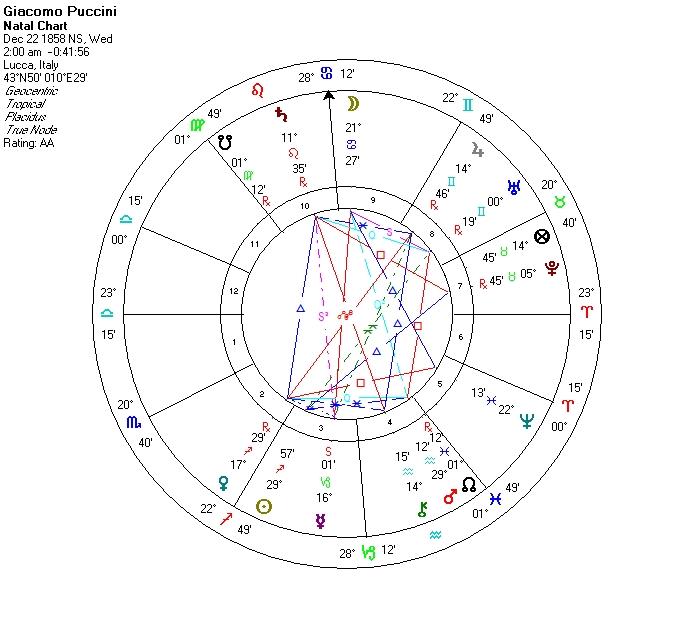
CHART appended to this transcript:
- FIGURE 1983 1002-1. Puccini Natal Chart.
If someone is writing, with audible sounds of chalk on a blackboard, I indicate this by [writing].
NOTES:
1983 10/02 was a Sunday. It appears to be a "Sunday special" class when it is possible Anthony played some of Puccini's music either at meditation, or at the end of class. There was also a regular Monday Astrology Class and a Seminar on Puccini 1983 10/03. Information per Blue Book and JF's class notes.
Please also see the Puccini astrology events, June 1982.
TRANSCRIBED Verbatim by IT 2021. Archival verbatim transcript – V11a.
AUDIO FILES: 1983 1002a. [Note 1: "Tape" and "Side" refer to original audio cassette tapes that were later digitized into .MP3 Audio Files. Note 2: We only have the first audio file for this class, we are missing the second.]
1983 10/02 at Wisdom's Goldenrod
Astrology; Horoscope-Puccini
[Audio File 1983 1002a Begins]
AD: The human being is of such a nature that these three aspects have to be included. And that's why I say, if you understand the human being, alright, you begin to realize that speak about-- to speak about the human being is to speak about him as sensible, is to speak about him as having certain ways of [student assents, faint] formulating or understanding-- let me put it this way, is to speak about him not only as a sensible human being, but also is to speak about certain ways that he has of understanding, his mental processes, alright, and even beyond that, alright, is recog-- the recognition that he has, let's say, a subjectivity which is beyond those. And these three things are simultaneously present in any individual that you speak of him. And to make it more complicated, that is under constant alteration moment-by-moment because it has a relationship to the transit-- transiting planets. Ok? We-- we have this much?
RG: Uh-hm.
[someone coughs]
AD: I don't know what that cough meant, uh--
S (faint): That's just [one/two words inaudible]
S (faint): Me too.
S (faint): Me too.
[short pause]
AD: Do I have to go-- shall we resume?
RG: Yeah. Should we go onto the quintiles for him?
AD: Yeah, well we were going to do [one word inaudible] They put Puccini down already.
RG: (Right.)
AD: Too bad it has only a momentary-- (some laughter)
RG: Um--
AD: Now try to remember also, you know, when we're discussing a man, if you haven't had experience with this man, his work, his life, alright, then keep your comments to a minimum. It's just like if I were to go to a cyclotron and say "Hey what's this, what's that," you know? Here's a moron trying to understand what an atom smasher is. (bit of laughter) [students assent, very faint] And then telling the engineers how he should reconstruct it.
S (very faint): Yeah. Ok.
RG: Um--
AD: And these-- this applies to spiritual matters as well as so-called science matters. You got to know what you're talking about. You've got to have familiarity with these people we're talking about.
TS: Time to break for lunch. (laughter)
AD: What?
TS: Time to break for lunch in that case. (bit of laughter)
RG: One-- Quintiles. Do you want to read it-- I have-- there are a few more quotes I thought--
S: (No/Oh).
AD (faint): No.
TS: No, this is--
RG (simultaneously): You don't want to do that.
S (faint): But maybe.
RG: Oh you don't have to. Alright. I get quotes. Ok.
S (very faint): Let's see.
S: No.
RG: Ok.
TS: Now there's an interesting set up in this chart.
AD: Let's directly attack it.
AS: Don't you mean it's [TS simultaneously: Right.] a set up?
TS: Um-- [short pause with faint background student words] That-- at least I wanted to look (at) something of these quintiles in his chart, um-- He's got this Mars Venus quintile in his chart and it's exact. The Moon is bi-quintile both of them as well. So there's a kind of a little triangle, an isosceles [AD simultaneously: Uh-hm.] triangle between the Moon in Cancer and the Mars Venus, ok. He also has a-- what we-- the-- a finger of God between Mercury, Jupiter, and Saturn, ok, and then Mercury in Capricorn. And the Mercury Saturn is a tri-septile. See the Mercury Saturn-- it was a Mercury Saturn Jupiter (thing/then) going the other way. Now-- [someone writing] um-- It's two different ideas I'm wondering if you wanted to pursue, one of which is that-- that we could-- try to look at those two different guys in his-- I've-- I've got that-- that thing for Tosca in terms of the different-- We'll have to see how they're brought out with the transits of that one event, could look-- try to look at-- You want to go over just all the natal charts with all the aspects (in) the natal chart, [student assents, very faint] [RG simultaneously, faint: Yeah you--] and see if we can differentiate them out?
AD: I don't think so.
TS: 'Cause, his Mars has a septile or some kind of thing. Bi-septile (to/the) Jupiter, [someone writing] it's quintile to Venus, and it's sextile the Sun. So Mars has all three. Ok. [student assents, very faint] And this seems to be one of the strongest-- That can't be right.
S (very faint): Do you have a septile?
RG: What degree?
LR: Oh this is a [RG simultaneously: Right.] (symmetric chart).
TS: Right, [S simultaneously, faint: Me too.] better be a sextile, sextile.
S (faint): Well--
RG: Well the Venus Mercury is a semi-sextile.
AS (faint): That (doesn't mean anything).
RG: Yeah.
S: Well--
RG: Venus Jupiter--
AS: No, no, he didn't say [one word inaudible]
TS (simultaneously): But here-- I didn't say-- I say Mercury Jupiter Saturn.
AS (simultaneously): It's the Saturn Jupiter.
RG: Yeah.
LR/S(?): Of (Saturn)?
TS (simultaneously): Mercury Jupiter Saturn.
AS (simultaneously): That's Jupiter. He has the [S simultaneously, faint: Yeah.] Saturn Jupiter and Mercury.
LR: Saturn? [S simultaneously: Yeah that's Mercury.] Well that's what came also.
AS (simultaneously with LR and S): That's what Tim was talk--
TS: Yeah right.
AS: It is, it's in--
LR: Is that the same thing?
TS: (No.)
AS (simultaneously): No he mentioned the Saturn and Jupiter here.
TS: See I thought that the-- In other words, I was thinking if you take the Moon Venus Mars together that-- that that's what captures the intuitions, it captures-- That if you say that there's a constant preoccupation or trying to grab a hold of the creative process of the Venus Mars, this kind of constant-- Take the Venus Mars as a constant reformulation [someone writing] of the anima on a level of the desire nature, and he's constantly trying to reformulate or evolve or-- or express this one level of the anima, the anima or (an/in) essential erotic way. Seems to be a theme that this goes through his whole life, in other words, his music or anything else. Seems to be that the Moon-- I'd like to see if we could understand how that Moon joins in and we could take the three degrees of the Moon Venus and Mars and see how they work together.
[short pause]
RG: Uh-hm.
LR: Well there's also the Moon Uranus. Which is in sextile. [Note: Moon Uranus is in septile.]
TS: Yeah, uh-hm.
LR (faint): Which I think is a very-- a mystical--
TS (faint): Yeah why don't you sit over there.
AD (faint): What did you just say, Linda?
LR: Just now under my breath?
AD (faint): Yeah.
LR: I said there's a-- that I-- putting together the degrees of the Moon Uranus septile which is exact, I found astonishing as well, that aspect which is very close in the Mars Venus quintile which is extremely close. The degrees--
AD (simultaneously): Well then let's do Mars Venus first, ok, and [student assents, faint] then after Uranus uh--
LR: Ok the Mars is--
Marc Edmund Jones [The Astrology of Concepts, Aquarius 30, LR reading]: "A mystic moon-lit field near the site of a mystic and traditional Babylon has sprung into delicate white bloom."
LR: The Venus is--
Marc Edmund Jones [The Astrology of Concepts, Sagittarius 18, LR reading]: "Little children are playing on the sultry beach, but each is protected from the glare by a tiny sunbonnet."
[short pause]
LR: I personally prefer the long interpretation of that Mars, I don't-- but-- I think we should read them both.
TS: Well, the middle sentence of the Mars. "Every…"
LR (simultaneously): Some of them hit, yeah. Go ahead.
Marc Edmund Jones [The Sabian Symbols in Astrology, Aquarius 30, TS reading]: "Everyone may count on the inherent friendliness of the universe, and in consequence on the capacity of man's destiny to endow him with [TS adds: the] fruits of his good rather than his bad works. The individual ultimately must rely on the world in which he finds himself, and so should live in such fashion that a reliance on him in turn is both possible and inviting."
LR: Which would be the quintile really.
TS: Yeah I was wondering if we could try that.
LR: Yeah, there's a-- this seems-- ok there's another sentence in here that I just thought was different like when he speaks about inner poetry of the soul or something. I thought it was a little [one/two words inaudible]
S (very faint): Uh-hm.
[short pause]
CDA (faint): Uh-hm.
Marc Edmund Jones [The Astrology of Concepts, Aquarius 30, LR reading]: "…soul-refreshing inner poetry of being [or the] light in the heart that comes from [spiritually-]nurtured sentiment."
AD: Will you read the symbol the way it's there?
LR (very faint): Yeah.
Marc Edmund Jones [The Astrology of Concepts, Aquarius 30, LR reading]: "A mystic moon-lit field near the site of a mystic and traditional Babylon has sprung into delicate white bloom."
AD: And the Venus degree now, can you read it?
Marc Edmund Jones [The Astrology of Concepts, Sagittarius 18, LR reading]: "Little children are playing on the sultry beach, but each is protected from the glare by a tiny sunbonnet."
[14¾ second pause]
AD: Read the similar, second to last one to-- on that Venus degree.
Marc Edmund Jones [The Sabian Symbols in Astrology, Sagittarius 18, TS reading]: "…man's very common self-cloistering on the practical side of experience, [or of] the individual's capacity to give primary [and needed] attention to his own personal affairs."
TS: And this is the second sentence.
Marc Edmund Jones [The Sabian Symbols in Astrology, Sagittarius 18, TS reading]: "Normality is idealized as a corrective for the self-diffusion or frustration which follows from any inadequacy of contact with others. Here is a happy and full participation in everyday living, aided by some suitable and chosen role in life. [The] keyword is INNOCENCE."
[30 second pause]
AD: And you said the other one was the Uranus Moon now?
LR: It's a septile. Uranus is the glass-bottom boat.
AD: Uh-hm.
LR: And the Moon is the woman standing on the beach waiting for the ship to come. I can read it, um--
Marc Edmund Jones [The Astrology of Concepts, Cancer 22, LR reading]: "A young woman, neatly attired in outing clothes, with eyes softened by dreaming, awaits a sailboat headed toward her."
Marc Edmund Jones [The Astrology of Concepts, Gemini 1, LR reading]: "A glass-bottomed boat drifts silently and easily over a constantly shifting panorama of marine wonders."
[9 second pause]
TS: The Moon interpretation he gives--
Marc Edmund Jones [The Sabian Symbols in Astrology, Cancer 22, TS reading]: "…creative poise and quiet range of perspective which give real power to the human soul, endowing it with its gift for sustained interest in the present situation and its constructive attitude towards each [ramifying] potentiality of things to be."
TS: And then the Uranus--
Marc Edmund Jones [The Sabian Symbols in Astrology, Gemini 1, TS reading]: "[This is] a symbol of man's alertness to every ramification of experience open to him, and of the necessity that he take definite action on his own account if he is to capitalize on any particular opportunity."
[11 second pause]
AD: Now, that's a septile, right?
S (faint): Yeah.
TS: Yes.
[21¾ second pause]
AD: Who thought that-- Linda, you thought that he was (spurtly) taken away, you know, expressing some kind of sensual nature that that Mars and Venus quintile.
LR: I thought that that Mars Venus quin-- bringing together that Mars and Venus might be what he was constantly trying to formulate.
AD: What he was constantly formulating?
LR: Yeah.
AD: Uh-hm, or expressing.
LR (faint): Uh-hm.
AD: Could you see that with those two degrees in quintile?
LR: Oh. I thought I could Anthony. I tried to write it down and I couldn't, so--
AD (simultaneously): Well, let's try, let's try, sure.
LR: I mean I didn't see it well enough to be able to put it in words so--
AD: Let's try. Well, maybe we have to read the whole-- the two of them together again.
LR: I thought the Venus-- these children in sunbonnets being protected from the elements, so to speak, had to do with a certain valuing of essential moments, a certain protection and cloistering of gems of sentiment, let's say, that he was able to extract from the sultry-- Bits of-- bits of-- I don't know how else to say it, bits of quintessential sentiment that he could pull out and actually draw on as a-- as a source of inspiration. And that the Mars which is-- I mean-- let's say an impulse in terms of--
AD (very faint): These people. Do it again.
S (faint): Uh-hm.
AD: Do it again. Go over it again. [short pause] Mars, go on.
LR: It was a certain kind of drive that had to do with poeticizing or something, that there was like a-- making-- raising up, making somewhat mystical or poetic those kinds of contents. Well, that's the way I see that degree, the mystic moon-lit field, it's like putting it-- putting any situation into that kind of light, this mystic moon-lit field breaking into white blossom. Now, I was trying to combine those two. And-- [short pause] Mars being Mars, it seemed like-- [short pause] Putting those two degrees together with the planets they're on, it seemed like there would be an implicit innate ability to immortalize those essential moments of the sensual life, that there would be a constant manipulation, reworking of those.
AD: Would you read that again now Tim, the Mars, the moon-lit field?
Marc Edmund Jones [The Sabian Symbols in Astrology, Aquarius 30, TS reading]: "[This is a] symbol of the spiritual integrity of nature herself, dramatized by Marie Corelli's mystic meadow of ancient Babylon [TS reads: dramatized in this picture] as an ageless and special challenge to modern life. Everyone may count on the inherent friendliness of the universe, and in consequence on the capacity of man's destiny to endow him with fruits of his good rather than his bad works. The individual ultimately must rely on the world in which he finds himself, and so should live in such [TS adds: a] fashion that a reliance on him in turn is both possible and inviting. … [When] positive, [the degree is] self-illumination through exceptional service to others, [and when] negative, witless reaction to fantasy."
LR: Can I read you what it says in here, in this version too?
AD (simultaneously): Sure, yeah.
Marc Edmund Jones [The Astrology of Concepts, Aquarius 30, LR reading]: "This is a symbol of the soul-refreshing inner poetry of being or the light in the heart that comes from spiritually-nurtured sentiment. Positively it is [LR reads: it's] a degree of direct inspiration or illumination; negatively, rare good fortune that obscures inner light."
RG: Uh-hm.
LR: Who reads this? [10¼ second pause] I mean I-- The playing out of his shadow was very inspiring for him in terms of his career. Putting his life direct-- I-- I don't know how else to say that. Putting his life directly into the gut, into living out the impulses of Mars was actually the source of his inspiration in immortalizing the Venus.
JA: How do you understand the shadow? I mean-- I guess I don't know. And what-- what's your definition? [student assents, faint] Just generally.
[short pause]
RG: Yeah.
S (faint): Uh-hm.
AD: Anyone any ideas on these degrees?
AS: Well I had some idea about this one, that this [LR/S(?), faint: Go ahead.] [AD simultaneously with S and AS, faint: (I'm listening.)] degree sounded like-- this degree is talking about the way that experience can be viewed as-- I would use it, the psy-- you know, we said a psychic animated organism, that the-- the individual here is part of the entirety of this living out-- the living in the World-Idea as it were. And this degree seems to be speaking of the-- the inherent meaning or-- [students assent, faint] How can I say, we-- [CDA assents, faint] That there's an in-- there's an integrity, there's an integrity of the entirety of Nature which he is a part of. And he can count on the continuity and integrity of the entirety of the world as a-- of his world as a living organism. And so it's from that that he either gains his sustenance or the-- He says inherent friendliness of the universe, that he-- there's a sympathetic-- a sympathetic continuity of meaning that is experienced in the world because this is the whole of his world and himself as an organic whole of some kind, as it were, as a living organism.
CDA: And therefore he could idealize (his life). Mars function.
AS: Well, ideal-- I don't know--
JA: How would the Mars function--
AS: Idealize it.
JA: --view that, I mean-- I mean how-- I don't-- They saying--
AD: Before we get in can I ask you again repeat what you're saying. Try to be more precise.
AS: Ok, um-- I-- from the symbol and also his interpretation, it starts with the spiritual integrity of Nature herself. And, I thought he meant by that-- and also the inherent friendliness of the universe, continuity that-- there's a recognition in this degree that-- I don't know about the Mars but that there's a-- a-- a s-- a sympathetic or-- there's an organic wholeness between the individual and the world, and that his-- he's-- he's part of this-- he's part of this psychic animated organism.
AD: You-- you got [AS simultaneously: I'm not-- I'm not really saying it.] the point I think, yeah, you got the point. Maybe-- maybe this might be more to the point.
[short pause]
AS/S(?) (faint): Yeah. (laughter)
AS: He's taking--
LR (simultaneously): Great.
TS: Oh yeah. (bit more laughter)
AS: Sounds like-- (laughter)
TS: Right.
AD: Friendliness [AS simultaneously: It's the friendliness--] toward-- to what? Friendliness to what?
S (faint): Yeah.
AD: He says universe.
AS: Yeah [one/two words inaudible]
AD: But I mean that's kind of exaggerated.
TS: Would you believe--
AD (simultaneously): Friendliness to what?
TS: Passion?
AD: Me and my Dragon.
TS: Yeah.
AD (faint): Me and my (my belief).
S (faint): Uh-hm.
AS: Well--
S (faint): Go ahead.
AD (simultaneously): Go home.
TS: I meant you could do that (with--) (AD laughs, laughter)
AS: Well when I said-- yeah. I guess when I said universe I meant (he--)
AD (simultaneously): (He has--) deals with very positive attitude towards the Dragon. You-- would you like to go for a cup of coffee? (laughter) You know, nice quiet place? (AD laughs)
AS: Yeah, [AD simultaneously: Huh?] I guess-- I guess that's kind of what I meant, I meant the world-image.
AD (simultaneously): Yeah. You think that's-- Yeah?
AS: What I meant was the world-- the-- not in the Dragon (belief/really) but that [few inaudible CDA words simultaneous with AS] the world-image (bit of laughter) was very sympathe-- he-- he was in a sympathetic harmony with this whole world-image, and he-- and through that he-- maybe he could gain some kind of meaning.
AD (faint): Yeah I-- I tend to look at that degree there as kind of a friendliness with the Dragon, [S: Oh.] that you don't [S simultaneously: (I know.)] consider it as hostile to your [one word inaudible]
S (faint): Uh-hm.
AD: And that-- the-- the example I used for Lawrence, you know, he takes-- take a girl out for a cup of coffee, this nice, warm feeling comes over you.
LR/S(?) (faint): Drinking coffee? (laughter)
AD: Now try the Venus.
AS (faint): [few words inaudible] too.
LR: I like that where he said of--
Marc Edmund Jones [The Sabian Symbols in Astrology, Sagittarius 18, LR reading]: "Normality is idealized as a corrective for the self-diffusion or frustration which follows from any inadequacy of contact with others." (laughter)
S (faint): Uh-hm.
AD/S(?): [couple/few words inaudible]
RG (simultaneously): You'd like that sentence?
S: Yeah. (some laughter)
S (amidst laughter, faint): I did (lose Flora).
TS: I thought that was exactly the point.
AS: Oh that's in the other degree.
TS (faint): Yeah, that's--
AS (simultaneously): Oh ok, [LR simultaneously: That's the Venus.] and I'm sorry, 'cause it didn't make any sense at all (for--) (AS laughs)
LR: No that's the Venus saw--
S (simultaneously, faint): Sure I know.
S (faint): Yeah, I know.
TS: What did he write about?
LR: What do you mean by normality, you know, the actual-- the actual normal functions that-- that (man's) [one word inaudible] And that's actually seen as stable, I mean that is the content of--
S (very faint): Well, his music.
TS: The way I was thinking of it just in-- in [LR simultaneously, faint: It was the Venus.] the normalcy of the content of his-- his music, [LR: Yeah.] excepting for Turandot.
LR: And it's-- [TS simultaneously, faint: Yeah.] it's exalted. That's what's [TS simultaneously: Yeah.] idealized.
TS: And he didn't write a mythological thing, sort of the-- here-- heroic things, I mean La Boheme, Tosca, [AS assents, faint] I mean they're very plebian.
AS: Themes. The themes that he values are very mundane themes. I don't know 'mundane' is the word.
LR: Well--
TS: Ordinary. They're [AS simultaneously: Ordinary.] pulled right out of life. And, you know, I mean (like/that)--
LR: The the-- the themes, you mean the melodies?
AS: Yeah. No, no, not necessarily the melodies.
LR: Oh.
AD: Now, you-- [AS simultaneously: But--] you see what you mean by sensual?
AS: Venus.
S (very faint): Yeah.
LR (faint): Yeah.
AD: I'm going to try and-- I'm going to try and pull out the-- let's say the ideas that are behind your hunch that this is what he's always expressing. I'm not saying that that's the creative part, that-- I'm not saying that that-- that's the creativity, although [LR simultaneously: Well no, I'm not e--] with Mars in the fifth house you'd like to think so.
LR: No, I'm not talking about that, I mean, because I don't--
AD (simultaneously): But this is what he's always expressing.
AS: Yeah this-- we were talking about this Venus, the children with sunbonnets. These are the-- the-- I think these are the themes that he's always--
AD: Would you read parts of that?
AS: "Symbol"-- and--
Marc Edmund Jones [The Sabian Symbols in Astrology, Sagittarius 18, AS reading]: "[This is a] symbol of man's very common self-cloistering on the practical side of experience, [or of] the individual's capacity to give primary and needed attention to his own personal affairs. Normality is idealized as a corrective for the self-diffusion or frustration which follows from any [AS reads: an] inadequacy of contact with others."
AD: Do you-- do you-- you remember, was it Jung's Venus degree that was the barnyard?
RG: Uh-hm.
AD: A kind of appreciation of the normalcy that's inherent in the very life processes, alright. And, basically this is [AS simultaneously: This is similar.] friendliness to the Dragon.
LR: But here he says normality [AS simultaneously: Similar.] is idealized.
AD: Yeah, even more so.
LR: Which is, you know, those little children [BB assents] just all--
AD: The-- the other meaning that you got for the Mars from the other text, where he brings in the immortalizing or let's say the enlargement of the value of, you know, what was it--
AS: The everyday experience.
AD/S(?) (simultaneously, very faint): [one word inaudible]
LR (faint): Yeah.
AS: These themes that he's write-- that he always talks about are the very everyday experience, they're not archetypal or anything, they're really the most personal level, most-- most personal common denominator of humanity is being exalted through the Mars degree, the other--
LR: For example, yeah right.
AS (simultaneously): Not exalt-- exalted maybe isn't the right word. But [LR/S(?) simultaneously, faint: (No.)] expanded or--
JA: What do you mean?
LR: Well but, you [AS simultaneously: Well that's what his (heroines) are.] look at a Wagnerian opera, he takes heroic views.
JA (simultaneously): Well, look at-- I mean what-- what are you referring to as [LR simultaneously: Any of his operas.] every day--
AS (simultaneously): (Well/No), look at the emotions he talks about, they're s-- they're the--
JA (simultaneously): Well--
LR: Just-- Ok, [AS simultaneously: Do you want examples?] La Boheme they're starving artists [AS simultaneously: Oh yeah, I mean--] and they're living in a-- you know, in [AS simultaneously: Well you gotta live in--] Paris, in an apartment.
TS: Or crummy characters.
AS: Or love and death! "Scarpia, Scarpia!" you know. (AS laughs)
LR: There's--
AS: What-- I mean-- They're really-- got emotion-- got emotional personal issues, they're not archetypal themes and that's-- I mean (there's also our) girl.
LR (simultaneously): Well they're also archetyp-- [RG simultaneously: Also archetypal.] I would say they're also [JA simultaneously, faint: Yeah, alright.] archetypal themes but they're--
AS: Yes (they/they're) also but--
TS (simultaneously): But they're pulled out of the normalcy of what was [students assent] going on in his own generation, his own lifetime, I mean, well, you know, the-- whether it's, well, you know, The Girl of the Golden West or whatever, there's-- they're-- they're all images of things that were happening within his own [JA simultaneously: Oh ok.] time span and they were very ordinary situations, they were not unique, you know, common, many people had those experiences.
JA: Yeah.
TS: And he pulled out of those im-- those things excepting for the last one, Turandot, he--
JA: Or brides being deserted.
TS: Well--
JA (faint): I see. I see what you mean.
TS: Yeah. [JA simultaneously: (You explained it.)] And it's not like reaching into some mythic or, you know, heroic past in [JA assents] order to come up with the contents to [AS assents] express his feelings and he, you know--
JA: But he's real good.
AS: You know, for like [TS simultaneously: Yeah.] ten operas in a row it's always boy meets girl or boy gets girl, boy loses girl because of (AS laughs a bit) death and it's always--
LR (simultaneously): Well you could say that about opera in general, Avery. (LR laughs a bit)
S (faint): Uh-hm.
AS (faint): No.
TS: No, no, no, no, there's still [one/two words inaudible]
AS (simultaneously): I don't know about in general. But--
TS: Vivaldi they never meet, I mean--
JA (simultaneously): Well that-- (some laughter) I mean, it's true, I mean that's what the one individual-- Yeah. Say that [one/two words inaudible]
AD (simultaneously): Notice the Venus is in the second house, [LR: Yeah.] alright, bodily aspect. The Mars in the fifth house, expressing creativity. These two are-- what we have to do with these two now is try to see it as a mental process.
S (faint): Right.
LR: I mean that's a--
AD: That's--
S (simultaneously): How (though)?
LR: Yeah.
AD: That's the difficulty [LR simultaneously: That's the crux.] in trying to understand a quintile [LR assents] is--
TS: Wait a minute. Going to ask something just as we were passing by. This is 18 of Sagittarius, this degree of the-- kind of an exaltation of normalcy. And you mentioned there was a similarity to Jung's Venus? That's 18 Cancer.
RG: Uh-hm.
TS: So it seems to be it's the-- It's part of the same process and a kind of-- 18 Cancer's exactly part of the quintile. No.
RG: Quincunx.
TS (simultaneously): Quincunx. [S, faint: Right.] Anyways, it's interesting to me that the same meaning, same reason-principle seems to be here elaborated in a slightly different fashion, you know.
S (faint): (Keep it.)
AD: Well, in the case of Jung, that was his way of being of service, by bringing in the value from the barn-- the barnyard population.
S (very faint): Uh-hm.
S (laughing, faint): Ok.
TS: And that was-- yeah, now that's Venus in Cancer at eight, ok.
AD (simultaneously): Yeah, and that was in his sixth--
AS: Sixth house.
AD: Sixth house?
TS: Now what was the difference between the-- that degree [RG/S(?) simultaneously: (But--)] as the normalcy and this degree as a [S simultaneously, faint: Right, yeah.] kind of normalcy.
AD (simultaneously): Second house.
TS: Well it's a different degree, this is 18 Sag, the other's 18 Cancer.
AD: Uh-hm.
TS: Here there seems to be a kind of a-- a using of the normalcy to transcend the distortions of the personality where there it seems like that there's a kind of an ability to apply the normalcy to the distortions of the personality [student assents] and bring them-- bring a person in to a more normal place. They're embodying-- give birth to--
AD (simultaneously, faint): How could you make-- how could you make it a mental process?
RG (faint): Yeah.
S: Yeah.
AD (faint): How can you make, you know-- see this as a mental process?
TS: You mean, the Venus Mars?
AD (faint): Venus Mars. How do you formulate it?
[short pause]
LR: Jung had a Mars Venus septile. Here we have a Mars Venus quintile. You know, that's--
[short pause]
AD: Well, let's try formulation. We have to con-- you have to convince our skeptical friend here.
RG: Well-- I mean we've looked at them as operative, let-- let's [one word inaudible]
AD: Yeah let's-- let's try to formulate it as operative, [RG/AS(?) simultaneously: Right.] that's--
TS: British. (laughter, AD laughs)
RG (amidst laughter): Very operative.
S (amidst laughter): Yeah.
S (amidst laughter): Uh-hm.
LR: Well this we're saying is the level of formulation, that the object is never formed but always in the process of [AD simultaneously, faint: Process of forming, yeah.] being-- forming, is that--
RG (simultaneously): Right, and that the image here is abstracted from the body, that it's not in the body but it's own [one word inaudible] psych-- psychized in some sense.
S (very faint): Yeah.
AS: Yeah. And he seems to be taking the normal functionings of his anima and trying to portray them and express them in a [RG simultaneously: Imaginal.] psychical-- an imaginal psychical and living mode.
RG: Uh-hm.
AS: And he can do that because (he/it) can make use of the whole affinity of the Dragon, the friendliness-- the inherent friendliness of [RG assents] the whole Dragonic world can be the expression for these normal functions of the anima. So they can get blown up in very--
RG: Uh-hm.
S: In very imaginative (way).
RG (simultaneously): Yeah.
AS: Imaginative ways.
S (faint): Well--
RG: Uh-hm.
AS (faint): This process is [few words inaudible] barnyard, yeah.
LR (simultaneously): Detached from circumstance, is that--
JC: Yeah but what-- what was his personal love life like?
AD: His what?
TS: Active.
JC: Personal love life.
LR (simultaneously): Very much like [one word inaudible]
AS: Like [one/two words inaudible]
AD (simultaneously): Heaven's sake, what are you--
JC (faint): [one/two words inaudible]
TS (laughing): Yeah.
JC: I mean, I just remember that part.
AS: (Uh-huh.)
TS: Yeah.
S: Ok.
AD: That's the only part that everybody remembers! (AD laughing)
LR: That's all everyone [couple inaudible student words simultaneous with LR] [one word inaudible]
AD (simultaneously): He was a real--
LR: Casanova.
S (faint): Uh-hm.
AD: Lover boy.
S (faint): (Uh-hm), a what?
AD: He lived that.
LR: He was a real Don Juan.
JC: Doesn't that in a way show that he lived his love-- his loving-- this loving process in his imagination?
AD: Oh no, he lived it for real.
JC: No but I mean-- (laughter) no, no, no.
JA: What do you mean for real?
JC: The imaginative counterpart holds sway over the sensible reality in the sense that (even/in) splitting from one to another, he's [BB simultaneously, faint: (What are you saying?)] still-- he's living it only as it-- as a subjective-- as an imaginative ful-- fulfil-- imaginatively fulfilling and not as value concreted [LR: What--] per se.
AD (simultaneously): Yeah I see-- I see what you're getting at. [student assents, very faint] It was a-- it was a very active component or ingredient of his mentality, that kind of orientation. [few inaudible JC words] It was always an ongoing process either-- whether he was 18 or whether he was 48 was always the same thing. Always there.
AS: Yeah, and the-- the thing is, Tim was pointing out, when that finally did get over, he died, and as the opera-- I mean, what-- what I'm-- The Turan-- the point in Turandot (and/in) himself and it was like it was so vital to his whole existence, the process is so intrinsic to his view, that when he finally, well, you know, lets itself out (all over) these operas, when [LR simultaneously: Liù died.] it's like real-- when Liù died in the opera, he also dies.
S (very faint): Yeah. Uh-hm.
JA: That [AS: Process.] causal-- he-- (JA laughs bit, bit of laughter)
AS: No I was just--
TS: Isn't it [LR simultaneously: Well but it is significant.] funny though, he wasn't able to finish the opera. I mean in his-- he was determined to get past that point in his operas. [student assents] He was writing furiously and he went for an operation with local anesthetic and didn't come out, that was just a-- it wasn't a major operation.
S: Yeah.
TS: And, it didn't move.
LR: So I still don't--
RG (simultaneously): Right. [couple words inaudible]
AD (simultaneously): Yeah we haven't put it together yet. We still have to-- I think this is where the astrologer's going to have to evolve a faculty of being able to combine ideas, and produce a new union out of it, you know? [student assents, faint] In other words, when you have these two ideas working together, and the two functions working together, you've got to be able to combine them so that you could produ-- produce, you know, the totality of these two ideas in its [one/two words inaudible]
TS: And it has to be done in a way of a subjective [AD simultaneously: Mental process.] [one/two words inaudible] process.
AD: The forming and not the formed.
S (very faint): Yeah.
LR: There's something you can feel but it's very hard to formulate.
AD: Yeah.
TS: Yeah well--
LR: I mean, you know, writing it down is real hard because you get-- you get the image way before you get any words to come out.
RG/S(?) (faint): Yeah.
JA: Well, one thing I haven't understood about a quintile is, it seems that the standard-- I-- there always seems to be an implicit standard of judging it by completion. In other words, quintile is the same as something incomplete relative to something complete. [S, faint: (Yeah.)] And instead of maybe seeing it as a process that is-- you know, has its own raison d'être, you know, I mean as he said, something in itself.
AD: That's the way to look at a quintile, [student assents, faint] the second way that you said it. That's the way to look at it.
JA: That's-- yeah.
TS: Yeah.
RG (faint): [few words inaudible]
JA (simultaneously): That's-- I'd like to, it's difficult. But to say oh I never finish(ed) this--
AD (simultaneously): But that's the way you have to look at it because [RG simultaneously: (Oh yeah/I know).] it has-- it is its own raison d'être, alright, and it's an operative process. It's never completed, it's always constantly completing itself. And that-- that makes him-- I think that's what they would refer to as creative, alright, as a creative thing. And I'm not using it in the sense that, you know, the text speaks about it, that is, quintiles being creativity, but that it's an ongoing mental process which is never completed, which is always in the process of being completed, alright, and its raison d'être is within itself and not necessarily in what it manifests, yeah. These are all--
AS (simultaneously): Well, I could see it the other way. I was trying to see the Mars expressing the Venus but maybe it's the Venus is this continual series of heroines is continually expressing his own intimate relation with this Dragon. And if the Mars is his own [AD simultaneously: Yes. Yeah.] shadow and his own intimate relation with the Dragon, each one of these little--
AD (simultaneously): Could you reverse that too?
AS: Oh yeah.
AD (simultaneously): But yeah now, could you reverse that?
AS (simultaneously): No, no, both-- yeah. Well I just was-- I tried to see the other way before but this (way/one) seems (good).
AD (simultaneously): I think if you could reverse that then like the two of them combined would give us that quintile.
S (very faint): Uh-hm.
AS/S(?) (very faint): Right.
AD (very faint): And then--
CDA (faint): What do you mean reverse?
AS (faint): See how the Mars is expressing the Venus, I was just [CDA simultaneously: Oh.] speaking about Venus expressing the Mars. You have to [student assents] see the Mars too.
LR: His relationship to the Dragon is clothing images of itself all the time in terms of the anima.
AD: In other words, it's always making an anima image out of the Dragon?
S (very faint): Yeah.
S (very faint): Yeah.
AS: And that's the way he always is unde-- by understanding that. That's the aspect of the Dragon that he's always interested in formulating.
RG/S(?): Yeah.
S (faint): Yeah.
AD: What do you think of that, Dickie?
AS (faint): You know?
S (faint): Uh-hm.
AD: You people got any idea or feeling for this quintile?
S (faint): He has a friendly shadow.
S (simultaneously): Yeah.
AS: He also has a friendly shadow, I mean if I understand something of the Mars, it's-- I don't know, depending on this--
LR: It's almost my-- it's almost po-- it is poeticized, it's something which he-- he's able to elaborate and idealize and [student assents] make a--
AD: Sure, you can just as easily conceive of a person having a very hostile attitude towards this Dragon, towards the Dragon. [student assents, very faint] Not like that sign up there, "Me and my Dragon", as though they're having a cup of beer together.
S (very faint): Thank you.
LR: But that mystic moon-lit field, I mean, it's very numinous, that's the word. There's almost a numinous feeling towards that, towards those processes that comes from that degree.
JC: See, the drive to win the treasure of the anima [AS/S(?) simultaneously, faint: Yeah (one word inaudible)] is not necessarily a great aggressive one, it can be a very romanticized will or drive.
LR: Yeah.
AD: So then what you're saying it's like a romantic ideal-- idealization of the Dragon's life.
S: Ok.
RG: Right and quintile to Venus it's a roman-- you know, it's a com-- it's the way he individualizes himself (is/as) a romanticization of the anima.
AD (faint): Alright, now if (you/we) can get all this stuff together in a couple-- one or two sentences, it'd probably [LR simultaneously: (This gives us--)] give us a feeling of the quintile that he's working with.
RG: Yeah, right.
[short pause]
CDA: 'Cause it's true, his music makes you feel like all those feelings are absolutely alright to have [AD: Yes.] because they've-- (CDA laughs) they've been so beautifully displayed. (CDA laughs)
LR: Well there's also--
AD (simultaneously): Try to-- try to play the-- try to-- try to play Tosca or Boheme and listen to the last chorus of Saint Matthew, see if you could do it.
S (faint): Oh.
RG: You mean right after that?
TS: Oh.
AD (simultaneously): Yeah.
CDA: Sounds like torture.
AD: Well what do you think?
BB: I think Puccini is-- listening to Puccini is very painful. It's very emotional and very--
LR (simultaneously): But it's wonderful pain.
CDA: Yeah.
BB: It's a-- it's kind of disturbing. And I think that the-- (laughter) [S laughing, faint: Disturbing.] I think it evokes a lot of emotions that, you know, you-- in a depth in, you know, that you don't ordinarily get from any other [S: (More.)] composers.
AD (faint): Yeah, more.
BB: I think there's a propensity to want to cry a little bit.
AD: Well, and that-- (laughter) Cry about what?
BB: I don't know, it just--
CDA: Lost love.
BB (simultaneously): There's a certain beauty there. (CDA laughs) I mean if you knew nothing about the story whatsoever--
AD: You don't have to.
BB: It's just something that comes out of it is [couple inaudible student words simultaneous with BB] very emotional and very kind of almost painful. And, you know, it just seems to me that something like that he was able to penetrate into some kind of depth in his own feeling and was able to somehow or another put it in music so that anyone else listening to it without knowing anything [AD simultaneously: Yeah but we're--] about the story would also experience that type of--
AD (simultaneously): Yeah but we're being-- we're being even more specific. We're saying that this man romantically idealized this friendliness towards the Dragon and, so to speak, elaborated it and evaluated that swamp consciousness. (CDA laughs)
BB: And see I just don't look at it that way.
AD: No, of course not. (CDA laughs) I don't expect you to.
BB: I think that he came through with something higher--
AD (simultaneously): (Do you think--) you think I expect you look at it that way?
S (faint): (No.)
[short pause]
AS/S(?): The man [one word inaudible]
RG: But where's the quintile in it?
TS (simultaneously): You mean it's a mystic swamp? (TS laughs)
AS: That's like-- it's-- it's the Mar-- it's like the Mar-- it's--
AD (simultaneously): Listen, the first-- the first time I heard La Boheme, I was up two nights and two days. I didn't let go. Don't tell me about those feelings, I'm old friends with them. I know them very intimately. But I still see them for what they are, an enlargement, an overgrowth of the swamp consciousness.
TS: The mystic moon-lit swamp, yeah. (laughter)
S (amidst laughter, faint): So you (perceive it).
S: Uh-hm.
AD: What do you-- [LR simultaneously, faint: No it's Mars, this is Mars.] what do you think the Dragon is interested in? Perpetuating itself. You know, I-- I have to-- I have to elaborate what you say. Yes, they're emotions, you cry. But what are you crying about? It isn't because you're in exile from the celestial regions.
S (faint): No.
BB: No I-- I admit (laughter) that (his) feelings that you have here, that you're relating to some kind of feeling that's being evoked by that music, and, even though you don't know exactly what that feeling is, there's something there that's of beauty.
AD (simultaneously): I can tell you. She's-- she's got blonde hair, blue eyes, she's 5'8". Ok? My God, you got to be kidding. You can't listen to his music without an anima image popping up out of your brain like a Minerva fully grown. (some laughter, AD laughs) Alright, let's organize this into a quintile.
LR (simultaneously): Herbert would like to say that this is tantra. Right Herb, is it?
AD: It's a what?
HS (faint): I think he's an innate tantric. (some laughter)
AD: You know, almost all tantrics fail?
HS (faint): Did he-- I don't know, did he fail [few words inaudible]
AD: No. As far as this is concerned here.
S (very faint): Right.
HS (faint): Well I take those to be images.
AD: Tantrics usually fail. Why? There's greater [LR simultaneously: They get pulled in.] force than their will. Anytime.
LR: Yeah so that'll be [couple words inaudible]
HS (faint): So, in the Mars [LR simultaneously, faint: That's right.] there seems to be--
AD: I mean what you're talking about is a man like Gandhi going to sleep with an 18 year old girl to see if his will is greater than his, you know, friendliness towards the Dragon.
HS: Yeah but his tantra--
AD (simultaneously): How many tantrics you think have s-- will succeed with tantra?
S (faint): Uh-hm.
S (faint): Uh-hm, (once a million/real familiar).
AD: I'll give you [HS simultaneously: (couple words inaudible) all--] one hand to count them on.
HS/S(?) (faint): Yeah, some people do it through images, you know. [student assents, very faint] I don't think any of them have ever been (lost/right).
AD: No not the images, and we're talking about real life.
HS/S(?) (very faint): Yeah.
AD: Tantra-- the-- the tantric road is all degenerated in Bengal, they're all degenerated.
HS (faint): But isn't it bound, like the emotionality in life when you try to bring it up and bring it out, [AD: Yeah.] (creative/create) feeling? [AD/S(?), very faint: Yeah.] Creative process?
AD (simultaneously): And he was expressing that.
HS/S(?) (faint): Just take the quintile [AD simultaneously: And--] (real quick).
AD: Yeah, and that was a continuous ongoing process with him, [HS: Yeah.] alright. It wasn't that it ended with, you know, Mimi dying. He went on to Tosca, [HS simultaneously, faint: He went on.] he kept going on, it kept on all the time. [HS assents, faint] And the response from the public of course was tremendous because I think like they all participated in that kind of-- they could easily understand that. But I think the basic thing that I'm trying to get to is that there was a concern with him, or there seemed to be a mental process that he was very much attached to, and that was the idealization, the romantic idealization of the-- the feltness or the feeling that is aroused when we, let's say-- [short pause] Maybe we could be really primeval and say that the soul's desire for re-embodiment, alright, is what's being expressed, [RG: Yeah.] and its attachment to--
RG: Hm(./?)
TS: Yeah.
RG: Yeah.
AD: It's easy enough to conceive of a man thinking, you know, opposite. He's repulsed by all of that. He would never listen to Puccini. I mean he might listen to Bach and he might listen to Beethoven. But he'd never listen to that.
LR: Herbert were you trying to say that tantra was the proper-- proper level of this quintile, [HS, faint: Yeah.] the fact that--
HS (faint): The Mars Venus [few words inaudible]
LR (simultaneously): That the reor-- regurgitation and re-- reima-- reimagining of those processes is [couple inaudible HS words simultaneous with LR] the proper level of a quintile per se?
RG: As opposed to a regular aspect where it would be [LR simultaneously: It was just lived.] fully manifest.
S (faint): Right.
LR: And I think that's--
RG (simultaneously): Yeah I think that--
HS (faint): Bringing emotion into feelings, you know.
RG: Uh-hm. Through the imagination.
HS (simultaneously, faint): And, making it (all-aware).
RG: Try to restructure his relationship to the Dragon, or manifest in his relationship [AD simultaneously: Yeah but--] to the Dragon, to women.
AD: Still Herbie, tantra basically means the sublimation of that energy.
RG: Right, [LR simultaneously: Yeah. Ok so that's--] and he didn't do that. [one/two inaudible BB words simultaneous with RG] He didn't-- he didn't do [AD simultaneously, faint: Yes.] that.
CDA: He wasn't into that. He was--
TS (simultaneously): No it seems like this quintile--
(Side 1 of original cassette tape digitized as 1983 1002a Ends; Side 2 Begins)
TS: --into emotion.
RG: Uh-hm.
TS: And there was an ability to give force to his emotionality because he was drawing on this kind of mental-- the mental processes, the mental or subtle forming of the Dragon. He kept putting them into-- in-- into the emotions, into the body. And it seems to me that what you said is, the desire, the soul's desire for re-embodiment, [AD/S(?), very faint: Yeah.] and you said that-- that constant re-expression of the-- of the intensification of emotional reality through the embodiment of the Dragon is what is being re-- what's-- what is being worked out through that quintile.
S (very faint): Uh-hm.
HS: What you're trying to say is, is that he came down (through this)?
TS: Yeah. Well down-- Yeah, in-- he's embodying, he's valuing the embodiment of that intimate relation with the Dragon. And-- and he-- and he constantly is capable of expressing that embodiment.
LR: Why-- no. Why are you saying that's implicit in this quintile and not another aspect, that's what I wonder. I mean what-- yeah.
TS: Feeble intuition, I mean, you know--
LR: No, come on.
TS: The Venus degree is his little critter-- these kids, his sun-- with sunbonnets on a sultry beach and his Venus is in the second house. So there's some kind of-- the way in which the anima is functioning is towards some kind of relationship to the body. But it's this-- it's a-- a kind of a protection, in other words, each one of these little expressions of that vast field of the swamp, the Mars, is protected in the sense that it's allowed to be worked out in whole, it's allowed to be-- you know, it is allowed to be embodied. You know, it's like the intensity of the emo-- the intensity of the Sun here that's in the Venus degree, I'm taking the intensity of the-- the feeling force of the Dragon. But in some way each little expression of it, each embodiment of it is protected from being burnt out, it's capable of being. [one/two words inaudible]
AD (simultaneously): Yeah in other words you're saying that that degree or-- [LR simultaneously, very faint: It's like the music.] it's from that degree, that sunbonnet refers to some protection from being--
S (faint): Yeah.
LR: Part of the sultry-- taken in by the whole somun-- [AD simultaneously: Yeah.] the sultry beach.
TS: I mean he could have gotten burnt [LR simultaneously: It's protection.] out with that intensity. [AD, faint: Yeah.] And he didn't. He was able to sustain it by-- by embodying it and by constantly re-embodying it he was free-- Otherwise, with the intensity of that emotionality you'd expect him to either get so dissipated or so, I don't know, exhausted that--
AD: Yeah, we still have the problem then of [LR, faint: The quintile.] organizing that into one or two sentences to get-- portray something of what that quintile means as a mental process. Whether that-- we have enough individual thoughts about it maybe we could try to work together and [LR: Yeah.] condense. But, the creativity now I think you would imply was coming from the Uranus Moon septile.
LR: No not necessarily, [AD/S(?) simultaneously, faint : Yeah.] I saw something else there. I don't really know how to find creativity per se, I-- I-- Uranus--
RG (simultaneously): But I don't see why we don't find it in this quintile also, Mars in the fifth house, I mean, that his creative sense of separateness from the Mars was constantly embodying--
AD: I'm sorry, I (didn't/couldn't) (express) that. [one inaudible student word] (Well/And) if the creativity is there-- But then what did that Moon Uranus--
LR (simultaneously): Well this had to get expressed.
RG: Right what was the-- see, I would say in the septile to try to find the ideas that were being expressed through that quintile.
LR: Well--
AD: What-- what was that septile?
LR: Ok.
RG: Go ahead.
LR: This is--
AD: Just repeat again.
LR: I-- Ok. The Uranus is the glass-bottom boat and the Moon is the total receptivity-- well, the Moon is the woman standing on the beach looking out to sea. Now it's interesting that the Venus [Note: LR means Uranus.] is a boat. In other words, the Moon which is the subjective-- the most reflected consciousness, bodily-consciousness, is totally receptive to the Uranus which is a boat actually-- a glass-bottom boat actually viewing marine wonders. I saw-- I saw the two of these as a certain inner [S, very faint: Yeah.] quietude or a stillness that could perfectly reflect the contents of the sea, from the most exalted level of Uranus to the sublunar level of the Moon.
AD (faint): Could we read those two divisions, the two symbols, the two definitions? I'd like you to go over them. And we will see if you can get an intuition, septile relationship, right? See if we could condense the two into one as we're reading them because maybe you could-- it might be easier that way to get an intuition as you're reading, whereas when we start discussing, you won't get an intuition. Why don't you read that version?
Marc Edmund Jones [The Astrology of Concepts, Gemini 1, RG reading]: "A glass-bottomed boat drifts silently and easily over a constantly shifting panorama of marine wonders. This is a [RG reads: the] symbol of the essential variety of all real expression or of the constant touch with the underlying basis of all being. Positively it is a degree of the conscious realization of the sources [RG reads: source] of selfhood; negatively, it is over-receptiveness to experience."
S (very faint): Uh-hm.
S (faint): Uh-hm. (AD and RG laugh)
AD: Read the other one. The Moon.
[short pause]
LR: Read Tim.
RG: Wait a minute, how could-- Moon Uranus? Isn't that conjunct?
TS: Moon.
RG: Moon.
TS (simultaneously): Moon. It's the one that [S simultaneously: Right.] looks like a sickle sort of.
RG (simultaneously): Isn't Moon to 22 Cancer and Uranus is at 1 Gemini.
LR (simultaneously): 1 Gemini.
RG: That's a conjunction.
LR: 22 Cancer and 1 [RG simultaneously: 1 Gemini.] Gemini is a conjunction?
RG (simultaneously): Oh I'm sorry, right. (some laughter) 22 Taurus, right. Hm.
S: Something to have.
S (faint): Uh-hm.
S: Yeah. Still sick.
S (very faint): Well I'm sure he wanted it to be. (bit of laughter)
S (faint): It's a good one, right.
S (laughing): Right. (bit of laughter)
AD: Maybe you better go out and do one round of tennis?
RG: Nah. I haven't played in a while.
S: Go ahead.
Marc Edmund Jones [The Astrology of Concepts, Cancer 22, RG reading]: "A young woman, neatly attired in outing clothes, with eyes softened by dreaming, awaits a sailboat headed toward her. [TS: (Glass-bottom.)] This is a symbol of the fundamental kindness of all life, or the sense of the potentiality behind all mere surface things. Positively it is a degree of determined desire toward [RG reads: towards] existence as a great adventure; negatively it is superficial contentedness. [TS (laughing): Stop.] The keyword is RECREATION." (RG laughs a bit)
S (faint): Uh-huh.
CDA: But, the other was--
AD (simultaneously): I'm getting to like his negative definitions more than the other ones. (AD and RG laughing)
CDA/S(?) (faint): The other one's very different from that.
AD: Ok, I'll tell you how I see it, the intuition I got right there, alright. That Uranus, the cognitive, you know, the knower in him, penetrated into the value of the totality of samskaras that constitute his body. This was-- In other words, the dominant idea of reality was that if he looked into himself, he would find the material. [RG assents] [short pause] That he must look into himself. [15¼ second pause] Yeah?
LR: For [AS/S(?) simultaneously: Yeah.] the reality of all the emotion.
AD: Period. He must look into himself.
[9 second pause]
S (faint): Uh-hm, (this--)
AD: Well you tell me.
LR (faint): That's it.
RG: Great, I would--
LR: That's real-- that's real great.
RG: It's right there.
LR/S(?) (faint): There's some value (and/in the) contents he was getting out of that glass-bottom boat. It was revealing something.
AD: Yes, that the-- [RG simultaneously: Yeah.] the knower within him by introspecting into himself would find everything that's of worth.
LR: The Moon is the-- is the consciousness of the body per se. And it's that kind of subjectivity.
AD: All the samskaras that let's say organized and constituted his vehicle.
TS: Would you say that by maintaining an outward attitude of receptivity towards intuitions coming to him from outside, that there was an openness to an inner kind of response from a deeper part of his inner being?
S (faint): Yeah.
S (faint): Uh-hm.
RG: Uh-hm.
S (faint): Yeah.
AD (simultaneously): I-- you're expressing the same thing a little differently.
RG: Right.
TS: In other words, like--
AD: I'm coming from the point of view Uranus looking into himself, alright, [students assent] into the organization of the samskaras to find-- In other words, that Uranus, that glass-bottom boat helps him to see what-- what's underneath, alright. And if we say that underneath is-- is his body, by looking into himself he would know the existence of these things.
RG: Uh-hm.
TS: But in-- ok, well, I don't quite see--
RG (simultaneously): No, and you're saying it from the Moon point of view, Tim.
S (faint): Right.
TS: Yeah but--
AD (simultaneously): I thought you were saying it from the Moon point [TS simultaneously: Yeah. I was trying to.] of view, the Moon looking up, [S simultaneously: Yeah.] alright, and receptive to that introspection.
RG: Right. Uh-hm.
TS: Yeah. 'Cause then the-- the way in which that Moon was oriented was to constantly be poised to take in guidance from self-attained-- was presented to him.
AD: So then-- so then the septile here would be that there's an a-- there's a way that he's looking, it's-- he's--
AD/S(?) (very faint): Well I don't know.
AD: One of the fixed-- the fixed idea, the fixed idea that he's operating with is that through introspection and through his own vasanas, alright, [9 second pause] he'll find what he was looking for.
LR (simultaneously): (He'll find) things of real importance.
RG (simultaneously with AD and LR): He-- (or) meaning. Yeah, real meaning.
AD (simultaneously, faint): Yeah. Find what he was looking for.
RG (simultaneously): Now what's interesting is that Moon now then links to the bi-- the quintile of Venus and Mars to a bi-quintile. So it seems that idea is directly translated into the quintile [LR simultaneously: Yeah. The Moon--] through the Venus Mars.
LR: The Moon hits the Venus and the Mars in quintile too.
RG: So it's those contents that are unfolding themselves through the de-- through the Mars Venus quintile.
TS: Yeah.
AD: Ok now an interesting thing would be we'd have a-- a-- you have (the/a) quintile and a septile.
S (faint whisper): Yeah.
S (faint): (Uh-hm.)
LR (faint): (Distinguishing--)
TS (faint): What we read (this morning)?
AD: What would be interesting would be to define aspects--
LR: That would bring out [AD: Yeah.] into the [RG simultaneously: Transits.] form--
AD: (In) the sensibly manifestness.
LR (simultaneously): In other words, why could he write music. Why did the actual [AD simultaneously: Well--] music get written.
AD: Like when he was actually writing music, alright, [RG simultaneously: Uh-hm, what transits were going on.] what kind of transits were going on.
LR: Ok. [couple inaudible RG words simultaneous with LR] There's a l-- there's a lot by progre-- remember the progressions we went through?
TS (simultaneously): The progressions I've got a little bit, let's do--
LR (simultaneously): Progress--
TS: Mercy. (TS laughs bit) You know, I don't want 63 boxes yet.
LR: Well, [JA simultaneously: It's peculiar.] it's just-- it happens to be the Venus.
JA (simultaneously): What are you-- what are you looking for now?
RG: Transits when he was writing music.
JA: No but I mean what?
RG: So(--/?)
LR: What [TS simultaneously: What transits.] transits brought about the music, the being-- the wri-- the writing of the actual music. See, one more thing about that Moon Uranus. A lot of people could exalt in their sensual nature and-- and enjoy the Dragon [one/two words inaudible] But, in order to turn it into something that's actually immortal-- immortalized music, there has to be a certain stance of watching, being able to not only enjoy that part of your nature but watch it in a very--
AD/S(?) (very faint): [couple/three words inaudible]
S (faint): What?
LR: In a very very immaculate way almost and I thought that was coming so much from the Moon Uranus.
S: Hm.
AD: From [LR simultaneously: He--] the Moon Uranus?
LR: Yeah that utter receptivity which could be actually-- You know, you have to-- in other words, you have to be-- not only enjoy that nature but detach yourself enough from it to be able to draw out exactly what's quintessentially--
AD (simultaneously): Yeah well basically the Uranus Moon was that which gave him the introspective ability, but introspectiveness into what?
TS: Into [LR assents] the Mars Venus one.
LR (simultaneously): That's right.
AD: Venus, yeah.
TS: See and that's where I said that there's-- that Moon is in a quin-- bi-quintile [RG assents] to the Mars Venus.
RG (simultaneously): Right. And that'll-- right.
TS (simultaneously): It's carrying-- it seems like when you look at the quintiles, the planets in quintile carry any septiles that they have with them [RG assents] into their function as-- as quintiles.
RG: Right, uh-huh.
TS: And we saw that with Jung also.
RG: Yeah, the content of the septile was [TS assents] unfolded in the imagination of the quintile. But also here the Moon also has a one degree trine to Neptune in the fifth house which also would seem to give a tremendous ability to--
LR (simultaneously): The Moon's very big, the Moon's also right on the midheaven.
RG (simultaneously): --to un-- to unfold music. [LR simultaneously: His Moon is--] I mean the sensitivity to music, Neptune in the fifth house, it's a degree of the medium. [Note: Pisces 23, "A huge hulk of a woman medium has gone into trance and around her are entities continually forming and dissolving."] [LR assents] That seemed to--
LR: So rulership Moon on the midheaven septile--
RG: --tile quin-- right.
LR: Septile Uranus, quintile Mars and Venus and [RG simultaneously: And--] trine, exactly trine the Neptune.
S (very faint): The Moon is--
LR: No not exactly.
RG: One-- it's a one--
LR (simultaneously): Yeah.
TS (simultaneously with RG and LR): Yeah, one.
LR: Yeah.
RG (simultaneously): One degree.
LR (simultaneously): Yeah, yeah. [AD, faint: Moon's--] Exactly trine.
AD: Yeah, big trine, (uh-hm).
LR (simultaneously): So that's a big Moon, it's a--
RG (simultaneously): Yeah. Neptune in the [TS assents, faint] fifth house, it should be where he was writing.
TS: And the Neptune is the miss-- the--
RG: Medium [TS simultaneously: Medium.] in a trance.
TS: Trance.
RG (simultaneously): With entities forming and dissolving around them.
JA: (See when) earlier when I was trying to just see the-- you know, sort of the activity of self-recognition going on in his creative process. I think that was part, you know-- Uranus septile this [students assent] lower thinking. And the other thing, what struck me was that if that's-- that somehow he also, you know, communicated that and so that--
AD: He what?
JA: He communicated that-- that process almost. Because I remember when you were talking about Manon Lescaut you said when we-- [RG assents] when you heard that music or saw that opera, you knew you were in love, or, you know, then someone s-- anyone, you know, like participated in his creative works will also [AD/S(?) simultaneously, faint whisper: Yeah.] come to a certain self-recognition of their anima functioning [one/two words inaudible]
AS (simultaneously, faint): In other words, the two of them [one/two words inaudible]
JA: In a conscious way. You know, that's-- And it-- you know, as Linda would say, it would come-- come to [one word inaudible] a little bit, it's also conscious or, you know [couple words inaudible]
S (simultaneously, faint): Yeah.
LR: Able to be viewed.
JA (simultaneously): But it's distinct and, you know-- what?
LR: Right, (that--) that-- that's what I was trying to describe, the ability to not only be part of that but view it almost in a detached sense seems to be the Uranus Moon. 'Cause it-- it's really-- glass-bottom boat, you know, not part of it, yeah.
S (very faint): Uh-hm.
[9¾ second pause]
LR: And we've said before, I don't know if we'd still hold to that, but this-- there's an exact sextile here between the Sun and Mars. We said before that was his ability to crank out the actual-- you know, write it all down.
RG: Yeah, uh-hm. What do you say Tim?
AD: What are you saying you notice(d), Tim, among the musicians, between Sun and Mars?
LR (simultaneously): Mars.
CDA/S(?): Yeah.
TS: Sextile.
S (faint): Yeah.
AD (simultaneously): Sextile most of the--
TS: Well, among the ones we've looked at, yes. I usually find a very prominent Mars. [short pause] We just looked at Wagner's.
CDA/S(?) (faint): Hm?
TS: That the will, the lower will or the desire nature has got to be, you know, either channelized in order to accomplish the-- the-- in this case the central purpose or whatever. Or that in the case of a performer, the person actually conducting or performing which he did also, so-- that they have to-- it has to be a very conscious tool, that Mars, the will, that the-- the libido. (And) that to any subjective modifications in doing what they want to do, it has to be completely disciplined to respond to the inner intuition or the feelings. Otherwise it's going to distort it in some way.
[19 second pause]
AD: Would you include in that the prior recognition or definition of the feelings?
TS: You mean in the Mars?
S (very faint): Uh-hm.
AD (faint): Yeah, the sextile.
TS: To the Sun you mean?
AD (simultaneously): Sun Mars.
TS (faint): Prior recognition or definition?
AD (simultaneously): Yeah. Or a definition or a-- a working (or--)
S (faint): I don't (know these/notice).
AD: Yeah, a defining feeling of the-- let's say the desire nature.
TS: Yeah. Yeah. Yeah that's-- yeah that's-- I mean-- now, the desire nature's-- is very clearly defined as a given al-- by the-- from-- from birth, you know, 'cause the intensity and focus, the development of the technique, the style and so forth, is going to have to be im-- you know-- If there's any question in a person as to whether they're a musician or not, they're not.
AD: It's not a musician.
TS: Yeah. [LR simultaneously: Can I--] If there's any choice, you know, it's not.
S (very faint): Uh-hm.
LR: Why-- No, I don't want to get into this. Can-- is it possible to say why this is musical and not poetry or not writing? Why he-- is it possible to see that in the chart do you think? I mean thi-- that he wrote it down, this Sun Mars. Why did he write it down in the form of music and not-- I don't know, I think I'm asking for something that we can't see here. [short pause] Would it be the Neptune-- I don't know. It might be [TS simultaneously: Moon Neptune.] the Neptune, the Moon Neptune aspect?
RG: But that could be poetry or-- (that isn't always) music. [student assents, very faint] Maybe not. Moon Neptune, I would-- yeah, I would start with the Moon.
AD (simultaneously): Well, I don't know, I can't-- you know, why-- why it would have a preference for one art form over the other I can't see or understand.
LR (simultaneously): Painting.
RG: Yeah.
TS: Painting is usually Mars. Well, I think that Mars is the--
LR (simultaneously): The Neptune?
TS: That the other side I was thinking. I mean, from my own experience looking at people's charts, I would see that, you know-- and, I'd look to the Moon Neptune in a sense that what he was able to embody was the-- the music of the-- the feeling of music, he couldn't write-- he didn't write the librettos. And yet he-- I would look to Mercury to-- [RG assents] to see somebody who was capable of writing librettos. And, you know, we looked at Wagner's chart with the Sun Mercury conjunction, you know, and opposite Uranus and in a t-square was ability to image things which comes from the Sun together with his ability to create the libretto, ok, could be coupled with Mercury. Usually to formulate words you'd look to Mercury and Saturn. And he really had a problem, I mean, he--
RG: It was septile.
TS (faint): Yeah that--
LR: He was--
TS: He was good at picking up other people's librettos, I mean--
RG: Yeah.
TS: But he couldn't rework them, I mean he went through like sometimes five or six librettists to get, [RG assents] you know-- it wasn't like smooth at all.
LR: It was an exact septile, Mercury Saturn?
JC (simultaneously): Didn't we say you have a quincunx to Mercury and [TS: Yeah.] [one word inaudible] [TS simultaneously: Yeah.] (Jupiter) [one word inaudible]
TS: Or the music, you know, he didn't go through that, that was-- I mean, you know, and I'd left that there. Moon Neptune trine.
LR: There was one other thing that I saw and I was asking myself the question of trying to figure out why he wrote about what he wrote about, you know, why that seemed to be the level that he wrote about. And that was this Pluto, which is the last planet in the chart. When you do Tim's system of bringing in planets by orb, that's the last thing to come in, it's not integrated with anything else. It's like six degrees. And it's in the seventh house. [TS/BB(?) assents] And it's the degree of the cantilever bridge connecting two realms. [Note: Taurus 6, "A delicate cantilever bridge is in process of construction across a high narrow gorge."] And you had said at one point that the realm it connected into was the-- the realm of the bodily, um--
AD: I'm sorry?
LR: Processes. Pluto's in the seventh house, [AD/S(?), very faint: Uh-hm.] alright, so he'd be-- he'd be involved with relationships a lot and cutting them off, having to kill all these women and reformulate them, like in some way seeing that Pluto. Also the Pluto has a certain-- we've seen that planets that aren't aspected to the rest of the chart have a certain out-- that luminosity that one has to attach oneself to because they're not part of the functioning of all the other relat-- the related planets. And it is Pluto, and the symbol is a cantilever bridge, chasm, you know, bridged over by this function. So I saw that somehow as being his music, that image of Pluto sitting there, isolated in the seventh house as very much embodied in his music. Something he was always trying to draw [TS simultaneously: No I could see it--] and then kill and then draw and then kill and-- and very attached to the-- Do you see what I'm saying about--
TS (simultaneously): Yeah. I would see it a little differently, I mean that our-- just looking through here and his rela-- in his operas, there's a history here of-- sequence in which an opera would be created goes something like this. He gets the libretto, he gets an idea, then he meets a woman, the relationship gets messy or he gets some kind of punch from that person in some way, and then he gets the inspiration to write the music. And-- (bit of laughter) you know, he gets to a certain point and whether it's in Butterfly, he gets the thing, he's working on it for two years, he isn't getting anywhere, he gets in a wreck, he has to marry Elvira, and then he gots-- then he writes the music.
AD: Uh-hm.
TS: Ok. He gets A Girl of the Golden West, he gets the stuff, it's going along, he gets stalled out and Doria, the-- the servant, commits suicide, then he writes the rest of the music. And there's like this-- that somehow that-- [LR simultaneously: Pluto in the seventh house (comes) (few words inaudible)] that Pluto in the seventh house is that by the imposition of some relationship it creates a bridge between the inspiration and the embodiment, you know. And some of these are with the men, they're still important ones like Tosca, he-- he can't go anywhere with it until he met Caruso that the rest of it came out.
RG: Read the Pluto degree again.
LR: Cantilever bridge-- Um--
Marc Edmund Jones [The Astrology of Concepts, Taurus 6, LR reading]: "A delicate cantilever bridge is in [LR adds: the] process of construction across a high narrow gorge."
TS: On one side is the orche-- the music and [S simultaneously, faint: Tim--] the other side is the inspiration and there's this person that he's going to walk across to get (that/there). (bit of laughter)
S (faint): (Alright.)
AD: You're saying-- I-- maybe I misunderstand, [TS simultaneously, faint: Yeah.] you're saying Pluto was what established the relationship between his inner world and his outer world?
TS: Yeah.
AD (faint): Ok.
TS: And that that would-- that mainly occurred through some imposed trans-- transformation of a relationship, an important relationship would show up. And it was through the vehicle of that relationship that this transformation of the inner world to the outer world was allowed to take place.
AD: Alright.
[short pause]
LR: So Pluto was both in the seventh house and unaspected. So it has to come from--
AD: Completely unaspected?
LR: No, no, it comes in at six degrees but--
AD: Oh. Ok.
LR: But all the other things are linked up before that, it's the last one to link up with the other planets.
[short pause]
AS: We just need to see [LR simultaneously: Somehow I thought that power is what--] what Pluto transits were occurring when he had-- when he did some of these [couple words inaudible]
TS (simultaneously): Pluto on Jupiter was Tosca, Pluto--
AS (simultaneously, faint): How the Pluto transits (I mean--)
AD: Well you-- Say them?
RG: Yeah, [S simultaneously, very faint: Yeah.] go ahead, (Tim).
TS (simultaneously): I've got them. Pluto on Jupiter for Tosca, Pluto opposite Venus and Neptune-- well-- As far as just Pluto, Pluto opposite Venus was Butterfly, Pluto sextile Saturn and Uranus opposite Pluto for La Boheme. Let's see. Pluto square Neptune, A Girl of the Golden West. Pluto opposite the Sun, La Rondine.
[short pause, flipping of pages]
AD: Alright. Let's hear the skeptics now. The skeptical or critical.
LR: Turandot, Pluto sextile--
TS (simultaneously): Pluto sextile Pluto.
LR (faint): Pluto [one/two words inaudible]
RG (simultaneously): Can (you read the) one opera and take it-- and see all the aspects, (and) what we were doing?
LR: Well-- well it's--
AD: You want to do one opera and (see)?
CDA (faint): Yeah, and what about the aspects to the quintile or septile?
RG: Yeah well we should [S simultaneously, faint: Ok (one/two words inaudible)] take one-- [TS simultaneously: Yeah, why don't (we do) that.] let's take one as-- one opera and do it.
CDA: Um--
LR: He asked for skeptical--
AS/S(?) (simultaneously, faint): Turandot [couple words inaudible]
RG (simultaneously with LR and AS/S(?)): Oh.
LR: --opinions.
RG (simultaneously): Oh.
LR (faint): [one/two words inaudible]
TS (simultaneously): What?
JC: Pluto is what, Linda?
TS: Sextile.
RG: The Venus, uh--
S (simultaneously): [few words inaudible]
RG: Right.
S (very faint): [one/two words inaudible]
LR (simultaneously): Did you have [AS simultaneously: You know, these--] one for Girl of [CDA simultaneously: Every--] the Golden West?
RG: Yeah.
AS: These may not in-- do these [LR simultaneously, faint: We left out the quintiles and--] include the-- the quintiles, [LR simultaneously: No.] septiles to Pluto.
TS (simultaneously): No they don't.
LR: No, these are the old ones.
AS: So these [TS simultaneously: These are all the old ones, we've got to go back.] are also just the regular aspects [AD simultaneously: Yeah.] of Pluto. [few inaudible JA words simultaneous with AS] But not to mention the other ones.
LR: What?
BB: Did you say--
S (simultaneously): We obviously know about them.
BB: Did you say Tim that the-- the Pluto kind of gave it a fixity, the kind of a [S, very faint: No.] fixity as to the-- certain things happen, a mental fixity, [RG: Yeah.] as it related to-- well, as it related to itself or Pluto, or to other planets, in other words, a certain fixity-- you know, a fixity, you're saying, a bridge?
TS (simultaneously): No. Would-- would I say that or did I say that?
BB: Yeah, did you say.
LR: Those are two (choices).
TS (simultaneously): No, I didn't say that.
BB: Ok.
TS: I said that it seemed as though Pluto-- it was through the Pluto that his understanding of how to get from his inner inspiration to an actual embodiment was provided through some kind of acquiescence to-- In other words, there was a compulsion to take these inner inspirations and put them into some kind of actual embodiment. And if you know of any of his operas, in terms of the history of them, like he would get an in-- an inspiration and, like with Manon Lescaut, he went through seven librettists. He was going to get that idea out whether it killed him or them or not, [BB/AD(?) assents, faint] you know. And then sometimes an opera wouldn't succeed. So he would go and present it and open it in place after place around Europe until finally somebody got it, you know. But Verdi, if it opened and nobody liked it he'd say well that's their problem, not mine, and he just went on to the next one.
LR: Not only that, I'm not even going to go with it to the opening, it's just--
TS (simultaneously): Yeah.
LR: I'm not interested in that.
TS: He was-- he knew what he'd done. He didn't care if anybody else did.
LR (simultaneously): Completely different.
TS: It was a very different attitude, you know. [AD/S(?) assents, very faint] With Puccini, he would get that out till it was fully manifested and it was done the way he wanted and that included getting the response he wanted. [student assents, faint] And I could see-- I would see that in the Pluto as a-- as a compulsion to go from the inner perception and experience, and it-- the bridge was created, interestingly enough it's in the seventh house which is relationships, through very important relationships either with his-- well what became his wife, or--
LR: What was left of his wife.
AD (simultaneously): [couple words inaudible] who, who.
TS: What?
AD: Who. (AD laughs)
TS: What?
LR: Who became his wife.
TS: Who became-- well-- oh oh. (some laughter, student words) Uh-- uh--
LR: The inner workings of the mind are curious.
S (very faint): [three words inaudible]
S (faint): Well--
AS: Oh look at this, [couple inaudible TS words simultaneous with AS] [one word inaudible] (in Mercuries).
S (very faint): Who (said/says)?
AD: That relationship with the Doria when she committed suicide, well what opera was that, that maybe--
TS: Girl of the Golden West. And--
S (simultaneously, faint): [couple words inaudible]
TS: It was in the middle of that. He saw the play in America, and he decided to do it, and he-- he started working on the music in May of 1908, but he was-- he just couldn't move. And then in January of 1909 she committed suicide.
LR: That was Neptune on Mercury, Uranus on Mercury. Neptune Moon was conjunct [TS assents] on Mercury.
TS: Yeah. And there was a-- And then by 1901-- 1910, the-- a year later it was done. And he premiered it in 19-- at the end of that year. Premiered in New York.
AD: Which opera do you have the most material?
LR: There's all-- we have it on all of them.
TS: Well no. It's-- it's unfortunate, but I mean if we get some of these dates. I've been trying to go through here and see. [LR/S(?): Do.] Let me tell what I've got and see if maybe it'll help you because you can give us some suggestions. Manon Lescaut I know when he got the libretto. Then he--
LR (simultaneously): And when he completed the first act.
TS: Yeah. I know when he got the libretto, I know that then he went off and tried to do an opera on the Buddha. Then he came back and started orchestrating Manon Lescaut and I don't know when he did the actual music. I mean I know months. I know when he finished the first act in terms of the orchestration and when he finished the whole opera and when it premiered. La Boheme, when he got the l-- the idea. When he met Cosima Wagner, that was the woman that-- she said don't write La Lapu-- La Lupa.
LR (simultaneously): He met her too?
TS: Yeah.
LR: Puccini?
TS: And she told him don't write anything terrible, and (he/she) said, "Your emotions are too strong." So you remember he was going to write this thing about La Lupa, The Wolf or something.
AD (simultaneously): Yeah. [TS simultaneously: She said--] She's a very perceptive woman.
TS: Yeah.
AD: Extremely.
TS: Said don't write--
LR: A what woman?
AD (simultaneously): She-- if she could manipulate Richard-- (AD laughs) Ok.
TS: So I-- he-- I have when he met her. And then I have when he finished the score which was very quick. For Tosca I have when he got the libretto, when he started composing it, when he finished-- when he met Caruso, when he finished the-- composing it, and when he premiered it. That's the one I have I think the most clues.
AD: Tosca?
TS: Yeah. I would like to have-- I can tell you what I have out of Turandot. I have the month he heard the play, saw the play, the--
AD: That's the one that fascinated me.
TS: I know. And I've been trying to get more information on it.
AD: I know it's scanty.
TS: It is a little difficult. I have the month he got the information on-- he saw the play. Then when he decided to-- he gave out actually-- he told somebody, his librettist, what he wanted in the way of a libretto. And that was a change too. Then in July, he began-- ok, in July of 1920, he began to write the music, the sketches for it. And then from November of 1920 through August of 1921, it took him that-- that whole period which is what--
AS (faint): Eight months.
TS: Eight months to finish the first act. And he knew, he was anxiety ridden that he wasn't going to get it done, he was constantly fighting to get it done. Then in 1921, he got the idea of making it a two-- a two act opera. And that was-- oh we have a date for that exact. In September 13th, 1921 he got this flash that like-- that he could make it-- try to structure it like Parsifal, like Wagner's Parsifal. Then we know that he began working on Act II in March of 1922, finished-- ok-- finished orchestrating Act I, finished-- got all of the libretto finally, finished the intermezzo for Act II, finished the music for Liù's death scene, um-- [short pause] I guess he finished Act II. Yeah he finished Act II, tried to get-- he got up through Act III right after the part where Liù's death scene comes in and died. Um-- But it's, you know--
S: Right.
TS: I can try to go through these [one/two words inaudible]
AD (simultaneously): Well which one you think about to try?
TS: Well--
AD: Let's go with Turandot.
TS: We can do Turandot and it's just that some of this--
AD (simultaneously): Yeah I like Turandot.
TS (faint): Ok. (bit of laughter)
S (amidst laughter, faint): (Yeah.)
S (faint): Yeah.
TS: Gee, well, [AD simultaneously: I mean I like the--] imagine my surprise.
AD: I'm-- I'm more fascinated with the original impulse that came into him when he thought Turandot would make an opera, when he saw the play (and the--)
TS (simultaneously): Ok, when he got-- That I happen to have. Next year transits.
AD: No, it's really inconceivable to try to figure out a man looks at a play and something in him tells him this will be the opera. [RG assents, very faint] I'm going to write this opera.
TS: Unfortunately I didn't do the quintiles.
S: No?
S: (Of course.)
LR: That was tomorrow.
TS: Well, you guys can work this out, I'll go get the--
AD: No, no, then let's do Tosca if you got them for Tosca.
TS: Well let's see, how do I get the--
LR: Just takes a minute to run them off.
TS: If you want to do this I can-- I can--
LR: Doesn't take long.
TS: Why don't you work with this part and I'll go--
RG: There's no table.
TS: Well I can copy it down there (now). You know. We'll just-- because it's just the quintiles. I've got the septiles and I got the regular aspects for when he saw the play and then I can go off and run off the quintiles if you want to--
AD: Alright, let's do that, yeah, let's see.
LR: He had Neptune on Saturn?
TS: Yeah we're just-- This-- it's this one down here.
AD (simultaneously): This is the day he saw the play, right?
TS (simultaneously): And these are the septiles, yeah.
LR: Is this the day he saw the play here?
TS: Well, this is the month, this is the middle of the month in which he saw the play. Ok, I don't have a day. I just know that some time in June of 1915 he saw it. [Note: TS misspeaks, 1919 is the correct year, and all the aspects that follow are for June 1919.] So anything--
RG (simultaneously): [couple words inaudible] disregard all (his) other ones.
AD: That was in England?
TS: Yes.
AD: That means he was-- he was with his friend, that [TS simultaneously: Yeah.] (ruddy) friend of his?
TS: Yeah.
LR: I know but it's a pretty good life he had that he had Mars on Jupiter.
RG: Yeah.
TS: Yeah well I (tried/try) to pick something, you know.
LR: Well, not knowing the exact day but the day Tim picked he had Mars on Jupiter.
RG: [few words inaudible]
AS (simultaneously): And if he didn't see that day it's the day he should've seen this.
TS: Right. (bit of laughter) That's why-- that's what he had tickets for. (bit of laughter)
LR: Jupiter on the Moon, Jupiter quincunx Venus, Jupiter quintile Pluto.
AD (faint): No.
RG: Uh-hm.
S (simultaneously): So the quintiles are there.
AS: No, only the regular quintiles.
LR (simultaneously): Just the quintiles [two/three words inaudible]
S: Oh. You mean Jup--
LR (simultaneously): Quintiles come out on the regular aspects [student assents, faint] but--
S (simultaneously, very faint): Yeah.
S (faint): But the Jupiter [three/few words inaudible]
S (very faint): What degree is that?
LR: Right. Right. Saturn quincunx Neptune, Uranus sextile the Sun, Uranus square Uranus. Actually I could just read the one degree aspects, that wouldn't be--
AS (simultaneously): Yeah you're reading two degree ones.
AD (simultaneously, faint): Yeah. Yeah just--
LR (simultaneously): He has them written out for two degrees.
AD: (Yeah/No) one degree is plenty.
LR: Ok that's close. (You have Pluto.) Uranus [RG simultaneously: Uranus on the Head.] conjunct the Head.
S: Yeah.
RG: Yeah.
LR: And Pluto sextile Pluto.
AS: No class.
S (faint): What's that?
LR: As far as septiles go, is this-- yeah.
RG: Go ahead.
LR: Mercury-- well-- again, we don't know the exact day.
RG: For Mercury?
LR: The-- we also--
RG: (Who's your friend?)
LR: Yeah but I don't know if these are bi's or tri's.
RG: Well that's a conjunction.
LR: Ok well that's what I don't know, Richard.
RG (simultaneously): Right, that's a conjunction.
LR: Mars Jupiter-- ok that's a conjunction.
AS: No, septile.
S (very faint): Uh-hm.
RG: [few words inaudible]
AS (simultaneously): There's a lot of septiles.
LR: Mars Head is what?
AS: Uranus Jupiter, Uranus Head.
LR (simultaneously): Mars is at 15 Gemini.
RG: Right.
LR: What's the Head?
S: 2 Pisces.
AS (simultaneously): You can't do the Mars [RG simultaneously: Yeah.] one.
S (faint): I don't see how.
LR: What?
RG: You can't do the one (with Mars).
AS (simultaneously): He doesn't want you to do Mars ones [couple words inaudible]
LR (simultaneously): You can't do the Mars ones, you don't know the day.
RG: Jupiter to the Moon is a conjunction.
AS (simultaneously, faint): (The middle) [few words inaudible]
LR: Jupiter Moon, that's a conjunction, so that's not one.
AS: Yeah it was, Uranus Jupiter.
LR (simultaneously): Uranus Jupiter.
RG: Yeah.
LR: What's that? Uranus is at--
RG: 2 Pisces [LR simultaneously: 2 Pisces.] and the Jupiter is 15 Gemini. So that's a bi-- it's a bi-- a tri-septile. Bi-septile?
S (simultaneously, faint): Uh-hm.
AS: Bi-septile, uh-hm.
LR: 2 Pisces?
AS (simultaneously): Pisces with Gemini is a square.
RG: (Uh-huh.)
AD: That's just on that one day?
RG (faint): Not for this Pisces.
LR: Bi?
AS: Yeah bi.
LR: What did you say?
RG: Right. Venus [LR simultaneously: Ok, I don't see it.] to the Head would be the conjunction.
LR: That's not one. Well--
RG (simultaneously): Neptune to Jupiter.
LR: Neptune's at se-- at 8 Leo. Huh.
RG: That's [LR simultaneously: And--] a septile, regular septile.
LR: And Neptune [RG simultaneously: Neptune.] to the Head.
RG: That's two.
LR: That's a septile also, isn't it?
RG (faint): 2 [degrees] 15 [minutes].
LR: Well, that's-- well so is that.
RG (simultaneously): Yeah, right.
LR: And Pluto Neptune.
RG: Pluto Neptune in the sixth.
LR (simultaneously): That's a real [one word inaudible] Pluto's at--
RG (simultaneously): Where is that?
LR: Pluto's at 7 Gemini.
RG: Right. Isn't Pluto at 6 [degrees] 40 [minutes]? Ok, yeah.
AS: No it's (6 [degrees] 10 [minutes]).
RG: (6 [degrees] 10 [minutes])?
LR: Oh sorry.
RG: Why?
S: It's a (bottom thing).
RG: It's a tri, yeah.
AD/S(?) (very faint): Yeah.
AS: Bi, yeah, [LR/S(?) (simultaneously): You had said that.] it's a bi-- bi-septile.
S (faint): (Uh-hm.)
RG: Yeah, bi-septile.
AS: The Neptune is a bi.
RG: Yeah.
LR: So these are all conjunctions.
RG: Right. So the only septile that we have--
LR (simultaneously): And this is two degrees. So, Uranus [RG simultaneously: Uranus--] bi-septile Jupiter and Pluto bi-septile Neptune.
AS: And also Pluto very close sextile Pluto, no, [RG simultaneously: Yeah.] which is not a--
RG: Right. And he had Uranus on the Head. Conjunction. Well the conjunctions work. [student assents, faint] We have to understand the conjunctions 'cause they're there for a long (while).
S: Yeah.
LR: I wonder if this goes.
RG: What? [short pause] Uh-hm.
LR: Well, if you take--
S: But if you're writing-- I'm going to leave that in there.
[short pause]
RG: Uranus--
LR: Don't do that.
RG: On the Head.
[short pause]
LR: Don't do that, I mean don't do that. Right?
RG: Well--
AD (faint): Well take it down then.
AS: No.
LR: Take down the chart or it just might happen right away.
AS (simultaneously): Well you could write--
AD: Yeah can you write them down?
S (very faint): (No problem.)
RG: Uranus--
S (simultaneously): (Well Uranus--)
LR (simultaneously): You don't think we should do Mars on Jupiter?
RG: I think that's-- I mean you got a one in a thirty chance that that was the day that it was there, I mean--
LR: Well it might have been hovering too, I don't know. Uranus on the Head, Pluto sextile Pluto.
[someone writing]
RG: Alright, and Neptune--
LR (simultaneously): (Can) you see this [one word inaudible]
RG (simultaneously): Yeah Neptune quintile Neptune.
LR: Can you see this part ok?
AD (simultaneously): Yeah. I can see it.
AS (simultaneously): That's another quintile.
RG: Oh quintile.
AS: That's a-- No, that's a--
RG (simultaneously): Ses-- sesquiquadrate?
AS: Sesquiquadrate.
RG (simultaneously): Oh yeah, that's a sesquiquadrate.
LR: What's the quintile he had? Oh. This is--
AS: He had Mercury.
LR (simultaneously): Oh Mercury we can't do.
AS (faint): Yeah we don't have any quintile(s).
LR: There was a quintile here.
AS: Well Jupiter [RG simultaneously: That's (quincunx).] quintile Pluto.
RG: It could be one degree.
AS: That could be.
RG: We don't know.
AS: Yeah, within the month it can.
RG: Jupiter quintile Pluto.
LR (simultaneously): Should we just write this down? [someone writing] All this Pluto stuff.
S: Yeah.
RG: But then you got Uranus [LR, faint: This is quintile.] conjunct the Head.
AD/S(?): Yeah.
LR (simultaneously): We did that one.
RG: Right, Uranus--
LR (simultaneously): Alright, now on the septile.
RG: Uranus bi-septile Jupiter. [someone writing] And Pluto bi-septile Neptune. And I guess Neptune septile Jupiter. [S, very faint: It's (close).] 1 [degree] 14 [minutes] is close. Neptune septile Jupiter.
AS (simultaneously): It's close, yeah [few words inaudible]
[short pause while someone writing]
S (very faint): Uh-hm, uh-hm.
S: Yeah.
LR: And Tim's running off the other quintile(s).
RG: Right.
AS (faint): [few words inaudible]
[few seconds of faint background student talking]
AD: And that's exasperating, isn't it?
AS/S(?): This is all over (the place).
BB (simultaneously): No. What-- what's exasperating here? Clumsy, yes.
LR (faint): Yeah that's what I thought was-- Just keep getting (a feeling of) that Plotinus quote, that music is a--
RG: Hm.
AD: You can see why Al-Ghazal came out of the cave after twelve years studying the problem of knowledge pulling his hair, saying knowledge is mysterious.
AS: (And when you) [BB simultaneously, very faint: (That's right.)] (finish these) you gotta read the opposite too [couple words inaudible] (bit of laughter)
AD (simultaneously): You're basically-- you're basically trying to understand the constituent a priori conditions that make knowledge possible. And, I think it would be much easier to-- to-- to go the way of Kant.
RG (faint): Yeah, right.
LR: It's like camping out.
RG: For him.
[short pause]
AD: Because I-- this material later on, or let's say these exercises in trying to understand [student assents] this material here, later on, whatever we can pick up in the way of try-- of understanding this here we're going to try to apply to what happens to a mystic when he has aspects going on like that, why visions occur and the kinds of visions he-- he has and what the visions mean in themselves and the way he interprets them.
[short pause]
RG/S(?): Yeah.
S (very faint): Yeah.
LR (faint): What's that (one stream you go to see)?
S: Oh.
RG: Which one? Neptune sep-- you get the other one 15 to the Head [student assents, faint] and then a se--
AD (simultaneously): Why for instance one Sage will enunciate the truth one way and another Sage--
[Audio File 1983 1002a Ends. We are missing the second audio file for this class.]
1983 10/02 V11a: CLASS: Astrology; Horoscope-Puccini. Copyright 2021 Wisdom's Goldenrod. p. iii