DIAGRAMS FOR 1983 1012
Class
Wednesday, October 12th, 1983
Verbatim, unedited transcriptClick the series name to view more
CLASS at Wisdom's Goldenrod, Hector, NY
with Anthony Damiani (AD)
October 12, 1983
PB PARAS; INTELLECT
TOPIC: PB Paras
SUBJECT: Intellect
SUBSUBJECTS: Biological Intellect, Dragon, Mental Being, Mystical Experiences, Mystic, Psychical Experiences, Philosopher, Occultism
CONTENTS:
"ALL THE PSYCHIC EXPERIENCES ARE THE EPHEMERAL AND ACCIDENTAL BY-PRODUCTS OF THE MYSTICAL PATH, NOT ABIDING AND ESSENTIAL RESULTS"
"THERE IS NO CLASSIFICATION INTO MATTER AND SPIRIT FOR THE SAGE"
"THE OVERSELF PROVIDES THE LIGHT; THE MAN PROVIDES THE THOUGHT-FORM THROUGH WHICH IT SHINES"
THE DIFFERENCE BETWEEN THE MYSTIC AND THE PHILOSOPHER
THE DIFFERENCE BETWEEN THE INTERIOR "I" AND THE UNIVERSAL "I"
DISTINGUISHING THE PSYCHICAL FROM THE SPIRITUAL
PSYCHICAL EXPERIENCES AND PICTORIAL VISIONS ARE NOT NECESSARY FOR SPIRITUAL PROGRESS
"EXCESSIVE ADDICTION TO SUPERNORMAL MYSTIC EXPERIENCES OR BIZARRE OCCULT TITILLATIONS LEADS TO WRONG VIEWS AND DRAWS THE SEEKER TO A WRONG GOAL"
TRANCE AND SAMADHI DISTINGUISHED
"PHILOSOPHY DOES NOT ACCEPT THE LITERAL INSPIRATION OF EVERY PAGE OF SCRIPTURE"
"WHEN WE GAIN AN IMPETUS IN MEDITATION PRACTICE, WE SHOULD USE IT NOT MERELY FOR GAINING TEMPORARY PEACE . . . BUT FOR PHILOSOPHICAL STUDY"
THE INTELLECT HAS BEEN EVOLVED BY THE PSYCHOSOMATIC ORGANISM FOR THE SOLE PURPOSE OF BIOLOGICAL ADAPTATION
THE ONLY THING THE INTELLECT CAN KNOW IS THE EFFECTS OF THE PHYSIOLOGICAL RESPONSES TAKING PLACE WITHIN THE PSYCHOSOMATIC ENTITY
THIS PRIMITIVE BIOLOGICAL INTELLECT IS UNFIT FOR METAPHYSICAL INVESTIGATION
THE MENTAL BEING, AWARENESS OF AWARENESS, WHICH ILLUMINATES THE CONTENTS, IS APPROPRIATED BY THE EGO AND THE INTELLECT
THE INTELLECT IS SPRUNG FROM THE DRAGON, LIVES WITHIN THE DRAGON, AND DIES IN THE DRAGON, AND ITS SERVICE IS TO THE DRAGON AND NOTHING BUT THE DRAGON
WE HAVE NO ACCESS TO REALITY BECAUSE THE INTELLECT DOESN'T HAVE ACCESS TO REALITY; IT KNOWS ONLY THE CONDITIONING THAT HAS BEEN GOING ON ITS ENTIRE LIFE
"THE MASTER STROKE": ONCE YOU UNDERSTAND WHAT THE INTELLECT IS, CAN YOU STILL BELIEVE IN THE EXISTENCE OF A SELF-IDENTICAL ENTITY?
BOOKS READ FROM OR REFERENCED:
Paul Brunton, Notebooks. 16 vols; Vol. 1 entitled Perspectives [Persp.], published 1984-1988. Some Paul Brunton Notebook paras are, as of 2018, unpublished, and are noted as such.
Paul Brunton, The Hidden Teaching Beyond Yoga
Gai Eaton, The Richest Vein: Eastern Tradition and Western Thought
George Santayana, The Realm of Essence: Book First of Realms of Being
Plotinus, The Enneads (MacKenna translation, 4th ed.)
PLOTINUS QUOTES READ OR REFERENCED: I.1.7, IV.3.30
DIAGRAMS appended to this transcript:
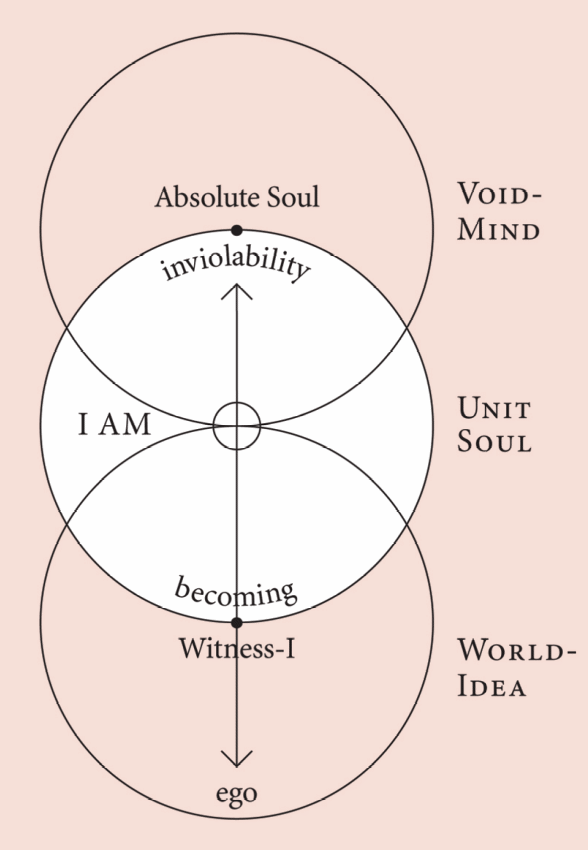
FIGURE 1983 1012-1. Void Mind, Unit Soul, and World-Idea.
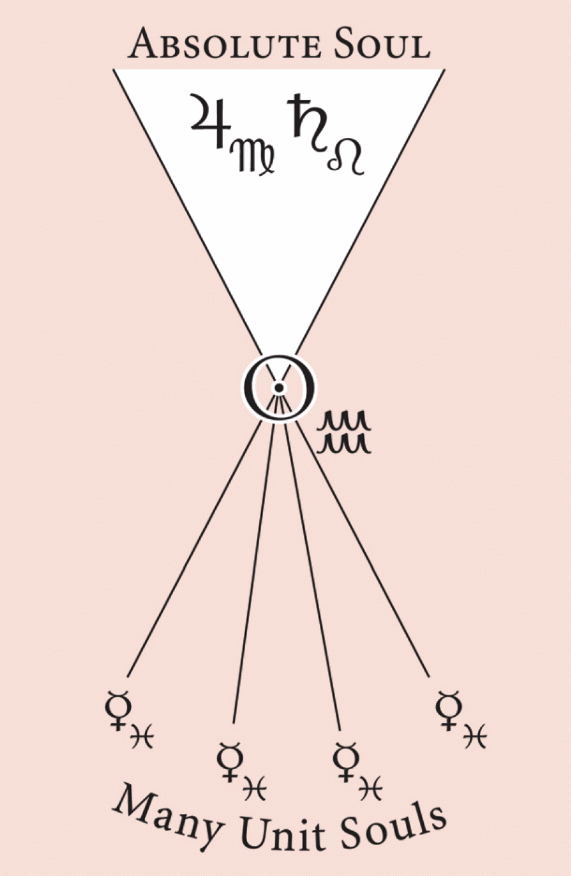
FIGURE 1983 1012-2. Absolute Soul and Unit Souls.
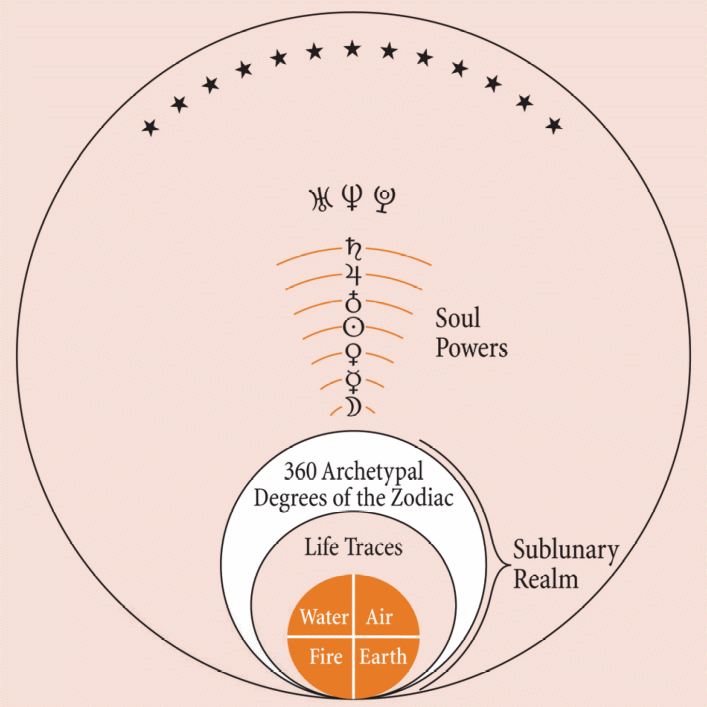
FIGURE 1983 1012-3. Inerratic, Planetary, and Three Levels of Dragon.
These diagrams are from Astronoesis, pp. 223, 185, and 249 respectively. [Transcriber note: [diagram] means the speaker is referencing a diagram as he or she is speaking.]
NOTES:
Pat Campbell transcript from 1983 exists (Scan File 1983 1012C1-18R04.PDF); other, earlier transcript versions may exist.
Unpublished PB paras should be sourced and proofread.
TRANSCRIBED Verbatim by IT 2019. Reformatted by JRM & JF 2019-2020, with Subheads and Table of Contents added by JRM. In 2023, IT fixes prefatory matter and footer, updates audio file name, completes Book List, adds Plotinus quotes section, adds new note within transcript, fixes minor errors, adds three diagrams and references within transcript to these diagrams. In 2025, MW expands Subsubjects and alters Subheads to make more accurate. Archival verbatim transcript – V14.1a.
AUDIO FILES: 1983 1012a, 1983 1012b. [Note: "Tape" and "Side" refer to original audio cassette tapes that were later digitized into .MP3 Audio Files.]
1983 10/12 at Wisdom's Goldenrod
PB Paras; Intellect
Archival verbatim transcript
[Audio File 1983 1012a Begins]
S: --ever.
RC: Naughty philosophic images. Some of these quotes will be very stunning.
"ALL THE PSYCHIC EXPERIENCES ARE THE EPHEMERAL AND ACCIDENTAL BY-PRODUCTS OF THE MYSTICAL PATH, NOT ABIDING AND ESSENTIAL RESULTS"
[10¾ second pause with faint background student talking]
PB [V13, 20:4.19, RC reading]: "The fantasies which are often produced by beginners as the valued fruits of their meditation will be regarded with repugnance when they have shifted their standpoint to a higher plane. When they follow the philosophic discipline, visions and messages which are the result of an intoxicated imagination or luxuriant fancy will then no longer be able to impose upon them and pretend to be other than what they really are. The temptation to implant our egoistic motives and to project our human feelings into the interpretations of these phenomena is so strong that only the curb of such a discipline can save us. All the psychic experiences are the ephemeral and accidental by-products of the mystical path, not abiding and essential results. They are signs of a passage through the imaginative part of the inner being. When students are so fortunate as to enter the truest deepest part of being, such experiences [RC reads: they] will vanish forever or for a time. Hence they are not to be regarded as worthwhile in themselves. The philosopher like the mystic may and often does see visions, but unlike him he [RC reads: but unlike the mystic the philosopher] also sees through them. He possesses true vision and does not merely experience a vision. But it takes time and experience to separate what elements are essential and what are merely incidental, what is enduring from what is transient, and the interpretation built up out of the original experiences from the experience itself."
[17¾ second pause]
AH: Randy, would you do the first two sentences again for me?
RC (simultaneously): Uh-hm.
PB [V13, 20:4.19, RC rereads a part of]: "The fantasies which are often produced by beginners as the valued fruits of their meditation will be regarded with repugnance when they [RC: These beginners.] have shifted their standpoint to a higher plane. When they follow the philosophic discipline, visions and messages which are the result of an intoxicated imagination or luxuriant fancy will then no longer be able to impose upon them and pretend to be other than what they really are."
[16¼ second pause]
RC: How about if we just read a bunch of these? We'll get some stuff to go on.
[9¾ second pause]
PB [V11, 16:2.63, RC reading]: "The initiation into mystical…"
RC: Oh. (laughter)
S (faint): Ok.
S (faint): (What?)
S (faint): Ok.
S (very faint): Uh-hm.
TS: Cheer up. (laughter)
S (very faint): Do Sunday.
S (very faint): Do Sunday?
RC: Who's doing the library now? Who knows where the books are? I specific--
S (simultaneously): What do you want?
RC: There's a-- there's a book I was looking at last week by Gai Eaton. It's a-- it's called The Richest Vein. There's a section in there that I was going to read tonight and I forgot to go get it.
S (faint): Uh-hm.
S: Do you know where it is? I--
AD: In the Traditionalist [one word inaudible]
S (faint): (What do you mean?)
CDA (faint): It's in the south (camp) on the-- on the east side on the third [one/two words inaudible]
AD (simultaneously): The same shelf where all the Notebooks are, (the) [one word inaudible] shelf, it's a blue-covered book. It's a blue-covered book, worn out.
[short pause with faint background student talking]
PB [V11, 16:2.63, RC reading]: "The initiation into mystical experience may come dramatically and convulsively through ecstasy in the case of one aspirant but unobtrusively and gently through quietude in the case of another. Because individuals differ so widely in the personality and the history with which they meet the experience, no general rule may be affirmed in the matter, no dogma laid down. When aspirants and their half-grown teachers constantly confuse these ecstasies with the highest and fullest enlightenment, it is necessary to protest and point out the error. That this is an error is shown by the fact that the ecstasy passes away, the emotions subside, and the man quickly recedes from these high levels and begins to revert back to his prosaic everyday condition once again. He soon discovers that these holy experiences, alas! cannot be kept up for long. They are as ephemeral as the colours of [RC adds: the] sunrise. Saint Bernard complained that the clear vision of the Divine is only for a moment. Jacob Boehme compared his mystic ecstasy to lightning which flashed and vanished. Such emotional ecstasies are always transient; they come and go simply because it is the nature of emotion to do so. Nature never intended mystical raptures to be anything more than weekend guests, [students assent, faint] [as it were]. She has not made the man who can enjoy them forever at the same pitch of passionate intensity which they possess at the start. In his ignorance the mystic desires to cling to his ecstasy but always fails. Consequently the experience is always succeeded by either a mood of depression or of frustration. He does not perceive that this very desire to hold on to it is something which must be conquered, as much as any [other] possessive desire, if he is [ever] to attain a lasting inner peace. The foregoing may prompt the question,"Why then is inward joy one of the accompaniments of mystic experience?" In the early stages it comes to make easier his revaluation and overcoming of outward and earthly joys. Hence it is then highly emotional and tempestuous. In the advanced stages it is to tell him what the divine Overself is like. Hence it is then profoundly mental and tranquil.
"The bliss which accompanies a mystical experience is not only accounted for by these causes but also [by] a further one, or by all in combination. And this is that every such experience is a renewed discovery of the glorious fact that he is not engaged on an impossible quest. That the latter can be successfully completed by conscious union with the Overself is joyously evidenced anew by each such temporary union. It is through such momentary glimpses or vivid intuitions of the transcendental reality that he is encouraged to continue [with] this long-drawn quest. The heavens have opened for him and closed again. Whoever has once had this vivid experience cannot go on again as though it had never been. He will be uneasy, restless, alternately fascinated and haunted by its memory, tantalized into seeking how he may recapture it again. And it is well that such gleams of encouragement do come to him. For there are times when he realizes the Himalayan altitude of the road he has undertaken to climb. With this realization there arrives despair, even the desire to withdraw from it altogether.
"The conclusion from all these considerations is that if [RC adds: the] blissful psychic experiences or rapt ecstasies come to him, he ought not let his attitudes and utterances be too jubilant; if they fail to come, he need not be too sad. It is interesting to hear about them and pleasant to have them but they are not essential to the higher life."
S (faint): Yeah.
[21¼ second pause]
RC: Um, this is the quote you're talking about, everything [one/two words inaudible] It's related to some of the things that came up last week and I think it makes a good introduction for things that we're doing this week.
[10¾ second pause]
PB [unpublished, RC reading]: "Today the profane presume to discuss what is sacred and to contest its character or even its existence. The inferior judges the superior, ignorance sets bounds to wisdom, error prevails over truth, the human supersedes the divine, earth overtops heaven, the individual sets the measure to all things and claims to dictate to the universe laws drawn entirely from his own relative and fallible reasoning. The perpetual demand for proof and evidence arises in a world which at heart doubts the very existence of any ultimate truth and certainly questions whether any man has ever known such a truth. But for the man who cannot doubt his own certainty, the demand for proof is essentially a frivolous demand. He does not suffer from the illusion that he may in some miraculous way transfer his knowledge and understanding to another by defeating him in argument. He knows that the most he can hope to do for his fellows is to show them the way by which, through the Grace of God and by their own unfaltering labour, they may come to see the place where he stands and see what he sees. It is truly strange that people demand proofs of this knowledge instead of seeking to become themselves aware of it by undertaking the necessary labour. Here, beyond doubt, Saint Augustine's quote"Believe, in order that you may know" is the essential advice. No man can set out to reach a place in the existence of which he does not believe and have a reasonable hope for [RC reads: of] arriving there. Belief in itself may not take him very far but it will make his journey possible and set his feet in the right direction. The spectacle so common today of the skeptic sitting tight and asking to be convinced by rational argument is a curious one. As well might a bird sit on a branch and ask for proof that he can fly instead of spreading his wings."
[1 minute 13½ second pause]
TS (very faint in background): I'll read this, ok?
PB [V11, 16:2.84, TS reading]: "At this stage of our brief study of the mind and its mystical powers, personal observation and experience involving thousands of contemporary cases among Asiatics, Africans, Europeans, and Americans no less than wide reading in and deep reflection over the past annals of mysticism in the West as well as yoga in the East dictates the stern duty of a warning utterance. In this matter at least we have the privilege of practice as well as the theories of yoga at our fingertips and hence may be presumed to know what we are talking about. If our statements are strongly worded, that is because the importance of the matter justifies it. Many have deplored the innumerable aberrations and the countless delusions, the intellectual vagaries and the pathological states, the hysterical emotionalisms and [the] half-concealed eroticisms to which mysticism too easily leads its votaries. Why does this happen? Part of the answer is that meditation exercises are often practised incorrectly. This is still true even when they are done under a teacher's guidance, for scientifically imparted instruction is usually difficult to obtain, whereas superstitious or superficial instruction is more easily found. The consequences of wrong practice make themselves marked in time upon both character and capacity. They may appear in the following forms: fancy being mistaken for reality; [TS adds: 2)] the decay of reasoning power and the growth of credulity; the surrender to emotional impulse, miscalled intuition, in the belief that this is a higher guide to behaviour than right thinking; and the adoption of a holier-than-thou attitude towards others. Moreover, meditation of a merely self-hypnotic character unaccompanied by philosophical or practical discipline may lead to pathological neuroses, or to dissociations [TS reads: associations] of personality, or to deep self-deceptive hallucinations of personal attainment. Just as the right kind of meditation will expand and develop spiritual life, so the wrong kind will cripple and dwarf it. Those who do not estimate the creative powers of meditation at their real worth may ridicule such a statement. But the fact remains--and is indeed a commonplace matter of mere observation to any competent investigator--that the whole character, mentality, temperament, motives, and reactions of the student who continues for a sufficient period with such practices will undergo a marked change for the better or for the worse. They will indeed either benefit or harm him.
"Nevertheless, if erroneous meditation has led some to fantasies and illusions, this is not a warning to give up its practice but to meditate rightly and to gain metaphysical clear-sightedness to see through phantasms and mistakes. Indeed, it is quite possible to erect a shield against these errors by undergoing the philosophical training, which puts its students on their own guard and enables them to protect themselves. Meditation is supremely necessary but the pitfalls that surround it are so grievous [TS adds: so] as to make it most desirable to practise it as part of the fourfold balanced path, and not merely alone. Moreover, in this world crisis, the service enjoined by this path and usually neglected by unphilosophical meditators is at least as urgent as self-development."
S: Last sentence again.
PB [V11, 16:2.84, TS rereads a part of]: "Moreover, in this world crisis, the service enjoined by this path and usually neglected by unphilosophical meditators is at least as urgent as self-development."
[short pause]
PC: Tim? You know what the fourfold path is that he referred to?
TS: Um, no not in--
RC: Generally the-- generally the four is mystical reverence, intellectual development towards metaphysics.
S (faint): Emotional purifica--
RC (simultaneously): Moral-- moral-emotional purification, development and altruistic service.
S: What was the last one?
RC: Service, altruistic service. Basically willing, thinking and feeling purifications plus service.
[16 second pause]
PB [V11, 16:2.6, TS reading]: "Mystics who seek quivering ecstasies alone take the risk of becoming victims of their own emotional workings. For then the aberrations of mystical experience may be numerous and peculiar, the exaltation [TS reads: exaltations] of imaginative emotionalism to the status of divine experience is [TS reads: are] often inevitable, and the possibilities of psychological camouflage may be many. Moreover, if their emotional overturning is carried too far and if it is mingled with concentration on pictorial visions of a saviour or saint who belongs to the opposite sex, it may easily develop into something quite unspiritual. (some laughter) A mystical eroticism which is rooted in repressed sex complexes may then be the undesirable consequence. The history of religious mysticism [TS reads: mysticisms] and devotional yoga has several cases on record of those whose excited ecstasies showed all the symptoms of strong erotomania. These cases have been offered as instances of"union with God." The truth must be told and it is that they are only emotional extravaganzas."
S (faint): That's it?
[short pause]
TS (very faint, part of background): You have anything?
AD (very faint, part of background): Why don't you (start) some more?
TS (faint, part of background): You'll find some more?
S (very faint, part of background): Get up here.
[39 second pause]
PB [V16, 25:3.130 & Persp., Ch. 25 #47, TS reading]: "There is no classification into matter and spirit for the Sage. There is only one life for him. If a man can find reality only in trance, if he says that the objective world is unreal, he is not a Sage, he is a Yogi."
[13¼ second pause]
MB (very faint): Would you read that over?
PB [V16, 25:3.130 & Persp., Ch. 25 #47, TS rereads]: "There is no classification into matter and spirit for the Sage. There is only one life for him. If a man can find reality only in trance, if he says that the objective world is unreal, he is not a Sage, he is a Yogi."
[25 second pause]
"THERE IS NO CLASSIFICATION INTO MATTER AND SPIRIT FOR THE SAGE"
EC (faint): So you could say the objective world is unreal is a statement that wouldn't come from a Sage?
TS: Yeah. [short pause] There are many quotes where he talks about a need to understand. The mystic develops through understanding the reality of the "I" and leaves the greater mystery of the reality of the world untapped, un-- uninvestigated, and that the nature of the philosopher is to equally investigate the [S simultaneously: Do we have any?] realization of the "I" and the realization of the World-Idea.
EC (faint): And he's calling that the objective world.
TS (faint): Yeah. Or let's say it is its manifestation.
AH: Also I think that quote, first part of it suggests that for the Sage there's no contradiction between something that's real and something that's not real, one world. That juxtaposition of realities.
TS: Yes, well he says, I think the way he put it there at least was that there's no difference between spirit and matter. But it seems as though there was no reference to unreality at all for the Sage, in fact--
AH: That's about the same, isn't it.
[16 second pause]
S (faint): And doesn't that then contradict that whole Hindu stance of the world as illusion?
TS: Yeah.
PD: What's the Hindu stance?
S: Oh, [S: The (one/two words inaudible)] the world as illusion, maya.
PD (simultaneously): That's a dualist consciousness.
BS/S(?): (Justice.)
PD: Hm, Vedanta.
S (very faint): (You're/We're) reading PB.
[15¾ second pause]
LD: But the contents of that consciousness are inexplicable according to them and they, you know, do not go on to explain it. And I think that's what he's speaking to.
PD: Here in this quote?
LD: No I think his conversation in general. Nobody's arguing that consciousness is not real, but the contents of that are also a reality to a certain extent. I don't know what. It's a--
PD: Well your quote here he's speaking about the Sage, there's no dichotomization of experience, [TS: Yeah.] spirit and matter, [LD: Yeah.] content and consciousness. There's not that dichotomization.
[9¾ second pause]
AH: I don't think we could use our notion of what constitutes a real world to understand what would be real for the Sage.
PD: Yeah.
AH: [one/two words inaudible] (would) practice some kind of fantasies about what-- the real world.
[short pause]
TS: In any case it would seem as though the quotes on the World-Idea would be an appropriate place to try to understand it. That might be--
AH: Maybe you could do that quote again. Would you mind?
TS: Ok, yeah.
S: "There is no…"
PB [V16, 25:3.130 & Persp., Ch. 25 #47, TS rereads]: "There is no classification into matter and spirit for the Sage. There is only one life for him. If a man can find reality only in trance, if he says that the objective world is unreal, he is not a Sage, he is a Yogi."
HS: There was a point in the context there that he's a Yogi therefore his approach is mystical, not philosophic.
TS: Yes.
[short pause]
"THE OVERSELF PROVIDES THE LIGHT; THE MAN PROVIDES THE THOUGHT-FORM THROUGH WHICH IT SHINES"
PB [unpublished, TS reading]: "The Overself provides the light; the man provides the thought-form through which it shines. The deficiencies or distortions in this form affect the result."
[10¾ second pause]
PB [V11, 16:3.74, TS reading]: "Philosophy accepts part of the tenets of occultism--the part…"
PD (simultaneously): Wait, wait, is that another quote now?
TS: Yeah. (laughter)
S (amidst laughter): Yeah right.
S: Would you read the other one again, Tim?
S: Yeah.
TS: Why certainly. (some laughter)
S: [one/two words inaudible]
S: (Uh-hm.)
TS: Uh--
PB [unpublished, TS reading]: "The Overself provides the light but the man provides the thought-form through which it shines. The deficiencies or distortions in this form affect the result."
[short pause]
PD: Any queries on that thought-form?
S (faint): Yeah.
TS: Well, I think that we have called it those three levels of subjectivity. The mental, psycho and somatic together are the thought-form which are (the instrument), the ego. I think thought-form and-- and ego would be [student assents, faint] [couple words inaudible]
HS (simultaneously): So you think he's talking about all experience or mystical experience here? Let's say all isn't mystical.
TS: Well, it's-- in this quote it doesn't seem to be particularly said one way or the other. Often I've seen this referred to that in mystical experience, when the person comes back or as they're experiencing it, to the extent that there are deficiencies and distortions in that-- their development, that experience will be so altered.
HS: But you don't-- and you don't think that's what he's saying there [couple words inaudible] Jeffrey? The Overself's supplying a light to the individual's mind, the thoughts that are formed?
TS: I think he's-- this seems to be pretty general and it doesn't say when you're at a stage of-- any specific state, it simply says that, you know-- that the deficiency and distortions in the form affect the result. Well the result here must be the result of some awareness of that light I guess.
PD: But, I'm saying, there's a more fundamental question that comes to my mind. Can a thought-form not distort the light? And that he seems to be implying that some type of thought-form will not distort the light.
AB: PB had thoughts.
S: Right.
PD: I don't know, Alan. (PD laughs a bit, bit of laughter)
AB: Well I mean there was a world. You know, there was a world being projected and experienced.
PD: If you say so.
S: Yeah.
AB: It's in attendance.
S (faint): Yeah.
HS: Well can you have a thought-form of light?
TS: Uh-hm.
HS: Well is that a distorting of the light to have a thought-form light? [short pause] Gee I thought that quote he just like-- it gives like the basic-- a basic, well, start to defining mysticism.
PD: Say what you mean Herb.
HS: Say what-- say what the quote says, I mean--
PD: No I don't understand what you're saying here.
HS (simultaneously): I mean you've got the light of the Overself, you got the mind, you got the presence of the light in mind. And you get-- begin to-- Like what-- how would you define mysticism, you know, just general? What would you say it is?
S (faint): Contamination of love?
HS: (Contamination.) (laughter) Present.
S (faint): Right.
PD: The conscious experience of-- consciously participating in the life of the Overself in some fashion or another.
HS: And I think that's what it was-- if I were to say, I would say that's what's being [TS: Discussed.] spoken in that quote.
TS: It seems like in-- in some ways he suggests in-- if I understand these quotes that-- that those deficiencies and distortions may be minimized, you know. But insofar as the-- there is a thought-form, insofar as there is an ego, or there is a mind with forms in it, there will be some modification of that light when it is expressed in thought or is spoken.
HS: But-- no but in the previous quote there was just something on the Yogi experiences the reality only in trance.
TS: Yes.
HS: Now is that-- would that be a thought-form or that would be an experience of the reality?
TS: Well, it seems that when he means that he experiences reality it is a-- it is the Overself. It isn't-- I mean that there are mystic experiences which are the thought-forms and he goes through a lot of quotes here about those.
HS: Aren't?
TS: Are thought-forms.
S (simultaneously): (Thought.)
TS: Yeah. Many mystic experiences are thought-forms but elevated above our ordinary consciousness. But it seems that in mysticism, the height of mysticism, of mystical union, is some glimpse or prolonged glimpse of the Overself where one is not in that mind or in the psychosomatic but that insofar as that it is followed up only from the point of view of what if-- "What am I?" and "Who am I?" that there is a limited and an intermittent attainment.
HS: So technically you would say that the present-- the awareness of the pre-- presence of the Overself's light in whatever form is what he's calling mysticism.
TS (faint): What do you think?
RC: I think probably that, given the way he's defining, there are levels of religion, mysticism and philosophy, that he'd be talking in mysticism there's a stage in which the normal sense of separateness that you have from the Infinite Life Power is attenuated or possibly even completely withdrawn, so that your experience of being is not so limited and separative as it normally is and that that would be a-- you know, a grade-- a graduated thing. Things that seem mystical to you when you're fourteen might not seem at all mystical fifteen or twenty years later. And I think that it just doesn't have to be meditation, that there are times that just getting some glimpse into the mystery of ordinary daily perception is mystical an experience as you could possibly--
HS: I think it's philosophical but-- Ok so you're saying that anything that-- that what, that supplies you with the presence of the higher or the deepest is mystical necessarily?
RC: Tentatively I think that would work. The sense of separateness that you would have-- It's like the presupposition it seems that the ego works on that-- that you are somehow separate from the Infinite Life Power. And it seems that that presupposition gets displaced to some extent.
HS: And that displacement takes the form what (we/you) would call mystical.
RC: Yeah, it usually reflects itself in the feelings as some sort of, you know, real emotional high. [short pause] Love, emotional feeling of the sacred. But I don't think you could box it, I think that--
HS: No I just wanted--
RC: The things you'd find-- [HS simultaneously: Thank you.] things that you'd call mystical at one stage of development would seem very prosaic at another. But then--
HS: Or vice versa.
RC: Yeah. Yeah.
S (faint): Yeah.
AH: Part of this quote, is it-- is it so that the light permeates all thoughts, whether they're distorted or not?
RC: I don't know about permeates. Insofar as those thoughts are objective to a knower, then it's the immanence of the light that makes the knower a knower, that--
AH: So, well, the Overself is always lighting the thoughts.
RC: Yeah.
AH: Now what constitutes a thought that is less distorted in regards to the light?
RC: I guess the-- the element of association that the ego normally brings into reconstituting the experience at the level of the triple relation would be the place to address, that-- Like that Hidden Teaching series that Dickie's been going over where you get the-- the impression in the mind, but being unable to dwell within it the first thing you do is you drag up your whole bag of tricks from the past and then paste together those associations into a so-called possession. But, I don't think that would be confuted with an undistorted perception. You're doing the best you can for you(--/,) when it works, the best you can do.
PD: Could you say that that activity of thought, when it is universalized will cease to distort the light?
RC: I think so in the sense that-- You know but we're always-- not always but most of the time every time you see something you immediately associate it with oh that's like such and such, that in the mind that's been cleaned out, that just doesn't happen. It's not like anything. It's just what it is. There's the particular space-time form and so on and-- particular to your eyeballs and that sort of thing. But, I think the meaning, you would say the self-declared meaning of the idea coming into the mind could be transparent and in that sense not distorted.
PD: So the ideas working themselves out in an unpersonalized fashion would be the true unfoldment of thought, not-- not obstructing the light of the soul.
RC: I would agree, I think there's also something-- I wouldn't completely degrade the person either. There is something legitimate about the person, as a person, maybe not--
PD: And as such he is universal.
RC: Well the universals are definitely-- (feed) him as well. [11¼ second pause] You got another one?
TS (faint): Yeah. I (use/used) [few words inaudible] [RC: 'Cause--] I wanted to introject that-- a quote to I think elaborate the one we're discussing.
THE DIFFERENCE BETWEEN THE MYSTIC AND THE PHILOSOPHER
PB [V13, 20:4.219, TS reading]: "The difference between the mystic and the philosopher is that although both are illumined by the same Overself, the former's limitations [TS reads: limitation] and narrowness limit and narrow the expression and communication of his state and his help. The philosopher, however, having all-around development--for instance, having well developed his intellect and activity--can explain to intellectual persons what they can understand, can work among active persons as one of them, thus showing that attainment is no bar to an intellectual disposition or a practical life. The mystic is often unable to do this, but talks as a simple fool or lives as a hermit or monk. Although this makes no difference to his enjoyment of the higher state, it makes a difference to other persons when [TS reads: whether] they come into contact with him. [TS adds: Thus, if the Maharishee had been a more practical person, he would have controlled the ashram and thus enabled it to render better service.] But these differences merely belong to the surface, not to the inner core, where both mystic and philosopher enjoy the same realization. Hence it is a matter of choice, not necessity, which path is taken."
[short pause with faint background student and AD talking]
LD: But you know, in that-- in a lot of those quotes, you know, through that whole volume I think, that in some places he uses mystic as a-- as just a Sage, it's like the difference between a Sage and a philosophic Sage. And other places he uses the word 'mystic' as one who only gets an intermittent realization, it's not a permanent establishment.
TS: Yes, that seems to--
LD: But, obviously in Maharishee I think the-- it was a permanent realization, it wasn't just-- it just wasn't brought into the-- the reasoning and expounded in a-- you know-- [TS simultaneously: Oh (couple words inaudible)] You know what I'm saying?
TS: Yes. I agree with you (Lou).
LD (simultaneously): In some places he-- the distinction is more between a mystic, a Sage, and a philosophic Sage.
RC: There's also a third usage in there. He'll talk about permanent partial (unity). That what's been gained isn't going to be lost but it's not complete.
LD: Yeah, that's the difference between a Master and a Sage in his language. A Master is one who has the light permanently but not the full light. And a Sage is one who has the light and it's full.
RC: I haven't been able to pin down the words that clearly but the ideas [few words inaudible]
LD (simultaneously): Well, it's probably a lot my--
[short pause]
JfL: Wait, in this quote though the mystic and the-- and the philosopher enjoy the same realization. You know, one of the quotes that you've read.
S (simultaneously, faint, possibly part of background): It's in here.
S (faint, possibly part of background): Well--
S (very faint, possibly part of background): Yeah.
TS: Says--
PB [V13, 20:4.219, TS rereads a part of]: "…both are illumined by the same Overself, the former's limitations and narrowness limit and narrow the expression and communication of his state and his help."
TS: It doesn't quite say it's the same.
S (very faint): Yes, yes (it does).
S: Linda, raise your arm.
S (simultaneously): [couple words inaudible]
S (simultaneously): He wanted me to enjoy the same (water/wine).
TS: Yeah but I think-- alright, but, it's in the projects.
CDA: What are you reading? You're reading part of something?
TS: Yeah.
CDA: Please start over again.
TS (faint): It's in the [couple/three words inaudible] ok, um--
[short pause]
JfL: Well I may not be asking what she was [one word inaudible]
S (very faint): (No/Yeah).
S (whisper): Yeah.
S (very faint): Well-- (laughter)
TS: Ah, that may be true. (bit more laughter)
S (faint): That may be true.
S: It may be true.
JfL: Well I was thinking about one of the quotes on Sunday where I think he said that the-- It sounded as though the-- the mystic enjoys great ecstasies in larger extremes but that he would eventually have to surrender those to the philosophic point of view which would be more-- wouldn't have the extremes, it would be more of a consistent-- And, it's not just constant but I think that like the highs were literally quite the same as the way the mystic does. I don't-- well first of all do you remember that quote that way, it was from Sunday?
TS: Yeah. There are many quotes like that in here. And even the next one here--
THE DIFFERENCE BETWEEN THE INTERIOR "I" AND THE UNIVERSAL "I"
PB [V11, 16:2.257 & Persp., Ch. 16 #44, TS reading]: "The successful mystic certainly comes into contact with his real"I." But if this contact is dependent upon meditational trance, it is necessarily an intermittent one. He cannot obtain a permanent contact unless he proceeds further and widens his aspiration [TS reads: aspirations] to achieve contact with the universal "I." There is therefore [a difference between the interior "I" and the universal "I," but it is a difference only of degree, not of kind, for the latter includes the former.]"
(Side 1 of original cassette tape digitized as 1983 1012a Ends; Side 2 Begins)
TS: --interior "I" that the mystic realizes and the universal "I" which the philosopher [one/two words inaudible]
CDA: Would you-- could you explain that?
BS (simultaneously): That universal (language/light).
TS: Well, I think-- I can try it, yeah. I think the individual "I" would be the Overself as Witness-I as that individual. The universal "I" would be the Overself as universal.
PC: And including the World-Idea.
TS: Yeah, of course.
LD: Do you mean in [CDA simultaneously: (I'm not sure--)] that-- in that the individual "I" would be in the spiritual level of the Dragon [TS: No.] and the universal "I" would be the I AM [TS simultaneously: No, no.] or taken up to the level-- what--
TS (simultaneously): I think the interior "I" would be the light of the Overself that-- that lights up the Dragon. And the universal "I" would be the Overself or the [students assent, faint] Saturn Jupiter in the [one word inaudible] Nous. [Note: See FIGURE 1983 1012-1, Void Mind, Unit Soul, and World-Idea, appended to this transcript. This diagram is from Astronoesis, p. 223.]
CDA (simultaneously): But the first one you're talking about sounds like the reproductive soul.
TS: Yes.
S (very faint): Uh-hm.
S: Uh-uh.
CDA: So you're calling that the same-- how did he say it at the end, it's the same in--
PB [V11, 16:2.257 & Persp., Ch. 16 #44, TS rereads a part of]: "…it is a difference only of degree [TS reads: of degree only], not of kind…"
CDA: So that-- I don't think that.
JfL (simultaneously): I thought it was inside the interpretation.
CDA: I don't think I could ag-- I mean, that the experience of the reproductive soul is the "I" is-- is the-- you're saying is--
JfL: Well I mean I think in the [CDA simultaneously: --the experience?] first case it's--
S (very faint): (Uh-hm.)
LD: Are they different in essence?
CDA: But to define it as such you're-- you are making a distinction between the Overself and that which emanates from it that has a desire for embodiment. So I think there's quite-- quite a distinction. One is expe--
LD (simultaneously): Well, yeah, the diff-- the distinction would be the proclivities and desires but essentially substantially [CDA simultaneously: Essentially--] tell me the difference.
CDA: No, essentially there's no difference but that one is in a different way-- one is the way Tim (has) explained that was that the universal was the I AM not as individual. Now that sounds like-- That's what he said. He said an experience--
LD (simultaneously): The individual (as/is) I AM not--
CDA: The-- an experience of the "I" not individually.
TS (simultaneously): Oh.
CDA: Ok?
TS: Yeah.
CDA: So, that would-- that sounds to me like beyond--
RC: Do you remember the quote we did a couple of weeks ago and he said, "When I have used the term"the centre of his being," I have been referring to an experience that takes place in meditation in which everything seems to be gathered into this central point." (PB, V13, 20:4.136 & Persp., Ch. 20 #83)
CDA (simultaneously): Yes, yes.
RC: And he says that for philosophers that-- that is not the goal? [CDA simultaneously: Yeah. Yeah.] That it's more accurate to speak in terms of a state of mind-- well not a state of mind but I think he used that-- a state of mind that has no necessary reference to body [CDA assents] at all. It's both in the body and in the Overself, there is no paradox between them. I think that's what he's talking about here, the difference between [CDA simultaneously: Yeah. Well--] an interior "I" and the universal.
LR: Could that be the one Overself and-- and the individual Overself? Could it be talking to the issue of Overself as one and many [couple words inaudible]
LD: You mean the Saturn and Jupiter to the Mercury? [Note: See FIGURE 1983 1012-2, Absolute Soul and Unit Souls, appended to this transcript. This diagram is from Astronoesis, p. 185.]
TS: Yeah.
LD: But I thought all [S simultaneously: Yeah.] the quotes we read on that the man never becomes God. I mean, what, are we forgetting that now?
S (simultaneously): Yeah. No, no, no, no, no.
S (faint): Someone should [couple words inaudible]
CDA (simultaneously): But you can experience (state of) the Void. I mean you can experience the universal soul.
LR (simultaneously): No, it's still Overself.
LD: Yeah, but does he ever become universal Overself in that sense?
S (simultaneously): No.
DB/S(?): Well he--
LR (simultaneously): I'm not-- I'm still keeping a distinction between Intellectual-Principle and Overself.
LD: Ok.
LR: I just thought he has-- he had-- I'm not talking about Intellectual-Principle at all.
LD: Ok, I'm sorry, (yes/yeah).
LR: Except (as/his) Overself is conjoined with the Overself [LD simultaneously: Ok.] [three/few words inaudible] That he does bring up-- and this might not be the place to bring it up because I know he has quotes on this but he talks a lot about Overself as one or many. And I wondered if that was this point.
TS: I mean that-- I-- so straining along here but, it seemed to me that that was what was being said here about the similarity between the attainment or realization of the mystic and the philosopher was that the philosopher was realizing that universal "I". The mystic was realizing that interior "I". And it seems to me likely to attribute that meaning of interior "I" to the individual Overself or the Overself as individual, and as Carol pointed out it has a reproductive tendency, the desire for incarnation. Perhaps that's partly why it is intermittent. Whereas the universal-- come into contact with this principle of the Overself as the universal has no such tendency. Hence the-- the association with that is permanent. And it seemed to me that as distinguishing between the philosophic path which leads to an interior realization-- I'm sorry-- the mystical path which leads to an interior realization and the philosophical path which leads to that union with that universal "I", that was the basis of some of these-- these quotes.
S (very faint): Yeah right.
TS (faint): You think so? We should probably return to these that have been checked off here.
[short pause]
S (very faint): (Read the quote to them.)
TS (faint): Yeah, I think so. Alright. I think we need to (read some of these).
RC: Um--
DISTINGUISHING THE PSYCHICAL FROM THE SPIRITUAL
PB [V11, 16:3.74, RC reading]: "Philosophy accepts part of the tenets of occultism--the part which its own seers and sages have handed down--and does not deny them. But it places emphasis on that which rests on a higher level and which is much more significant. It refuses to allow its students to be involved in the practices, the bypaths, and the dangers of occultism."
RC: He does say students. "…refuses to allow its students…"
[short pause]
PB [V11, 16:3.75, RC reading]: "The psychical is concerned with imaginations, visions, voices, thoughts, and feelings which originate beneath the surface of the ego's mind, whereas the spiritual is concerned with the higher self. The two are not the same but utterly different in quality and character. Aspirants often confuse them although the first is still within the realm of personal things whereas the second is within the impersonal. A still greater confusion concerns the mediumistic. This is the same as the psychical but influenced or possessed by what purports to be someone else's ego, often someone unknown and usually unseen, or even by what purports to be from the realm of the spiritual itself."
[12½ second pause]
S: Well, I'm in a little trouble with the first part of that quote. It sounds as if you're saying that-- that there is really no difference between a-- a psychotic kind of a hallucination and a mystical vision in that they're both in the same realm. Would you read the first part again?
PB [V11, 16:3.75, RC rereads a part of]: "The psychical is concerned with imaginations, visions, voices, thoughts, and feelings which originate beneath the surface of the ego's mind, whereas the spiritual is concerned with the higher self. … [short pause] Aspirants often confuse them although the first is still within the realm of personal things whereas the second is within the impersonal."
[short pause]
S: Is he saying that no visions can take place within that second realm, no-- whatever, visions, within that second realm? Or would there be a different kind of vision in one realm than the other?
RC: In this quote he seems to be saying definitely that it's characterized by a difference between personal and impersonal.
S: Uh-hm. [short pause] I guess maybe he doesn't give quite enough description of the impersonal to say one way or the other.
RC: No but, we'll get more of that as we read more (I guess).
S: And then how does the second part of that fit in, the mediumistic?
PB [V11, 16:3.75, RC rereads a part of]: "A still greater confusion concerns the mediumistic. This is the same as the psychical but influenced or possessed by what purports to be someone else's ego, often someone unknown and usually unseen, or even by what purports to be from the realm of the spiritual [RC adds: (in/of)] itself."
[short pause]
JB: If you take out all the "purports to be" then it's all psychical.
S (faint): Yeah.
RC (faint): Mostly psychical.
S (very faint): Uh-hm.
LR: What did you say Jonathan?
S (very faint): Yeah.
JB: It sounds like if you take out all the "purports to be", it's not any different from the psychical at all. So I wonder why it's a further-- I mean it's a further confusion because of the addition of "purports". But it doesn't sound like it's any different.
LR: I don't know what you mean by the "purports", I didn't hear you.
JB: Well like you're in a séance and I guess the mediumistic idea is in a séance and you have a certain experience.
RC: Yeah well here's this book, it's not a real person.
JB: Well, that's what I'm-- I'm almost asking that, is-- is the suggestion there that it's-- that the mediumistic experiences are all psychical. Or, is there an influence [RC simultaneously: Yeah.] but it's an unknown influence.
RC: Yes.
JB: Ok.
RC: Like you couldn't possibly contact your grandfather. But you might be able to, you know, have a medium translate something of the residue within the astral.
JB: So the influence is not--
RC (simultaneously): But in terms of the soul, if you were going to contact his soul, it wouldn't take place in that [one/two words inaudible]
S (faint): Can you read the whole thing again?
PB [V11, 16:3.75, RC rereads]: "The psychical is concerned with imaginations, visions, voices, thoughts, and feelings which originate beneath the surface of the ego's mind, whereas the spiritual is concerned with the higher self. The two are not the same but utterly different in quality and character. Aspirants often confuse them although the first is still within the realm of personal things whereas the second is within the impersonal. A still greater confusion concerns the mediumistic. This is the same as the psychical but influenced or possessed by what purports to be someone else's ego, often someone unknown and usually unseen, or even by what purports to be from the realm of the spiritual [RC adds: (in/of)] itself."
[19¼ second pause]
PB [V11, 16:13.88, RC reading]: "The so-called astral travels and mental-plane journeys of the occultists are very far from being what they are popularly taken for. They are nothing but a series of subjective visions, dreams woven by the mind under various influences."
[10¼ second pause]
S (faint): What?
PC: Could-- could you do that one again?
PB [V11, 16:13.88, RC rereads]: "The so-called astral travels and mental-plane journeys of the occultists are very far from being what they are popularly taken for. They are nothing but a series of subjective visions, dreams woven by the mind under various influences."
PC: You don't think he means in that that one couldn't actually experience something occurring at a great distance from the body where it actually occurred in the world.
S: Right.
PC: He can experience that.
RC: Yeah.
PC: But it's not because he goes somewhere outside his body.
RC/S(?) (faint): Yeah.
S (faint): Oh.
RC (simultaneously): I think that was the point Anthony was trying to make when he said when-- when he said PB went into Benares, he didn't mean astral.
PC (simultaneously): Oh. Ok.
S (simultaneously, faint): Yeah.
[14¾ second pause]
PSYCHICAL EXPERIENCES AND PICTORIAL VISIONS ARE NOT NECESSARY FOR SPIRITUAL PROGRESS
PB [V11, 16:2.51, RC reading]: "The seeker who has no psychical experiences, no pictorial visions appealing to the senses, no clairaudient voices delivering [RC reads: revealing] a supreme message, should have no regrets. (laughter) His progress is not belittled in any way."
PB [V11, 16:2.52, RC reading]: "There are mystics to whom no vision has come, no voice has sounded, no phenomenon has appeared. Yet they are farther on the quest than [so] many to whom these things have happened."
[short pause]
LR: Can you explain that?
RC: Yeah. (bit of laughter) I still think that if you really inquire into ordinary everyday perception, it's as mystical as you could possibly hope to find.
LR: What's the difference between that and the philosophic procedure?
RC: Well he's saying there--
PB [V11, 16:2.52, RC rereads a part of]: "There are mystics to whom no vision has come, no voice has sounded, no phenomenon has appeared.
S: When do we--
LR (simultaneously): Right but I thought the definition of a mystic was one who perceived such things.
AB: These are psychical experiences now as well that he's talking about.
LR: Can't hear.
AB: These also seem to be psychical experiences which are not necessarily part of philosophic development.
S: (What/Well)--
LR (simultaneously): The quotes--
RC (simultaneously): Yeah, this--
JfL (simultaneously): Linda, do you remember the quote on the bulletin board with the three tier experiences for the aspirant? The first one had mystical experiences which were to entice him. And the mystical experiences for the advanced was the culmination, but there was the middle ground where there were no experiences like that to be enjoyed. [short pause] Sounds like--
LR: No, I don't remember.
JfL: Well it sounds like that kind of middle ground that he's talking about here.
LR: I'm-- I-- not only don't I remember it, I can't hear you. (bit of laughter)
S (faint): Right.
S: Yeah.
AB (faint): Let me write these. (laughter)
PD: How did you know you were [JfL simultaneously: How do you know I--] supposed to try to remember?
S (faint): What? (bit of laughter, student words)
S (very faint): How come?
LR: The mystical experience.
JfL: There was-- you didn't--
LR (simultaneously): Please try again, Jeff.
JfL: You didn't hear any of the-- you--
LR: I vaguely heard what you said about the bulletin board and didn't understand what you were talking about.
JfL: There was a quote on the board that had three levels of-- of experiences, mystical-- well, three levels of experiences for the person on the Quest. And, he said that the mystical reveries were experienced by the beginner and by the advanced but not by the person in the middle realm.
LR: I guess what I'm asking-- it's real simple I think. If he says a mystic who has not had visions, inner voices--
HS: How could it be a mystic.
LR: What-- no, what does he mean by mystic there?
RC: Well, that's (what/where) I would use like the example that I mentioned before in terms of the sense of the separateness from the universal Life Force is attenuated. You could think that fellow Cardinal Cooke who just died would be another example.
LR: You're talking about heightened feeling function?
RC: Well, I suppose. If you mean in terms of Neptune rather than Venus, Neptune consciousness.
LR: One who's drawn up higher by the feelings?
RC: Yeah. Like when he took his stand right at the-- until the very end against abortion, he made remarks to the effect of "Life is no less beautiful or sacred when it's accompanied by pain or [one word inaudible]" You know you had a-- a participation in the sacredness of life. I think that made him a mystic.
LD: But even before he referred to the Maharishee as a mystic. I don't think of the Maharishee as one who's (head/had) (in) visions and raptures and I just think of him as one who was in the presence or is in some type of union with the Overself. And he referred to him as a mystic before, in previous quotes.
LR: So one who has experiences of such connection, would you say, kind of the Overself or Nature, something like that, you're saying he's defining as a mystic and that could happen with [LD assents] or without visions, raptures, ecstasies. That's what you're calling a mystic?
LD: Because I think he-- all-- all that goes on the side of the ego, the visions. That's what the ego does with the Grace from a Sage (or) by the Overself. It makes a vision, it makes, you know, a--
LR: So a mystic is both someone who experiences the interior "I"-- I'm trying to put all these things together that you're saying about-- the way you're defining a mystic. I mean we said before a mystic doesn't experience the universal. Wasn't that the distinction you made before?
RC: Well he's not permanently established in it.
MB: Doesn't he use the term 'mystic' in different ways?
LD/BS(?): Yeah.
MB: I mean, are you trying to make one all-comprehensive--
BS: It seems that that's been attempted.
LD: That's what I tried to say before about sometimes he uses the word 'mystic' in the case of the Maharishee who was permanent and sometimes he uses 'mystic' in a sense that it's an intermittent connection with the Higher Power.
MB: And sometimes he uses it as a legitimate stage of-- of endeavor, you know, practice, [LD: Right.] mystical practice and sometimes he says, you know, he puts it down completely because it's non-philosophical.
[students assent, very faint]
CDA: But then it's actually--
RC (simultaneously): Yeah, when I went to Switzerland he wrote-- well he-- you know, he kept writing his things. And when I was there he wrote one-- one sentence that just said "I am a simple mystic". (bit of laughter)
PC: Randy, without-- without trying to pin it down to something too precise which he probably never does, do you think you could say that mysticism is an interiorization of consciousness in the direction of [three words inaudible]
BS: Of what?
S: Right.
RC (simultaneously): I think before we try to sum it up and pin it down we really should cover more of this material because that's what these quotes are about, you know, we're going to be trying to bring out [BS simultaneously: You (didn't) (one word inaudible)] how he distinguishes mysticism and philosophy.
BS: But I thought it was philosophic versus non-philosophic mysticism, not philosophy from mysticism. At least that's the way you started off the evening.
RC: Ok that's better.
BS: No you said it, I'm just repeating.
RC: Ok.
S (faint): Uh-huh.
AH: Randy, perhaps a little different slant on the quote that Linda [BS simultaneously: Oh I'm sorry.] asked you about. You say that someone who doesn't have these kinds of mystical psychic experiences may also be on the Quest. I think that could be explained quite simply really from the point of view of students, you know, rather than accomplish the-- If-- if there's a misidentification with the personal point of view, that-- as far as this Quest is defined as a philosophic one, that might not be attended by any sort of mystical phenomena or psychic phenomena. It could be a purely analytical process of a (dis-solidification) with the personal ego. May or may not be attended by any--
RC: I just don't know if I would call it non-mystic, I definitely could see calling it non-psychic. [AH simultaneously, faint: Non-psychic, yeah.] Now, yeah, I don't know if-- personally I just can't conceive that a person would actually participate in that impersonal point of view and there not be something mystical about it. [S simultaneously: Oh you mean that--] By mystical not meaning vague or-- there's no-- no vaguery or anything like that.
AH: How would you determine mystical in perhaps a lower sense of-- of phenomena, psychic phenomena, visions or noises or--
RC: I guess I'm-- I'm seeing generally this mystical perspective as being a cognition through the-- through the-- the feeling part of the threefold nature of-- of the proper object of the Higher Self, one way (and) another way, preferably without psychic images.
S: (Yeah.) On the other hand someone could say-- oh have, I don't know, a vision of the Holy Trinity or something where-- where the person really says the philosophic meaning behind it but didn't have that philosophic understanding. Yet it wasn't just a psychic aberration, it was a-- there was something filtered down from the highest (level).
RC (simultaneously): But the vision, the form of the vision I think you would say is psychic.
S: Ah.
RC: The impulse and the genuineness of it is what makes it mystical experience rather than a-- you know, some type of an imposter.
S (faint): Uh-hm.
RC: But the particular form, like the one that Tim read that we talked about a little bit, that the Overself gives the light and the individual constructs the thought-form, [S: Uh-hm.] applying that to the level of what you're talking about that's supplying of-- making it into the Holy Trinity of the Catholic Church instead of the Holy Trinity of Brahma, Vishnu, Shiva, [S, faint: Uh-hm.] and all the consequent associations, religious disputations that come with it.
S: So in that previous quote because that all these phenomena take place in the psychical realm, he doesn't mean that they necessarily originate there but that that's where the expression takes place. In other words, the--
RC: Some originate.
S: Some originate [RC assents, faint] there but a genuine experience is more a filtering down from above but the realm that it takes place in is like a-- So that there-- you know, he's not just lumping a-- a fantasy in here that you just had a mystical experience.
PD: But if a mystical experience is covered with the space-time imaginal form then it's lumping it together. The-- [S, faint: Right.] the mystical experience isn't a true mystical experience.
S: But there is a qualitative difference that-- And he doesn't really deal with it in that quote but--
RC: Yeah there is a difference when the impulse comes from a higher level and when it comes from a lower level, definitely. But in both cases the imagery is psychic.
S (faint): Ok.
AH: What do you think it means to be equally on the Quest and not have any unusual experience whatsoever?
S (faint): Can't hear you.
S (very faint): Can't hear you, Andrew.
S: Something about the [few words inaudible] (laughter, student words)
AH: The quote-- (laughter) the quote-- the quote was-- the quote was suggesting that without any of these extraordinary sorts of mystical or psychic experiences, there's still a way to find participation in the Quest.
RC: Well I think that which qualifies the person as a mystic, now he's saying here there are mystics. I think that which qualifies a person as a mystic, which in itself is really unusual now, in this (couplet)-- This quote to me would need more, you know, because there's not a lot of psychic cinematic scenaramic sort of stuff going on (here/there). The presence of the sacredness is a fact of the man or a woman's daily experience. It's normal in the true sense but in a collective sense it certainly is unusual.
S (faint): What do you mean by that historical comment?
RC (very faint): What historical comment?
S (very faint): Well you said something (about/on) the past.
AB: Louder.
S: Well-- I think I was hearing something, I mean--
AB: Psychical (intrusion).
S (faint): Yeah.
S: I think he-- I feel like (you/he) made some historical comments about the idea of a mystic in the past and what the idea of a mystic is in modern times. Did you say anything like that?
RC (faint): (Uh-hm.)
S (very faint): No. (bit of laughter)
AB: Said there weren't many around.
[few seconds of background student talking, bit of laughter]
RC: No I was [couple/three inaudible student words simultaneous with RC] just saying that I think that for a person to actually be a mystic, even as normal as it is in terms of soul, it's fairly unusual in terms of the present collective (thing) that a person would actually be a mystic. I don't think there are that many.
LR: I disagree.
S: Why do you-- but for the present concept I don't-- I associated that as a distinction from some collective of the past, I didn't understand the concept, why--
RC (faint): (What I've) been going through, at which the level of culture obviously has indicated that the general standard, a higher awareness of the sacred [couple words inaudible]
S (faint): Ok.
LD: Do you think-- do you think mystic in some sense means a firsthand knowledge, a certain certitude [RC assents] in that there is soul, [RC, faint: Definitely.] that there is, you know-- that it's not theoretical anymore, [RC simultaneously, faint: You bet.] there's a certain knowledge that this is for sure, you know, this is a fact.
RC: Well that's how PB defines the step from the religious to the mystical level, that you reach a point where you can no longer stand to hear about it secondhand, that you want personal experience of it.
LD: Like all the talk is secondhand. It's-- it's [one/two words inaudible]
RC: Yeah like that quote that we read from here, that whether or not there is such a thing as the soul, whether or not there is true object of mystical perception, to these people it's really (safe) to ask, it's not a question. Then the comparison between intoxicated mysticism and intelligent mysticism becomes important. To what extent are you going to allow or demand that your intellect and your understanding become part of this. Bring some rationality into it. Because the earlier quotes he said if you depend on emotion, then automatically the very nature of emotion is unsteady. You can be a mystic. But to become a philosophic mystic there has to be (more than that).
PC: Randy, now in the opening chapter of the Hidden Teaching, especially on the chapter on the religious and mystic grades, there's a certain amount of discussion of this, might clarify things somewhat if you wanted to read that.
RC: Ok.
S (faint): Yeah.
S: [couple words inaudible]
PC (simultaneously): Because he does talk about his-- what he means by (mysticism).
RC (faint): Yeah.
PD: Is there any direction and order to where we're going here tonight?
"EXCESSIVE ADDICTION TO SUPERNORMAL MYSTIC EXPERIENCES OR BIZARRE OCCULT TITILLATIONS LEADS TO WRONG VIEWS AND DRAWS THE SEEKER TO A WRONG GOAL"
RC: Yeah we have quite a few quotes to read that are basically on comparisons of philosophic and non-philosophic mystics. I'm going to read as many of them as I can [S, faint: We love them.] and do as much-- I think it's good that we do discussion but I think that it would probably be more valuable that unless it's really an important question that you read more-- more of the quotes and get more information. But if something, you know, isn't clear, I think we should definitely bring it up.
[short pause]
PB [V11, 16:3.113, RC reading]: "Excessive addiction to supernormal mystic experiences or bizarre occult titillations leads [RC reads: lead] to wrong views and draws [RC reads: draw] the seeker to a wrong goal. The dignity of quiet philosophical [RC reads: philosophic] study often appears [to prove] too frigid for those who revel in superstition and who seek the gaudy caricatures of truth rather than the austere truth itself."
[10¾ second pause]
PB [V11, 16:5.97, RC reading]: "We may admire a man for his holiness and yet reject his ideas for their wrongness."
[10¼ second pause]
RC: I think that's an important one for what Louis was talking about. If he's really a mystic with any degree of advancement there is going to be a certain atmosphere of the holy that permeates through him. But when he reconstitutes his inner experience at a level that can be communicated he could get it all botched up.
[short pause]
S (very faint): Would you read it?
PB [V11, 16:5.97, RC rereads]: "We may admire a man for his holiness and yet reject his ideas for their wrongness."
[11½ second pause]
PB [V11, 16:3.89, RC reading]: "We were not born to perform magical stunts, nor were we born to be able to remember past lives or [to] foretell the future. We were born for one thing only and that is to discover what we really are in our deepest, innermost being, not just the crest of it."
[short pause]
PB [V11, 16:10.25, RC reading]: "There will be far more truth and wisdom in [RC reads: when] studying the words [RC reads: pages] of Socrates for half an hour than when attempting to understand the empty jargon of occultists for half a week."
[short pause]
PB [V2, 1:5.432, RC reading]: "Keep away from psychic practices and occult explorations. They are filled with dangers and pitfalls. First devote your energies to the foundational work of learning philosophy, [RC adds: and] improving character, disciplining emotion, and cultivating calmness. Only after this work has been well advanced will it ever be safe for you to take up occultism, for only then will you be properly equipped to do so."
[short pause]
S: Could you repeat?
S (faint): Just briefly, what's meant by occultism and [few words inaudible]
DB (faint): Right.
RC: I don't know that I can justify it from the text. Tim's read more of this section than I have but he never used that(--/.)
TS: I think he means by occultism an extension of the senses into the side, you know. I think it's the senses of action or the senses of, you know, perception.
RC (faint): Would you say also the attention it would manipulate?
TS: Well that's what I said the senses of action, organs of action as well.
S (faint): [one/two words inaudible] senses in the mechanism?
TS (faint): Almost.
RC (simultaneously): Well there's a certain-- I would say that there's a certain amount of interest in getting power to-- on the way up. As long as-- that seems to be what makes it dangerous, that when the person's reached a level without (its purely) [one/two words inaudible] service and no longer any [one word inaudible] or [couple faint inaudible student words] making improper use of secret knowledge and the power that comes with that knowledge (that so abusive).
S (faint whisper): Yeah.
S: How about through that?
S (very faint): Uh-hm. (laughter)
HS (faint): What did he say?
[few seconds of faint background student talking]
TS: No secrets there. (laughter)
[few seconds of background student talking]
DB/S(?): (Next week.)
LDS: Would that be considered an occult science?
S: [one/two words inaudible]
TS: [one/two words inaudible]
AB (simultaneously): Could be misused.
LDS (faint): Astrology would be an occult science.
TS (faint): He puts it under, let me see, section (on--)
S (faint): From Birth to Rebirth.
TS (simultaneously): Birth-- [CDA simultaneously, faint: Reincarnation.] Birth to Rebirth. And the-- the discussion of free will in that the-- insofar [one/two words inaudible] If it wasn't from a first sentence it's not from a (sa--) psyche it's born. You're not reading the astral up here-- up there.
LR: I think still that's a good point, there are dangers there.
S: But--
VM: Only if it gave you [one/two words inaudible]
TS (simultaneously): It might temporarily make sense.
S (faint): Uh-huh.
S: No.
AB: It could be misused.
LDS: Yeah it could be [S simultaneously: Oh yeah.] misused, I mean (show--)
S (simultaneously, faint): (Well/Not) ok.
S (faint): PB.
S (very faint): (Probably.)
DB: I mean, it could be.
S: Yeah.
AB: When it is misused then it is considered part of occultism and it's not good.
RC (faint): No I think it's good. (bit of laughter)
LDS: I think it's an [one/two words inaudible] science.
RG (simultaneously): And even when it's used you wouldn't say (there's a use) from it.
S (simultaneously): Now I'm having fun.
S (faint): (Then you'd be) referring to the occult path.
LDS: No, it's an occult.
BS: Yeah.
RC: There are oth-- there are other places though that he says there is no occult. The only thing that makes it occult is if you (block it), and, I guess you'd also have to say that developing organs of perception is part of the task here, the occultism. Even if the Sage hasn't developed them there's going to be certain places that he just doesn't have easy access [one/two words inaudible] Well I don't know if Sage is the right word. Let's say even if the person who's achieved a permanent union with the soul, there may be certain things that he just hasn't historically developed the organs to have immediate access to.
PB [V11, 16:3.16, RC reading]: "The greatest dangers to the aspirant come from the votaries of a materialism which deceives itself into believing that it is mysticism when it is merely materialism varnished with mystical paint." (bit of laughter)
[short pause]
AH: Could you read it again?
S (faint): Yes please.
S (simultaneously): Yeah.
PB [V11, 16:3.16, RC rereads]: "The greatest dangers to the aspirant come from the votaries of a materialism which deceives itself into believing that it is [RC adds: a] mysticism when it is merely materialism varnished with mystical paint."
JB: You got one in mind? Or is that any materialism?
RC: A lot of the spiritualist groups could also pray for refrigerators. (laughter)
PD: Or pray for ego aggrandizement.
LR: There's all kinds of books written about how to get more power and money, possessions [RC simultaneously: Power of positive thinking.] through occult means.
S (faint): Oh yes [one/two words inaudible]
S (simultaneously, faint): [one/two words inaudible]
S: The New Thought.
CDA/S(?): It's also on mystical [LDS simultaneously: There's a lot of cheap (few words inaudible)] political groups here.
S: Yeah.
S (faint): Right.
S (very faint): (Andrew?)
AH: Didn't we have a discussion concerning this point several months ago concerning like in ter-- even in a philosophical view there's this danger of a materialism that can creep in, [RC: Definitely.] whereas you imagine the Overself as some kind of object.
RC: Definitely. There was one passage in Santayana he had in The Realm of Essence that I thought just really addresses beautifully the co-- He was talking about, you know, trying to get some sort of experience in the-- of the realm of essence and he said you have to be very careful. He blew it himself it sounds like. But at least to say you have to be very careful that you don't make this realm of essence into a metaphysical object of high animal faith.
[students assent, faint]
AB: At the time PB was writing a lot of these quotes there were a lot of different movements subsumed under the term, it was called New Thought, which were all a kind of application of spiritual practices and beliefs for personal gain in the world, you know, personal success in the world. And I think that a lot of these barbs are directed at the-- this New Thought.
RC: Yeah there's still a lot of them around, they're-- [AB simultaneously: Right.] you know, say God expresses his love to you in terms of how well you get paid. The best way to help the poor is not be one of them. (laughter, student words)
S: Paul.
PD/BS(?): Wait Linda. (bit of laughter)
S (faint): What did he say?
BS/S(?) (very faint, possibly part of background): [couple words inaudible] (bit of laughter) It's weird.
S (faint): [one/two words inaudible]
S (faint): That's the one you're reading? (bit of laughter)
[18½ second pause with faint background student talking]
PB [V11, 16:2.122, RC reading]: "If he cannot enter the spiritual state without shutting himself up in an undisturbed room and meditating, then it [RC reads: his] is assuredly not the final state. If he has to pass into a trance or close his eyes, he has still to travel to reach the goal. If he cannot keep the higher awareness when he returns to social existence, it is not the eternal one. All these have to be transcended if the philosophic experience is to be attained."
[11 second pause]
PB [V11, 16:2.50, RC reading]: "Quite a number of mystics have never even had the trance experience although they [RC adds: may] have had ecstasies, intuitions, messages, visions, and other exalted phenomena. It is not at any stage a necessity of the mystical path."
JB: That is trance?
[short pause]
PB [V11, 16:15.80, RC reading]: "The visions represent no new knowledge but only a development of his inherited beliefs or subconscious influences."
S (very faint): That's really big.
RC: Yeah that business of like ordinarily if anything really starts to come in to you and you automatically dress it up in language that you have, make it into the Holy Trinity, that you already think you know some-- seems that very process is like your refusal to get new knowledge. Whereas it would seem that the proper reaction would be, "That's not like anything I ever experienced before. That's not like anything I ever knew." And, instead of immediately trying to label it with [couple words inaudible] to try to dwell more in that contemplative state.
LR: What was the quote again Randy?
PB [V11, 16:15.80, RC reading]: "The visions represent no new knowledge but only a development of his inherited beliefs or subconscious influences."
[12¾ second pause]
AH: Is that to say that they can't come from any place except from some level of his own mind or some level of his own personal mind?
RC: Yeah I'd say definitely that visions there is-- I would say it's referring to the psychic reconstitution.
[short pause]
LR: So that means it's all-- it's all--
[Audio File 1983 1012a Ends]
[Audio File 1983 1012b Begins]
TRANCE AND SAMADHI DISTINGUISHED
LR: --you know, expansion or [one/two inaudible student words] unfoldment of those subconscious influences. In other words, the way we talk about the tropes, he seems to be making a statement about visions as being a pic-- pictorialization, something from that realm and not knowledge.
AH: Not new knowledge.
LR: Well, yeah, it depends on-- yeah. It depends on whether you consider that knowledge or not.
LDS: Randy I thought that other quote previous to the one you just read about the mystical path not entailing the necessity of trance, [RC, faint: Uh-hm.] how does that fit in with the whole system of yoga where they talk about the necessity of reaching the different states or the different samadhis? And I would say samadhi means trance. But I might have (already) assumed that.
RC: That's another word that's hard for me to pin down, I mean, it's pretty obvious. (laughter)
S (very faint): That's a good [one word inaudible]
S: [couple words inaudible]
S (very faint): Distinguish.
LDS: Well anyway, [S simultaneously, faint: That's like trying to (one/two words inaudible)] can't you do the samadhis?
RC: Trance. Because there are places where he went through and wanted to change the word 'trance' to 'reverie'. There are other places where by trance he definitely meant the body just goes out. For all practical purposes to the outside observer the-- the person could be dead. Life forces are all but inactive in the body.
LDS: That's true too of something like Nirvikalpa samadhi [RC: Yeah.] or one of the other samadhis.
RC: Yeah. So [LDS simultaneously: So--] it's just hard for me to pin that word down whether-- I don't think it always means Nirvikalpa although I'm tending to take that as what-- as a first choice. But then in other places it would seem like (he/he'd) originally will use trance or at some stage we'd use trance and then would change it to reverie because he didn't want to use the word 'trance'.
LDS: Well let me-- let me-- Go ahead.
S: What do you think it means in this quote?
LDS: Tim, what were you saying?
TS: I think he'd also somewhere changed it to have some mediumistic somnambulance or the person is just-- the mind has become so passive and vacant. The ego is so undefined that they have some kind of in-- inward experience but it's not really a state of alertness or attention to heightened consciousness. And I think there's sometimes places where he uses 'trance' that way as well.
S (very faint): Uh-hm.
LDS: Yeah.
AB: Couldn't you also say that in order to have an experience of the Overself consciousness, you don't have to have a withdrawal from the world, you know-- experienced world and go into a trance or samadhi.
RC: Ok.
AB: You could have an experience, you know, in Nature or something like that.
LD: Isn't, like on what you're saying Alan, isn't that like part of what the-- the Zen people do and also like King Janaka, they go for the-- like they speak of the lightening flash, which isn't done in trance, it's done right in, you know, like that. [LD snaps fingers] That's-- you know, it seems something different than what they're talking about in trance.
AD: Yeah but that lightening flash, Louis, King Janaka had, he got stuck in a-- he got [LD simultaneously: Saddle.] stuck in a horse.
AB: Stirrup. (bit of laughter)
AD: And stayed like that for a day. (AD laughs a bit)
LD: Oh did he? I--
S: [one/two words inaudible]
S: [one/two words inaudible]
AB: Getting onto his horse and it hit him and he stayed there with his foot in the stirrup.
AD: Trance would be physiological. You don't have to become unconscious of your physiology.
S (faint): Maybe you could read that over.
AD (simultaneously): You can't have the experience or the glimpse of the Overself, Alan, and have the World-Idea there.
AB: You can't? Ok.
LDS: So Anthony, you're not equating trance with any of the samadhis necessarily. Or are you?
AD: No, samadhi you don't have to be unconscious, your-- your body doesn't have to go limp, you could have a samadhi and be perfectly alert. Trance-- [AH simultaneously: If you say-- if the experience of the Overself and the World-Idea--] trance usually refers to a physiological condition, [AH/S(?) simultaneously: Because--] the enervation of the body.
[short pause]
AH: Anthony? If the experience of the Overself and World-Idea are incompatible, [AD, faint: What did he say?] what is the state that was described as the philosophic one?
S (faint): If the experience [one/two words inaudible] samadhi, (it still is) samadhi, what would be the state of the [one/two words inaudible]
AD (simultaneously): Say it again, uh-- (bit of laughter)
AH: You just described that the experience of the Overself and the World-Idea are incompatible, that one had-- be able-- World-Idea has to go in order to have experience of the Overself. Well a couple of quotes tonight describe the difference between philosopher and a mystic was that the philosopher was able to have experience that was in one piece, no contradiction.
AD (simultaneously): Well I wasn't addressing myself to that question. I was addressing myself to what Alan said, if the mystic is having a glimpse.
[short pause]
S: [one word inaudible]
RC (simultaneously): He does say too that your first experience of the Overself is as within, and that after that you can begin to discover it's also without you [students assent, faint] as well as within you.
[short pause]
S (whisper, part of background): Use the bathroom.
TS (faint, possibly part of background): Ok.
S (very faint, part of background): I'll leave it open.
[short pause]
"PHILOSOPHY DOES NOT ACCEPT THE LITERAL INSPIRATION OF EVERY PAGE OF SCRIPTURE"
PB [V11, 16:6.50, TS reading]: "Philosophy does not accept the literal inspiration of every page of scripture. It knows that human fallibility and human preferences [TS reads: preference] may be present. Another important factor which broadens or narrows the nature of an individual's [TS reads: of his] revelation is the breadth or narrowness of his general cultural experience."
[16¾ second pause]
PB [V11, 16:2.3, TS reading]: "Those of you who are trying to find a closer…"
AD (simultaneously): I don't have to believe that there's turtles all the way down? Is that what you're saying?
TS: Yeah.
AD: Ok.
S (faint): Turtles?
S (faint): Could you repeat that (Randy)?
S (very faint): The what?
S: Turtles.
[short pause with faint background student talking]
PB [V11, 16:6.50, TS rereads]: "Philosophy does not accept the literal inspiration of every page of scripture. It knows that human fallibility and human preferences [TS reads: preference] may be present. Another important factor which broadens or narrows the nature of an individual's [TS reads: of his] revelation is the breadth or narrowness of his general cultural experience."
S: (Uh-huh.)
S (faint): I don't get it.
S (very faint): What's the difference [one words inaudible] not necessarily. (laughter)
S: No, no, no.
RG: No you have to tell us. (laughter)
S (amidst laughter): I really don't mind talking about myself.
S (simultaneously): Well--
S (faint): What?
TS (faint): [couple/three words inaudible]
RG (simultaneously): Slow.
S (faint): Read.
[short pause]
S (very faint): Tim--
S (very faint): You could read now.
TS: Ok?
PB [V11, 16:2.3, TS reading]: "Those of you who are trying to find a closer contact with [your] spiritual selves through the practice of meditation, through inspiration, and through prayer ought to understand the limitations of what you are doing. Realize that you may get exalted experience [TS reads: experiences], but do not deceive yourselves about them. Experiences which come and go are not experiences of the Real: they are experiences of the thoughts."
[9 second pause]
BS: Are we--
S: Go ahead.
BS/S(?): (Skip it.)
BS: This whole notion of the human mind creating the thought-forms had me baffled since it was read tonight. Is one of the ideas or attempts that the philosophic quest, you know, would impose on you is to read the impressions of the intelligibles, as Plotinus puts it, right off the psychosomatic organism? [Note: See Plotinus, I.1.7, sixth para.] Are we talking about something much more than that or-- or is this inclusive of that?
[short pause]
TS: Would you mind trying to rephrase that?
[12 second pause]
BS: Is one of the ideas to be accomplished that is, one of the accomplishments, that to be able to-- to read the impressions made on a s-- the impressions of truth that are on the psychosomatic organism? So in some sense to perceive reality? Actually perceive it? Is that the other aspect that makes one philosophical or is that just one part of it or not at all?
[15¼ second pause]
TS: Well, I understand--
BS/S(?): Excuse me?
TS: I am not sure I can answer the question quite as asked. What I understand is something like this, that when he says thought-forms in that quote we (mentioned) earlier, the Overself supplies the light and the individual supplies the thought-forms, [BS: Uh-huh.] it means, or what I understand it meant there is that the psychosomatic and the mind, the mind as in the mind-- the individual mind creates the world-image for us, provi-- has the form of "I", the form of ego, [student assents, faint] which then with its presuppositions and predisposition(s) affects that light or affects its perception of that light. Now that's one side. Now when you speak of a philosophic development, I think that it is speaking of trying to understand through a development of that "I" a discrimination of that light from the World-Idea as impressed upon that mind.
BS: Discriminate the World-Idea [students assent, faint] from the [TS simultaneously: World-Idea as--] mind which the World-Idea is impressed upon? Is that what you're saying?
TS: I-- yeah. In other words I don't know that that-- that to speak of that-- you asked if, you know, if you could read truth off of the psychosomatic to see through reality (as it were), you know, from a point of view of psychosomatic and that-- or is that the philosophic-- part of the philosophic discipline. Now, [BS: Uh-hm.] I don't really think that that's-- I mean, I think he's saying no, that it's-- that in the individual mind there may be an image of truth, but first there has to be discrimination of that [one word inaudible] to be able to read it. And the discipline is one of developing that mind to that point where it can make that differentiation.
LD: But isn't-- isn't also what Bert's-- [S: Yeah.] tell me-- I'm sorry--
BS: Go ahead, no, I-- I don't care, suits me.
LD (simultaneously): If I'm wrong, like, in a way you're speaking of almost like the quote IV.3.30 where the spiritual intuitions are spread out on the mirror of the imagination and if it-- if a philosophic discipline has been acquired, that spreading out on the imaginal essence will conform to the laws of reason. Is this-- is this what you're saying? And if not-- the philosophic discipline hasn't been undergone, then that representation in the imagination won't conform to the laws of reason.
TS (faint): It won't even be known as that.
BS: Won't be known anyway.
RC: The philosophic discipline it seems, the reasoning phase of it permits reason to fulfill itself in the imagination. Whereas normal-- the normal imagination is so contaminated that reason can't fulfill itself in the imagination. So it is trying to do that. [LD: Yeah.] But, usually the imagination runs riot and won't be tamed, it won't conform.
LD: Yeah, I don't think that disagrees with that.
RC: No I was just [LD: Yeah.] saying the same thing.
LD (simultaneously): Yeah, yeah.
[short pause]
TS: Actually this next quote almost had something to do with that, to the same question.
BS: You un-- you understand I'm just trying to understand the distinction that's being made between the inner and the outer realization, [RC assents, faint] what makes one form of mysticism superior to another form or something like that.
TS: Yeah. Well I'm trying to answer it.
BS: Ok.
TS: Uh--
BS: No.
CDA: Would you speak up?
BS (simultaneously): No. Well I'm happy so far. Well I'm happy with this. (bit of laughter)
S: What?
TS (faint): He's reflecting [one word inaudible]
BS: No uh-- fine.
TS: Ok.
"WHEN WE GAIN AN IMPETUS IN MEDITATION PRACTICE, WE SHOULD USE IT NOT MERELY FOR GAINING TEMPORARY PEACE . . . BUT FOR PHILOSOPHICAL STUDY"
PB [V11, 16:2.193, TS reading]: "All emotional realizations, with their claims to a false finality, are deceptive. They must pass; the fluctuant moods of the mystic are not reality. We have to think and think our way through to Truth. Such thought must be long sustained and tranquil, hence the need of yogic ability in concentrative thought. When we gain an impetus in meditation practice, we should use it not merely for gaining temporary peace (which is all the peace it can give) but for philosophical [TS reads: philosophic] study."
[short pause]
TS: Now that seems to be a difference there in terms of what the mystic is doing, you know, what-- what is the difference between the philosophic discipline and the mystic discipline.
S: Could you repeat that last quote again?
TS: Yeah I'm s--
S (faint): How about the last sentence?
TS: How about the whole thing? Alright.
PB [V11, 16:2.193, TS rereads]: "All emotional realizations, with their claims to a false finality, are deceptive. They must pass; the fluctuant moods of the mystic are not reality. We have to think and think our way through to Truth. Such thought must be long sustained and tranquil, hence the need of yogic ability in concentrative thought. When we gain an impetus in meditation practice, we should use it not merely for [TS reads: for merely] gaining temporary peace (which is all the peace it can give) but for philosophical study."
[short pause]
CDA: Do you have the page number of that para?
TS: Nope. There's no pages on this thing.
LR: When we gain what Tim? Impetus?
TS (simultaneously): An impe-- Yeah, an impetus in meditative practice.
DB: Excuse me but haven't we been doing that around here for some time?
S (very faint): (I don't know.)
TS: Well, or some motley form of that.
DB: Right, but I mean it-- I've heard it said that, you know, when you go from the point of concentrated work in meditation and immediately start work on some philosophic topic in class, I mean is what he's talking about there developing the state of concentration and then trying to bring that concentration into rational processes of our-- of our minds?
TS: I understood that to be what he was saying.
DB: Alright.
LR: And couldn't the process work in the reverse also? That is, um--
TS: That if you don't get concentrated you can't study, I mean-- [couple words inaudible]
LDS (simultaneously): I'll let you study-- you can meditate if you study.
S (faint): Yeah.
LR: But you could use it the other way, that you could try-- you can get concentrated through study and use that kind of concentration here.
S (faint): There's a quote that he-- where it says the philosophic aspirant turns these intellectual studies into acts of devotion. This is the same.
S (very faint): Yes, it is.
[short pause]
AH: Who do you think, who do you think would be in a concentrated state, like just practically speaking would it certainly be a state that would to a large extent be devoid of emotionality and hopefully devoid of a personal sense of doing it. You think that would describe the (concentration)?
[students assent, very faint]
DH/S(?) (faint): Did that quote say concentrated? I thought the quote was talking about peace. Saying that it's supposed to be used for study.
TS: Well he-- the quote goes this way.
PB [V11, 16:2.193, TS rereads a part of]: "Such thought must be long sustained and tranquil, hence the need of yogic ability in concentrative thought. When we [TS adds: should] gain an impetus in meditation practice…"
TS: To-- I'm sorry, this-- there's carrots in there somewhere back there.
PB [V11, 16:2.193, TS reread a part of]: "When we gain an impetus in meditation practice, [we should] use it not merely for gaining temporary peace…but for philosophical study."
TS: So it seems like there's-- that yogic ability of concentrative thought would need to be then directed towards peace or philosophic study.
RC (faint): Yeah this is a good one that Paul found (now).
PB [V5, 7:1.3, RC reading]: "What was called"Reason" in The Hidden Teaching Beyond Yoga and what was honoured as "Reason" by the Cambridge Platonists is a mystical plus intellectual faculty and not merely an intellectual one. It is not merely a coexistence but a fusion of the two capacities."
S (very faint): (Read it) again.
PB [V5, 7:1.3, RC rereads]: "What was called"Reason" in The Hidden Teaching Beyond Yoga and what was honoured as "Reason" by the Cambridge Platonists is a mystical plus intellectual faculty and not merely an intellectual one. It is not merely a coexistence but a fusion of the two capacities."
S: Yeah, yeah, do you want to read?
[14¾ second pause]
LR: Who are the Cambridge Platonists Randy?
S (faint): Smith.
TS (very faint): [three/few words inaudible]
BS: From Cambridge.
LR: Smith?
S: Smith was one of them. Wordsworth maybe.
TS: [one word inaudible] was there. (bit of laughter)
LR/S(?) (faint): It's not (Annie)?
AD: Cudworth.
LR: Who?
AD: Cudworth.
LR: Cutwork?
AD: Cudworth, C-u.
S (simultaneously): Cudworth.
AD: John Smith.
S (faint): [couple/three words inaudible]
THE INTELLECT HAS BEEN EVOLVED BY THE PSYCHOSOMATIC ORGANISM FOR THE SOLE PURPOSE OF BIOLOGICAL ADAPTATION
AD: There's a book on the library about Cambridge Platonists. [11¼ second pause] (You de-populated) somewhat? Good. Now, what's an intellect, what's the intellect? [short pause] Before you combine it.
RC: You mean in this point about reason?
AD: Uh-hm.
RC: I guess there he has to mean-- well-- I guess there he does mean the faculty within the ego (that) conceptualize and represent things in a apparent faith of logic. But, it lacks direct participation in the intuition that underlies the thing.
JfL: Don't you also need for that intellect the subject matter to be-- what it's directed to would have to be for reality, not towards anything. In other words, it's not just general intellect, otherwise then you'd just be talking about concentration. That was like the intellectual approach that he's talking about is going to be directed towards reality in that sense.
RC: Don't you think that would be bringing in the mystical part? He says-- Maybe I should read the quote again.
AD: No you don't have to read the quote again. That's exactly the point, isn't it?
RC: That once you direct [AD simultaneously: Let's--] it towards reality--
AD: Let's imagine or let's go back to our childhood. You're born, you get a body, right? [RC: Little one.] The body has physiological functions, alright, and these functions have certain effects. And-- and then after a while you get acquainted with the effects of the functioning of your physiology and we start noting these things, you start noticing it. Well, when I see these two straight lines, alright, and curve at the end and a spider web's down the bottom, that's a broom. Right? I mean that's physiological functioning. (laughter) And then you notice other things and, you know, your mother puts something on-- on the dish and she fed you when you were a child and now you know you could eat that stuff, your intellect says you could eat that, so you eat that.
RC (faint): Gives you a name for [one word inaudible]
AD (simultaneously): What's the intellect?
MB (faint): Based on the instincts it sounds like.
AD: Yeah, based on the instincts.
MB: A reaction--
AD: It's a-- it's a kind of adaptation to the functioning of your physiology?
RC: Yeah but it's also abstract in that it has--
AD: Yeah.
RC: Well, in that it has the power to deal with things that are not present. Like--
AD: Is that in-- is-- that's memory then.
RC: But manipulating those contents of memory I think would be part of that intellect.
AD: So then manipulating the products of the memory would be the intellect. But the intellect we said was concerned with about biological adaptation. Would you-- would you accept that as the definition of intellect? Subservient to the ego and the ego's functioning in a body.
RC: In this quote I would but--
AD: Let's try. Hm?
RC (faint): Um--
PC: How about a mathematician using abstract mathematics, what is intellect? Would that still be based on the instincts?
AD: Well, I'm trying to take you back to a very primitive level where the biology precedes concept, you know? Where there's physiological functioning going on and adaptation to that functioning is taking place. And the fact-- the fact that a person of course has a storehouse of experiences or has a memory of these events which are taking place, these physiological facts, alright, and the manipulation of the contents of that memory is generally what is known as intellect.
PC: So even what we regard as highly abstract in that realm is still derived from manipulation of memory [one word inaudible]
AD: What are you--
RC: Insofar as it's lower than reason, yeah I think that's the right-- that's the right way to define it.
AD: So then, would you say for instance that it would be, so to speak, in this-- you know, the lo-- the lower two realms, either in the [RC: Ok.] level of the psychical or the level of the gross. [13¾ second pause] What do you think? Yeah?
DB: Isn't this sort of one way of defining what it means to have a human brain? [short pause] And then insofar as it's a-- a reaction to biological processes, somehow I-- it has to be intimately tied up with it, and indeed, you know, you distort those biological processes (are on and off) and you get different functioning of that intellect. And yet at the same time it is pro-- it is capable of dealing with memory contents and items that would be understood as being psychical. But it seems to be in some sense the bridge between the two of them, although that might--
AD: Bridge between what?
DB: The two of them.
AD: Two what?
DB: Between what we might consider the physical and what might be considered the psychic. You know, I mean-- We rely on our memory, which is a psychic fact, to-- to know how to go about any of the tasks we-- we perform on a regular basis.
AD: Then why do you say it's a bridge?
DB: Well that's perhaps a poor choice of words. But-- [short pause] On-- on the one hand it does seem to be-- it does seem to be what gives rise to the beliefs and opinions we have about the sensible world. But it's not sensible in any sense. I mean it's not a-- That was not very well said, was it? It's not a-- it's not a sensible phenomena in any way. It's not entirely physical either but it does, you know-- the way PB speaks of it, thought has a concomitant-- it is concomitant with the molecular activity in the brain but is not limited to that. And, I don't know, it's-- is a bridge makes sense if you can see it. You can see it working on the one hand-- you're presented with phenomena that you don't understand and you go in your memory, pluck out the relevant parts of your own content so that you can explain to yourself what the thing is.
PD: But aren't you confusing intellect with the function of mind that PB's using epistemologically there David?
DB: Well--
PD: I mean intellect here has a very specific meaning, it's not the general principle of mental activity.
DB: Yeah, yeah, I know, I-- I don't--
PD: And I think you seem to be confusing the two, here intellect is being restricted to a very specific meaning.
DB: Yeah well that's what I was trying to say, I'm-- you know I mean you-- Let's see-- but that-- any-- any-- any phenomena is a mental activity whether it's the movement of the blood through the vessels in your leg or whatever but this seems to be associated with the brain. I mean it's the mental activity that's specifically associated with the brain consciousness.
AH: Could you include in the definition the factory of language and manipulation of symbol as part of intellect?
[short pause]
AD: Well, you know, it was-- we were speaking about how if you trace your development, alright, from the time you're a child (to/till) now, we speak about a development here that is in terms of your physiological processes, and, we speak about the manipulation of the effects of these physiological processes that are going on all the time to the necessary biological adaptation. I was trying to keep the-- the idea of the intellect at this very primitive level, alright, and not bring into it the higher mental faculties but just trying to point out that there's a kind of development that goes on which is basically the storing of these memory images and their manipulation to accomplish this biolitic-- biological adaptation that we're speaking about. And that this in a sense is the intellect or what we-- most of us call the intellect. This is in a sense what is available to the ego to have its way all the time because the ego uses the intellect to support it. So I was trying to just keep it down at that level where we're speaking about this interior functioning that is going on within the psychosomatic organism and leaving aside any implications of higher functioning.
LR: So you were talking about the-- I'm sorry.
AD: I'm talking about the phylo and ontogenetic development of the individual which excludes the soul functions or the soul's virtues or excellences, whatever you want to refer to them.
AH: I don't understand what-- what the restricted use of intellect is Anthony, I--
AD: I didn't hear you.
AH: I don't understand what-- what you're saying about the restricted definition. I heard-- I heard you describe it as you-- in connection with the biology and all that. But I don't s-- I just don't understand the distinction.
AD: I'm not making a distinction yet. I'm just--
AH (simultaneously): But look-- but the restraint-- your restraint that you wish to define intellect with I don't understand.
AD: Yeah. I want to restrain it and confine it within the functioning of the psychosomatic organism and I want you to see if maybe you can get a glimpse of what I'm talking about in the sense that this is not an intellect that's, you know, going to solve the problems of the soul, this is an intellect which has been fostered, which has been nourished, which is brought into being by the biology of the psychosomatic organism.
AH: May I ask a question? Is this any different than the intelligence of an animal?
AD (simultaneously): Well, did you understand that?
AH: I'm sorry, go ahead.
AD: No, I say, did you understand what I said?
AH: Yes, I think so, and I-- to verify my understanding I want to ask a question. Is this the same as the intelligence an animal would have?
AD: Is this the same as?
AH: An animal's intelligence?
AD: Yeah, you know, you put up your paw right away someone wants to strike you.
AH: Right.
[short pause]
AD: Would you call that the intellect, Alan?
AB: Would I call--
AD: What we just described, would you call that the intellect?
AB: Well it's not the way we use intellect in the Platonic--
AD: Well, no, not the [AB simultaneously: Yeah.] way the Platonists are speaking of it.
AB (simultaneously): Ok. But no, within-- in terms of--
AD (simultaneously): But the modern connotations of the word 'intellect'--
AB (simultaneously): Right, right, the modern connotations, the way we ordinarily think is called intellect.
AD: Yeah, it's like a reflect-- a reflective ability on our behavior patterns?
AB: Right, it's like a reflection of the instincts in the imagination.
AD: Ok.
AB: Now the quote said that Reason as used in The Hidden Teaching and the Cambridge--
AD: No. No, no, no, no, no. I don't want to go that way right now, just a minute, just a minute, ok?
AB (faint): Ok.
LR: What about in--
AD (simultaneously): So then--
LR: Sorry.
AD: So then if we spoke about the psychosomatic organism which has evolved from within itself, alright, through its biological functioning, has evolved this ability to manipulate the various responses which it has stored up within itself, alright, and the ability to manipulate these responses, would you call that the intellect now?
RC: I would call it specifically intellect the way he's using it here. When it is able to introduce an interval between its operations [couple words inaudible] then get on.
AD (simultaneously): That's-- go ahead.
RC: Between its own operations and the base which gave it birth but it doesn't yet have reference to a higher order.
AD: No. The intellect is not capable of such a distinction.
RC: Ok like when you say for example-- oh like Susanne Langer used the example (it seemed) like, if a dog can recognize the name of its master, that name can become a-- a denotative--
AD: That is not so. A dog cannot recognize the name of its master.
RC: Well her example I-- [couple inaudible student words simultaneous with RC] was-- was like if you say the master's name is John and you say John the dog immediately starts to look for John.
AD (simultaneously): Not recognize. The word 'recognize' is wrong!
RC (simultaneously): Ok, very good. Ok, I agree. It can-- it can get a-- [AB: Response.] a response [AD: Yeah.] to a symbol.
AD: To a symbol, yeah.
RC: That is reflected in its behavior.
AD (simultaneously): Ok.
RC: Ok now she says the next step is what she's calling the connotative use of language where you can say the word 'John' and you realize that you're talking about John, doesn't mean that John is present. And John can become a term for discourse independent of his physical presence in the room. That the ability to manipulate terms--
AD: See I'm denying that.
RC: Ok. That's clear.
AD (simultaneously): I'm denying that. What I-- what I'm trying to work up here is the meaning of intellect at this level that will frighten the hell out of you.
S (faint): Yeah.
LDS: Anthony?
RC (very faint): Ok.
LDS: (Could--/Ok.)
THE ONLY THING THE INTELLECT CAN KNOW IS THE EFFECTS OF THE PHYSIOLOGICAL RESPONSES TAKING PLACE WITHIN THE PSYCHOSOMATIC ENTITY
AD: In other words, the feeling that you're going to get after we talk about it for a little while is that this intellect has one purpose and one function and that is biological adaptation. Preserve itself, preserve the entity that gave rise to it. And that any reference to any reality outside of that is de facto impossible. Because the only thing that the intellect could know is the effects of the physiological responses that are taking place within that psychosomatic entity. Therefore the psychos-- this intellect cannot know anything beyond that. It can manipulate symbols and as it progresses it can progressively manipulate more abstract symbols but they are all basically contents of memory, its memory. [RC: Yeah.] And this is the intellect that we've got to get acquainted with.
LR: Anthony, [LDS simultaneously: Yeah.] does this-- does this version, this explanation include conceptualization?
AD: But of course.
LR: Then why-- why would it be the same as what an animal does, does an animal have concepts?
AD: Well we're more evolved animals.
RC: There does seem to be a distinction though [LR simultaneously: Well--] what he's doing that-- that you're saying that the terms that this intellect manipulates are the contents of memory, not the-- what's immediately present in the sense world. Like that--
AD: Well the intellect can manipulate the immediate sense data that is presented to it and will respond according to the past conditioning that that psychosomatic organism has gone through.
RC: So we used the terms before like if-- just for-- for terms.
AD: I'm sorry?
RC: Just a couple of terms that we have that we maybe use. Like we talked about two kinds of inborn intellect. We talked about two kinds of inborn intellect, one being analytical and the other being non-analytical. You're saying both is what you mean.
AD: Yeah you see, what I'm going to reduce you to is to-- or try to reduce us to is that the functioning of our intellect is within a cul-de-sac. Its operation is all within the functioning of the Dragon. [RC, very faint: Ok.] And that the evolution of language, symbols, all these things are still all within the evolution of the Dragon. Now I'm not saying it has to stop there, I'm just trying to point out that since the intellect was given birth to by the organism for means of protecting the organism and making it possible for it to adapt to its environment, this intellect is primarily concerned with and only with the manipulation, and this is important, the manipulation of the effects of the physiological functioning which is the only direct access or direct experience it has of reality. It has no experience of reality beyond that domain.
RC: In fact it takes its own reality as totally dependent upon that continual stream of images.
AD: Coming through, sure. Correct. Now the reason why I point out that-- or I said that the intellect can't know its own origin, because then it would be like saying that the intellect knows that it has come from the ego and is subservient to the ego. Now that's not a piece of knowledge that's coming from the intellect. That's a piece of knowledge that's coming from beyond the intellect, alright. So the ego in any animal, whatever intellectual functioning there is, and there (is) a miniature functioning, is always subservient to the purposes of this entity's existence in the environment. Do you get the feeling now of the-- what we're talking [student assents, faint] about?
S (faint): [couple words inaudible] sure.
AD: No, Linda? This is very important because there's another quote also where, if you-- if you remember it where he speaks about the master stroke of the path. You remember that quote?
RC: Yeah.
AD: He said to take the intellect and turn it upon itself. But anyway, this is also a very simple way of trying to get you to understand Kant's very, you know, difficult notion that no matter how much the intellect works at these problems it can't solve them because we can't get out of the cul-de-sac that it is in. In other words, it's part of the Dragon, its functioning is the functioning of the Dragon, and the only thing it could know about is the functioning of the Dragon, whatever effects were thrown, alright. Like let's say it sees a streak of light. Alright. It's looking out there and sees a streak of light. It's only much later on you say it's a river that was flowing. The only thing you have a right to say from the point of view of the intellect is that there's a certain sense data out there, alright, which is let's say a simmering light, alright. This is the only thing the intellect knows and knows that that is really there, that it learned that through animal faith. Right? So the intellect is really not what we think it is. It's-- it's part of the animal organism's functioning. [student assents, very faint] [AB: Anthony?] No more, no more than that.
AB: It's only a series of conditioned responses to its environment, which is the body.
AD: Yeah. And the manipulation [AB: Of those responses.] of those responses to suit whatever [AB simultaneously: Right.] further needs it's concerned with.
AB: So most of the things we think about is like well if I do this then this will happen and that'll be bad so I better do this and then that person will be nice to me and that's intellect.
THIS PRIMITIVE BIOLOGICAL INTELLECT IS UNFIT FOR METAPHYSICAL INVESTIGATION
AD: Now, suppose you sit down to mediate, [S: Yeah.] you'll never come up with themes, what is the essence of compassion, I want to contemplate on it, alright, you don't come up with that. The intellect keeps presenting pleasant little pictures or frightening terrible nightmares, always, you know, being occupied with me, never mind that stuff. Me, me, me. So the intellect is always me, me, me, me, me. You're going to use this for metaphysical investigation?
S (very faint): (Oh no.)
S (faint): Uh-hm.
S: Anthony, your (ex--) fundament-- but fundamentally, are you saying that the intellect is like what we call the brain function, like the sym-- this very basic ability to synthesize--
AD: Yeah. Yeah.
[short pause]
JfL: See my problem--
BS (possibly part of background): Give me it.
JfL: My problem with this, the way you're describing it, you wouldn't use it for metaphysical study.
CDA: But I thought-- I thought that was the point.
AD (simultaneously): Yes, isn't that interesting, you wouldn't use it for that purpose. [students assent, faint] Isn't that true. [one/two words inaudible] the intellect wants to be used for metaphysical purposes? It wants to know, is that chicken a suitable dinner?
JfL: Well then what does it have to do with--
AD (intensely): Can I date her?
AH: But what is used for metaphysical [possibly one word inaudible] (bit of laughter) if it's not that intellect?
THE MENTAL BEING, AWARENESS OF AWARENESS, WHICH ILLUMINATES THE CONTENTS, IS APPROPRIATED BY THE EGO AND THE INTELLECT
AD: Well, there's another part of our being, alright, which we placed above the psycho and the somatic because these two seem to be in cahoots, always together, you don't have one without the other. There's another part, alright. We refer to that as the mental being. Remember the third circle around [diagram]? [Note: See FIGURE 1983 1012-3, Inerratic, Planetary, and Three Levels of Dragon, appended to this transcript. This diagram is from Astronoesis, p. 249.] And we said well this is like awareness of awareness, the consciousness-- When that light is looking down, it gets confused with the functioning of the intellect, pervades it.
(Side 1 of original cassette tape digitized as 1983 1012b Ends; Side 2 Begins)
AD: This is consciousness pervading the functioning of the intellect, alright, which is not a living thing. I mean, it's not understanding in any way. It's just like we said, a response to the con-- prior condition, whatever the stimulus is the way it respond. Alright? I mean the tiger doesn't stop and say "Wait a minute, should I attack that lamb? I'm starving to death, now let me think. Is that the Lamb of God?" (laughter) How does the tiger behave? [AH/S(?), faint: Well--] Instinctually, the responses-- the responses condition his action. This is the way he did it in the past, this is the way he's going to do it now. So immediately he gets to business. The lamb gets attacked, alright. And in the same way our intellect is going to respond to the stream of blooming view-- booming confusion of the sense data until it organizes it for the purposes of its own biological evolution. We're going back to that point. Alright, but, let's say that the organism is considerably evolved, alright, it has a huge storehouse of memories and now we consider that this mental being, alright, the light from this mental being pervades that functioning, alright. The light of the mind, so to speak, is shining through that psychosomatic organism. Now the first thing that the intellect and the ego do is says "That's my light. That belongs to me. That's me." So now the mind has suddenly become this ego, this psychosomatic organism which has an intellect which is functioning to subserve it completely for its own purposes. Right? And it cannot distinguish between the light that is illuminating the contents, alright, which is the mind, and the contents themselves.
AH: The intellect cannot distinguish.
AD: No. As a matter of fact the intellect even thinks that that light belongs to it. The intellect says "I'm bringing this light to the-- to the subject, you know, to the matter that I have to consider."
AH: So how is it that we do philosophic reflection here?
THE INTELLECT IS SPRUNG FROM THE DRAGON, LIVES WITHIN THE DRAGON, AND DIES IN THE DRAGON, AND ITS SERVICE IS TO THE DRAGON AND NOTHING BUT THE DRAGON
AD: Well, take out a little time, a few more minutes. I'm in no rush.
[short pause]
AH: It sounds as though this intellect couldn't posit or establish anything outside of itself.
AD: Uh-hm. But this mental being is outside of it, isn't it, in the sense that it's-- outside in the sense that it's distinguishable from that intellectual functioning.
AH: But any symbol the intellect forms of that mental being is an inadequate one.
AD: Yeah, why?
AH: Because [one/two words inaudible]
AD: Because it's derived from its functioning.
AH: Yes.
AD: From within itself it arri-- it let's say derives all these different symbols, words, you know, symbol, caricatures, whatever, alright, and then it wants to apply it to this invisible intangible incorporeal light and say that's what that thing is. But we know that if it's evolved all these things from within its own organic life, alright, [AH, faint: Yeah.] it never could possibly have contacted that which is beyond it. So the symbols, alright, can't serve. In other words, the symbols might be symbolic of that reality but they are not that reality. So if I have the concept of the light of the mind permeating the intellect, alright, I'm only got a symbol. I have not got that light.
AH: You got a symbol within intellect.
AD: Yeah.
S: Yeah.
AH: That posited something outside of itself [AD: Yeah.] that it had no right to do and couldn't do it.
AD: Well, we won't deny that it has a right to do it. [AH simultaneously: Well I mean principially.] But, the point here is that it's going to-- to claim or think that that symbol is that reality. So like for instance in texts I just read, the man said something to the effect, and this is a well-known psychologist, he says "Can't you see that (the) consciousness is behind everything that you think? You know that." What he really means is that you have an idea that consciousness is behind and illuminating what you know. He doesn't know that. He knows the idea of that which he has evolved within the intellect. You see the difference?
S (very faint): Yeah.
AD: I-- in other words, if we say something like this. Consciousness is available for immediate perceptual usage but in its o-- it cannot in itself be objectified. You remember that, right? So what they're saying there is that consciousness sheds its light on the intellect's functioning, illuminates it, alright, and that intellect now thinks that it is that consciousness. The intellect thinks that it is that consciousness. And it represents that to itself by using symbols and words and concepts. Now, we're getting a feeling for this?
AH: When we use a symbol, when we use a symbol, the word that we use a lot like 'mind' or 'soul' is symbolically trying to represent what we res-- we ourselves are. But the symbol can never be appropriate to what we are.
AD: Well, the symbol wouldn't be the reality that you are. [9½ second pause] How so far, Linda?
LR: I'm getting nauseated.
AD: Hm?
LR (faint): What you're saying, (it) just--
AD (simultaneously): It's a-- what did you say, it's nauseating? I have to agree with you.
DB (faint): Uh, Anthony?
AD: Go ahead.
DB: How does that-- how did it happen that-- it seems that on the one hand this intellect has a absolute conception of itself, alright. And at the same time all of its functioning is-- implies a kind of a mortal terror that it's going to end.
AD (simultaneously): I'm sorry. I'm sorry Dave, try again.
DB: Well, I don't understand, I mean-- It seems as if the functioning-- on the one hand the intellect takes itself to be, you know, the center of it-- of the world and it gives itself an absolute form of-- an absolute status. And at the same time all that's functioning, all of its responses, every reaction it has to any given stimulus is generally-- presupposes the fact that it's scared that it's going to end almost any moment.
AD (simultaneously): And what?
DB: That it's scared that it's going to end, you know. Like-- like the one thing that the intellect will-- it's very good at doing is avoiding experiencing any form of humiliation or everything that its responses are geared in terms of is perpetuating itself and-- I mean I-- it seems to be aware of its perilous state, at the same time it also operates with a-- with a-- you know, with a normal kind of presumption (for) absoluteness which-- which-- well-- Is that be-- is that because of this mixture of the light within it?
AD: Well, wouldn't you say that the intellect could arrive at that notion when it sees similar bodies that are inhabited by other intellects also come to a s-- an end, and that that would be incorporated in its memory bank and that the intellect would have to say that these are one of the things that it is, so to speak, it will include in the condit-- in its own conditioning. [DB, faint: Ok.] We don't have to attribute any metaphysical reason(ing) beyond (its) [one/two words inaudible]
DB: Ok. So that's the-- alright. Its mode of behavior is something that's learned.
AD: The basic point I'm trying to get across is that all of this that we refer to as the intellect is the result of animal training.
LR: Huh.
AD: I want to make the definition of intellect as biological, downgraded, you know, make it as brutal as what it really is. So that you get away from the notion that there's something divine about it. I'm just doing this methodically now for a certain reason of trying to clear away all associations that you may have of what the intellect is. The recognition that the intellect is something which is sprung from the Dragon, lives within the Dragon, dies in the Dragon. That its service is to the Dragon and nothing but the Dragon. That's-- that's the only recognition I'm trying to evoke. And this is referred to as the-- what did he refer to it, as the ontogenetic and phylogenetic development of the individual. Yeah.
AH: Anthony, it was-- it seems that there is something slightly unusual about one aspect of the intellect. It's not homogenous. Like the discussion that we're having now where you-- a way of describing intellect to turn upon itself I think was the phrase?
AD: I-- You have to speak up Andrew.
AH: A method within intellect whereby intellect is turned upon itself does not seem--
AD (simultaneously): Now-- We'll read that quote in a minute, I--
AH: Ok, I'm sorry.
WE HAVE NO ACCESS TO REALITY BECAUSE THE INTELLECT DOESN'T HAVE ACCESS TO REALITY; IT KNOWS ONLY THE CONDITIONING THAT HAS BEEN GOING ON ITS ENTIRE LIFE
AD: We'll read that quote. Do you have that quote uh--
RC: Yeah.
AD: Read it.
PB [V13, 20:3.79, RC reading]: "This path is a master stroke."
AH: I didn't hear you Randy.
PB [V13, 20:3.79, RC reading]: "This path is a master stroke. This method…"
AD: Go right ahead. Go ahead.
PB [V13, 20:3.79 cont., RC reading]: "This method of destroying the illusion of the self by means of the intellectual function which is its primary activity stands supreme and almost alone. That very function automatically ceases when directed upon itself in the way that is herein taught. And with its cessation, the self is dissolved, appropriated by the Universal."
AD: You want to hear that quote once more?
S: Uh-hm.
AD: Because that might save your life. Randy, can I ask you if you follow?
PB [V13, 20:3.79, RC rereads]: "This path is a master stroke. This method of destroying the illusion of the self by means of the intellectual function which is its primary activity stands supreme and almost alone. That very function automatically ceases when directed upon itself in the way that is herein taught. And with its cessation, the self is dissolved, appropriated by the Universal."
AD: Now if we follow what he's saying there, alright, if you recognize what the nature of the intellect is the way we've been speaking about it as a response, a biological response to the environmental conditions that are not-- a psychosomatic organism finds itself in and the storing of these responses within that organism for manipulation and let's say of service as to how to best survive in that environment, and we really and truly understand this, what we just have said, then you will not attempt to use that intellect to solve the problems of Being. But, you will-- you can easily see that if this is the very nature of the intellect that we're working with, alright, and that it cannot answer any of these questions, therefore it cannot give you what you're seeking, the glimpse you're seeking. As a matter of fact, only by it-- the cessation of its operation or functioning can you get a glimpse.
RC: So when you say that it can't be got by an unphilosophic mind, this is-- this is the mind that you mean that [AD simultaneously, faint: Yeah.] by nature is unphilosophical.
AD: So that this undisciplined and unphilosophic intellect, alright, when the philosophic mind begins to understand that this is the nature of the intellect, then it will not attempt to use the intellect to find what is beyond the intellect.
RC: Is that process within intellect?
AD: Hm?
RC: Is that process also within intellect?
AD: Yes, that process, in other words, the philosophic part of the mind which is illuminating the mind reveals the intellect's functioning to itself.
AH: Yes.
AD: Alright.
AH: That's the hard part.
AD: Well why? If you recognize, if you recognize that everything that you can possibly understand is the manipulation of the responses that your sensory organs have made to the environment, would you undertake to answer or discuss the question of what Being is with such a mind, I mean with such an intellect? [short pause] You know, it's like a man who's caught up in a dream, alright, he's completely identified with a character in the dream, alright, and-- I don't know if the analogy will be useful but-- It would be totally irrelevant if you tried to explain to him the situation that is going on in the irre-- in the wakeful world. He's locked into this dream consciousness, alright, he can only function in there, so anything in the wakeful consciousness is utterly irrelevant to him. What I'm trying to get at is we're like animals locked into our own subjectivity. An animal is locked into his subjectivity. They-- he has no access to reality, alright. We're the same way. We have no access to reality because the intellect doesn't have access to reality, it only knows the conditioning that has been going on the whole of its prior life. So your conditioned mind is all that the intellect knows. Yeah.
S: Well they've done studies which show when babies are brand new they actually know how to swim and walk already, they say it's instinctual but they forget all that once they start learning things conceptually so-- [student assents] They've already carried this from past lives that-- they already know how to do these self-preserving acts and (they) might-- they've unlearned them and then they have to relearn them that this is brand new.
AD: Yes, I think that would easily be accounted for, you know, by the theory of reincarnation.
AH: You know it's reasonably easy for me to understand the example that Charlene has given and we think of this intellect in regards to infants or animals. But it's harder for me to grasp the import of this when I imagine myself sitting down to meditate on a spiritual theme and I'm doing it with a mind of an ape, you know. (laughter)
AD: That is exactly what a Zen master told his students. If I could quote him. "Dare you talk about the Absolute with the mind of an ape." (laughter)
AH: That's harder for me to understand. That's a-- there's a certain [possibly one/two words inaudible]
AD: No, I want you to understand it because this is of extreme value, like we pointed out, if you can distinguish this from what we call the third level, the mental being, the light of the mind, if you distinguish these two layers, alright, you have the-- I don't know how, I'm (sorry), but it can constitute-- if this is realized, it can constitute an initiation.
"THE MASTER STROKE": ONCE YOU UNDERSTAND WHAT THE INTELLECT IS, CAN YOU STILL BELIEVE IN THE EXISTENCE OF A SELF-IDENTICAL ENTITY?
MB: In this quote that Randy read when he talks about the-- the self feel-- the illusion of the self that dissolves when the intellect turns in upon itself. Is that the-- what self or what illusion of self is that? Is that the separative-- separative psychosomatic ego that is what is dissolved as it comes in and goes (out)?
AD: Well try again Myra, and if you wish stand up.
MB: The quote discusses the master stroke, turning the intellect upon itself. And then he says there's--
AD: Well what would happen if you turned the intellect upon yourself like we're doing now?
MB: Upon-- upon-- upon yourself.
AD (simultaneously): Upon yourself.
EC (faint): Isn't that [one word inaudible] reflec-- being able to be reflected on reflective stage? (Then) you say it can begin to develop and become-- become reflective?
MB: No (I think he meant--)
AD (simultaneously): Well, assuming, assuming that there's a reflection or a light impinging or pervading that intellect, alright, and the intellect understands what we just said, Myra.
MB: Then the intellect understands that it can't know anything. It understands that it cannot know anything, that it's not--
AD (simultaneously): Would the intellect be justified-- or let me-- let me try this way. Could it any longer believe in a self-identical, self-existing entity?
MB: No I guess not, if-- if it-- it's the support for that entity, it's established that.
AD: Let's say, let's say you're very slowly going over this material, you understand something about what the intellect is now, alright. Can you believe in the existence of a self-identical entity? A permanent being.
AH: You shouldn't because you would have to understand that you've posited that permanent being from the perspective of impermanence.
AD: From perspective of what?
AH: Impermanence or change or-- of the intellect.
AD: Yes. That would be one point, yeah.
AH: Can't say-- can't say anything about Being [AD: Uh-hm.] except symbolize it inadequately.
AD: Yeah.
MB: But from a relative-- another way to put it is from a relative [couple words inaudible]
AD (simultaneously): So there can't be any such thing.
AH: Not for the intellect.
AD: (Yeah/No). If it was true to itself, if it un-- if-- if you understood right now what intellect is and that it's the result of this adaptation to a physiol-- physiological processes, then what are you talking about when you say "I am"? What were you saying, David?
DB: Earlier? You mean the--
AD: No, you raised your hand.
DB: Oh, no, I didn't mean to.
AD: Good. It's much better if you try to swallow this in one-- one dose. (AD laughs a bit)
S (faint): But um-- Did he answer your question about, what did he say, (if) you say "I am" there is no such thing.
AD: Can't hear you.
S (faint): [couple/three words inaudible] or not(./?)
AH: Can't hear you, Lauren.
S: Was he saying that the statement "I am" is untrue?
AD: Could you ever again believe that the intellect could make a pronouncement about reality in any way whatsoever?
S: Well, it would seem if you had the experience (and/then) that--
AD (simultaneously): Just go by what we're talking about now, the way the intellect is derived, alright, the origin of the intellect, the conditioning of-- in other words, all these physiological responses storing up their-- all these physiological reactions which get stored up as responses, if you understand this, alright, and you understand for instance that this-- this functioning or this manipulation or rearrangement of this memory bank, I expect to get the notion of a permanent "I" out of this?
S (faint): You'd know that is part of the "I" you experience, it would be [couple/three words inaudible]
S (very faint): Yeah.
S (faint): It's not outside that.
AD: Then you didn't understand what the intellect was.
[17¾ second pause]
AH: To be really strict about it, it'd be awfully hard for intellect to speak about an experience of anything outside of itself in a meaningful way. There-- again it would have to be so symbolic.
AD: But if you un-- again if we can-- if we can repeat ourselves. We just formulated the fact that the intellect is a combination, a permutation, an organization of responses, biological-- you know, we're responding biologically to certain stimuli, if you understand that this is what the intellect is, how could you make any statement, how could you even, so to speak, speak and say that it has validity except for the immediate expediency of the biology of the organism? Otherwise you missed the whole point of what this intellect is. And how devastating the critique of an intellect understood in this way can be.
BS: So you're making-- the intellect you're saying is a result of-- of, so to speak, tropes reacting to tropes.
AD: Good. (bit of laughter) Alright.
BS: But-- no I won't say but.
AD: Could you say it's anything more than that?
BS: Well you're knocking Descartes' idea, "I think therefore I am" but is thinking--
AD: No I didn't use the word 'thinking'. I used the word 'response'.
BS: Ok.
AD: And then I store all these responses. And then I manipulate them. And I'm going to call that thinking.
BS: It is devastating, if that's what you're talking about.
AD (simultaneously): But that's a disservice to truth.
AB: It's a definitely contemporary notion of what thinking is unfortunately.
AD (simultaneously): Yeah. This is the contemporary notion. It's also a good biological idea [AB simultaneously: Right.] of what they think the intellect is [BS simultaneously: Oh I see.] [AB: And also--] and why the intellect cannot be inspired, everything must be derived within it, you know, must come from within the organism.
AB: It's also the contemporary notion of what the self is because the self is built up from that [AD simultaneously: From that functioning (mind).] instinctual patterning and social relationships which are only through those culturally symbolic--
AD (simultaneously): Between intellects, alright, [AB: Yeah.] each-- this has its set of conditioned responses, this has its set of conditioned responses, and the interaction of these two constitutes social relationship. Sure, good.
AH: What's the other kind of self, the one that--
AD: I only want to stay with this dirty kind for a while. (bit of laughter) [AH simultaneously: (Can/And)--] Because the other part we speak about a lot, you know, this light that's going to come into it, illuminate the functioning of the intellect, alright, and this illumination of the functioning of the intellect, when you meditate you're going to try to distinguish that light which is illuminating the intellect, alright, from the intellect. So when you're sitting down in meditation, every time a thought comes up you shove it away, you say I don't want nothing to do with you Satan, get out! Alright? I want the light! So you keep getting more and more attentative. You introspect into attention. You forget about any contents, alright, you're distinguishing, you're separating the light from the intellect, the light from the psychosomatic organism. This is what you're aiming at. And when-- and-- and if you succeed and you become aware of just consciousness, you become conscious of consciousness and nothing else, then the other two lower levels have been completely pushed aside. But you're not going to have now any visions, any thoughts. You're not going to see any pictures. You're not going to have any of that if you've completely distinguished and separated the light from the psychosomatic organism. But if they're not completely distinguished, alright, and let's say you are aware of this light, and every now and then one of these thoughts filters in from the intellect, alright, in that light it gets enormously magnified and beautified and glorified, alright, and you have a vision. But this is not the authenticity of that glimpse minus all that. Now it's too late to continue, continue next week.
S (faint): Alright.
S: Anthony?
AD: I want you to go home and think about what we said about the intellect.
[short pause]
BS: You're implying some sort of direct [one word inaudible] of the-- of the light. Let's say it's realized, the separation is made between the light and the psychosomatic organism, this light or realization of this light being imageless, so even light is kind of a--
AD: Light is also an image.
BS: Yeah. But we use the term.
AD: It's a symbol, right?
BS: Yeah. This would imply a direct or a non-mediated approach to the sama-- psychosomatic organism, sort of a--
AD: I'm sorry, I lost you.
BS: Yeah. I may be off on my own a while but-- It might imply a-- an unmediated self-- true self-governance or-- yeah, towards the psychosomatic organism or the e-- or some entity that you're involved with.
AD: It would-- it might imply through self-governance?
BS: One of the implications. Would it or would it not?
AD: Well I think what you're saying is that it would be in the position of an impersonal consciousness. Because if you were capable of identifying not with the word 'light' which is a symbol of the reality, alright, but with the actual reality itself, then you would be that consciousness, that awareness which can be aware of contents, that is the psychosomatic organism, or could ignore that and try to be aware of its universal Self which is above it.
BS: Yeah. I guess part of my problem is I think in terms of functions and if I could switch it around it would-- it would help, I can't, you know, make that conceptual leap of looking the other way and what does it mean.
AD: What does it mean?
BS: Yeah, well, you know, I have to struggle with it then.
AD: Well, try to get out (son--) some more of these meanings. But, I regard some of these things so important and especially the ability to distinguish the intellect from the soul's presence in the intellect, to see the intellect for what it is, you know, a device of the psychosomatic organism. I think you'll understand for instance why Jung calls reason simply the biological adaptation of the organism to its environment. He says this is how reason has evolved in us. He doesn't mean reason. He means intellect.
BS: See but we've always spoken of this I thought as empirical knowledge.
AD (simultaneously): Yeah, that's empirical reasoning growing up and evolving in (matter).
BS: Which-- what we're calling intellect now.
AD (simultaneously): And he tries to use this to understand metaphysics, alright, and he's not-- let's say he's not in that position. (His/This) intellect will destroy completely any understanding, any possibility of understanding until he turns around and tries to understand that the nature of the symbolism that is evolved or the language that has been evolved, which is derived from the functioning of the intellect, is going to be a via media between him and the truth. Now a via media can get very muddy. Words very often will stop you from getting to where-- the thing you want to understand. They'll actually be obstacles in the way. On the other hand, like in a write-- in a writer of this-- of these dimensions, they can be an actual bridge to the other side. We'll talk about it next week. We'll try to find some quotes that-- That-- that one sentence though is really amazing. It's a master stroke of the Vedantic notion, you know. Slice up-- cut off the intellect. Alright. I'm sorry to keep you so long.
[Audio File 1983 1012b Ends]
1983 10/12 V14.1a: CLASS: PB Paras; Intellect. Copyright 2023 Wisdom's Goldenrod p. iii