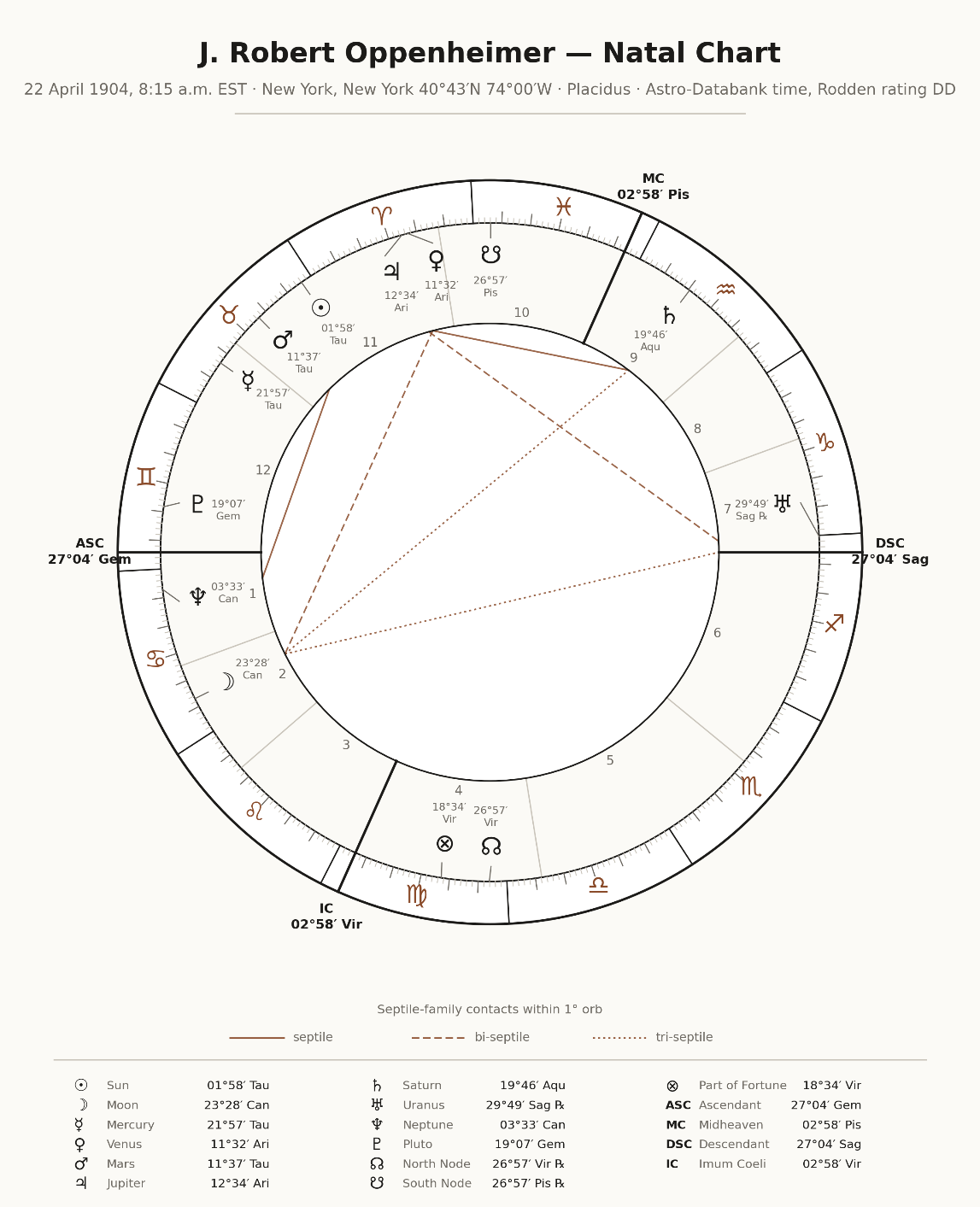
CHART FOR 1983 1023a
Seminar
Sunday, October 23rd, 1983
Verbatim, unedited transcriptClick the series name to view more
SEMINAR at Wisdom's Goldenrod, Hector, NY
with Anthony Damiani (AD)
October 23, 1983-a
ASTROLOGY; HOROSCOPE-OPPENHEIMER
TOPIC: Astrology
SUBJECT: Horoscope-Oppenheimer
SUBSUBJECTS: Septile theory, Oppenheimer natal chart (septiles)
CONTENTS:
The two-symbol problem in the septile — 51°26' reaches two Sabian degrees
Orb dispute — one degree or two; caution against importing orb assumptions from the regular aspects
AS on "naturally septile" degrees
What pleased AD about septile indeterminacy
Plan — three septiles to Oppenheimer's Saturn as three test cases
Aside: Pythagoras, things made of number, execution over irrational numbers
Case 1 (exact, correct symbols) — Venus (Aries 12) septile Saturn (Aquarius 20)
Anima subservient to the senex, which he felt was being informed by the World-Idea; the date left in the car; Davis reading
Case 2 (1° orb, wrong symbol) — Moon (24 Cancer) tri-septile Saturn
Body, speech, and thought subservient to his sense of the World-Idea; a man of his times, tuned to the progress of science
Septile as "fixed belief" — KD presses; belief vs. being a channel; belief in the ideas that constitute you is the driving force
The alternate degree — Cancer 25 and the question of power
Napoleon as man of destiny/power vs. Oppenheimer as instrument of the World-Idea
Cancer 23 ruled out; two birth times in circulation for the chart; the tri-septile as his capacity to organize Los Alamos
Case 3 (rejected) — Jupiter (Aries 13) septile Saturn
The arithmetic — 52°49' instead of 51°26'; degrees not naturally septile
AS on the overlapping, interpenetrating mapping of septile degrees; AD: this is where things are not fixed
Interpretation attempts
AD's test — were it a septile he would not have felt guilty, would not have said "We have sinned"
Is there such a thing as an inexact septile?
AD: numbers determine reality — either conjoined or not, no in-between
Where the indeterminacy lies; verdict — not a septile
JA's reading and the double view — reassigned to Uranus-Neptune opposition
AD on method: A means A; one sentence at a time, since a run-on brings in the whole chart
Jupiter bi-septile Uranus, and Saturn–Uranus
Pairing the planets — hold Uranus, test Saturn
Uranus, Sagittarius 30 — the Pope; moral authority, not the physicist; the thrust toward international control of atomic energy
Neptune (Cancer 4) in the first house — indefinite facets of the "I am"; the opposition as spiritual crisis
Why Saturn–Uranus cannot be a septile — he could not have proceeded
The same Uranus that sanctioned Jupiter's work later condemned it as conditions changed; Saturn registered the danger as part of the changing World-Idea, but the condemning voice was Uranus
AS's proposal — did Uranus retrograde into septile with Saturn?; if so, Saturn becomes the reflective consciousness enunciating the Uranus knowledge
AD: the dossier is fixed but life changes — that fixity is imaginary
Uranus-Neptune opposition — the "I am" is a meaningless ambiguity until ethically defined; Uranus forced the actualization of his morality
Ephemeris check — progressed Uranus back into Sagittarius 29 (1936); progressed Saturn to Aquarius 21 at twenty, to 22 in 1958; by progression each reached a degree septile to the other's natal degree; AS's claim of exact progressed septile in 1944 retracted
The perennial problem of misattribution — right observation, wrong aspect
Two reasons for working with exact aspects: don't assume regular-aspects orbs carry over — that's the open question; timing is of the quintessence — events happen at a moment, not across a span
Next chart (Fermi); AS's closing diagram
BOOKS READ FROM OR REFERENCED:
Marc Edmund Jones, The Astrology of Concepts
Marc Edmund Jones, The Sabian Symbols in Astrology
Nuel Pharr Davis, Lawrence and Oppenheimer
J. Robert Oppenheimer, The Open Mind
J. Robert Oppenheimer, Science and the Common Understanding
Leopold von Ranke, The History of the Popes
SABIAN SYMBOLS: Aries 11, 12, 13, Gemini 20, Cancer 4, 23, 24, 25, Sagittarius 30, Aquarius 20, 21, 22
CHART appended to this transcript:
- FIGURE 1983 1023a-1. J. Robert Oppenheimer Natal Chart.
Other diagrams also referred to are not with this transcript version. [Transcriber note: [diagram] means the speaker is referencing a diagram as he or she is speaking. If someone is drawing or writing, with audible sounds of chalk on a blackboard, I indicate this by [drawing] or [writing].]
NOTES:
This is 1983 10/23a, Astrology; Horoscope-Oppenheimer seminar, the first of two entries associated with this date. 1983 10/23b = PB Paras class, for which we have no audio, just AB notes.
This seminar took place on a Sunday.
TRANSCRIBED Verbatim by IT 2026. Archival verbatim transcript – V11a.
AUDIO FILES: 1983 1023a, 1983 1023b. [Note 1: "Tape" and "Side" refer to original audio cassette tapes that were later digitized into .MP3 Audio Files. Note 2: Sound quality is mediocre throughout, more so on file a. Note 3: File 1983 1023b was digitized with its sides in reverse order (2, 1); corrected by REP Studio in 2024.]
1983 10/23a SEMINAR at Wisdom's Goldenrod
Astrology; Horoscope-Oppenheimer
[Audio File 1983 1023a Begins]
RG: Go ahead.
CDA: Does it-- doesn't that (like) the same seem to imply that the ideas are fixed in that realm, you know?
RG: But that's true of any ideas when they're aspected, that they're fixed together in that way.
CDA (simultaneously): But-- then in essence, is it right for us to conceive of the ideas as being these fixed degrees?
S (faint): Let's leave it there.
CDA: Does it-- isn't that question implied almost?
AD: I don't know what the question--
CDA: Is-- is the same [couple words inaudible] as before.
RG: Well that's a different ques-- One is what is the essence of a degree, and one is if you combine degrees in a certain way, do they have to be the same degrees in aspect.
S: Yeah.
TS: Well the cor-- and the corollary to the thing is if it's in-- if it's in one degree aspect and it doesn't work 'cause it's not in the right Sabian symbol, what does it mean that [couple inaudible AD words simultaneous with TS] it-- well, that there are two degrees, two Sabian symbols on either end of the septile which do work? In other words--
RG (simultaneously): What do you mean?
TS: What?
RG: What do you mean?
TS: Well it-- because it's 51°26', [RG: Right.] if it's--
S: There's two different--
RG: Right, there are two different-- yeah, yeah.
TS (simultaneously): It can be from 0 Aries to 21 Tauru-- 21-- yeah, [AD simultaneously: Good, that's right.] Taurus, 20-- whatever it is, 51°26'-- 21 Taurus, or 0 Aries to 22 Taurus, and vice versa, it can be from 21 Taurus to 0 Aries or 30 Pisces.
AD (faint): Yeah.
LR: But (we) [TS simultaneously: So the--] (haven't) brought that out.
AD: But they should work, they should work though, shouldn't they, because we have the-- the number is exact.
RG: Yeah, (uh-hm).
TS (simultaneously): Well the number--
AD/S(?): Yeah.
RG: It seems the septile of all of them should allow for degrees of difference and degrees of freedom.
AD (simultaneously): They could be on different sym-- symbols, alright, [RG simultaneously: And work.] but it should work if it's a septile.
RG: Yeah.
AD: You know, 51°26' [RG simultaneously: Right and--] should work.
RG: Yeah, I mean I think it works up to a two-degree orb, I mean I-- I-- I mean empirically I think septi-- you see a lot of septiles that work in a two-degree orb, don't you, Tim?
AD: Well, we have to be careful not to bring over, you know, from the regular aspects the implications that the other [student assents] aspect will work.
S (simultaneously): That it will work, yeah.
RG: I don't--
LR: If it's a septile?
AD: It may, it may not.
RG: Or what?
AD: But we have to-- [S: Can be a sextile.] we have to avoid that [one word inaudible]
RG (simultaneously): An 8 degree sextile. And what if it's below, it can't be if it's on negati-- on the lower end.
LR: Well, would you be able to distinguish a sextile from a septile?
RG: My Pluto Saturn is two degrees on the lower end of a septile. It can't be a sextile.
TS: It's a six degree s-- semi-square.
RG: Right. (TS laughs a bit)
TS: I mean I could go--
LR (simultaneously): Well I just-- I don't [RG simultaneously: No, I'm saying, I'm saying I just think--] know if I can, you know, so I--
RG: Yeah I-- yeah.
LR: I can't clearly ever know if it's a two-degree [RG simultaneously: I just think--] septile [couple/three words inaudible]
AS (simultaneously): I would compromise in between the two and say that-- I would consider a one-degree operative theoretically if the degrees that they're actually on are degrees some part of which are septile to each other. In other words, two planets may be within a degree of orb septile. [student assents, faint] But, you can take 51°26' from either one and it won't reach. And yet they are on degrees some part of which is septile. I'm not-- I'm not explaining this very well. But, I would have to draw a little picture. But I-- In other words, you may have a planet that say if it were-- if it were just a few more minutes into the degree, [S, very faint: Oh I see.] if it were just a few more mi--
TS: Hm.
AS: (May be important.) But I had-- I've thought it out once before but--
AD: You thought it out once before?
S (simultaneously): Now you're [couple words inaudible]
AS: I guess. (AS and another student laugh)
AD: Well it should be [AS simultaneously: But I still--] easier the second time.
S: What do you suggest?
AS: No I-- I--
LR (simultaneously): But, now we did have that discussion the first time about orbs. The thing that you seemed so pleased about was that septiles did refer to an indeterminacy in the World-Idea. Remember, we've been talking about that?
AD (simultaneously): Yeah, but that's in reference-- if it's a--
LR (simultaneously): One or the other degree.
AD: Yeah.
LR: Right.
AD: But 51°26'--
LR: Could be two--
AD: -- dif-- yeah, could be two different degrees, [LR: Right.] alright. But that's alright.
LR (simultaneously): Now what pleased you so much about that?
AD: Because it could be either.
LR: Yeah.
AD: In other words, like Tim just pointed out, could be at 1 degree Aries and, oh (on that) 21°26' Taurus, or it could be 21°26' Taurus and still be into the--
TS (simultaneously): 30 Pisces.
AD: 30 Pisces.
LR: Right. And you like that because--
AD (simultaneously): Oh yeah, I like that.
LR: Well, just elaborate why because that's what I want to know.
AD (simultaneously): Well that's-- this way the astrologer has an out. (AD laughs bit)
S: Oh.
CDA: But you know, [TS simultaneously: Everyone.] I don't get it.
LR: No that's not why you liked it. [S: Yeah.] You liked it for some other reason, you liked it because it didn't claim the World-Idea to be so fixed and determinate.
AD (simultaneously): It's not [one word inaudible]
LR: That the World-Idea could be combi-- that two ideas could be combined in-- that the World-Idea could be combined in this variety of ways.
AD: Well not so much the World-Idea but our thinking about the World-Idea.
LR: Say more, can you just say more a little?
AD: Well let's get working and I-- [LR: Oh sorry.] I can't start working yet, you know. [couple words inaudible]
LR (simultaneously): And how do I do that? How do we get working?
[Note: See FIGURE 1983 1023a-1 (Oppenheimer Natal Chart) for all references to Oppenheimer's chart throughout.]
AD: Well, we'll pick on one of these here and we'll see if we could--
LR: Try another [one word inaudible]
AD: I don't know if we have enough [LR simultaneously: We know the man well enough?] know-how, you know, on Oppenheimer [student assents, faint] but we could-- we could start.
[few seconds of background student talking; possibly couple words from AD, "I'm leaving"; background student talking continues for a few seconds as class continues]
AS: Yeah you could. Give me one that's [TS simultaneously: Ok.] by degree but not by-- by orb but not by degree.
TS: I just did up there, ok.
AS: That's the one (did he not say), Tim, was the Moon Venus one?
TS: Yeah, the Moon Venus is not-- is in one degree, it's-- Moon Venus are 0 degrees 56 minutes apart and they're not on the right [AS assents] Sabian symbol.
AS: Ok.
LR: Which one?
TS (simultaneously): Ok? Moon Venus. We've already done two of them so we should probably-- well let's see. Venus has a-- has a septile to Saturn which is one degree and is in the right Sabian symbol, ok, Venus and-- where [couple words inaudible] Venus in Aries in the eleventh house is septile to Saturn in the ninth, [AD, faint: Yeah.] yeah, so that's exact, that's-- there's no way we can't get around that one, ok.
LR (simultaneously): We did that one.
TS: Yeah I know.
LR: Oh. (TS laughs a bit)
TS: You mean we've said something about it before.
LR: Yeah, no, I thought you were bringing up a new one, I'm sorry.
TS (simultaneously): No, no. And that-- I'm just picking on that one because the Venus-- Well let's see. Better yet, let's do this one.
AS: And here's [one//two words inaudible]
TS (simultaneously): Moon-- Ok. Let me [AS simultaneously: You don't want to do this one?] just do some. The Moon-- no-- the Moon se-- Venus septile Saturn is one degree in the right Sabian symbol. Moon tri-septile Saturn is one degree not in the right Sabian symbol. Jupiter septile Saturn is two degrees not on the right Sabian symbol. So we got a-- and three septiles to Saturn which all three-- which fit the three cases. So--
AD (simultaneously): Which fit the--
TS: Three cases, that is-- that isn't a-- an example of something which is in the right deg-- one degree of orb and in the right Sabian symbol, something which is in one degree of orb and not in one of the two acceptable Sabian symbols but still in the sa--
AD (simultaneously): But still-- still 51.
TS: That can happen.
AD: Uh-hm.
TS: Ok.
AS: Yeah. Yeah l-- let me-- but I can draw a picture of the one with the Venus Moon.
S (faint): How can (you draw)?
AS: It's real simple. [drawing/writing] Here's-- here's 11 degrees and here's 12. And here's Venus is at 11°33' Aries, [AD assents, faint] ok, and here is the Moon. The Moon is at 23°29' Cancer, the Moon, ok. Now if you take 102 degrees 52 minutes exact septile from the Moon, you will get unfortunately a little past, [drawing] you'll end up some place in 24 plus.
AD: Again.
AS: Ok, let me-- This is [AD simultaneously: Well just--] where the planets actually are. If you add 102 degrees and 52 minutes, you add an exact bi-septile, you actually-- from Venus, you'll actually end up not at 24 but at 25 degrees, one degree past it by Sabian. Now if you take an exact septile backwards from the Moon, you actually end up here, some place before the 12th degree, ok. But-- so these two are less-- the-- yet they're less than one degree by orb. But, I claim it's still exact in the sense this. There are places in the 12th degree which are n-- which are naturally bi-septile [students assent] to the 24th degree. That's what I was trying to say, I couldn't say it. [AD: Yeah.] The picture shows it clear. In other words, if I take something [drawing/writing] at 11°01' and add 102°52', I will get to 23°53', which is part of this degree. So this degree, the 24th degree, is naturally septile to the 12th degree in the sky, even though these two planets where they sit don't happen to be exactly by that. So I'm saying, espec-- at least in that case it seems there that they can be septile 'cause the degrees are.
AD: So we have [student assents] to keep that in mind then.
AS: It's-- it's kind of tricky.
TS: So that means that [student assents, faint] if-- those which are in one degree but not on the same symbol.
AS: They still can be on degrees which are naturally septile.
TS: Is there ever the case where they-- that can't be?
AS: Yeah. But I want to show you a picture.
TS (simultaneously): It should be at the last eight minutes.
AS: Yes, it's the l-- it's if-- if they happen to be on the last eight minutes and the first eight minutes, then [LR simultaneously: Those degrees are not septile.] this doesn't happen. They can still be less than-- they can be less than a degree by orb and not on correct Sabian symbols [LR simultaneously: So what does that--] but is never naturally septile. (bit of laughter) All you have to look-- I mean those are-- that's [AD, faint: Yeah.] the extreme case. I don't know.
AD (simultaneously): This-- yeah this is why [AS simultaneously: I'm just saying it's complicated.] I'm interested.
TS: Why you gotta follow it.
AS: It's complicated.
S (faint): Yeah.
LR: You know, Anthony, I--
TS: (Fall) schedule too.
LR (faint): [few words inaudible]
AD: (Well/No), Pythagoras said the universe is made-- things are made of number so you gotta keep that in mind.
AS: And here you're like getting down to really very minute [LR simultaneously: Can I--] distinctions. I'm not-- I didn't say that-- I mean I don't know, they may not be right.
LR: No I--
AD (simultaneously): You know what they did to one of their members who revealed irrational numbers? They executed him.
S: Uh-huh.
S: They--
TS: The kindest thing they could do.
CDA: [couple words inaudible] irrational.
LR (simultaneously): I don't really see what these--
AD (simultaneously): What I-- what I think it really amounts to is they-- that he was giving the secret away once he wrote them up, not that they didn't like him.
AS (simultaneously): It's ok.
AD: Not that they didn't like him.
AS: No, they didn't, they-- It was just too esoteric.
LR: In order to get this, to compare some of those, I really don't think we can do it except with somebody who we know extremely intimately, such as yourself.
AD (faint): [couple/three words inaudible]
LR: Well we don't know Oppenheimer any better. (CDA laughs) No really, I mean--
RG: Wait, wait, well we might-- we delineated my septiles, the only one that works this way is the Jupiter Saturn, we have to throw out the Mercury Saturn and the Pluto Saturn. There's only one exact by symbol, the bi-- tri-septile.
AD: But is it still within the range of the septile?
RG: Only this one, the others are two degrees. I mean--
LR: Orb, you're just talking about the orb?
RG: Yeah.
LR: You're not talking about the--
S (faint): Why?
RG: One is exact by symbol and one degree.
LR: And the rest are two-degree orb.
RG (simultaneously): The other two are two-degree and don't go to the symbol.
AD: We don't-- we don't have to throw anything out yet.
S (faint): No.
RG: No, no, I'm just-- that's fine, I mean but, it would be nice to unders-- you know-- I still don't see why you wouldn't allow a two-degree orb. It may not have the same efficacy.
AD (simultaneously): Well just as a caution against the notion, you know, three, six, four degree orb, [student assents] the natal chart, you know, influence-- [few inaudible RG words simultaneous with AD] In other words, we're so influenced, and our mind is so rooted in this notion that there could be, you know, three degree orb, four degree orb, that I'm going to the other extreme and saying no, I'm not going to allow that, and then see what happens. [AS: There's a trine.] I don't have to hold on to any dogma [few words inaudible] you know. [short pause] So let's try one.
LR: So which one are you doing, Tim?
TS: Try one, try one. Which flavor? You know, you want to look at one that doesn't exist?
AD: Well I like chocolate.
S (very faint): (Yeah me/I do) too.
TS: One that doesn't exist or one that does exist?
S (faint): Uh-hm.
AD (faint): Start again.
[AS and RG talking in background, continues for few seconds as class continues]
TS: Ok, well-- Maybe we could do those three to Saturn and see if they progressively shift in any way.
RG: Yeah.
TS: Ok? No?
AD (faint): Sure.
TS: Well no, would it be (in Oppenheimer)?
AD: Yeah. Let's do it.
RG/AS(?): That'd be these three on that?
AD (simultaneously): I think-- I think [TS simultaneously: But--] Avery maybe if you'll repeat the explanation once more for all of us?
AS: Ok, well this-- I'm not-- this is just mathematical (equation).
AD: Now unless you got eyes behind your head, you better turn around.
AS: Yeah. Or picture--
LR (simultaneously): Or maybe-- Kathleen, could you just [KD simultaneously: Yeah (right).] go back that way a little, we can go right here.
KD (simultaneously): Yeah (we can), yeah.
TS: Just take your head off for a few minutes.
LR: Screw it back on in a minute.
AS: Well here-- I just use this example to illustrate how this can happen. He has Venus at 11°33' Aries. 11°33' Aries, the bi-septile to that happens to be at 24-- about 24°30' [AD assents] of Cancer. So it's not 24th degree. And he has the Moon at-- you know, (24) [couple words inaudible] [AD, faint: Yeah, that (one).] He has the Moon at 23°29' of Cancer, ok, and the exact place that's bi-septile to that is back here [writing] at something like 10-- I don't know, 10°40' of Aries. Ok, so they're within one degree-- they are within one degree of being bi-septile. But if you go exactly back by bi-septile you don't get to 12 Aries and if you go exactly forward through Venus you don't get to 24 Cancer. [student assents, faint] But, the degrees that the Moon and Venus are on, the Sabian symbols they are on, 12 degrees Aries and 24 Cancer, are naturally bi-septile because there are places within this twelfth degree that are exactly 102 degrees 52 minutes to the-- the 24th degree. In other words, if I take places within-- [drawing] within this very degree, there are bi-septiles to both the 24th and the 25th degree.
LR: And that's--
AS: So, 24 is one of the two degrees that is naturally septile (to 12).
LR (simultaneously): Right. And our Sabian is-- 'cause the way we use Sabian astrology is to round up the degrees. [AS: Yeah.] Like we don't have a different symbol for every minute. [AD assents, faint] We have them for rounded up degrees and those degrees-- so that's what we-- we look at the Moon we say it's at 24 Cancer, not 23°29' or so.
AS: Right, and I'm just claiming that the 24th degree of [LR simultaneously: Is--] Cancer is [LR: Right.] bi-septile [student assents] to the 12th degree of Aries.
RG: Uh-hm.
AS: Ok, in-- in the sense that we do-- that we talk about degrees.
JA: Maybe you already said this before but, would that work, in other words if the-- the planets weren't at that, you know, septile, that maybe the last-- they could be in degrees that are not septile too.
AS: No, if they're in degrees that are septile they would always be within one or two degrees.
RG: They'll be within two but not necessarily within one.
AS (simultaneously): Yeah, within one or two. [RG simultaneously: It'll never put--] They don't have to be within one. In other words, you cou-- you can get--
JA: Did you s-- I don't know. I'm not sure if you understood what (I'm) saying.
AS: Yeah, I mean-- and I think I did and I answered it.
JA (faint): Well--
AS: I thought I understood what you said.
LR: Well try again, Jeanne.
AS (simultaneously): And I answered what I thought you said. They can not-- no, no, not-- no, not yes. I'll just try and say it again. [S: The significance.] Planets can be--
AD (simultaneously): What's this abouts?
RG: [one/two words inaudible]
AS (simultaneously): --one or two degree orb. They can be septile by one or two degrees orb, be on the degree-- Sabian degrees that are exactly septile. They can't be on Sabian degrees that are exactly septile and be more than [one/two words inaudible] They're not on the septile now.
S (faint): Uh-hm.
[CDA laughing; LR lights a cigarette]
TS (to LR): You'll need it.
RG: You're smoking now, Linda?
LR (faint): Yeah. (RG laughs a bit)
S: [one word inaudible]
AD (simultaneously, faint): So anyway, we take-- if we take one of them, let's take one.
TS: Ok. [short pause] And--
LR: Now we're taking one which--
S (faint): Venus.
TS: Works.
LR: Which works and is in what orb?
TS: One degree se-- Venus Saturn. If that doesn't work, none of them do.
LR (simultaneously): Oh. We're taking one you've already done? I thought we were going to try one we hadn't done to see [one/two words inaudible]
S (simultaneously): We're doing some (already) have done.
LR: Venus Saturn is the first one we did, that was definitely--
[short pause]
TS: I thought it would be good if we started with the one we already we did [LR: Oh ok.] that works, [LR: Oh ok.] then do one that is questionable, the Moon Saturn, and then one which is total-- even further questionable which is the Jupiter Saturn.
LR: Ok.
AS: But-- by the way that one, Tim, the Moon Saturn one, that one also, those two degrees that the Moon and Saturn are on are also-- [AD: Uh-hm.] those Sabian degrees are not-- are tri-septile.
TS (simultaneously): Yeah, I know. Ok, so that really fits in a--
AS (simultaneously): [couple/three words inaudible] degrees are too. In fact my conjecture is, and I haven't figured out mathematically, but I'm pretty sure that any two planets which are within one degree of orb of each other must be on degrees which are naturally septile.
S (faint): (Say it again.)
S: Why?
AS: I'm pretty sure. And I-- I didn't--
LR: Say it again, Avery.
S: I still--
AS: I'm not convinced yet but I think that's so. [S, faint: Oh yeah.] If any two planets are within one degree of orb, they must-- if any two planets are within one degree of orb of exact septile, bi-septile, or tri-septile, they must be on degrees, Sabian degrees, which are naturally (by) septile. With two degrees of orb they may or may not be on degrees which are naturally septile, bi-septile, but they can be. But [TS simultaneously: Yeah I didn't check these when (few words inaudible)] for one degree I think they-- I think they must be, Tim. I'm pretty sure.
CDA (simultaneously): And what about those eight minutes you leave out [few words inaudible]
AS (simultaneously): That-- no, that's ok because you got-- I-- it's because-- because remember, every degree is septile to two different degrees, so you actually have two whole-- you [CDA simultaneously, faint: Ok.] have 120 minutes of latitude. And 120 minutes, even at the worst case which is the 52 minute one, [RG assents] that's the 102°52', if you add one whole degree to that, that's still only 1 degree and 52 minutes, that's still less than two degrees so, I-- I didn't feel this. But I think-- I think we-- that if it's one degree orb must be on the degree, ok?
S (faint): That's the [couple words inaudible]
S: Avery--
[12 second pause]
AS: Oh.
TS: No.
AS: That doesn't make-- (Close enough.) Well let's just work with [couple words inaudible]
TS (simultaneously): Ok.
LR: Let's do something!
AS: Yeah, do something.
AD: Oh we're doing something, we're doing something.
AS (faint): Unless you had some sort of [one word inaudible]
TS: No, we could start-- it is the worst case is the bi-septile that won't work, the other two will.
AS: Yeah.
LR: You mean you could do it within one--
AS (simultaneously): You're right, it's more than ha-- it's more than thirty [one word inaudible]
LR (simultaneously): It could be within one degree and not be the same symbol?
AS (simultaneously): Yes. Not be the right symbol.
TS: But that would only be true for the bi-septile. 'Cause the other one would fall-- it's 26 if he falls in the middle.
RG: Uh-hm. Right.
AS: [couple words inaudible]
S: To which one?
S: What degree?
S (very faint, possibly part of background): Yeah.
[few seconds of background student and AD talking, mostly audible]
TS: So Venus is 12 Aries.
LR: Geese flying. That's ok.
TS: Wild geese flying.
LR: Which one is the one that we're concerned with?
TS: Venus Saturn.
LR: Venus Saturn, exact right symbol, right orb.
TS (simultaneously): Yes.
LR: Everything's right about it.
S (faint): (Uh-hm.) Ok.
S: Yeah.
LR: Ok.
Marc Edmund Jones [The Astrology of Concepts, Aries 12, TS reading]: "A flock of wild geese is seen in flight overhead."
Marc Edmund Jones [The Sabian Symbols in Astrology, Aries 12, TS reading]: "…a symbol of the irresistible aspiration and indomitable desire for freedom which represent the real core of personality, and…"
AD: That's his version.
TS: Uh-oh, this is gonna--
LR: That's not what's at the real core of personality.
TS: Pardon? (CDA laughs)
AS (faint): [few words inaudible]
TS (simultaneously): Oh.
AD: No, you'll be surprised that some of what he's calling freedom is--
[short pause]
TS: Motorized vasanas?
AD: How free was Ramana, he-- that had to stay 45 years next to a mountain he couldn't leave? [short pause] Alright, let's go on.
LR: Maybe he liked it there.
[few seconds of background student talking]
AD: There's many kinds of self-torture, that was one of them. (bit of laughter)
[short pause]
TS: At least he had a mountain.
AD: Yeah but they kept taking it away from him rock by rock, pebble by pebble. (AD laughing) I mean we got a couple pieces in the cottage! (AD laughing)
S: I got one (for you). (bit more laughter)
S (very faint whisper in background): [few words inaudible]
AD: Which one?
S (very faint whisper): [couple words inaudible]
AS: What?
AD (faint): Alright. Yeah. [short pause] 2:22. This is for here?
CDA: This is Kozminsky.
AD: Oh, oh, which one did Tim do?
CDA (simultaneously, faint): Here there's "A flock of wild geese is seen in flight overhead."
AD: Oh.
S: (Oh.)
AS: Well that was an interesting seminar. (AS laughs)
CDA: What's the matter?
AS: That the note says my cat just died.
[12¾ second pause with some faint background student talking]
AD: Can't do anything about it.
AS: No, no, but Janna's upset, but Janna's upset, Carrie's upset, that's-- (AS laughs a bit)
AD: Oh.
AS (faint): But not the cat.
AD: Alright. (bit of laughter)
S (very faint): Cats are elusive.
S: Yeah.
S (very faint): She went to cat heaven.
AD: She went to cat heaven.
[14¼ second pause with some faint background student talking]
TS: Oh yeah.
S (faint): Yeah.
S: Yeah.
[13 second pause]
RG(?): Yeah.
LR: Freedom was found in trusting to the intellect.
TS: Right.
RG: Which one are we doing?
TS: Venus Saturn.
LR: Venus Saturn. Felt freedom was found in giving itself to the intellect.
TS: Large white [LR simultaneously: What's wrong with that?] dove is the Saturn. [Note: Aquarius 20, "A large white dove circles about and about overhead and then descends and proves to be a carrier with a message."]
RG: We did that already.
TS: I know we did it.
RG: Oh ok. Right.
TS: I just thought we'd take a running start at the ones [RG simultaneously: Ok.] we haven't done. That's it.
[10½ second pause]
LR: I mean, that should be very obvious if he took a woman out, supposed to be the anima functioning, and he got so absorbed in the physics problem that he walked all the way back to the lab and left her in the car up on the mountain.
S: Weird. (student laughs)
LR: You know, what was the Venus-- I mean-- (bit of laughter)
S: Right.
S: Right.
S (very faint): Uh-hm.
LR: Right?
S (very faint): [one/two words inaudible]
S: Did he ever remember or she just [one word inaudible] broke down and--
LR (simultaneously): She remembered, I don't know--
TS: I'll bet she did. (TS laughs)
LR: The Venus was toeing another line. [short pause] Rapt absorption in the Saturn. That one seems fairly-- is that elusive one for you, Anthony?
[46¼ second pause]
TS: [couple words inaudible] yeah.
LR: Should we rework that one?
AD: Should we rework it?
LR: Yeah.
AD: Yeah, sure.
TS: Well, say the Venus is this flock of geese. I don't know, the way I was trying to-- well, one thing I-- I sensed in this was that, say the Saturn in the ninth house is this message bearer, a large white dove, and the Venus is this flock of wild geese, he says in here--
Marc Edmund Jones [The Sabian Symbols in Astrology, Aries 12, TS reading]: "Here there are [TS reads: Here are the] vagaries of immediate caprice to the point of irresponsibility, but through them is the undeviating course characteristic of the migratory fowl and so a promise of obligations to be met and ideals to be realized."
TS: Now, what my feeling was is that, as this one fellow says in there, that if Oppenheimer had been a little more wise and a little less clever, he might have deliberated more in undertaking the project at Los Alamos, but that his mind was very quick but given to the im-- the kind of-- the purely abstract or the more theoretical enjoyment of the problems, even if they were true empirical problems. And I thought that in this degree, that by-- by putting these two degrees together, that his anima was so organized that although he was more clever in the sense that he just tried to manipulate these concepts, that the general force of that unconsciousness, like the geese migrating in one direction, was gonna tend to allow him-- tend to make him preoccupied with the right problems at the right time. So his-- the concepts that caught his fancy would tend to build in a very specific direction which would be the material in which that message could-- could be born, the message being [one/two words inaudible]
CDA (simultaneously, faint): And the septile being unconscious process here.
TS: Well, it's an innate process.
CDA: Irrational process.
TS: Yeah, it's a given process, you know, he wasn't, you know, reflectively-- necessarily reflectively aware of himself through this process.
CDA: It almost seems that reflection in the symbol would be--
S (faint): You're not sensitive.
TS: Or that the Venus symbol-- Yeah, it's a funny-- it's a-- it's a very high-flying intellect but it's not really reflectively aware of its flight.
S (very faint): Uh-hm.
LR: Wait a minute. Venus is a high-flying intellect?
TS: Venus Saturn. Putting-- putting his Saturn on (there/it) would be the tendency towards abstraction or distancing himself that's in the Venus as applied to the Saturn in the ninth house.
LR: You're saying it's not reflective because of the symbols.
TS: Uh-hm.
LR: It's [couple inaudible TS words simultaneous with LR] more intuitive, in other words.
TS: Yeah.
LR (simultaneously): So it's just operating with-- [CDA: Yeah.] with intuition that's--
CDA: I think of intuition as the psychological function but not intuition as the true-- true capacity to reach all the way [couple words inaudible] Intuition is simply that the migratory birds are-- they-- they know where they're going and so it's not a reflective thing but they know that they know that they're-- where they're going, it's given in the make-up of their brain structure or-- to go in this direction and not that--
[tape break]
LR: [few words inaudible]
S (faint): Ok.
[15 second pause]
[tape break]
LR: That's why he would get very impatient with people who didn't grasp it as quickly because he wasn't aware of the processes it took to grasp the idea. [CDA, faint: (Ok.)] He simply grasped it. It was a very far-reaching overview that he would [LR snapping fingers] constantly get like that and-- but the logical processes were not what he was seeing. As opposed to someone like Fermi who would see the thing and tell you every step leading up to that conclusion. Oppenheimer didn't have that kind of mind, he had a-- an instant grasp of the problems.
JA: Are we-- are you speaking of this septile in terms of mind or intellectual grasp because it's a septile, I mean--
LR (simultaneously): Uh-uh.
JA: I mean it's a Venus Saturn combination of course.
LR (simultaneously): No, yeah, I was just coming off the-- the degrees again. I wasn't even talking about the septile part.
JA (simultaneously): Yeah but-- I mean, it may be legitimate but-- but it-- you know, it's-- it's gotta be more specified that he-- that [LR simultaneously: Right, but--] you can speak of the Venus Saturn combination in that way.
LR: Oh, I wasn't talking about Venus Saturn, I was talking about Venus on that degree, Saturn on that degree, in-- and seeing them together. And if I were to say then that is a septile, I would say that that was built in.
S: That what?
JA: It just seems that you were speaking in terms of his thinking in-- thinking in this way. I don't know if I understand.
LR: That his thinking was that way?
JA: Well, his grasp of the-- means you're speaking in terms of his intellectual function, thinking [couple words inaudible]
LR (simultaneously): Not just his intellectual function. Well, depends what you call intellect there.
JA: Well--
S: [one/two words inaudible]
LR: You know, I-- his mind. I mean it's all-- all these things are functions of the mind, so--
JA (simultaneously): Ok. But--
LR: His mind was predisposed to operate that way. In the Saturn, where he says--
Marc Edmund Jones [The Sabian Symbols in Astrology, Aquarius 20, LR reading]: "…facility for ordering all personal desires in a cosmic framework…"
LR: Um-- [short pause] There i-- there's a certain-- [9½ second pause] there's a certain ability or tendency towards abstraction it seems. And then if I add that to the Venus symbol, the geese in flight, the overview seems to come out as being very [one word inaudible] that his mind would just grasp these abstractions, these overviews, get right to the-- to the idea.
JA: Yeah but see I would-- I would want to just keep the Venus more as his values and not, you know, the [few words inaudible]
RG: I know, I had a problem too when you discussed the septile, septile--
LR (simultaneously): You didn't see the Venus, is that the problem?
RG (simultaneously): I hadn't yet seen the Venus, but--
AD (simultaneously): The subservience of the anima function [RG simultaneously: To the Saturn.] to the self-reflective [LR simultaneously: To the Saturn.] [RG assents] function which he thought was being informed by something within himself.
RG: So any planet on that degree you'd say gives itself up to some transcendent image.
AD: Well, it seems that the (writing is) here, it seems that it was capable of being subservient. The septile is this notion of a fixed view.
RG: And the subservience you get from the Venus, the Venus symbol, that it had an-- this ability to abstract itself, that it's on the geese degree?
AD: Well-- abstract itself?
LR: To receive [AS(?) simultaneously: No to--] its direction.
AD: To surrender to the higher value that the Saturn--
LR: The cosmic framework [one/two words inaudible]
CDA: Yeah but he's asking where do you see the surrender and where do you see the-- the other symbol?
LR: Well if you take a septile, you're fu-- you're bonding those two planets, [RG simultaneously: Right, but why are you bonding it--] so that they're not oper-- operating separately. So, we should be able to formulate it the Venus to the Saturn or the Saturn to the Venus as well.
RG (simultaneously): Yeah but you've got-- right, we've only heard this-- have given Venus to the Saturn.
LR (simultaneously): Well I don't think so. Because I think if you-- if you take the Venus as the anima function, and I would say that would be what-- what the psych-- the psyche goes out to grasp, ok, [RG assents] that that's the anima function even in just the Venus symbol [RG assents] is transcendent, [one/two inaudible RG words] is trying to transcend, the attempt of-- the freedom to-- the desire to transcend-- to fly, to go on these flights of fancy.
RG: Uh-hm. Right.
LR (simultaneously): So, I think that's just in the Venus.
RG (simultaneously): Right, uh-hm, I agree.
LR (simultaneously): Ok now, if it's bonded to the Saturn, then, you know, there's some definition of where it's directed. But I think it's inherent in the Venus symbol per se that [RG assents] it will do that as well.
AD: He says--
Marc Edmund Jones [The Sabian Symbols in Astrology, Aries 12, AD reading]: "…the degree is a completely naïve independence or an ever-immediate capacity for rising above any given involvement in experience…"
AD: And the same thing above. You want to read?
Marc Edmund Jones [The Sabian Symbols in Astrology, Aries 12, AD reading]: "…through them is the undeviating course characteristic…a promise of obligations to be met and ideals to be realized."
AD: Wouldn't you say that when he left that girl on the-- in the car and he went in, wouldn't you say that, so to speak, that anima function was subservient to the functioning of the Saturn?
S: Yeah.
RG: But as Linda was saying, unless the anima function by itself was already disposed that way from the Venus degree, it was already--
AD: Yeah, but does-- isn't that the point--
Marc Edmund Jones [The Sabian Symbols in Astrology, Aries 12, AD reading]: "…completely naïve independence or an ever-immediate capacity for rising above any given involvement in experience…"
AD: So here he was with this girl and [RG assents] doing whatever, and it was capable of rising above that situation and the anima was capable of being subservient to the intellectual, you know, introspection, let's say that Saturn symbol.
LR: But here in-- because it is a septile, it wasn't like he was conscious of making a choice the way [student assents] it would be of some other aspect, he was [TS simultaneously: No.] predisposed to [student assents, faint] operate that way. You know, [TS simultaneously: He was-- yeah.] so it's-- you don't get the feeling he was up there on the mountain with the date saying, "Should I stay here on the mountain or should I get back to the lab?" you know, it wasn't that kind of-- he wasn't even aware that he had wandered off and gotten back to the lab. He couldn't even remember where he had been. [student assents, very faint] It was like--
RG: Yeah.
JA: She must have been kind of lonely anyway.
LR: Yeah, she must've been. (LR laughs)
TS: But I think that same thing is reflected in the instant where he first showed up in Berkeley. It's just a-- it's something which is not even a reflective process but just in-- built into him, he says--
LR: You mean about the car?
TS: No you--
[Transcriber note: I am using Nuel Pharr Davis, Lawrence and Oppenheimer (New York: Simon and Schuster, 1968).]
Nuel Pharr Davis [Lawrence and Oppenheimer, p. 24, TS reading]: "His first destination was the California Institute of Technology [at Pasadena. There] he walked through the Bridge Laboratory and stood still in the middle of the busiest workroom. Clerks and mechanics gradually began to take notice of him. He had one arm in a sling and looked as though he had not shaved, bathed, or changed clothes in three days. [TS: Which was true.] 'I am Oppenheimer,' he said when he noticed they were staring.
"A round-faced, [cheerful] little man named Charles Christian Lauritsen [was] bending over [TS adds: an] apparatus…[TS adds: said] 'Oh, are you Oppenheimer?...Then you can help me. Why am I getting the wrong results from this confounded cascade voltage generator I have put together?'"
TS: That there's a-- in other words, these guys just were not exactly in the body, ok. And he showed up with this kind of tendency to-- to immediately be at, you know-- involved with the-- these abstract problems was always there, it was like an ever-present kind of function.
LR: And then later with the Venus Moon, the thing about the body is from the Venus Moon septile, that it-- the Moon, the body-consciousness would get swept away, you know, so he could walk in there. Someone else would say, "Well wait, give me a few minutes, you know, let me wash up" or some-- you know. I can imagine someone saying "I need to go get rest, I haven't eaten for three days." But he probably just got right in there and [TS assents] fixed the thing.
TS: Yeah.
LR: So, that Venus Saturn and Moon Venus, I thought that was quite clear in a way.
TS: Yeah.
[13 second pause]
S: (Let's do it.)
TS: No?
LR: Yeah, let's go.
RG (simultaneously): Yeah. Yeah, yeah. Let's go.
TS: Somebody got Mars transits?
LR: Well, I mean-- we were going to do something we haven't looked at.
TS: Well, we should do the Moon Saturn again 'cause it would keep the same Saturn and bring in the Moon which is now-- [LR assents, faint] it's actually isn't-- how can I do this. The two degrees-- this is that thing Avery was trying to explain. The Moon and Saturn are in degrees which are some part of which degree, each is septile to some part of the other degree. But, they themselves taken by degree and minute are not.
AD: Uh-hm. So let's do it.
TS: Ok.
LR: Ok, so we have the Venus Saturn and we did the Moon Venus but we didn't do the Moon Saturn? Oh we did the Moon Saturn.
TS (simultaneously): No we did, I'm just saying we-- let's hang onto the Saturn [LR assents] because then we'll do the next one which is the worst case, the Jupiter Saturn.
LR (simultaneously): Jupiter Saturn.
TS: See, that's-- I just wanted to hang on to the Saturn.
LR (simultaneously): Ok. What we said about the Moon Venus and the Moon Saturn--
TS: Moon Saturn.
LR: Moon Saturn and Moon Venus. Moon Venus, Moon Saturn. Let's just say it.
S: Go on.
S (faint): Let's go, it's ok.
LR (simultaneously): (Now are we--)
TS: I was trying to hang on to just the Saturn and apply it to something, to each of-- there's a different case for the Saturn.
LR (simultaneously): Right. But when we discuss them, we discussed Moon Venus, Moon Saturn together. [TS: Ok.] So, we could pull out what's the Moon Saturn in there.
TS: Yeah. The Moon is--
Marc Edmund Jones [The Sabian Symbols in Astrology, Cancer 24, TS reading]: "A [TS reads: The] woman and two men on a bit of sunlit land facing south."
TS: And we say the personality confronting the soul. Um-- [1 minute 40¾ second pause] Would you say that this would give him a kind of an inner faith, you know, in organizing his vasanas or organizing his daily experience in such a way that it would accomplish the goals that he intrinsically felt he had to achieve? Let's see if I can say this (better).
AD: Yeah, I think we have to try to say it.
TS: They-- that from the Moon Saturn that there was a--
AD (faint): Well how do you see the Moon? (bit of laughter) Go over it. You know it's tri-septile, right? Tri-septile.
TS: This is a tri-septile.
AD (faint): Tri-septile. What's a tri-septile?
[9¾ second pause]
TS: Well I was applying what you said about it before. The-- I liked what it says here that--
Marc Edmund Jones [The Sabian Symbols in Astrology, Cancer 24, TS reading]: "…a symbol of the soul's necessary decisiveness in the basic allegiances of life…a mediation between [the] competing demands for immediate attention to various transient needs, and for some consistent or over-all goal which will bring an [TS reads: the] individual's efforts [TS reads: effort] [into a] cohesive pattern."
S: Oh.
S: You might go to--
TS: And we said that the Moon is some kind of what? Uh-oh.
LR: Remember that notion of vasanas that constitute you physically, memories, dream, reflections.
TS: Yeah. [short pause] Waking consciousness.
LR: Call that awake.
TS: What?
LR: You call that awake.
TS: Yeah well--
CDA: But, could you see that as the symbol or a demand that he's-- to step back from that organization of vasanas that [one word inaudible]
AD: No, even worse.
CDA: Even worse?
S (faint): Yeah.
CDA: That he was totally immersed in it?
AD: No.
(Side 1 of original cassette tape digitized as 1983 1023a Ends; Side 2 Begins)
CDA: (You would say--)
AD: Physical, the psychical, and the ideational.
CDA: And those three are in the Moon-- the Moon degree [couple/three words inaudible]
AD (simultaneously): Yeah, would you say that the Moon represents [CDA assents] the organization of vasanas?
LR: And the Sat-- [CDA: So--] the Saturn's trying to place everything in a cosmic framework, [AD simultaneously: Yeah, (give me coffee).] that's what the symbol is, so that would include--
CDA (simultaneously): And is that-- includes the hierarchical status, the Saturn, because of that degree that it's on?
AD: No.
CDA: Well it seems like you made-- you made the Venus and the Moon subservient to the Saturn. And I'm asking, is that because of the degree that Saturn is on that you're doing-- that you're putting it--
AD (simultaneously): Well, yeah, I think he points out that in Saturn there's-- all the other desires are brought under its thumb.
LR: And also, if [couple inaudible AD words simultaneous with LR] we interpreted the Moon degree as the personality looking towards the soul, and you put that with Saturn, you're saying that there's-- that the natal-- that the innate vasanas are already looking towards something beyond themselves. I mean that's in the Moon degree also so-- I think we said that about the degree. The natural thing they're looking at is [couple words inaudible]
AD: Let's hear the symbol again.
Marc Edmund Jones [The Sabian Symbols in Astrology, Aquarius 20, AD reading]: "…a facility for ordering all personal desires in a cosmic framework…"
AD: Or let's say according to what he thinks the Idea is.
TS: Oh boy. I finally understood this.
S: (Yeah.)
AD (faint): Well tell us.
RG: Better be good. (RG laughs)
TS: Sorry. [short pause] From the point of view of the end of his life you'd say that this is a person who-- who is at personal actions, his emotional values, and his theoretic processes all had to be held up and against the light of what the-- the effect on the cosmos was, what they con-- what the objective impact is.
AD (simultaneously): Yeah, but limit it to the senex of meaning, the senex, limit it to the senex.
TS: Limit it to the senex.
AD: Whatever he knows of the World-Idea is how he understands [TS simultaneously: Through the senex.] it through the senex archetype. And so the-- if you restrict it that way, alright, you won't get into a metaphysical discussion of whether he was being guided by the World-Idea or not. It's his interpretation of what the World-Idea. So if we think of that Saturn, you know, is like formulated by a reference to the World-Idea, then I think we'd be on the right track. Then the Moon would be subservient to that, that (is), body, you know, speech, and thought would be subservient to that. So, the example that you gave was the-- when he came into that room and stayed there, he was com-- generally, another person, one of those three, would object to being put to work immediately. [TS assents] But, those three were completely subservient to that. And then it seems to make sense. [student assents, faint] Moon [one/two words inaudible] I think very powerful in the chart, Saturn was [student assents] very powerful, rulership.
RG (simultaneously): Yeah, (very) [one word inaudible] yeah, yeah.
LR: Well Venus is also in dignity.
TS: Yeah but so is the Moon, the Moon is--
LR: And the Moon is in rulership.
TS: The Moon's in rulership and the exaltation [one/two words inaudible]
LR (simultaneously): That's interesting, [S simultaneously: Right here too.] that's a whole nother--
TS: Ok. Let's pretend we never heard of him.
LR: I bet it makes a difference though in the psyche.
TS: Yeah, well so far these are all in dignity.
AD: So then could we say that that's what it represented, that tri-septile, body, speech, and thought subservient to the dictates or to the meaning that he found within his own senex archetype?
S: Yeah.
[short pause]
TS: Yeah but that's-- what I was feeling it's-- earlier was that he-- when he first started working at Berkeley, he worked there for a year and he felt that his mind wasn't sharp enough and all that they were offering, he had like twelve offers to teach in different places, he went to Germany, I think to Pauli actually in Zurich. He just said, "I have to go get some more training." So he went to Europe and he re-- you know, 'cause he felt he-- he had his faith in that Saturn, in that senex, that that told him, "Now you've got to go here and--" and it did, they said that that's where he, you know-- his thinking got clarified through that process so, that inner kind of responsiveness to that authority of what it was he had to do next. Then, you know, he pulled his circumstances and his, you know-- the rest of the emotions and his mind to do that. Does that make sense?
AD: Yeah.
[short pause]
TS: Ok, now we'll do one that doesn't exist, um--
KD (simultaneously): Wait a second, why-- why did you-- why did you say it's subservient to the senex archetype rather than the idea that Saturn is on, the white dove, I thought that was the point, two planets (and the Saturn).
AD (simultaneously): Well the idea, the idea-- the Saturn is sitting on a very big idea. Seems to be a degree that indicates some communication with the World-Idea. I mean, what is this dove bringing a message?
KD: Right, that's the connection to the World-Idea.
AD: It's communication of the World-Idea to the individual, and he felt that, alright. And I think if you read the Saturn degree that way I think you'll see that implanted already in this man.
Marc Edmund Jones [The Sabian Symbols in Astrology, Aquarius 20, AD reading]: "A big white dove, a message bearer….symbol of man's recognition of a transcendental [or superior] wisdom…"
AD: The World-Idea.
KD: Yeah.
Marc Edmund Jones [The Sabian Symbols in Astrology, Aquarius 20, AD reading]: "…from which he may always receive [his] inspiration and assurance…"
AD: In other words, this is an example of a man, alright, who's, you know, trying to be in accord with the-- with the times he lives in, the World-Idea. Like for instance PB left India and left that whole atmosphere because he-- he needed to get in touch with the World-Idea which was 1940, it wasn't, you know, 1340. And it was only when he hit the world the way it is that he began to see that modifications of all these ideas had to take place. Basically what I'm saying is, you know, we speak about the World-Idea is commu-- communicated to an individual mind, and some minds are more receptive than others to it. His Saturn was very receptive to the World-Idea which was coming into him, and he felt that he could rely on that and be guided by that.
KD: You see this in the degree, right.
AD: You see that from the Saturn, yeah, the Saturn degree, yeah.
KD (simultaneously): Degree. And I just wondered why you'd [AD simultaneously: Yeah, and if you read it--] call (attention) to the senex archetype.
RG (simultaneously): Because that's the meaning of Saturn.
AD (simultaneously): Well, that's what Saturn means psychologically, senex, the archetype of meaning.
KD: So by saying that he's subservient--
AD: The wise old man.
KD: --to that authority--
AD: Within him.
KD: --just saying that that--
S (very faint): Yeah.
AD: Yeah.
KD: And that authority is identified be-- because it's identified with this-- with the World-Idea [AD: Yeah.] coming in.
AD: He was a man of his times.
KD (simultaneously): [few words inaudible]
AD: He was a man of his times, sure. In spite of the fact that he didn't know the Depression took place, (AD laughs a bit) he was a man of his times, obviously, he was working in physics. The example, he went to-- to Germany or Switzerland to get further informed because Germany at that time was the-- had the tradition of the deepest understanding of physics.
JA: Could you specify that more and say that he was a man [couple/three words inaudible] [student assents] so that he would be always tuned in to the scientific progress and not, you know, that he--
AD: Yeah, you could say that he was very tuned into the progress that was taking place in science and was going to try to be right there with it.
JA: And that would also mean [three words inaudible] interpretation [few words inaudible]
S (faint): Uh-hm.
KD: The fact of it being the septile would be the-- the underlying-- or commitment to that-- to that Saturn that the-- like almost a complete identification with that. And, you called a septile the fixed belief, would it be like an-- an almost unconscious identity, an unconscious commitment to that?
AD (simultaneously): No, over-- over here what was the fixed-- the fixed--
KD (simultaneously): The-- in other words with a septile, that would almost ensure the fact that he would be a channel. Could you say the fact that it's a septile rather than another type of aspect-- (well-- well, yeah--) You know what I mean? When you use the word "fixed belief"--
[short pause]
AD: I lost your question.
KD: Is septile-- the fact that this is a septile aspect with Saturn, these three-- these three that we just talked about, di--
AD (simultaneously): Well we're just speaking about the Moon now and the Saturn, alright, tri-septile.
KD: Yeah, I understand. Ok. What makes-- you called a septile fixed belief. Right? That-- that this guaranteed a-- an underlying belief about reality. Ok so, in that interpretation that we gave of these other functions being subservient to the-- to the Saturn authority, could you say that that fixed belief is-- is like a commitment to that-- to that Saturn function, like an-- like an underlying basic, [AD simultaneously: Well, no, you have to bring in the Moon.] um-- would that be the belief part of it?
AD: You have to bring in the Moon. In order to speak about a septile you gotta bring in two ideas. And-- and then you will be correct, the fixed-- there's a fixity as to how these two ideas are organized. And the consequence of their fixity is such that it delivers the belief that his reality is organized this way and not another way. In what way is it organized? That the totality of the samskaras that constitute this person, alright, the body, speech, and thought, are going to be subservient to the meaning that life has for him. That's the fixed belief. The subservience of body, speech, and thought to the meaning of life, to what life means to him, that's the septile in his particular case. I mean you can't generalize it too much because if you do then you lose [LR simultaneously: You lose the specificity.] the precision [KD: Yeah, right.] that the septile requires.
KD: It seems that that's more like an-- I guess I don't unders-- understand belief, you see, that's exact-- that's a-- a condition that has been created in the psyche so that there will occur this transmission of the World-Idea and I-- I don't see that as a-- as a belief. I see it more as a-- more a reconstitution of his psyche so that he can be a channel rather than an imposition of some kind of belief, that just seems like it's something in his chart.
AD (simultaneously): What's the difference, what's the difference?
KD: I don't understand [few words inaudible]
AD (simultaneously): Whether being considered as a channel or consider it [one/two words inaudible] consider that he has a belief in himself as a channel. What's the difference?
KD: 'Cause you could be wrong.
S: Yeah.
AD: Yes but-- of course, from a point of view of ultimate truth we're all wrong but from the point of view of pragmatic efficacy, the fact remains that a person's belief in these ideas that constitute him is the driving force behind him.
KD: And in this case his-- his psyche was organized in such a way that-- that it-- that that-- that that belief did allow that, I mean, that belief did that--
AD (simultaneously): Did allow him to work that way.
TS: All of those guys were linked, that's a-- that's how (he had--) This is really with that. Venus, Saturn, Jupiter, Uranus square [one word inaudible]
S (faint): Yeah.
AD: Anyway, settle for that?
TS: Oh, oh yeah.
AD: Do you think that that's valid now (or) a septile?
LR: Those are-- those are real [one/two words inaudible]
TS: Yeah. And even, I mean, the degree that Saturn should be the degree in-- if you take the degree and minute that Saturn is on and you add a tri-septile to it, you would get the next Sabian symbol which is 25 Cancer, ok, but by virtue of the power of the planets as it were it's pulling it into 24. Now if you take the whole degree, 20 Aquarius, it is tri-septile to 24.
AD: 24 and 25?
TS: Yeah. And so here's a choice is being made between 24 and 25. And the choi-- and the--
AD: Let's look at them both.
LR: This is 24.
TS: You mean 25.
LR: 25 [AD simultaneously: 25.] is the power-- is the guy with the mantle of power, [TS assents] isn't it?
Marc Edmund Jones [The Sabian Symbols in Astrology, Cancer 25, TS reading]: "A dark shadow or man[tle]…"
LR: Brings [TS simultaneously: Well--] that in just by proxy.
Marc Edmund Jones [The Astrology of Concepts, Cancer 25, TS reading]: "A leader of men erect and fearless suddenly finds thrown across [TS reads: over] his right shoulder an invisible mantle of power."
TS (faint): That's from inside (here).
LR: It's interesting but it-- but it also--
AD: Was that true?
LR: Well yeah.
AD: No!
RG: No.
S (very faint): Why not?
LR: It wasn't true that he had a power?
AD (simultaneously): He had it in-- it was-- no.
LR: Well I think it's clear it's not his Moon symbol. But that he had some power is also clear.
AD: As a matter of fact if anything it show--
LR (simultaneously): He didn't have power? Come on.
AD: As a matter of fact it shows very clearly he-- even whatever power he thought he had was taken from him.
LR: Yes, I agree. That's why I think it's not his Moon.
[short pause]
AD: No he (had no) power.
LR: You think the power was just in the Uranus? Just in the trans-Saturnian?
AD: No, I--
LR: I don't know what you mean he didn't have any power, [TS simultaneously: He wasn't like Napoleon, you're saying.] he wielded tremendous power.
AD: Uh-uh.
LR: Well I don't get it. You have to explain to me why not. From the biographies I've read he seemed to be a-- [students assent, faint] What do you des-- what do you mean his power?
AD: Now, [S simultaneously: It wasn't personal.] now you're getting to something--what do you mean by power?
LR: Well I asked you first.
AD: So, that gives you priority? (CDA laughs)
LR: In this situation I think it ought to. (CDA laughs)
S: (He had no) personal power.
AS: It gives her power.
LR/S(?): Who?
S (very faint): He was powerful.
LR: Yeah but I-- yeah that level's [couple words inaudible]
JA: The follow-up speeches are just--
S (faint): Yeah, oh yeah.
S: (Hm?)
AS (faint): What can you say about him?
CDA: What do you mean by power?
RG (simultaneously): Want to smoke (this)?
S (very faint): (Smoke what?)
RG: I don't know [couple words inaudible]
AD: He had-- he had certain executive and administrative (power but--) He ruled over Los Alamos, alright. But he didn't wield the ultimate power what was to be done. That came-- that came from elsewhere.
CDA: But he seemed to have been given the power to-- to manipulate the circumstances or to-- to [three words inaudible]
AD (simultaneously): He didn't manipulate the circumstances.
CDA: --the immediate circumstances to-- that--
AD (simultaneously): I mean it's so obvious, he wasn't given-- he was told what to do.
RG: And that was one of the very [S: Told?] [couple words inaudible] five years out of his life.
LR (simultaneously): Well, ok, wait, what do you mean by that?
AD: What do I mean by that?
LR: He was told what to do. You mean he didn't have the power, he was just following orders.
AD: Yes!
S (very faint): Right. (AD laughs)
LR: Well-- But those orders were also from within his chart.
S (very faint): What do you mean?
S: What do you mean?
LR: Well what do you mean by order-- following whose orders?
S: Well--
AD (faint): Whose orders you think he was following?
LR: I think he was following the order of the World-Idea.
AD: Yeah, but his more immediate superior was not the World-Idea, (student laughing) it was the United States government, [S: Oh.] and it was-- it was General Groves.
LR: As always.
RG: His idea [three words inaudible]
LR: Well, I mean--
Marc Edmund Jones [The Sabian Symbols in Astrology, Cancer 25, LR reading]: "This is a symbol of the irrevocability of man's obligation to the reality of which he is a part, with emphasis on his capacities of leadership as a revelation of racial stewardship…"
JA: Linda, he spent the rest of his life after that trying to confront, you know, [S: Right.] that-- in a sense that, you know, the findings of science [few words inaudible] [S, very faint: The government.] the government.
LR: Right.
JA: And he lost.
LR: Right.
TS: Even when he was at Los Alamos at one time he went and snuck off to Berkeley and he found they were machining parts for-- for part of the project at Los Alamos that they hadn't-- that Groves hadn't allowed him to be informed about. [student assents] You know, I mean-- If I was thinking of somebody like Napoleon who carried power within himself, that wouldn't last about ten minutes, you know.
LR (simultaneously): Right, that-- right, this is [S simultaneously: Very, very differently.] clearly very different. So in this case you're saying-- I mean I agree this is not his Moon symbol, it's real obvious to me that the other one is where it-- there's a-- he's more a receptor, he's more an instrument of power than he is [AS: Holder of it, yeah.] the holder of power. But, why did we bring this up?
RG: To look at the exact septile degree.
LR: And what--
TS: In other words, 20 Leo-- 20 Aquarius [RG: Exactly septile.] contains within itself an unfoldment by tri-septile as [LR simultaneously: To 25.] either 24 or 25.
LR (simultaneously): Or 25. Which means what?
RG: Nothing necessarily.
TS: Well, I think it means that-- [AS: As we just showed.] that--
RG: Yeah.
LR: That--
TS: You know, the in-- there's a specific-- specificity to the indeterminacy of the ideas that-- you know, that-- that are two different kinds of meanings can be worked out from this 20 Aquarius, one of them which would be, if you take that message bearer and a mantle of power versus the message bearer [RG assents] and this personal [one word inaudible]
LR (simultaneously): Right, which one, that this is obviously not the [RG simultaneously: The other one.] one that's more appropriate.
RG: 'Cause if you took the other one, if you found somebody who had a Saturn [few inaudible AS words simultaneous with RG] something-- no, they-- it would obvious-- you could-- you-- your reflective consciousness thinks you have a message and your intelle-- and your body [LR simultaneously, faint: Is (few words inaudible)] is going to go-- is going to go manifest it, you would get a Napoleon type.
TS: Yeah. We could-- I mean it would seem that you would get somebody who really was embodying that kind of sense of power, [RG assents] you know, consciously.
RG: Yeah.
AD (quietly): Yes, I don't think he himself thought he was a man of power. Like Napoleon knew he was a man of power, you remember the remarks he made? "I'm a man of destiny, nothing can stop me. But when my time is up even an atom would be enough to smash me." That was in-- He knew he was a man of power and destiny. But I don't think he ever felt that way, he felt himself to be that. I do think he felt himself to be an instrument, an implement by which the World-Idea can further carry itself out, but to confuse that with the feeling that (here) was a man who thought he was a man of power--he didn't have that.
[short pause]
S (very faint, possibly part of background): Anthony? [one/two words inaudible]
LR: I think [TS simultaneously: Ok.] he liked to see himself as watching the power of the World-Idea.
AD: I thought he'd like to conceive of himself as a wise man, not as a powerful man.
S (faint): Yeah.
S: Yeah.
[short pause]
AD (faint): Would-- that was what, 24?
TS: That was what?
S: I'm sorry.
AD: 24 is-- I think is his Moon degree, right?
RG: Yeah.
[short pause]
AD: And 23 doesn't seem to work at all either, does it? Meeting of a literary society? [Note: Cancer 23, "A serious little study group, a literary club, has met for social and intellectual fellowship in some member's home."]
[short pause]
S (faint): (Well--)
RG: [few words inaudible]
S (faint): I didn't hear that.
S (faint): No we didn't hear that.
RG: Well it could be. And it could be [couple words inaudible]
TS (simultaneously): There are two birth times for his [student assents] chart.
LR: Yeah, it wasn't in [one word inaudible] what degree [three words inaudible]
JC: Honestly we're trying to decide.
AS: And in any case there's no place in 23 that is tri-septile to 20 degrees Aquarius. It's already too early in the degree.
S: [couple words inaudible]
JC: Does-- the tri-septile that exists there seems to me could explain his ability to organize for instance Los Alamos, that the Moon, that symbol, [CDA assents] that there are competing demands of various people [couple words inaudible]
Marc Edmund Jones [The Sabian Symbols in Astrology, Cancer 24, JC reading]: "…mediation between the competing demands for immediate attention to various transient needs, and for some consistent or over-all goal which will bring an individual's efforts into [a] cohesive pattern."
JC: That that was subservient to the Saturn's authority to-- his authority to have a certain idea that it wanted to bring about and to rule. He was organizing his-- his little island of Los Alamos into some sort of that-- You know, the project might have been different. He had an idea of how it should be done in that fixed relationship here. He was going to be the [one/two words inaudible] ordering this whole affair.
[1 minute 10½ second pause]
S (faint whisper): Jupiter?
TS: You want Jupiter? I mean Moon-- Jupiter Saturn?
AD: Let's do that.
TS: Jupiter Saturn. Jupiter is at-- oh yeah. This--
LR (simultaneously): Bomb explosion, unsuccessful bomb explosion. [Note: Aries 13, "A bomb that has failed to explode is now safely hidden from discovery."]
TS: Oh yeah, the air bombs.
RG: Mm.
TS: Ok.
LR: His actions were exonerated from karma, karma [one/two words inaudible]
TS: Now Jupiter is septile Saturn, now let's see if I got this straight.
LR: And what we want to see is if that Jupiter was really bonded to the Saturn, [RG simultaneously: Yeah, if it's good.] and if that works as a septile?
RG: Yeah.
TS: Right.
RG: 'Cause it's two-degree orb. [short pause] Is there any way it's on the same degree?
TS: That's what I'm trying to figure out.
AS: Can't be.
RG: Can't be?
AS (faint): Not this one.
RG: Well it could be one [few words inaudible] one?
TS (simultaneously): Ok well-- well let's look.
RG: 1 degree 1 minute can't have--
AS: Oh, or what?
LR (simultaneously): It's 1°23'.
S (faint): Oh.
AD: Ok.
S (very faint): Huh.
AS(?) (faint): (Are these people speaking of that?)
TS: Well let's see. 300--
RG: Do you (know/need) the degrees, Tim?
AD: That's not (imperative), that's-- minute, that's--
LR: Yeah 1-- [RG simultaneously: Yeah, (twenty) degrees less.] 1 minute 23.
AD (simultaneously): [couple words inaudible] Uh-hm, (also).
LR (simultaneously): 1 degree?
AS: What do you think of the [couple/three words inaudible]
S: [few words inaudible]
CDA (simultaneously): What does that mean?
S: I don't know.
AS: If you line up-- let's see, pick Aries 1 degree, if it's in Aries and you look at the degrees that are septile to Cancer. But-- well that-- You get-- instead of them-- instead of the degrees, the exact degrees lining up, you get like this, I mean, back and forth pattern. It's a very distinct way, they don't-- you know, they don't-- they don't mesh right. And so there's a link there. Whereas with the regular ones you can't-- you know, you're stuck each-- each one is only mapped to each one. 'Cause like 1 degree maps to 23 or 24 but then 24 maps to 1 or 2, and then 2 maps to 24 or 25 and 25 [LR assents] maps to 3 or 4, and then 4 maps to 25 and 26.
LR (simultaneously): (He) eventually get them all.
AS: So they-- yeah, so eventually they kind of-- they all (interpenetrate).
LR: (They do.)
TS: Oh dear.
AS: What happened?
TS: It works, ok.
AS: We should be able to have them work [few words inaudible]
RG: Well certainly [few words inaudible]
TS (simultaneously): Ok. Well, in this case it's-- it's not.
S: Oh boy.
TS: Um--
AS: Is this a tri-septile, Tim?
LR: Yeah.
TS: Yes. No, it's a septile, it's a septile.
AS (simultaneously): It should be-- A regular septile, I think it should have up to 1 degree and 26 minutes apart they could be.
TS (simultaneously): Oh. [LR simultaneously: This is 1.] The other way is 23, yeah.
RG (simultaneously): It depends where they are.
AS: Depending on where they are they could be up to 1 minute-- 1 degree and 26 minutes apart and still be on correct degrees.
TS: The Sabian symbol that Jupiter is on, which is 13 Aries, one of the degrees that it is septile is 20 Aquarius.
AS: [couple words inaudible] yeah.
TS: But-- now how can that be?
AS: No, it's gotta work both ways.
TS: It's gotta work both ways, [AS: Sure.] I did something wrong.
AS: No you're right, Tim. It is. 13 degrees is one of the degrees because if it's 19 for Pluto, that's-- [S: No.] Yeah. Yeah, try 19 [one/two words inaudible]
S (faint): Yeah.
RG: Uh-hm.
TS (faint): Excuse me.
RG: The 12-- no, no. It's 52°35' from 20 Aquarius.
[short pause]
S (very faint): What did he do?
RG: That's right.
[short pause]
AS: Seems the Pluto--
TS (faint): You count the way you want to.
RG: Yeah.
TS: 19°59' [RG simultaneously: Well--] comes out 11°45' now.
AD (simultaneously): See why now [RG: Right.] you can't ever be sure as--
[short pause]
S: Uh-hm.
RG: 'Cause the septiles are indeterminate?
AD (faint): Yeah. But, you know, there's so much of a fluctuation in a [LR(?) simultaneously: Get a whole (one/two words inaudible)] person, well his whole life changes.
AS: And those degrees are not-- there's another place in 20 that is [couple/three words inaudible]
CDA (simultaneously): But if you-- but what if it's fixed in the chart?
AD: (Well here's) what I'm saying--evidently this is where things are not fixed.
AS: You could even [one word inaudible] that [AD assents, faint] [couple/few words inaudible]
CDA (simultaneously): But even-- and-- may I inquire further?
[few seconds of inaudible background student and AD talking; continues for a few seconds as class continues]
CDA: Once-- how do you see that they're not fixed once the [couple words inaudible] are established in the chart, I don't understand what you're saying.
[short pause]
RG: This one is [couple words inaudible] (Jupiter).
AS (faint): [few words inaudible]
[14 second pause]
AD (very faint): [three words inaudible]
RG: Ok, so these are not in Sabian symbol by any means.
AD: Not in Sabian symbol?
LR (simultaneously): They're not?
RG: No. The Jupiter Saturn--
TS: Yeah, they're not.
AD: But they're--
RG: They're two degrees, it's a two--
TS: 1°23'.
AD: 1°23'?
TS: 1 [LR simultaneously: Or--] degree 23 minutes apart. And these--
AD: Well that's an exact septile.
RG: Right.
TS (simultaneously): Yes.
AD: So instead of 52°26' it's 53--
RG: Well instead of 51°26'--
TS (simultaneously): Well instead of 51°26' it's 52°49'. Yeah, that's [AS simultaneously: That's right.] right. And there's no place in either of the degrees they're on that is in any way septile the-- any place in the other degree that the other one is on.
AS: Uh-hm.
LR: Ooh, you know what? It may-- well-- this is s-- I--- I don't know if it's possible to be-- to have this kind of speculation at all, but maybe you could say that if the Jupiter was really septile Saturn, he would have had much more-- his actions would have been brought much more to tow, [RG/S(?) simultaneously: Well if it's your--] the tow of the Saturn, whereas the Jupiter was aligned to the Uranus, the Pope.
RG: Yeah, but I would say his--
LR: And if he had the kind-- in other words, the senex-- the self-reflection that would've operated on his actions that the Jupiter, the bomb exploded, would've actually possibly prevented him from, well-- not having that more-- that ethical thing happen in the act itself. Now that could be entirely [one word inaudible] But, you know, [RG simultaneously: Well he says--] we were talking about the Jupiter Uranus as-- he was the agent of the Uranus (septile). He really was exonerated, the Jupiter-- his actions were not something coming from his personality almost in terms of feeling responsible for that, whereas if Jupiter was actually working as septile Saturn, the responsibility might have-- that issue of responsibility for action might have come in a lot. I don't know.
RG: Linda, with the Jupiter degree exempt from the [LR simultaneously: I don't know.] consequences you would think that it would unfold his reflective consciousness that way, that they would be-- he had plenty of beliefs that he was exempt even in his reflective consciousness from his action.
LR: Say it again?
RG (simultaneously): Are you saying because they're not exact that he knew to the-- the ethical question arose, that if they were-- were exact that there would be a fluidity between his reflective--
LR: No, the opposite.
RG: Why? The bomb explosion was on one where you're exempt.
LR: Yeah.
RG: And they're bo-- that's bonded to-- so his [TS simultaneously: Yeah.] message-- part of his message from the Saturn was that he was exempt from the consequences of his action.
S (very faint): Yeah.
TS: But if you take the bomb degree, the two degrees that should fit with the bomb degree are a woman--
Marc Edmund Jones [The Astrology of Concepts, Aquarius 21, TS reading]: "Leaving the room [TS reads: a courtroom] is a well-groomed and striking and conspicuously solitary woman long disappointed and disillusioned."
TS: Or--
Marc Edmund Jones [The Astrology of Concepts, Aquarius 22, TS reading]: "A new deep and velvetlike carpet has been…"
AD: No. They're not in septile. They don't work, septile, [LR simultaneously: Jupiter and Saturn.] they don't work se-- I mean the obvious.
RG: I don't see why you say that.
LR (simultaneously): No, I was agree-- I was saying they're not, [student assents, faint] but how--
RG: I don't see why you say that.
CDA (simultaneously): What would be the point of view that they are, I mean--
LR: I was [RG simultaneously: That--] saying that if they were he would've had-- felt some self-responsibility for--
RG: Why? If his reflective consciousness is structured as we said to bring a message--
LR (simultaneously): He would have been torn apart by doing (the things).
RG: No. That he was a messenger from the World-- that he was bringing in a message from the World-Idea, it would necessitate the free-- his freedom from feeling that he was responsible for that action.
LR (simultaneously): No. The messenger from the World-Idea was because of Jupiter's [RG simultaneously: Each--] connection to Uranus.
RG: We just interpreted the Saturn that way, that in his reflective consciousness [LR simultaneously: Oh, you're talking about the Saturn.] he believed himself to be a messenger.
AS (simultaneously): Yeah, yeah. Or [one/two words inaudible]
RG (simultaneously): Yeah, it's from the messenger degree, not from the Pope degree.
AS (faint): He believed that his reflective consciousness had some access to-- to the World-Idea [couple words inaudible]
RG (simultaneously): World-Idea and that-- and that because of that or whatever he was free to act and pursue that without feeling the consequences of his action, I think it fits very well.
CDA: The other part of his symbol is that-- that-- that there was "a need for a better instrumentation of the action springing from the deeper sources of selfhood," (Aries 13) [RG simultaneously: (Same freedom.)] that that's what this degree is supposed to be effectuating?
LR: Right.
CDA: I can see that with his whole-- that the whole thrust to try to develop some kind of philosophical perspective that he knows [few words inaudible] and that-- that the sources of the action were not from-- not-- that the source of the karma was-- was beyond the personal-- the personal [RG assents] action. [short pause] I can s-- I don't know if I've articulated something (but--)
[short pause]
TS: See, I would-- let me see if this makes sense. [short pause] That if you say that Jupiter represents-- one of the things Jupiter represents is the reactive processes of the individual, the way they react, and you say that the Saturn is this-- that is, is some kind of specific link that the World-Idea is to bring in one i-- one aspect of the World-Idea of his time having to do with the bomb. Now one way I can insert-- interpret the Jupiter symbol is literally where the shorter version, "An unsuccessful bomb explosion," in that his reaction was-- ok, let me be more clear. The-- you take 20 degrees Aquarius, ok, which is this message, it should belong with either 11 or 12 Aries, ok, and 11 Aries says--
Marc Edmund Jones [The Sabian Symbols in Astrology, Aries 11, TS reading]: "…a symbol of high ego on the impersonal side…keyword is IDEALIZATION….degree is [the] self-sacrifice required of anybody who would become the creative representative of eternal value…"
TS: We know 12 degrees Aries is that naïve independence, desire-- in which there was that capacity of surrendering something of the individual to that Saturn in the-- in the-- of 12 degrees Aries, ok. But what-- if you read the Sabian-- the 13 Aries, it says--
Marc Edmund Jones [The Sabian Symbols in Astrology, Aries 13, TS reading]: "…keyword is IMPETUOUSNESS….a dramatic rejection of any accomplishment falling at all short of very deep or hallowed purpose…"
TS: Now, what I'm trying to say is this.
AD: Good, get to it, Tim. (AD laughs)
TS (simultaneously): He-- After the bomb went off, he rejected any, you know-- the way in which the World-Idea was-- was evolving in terms of keeping the bomb within the hands of the Americans which some people suggested might have been a very good thing, ok, he o-- his reactions, his Jupiter, his instincts, were impetuous in the sense that he wanted to spread the news of the scientific, you know-- he wanted to bring this out in terms of the scientific community. And in that sense he deviated from-- or that wasn't, as it were-- that was an in-- intrusion of his reflective consciousness or his more ordinary ego personality into what was going on-- what that Saturn was bringing in.
S (faint): Hm. That doesn't work, (does it)?
AD: Come on, Tim, get to the point!
CDA: He did. You missed it. (CDA laughs)
S: No way.
AD: Try again. The shorter you make it, the more precise--
TS (simultaneously): Once upon a time, he had oatmeal.
CDA (simultaneously): No, just one sentence.
TS: One sentence.
AD: No. You know, try to be precise, just formulate the idea precisely.
TS: Well, that presumes there's an idea there that I can formulate. (TS laughing) His instincts were so organized to be in-- to have a certain impetuousness in them that did not work towards accomplishing what that message-- what that idea was that was coming through. That-- I could see the septile working but working in a negative fashion, not a positive fashion.
CDA (simultaneously): More of a [one word inaudible] Yeah.
AD: I don't see the septile working at all.
RG: I don't-- I don't see why you don't see it.
AD: I don't see it. (student laughs)
CDA: But [few words inaudible]
AD: If the septile was working, alright, [RG: Yeah.] if the septile was working, he would not, he would not feel so guilty.
RG: That's what I'm-- that's what I-- that's what I thought Linda should've been saying when she got to her exact septile formulation.
AD: That was a septile--
S (simultaneously): That's right.
RG: Right. That he [S simultaneously: Yeah.] shouldn't have felt guilty [S: He would've.] 'cause this exempted him but he did.
S: [couple words inaudible] should.
S: [one/two words inaudible]
RG: Yeah, yeah.
AD/S(?): (I'd like to.)
RG: Yeah, yeah.
S (simultaneously): Who?
TS: That's-- well that was ok.
RG: But what other Ju-- what other aspects are there to that Jupiter? An exact quincunx to Mars?
TS: Well there's all (kind of) [one word inaudible]
RG: Oh.
TS: See the other side I thought was that if that septile was working, his reaction to Los Alamos would have been to continue working the World-I-- working out, you know, with what needed to be done to keep America in power at that time. But he really upbraided against that which-- his instincts went against what the World-Idea seemed to be suggesting at that time.
RG: Well, or his view of the World-Idea [TS simultaneously: What?] at that point, yeah.
TS: Well when PB says that-- that, you know, if we had kept, you know-- that we had a position of power then, of responsibility, and some things could have been-- So I was just-- I'm coming off of that, not my own.
RG: But you know, on the other hand, if he felt that this message after the bomb that was coming into his Saturn was one of what he had to do-- what he had to do now was change the course of [TS: I know.] atomic control or whatever.
TS: But that would be-- see, I'm saying that's an interference, that wasn't. I mean, based on some of the comments and notes that I'm imputing here, that there was an interference, that his reactions, you know, didn't work as part-- towards accomplishing what was in that Sabian symbol, where if he had taken one of these other degrees, either the 12 or 11 Aries, or a complete-- you know, like 11 Aries where it says, "self-sacrifice required of anybody who would become the creative representative," that there's something of [RG assents] letting go of his own e-- you know, place. If he had said, "Alright, well this is what you guys want to do, fine, I'm not going to stop you."
CDA: But, you know, it seems implied, I'm not just being-- but it seems implied in what you say that if a septile is exact, this fixity of the functioning of the ideas being manifest in the life is-- at least in this case, you're saying that that fixity is-- is a-- as this message bearer as in conformity to the World-Idea. And it seems like there's not--
AD (simultaneously): What-- what I said was that if this was a septile, he wouldn't have felt guilty.
RG: Right, I agree with-- I agree with--
CDA (simultaneously): No, but I'm not-- I'm-- I'm pointing to something else than [few words inaudible]
AD (simultaneously): You point to what you want.
CDA: Ok. The other septiles that are exact, the Saturn Venus and the Saturn Moon, it seems that implied in how this is being interpreted is that there's no-- not going to be a possibility for deviation [student assents] the more he has his action.
LR: Between those two planets.
CDA: Between those two planets, yes.
AD (simultaneously): Which two?
LR: The two in septile.
CDA: The Saturn septile Venus, which is exact, and the Saturn septile the Moon is exact.
AD: Yeah.
CDA: It seems implied that there's not any possibility for deviation in his action and this-- that isn't exact, there is this-- there's-- there-- it's not determined.
LR: (Him) first.
CDA: So-- so I'm seeing-- I'm seeing a more deterministic patterning in the exact septiles.
RG: Carol, I don't think the question was determinate or indeterminate but his feeling that he was acting in accord reflectively with the World-Idea, not deter-- not necessarily deterministically.
CDA (simultaneously): Well-- well, ok, I shouldn't have used that word. I meant that-- that he was this message bearer, and that his-- the anima function was going to be subservient to it, and that his lunar function was going to be subservient to it, and they were-- his life shows that this in fact--
AD (simultaneously): They were fixed modes [RG: Right.] of being, yeah.
CDA (simultaneously): Yes, yes.
AD: Alright.
CDA (simultaneously): And that, and that there was no way that his reflective consciousness was going to get outside of that and manipulate it or deviate from that fixed mode. Was that--
AD: Yeah well, that last part was unnecessary right now.
CDA (simultaneously): Ok. Ok.
AD: Yeah. [CDA: That--] The next part.
CDA: Well, it seems that this-- this fixity is-- I-- or maybe I shouldn't go on talking.
RG: Well that's all-- that's our definition of a septile though, Carol, that they are fixed attitudes of viewing reality. Now if this is not a septile, then a relationship with Saturn and Jupiter don't have that fixed view, and if they did then he wouldn't have felt that--
CDA (simultaneously): So the ego can come in and blow-- and he-- and m-- and make mistakes.
RG: Yeah but you can make [CDA simultaneously: And then--] mistakes from the septile, but these are just fixed views of reality that in these two relationships he didn't have, I mean, the ques--
AD (simultaneously): So it's-- it's so simple. If it was a septile, he wouldn't have said "We have sinned."
RG: Right.
AD: Or we should say "I have sinned." Because we didn't say it, he said it. He said "I have sinned." Let me change his wording. He says, "We have sinned." I'm saying he should've said "I have sinned." [RG assents] If it was a septile, alright, he wouldn't have said that. Because he was only an instrument carrying out orders [RG: Right.] and he was doing that.
S: His intellect would have self-exoner-- I mean--
RG: Uh-hm.
AD: Yes.
S: And he was--
RG: That he was just bringing the message, ok.
LR (simultaneously): But we did say with the Jupiter and Uranus that he did feel like his--
AD: Well, let's [RG simultaneously: That's right.] do one thing at a time.
S: Go ahead.
[Audio File 1983 1023a Ends]
[Audio File 1983 1023b Begins]
AD: Go ahead, fight.
S: Show him your foot, Jeanne.
JA: What I was trying to say is that you would maybe hold a fixed view in terms of the Jupiter Saturn symbols but not always, and that it would-- that it would fluctuate, in other words, there wouldn't be that feeling (of shredded).
AD: But then, then you're taking away the groundwork of everything we're doing, [JA: Why?] that numbers-- numbers are determining reality.
JA: Why?
AD: Well one is not two and two is not three.
RG: 'Cause it'd be three.
AD: It's either-- it's either conjoined, something that God put together which no man can put asunder, or it's not conjoined. Now you have to make up your mind, is it one or the other. Don't say it's in between. 'Cause that don't mean anything.
JA: Yes it does. Why can't there be change, or why can't there be fluctuation? There is fluctuation.
AD: We're not discussing that there is change in the world. I'm not like Nagarjuna, I-- I believe that there's change in the world. We're not discussing that, we're discussing what is the nature of the septile.
JA: An inexact septile.
AD: Oh, now you want to make the-- you want to make the septile inexact.
RG: (That's right.)
JA (simultaneously): I'm trying to get some status to an inexact septile.
AD: So then what--
JA: I'm saying it has the nature of [couple/three words inaudible]
AD (simultaneously): Well then what would a septile mead-- mean if it's indeterminate!?
S: Ok.
CDA: No, that's what I tried to point out, that it--
AD (simultaneously): It's both determinate and indeterminate, huh? We got a good definition going.
KD: But the real [LR simultaneously: I'll take it.] septile is indeterminate for both of them.
AD: No it's not!!
LR (simultaneously): No, no, no, no, [AS simultaneously: Not exactly.] that's not what he said.
RG: No, no, no.
AS: No, no.
RG: The septile is determinate, the ideas that are entering [LR simultaneously: The ideas are--] it may be indeterminate [LR simultaneously: No, no, no, no. What he--] but the psychological functioning is very determinate.
LR: What he said was once you have the septile in the chart, it's very determinate what ideas are being related.
CDA (simultaneously): Right, yeah [couple words inaudible]
LR (simultaneously): But until you have the exact example, you won't know ahead of time. You won't know which of the two ideas [CDA assents] are going to get connected until you have that chart which connects very specifically two ideas. [S simultaneously, faint: To the (one/two words inaudible) yeah.] Then it's very de-- then it's very exact. Isn't that--
AD: Yeah.
S: Yes.
LR: But if you were just to say, you know-- like for instance, if you wanted to see what a sextile would be, you would say, it's one degree Taurus to one degree Cancer, there's no fluctuation in it. But if you were to say what's sextile one degree-- what's septile one degree Taurus, you wouldn't know ahead of time. That's where the indeterminacy is, not in the exact example.
RG: Right. The psychological disposition in the septile is more determinate than in any other aspect.
CDA: That's what it seems [KD assents] like.
RG: It is. Well that's what we've been saying. As your view of reality it's totally determinate.
AD: And it isn't something that you have or something that you own, you know, like bunch of keys in your pocket. [CDA: Something that owns you.] This is you.
RG: Uh-hm.
TS: Yeah.
CDA: Uh-hm.
TS: Boy, the more you see them the--
AD: Well we have to try a couple but--
S: See this--
RG (simultaneously): See this makes sen-- this is pretty-- I agree that if this-- [LR: But--] this really is not in exact septile like-- I still--
LR: Is this in-- is this considered a septile or not?
AD: No.
TS: No.
LR: Not even-- so you would say--
AD: Going by this example, no.
LR: This septile [few inaudible RG words simultaneous with LR] is not operative to you--
AD: No.
LR: --is what you're saying.
AD: I'm not saying this septile is not operative, I'm saying this is not a septile.
RG: Right. (RG laughs bit)
LR: Well--
S: Same thing.
RG (simultaneously): Yeah, well--
AD: Ok.
JA: I was trying to say this septile was operative as not a septile. (bit of laughter)
S: As what?
AS: A is not A.
JA: Yes.
AS: You mean this aspect. I-- no, no, no. You're saying--
JA (simultaneously): I'm trying to address the logic of a thing in question, alright?
AS (simultaneously): Yeah. You're saying that this thing is operative but not as a septile.
JA: Yes.
AS: Ok. [RG simultaneously: That--] Instead of saying that the septile is operative.
RG (simultaneously): Oh, then it's operative as a-- ok, but then you-- we would try to see it--
JA (simultaneously): It's operative as fluctuation, [RG: Ok, but you--] not as fixed.
RG: But Jeanne, before we quoted that we should see if we could see it as a sextile, that in fact there is an eight degree sextile.
JA (simultaneously): Uh-hm. Would you-- would you accept? [RG simultaneously: But--] That's not sextile.
RG: But if it's not-- but if it's not a septile, and there is some relation, then we should try to see it. Now you're saying you still want to say there is a septile.
JA (simultaneously): I'm saying it's a relation trying to be a septile.
RG: What-- but--
LR: Where-- ok now where do you see that it is trying to be a septile?
JA: I'm just-- I'm just speculating that this is so, I haven't-- we haven't gone into the degrees yet, right?
RG: Yeah we did.
JA (simultaneously): We haven't really--
RG: Yes we did.
JA: Well, have you done both symbols?
RG: We took the three-- (You) didn't show us how it could be a septile, if you're going to state it. Whereas this--
S (simultaneously, faint): (I don't) understand.
RG: You have to support your-- that being the case that it-- that it's trying to be septile. I mean--
S (faint): You-- you'd still have a distinction.
JA: Is that he-- well, alright, what did you say-- what-- what did you say about this, that he wouldn't-- he wouldn't have felt guilty.
S (faint): Uh-hm.
RG: Right.
JA: Well he-- well, both attitudes were present equally.
RG (simultaneously): So you're saying at times he did and at times he didn't.
JA (simultaneously): Yeah. He [RG simultaneously: Ok.] operated in a way, you know, in other words, there wasn't-- there wasn't an anticipation of guilt. There wa-- he did-- he did the thing without feeling guilt, and then he felt guilt. Right? I mean, that's-- that's all I was trying to get at, I mean (I) wasn't--
AD (simultaneously): When he felt guilt, I can assure you it's not coming from Jupiter. I think I know where it's coming from but I didn't want to anticipate that. The guilt he feels is not the Jupiter.
CDA: And you're saying that if he-- if he hadn't felt guilt it would be a septile because it would be-- the Jupiter would circumvent the guilt, the septile-- if it was a septile it would--
AD: It would simply come up to the point of saying "Well I-- I'm exonerated from this because I'm only an implement in the World-Idea which has forced me to do this," if that was a septile.
[short pause]
JA: But you (wouldn't), I mean-- Maybe I should read this quote that I'm actually coming from, maybe I-- you know, it's a very curious remark and it just seemed to apply here and that's all. I'm just thinking of it. He made this remark in one of his lectures.
[10 second pause]
LR: Which book is that Jeanne, Open Mind or the other one? [Note: J. Robert Oppenheimer, The Open Mind (New York: Simon and Schuster, 1955).]
JA: This is just a brief, you know, synopsis I would think. It's 150 pages. [12 second pause] And he said-- said--
[Transcriber note: I am using J. Robert Oppenheimer, Science and the Common Understanding (New York: Simon and Schuster, 1954).]
J. Robert Oppenheimer [Science and the Common Understanding, p. 7, JA reading]: "…[JA adds: the scientist, if] he is a thoughtful man, he may be hesitant to think that only his own consciousness is real and all else illusion. But that view, too, is not by logic exorcised…"
JA: Exorcised, you know, the--
S (very faint): Uh-hm.
J. Robert Oppenheimer [Science and the Common Understanding, p. 7, JA reading]: "…from time to time it may rule his spirit."
JA: And, I think it indicated that he really did have-- and I think that his attraction to Eastern philosophy was actually melded with the scientific view that-- that world of science which is very different from the ordinary world is the real world, you know, and allows scientists really to think of the ordinary world as the real world.
LR: That's from Science and the Common Understanding?
JA: Uh-hm. But, at the same time, and he wasn't-- he wasn't an Eastern philosopher, I mean-- so that he had this double view [couple words inaudible] and that there's a different ethic concerned with this view.
LR: I don't see that you-- I don't see the connection. I don't see what you're getting at.
JA: Put Saturn and Jupiter together in an inexact-- inexact relationship and I'm saying that you might get this fluctuation between the two-- between the scientist--
LR: Oh at once the scientist and [JA assents] not the scientist?
JA (faint): Yes.
S (faint): Yes.
LR: You see that in these symbols? I mean, you see that in this Jupiter Saturn?
JA (simultaneously): No I'm seeing it again, I'm saying this might be his--
LR: But for--
S (very faint): Uh-hm.
JA: (Hard at work.)
LR: That gave him that double view.
S (faint): Yeah.
LR: I don't see why it would be here but I know what you're talking about as the double view. And also--
JA (simultaneously): Well where would you put it then?
LR: I don't know yet.
JA (simultaneously): That was Jupiter.
LR: I haven't yet. I haven't yet. But I've also-- I mean that is a thing.
JA (simultaneously): I'm saying that it seem--
[10¼ second pause]
AD: I would put that with Uranus.
LR: Yeah, I would too.
AD: I wouldn't put that with the Jupiter.
[9¾ second pause]
LR (faint): The Neptune (quintile).
[short pause]
AD: You've got same--
LR: You want to see if any of those others work?
AD (faint): Well--
RG: There's another--
AD: He's got Jupiter bi-septile Uranus.
LR: Exact.
RG: That's a-- we did-- that's exact. I mean we did it and that was-- [TS assents, faint] But the other one we do the Moon bi-septile Jupiter.
TS: Ok, yeah.
LR: No, no, well he's pointing out something else.
AD: No, I'm pointing out that what she's talking about [RG simultaneously: Is from Uranus.] is coming from Uranus, not from the Jupiter.
RG (simultaneously): Right.
JA: Ju-- what is coming from Uranus?
AD: This fluctuating view of reality and guilt and not guilt.
RG (faint): [few words inaudible]
AS (faint): [few words inaudible]
RG: Yeah.
LR: Yeah, and look where that [RG simultaneously: Look at Uranus-Neptune opposition.] opposition is, the Neptune-Uranus opposition's on the ascendant-descendent axis.
RG (simultaneously): That's the alternating views of reality.
LR: And that is, I mean the comment you're making is-- it seems to me brought out about him over and over, it's a common theme that's constantly remarked upon which is that science was not just-- physics was not totally encompassing for him but was a way of viewing the broader philosophy, that he constantly saw-- I mean he wrote that he ga-- delivered those essays, Science and the Common Understanding, because he felt there was-- he felt the need to figure out exactly what role science had to play in the common [JA: Yeah.] (lot of men). [S: Right.] But--
AD: As soon as he tried to bring in the ethical point of view into science he was not coming from Jupiter, he was coming from that opposition.
RG: Uranus Neptune.
TS: Yeah the-- the Neptune, [LR simultaneously: Uranus Neptune.] (remember) cat and mouse. [Note: Cancer 4, "In an imaginative tableau a hungry cat is seen arguing earnestly with a mouse who is to be her victim."]
RG (simultaneously): That cat and the mouse, the imaginative feltness.
AS: Seeing all possibilities?
LR (simultaneously): And also the moral--
RG: Yeah the moral stuff, yeah.
LR: Science and then the moral-- the moral retributions.
S (faint): (Maybe) you're right.
S: Oh.
RG: Doesn't that make sense?
S: Uh-uh.
RG: It doesn't.
JA: No, I think that we've spread it out too much.
AD: No, I'm getting very precise. I'm not spreading out. That's exactly what I'm trying to avoid. This thing means this here. A means A and doesn't mean anything else, and then I do B, B means B, doesn't mean anything else. And until I get every little thing itemized and put in its own little test tube, I'm not going to worry about bringing them all together.
RG: And it does certainly seem kind of alternation [student assents] of views that we're talking about is much more characteristic of the opposition than of a septile.
JA: But you've just brought in three or four things to dis-- to--
LR: No, one--Neptune.
AS: Neptune Uranus.
RG: Neptune Uranus opposition.
LR (simultaneously): I didn't hear any others.
AD (simultaneously): Why do you think I keep insisting that you stay with one sentence? Because as soon as you have a run-on sentence you're bringing in the rest of the chart.
LR: Do you want to try another one of these septiles to see if they're operative or not or was one enough to convince you?
AD: No, I want to keep trying, [LR simultaneously: Yeah, ok.] (I don't-- I don't know).
TS (simultaneously): Ok. So let's do-- we got Jupiter Uranus is in an exact--
AD: This is worse than duck soup.
S (faint): Ok. (bit of laughter)
TS: Ok, Jupiter Uranu-- Jupiter Uranus is in exact sep-- bi-septile, ok. So those two planets belong together. [RG assents] Now, Saturn and Uranus are not, ok, and so-- and Jupiter and Saturn, we have two-- two experimental ones, the Jupiter Saturn which we just discounted, [RG: Right.] ok. But there's al-- I'm just trying to pair them up before we can jump off from something. We know the Jupiter Uranus is working. So we-- we can see that, and then maybe we can look at the Saturn Uranus and see if the Saturn Uranus also fails.
AD: Let's try, let's try.
TS (simultaneously): Ok?
AD: Sure.
TS: So we got the Jupiter which is the-- the [AD assents] unsuccessful bomb and we got the Pope. Now we said something about these two degrees.
RG: Well let's just make sure that the Uranus Saturn are not in the same--
TS (simultaneously): Ok. Now I'm going to work on that, you wait.
RG: Right.
TS: That's what I got.
AS: Wait now, [AD simultaneously: Yeah, get that.] which are you doing Tim, the Saturn Uranus?
RG (simultaneously): Uranus Saturn.
TS: Yeah.
LR: Tim wants to go back over the Jupiter Uranus.
AS (simultaneously): So it's not the-- not the unsuccessful bomb.
TS: No, no, no, no. I'm saying the Jupiter Uranus [RG: We did that.] [AS simultaneously: That works. I remember about that.] is-- works, [AS: Yeah.] ok. [AD, faint: Ok.] And if we say that one works then we should be able to hang on to the Uranus meaning [AS assents] and see why the Saturn degree isn't-- you know, we can come-- hold the Saturn degree to that and see-- [AS: Right.] Ok?
AS: Fine.
LR: But it seems clear that the Uranus is the physicist, the one who actually bore into the external world and got the ideas right from the external and [AS simultaneously, faint: What degree is that?] that-- and the Pope being there in the seventh house on the Uranus degree that that was the science, the [RG(?) assents] scientist was that degree would pursue that--
S (simultaneously): (Eve had) made that good comment about him being scientist as a leader.
S (faint): Uh-hm.
RG: Yeah.
LR: Yeah but I think the leadership comes a lot from the Pluto too, I don't think it's just from here. [Note: Gemini 20, "A self-service restaurant, the cafeteria such as originated in Los Angeles, displays its inviting steam tables."]
RG (simultaneously): You don't think from the Pope degree?
LR: Well I think from-- I don't think it's one place, the leadership.
RG: Yeah, but I agree.
TS: Ok. Let's just do this Jupiter Uranus then.
AD (simultaneously): Tim, where-- where do you think his interest in physical physics comes from?
TS: His interest in physical physics come from? Pluto on the ascendant, in the twelfth house, which is-- in my understanding of the twelfth house is the objective phenomena, and Pluto is the kind of subjective--
AD (simultaneously): No, I just wanted to see because I also have the opinion Uranus is not the physicist.
LR: Oh, I'm sorry, I thought that's what you said on [AD: No.] [RG: Who's Uranus?] Monday night.
RG (simultaneously): No. What do you think Uranus is?
AS (simultaneously): No, it's the leader.
RG: Is the leader.
S (simultaneously): Yeah, I (want to) say leader.
AD: It is a leader, yes, [student assents] but I think if, you know-- I think that Uranus of course is involved in understanding physics, I mean [RG assents] these are not, you know, compartmentalized. But I think Uranus is something much more significant, I-- I think it was his whole thrust, you know, in relation-- like his feeling about the uses of atomic energy, it's, you know, his desire to bring under worldwide control, you know, the control of certain, you know, organizations and all that. Because like I say-- Let's do it because--
TS (simultaneously): The political avant-garde [couple words inaudible]
AD: (Let's do it.)
TS: Uranus is the Pope. Now I don't have the long symbol.
RG: I do, yeah.
Marc Edmund Jones [The Astrology of Concepts, Sagittarius 30, CDA reading]: "A picture of regal and sacerdotal pomp and glory reveals itself; the Pope is holding audience in his palace."
[short pause]
TS: [couple words inaudible] comes together. And we gotta put that with this old bomb.
AD (simultaneously): Now--
LR: No wait, let's finish the [one word inaudible]
AD (simultaneously): Well, right off the top of your head, what-- what does that give you a feeling of?
AS: That one?
AD: Assuming that you haven't read The History of the Medieval Popes by Otto Ranke, ok? (laughter) [Note: Possible reference to Leopold von Ranke, The History of the Popes, but Rank's history covers the sixteenth century onward, not the Middle Ages.]
TS: All those lady popes?
S: Uh-hm.
AD: No. If you read that, if you read that history you'll never come up with that. Well-- (CDA laughs) well what would that symbol give you a feeling of?
LR (simultaneously): Sanctification.
AD: Huh?
LR: Sanctification.
AD: Sanctification? Never mind [LR simultaneously: Authority.] him, what would you think of it!?
LR: I think of pomp and glory and--
CDA (simultaneously): Authority.
AS: No [one word inaudible]
S: I think it's authority and a solely--
AD (simultaneously): What kind of authority? What do you go to see the Pope for?
LR: To repent.
AD: Moral authority? You bet your life. Because that moral authority is going to face the fact that the "I" can have all these implied aspects to reality and these two are facing each other. What does this mean, this Neptune here?
CDA: I don't remember the degree.
AS (simultaneously): The various facets of the individual arguing (within) each other.
AD: Yeah, and s-- [CDA assents] [AS simultaneously: All of the time.] and say that that's his identity. In other words, there's many facets to his self-identity, ok?
AS: And it's in the first house too [couple words inaudible] yeah.
AD (simultaneously): First house, so that's what he's identified with, and this thing is pointing directly at him. And if-- if that doesn't give you a sense that you're-- you have to be your own moral authority I don't know what-- what I'm reading astrology for. Even in-- even in a transit, anyone who had that transit knows that it's a spiritual crisis.
AS (simultaneously): Spiritual crisis.
LR: Yes.
AD (faint): (Full stop.)
S (faint): Alright.
[short pause]
AD: Well the strange thing is, [AS simultaneously: I would say then--] alright, exonerated here [Jupiter], alright, but nonetheless this here [Uranus] expresses the guilt that he feels.
AS (simultaneously): Is where he's guilty.
RG: Uh-hm.
AS: But you know, Anthony, I'd take a pot shot at why that's not a septile. I would say that if it is, he wouldn't have been able to go ahead with his research into his ideas at all.
AD: Yeah.
AS: If there had been a septile there, that morality-- I mean as it is he went through many years of doing-- he rationalized and he did it, the Saturn took control, the Saturn was able to do what it wanted, to just investigate the ideas.
AD: And he didn't even stop after you-- after he was excommunicated.
LR: Wait, we're back to the Jupiter Saturn?
AS (simultaneously): Oh no, I'm talking about the Saturn Uranus, why I think it's not a septile.
LR: Saturn Uranus now.
AS (simultaneously): Yeah. I'm on the Sa-- I'm talking about the Saturn Uranus now.
LR (simultaneously): Oh.
AS: I was trying [AD simultaneously: Well--] to bring in the Saturn Uranus.
AD: Let's try. Let's try, let's read them together.
AS (simultaneously): And say that-- and say that the reason why [S simultaneously: (I--)] I think that that's not a septile, if you bring that moral autho-- if you did bring that moral authority into septile with those-- with the Saturn degree which was the dove, right, wasn't it the divine [AD simultaneously: Yeah.] messenger, [AD: Yeah.] then I don't think he would've been able to proceed at all with doing the-- I mean as it is he went through-- all the way through to the bomb explosion, just keep doing the-- The Saturn was able to operate independently of that Uranus, that's what I'm saying. If those two were really linked, [LR: Oh.] the Saturn couldn't ever operate independently of that moral authority.
LR (simultaneously): Oh that's what I was saying about the other one.
AS: Yeah, and I [LR simultaneously: And you're saying it's something here.] think there's something in there too because [student assents] the Sa-- it's the Saturn again.
S: Yeah.
LR: The Saturn is a sense of responsibility, [S: So--] what you feel-- I mean-- it is a sense of responsibility in the chart and you're saying if that was put in tow to the moral re-- moral authority he couldn't have even [S simultaneously: More--] gotten as far as he did.
AS: Yeah, but as it is he's-- he considers himself to be a divine-- you know, to have a divine message to lay out.
AD: I got the same (agree) you have-- the same opinion you have. This was a septile, he would have never gotten involved in the bomb.
LR: Ok, now what about the one [few inaudible AS words simultaneous with LR] that wa-- how do you see the Jupiter Uranus come in? 'Cause we know that one was exact. That said well he was able [AS simultaneously: Because (it is).] to act but he wasn't responsible.
AS: Yeah, that one said he was able to.
LR: The Jupiter--
AD (simultaneously): This is exact?
LR: Yeah.
RG: Uh-hm.
AS (simultaneously): The Jupiter Uranus is exact.
LR (simultaneously): The Jupiter Uranus is exact. So his actions were exonerated [couple inaudible student words simultaneous with LR] from the moral authority.
AD: Now you see where the condemnation was coming from.
CDA: From what? I don't see it.
RG: From where?
CDA: Now I see.
AD (simultaneously): He-- this [Uranus] was condemning what that [Jupiter] was doing.
RG: But in our in-- but in our interpretation of before you-- we said, because of the exact septile the Jupiter allowed him to do it.
TS (faint, possibly part of background): Well, watch your head.
AD: I'm sorry.
LR: The Uranus allowed Jupiter.
RG (simultaneously): The Uranus Ju-- because we have an exact Jupiter Uranus septile, we said that that Jupiter freed the necessity for the moral condemnation from the Uranus.
AD: Yeah, but now to accommodate her statement, [RG: Right.] this fluctuation of feeling guilt is coming from here [Uranus].
RG: Through the septile of Jupiter or from somewhere else, just from it in itself?
AD: Uranus Jupiter septile?
RG: Yeah.
AD: Alright, what is the Uran-- Uranus degree say?
RG: Symbol of a moral authority.
AD: Well--
RG: But I would say that the-- well, I don't know.
AD: Well, let me put it to you this way. Would Uranus s-- would Uranus say, "You're doing the right thing son. Go right ahead and make that bomb, so that this way mankind could be destroyed. [RG simultaneously: I--] Go right ahead and do it."
RG: I think in septile to Jupiter it could un-- because of the Jupiter degree. Yes.
CDA (faint): Yes, but it didn't matter to [one word inaudible]
AD (simultaneously): Now, how about the Uranus degree?
RG: Uranus degree is not some-- I say his self-knowing was as the authority and the content of that authority wasn't described by the Uranus degree. He is the authority. I mean it's not like he's coming for the Pope, he is the Pope. I mean, his self-knowing takes itself to be the ultimate authority in some sense.
TS (faint): He was this-- I'll find this passage I got over here.
AD: Try again, Dickie, I'm sorry.
RG: Alright.
AD: (We're only) [one word inaudible] [short pause] It is true that what we want to do is we want to keep these things like a-- a quanta, a-- or units of meaning, alright. And that it is also true that you could have two contradictory impulses operating within you. [RG assents] In other words, on the one hand, the Jupiter exonerates him from any [RG assents] feeling of guilt, that this is [RG assents] what he's supposed to do. On the other hand, a planet aspecting that Jupiter would be condemning him for doing what he's doing. [RG assents] But from the point of view of Jupiter, [LR simultaneously: He was not guilty.] alright, he was not. From the point of Uranus, alright, which represented moral, you know, authority of some kind, he was being condemned.
RG: Ok right, but if those are the two meanings of the degree and they're in exact septile I'd say we'd have to find that throughout his entire life as a fixed [LR simultaneously: Well, we do.] view of reality, I mean--
AD (simultaneously): Wait, wait, wait, let-- let him finish.
LR: We do.
RG: But-- [student assents, faint] but in fact while-- you don't. I don't think he would've got-- he would've gotten anywhere with the bo-- with the-- in this interpretation, Uranus wouldn't have even let him start. He would've had tremendous moral conflict throughout [S: (Before) he began.] [AD: But-- but look at--] Los Alamos and he didn't.
AD (simultaneously): Yeah but look-- but look at the situation then, Dick. Look at the situation. Here was a man of Jewish extraction, alright, and-- you don't remember, you're too small to remember, [RG simultaneously: I wasn't even born.] you were non-existent. (RG laughs a bit) When Hitler [AS simultaneously: Oh, (well), he was probably in India.] came into power, do you-- do you know what it was like?
RG: No. I am--
AD: Did you ever see any victims of the German--
RG: (Yes.)
AD: Do you-- do you think that-- do you think that this man would say, "No, I'm doing the wrong thing"?
RG: No. No.
AD: I think-- I think he would've felt "I'm doing the right thing. [RG assents] This is the right thing, we have to destroy Hitler."
RG: And you're saying after the bomb went off then he-- then he had the question.
AD: Then he realized it wasn't only a question that this would destroy Hitler, this would destroy mankind.
AS: Ok, [RG simultaneously: (couple words inaudible) wait, wait.] but then the question, while he thought it was the right thing because of the whole German problem and so on, it seemed it was all-- even then it was the Uranus telling him that it was [CDA simultaneously: That was the right thing.] the right [AD simultaneously: Yeah.] thing to do.
TS: Yeah.
AD: Ok.
AS: And then afterwards, when it was the wrong thing, again it was the Uranus telling him-- Notice, Uranus does-- [CDA: Yeah.] can-- just makes-- like is a knower, it decides on these moral issues. It has a knowledge of the-- the-- the rightness or-- well, no, the Jupiter's the rightness or wrongness but the Uranus certifies it. (CDA laughing)
LR: The knowledge of.
AS: Yeah, the knowledge of that. It's a moral knowledge, it fits in very well with the Jupiter.
AD: Because this is the nature of the personality, a personality's a very complex organization of these things [LR: Oh.] and you're not going to work it out with a computer.
LR: Ok, so, I think I caught what you're saying.
AS (simultaneously): I don't know, Saturn [few words inaudible] you're saying about this--
LR (simultaneously): No, no, before this I did-- before you go on. In other words, the Jupiter Ura-- we could say now about the Jupiter Uranus bi-septile which was exact, which was operative, that he had an innate belief, he had a predisposition, that he would be told whether his actions were just or not, right or not-- or wrong, and in fact, that's exactly what he did, after the bomb he said, "I can no longer go ahead with these projects and I'm going to have to say that we should put a stop to it" whereas before-- [AS simultaneously: He knew it wasn't right.] you know, I mean he actually followed that sense of moral authority in him because he-- after the-- after Hiroshima, he stood up just as strongly and said we can go no further as he stood up before the thing and said we have to pursue this or--
AD: Whereas the others like Teller [LR simultaneously: He had the--] were saying "Let's make it. Let's make [LR simultaneously: Teller said--] bigger and better ones."
LR: Right.
RG: Right, but I think you--
LR (simultaneously): So that with that septile operating, he had the faith that-- that he would know, you know, that he would have guidance what was right and what was not.
S: Yeah.
TS: Let me read you something here, um--
Nuel Pharr Davis [Lawrence and Oppenheimer, p. 224, TS reading]: "Oppenheimer believed that his mind and will were set on heavenly things. The Mesa as he saw it merged physics not only with the desert but also with Ahimsa, an austerer love. [few inaudible TS words] The German nuclear threat was dissipated for him by intelligence reports toward [TS reads: towards] the end of 1944. [TS: They knew the Germans couldn't finish making the bomb.] He was not much…"
AD (simultaneously): What do you mean they fin-- the-- They were throwing V-2s in London.
TS: But the atom-- they knew the Germans could not make the atomic bomb at the time in 1944 is what this is saying.
AD: But they didn't know what they were doing. The V-2s were smashing London apart. So maybe instead of worrying about the atomic bomb, you know, maybe the Germans were up to something else. But I mean you can see that up to that time everybody was pretty scared.
LR: Oh yeah.
AD: The interesting thing is the way it was pointed out just now by Avery and I think Dickie, was that the Uranus was morally sanctioning him when he was working on the bomb and everyone knew this had to be done before the Germans or at least to kill-- stop them dead, alright. Then as the conditions changed, Germany was defeated, alright, the bomb was exploded in Japan, alright, then that same authority began to say "Now, what are we going to do with this power? We've unleashed this power. Is it right?" In other words, Uranus can change its-- its, you know, objection to something or non-objection. It can not object at the time of the war. When the bomb was blown up, the war was over, now it can disagree with that. [AS simultaneously: Yeah. But you know-- but it's always a certain--] Because World-Idea is changing constantly.
S: Uh-hm.
AS: But-- but the point-- I think the fact of it is not so much the content, Dickie, and maybe it's just [RG simultaneously: Right, (guarantee.)] the certainty, [RG: Yeah.] the certainty of the knowledge of right or wrong, the certainty of the moral knowledge that-- I mean he abso-- I mean, even when some people during the Los Alamos thing tried to say "No, we should stop it now," remember they had that meeting, he said, "No, no, we have to continue." He-- at least he was certain at that point.
LR (simultaneously): Yeah, he didn't have doubts. What he stood up for, he had no doubts what he was--
AS: Ok, now that's in the moral [LR simultaneously: Until--] sphere but now how-- can-- can we see that the Saturn wasn't linked in that way to the Uranus? This-- the Jupiter couldn't operate independently of Uranus but we should see that the Saturn [LR: Did.] could and did operate independently.
LR (simultaneously): Yeah, it had an overview regardless of [AS simultaneously: It didn't, yeah.] moral ethics.
AS: It wasn't tied to the Uranus, that's--
RG: I don't see that.
LR: The Saturn?
RG: I don't see how you--
LR: His thought.
S (faint): How you--
RG: [few words inaudible]
LR (simultaneously): His thought wasn't tied to moral-- He-- in other words, he-- he-- what-- the con-- the content of his thought, what-- what his mind or-- was operating on did not-- was independent of--
RG: Ok or--
LR: Ok.
RG (simultaneously): I mean I don't know [LR simultaneously: Yeah, I--] why-- how you see it.
AD (simultaneously): Think it over, think it over and say it right. Say it properly.
RG (simultaneously): 'Cause I would say that this moral authority pervaded his reflective consciousness and he felt he was bringing a message to humanity whether it was from the bomb or after he was the moral spokesman through his reflective consciousness for twenty-five years of the country.
S: Uh-hm.
LR: Yeah. But if his Saturn were connected to the Uranus he couldn't have used his mind.
S (faint): Right.
AD(?) (faint): No.
[short pause]
AD: I don't know, I-- I'll inquire, Dickie, I still think that was Uranus when he was within those courtrooms and when he was defending his position, he was coming from that position of Uranus, that morally this was evil, that this was going to lead to evil consequences in--
RG (simultaneously): And you don't think that was being reflected in his Saturn, in his reflective consciousness in a-- in a--
AD: Well, here again, here again--
RG (simultaneously): You know, he was bringing a message to [AD simultaneously: Yeah.] humanity?
AD: I-- when I say you're-- I disagree [RG simultaneously: No I--] I don't mean you're totally wrong, [RG simultaneously: Yeah. It's alright.] I see it just in a little different light. Yes, now the Saturn, alright, can say now part of what I have to express, alright, is this notion, which is included in the World-Idea, that you-- you know, we're in dangerous situation.
RG: Uh-hm.
AD: In other words, included in-- if we said that the Saturn represented guidance, his-- his felt connection with the World-Idea, alright, and we say that the World-Idea's changing, alright, now the possible ramifications of what that means is coming up with the-- you know, coming into consciousness, alright. Certainly Saturn would have to be included in the notion that part of the World-Idea was now that this was a dangerous situation, [AS: No I know.] so I'm not going to exclude the Saturn from that. But the ultimate voice of authority which was condemning this was the Uranus.
RG: Uh-hm.
AS: You know what I think happened (that day)? We should check it out, but that Uranus is retrograde anyway, right? I think what happened [S simultaneously: Yeah.] was that the Uranus retrograded to the septile of Saturn. I think if we find out when that happened, [couple inaudible LR words] we'll see a tremendous [CDA assents] change.
AD: Are you sure?
RG: [couple words inaudible]
AS: It's retrograde.
AD: Yeah.
AS: It must--
RG: Let's look it up.
LR: Well 50--
AD (simultaneously ): Let's look it up.
AS: Oh it has to be because the Sun's over on the other side of the chart from it.
LR: It would be right [AS simultaneously: But that--] after Hiroshima.
AS: You're right but--
AD (simultaneously): Amazing-- you see how amazing this is, [AS simultaneously: I wonder if you could find it.] there's nothing consistent about a human being?
LR: Why couldn't we find it?
AS (simultaneously): Yeah but I wonder-- we sh-- we sh-- if we could find when the Uranus actually went into the degree symbol that was septile or something it would really be interesting.
LR: It was right--
RG: I still don't see it, I mean-- The Saturn degree we interpreted as his feltness that he was revealing the World-Idea in his reflective consciousness.
AD: Yeah but, the interesting thing is Avery is saying now, if this-- if this retrograded [AS simultaneously: I could be wrong.] to an exact septile to this, [RG assents] alright, then these two would have to be working together.
AS: Then they would start working together I think.
AD: So now, Saturn becomes a-- the reflective [AS simultaneously: I think this is great.] consciousness through which he's-- he's enunciating [AS: Yeah.] the Uranus knowledge.
AS: Maybe Dickie's right, that at-- it was at that point right after the war that he could no longer use the Saturn independently of the Uranus.
LR (simultaneously): Right.
AS: That would make a-- a lot [RG assents] of sense if that's what actually happened.
LR: But before that he--
AS: But before that he could.
RG: 'Cause he didn't really feel any great moral conflict until after.
AS: Yeah, that's what I'm saying, (exactly).
LR (simultaneously): Certainly felt no responsibility to other people. [RG assents] I mean if you read about his early [RG simultaneously: Yeah, no.] life he wasn't concerned.
RG: But if the moral voice didn't arise 'til after your--
AS (simultaneously): Didn't hit the reflective consciousness really.
RG (simultaneously): That's right, from-- (alright, yeah).
AS: Maybe that-- maybe that was what that--
AD (simultaneously): You see that's-- that's a difficulty that's coming up. When we do the dossier, [RG assents] alright, it's all fixed. But, there's always changes going [AS simultaneously: That's nice. And it's close to it, yeah.] on so that that fixity is really imaginary.
RG: Uh-hm.
S: Yeah.
AS: I mean especially in a case where it's so clo-- it's within a two-- two degree orb anyway to begin with.
LR (simultaneously): He was that way anyway so, I mean it's--
AS: I mean it's--
LR: 1°29'.
RG: Yeah.
LR: It's real close.
AS (simultaneously): What?
RG: Alright, yeah.
LR: It's a 1°29' septile.
AD (simultaneously): They don't have retrograde here.
RG: How do you know it was retrograde?
AD: I mean, [AS: I don't.] [LR: It is.] these [couple inaudible RG words simultaneous with AD] things are very coordinated [one/two words inaudible]
LR: It is.
AS: No, I think it's retrograde.
LR: It is.
AS: 'Cause it's on the other side from the Sun. Whenever-- whenever the big planets are opposite the Sun they go retrograde.
AD: Does he have anything else retrograde?
AS: No they're all on the same side. The Saturn is close though. None-- the other ones are too close to the Sun.
S: Really?
AS: Well that's generally why the planet appears to go retro-- the big planets appear to go retrograde. The ones inside have other reasons for going retrograde, the Mercury and Venus go retrograde because of the action [RG assents] on the other side of the Sun from themselves but they're always within it, but the Uranu-- the ones out-- on the outside of the Earth appear to go retrograde because of the [one word inaudible] They have to be on the opposite side of the Earth from the Sun. Ok.
RG: But it seems the-- so Anthony how would you tie in the Neptune opposition? Now it seems there was a tremendous conflict also about his role in the thing from that opposition. With-- it's almo-- with Neptune on the ascendant you'll think he's like identified with the collective voice of humanity also in some sense, and it was a-- it was a real conflict (for him).
AD: You know, if we think of that degree. First of all we think of the first house as his identity, alright. And if we think of the-- that degree as representing the-- you know, indefinite aspects that any given reality may have and we combine these two, I think in a feeling way he was quite aware that the "I am" is constituted of a variety, an indefinite variety of, you know, possible ways of being understood and felt, alright. So, there was this kind of, how could I say, indefiniteness as to what his "I am" was. The Uranus opposition zeroed in and brought about the need to actualize his morality and include that in what the "I am" is; that the "I am" is really an ambiguous entity until ethics comes in and gets actualized.
RG: Hm.
AD: That's why I considered this so significant.
RG: Uh-hm.
[couple students at once, few words inaudible]
RG: Uh-hm.
AD: It was like helping him to define his "I am" ethically.
CDA (faint, possibly part of background): I don't know.
LR: Tim went to--
S: Well--
CDA: Yeah, where are they?
AD: He went to get the--
RG: To get the [one/two words inaudible]
AS: Yeah, just a 40's ephemeris will do it.
LR (simultaneously): What'd you say, the Uranus was helping him to [AS simultaneously: Oh we needed the 40's.] define his "I am"?
AD: Yeah.
AS: Oh no I'm wrong. No, no, no.
AD: The--
AS: (Yes) I'm wrong.
RG (simultaneously): No, you need his birth date ephemeris.
AS (faint): I'm wrong.
RG: You need 1904-- [AS: Yeah.] 1900 ephemeris.
AD: If we say that that Neptune consciousness was the indefinity of his "I am," it represented basically an ambiguity as to what he really was, there were many aspects that he would consider as himself, there was a felt like-- a felt identity with the indefinitude-- Well say yours now.
LR: In--
AS: [one/two words inaudible]
LR: Indefiniteness.
AD (simultaneously): Unspecificity. Yeah, the indefiniteness of his "I am," alright. But the Uranus opposition to that, alright, forced him to realize that the "I am" is a meaningless ambiguity unless it is ethically defined.
S (very faint): Uh-hm.
LR: And he certainly learned that lesson in his life [couple/three words inaudible]
AD: Yeah.
JA: And would his-- would you say that-- That would be more or less an impersonal view, trans-Saturnian. It would be complimented or actualized in a sense through aspect to Chaldean planets. And there were two trans-Saturnians. In other words, he wouldn't say, ok, it's just this aspect that's responsible for that-- that feeling, you would say no, you know, that not be the fundamental person, the personal view or a conflict or tension, and that it would be brought out more in other, you know, aspects from Uranus to the Chaldeans in some way. I'm sorry, Eleanor.
EC (faint): I have to just [one/two words inaudible] several times [couple words inaudible] that this might (do). He spoke for so many of us. It was such a serious time. And, it was like everybody was blinded.
AD (simultaneously): But it was such a-- but it was such a deluded time too.
EC (simultaneously, faint): Yeah but-- but, may I finish? I mean I [couple words inaudible] doesn't have [couple/few words inaudible]
AD (simultaneously): Yeah, yeah. He spoke [EC simultaneously: But--] for many of us, sure.
EC: Yeah, but I wanted to-- We had to-- we had to bring that idea in (for) that-- in that first bomb. No matter how much power they knew that they had in their hands it was still (very--/buried.) If they had a true-- if they saw what it was as they did it when it really happened, the kind of people they were in those (places), you know, it would have held them back 'cause they weren't the monsters, they weren't guided by what Germany was guided by at the time, they needed to be held back and really know what was (given). And then when it did come in, because we were what we were and because we were also deluded, we thought, "What are we going to do with this?" I mean it was that part too, questions, you know? So, it was like constant-- the World-Mind was closing us off so that that idea could come in, not just-- just Oppenheimer. He was the central person but it seemed like it was all of us that that-- that veil was on.
AD (simultaneously): No, no, the world was simply--
EC: Well--
AD: No, it was--
S: The old days.
EC: It was such a fight that-- there wasn't such a fight on, you know, closing down Los Alamos. That wasn't a big fight. It was only after the fact that the fight came on.
AD: I know that there were many people who were quite sure that if we-- if the principles weren't laid down right then and there that there would be nothing but trouble.
EC: Afterwards.
AD (faint): Afterwards, yeah.
EC: Yeah, I meant-- that's what I'm saying, it was so (interesting--)
AD (simultaneously): Patton's advice was not to be disregarded so completely.
EC (simultaneously): It had to be the experience before-- [RG: Yeah.] before that-- before that issue really came up.
AD: How'd you make out?
TS: 1936.
AD: 1936?
AS: What happened in '36?
AD: Went retrograde?
RG: Went into the next degree.
TS (simultaneously): Went into twenty-- went into the septile. It went into 29 Sagittarius.
AD/S(?) (faint): You (were) expecting [couple words inaudible]
AS: Yeah.
CDA: So it was before [few words inaudible]
LR (simultaneously): '36? That's interesting, '36.
S (faint): Oh.
TS: Yeah it stayed there 'til he got--
LR (simultaneously): That's when he really came--
AS (simultaneously): [couple words inaudible]
AD: That's what?
LR: I don't know, (when) [one word inaudible]
AS: Stayed there 'til when, Tim?
TS: 'Til he died, I mean it didn't move.
AS (simultaneously): Yeah.
RG: Yeah.
AS: But did-- what about Saturn 'cause-- what's Saturn there?
TS: There's not-- could you mind not moving with this?
LR: Oh sure.
TS: I didn't think to check Saturn.
AS: No, that's enough.
S: Let's do (it).
S (very faint): [few words inaudible]
TS: Saturn has to move--
RG: 1936 it went into exact septile.
AD: Where was he then, Berkeley?
RG: Yeah. In--
LR: Yeah but when did he go out there?
RG: '42.
AD: Went out to Alamos in '42 I think.
LR: No, no, when did he go to Berkeley?
TS: '27.
LR: '27?
TS: 1927 I think. That's when Lawrence and he worked there.
LR: Remember the [one/two words inaudible]
RG: '29. [Note: 1929 is correct; 1927 is Oppenheimer's Göttingen doctorate. Lawrence reached Berkeley in 1928.]
CDA: So is this-- anything happen in '29? I mean--
S (faint): Not really.
AD (faint): [few words inaudible]
[9¼ second pause]
RG: Is that a 1900 ephemeris?
S (faint): Uh-hm, yeah.
S: [couple words inaudible] ephemeris.
CDA (possibly part of background): Oh don't.
TS: I wonder what kind of life I-- Well-- ok.
S: Right.
S: I mean--
RG (faint): I mean--
TS: Saturn was in that degree by progression when he was twenty. 1925. And it's-- oh, Saturn-- This is interesting. At least I think it's interesting. Saturn progresses to 21 Aquarius which is exactly the septile to Uranus when he's twenty years old, 1924, and it moves to the next degree, 22 Aquarius on [few words inaudible] 29th of May. It's the 59th degree for when he's for-- when he's fifty-four years old.
RG: 1958?
TS: In 1958. And it stayed there 'til he died. So the-- once he got to twenty years old, Saturn was also septile Uranus. So by progression both planets moved into the right degrees to make the septile to the natal degree of the other planet.
AS (faint): Yeah.
RG: (One of them is 21.)
TS: What?
RG: Yeah.
TS: From that, yeah. Saturn only moved two degrees in his life. In fact it only moves one degree 'cause it never gets to [AS simultaneously: Can I see it, (Tim)?] 21 degrees 'cause of 21°00'. [to AS] Sure.
S: Oh yeah.
S (very faint): Hey you're still there.
LR: That might have been when he got married to Kitty. [Note: Oppenheimer married Katherine "Kitty" Puening on 1 November 1940; they remained married until his death in 1967.]
[short pause]
AD (faint): What do you (mean/need)?
RG: Uh-hm.
AD: I always found that the degrees, this is only the work of a mathematician is going to figure this out. (AD laughing)
S: Well-- (AD laughs)
AS: Aha, but, 13°40', yeah but guess what happened in 1944? That's when it (wins). That's when by progression the Uranus Saturn was ex-- was actually exact I think.
RG: By progression?
AS: Let me not-- yeah, let me not be hasty. (student laughs) I want to make sure [AD simultaneously: We can't--] before I make rash [S simultaneously: Before-- (yeah), I see.] statements-- before I make rash statements here. It was in the 14th. That's fourteen days, that's forty years right? 1, 2, 3, 4, 30, yeah, that's right.
TS: Fourteen days is [AS assents] you have to add it's [AS simultaneously: Thirty days with--] the 44th day of--
AS: April has thirty. That's right, isn't that forty years, Tim?
TS (simultaneously): It's the fortieth birthday, yes.
AS: Is that exactly forty years? 1944, [TS simultaneously: It should be.] by exa-- it went exact by progression, Saturn Uranus septile, I mean to the mi-- [RG simultaneously: The progressed Saturn Uranus septile.] the-- they passed each other, the progressed Saturn-- Uranus was moving one way and Uranus was mov-- Uranus was moving one way and Saturn was moving the other way. In 1944 they moved to by progression exact septile, [AD simultaneously, faint: Septile.] and then passed each other. And then passed-- they went right past it too. But that was the-- I think, I'll tr-- I'll check it again but I think that's right.
RG: [couple words inaudible]
AS (simultaneously): It was twenty-six-- It was between the 13th and the 14th. Well, it's close, I mean it's-- it's within a year I think.
[short pause]
LR/S(?): So what kind of--
AS: No, yeah. [few inaudible student words simultaneous with AS] No, I don't-- that's the nice thing about this. I just had to [couple words inaudible] you interpret it. No I don't know. I-- I just-- there was something about it. Something happened then where it seemed-- it seemed somehow they were [few words inaudible]
LR (simultaneously, faint): Seems (they) [few words inaudible]
RG: Yeah. But his view of reality now demanded his moral imperative coming through his reflective consciousness.
LR (simultaneously): I had a feeling that he was possibly-- Well, maybe this is coming out of that (Neptune).
JA (simultaneously): [few words inaudible] to Neptune.
AS: Oh, I'm wrong. Yeah, wrong. Absolutely wrong. Sorry about that, [few inaudible student words simultaneous with AS] I was absolutely-- It's not absolutely wrong, it's just-- you know, it would have been nice but it's wrong.
LR (simultaneously): Well, I just followed the part (of the) Kitty but-- I don't know if it goes back-- zigzags back into--
AS (simultaneously): It's the 22nd of April, the '04 is the year.
S: Oh.
S (faint): Oh.
S: I'll take my bet.
AS: I knew I could make it work. No, no, it's wrong, it's wrong.
TS: So it's twenty-- 22.
AS (simultaneously): Trouble is that-- yeah. Wrong.
AD: It's like a [TS simultaneously: Oh, when it-- when you--] roulette wheel, huh? [RG: Yeah.] It's like a roulette [CDA simultaneously: He's (going).] wheel, you got three wheels one inside the other.
AS: Too bad.
CDA: And it--
TS: What-- [AS simultaneously: Yeah, I know.] when it was exact is when he began his job at Berkeley.
RG: Right, in his 20's.
TS: When he was 26. [Note: He was 25. The Berkeley post began in 1929, and he turned 26 in April 1930.]
RG: Yeah.
LR/S(?): But--
S (faint): Uh-hm.
AS: Actually, what-- Saturn went retrograde in '44 [few words inaudible]
TS (faint): What was going on?
AS (faint): Something happened to him.
S (very faint): (No), a few months.
S: Well, what had happened?
AS (faint): Hm? 28, 36.
[11¾ second pause]
RG: Hm. Day he was convicted Ur--
(Side 1 of original cassette tape digitized as 1983 1023b Ends; Side 2 Begins)
AD: --(well one) very powerful. You know, one-- one planet or one idea. And yet we know that there's other things that we'd like to say about the person. Like the example that Jeanne gave. [student assents, very faint] And I think she was right in one way, wrong in another ascribing to that aspect, alright, what was really-- had to be ascribed to another aspect or to another planet. And I think we'll see that very often again and again when we try to interpret a chart. Person will say, "Well it happened because of this and this." And then you really look at the chart and you make sure you got all the aspects and it's not because of this, it's because of something else but it just fits in with, you know, what we're seeing at the time and not having enough information to see the other things.
RG: Uh-hm. Yeah.
AD: That's always-- that's going to be a perennial problem all the time. Because what we say is like a half truth and a half falsehood. What we see is true but we're relating it to the wrong aspect.
LR: But the right planet even.
AD: Yeah.
LR: And if-- same planet could be in two different aspects and it's true of one aspect--
AD (simultaneously): And then the complication the progressions are going to make, [RG: Yeah.] it's-- Well I think we ought to follow this clue, watch the exact ones, in another chart, watch the exact one, then see if one or two degrees, you know--
LR: What was the verdict on that, was Saturn septile Uranus or not?
AD (simultaneously): See, I've got two reasons like I mentioned, one is that because we bring import or we associate, you know, the regular aspects having an orb, you know, we try to do that with the quintiles and-- alright, or the septiles. That's number one caution we gotta be careful. Number two is we have to keep in mind that when things happen, timing is of the quintessence. It has to happen at a certain time, not any time. So it has to be-- something has to come in that makes it-- in other words, a second-handle has to come into operation. And so there we're going to have to consider exact aspects. And it might be that we-- you know like you watch a regular aspect with planets and sometimes they can go on for quite a while, couple days, you know, a Mars or Saturn, go on for a couple ti-- days. And you watch the Moon as the second-handle, boom, the event will happen when the Moon [AD snaps fingers] is exact.
LR: Well that's another consideration, the faster moving planets--
S (faint): Yeah.
AD: Yeah.
S (faint): Right.
AD (faint): Alright, you better go and rest now.
LR (faint): [few words inaudible]
AS (faint): [few words inaudible]
RG: So what are we going to do to-- what are we going to do tomorrow or next Friday about it?
TS: Now who do you want to do for our next chart?
LR: Want to go back to Fermi and go his?
AD: Sure, you want to go back to him?
S (faint): [couple words inaudible]
TS: [couple words inaudible]
LR (simultaneously): We never fini-- I mean I--
AS: Why don't you do his in the light of this thing [couple words inaudible] not exact.
LR (simultaneously): They are worked up so it seems like--
RG: Do we know enough about him?
AD: Well, Fermi I've read.
RG: You read him? Alright.
[short pause with faint background student talking]
AD: That looks pretty.
S (faint, possibly part of background): I thought so.
AS: Look at this. This-- maybe this will make something clearer, I'm not sure. First of all-- well this [one word inaudible] [student assents] His degrees obviously don't line up closely and so-- [AD: Yeah, ok.] so you get an overlapping pattern [diagram]. And this also shows that if there were more than one degree, then this-- this would cross through here, it's easier, and this would have to link all the way to here instead of-- or to here, instead of natural. I don't think this is a fixed kind of pattern.
LR (simultaneously): Maybe we should do this in-- I think that was a pattern.
AS: But this-- I thought this was interesting, the quintile [few inaudible LR words simultaneous with AS] and the regular aspects do got blocked, you know, they're not-- [RG: Yeah, I like that (couple words inaudible)] they're not-- they don't have that overlap, they got blocked, the degrees get, you know, blocked like that, but the quintiles do the-- do that with the signs. Instead of laying out the degrees, if we lay out the signs and the exact position of the planet on their sign, same kind of [thing 'cause you (read each other), 'cause there's a--] [Note: Bracketed words cut off in remastered audio; supplied from original digitization.]
[Audio File 1983 1023b Ends]
1983 10/23a V11a: SEMINAR: Astrology; Horoscope-Oppenheimer. Copyright 2026 Wisdom's Goldenrod p. iv