DIAGRAMS FOR 1983 1109
Class
Wednesday, November 9th, 1983
Verbatim, unedited transcriptClick the series name to view more
CLASS at Wisdom's Goldenrod, Hector, NY
with Anthony Damiani (AD)
November 9, 1983
PB PARAS; INTELLECT
TOPIC: PB Paras
SUBJECT: Intellect
SUBSUBJECTS: Intuition, Reason, Facts, Metaphysics of Truth, Science, Scientific Discoveries, Psyche, Symbolism, Faculty of Understanding, Intelligence
CONTENTS:
THE VALUE OF STUDYING METAPHYSICS
"FACT-FED THINKING—HARD, DEEP, RATIONAL, AND THOROUGH—IS WHAT CONVERTS VAGUE SURMISE INTO UNBREAKABLE CERTAINTY"
IS A FACT WHAT IS PUBLICLY CERTIFIABLE?
REASON MUST TAKE INTO ACCOUNT ALL THE RELEVANT FACTS WHEN IT TRIES TO SOLVE A PROBLEM
OUR KNOWLEDGE SEEMS TO BE CONFINED TO THE IMAGES, THOUGHTS, AND FEELINGS THAT ARE BASED ON THE MODIFICATIONS OF THE BODY'S FUNCTIONING
WHEN A DIFFICULT PROBLEM IS SOLVED, THE LIGHT FROM THE OVERSELF CONNECTS VARIOUS DISPARATE FACTS
SCIENCE DEALS WITH ITS SYMBOLS OF WHAT IT THINKS REALITY IS
THE INTELLECT REGISTERS, CLASSIFIES, AND ORGANIZES MEMORIES AND IMAGES—THAT IS, IT MANIPULATES FACTS
IN THE MOMENT OF SCIENTIFIC DISCOVERY, THE LIGHT FROM THE OVERSELF CONNECTS TWO IMAGES THAT PREVIOUSLY HAD NOT BEEN CONNECTED
THE METAPHYSICS OF TRUTH IS A CONCEPTUAL MAP OF THE TRUTH THAT THE SAGE HAS EXPERIENCED, BUT IT'S NOT THAT TRUTH
THE LIGHT THAT CONNECTS TWO MATRICES OF THOUGHT CAN BE CALLED "INTUITION" OR "REASON"
YOU HAVE TO REASON ABOUT THE SAGE'S CONCEPTUAL MAP TO GET TO THE TRUTH IT POINTS TO; MERELY READING A MAP DOESN'T GET YOU ANYWHERE
ALL THAT I CAN POSSIBLY KNOW ABOUT ANYTHING IS MY OWN EGO
THE SOUL'S FACULTY OF UNDERSTANDING CAN ILLUMINATE THE PRODUCTS OF THE PSYCHE'S FUNCTIONING AND RELATE THEM TO EACH OTHER
WHEN THE SOUL RELATES THE SYMBOLS IN THE PSYCHE TO EACH OTHER, IT LEADS TO A GROWTH OF THE PERSONALITY'S OWN SELF-UNDERSTANDING
THE DISTINCTION BETWEEN THE CONSCIOUSNESS THE SAGE EXPERIENCES AND THE TRANSLATION INTO A SYMBOLIC FORM IS ONLY FROM WITHIN SYMBOLICAL LANGUAGE; IT'S NOT WITHIN THE EXPERIENCE OF THE SAGE
THERE HAS TO BE A DIVINE INTELLIGENCE BEHIND THE REASONING, AND YOU ARE THAT INTELLIGENCE
AT THE MOMENT OF THE INTUITION, THERE ARE NO MORE IMAGES, THERE'S ONLY THIS BLAZING LIGHT, THIS BEAM THAT YOU ARE
ONE KIND OF CONCENTRATION WILL ORGANIZE THE CONTENTS WITHIN THE PSYCHE, AND ANOTHER KIND WILL LEAD YOU OUT OF IT
REMARKS ABOUT RAMANA MAHARSHI AND PB
BOOKS READ FROM OR REFERENCED:
Paul Brunton, Notebooks
Paul Brunton, The Wisdom of the Overself
John Arthur Thomson, Introduction to Science
Mandukya Upanishad with Gaudapada's Karika
Ashtavakra, Ashtavakra Samhita
DIAGRAMS appended to this transcript:
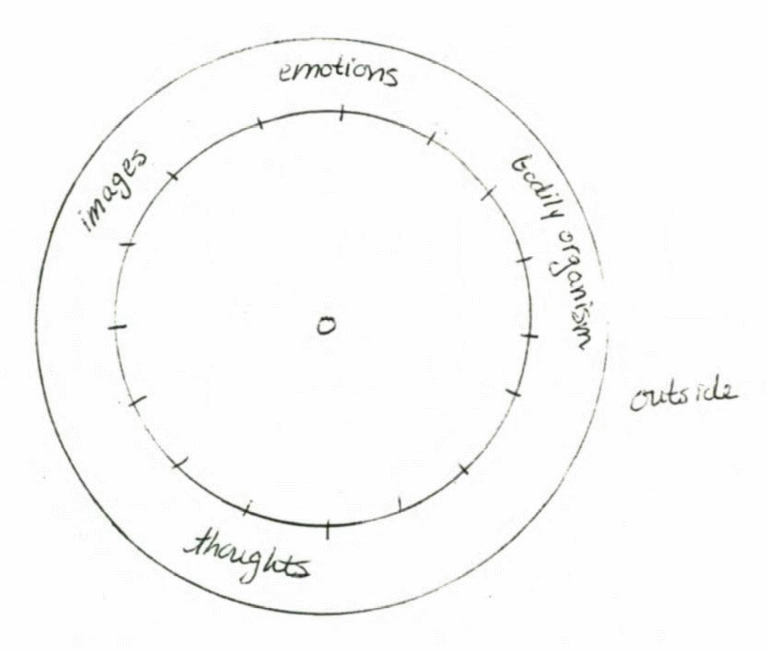
FIGURE 1983 1109-1. Psychosomatic Organism.
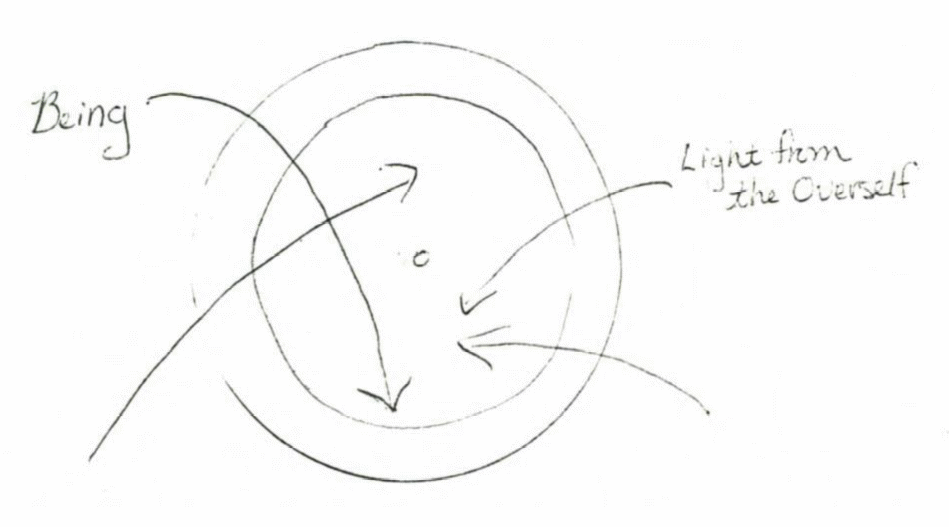
FIGURE 1983 1109-2. Light of Overself in Psychosomatic.
[Transcriber note: [diagram] means the speaker is referencing a diagram as he or she is speaking. If someone is drawing or writing, with audible sounds of chalk on a blackboard, I indicate this by [drawing] or [writing].]
NOTES:
- Pat Campbell transcript from 1983 exists (Scan File 1983 1109-32R04.PDF); other, earlier transcript versions may exist.
TRANSCRIBED Verbatim by IT 2019. Reformatted by JRM & JF 2019-2020, with Subheads and Table of Contents added by JRM. In 2023, IT fixes prefatory matter and footer, updates audio file name, fixes/completes Book List, fixes typos/minor errors, adds new note within transcript, relabels two diagrams and moves them to appendix, leaves reference to these diagrams within transcript. In 2025, MW expands Subsubjects and alters Subheads to make more accurate. Archival verbatim transcript – V14.1a.
AUDIO FILES: 1983 1109a, 1983 1109b. [Note: "Tape" and "Side" refer to original audio cassette tapes that were later digitized into .MP3 Audio Files.]
1983 11/09 at Wisdom's Goldenrod
PB Paras; Intellect
Archival verbatim transcript
[Audio File 1983 1109a Begins]
RC: --collect the quotes and then go over (them).
S: What?
S (very faint): Randy?
RC: Some of the things [S, very faint: Hey Randy--] we're reading about. Does she--
[short pause with faint background student talking]
THE VALUE OF STUDYING METAPHYSICS
PB [V5, 7:7.127, RC reading]: "When thought hits into one's passions and prejudices [RC reads: the prejudice], few people care to draw a line of hard thinking unto [RC reads: to] its bitter end. The consequences of philosophical brain activity can be too dreadful for weak mortals. (bit of laughter) Only he who has made thought his lord and king can accept its commands."
[12¼ second pause with faint background student talking]
LD: That's thought with a small "t" Randy?
RC: It's [one word inaudible]
AH: Randy, would you mind just doing it again, I didn't hear it.
PB [V5, 7:7.127, RC rereading]: "When thought hits into one's passions and prejudices, few people care to draw a line of hard thinking unto [RC reads: to] its bitter end. The consequences of philosophical brain activity can be too dreadful for weak mortals. Only he who has made thought his lord and king can accept its commands."
[9 second pause]
PB [V5, 7:1.163, RC reading]: "The victories of reason are the only enduring ones."
[15¼ second pause]
PB [V5, 7:6.40, RC reading]: ""…(c) In a limited sense Science explains things, namely, by reducing them to simpler terms, by discovering the conditions of their occurrence, and by disclosing their history. What do we mean when we say that Physics has accounted for the tides or that Physiology has made some function of the body much more intelligible than it used to be? What is meant is that we have gained a general conception of the nature of the facts in question, and that we are able to relate them to some general formula. In this sense only does Science explain things, [and] it does not really get beyond a description."[--Thomson, Introduction to Science.]"
[19¼ second pause]
PB [V5, 7:7.121, RC reading]: "Metaphysics must act as a custodian of the truth and as a guardian of the road to it. To refuse to submit to its discipline is equivalent to choosing a different goal, and another road than truth."
S: Would you read that again?
PB [V5, 7:7.121, RC rereading]: "Metaphysics must act as a custodian of the truth and as a guardian of the road to it. To refuse to submit to its discipline is equivalent to choosing a different goal, and another road than truth."
S (faint): Yeah.
[10¾ second pause]
PB [V5, 7:1.203, RC reading]: "The intellectual knowledge of the Truth is merely its shadow and not the Truth itself. The Truth is a higher state of awareness which leads you out of the little personal and physically materialistic everyday life into a new world of being--the world of your higher self which transcends these things. It is a real experience and not a mere speculation. It brings with it the peace which passeth understanding of which Saint Paul [RC reads: Jesus] spoke, frees you from anxieties [RC reads: anxiety], fears, and all other negative ideas. It reveals to you that God, in the sense of a Universal Intelligence and Universal Power, is actually the basis of all existence."
[short pause]
S (very faint): Read it again (please).
PB [V5, 7:1.203, RC rereading]: "The intellectual knowledge of [the] Truth is merely its shadow and not the Truth itself. The Truth is a higher state of awareness which leads you out of the little personal and physically materialistic everyday life into a new world of being--the world of your higher self which transcends these things. It is a real experience and not a mere speculation. It brings with it the peace which passeth understanding of which Saint Paul [RC reads: Jesus] spoke, frees you from anxieties, fears, and all other negative ideas. It reveals to you that God, in the sense of a Universal Intelligence and Universal Power, is actually the basis of all existence."
[21 second pause]
AH: Randy? Could-- could you speak a-- a little about the last two quotes in the sense that you spoke of metaphysics as being the guardian of this truth and then in the very next quote describes the intellectual formulation of Truth as a shadow of it. That's not a contradiction but there seems to be a different emphasis though, it's a very different emphasis in those quotes. What do you think is meant by the guardian of the truth?
RC: Well I would relate it I guess-- The first time I talked with PB I-- was when he came here.
S: When he was at Bert's house?
RC: Uh-huh. And, I remember that the only question I really wanted to ask him was, is it really necessary to get theoretical knowledge, like is it even knowledge. And, doesn't it make more sense or does it make more sense to just try to keep your mind quiet, keep yourself more or less centered and figure that whatever you're going to need to know will be part of the situation you're in and it'll come to you when you need it. Sort of my conception of the Middle Way at the time. He said no. That you have to study metaphysics. He said that the first way is more of a yoga way, but the philosophical way you have to get the intellectual understanding. He said the first way you can get tastes, glimpses of the Peace, periods of the Peace and so on, but it would never be permanent. He said that the only way that you could get the Peace to be permanent was to acquire a comprehensive intellectual understanding.
S (very faint): Uh-hm.
S: Why?
AB/S(?): (Do you have Mercury--)
AB: We made a distinction between a philosophic and a non-philosophic Sage. Seemed to me that a non-philosophic stage-- Sage had the Peace but had not developed the intellect or the understanding to ex-- expound it to others.
RC: But we also do, I mean-- we've heard a few men and we should distinguish (them/those).
[short pause]
AB: So that the non-philosophic Sage has Peace but not Truth?
RC: I guess we'd have to talk about an individual but-- I've said everything about it I know.
DB: Is it-- Randy is it possible that the distinction lies somewhere in the notion of what in the first quote he referred to as philosophic brain activity, that there's a qualitatively different dimension to right philosophical thought as opposed to just, you know, speculative or conceptual thought? [students assent] Even at-- even at the level that, you know, is relatively familiar there in terms of that meaning developed.
RC: I agree.
DB: And that-- and that it's this-- this which makes for philosophy as the-- the whole being permeated by this would-- I mean I'm conjecturing at this point, but it would seem as if the one-- one spoke of a Sage that wasn't a philosopher [AD/S(?), faint: Yeah.] that there would be a part of his being that would be relatively speaking unexposed to the full dimension of the so-called Truth. Maybe it would be (classed) or something like that but, this is a--
[short pause]
RC: It seems to me that the development of the intellectual understanding is-- is really requisite if you're going to speak about continuing ego that's capable of being a vehicle for the realization. That someone who doesn't have that can't explain to you what it is that they have attained in ways that you can understand it if you're not mystically sensitive and if you're wondering. Even if you are mystically sensitive, you can't understand what it is unless you can integrate it somehow.
[short pause]
DB: Is it-- is it also possible that-- See, there's something-- I guess a part of what I'm trying to get at is there-- it seems like there's-- there's a real big distinction, you know, something almost numinous about this notion of what he's referred to there as that philosophic brain activity, that-- that the content [student assents, very faint] there in some respect-- How can I say this? It's not as if the Truth is somehow jammed into the intellect so much as the intellect is transformed to be able to apprehend the mental factors that Truth can-- could provide, something like that. You see the distinction I'm trying to get at?
S (faint): (Right.)
S (faint): (Ok.)
RC: Yeah. Like when Anthony talks about not being able to systematize metaphysics. Like any specific point you can get a certain amount of understanding of maybe one specific aspect or view by really homing in on that-- that one particular attribute or whatever. So that it seems the intellect can be a door to it. But if you try to make-- if you try to come down and say that you can make a system that's like lock-tight, that I thought that's what you meant by saying cram it into the intellect. [DB: Yeah.] It-- it would seem that part of the intellect getting-- becoming useful is that it sees its shortcomings and even while it's revealing something you're aware that there's a lot more that you don't know or that you never exhausted yet.
[short pause]
AH: Yes, to s-- to speak in re-- in regards to some of the earlier quotes that the function of intellect is a negative one insofar as that you're pulling out what truth isn't. That's really no small thing, I mean, that's not the mission of the intellect, greatest possibility. I thought about another answer to that-- my question regarding the guardian there. Is the distinction made between a speculative metaphysics and one based on a Sage's realization of Truth? That quote makes sense to me now [S, faint: Yeah.] if I thought of it as the expression of a metaphysics from a Sage's-- the experience of Truth, [RC assents, faint] you know, like intellectual formulation that would to me be a guardian of that truth.
[37 second pause]
PB [Persp., Ch. 7 #12, RC reading]: ""Thinking," said Hegel (when his landlady worried about his absence from church service), (bit of laughter) "is also Divine Service."" (bit of laughter)
[short pause]
PB [V5, 7:3.67, RC reading]: "Only he who is capable of sustained intellectual effort is capable of understanding this philosophy."
PB [Persp., Ch. 7 #15, RC reading]: "In this little head we must first conquer the larger world. From this obscure corner we may master life."
[short pause]
SD: What was the first sentence again?
PB [V5, 7:3.67, RC rereading]: "Only he who is capable of sustained intellectual effort is capable of understanding this philosophy."
[29¼ second pause]
PB [V5, 7:2.3, RC reading]: "Unless he exercises his reason--and that at its subtlest pitch--how is he going to wake up from this dream of spinning planets in which he sleeps by the mesmeric power of some unseen and unknown Sage [RC reads: unknown and unseen age]?"
S (very faint): What?
S: Huh?
S: Huh?
S (very faint): Uh-hm.
S (faint): Uh-hm.
S: Can you read that again?
S (faint): What was that?
PB [V5, 7:2.3, RC rereading]: "Unless he exercises his reason--and that at its subtlest pitch--how is he going to wake up from this dream of spinning planets in which he sleeps by the mesmeric power of some unseen and unknown Sage [RC reads: age]?"
AH: Age, a-g-e?
RC: Well, that's what's here and then there's a bunch of marks that say what if PB changed it.
S: Huh.
S: Hm.
S: Ok.
S: Uh-hm.
S (faint): Would he do that?
AH (simultaneously): Oh, mage.
S (faint): Uh-hm, that was [couple/three words inaudible]
AD (simultaneously, faint): Was it this way?
S (faint): Uh-hm.
S (faint): [couple words inaudible]
S (simultaneously): Mage [S simultaneously, faint: Well that's--] would make sense.
RC (simultaneously): Well there's one-- there's one mage, there's one Sage. (bit of laughter)
S: Yeah.
S: Yeah.
S: Isn't the idea that--
S: Age.
S (simultaneously): But--
S: Agent.
S (simultaneously): I mean why doesn't 'age' work, that you're mesmerized by the time that you live in unless you use reason.
S (very faint): Yeah that works.
S (simultaneously): Uh-hm.
S: I mean you're totally under the sway of the collective--
AS: Except unknown and unseen though.
S (simultaneously): [one/two words inaudible] there's a lot of (them).
S (faint): Uh-hm.
S: Yeah, unseen.
S: We don't know David.
S (faint): Uh-hm.
S (faint): Well--
JB: Agent is better than Sage.
S (faint): Seems like [few words inaudible]
S (simultaneously, faint): Richard--
S: Is it right at the end of that page like something got cut short?
RC: Nope. It's part of the middle.
[students assent, faint]
S (very faint): Part of the middle.
TS: Shall we vote?
S (very faint): Yeah.
S: Uh-hm. (bit of laughter)
S (faint): Uh-hm.
LDS: Could you read that sentence again, that-- that first one?
PB [V5, 7:2.3, RC rereading]: "Unless he exercises his reason--and that at its subtlest pitch--how is he going to wake up from this dream of spinning planets in which he sleeps by the mesmeric power of some unseen and unknown…"
S (faint): Uh-hm. (bit of laughter)
S (faint): Yeah.
S: It's (Sage, Sage).
AH (simultaneously): So (it's/if) not that word, how about (age)?
S (very faint): Ignore him.
LDS: Randy? (bit of laughter)
S: Randy?
RC: We could stop after 'sleeps', the whole thing holds together there pretty (well).
S (very faint): And if we shorten something [few words inaudible]
[short pause]
MB (faint): How about from unseen and unknown (Dragon)?
S (very faint): Say what?
S: No.
AB: Dick-- Would--
S (very faint): Say it again.
AB: The way we're using reason, can reason take you outside of the Dragon?
RC: It would seem that he's saying that.
AB: Yeah, I mean that the planets are spinning out this scenario which we call the whole Dragon that we live within and that reason could take you out of that.
AS: It's not that he-- [AH simultaneously: Right, that he's calling to wake up from.] that he implies that reason can take you out, it's just he says unless we use it. Doesn't seem-- he's not I don't think implying that that's all we need.
AB: Ok.
RC: He seems to imply that that would wake you up from the dream.
AS: Well--
S: (I don't know.)
[13½ second pause]
"FACT-FED THINKING—HARD, DEEP, RATIONAL, AND THOROUGH—IS WHAT CONVERTS VAGUE SURMISE INTO UNBREAKABLE CERTAINTY"
PB [V5, 7:2.1, RC reading]: "The cultivation of intelligence is one of the supreme duties of man. [RC: We read this.] [S, faint: Uh-hm.] Fact-fed thinking--hard, deep, rational, and thorough--is what converts vague surmise into unbreakable certainty, blind belief or tormenting doubt into irrefutable knowledge, and native error into new truth."
[short pause]
DB: Does that imply that starting out at the lowest levels of the divided line by the application of reason to those-- to those contents, that somehow the-- the contents themselves are transformed and-- how does that part work? 'Cause I mean the way he speaks about it there it's not as if you just get rid of them and you get something that's better but they're actually transformed, I think.
RC: Says he converts vague surmise.
DB: Right. Like I think the world might be mental maybe.
RC: Yeah that makes sense if you actually reason on the sensible, take the sensible into the path and actually reason on the sensible and-- [short pause] and cultivate the intelligence there.
[15½ second pause]
DB: Can you please reread that?
PB [V5, 7:2.1, RC rereading]: "The cultivation of intelligence is one of the supreme duties of man. Fact-fed thinking--hard, deep, rational, and thorough--is what converts vague surmise into unbreakable certainty, blind belief or tormenting doubt into irrefutable knowledge, and native error into new truth."
[16¾ second pause]
S: Is reasoning a thinking possible within a meditative process?
RC: Well (it) uses the intellect, the intellect as its tool. It seemed that the way the quotes we had before, (they would) say that normally the intellect is at the disposal of the ego [student assents] and rationalize-- rationalizes whatever the ego wants. [S: Right.] And it seems that when he talks about starting to reason, that there's an effort made to take the intellect away from the ego's (solid nature).
S: Uh-hm. Well, the fact-fed knowledge that's used I-- [RC: Uh-hm.] fact-fed part of it which (is recall) but then somehow the reason is developed and proceeds from there. And I just-- I can't get a sense of when the intellect becomes reason or if you can even talk of it that way. It seems that it's not a normal thinking process but it's somehow above thinking as we know it or as we know those thoughts.
RG: Well what we mean by-- (what-- well your style) of thinking. Normally that's what cuts it off.
S (faint): Uh-hm.
S (faint): It's just a-- a habitual--
LR (simultaneously, faint): Remember how you said reason or intelligence and intellect are the mystical faculty?
S: Pardon me?
LR: Remember the quote where he said reason was the [three/few words inaudible] and the mystical [S: Right.] faculty?
S: Right.
AH: This last quote what-- was there-- is there interest in interpreting the meaning of that quote from point of view of reason or is it to be interpreted from the point of view of fact-fed intellectual thinking? Like when he talks about going from vague surmise to certainty, etc. I think that could be understood purely from the point of view of fact-fed thinking. And that would certainly connect with the first quote you read tonight. And (that/then) to actually face the facts about things is-- could go against prejudice and opinion and desire and [student assents] all of those things.
AB: Would that require reason?
AH: I don't-- I was curious that if we-- if we need-- if we need to include reason or if it is possible to understand these quotes as just a function of logical thinking.
AB: I-- I would think that it is reason which utilizes the facts to arrive at a conclusion which is being consistent with the vague surmise or belief and which is in accord with reality.
AH: I don't know, [S simultaneously, possibly part of background: Who?] I'd-- I'd ask the question again.
S: Yeah.
SC: Randy, could you read that piece about fact-fed thinking?
RC (simultaneously): Uh-hm.
S (faint): Well--
S (possibly same S as above): Please.
[14 second pause]
PB [V5, 7:2.1, RC rereading]: "The cultivation of intelligence is one of the supreme duties of man. Fact-fed thinking--hard, deep, rational, and thorough--is what converts vague surmise into unbreakable certainty, blind belief or tormenting doubt into irrefutable knowledge, and native error into new truth."
[short pause]
S (faint): Uh-hm.
SC: Sounds like reason.
S (very faint): (Uh-hm.)
RG: Yeah, his definition of just logic isn't even that it's necessarily fact-fed. But that reason demands all the facts of experience. And that logic has no certainty.
S: He also said some-- someone could operate with perfect logic and it could be not-- have it-- it could be (untruthly).
S (very faint): Yeah.
RG: 'Cause it didn't deal with all the facts.
SC: Yeah, when he uses those words.
LR (simultaneously): Well, I don't know. I think there's other reasons why it could be untrue [couple inaudible student words] besides not being factual enough.
RG: Well, if it isn't in accord with the thing, then it wouldn't be true as (facthood). Fact-fed meaning the thing-- you're actually looking at the given. [student assents, very faint] It's not your-- it's not your idea of it or your surmise about it.
AH: Is there any--
SC (simultaneously): The reason starts with facts and then [S simultaneously, faint: Well-- well--] thinks deeply and rationally--
S: That's all he's pondering too.
SC (faint): [few words inaudible]
RC/S(?) (faint): Uh-hm.
AH: Now could-- how could-- how is that different than let's say a thorough analysis of an object from a scientific perspective? Let's say that I studied a phenomenon scientifically or, you know, very thoroughly. Is this process that described in this quote different from that [S, very faint: Yeah.] yet?
RC: I don't know, (could do this way), but it seems like it would certainly depend on the depth of what you could (think about).
AH (simultaneously): That's where I always get (confused).
RC (simultaneously): Like what Vic's doing when Vic is really trying to understand some of these things in his field. He's bringing to bear as many facts as he's aware of and some he got at school and the things that he got here and he's trying to understand what the-- what the presentation is.
AH: Yes.
RC: I think that's trying to use reason to deal with all the facts.
AH: How shall we understand what you've just said in this quote without thinking of reason in some quasi-mystical sort of way where it could very well be the expression of opinion or expressed by it. How can we define this notion of reason without leaving the door open to all sorts of vague possibilities? Like, I've been struggling with this for several weeks in terms of trying to understand this distinction. And no, it's not like doing a scientific experiment, it's like what Vic does when he brings ideas in from different places and-- But I don't know what that means.
SD: Andrew one--
S (simultaneously): Well a scientist would take more material facts and that their facts are based on experiments that they do and a more material [one/two words inaudible] facts might in this case include anything that pertains to truth that wouldn't be included in trying to think.
S: Oh but--
AH: Yeah that--
S (simultaneously): We'd have to start trying--
RG (simultaneously): Yeah, the scientist has claimed that he's dealing with think-- thinking.
S (simultaneously): He claims that he is but he isn't.
AH: Yes then I [one/two inaudible student words simultaneous with AH] would agree [one/two words inaudible] but I still don't see how that helps us why-- with distinction between reason and intellect.
[student assents, very faint]
RC: Well I still think it comes back to what-- what a person is willing to accept as a fact. It seems that most of the science that we talk about, they have a predilection for certain facts and abhorrence for others, in general the waking state, period. [student assents] Anything other than the waking state is not factual. Whereas from the beginning when we try to understand our experience we're told that we have to include all the facts of our experience including dream and sleep, and that to try to put together a science that doesn't include them doesn't deal with all the facts. And so the question of [short pause] what makes a person accept something as a fact, I don't know what that faculty is.
S (faint): That's a--
AH: Well I think-- but--
PC/S(?) (simultaneously): Well, that's a def-- I'm sorry.
AH: My question is, I'm trying to understand the distinction between intellect and reason. And I don't know if it's appropriate to try to drag it out of this quote. But I could understand this quote from the point of view of intellect, I don't have to, in my understanding, have a notion of reason to allow [student assents] because--
DB (simultaneously): I think-- can it be said that the distinction has something to do with that one of the facts that reason takes into consideration that the intellect of say the scientist-- [student assents, faint] scientific mentality does not is that it takes as an objective fact the-- the very functioning of the scientific method and looks at that as a fact whereas the scientist is identified.
AH: Alright, [S simultaneously: Yeah.] I would agree but I wouldn't equate intellect with scientific method.
DB: Well no, but I mean just for the purposes of--
AH: I think (that once/that's a once)--
DB: Ok.
AB: Didn't we say that intellect is what assigns the name to the thing and remembers the definition of the object? [students assent, faint] But that the faculty which establishes relationships and understands those relationships between the things is reason. So that this quote, hard rational thinking, as Sam said, would require reasoning, not only intellect which would say this is a this, that's a that. You know this one says this, that one says that.
RG: And not-- and not only that, I don't see how you could say somebody's using reason if their claim to acquire that truth pro-- it seems they would first ha-- have to inquire into the faculty and how you know something. If a scientist doesn't first enquire into the method of knowledge, the content of his knowledge is always going to be questionable 'cause he's assuming the means of knowledge to get to his objects and that's no fact.
SD: Wouldn't one mark of the distinction be that with reason there's a self-conscious reflective awareness of its own activity and that's [student assents, faint] part of a field that-- that [couple/three words inaudible]
[9¾ second pause]
PC: Maybe, could you say that for reason to be reason it has to be willing to examine whatever facts, including presuppositions and biases, come into its field of awareness? As soon as it refuses to do that it's doing without the reason.
[students assent, very faint]
RC: And it seemed to be the thing of its trying to get beyond the domination of the ego.
PC: Right, as soon as it sees an egoistic bias, it has to (attack) that as well [RC assents, faint] and if it doesn't, then it's not reason then.
RC: Yeah we have this one definition that we read before, we could--
PB [V5, 7:1.14 & Persp., Ch. 7 #3, RC reading]: "Intellect, reason, and intelligence are not convertible terms in this teaching. The first is the lowest faculty of the [RC reads: this] trio, the third is the highest, the second is the medial one. Intellect is logical thinking based on a partial and prejudiced collection of facts. Reason is logical thinking based on all available and impartially collected facts. Intelligence is the fruit of a union between reason and intuition."
[short pause]
S (part of background): Is that why Chip is gonna have to pay for mine too?
S (part of background): (I see.) (bit of laughter)
S (part of background): Yeah.
TS: (faint, part of background): I guess so.
PC: But that's really a fair distinction between intellect and reason.
RC: Yeah.
AH: Where does-- what is reason again, it's all available facts--
PB [V5, 7:1.14 & Persp., Ch. 7 #3, RC reading]: "…logical thinking based on all available and impartially collected facts."
[students assents, very faint]
AB: So the scientist could be reasoning.
S (faint): Right.
SC (simultaneously): Right. Or not reasoning, depending [AB simultaneously: Right.] on--
AH: How thorough his collection of facts or--
SC (simultaneously): And the impartiality.
AH: And how impartial.
S (very faint): [one/two words inaudible]
S (faint): Yeah.
JA: If a scientist were rea-- reasoning and taking into account, you know, an object that he's looking at and also he's taking into account mentalism. How-- how much would he have to take it as a fact, in other words, do you think it would be possible for him to accept the concept of mentalism and reason with it? Or would he have to have actually some actual understanding of what it meant, you know, and some experience of it-- of a [one/two very faint inaudible student words] mentalistic world? You still with me?
RC: Yeah.
S (faint): Uh-hm.
S (faint): Um--
JA: I mean what would be all available facts in that case, you know? Would a concept of mentalism be-- count as an available fact?
RC: I think if he considered it a concept, then-- just a concept, [JA: Uh-hm.] then he would have trouble considering it a fact. But if he thought about that concept deeply and said "Well, yeah, I really-- I guess. (bit of laughter) When I really think about it I don't experience anything other than my own mind," then it might take on the dimension of fact for (him).
JA: Yes.
S: Yeah.
IS A FACT WHAT IS PUBLICLY CERTIFIABLE?
RC: And then it would be one more fact brought into any further reflection. So-- but that's the one that I keep having a hard time with. What is that faculty that decides to accept this item as fact? What is (another) right word for (images)--
AD: How about this: Mount Himalaya is purple. For everybody?
RC: Uh-hm. Ok. I agree they-- (but/that) I don't accept that as a fact.
AD: You don't accept it as fact. I saw it purple but everybody else saw it as bluish-white, right?
S (very faint): Ok.
RC: Well I could accept it as a fact that for some people it could've turned to purple.
AD: Would that be a fact?
RC: That it is purple? I would have a hard time accepting it as fact.
AD: Wouldn't you say a fact is something which could per-- publicly certify too?
RC: Publicly certify? Ok.
S (very faint): Publicly certify.
S: Probably later.
RG: Uh-hm.
S: You got to remember it.
RG (simultaneously): Yeah, right.
RC: You mean there could be intra-subjective corroboration?
AD: No. (laughter) If I follow your directions I will get to this body of water which you call Lake Seneca and so will anyone else. [students assent] This is a fact.
[student assents, faint]
AH: It's not a sub-- it's not a subjective experience, it's also a public phenomena.
AD: Yeah, I don't like the way you put it. (some laughter)
AH: But, you said it's publicly certifiable.
AD: Well, I can't accept "public phenomena" because phenomena is always subjective. But if everyone agrees that this is what the phenomena is then this is a fact.
AH: What if I have a very secret fact that's just mine. (laughter)
AD: If you have a very what?
AH: What if I have an [S simultaneously: A secret.] impression of facts that are secret and private and belong to just me? Like, how do I test their facticity?
S (faint): Don't tell anyone.
S: Hm? (bit of laughter)
S (faint): Yeah.
AD (faint): No.
S (very faint): Uh-hm.
RG: Oh Andrew has a good point, [couple inaudible student words simultaneous with RG] I mean your test Anthony is good for (bit of laughter) things that are not-- sensibly perceived. But when you're dealing with a mental phenomena it's hard to verify facts.
AD: You don't want to know what a fact is, do you?
AH: I would like--
RG: We do want to know what a fact is.
AH: I would like--
AD (simultaneously): No, he doesn't want to know what a fact is.
RG (simultaneously): Who-- who doesn't?
AD (simultaneously): Him.
RG: Oh him?
AH: Actually my question is rhetorical, I think I know what a fact is.
AD: Well it's rhetor-- rhetorical for everyone but still we want to get clear in our mind, what do we mean by a fact?
AH: I'd want-- I'd want some support from outside of my own subjective state in order to call it a fact.
AD: That means you have to call on someone else, right, and heed someone else. In other words, the one thing about science is that, if you claim this is a fact, anyone in the scientific community, given the same apparatus [one/two words inaudible] all the necessary conditions he can also see that that's a fact.
AH: Yes.
AD: Well that's a fact, right?
S (faint): Yeah.
AD: So, if we decided on a number system and we say we're going to go measure this mountain and this mountain is twenty thousand feet, alright, that's a fact. [short pause] You really have a problem deciding what a fact is? [11 second pause] Severin, am I imagining this or is it really going on? (laughter)
S (amidst laughter): Is it a fact, Anthony? (more laughter, student words)
BS: In other words you're telling Andrew that-- that they're subjective, as he put it [couple words inaudible]
AD (simultaneously): I'm leaving-- I'm not even-- [BS simultaneously: It's not a fact.] I'm leaving that out completely.
BS: Yeah, it's not a fact now.
AD: I'm leaving that out. If it can be per-- publicly certified then it's a fact. If it can't, if I say I see a pink elephant and everybody else says no it's grey, it's not pink, [S, faint: Yeah.] the grey is the fact, not the pink.
RC: But, the way the [couple/three words inaudible] [S simultaneously: Keep going.] oh, (bit of laughter, student words) when you limit it to facts that we-- that the broad majority of people would agree on, or would you say there are plenty of facts that a lot of people just don't accept as fact(s).
S (faint): Yeah.
AD: It's not going to be a fact then if they can't agree on it.
AB: But does this--
S (simultaneously): It's (only/always) [one word inaudible]
SC (simultaneously): Is it a [one word inaudible] notion? (some laughter)
S: No.
AD: Hm?
MB (faint): Very, yeah.
S (faint): Fact, right.
AB (simultaneously): So the fact that the Sun rises? I mean we all see that but it's not really happening.
LR: But it's publicly [S simultaneously: Yeah.] certifiable. [AB: But the--] You go out in the morning at a certain time you see the Sun rise.
AB: Right, but wouldn't reasoning based on all the facts be able to show you that the Sun isn't rising-- rising.
LR: But-- but is that-- that doesn't deny its facticity that if you go out in the early [one word inaudible]
AB: Is the facticity [S simultaneously, faint: Yeah.] is that you go-- you can see the Sun rise or that the Sun is rising?
LR (simultaneously): In other words, a-- a fact doesn't have to be incontrovertibly true, I mean-- From Anthony's definition, it can be repeated, it can be publicly certified. I tell you go out at sunrise and you'll see the Sun come up over the hill. Anybody can do that and see that way.
SC: But suppose I say that I want to tell you something about the world. The world is fixed, it's sitting in one place and there's this remarkable phenomenon that while the world is sitting there, there's this ball that rises, comes up over the horizon, you can actually watch it rise, and then later on in the day you're going to watch it go down. And what's happening, the fact is, is that that ball is rising up and then it's going down. (some laughter) Now, if you put it that way and you could get that verified by law-- societies full of people, is that a fact?
S (faint): Yeah.
S (faint): Yeah.
S: Yeah.
LR: Well that--
LDS: Well then reason, having a collection of those kinds of facts, could never get out of the-- out of the problem of-- [AS: Oh no.] it's in.
RG/S(?): So what we're saying is facts don't include the correct understanding.
LR: Right.
S: You're not--
S: Don't always include that.
LR: Is that-- [S simultaneously: Well--] Anthony is that--
S (simultaneously): Then everything is--
AD: No, (some laughter) is-- Facts do not include the correct understanding of them, we're not speaking about what reason will say about the sunrise, we're just state-- we just want to know is this a fact.
LR (simultaneously): Ok. So that is a fact and another fact you might have to gather is that the world is round and the world is revolving-- revolving around the Sun. So then reason would have to put all those facts together, namely the Sun comes over the hill that is-- And then it's the task of reason to come up with some understanding based on all these so-called facts which are seemingly contradictory.
S: So that first step--
LR: Larry?
LH: Reason [one/two words inaudible] (it's already) fact.
AD: One fact isn't going to give you a truth, or any truth. We're not speaking about truth, we're not speaking about understanding. [student assents] We're speaking about whether something is so or not so, [student assents] a fact.
PC: But Anthony, it sounds like you're talk-- you're saying that whether everybody agrees on it or not is what defines it as a fact.
LR: Yeah.
AD: Well how else are you going to define a fact?
PC: Well then are you going to say it's not a fact that the world is mental because you can't get everybody to agree to that?
S (faint): Yeah.
LR: No but--
PC (simultaneously): And I just don't understand--
LDS (simultaneously): Say it again Peter, I didn't hear you Peter.
LR (simultaneously): But Peter, if you were-- [AD simultaneously: Oh heavens.] if you got everybody-- if-- he said like the world--
AD (simultaneously, intensely): You think you're going to come to an understanding that the world is mental by saying it's a fact?
S (faint): Yeah.
PC: No but-- (some laughter, student words) I would think that the definition of fact is that if you-- if you were capable of examining all the necessary evidence reasonably, you would come to a certain conclusion and it would be a fact.
S: That would be truth.
PC: That would be truth and not a fact?
S (faint): Uh-hm.
S: I think they'd be talking [one/two words inaudible] [LR simultaneously: Yeah.] how you've got to define your terms and that would be truth, not fact.
PC: So any time you can get a whole group of people to-- (laughter, student words) I mean I really don't understand this.
LR: No Peter, in that example you gave about mentalism, if you could use the analogy of following a certain roadmap to find Seneca Lake.
S: Uh-hm.
PC/LD(?): Yeah.
LR: And you-- it's the same kind of thing. If you followed certain prescriptions and did certain exercises, and it might take you your whole life, [PC simultaneously: Yeah.] might take-- might-- [S, faint: Ok.] it might [S simultaneously: Of course.] be true that you would get to the truth of that map.
PC (simultaneously): Well then, ok, then--
LR (simultaneously): Now, it's harder to verify because how many people are actually going to follow that roadmap? But that doesn't make it less of a fact. In other words, it could-- it still might be publicly verifi--
(Side 1 of original cassette tape digitized as 1983 1109a Ends; Side 2 Begins)
LR:-- would arise that conclusion.
S (faint): (Well), yeah.
MB: Verifiable does not mean verified. Could be verified [S: Right.] [LR: Right.] doesn't mean it has been verified.
S: Couldn't you just say that all facts are relative? They're relative to the--
AD: That's another fact.
S: That's right, he's right.
S: Oh.
S: Right. That is a fact. You can't just talk about an object that isn't-- that you're not talking about some observer looking at the object. And so if you talk about the Sun or the Sun rising and you say well if you stand in this place at a certain time the Sun's going to rise--
AD: And if you have eyes and a body that goes with them, and if you lay out all the conditions necessary this is one fact. And people have believed that for hundreds and thousands of years. During that time, more and more facts have been accumulated. [PC, faint: Right.] Until finally reason points out that this is not a fact. And then they have to explain why this situation occurs. And the real facts, so to speak, no longer are they real facts, alright, now you're explaining the fact or describing how that perception is possible. But you first have to collect a lot of-- lot of facts. When you explained-- when you explain the facts you have to use reason but we're not discussing that. We're discussing the fact that this can be per-- publicly certified here. You walk over there you'll find a body of water, you can jump in.
S: So in that case you could say that it will be your experience that the Sun rises but you couldn't say that the Sun's actually rising. You could only say it's your experience, then that would be a fact. You couldn't deny it.
AD: It would be a fact because everyone else would see the same thing.
S: But if you try to isolate a fact from an observer, then you don't have any facts. I mean isn't every sensible fact dependent upon an observer seeing that fact from a point of view?
AD (faint): Yeah.
[short pause]
SD: Isn't it also that everything that we call a fact is also intertwined with a certain amount of interpretation. And that one of the functions of reason is to distinguish out that part which is actually repeatable and verifiable from that part which has been-- has been interpreted and-- and imposed upon that. And that's what the-- the other facts do, they help distinguish so that you then still have as a fact that you can perceive this activity and that it looks as if the Sun is rising but you don't identify that as an interpretation of the actual event.
[students assent, very faint]
S (very faint): Ok.
AB: 'Cause the new interpretation, that the Sun isn't rising, doesn't still de-- deny [student assents] the experience that you go look and (there/there's) the [student assents] Sun (doesn't--)
BS: It does deny the ex--
AB: Well, [S, faint: Well--] you still have that experience.
AD (simultaneously): No, it doesn't deny it, it [S simultaneously, faint: Well--] explains it.
AB: Right.
[students assent, very faint]
S: (True.)
RC: But most people don't know that by reason.
S (faint): That's not true.
RC: I mean most people take the fact that the Earth goes around the Sun as just another content that they got given when they were seven years old.
[student assents, very faint]
AH: Right, yeah but we accept a lot of facts in that way. We can't-- you can't certify all the facts [couple words inaudible] (being) experiment.
RC: I mean there's still a Flat Earth Society.
[student(s) assenting, very faint]
S (simultaneously): Well, yeah. (bit of laughter)
AH: What's the matter?
S (faint): What-- what's the matter?
S (faint): [one/two words inaudible]
AB (faint): It was the procrastinators club.
AH: But it's curious that you do have to accept it with a certain measure of belief that the Earth is round and pressure-- (and then) 40,000 feet air pressure [one word inaudible] curvature [one word inaudible] watch [student assents, faint] sail boats ten miles away.
JL: How--
REASON MUST TAKE INTO ACCOUNT ALL THE RELEVANT FACTS WHEN IT TRIES TO SOLVE A PROBLEM
MB: Something about this-- there's something else about this definition that's a little bit difficult for me which is the definition of reason as being that which takes all the available facts into account. Well, seems like you're never going to be able to take all of the available facts into account. If you take that literally I mean forget it. So he-- then he doesn't mean it quite literally. I mean I think he means something qualitative about taking all of the facts into account. Like you take the ones that you need or the ones that you--
AD: All the facts that are pertinent to that issue.
MB: To that issue.
AD: To that point.
MB: So then for example science-- not all of science--
AD: You don't have to have the facts of everything in order for instance to work out a simple problem.
MB: Right.
AD: Right?
MB: You can still call--
AD (simultaneously): But you do need certain facts that are pertinent, all the facts that are pertinent to that in order to solve that problem you need those facts.
MB: And you could still call it reason. Let's say-- let's say a certain branch of science operates in a very narrow sphere, let's say they're just interested in [couple/three words inaudible] let's say grasshoppers. (bit of laughter) I mean, that-- they could still be using reason according to this definition if they take all the facts about grasshoppers into account.
AD: Yeah. They don't have to figure out if there's any of them in the galaxy of Androm-- Andromeda.
MB: That would be hard to come by (and check).
AH (simultaneously): They're not available yet.
AD: They're not available and they're irrelevant.
MB: Yeah. But if they want to do philosophy or if they want to talk about consciousness and they say I'll just take into account other states of consciousness or if they talk about perception and they say or mention that it's all within mind, then they haven't taken all-- all the facts into account.
AD: Then--
MB: Then they haven't, if that's what (they--)
OUR KNOWLEDGE SEEMS TO BE CONFINED TO THE IMAGES, THOUGHTS, AND FEELINGS THAT ARE BASED ON THE MODIFICATIONS OF THE BODY'S FUNCTIONING
[Note: See FIGURES 1983 1109-1, Psychosomatic Organism, and 1983 1109-2, Light of Overself in Psychosomatic, appended to this transcript for the following.]
AD: Alright, and then there's another difficulty, maybe-- maybe a little diagram might help us. Let's try something like this. We have-- [10¾ second pause while drawing] Let's say that we have over here the body organism, [short pause, drawing] emotions, images, [short pause, drawing] thoughts. And let's put the person at the center [diagram], ok. And, from the time he's born, you know, to seven, eight years old, he has [drawing] acquired innumerable images, thoughts, feelings, emotions (of) an innumerable kind. They're all, so to speak, modifications of the body's functioning. And any time there's any sort of bodily function go on and the senses are mo-- modified and which produces organic sensation, and organic sensation which you correlate with what you think is outside, ok? But all you really know is what's inside. Only this [diagram] is what you know, you don't know anything else out here, alright? Then, any time we're given, let's say, situation where we are called upon to say this-- state this is a fact, we all have to have [drawing] those images that somehow can correspond-- in other words, they (would/will) be adequate for the phenomena which is supposed to be outside the mind. So if I ask you to start-- Would you start reading some of the first quote?
RC (faint): [one/two words inaudible] I read that quote tonight?
S (faint): (What?)
WHEN A DIFFICULT PROBLEM IS SOLVED, THE LIGHT FROM THE OVERSELF CONNECTS VARIOUS DISPARATE FACTS
AD: Oh here's-- here's another thing that might help in the diagram. Imagine that this is the [drawing] light from the Overself coming in [diagram], ok. Just imagine that there's light from the Overself coming in. But it gets trapped in here, alright. It gets trapped, stays there or it bounces here or it bounces here, but it's trapped in there. Ok? [student assents, faint] But it isn't actually so, I mean that light goes right through. That light goes right through because that's the Being that you are. But this light or Being that you are gets trapped inside this here and you call that your personal consciousness, alright, and it lights up [drawing] everything in here or anything that the light falls on it lights it up. [students assent] So you have accumulated here all kinds of images, impressions, memories, all kinds, alright. And you're working on a problem. You're working on a problem and you have this fact here, this fact here, and this fact here, alright. And you can't figure out the solution and you keep working on it. You work on it and then suddenly you give up. [S: Ok.] Alright, all of a sudden the light falls, alright, and connects them. [S, very faint: Right.] You've related all these different facts together, alright, this light that came in just related all those facts together, gave them their proper emphasis, and all of a sudden something clicks--"I got it!" [drawing] [S, faint: Yeah.] Ok, that's-- (laughter) But notice, all his understanding is enclosed within the language of organic sensations, images, pictures, thoughts. It's never this here [diagram]. It's always [drawing] within this realm. Ok? [student assents, faint] Let's read a couple, just randomly start from the beginning.
SCIENCE DEALS WITH ITS SYMBOLS OF WHAT IT THINKS REALITY IS
PB [V5, 7:7.127, RC reading]: "When thought hits [into] one's passions and prejudices, few people care to draw a line of hard thinking unto [RC reads: to] its bitter end."
AD: Now let's go (to another one).
[short pause while AD draws]
RC: "Science explains things in a limited sense…"?
AD: Yeah, ok.
PB [V5, 7:6.40, RC reading]: ""…namely, by reducing them to simpler terms, by discovering the conditions of their occurrence, and by disclosing their history. What do we mean when we say that Physics has accounted for the tides or that Physiology has made some function of the body much more intelligible than it used to be? What is meant is that we have gained a general conception of the nature of the facts in question, and that we are able to relate them to some general formula. In this sense only does Science explain things, and it does not really get beyond a description."[--Thomson, Introduction to Science.]"
AD: So in other words science then is only dealing with its symbols of what it thinks reality would be, the symbols being these here [diagram]. [drawing] These aren't signs, alright. [RC assents] If I ring a bell and the dog comes running, that's a sign, that's not a symbol. The dog doesn't have a mental equivalent, you know, a bell ringing and say that's the same as food. That's just a sign he's got but for us these are symbols. In other words, I could take the-- I could take any given phenomena or anything that I experienced, any experience that I had, that image is retained. And through that image like we said we can associate a word with it, alright, and now the word is very abstract, the image is very concrete in a sense. If you try to think in pictures, you would find it impossible, although you can. Like a little child says-- or let's say-- let's say a child sees his father get into the car with a man and they go off to school and the child is saying, "Dada, school, bus" or something like that. He's thinking in-- you can see that there's strips of images, one following the other. [RC assents, faint] Ok? But we don't do that. After a while we grow up and, if you notice in their language, the subject, the object, and the predicate is all included in that, ok, even if they don't use it. But we don't-- we don't do that. We tie in a word with a certain image and then we have enough words so that we can manipulate the words, alright, which are based on images, which in turn is based on the bodily functioning and the memory of these images, alright, and then we're going to explain a phenomena, we're going to explain Newton's law of gravity, we're going to say that apple fell, alright, because of gravity, and that's also what's keeping the planets in terms of gravity.
But look, the explanation of what's keeping the planets in their orbit and the apple that fell is all based on gravity. But notice, how far can you go with that explanation? Stop(s). Because you haven't-- you haven't really probed what is gravity. You've only reduced this here [diagram] to a larger, more universal example. And that makes you feel good. You've got them all-- any phenomena that, you know, represents the phenomena of gravity you can all classify under the gravity. [students assent, very faint] But notice, you're using words which are derived from images which are modifications of the bodily senses, alright, and of which you have memories and all you're manipulating are these, whether concrete images or abstract words. You're still in this realm [AD indicates on diagram]. [students assent, faint] You've never really explained anything. If, you know, you really consider explanation, what is an explanation, you'll see that these are instances of a [drawing] more general law, they come up with a general law and they say we've explained it. No you haven't. Now the fun begins, what is that general law.
AH: Anthony, the description of words could almost be equated with fundamentally almost like a muscular gesture, either of the eye or ear, insofar as the word has its basis in sensory experience.
AD: Yeah, in an image. Because the-- the terms you just used are derived from images. The image is primary. Good example was someone was telling me the boy was looking at a book with a picture of a truck in it and he was screaming that he couldn't take it out.
S: Mm.
BS (faint): (Who is that?)
S (very faint): Uh-hm.
AD: You think in images, [S: Yeah.] all the time.
S (faint): Yeah.
S: What's [couple words inaudible] Anthony?
AD: What we're speaking about here. You first have to have the image and then you form from the image the abstract concept.
AH: That's the part that I don't see. I don't see what it means to use language abstractly. It's like--
AD: I didn't say use language abstractly, I said language was abstract.
AH: Language is abstract.
AD: Yeah. Look, this is a picture of a truck, ok. [drawing/writing] And then you use the word 'truck'.
AH: You don't-- you know Anthony--
AD (simultaneously): This is abstract compared to the picture of a man driving an 8-wheeler or an 18-wheeler.
AH: Ok. When we say 'truck' it's not necessary to think of a truck in terms of--
AD (intensely): Andrew, the word 'truck' is an abstraction compared if I'm here in front of you with an 18-wheeler!! (laughter)
RG: The word won't kill you.
S: Yeah.
AH: I understand that, (but--) but we could only use words abstractly, they are abstract.
AD: They-- language is an abstraction from the image we experience that we have.
AH: And my question was in the use of language, it's no longer necessary to have the images following the words.
AD: Of course not. When I say 'chair' I don't-- I don't conjure up a chair in my mind, otherwise I feel uncomfortable, "Gee, does this correspond to that?" (some laughter)
S (amidst laughter): (What days am I) approaching it?
AD: Yeah, so if I say 'chair' what does it refer to? You're thinking of a four-wheel chair and I'm thinking of a three-wheeler, (laughter) and somebody's [one/two words inaudible] that anybody could sit on, someone is thinking of a bench.
AH: We're not thinking of any images anymore, we're thinking in term--
AD (simultaneously): Well no. That's why it's abstract.
AH: What's the meaning content that we'll have here? (bit of laughter)
AD: Andrew you could ask more questions in one minute than I can answer in five weeks. (some laughter)
S (amidst laughter): That's right.
AH: I'm--
LR (simultaneously): But your point, your point is that it goes from-- the source is the bodily organism. From there, images--
AD (simultaneously): Yes, that all this-- all this here [diagram]. Now what happens is when you-- when you arrived at the-- at the abstract language, alright, you are now in the realm of symbolism. And all your conversation, every communication you make is going to be in terms of symbols. You are not in any way dealing with reality.
LR: And this is all the realm-- I mean from-- what I gather you're trying to say is there's a modification of the bodily organ-- organism which produces images and triggers words which then are put together in terms of thoughts and are (all--)
AD (simultaneously): Well, I didn't say that. [S: Go ahead.] I didn't say that. [S simultaneously, faint: Well (one word inaudible)] I said that there are images that are produced by the functioning of your body. These images which arise give later on from them we attach words to it. Now, that process of, let's say, attaching words to certain images, that may be something that evolved in time and, [LR simultaneously: Ok. No but that's what--] you know-- But that may have been an effort on the part of reason. Reason may have had to come in here and evolve language. [student assents] [LR simultaneously: But--] So I-- that's why I was a little cautious with that.
LR: Right, but that's the order you're saying [AD simultaneously: Uh-hm.] that the evolution occurred.
AD: Uh-hm.
LR: And then you're saying we arrive at thought-processes as a result.
AD: We arrive at--
LR: There's-- there's a kind of sequential thought pro-- process which would be a result of what you're describing which--
THE INTELLECT REGISTERS, CLASSIFIES, AND ORGANIZES MEMORIES AND IMAGES—THAT IS, IT MANIPULATES FACTS
AD (simultaneously): Well, then when we have all these memories and images, alright, and these are like registered, then we could manipulate these, our intellect will ha-- have-- having registered them, classified them, organized them and ordered them in a certain way, alright, then that's the intellect's work. So we have the intellect, so to speak, being capable of manipulating all these facts. And by facts here we mean the recorded memories, images and shapes and nuances, shades (of event) and everything else, right? [student assents] Now the intellect can manipulate them around. So the intellect gets this brass ring or this gold ring, this crown, I'm sorry, a crown which might have been a mixture of gold and brass, alright, and then there was a smear in the bathtub which went-- Archimedes stepped in, noticed that the-- the water went over that shmear. (laughter, student words) So he recognized, "Oh wait a minute, every time a body goes in, alright, displaces a certain amount of water. This has specific gravity." What brought these two facts together? Why'd he have to think so hard and so long? He had to prepare the conditions for the light to come in and connect the two of them. Because that's what the light hit up. Brought them together.
IN THE MOMENT OF SCIENTIFIC DISCOVERY, THE LIGHT FROM THE OVERSELF CONNECTS TWO IMAGES THAT PREVIOUSLY HAD NOT BEEN CONNECTED
LR: Wait a minute, the light connected the two images?
AD: Yes. It's not going to light up facts that are irrelevant to the problem it's trying to solve.
[short pause]
JB: It-- it's trying to solve the problem?
AD: The problem that Archimedes was trying to solve, remember?
JB (simultaneously): But he-- he was trying to solve it, he (was--)
AD (simultaneously): Yeah, he was trying to solve a certain problem. [student assents] And he had the facts about the fact-- about gold having a certain specific gravity, metal having a certain specific [S simultaneously: Ok.] gravity, alright? He was given this golden crown which the king suspected was--
JB (simultaneously): Well, I know the story.
S (faint): Oh.
RG: Right.
AD: And he studied that and thought of every possible way by which he can find out if that was mixed with brass, alright, and he couldn't come to any conclusion, but he kept thinking about it, it was always on his mind, alright. Then he went to take a bath, alright, and he saw the water rise over the smudge mark, you know, the soap makes a smudge mark? (laughter, student words) Now, what connected that to this problem? He says, "I got it!" You know? What connected those two di-separate facts? Certainly the intellect knew of them but never made a connection. [JB: Right.] The intellect, "Well, there's a smear right there on the bathtub. (laughter) I know every time I step in the bathtub the water rises. Intellect, I know all that. (laughter) I know that as-- because I know that gold has a specific weight," alright. But why couldn't the intellect solve it?
JB: The answer you gave that the light coming in connected them for him but it could only light up things that were already present. I thought you just said it was trying to solve the problem. That's what I asked. Do you mean that the light is engaged in some way in an effort to solve that problem?
AD: Yeah.
S (faint): Yeah.
JB: Now that's what I want to ask about.
THE METAPHYSICS OF TRUTH IS A CONCEPTUAL MAP OF THE TRUTH THAT THE SAGE HAS EXPERIENCED, BUT IT'S NOT THAT TRUTH
AD (simultaneously): That light, that light brought together coherently-- You want me to change the word? [9¾ second pause while writing, faint background student talking] Connected these two things. [JB, faint: Ok.] The reason pointed out the connection between these two things. So you're going to see that this is unlimited [diagram]. There's no limit to this. [drawing] So reason keeps doing that. I mean all you have to do and I told you people, try this, out of just sheer-- you know, like be contrary. If I tell you to do something you won't do it. This time be contrary. (some laughter) I tell you to do something, do it just to be contrary to yourself. (laughter) Get a history of science of the last two hundred years and read it through and you will find this repeated over and over again, a hundred thousand times. Some of the greatest inventions were made on-- in this bizarre way. At any rate.
So if-- [LR: But--] in terms of that quote then, we can see that insofar that all we're dealing with is all the time the symbolism that we have created, and that with this symbolism we answer our questions, now the interesting thing comes, well suppose we do have a metaphysics of truth. Well a metaphysics of truth would be that it is able to relate all these images, thoughts, it is able to relate all of the content of this psychosomatic entity, relate them in a way that is determined by the Sage himself who has experienced the Truth in his own consciousness. Now he tries to translate the Truth that he experienced in his own consciousness, alright, into terms [drawing] that we can grasp in terms of the symbolism that we have evolved. So with the symbolism that we evolve, alright, we could make for ourselves a conceptual map of the Truth that he's speaking about. But this map is not the Truth of consciousness that he wants you to experience. It's only a map of that. It shows you the way into or out of the-- the Dragon. But it isn't the Truth which is beyond it. So if you read that next quote then. [students assent, faint] [short pause] If you don't get the feeling of the way you're locked into this and the way everything that you know is already predetermined for you by this outer structure, you're just-- you're just bouncing on waves, you know, like a cork.
RC: The one about metaphysics as a custodian (of) the--
AD: Yes, (any) [one word inaudible] You can do them both. [S simultaneously: Yeah.] Because this is-- [drawing] this is the experience of bondage. When you experience that you're enclosed in this, that you can't get out, you really experienced bondage. Until then, alright, it's just hearsay, you heard somebody else says that he feels in bondage.
RC: Is it-- that brings me back to the same question like, it's come up in a lot of different contexts [one/two words inaudible] but let's say in the Scholastic context and the way Santayana was-- reiterates it in some way, isn't what we ordinarily mean by a fact that we think there's a correspondence between this image that we have and the-- the world which we don't know.
AD (simultaneously): Yeah. Given-- given that you have n+1 [writing/drawing] subjects, [RC: Ok.] ok? Then every one of these subjects could per-- publicly certify to the fact that there is such a thing that corresponds to the symbol he has over here. So science has a set of symbols that would correspond to a certain phenomena that we can all, so to speak, [RC assents, faint] point to.
RC: Now when a person does begin to realize that there's (the other form) to this sense images-- images, what becomes then of the faculty of fact, uh-- Like if a person realizes that all I'm dealing with are these images, I have no guarantee that those images actually do correspond to the real structure of the world, is he leaving the consciousness that we normally call fact consciousness and going into a different level or--
LR: Wouldn't that be a fact what you just said that's publicly certifiable by everybody who can [one word inaudible] (and has to be)?
RC: Well, I think the majority of [one/two words inaudible] at this point would call it a problem for psychiatrists to deal with.
LR: Yeah but that's-- but forgetting what [one word inaudible] (we all--)
AD (simultaneously): Now this is a-- this is the problem for man to deal with.
RC: Well I agree.
AD: If you want to find out about these things you better-- you better be a man.
LR: But my-- my point was [RC simultaneously: What's the name of--] isn't that as much a fact, it might be about a different kind of--
RC (simultaneously): Yeah, yeah. Like somebody might say none of this stuff is fact, what are you talking about fact?
AD: Any-- all of this is fact. I got biologists here, scores of them that'll prove (it/me). (laughter)
S (amidst laughter): It's all good.
AD: Any physiologist will tell you this is it boy [AD taps on board].
LD: Yeah but a fact seems to be in fact that it's verifiable, certifiable, under certain prescribed condition. [RC assents, faint] I mean, two apples plus two apples is a fact in the waking state. You can't change the conditions of that fact and say in the sleeping state.
AD: Well, yeah, that's why I said when you look at sunrise you have to also say at this particular point, you have [LD assents] a set of eyes with a body and everything that's necessary. People say like for instance they're taking animals to the Moon and they say their instincts don't work. Of course not, what they-- what are they expecting, to break in? (bit of laughter)
S: Yeah.
RG: Hm.
AD: Like to say that the metal has a specific gravity. Yes, of course, you're speaking about it under certain conditions here, [student assents] you're not speaking about what it'll be like in Jupiter.
RC: Yeah, that's the kind of--
AD: Well, the point-- but the point Randy here, this is all physiologically proven. I mean anyone who hasn't understood this, alright, is just wasting his time. As much as you may dislike it, you have to take physiology, follow them through, see what they're saying. Understand the facts that they're presenting. Then it's another thing when they start interpreting the facts. [S: Yeah.] That's a whole [S simultaneously, faint: True.] different ballgame.
S: Right.
RG/S(?): True.
S: You don't have (the animus).
S (very faint): Uh-hm.
THE LIGHT THAT CONNECTS TWO MATRICES OF THOUGHT CAN BE CALLED "INTUITION" OR "REASON"
JfL: Can you use the same diagram to describe the intuition?
AD: That was intuition.
JfL: That that's-- doesn't PB say that--
AD: It's intuition.
JfL: Of-- Well then (have) the intuition but the intuition be right or wrong depending on whether you view them if they're the same.
AD: Again?
JfL: How come you said that you found the intuition but (has/as) wrong usage, you're not--
AD: You could have a wrong interpretation of intuition, sure.
JfL: But the interpretation is reasoning aspect.
AD (simultaneously): Uh-hm, uh-hm.
JfL: So not quite the same.
AD: Well look, you have an intuition which lights up these two facts [drawing] or three facts or whatever facts are necessary, alright, and let's say connects them, like in the case of St. Paul. What happened? The point I was making was that this guy [diagram] had the final say. Not the intuition.
RG: It's more than reason. That was what delivered that sense of it.
S (simultaneously, faint): Yeah, right.
AD: The intellect-- the intuition lit up the facts, pointed out what was to be done. The ego--"No", misinterprets it. 'Cause all this is ego. [drawing] Body, body-organism, organic sensations, memories, the emotions, the imagery, all that is the ego And when that light comes into the ego and we speak about this light coming in and getting trapped in there, alright, but in this case when it lit up these various facts to bring together a certain s-- you know, resolution to a problem, alright, then the reason was acting or the logical intellect fell in line with the intuition or the reason which pointed out these connections or let's say two entirely different matrixes of thought were brought together into a coherent whole, like the apple and the planets, alright, and the problem was solved that way. But on the other hand Archimedes, if he wasn't that aware of his intuition, and he had worked at many of these problems, he was of such a deeply intuitive nature that when the Romans caught him, alright, they speared him because he was in a state of abstraction, he was concentrating on a problem, he didn't even hear them. And (they) were legends that were told, boy.
S: So reason operates within that sphere of bondage and is then applied to what's coming from outside? Or does reason somehow have its locus outside as well?
AD: No, I said reason is outside, the light is outside. It comes into the organism, this is the circumference of your being [diagram], alright.
S: Well, it seems like you're saying reason and intuition.
RG: Uh-hm.
S: Yeah.
RG: Yeah.
S: You are.
S: Uh-hm.
S: Yeah.
S: Ok.
AD (simultaneously): And if you should ever happen to have a steady stream of intuition or reason it's one and the same thing. [student assents] It'll illu-- illuminate whatever you're doing now, everything.
S: 'Cause we were talking before about reason more as a process than a moment or--
AD: That only takes place here [AD indicates on diagram], the process.
S: Yeah.
PC: Anthony?
S: So reasoning has functions going from within and from without.
AD: Naturally, reason is [drawing] connecting these things here and the logical intellect is trying to follow in its wake and see what the connections are that the reasoning is pointing out.
S (very faint): Yeah.
PC: I don't understand that difference you're making between intuition and reason.
AD: I'm not making any.
S (simultaneously, faint): [three/few words inaudible]
PC (simultaneously): (You're/I'm) not making any. So what does PB mean when he says intelligence is the fruit of a union--
AD: Let's wait till we get to that.
YOU HAVE TO REASON ABOUT THE SAGE'S CONCEPTUAL MAP TO GET TO THE TRUTH IT POINTS TO; MERELY READING A MAP DOESN'T GET YOU ANYWHERE
KD: When you said the Sage makes a roadmap but then that-- to take you outside--
AD (simultaneously): That a Sage makes a--
KD: You said that the Sage makes a roadmap within that psychosomatic organism.
AD: He doesn't make it within but his understanding of the Truth which is outside of this realm, alright, [KD: Yeah.] he wants to formulate the Truth, he's going to [drawing] have to use the language which has been evolved from this entity, alright, and he's going to try to have to communicate the Truth, put it into an abstract language which will guide us to organize the contents of the ego or of the intellect.
KD: Now-- so we take his words, like let's say like in The Wisdom of the Overself for example, we take his statements and we are locked within that [AD simultaneously, faint: Yeah.] center circle [diagram]. But through-- to contemplation, reasoning or whatever it takes to really concentrate on those ideas--
AD (simultaneously): Let's say understanding of the map that he has drawn for us.
KD: Ok. That that will-- that will take us outside that, right?
AD: It will help us to organize the material within first.
KD: Yeah.
AD: Alright? And then, hopefully, take us outside of that realm.
KD: See, PB-- PB described that-- he called that like the process of jnana which was, you know, to-- to dialogue, to really think about the ideas, make the connections, and then he s-- he said that-- that that was like being a channel to the Overself, that that would connect you to the higher, is that what you're talking about, that--
AD: Yeah, in other words over here [diagram] we have the Sage's experience of the Truth, ok. [drawing] Now, you don't have it, I don't have it, Sage's experience of the Truth. He wants to communicate that to you. He wants to present it to you. But he can't give you on a silver platter the state of consciousness which is referred to as Turiya or Prajna, alright, he can't give it to you, "Here's Prajna," right? The next best thing he could do is to write or make available to you a map, a conceptual map. In other words, in the lan-- in this-- in the language of these symbol, alright, he tries to portray what this is like. Now, insofar that this is a correct map of what this is like, you have this map, just like when you're driving in a car, you open the map and you say I gotta take this road and that road. You don't get there unless the car goes there. By looking at the map you're not going to get there! (bit of laughter) So he gives you the map, do this, do that, alright, organize your knowledge this way and you'll see that you can get there.
KD: And it's the same process, your own reasoning makes those-- makes those connections within that, like the light you were saying makes those connections within that circle, right? [AD simultaneously: Uh-hm.] And take-- that's why you've gotta do it yourself, you-- your-- it's your reasoning that'll [AD: Yeah.] take you out there, your--
AD: You have to reason [student assents, faint] about it.
AH: Anthony, is it a map--
KD/S(?) (simultaneously): Uh-hm.
AD: Reading it won't do it. You have to reason (of the)-- It's like when Kant pointed out, that in order to understand the critical philosophy, reason has to reflect on its own processes. And in that very-- and at the very time that it is doing that, it is philosophizing, it is truly philosophic.
PC: Can you say that again?
AD: Insofar that you're retrospectively reasoning upon reason's own processes, you are philosophically introspective or philosophically aware. But this is the important point, right? The important point is to notice: you're within this organism, within this circle, alright. The only things that you know are what we've laid out over here [diagram]--the images which arise from the bodily functioning, the memory of those images, the ability to organize, classify those images, alright, and, let's say, the relationship of all those images to one another. This is all that we have. So we're always in a world of symbols. That's what we're manipulating all the time. And if you remember there was a passage in the Wisdom where PB points out that the scientists only recently have ruefully begun to realize that they are not dealing with reality but only with their symbols of reality. [S, faint: Where was that?] You remember that though, don't you? That's what he's talking about. You don't-- you don't handle gravity. You're symbolizing certain things and those symbols are for you-- supposed to be for you an adequate representation of reality which is outside of you. If you-- if you get to understand this then you can understand why all meditation takes place within the imagination. That when you sit down and meditate you're within the imagination. You're not out here [diagram]. No matter how exalted that meditation is, until it reaches the level of contemplation, you're within this realm. So if you take an image, you imagine Lord Krishna or your Ishta Devata and you imagine it very intensely and to the point where it assumes a concrete appearance in front of you, [AD hits board with chalk] you're still within this realm.
AH: Anthony, we spoke of-- as a map of the truth and in regards to the scientist who manipulates symbols to understand something outside(,) gravity. But it seems in the case of metaphysics you'd have to use the phrase "a map to the Truth". [AD, very faint: Yeah.] Because the goal was consciousness, not a law of Nature.
AD: Yeah, I-- I already said that, a map to the Truth.
AH: In the case of metaphysics.
AD: Uh-hm, yeah. I already said that, sure. Let's read a couple more now, let's see if we could breeze through.
S: Anthony--
BS: Although I just said-- I'm sorry but I got the opposite in that it's a map from Truth (in that) (his/it is) experiencing represents--
AD: Yes, I wouldn't disagree with you either. It's a map from the Truth [student assents, faint] insofar that the Sage has realized in his own consciousness, Turiya consciousness, alright, and makes a map for you, you could say it's a map from the Truth that the Sage has realized, alright. And then to get to that Truth he says well, it's a map to the Truth. There's no contradiction here.
S (faint): You already see.
S (very faint): Uh-hm.
S: There does seem to be a difference between intuition and reason in that--
S: What?
S: Well because we don't (always) apply the-- the reason process. [student assents, faint] And that intuition--
AD (simultaneously): I'll talk about that later, [S: Yeah.] not now. You people have very strange ideas of what reason is. Let's read a couple.
PB [V5, 7:7.121, RC reading]: "Metaphysics must act as a custodian of the truth and [as] a guardian of the road to it. To refuse to submit to its discipline is equivalent to choosing a different goal, and another road than truth."
[short pause]
AD: So if we say that the metaphysics of truth is a conceptual map of the way to get to the Truth, not to follow it is to have chosen another road. That's obvious. That's why metaphysics is so absolutely necessary because you can't get to it without it. And especially in the higher reaches. But is that clearer to you or not? Come on.
RC: Yeah well that makes sense to me in terms of like the way KCB has that triple Absolute and the truth is the absolute for the knowing function. That if truth is the goal then metaphysics being the highest operation of the intellect would be the-- the way to approach truth. It wouldn't be the way to approach necessarily freedom or feeling. But it would be the way to approach truth.
AD: Well, alright, we can go along with that, sure.
AH: Anthony, in the case of PB's expression in the Wisdom where he uses-- I just realized something for myself and maybe (you could--) (is/use) the word 'Mind', you know, with big M, that's a symbol. He's using it [AD simultaneously: Uh-hm.] as just symbol.
LR: Right.
AH: Or whatever other words he chooses to use.
ALL THAT I CAN POSSIBLY KNOW ABOUT ANYTHING IS MY OWN EGO
AD: Yeah, it's a symbol, that's all. You never experienced it so-- Look, if you keep this as axiomatic in your understanding, ok. All that we know-- Or let me-- let me make it personal. All that I can possibly know about anything, alright, is my own ego, that's all I really know. I don't know anything else. Can I be that honest? You don't know Mind. You don't know gravity in itself. All I know is my own ego. [short pause] And here of course by ego I mean all that paraphernalia that go-- comes with it. So any time I say I know anything I'm talking about what has evolved phylogenetically, ontogenetically, and psychogenetically.
AH: Would it be s-- would it be so because I don't know Mind, I know the symbol of Mind. And the symbolic process is the glue that holds the ego together?
AD: Well, I think the ego would hold together even without the symbolic [S simultaneously: Yeah.] process. (bit of laughter)
S (faint): Yeah.
S: Oh [one word inaudible]
AH (simultaneously): I mean for those of us who have--
AD: No, it'll hold together without the symbolic process. It's pretty-- it's pretty primeval.
LD: Then ev-- every--
AD: So when-- you get the point, this-- the joke now about the fellow who goes into the restaurant, keeps reading the menu?
AH: And he's always hungry.
AD: Yeah. You can go on reading about the Mind from now to infinity. You'll always be hungry.
AH: Can I properly say that I know the symbol?
AD: Yeah, you can say that. Because there knowledge is coordinated for the realm that it's dealing with.
LD: But-- but is that knowledge, if the symbol's continuously changing?
AD: Sure, you could have knowledge of changing values.
LD: That the knowledge is not--
AD: The point here is that the word 'knowledge' is applicable, alright, the word 'knowledge' is applicable when you speak of total or the Supreme Identity. The word 'knowledge' is a term that goes from top to bottom, from the lowest level of, let's say, protoplasmic irritability to the highest level of Vedantic Supreme Identity. The only way I'm going to know what you mean by knowledge is when I see it in a sentence and in a certain context, then I know what you mean by that. [short pause] Let's read another one, a couple more, just to see if you got the drift of--
S (faint): Yeah.
PB [V5, 7:1.203, RC reading]: "[The] intellectual knowledge of the Truth is merely its shadow and not the Truth itself."
AD: Well that's-- that's obvious, huh? [S simultaneously: Right.] So, this person was telling me, "But I understand you." And I went like this and went-- went away.
AH: What does-- what does the word 'Truth' symbolize in this example?
AD: Mind.
AH (faint): I see. (laughter) What does the word 'Mind' symbolize in this example?
[9 second pause]
AD: Another one, Randy, just randomly.
PB [V5, 7:3.67, RC reading]: "Only he who is capable of sustained intellectual effort is capable of understanding this philosophy."
PB [Persp., Ch. 7 #15, RC reading]: "In this little head we must first conquer the larger world."
RC/S(?): [couple words inaudible]
AD (simultaneously): Isn't that amazing? [student assents, faint] In this little head you got to conquer the larger world. It's utterly miraculous! And people take it for granted! [short pause] [aside] Let me see.
LD: Can you-- will you read that again?
PB [Persp., Ch. 7 #15, RC rereading]: "In this little head we must first conquer the larger world. From this obscure corner we may master life."
LD: That's-- and the first part was only those who are--
PB [V5, 7:3.67, RC rereading]: "Only he who is capable of sustained intellectual effort is capable of understanding this philosophy."
S (faint, possibly part of background): Yeah.
DB: Randy, could you say that the-- the reason that the first part of that statement is true is that you have to-- you have to give a channel for that reason or intuition to focus on, I mean like Archimedes looking at a problem so on and so forth is contain-- this container is uh--
[Audio File 1983 1109a Ends]
[Audio File 1983 1109b Begins]
THE SOUL'S FACULTY OF UNDERSTANDING CAN ILLUMINATE THE PRODUCTS OF THE PSYCHE'S FUNCTIONING AND RELATE THEM TO EACH OTHER
S: Well how?
RC: You move from the sensibles to certain ideas and then from those ideas that you've taken as solid to further ideas, like building up step-by-step on a solid foundation that, you know, you're always dealing with something that's uncontradictable at the level that you're at. And it takes really sustained concentration to be able to-- to move from idea to idea.
AS: Yeah, I have a question about that quote. I mean is-- [S, faint: There you go.] you think the-- do you think that the implication is that the intuition or reasoning has no content, the light has no content in its own right, as it were, and that the prior-- all this prior intense thinking in the intellect is to really set up the contents there. Because otherwise the intuition there won't have anything to link up.
RC: I do, yeah, I think that this whole thing--
AS (simultaneously): I mean, is that the implication, that there's no-- the light itself is not going to-- is indifferent, as it were, to what it lights up.
RC: Yeah, I think this whole business of each soul [AS simultaneously: Well--] is going to manifest the World-Idea for itself, that the stage [one/two inaudible AS words simultaneous with RC] of developing reason is like completing that manifestation for that soul, that there's so much of it you can see with your eyeballs and tongue and to see more of it you have to bring in the reason in order to be able to manifest it. [student assents, faint] But in itself it's not manifested.
AS: Yeah but-- yeah. [RC simultaneously: (And that's--)] But I guess-- I guess I'm getting--
LD: Like Andrew brought out first the distinction between Peace and Truth. Like, I think, from reading some of the quotes, that he speaks of like someone being established in the Peace and then they could go on and work and acquire the contents which will give Truth. But they could do it from in the Peace. That-- what I'm saying is that-- I don't know.
S: Uh-uh.
S (faint): I don't see that.
LD (faint): I forgot what I was going to say.
AS: Yeah I mean it's-- I mean does-- is the-- is this whole process of the-- really the hard thinking you have to do first just to get to the mind to a point where it's completely frustrated so it could stop or does it have a positive value to it of actually getting the contents worked up to a point where the light can come in and connect them.
S: Well I think the last [one word inaudible]
AS: I mean is it a positive thing also or do you look at it as just finally as just to exhaust itself?
RC: The universal?
AS: Well, I-- what do you think the--
AH: I think it's a positive. [students assent] I think both sides of--
AS (simultaneously): Also, you know, (the length) is--
S (faint): [couple words inaudible]
AH: Both sides [one/two inaudible student words simultaneous with AH] of your comparison were expressed in the diagram as light, as your being, and it goes right straight through anyway. It's only a manner of speaking to talk about bouncing around on content(s).
RC: Yeah but it's a real-- there's a really a-- a touchy point in here in that how can you claim that as your being if you're not able to unfold it?
AH: Well if-- if according to Avery's first comment the light doesn't yield products of its own nature but only products in regards to the contents that are already there, [S, faint: Yeah.] [S: Yeah.] how-- how shall we speak about that light doing anything?
S (very faint): Well that's his question.
KD: Yeah but Avery, you said that the first thing that the-- the light was indifferent to what it lights up but how do you account for the fact that it seems as though something from outside that psychosomatic organism seems to smell out like what facts it's going to connect? I don't think [student assents] that comes from inside that [S: Right.] psychosomatic organism, so it-- even though it doesn't have any contents it certainly acts as a-- as a guide because that-- you don't know which facts to put together, because [AS assents] that's contained in that light that comes from outside.
AB: Right, the intellect has to--
KD (simultaneously): It smells it out, the intuition smells it out.
AS: It's very mysterious [couple/three words inaudible]
LD (simultaneously): And if it didn't have a positive effect then it would seem like he would emphasize more of just the mystical path instead of a mystical-metaphysical. [student assents] Because, you know, it seems like you could stop the intellect, shut the-- the intellect down with a mystical path, you could stop the mind. But it seems like there needs to be from his speaking of the metaphysical, acquiring it too, that some buildup is necessary for the acquirement.
LH: On the other hand when you-- when you know that there isn't any content within that that is-- the mind that isn't truth, it's hard to see how any kind of map or arrangement of those contents could lead you to the truth.
RC: Yeah but that has the problem of you're presupposing that you know what the truth is and what (you could say it is).
S (simultaneously): Yes.
BS: But there's no (content/context).
RC: But there's no relation.
S (faint): Yeah.
RC: Um--
AS/S(?) (faint): Not--
LH (simultaneously): Not that there's no relation but-- You don't think it's--
S (very faint): Yeah.
RC: (I think) [one/two words inaudible]
LH (simultaneously): --a correct statement to say that none of those contents is the truth?
RC: Well I think truth is maybe a tricky word to use, like I think you mean consciousness now that you're saying (what's--) that none of this is pure consciousness, [S: Oh.] content could in any way be confused with pure undifferenced consciousness.
LH: Or even, you know, intuition.
RC: Well the [S simultaneously, faint: Oh yeah.] reason usually are hearing some type of intellectual form for it. It is-- [DB, faint: Right.] it's manifesting something of the Intelligible World.
PC: I thought it was manifesting something of the contents in that closed circle.
RC: Well the intelligibility.
AD: You all should be able to answer that question from Plotinus.
AS: Do you think he would do it in [possibly one word inaudible] the same way? I mean (is the) [one word inaudible]
AD: Soul [AS simultaneously: (couple words inaudible) soul.] can-- can operate, has a faculty of understanding, [AS assents] or can have self-knowledge.
AS: Yeah, it can have self-knowledge.
AD: So it could illuminate the products of the functioning psyche on the one hand and join them into a rational coherent way, or it could investigate into its own nature and then you would be following the metaphysics of truth and getting hopefully to the truth.
AS: Yeah, I guess I was mainly concerned with the prior-- the prior one, the first one, in the cases where it is investigating or still making use of the thinking that's going on in the intellect. Before it's developed to a point where it can turn upon itself and investigate in its own realm, before the reason has [one/two words inaudible]
AD (simultaneously): Well wouldn't that correspond to what I refer to as the faculty of understanding that the soul has?
AS: Yeah, the o-- the reasoning would be the faculty of understanding.
AD (simultaneously): Understanding.
AS: And I just-- when it-- I guess focusing just on when that faculty of understanding is turned towards the intellect's own contents.
AD (simultaneously): Contents within the intellect?
AS: Yeah, now when you-- you know before you can turn that faculty of understanding back on itself to try and obtain knowledge of its own source, [AD: Uh-hm.] then it is using, as you said, before Archimedes can have this illumination, he has to go through this process of-- in the intellect, of really, you know, deepening his thinking and really he has to be keeping it in mind. If he didn't have that problem in mind for weeks and months then the correct solution probably wouldn't come to him.
AD (simultaneously): Yeah, the intellect has to learn to get concentrated, sure. But I think the important point here is that ultimately it is the faculty of understanding of the soul that makes that work fruitful.
AS: Yes, yeah. I was thinking-- I guess I'm asking, maybe it's not relevant, what is the-- what is the intellect's pro-- is the intellect's process a positive one or only passive? Do you remem-- we once had that-- you know, that-- still that question. In some way you could say that all of the things that the intuition is going to know when it lights up the intellect are in the intellect. The intellect contains all these traces. Like you look at the guy's natal chart and it's got all these traces in it. Now one thing says well, if he just brings enough of that up to the surface, then the intuition or the underst-- the light of understanding will reveal it to him. And the other thought says no, it's the in-- the understanding has to actually bring in this idea. Now you seem to be doing-- going the former way here. That the contents-- if-- if we're not talking about understanding turning back on itself, if we're talking about the understanding or intuition lighting up the intellect, and the contents are already within the intellect or in his psychosomatic organism and they're just-- they have to be focused or brought up to the surface--
AD: Well-- well when we say that the soul has a faculty of understanding, again, if I could repeat, we're saying that the soul has a faculty to understand the products of the psyche's functioning and relate them to each other, [AS assents] alright. That's when you speak about the faculty of understanding.
AS: Right.
AD (faint): (Very good.)
AS: [three words inaudible]
LH (simultaneously): But you also seem to be saying that there's a way that faculty of understanding (to/could) operate such that it would arrange those contents in such a way that would lead to that reflect-- more reflective operation, I guess I-- indefinite part of the [one word inaudible]
[student assents, very faint]
AD: I'm lost, I don't know what you're saying.
LH: You spoke of these two ways of the soul functioning, one in the understanding as arranging [S, faint: No.] reasonably [couple words inaudible]
AD (simultaneously): I said that the-- I said that the soul is-- has the faculty of [LH assents] understanding. Now what does it understand?
LH: The contents in the intellect.
AD (simultaneously): Of-- the contents-- No, I didn't say of the in-- I said of the psyche. All that we're [LH simultaneously: Ok.] talking about is what's going on within [LH simultaneously: Every-- everything, images, thoughts, intellect.] the indi-- yeah, the psyche of an individual. So the functioning of that psyche is what the soul's faculty of understanding is able to relate, relate these processes to one another. Try to understand, what it's relating is symbolism, the symbols inside the psyche to one another [LH assents] to give you an understanding of something. The soul's knowledge of that does-- the soul to have knowledge of that doesn't need it.
WHEN THE SOUL RELATES THE SYMBOLS IN THE PSYCHE TO EACH OTHER, IT LEADS TO A GROWTH OF THE PERSONALITY'S OWN SELF-UNDERSTANDING
S: Right.
LH: But the soul's relating those contents-- I don't-- I'm not saying it, I [AD simultaneously: Go ahead, go ahead.] want to see if you were saying this, [AD, faint: Try.] that the soul's relating those contents correctly will lead to-- to its turning like back on itself [couple words inaudible]
AD (simultaneously): Well it would lead, it would lead to an understanding within the psyche, number one. In other words that limited consciousness or the personality which we put inside the circle would have an amplification or a growth of its own self-understanding, [student assents, faint] that would be the first thing.
LH: Within that.
AD: Yeah, within that.
AS: That-- but I thought you--
LH (simultaneously): And how could that po-- how could that possibly lead to any kind of-- It's almost a contradiction, the ego doesn't get-- the ego doesn't get any knowledge of anything outside of that.
AD: Uh-hm.
S (very faint): It's not a contradiction.
AD: It's not a contradiction.
BS: But what about the--
LH: And-- no, but the soul already doesn't-- as you said, doesn't need that knowledge, it-- its Being is in that knowledge.
[student assents, very faint]
AD: It is that knowledge. Soul is that pure knowledge. The knowledge that you have, again if we go back, is to connect the various functionings that are going on in the psyche and what you get to know within the psyche is this simulated knowledge. It's not real knowledge, it's a-- it's a knowledge of how to relate the symbols to one another so that you have a proper concept or meaning. But that's not the knowledge that we can call really knowledge because that is the soul that you're speaking about. When it knows a thing intrinsically within itself and as itself, then that's no longer the kind of knowledge we're speaking about inside that circle.
LH: Right. Then-- Well it sounds like a real facetious question but then-- [short pause] You go to all this effort to try to arrange the contents within that in a very specific correct way--to what end, the ego? No. [AD simultaneously: Well, hopefully--] The soul which already has that knowledge? No.
AD (simultaneously): Hopefully-- No, for the ego, for its-- for the ego's growth. And of course for others. You get-- when an inventor, a philosopher or a scientist gets a great idea it becomes a truism the following week or the following year. So it's for the growth of the ego, sure, why not?
LH: (Then/And) it's a continual growth that's going to always take place within that-- that circle.
S (faint): Exactly.
AD: Uh-hm.
S (very faint): Alright.
AS: It's now part of the collective truth map, if we could put it that way. Every time one of these great people has a flash of reason like Archimedes and so on, it becomes part of-- you know, we could speak about an individual truth map that the Sage delivers but I would suppose you'd say that also the World-Idea is building [AD simultaneously: Uh-hm, yeah.] a huge truth map for the whole race to follow and that (partly used) men must be the (Sage).
AD (simultaneously): And if you remember the quotation from PB where he says only now after seven [AS assents] thousand years, [student assents, faint] now mankind is sufficiently evolved and mature that it could bring together in a final act of synthesis a philosophic truth that will endure for our planet for all time. (PB Notebooks, V8, 12:2.186) It didn't happen in one day. And it didn't happen 4004 B.C. It's been going on all the time.
LH: But again you're-- you're speaking of that metaphysical truth as being a way the world will understand within the symbols and images that it works with.
AD (simultaneously): The metaphysics of truth-- the metaphysics of truth is something a little different, there the Sage is telling us, alright, what the ultimate philosophy is, the fundamental truth, those universal laws about our soul, its immortality and its relation to the Divine Idea, etc, etc. And he will, so to speak, organize the symbols within our psyche so that it is as an accurate a reflection of that truth that could be made. But it is not that truth and like he says it's only a shadow of that.
LH: And my question is, how could that possibly lead us to the actual experience of Truth.
AD (very intensely): If you follow it!!! If you do what it tells you. Not if you read it. Reading it won't do it.
JA (faint): Wish I had a quote about that.
AD: You got a quote about that? Good.
JA: It says--
PB [V5, 7:7.154, JA reading]: "The study of the metaphysics of truth prepares the mind for mystical revelation, helps it to become mystically intuitive."
JA: So, actually, it's both. [student assents, very faint] The study of it helps it but it also has to become mystically intuitive. [short pause] Randy, did you read earlier a quote that was a definition of the metaphysics of truth?
RC: We read a few of them, yeah.
DB: What-- couldn't-- couldn't we also, you know, just kind of simply say that one of the-- the fruits of metaphysical study is the fact that one is given a real indication as to the value of trying to put the ego's position in its place. I mean that would-- that would seem to be like part of doing it, recognizing that the function of one's own egoity and how one's daily consciousness is totally preoccupied [one/two words inaudible]
AD (simultaneously): Anything that you do in that direction, anything, no matter how trivial, just do some of it.
S (very faint): Yeah.
S: Could I ask--
AH (simultaneously): Might-- might it be expressed that like knowledge of the contents can't-- can lead to the insight that this notion of real knowledge is without content?
AD: I don't know why you're making it so difficult.
AH: I was trying to see the distinction in regards to the--
AD (simultaneously): You want to go to Timbuktu, I draw you a map and I tell you, "Now, this is the map." You get in the car and you go! [AH: But you-- but you--] You don't sit down and say "I'm there. (laughter) I got it right here in the map!"
AH: You held a distinction between knowledge here within that and real knowledge. And I'm trying to see the discussion from the point of view of those two kinds of knowledge. But it literally--
AD (simultaneously): The fir-- the-- the lower one is a via media, it's the method you have to use, what you have to do in order to get to that higher knowledge.
AH: There ought to be a content for that one.
AD: Yeah.
AH: But can you speak of a content for the higher knowledge?
AD: It depends on how you use the word 'content' in a sentence. [short pause] Words don't have the meaning for me that they have for you. 'Content' is just a sound, con-tent, con-tent, con-tent. (bit of laughter) When you put it in a sentence then I know what you're saying.
S: (Yeah/Hm).
S: Hm.
S: Alright.
LH (simultaneously): So when you-- when we're speaking here of rearra-- properly arranging those contents we're not speaking about just understanding intellectually properly. We're talking about those contents as being also how we will, how we feel, all-- all the contents in our life are included in those contents that have to be rearranged.
AD: Uh-hm. Let's read a couple more.
BS: Can I ask a question?
AD: Oh let me have a glass of beer, would you please? (laughter, student words)
THE DISTINCTION BETWEEN THE CONSCIOUSNESS THE SAGE EXPERIENCES AND THE TRANSLATION INTO A SYMBOLIC FORM IS ONLY FROM WITHIN SYMBOLICAL LANGUAGE; IT'S NOT WITHIN THE EXPERIENCE OF THE SAGE
BS: When you say that the-- would I be mistaken in thinking that the-- the philosophic Sages-- or the Sage's realization of the Truth would have to be conum-- accompanied by the bodily organism?
AD: I don't know what you mean (now/there).
BS: Because otherwise how can we speak of the connection or communication all the way down the line, you know? Like you said he's got to realize it to the tips of his toes. And what we can grasp from it has to be something akin to our own make-up.
AD: I follow the latter part of what you're saying but I don't understand the first part at all, [BS simultaneously: The accompaniment that was--] that the Sage's realization has got to be down to the tips of his toes.
S (faint): Uh-hm.
BS: No, it will have to be communicated all the way-- all levels of existence, at least that he exists.
AD: Yeah the way we pointed out, it would ha-- it would have to be communicated in the symbolic form which is the only form available to us to understand what his experience is unless we're extremely sensitive in other ways.
BS: But I'm always, you know-- I always had a difficulty trying to make the connection between the actual reality or realization of Truth and its representation. If a thing is only a representation and not the Truth there's like a gap between the two of them. And trying to conceive in some way is his-- does some organism such as the psychosomatic or the somatic accompany the Sage to that point. Now, of course I realize that's probably, you know, like the radiant body or whatever, but-- so that it could be communicated--
AD: You see, that distinction, that distinction that you're making is really a distinction that arises only within the symbolism that we have to work with.
BS: Could you explain that a little bit.
AD: The-- the distinction that you see between the consciousness that the Sage experiences, alright, and then that translation into a symbolic form, you see a division between these two. But this is only from within symbolical language, it's not within the experience of the Sage. [PC: That's right.] The experience of the Sage goes right through that. There is no symbolism which is outside of and not Mind.
BS: But that's why-- that's what I'm trying to at least picture for myself.
AD: But-- but then what-- what you're saying is that it is the nature of our understanding to bifurcate these things into a subject-object all the time.
[student assents, very faint]
BS (faint): Yeah.
AD: Well that's all you're saying. You're saying the water is different from the wave, the ocean is different from the wave and the Sage says no, they're both water. You're holding on to a distinction that exists, alright, [S simultaneously, faint: Oh I see.] in the phenomenal way and doesn't exist in a real way. And he would have to make that available to you in symbolic language.
[students assent, very faint]
BS: That distinction I made then wouldn't exist for him, it would--
AD: No, doesn't exist for him.
BS (simultaneously): --shoot right through that. Be a direct--
AD: It simply does not exist. Not for him.
BS: Is that what PB meant when he said he doesn't think or something like that?
AD: No.
BS: Oh that's a different story, ok.
[10 second pause]
AD: Alright let's-- let's try a couple more and--
[short pause]
THERE HAS TO BE A DIVINE INTELLIGENCE BEHIND THE REASONING, AND YOU ARE THAT INTELLIGENCE
PB [V13, 20:1.11, RG reading]: "There is nothing spectacular in philosophy. Reasoned thought pitched at the highest level and directed inwards upon itself is one of its chief features."
PC: Read that again?
PB [V13, 20:1.11, RG rereading]: "There is nothing spectacular in philosophy. Reasoned thought pitched at the highest level and directed inwards upon itself is one of its chief features."
[short pause]
AD: Well, for some people that might be quite spectacular. (bit of laughter)
PB [V5, 7:1.4, RG reading]: "If we reverse the words of Descartes, whose thought helped usher in the age of science, and proclaim,"I am, therefore I think" we come nearer to the truth."
S: Hm.
[13½ second pause]
PB [V5, 7:2.18 & Persp., Ch. 7 #14, RG reading]: "The intellectual study of these truths…"
AD (simultaneously): Do you see Carol?
RG: Hm?
AD: Go ahead, I'm sorry (Dick/Vic).
S (very faint): What did you just say?
S (faint, possibly part of background): Don't [one/two words inaudible]
S (faint): [couple words inaudible]
PB [V5, 7:2.18 & Persp., Ch. 7 #14, RG reading]: "The intellectual study of these truths is not without great value. It prepares him for their eventual realization, nourishes his soul, strengthens his higher will, and encourages his finer hopes. Moreover, holy reverence is born of itself as he meditates on the picture of universal intelligence which thus unfolds before his gaze."
[short pause]
S (faint): Do it again.
PB [V5, 7:2.18 & Persp., Ch. 7 #14, RG rereading]: "The intellectual study of these truths is not without great value. It prepares him for their eventual realization, nourishes his soul, strengthens his higher will, and encourages his finer hopes. Moreover, holy reverence is born of itself as he meditates on the picture of universal intelligence which thus unfolds before his gaze."
[short pause]
S: Again please? (AD laughs a bit)
AD: Put it on the repeater. (AD laughs, bit of laughter)
S: I would too.
S (simultaneously, faint): Uh-hm, yeah.
S (very faint): What?
PB [V5, 7:2.18 & Persp., Ch. 7 #14, RG rereading]: "The intellectual study of these truths is not without great value. It prepares him for their eventual realization, nourishes his soul, strengthens his higher will, and encourages his finer hopes. Moreover, holy reverence is born of itself as he meditates on the picture of universal intelligence which thus unfolds before his gaze."
[12¾ second pause]
S: Dickie, do you think by universal intelligence there, did you think he's referring to like the intellectual essence in every object? What do you think he means?
AD: World-Mind.
S (very faint): Right.
S (faint): World-Mind?
[short pause]
PB [V5, 7:1.14 & Persp., Ch. 7 #3, RG reading]: "Intellect, reason, and intelligence are not convertible terms in this teaching. The first is the lowest faculty of the trio, the third is the highest, the second is the medial one. [RG adds: The] Intellect is logical thinking based on a partial and prejudiced collection of facts. Reason is logical thinking based on all available and impartially collected facts. Intelligence is the fruit of a union between reason and intuition."
AD: Go ahead Peter.
PC: What does it mean? (laughter)
S: Well, look do--
DB: Anthony does-- does reason right here represent the impartial collection of facts the way that you were speaking about the arrangement of the ideas that Archimedes was working with there?
AD: Well what do you think Ar-- Archimedes became conscious of?
DB: Well, he became conscious of the fact that there was a re-- relation between the smudge and the bathroom-- the water, that part.
AD (simultaneously): Well what-- if you were Archimedes wouldn't you feel also something deeper than that?
DB: Well-- If I was Archimedes, well--
AD: If that happened to you a few times, alright, what are you going to start suspecting?
DB: I-- well I'd start suspecting that--
AD: You're it!
DB: That I'm-- I'm it. (laughter)
AD: That Divine intelligence is within you.
DB: Yes, right, ok.
AD (simultaneously): Yeah, well, what do you want, a torch to light that up? (bit of laughter)
S: Right.
DB (faint): No.
AD: The next thing would be then behind this functioning of the reasoning, alright, [S: Yeah.] and the fact that it could relate all these facts in a coherent way, alright, there has to be a divine intelligence behind that.
DB: Yes.
AD: And that's you, isn't it? It didn't come out of the tree!
DB: Well, yes, but, I mean, from the point of view of my psychosomatic, you know, integrity or lack of it, the intel-- he speaks of I think intelligence being born out of-- out of that conjunction, I mean-- Is-- isn't that-- I mean that was the problem I had with quotes.
AT THE MOMENT OF THE INTUITION, THERE ARE NO MORE IMAGES, THERE'S ONLY THIS BLAZING LIGHT, THIS BEAM THAT YOU ARE
AD: Well maybe-- maybe if we do this to the picture it would-- it would help.
S (faint): Yeah, uh-hm.
S: 'Cause Andy (sitting with his open). (bit of laughter)
S (faint): Yeah.
[12¼ pause, faint background student talking, AD drawing]
AD: We said the light was coming in, ok.
DB: Yes.
AD: And insofar that the light is within the circumference of this Earth well we call that [drawing] our personal consciousness, ok? [DB assents] Now you're concentrating very intensely on a problem, alright, you get an intuition. You know what happens when the intuition-- when you get a big intuition? I mean-- I don't mean one which horse is going to win, but you know, an intuition that'll keep you occupied maybe for the rest of your life, something like this happens.
[AD erasing]
S: (Yeah.)
S: Right. (bit of laughter)
S: Yeah.
S: (Yeah.)
DB: [one/two words inaudible] (bit of laughter)
AD: Alright?
DB (simultaneously): Now that's a-- that's a-- a big intuition. (laughter) Just because-- I mean are you saying that all of the images [S simultaneously: To me that's a really big--] that had-- had a certain amount--
AD (simultaneously): At that moment of the intuition there are no more images, there's only this blazing light, this beam that you are.
DB: Ok.
AD: That's the intelligence.
AB: Yeah. Anthony?
LR (faint): Wait.
DB: Ok.
AD: I'm stating it a little different, I'm going in through the back door. [AD indicates on diagram as he speaks] Reason combined with the facts of the intellect, these two together will produce intelligence. It's like he's saying this light coming in here combined with all the facts that you have over here is going to give you intelligence. But intelligence is the same as the Overself. What do you think intelligence is? As a matter of fact I like that word more than consciousness. Because I can understand everything coming out of intelligence, I can't understand anything coming out of consciousness.
AB: Could you say that it's-- it's the-- reason and intuition are only separate from within the circle of the personal consciousness. And actually the light coming in is this-- is intelligence. It's a fusion and we have to go back, trace that back to find that reason and intuition are really one-- the same light.
AD (faint): Alright, yeah.
S (very faint): Yeah.
LD: Can we-- the--
AD: The point is to notice that when it's within here [diagram], alright, we'll say it's my intuition.
AB: Right, or I'm reasoning, it's process.
AD (simultaneously): Or I'm reasoning. But what-- when this-- and generally this is the facts of the case, I mean when you study enough of them you realize at that moment there is no personal consciousness. The moment Einstein got up and everything was getting formulated, there was no personal consciousness. [students assent, very faint] [AB simultaneously: Yeah (well/but)--] And that is true of almost any state of inspiration, the personal consciousness is gone momentarily. Then when it reasserts itself, of course. Then comes in the intellect, alright, which starts, let's say, eliciting, following the hunch that intuition gave to it and it follows through because you have to have the intellect to bring this into the world. Otherwise it'll just stay out there. But the basic point here was to notice that this was intelligence, so to speak, outside the circle. It comes into the circle, alright, that's reason illuminating the facts which the intellect has collected, alright. [student assents, faint] And a combination of these two, alright, will give us-- will give us intelligence. So if you bring your reasoning to bear, for instance you're reading the Mandukya Upanishad or the Ashtavakra Gita or something, alright, and you bring the reason to bear on the ideas that are being brought to you, and then the reason does combine them properly, you may experience momentarily a flash of true intelligence, get back into the realm of intelligence.
AB: Well the two examples from Archimedes when he ran through the streets unclothed and where he was meditating and he didn't hear the soldiers behind him, there was no personal consciousness [AD simultaneously: There was--] at those two times.
ONE KIND OF CONCENTRATION WILL ORGANIZE THE CONTENTS WITHIN THE PSYCHE, AND ANOTHER KIND WILL LEAD YOU OUT OF IT
ME: But, you would say that the idea that's-- so to say, that obliterates the personal consciousness and the idea is present, the experience would be different depending on what idea there is there, in other words what the intellect started with. In other words, if you were doing-- if you were concentrating on the Mandukya Upanishad would be different than concentrating on relativity. There's--
AD (simultaneously): Yeah, if you notice, if you notice, one kind of concentration leads you into the circle [diagram], alright, and is concerned of organizing the contents within that circle. Another type of concentration will lead you out of the circle. So if-- if let's say that the-- the genius, whoever-- whoever we may be speaking about, alright, is concentrating and is looking to resolve or come up with a solution to a problem, he will be led into the realm of the symbolism. On the other hand, if that very same person, instead of being concerned with resolving the problem, is concerned about what is the nature of this light or this intuition, this unknowing knowing that came into me, alright, and concentrated on that, then he has to go the other way. Because there we're speaking about mind introspecting into itself, alright, whereas over here we would be speaking about mind introspecting into the contents, the ideas, and trying to relate them in a rational way. [student assents, faint] Ok? So that's very fundamental and that's why at higher stages of meditation which you remember PB pointed out, what you meditate on is very important now because if you meditate on the wrong things it'll bring you back into. If you meditate on the correct things, the spiritual subjects, (it'll) takes you out.
ME: Ok. Yeah so the let's say-- well you could say the-- it's not just the intensity of the concentration then that's important, it's actually the content of the concentration and also--
AD: Yeah, what it's directed to. I mean if you were-- if you were Pasteur and you were trying to figure out what was going on in the case of this, you know, anthrax situation, alright, obviously the attention is going to be riveted on the problems, alright. [student assents, faint] But instead of being Pasteur if you were St. John obviously you would be interested in "What is that light? What is that unknowing?"
ME: Oh yeah, I mean some-- I guess I had the impression that it was the intensity (with both) the concentration that made a difference of the experience you had but you're saying actually that the top-- the subject matter--
AD: The direction--
ME: Or direction that counts.
AD (simultaneously): Direction, yeah. Or the intention.
AH: I guess you can say that whatever question you're pondering, if it's a question of spiritual truth, that answer will be in the-- in the context of the question.
AD: Ok, sure.
AH: But when you described a big intuition by removing the circle, would that also apply to a big intuition regarding content?
AD: Yes. At that moment, the limitations of personal consciousness are-- are unavailable to you. You actually experience a moment of not knowing anything. That's the way you're going to describe it when it happens. "I didn't know anything." At that moment it was really the only moment you ever knew anything but according to the perversity of the symbolical language we operate with that's exactly what's going-- It seems that anything-- How could I put it? It seems that anything that happens outside that circle, when it's reflected in the circle, gets inverted and turned upside down.
AS (faint): It's like a lens.
AD: I'm sorry?
AS: It's like a lens.
AD: Yeah.
AS: But that also-- that brings up something related to what I was trying to ask before which you just answered I think. But, it seems-- I mean I would agree that in the case of Archimedes it wasn't just that he linked up those two things but for an instant, I mean the main value of the experience, if he really realized it, was that for an instant he was that universal intelligence.
AD (simultaneously): Yeah.
AS: And not the contents. And it seems--
AD (simultaneously): And wouldn't it be natural for universal intelligence to know all the laws of Nature?
AS: Right. See that's why I asked that question, you-- the answer would obviously be I think the intelligence does know the Truth as outside the circle. And that's why it can make the links within the circle.
AD (simultaneously): Uh-hm.
AS: And it seems that what the idea of the Sage's intelligence, the Sage's reasoning, is he goes the other way. He is already situated at the level of the Truth, as it were, outside and his reason is used to organize the contents inside from the outside.
AD (simultaneously): Within (it), yeah, yeah.
AS: Whereas the guy that's inside, the reason is a bridge to what's outside. So the-- that's the sense in which the reason can work both ways.
AD (simultaneously): Yeah, and could see, you could see why the speculative philosopher and the dogmatic philosopher, and by that we mean the philosopher who has not experienced in his consciousness these things is a speculative philosopher. Because what he's going to do is he's going to take many of these symbols or, as we said, the images which lead to abstractions, language, these symbols, he's going to combine them in a variety of way and say this is the truth of what's outside of the symbols. And so you-- you have to be careful when you read a philosopher, it's true, he may have a great intuition and it's also true that he might be quite, you know, misled.
AS (faint): That's right.
S: Well Avery are you saying that the intuition and reason can be said to be the same from within the circle but from outside of the circle they have to be unified?
AS: Well [S simultaneously: Well--] I wasn't-- Maybe that was implied, I wasn't really-- I wasn't making [S simultaneously: Well from the last quote--] those distinctions in what I was saying. Maybe I did, I don't know.
S (simultaneously): From the last quote he says that-- that the reason and intuition have to be combined to become intelligence. And before we were saying that the-- that the reason or the intuition come from without and go in. But-- but from that quote it doesn't seem possible to because he's-- the intelligence is outside.
S: And could you say again what you were saying?
AS: Yeah. But I said two things because the second-- I was just saying the second thing it seems to me that-- but a case of the Sage-- well the case of like Archimedes, something like that, he's inside the intellect normally, [student assents] and the intuition or this flash of reason links him with what's outside, with the truth. [student assents] And the main important thing in the experience is not so much what's inside but that for the instant he is that universal intelligence. [student assents] And that that can then provide a link to a reason-- provide a link between him inside and the universal intelligence. The Sage, the reason works just the opposite way as it were. He is that universal intelligence and the reason allows him to organize a conceptual map for those-- those of us who need it. So there the reason is based in the intelligence and is organizing the contents of the intellect according to intelligence. [student assents] I mean it's not two different things, it's just, you know-- depends on which end you're identified with having to [few words inaudible] And I didn't see [couple words inaudible]
S (simultaneously): Right. Well it seems that for the-- for the Sage, the intuition is irrelevant or for the Sage there is no intuition, it's a constant intuition. But for someone like Archimedes, an intuition had to be involved in the-- in the operation of the reason to bring it out into intelligence. I-- it seems like you're leaving the intuition out whereas PB keeps bringing it in. And maybe in some cases it is-- it is unified with the reason but in other cases it's a separate function.
AS: Maybe.
S: I mean the Sage is already identified, the Sage doesn't need the intuition. I don't know.
AS: Oh I see, I don't know if it's valid, I mean you seem to be saying well in that experience the fact that he becomes linked with universal intelligence is like the intuition part of it. [student assents] But the fact that that light can actually connect some things within the intellect you're saying that's the aspect he's calling reason in it.
S: Uh-hm.
S: Yeah. And because earlier Anthony was equating reason with intuition.
AS: Well, in that sense they're two ends of the same stick.
S: Yeah. Uh-hm.
AD: Give us a couple more Randy.
[9½ second pause]
PB [V5, 7:7.10, RC reading]: "The final triumph of metaphysical thinking carries in itself the end of such thinking. Logic vanishes when its own work is done, when the intuition which it unwittingly invoked and successfully called into existence is born."
S (faint): Again.
PB [V5, 7:7.10, RC rereading]: "The [final] triumph of metaphysical thinking carries in itself the end of such thinking. Logic vanishes when its own work is done, when the intuition which it unwittingly invoked and successfully called into existence is born."
[9 second pause]
AH: Is that to say that the triumph of thought is the invocation of intuition?
AD: No, the triumph is something like this. "Tell me, you idiot, why do you keep on talking about it? You know you have to keep quiet." (bit of laughter, student assents) That's the first, ok. [student assents] The second is that it invites intuition if you keep quiet. [short pause] Let's have another one.
PB [V5, 7:7.134, RC reading]: "Once he begins to bestow his thought upon thought itself, he begins a path of enquiry which, if pushed to its farthest [RC reads: furthest] end, will bring him into astonishing discoveries and, if he follows them into practical application, [RC adds: and] beneficial changes."
[students assent, very faint]
S: Uh-hm.
S (faint): One more time please.
PB [V5, 7:7.134, RC rereading]: "Once he begins to bestow his thought upon thought itself, he begins a path of enquiry which, if pushed to its farthest [RC reads: furthest] end, will bring him into astonishing discoveries and, if he follows them into practical application, beneficial changes."
[student assents, very faint]
AS: Randy, I'm sorry, (can/could) you just read the first sentence again, thought upon thought, just the sentence [couple/few words inaudible] again.
PB [V5, 7:7.134, RC reading]: "Once he begins to bestow his thought [AS simultaneously, faint: Bestow.] upon thought itself…"
AS (faint): Yeah. Just that word, I didn't (hear that).
[17½ second pause]
PB [V13, 20:5.45, RC reading]: "Neither the life of action nor the life of reason is [RC reads: are] able to satisfy him, nor even their combination, however good it be. He comes, in time, to the last question and, with the finding of its answer, to the life of intuition. Henceforth he is to be taught from within, led from within, by something deeper than intellect, surer [than intellect. Henceforth he is to do what needs doing under the influx of a higher will than his merely personal one]."
(Side 1 of original cassette tape digitized as 1983 1109b Ends; Side 2 Begins)
REMARKS ABOUT RAMANA MAHARSHI AND PB
PC: I have a question and if it's way off point, [S: Yes.] you know-- But, would you say that a Sage like Ramana, the main thing that distinguishes him from a philosophic Sage is that he isn't really interested in the way the light connects the contents, that he's simply interested in the light itself? Would that be fair thing to say? (Not interested) in contents of the World-Idea at all.
AD: Did he look as though he was interested in the World-Idea? (laughter, student words)
PC: Well-- (bit more laughter, student words) Ok, let me ask that question again. (some laughter) Was the higher will operative in him?
AD: No, he was a Sage. You know, the night he died there was a comet that appeared and hung over that hill? You remember reading about it?
LDS: Yeah, Osborne wrote about that. [Note: Arthur Osborne.]
S: Uh-hm.
S (faint): Yeah.
PC: Ok.
AD: And people say that at a certain time of the day that presence would come and everyone would be galvanized, they'd be hypnotized by the peace that just radiated from him. You think he's going to worry about the World-Idea? (bit of laughter) The world's being taken care of, what am I going to do? (AD laughing) If PB had told Ramana, and I'm sure he told-- he does make the remark somewhere that the ashram should have been run more efficiently and he should have taken a hand in it, Ramana would've said, "Nothin' doing. (AD laughs) It takes care of itself, I got nothing to do with that." And he even made that remark. "That's their karma, that's not my karma."
PC: But is it just a matter of karma that some Sages will be interested in the World-Idea and others won't?
AD: I don't know what that's due from. Why one becomes a philosophic Sage and goes around teaching and one sits on a mountain for forty years, I don't know.
S: Uh-hm.
[short pause]
AB: Didn't Ramana say that they could do whatever they wanted but if PB came to the gate he would walk out to meet him?
AD: Oh yeah, he was-- he recognized. There was an article written many years ago and the person who gave it to me didn't even realize-- I think you know who I'm referring to, (and/well) he didn't even realize the import of the article. There's PB and this Buddhist friend, very close friend, and they're interviewing Ramana. And one of the questions PB asked Ramana was, "Do you think that a spiritual man of sufficient stature will appear so that he could help the world?" And Ramana just stayed there and laughed. (AD laughs, laughter, student words) Alright, go home! (AD laughs, laughter) [bell rung] You people have no sense of humor. (laughter)
S (amidst laughter): That's what I've noticed.
AD: Thank you Randy, Dickie.
[short pause]
LH: That's amazing, that really is, that's strange.
[Audio File 1983 1109b Ends]
1983 11/09 V14.1a: CLASS: PB Paras; Intellect. Copyright 2023 Wisdom's Goldenrod p. iii