DIAGRAMS FOR 1983 1111
Class
Friday, November 11th, 1983
Verbatim, unedited transcriptClick the series name to view more
CLASS at Wisdom's Goldenrod, Hector, NY
with Anthony Damiani (AD)
November 11, 1983
EPISTEMOLOGY; SYNTHESIS
TOPIC: Epistemology
SUBJECT: Synthesis
SUBSUBJECTS: Buddhism (Sautrantika), Kant, Vedanta, Platonism, Mentalism, Seed-Thoughts, World-Idea, Primal Image, Intellect
CONTENTS:
We want to examine epistemology from every angle, bring in all the schools
Review of Sautrantika scheme covered in WG Class 1983 1028
Students discuss pure sensation and intellectual construction in Sautrantika
AD presents epistemological problem
Mind bifurcates itself; distinction, not a separation
'Fact' defined; reasoning must be based on facts
To synthesize epistemologies, order of questions important
Kant's sensibility and understanding explained in terms of diagram
Categories of thought implicit in individual mind receiving World-Idea
AD presents epistemological problem again with help of diagrams
Distinguishing mind and ego
Mind receives World-Idea, phenomenalizes it, operates through psychosomatic organism to evolve a conceptual understanding
Distinguishing ego's conceptualizing activity and mind's thinking/reasoning; Plotinus, IV.3.30
Mind identified with psychosomatic organism thinks it can understand nature of reality by manipulating contents of psychosomatic
Intellect
Witness-I can't be objectified, empirical subject can be
How can mind operating through psychosomatic get to know something about the object?
Mind must operate through the body to determinately contact the object; Vedanta-Paribhasa example; Platonists have similar description
Vedanta says perception is both immediate and mediated but doesn't provide context in which this can be properly understood
Reception of World-Idea is drop-by-drop; mind converts itself into primal image; drop keeps going down into the body which is part of primal image
It's not the concepts but the sensibility/senses that are set to reify an object
Distinguishing concepts and categories of thought
Primal image and world perceived through body are both sensible
Gandavyuha Sutra on how a Buddha sees the world; this is the world prior to working of intellect
Sage must operate through psychosomatic if he wants to contact object determinately
Novelty of primal image never wears off; every moment a fresh brand new world
When empirical subject comes up with concept, he's acting as a knower; Archimedes example; at the moment of intuition, no empirical subjectivity functioning
Empirical subject gradually becoming a mirror-like image of the Witness-I
PB's seed-thoughts explained with help of diagram; once seed-thought reaches head, no longer primal image
Primal image contains all possibilities that will be actualized
Seeing a star
Physics takes place within primal image; simultaneity only at level of primal image
What is the nature of the Thought given by God to the individual mind?
Distinguishing Thought and perception
Curvature of space, relativity, etc, within primal image; space doesn't curve
When you get to the seed-thoughts, spiritual knowledge is yours; galaxies become terrestrial incidences in your Consciousness
Sage not dependent on modification of sense functioning for knowledge, has direct knowledge of World-Idea
This is the mystery: that the Idea given to the mind already contains within itself the entirety
More discussion of nature/experience of primal image; Eastern painters interested in painting the primal image
More discussion of Vedanta school
Determinate perception is through antahkarana – mind goes out, takes form of object; Witness-I underlies both subject and object
Mind has attributes of life and heat; vitalizes body and then proceeds to contact an object outside the body
All epistemological steps are simultaneous, we are discussing a logical order
More discussion of immediate and mediate perception in Vedanta
Brief description of Platonic epistemology: light going out from eye must get interfused with Sun's light
Trying to evolve a large enough framework so that every school of epistemology is represented
Surgical astuteness required to separate and distinguish out all the factors involved and then put them together again
Kant: transcendental unity of ego is realizing itself in the empirical subject
PB: the Gods enticed me to come down here with the promise of knowledge
BOOKS READ FROM OR REFERENCED:
Ashtavakra, Ashtavakra Samhita
Michael Fordham, The Objective Psyche
Paul Brunton, The Hidden Teaching Beyond Yoga
Paul Brunton, The Wisdom of the Overself
Paul Brunton, Notebooks
Immanuel Kant, Critique of Pure Reason
Plotinus, The Enneads (MacKenna translation, 4th ed.)
Dharmarajadhvarindra, Vedanta-Paribhasa
Thomas Taylor, "Introduction to the Timaeus" (Vol. 2), in The Works of Plato, viz. His Fifty-Five Dialogues, and Twelve Epistles
D.T. Suzuki, The Gandavyuha Sutra
D.T. Suzuki, Essays in Zen Buddhism (Third Series)
Asvaghosha, D.T. Suzuki (tr.), Asvaghosha's Discourse on the Awakening of Faith in the Mahayana
PLOTINUS QUOTES READ OR REFERENCED: IV.3.30
DIAGRAMS appended to this transcript:
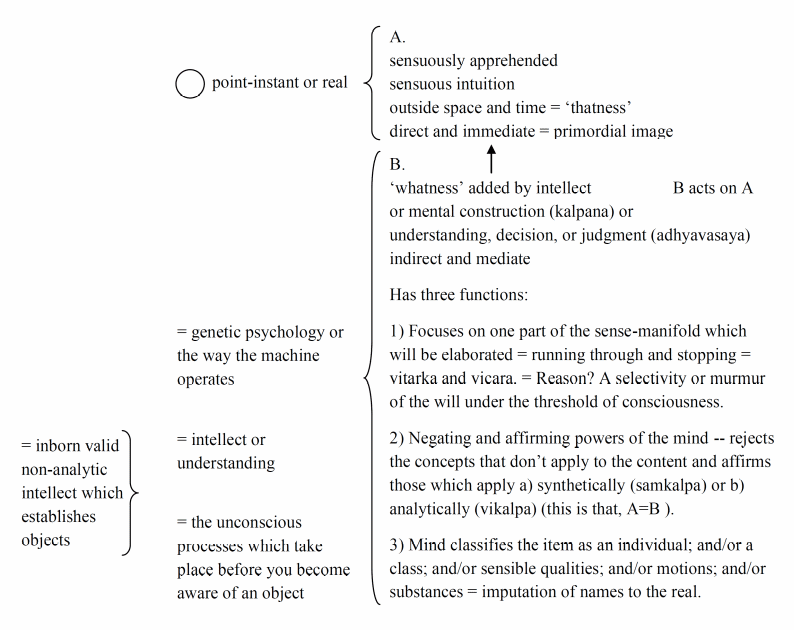
FIGURE 1983 1111-1-AB. Sautrantika Scheme.
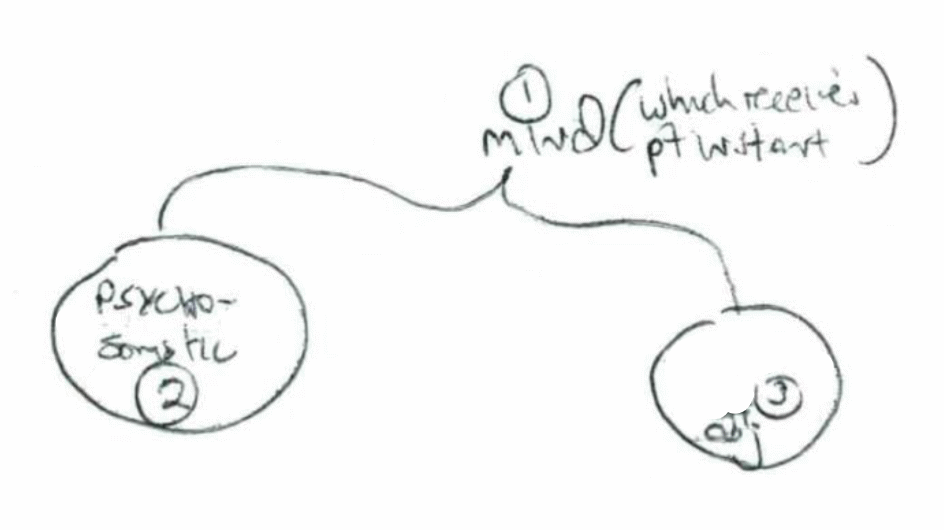
FIGURE 1983 1111-2-AB. Mind, Psychosomatic, and Object.
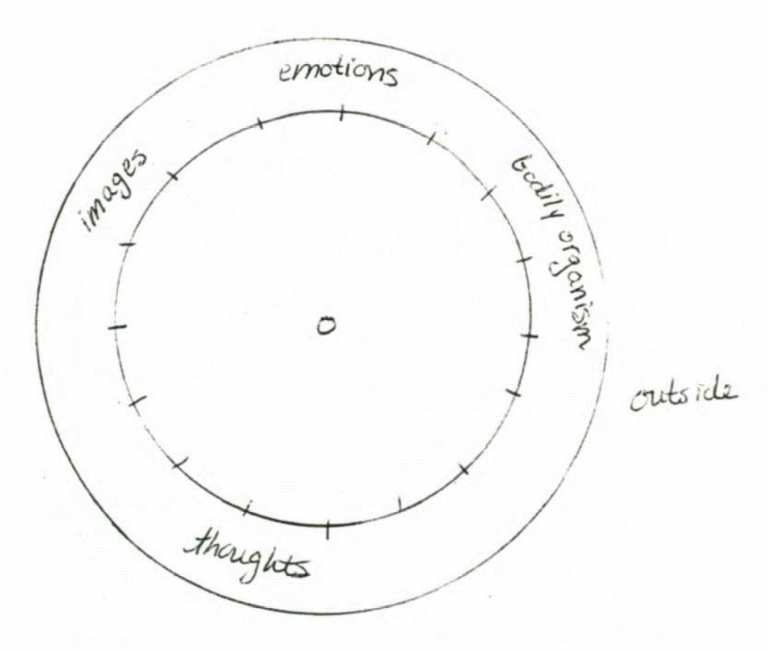
FIGURE 1983 1111-3. Psychosomatic Organism.
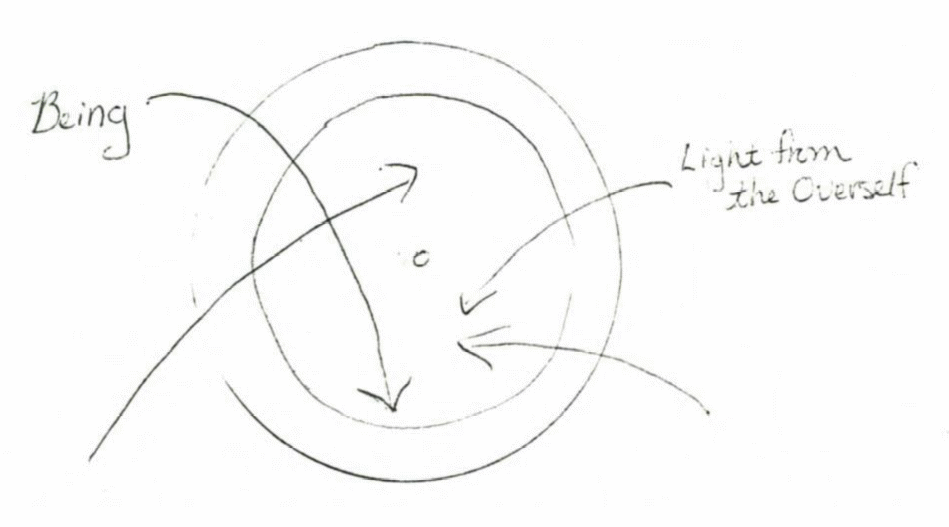
FIGURE 1983 1111-4. Light of Overself in Psychosomatic.
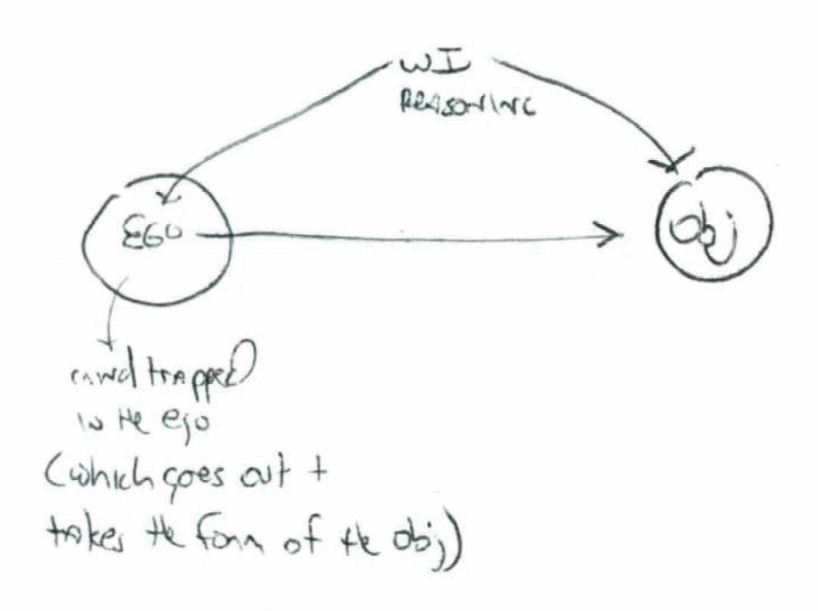
FIGURE 1983 1111-5-AB. Witness-I, Ego, and Object.
Other diagrams also referred to are not with this transcript. [Transcriber note: [diagram] means the speaker is referencing a diagram as he or she is speaking. If someone is drawing or writing, with audible sounds of chalk on a blackboard, I indicate this by [drawing] or [writing].]
NOTES:
Epistemology discussion related to those of WG Classes 1983 10/21, 10/28, 11/18, 11/25a, 12/1, 12/09a, and 12/19a. See also earlier Mentalism series, WG Classes 1983 1/26, 2/2, 2/9, 2/11, 2/16, 2/25, 3/2, 3/9a (and associated paper 3/9b), 3/16, 3/21, 3/23, 3/30, 4/6b, 4/13a.
Earlier transcript version also exists.
Friday night class.
TRANSCRIBED Verbatim by IT prior to 2018; reformatted by jf 2018. This is V12a (2023) and has: updated prefatory matter, footer, and audio file name; Book List and TOC completed; Plotinus quotes section added; Subject and Subsubjects changed to be more accurate; new notes within transcript; five diagrams appended and references within transcript to these diagrams; new formatting to accord with new conventions. Archival verbatim transcript – V12a.
AUDIO FILES: 1983 1111a, 1983 1111b. [Note: "Tape" and "Side" refer to original audio cassette tapes that were later digitized into .MP3 Audio Files.]
1983 11/11 at Wisdom's Goldenrod
Epistemology; Synthesis
[Audio File 1983 1111a Begins]
AD: So we want to keep from jumping conclusions so we're going to [tape goes silent for 4 seconds] here try to examine the epistemological background, alright, from every angle--from the Platonist, the Vedantist, the Buddhist, anybody you want to bring in, PB. Ok?
S (faint): Ok.
AD: Maybe the last time or next class, [VM simultaneously: Oh.] huh? (some laughter)
S: Maybe.
VM: Don't make any promises you can't keep.
S: That's (for sure).
AD: Alright, (I/I'll) take it back. (bit of laughter)
[few faint inaudible student words in background, laughter]
AS: Randy said you shouldn't make promises that we can't keep. (laughter)
S (amidst laughter): Right, that's right, that's right.
AS: Oh, and I just want a brief announcement. Those Ashtavakra books are in and they're $3.56 [three/few words inaudible] And--
AD: As a matter of fact, that's the first PB publication, right?
AS: Right, same (price). [student assents] Every-- I mean everybody knows about the notes as-- [student assents] Well, Carol (suggested) [couple/three words inaudible]
S (simultaneously): About what?
[few seconds of faint background student talking, AS and other students]
AS: Ok.
S (simultaneously): Can I-- could I say something before we start?
AS (simultaneously): Yes, certainly.
S: I'd like to make a sugge--
[Note: Quick tape break. The rest of the beginning announcements weren't recorded. The tape picks up again with the beginning of the content portion of the class.]
[Note: See FIGURE 1983 1111-1-AB, Sautrantika Scheme, appended to this transcript for the following.]
AS: So you remember from-- no you don't, but two weeks ago-- sure you do, two weeks ago we-- just to set the context we've come up with so far, in two minutes. Two weeks ago we were discussing these Sautrantika fellows with their split, the ones that Severin likes, with their two sources of knowledge, the pure sensation and then the productive imagination, their intellect. [Note: See WG Class 1983 1028.] And you remember they said that on the basis of this pure sensation the intellect then goes ahead and constructs the perception, constructs an image that corresponds to the sensation and it judges that it belongs to it, combines it with it.
And remember it had these various functions. It-- it had a power of searching through [AS writing on board] and stopping. [student assents, very faint] It's presented with-- this is given [diagram]. The pure sensation apprehends the thing-in-itself and out of the manifold of sensations or pure given sensuous intuition or whatever you want to call it, the intellect first begins searching through and then stopping at certain of those sensations, and then it organizes its own memory content and images according to everything, negation and affirmation. It negates everything that's not like the sensation and then it affirms everything that's like it both analytically and synthetically. And then, finally, it decides on one of five classes. Put the object there [diagram]. [short pause while drawing/writing]. Ok? And all of this the intellect does. And it's all-- and on that side [diagram] we have conceptions, they are indirect knowledge, they're constructed. He call-- other words for this side is imagination, intellect, judgment, and Anthony said, well, habit. [student assents, very faint] It's mental habits, the brain function, right here [diagram], and the psychosomatic organism.
And what it does all this stuff on the basis of is this pure or direct sensation. And this [diagram] is direct [writing/drawing] or immediate (basis), [student assents] an immediate contact with the reality of the point-instant. Whatever that thing-in-itself may be prior to the intellect's construction we don't really know, you know, because there's no real intelligible content here until the, they say, until the intellect gets to work and decides how to name it, how to classify it, what image to associate with it and so on. And on the right side [diagram], all this does is announce that there is an object, that there is something in the ken, and the intellect has to get to work to make something a what out of it instead of a that, so-- And then it puts together the core or the that, its sensation, and combines it with a what, names it, gives it qualities and so on.
And those two together are your experience. Those two together give you a perception of some what, some thing, a sensible direct core and an indirect productive imagination which is imposed on that. And these two have completely different-- they're completely different sources for the Sautrantika. The productive imagination cannot really contact a thing-in-itself. It deals only with the images. And the sensation, the pure sensation, although it contacts the reality, so to speak, it can't really deliver any determinate knowledge about it until the intellect makes judgments. [noises, AS possibly drawing] (Make contact.) Ok? Now, any questions, everybody likes that kind of view?
S: David had-- David has a question about that part.
DB: What is the ken?
S: Oh.
AS: What is the ken?
DB (simultaneously): [couple/three words inaudible] [S simultaneously: Oh, oh.] yeah, but ken, what's the ken? [AS simultaneously: When you say (few words inaudible)] You know, they say, "Well, it announces that something has shown up in the ken which is a point-instant" and there's no ken--
AD (simultaneously): Dog kennel, don't you know what a dog kennel is? (some laughter)
DB: Yeah right, but I mean 'ken' is a archaic form of knowing, I-- I mean a phrase that means "knowing that".
S: Uh-hm.
AS: "Knowing that".
DB: "Knowing that," right, so [AD/S(?) simultaneously: Ok.] we got this-- this "that knower", but it doesn't know anything other than that something showed up. And I didn't quite understand what they mean by it, it doesn't make any sense. You don't know-- you don't know anything about it [S: Yeah.] other than the fact that [S: Well--] something happened and then the intellect goes to work and, you know, it clumps something together and calls it a banana, I don't know. But--
AS: Mind got energized.
DB: Right. But what is-- yes, but what is 'ken' and how is that-- I mean, do we have two centers of awareness there, one is-- is knowing that and the other one is knowing the [S simultaneously, faint: That's (what--)] particular-- What?
LDS: Why can't the ken be the field or the environment of the subject, [S simultaneously: Yeah but--] whatever that-- whatever that entails here (behind) the subject.
DB: Um--
LDS: And uh-- well maybe that's not saying it right.
DB: Well then-- but then that-- would that imply that, you know, they go into the whole thing of eye, ear, nose consciousnesses and those guys, is that what they mean then?
LDS: I thought it was prior to that somehow.
PD: Well, he's trying to indicate that non-conceptual cognizing that's going on in you. [DB/S(?) simultaneously: Yeah that--] Now if you keep trying to-- to weave a web of cogitation, you're missing the whole point of what he's pointing to.
DB: Yeah-- well, yes, granted, undoubtedly, but um, my-- my problem is we still don't have anything that resembles anything that I can understand as being a form of knowing because you just-- something has shown up. "Oh, well, ok." I just don't-- I don't appreciate it fully. I'm not saying it doesn't happen, I just would like to get that-- that differentiated, you know.
RC: Well that-- it seems real dark (all/or) by itself without the word. He's talking about, "You hear that?" "Yeah." "What was it?" "I don't know, but I heard it."
DB: Yeah.
RC: It seems like he's trying to talk at that point of, there's been recognition of the [one word inaudible] in some sense but it hasn't been defined as anything that you could put a name on.
DB: Well yeah, but I mean, I-- I understand-- I understand your analogy. The only problem is that perhaps I'm misinterpreting the Sautrantika because I had under-- I had understood that what they meant was something that couldn't be defined in-- as a-- an auditory signal or as a visual stimuli or any--
LR: David, isn't it just [AS simultaneously: Well (few words inaudible)] the point-instants hitting the mind? Isn't the mind the ken?
S: Right.
AS: But David-- but the thing-- what about the thing David said? Are they really-- I mean they say "pure sensation". [LR assents] Do they mean that, I mean, do they mean the sound hitting the sense of sound [LR simultaneously: I thought (S simultaneously: Yeah, is it with--) it was completely undifferentiate--] and the colors hitting the sense of sight?
S: Yeah, good.
LR (simultaneously): I thought it was a completely undifferentiated stimuli.
AB: Yeah, it's just-- it's just a--
LR (simultaneously): I don't think it means sensation in terms of which sense. Something is received by the mind. No jud-- absolutely no judgment or any images apply to it. The mind is imageless. Isn't that the ken?
[student assents, very faint]
AS: I don't know.
AB (simultaneously): But is this process-- last time I thought we expressed this process as the production of the image. In other words, it's prior to experience. But I think, using Randy's example, you could also look at this process taking place within the primordial image and then the subject of the subject and object relationship goes through these-- these stages in, you know, having an experience. Alright, and it seemed that you could argue this at either level.
RC: Yeah. I think it would be prior-- prior to what we mean by localization too, like when we did that stuff with-- (Weren't we-- weren't we) working with, yeah, it was Kashmir Shaivism book two years ago? He gave examples of how at a certain point the sound is all-pervasive until you refer it to the body and establish its (immortality) and relation to the body. Seems to be referring to the stage at which there's a stimulus but it hasn't yet been localized, placed or defined as an image.
AB: But is the stimulus a-- the-- the mind receiving the primordial image from the heart or is the stimulus you're within the image and you hear a sound that you haven't localized?
S: [couple words inaudible]
AS: Is this the-- is this sensation, is it objective, is it some thing, is this a tree here [AS tapping on diagram]? [students assent] What's here? What are these--
RC: Is it received prior to the subject-object split or received by the subject who's already part of the split?
AS: Uh-hm.
AB: See, that was my question.
[students assent, very faint]
AS (faint): What do you think?
S (faint): (I can already feel it.)
VM: It's got to be-- it's got to be the perception prior to any empirical subject. [student assents] Got to. Because the productive imagination is that thing which generates your sense of personality there, your sense of ego identity. And this process, if I understand the Sautrantika, is prior to that sort of energization of the mind or undifferentiated content being stimulated in consciousness.
[short pause]
LDS: So you're saying that the-- the precipitation of subject-object split is a consequence of the operation of that-- a consequence--
VM: More things that Avery laid out (earlier).
LDS: Yeah, the two forms of the productive imagination.
VM (simultaneously): Yeah, I think so. Go ahead.
[students assent, faint]
AS: Yeah then-- then is this stuff on the left [diagram] though, is that actually producing my sensation, producing the object that I see?
[student assents, faint]
VM: Well, how do you [possibly one word inaudible]
S: These images [one word inaudible] in front of you.
VM: It's unfolding what's already inherent in that pure sensation because when they say pure sensation to me that can't be a completely contentless, undifferentiated in the fullest sense of the term otherwise there's no way to account for the uniqueness of each perception. So those point-instants, there may be a (comment) in a certain sense. From down here, so to speak, they can't be penetrated by conception. On the other hand they must have some sort of structure inherent to them at their own level. Otherwise every perception would be the same or it could be anything.
RC: Right. And that very process of negating and affirming, this couldn't happen.
VM: Or it would (be) just random.
S (faint): Uh-hm, would be [one word inaudible]
DB: So then at that first-- [couple/three inaudible student words simultaneous with DB] that-- that first moment like gotta have something that he can work on and say, "Not not a cow" or whatever. I mean, [S simultaneously: Right, (we'll do) that.] so-- so that when something shows up in the ken, the ken doesn't just go "Another something just showed up" but [students assent, faint] specific to some kind of qualitative determination there.
RC: I wonder if you could take it, you know, back so far as to say that the first negation is-- whether or not it's like part of the subject or part of the object series instead. Do you know what I mean? [students assent, very faint] The first-- the first thing to be defined is, is it an internal content or an external content.
S (faint): Very (small) [one word inaudible]
AS: But also, does this working of the intellect actually produce this green sensation? And when they say that-- I mean, you get these green sensations. Are they objective or subjective? And are they actually something given or does the intellect construct it? I mean, does the intelle-- does the productive imagination construct the actual green of this book or is that something that the book actually has [students assent, faint] [S simultaneously: It's both.] that's been given objectively?
S (simultaneously): Why do we have to fall on one side or the other?
S (faint): Yeah.
S (very faint): Uh-hm.
AH: Yeah, but Sautrantika is considered realistic in comparison to schools that have more mentalistic trend, so for them the point-instant is real. There is an objective object status for that [one word inaudible]
AB: Yeah, but the fact that you see this green, where does that come from?
AH: Well that's a-- that's a subtlety of their school that's-- I was just trying to read about this week.
AB: But Avery, wouldn't it-- isn't it that you perceiving the book as green, all of that is what's elaborated out of this point-instant by this [one word inaudible] It's not just even-- it's not just, say, the greenness of the book but the whole perception as a whole is a result of, you know, searching and stopping, etc.
[students assent, very faint]
AS: Uh-hm.
[student assents, very faint]
AB (faint): Well, that refers to the original question.
RC: I remember we said that was so in the Vaibhashika, I don't know if Sautrantika (catch) that or not, do you know?
S (faint): [one word inaudible] what Randy?
RC: Well there-- there were those examples we used with the Vaibhashika when Louie was doing it [couple words inaudible] or so, that the whole way they presented the thing was not the son but the man seeing the son was the object and everything came together like for them as a man seeing the son as a unit. And I don't remember if the Sautrantika has that.
LDS: Well I think in the Vaibhashika they were totally objective. There was no reality to any subjective pole at all, [RC assents] where with the Sautrantika the-- the con-- concession to a real subject was made. [AH simultaneously: Yeah, I think--] There wa-- there was a real split between the subject and object and that was the primary conflict they were going to deal with, [S simultaneously, faint: So that--] the-- for the Sautrantikas.
AH: But the only one that-- Vaibhashika (holds) the objective pole to be the reality of the dharmas [one word inaudible]
LDS (simultaneously): Yeah. The dharmas were all-- all the-- you had a real split.
AH: They devalue the subjective, the egotistic, etc.
LDS: Any sense of subjectivity was a consequence of the functioning of the dharmas.
AH: In Sautrantika, an evolution-- they-- they began to talk about this-- this object as other than--
[someone drawing/writing]
LDS: Subject.
AH: --other than a real(--/,) a Vaibhashika object or-- They reduced it from a dharma to a point-instant.
LDS: Think I knew that.
PD: Didn't Sautrantikas take their stance in human knowledge, inference and perception? I mean that's their fundamental stance?
S: [one/two words inaudible]
LDS (simultaneously): Yeah, I would say epistemology.
PD: And, if you're gonna, you know, if you're gonna work from their position you're gonna have to start from that assumption. You can't bring in a metaphysical framework.
[student assents, very faint]
AS: Yeah, but we may want to move--
PD (simultaneously): (Bring in) a cosmological scheme such as [AS simultaneously: Yeah.] the world-image or--
AS: But I don't-- it-- I don't think we want to stay necessarily with the Sautrantika, we want to see where, you know-- where the problems of their school might lead us, because obviously their thing is not the final word, there are some problems with their epistemology. And I'm wondering if we could-- if we can get it, what the-- what exactly the problems are with their epistemology, where do they lead us, where did-- where do we have to go if we assume their thing that there's this [drawing] object here [diagram] that's on-- that's known in direct perception or the sensation and then the intellect goes and constructs an image on the basis of that.
RG: But I (don't think) that's any different (of) the way we think about it. I mean, how is that different than a mentalistic epistemology? If sensation is direct, immediate, has no qualities, and the constructive imagination constructs everything about the known object including its space-time unfoldment, what's-- what's the problem?
AH: I think there's a different presupposition. In the Sautrantika they presuppose-- they presuppose the reality of the point-instant and that deprives it of the truly mentalistic epistemology.
S (simultaneously, faint): Really?
RG: It does?
VM: No so.
RG: But what's the point-instant?
AH: For them it's a real.
RG: And isn't the world-- and isn't the stimulus to the-- to our imagination a real as well? I mean even in a mentalist [student assents] construct.
AH: I think it depends on how you speak of that as a presupposition. Are you going to call it-- are you going to introduce it as a metaphysical belief? Or are you going to establish this basis from the analysis of experience. [students assent, faint] And I think the mentalism that we sometimes do is more a testimony of experience rather than a metaphysical presupposition.
S (very faint, possibly part of background): No.
RG: As the point-instant is a metaphysical presupposition.
S (simultaneously, very faint): [couple words inaudible]
AH: I can't get (like) one [one word inaudible]
AS: I don't-- for example, I don't think they-- that the Sautrantika would say this green book (AS drops book) out here, green book, the green of it is constructed by my intellect.
RG (simultaneously): Then what is it-- then I don't understand what we've been saying of what constructive [students assent] imagination is or what--
AH (faint): Or they.
RG: Yeah, what-- then [couple inaudible student words simultaneous with RG] what does the constructive imagination (give) do?
AS (simultaneously): Well, then what would that-- but then where would they differ from the Yogacara if they said well even the-- even that book that's so-- that seemed to be out there [RG simultaneously: I don't know, I never unders--] isn't but is constructed by my intellect.
RG: Never understood this.
AS: It's not constructed. The thing, the object is not constructed by my intellect.
RG: What is?
AS: You mean my ego constructs-- If my ego constructs this book, [RG simultaneously: But is--] then it could construct anything!
RG: We didn't say our ego did Avery.
AS (simultaneously): Does this construct realities?
[few students at once, inaudible, continues for few seconds as class continues]
RG: Ave, wait a minute, Avery, A-- well who-- why are you equating ego with mind?
LDS (simultaneously): That's (what/with) the Yogacara(--/.) Yogacaras don't do that.
RG: Wait, whoa, whoa.
AS (simultaneously): No, I mean it, they say look, first the thing, it goes and it searches through and then it decides what-- what concepts are [one/two words inaudible] [RG simultaneously: What searches through what?] belong with it and then they go and then it categorizes it. [RG: What--] Now you think that's the same thing as constructing an actual book? [S simultaneously: (Right.)] That kind of process can construct a book for you?
RG: Wait a minute, you went through this whole--
AS (simultaneously): If-- if that were so--
RG (simultaneously): But wait, whoa, whoa, whoa, whoa!
AS: If that were so [couple/three word inaudible]
RG (simultaneously): You went through this whole analysis two weeks ago about vikalpa [AS simultaneously: I did?] and the constructive imagination, (bit of laughter) how it constructs--
AS (simultaneously): But what is it constructing?
RG: You-- [S simultaneously: What?] well, you tell me.
VM/S(?) (simultaneously): [couple words inaudible]
AS: Is it constructing this book?
CDA (simultaneously): Concepts.
S (simultaneously with AS and CDA): [one/two words inaudible] one at a time.
RG: What is it constructing?
AS (simultaneously): I could, I could-- If it's not-- if [S simultaneously, faint in background: I would say the whole thing, yeah.] it's constructing the book, then it could easily turn the construction of the book into something else.
RG: That's not true. We have the same p--
AS (simultaneously): Why?
RG: Why? Because it's [AS simultaneously: Yeah.] not your ego that constructs it.
LDS: It's the four hundred (years) within your own [one word inaudible]
AS (simultaneously): But-- oh, but if it's not your ego that [drawing] constructs it but all of that functioning was the functioning of the ego--
RG: Who said all-- who said that?
AS: Well what-- [S simultaneously: Uh-hm, wait.] what in all that stuff, what in-- what in all that stuff that we mentioned about-- (some laughter) what is all that stuff-- what in all that stuff about (laughter) [couple words inaudible] about-- [S: Said that (already).] about vitarka and vichara and all that did we have something that could-- that can-- They-- they're one-pointed that all that stuff does not construct the reality of the object. The reality of the object stands as what it is and that reality of the object is the very core of your experience.
RG: No doubt. But what i-- what i-- when you say "reality of object", what do you mean?
AS: Yeah, well what did you think-- what do they mean? They don't mean pie in the sky.
RG: What do they mean?
S (simultaneously): [three/few words inaudible]
AS (simultaneously): They mean the object.
RG: No, they mean the object that's contacted by sensation, which is direct and immediate, which can't be contacted by the sensory apparatus.
AS: And in my very experience, isn't that sensible object a part of my experience or [RG simultaneously: The--] is it not?
RG: The direct--
AS: You mean-- you mean this [AS indicates on diagram] doesn't form the core of all my perceptions?
RG: Yes. But your-- but your claim that it's [AS simultaneously: And I don't know it?] in space and time is a question.
AS: Oh, well this-- well, my claim that it's in space and time. Not exactly that it's in space and time but that my-- this constructive process of the intellect can't fabricate-- isn't what fabricates the reality of the book for me.
RG: Nobody ever said it fabricated the reality [AS simultaneously: Well, then how does it then--] of it. We-- you've already had on the other side [diagram] the pure object which is the reality of the book that's [AS simultaneously: Right.] contacted by sen-- pure sensation.
AS: And in fact the reality of the book is the book. I mean it is the book. It's not some other book.
PD (simultaneously): Why-- why are you assuming an equation, Avery, between reality and book? [AS simultaneously: Well what (of it?)] Maybe there's no relationship.
AD (simultaneously): Wait, wait, wait, wait, wait, wait. (laughter, student words)
VM(?) (amidst laughter): [couple words inaudible] now let's start again. (more laughter, student words)
AD: Let's [AS simultaneously: I was just trying to get (one word inaudible)] start, let's start where we are, ok?
S (faint): It's alright with me. (bit of laughter)
AD: We left off that all that we could know and all that we do know is the psychosomatic organism, the functioning of that organism. We don't know anything else. Would you agree with that? We're located inside the organism. [students assent, very faint] Ok?
[student assents, very faint]
AS: There we are [diagram].
[sounds like student assenting, very faint]
S: Hm.
LDS: Hm.
AD: We're inside the organism, we're locked into the body. [someone drawing] Everything that we know about the external world we must know through our senses. And whatever modification the senses register, alright, we speak about that as being memorized, etc, stored away, and then recalled. Now, there's a tree or a cloud outside the psychosomatic organism, cloud up there.
S (faint): Wait, wait, wait.
AD: Huh? (bit of laughter)
S (very faint): Help us through. (bit of laughter)
VM (faint): Not outside.
RG: What do you mean?
VM: How did it ever get outside?
RG: Yeah.
AS: It didn't get outside, it is there.
AD (simultaneously): Is it spatially related to your body?
VM: Yes, but my body is not the totality of the psychosomatic organism.
AS: Oh no?
S (faint): Wait, let him finish.
AD: Well, [LDS(?): Yeah.] you want to tell me what else you got? (laughter)
VM: Well when you (look--) [S, very faint: Uh-uh.] when you use 'body' like that and when you use "psychosomatic organism," I take it as-- well, you know, we read that quote from Fordham a lot of times about what is the body schemata and so on, and that's the way I was trying to interpret the body, as including [AD simultaneously: Look--] the full space-time continuum within which experience occurs. [Note: See Michael Fordham, The Objective Psyche.]
AD (simultaneously): Yeah, look, look, you're inside the body, you're looking out. You're perceiving from within out, right? Now, disregarding Fordham, alright, because we're going to have to work our way out. The point now is, what do you know outside of the functioning of the psychosomatic organism?
AS: Nothing.
AD: Is that-- is-- are you really convinced of that?
RG: No, because if you-- no.
VM (simultaneously): I think so, as long-- but if you want to put the cloud outside my body [RG simultaneously: Then you know something else.] then you got me worried, and then I get confused.
AD: Well is the cloud inside your body?
VM: No, it's within the sphere of my psychosomatic experience though.
AD: Well, I'm not denying that-- I'm not denying that.
VM (simultaneously): Are you gonna make the mind spatially localized right over here?
AD: I'm absolutely localizing. When I speak about Anthony, [AD hits something] I'm speaking about this guy here [diagram].
[student assents, very faint]
AH: You said--
AD: And that cloud's a hundred miles away and I see a white cloud.
VM: Ok.
AD: Now, whiteness is a sensation. Now the problem begins. [student assents, very faint] But sensation belongs to the mind.
[student assents, faint]
RG: Right.
AH: So you speak of a known cloud.
RG (simultaneously): So you've just disproved your first statement, [VM simultaneously: Yeah, see I would say--] that all you know is your psychosomatic organism.
AD (simultaneously): No, I'm not disproving anything, I'm just-- I'm just taking one step at a time. [some student talking in background simultaneous with AD, continues for few seconds as class continues] I'm just-- I'm just walking.
AH: Anthony, could I-- but could I-- could I try to at least clarify something for myself too. If all we know is within this psychosomatic organism, I can reluctantly agree to that. And you say there's a cloud or a tree outside of it but you speak of a known cloud or a known tree. So how did it get outside? It got outside--
AD (simultaneously): Well if you-- if you let me take a few steps. (bit of laughter, students assent, very faint)
S: And then we'll [RG/S(?) simultaneously: Yeah.] get a chance. (bit of laughter)
S: Right.
AD: Let's start class all over again. (AD bangs cymbal loudly) We start from the beginning. Ok?
S (very faint in background): Are you doing this [few words inaudible]
AD: We left off-- (13 seconds of laughter, background student talking; continues as AD begins to speak) Uh-- You remember the statement in the Hidden Teaching that unless you recognize that you're locked up in the body and that you must see the world through the immovable spectacle of the senses? You remember that quote?
[students assent, faint]
AD: You do remember it, right?
S: Yeah, yeah.
AD: So then that's you. Whatever you know is the way your psychosomatic organism functions. [student assents, faint] But then we bringing in this problem. There's a cloud out there, and the cloud is white, alright, there's a distance, we could bring in a lot of qualities. But we're saying that this whiteness is sensation. Sensation belongs to the mind. Now, what do we do?
[short pause]
JfL: You said sensation belongs to the mind, you didn't say the body.
AD: Yeah, I know I said that.
JfL: Why is it-- why is it-- I missed the problem.
AD: We said that all we could know, alright, is the functioning of the psychosomatic organism, that you're locked within it, ok, and that you function within your psychosomatic organism. You notice that? [JfL assents, faint] And then the problem is brought out, and we're not going to go through it, we're saying well there's a white cloud, whiteness is a sensation, sensation belongs to the mind, therefore… What happens? [AS: Yeah.] What am I [LDS simultaneously: Well then--] talking about?
LDS: Yeah, what's the white cloud out there?
AD: No, not "what's the white cloud [AS simultaneously: No.] out there".
AS: The white--
S (simultaneously): Why? [couple words inaudible]
AS (simultaneously): White cloud isn't [one word inaudible]
RC: What does (psychosomatic mean here)?
AD (simultaneously): Sensation, the whiteness, belongs to the cloud, the cloud's out there and therefore, [AS simultaneously: And the mind's out there.] if sensation belongs to the mind my mind's there too.
LDS: Well--
S: Right, yeah.
S: Yeah.
RC(?) (faint): Yeah.
AS: And that--
[student assents, very faint]
AD: Ok.
AS: So-- so the conclusion then, one implication, this psychosomatic organism which has done all this intellectual operation here [diagram] is not equal-- does not equal the totality of the mind which is out there at the object.
RC: What does 'psycho' mean?
JfL: Yeah I mean, you (pose--)
AS: The conceptual operation which is linked just to the body is not the totality of the mind.
PD: The-- [AS simultaneously: It (doesn't) create (couple words inaudible)] if you take one set of sensations and you call them your body and you take another set of sensations and you call them the object and then you-- [student assents, very faint] [S simultaneously: But I thought that--] (and) if you're calling one the thing and the other yourself and you're saying they don't relate, it just seems ri-- [AS simultaneously: No (one word inaudible) it's--] ridiculous.
AD (simultaneously): I didn't say they don't relate.
AS (simultaneously): No, it's not that they don't relate.
PD: Because they're both contents of the mental functioning.
AD (simultaneously): (I didn't say) they don't relate. I'd better get up there.
S: (Yeah.)
AD: I'd better get up here Richard. [student assents, faint] Bella-- belli-- bellicosis. (laughter, student words)
AS: I think the question is Paul, in the Sautrantika system or any system or this little discussion (we even had), what do we have to add to the picture in order to make the link?
PD: Well, we have to understand them first, I--
[Note: See FIGURE 1983 1111-2-AB, Mind, Psychosomatic, and Object, appended to this transcript for the following.]
AD: [drawing] They're both mind then, right? This is-- this sensation [diagram] belongs to mind.
PD: Well they're both mental functioning.
AD: The psychosomatic organism you're aware of, to mind [diagram]. [VM simultaneously, faint: Oh but wait a minute.] So they're both mind.
RG: Uh-hm.
AH (simultaneously): Yeah, I--
VM: I find it difficult to put cloud over there as that pure sensation. Does he-- (did he/do they) mean that?
AD: Well, we're saying something like this then. We're saying the world is given to the mind. Alright now-- We don't have to say point-instants, the world is given to the mind, alright, so then the mind has the receptivity-- better not use 'sensation' because [one/two inaudible student words] that's a Rorschach test. So the mind has a receptivity, it takes in the World-Idea, alright, and immediately there's spread out all the sensible qualities of the world, right? This is white, alright. Over here is a green mountain. [student assents] Ok? Green, [drawing] that belongs to the mind too. Right? So mind is here, mind is here, mind is here, alright, ok? The mind seems to be everywhere. But this mind here [diagram] we can refer to in one way and this mind here, [student assents, faint] going through this here [diagram], we refer to as another. Could we do that?
AS (simultaneously): Yeah. Now when-- when the Sautrantika mentions the two forms of knowledge, what they don't stress is that both the sensation, the function of sensation, and the function of conception or intellect, both belong to a common principle. I think-- and David-- David brought that out right near the beginning, that are these two different minds, the one that has sensation and the one that has conception. For Sautrantika they are, there really is a split, [student assents] but I think-- but here we're saying no, but they-- you have to make the understanding-- in the understanding you have to make the link that these are both functions of some greater mind. Now they won't say that this mind, the intellect, constructs this sensation, that's a given for them. And they won't say that this sensation has anything to do with this intellection here. But both of those really, from a bigger context, are parts of-- functions of the same mind.
AD: Well, you got that-- you got enough of that from the Hidden Teaching, right? Hidden Teaching points out, well, the green in the leaf of the tree is on the leaf, [students assent, very faint] alright, so it has to be in the mind because if greenness is a sensation, it's got to be there where you see it, alright. So that would be mind here [diagram], ok? But then over here too you have mind, inside the psychosomatic organism [diagram]. So like we were trying to point out last night, there's a light that's going through, let's say, this psychosomatic organism, which we can call the personal "I", the personal consciousness. [drawing/writing] Ok? Or subjective consciousness, empirical consciousness. What are we going to call this here [diagram]?
[short pause]
PD: I can't see how you can speak of two of them.
AD: Why can't I speak about two of them?
PD: Why do you want to speak about two of them? (bit of laughter)
AD: Because the white cloud-- whiteness is a sensation which belongs to mind, alright. Then the sensation of bodily pain, for instance, that belongs to mind too. But it don't belong to the tree or to the cloud.
PD: But they both belong to the same mind, the [AD simultaneously: Yeah.] whiteness of [student assents, faint] cloud and the whiteness [AD simultaneously: Uh-huh.] of pain.
AD: Yeah.
PD: So the-- the white that [three/few words inaudible]
AD (simultaneously): They belong, they belong to the same mind, yes. Alright, [S simultaneously: (Which one?)] now how would you refer to the mind which is operative within the personal consciousness or within the psychosomatic organism and that objective psyche, that objective mind?
PD: But the white cloud is part of the subjective consciousness too. I mean there's-- there's nothing within the continuum--
AD: Now wait a minute. Do you or don't you experience a distinction, an alienation between you and the white cloud?
PD: I experience an emotional separation in the different contents of my experience.
AD: Yeah.
PD: But that is not a critique for a difference in knowledge.
AD: Well, it's enough of a critique. I don't feel that I am part of the world, I feel distinct from the world.
PD: Well that's because you have certain abilities but--
AD: No, no, all of us.
PD: But that feeling is no criterion. Why is that a criterion for reality?
AD (simultaneously): Why is feeling not a criteria?
PD: Well, then what's the criterion for the reality of whiteness [couple/few words inaudible]
AD (simultaneously): I mean I don't run over and stop you from chopping down a tree, I say it's hurting me.
S (very faint): (Yeah.)
S: Yeah.
MW(?): Yes.
PD: I don't get your point. (bit of laughter)
S: Yeah. (bit of laughter)
[student assents, very faint]
AD: If this tree that you're [student assents] chopping down (bit of laughter) is my mind, then I would come over and say, "Stop cutting me!" (laughter)
PD: But you don't experience the tree that I chop down.
AD: No, that's why I'm saying, [RG simultaneously: Some people do.] alright, I'm going to make a distinction. I'm going to make a distinction between the mind which is operative within the psychosomatic organism and the mind which is the perceived world all around me. I'm making a distinction between these two.
PD: But the perceived world is with-- as much a part [couple words inaudible]
AD (simultaneously): Not a separation.
PD: Pardon?
AD: Not a separation.
PD: But how can you take the perceived world and separate it from the psychosomatic organism?
AB (simultaneously): He's making a distinction.
AD: I'm just telling you, it's not a separation, I'm making a distinction between me and everything else. Not a separation, I'm not cutting it off. And further, I'm saying that that what I distinguish from, everything that I distinguish myself from, is the objective world and the "I" that's distinguishing itself from all that is the subjective or the empirical consciousness.
RG: Right.
AD: So here's mind [diagram], my mind, if you want to say "my", although it would be ludicrous, alright, this is mind, alright, and it receives the World-Idea. The World-Idea includes the psychosomatic organism and everything else that you find in your perceived world, alright. And I'm going to say, well mind, insofar that it translates the world that it receives into sensible qualities, greens, yellows, smells, tastes, ok, and is outside of my psychosomatic organism, I'm going to call that the objective psyche, well you can call that the product of the Witness-I, and this here [diagram] I'm going to call my personal consciousness, my empirical consciousness.
RG: Uh-hm.
PD: So the green, the yellow, that you see is not a product of your psychosomatic organism.
AD: No.
DB: No, you perceive it. [S: Yeah.] It's not a product of it. Why is it a product of it or a production?
VM (simultaneously): [three/few words inaudible] when you talk about the psychosomatic.
PD (simultaneously): Well, (when) you change the light a little and you won't see the green.
AD: I'm sorry?
VM: Well, it seems like--
PD (simultaneously): What's mo-- what's getting modified?
DB: Your perception.
PD: Yeah. So your psychosomatic organism is conditioning your perception. So then green is a product of the psychosomatic organism.
AD: Is there green in the brain?
VM: Oh.
DB: Give up.
PD: I don't know.
AD: No, there's no color in the brain.
PD: But you change the light in relation to the psychosomatic [AD simultaneously: Yeah, but there's no color in the brain.] organism, you have no green.
AD: That's-- that doesn't change the issue. The-- there's no color in the brain.
[students assent, faint]
PD (simultaneously): So there's no-- as long as there's no [couple inaudible student words simultaneous with PD] green apart from the brain. (bit of laughter)
S (faint): Oh yeah.
VM: Let's take [AD simultaneously: Huh?] his word (Paul/for it).
PD: I mean as long as you-- as long as you keep the qualities of the experience tied to a psychosomatic organism.
AD: I'm sorry?
PD: The greenness of the perceived world exists only in relation to psychosomatic organism.
AD (simultaneously): No, no. Not only. Not only.
S (simultaneously, very faint): [couple words inaudible]
PD: And you [AS simultaneously: When you say exist--] change the light that exists in relation to the body and there's no green-- green cognized world.
[students assent, very faint]
DB: Yeah but the light was there to begin with and the-- the change of the light is as much of a--
AD (simultaneously): Look, look. Let me take it over for a while, huh? (some laughter, student words) Something's wrong with my eyes, I don't see the green, right? I see red. Now, "Red is the color of all leaves." Correct? Is that a fact?
[student assents, faint]
VM/S(?): [couple words inaudible] [PD simultaneously: Red--] for you it's a fact. (bit of laughter)
PD: It could be a fact to you.
AD: Is it a fact?
S: No.
AD: Could be a fact [LR simultaneously: Fact, it's not publicly certifiable.] means that it would have to participate in the [S simultaneously: No.] Idea of the World.
S (simultaneously): [couple/three words inaudible]
S (faint): I agree.
PD: Well that's a conceptual construction, I don't know no Idea of the World, so--
AD (simultaneously): Well-- well look, let's not go-- Look, I don't want to round and round in circles, I got something to do. Again, is-- if I say to you that this train is a hundred feet long, anyone with a tape measure can go over and prove that it's a hundred feet long. Right? That's a fact.
PD: There's a conceptual construction of measure [three/few words inaudible]
AD (simultaneously): I don't care what you call it. Is [PD simultaneously: Ok.] it a fact or isn't it!?
PD: Well, I don't know what you mean by fact.
S: Oh.
AD (intensely): I'm explaining to you what a fact is, that it can be publicly certified if anyone takes the trouble to go check it out!
PD: So if two people agree on something, it's a fact.
AD (simultaneously): If I give you directions that "Here's a mountain, when you get there it'll be so high, so tall, and such and such a color," alright. You say, "Well, I don't believe you." You go there and you do it and you say, "It's so", then you tell someone, he goes there-- That's a fact!!
LR: Paul, you weren't here Wednesday but we all agreed [couple/few words inaudible] (laughter)
AD (amidst laughter): He's got to get it too, he's got to get it too. (laughter) In other words a fact is public knowledge that given the same conditions anyone can go there and certify it for himself that this is so.
VM: Empirical fact, yes.
AD: Yeah, an empirical fact.
PD: Belief.
S: Yeah.
AD: It's a fact.
[few faint background student words]
PD: Well, I don't know. I find it--
AD (simultaneously): Well you-- well you want to bring in a belief. Now you're going to bring in the notion that a fact is a web of relationships of many little items that go-- I'm not interested in that. It's a fact. You go there, I go there, anyone goes there, that'll be a fact. Otherwise, Hitler never killed seven million Jews, that's only a subjective opinion.
PD: Well, it took a lot of people to kill the seven million Jews.
S (very faint): (Oh no.)
AD: No, again, [VM simultaneously: Well, let's return.] you're missing the point, the point I'm making is that there are such things as historical facts.
PD: Well, and the point I'm making is facts (are/is) a certain system of relationship(s).
AD (simultaneously): There are such a thing as scientific facts.
PD: That if you stand at a certain point of view then it's a fact to you.
AD: But that goes-- that goes in the understanding of what a fact is.
PD: Ok, so we agree, it's a belief. [AD simultaneously: Yeah.] Go on.
AD (simultaneously): Alright, so there are such things, alright?
LR: You were-- you were doing the "All leaves red." You're on "All leaves are-- are red."
AD: No, no leaves are green, the point-- the point that we're trying to get to here, the point that we're trying to get to here is that when someone wants to bring in an accidental modification of the functioning of the sense-organs and say, "Well I don't see the green there, I see red," alright, well this is not a fact. [student assents, very faint] It's not red, it's green. Why is it green? Because we've decided beforehand what a fact is, that anyone can go there and publicly certify it. This is elementary scientific method, if you don't buy this you can't buy anything else that follows. Because I've got to base my reasoning on facts.
PD: But greenness as you're speaking about is not a fact, it's a subjective interpretation of an organism, and nobody ever has verified your experience of green. There is no such thing as public experience of green.
[student assents]
VM: But we all know to stop at a red light and not a green light.
PD: Well, fine. (bit of laughter)
VM: Ok. So I mean there's a certain commonality to our experience. I grant you your particular green is yours and mine is mine and there really are differences that come with a-- the psychological apparatus that I bring to that perception and that you bring too.
PD (simultaneously): As relative psychosomatic (I) [one word inaudible]
VM (simultaneously): Yes, yes, I'm using that in the broad sense. Nonetheless, there is a certain way we have of organizing our experiences and we agree on common facts. [PD simultaneously: Well, well, yeah.] I think, you know, operational definitions [few words inaudible]
PD (simultaneously): Operational definitions, I agree a hundred percent Vic.
VM (simultaneously): Right, so that's all we got.
PD: Ok.
AD/S(?): Yeah.
AH: May I ask a question concerning the green on the leaf. We proved earlier or we use as an example the fact that the green is on the leaf but is also part of the psychosomatic organism but the problems-- There's two minds, there's one out there and one here.
AD: There's not two [RG simultaneously: Not two minds.] minds. [AH simultaneously: Are there--] There's a distinction being made within the functioning of mind.
AH: Yes, ok.
AD: The mind receives the World-Idea, alright, and the distinction that is made is that on the one hand the mind takes in the World-Idea which includes the body that it's going to be attached to, [AH: Uh-huh.] and on the other hand, this same mind, alright, is illuminating the psychoso-- psychosomatic organism through which it's going to operate.
[student assents, very faint]
AH: Yeah. [student assents, very faint] How-- the question I wanted to ask is this. Now, green is a quality of the object. [student assents] Now the object has many other qualities, each of which could be connected back to the psyche.
AD: Each of which could what?
AH: In the same way that we found green to be on the leaf as well as part of the psychosomatic [AD simultaneously, faint: (Uh-hm), uh-hm.] sensation, all the other qualities of the-- of the object will-- can also be traced back. Is that-- is that so? Is that the kind of reasoning that one could follow?
AD: No, I mean let me do it.
S: [couple words inaudible]
AH: I mean, are we talking about the qualities of the object, are we talking about--
AD: But look, look, can't you follow me for a little while? And then we'll hit your questions. Follow me for a little while.
AH: I'm just trying to see what-- what (you say--)
AD (simultaneously): Yeah, you're trying to-- Here, let me put it this way. You put it together. [short pause] Anyone here. Now I'm not doing this to be, you know, hostile or belligerent or bellicose. I'm not doing it for that reason. Can you do it? Get up there and do it. Put together, put together the Buddhist, the Vedantist, the Platonist, PB, put 'em together. [13¼ second pause] Put together, for instance, the theory that the Platonist and the Vedantist have: the mind goes forth, grasps the object, penetrates the object, and you're delivered of knowledge. Or put forth the fact like PB said, ok-- PB points out, well, according to the modern epistemological theories, alright, you have a-- an object spatially related to the body, alright. There's an image of the object goes [AD indicates on diagram] to the eye, reaches the brain, alright, and then you get awareness and you know that that-- it can't work that way. [student assents] Right? Put together the other theory that you have, the seed-thought going into the heart and then exfoliating through the brain and projecting the world conscious-- the world-consciousness, you put all these things together for me. If you can't ask this-- a series of questions in the proper order, you won't be able to put it together. And the proper order is important.
Because we've taken the thing from the Hidden Teaching where PB says, you've got to realize, and this is an elementary fact in physiology, that as a psychosomatic organism, you don't know anything except what your body reveals to you, the way the body is modified. So if there's something wrong with the senses, one of the eyes don't see right, instead of seeing green you see red, or red you see green, whatever. Is that right? Yet he himself says that the green you see is on the leaf of the tree, the whiteness of the cloud is the whiteness on-- alright. And we know that sensation is something that can only be spoken of in relation to a mind. Only mind has sensations, only mind has thoughts, what else has thoughts? Then the question being asked now is how are you going to bring-- bring that together. You follow the question? [short pause] It's a scientific fact, alright, that insofar that I'm a-- I'm a functioning psychosomatic organism, this is the center, this is the "I" that's speaking about claiming to know something. And then I claim I know that that cloud is white. And I know that whiteness is a sensation of the mind. Then what happens to our the--
(Side 1 of original cassette tape digitized as 1983 1111a Ends; Side 2 begins)
AD: Or, let's say something like this. You take Kant, you've been reading Kant, he says the mind-- the mind has-- How did he refer to it, alright? (Well--)
AS: Categories.
AD: The two categories or [AS simultaneously: Three. (one/two words inaudible)] three forms of-- he speaks about pure receptivity and intellectual construction. Or he speaks about it as receptivity or sensibility and, what was the other term, you remember?
PD: Sensibility and understanding.
AD: Ok. Now, Kant doesn't tell you that when he speaks about the mind as being sensible, he doesn't tell you that this [diagram] is the mind he's talking about. [students assent, very faint] And he doesn't-- he doesn't tell you that the mind that understands, the understanding mind, is this one [diagram], he doesn't tell you that.
[student assents, faint]
PD: Doesn't tell me what?
AD: He doesn't tell you that in his Critique.
PD: Well, he speaks of human knowledge as being composed of two elements, [AD simultaneously: Yeah, being composed--] the intuitional core and a conceptual--
AD (simultaneously): --being composed of two elements.
PD: --a con-- conceiving pattern.
AD: Ok.
PD (simultaneously): And without either-- either side of the-- the human knowledge, you don't have knowledge, an intuitional--
AD (simultaneously): Now, instead-- instead of putting it the way he did it, why don't we do it so we that we can understand what we're talking about? He's saying on the one hand, [AD hits board with chalk] you got the mind which is receptive, alright, sensible. That means the mind converts the World-Idea into a sensible world immediately, ok. That's everything that's given. Then when he speaks about the mind as understanding, he's-- he's talking [AD knocks on board as he talks] about mi-- the mind that's operating through this psychosomatic organism and using the material that the psychosomatic organism supplies it with to understand what that [diagram] is.
PD: But, see, I understand him a little different there because the mind that's perceived the object has implicated in the perception the forms of the understanding through which perception is possible. The--
AD (simultaneously): No. I thought it was the categories of thought were implicit in the mind, in the sensible mind.
PD: Yeah. The understanding--
AD: So the categories of understanding or the categories of thought are implicit in this mind. When this mind, the individual mind, receives the World-Idea, it grasps the World-Idea and through the categories organizes a perception.
PD: Yes.
AD: Ok. That means the whole objective realm. Ok? That includes this body [AD indicates on diagram].
PD: Yes. The body is a conceptual construction.
S (faint): No.
AD: No.
PD: As a-- as a content of knowledge.
AD (simultaneously): The body is a perceptual construction, [S, faint: What?] first.
PD: Insofar as it's cons-- construction, it's done so by the understanding.
AD (simultaneously): No, no. That's where-- that's where we're disagreeing. [with much emphasis] The World-Idea is given to an individual mind, that includes the body which is part of that world which is being given to the individual mind.
PD: But insofar as you or I speak of a body, we speak of a complex of thoughts and feelings constructed by our understanding.
AD (simultaneously): Not-- no. You insist on fa-- on me falling back into-- getting locked into your conceptualization processes.
PD: No, I'm not insisting on you are but I am.
AD: Yeah. [student assents, faint] That's quite different, quite different. Let's try again. We're saying that the World-Mind, I mean that the individual mind receives the Idea of the World, and that given in that Idea of the World-- In other words, God's coming over and saying "Here's the world" to the individual mind, up here [diagram]. It has the categories of thought implicit in its functioning. So as it translates itself into a-- a perception, the whole image is fabricated. Included in that image is the body, your body.
AS: Uh-hm.
AD: Now--
AS: Yeah.
AD: Yeah, go ahead.
AS: And in that, I think to make clear the point, it's not your conception of the body, it's-- it is your body.
AD: Yeah.
AS: It's not-- you're not talking about constructing a con-- it's not a concept of what your body is. It's the a-- it's your body.
PD: But the [RG simultaneously: Is it your perception of the body?] concepts are constitutive [AD simultaneously: Percep--] of the percept.
RG: Is it your perception of the body?
AD: It's your [AS simultaneously: Yeah.] mind perception [AS: Yeah.] of the primal image.
AS: Immediately [RG simultaneously: Right.] perceived.
AD: In other words, whether we say that what is given to the individual mind is a primal image or point-instants is irrelevant here. The point that we have to grasp here is that the world-image or the point-instants are given to an individual mind. In other words, God is delivering this thought to you and saying, "Here you are." The mind makes a perception of that.
RG: So those are two distinct processes?
AD: (Is/In) what?
RG (simultaneously): Are those two distinct processes?
VM: Perception and conception.
AD (simultaneously): What [couple words inaudible]
AS (simultaneously): [one/two words inaudible] at first this is this process of--
RG (simultaneously): The first is gi-- the [AS simultaneously: --this (one/two words inaudible) yeah.] image give-- the primal image given to the individual mind is one process.
AD: Uh-hm.
RG: And then the individual mind perceptual creation of that primal image is a second process?
AD: Yeah. So now we won't discuss the point-instants, alright, or the Idea, the World-Idea which is given to an ima-- to an individual mind. What we will discuss is that this mind that it's given to, alright, is formless, shapeless, alright, everything that we know about mind. It fabricates or translates or whatever way you want to do, metamorphosizes itself into a perception. [couple inaudible student words, possibly part of background talking] [RG: Uh-hm.] This perception, alright, includes everything that you can include within a perception. Everything is there, including your body. [student assents] [couple inaudible student words, possibly part of background talking]
Let's go back and recall. We said that this body, you remember, the psychosomatic organism, all its memories, the registration of any modification of bodily functioning and all that, everything that we said about it, keep that in mind as the background. The mind, so to speak, is going to bifurcate itself, on the one hand illuminate this psychosomatic organism [AD indicates on diagram] and function through that psychosomatic organism. And on the other hand it's going to be the whole world which is plastered out there as a perception. [student assents, faint]
So then we could say, like the Sautrantikas, the mind receives the world. That's pure sensation. But, you don't have to use the word 'sensation', just say 'perception'. I don't care what the word is. Point is that the mind is receiving the world, alright, and [AD banging on board while finishing sentence] there it is a pure perception. [AD bangs on board, emphasizes the next two sentences.] There the fire is hot. It'll burn you, ok. [student assents, faint]
Then we're saying that that same mind, alright, is operating through an individual psychosomatic organism and, if you remember the way we put it yesterday-- (Who is that?) We made the diagram yesterday, we said, if we think of the psychosomatic organism as bounded, [drawing] alright. [Note: See FIGURE 1983 1111-3, Psychosomatic Organism, appended to this transcript.] And, we put out here the body, the organic sensations, the emotions, ok, memories [diagram], everything that has transpired. I don't have to tell you that, anything that you ever did is recorded by the body, automatically. Something you ate when you were a year old, a good hypnotist could recall it for you. (bit of laughter) He can pull it right out of you. So anything that you've experienced is, [drawing] let's say, in this realm, ok? [student assents, very faint] And here-- so, this is the ego. Now, is this true or is it not true: all you know, now, you and I, all that we know is our ego, we don't know anything else. [short pause] You know something more? You shouldn't be here. (bit of laughter)
S: Yeah, yeah.
RG (simultaneously): Say what?
AD: Then this is what we know, this is all we truly know. So that [drawing] we think-- we'll put all the contents within the ego here, ok, this is all within the ego. Now, we said that the mind-- and we made the distinction, now notice the distinction we're making, which is not going to-- which is not available. [next eight sentences delivered with much passion] People don't tell you these things. Whether they don't know or whether they don't want to tell you, I don't know. But I do know they don't say it. Kant doesn't say, "Look, I'm talking about this mind, alright, which has a pure perceptive ability, alright, and the mind that's in the body which is not that, alright, I'm going to call the understanding." He doesn't say that. I'm saying it. And I'm making it very clear that I know what I'm saying. And I'll even draw diagrams to see that I know what I'm saying. Ok, so then here's the white cloud or green tree. [drawing] [S: (Oh great.)] And by presenting us with the problem, alright, we're going to be forced to find a-- an answer. This whiteness [AD hits board] belongs to the mind, we know it. We've proved it over and over again, sensations are products of the mind, alright. Yet this [AD hits board] is who I am. This is me, [drawing] ego, me, ok. How do I know that [diagram]? Isn't that the problem of the Hidden Teaching? [RG and other students assent] So how would you pick it up then? This is the mind [diagram], bifurcates itself, [drawing] ok. When its will melts down, it becomes the percept, the whole perceived world, alright, and its attachment to the body starts at the moment you're born. So that it'd have to operate through this body, and this continuous operation through the body, alright, [RG assents] is going on. Avery, you want to take it over from here and I'll help?
AS: [few words inaudible]
AD: What we're going to have to do, we're going to have to try to put together the Platonist, the Vedantist, the Buddhist, all of them, and put them all in their place. If we can't put them all in el-- in their place, we don't understand epistemology. We just memorized. Alright, Avery.
AS: Let me-- yeah, let me--
AD: Cross the board out and--
S (faint): Santayana.
AS: Well-- [short pause] Well any questions on that? I mean is everybody clear on where the-- you know, where that stands?
VM (simultaneously): Let me ask, how do you make the distinction between the-- the mind in this large sense and ego? [AS: Yeah.] Because there's some ways that we've used the ego that it's hard for me to distinguish between that larger notion of the ego and this notion of individual mind. I'm sorry, maybe it's a real dumb question though.
AS: Well-- no, I think that they-- you can see, I mean, that the mind here is much larger, is larger than [drawing] what we call the ego. Maybe the dream example, that the guy, the dreamer who's constructing the dream is much larger than the little organ-- the apparent subject that's within the dream. So that that mind then functions through the apparent subject. [student assents, faint] If you take a same kind of example and say that this bigger mind actually projects this ego and the world. The ego and the world, the ego is a content as much as the world is, but that mind is not a content. I think right there you have a primary distinction. The mind or the Witness-- that big-- the big mind, the Witness mind, which is producing both of these, the world-- the ego and the world, is not a content. It's never a content. But the ego is a content because anything you say about it is a thought or a feeling, a bodily sensation, whatever you want to call it. The ego is never the mind which is aware.
AD: You notice the same difficulty you would have in the dream example, wouldn't you? Where does the dreamer's mind and the s-- the dream subject, the dream character's mind, [AS: Where (does--)] where does this end, where does the other begin? Again, [couple/three inaudible AS words] where does my mind end and where does it begin?
AS: To try and speak about it as being on one--
VM: When you're speaking of "my mind" you're speaking of ego, is that correct? When you speak of (mind/mine)--
AD (simultaneously): I'm speaking about Anthony, alright, here. I speak about my mind and I'm inclined to refer to it and localize it always with the body and refer it to the body, ok. But, if I speak about the whiteness that's in the cloud, is that Anthony's mind? You see, the-- the distinction here is very tenuous. We have to have a distinction but we can't-- we can't obliterate that distinction but we have to have something to say, "Well, on the one hand my psyche is subjec-- is objective. The whole perception is my psyche." After all, that's what I mean, when I say 'psyche' I mean the image!
[simultaneously] [student assents]
VM: Yeah, I agree.
AD: Ok. Now, I want to distinguish that from the empirical "I", the one that is always located in this body and thinks of itself as this body. So I'm making a distinction between the Witness-I and the empirical ego. Can I do that? [student assents, faint] Not a separation, a distinction.
VM: Ok. [student assents] I just-- as I say, the thing [student assents] kind of keeps-- they run into each other all the time and it's hard for me [AS simultaneously: Yeah.] to keep 'em apart.
AS: But in-- in the example of, you say that you're this [drawing] empirical subject, the psychosomatic organism, and then you say that your mind is right there where the white cloud is. The mind that's there where the white cloud is is not your ego.
VM: Yeah but Avery, any [AS simultaneously: Because if your mind-- if--] time I have a conception of mind, [S: Yeah.] [AS simultaneously with S: What?] it's still-- it's an ego functioning, isn't it?
RG: No.
AS: No.
VM: Any kind of conception I have of mind, isn't it an ego functioning insofar--
AS (simultaneously): Look, but the concep-- I'm sorry, (go ahead).
S (faint): [couple/three words inaudible]
AD (simultaneously): Well let's leave out the word 'ego'. [AS simultaneously: Use (just--) or 'psychosomatic'.] Let's use the "empirical mind" or the "empirical subject", alright, the "objective mind", the "objective psyche".
[simultaneously] [student assents, very faint]
AS: Or the psychosomatic organism.
AD (simultaneously): Leave out the ego. Huh?
AS: The psychosomatic organism.
AD (simultaneously): Psychosomatic organism.
AS: I think he's just saying that that-- that mind, when PB says that your mind is right there where the tree is, that's not the psychosomatic organism. That mind which is there at the tree is not the psychosomatic organism and you can make that distinction in [students assent] your experience very easily. [RG simultaneously: In other words, like that--] Like in the-- What?
RG: That distinction is always given in your experience. [LR assents, faint] If it wasn't you'd have an experience of [AS simultaneously: Of Witness.] freedom from your ego and you would be that tree.
S (faint): Right.
AS: Yeah.
PD: Then take your glasses off when you look at the tree Avery.
AS: Yes, what about it?
PD: You don't need your psychosomatic organism to experience the tree.
AS: No, no, that's not what was said. It wasn't said that the experience is not modified and [S: Conditioned.] conditioned by the psychosomatic organism because as-- as was just pointed out, you don't have just the Witness position. If you did, I think what we're going to see is, [RG simultaneously: Ok.] if you had that kind of a perception it would not be determinate [drawing] in the same way it is coming through a psychosomatic organism.
VM: The Witness doesn't wear glasses, is that it?
AD: But, what we want to do, what we want to do is show the complexity of this whole thing, and that if you hang on [one/two inaudible student words simultaneous with AD] to one you're going to-- you're going to choke, alright.
AS (simultaneously): Yeah, you need both.
AD: You're going to need a few viewpoints to understand this. Now, if we take this view that we can make a distinction within our mind of that which is in relation to our body, alright-- In other words, we're making a bifurcation within the mind itself, alright, a distinction within the mind itself, of an empirical subject, alright, with the empirical object. This is the bifurcation we're making but we're leaving it all within the mind.
AS: Yeah Vic, I think maybe--
[short pause, faint background student words]
VM: But isn't that bifurcation, Anthony-- excuse me, [AS simultaneously: Well, no, go ahead.] isn't that bifurcation part of the conceptual functioning of this [AS: No.] "my mind", personal mind?
AD: Look, [AS: Not conceptual.] look. [AS simultaneously: I think--] If I'm coming from the point of view of concept, I'm doing so because I have to explain what is beyond concept, alright. So if you accuse me of using concepts, I can take the next point of view, alright, and it is, "Let's shut up, let's put out the lights and meditate."
VM: I can't do that well [AS simultaneously: (No, I don't) think--] either Anthony. I'm just asking, you know, isn't this-- the fact that we do in experience always make this empirical distinction-- I never confuse myself with a tree. [AS simultaneously: Not any tree.] But, isn't that part of the conceptual functioning of that mind to make [AS simultaneously: No.] that distinction between localized mind and the objective-- objectively presented sensations?
LR: No, [AS simultaneously: I don't think it's a conceptual--] I would say it was the fact of the body. It's [VM/S(?) simultaneously: So--] a fact of embodiment that you do that. And if you want to call the body a concept you could but I don't--
AD: Again, [LDS simultaneously: I think--] the original bifurcation-- if you people are going to leave the discussion you're going to get in trouble. The original bifurcation, we just pointed out, is in the mind itself. [students assent] [intensely] We pointed out, one part of the mind, [someone drawing] alright, is concerned with receiving the World-Idea. Another part of the mind is concerned with being an empirical subject. The empirical subject will evolve an understanding which is ideality, alright. The other part of the mind is not ideality, it is the actuality.
S: Hm.
PD: When you distinguish those two levels of mind, the-- that part of the mind which is in contact with the universal order and that part of the mind which is phenomenalizing that order as the continuum of experience, that continuum of experience itself now takes on a bifurcation. On the one hand, there's a subjective pole in it, on the other hand there's an objective phenomenality. But both those elements within the continuum of experience are phenomenal, they are not referring to that level of mind itself. And you keep seeming to want to make the-- the "objective" pole of phenomenalization the thing itself or-- or the universal order.
[12 second pause]
AD: I don't think I really understood what you were saying.
PD: The two levels--
AD: The two levels?
PD: --which you just now referred to, that mi-- that mind--
AD (simultaneously): The two-- the distinction that I-- I'm making within the mind?
PD: Right.
AD: Ok.
PD: The mind that receives the universal order--
AD: You see, I didn't say "two levels", I said "the distinction within the mind" for very practical reason, and that is that the mind is going to be one and the same regardless, whether you think of the mind which gives you the World-Idea or whether you think of the mind which is inside the psychosomatic organism organizing its memory content to try to understand what that objective phenomena is.
PD: But so you're speaking-- you're-- When I say the mind that's phenomenalizing the universal order, that mind is not the reproductive ego imagination.
AD: I didn't [AS simultaneously: Right.] say it was. I call [PD simultaneously: Ok.] it the Witness-I if I call it anything.
PD: Ok. That phenomenalizing activity of the mind in-- into the continuum of experience and images takes on a twofold character as well.
AD: Yes, it takes on a twofold character, one which we can refer to as the empirical subject and the other part as the objective ps-- of that.
PD (simultaneously): The apparent objective world. Now both [AD simultaneously: Yeah.] of those are within the continuum of the imagination and are not that--
AD (simultaneously): Of whose imagination?
PD: The individual imagination.
AD: The individual mind's imagination?
PD: Yes.
AD: Uh-hm.
PD (simultaneously): And they are not that universal mind contacting the-- or the mind contacting the universal order. They're both phenomenal aspects--
AS: Which-- but they're phenomenal aspects which follow upon the mind contacting the universal order or the World-Idea. And the mind-- he's just saying the mind which contacts the World-Idea and the mind which you're calling the phenomenalizing mind that produces the split are this-- one and the same mind functioning in two different-- pointing in two different directions if you will. That very mind receives the World-Idea and that very mind phenomenalizes the World-Idea as what you called the split. [student assents] And then [one word inaudible]
PD (simultaneously): Yeah, my point is is that the s-- in the split, in the continuum of the images, the objective pole and the subjective pole are both phenomenal and are not referent to universal order.
AD: Of course!
AS: That's what he said.
RG: Yeah.
AD: Of course!
PD (simultaneously): But you keep pointing to the cloud and saying it's the thing, it's the universal.
AS: No, he didn't say universal.
RG (simultaneously): He didn't say it's the universal.
PD (simultaneously): It's the thing-in-itself.
RG: No, no, he never said that Paul.
AS (simultaneously): No, he didn't say that.
PD: He said it's the thing apart from [AS simultaneously: Oh.] your continuum of experience.
AS: Oh no, no Paul, [RG simultaneously: (No/Hm), you're (not so) (one word inaudible)] I don't think so. I think he's keeping [drawing] them-- the World-Idea that you're speaking of or the universal order now is-- is out here [diagram], which the Witness mind or the-- your mind or mind contacts. And then, what you're calling-- it phenomenalizes or produces this entire image for itself. It produces an [PD simultaneously: Ok, ok, keep going.] entire world for it to experience and then it takes itself to be one little part of that entire world, namely the bodily organism, and tries to make sense out of the very world that it just produced.
PD: So its mental activity, its understanding, has constructed [few inaudible AS words simultaneous with PD] that split in the image.
AS: Its reasoning has constructed the split [drawing/writing] and then its intellectual conceptual activity is going to try and understand what it sees now as if it were other.
PD: Well, I can't accept the latter distinction you're making, [AD simultaneously: Well, let's wait and find out.] I don't see-- I don't see the--
AD (simultaneously): Let's wait and find out if that's so or not.
S (simultaneously): [one/two words inaudible]
PD (simultaneously): (There's/It's) two levels of conceptuality.
AS: No, no-- yeah, because you're calling the first one conceptuality and I'm not. I'm saying-- I see the problem. We're-- I don't think this view is saying that the Witness-I or the mind [student assents, faint] in phenomenalizing things is conceptually-- concept-- that's not concepts.
PD (simultaneously): Well see, we have different meanings to the words 'concept'.
AS (simultaneously): Ok, well then forget them, forget-- then let's not use the word 'concept'. It's producing this-- the whole perception for itself, just like the dreamer's mind, the big dreamer's mind would produce a whole dream image for itself.
S: That's why I [couple words inaudible]
AD (simultaneously): And then that same mind is operating within the dream subject trying to understand the dream that that mind has produced.
AS: Yeah. So first-- in the first stage, if it could stay at that level, it would know both of these [diagram] as objective but not-- it wouldn't take one pole of this to be a subject and the other to be an object. It would be the true subject.
PD (simultaneously): But that level of mind always stays at that level.
AS: Exactly. But, the mind itself also functions through or as if it's identified with the body. That you can't deny because here you are. You say "I'm the body", and you say that the cloud is out there. Now that position is obviously not the position of the guy here [diagram]. It has to be the position of the mind being here [diagram]. And now if we don't want to take the view that there are two different minds, that it has to be one and the same mind, then you have to say at one instant the mind was the Witness [drawing] of everything it produced and that the next instant, if you will, it's identified with this position of the body trying to understand what it itself just produced. You can't--
PD: So you have the primary productive imagination with its [AS drawing] implicated con-- conceptual distinctions. Then you have the reproductive imagination--
AD (simultaneously): No, it's not-- it's not conceptual [student assents, faint] Paul.
AS (simultaneously): Yeah, yeah this--
S (very faint): Well, it's just the terminology [possibly one/two words inaudible]
AD (simultaneously): The-- the mind that in-- that grasps the Intelligible World is not a conceptualizing mind.
PD: But, if it's-- if it's not the universal Ideas in themselves then (it's/is) a concept to me.
AS: No, it's a-- there's a medial-- yeah.
AD (simultaneously): To you, yes, it might be because that's the only way I can communicate to you that the world outside of your imagination is not a conceptual one.
AS: Yeah, it-- it's a-- it's a medial--
PD (simultaneously): But the whole thing, that whole balloon there [diagram] is my imagination.
AS (simultaneously): No, no but-- no, it's a medial point of view though Paul, it-- You gotta use a different-- You don't have to but if-- to call these things here [diagram] concepts and to call what this mind [diagram] uses concepts is a little bit of a problem because I think that was the problem before. My concepts can't produce the factuality of a thing, these concepts here [drawing/diagram] that this has.
PD (simultaneously): But you know, coming from the point of view of Dignaga or-- [AS simultaneously: I know.] or Kant, they're not going to allow you [AS simultaneously: No, (no).] that fanciful distinction.
AS: No, no, Kant-- that's a very real distinction.
AD (simultaneously): What fanciful distinction, what are you talk--
PD: Between a concept at one [couple inaudible student words simultaneous with PD] level and a concept at another level.
AD: Well wait [AS simultaneously: Kant makes a tremendous distinction.] a minute. If you want to quote Dignaga, I'll quote Plotinus.
PD: Well we're speaking here of Sautrantika.
AD (simultaneously): IV.3.30 (laughter) he'll poi-- he points out that from Thought, [couple inaudible AS words simultaneous with AD] from pure Thought, reason takes from pure Thought and phenomenalizes what's in Thought.
PD: That's-- that's fine too but that's not what you got here, you're [AS simultaneously: No (one word inaudible)] speaking Sautrantika.
AS: No Paul, but [VM simultaneously: Oh, we gave up on the Sautrantika.] this-- we just used [RG simultaneously: We left Sautrantika long ago.] the Sautrantika [few faint inaudible student words simultaneous with AS and RG] as the jumping off point. And also Kant himself would make a distinction between the categories here [diagram], the categories [VM simultaneously: Those are epistemological (one/two words inaudible) psychological.] of thought and the-- and the reproductive categories, [drawing/writing] the categories of the reproductive imagination.
VM: [couple/few words inaudible]
PD (simultaneously): Yes, they both work with concepts [one/two words inaudible]
AD (simultaneously): David, you gotta get this all in your head!
S (very faint): All what?
AS: That's-- ok, (some laughter) if you're using Kant-- the only objection-- but then there's no-- there's no difference in understanding, it's just the word. Why don't we use a-- a totally different word?
PD (simultaneously): Well-- I don't-- I don't want to use [AS simultaneously: Why not use another word. (bit of laughter)] a different word, I want to keep a continuity.
AS: Ah, I see, but this is really (what/one)--
PD (simultaneously): You want to make an existential separation between two levels of mind. I don't want to.
AS: Oh, I see what you want to say. You want to say that this mind-- this functioning of reason is no different-- no distinction between the functioning of reason here that produces this whole stuff [diagram] and the functioning of intellect which try--
PD (simultaneously): I'm saying it's this continuity of inference and of thinking all the way down, that's right.
AS (simultaneously): But the continuity is in the consciousness. The continuity is in the witnessing, is in the mind. The continuity [AD simultaneously: I--] is in the--
PD (simultaneously): The whole thing's in the mind.
AD (simultaneously): I wish [S simultaneously: I know.] you could say that. I wish you could say that it was continuous.
[student assents, very faint]
AS: Continuity is not in the functions Paul.
PD (to AD): Well I-- that's what I was trying to say.
AS: But Paul, it--
AD: Yeah, I wish you could say it. (RG laughs a bit)
PD: I just tried to say it.
AD (simultaneously): No, you can't say it.
PD: Why can't I?
S (simultaneously): You can't assert--
AD: You can't.
PD: Why can't I? (some laughter)
AD: Because [AS simultaneously: (few words inaudible) the Witness.] you're not the Witness-I and you don't experience yourself as such. Because the Witness-I would also include the ego and the empirical subjectivity within itself. But [student assents] you cannot include in your subjectivity the Witness-I.
PD: So then there's two subjects.
AD (simultaneously): And I'm going to make a distinction between the individual mind which reasons and produces or phenomenalizes the Intelligible World and within that phenomena will take place this artificial bifurcation of subject and object.
[student assents, very faint]
PD: And you say there's two separate subjects now?
AS: No.
S (faint): Not here.
S (simultaneously): Oh no, no.
AS: One subject but two functions.
AD (simultaneously, very forcefully): You and I could [AS drawing] say there's two separate subjects. Your Witness-I and the empirical subject that you are to you are two distinct subjects right now. When--
PD (simultaneously): Two separate things, one could go in one room and one in another?
AD: As far as you and I [AS simultaneously: Pretty much.] are concerned, yes.
AS: I mean, one of 'em stays here and the other one's there in the white cloud. (some laughter, student words)
PD: If that makes you happy Avery, fine, but that doesn't make me happy.
AD (simultaneously): But look, look, I-- I mean what [few inaudible AS words simultaneous with AD] we're doing now is bantering words. I (try/tried) to point out to you that I am making a distinction within mind and the distinction was between a Witness-I and the empirical subject. It is a distinction, it is not a separation. The Witness-I is functioning here and now, present with [AS drawing/writing] your so-called empirical subject. You're not aware of it but that's not the point. The point is we're making these distinctions so that I could go on talking about what I want to do.
S: Please.
AS: Oh I see.
VM (simultaneously): Please go on.
LR: Please go on now.
AS (simultaneously): May-- maybe--
VM (simultaneously): Please go on.
RG (simultaneously): There you go.
S (simultaneously): Go on, go on.
AS: Maybe-- maybe this-- this helps.
VM: This always happens when we do epistemology.
AS (simultaneously): I think-- I think when you drew these pictures you didn't mention this, that, when you were talking about that light coming into this whole conceptual apparatus-- so that's-- that light coming into this whole conceptual apparatus is the light of reason. Now you're talking about the mind now getting identified with that psychosomatic organism. And, what was left out of the explanation on Wednesday then you're saying is, we didn't put the whole thing in a context. It was isolated.
AD (simultaneously): Yeah, I didn't put it in a context. I restricted it to the psychosomatic organism because I wanted to [AS drawing] present you with the dread situation that we find ourselves in, right? [student assents, faint] The existential situation is something like this: that that mind is identified with the psychosomatic organism and it thinks it can understand the nature of reality, alright, by manipulating the contents of that psychosomatic organism, that is, all the memory traces, all the prior functioning, the vasanas, tendencies, etc. Now that's what that mind inside that psychosomatic organism has to work with and we call that the intellect.
AS: Uh-hm.
SD: Anthony, to what extent is the activity of that psychosomatic organism apperception or perception? In other words, as it understands something, if its only contribution is apperception then to some extent it knows--
AD (simultaneously): Well, that doesn't come in at all right now Severin. What comes in right now is the way it can understand what's outside of it is by manipulating the contents that are within it.
SD: Even as it perceives? In other words, when--
AD (simultaneously): You s-- you see a cloud, right, and you stir up in your mind all kinds of em-- memory-images to try to get you to understand-- or, let's say you saw one cloud, another, third and fourth, and you make a certain abstraction, you say "Ah, this is what they all have in common, now I got a concept." And with that concept you think you're going to understand the reality which the mind has translated for you.
SD: But is this-- is-- is this activity that I go through something subsequent to the perception of the cloud or is it the very perception itself?
AD: Look. You see a horse, you see another horse, you see a fifth, sixth. You say, "This is what they all have in common," alright? You manipulate all these memory contents and you say "They all have this in common. I got a concept. [student assents, faint] With this concept I can understand what that reality is which I'm perceiving out there." So in your mind you have this concept. It's ideal, it's an ideal concept. It is not the horse which is out there.
SD: But I do have some sort of access to that horse in some sense. I mean I (get/guess) that's what I'm trying to find out.
AD (intensely): In what sense do you have access to that horse!?
SD: Well that's what I want to know, I mean, you're-- you're saying that I see that and then I come up with--
AD (intensely): In what sense do you have access to that horse!?!?
SD: Insofar as there's a perception going on.
AD: Insofar that your mind made it, yeah; insofar that your mind produced the perception to begin with. [intensely] But you're not aware of that!!
[short pause]
SD: Not aware because the perception is so inextricably bound up with the reactions and the attempts to understand?
AD (simultaneously, passionately): You're not aware of it because you don't understand the nature of who you are. When you're having the dream, the dream Severin, alright, tries to understand the nature of the dream object with-- which is out there in terms of his own inner content. When dream Severin really wakes up he realizes that the real Severin made the horse as well as the dream Severin. But we're not at that level now. We want to understand at the level we are now and be gradually-- gradually lead ourselves to that recognition that the Witness-I and the empirical subject are one and the same.
[short pause]
AS: I think you had that other-- what was that other example we gave about the light-- Remember doing that? The light from a star [couple word inaudible]
AD (simultaneously): No, let's wait-- let's wait a minute because thi-- this has to be made-- made very clear.
AS: Yeah, I thought that-- [one/two words inaudible] that's how they--
AH (simultaneously): Anthony? You're holding a distinction for now, the time being, between empirical subject and Witness subject.
AD: Uh-huh.
AH: Neither subject could be objectified in any way whatsoever.
AD: No, [VM simultaneously: Andrew, that's not so.] the [AS simultaneously: That's not true, the empirical can.] empirical subject is capable of being objectified.
LR: By the Witness.
AH: Could you please explain to me--
AD (simultaneously): But the Witness can't be objectified.
AH: Could you give me an example of how my empirical subjectivity could be an object to me?
VM: That's the whole--
LR (simultaneously): If you were the Witness.
S: Or out of the body.
[student assents, very faint]
VM (simultaneously): That's the whole function of psychology, isn't it, try and make [AS simultaneously: Objectify the empirical subject.] objective-- objective what the empirical subject is?
AH (simultaneously): But every time-- every time I have a content it's not the subject.
AS: It's the empirical-- well, (only--)
RG (simultaneously): That's-- well right.
S: Take the example of a dream.
[few faint inaudible student words, possibly part of background]
AH (simultaneously): Take the example of a feeling, a thought, a wish, a hope, a memory, my finger--
AD (simultaneously): Oh for heaven. [AH simultaneously: Uh--] Look, you're the one who keeps pounding on my head this notion that consciousness is available for immediate [RG assent] perceptual [S: Usage.] usage but in [AS simultaneously: Is never objective.] itself is no way objectifiable. You the one who keeps hitting me on the head with it.
AH: Yes.
AD: Now, can this consciousness know the ego?
S (faint): Certainly.
AH: As a content?
AD: Well what the hell as?!
AH: Alright, let's say it can.
AD (intensely): I know myself to be a lousy gutter snipe!! Isn't that objective knowledge that my Witness-I told me? (some laughter)
AH: No.
AD: No?
AH: You don't-- When you sit [couple words inaudible]
AD (simultaneously): Then what would be the sense at night going to sleep and reviewing all the events you went through, or [AH simultaneously: I--] trying to understand what the experiences of your life are about?
AH: How is that-- how is that an example--
AD: Of the ego being objective?
AH: Contents are being made objective but the subjective pole for the empirical state [few words inaudible]
AD (simultaneously): What is the subjective pole of the empirical state?
AH: The Witness-I!
[student assents, faint]
AD (intensely): But you see the way you're turning language on me! We just said that the empirical subject is the ego. What is the ego?
AH: As content or as subject?
AD: What is the ego?
S (faint): Yeah.
AH: It's a (contradicturn/contradiction) of complexes.
S: Right.
S: Yeah.
AD: It's a what? (some laughter)
S (amidst laughter): Uh-hm.
AS: Concatenation.
S (simultaneously, faint): Yeah.
AD: May-- maybe you're right, say it again. (laughter)
S (faint): Uh-hm.
AH (simultaneously): The ego is a subjective state [students assent, very faint] of [one word inaudible]
AD (intensely): No, the ego is not a subjective state. The ego is a collection of thoughts, memories, tendencies, etc, etc.
S (very faint): Right.
S: Yeah, contradictions--
AH (faint): (Ok/Yeah).
S: You're right, uh-hm.
AD (simultaneously, intensely): Are they objective to you or aren't they?!?
RG: Yeah.
S (faint): Yes, and you go get [couple words inaudible]
S (simultaneously, faint): Yeah, that's (right), yeah.
S (simultaneously, faint): Yeah.
AH: They're objective to a subject, yes.
S (faint): Including (me)(./?)
AD: Yeah. Who's the subject now?
S (faint): Ok.
AH: As soon as I look for him, he's a content.
AD (simultaneously): You can't, right?
AH: He's a content.
AD: No, no. As soon as you look for [AH simultaneously: I could make--] him you-- [intensely] as soon as you look for him you won't find him because you cannot objectively relate to it! But that doesn't mean he's not there telling you!
AH: I missed that.
AD (intensely): That doesn't mean that he's-- he's not knowing.
AH: I don't deny that, I just--
AD (simultaneously): Well, let's go over it again.
AH: I-- I just wanted to see how--
AD: Let's go over it again. Is the ego a collection of thoughts, [AH assents] tendencies, memories, all these things that we spoke about?
S (faint): Yeah.
AH: Yes sir, it is.
AD: Alright. It is not the consciousness because that is not the ego. [AH simultaneously: Yes.] The consciousness would be at a different level than these things.
AH: Yes sir.
AD: So therefore we're not speaking about that, we're speaking about the ego. [intensely] Now, are these memories, tendencies, thoughts, objective to your consciousness? Yes!!
AH: Are they objective to the empirical subject?
AD (intensely): Are they empirical to your consciousness?!?
AH: Yes.
AD (intensely): Then I've shown you where your Witness-I is, right?
AH: Yes. Show me please where my empirical subject is.
S: [one word inaudible]
AD (simultaneously, intensely): But I just [S simultaneously: Well I think--] pointed it out to you!
AH: As an object you showed me.
RG: That's all it ever is.
AD: That-- oh (God). (AD laughs a bit)
RG: That's the point.
S (simultaneously): (Right.)
AH: But you posited the subject.
AD (simultaneously): At 62 I'm going to retire so--
S: No you're (not). (laughter)
RG (amidst laughter): That's his point.
S: The empirical--
AH (simultaneously): Maybe--
RG: That's his point Andrew.
AH (simultaneously): --maybe-- maybe I'm not stuck on the word, you know.
S: We don't know that.
RG (simultaneously): He posited two subjects to show you that there wasn't one-- that there weren't two.
AH: Oh, well then I agree.
[few seconds of background student talking, laughter]
AD (amidst student talking/laughter): You looking for my aspects? They must be terrible. Pluto is probably sitting opposite.
[few more seconds of background student talking]
AS: Yeah, David did you-- did you want to [S, very faint: Whatever you want to do.] continue?
DB (simultaneously): Yeah, I didn't want to talk about the ego but--
AD: No, I just want this point clarified, I [AS assents] want you to hammer at this point, don't go away from this point.
HS: What's the point?
DB (simultaneously): Ok.
AD: Because this point is going to be the background where we can explain a few other things.
HS: What's the point?
DB (simultaneously): I missed-- I want--
HS (simultaneously): Yeah.
[student assents, very faint]
AH: Two, why not three, you know, or four.
S: Why not?
AS (simultaneously): Ten or what?
RG: It doesn't matter.
AH (simultaneously): Subjects.
S (faint): (You're/They're) talking about bananas, aren't you.
S (faint): [couple/three words inaudible]
S (faint): I need more coffee. (bit of laughter)
BS: You're missing the point, get back.
S (faint): [one/two words inaudible]
JL: Anthony, how will you say the Witness-I is the real subject, so to speak, and the ego as we know it is really a reflected-- a quasi-reflected subject, I mean believed to be the--
AD (simultaneously): You could put it that way, you could put it that way. But why not be brutal and blunt? (bit of laughter) The ego is a collection of thoughts, memories, vasanas, tendencies. Why the hell give it any more status than that?
S (faint): Yeah.
JL: Ok, but we believe it to be a subject.
AD (intensely): But what you believe to be the "I" is not the ego. That comes from another plane of existence, that is not at the level of the ego. The-- the "I" that you say "I am Anthony," alright, that "I" is not at the level of the ego.
[short pause]
AS: Yeah, [JL simultaneously: That's my point.] John, that nice-- there was a little thing, that nice quote from PB, this collection of thoughts and etc whirling around, but the feeling [AD simultaneously: An empty--] that there's an "I" is not from-- you said [one/two words inaudible] is not from the same plane as those thoughts, it's from a totally different plane. [Note: See PB, Notebooks, V6, 8:2.31. See also WG Class 1983 1014 for AD comment on this quote.] And the totally different plane is what we're calling the Witness. That's-- that's going to be the underlying consciousness of both of these. And that's the one the Vedanta says is never objective. If it's never objective, it's not even objective even when you say it's these thoughts. [PD simultaneously: And that's why there's a continuity--] The thoughts can say whatever they want.
PD: There's a continuity at all level(s).
AD (simultaneously): And you remember we--
AS (simultaneously with PD): Yes, that's the continuity Paul, but the continuity is not the reason and the intellect.
[Note: See FIGURES 1983 1111-4, Light of Overself in Psychosomatic, and 1983 1111-5-AB, Witness-I, Ego, and Object, appended to this transcript for the following.]
AD (simultaneously): You remember, the Wednesday we-- we pointed out that this light coming in, the mind, alright, which makes this [diagram], alright, [drawing] think of that mind as trapped inside this ego, alright, that mind is trapped inside this ego. [S simultaneously, faint: I think I (get) this.] That's the mind that now the Vedantists say is going to go out and take the form. But we're going to have a mind trapped in the ego [AD indicates on diagram] and we're going to have the psyche or the images which are in the mind.
AS: Correct, great.
DB: And the structure that that mind appears to take the form of with-- within that psychosomatic organism is--
AD (simultaneously): I'm sorry, the structure--
DB: Right, that that-- that mind appears to take the form of within that psychosomatic organism is what is called the ego, that-- and that feels like a s-- that is a subjective state.
AD (simultaneously): No, the ego, again, don't-- The ego is not that, the ego is these thoughts. [drawing] The ego is a cadaver!
DB: Yes, right. (bit of laughter) An-- Anthony but--
AD (intensely): It's a corpse! [DB: The-- with--] Engrams! Impresses made on dirt! (AD hitting something)
DB: Right. (laughter) Structure is the (inner) psychosomatic organism. The dirtball. (laughter)
AD: Dirtball, good, that's very good. (laughter, student words) You got it. Ok. Now this light which is illuminating that dirtball [DB: Right.], (laughter) alright, is appropriated by the dirtball and the dirtball says, "Me". (laughter, student words)
S (amidst laughter): Right, felt subjectivity.
DB (amidst laughter): Ok, felt subjectivity.
AD: Now, as soon as we analyze that, we see that that's nonsense.
DB: Right.
S (simultaneously): Yeah.
AD: The ego has no consciousness, never had, never will.
DB: Right.
[Note: See FIGURES 1983 1111-2-AB, Mind, Psychosomatic, and Object, and 1983 1111-5-AB, Witness-I, Ego, and Object, appended to this transcript for the following.]
AD: Ok. So, we're back now to this point and this-- this is everything. If we can see that this individual mind which receives the World-Idea at one and the same time constructs the-- the image in the psyche, and psyche and image are the same [DB assents] as far as we're concerned, alright, and that included in that image is your body which that mind immediately identifies with from the moment it is conceived [AD indicates on diagram]. [DB assents] That body's [drawing] conceived, comes out and is born, that's it, the mind thinks it is this body. Now it must work through the body. [DB assents] Let's pick it up from here.
DB: Yeah, the-- I think this is what I wanted to ask about earlier, in that what we normally refer to as perception, it seems like it's that as-- like we break within that, we break it down into subjective pole and an objective pole. I wanted to ask, is the objective pole of perception, you know, like the stuff that we're familiar with, that is the psychosomatic organism's relationship to the totality of the rest of that world-image.
S (very faint): It's not just that.
AS: Not just that.
DB: Well, there's more to it than that but you-- it's always-- it's always a relationship here.
AD: Then what is this here [diagram]?
AS: Yeah.
DB: Ok.
AS: (There's even more then.)
AD (simultaneously): What is this here [diagram] then?
DB: Yes, that's-- Well, I can't see where you're pointing.
AD: Over here [diagram].
AS (simultaneously): An object.
DB: Ok.
AD: When the mind takes in the World-Idea, what do you call that, [DB: Right.] what would you call that?
DB: I would call that, like if--
AD: You'd call that perception, wouldn't you?
DB: Well, or sensation.
S: Well-- oh.
AD (simultaneously): What's the difference?
DB: Ok, alright, perception.
AD: The mind receives something. [DB simultaneously: Yes, ok, right, ok.] I don't care if you want to call it perception, sensation, but the mind is receiving the World-Idea, alright.
DB (simultaneously): Yes, right.
AD: So then this is perception [diagram].
DB: Alright.
AD: And now you want to call this perception [diagram].
DB: Well no, but, I do want to make-- you see, because at that level you don't have senses. At that top level you don't have the specified sense-organ(s)--
AD: But then how could there be whiteness to a cloud, whiteness belongs to the visual organ.
DB: Yes, right, ok. Alright, and the-- and the psychosomatic organism is that business down there that-- that is identified with by that light.
AD (simultaneously): Why don't-- why don't [DB simultaneously: Ok.] we wait, why don't we wait. Just hold on, just for one minute, [DB simultaneously: Ok, yeah.] ok, and-- and you tell me.
DB: Alright, uh-hm.
S (faint): Yeah.
AD: But I forgot.
AH (faint): Exactly.
AS: Well, [DB: Perception.] you're now asking the question, if this light, I think-- the question now comes, if this light is [drawing] completely trapped within the psychosomatic organism from [AD simultaneously: Yeah.] birth, but we've already said we know that somehow the mind though was out here at the object, or is out here at this white cloud, then now we have to explain how the light which is trapped in here [diagram] can know something about this white cloud that's out here [diagram].
AD (simultaneously): Ok. Instead of a white cloud, let's put a green tree so that it locates us in the Hidden Teaching.
AS: [one/two words inaudible] [students assent, very faint] And we know that this mind has produced the tree, [S: (That's fine./Which mind?)] the reasoning of the mind, the tree, and also we know that this mind is trapped within this psychosomatic organism [DB simultaneously: Which it also produced.] with its intellect, [couple inaudible student words simultaneous with AS] which it also produced.
DB: Right.
AS: It produced the whole thing but then it identified with this [diagram].
DB: Right.
AS: Now if it produced the whole thing and the thing is where it produced it and the body is where it produced it but it identifies with the body, then it's gotta now be-- be able to determinately contact that so-called tree.
DB: Right. And that's-- and that relationship-- see that's-- that I've never understood before.
AD: Well that's what we want to try to understand.
DB (simultaneously): Ok, that this--
AD: The Platonist and the Vedantist both say, alright, they both say that the mind goes out, alright, [RG: Right.] grasps the object, penetrates it (and) then you have perception of an object, you know. So you-- the example they give in the Vedanta Paribhasa, what was it, the water goes though these pipes and spreads out into a bathtub and now it has an impression of the bathtub and you get-- Alright? But then the Vedanta is very peculiar, they also say perception takes place without any sense-organs.
RG/S(?): Uh-hm.
S: They what?
AD (simultaneously): Ok. Well you--
RG (simultaneously): Yeah but, you have to continue.
AD: It's immediate and without the use of sense-organs.
RG/S(?): Yeah, [S, faint: Yeah.] yeah.
DB: But--
S (faint): [few words inaudible]
S: [couple/few words inaudible]
AD: No, you see the point, huh? [AS(?): (Would you) back up (a little)?] You see how they trick us?
RG: Yeah, right.
AS: Talking about two different things.
AD (simultaneously): You see how they speak from both sides of the mouth. (bit of laughter)
RG: Right. (bit more laughter, student words) But, Anthony [couple words inaudible]
PD (simultaneously): Why-- why is that a trick?
AD (simultaneously): They say you-- Perception takes [RG simultaneously: Right.] place without any organs, alright, and it's immediate. This [diagram] is what they're talking about. [RG: Right.] Then they go through a lengthy explanation about how you get [student assents] to know this object here [diagram]. But they don't give you this framework that you can work with, alright, that on the one hand there's this whole total fabrication of an image, alright, which is the mind's [AD tapping on board with chalk] immediate perception of the World-Idea, and then within that image there's going to take place the going out of the antahkarana to the object, alright, [AD taps board with chalk] and getting knowledge that way.
AS: Yeah, it makes a bridge.
RG: Can-- can I ask you a question? Or do you want to(--) go ahead(./?)
AD (simultaneously): And the Platonists do that too.
RG: Same thing.
AD: They do the same thing.
RG: Right.
AD: Then let [one/two inaudible student words simultaneous with AD] me ask you this here. Where would you place the Yogacara's notion, [S, faint: Yeah.] the five different kinds of consciousness that manas has? [students assent, very faint] Where would you place, for instance, PB's drop-by drop theory?
S (faint): Yeah, right.
AS (faint): Richard can do it.
RG: I could do it.
DB: But Anthony, I don't think they're saying--
PD (simultaneously): (It--) PB's speaking of the relationship between the multiple levels of cognition going on.
AD: You gotta make yourself clearer Paul.
PD: The different-- the different levels of the being that are functioning simultaneously, the level of the being--
AD (simultaneously): Wait, tell me which question you-- you're answering.
PD: The drop-by-drop (theory).
AD: Drop-by-drop. In other words, the seed-thoughts.
PD: Right.
AD: Ok. Go ahead.
PD (simultaneously): That's speaking of the relationship between the multiple levels of cognition or-- going on in the being. There's the top level that the Vedantists speak about where there's-- perception is not being obscured or interfered with by the psychosomatic functioning and then gets overlaid with the psychosomatic functioning through the--
[4 second tape break]
AD: Let's see, if I follow what you're saying, you're saying that the individual--
[Audio File 1983 1111a Ends]
[Audio File 1983 1111b Begins]
AD: --World-Idea. The reception of this World-Idea is seed drop, point-instant, one at a time. It's being fed, the World-Idea, o-- drop-by-drop. Now we take one drop. The mind converts itself into the psychic image that we spoke about, the primal image. There's spread out the world, it spreads out the world. Included in that world we said is the body, alright. That drop keeps going down into the body. Now this body is part of the primal image. It is not the body that you know in your reflective consciousness or through the psychosomatic organism. [RG: Right.] Try to follow this.
PD (simultaneously): Why? I don't understand why.
RG/S(?) (faint): I don't understand why [couple words inaudible]
AD: Because when the mind receives the World-Idea and converts it, makes the primal image, makes the thought of the world for you, that is at a subtle level.
PD: And if the mind did not develop reified concepts of the body, it would [AD simultaneously: But now-- no--] not localize himself as the body.
AD: Start again. If the mind did not--
PD: --develop reified and ossified concepts of it existing in the body--
AD (simultaneously): Why are you obsessed with this notion of concepts? [intensely] We don't come to concepts until we get inside the body and the mind is stuck in the body and has got to work with memory contents of the body to create the concepts.
PD: But the localization in the body is through the conceptual mind only, the light is never in the body.
AD (simultaneously, intensely): No, no, it is not the conceptual mind!!
PD: You're telling me that the light gets (in/into) [couple/three words inaudible]
AD (simultaneously, very intensely): Do you-- do you think that a mind that works with concepts is going to make that primal image?!?!
PD: Absolutely.
AD (very passionately): Well you've got some idea of what a concept is. Because to me a concept was something that was derived from my empirical experience of the world. It is an [AD hits something] abstraction from a totality of particulars from which I can draw a common element and say "This is the concept that explains all of these things." [PD simultaneously: That has gone to (one word inaudible)] And that is absolutely derivative and I don't see how it could in any way be fabricative! A concept-- if I have a concept of a hundred dollars, I will not find a hundred dollars in my pocket.
PD: But the fact that you have a concept make-- can allow you to look for a hundred dollars and without that concept you would not know what a hundred dollars is.
AD (with piercing intensity) I-- I'll get, I'll get even closer to the point--it is not the concepts that reify the object, it is the senses that are set to reify an object. You got this from Buddhism, that the concepts are reifying, and I'm saying it's your senses that reify an object, that your senses are already set to reify an object! [PD simultaneously: Well there--] That you cannot but help see the object the way your senses want you to see it!!
PD: Yep, there is a difference of interpretation there.
AD (simultaneously, intensely): You bet your life there is. All you have to do is draw those two faces or those two vases, alright, and you can see that your senses have already predetermined what you're going to see.
PD: No, the concepts have determined what I'm going to see.
AD: Uh-uh.
PD: Yes sir.
AD: No sir. [intensely] It is your senses that have been set.
PD: My senses don't see anything if I'm not thinking first.
AD: Now you're getting off into another argument, you see.
PD: No, I'm [few words inaudible]
AD (simultaneously, intensely): I'm trying to point out, I'm trying to point out (bit of laughter) that what can reify an object is the senses, alright, in this level-- in this level, where the mind takes in the World-Idea, it is the sensibility of the mind that reifies the object.
AS: Yeah. Paul, when you just said that the-- the senses won't see anything unless thinking goes on first, that's-- that's fine but the thinking that you're referring to is [AD: Which-- yeah.] the productive thinking and not the concepts. The concepts follow the sensing activity. He's saying that here's the thinking [diagram]. Thinking, what you said thinking, thinking equals reasoning. And if there's no thinking of the Witness-I first, there's no thinking of the mind first, the senses won't function, it's true. But that thinking that produces even the thing that the senses are going to work with is-- why-- I don't-- I don't see anywhere why you'd call that--
PD (simultaneously): But the senses by themselves have nothing but a mass of confusion of indeterminability. [AS simultaneously: And the thinking must be prior to that.] And the only thing that adds determination is the concepts.
AD (simultaneously): That would be denied, [one/two inaudible CDA words simultaneous with AD] that would be denied 110% by [CDA simultaneously: Yeah.] modern physiology which points [couple inaudible AS words simultaneous with AD] out the senses are all predetermined and preset.
PD: And being bombarded by sensations and stimuli ad infinitum.
S: Right.
RG: Yeah, yeah.
S (simultaneously, faint): [one/two words inaudible]
CDA: What is this--
PD (simultaneously): They have nothing to do in terms of the determinate object that you're knowing.
AS: Well, I think-- [CDA simultaneously: What is--] I don't follow that Paul.
MB: But you're using sense--
AS (simultaneously): I mean one--
CDA (simultaneously): Prove that or [MB simultaneously: You're using 'senses' in the sense of--] give some basis for that statement. I mean--
MB (simultaneously): See, are you [couple inaudible student words simultaneous with MB] using 'senses' in the sense of pure sensation? Do you want sensation that-- that's indeterminate, that does not have any, you know, formal characteristics? So, if you are then that definition of sensation would probably put it above the level of that split. Is that possible?
AD: No, [AS simultaneously: You know, even (couple words inaudible)] Myra, it's pretty simple. The confusion that Paul has in his mind, he's identified concepts with [student assents, faint] the categories of thought. [AS: Thought. That--] Once you do that then you're going to say that the concepts are what are making the objects. If the categories of thought are implicit in the constitution of the Witness-I's functioning, that is what reifies, if you want to use that word, an object. But not the concepts that you deal with in the intellect. Those concepts cannot make an object for you. And if you didn't learn that from Kant, I don't know where you're going to learn it from.
PD: Well, there's a difference in interpretation of Kant quite apparently because there's many places I can show where he is speaking of the concepts as being constitutive and determinative of the percepts. There is no perception without [one/two words inaudible] (location) with concept(s).
AD (simultaneously): Paul, I'd be glad and I'd be willing-- I'd be glad and willing to take out the next two months and discuss the Critique with you.
PD: I'd be honored.
AH: (I would.)
S (faint): Uh-hm, that's true. (bit of laughter)
S (very faint): Yeah, but not here.
AD: Huh?
S (very faint): Not here.
AD: Not here?
S (faint): Avery, (let him do it). (bit of laughter)
S (faint): That's good.
S: But--
AB: Aren't we--
RG: (And/Anne) wait, but let him do it.
AB (simultaneously): Paul, I'm confused [S simultaneously, faint: Uh-hm.] about what you're meaning by concepts here.
AD (simultaneously): You're getting like Dickie, you think I gotta reason the way Bhattacharyya does. I don't have to. I can go my own way and know what I'm saying and doing every step of the way. And I'm pointing out that what you're talking about, fabricative concepts, are the categories of thought that the reasoning soul uses to fabricate this image. Within that fabrication, if I'm allowed now, ok, we spoke about the mind getting caught within this psychosomatic organism [diagram]. Within the memory bank, the entire memory of this psychosomatic organism, this illumination which is taking place in the psychosomatic organism and its relationship to the contents and the way it can manipulate those contents is what we're calling the intellect. So here we have, here we have established, this is the way I'm going to use 'intellect', it refers [AD hits board] to this here [diagram]; it doesn't refer to this here [diagram]. In Platonism and in Plotinus he'd call this Intellection [diagram]. [students assent, faint] Now you can see when you say thinking, for instance, what do you mean? Do you mean this kind of stuff [diagram] or do you mean this kind of stuff [diagram]? Do you mean the Witness-I or the impersonal consciousness, the impersonal mind, thinks the world? Or do you mean that the thinking that you do inside the psychoma-- psychosomatic organism creates the tree? [student assents] So you'd have to decide. You can see how 'thinking' can be used and only the context would tell you what the guy's talking [RG assents] about. When he says the impersonal "I", alright, thinks the world into existence, then it's got to [RG simultaneously: I know.] be this one [diagram]. Certainly this [diagram] can't think the world into existence. [RG simultaneously, faint: Right, that's right.] It can't even think.
S (faint): Yeah.
[student assents, faint]
RG: One question. Could I ask you?
AD: Yeah.
RG: I don't-- I didn't understand why you needed to bring in the subtle-- the-- the subtle level. I understood you up to the point [AS, faint: That is the subtle level.] where you said that the tree-- when that Witness thinks the world into existence and [couple inaudible AS words simultaneous with RG] the primal im-- the whole primal image is given.
AS: That's the subtle level though.
RG: Why is it the s-- I do-- I don't understand the distinction between the subtle and the sensible at that level. Why can't it be the presented--
AD: Well, no, no, no.
RG (simultaneously): Isn't it presentation?
AD: Yeah, it's a presentation. What you did you can't, they're both sensible. The primal image is sensible, [RG: Right.] alright, as well as the world that you perceive through the psychosomatic organism is sensible, [RG: Right.] alright, so sensible will not establish the criteria.
RG: So what did you mean by "subtle"?
AD: "Subtle" in the sense that when the Idea of the World is given to an individual mind and this mind transposes or metamorphosizes itself into the psychic image, that's primal. [RG: Yeah.] That's the first image of the world.
RG: Uh-hm.
AD: Alright. But that's not what you perceive [S, faint: Yeah.] through the body.
RG: But we said perception doesn't really happen through the body.
AD: No, [AS simultaneously: Right.] it doesn't.
RG: Right.
AD: But let's go on this way just for a [RG simultaneously: Alright.] little while, alright?
RG: Yeah.
AD: We say now that the mind is in the body, alright, the antahkarana. And the antahkarana or the Platonists will both say that a light streams forth, it has to be conjoined with the solar light or any kind of light, alright, and penetrate into that object in order for us to have knowledge of that object. [Note: See Thomas Taylor, "Introduction to the Timaeus," in Volume 2 of The Works of Plato, viz. His Fifty-Five Dialogues, and Twelve Epistles.]
RG: Right.
AD: Ok? Now, would-- would that light which goes from the empirical subject to the object, would that give you the primal image?
CDA: I don't [RG simultaneously: No.] get that question.
[cough or student assents]
RG: No, it's already within the primal image.
AD: Exactly.
TS: It would give you the physical object.
RG: But, I-- I see that point. But is it really a-- It's not a different object though.
AD: No, it isn't.
S: No.
RG: And the main-- and let's say--
AD (simultaneously): Look, look, suppose, suppose it was possible for me to perceive the world as a Witness subject, [RG simultaneously: Right, sure.] alright, rather than as psychosomatic subject, [RG simultaneously: Uh-hm.] alright. I would still see that green tree.
RG (simultaneously): Right, exactly the same as you do when you would see what you--
AD (simultaneously): Not exactly.
AS: [couple words inaudible]
S: Not at all.
RG (simultaneously): Not exactly but you'd still walk over--
AD (simultaneously): But you would see, you would see that green tree.
RG: In the place-- in its rightful place.
AD: Yeah.
RG: Right.
AD: Now, you remember, you remember that little quotation from-- I-- I forgot the sutra that Suzuki quotes where he speaks about the way a Buddha sees the world, without shadows, [S, faint: Yeah, good.] alright, interpenetration, everything is interpenetrated with everything else. You remember that? [Note: See Essays in Zen Buddhism (Third Series) by D.T. Suzuki, Rider and Company, London, 1953. See also D.T. Suzuki, The Gandavyuha Sutra.]
RG: Yeah.
AD: No darkness, everything is light, alright. This would be like the perception of the world prior to its functioning through the psychosomatic organism.
RG: Ok.
AD: In other words, the percep-- the world is perceived directly, [RG: Right.] alright, and without any intermediaries.
RG: Ok. But for the man who can do that, he still can walk around the world and do that.
AD: Of course.
RG: Right, ok.
AD: He sees the green on the tree and he sees you put a table of food on the table, you know, I mean a dish of [RG assents] food on the table and you tell him "Eat" and he sits down and he could eat it.
RG: And that world, that clear world without shadows, is still structured the way his physical senses would see it if he was identified with the physical senses.
VM: Yeah, he's nearsighted if he's nearsighted.
RG: In other words--
AD (simultaneously): Yeah.
RG: And so, what do you mean that the world is presented and he could see that world and yet it doesn't come through his sense-organ? It still seems to have to be presented through his sense-organs. The question seems to be the identification with them or not.
AD: I'm sorry, repeat, (let's go over this).
RG (simultaneously): But that every part of the perceptual world comes through a set of sense-organs, whether you're-- and-- and that's what gives you the perceptual world with your body in it. Now maybe it's the subtle senses that give that. But even for the man who's not identified with them, the world still is presented through se-- through the senses.
[student assents, very faint]
S: Wouldn't it have [student assents, very faint] to do with [one/two words inaudible] seen as [one/two words inaudible]
AD (simultaneously): The world is still pres--
RG (simultaneously): Is still presented through-- through the s-- through-- through the senses. I mean if you're going to s--
AD (simultaneously): But for the-- for the-- for the enlightened man.
RG: Yes.
AD: Yeah, now, again, there would be, we said, what? We said he would see the world like in its primal condition.
RG: Uh-hm.
AD: But you and I don't see it in our primal condition.
RG (simultaneously): Right, right.
AD: Then what would be the difference?
RG: We add all our concepts and apperceptions, memories, and everything else to it.
AD (simultaneously): Everything that the mind works with from within.
RG: Right.
AS: Oh but-- but wait, I have a--
S (simultaneously): [couple words inaudible]
AD: (Be quiet.)
S: Go ahead.
LDS (simultaneously): Yeah, but he didn't answer.
S: Yeah.
AS (faint): Oh.
VM(?): But wait a minute, could--
AS: Well I think there's a mis-- I-- I think there's a misunderstanding there that just went on.
AD: Go ahead Avery.
AS: There's definitely a misunderstanding. I don't know if I could clarify it but-- When the Sage wants to see the determinate tree-- The problem is this psychosomatic organism has two very distinct functions. It can function as a pure vehicle and it-- and it-- [student assents] Even a Sage, if he want to perceive the tree in a certain sensible way, must operate with those sense-organs. [students assent] The intellect [S simultaneously: His--] may not be function-- [drawing] I mean, all the concepts don't overlay that, but he still is using the interrelation of this thought-form of the body in order to know this tree.
AD (simultaneously): With another thought-form, sure.
AS (simultaneously): With another thought-form.
AD: Sure.
AS: And therefore he is using his sensible [student assents] appara-- his sensing apparatus. [VM, faint: So--] And that-- and, I think that isn't--
RG (simultaneously): Then what's the difference(--/?)
AS: No, I would [AD simultaneously: Wait, wait.] say that isn't just the pure perception of the entirety. That's--
S (simultaneously): [couple words inaudible]
AS: No, no, that-- No, no, I want to-- I want to say that that's with a second level of knowledge, too, tied in. The Sage can have many levels of knowledge at once. The sensible knowledge of the tree [AS indicating on diagram] as related to his body still must go on for him if he's going to walk around it.
AD: Yeah.
AS: And I think that's-- I would want to say that's different from his knowing of the primal image the way reason actually constructs the whole thing. Because that's got to be indeterminate, otherwise there's no purpose for the senses canalizing and determining that primal image.
RG: But I think that senses that canalize it are prior to the physical senses.
AD (simultaneously): Now why do you find this to be disagreeing with what we just said?
AS (simultaneously): I don't. No, no, I-- 'cause now Richard's going to [couple/three words inaudible]
AD (simultaneously): Remember the quotation from PB where he says the way the Sage has to see, [AS: Yeah.] that a thing has a critical temperature where it is both fluid [AS: Yeah.] and a gas? [Note: See Paul Brunton, Notebooks, V13, 20:4.122 and Perspectives, Ch. 20, #53.]
AS: And I think there was a misunderstanding.
AD: Well, [RG: Well we--] if there was then let's go over it.
VM (simultaneously): Let me see if I can--
RG (simultaneously): Let's go o-- let me (just/do)-- Well Vic--
VM: Is it the Sage does see the world through the psychosomatic organism but he doesn't use the intellect. Isn't that the distinction we're making?
S: That's one distinction.
AD (simultaneously): Yeah.
AS: Oh no.
S (simultaneously, faint): And there's that [few words inaudible]
RG (simultaneously): And [one/two words inaudible] there's another distinction.
VM (simultaneously): In other words, when he sees the world, he clearly has to use the physical senses if he's moving around and so on and so forth. On the other hand, insofar as it's-- as you were describing [one/two words inaudible] interpenetrating without shadows and so on, those-- the structures from the ego which we continually try and grasp the world with are not being employed.
MB: Yeah, but there's more than that. [LDS simultaneously: Yeah (couple words inaudible)] The Sage [VM simultaneously: Ok, there's more than that. But first--] also understands the subtle formation that goes into forming the sensible, whereas the person who [one/two words inaudible] the intellect--
AD (simultaneously): Wait, we're not discussing that point now. We're not [RG simultaneously: We're only discussing the perception of the world.] discussing [MB: But that's-- but--] that point. Because that's not going to deprive the Sage of knowledge of the Intelligible.
S (faint): Right.
AS: Right.
MB: No, I wasn't even talking about the Intelligible. What we were saying was that the overlay that the ordinary man puts on the subtle is what was respon-- what's responsible for his experience of the sensible in the way he experiences it.
AD: Yeah.
MB: But what I'm saying is it's not only that, it's that the Sage-- The difference is-- that the Sage has is that he does understand the formation of the sensible by the subtle. He still can be in the sensible but he also has the subtle simultaneously. He also has knowledge of the subtle simultaneously.
AD (simultaneously): Well, the sensible cannot be used here as a criteria. The criteria that has to be used here is that there's no intellect functioning. [student assents, faint] [RG simultaneously: Right, not--] That's the criteria. Did you ever see the world without your intellect functioning? Without the mind's expectac-- [S, faint: --tation(s)?] [MB simultaneous with S, faint: --tation(s)?] expectations, anticipations, memories, hopes, fears? Did you ever perceive the world that way? Because you wouldn't say only.
S: But that's--
MB (simultaneously): No, but what I'm say-- but if you did, then are you saying that the sensible and the subtle would precisely coincide? There wouldn't be a [few words inaudible]
AD (simultaneously): The point, the point here is that they're both sensible! [RG: Right.] The ordinary man looking at a green tree, it's a sensible green tree. The Sage looking at the green tree without the intellect functioning [three inaudible AS words simultaneous with AD] is still a sensible green tree.
MB: Right.
AS: Right.
AD: So the criteria cannot be based on the notion of sensible!
RG: Right. Now A-- could we review this-- ok.
LR (simultaneously): In fact, I just read a quote in PB where he says that [S simultaneously: Right.] kind of perception when you see the tree, [AS: Right.] there's no memory of ever having [AS simultaneously: But--] seen a tree before. [Note: Possibly a reference to Paul Brunton, Notebooks, V16, 25:2.230.]
AD (with much emphasis): Its novelty never wears off.
LR (simultaneously): There's no other-- there's no other tree.
AD (with much emphasis): Every moment it is a fresh, brand new world. (LDS laughs a bit)
AS: Right. But-- Ok.
AD: I'm going to retire, 62's not old.
AS: But, one thing-- (laughter)
AD: At 62 you said I can collect?
CDA: Nope. Only partially.
RG: But A-- wait-- Anthony, [AS simultaneously: No, I see (that).] Avery and I, we have a-- there's a-- there's a problem here.
AS (simultaneously): (possibly another student: Yeah), let me-- let me-- there's a problem here, (let me see if I can do it).
AD (simultaneously): Yeah, sure. [S simultaneously: What kind of problem?] Let's have the problem.
AS: I can-- I can (leave it) but I think if you have-- I think there's something else going on that Dickie's objecting to and I--
AD: Well, [AS simultaneously: Let me (couple/three words inaudible) my (one word inaudible)] bring it out.
RG: Well Anthony already agreed with me so you'll have to get him to now agree with you. Go ahead.
AS (simultaneously): No, I don't-- I don't-- I don't (care) agree or not, I just want to present this little thing.
AD: Words are-- are the via media that can confuse us thoroughly.
RG: Definitely. (laughter, student words)
AS: That's why I like the picture better. I mean that's why I think the picture is better.
RG: Picture doesn't say it.
LR (simultaneously): Well what's the confusion Avery, I don't see the confusion.
AS: [three words inaudible] The guy-- the guy who is functioning with all of these concepts, [drawing] ok, he still is perceiving the sensible object through this light going out, so on. Now the Sage, too, when he wants to know the tree sensibly and not have his body bump into it, the light of his mind also has to go out through the senses. The antahkarana had to take the form of the object. And-- but there's no conceptual overlay so it's a very bright type of perception. Right? Now, if he doesn't want to do even that, can he take the position of the reasoning which is a Witness position [S, faint: Yeah.] and be identified with the whole of the primal image that he's produced from the World-Idea. In other words, there are three steps. There's a World-Idea [AS indicates on diagram]. The reason takes that World-Idea and translates it into this entire primal image [diagram]. Almost simultaneously with that functioning of thought is the functioning of the mind through the senses as well to determine or pick out a certain determinate sense-perception within that. Now the Sage obviously still has that very determinate sense-perception of, you know, perceiving the world. However, I mean I-- and [AD simultaneously: Yeah.] this is not really relevant, but he could not do that. Of course he better watch out now because otherwise [VM simultaneously: Bumps into cars.] he might bump into things so he's got to be sitting in one place quietly, but now he could also have the view of the Witness-I as producing the whole primal image.
AD: Not "also", but has it simultaneously.
RG: Simultaneously.
AS (simultaneously): Has-- and has both of those [AD simultaneously: Yeah.] simultaneously.
RG: But-- and what I-- I--
AS (simultaneously): Now, I agree, and I'm saying that one of them is sensible. That one [diagram] is still the sensible one, it always was the sensible. [AD simultaneously: Yeah.] But if you remove that one, this one [drawing] is an intelligible perception [diagram]. And I don't [RG simultaneously: But--] mean intelligible in the highest [RG simultaneously: But--] sense but it's a-- it's a subtle-- it's the perception-- I would-- (yeah/you know), maybe I'm wrong. [RG: I--] I think that's a perception of the s-- what you call the subtle, what the-- what the reas-- the world of reason, the primal image not as-- Maybe I'm not-- maybe the distinction is not valid.
RG (simultaneously): And I don't-- and I don't see the difference. Either the-- I would say either that primal image, the way you're speaking about it, is the Idea presented to the Witness above the reasoning, or the primal image is the sensible unfoldment which the Sage can see when he's-- with his eyes open because he's not identified with-- with the body per se and he can have that image presented.
S (simultaneously, faint): Yeah.
AS: Then we've thrown out the whole idea of the categories of the mind which can organize--
RG (simultaneously): No, that constructs the w-- no, that cons-- that still goes on constructing the world, the perceptual world.
AD (simultaneously): Wait, wait, let's tackle this a different way Avery. Let's tackle this a different way.
AS: [one word inaudible]
AD: Put a triangle and put the psychosomatic organism together [AS, faint: Yeah.] inside that circle [diagram].
AS: What's that, excuse me?
LR (simultaneously): In other words, the tree.
[student assents]
AS: Say it again?
AD: Put the psychosomatic organism--
AS: [drawing] Yeah, put the guys back.
AD: Yeah, put [student assents] the guys back there.
AS: [drawing] So there's a psychosomatic organ.
AD: Ok. Now, let's say that that tree, alright, um-- um--
PD/S(?): Is that a tree?
AS: Yep. (laughter) It doesn't look like it but it is.
S: It's not funny.
AB (simultaneously): No comment.
[few seconds of background student talking, bit of laughter]
AD: Let's say that the-- the empirical subject there, alright, is looking at that tree and looked at many trees and he comes up with a concept of "tree". [student assents, faint] Now, in his memory there would have to be the-- the stored, you know, experiences of all his prior experiences with trees, alright, and he comes up with a concept of a tree. Then, let's say, he'll divide that concept into species, you know, and go all the way down the line, further and further classification, ok. But the point I'm getting at is here-- that I'm trying to get at here is, when he comes up with the concept of the tree, alright-- You remember when we were reading the way the Scholastics understood the intellect to work, they said it is like an x-raying of vision, it goes-- penetrates into the object and brings out [AS: Abstracts.] the essence?
AS: Yeah, and it extracts or it abstracts these concepts from the thing.
AD: Yeah.
AS: And so he's got a whole bag of these concepts [drawing] here. He builds them all up, they're over here [diagram]. And I-- this-- and he doesn't really need them to perceive though. (Well--) He can perceive the tree without them functioning.
PD: Put them there first then.
AD: Now, if-- if I saw a hundred thousand bears with four legs all the time, alright, (laughter, student words) and-- No uh-- um-- I'm sorry. Let me back out and take the example of the dream, ok. The dream subject sees the dream bears one after the other, [S: Ok.] hundreds of them. Could he could come up with a concept of a bear unless the idea of a bear is not already in the dreamer's mind?
AS: No, of course not.
S (faint): You would.
AS: I would say no, definitely. He can't.
AD: So then, [AS simultaneously: And he has to have an idea first.] so then-- then what we're saying is something like this, that when the empirical subject comes up with the concept of a bear, alright, he's really-- he's really acting as a knower.
AS: Well he's acting as a knower because this mind [diagram] has the idea of a bear. And actually the question's then from that point of view of this mind having the idea "tree", it doesn't matter whether you say-- whether the Scholastics say it has to come out of the tree or the [one word inaudible] (guy) says no, it's here [diagram], because actually this is the mind which is-- has both of these. Therefore it did have the idea, it doesn't matter really where you say it's coming out of. It doesn't come out of this tree or out of this mind.
LR: Yeah, [BS simultaneously: But you wouldn't call that concept.] but you have to be careful when you say that mind has the idea of bear that what you mean by that idea of bear which is held by that mind, that individual mind, is not like a concept that that dream character is going to come up with.
AS: Right, but he has to-- right. But the concept that's here has only a representation 'cause that's all-- The guy that's stuck in here, that's all this organism can do is have a representational concept of the idea "bear".
HS: And why can't he get that from the object?
AS: He could, it's ok. But it doesn't matter [drawing] because the mi-- it's his mind, the--
LR: The object [couple words inaudible].
AS (simultaneously): We're not talking about (if you--) His mind has it.
AD (simultaneously): Let me, let me ask you this here. Let me ask you this here. When Archimedes watched that water rise over the smudge pot, (some laughter) or the smudge mark, [HS: Yeah.] why didn't the bathtub tell him about the idea? (laughter)
HS (amidst laughter): Why didn't the bathtub-- (more laughter, student words)
S (amidst laughter, faint): Tell him about the idea.
DR (amidst laughter): (He) would.
S: I'm not following. (more laughter)
AS: It was his reason that told (him).
HS: It was his own reasoning-- Yeah (because--) He was in a concentrated state.
AD (simultaneously): It was his own reasoning soul that told him that.
RG/S(?): Sure.
S: Yeah.
AD (simultaneously): It wa-- it wasn't the objective phenomena.
S: Right.
S (possibly same S as above): But don't-- (bit of laughter)
PD: It was his own inward intense thought became phenomenalized in that percept.
DB: So the bathtub [one/two words inaudible]
HS (simultaneously): So you're saying there's nothing in-- in the horizontal unfoldment that could've given the idea of specific gravity.
AD (simultaneously): Wait, wait, wait, un-- horizontal unfoldment. (some laughter)
HS: Yeah, yeah, that thing in the-- you know, the subject and object [one word inaudible]
AD (simultaneously): Why don't-- use the bear or the tree for me.
HS: Yeah. (bit of laughter)
S: [couple words inaudible]
HS (simultaneously): You're saying there's nothing in the empirical subject's experience of empirical objects that could give him knowledge? Is that what you said?
S (faint): [one/two words inaudible]
S (very faint): No.
AD: I didn't say nothing. I'm just trying to pull out who the knower is in this case. Who is the knower? Who provides, so to speak, the concept, the idea?
S: Well, I mean it's--
HS: In-- in (this case--)
AD (simultaneously): I mean if you keep-- if you keep in mind the Archimedes example, alright, I'm saying it's-- the objective phenomenon has to be there, no one's denying that. What we're pointing out is that the-- you know, the combination of these two matrixes of thoughts which finally produced in him the insight into how to understand this phenomena was something that came out from within him. Now, did it come out from within the empirical subject?
S (very faint): No.
HS: It seem--
S: No more than (I think--)
HS (simultaneously): What you're saying, it came into the empirical subject.
AD (simultaneously): Well-- wait, wait. Did it come out from the empirical subject or did it come out from something higher? Because we said an intuition had to be supplied in order for him to see the relationship between these two different frameworks.
HS: Ok, I'll say it came out of the empirical subject.
S: Yeah.
AD: But the-- by the empirical subject you mean here the intuition which was present in the-- in the-- at that moment.
HS (simultaneously): Into-- in the empirical subject, right.
AD: Well then who is the knower!?
HS: At the moment it was known it would have to be-- it would have to be-- or whoever Archimedes took himself to be, the empirical subject.
S: [couple words inaudible]
SD (simultaneously): But at that moment did he take himself to be the empirical subject?
HS: Well what's the form of the knowledge though there? You're talking about knowledge of objects.
SD: But in that moment [AS simultaneously, faint: In that (knowing--)] of the perception isn't that a--
AD (simultaneously, intensely): At the moment that you have the intuition, there's no empirical subjectivity functioning.
PD: But when you press the point, always, the knower is not going to be able to be localized at the empirical level.
AD: Good.
S (faint): Pretty important.
S (faint): It's not like-- yeah.
AD (simultaneously): Good. That's why I said, there's only a distinction between the empirical and the Witness-I, not a separation.
AS: Right. And m-- my point before was just that when that Witness is functioning in the ego as it were, it knows concepts. When it's functioning in this peculiar way going out like this [diagram], it knows the sensible qualities. And when it's doing neither of those things, which is possible, it still is the knower, but now it's the very knower that constructed the whole thing, it must be at the level of reasoning. [Note: See FIGURE 1983 1111-5-AB, Witness-I, Ego, and Object, appended to this transcript.]
HS: And you're saying that's the level [AS simultaneously: I'm s--] that Archimedes was at to receive this--
AD: At that moment [AS simultaneously: And I'm--] of inspiration, [couple inaudible student words simultaneous with AD] at that moment of inspiration.
AS: And I-- I would claim-- I mean it seems to me you could put a definite ordering. This is what I was trying to say, that, the mind can have in-- [AS indicates on diagram as he talks] in it-- in functioning with intelligence it knows the World-Idea in itself. In functioning with reason, it's apprehending that World-Idea. Now, down below, in functioning to apprehend the sensible qualities, it's the belief or sensible quality of the object. And then when it [drawing] reflects on that or abstracts certain concepts or overlay those, that's the lowest, that's the imagination, the fantasy.
S: Do you--
AD (simultaneously): Yeah, but you notice the point I was making was that even at the level of conceptual formulation in terms of abstracting from the s-- you know, the manifold of particulars, alright, the intuition has to come in to pull out the concept and say "This is what you're looking for."
AS: That's why I wanted to keep this line here [diagram]. [VM(?): (That, right.)] When Paul said there's a continuity, the continuity is the continuity of the mind, it's not the--
PD (simultaneously): The thinking principle in you.
AS: Yeah, but-- but there's a differentia of functions.
AD: But look--
AS: I mean here it's [drawing] operating with the concepts. It's not that the concept has the continuity here, it's the mind that provides the continuity.
AD: But look at even the greater thing that's happening, alright. We know this "I", this Witness-I, [student assents] in the sense that we can say this perceives the entirety. It stands alone, it looks upon everything. Because an experience of the Witness-I, the whole world is there and your body's out there and it's all objective to you, alright.
AS: And [student assents] that's the primal image.
S (faint): Alright.
AD: Now the same thing is happening here, to this entity. [chalk on board sounds] [student assents] Ok, you got the answer? Go ahead.
DB: Well, no that's (the problem).
VM: Wait a minute [S simultaneously: No!] [couple/three words inaudible]
[few students at once, few words inaudible]
S (simultaneously): Yeah I--
RG: [one/two words inaudible] go ahead
S: No I--
AS: Anthony could-- do-- you didn't-- I mean--
S (faint): [couple words inaudible]
S: [couple/three words inaudible]
DB (simultaneously): Well could--
S (simultaneously): Finish your sentence, (yes).
S (simultaneously, faint): Yeah.
S (simultaneously): Yeah, you could do it.
DB (simultaneously): Could I-- could I please do it?
S: No.
RG: No.
AB: Let him finish [one/two words inaudible]
S (simultaneously): No, that's [one/two words inaudible]
[few students at once, few words inaudible]
RG (simultaneously with S and other students): David, you want to go ahead anyway?
AD: Try.
DB: Alright. The production that the individual mind has produced contains the body, the psychosomatic organism, and the totality of the rest of phenomena, ok, of the world. Now, when that perception, when the-- when the individual empirical subjectivity has perception of that tree, I guess that's a tree there, what's happening is that there's a specific form of relationship that's taking place between the-- his sense-organs and that object, both of which are constructs of the individual mind, ok. Now the relationship that is taking place between those two things is because of the presence within the psychosomatic organism of that light, and the relationship there is a very structured, very real thing, ok. Because if I'm a human being, I can see only a certain level of the spectrum, ok. The object out there contains more of it but I only see part of it. That part of it which I see is as objectively determined as the structure of the object is itself, because it's a product of that object and my own-- the state of my own sensible organs. Ok? [student assents, very faint] And it's the-- it's the same principle which is making possible that relationship, ok, that is the mind which is permeating the-- the psychosomatic organism, that has produced the whole image in the first place.
[short pause]
AD: I don't disagree with what you said but you didn't get to the point.
VM: No, it doesn't seem to follow anyway.
DB: Well, the point is that that knowledge is real, ok.
AD: Yeah but-- Again, I'm not disagreeing with you.
DB: Ok.
AD: Well what can we see as the eventual outcome of this here?
DB: Well that-- that insofar as this knowledge that's taking place here at the low level, ok, there [diagram], insofar as that's real, that sooner or later over however many millions of years is necessary, is going to restructure that psychosomatic organism in a way which corresponds to the reality of the world that it's perceiving.
AD: Ok. [short pause] The empirical subject is going to be a mirror-like image of the Witness-I. That's why you're going through all that. [short pause, someone tapping on board] Anyway, let's continue a little bit more Avery.
AS: Yeah, we were-- we already went on.
AD (simultaneously): We said, where would-- where would you put PB's drops? I just want to recapitulate something. [AS: Well--] Seed-thoughts. [AS simultaneously: Well I don't know, I would put (the/them)--] He says-- he says at the heart center.
AS: I would put the Witness at the heart. He says there's a karmic potential comes into the heart and it develops into a tiny seed-like thought form. So I would take that [drawing] as the activity of the mind developing that into what we call that primal image. [AD: Yeah.] Now then it goes up to the throat level and then up to the brain. Yeah, go ahead.
S: Can I-- can I go slow?
AD (simultaneously): Wait, wait, wait, let's finish this thought, let's finish this thought before we interrupt.
AS: So-- Yeah, and then so the--
S (very faint): (In other words), the [one word inaudible]
AD (simultaneously): The-- the point that we'll--
AS (simultaneously): So the reception at the heart and then his whole process.
AD (simultaneously): Well that's-- that's where we have to stop, you see, at-- at the heart center. Let me change the wording. That's not heart, because you don't understand that. [AS: Right.] Into the mind, [AS simultaneously: Yeah, well I was using his terminology.] into the center of the mind. Ok?
AS: Yeah, I was-- I--
AD (simultaneously): The drop goes right into the hea-- into the mind's center. Alright?
AS (simultaneously): Well last time I tried to turn that around [drawing] and put the-- the mental being or the Witness in the center of the thing, the individual mind at the center of the thing, which receives the World-Idea. What he means by the heart is the individual mind.
AD: Yeah. Alright, so the World-Idea enters into the individual mind.
AS: And-- and the individual mind forms it--
AD: The world-image.
AS: The individual mind forms the world-image out of it [AD simultaneously: Now, we s--] and he called that a tiny seed-like [S simultaneously, faint: No.] thought-form.
AD: Alright, now, at that-- at-- right there, at that point, alright, where it forms the [AS simultaneously: (And there was) entirety of the world right there.] primal image, [student assents, faint] at that point where it forms the world-image, it includes the body. [AS simultaneously: Body (one word inaudible)] It is at that point that it goes-- the seed goes into the heart, alright, the heart or the-- the physical heart, what's going to become the physical heart.
AS: The heart of the body-thought that's included within that primal image.
AD: Primal image, ok.
AS: The mind includes the body-thought and the world-thought. Within that body-thought is the heart center, [AD: Center.] and that very image of the world that the mind produces is now a tiny seed-thought in that--
AD: Heart, [AS simultaneously: --heart, the thought.] in-- in the heart of that part which belongs to the subtle image.
RG: Can we go-- Alright, but the primal image, then, though, in this case, is it-- it's-- I mean Avery was calling it [AS simultaneously: Well--] this tiny seed-like thought-form. But it seem--
AS (simultaneously): Well, it's just what he uses.
LR: (Uh-uh/Uh-hm).
RG: No, but I don't-- I think there's another step involved. I mean I think the tiny seed-like thought-form isn't equatable with the primal image in the way you were using it before, in the way you were using the "primal image", that it was the fully blown presented image which is blown out of the seed-like thought-form.
AD (simultaneously): Yeah, but where does that primal image come from?
RG: From the tiny seed-like thought-form.
AD (simultaneously): From the tiny seed-like thought-form. (bit of laughter) The tiny seed-like thought-form is received by what?
RG: The individual mind.
AD: The individual mind. So the individual mind receives a tiny seed-like thought-form. Now the mind becomes a subtle thought, [RG assents] the primal image, which includes [RG simultaneously: The body, yeah.] the body, alright. Now, that continues into that body.
RG: Yeah.
AD: Because from there on, alright, [RG: Right.] and only from there on, can you speak about it going up, because you've got to have the body in which that image can go up. [RG: Ok.] Not until it reaches the head do we experience wakeful consciousness.
RG: Ok.
AD: Alright. [RG: Ok.] So until it reaches the head, we don't experience the world the way it is in the primal condition. [RG: Right.] I'm sorry. [S: Right.] I-- what I mean is that before it reaches the head, we experience the world as the primal image. Once it reaches the head, [RG assents] it's no longer the primal image.
RG: Ok.
S (simultaneously): Right.
AS: But while it's the primal image, we can't experience it as this determinate sensible form.
AD: Exactly.
AS: So we have a twofold problem, because until it reaches the head it doesn't become determinate for our perception, but while it's in the lower form-- while it's in the subtle form, it's unknowable by the-- by the determinate perception.
RG: Then it seems to know that [one word inaudible]
AD (simultaneously): It's unknowable--
RG: But, [couple inaudible AS words simultaneous with RG] then to know this primal image you can't--
AD: It's knowable, uh-- It's unknowable [AS assents] to us.
AS: I said as determinate. It's not known in a determinate symbol.
AD (simultaneously): It's not known as a determinate image, yeah.
RG: What is-- what is the-- what are-- is this inde-- what is the quality of the-- that indeterminate image? [S: Yeah.] [PD simultaneously: He calls it dreamlike.] Can you give an example of that?
AS: Taijasa.
S: Isn't [one word inaudible]
RG (simultaneously): Well, that doesn't mean anything.
AD (simultaneously): What do you mean the quality?
RG: What--
LR (simultaneously): What's in it?
AD: What's in it? [S simultaneously: (What--)] The contents [LR simultaneously: Yes.] of the world and all the possibilities, not just some of the possibilities that are going to be actualized, but all the possibilities.
[student assents]
RG (simultaneously): That's the primal image?
AD: Yeah.
LR: Wait.
RG: Ok. Then in order to perceive that, you have to be in a-- in a yogic meditative state, don't you? I mean you can't--
AD (simultaneously): Well, alright, let's try this now.
RG: I mean you can't do it with your eyes open 'cause [AD simultaneously: Don't--] you're seeing a determinate world.
AD (simultaneously): Don't dissolve the question, don't put it aside, just hold on to it, alright, just for a minute, just for a minute. Now we bring in his [VM assents] star. [AS: Sure.] His star.
VM (simultaneously): I don't want-- I don't want to bring in the star, I want to talk about all those possibilities; [AS simultaneously: Totally.] are some of which are actualized Anthony?
AD (simultaneously): Oh no, no, no, this is-- [AS simultaneously: Yeah.] this is important.
AS: Yeah, to distinguish between one-- to-- what Dickie was saying, the knowledge in the primal image versus the knowledge as it's sensibly determined.
AD: [drawing] There's a star, or let's [S simultaneously: Before--] take our Sun, [S: What do you mean?] ok. Here's Vic. Ok? [S: Yeah.] Eight minutes. Ok, now within-- We can understand this, [student assents, faint] I mean, this body, this body, the contact between them through light takes eight minutes for you to see that, ok.
VM: Well, I've been already warmed up to this discussion, but go ahead, I'm fine.
AS: But this is a true-- this is a true fact.
VM: No, all you have is a--
AD (simultaneously): I'm not disagreeing [AS simultaneously: You can't deny--] with any facts [VM simultaneously: No, no.] that science has come up with.
RG (simultaneously): Right.
VM: All I want to say is take that time element out of there, all you're talking about is a spatial separation between those two elements. Fine. Ok.
RG: And that eight minutes takes place after the whole perceived image is given.
AD: Yeah. Exactly.
AS (simultaneously): That's the point.
AD: So we [student assents] have to [drawing] locate physics, alright, [RG: Within this.] within that primal image [VM simultaneously: Alright.] where the bodies [RG assents] or-- Alright. But, [AS assents] now let's ask ourselves a question like this. When the mind receives the Idea of the World and-- how could we put it?
AS: And presents it to itself.
TS(?) (faint): (I don't know.)
AS: Thought there, I mean--
AD: Because this is the whole miracle, right here.
AS (simultaneously): Well that's the thing. The reasoning mind can translate or transform that World-Idea, which is outside of space and time altogether, into the enti-- into an entire, what you're calling world-image. And that thought moves at a speed that's not determined, not limited by light, but is an immediate grasp of the entire universe. [TS: (Oh no.)] The thought can grasp the World-Idea immediately. But then [AD simultaneously: And--] as-- when he locates himself in here [diagram] it only travels at the speed of light that the pers-- that the empirical person gets to know about.
HS: You mean now you got [one/two words inaudible]
AD (simultaneously): You see the distinction, you see the distinction we're trying to make Vic?
VM: Think so.
RG: But--
AD: The mind receives a thought. Now the thought is the whole World-Idea; and that's going to include stars, you know, that are separated by thousands of light-years, right? [students assent, faint] [VM simultaneously: But it unfolds that instantaneously.] That thought, that thought contains the whole World-Idea, alright. But then us within it, alright, what-- when we see the Sun it's going to take eight minutes. [VM: Ok.] [AS: Well--] Now, what's the speed of thought, what's the speed of light?
VM: Well, let's-- let me see if I understand what you're saying. [S simultaneously: That's a (good example) (one/two words inaudible)] The unfoldment of that world-image into the perceived world, that's, if you like, instantaneous, that's-- there's no limits on the speed with which that occurred.
AD: Is there simultaneity there?
VM: That's the only place there's simultaneity, if I understand.
AD (simultaneously): In other words, when that thought becomes a manifested world, alright, there is simultaneity. Not only is Sirius presented, but Andromeda is presented.
VM (simultaneously): Oh, that's right, that's right.
AS: Yeah.
HS (simultaneously): But is there specificity?
AS (simultaneously): And there's instantaneous communication.
VM: Yes, I think so.
S: Yeah.
AD: Ok?
AS: In that-- in that problem you had with [couple/three words inaudible] [student assents] there's simultaneous communication.
RG (simultaneously): But that's sensible too, Anthony. I mean that-- [few inaudible student words simultaneous with RG] you just said the primal-- that's not a tiny seed-like thought-form, that is the presented image of the world, with all the stars [VM simultaneously: Yeah, I don't know what's tiny about it.] distinctly in it and the Sun in it, isn't it?
AD (simultaneously): But-- [AS simultaneously: Well, not exactly.] but wait, wait. This is-- this is the point we're trying to get to.
RG: I really don't get it.
AD: This tiny seed-like thought-form, it's a form of thought.
RG: Yeah. It's a form of thought.
AD: That isn't obviously the sensible world that we perceive.
AS: That's right, it's not.
RG (simultaneously): Why not? The sensible world is a form of thought also.
AD (simultaneously): Now, now, now, again, Dickie. We're talking about that Idea which is given, the thought which is given to the world-- to the individual mind which then becomes the image of the world that we look at.
RG: Right.
AD: Alright? [RG: Right.] Now, the point that I'm trying to get here and I-- I don't-- I don't think I-- I don't think we're going to succeed, is what is the nature of thought? Because when we say that God gives the individual mind, "Here's the world," alright, he's giving the individual mind a thought. He's not giving a sensible world, right? He's giving it a thought. It is this thought which at one and the same time includes the entirety of manifestation in its universality as far as any one of us as individuals can perceive it. So what I'm trying to point out is, there's a distinction here we have to try to keep in mind. We have the world is presented to the individual mind. The thought of the world is presented to the individual mind.
RG: Uh-hm.
AD: Alright? And the second thing in contrast to that is once the thought is given to the individual mind and the individual mind transposes or metamorphosizes itself into this image of the world, then you have all the spaces of the galaxy within that image.
RG (simultaneously): Within it, right. [student assents, faint] Now that im-- right, now-- well my further question--
PD (simultaneously): And at each level of that World-Idea, [RG simultaneously: That--] the totality of the World-Idea is present. And at each level the mode or-- of its appearance is going to have all the elements in a certain reciprocity and relationship appear-- according to the center of cognizing. So at the dream level, it has a dream-like quality, but the whole world there is present. The whole Idea is phenomenalized in a luminous manner. The wakeful level, the whole world is perceived as a totality through, let's say, the bodily senses. So it's perceived from the locus of that functioning. But at any given locus, it's present as a whole with the different elements related.
S (faint): Oh yeah.
AD: Now the difficulty that we-- we're going to have is to try to understand the nature of that seed-thought which is given to the individual mind. You can't think of that thought, so to speak, in any materialistic way whatsoever. Now, when he says "seed-thought", we-- I think we have the tendency to spatialize it in our mind, think of a tiny little seed which, you know, will blow up and become the world. But if that was so, alright, then the first instance of perception, I would see first this star and then the later stars, and then the later stars as it was [RG simultaneously, faint: (That's right.)] expanding. In other words, as the-- the world-thought was blowing up, alright, I would see parts of the galaxy as it went along, expanding. But [RG assents] that's not what happens.
RG: Yeah-- no, because the world-picture, the sensible world-picture, is presented instantaneously. And the Sun and the--
AD (simultaneously): Yeah, yeah, what does that mean?
RG: It means that--
AD: It's presented instantaneously. You're getting like-- you're trying to get to this thought, alright, which contains the entirety of the sensible appearance.
RG: That's right.
AD: Yeah.
S (faint): Or is that--
RG: And that [LDS simultaneously: But in a non-imaginary--] is the sensible-- and isn't that-- that is the sensible appearance. I mean that thought of the sensible appearance and the sensible appearance are one and the same thing.
LDS: But you got to bring one element in that you didn't.
AD (simultaneously): Not really. Not really.
S (simultaneously with LDS and AD): Well-- No I don't think so.
LDS: You gotta bring in why-- don't you have to bring--
RG (simultaneously): No wait. Wait a minute.
AD: No, wait-- wait [S simultaneously: (Yeah.)] a minute now.
[simultaneously] [couple students at once, few words inaudible]
RG: If you-- that Sun I've got--
AD (simultaneously): Is-- is the thought the perception? You're saying they're the same thing.
RG: I don't see the difference between this perception-- perception of thought or--
AD: Doesn't he make the remark somewhere in the Wisdom that perception is the concretization of thought or something like that?
RG: Yes but I-- there are different levels of thought. I'd say it's a concretization of one level of thought. But the guy looking at the Sun, when that world-picture, even the sensible world-picture is presented, I don't see where within that picture the eight minutes-- the eight minutes comes in later. I mean it isn't just a--
AD (simultaneously): The eight minutes comes in when you already have the primal image, when you have the subject, the psychosomatic organism, alright, within that primal image, and the light working through that psychosomatic organism going out to greet the star or--
RG (simultaneously): Going out.
AD: Yeah.
RG: So it's the eight minutes going out from the-- from-- It's not eight--
S (very faint): Going out.
AD (simultaneously): From the psychosomatic [RG simultaneously: Right, going out and-- ok.] organism the light [one/two faint inaudible student words simultaneous with AD] goes out and-- alright?
RG: Yeah.
AD: But, [AS, very faint: What about the mind?] that part, that part seems-- I mean we can understand that part because there, within that realm, we can speak about relativity, we could speak about curvature of space and all that, which is all nonsense because space doesn't curve, space isn't a thing, you know. [student assents] I don't know, I-- I'm not trying to bombard you. (laughter)
(Side 1 of original cassette tape digitized as 1983 1111b Ends; Side 2 begins)
LR: I don't get it. I don't have any idea what they're talking about.
AD (simultaneously): I don't either.
VM: Anthony, [student assents] put that--
LR: I mean all I can do is take [AD simultaneously: How--] everything I know of the world and squash it down, like you said. (some laughter)
AD: I know. You remember the-- you remember-- [LR simultaneously: I--] you remember in the Buddhist sutra where they spoke about imagine a huge canvas and you got the whole universe painted on it and then they squash it down to a tiny little seed-like thing and then they insert it in your brain and it blows up again? (AD laughs, laughter)
S (faint): Can I go--
RG: And why is that different than the World-Idea? I don't see [AD: (What?)] any difference the way you're (talking--)
AD (simultaneously): I'm sorry?
RG: Why is that different than the World-Idea being presented to the mind?
AD (simultaneously): Why is the thought different than--
RG: The seed-like thought-form, yeah.
LR (simultaneously): It's fine Lou.
LDS: Wait, could--
S: [few words inaudible]
RG (simultaneously): What differences are you going to [AS simultaneously: (There there's) the Sun.] establish between the seed-like thought-form and the World-Idea that's first presented to the individual mind?
AD: One is thought and the other is the-- is a manifestation [S simultaneously: Image.] of thought. One is thought, the other is perception. [S: (Very different.)] One is [S simultaneously: And--] indivisible [S simultaneously: Which one?] thought and the other, through the reasoning, is spread out on and in the imagination.
RG: That spreading out, that spreading out in the imagination is the seed-thought.
AD: No, that's [LDS simultaneously: No, that's before.] no longer a thought.
RG: That's the presented world.
AD: That's the presented appearance, yeah.
LR: Ok, but you said the world-image--
AD: Anybody got a copy of the Wisdom?
LR: The [S simultaneously: Yes, we do.] world-image is given to the mind drop--
LDS (simultaneously): No, the World-Idea.
RG: What's given?
LR: The World-Idea is given to the mind drop-by-drop. [student(s) assenting, faint] What is-- let's get back to that, what is contained in each drop?
S (faint): Everything. (AD laughs)
S: Well, I moved.
LR (faint): (Where/What) is this--
AD: I'm not-- I'm not a-- a know-- a gnostic.
LR: But just use wor-- I mean--
AH: Well it was spoken of as containing all subjects and all objects.
LR (simultaneously): What is that?
AD: That would make the whole of the all the galaxies but little terrestrial instances, [S: Yeah.] incidences in your Consciousness. That's what they call gnosis. When you can get to these so-called seed-like thought-forms in the heart, spiritual knowledge is yours.
LR: Yeah, but I'm asking you personally.
S: Yeah.
AD: I don't have any (personally/personal).
LR (simultaneously): 'Cause you're the only one around here that I can ask that I could get some kind of answer.
AD (simultaneously): Did you read this, do you know where that is? [S, very faint: Yeah.] Close that. Go ahead, I'm listening.
RG: Go back to the seed-like thought-form again?
S (faint): Richard--
AD: No, where he [RG simultaneously: (Or no?)] speaks about perception as a concretization of thought.
AS: You know Linda, Jan had a good scientific example. In the example here of the eight minutes, suppose it was a lot further, it doesn't matter, but suppose in that eight minutes the Sun had blown up. So suppose this light is coming to you, it takes eight minutes. But suppose four minutes before that light gets to you, the Sun blew up. Now you're not going to know that for still another four minutes.
S (very faint): Ok. (AD laughs) I see.
AD (simultaneously): You're hoping that the world wouldn't just--
AS (simultaneously): You-- you're not going to know that for another four minutes. But if you are that Sage at that instant that it blows up, you know it's blown up. Now what's the difference? Isn't there a tremendous difference between [student assents] the immediate knowledge of the world and the knowledge which you have to-- which depends upon a light and the relation between this body and the Sun? I mean this is sci-- well sci-- you know, [student assents] the scientist will tell you [S simultaneously: Of course he will.] that, he says, [RG(?): Hm?] "Twenty million light--"
LR (simultaneously): Actually I don't think that's true right now.
AD: No, [AS simultaneously: Ok.] that is true, a star that you're looking at may no longer exist.
LR (simultaneously): I mean if the Sun blew up I don't think you'd be knowing anything.
AS: No, then use an example (bit of laughter) of the star twenty-- twenty million [LR simultaneously: Ok, but Avery--] light years away. [SD simultaneously: Well she's saying you--] When the light gets to you-- now, by the time it gets [AD simultaneously: Follow the example.] to you, that light left the star twenty million years ago. I mean that's not this-- I mean I'm-- [RG simultaneously: What does that mean?] maybe I'm--
VM (simultaneously): No, that's fine, that's fine, [S simultaneously, faint: No.] when I get to you-- Go ahead.
AS: I'm using-- [VM/S(?): Which--] I'm completely materializing it but I'm saying now, wouldn't the Sage who knew the status of the universe know that the star had blown up if it actually had before the light gets to him, [student assents, faint] before the light stops coming, [student assents] because at some point he's-- all of a sudden the light stops and the thing explodes. [RG simultaneously: What are you-- this idea-- fine.] And he says, "Oh, the star has exploded." But the [AH simultaneously: What--] scientist says, [AH simultaneously: What star?] "No, the star didn't explode, it exploded twenty million years ago!"
RG: But the light from the star never comes to him in order for him to know it, I thought that's-- The whole analysis of the Hidden Teaching shows you can't get to the perception from positing a light coming from anywhere coming to the-- coming to the [one/two faint inaudible AS words simultaneous with RG] sensible body, it doesn't work.
AS (simultaneously): That light is part of the mind going out.
RG: Yeah, well how does it-- yeah, but you're talking about it as-- as if it's coming in.
AS: No, no, doesn't matter now.
AD (simultaneously): Well, wait. [couple/three inaudible student words simultaneous with AD] What you're saying Dickie, what you're saying is that PB has said that there is no interaction between these two bodies.
RG: No I-- no.
VM: There must be.
RG: I didn't say that, but it doesn't happen that the body emits light and then you know it.
AS: It happens [S simultaneously: The--] that the--
AD (simultaneously): For you, for you--
RG (simultaneously): For me?
SD: Uh-hm.
AS: --for the ego knowledge.
AD (simultaneously): --for you, alright, you get out here and you're looking at a star [RG assents] and that star is ten light years away [RG assents] and that star no longer exists but you still get the light coming from that star. Or don't you?
RG: I don't know what that means, that the light's coming from [AS simultaneously: Yeah.] the star for me to get it because he went through--
AS: Your mind hasn't contacted the star.
AD (simultaneously, intensely): In other words, that it's going to-- it's going to modify your sense functioning!
VM: If it's cloudy you won't--
RG: Yeah, and-- I don't know what that means.
VM: Oh, come on Dickie.
AD (intensely): Is that a fact or isn't it a fact in physiol--
RG (simultaneously): I don't know.
AD: Well you've gotta know, I'm sure you gotta know that.
RG: I don't! (RG laughs a bit, student words)
AD: Oh for heaven's sakes.
VM (simultaneously): You-- you've been reading the Hidden Teaching too long.
LDS: Now how would PB handle that question Dickie? (bit of laughter)
RG: I thought-- well--
LDS (simultaneously): Or how would you answer it from the Hidden Teaching perspective?
RG: (A light--)
AD (with some intensity): I didn't say, I didn't say that you perceive the star, alright, because the light is coming from that star, alright, and then it hits [RG assents] the optic nerve and then you know there's a star, I didn't say that. I said that there's an interaction between this body here and that body there, this body of light. [RG: Yeah.] Is there or isn't there?
RG (simultaneously): Yes!
AD (with some intensity): Then there's a modification of the sense-organ, right?
RG: Uh-hm.
AD: Ok, that's what I said.
RG: Well--
AD: And what we're saying is that's-- that light from that star which we said represented that star, that star may no longer be there.
RG: Uh-hm.
AD: And we're within the domain of the image and we're speaking factually. Now the point is, for a Sage, for a Sage now, alright, that star is no longer there. Would he know it or wouldn't he? Or would he be governed by the sense-knowledge, the modification of his bodily organism?
S: No.
RG: And if he [LDS simultaneously: He could appreciate this--] want-- [S simultaneously: It blew up.] if he wanted to know it, he'd know it.
S: Yeah.
S: Yeah.
AD: Yeah.
VM: Yes.
AD: Yeah, because at that level, at the intelligible level, the whole world-- if we say that the tiny seed-like thought-form in his heart, that's where all this knowledge is coming from about what's going on. In other words, the Sage has spiritual knowledge because he's aware of the-- the so-called thoughts that are coming into your heart. Now, if you can't-- if you look at this very closely, when you have a thought about something, and you keep having thoughts about some-- that same something, you'll be amazed at how much you get to know after a while, how thought gradually keeps revealing more and more about it. That shouldn't surprise you, right? So, we're going to continue even though it's past the-- it's past time.
VM: And you get overtime.
[couple students at once, three/few words inaudible]
AD (simultaneously): Did you find my quotation?
RG: Not yet.
AD: I think it was in "The Birth of the Universe" but I'm not sure.
RG: Yeah, yeah.
S: What?
AD: The quotation where he says that thought is first and the perceived world is the corporealization of that thought or [RG assents] concretization.
PD (simultaneously): I think it's in "The Meaning of Mentalism".
AD: Huh?
PD: It's in the first chapter, "The Meaning of Mentalism".
AD (simultaneously): First chapter? You know where it is?
PD: If you have a copy.
S: Uh-hm, (right).
AD (simultaneously): Yeah, take a look.
BS: But the Sage never knows the truth(,) (he/you) just [one/two words inaudible]
AD: The Sage-- again-- We're taking liberties here because the Sage may not know that that star disappeared because it's none of his karma.
[students assent]
AS: Yeah he won't know.
AD (simultaneously): Not none of his business, none [LR assents] of his karma.
LR/S(?): [couple words inaudible]
VM (simultaneously): Or he doesn't care.
AS: There's a contingency (of opinion). (bit of laughter)
S (very faint): Or he just doesn't care.
[Transcriber note: I am using The Wisdom of the Overself by Paul Brunton, North Atlantic Books, Berkeley, CA 2015.]
Paul Brunton [The Wisdom of the Overself, "The Meaning of Mentalism," p. 16, PD reading]: "Perception and thought are but phases of the mind's action with the first depending on the last. We think and the world appears."
AD: We think over here [AD indicates on diagram], and the world appears here [diagram]. [student assents, very faint] Alright, so he does make-- he does make a distinction between [student assents] thought and perception.
RG: Ok.
S (faint): Yeah.
AD: So, the individual mind, alright, we say has this thought, it receives this thought, alright, and then that thought is made into the perceptible world.
RG: Right, but Anthony, when you say that thought is made into the perceptible world, is that be-- prior to the identification of the mind with the individual body? Or is it--
AD (simultaneously): Logically, yes.
RG: It is.
AD: Yeah, logically yes.
RG: So you can have the presented sensible world, not seed-like, but really pre-- the presented world without the identification [AD: Now--] with a body or not? Without the [AD simultaneously: I'm sorry.] individual mind's identi--
AD: I'm sorry, I--
RG (simultaneously): Could-- could the sensible world be presented to the individual mind without it going through the bodily sense-organs of an-- of a-- of an individual?
AD: Well we spoke about. The sensible world that you're referring to now is the one that we spoke about as the product of the identification of the light and the psychosomatic organism.
RG: Right. Can you have it without that identification?
AD: Can you have the sensible--
RG: Yes.
AD: In other words, can you perceive the subtle world, the primal image? Of course you can.
RG: No, but I'm-- well--
LR (simultaneously): But Dickie, [S simultaneously: He means (three words inaudible) around.] where would, where-- what position-- what part of it would you perceive at that (point)?
AD (simultaneously): No, no, no, no, no, no, no. Of course you can.
RG: Yes.
AD: Yes, you can perceive directly the subtle world, which is novel, fresh, [LR simultaneously: That's not what he's asking.] invigorating, [RG: Right.] like dew from heaven. We got to keep going over this?
RG: No, I'm-- wait, no, that's--
LR: That's not the point he--
RG (simultaneously): That's not the point I'm objecting about.
AD (simultaneously with LR and RG): The point, the point that I'm getting at is even beyond that. That subtle world, alright, the primal thought that the individual mind has, alright, before that is the thought, the thought-form. [RG assents] And this is the mystery, [student assents] that thought, you know-- that the Idea already contains within itself the entirety. I mean, from this point of view we can understand why even a [student assents] galaxy--and listen to what I'm saying--is a terrestrial incidence in the Life of Consciousness. [short pause] But still the mystery of thought remains. What other school did we want to hit on before [S simultaneously: I (didn't--)] we let these people get out?
PC (simultaneously): Anthony, do you [RG simultaneously: Wait, wait a minute, wait a minute.] just not want to deal with the question he just asked 'cause I have a thought about-- of that too. Do you not want to touch on that now, the nature-- [AD simultaneously: On--] the nature of that primal image as-- Is that a sensible image, that primal image?
AD: Oh for heaven's sakes, of course! We pointed out that the green is on the tree!
PC: Ok, now you can see that without the addition of-- I'm sorry (again), this is--
AD (simultaneously): Of all the memory traces of the functioning of the intellect? Yes, you can have a perception of the world without the intellect's functioning!
PC: Ok, and also without any identification with the psychosomatic organism?
AD (simultaneously): Yes, yeah. As a [S simultaneously: You could-- you could--] matter of fact that's almost prerequisite.
RC: How about without [one word inaudible]
S: What is (that)?
AD: Well I don't see-- I don't see what you mean.
RC: Identification.
MB (simultaneously, faint): I don't think it goes to ego.
AS (simultaneously): Without a body.
RC: Yeah, without identification is different than without a body.
AD (simultaneously): I mean, you're-- you're looking-- Wait a minute. You're looking at the world, alright, you have a moment of clarity, [student assents] transparent clarity, where the perception of the primal image is taking place. Now you asking me, "Well what about the body?" Well who am I talking about? (bit of laughter)
S: The body is [one/two words inaudible]
AS (simultaneously): But that's why it's--
RG (simultaneously with S and AS): But Anthony, but--
AS (simultaneously): No, you're a-- you're saying his question is obvious but he doesn't see that maybe, I mean--
RG: But I-- but it's the translat--
AS (simultaneously): Could-- could you-- can you just directly [PC simultaneously: See I--] answer-- say to him, that yeah, of course you got a body, because you won't be-- the-- you won't be having that sensible perception, even if it's a clear perception.
AD (simultaneously): Yeah, ok.
RG: But he--
AS (simultaneously): He want-- he just wants to s-- you to say the-- to say that to him because otherwise he's going to think that you're going to be in-- you're in some Intelligible World [RG simultaneously: Yes, right.] having a sensible perception.
LR (simultaneously): That's what [RG simultaneously: Right.] Dickie [S simultaneously: No, no, look--] thinks too.
S: That's (right) [couple words inaudible]
RG (simultaneously): No, that's not what I think. That's what--
AS: Yeah, it is, it's--
RG: No, but that's-- But you-- [few inaudible student words simultaneous with RG] but you said that is the primal image al-- that's the primal image, now--
AD (simultaneously): Yeah, that's the primal image.
AS: Of course, and that primal image is known [couple/three words inaudible]
AD (simultaneously): You remember, you remember that sutra that I spoke to you? Take a look at it, go read that.
PC (simultaneously): Well I-- well-- that's what I don't understand [RG simultaneously: What?] what you just said.
AD: Well but-- look, I'm forced by, you know, the circumstances to supply you with a reason, I'm not forced to give you understanding. (laughter, student words) Look, that sutra that I referred to and [RG simultaneously: Yeah.] there's a couple of others, they do speak about the perception of the primal image, what an enlightened person-- how an enlightened person sees the world. And they run into pages and pages [RG simultaneously: Ok, good.] of the description.
RG: Ok, I'll read it.
AD: And when you read it you can see, "Well that's not the way I see the world dammit! [RG assents] What's wrong!?" (bit of laughter)
RG: Right. Is the--
LR (simultaneously): What's the sutra?
VM: The beginning of volume 2, Suzuki. [Note: VM misspeaks, see note on bottom of p. 53 for correct references.]
LR: Ok.
AB: The Gandaharva Sutra.
S (simultaneously): [possibly one/two words inaudible] Gandaharva, Gandaharva.
AD (simultaneously with AB and S): The whole sutra. He only has a page-- [VM assents] a paragraph quoted from it or two, but the whole sutra runs like that.
[student assents, faint]
RG: Ok.
LR: What's-- where is the sutra, [AB simultaneously: The Gandavyuha.] what is it?
S: Gandaharva.
AD: Not the hara, Ganda--
AB: Gandavyuha.
AD (simultaneously): Gandavyuha.
AB: Gandavyuha.
S: Gandavyuha.
S (simultaneously): Yeah.
S (faint): Gandavyuha.
RG (simultaneously): But Avery, now, in this view-- A--
AD: Go ahead.
RG: No, I just want to--
AS: Go on, yeah. What?
RG: An-- Anthony just said you can't have--
AD: Something like that.
RG: The prim-- the primal image is given in that clear perception of the world and it's not other than-- it's not other than the sensible. [student assents, faint] But you seem to be saying that you d-- the primal image is-- is-- is more-- is like more the seed-like thought-form where the-- where the possibilities are--
AD (simultaneously): Well, it's more closely related to the seed-like thought-form. Well, I don't see that that's relevant right now.
RG: Ok. [S, faint: Yeah.] Alright.
RC: He's just saying that the-- that the ani-- the animate has to include the body, the organized body, [RG assents] in order to have a perception in the realm of sense.
AS: Yeah. Right.
RC (simultaneously): And then you don't have to identify--
RG: I agree, that's what-- yeah, that's fine.
[student assents]
AS (simultaneously): That's all I was saying, I mean, [RG simultaneously: That's fine, that's what I--] he says the body has no-- you don't have [RG simultaneously: That's fine.] this medium of the body, you won't-- soul isolated will not have a sense-perception.
RG (simultaneously): Right.
AS: And I-- it's just saying that he has a clear-- a clear perception doesn't mean he doesn't have the thought-- he still needs a thought-form of that body to have a clear perception.
RG (simultaneously): Yeah, yeah.
S: [one/two words inaudible]
AS (simultaneously): He can (ha--/have) a clear sensible perception.
PC: And I--
AD: See--
AS (simultaneously): And that's of the primal [AD simultaneously: And see there's--] image, [drawing] that's the funny thing, because you're always knowing the primal image. [PC simultaneously: Ok, ok.] You just don't realize it. [PC: Ok.] [RG: Right.] [couple inaudible student words simultaneous with AS] And that's the point he's saying.
AD (simultaneously): And that primal image we could say is a l-- [AS simultaneously: He's always know-- you're always knowing it.] a-- an alogical unity which includes all the features that you will experience in the duplicate or [few inaudible student words simultaneous with AD] reproductive consciousness, the consciousness that operates through the psychosomatic.
AS: Remember that one in I think the North-- what's it, the Northrup or somebody, where he talked about like in the Chinese painting, they try and make clear that really all your-- your experience is of that primal image except when you view-- the Western--
S (faint): (The book that I like.)
AD (simultaneously): But that's why I like Zen painting. [AS simultaneously: Yeah, that's why--] All the-- all the great Eastern painters, alright, they're only interested [AS simultaneously: They're (one word inaudible)] in painting, [AS: Yeah.] alright, what the mind receives, what the-- Not this mind here [diagram]. They sit for months until they-- they get a-- they get that image of what the mind has received first. When the-- In other words, the minds gets from God the Idea of the World, alright, and the first manifestation of that, before this guy [AD indicates on diagram] gets to work on it, that's what their-- the artist wants to see, the way that Intelligible World is painted on the canvas of the mind before it gets into-- in-- locked into this here [diagram]. That's what it wants to paint, it doesn't want to paint this-- what this guy [diagram] sees. [student assents] Because now the concepts are working and everything becomes much more determinate, you know. And there are shadows and there are separations and distinctions which are beyond, you know, the legitimate. Anyway, [RG: Now we got--] we gotta move on, [RG simultaneously: Ok.] we got-- We gotta move on. What's another school?
AS: Ok, well I think we should finish up the Vedanta one.
AD (simultaneously): Any school, any school, any school of epistemology, you'll be able to work out. [AD hits board with chalk]
AS: I think there was one point that [S simultaneously: Go ahead.] we should have made about the Vedanta one.
AD: Oh yeah.
AS: Which was that when-- when you talked about after the production of this entirety, that that mind identifies with the finite organism and therefore [drawing] now needs this bridge, which they call this antahkarana bridge. That when it does that, they say now this-- the consciousness underlying the subject and the consciousness underlying [student assents] the object are one and the same, they mean the consciousness of this Witness, I would [student assents] suppose, the I AM [RG assents] or the Witness is what underlies both.
AD: Both.
AS: And they say-- they also say that first the object is known as unknown, but then it gets known determinately through the antahkarana. In other words, they say you don't really know-- need the antahkarana to have a pure perception of the object, but you need the antahkarana to have a determinate perception.
LDS (simultaneously): As a matter of fact they call that illu-- misperception, when the an--
AS (simultaneously): Yes, the-- what you call perception they call the misperception. But I don't-- that's not really relevant.
RG (simultaneously): But when-- when a Sages perceive--
AD (simultaneously): Well, that's not important now, go over the explanation again.
AS (simultaneously): It's an important point. I--
AD: It's the individual mind that we said received the World-Idea, right?
[Note: See FIGURES 1983 1111-2-AB, Mind, Psychosomatic, and Object, and 1983 1111-5-AB, Witness-I, Ego, and Object, appended to this transcript for the following.]
AS: Yeah. The individual mind receives the World-Idea and so [drawing] it already knows in some indeterminate-- but indeterminate isn't really right 'cause it's super-determinate. [AD: Uh-hm.] It knows in a super-determinate way. And so it of course underlies both the psychosomatic organism and the whole world. But now, once that individual mind gets limited, because of tendencies or desires or whatever, to that finite organism, then it must get to know the rest of the world through that organism, through the creation of a bridge to it, which they call this antahkarana vritti, and that's now when they speak about the mind goes out, takes the form of the object. The object that it takes the form of was already an object within the greater consciousness. But as such it's an indeterminate object for this guy [diagram]. So now when the bridge is made and they say the consciousness underlying the subject and the consciousness underlying the object are really the same thing, I would take them to (be/mean) this Witness consciousness which is never objectified or whatever. And now, they say, now the subject knows the object but they mean this subject [diagram] now knows the object. Or the mind, the true mind operating through the psychosomatic knows the object. Whereas before that same mind always was witnessing the object; and they have a funny terminology, they say before the object was known as unknown. And by that they mean it was known but not as known to an ego, it was just witnessed.
AD: Yeah.
RG (simultaneously): Yeah.
AS: Which is--
S (faint): [couple words inaudible]
MB: Can I ask a question?
AS: Yeah, yeah.
MB (simultaneously): I-- this is a whole mess of questions so-- but, I just cannot--
AS (simultaneously): That wasn't clear?
MB: I cannot understand, and I've never been able to ever understand, what they mean when they say the mind goes out. Because if you speak-- if you speak the way we spoke before of the psychosomatic organism with that mind, how is that mind going to go out? I mean--
LR: Yeah, what mind goes out?
AS (simultaneously): Because-- [drawing]
MB: What kind of going out and where is "out" and where is it going to, what, you know--
AS (simultaneously): Ok. This is what (we/we're) tried to explain. This mind, the Witness-I, produces this whole entirety, your body and the world.
RG: That's a--
AS: Well, right? I mean--
MB (simultaneously): Yeah. So far so good.
AS: Ok, but in that-- in that state it's not known as determinate. We said now that mind identifies with this particular psychosomatic organism. In fact it's almost immediate it identifies with it.
MB: So far so good.
AS: Ok? And now--
AD (simultaneously): And is the mind, so to speak, does it have the attributes of light and heat? In other words, does it keep your body alive?
MB: Yeah.
AD: Alright.
MB: Yeah. But that light and that heat--
AD: But if, if that mind, so to speak, can vitalize that body and give it the heat that it needs in order to live, because life and heat are usually synonymous with that principle, alright, and from the Witness-I to the body, if you want to conceive of it spatially, then you can also conceive that spatially that mind can keep going out of the body and to an object. If it can get to the body, it can also can get to an object outside the body.
MB: But once-- [S simultaneously: Oh.] once we've talked about it getting to a body, and we're talking about a physical organism, we're talking about-- well--
AS: [one/two words inaudible]
S: (True.)
MB (simultaneously): We're talking about physical events that we have-- that we do have some-- some information about and it just doesn't seem to me that we have any information about the mind going out per se into [AS assents] a pre-constructed space.
AS: No, it's not pre-constructed even in that sense that he's saying because even to know the body the mind has to take the form of that body. [students assent] I mean it won't even know the body unless it takes the form of it.
LR: That's an object to it.
MB: So what [AS simultaneously: That--] you're [someone drawing] saying by it going out is that it's differentiating a spatial world. Not that it's going out into, you know, a previously conceived spatial world or previously [AS assents] imaged [LR assents] spatial world.
LR: It takes the form by making the form.
AS: Undifferentiated. Well, I don't think you have [MB simultaneously: But see, that's-- but--] to say that it either gives the form to the object or that the object already has a form, 'cause you could say that the object has all possible perceivable forms as contained in it.
LR: But isn't that Mind we're talking about, the capital?
AS: Yeah, that's-- the mind is already there in a s-- the-- in one aspect of it, the mind is there.
LR: I'm saying that's what takes the form of the object 'cause it (really) say it's giving form. It's form giving. It's (life/light).
AD: Can you believe in--
LR: No, you're not saying that?
AD (simultaneously): Do you believe in hypnotism? [student assents] Did you ever watch it?
MB: Did I ever watch it?
AD: Yeah. Would you say that the mind of the operator goes out and tells that gentleman what to do?
[short pause]
MB: I'm not sure. I'm really not sure, I mean--
AD: Well, that's a good beginning.
MB: The thing is that-- What bothers me is that the-- to me the going out, take the form of the object has to be simultaneous with that primordial image.
AD: Well, you could-- [MB simultaneously: I can't see it as a later event.] you could-- you could conceive of it that way, you could [couple inaudible student words simultaneous with AD] conceive of it that way. No objection to that. At the same time that the primordial image is fabricated by the mind, that individual mind simultaneously identified with a body which is going out from the body and perceiving objects spatially related to that body, no objection to that.
MB: I can't-- I can't see it the way you just said it though, it just doesn't--
AS: Then you're not--
AD (simultaneously): But you [couple inaudible student words simultaneous with AD] just said that you could think of it simultaneously.
VM: I think Myra wants to say something like this, let me see if I'm correct on this Myra, you want to say--
MB: You didn't say it simultaneously, you said it came into the body and then it went out.
AD: Well, [AS simultaneously: That was just metaphoric.] we have to-- we have to speak sequentially. [MB simultaneously: (This seems) like the narrative.] I can't say everything all at once. (some laughter, student words)
MB: No but [couple words inaudible]
HS: That's simultaneous with the reception of the Idea of the World by the mind?
AD: Yes. All this [few inaudible HS words simultaneous with AD] is simultaneous.
HS: The whole--
S: Maybe--
AD: The whole thing is simultaneous as far as we are concerned. What we are discussing is a logical order.
HS: Is simultaneous in actuality or is simultaneous as far as we are concerned?
AD: As far as we are concerned. As far as the logical order is concerned, you have to have a mind which receives the World-Idea. The World-Idea is primary, the individual mind next, alright, the trans-- translation of that Idea into the sensible world next. So you have to follow this order, right?
HS: You have to follow the order?
AD (simultaneously): Yeah, we have to follow this logical order.
HS: But is the whole thing actually happening at once, so to say?
AD: Is it or isn't it? To you, is it or isn't it?
HS: I'm from the miracle school of perception so you can't ask me that (now). (laughter, student words)
S (amidst laughter): Right [one word inaudible]
JA: Anthony? Anthony, is that why you said that Vedantins don't make any distinction between perception at the empirical level and perception-- the mind's perception of the World-Idea? Is that what you were getting at?
AD: No.
JA: No? [couple/three inaudible AS words simultaneous with JA] That the per--
AD (simultaneously with JA and AS): I said that-- I said that they don't make this distinction. Whether they know about it or not, I haven't run across it. But in one Vedantic text they'll claim that perception is immediate without the use of any, you know, sense-organs, alright. Now what they're speaking about there is the individual mind, alright, taking in the World-Idea.
JA: And then they-- yeah.
AD: Then they speak about the need, alright, for the light of the mind to go out through the senses. [JA assents] But if-- if you have senses and the light of the mind has to go out through the senses, then it's not immediate. [students assent, faint] Now it's, so to speak, alright, second--
JA (simultaneously): Yeah. But could it be simultaneous?
AS: [few words inaudible]
AD: As far as we are concerned, like I told her, it is simultaneous. As far as a logical metaphysical explanation, it is not simultaneous.
JA (simultaneously): Right. I agree. And you said that--
AD (simultaneously): Because if it was simultaneously metaphysical, alright, then we'd never be able to take these things and, you know, take them apart and analyze them.
JA: Ok my question is then why do they treat them in-- in this way. I mean why do they consider them as simultaneous unless they would-- unless the Vedanta value(d)--
AD (simultaneously): I don't know that they treat them simultaneously. [S, faint: No.] I don't know that they treat them simultaneously or--
JA (simultaneously): Well, why do they not make the distinctions?
AD (simultaneously): What I said was that from one school you get the notion that perception is immediate. From another school you get the notion that you have to have the senses. And all I said was, now we will show that both these explanations are valid but we will have to lay out a framework to show you how that's valid.
AS: Yeah but, I-- I would say that they-- those schools will say that 'cause the view that says it's not immediate is the view that takes the finite view of the Jiva as this [diagram]. The other view that says that the Jiva's actually infinite would be taking this guy's [diagram] point of view and so for him the knowledge is immediate. [student assents, faint] It depends on-- and they don't-- I mean the school doesn't say where they're coming from but, you know, [JA simultaneously: Well--] the diagram might show which one they're identifying as their notion of Jiva.
S (simultaneously, faint): Yeah.
HS: Yeah, but in all the schools, [S simultaneously: Wait.] perception is always immediate.
AS: That's--
AD (simultaneously): No! No! In the Vedanta Paribhasa it is not!
HS: Perception is mediate in the V-- in--
AD: Yes!! The mind has to flow out!
AS: Yeah but-- I think what Herbert means is that [S: Here you go.] when the consc-- when the-- after the-- when the mind flows out, they do say that the consciousness is right there at-- at the object, shining through the object. And in that sense the light of the Witness is right-- right there wherever the perception is formed. Rather, wherever the mind has been formed, the consciousness shines through it.
MB: See, what bothers me--
AD (simultaneously): To whom does the consciousness shine all to? Is it [AS simultaneously: To--] to the antahkarana or is it to the Witness-I?
HS: Well I would-- I would say that they would [couple inaudible AS words simultaneous with HS] say at the moment of the shining through it's, as you say, it's just a continual light, as it were. It's-- you know, it's [couple inaudible student words simultaneous with HS] like an [one word inaudible] as you describe it.
LDS (simultaneously): Aren't you talking about determinate and indeterminate perception again, the difference? One is immediate and one is mediate?
LR (simultaneously): [three words inaudible] (be gone) for next week.
AS: No. [S: Yeah.] I wasn't trying to say that.
MB: Well, when we spoke before about the white cloud--
AD (simultaneously, aside): (Well), goodnight Carol.
MB: --we said that the ego is not plastered on that cloud.
AD (simultaneously): Wait, wait. Avery?
AS: No, I would say in this Vedanta Paribhasa view, this-- for this guy [diagram] it's a mediated knowledge.
LDS: Yeah.
AD: Uh-huh.
AS: Definitely.
LDS: For the antahkarana.
AS: But-- yeah. And I just was saying that it seems to me-- I don't know-- I don't remember the Vedanta Paribhasa so well, but when the mind goes out and takes the form of the object, they say it's the light of awareness that's shining, [AS taps on board with chalk] immediately illuminating that object. If that's what you mean by immediate, I [PC assents] can understand that. But if you're in the Vedanta Paribhasa view where this [diagram] is where the Jiva's identified, [AD: Uh-hm.] then it's mediated.
AD: Then it's mediated.
AS (simultaneously): Yeah.
AD: Yeah.
S (faint): Yeah.
AB: Avery, for me--
AD (simultaneously): That's why, that's why I tried to point out to Herbie that the Vedanta Paribhasa school does not say perception is immediate.
S (faint): I see.
S (faint): Well, it depends [one/two words inaudible]
HS (simultaneously): Could I ask [one inaudible student word simultaneous with HS] you a footnote though? Oh I'm sorry, go ahead.
S: No go ahead.
HS: Would you say that--
AD: We want to get to the Yogacara.
S: Uh-hm.
HS: Yeah.
AD: You want to get to them?
HS: Yeah, I'll get to them.
AS: You know, there's one-- I think the Platonists go in here too, right, there's an interesting thing about the Platonist thing. And when they say that the light goes out, you know, winds its way out from the eye-- But they say it has to get-- it has to get interfused with the light of the Sun.
AD: Of the Sun, [RG assents] yeah.
AS: I think by the S-- the light of the Sun they mean basically the World-- the World-Mind, not the individual mind. But that this object is a-- is a transformation of the World-Idea and therefore it contains the sunlight. If you say that the World-Idea itself is really made up of the Sun and the sunlight and that kind of idea, then in waking perception, your-- the mind going through the individual does have to intermingle with the light which actually makes up this-- the World-Idea object. [S: Well--] And that's a different state than dream, in the dream you don't have that actual Sun's object. You just have the objects of your own mind and so the light doesn't have to intermingle with any objective Sun light. But here they mean that the-- the Sun's light is the actual stuff-- yeah, 'stuff' is the wrong word, the mind-stuff of that object.
LDS (simultaneously): Well that's the basis of the whole-- it's the basis of the whole triple relationship, isn't it? The Solar light, the Sun produces both the object, the subject, and the knowing [student assents, faint] act?
JA (simultaneously): Avery, that's-- that's also Vedantic variation. I'm sorry Lou.
AS: The what?
[student assents, faint]
JA (faint): Go ahead.
AD: Well, alright, I thought we'd finish it tonight but we won't. So we'll-- we'll have to continue next week. All this will give us a background I hope to work out Plotinus' epistemology.
S: Yeah.
LR: Well I'd like to do more on the Vedanta 'cause I don't get it.
AD: Too bad. (AD laughs a bit) We're going to do this.
S: A (sequence)?
LR: What's this?
AD (simultaneously): Well you-- What we're doing now.
LR: Well that's what I'm talking about, the Vedanta explanation of epistemology.
AD (simultaneously): No. No, what I'm talking about is something like this, I want to-- I want to see if we could evolve in our understanding efficiently a large enough framework [LR simultaneously: Two way.] that every school of epistemology will get its representation, alright, its share of credit, alright, we don't have to be hostile to any of them.
LR: That was what I was talking about and I--
AD (simultaneously): Yeah. But as far as reading something on the Vedanta, you--
LR: I didn't ask that.
AD: You can go home and read a couple of things on the Vedanta, you have a lot of books on it.
S (faint): You do. (some laughter)
AD: So that we have the freedom here to discuss the ideas.
LR: I would like to discuss the Vedantic ideas in light of your diagram.
AD: Alright, then we'll do that. (laughter) But look, I'm not going to disagree with you no matter how you put it!
LR: Ok. (laughter)
AD: We'll try doing that and we'll try the Yogacara, because the Yogacara school-- you remember The Awakening of Faith, where they speak about the five different consciousnesses, alright? [Note: See Asvaghosha's Discourse on the Awakening of Faith in the Mahayana, translated by D.T. Suzuki.] [couple/three words inaudible] That also has to be brought into this diagram to show how the Yogacaras, where they're coming from. [Note: See WG Class 1983 1118.] [AS assents] And maybe we can bring in the Madhyamikas, because they insist on a presentation without a background. [Note: See WG Classes 1983 1125a and 1209a.]
AS: Yeah.
AD: So why don't we do that and maybe try to get it all together by next week.
[student assents]
HS: Could you just answer one thing? When you say the Scholastics say that you contact through the senses the essences contained in the object, is that the same as when the Vedantists say you contact-- that your consciousness goes out and contacts the consciousness underlying the object?
AD (simultaneously): You notice the similarity, don't you?
AB: Yeah but even [AS simultaneously: Very similar, yeah.] the Platonic he said the [HS simultaneously: Did you say anything?] light-- [students assent] the two lights.
AS (simultaneously, faint): I agree.
S (faint): Yeah. They agree.
AD (simultaneously): So, you see, the-- [one/two inaudible AS words simultaneous with AD] the difficulty, the difficulty is something like this. Each school has a certain truth to it, you know. And they also are overlaid with a kind of error or let's say misrepresentation or bad translation. But whatever it is, when we get it, alright, we're going to have to try to weed out those parts that are, you know, incongruous and put them in and contrast them with one another. When the Scholastics say-- says the intellect has like an x-ray vision that penetrates into the object, they're discussing something which is true because we experience it. But the difficulty is that the analysis, the-- the almost surgical astuteness that's required to analyze and separate and distinguish all the factors that are involved and then put them together again, so that no matter who's talking to you you're going to see where he's coming from and, you know, what position he's taken. Whether he's coming from the Buddhist point of view like the-- Dignaga, who insists on-- or Kant, who insists on that the mind has the possibility of receiving, you know, making a sensible or phenomenal world, and then bifurcating itself into an objective and a subjective pole, alright, and that the tran-- He also said the same thing too. [RG assents, faint] What-- what I was trying to point out before, what David was saying, was that it seems that the psychosomatic entity is evolving and developing into a Witness consciousness, alright. And Kant said something like that, I don't remember it, maybe Paul does. But he said something to the effect that the apperceptive-- the transcendental unity of the ego is realizing itself in the bifurcated consciousness, in the empirical subject. Something to that effect. I-- I don't-- I can only paraphrase it now. But he even had the hint that whatever this unknown subjectivity is, this transcendental "I", alright, it seems like it's preparing a domicile for itself by evolving the ego's consciousness.
S: Yeah.
AB: All these theories have this common element that even though the knowledge may reside in the Witness-I or the transcendental, there has to be the appropriate occasion for the revelation of that knowledge which requires a correlation between the subject and the object.
AD (simultaneously): You remember what PB said? "They enticed me to come down here with the promise that I would get some knowledge. And that was silly." (bit of laughter)
AS (faint, possibly part of background): Right.
[short pause]
VM: Thanks for your patience, Anthony.
S (faint): Right.
S: It wasn't easy.
[Audio File 1983 1111b Ends]
1983 11/11 V12a: CLASS: Epistemology; Synthesis. Copyright 2023 Wisdom's Goldenrod p. v