DIAGRAMS FOR 1983 1116
Class
Wednesday, November 16th, 1983
Verbatim, unedited transcriptClick the series name to view more
CLASS at Wisdom's Goldenrod, Hector, NY
with Anthony Damiani (AD)
November 16, 1983
PB PARAS; INTELLECT; MYSTERY OF MIND
TOPIC: PB Paras
SUBJECT: Intellect
SUBSUBJECTS: Mystery of Mind, Overself, The Absolute, Metaphysical Thinking, The Void, I-Ness, Dragon
CONTENTS:
THE ABSOLUTE AND OUR RELATION TO IT
METAPHYSICAL THINKING ABOUT THE INEFFABLE AND INFINITE ABSOLUTE
THINKING ABOUT THE INFINITE BY POSITING A CONCEPT AND THEN NEGATING ITS LIMITATIONS
PURE THOUGHT CAN KNOW ITSELF WITHOUT SETTING UP A FALSE DUALITY, DESPITE REASON'S CLAIM THAT IT CANNOT
THE INTELLECT IS THAT PORTION OF THE LIGHT THAT IS CAUGHT WITHIN THE PSYCHE AND MANIPULATES ITS CONTENTS
IN THE SAME WAY THAT PAIN CAN BE CONSTITUTIVE OF YOU, YOU HAVE TO UNDERSTAND THAT THIS LIGHT, NOT THE CONTENTS IT ILLUMINATES, IS CONSTITUTIVE OF YOU
WHEN THIS PRINCIPLE RECOGNIZES THAT IT CAN'T GET IN TOUCH WITH ITSELF BY ILLUMINATING CONTENTS, IT TURNS WITHIN ITSELF INSTEAD
YOU'RE THE ONE WHO IMPOSES MEASURE ON THE IRRATIONAL APPETITES, WHICH THEMSELVES HAVE NO MEASURE
WHEN THIS PROCESS STARTS, YOU BECOME INDIFFERENT TO ANY CONTENT IN THE MIND AS IT ARISES
WHEN THE INTELLECT'S ACTIVITY HAS BEEN SLOWED DOWN, IT BECOMES MORE SUSCEPTIBLE TO LISTENING TO THE OVERSELF'S WHISPERS
NATURE, THE LAST OF THE INTELLIGIBLES, NURTURES IN YOU THE NOTION OF THE EGO, THEN GOES THROUGH MORE PAIN HELPING YOU GET RID OF IT
THERE'S NO RELATIONSHIP BETWEEN BECOMING AND THE VOID BECAUSE YOU DON'T HAVE TWO TERMS; YOU HAVE ONLY ONE TERM
NO MATTER HOW YOU MANIPULATE THE SYMBOLS THAT ARISE WITHIN YOUR MIND, THEY STILL REMAIN SYMBOLS; THEY DON'T BECOME THE REALITY
WHEN THE ATTENTION IS NO LONGER PREOCCUPIED WITH ANYTHING BUT ITS OWN SELF, THE REVELATION THAT YOU ARE CONSCIOUSNESS TAKES PLACE
THE TOTALITY OF THE SUBCONSCIOUS IS AVAILABLE TO THE FUNCTIONING OF THE BODY, AND THIS IS WHAT THE INTELLECT WORKS WITH
THE "I" IS SOMETHING THAT COMES FROM A DIFFERENT LEVEL THAN THE REST OF THE PERSONALITY, AND THAT I-NESS IS RETAINED AFTER ALL THOUGHTS ARE DROPPED
YOUR I AM, THE ULTIMATE PRINCIPLE, YOUR INDIVIDUAL SOUL, EVEN THAT PRINCIPLE CAN IN NO WAY COMPREHEND THE ONE ITSELF
THE SAGE FUNCTIONING THROUGH INSIGHT RECEIVES THE EMANATED WORLD-IDEA, AND IT'S ONLY AT THAT LEVEL THAT WE CAN ULTIMATELY EXPLAIN EPISTEMOLOGY
BOOKS READ FROM OR REFERENCED:
Paul Brunton, Notebooks
Upanishads
DIAGRAMS appended to this transcript:
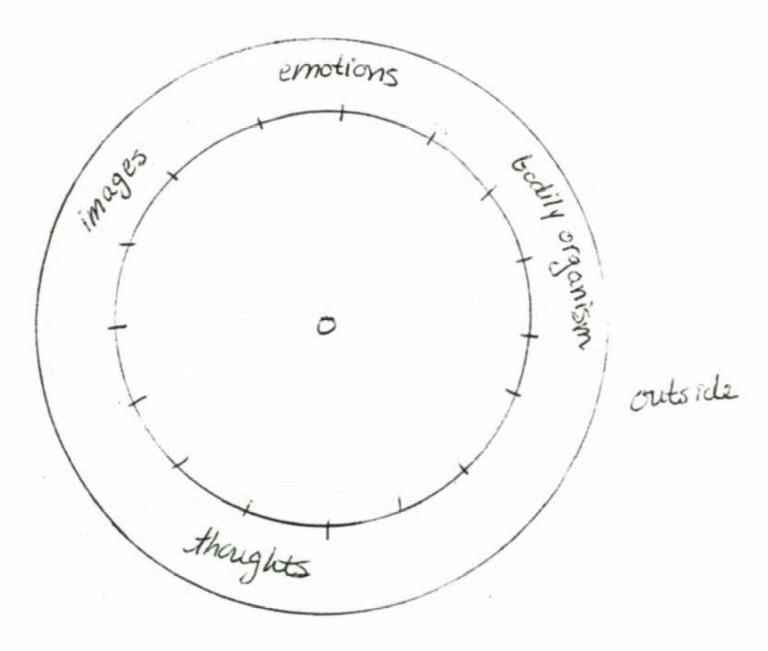
FIGURE 1983 1116-1. Psychosomatic Organism.
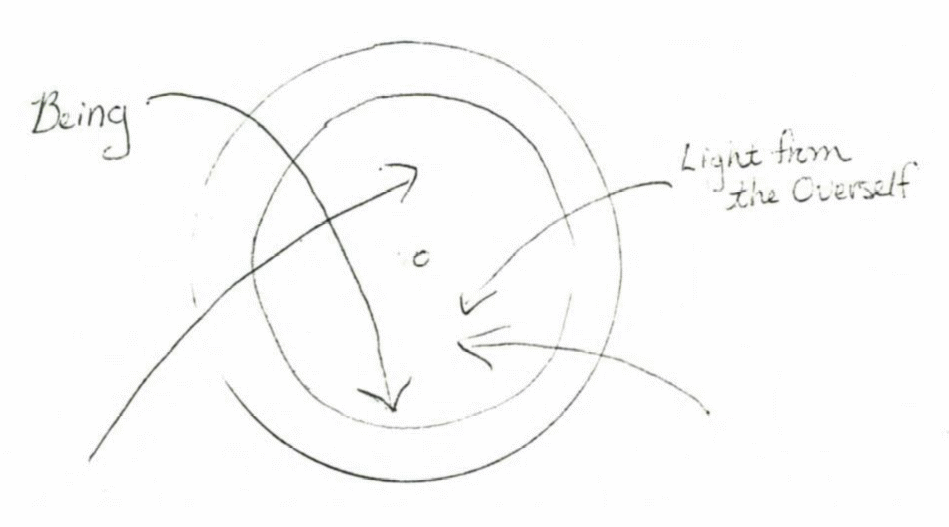
FIGURE 1983 1116-2. Light of Overself in Psychosomatic.
[Transcriber note: [diagram] means the speaker is referencing a diagram as he or she is speaking. If someone is drawing or writing, with audible sounds of chalk on a blackboard, I indicate this by [drawing] or [writing].]
NOTES:
- Pat Campbell transcript from 1983 exists (Scan File 1983 1116-36R04.PDF); other, earlier transcript versions may exist.
TRANSCRIBED Verbatim by IT 2019. Reformatted by JRM & JF 2019-2020, with Subheads and Table of Contents added by JRM. In 2023, IT fixes prefatory matter and footer, updates audio file name, fixes/completes Book List, fixes typos/minor errors, adds new note within transcript, relabels a diagram and moves it to appendix, adds another diagram, leaves reference to both diagrams within transcript. In 2025, MW expands Subsubjects and alters Subheads to make more accurate. Archival verbatim transcript – V14.1a.
AUDIO FILES: 1983 1116a, 1983 1116b. [Note: "Tape" and "Side" refer to original audio cassette tapes that were later digitized into .MP3 Audio Files.]
1983 11/16 at Wisdom's Goldenrod
PB Paras; Intellect; Mystery of Mind
Archival verbatim transcript
[Audio File 1983 1116a Begins]
THE ABSOLUTE AND OUR RELATION TO IT
PB [V16, 28:2.99 & Persp., Ch. 28 #2, RC reading]: "[The topic with which all such metaphysical thinking should end after it has pondered on] mentalism is that out of which the thinking principle itself arises--Mind--and it should be considered under its aspect as the one reality. When this intellectual understanding is brought within one's own experience as fact, when it is made as much one's own as a bodily pain, then it becomes direct insight. Such thinking is the most profitable and resultful in which he can engage, for it brings the student to the very portal of Mind where it stops activity by itself and where the differentiation of ideas disappears. As the mental muscles strain after this concept of the Absolute, the Ineffable and Infinite, they lose their materialist rigidity and become more sensitive to intimations from the Overself. When thinking is able to reach such a profound depth that it attains utter impersonality and calm universality, it is able to approach the fundamental principle of its own being. When hard thinking reaches a culminating point, it then voluntarily destroys itself. Such an attainment of course can take place deep within the innermost recesses of the individual's consciousness alone."
[21 second pause]
PB [V16, 28:1.114 & Persp., Ch. 28 #5, RC reading]: "If Mind is to be regarded aright, we must put out of our thought even the notion of [the] cosmic Ever-Becoming. But to do this is to enter a virtual Void? Precisely. When we take away all the forms of external physical existence and all the differences of internal mental existence, what we get is an utter emptiness of being which can hardly be differentiated after we have taken away its features and individualities, its finite times and finite distances. There is then nothing but a great void. What is the nature of this void? It is pure Thought. It is out of this empty Thought that the fullness of the universe has paradoxically evolved. Hence it is said that the world's reality is secondary whereas Mind's reality is primary. In the Void the hidden oneness of things is disengaged from the things themselves. Silence therefore is not merely the negation of sound but rather the element in which, as Carlyle said, great things fashion themselves. It is the supreme storehouse of power."
[short pause]
S: Do you have the page number for that Randy?
RC: Um, 16, red, 45.
[short pause]
PB [V16, 28:2.111 & Persp., Ch. 28 #4, RC reading]: "Thinking can, ordinarily, only produce more thoughts. Even thinking about truth, about reality, however correct it be, shares this limitation. But if properly instructed it will know its place and understand the situation, with the consequence that at the proper moment it will make no further effort, and will seek to merge into meditation. When the merger is successfully completed, a holy silence will pervade the consciousness which remains. Truth will then be revealed of its own accord."
[11¾ second pause]
PB [V16, 28:2.100 & Persp., Ch. 28 #14, RC reading]: "He will arrive at the firm unshakeable conviction that there is an inward reality behind all existence. If he wishes he may go farther [RC reads: further] still and seek to translate the intellectual idea of this reality into a conscious fact. In that case the comprehension that in the quest of pure Mind he is in quest of that which is alone the Supreme Reality in this entire universe, must possess him. The mystery of Mind is a theme upon which no aspirant can ever reflect enough: first, because of its importance, and second, because of its capacity to unfold his latent spirituality. He will doubtless feel cold on these lofty peaks of thought, but in the end he will find a heavenly reward whilst still on earth. We are not saying that something of the nature of mind as we humans know it is the supreme reality of the universe, but only that it is more like that reality than anything else we know of and certainly more like it than what [RC reads: than that which] we usually call by the name of"matter." The simplest way to express this is to say that Reality is of the nature of our mind rather than of our body, although it is Mind transcending the familiar phases and raised to infinity. It is the ultimate being the highest state. This is the Principle which forever remains what it was and will be. It is in the universe and yet the universe is in it too. It never evolves, for it is outside time. It has no shape, for it is outside space. It is beyond man's consciousness, for it is beyond both his thoughts and sense-experience, yet all consciousness springs mysteriously out of it. Nevertheless man may enter into its [RC reads: this] knowledge, may enter into its Void, so soon as he can drop his thoughts, let go his sense-experience, but keep his sense of being. Then he may understand what Jesus meant when saying: "He that loseth his life shall find it." Such an accomplishment may appear too spectral to be of [any] use to his matter-of-fact generation. What is their madness will be his sanity. He will know [RC adds: that] there is reality where they think there is nothingness."
[23½ second pause]
PB [V16, 28:2.48 & Persp., Ch. 28 #16, RC reading]: "The absoluteness of the Godhead is complete and basic. It is not categorically identical with man any more than the ray is with the sun; they are different although not more fundamentally different than the ray from the sun. Hence there can be no direct communication and no positive relationship between them. A profound impenetrability, an existence beyond comprehension, is the first characteristic of the Godhead, when gazed at by human sight."
[12 second pause]
RG: I mean ba-- based on the analogy you would think that there is some direct communication, that the Sun does directly communicate and [one/two words inaudible]
S (faint): In that way though, in that direction.
RG: Yeah.
MB (faint): Would you repeat it (once more)?
PB [V16, 28:2.48 & Persp., Ch. 28 #16, RC rereading]: "The absoluteness of the Godhead is complete and basic. It is not categorically identical with man any more than the ray is with the sun; they are different although not more fundamentally different than the ray from the sun. Hence there can be no direct communication and no positive relationship between them. A profound impenetrability, an existence beyond comprehension, is the first characteristic of the Godhead, when gazed at by human sight."
[17¼ second pause]
MB: Can you explain what the word 'categorically' means in this (quote)?
[9 second pause]
RC: There are a couple of ways to do it I guess, the way I would prefer to do it would actually be to read some more of these quotes [MB, faint: Oh.] because it's going to get (peculiar).
S (faint): Ok.
S: Let's read.
[45¼ second pause]
RC: Ok I think this one will pick up on not categorically identical.
PB [V16, 28:2.79 & Persp., Ch. 28 #26, RC reading]: "The chasm between the Real and man seems entirely impassable. The intellect is conditioned by its own finitude, by its [RC adds: own] particular set of space and time perceptions [RC reads: perception]. It is unable to function where absolutes alone reign. The infinite eternal and absolute existence eludes the grasp of man's logical thought. He may form mental pictures of it but at best they will be as far off from it as a photograph is far off from flesh and blood. Idea-worship is idol-worship. Everything else is an object of knowledge, experienced in a certain way by ourself as the knower of it; but the Infinite Real cannot be [RC adds: made] an object of [anyone's] knowledge simply because it cannot be conditioned in any way whatsoever. It is absolute. If it is to be known to all it must therefore be in a totally different way from that of ordinary experience. It is as inaccessible to psychic experience as it is impenetrable by thought and feeling. But although we may not directly know Reality, we may know that it is, and that in some mysterious way the whole cosmic existence roots from it. Thus whichever way [RC adds: a] man turns he, the finite creature, finds the door closed upon his face. The Infinite and Absolute Essence is forever beyond his vision, unreachable by his knowing capacity and inaccessible to his experience, and will forever remain so. The point is so subtle that, unless its development is expressed with great care here, it is likely to be misunderstood. Although man must pause here and say, with Socrates,"None knoweth save God only"--for with this conception he has gone as far as human thought can grasp such mysteries--nevertheless he may know that the seers have not invented an imaginary Reality. He has neither been left alone in his mortality nor abandoned utterly to his finitude. The mysterious Godhead has provided a witness to its sacred existence, a Deputy to evidence its secret rulership. And that Witness and Deputy can be found for it sits imperishable in the very heart of man himself. It is indeed his true self, his immortal soul, his Overself. Although the ultimate principle is said to be inconceivable and unknowable, this is so only in relation to man's ordinary intellect and physical senses. It is not so in relation to a faculty in him which is still potential and unevolved--insight. If it be true that even no adept has ever seen the [RC reads: this] mysterious absolute, it is also true that he has seen the way it manifests its presence through something intimately emanated from it. If the nameless formless Void from which all things spring up and into which they go back is a world so subtle that it is not really intellectually understandable and so mysterious that it is not even mystically experienceable, we may however experience the [RC reads: this] strange atmosphere emanating from it, the unearthly aura signifying its hidden presence."
[short pause]
RC: So that seems to be pretty cate-- not categorically identical.
RG: That seems to speak against the non-direct communication.
RC: Well, I think that the Overself is a function that [one word inaudible] Between the finite creature and the Godhead the Overself is the intermediary. That there is not a direct relationship between the finite creature and the Godhead. [14½ second pause] Let's say if you rise to the level of identify with your Overself, [16¾ second pause] the person who had the question isn't there anymore. [9¼ second pause] Ok?
[short pause]
RG (faint): I think we've spoken of this before, that we want to allow (beforehand) the Sage could have this access (to the) [three/few words inaudible]
RN (simultaneously): You're not speaking very loudly.
RG: Haven't we also in the past, when we discussed this in the past, allowed for the fact that the Sage could have access to the principle that transcends the Overself? Because if you don't, I don't understand how anyone could ever say that It Is. If you can't think It, you can't experience It, you can't mystically know It, then to talk about an emanation from-- I mean it seems that some Sage would have had to experience it or non-experience it.
S: Yeah.
EC (simultaneously): (In fact), doesn't it mean that the finite part of him can't experience it (but) when he has come to his Overself that he can-- that can have the experience. The finite man, the finite consciousness can never come near-- finite consciousness could develop to the Overself and then there's I think some mysterious thing that happens. And I think I remember a quote like that, that he will--
TS: Can you say that it is through insight, the function of insight that the Sage knows the emanation of the Absolute (essence) as an emanation?
LD: You guys want to speak a little louder please? Because it's--
PB [V16, 28:2.79 & Persp., Ch. 28 #26, RC reading]: "Although the ultimate principle is said to be inconceivable and unknowable, this is so only in relation to man's ordinary intellect and physical senses. It is not so in relation to a faculty in him which is still potential and unevolved--insight. If it be true that even no adept has ever seen the mysterious absolute, it is also true that he has seen the way it manifests its presence through something intimately emanated from it."
S (very faint): Uh-hm.
SC: That's-- I think that's the point Dickie was speaking to, it's very difficult to-- to grasp that there's some kind of identification with the Overself, that that Overself is an emanation from the Godhead but isn't the Godhead and yet somehow when you identify with it, with the emanation, you recognize it as an emanation from-- from God. [student assents, very faint] Even so you're not in direct contact with-- with the Godhead. But you can clear that up Louis.
S: [couple words inaudible] (laughter, student words)
PD: Are you saying something like the soul has the ability to recognize the manifestation (through) God but not the human intellect, and that it's only that principle in you-- the soul in you that can recognize when there's a-- the presence of the Void is there or manifestation from the God?
AD: Correct.
[11 second pause]
RC: Ok.
PB [V16, 28:2.135, RC reading]: "In grammar, sentences are built up basically from three things: a subject, a verb, and an object, with the subject acting upon the object through the verb. A sentence is not considered complete unless it has these three things, this relationship between the subject and the object. In metaphysics, every experience also requires a subject and an object--a person or a thing who is affected by or produces an action on a second entity. All statements about human experiences must include this subject-object relationship. Thus, in the relationship between a man and his thoughts, the man is the subject and the thoughts are the objects. In Oriental metaphysics, a similar relationship holds good--except that the subject is there called the seer, [RC adds: and] the object is called the seen, and seeing describes the relationship between the two. All existence in the time-space order as experienced by a human being necessarily has these three elements [within it]. There is no subject without an object, no seer without a seen plus the relationship or the action between them. They are always linked together. If however we look beyond this existence to the timeless spaceless Reality, it is obvious that there can be no such relationship therein, for it is completely nondual, the Reality which never changes, which has no second thing. We learn from mentalism that this Reality is Mind. If we are ever to find it we know that it cannot be found as if it were a second thing, with us as subject and it as object. In that sense we can never find it, but only substitutes which themselves are in duality. [RC adds: So] We have indeed to set up a search for the kind of consciousness where there is no object to be experienced and therefore where there is no subject-ego to receive the experience. Such is the unified consciousness which is none other than Mind itself. We can use this criterion not only with reference [RC reads: references] to our experiences of the world but also with reference [RC reads: references] to our inner mystical experiences and check from this on what level they really are [RC reads: what level they are really on]."
[30¾ second pause]
AH: That quote seemed to help me understand the first few in-- in the sense that-- that if this Mind, principle of Mind is described as totally self-sufficient and all that, it really can't be spoken of in terms of any kind of relationship, in relationship with probably duality of some kind.
[short pause]
RC: So if-- he says that we have to seek for a kind of consciousness--
PB [V16, 28:2.135, RC reading]: "We have [indeed] to…search for the kind of consciousness where there is no object to be experienced and therefore where there is no subject-ego to receive the experience."
AH: Is it in that quote Randy where he precludes the possibility that this search should be conducted as if there was something that we are going to attain to? [11¾ second pause] See it's a-- it's an interesting question that you-- you're going to conduct a search. But if we set the search up in such a way that we look for it as another object-- [short pause] So how do you search for it without expecting an objective thing? [student assents, faint] I mean that's a-- [RC assents] kind of an enigma.
RC: Yeah. Well I think it helps a lot to have this much, in that he has said that there's a whole direction of mind in which it knows if it makes any sense to even look.
AH: Could you elaborate it?
RC: Well insofar as he's saying that if you're expecting it in terms of a relationship between any kind of object and a subject related to it, then by its very nature that can't be productive of what-- of this kind of consciousness that we're looking for. And--
PB [V16, 28:2.135, RC reading]: "If we are ever to find it we know that it cannot be found as if it were a second thing, with us as [RC adds: a] subject and it as [RC adds: the] object."
AH: Right, that's what he said.
[short pause]
RC: 'Cause otherwise we only get substitutes which themselves are in duality.
SC: So you'd say that Mind-in-itself and its emanation the Overself are both beyond that subject-object distinction. Any searching can't be in the normal sense of looking for something, both for the-- the Mind or the Absolute and for the Overself. And yet you somehow still speak of that Mind and you could speak of that Overself emanation. Now I know we spent a lot of time talking about what emanation means. So, the discursive thinking won't get you to either place. And when you-- if you can withdraw from discursive thinking, you can get to Overself, you can have some identity. And therefore you're no longer in a subject-object mode, it is really identification, and yet somehow that's not an identification with Absolute, it's an identification with emanation.
[student assents, very faint]
RC: Yeah, reread parts of some of the stuff from the beginning.
PB [V16, 28:2.99 & Persp., Ch. 28 #2, RC reading]: "Such thinking is the most profitable and resultful…"
AD: Randy, you understand that this is in the nature of firing twenty-one 16-inch guns all at the same time? (bit of laughter)
RC (faint): This is what you said that you wanted to do. (bit of laughter)
AD: One at a time.
RC: Ok. (RG laughs)
S (amidst laughter, faint): It's [couple/three words inaudible] in other words.
RC: Well I went back to the first quote.
AD: Ok. (bit of laughter)
RC: It's a good time for the first quote.
[short pause with faint background student talking]
METAPHYSICAL THINKING ABOUT THE INEFFABLE AND INFINITE ABSOLUTE
PB [V16, 28:2.99 & Persp., Ch. 28 #2, RC reading]: "The topic with which all [such] metaphysical thinking should end after it has pondered on mentalism is that out of which the thinking principle itself arises--Mind--and it should be considered under its aspect as the one reality. When this intellectual understanding is brought within one's own experience as fact, when it is made as much one's own as a bodily pain, then it becomes direct insight. Such thinking is the most profitable and resultful in which he can engage, for it brings the student to the very portal of Mind where it stops activity by itself and where the differentiation of ideas disappears. As the mental muscles strain after this concept of the Absolute, the Ineffable and Infinite, they lose their materialist [RC reads: materialistic] rigidity and become more sensitive to intimations from the Overself. When thinking is able to reach such a profound depth that it attains utter impersonality and calm universality, it is able to approach the fundamental principle of its own being. When hard thinking reaches a culminating point, it then voluntarily destroys itself. Such an attainment of course can take place deep within the innermost recesses of the individual's consciousness alone."
[15 second pause]
RC: So he certainly seems to be saying that it's not useless to think about this kind of consciousness the other quote referred to.
[short pause]
AH: It seems almost that like its efficacy is the fact that think about it enough like you actually convince yourself.
RC: Yeah. I think that's what he says by taking firm hold of the intellectual understanding.
AH: But what is it that you convince yourself of? You convince yourself thought can't have it.
RC: That what I have to seek is a consciousness that cannot be known as a second thing, [student assents] it cannot appear as an object with me as a subject to receive it. [AH simultaneously: Wouldn't--] When I talk in terms of the goal, what am I trying to complete myself?
[short pause]
S: Doesn't he also speak of making that thinking-- maybe I misheard this, bringing it into yourself and making it its-- like a bodily pain, did you s--
RC: (One doesn't speak of) bodily pain.
S: No but doesn't that [S, faint: Yeah.] kind of imply-- (some laughter)
RC: Making it as much your own as a bodily--
S: As a bodily pain, does that-- does that imply some kind of melding of all the functions, the feeling, the thinking, and the willing, isn't that part of that process of-- of the whole thing rather than just keeping it as a conceptual thing that's kind of, you know, subject-object type thing. [RC assents, faint] That's what I thought but I don't know if that's so, if that's part of it.
TS (faint): I was thinking of that part where he speaks of it as the nature-- (particularly/speak of) the way the Samkhya talks about the na-- reflection on pain and that there's something of the character of pain which is undeniable, objective-- objectively given and immediate. And that if the thinking came to the point where it was experienced as undeniable in terms of its [one word inaudible] understanding and experienced as objectively given as in-- and is immediate, that there would be a certain kind of solidification or accomplishment of the thinking process instead of its being evanescent speculations and drifting, you know, thoughts and images. (Awareness--)
S: But what-- I mean that's nice, I hear what you're saying.
S: We don't hear him.
S (simultaneously): I don't. (laughter)
S (amidst laughter): Go ahead and say it!
S: Go ahead.
LR: Whisper and then, you know--
S (faint): Right.
S: Uh-hm.
MB: Talk to me.
LR (whisper): That's why it's so loud.
AD: Well the thing to do is get a microphone and pass it around.
LR: (Develop) himself.
S (faint): Well did you say a microphone?
TS (simultaneously): Say what?
S: Speak into the microphone.
TS: Speak into the mic?
S: [couple words inaudible]
S (simultaneously): [one/two words inaudible]
TS: There weren't any but the ones in the back can order [one/two words inaudible] (TS laughing, laughter)
S: It's over here.
JA: Tim, are you going to repeat what you said about-- or [TS: Ok.] can I--
TS (faint): Uh-- well who's got that (one)?
[short pause with faint background student talking]
JA: Well you-- could you repeat what you said?
S: Ok.
TS: Um, well, ok. He speaks here of coming-- developing an understanding of Mind which is--
S (faint): What?
S: What?
[short pause]
PB [V16, 28:2.99 & Persp., Ch. 28 #2, TS reading]: "When this intellectual understanding is brought within one's own experience as fact, when it is made as much one's own as a bodily pain, then it becomes direct insight."
TS: Now I was making a leap going back to the old Samkhya notion of reflection-- spiritual reflection beginning with a wish to be free from the wish to be free from pain. [student assents, very faint] There's something about the nature of pain which is objectively given and immediate. And I thought that he was saying here that when one's understanding was experienced as objectively given and immediate and--
AD: Tim, is pain objectively given?
S (very faint): Uh-hm.
TS: Is pain objectively given? Yes. Yes, it's taken as an object to consciousness and it's taken as given.
AD: I guess we experience it differently. (laughter, student words)
S (amidst laughter, faint): Well you don't have to [couple/three words inaudible] (laughter)
S (amidst laughter, faint): No.
S (amidst laughter, faint): (No.)
LR: Tim, if it were objectifiable, would you call it pain?
S (faint): No.
S (faint): No he said--
S (faint): [few words inaudible]
S (simultaneously, faint): That's what I was (just) going to ask you (about).
JA: Why are you throwing Tim off the point? I wanted to hear what he had to say the first time. (JA laughs, bit of laughter)
RG: Well Jeanne 'cause Anthony actually wanted to clarify [JA simultaneously: Are you--] something that (Tim said).
JA: Yeah but I didn't-- you got into something about pain and-- and I don't think that was-- that's not the point, I thought he was saying that the thinking process ends in a solidification in the sense that it's a certitude of what has been given instead of a-- a doubt or a continuing search for it. I thought that was along the lines of what you first said. And [TS simultaneously: Yeah but what--] your thing about pain was an analogy.
TS: Well, I don't know it-- how analogous it really is, I mean I think that-- I was wondering if here it was meant in that way that-- that Bhattacharyya uses the-- his discussion on reflection of pain, that there is a kind-- that there's something about he-- the facticity of pain.
JA: It's undeniable.
TS: Yeah. [couple/three words inaudible] these people are correcting me and saying that pain is not objective in the sense that it is not a content to consciousness?
S (very faint): Uh-hm.
RC (faint): Subject-object.
JA: Well Tim?
TS: The subject doesn't experience it as other than (itself/himself).
S: It is itself.
TS: Yeah.
S: That's all there is, I mean, when you're in it.
TS: That's what I'll-- well if it [couple words inaudible]
S (faint): You (have) a good eye?
TS (very faint): (I/That) was being (subjective/objective).
[students assent, very faint]
S (faint): Alright.
HS: Oh, well would you say that it's certain (bit of laughter) and-- and immediate [one/two words inaudible] (object/subject) of the subject.
TS: Yeah.
HS: Ok. And like the kind of knowledge that you want, right, when you have knowledge of reality in your mind?
TS: Always look forward to more pain [one/two words inaudible] (laughter)
RC: Yeah you seldom-- seldom doubt that you're in pain.
HS: Ok. So-- so the point-- the point though in this quote though is that it's possible through intellect to have a certitude of the knowledge of the one reality, would that-- is that the way the quote was spoken?
TS: Yes, I would say knowledge [one/two words inaudible] about this. What is that certitude about?
HS: Well doesn't it actually (say/saying) you have certitude of the reality, Mind, in some way, or Intellectual, I mean (if) you keep going over and over again?
SC (simultaneously): Where does it say intellect? Was the word 'intellect' here, is that-- I was taking thinking there to be thinking as productive, more of a reasoning quality as opposed to an intellect that a subject was using on the objective around it. So when he was talking about really getting more and more involved in the thinking process and that bringing you closer to some kind of insight, I took it to mean identifying with thinking as productive-- as very real and productive of the world, the whole world that we take, the subjective and objective elements both.
HS: So what do you think-- but doesn't he al-- doesn't he speak of the thinking that's general and universal, wasn't the phrase "universal thinking"?
S: Uh-hm, yeah.
RC (simultaneously): Probably going all the way back to the beginning is helpful, just--
S (faint): Yeah.
PB [V16, 28:2.99 & Persp., Ch. 28 #2, RC reading]: "The topic with which all [such] metaphysical thinking should end [RC emphasis] after it has pondered on mentalism is that out of which the thinking principle itself arises--Mind--[and] it [RC reads: which] should be considered under its aspect as [RC reads: of] the one reality."
RC: So it seems if you've pondered on mentalism then you've become at least intellectually convinced, possibly even experientially convinced, that all you experience is the functioning of mind. And now they're saying, ok, you got that far, now let's-- let's trace back and let's say what does all this functioning come out of. Whatever it is that it comes out of has to be the one reality.
S (very faint): [couple words inaudible]
HS: Ok, now as you say, now people can now think about this thing, ponder, whether with or without reason and hopefully with reason?
S (faint): Uh-hm.
S (faint): Uh-hm.
HS: Well does he mean like just like think about it, like hey what does this mean, the one reality, Mind.
S: But wouldn't [one/two words inaudible]
AH (simultaneously): I don't think that-- it's not that-- it's no so much the process that you can emphasize as it is the topic. The topic of thinking is the emphasis.
RC: And bringing this intellectual understanding within your own experience as fact. [couple words inaudible]
HS (simultaneously): Ok, still it's an intellectual understanding, you get--
RC (simultaneously): Yeah.
HS: I mean--
PB [V16, 28:2.99 & Persp., Ch. 28 #2, RC reading (simultaneously with HS above)]: "When this intellectual understanding is brought within one's own experience as fact, [S: Go ahead.] when it is made as much one's own as a bodily pain…"
HS: Ok, the certitude and the-- what's the other thing that pain has? Immediacy and certitude.
PB [V16, 28:2.99 & Persp., Ch. 28 #2, RC reading]: "…then it becomes direct insight."
SC: So again isn't that starting with an intellectual idea about mentalism and then somehow being propelled into the experience of the mind producing the subject and the world that the subject has. And that's what-- and then the end result of that would be that it's-- [student assents] But-- and that would be a prior kind of thinking to the thinking we're normally familiar with, you start with that kind of thinking but you have to be propelled back into [student assents] real thinking or reasoning.
TS: When he says that-- in the first sentence he says that after understanding mentalism, one has to try to ponder on that out of which the thinking principle itself arises, Mind. How would you differentiate that Mind at-- as Mind Absolute from Overself?
RC: At this point I wouldn't. I think that distinction will come later.
S (faint): Yes, uh-hm.
TS: But he's speaking here of the development of insight out of understanding to the-- the topic of the Mind is-- the thinking is [one/two words inaudible]
RC: Uh-hm. [short pause] I guess the way that I'm-- I'm understanding it is that if I get so far as being able to say that all that I experience is functioning of my own mind, then mind is a much more meaningful word for me to use when I try to dig into the one reality that all this functioning is, is an expression--
(Side 1 of original cassette tape digitized as 1983 1116a Ends; Side 2 Begins)
PD: --how could you realize its prior?
[short pause]
RC: But he does say--
LR (simultaneously): Not necessarily something.
S: Yeah.
RC: He does say later that in the effort to understand this--
PB [V16, 28:2.99 & Persp., Ch. 28 #2, RC reading]: "As the mental muscles strain after this concept of the Absolute [RC: of the one reality]…[RC adds: then] they lose their materialist rigidity and become more sensitive to intimations [RC reads: imitations] from the Overself."
S (faint): (Imaging.)
S (faint): Uh-hm.
S: [possibly one word inaudible]
S (faint): Intimations. (bit of laughter)
S (very faint): Intimations.
RC: What did I say?
S (simultaneously, very faint): [one/two words inaudible]
RG (simultaneously, faint): [one/two words inaudible] intimations.
S (faint): (You said) imitations.
S (simultaneously, faint): [few words inaudible] (some laughter)
TS: [couple words inaudible]
S (simultaneously): Going around mostly [one/two words inaudible] (bit of laughter)
RC(?) (faint): (Those that are beginning to work.)
S (faint): Uh-hm.
HS: Ok so what-- what would you say then is the-- you know, the-- what did you say? What did you say-- what would you say correct thinking brings you to?
RC: Correct thinking?
HS: Yeah.
RC: Well it seems that in this context it brings you-- well, I would do the next quote for that one where he addresses that more directly [student assents] or--
AH: Before you go there, could we-- I'd like to finish [few words inaudible] Thinking seeks its source, which I guess is kind of a summary of what the quote suggests, thinking's going to look for its own source or its principle, like what are the-- what are the-- what are the actual consequences of-- of that process? Isn't that another way of speaking about the Hua T'ou exercise? Like, it's the place where thought stops. It's not-- it's not a step along the way. You're saying this specific topic of Mind, once you have a grasp-- some sort of intellectual grasp of mentalism and you take up this specific topic of Mind, what is the source of thought, doesn't that just logically necessitate a place where thought would stop?
RC: Yeah. But I think that Paul's remark was very apt, you know, in making the context of the discussion more clear, that this source of thought that you're thinking is not really the source of your abstract verbal conception(s), I mean--
AH: I'm sorry, I-- I didn't follow.
RC: That when we say we're seeking the source of this thinking activity, [AH: Uh-huh.] that we're not merely seeking the source of the abstract verbal language constructions. Put it in the context of after having gone through some mentalism and the source of this activity that we're seeking is really everything that we know.
AH: Yes, yes. How do you think about Mind? What are the consequences of thought being fixed and persistent about trying to find Mind?
BS: Become more universalized and less finite, wouldn't it?
AH: Yes.
BS: In that sense would thinking stop or does it get transformed? That's what's bugging me.
AH (simultaneously): Transformed-- transformed into more thoughts?
BS: No, it becomes universalized, the thinking process. I'm asking this in a form of a question. I [RC simultaneously: Yeah.] wonder-- I wonder where the expression-- see this always bothers me. We have the expression that thinking would turn upon itself. Is that very-- is that turning upon itself a transformation of it or is it an actual cessation? When thinking ceases to be finite, is it no longer thinking?
RC: Well we know that there's a change that happens there. Whether or not we're going to continue to wor-- use the word 'thinking' could be debatable. But, let's say there's some kind of continuity in-- [9¼ second pause] there's some kind of continuity in knowledge even though there's a difference in form of the knowledge. [short pause] That the concept does lead to that of which it is a concept but the knowledge doesn't arise on the same level [student assents] when you had only the concept.
S: Yeah.
S (faint): Uh-hm.
S (faint, part of background): [couple words inaudible]
S (faint, part of background): [possibly one/two words inaudible]
BS (faint, part of background): If it's here.
LR: Couldn't we say Randy that the quotes are in some kind of order hopefully that you've been reading and that our prior discussion of the intellect has now taken us to something which these quotes seem to be talking about more as a power of the soul than a mere regurgitation of memories within the body. So that when thinking is used here, it seems more like a-- the hierarchical definition of reason which somehow is a power traced directly to the Oversoul-- the Overself and not so much just the intellectual pursuit of juggling concepts.
RC: Yeah. He does say metaphysical thinking, the topic with which all metaphysical thinking should (qualify).
LR: And it seems like this kind of thought, this kind of thinking has a real propulsive energic power to it, I mean it is directly traceable. And so [RC or another student assents] when he talks about turning it back onto itself, it's more like getting back onto a-- you know, going upstream or something, getting [RC assents] back onto that.
RC: I think a big part of the fruit of what we did the last few weeks was-- what we were trying to do is we were trying to get at least an intellectual understanding of-- of the intellect's limitations. And it seemed like we got at least that much. And, then that second quote that I read after this one he talks about when the intellect knows its place then it can be used in this way. [student assents] Um, (there's certain--)
LR (simultaneously): But-- ok, so then I guess I could turn my thing into a question.
RC: Uh-hm.
LR: Would this still properly be called intellect, what's being described here. I don't think so but [RC: Yeah.] that's a question though.
RC: Well it's the same question Bert was saying and-- and he says here--
PB [V16, 28:2.111 & Persp., Ch. 28 #4, RC reading]: "Thinking can, ordinarily, only produce more thoughts."
LR: Which would be the way we discussed intellect [RC: Exactly.] the last few weeks.
RC: He says--
PB [V16, 28:2.111 & Persp., Ch. 28 #4 cont., RC reading]: "Even thinking about truth, about [RC reads: or] reality, however correct it be, shares [RC reads: shared] this limitation."
RC: But then he says--
PB [V16, 28:2.111 & Persp., Ch. 28 #4 cont., RC reading]: "But if properly instructed…"
LR: By who?
RC: By a philosophical teacher I would imagine.
HS: Ok, but it's the same thinking though.
LR (simultaneously): No. No, no, leave out the teacher, I mean would-- wouldn't that be properly instructed by a higher-- by a source other than intellect itself, such as reason for instance?
RC: Ok. Ok.
LR: And then-- I'm sorry.
HS: But it's the same thinking though, right?
RC: Yeah. And if properly instructed--
HS (simultaneously): So ordinarily-- it wasn't like before but it's better now.
RC: Yeah.
PB [V16, 28:2.111 & Persp., Ch. 28 #4 cont., RC reading]: "[But] if properly instructed it will know its place and understand the situation…[RC adds: and then] at the proper moment it will [RC reads: it'll] make no further effort, and will seek to [RC reads: effort but] merge into meditation."
RC: So there is a qualitative thing he's saying has to take place here.
LR: Yeah.
HS: Let me-- let me ask, before you--
LR (simultaneously): Yeah, I don't think that these-- I don't think these things have chapters, you know, like now you left intellect and you're headed towards something else, I mean, Herbert's point is well taken, it's the same power let's say, yeah, but it does get attenuated. [HS simultaneously: Well let me ask, if--] More intelligence gets let into it hopefully.
THINKING ABOUT THE INFINITE BY POSITING A CONCEPT AND THEN NEGATING ITS LIMITATIONS
HS: Let's say you want to think about-- just to think about Mind as the reality, and someone says to you think about an oc-- a shoreless ocean. Right? And so first thing, how do you think about something like that?
RC: Very expansively.
HS: Expansively. But I mean don't you think of an ocean first? Don't you see shores?
RC: Very fluidly.
S (faint): Yeah.
HS: And then you say wait a minute, shoreless ocean, don't you try to like get rid of the shore(s)? (some laughter) And then what happens to the concept?
AD: The same way you think of a-- of space, [HS/S(?) simultaneously: (Exactly!)] a box, (bit of laughter) alright, and you knock out all the sides, the top and the bottom. (bit of laughter)
[short pause]
HS: But you start with like space, you know, like space-- the space in a room and say that's not it and you knock out the sides of the wall and you say space, the universe. But that's not it because it's a conceptual, it's a spatial-temporal. Is that-- is that properly thinking anymore?
AH: Is it like what-- I think what Herbie might be suggesting is if you take up the [one word inaudible] you take up the enquiry of Mind at some point you realize that you're really inquiring about another concept, which-- which is a-- which is a thought construct. It's not-- it's not what Mind must be. You know, Mind is other than that. Is that what you're driving at?
JB (faint): No.
S (faint): No.
S: Uh-hm.
HS (simultaneously): I would say that if the-- if truth could enter into thinking as he said there, right, you could have true [student assents] thinking, then I would say that at some point you have these kinds of thoughts. "Hey, thinking only can give me concepts. You know, I want beyond the concept." And that's in thought too.
S: Yeah.
S: Uh-hm.
S: But Herb--
HS (simultaneously): And you try to go beyond the concept, in thought now, still in thought. And then maybe the last one is how are you-- you know that thinking has to turn on itself so to say. But before that you try to actually think, I mean I would say.
AB: Herbert, (if you have a--) the quote starts out saying that we have to have an understanding of mentalism. Now, maybe if that was experiential and not just conceptual. In order to understand mentalism you have to experience how the objects which you know are you or your own thinking. So then that perception of the thinking as one's experience is now turned on the mind, it's an outflow of and can make it also experience its identity with its source. So it seems like the thinking develops this ability to experience its identity with this object first through mentalism and then turned back on itself.
AH: That seems palpable.
HS: 'Cause the turning back on itself would--
S: Uh-hm.
AB (simultaneously): On its source.
HS: That's a destruction of thinking, right, its [AB simultaneously: Right.] proper end so to say.
AB: Right. Then it's no longer thinking.
HS: Well--
AH: How do you turn thinking on Mind rather than on a concept of Mind?
PD: That you posit the concept and then negate its limitations seems to be the method.
AH: I'm sorry Paul, say that again.
PD: You posit a meaning and then negate its limitations. And that's the dialectical method that's employed in trying to inquire into a transcendent.
AH (faint): I see.
PD: So you posit something and then you negate the limitations inherent in any specific positing.
S (faint): Yeah.
RC: And you [PD simultaneously: Just keep--] can reasonably understand how that would be necessary to do that.
S (faint): Ok.
S: What if you take a concept, Paul, "thinking can't reach the Absolute", and that's your idea, you know, that idea that you've made an idol. You know (what I mean)? I think there's some [one word inaudible] (of--)
PD (simultaneously): But that's not an idea of reality. You haven't posited--
S (very faint): Sure.
S: It's a concept, yeah.
PD: Yeah but you haven't-- the meaning is not an affirmative meaning towards or about reality.
S (very faint): Yeah, true.
S: Alright.
PD: But if you try-- if you speak of like a shoreless ocean or space, you're positing a meaning, an affirmative state of mind, and then you're trying to negate the limitations that your own thinking has imposed on it, [S: Ok so--] which would be the dialectical-- the dialectical method.
MB: And you can turn that quote around and say the Absolute is that which simply you cannot reach, and then you posited a positive notion of the Absolute within the same (sphere). But it doesn't-- it doesn't stop [couple/three words inaudible] away [couple/three words inaudible] but--
[short pause]
AH: I think, I think Paul's point is-- is good, ju-- you-- you start with a notion, oh like a shoreless ocean as your-- as your affirmative statement about mind. And then you reflect on that with the aim being to remove all, you know, limitations. Did he refer to that-- refer to that as the dial-- the li-- dialectical method?
PD: Yeah, I think that's the dialectical method he's employing, yeah.
AH: What would-- how would-- what-- like what would be the first limitation that--
S: You. (laughter)
S: (amidst laughter): Yours.
AH (amidst laughter): It sounds as if-- (laughter)
S (amidst laughter): (Yours?)
PD: Well when you imagine space, you're always going to be filling it with something, right?
S (faint): Right. (some laughter)
PD: In your own imagination your-- your mind is going to be positing a wall to that space. [couple seconds of background student talking, laughter] And by negating the limitations that your mind has been positing, imposing on the ideas, you're turning your thinking activity into a formlessness.
JL: I'm not so sure. I-- I think even the negation would be a kind of-- would have a positive nature to it, as long as it were thinking.
HS: But what if it was just negating?
JL: What do you mean negating though? I mean the action-- the actual actions of-- of the thought?
HS: Well, I talk about, you have a wrong concept is vanishing.
S: (Why?)
HS: Now you have more space.
S: Yeah.
JL: So then there's no thinking.
S (simultaneously): You mean if the subject negates the object then there is no more object?
JL: What?
S (simultaneously): Then-- then you've gotten past it?
S (faint): I don't know.
HS: [couple words inaudible] what?
S (simultaneously): It seems like you're still talking about subject-object, [student assents, faint] a subject that negates the object.
HS: Oh. You were trying to talk, how is Mind infinite, right?
S: Uh-hm.
HS: Mind is infinite and you come to a-- a wall, you come to a block, a conceptual understanding of how Mind's infinite. Now if Mind is really infinite, [S: Uh-hm.] and you have a conceptual understanding of how Mind is infinite, and you work through the conceptual understanding, and the conceptual understanding-- what happened to the conceptual understanding?
S (very faint): It remains(./?)
HS: It remains?
S (very faint): Yeah.
S (very faint): Yeah.
HS: But what if you work through it and you see that it's just a conceptual understanding?
RG: Well right, but that conceptual understanding doesn't disappear, you may ha-- I mean you'd hope you'd have an experience or the--
HS: Of you as wider than it.
RG: Right.
AS: Are those the quotes say(--/?)
S (simultaneously, faint): [few words inaudible] conceptually when it happened.
RG (faint): Ok.
JB: Doesn't he say [HS simultaneously: No, no.] you become the insight? [students assent, faint] But if the thought becomes the insight are we arguing about whether it's still also thought? Is it still a concept once it becomes the insight?
S: I don't get (it).
AH: Well I think, I think the implication that's being struggled with, would-- would any notion of Mind be appropriate if it wa-- if it occurs as an object of thought.
RC: Definitely not insofar as we're seeking Mind in its aspect as the one reality. I mean that-- I think we have to keep that right on top, that he's certainly not limiting Mind to being sought out in this way, but he's saying that at this stage we do have to consider it under its aspect of the one reality, and then in that sense our thinking becomes subject to certain limitations.
S (faint): [one word inaudible]
HE (simultaneously): Randy? There's-- seems like there's two points that keep getting mixed up I think, which is one is that you can't really think about it, you know, it can't be captured by thought, the other is that still it's worthwhile, you keep trying to think about it and you can somehow-- the only way to get your thought to stop trying to think about it is to keep trying to think about it [student assents] until it kind of gets, you know, blown away or-- or whatever [RC simultaneously: Yeah it's true.] trying to grasp it that it does have a kind of formative effect on the thinking.
RC: Yeah he says—
PB [V16, 28:2.99 & Persp., Ch. 28 #2, RC reading]: "When thinking is able to reach [RC reads: When it reaches] such a profound depth that it attains utter impersonality and calm universality, it [RC: the thinking] is able to approach the fundamental principle of its own being. [RC: Says--] When hard thinking reaches a culminating point, [RC: Whatever you want to call that point.] it then voluntarily destroys itself."
S (simultaneously, faint): Ok.
HE: Right.
S: Does it mean that the thinking presuppose [one/two words inaudible] the intellect or the--
RC: Well if pure thought-- I think the-- what's implied here is that pure thought can know itself but not through process.
S: What?
RC: But it is not dependent upon process in order to possess that self-knowing.
S: It's just kind of like [S simultaneously: (Yeah), the thinking.] perception. It might be self-directed, you know, but--
S: (Ok.)
S (faint): Yeah.
RC: But not as an object appearing to a subject.
AH: Could we say that this process is recommended because it leads to a transformative quality of consciousness.
RC: Exactly.
AH: Not that it leads to--
RC: More thinking.
AH: More thinking.
RC: Exactly.
AH: It's a method. But what the-- what the goal is we can't really express adequately from the point of view of thought.
RC: I think he's done some really good stuff with this.
AH: (See/Yeah) I think he's-- (laughter)
S (amidst laughter): [couple words inaudible]
AH: I have a little trouble with it but I'm-- I'm (doing) ok. (bit of laughter)
HS(?): Yeah.
RC: There's probably just one more to throw into the grab-bag here, it's a short one but I think this is precisely (what we/we'll) need to appreciate as we move ahead here. It says--
PURE THOUGHT CAN KNOW ITSELF WITHOUT SETTING UP A FALSE DUALITY, DESPITE REASON'S CLAIM THAT IT CANNOT
PB [V16, 28:2.132 & Persp., Ch. 28 #27, RC reading]: "Reason tells us that pure Thought [RC: With capital T.] cannot know itself because that would set up a duality which would be false if pure thought is the only real existence. But this is only reason's inability to measure what transcends itself. Although all ordinary experience confirms it, extraordinary experience refutes it."
S: Randy, could you repeat that for us?
RC: Yeah.
PB [V16, 28:2.132 & Persp., Ch. 28 #27, RC rereading]: "Reason tells us that…"
LR (simultaneously): What she means is could you talk louder.
RC: What?
S: Yeah we can't--
LR (simultaneously): Would you also talk louder?
S: There's a lot of talk in the background, it's getting harder and harder to hear.
RC: Yeah? Well maybe you could ask them to be quiet because I feel like I'm shouting.
S: Maybe you could pass the quote back.
[few seconds of faint background student talking]
RC: I'll just read it again.
[few seconds of faint background student talking]
PB [V16, 28:2.132 & Persp., Ch. 28 #27, RC rereading]: "Reason tells us that pure Thought cannot know itself because that would set up a duality which would be false if pure thought is the only real existence. But this is only reason's inability to measure what transcends itself. Although all ordinary experience confirms it, extraordinary experience refutes it."
AH: Is Thought being used as Mind here?
[short pause]
RC: I think you could take them interchangeably, pure Thought, pure Mind, pure intelligence.
HS: What does he mean? What's the last sentence say, that pure Thought can know itself?
S (very faint): (Is that what it is?)
S (very faint): Yeah.
LR: But that-- would that-- [S simultaneously, faint: Yeah.] would that be because ordinary experience it's in-- there is-- knowledge always implies a duality. And so in ordinary experience there could be no [RC assents, faint] understanding of a non-dual Mind.
RC (simultaneously): Uh-hm. Exactly. And the very reason that produces that kind of experience would naturally be confirmed by that kind of experience.
[students assent, faint]
HS: Now when you say pure Thought can know itself, it's like kind of self-knowledge that this is-- When this dis-- when you look for your consciousness, is this the consciousness that you're looking for?
S (very faint): Uh-hm.
RC: Sure.
S (very faint): Go back at some point.
HS: I-- if you're looking for that consciousness, [RC: Uh--] in our [couple/three words inaudible]
RC (simultaneously): I wouldn't use that preposition but ok.
HS: Which one?
RC: For.
HS: For. For which-- toward which or of which. (some laughter) Trying to find yourself.
S (very faint): Do you have another one?
S: Yeah. (S laughs, bit of laughter)
HS: It's given in-- it's given in that it's what, we're pu-- we're Mind? Your inner nature is Mind, is pure Thought? And pure Thought can know itself as itself, like self-knowledge, something like that?
AH: It's non-dual.
HS: In a non-dual way. Which is no knowing at all but (you know/who knows).
RC: I think of it-- This might be too subtle and it might be a misunderstanding on my part, but I think what he-- like the context he's put this in, he's talking about we're doing metaphysical thinking on pure Mind as the one reality.
HS: Ok.
RC: And to me the process lends itself to something that is like more real than something. [student assents, very faint] Like I-- I got to keep thinking of it in terms of-- I want to think about it as the one reality and I don't want to just think about it as my reality because it has to be the reality that includes all other reality that I experience besides what I call my [one/two words inaudible]
RG: Isn't that a misappropriation of what-- of the personal pronoun?
RC: With what?
RG: Well you said just [couple words inaudible]
LR (simultaneously): Come on Dickie, I know you can talk louder than that.
[short pause]
RC: No I just said that because like Herbie said you're trying to find yourself. And I'd say ok, that's one way to put it but then it seems like if you put it in that context you'd say I'm trying to find my ultimate reality. Whereas it seems that if you put it in a context of I'm trying to find the one reality, which includes not only what I call my reality but everything else that I experience as reality, then it's like a more adequate way to approach the idea.
AH: But wouldn't that distinction be somewhat dissolved by thorough understanding of mentalism?
RC: Yes.
S (faint): Uh-hm.
RC: Yes.
AH: You wouldn't make a separation between my reality and other reality.
RC: Well my-- I think-- like the mental universe is stratified. There's a hierarchy in it. [student assents] At a certain level mineness arises, and under that arisal of mineness there's (just) a bunch of possession. [student assents, very faint] I think that's legitimate.
RG: But that mineness is already within either concept of your selfhood or the Absolute selfhood or the-- or the Absolute reality.
RC: Ok and I guess what I'm saying is that I don't think that that mineness is appropriate-- an appropriate way to think of the Absolute.
RG: Nor is it appropriate way to think of the Overself. 'Mine' is a pronoun based on your embodied existence.
RC: Ok.
[student assents, very faint]
RG/S(?): I don't see--
S: Oh.
RG: I don't see how you could ascribe [S simultaneously: But--] Mind to either.
RC: Ok, I was thinking that [couple words inaudible]
JB (simultaneously): But Herb did, that's why he was making that argument.
RG (simultaneously): Well I'm sorry, I don't think you can.
RC: Ok.
AH: But one then would recommend the "Who Am I?" exercise as the quickest and most direct [one word inaudible] [students assent] How could you recommend like the "Who Am I?" exercise as the most direct and quickest one if the notion of Mind is inappropriate?
RG: Very different to say "Who am I?" than "Who are you?"
HS: Oh yeah but-- You want to seek-- seek your reality, and the way we-- we could seek our reality is "Who are you?"
S: Yeah.
S (simultaneously): Yeah.
HS: You don't want it.
RC: Ok, well I guess I made too much of it but I-- I thought it was important.
S: Would you read the quote?
RC: Yeah.
PB [V16, 28:2.132 & Persp., Ch. 28 #27, RC rereading]: "Reason tells us that pure Thought cannot know itself because that would set up a duality which would be false if pure thought is the only real existence. But this is only reason's inability to measure what transcends itself. Although all ordinary experience confirms it, extraordinary experience refutes it."
RG: So it seems Kant would be a real good example of this where there's a pure reasoning without the mys-- mystical experience so that his reasoning did formulate the unknowability of the self.
S (very faint): Yeah.
HS: And yet had the extraordinary--
S: (Part of the experience.)
[short pause]
HS: Are you going to go through the quotes that you read?
RC: Yeah. I would think that what prevented that experience was where he says in this next one, that at the proper moment thinking will make no further effort but will merge into meditation. 'Cause that's a really critical point.
HS: But may-- you're talking about like Kant or something, [RC simultaneously: Yeah.] is that what you're talking? Well maybe no one told him.
S (faint): (Yeah.)
S (faint): Yeah.
S (faint): No one told him.
RC (simultaneously): Maybe his karma was such--
AD (simultaneously): He didn't have no instructor.
HS: Yeah.
S (simultaneously, faint): Right.
RC: Yeah, he wasn't properly (instructed).
HS (simultaneously): Well, and they're hittin' boys over the head, you know?
JA (simultaneously): Maybe-- maybe [S simultaneously, faint: (Yeah.)] also he had mystical experience and didn't tell anybody.
HS: Or didn't know what it was.
RC: I tried that.
JA: I mean why would he write-- I mean-- maybe he just didn't want to write down anything that reason wouldn't allow (him/in). It's impossible to tell really.
RC: Yeah, it's hard to keep your mouth shut about things like that though Jeanne.
JA: How do you know?
RC: Oh I don't know.
JA: Because all I hear-- (laughter, student words) No I mean, people talk about them but there may be people who don't, I mean, you know, how would you know?
S: Right.
RG (simultaneously): Nobody knows.
S: Yeah.
S (very faint): Uh-hm.
S: Can we go [couple words inaudible]
AD (simultaneously): [one/two words inaudible] we go through them.
S: Pardon?
S (faint): Pardon?
S (very faint): Ok.
S (very faint): Uh-hm.
RC: Ok. Should we go on in a second quote?
S (faint): [couple words inaudible]
THE INTELLECT IS THAT PORTION OF THE LIGHT THAT IS CAUGHT WITHIN THE PSYCHE AND MANIPULATES ITS CONTENTS
[Note: See FIGURES 1983 1116-1, Psychosomatic Organism, and FIGURE 1983 1116-2, Light of Overself in Psychosomatic, appended to this transcript for the following.]
RN: Randy, I think it would be very (helpful) to put on the board the diagram that we had last week, you know, it was very simple, [S simultaneously, faint: Circle (couple/three words inaudible)] a circle that you couldn't get out of but [RC: Emotions-- (drawing)] [students assent] [RC simultaneously, very faint: Intellect--] there is-- And the intellect is within that circle.
S (faint): That's the intellect?
AD: No, the intellect [S simultaneously, faint: No.] wasn't inside the circle. Around the circle, intellect, emotions, [RG simultaneously: There we go, yeah.] memories, [RG simultaneously, faint: Intellect right on the edge of that (circle), yeah.] organic sensations [diagram].
DH (very faint): Now I remember.
AD: Ok?
[9 second pause while RC draws, faint background student talking, bit of laughter]
S (very faint): Dirtballs.
S (faint): Yeah.
LR: Dirtballs.
S: Dirtballs.
AD: Dirtball, yeah. (some laughter, student words)
S: Right.
AD: And then--
RG: Funny? (laughter, student words)
AD: And then shining through it a light was trapped inside of that.
RC: Inside? Ok. (bit of laughter)
[RC drawing]
AD: And there was a lot of little points in the circle which represented the memory contents, anything that the mind or let's say that has been registered within the psychosomatic organism. And that the intellect had free play to shuffle, combine, arrange, rearrange in any desire-- any way its heart desires all those possible memory contents, right?
[students assent, very faint]
AD: And remember the light-- the light is universal but it seems that a portion of that light gets caught within the psychosomatic organism. And the part that is caught within the psychosomatic organism and starts manipulating those contents you might say or we might think of as the intellect in man.
[short pause]
PC/S(?): Say that again, the last one?
AD: Think of the light that's caught inside the-- the-- that circle, you could think of that as the intellect of man, man's intellect. [short pause] Now, you could also say that the intellect represents the contents, alright. And as you go along you'll see which side you have to throw the weight on. But there's something inside the person, alright, it's like a light perched inside the psyche, alright, taking account of all the manipulation that is going on. Now if we start with the first quote again?
IN THE SAME WAY THAT PAIN CAN BE CONSTITUTIVE OF YOU, YOU HAVE TO UNDERSTAND THAT THIS LIGHT, NOT THE CONTENTS IT ILLUMINATES, IS CONSTITUTIVE OF YOU
PB [V16, 28:2.99 & Persp., Ch. 28 #2, RC reading]: "The topic with which all [such] metaphysical thinking should end after it has pondered on mentalism is that out of which the thinking principle itself arises--Mind…"
AD: Now, what would you point to in the diagram?
S (faint): What'd he say?
S: Yeah.
S: It's the (light/left).
S: (For?)
AD: For the thinking principle.
S: (Oh.)
S: Oh.
S (very faint): The light.
AD: Would the thinking principle be the memory content?
S: (Uh-hm.)
S: Well, no.
AD (simultaneously): What would the thinking [S simultaneously: No.] principle be?
RG: The light. The light that's trapped in there.
AD: Yeah, what you feel to be that illuminating current in you, that (life/light) current which combines and recombines, shuffles about. Alright so, you'd say that that would be the thinking principle within you, ok. Read the next part.
PB [V16, 28:2.99 & Persp., Ch. 28 #2 cont., RC reading]: "…and it should be considered under its aspect as the one reality."
AD: So now he's asking you to think of that light as part of the whole of the light, in other words, now don't restrict that light to what's within the circle but universally pervasive. [9¼ second pause] Go on.
PB [V16, 28:2.99 & Persp., Ch. 28 #2 cont., RC reading]: "When this intellectual understanding is brought within one's own experience as fact…"
AD: You-- you have to stop here now.
S: I know.
AD: What's the fact that he's asking you to refer to?
LD: When that light inside the circle is recognized as the part or in some sort of identity with the whole of the light? [S: Uh-hm.] [S simultaneously, faint: Or--] What you just said previously.
RG: Or even before that when he stops thinking of himself as those memories, thoughts, and images in the mind.
AD: I'm sorry?
RG: Before when he just-- when he stops thinking of himself as the thoughts, images, and emotions within--
AD: Alright, that would be the obverse side, [RG assents] right, he's-- you stop thinking of yourself as those contents, alright, and instead start referring to that principle in you which thinks about those contents, ok. Let's go on a little more.
PB [V16, 28:2.99 & Persp., Ch. 28 #2 cont., RC reading]: "When this [intellectual understanding] is brought within one's own experience as fact, when it is made as much one's own as a bodily pain…"
AD: Now, that's the interesting part. [students assent, faint] You remember we were speaking, we pointed out that Atmananda, or better still you go to the Upanishads, not for the sake of the wife is the wife dear but for the sake of the Self the wife is dear. You remember that quote?
S (faint whisper): Yeah.
S: Yeah.
AD: Or the way Atmananda said that the pleasure that you derive from the object doesn't come from the object, it comes from you. Isn't that right Timothy? [Note: See WG Class 1983 1030a Hinduism - Atmananda - Meditation.]
[students assent, very faint]
TS: Yes.
AD: Well, in other words then, they have their source in the Self. In the same way if you think of this light which is within you, alright, or this consciousness which is aware of the contents, alright, and if you think of that as you. But to think of that as you is no good because it's only going to be another content that you're going to try to shovel around, alright? So you have to actually have a factual knowledge that that is more you than anything else in that circle, [student assents, very faint] that this consciousness which is aware of and manipulates contents, alright, that that is more you. And you have to understand when he says this is more you, he means that you have recognized this not in a theoretical or conceptual or abstract way but in the same way that pain can be constitutive of you, in the same way you have to understand that this light is constitutive of you. [students assent, faint] Let's try a little more.
RC: Says when this has happened--
PB [V16, 28:2.99 & Persp., Ch. 28 #2 cont., RC reading]: "…then it becomes direct insight."
RC: What started out as intellectual understanding becomes direct insight.
WHEN THIS PRINCIPLE RECOGNIZES THAT IT CAN'T GET IN TOUCH WITH ITSELF BY ILLUMINATING CONTENTS, IT TURNS WITHIN ITSELF INSTEAD
PB [V16, 28:2.99 & Persp., Ch. 28 #2 cont., RC reading]: "Such thinking is the most profitable and resultful in which he can engage, for it brings the student to the very portal of Mind where it stops activity by itself and where the differentiation of ideas disappears."
[short pause]
AD: Now, if you really understood this would you spend any more time thinking about it?
RC/S(?) (faint): No.
AD: 'Cause you know you're in a cul-de-sac, there's no way you're going to get an answer by combining, shuffling and dealing out the cards every other minute, (right/alright)? 'Cause that's all you're going to keep getting is back the contents, you know, that you've memorized. So then you say well why bother with it? I always lose. (laughter) So you stop being concerned about understanding that principle within you which is illuminative of the psychosomatic structure, organic sensation, memory, emotion, it illuminates them. They in themselves are not illuminated. They don't shed a light and s-- you know, say "Here I am." It's that principle which is always illuminating all these contents. So when this principle recognizes that no way can it ever get in touch with itself by illuminating contents, alright, but except by turning within itself, it won't stop doing that.
[short pause]
LR: So what would you suggest?
AD: I suggest you keep on thinking. Because you do have to actually draw out all the potential and exhaust it before you give up.
RG: That's the only-- that's the reason to do it, that [AD simultaneously: Yeah.] you have to exhaust it.
AD: You have to exhaust that. You have to see that it won't get you what you want.
AB: Seems that what separates the light from its source is all those contents that-- in the mind that it's identified with.
AD: I'm sorry?
AB: You say that the light is trapped in the circle. What separates it from its source is the fact that it's identified with all these contents.
AD: Yeah, that would be one way or the other way would be to say that the contents embrace lovingly the light.
RC: Couldn't you [AB simultaneously: Right.] call that circle me, me?
AD: Yeah, yeah.
RC (simultaneously): Isn't that what that circle is?
AD: That's the "me".
[student assents, very faint]
RC (simultaneously): Yeah. Everything you call me is something which remembers that the "I" experienced it, now you say it belongs to you.
MB: Anthony when you say exhaust the thinking, is-- doesn't that have to be done in a very systematic disciplined way, the way he talks about metaphysical-- the metaphysical road in that quote that we had last week? And the attention--
AD (simultaneously): Well, (yeah/yes), some of us are organized and can do it that way and others like me are not organized and so we just take potshots at it continuously, relentlessly without interruption until there's no more shots left. But either way you're going to have to exhaust.
MB: You mean-- I mean those potshots-- I mean, this is a very thorough exhaustion, it's not totally random, it's very exhaustive, (exhausting).
S: Yeah. (laughter)
AD: Well I do notice that very often people don't come to classes.
LR: Because they're exhausted? (laughter) That's not the kind of exhaustion you meant, right?
AD: No, the exhaustion here is to understand what we've been talking about, to really assimilate these ideas, how we are trapped into the-- you know, the alien, the intruder, how we're trapped in that, and that if you-- if you remember that from the time you're born and all the years between, that this constant bombardment of the world upon your inner being and the acceptance of its dictates and the identification with the results of that interaction with the world, it's very hard at the age 20 or 30, you know, to loosen them up and start dis-identifying from them. Well, there's been a certain amount of conditioning, conditioning that's been going on. And if you watch the mind very carefully, even if you think of it in an abstract sense, if you think of yourself as a disembodied entity, you know, like when you're dreaming, you'll see that always the contents of your mind's functioning are memories. Memories and, you know, what they call vasanas. But memories is a good word because usually it relates to the attachments that you have of something you've experienced previous-- previously and that attachment could be negative or positive. [short pause] So your thinking is based on this, alright, most of the time and it's constantly manipulating that. But the point here is that it's-- it's only when this kind of-- when the situation is really understood the way we're trapped into the psychosomatic organism, the way the intruder takes over or the way we identify with it and that we're in this closed magic circle, you know, a ring of fire and we can't step out of it because it would-- would require a little feat, you know, of discipline. When we begin to realize that thinking is, so to speak, always preoccupied with that rather than with itself, alright, and not until it's a realization in the same way that you realize pain when you have it, alright-- Everybody's a good mentalist when they're in pain. [S: Yeah.] You ever notice that? Everybody believes in mentalism when they're in pain. Because it's mental. Absolutely mental.
S: Yeah.
RC (faint): What do you mean it's a beautiful day, I hurt.
AD: Huh?
RC: What do you mean it's a beautiful day, I'm in pain.
AD: Yeah.
RC: Yeah, how can it be a beautiful day.
YOU'RE THE ONE WHO IMPOSES MEASURE ON THE IRRATIONAL APPETITES, WHICH THEMSELVES HAVE NO MEASURE
AB: You said the identification is twofold, in other words, the light identifies with the contents but the contents embrace the light.
AD (faint): Uh-hm.
AB: I could see how by getting the light to introspect on itself it could be-- release its identification from the thought-- the contents. But how do you get the contents to let go of the light?
AD: How do you get--
AB: The contents to let go of their embrace of the light.
AD (simultaneously): Well, that's what they call the practice of the virtues.
AB: Yeah but even if you behave yourself, then you congratulate-- (laughter)
S (amidst laughter): There's something better.
CDA: (It's/There's) more (than/to the) [one/two words inaudible]
AD (simultaneously): What do you mean "even"? [S simultaneously: I'm going to (one word inaudible)] What do you mean "even"? (more laughter)
AB: I put--
S: [few words inaudible] there still seems to be [couple words inaudible]
S (simultaneously): He means that whatever content is--
AD (simultaneously with previous S): Do you think, do you think the eye is going to desist from wanting that chocolate bonbon? (laughter) It will always go out, the eye will always go out and the mind will say "No, period." It's its nature to do that. It's the nature of the intruder to do that.
AB: So it will never stop.
AD: No, it'll never stop.
AB: Ok, well then that answer(s) my question then. It can't.
AD: Can't. If it could it would be rational but you're speaking about the irrational, you're speaking about the irrational appetites. They have no measure. You're the one who imposes measure on them.
AB: One-- one bonbon. (laughter)
AD: Yes Alan, one (bonbon). (laughter)
AB: Sometimes PB would make you have two. (laughter)
AD (amidst laughter): No. I insisted one.
AB: (Well/No) I ate (two).
AD: I had the other one later on. (laughter) Let's read it again now.
LR: You're not only virtuous but you're clever. (some laughter)
AD: Virtue wasn't my concern. Let's read-- we finished it?
RC: No.
AD: Oh, go ahead.
RC: Reaches a point--
WHEN THIS PROCESS STARTS, YOU BECOME INDIFFERENT TO ANY CONTENT IN THE MIND AS IT ARISES
PB [V16, 28:2.99 & Persp., Ch. 28 #2 cont., RC reading]: "…where the differentiation of ideas disappears. As the mental muscles strain after this concept of the Absolute, the Ineffable and Infinite, they lose their materialist rigidity and become more sensitive to intimations from the Overself. When thinking is able to reach such a profound depth that it attains utter impersonality and calm universality, it is able to approach the fundamental principle of its own being. When hard thinking reaches a culminating point, it then voluntarily destroys itself. Such an attainment of course can take place deep within the innermost recesses of the individual's consciousness alone."
[13 second pause]
AD: Yeah, would you start again where you started and we'll pick it up a little at a time but not too much?
PB [V16, 28:2.99 & Persp., Ch. 28 #2 cont., RC reading]: "As the mental muscles strain after this concept of the Absolute, the Ineffable and Infinite, they lose their materialist rigidity and become more sensitive to intimations from the Overself."
AD: Alright, let's try that, yeah. Go ahead Dickie.
RG (simultaneously): So it would seem-- it seems there's another virtue to metaphysical-- to this kind of thinking that's just exhausting itself. I mean, as you think harder about these ideas, the mind gets subtilized and is able to receive certain inti-- in-- impressions from the Overself easier because (its/it's) thinking--
[Audio File 1983 1116a Ends]
[Audio File 1983 1116b Begins]
S: Um, this is material.
S: No, it's out there.
[students assent, very faint]
AH: Seems that you could always see how it's being-- as it becomes more subtle or more tenuous or more gossamer, less attached to any specific(s), more aimed towards universals, what it actually receives by way of intimations is its own negation.
[students assent, very faint]
AD: Well, one of the things you've probably noticed when that process starts happening is a kind of in-- impersonality or perhaps the word indifference to any of the mind's contents starts taking place. You look upon any memory that's recalled with a certain amount of indifference, alright. And like formerly certain memory contents would arouse a certain adoration, that is you'd give them your attention, you'd bring them to life, you know, you'd pet them and elaborate them. But when this process starts, you become indifferent to any content in the mind as it arises. A thought arises, there's no reaction on the part of your intellect to it, alright. And as this process goes on there becomes more and more an impersonal-- an impersonality towards the intellect and any memory content which arises. Now it's approaching the stage of calmness and universal-- universality in the sense that it looks upon all the memory contents with the same sort of equanimity, you know?
[short pause]
AH: That in itself seems an intimation from the Overself.
WHEN THE INTELLECT'S ACTIVITY HAS BEEN SLOWED DOWN, IT BECOMES MORE SUSCEPTIBLE TO LISTENING TO THE OVERSELF'S WHISPERS
AD: Well yes, it's possible now that the craving to suckle upon this con-- these contents is slackened, it's possible now that you pay heed to the whispers coming from somewhere else. Because on the one hand the contents are clamorous. They're always demanding your attention, they always want to be noticed. And they want to be enlivened by your giving them attention. And if we say that this decreases, you know, then naturally the mind will also be experienced as being quieter. Now if the mind is quieter we're simply saying that the intellect's activity has been slowed down, it's not so interested in picking up this thread and that thread and tying knots and (play--) alright, then it becomes much more susceptible to listening-- to listen to the Overself's whispers in comparison to the clamoring that's going on in terms of the, you know, memory contents.
AH: Anthony, would those whispers be spoken of in any way as another kind of content?
AD: It is a content, yes, in a way it is a content.
[student assents, very faint]
AH: But not in the sense of memory or--
AD: It's not a content in the sense that those are contents. [RC assents, very faint] There-- the contents there, like we said, are organic sensations, right, memory, volition, impulses, all things that have been registered in the psychosomatic organism and duly recorded and put in a-- a bank, you know, for use in the future, alright. In other words, this is the way that organism is going to respond to any and every given situation, by going to this memory bank, manipulating, and coming out with an answer. Now, that's a content, sure. But a whisper coming from above is not any of those contents. It's nothing like those, although it will use any of those contents to try to portray itself within the personality.
RC: There seem to be two words in here that are very valuable. He says that in getting-- you gradually get rid of the materialistic-- the materialistic rigidity, the experience is becoming less characterized by that-- what we normally take as materialistic experience of a defined subject related to a distinct object. There-- that's one thing that starts to break down. And he speaks about becoming more sensitive to intimations and like-- like the word 'intimations' carries this sense of intimacy which like rather than a whisper or being spoken to by an other it's like it's as intimate as your felt subjectivity that a certain kind of knowing begins to enter, to appear as the subject for a moment, like for a moment he starts to glimpse that this is [short pause] possible as a state of being rather than that it's whispers from outside to an untransformed subjectivity.
AH: So then you'd speak of it generally as always being-- always being in the direction of the knower.
RC: Yeah, being presented from a within-ness rather than from a without-ness I would say. Materialism seems to be based on things are coming from without, getting labeled and processed. The intimations from the Overself can be characterized by coming from a certain within-ness.
AD: Yeah, like ripples within the attention which is concentrated on itself. And that is true, a lot of the materialism does start flagging when the craving and the attachment to the contents is lessened. The materialism also is lessened.
RC: Like when those people say that-- you know you reach a certain (stage/state) where you start realizing that it doesn't make any sense to desire all those things because you have them already.
S: Right.
RC: They don't draw out that light. At the level that you desire them you don't have them. And that's the level of the materialistic experience. At the level that you have them is the level where you have this intimacy with the Overself, and those essences are part of your very soul.
S: And are we treating (it) [one word inaudible]
AD (simultaneously): Well, there I wouldn't agree [RC, faint: Ok.] because you're trying to take the sting out.
RC: Trying to take the sting out?
S (very faint): (Yeah.)
AD: Turning away from cravings will have a sting in it, you know. [students assent, very faint] So it's a very melancholic state. But, to the extent that one succumbs to it and does it, to that extent the whisperings from the higher Self become more available to him. I-- I still leave the sting there.
RC: Ok. But I was just meaning that by the stage where he's speaking of actually receiving the intimations, that those-- insofar as they're intimations from the Overself I think it would be--
AD: You remember we spoke about that light which we call the attention which is functioning within the psychosomatic organism? And this light or attention is what shuffles about the contents, alright. Now, if we say that it isn't too concerned about the contents in the memory bank, alright, let's say it's somewhat lost interest in that, then it is much more aware of any ripples within itself, within the attention itself, coming from within itself rather than from let's say the memory bank. So to that extent you could say it's much more aware or would be much more aware of those intuitions that are coming to it.
LD: Can I ask to-- to get an idea-- When, you know, you-- it's hard to frame the question but like say you experience certain lofty aspirations once in a while and, you know-- you know, what you would take to be higher feelings maybe or, you know, hopes. Would you say those are intimations [AD simultaneously: Yes, yes.] or are they just more like reflexes from certain memories?
AD: No, they're intimations. [student assents, very faint] [LD simultaneously: You would--] You can have intimations.
LD: So, you could still feel those intimations and still feel the cul-de-sac quite poignantly.
AD: Yeah. That's why I told Randy don't take the sting out. Let's read another one.
RC (faint): Ok.
[13 second pause]
AD: You know, if you wanted to, like the way we are situated here in wakeful consciousness, and you could see how you're trapped in the psychosomatic organism and you could refer to bodily subjectivity. On the other hand, if you want to do away with the grosser aspect and take a more subtle aspect, think of yourself a dise-- as a disembodied being, like in a dream state, alright, where you're not identified with the body. But now you could notice the attachment that the mind has or the-- I should say the attachment that the attention has to its contents. Because there in dreams all you are doing are experiencing these attachments all over again. And much more like ideas, I mean when you wake up you realize that they were just ideas. But the point I'm getting at here is in either case, the attention is riveted to certain contents, whether they're in your-- whether you conceive of yourself as a bodily subject or as a-- you know, a psychical subject. The mind always goes to those contents. And it's a very rare instance where the mind or the attention starts saying, you know, but who am I that I'm always looking out there for something, who is this guy that's looking out there, alright. So, if you keep that in mind, you can see that in either case whether you're identified with your bodily subjectivity or your psychical subjectivity, you're in a trap. Because you're always within the memory contents and you're always manipulating memory contents.
NATURE, THE LAST OF THE INTELLIGIBLES, NURTURES IN YOU THE NOTION OF THE EGO, THEN GOES THROUGH MORE PAIN HELPING YOU GET RID OF IT
LR: But Anthony, what you're saying, isn't that to attempt to reverse the very process of Nature itself?
AD: I'm sorry, it's to reverse the very practice of Nature?
LR: The process of Nature itself.
AD: Well, you remember that [LR: Seems (to--)] very nice quote from Emerson where he points out that it is the view of children and primitives who believe (that/in) the external reality but culture inverts those views and tell-- and points out that that's not quite the case. [short pause] You remember that?
LR: Yeah.
[student assents, very faint]
AD: Ok. The whole purpose of culture is to straighten you out, that you don't continue in this way.
LR: What about the (force of) you can do what, you know-- (laughter)
S (amidst laughter): [couple words inaudible]
S (amidst laughter): [few words inaudible]
S (amidst laughter): Yeah.
S (amidst laughter): [few words inaudible]
LR: Nature itself [one word inaudible]
AD (simultaneously): I'm doing what I have to do Linda, go on. (laughter)
LR: It was just-- it was the way you put it, that you see that your whole life you've been-- every-- your bodily feeling, your psychic feeling is concentrating constant--
AD (simultaneously): But isn't it Nature that brought you to this point?
LR: Of knowing that, of reflecting [AD simultaneously: Yeah.] on it and turning it around.
AD: Yeah.
LR: So-- but I thought Nature had no contemplation.
AD: Nature had no contemplation?
LR (simultaneously): Yeah.
AD: Well we're using this-- the term 'Nature' in the sense like God's representative, the last of the Intelligibles, right? It's fabricating the world, the universe.
LR: It's fabricating the world.
AD: Yeah.
LR: It's generating. It [AD simultaneously: Uh-hm.] is the process of generation itself. Ok. That's what I said--
AD (simultaneously): The highest and the lowest.
LR: But that's why I asked the question. Isn't what you're saying to--
AD (simultaneously): Well, isn't Nature your nurse? From cradle to grave?
LR: I don't know.
AD: Oh sure.
S (faint): Oh.
LR: No I thought at [S simultaneously, faint: Yeah.] some point it really wasn't, I thought at some point it was really a hindrance.
AD: No.
LR: In other words, if it is the principle--
AD (simultaneously): No, why-- why restrict the concept of Nature to the lowest section of the Dragon, why not include [LR simultaneously: I'm co--] even the highest levels of the Dragon as Nature too?
LR: Right. And in so doing it's the principle of reproduction.
AD: Look, in the same way that Nature at first goes through a lot of pain to nurture in you the notion of the ego, then she goes through more pain helping you get rid of it.
LR: And you would say that was Nature also.
AD (simultaneously): That's all Nature, yeah. All Nature.
LR: So would you-- you would say the Overself and Nature were good friends.
AD: Very close, very close.
LR (simultaneously): You would say there's no problem there.
AD: Yeah, very close friends.
LR: Do you believe that?
AD: Absolutely. (RG laughs)
S (faint): Absolutely (what)?
AD: Read a couple.
[short pause]
THERE'S NO RELATIONSHIP BETWEEN BECOMING AND THE VOID BECAUSE YOU DON'T HAVE TWO TERMS; YOU HAVE ONLY ONE TERM
PB [V16, 28:1.114 & Persp., Ch. 28 #5, TS reading]: "If Mind is to be regarded aright, we must put out of our thought even the notion of the cosmic Ever-Becoming. But to do this is to enter a virtual Void? Precisely. When we take away all the forms of external physical existence and all the differences of internal mental existence, what we get is an utter emptiness of being which can hardly be differentiated after we have taken away its features and individualities, its finite times and finite distances. There is then nothing but a great void. What is the nature of this void? It is pure Thought. It is out of this empty Thought that the fullness of the universe has paradoxically evolved. Hence it is said that the world's reality is secondary whereas Mind's reality is primary. In the Void the hidden oneness of things is disengaged from the things themselves. Silence therefore is not merely the negation of sound but rather the element in which, as Carlyle said, great things fashion themselves. It is the supreme storehouse of power."
LR/S(?): Would you just read the last two sentences Tim?
PB [V16, 28:1.114 & Persp., Ch. 28 #5, TS reading]: "In the Void the hidden oneness of things is disengaged from the things themselves. Silence therefore is not merely the negation of sound but rather the element in which, as Carlyle said, great things fashion themselves. It is the supreme storehouse of power."
[20 second pause]
AD: What does he want you to do there, Tim? He wants you to un-think the universe?
[9¾ second pause]
TS: See-- seems as though-- that is, here one is being asked to unthink one's self, this me, one's body, and the universe, [short pause] and understand the source as-- [short pause] as this silence, this void, whose oneness is not related to manifestation at all, is unrelatable to manifestation.
[14¼ second pause]
AH: But paradoxically it's a source of all power from which manifestation emanates.
[10 second pause]
AD: Wouldn't you say paradoxically it is the source of all objects and subjects? [short pause] And yet within it they don't exist. [short pause] Like for instance, you can-- can you relate the wave to the ocean? There's no relation there. [student assents, very faint] It's all water. The wave and the ocean is all water, there's no relationship. So the existence of the empirical subject and the empirical object can only takes-- can only take place within the empirical. It can't take place in the Void. And yet it all exists within the Void.
[short pause]
AH: In an unrelated way.
AD: In an unrela-- It's unrelated-- I mean if you speak about the wave and an ocean, they're unrelated. It isn't that there's a disjunction between the wave and the ocean that's so-- there's something that relates the two of them, you know, you have A and you have C and B relates A to C, alright. You have a disjunction. Right?
RC(?) (faint): Right.
AD: You say the-- you say I'm related to her through a certain genealogy. Or you say the chair is related to the floor in a certain way. Everything is in relationship to everything else, alright, some way or another. Ok?
AH: Correct.
AD: If you relate A to C that means you got entity A and you got entity C. And they're brought into relationship by entity B. B brings A and C into relationship with one another. Isn't that right? We'll disown the argument that between C and B you need a relationship and C and A you need a relationship, we'll ignore that for now. Alright?
AH (faint): Ok.
AD: Now, how do you relate a wave to the ocean? You can't, it's already there, it's all-- [student assents] it's part of the ocean.
[short pause]
HS: So how do you relate becoming to the Void essence? Do you say then it's already part of the Void?
AD: There is no relationship. There's no relationship between becoming and the Void.
AH: Is that because there are not two terms to Void?
AD: There's no two terms, there isn't a world that stays here and the Void that stays here. You don't have these two terms like that. You have only one term: Mind per se. And within Mind, there are no distinctions.
HS: So if we're not (pointing to it) becoming could, so to say, could rise without disturbing the Void nature.
AD: Yeah.
S: Yeah.
AD: The arisal of the wave and the sinking of the wave into the ocean, alright, there's no disturbance of the water. It's all water and all retains its nature as water.
HS: It becomes ocean and wave when we bifurcate it.
AD: Becoming can only be spoken of, so to speak, from the point of view of the sensible or the becoming. There's no speaking of becoming from the point of view of water. The water doesn't become something else. Mind doesn't become something else when a world appears. That's the non-dual point of view. There's no two things. Let's try the next one.
NO MATTER HOW YOU MANIPULATE THE SYMBOLS THAT ARISE WITHIN YOUR MIND, THEY STILL REMAIN SYMBOLS; THEY DON'T BECOME THE REALITY
PB [V16, 28:2.111 & Persp., Ch. 28 #4, TS reading]: "Thinking can, ordinarily, only produce more thoughts. Even thinking about truth, about reality, however…"
AD (simultaneously): We can go back to our di-- our diagram, right? You combine different memory contents, you get another thought. You combine some more you get another thought, this can go on forever. Yeah. And even the thought of truth, you know, adequation to the object, that's still another thought. [short pause] Continue Tim.
PB [V16, 28:2.111 & Persp., Ch. 28 #4 cont., TS reading]: "…however correct it be, shares…"
TS: Oh I better start that (from the beginning). (bit of laughter)
PB [V16, 28:2.111 & Persp., Ch. 28 #4 cont, TS reading]: "Even thinking about truth, about reality, however correct it be, shares this limitation. But if properly instructed it will know its place and understand the situation, with the consequence…"
AD: Wait, what is the situation that is understood now? That no matter how you manipulate the symbols which arise within the organism or your mind, no matter how you manipulate them, they still remain symbols. They don't become the reality.
AH: Yes.
AD: Uh-hm.
HS: Ok but that's graspable within the thinking.
AD: That's graspable within thinking, yeah.
TS (faint): Yeah I think so.
AD: Again.
TS: [one word inaudible]
S (very faint): Uh-hm.
AD: I-- we have to remember that thinking is such a generic term, you know, that it can cause difficulty but we'll ignore that for now. [aside] Thank you. You're trying to feed me, huh? Go on. You understood the situation, that no matter how you manipulate these memory images, symbols we refer to them, and then you make abstract symbols, you make words, no matter how you manipulate them, they're never going to be the truth. No matter how many times I say 'fire', you're not going to feel the heat.
S: Yeah.
AD: No matter how many times you read the menu, your hunger isn't going to be satisfied. No matter how many times you say 'Mind', you're not going to experience Mind. [student assents, faint] Go ahead.
[short pause]
PB [V16, 28:2.111 & Persp., Ch. 28 #4 cont., TS reading]: "[But] if properly instructed it will know its place and understand the situation, with the consequence that at the proper moment it will make no further effort, [and] will seek to merge into meditation."
[short pause]
AD: Yes, of course, when you get weary of it then you just want to stop and keep quiet. But you have to get weary of it. And reading one little textbook won't weary you. I remember a quote from Manly Hall, he said something to the effect that the Easterners believe that the mind should be immediately stopped in its functioning and one should try to achieve some state of thoughtless condition. He says "But I think for the West it is necessary to recognize that we have to exhaust the mind," you know, exhaust the mind and then you'll stop thinking. It'll be very natural. But that's Manly Hall's opinion and they don't consider him very-- you know, this-- the Easterners don't have a very high reputation of Manly Hall. Go on, Tim.
WHEN THE ATTENTION IS NO LONGER PREOCCUPIED WITH ANYTHING BUT ITS OWN SELF, THE REVELATION THAT YOU ARE CONSCIOUSNESS TAKES PLACE
PB [V16, 28:2.111 & Persp., Ch. 28 #4 cont., TS reading]: "When the merger is successfully completed, a holy silence will pervade…"
AD (simultaneously): What merger?
AH: Of thinking with its source.
AD: Huh?
AH: Thinking with its source.
AD: Well, could you be a little more exact uh-- This principle of attention which is always shuffling about and trying to come up with, you know, a new-- a new hand, you know, when this principle stops being preoccupied with the contents it merges with its source. What would that mean?
[short pause]
AH: Becomes itself.
AD: Yeah, it wants to know who it-- who it is, sure. [short pause] But you can refer to it as a merger because when it is freed from content of any kind and seeks itself, then of course you can speak of that as a merger now. Because that personal-- that small limited part of consciousness which is always identified with the contents no longer identifying with those contents now identifies with itself and this you can refer to as a merger. Now you can speak about the light going through the circle, alright. Instead of limiting it within the circle, think of the light going right through the circle in all directions.
RC: I guess you could say that ordinarily in thinking, attention is directed toward a content of some sort.
AD: Uh-hm.
RC: It seems that at this point it ceases to be directed towards a presumed other and just becomes present.
AD: I'm sorry Randy? At this--
RC: At a certain point the belief in otherness would you say--
AD: Yeah.
RC: It ceases to become directed towards that belief in otherness. And in that it ceases to be directed and just becomes simply present as attention.
AD: Alright. [short pause] Proceed Tim.
PB [V16, 28:2.111 & Persp., Ch. 28 #4 cont., TS reading]: "When the merger is successfully completed, a holy silence will pervade the consciousness which remains. Truth will then be revealed of its own accord."
[11¾ second pause]
AD: Alright, let's go on to another one.
TS: Well, can I ask?
AD (simultaneously): Yeah.
TS: Is that truth, uh, a-- an un-- an intelligible content?
[short pause]
AD: I would say Tim that what he means here by Truth is the Truth of your being is revealed to you. In other words, when the attention is no longer preoccupied with anything but its own self, and the merger takes place, the revelation that you are consciousness, here you have the case of Being is Knowing, Knowing is Being takes place. You realize that you are consciousness, consciousness is Being, this is you. But this is not a realization in terms of the triple mode of subjectivity, you know, subject-object relationship. [TS: Well--] You are that which you know.
TS: Well I was wondering not in terms of the triple mode, like the last quote, but in terms of (like/that) a coming into a knowing being of Ideas in the Intellectual-Principle.
AD: No, no.
LR: In fact I just read a quote, I was wondering the same thing, I just read a quote that said in the depths of mysticism-- I wish I had it, I don't have it here. But what is discovered is-- in the depths of mysticism is not the truth about the world, is not the truth about the problems, I mean--
AD: It's the truth about yourself.
LR: But is only-- you know, he seemed to limit it only to that, uh--
AD: What is revealed is the sacredness of the miracle of Being, the prodigy, the miraculous prodigy of subjectivity, which is the same as Being. That's what's revealed. Anything other than that would be a digression. It is with that kind of equipment that then you can start speaking about what are the Ideas in the Intellectual-Principle.
TS: I just wondered insofar as it-- if there was some need for that exhaustion of the intellective activity to come to a stillness because later on it would need to be picked up again in order to articulate and embody those Ideas.
AD: I'm sorry, I didn't understand.
TS: Is it the nature of the Western intellect-- the Western constitution, that the reason that they have-- that we have to work through exhausting the intellect before dropping it, that later on that intellect will be needed to articulate the vision of the Ideas?
[short pause]
THE TOTALITY OF THE SUBCONSCIOUS IS AVAILABLE TO THE FUNCTIONING OF THE BODY, AND THIS IS WHAT THE INTELLECT WORKS WITH
AD: I see what you're saying. That's possible. At least the full maturation of the intellect is necessary in order for you later on to come to a complete reflective understanding of what you've gone through, that-- that may be so. [short pause] Let's try another one. But do try to remember the things that we spoke about last week about the way, you know, the-- that attention is riveted on symbolism, on images, images that later on we-- they're concrete but later on we make into abstractions by, you know, attaching certain words to the images and then using the words. Try to remember that that's what the intellect works with. Intellect here to me is almost equivalent to the whole of the registrations that have gone on in the subconscious.
[students assent, faint]
AH: Anthony when you-- when you speak of that, you mean in just one life?
PD: All of them.
AD: No, you also racially inherit many things. And, part of the work of many psychologists and anthropologists has been to show that the myths that arise in various parts of the world arose from the necessary inheritance, that since we all have a brain that's similarly constructed, it's not surprising that there would be similar products of that brain's functioning. So that you can find the same myth in two different parts of the world and there was no means of transmission and nonetheless the same ideas arise. Now, [AH simultaneously: And even though you--] the thing that would account for that would be the similarity let's say of the psychosomatic organism. That means that built into the psychosomatic organism is the racial memory.
AH: So those archetypal myths you would speak of as contents within that circle.
AD: Uh-hm. Uh-hm. If you take-- if you take a person for instance under treatment, and there's many cases like this where an animal represents a certain kind of illness, alright, that's part of the racial inheritance of people in general. So it arises and they could correlate it with some misfunctioning that's going on. [student assents, very faint] In other words, what the race as a whole has acquired, alright-- let me put it this way, and this would be much more to the point. It isn't that a little part of the subconscious is available to the functioning of the body but the totality of the subconscious is available to the functioning of the body. So that means that if you can understand how the subconscious works, you're (a/an) Adept. Just think of the unlimited power at your disposal if you know how the subconscious works.
AH: Seems almost the equation between the subconscious and the Dragonic life of the Earth.
AD: Yeah, yeah that's what I'm saying. Yeah. You-- all you have to do is think of any individual body and the immense wisdom that's incorporated in the functioning of that body. And it is possible for some people to have access to that. And a good example will be if you take some of these prodigies, you know that you probably heard of, like a mathematical wizard, a six year old boy, you give him three digits to multiply by four digits and before you can finish he gives you the product. And he'll tell you "I didn't do anything." I would-- just go through some of the literature and you begin to realize the subconscious here is doing everything. You know like extract the square root of 836, 422 and the guy tell you there-- it's not possible. (AD laughs, bit of laughter)
S: I see.
AD: No, you just read-- That's what we're talking about. [short pause] The subconscious. Alright.
S: Yeah.
AD: But at any rate, we-- the point we're getting at is that that's available to-- at a certain level of intelligence, that's available. Let's read, let's read.
THE "I" IS SOMETHING THAT COMES FROM A DIFFERENT LEVEL THAN THE REST OF THE PERSONALITY, AND THAT I-NESS IS RETAINED AFTER ALL THOUGHTS ARE DROPPED
PB [V16, 28:2.100 & Persp., Ch. 28 #14, TS reading]: "He will arrive at the firm unshakeable conviction that there is an inward reality behind all existence. If he wishes he may go farther still and seek to translate the intellectual idea of this reality into a conscious fact. In that case the comprehension that in the quest of pure Mind he is in quest of that which is alone the Supreme Reality in this entire universe, must possess him."
AD: Must what?
TS: Possess him.
PB [V16, 28:2.100 & Persp., Ch. 28 #14 cont., TS reading]: "The mystery of Mind is a theme upon which no aspirant can ever reflect enough: first, because of its importance, and second, because of its capacity to unfold his latent spirituality. He will doubtless feel cold on these lofty peaks of thought, but in the end he will find a heavenly reward whilst still on earth. We are not saying that something of the nature of mind as we humans know it is the supreme reality of the universe, but only that it is more like that reality than anything else we know of and certainly more like it than what we usually call by the name of"matter." The simplest way to express this is to say that Reality is of the nature of our mind rather than of our body, although it is Mind transcending the familiar phases [TS reads: phrases] and raised to infinity. It is the ultimate being the highest state. This is the Principle which forever remains what it was and will be. It is in the universe and yet the universe is in it too. It never evolves, for it is outside time. It has no shape, for it is outside space. It is beyond man's consciousness, for it is beyond both his thoughts and sense-experience, yet all consciousness springs mysteriously out of it. Nevertheless man may enter into its knowledge, may enter into its Void, so soon as he can drop his thoughts, let go his sense-experience, but keep his sense of being. Then he may understand what Jesus meant when saying: "He that loseth his life shall find it." Such an accomplishment may appear too spectral to be of any use to his matter-of-fact generation. What is their madness will be his sanity. He will know there is reality where they think there is nothingness."
[short pause]
AD: Unless there's some part of it that you want to discuss.
S: What does he mean by "keep his sense of being"?
S: Uh-hm.
S: My answer is [couple/three words inaudible]
[short pause]
TS: The sentence says--
PB [V16, 28:2.100 & Persp., Ch. 28 #14, TS reading]: "Nevertheless man may enter into its knowledge, may enter into its Void, so soon as he can drop his thoughts, let go his sense-experience, but keep his sense of being."
TS: Well, here I think that that (life/light) that is shuffling the thoughts around would be that sense of being. I mean it seems as though sometimes we let go of our thoughts and sense-experience and go to sleep, that the light is not kept-- is not kept in awareness, kept in attention.
AH: Is that to say that perhaps our sense of being at base is really (itself Being/its self-being)? [short pause] The self-being of that Mind we misinterpret as our being.
[short pause]
S: Are you saying that that Being would be-- that our Being would be that light that he's talking about? Is that what you mean?
AH: If you're speaking of the light as that Mind.
S (simultaneously): Well the light we'll just describe [S, faint: Uh-hm.] as that(--/.)
AH: Whatever has self-being in the discussion.
AD: Well you remember in-- in the discussion of the notion of personal identity, the "I" is something that comes from a different level than the rest of the personality. [student assents, faint] Well it's that I-ness or that isness that one has to retain even though he does forget everything else. That isness, that I-ness, the I AM, that feeling of being, perhaps instead of the word "the sense of being", the feeling of being is retained. All the rest is forgone.
AH: It almost confuses me how-- how to speak of that as-- as my being.
AD: Well don't use the-- don't use the word 'mine' and you get closer to it. It's only mine when the light is within that circle, you say "(mine/my) self", ok. But if you take away the circumference, then there's only the feeling of selfhood. Mine would be inappropriate there. [short pause] You remember the quote where PB says that the feeling of "I" comes from a different level. In other words, it's not at the same level where the circle is, where all the contents of memory, where organic sensations are stored. All that, alright, is one level. But the "I" or the light which is illuminating that content is not at the same level. But yet when you say "I", that's what you're referring to. [short pause] You see what's required here is in the analysis of the personality is if you take apart-- if you take apart all the component factors, if you factor out everything, alright, the thing that you're left with is with this feeling of I-ness, but this I-ness in no way is a material thing. So it's not on the same level like let's say the elements, the memories, the-- all these other things that (we're/we) speaking about. That principle of "I" which is, you know, what we're constantly referring to when we say "I", alright, is not at that level, therefore when the analysis of the personality for instance in Buddhist scripture is carried through and you factor out all the components, all-all the parts that go into the personality, alright, you come up with no Atma, there is no Atma there. But why there is no Atma? Because it's immaterial, how could you find it?
S: Yeah.
S (faint): Yeah.
AH: Can't be a content.
AD: It can't be a content, yeah.
BS: Does this "I" have the predisposition to illumine the personality, is this the "I" you're speaking of?
AD: It has the what, the predisposition? It has the inherent ability to illuminate the organism, yeah. It's naturally a light. Light of understanding, of course, don't think of a physical light.
[student assents, very faint]
LR: What would the Void be referring to there Anthony because when we dis-- when we had those discussions it seemed like we talked about the entrance to the Void in-- necessarily applying a--
(Side 1 of original cassette tape digitized as 1983 1116b Ends; Side 2 Begins)
AD (faint): Yeah.
TS: Um--
PB [V16, 28:2.100 & Persp., Ch. 28 #14, TS reading]: "It is beyond man's consciousness, for it is beyond both his thoughts and sense-experience, yet all consciousness springs mysteriously out of it. Nevertheless man may enter into its knowledge, may enter into its Void, so soon as he can drop his thoughts, [S, faint: Yeah.] let go [TS adds: of] his sense-experience, but…"
AD (simultaneously): This Void here would refer to what? What I just referred to as this immaterial principle of "I".
LR: But it's-- he says it's beyond man's consciousness.
AD: Yes, it's man's mind, right?
LR: So you take consciousness in the lower sense of intellect?
AD (simultaneously): Well, in the way he's using the term here, consciousness is a derivative and the ultimate term would be Mind.
LR: Oh.
AD: So, if you enquire into the nature of this Mind which we said inhabited a portion over there, you know, on the board [diagram], and you inquire into the nature of attention itself, it is void. It is an immaterial principle. You won't find anything there.
LR: Ok.
[9¾ second pause]
YOUR I AM, THE ULTIMATE PRINCIPLE, YOUR INDIVIDUAL SOUL, EVEN THAT PRINCIPLE CAN IN NO WAY COMPREHEND THE ONE ITSELF
AD: Let's proceed. You see, it's almost like a class in Plotinus. Imagine way back in 200 A.D. where Plotinus was giving a class. And he'd give a lecture. And he would assume as you were listening to him that you had available the whole of his doctrine and you would be able to apply it to any one statement that he made. That's the way Plotinus would operate. And I think PB is asking you the same thing. You've got to come with that total understanding of this doctrine to be able to understand any one statement he makes. And if you try to put them in order, you're welcome to-- to do so. But it'll be very difficult. I-- I'm not ridiculing your attempts Randy, there is some order, you can place them in a certain sequence, the way you showed me today. That was very good. But, on the other hand, there's a certain delight, you know-- You know, I told you the way I do it, I read and then I shuffle the pages about so I don't-- you know, my memory is thrown out? [RC assents, very faint] And then I read it again. Just to check myself. [S, faint: Yeah.] In other words, if I fall back on my memory, uh-uh, no good. I've got to come there with everything available, in other words that one statement he makes I have-- I have to be able to use the entirety of the doctrine to interpret that. [students assent, faint] And I can understand the reluctance to throw them out like that to the public.
RC: We could do flash cards. (AD laughs, laughter)
LR: Yes.
S (faint): Yeah.
S (faint): Yeah.
AD: Let's try another one.
S (simultaneously, faint): That's a classic.
S (faint): Flash cards.
HS: What is it in the-- in-- in the last quote, you read something that said the reality is beyond mind? [S, faint: What?] What does that mean?
S (faint): Yeah.
AD: I didn't say that, did (it/I)?
HS (simultaneously): He read something like that.
S (very faint): Yeah.
S (very faint): I thought it was--
S (faint): Yeah, uh-hm.
LR (simultaneously, faint): Consciousness.
MB: Reality is the nature of our mind rather than our body but Mind was the highest state that we know.
S (very faint): That too.
HS: That Mind is the grandest understanding we could have?
TS: No, ok. Ok let me--
PB [V16, 28:2.100 & Persp., Ch. 28 #14, TS reading]: "We are not saying that something of the nature of mind as we humans know it is the supreme reality of the universe…"
RC: This one's a small m.
TS: Yeah.
HS: Small mind.
TS: In other words, [S: No.] when we're talking about Mind as the supreme reality of the universe and we're talking about our own mind, they may be spelled the same. (bit of laughter)
AD: Even your I AM, you know, the ultimate principle, your individual soul, even that principle can in no way comprehend the One itself.
HS: The One.
S: Yeah.
AD: Let alone Intellectual-Principle or Soul, you know, Absolute Soul.
[short pause]
MB (faint): Could you read the one-- the sentence that follows on that sentence please?
TS: The sentence that followed it?
MB: That follows it.
S (faint): Uh-hm.
[short pause]
TS: Um, hang on. The sentence-- I think this is what you want.
PB [V16, 28:2.100 & Persp., Ch. 28 #14, TS reading]: "The simplest way to express this is to say that Reality is of the nature of our mind rather than of our body, although it is Mind [TS: Capital M.] transcending the familiar phases and raised to infinity."
TS: Is that what you want?
MB: That's good. Was there one in between this?
TS: No.
MB (faint): Ok.
AH: Does that suggest that any phase is finite?
RC: Famil-- familiar phase. (bit of laughter)
TS (amidst laughter): Any (familiar--) familiar phase.
S (simultaneously): Go.
AD: No that wouldn't be quite accurate, Andrew. If-- if you will refer to discussions we had previously about the I AM principle, and that is, you know, a unit soul or Mind per se for an individual, alright, if you raise that Mind to infinity, that's the Mind he's talking about, not the mind that's enclosed inside a psychosomatic organism. That's where you would say the Sun and a ray, alright, that unit soul or the individual mind, the Overself, the individual, so to speak, as an Overself, that is a ray from that central Sun. And as he pointed out in the other quote, it cannot in any way comprehend, except possibly through revelation, but it cannot in any way comprehend that principle itself except to know that it exists. That's the only understanding that we'll have of that. And he also goes further, he says if the Sage could do nothing else but assure you of that-- that That Is, he's done enough. [short pause] Let's have one more.
[13¼ second pause]
PB [V16, 28:2.135, TS reading]: "In grammar, sentences are built…"
AD (simultaneously): No, no, let's not go through that. (some laughter, student words) We've discussed that, haven't we, over and over again, that grammar organizes these contents, points out there's got to be a subject and an object and a verb to relate these two and then you take this abstract symbolism and you apply it to the world, alright. And if you try to apply that to the nature of Mind, it's self-refuting. We don't have to go through that, do we? [10 second pause] Do you understand the-- the one that-- which one was it that you made a comment on Paul? And I told you that was correct?
S: (Oh/Yeah).
PD (very faint): [one/two words inaudible] I don't remember [three/few words inaudible]
S: Go ahead.
MB: The chasm between the Real and man?
TS (simultaneously): Yeah.
MB: Interesting.
THE SAGE FUNCTIONING THROUGH INSIGHT RECEIVES THE EMANATED WORLD-IDEA, AND IT'S ONLY AT THAT LEVEL THAT WE CAN ULTIMATELY EXPLAIN EPISTEMOLOGY
PB [V16, 28:2.79 & Persp., Ch. 28 #26, TS reading]: "The chasm between the Real and man seems entirely impassable. The intellect is conditioned by its own finitude, by its particular set of space and time perceptions. It is unable to function where absolutes alone reign. The infinite eternal and absolute existence eludes the grasp of man's logical thought. He may form mental pictures of it but at best they will be as far off from it as a photograph is far off from flesh and blood. Idea-worship is idol-worship. Everything else is an object of knowledge, experienced in a certain way by ourself as the knower of it; but the Infinite Real cannot be an object of anyone's knowledge simply because it cannot be conditioned in any way whatsoever. It is absolute. If it is to be known to all it must therefore be in a totally different way from that of ordinary experience. It is as inaccessible to psychic experience as it is impenetrable by thought and feeling. But although we may not directly know Reality, we may know that it is, and that in some mysterious way the whole cosmic existence roots from it. Thus whichever way man turns he, the finite creature, finds the door closed upon his face. The Infinite and Absolute Essence is forever beyond his vision, unreachable by his knowing capacity and inaccessible to his experience, and will forever remain so. [TS: Well, ok.] The point is so subtle that, unless its development is expressed with great care here, it is likely to be misunderstood. Although man must pause here and say, with Socrates,"None knoweth save God only"--for with this conception he has gone as far as human thought can grasp such mysteries--nevertheless he may know that the seers have not invented an imaginary Reality. He has neither been left alone in his mortality [TS reads: morality] nor abandoned utterly to his…" (TS laughs a bit)
TS: Excuse me, interesting. We have-- He's not--
PB [V16, 28:2.79 & Persp., Ch. 28 #26 cont., TS reading]: "He has neither [TS reads: Nor has he] been left alone in his mortality…" (laughter, student words)
S (amidst laughter): Oh. (S laughing)
S (faint): [couple/three words inaudible]
TS: Uh--
PB [V16, 28:2.79 & Persp., Ch. 28 #26 cont., TS reading]: "…nor abandoned utterly to his finitude."
S: Yeah.
TS: Excuse me.
PB [V16, 28:2.79 & Persp., Ch. 28 #26 cont., TS reading]: "The mysterious Godhead has provided a witness to its sacred existence, a Deputy to evidence its secret rulership. And that Witness and Deputy can be found for it sits imperishable in the very heart of man himself. It is indeed his true self, his immortal soul, his Overself. Although the ultimate principle is said to be inconceivable and unknowable, this is so only in relation to man's ordinary intellect and physical senses. It is not so in relation to a faculty in him which is still potential and unevolved--insight. If it be true that even no adept has ever seen the mysterious absolute, it is also true that he has seen the way it manifests its presence through something intimately emanated from it. If the nameless formless Void from which all things spring up and into which they go back is a world so subtle that it is not really intellectually understandable and so mysterious that it is not even mystically experienceable, we may however experience the strange atmosphere emanating from it, the unearthly aura signifying its hidden presence."
[12¾ second pause]
TS: Some address. (bit of laughter)
AD: I'm sorry?
TS: Some address.
S: Yeah.
S (very faint): Uh-hm.
[short pause]
AD: Well that's of course the-- the root of the problem of epistemology. Because it's at that level and only at that level where the final explanation is available to us. In other words, the Sage functioning through insight receives the emanated World-Idea and it's at that level that we have to start to ultimately explain epistemology. You have to be perched up there to receive that mysterious aura or that mys-- we can call it also Thought but not thought as we understand it. There's-- that's where the-- the miracle and the complete mystery of Thought arises. [short pause] Well we'll pick that problem up Friday, a little bit. Thank you.
[bell rung]
[Audio File 1983 1116b Ends]
1983 11/16 V14.1a: CLASS: PB Paras; Intellect; Mystery of Mind. Copyright 2023 Wisdom's Goldenrod p. iii