CHARTS FOR 1983 1121a
Class
Monday, November 21st, 1983
Verbatim, unedited transcriptClick the series name to view more
CLASS at Wisdom's Goldenrod, Hector, NY
with Anthony Damiani (AD)
November 21a, 1983
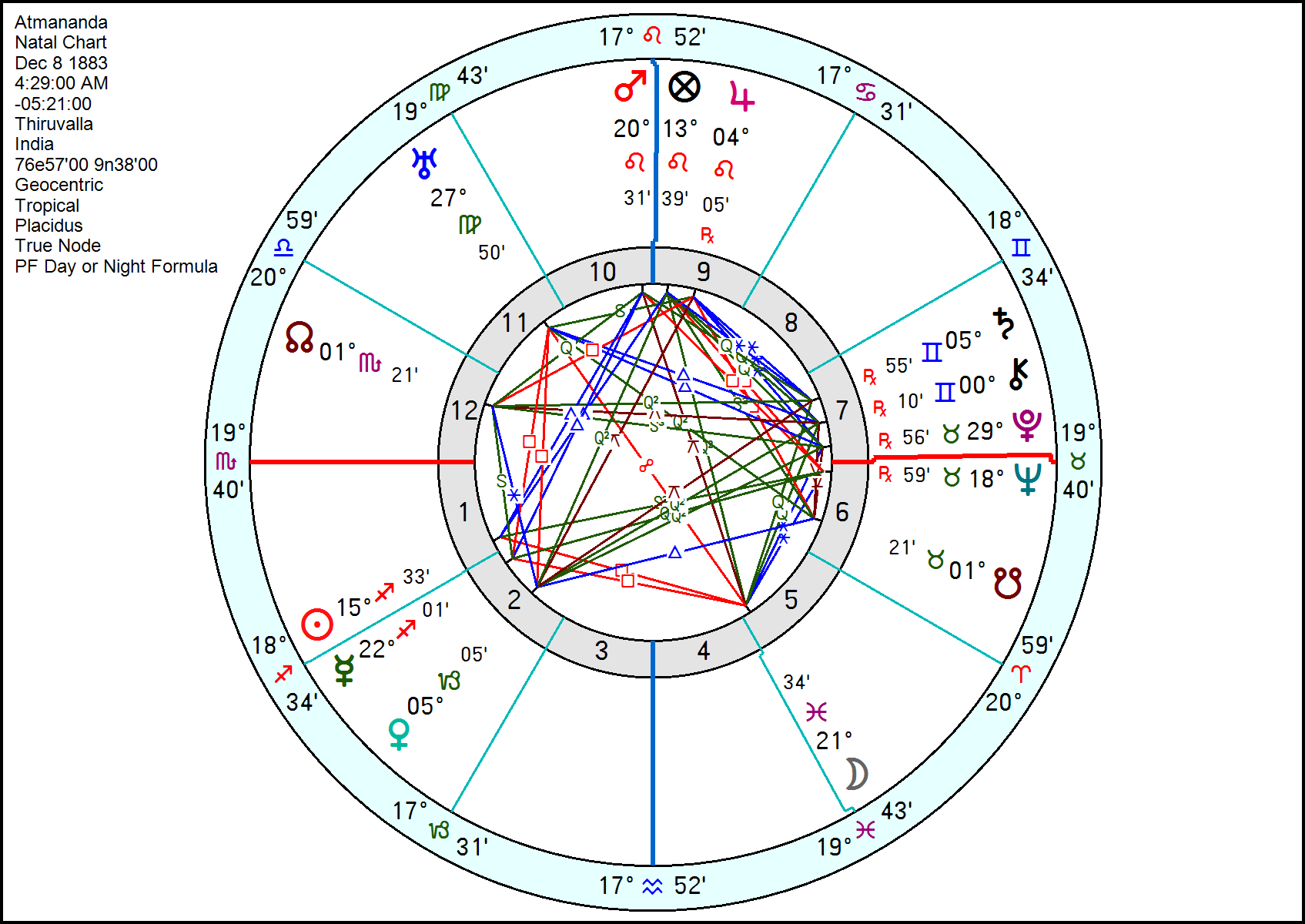
ASTROLOGY; HOROSCOPE-ATMANANDA
TOPIC: Astrology
SUBJECT: Horoscope-Atmananda
SUBSUBJECT: Atmananda natal chart (Chaldeans)
CONTENTS:
Review of Atmananda's life
Atmananda's natal chart (Chaldeans)
Sun at Sagittarius 16: choiceless awareness, Witness-consciousness, inner poise
Opposite at Gemini 16 in seventh house: practicing mystic, insists that the soul's understanding be given its due, expression of inner Witness poise in the ordinary life of the householder
Planetary mind manipulates all of its ideas to create vehicles for souls to inhabit
Sun on a degree is the life in you which is universal but circumscribed in a particular way
The soul, in using the ideas given to it by the planetary mind, is manifesting itself and the ideas
Mercury at 23 Sagittarius: intellect is free
Atmananda's chart very straightforward, hardly any psychology
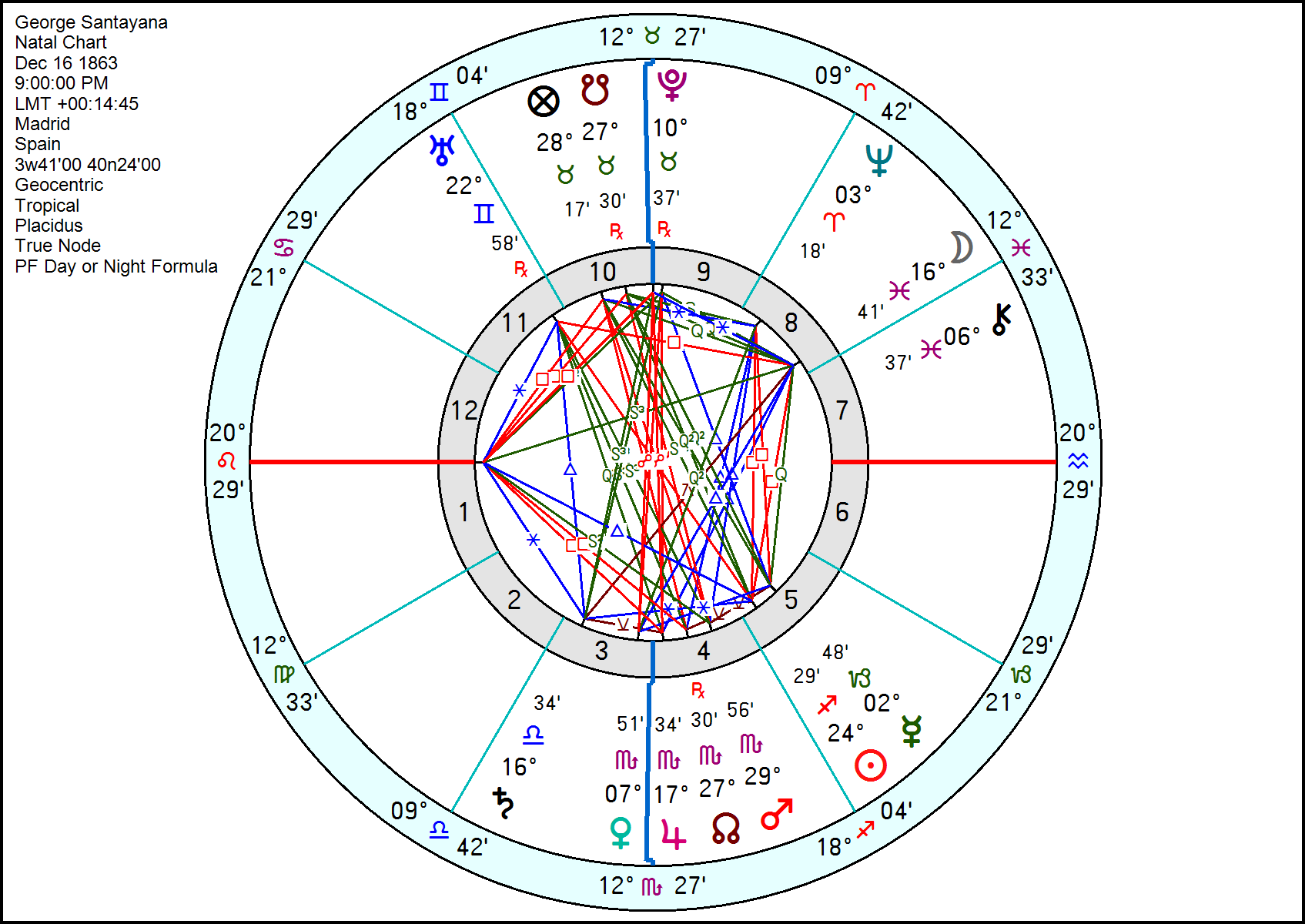
Opposite at Gemini 23: Santayana's Uranus degree; in the case of Atmananda, transcendental is right in the empirical, in the case of Santayana, did not descend that far down
Wang Yang-ming: the transcendental lessons that we have to learn are right in the empirical
For PB, metaphysics was right in the empirical
Gemini 23: Atmananda's stand is in the Nous; dialectic, direct knowing, no reasoning required
Gemini on eighth house cusp: able to universalize any statement he wants to make, able to creatively reformulate the doctrine from his own experience
Atmananda is a Sage but not a philosophic Sage
PB was able to take not only the highest point of view but all the lower ones too
Gemini 23: "fledglings who are aware of their inheritance" indicates that this is a carry-over from the past, worked at this before
Venus at Capricorn 6: the mind transforming itself into an image–beautiful; mind has all possible forms to portray any object; mind transforming itself into perceived world moment-to-moment and thereby giving up its virginal purity
Aesthetic appreciation is the mind's ability to make itself into a beautiful object; this is the Venus function
AD doesn't buy standard Vedantic explanation of Beauty
The recognition of thoughts as a manifestation of Brahman is the Venus function
Opposite at Cancer 6: the Sage knows how to use thought, knows how to take the power inherent in thought and manipulate it to achieve certain effects; Sage can activate higher potential of his students, his gift-thoughts can transform your personality; Master can make you a teacher
Example of Atmananda's secret rite as functioning of his Venus
BOOKS READ FROM OR REFERENCED:
Marc Edmund Jones, The Astrology of Concepts
Marc Edmund Jones, The Sabian Symbols in Astrology
Atmananda, Radhamadhavam
Atmananda, Nitya Tripta, Notes on Spiritual Discourses of Shri Atmananda
Atmananda, Atmanandopanishat, 2 vols. (Atma-Darshan and Atma-Nirvritti)
Paul Brunton, The Notebooks, published and unpublished
Paul Brunton, The Quest of the Overself
Plotinus, The Enneads (MacKenna translation, 4th ed.)
PLOTINUS QUOTES READ OR REFERENCED: V.1.6, V.3.17
SABIAN SYMBOLS: Gemini 16, 23, Cancer 6, Sagittarius 16, 23, Capricorn 6
CHARTS appended to this transcript:
FIGURE 1983 1121a-1. Atmananda Natal Chart.
FIGURE 1983 1121a-2. George Santayana Natal Chart.
NOTES:
This is 1983 11/21a, Astrology; Horoscope-Atmananda evening class, and the first entry associated with this date. 1983 11/21b = Epistemology seminar from earlier in the day, for which no audio survives — only JF notes.
Atmananda also known as Sri Krishna Menon.
TRANSCRIBED Verbatim by IT prior to 2018 (V11a). This is V12a (2023) and has: updated prefatory matter, footer, and audio file name; Book List and TOC completed; new notes within transcript; Atmananda chart replaced, Santayana chart added; new formatting to accord with new conventions. Archival verbatim transcript – V12a.
AUDIO FILES: 1983 1121a, 1983 1121b. [Note: "Tape" and "Side" refer to original audio cassette tapes that were later digitized into .MP3 Audio Files.]
1983 11/21a at Wisdom's Goldenrod
Astrology; Horoscope-Atmananda (Sri Krishna Menon)
[Audio File 1983 1121a Begins]
TS: --elaborating the Sun. Anne, you were going to review the life again?
AK (faint): Of course.
TS: We're starting?
AK (faint): Ok, so he was born December 8th, 1883 in extreme southwest India, which is down by the coast. First, if you've read (anything about it), when he was 10 years old, a Sannyasin came to visit and gave him a mantra to practice which he continued to practice until 1919. That's when [couple/few words inaudible] So, at 14 he matriculated at the University of Madras, and, when he took the exam, they originally told him that he'd failed the exam [couple words inaudible] (with) 100, and he seemed unperturbed by this and then a month later they discovered that it was a typo and he had gotten 90 out of 100. And so they admitted him to the university with-- with special regards and he would (use some other) classes. And, he also had little re-- emotional reaction to passing or failing, and he would say it proved the unreasonableness of causality. (bit of laughter) Anyway at-- at 16, he started to demonstrate some atheistic tendencies and [one word inaudible] the simple religiosity of his (earlier) [one word inaudible] he started to convert other people to atheism. But he still observed the practice that the Sannyasin had given him. From 14 to 27 he had worked his way through college alternately teaching and taking classes. But, in 1910 he was married, an arranged marriage. After graduation he joined the High Court at Trivandrum and joined the Law College. But he met the police commissioner for that time, and although he didn't meet the physical standards of the police department--he was very short, he was only a little over 5 feet tall--he was appointed as a Senior Inspector of police. And he se-- served as a Senior Inspector until 1919 and then took some time off and completed his law degree and is promoted to prosecuting Inspector.
During that same year, he went through a three month period of-- of difficulty, seeing that he needed to find a Satguru. He's lost confidence in Sannyasin as a source of-- of truth. And he couldn't find what he wanted in books and so he went through an intense emotional period [few words inaudible] which he prayed to his Ishtadevata (for/to find) a teacher. Then one night on his way home he met a-- a yogin who was sitting by the road waiting for him. And, they walked away together and came to an abandoned house up at the west side of the city and he spent the entire evening in this house talking and in one evening Yogananda gave him his complete instruction and brought him very close to complete enlightenment. Trouble is that he wanted him to be Acharya, and-- which was a [one word inaudible] familiar with all the paths of yoga and he-- and Yogananda insisted that Atmananda follow all four paths of yoga (if he) [one word inaudible] although Atmananda wasn't very interested in following the lower paths of yoga, he was only interested in Jnana at the time. And he also impressed on him the importance of being a householder, continue as a householder. And he's-- he began this-- with the devotional path and which he completed within six months and wrote 'Radha-madhavam' which is a-- a short work, 64 verses [Transcriber note: 48 verses] about the devotional path.
Anyway by 1923 when he was 40 years old he'd completed all four-- all three paths of yoga and had become-- began, well, Jnana-sadhana, to attain the ultimate truth. All this time he'd been guided by Yogananda in the subtle sphere, he never met him (in) person after Travancore. In May of 1922 he began to prepare secretly to leave his job and to go to Calcutta to join Yogananda and be a sannyasa. At the end of the month-- bless me-- Yogananda appeared to him the-- in the subtle realm and forbid him to leave his role as a householder, and told him that if he left now he wouldn't-- he wouldn't catch him in time. And then, on June 1st at 9 a.m. Yogananda passed. [S, faint: Interesting.] [student assents, faint] In other words, where-- where [couple words inaudible] managed to pass with Yogananda.
Over the next few years he developed a-- began to attract disciples and by 1927 he had a few disciples. In 1934, he told his de-- devotees that they should cherish him speaking to them in Malayalam [S, faint: In (Malayam)?] [few words inaudible] because he was going to be getting foreign disciples. He was fluent in English and the books that he wrote, I mean in his native tongue, he translated himself. So we have translations of his work that carry some authority.
Ok, well in 1935, he met the Sannyasin that he'd met as a child again. And, he was drawn out of the way to [couple words inaudible] he was meditating, and enlightened the Sannyasin fully, brought him to complete enlightenment. In 1937 he had his first European disciples, that included John Levy. 1950 (he had a) [one/two words inaudible] of Paris (then/and) Switzerland and Cairo. In 1952 PB visited him and stayed for three months and observed the secret rite which is [couple words inaudible] [Note: See https://www.pbarchives.org/archive/document/writing/12, Asiatic Notes 4, pp. 697-698, quote 657-1 in text searchable version; pp. 657, 659 in original version. See also WG Class 1983 1030a.] In March of 1953, his wife dies. He had a pretty interesting home life. He said that the ideal human marriage is complete accord.
S (faint): (That's--)
S (faint): That's nice. (bit of laughter)
LR/S(?): Most of it doesn't [one/two words inaudible]
S (simultaneously): She obeyed and-- (laughter)
S (faint): It was me. (S laughing)
VM: His wife was moot I think. (some laughter)
AK (faint): Anyway, he predicted his own passing in six years and indeed in May of 1959 he died. And, there's not much we know [one/two words inaudible] we-- there's very little biographical data on his life.
S: Any children?
AK (faint): Three children of-- one of whom at the time that the book [couple words inaudible] '63, still owned the compound where (there were two), he had(--) probably had that [couple words inaudible] samadhi [couple words inaudible] built one for him and one for his wife. And, that the-- the disciples who were living there continued to live there. That's all for-- for the chronology. Now-- let me see. Other charts we've done, we've done primarily artists and scientists because they're very successful at finding extroverted expressions for their intuitions or inspirations and so we're able to follow-- well follow them in the transits, we're able to see how-- times when ideas became available to them and work them out in transits, any idea through transits. With-- without [one/two words inaudible] there are very few well-defined events, there are very few where we have years, we don't have months or days or time. [few words inaudible] just make up ephemerises for the month and see what kind of transits he was having over the year and try to pick a date and see if that was really acceptable.
And also, you know, if you look at the degrees in his chart, you('ll) find that they're very very clearly figured in his life, that there isn't-- there isn't the kind of murkiness that we see in a chart that's going through a lot of development and a person is working out an idea in his life or going through kind-- a very-- usually we find psychological development. So it's-- even if we could-- maybe you could trace events with-- looking at transits for-- I mean on his chart. I'm not sure how valuable that would be because the circumstances of his life did not cause him to have emotional reactions of a psychological or-- or psychological nature and he also, looking at the earliest works he published and the latest works you see no deviation from the highest point of view in either work. In fact, it's almost possible to-- to imagine taking a section from one and transposing it into the other. You don't see a kind of major development like you saw in Fermi's work where the idea came in at one point and over a series of transits, expressions, you see the idea unfolded more and more intellectually. Or with Wagner when you see the-- an inspiration come in and then it's unfolded in a feeling way over several transits. So looking for what septiles or quintiles doesn't seem really useful. (Really um--) But the chart does have other useful things about it, especially the--
LR (faint): Do the-- do the dignities. Talk about the dignities.
AK (faint): Oh, ok, well they're specific (that I--) For one thing, there are very few aspects, close aspects to that-- among the Chaldeans. The closest aspect is a-- the Sun is a tri-septile to Neptune and then the next is a five degree trine to Mars. And those (are about) close aspects amongst Chaldeans. It's very uncluttered in that way. And-- Oh there are very few dignities, you notice the only dignity is the Mercury in Sagittarius by sign. But by house, there are two rulers, the-- the s-- the-- with the three rulers and two exaltations. See the Sun in the first house and Saturn in the seventh exaltation, plus you have Jupiter in the ninth house, the Moon in the fourth house, and Venus in the second house ruling. It's curious. And also the trans-Saturnians don't progress by degree.
S (very faint): Well that's good.
[student assents, very faint]
AK: Now Uranus progresses from ninth house-- from 1892 to 1927, Uranus progressed one degree forward to make an exact sextile to Pluto. And then it was only a few minutes into the next degree and then it retrograded and came back.
LR (faint): It's in sextile, didn't it trine?
AK (faint): Trine the-- Oh yeah [couple/three words inaudible]
LR (simultaneously): (I/You) missed something.
AK (faint): (I was trying to--) So it went to the-- that aspect between-- in between then it went back. But other than that the-- I checked on-- at intervals on the machine and it-- they don't progress as they go retrograde and they're not leaving the degree.
S (very faint): That's right.
LS: Uranus gets all the way to 29°56'?
AK (faint): 29°56'? I checked it for 1959, I think it has a chart.
AS: (No.) (No/Well) Lenny was asking about that, you said (he's had) trine of the Uranus. Did it go to the 20-- 30th degree or just to 28?
AK (simultaneously): No, it went to-- went to 28° 0 something.
AS (faint): Ok.
S (faint): [couple words inaudible]
AS (simultaneously, faint): But that's not-- It doesn't matter, he was just questioning [few words inaudible]
AK (simultaneously, faint): Oh ok. Anyways, moving quite [couple words inaudible] [short pause] Also, we should with this chart be able to see the planets as some-- as-- as aspects of the Sun. One of the themes that we've worked on is that the-- the Chaldean planets in some way express that the-- the idea that the Sun embodies. And we should be able to see those [one/two words inaudible] in as somehow coordinated with the Sun degree. But-- [12¼ second pause] (Maybe we/I) should just read it [few words inaudible] Just-- first we should just read his Sun degree and then (ask me more)(--/.)
LR (very faint): [one word inaudible] (Sun degree)?
AK (faint): Yeah. [short pause] [couple/three inaudible words, possibly another student] (especially) we can't find (the quotes as) [couple words inaudible] something outside the way that they're doing. That because we don't have a great deal of bi-- biographical data and we had to-- we're going to be working directly from the planets and from the reason-principles which are embodied, [S, faint: That's good.] this is more of an opportunity for people to participate in the class. 'Cause we're not so much working on trying to penetrate into psychological motivation as to see the real underlie, see if there's some inner structure of-- to the chart. PB did consider this man a Sage. And, from-- from his-- from his writings and from his work you could easily see he's not a regular person, that he was always operating from the Witness position at least. So we should be able to see in-- we should-- some glimpse, some idea of what the entity is, like who is the "who" in his chart, like how the-- how the Earth provides the vehicles for the entity to experience and it needs them [few words inaudible] So we were hoping that more people could participate tonight since we're (going to be working on) [one/two words inaudible] degrees and trying to see intimately into them.
[short pause with very faint inaudible student talking in background]
LR (faint): So should we go over the Sun, go over--
S (faint): Yeah.
[students assent, very faint]
Marc Edmund Jones [The Astrology of Concepts, Sagittarius 23, LR reading]: "Bathed in a slantwise Western…"
DB (simultaneously, faint): Could you-- no.
LR (simultaneously): Sorry.
S (very faint): Wrong page.
[short pause]
Marc Edmund Jones [The Astrology of Concepts, Sagittarius 16, LR reading]: "A peaceful scene is unfolded to the view; a calm ocean, a single motionless ship, a few lazy soaring seagulls."
LR (faint): This is 16 Sagittarius.
[24 second pause]
S (very faint): Can you read the long interpretation, the long form of that symbol also?
WY (faint): You want me to read?
TS: Yeah. I think that was better.
Marc Edmund Jones [The Astrology of Concepts, Sagittarius 16, WY reading]: "This is a [WY reads: the] symbol of the quiet on which all action is sustained or of a [WY reads: the] pause that presages change and impatient opportunity. Positively it is a degree of watchfulness and readiness; negatively, [a] distress at the inability to know what lies ahead in life. The keyword is ALERTNESS."
VM: Could you do the whole thing with the symbol (again)?
S: Huh?
WY: Pardon?
VM: Why don't you do the whole thing with the symbol again?
WY: Sure.
VM: Thanks.
Marc Edmund Jones [The Astrology of Concepts, Sagittarius 16, WY reading]: "A peaceful scene is unfolded to the view; a calm ocean, a single motionless ship, [WY adds: and] a few lazy soaring seagulls. This is a symbol of the quiet on which all action is sustained or of a [WY reads: the] pause that presages change and impatient opportunity. Positively it is a degree of watchfulness and readiness; negatively, distress at the inability to know what lies ahead in life. The keyword is ALERTNESS [WY reads: ALERTNESS is the key]."
[9¼ second pause]
LR (faint): (Someone) could say some of the things we've said.
S (very faint): Yeah.
AK (faint): So if-- Well taking the Sun as the dominant power being expressed by the chart, you know, sometimes the Sun is called the purpose in life. [students assent, faint] Is it possible to-- I guess have people been reading the-- there are a few of his books around, people been reading his work? [one faint inaudible student word] (Ok.) [short pause] Supposed to be a degree that-- that shows that-- great poise and choiceless awareness as some motionless ship in a vast expanse of blue sea and a few seagulls that when they soar they don't seem to move at all, they just float on the air. And there's such a stillness. [short pause] Gives the impression of looking downward, you know, from a great height. [13 second pause] Sort of-- it would be just that this-- that this degree allowed him a vehicle that would embody a certain choiceless awareness, that-- that [few words inaudible] his writings and his life carried the personal authority of experience, that-- that the-- the writings he did on Vedanta are classic Vedanta. It isn't a, you know, Atmananda('s) School of Vedanta, (wasn't related) to that kind of personal development of a particular system. But at the same time it's so succinct that you can see it's directly from that-- from that poised position.
AH: May I ask a question about the symbol (you have). (It/There's) certainly-- it certainly seems a very peaceful and very sedate sort of image. But there's some kind of stress in the symbol also with-- describe the keyword as Alertness.
S (faint): Yeah.
AK (faint): Yeah.
AH: Like, what do you make of that? You know, like the keyword isn't Calmness, it's Alertness.
LR: I think they keyed into that Andrew and I think it comes out when you read the opposite degree which I think we want to do as well. The opposite degree is a woman agitator standing, making an impassioned plea to a surrounding group of men. And one of the ways we saw that is that the kind of stillness that Anne was speaking of is not eq-- is not equatable with passivity. That it's the kind of alertness or stillness which is ready to act at the appropriate moment and not act at the inappropriate moment, that there's a certain poise, you know, poise as you would [couple/three words inaudible] which allows the attention to be absolutely in tune with the Tao, I use that phrase in the highest [AH assents] way. And so the-- you can really see that in the opposite degree because the action was enacted, so to speak, when it had to be. He was capable of that kind of agitation where it was necessary and capable of com-- but only from the standpoint of that inner stillness. So, it-- I don't know, it was hel-- when you read the two degrees together you can't help but see that that complementarity exists there, that it's not a calm passivity but an inner poise, an inner readiness. And, gosh I meant to go (read PB) [one/two words inaudible] I don't think I have it but, there's a beautiful quote in PB about how the Sage rides on the back of the Dragon and knows just when to make his move because he's totally--
[student assents, very faint]
AK (faint): Calm.
LR: He's motionless insofar as he's totally in tune with the motion of the Dragon. And I'd like to find that quote but--
AK (faint): Yeah, that the [few words inaudible] it all arises from it.
LR: [one/two words inaudible] yeah. [student assents, very faint] And, there were a couple of quotes that I found right in the Spiritual Discourses which I thought [one/two words inaudible] to some-- The first one is where he says--
[Transcriber note: I'm using Notes on Spiritual Discourses of Shri Atmananda, taken by Nitya Tripta, Trivandrum: Reddiar Press, 1963 edition.]
Atmananda, Tripta [Notes on Spiritual Discourses of Shri Atmananda, p. 13, note 32, LR reading]: "Dispassion is not only possible, but is present in all your states."
LR: In another, he says--
Atmananda, Tripta [Notes on Spiritual Discourses of Shri Atmananda, p. 12, note 28, LR reading]: "To have deep peace and not to be disturbed from it, even for a moment, is the ardent desire of every one. For this you have necessarily to be at a centre which does not change."
S (very faint): Go ahead.
AH: It's not a sleep-- it's not a sleepy situation.
AB: I mean the guy was a police inspector, (as (he/we) said) on that [one/two words inaudible]
VM: In fact as I remember it, many years since I read his life but, while he was going through this tremendous sadhana he was also getting advancements in his job. So it wasn't like he was just spaced out on the job apparently. (bit of laughter)
TS: Here's the quote.
LR (very faint): Oh good.
TS: Um--
[short pause]
PB [V6, 9:3.566 and Perspectives, Chapter 9: From Birth to Rebirth, #59, TS reading]: "Every situation in human existence must find its appropriate treatment, and the right treatment can only be consciously adopted by the sage who has established inner harmony with the law of periodicity.
"The sage seeks to do the right thing at the right moment, for automatic adjustment to these varying fortunes. This is called, in the Chinese Mystery School teaching,"mounting the dragon at the proper time and driving through the sky."" (laughter)
VM: That's beautiful. (VM laughing, some laughter)
PB [V6, 9:3.566 and Perspectives, Chapter 9: From Birth to Rebirth, #59, TS reading]: "Hence I have written [in The Quest of the Overself] that the wise man knows when to resist fate and when to yield to it. Knowing the truth above of the ebb and flow of destiny, he acts always in conformity with this inner understanding. Sometimes he will be fiercely active, other times completely quiescent, sometimes fighting tragedy to the utmost, but at other times resigned and surrendered. Everything has its special time and he does not follow any course of action at the wrong time. He is a free agent, yes, but he must express that freedom rightly, because he must work, as all must work, within the framework of cosmic law."
TS: [couple words inaudible]
S: [few words inaudible]
LR (simultaneously): But it's a long quote.
TS: Yeah. [one/two words inaudible] And it seems to be carried in the-- in the degree and its opposite in that there's a kind of alertness which is a riding above the Dragon that seems to be in the degree itself, the Sun degree. And one thing that was pointed out about the image itself, that the ship is motionless, it's not moving, that the sense of the conscious ego structure is not developing as Anne was pointing out, that there was a fixity there which is rather peculiar. Most of us, the ego is moving at least in several directions, usually not cogent directions, at once. Or-- so there's a fixity to the ego and also an alertness or a watching over that that seems to be built into the degree itself. And it seems to be to me in the opposite degree that the soul is claiming its own [one word inaudible] within the world and calling forth a better response from the egos around it in-- in the way in which I'm understanding this woman agitator standing up on a platform making an impassioned plea to a group of men. There's a kind of-- his teaching-- so I think Anne pointed out was that he would put these people into states while he was teaching the-- teaching them. And that some of the essence that he was-- of his stillness or his awareness that he imparted as well. And I think that would be rather agitating (for) his [one/two words inaudible]
S (very faint): Tim?
AH: You know, how are these qualities connected to the Sun, just in general terms, generally considered.
TS (simultaneously): How are these qualities connected [LR simultaneously: We--] to the Sun.
LR: We were calling the Sun the dominant-- we-- the dominant for the vehicle. So I would say in that [few words inaudible]
TS: No he--
[student assents]
LR: Oh you mean how-- how does--
AH: No the-- you've answered it, you could say for instance like the ship could be spoken of as his ego that was kind of motionless. That's part of the Sun. This alertness that we had been talking about (all of), that the Witness point of view, that's part of the Sun. It seems that we're using the notion of Sun in a very panoramic sort of--
TS (simultaneously): Yes. [LR assents, very faint] You think of the keywords for Gan-- Gandhi was Equanimity or Napoleon it was Audacity, for Patton it was Courage. You'll see that there's a kind of key-- a kind of a fundamental tone or note that the Sun strikes as a kind of center of the individual, psycho-somatic individual, and that all the other planets will be displaying the character that that Sun presents. And here it seems to be in the first house that this Sun is preoccupied with some kind of self-knowledge. It's an exaltation in the first house. We call the first house self-identity. And this self-knowledge is going to take place under the auspices of this kind of fixed ego structure and this consciousness or stillness that is overriding that ego structure. [one word inaudible] I'm sure I shouldn't say fixed, it's stable, the ego structure.
S (very faint): I think so (in this case).
LR: You know that's another-- [couple/three words inaudible] if we brought this out yesterday or not but, it seems that with people with the Sun in the first house, right or wrong they have a strong sense of their "I", I mean for better or for worse. There seems to be a strength to the ego. And, with this degree, that might be somewhat ex-- demonstrative of why he seemed to be who he was right from the beginning. Oh wait, you were saying that yesterday [TS simultaneously: Yeah.] Tim that in another house it may-- it-- it could've possibly been something that was evolving, something like-- that worked in a different way but the fact that it was in the first house might be one way of indicating [one/two words inaudible]
TS (simultaneously): Well the thought was that--
AK (faint): Trace it back to dignity by house.
TS: Yeah. If there was a dignity by house and if you-- and we talked about the difference between the Sun as a central power of the soul or dominant power that is being illustrated by the planets and-- as opposed to the purpose of life as-- conceived as some goal to be achieved. I mean that's this idea that while sup-- supposing the Sun is in something like the eleventh house, then maybe the purpose or central theme is couched in the circumstances of the goal to be achieved, where in the first house it's-- the circumstances that it comes in with or the part of the World-Idea it links up to is one of self-knowledge and (they're in--/therein) in the exaltation it'll work more gnostically than fabricative, it'd be one of deepening the knowledge that was there, not evolving the quality that the degree carried.
[short pause]
LR: Does anyone have anything to add to the Sun? 'Cause I think what we were going to try to do is see the others as evol-- (as fingers) of that unity.
S: You know, this doesn't say it's a sailing ship but to me this-- the picture yet sticks out as a-- as a sailboat and, you know, you're becalmed, and if you've ever been becalmed you sit there and you watch for any agitation on the water, any movement of the rivers on the raft, you're always ready to go wherever, turn, be careful where you can get out of this becalmedness. The fact that it's on a sea, the depth of the water, the depth of the feeling I think is immanent in the degree. Of course it als-- also brings up the picture of that ad that appears quite often in magazines lately in so-- two page ad of the blue ocean and over (in/on) this side there's a beautiful yacht and it says "The yacht is optional." (laughter) Came out about 15 degrees of Sagittarius.
[short pause, faint student talking in background, bit of laughter]
TS (faint): Guess I (have/had) the new set of Sabian symbols. (some laughter)
S (amidst laughter): Right.
AK (faint): Read-- (please) read the opposite degree. So [one/two words inaudible] we'd like to see is in this chart where we can see the degree and the opposite degree as complementary to each other. Sometimes we-- we look at the chart and see if the-- if the-- if the degree is being expressed in the opposite side where there's kind of [one/two words inaudible] expressed over there. But, this seems to be an integrated chart where the inner and the outer are expressed by the opposite degrees, you know, so we'll-- 16 Gemini is--
Marc Edmund Jones [The Astrology of Concepts, Gemini 16, AK reading]: "A woman agitator stands upon a platform, making an impassioned plea to a surrounding group of men. This is a symbol of the rising of the inner soul of man in demand for the recognition by the outer self's conformity to the convenience of life, of the needs of inner-- to the convenience of life, or [AK reads: of] the needs of inner being. Positively it is a degree of irrepressible self-assertion; negatively, sure self-adjustment. The keyword is EQUALIZATION."
AK (faint): And it is in-- in relation to the Sun degree [one/two words inaudible] as a-- like the Sun [one word inaudible] from that(-)that inner poise, it could go down-- it could go forward, it could-- it could go out into the world and express that inner poise because it was [one/two words inaudible] from his own interior place that he was working from.
TS (faint): You know, I just was seeing something [one word inaudible] Jones interprets it in his second version. [short pause] Where he says in the degree--
Marc Edmund Jones [The Sabian Symbols in Astrology, Sagittarius 16, TS reading]: "[This is] a symbol of the spirit's demand for its full share in the privileges and rewards of human society…"
TS (faint): For 16 Sagittarius. As opposed to 16 Gemini where he says--
Marc Edmund Jones [The Sabian Symbols in Astrology, Gemini 16, TS reading]: "[This is] a symbol of the soul's demand for a full participation in the responsibilities of human society…"
TS: I think I finally figured out what he means and that is that in the degree 16, "the spirit's demand for a full share of the privileges of society," it's the spirit's demand that he recognizes society as itself, which is more in accord with the interpretation of what we've seen in the degree than what I've understood it to mean before. And it's in the opposite degree, the 16 Gemini, "the soul's demand for a participation in the responsibilities of human society," that is more-- what he was saying, that there's a kind of an ability to go out and deal with society, you know. It seems also that he says it's a task that the-- his teacher presented him with was to bring this wisdom out [one/two words inaudible] condition of being to the householder's life. Would you say that the 16 Gemini presented him with that task and the 16 Sagittarius presented him with the ability by which he could accomplish that task?
VM: You don't have any times for when he saw his Guru?
AK: Nothing very firm but we know it was a nice night. (laughter)
VM: You don't even know the month or anything?
AK: No what (we've seen-- we've seen that) he was already there in 1919 in this Trivandrum, right, so couldn't have been before March.
VM: Oh. I see, it's that kind of thing, I was saying it might [AK simultaneously: They--] be a wonderful test of Tim's idea if there's a big transit over that.
AK (simultaneously): Well, what did he have, Neptune coming up square to the Sun at that time? Oh no, it was heading opposite to the Sun.
TS (faint): Yeah, opposite the Sun that Neptune was [one word inaudible]
AK (simultaneously, faint): Neptune was coming up to the opposition but that didn't [one/two words inaudible] conjunct early 1920. What he had when he met his Guru was 26 degrees of Venus. And hitting the finger of God is that Venus quincunx the (Sol) and quincunx to Jupiter. And this Pluto was going to be the opposition to Venus, except most of that through (19).
TS: And that was when he first met his teacher?
AK: Right, that's the only time [couple/three words inaudible]
TS: Yeah, ok. What about the month of May before he-- when he wanted to sneak off to the ashram? Do you know what the transits were?
[students assent, faint]
[9½ second pause]
AK (faint): Ok, that was--
[short pause]
AH/S(?) (faint): [couple words inaudible]
S (simultaneously, faint): Go ahead. [couple/few words inaudible, possibly another student]
[student assents, faint]
TS: This is a theory based total-- on-- totally unbased on fact. (some laughter)
VM: Yeah. Keyword is Belligerent. (VM laughs)
TS (simultaneously): Our usual collection of--
WY (faint): [one word inaudible] I see.
AK (simultaneously, faint): In terms of Neptune-- (oh/well) no, it's right, 'cause Neptune trining the Sun.
TS: Right.
AK: Yeah.
AB: What Anne?
S (very faint): What'd you say?
AK: That's when Yogananda died, in 1922, June 1922.
TS (faint): What else did you see in this-- (I/they) interrupted you, what were you saying about the-- the opposite degree?
S: Yeah.
AK (faint): Well just that it showed the-- that part of the dominant thrust of the life was to emphasize [few words inaudible] in everyday affairs, it just was not-- that-- that this kind of attainment was not necessarily, you know, limited to a monkish existence. It was-- wasn't for [one/two words inaudible] soul that the full expression of the life demanded this ability to function successfully and be dominant in the world.
LR: (I think that) too that, concerning your question Andrew that it really does seem important to take the opposite degree [few words inaudible] Because if you just did read the 16 Sagittarius, you could think of a passive state. It wouldn't be [few words inaudible] thinking but the opposite degree seems to be the exterior to the kind of alertness which certainly (is becalmed/has become)(,/--) I mean, look at the guy, it is a pure [one/two words inaudible]
AH: I'm just having a little trouble understanding, you know, on the one hand you talk of the alertness as some sort of awareness, perhaps even a Witness kind of consciousness. And then to try to speak of that in regards to his psychological functioning seems a problem.
AD (quietly): Why shouldn't a mystic be practical?
S: Yeah.
AH: He may be eminently practical.
AD (quietly): That's exactly what that degree is saying. The mystic is the ship lying still, an ego without any agitation, alright, it's not important, the desire, stillness [one word inaudible] And the mystic achieves that. In the seventh house it could also (be/mean) functioning in the world. Mystic is practical. I'm practicing mysticism. Of course this is a higher kind of mysticism, it's a philosophic mysticism.
[short pause]
[student assents, very faint]
AH: So you would be able to see that in his function, a certain kind of precision and clarity, a certain appropriateness which would be a way of speaking about that alertness as manifest in the world.
AD: Yeah.
AK (faint): He was painfully punctual.
AD: Why hide-- why hide the light under the bushel?
[students assent, very faint]
AB: The thing he did was present cases in court. And that-- but wasn't that part of the job as [couple words inaudible]
AD (simultaneously): Oh no that-- that's irrelevant.
AB: Then I didn't say that. (some laughter)
AK (faint): You know it's interesting what they say about the opposition.
AD (simultaneously, quietly): Look, look it he says over here now. Is this him? (What does/Doesn't) he say in here? [student assents, faint] Well-- "taking part in every possible detail of world-wide reconstruction." [students assent, faint] Yeah, a practicing mystic.
AK (faint): It seems that to-- to fully appreciate the vision [few words inaudible] has to not take them as-- as opposites, that there would be an opposition, but the resolution of the opposition is going to a higher position(,) which he might, in that that seems that in these degrees you'd have to see both sides of it to appreciate where-- (where you're going).
WY: I have a theoretical question (I have) and that in trying to get a sense of-- of who he was or the central purpose was uniting the opposites.
AD: Not his central purpose.
WY: The ego's--
AD: Let's go back to [WY simultaneously: Ok, the--] (her/the) point. Planetary mind or the planetary consciousness has all these ideas. And one of the ideas is this 16 Sagittarius. Plus the other degrees and it creates a vehicle. The soul that uses that-- those vehicles, alright, the soul that uses that vehicle is going to operate through that vehicle but the soul has to be held distinct from the ideas which the planetary consciousness brought together to form the vehicle. Ok? Alright, now go ahead.
WY: Alright, it seems like with this degree, 16 Sagittarius being let's say the fulcrum of this vehicle of which-- the vehicle can be view-- delineated from this degree at this time and the symbol seems to be perhaps the boat is the ego and the ocean is the Dragon or the imaginal essence. And any ripples that go along the water is the reason-principles, that ego is going to be exactly attuned to express them. And for-- like what I'm trying to get at is, shouldn't we try to be looking for the meaning in 16 that would be covering both 16 psychologically as well as 16 Gemini? Looking-- trying to explicate and delineate the meaning between opposite degrees seems to me it would be giving the overall psychological manifestation in the vehicle but trying to get at that reason-principle itself it's got to be all included within the 16 so it's gotta be a higher level interpretation.
LR: Except that, if I can just respond to that. You know, the axiom in Plotinus about for every essential authentic being there's an outward-facing hypostasis. [Note: Plotinus, V.1.6, third para from end.]
WY: Uh-hm.
LR (faint): So I-- I would imagine that the closer you got to the essence of a degree, the more present the opposite degree would be of the outward-facing and the outpour-- the outpouring of that. In other words--
WY: Well, do you think it would be that or there could be an inward and outward-facing hypostasis of that one degree?
S: (No.)
LR: 'Cause then that's what it (means).
WY: And then you're saying the opposite degree--
LR: Is that. Now I-- I would say to the extent that it became more psychological and less authentic, the opposite would appear more opposite. But to the extent that it reached the essence, the two of them are extensions of one idea [couple words inaudible] (both of them) [couple/three words inaudible]
WY: Yeah I-- just to reiterate again, the full idea, the inclu-- the inclusive idea should be able to be penetrated into by just considering 16 Sagittarius without looking to the-- Theoretically it seems like that would be--
AD (simultaneously, faint): [one word inaudible] that (even possible/impossible), Bill? Would it be possible to understand anything in isolation from everything else?
WY: Well, if you penetrate it on a subtle level it's not isolated.
AD (simultaneously): No, no, just in a general sense.
WY: No.
AD: Then why do you want to make them the same here?
WY: Well I'm trying to clarify in my own understanding the theory of the method that we go about trying to understand a chart. And what does it mean to try to get at the-- the idea behind a symbol. What does it mean to-- well, I--
AH: Bill?
WY: Yes.
AH: Is it-- is it as if talking about two reason-principles as if it was one?
WY: That-- I don't have any problem with that at all, the two being an expression of one reason-principle. But-- I mean sometimes Anthony will take-- you know, ponder on one symbol and he'll come up with a-- a fairly-- and he'll come up with a-- a subtle idea that that vehicle is expressing and it seems like that he wasn't considering the opposite degree at all. And, you know, so throughout these classes I've been just trying to get a hold of some sort of methodology to, you know, grasp a hold of, you know.
VM: Good luck. (some laughter)
WY: And--
AD: Yeah but, Bill in-- in principle if we go back to the point you're making, you want to find the-- you want to find two complementary ideas in one degree.
WY: Yes.
AD: And then when you find those two, what is to stop you from finding two more in each one?
[student coughs or assents]
AD: And then why stop there?
WY: Well let's say if you penetrated it at its highest it would be a hologram of the whole 360 degrees.
AD: Yeah. So, aren't we in a sense saying that these are like quanta-units, each one of these ideas, each one of these degrees?
WY: What do you mean by quantum?
AD: You can't break them apart, you know, you can't [WY assents] go any further.
WY: Yeah, uh-huh.
AD: Now it's not only the opposites I-- you know, it's not only the opposite degree which is complementary but we haven't even investigated the idea, the way the-- a notion of how these ideas could be altered, you know. What does a square do to these ideas, what does, you know, different aspects do to the ideas. Opposition is only one way of looking at a degree, there might be other ways which, you know, (really) haven't gone into. But, go by the empirical facts. Go by the empirical readings of the chart. And, can you, so to speak see that the 16 Sagittarius readily underlies the-- you know, the basis of identi--
(Side 1 of original cassette tape digitized as 1983 1121a Ends; Side 2 Begins)
WY: Yes, if I'm anywhere near the mark(--/.)
AD (simultaneously): No, one does-- one does not. There are many mystics who never become practical and never will have had (a) harangue in the-- in the marketplace and insist that the soul's understanding should be given its due.
WY: Well I agree with that as a-- a general observation but I was talking about this degree, 16 Sagittarius. I could see the way the symbol is laid out that that ship is going to conform or act to whatever is happening in terms of the water of the mind that it's on. And in that way--
AD: Acting on the what?
WY: Maybe I'm just--
AD: No, just repeat what you said.
WY (simultaneously): Ok. It's a motionless ship and a motionless sea. If the sea-- oh ok. So if a clear mind, the ego can go ahead and clear--
AD (simultaneously): Clear mind? Well what do you mean now?
WY: Clear-- ok. I'm thinking of the ocean as the-- the imaginal essence that the Witness consciousness uses these--
AD (simultaneously): Why not [one word inaudible] with what you just said, you're thinking of the ocean as mind.
WY: As mind.
AD: Yeah.
WY: Uh-huh.
AD: And that ship as an ego within that.
WY: Yes. And that the ego is going to lucidly express whatever the mind transforms itself into. See I'm thinking of the mind more specifically as the imaginal essence of the Dragon. And that the whole symbol conveys [AD: But--] the Witness consciousness.
AD: But every idea is the imaginal essence of the Dragon.
WY: Yeah, ok, but I'm saying this is a symbol of the vehicle's refined structure that allows for it to be a clear-- receptive to any-- any transformations in the Dragon. Any reason-principles that are-- that are being transformed into imaginal expression are going to come out with no distortions in that ego to that ship.
AD (simultaneously): Look, look, let's try this way. [student whispering] The-- excuse me [one word inaudible] Looking at that symbol or reading that symbol, what idea do you think it expresses?
WY: But I thought you said a Witness consciousness, that's what I-- I think.
AD (simultaneously): Well no, I'm asking you, what-- not what we have said, what do you think it was.
WY (simultaneously): That's what I think.
AD: It expresses Witness consciousness?
WY: Yes, yeah.
AD: An impersonal consciousness?
WY: Yeah.
AD: Choiceless awareness? A poise, an inner poise?
WY: Yes, and a complete--
AD: Like the eye of the hurricane?
[short pause]
WY: It-- well I don't see it as necessarily having to be all passive like that though.
VM: Let-- let me just-- (seems) I think you're backtracking very fast. I thought when Anthony (said/says) eye of the hurricane you'd say no, I see no hint of hurricane. That would be calling on the opposite degree. 'Cause I thought that was your point, I want to see the degree in isolation.
WY: I see the ability to either be completely passive or active depending on the--
VM: How [one/two words inaudible] ocean is.
WY: Yes, yeah.
VM: Ok.
WY: Thought maybe there's [few words inaudible]
AD (simultaneously): Even the seagulls are soaring, they're not flying, [WY assents] they're soaring, in other words you know like a glider. [WY assents] And, in that state of consciousness the thoughts that come in had no propulsive energy.
[10 second pause with student whispering, some laughter]
WY (faint): Ok, so I should just say goodbye here.
AD: I'm-- I'm trying to follow you but the first thing I don't understand at all you want to split-- split and have two meanings in that. And even the most elementary acquaintance, you know, with any of the premises we work with, you cannot have an idea, quanta-unit, without relating it to other quanta-units. [WY: Uh-huh.] There's no such thing as an idea self-existent.
WY: Right.
AD: Ok, that's out of the question. As soon as you say one word, you immediately bring in that which is other than that in order to understand it. You cannot understand pain without bringing in pleasure. [WY simultaneously: Yes in--] You cannot understand day without bringing in night.
WY: In-- in manifestation.
AD: Well-- in terms of meaning, yeah.
WY: Ok, meaning [one word inaudible]
VM: This true though, I mean, just to ask a little further along Bill's point. When you say you can't experience or understand a degree meaning other than in relationship, I certainly understand that in normal discourse and so on. But how about if one has a real genuine, let's say, insight, in the way PB would use the term, into a particular idea, is that always in relationship? Does it make sense to speak of relationship at that level?
AD: (Well) as soon as you said insight you've denied relationship.
VM: Ok, that was the question really. There is no relationship at that level. (And that the) more penetration directly into that unique idea, that unique essence.
AD: Yeah. Self-cognition doesn't have an "other" for its object of cognition. But we're not talking about that.
VM: I understand that, so that was just--
WY: Ok. So there's [VM simultaneously: (one/two words inaudible) Seagulls are flying (one word inaudible) right?] relationship even though the level of the reason-principle may be high above any psychological manifestation. There's still going to be a relationship of that reason-principle to--
AD: Other reason-principles.
WY: Yeah, at least the opposite.
AD: And the manner in which the vari-- you know, the possibility of permutations and combinations is utterly inconceivable to us. And that's why I said, the planetary consciousness or the planetary mind, the mind of our planet, is what manipulates all its ideas to create vehicles for souls to inhabit. Now, when we examine the vehicles that it creates, alright, and we say here's the Sun. Now the Sun generally means life, universal life. [WY assents, faint] What could circumscribe a universal life? You put a fence around it? What do you think could circumscribe it? When that life has a goal towards which it's working. Then it is circumscribed. Well, that's another way of saying that the Sun represents in a chart the life in you which is universal but circumscribed or orientated in a particular way. What way? To operate in this way. This is the idea that has brought in a boundary to that universal life. Now you speak about that as the purpose or the goal of this individual life. Take away the idea and you have an infinite life. So, in terms even of the, you remember in astrology when we worked with the chart, the-- the Sun goes around the Saturn in the fifth house. The Saturn goes around the Sun in the eleventh house. In the one case you have life infinite in the Nous. In the other case, the eleventh house, you have that life circumscribed by a prescribed-- [VM: Yeah.] an ideal.
S (faint): Ideal.
AD: And this will be true of every-- every aspect of that vehicle which the planetary consciousness creates. It's going to be this cluster of ideas organized in a certain way which the aspects will indicate. And then, that soul inhabiting that vehicle, alright, will be forced, by necessity, to use those ideas. In the very use of those ideas, alright, it is manifesting itself, at the same time the ideas are getting manifested. So it's really a-- a very pretty picture. And I'm sure Tim would refer to it as fairytale but-- Let's try again. Just-- just look in your mind, you know, at this calm ocean.
S (simultaneously): That's [one word inaudible] that's one of the better moods. (TS laughs a bit)
AD: A ship (is becalmed). And that's-- I think that was a good way of putting it, becalm(ed). Eagles are soaring-- no. (bit of laughter) Seagulls.
VM: Eagles.
LR: If the eagles are soaring the seagulls are running away fast.
AD: Like-- I-- I think that's a perfect description of what a poised Witness consciousness is like. 'Cause even when the thoughts come in, there's no friction in these thoughts coming in. They come in and you let them go. In ordinary ego, the thoughts have to struggle among themselves to see who gets in first, (VM laughing) alright. And then as it's getting in there's all kinds of sparks on the way. [student assents] And then when it goes out there's a crashing crescendo. (some laughter, student words)
AH: While it's in there that it's really a problem. (bit of laughter)
AD: It's in there? While it's in there. Well, yeah. Don't let them in. You people make terrible watchmen. You're put on duty, guard your consciousness, don't let any thoughts come in, and the first thing you do is go to sleep on the job. (bit of laughter) Anyway, I think that's a pretty nice view of his in-- you know, inwardness, Atmananda. [slight pause] But please, go on, you know, making your objections as we go along and let me see if I could objectify more and more the principles and, you know, not worry about the--
AH: Anthony, we s-- he spoke about the 360 degrees being specific ideas. There was 1 through 360 and they each have a unique and special meaning. Well in regards to Bill's-- I'll have to say that, the 16 Sagittarius is a description of this Witness consciousness. [short pause] The opposite degree is a different one, there's a different meaning. Right, Johnny, there's a different-- it's not the same meaning.
AD: Yeah, when you say night, you do not mean day.
AH: They're different ideas.
AD: Yeah, when I say hot, I do not mean cold. But I cannot understand hot without cold already being implied. Otherwise I'd be saying hot even when I'm talking about 50 below zero.
AH: But it seems the only distinction we've made between the two 16's is that one is inner and one is outer. Is that an appropriate--
AD: Only?
AH: No is that-- [AD simultaneously: Yeah.] is that adequate to make distinction between reason-principles that one is inner and one is outer?
[few faint inaudible student words simultaneous with TS, possibly part of background]
TS: I think we've made more than that-- that as a distinction. And we said that the 16 Gemini, the woman suffragette haranguing is the task set before him, the expression of that inner being, inner Witness poise into the ordinary life of the householder, [AH: (Yes.)] that he was involved in agitating these people around him, stimulating people around him, he did take on-- in other words, as opposed to some ideas of Hinduism, he did try to initiate his whole household into the idea-- the doc-- the perennial teachings.
AH: Alright, if you take the view that they are indeed different, [TS: Yeah.] then how are they connected?
TS: If you were going to-- if your task set before you is to teach the true doctrine, which is 16 Gemini say, you would have to know it in order to teach it, and that would be the 16-- you'd have to have the consciousness from which you could teach it authentically and that would be 16 Sagittarius. That's what I was saying. That in other words if you-- you have to go out into the world and bring the doctrine out into the world in some form, that would mean you'd have to be able to come from some point of view that was not theoretical in order to do that. And it seems to me the 16 Sagittarius was that calm, alert consciousness that is the essence of the teaching. And, then the 16 Sagittarius [Transcriber note: 16 Gemini] is the ability to bring that essence into some form that will uproot the egos around you-- around him, and bring them to some further spiritual growth.
AH: Yeah, but--
AD (simultaneously): You know, it's a perfect example of Ramana's remark when they asked him, he said, "What hope would there be for mankind if the householder couldn't get liberated?" Do you ever remember reading that in the notes? Ramana actually told PB this, "What hope would there be for mankind if liberation was impossible for a householder?" And, he was a householder. And if he was going to anythi-- if he was going to do anything I think it was prove that remark Ramana made.
[students assent, faint]
AH: I guess that-- just a little bit more. Is the notion of inner and outer dependent on mea-- dependent on the meaning of the degree?
AD: No, the inner and outer-- we tried to point out that the planet sitting on a degree is the inner functioning.
AH: Always.
AD: Yeah. Its outer manifestation is the out-- opposite.
AH: That's kind of a general rule (but--)
AD: That's a general rule, what is within must be manifested. Once you incarnate, what's within must be manifested. You can't hide it. Even if you say "I'm not going to say anything", you're already manifesting it. And, we ma-- we ma-- we made some preliminary work, I mean, remarks about that, that where the planet sits, that's the subjective functioning. The opposite degree is the outward manifestation of that inner subjective functioning. To understand, you have to use both. In other words, to draw a portrait of this man, you would have to use the degree and the opposite, all seven planets.
S: [couple words inaudible]
AH: So, I know (you/you've) [one word inaudible]
AD (simultaneously): In the same way like you say there's an external world and there's my inner thoughts about it. My inner thoughts, alright, fabricate the external world I perceive. If I function inwardly, then there's an outward manifestation. There can't be one without the other, the two of them always come together.
AH: So in this example if the Sun was on 16 Gemini--
AD: Well then, if my aunt had--
VM: Oh. (laughter, student words)
AD: And we'll have to do that with all the other-- we'll do that with all the other Chaldean planets. You-- you rec-- you try to understand when the planet is on the degree it manifests that. That functioning is in a sense organized by the degree but on the other hand the planet or the function manifests the idea. These two always have to be kept together.
AH(?) (faint): Ok.
AD: Alright. So let's try the next degree and see if you could, you know, get a feeling for that subjective functioning and the outward manifestation of it. It's really not that difficult. Even if we don't have a method built, you know, uh-- You know it's like, the situation like-- In the old-- in the olden times, you know, you wanted to learn to be a painter the-- the father took you when you were eight years old and put you in a painter's house and you lived with the painter. And if you asked the painter "Well how do you do this?" "I don't know, just watch," and he'd go on painting. And when the kid was twenty years old he was doing the same thing, he was painting. So maybe he didn't consciously learn the method involved, you know, but, he could do it.
VM: That's what we're hoping.
AD: Yeah, that's what we're hoping. (laughter) Let's try the next one, ok?
LR: That would be Mercury?
S (faint): Yes.
Marc Edmund Jones [The Astrology of Concepts, Sagittarius 23, LR reading]: "Bathed in a slantwise Western Sun, with the Statue of Liberty beyond, Ellis Island welcomes the immigrants."
[11 second pause]
AD: Don't run away. Figure it out! You don't ride the Dragon, the Dragon rides on you! (AD laughing)
VM: (Careful what you say.)
S (simultaneously): The Dragon was a pony, you know. (AD laughing, laughter, student words)
VM: I didn't hear the last part of the symbol 'cause you got a little quiet at the end.
Marc Edmund Jones [The Astrology of Concepts, Sagittarius 23, LR reading]: "Bathed in a slantwise Western Sun, with the Statue of Liberty beyond, Ellis Island welcomes the immigrants."
Marc Edmund Jones [The Sabian Symbols in Astrology, Sagittarius 23, LR reading]: "This is a symbol of opportunity caught and held through its effective recognition in advance, here dramatized by the creative faith of those who risk their well-being in bringing their skills into pioneer areas of self-expression. The human soul must be…"
AD: Oh cut it out, just read the symbol and apply it to the planet and you should be able to see it, it's-- [LR: Good I--] it's very straightforward.
LR (simultaneously): We weren't real happy with [couple words inaudible] (I think).
[short pause]
AD: What planet is on that degree?
AB: Mercury.
S (simultaneously): Mercury.
S: Mercury.
VM: Mercury? Is that what it is?
AH (faint): Could you read the symbol once more?
Marc Edmund Jones [The Astrology of Concepts, Sagittarius 23, LR reading]: "Bathed in a slantwise Western Sun, with the Statue of Liberty beyond, Ellis Island welcomes the immigrants."
AD: Now isn't that what you all desire in your heart of hearts, that your intellect should be free?
VM(?) (faint): Oh yeah.
S (faint): [couple words inaudible]
LR: [couple/few words inaudible] (laughter, student words)
VM (simultaneously): You mean like the immigrant is free of that-- immigrant is free of that constrained society of Europe where those [couple words inaudible] and so on and now--
AD (simultaneously): Well, yeah, but in this case the intellect is free from that constraining memories, [VM assents] associations, alright, all that you went through, the intellect is free of that.
S: Yeah.
TS: And it's intellect here (this/that's) Mercury. Mercury as (intellective) has this freedom to operate in the light of the Sun. And here that Sun is motionless awareness.
AD (simultaneously): Well, welcome in-- welcomed in the-- into [couple inaudible TS words simultaneous with AD] freedom. You see, if you think of the intellect of an ordinary person, it is constrained by the personality structure to operate in a certain way, right? And the contents that it has are also very partial, very (selected/selective) by the particular circumstances you live in, right? Now, just imagine a person to whom that no longer applies, the intellect is not (AD snaps fingers) constrained, not imposed upon, alright, it is free. Now it could go and look at the Upanishads, read a passage and say, "Oh, I know what that means."
[short pause]
TS (faint): (Wow./Well--)
AD: Atmananda's very straightforward, this chart is very straightforward. As a matter of fact I think all we should read is charts of Sages and never mind anybody else. (AD laughing, bit of laughter)
VM: It's the reverse of psychology when you study all the crazies.
AD: Oh this is so clean, you know, that's so clean there's hardly any psychology.
S (faint): Yeah right.
LR: You'd have a hard time understanding the aspects (though/there).
AD: Alright we'll get to them, alright, [TS simultaneously: Hardly (one word inaudible)] we'll get to them. Shall we try the next one? We don't want to spend too much time on these degrees, go ahead, try it. [TS simultaneously: You want the o--] Or you want to discuss it a little more, go ahead, [LR simultaneously, faint: No, no.] it's fine.
TS: Do you want to do the opposite with this or (no/not)?
AD: Yeah, do the opposite, please.
TS: Do the opposite. You'll like the opposite.
AD: Oh I love the opposite. (bit of laughter)
Marc Edmund Jones [The Astrology of Concepts, Gemini 23, TS reading]: "Three fledglings, secure in their nest high in the [TS reads: a] tree, already reveal the deep pride of their heritage."
AD: Tha-- this was Santayana's Uranus degree, remember?
[student assents, very faint]
TS: [one/two words inaudible] and tell.
LR (simultaneously): Yeah but we don't look at other charts because we don't want [possibly one word inaudible]
VM (simultaneously): I-- I don't-- my intellect's free of all those associations. (laughter)
AD (amidst laughter): But they did-- they did have-- they do-- they did have this in common in a very strange way, I'll mention it later. (laughter, student words)
S: No mention it now please.
TS: He never came down from the high point of view.
AD: Well, in the case, in the case of Santayana-- I mean in the case of Atmananda, it is right in the empirical. The transcendent is right in the empirical. I mean by that it's in the very categories of the imagination. Whereas in the case of Santayana, it did not descend that far down.
[short pause]
LR: And by "it" you mean vision, the vision.
AD: Yeah, the understanding, the cognition, the knowing.
S (faint): He did write though.
AH (simultaneously): Anthony how did-- how did you get that from the symbol?
VM: "Just watch the way I paint, don't worry about it." (laughter, AD laughing)
LS: But couldn't you say that's because of-- couldn't you say that's because Santayana's life didn't descend all the way down?
AD: I'm sorry?
LS: Wouldn't you say that's because Santayana's life itself didn't descend all the way down?
S (possibly part of background): Oh.
LS: I mean he held himself really aloof from friendships, he wandered.
VM: He wasn't married, didn't have three kids.
AD/S(?): [one word inaudible]
LS: He didn't come down, [one/two inaudible student words simultaneous with LS] yeah, he didn't come down into--
RP (simultaneously): (Well), he didn't work as a cop.
AD: Yeah, more or less like that, you know, it couldn't descend all the way down, it stayed in a certain level.
LS (simultaneously): But (instead--) but it probably descended all the way down into life such as he lived it.
AD: Yeah, such as he personally lived it, true, but, didn't you get the feeling that there was a kind of stand-offish [LS: Yeah.] that wasn't a natural stand-offish.
LS: Yeah, yeah, something artificial (about) [one word inaudible]
AD (simultaneously): Yeah, there was something artificial about (him/it).
LR: But that just points out that every-- that-- that the commonality of the degree still for each chart has to be read with the entire rest of it, because it will mean something, I mean-- So you take the same idea, you say well for Santayana that was Uranus. But you read some of the other degrees in Santayana's chart and you get a good description of that aloofness, that, you know-- Whereas if you put this degree in light of the-- this chart, the-- that actual-- that activation of the soul, the actualization of the soul, is (normal/now the) overall theme here and whatever comes in is going to predicate on [one/two words inaudible]
AD: Well I think what I might add would be something like this. You remember in Wang Yang-ming he pointed out that the transcendental lessons that we have to learn are right in the empirical. That's where we learn about them. Or the other example, which I asked Randy to repeat, when they were talking about the Parmenides. Is that right Randy? [students assent] And what did PB say? (Says), "Alright, now let's get to dinner or sewing some clothes or something."
AB (faint): Something less (mundane).
TS: Yeah.
VM/LS(?): Something more metaphysical or something like that.
CDA: Something less mundane.
S (simultaneously): Something less mundane.
AD: Yeah.
S (faint): Oh yeah.
AD: Something less mundane. So, like for him, alright, the metaphysics was right in the empirical. That's where you get to metaphysics. [student assents] And what I'm saying here is that, in the case of Atmananda, the transcendental was right in the categories of the imagination, it descended all the way down.
LR: But that's-- but-- I-- what you're saying about that isn't the way you're interpreting the degree of three fledglings secure in their nest or is it?
AD: Oh no, that-- that was just [LR simultaneously: And that was just--] in reference to the Mercury on the degree.
LR: Right.
[short pause]
AD: Let's go after the three fledgling(s).
Marc Edmund Jones [The Astrology of Concepts, Gemini 23, LR reading]: "Three fledglings, secure in their nest high in the [LR reads: a] tree, already reveal the deep pride of their heritage."
[14½ second pause]
Marc Edmund Jones [The Sabian Symbols in Astrology, Gemini 23, AD reading]: "…the degree is an unconditioned creativity exalted to the point of complete freedom from any immediate involvement…"
[short pause]
AD: Did he have that kind of an intellect functioning?
TS: It seemed like he always spoke from a point of view of a-- of the-- the highest-- the highest teachings of Vedanta, that it doesn't have the kind of graduated reasoning process or cosmological stages. I mean, he speaks of the empirical from the point of view of the Absolute, and there doesn't seem to be anything-- any intermediaries allowed. And on the one hand it seems that, from the Discourses anyway, that he did speak-- speak to the empirical situations but he would take this-- the heritage of the-- that orthodox Vedantic point of view and apply that to the-- that perspective of Vedanta to the, you know, ordinary life. Or even when he speaks about in the Atmananda Upanishad, when he speaks about perception and takes the straight Vedantic line of consciousness is the background of perception.
[short pause]
AK: Listen, the-- the older interpretation of the-- the Jones interpretation is that.
Marc Edmund Jones [The Astrology of Concepts, Gemini 23, AK reading]: "[This is] a symbol of the superiority of real being over all the external and falsely reared difficulties of daily existence; it signifies [AK adds: the] recognition of the reality of selfhood. Positively it is a degree of innate self-confidence; negatively, of self-dependence."
AK: And it's all because superiority of the-- the inner self over any external and--
AD: Would you read the first part again, Anne?
VM: A little louder.
Marc Edmund Jones [The Astrology of Concepts, Gemini 23, AK reading]: "[This is] a symbol of the superiority of real being over all the external and falsely reared difficulties…"
AD (simultaneously): Over what?
Marc Edmund Jones [The Astrology of Concepts, Gemini 23, AK reading]: "…over all the external and falsely reared difficulties of daily existence…"
AD: Stop right there.
TS: Yeah.
AD: Stop right there. In other words, if you ask this man, "What is a tree?", what is he going to say?
S: Consciousness.
AK: Soul.
AD: Consciousness, yeah. He's not gonna start wasting time classifying it, categorizing it, going to a botany book. His stand is in the Nous. Anything else is always, you know, irrel-- irrelevant. You remember Plotinus has said, "Well what's the being of a tree?" Well of course, the being of the tree is the Idea of the Tree, the true Idea. Well what about the other, the one I see? "Well, that's just a dream-image."
AK: So, then we could say that his Mercury, taking the point of view of freedom of expression, freedom from any attachment to the ego, would (express--)
AD (simultaneously): Any attachment from the conventional, yeah.
AK: Its outward expression is always speaking from the highest point of view, [AD simultaneously: Yeah.] any problem-- and so we can see that as the intellect serving the purpose of the Sun, that-- [AD: Yeah.] reaching that (perspective) [AD simultaneously: Manifesting--] [one word inaudible] with the (soul of man).
AD: Yeah, manifesting that Witness consciousness, showing that inner core that it's working from, trying to bring it out.
TS: Do you think it's also that-- in this degree and its opposite that his use of a tradition like Vedanta would be indicated? In other words, that he didn't-- didn't speak from-- from an independent point of view in the sense that he created a-- The Doctrine of Atmananda but he's-- he's worked within a tradition of Vedanta and brought in the-- the (light/life) could be in that teaching.
[short pause]
AD: I don't know Tim, it's possible, (that/it) may be.
TS: I was thinking of the te-- you know this three fledglings high in their nest already reveal deep pride in their heritage. The way in which that inner freedom of thought, of mind, would be expressed is through some security within a-- (well pride in an) heritage, an inherited teaching, inherited doctrine.
LR: Tim aren't you reading the house when you say [TS simultaneously: Yeah.] that for a lot of these things, I mean--
TS: Well I'm trying to bring that in, I mean--
LR (simultaneously): The secondeighth house, wouldn't that more point to--
AD (simultaneously): But the experience of the world, the reality of the world, is-- I mean it's not Vedantic.
LR: How would you interpret the house positions here is what I'm saying. How would you see this as the second-eighth house he's bringing in, what you--
AD: I didn't follow. I don't understand what you're saying.
LR: Mercury's in the second house, I'm asking [AD simultaneously: Yeah.] how you would see this-- these complementary ideas as exhibiting the house [couple words inaudible] [9¾ second pause] I could see it in several ways in this one. [short pause] In other words, Mercury in the second house would be the mental freedom, the freedom of the intellect from constraint. In the second house one way you could see it is, it's free from the operation of the vasanas. It's free from the habit. That's one way. Another way I could see it is that the Mercury itself as being free is itself a vasana. It's something carried over. If you could-- that in the past he worked for that and now the intellectual freedom is something he's coming in with as a vasana.
AD: But if Gemini is ruler of the eighth house, wouldn't that mean that he has the freedom to creatively reformulate, you know-- Yeah, I said it all. If Gemini is the ruler of the eighth house, the outward expression of that Mercury from-- coming from the second, alright, it would seem that he would be able to universalize any statement he wants to make. In other words, creatively reformulate, from his own experience, these teachings. That would be the eighth house expression.
LR: And the second house would be the personal experience of the teaching you're saying?
AD (simultaneously): Yeah. The intellect, as we spoke of it before, the intellect freed from the constraints. [short pause] If you have Gemini on the eighth house cusp, I mean, and a formulation was taking place there, the outward manifestation of the Mercurial or the intellectual functioning of the second house, wouldn't you assume that with Gemini the ruler there that it is capable of formulating in a universal way its own experience? [short pause] I think Geminis are known for that, you know. Universality of their intellect is something that you always gotta live with. [short pause] But even so, if there's no agreement there, I think the other part is pretty open, three fledglings. [15 second pause with student whispering in background] So tell me, how do you understand the three fledglings?
S (faint): [couple words inaudible]
TS: Seer, seeing, seen.
VM (whisper): Uh-oh.
AD (simultaneously): Huh?
TS: Seer, seeing, seen.
[short pause, bit of laughter]
LR: Atman, Brahman, I mean-- (bit of laughter)
VM: Sat-Chit-Ananda.
TS: No Vic, (VM laughing) is-- that here there's a unification of the subjective and objective consciousness, and inherited, that he's always giving expression to. I know we've talked about all kinds of truths but I think that-- I was thinking here that subject, vritti, object.
AH: What are fledglings?
S (faint): Birds.
LR/S(?) (simultaneously): Baby birds.
TS/S(?): Baby birds, yeah.
S (simultaneously): Baby birds.
AH: Baby birds?
LR/S(?): Learning how to function.
S (faint): [one/two words inaudible]
TS: It's hard to imagine that nobody wanted to [one word inaudible] them 'cause that's the fledglings.
LR (faint): Right, that's the wrong way.
TS: Yeah.
S: (Perfect.)
TS: But Dickie isn't here, how could we-- how could it be knowing, willing, and feeling?
VM (simultaneously): [few words inaudible] yeah.
S (faint, possibly part of background): What is this?
VM (faint): No, I understand.
[few seconds of faint background student talking]
LR: I think it's more, I mean-- I think Andrew has asked the que-- that they're fledglings. They're--
S (faint): Yeah.
VM: Not experienced birds.
AD: But they already reveal pride of their heritage.
LR: Right, so there's a freshness and newness in every utterance that's bearing-- that's giving proof of their experience, the source of its--
AD: Well if we wanted to say that those three fledglings represented the three ways of knowing, each one of them, whenever they make an announcement, or all three of them, would always say "I know where I'm coming from. I'm speaking from a point of view of the Nous."
S (very faint, possibly part of background): Ok, (we speak about) [one word inaudible]
[short pause]
AD: Read the symbol, just the symbol.
Marc Edmund Jones [The Astrology of Concepts, Gemini 23, LR reading]: "Three fledglings, secure in their nest high in the [LR reads: a] tree, already reveal the deep pride of their heritage."
[12¾ second pause]
AB: You know, it's like birds don't learn how to sing and, you know, pick up a note here and there. (bit of laughter) They hear the mother and then boom!, they have the whole thing. (some laughter)
VM: (That's/What's) so funny that I [one/two words inaudible]
AD: Very nice Alan, very nice. (AD laughing, laughter, student words) They come fully equipped. They already have a repertoire, you're right. [students assent] [11¼ second pause with faint background student talking] Look, the outward manifestation of that inward functioning would be the same as what Plotinus calls dialectic. He doesn't have to reason about something, he pounces on it--"This is what that is." [short pause] Otherwise you wouldn't be speaking about an intellect that's freed from the personality. [short pause] Alright, I'll go in the back room, start the next one. [TS, faint: We begin(--/.)] I'll send them inside.
S: Start the next (one)?
LDS (simultaneously): I want to understand three fledglings, I--
S (very faint): I don't see no three fledglings.
AB: You want to experience them?
LDS: Isn't that the same thing?
RC: The fledgling part or the three part?
AB (simultaneously): Yeah, yeah, I could see the fledgling part but I-- the three I can't see.
LDS: I want to understand the whole thing, (I--)
S: The fledgling(s)?
LDS: Three fledglings revealing their heritage.
AH: (He) said there was three ways of know-- knowing, is that knowing, willing, and feeling?
LDS: Yeah.
AH: Ok.
TS: And that's usually what we talked about. The only-- the only way I could try to make up a fairytale here is that he had to practice the lower yogas to-- [VM: All three.] all three of the lower yogas before he got to Jnana yoga.
VM: Sure.
TS: And that there was some reluctance to undertake that [one/two words inaudible] that [one/two words inaudible]
VM: Let me ask you something [couple words inaudible]
LR (simultaneously): How about the-- how about the expression of life as being the three? You know how in the Spiritual Discourses people are throwing him questions about their lives from all-- from left-field, right-field, you know, all over the place, and he always--
S (simultaneously): [few words inaudible]
[few seconds of mostly inaudible student joking, laughter]
LR: No but-- I mean I-- you know, the expression of life, and he's always bringing it back to one point and he doesn't just do it irregardless of what the question is, I mean he-- his answer is directly related to where they are, whichever fields they're in, and he brings it right back to the one of pure consciousness. It's like blip-blip-blip, you know, he's back. So in way, you know, I can see the three fledglings as representing that, any expression of life knows the source, finds the source.
AB (simultaneously): Yeah but why three?
LR: Because I was-- you know the way we talked about the trine [AD: A what?] as being the expression of life? [students assent] Yeah, the outward expression is life?
AK: Well, I-- I don't know if I can go along with (them) but I actually do want to go along with Tim's interpretation of the-- the three lower paths of yoga which he was required to undertake because it was explained to him that he would have to have intimate personal knowledge of those three paths, those three lower paths, to be able to speak in authority on those three lower paths even though he was spiritually ready to undertake Jnana for the highest achievement. That he had to recapitulate and bring that-- that solar-- soul knowledge into (his/this) discursive ability, sort of bring it from or this-- the Witness condition into the intellect and had to be able to speak on those-- on those three paths of yoga to-- to his students.
VM: Let me ask this question about that fledgling aspect of it. Is there a certain limitation inherent in the notion of fledgling, after all it isn't a fully developed bird, barely able to fly and so on. I don't know what to make of that, I-- as I say it was a long time since I've read Atmananda but I remember it was fairly-- for-- for an Advaitin it was fairly homey kind of stuff as you pointed out. Does he have real, let's say--
LR/S(?) (simultaneously): Oh I didn't find it homey. I don't know what you mean by that.
VM (simultaneously): Well, it's not a real systematic Shankara-like excursion where he takes up issues and spins them out for long passages and so on. [LR simultaneously: No, but he sticks--] It's just short little pop, little fly, you know, little pops.
AB: The degree emphasizes [VM: I mean--] how much they have for their age and not their insufficiency because of their age.
LR: Yeah right, there's no lack [couple words inaudible]
AB (simultaneously): It's not three fledglings un-- unable to--
VM (simultaneously): But you have to admit that's true though of his writings, right? Or--
LR: But not only-- I wouldn't agree with the way you said that, I mean, it's true he doesn't have lengthy--
S (faint): [few words inaudible]
VM: Just metaphysical.
LR (simultaneously): --systematic explanations, on the other hand, the si-- si-- the simplicity (of his) statements, he just chops the head off of any presupposition the guy's coming from at all, I mean it's not--
S (simultaneously): [few words inaudible] mental.
LR (simultaneously): It's more powerful in that way though.
VM: Well but like let's contrast it with Plotinus.
AK: "Cut everything away", page 400. [Note: Plotinus, V.3.17, last line.]
VM: But yeah, that's just one view. (laughter, student words)
LDS (simultaneously): In other words Vic's saying-- I took him to say-- I took him to say--
VM (simultaneously): I don't-- you know, you're right, you're right, there's one view that-- but Plotinus has got that plus he has a obvious enormous tapestry that you can pick up on. I don't see that in-- in Atmananda or I don't rem-- no.
AK (simultaneously): I don't see in-- that in any of his writings there-- you don't see any kind of-- of mental development. Like you can say a septile would indicate the-- an idea coming into the mental realm, being developed and express such an idea, that the-- that function that-- like Fermi, who could look-- get the intuition and then give a whole rationale for it, figure it all out. He just never bothered with explicating to him the obvious. He just goes directly to the Nous [one/two words inaudible] [VM simultaneously: Ok, well--] speaking from authority. And at the same time you remember Vic that when he's talking to these people, and he did all of his teachings--well he didn't write books to-- to reach other people--[VM simultaneously: No I understand that, it would-- it would take him down.] that he would induce the state, he would induce the corresponding felt-knowledge in his student while he was giving them the intellectual-- the aphorism, the-- it was-- it was very much he wrote poetry. And even though it's not translated as poetry, and he says in one of his prefaces that he's sorry that in the translation that the music is lost, which (PB) felt that would change the force, but that's-- But I-- I think he was-- he was really--
VM: I'm not trying to diminish the man's stature, you know, I'm just trying to see-- [AB: Trying to see the--] [few inaudible student words simultaneous with VM] trying to see (his point of view).
AD (simultaneously): Well then what is the point you're making, Vic?
VM: I mean the man has a unique expression, he is a-- everyone is, you know. And I was just saying, the fledgling aspect of it, does it give us a hint of a certain kind of limitation, I know limitation's a very negative word, especially given the eulogizing you've been doing the last hour or so, but isn't there a certain limitation in Atmananda's presentation? It's very direct, it's very pithy, it goes to the highest point of view all the time and so on. On the other hand, to contrast it with Plotinus, it's not that grand exposition where a tremendous detail and unfoldment is laid out. And I'm asking, is that a reflection of this fact that these are fledgling. These are not enormous eagles that can really soar. I don't know, maybe I'm taking off on the wrong, you know, tack but--
AD: Yeah, I think what you're saying is that he's a Sage, he's not a Philosopher-Sage.
VM: Ok. That's a very quick way of saying it, thank you. (some laughter) But--
AB (faint): So he's staying at the [one/two words inaudible] level.
AH: But is that in any way connected to the fact that they're fledglings and not adult birds?
AD: Yeah.
TS: Huh.
LDS: Insofar as--
AD (simultaneously): It takes an adult bird to give a complete exposition.
VM: Right.
AD: In other words, someone like Plotinus, alright, would be considered a mastermind. PB would call him a Philosopher-Sage. He not only knew the doctrine, alright, but he could expound it in utmost detail from any aspect, [VM assents, faint] any aspect, whereas this point that he was taking was always from one aspect. Let me give you-- let me throw it off completely. You take a man like Guenon, alright? One of the critic-- not necessarily negative but a positive criticism made of Guenon is that in all his writings, there's only one point of view expressed and expressed all the time, and this was said by Coomaraswamy of him, that his standpoint was always purely metaphysical. And he considered this really a great achievement. And I don't disagree. But I would add, how much greater is the achievement of a man who can take that point of view and all the other points of view, [VM assents] all the lower points of view? [VM assents] So that if you read PB, regardless of what level you're at, you'll find the place that's meaningful for you and--
[Audio File 1983 1121a Ends]
[Audio File 1983 1121b Begins]
AD: In the case of Atmananda he's a Sage.
AH: The deep pride of the heritage in the symbol is the fact that Atmananda's speaking of reality. But it's in a-- it's in a-- in a(n) immature way from the point of view of--
AD: No, I wouldn't say immature. (AD laughs a bit) They're not immature.
AH: Yeah, I realize, terrible choice of words, but--
AD (simultaneously): Alright. We'll go on from there. (laughter)
AH: Un-- unfinished-- unfinished from the point of view of what a complete exposition is. The truth is there, certainly, but it's-- (Go ahead.)
AD (simultaneously): Also the indications are in the term "fledglings who are aware of their inheritance", the indications are that this is a carry-over from the past.
VM: Sure.
AD: They know their past, they worked at this before. So it's a natural expression of that past. Let's go on to the next one.
TS: Venus.
AD: Venus.
TS: It's the logs.
Marc Edmund Jones [The Astrology of Concepts, Capricorn 6, LR reading]: "A dark archway in the forest leads to greater depths and darkness beyond, in its shade lie an even ten logs."
TS: Hm.
VM: It's the temple.
AK: Tim, we've-- we finished the scary part of the program and now everyone can join in (laughter) with their insight(s).
VM: Ok.
AK: This is the participatory part of the program.
TS/S(?) (faint): I thought it was mixed.
LR (simultaneously): Really, I didn't notice it was [one/two words inaudible]
AK (simultaneously): 'Cause I didn't [couple words inaudible] This is [one/two words inaudible]
S (simultaneously): [one/two words inaudible]
[student assents]
S (simultaneously, faint): We're two different people.
AK: What we said about this in an earlier class, that the-- that the ten logs were the psychic function(s), which each one has been taken from its natural state and prepared for the erection of some kind of building, that n-- that building hasn't been begun, that you were in the middle of a-- of a natural setting, that some part of Nature had been worked up and this related to these ten functions, the ten planets, that each one was an effective function which was then available for any use, some kind of building of some sort, [student assents, faint] construction.
VM/S(?) (faint): Alright.
AB: Also that the perception of what Nature is led to greater depth. You know, in that degree there's a kind of perception of Nature which is leading into this deeper layer of something.
LR: Think the way we said it was that-- the way Anthony was saying it was that he perceived exactly what was presented, [AB assents] that there was an absolutely correct and corresponding(--) correspondence, clearness to his-- to the faculties of perception, so that what was presented was perceived and what was not presented was not perceived, there was no superimposition, no overlay.
VM: Why are we using perception for Venus, why isn't it value and feeling and so on?
LR (simultaneously): Well actually, that was something that I-- that Anthony spoke about and I-- I thought it was quite-- I've been thinking about it for a couple of weeks, I--
VM: Good, give me the best of your thought. (VM laughs a bit)
LR: Anthony was speaking of Venus as sense-perception. [VM: Hm.] And, if you think of the normal way we spoke about Venus as the anima function, it's the faculty which goes out and receives experience or represents the soul in some way that Jung talks about, it's the-- the-- the one who opens itself to the outside, that's what the anima does. And, that seems to me to be a perfect archetypal description of the faculty of sense-perception and someone else pointed out that if you get a tran-- a big transit to the Venus, what you're able to experience of-- outside yourself is altered, that's one of the things that-- [student assents] So you could speak of it as feeling but in some way this-- this is a broader, more fundamental way of speaking about it, I-- I really began to appreciate his description.
AS: That-- that's also that one of those seven, the chesta.
VM: Chesta was movement [one/two words inaudible]
AS: Well it's the one that leads to senses. [student assents, faint] And we-- he had equated that with Venus also, that depending on where your values are and what attract-- what attracts you, that's what will lead the senses.
VM: Feeling guides-- in some ways you could say feeling guides the perception?
AS (simultaneously): (Or guides) [few words inaudible] And that at the higher level it's aesthetics I think.
VM: Ok.
LR: The thing we didn't get at this symbol last time I would appreciate talking a little bit about is the darkness of the forest. Because I think that's--
TS (simultaneously): Yeah, I have some fairytales on that.
LR: --that's-- I mean, [student assents] to me that's the real mystical part of this degree and somehow last time we only talked about the ten logs but not the setting, not the shades and the darkness beyond that those logs are sym-- you know, are [one/two words inaudible]
TS (faint): What's interesting, I'm beginning to see in this degree that they don't-- you could say that Venus is in the second house that-- that he came in with a tendency to void everything out. [student(s) assent, very faint] There's a ten-- that he picked up where he left off. And in a sense the ten even logs or the ten functions of the psyche that he had, the he-- that had already been formed because [one/two words inaudible] indicate that emotionless-- an ego needing no further direction or [one word inaudible] But in his Venus degree in the second house we'd say it's a-- samskaras has usually been second house and Venus in the second house oftentimes is very attached to its samskaras or its habit. And I'm thinking here he was attached to the habit of voiding everything out or emptying it. And then through that emptying, there was a certain kind of deepening [couple words inaudible]
VM (simultaneously): Well I missed how you see the emptying.
S (faint): Tim louder [couple words inaudible]
VM (simultaneously): I missed how you see the emptying.
AD: Tim, would you like to hear a little fairytale?
TS: Sure.
AD: I think Linda got what I was saying but, maybe I could say it again but reformulate it a little different. We speak about the mind as transforming itself into the perceived object. [VM assents] So that on the one hand you have the intelligible world, on the other hand you have your mind which takes that idea and has to transform itself, metamorphosize itself into the object. The act of metamorphosizing itself into the object is the death of the mind in the sense that it loses its virginal purity and takes on an image.
LR: De-- did you say [VM simultaneously: Death.] death?
AD: Death.
AB/VM(?): Death.
VM: Yes. It's the limitation of the vasanas.
AD: Well, not so much a limitation. But if the mind wants-- wants to be let's say this particular scene, alright, in the process of becoming that, it has to give up its status of remaining per-- virginal. So every time it's metamorphosizing itself, transforming itself, into a perceived object, it is dying. That's its death, alright. And the-- the point here that(--/,) Venus represents beauty, always does to me, I don't care what any astrologer says. [S: Beauty.] Now, that Venus is also the ability of the mind to conjoin itself or transform itself into this object--beautiful. [short pause] It didn't make it. Ok.
S: Uh-hm.
S (faint): Yeah.
VM: You said it nicely Anthony but I didn't get it.
AD: Well, doesn't-- doesn't it amaze you, you're looking at-- you're looking at the, let's say, the most gorgeous sunset you could imagine, alright, and you're looking at it. And you know that that's your mind. That red that you experience, the whiteness of the cloud tinged with mauve and-- alright. [said with feeling] That's your mind. (VM chuckles a bit)
VM: Only 'cause you say so but then-- (AD laughs, some laughter)
LR: But to actually [few words inaudible]
VM (simultaneously): I'm-- you know, I'm just confessing that it's your, you know, (wi--)
LR (simultaneously): (If/Yet) there's something in that example though that-- that I think would bear out what you're saying about his Venus. When I look at a beautiful sunset, I'm always aware of how much of it I can't get. In other words--
AD: Well it's the best that could be done. (VM laughs)
LR: No, no, in my case it's not. Another reason--
AD (simultaneously): No, no, no, no, no. No, you must understand this in its proper way. That subconscious or unconscious functioning of the mind which is transforming itself into the perceived world, which is only later on known by the empirical subject. Ok?
LR: Yes.
AD: You got that point?
LR: Yes, [AD simultaneously: Alright.] but I'm speaking from the empirical, rather than the--
AD: Yeah, you were speaking, you were speaking from the point of view of the empirical. [LR: Ok.] I'm speaking from the point of view of the mind per se transforming itself, alright, becoming this object, which is the perceived world. So at one and the same time, you-- what has to be recognized is that the mind must have the absolute fullness of forms to pe-- to be able to metamorphosize itself into any perceived object that we're capable of perceiving.
LR: Ok. I was just trying to say Anthony that the-- the mind that's capable of putting that out and the mind which perceives it in this case are conjoined, that there is no (different/difference)(--/.)
AD: Well yes, they are the same mind, it's one and the same mind.
LR: Not for me it's not. But for-- in this particular case--
AD (simultaneously): Here we go again. [couple inaudible LR words simultaneous with AD] "I really didn't do it!"
LR: What I'm trying to say is the psyche is so clean here that it is a pure translation.
AD: That it is--
TS: Void Mind.
LR: That it is a pure translation.
AD: Yeah.
LR: That's-- that's all I'm trying to say. When you say it's capable of perceiving exactly what's presented, no more, no less, [AD: Yeah.] that's what I take you to be meaning.
AD: [very faint: Yeah.] Now, does that presuppose that this mind contains all the forms necessary in order to accomplish this? The mind would have to be equipped with all the possible forms in order to be able to portray any object.
LR (faint): Uh-hm.
AD: Well, if that is so, then wouldn't that make significance, "A dark archway in the forest leads to greater depth and darkness beyond, in its shade…"
LR (very faint): Lie an even ten logs, ok.
AD: "…lies an even ten logs."
S (very faint, possibly part of background): Tim needs a lot of [one/two words inaudible]
[student assents, faint, possibly part of background]
S: So you see the dark forest--
AD (simultaneously): See, I've always seen Venus as beauty. But, to speak about beauty in this abstract way is meaningless. When we say we're listening to a, you know, piece of music or look at a work of art and we say "Isn't it beautiful", what do we mean? We mean that that composer or artist brought all of it together, created a piece, alright, so what we mean is all that was involved in making that piece to be what it is. You don't mean beauty in the abstract sense, "Isn't that beautiful," you say the-- alright. It's the whole functioning of the mind which brings that about and you say "That is beautiful." But, implicit in that which is beautiful are all those prerequisites, his artistry, his command of forms, his ability to, you know, put them together and all that. That's what you mean is beautiful, all that has to be included.
LR: And how do you see the archway leading to the greater depth?
AD: Well I tried to explain that. In order to do that the mind is continuously sacrificing itself and giving up its virginal purity, its choiceless-- What do we mean by saying the mind is virginal? We mean that it has no images, alright. Isn't that what we mean? Alright. It has to give that up constantly in order to keep presenting you with a world.
S: Yeah.
VM: Oh so it's like this forest is in some ways the trees have been cut, there's been a certain sacrifice if you like to develop this building material? Maybe I'm taking this symbol too literally, I'm just trying to make a connection (of--)
AD: No I was simply thinking that from instant-to-instant as the mind is fabricating the perceived object, it is continuously dying [VM simultaneously: I understand.] from instant-to-instant as-- as its making that object. Now an artist would take ten years to make one painting but the mind is doing it instant-by-instant. And I'm referring to that as its process of, you know, dying. Because it goes into a darkness when it does that, every t-- every instant that it transforms itself it does that. [student assents, faint] That's the way I interpret this symbol, it's really an extraordinary symbol.
JA: I [AD simultaneously: (Go on.)] understand that the--
AS (simultaneously): Does this-- is thi-- is this related at all--
JA (faint): Go ahead.
AS (very faint): Oh [one/two words inaudible]
JA: I was just going to ask if the aesthetic or the appreciation would be that-- knowing that the mind's forms are the substratum of all the images. I mean, the appreciation of that.
AD: You have to repeat it.
JA: That this Venus function would appreciate that the-- that it is the mind's forms that are the substratum of the imagery, and so that there would actually be an appreciation of mind's-- mind, but-- and its forms. Yeah. I was trying to emphasize the substratum part of it.
AD: No, you can't emphasize the substratum part of it because that is not aesthetic appreciation. The aesthetic appreciation is the mind's ability to make itself into a beautiful object. That aspect of the mind which makes itself into a beautiful object is the Venus function. Now we have a colloquial way of speaking of the Venus function, we say it is the evaluative function, it's the anima. But all these are very gross descriptions at the lowest possible level of significance, fit for idiots and morons, alright. But this is what Venus means.
S: What (Venus--)
AS: (But), can I just--
AD: You just don't appreciate your own mind!
JA: What does that have to do with what I said though?
AD: You have to speak louder Jeanne because [JA simultaneously: What--] I'm getting bombarded.
JS: What you said have to do with what I said?
AD: Alright, let's try again.
[short pause]
JA: I said that instead of a fascination with the sensible portray-- the image, there would be an appreciation that it is the mind's own forms that provide the substratum of the image and an appreciation-- that would be the aesthetic appreciation involved.
AD: That it's the mind's own form that provides the substratum? Leave that out and you'd be right. It's [JA simultaneously: Well--] the mind taking form.
JA: Yes. I'm thinking back to what you said about the tenth house Idea and thinking of this as in Capricorn and you said that-- you relate that once to the substratum of each (form), individual substratum of each form, whether it was the form of the universe or any object. And that's what I was trying to get at.
AD: I don't know what you're-- you know, what you're referring back to.
JA: The tenth house Idea [AD: Yeah.] as related to Capricorn, [AD: Yeah.] and this is Venus in Capricorn, and that's what I was trying to relate(--/.)
AD (simultaneously): This is Venus in Capricorn?
JA: Yeah. Venus in Capricorn is a-- it's a special kind of aesthetic functioning, [slight pause] as is Venus in any sign.
[13¾ second pause]
AD: I'm sorry Jeannie, I lost your point. You'd have to try again.
JA: Do you remember what you said about the tenth house Idea?
AD: I said many things about the tenth house Idea.
JA: In relation to-- as the substratum of-- Avery is getting excited about something [one/two words inaudible]-- [students assent, very faint] of the manifested universe. And you--
AD (simultaneously): Well I probably would say something that the tenth house Idea is the material substratum of any manifestation, the material substratum here being of course the samskaras of God.
JA: Right. But I'm saying that the material-- the material here, the substratum of the image, the material, is aesthetically appreciated as the mind's forms.
[30 second pause]
AD: [couple words inaudible] understand a little of what you're saying, on the one hand you're speaking about the material substratum of the tenth house Idea, the organized and that structuralized material substratum of the world. And on the other hand you're bringing into relationship with that the remark I'm making now about the evaluative function or the Venus as representing an aspect of an individual mind which through the process of manifesting the world, alright, sensibly, you're bringing these two things together.
[student assents, faint]
JA (faint): Well, yes, I was trying to.
[short pause]
AD: I don't-- I-- I wasn't thinking of it in that way at all. Because on the one hand you're bringing in metaphysics. And on the other hand we're speaking now about the functioning of a finite or-- not finite, an individual mind. An individual mind (has, we said/as we said), different aspects. One of the aspects is the Venus aspect, that is to combine form-matter. In the-- in the case of an individual, the Venus could represent the form that the mind is going to give to matter. The matter here is the intelligible world which, so to speak, it's going to transpose or translate into the perceived world. [short pause] Alright, let's go back. [few faint inaudible student words simultaneous with AD] Venus is the anima. Just go on. (bit of laughter)
AK (faint): Wait, wait. Avery I'm sorry, let me read this [couple words inaudible] quote I'm reading.
Atmananda, Tripta [Notes on Spiritual Discourses of Shri Atmananda, p. 124, note 20, AK reading]: "WHAT IS 'BEAUTY'? 'Beauty' is personalised when you perceive it. But in itself 'Beauty' is an expression of the Absolute. It is Harmony [AK adds: in] itself and [AK reads: it] is not perceivable. … For example, you say,"the boat is beautiful". But do you see anything other than [AK adds: the] wood? [No!] Then where is the Beauty? Certainly in the seeing which is illumined [AK reads: illuminated] by Consciousness."
[short pause]
S (faint): Anthony it's (their presentation).
AD (simultaneously): I don't buy that. (AD laughs a bit)
AS: I mean that's his standard line. That's the way [couple/few words inaudible]
AD (simultaneously): That's the orthodox Vedantic way of explaining it.
TS: Avery.
S (faint, possibly part of background): [couple/three words inaudible]
AS: Well, you know, I-- something about what you said seemed to give the flavor of-- that he was-- there was some kind of-- there's [few words inaudible] This is kind of what kept him in the world in a way. I mean I think this(--) part of the Venus, since he could see in the ordinary perception, he could see that it was his mind transforming. He had all these tools available, his mind had this, and he was-- the Venus was willing to give up the-- the freedom it might have had by remaining in trance or something [half/one word inaudible] for the sensible world because it recognized that the sensible world was the transformation of the intelligible, it recognized that function. And therefore he-- he was content or he had to play a role in the world. I think this is one of the re-- one of the planets in the chart that kept him in the world and wouldn't let him lose his [one/two words inaudible] He had the-- that guy wouldn't let him leave the world partly 'cause of his-- the Venus. The Venus is also related to the family in some way. He had to stay there, and it was ok because he recognized in this functioning of his mind to produce the world he recognized it was a transformation of the inner world.
AD: Except for-- yeah, I could put it this way, maybe that might help the others. And that is to recognize that Venus is that functioning-- For instance, you sit down and you're meditating and thoughts keep coming to your mind, alright. Now there is a level of meditation where you begin to accept the thoughts as a manifestation of Brahman. That recognition is the Venus function.
AS (simultaneously): (Uh-hm), this Venus, yeah.
AD (very faint): Yeah.
AS (faint): Yeah, well I--
[student assents, very faint]
AD (very faint, possibly part of background): Alright.
AS: And so it's ok-- so, for him, the wor-- it's o-- he doesn't need to be in this trance, he [AD simultaneously: Exactly, yeah.] can be in the world and recognize it.
AD (faint): Yeah exactly.
[short pause]
[few very faint inaudible student words, possibly part of background]
AK: Uh-hm. [few words inaudible] the Sun degree and its opposite degree, and the Venus to say this is-- this is very quiet and inner or-- or isolated, (scattered) sort of representation. And then the opposite degree is the game birds busily fea-- feathering their nests. How do you see that being the outward manifestation or the activity that-- that that-- an [one word inaudible] manifestation that's in the symbol?
[23¼ second pause]
AD: You want to try another one, [TS: I--] move on to another one?
TS (simultaneously): Do you want to go take this opposite or move to another [one word inaudible]
AD (simultaneously): Oh yeah. Did we-- we didn't do the opposite? What was it?
S (very faint): 6 Cancer.
AD: Hm?
S (faint): 6 Cancer, the birds.
Marc Edmund Jones [The Astrology of Concepts, Cancer 6, TS reading]: "It is in the flush of spring, and innumerable wild or game birds are seen feathering their nests."
Marc Edmund Jones [The Sabian Symbols in Astrology, Cancer 6, TS reading (out of order)]: "[The] keyword [is] METICULOUSNESS. [When positive], the degree is high intelligence and skill in enlisting the potentials of [TS reads: potential for the] experience for the service of self… …the [unlimited] degree to which the spirit of man may develop and preserve its initiative by utilizing the natural course of things in the world at large, and of the satisfaction anyone may know through his conscious participation in a group destiny."
LR: Dum-da-dum-dum. Sorry.
AD: Anne, would you read the [AK, faint: Yeah.] shorter version?
Marc Edmund Jones [The Astrology of Concepts, Cancer 6, AK reading]: "[This is a] symbol of the instinctive preparations for the warm summertime of existence and it is the promise of fullest richness in self-expression. Positively it is a degree of confident preparation; negatively it is [AK reads: it's] the making of plans and dreaming of dreams. [The] keyword is ADAPTATION."
[13 second pause]
AD: Go ahead. Go ahead.
LR(?): What do you think about [one/two words inaudible]
AD: Try.
S (very faint): Yeah. (bit of laughter, student words)
S: It's a further negative. Dreaming of dreams.
LR: Dream on?
VM: Yeah. (VM laughs a bit)
AD: Sound like a negative mystic, c'mon. Interpret it. [short pause] C'mon, interpret!
S (very faint): Meticulous.
TS: That part's easy, I mean he's been [few words inaudible]
S: Oh.
TS: I don't see no game birds yet.
LR: Well, feathering, how about the feathering their nest?
S (faint): For this other point, for the (flesh too).
S (very faint, possibly part of background): (Put 'em back.) (bit of laughter)
TS: Yes.
AD/S(?): Uh-huh.
LR: Well that-- that thought of careful adaptation for practical [one word inaudible] And I think that's getting back to what Anthony said, that there's this inner voidness and outward preparation constantly ada-- constantly being able to adapt. [few very faint inaudible student words] Needing to adapt, yeah, so (they're/their)--
[few seconds of very faint inaudible student talking in background]
AB: So how do you see that--
LR (simultaneously): He had to deal with all the details and-- you know.
S: How do you see what?
AB: How do you see-- give us some examples of what you see and how you see it somehow as the [couple/three words inaudible]
VM: Build on what Avery was saying about him being able to live in the world and make use of the materials right at hand to deepen his realization, I mean he's-- has family, job, so on, [AS simultaneously: Well that-- or--] takes care-- [AS, faint: Yeah.] [LR simultaneously: Or his students.] you know.
AS: And maybe that would be-- [VM simultaneously: Seems.] that would be a consequence of the way that that Venus [VM simultaneously: That Venus works, right.] functioned inwardly.
VM: Right.
AS (faint): His recognition of that translation process, which results would be certain care about the [few words inaudible]
VM (simultaneously): Well I wasn't-- I wasn't emphasizing the care so much but the idea that bird does this sort of thing for the family, for the preservation of the species and picks up what materials are at hand right there and builds the nest with a certain kind of natural--
AS (simultaneously, faint): [few words inaudible] care, you know, just care-- take care of-- care of [one word inaudible] [VM: Yeah.] I mean but, take care of [one/two words inaudible]
LR (simultaneously): But, because it's the opposite degree in some way this is what was foisted on-- um--
[short pause]
VM: By assimilating this outward object he can emphasize the inner aspect of it or the other way around, the inner aspect [LR: Here's what I mean.] plays itself in the outward?
LR: Insofar as what Anthony says is true, insofar as there's a-- there's a clarity or a cleanness of transformation of the mind into reality, [VM assents] into everything that has to be displayed, the other degree seems to guarantee that every possible situation will be foisted on that mind for it to have the--
[short pause]
JA (faint): The first part of what you said, is that what Anthony said? I mean, seemed like the new formulation of what he-- So, why don't you go back to that and start over. 'Cause I don't-- I didn't--
[22¾ second pause]
AD: Well, it would be very hard for you to unders-- understand the outward manifestation of this kind of subjective functioning. But, basically what it would amount to would be that the Sage now knows how to use thought.
KD: Sage knows what?
AS (simultaneously): They call it immediate usage. [few faint inaudible student words, possibly part of background] They call it immediate usage.
AD: Yeah but, (AD chuckles a bit) in a very peculiar way. What he can do with it.
AS: Uh-hm. Well, you know that thing [one word inaudible] though--
AD (simultaneously): You know, it's one thing to be an apprentice to a painter, it's another thing to be the Master and know how to use the pigments, how to draw the picture, how to fill it in, [AS: They--] how to make the shades and all that. So if you think of a Sage now who has reached that level where he can manipulate, charge an image with thought, and give it to you, you got a time-bomb on your hand.
AS: But does the symbol of the-- (VM and possibly AD laughing) the wild birds who are [VM simultaneously, faint: Makes sense.] feathering their nests suggest that this-- the wild birds would be like this normally untameable function of the mind, this tremendously powerful function of the mind which is being brought to bear on-- on a-- on an actual activity, on a-- or domesticated activity. By domesticated I just mean the actual-- the world.
AD: Yeah. Let's say, let's say that-- Let's try this way. We remembered what the Venus on that degree said. Now, imagine that you, you personally, know how to take thought, alright, and change it into an image.
S: What?
VM: That sounds nice.
AD (simultaneously): What could you not do?
KD: But, what do you mean take a thought and change it into an image?
AS: That's what's going on ev-- all-- every instant. Now if you could mani-- if you could have control over that--
KD (simultaneously): Oh, you-- you mean [S simultaneously: Right.] how does--
AD: Well what do you think [AS simultaneously: Then that--] a Sage does?
KD: Yeah. What do you mean take a thought and--
AD (simultaneously): If the Sage is only concerned with the highest teaching, he will be constantly taking thought and transforming it into an image as closely as possible to what he wants to inject into you.
KD: Yeah.
AD: Now, take a Sage, alright, who says "You are my student, and you are going to deliver this teaching." So, he takes thought (some laughter) and injects it into you, alright, a little image ball that goes on getting bigger and bigger.
TS(?) (faint): That's the (prasad).
[student assents]
AB: You know the story--
KD (simultaneously): But wait a minute, wait. (some laughter, AD laughing)
TS (faint in background): That sentence, usually that means [couple words inaudible]
KD (simultaneously): You mean, you mean that's--
AD: He knows how to take the power that is inherent in thought and manipulate it to achieve certain effects. Whereas we do that unconsciously. Our mind is metamorphosizing itself, transforming itself into an image, alright, and then we stupidly ga-- gaze at it and say, "Isn't that pretty, out there?" Whereas a Sage was-- would say, "Didn't I-- didn't I do something beautiful, look at it!"
AB: Isn't the story--
KD (simultaneously): You mean that's when we s-- like unconsciously when what we think we become so when we're passive to whatever-- what comes in--
AD (simultaneously): I'm saying, what you're doing unconsciously, [KD: What we do un--] he can do consciously.
[student assents, faint]
RC: So like when he sees-- when he sees something of the higher nature of the student, his actual perception of it, the entertainment of it in his consciousness is productive or evocative within the-- within the-- the student that he sees it in.
AD: Yes but that's-- that's prior to. Let's say that the Sage sees that-- the higher potential of a student. Then he will know how to transmit a benign influence, Grace, whatever you want to call it, that will bring that out from the student.
RC: Uh-hm.
VM: Did you call that putting (into work) [couple words inaudible]
AD (simultaneously): And I'm not saying it'll happen immediately. It may take years. [student assents] But it will reach its effect, it will be effectual. That's why to, you know, receive the gift-thought of a Sage is something that you all plead for, we all-- You know, most of the Buddhist prayers say, "Please Master, send me your gift-thoughts." That's for real. They want the Master to actually, alright, transform them by sending his thoughts to them. These thoughts transform the personality. True, under the auspices of his karma and all that, well we-- we'll ignore that. But otherwise it'll just lie there in a potential form. You remember, you remember a quote from the ones you gave me? He says unless God or a Master made you a teacher, don't do it. [student assents, faint] Do you remember that? Now how could a Master make you a teacher? That's the outward symbol.
AB: Anthony, that secret rite--isn't that an example where there is--
AD: That's an example of--
AB: There was this inner vibratory rhythm of consciousness and he was outwardly manifesting it in this ritual to create this palpable atmosphere.
AD: Uh-huh.
AB: It's like there's the two aspects of the Venus degree.
AD: Yeah that was the Venus degree.
AB: And that was music.
AD: That's why I wish I knew that night, I would have liked to see where his Venus was. That's-- that's exactly what was going on. He like was reduplicating in dance form these influences that were permeating the atmosphere at that time.
S (simultaneously): Exactly.
AB: The way PB describes it was, it was according to this inner vibratory rhythm of consciousness [AD simultaneously: Uh-hm.] that-- that he had, he was manifesting it so that everyone participated in that.
AD (simultaneously): In other words, the same way like the mind makes an image for you, he was trying to do it with bodily gestures, trying to make the image of that intelligible.
VM: Uh-hm.
AB: And then everyone could participate in that atmosphere.
AD (simultaneously): Well, to the extent that they're sensitive.
AB: Right, right.
AD: I mean, you know, a retard could look at that forever and never get anything out of it. Well, alright, next week we'll do the others. Let's continue from here, ok?
S (faint): (I'll try/That's right).
AD: The next one, the Moon and whatever, let's go around. I think we're going to find out something very interesting like Anne point out--those three trans-Saturnians. That's unusual. They stay [S simultaneously, faint: That they don't move.] in their degree. [S, very faint in background: They don't move.] A Sage is really a beautifully chart to work. [S simultaneously: Anthony--] We shouldn't waste our time with other charts. Even a mystic's, you know.
VM (simultaneously): Is there a-- this-- this is perhaps too late and too general a question but, is there a particular signature that would allow you to see that this is the chart of a Sage or is that something that we haven't been able to unearth yet?
AD (simultaneously): We haven't been able to find out.
VM: I don't mean necessarily the gurukula or--
AD (simultaneously): No, no. We haven't been able to find out.
LR (simultaneously): That's what we're going to learn from doing these charts.
AD: It certainly would be interesting. [short pause] You see, I'm interpreting the levels-- I'm interpreting the [VM simultaneously: It's very difficult.] degrees now at the highest levels, I don't even want to bother with his explanations. [VM simultaneously, faint: Psychology.] I don't think he'll ever reach them. [short pause] Alright, we'll try-- we'll try for the others next week, ok? [student assents] We'll try for the others next week.
VM: Keep coursin' in the Void buddy.
[background student and AD talking, shuffling about until the end]
[Audio File 1983 1121b Ends]
1983 11/21a V12a: CLASS: Astrology; Horoscope-Atmananda. Copyright 2023 Wisdom's Goldenrod p. iv