DIAGRAMS FOR 1983 1123a

Class
Wednesday, November 23rd, 1983
Verbatim, unedited transcriptClick the series name to view more
CLASS at Wisdom's Goldenrod, Hector, NY
with Anthony Damiani (AD)
November 23a, 1983
PB PARAS; INTELLECT; MYSTERY OF MIND
TOPIC: PB Paras
SUBJECT: Intellect
SUBSUBJECTS: Mystery of Mind, Three Primal Hypostases, Insight, Void, Overself, Solar Logos, Self-Recognition, Glimpse, Soul Development
CONTENTS:
THE SOLAR LOGOS AS THE UNKNOWABLE GODHEAD AND THE WORLD-MIND AS ITS PLANETARY POWERS—ONE INTERPRETATION
MIND, VOID, WORLD-MIND, AND WORLD-IDEA—METAPHYSICAL AND COSMOLOGICAL INTERPRETATIONS
THE HOLY TRINITY INTERPRETED AS GODHEAD (FATHER), SOUL OF THE UNIVERSE (SON), AND THE I AM (HOLY GHOST)
THE OVERSELF IS AN EMANATION OF THE ABSOLUTE SOUL, AND TO THAT EXTENT, IT CAN NEVER BECOME IDENTICAL WITH IT
ALTHOUGH THE INDIVIDUAL SOUL CAN NEVER BECOME ABSOLUTE SOUL, NOUS, OR THE ONE, IT CAN RECEIVE TEMPORARY REVELATIONS OF THEM—THE THREE DEGREES OF INSIGHT
OUR OVERSELF IS EQUIVALENT TO, OR IDENTICAL WITH, THE ASMITA PHASE OF THE SOLAR LOGOS
IF THE INDIVIDUAL OVERSELF ACHIEVES IDENTITY WITH THE SOLAR LOGOS, THEN IT'S POSSIBLE FOR IT TO ACHIEVE A TEMPORARY IDENTIFICATION WITH THE NOUS AND THE ONE
THE SUPREME IDENTITY WITH THE ONE IS AUTHENTIC, NOT SOME KIND OF SELF-HALLUCINATION THAT THE OVERSELF IS HAVING
"THE CHASM" REFERS TO THE EXISTENTIAL DISTINCTION BETWEEN THE THREE HYPOSTASES AND THE OVERSELF
WHAT IS CALLED "UNION" WITH MIND IS NOT REALLY A UNION BUT THE TEMPORARY DISAPPEARANCE OF THE CONTENTS OF YOUR PERSONAL CONSCIOUSNESS
WHETHER WE'RE SPEAKING METAPHYSICALLY, COSMOLOGICALLY, OR INDIVIDUALLY, OUR LANGUAGE IS ALWAYS SYMBOLISM
AN EXISTENTIAL ALTERATION OF THE PERSONALITY WILL OCCUR ONCE YOU GET THE GLIMPSE, BUT THE LIGHT ITSELF DOESN'T CHANGE
THE ALTERATION OF THE PSYCHOSOMATIC ORGANISM IS WHAT WE MEAN BY SOUL DEVELOPMENT; THE UNDERSTANDING CHANGES, NOT THE LIGHT OF THE UNDERSTANDING
AFTER THE GLIMPSE IS OVER AND THE EGO TAKES REPOSSESSION, YOU MAY NOT RECOGNIZE THAT THE EGO IS ILLUSORY, BUT YOU WILL COME TO THAT EVENTUALLY
THE EXPERIENCING OF YOURSELF AS MIND IS NOT A THING OF MEMORY; SELF-RECOGNITION IS IMMEDIATE AND DIRECT
THE GLIMPSE ITSELF IS AN EXPERIENCE OF MIND'S DEATHLESSNESS, AND THE EXPERIENCE OF YOUR REAL "I" SHOWS THE OTHER ONE AS ILLUSORY
BOOKS READ FROM OR REFERENCED:
Paul Brunton, Notebooks
Plotinus, The Enneads (MacKenna translation, 4th ed.)
PLOTINUS QUOTES READ OR REFERENCED: VI.7.36
DIAGRAMS appended to this transcript:
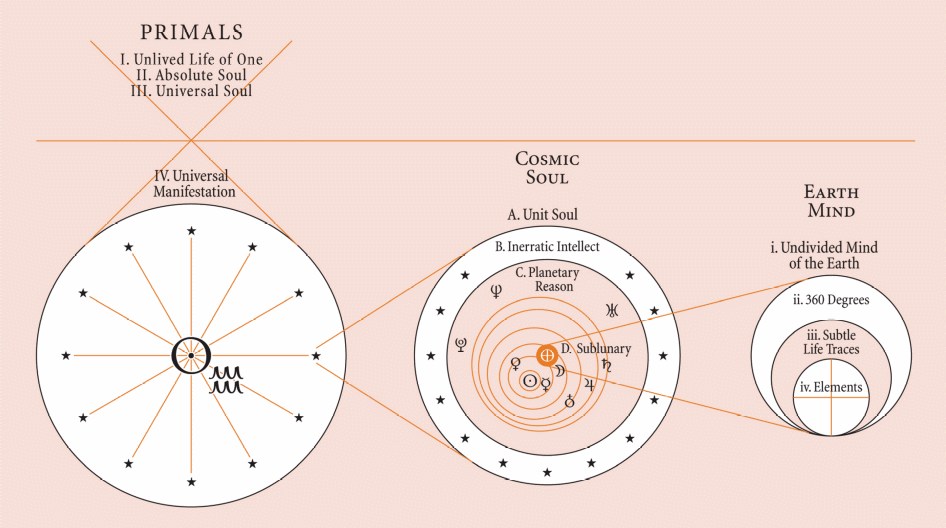
FIGURE 1983 1123a-1. Tripartite Cosmic Soul and Solar System.
FIGURE 1983 1123a-2. Nested Levels.
FIGURE 1983 1123a-3. Psychosomatic Organism.
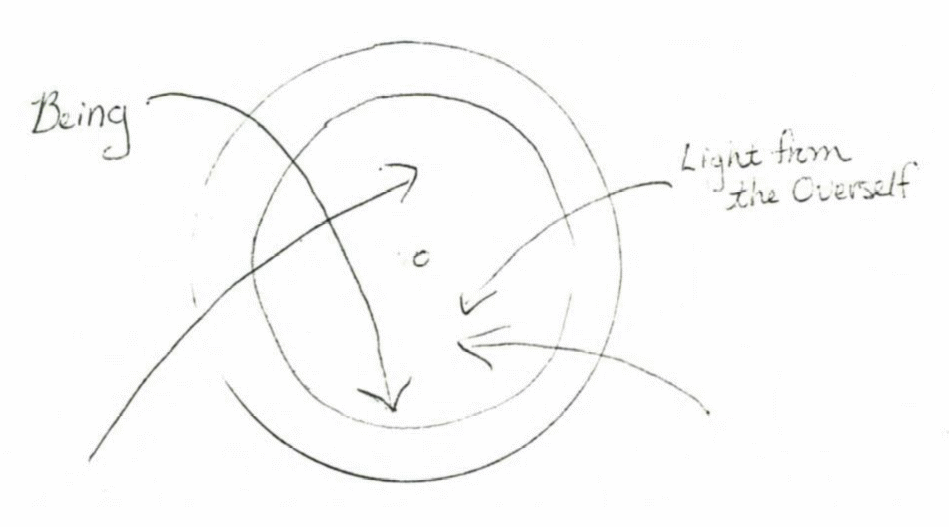
FIGURE 1983 1123a-4. Light of Overself in Psychosomatic.
The second diagram is from Astronoesis, p. 250. [Transcriber note: [diagram] means the speaker is referencing a diagram as he or she is speaking. If someone is drawing or writing, with audible sounds of chalk on a blackboard, I indicate this by [drawing] or [writing].]
NOTES:
This is 1983 11/23a, PB Paras; Intellect; Mystery of Mind Class, and the first entry associated with this date. 1983 11/23b = Buddhist Seminar, for which we have no audio, just a header in JF notes and a PDF scan (Scan File 1983 1123 PHY Quantum Mechanics F35.PDF) of a paper by Vic Mansfield titled "Quantum Mechanics and Madhyamika".
Pat Campbell transcript from 1983 exists (Scan File 1983 1123-31R04.PDF); other, earlier transcript versions may exist.
TRANSCRIBED Verbatim by IT 2018. Reformatted from V11a version by JRM & JF 2019-2020, with Subheads and Table of Contents added by JRM. In 2023, IT reformats again to accord with new conventions, fixes prefatory matter and footer, updates audio file name, fixes typos/minor errors, fixes/completes Book List, adds Plotinus quotes section, adds new notes within transcript, adds four diagrams and references within transcript to these diagrams. In 2025, MW expands Subsubjects and alters Subheads to make more accurate. Archival verbatim transcript – V14.1a.
AUDIO FILES: 1983 1123a, 1983 1123b. [Note 1: "Tape" and "Side" refer to original audio cassette tapes later digitized into .MP3 Audio Files. Note 2: AD speaks very quietly on file a, Side 1. Note 3: In 2024-25, REP Studio improves the sound quality of both audio files, cuts dead air.]
1983 11/23a at Wisdom's Goldenrod
PB Paras; Intellect; Mystery of Mind
Archival verbatim transcript
[Audio File 1983 1123a Begins]
THE SOLAR LOGOS AS THE UNKNOWABLE GODHEAD AND THE WORLD-MIND AS ITS PLANETARY POWERS—ONE INTERPRETATION
PB [V16, 28:1.45 and Perspectives, p. 382, RC reading]: "[Mind is] [RC reads: to] the essence of all conscious beings. Their consciousness is derivative, borrowed from it; they [could] know nothing of their own power; whereas Mind alone knows all things and itself. When it knows them in time, it is World-Mind; when it knows itself alone, it is the unknown to man and unknowable Godhead."
[9¾ second pause]
CDA: Again please Randy.
PB [V16, 28:1.45 and Perspectives, p. 382, RC reading]: "Mind is the essence of all conscious beings. Their consciousness is derivative, borrowed from it; they could know nothing of their own power; whereas Mind alone knows all things and itself. When it knows them in time, it is World-Mind; when it knows itself alone, it is the unknown to man and unknowable Godhead."
[33 second pause]
BS: So-- [slight pause] when this is realized, he doesn't know himself any longer as a man, just [one/two words inaudible] man?
RC: Say that again?
BS: First he gets self-realized, when man gets self-realized, he no longer-- "he" in quotes, no longer knows himself as a man but knows a man? The Mind's power?
S: That (seems to be)(--/.)
BS: Or men?
[short pause]
JB: Bert are you thinking it means he knows nothing of his own power meaning there's much more power that he-- (than he knows)? 'Cause I think it's parenthetical, I think he means on his own he knows nothing, knowledge only comes from Mind.
JB/S(?): No he needs help.
RC: I got the first part. If he doesn't-- he doesn't know himself as this man, he doesn't take that man to be himself [couple very faint inaudible words]
BS (simultaneously): Yeah, not-- not a particular form of consciousness, but he knows that form of consciousness that is the man, "he" being the Mind. [student assents] All (then/them) or all things. Just trying to grasp the idea of Mind knowing its own power.
RC: I guess insofar as-- [short pause] insofar as he knew the-- the [one/two words inaudible] that existed in the World-Mind, he'd be participating in that knowledge and it says here, "When it knows them in time, it is World-Mind…" [AD/student(?) assents] That I guess it'd be, if he knew the idea of himself as it exists as part of the World-Idea, then he would have a slice of-- a bit of power.
[short pause]
PD: I thought that quote though was much more metaphysical, that, you know, the whole reference is that Mind is (a--) one principle of Soul or all conscious being, on the other hand it's a principle of Universal Soul or (the) existence in time. Or on the other hand it's what's called Universal Mind which is self-contemplative, completely absorbed in itself and that's the Godhead. I don't think it's a reference to-- you can't say "he" at that level.
BS: Well I really wasn't referring to a "he" at that level. But I do see the other point about the power which is the Mind would be the World-Mind, that that's (a World-Mind), yeah. So I'll wipe out my question.
JB (very faint): (I guess I can do that too.)
[student assents]
[9½ second pause]
SD: Randy? How do you understand that part where the World-Mind (is--) like knows itself in time? I'm kind of confused by that.
[9¼ second pause]
RC: Well it seemed there, like Paul was saying, that World-Mind in that context you must mean what we'd call cosmic soul. [student assents, very faint] And, implicit in the very definition of cosmic soul is that it's knowing its productive-- what we would take to be an objective space-time unfoldment that we have to participate in whether consciously or unconsciously.
SD: So then, like Intellectual-Principle(s) would be-- and Soul as a-- as a principle, as a Hypostasis, would all be subsumed under what he's calling Mind there. [short pause] Mind in the sense of knowing itself, by itself.
RC: You mean to include all three of [SD: Yeah I--] what Plotinus calls the primal Hypostases?
SD: 'Cause in none of those cases can you really speak of them operating in time.
[short pause]
RC: I mean it's hard to speak of them operating without time.
[short pause with few faint inaudible student words in background]
PB [V16, 28:1.45 and Perspectives, p. 382, RC reading]: "Mind is the essence of all conscious beings. Their consciousness is derivative, borrowed from it; they could know nothing of their own power; whereas Mind alone knows all things and itself. When it knows them in time, it is World-Mind; when it knows itself alone, it is the unknown to man and unknowable Godhead."
[9½ second pause]
JB: Well one thing is that "them" isn't a thing and itself, it's probably just a thing. That's one possibility. So, there's not the suggestion here that Mind knows itself in time, only that it knows things in time and then it is the World-Mind. At first [couple words inaudible] after that [one/two words inaudible] [student assents, very faint] See what I mean? "When it knows them in time" seemed at first to refer to both things, knows all things, and knows itself. But now it sounds as if the "them" is just things in time and there's no call to explain how it knows itself in time when it knows itself not in time [one/two words inaudible]
S: Of course.
[17¾ second pause]
S: Says "when it knows itself alone"(--/.)
[25 second pause]
BS: To know yourself alone, would that mean it's time, it's knowing itself as World-Mind but not-- but not being in time, without a reference to-- no I'm sorry, not knowing yourself-- ok. Knowing yourself as the-- what (we's) call the Nous, World-Mind I guess, would be its power but cut off from thinghood, just pure power. Or would you even melt that back into Mind itself? Well, but that is (then how--) how does it know itself.
[short pause]
RC: Well it seems one thing that we're talking about, (it) was some last week, and also in Plotinus classes, a lot depends on what you mean by knowing when you say that it-- that it knows itself. From one level, we talk about it as a super-knowledge. [student assents, very faint] But it seems you could express the same thing, (as I know you can), intrinsic quality of-- of what it is, and there's-- knowing isn't something that gets added to it or subtracted from. But then we have that problem with-- like what Plotinus does with the-- the One and the Intellectual-Principle as-- depending on what you mean by knowing versus super-knowing.
BS: Or is it-- is [few words inaudible] between(--) (or) the Being of Mind or the power of Mind, and Mind, the Mind-in-itself, where the Being gets merged into it and yet has a recognition of itself as the Being that [one word inaudible]
RC: There are s-- there are some other quotes where he refers to that [one/two words inaudible] It seems in this particular quote that the power to know is intrinsic within Mind and-- and any-- any conscious being has derived its power to know from that power to know. But this particular quote doesn't seem to distinguish that power to know between-- from Mind itself. But it differentiates that power into knowing things in terms of time and knowing itself alone.
[28½ second pause]
AD: Well my version-- Well I'm not going to disagree with Paul (no), I was going to [three words inaudible] (merely) speaking [one word inaudible]
JB/S(?): You convinced me.
S: Hm? (bit of laughter)
JB/S(?): [few words inaudible]
AD: Well, [one/two words inaudible] think of the Solar Logos (and) I think of that as the Mind. Remember when he said the Mind--
[short pause]
PB [V16, 28:1.45 and Perspectives, p. 382, AD reading]: "…Mind alone knows all things and itself. When it knows them in time…"
AD: Now, now we're bringing in the planetary powers, the Solar Logos' powers. That's the World-Mind. When it knows itself alone, then that's Mind alone, Solar Logos by itself. This is unknown to man and unknowable Godhead. So the way I-- I interpret it is that the-- the unknowable Godhead is the Sun or the Solar Logos itself. When it becomes the Mind that knows, then you're bringing in its powers, and that would be the planetary spheres. I'm not saying that it cannot be interpreted in a Plotinian fashion where you have One, Intellectual-Principle and the Soul but there's not enough material there for me to go on [few words inaudible] without, you know, finding a contradiction with Plotinus. [short pause] [19 seconds highly inaudible, sounds like AD possibly talking to someone in background]
[short pause]
MIND, VOID, WORLD-MIND, AND WORLD-IDEA—METAPHYSICAL AND COSMOLOGICAL INTERPRETATIONS
PB [V16, 28:1.52 and Perspectives, p. 382, RC reading]: "The Mind's first expression is the Void. The second and succeeding is the Light, that is, the World-Mind. This is followed by the third, the World-Idea. Finally comes the fourth, manifestation of the world itself."
[13½ second pause]
S: Repeat it please.
PB [V16, 28:1.52 and Perspectives, p. 382, RC reading]: "The Mind-- [RC: This is capital M.] The Mind's first expression is the Void. The second and succeeding is the Light, that is, the World-Mind. This is followed by the third, the World-Idea. Finally comes the fourth, manifestation of the world itself."
S: Yeah.
AD: I think we could interpret this in two ways, metaphysically and cosmologically. In the first one, metaphysical, that'd be like Plotinus. You would have first the One or Mind. Then you have the radiation going (forth) [couple words inaudible] emanation. That's the Void. The Void can be bifurcated in the sense that on the one hand you've got the Intellectual-Principle and on the other hand you've got the Idea. And then (if you're) following is the manifesta-- manifested world. That's one. But cosmologically it needs to be interpreted, you have-- have the Mind. Now here the Mind is the-- the unity of a Solar Logos. So that would refer you back to the Intellectual-Principle, (this) unity is found in the Solar Logos. Then the next is that its very nature is of voidness, the [one/two words inaudible] Intellectual-Principle, it is of that nature. But it has these two aspects. It has a reasoning phase, it has a unit-- a unitary phase. And then following that, it has a principle which we refer to as the principle of manifestation. And then following that we have the manifested world. You have to interpret it cosmologically and metaphysically. If I can't do both there's something wrong, because that's the way it is. I could interpret a thing metaphysically and can interpret it cosmologically. And then you could interpret a thing cosmologically and individually the same way. You can't do all three, you can't interpret metaphysically, cosmologically, and individually. Because there's no symmetry (between them). [21 second pause] Is that [one word inaudible]
JB: What do you mean there's no trimestry (JB misspeaks)? [S: Trimes--] There's a symmetry (in each) (too/two).
S: Symmetry.
AD: There's symmetry there [couple/three words inaudible]
AS/S(?) (simultaneously, very faint, possibly part of background): Oh, now [few words inaudible]
JB (simultaneously): What I'm lacking is the three way(--/.)
S (possibly part of background): Yeah.
S (possibly part of background): Why not?
AD: Well, yes and no. (In the quote), there's an unbridgeable chasm between the individual I AM and the-- [short pause] In that sense there's (no) [one word inaudible] In the sense that if you could interpret it cosmologically you could interpret it individually (but) if you could interpret it metaphysically you could interpret it cosmologically. In that sense you could run three columns (there), of the-- the One, the Intellectual-Principle and the Soul, Absolute Soul. And that would be the Void, it would refer to all three as the Void or (absolute) [one word inaudible] You could do it in terms of Soul too. When you take Soul you would have three principles, there would be these three. Now if you think of our Solar Logos it would have a unity, it would have-- the nature of this unity would be of a void essence, you know. It would bifurcate into the Idea and the consciousness of that, in other words, World-Mind and the (World-Idea). And then the principle of manifestation of each manifestation [couple words inaudible]
[student assents, very faint]
[9¼ second pause]
RS: When the light here-- I don't think it refers to the light in ordinary sense we think of light.
S (very faint, possibly part of background): Isn't it?
AD: Light in this quote there?
[student assents, faint]
[short pause]
S (very faint, possibly part of background): [one/two words inaudible]
[student assents, very faint, possibly part of background]
PB [V16, 28:1.52 and Perspectives, p. 382, AD reading]: "Man's first expression is the Void-- The Mind's first expression is [the] Void. The second and succeeding is the Light, that is, the World-Mind."
S: Yeah.
S: Yeah.
AD: Well, you could leave it that-- It's certainly not light in that sense, that physical light. That is the principle of vibration.
PB [V16, 28:1.52 and Perspectives, p. 382, AD reading]: "This is followed by the third, the World-Idea."
AD: Now what I-- what I'm-- what I'm doing is this, you know, for my own purposes, I have Mind, ok. Mind radiates. Like Plotinus, there's a radiation coming out of Mind, this mysterious radiation, which is the same as the Void, and included in that Void is a bifucation-- bifurcation of the Intellectual-Principle and the Intellectual Ideas. And then, he says there(,) finally comes a fourth, manifestation of the world itself. So, he's-- he's going immediately from the Intellectual-Principle to the manifested universe. He does that very often, he doesn't even talk about the Soul, because he doesn't distinguish Absolute Soul and Intellectual-(Principle). Well let's try one more, these are going to be [one/two words inaudible]
S: You think?
JfL: What (I was saying) Anthony(,) that it's not applicable to relate this whole thing to the individual? But then Mind's first expression of the Void as being the I AM and lower? [S: No.] Is that-- I'm-- I'm not sure if I understood what you were saying that (there('s)--) [short pause] Were you saying that the gap couldn't be bridged and that it really couldn't be looked at--
AD: You said you wanted to apply this to the individual mind? So the first expression of the individual mind would be the Void. The second and succeeding is the light, that is the World-Mind? I--
JfL: Uh-hm.
AD: And this is followed by the third, the World-Idea?
JfL: Yeah, the individual as creator, his own universe, starting with his I AM.
AD: But the World-Mind and the World-Idea are not radiations or emanation of the I AM.
JfL: Well I was using it a little looser than that I guess. I was thinking of the World-Mind as just being in the O-- you know, the Mind in general as being the Overself, the I AM, and-- and the light as maybe the-- well, I'd-- well I was thinking maybe the light was the primal image or something in that-- or maybe-- well I guess maybe the world [one/two words inaudible] (become) the primal image. It's not really thought-out, I just wasn't sure why it couldn't be done for the individual.
AD: Well do it and then ex-- and tell it to us.
JfL (simultaneously): Ok well-- You mean do it at home? (student(s) assenting, laughter, student words) The Mind distinctly-- the Mind as the Void would be the-- the I AM, person's experience, the non-dual. And that the-- the first one, that the experience of the light sounded like almost the-- the state of contemplation or a state where the individual still(--) is let's say in a thought pre-state.
AD (simultaneously): Look, look, (wait). Let me read this once more.
PB [V16, 28:1.52 and Perspectives, p. 382, AD reading]: "The Mind's [AD: That's capitalized.] first expression is the Void. The second [AD: I'm putting in the word, second expression.] and succeeding is the Light, that is, the World-Mind. [AD adds: Now that--] This is followed by the third, the World-Idea. [AD adds: And] Finally comes the fourth, manifestation of the world itself."
AD: You want to put this all in the individual I AM? [student assents, faint] It's like saying that the World-Mind and the World-Idea is an expression of the I AM. [one/two words inaudible] but I think the expression [three words inaudible] [11 second pause] Let's try another one.
RC: (Ok.)
S: Hm?
RC: [couple/three words inaudible]
AD: If you know a [one word inaudible] Alright, read the whole thing. (No excusing yourself.)
S: No (excuses/excusing).
S (very faint, possibly part of background): [one/two words inaudible] (to read).
THE HOLY TRINITY INTERPRETED AS GODHEAD (FATHER), SOUL OF THE UNIVERSE (SON), AND THE I AM (HOLY GHOST)
PB [V16, 28:1.54 and Perspectives, p. 383, RC reading]: "What is the meaning of the words"the Holy Trinity"? The Father is the absolute and ineffable Godhead, Mind in its ultimate being. The Son is the soul of the universe, that is, the World-Mind. The Holy Ghost is the soul of each individual, that is, the Overself. The Godhead is one and indivisible and not multiform and can never divide itself up into three personalities."
[15¼ second pause]
JB: So was that an explanation or an apology?
AD (simultaneously): Well, you have to remember that you have the Christian notion of the Trinity, three persons, one substance.
JB: So it was back on there that this (reminds) you(--/.)
AD: Well, you can see it's not [few words inaudible] Read it once more [couple words inaudible]
PB [V16, 28:1.54 and Perspectives, p. 383, RC reading]: "What is the meaning of the words"the Holy Trinity"? The Father is the absolute and ineffable Godhead, Mind in its ultimate being. The Son is the soul of the universe, that is, the World-Mind. The Holy Ghost is the soul of each individual, that is, the Overself. The Godhead is one and indivisible and not multiform and can never divide itself up into three personalities."
S: Yeah.
[short pause with couple highly inaudible student words in background]
AD: (You-- you/Lou you) have to say it again.
[student assents, very faint]
[short pause]
LDS: Well he-- PB's not ascribing to the three persons one essence that the Christians would speak of, by saying that Mind-- the ultimate Mind cannot be multiple or divide itself up into three persons?
[students assent, very faint]
LDS: So how do-- how do we account for the-- the other two persons?
AD: He's not accounting for them.
LDS: But he spoke-- I mean he s-- he spoke of what they would mean in his framework. Is it-- he-- he's implying a kind of emanationism?
[short pause]
AD: Louis your question isn't clear.
LDS: Pardon me?
AD: Your question is not (clear to grasp).
LDS: First I asked if-- or I stated that it doesn't seem PB's ascribing to the-- the Christian three persons one essence or one substance theory of the Trinity. You'll agree to that?
AD: Uh-hm.
LDS: And, what I'm asking, if that's not the case then how is he speaking of these three principles if not as divisions of one substance or levels of that one substance or aspects of it?
AD: Of who-- in other words, you want that explained.
LDS: Yeah that's the drift. (laughter)
AD: I think-- I think you're familiar with it. The first one's the Godhead, that is(,) the One, [LDS: Yeah.] according to Plotinus. The second one I think is the Absolute Soul. Notice-- notice the change, he doesn't call-- he doesn't say the Intellectual-Principle, he said soul of the world in this quote. But he says that (they're/there) [one/two words inaudible] principles that it is the soul of the universe. The Sun is the soul of the universe, that is, the World-Mind. It's not e-- instead of referring to the-- instead of referring to the Intellectual-Principle, you know, as pure Intellectuality, he's referring to it as the soul of the universe. The soul of the universe would be the Absolute Soul. It would be-- I'm sorry, it'd be the same as Universal Soul.
LDS: Uh-hm.
THE OVERSELF IS AN EMANATION OF THE ABSOLUTE SOUL, AND TO THAT EXTENT, IT CAN NEVER BECOME IDENTICAL WITH IT
AD: And then the third one, the Holy Ghost, the soul of each individual. So with each individual I AM or Overself or asmita principle, any of these terms you want to use, (is/it's) the Holy Ghost. In other words, your I AM, your Self, your Higher Self, is the Holy Ghost. And you've heard the story that if you sin against the Holy Ghost there's no getting away with it. But here again, I think-- I think if you carry on, there is again an asymmetrical relationship. You could line up the One on one side and Universal Soul on that side. But the Holy Ghost you can't, because there's this-- like he would say that there's this unbridgeable chasm between the individual I AM or, you know, Overself, and the mysterious Void. That cannot be crossed. [student assents] No?
LDS: Yeah, I remember that.
EC: No one-- no one can hear in the back (at all).
AD (simultaneously): (But it's) very-- but it's very loud (here). (bit of laughter) I didn't want everybody to hear me. [student assents] I'm sorry Randy.
RC: I can understand there being an unbridgeable (chasm) between like my ego and anything divine. I'm having a hard time understanding that there's an unbridgeable chasm between Overself and [short pause] Mind.
AD: I didn't hear you Randy. [student assents, very faint] [10¾ second pause] You would have to go back to those quotes where he-- where he spoke about the fallacy of--
LDS: Merging with the Godhead?
S: Divine identification. [Note: See Paul Brunton, Notebooks, V16, Category 25, Chapter 1.]
LDS: In o-- in other words you could never become God, you could never identify.
AD: The highest that we could reach is to this level of the I AM or-- or the asmita principle or your Overself, that's the highest you could reach. But the Overself itself is an emanation, a reflex emanation of the Absolute Soul. And to that-- to that extent, it could never become identical with the Absolute Soul. To that extent it is always, let's say, suspended from that principle.
RC: But I guess what I'm-- what I'm thinking is like, on this side of the fence, the notion of pure Mind, undifferenced consciousness--
AD: No that's the other side of the fence. (some laughter)
RC: No, but I mean from this side, that whole notion seems like a concept that someone like Jung could say I just can't-- I just can't conceive of that as being valid. I don't know of any consciousness without an ego and can't conceive (of that). But it seems that for a man who's living in the Overself, (then) that becomes the one reality which he's sure of. He doesn't know anything about it. But it seems that what really characterizes his life in the Overself is there's no longer any doubt about the reality, the ultimate reality of consciousness in its pure (spirit).
[9 second pause]
AD: [5 seconds inaudible]
RC: I guess (if--/it's) still back at the beginning. I can thoroughly appreciate there being a chasm between the mind which necessarily knows in terms of the subject-object duality. I can understand there being a chasm between that level of the mind and anything higher, any kind of pure consciousness [one/two words inaudible] But it seems to me that when-- when a person is no longer restricted to operating at that level but we'd say he's living in the Overself now, that he begins to participate in a kind of knowing which is no longer characterized by that duality. And, in that sense, even though he doesn't know anything about the ultimate reality, that the quality of his own mind is such that he has no doubt about the fact of that reality. So that it would seem-- I guess the conclusion that I would draw from that would be that, insofar as he's living in the Overself, rather than there being like a-- an unbridgeable chasm between this man and the ultimate reality, there's an intimacy that can't get characterized as any kind of known thing. But there is a reverent-- a constant reverent recognition of its presence.
AD: I see.
RS: You know there's the word there, Holy Ghost seems to give a very good clue that the Overself is not the Godhead itself but it's a-- it's like a ghost of it, an emanation from it.
AD: That's very good Ram. (AD laughing, laughter)
VM: I never thought of the Holy Ghost that way.
AD: I never thought of it.
S: (Neither did I.)
S (simultaneously): (Yeah neither did I.)
S: (I mean) that's--
VM (simultaneously): (Hindu doesn't have a) Christian background to struggle with, does he? (laughter)
AH: Actually about 20 years ago they changed it from Holy Ghost to Holy Spirit because ghost had unfortunate connotations. (laughter, student words)
AD: I don't think it would disagree with the fact that a Sage or the Master recognizes or that-- or [few words inaudible] We-- we sometimes speak of it as being a mouthpiece for the Intellectual-Principle or the-- the Absolute Soul.
[short pause]
RC: I-- I guess I just reacted to the word 'chasm' there. Like rather (than) to abide with the Overself as the state of being which we would call it Overself. But it seemed that rather than [few words inaudible] wide chasm all of a sudden.
AD: He doesn't call that a chasm [possibly couple/few words inaudible]
RC: I guess that's what I'm trying to get at.
AD (simultaneously): I'm just-- I'm just-- I'm just pointing out that, this way: the distinction between the Overself, the individual Overself, and the Intellectual-Principle(,) and the One. [RC assents, faint] If we think of the One and we think of the Absolute Soul, it's [couple words inaudible] instead of-- it's the very nature of these three principles or these three Hypostases to be referred to as the absolute mysterious Void. But that which is an emanation, that which reflects them, that which they projected forth from (themselves/themselves), there's a difference, a distinction, a distinction you (haven't caught). We could say that the Overself must get involved in manifesting the Idea of Being which is given to it and then evolve itself through that. There's no such thing as [5 seconds inaudible]
S (very faint, possibly part of background): Uh-hm, I could see it there.
RC: Like over and over again there's quotes where he says, I don't know anything about it but-- but I know that it is, that's the one thing that I know.
ALTHOUGH THE INDIVIDUAL SOUL CAN NEVER BECOME ABSOLUTE SOUL, NOUS, OR THE ONE, IT CAN RECEIVE TEMPORARY REVELATIONS OF THEM—THE THREE DEGREES OF INSIGHT
AD: I don't know if that's absolutely true too because Plotinus points out that in a certain condition, under certain condition a revelation about it may be made to the Master. In other words, there will be certain annunciations about the nature of the One, something about the nature of the One. And I think in some of his later quotes we're going to find that he too is going to say that something about the One could be and one of the most important thing that they could know of course is that it is. And this is the fundamental knowledge that we have. But when Plotinus, for instance, starts speaking about the nature of the One, how the completing act is the same with--
S: [few words inaudible]
AD: Yeah. That-- that's more of a revelation which was given to Plotinus when-- when he is identified with the Overself, when he penetrated [couple words inaudible] that PB says that there is these three degrees of initiation, the first penetration, second and the third. The third takes you to the One itself, the second to the Intellectual-Principle, the first initiation is into the Absolute Soul. So when the Sage achieves identity with his I AM principle and has self-cognition to work with (and the) insight to work with, that there's three levels, the way he spoke of it, there's three levels or degrees of insight. And the first level of insight introduced you to the Absolute Soul, the second to Intellectual-Principle, and the deepest level of insight brought you into the awareness of the incomprehensible One itself. Now that is some kind of knowledge too, nothing like we understand. But then he goes on to point out but this is only a temporary thing. The individual soul must resume its own self-identity, it cannot by the very nature of the thing we're discussing remain Absolute Soul or Intellectual-Principle, it must return to its own nature. So, in that sense you can see that there's a chasm that's unbridgeable. It can't be crossed. Individual soul can never become Absolute Soul or the One.
RC: Emanating [few words inaudible]
[students assent, very faint]
AD: And he speaks about that individual soul or the I AM or the Overself as being of an eternal nature. And, when we say well it seems to be eternal, so is the mysterious Void but the qua-- qualifications have to be brought in that in the Intellectual or in the mysterious Void everything is already so to speak, you know-- Well, the very substratum of the mysterious Void is eternally itself whereas the substratum of the Overself is this perpetual process which is an indication of that eternal(--/.) (There's/They're) just a little (difference there).
RC: This might-- might be too-- I don't know if this is a legitimate way to put the question. You know how Plotinus would-- when he speaks about the quote unquote "experience" testifying to the-- to the One, he says that the Intellectual-Principle within the soul gets cancelled and then he (says/said)-- and that-- that it's during-- it's during that temporary lapse that the person has the-- the touch of the untouchable.
PD: You could keep talking to yourself.
S: Louder. Is that what you mean? (bit of laughter)
RC: When Plotinus talks about-- when he tries to testify to his having had some authentic awakening to the One, not as a concept but as a reality where he could testify directly, says that what happens is that the Intellectual-Principle within the soul is temporarily suspended, and that during the period of that lapse the soul receives the touch of the untouchable, which it can't characterize in any way but in some way that it-- there's no denying that it-- that this is happening. I'm wondering if-- if in PB's language, the whole thing is going on within what he calls the Overself, that the Overself's attention to the World-Idea is momentarily introverted so that instead of attending to the World-Idea it attends to its own [short pause] oneness in-- in the Universal Soul-- Absolute Soul.
[short pause]
OUR OVERSELF IS EQUIVALENT TO, OR IDENTICAL WITH, THE ASMITA PHASE OF THE SOLAR LOGOS
AD: (You/We) better [few words inaudible] [19 second pause] Maybe an illustration might help because it's-- the very nature of these things is very difficult.
(Side 1 of original cassette tape digitized as 1983 1123a Ends; Side 2 begins)
S: Uh-hm.
PD: Yeah.
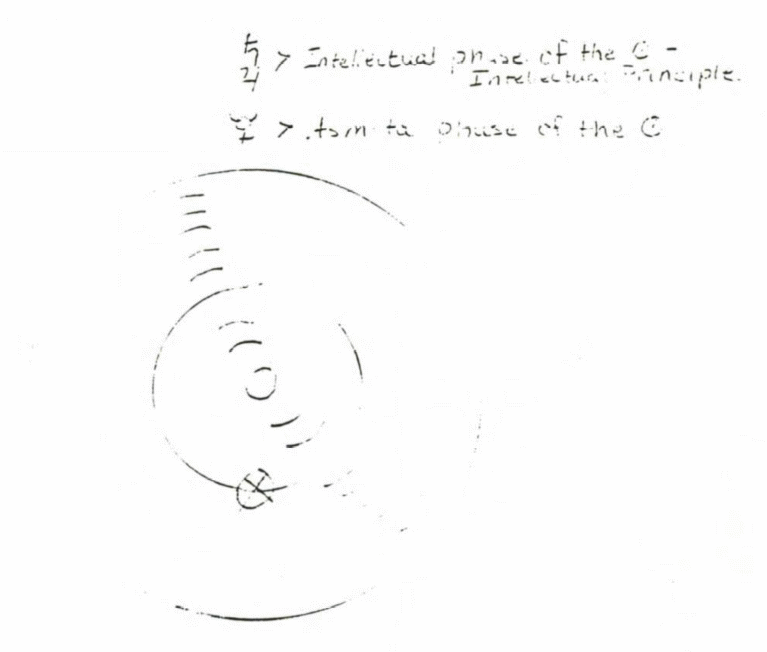
[Note: See FIGURES 1983 1123a-1, Tripartite Cosmic Soul and Solar System, and 1983 1123a-2, Nested Levels, appended to this transcript for the following. The second diagram is from Astronoesis, p. 250.]
AD: Remember we spoke about the-- we spoke about it something like this. This is the Earth [diagram], alright, and we're creatures on the Earth and we're surrounded by a Dragonic belt and we're constituted of that. (Now/And) the highest level of the Dragonic belt he referred to as the individual mind, alright. And the next level where we have the-- [drawing/writing] to use this kind of diagram (here/yeah), I think it's this-- (yeah). (And/Then) I said the next level, this here level [diagram], this whole level, would be our individual Overself. In other words, our individual Overself is identical with the powers of the Sun soul, right, of the Solar Logos. Yeah, alright? [student assents] So now if you re-- if you reach the level of the Overself, you would be identical with the powers of the Solar Logos. [student assents, faint] Again, we refer to these here powers as the undivided mind of the Earth. And that's a [one/two words inaudible] But now if we conceive of ourselves as-- and if we think of the Overself as the powers of the soul, ok, Overself as identical with the Sun-- the Solar Logos' powers of the soul. [student assents, very faint] I explained it to Avery but he's not around?
KD(?): Yeah he-- he signed out.
AD (faint): Oh he signed out?
S(?) (faint): What are we going to do?
VM/S(?): [few words inaudible]
AD: Uh-- [chalk on board sound] (laughter) Wake Vic up. (laughter, student words) Alright, what I'm trying to say is that this Overself now is identical wi-- with the Solar Logos' powers of the soul, of the Sun. Now the Sun is similarly constituted, right? It has these phases, [drawing/writing] alright. These three phases [diagram]. This is the Intellectual phase [diagram], alright, and this is the principle that manifests the world [diagram]. So, this principle which manifests the universe, our world [few words inaudible] When you reach the Overself, it's like you're living (there) [AD indicates on diagram]. Ok? So, our Overself is equivalent to or identical with the asmita phase of the Lo-- Solar Logos. That's this phase here [diagram]. [student assents, faint] This is the [drawing/writing] Intellectual phase of the Sun [diagram]. [students assent, faint] Now, he said or Plotinus said that this is in some way annulled so that you can have the experience of the One.
BS: It's a [AD/JB(?) simultaneously: (But--)] what, I'm sorry.
IF THE INDIVIDUAL OVERSELF ACHIEVES IDENTITY WITH THE SOLAR LOGOS, THEN IT'S POSSIBLE FOR IT TO ACHIEVE A TEMPORARY IDENTIFICATION WITH THE NOUS AND THE ONE
AD: When he says that is somewhat annulled, I would rephrase it and say only by the Grace of Heaven [AD indicating on diagram] are you going to get to the One, the One itself, alright. So, the Overself-- this is the first initiation of the Overself, identical with the asmita phase. The second would be [AD indicates on diagram] identity with the Intellectual-Principle of the Solar Logos which is in the Intellectual realm, alright. And the highest phase would be when achieve that identity with the One, the ultimate, the absolute Godhead, the One itself. So, here we are located within the realm of the Solar Logos, the Solar Logos (does) all this [one/two words inaudible] to provide with the necessary vehicles by which the individual Overself could aspire to reach identity with the Solar Logos, alright, and then achieving that identity with the Solar Logos there's these other two phases, a deepening or an inwardization or he says a penetration, goes in much deeper because of this phase [AD indicates on diagram], identifies with the Intellectual-Principle, that's the second penetration and then the third penetration is that identifies with the One itself. So, it is through this here [diagram] that we can reach the One itself [AD indicates on diagram]. Was it something like that Avery [AS assents] or it's too high?
AS (faint): Yes, certainly. (some laughter)
AD: Alright, that excuse is [one word inaudible] enough, right? [student assents] [short pause] You might have to go over that again but I think you'll-- I think you'll see it's quite accurate. [short pause] Otherwise you'll come up with the notion that the-- the identity with the One that is spoken of by Plotinus or PB or anyone else is fictitious. The only identity they achieve is the identity with their Overself, and that's not the identity with the One that Plotinus speaks about or PB speaks about. But nonetheless, if-- if you don't have this kind of a backdrop, you-- you won't be able to-- at least I can't symbolically represent to myself how when I reach the summit of the I AM, how can I make contact with the One, touch of the untouchable? How can there be unity, even if it's a temporary thing, how could there be the supreme identity?
LDS: Well, I don't know, I think I followed some of what you said Anthony, I just want to clarify. You speak of this second and third identification, the one with the Intellectual-Principle and then finally the one-- last one would be One itself.
AD (simultaneously): The Intellectual-Principle of the S-- our Solar Logos, yeah.
LDS (simultaneously): Ok. But, [student assents, faint] what does that mean? I mean, first of all would you say that that can't be proven? Is that-- And what do you mean by identification?
AD: You start with the first question.
LDS: I-- first I would ask if-- if that would be a-- if that's possibly a permanent state.
THE SUPREME IDENTITY WITH THE ONE IS AUTHENTIC, NOT SOME KIND OF SELF-HALLUCINATION THAT THE OVERSELF IS HAVING
AD: No, of course not, no, you don't become the Absolute Soul. You don't become the Solar Logos.
LDS: Ok.
AD: Your Overs-- your Overself is a distinct emanation from that principle.
LDS: Ok. And it's in no way reducible to that principle, it's-- it's an existential i--
AD (simultaneously): If you reduce it, if you reduce your Overself to the Father Overself, alright, then you've made all souls one soul.
LDS: Yeah.
AD: And then the talk about you and I going-- going on becoming bodhisattvas and enlightening mankind, it would be quite meaningless.
LDS (faint): Yeah. Ok.
AD: Remember that quotation where he says there is no beginning, there is no end [slight pause] to that-- to that principle. Alright so, it won't identify-- it won't lose its individuality by becoming or absorbed in the Solar Logos. Now your second question?
LDS: Ok, that-- I think now I'm beginning to follow what you mean by identification at that level. It's mu-- maybe, maybe the word identification is a little strong for that experience, maybe-- maybe we could speak of it as like a-- some kind of communication or touch, some kind of revelation. It seems what you're saying Anthony is that the true-- the real identity can only be with the asmita, and that you could have-- beyond that you could have communication--
AD: Beyond that you would have, let's say, participation? Temporary participation?
LDS: Ok.
PD: Could-- were you implying though that it's through the principle of identity that you gain those experiences.
AD: It's through identifying yourself with the Overself. When that identity is succ-- successful and achieved, in other words, you are now a Master, alright, now you can speak about the possibility of, you know, rec-- penetrating into the mysterious Void itself, in other words, the three primal Hypostases. The penetration, like we said, is a temporary thing, it's not a permanent absorption. The Master by i-- being identical with that principle that we refer to as the Overself, which has the function of insight, it will recognize that the insight has these three different levels within itself, it could go in-- into itself if he's-- the only way I can express it right now-- it could go into itself or penetrate deeply into this-- it could penetrate into itself and recognize these three different levels that are beyond it. It can recognize or cognize these here but, like we're saying is it cannot become that which it knows because here what it's penetrating into is these three primal Hypostases. And recognizing them then comes out and s-- you know, could communicate that information just like Plotinus did. The notion of the three primal Hypostases came from the revelation that was made or given to him in his functioning as insight.
RC: I mean I guess what I-- what I was basically asking in terms of PB's use of the word Overself was that, would you say that whole process that you're talking about goes on within his Overself and at no point is being spoken of as going beyond his Oversel-- or the Overself. That it's Overself that presents the capacity for that knowledge.
[10½ second pause]
AD: Well, I think-- I don't know if I understood you right. I think you're saying, and correct me if I'm mistaken, I think you're saying that these three degrees of penetration are within the Overself and they're not really a penetration into the primal Hypostases themselves.
RC: Yeah, not--
AD: Is that the way--
RC (faint): It's not a change in principles as much as a--
AD: Not a change in--
RC: Not that he stopped operating with the Overself and starts operating momentarily with the World-Mind but that within the operation of the Overself is a state of being capable of participating-- reflecting within itself the authentic contents of the World-Mind. And not that he shifts over from no longer being the Overself and momentarily being the Overmind-- World-Mind.
AD: Well, the question will have to be put this way, is there an authentic-- an actual identity between, let's say, the Overself of the Sage and the Intellectual-Principle or the World-Mind?
LDS: Seem-- it seems like, if you've established these three Hypostases as existentially distinct, never identical, then you can never get them back together, you can never then subsume one in the other in a-- in a identical way or in a substantial way.
AD: You have a misunderstanding of the hypostatization of the three principle. You're making them existentially distinct. And I referred to the fact before that these three principles are also and can also be conceived of as the Void, all three of them together. You are not to conceive of these principles as a hierarchy.
[short pause, possibly student assent]
S: Well you speak of the Ov--
AD (simultaneously): That's-- [student assents, very faint] that's only half-- that's only part of the way of looking at them, the other way of looking at them is that the distinctions that Plotinus makes between the first, second, and third are only for our understanding, to help us understand it. But you won't find-- in the other realm you won't find the One, a fence, and then the Intellectual-Principle, a fence, and then the Soul. It's not like that.
LDS: But, yeah, I know you've spoken of it before that in the highest experiences open, that there's this-- is like a monolithic block, it do-- these distinctions that Plotinus or PB gives us are not experiential but rather something given to them through the faculty of insight about the nature of reality. And that's different than an experiential distinction. Is this something about what you're saying?
AD: No. That they are experienced, experientially experienced, but by your Overself. Otherwise we're back again to the same thing, is the-- or-- is the identity that an individual Overself has with the One authentic or not? Is it a kind of self-knowing or is it that the Overself actually experiences the supreme identity, the-- the identity with the One? Or, the way he puts it, the touch of the untouchable, which simply means that there's no relationship here.
[short pause]
TS: Or is it that the-- in the experiences of the One, that that was retained by the Overself as part of its self-knowing.
[short pause]
AD: I don't follow you Tim. Try again.
TS: Yes. You said the Overself is temporarily united with-- or that the-- what dis-- distinction there is between the Overself and say the One temporarily set aside. But then when the Overself-- the distinction that is the Overself coming back, that in its self-knowledge there is retained that knowledge of itself as-- as-- as not-- it's non-distinct from the One. Or it re-- it retains this knowledge of that experience in its own self-knowledge rather than knowledge of something outside of itself.
[20 second pause]
AD: The only thing for us to do is to go back and read the experience that Plotinus speaks about of the One, because you keep going back to the fact, or you keep thinking in the-- in this way that the supreme identity is some kind of self-hallucination that the Overself is having.
TS: Well--
[short pause]
S(?): [couple/three words inaudible]
LDS: You've mentioned at the beginning of the discussion Anthony this chasm-- this chasm that will never be bridged between the Overself or the I AM and true Godhead. You've estab-- I mean that's the--
S: It's a quote.
AD (simultaneously): Isn't that-- isn't that a quote from PB?
LDS: Yes.
AD: Ok.
LDS: Ok and you're-- and you're saying there's a difference between what PB's saying and what Plotinus spoke of as this supreme identity.
AD: I didn't say that.
LDS: Oh I thought you were just implying that in establishing that it was a PB quote.
AD: I didn't say that.
LDS: Ok. But you established a context at the beginning of the discussion which is--
AD (simultaneously): If you remember (the s--/this--) the context I established was when PB speaks about three levels of penetration that could take place when the Sage has achieved identity with the Overself and is the Overself. And he speaks about these three different degrees and refers to them. And I don't remember the quote in--
AS (simultaneously): I remember. Anthony, in one quote he laid out the four-- he laid out four stages of progressive insight, developing insight. And then in another quote he mentioned that between the second and third stage there were really two other very mysterious stages in which-- in which the Sage or whatever went deeper, went-- penetrated much deeper. And that those two he really couldn't-- wasn't going to say very much about them.
RC: Do you want that quote?
TS/S(?) (very faint): (Oh) sure.
AD: Do you have it Randy?
"THE CHASM" REFERS TO THE EXISTENTIAL DISTINCTION BETWEEN THE THREE HYPOSTASES AND THE OVERSELF
PB [V16, 25:2.109 and Perspectives, p. 348, RC reading]: "The deeper one penetrates into the Void the more he is purified of the illusions of personality, time, matter, space, and causality. Between the second and third stages of insight's unfoldment there are really two further subsidiary stages which are wrapped in the greatest mystery and are rarely touched [RC adds: upon] by the average mystic or yogi. For both of them are stages which lead further downwards into the Void. The yogi touches the edge of the Void, as it were, but not its centre. These two stages are purificatory ones and utterly annihilate the last illusions and the last egoisms of the seeker. They are dissolved forever and cannot revive again. Nothing more useful can and may be said about it here. For this is the innermost holy of holies, the most sacred sanctuary accessible to man. He who touches this grade touches what may not be spoken aloud for sneering ears, nor written down for sneering eyes. Consequently none has ever ventured to explain publicly what must not be so explained."
[short pause]
AD: Now obviously Plotinus isn't your average yogi. (some laughter)
[short pause]
RC: Could we review that chasm quote again because--
AD: Sure, sure.
RC: I think--
AD: If you got it, fine, yeah.
RC (simultaneously): Yeah, yeah I think I did enough quotes that I'd like to find out if what I think is wrong (or not). I'll read the first part quickly 'cause it's fairly long and then slow down.
PB [V16, 28:2.79 and Perspectives, pp. 384-385, RC reading]: "The chasm between the Real and man seems entirely impassable. The intellect is conditioned by its own finitude, by its particular set of space and time perceptions. It is unable to function where absolutes alone reign. The infinite eternal and absolute existence eludes the grasp of man's logical thought. He may form mental pictures of it but at best they will be [as] far off from it as a photograph is far off from flesh and blood. Idea-worship is idol-worship. [RC: I-d-o-l.] Everything else is an object of knowledge, experienced in a certain way by ourself as the knower of it; but the Infinite Real cannot be an object of anyone's knowledge simply because it cannot be conditioned in any way whatsoever. It is absolute. If it is to be known to all it must therefore be in a totally different way from that of ordinary experience. It is as inaccessible to psychic experience as it is impenetrable by thought and feeling. But although we may not directly know Reality, we may know that it is, and that in some mysterious way the whole cosmic existence roots from it. Thus whichever [RC reads: whatever] way [RC adds: a] man turns he, the finite creature, finds the door closed upon his face. The Infinite and Absolute Essence is forever beyond his vision, unreachable by his knowing capacity and inaccessible to his experience, and will forever remain so. The point is so subtle that, unless its development is [RC adds: understood] expressed with great care here, it is likely to be misunderstood. Although man must pause here and say, with Socrates,"None knoweth save God only"--for with this conception he has gone as far as human thought can grasp such mysteries--nevertheless he may know that the seers have not invented an imaginary Reality. He has neither been left alone in his mortality nor abandoned utterly to his finitude. The mysterious Godhead has provided a witness to its sacred existence, a Deputy to evidence its secret rulership. And that Witness and Deputy can be found for it sits imperishable in the very heart of man himself. It is indeed his true self, his immortal soul, his Overself. Although the ultimate principle is said to be inconceivable and unknowable, this is so only in relation to man's ordinary intellect and physical senses. It is not so in relation to a faculty in him which is still potential and unevolved--insight. If it be true that even no adept has ever seen the mysterious absolute, it is also true that he has seen the way it manifests its presence through something intimately emanated from it. If the nameless formless Void from which all things spring up and into which they go back is a world so subtle that it is not really intellectually understandable and so mysterious that it is not even mystically experienceable, we may however experience the strange atmosphere emanating from it, the unearthly aura signifying its hidden presence."
RC: And I guess what I was focused on was, when he describes this Deputy, one of the things that he says here--
PB [V16, 28:2.79 and Perspectives, pp. 384-385, RC reading]: "The mysterious Godhead has provided a witness to [RC emphasis] its sacred existence, a Deputy to evidence its secret rulership."
RC: And it seems to me that right within this-- this Deputy, the Overself, is a capacity both to-- to witness the-- the pure fact of Mind and the operative intelligence of the World-Mind through which it rules the manifested world. And that, I was taking it as that, if we do use the word 'chasm' there it shouldn't be a chasm like-- I don't think it should be taken as a chasm like [short pause] throwing one's arms up in despair (type of--) type of chasm.
AD: No, the chasm here refers to the existential distinction between the three Hypostases and the Overself. That's the chasm.
VM: So to continue that metaphor Anthony, you can't cross it but in some sense you'd look on the other side, insofar as there is some possibility of touching this radiation that emanates from this higher principle?
AD: Well, if we said that it is existentially distinct from the Overself, what we mean by that is that the Overself cannot become those three principles.
VM: Yeah but that's what I was saying.
AD: But that doesn't exclude [S, faint: Some--] that it can't know something about them. [S, very faint: (Same word.)] That's what I meant maybe the word threw you off Randy but chasm here only in that sense.
RC (simultaneously): Ok, yeah. Ok that's all I've got. I think in the quote, when he was sayin'-- starts out "The chasm between the Real and man," I think in that context it's a sense of, if I know all about the ego's artificiality and everything I might think reality is totally out of reach in any way.
AD: Well there I would say there is a real chasm between man and the Real. [RC assents, faint] There I would say there is a realm chasm, not only existentially but from the point of view of knowledge [students assent, faint] also.
RC: Yeah. And, in this quote he seems to be saying that-- that the Overself makes that apparent chasm not a real chasm [AD: Uh-hm.] between man [AD simultaneously: Yeah.] and the Real.
AD: That the existential distinctions which will remain, alright, can be bridged by the insight that the Overself has as to what these principles are.
AH: Perhaps the question is inappropriate. Does the Overself-- when we speak of the Overself experiencing, do we intend to mean the-- like the experience we have or is it like a non-dual experience [one/two words inaudible] (What--) I-- this begs the question, what does it mean for Overself to experience?
[short pause]
AD: You're asking me to explain what is the nature of the content of insight. Again I'm using the word 'content' loosely. What is it that takes place in self-cognition. Well, I don't think I could answer.
AH: Well I was confused Anthony because for the last half hour I've been struggling with trying to understand what it means for the Overself to experience, the only [one word inaudible] I have--
AD (simultaneously): Well look, the word 'experience' here is only analogically being used. It's not experience as we understand it in this realm.
[student assents, faint]
AH: So, the reference to a chasm here would not be appropriate as we would understand that.
AD: Yeah. You can understand that we can use a word like 'experience' in the ordinary way and then we use the word 'experience' in regard to this extraordinary knowledge which the Overself has. And we're using the word analogically but no connotations or associations should be carried over from what it means to us here as to what kind of knowledge insight is over there.
AH: Ok. I'm not sure that helps but--
AD: I don't think-- I don't think I can help you. [student assents] I don't think it's possible to communicate what this nature of insight is. We could use a lot of similes, you know. But they're not going to work. [short pause] Knowing knowing? [9 second pause] Alright, I'm sorry to drag you right into the depths of metaphysics right at the opening shot. It was worthwhile to review some of this. Yeah Avery?
[short pause]
AS (faint): He still seems to be leaving a certain question open and maybe it's not answerable. But maybe-- maybe it's (nothing major).
AD (faint): Well, state it, state it.
AS (simultaneously): (Yeah, it) seems to remain mysterious but it's been mysterious for a (while now) [few very faint inaudible words] (bit of laughter, student words) But I-- I'm-- I try to put together this-- the way PB speaks of insight and the way Plotinus speaks about grand learning [Note: See Plotinus, VI.7.36, second para.] (and) he has many of these quotes that talks about the grand learning and direct experience, now the soul is not even soul, is not even Intellectual-Principle or things like that. Now, maybe I could say it this way. Ins-- in this-- when he speaks about insight, the Real-- the absolute or the Real, the infinite Real is available to insight, whatever that means. But now we were inclu-- we wou-- you would include under insight either insight into-- any one of those three initiations would be through the faculty of insight.
AD: Yeah I thought it was the way he had put it, deeper--
AS: Yeah, deeper penetration [AD simultaneously, faint: Penetration.] into the Void. [AD, very faint: (Yeah/Uh-hm).] So that-- so, I-- maybe this is a moot point but do you describe that as three-- if it's deeper penetration into the Void do you describe that as three levels of insight? Or is the faculty of insight one, the-- I mean, or is it just insight and yet something happens by the Grace of the World-Mind or whatever to reveal to that insight the One. Or maybe-- maybe it doesn't (reflect any difference).
AD: Well again, if you s-- if we say that it reveals to insight the One, is this a way of speaking of the supreme identity?
AS: I would say yes. That you ha-- that the high-- that third, the deepest top-- that deepest penetration [few very faint inaudible student words, possibly part of background] would be iden-- equivalent to the, what do you call it, the grand learning or (union), union with the One.
[students and possibly AD assent, very faint]
AS(?) (very faint, possibly part of background): But I'm just [one word inaudible]
LDS: Avery, are you saying that this identity is strictly in terms of knowledge, it's because of insight?
AS (very faint): No, I'm not--
PD: (Steve) it's the other way around.
AS (simultaneously): By supreme [LDS simultaneously: No, that's just what he meant though.] identity I thought he means what Plotinus calls union with the One.
PD: Knowledge through identity seems to be the first level. A deeper insight, a deeper penetration.
LDS (faint): Well I'll try to figure out what Avery was saying about insight [one word inaudible]
AD: I don't think it's at all profitable for us to speak about those.
AS (faint): Ok.
AD: I think I follow the question theoretically.
AS (faint): But then(--/,) that's all it really is is a theoretical question.
AD: But certainly in our way of understanding we would think of insight at its deepest level conjoined to the One or the One is totally present to that insight. Or we can say that insofar that insight is aware or is this awareness of this deepest level within itself, that that could be a possible way of describing union, identity or the touch of the untouchable. I think this is outside of our reach. I mean conceptually we can't even paint a picture. [short pause] Ok, let's try another quote, these are going (back horse).
[student assents]
[short pause]
WHAT IS CALLED "UNION" WITH MIND IS NOT REALLY A UNION BUT THE TEMPORARY DISAPPEARANCE OF THE CONTENTS OF YOUR PERSONAL CONSCIOUSNESS
PB [V16, 28:2.140 and Perspectives, p. 387, RC reading]: "The true union, completely authentic and completely beatific, where [RC adds: little] mind melts into [RC adds: big] Mind without the admixture of personal wish or traditional suggestion, cannot be properly described in words. For he who experiences it may know its onset or its end because of the ordinary-- because of the enormous contrast with his ordinary self, but he will not know its full height simply because he will not even know that he is experiencing it. For to do so would be to re-introduce the ego again and thus fall away from the purity of the union. [There would then be admixture--which is the fate of most unions.]"
[10 second pause]
AD: Alright, let's try. See this is just like a banquet, tomorrow it will be a phony echo of the banquet you're having tonight. Let's try. What's the union between?
[short pause]
PD: Individual mind and the Solar Logos.
[9 second pause]
LD: I would say it would be the One going according to that last quote we read, the deeper one penetrates into the Void. But, maybe you don't want to mix two--
AD: No, just speak your opinion, we're-- we're friendly, we don't have to--
LD: Well I-- he says in that last quote--
PB [V16, 25:2.109 and Perspectives, p. 348, LD reading]: "The yogi touches the edge of the Void, as it were, but not its centre. These two stages are purificatory ones and utterly annihilate the last illusions…"
AD (simultaneously): Yeah but this quote-- but this quote-- you have to concentrate on this quote to understand what this quote is saying. [student assents] Try again once more.
PB [V16, 28:2.140 and Perspectives, p. 387, RC reading]: "The true union, completely authentic and completely beatific, where [RC adds: little] mind melts into [RC adds: big] Mind without the admixture of personal wish or traditional suggestion, cannot be properly described in words. For he who experiences it may know its onset or its end because of the enormous contrast with his ordinary self, but he will not know its full height simply because he will not even know that he is experiencing it. For to do so would be to re-introduce the ego again and thus fall away from the purity of the union. …"
[student assents, very faint]
AD: Now the first thing I think you have to establish is, what does he mean by [students assent] little mind and big Mind, alright?
VM: I would like to make a stab. I would say little mind is what we've been calling intellect. And big Mi--
RC (simultaneously): [one/two words inaudible] Lower case, upper case. I just read it that way so you'd know. Small "m" mind and big "M" Mind.
VM: Ok. Well I still think that it makes sense, at least to me. Because little mind is the intellect, we sometimes call it the ego. The distinction at least in my mind is difficult to make between ego and intellect. In any case, let's say the intellect is little mind and this union it makes is with the Overself as the first Mercury here [diagram]. And, let's say, that initial penetration, unless you're very advanced and used to this kind of experience, is only noticed by the fact that the ego, or what you normally consider to be yourself in your normal st-- well, states of mind, are-- vanish and there seems to be no you, you only know it going in and coming out or mostly probably coming out.
AD: Going in too.
VM: (Well/A)-- or maybe going in too, I-- I don't know, (I--)
S (very faint): Yes Vic. (bit of laughter)
VM: I can't speak from personal experience. So--
AH: I think Vic-- I think Vic is correct because the way the little mind is described is in a very individual and personal sense and its first union would have to be with the Overself.
AD: So we're say-- so then what we're saying now is that the personal "I", you know, what I refer to as myself, my personality, [VM assents] my personal mind which I think is different from your mind, alright, my personal mind is what first has to achieve union with the higher mind [VM assents] or with the Overself. Well, if you read it that way would it make sense?
HS: Yeah.
[short pause]
S(?): (This is the--)
AD (simultaneously): Could I ask you to read it again Randy? [RC assents, very faint] I know it's tiring you.
PB [V16, 28:2.140 and Perspectives, p. 387, RC reading]: "The true union, completely authentic and completely beatific, where [RC adds: little] mind melts into [RC adds: big] Mind without the admixture of personal wish or traditional suggestion, cannot be properly described in words. For he who experiences it may know its onset or its end because of the enormous contrast with his ordinary self, but he will not know its full height simply because he will not even know that he is experiencing it. For to do so would be to re-introduce the ego again and thus fall away from the purity of the union. …"
[Note: See FIGURES 1983 1123a-3, Psychosomatic Organism, and FIGURE 1983 1123a-4, Light of Overself in Psychosomatic, appended to this transcript for the following.]
AD: Remember the diagram we had up-- [student assents, faint] We did something to the effect-- Where's a piece-- Oh good, that's fine. (bit of laughter) [slight pause followed by laughter, student words] We did-- we did something like this, we said, alright, let's say this is the ego [diagram], [drawing/writing] the emotions, the intellect, all-- now all the traces in that Moon, etc. And we said there's this light running through it [diagram], alright. And the light that gets trapped in here [diagram], we call that our personal consciousness, alright, but all of this is consciousness [diagram], ok. And then we did something like this, alright. This is the personal "I am", the "I am"-- you know, the consciousness that you refer to as yourself. And we did this here. [short pause while erasing] What do you got left?
HS: Big Mind.
AD: Big Mind. Pretty good. (laughter, student words) Some like to call it the principle but, alright, this is the big Mind [diagram]. Now, you want to call it a union? Not really. It's not a union.
S (very faint): Yeah right.
HS: You call it a kind of melting (where/for) the little mind(--/?)
AD (simultaneously): Well, that's a description of what it feels like but--
VM (simultaneously): It's not a (raisin).
AS: They say it's not a union because [few words inaudible amidst laughter] (laughter, student words)
AD: There aren't two things that are being united.
LDS: Right.
AD: It's really that you're getting rid of this here [diagram]. (bit of laughter) Now after the experience is over, this fellow comes right back again. [VM simultaneously: I thought you'd make it stronger.] Now you notice, I did give it heavier lines. (laughter, student words) Wait a minute. (laughter) Now we have to capitalize it. (laughter, student words)
HS: Ok now when that guy comes back does-- you speak to the knowledge that is available (into it)?
AD (simultaneously): Yeah, there is a recollection that this state does exist.
HS: Inside this thick line [diagram].
AD (simultaneously): (Line.) There's a memory of it.
HS: Would you actually say that that's what thickens the lines [couple words inaudible] (laughter)
S (possibly part of background): Watch out.
[short pause with bit of laughter, background student talking]
AD: Look. [AD hits board] I guess you could put it that way Herbie and the other way you could put it is that the ego suddenly experiencing its own annihilation does not particularly appreciate it, (laughter) then it comes back with twice the strength. But, we can say it's a union, I mean, you know, they're words, you know. In a sense it does seem like there is a union with the consciousness which is way beyond the ego, alright, the consciousness which is inside the ego and then outside, and when you erase that or when through the effort of, you know, concentration and meditation you obliterate all content, you know, thoughts, memories, (fears) and all that, then only this is there [diagram], there isn't anything else, this is [one/two words inaudible] cancelled out temporarily. So, we could look at it that way. So, you can refer to this here and this here as a union of these here [diagram]. Another way of speaking of that, alright, is that it's not a union, it's self-recognition.
SD: Anthony? To connect this with the stages that we talked about earlier, is it only when that union or self-recognition becomes strong enough that that ego doesn't come back and obliterated that one can then talk about those further deepening?
AD: Well-- To talk about those deepenings when you're in here [diagram] is nonsense. It's only when you've identified with this consciousness, [SD simultaneously: So that has (few words inaudible)] in other words the Overself, then you start speaking about the three degrees of initiation.
[couple seconds of background student talking]
LD: Could I ask, I-- see, I understand what you're saying, this is the way we've been interpreting this. But I have confusion coming from-- like in this quote like he's talking about something that's absolutely void, there-- you cannot even speak of a person there experiencing it. Now-- [AD simultaneously: That's-- that's true.] and-- and then yet we go on to say that there's more-- even more absolutes void experiences (bit of laughter) and-- and I don't [S simultaneously, very faint in background: This is Paul Brunton.] know what-- you know, how--
AD (simultaneously): Well, he didn't say more [LD simultaneously: No, but this what--] void (experience), he says-- he says, he says there is a penetration, a-- a going downward or more inwardness into that Void. [VM simultaneously: But then--] Now, if you assume that Void is (void/Void) regardless of whether you're speaking of the voidness of our individual consciousness or mind is the same as the voidness of the primal principles, you are overlooking what I pointed out, that there is an existential differentia between--
[Audio File 1983 1123a Ends]
[Audio File 1983 1123b Begins]
AS: --manifold from that, although it's the World-Mind (that has that knowledge). But then (you'd) still talk about the mind of that Solar Logos itself. In other words, this outermost aspect, the outer aspect of the Solar Logos [few words inaudible] would there be identical in that first experience with our innermost. But then there would still be a penetration [drawing/writing] as it were into the level of its inner mind.
JB: Well it's easier to see that as a hierarchy [few inaudible AS words simultaneous with JB] as compared to the depths of voidness. I [AS simultaneously, faint: Well--] would take this objection as that well loi-- what kind of hierarchy can you imagine in voidness? Voidness feels like well once you get there you're there but it's a new--
LD: Yeah I'm sorry it's just my own mi--
AD (simultaneously): Well maybe you could put it this way, maybe if you change the language Louis we could say our innermost is its outermost.
WHETHER WE'RE SPEAKING METAPHYSICALLY, COSMOLOGICALLY, OR INDIVIDUALLY, OUR LANGUAGE IS ALWAYS SYMBOLISM
AH: Anthony? When we speak of this experience and then we talk about the earlier quote tonight, it seems that at that point where-- where the little mind gets out of the way for a minute, we have to change the kind of language that we're speaking. I mean, in this quote we're talking about an experience that a person like may have. But all the other quotes from the point of view of metaphysical reality, different language, the notion of a doer being there is inappropriate. Like, in regards to what PB said about a metaphysical description it's an intellectual [one word inaudible] of truth. Like, is it appropriate to think of changing languages at this point? Like we're talking-- (if) we're talking about an experience that can be-- you (could) talk all the way up to the point of the experience in normal dualistic conceptual terms, and it has a meaning content for a person. But as soon as you introduce a metaphysical description, we're talking a completely different kind of language, there's no longer an individual there.
AD: Yes but it still is within the symbolism. We-- (we/you) still have to speak, whether we're speaking metaphysically, cosmologically, or individually, our language is always symbolism, and it's a symbolism that is one-dimensional in the sense that-- you know like, when you're reading a passage from PB, alright, now(,) it's all printed on a-- a page and-- but the letters are all evenly distributed, they all have the same. But when you read it you say this idea is deeper than the one before it and-- so you make this one in blue and the other one in yellow, alright, and the one that's really very deep in black, you know. So-- I mean, they can only symbolically refer to the distinctions that we want to make metaphysically but in language, on our symbolism (we/you) can't do that. There's no symbolism where you can have ontic differences within the symbolism.
AH: Well, how about when we juxtapose these last two quotes for instance. This last one's obviously reference to an individual mind experiencing its Overself. That's not necessarily a metaphysical description. The other quotes were a metaphysical description. Now, can we talk fluidly from one quote to the next without being aware of the fact that we're making transition from experience to metaphysics?
AD: Well I thought I was making that clear.
AH: Making clear that we have to make this transition.
AD: Yeah, I thought that that was clarified as we were discussing those things, that we were making transitions within the symbolic language with which we have to operate with.
AH: I see, ok.
AN EXISTENTIAL ALTERATION OF THE PERSONALITY WILL OCCUR ONCE YOU GET THE GLIMPSE, BUT THE LIGHT ITSELF DOESN'T CHANGE
AS: That-- oh I see. Well, that's another story. Maybe that picture helps with the quote you read before about the aura, you know the long (quote)? [students assent, faint] Because, in there maybe [half/one word inaudible] (do we try) [one word inaudible] [few very faint inaudible student words, possibly part of background] If you say that the-- in order to have any higher initiation or to go to the innermost of the Logos, or to get to the final Hypostases, the ego-- you first have to go through the experience of the ego being obliterated, then the quotes which say that the highest experience open to the person is union with this Overself are correct very technically. Because once there's no more ego you can't technically speak of the personality or person and therefore the experience is for that individual Overself or the I AM, of the higher principles. And therefore technically the person doesn't have the experience of those three primal(s). Only-- the only experience the person has is the coming into or leaving, and only there at the edge of that void of the Overself. Because once he's in-- so to speak, you're in there the personality has dropped off and now it's that I AM which is-- now it's you as I AM or the "We" or the Overself that's going to have the experience of the primal(s). [couple/three words inaudible] so technically you-- the personality doesn't have experience of three primal principles.
RC (simultaneously): Well I guess that's the real reason I was asking that stuff about whether the Overself actually witnesses and evidences within itself because, if the Overself puts forth the personality, then the Overself certainly can put forth a personality that it's capable of manifesting whatever aspect of its own knowledge it wants to.
S: Yeah.
RC: And if you come out a channel, the person-- the person that starts operating after that experience is not immediately continuous with the person that was before. It's like something of the knowledge that the soul has now gets built into the personality that it projects from then onward it seems.
AH: But does it change its-- does it chan-- does it change its perceptive vehicle, doesn't it-- wouldn't that personality however altered by the experience of the Overself still have to know things dualistically?
RC: Well, I guess it depends a lot on your belief in the inherent existence of the personality or not. [AH assents] If you don't think that the personality has any inherent existence, then the Overself can make it be whatever it wants it to be.
AH: Can it-- can it-- can it make it be so that it can experience the (inexperience)?
RC: No, that I think of it-- is an unbridgeable chasm because the personality cannot have that. But I think that the personality can be put forth by the Overself as a vehicle that can do some pretty good public relations. (bit of laughter, student words)
JB: Isn't it the stubbornness of the ego or the personality one of the sort of principial (standing) conversation(s)? I mean you are suggesting something that sounded novel, to me anyway, that the Overself now projects a new kind of persona in re-- in respect to the depth that the Overself has accomplished.
RC/S(?): Yeah.
RC: I don't mean utterly different in the sense that like, you know, all the karmic history is dissolved or anything. But I think a new factor now enters into the constitution of this--
JB: Brand new.
KD (simultaneously): Randy-- Randy I-- I would object there, I w-- are you saying that that ego changes as a result of an experience of the Overself? 'Cause if you do, I'm saying no, because the knowledge there isn't-- the knowledge that's gained, if any, from the experience of the Overself is not those images and memories that make that ego. [student(s) assenting] You know, so if you say that-- that those images-- what constitute that ego is changed as a result of the Overself, I don't think you can say that. 'Cause that's just a person's memories.
RC (simultaneously): Do you think that a person-- do you think that a person could actually have this kind of an experience and not be changed?
AS/S(?) (faint): Uh-hm.
KD: Well I've heard, say, that there's like a crack, you know, that maybe there's a-- like a crack that remains that-- But the ego, from what I heard, and I don't have any experience, but from what I've heard that ego comes back full force and that's still the same. But maybe there's just like a slight crack, it's not like the cement isn't as hard as it was.
AH/S(?) (simultaneously, faint): [few words inaudible]
RC: That the person's relation to the e-- I don't know if these words will work, but if the person's relationship to the ego, the soul's relationship to the ego, whichever combination you want to do, is different, then you don't take-- you can't have the same perspective on events that you had on events prior to that.
VM: I mean there's gotta be a change, haven't we [AS assents] spoken so much about the-- the fact [AD simultaneously: I think what he is (half/one word inaudible)] that you're trying to make a lower mind that is a fit expression to the higher and so on?
AD: I think [RC/S(?) simultaneously: How about--] what he's trying to say is that an exis-- a continuing existential alteration of the personality will occur once you get the glimpse. That's all. [slight pause] And it may take a considerable amount of time to see the alteration.
BS: Would that be the soul's actualization within the personality, actualizing itself?
S (faint): Could be.
S (faint): Ok.
BS: The Overself's actualization?
AD (very faint): (I need more fluid.)
AS (faint): I know what you mean Bert.
BS (very faint): Just [one/two words inaudible]
S: Eventually.
AS (simultaneously): Maybe-- I think may-- Bert, you mean like, if we use the diagram we had this little ray of just-- you know, you had the ray of reason or the light of reason that got trapped in the ego. Now suppose that he has a glimpse and the ego's (downgrade) for a while. Then the ego is bound to come back, and he's got a little ray of light again trapped in the psyche itself. Is there any exis-- any kind of a distinction now from the point of view of that ray of light itself? I guess that's what Randy's point about the ego itself-- in your point of view there's an actual existential difference perhaps, a change. But what about the ray of light there? Is there-- could-- could there be said to be more of the soul's faculties are now available? Or does that ray of light itself, that fragment of awareness carry more of the intelligence because of that glimpse? There's-- can there be such a new change in the fragment of awareness that's trapped in the ego because of the glimpse? (Is that what you said?)
S (very faint): I think so.
S (faint): Take a break, Tony.
AS: Is-- could there be said to be a change in that fragment of awareness or light of reason that's trapped in the ego after there's a glimpse. That light itself, the light of--
BS: Yeah somehow it just used to be that what I-- when I suggested the act-- or asked about the actualization of the-- of the soul, I meant in terms of its ultimate actualization right here in the-- in the psychosomatic.
AS (simultaneously): That's what I was talking about. Well that's [BS assents] what I understood that ray to represent, the actualiza-- [BS assents] actualization or light of the soul that's actually present to the animate or present in the ego.
JB: If you erase all those walls different light's gonna come in there. Is that the idea?
AS: No I wasn't thinking like that 'cause the light is always penetrating, I mean it's not like it's some fixed thing. But-- but I mean if you speak of a distinction in terms of the ego it seems you should be able to speak of a distinction in terms of that fragment of awareness that's present to the ego. I mean otherwise why talk about a development? Remember, one of those five categories of the manas was developing-consciousness. [Note: See WG Class 1983 1118.] [student assents] And I don't see why that doesn't refer to that Witness [SD simultaneously, faint: But Avery--] consciousness, the fragment of awareness.
SD (simultaneously): You're saying that it's actually a change in the light rather than in the ability of the light to be reflected in the [one/two words inaudible]
AS: I'm just asking [one/two words inaudible]
AD: No, it's not a change in the light, Avery. That remains what it is. The perspective is completely altered. [AS: Yeah.] In other words, it's the way you relate to contents now. [AS assents, very faint] The same contents which you had before are now brought or are related differently than they were before.
AS: Now, isn't-- is that a relation-- when--
AD: [coughing] Excuse me.
AS: When we spoke about the function of reason though one of the things was that it knew-- that was what actually related the content, that which organized or related the content. And that's what I'm saying, could you say-- it seems it's not just a distinction of different contents but a different relation. Isn't-- isn't that a relation, a di-- that difference of relation a mark of a change in the reasoning?
S (faint): (No Avery.)
AS: No I [AD simultaneously: (This--)] don't mean the pure consciousness changes. I wasn't talking about the pure consciousness, I'm just talking more like the reasoning, which is-- which is alway-- which is operative in that ego. Not the ego's contents but the reasoning which is organizing those contents.
RC: Well it's going to be presented with a new fact that now it has to [few words inaudible] know 'cause-- I mean, that seems to be a fact that would be impressed upon it that now has to be-- it has to be brought into all its reasoning.
AH: Which fact is that?
PD: Is that the most [couple/few words inaudible]
AS: But isn't reason this-- I mean--
BS (very faint): But isn't [one word inaudible] already within the light?
TS (faint): Where are you guys?
[students assent]
TS: Back three people.
S (simultaneously): All I need is (four question). (laughter)
AD: No [S simultaneously: Well, you talk--] the nature-- the nature of that light doesn't alter, Avery, this perspective, the interrelationship of the contents among themselves [AS: Ok.] is what evolves [AS: Ok.] and alters. [AS simultaneously: Ok I--] But that light remains.
AS: Even-- the light that's trapped within there [AD or student assents, faint] or maybe is still that same [one word inaudible]
AD (simultaneously): It remains self-identical. And the distinction that you have to draw here is that that's one thing, all the contents of that personality are another thing, but the experience completely alters the perspective of what those contents are. The light remains what it is.
THE ALTERATION OF THE PSYCHOSOMATIC ORGANISM IS WHAT WE MEAN BY SOUL DEVELOPMENT; THE UNDERSTANDING CHANGES, NOT THE LIGHT OF THE UNDERSTANDING
AS: So-- so that also answers further question, I guess, that you [possibly one/two words inaudible] we still are (on/in) that view that anything that's evolving is the vehicle.
S: Yeah.
S: Uh-hm.
AH (possibly part of background): [one/two words inaudible]
S (simultaneously): It's ok to see--
S (simultaneously): It's like a-- I'm sorry.
S (faint): No [one word inaudible]
AD (simultaneously): That's why, that's why it was so important to recognize what we spoke about, I don't know, couple weeks ago, was that the-- the amazing thing that's happening is that the vehicle itself [S simultaneously, faint: Yeah. Is that--] is being built up to a witness position. [Note: See WG Class 1983 1111.]
AS: And it's going to duplicate the [AD simultaneously: Yeah.] entire cosmos. Now one [one word inaudible]
AD (simultaneously): That's-- that was why we said also that, in a sense, it's a miracle-- remember that quote where he says in this tiny little head of yours, you're going to understand the whole world.
AH/S(?) (possibly part of background): [few words inaudible]
SD: But then to follow up on that, that means that that vehicle is not just (the/a) particular psychosomatic organism of this lifetime but is the understanding that carry(--/.)
AD: Now you're speaking about the soul. You just haven't realized how important that vehicle is.
S: But it-- my point is I think that if it--
AD: Imagine if you were caught-- if your personal consciousness was caught up in the body of a cat. And the only thing that would really matter to you was to catch mice. (bit of laughter, student words) Even the-- even the form of man is-- requires the Ideas of the zodiac.
PD: But Plato would say that the souls that incarnate in the human body are those souls that have had the beatific vision.
AD: That had a vision of the Ideas, yes. If they haven't seen the Ideas, they cannot inhabit a human body.
AS (faint): See, [S simultaneously: Well--] there you go again.
JB(?) (faint): (Spread) it out, ok?
AS (simultaneously): But, Anthony don't you (think--) (laughter, student words) Anthony I'm sorry but that [possibly one word inaudible] (you know what, you know what--) if I could just assume-- just that statement you just made. Suppose we take that. "Those souls that incarnate in a human body are those that have had a beatific vision." Now that's not carried by the body because you're saying that that's something which the soul has had, that beatific vision, the bodies can't have it. So there is a distinction to be made between a soul-- I mean this is what you're saying-- there's a distinction to be made between the soul which has had a beatific vision of the Ideas and one that has not. (Now) that distinction can't be held within the body. It seems to me it has to be a distinction held in the higher memory or somehow in that-- in that soul, in that phase-- maybe in that phase of the soul which is going to become divisible or that reproductive phase, but if-- I mean if the distinction is in terms of whether it had the beatific vision, if that's a valid statement, then that-- (then/and) that's something-- a memory of that experience or a trace of that experience or whatever must have made a mark on the soul in some way. [RC simultaneously: You think that's a historical refere--] Can't just be the body.
RC: You think that's a historical reference rather than the essential?
AS: No I think it's a-- I thought it was essential reference.
[students assent, very faint]
S (faint, possibly part of background): Don't waste your time.
S: I missed which (reference/referent).
AS: To having a bea-- a soul as having beatific (vision).
S: Why does it exclude the vehicle's importance?
AS: It-- I'm-- I'm not excluding the vehicle's importance whatsoever Eric, I wasn't talking about the vehicle's importance or non-importance.
S: Think there the point-- point is whether a change can occur in the soul itself, some type of a higher memory that--
AS: Well let me say in the soul but not this-- even if I don't say in the soul itself but in-- in the-- in the s-- in that phase of the soul which is actually becoming divisible or seeks an earthly existence or-- or the reproductive act [one/two words inaudible] distinct from the body, distinct from the psychosomatic (physical organ).
S (very faint): (That seems to be Anthony--)
AS (very faint): It's ok.
S (very faint, possibly part of background): [few words inaudible]
AH: There's a bit of a problem to speak of a-- to speak of the soul whatsoever as-- as distinct or as having qualities unless it's in relation to some kind of content. [short pause] Like--
JfL (simultaneously): Well-- you know, [S simultaneously: Right.] it seems that the soul does take back something. And it's by that (mark then) rightfully and correctly choose the next vehicle. Wouldn't that-- isn't that a little different than what was being discussed as the-- [short pause] the fact that the vehicles themselves are the ones that are evolving or actually-- that's really taking place in the vehicle itself. The suitability made one-- I mean I don't know how that's determined or how the-- the soul chooses or, you know, how that mutual attraction works out in detail. Do you (Jon/John)? (bit of laughter) But the vehicle-- (laughter) I don't know, it just seems that the veh-- the vehicle provided by Nature. And for a soul that is developed to a certain degree it could pick out a more advanced vehicle.
S: Yeah but what does that mean the soul developed to a certain degree if there's-- if all the development's taking place in the vehicle(s), that's the question I think that's being asked.
JfL: You mean what does it mean for the soul to be self-perceiving, self-conscious?
S: No, what does it mean--
JfL (simultaneously): What is that process?
S: Didn't you just say a-- a soul that has developed to a certain degree?
JfL: Yeah, whatever it has accumulated or whatever the lowest-- that lowest aspect has--
S: Well that's what we're trying to ask though because it seem(s) as though Anthony has been saying the development doesn't occur within that lowest aspect.
AD: What do you mean when you say the soul developed to a certain degree?
S: Well I was just taking--
AD: No, what do you mean? Or what do we mean? What do you think we mean when we say the soul developed to a certain degree?
S: Well I had had the impression that the lowest phase of the soul, which is that light of reason that enters into the ego, had some type of a higher memory that it carried with it from one incarnation to another. Only the essential things would get extracted from its experience with the (person that it is).
AD: Alright now, that it has that in your view. Now the question still remains, what do you mean by the soul development?
VM: Having a fuller and fuller appreciation of its origin in the Nous, or at least, expressed in other words--
AD (simultaneously): Well no, at a lower level, I mean [VM simultaneously, faint: (one/two words inaudible) you wanted it--] we're speaking about [S simultaneously, faint: Right (one word inaudible)] the soul developing. Wouldn't you say that that mean that you get or you operate through a body which is adequate to the level of development at which it is functioning.
[student assents, very faint]
VM: Fine, I thought you were asking a more ultimate question I guess.
AD: No, more immediate question.
S: [couple words inaudible]
AD (simultaneously): Isn't that what we mean?
AS/S(?): I would agree, yeah.
AH: The soul's development here--
AD (simultaneously): So then, so then, when we say that, when the glimpse is given to a person or he has a glimpse, we're saying that the light of understanding doesn't alter. We're saying the understanding alters, which means that there's an alteration in the body. It does not exclude the import that within that light the, let's say, the meaning of the World-Idea, alright, is the same, that too gets altered. But we're not discussing that, we're discussing the fact that a person has a glimpse, alright, now what happens? Is the light in him changed, is this light of the soul, this light of the understanding altered? And the most simple and direct answer just to that question, without going any further, is simply that it isn't the light of the understanding that changes, it's the understanding that changes. But understanding is a reflective activity that's going on within the psychosomatic organism. Then if you want to bring in that the light, alright-- that the alteration of the bodily organism makes a further soul development possible, in other words, you have to import or sneak in the idea that this light has implicit within it the World-Idea, alright, then we're going on to something else. And I told Herbie and I'll tell Avery, I don't want to get into that question. That's an imponderable, as far as we're concerned. Why is it that silence or intuition can convey a certain meaning? I mean that's the question you're asking. But from our point of view that light remain unaltered. Do you see what I'm getting at, Herbie, ok? The light doesn't change its nature, although as the process of developing goes on, you get more and more messages as to what to do, what not to do, etc., ok. It isn't that light that's altered but the understanding that's altering all the time [student assents] and that's evolving and developing.
HS: And that's the psychosomatic organism (that's/that) [one/two words inaudible]
AD (simultaneously): Yeah, which is very very important.
HS: Or that it--
AD: It cannot be overestimated how important it is.
SD: Anthony, when you use the psychosomatic organism, can that be understood also in a rather general sense of body on-- on a subtle level as well? Because, other-- otherwise I d-- I don't understand how to think about what's carried from lifetime to lifetime. I mean are you implying that there's a vehicle of a sort which in some sense we call psychosomatic that operates between lives? Because if the only-- if the only growth is carried in the organism, then I--
AD: No, I didn't say the only growth that carries in the organism, I said how do-- what do we mean when we say the soul develops?
SD: And you answered it by saying that the organism is now the psychosomatic organism, that complex.
AD: That understanding, alright, is altered. Not the light of understanding, but the understanding is altered. But isn't that the same as saying that this psychosomatic organism-- whether as we understand it in a reflective consciousness or whether we understand it as part of the primal ima-- image is irrelevant right now. The point that is to be taken to task is that the alteration of the psychosomatic organism is precisely what you mean by soul development. [students assent, very faint] Now we're not asking the question how does the soul carry the memory of these incarnations within itself, we're not asking that. And we're not denying that the experiences that is-- are given to a soul or are available to a soul from having an organism is not carried over, it certainly is. But we're mixing up questions and mixing up our, you know, our desire to understand one quote at a time.
S: [one/two words inaudible]
AS: But, the question sprang from the question of this-- back to the quote, where-- where he talks about dissolving the low-- little mind into the big Mind.
[short pause]
AD: Go on, go on. No, you might as well get this straight.
AS (faint): Yeah. But I mean I-- I follow along but the [possibly one word inaudible] (bit of laughter)
AD: Well we could try, Avery. Let's try again, slow down.
AS (simultaneously): Well I don't-- I don't think it was a question of li-- I'm not of the opinion that (it's) the soul essence (is/that's) going to change into anything else. Or that the light of the soul is going to be any-- the light is what it is, the awareness is what it is. But, but, I'm having a little trouble with things like-- leaving aside the light, if we talk about the soul in the sojourns is-- well maybe I'm struggling to find a different way, in its sojourns that this is extracting or distilling some amount of wisdom from this experience. And he says somewhere even the Solar Logos is going through this experience in order to know itself more fully or whatever we want to say. Now, there seems to be something on the side-- something other than just-- and I don't mean just-- something other than the alteration of the psychosomatic organism. For example he talks about two memories. And I didn't want to refer this-- forget about life to life. But it would seem that in that experience of the ego being obliterated or, you know, dissolved for the-- for the while or every instant, that, if the ego isn't even there then what has to have that experience if we speak about it at all is that light of the soul. And if any alteration is going to occur, it has to be conveyed by that light of the soul and the light of the soul itself must have-- not must have but-- seems should gain some awareness. Maybe more of the power of the soul is now invested in it or [few very faint inaudible words] I think you're saying that everything that-- that (has) happened to him can now be attributable to-- the effect of everything that's happened can now be attributable to a change in the psychosomatic organism. And I don't see how you could squeeze or put all the total effects on the side of the psychosomatic organism. [short pause] Because ultimately the experiencer is not the psychosomatic organism.
S (faint): Yeah, it would be the light that's actually had the experience of the Void.
S: But why separate them?
AS: What?
S: The psychosomatic and the light of the soul.
AS: Because that's the primal-- if there's not that distinction, that's a--
S: Yeah I'm not saying that [AS simultaneously: (--(correct/direct)--)] you don't still have a distinction. [AS simultaneously, faint: (couple/three words inaudible) experience.] But in terms of experience it would seem that the experience would have to filter down, I mean it would have to be experienced by every aspect of the being.
AS: Yeah.
S: So in that sense it seems not necessary to separate them.
SD: I don't think Avery's not--
AS (simultaneously): And I think it's absolutely necessary to distinguish them though.
S: Go on.
SD: I don't think he's denying that there is an experience that changed the psychosomatic organism.
AS/S(?) (faint): Right.
SD: He's just saying that there (seems to be) something else involved.
AS/S(?): Well--
S: But it didn't seem like anybody was denying that. No one ever said that it just happens in the psychosomatic or just happens in the soul, it seems.
S (faint): I think that it was said that it just happens in the psychosomatic organism, that's what the whole [student assents, very faint] discussion's about.
S: I don't think that was said.
AS (simultaneously): Now the experience was of the soul but that the effect was felt in a-- in a change or alteration of the psychosomatic organism.
S (simultaneously): How could it not be felt there?
AS: What?
S: How it could it not [S simultaneously, faint: (Or else--)] be felt there?
AS: No, no, I'm not-- I'm not doing the converse, I'm not saying that the-- I'm not saying that the body is not being changed.
S: Right.
AS: That-- that was-- I'm--
S (simultaneously): All I'm saying is that I don't-- I don't think it was said that it just was felt there (as effect).
S: What was that?
PD: Could we-- could we read the quote again? (some laughter, student words)
AD: Oh it has nothing to do with the quote.
S (simultaneously) (very faint): (I know) [couple words inaudible]
PD (simultaneously): I (just--) (laughter)
S (amidst laughter): Anthony [S simultaneously: We know.] would you-- would you state your side again?
AD: I-- I don't-- I don't think that, you know, I properly discussed it because of the involutions required. The alteration of the psyche-- psychosomatic organism is like I'm saying that mind which translates the intelligible into the sensible gets altered.
AS: Oh well that's--
VM/S(?) (very faint): Oh that's a different [one word inaudible]
AS: Well Anthony, why isn't that-- well if--
AD (simultaneously): I don't want to go into that now.
AS: Well that's-- (bit of laughter) well if you don't say that though it's-- I mean-- I'm sorry but without saying that much, it's really un-understandable or at least now I can drop it. (laughter)
S: You mean the [one/two words inaudible]
AS (amidst laughter, faint): As long as you say that.
AD: You see I-- we'd-- we'd be busy for the [AS simultaneously: Ok.] next couple hours.
AS: Ok but this-- but it's--
AD: It'll come up at the right time. Tomorrow. I mean the next day.
KD: Could I ask just one other thing about that? When you-- Tony when you said that the-- that the perspective changes after contact with the Overself, after a glimpse, wouldn't that refer to the relationship-- to the identity that occurs between the soul in-- in-- and the ego, between the soul and psychosomatic organism? I mean rather than those contents or rather than that vehicle being altered--
AD: I'm sorry, [one inaudible KD word simultaneous with AD] try again.
KD: Um-- [S, faint: It--] when you said that the perspective changes after a glimpse, that the perspective of that-- that ego changes--
AD: Yeah, the understanding altered.
KD: Yeah, and the whole problem is where is that-- where is that understanding, it's-- you know, it's not in the images of the ego.
AD: Well that's what I just told him.
KD (simultaneously): It would be-- and that was what the problem was, right?
AD: That's what I just told him. You'd have to understand the full implications of the term 'psychosomatic'.
[students assent, faint]
KD: Does-- does that mean that you can't look at the vehicle as a box, you know, like it's a static box, but there-- if the vehicle is thought, you know, then at the-- at a higher level it's-- I mean it's not just body.
AD (simultaneously): No, you can look at it-- you can look at it as a closed system. But you can look upon it as a closed system.
S: Right.
AD: But not necessarily restricted just to the physical body. But it's a closed system.
KD: By a closed system you're referring to that-- to that psycho--
AD (simultaneously): I can surround it with memories, deeds, [KD: Yeah.] thoughts, you know, emotions, I can surround it with that.
KD: But isn't the-- isn't the-- i-- isn't it closed because of the identity of the soul with the body and that what happens after a glimpse is that that-- [AD simultaneously: No, it's closed--] that that identity gets cracked, that identity gets loosened [one/two words inaudible]
AD (simultaneously): No it's closed because we speak about it as part of the World-Idea. The psychosomatic organism is a little part of the World-Idea and its functioning is restricted, is limited. It doesn't grasp the entire intelligible but just a little part and it has been doing that for a long time. And all its prior activity and its present activity, you know, all its prior activity is now present in its present activity. And so it's a closed system (you know). [short pause] We're really not ready to handle this yet.
[short pause]
AH: Anthony? You've said from time to time that (it would/we've) exchange(d), it-- to use the word mind instead of soul. Would it be helpful in this case to-- you wouldn't think of that mind as being altered.
AD: I'm sorry I don't follow.
AH: Like frequently in the past we've exchanged the term soul for mind. And I think in this case it would be appropriate to do so because we made a distinction between the light of understanding and the understanding. That light is conceived of as mind. You wouldn't speak of that mind being altered or changing in any way. Like trying to get a little different perspective on it.
AS (simultaneously): Except that usually you use mind and soul are reversed Andrew, and soul is the unchanging one and mind is the one that's changing.
AH: I'm sorry Avery I didn't hear.
AS: I just thought your use of mind and soul seemed(--/,) maybe you just switched them around.
AH: I thought they were in some ways interchangeable.
AS: Oh I thought you were making a distinction.
AFTER THE GLIMPSE IS OVER AND THE EGO TAKES REPOSSESSION, YOU MAY NOT RECOGNIZE THAT THE EGO IS ILLUSORY, BUT YOU WILL COME TO THAT EVENTUALLY
AD: Well, it's-- (there's/that's) always in terms of a context. But, we better go on to other quotes.
RC/S(?) (faint): Ok.
RC: This is one that got read last week but we didn't really talk about it much and I-- I sometimes wonder in the discussions that we've had of some of the readings in the Madhyamika that this might be useful.
[student(s) assenting, faint]
PB [V16, 28:2.106 and Perspectives, p. 385, RC reading]: "In the moment that there dawns on his understanding the fact of Mind's beginninglessness and deathlessness, he gains the second illumination, the first being that of the ego's illusoriness and transiency."
[short pause]
[student(s) assenting, faint]
S: Again please.
PB [V16, 28:2.106 and Perspectives, p. 385, RC reading (simultaneously with S above)]: "In the moment-- In the moment that there dawns upon his understanding the fact of Mind's beginninglessness and deathlessness, he gains the second illumination, the first being that of the ego's illusoriness and transiency."
[short pause]
HS: Just [one word inaudible] just say what the two illuminations are.
RC: Well one seems to be, "I know that's not me and anything that guy dreams up isn't real." There's a certain sense of freedom and release from ego because it's illusoriness has been seen quite clearly.
HS: And the second?
RC: The second, he seems to be saying, is that there actually dawns on the person's understanding that it is a fact that Mind is-- Mind is-- is and is beginningless and endless.
HS: Hm.
RC: One seems to be like a casting off of the finite but doesn't necessarily in itself carry [couple/three words inaudible] (me) to the truth of the three primals.
AD: Herbie, if we looked at that circle with the light inside [diagram], ok. [HS assents, faint] And let's say you have a glimpse and the circle is cancelled out, there's no circle, there's only those lines going-- alright?
HS: Little mind, (big Mind).
AD: Now that's the glimpse, alright. The consequence of that would be what? [HS: The--] When-- when for instance-- when the glimpse is over, what is it that you would recognize?
HS: Well, it seems possibly twofold, the illusory-- potentially illusory nature of the ego and the potential reality of Mind as a substratum. I think that's what.
AD: So at one and the same time, in other words, the sword that's being used now, the two blades, the two sides of the blade, are in operation. You get the glimpse. You get the experience of Mind's deathlessness, its immortality. You also get the-- the understanding of the illusory nature of the ego when you come back into it. But, it doesn't have to happen like that. I would-- I would add, you may not recognize that for some time.
HS: You may not recognize that being either one or--
AD (simultaneously): At that time that you have the glimpse, after the glimpse is over and the ego takes repossession, you may not recognize that the ego is illusory. You'll come to that, true, you'll come to that eventually because it's now something that's happened to you where you experience its illusory nature. But it may not come up into your conscious understanding for some time. [couple inaudible HS words simultaneous with AD] It may take months, may take years, (it) depends on the reflectiveness that the person has.
THE EXPERIENCING OF YOURSELF AS MIND IS NOT A THING OF MEMORY; SELF-RECOGNITION IS IMMEDIATE AND DIRECT
HS: And would the same thing be for the experience of the Mind as the reality, (could--)
AD: I'm sorry?
HS: Would that whole force of the Mind that, you know, be-- would you understand necessarily that Mind is the underlying reality? Or that--
AD (simultaneously): The Mind is the reality?
HS: Yeah. Or would that too have to so to say take time to deepen and dawn there? Or is that like concrete knowledge?
AD: Oh no, that's very concrete, at the time it happens there is no doubt, it carries its own authenticness, it certifies itself, and the intense-- intensity of the-- or the enhancement of one's subjectivity and the reality of that subjectivity is something he'll never doubt again. But, through the years his memory gets dim if he doesn't repeat it. Nonetheless he knows that there is-- that is what is real in him.
[student assents, very faint]
HS: Is it-- and this is(--) before you said this intensity of memory or the reality of the subjectivity is now in-- in the psychosomatic.
AD: Yeah, it's like a trace there, because the ego can't obliterate it. It would like to and does everything it can to forget it. But it's a-- it's in, so to speak, you know?
HS (simultaneously): Could you-- could you actually say that something more real than the ego has entered the psychosomatic?
AD: Huh?
HS: Could-- could you actually say that something more real than the ego is now inside the psychosomatic entity? Would that be proper?
AD (simultaneously): No, no. Because that's memory. But what I'm saying, what I'm saying is that your-- you ex-- in experiencing yourself, in experiencing yourself, that consciousness without no circle, [HS assents] you know that that is your true Self, this is what you're really like, alright. Then let's say the circle comes back, the ego reclaims itself, alright. It can't obliterate that memory.
HS: The ego?
AD: The ego can't obliterate that. [student assents] Because you had, you experienced, you s-- you recognized who you were. That self-recognition will remain.
KD: That belongs to the soul. That belongs to the soul.
AS (faint): No, he's saying no, it belongs to the psychosomatic.
KD (simultaneously): The soul recognizes itself.
AS: Yeah but the memory of it--
KD: The memory resides in the soul. Traces--
AS (faint): He's saying no.
KD: I (know.)
AS (very faint): Just putting the other point in there. (bit of laughter, student words)
AD: In that situation, there is no memory. When you experience your subjectivity, there-- there's no memory in that.
HS: In that it's not through the form of a vritti that [one word inaudible]
AD (simultaneously): The experiencing of yourself as Mind is not a thing of memory.
S (faint): Yeah.
KD: Well--
AD (faint): Trust me.
KD: I said that but that's what you were really saying.
AS: But that's always (the case).
KD (simultaneously): No when you said it belongs to the psychosomatic organism, that's what-- that that belongs to the vehicle.
AD (simultaneously): Do you think you carry a memory of this experience in the soul? Then you [KD simultaneously: Well--] would make the soul burdened to memories and passions all over again.
KD: No not that kind of memory, no I meant--
AD: It's memory. What kind of memory are you referring to, two-- [KD simultaneously: Self-recognition.] there's two different kinds of memory?
KD: Self-recognition, yeah, I don't mean the memory that belongs to the ego, the stale [few faint inaudible AS words simultaneous with KD] memories that make up the-- the images of the ego.
AD (simultaneously): Well, [S simultaneously: But it doesn't--] in the-- in the soul then it's fresh memory? (bit of laughter)
KD: No wait, wait-- [S, faint: Just--] no, I'm talking about you said self-recognition. The spiritual-- what you were-- what you were saying, that coming to the Overself is self-recognition. That self-recognition belongs to the soul.
AD: Yes.
JB: So why would it need to remember it?
KD (simultaneously): If it doesn't then (what are we going to do)?
AD (simultaneously): Yes it belongs to the soul, yes [KD simultaneously: Yeah.] it belongs to the soul, fine, ok.
KD: Ok.
AD: Go on.
KD: Now, you are the one that said that-- that that-- that that-- that that ego can't get rid of that memory. That that-- that that understanding resides in a psychosomatic organism. And I'm saying that I don't understand that. Because--
AD: Well let me try-- [KD simultaneously: Because, because (one/two words inaudible)] let me try this way.
KD: The spiritual understanding has to-- has to survive, you know, it's got to survive (of the--) Doesn't belong to the fleeting images of the psychosomatic organism.
AD: You're making heaven into hell.
KD: Why?
AD: Because if I was to go to heaven with all my memories, I would be in hell.
KD: But I'm not the-- (laughter) I'm not saying that that self-recognition-- I'm not saying [AS simultaneously: Not if there was memories of recognition of the Overself.] that there's self-recognition with that kind of memory. Maybe I used the-- the word memory wrong the first time I used it.
AD (simultaneously): Let me-- let me maybe rephrase it because I know this is the same thing that--
KD (simultaneously): You-- you are the one that used the word memory. [few seconds of faint background student talking/laughter] Go ahead.
AD: No it's alright. I'm trying to find a way to say it that avoids the language of Plotinus and PB.
S: Fine.
AD: That would-- let me try this way. On the one hand there's the experience of self-recognition. Self-recognition does not depend on any kind of memory. That wouldn't be self-recognition. Self-recognition is immediate and direct, without any intervening.
(Side 1 of original cassette tape digitized as 1983 1123b Ends; Side 2 begins)
AD: --(it's/its)-- is of its own non-being at that moment. And maybe this way of presenting it would show you that the ego can have a memory of the experience but it is a negative memory.
KD: (Say again.)
AS: It's like sleep.
AD (faint): What?
AS: It would be similar to sleep.
AD: Yeah.
KD: Ok.
AD: And self-recognition, the soul, you know, or the entity, the soul entity knowing itself, that wouldn't be, as we said, some act of memory, [KD assents] but that would be self-abiding, (it'd be) this is what it is, alright. And, I think if we try to combine these-- we try to combine it in-- in the way I just described it, there won't be a contradiction.
KD: Ok I follow that. Well-- ok, so the soul attains that self-recognition. The effect of that, wouldn't that-- wouldn't the effect of that be when you talk about the vehicles changing is that the-- that fixity of belief that I am a body and the separateness that's, you know-- the separateness [couple words inaudible] is that attention on the body and that total belief in the body, isn't that what would-- what would change and not the contents of that psychosomatic organism or that ego who-- isn't that what ultimately changes the vehicle? Because once there's a self-recognition in the soul, that doesn't-- that doesn't go away. And so when you can be that, you know, that fixity of attention and identity which-- which creates these strong beliefs that leads to having a wrong vehicle, that fits-- but wait.
AD (simultaneously): But is that any-- but is that anything else than the alteration of understanding?
KD: No. No.
AD (simultaneously): Well then, then we're back to what we said. What changes is not the light of the understanding [KD simultaneously: No.] but the understanding itself.
KD: Yeah. And that's what leads to the change in the vehicle. Right?
S (simultaneously) (faint): It is(--/.)
RG: It is the vehicle.
KD (simultaneously): In other words [S simultaneously, faint: It is the veh--] to a higher [AD simultaneously: Yeah.] vehicle or to a subtle--
RG: That is one of the vehicles.
KD (faint): Yeah.
BS: Is this the same as the Yogacara, the notion you were expounding about the fabrication of subjectivity? [Note: See WG Class 1983 1118.] And (it's/is) the subjectivity which is the understanding actually equatable with the--
AD: Yeah, let's not get into that.
AS: That's my question Bert. (AS laughs a bit) [KD simultaneously, faint: Yeah that--] That's the question he wouldn't-- doesn't want to answer right now.
BS (simultaneously): Oh I thought that's what we were-- I'm sorry.
KD (faint): Yeah that's what (his question's on).
AH: Is there-- (as if there's) self-recognition, there's no act of knowledge there. There's nothing that really happens. If you analyze what is meant by self-recognition, there's no dynamic or anything. You might-- you might even say that the soul is always self-recognized.
KD: No Andrew, I disagree with you here. I think that's a really big thing that we're-- that happens, the self-recognition is [AH simultaneously: But from the soul (one word inaudible)] the whole goal of the whole [AH simultaneously: Yes this is true.] practice or the whole goal is [AH simultaneously: I agree with that.] self-recognition and once that happens it can never be erased, that's the point.
AH: I hasten to admit that but from the soul side of the discussion, does anything happen?
KD: Yeah, something really did happen (to--/too.)
AD (simultaneously): But you must-- but you must try to understand that an alteration--
KD (simultaneously): Yeah you're a quite conscious--
AD: You must try to understand that a basic alteration of the understanding is a radical thing.
KD: Yeah.
AD: And that's what we mean when we say this is the soul's further development.
S (very faint, possibly part of background): Oh, see(--/.)
KD: That's what I would think, it's a really big thing. (some laughter) Looks like-- I mean that-- it's what we're all here for.
S: But Kathleen he's saying that that occurs within the vehicles though, [few faint inaudible student words] even [AS/S(?) simultaneously, faint: What vehicle?] though it is--
AS (faint): But Richard said, that is a vehicle, the understanding is still the vehicle for the light [one/two words inaudible]
KD: Well--
S (faint): But then, are you-- are you looking at other than the psychosomatic organism?
AS: Hard [KD assents] to know.
AD: You're talking about the fact that the psychosomatic entity has to be brought to the recognition that it has to destroy itself.
KD: That refers like to that quote when the intellect has to turn upon itself. When [AD assents, very faint] intellection turns upon itself then--
AD: It's not the soul that has to destroy itself, but the intellect functioning and-- and-- at the service of the ego. That has to be brought to the recognition that it has to self-destruct. It wouldn't make any sense to think of the soul as having need of that because it has to self-destruct. That's why there's no need of memory in the soul.
[short pause]
RC: Could you say that reason-- like one of the ways that he describes reason when we were doing that section, like he said that reason operated on all the available facts. And, it would seem that this glimpse presents the reasoning mind with something that it has to take as a fact now that maybe before it had no reason to take as a fact. If it seems that-- then the presence of that fact is what alters the understanding.
[student(s) assenting, faint]
[23½ second pause]
AH: Randy, do you intend fact to be thought of as another content of the understanding?
[short pause]
PD: Well, but Randy it's like the glimpse, if you had the experience of the glimpse, then you need the reason to correct the system of understanding that is operative in you, the glimpse.
AH (faint): Yeah. But it introduced a-- a fact.
RC: Like he says, intelligence-- intelligence evolved out of the--
AD: But what you're saying is that the fact of the soul's existence is what alters the understanding.
S: Uh-hm.
AD: Yeah.
RC: Yeah. He said intelligence evolves out of reason fused with intuition, and I guess you could call this glimpse like an intuition, that now as-- as reason includes that within its purview, the intelligence born out of it is-- is an al-- altered un-- altered deepened understanding. I mean it was always there before but he had no way of knowing about it. And now suddenly it's there present to him. And it's a fact for him, not a--
AD: Yes.
AH: Is that a negative fact?
[short pause]
AD: So, once-- you're saying that once the-- included within the itinerary of all the facts at his disposal, once he gets the glimpse, alright, that fact introduced now among all the other facts alters the understanding and alters it completely.
RC: Uh-hm.
AD (faint): (Oh yes.)
JA (faint): But I-- to go back to this quote then, after the glimpse is over then there's this-- there's retained self-recognition of reality [one/two words inaudible] And you're say-- [CDA simultaneously: He can't hear you.] Dickie said that--
S (simultaneously): Speak up please.
S: He can't hear you.
JA: Oh that this self-recognition is a memory within the intellect of its own absence. But then it takes a while for the second recognition to come, which is the recognition of the illusoriness of your ego and that-- is that what would take the reason (here)? Say the--
AD (simultaneously): Is that what?
JA: Necessity that intellect come to the recognition of a necessity of its own destruction. I'm just relating it back to the original quote.
AH: I think the second recognition was the reality of Mind and not the illusoriness of the ego.
JA: No I thought that the first-- the first recognition, after the glimpse, was the reality of Mind but that the second thing that took lo-- a longer time was the recognition of the illusoriness of the ego.
AS: So-- but Jeanne, the quote had them in the other order.
JA (faint): The quote (didn't have them)(--/.)
AS: That the illusoriness of the ego was the first recognition and the second recognition [JA: Oh.] [student assents] was the Mind. [student assents] I mean that's the way the quote ((had/has) them). Right Randy?
[student assents, very faint]
S (very faint): That's what [student assents] you think.
[students assent, very faint]
THE GLIMPSE ITSELF IS AN EXPERIENCE OF MIND'S DEATHLESSNESS, AND THE EXPERIENCE OF YOUR REAL "I" SHOWS THE OTHER ONE AS ILLUSORY
PB [V16, 28:2.106 and Perspectives, p. 385, TS reading]: "In the moment [S simultaneously: What did he say?] there-- that there dawns on his understanding the fact of-- of Mind's beginninglessness and deathlessness, he gains the second illumination, the first being that of the ego's illusoriness and transiency."
[29 second pause]
AS: That-- that quote, I don't know, Andrew, is that a necessary order? It seems from what you were saying and from other things too that that is maybe-- is it possible that the recognition of Mind's deathlessness, eternality would come before the recognition-- recognition being (beyond doubt), would come before the recognition of the ego's (illusory--/illusoriness?)
AD (faint): I'm sorry Avery, try again.
AS: Well the quote mentions that the second illumination is the recognition of Mind's eternality and the first is the recognition of the ego's illusoriness. But, it seems from what you were saying in some other considerations possibly the order could reverse. You might have a more immediate recognition in the glimpse of the Mind's eternality and only later on come to recognize that this actually means the illusoriness of the ego. I'm just suggesting the quote mentions them in that order but might they not be reversed or simultaneous or--
[short pause]
AD: Yeah.
AS: Do you think some time it (is/was) reverse? The order [one/two words inaudible]
AD (simultaneously): Yeah I definitely think they can be reversed because the glimpse itself is an experience of Mind's deathlessness, alright. Simultaneously, the-- I don't know that you can say that you have an experience of the illusoriness of the ego because there is no ego and there cannot be an experience of something which isn't there. I say-- the way I understand it in-- is that only after does one recognize that the ego was illusory because he had the experience of and the enhancement of his "I" or his subjectivity, alright. The experience of your real "I" places the other one as illusory.
[students assent, faint]
SD: Anthony? Perhaps the way the quote-- that PB is speaking of it is not as an actual firm experience of the illusoriness of the ego but perhaps something like a-- an experience in life which devalued the world, some-- something which put a person onto the quest in the first place, some sense of the (illusoriness/illusory) [possibly one word inaudible]
AD (simultaneously): No, no. Because imagine if you do have a great artistic experience. Who's having it?
SD: The ego.
AD: Yeah. The experience-- the ex-- the experience could be that-- Look, you sit down and you're meditating, alright, and you finally succeed in achieving stillness. Now, what you experience is an intense subjectivity: This I am. I mean s-- if you were to annunciate or try to symbolize that experience you would say This I am. That's the most pronounced thing about it. Ok? Now-- I forgot what I was talking about.
AS: Yeah, that may not necessarily deliver the illusoriness of the ego.
AD (simultaneously): Yeah, that doesn't deliver the illusoriness of the ego.
[student assents, very faint]
AS: In other words, as a l-- as a-- as a-- as a cog-- cognitive fact, as it were, the factness or that what the experience delivers is this I AM but it doesn't deliver immediately and necessarily that ego is illusory.
AD (faint): Illusory.
AS: And perhaps you're saying it's because the "This I am" is that immediate experience. The other is almost an inference from the later--
AD (simultaneously): From that experience.
AS: From the later (impact) [one/two words inaudible]
AD (simultaneously): You cannot, so to speak, go back into the experience, I mean back into the ego, alright, and ex-- and experience its illusoriness.
AS: Because once you're back in it it's there again. (AS laughs a bit)
AD: It's there again.
AS: That's the part that [couple/few words inaudible]
AD (simultaneously): It's the same thing like sleep.
TS (very faint, possibly part of background): Maybe that's a good parallel.
[short pause]
AD: But it is true that that one experience has these two sides. And to some people it happens very quickly, they recognize the illusoriness of the ego. For others it takes a long time for it to come up to the surface and-- It-- it would depend I presume on the strength of the ego. If the ego's very strong it may take you some time, if you've thinned it out somewhat, it's not too fat, then as soon as you come back you recognize that illusory and empty nature of the ego, that it isn't a reality, that it is also of the nature of thoughts like all others.
RC: There's one-- one passage that starts out, he can-- he can come to the nothingness within himself only after he's recognized the nothingness of himself. (V16, 28:2.148 and Perspectives, p. 381) And then he goes on to talk about how the-- the Void (would/will) not reveal itself to the arrogant, the self-centered, proud and so on. In this quote where he speaks of these two initiations, I was getting the sense that at some time somewhere in the past, in order for him to have the experience with-- of Mind's beginninglessness and endlessness, that he would've had to have had some sense prior to that of the illusoriness of the ego. Otherwise the-- that wouldn't be eligible for--
AS: I thought that was the type Severin was trying to say also, just before, just what you said, that he had some crushing or otherwise experience, deep loss or whatever, that would be [couple words inaudible]
RC (simultaneously): But I guess what I'm really asking is, do you think it's really even possible for a person who still has belief in the reality and permanence of the ego to-- to get a glimpse.
JB: Then I have to take [AS simultaneously: Why not?] the other side. You would have to take [AS simultaneously: Why not?] the other side. If the-- it seems to me equally impossible [AS simultaneously: Otherwise we're all (couple words inaudible)] to know of the ego's [couple words inaudible] without believing that you come from a knowing-- You know, you have to compare it to something, you can't know the ego's impermanence unless you already have the intimation of a-- of the meaning of permanence. They do seem to always hang together and require each other.
RC: (Uh-hm, that's true.) But whether that intimation amounts to a glimpse, you know, would be my question.
AH: I don't see how it's possible to speak about either of these conditions occurring(--/,) although it seems to-- to have a glimpse of the illusoriness of the ego is also to have a glimpse of Mind and vice versa. Like it would just I think depend on the orientation that one had psychologically in regards to oneself or in regards to his options. But-- I mean-- it's like two sides of the very same realization I think.
LDS: But Andrew, you know, this whole discussion reminds me of something we talked about in Madhyamika. That is, the-- if you analyze-- if you analyze the ego as a subject, this empirical subject, then-- and you follow that analysis through enough times with enough intensity, it can deliver the inference, ok, of--
AD (simultaneously): It will deliver what?
LDS: This inference of its-- of its illusoriness.
AD: Yeah but a mental habit is not destroyed by an intellectual understanding.
S (possibly part of background): Go ahead.
LDS: Not but, can't the intellectual-- that understanding begin to erode or loosen the grip of that--
AD: But-- let's not discuss the-- you know, the grey area, let's discuss the black and the white.
RG (faint): Uh-hm.
LDS: Well what is PB referring to in this quote, is he refer--
AD (simultaneously): No matter how much reasoning you do, and convince yourself of the illusoriness of the ego, until it is translated into an activity where that doesn't exist, until then, it is just an intellectual idea, an idea in the intellect.
LDS (faint): Ok, I follow.
[student assents, faint]
AD: I-- I don't see why you argue that point.
LDS: I'm wondering, I'm asking about what-- what PB's referring to in the quote. Is he referring to a reflexive understanding of the impermanence of the ego or not? That's all I'm asking.
AH: Or to use the term 'illusoriness', that would seem to imply some kind of a breakthrough.
LDS: Could I hear the quote Tim or whoever's got it?
PB [V16, 28:2.106 and Perspectives, p. 385, RC reading]: "[In] the moment that there dawns on his understanding the fact of Mind's beginninglessness and deathlessness, he gains the second illumination, [student assents] the first being that of the ego's illusoriness and transiency."
JB: So--
LDS (simultaneously): It seems that we've been discussing the quote as if this is some kind of mystical experience, [student assents] and I'm not sure that he's referring to mystical experience here.
JB: Facts dawning on understanding.
S: Yeah.
AH: "Illumination", "illusoriness".
JA: "Illumination".
AH: I think the argument could be made the other way.
AD: This deathlessness of Mind you're going to get through understanding?
S (very faint): I don't think so.
[short pause]
LDS: That can be understood. That doesn't-- that doesn't deliver the experience.
[18¼ second pause]
S: (And I think) we have to be talking about it as an actual mystical experience of that Mind for it to really have any transformative effect.
AD/S(?) (very faint): I think so.
[students assent]
S (simultaneously): Yeah for it to be called an illumination.
HS: Yeah isn't that the fact-- the fact-- you-- well (to/I) use the word 'fact' doesn't reflect that experience, doesn't reflect this-- the fact entering the understanding, illuminating the understanding, the fact that Mind is deathless. Like real, you know, pure knowledge.
LDS: Yeah, I mean, I see that perspective, I see (your/that) point of view but I-- within the quote itself I can't be sure that he's speaking of fact in that way, I'm--
LD: Well how [AS simultaneously: As a fact? Yeah I (couple words inaudible)] else can you think of the understanding, I mean, can you understand what water tastes like without ever tasting it?
LDS: No I would agree [S simultaneously: So--] with that. But he uses the word 'understanding' in this quote, "dawns on the understanding".
HS: Yeah I think he means you realize it, you're smarter now. You know-- you know that Mind is-- you know, in a real way, that Mind is how he describes it, eternal, deathless, that's your nature.
S: I really dig it.
AH: What confuses me about the quote is that-- that realization has as a prerequisite the illusoriness of the ego, I don't understand why they're stocked in that sequence.
AD: Look, if you sit down, you as an ego sit down, you're going to meditate and you're going to get a glimpse, alright?
HS: Get what?
S (very faint): The gli-- a glimpse.
AD (simultaneously): Get a glimpse. So you sit down and you meditate. And that means that step by step you have to go through the process of a-- alleviating or getting rid of all these thoughts, alright. Now, if you get rid of all these thoughts, alright, you cannot so to speak, speak about seeing the illusoriness of the ego. [student(s) assenting, very faint] Is that right? [HS simultaneously: 'Cause you know there's no thought.] You have to experience the deathlessness of Mind or Mind as immortal in order to be able to experience the illusoriness of ego.
HS: Right, 'cause [few inaudible student words simultaneous with HS] at the moment that you're experiencing that Mind there's no thought, this illu-- this ego's illusory and you're experiencing the Mind.
AD: Yeah.
HS: Right.
RG (faint): But the quote said it the other way (though).
HS: I could (find it).
S: (But you--/Uh-hm.)
TS/JB(?): [couple words inaudible]
AH (simultaneously): Just so happens that the quote's the other way around.
S (simultaneously, faint): Yeah, yeah.
RG (simultaneously): The quote says (it/that) the other way around.
[short pause]
AD: Well I'm quite sure if you look on that paper where that quote is, those words and ideas are not nailed down to the page, (laughter, student words) you can move them around to accommodate yourself. [short pause with background student talking] So you could sit down and you meditate and you keep meditating and finally, alright, you get to the stillness, you experience Mind's immortality, alright. You're not experiencing the ego's illusoriness. You're experiencing Mind's immortality. There is no ego there. So, we could say that you experience yourself ontically at one level. Then when the ego repossesses, reclaims you, you experience yourself ontically at another level. You say, "This is not the real me. This is illusory. This is an expression of the real me." You can look at it that way. [short pause] We gotta-- I think we're going to have to do something like this. When we read a quote, then we're going to place alongside of it possible-- possible interpretations.
HS (simultaneously): No.
S (very faint): Don't drown him out.
[few inaudible student words]
AD (simultaneously): Or the variety of ways of explaining this. So that we don't feel that there must be-- you know, like the nut-bolt theory I work with? People have this nut-bolt theory--"I've got to have the exact nut to fit that bolt." But, they're only words. You could change them around to suit the way you understand.
HS: But you have to have a clause that some of the meanings have something to do with the quote. (laughter)
AD (amidst laughter): That would help, Herbie, that would help.
S (very faint): [few words inaudible]
[someone rings bell, laughter, student words]
AD: Alright. We--
[Audio File 1983 1123b Ends]
1983 11/23a V14.1a: CLASS: PB Paras; Intellect; Mystery of Mind. Copyright 2023 Wisdom's Goldenrod p. iii