DIAGRAMS FOR 1983 1125a
Class
Friday, November 25th, 1983
Verbatim, unedited transcriptClick the series name to view more
CLASS at Wisdom's Goldenrod, Hector, NY
with Anthony Damiani (AD)
November 25a, 1983
EPISTEMOLOGY; SYNTHESIS; BUDDHISM
TOPIC: Epistemology
SUBJECT: Synthesis
SUBSUBJECTS: Cosmology, Buddhism (Madhyamika), System of Nature Framework
CONTENTS:
Epistemology inseparable from cosmology
AS reviews diagram of epistemological/cosmological stages
Step 1: static I AM receives World-Idea; conjoining of I AM and World-Idea into One-Being; known through insight
Is World-Idea received directly from Nous or from Solar Logos?
Equivalence of Overself, Infinite Mind of Earth, powers of Solar Logos in cosmological scheme
The term 'World-Idea' determined by context in which it's used
Reception of World-Idea correlated with first section of divided line
Step 2: Sun's reasoning powers fabricate subjectivity and objectivity
If you stay at Step 1, all is well
Five functions of manas delimit infinite Overself consciousness to Witness-I
Is Overself individual at Step 1?
Kant's categories involved in organization of primal image
Five buddhi vrittis
Knowledge is formless and mysterious; no answer to the question "What is knowledge?"; some questions unaskable
Your natal chart is a doing of the ideas rather than a contemplation of them
Why does soul descend into the circuit?
Student discussion trying to clarify the two sets of categories being discussed
Step 3: Witness-I and primal image/360 degrees
Step 4: Witness-I contracted to psychosomatic organism/heart center; taijasa
Step 5: Combined seed-thought/antahkarana/fractional consciousness goes up to the brain and out to the object; vaishvanara
What is the nature of the object that the antahkarana "goes out" to?
Earth Mind's primal image is an alogical whole, is sensible but subtle; corresponds to clairvoyance
Two ways of experiencing object as it exists in Earth Mind's consciousness: from position of Witness-I or Witness-I functioning through body with intellect subtracted
Cosmic vaishvanara: Earth Mind knowing the object the way you know it
How does the Earth Mind know the primal image?
How do we experience our brain?
Man is highest creature on Earth; Earth Mind can only experience world in wakeful way through human consciousness
Earth Mind has immediate knowledge
Body-thought brings about focus of consciousness; life teaches us to become conscious
Yogacara: subject-object split exists but is unreal
AD comment on synthesis of epistemologies
Fundamental issues beyond epistemology; PB and Rig-Veda (Hymn of Creation) on the "why" of creation
The teachings have to literally get into your bloodstream before you believe them
Reading AH paper, "Prasangika Madhyamika Analysis of Objects"
All appearances originate in relations
Prasangika analysis is aimed at false notion of inherent existence
Each school has a unique way of talking about emptiness, dependent arising, two truths
Prasangika rejects ontic realities posited by thought without devaluing thought
External things don't exist under their own power but exist in dependence on other things
Known object related to knowing subject, imputed by thought
Inherently existent object not found by analysis
Once object shown to be dependent, then impossible for understanding of emptiness and understanding of appearance to become separated
Phenomena not made empty by emptiness but are themselves empty
Prasangika view can bring about transformation of the way we habitually experience the world
Prasangika does not deny existence of objects, only tries to undermine innate unreflective beliefs
Similar to Deck in Nature, Contemplation, and the One, "Is Nature Real For Plotinus?"
Discussion of AH paper
AD: more to the point to use 'matter' instead of 'self-existence'; they're trying to show that everything is an expression of mind (emptiness)
Poetic expression of emptiness/phenomena: geometry of sunbeams and pictures
Madhyamika wants to reduce you to vacuum state of mind through analysis of phenomena
Belief in matter/inherent existence is a natural mental habit; you want to put it on unemployment rolls
If you follow their reasoning with concentration, can get flashes of ethereality of phenomenal world
BOOKS READ FROM OR REFERENCED:
Paul Brunton, Notebooks
Plato, Parmenides, Timaeus
Plotinus, The Enneads (MacKenna translation, 4th ed.)
Immanuel Kant, Critique of Pure Reason
Paul Brunton, The Wisdom of the Overself
Sri Venkataramiah (Swami Ramanananda Saraswati), Recorder, Talks with Sri Ramana Maharshi
D.T. Suzuki, The Gandavyuha Sutra
D.T. Suzuki, Essays in Zen Buddhism (Third Series)
George William Russell (A.E.), The Candle of Vision
A.J. Penny, Studies in Jacob Böhme
Rig-Veda, Nasadiya Sukta (Hymn of Creation)
His Holiness the 14th Dalai Lama, Jeffery Hopkins (tr., ed.), Elizabeth Napper (ed.), Kindness, Clarity, and Insight
Maharatnakuta Sutra (Sutra of the Heap of Jewels)
John N. Deck, Nature, Contemplation, and the One
Susanne K. Langer, Philosophy in a New Key: A Study in the Symbolism of Reason, Rite, and Art
PLOTINUS QUOTES READ OR REFERENCED: III.2.12, III.2.17, IV.4.26, IV.8.4, V.1.3
DIAGRAMS appended to this transcript:
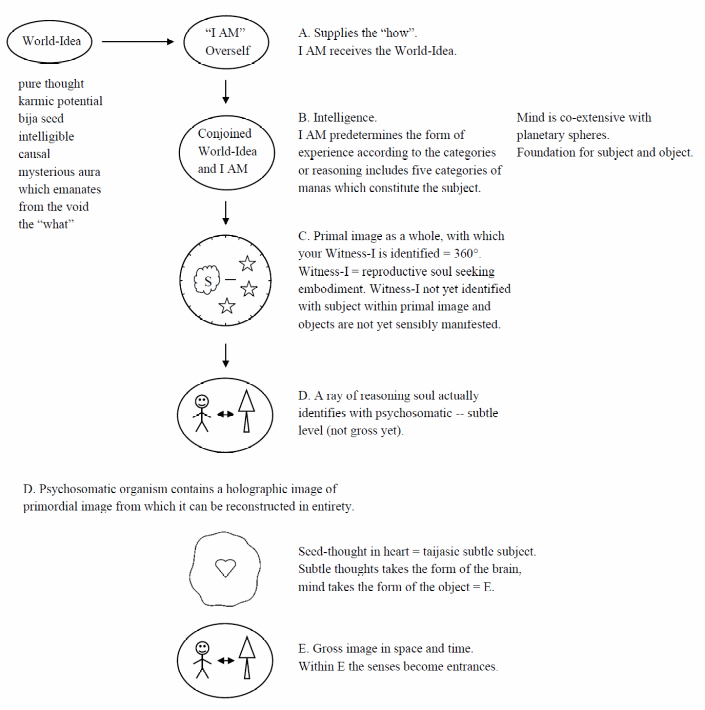
FIGURE 1983 1125a-1-AB. Synthesis of Epistemologies.
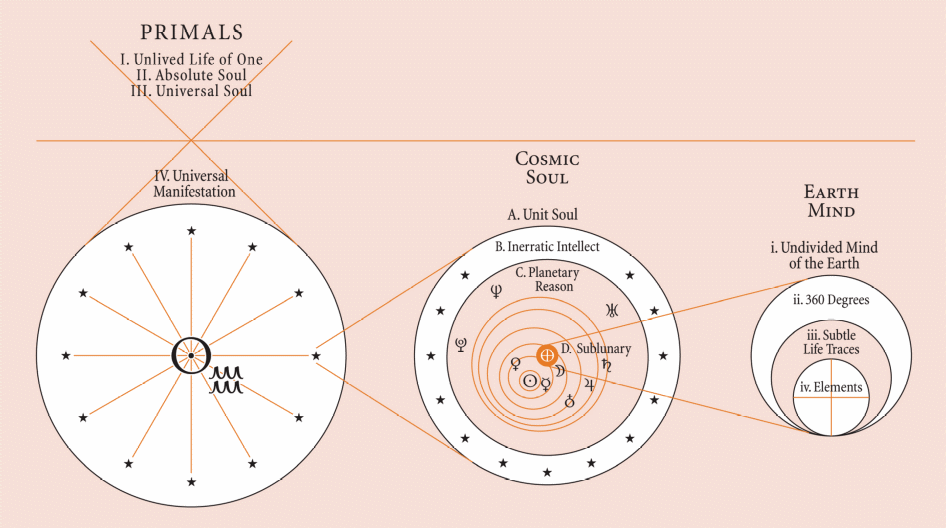
FIGURE 1983 1125a-2. Nested Levels.
The first diagram is from WG Class 1983 1118 and is used as a stand-in to help follow along. The second diagram is from Astronoesis, p. 250. Other diagrams also referred to are not with this transcript version. [Transcriber note: [diagram] means the speaker is referencing a diagram as he or she is speaking. If someone is drawing or writing, with audible sounds of chalk on a blackboard, I indicate this by [drawing] or [writing].]
PAPER read in class:
- "Prasangika Madhyamika Analysis of Objects" by Andrew Holmes (AH). Retyped as 1983 1125b V09M. Buddhism - Madhyamika Prasangika.
NOTES:
This is 1983 11/25a, Epistemology; Synthesis; Buddhism Class, and the second entry associated with this date. 1983 11/25b = Prasangika Madhyamika Analysis of Objects Paper.
Epistemology discussion related to those of WG Classes 1983 10/28, 11/11, 11/18, 12/1, 12/09a, and 12/19a. See also earlier Mentalism series, WG Classes 1983 1/26, 2/2, 2/9, 2/11, 2/16, 2/25, 3/2, 3/9a (and associated paper 3/9b), 3/16, 3/21, 3/23, 3/30, 4/6b, 4/13a.
Friday night class.
TRANSCRIBED Verbatim by IT prior to 2018; reformatted by jf 2018. This is V12ap (2023) and has: updated prefatory matter, footer, and audio file name; Book List and TOC completed; Subject and Subjects changed; Plotinus quotes section added; new notes within transcript; two diagrams appended and reference within transcript to these diagrams; new formatting to accord with new conventions. Archival verbatim transcript with Paper– V12ap.
AUDIO FILES: 1983 1125a, 1983 1125b. [Note 1: "Tape" and "Side" refer to original audio cassette tapes that were later digitized into .MP3 Audio Files. Note 2: In 2025, REP Studio cuts dead air from file a and improves its sound quality.]
1983 11/25a at Wisdom's Goldenrod
Epistemology; Synthesis; Buddhism
[Audio File 1983 1125a Begins]
AS: I don't know, maybe this is just-- the kind of unique, I think, the unique way that Anthony has been approaching the epistemology is that in most schools they separate cosmology from epistemology. Cosmology is assumed as some backdrop or whatever within which you can discuss to the lower level or some of the epistemology. It seems the-- a key point here is that the cosmology-- the epistemology is inseparable from the cosmology, that the cos-- you have to understand how the cosmology works because that is the epistemology. The epistemology has cosmological basis in it and the two of them are really inseparable and you won't understand the epistemology, I mean I think in this framework, unless the cosmology goes along right with it. Now I think that's kind of a unique way of-- [S: That's right.] of looking at epistemology. Now may-- some people take it at the level of pure consciousness and some people-- some schools take it as just the empirical and so on but rarely do you see it tied in with the actual cosmology, ok, so it's-- I think that's an important framework. [one/two words inaudible] we can, when we go through these steps, maybe try and compare it to the cosmology. Ok, and in fact-- no. Maybe we should do that as the background for the cosmology, just, [AS drawing/writing] you know, repeat this separate prop, we gotta [one/two words inaudible]
S: [couple words inaudible] (bit of laughter)
TS: You don't want to do it.
[Note: See FIGURES 1983 1125a-1-AB, Synthesis of Epistemologies, and 1983 1125a-2, Nested Levels, appended to this transcript for the following. The first diagram is from WG Class 1983 1118 and is close enough to what's being discussed (though not exact) to help follow along. The second diagram is from Astronoesis, p. 250.]
AS: Ok so, I tried to summarize in some method or other these various steps starting from the first which we discussed where the World-Mind's Idea or the World-Idea, which is pure Thought, is received by the Overself or is received by the I AM, which knows it as entire, causal, indeterminate, immediate, and this includes everything that could manifest from it. And in this intelligible perception the intelligence of the I AM or the Overself is simultaneously instantaneously present to the entire Thought of the World. [student assents] And PB al-- PB spoke here also about this aura emanating from the Nous. [Note: See Paul Brunton, Notebooks, V16, 28:2.79 and Perspectives, Ch. 28, #26.] And that, in this picture, [drawing] we could say at this level we had the World-Idea which is intelligible, is given to the Overself, to the I AM, and that together this then constituted a one-many. The I AM itself or the Overself is a unity and the World-Idea is given to it, and as in the Parmenides terminology or something, [VM: This is on Being.] this is the Being [diagram], ok, and this is the unity [diagram] and the World-Idea is giving a certain Being or determination to the I AM and the I AM is giving a certain unity to the World-Idea and together they may constitute this one-many. [Note: See WG Classes 1983 0902b, 0909b, and 0916 for more discussion of this point.]
Now at this level, [drawing/writing] I guess we could speak of the soul having insight. And I think that this-- if we located this cosmologically, I think this would be at the level of the Overself that's conjoined to the whole Solar Logos [diagram]. So that your inner aspect or your Overself, the individual Overself, is conjoined with the outer aspect of the Sun soul. Now there he spoke about the World-Mind as being Mind as active. And so this would be the Sun with all of its powers, or what we call the Infinite Mind of the Earth also would coincide with that, so-- The reception-- the way, I guess, the level of speaking of the reception of this World-Idea or the Intelligible is that it's the World-Idea which is given to the Solar Lo-- from the Solar Logos or given to the Overself which is conjoined with the Solar Logos and so we have the reception of the World-Idea. Now the soul is this one-many.
SD: Avery, when [AS simultaneously: Yeah.] you have the World-Idea up there, you're referring [S: Yes.] to the Nous there, right, to the-- to the Ideas? That's not yet the specific idea of a manifested world.
S: Uh-hm.
S: Right.
S: Yeah.
AS: No I-- I don't--
SD (simultaneously): Was it som--
[short pause]
BC: Could you ask it again?
S: [one word inaudible] go on [one word inaudible]
SD: Well, sometimes we use World-Idea for the Idea that the cosmic soul has of the world, something more specific to the-- to the manifested world and sometimes we use that as the objective half of the Intellectual-Principle, the realm of Ideas. And I guess I need to know what-- which way it's being used here.
AS: Why? (laughter, student words)
VM: "Why." (laughter) Yeah, why do you want to know that?
S: Yeah. (laughter)
AS: I mean, here-- I think-- (bit of laughter) I mean-- does it really matter whether you say it's the-- it's the Solar Logos that's giving your Overself its World-Idea or it's coming directly from the Nous?
VM: Well I think it matters.
S: Yeah.
AS: Well, for the purposes of epistemology here, cosmology, [SD simultaneously: But--] it doesn't really matter.
S: What--
AS: Ok, well, we'll try it anyway.
SD: Well I thought it was just in the context of cosmology where we did distinguish this.
AS: Well--
VM: Well if it doesn't matter then [AS simultaneously: Yeah.] explain why it doesn't matter. (some laughter, student(s) assenting)
AS: Because we're talking about your Overself as conjoined with this Infinite Mind of the World where we could say that it's the Mind of the Solar Logos or we could say it's the Infinite Mind of the Earth [drawing] that it's concerned-- that it's conjoined with.
VM: Now it sounds like you have three possibilities, is that right Avery?
AS: They're equal, they're equivalent. Because I-- I think the way-- the way you-- ok, I'm trying [S simultaneously: But--] this [couple/three words inaudible] is that the Overself, your individual Overself, is conjoined to the activity aspect of the Solar Logos which is also that Infinite Mind of the Earth. It's all the same.
AD: Uh-huh.
S: (I mean, maybe it'd be better--)
VM: See, I don't understand [AS simultaneously: In other words--] how the activity aspect-- excuse me, how the activity aspect of the Solar Logos is identical to the Infinite Mind of the Earth because take the simple geometrical or astrological-- astronomical example, what about a manifestation that might occur on another planet? How does that come about if the Solar Logos' [AS simultaneously: Keep going.] activity is just conjoined with the Earth soul, then nothing can happen on Venus?
AS: What? No, they're all-- I don't-- I thought-- (that will throw us off). I'm sorry. I guess I don't-- I don't--
VM: Let-- maybe you should deal with Severin [couple/few words inaudible]
AS (simultaneously): No, no. (bit of laughter)
VM: I'm lost.
AS (simultaneously): Let me-- let me try again, let me try once more and Anthony will try this, maybe I have this messed up or something.
VM (simultaneously): Or my question maybe messed you up.
AS: No, well, it's ok. We can leave-- I'm sorry-- I thought it would be nice to bring in along with this the cosmology that we've done [VM: For sure.] and when-- at the first level where we say we have this-- the I AM receives the World-Idea, and then they're conjoined [diagram], you have this one-many. Well I think at that point it's-- it seems to me it's equivalent to the point at which your I AM or your Overself is conjoined with the I AM of a Solar Logos, ok, is co-extensive with that, which is co-extensive also-- which we could also call the Infinite Mind of the Earth as opposed to the soul of the Earth which is within the Dragon.
If we started the other way, this would be the [drawing] three levels within the Dragon [diagram], and outside of that we would talk about the Infinite Mind of the Earth [diagram]. Well the Infinite Mind of the Earth is its participation in the entirety of the Solar Logos' powers, ok, and it doesn't seem to me to make that much of a difference whether you say it's the Solar Logos which is receiving this aura or emanation from the Nous, the World-Idea, [drawing] or whether you say the individual Overself is receiving the World-Idea or the Infinite Mind of the Earth is receiving the World-Idea because they're all conjoined and they're all receiving that infinite intelligible World-Idea into that Infinite Mind.
Now all I meant by outward aspect of this was that this-- whether it's a Solar Logos or whether it's the individual soul, the individual I AM, [drawing] it's going to have this absol-- the a-- abs-- aspect of it which is absolute and within the Nous, which we call the Absolute Soul and so on. And I think that we're talking about the point of receptivity here [diagram] is where we're speaking about [drawing/writing] the third level of that, the Mercury phase. Now whether it's a cosmic soul, that is a Sun soul, or it's the individual soul--
SD: Are you referring to the Mercury phase of all three?
AS: Of any one of them, you--
SD (simultaneously): Ok, so it's the Merc-- that I AM Overself is the Mercury phase of the individual and that activity aspect of the Solar Logos is again its Mercury phase.
AS: Uh-hm.
SD: And what you're calling the Infinite Mind of the Earth is also its Mercury phase?
AS: Same thing, [S: Yeah.] that Infinite-- Uh-hm.
SD: Ok, [AS simultaneously: We're not referring to this (diagram), we're not--] so the terms are different but you're really referring to the Mercury phase in all three even though the words you're using are different.
S: That's given.
S: I don't--
AS: Uh-hm.
AD: I didn't follow you Avery, would--
AS: Severin.
AD: Severin. (CDA laughs) [one/two inaudible AS words simultaneous with AD] Would you repeat that?
AS(?): Uh-hm.
S: Of course.
SD: That the-- the phrase "Infinite Mind of the Earth" is certainly-- it sounds somehow different than "activity aspect of Solar Logos" but I guess what Avery's been saying is that in both cases he's referring to the-- to the Mercury phase.
AD: Of the Solar Logos.
SD: Yeah, and also the Mercury phase of the Earth.
AS: And also the Overs-- the individual Overself for an individual is conjoined with the Mercury phase of the Solar Logos. I-- what I meant by activity, perhaps I'm mis-- mixing metaphors but when PB says that Mind when it's still-- he says when Mind is active we call it World-Mind. [student assents] And that's the Solar Lo-- that's why I call it-- that-- in that sense activity. [student assents] Its activity, its outward aspect is our-- conjoined with our in-- inner aspect, our Overself, and our outer aspect is going to be even a further imaginative representation of that. So when I was meaning-- when I said "activity" may-- let me clarify. [couple inaudible VM words simultaneous with AS] In the quotes where he says when Mind is active [drawing/writing] we call it World-Mind, which equals Solar Logos, which equals Solar Ler-- Logos' Mercury phase. [VM assents] And when he says Mind in its stillness is the absolute Void or whatever, then he's [drawing] speaking about the inner nature of that Solar Logos as being the Absolute Soul or the Divine Overself. So, the reception then I'm saying of this World-Idea by the World-Mind-- and he says, he even has that listing, you know, that ordered sequence.
But I-- your question is, does-- does the individual soul receive it directly from the Nous or does the individual soul receive it as its fr-- as it is from the Solar Logos' working [S simultaneously: Right.] it over first, [VM: Right.] and I-- I think that's-- I don't-- I'm not sure how to-- whether the-- depends how you want to put it I guess, I'm not sure I can-- You know, the individual soul [drawing] is directly linked to the Nous but it also has to receive the World-Idea from that Solar Logos, [SD assents] it doesn't receive some other World-Idea. It receives it as the Solar Logos-- through the auspices of that Solar Logos. Now I don't-- maybe there's a better way to put it. Well--
AD: And Vic's question, would it really matter, Vic? I mean you can refer to that as the Undivided Mind of Jupiter as well as the Undivided [AS assents] Mind of the Earth, it wouldn't matter.
VM: Is there a distinction between the Undivided Mind of Jupiter and the Undivided Mind of the Earth?
AD: Well, if you say the Undivided Mind of the Earth, alright, you're calling that whole sphere, you know, the planetary spheres, you're calling that the Undivided Mind of the Earth. The distinction would be the Undivided Mind of Jupiter would also be the same. What would be the distinction between [S simultaneously: They're all the same.] these two? Alright? Is that [one/two inaudible VM words simultaneous with AD] what you're asking?
VM: Yeah I guess so but it seems to me--
AD (simultaneously): What's the Un--
VM: It's maybe a-- maybe a silly question to pursue, I don't know.
AD (simultaneously): Well, no, I mean it seems to be legitimate.
VM: But it seems that there's a different--
AD (simultaneously): But the point-- the point is that if it's the Undivided Mind of the Earth, alright, you're-- [15 second pause] But maybe we could put it this way, if we could say existentially it's the Undivided Mind of the Earth and it's also the Undivided Mind of Jupiter but when you say that then you're speaking essentially.
VM: Ok, 'cause you-- you do want to keep some distinction.
AD (simultaneously): Essentially, alright, it's the Undivided Mind [RG: Yeah.] period, [VM: Right.] but as soon as you say "of the Earth" then existentially you're speaking.
VM: Ok.
AD: (You/I) have to remember, we can't spatialize these concepts, uh-huh.
VM (simultaneously): No I understand that, uh-hm. On the other hand you put--
AD (simultaneously): The other-- the other point I think Severin, the World-Idea from the highest point of view would include the World-Idea at the lowest level but the lowest level of the World-Idea will not [one/two inaudible AS words simultaneous with AD] include the higher level of the World-Idea.
SD: Right and I-- that's what I'm wondering is which-- which one is being received.
AD: Well the first one that's given is the abstract World-Idea, that which includes everything [S simultaneously: The world.] else, what's going to even happen on Earth. But the-- the World-Idea would include both and what's important here is to recognize that from the point of view of a human being the World-Idea isn't the World-Idea the way it would be up in the higher realms. So, the World-Idea would have to be the-- would-- what determines the meaning of that term World-Idea will be the context in which Avery's going to use it.
[short pause]
AS: Yeah he-- he-- you remember, maybe it was a couple of months ago, we went through this whole long discussion of the-- the same-- the same kind of leveling but there with the World-Idea where we spoke of the Universal Soul [SD: Uh-hm.] with the universal World-Idea and all these star souls within that and then each star soul itself would interpret according to its intellectuality and then all of the planetary souls within-- conjoined to that star soul and then finally each individual human soul would get it. Now in some sense it's sequential because the individual human soul gets it only after all of these prior-- principially prior souls have already gotten it. On the other hand, you don't want to say that your soul only begins here [diagram]. Your soul also has-- is directly linked to the Divine Overself so, I think again you have the-- the hierarchical and the simultaneity view are both operating but I think particu-- in the epistemological view when you say it's receiving it, I think you'd have to say it receives it most directly from the Solar Logos.
SD: Another thing, [couple inaudible AS words simultaneous with SD] you seem to be using Overself two ways. The Overself that you refer to the I AM, that's being distinguished from the Divine Overself.
VM: Yes.
AS: I think when we're-- we're-- I-- maybe call this-- I know PB doesn't [writing] use this word but we use the word individual Overself [SD assents] or unit-- Plotinus used the word unit souls or the third phase of soul whereas we've already reserved for this term Absolute Soul, which might equal the divine phase of the Overself. I don't know. This is what-- if you were going to speak of just one Overself then maybe we could call it the Absolute Soul but when you speak of individual Overselves we-- we would equate it with that-- again that third, the Mercurial phase.
SD: One-- one last question. The-- in terms of the divided line then, that reception, would that be Intellection?
AS: Yeah, I would-- I would say that the first-- the reception by the Overself of that World-Idea, I-- I always [drawing/writing] gonna tend to put at the level of the Ideas [diagram].
SD: Ok, so even [AS simultaneously: And--] if it is a version that's already been worked on, it really is still Intellection.
AS: It's still Intellection of Ideas.
SD: Ok.
AS: And at the next-- at the second step is where Reason is going to come in [diagram], I would say. Because now whether this is a Solar Logos or an individual Overself or a planetary, if it was the Solar Logos it would still have to manifest that World-Idea for itself. And if this is an individual Overself, then what this-- what the second step is, is that there have to be established the conditions and the forms under which the World-Idea is going to be experienced in an empirical way, ultimately. So, the next step after you have this conjunction of the World-Idea with the Overself [short pause while drawing] as this whole Undivided Mind [diagram], this Undivided Mind has the power of Reason. That's the next step in-- If it's the-- if it's the cosmic soul, you could speak about all the reason-- all the functions of the cosmic soul. The Undivided Mind of the Earth is conjoined with that, the individual Overself is conjoined with that, and the next step after this is to establish the conditions for a subject and an object. Yeah Randy.
RC: Can you-- you know when it's said that what you can't get at through contemplation you seek to get through the circuit?
AS: Uh-hm.
RC: Where you are now, is that where the circuit begins or is that a level--
AS: I think, I think if you could get it directly by contemplation you could stop with that receptivity of the World-Idea. But, if you needed to get it by the circuit, you'd have to go through this whole process beginning with this second step where the reasoning powers are going to mold the conditions of a Witness subject and a whole objective world. So, the planetary spheres themselves, all these powers, the planetary powers, have the power to mold the subjective center, to delimit the infinite Overself-consciousness to a Witness-consciousness, and on the other side, on the objective side, to impose the categories of space, time, causality, part and whole and so on, on that indefinite World-Idea to make it into an image for that Witness. And that's the beginning of the process that we would call "by the circuit" whereas if you just talked about the reception of the World-Idea or the aura emanating from the Nous, then that would be known as intelligible, in other words in contemplation, I think.
AD: Yeah, there was even a quote from Plotinus, he says all is well if you stay at that level. You remember? [Note: Plotinus, IV.8.4.]
AS (simultaneously): Yeah, yeah.
AD: If you go below that level, then [AS simultaneously: Yeah.] you're in for it. (some laughter, student words)
AS: Now, [drawing] this is-- this-- I think this level [diagram] is equivalent to the reception by the Solar Logos. You're i-- you're identified with that Infinite Mind of the Solar Logos. Or, for the World-Mind it-- it doesn't have any problem knowing the World-Idea 'cause it knows it at that level. But, since the soul needs to experience it in a more particularized way because it can't grasp the Idea at that level, therefore the next level will immediately begin to function if it doesn't stay there, which is Reason. And again, Reason will establish the two ends, it will establish a Witness. In other words, it will delimit the infinite pervasive consciousness of the Overself to a witnessing consciousness, which is either through the kanchukas they spoke of, making it a little knower, a little doer and so on, or that end will be through these [drawing/writing] five functions of manas [diagram] which first of all activate-- remember the activity consciousness will activate or pull that Overself out of the Being condition into an activity condition. And then we have this representation consciousness? I don't remember, no, [AD: Evolving.] evolving consciousness. [S simultaneously: Oh ok.] And that will make-- delimit this Overself so it's not just a static condition but again so that it can evolve through a whole series of lives and so on. And then there's a representation consciousness which will allow this Witness, this delimited consciousness, to be a receptor or to contain within itself or take on the form of any primal image or any image that's given to it. And then we'll have this particularizing consciousness and discriminating consciousness and-- Maybe that's the one that allows it to distinguish between what's real and what's unreal or what's intelligible and what's sensible. And then a memory consciousness or succession consciousness. Because if it's going to be evolving and it's going to go through this process, it has to retain some kind of a memory of the essence of what it experiences. [S: Really?] So, all five of this-- all five of these are necessary to set up the infinite Overself consciousness as a witness of experience, a witness of sensible experience, or as an experiencer of imaginal or manifested-- of a manifested world. [Note: See WG Class 1983 1118 for a more detailed discussion of this point.]
RG: Now how is that different than the individual Overself concept you're using?
AS: Yeah because here [diagram] the Overself is just like this pure consciousness.
RG: And then what makes it individualize(d)?
AS: What makes it individual is-- What? Oh, oh, why call it an individual Overself. Because I think-- I would say [drawing] that level is where you would just-- He says nothing separates them but the fact that they are not one and the same. [Note: Plotinus, V.1.3, second to last para.] It's still a unit soul.
SC: So you would s-- would you say--
AS: But it's not much, I mean-- [SC simultaneously: Avery--] I mean not much would separate them.
SC: Avery, would you say at that level [diagram] that there is a presentation to mind of that-- of-- of say a-- a moment-to-moment presentation of a World-Idea and that there's no distinction within that World-Idea, no separation, but there is this successful-- successive arisal of World-Ideas to a mind, so in-- there is some di-- some conscious distinction as opposed to the above [diagram] where-- where you'd be talking about it as eternal and complete identity.
AS: What do you mean by above, you mean here [SC simultaneously: Yeah.] Absolute Soul as here [diagram] as opposed to here [diagram]?
SC (simultaneously): But-- but there there's-- there is a presentation, that there's-- the World-Idea is presented moment-by-moment to a-- to [AS simultaneously: But--] the individual Overself say.
AS: I don't know if it's moment-by-moment yet (here/though).
RG (simultaneously): But it seems that's what he [SC simultaneously: (Take more time.)] wants to talk about as being given to the Witness.
S: [couple words inaudible]
AS (simultaneously): Yeah not yet, yeah.
RG: And not to the individual Overself.
AS: Well, I [RG simultaneously: Which I still don't understand what--] used-- I used the word 'individual'-- I-- I don't know what you mean-- I'm not sure what I mean by individual at that level either if it isn't-- if it isn't delimited to a particular [RG simultaneously: Right, I mean--] evolution and so on.
RG: Usually when we say Witness we mean the individual aspect of the Overself.
AS: And what I'm meaning by it is that aspect-- now the-- the-- cosmologically this happens when the infinite consciousness of the Overself is delimited to the aura of the Earth, [drawing/writing] to the Earth's Dragonic belt, to the imagination of the Earth. Prior to that, it's co-extensive with the entirety of the Solar Logos. And now it's gotta be delimited-- I mean here it's in the Intelligible [diagram], it's first conjoined with the Solar Logos [diagram], then it's gotta be further delimited so it will only experience the particular images on this Earth, the manifestation that's going on here, and that's what these [diagram] seem to do to that infinite consciousness. Now, that-- of course if this is an infinite consciousness what do you mean by calling it individual? Well the only-- I mean-- I don't know except that it's still my Overself and not yours.
RG: I don't know what you mean by that, every-- [AS: Well--] I don't--
LDS: But Avery-- Go ahead.
AS: Each soul is permanent. All I could say is that--
RG (simultaneously): Right, and what are you going to use to-- what is going to describe that distinction?
AS (simultaneously): What is going to distinguish [S simultaneously: Disting-- yeah.] one from the other?
SD (simultaneously): Perhaps that's where the-- the vision that's unique to each soul is referred to, that vision of the Intelligible that it has, that it's working towards as-- as a complete--
RG (simultaneously): But then you're up in the Intellectual-Principle again.
AS (simultaneously): No, what's going to distinguish a Sun soul from a planetary soul from your soul or from my soul? In other words, I don't want to take the view here that it's only at this stage [diagram] that distinct Overselves are going to be separated, like mine from yours from the Solar Logos. It's already-- they're already distinct at this level [diagram].
RG: Well then I'd say they were already distinct as Severin was saying at the level of Intellect [diagram].
AS: But that may be too. Sure, may be.
S: (We've/You've) read though--
AS (simultaneously): You (mean/made) that-- that distinction may root all the way from here [diagram], sure.
S: We read that.
AS: That would be ok. I mean I wouldn't-- I-- I wouldn't argue against [couple/three words inaudible] But I don't think-- this-- in other words, I don't look at this [diagram] as making this Overself distinct, this is only limiting an Overself.
TS: Well isn't that making the Overself a subject?
AS: Yeah, making it into a subject, yes, that's another-- that's what these-- This is [drawing/writing] determining the subjective pole, sure, as opposed to here [diagram] it's not really a subject or object.
TS: Yeah, there's no subject-- there's no subject as opposed to an object.
AS: Right. And here these-- this side, these functions of the reasoning activity, these principles or categories [diagram] or whatever you want to call them, are delimiting and determining the subject, the Witness. And the other side of them, the objective categories [diagram] are going to organize the Earth's imagination into an object, the whole primal image say.
AH: And so Overself consciousness is dualistic consciousness.
AS: No, Witness consciousness is dualistic consciousness. The Overself's consciousness in itself is not dualistic, and maybe that's-- that's what has to happen. [short pause] Do you follow, no? No?
S: I'll try.
AH: I understand the necessity of speaking of the Witness as subject.
AS: Right.
AH: But how do you avoid-- how are you going to posit the second subject within Dragonic belt?
AS: Oh, that'll-- there won't be a second subject, that same-- that very Witness subject will identify with that body.
AH: I see, alright.
AS: And that's how you'll posit that. But I think Tim's point was good. This [diagram] is not the subject. At this level of the Infinite Mind this is not a subject as opposed to any object whereas here [diagram] the consciousness now is delimited as a subject opposed to object. Of course the object here is the whole--
VM (simultaneously): Well I thought Witness-consciousness wasn't really opposed to objects, I mean--
AS (simultaneously): Not opposed, no, ok.
VM (simultaneously): Like the ego is opposed to [AS simultaneously: Right, right.] objects, right?
AS: I-- I just-- I want to find some way to say that there is a content to this subjectivity.
VM: Yeah. I guess there's an awareness of knowing let's say, in the Witness-I.
AS (simultaneously): Ok yeah, there's still an awareness of knowing, sure, the awareness of being a knower.
VM: Right, it's not necessarily a separate-- separate [AS simultaneously: Right.] kind of awareness.
AS: I agree.
VM: Nonetheless you know content is being presented.
AS: Uh-hm. Awareness of being a subject whereas here [diagram] there's not even an awareness of [VM assents] being a subject, you would say. So, when it's delimited to just viewing the contents of this Earth or of the imagination or of this primal image, that-- in order for it to do that, to become this subject, it has to be delimited by these five [diagram]. What has to be? The infinite consciousness of the Overself. Because before that it's just quiescent, its doesn't want to do anything so it has to be brought into activity. Before that it's stable, it doesn't evolve, so it has to have that evolving principle. Before that it doesn't know anything about images so it has to become representation. Be-- before that it's not particularized in any way so it has to do that. Before that it doesn't have any memories here, it holds the whole Intelligible, so it has to be capable of holding a certain memory. Now this [diagram] is the guy that's going to go through, is going to be the Witness of this whole evolution here of the double. I mean this is the kind of consciousness or subjectivity that's going to be needed to witness this entire series of lives, (ok/alright). This kind of subjectivity is oozed out of that infinite consciousness so that it can experience the whole development of an ego and finally recognize itself self-consciously as its source.
SD: Could we say that time in a sense enters in at that-- I mean not discrete [VM simultaneously: Not empirical time, no. Sequence.] experience(d) time but, like on-- on a level of the Overself the World-Idea is a unit. It's the [couple/three inaudible student words simultaneous with SD] World-Idea rather tha-- and on the level of the primordial image there's some aspect of a presentation--
AS: Oh. Yeah I definitely [drawing/writing] think there's time here because if this is correct that some of Kant's categories apply to the content of that Witness subjectivity or to that primal image or whatever we want to call it, the organization of the Earth's imagination or Dragon, then all of those categories like space and time and causality, whole and part, are going to operate to give a form to that imagination, to organize that entire imagination of the Earth. 'Cause at this level [diagram] we're still at that Undivided Mind. All those planetary spheres have those powers. [student assents, very faint] Or, I think actually probably the way we've been doing it is that the planetary spheres will organize the subject, perhaps-- Let me put it this way. From-- it's the Solar Logos' powers that will organize this Witness subjectivity, perhaps it's the Earth Mind itself that has these categories which are going to organize the form of the Dragon. [student assents] 'Cause this whole Dragonic imagination will be the content of this Witness-I, and the o-- the subjective side is organized by these categories [diagram], the objective side or the Dra-- the imagination would be organized according to space, time, whole, part, and all these other-- the Kantian ones perhaps then.
JA: Avery, the last class you had spoken about this and then I think the last question we were sort of left with was, does this Mind contain the-- the forms necessary to externalize its knowledge. And, that confused me at first because I thought, well, I thought that these objective categories or categories of the imagination would be vast, you know, time, space, causality, [AS assents] and so on. But then following that, you spoke of these five principles necessary, [AS drawing/writing] you know, for the subjective or for the Witness to manifest knowledge. So, is that what you would speak of as the forms necessary to externalize knowledge, the Mind's--
AS: Well, maybe-- you remember he calls right knowledge, wrong knowledge, sleep, imagination, and-- (what was/where's) the other one? There was one more in here.
[sounds like student assenting]
AD: Memory.
TS (simultaneously): Memory.
AS: Memory, yeah.
VM: So what are these five?
AS: That's easier. [writing/drawing] Now, these-- these five are the five forms of presentation or knowledge that the Witness can have, can view this whole primal image [S simultaneously: (Ok/Alright).] under.
[student assents]
JA: I mean are the-- alright, are these the forms necessary to externalize its knowledge?
AD/S(?): [one/two words inaudible]
AS (simultaneously): Are these the forms-- No. I would say no, what's necessary-- If you mean by "externalize" what's-- what is necessary to organize the World-Idea as the primal image instead of a purely indeterminate form.
JA: Ok, but then you're putting the object before the subject.
AS: No, I'm putting the subject before-- this Witness subject as prior to the object.
JA (simultaneously): You know, it-- it seems that you're saying that in receiving the World-Idea I would receive something that would have these objective categories but that you still n-- are not speaking of a subjective consciousness. You've said, you know, you said at that earlier level you don't have [AS: Yeah.] a subjective consciousness.
AS: All I'm-- all I'm trying to say is at this level of a one-many [JA: Yeah.] you have the Overself, infinite consciousness, and the World-Idea conjo-- joined in a One-Being and [JA assents] you can't say which is the subject and which is the object [JA assents] because there's no subject or object here, it's just Mind. Now out of this Mind which is a one-many or whatever you want to say, is going to concrete out, is-- or is going to ooze out a witnessing subject and it's imaginal content. Out of this indeterminate Mind is going to first have to ooze out the conditions, the bigger mind, the Witness-I and the entire [drawing/writing] primal image within which a particular subject-object experience is going to go on. So first this infinite consciousness side, the Overself side, has to be del-- not-- first or second doesn't matter, but the Overself side or the consciousness side has to be delimited to a witnessing subject [JA assents] and the content side, as it were, to be, the World-Idea, has to be organized, pictured and organize this imagination which is the Earth's aura or the Dragon. So, both of these have to be organized by this one Un-- Undivided Mind [diagram].
JA: Uh-hm.
[student assents, faint]
AS: Or maybe it's possible to say that this Undivided Mind first [drawing] organizes this witnessing subject within which then the organization of the whole primal image or imagination as object will occur.
JA: Well, I thought that [AD: Wait.] point--
AS (simultaneously): And I don't see much difference.
JA: Well, except that at this earlier level where it's conjoined with, you know, the Solar-- it's Mind and knowledge but it's not externalized.
AS: Right.
JA: Alright, so I-- that's why I thought that the forms necessary to externalize the object or its knowledge would be these subjective principles.
AS: No, and I would say no. What organizes the objective knowledge is these very forces in the World-Idea which are organizing the Earth's imagination. This-- I don't-- I'm not looking at it as this Witness-I is causal of the organization of the Dragon. The organization of the Dragon is part of Nature and is subject to the forces of the cosmos, in other words the cosmic [JA simultaneously: I-- but I don't see--] circuit. That's-- so I'm saying, there's n-- I'm not looking at it as a [drawing] causality of Witness-I to the content.
JA: I'm not either.
AS: Well you were trying to say that these [drawing] determine the conditions for objective knowledge and I'm saying no.
JA: No.
AS: It's the-- it's the act-- it's the organization of the-- of the imagination by the cosmic circuit that's determining those conditions [few words inaudible]
JA (simultaneously): I was talking about externalizing knowledge, I wasn't talking about objective knowledge or subjective, you know, consciousness. I was saying, you know, [AS simultaneously: What do you mean by (external)?] what externalizes this knowledge that is conjoined together.
AS: And what do you mean by externalize? I don't think it's external yet even here [diagram].
JA: I don't think so.
S: [couple words inaudible] [AS: Could I just--] categories up there, yeah.
AS: I mean I-- I don't [drawing] even think yet that it's external here.
JA: What do you mean "there"?
AS (simultaneously): This--
JA: What are you saying now?
AS (simultaneously): Ok, but let me do the-- This is the step-- we just did the subject side, that this-- you pretty much agreed that this infinite awareness has to be delimited to a witnessing subject.
JA: Uh-hm.
AS: And that witnessing subject will be conjoined-- just as this infinite Overself is conjoined or co-extensive with the Infinite Mind of the Earth, this witnessing subject is co-extensive with the soul of the Earth, and by soul of the Earth we meant the Drago-- the whole imagination with those three levels of mental, psychic, somatic. [JA assents] Ok now, what is it going to witness is going to be the contents of that Earth soul, organized and energized in a certain way.
JA (simultaneously): Well that's what I'm speaking of as external.
AS: Ok, if you call that external, [JA simultaneously: That's what I mean.] but there [diagram] I don't think it's external to it, it's still viewed-- Here [diagram] there's no content. Here's [diagram] content but viewed as internal rather than external. At the next step there's going to be content viewed as external or other [diagram]. I don't see why content can't be objective and still internal. [students assent, faint] The idea's known within it. If Archimedes goes and he has this brilliant-- or has some kind of flash which is no kind of oth-- knowledge as other but it's felt as himself, why can't it be at this level of the Witness, where it's not external? I j-- I just-- the word 'external', if I understand what you mean. It's not easy but--
JA (simultaneously): That was how the question was posed. Does the-- does this Mind contain the forms necessary to externalize its knowledge? So I was just proposing that as the-- the answer to it. Now maybe, you know, maybe that's not it, I just--
AD: Assuming that knowledge has a form.
JA: What?
AD: You're assuming that knowledge has a form.
S (very faint): Yeah.
JA: Well, you asked the question a couple of weeks ago so maybe you could throw some light on what you're asking me.
AD: Instead of asking me a question, try to understand what I just told you. You're assuming that knowledge has a form.
JA: I am? Why?
AD: Well you just said it externalizes it.
JA: Well the question that you asked at the end of class two weeks ago--
AD (simultaneously): Now, the question that you should ask is it's-- if knowledge is formless, I don't know what knowledge is. And if you go that far then I would have to be agreeable, [student assents] because no one knows what knowledge is.
[student assents, very faint]
JA: Alright.
[short pause]
AD: Ask yourself, even-- even with this as a background, what is knowledge? You can't answer.
[student assents, faint]
S: That's for sure.
JA: Well, what I thought you were saying was-- what-- I thought what-- what you were referring to as knowledge was the Overself's reception of the World-Idea, that that's what you were referring to as knowledge.
AD: I didn't hear you Jeanne.
JA: I thought implied in the question you asked two weeks ago, does Mind contain the forms necessary to externalize its knowledge, I thought implied in that was [AS drawing/writing] that the-- the Mind being the Overself, as you seem to be using it, in receiving the World-Idea then could be said to have knowledge. Then, I--
AD (simultaneously): Well, I think you're missing misconceiving then what we're doing here.
JA: Could you explain?
AD: The finitization of Being, individual Being, so that it can become a subject does not a-- does not-- it does not necessarily follow with the notion that now knowledge gets externalized.
JA: But, um-- So what-- what did you mean then when you asked that question?
AD: Well ask yourself the question, what is knowledge?
JA: Well I told you what I thought you meant. I'd have to have a few minutes to think it over again.
AD: Doesn't it strike you as something very mysterious?
JA (quietly): Yeah.
AD: We make allowances for the finitization of this I AM consciousness and we're trying to make provisions to understand the creation or the formation of the primal image. They're brought together within the Dragon but in no way does this answer the question, what is knowledge.
[short pause]
SD: Anthony, are you using knowledge (for all--)
JA (simultaneously): Excuse me Severin.
AD (simultaneously): Just stop and think about it for a minute before you jump. Just stop and think about it, ask yourself. Take an instance of real knowledge you had and ask yourself, what is it? You see the question is unaskable. You'll just go away pulling your hair out like a madman. Well don't you ever stop and think of these things? They're fundamental. I know that every philosophy textbook has ten chapters on what is knowledge and even an explanation and an answer. (bit of laughter, student words) But if you stop and think about it you'll see, it's mysterious, there's no answer. Here we're-- we're preparing for you a cadaver that goes around thinking that it knows something, alright, and you take all this literally.
S: Yeah. (bit of laughter)
AS: It's a likely story.
VM: Uh-hm.
AD: I should've been a novelist.
AS: Yes, I-- (laughter)
AD (amidst laughter): I think [few words inaudible]
AS: The line that-- in fact-- the similarity is striking when Timaeus talks of cosmology as being a likely story, then obviously this is going to be--
VM: Even less likely.
S: Right. (some laughter)
AS: No, or equally as-- (laughter) equally more [TS simultaneously: More likely.] or less likely. (bit of laughter)
AD (possibly part of background, faint): [couple/few words inaudible, possibly student] it represent-- it represent [AS simultaneously: Yeah.] the ego, no?
[few inaudible student words in background]
AS (simultaneously): Yeah it doesn't really explain how you know.
VM: Ok, it's a nice story. [one word inaudible]
AS (simultaneously): But-- but it's a hu-- I mean--
AD (simultaneously): Do you notice how subtle it is? He was just telling you the-- that the-- this universal I AM is getting delimited. And then he's telling you that there's certain categories of thought which are going to produce the primal image. And you put them together and you assume, "Now I have knowledge." (AS laughs)
AS: What?
S (very faint): Right.
AD: You-- [students assent] Superman 3 has got to come out.
S: I think [AS simultaneously: Superman 4.] it already did. (some laughter)
S: 4.
AD: It already did? (some laughter, student words)
RG: It didn't answer the question.
AS (simultaneously): It's already on 4. (laughter)
S: Remember, maybe that-- maybe that language really it didn't [possibly one word inaudible]
AS (simultaneously): Maybe it's just the-- the 5th.
[few seconds of background student talking as class continues]
AD (simultaneously): Maybe the 4th will tell us what knowledge is. (bit of laughter, student words)
AS: Maybe he knows differently than we do. So just to-- well anyway-- In some way this is only--
(Side 1 of original cassette tape digitized as 1983 1125a Ends; Side 2 begins)
[Transcriber note: This side of the audio file is really faint and hard to hear for a few minutes.]
AD: --about what the presuppositions are, what conditions are required, blah, blah, blah but it never tells you what knowledge is.
[students assent]
AS: Right, it just-- never-- These [diagram] are the form-- these are the forms of-- this is [one word inaudible] necessary for the subject, as it were, [AD: (Heart/Hard).] and the Kantian ones are the necessary forms for the content.
S: Right.
AD: Go ahead.
AS: Vic-- you could say that-- you know it actually would-- why don't we just leave it. Anyway, ok. When we're-- what belongs to the five [one/two words inaudible] But I think they're functions of the Reason, they're functions of this Solar Logos.
RG: Then why do you distinguish that those five limit the subject so it consequently knows the object?
AS: Oh I know.
S: [few words inaudible]
AS (simultaneously): Yeah, we went through [RG simultaneously: Ok.] the alphabet. Well let me-- let's go a little more [S simultaneously: That's fine.] of the detail. Just like--
RG (simultaneously): It's alright, you don't have to do that.
AS: No, no, it was-- it's worth it just a little. [students assent] The reason why it was partly because of the way (that he/the view) was describing it. He spoke about the alaya, these bija seeds in the alaya, and then out of that he said that this manas, the manas [couple/three words inaudible] That's the seventh of the eight [one word inaudible] [student assents] And that klista manas are these five different functions, [RG assents] ok. Read through them they all seem to refer to the awakening and activity and possibilities of the subject. They seem also equivalent to the-- the kanchukas in the Shaivite school which delimit infinite I AM or "I" to a "this," delimit it to a finite ego.
AD: Oh I-- it would be stretching the analogy because I don't remember it too much, (but) those would correspond to the forms of understanding in Kant. [RG assents] Notice, the forms of understanding. [students assent, faint] No, when you look at these things straight in the eye they'll frighten you. You can't ask some of these questions. They're just not even askable.
AS: Well, unless-- It's funny, he doesn't-- Plotinus has one line where he says-- well as the-- (says/as) the All-Soul has put us here. He talks about the All-Soul has put us here. It's almost as if we're saying that the cosmic soul puts us here and people-- the Gnostics take this as something that's evil. But then he goes on to say no, it put us in the place to which we belong. It put us-- it conjoined us with the exact location that our soul demanded(,) (our existence). [Note: See, e.g., Plotinus, III.2.12 (last para), III.2.17.] So it's something like the question of where these conditions or limitations of knowledge come from, it's really both from the cosmic side and the individual.
JA: Does that bother you?
AS: What? (bit of laughter)
S: "What".
AS: No, I think it has to be that way because I'm--
JA (simultaneously): No I mean doesn't it bother you that it has to be that way?
AS: No, I think the explanation of why it has to be that way is that-- the thing about you can't-- if you can't contemplate directly you have to get to it through the circuit and the wisdom of the cosmos is somehow mysteriously arranged that the way to get to it indirectly is to first have your infinite soul limited to a particular witnessing subject. That's just, I mean--
RG (simultaneously): Could you say that again, what?
AS: If you say that the soul needs this circuitous route because it can't get to the contemplation directly, it's just like what he says sometimes, needs to come by these essences indirectly through the circuit, then somehow the mechanism that the One or the World-Mind or the Nous or the whole business has so arranged for you to do that is this particular mechanism or one of the mechanisms whereby your soul which is unattached and undivided and so on can experience the Ideas in a delimited sensible empirical way.
AD: Your natal chart, in other words. Watch the way the ideas are manifested as your life. That would be doing the ideas rather than contemplating the ideas.
[student(s) assenting, faint]
AS: You get at it by doing.
RG: But, you know, in this unfoldment of the soul, where does it lack them to start with that it needs the circuit?
AS: Well that's-- that's a different que-- (AS laughs a bit)
RG: No, no, but shouldn't it [AS simultaneously: Oh (few words inaudible)] show-- it should show in your unfoldment.
AD: Dickie, would you repeat it, I didn't hear you.
RG: Where-- where in this unfoldm-- foldment does-- does the soul ha-- experience the lack which it needs to then rega-- regain by the circuit?
AD: Where it regains the lack?
RG: If that--
AS (simultaneously): He wants to know where the lack that it has to begin with that it can't directly contemplate the Ideas. He wants to know where does it show up on the diagram. (AD laughing a bit)
S: (Teenager.)
RG: Let-- (bit of laughter, student words)
AD: Dickie, we'd have to go right to the Nous for that. (AD laughs a bit)
S (very faint): You're really stretching it.
RG: Well, but otherwise, you know, I mean--
AS: Well, I--
RG: Otherwise, I mean, [AS simultaneously: Well let me-- let me make a stab at that though Richard.] it's pretty-- (otherwise) it doesn't make any sense.
AS: If-- [couple inaudible student words simultaneous with AS] if part of it, if part of the infinite soul is delimited, it's allowing itself to be delimited. That part which is delimited is the very aspect of the soul which has a desire for earthly existence. In other words, the fact that it's delimited is exactly consonant or accords with the fact that there is some aspect of it that seeks this limitation. [S simultaneously: Right (few words inaudible)] It has a desire for earthly existence.
VM: In the Nous there is a tendency for division in the Overself.
S: That's right.
S: Yeah.
VM: I mean it's even before you get here that you got to [AS: Right.] postulate that-- that aspect of soul.
S (simultaneously): I don't know.
AS: But-- but there's one other thing, I think, I mean-- if we go [drawing/writing] to the original-- you know, the metaphysical diagram, it's like saying well the fourth quadrant is really a part of the Absolute. Why throw it out? It must have something important to add. I mean if the soul doesn't ever go through all the four of those and come down into manifestation, it's missing-- it-- it's just missing something. The lack-- maybe the lack is that it's not experiencing the full blown possibilities that are in the One. I mean that is it's lack. The lack is the lack of-- of [one word inaudible] [student assents] It's tautologous, I mean, (AS laughing, some laughter, student assents) it's really tautologous [S simultaneously: It is.] but it's saying that the sensible world is a manifestation of the Real, [student assents] and it would lack that if it didn't come down and experience it. Then when he says where the Nous has the possibility to be all it can be, why shouldn't the Intelligible not also manifest perpetually? And then if that manifestation did go on perpetually and the soul didn't know about it, it would lack something. That's a pretty poor-- (AS laughing)
S: It's ok. (S laughing)
S (simultaneously): Yeah, yeah.
S: [couple words inaudible] (some laughter)
RG: No, that's not-- I mean that's just not acceptable.
S (possibly part of background): Yeah.
TS: Can you say that the-- there are divisions of knowledge which go into-- to forming this Witness-I or the-- the limited individual defined as the-- and there are conditions of knowledge which go into forming the World-Idea into the primal image in the Dragon. [AS: Yeah.] Is there then any condition of knowledge which is needed to relate those two?
SD: No because, isn't that a-- we said that that's not a threefold relationship though, (is it)?
VM (simultaneously): Yeah but you have (the primal) that we work within, in other words, I think [one word inaudible] term was infinite or something like that, well isn't it? [S simultaneously: Yeah I don't know.] I mean I don't think you can distinguish them there though.
AS (simultaneously): Yeah we're kind of-- we're-- or you can't separate it, we're [VM: Ok.] maybe perhaps artificially-- In other words, you won't have a delimitation of a Witness unless you have what it can witness, unless you have a primal image to witness, and you won't have a primal image unless there is a Witness to be witnessing.
VM: Like what does this mean in some sense, the Overself with content.
AS: Yeah, yeah, except (Vic/that)--
JA: Well--
S: What'd you say Vic?
VM: I say one way to understand the Witness is the Overself with contents.
TS: Ok, but let me ask you again, you have form here [possibly another student: (of--/oh.)]
S: Ok.
VM: Especially if someone-- somebody else wants.
AS: No he--
TS: We say that you have five and I don't.
AD: Tim, if you consider them as separate or even as distinct, you're in trouble.
VM: You mean the primal image and the Witness-self?
AD: The subject is the object, the object is the subject.
S: Yeah, at that level.
AS: In fact, this-- those Atmananda terms would be-- this is seeing [diagram] and this is the seer and the seen [diagram] which are not different from the seer. [drawing/writing] (Here's) seeing, well here's the seer and the seen. The seer and the seen are nothing other than seeing.
S (possibly part of background): You want to.
AS: But Tim, you get this chart.
TS: No, [possibly another student: look--]
AS: Yeah, no.
TS: I'm trying [RG simultaneously: Right.] to follow what you're saying [S simultaneously: Try (one word inaudible)] because it's confusing to me. I mean, I can focus the-- if I can parrot back the idea that there's a level of content and consciousness which is distinguishable and yet here you're speaking of some form of individual, well, how'd you put it--
S (possibly part of background): He can see us.
S (possibly part of background): Yeah.
TS: The finitization of individual being is requiring certain conditions of knowledge which are unique to it and they're kind of a-- a finitization of [AS drawing/writing] the World-Idea into the primal image which require other conditions of knowledge, they're not identical conditions of knowledge, there's a separate group of-- separate set of conditions.
AS: Well, and--
TS (simultaneously): And I get lost in [RG simultaneously: Uh-hm.] then understanding various conditions which are creating the finitized individuals, and there are conditions which are not (identical), a different set of conditions which are involved in generating the primal image. It seems as though that would create some kind of distinction between that individual being and that primal image, [RG assents] and it's hard for me to understand in what way you mean that they are not distinguishable.
AS: I didn't-- I think at this-- at the level of the primal image there is a distinguishability there.
S: Well I thought that that was the point of--
AS (simultaneously): But I don't know which level [TS simultaneously: (That) wouldn't understand.] Anthony's speaking at. I don't know if he was speaking at the prior level or at this level. But it seems [TS simultaneously: Uh-hm.] to me if you have conditions governing the subjective and you have a different-- different conditions, just as he's saying, there's different conditions governing the appearance of the content or the primal image and they should be distinguishable.
TS: They're distinguishable but they're not yet subject and object.
RG: Right.
TS: But there's some distinguishability [one word inaudible]
AS (simultaneously): But these are the presuppositions for subject and object.
RG (simultaneously): Well the form-- but Ti-- yeah Tim, you can understand that the form of a thing is distinct and yet experienced as within the mind still.
S: Yeah.
AS: I think that's what Anthony meant. That's-- and that was the question about externality before. Here the form is experienced as within whereas at the next step, only after you identified with the body it would be experienced as without.
BS: But you say that--
TS: But it still is experienced-- I'm sorry.
BS: Go ahead.
TS: It still is experienced as a-- as content, as--
AS: I don't think we experience it distinct. I mean it may be distinct in existentiality or [couple words inaudible] as such.
TS (simultaneously): Don't experience-- yeah right. It's-- it can be distinguished as a content of knowledge but is not known as distinct in that subtle. Is that right?
S: Uh-hm.
LDS: What's the [one/two words inaudible] person?
RG(?): But if--
AS: They're not contentless consciousness.
AB/RG(?): Right. Or the contents--
PD (simultaneously): Remember what we did Wednesday of PB's, or the three expressions of Mind as the Void, then there was the Light or the World-Mind, then the World-Image, and then manifestation.
AS: Then the World-Idea, then world-image.
PD: Well I-- World-Image, World-Idea.
AS: Think they're different.
PD: Yeah, ok. So it's those three levels of principle and then manifestation. Now if we take-- if we take the-- the World-Mind or the Light as being inclusive of the Overself, so, like the Solar Logos is that principle of Light radiating in all directions, that Light that's involved in the World-Image and then manifestation appears. So this-- so you have the Overself in union with the World-Mind as this principle of-- of Solar Logos, the form-bearing Light which then precipitates the World-Image and then the individual's incarnation in that image. [TS simultaneously: But it's at that--] So the World-Image, the World-Idea is not a direct emanation from the Void but it's-- it's coming, precipitating out of the form-bearing Light or the world of the Solar Logos.
[student assents, very faint]
VM: I didn't see how you-- I don't disagree with you, I don't see how it connects to Tim's question though. Maybe I missed what-- what [one/two words inaudible]
TS (simultaneously): Yeah but my question is the-- which is then part of it. You have the Solar Logos and the form-bearing Light and there's a-- and there the Overself. That seems to be what he's got under the top of his diagram, [AS assents] the infinite Mind of the Overself, ok. [AS assents] Then at the next stage he said that there's two little-- you had two little arrows coming out of that [couple words inaudible] [VM simultaneously: The subject and object.] one which reads the five manas, the buddhi-vrittis or the five forms of manas or whatever, and those were the five conditions of knowledge which finitize the subject. Then you had another arrow which came out of that which was Kant's twelve cate-- well, oh dear. (laughter)
S (amidst laughter): Right(./?)
PD (amidst laughter): Well I (was/would) just [one/two words inaudible] the Solar Logos to define the Light.
AS: Yeah, Paul--
VM: I [one word inaudible] like you were moving up.
[multiple students talking at once, mostly inaudible]
AS (amidst student talking): [drawing/writing] Well, the Light equals Solar Logos equals the Overself, that's ok, they're all there, and then at this level [diagram], this is the-- this should be the soul of the Earth, [student assents] the mental belt of the Earth, and the 360 degrees are pretty much what call-- Paul is-- is calling the [RG: Right.] manifestation or the-- what gets concreted out of that or--
S: It's a little different.
PD: The World-- the World-Idea [AS simultaneously: Precipitated. Precipitated out.] precipitates out of the form of the Light.
AS: Yeah, precipitated out [drawing] of here is both the form, the three hundred-- the imaginal form, and also the limitation of that infinite consciousness here to a witnessing consciousness, and this is supposed to be the whole Earth Dragon with all the 360 degrees as the content of that primal image. And--
S: (Body language.)
[student(s) assenting]
AS: This-- this has the power to precipitate out of it both the witnessing subject and the primal image, the manifestation, this whole--
AD: Maybe, maybe you could do it this way, the problem won't arise. You know, if-- if you-- [short pause] if you let Avery continue, like work with the fact that so-called subject and object that comes out of that, alright, let him go into the Dragon, alright, and understand how that subject and object which is-- [short pause] which is a seeing, alright, but becomes a seer and a seen in the natal chart. If you let Avery go through with that, it might a-- I think maybe you'll see why you just, you know, side-step that question for now.
AS: Maybe it'll also move the whole thing down one level (from the) Overself, because-- Yeah, ok, well then I'll try and go to the next level. So the result-- anyway, the first level was-- the divided line [drawing/writing] helps too, the first level was the reception of the Idea, the second level was the whole functioning of the Undivided Mind or the Infinite Mind. The result of its functioning was to give rise to a primal image in which you'll find the 360 degrees of this Earth and delimiting the infinite consciousness of the Overself to a Witness subject, at which point there is no externality but the whole world is still experienced as within. (Now/At) this primal image, the step we're at now, the stage of this primal image, and the Witness-I.
RC: Ave, could you say that in that [couple inaudible AS words simultaneous with RC] stage the whole-- the whole primal image would be presented to the Witness in such a way that it includes the body but the sense of "I" hasn't yet passed over to the body. So that [AS assents] things in the primal image could be perceived as distinct from the body and at the same time not be experienced as separate from the sense of "I".
AS: Exactly, I would say. But this is the witnessing consciousness [drawing/writing] which already witnesses your body, the tree, and everything else that's part of that primal image, and-- except that it's not sensibly manifested or whatever form it is manifested later on will just be a slice out of that whole primal image. Everything is within that primal image. But I think at that level it seems more appropriate to speak of everything within that primal image as a certain combination of these reason-principles [students assent, very faint] which are going-- which are portraying this pure energy, maybe that's another way to put it, this pure energy of the pulsating World-Idea, alright, is now given a form according to these 360 primal reason-principles, and that infinite consciousness is delimited in terms of the witnessing subject. And so, once that's established, that is the very ground or form of any subject and object that will now appear within it.
And so the next step after delimiting or contracting to that is now for that witnessing consciousness itself to be contracted even further to a psycho-somatic organism. Now, when we had three levels, when we had a somatic, psychic, mental distinction, we put all three of those, that was nice because I think this one [diagram] would be equivalent to the mental level of that Dragon, if there were such a thing. This would be like the mental, which also would be in a sense like the-- which one made consciousness (be) like prajna, where it's out here [couple words inaudible] So another way you could think of it is this, you know, contraction of the consciousness in prajna, then next taijasa, and then the vaishvanara. It seems that would also be a valid correlation, ok, where now this mental-- this mental being, this Witness-I or mental being, with its total primal image or the 360 degrees can be delimited to the form of a particular psycho-somatic organism, which form is basically going to be given by your natal chart. So, at the-- so at the next step, we're now at the step where we have to understand how this Witness consciousness is going to be limited to this per-- the psycho-somatic organism which is only one little part of that primal image, ok, and he has this thing where he says--
[Transcriber note: I am using The Wisdom of the Overself by Paul Brunton, North Atlantic Books, Berkeley, CA 2015.]
Paul Brunton [The Wisdom of the Overself, "The Secret of the"I"," p. 116, AS reading]: "…awareness is [itself] a separate principle. [AS adds: But] Part of it acts upon the body, principally through the heart and the brain. … [AS adds: And] The part which thus acts is the part which is projected into a particular space-time existence and [which] thenceforth imagines itself to be an entirely complete and self-sufficient being. It is [AS reads: And] indeed [AS adds: this is] what we know as the person. … It is [AS reads: And] this fractional consciousness--[and] not the [AS reads: not that] mind whence it originates--[that] has its seat in the particular body…"
AS: That's a quote from the Wisdom. So, at the next step now, it's like the dreamer that has produced the entire dream or witnesses the entire dream now limits itself [drawing] to being a dream subject within it. And the first identification according to, at least to PB's terminology, is this heart-center or the subtle body [diagram]. Now, remember everything now-- this [diagram] is all going to be assumed, only he doesn't know it once he limits himself to this body. This Witness has already witnessed the entire primordial image. And now he iden-- his Witness (conscious--) a ray-- as you said, this light of reason or this fractional awareness gets trapped in this psycho-somatic organism. [couple words inaudible]
AD (simultaneously): Which is part of the subtle, which is part of the subtle thought.
AS (simultaneously): Subtle image, yeah. That's why I labeled this 'subtle' because that's [student or AD assents] important.
RG: Is that subtle image different than the primal image here?
AS: Only insofar as now as limited to a particular body.
VM: Right, but (would it) aspect the mind?
RG (simultaneously): Then what mind is perceiving that at that moment?
AS: The same mind that's here [diagram]. In other words, we tried to think of this last week as like-- that, you know, like that the hologram, that the entire primordial image, but now any tiny little fraction of that is going to-- you can reproduce the whole thing from that. Now, I tried to conceive that-- Well two-- the first point was that this-- the soul itself has this reproductive aspect which has the tendency towards separate existence, and that has an affinity for this particular vehicle and this particular vehicle on the other hand gra-- appropriates that light which now seems to get trapped here. But, what I tried to conceive, and it's really hard, is like the Witness consciousness with this primal image has to be like contracted to a point, the whole thing, the awareness with that primal image that it knows as it were or experiences in some way is contracted to a point. So it's like that light that enters the psycho-somatic organism is a form-bearing light, it already contains a form of the entire primordial image, and when it hits the heart PB then calls it a seed-- that tiny seed-- but let's leave out seed form.
RG: Uh-hm.
AS: There's a contraction which is dropped [drawing] into the subtle organ. In other words, I think the subtle organ is-- in other term is antahkarana or it's the imagination or the taijasa. And in that s-- now, from that point where it's dropped into the imagination is now going to then expand again as the sensible world, as your experienced world. It's like the ripples come in, contract to a point, drop into this imaginal essence, and then expand outward again as the mind, mind here now being the imaginal mind, the subtle mind or antahkarana, expands again, goes upward to the brain and then goes out and takes a certain form, first of course goes up and takes the form of the brain. So when the mind, the Witness mind with its primordial image contracts to the point in the heart, you have there the subtle seed-- the subtle form of the universe which is going to expand and become your sensible world. And-- so at that level we have three things, seems to me but-- up to this point in the heart we have [drawing/writing] first of all that imaginal essence, which is the subtle or taijasic mind, we have that fractional awareness, and we have this form, the form of the primordial image. That infinite World-Idea has contracted to the state of this primal image which is now contracted to this form within that light, we have this fractional awareness which is the light trapped in that organism, and we have this imaginal essence which is just basically the subtle body as it were, the winds, the channels, drops, that whole--
RC: This thing-- the transition between the two boards and the-- and the getting (bound up), [AS simultaneously: Yeah.] would you say that on the left-hand board [diagram] whatever knowing is taking place is the actual-- it's taking place by means of the actual motions of the planetary spheres. Wherever you look in the ephemeris that's where they are and so on. And then when you make the transition over to this other board [diagram], all of a sudden now it has to be accommodated to the aspects of the natal chart.
AS: Exactly.
RC: That--
AS: That-- I would agree.
RC: That imaginal essence there that you're talking [AS drawing/writing] about is the particular [AS simultaneously: Natal chart.] frozen patterns of your natal chart.
AS: Exactly. That's what I would say, that-- when he spoke about the moment of birth the imagination gets stamped with the conditions of the World-Idea at this instant, that's the form of-- that imaginal essence isn't completely formless. Like Ramana says, there all your vasanas are there. [Note: See Talks with Sri Ramana Maharshi, Talk 616.] Well, I mean that seems to mean that's--
VM: In fact he even says the vasanas are very close to your heart.
AS: Yeah, they're close, he says they're kept in the heart, that's why--
VM: You identify with them.
AS: You know, when you go to sleep your head drops because you want to be closer to the heart.
S: Oh.
VM: It's very subtle. (some laughter)
TS: But I thought--
AS: But this isn't the actual-- I mean this is the subtle. But I-- I-- it seems that just [drawing] from here [diagram], this is the whole producti-- this is the-- but it's not just this, it's also the brain has the form of that natal chart too. [RC assents] And that those are the forms through which this world-- the image is going to be projected, through which a world is going to-- to come to you. Or, in other words, if this were like the pure sensation [diagram], then everything that goes on here is going to be the productive imagination [diagram] but based on this pure sensation or pure intelligible intu-- sensible and sensuous intuition. First it's going to pick through all of those 360. How is it going to pick through them? It's going to pick through them according to its own vasanas, ok, and then it's going to take them and decide which concepts and images go with it and which don't, and then it's going to finally put it into a particular one of these five categories as this concept or that concept. So, the-- this light, this fractional light of awareness identified with that heart-thought, with the imaginal body, it goes up to the brain, takes the form of the brain, goes out to the object, takes the form of the object, and--
RG: Now, when you say goes out to the object, [AS: Yeah.] what do you mean by that?
AS: Ok, what I mean--
RG (simultaneously): Is there a vaishvanaric object out there that it's taking the form of?
AS: Well, the only object that's out there is this object [drawing] or x which is part of this primordial image.
RG: But that's in a causal state.
AS: Right, so--
RG: Why aren't there also objective states of the object?
AS: Why aren't there objective states of the o-- This is a content.
RG: Right, but that's in a--
AS (simultaneously): This is a content of the Earth.
RG: Yeah, as a-- in a--
VM: [couple words inaudible] space-time.
AS (simultaneously): It's an actual-- but it's an actual--
RG: Then it's not causal.
AS (simultaneously): These things here, just as-- just as your body is a con-- is a conglomerate of the Earth's essences so are all the other objects in this primordial image, they're all part of the Earth's subtle and they're all part of the Earth's elements.
RG: Ok, now as part of the Earth's elements, or its gross body, [AS: Yeah.] doesn't that have a status along with the mind going out and taking the form of it?
AS: Sure, it already has a status but your mind doesn't project that.
RG: Right. But isn't that given?
AS (simultaneously): In fact that doesn't have to go anywhere.
RG: Why, it's not-- it's not purely in the primal image otherwise it would be purely causal.
AS: I don't know what you mean. It doesn't have to go anywhere.
RG: Well then you're not differentiating the Earth's causal, subtle, and gross states if you say it's all locked-- it's all casually present in the primal image that doesn't distinguish the levels. Then(--) it seems what you're saying is the individual mind's projection is what distinguishes the levels of the Earth's body and psyche and soul.
AS (simultaneously): Manifests it more. Not necessarily distinguishes this but manifests it (more).
RG: But it seems the Earth has a-- has its own body also, [AS simultaneously: Sure, it has its own perception.] independent of the individual's--
AS: That's fine, why can't the Earth have its own perception of what goes on in-- and in fact I would-- I think he would say that [couple/three words inaudible]
RG (simultaneously): Right, he does.
AS: It does have it own perception of what goes on.
RG: Right. So when the mind goes out and takes the form of the tree, is there-- I mean what's the status of--
AS: Ok. [drawing] My claim is, as soon as he identifies with this psycho-somatic organism, he no longer knows this Witness point of view. I mean he could but let's just (take a/think of) ordinary. So, when the mind goes up and takes the form of the brain-thought, now going up is only in relation to the heart or the brain, and going out is only in relation of this thought-form of his brain-- [RG assents] Right, his brain is a thought-form, the tree is a thought-form. So it's not going outside of his Witness consciousness.
RG: Right.
AS: It's within that. It's only outside in relation to the thought-form of his body and the thought-form of the tree, all of which may be thought-forms held within the Earth's consciousness. I don't see any problem with that.
RG: Uh-hm.
VM: I don't know, this whole description seems to me like a inappropriate imposition of space-time categories from down here, empirical realm, into the subtle or-- I don't know, [AS simultaneously: Ok I don't--] I always get hung up and confused at this level, you know?
S: Uh-hm [few words inaudible]
RG (simultaneously): Who doesn't? (RG laughing, some laughter)
S: Right.
VM: Well now I guess I'm not alone but-- [AS: I--] you know, I don't want [AS simultaneously: I don't think this is the problem.] that tree to sit out there objectively in space-time.
AS (simultaneously): It doesn't, it doesn't. The point of view here--
VM (simultaneously): And I don't want my mind going out there like a damn water-hose.
AS (simultaneously): Ok look, let's leave the tree. (laughter, student words)
RG: But I don't know why you say it doesn't, I don't see how you could say [AS simultaneously: Well, hold on.] that it doesn't.
VM: What doesn't?
AS (simultaneously): Let's-- look-- Let's leave out the tree for a minute and just take the heart-form. Now this is still subtle. But I haven't manifested a physical heart, in other words, if I'm at this level I don't see my heart.
VM: Of course not.
AS: Right? I mean, I assume, I'm--
VM (simultaneously): You could say the center of the imaginal essence.
AS (simultaneously): I [couple words inaudible] why it would be met, sure, or let's say at the time that the mind hits the heart I could say "I". Now, let's say now that from this position you want to get to manifest whatever sensory new stimuluses and whatever stuff is going on in the brain. You're identified with the heart. Now remember the brain is a thought-form too, part of the World-Idea, part of the primal image, but since my light of consciousness [drawing] or attention is only fixated here [diagram], I'm only going to know what's going on here [diagram], I'm not going to know what's going on here [diagram] yet.
S (very faint): No.
AS: And this here [diagram] isn't spatially [LDS simultaneously: No, that's the point, that's the point.] related in [VM simultaneously: Yeah (couple words inaudible) said.] a-- in a sensibly manifested way.
S: Yeah that's what I'm saying now.
AS: But I have to draw it [S simultaneously: That's true.] somewhere. I mean if I [VM simultaneously: Fine, fine.] draw it in the same place it's going to get terri-- even [S: simultaneously: So--] more confusing. (bit of laughter)
VM: Right.
S: Wait.
SC (simultaneously): That's simple.
S: Yeah right, uh-hm.
AS (simultaneously): So it's not anywhere until the imaginal essence takes its form.
VM: Fine.
AS: And in doing that it-- it knows this-- the impressions o-- in the brain. In other words, how does it know them? It knows it as its own internal thoughts and feelings. And then it streams out as it were, it-- [drawing] since, again, this fractional awareness is identified only with the subtle organ and then identified with the form of the brain, it still hasn't contacted-- it, the imaginal essence, hasn't contacted the form of the tree, the thought-form of the tree. Even though the Witness or awareness has contacted it, his imaginal essence hasn't contacted it and given it a particular form. So it gets channelized by the senses which are also thought-forms, I mean, the sense-organs-- The sense powers are part of the imaginal essence. They get channelized by the sense-organs and they go out along the line of the sight because they have to follow the determined path given by that light, which is also a thought-form, and that gets manifested as the imaginal essence takes that form. And finally the tree, the form of the tree gets manifested according to the forms-- remember, he's already got a form of the primordial image here [diagram], he's already been channelized by his senses. And then what is it that's actually aware of any of these levels is the Witness, which lights up anything. So, even though he doesn't know it, [drawing] it's assumed that the whole thing is like within his being, it's all known by the Witness. So the Witness doesn't have to go out to the object. The Witness is already there and there's no space-time there, it's the-- it's-- as we said here, it's there with all of the reason-principles in the primordial image, doesn't have to go anywhere. But it wants to know them determinately. Its little means or tool for knowing it, which is like his imaginal essence, his natal chart, has to give a form to that object. Now, only thing I can see is that when that subtle mind goes out, it doesn't project the thatness of the object. That doesn't get project-- it doesn't make the object, I can't make this eraser, ok. And that's the only thing I can understand by what Vedanta means by "going out," that the mind, the subtle mind there is no longer identified with just the thought-form of the body but actually is identified with the thought-form of the eraser as it is in the World-- in our World-Mind, well our World's Mind, our Earth.
RG: On the Earth.
AS: Yeah. And the form that it has before my mind takes [S simultaneously: Good.] its form, I don't think we can speak about it. I would agree, you might want to call it a vaishvanaric form. It's ok.
RG (simultaneously): I would just want to differentiate it from its primal image form. Otherwise, I don't see that you would say that the individual mind could really sensibly take its form. It wouldn't have any way to take its form, [AS simultaneously: But it also probably gives its form.] its form would be in the primal image.
S: Yeah.
LDS: That's the point, you can't do that.
AS (simultaneously): But it gives it its form as well.
LDS (simultaneously): You can't multiply the forms on both s-- that's what I don't understand.
RG: It gives it some form but it also has a determinate stimulus to that form.
AS: But where is [LDS simultaneously: Yeah.] the determinate stimulus, [drawing] is it here [diagram] or isn't it really back here [diagram] though?
RG (simultaneously): No, I don't-- I think it's both, I think--
AS (simultaneously): Or is it anywhere.
RG: Well, I think it's at whatever level you're at. [AS simultaneously: (couple words inaudible) go anywhere.] It's causal, it's subtle, and it's gross for both the Mind of the Earth Mind and the individual mind.
AS: Oh I--
RG: Otherwise you have a-- you have an [AS simultaneously: But, that's ok.] individual mentalism without a object-- [AS simultaneously: Oh no.] any objective basis to its object(s).
SD: Wouldn't the determinati--
AS (simultaneously): But the objective basis is the entire content of the primal image. I-- I just-- you might be right, [RG simultaneously: I don't (couple words inaudible)] I don't disagree. I don't see why you need anything more as an objective basis when all of the thought-forms or impressions of the entire Earth are there.
RG (simultaneously): Because when you go to sleep at night and your body still exists, [AS: Right.] some mind [couple inaudible student words simultaneous with RG] has to support it.
AS: Right here [diagram], [RG simultaneously: No, but it doesn't--] the Earth Mind supports it right here.
VM (simultaneously): The Witness-I, you don't think-- [RG simultaneously: Where?] think that Witness-I goes to sleep?
RG: No I-- where, in the primal image? [possibly one word inaudible] you're--
PD (simultaneously): (And) being of the sensible object [AS simultaneously: Yeah.] is in the primal image.
AS: Sure.
RG: I don't know what you mean then by the primal image anymore.
S: Yeah I--
AS (simultaneously): It's the entire Earth (Dragon).
PD (simultaneously): This organism.
AS: Right, I mean--
RG: Yeah, which includes a-- a heart beating and a-- right?
PD: What-- whatever [AS simultaneously: Your heart beating.] the thatness of the object is, whatever the true being of the object is would be included by the-- the Earth's consciousness.
RG: But I think it's more than just the true being of it, it's also its form in the Earth Mind as a vehicle.
AS: But [DB simultaneously: What's-- the form that is--] it's-- that includes it.
DB: The form that's within the-- I mean there's a tremendous variety of possibilities of perception of that one object.
RG: No doubt.
DB: Ok, [S simultaneously: Yeah.] and I would-- I mean, the specific limitations that we [AS drawing] of course perceive that object through do no exhaust it, [RG: No doubt.] ok, but the totality of them would be included within the primal image, right?
RG: Yes.
PD: Remember that--
DB (simultaneously): So what-- so what is the point of needing-- I mean, when they speak of vaishvanara I thought they spoke of it as being something which was separated into an object and subject, that it was at that level of consciousness where they spoke of vaishvanara consciousness, [RG assents] right?
RG: No, but vaishvanara has a cosmic aspect.
AS: Oh yeah but, [DB: Yeah but--] there's one other little thing though. [VM simultaneously: Have we ever done this conversation before this? (laughter, student words)] I didn't mention that. But this is all vaishvanara [diagram].
S (in answer to VM): (Not here.)
VM: Not today anyway.
[students assent]
AS: The whole-- the whole thing is vaishvanara. This is vaishvanara turiya [diagram], vaishvanara prajna [diagram], vaishvanara taijasa [diagram]. So it-- I'm just saying there's a-- there's a possibility that it's not clear when they say vaishvanara that they mean the vaishvanara of vaishvanara is cosmic or they mean this whole thing [diagram] is cosmic, I mean all the way from Solar Logos right down to-- So you-- you just-- you seem to keep wanting to say that the Earth itself has a vaishvanaric content.
RG (simultaneously): It has a body.
AS: Has a body, it does, and our body is [RG simultaneously: Is within that.] part of it.
RG: Is part of it, right.
AS (simultaneously): Yeah. And in fact our psyche is part of its psyche.
RG: That's right.
AS: And even our mental is part of its mental.
RG: Right. So I'm saying when we go out and contact the object, there is a objective content of the Earth that we could say that we do contact.
VM: Objective in what sense Dickie?
AS: He means vaishvanaric and I don't--
VM: I don't know what the [few words inaudible]
AS (simultaneously): That's the [one/two words inaudible] [one/two inaudible AD words simultaneous with AS] just right at the bottom and I don't--
AD (simultaneously): Dickie, you're saying that that's part of the primal image, the object, [AS simultaneously: He's saying more.] and therefore has an existence independent of our mind's grasping?
RG: Yeah.
AS: No, I would agree [SC simultaneously: I thought--] with that. He's saying more than that Anthony. That's--
SC (simultaneously): I thought you were saying not only in the primal image but imagined [RG simultaneously: No.] as well.
RG: No [few words inaudible]
AS (simultaneously): No, not imagined, you got to-- can't use imagined. He's saying that it has a separate existence in the primal image and the kind of existence it has is not just causal but is an actual [LDS: Gross form.] vaishvanaric [LDS simultaneously: Gr--] form [LDS: Right.] [RC simultaneously: That could (few words inaudible)] that the Earth has of it.
RG: For example, I mean, the Earth persists whether an individual looks at it or not, I mean who's the-- you know, who's the imagined observer of the North Pole, [AS assents] PB asks, that there is a certain consciousness that you-- that--
VM (simultaneously): Sorry, how does it exist? [one/two inaudible student words simultaneous with VM] It doesn't.
RG: I don't see why you can't think of it--
AD: I think what Dickie is saying is that if I withdraw my consciousness from that tree, alright, I've just withdrawn it for myself. [RG: Right.] But that insofar that that's an idea in the World-Mind, it still exists and it can exist for another consciousness.
RG: Right.
AS: No, that's not the only [VM simultaneously: Well, I don't--] thing he's saying though Anthony. That's what I was saying [S: Well--] too and that's not what he's agreeing with [few words inaudible]
RG (simultaneously): Right, I am agreeing-- I am agreeing with that. (laughter)
AS: Maybe-- maybe I'm making an artificial argument but you're saying something extra [RG simultaneously: Right.] to that.
RG: Well--
AS: That it's the extra that the argument is.
AD (simultaneously): Let me hear what that extra is.
RG: Well, it's the way-- the way in which that object exists in the Mind of the World.
AS (simultaneously): Yeah and that's the issue, that's the issue, yeah.
S (simultaneously): The World-Mind.
RG: How does it exist in it [S simultaneously: Yeah (couple words inaudible)] without our looking at it.
S (simultaneously): (World-Mind.) No.
RG: Does it exist only causally and does my mind produce the--
AD (simultaneously): I don't know what you mean "causally".
RG: Well, as [AD simultaneously: As--] primal ima-- as reason-principle.
AD (simultaneously): As part of the--
LDS (simultaneously): As indeterminate.
AD: As part of the World-Mind or the Earth's Mind?
RG: Yeah, we-- we all agree that when I'm not looking at it the object exists in the Mi-- in the World-Mind. In what status--
SD (simultaneously): Are you saying the object is still green, [RG simultaneously: What-- no I-- no.] like with a tree for instance, is still green?
RG (simultaneously): What's-- what [S simultaneously: Yeah.] status does it have? Is it only-- is it purely reason-principle as it is in-- when the Witness experiences the World-Idea and that the individual mind actually produces the totality of the sensible form of the object or does it also have some sensible form of its own that's present from its own Earth consciousness? So I would say that there is some sensible form that the object has independent of my imagination and that we contact it if our imagina-- our imagination envelops that se-- that sensible Earth form.
AD: And reveals it, right.
RG (simultaneously): And reveals it to us. Does that make sense?
AD: Yeah, and Avery what were you saying now?
AS: Oh no, that's o-- I-- [VM simultaneously: That's ok.] now he stated the problem clearly and I'm trying to say [AD simultaneously: Yeah.] that, I think it's possible to say-- It's all comes over here [diagram] when the mind goes out, does it take the-- what it takes the form of. We all agree that the object subsists in the Earth Mind, you know, when I'm not taking the form of it.
AD: Uh-huh.
AS: When my mind takes the form of it, is it giving the form to the object [S simultaneously: Uh-hm, right.] or is it-- or does that object already have a gross sensible form of some kind that I just delimit?
AD: A gross sensible form(./?)
AS/RG(?): Well my point of view is--
AD (simultaneously): Well I think, I think then it's back to the problem before that the Earth's-- Earth's Mind consciousness or the World-Mind's idea of that object, you have to locate that in the subtle realm.
RG: Uh-hm.
AS: And your mind is the only one that manifests it grossly or sensibly for you, and the Earth may manifest it for itself also. See I think the distinction disappears if we say that this primordial image includes the possibilities for any entity to perceive it sensibly including the Earth, including any entity on it, but that for you to actualize it as sensible requires this whole mechanism [couple/three words inaudible]
AD (simultaneously): That's why I didn't want to use the word 'sensible' because they're sensible in both [students assent] cases.
RG: Well let's [AS simultaneously: Yeah.] hear the difference.
AD (simultaneously): The green on the tree, alright, is a production of the Earth's Mind's tree, [RG assents] alright, but then that would be in the subtle form, alright, but then our perception of it [RG: Right.] is still the sensible green [RG: Right.] [VM simultaneously: So it's more concretized in some way?] but it's in a wakeful state.
RG: Uh-hm.
[students assent, very faint]
RG: So the green that the Earth Mind knows is a s-- is a-- is like a-- is more like a dreamlike con-- is more like a subtle consciousness.
AD: It's more subtle, yeah. As a matter of fact it would correspond if you saw it, it would correspond to what they call clairvoyance. [S simultaneously, very faint: I don't know (couple words inaudible)] If you see the Earth's view of the-- you know, its idea of the world, which by the way does not come fragmented--
S: It's whole.
AS: And that's why it's back-- it's view of the world is really back at the level of the primordial All.
AD: Alright, but there-- you see, if we call that sensible and then when we speak about perceiving that green [RG: Right.] and we call that sensible, we can't make a mi-- a distinction.
RG: But I would say that first one is the real sensible and what we do is imagine it and we never really have [AS assents] contact with the sensible.
AD (simultaneously): Or reveal it, yeah, uh-huh.
AS (simultaneously): Sure. That's a point of view.
DB (simultaneously): Yeah, but if we don't have contact with-- if our knowledge isn't in some sense real Dickie, alright, [student assents] [S: I agree.] then-- [AH: Maybe it's--] then what's the point?
AS: But here it's real David. When it actually contacts it, Vedanta-- then it-- it does reveal something that's actually there.
DB: Yeah.
AS: They won't say that it just gives a form but the obj-- it does take on something of that actual form.
S (simultaneously): [one/two words inaudible]
AD: No use getting excited and going away, you're going to keep doing this for the next twenty years. (AD laughs, laughter, student words)
RG: And in fact I'd say if-- if we-- if we could-- if we could cut out all our concepts, all our imaginations, and all our memories of what the tree is and just see the tree we would have that image as it is in its--
VM (simultaneously): No, [AS simultaneously: Yeah.] I think it rules--
AD (simultaneously): I'm sorry, I'm sorry. If you got rid of the--
RG (simultaneously): If we could cut away-- got rid of our concepts, our memories and everything else about the tree and really contacted the presented [AD simultaneously: Yes, then they'll be in our whole world, yeah.] tree, we would have that subtle-- and we would have that subtle image.
AD (simultaneously): Yeah, and you remember we-- we said that this was the quotation that you could refer to, keep that in the back of your mind, that when the Buddha sees the world he sees it in this very fresh novel way. [RG assents] You remember the sutra that we referred to?
S: Uh-hm.
S: Gandavyuha.
AS (simultaneously): Gandavyuha. [Note: See Essays in Zen Buddhism (Third Series) by D.T. Suzuki, Rider and Company, London, 1953. See also D.T. Suzuki, The Gandavyuha Sutra.]
[background student talking as AD begins to speak]
AD: Yeah, where the world is perceived without shadows, [RG assents] where the interpenetration of objects-- where you have, so to speak, a-- like an alogical unity but all the features are included which you with your discriminating reifying conceptual consciousness will distinguish one [RG assents] from the other.
RG: So when we can get rid of all our thinking about it we would be united with the image as it is in the Earth, say. [students assent, faint] [VM simultaneously: Primal image.] You would have that subtle image.
AD: Yeah, you'd have [one/two words inaudible] you would be exper--
RG (simultaneously): Which would have green in it, it would be a subtle green, like you said, a clairvoyant image of green.
AD: Well, clairvoyance would be considered subtle. [sounds like RG assents] It would be considered an extension of the senses but subt-- in the subtle realm.
VM: Yeah, this is the primal image still we're talking about?
RG: Yeah.
AD: And by that we simply mean what the Earth--
VM: What the Earth has unfolded.
AD (simultaneously): Has fabricated, yeah.
AS: Ok but there-- there's still a question [AD simultaneously: Go ahead.] as to whether-- and I would guess I would say yes, as to whether his mind still-- Now you're saying like the concepts, this whole thing [diagram] gets wiped out, all the conceptual apparatus that al-- always overlays it.
VM: Well that would be the brain, [AS simultaneously: Which is--] vasanas, right.
RG (simultaneously): Hm, right.
[noise or AD says "Uh-huh"]
[Audio File 1983 1125a Ends]
[Audio File 1983 1125b Begins]
AS: Right.
AD: When you do that, I could be looking at that tree but you're now(--) you have withdrawn your mind, brought it, so to speak, concentrated, gathered it into your heart, [AS: Yeah.] and that tree won't exist for you.
AS: No, but that's not-- Yeah.
RG: Right.
MW: Uh-hm.
AS: And--
RG (simultaneously): But let's say you wanted to see the tree in its pure state, [AS: Yeah, that's what I'm saying.] then does the mind have-- the mind still would go out through the senses in order to contact it and yet you wouldn't have any images about it.
AD: Well--
RG: Or would it not?
AD: You mean-- if you want to see the tree the way it is in the Earth's Mind consciousness?
RG (simultaneously): Yeah.
AS (simultaneously with AD): Right.
AD: You'd have to be, so to speak, lacking a reifying conceptual consciousness.
RG (simultaneously): Conceptual, but you'd still need [S simultaneously: Some kind of--] sense-- your [AS simultaneously: No, no.] senses [S: No.] should [couple inaudible student words simultaneous with RG] be functioning or not?
AS (simultaneously): Anthony, what is reifying--
AD: Well, [S simultaneously: Yeah, tell (us).] there's both, you-- you know, you could talk about the perception of green tree the way it is in the Earth's Mind consciousness from the position of the Witness-I.
RG: Uh-hm.
AS (simultaneously): Right.
AD: You could speak about the Witness-I operating through a body or a psychosomatic organism from which the conceptualizing mind is subtracted and [RG simultaneously: And have the whole thing (couple words inaudible) right, right.] have the same thing but like localized, you know.
RG: Be both.
AS (simultaneously): [one/two words inaudible]
SD: Uh-hm.
AS: Ok, that's-- I--
S: Ok.
RG (simultaneously): That--
AS: I think [PD simultaneously: So what Dickie--] that clarifies things because [student assents] that's important. Because you can-- you can have that perception of the essence of that tree, the living growth of that tree, and even the whole form that's contained at the level of this Witness. Or you can-- if you have purified your vasanas and so on, you can have that experience when the senses-- when the physical senses are functioning as well, in which case you'll also have the particularized sensible perception of it [RG assents] along with that shining primal image.
SD (simultaneously): And is it-- is what particularizes it the fact that you're operating through those organs which are provided-- I mean that's where the vaishvanaric aspect of the-- [AS: I hope.] of the-- of the wo-- of the Earth's consciousness comes in.
AD (simultaneously): Well I think the vaishvanara happens as soon as it goes to the brain.
AS: Brain. That's what's Severin's saying.
AD (simultaneously): As soon as the light hits the brain.
[student(s) assenting]
AS: I think that's what Severin's saying. This-- this whole business [drawing] here, the relation of brain with the object is the vaishvanara thing, and even for a Sage if his concepts and vasanas are purified he can still experience the world that way in-- in--
AD (simultaneously): Yeah, the light will go out which is [couple inaudible AS words simultaneous with AD] a subtle light but the consciousness that you're operating with now is a wakeful consciousness.
AS: Is--
RG (simultaneously): Right, now--
AS (simultaneously): It could be identified with the [student assents] whole thing.
RG: Now when they ta-- the Vedanta talks about an individual vaishvanara and a cosmic vaishvanara, what do they mean when they're talking about the cosmic vaishvanara, the way we're talking about this subtle green as it is in the Earth Mind?
AD: No, that the Earth Mind would know the green the way you know it.
AS: Yeah.
RG: Ah, well that's what I was asking.
AS: Oh no, but see that's-- that's a-- [S: Really?] that's just a little bit different. Because that's saying that-- in the one case you're saying the Earth Mind just knows, you know, the primordial image. In the other case, when the Earth Mind knows the way you know it, that's saying the Earth Mind knows this whole interrelation between your thought-form and the tree and so on, [RG: Uh-hm.] particularized the way that you also know it.
SD: Not that it has a brain of its own [AS assents] with [LDS simultaneously: It knows through you, in other words.] senses of its own, [VM simultaneously: Of course.] but yeah that your-- your [LDS simultaneously: You're the vehicle.] senses are the participation in its-- [S: (No.)] yeah [one/two words inaudible]
AS (simultaneously): Or you could say [LDS simultaneously: That's what he said.] it knows [RG simultaneously: I think the--] all the knowing that goes on. [RG simultaneously: Plotinus hints at--] Why can't you say the Earth knows all the possible knowing that goes on of its own content?
LDS (simultaneously): Sure, why wouldn't it?
S: Isn't that what you want though?
RG (simultaneously): But I don't think you could just say the Earth only knows through the-- through human be-- through the--
AS: No, not only.
VM (simultaneously): Let's take all [LDS simultaneously: Not only.] the humans off the [S simultaneously: Right.] Earth, then what do you have?
RG: You have the Earth knowing itself through its own organs.
S: [one/two words inaudible]
AS: That-- but that's this [diagram]. Why is that any much-- why is that [LDS simultaneously: That would be the primal image.] any different from this primordial image [AS indicates on diagram]?
RG: As long as you allow the-- the gross and subtle modifications within that image, nothing.
S: Oh.
AS (simultaneously): But then [TS simultaneously: No.] you're talking about also the psychosomatic--
S (very faint): No.
RG: Not of indiv--
DB: I mean from its point of view aren't we the gross sensible [one/two words inaudible]
LDS (simultaneously): You gotta have [one word inaudible]
RG (simultaneously with DB and LDS): No, I disa-- that's an anthropomorphism I'm saying.
LDS (simultaneously): You got to have people Dickie.
[background student talking for a few seconds as class goes on]
RG: No you don't have to have people, that's ridiculous!
LDS: If you want to know-- (LDS laughing)
RG: That's really ridiculous that you have to have people to know-- for the Earth to know things.
S: I know.
LDS (simultaneously): Only vaishvanarically, that's all I'm--
VM (simultaneously): But I think it's worse anthropomorphism to think that the Earth knows as we know. [AS simultaneously: Worse (one/two words inaudible)] To me that seems the worst [S simultaneously: No, no.] [few words inaudible]
RG (simultaneously): No, I'm not saying the Earth knows as we know. I mean, Plotinus has passages where he says, "How do we imagine that the Earth knows? Well maybe the-- you know, plants growing are the way it-- it sees or something." [Note: See Plotinus, IV.4.26.]
AS (simultaneously): Right, exactly. Yeah. [VM simultaneously: That's good (though/there), that's ok.] And why isn't that part of this primordial image?
RG: It is!
AS: And I would say that's part of the-- the thought of the Earth. And look--
VM (very faint): Say it again [one/two words inaudible]
AS: I thought that was that thing in A.E. also, I mean I don't know if that's exactly what he's getting but, in that one chapter in A.E. where he talked about the Earth's memory of everything that goes on here. [Note: See The Candle of Vision by George William Russell, also known as A.E., Macmillan and Co., Limited, London, 1918.] Again this cl-- in what can be perceived clairvoyantly, the succession of images cons-- continuously being transformed. [S simultaneously: The akashic record.] That's-- that-- yeah, the akashic record is just the Earth's-- the memory of the Earth's-- any ex-- Because you'd have to say that anything that goes on (in/on) the Earth couldn't be excluded from the Earth's knowledge, all the activities of the [one/two words inaudible] the trees growing out of it. I mean if the bodies we have are just a scooping out or a putting together of part of the Earth's own body [student assents] then-- so [LDS simultaneously: So what are you saying now?] the planet's consciousness should include it.
LDS: I'm not following for su-- for sure what you--
AS (simultaneously): I'm just saying what Richard wants to call the Earth's perception of what goes on in its world could take place in its own way as a perception of that primordial image. [LDS simultaneously: But that wouldn't be (rocks), that wouldn't be dirt.] (If/It) the Earth entity doesn't have to be-- the Earth entity doesn't have to go through identifying with a particular part of its body. [student assents, faint] [RG simultaneously: No, it is its body.] It's identified with the whole.
VM: But, you know, [LDS simultaneously: But the question is gross.] when you s-- when you say gross though, Lou, let me just see if I can jump ahead, you normally mean that there's a spatial distinction between the bodily-based subject and object. There's the normal functioning of the eyes and you're going to see a fi-- finite range of the electromagnetic spectrum. There's all this other business that comes along with sense-functioning through the fleshy senses. [student assents] And, I grant you the Earth knows but I can't imagine what kind of knowing that is. [RG simultaneously: Right.] Even if you say it's gross, sensible, it can't be delimited to the kind of functioning we have.
RG (simultaneously): But that's not what I-- that's not what I think we should mean by sensible. That's [one inaudible VM word simultaneous with RD] all within the sensible, the distinctions you just made. The sensible are the actual corporealization of-- of the elements of the Earth into-- into vehicles and the way those vehicles interrelate are something else. I don't see why you say that's the definition of the sensible. [S simultaneously: Yeah, see--] That's a psychological view of an e-- of a cosmological condition.
VM: But I'm trying to remove the psychological view from that-- that description of how the Earth knows.
RG: Right, but then why-- then we wouldn't [S simultaneously: Right.] abstract it from the sensible, that would be the real sensible.
VM: What's the real sensible?
RG: The way the Earth knows without the psychology that we have.
VM (simultaneously): Ok, but whatever that is it's got to be very different or I'm assuming it's-- on my view it'd be limited in the way ours is.
AS: Ok. I'm going to give you particular part of the Earth and you tell me how we experience it and how the World-Mind does. Let's take our brain.
RG: Uh-hm.
AS: Now how do we experience that, now do we experience that grossly or subtly?
VM: I don't experience it at all.
S (simultaneously): Don't experience it.
RG (simultaneously): Yeah, I don't know how we--
AS (simultaneously): No, no we do experien-- [S simultaneously: We have to.] in my view, [RG simultaneously: (couple words inaudible) experiencing.] you are-- that's-- if you talk about [drawing] all your thoughts and so on that you're having, that's the way your mind is experiencing that thought-form of your brain, [RG assents] not as sensibly, not through your eyes, you're not seeing your brain; but you [students assent] are experiencing it. Are you experiencing it as gross or as subtle?
RG: Both.
AS: I would say both, right, so you are actual-- you're experiencing(--/.)
VM (simultaneously): Where's the gross part?
AS: The thought-- the manifested thoughts and feelings and so on. (laughter, student words)
DB: No, I don't think you experience the brain in any other form than subtle. As a matter of fact there aren't any nerve(s) in the brain to experience it.
VM: Can't see the gross [AS simultaneously: No, no, the nerves don't ex--] [couple words inaudible] I never experience my brain.
DB: We don't, we experience the subtle [VM simultaneously: Grossly.] equivalent of [S: But anyway-- (some laughter)] brain.
AS: But that's even better.
DB: You don't s-- you can't experience physic-- it grossly.
AS: I don't know if we see [DB simultaneously: No.] what I'm-- [couple inaudible student words simultaneous with AS] maybe what I've been trying to get at is--
TS (simultaneously): [few words inaudible] all people. [couple inaudible student words simultaneous with TS] So then pharmaceuticals would have no-- No. (laughter, student words)
S: That's right, pharmaceuticals. (S laughing)
S: You could call it (brilliant). (laughter, student words)
DB: You don't go-- you don't, I mean--
VM: Psycho-dramatics.
DB: No I mean, even so, even so all that you-- all that you experience is the subtle ramifications of that. You never experience [one/two words inaudible]
RG (simultaneously): Yeah, but the fact that they have subtle ramifications is an indication that they're conjoined.
DB: Oh I'm not saying that-- What are you trying to imply, [one/two inaudible AD words simultaneous with DB] that I'm-- that there isn't any brain?
VM: No, wait a second, (laughter) I didn't think you [one/two words inaudible]
RG (simultaneously): I'm a firm believer in the brain.
S (simultaneously): Same brain.
S: [one/two words inaudible]
VM (simultaneously): That's as far as we could go, [student assents] next thing you're going to know-- no. (some laughter)
DB: No, I just-- I defy anybody to experience their own brain in a-- in a gross level.
VM: I agree.
AS: Oh. He's [couple inaudible student words simultaneous with AS] just saying we can't reify [few inaudible student words simultaneous with AS] it by seeing anything inside of it except if you hold a mirror up there or something. But I'm saying that is [S simultaneously: Uh-hm. Oh God! (S laughing)] the way that you experience your brain [couple words inaudible]
RG (simultaneously): Uh-hm. Right.
TS: Wait a minute.
AS (simultaneously): Well see, it's not gross.
LDS: I'm not satisfied with what you said.
TS: Let me ask you two questions that-- can you-- would you say that when the-- that if the Earth was to experience sense phenomena in vaishvanara consciousness that it would use the organized sense-organs of the entities within its consciousness?
AS: No, [RG simultaneously: No.] I don't [S simultaneously: Uh-uh.] think it has to.
VM (very faint): That's not [one word inaudible]
TS: What else would the Dragon be? I mean they speak about that as seeking to know through the-- [student assents] experience through the sense-- sensation of it.
AS: I-- the Earth had a-- had a elemental body a long time before there were [student assents] any-- the entities on it.
VM (simultaneously): Earth could experience it without us.
AS (simultaneously): And you're saying it didn't experience it. [TS simultaneously: Not as--] Or it didn't experience it in the same--
TS: In vaishvanara. I didn't say [AS simultaneously: I see. Well--] it wasn't-- that it didn't experience sense-- [AS simultaneously: I know, that's--] the for-- sensible en-- forms, but that it-- to experience the sensible forms in particularized space-time [AS assents] consciousness, that it would require the organization and creation of--
AD: You think that's why they say that man is the highest creature on Earth?
TS: Well I noticed men say that, I don't know if it's true.
AD: Well, Nature. (laughter, student words)
AS: In other words, these--
AD: The World-Mind doesn't say that, [student assents] it needs-- (laughter, student words)
AS: Maybe the-- the Earth has evolved humans in order that it may know sensibly its own body in this particular way. That's not a far-fetched view Tim.
LDS: That's what I'm saying.
AS: I don't think that's a crazy view at all.
S: Yeah.
TS(?): (Oh thanks.)
AD (simultaneously): As a matter of fact that was the purport of that-- couple of those quotes we read, you remember, from the-- [AS and another student assent] who was that?
TS: [one word inaudible]
S (simultaneously): (Yeah.)
AS: I don't think it's crazy at all.
S (very faint): What was that?
AD: Quote on the Dragon, who was that?
PD (simultaneously): Yeah, Jacob Boehme's book?
TS: Yeah.
AD: Yeah, but who was the author?
TS: Penny?
AS: Penny?
AD: No, the-- who she quoted. [Note: A.J. Penny, Studies in Jacob Böhme.]
AS: Oh, no.
AD (simultaneously): Harris? No.
AS: (Better adopt your formula.)
AD: Harris [S simultaneously: What?] was another big seer. [S simultaneously: Well--] I can't think of it right now. But that was the purport of his argument, that the Dragon or the Soul of the Earth, what we're calling the Mind of the Earth, can only experience the world in this wakeful way [S simultaneously: Through--] through human consciousness, not even a animal consciousness because animal consciousness is too subjective.
S: It's incomplete.
AS: It's still [AD simultaneously: Uh-hm.] dreamlike.
DB: I don't know, what?
AS: And-- That makes a lot of sense.
VM: I-- that don't make any sense to me, I wish I was participating in your enlightenment.
AS (simultaneously): Yeah. Don't you see, it needs-- it-- The whole argument about, yes the Earth knows the entire primordial image, that's fine. But, as Richard's [VM simultaneously: That's gross level.] saying, that is at a subtle level.
[student assents, very faint]
VM: Yes.
AS: Now, the Earth doesn't have particularized organs [VM simultaneously: No it doesn't, that's right.] except through-- but the Earth does know everything that goes on with the entities that have evolved out of its own substance, like your body and his body.
VM (simultaneously): Oh, you're saying through me in particular, or you, [AS: Yeah.] the Earth can know, but it does not--
AS (simultaneously): Can know in a particular way.
VM: Yes, it'd know in a concrete [couple words inaudible] as you said.
AS (simultaneously): And so it's symbiotic. If the only-- if the Earth didn't get anything out of having these little human critters around on it [S simultaneously: What--] maybe it wouldn't-- it wouldn't want them at all.
AD (simultaneously): It wouldn't produce them. (AD laughs, laughter)
VM: Maybe you should go (unsign).
TS: Yeah.
AS (simultaneously): It's symbiotic. (laughter, student words)
S: I was thinking about it [possibly one word inaudible]
RG (simultaneously): I mean, but by-- by wakeful con-- by wakeful consciousness are-- are you meaning the experience of I—not-I, of a-- of a-- that kind of distinction of a consciousness in a locus verse an outside world?
AD: Yeah, and also very fixed ways.
RG: Ok.
AD: Fixed in a sense, objects are distinguishable. You know, there's distinction and separation for us, this pole is separate [VM simultaneously: Particularized consciousness.] from that pole, [RG assents] this tree is separate from that tree. But, I would have difficulty of conceiving that Earth's consciousness would be able to do that because it has the whole World-Idea, [RG assents] not just a partial.
RG: Ok, and because of that you're saying it only has it subtly.
AD: Yeah.
RG: And repeat--
AD (simultaneously): But that-- you have to remember that that would also mean that it has immediate knowledge.
RG: Uh-hm. [student assents, very faint] Of all the objects within it.
AD: Yeah.
AS: Right.
RG: And the human consciousness takes its form and reveals it to itself as its wakeful state.
S: Right.
[student assents, very faint]
RG: No it's (good).
AD: Which in a way makes it s-- makes it sound like we're parasites sometime. (AD laughing)
S (simultaneously): That's how I see it.
AD: Yeah, go ahead Dave.
DB: Anthony, there's something else that is going on that I-- I've never understood and that is that when the-- when the individual mind is going out through the senses and contacting the object, in addition to this separate distinct quality of-- that each one of the objects has for-- for the human, it's the only way most people experience themselves as distinguished or as any kind of an object because you get far enough into a dream state you begin to dissolve and you don't have the clearness and precision that you might want to operate with, you'll accept a lot of stuff in dreams that just don't make any sense and finally in deep sleep consciousness is-- is no longer available. So that there's a clarity that the individual consciousness actually is without that comes from the association here with the-- with the world's-- with the-- with the Earth's knowledge of itself, and, I'm not exactly sure how that comes in. Is it-- is that specifically due to the--
AD: Could you tell me the question again?
DB: Ok. (bit of laughter, student words) Where does the quality-- where does the clearness of our ordinary perception come from? Is it--
VM (simultaneously): Good glasses.
AS: Uh-hm.
DB: Alright. I'm aware of myself as an individual, distinct human and so forth and so on, I go to-- I go to sleep and I'm not, that stops, ok. That clarity and-- of consciousness, that-- even though it's-- it's not entire, that form of self-consciousness comes about because of this association, and I just want to know where-- how that happens.
[14¾ second pause]
AS: And do you mean by the clarity the fixity as opposed to the-- in the dream it's kind of hazy and indeterminate?
DB (simultaneously): No, no.
AS (simultaneously): Is that what-- I'm just wondering what you mean by clarity.
DB (simultaneously): Not really. It's like-- I mean granted there's a certain kind of illusion that takes place but normally people are aware of themselves as distinct individual people, their sense of "I" is reasonably strong when they're awake, ok?
AS: Yeah. Well it's the body-thought.
DB (simultaneously): Alright. When they go to s-- when they go to sleep, that sense of "I" begins to dissolve, ok?
AS: How about the body-thought? Wouldn't the body-thought itself give strength to that separation of you-- distinction of you from your world? I mean if the mind had to first take the form of the body and then of the object, [DB: Yeah.] since it identified primarily with the very distinction of the body thought-form from the other thought-forms would give-- would help to strengthen that sense of separation whereas in the subtle world when it hasn't taken the form of the body or those objects, there isn't anything there to be existentially distinct and give it the sense of separation from [student assents] objects.
DB: But, I--
AS: It thought it.
DB (simultaneously): Yes, right, ok.
AS: What? I mean I think the body-thought would do it.
DB: But--
AS: The body.
DB: The-- right. [student assents] Well--
AD (simultaneously): In other words he's s-- you're saying that it's the body that brings about this focus of consciousness.
AS: Yeah, and gives you the strong feeling [AD simultaneously: (Uh-hm/Right).] of a separation from your world.
DB: Ok, now--
AS: [few words inaudible]
DB: Alright, now the question then comes, is it-- what is it then that makes it possible for an adept or a Sage to remain self-conscious when in deep sleep, when he's no longer associated with body?
AS: I would say because he-- if he's learned how to focus his attention carefully enough, he doesn't need the body to help him do that. The body really pre-- present-- provides a focal point to that differe-- undifferentiated or hazy kind of consciousness. When he's able to focus awareness for his-- for himself without the aid of that particular body-thought, then he could keep self-awareness in a dream or in sleep.
DB: Right.
AS: But that's just a suggestion.
DB: Yeah, no, that's--
BS: For the purpose of-- Could you say that one of the purposes, if we could speak of purpose, of wakeful consciousness or gross consciousness or particularization of the individual of the Earth's consciousness, is to separate somehow the identification with the consciousness of the Earth to eventually realize this particular attention or awareness, which would be of his own Overself I suppose, even through all the states such as sleep?
AD: Yeah, exactly Bert. [AS simultaneously: And (one word inaudible)] It's more or less that's what I think you were saying, that the Earth provides the means of experience by which the universality of consciousness can become sus-- susceptible or where you learn to focus consciousness. And that learning then has to be applied and you have to bring that into your-- you know, when you sit, you have to bring that kind of intense awareness into your interior states.
S: Yeah.
RG: Uh-hm.
S: Ok.
AD: Life does teach us to become conscious. You notice, many people when they get in a car and drive become much more conscious than they usually are. [few seconds of laughter and background student talking] Alright. Now, this-- this is like going from top to bottom, alright. The only thing I-- I would have preferred that Avery did at the end although it doesn't really matter was to-- instead of using the tree to use the natal chart [AS simultaneously: Oh.] and take the opposite degrees and [AS simultaneously: Yeah, I'm sorry.] show that this is--
AS: Yeah.
AD: The reason why I wanted to do it that way because I-- I really don't give a damn about the tree. (bit of laughter, student words)
AS: Well, if we say--
AD (simultaneously): I'm--
VM: But I care about the trees [one/two words inaudible]
AS (simultaneously): I would say something like if this is the natal chart is even at the level of the heart [diagram], when this mind gets projected, here the-- the position the planet is on is felt as inward, as his subjectivity, and the posi-- the opposite degree is projected as it were and conditioned and organized by or organized as the environment [AD: Yeah.] that seems to be out [AD simultaneously: The outward.] there outside of his body. And so--
AD (simultaneously): And that this-- now, of course you have [AS simultaneously: That's great.] to see that what I think the Buddhists mean when they say that this is unreal. Now how did they put it?
VM: No inherent self-existence?
RG/S(?): No.
AD: In the third stage, they refer to this as unreal. It exists but it's unreal, [RG assents] the bifurcation, alright. But the point that we're making here is the presuppositions for this was to be found in the prior state where we spoke about the conditioning of the forms of the understanding, alright, which is-- you know, you're-- you, not only internally but externally. On the one hand, the conditioning of the forms of the understanding and on the other hand the categories of thought which create the vehicle, these two have to be thought of as together but the principle of this has to be above, alright. So that--
VM (simultaneously): You mean that five k-- five types of consciousnesses on one hand and the Kantian categories on the other, you refer them back to--
AD (simultaneously): Yeah, yeah but you see the way our language, so to speak, divides them and makes them into two things.
AS: In fact, that-- right there, I mean after we do the Madhyamaka, I think the Yogacarins will say that that is the primary error. That which seems-- [RG simultaneously: (couple words inaudible) yeah, right.] that which distinguishes the subject from the object incorrectly is the primary error. [few inaudible student words simultaneous with AS] In other words, coming out of that level of an Undivided Mind [students assent] into a condition of subject and object is the primary error.
AH: Actually they state that very s-- very succinctly.
AS: Yes, I know they do. I stated it very poorly (AS laughing) but that's-- that's-- that's ok.
AD (simultaneously): Alright, now-- now the-- the idea of doing this was to try to locate all the epistemologies within this vast framework and, you know, like we did locate one (in) the Yogacara school, but I thought we'd have to try to locate the others. He located another one when the Vedantists speak about the mind going out, [RG assents] alright. But there are the others and the others were-- we were going to try were the Prasangikas and the Yogacaras. We did part of the Yogacaras, we didn't do all the Yogacaras, right?
AS (simultaneously): Right. Oh no, the one we actually had done was the Sautrantika.
AD: The Sautrantika, yeah.
AS (simultaneously): That was-- that was (a few months later).
AD: So that if we could do that with the Buddhist schools and then do it with the Vedantist schools, you know. Because the Vedantists are also-- you know, sometimes they speak about the mind going out, grasping the object, alright, and then they-- at other times they'll speak about perception is immediate without the use of intermediary of any kind. So, you say well, you know, you can't have your cake and eat it, what are you talking about?
VM (simultaneously): No, no, it doesn't make sense.
AD: And then you begin to see that different people are referring to a different stand, different presupposition, [student assents] and if we don't understand these presuppositions, we're in trouble. So we could try locating all the Buddhist schools and then some of the Vedantist schools. [S: Sure.] And I think we'll find not so much conflict as limited understanding.
VM: Partiality.
AD: Yeah, partiality uh-- The point that Avery made at the very beginning I thought was very sharp and that is that the co-- cosmology and epistemology to me are one and the same thing. I don't know what you're talking [AS assents] about when you speak about epistemology in the abstract. I got no idea what you're saying. They-- they're just meaningless, they're just meaningless. There's no problem of epistemology without a world. Right? (bit of laughter)
S: That's right.
VM: You're aware of all epistemology.
BS (simultaneously): Yeah that may be.
AD: So how are we going to separate them? So if you don't have the two-- And even then like I tried to point out to Jeanne that he-- the fundamental problems are still beyond that horizon, like the nature of knowledge itself. It's-- it's even scary. [students assent] You know, or why did Brahm-- why did God create and PB says, "He doesn't even know he's doing it!" [Note: See PB, Notebooks, V16, 27:3.42.]
S: Uh-uh. (AD laughing)
AS: Did he say that (in another place), he had to say that(--/.)
VM (simultaneously): (It/He) just better not (quit).
AD (simultaneously with AS): No, that was Rig-Veda 20 I think. (bit of laughter) PB put it a little different. The "how" of creation could be explained but the "why" never. [Note: See PB, Notebooks, V16, Category 27, Chapter 3.]
S: Yeah.
AS: But he gives a reason in that one place. Remember in one place he gives reason for the Solar Logos or, he says, get to know itself more fully.
RG: Hm.
S: It's crazy.
S: Oh well, if you buy that then--
AS: If you buy that.
S: Yeah. (laughter, student words)
VM: So is your attic and stuff-- (VM laughing, student words)
AD: I think he says somewhere that the "why" of manifestation is unanswerable. [student assents] And that was beautifully stated in that hymn, I forgot, "The Hymn of Creation"? [Note: Rig-Veda 10.129, Nasadiya Sukta (Hymn of Creation).]
AS: Yeah.
S: Yeah.
AD: Yeah, I think the Vedic seers said the same thing--he doesn't even know.
AS: "He who-- He who dwells in highest heaven, he alone knows -- or perhaps he knows [one word inaudible]"
AD: Or perhaps he doesn't. (AD laughing, laughter) Exactly. Yeah, that's the quote.
[short pause with background student talking]
AS: That was the one and a half-- only one and a half, (what do you call it), the one and a half. (AS laughing)
S: Two.
AD: So now, is Vic and Andrew ready to give us the Prasangika?
VM: Yes, now we're talking.
AS: Sorry I took so long [one word inaudible]
AD (simultaneously): Well, we got a few minutes yet if you're not too tired.
VM: Maybe.
AH: Well, how do you-- how do you want to do it?
AD: Well, [VM simultaneously: Debate it.] I think you'd have to review a little bit, you know, to the others here, the Prasangikas, you know, the way they look at it. You-- [RG simultaneously: Andrew (couple words inaudible) without leading us?] you have your paper with you? Yeah? Well, come on, get up there [few inaudible AS words simultaneous with AD] with Vic and have an argument with him and then we'll get-- (AD laughing)
AS (simultaneously): How about reading the introductory and then take one of those three and read that. [student assents] The first one, how about that?
AD (simultaneously): Why don't yous ask questions among yourselves? Go ahead.
AH: Well you know the paper-- [AS simultaneously: Sounds good.] to read through the paper is efficacious because there's a certain train of logic there. But, it's awful long and--
AD: Well, ask them. I know they feel a little weak and they had a big banquet yesterday. (bit of laughter)
AS: But it was a good paper, it should--
S (simultaneously): Probably should [LDS: Yeah.] import it.
JA: I didn't hear it. I'd like to hear it.
S: Yeah.
S: (Yeah.)
AH: I guess I'm willing to read it if you-- [S simultaneously: He didn't eat enough yesterday.] people want to hear it.
VM: You can't read it (yet/yeah).
S (simultaneously): Yes, uh-hm.
AS (simultaneously): Or let Vic read it.
S: Uh-hm.
S: Sure.
RG: [few words inaudible]
VM (simultaneously): I mean I'll be happy to read it, I'm just saying that it's not-- it's not readable in its entirety tonight. We'll start--
AS (simultaneously): Well why doesn't he read the introduction and maybe [S simultaneously: You can do just one.] one of the three sections.
S: What?
VM: Yeah, it's long.
RG: It's very long.
AD (simultaneously): [few words inaudible] that you got to [couple/three words inaudible]
AS (simultaneously): (Wait a sec.) How about if he reads the introduction and [one/two words inaudible]
VM (very faint): We can do that.
AS: That's always a good [one word inaudible]
RG (simultaneously): What? (bit of laughter)
AD: Go ahead if you wish.
AS: But I don't think he [one/two words inaudible]
AD: Do yous want to go through it or not?
S: Yeah.
S: Yes.
S: We didn't compromise here.
S (simultaneously): [few words inaudible]
AD: Or we can go through it tomorrow.
S (simultaneously): Yeah.
S: Tomorrow.
S: It's going to be even worse.
LDS (simultaneously): Not tomorrow, let's do it tonight.
AD (simultaneously): Huh?
RG: Do something tonight, do the introduction.
AD: I-- I don't have to listen to it, I've heard it enough times. (AS laughs) I got my own views on the subject. It's you people.
LDS (in background): Maybe we should do the introduction just and discuss it, no?
S: (Good.)
AH: Alright well I'll start reading.
AD (simultaneously): Until this stuff gets into your bloodstream, you're not going to believe it.
AS: I have a suggestion.
AD: I mean it literally. [AS simultaneously: And then--] You may think this is a metaphor, I mean it literally.
AS: I have a kind of suggestion. I thought it was helpful for myself to hear the whole thing a couple of times and maybe if he reads through the whole thing tonight, give it a chance to sink in and then he could read it again.
S (simultaneously): Read it.
AH: Alright.
AS: Why don't you just start reading?
[Transcriber note: The following is a paper written by AH and possibly one or two other students. It has also been retyped as 1983 1125b V09M. Buddhism - Prasangika Madhyamika. I do not have access to it so transcription needs to be checked. I transcribe it verbatim as read, including any changes made during re-reading. The first part of this paper is also read in WG Class 1983 1209a.]
AH ["Prasangika Madhyamika Analysis of Objects," AH reading]: "Prasangika presents an epistemology from the perspective that all that can be said to exist in appearances originates in relations. The various elements of the discussion are presented…"
AH: I'm so sick of reading this. (laughter)
[much laughter and student talking for a few seconds]
AD (amidst laughter): No that's ok Andrew. Just keep on reading. (more laughter)
[more laughter and student talking for a few more seconds]
AD (amidst laughter): No, no I'm (teasing you).
AS: Come on Andrew. Andrew, wait, I-- a compromise.
VM (simultaneously): You should've cut it down.
AS (simultaneously): You should read the introduction because it's hand-written and then somebody else will go on from there. How about--
AH: Alright, fine. (laughter, student words)
VM: That'll get you off the hook.
AS: Just-- just the-- just the introduction.
BS: Shakespearian style.
VM: Certainly.
S (simultaneously): Yeah.
AB: With musto!
AS (simultaneously): (Oh/Or) yeah, read [one/two words inaudible]
S: Yeah, with a little feeling, you know.
[few seconds of background student talking]
AH ["Prasangika Madhyamika Analysis of Objects," AH reading]: "Prasangika presents an epistemology from the perspective that all that can be said to exist in appearances originates in relations. The various elements of the discussion are presented on a phenomenological level and the objective as well as the subjective are (giving) with the same evidence. This is to dispense with all judgments, such as existence, non-existence, being and not-being. In this view, there is no casual nexus between the terms of relationships except at the conventional level of appearance. They emphasize clearly one of the central issues of Buddhism: that is, the need to conceive of the path of self-development without prejudging the nature of that self. In the Prasangika view, any attempt to prejudge that self is to obscure the possibility of attaining it. This they contend is to submit to the error of reducing reality to a concept and in so doing strengthen the already powerful force that causes appearances to be presented as inherently existent.
"It is at this powerful innate force that the analysis is aimed, for in Prasangika, even in direct cognition is the false element to be found. For them, the presented image of self and other is permeated with a false element of inherent existence. The system attempts to identify the fundamental level of direct cognition and to force the reasoning to act on the error at the level of animal faith or to enter the secret cave of the Dragon. If reason can infer a false element there and by way of an incontrovertible direct cognition correct it there, Prasangika speaks of that which is ultimately not found as some thing or other and is beyond the reach of the intellect, is existentially present as the absolute indivisibility of the two truths.
"In the Prasangika epistemology, the familiar Buddhist terms are dependent arising, emptiness, and the two truths, are defined and presented in a way that allows for the above-mentioned goal. Each of the four Buddhist schools define these three terms in connection with their own epistemological formulations and each school has a different formulation. This paper will attempt to show how Prasangika uses these three terms in its own unique way. It is especially significant that for Prasangika these three terms can be used in an interchangeable interpenetrative way. This reflects the relational aspect of their formulation and helps to gain an insight into their method or contrast it to the other schools' use of the same term. The other schools views these three terms in ways that allow them to be placed in a causal nexus and this points clearly at the various ontic premises for their epistemologies.
"Although Prasangika rejects the ontic realities that human thought is capable of positing, they do not devalue thought in the way that other systems sometimes do. From a certain point of view, it can be described as existentially spiritual. They pay the thought process a very high compliment. They attempt to describe a method where thought is not only able to correct itself but is actually able to work at the fundamental level of its own instinctive presupposition. It is a curious enigma that they see thought in this exalted way and insist on stripping thought of all ontic premises as well."
AH: So the first topic that we take up is their notion of dependent arising, and we're going to show how they-- how they define dependent arising uniquely to the needs of their goal.
AH ["Prasangika Madhyamika Analysis of Objects," AH reading]: "That the external things of experience do not exist under their own power is a scientific fact. Any thing in the physical sense must depend upon other things or processes. This fact can be easily demonstrated by observing the interrelationships within the natural world. For example, a tree does not exist under its own power for it depends upon the soil in which it is rooted, upon the sunlight that its leaves absorb and upon other factors so numerous that we cannot name them all. Each of these factors upon which a tree directly depends is in its turn dependent on other factors and so on. It is clear to see that if the material aspect of the relationships in Nature are investigated in this way, the result would be a vision of an infinitely complex web of interdependence. Although the truth of this analysis points toward important philosophical possibilities, it is a one-sided investigation for it deals with the manifest, the known, the objective, and no question is asking with regards to the presence of knowledge itself.
"If the bare fact of a tree appearing to a subject is itself examined, a different kind of analysis can be undertaken. The tree is after all a known or appearing tree, and despite the fact that the tree is profoundly intertwined with the whole of Nature, that whole of Nature can be known as well. Furthermore, the knowledge of the relationship of the tree with Nature can appear under certain circumstances as an object to a knowing subject. Not only solid objects like trees, people, and stones can be known, but mental objects as well. Thoughts, feelings, and images appear to the knowing subject and can be made objects.
"Earlier we saw how the tree as a physical thing was dependent on the natural surroundings of which it is a part. Now we must consider the tree as in some sense dependent on the mental atmosphere of which it is most certainly a part also. The known tree must be considered as involved with the mental factors of the knower. The tree presents the knower with the appearance of a tree that does not depend on anything but itself and seems to exist under its own power. We know of course this is not so in the physical sense and the fact that the tree is in relation to a knowing subject is cause for suspicion as well. There can be no doubt that the tree appears to exist in its own right and does not depend upon the thought of the subject. We do not normally experience objects otherwise. We might be willing to assert that the tree in itself is involved with thought in the sense that thought casts an overlay upon the real tree. It is harder to assert that the tree in its most fundamental sense is imputed by thought.
"If, on the other hand, the tree has an objective basis apart from thought, apart from appearance, we should be able to find it through analysis. In the same way that one can analyze the rope that appeared as a snake and not find a snake because it was an illusion, we should be able to analyze the appearing tree and find the real tree because it is not an illusion. If the appearance of the tree is in agreement with the way it exists, this existence should become clearer when it is carefully analyzed. If something is true, it becomes clearer and its foundations more firm the more one analyzes it. Therefore, when sought it must definitely be findable.
"Let's subject the tree to this analysis to see if its objective foundation becomes more clear, more firm. We're not interested in proving that the tree appears to be solid and firm. Just look at the massive trunk. We are here interested in discovering an objective mode of existence that the tree enjoys apart from appearance. No one would argue that the tree appears to be other than real and objective. Since the shape, color, and so forth are qualities of the tree, the qualities are not the tree. Also the leaves, branches, trunk, etc, are bases upon which the tree was imputed so they are not the tree. If the tree is sought in this way it seems quite unfindable. If the tree exists is not the question. It most certainly does exist. What is at issue here is the fact that the tree appears to exist inherently or through its own power as if it did not depend upon imputation of thought of the knower. What is unfindable is this mode of existence. The analysis serves as a means of discrimination between existence and inherent existence.
"Once it is accepted that the tree exists but it is not findable as inherently existent, then it can be decided that it doesn't exist by way of its own power but that the tree exists in dependence on other factors. If it is established that the tree is dependent, that it doesn't exist under its own power, and once it is under the influence of other factors it depends on those factors, then it is by the reason of the tree being dependent that it is shown to be empty of existing under its own power. [AH: This is a quote from the Dalai Lama.]"Thus when it is by the way of the very reason of dependent arising that one is establishing or proving this emptiness of inherent existence, it is impossible for the understanding of emptiness and the understanding of appearance to become separated." [Note: See Kindness, Clarity, and Insight (p. 151) by the 14th Dalai Lama, His Holiness Tenzin Gyatso, Snow Lion Publications, Ithaca, NY, 1984.]
"It has been proposed in this discussion, the object under investigation, the tree, is engaged in relationships of dependence in two ways. In the first case, the tree is dependent on the rest of the objective world and in the second the tree is dependent on thought. In the former case, the tree is taken as an objective thing and in this appearance as object it pretends to have a self-standing existence. A closer look however at the tree's dependence on thought reveals that the tree's objective appearance is not the whole of the tree's nature. It has a deeper nature and a more fundamental relation to thought than it does to the objective world. That is to say, its objective status is provisional and restricted to objective appearance rather than in the sense of the tree having objective being or inherent existence."
AH: Ok so that's the reasoning of dependent arising, the-- and the important point is the quote, and I'll repeat that.
AH ["Prasangika Madhyamika Analysis of Objects," AH reading, quoting H.H. 14th Dalai Lama]: ""Thus when it is by way of the very reason of dependent arising that one is establishing or proving this emptiness of inherent existence, it is then impossible for the understanding of appearance and the understanding of emptiness to become separated.""
AH: Alright. Now that next step is a closer look at what they mean by emptiness and if you want to do it I'll read it. [short pause] Ok?
AD: Do you follow the reasoning here? The analysis of the objective tree is subjected to this scrutiny and it's realized that it's a dependent object. Then the same analysis is applied to the subjective realm and you come up with the same unfindable tree. Then the analysis is applied to both combined. You've removed the so-called inherent existence or let's say expanded it to relationships.
RC: The part where the-- where it's subjected to the-- the appearing tree is subjected to analysis from the-- the side of thought's contribution. Could that be elaborated a little bit?
PD: I don't understand your question Randy.
RC: Well it seemed-- there were two sentences when-- when you were analyzing it from the point of view of trying to find the objective tree that (it) exists apart from thought. You said that it-- it was unfindable and there were just two sentences there before the conclusion that it was unfindable.
AH: Yes I gave an example of the kind of analysis they would do and I just gave a taste of it, you know, the briefest little taste of it. They said, you know, since the shape, color, and so forth are qualities of the tree or the qualities are not the tree, those two sentences, as very core analysis. They offer a hundred different ways of looking for the tree. If you wanted to get into that, that would be a-- that would be a fairly lengthy undertaking. They have different ways of looking for the objective tree and not finding it. The analysis through parts and-- The-- so I think the point is-- and we're just looking-- we're looking for a little taste of what they're talking about, the point is if you can establish that the tree is in relation to thought, then you have to say logically that it's in some sense dependent on thought. See that's the key of the logic you're looking for. They're trying to get you to a point where you're willing to admit that the tree is involved in a mental atmosphere. And once you say yes to that, then you've got to say yes to a couple of other points they're going to make down the road a bit. [student assents] Yeah that's the key.
RC: No, I definitely appreciate that from other points of view, I didn't really get too clear a sense of what the Prasangika analysis was there though, (I mean), [AH simultaneously: I can show you--] at some other time maybe.
AH: I'll be happy to show you some texts where they go through it in a very detailed and vigorous way. See they're not looking to do away with the tree. They're looking to do away with a mode of appearance of the tree. They're looking to negate something that a tree pretends to have.
RC: Uh-hm.
S: Uh-hm.
AH: I should read that quote.
AS: Well, you can have somebody else read Andrew. Ah, two, this is an analysis of emptiness. In the quote--
AH ["Prasangika Madhyamika Analysis of Objects," AS reading, quoting Pile of Jewels sutra]: ""Phenomena are not made empty by emptiness but phenomena themselves are empty.""
AS: This is the main quote. This is important so I'll read it again.
AH ["Prasangika Madhyamika Analysis of Objects," AS reading]: ""The phenomena [AS: Whatever it is, tree, anything.] is not made empty by emptiness. The phenomena themselves are empty." This brief quotation from the Pile of Jewels sutra offers an insight into the understanding of emptiness according to their system. [Note: See Kindness, Clarity, and Insight, p. 164.] The first phrase, "phenomena are not made empty by emptiness" refers to a common misinterpretation of what the Prasangika intends to convey. In the second phrase, "the phenomena themselves are empty," is an expression of the correct view of emptiness. Although the two phrases do no seem on first consideration to present any great juxtaposition of meaning, upon analysis they are very different in regards to presenting a view of emptiness. [AS: Ok.]
"The first phrase,"phenomena are not made empty by emptiness" refers to the misinterpretation that's common. The inclination to misinterpretation is for the most fundamental reasons. The error is actually indigenous to experience and descriptive of the unreflective or passive way that an individual entity functions in order to maintain its status. By drawing out the implications of this phrase, "phenomena are not made empty by emptiness," it is possible to see clearly the basic paradox implied in non-reflective experience. This paradox can provide a wedge for the reasoned analysis of experience and also to make possible a correct understanding of the Prasangika view expressed in the second phrase, "phenomena are themselves empty." [AS: Now--]
"What would happen if the…"
(Side 1 of original cassette tape digitized as 1983 1125b Ends; Side 2 begins)
AH ["Prasangika Madhyamika Analysis of Objects," AS reading]: "…and thereby alter it to make it empty. How the phenomena would be altered in this hypothetical case is perhaps a far-fetched possibility to discuss but it might take the following hypothetical form. Object plus emptiness added to it would equal nothing. In this incorrect view, the phenomena is accepted by the mind to exist as an independent thing. It is accepted in experience as objective (and/an) independent existence. The phenomena has been unreflectively validated as having an absolute givenness as a separate and independent thing. When this givenness is clung to, the understanding of emptiness then would take the following incorrect form. The objects of experience, which as we just said under this view would be given, are not now empty. But it is possible that the objects could be made empty. Namely, dissolving the objective phenomena with the mental solvent of emptiness. This is the way we might conceive that phenomena are not empty but are made empty by emptiness."
AS: This is the incorrect view. If you imagine that there's an existent object given as it were, and then this emptiness acts like a solvent to dissolve the objective phenomena into itself and they become empty.
AH: Excuse me. And we've already decided in the first analysis that the understanding has to be, to take this view-- that it is because it's dependent you prove its emptiness. The very appearance proves the emptiness.
AS: Uh-hm. Because it appears it's empty.
AH ["Prasangika Madhyamika Analysis of Objects," AS reading]: "It is clear that the above discussion is a consequence of an analysis of experience while clinging to the natural and innate belief in objects and the attendant opinion that the mind has some magical power of making phenomena dissolve by directing a concept of emptiness or nothingness at them. The insistence of the belief in phenomena as self-standing necessitates a view of emptiness as nothingness or the opposite of phenomena. [AS: So, in this first incorrect view then--] If it's examined more closely it is obvious the doctrine of emptiness is being equated here in this misconception with a concept of nothingness and this imagined nothingness must then be juxtaposed with phenomena."
AS: And you have these two distinct things. Now--
AH ["Prasangika Madhyamika Analysis of Objects," AS reading]: "This is a fruitless approach because the object and the emptiness annul each other. This error cannot lead to a valid philosophic perspective, only to the fear that the world is going to disappear." (bit of laughter)
AS: Once you apply the solvent of emptiness to it.
VM (simultaneously): Or turn hazy. (bit of laughter)
AH: It sou-- it sounds a little bit humorous, [AS: No it isn't.] but they make quite a deal about that in the literature, that that-- they say you got to be careful that you don't fall into a nihilistic view of things. And if you-- if you take the wrong view of emptiness it's just like picking up-- it's like a serpent wrongly grasped. You can even experience it, and I did for a while today, that there's a nihilism, you know?
AD: I know a couple of people who meditated on a vase expecting it to disappear.
AS: By the solvent of the mind. [couple seconds of student whispering, laughter] Yeah. So--
AH ["Prasangika Madhyamika Analysis of Objects," AS reading]: "If the thinking persists and the second phrase of the quote is considered, then it may become obvious that the manner of posing the problem in the first way of trying to do it has rendered the problem impossible to solve. Emptiness according to the Prasangika [AS: In their correct view.] refers to the absence of independent existence. But if the attempt is made to apply the term emptiness to objects that are first and foremost revered by the mind as independent existing things, then the Prasangika view is not grasped. Now upon looking at the issues discussed above from the point of view of the second phrase, namely"phenomena themselves are empty," then the paradox can be resolved. Things are empty. There are no separate things to be made empty. In this view, the basis of the object is no longer its objective independent status. The basis of the object is emptiness or non-independence or mind. The sutra's expressing the view that the real basis of the thing is its lack of or emptiness of independence of the mind. The thing is never independent of the mind. The thing has the nature of dependence on the mind, is therefore empty of any independence from the mind. The thing and the empty nature of a thing are the same [AS: they're not different] and these arise together in experience."
KD: Wait, go slowly. The thing-- [AS: I'm sorry.] the thing and the nature. Start from the thing and--
AH ["Prasangika Madhyamika Analysis of Objects," AS reading]: "The thing has the nature of dependence on the mind and is therefore empty of independence from the mind. The thing and the empty nature of the thing are the same and arise together in experience. And that's why he says,"The phenomena are themselves made empty or of the nature of emptiness.""
AS: It's not that you have phenomena and then emptiness something separate that gets applied to phenomena. So--
AH ["Prasangika Madhyamika Analysis of Objects," AS reading]: "The dependently arisen thing is no thing apart from its own empty nature and the empty nature is not other than the dependently arisen thing."
AS: Just take empty nature to be the substance of the thing or its essence.
AH ["Prasangika Madhyamika Analysis of Objects," AS reading]: "This analysis seems to present its own paradox. But, it is important to see that the apparent paradox is in regards to the fact that we do not normally experience objects as varieties of dependent arisings. Rather, we do not know the world as mental. [AS: Now--] If, on the other hand, the Prasangika view is approached from the perspective of mentalism or to use the expression of that system, from the perspective of imputations by thought, then the quotation becomes more meaningful. It is important to see that this view, when taken to heart, promotes a drastic and innovative transformation of the way that we habitually experience the world. The logic of this view forces the intellect into a cul-de-sac by making clear the fundamental paradox which is inherent in the distinction between mind and matter, as well as the logical contradictions involved with experience of phenomena as independent of thought or mind."
AS: These will be broken down if you can figure-- if you can understand this view.
AH ["Prasangika Madhyamika Analysis of Objects," AS reading]: "Insofar as this analysis of experience is offered as a method to be applied to the conventional, innate, non-reflective state of mind, rather than an expression of ontology or metaphysics, it seems an extraordinarily precise expression of mentalism. But also, in that we normally define ourselves, at least in terms of our ego, in regards to the way things appear to be rather than the way things must actually be, this analysis can gnaw at the foundations of our non-reflective beliefs. It's important to recognize that the beliefs that are being questioned are the very ones that obscure the actual experience of mentalism as immediate and intimate reality. The Prasangika view does not in any way deny the existence of objects. Objects most certainly do exist. But according to this view they do not exist the way they appear, if they appear(ed) to enjoy an independent existence."
AS: And that also, last thing according to the first topic we took up(,) about dependent arising, that if they appear as independent, then that's the false view. But if they can appear as dependently arisen-- Now, this-- I just wanted to mention that I thought it was a very striking similarity with the way Deck puts it, that if you take the sensible world qua sensible, as sensible, to have a separate self-subsisting existence as sensible, then that's not the being of it. [Note: See John N. Deck, Nature, Contemplation, and the One, "Is Nature Real for Plotinus?"] But if you ask for the being of the sensible tree, the being of it is its essence or the intelligible. So that once you begin to see the sensible as intelligible, then you begin to see it correctly. [students assent] And that, it's almost like the emptiness-- when he says emptiness doesn't make the object empty but objects are empty it's like saying the intelligible doesn't somehow come in from somewhere to make the sensible object more real. The sensible object itself is always given its being by the intelligible or that the being of the sensible is always the intelligible. And here he's saying the being of the phenomenal object is always what they call emptiness. That is its mode of being. And-- well-- and also in the [few words inaudible] then-- Yeah.
S (faint): (In/And) another (article).
AS: (It's a benefit.) The third-- the third one, that was the two truths, is a little bit longer. Maybe--
KD: Andrew, could I just ask something there then? There-- the part about tying the concept emptiness to objects. Now that was-- that was really-- you know, that was really clear, that's like making [AS assents] the same error that we do in perception, you're giving an independent existence to the notion of emptiness and then it reacts and causes, you know, objects to become empty. That part of the analysis was really clear. But when it moved to-- from the conclusion being that because objects are inherently empty therefore they are dependent on thought, was that their conclusion? In other words, all of a sudden because they cease having independent existence, an independent existence other than what is known, [AH: I think--] then they're saying that because they're known they're dependent on thought? It was--
AH: I think the way that the sequence of logic was according to them is the first thing you need to do is to resolve the fact that are-- they are dependent, ok, dependent on other things. That's-- [KD simultaneously: Yeah, that was clear, yeah.] that's fine, that's physical dependence. But then you-- the hard part I think and is really-- is-- is to see clearly that the object is dependent on a mental atmosphere of knowing. That's as far as you have to go. You need to say yes it's true, that is true. Then the rest of it follows. And because it's dependent on thought, because the tree is in some sense dependent upon the thought of my knowing it, then I can say that the tree lacks or is empty of what it appeared to have. And it appeared to be independent of my thought.
KD: So they're making that knowing primary, I mean they're-- that-- that's like at the basis of their [AH: Yeah, I think--] analysis, I mean, to their conclusion.
AH (simultaneously): I think the thrust of their analysis is to put you-- is to put you very much in the mental or the psychic level of experience and then try to find the error from there.
BS: You know, I didn't-- I didn't follow that one [S simultaneously: Or--] part that the tree is dependent on my mental thoughts.
AH: See that-- that really-- that took--
AS: Well you can use the diagram [couple words inaudible]
BS (simultaneously): Well maybe I just didn't understand the way he said it, could you repeat?
AH (simultaneously): No it's tough, it's tough because there's a--
BS: Do you mean that the appearance, the appearance as physical is dependent on my thoughts about it?
PD: (I know), I can try Andrew but-- Any state of mind, any perception, any thought, any feeling, is a-- is the synthesis of other ideas, perceptions, sense-data. There's always a synthesis of many factors put together in any given state of knowledge or experience. That given state of knowledge or perception has implicit in that act of synthesis the belief in its reality. And that is what they're trying to clear away out of that experience. That belief in that synthesis is this inherent belief that they're directing their analysis at. Does that--
AH: That's right. That's right, and--
KD: You mean it's a synthesizing function of the mind that creates that belief in its independent existence? You're saying that every perception, every [few words inaudible]
PD (simultaneously): I don't-- I don't know why but it seems like in any presentation or in any experience, you believe in what you perceive.
KD: Yeah.
PD: You [S simultaneously: And--] believe in what you feel, what you perceive, as if it's a reality.
BS: Yeah, [S simultaneously: Alright.] (go on).
KD (simultaneously): And that's-- that's what is inherently empty, that's what-- it's that-- it's that belief in its-- in its independent existence from my knowing, from-- that is what it is.
PD (simultaneously): From the totality of conditions that are involved in that. So you believe in that as a thing, [KD assents] a real object in your perception.
AH: They (say/said) it's pretty easy to see or get a smell of what they mean by inherent existence if you're falsely accused of a crime [student assents] let's say. Then you experience yourself as inherently existent. Or if you're intensely angry and hateful towards someone or desperately in love with someone or some extreme emotional state, then you can taste what they mean by inherent existence, the object really does seem to have its own self-standing existence. So it's easy then. But what's harder to accept in their view is that the-- everything is presented with that just waiting to leap out at you. You know like, the whole experienced world is presented with this need to be s-- need to appear as inherently existent. It's-- it's not always obvious to us and we can say, you know, as students of philosophy, well I know better, you know, I-- the world is change, I'm gonna die and it's going to all pass away. There's like a subtle belief and it comes out in those-- [student assents] you know, we have examples in our own lives where it leaps out and we really feel someone do that. And then they say it's important to understand that the implications are, you know, if you say something is in itself, you're saying that it has being. You're saying that it actually has-- it appears to have being. Now how could it change if it had being?
S: Yeah.
AS (simultaneously): Could I-- maybe-- could we-- maybe we could try and present some of-- on this thing Andrew, wait, wait, don't--
AH: I can't see from just [couple/few words inaudible]
AS (simultaneously): No, it's ok.
AD: Andrew, Andrew, it may be much more accurate if instead of using the term that a thing has self-existence, it would be much more to the point if they said that a thing has matter.
[students assent, very faint]
AH: That's the way I wrote [VM simultaneously: Material existence, yeah.] [one/two words inaudible] the first time and I crossed it all out.
AS: It has no material existence.
VM (simultaneously): Material existence, yes, that's the point.
AS: Yeah.
AD: It's the whole point.
VM (simultaneously): That's what I was worried about Dickie, he wanted a self-existent object.
AD (simultaneously): As soon as they bring in the term 'self-existence' they just [AS: Difficult.] bungled the whole thing.
S: The only thing--
AS (simultaneously): Maybe it's the translation of it, don't know.
AH (simultaneously): See I wrote the paper the first time that way and I used 'matter' all the way through. And-- and you can see where I've crossed it out because (one of the--) not being able to conclude with them their conclusions. Because the on-- if you do the analysis that way, you're going to resolve the distinction between mind and matter, ok? And that's fine.
AD (simultaneously): In the-- in the very nature of analyzing phenomena, you'll never come up with matter, you'll always come up with more phenomena. [students assent] You never could prove the existence of matter and what-- what they're really out to do is show that everything is an expression of mind; insofar as it is an expression of mind, alright, simultaneously there would be the thing that's presented and the mind that's presenting it which will be the emptiness.
S (very faint): Yeah.
AS: Yeah.
AH: Yeah.
AD: Emptiness is presenting the object, [AH: Yes.] and therefore it's not different than the object that is being presented.
AS: And that, I mean, in our diagram, we would have the emptiness is that entire Undivided Mind and what it presents [drawing] is anything that's within here [diagram] as being presented. [S simultaneously: Why can't the--] And the idea that there's some kind of matter, just as you [AD simultaneously: Which-- yeah.] point out Anthony the modern scientist has shown that if you really analyze carefully you will get to this-- to this almost emptine-- I mean the-- there's no atom there and they've even gotten to this point of probabilistic wave-- probab-- probabilistic phenomena which is subject to the uncertainty principle and so on [AH simultaneously: You know why I had to cross--] and that's this pure energy [diagram].
AH: You know why I had to cross out 'matter'? Because then how are you going to deal with mental states as being empty? [student assents] How are we going to declare our thoughts to be empty s--
AS (simultaneously): [one/two words inaudible] If they're a content.
AH: They're a content. So you have to extend it from matter to phenomena to include mental.
AD: Uh-hm.
S: Yeah but--
AS: But I thought you did that Andrew. When you said over here, you said the same analysis you made on this appearing tree we can make on these subjective states. [AH simultaneously: Yeah but--] They're both-- they're both phenomenalizations [AH simultaneously: Yes, and if you say-- if you pr--] of a certain energy, whether it's mental or [one/two words inaudible]
AH (simultaneously): If you prove-- if you prove with vigor that matter is empty, then how is that analysis going to apply to thought in a parallel way, to-- to mental matter? If-- you know, if you made a distinction in the beginning that when we say matter we mean thoughts and feelings also.
AD: Well, what does this-- what does the ordinary materialist say? [student assents] I even (bring) you some [AH(?) simultaneously: Well--] quotes, alright. [couple inaudible VM words simultaneous with AD] They actually believe, and I read you a quote on that, they actually believe that feelings can be produced by chemical combinations. [Note: See Susanne K. Langer, Philosophy in a New Key: A Study in the Symbolism of Reason, Rite, and Art, Harvard University Press, Cambridge, MA, 2009, originally published 1942, p. 40.]
[students assent, very faint]
S (simultaneously): Yeah, they think--
VM: So I mean there's no [couple words inaudible]
AS (simultaneously): So there's no basis for thoughts either. There's no material basis for thought anymore than there's a material basis for the object, any-- But Vic had a--
VM (simultaneously): But I-- I want to go back to the mat-- I want to [AS simultaneously: Yeah.] go back to the matter. And I think that you might be taking emptiness too high if you take it outside the primal image [AS: Sure.] for the following reason, that I don't see how you could maintain their indivisibility of the appearance with the emptiness if you go prior to imagery, prior [AH assents] to the primal image.
AS (simultaneously): Ok. But I'll say all the appearances within that circle [diagram] are just the observe side of the pure World-Mind's energy of functioning.
VM: Ok.
AS: And I'll say the planetary spheres are combined dependent origination continually re-organizing that image. [VM assents] And you say the two truths are right there also because the-- the pri-- the truth of reality is that there is nothing but that Undivided Mind and-- but the phenomenal truth is anything that appears has a logical coherence.
AD: More poetically expressed, on the one side you got the geometry of sunbeams and on the other side you got pictures.
RC: Well it does though appear to (be) participate in the (experiential) level.
VM (simultaneously): I don't know, it just seems to me that the spirit of--
S: Ok.
AS: Ah, stereo.
RC: Your initial premise that you laid out seems to be of a different spirit than that though.
AH: In what sense?
RC: Well, it seemed that you also wanted to say that there was no ontic basis for the causal relations that the-- that the appearance has. Wasn't that one of your early statements?
AH: Oh absolutely.
RC: Yeah. So, I mean it seems at least in the context of Prasangika, to arrive at a structured, intelligible world is not their goal.
[student assents, very faint]
PD: Or that the ontic basis is the system of relations.
AH: Because they say there's a danger in that. There's a tendency for you to take a notion of an ontic relationship and take that and reduce reality to a concept, see. [RC assents, faint] And he says, in their system, I just argue their point of view, they say that serves to bind you tighter to the appearance because now you not only have the natural innate need for the-- of the mind to present objects as if they were real but then you've got a conceptual overlay of ontic realities to make it really real. (bit of laughter, students assent)
S: That's it.
PD: So you-- you've taken that imputation or belief function and put it into a conceptual model.
AH: To strengthen there that exists way upstream of the whole business anyway.
AS: Right, uh-hm.
S (very faint): Yeah, ok.
RC: That does seem to be the problem with comparing-- at least what Andrew read with like Deck's presentation, is that Deck seems to be saying, yes, we do arrive at a-- at an intelligible-- at-- at a formed intelligible--
AD: No, they don't want you to arrive at an intelligible form.
RC: Exactly. [student assents, faint] They seem to-- seem to want to collapse the synthetic function [one word inaudible]
AD (simultaneously): Through the analysis of phenomena they want to reduce you to a, what you might call a vacuum state of mind.
RC: Uh-hm.
S: Right.
JA: But-- but I would also say that-- that what Deck is referring to is that-- is that you don't arrive at an intelligible world through conceptualization either.
AS: Yeah.
JA: I mean that's not [S: Uh-hm.] [AS: Yeah.] point.
AS: Sure and they would say too that you won't arrive at emptiness through conceptualization.
AH: Well, that's debatable. They say that--
AS: You would say they'd arrive at it through inquiry.
S (very faint): Yeah.
AH: (Correct.) Direct penetration into [one/two words inaudible]
S: Yeah [one/two words inaudible]
[student assents, very faint]
AD: Alright, I better let you go home. (bit of laughter) We'll try to grab them when they're energetic. (bit of laughter)
AS: Uh, when?
AH (simultaneously): Well I'm actually pretty energetic but you know, I don't want to argue their view too vigorously because (AS laughs) I don't see that-- I don't see that as my function, I--
AS (simultaneously): He's changed his point of view.
AH (simultaneously): Yeah. You know, I don't-- I don't really want to--
VM: But that point of view is just as inherently non-existent as anything else [one/two words inaudible] take that. (bit of laughter)
AD: But-- but you can easily see that you believe that something inherently exists [VM: You're darn right.] if you believe that there's matter.
VM: You're darn right.
RG: That's right.
VM: It's like an [one/two words inaudible]
AD (simultaneously): But take away the notion of matter, nothing could inherently exist.
VM: No sir.
AD: You wouldn't come up with that.
VM: Built right into you though Anthony, that nasty vasana though [one/two words inaudible] that inherent existence.
AD: I'm sorry.
VM: It's a nasty vasana, that belief in inherent existence. It's very hard to get rid of.
AD: Yeah, but it's a natural one too.
VM: Oh, I'm saying, yeah natural, nasty, same thing.
MW (simultaneously): Keeps you [one/two words inaudible]
AD: Sure, it's a-- it's a habit, it's a mental habit. But after all, the mind isn't going to make something and not believe in what it made.
S: No. Give it something [one/two words inaudible]
VM (simultaneously): Yes sir. Throw itself out of work. (laughter)
PD: Isn't that what you're essentially trying to do by [few words inaudible]
AD (simultaneously): But that's what you want to do, [VM simultaneously, possibly part of background: Yeah I don't see it.] put it on-- on the unemployment rolls.
VM: Right. (VM laughing, laughter)
AS: The mind is unemployed.
PD (simultaneously): Can the-- can this analysis direct itself and break through the function of belief. [AH simultaneously: That's (one/two words inaudible)] And that's-- that seems to be their--
S (simultaneously): Yeah.
VM: That's the whole point, isn't it?
AH: Yeah. If the--
PD (simultaneously): That if that's done-- that seems like to be breaking the power of vasanas operating in your consciousness, if that can get accomplished.
AD: Well that could happen, not necessarily in a steady stream but you can get flashes of that. If you intensely apply and understand and try to reason this thing through, you'll get flashes of that. And you begin to ge-- you begin to experience the ethereality of the phenomenal world. But that would require an intensity of concentration. And the only-- there's very few things that we get really very concentrated on. (bit of laughter)
AS: Right. That's good.
AD: (We/You) eat. (laughter)
S (amidst laughter): I tried eating.
AH: Anthony--
[few seconds of laughter and student talking]
AD: This, that, or the other thing. We better let them go.
AH: Anthony? Just for the sake of the people who hadn't heard the paper before we-- we've left the paper in a very desperate place for people(--/.) (laughter, student words) The third section was an effort to provide some resolution.
AD: Well, I was [S simultaneously: It all turns out (one word inaudible)] hoping that we continue-- we continue with the paper where we left off, [AS assents] alright, right at the very beginning of the class. You know, it's the same problem I have like if I try to push meditation beyond an hour, the wriggling starts, the churning, the coughing, the sneezing. And if you try to push a class beyond two hours the same thing starts happening.
VM: I've noticed that.
AD: The worms wriggle out. (laughter, student words) The coffee pot is empty.
VM: The coffee pot's empty, the smoke is heavy.
AH (simultaneously): Well I just wanted to-- I just wanted to make the point that there is a resolution to this kind of [one word inaudible]
AD (simultaneously): Yeah. No, no, we'll continue it, we'll continue it. I think I-- I think the paper can be really summarized, you know, with the main points without giving their explanations. I think you could try doing that, Andrew.
AH: Right now?
AD: No, not right now. (AD laughing, laughter)
AS: For next week [couple/few words inaudible]
S: Why don't you try to do it right now?
AH: You mean the whole paper or the third part?
AD: Yeah, [AS simultaneously: (one/two words inaudible) the whole thing, um--] it can be reduced to the main points, two or three pages.
AH: You know, it was--
AD: Leave the paper alone, just make a resume of the paper so that the main points are all itemized.
S: Yeah, sure.
AH: Sure, I'll be happy to.
AD: Yeah. Because as soon as a paper gets too long it's like making demands, you know, on memory, visual memory-- I mean oral memory. Most people-- I think people here could read and remember things but when they listen they don't remember things. They have-- you know, oral hearing isn't as developed as their visual. [VM simultaneously: Association.] They read something, they'll remember it. [S: Well--] They-- you talk to them and say something, they forget it. (some laughter)
VM: Sit at home.
AD: I got proof. (laughter)
VM: You should've been writing all these years instead of wasting [S simultaneously: Otherwise--] your breath.
[Audio File 1983 1125b Ends]
1983 11/25a V12ap: CLASS: Epistemology; Synthesis; Buddhism. Copyright 2023 Wisdom's Goldenrod p. v