CHARTS FOR 1983 1128
Class
Monday, November 28th, 1983
Verbatim, unedited transcriptClick the series name to view more
CLASS at Wisdom's Goldenrod, Hector, NY
with Anthony Damiani (AD)
November 28, 1983
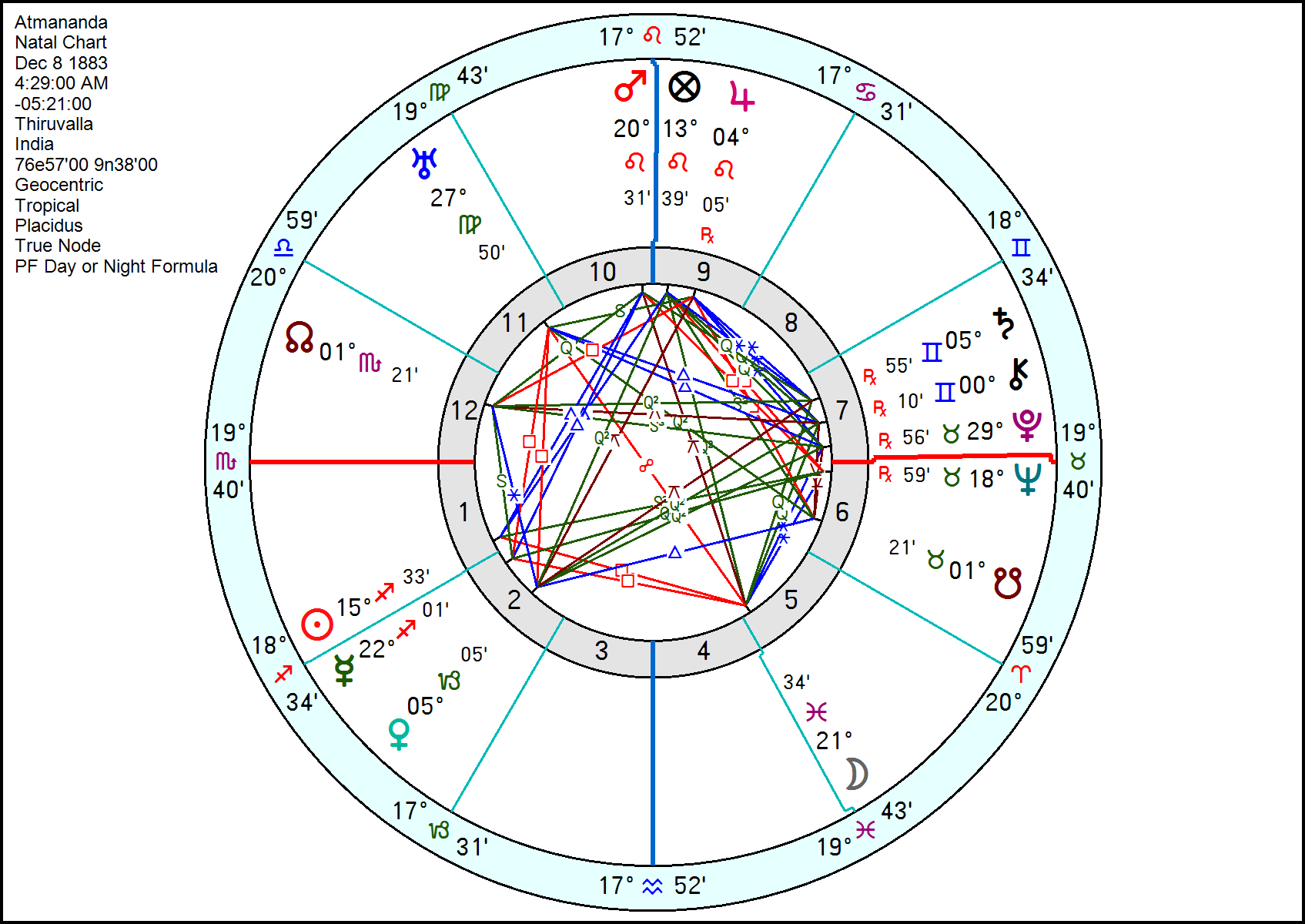
ASTROLOGY; HOROSCOPE-ATMANANDA
TOPIC: Astrology
SUBJECT: Horoscope-Atmananda
SUBSUBJECT: Atmananda natal chart (Chaldeans)
CONTENTS:
Student discussion of Atmananda's Moon at Pisces 22 and its opposite
Student discussion of Atmananda's Mars at Leo 21 and its opposite
Discussion trying to differentiate Mars and Venus–which one does the desiring?
Mars at Leo 21: superior state of consciousness available to the animal; an intense desire to manifest the divine consciousness in an animal body
Opposite at Aquarius 21: dispassion towards the mind's functioning; consequence of this is compassion for others
Through the lower desires you're achieving what the higher will wants done
More discussion differentiating Mars and Venus
Venus will pictorialize not only what it likes but also what it dislikes
Venus as function of the mind to manifest the intelligible
Jupiter at Leo 5: ego as a natural product of the world-process/World-Idea, has a long history behind it; takes millions of years to produce a Buddha
Opposite at Aquarius 5: all the past experiences which have made your ego to be what it is can now be projected out to guide you further along the way; all of your past is there to instruct you
Choosing a teacher is not a rational process, is based on the profundity of your past
Primal image, reflective consciousness, prepositions, and introduction of ego
AD on how to read a Sabian symbol: throw mind out of focus, attenuate all prepositional relations until image is a phenomenal presentation with no ego-subject
Prepositions reveal presuppositions
Saturn at Gemini 6: intense reflective consciousness; Spinoza: "Nothing worthwhile without great labor"
Opposite at Sagittarius 6 in first house: outward manifestation of intensive introspection into attention leads to a settled conviction of who you are; reflectively you know who you are
Always examine the self-image you work with, most of us have a wrong self-image
Atmananda always cooperated with flow of World-Idea; indicated by his multiple house (not sign) dignities
BOOKS READ FROM OR REFERENCED:
Marc Edmund Jones, The Astrology of Concepts
Marc Edmund Jones, The Sabian Symbols in Astrology
Swami Nikhilananda (tr.), The Mandukyopanishad with Gaudapada's Karika and Sankara's Commentary
John Bunyan, The Pilgrim's Progress
Atmananda, Atmanandopanishat: Atmadarsan, Volume 1
Atmananda, Nitya Tripta, Notes on Spiritual Discourses of Shri Atmananda
SABIAN SYMBOLS: Gemini 6, Leo 5, 21, Virgo 22, Sagittarius 6, Aquarius 5, 21, Pisces 22
CHARTS appended to this transcript:
FIGURE 1983 1128-1. Atmananda Natal Chart.
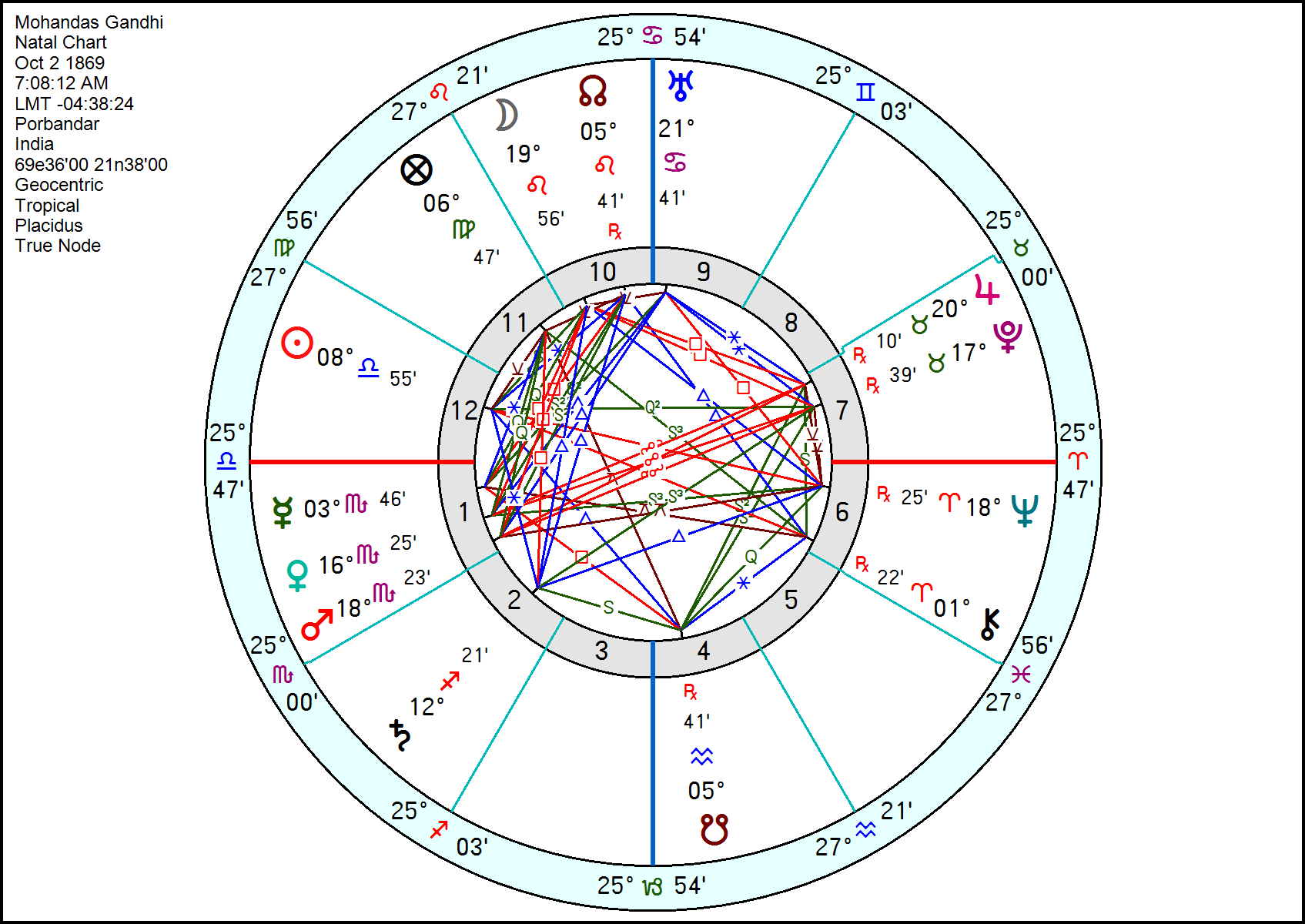
FIGURE 1983 1128-2. Gandhi Natal Chart (astro.com).
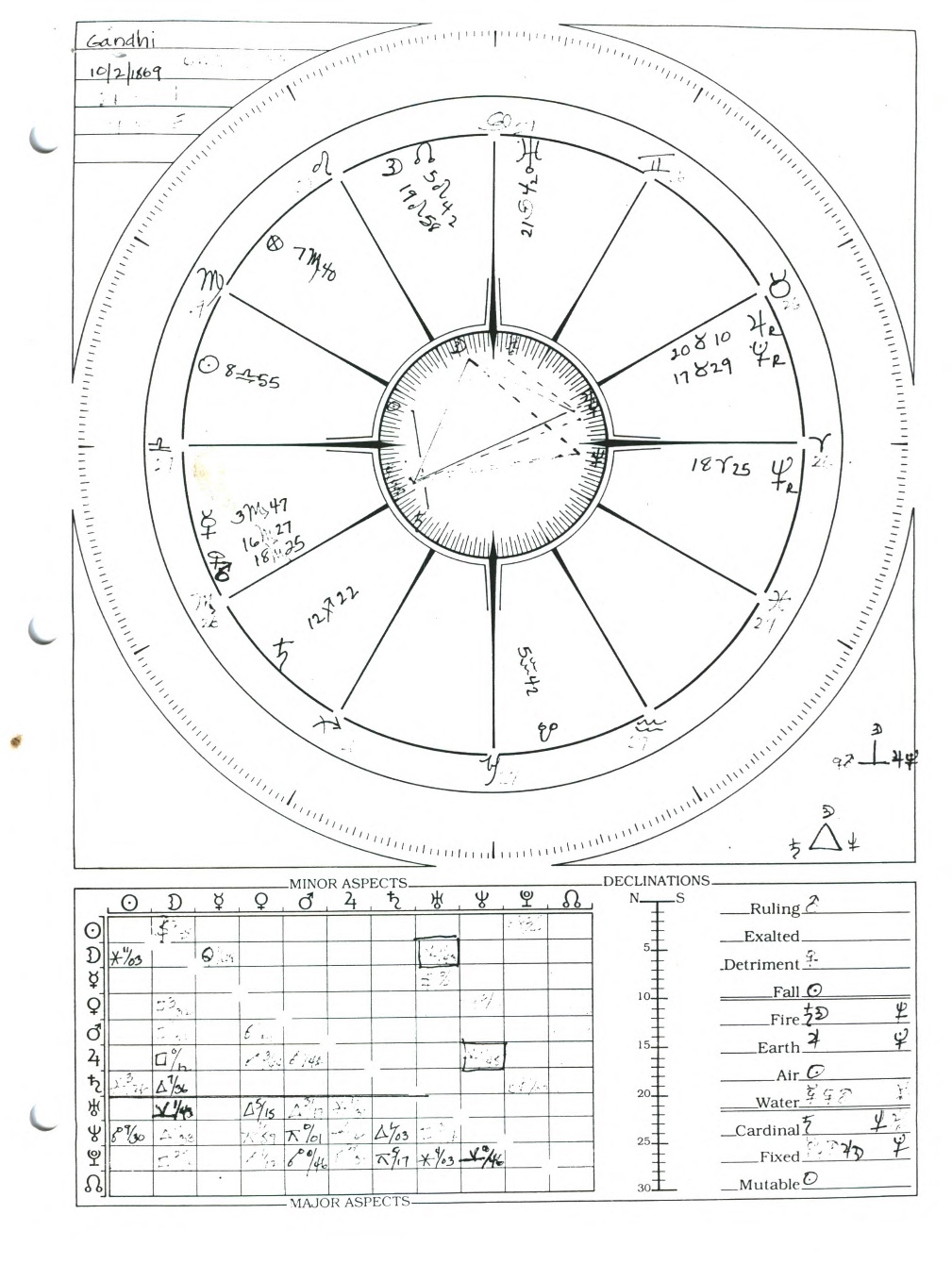
FIGURE 1983 1128-3. Gandhi Natal Chart (WG version).
NOTES:
- Atmananda also known as Sri Krishna Menon.
TRANSCRIBED Verbatim by IT prior to 2018 (V11a). This is V12a (2023) and has: updated prefatory matter, footer, and audio file name; Book List and TOC completed; new notes within transcript; Atmananda chart replaced, Gandhi chart added; new formatting to accord with new conventions. In 2025, IT updates audio file markers to match new REP audio. Archival verbatim transcript – V12a.
AUDIO FILES: 1983 1128a, 1983 1128b. [Note 1: "Tape" and "Side" refer to original audio cassette tapes that were later digitized into .MP3 Audio Files. Note 2: In 2025, REP Studio cuts dead air from file a and improves its sound quality.]
1983 11/28 at Wisdom's Goldenrod
Astrology; Horoscope-Atmananda (Sri Krishna Menon)
[Audio File 1983 1128a Begins]
S (very faint): Yeah. Again?
TS: 22 Pisces.
[student assents, very faint]
S (very faint, possibly part of background): That's deep.
[few seconds of very faint AD talking in background; continues as LR reads]
Marc Edmund Jones [The Astrology of Concepts, Pisces 22, LR reading]: "Down the man-made mountain of industry in allegorical representation comes a prophet with tablets of a new Law."
[few more seconds of very faint AD and student talking in background, flipping of pages]
Marc Edmund Jones [The Sabian Symbols in Astrology, Pisces 22, TS reading]: "This is a symbol of the eternal authority implicit in the very fact of man's ideals, [and] of a spiritualization of experience through the religious insights of a human-- of [a] human society and the institutions it has created for the common welfare. The inspired prophets of each age have been custodians of an enduring morality, and this has its embodiment in the mountain-top aspiration of even the least of individuals. Right is dramatized as a personal responsibility for the course of events. [The] keyword is MANDATE. When positive [TS reads: Positively], the degree is self-sacrifice and a determination to further the ultimate upliftment of all men…"
TS: Ok. The opposite degree is--
Marc Edmund Jones [The Astrology of Concepts, Virgo 22, TS reading]: "Upon rich velvet in a case, at an exhibition, is an exquisitely wrought miniature; a jewel-set royal coat-of-arms."
TS: Now, I'll read you what he says about this degree which sounds exactly like what he just said about 22 Pisces and--
Marc Edmund Jones [The Sabian Symbols in Astrology, Virgo 22, TS reading]: "This is a symbol of the eternal authority implicit in the very fact of existence, and of the consequent dignification of experience through the laws and customs by which man organizes the conduct of his own affairs. The elders of the tribe [TS: This is where it gets different from the other one."The elders of the tribe] were long the custodians of this common-sense regulation of life, and an aristocracy of [blood or of] the inherited stewardship of social function has continued to re-enact these values and to enforce their observance. Right is dramatized as a privilege worthy of sustainment. [The] keyword is PREROGATIVE. When positive [TS reads: Positively], [the degree is] a gift for bringing all men together in common purpose and unified stability…"
TS: That's his Moon. Maybe we should read that whole thing over or-- [20¾ second pause with very faint background student talking, shuffling about] Well, I made a few notes on this. [short pause] And that'll be at least a jumping off place for us…I hope.
[short pause]
[Transcriber note: TS is reading his own notes. I don't have a copy of these notes, quotes should be checked.]
TS [Notes, TS reading]: "Moon is the function of memory, body-based subjectivity, the assimilative function, (could call/we've called) it the organization of the vasanas from the past. In the fourth house there would be a personal management of day-to-day functions, a recognition of who he was, in the sense that the fourth house is the self-image, here in a very exalted sense. In Pisces, there may be the indication that he would become detached from the personality, that he was born with a natural disinclination to take life personally. The degree indicates to me that his personality reflects the tremendous self-development and effort he must have made in the past to be able to enact his teacher's suggestions only after one meeting. Perhaps we could say that the ego easily recognized its place and was able to take the demands of a Higher Self as its mandate."
TS: Another way to-- some other thoughts on it was that the self-effort had reached its peak, and that having rea-- reached its peak of hi-- what the individual ego could do in itself, the Higher Self could come down with-- with the true doctrine, the knowledge. The way I understood the opposite degree, the 22 Virgo, jewel-- miniature jewel coat-of-arms, I was wondering if we could see that here as the content of that Moon as being the individual's soul's knowledge of the Intellectual-Principle, that there was a kind of assimilation of metaphysics or of an impersonal kind of doctrine, that he had developed a personality capable of being a channel through which that vision could be spoken of. [10 second pause] And (it's/that's) as far as I got.
[short pause]
LR: I think we emphasized the-- in the long symbol, the fact that-- that it was a mound-made-- man-made mountain of industry, and then that that was the mountain down which this revelation could pass. And-- so with that-- that it was actually-- the man-made mountain is like the ego's work, and it has to actually build that channel, the ego is actually what builds the channel to the Higher Self. [student assents] And that the symbol-- the symbol seems to say that that mountain has been built, that there's a clear channel to receive the (Law/Word), so to speak, and that that vehicle or that mountain has been built into the actual physical make-up of the man, that in fact it was something buried in his blood, that it's not antagonistic to it, that there's no impediment by the body to the truth or to the (Word), to the annunciation. [short pause] And, the opposite degree, the miniature jewel-set coat-of-arms, seemed to be like the Atman (attached) on itself, (Atmananda) [one/two words inaudible] It-- that's like a jewel, like a kernel, completely concise kernel of a whole tradition, a whole-- I mean Jones says the opposite means veneration of the values of the past. And it's like in every instant of his life the whole is, you know, reconstructed, like that little [one word inaudible] just very concise statement of Vedanta, or Tim wanted to say just the individual statement of (vichara), just--
TS: Yeah, well he-- to my own thinking so far anyway, I thought that the planets in the ninth house would tend to involve the person with the more traditional or orthodox perspective, and also the meanings when we get to that. And I thought here with this-- this Moon, that it was the content through which he was bringing into-- into that tradition was this kind of present vision of the intellectual cosmos, and that his writings really-- besides being pithy, are more impersonal and metaphysical I would guess, the-- them or, you know, they're a combination of epistemology and metaphysics. They don't speak so much to a kind of mystical development or subjective evolution.
LR: And in that Moon symbol, the man-- the mountain, it leaves very-- it really isn't-- I need the symbols-- there really is not a whole lot of personality to be seen, you know. The symbol seems to say to me that the whole personality is built on the receiving the testimony. And in the fourth house, you don't see a whole lot of personality in that regard, at least you-- we haven't-- we don't have any statement of a personal life. It seems like the whole personal-- personal life is built on this reception, which would be really the Moon function developed to its most refined functioning, because the Moon's supposed to be receptivity or assimilation. And here it seems to say that all the faculties of the physical life are clearly built on-- built up to such a degree that they could be purely receptive in some way.
KD: How do you get ego development out of this, from-- from the symbol, fourth house, or the Moon? Tim, you had mentioned that the fourth house you thought was self-image? Wouldn't that be the first house, this--
TS (simultaneously): Well, the way I understand it is that the-- I'll answer both of your questions, they're not the same thing, they are the-- The first house is the self-identity, the fourth house is the self-image. If you want to be a certain thing when you grow up usually that thing that you want to be could be spoken in terms of the planets that are in the fourth house. But it's not something you're necessarily identified with at birth. And there's certain tools, skills, functions that you want to-- to assimilate, to take into yourself, to create or build up, to accomplish.
KD (simultaneously): Wouldn't that be ideals, wishes?
TS (simultaneously): Uh-uh, no, that would be the eleventh.
KD: Yeah.
TS: No, this is-- you decide that it's very important for you to be rational, so you have Uranus in the fourth house. Or you decide that you want to be a writer, you have Mercury in the fourth house. And you aren't-- like if you have it in the first house you just write, that's not a decision, "Well, I'm going to be a writer, I would like to be a writer."
LR (simultaneously): Well, it's the manifestati-- it's what you want to manifest of yourself, it's the image you want to make of yourself that's, you know-- [KD simultaneously: Is that-- is that--] It's not what you'd necessarily take yourself to be.
KD: Is that why you stress the ego development? Is this--
TS (simultaneously): No. No it's not.
KD (simultaneously): Ok, I--
TS: Are you asking--
KD (simultaneously): I thought maybe that was tied together.
TS: No, it's because it's a-- it's a man-made. The mount-- it's a man-made mountain of industry, and then this prophet of power comes down and (brings) the tablets of the new Law. And unfortunately we're making an exception here from-- in the sense that we're assuming the highest interpretation of these degrees. And it would seem like the fulfillment of-- I mean-- in my understanding of what happens in the process of realization is that the ego has to work to develop itself to a c-- till it reaches a certain kind of perfection or peak or whatever and then-- then the Self comes in and takes over, the Higher Self comes in and takes over, and the work goes on. But at first the ego must do the work up to a certain point. And it seemed like this degree carried that kind of meaning, that this is such an i-- that one of the ideas in the 360 would be that the ego has to make-- build itself up to the point that it can be strong enough and refined enough and detached enough to let the-- that Higher Self come in. And here we say that his vasanas are organized to operate that way, that the personality, which is the Moon, is organized to recognize or to turn itself over to that higher power and let it come in and--
KD: Yeah, I just wondered where you got ego development 'cause it-- the symbol to me suggested more of a soc-- society or cultural heritage, you know, man-made mountain of industry, that that was the-- the contribution of-- like a cultural contribution over years and years and years, you know, like maybe that would refer to the Vedanta or something. I don't know, [LR simultaneously: Then how do you-- I'd have to--] I'm just-- I just got more of a society, you know, (when) you have a (cultural/culture) [one word inaudible]
LR (simultaneously): I mean you have to put that with the Moon, I mean you have to put that with the personal functioning of his own psyche.
KD: Yeah.
LR: I mean that's the symbol, but now [KD simultaneously: Yeah.] how do you apply the-- how would you--
KD (simultaneously): I would say that the organization of vasanas-- I mean his vasanas were organized in such a way as to-- as to continue that or reflect it or maybe be a channel for that accumulated wisdom. I just-- I just thought maybe the-- the symbol referred to a-- to me suggested a cultural like heritage rather than it-- a personal ego development, ra-- rather than a-- it-- rather than having it refer to an individual and his ego development. I don't know, this--
TS: Well, I don't know that-- I mean, I would imagine that a fairly developed ego would have a certain amount of culture in it, that, you know, if it-- it is a product of a society, I don't know that the interpretations have to clash, you know.
KD: No, I just thought the man-made mountain of industry suggested to me rather than a personal individual ego development that that would refer to a cultural [TS simultaneously: I understand.] heritage, a heritage--
TS (simultaneously): But see, we're saying now we have to take the degree meaning, the degree and the function. And the function here is the most personal, most immediate of the planets in some ways, I mean the Moon's right out there, it's the most immediate to the Earth, closest to the body. In some ways I think of that as the immediate subjectivity or the emotional psychosomatic kind of-- of process, the personality itself. So you're saying we take the personality itself and how can we-- we're saying that this is a meaning or idea that's in the personality. How do we understand that? So we're saying that here the personality is something that's man-made, ok, but showing, you know, eons of effort. That-- I was thinking of a comment that Randy mentioned, I believe, about PB, that he said that he had spent several lifetimes working on developing a certain kind of aura and an atmosphere. And I could see here that also a sense that the pers-- for the Sage to be a Sage, that the personality would have had to (have) gone through tremendous refinement, purification, objectification. And that it would be a tool, it would be a function, it's not a-- a point of identity as it is for most of us, but it's a function that can be used. And that to be able to develop a personality which could not just go into Nirvikalpa samadhi and just shut off the personality but actually come back and communicate and make that bridge would seem to be a very rare thing. [student assents, faint] Ok, is that--
KD: Well go ahead.
TS (faint): No. Just a little.
LDS: How about the idea of the householder that he-- that he brought the message for or seemed to live and express a lot? You were speaking of the Moon that's in the fourth house, and, the opposite symbol does seem to have something to do with a "dignification of experience through the laws and customs by which man organizes the conduct of his own affairs." (Virgo 22) I just wondered if you could see any-- any connection with the whole idea of the householder in this sit-- you know, in this Moon. It seems like the Moon symbol itself that it's sitting on has something to do, as you have said, with this receptivity of ideals or truth for him. He was certainly a Jnani and everything. But he also had to bring that to bear on the householder's life. It couldn't be just-- you know, live for himself or in a mo-- monastic situation. Can you relate that to the Moon at all?
AH: Actually I had a comment that I think is obliquely connected to the other two. Do you ever speak of the Moon as the body-based consciousness? Is that--
S (very faint): Yeah.
AH: Like, you remember he-- he felt the lower yogas were an unnecessary discipline but he was committed to do it. I think some of-- a lot of times the lower yogas are means by way of preparing the body, the subtle currents that we embody. It's like that was already (taken care of). Also, he was able to do those practices while carrying on his householder's life. It's-- it's almost as if that mountain symbol is his actual physical body.
TS: Yes.
LC (faint): It sounds like what Linda was saying as well.
S (faint): [couple words inaudible]
LC (faint): [couple words inaudible]
AH: It's a body that's been prepared for those--
LC: (Realm.)
TS: Yeah.
S: Yeah.
AH: If you talk about the strain on the nervous system and the various ways of purifying the nadis and to straighten out the subtle currents of the body, it was all taken care of when (he needed it). He went through those lower yogas as a-- as an acade-- academic sort of thing, it wasn't--
TS: Well it wasn't quite academic, he ended up paralyzed for a while.
AH: Didn't he go through them very quickly?
TS: Yeah, four, five years.
AH: And each of them might represent a life-- a life's ambition, yeah.
LR (faint): Anne, do you have anything to offer [one word inaudible] What were your thoughts about [AK assents] the Moon?
AK: You mean in terms of trying to see the Moon as reminiscence [LR: Yeah.] as opposed to looking at it as instinctual or archetypal, as he did. And as Andrew was saying, (and) there-- you-- looking at the life you don't see much in terms of what we would consider ego development, you wouldn't see any psychological development per se. He'd seem to be a man of reminiscence, you know (what you're saying), bringing-- bringing things to-- bringing the-- these yogas-- bringing them up to consciousness that were already accomplished, man-made industry, man-made mountain of industry. He's bringing these already accomplished yogas back to his immediate consciousness, immediate body. How do you see the-- you know, we-- we had spoken originally about that-- the rulerships he has by house. Do you have any thoughts on the Moon rulership?
TS: The only one that I had so far was that it seemed as though his immediate circumstances and environment provided him with everything that was needed, you know, he didn't-- you know, he was wandering around wondering what he was going to do after praying for three months and the future came to him, you know, that his-- he didn't have to travel all over India or the West or-- or whatever to find his teacher or his job or whatever. Things were provided in his immediate environment, he didn't go that far away from his childhood birthplace, and-- and in that-- those circumstances were-- the World-Idea provided those things which were-- which were expressed as personal needs, like when he had the-- the personal need to find a teacher, you know, that it came to him in that way.
LR: Well that also might be [one/two words inaudible] which is common, as opposed to the Moon rulership by house, so that, let's say the control of those-- the appropriateness of those-- of the physical body and of those vasanas to the home [student assents] was something that he very much felt was appropriate [LDS: Yeah.] and in-- [LDS simultaneously: Would be an issue.] it's in this book, yeah.
LDS: That would be a big issue in his life.
LR: Circumstance, yeah, the Moon's rulership over those kinds of [one word inaudible]
LDS: Yeah.
LR: So, you know, many people might write about the hindrances (or) householder to the quest. He didn't seem to feel that was necessary at all, that living that kind of natural life could be perfectly in tune with it.
LDS (simultaneously): Uh-hm.
[short pause]
AK: What if I [TS assents, faint] read the-- the short version of the opposite degree, [S simultaneously: What?] read [one word inaudible] (Virgo)? That's the jewel-set royal coat-of-arms.
Marc Edmund Jones [The Astrology of Concepts, Virgo 22, AK reading]: "This is a symbol of the preservation of the venerable values of the race in new form or of a [AK reads: the] healthy veneration rather than blind adulation of the past. Positively it is a degree of certification of merit; negatively, an enjoyment of life's prerogatives. [The] keyword is ARISTOCRACY."
AK: Think-- think it's really easy to see those-- his place in the world as functioning in the tenth house as a natural aristocrat, the-- Think he was-- he was perceived outwardly as a, oh, a noble character even before he was involved in the spiritual quest. But--
[student assents]
AK: There was-- there was no, you know, struggle of-- of-- of finding his place particularly.
[short pause]
TS/S(?): [couple/three words inaudible]
AK (simultaneously): Did you-- did you find any-- any information on-- he didn't seem to have any-- any organizational (prowess/powers) of any kind.
TS: Not that I know of really. [student assents, very faint] I was looking through here to see if there was any comments on other doctrines or what not, [AK, faint: Right.] even Vedanta. [student assents] Seems like other than referring to them in terms of their philosophic tenets, wasn't any real reference to them that I could see that, you know-- Yeah it's such sparse material, in fact. It certainly didn't seem it-- to be reflected in-- as his preoccupation in any way. I see what you're saying is that-- if you say that the inner function of the Moon is one where the vasanas have been organized such that they can allow a certain kind of reminiscence or receptivity to the Higher Self, that the outer re-- manifestation of that would be a kind of-- a natural nobility, like the personality would reflect the virtues of the soul. And-- and that there would be-- there'd be a certain kind of beauty and naturalness with which you would see the personality operate. I mean it seems as though-- would you say that there's a-- a kind of expression of love and beauty that's-- that was a part of his personality?
[short pause]
AK: For someone with Mars in Scorpio, he seemed to be--
TS: Leo, (Leo/you know).
AK/S(?): Oh excuse me, what do-- what do you want for Christmas?
AK: Oh I'm sorry, I was just cycling back as conferring Gandhi, [TS simultaneously: Ah.] Gandhi's heavy real trip that he imposed on people with the Mars as opposed to Atmananda who just was who he was and people accommodated themselves to it.
LR: It's interesting that you bring up Gandhi because (we/you) were talking about that today. Gandhi, the Moon was on the midheaven.
AK: Oh, the opposite.
LR: And, his personality was what he wanted to make the world into. [S, faint: Pretty much.] In other words, his personality was what he had to present as an example.
AH: I--
[student assents, very faint]
AK: Hm.
LR: And his personal life is very much the issue, you know, "In my personal life I follow this habit, that habit, that habit, and people should try to conform to those." And it (seems/seemed) like that Moon, you know we were talking about where's his personality, where is Atmananda's personality. How do we know anything about it? It's-- it seems to be kind of made over, it seems to be irrelevant. It seems to have given itself up to a certain kind of impersonality whereas in Gandhi's Moon on the midheaven, the personality-- well, I don't know if you're going to like that word but, just the pers-- well the personal life, [students assent, faint] the habits in the personal life was exactly the issue. [AK assents] And that's all you'd read when you read Gandhi's journals, you know, just-- "This morning I had buttermilk at 7 o'clock and then I…" you know, he goes on and on and on. [student assents] [one/two inaudible student words simultaneous with LR] Personal habits.
AH: Try to make India over in his own image.
[LR and other students assent, very faint]
AK: So that we could-- there is an interesting point that there were-- Atmananda seemed to rule through the appeal of the higher, you know, that they-- that there was this-- all-- all men seek the Good, and whatever their-- their manifestation of the Good is, that's what they're seeking. He seemed to be able to make over the environment to project his immediate-- his consciousness out into the world as a desirable environment, desirable values.
LR: You're talking about the Mars now.
AK: Maybe.
LR: Yeah.
AK: But I just (need) the Moon in terms of this channel. 'Cause we'd have to see how he's going to make it manifest out in the tenth house, it's going to-- in his-- if you take the tenth house like place in the world or occu-- occupation of some kind or so, to-- to see him as working with police, looking at-- But like Gandhi sounds much more like the police than Atmananda does.
S (faint): Yeah.
TS: In terms of his will, his--
AK: Yeah.
TS: Yeah.
AK: In terms of-- that's right, as a-- as a person working he-- he adhered to rigorous enterprise system, which is, you know, almost unheard of in India, that kind of rigor, professional rigor, and that-- and that's just the way he organized his work. And-- well other people valued it, it was these jewels, this-- this nobleman among us was valued as--
LR: Yeah, I can see that and I can also see it as the book, the royal jewel-set coat-of arms, you know, this perfect--
AK: The aphoristic quality of his writing.
LR: Well, not-- yeah that but also the fact that in that one little statement, I mean it's so essential, which a coat-of-arms is anyway but now it's in miniature too, you know. [AK assents] It's just all there in this very concise, very perfect form. I can see that as the opposite degree, his statement of the (work/worth)-- the work of the opposite degree. In other words, that's as much to me his public life as the fact that he was a policeman, that book that was such [couple words inaudible]
AK (faint): Yeah but [few words inaudible] talk about and referred to the Mars.
[student noise or one inaudible student word]
TS: It seems [LR simultaneously: Well do we have it?] that it's a very [S simultaneously, very faint: (Uh-uh.)] evanescent degree (and) it seems partly that's-- that's in the nature of the degree but the thing-- the anecdote you mentioned where he got a 9 not a 90, you know, what's the difference, (well) he had-- on his score, that he was kind of non-involved with his own personality in the sense of taking what was ever appropriate, I thought might come from-- from that Moon. I also think that it might also be due to his time where he was-- his-- the slant of those people around him that his-- the ethical activity that he may have practiced on his job is not as e-- e-- easily accessible to us, you know, he-- here's a person who's teaching that the world is illusory and meticulously ethical on his job, you know, uh--
[student assents, faint]
AK: Well, I mean, [LC simultaneously: His--] [TS simultaneously: You know.] maybe-- maybe that's why-- this maybe is what the police person-- the police commissioner saw him as this natural moral authority, [TS assents] that's what I was trying to work my way around to, that he projected into the world, into his [one/two words inaudible] from within himself.
TS: And he probably set a paradigm for that in terms of those who-- who were able to contact him and-- you know. It might have been something that's not available to us now, but for those people around him he probably was like kind of a-- a high water mark or whatever and reference point, he would just act with a-- a natural careful attention to doing the right thing in every aspect of his professional life.
AH: So there's a way-- I think there's a way of connecting the two symbols. If you say that one hand there's a man-made mountain that was built up over a long time suggesting the past, and that the coat-of-arms was originally carried on a shield, as in the modern world (it would) miniaturize the kind of [few words inaudible] symbol, suggesting the past. Like people have had their coat-of-arms embossed on their stationary, but it used to be carried on a shield, suggesting a thousand years of history.
LR: Yeah, that suggested to me too that-- that in every instant in the smallest quantum of the life let's say, that perfection is displayed, exhibited, [AH assents, very faint] that the fact that it was that minia-- not-- I think you were saying this too, that in it(--/,) there wasn't an aspect of the life, there wasn't a minute in the life to which that achievement was not applied, did not have to be directed. It had to be in every instant, in every minute, [AH: An obligation to--] perfection of the instant.
AH: An obligation to the past.
S (faint): Right.
LR: [one/two words inaudible]
[11 second pause]
LR: Do we have more (to say on this)? Does anyone have anything to add to this Moon?
LS: Do you think that he was bringing down a law for his times?
LR: Say more.
LS: Well, it isn't just about Sinai, I mean, so-- [student assents, faint] It's really-- it's-- it says a man-made mountain of industry. I think he was actually reaching out of his own past and out of his own [few words inaudible] into the psychic stream of these times to create a law that was both, that was a law included in the tradition yet a law spoken the language [one word inaudible] of his times, that's the way I see that degree.
[10¾ second pause]
PD: Could you say that the-- in his personal life was a complete embodiment of the ideals of the Hindu life and a fulfillment of the cultural ideas. And in doing that in his personal life, he naturally became a man of authority and responsibility out in the world and in terms of the Hindu culture. And that's connecting the two symbols together. [short pause] Because in a sense he's the com-- he's a-- a n-- almost like a natural product of the Hindu culture and-- (or/of) the ideals of the Hindu culture. [short pause] So he fulfilled those ideals of his culture in a-- right down to the domestic life. And so he brought the-- the scriptural laws and culture to fulfillment within his own personal life, and that automatically manifested in the world, in society-- you know, he's shown as a man of responsibility and of virtue.
TS: Yeah, I mean, and it seems like, as a, you know-- that he-- in terms of the actual life activities, it wasn't something which was like new age or what have you but it was really-- like you say, it was a classical kind of life of a-- of someone who was a-- an aspirant in India at that time. It was a fulfillment or co-- a continuum within the or-- within a doctrine, within the culture, with the exception that he was bringing in this stage of the-- the Sage or the Jivanmukta into the-- as accomplished in the context of a householder's life and that seems to be a new law in a sense, that it's-- it's done in this-- you don't have to go off to an ashram or become a sannyasin in order to do that, but yet still stay within the culture, it wasn't a question of rejecting [PD: That's right.] and going off into-- taking on Western or [one/two words inaudible]
PD (simultaneously): Or starting a new movement or--
TS: Yeah. He doesn't-- there's not a school. And the other thing is that I think-- I wondered if it might be a-- well, this is stretching and reaching a bit, that in this Upanishad, in his two little Upanishads, really are Upanishads, I mean they really are scripture and they're real-- written in English, you know. And that--
PD (simultaneously): Well they were first written in his native language as a poetical work [TS simultaneously: Yeah.] and then he translated them.
TS: Yeah, but he translated them, not somebody else, [PD assents] he translated them, you can't fault the translator for making them first, you know, or say well, because they had to memorize them they kept them short like the Mandukya or something like that. No, this is it, take it or leave it, you know. And I think that kind of reformulation, that kind of revela-- that renewed revelation of showing that the Vedanta or (the--)
PD: Is pertinent today.
TS: Yeah, that there's an eternal vision and has as much pertinence today as it does in any other part, you know, in its form as a tradition that he had-- would, you know-- had been carried in the past. 'Cause this thing isn't much longer than the Mandukya Upanishad and its karikas, you know, it's just about as understandable. (I'm joking.) And those were the two ways I was trying to see this new law coming down and that there's a kind of special gift in his own culture. He was a gift to his own culture. And I could see that as being the opposite degree.
[short pause]
S (very faint): In the mountain [one word inaudible]
TS: Yeah.
S (faint): I'm sure.
[short pause]
LR: We're doing Mars?
TS: Failing any helpful remarks, yes. Ok.
S (very faint whisper): [few words inaudible]
[student assents, faint]
TS: What?
S (very faint): (Speak up.)
S (faint): [couple words inaudible]
LR/S(?) (faint): I'm so [few words inaudible] there's some--
TS (simultaneously): Right, I know. The comprehension, depth and breadth of our in-- insights.
LR: The Mars symbol is--
Marc Edmund Jones [The Astrology of Concepts, Leo 21, LR reading]: "An unwitting allegory is enacted by a few chickens who have gotten at some fermented feed, and are happily intoxicated."
LR: That's Leo 21. And the opposite is--
Marc Edmund Jones [The Astrology of Concepts, Aquarius 21, LR reading]: "Leaving the room is a well-groomed and striking and conspicuously solitary woman long disappointed and disillusioned."
LR: And that would be right on the nadir and midheaven.
S: [one/two words inaudible]
LR (faint): This is.
LS: Do you know what the unwitting allegory is?
TS: Which unwitting allegory?
LR: Chicken?
LS: Yeah.
LR: Ok.
LS: What allegory are they enacting there?
S (very faint): (It seems it) didn't say.
LR: Well that's the meaning of the symbol, when we get the meaning of the symbol you'll know what the allegory [one/two words inaudible] [couple/few inaudible TS words simultaneous with LR] I mean they're enacting an allegory by eating this fermented feed and getting intoxicated. Now what's the meaning of that? Unwitting, they're not purposely acting out a play. Their actions are--
LS (simultaneously): Well, I got that point. (laughter)
LR: So, I thought the unwitting allegory was--
TS: I see, you've only got the-- the unwitting part [few words inaudible] (laughter)
S: Yeah. (S laughing a bit)
[bit of laughter and a few student words in background followed by short pause]
TS: What's an allegory? Where's [couple words inaudible] when I need it.
LR (very faint): An allegory is (a/uh) [few words inaudible] A guy comes up to you and tells you that [few words inaudible] Isn't an allegory like [one word inaudible]
AH: Linda? Can't hear you.
LR: Oh. [TS simultaneously: That's right (couple words inaudible) hey.] Andrew, you're the English teacher, what's an allegory?
AH (simultaneously): An allegory is a story that can be read on two or more levels.
S (very faint): [couple words inaudible] (some laughter, student words)
LS: One obvious level is that the feed was rotten, that's one level. (some laughter)
AH: It's like Pilgrim's Progress. [Note: John Bunyan, Pilgrim's Progress.]
TS: If you can read it at all (then it's right). (bit of laughter) Ok. I wrote up a little fairytale on this which I would like to throw out because I think some of the ideas in here approach the meaning of that degree. With the idea that it's Atmananda's Mars that we're reading here, not just Mars in (21 Leo). The allegory here involves that it's Mars.
TS [Notes, TS reading]: "Mars is the desire nature, the heart's desire, the lower will, sense of free will, so forth, so on, shadow…"
TS: I (don't/won't) read all of it.
TS [Notes, TS reading]: "In the ninth house Mars would direct the attention towards spiritual self-discipline, towards acting in accordance with one's beliefs. There would tend to be a focus on one tradition over others. The degree would give him an uncanny sense of when he was acting according to inner directives and when not. There would be an inborn uneasiness whenever he went beyond the focus of his direction and a natural happiness in pursuing and attaining his goals. Once the natural perspective was discovered, there would be an ability to focus on every aspect of daily life or of inquiry, so long as these needs sprang up from the soul of the enquirer. He would be able to see the soul's longing in others and act to bring about some sense of its presence in them. [TS: This is bringing the opposite degree in.] In Leo there would be a period of discovering his own potential and a natural compulsion to distinguish himself from his outer environment. There would also be an innate tendency to act from the heart rather than the head. The degree would give him a natural intoxication, an intensification of the will, as a bound approach to maintain his goal. The degree also indicates that all the natural desires have been or were converted to desires for-- of the Atma, that nothing in the world or Nature could be done or enjoyed for its own sake, yet there would be a tremendous enjoyment for these things as they imaged forth the uplifting joy of the Self."
TS: And I think that's-- the thing about those chickens is they can't walk. Their instincts are short-circuited, they-- they can't peck, they just flop around and fall over and what not.
LR: But drunk people do that too. [S simultaneously: Yeah.] I mean that's not just chickens.
TS (simultaneously): Chickens do it a lot quicker, they--
LR: Not but, I mean-- (bit of laughter)
LS: But that's a witting allegory.
AH: Sometimes they drive when they're too drunk to walk. (bit of laughter)
TS: But something about the way he talk-- about Jones talks about this degree I-- I get this feeling that-- that anytime that you-- with this Mars degree, anytime that he wasn't applying his will intensely towards his goal, there'd be this uneasiness in the sense of-- the Mars would be very sensitive towards directing the energies towards what was a presented task and there would be a kind of natural joy in any kind of achievement of that or even effort towards accomplishing that and maintaining it. Because I would imagine that it takes something to be maintained, that-- in terms of the amount of energy that's required by the psyche, that it's a constant outpouring of energy. And that here there's a kind of short-- all the instincts have been short-circuited to being instincts for the Self. And they-- they didn't have their-- their ordinary feed, but that, you know, the whole field(--/,) the same as the Vedantists [one/two words inaudible] you know, not for the sake of the wife is the wife is dear but for the sake of the Self. And he really explains that and he writes out a good number of things about--
(Side 1 of original cassette tape digitized as 1983 1128a Ends; Side 2 Begins)
S: Yeah.
LR: It seems like it with this Mars that he knows he can-- the a-- active outreach then is directed to absolute fulfillment of desire, in this case in the ninth house, some ideal of desire. And there's no stopping, there's no-- there are no rungs on the ladder. The only stopping point in the symbol comes through the absolute manipulation [one/two words inaudible] That-- there is no accepting in-- acceptance in Atmananda's position at all for anything short of the Absolute. It's to be able to-- It's like you totally fulfill the goal. There are no other stations that are accepted, you know, it-- there's no position other than the complete position. And-- well I don't think-- I thought the chickens could be seen like a restlessness. Could that be then a kind of restlessness, a kind of witting mind that has nowhere to stop, is just running all over the place all the time? At least that's what I think (of/you know) as the chicken(s), I mean-- The drunkenness represents the final state where the motion actually stops and that the ignorance of the animal (vasana) is transfigured or transformed. So for me it's not normal when it's usual-- it's not its normal state, you know, drunk chickens are not what you usually see when you look in a barnyard. And, the opposite-- the opposite seems to me to be-- the disillusioned woman seemed to suggest to me the barrenness of the ego, that Atmananda knew and saw that identifying with the psyche-- that the soul knew that that identity-- there's a barrenness to any identification with the psyche, the woman is leaving the room completely disillusioned. And I see those in harmony, those two degrees. What-- Tim, didn't you say today that you thought that degree, the opposite, also meant there was no ambition, [TS: Yeah.] no personal ambition, the ambition was strictly for the attainment of the Self?
TS: Yeah, and a big-- and that in-- well I think in the degree itself there's an in-- all the ambitions are-- have been stopped, all the images in the blood have been overridden by the inebriation with the Self. There's no further ambition. And at the same time there's this-- out of that lack of personal ambition, and yet he has an incredibly accurate and specific kind of compassion for anybody that approached him, you know. Reading the interviews, whether they're accurate or not, there's the kind of general sense that one sees of him speaking to the need of the person and not-- not abruptly confronting him with metaphysics necessarily but kind of leading one to it. And I see that in that opposite degree, the-- the woman long disillusioned and disappointed would be the things that-- that might be the soul of the aspirant as being somewhat disillusioned with its-- its present occupant. And, I would see here that, in the ability of the Sage to take into himself the needs of a-- of a student, and to give that student darshan, he would have to have no preference of his own. He'd have to have no personal ambition for what their-- their direction was. He'd have to give them what their soul called forth. And that's what I saw in this degree and its opposite. 'Cause the third house is inquiry, communication, day-to-day contacts, stuff like that.
LR: Don't you think the opposite also is a certain recognition of the Alone?
LC: [few words inaudible] (the fulfill--) yeah. Read the degree [three/few words inaudible] disillusionment given a certain dignity [LR: Yeah.] in the degree, it's not--
Marc Edmund Jones [The Astrology of Concepts, Aquarius 21, LR reading (simultaneously with LC above)]: "Leaving the room is a well-groomed and striking [LC: Yeah.] [and] conspicuously solitary woman…"
LC: Right.
LR: I mean the strike seems to come from a dawning recognition that there is no place for that (kind of--) or there is no-- there's nothing there that's attractive that one can fully identify with. It's a barren state. It's like a (daydream).
KD (simultaneously): Yeah there's not a going-- there's-- there's not like a going out.
S: Why don't you see (in it) any kind of freedom, a real freedom?
KD: Yeah, that's [couple words inaudible]
LC (simultaneously): I-- I think that's the strength. I think what you're calling [LR simultaneously: (I agree.)] freedom is that.
KD: There's not an impulse to go out, you know, it's like a-- a stopping of the energy outward. Tim I was wondering why you-- why you emphasized his will.
TS: Mars.
LR (simultaneously): Mars.
S (simultaneously, faint): Mars.
KD: Well, yeah, but you said that wh-- you thought that while he was-- un-- unless he was acting-- unless he was willing something that things weren't right and I wondered how you got that from his-- from his life because it seems like he was-- I got the impression that there was almost like a-- a lack of will, that his being was so in conformity with the higher that-- and his desires were so in conformity with the higher that there was just like a-- that his-- his actions and his behavior would indicate a lack of that personal will going out. I just wondered where you got the-- the emphasis on his personal willing. I realize it's the Mars but to me that symbol would show like the-- the lack of will. In other words, there's like a stopping. You know, intoxication is the complete cessation of, you know-- of that activity of the instinctual nature. You know, it's no longer going out and doing its thing, it's like, you know, intoxicated drunk, it's like gone back on itself or (something).
LDS: Didn't he say a mantra for ten years?
TS: Seventeen.
LDS: Seventeen years? It seems, Kathleen, like you're speaking more of his interior after his realization but earlier on it [student assents] seemed that he exercised quite a lot of will, [KD simultaneously: Well, it (seems/seemed) like--] you know, in his early life.
TS: He even mani-- you know-- and didn't you say he manipulated circumstance, he was making plans to split and go up to-- to live with his guru, [LDS simultaneously: Oh yeah, that's right.] right, I mean, get out of his, you know-- to pursue that career, [KD: Yeah, but he didn't.] to pursue that seeking of the Self, then he got stopped.
KD: But he didn't.
TS: Yeah.
KD: Right? That's the point. And like this is the end--
TS (simultaneously): Well, that's what I'm saying is (the/a) sensitivity, the uneasiness, I mean some of us might make plans and even if they-- we know they're wrong we just pur-- we continue to seek to actualize them, trusting (the/that) circumstances to correct them.
KD: Yeah. I got a different impression just-- like his period of atheism. He didn't-- he didn't will to like to-- even though to change that was like a--
TS (simultaneously): It's real hard for me to imagine (as that) not willing. I mean--
KD: Like his exam, you know, whether it was 9 or 90 there was like an acceptance of-- of [TS simultaneously: His acceptance of the consequence but not--] circumstances and not the imposition of the personal will.
LDS (simultaneously): That was more like the opposite degree.
TS: Well you're saying that he didn't have an investment in the consequences but he didn't try to fail the exam, he didn't-- he did get a 90, he did work at it, he, you know, put the energy towards it.
LR (simultaneously): And it [one/two words inaudible] (that is) the symbol, I mean the symbol actually seems to say there's not a willing towards personal accomplishment, personal ambition, that kind of will. I mean the symbol seems to say it's just total fulfillment of the Sel-- the state of Selfhood that's being willed here, it's not the kind of-- there's a-- there's a-- a voidness of the kind of personal will, I think that's what you're trying to say.
KD: Yeah. You don't get the impression of a--
LR (simultaneously): That doesn't mean there's no [one word inaudible] it seems like the will is doubly strong because of that.
TS: I mean he prayed with such intensity in dream [LR simultaneously: He can(--/.)] life that he called forth the response from his teacher. Now that's-- I would consider that a kind of will, you know, and [student assents] focusing of all of his energies.
LDS: Yeah, he could focus his energies, that's good.
AH (simultaneously): What if we could speak of--
KD: But when the will is in conformity with the higher we don't speak of it-- we don't speak of it as personal will, you know? (I mean that--)
LR (simultaneously): Ok, no, we have to obviously discuss this-- the word because I think it's more the word than [couple words inaudible]
KD (simultaneously): You know, to me Mars is the pers-- is a personal thrust into-- you know, into existence-- you know, into life.
LR: Mars represents the courage of the soul.
TS (faint): Courage and karma [one/two words inaudible]
LR: I mean why-- you have this [student assents] function at a lower level than we're taking all the other functions that we're reading in the chart.
KD: Ok, and I'm saying that his interpretation stress-- to me I thought that sounded like the personal will thrust into-- you know, thrust into life.
PD (simultaneously): Why-- why can't that be the desire on his part for truth?
TS: Yeah.
LC: That first, (I mean--)
LDS (simultaneously): (Yeah/Right).
S (simultaneously with LC): [couple words inaudible]
PD: I mean, [LDS simultaneously: That was one (one word inaudible)] and a burning desire, who can distinguish that from the will of a-- of the being? I mean, you gotta be careful you don't just banter words. You have a burning desire to-- to experience the truth, beauty or-- I mean that's gonna consume the whole of you, and--
KD (simultaneously): Yeah, so it's no longer--
PD: Well, I mean-- [couple/three inaudible TS words simultaneous with PD] Don't let a verbal distinction, you know, block your perception, it's-- if-- you know, chickens getting intoxicated isn't a normal condition, right?
KD: Yeah.
PD: And so that's a consummation of the desire nature in an un-normal way. It wasn't fulfilled in its normal day-to-day (activities/activity). It was fulfilled in a deeper level, [KD/S(?), very faint: Exactly.] let's say. And so if it's going to be fulfilled at a deeper level it's-- it's not going to be what we normally call the personal, you know--
KD: The personal will, yeah.
PD: Yeah, but--
TS (simultaneously): The remar-- I think that-- the same thing we're trying to say Kathleen [PD simultaneously: Yeah.] is that-- all I'm saying is that, there's no personal content to that personal will. Personal will is completely consumed by the goal of an impersonal attainment of the Self, you know, but it's still his effort, it's still his-- he-- he di-- didn't just take up a fatalistic attitude and say, "Well, if the-- if the-- if a guru comes to me then it's meant to be and if he doesn't well that's meant to be," you know. He prayed incessantly for three months, you know.
KD: Yeah, that's what I was-- yeah.
TS (simultaneously): Now that wasn't-- that wasn't a fatalistic non-willing perspective.
KD (simultaneously): No, no, I don't mean fatalistic and not-- no, no, not at all. I'm saying that when it's in conformity to the-- to the highest then we're speaking about something I think different than what we normally think of as the personal will.
TS: Well, [KD simultaneously: A conformity--] I think we-- we mean the same thing [KD simultaneously: Yeah.] so let's--
S (faint): Ok.
KD: Yeah, go ahead.
LR (simultaneously): One other thing I saw in the symbol in terms of the allegory [couple/three words inaudible] To me there's a tran-- there's a transformation from one natural state to the other. If a chicken gotten itself fermented feed and is drunk, he's no longer the same animal. I mean his instincts won't work. He's repla-- he's replacing the whole natural instinctual nature. And I think part of the-- adding Mars to that is the desire to transcend that-- that animal life as a-- I see that in the symbol.
LDS: I don't know Linda 'cause it seems to me that, if-- the first sentence of the symbol, the interpretation, this e-- "inevitable distress of the human soul whenever it seeks stimulation from elements essentially alien to its nature," [LR: I don't have it (Lou).] it seems like he's saying that because the chickens got into something alien to their make-up, in other words, their bodies couldn't handle this bad feed, whatever, (ok--)
PD (simultaneously): You reading the opposite, [LC simultaneously: Fermented.] Lou?
LDS: Fermented [LR simultaneously: No, he's reading--] seeds, that--
LR: He's reading Jones' interpretation (Tim).
LDS (simultaneously): And Tim was saying that Atmananda had this sensitivity about whenever he was going in a direction that wasn't in accord with his nature, he was-- he would know it right away, he would have a sensitivity to it. [student assents, very faint] [LR simultaneously: Right, but--] In that way, I think the symbol of the drunk chickens is-- is an allegory of something violating its nature, something seeking for stimulation or something outside itself that is not in accordance with its nature.
LR: Right. So the Dragon it-- the Dra-- it's beyond it, right, and I would agree, I just don't think-- I mean it's not a symbol of discriminating, "Boy, should I eat that or shouldn't I eat that."
LDS (simultaneously): Oh no, it's a very very intimate--
LR (simultaneously): The guy's drunk, I mean [LDS simultaneously: It's very intimate.] the chickens just-- they're gone.
LDS: Yeah.
AH: You know, the difference between chickens and people getting drunk, (some laughter) in like a case of-- in the case of a conscious-- (laughter, student words) it's like [one/two words inaudible] unconscious mistake to drink, you know, to drink and you invoke the unconscious. I think Tim's initial comment is probably very clearly to the point, he says that total paral-- total paralysis of that lower instinctive functioning in the case of the chicken and that you see that in the other degree also. It's like this woman, the image of this woman, there's a kind of paralysis of instinctive life that-- but it's-- but it's paralysis by completion. She's, uh, (well) well-groomed, that-- you know, it-- it's the same thing there, that lower nature is frozen in most-- in both (consciousnesses).
JC: Why not say that in the example of that first sentence that the stimulation from that alien source could be the fact that the personal will was motivated by the Higher Self, and that's an alien source in a way [LR simultaneously: Yeah, that source.] and the allegory is one of-- it's an allegory. Creative self-mobilization is the stimulation from the inner being, just like, you know, alcohol is a form of spiritual inflation that you can experience in a physical way. You know, it's about [TS(?) simultaneously, faint: Well, sure.] all the chickens [couple words inaudible] go up.
LDS (simultaneously): But-- oh you're taking it the other way.
JC: You just take it as an allegory.
AD (simultaneously): (Maybe you should go take) [one word inaudible] ok, I'll go take a drink. (AD laughing, some laughter)
S (amidst laughter): (I get it.)
JC: Well you might feel better. (AD laughing, some laughter)
[student assents]
DB(?): (Seriously.)
JA: See that's-- [student assents] I-- I thought Kathleen was trying to say that the lower personal will has been un-commissioned by this higher [one word inaudible]
JC (simultaneously): Well why not say it's directed by something higher rather than out of commission, 'cause obviously he [JA simultaneously: Because I--] still had to act.
JA (simultaneously): Because of the degree.
JC: But he still had to act, he was in-- he was inspired by a deeper source, not-- [JA: Yeah.] he wasn't drunk on alcohol obviously, I don't think he drank.
JA: Yeah, I know that Tim was emphasizing, you know, the exertion of the will but just in the degree symbol itself it seems that, you know, the lower-- the personal will has been un-commissioned [one/two words inaudible] and whatever-- however then he proceeds to act, you know, he'd have to build on--
TS (simultaneously): Well it doesn't say the chickens are passed out. (some laughter)
JA: What?
TS: It doesn't say that the chickens are passed out, (I mean--)
KD (simultaneously): But they're no [JA simultaneously: Yeah (couple words inaudible)] more the function of these chicken(s).
JC (simultaneously): Yeah. They're careening about under the influence of something(--/.)
TS (simultaneously): [few words inaudible] abnormally, they're not-- they're not out cold yet.
AH: If you spoke of the pers-- if you spoke of the personal will as connected to the instincts the way that most of us function, it'd be like the will is an expression of those instincts. But I think it's also possible to speak of the will as being personal disconnected from instinct. Still [student assents] the Mars functioning, but it's not motivated by instinctive appetite.
S (faint): Well--
JC: I think-- I agree with Andrew, I think Mars could subserve a number of planets in fulfilling and directing the will to accomplish those ends whether as the instincts or something else.
LR: They probably do. I mean it's on the midheaven.
JC: Yes, and for him I think that those degrees indicating that as-- the positive meaning's creative self-mobilization. I think that's very-- the creative part's that-- the drunkenness, and it's mobilization of his forces.
LR: You don't like any of this?
AK: You want me to go (to extreme).
LR: What do you think?
LDS: Yeah, come on Anne.
AK: Well--
S: Come on.
AK: With Mars on the midheaven we'll expect him to be very much controlled of hi-- as a rule, he's very much controlled. And one of the things-- but at the same time he was capable of having the courage-- he had to produce like, just muster the courage to completely negate itself, be inundated, to allow total-- totally giving up that Martian willfulness and allowing the-- the higher to flood in so that he was capable of willing or a freedom from willing. [student assents] He-- he could also put it down.
AH: But how do you [AK simultaneously, faint: It seemed like-- it seemed like, well (couple words inaudible)] express-- Anne, how do you-- but, how do you express that without negating the Nars-- Mars function altogether?
AK (faint): Say it again.
AH: The way you just described that Mars, what-- what would you retain of the Mars function in his-- as a refined or sublimated function? [10½ second pause] Is it-- is the question appropriate?
AK (simultaneously): I think-- I think it's [one word inaudible] because it's easier to see the other side of it in terms of complete disdain for the seductions of any kind of power, totally immune to privilege of any kind.
KD: Andrew? Maybe-- maybe you could say that, you know, it's been touched with divinity, you know, it's been touched with this intoxication so it can no longer function in its normal outgoing grasping, you know, thrust outward into experience. And maybe as a result of that, the opposite degree, then the soul no longer, you know, is looking-- is looking outward. It seems like that opposite degree will go along with it, that it, you know, will no longer seek something outside itself.
JC: Well I'd say that the-- it no longer seeks to gratify itself, its psychos-- the psychosomatic organism is not gratified any longer by that Mars, it's not a function to gratify the psychosomatic organism. That's [one/two inaudible TS words simultaneous with JC] the turning from the outward and the being alone, the-- being able to direct the power of the Mars from the inner being.
[short pause]
LR: I agree with all that but I think Anne's bring-- one thing Anne said--
AK: Oh here it is.
[Transcriber note: I am using Atmanandopanishat: Atmadarsan, Volume 1 by Sri Krishna Menon (Atmananda), India: Vedanta Publishers, 1946.]
Atmananda [Atmanandopanishat: Atmadarsan, Volume 1, Section 9 (The Self), stanza VI, AK reading]: "The intense feeling that one is neither doer nor enjoyer removes all bondage and one's real nature comes to light thereby."
AK: The doer the Mars, the enjoyer the opposite degree and he's neither.
JL: Yeah, from my reading about him, I get the idea that he was totally in control of all of his circumstances, and to the extent that his action-- whatever action was being done was in-- in accord with-- with the World-Idea, total necessity with what-- what was necessary, you know, in [LR simultaneously: But--] the circumstances.
JC: But the Mars function still had to act in order to be in accord with the World-Idea, it still has to function.
JL: Yeah but it-- according to him it functions of itself. You know, it's a-- it's a spontaneous functioning.
JC (simultaneously): Ok so-- yeah, it's not personally motivated, it's motivated from the inward.
LR (simultaneously): But there is the aspect of what Anne said that I think we really have to give some attention to is he was able to really get drunk. He was able to really bring in those states that have nothing to do with control or--
JA: Or separatism from the World-Idea.
LR (simultaneously): Or separated, right, you know, those kind of mystical states he had access to with that Mars. And that's something that we haven't really touched on with that symbol but is in there.
AK: It's interesting that he was also able to induce them in his students, [LR: Yeah.] in his disciples, that he was able to-- to [one/two words inaudible]
LS (simultaneously): I think he knew what was poisonous about them and what was good about them.
[student assents, faint]
[short pause]
JC: I don't know if a mystical state could be told by Mars, you know, that a state of mind would-- could be-- a mystical state could be [LS simultaneously: They did let him on the (one/two words inaudible)] expressed as an-- a Mars experience.
LR: Yeah, no, I'm not describing the state as Martian, I'm saying the symbol of getting intoxicated--
JC: Uh-huh. Is? It would indicate some possibly [LR simultaneously: Access to a-- a--] mystical state maybe if you had the Sun on that degree or something.
LR: Where is it?
JC: I don't understand Mars on that degree as a mystical state.
AH (simultaneously): Yeah but-- but, fundamentally, wouldn't Mars represent--
LR (simultaneously): The(--) desire, the fulfillment of desire, the total enjoyment of the Self.
JC (simultaneously): That's every exciting, you know, but I don't know if it's mystical.
LR: Well I [LC simultaneously: What's your idea of mystical really?] don't know what you mean by "mystical" [possibly one/two words inaudible] (bit of laughter)
JC: Well-- fulfillment of desire. (JC laughs)
AH: Doesn't Mars stand for the virtue of courage, and couldn't that be expressed in a spiritual dimension?
S: (No.)
JC: Maybe as the will towards it. I mean I could understand that. But the will towards it and to maintain it-- but I don't know if it's-- that's exp-- the mystical state itself is expressed by Mars.
AH: Well if you spoke of Mars as being that virtue and there was an absolute paralysis of the instincts in regards to lower life or the--
JC: Yeah. He had a will towards the higher you're saying. I just objected to saying it was a mystical state itself was that intoxicated Mars.
TS: Let me read you three-- three little paragraphs that may at least enrich our discussion if not clarify it.
S (very faint): Ok.
S: (Yeah.) (bit of laughter)
[Transcriber note: I'm using Notes on Spiritual Discourses of Shri Atmananda, taken by Nitya Tripta, Trivandrum: Reddiar Press, 1963 edition.]
Atmananda, Tripta [Notes on Spiritual Discourses of Shri Atmananda, p. 28, note 25, TS reading]: "You approach God to get your desires fulfilled one af…"
TS: Well, I'll do-- I get to-- I get to cheat.
Atmananda, Tripta [Notes on Spiritual Discourses of Shri Atmananda, p. 51, note 72, TS reading]: "[A disciple asked]"What is will?"
"Ans:"Will" is that volition appearing just before every activity. It is in essence desire itself. It is one of the manifested forms of the mind itself, forming the [TS reads: a] lowest link between [the] subtle and the gross spheres. It is thinking in terms of the needs of the lower self. The different manifestations of mind, according to [the] western systems are called─Mind─Reason─Will and Egoism."
TS: And then he says "But according to the Eastern system" and there's all (this/its) interesting marks, you know.
CDA: Where are you reading from, the Discourses?
TS (simultaneously): The At-- the Discourses.
CDA: What page is that?
TS: Page 51. The rest of this is in his native language. The second thing is then--
Atmananda, Tripta [Notes on Spiritual Discourses of Shri Atmananda, p. 28, note 25, TS reading]: "You approach God to get your desires fulfilled one after another. This cuts at the root of your self-dependence and self-confidence, and makes you weaker and weaker day by day, till at last you become quite helpless and passive without any power of initiative. Seeing that most of your desires are not fulfilled you are slowly disillusioned and finally dare even to dethrone the personal God. Then you begin to depend upon yourself and looking back from that standpoint continue to rise slowly and steadily. When your earnestness is deep enough you get a real teacher and you are gradually taken to the right Absolute."
LC: It's just-- just like that opposition.
TS: That's page 28. That-- I thought that's-- he almost spoke to those-- those images. And finally, for Kathleen--
Atmananda, Tripta [Notes on Spiritual Discourses of Shri Atmananda, p. 34, note 35, TS reading]: "When the [TS reads: a] Sage takes to any activity that activity is seldom preceded by a volition of the will, all his real interest being in Consciousness alone, which is involved in it. His deep conviction that Consciousness has not undergone any change by all of these apparent manifestations keeps him at his centre and never disturbs him, as it does a Sadhaka. …
"To a [TS reads: the] Sage it might sometime [TS reads: sometimes] happen that from the first formless…"
TS: Well then-- There's also this. Anyway, I thought that-- I looked through here for some quotes on the will and it seems to me that these ideas all-- all are apposite of his particular degree; the first that he is equating will with desire and a lower desire nature, which is quite commonly how we refer to Mars; the second one that seeing that the desire for-- that there's a kind of a disillusionment with any kind of personal application of that desire, leaving that personal app-- application of the desires to a-- a-- an Ishta Devata. And that only when it is directed towards pure Consciousness, which is what I think of as that-- the allegory of the inebriation, that there's a higher-- heightened state of consciousness, that he (is/has) all the chickens, every last one of them, ok, 'cause all the different desires have one c-- one thing in common, a kind of higher common denominator. And that by virtue of them all having that higher common denominator of-- then there is a kind of inactivity or withdrawal of-- of personal volition in the sense that the soul has withdrawn its attention from the room, this-- the woman left, ok, so there's not an involvement in the sense of-- there's not an involvement but yet there's activity.
KD: Right, yeah.
[student assents]
LR (simultaneously): You might be interested to know that he wrote that quote when Pluto and Neptune-- Pluto was at 20 degrees Leo (some laughter) and Neptune was at 20 degrees Libra.
KD: You know that's-- that [S simultaneously: Yeah (one/two words inaudible)] second description, that too goes along very well with the rest of his degree symbols, you know, the choiceless awareness (and) the essence of the-- the panoramas and all that, that-- that seems to tie in with that Mars symbol.
S: Yeah.
[14¼ second pause]
LC: There was something he added to about it being on the midheaven [one/two words inaudible] in regards to that symbol or what the function of the midheaven brings in here.
TS: You're going to try it the opposite way today.
LC: Well-- I mean it seems the symbolism of having [one/two words inaudible] straight up is significant, there's something to the pow-- to some energy or power that's coming in at that point on the chart, and-- [11¾ second pause, faint background student talking] (Anne, do you have it?)
[short pause]
S: Anne, do you have his symbol(s)?
AK: No I'm sorry.
JL: The man was a police inspector, I mean he was-- he was able to investigate the affairs of-- of other men's desires and(--) impartially. I mean if it has any bearing on-- on this detachment from his own desire.
LC: So you think the midheaven encourages a detached sort of [one/two words inaudible] to give him detachment?
JL: Well it would seem that way, I mean, 'cause some of the readings almost come on as being a negation of the Mars function, as if there were no Mars there at all, and, you know, you're not speaking of-- of a Mars. And if you're going to say that there's a Mars there it means something.
LR: [few words inaudible] I mean Gandhi has a Moon on the midheaven. He-- this guy has Mars on the midheaven, look at his nature.
[student assents]
JL: Uh-hm.
[student assents]
LR: That-- you know, you look at him as a public tran-- figure and I think you see that Mars. But that's no help in determining exactly what the midheaven is 'cause I-- I don't know but, that's kind of a simplistic--
LC/S(?): It's like--
TS: It's interesting that Patton had it on the nadir.
LR: Mars?
TS: Uh-hm. [student assents, very faint] But I really don't know what those two points mean, midheaven and nadir. I think-- I mean I wouldn't disagree what you said John, I mean, ok, he was a police inspector, it was a mundane fact, he was in the-- as a part of the World-Idea(,) his personality and role functioned in-- in a military way or-- and that would be a career that would be related to Mars. (And that's) something that's true [one/two words inaudible]
AH: I thought the especially interesting thing that Johnny said was, he was a policeman and his job was to make impartial judgments about the desire natures of others. That's how people get in trouble frequently.
PD: Any transits to that or just--
TS: We just found that one and you were saying that when he had Pluto there is when he wrote this quotes that we just read.
JC: That's interesting, [one/two inaudible LR words simultaneous with JC] 'cause it was about the sublimation of the personal will to the higher will, [LR: Yeah.] [TS simultaneously: Pluto on Mars.] Pluto on Mars. That's fairly literal.
LR (simultaneously): Neptune sextile Mars and the Head was on I think that what-- during that month, it just says January '51 and Neptune and Pluto were both at 20, not 21 yet but 20 that whole month. [JC assents] And in the middle of that month the Head was at 20 Aquarius, Head and Tail on Mars. A good-- [one/two words inaudible] have good quotes (he has), if you want.
JC: But personally I've found it unacceptable to equate Mars with desire. I really think that Venus is the seat of the desire nature [LR: Ahh! (laughter)] and Mars is what carries it out. Mars is the impulse to, you know, to go after whatever it is that Venus perceives as desirable. And(--/,) because they're both tied up with the animal nature very much, the vitality--
LR (simultaneously): But value isn't desire.
JC: Something you value [LR simultaneously, faint: No.] and you desire very much, they go hand in hand.
LR: Not necessarily.
JC: Yes (though).
S: Do you think I don't know when-- got a square.
TS (simultaneously): You got the trine and I got the square.
JC (simultaneously): You may desi--
S: Yeah right! That's-- so that's (where this is) [one/two words inaudible] (laughter)
JC (simultaneously): You may-- you may desire something but unless you've got that Mars you can't get it.
LR: You [TS simultaneously: That's right. (laughs a bit)] may have very high ideals, [JC: Ok.] and if the Mars isn't into-- if the Mars is square them, you're gonna have a lot of trouble with your desire nature going after those [one word inaudible]
JC: Yeah, you go about it [student assents, faint] in the wrong way or what you-- what you want is what-- what you like is what you don't get most of-- most of the time, (some laughter) people step on you, inconsiderate. I know, you know, some of the square stuff but the-- (some laughter)
AD: Do you ever watch-- do you ever watch your Mars transit?
JC: I get very impulsive, [LDS, faint: Buy cars.] you know, with Mars aspect. But it--
AD: And when you got Venus transits?
JC: Lusty. (some laughter)
AD: [one/two words inaudible] (laughter, student words)
JC: Lusty.
[short pause]
AD/S(?): [few faint inaudible words] (some laughter)
JC: I get-- and I get very willful and assertive with the Mars transit. Those are usually the nights that I can speak in class, (some laughter, student words) you know, 'cause the rest of the time I'm--
AD (simultaneously): Now-- now don't give your secrets away.
JC: Oh. (laughter) Alright, forget it then.
S: Wait.
JC: But-- no, you know, that's when I have the will to-- to do it, to [AD simultaneously: Isn't that desire?] assert myself, to break through-- [few faint inaudible AD words simultaneous with JC] not the desire. The desire is always there and very often frustrated but unless the Mars--
AD: Well, what do you mean the desires are always (there, would you say--)
JC (simultaneously): The desire is there to express an opinion let's say, but unless the Mars is energized I don't have the ability to break into the situation and express the thought, whatever it might be.
AD: Well then you're saying it's energizing?
S (simultaneously): Was--
S (faint): Yeah.
JC: Yeah, it en-- energize--
AD (simultaneously): What's the difference between that and desire?
JC: I see desire more as the want. The-- the Mars as more as the will, the will or the--
AD (simultaneously): Do you see a distinction between want and desire?
JC: No. I'm saying Venus is desire.
AD: Oh you're saying Venus is desire.
JC (simultaneously): Yeah. I said it re-- represents what is desirable for you as a, you know, let's say a psychosomatic organism.
AD: But you need Mars to fulfill the desire.
JC: Yes. To attain it. I mean that's why Mars rules the muscle system, they go after it with the Mars.
TS/S(?) (very faint): [couple/three words inaudible]
JC: Yeah.
TS/S(?) (faint): How's Jupiter?
JC: Well--
TS/S(?) (faint): That's also the life.
JC: Mars is the muscles.
AH: But can't you value something without-- (laughter)
S (amidst laughter): I got the [one word inaudible]
JC: The guy on the beach is the muscles, that's very much a Mars--
LDS (amidst laughter): Call it the Mars factor.
JC: The guy that can move weights.
KD: The girl with him is the Venus, right?
JC (simultaneously): It's not Jupiter. (laughter) Jupiter doesn't move weights, it's Mars.
[couple students amidst laughter, few words inaudible]
JC (simultaneously): Yeah it's a-- right.
AH: But can't you value something without desiring it?
AD: No, of course you (can't).
TS: Hard to move.
AH (simultaneously): You can? I mean--
AD: According to him you can't.
AH: I always see the functions as distinct. You can-- you can value something without desiring it.
AD (simultaneously): Aesthetic appreciation is also possession according to him.
CDA: But he's [JC simultaneously: Desire to possess, if not--] talking about an animal level now, he's not talking about the-- [JC: The--] on higher level, now I-- I just don't--
JC (simultaneously): Aesthetic appreciation you're at least listening to it. You're possessing it with your senses. You play the record over and over. You look at the painting, whatever it is. You're possessing it in some fashion, maybe you didn't put it in your pocket.
[9½ second pause]
AH: Do you have a trine there?
JC: Yeah I have them-- this close trine Andrew.
AH (faint): I have a close trine too. I usually get (in a lot of) [one word inaudible]
S (faint): Yes. (laughter, student words)
JC (amidst laughter): To your detriment, (to your) detriment, sometimes, sometimes.
LR: Well no wonder you can't see the separation of the values and the desires.
JC: No, I see them very clearly.
LR: Uh-hm. You see them as blending.
JC: I'd say the person with a square would have trouble separating.
AD/S(?): [couple words inaudible] (bit of laughter)
TS: If there's anything that can see separately, it's Mars and Venus in a square. It's very clear what's important to do, it's getting the will to do it.
JC: Ok, you just said it. Venus desires, knows what's [TS simultaneously: Yeah.] important to do. [TS simultaneously: Knows it.] Mars has to do it.
TS: No but, Venus recognizes the value of it, the Mars has the desire to accomplish it.
LR: Or not.
TS: Or not.
JC: The will to accomplish it. You desire it, you desire these ends but you don't have the will to accomplish it.
TS: No, I don't desire them I just know I should do them. [one word inaudible] (entire--)
JC (simultaneously): Well the "should" is something else, it's not Venus. Venus doesn't have to "should" something.
LS: Certainly Mars doesn't.
TS: Ah, now we get the rulership in. (laughter) So we'll pull them all in.
[few seconds of background student talking]
LDS: So what have we come to?
S (faint): Right.
[10 second pause]
JC: I guess what I'd like to come to is that I think that Mars is a hero and that Mars on the midheaven in this chart shows that Atmananda--
AD: Tried to become a hero without desire.
JC: Was a hero, yes. Spiritual hero creatively driven from his inner being used his will for that Higher Self, and that made him a hero, to mobilize that potential within him constantly.
LC: Did you say try to do it without desire, is that what you said?
[25¾ second pause]
S(?): (It'd go for many more Mars.) [few words inaudible]
TS: The exaltation knew better, he went back to (camel). (bit of laughter)
LS: I notice you've been talking a whole lot.
[students assent] (bit of laughter)
TS: Yeah.
[short pause]
LR: Do we have anything to add, Anthony?
AD: Well, what does the symbol mean? (laughter)
LR: I'm waiting for you to ask. (more laughter)
AD (faint): What does the symbol mean?
LR: It means the absolute fulfillment of his desires.
S (very faint, possibly part of background): No.
[students assent, very faint]
AD: Would you read it again?
LR: Sure.
Marc Edmund Jones [The Astrology of Concepts, Leo 21, LR reading]: "An un…"
AD (simultaneously): Chicken eats alcohol and gets drunk.
LR(?): Pardon me?
AD (faint): [few words inaudible]
LR: Yeah, you got it.
Marc Edmund Jones [The Astrology of Concepts, Leo 21, LR reading]: "An unwitting allegory is enacted by a few chickens who have gotten at some fermented feed, and are happily intoxicated."
AD: Alright, what is the idea there?
LR: That his desires will part-- will get him to bliss.
AD: The poor chicken is eating some mista-- corn by mistake and you talk about its desires. What is the idea there? Just think for a minute, what is the idea. The chicken eats fermented corn.
AH: The chicken is trying to fulfill its instincts and they're frozen, atrophied.
TS/AH(?): Short-circuited (maybe).
LDS: Or with the wrong substance.
AD: Right, but does it satisfy you?
LR (simultaneously): The animal wants it [one/two words inaudible]
AD: Hm, you like that?
S (very faint): Not really.
AD: No? Well, try another interpretation, what might the idea be?
LR: The animal knows how to blow itself out?
AD: Animal knows how to blow itself?
[student assents, faint]
TS: It's not-- you have to translate that into English.
AD: Do it.
LR (simultaneously): The animal knows how to--
AD: The animal knows that it can become divine by drinking some alcohol, no? In other words, there's a superior state of consciousness available to the animal.
LR (faint): Yeah.
AD: That's what it means?
LR: I think so.
S: I don't(--/.)
S: Somebody was talking about the transformation of the idea.
TS: Through a natural [one/two words inaudible]
AD (simultaneously): The-- the Mars located on that degree would have to manifest it, wouldn't it? What would-- it will be saying? What's manifested? [11½ second pause] I'm not disagreeing with what you said, all of you, I'm just saying maybe we have to state it a little more concisely. If the idea represents the possibility that animal consciousness can get transformed into a higher kind, and then the Mars sitting on that degree would necessarily have to manifest it, wouldn't it? According to what was just said the Mars is muscles so I guess Mars is the muscle man that really manifests that.
S: Look.
AD: He'll actualize that degree. [12 second pause, faint student whispering in background] Well you could say it louder Lenny.
[TS assents, faint]
LS: I'd say he's just gonna actualize it, but it could be in the blood too, you don't have-- it-- that doesn't matter whether you say it's muscles or blood, it's going to actualize it.
AD: Yeah, it's going to actualize it so then--
LS (simultaneously): It's not going to sit around waiting and wishing.
AD: But then the Mars does represent some kind of function. And, whether we refer to that function as actualizing or, you know, desire, intense desire, the point is that it has to manifest through that idea. Now, we were-- we were referring to Mars as desire, and, evidently this is-- if this is the psychical situation in which Atmananda was placed, he had an intense desire to manifest that degree or that idea. So, I would say had an intense desire to manifest the divine within (him/it).
TS: But that er-- I'd like-- I thought that's what I was trying to do with that quote on the will.
AD (simultaneously): Yeah. Yeah, I'm not disagreeing with what has been said. [TS simultaneously: But in--] But then the outward manifestation would be what?
TS: Compassion.
LR: Quietude, [S simultaneously: Love.] I would think.
AD: What-- what is the symbol, the opposite symbol?
LR: Striking woman is leaving a room disillusioned.
Marc Edmund Jones [The Astrology of Concepts, Aquarius 21, LR reading]: "Leaving the room is a well-groomed and striking and conspicuously solitary woman long disappointed and disillusioned."
AH: Dispassion.
AD (simultaneously): Well what would-- what would be the idea?
AH: Dispassion and detachment.
AD: How do you get compassion?
S: Yeah.
LR: Guess.
AH (simultaneously): I didn't say-- I didn't say compassion. Dispassion, detachment.
AD: Yeah.
S: How about [PD simultaneously: Disillusionment.] [couple words inaudible] (a spot?)
AD: Why would you say that? I mean--
AH: Remember when you (said how--) the symbol suggests it, but-- but I understand it more clearly in the way that he described the Mars. If-- if it is so that the higher consciousness has supervened over the animal, [possibly another student: (so--)]
AD (simultaneously): Then the consequence of that would be--
AH: Dispassion.
AD: About?
AH: About animal life.
AD: Alright, or about the animal or the mental manifestation of mind's function.
AH: It wouldn't be very interesting.
AD: Yeah. Doesn't care what the mind thinks.
TS: I understand that meaning of the symbol. I wondered if not, though, that (from) what I was seeing in that degree, made any sense to say that the opposite degree would give him a knowledge of the soul-ego relationship in others. That by taking the point of view of his own attention being completely locked into pure Consciousness, his own Overself Consciousness, that that perspective would give him a natural insight into the yearnings or the soul's desires in other people and not their ego desires or mundane con-- worries. In that sense I think there is connection. There would be a knowledge of that-- that need in others.
[short pause]
AD: Well I-- I don't think I disagree with what you said but I don't think it's accurate enough. It is the consequence of disinterest in the mind's functioning that there could arise a compassion for others. [TS assents] Because when you become detached from the way your own mind functions, then it is possible to conceive that you could be interested in the way other minds [TS assents] function. Yeah, so it would be the consequence of that, right.
TS (simultaneously): The consequence of this reality.
[short pause]
AD: I think you'll have to [one word inaudible] unless you work-- stick to the symbols, translate the symbol into an idea, and then you could work more directly. I don't see what the difference is between saying Mars is desire, Mars is the hero. I don't see (it/that).
JC (simultaneously): Wait, Mars is desire or--
AD: Or a hero, I don't see what the difference is. It depends. If your desires are of a high enough nature you'll certainly be a hero. But they don't have to be of a high enough nature. [sounds like student assenting] Desires could be of a lower nature. And I think Kathleen was right when she says desires at a lower level is exactly desires. At the level of will to call them desires is to confuse your terminology. So, I think these are approximation, (what/when) he says "the lower will" is more to the point. But as soon as you say the higher will, you're not speaking about desire. But we call the higher will when it is trans-- when it translated through the categories you can call that desire or the lower will. So why call both will, unless you make a distinction and, you know, retain it.
[Audio File 1983 1128a Ends]
[Audio File 1983 1128b Begins]
AD: For it to accomplish its purpose, it holds a carrot up in front of you.
JC: The higher does.
AD (faint): Yeah.
JC: Yeah.
AD: Then through the lower desires you're achieving what the higher will wants done. But they're not the same.
JC: Are you equating the higher will with Pluto or--
AD (faint): Uh-hm. [short pause] But at any rate, Jeff, I don't see much difference between [student assents] (us) calling it the hero, you know, [JC assents] when it adopts courage and fortitude and prudence and all that then we'd call it the hero. But when it doesn't adopt that (can) you call it the hero?
S (faint): (Yeah.)
JC: Or only in a very distorted way.
AD: Hm?
JC: Only in a very distorted [AD simultaneously, faint: (What way?)] collective way, collective sense. But I don't understand the-- this term, this word 'desire', you know, I have a problem with that as-- as-- [AD simultaneously: Well I-- that's because--] the way it's being equated with--
AD (simultaneously): I think that's because you fail to understand the distinction that they were trying to point out. It's one thing to evaluate something, and only after you evaluate it can you say that you want it. And, if we-- if we say that the Venus is beauty, alright, aesthetic appreciation, that has to first take place before you say you want it. [JC simultaneously: Yeah, it has to be a perception.] So, the distinction--
JC: But in-- wouldn't that be like the difference of-- would you equate anima functioning, let's say, with evaluative functioning, [AD simultaneously, faint: Yeah, (yeah), uh-hm.] the anima per se as evaluative? But doesn't the anima paint the-- the screen of desire for the lower-- the lower-- for the psychosomatic entity?
AD: Paints the--
JC: Well, you know, the desire of-- it fills you with the desirable images it seeks to obtain.
AD: Oh. You're saying like the anima is the psychic functioning of manifesting the images or let's say perception itself.
JC: Yeah. Epistemologically it could (be in the present).
AD (simultaneously): Well, perception itself Jeff, perception itself is evaluative. [short pause] I know it sounds strange but [JC assents] you only perceive according to what your standards of beauty are.
[student assents]
JC: Determines what you'd see. [AD or student assents, very faint] But the very fact that you evaluate something, now you may be saying evaluate in the sense of some subtle nuances, but the basic evaluation of like or dislike, doesn't that involve desire, that you like something? I mean you value it, you like it, doesn't that mean you also want to be near it, you want to include it in your sphere and you want to avoid that which is dis-- gives displeasure to Venus, to the Venus function?
AD: Again I think it's the same problem. Jeff, you know-- You're saying "I like and dislike," that's evaluative, well I-- I think that's a very simplistic [JC: (It/If)--] interpretation of evaluation.
JC (simultaneously): Of evalu-- yes.
AD: Um--
JC: It is but it's the basic one, I mean like the Buddhists they give [AD simultaneously: Well look--] three for feeling, like, dislike, and indifference. I mean what kind of differentiation of feeling is that? It's nothing basically but it's the fou-- it's fundamental broadest-most categories, isn't it?
AD: Yeah. Well, you know, that's also for instance Horney's idea, Karen--
S (faint): Horney.
AD: Horney?
AH (pronounces it differently than AD): Horney?
S (pronounces it differently than AD): Horney.
AD: Horney. She had the theory that neurosis was based on like, dislike, moving towards an object, away from an object, or standing still. I don't know that it's Buddhist or anything else but I [one word inaudible]
JC (simultaneously): No, but they just give a very coarse [AD simultaneously, faint: Well--] approach.
AD: But I would say that the aesthetic functioning that is represented by Venus will depict, pictorialize not only what it likes but also what it dislike(s).
JC: Yeah.
AD: And, people that have, say, a developed Venus function, alright, will be captured, let's say, or aesthetically appreciate something even though their personal preferences may not be involved. It sound strange to you?
JC: Well-- [RG(?), faint: Yeah.] no, I mean--
AD: Like for instance I can't listen to Tchaikovsky's Fourth Symphony anymore, but I can't turn it off. (bit of laughter)
JC: The-- the fact that something like the discomfort for some-- some one way doesn't mean you can't appreciate the beauty in it or like it in some other way.
AD (simultaneously): But then-- then you-- then you're beginning to see what the aesthetic function is.
[student assents]
JC (faint): Yeah.
AD: The like and the dislike is really like we said very simplistic. [JC assents, faint] But if we go back to the definition of Venus as the mind's ability to grasp, let's say, any portion of the primal image and paint it on its own surface, that's the aesthetic appreciation, that's the evaluative function, not the simplistic notion "I like" and "I dislike". Because the "I" who's saying that is the empirical ego which is a, you know, product way down the line, but as the primary function of the mind to manifest [one/two words inaudible] intelligible is what I'm calling the Venus functioning and that's even prior to empirical ego's even awareness of it.
JC: So, you're saying that the part of the world that you might even be attracted to to manifest, that your soul is attracted to to manifest, that Venus is determining where you love, that's where you-- your heart is, where your mind is, that's what you're going to project.
AD: Yeah. And that's why, that's why despite, for instance, Jones refers to Venus as acquisitiveness. I consider that a gross blunder.
JC: Yeah, I mean-- Certainly not the most differentiated way of looking at it.
AD: Alright but, you think maybe we gotta an idea now about that Mars?
[students assent, faint]
AD: That intense psychical aspiration to manifest the divine consciousness in an animal body. And the natural consequence of that would be that there would be disillusionment if he looked for it in the manifested, you know, lower mind. And so naturally the dispassion or detachment from the mind-- lower mind's functioning trying to manifest that takes place. Go ahead, (read it/yeah).
TS: Would you mind discussing the Moon degree?
AD: Yes I would, but go on to the next degree.
TS (faint): [one/two words inaudible]
AD (faint): We'll get back to the Moon.
TS (faint): Alright, 'cause I don't know(--/.) Jupiter.
AD: I-- I don't think you were too far off with the Moon. (bit of laughter) But, we'll get back to it, one at a time.
TS: Give us a hint, which part was-- (bit of laughter, student words) Jupiter, well-- um--
AD (simultaneously): Try-- try Jupiter.
TS: We have an expert on this Jupiter degree with us now.
[10½ second pause while flipping pages]
Marc Edmund Jones [The Astrology of Concepts, Leo 5, TS reading]: "Overhanging a [TS reads: the] vast canyon, but giving evidences [TS reads: indications] of thousands of years of survival, are suggestive masses of granite."
Marc Edmund Jones [The Sabian Symbols in Astrology, Leo 5, TS reading]: "[This is] a symbol of the constitution of reality in crisis, [TS: (That sounds) weird.] offering a challenge to man as it pyramids in ramifying involvements until action or decision becomes an immediate necessity. … [TS, to himself: Um, no.] [The] keyword is ENDURANCE. [When positive, the degree is] man's genius for initial aplomb and ultimate competency in the face of all danger…"
TS: The opposite degree.
S: Go.
Marc Edmund Jones [The Astrology of Concepts, Aquarius 5, TS reading]: "In the land of shades a grave council of [the ancestors] of a man of world importance has been called to guide him."
Marc Edmund Jones [The Sabian Symbols in Astrology, Aquarius 5, TS reading]: "[This is] a symbol of the enduring reality which man creates in the over-all ideal he accepts for himself, and of his immortal dependence on the characteristics which have proved their value and hence have their continual re-embodiment in the hearts and minds of one generation after another. … [The] keyword is ANTECEDENCE. When positive, the degree is [TS reads: The degree is positively is] power through absolute self-integrity…"
LR: In this version he says-- 5 Leo--
Marc Edmund Jones [The Astrology of Concepts, Leo 5, LR reading]: "This is a symbol of the permanence that underlies all natural phenomena, or the independence of time and situation of all primary elements in manifest creation. [short pause] Positively [it is] a degree of dominance…"
LR (faint): And the keyword is ENDURANCE.
S (very faint): [couple/three words inaudible]
TS (very faint, possibly part of background): Yeah, would you like to start?
[short pause]
AH/S(?) (very faint): The Grand Canyon.
[sounds like student assenting]
[few seconds of faint inaudible student and AD talking in background]
[24 second pause]
TS: Well, let's start. It seems to me in the degree itself-- there's something of the nature of the catastrophe theory in the degree, which is-- from my vast readings of the fact(s) of Scientific Americans that (bit of laughter) there's an idea in physics that something goes from one state to another state without any-- any intermediate change between them. And the simple example is something like the common change of ice to water or water to steam, there's no intermediary states. And here you have something which is either granite or nothing, you know, there's two states which are juxtaposed in a very immediate and critical condition. In the sense that you're standing on the edge of a cliff, the emptiness that's in front of you is rather real, and sometimes more real than even what you're standing on. So, I see in this degree a kind of crisis point and as he says it, where he says "the constitution of reality in crisis" I see the crisis in a sense as-- as there's a transition from an unmanifest to a manifest or from a manifest to a void state with no intermediate, it's an absolute kind of situation. It's either-- it's either a-- objectified absolutely or absolutely empty and there's no shilly-shallying around. [student assents, faint] Um--
[13¼ second pause]
LC (faint): It's the Jupiter planet?
TS (faint): [few words inaudible] did the [one word inaudible] degree. Anthony was suggesting the track that we get the degree first and then apply the planet to it so-- I've tried that, I'm gonna do Jupiter from it.
[student assents, faint]
[23¼ second pause]
LR: Wouldn't you say that an ego that is fully developed-- (it) abstracted this symbol from [couple/three words inaudible]-- is-- fully developed ego would be one that was at the point of the un-- undoing? [short pause] I don't know.
S (very faint): I mean I could confess.
LR: That's what I see in this symbol, that's what the critical reality is, this-- that something that's evolved to that point of complete-- And, I mean it's paradoxical, something that's evolved to that point of complete permanence, complete stability is at that precipice. [students assent, very faint] [short pause] There is no more development to take place with this Jupiter.
TS: Well the-- or the next step is a permanent one. (bit of laughter, student assents)
JA (faint): But it seems that the-- it's more of that-- I mean I see what you're saying about the ego development but-- I think [couple words inaudible] fully established as a man facing the Absolute, (the/Being) Absoluteness or Being, abyss, and the establishment would be full and--
[students assent, faint]
JA(?) (very faint): Uh-hm.
[RG assents]
LC (faint): [couple/three words inaudible] symbol I keep getting feeling of thousands of years of survival, this granite (had/has) been [three words inaudible] long version, (the/this) toiling effort in the negative. Except I don't know what positive and negative is but (their-- their experience) [couple words inaudible] long period of work, pressure. [9¼ second pause] Unless the defeated ego--
[10¼ second pause]
LR: But that-- that's not a contradiction. I mean it can-- it does take that long to get the ego to the point where it is [LC simultaneously, faint: It's just that (few words inaudible)] ready to face the ultimate.
[students assent, very faint]
[24¾ second pause]
LDS: How about Atmananda, was he a risk taker? I mean did he-- did he operate in a way of--
AD: No, there's no sense discussing Atmananda. Try to discuss the symbol, see what idea is suggested.
[student assents, faint]
LR: You know how PB talks about-- in his notes on the Quest, why one decide(s), it's like a real-- where he talks about only after many lifetimes of suffering and disappointment, involvement in (experience), disillusionment, and he just goes on and on and on, will you be ready to turn around and look for an alternative, look for (yourself/your Self). But, there has to be a complete saturation.
S (faint): Yeah, but that--
CDA: What about--
LR: There's a rocklike surety that's knocked away. That's-- that's the feeling I get from the symbol.
LDS: I see you talking about the stability in the symbol, the rock-- the rock formation. But what about the other end, the-- the abyss?
LR (simultaneously): Precipice. Yeah. It-- I don't see them as contradictory.
LDS: In other words, you see this--
LR: That is when you can face the abyss, when that--
AD (simultaneously): That precipice--
LDS (simultaneously): When you've got the ultimate stability.
AD (simultaneously): That precipice was created by a natural process that extended through eons and eons.
S (very faint): Yeah, but I don't--
AD: What is the idea? You got it Linda, you don't need the idea.
LR: I thought I just said it, I don't know what else to say.
AD (simultaneously): Yeah. Well, try to be a little more, you know, pointed.
S (very faint): Yeah.
S: That what?
S (very faint): Pointed.
AD: That the ego is like this granite, the result of eons of natural processes for it to come into being. [short pause] Is that what you were trying to say or am I putting words in your mouth?
[9¾ second pause with few faint inaudible student words]
CDA: So are you-- well-- Were you [one/two words inaudible]
AD: Well, like she was trying to point out, that the ego is this result of thousands of lives, thousands and thousands of lives. It is the product of natural forces, ok, we could say the World-Idea, right, and this ego gradually comes into being. And it is like granite, as most of us know, ok, you can't change it. (bit of laughter, students assent, faint)
CDA: So how would you interpret then the piece that's about to fall off of-- out of this mass?
AD: Well it doesn't say anything about falling off, it just says overhanging. I mean, I think you're bringing your psychology in, you imagine yourself on a precipice (laughter) and then you feel that you're going to fall off. (AD laughing, laughter, student words)
S (amidst laughter): Especially me.
LR: The long symbol, let me read the long symbol.
CDA (simultaneously): The image-- the [few words inaudible]
Marc Edmund Jones [The Astrology of Concepts, Leo 5, LR reading (simultaneously with CDA above)]: "Overhanging a vast canyon…"
KD: Also it's not Seneca Lake, it's not made of [one word inaudible]
S (simultaneously): What? (bit of laughter)
LR/S(?): The en--
S: Right.
Marc Edmund Jones [The Astrology of Concepts, Leo 5, LR reading]: "Overhanging a vast canyon, but giving evidences of thousands of years of survival, are suggestive masses of granite."
AD: So you get-- you get the feeling that this is something which has been created, this overhanging precipice, alright, is a result of eons of development, ok? And that it bears witness to that process. Now--
LDS: But what about the-- the abyss?
AD: Now-- now you have to put Jupiter on it and try to understand what Jupiter is so that you could interpret or see how the idea is manifesting.
LDS: You didn't say anything about the canyon.
AD: Uh-hm. Was there something I should say specifically?
LDS: Well-- (bit of laughter)
AD: I mean if you think of a canyon, alright, as formed by rivers flowing through it constantly through eons of time-- Right?
LDS: Yeah.
AD: Digging it in deeper and deeper and deeper. [LDS assents] Well, think of that river as the river of life, you know, just flowing and flowing and constantly eroding the sides of the mountain, wearing it down, getting deeper and deeper, and this precipice, you know, up there is overlooking the whole process or at least the process that was in the past. But you get the feeling that, you know, this is the-- the natural product of forces and processes that have been in operation for millennia.
AH: Anthony, how did you connect that to-- how did you connect that to the notion of ego before talking about a planet or a person (on that degree)?
AD (simultaneously): Well, in the sense that the ego is a product, a natural product of the world-process. [students assent, faint] It didn't come into being overnight, although some people think so. First got a long long history behind it. Because if you think of the ego as part of the world-process, alright, in that sense, if you think of it as something natural included in the World-Idea, alright, distinguish it from the soul which illuminates it, then you could see the ego is part of this process.
AH: And you read that symbol in that way before applying it to a planet or--
AD: Well, first I like to get the idea [AH simultaneously, faint: Right.] that the symbol is suggesting before I try to interpret how-- or what is going to be-- what is being manifested.
AH: I was just curious that you were able to be that specific before put--
AD (simultaneously): (Bless you/I see). I mean, you've been out in the Midwest, you've looked at the Grand Canyon. What feelings do you get? You just have to put the picture in front of your mind and look at it.
[few seconds of inaudible student talking and giggling in background]
AH: Actually I never had a Grand Canyon.
S: Kids.
TS (faint): I didn't see it either.
AD: Well you can go to Point Lookout and [LDS simultaneously: That's amazing. It's really amazing.] [couple words inaudible] I mean you don't have to go to the Grand Canyon.
S: I get the feeling that it's kind of like "We shall-- We--" that song, "We shall not be moved" at the point of crisis and it-- and it just-- it stays right there, I mean there's no moving of it. And applying it to Jupiter regarding his instincts, he's not going to be moved one way or another. He's just solid.
LDS: He looks at the--
S (simultaneously, very faint): What is Jupiter?
[students assent]
AD (very faint): Yeah.
S (faint): What(--/?)
S (very faint): (Uh-hm/I don't know).
AH: It was spoken of once as the wisdom of the instincts.
[students assent]
S (simultaneously): What, what?
AH: The wisdom of the instincts, rather than the instincts per se.
LR: But, in this case I think of Jupiter as the actual experiencer, the one who goes out into life and-- the actual thrust into life. I mean that's another way I think of [S simultaneously: Ok.] Jupiter and in this case there's not-- it's developed, it's--
LC: Is this the thrust of the e-- the pers-- the person into life or the soul into the body or, you know, what level are we-- or--
LR: Well like Anthony was saying, you know, eons and eons of interaction with the World-Idea brings a certain rock-like solidarity. So, he's really not interested in developing that experience much more, there's a certain crisis point in this (hole/whole) where it's supposed to [possibly one/two very faint inaudible words]
LC: (Right.) And no need to experience it outgoing or anything?
[student assents, faint]
LR: Yeah, I see that in there. I mean that might not be the main point but I see that in there.
[short pause, faint talking in background]
PD: Can you say that the outgoing of the enthusiasm was from that permanent base within himself? And that was the-- where (it/that) came from. [short pause] You know, if you took Jupiter as that being outgoing of the rational soul, [student assents] you know, if you-- often Saturn, the contemplative aspect of reason and [LR simultaneously: Right.] Jupiter is the outgoing [LR: Yeah.] communicative philosophical spirit of reason.
TS: Yeah.
LR (simultaneously): Yeah
LR/S(?) (faint): Ok.
[students assent, very faint]
PD: And so he was coming from that self as encarved to eternity, and what the-- the enduring aspect of it.
[short pause]
S: Would you repeat what you said about the reasoning part of it? Would you repeat what you said about the reasoning part, the--
PD: I don't remember what I said. (bit of laughter) Just going from that, you know, if you take Jupiter as the outgoing communicative aspect of reason-- of reason as a flowing into or becoming involved in life.
AD: Yeah, let's say the political and social aspects would have-- Saturn represents the contemplative or the rational. Then the function of Jupiter would be how it relates(?/.)
PD: And brings that wisdom into life.
AD: Brings it into manifestation.
PD (simultaneously): Communicates with the (form).
AD: So then, so then we would be saying that what is represented there, that Jupiter is manifesting(./?)
[short pause]
PD: Manifesting the-- the teachings of his own being, the wisdom of that self-being which the idea seems to be indicating, that that enduring aspect of the self would communicate, just taking that idea and just-- [S: Wisdom.] as this-- the-- the idea as the enduring wisdom of the self.
[short pause]
TS: Hm. Oh I see, yeah. In other words, you're saying if you get down to the esse-- the essential-- the instincts are (in) a kind of a providential intelligence that allows us to flop around [couple words inaudible] apply some kind of effort this way and that but in the instincts (so that) they keep us alive. We remember to eat, remember to sleep and all that and we don't learn that [few words inaudible] something that's achieved by personal reflection, but without that kind of intelligence we'd have a hard time making it through. The in-- the instincts themselves, underneath the instincts as they're more ordinarily expressed, there's a kind of providential wisdom of the soul itself in that it's creating a kind of protective environment or aura or whatever, like that thing with the auric envelope that Jupiter knit, that the-- you know, and even in Jung where he lists the instincts, one of the first instincts he lists is faith, faith in the Higher Self, and that it's al-- it's a natural instinct in man. And I'm thinking here that-- that this-- that that rocklike faith in the Higher Self and its providence was being manifested in an unmoving way.
LC: Except that the quality of the symbol we spoke about was this-- something being produced out of eons of time.
TS: Usually you try a lot of other things first before you have faith in yourself, your Higher Self.
PD: It's like what's left out of eons of time.
TS: Right. So everything else has been eroded away. It's a basic-- the foundation of the instincts (or--)
AD (simultaneously): Well, maybe you'll get a better ins-- a better insight if you read the opposite degree. There's no Jupiter on it but it's an outward manifestation. Read the symbol and then--
Marc Edmund Jones [The Astrology of Concepts, Aquarius 5, TS reading]: "In the land of shades a grave council [of the ancestors] of a man of world importance has been called to guide him."
[student(s) assenting, faint]
LC (faint): Grave council of the ancestors has been called.
[students assent, very faint]
S (very faint): It seems like [possibly another student: some of his other symbols].
[students assent, faint]
[short pause]
KD: But they didn't say that that opposite degree would be the articulation or the expression outwardly of-- of that wisdom, that distillation of life's experience, but the Jupiter on the opposite degree would be.
AD: Yes. The providential wisdom inherent in the instinctual functioning which has been going on for the-- for millenniums is outwardly represented as the council of elders.
[12 second pause]
AH: Something struck me about that-- the-- about the Leo symbol. It's in some ways almost like a Chinese painting where the visual image, the sense of space is as important as the profile of the overhanging rocks. I mean, what time has created is not just a projection of rocks but a vast--
AD: Yeah but, it is also true Andrew that when you look at a painting, and the Renaissance paintings are very misleading because there's a clarity about the background and the portrait which is a lie. If the-- if the portrait is clearly focused then the background must be out of focus. You can't have it both ways.
S (faint): That's true.
[student assents, faint]
AD: Now, when you're looking at the symbol-- You understand what I just said?
AH: (You/You're) co-- you're contrasting the example of the Chinese painting to what--
AD (simultaneously): No, I'm contrasting, I'm trying to point out, at a painting, if you look at a painting where you have the background as sharply in focus as the portrait, as an example, that's wrong. You cannot have them both sharply in focus. You either have the-- the portrait sharply in focus and the background out of focus or the background in focus and the portrait out of focus. [AH: Yes.] You can't have it both ways. That's just, you know, something that the Renaissance painters conjured up. It doesn't exist like that. Now, if you go back to that symbol about the granite overhanging, ok? [AH, faint: Yeah.] If you're taking the point of view of the granite, then the canyon, you know, the whole-- the deep pit, the canyon and all that, is like the background. What's in the foreground is that overhanging granite, alright, and there again the example of the painting I'm trying to show you, that if you have-- if you're looking at a beautiful scene in the Grand Canyon where you're standing at, let's (say/see)(,) the promontory is sharply in focus but the background is out of focus, you'll see it hazily and dimly, alright?
AH: Right.
AD: Now, what we're saying is if the idea represented is of the millennium required of these world processes to bring and shape into actuality an ego, alright, because we were trying to bring it into astrology, we're not interested in theology, and this ego is the result of all these natural processes that have been going on for a millennium, ok. The Jupiter manifests them. Now, she made the point, what is being manifested is this inherent wisdom which those natural processes represent that brought about the-- the shaping of this ego. And insofar that Jupiter manifests that, alright, now this is the point, that proverbial wisdom that we speak about as the world-process, the world forces, alright, gets pictorialized (or) projected out or anthropomorphized as its leader, its guru, its teacher. Is that--
AH: That's the other degree.
AD: That's the other degree.
[students assent, very faint]
PD: So by-- the Jupiter by taking a stance of eternal values or that bedrock within the self, what came out was the wisdom of the elders or the wisdom of traditions [AD simultaneously: Yeah.] he brought out to--
AD: The wisdom of these natural processes. [students assent, faint] You could say, you could say, you know, if you wish, the-- you know, the tradition, the cultural mores of the race that you're speaking about. But the symbolism suggested something much more profounder, and that is that the world-process requires millennium time in order to bring about the desired, you know, result, to get a person-- well, I think PB made the remark that it took four hundred million years for the Earth to bring a simple existence, so what if it takes another four hundred million years to perfect us. Four hundred million years is a long time, you know. (bit of laughter, student words) But it's-- and it's hard to believe that it took that long to bring mankind to the level that he's at now, but it is such lengths of times that are required in order to bring about the ego at the level that it is now.
TS: Well, that-- would it be following that idea to say that the World-Idea is the co-- coordin-- that in-- in the establishment of a philosopher, it is the apprehension of the way in which the World-Idea itself creates the individual ego which is then the foundation of the wisdom which is going to be communicated through him.
AD: Yeah, but I didn't hear the first-- the very first part.
S (very faint): Repeat it again Tim.
TS: That it is in-- in the nature of the creation of a Philosopher-Sage that there's an understanding of the forces in the World-Idea which go to make up the individual ego or man.
AD (simultaneously): Yeah, couldn't you leave out the first part?
S (very faint): Yeah.
TS: What?
AD: Couldn't you leave out the first part?
[short pause]
TS: Couldn't I leave--
S (very faint, possibly part of background): Why [few words inaudible]
TS: The Sage?
AD: I think what you're trying to say is that it takes millions and millions of years for a Buddha to come about into being. Yeah.
TS: And--
AD: Alright.
TS: --that the World-Idea then which is-- has guided that process becomes the council of elders or the wisdom of the perennial (doctrine).
AD (simultaneously): Yeah, if it's projected out like [TS: Yeah.] his teacher or his guide or the council of elders. But he does in the opposite degree refer to it as a shade.
TS: Well, ok. What I was trying to say about that was that in his doctrine is a reflection of the perennial doctrine, in his teaching. And I was reading one thing today about the Nirvikalpa samadhi and his criticism of Nirvikalpa samadhi, saying you have to come back 'cause you-- you think you went somewhere and you still haven't understood the world. And-- and he makes that point that PB makes, that you need to understand the World-Idea as well as the Self, the Overself. And I thought of this degree as being that philosophic instinct towards a-- an inclination to both-- you couldn't communicate the wisdom of the World-Idea unless your individuality had been-- well, it's worth the effort of that World-Idea.
AD (simultaneously): Well-- well, yes Tim, I follow what you're saying but I think you're extending the meaning beyond the proper domains of the symbol.
TS: You mean I'm exaggerating. (laughter)
AD: No, not that you're exaggerating, no. You're extending it beyond what is there, the evidence that is there. Not exaggerating. [13 second pause] Aren't we simply saying something like this? That the wisdom inherent in the functioning of our instinctual nature which is part of the world-process gets projected out as your own guide. In other words, all the experiences that you have had in the past which made your ego to be what it is can now be projected out to guide you along the way or further. [short pause] It isn't that I disagree with what you said, I just want to keep it in bounds of what the symbolism here is referring to. See because from an ultimate point of view, that distinction between Philosopher-Sage and ordinary person wouldn't work here.
TS (very faint): Ok.
AD: I mean in the actual symbol.
TS: Well I was--
AD: Because it could be a highly evolved person whose own past is guiding him, who takes guidance from the understanding that he has built up through millenniums, as well as that of a Sage, the Sage too will do that.
TS: Well, ok, that-- let me ask you a question, the first-- is it that it's his own past or is it the past effort of those natural processes which are guiding him?
AD (simultaneously): Isn't it both?
TS: In this degree? See, I thought that-- I mean this is-- well I don't want to jump around with it. Here it seemed to me you were-- if you're saying that the 5 Aquarius as a manifestation--
AD: I'm sorry.
TS: If you're saying that 5 Aquarius as a manifestation of 5 Leo, it would seem to me that in that sense it would--
AD (simultaneously): No, I said it's a manifestation of the Jupiter on 5 Leo.
TS: Yeah. Ok, now the manifestation of Jupiter on 5 Leo would mean that the 5 Aquarius is the expression or form of what is the essence that is carried in the-- in the pair. Now in that sense would you say that the 5-- that in the idea of 5 Aquarius that there's something of a personal past as contrasted to just the-- the kind of-- [student assents] not just but [couple words inaudible]
AD (simultaneously): I like that, there's something of the personal path indicated in that 5 Aquarius, yes, I like that.
TS: Ok. Well, then I'll tell you [couple/few words inaudible] (laughter, student words) As I was saying, there's something in-- (more laughter, student words)
AD: Well isn't that true fundamentally for all of us, isn't it true that ultimately we must go by our own understanding of what a thing is, or what a situation calls for. We're forced back to our own understanding. Even if you say "I'm listening to my teacher," alright, you're still doing that because you were forced into that position, alright, through circumstances, past development and whatever.
TS: Certainly wasn't by native [one/two words inaudible]
AD (simultaneously): So it is-- it is in a sense your personal path. [S, faint: Yeah.] In other words what we're saying is, all of your past, alright, which now presents itself as your present ego-- psychosomatic structure with your soul involved in it, alright, all of that past is there to instruct you. Otherwise of what value would the past be?
LR: I-- you know, I came to a-- a little while ago, when I was trying to understand Jupiter, I came to the-- an idea that the reason they call Jupiter the guru is just that, that the real teacher will be able to perceive the actual instinctual make-up of the person and that's what's being instructed, that that's the only thing which will really help, which will be the real [AD simultaneously: That's why they-- yeah, that's why they call it the hierophant.] help for the person. I mean concepts won't be, it has to actually alter the instinctual make-up and that's why I think we can call Jupiter both the guru and the wisdom in the instincts. See, I think you find in your teacher that is what-- that is what you're asking, you're asking for that [couple words inaudible]
AD (simultaneously): Yeah, that teacher will to some extent conform to your inner expectations. And that-- (some laughter)
LR: So then your actual-- wait a minute. [couple words inaudible] wait a minute.
AD (simultaneously): I'm sorry I put it that way. (laughter, student words) But I think, I think a remark was made by PB, he says all you people are marked. Do you remember that? No?
S (very faint): No.
AD: Well that was his way of saying that there's a certain similarity or a certain (mark)(--/.) (laughter, student words)
TS (amidst laughter): I told you, this is a-- this is a philosophy of the beat up. (laughter)
LDS (amidst laughter): Where are we going next? (Afghanistan.)
AD: But you know, it's irrational and more of an intuitive nature when you choose a teacher, I mean, it isn't a rational process you go through. But we call it irrational and intuitive because we don't understand its profound-- the profundity of our past which lets us-- leads us to this person rather than another. And that attraction that exists between those people is because of that. It's s-- you know, a similar past. And that's what he meant when he says you're marked, branded. (bit of laughter, student assents, faint)
TS: Now, let me ask my-- then my second question is I-- just to clarify something that [one/two words inaudible] here. You've spoken of understanding the images in terms of the prepositions, in terms of the relations inherent in the image itself.
[students assent, faint]
AD: Maybe I can try to do it this way. I haven't been able to formulate that because it's, you know, certain lack on my part in, you know, mastery of the language, you know? But, I would put it somewhere like this. There's-- there's a-- the primal image of the world which is given to an individual mind. That image does not have parts. It is not separate, things are not separate from one another. There's a kind of alogical unity which nonetheless contains the features of everything that will be available to the reflective consciousness. Now, keeping that in mind very carefully ok, you can see that if you tried to describe the primal images-- uh-- [short pause] that it would be prepositions-- is that the word? yeah, prepositions that would relate one part of the primal image which is not separate from another part of the primal image. So prepositions give us the clue as the way you are relating those different parts of the primal image.
(Side 1 of original cassette tape digitized as 1983 1128b Ends; Side 2 Begins)
TS: --the, say the simplest part (of) being the degree and its opposite [AD simultaneously: No, no, no.] or is the degree itself [AD simultaneously: No.] a part all by itself?
AD (simultaneously): No I-- just-- don't bring that in, otherwise you-- otherwise I'll be confused.
PD: And me.
AD: I-- Think of an image, alright, so an image which you can't spatially and temporally localize, where all the-- where all the parts of the image are interfused with all the other parts. There is no characteristic distinction between one and another, where it's a world of light, there are no shadows here. Now, if I try to describe that image to you in my reflective consciousness, I have to use prepositions to connect one part to another part. My use of the prepositions shows the way I view that reality. [students assent] If you notice for instance in ancient mythological languages, and the older they are the better, whether it's, you know, ancient Norwegian or S-- Scandinavian, [student assents, faint] Chinese, ideographic languages, they don't have prepositions. Now I'm speaking-- ignore the ideogram, you know, Chinese, ignore it for instance, or hieroglyphics. Go to a language, Norwegian is a good example, ancient Norwegian, they have no prepositions. How did those people see the world? Imagine speaking about everything in terms of nouns and pronouns.
TS (faint): The Arabs are that way too.
AD (simultaneously): Huh?
TS: I think the Arabs are like that, the Arabic--
AD: They used to be like that.
TS (faint): Now all they have is [one/two words inaudible]
AD: No more.
PD: Like if you-- if-- when you characterize something you say "inner" and "outer" like for the degree. The fact that we're characterizing it that way is saying something about the human intellect and not about the primal image.
AD (simultaneously): Yeah, you're saying-- you're saying "The chair is on the floor." "On" is what you're contributing, the reflective consciousness is contributing that word "on". Once you do that, you've introduced the ego.
AH: Don't children speak without prepositions?
AD: Uh-hm. [students assent] Gradually they come up.
AH: They come up gradually as they start to discriminate the world [one word inaudible]
AD (simultaneously): Yeah. Of course parents and society.
LDS: See, that's the relational part of the mind that you're speaking of, when you say prepositional you mean that part that makes for relationships.
AD: What do you mean relationship?
LDS: Well, (bit of laughter) any level of relationships you want to speak at, phenomenal--
AD (simultaneously): Well what level would you speak from?
LDS: Well I think fundamentally, ph-- the phenomenalization of my experience in terms of--
AD: Don't you mean that you're bringing in the ego?
LDS: Yes, I mean [AD, very faint: Yeah.] fundamentally that would be the case.
AD: As soon as I say "The chair is on the floor," I've brought in the ego, [LDS: Yeah.] because that's a point of view.
LDS: Point of view, [LR simultaneously, faint: It's a point of view.] well, yeah, point of view.
AD: Well that's what I'm trying to say [LDS simultaneously: Ok.] when I say that prepositions help me understand how that person views reality and that's why prepositions are important, the way a person uses them, to me. [short pause, faint student talking in background] Has the comedy hour started? (bit of laughter, student(s) assenting) Wow, it's a-- it's after ten. Well we have one more session with Atmananda next week. I really want to con-- I really wanted to get to the trans-Saturnians because that's--
LR (simultaneously): Before or after sesshin?
CDA (simultaneously): [couple words inaudible] sesshin so--
AD: Oh, next week is the sesshin, well it'd have to be after, yeah [couple words inaudible]
TS (simultaneously): Can I ask you one further question [LR simultaneously: How about ten tomorrow?] on relations? (bit of laughter) That is, at what point in the study of the Sabian symbols is this relational consciousness introduced? When you speak of this whole primal image and that relations are brought in at which-- where the functioning of the ego established parts to that primal image, how would you art-ar-- use the Sabian symbols to illustrate that condition-- transition?
AD: Well, [TS simultaneously: Individually or in totality?] I don't know if I understand your question, Tim. I can tell you what I do. I looked at the image(--/.)
TS: By 'image' you mean what?
AD: The image that he gives me, the [TS simultaneously: Just the--] symbol that he gives me.
TS: Just the one degree or the degree and its opposite?
AD: No, I just look at one at a time and-- I look at that image and I try to throw my mind out of focus, which means that-- that all prepositions and relationships to the ego are attenuated or, you know, lessened considerably. And, if you knock out the prepositions, then the image is like a phenomenal presentation.
[student assents, very faint]
TS: So you say that like with the-- so--
AD: Without an epistemological subject.
TS: So what we were doing at the beginning with this 5 Leo was exactly backwards, that is, to focus on the relation between the space and the-- and the granite was to introduce the preference rather than try to drop the idea of putting prepositions in. [short pause] When we were speaking at the beginning of-- [AD simultaneously: Yeah.] interpreting the Jupiter as a crisis between [one inaudible student word simultaneous with TS] something which was objectively solid and something which was void in some way here(--/.)
AD (simultaneously): Well the-- again, I-- I look at the symbol. I try to get dissolved in the image so that there isn't anyone there. And, only in that way do I get a feeling of what it means. Then when the mind is in focus again or the reflective mind gets in focus again, then I notice how the prepositions spring up, the relationship of one thing to another. They're not in the picture except the way I said before, they're in the image in an alogical way. You know what I mean by that? There's no logical structure or relationship of the parts to the parts.
TS: You're saying that the prepositions innately are not deterministic of the [one word inaudible] of the meaning.
AD (simultaneously): Yeah. Of the picture. But they come out of the picture as soon as you postulate a subject.
LC: So you're stepping into some Witness, you're talking about--
AD: No, [couple inaudible TS words simultaneous with AD] no, don't make it sound ultramystical.
LR: But you know, it--
LC (simultaneously): Well I'm just try-- I-- in the discussion--
AD (simultaneously): Haven't you ever gone to a museum and looked at a picture and just forgot yourself for a minute? And if that didn't happen how did you ever appreciate the picture? You sure it's not just a parrot repetition, that you heard someone else say it's good?
[LC and TS assent]
TS: [few words inaudible]
AD (simultaneously): I mean, that's the only way I know that you can appreciate a work of art. You look at it, and you keep looking until you aren't there. Then you've got the picture. Right, you do that three, four, five times, that's it, [LC simultaneously: Yeah and you're al--] no more, you leave the museum.
LC: You're also not associating with your own subject-- your own ego subjectivity, that's what I meant by ego.
AD: Well yeah, you can come back, after you've merged with the picture then you come out and you can appreciate it very intensely. And, you get exhausted you do that a few times.
LR: It's interesting--
PD (simultaneously): What it sounds like is like samadhi on a seed, and they speak of four levels to-- to that contemplation on a seed-thought. And, the ability to translate those seed-thoughts from one level to the next, you know, to the discursive consciousness back to the-- they call it the asmita level, the highest level, is that the-- seems to be what you're talking about.
AD: Yeah, except that I'm trying to make it available, you know, and if I use Sanskrit terminology I won't even know what I'm talking about. (some laughter)
LR: You know, Anthony, the-- the interesting thing to me in what you said was the last time you described this, you put the emphasis on the preposition part. In other words, you could get the image but it-- you don't get the particular symbol for that person until you see how the prepositions are working [AD simultaneously: Yeah, that's the--] because that-- that [AD simultaneously: I--] would give the particular bias of that individual.
AD: Exactly, exactly.
LR (simultaneously): And so that's why you, you know--
AD: That's what I was trying to say, exactly. [LR assents] The u-- the way he uses the prepositions shows me his presuppositions.
LC: Huh.
S: Yeah.
AH(?): But who's--
LR: So, and that's really ultimately what you have to see to read the other guy's symbol. So it's a--
AD (simultaneously): Just out of curio-- curiosity if we got five more minutes, what's Saturn, his Saturn symbol?
LR: It's an oil rig.
AD: See, I can't go home and study these things, you know, I can't go home and read the chart because I have to do the same thing as I do here, otherwise it-- And, I have to also admit that very often I can't-- I can't see the symbol, you know like, I'll go to the museum and there's ten pictures but only one of them is going to, you know, grab me. And very often I'll read a chart and I can get along with seven, eight symbols and there's one or two that no-how. Well--
Marc Edmund Jones [The Astrology of Concepts, Gemini 6, TS reading]: "In the flaring…"
AD (simultaneously): What is his Saturn, the original Saturn symbol [possibly half/one word inaudible]
Marc Edmund Jones [The Astrology of Concepts, Gemini 6, TS reading]: "In the flaring artificial light, amidst ghost-- ghostly steam escaping through the rigging, grimy workmen are drilling for oil."
[12 second pause]
AD: What's the opposite one now Tim?
Marc Edmund Jones [The Astrology of Concepts, Sagittarius 6, TS reading]: "There is a great display of [colorful] coming and going in a large concourse of people; it is a cricket game."
TS (faint): [couple/three words inaudible]
S (simultaneously, faint): (And) the Venus symbol.
AD: Go ahead, try with the Saturn symbol, how would you interpret it?
[16½ second pause]
TS: (It's hard work.) (bit of laughter)
S: Hard-- hard work is what came (out of content)?
AD: You mean intense reflective consciousness?
S: Because it's Saturn.
AD/S(?) (faint): Uh-hm.
LR: But within there(--) is there ghostly vapors, artificial light, and steam.
AD: Yeah but, if you've ever seen people drill for an oil well, you know, they want to strike oil, it's very hard work, very hard. And at night, you know, with the light shining and the steam coming from the hoist and all that and you look at that scene, alright, you do get a-- a picture.
LR: It's eerie.
AD: Yeah, it's eerie, that's very true(--/.)
LR: But-- but I'm-- I'm just saying that the-- that attention that has to drill through is drilling through the ego and the description of the artificial light and vapors is I think a very good description of the ego.
AD: Well, wouldn't you say it's a very good description of for instance when you're sitting down, you're studying a text, and you're trying to penetrate right to the bottom, alright, and there's all these lights shining on you, you know, and mist and smoldering embers, and after awhile you begin--
LR (simultaneously): [few words inaudible]
AD (simultaneously): Huh? You-- you can see what that is, obviously that's, you know, part of the stuff, part of the equipment that you have to work with.
[short pause with very faint inaudible student talking in background]
AD: Then what about the opposite degree? Well, what would be the-- the idea there? Spinoza's dictum--"Nothing worthwhile without great labor"?
TS: In the-- in the 6 Gemini you mean.
AD: In that Saturn symbol.
TS: Yeah.
LC: Isn't-- isn't a cricket game very-- something very ordered?
AD: Now-- now that's something I don't know anything about, cricket game [one/two words inaudible]
LC (simultaneously): It's rather proper, you know, [AD: Huh?] it's a very proper game.
AD: Very proper?
LC: It's very ordered and, you know--
S: Boring. (bit of laughter)
LC: And what, boring?
S: Well, but [few words inaudible] (AD laughing, some laughter) [LC simultaneously: Excuse me?] it's an entertainment but it goes on for days.
AD: Goes on for days?
LR(?) (simultaneously): That's right.
S: Yeah. Cricket [few words inaudible]
LR (simultaneously): They do it in Scotland on the green. They come out for their lunch hour and they play cricket for an hour and then they all go back to work…with the long greens in front of the buildings and stuff. They go back to work and then the next day they come out [couple words inaudible] for another day, people stand around and watch. It's for-- it's a formalized order.
S: It's their social (advent) and displayed very often in a lot of countries.
AH: Very much like [one word inaudible] I believe.
S (simultaneously): They party (outside/on the side) all the time.
TS: Yeah, usually it seems that cricket games are-- [S simultaneously: Seven.] there's a vast contrast between the attentive formality of the players and the, shall we say revelry and rivalry amongst the crowds could be pretty harrowing. There's usually a tremendous amount of chaos going on outside of the playing field, the playing field itself is extremely ordered and manicured, you know, and--
S (simultaneously): It's like a golf (course).
PD: It sounds like a controlled relaxation in response to the intense work-- work at the opposite degree.
[short pause]
AH: But in its own way just as demanding.
LR: He says--
Marc Edmund Jones [The Sabian Symbols in Astrology, Sagittarius 6, LR reading]: "…holding steady in any given milieu of confusion…"
TS: Yeah, that's-- [S simultaneously: Yeah.] that's [couple words inaudible] of the flavor that (had/has).
[student assents, faint]
LR: [couple words inaudible] experiencing [couple words inaudible] in very-- it's not like croquet.
AH: It's a lot like baseball actually. You have a bat [student assents] and a ball. [S simultaneously, faint: (couple words inaudible) play bases.] [students assent] Fielders field the ball. It's very much like baseball, it's a much slower game if the ball is dead.
LS: So that same introspective quality surrounding all the players, and the crowds are drinking beer and going wild.
S (faint): Right.
[students assent, bit of laughter]
S: Selling beer. (bit of laughter)
AH (simultaneously): It is not like croquet, it's a much more active game and it's much more physical. I mean they're athletes, they're professional players.
[student assents]
CDA(?): So what's the essence?
S: [one/two words inaudible]
LC (simultaneously): It may be intense work to be able to maintain a certain--
KD/LR(?): What?
LR: [few words inaudible] That the-- that the attention that was required by his own reflective processes, within that still he maintained the colorful display of a life, he held a job, he had a family, he-- that was not interrupted and yet the symbol-- sure course going on?
LR/S(?): I don't know.
TS: I think you're onto it. The way I would see that is that, on the one hand through the intense-- intense kind of work towards getting towards the-- digging into himself, that tremendous effort was constantly(--) around the clock effort needed to create that self-deepening that is in the Saturn degree itself. The outer manifestation of that was a total and rigorous ordering and organization of his own personal circumstances--
AD: Of his own personal identity.
TS: (So I was reading back.) (some laughter, TS laughs)
AD: Yes, yeah Tim, that's the way I saw it, yeah. It's not too dissimilar for instance when I, you know, suggest that if attention introspects into itself, alright, and if it's done intensely enough, the outcome will be an understanding of your I AM or (the) [one word inaudible] But, the-- the understanding would be organized-- in other words, the outward manifestation of in-- intensive introspection into the attention leads to a settled conviction as to who you are. And he said it was a controlled game. I'm sorry, I can't get along with that symbol yet well enough, I'll have to go find out about cricket player. (bit of laughter, student words)
AH: I think-- I think it-- the tension in this symbol it's the control of the game and the players in juxtaposition to the-- the crowd of people who are aimlessly trying to find a place to watch it. There's like a tension there.
S: Oh I see [couple words inaudible]
AH (simultaneously): Is that like-- is that like the isolation of his identity in regards to--
AD: No, it's-- We have to remember, it is Saturn in the seventh house that is intensive-- intensively reflecting on its own nature. [AH assents, faint] The outward understanding of that or the outward manifestation of that would be a very settled vigorous controlled self-identity in terms of reflective consciousness, in terms of reflective consciousness. Reflectively you know who you are or if we want to express it negatively what you are not.
TS: Yeah would-- would you say with that degree that in the first house Saturn you reflect-- the reflex of that would be he knew what his job was and what the boundaries of that job was in terms of establishing himself, because these are the-- these are his tasks to-- for self-identity?
AD: These are his--
TS: Um-- We think of Saturn as limitation or sometimes I-- well I'm not willing to do Sanskrit-- those things which are uniquely pertinent to that individual, the individual's reality, and he would say "This is my job, my job is to, you know, work on these specific paths that are part of the Vedantic or Hindu tradition and accomplish them and order my life to do so." And it's not a question of say undertaking an ecumenical perspective [AD(?) simultaneously: Uh-hm (few words inaudible)] and what not, that wasn't his job. And he would know, "This is what my--" by that kind of intense self-introspection he would come to know exactly what his job was.
AD/S(?) (very faint): Uh-hm.
AH: Does the self-image have to include the contents of one's life? I-- for my own edification.
AD: No, you could have the wrong self-image. Most of us do have a wrong self-image.
[student assents, very faint]
[short pause]
AD: You always have to examine the self-image you work with.
AH: (Ah.)
AD: You know, the-- one other observation before we call it quits for tonight. When-- I think Anne made the point that he had three rulerships and two exaltation.
AK: By house.
AD: And-- yeah, and that this seems to show that this entity, whoever, cooperated with the World-Idea. Everything went smooth because there was that cooperation, alright. But, I think we forgot to point out or we didn't include in that remark Anne, that the opposite too would be very pronounced, right, like if you have the Sun in Aries in the first house exalted but it's in detriment [Transcriber note: fall] in the seventh house. So even its outward manifestation, alright, would be in-- in dignity by house. [student assents] And so that multiplied everything by two, no? Instead of having five in rulership by house you really got ten. So there was that cooperation all the time with the World-Idea, he always worked with it smoothly, you know, he'd let the Tao flow and he'd follow it. [student assents] Well, next week ought to be the interesting one.
AK/S(?) (faint): The trans-Saturnians.
AD: We do the trans-Saturnians. In this case they ought to be unusual.
[Audio File 1983 1128b Ends]
1983 11/28 V12a: CLASS: Astrology; Horoscope-Atmananda. Copyright 2023 Wisdom's Goldenrod p. iii