DIAGRAMS FOR 1983 1130
Class
Wednesday, November 30th, 1983
Verbatim, unedited transcriptClick the series name to view more
CLASS at Wisdom's Goldenrod, Hector, NY
with Anthony Damiani (AD)
November 30, 1983
PB PARAS; MEDITATION
TOPIC: PB Paras
SUBJECT: Meditation
SUBSUBJECTS: Meditation Advice, Meditation's Goal, Meditation's Value, Aspiration, Mental Quiet, Discursive Meditation
CONTENTS:
PB PARAS ON ELEMENTARY MEDITATION
IF YOU SUCCEED IN AROUSING THE SPIRIT-ENERGY, THERE WILL BE A DEEPENING AND A FURTHER INWARDIZATION OF YOUR CONSCIOUSNESS
"THE TRUTH OF THE ULTIMATE REVELATION CAN BE LEARNED ONLY FROM AND WITHIN ONESELF BY MEDITATION"
INTENSE, TOWERING ASPIRATION IS THE SAME AS MENTAL QUIET
A YOGI WON'T KEEP TRYING TO STAY IN NIRVIKALPA ONCE THEY UNDERSTAND IT'S THE WORLD-IDEA THAT'S RECLAIMING THEM
IN THE TRANSITION BETWEEN ONE STATE OF CONSCIOUSNESS AND ANOTHER, THE IDENTITY OF CONSCIOUSNESS REMAINS BUT THE CONTINUITY OF THE FIELD GETS BROKEN
MEDITATION HAS BEEN SUCCESSFUL "WHEN ALL THOUGHTS HAVE COME TO AN END, AND WHEN THE PRESENCE OF DIVINITY IS FELT WITHIN THIS EMPTINESS"
AWARENESS OF AWARENESS IS NOT THE ULTIMATE STAGE
PATIENCE AND EFFORT ARE NEEDED TO MASTER THE ART OF MEDITATION
WAYS IN WHICH MEDITATION CAN BE MISUSED
THE DANGER OF TRYING TO MAKE ONE'S MIND A BLANK
ABOUT MEDITATION PRACTICE: JUST DO IT!
APPROACH MEDITATION WITH THE DELIBERATELY INDUCED FEELING OF COMPLETE LEISURELINESS
WHERE TO DIRECT THE GAZE IF THE EYES ARE OPEN OR PARTLY OPEN
HOW TO CALM RESTLESS THOUGHTS DURING MEDITATION
PRACTICING DISCURSIVE MEDITATION
BOOKS READ FROM OR REFERENCED:
Paul Brunton, Notebooks
Paul Brunton, The Hidden Teaching Beyond Yoga
Paul Brunton, The Wisdom of the Overself
Patanjali, Yoga-Sutras
Atmananda, Atmanandopanishat, 2 vols. (Atma-Darshan and Atma-Nirvritti)
Plotinus, The Enneads (MacKenna translation, 4th ed.)
DIAGRAMS appended to this transcript:
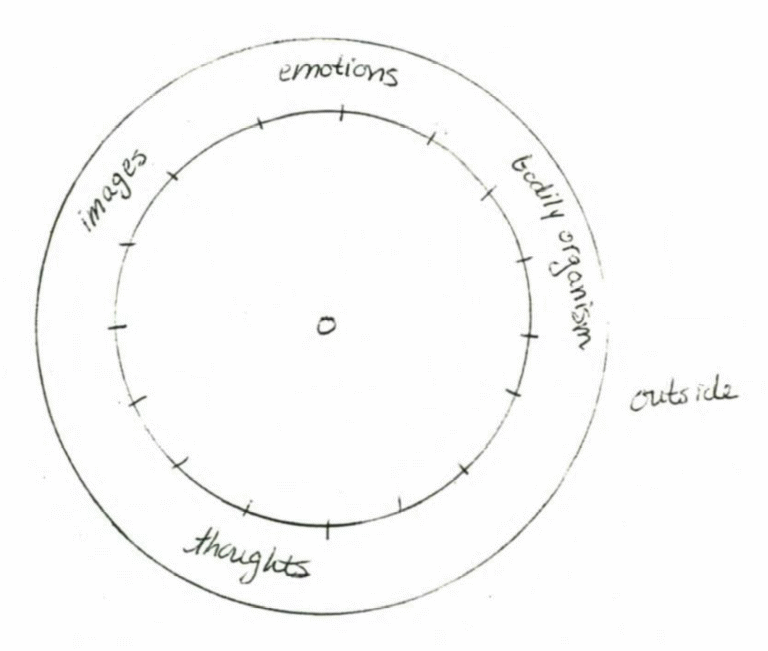
FIGURE 1983 1130-1. Psychosomatic Organism.
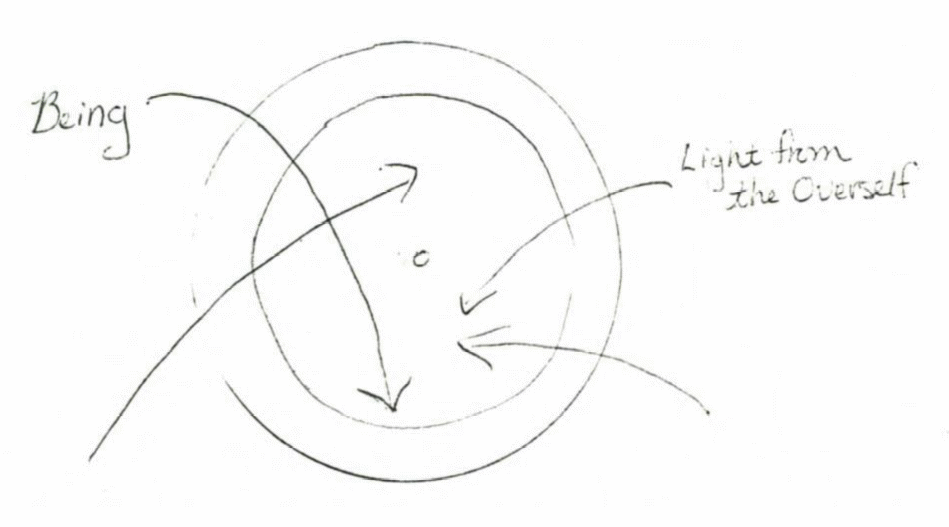
FIGURE 1983 1130-2. Light of Overself in Psychosomatic.
[Transcriber note: [diagram] means the speaker is referencing a diagram as he or she is speaking.]
NOTES:
This class concludes the Summer/Autumn PB Paras classes on Overself, Philosophy (a few), Fallacy of Divine Identity, Meditation, and Intellect. From December 1983 through March 1984 was the series on Philosophy, and then Ego (March 28-April 18, 1984). AD'S final classes on Ego and Philosophy took place June-September 1984.
Pat Campbell transcript from 1983 exists; other, earlier transcript versions exist, including one done in 1993 from audio cassette tapes by hp, jf, et al.
TRANSCRIBED Verbatim by IT 2018. Reformatted from V11a version by JRM & JF 2019-2020, with Subheads and Table of Contents added by JRM. In 2023, IT reformats again to accord with new conventions, fixes prefatory matter and footer, updates audio file name, fixes typos/minor errors, fixes/completes Book List, fixes notes within transcript, adds two diagrams and reference within transcript to these diagrams. In 2025, MW adds Subsubjects and alters Subheads to make more accurate. Archival verbatim transcript – V14.1a.
AUDIO FILES: 1983 1130a, 1983 1130b. [Note: "Tape" and "Side" refer to original audio cassette tapes later digitized into .MP3 Audio Files.]
1983 11/30 at Wisdom's Goldenrod
PB Paras; Meditation
Archival verbatim transcript
[Audio File 1983 1130a Begins]
PB PARAS ON ELEMENTARY MEDITATION
PB [V4, Part 1, 4:1.14 and Perspectives, Chapter 4: Elementary Meditation, #1, RC reading]: "[The truth needed for immediate and provisional use may be learned from books and teachers] but the truth of the ultimate revelation can be learned only from and within oneself by meditation."
[15¼ second pause]
PB [Perspectives, Chapter 4: Elementary Meditation, #3, RC reading]: "Among the values of meditation is that it carries consciousness down to a deeper level, thus letting a man live from his centre, not his surface alone. The result is that the physical sense-reactions do not dominate his outlook wholly, as they do an animal's. Mind begins to rule them. This leads more and more to self-control, self-knowledge, and self-pacification."
[short pause]
PB [Perspectives, Chapter 4: Elementary Meditation, #42, RC reading]: "Too much attention is too often put upon the role of meditation itself. It is a necessary practice but it is only a part of the total work to be done. Balance, reverence, knowledge, virtue, and awareness despite or during activities are also parts."
S (very faint): Would you read it again?
PB [Perspectives, Chapter 4: Elementary Meditation, #42, RC reading]: "Too much attention is [too] often put upon the role of meditation itself. It is a necessary practice but it is only a part of the total work to be done. Balance, reverence, knowledge, virtue, and awareness despite or during activities are also parts."
[9½ second pause]
PB [V4, Part 1, 4:1.76 and Perspectives, Chapter 4: Elementary Meditation, #16, RC reading]: "He needs to remember the difference between a method and a [RC reads: the] goal: the one is not the same as the other. Both meditation and asceticism are trainings but they are not the final goals set up for human beings."
[10½ second pause]
PB [V4, Part 1, 4:2.370 and Perspectives, Chapter 4: Elementary Meditation, #20, RC reading]: "He should fully understand and accept the importance of being punctual in keeping his unwritten appointment when the meditation hour comes round [RC reads: around]. If he is careful to honour his word in social or professional engagements, he ought to be at least not less careful in honouring it in spiritual engagements. Only when he comes reverently to regard the Overself as being the unseen and silent other party with whom he is to sit, only when he comes to regard failure to be present at the prearranged time as a serious matter is the practice of these exercises likely to bear any of the fruits of success. It is a curious experience, and one which happens [RC adds: all] too often to be meaningless, that some obstacle or other will arise to block the discharge of this sacred engagement, or some attractive alternative will present itself to tempt him from it. The ego will resent this disturbance of its wonted habits and resist this endeavour to penetrate its foundations. He must resist this resistance. He must accept no excuse from himself. The decision to sit down for meditation at a stated time is one from which he is not to withdraw weakly, no matter what pressure falls upon him from outside or arises from inside. It may require all his firmness to get away from other people to find the needed solitude or to stop whatever he is doing to fulfil this promise to himself, but in the end it will be worthwhile."
[19¾ second pause]
PB [Perspectives, Chapter 4: Elementary Meditation, #2, RC reading]: "Meditation is not to be regarded as an end in itself but as one of the instruments wherewith the true end is to be attained."
[19¾ second pause]
PB [V4, Part 1, 4:3.221 and Perspectives, Chapter 4: Elementary Meditation, #14, RC reading]: "None of the elementary methods of yoga such as breath control and mantram lead to [a] permanent control of the mind, but they prepare the way and make it easier to take up those practices which do lead to such a result."
[9¾ second pause]
PB [Perspectives, Chapter 4: Elementary Meditation, #19, RC reading]: "During this brief period he is to undertake a strange task--to separate himself from the petty and [the] passional, from the affairs of his personal career and family relationship, and to seek to unite himself with the grand truths, the impersonal principles of spiritual being."
[9 second pause]
PB [V4, Part 1, 4:1.172 and Perspectives, Chapter 4: Elementary Meditation, #6, RC reading]: "It is a means of severing attention from its ever-changing objects, and then enabling the freed mental force to study its own source."
[11¾ second pause]
S: [couple/three words inaudible]
RC: Should probably read that one again.
S: Yeah.
PB [V4, Part 1, 4:1.172 and Perspectives, Chapter 4: Elementary Meditation, #6, RC reading]: "It is a means of severing attention from its ever-changing objects, and then enabling the freed mental force to study its own source."
[9¾ second pause]
PB [Perspectives, Chapter 4: Elementary Meditation, #34, RC reading]: "It is not enough to lull the mind: the heart's feeling must be stimulated and directed in aspiration and devotion, warm and strong toward the Overself, which by reaction, arouses a certain force, the Spirit-Energy, which acts for a short time to prepare him for deeper, more concentrated contemplation."
[16 second pause]
PB [V4, Part 1, 4:1.16 and Perspectives, Chapter 4: Elementary Meditation, #4, RC reading]: "It is a principle of philosophy that what you can know is limited by what you are. A deep man may know a deep truth but a shallow man, never. This indeed is one of its reasons for taking up the practice of meditation."
[11¾ second pause]
PB [V4, Part 1, 4:1.131 and Perspectives, Chapter 4: Elementary Meditation, #13, RC reading]: "The novice must be warned that certain ways of practising concentration, such as visualizing diagrams or repeating declarations, as well as emptying the mind to seek guidance, must not be confused with the true way of meditation. This has no other object than to surrender the ego to the Overself and uses no other method than prayerful aspiration, loving devotion, and mental quiet."
[short pause]
PB [V4, Part 1, 4:1.131 and Perspectives, Chapter 4: Elementary Meditation, #13, RC reading]: "The novice must be warned that certain ways of practising concentration, such as visualizing diagrams or repeating declarations, as well as emptying the mind to seek guidance, must not be confused with the true way of meditation. This has no other object than to surrender the ego to the Overself and uses no other method than prayerful aspiration, loving devotion, and mental quiet."
[11½ second pause]
PB [Perspectives, Chapter 4: Elementary Meditation, #28, RC reading]: "To sit down for meditation with the secret expectation, the half-hidden hope, or the fully conscious desire for a dramatic glimpse, a sudden transformation, or a speedy result is to introduce the ego and thus block the way to the egoless plane of the Overself."
[14¼ second pause]
PB [V4, Part 1, 4:2.338 and Perspectives, Chapter 4: Elementary Meditation, #38, RC reading]: "The ego is so taken up with itself that the time of meditation, which ought to be its gradual emptying-out, remains merely another field for its own activity."
[short pause]
S (faint): Will you read that for him again please?
PB [V4, Part 1, 4:2.338 and Perspectives, Chapter 4: Elementary Meditation, #38, RC reading]: "The ego is so taken up with itself that the time of meditation, which ought to be its gradual emptying-out, remains merely another field for its own activity."
[14 second pause]
AH: Saying it's-- well I'd like to ask a question about quote, two or three quotes ago, that prayerful aspiration and loving devotion and mental quiet is-- Do you-- do you think he-- do you think he intends those three things to be taken as simultaneous? [18½ second pause] Or are they sequential in regards to meditation practice.
[10¾ second pause]
RC: You mean, what do I think personally?
AH: Well, they seem-- they seem to me [couple/three words inaudible] hard to take them simultaneously because if there's mental quiet it would exclude any other qualities. There wouldn't be any other-- any other contents of mind if the mind is quiet. I was just curious how that might be understood.
CdA: Why do you say-- I mean--
AH: Well if you're praying--
CdA (simultaneously): But why do you say that Andrew?
AH: If you're praying, your mind wouldn't be quiet. [student assents] Your mind would be active. The content would be the prayer.
CdA: How-- why wouldn't a feeling be quiet?
AH: 'Cause that's-- I mean-- I don't experience my feelings as mental (quietness). Say the other [one word inaudible] would be-- that's another content. Like you think-- I guess the question is, do you think he means mental quiet in a strict and technical sense.
RC: How would you-- what would you mean by that?
AH: Where the mind is quiet.
S: Yeah.
RC: I guess I think that like the-- all the chattering stops. [short pause] But I think it-- it runs through here as a-- as a fairly consistent theme that this presence of-- of aspiration as-- as a positive thing. At least from these notes, something indispensable.
AH: While the mind is quiet.
RC: If-- if by that you mean that the regular chatter that-- that goes on and-- [short pause] So what you would ordinarily call mental activity if you hadn't studied mentalism. (RC laughs a bit) [short pause] There [AH/S(?) simultaneously: (Thank you.)] was one earlier that I think said the same thing about-- [short pause] Well this is one that wasn't checked but it's probably worth reading for now. It says--
PB [V4, Part 1, 4:3.62, RC reading]: "A mere emptiness of mind is not [RC reads: isn't] enough, is [RC reads: it's] not the objective of these practices. Some idiots possess this naturally [S: Sure.] (laughter) but they do not [RC reads: don't] possess the wisdom of the Overself, the understanding of Who and What they are."
RC: The one I was looking for was--
IF YOU SUCCEED IN AROUSING THE SPIRIT-ENERGY, THERE WILL BE A DEEPENING AND A FURTHER INWARDIZATION OF YOUR CONSCIOUSNESS
PB [Perspectives, Chapter 4: Elementary Meditation, #34, RC reading]: "[RC adds: But] It is not enough to lull the mind: the heart's feeling must be stimulated and directed in aspiration and devotion, warm and strong toward the Overself, which by reaction, arouses a certain force, the Spirit-Energy, which acts for a short time to prepare him for deeper, more concentrated contemplation."
AH: So the purpose of devotion and aspiration is to generate a certain force whereby the mind is likely made quiet.
RC: Yeah. Yeah I think there would be two levels of that mental quiet, if you take [one/two words inaudible] Stop the chattering on the one hand [one/two words inaudible]
AH: Yes. [short pause] Yeah that makes sense now after having read the last four.
TS (faint): Why do you think he makes it a short time? What does he mean [couple words inaudible]
RC: Oh, um-- I think just that whatever you experience in meditation is-- is generally another state of the attention, the consciousness, that in relation to the duration of your whole life is bound to be a short time.
AH: I was thinking of it in terms of one presentation sitting down.
RC: Yeah. Like no matter how ecstatic you get you are going to come out of it, or how peaceful you get, unless you're very fortunate, and you're going to come out of that peace.
AH: I guess-- I guess I was hearing the quote that, when you sit down to meditate for an hour, there's a short time involved in that practice where you generate this mental force via aspiration and devotion. And you do it like every time rather than a short time in regards to a span of a person's life.
MB (faint): Will you read the [one/two words inaudible] short time again?
RC: Yeah.
PB [Perspectives, Chapter 4: Elementary Meditation, #34, RC reading]: "It is not enough to lull the mind: the heart's feeling must be stimulated and directed in aspiration and devotion, warm and strong toward the Overself, which by reaction, arouses a certain force, the Spirit-Energy, which acts for a short time to prepare him for deeper, more concentrated contemplation."
TS: The Spirit-Energy helpful to aspiration would seem to be--
AD: Louder, Tim.
TS: It seem, it-- I understood the quote to be saying that it's the Spirit-Energy or activity of the Overself which is acting here for a short time to prepare [couple words inaudible] for another stage of meditation. And, I just would like to understand that statement more fully, not just-- if it's not a question of what his response might [couple words inaudible] understand what is this process a little more.
AD: Well you-- if-- if you succeed in arousing that Spirit-Energy, you'll see it. It's like a-- a golden thread coming from above, and it comes into you, and there's a deepening and a further inwardization of your consciousness.
TS: But here-- but I understood it differently than-- That I thought by a short time period meant something like two or three years it might go on.
AD: No, it'll only last a couple of minutes.
TS: Oh boy. (laughter) Then you gotta go back to work. (Ok.) So it is something that's a one-- is a specific experience in meditation.
AD: It is what?
TS: It is a specific experience in meditation not to be repeated.
AD: Yeah. You may or you may not, it depends, be aware of it.
MB: I didn't get the impression that it was not to be repeated.
LR: See I thought he was saying it takes you from one stage of meditation to another. [couple words inaudible] another meditation. I don't know. Did you mean that Anthony? Did you mean-- you didn't mean it just ha--
AD (simultaneously): Well I don't know if it's one state from another. I think it's more accurately described by noticing the deepening inwardization, that before you didn't have the strength to plummet inward further but now that gives you that strength to go in much further.
[12¼ second pause]
S (faint): Ok.
AD: It's not that rare. It's not that rare.
[short pause]
BS: (Here's) a different question.
AD: Sometimes you may not see it, but you may feel it. You would feel an increase in your will, in your resolution. And you might temporarily be surprised that you have it or that it came, but then you realize it wasn't you: It was like help extended, or PB probably would say it's Grace. But basically it is help that is being extended to you to help you further the deepening. [short pause] I-- I'm quite sure, I'm not positive though because there's not enough in this-- it is not the kundalini.
[short pause]
MB: Anthony, is it an experience which happens only once in a lifetime or is-- it happens--
AD: No, it could happen a few times.
[short pause]
RC: Yeah I think I-- I think I mentioned in the class before one time that he talked about just a little bit saying that all the eff-- all the effort that you make is like as if your ego is rubbing itself against something, [student assents] stimulate a certain amount of heat, force or whatever, that finally ignites something deeper. And-- so while that's working-- what you're to do is to let it work and-- and to realize afterwards that it wasn't-- wasn't really you that was doing it, and [couple/three words inaudible] kundalini. That comes from the Earth and this comes from the soul. [20¾ second pause] Bert?
"THE TRUTH OF THE ULTIMATE REVELATION CAN BE LEARNED ONLY FROM AND WITHIN ONESELF BY MEDITATION"
BS: Um-- Alright, I'll ask it but you may-- you may have been asked it. This goes back to right at the beginning. The truth something-- I think it was your se-- second statement, the truth of the ultimate revelation is only gotten through meditation?
PB [V4, Part 1, 4:1.14 and Perspectives, Chapter 4: Elementary Meditation, #1, RC reading]: "The truth needed for immediate and provisional use may be learned from books and teachers but the truth of the ultimate revelation can be learned only from and within oneself by meditation."
[short pause]
BS: Ok. Yet it was only one of the instruments leading (to the) true end?
AD/S(?) (very faint): Once more, Bert.
BS: Well I don't know if you want to address this question. I was just a little puzzled when you first read it.
LR: Bert, can I try that?
BS: Sure.
LR: (You/He) said the ultimate truth can-- truth can only be received within meditation, right?
BS (simultaneously): Yes.
LR: And-- but then when he says that meditation is not the ultimate goal, I don't think he's talking about the reception of the truth anymore but what has to be done after one has actually gotten in touch with the truth. You know, he says how it has to come into a life, has to change the very action of the--
BS: Yeah, I understand that meditation is not the goal, which is what you're saying.
LR: Didn't you say you heard those two as contradictory? Thought that was your question.
[short pause]
BS: Is it that-- [short pause] [one/two words inaudible] just wondered how this-- This revelation would be of the Overself?
S: Yeah.
BS: Do you think?
RC: You mean this ultimate revelation?
BS: Yeah. [short pause] Or is there a revelation and then the truth of it is gotten in meditation or through meditation?
RC: The way he's got it here is--
PB [V4, Part 1, 4:1.14 and Perspectives, Chapter 4: Elementary Meditation, #1, RC reading]: "…the truth of the ultimate revelation can be learned only from and within oneself by meditation."
S: Hm.
AH: I think it suggested it can come from no external-- no external source. It has to come from the interior source.
RC: But what would you expect to be, I mean-- how would you fill in the blanks of the ultimate revelation?
AH: Well the ultimate revelation would be-- I would suspect would be in regards to there's really nothing out there, everything is within in regards to the truth of mentalism, experience of the Overself, you know, the whole notion of something being out there. [short pause] False from the point of view of revelation. Revelation shows that it always was [one/two words inaudible, possibly another student] That's the way I was understanding.
[13 second pause]
DB: Is it possible that there's a distinction between what he might be referring to here as concerning itself with the ultra-mystic exercises and so forth as opposed to just the beginning yoga and meditation techniques and so on? [16½ second pause] I mean the-- the ultimate revelation is not going to-- I don't-- I don't think I understand it as being something which is going to come to an untutored mind, so to speak. I mean, the way he lays the process out, he develops some ability in terms of meditation, so on and so forth. Then you have to go understand what the-- the nature of the world is through some kind of philosophic endeavor. When that's-- then when that's accomplished, or in conjunction with that accomplishment, he does a meditation-- meditation techniques that he has in the Wisdom I would think would be the ones that would bring about that-- that ultimate revelation.
S (very faint): [couple/three words inaudible]
S (faint): You're bringing up his book.
DB: I'm bringing in-- which other quote?
S: The other quotes that I think Bert was asking about, balancing the knowledge and what not, talking about your psyche.
[student assents, very faint]
DB: Yeah I--
S: Couldn't put together.
S: Isn't that the quote?
DB: Yeah, I guess--
[short pause]
RC: I tend to think of provocation to get that balance [one word inaudible] to be what he's speaking about in this quote.
DB: Which quote is that? I always thought that was the-- kind of the dark night of the soul that came along after, you know-- You had to integrate your mystical experiences, your worldly life.
RC: Seems to be saying here that there-- there's a certain truth that's going to come to you. And, at least in this quote, that the only way that it can be delivered is through meditation.
AH: Randy, would you mind [PD simultaneously: That--] reading the quote?
PD: He-- he says that the whole-- the ultimate truth. [student assents] He says there's this type of knowledge, intellectual knowledge, right, acquired from books and outside sources, he contrasts it there.
BS/S(?) (very faint): Yeah.
INTENSE, TOWERING ASPIRATION IS THE SAME AS MENTAL QUIET
LD: Randy also, what do you think is meant by meditation there, do you think it-- it's not a formal "I'm going to sit down and meditate" here.
RC: Well--
LD: Do you think that's what it means or something else?
RC: I thought one of those was really good. Meditation as--
PB [V4, Part 1, 4:1.172 and Perspectives, Chapter 4: Elementary Meditation, #6, RC reading]: "…a means of severing attention from its ever-changing objects, and then enabling the freed mental force to study its own source."
[short pause]
LD: So-- so that could be done in a, you know-- you know, in-- in any-- Like I'm thinking of something like King Janaka, you know, I mean he wasn't sitting down and meditating, he was getting in his horse, getting on his horse. But, obviously I would think his mind is still in a meditative state.
RC: I think that there's-- that this truth can dawn perhaps upon a person without, say, the realization being complete and permanent and fulfilled and completely rounded out and all that. And that the introduction to this-- the-- like the initiation to this truth is one thing and the permanent establishment of the whole of the life as an expression of it would be something more. I think in that sense that he's saying here that from meditation you're going to become convinced. It's the only way that you're going to become convinced irrevocably. And that makes meditation serve as a-- as an invaluable instrument to that complete realization. But meditation in itself won't make it complete.
AH: I want to comment on Louis' question, I think-- I think the upshot of Louis's question might be, ok, are we to think of meditation as the physical posture or as a mental state.
RC: Oh definitely as a-- as a mental (posture). But I think that any time that if you put it in terms of this definition of severing attention from its objects and then taking that freed force and turning it around to study its own source, you can stand on your head if you want to, but if-- if you do that then I think that's what he really means by (it).
DB/S(?): Yeah.
[20½ second pause]
DB: Randy could I ask a-- a little bit more of an elementary question? There was-- there was a text-- there was a-- two quotes, one of which was reread which concerned the development of the aspirations, devotions in the heart, and how indispensable that was to getting anywhere with a certain [one/two words inaudible] that it's not enough to lull the mind into state of inertia, whatever. And then he says in the other quote, and I can sort of see the difference, that if you go in with the expectation that "Well this time for sure I'm going to really get some light or whatever," then you've just introduced a stumbling block to an already difficult process. (bit of laughter) So, what I-- what the question is, basically comes down to, what is this aspiration and devotion, whose is it, and where does it come from?
RC: I think it's a difference between loving and wanting to be loved.
[short pause]
CdA: Why does that matter, David, if you have it? Why would it even matter where it came from if you [DB simultaneously: I'm curious.] had it, I mean I-- seems to me that having it is--
DB: I'm sorry Carol, would you repeat?
CdA: I mean I'm just disagreeing with your approach for some reason. It seems better--
DB (simultaneously): Maybe you've got it.
CdA: Pardon me?
DB: I said maybe you've got it.
RC: Now you know where it is.
CdA: No, I'm just saying that it seems having it is-- I don't know if-- [couple/three inaudible student words] well-- I don't understand your question, how you could ask that question.
DB: Can you answer it?
AD: Intense, towering aspiration is the same as mental quiet. You won't be there.
DB: Thank you.
[20 second pause]
AD: You could try the other thing, you could try-- you could sit down and say, "I'm going to love God." And try, turn the faucet on and see if anything comes out of it.
[20½ second pause]
DB: So, Anthony, if I-- if I can just understand, if I can just ask-- see if I understand, what you're saying is that this aspiration and devotion is not something that we can manufacture ourselves but it's something of a-- of the nature of a gift in itself.
AD: Yeah, you-- you get the conditions ready. In other words, keep doing it. Keep trying.
[short pause]
AH: Anthony, may-- may I ask, you say that if you-- if you are really aspiring, the mind would be quiet. Could that be understood as-- if the ego's out of the way?
AD: You won't understand that except through experience I think because it sounds to you like when a person is aspiring intensely that there's some sort of mental activity going on. Actually it's closer to the truth, I think, to say that when you're doing that, or when there is intense aspiration-- [25¼ second pause] Let me-- let me try another way. Ecstasis means "out of the body." Intense aspiration is a kind of ecstasy. So, in a sense, you're really out of the ego. You can't readily duplicate that, you know, if you try. But when that does come, it's kind of Grace.
Also, the strange accompanying phenomena is that it's extremely quiet. This accompanies that phenomena. And whatever noise or chattering is going on around you or outside you, you won't hear.
AH: So this aspiration that's being described is not the sort of-- might be construed as psychological posturing, psychological manipulation of one's feeling states. Something quite different (than/from) that.
AD: Let me see. Do you remember before he made the quote - if you can detach that mind which is constantly working with the body and the ego and the emotions and all that - if you can detach that mind and force it to turn upon itself - remember the diagram we had where we put the light inside the circle? [Note: See FIGURES 1983 1130-1, Psychosomatic Organism, and FIGURE 1983 1130-2, Light of Overself in Psychosomatic, appended to this transcript.] And the circle represented the totality of our feelings, thoughts, impulses, you know, stored knowledge, trances-- traces of all kinds. If you can detach the mind that illuminates-- illuminates the-- those products or those contents from those contents, if you detach the mind from those contents, in other words that light which is within the circle, and-- then it is freed from the attachment to those contents, now it could investigate its own nature. That help you any? It's in that state that the experience of intense aspiration is available to us. And the more detached from those contents, the more the intense aspiration is.
S (very faint): Ok.
AD: Follow?
S (very faint): Yeah.
AH: If you're saying that insofar as the ego is negated, aspiration is possible.
[short pause]
S (faint): No.
AD: No, not quite like that. [short pause] See there's no ego in the state of sleep. Ego's negated but you're not exactly aspiring.
AH: [couple/three words inaudible]
AD: Yeah.
AH: There'd be a-- there'd be a-- a conscious perspective.
AD: Yeah, you'd be conscious, (uh-hm/alright). And that's why I'm using the other example, you know, where he says you have to free this mental force which illuminates the contents of the personality, free it from that and then you could use that mental force to introvert on itself. [student assents] And that's accompanied by tremendous aspiration.
EM: Necessarily?
AD: Yes. Just like I pointed out, that's-- that's almost like a condition of ecstasis. "Out of the body," of course, is meaningless, I mean I-- I-- I mean it's inaccurate but I think you know what I mean. "No concern for the body" would be better. [9¼ second pause] You try this weekend. Let's go on to another one.
[student(s) assenting, faint]
[14 second pause]
A YOGI WON'T KEEP TRYING TO STAY IN NIRVIKALPA ONCE THEY UNDERSTAND IT'S THE WORLD-IDEA THAT'S RECLAIMING THEM
PB [Perspectives, Chapter 4: Elementary Meditation, #30, RC reading]: "The body's position…"
S (very faint, possibly part of background): One more. [possibly another student: Yeah.]
PB [Perspectives, Chapter 4: Elementary Meditation, #30, RC reading]: "The body's position is not without its influence upon the beginnings of meditation. All muscles should be relaxed, all limbs at ease, all fingers at rest, and the jaw unclenched. Any physical tenseness hinders the onset of contemplation."
[12½ second pause]
PB [V4, Part 1, 4:1.299 and Perspectives, Chapter 4: Elementary Meditation, #15, RC reading]: "If in meditation he goes down sufficiently far through the levels of consciousness, he will come to a depth where the phenomenal world disappears from consciousness, where time, thoughts, and place cease to exist, where the personal self dissolves and seems no more. If there is no disturbance caused by violent intrusion from the physical world, this phase of complete inner thought-free stillness may continue for a long period; but in the end Nature reclaims the meditator and brings him back to this world. It is only an experience, with the transiency of all experiences. But it will make its contribution to the final State, which is permanent establishment in the innermost being, whether in the depth of silent meditation or in the midst of worldly turmoil and activity."
(Side 1 of original cassette tape digitized as 1983 1130a Ends; Side 2 begins)
[Transcriber note: AD's first sentence is from Pat C. partial transcript, not on audio file.]
AD: Rather than saying "Nature will reclaim you," think of it as the World-Idea will reclaim.
S (faint): Yeah.
[short pause]
AD: Then you've solved a lot of problems for the yogi. He won't get upset if he understands it's the World-Idea that's reclaiming him. Otherwise he'll keep trying.
[short pause]
S: Keep trying-- yeah, keep trying what?
AD: Keep trying to stay in nirvikalpa.
S: Oh.
AD: You remember Vivekananda told Ramakrishna, "Can't I stay there for a month?" (bit of laughter, student assents) Ramakrishna told him, "There's something better than that."
[13¼ second pause with background student whispering]
AD: Ok.
[short pause with background student whispering, bit of laughter]
IN THE TRANSITION BETWEEN ONE STATE OF CONSCIOUSNESS AND ANOTHER, THE IDENTITY OF CONSCIOUSNESS REMAINS BUT THE CONTINUITY OF THE FIELD GETS BROKEN
PB [RC reading, V4, Part 1, 4:1.411 and Perspectives, Chapter 4: Elementary Meditation, #36]: "He need not get either perturbed or puzzled if, after a certain period of the session has elapsed and a certain depth of concentration reached, there is a momentary disappearance of consciousness. This will be a prologue to, as well as a sign of, entrance into the third state [RC reads: stage], contemplation. The immediate after-effect of the lapse is somewhat like that which follows deep dreamless sleep. There is a delicious awakening into a mind very quiet, emotions gently stilled, and nerves greatly soothed."
[short pause]
S (faint): Would you read that again?
PB [RC reading, V4, Part 1, 4:1.411 and Perspectives, Chapter 4: Elementary Meditation, #36]: "He need not get either perturbed or puzzled if, after a certain period of the session has elapsed and a certain depth of concentration reached, there is a momentary disappearance of consciousness. This will be a prologue to, as well as a sign of, entrance into the third state [RC reads: stage], contemplation. The immediate after-effect of the lapse is somewhat like that which follows deep dreamless sleep. There is a delicious awakening into a mind very quiet, emotions gently stilled, and nerves greatly soothed."
[11 second pause]
AH: Is that a description of the attention not being strong enough to stay aware, so it appears like a loss or a gap in attention?
AD: What'd you say Andrew?
AH: Is that-- is that quote a description of or a way of speaking about the attention lacking the strength to enter that third stage? So from outside of it it appears that there's been a gap in consciousness. [11¾ second pause] Like the-- the attention would have to become strong enough to stay aware--
AD: No I-- I think what he's referring there to is-- now I'm not quite sure but in general I think this quotation is an answer to the problem that you find in many of the Buddhist texts. They refer to this transitional state as "the perception of non-perception". And, they-- they turn it into a problem. And I think he's answering here the problem by pointing out that it is simply a transitional state. It's momentary, it does occur, and at the moment that that occurs, there is a state that might be referred to as the perception of non- perception. But, you know-- you know, to make it into a philosophic issue is like a lack of understanding the dynamics in meditation, that transition(s) between one state of consciousness and another, alright, does require that point, you know, that point of transition from, let's say, sleep-- or dream to sleep. It's a momentary point, but it is experienced as conscious non-perception.
[short pause]
JL: Anthony, does that-- does that occur of its own accord?
AD: Is that what?
JL: (Or/And) the concentration has to be maintained up to the point where the-- where the attention lapses into a-- a perception of non-perception?
AD: The perception doesn't-- the attention doesn't really lapse, like I [JL assents] pointed out. It's just a [couple/few inaudible JL words simultaneous with AD] transition that's taking place in the attention itself. [JL assents, faint] Just like a transition from prajna to turiya cannot be understood, neither can from taijasa to prajna be understood. And those intermediate points are always the experience-- understood as states of non-perception, the perception of non-perception. And the point I'm saying here is that this is not a philosophic issue nor is it a problem.
It's like if you were driving a plane and you're going through a cloud bank, but your instruments are set, the plane flies through the cloud bank and you continue on your course, and there was momentary loss of vision, you know, what's the surrounding environment. [JL assents, faint] But, that's about all it amounts to.
LR: So it wouldn't be changing from the way PB would use the word 'consciousness' and 'awareness', where you go from the ordinary kind of consciousness to a deeper awareness?
AD: I-- I didn't understand your question.
[short pause]
LR: It sounds like in the analogy you just used, it's not the subjective consciousness which changes as much as it is the field of vision. Like coming through a cloud into a new vista. [student assents, faint] But sometimes he uses the word 'consciousness' to describe the kind of awareness that one has in ordinary wakeful consciousness and then he uses the term 'awareness' to describe a deeper level of subjectivity. And I thought perhaps he was speaking about that kind of transition. The reason we think it's unconsciousness is there's actually a different-- a different kind of looking.
RC/S(?) (very faint): Yeah.
S (faint): Different kind of what?
LR: But I don't know what word to use.
S (simultaneously): Looking?
JB/S(?) (faint): She said looking [LR simultaneously: Yeah, I--] [couple words inaudible]
S (very faint, possibly part of background): 'Cause of the faster [one word inaudible]
[short pause]
AD: Well you may be right Linda, maybe-- the analogy I think is faulty.
LR: Because when you said going from wakeful to dream or dream to sleep, those are actually descriptions of different kinds of consciousness, right, not just different contents. Is it-- I took them to be different states of subjectivity.
[short pause]
AD: Well, now I don't follow you.
[short pause]
LR: Um-- I could see there being momentary confusion or what we from this side would call a lapse of consciousness when some other-- when there's-- when a deeper level of the mind has taken over as being responsible for [one word inaudible] awareness. Then the ego would feel-- the ego would describe it as a la-- lapse of consciousness because it's no longer functioning as the center or taking itself to be the center. But a deeper level of awareness has taken over, the true awareness of the mind. And that's the kind of transition I thought he was describing, not necessarily a different field of content. [15 second pause] Just as when you fall asleep you say you weren't there. But you're not referring, I mean-- some level of the mind is aware of sleep.
PD: I thought that was Tony's point, that in that transition point, the functioning subjectivity is not there to perceive.
LR: Yeah.
PD: Ok, but whatever-- it doesn't make a difference, wakeful to sleep or to dream, dream to deep sleep. In that transition point the functioning subjectivity doesn't fit through the point.
LR: Right, so a deeper level of the mind has taken over as being the conscious center. Not the functioning subjectivity.
PD (simultaneously): No. At the ne-- at the taijasa level, [LR simultaneously: At what?] then you have contents that function again as the subjectivity, but that's not consciousness.
LR (very quietly to herself): Contents that function again as subjectivity.
S (faint): [one/two words inaudible]
LR: At the contemplative level?
S (faint): Well--
PD: At the dream level.
LR: Oh yeah, but that was--
PD (simultaneously): And then at the deep sleep level you have also a content, [slight pause] if I'm understanding. This seems like a discussion in the Yoga Sutras on samprajnata and asamprajnata. [AH simultaneously: (Paul--)] 'Cause in that bindu point, in the transition point from one level to the next, the field of consciousness is dropped.
LR: Right, right, that's--
AH: Paul, if I [LR simultaneously: But--] see it-- if I feel--
AD: Yeah, the important point here I-- I think that I'm trying to get to is that there is no break in consciousness per se. The continuity, or I should rather say the identity of consciousness, is not interrupted. [students assent, very faint]
Now, if-- if we take this as axiomatic in a philosophic sense, you know, that consciousness is self-identical with itself, you can't speak of a point where-- you can't speak of a point where there's an interval in consciousness, because then you would be speaking about discontinuity and not the self-identity-- identity of consciousness. So, to say that consciousness lapses for a moment is the same as to say that there's a break in consciousness. Now, what I'm trying to point out is that the continuity or the identity of consciousness remains; the continuity of the field gets broken. The continuity-- there's the field of wakeful consciousness, there's the field of dream consciousness and so on.
Now, the break between wakeful consciousness and dream consciousness is not in consciousness. Consciousness remains self-identical with itself, so there's not going to be no-- be no break there. But nonetheless if you're moving-- if you're moving from the state of wakefulness to sleep, there's going to be an interval where there's going to be the perception of non-perception. There's going to be the perception of nothing there. Ok? That's all I'm trying to say.
LR: So it's-- it is a change in content, not consciousness.
AD: Basically, yes.
LR: It's like a guy waking up and instead of seeing his room he's looking at a wall and thinking he's blind.
AD: Instead of seeing a what?
LR: Never mind. I knew a guy that-- (laughter)
JfL: Anthony, you gave an example a while ago that sometimes when you're in a meditative state-- or the object that you're concentrating on will dissolve at the very end and you feel like the very goal or the very thing that you were trying to attain slipped out from your fingers and then there's nothing there. And I think you also mentioned that sometimes you'll find out that the solution or the-- you actually did have that perception and that it'll sometimes appear later on. [student assents, faint] But is it that kind of break? [short pause] That the theme that you're working on seems to temporarily, just at the-- just at the moment before you grasp it, seem to dissolve?
S (very faint): I don't think it (dissolves/dissolved).
AD: Well, the object doesn't dissolve, I mean if you're contemplating a flower or a vase, it doesn't disappear on you, although that might be an inaccurate way of describing it. It's the recognition that what you were concentrating on-- in other words, the subject and the object were suddenly experienced to be a unity or two ends of one stick. But-- I think that's what you're referring to. I don't know what that has to do with this problem.
JfL: Well, maybe nothing, that's about it. It sounded like it's that moment that the-- something is withdrawn and I thought maybe that would be the perception of the non-perception but it's not. You would perceive not-- you-- there would be the feeling that you're perceiving nothing instead of [one/two words inaudible]
AD: Oh I see what you're getting at. At the moment that there's the change from experiencing yourself as a-- an empirical subject versus an empirical object, at the moment that that is transcended, you [JfL assents] experience the perception of non-perception [JfL: Right, or the whole (object).] or consciousness of nothing. Oh yeah, yeah, right, well, yeah.
[20½ second pause]
AH: What was confusing for me, I think it's been cleared up, was that we spoke about a transition from one state to another and it was hard not to think of that transition state as a transition of consciousness which you explained that it is not a change in consciousness, it was a change in content. [short pause] Because by definition consciousness will--
AD: If we're speaking about consciousness, yeah. [22 second pause] Alright, Randy.
MEDITATION HAS BEEN SUCCESSFUL "WHEN ALL THOUGHTS HAVE COME TO AN END, AND WHEN THE PRESENCE OF DIVINITY IS FELT WITHIN THIS EMPTINESS"
PB [Perspectives, Chapter 4: Elementary Meditation, #9, RC reading]: "The meditation has been successfully accomplished when all thoughts have come to an end, and when the presence of Divinity is felt within this emptiness."
[12¾ second pause]
RC: I thought this one worked very nicely with that other one about severing attention. And it's parallel. [student assents, faint] When attention is severed from its ever-changing objects and all thoughts have come to an end and when the presence of Divinity is felt within this emptiness, then his freed mental force is actually in a position to examine-- study its own source. I think too from what Anthony was saying before, that that's the point at which, as long as experience continues at that point, that that's where the aspiration really arises quite naturally, that-- that feeling of the presence of Divinity within the empty mind. [11 second pause] If the person is re-- is properly prepared for this, then that-- that naturally will evoke devotion, aspiration. And, it's very different than trying to rustle up a feeling for an object.
[short pause]
S (faint): What do you mean properly prepared?
RC: Well, um-- You've heard a lot of times here people talk about how at this very crucial moment when the mind that might actually come to a halt, [short pause] most people get terrified and instead of feeling the presence of Divinity, they're not psychologically prepared to receive the opportunity positively and it gets interpreted psychologically (or the--) as something (to/you'd) be afraid of.
[short pause]
CdA (possibly part of background): Excuse me.
[short pause with background student whispering]
AH: Yeah, Randy, I'm a little confused about combining those two quotes. Like, in the first one where he describes there's a detached-- there's a-- a disinterest in the normal kinds of objects so-- so this exercise can-- can proceed, you know, to examine his source. But, that seems to be at that level of-- of effort or as-- or practice. The second quote seems to speak about something having been accomplished. Would you hold those two as distinct in that way?
RC: Well--
AH: Like--
RC: Yeah maybe I'm--
AH: I think it can be interpreted the way you did.
RC: Maybe I'm superimposing something but I thought they had very interesting parallels in that the first says that what you're trying to do here is to sever attention from its ever-changing objects. So let's assume that he actually does that. Well it seems that when you've actually done that then the parallel is that all thoughts have come to an end.
AH: Except the second part of the first quote said it examines its own source, [RC assents] as if something was going on.
RC: Yeah. And I thought the parallel to that was that in the second quote the presence of Divinity is felt within this emptiness. That that notion of examining its own source-- Like it seems that the question we're deriving, why it's the activation of the heart's deepest feeling called for, you know, why can't I do this in a very indifferent and unfeeling manner. And, what I thought was interesting about the parallel was that this turning to-- to study one's own source is done in the-- the felt presence of the Divinity that's here.
[9½ second pause]
JL: Doesn't it-- doesn't it also sort of-- sort of force the-- the penetration of the Overself and also unification of the mind? I mean instead of-- instead of just the-- the perceptual kind of emptiness that maybe pertains, doesn't it show the unity of the-- of the [one word inaudible] subjective function(s), you know, the will and the feelings and thinking? [short pause] And that if it's caught up in just-- just in terms of seeing into the emptiness of the mind as a stage or a higher realization, there's an actual attempt on the part of the-- the meditator to accomplish at least a-- [S, possibly part of background: Well, ok.] bring them together [one word inaudible] fundamentally [couple/few words inaudible] Is this done in that-- in that kind of a way?
S (faint): Sure.
RC: Yeah I think there's a change here from uh-- [short pause] in the-- [short pause] the level of organ that the knower is functioning with. Like at the-- like a lower level we talk about this psychological functioning that-- that operate on the-- the presuppositions of otherness. And that type of thinking, that type of feeling and so on qualitatively very different. And I think all of that is what is dispensed with, there's a severance of attention from its ordinary objects, he's brought all thoughts to an end. There's-- there's a change now in which you might actually-- it might be valid to say that now we've got to the level where we can really talk about knowing, willing, and feeling at-- at a deeper level. And for us it's hard to distinguish it in this level, it just seems really united, that what I-- what I felt I also knew and that energized my will. [10½ second pause] In that sense it seems to be [short pause] appropriate to say that the mind's been [few words inaudible] that way.
[short pause]
AH: It's hard to understand because they speak about divesting the attention from all the contents and arriving at a state of quiet mind and-- and then it's very confusing to speak about that state as if there's some other kind of contents there, I mean I-- like the presence of Divinity is a content now, it's-- it's different than the ones I just gave up.
PD: Well, I don't-- [S: Yeah.] keep getting confused, you keep blending those two quotes together and I don't even see a relation between them.
AH: I couldn't either, that's why I was just questioning (them).
RG: Ok, I--
RC: I don't know (if this sounds--) He didn't lay them on top of each other so I certainly don't have to.
PD: But, you know, I'm just--
[student assents, very faint]
[short pause]
HE: Randy? I have a question about the aspiration part. When-- when you say that you get quiet and then there's this feeling of aspiration or a lovingness that would come in, would you see that as a response on the part of whatever the meditator was at that point (to/too)? I don't know what [couple/three words inaudible] or whatever of the-- or the presence-- Well maybe-- what about-- 'cause also became-- I have to [couple/three words inaudible] or an outflowing of love from this [one word inaudible] self or a little bit (above/of both) unknown, or whether we're personalizing (yet) you really get something very impersonal there but we have a very good love as our personal way of responding to it, I don't know.
S: Uh-hm.
RC: I don't know, I-- I guess that's the sort of thing that the Catholics really mean when they say that a person is in the state of Grace or is not in the state of Grace, um-- [short pause] [S: Yeah.] And, it certainly does seem to be a gift, that from this side you can't-- you can't generate.
HE: Right, I mean--
[short pause]
RC(?): I don't really think I'm off on that.
S: Yeah.
HE (faint): (Good) point.
S (very faint): Uh-hm.
[couple seconds of faint background student talking]
S: Meanwhile it becomes a receptivity (to those) [couple/three words inaudible] rather than a-- than a-- than a positive force.
RC: Yeah. And again I think that, you know, you can say the difference between how much "me" is in it is like how impure it is and how much it's like actually loving to the degree that you're capable of as much as its presence is-- is known, and loving it actively as opposed to taking a stand in the ego and wanting it to come to you and praise you and make you feel good. [HE assents, faint] So I guess there is a [one word inaudible] we could check how-- how much "me" is in it.
HE: Well, it's just hard to imagine 'cause ultimately it should become impersonal and to imagine love (going) impersonal is very difficult, I mean, you don't--
S: Yeah.
RC: Yeah.
HE (simultaneously): (Yeah I mean--)
[short pause]
RC: Well I guess we should go on. [23½ second pause] We read this before but--
S (very faint): Yeah.
S (faint): [one/two words inaudible]
RC: It's really nice.
AWARENESS OF AWARENESS IS NOT THE ULTIMATE STAGE
PB [V4, Part 1, 4:1.128 and Perspectives, Chapter 4: Elementary Meditation, #8, RC reading]: "The true state of meditation is reached when there is awareness of awareness, without the intrusion of any thoughts whatever. But this condition is not the ultimate. Beyond it lies the stage where all awareness vanishes without the total loss of consciousness that this normally brings."
[15½ second pause]
PD: Is that awareness of awareness nirvikalpa samadhi, [short pause] consciousness without any presence of the world-thought or the individual thought, any type of ideation in it? And the sahaja is something transcendent to that even? Is that what he's speaking of there?
AS: I thought the second one was nirvikalpa and the first one was not yet there. That the awareness of awareness was still awareness of some functioning, being aware self-- in some sense still aware that there was some kind of awareness going on, whereas in the second he was speaking of nirvikalpa where there wasn't even that awareness of awareness. [14¾ second pause] 'Cause he is the awareness in the second-- the second(--/.)
PD: Yeah, so that would make it sound like sahaja, the second one.
DB: Yeah but the-- but the first one, there's-- I thought there was an implied sort of subject-object there, awareness being aware of itself.
PD: Without any type of ideation.
DB: Yeah, right.
PD: So ideation would include--
DB (simultaneously): There's no thought.
PD: Yeah. But ideation includes any type of thought, right?
DB: Right, it's not a-- it's not a [PD simultaneously: Well that--] reflective thing.
PD: What I understand of nirvikalpa is what the-- that state is: pure self-absorption in consciousness.
AS (simultaneously): Right, but not awareness of.
PD: Why not?
AS: That's fine. Because I'm thinking of like that-- well, maybe you should read it again Randy. Can you read it again?
RC/S(?) (faint): Uh-hm.
PB [V4, Part 1, 4:1.128 and Perspectives, Chapter 4: Elementary Meditation, #8, RC reading]: "The true state of meditation is reached when there is awareness of awareness, without the intrusion of any thoughts whatever. But this condition is not the ultimate. Beyond it lies the stage where all awareness vanishes [RC: And the rest of this sentence is underlined.] without the total loss of consciousness that this normally brings."
AS: Uh-huh.
DB: [three words inaudible]
AS (simultaneously): Yeah. No I think [one/two inaudible TS words simultaneous with AS] there's only two.
TS: What?
AS: I think there's only two.
TS: Well, can-- let-- let me try it then [one/two words inaudible]
S (very faint in background): Try it.
S (simultaneously): (Well do.)
TS: Awareness of awareness I think from the Yoga Sutras would be like asamprajnata samadhi or the mind as at rest. Awareness-- the stage where all awareness vanishes would be nirvikalpa samadhi and the stage where awareness vanishes but there is not a loss of consciousness would be sahaja. Depends on how you [couple words inaudible] If I [three/few words inaudible]
PD (simultaneously): So you think there's three things now.
TS: Well-- [AS/S(?) simultaneously: Yeah.] unless-- if it's just-- that's assuming that total loss of consciousness is meant not just as going to sleep but is an actual meditative state.
PD (simultaneously): And I thought that was the same as the second, it was an elaboration of what that second position was.
S: Hm.
S: Yeah I-- I follow what (you're doing).
PC (simultaneously): But it's true, you couldn't think of nirvikalpa samadhi as being totally without any kind of consciousness, could you?
TS: Yeah.
PC: Total lack of consciousness?
AS: Uh-hm.
S: Uh-hm.
[AD talking so someone in background, very faint]
TS: That's what I'm saying. Maybe I shouldn't think of it that way but I could think of it that way and I do. (laughter)
PC: I thought the thing which distinguished sahaja was that it was a consciousness which remained pervasive throughout any of the other states of consciousness. I mean if you were operating in the waking world, you would never lose that [one/two words inaudible] This doesn't sound like it's referring to that.
[short pause]
DB: Would it be possible--
S: That's true, yeah.
DB: Would it-- would it be possible just to approach the quote with-- with an idea of getting a very specific understanding of the difference between what awareness-- how he's using 'awareness' and how he's using 'consciousness'? [short pause] I mean they're often used interchangeably and here he's used the-- he's making a very sharp distinction between the two of them.
AH: Well they're both being spoken of as non-dual, that's (why/fine).
DB: Well, I don't know, I-- the-- like it's-- I thought that the first part of it, the awareness part, did have some form of duality or at least some form of activity, some-- still some kind of functioning going on there. Whereas the other or-- where the consciousness remains it didn't seem that there was any kind of movement at all. Now that might be so general as to be worthless but I-- I thought that awareness in some sense had some trace of duality.
AH: What would be its content?
RC: [three/few words inaudible]
DB: Yeah, awareness of it-- even awareness of itself. Now, I'm just talking here, these are just words that are coming out of my mouth.
AH (simultaneously): Yeah well I think-- I think [couple/three words inaudible] (if they're riding) these distinctions there is more, that what-- what would be the content of awareness of awareness?
PD: Well, there's no ideation.
DB: Right.
PD (simultaneously): You have eliminated [DB: Yeah but--] feeling, willing, thinking, a World-Idea--
DB: Well, I-- I don't know, I mean, wouldn't-- wouldn't there be the knowledge that awareness had-- you know, I mean you say awareness is aware of itself, well, saying like, alright, this is self-knowing that's taking place here. I mean that's not as an idea, not as a specific rumbling within that but just that that state it applies that form of knowledge, saying "Oh yes. This is awareness knowing itself."
AH: That's a non-dual self.
S (simultaneously): No.
AS: Well I don't think that's non-dual though. [student assents, faint] I-- I think that first one, awareness of awareness is still being aware of that principle, like in Plotinus the lower one. [S: Right.] The awareness in vir-- of the principle in virtue of which awareness occurs. Whereas in the second one there's not even awareness of that function of being aware. He just is that pure consciousness.
LR: So you'd be going from like the I AM to identity with the Intellectual-Principle.
AS (simultaneously): To the Overself, yeah. Yeah or from some-- towards [one/two words inaudible, possibly another student]
AD: We did-- we did do this once before, you remember.
LR: Yes.
HS/S(?) (faint): Yeah.
AS: Two knowers. Right? I (think/hope). Go ahead.
AD (simultaneously): Change the words: knowing of knowing instead of awareness of awareness.
RC: So maybe the first stage he talks about is being the Witness of the Witness?
LD/S(?): And if you don't?
S (very faint): Right.
PD: The Witness-consciousness always implies ideation, [RC assents] so this-- that seems above that, the first one.
AS (simultaneously): Well this is knowing the Witness, knowing that you're witnessing.
PD (simultaneously): This is above the witnessing, the first one.
AD: Yeah, the awareness of awareness is the bodhi mind.
[short pause]
LR: What's that mean in English? (bit of laughter)
AD: The wisdom mind.
S (very faint in background): Who said that?
S: Me.
[laughter with background student words followed by pause, 14 seconds]
AH: I don't understand.
AD: Let's go on to the next one.
AH: [one/two words inaudible]
JfL (simultaneously): Wait, wait, before you go on, are you agreeing that it is-- the first one is the I AM and the second one is the (actual/astral) soul?
AD: I'm sorry Jeff.
JfL: Would you agree that the first-- the first level here, the awareness of awareness is the I AM, you're identified with the I AM principle? Is that what you said Avery? And the second one is the (actual/astral) soul?
AS: No I didn't say that, somebody else said-- I was just saying that-- I'm not sure what you meant there by the I AM but I would-- I could see it as the two phases of the I AM.
JfL: Oh, ok.
AS: (In/And) one looking down, he's aware of that principle of awareness, he's aware-- knows the knowing, knows that he is knowing of that principle in virtue of which there's knowing. But in the higher he is that pure consciousness or pure awareness or he is the Overself. And he's not even aware of the witnessing function.
JfL: So the first one is still contemplation would you say?
[15 second pause]
PATIENCE AND EFFORT ARE NEEDED TO MASTER THE ART OF MEDITATION
AD: Let's go on to meditation, come on Randy.
PB [Perspectives, Chapter 4: Elementary Meditation, #23, RC reading]: "It is not possible to master the art of meditation without acquiring the virtue of patience. One has to learn first how to sit statue-still without fidgeting and without changes; second, how to endure the waiting period when the body's stillness is mocked by the mind's restlessness."
[student assents, very faint]
S (simultaneously): Huh.
S: Hm.
[students assent, faint]
[17¼ second pause]
DB: Randy--
PB [Perspectives, Chapter 4: Elementary Meditation, #27, RC reading]: "It is a common mistake to believe that because no fruit seems to grow out of the exercise, no feeling and no experience result from it, [RC adds: then] the time given to it is wasted. This is why so many abandon it after a short or long trial. But how can the ego know that even the simple act of sitting like a beggar at the Overself's door, in resigned humility and patience and perseverance, is an act of faith for which the reward is certain, even though the form of this reward may not be?"
[10 second pause]
S (faint): I'd like to hear this again.
PB [Perspectives, Chapter 4: Elementary Meditation, #27, RC reading]: "It is a common mistake to believe that because no fruit seems to grow out of the exercise, no feeling and no experience result from it, the time given to it is wasted. This is why so many abandon it after a short or long trial. But how can the ego know that even the simple act of sitting like a beggar at the Overself's door, in resigned humility and patience and perseverance, is an act of faith for which the reward is certain, even though the form of this [RC reads: the] reward may not be?"
[13½ second pause]
S (very faint): (Read/Do) it again.
MB: The flavor that I get from this quote and from some of the others of patience and humility very different from heroic approach to meditation, cutting out thoughts and so forth. [couple words inaudible] it that-- or are-- or are there any quotes that describe when one approach or the other might be appropriate? I think there's a quote that-- before when you were reading [one word inaudible] the last one.
[short pause]
RC: There any quotes that say when one is appropriate and when the other.
AH: Myra, I-- (off of) one topic [couple words inaudible] When we-- when we all s-- when we start out this practice I think it's kind of a can-do sort of attitude.
RC: No go on. (laughter)
AH: So we start-- you know, started the practice [S simultaneously: New word.] as a kind of a goal orientation. "I'm really going to do this, I'm going to sit right down and get enlightened."
S (faint): But take me off that [one word inaudible]
AH: But then-- (laughter, student words) It might take a month or two but that-- but that leads inexorably to a kind of humiliation in most cases.
S (very faint in background): Yes it does.
AH: You keep doing it you'll be somewhat humiliated. I mean in the sense that one leads into the other.
RC: I got one for Myra.
PB [Perspectives, Chapter 4: Elementary Meditation, #11, RC reading]: "Meditation in one sense is an effort. It seeks first to approach, by actively cutting a way through the jungle of irrelevant thoughts, and second to enter, by passively yielding to its outraying influence, the very core of oneself, the very centre of one's psyche, which is indeed the divine spirit. In the first stage, a resolute will is required to overcome and banish the eager intruders who would destroy his [RC reads: the] chances of success. [In the second stage, the exercise of will would itself be just as destructive, for an opposite attitude is then called for--total surrender of the ego.]"
[Audio File 1983 1130a Ends]
[Audio File 1983 1130b Begins]
S (faint): Uh-hm.
AD: Yeah, go ahead.
PB [Perspectives, Chapter 4: Elementary Meditation, #11, RC reading]: "Meditation in one sense is an effort. It seeks first to approach, by actively cutting a way through the jungle of irrelevant thoughts, and second to enter, by passively yielding to its outraying influence, the very core of oneself, the very centre of one's psyche, which is indeed the divine spirit. In the first stage, a resolute will is required to overcome and banish the eager intruders who would destroy his chances of success. In the second stage, the exercise of will would itself be just as destructive, for an opposite attitude is then called for--total surrender of the ego."
JanH (from Sweden): Is there any possibility of a kind of mixture of those two? There appears to be.
S (faint): [couple words inaudible]
MB (simultaneously, faint): [couple words inaudible] with the sword. (bit of laughter)
S: Yeah.
JanH: Well, I mean, that you both need to be resourceful [one word inaudible] and at the same feel that (watching) yourself is stopping it.
S: Uh-hm.
AD: You'd better try the first way Jan, be-- be resolute and willful at first.
[JanH assents, very faint]
[short pause]
S: And then be patient when it doesn't work. (laughter)
RC: And then sit in (total) resignation [one/two words inaudible]
AD (simultaneously): You don't want to be wishy-washy.
JanH/S(?): [one/two words inaudible]
RC: Be what?
AD: You don't want to be wishy-washy. You sit down, and you're going to get rid of your thoughts. [student assents, faint] And you better have a battle axe in your hand.
S: I mean you're right.
[9½ seconds of laughter, faint background student talking]
CdA (faint): I don't think you know what 'wishy-washy' means. (CDA laughs, student words)
AD: You know what a battle axe means, don't you? (laughter)
S: Yeah, sure do.
[laughter and background student talking followed by pause, 21½ seconds]
LR (faint): Read it anyway Dickie, read it.
S (faint): [couple words inaudible]
TS (faint): [couple/three words inaudible]
[short pause]
PB [V3, 2:6.69, first part of quote is not read, TS reading]: "This quest is not for weaklings. Let such go back to popular religion. It is only for those who are ready…"
AD (simultaneously): What'd you say? (laughter)
S (very faint): Yeah, stick to the [one word inaudible]
TS: Thought you might like this one.
LR: Close the doors (Mark).
S: Right.
S (very faint in background): You can open them.
TS: Um-- Well let's see.
PB [V3, 2:6.69, first part of quote is not read, TS reading]: "This quest is not for weaklings. Let such go back to popular religion. It is only for those who are ready to be steeled in will and shorn of self-pity. Real aspirants show they are such because they do not weary in their efforts and remain uninfluenced by the setbacks and difficulties that they meet [with] on the way. There is good hope for a man no matter how much of a beginner he is, but only [if he is eager to see his mistakes, if he is his own harshest critic, and] if he puts forth a continuous and persistent effort to amend his life."
[20¾ second pause]
TS: You know where Dickie--
S (very faint): (He's now taking a walk.)
TS: Uh-- (some laughter)
S (faint): We need him.
WAYS IN WHICH MEDITATION CAN BE MISUSED
PB [Perspectives, Chapter 4: Elementary Meditation, #37, TS reading]: "Meditation can be misused. It is then no longer a help toward the spiritual liberation of man but another captivity to keep him from it. It is misused when the object is to gain occult powers. These merely cater to the ego's aggrandizement. It is misused when the object is to become a prophet, teacher, or reformer who will influence or lead people. This merely caters to the ego's spiritual ambition, which is the same force as worldly ambition working on a higher level."
S (very faint whisper): Go over it again.
TS: Do it again?
S (faint): Yeah.
[couple seconds of very faint background student talking]
AD: Next. (laughter)
THE DANGER OF TRYING TO MAKE ONE'S MIND A BLANK
PB [Perspectives, Chapter 4: Elementary Meditation, #49, TS reading]: "There are certain persons who belong by birth and temperament to the type of spiritistic medium. Until they have strengthened their higher nature, purified their feelings, and obtained sufficient knowledge, they should avoid meditation. The risk of being used by inferior spirits, even of [TS adds: the] obsession, is present."
TS/S(?) (faint): Taking all the good ones.
S: Mm.
[student(s) assenting, very faint]
TS (very faint): [three words inaudible]
PB [Perspectives, Chapter 4: Elementary Meditation, #12, TS reading]: "The mere making [TS adds: of] one's mind a blank, the mere stopping of thoughts for a few minutes, is not by itself, unaccompanied by the other endeavours of the fourfold quest, sufficient to bestow any mystical state. A high official of a mystical order who practised this mental blackout of several years standing, confessed privately that he has [TS reads: had] not had any higher consciousness as a result. The general effort in meditation should not be to make the mind a blank but to make it concentrated, poised, and still. If blankness supervenes sometimes, as it may, it should do so of its own accord, not as a result of our striving. But then this would mean the cessation of thinking, which is a very advanced stage at which few arrive [original reads: that few arrive at]. A positive attempt to induce blankness might induce the wrong kind, which is negative and mediumistic and has nothing spiritual about it. If, however, it comes by itself as a by-product of correct meditation, then it will not be mere emptiness but rather an utter serenity which is satisfied with itself and regards thoughts as a lower disturbance."
CdA: The last-- just the last two sentences please?
PB [Perspectives, Chapter 4: Elementary Meditation, #12, TS reading]: "A positive attempt to induce blankness might induce the wrong kind, which is negative and mediumistic and has nothing spiritual about it. If, however, it comes by itself as a by-product of correct meditation, then it will not be [TS adds: the] mere emptiness but rather an utter serenity which is satisfied with itself and regards thoughts as a lower disturbance."
[students assent, faint]
[20¼ second pause]
PB [V4, Part 1, 4:3.63 and Perspectives, Chapter 4: Elementary Meditation, #10, TS reading]: "Philosophy does not teach people to make their minds a blank, does not say empty out all thoughts, be inert and passive. It teaches the reduction of all thinking activity to a single seed-thought, and that one is to be either interrogative like"What Am I?" or affirmative like "The godlike is with me." It is true that the opening-up of Overself-consciousness will, in the first delicate experience, mean the closing-down of the last thoughts, the uttermost stillness of mind. But that stage will pass. It will repeat itself again whenever one plunges into the deepest trance, the raptest meditative absorption. And it must then come of itself, induced by the higher self's grace, not by the lower self's force. Otherwise, mere mental blankness is a risky condition to be avoided by prudent seekers. It involves the risk of mediumship and of being possessed."
[20 second pause]
PB [Perspectives, Chapter 4: Elementary Meditation, #43, TS reading]: "It is necessary to pronounce certain words of caution to the novice in meditation. He is trying to penetrate the unknown parts of his being with a vehicle not only fashioned by himself but also fashioned out of himself. If the material is defective or the method inaccurate, the result will be disappointing and may even be harmful. Moreover, the journey itself is beset with certain risks and dangers for the man whose emotions are undisciplined, whose passions are ungoverned, whose ambition is to exploit other persons, whose critical judgement is poor, and whose knowledge is small." (laughter)
S: Can we go home now? (laughter)
S (amidst laughter): Yeah.
S (amidst laughter): Yeah.
S: (That's true.)
S: Yeah.
PB [Perspectives, Chapter 4: Elementary Meditation, #43, TS reading]: "Therefore the traveller must safeguard himself by sufficient preparation and adequate equipment before beginning his journey, by a preliminary discipline to fit his mind and character for the effort."
S (very faint): Could you [couple words inaudible] again?
TS: You want me to do this again? (some laughter)
S: You're (jealous).
S (very faint): Read it.
TS (faint): Well--
S: Must be obvious to (Tim/him). (bit of laughter)
[students assent, faint]
PB [Perspectives, Chapter 4: Elementary Meditation, #43, TS reading]: "It is necessary to pronounce certain words of caution to the novice in meditation. He is trying to penetrate the unknown parts of his being with a vehicle not only fashioned by himself but also fashioned out of himself. If the material is defective or the method inaccurate, the result will be disappointing and may even be harmful."
[short pause]
S (faint): Keep going. [students assent, very faint] Just read [one/two words inaudible] tomorrow.
[student assents, very faint]
AD: Speak up if you got questions because this will save me a lot of talking later on. I'm going to have five days this week and hopefully make it a week later on.
S: [couple/few words inaudible]
AD: Speak up if you got questions…about meditation. When he says no positive means are to be employed to achieve a vacuum mind, you understand what he's saying there(./?) Like don't sit down and imagine, intensely imagine that your mind's a blank, don't do things like that.
[short pause]
EM: And maybe-- I'm not sure I understand what that means. (And you) even have the exercise where you're looking at darkness and then blackness.
AD: Yeah.
EM: That's different. [couple/three words inaudible]
AD (simultaneously): Well, what was the rest of the exercise?
S (faint): Right.
S (faint): Yeah.
EM: Cut off all thought(s).
AD: Yeah. [student assents, very faint] So that means you have to be very alert.
EM: So in-- in the situation where you're just imagining the mind's a blankness then that's-- I don't understand how you'd do that without cutting out the thoughts, I'm like-- I guess I don't understand how-- how you imagine the mind is blankness. I don't understand what that means. And maybe that's just as well. (bit of laughter)
AD: I don't know how I can explain it simpler, that some people could imagine that their mind is empty or blank.
EM (simultaneously): Is it a pa-- a real passivity?
AD: Yeah.
EM: A real passive--
AD: You can imagine anything except the imagination, right? So you could imagine you have a blank mind and keep imagining it. You'll be bring-- you'll be pulling into operation things that you're not aware of. But basically, that's what he means by not taking any positive approach to produce a state of vacuity. If the vacuity happens of its own accord because let's say you're intensely looking into that darkness and as any and every thought arises you destroy it, you crush it, you annihilate it, first of all there's going to be an alertness of attention, and secondly there's going to be a poise in your attention. And there's not going to be a vacuum mind but there may suddenly occur a feeling of being completely at ease, completely at rest. Alright, that would be that moment of serenity. But that's not a vacuum mind. [student assents, very faint] [short pause] I find it hard to have to explain that because, you know, most of us have first-hand acquaintance with it. Like someone told me, "Gee, I drove all the way from Ithaca and I don't remember anything about it." (bit of laughter) That's a blank mind. (laughter, student words) Next one on meditation, Tim.
PB [Perspectives, Chapter 4: Elementary Meditation, #39, TS reading]: "It is necessary to warn the beginner in meditation against the mistakes and perils…"
AD: No, the next one, is [TS simultaneously: That's in--] it on meditation?
TS: What?
AD: The next one.
TS: This is a new one.
AD: Yes, a new one.
TS (simultaneously): It's a different para.
AD: Good.
TS: What? (CdA laughing)
AD: Try it, go ahead, read it. (bit of laughter)
TS: I don't know where these come from, I-- He walks away and I go [couple words inaudible]
PB [Perspectives, Chapter 4: Elementary Meditation, #39, TS reading]: "It is necessary to warn the beginner in meditation against the mistakes and perils into which he is liable to fall. The greatest mistake is to fail to realize the contributions [TS reads: contribution] of the ego to his own mystical experience; the greatest peril is to let himself be overcome by a mediumistic passivity under a belief that it is a mystical passivity."
TS: Seems to be the same point.
S (very faint, possibly part of background): Not in my opinion.
TS (faint): And this is a-- Let me read from Emotions, part 13.
S: Yeah. (laughter)
TS (faint): I can't make the analogy.
PB [V4, Part 1, 4:2.236 and Perspectives, Chapter 4: Elementary Meditation, #31, TS reading]: "Because of inferior auric magnetism of other persons picked up during the day…"
S (very faint): Tim, what is (this/it)? (laughter)
S (amidst laughter): That's so (insensitive). (laughter, student words)
PB [V4, Part 1, 4:2.236 and Perspectives, Chapter 4: Elementary Meditation, #31, TS reading]: "…the washing of hands and feet and face is [TS reads: was] prescribed in Islamic religion before prayer and recommended in philosophical [TS reads: philosophic] mysticism before meditation."
S (very faint): Yeah.
[few seconds of laughter, faint background student talking]
LR: Oh no, the bathroom lines are going to be [one word inaudible] (laughter) You're going to have to add a few porta-johns for next week.
S: If they didn't have water they were suppose to use sand.
LR: Or snow. (laughter)
S (faint): Snow.
S: [three/few words inaudible]
S: Let's change the topic.
[laughter and background student talking, 18 seconds]
AD: Next one! (laughter)
ABOUT MEDITATION PRACTICE: JUST DO IT!
PB [Perspectives, Chapter 4: Elementary Meditation, #21, TS reading]: "You begin your meditation by remembering its spiritual purpose and consequently by putting away all thoughts of your own affairs or of the world's affairs and paying attention only to the single thought of the Overself."
S (very faint): Repeat.
[short pause]
AD: Do you understand that one?
AH: No, I don't understand that at all. What is-- (some laughter) what is the thought-- what is the thought of the Overself?
AD: You're too far away. (AD laughing, laughter) But someday I'm going to get electric seats (added in here). (laughter)
CdA: A little dial back here. (laughter)
AD: Little button here.
PD: What do you mean someday? (student words, bit of laughter)
AD: Andrew, Andrew, you or anyone else could try this, alright.
AH: Sure.
AD: Take a word like 'bitsu', ok, maybe you'll find it fascinating. You know what it means, right? "Bitsu, bitsu." Say that, intensely, earnestly, for an hour. Don't stop. [short pause] And you'll be preoccupied with the thought of the Overself. Don't stop. Don't come over and tell me it's hard.
JanH: What does it mean?
AD (intensely): It doesn't mean anything, just keep thinking about it.
CdA: He's Swedish, come on, give him a break.
AD: He's Swedish?
CdA: He doesn't know [LDS simultaneously: That's better, yeah.] what bitsu means.
AD: You don't [couple inaudible student words simultaneous with AD] know what bitsu means?
JanH: No.
AD: No?
JanH: No.
AD: I'll tell you after class.
JanH (faint): Ok.
[student assents, faint]
S: [one/two words inaudible]
AD: It doesn't have to be bitsu, Jan, you could say anything, you could say any mantram, you could say any affirmation, or you could have any seed-thought in your mind, you could say "Lord Jesus", "Lord Buddha". It doesn't matter. Just don't let go. Just keep at it. After ten minutes, you'll curse me.
S: Right. (laughter, student words)
AD: If you listen to the questions, they're always the same stupid question(s).
JanH: Yeah, I notice(d) that.
AD: "I can't (do it)." (loud laughter and clapping, student words) "I can't do it, it's hard, I'm tired, my back is breaking, I got a headache. You know, I saw an eagle fly by while-- while I was saying it. (laughter) The television went on, full stage production." Just do it. Let's have another one on meditation, straightforward and simple.
[short pause]
TS(?) (very faint): [three words inaudible]
S: Uh-hm.
PB [Perspectives, Chapter 4: Elementary Meditation, #35 TS reading]: "An aid is bhakti, love. [S, faint: Yeah.] Love is essential to meditation; it is a binding force comprised of devotion and reverence. The aim is to become united. Success in meditation is to become one with the Higher Self (unity). Meditation should be a yearning to come home to one's place in the universe."
[short pause]
AB: Anthony? When you're trying to arouse that-- that love or that aspiration, that should be fused into the willing that we were talking about before?
AD: Just do it. Just do it. Because if you try doing it, it's going to fuse all three of them together, willing, knowing, feeling. If you just do it. There's no way you can talk yourself into this. And no amount of talking is going to do it. And when I tell a person sit down and do it for an hour, you're going to-- those three functions are going to be merged sooner or later. It's an accompanying phenomena, as soon as the mind starts getting focused all three of them start becoming one, they become welded into a unity, alright. That's why I say, just do it. There's no other way it can be appreciated. [short pause]
And (you/you'll) see, it will take all your reasoning, all your-- all your willing, all your feeling, and all your knowing to do it for an hour, and to do it every day for an hour for a few months.
[short pause]
AH: Anthony? There was one quote, uh, it said-- you should have a kind of an interrogation of-- of two possible choices. Well it could be expressed negatively, "What am I?" or positively "I am".
RC: "The godlike is with me."
AH: The godlike, uh-hm. [short pause] That seems to be like the thought that one is fixed on is-- is in some sense a conclusion of a certain reasoning that's been gone through.
S: Right.
[10¼ second pause]
AD: I'm afraid I don't understand, I--
AH (simultaneously): I'm curious, is that a different practice than-- than just the repetition of a-- [S: Yeah.] of a thought?
AD: Oh yes, this is elementary, when you say repeat-- repeat this-- this thinking about the Overself, thinking about one particular thought and repeating it endlessly, that's quite elementary. That's not the same as the previous quote, the one you're referring to. [14½ second pause] Read us another one.
[short pause]
APPROACH MEDITATION WITH THE DELIBERATELY INDUCED FEELING OF COMPLETE LEISURELINESS
PB [Perspectives, Chapter 4: Elementary Meditation, #22, TS reading]: "No matter how limited the period may be, whether five or fifty minutes, approach it with the deliberately induced feeling of complete leisureliness. Bring no attitude of haste into the work, or it will thwart your efforts from the start."
S (faint): Yeah.
AD: Do you understand that, Jan?
JanH: I'm not sure. I don't think I understand.
AD (simultaneously): Well why do you think I told you don't come in the last minute?
JanH: What?
AD: Why do you think I told you don't come in the last minute and go running to your seat?
JanH: Yeah, I understand now. But sometimes when I want to be willful I unconsciously (do it).
AD (simultaneously): If you could run leisurely, alright. (laughter)
JanH: Yeah, yeah. But it's kind of a psychological thing, I mean, the ego plays with you too. Like when you try-- when I try to be willful and keep to one thing, it-- some kind of stress appear sometime(s) and make-- But I can understand what you mean.
AD: Well, good, [S simultaneously, very faint: Me too.] then we got to the point.
[12 second pause]
WHERE TO DIRECT THE GAZE IF THE EYES ARE OPEN OR PARTLY OPEN
PB [V4, Part 1, 4:2.238 and Perspectives, Chapter 4: Elementary Meditation, #33, TS reading]: "There are four chief points in the body which may be used to hold the attention of the eyes if the latter are to be kept open or partly open during meditation. They are: first, the navel; second, the tip or the end of the nose; third, the space between the eyebrows, or the root of the nose; and fourth--which is rather a Chinese exercise--on the ground a little in front of the feet, which sights the eyes somewhere between the second and third exercise."
[short pause]
LR: That might be referring to when he talks about the three-- the three ways you can have your eyes according to stage of meditation you're at. At the earliest stage you leave your eyes closed and then-- I don't know.
TS: I-- I don't know, I didn't know why it was checked.
[short pause]
AD: If you want to meditate with your eyes open, he's referring to three locations that are safe, or four locations. The only one I have difficulty with is at the tip of the nose, I tend to-- the eye muscles tend to get fixed, and then there's some discomfort after the meditation. But it's really just if you want to meditate with your eyes open, which we should do once in a while and not get too comfortable with your eyes closed.
Well that I-- it doesn't have to do with the other thing that you mentioned, Linda. [LR(?), faint: Yeah.] In early meditation you keep your eyes closed; in the intermediate stage, you keep them closed and then you open them; and in the third stage it really doesn't matter.
[short pause]
MB (faint): Anthony, this is kind of weird but, there-- there are pictures of yogis, I cannot remember who, but occasionally you see pictures of these guys with their eyes actually crossed, you know.
AD: Crossed?
MB: Cross-eyes.
AD: Yeah.
MB: You know, completely turned in. And if you really focused your eyes on the space between your eyebrows that's what would happen. [student assents, faint] Now, is that what he wants you to do, actually turn the muscles of the eyes so that the eyes [one word inaudible]
AD: If you get very concentrated they'll naturally go that way. [S, faint: Oh.] And if you get intensely concentrated, they'll go right up. You'll see them roll up. But we-- we don't have to worry about that.
MB (simultaneously): But so that's not-- yeah.
[laughter followed by pause with very faint background student talking, 17½ seconds]
AD: Another one, Tim.
HOW TO CALM RESTLESS THOUGHTS DURING MEDITATION
PB [V4, Part 1, 4:3.21 and Perspectives, Chapter 4: Elementary Meditation, #45, TS reading]: "The first part of the exercise requires him to banish all thoughts, feelings, images, and energies which do not belong to the subject, prayer, ideal, or problem he chooses as a theme. Nothing else may be allowed to intrude into consciousness or, having intruded by the mind's old restlessness, it is to be blotted out immediately. Such expulsion is always to be accompanied by an exhaling of the breath. [TS: This is underlined.] Each return of attention to the selected theme is to be accompanied by an inhaling of the breath."
[short pause]
CdA: Can you do that one more time Tim?
[short pause]
PB [V4, Part 1, 4:3.21 and Perspectives, Chapter 4: Elementary Meditation, #45, TS reading]: "The first part of the exercise requires him to banish all thoughts, feelings, images, and energies which do not belong to the subject, prayer, ideal, or problem he chooses as a theme. Nothing else may be allowed to intrude into consciousness or, having intruded by the mind's old restlessness, it is to be blotted out immediately. Such expulsion is always to be accompanied by an exhaling of the breath. Each return of attention to the selected theme is to be accompanied by an inhaling of the breath."
[short pause]
AD: Follow it?
CdA: Yeah I just-- I never heard that before.
AD: Well you-- you probably tend to do it automatically. If you notice that when you do make an effort to push something out of your mind, the next minute or the next instant an effort is required, and you usually take a breath in. [CdA assents, faint] Usually, usually the greatest effort can be made with the breath within you, you know, not-- And if you're-- if you're like cut-- decapitating a thought, you go "Ah!", and the breath's out. (some laughter)
CdA: I never thought of it that way.
AD: No?
CdA: No, that's great [couple words inaudible]
AD (simultaneously): You better start thinking that way. Or the thought's going to decapitate you. [short pause] Just think of those thoughts as wriggling anacondas. (some laughter) [short pause] Another one?
PB [V4, Part 1, 4:3.22 and Perspectives, Chapter 4: Elementary Meditation, #46, TS reading]: "When [TS adds: the] thoughts are restless and hard to control, there is always something in us which is aware of this restlessness. This knowledge belongs to the hidden"I" which stands as an unruffled witness of all our efforts. We must seek therefore to feel for and identify ourself with it. If we succeed, then the restlessness passes away of itself, and the bubbling thoughts dissolve into undifferentiated Thought."
S (faint): (Do/Read) that again.
PB [V4, Part 1, 4:3.22 and Perspectives, Chapter 4: Elementary Meditation, #46, TS reading]: "When thoughts are restless and hard to control, there is always something in us which is aware of this restlessness. This knowledge belongs to the hidden"I" which stands as an unruffled witness of all our efforts. We must seek therefore to feel for and identify ourself with it. If we succeed, then the restlessness passes away of itself, and the bubbling thoughts dissolve into undifferentiated Thought."
[14½ second pause]
KD: You know that's interesting 'cause it makes it sound as though it's the attention on the body that causes it to be restless. And that withdrawal of attention from the contents in the body, there'll be an automatic ceasing of the restless activity. [short pause] Whereas, you know, you kind of assume that the body's restless of its own accord and that its restless activity is part of what it does. And that quote makes it sound as thought the-- it's your attention, it's the identity of your attention with it that causes the restless activity.
[short pause]
RC: Yeah, that one seemed to make really tangible that [one word inaudible] Like when-- if you turn your attention away from the ego, you could be giving it a very-- sensitive of what you're turning toward(s).
KD: Yeah, also, also, you know, you-- you think that you can stop the restlessness of the body by thinking about the body, you know, it-- the restlessness kind of pulls your attention towards it and what he's saying is that that's the opposite way to go, [student assents, faint] that the restlessness will stop of its own accord by concentrating on-- you know, by turning the attention from it.
RC: Not just (the/a) body.
KD: No, the ego, the thoughts, [RC assents, faint] the images, yeah.
LR: Can I ask a question about the quote that you all understood?
JanH: Thank you. (laughter, student words)
LR: You know, I wasn't going to bring this up but, I really don't understand that quote because I find if I take a leisurely attitude to meditation, it brings quite a kind of drowsy result. If I take-- if I give myself a lot of leisure then I think "Well I have a lot of time here and…" It bring about a kind of lax attitude whereas if I take a much more pressured attitude I usually can exert a great deal more willfulness. And that's just personally my experience but-- I guess I just disagree.
RC: I guess it depends what you mean by leisure [few words inaudible]
LR: Alright, that's not the right word.
RC: If you-- if you take leisure time as not dead time or empty time but this is the time which belongs to you. This is-- this is when I do what I want to do, not what circumstances or other people tell me I have to do but--
LR: I know. I mean-- I don't understand how you [one word inaudible] that whole quote, that kind of leisure, because I assume that if anyone's meditating-- In other words, it's only by the fact that we all have a certain amount of that kind of leisure in our life that we are able to do anything at all.
DB: You pray for that. I think he's just talking about agitation.
LR (simultaneously): Yeah but-- Yeah I'm talking about agitation also.
S: Yeah.
DB: And I think what he's saying is that-- well, go ahead.
LR: Go on David.
DB: No I was just saying that-- I mean I perfectly understand what you mean, I mean I-- I sort of measure myself how long I manage to sleep through meditation as, if it's a short time then that's a good one. (bit of laughter) But, what he's saying here is that an attitude of agitation and so forth, I mean, just normally I experience it, well I'm agitated and I've got a little bit more adrenaline in my system let's say, and my mental activity is-- there's a lot more thoughts. I think he's trying to say by taking the-- by taking the perspective of leisureliness-- You know, I mean it's kind of the-- kind of goes along with the idea of when you go into a temple or something like that, you're entering into a kind of a quiet place, you know, sort of thing, [student assents] it's not appropriate to bustle around physically, and, I think it's the same kind of approach. The-- this is just a personal aside but the thing that finally made sense to me was there was a quote in Wisdom where he talked about the need for the development of patient determination, it being a way to approach this here. [student assents, very faint] Ok, and just the combination of those two words seems to make sense so that you go and you do sit down but you're not desperately somehow manage to break on through today or-- or tomorrow, whatever.
LR (simultaneously): Yeah, well that-- that's-- I mean that would refer to the quote where he says, if you sit down with the thought that you're going to have an immediate transformation or a glimpse, [DB: Right.] then you're putting the ego as a block to any progress.
DB: Right.
LR: And that one I-- I understood that thought, I mean I-- that's what you're speaking of there.
S: I think--
BS: Well, I like Randy's-- [S: Yeah.] this is your time.
RC: Yeah, I'd make it even stronger, like it's-- I think instead of saying to do what I want to do maybe just change it to this is my time to be myself rather than what somebody or anybody else demand that I do or pretend to do. Like more in that context, to be myself, to be what I am, which shouldn't require any type of ex-- you know, externally directed effort.
EM: I think too that there's this attitude of coming toward meditation where you give yourself the time to do it properly. Doing it properly means you're applying a lot of will. But you also give yourself the time to get to where you're going to be, whether it be in your own little room or here and get yourself time to sit properly, to quiet the mind a little bit, to prepare yourself a little and make that be the important thing of the day and not finishing the last other little things that were supposed to happen, I mean, giving it its-- [S, faint: Sure.] its due.
[student assents, very faint]
LR: Ok, so it's not-- I mean he says no matter if the meditation time is five minutes or an hour it's not the amount of time. You're just speaking of leisureliness as a certain act, being able to value the time, being able to put all the value on and consideration into the time that you plan it, the more ki-- it's a quality time not a quantity time. If that's what you (think) leisureliness, I--
RC: Yeah there are other places where he-- he picks up on it, he says not to confuse this care-free attitude with a care-less attitude.
S (faint): [couple words inaudible]
RC: And I thought that was kind of true.
JfL: I think it was also mentioned, and we've gone through this before, that if you would import a feeling that it's my-- it's my half hour or whatever time you sit down, you have to bring in this feeling a little more, you know, a little bit of what (we were trying to get done) too. So that you don't have in your mind, well, it's now time to sit and then I'm going to watch the news or something else, (bit of laughter) so that you have a devoted time to, you know, showing your devotion (to--) You know, it seems to me that, you know, leisurely [few words inaudible]
[students assent, faint]
AH: Another thing perhaps, whatever attitude one had before sitting down, if there's like anything other than carefree neutral sort of state, if you had a-- a cramp from an attitude of some kind, that can't be of any use in the actual meditation. The only attitude that would be of any use would be one that was fairly neutral. And (you're/your)-- you wouldn't want to superimpose the regular subjective state into the meditation to an extreme extent now.
RC: Yeah. Even so I think procuring a sense of enjoyment rather than to focus on duty to another.
TS: Or deliberate awareness of its significance rather than routine.
[9¼ second pause]
AD: Next one.
[20½ second pause]
PB [Perspectives, Chapter 4: Elementary Meditation, #49, TS reading]: "He must lock himself in a room for a few minutes every day with the fierce determination to tame this mind which jumps about like a monkey. He must choose a topic and then keep his thoughts rigidly fixed on it. He should concentrate all his attention on it and try first to provoke and then to develop a sequential logical line of thought about it. He must wear down its resistance by unremitting daily practice of this kind."
[short pause]
LR (very faint): [few words inaudible]
TS (faint): Uh-hm. (bit of laughter)
S: Uh-hm, yeah.
[short pause]
AD: You all understand that, right?
S: Yeah.
AD: Very straightforward.
[short pause]
PB [V4, Part 1, 4:3.20 and Perspectives, Chapter 4: Elementary Meditation, #50, TS reading]: "If the wandering characteristic of all thoughts diverts attention and defeats the effort to meditate, try another way. Question the thoughts themselves, seek out their origin, trace them to their beginning and reduce their number more and more. Find out what particular interest or impulse emotion or desire in the ego causes them to arise and push this cause back nearer to the void. In this way, you tend to separate yourself from the thoughts themselves, refuse to identify with them, and get back nearer to your higher identity."
S (very faint): We have no--
[short pause]
PB [V4, Part 1, 4:3.20 and Perspectives, Chapter 4: Elementary Meditation, #50, TS reading]: "If the wandering characteristic of all thoughts diverts attention and defeats the effort to meditate, try another way. Question the thoughts themselves, seek out their origin, trace them to their beginning and reduce their number more and more. Find out what particular interest or impulse emotion or desire in…"
(Side 1 of original cassette tape digitized as 1983 1130b Ends; Side 2 begins)
PB [V4, Part 1, 4:3.20 and Perspectives, Chapter 4: Elementary Meditation, #50, TS reading]: "…and get back nearer to your higher identity."
[student assents]
[short pause]
DB: You know-- but Tim? It seem-- there's-- there's an implication I never-- never really occurred to me but, you know, this whole business of categorizing it-- thought, like I have five topics, well, let's see, there's my job, there's my relationships with my friends, there's yesterday, there's tomorrow. There's like these five topics and like they revolve and spit up thoughts one at a time. But he's saying that you can-- you can actually, by directing attention at the-- those causes themselves, which are not-- which in themselves are not really thoughts, they don't-- they don't take the form of an individual specific thought.
S (faint): Yeah.
AD (faint): Yeah.
[simultaneously] [student assents, faint]
DB: But he's saying you can-- you can actually manipulate them, get them, he says, closer to the void, I've never run into that before.
PD: That sounds like the Prasangika analysis of the-- of your experience, of any presentation. Piercing and turning the analytical intelligence onto the presentation and stripping it of the vitality that you've invested into it.
DB: Well, yes, but I mean--
PD: The be-- the belief, your whole belief function you invested in all your unreflective thoughts which are flooding your mind daily.
DB: Well I thought he wasn't so much talking about dealing with each particular thought there but by an examination, say like you have five thoughts in a row and you say, "Oh. Well these were all thoughts about, you know, what happened to me in 1965."
PD: Well if you keep-- I-- (laughter) [DB: You know.] the point is, if you keep pressing the thoughts, [DB: Right.] you're going to find that there's a real monotony going on in your psychical life, [DB: No kidding. (some laughter)] and that there's a complex of certain ideas that you haven't gotten over and that are thinking themselves [student assents] out in you.
DB: Yeah, right. But, you know, he's saying that you can-- you can direct your attention back--
PD (simultaneously): And by pushing them back to the void.
DB: Yeah. But not each individual thought but that root complex.
AH: They all have the same source, the second part of this quote. If you follow any of them back you're going to go back to the same source which [three/few words inaudible]
PD: (Yeah.) But [couple inaudible student words simultaneous with PD] doesn't-- doesn't that sound like a Prasangika analysis Andrew?
AH: Everything sounds like (Prasangika/it). (laughter, clapping)
BS: Just talk to him. (more laughter)
AD: Trace them all back to the seven cardinal sins and then you get nauseated.
S: Yeah. (some laughter)
TS: I thought that's-- he was saying is here you would-- that by analyzing the foundational emotions or ego's desires or divulsive nature that that recognition itself would tend to want-- incline one to push these things into the void. [students assent, faint] Yeah. You see what-- what they're based on and--
LD: Yeah but I thought he was also saying by watching that and seeing these seven fetters constantly come up is that the ego itself doesn't like to be looked at and it naturally slows down once you start watching it intensively, that it stops spitting so much up because it really hates to be looked at for what it is.
[students assent, faint]
S (very faint): Oh I see.
[9¾ second pause with faint background student talking]
RC: It also helps to objectify that structure (to constantly give--) Normally, if you don't trace those thoughts back, then-- like Andrew keeps saying, how are you going to turn the ego into an object. He seems to be saying in this quote if you really trace those thoughts back you will start objectifying these basic presuppositions that are ego and in the very act of doing that, while you're pushing that whirl of psychic tendencies into an objective condition, you are actually approaching closer and closer to the void and disassociating yourself from the identification with it. It's hard to do I think an abstract thing and say I'm going to detach myself from the ego. But, if he tried to say where is this thought coming from and keep digging deeper, then hopefully you keep coming back to a certain level, like a(n) internal push and pull going on, trying to get under where these thoughts are coming from.
LD: I think I agree with-- I think we're in agreement.
MB: It-- it seems like a very different technique though from some of the other techniques [three words inaudible] It's not holding one thought in your mind, although that's the aim in the background, and it's not chopping off any thought because you may have to use more thoughts in order to get to the root. In order to examine what's actually [one/two words inaudible] all this stuff you may have to use your reasoning [one/two words inaudible] you know, do some analysis [few words inaudible, possibly another student] It seems like a really different approach, (to me anyway).
RC: I think it's a different method though to say-- to produce more thoughts about these thoughts and say just get to the bottom of them, see where they're coming from.
S (faint): Right.
DB: I think this--
MB: But you can't get to the bottom of them instantly so the [DB assents, faint] getting there is using this thinking as a tool. Or maybe it's more than just thinking, you might have to use your feeling or your intuition also.
AD: It's the steadiness of purpose that counts here Myra.
[10¾ second pause]
MB: Tim, could you read the one about the monkeys again? (bit of laughter)
AD: About what? (bit of laughter)
LR: The monkeys.
JA: What's his name?
PRACTICING DISCURSIVE MEDITATION
PB [Perspectives, Chapter 4: Elementary Meditation, #49, TS reading]: "He must lock himself in a room for a few minutes every day with the fierce determination to tame this mind which jumps about like a monkey. He must choose a topic and then keep his thoughts rigidly fixed on it. He should concentrate all his attention on it and try first to provoke and then to develop a sequential logical line of thought about it. He must wear down its resistance by unremitting daily practice of this kind."
[short pause]
MB: Is there a creative thought process happening in this?
S (faint): Is that the taijasa?
[short pause with faint background student talking]
TS: This seems to me to be different from the-- the other one.
MB: Yeah but--
TS (simultaneously): This-- the other one is reductive to-- reductive in that-- in that it initially annihilates the thinking process, here it seems as though through concentration and then through an evolution of thinking one is trying to approach some kind of contemplation of-- where the-- that through the process of reasoning upon-- rigorously upon-- well, I don't know if it's correct but I would think that some of the pages from the Atmananda Upanishad and simplifying that kind of rigorous logical sequence upon the thing, you know, where it's very-- there's no gap in the-- in the logical steps from the [one word inaudible] to the conclusion.
[short pause]
AH: But that topic, it was taken up today as a suitable one for this exercise, it would be a-- a logical structure that would lead to the cessation of thought, is that not so? I mean it wouldn't-- you wouldn't want to choose one that propagated thoughts because it's already been posited as a mad monkey.
TS: The mind is the monkey here. I don't know, I mean I think that there's-- there are some quotes which speak about the need for the mystic to both learn how to stop thought and to use thought properly. And the, you know, the-- the idea of the difference between sahaja which is capable of functioning in both-- with the World-Idea and abstracted in itself.
AH: Yes.
TS: So it seems to me that there would be types of exercises which might go towards holding a thought and becoming identified with the theme or reason-principle which is constitutive of the mind.
AH: Yes. I was just wondering, what would be a-- what would be a suitable theme for this kind of exercise?
AD: Well, take the last six chapters of the Hidden Teaching and repeat the argument to yourself in your mind when you're sitting. Right from beginning to end: backward, forward, inside out, and all around.
AH: It's a very tight logical argument.
AD: Yeah, yeah. That's a discursive meditation. If you don't like that, take a-- a theorem of Euclid and prove it(--/.) Or like I told some people last Sunday, we went over some quotes on the soul by Plotinus. I told them, take it to meditation. You're not going to understand it when we read it. [short pause] Yeah, it's what they call a brown reverie, you know. You think something up, you sit in a corner and you (think/pick) that.
AH: So the theme is not really important so--
AD: It's the steadiness of purpose that's important.
AH: I see.
S (very faint): Yeah.
RC: So if someone asks us what we do with our leisure time we could tell them that we train monkeys? (some laughter)
S: Yeah.
AD: If you train monkeys? [S, very faint: Yeah.] Quite an accomplishment. But, I think of it as the "grasshopper mind", not the "monkey mind", I think of it a-- Because grasshoppers I can never figure which way they're going to take off. (laughter) Monkey I can almost, "Uh-oh, that's where he's going to jump next," but grasshopper, uh-uh. (bit of laughter) He even goes backward!
S (very faint): And sideways too.
S (faint): [few words inaudible]
AD(?): Yeah.
S (faint): Ok.
[bell is rung, signaling the end of class]
AH: Anthony, if-- if steadiness of purpose was the only requirement, I know lots of people that have extraordinarily good concentration. But they had absolutely no interest whatsoever in the higher life.
AD: Yes, but you have to remember, there's a difference. I remember one of our mutual friends told me that I could develop tremendous concentration by playing tennis. (laughter)
LR (amidst laughter): There's a quote-- there's that quote.
AD: Huh?
LR: There is that quote about that, that development of concentration in the external world is not the same faculty as concentration developed in meditation.
AD: Oh, well then read it.
TS: "If the state of conc…"
AD (simultaneously): Why put me through that?
TS: Yeah, I've got it here.
PB [V4, Part 1, 4:3.118 and Perspectives, Chapter 4: Elementary Meditation, #52, TS reading]: "The state of concentration acquired during a worldly pursuit differs from that acquired during mystical meditation in that the first is usually directed toward outward things and the experience of sense-pleasures, whereas the second is directed toward inward being and rejects sense-pleasures. [Thus] the two states are at opposite poles--one belonging to the ego-seeking man, and the other to the Overself-seeking man."
LR: It almost seems like two different faculties. I mean one is a development of the ego and the other doesn't seem to be [couple words inaudible]
TS: Or the attention is being directed through a sharpening of the sense-consciousness in the one case and the other it's trying to remove from [three/few words inaudible] senses, direct it to a more universal (theme/thing), uh--
S (very faint): Yeah.
S (very faint in background): But one could be [three/few words inaudible]
[simultaneously] [students assent, very faint]
S (faint): But one's a faculty, the other one is really spiritual. (bit of laughter)
TS (faint): [couple/three words inaudible]
AD: Thank you gentlemen. (bit of laughter, student words)
[Audio File 1983 1130b Ends]
1983 11/30 V14.1a: CLASS: PB Paras; Meditation. Copyright 2023 Wisdom's Goldenrod p. iii