CHARTS FOR 1983 1201
Seminar
Thursday, December 1st, 1983
Edited transcriptSEMINARS at Wisdom's Goldenrod, Hector, NY
with Anthony Damiani (AD)
December 1, 1983
ASTROLOGY; THEORY; EPISTEMOLOGY
"WHAT DO WE KNOW AND HOW DO WE KNOW IT"
TOPIC: Astrology
SUBJECT: Theory
SUBSUBJECTS: Epistemology, "What Do We Know and How Do We Know It"
CONTENTS:
Relation of World-Idea and psychosomatic organism
Ego-complex as agent and vehicle
Psychosomatic organism and seven psychic functions
Natal trans-Saturnians as fixed attitudes brought over from the past
Natal aspects reveal root tendencies from former lives
Degrees and opposite degrees
What is within must manifest outwardly and vice versa
AD Saturn and its opposite
Subject-object relationship
Plotinus: your life is the soul contemplating ideas
Consciousness splits the subject from the object
Witness-I, can be experienced in a variety of ways
Solar Logos forces the Overself to evolve the faculty of understanding
Categories of Thought (Kant), belong to the planetary mind
Yogacara's five consciousnesses contract the Overself infinite consciousness to a Witness consciousness
Reminiscence
True epistemology is a combination of epistemology, cosmology, and ontology
Miscellaneous topics (transiting planets vs. natal planets, transiting Chaldeans vs. transiting trans-Saturnians, houses, categories of thought vs. categories of imagination)
BOOKS READ FROM OR REFERENCED:
Marc Edmund Jones, The Astrology of Concepts
Marc Edmund Jones, The Sabian Symbols in Astrology
Plotinus, The Enneads (MacKenna translation, 4th ed.)
PLOTINUS QUOTES READ OR REFERENCED: III.8.6
SABIAN SYMBOLS: Aries 6, Libra 6
CHARTS appended to this transcript:
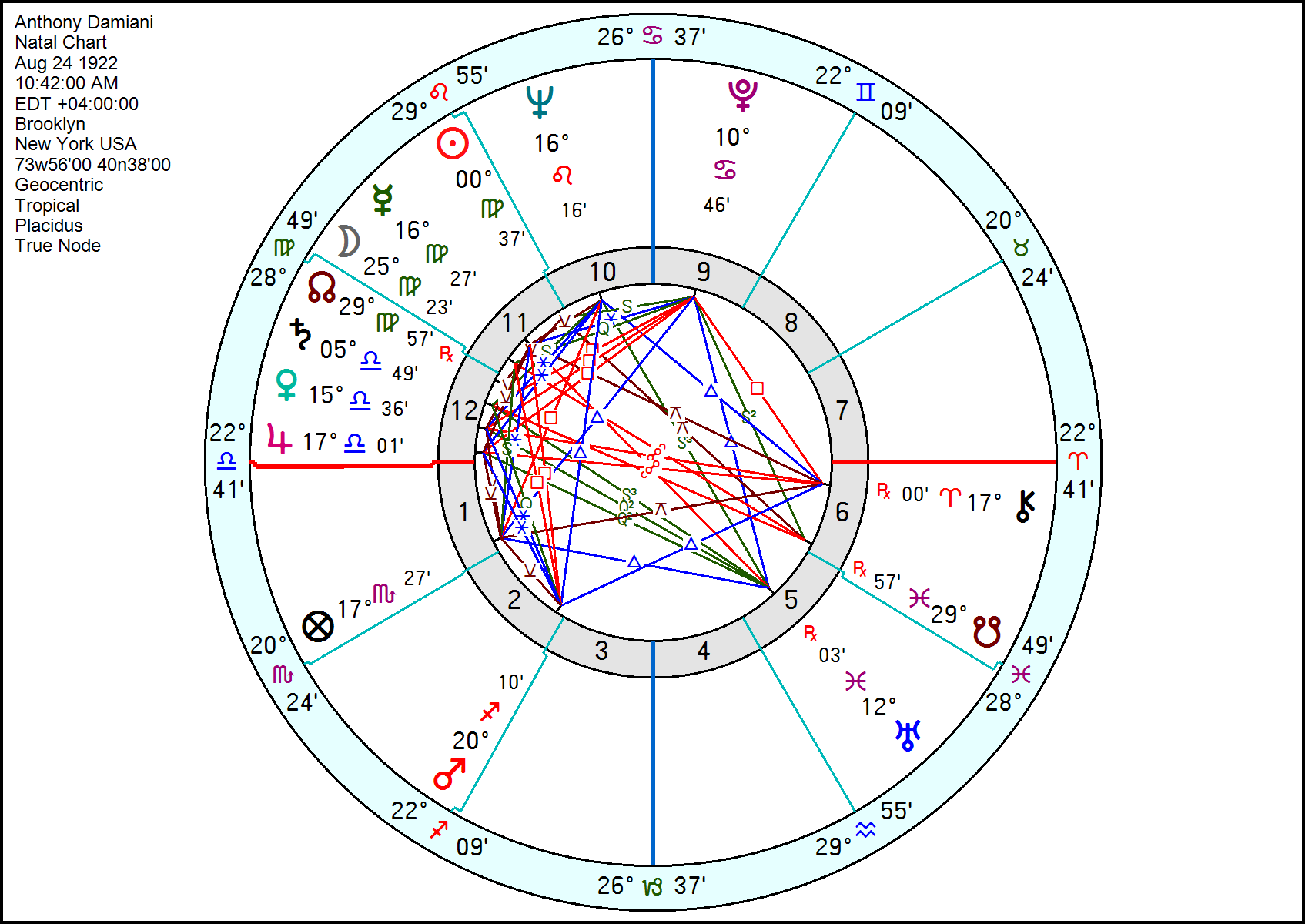
FIGURE 1983 1201-1. Anthony Damiani Natal Chart.
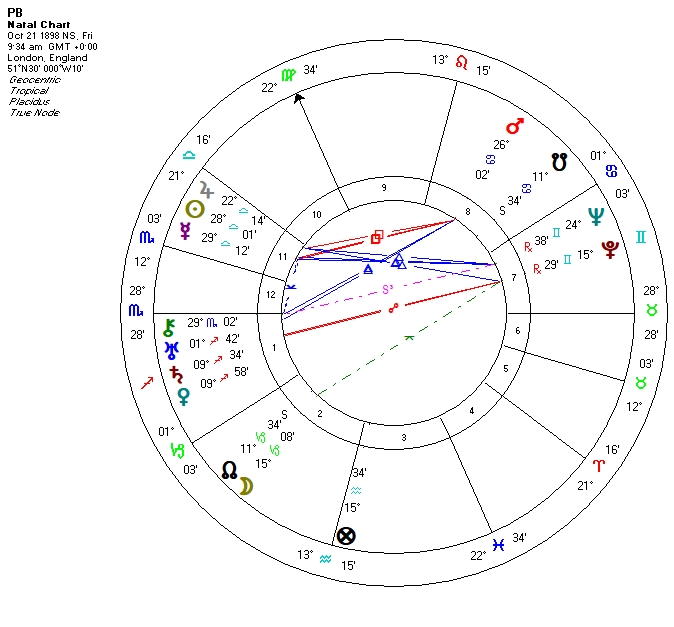
FIGURE 1983 1201-2. Paul Brunton (PB) Natal Chart ("official").
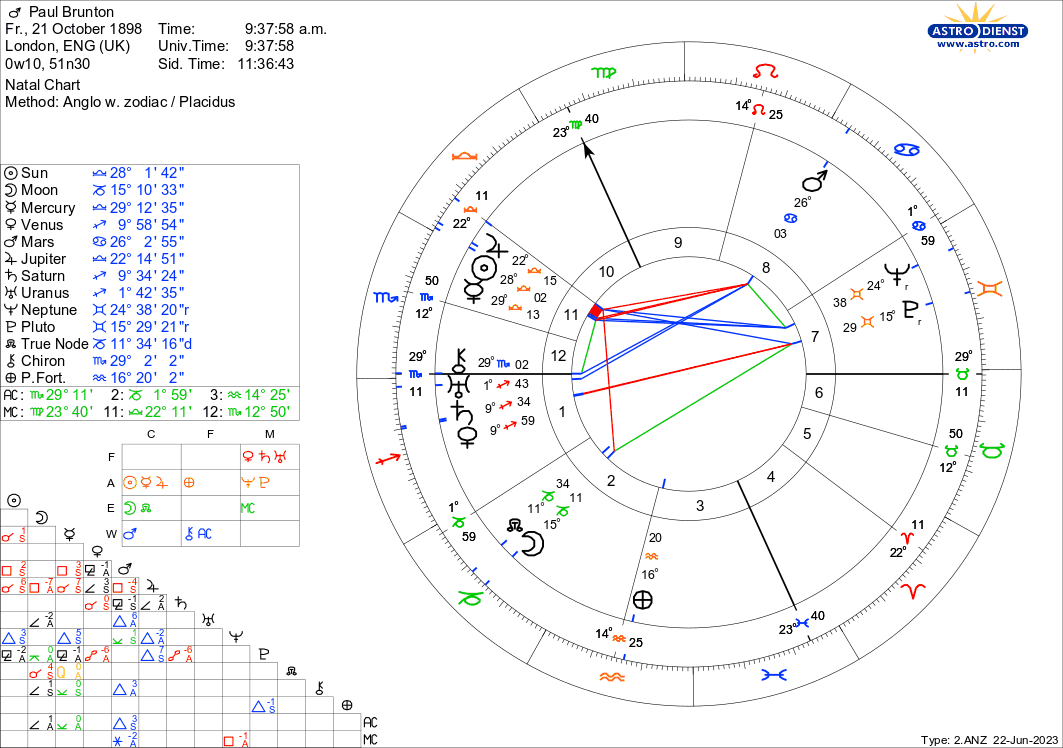
FIGURE 1983 1201-3. Paul Brunton (PB) Natal Chart (TS rectified).
RETYPED AND REFORMATTED by JF 2018; UPDATED by IT 2023 (see notes)
NOTES:
REDONE RETYPED PARTIAL TRANSCRIPT (hence V10.1). From AD Supplementary Material (Notes and Papers), pp. 1103-1109. THERE ARE NO AUDIO CASSETTE TAPES EXTANT.
Dec. 1 was a Thursday, hence a seminar.
This is a redo of the previous version which was labeled V08. This version is labeled V10.1 (per new convention for all redone partials) and has: updated prefatory matter and footer; Book List and TOC completed; new notes within the transcript; different Anthony chart and an extra PB chart appended.
This partial transcript apparently consists of a SUMMARY of several different seminars and classes from early-mid December 1983. (Info per Blue Book and jf notes.) Some of the following crosses over with December 19th Monday class verbatim transcript.
This transcript retyped by jf from the partial transcript entitled "Astrology; Theory "What Do We Know and How Do We Know It?" (found in AD Supplementary Material, pp. 1103-1109). The earlier version was originally typed on two different typewriters by jf in 1983, using her notes as a basis.
IT also typed the same partial transcript, but his version not used.
12/01/1983 is NOT the same as 12/19/1983 (for which there is a full verbatim transcript– Monday Astrology class), per Blue Book and other records, even though there's some overlap with this transcript and that event (there is material here not in 12/19)
AD apparently saw (because this was included in AD Supp).
Planetary glyphs and abbreviations replaced by spelled-out words. Some other slight formatting.
During November 1983 through February 1984 Anthony spent a lot of time working both on Epistemology and the Categories of the Imagination (planets).
1983 12/01 SEMINARS at Wisdom's Goldenrod (Summary)
Astrology; Theory; Epistemology
[AD Supp, pp. 1103-1109 Begins]
Mon. Dec. 1, 1983
ASTROLOGY THEORY - "What do we know and How do we know it"
I. THE DISCUSSION IS OF:
1) The World Idea - "What we know"
2) The finite mind - psychosomatic organism = natal chart, planets, degrees, aspects - "How we know the World Idea"
3) The World Idea's connection with the person.
II. THE EGO COMPLEX AS AGENT AND VEHICLE
There are two sides:
a) the mind is organizing the psychosomatic organism
b) and the psychosomatic organism is experiencing what's organizing it.
I.e., there's an appearance taking place in mind and mind is trying to understand the appearance taking place within it (by being). In order to understand that, you have to understand the a priori categories of thought.
To know that World Idea, the mind has to some extent become that World Idea (like the mind takes the shape of the cloud that's seen). The individual mind's functioning is the object of a Knowing, Willing, Feeling.
The natal chart, the totality of planets on degrees, forms the ego complex, that set of ideas to see the world. It's what I see and how I see; it's an agent and a vehicle. To the extent you identify with the vehicle (ego complex), you can't get to the ideas.
III. THE PSYCHOSOMATIC ORGANISM
If you had no body or senses, you couldn't know the sensible world -- to know the sensible world your mind is organized and constituted by the planets on certain degrees (natal chart). The Chaldean organization you're given determines the way your psyche functions.
The seven functions or planets in their togetherness constitute the psychosomatic organism which is the field of operation in which K, W, F [Knowing, Willing, Feeling] is operative. The Soul is inhabiting a body, and what you know of that body, and the appearance of the world is through the organization of these seven planets' functioning or instincts which are:
Mars - desire nature
Saturn - self-apperception
Jupiter - rightness/wrongness of instinctual function
Mercury - intellect, classification of memories that organism has experienced
Moon - assimilation of environment
Sun - creative purpose of life
Venus - like/dislike, aesthetic function
That functioning in its totality is the object of your knowledge, because you don't have a body without a World Idea concomitant with that body, and because the body is part of the World Idea. You're locked into the organism in such a way that you can only know what the senses report (like your ears will hear only a certain range of frequencies; a dog can hear higher ones). Therefore the appearance of the world is coordinated with the functioning of the body; they arise and set together.
IV. THE TRANS-SATURNIANS IN THE NATAL CHART
The trans-Saturnians in the natal chart represent certain fixed attitudes which operate with respect to the psychosomatic organism and body. This is in terms of the ego complex and the world arising concomitantly with that ego complex. These trans-Saturnians represent fixed attitudes that you bring over from the past in relation to the field in which they are now operative. This fixity of attitude doesn't really give the picture of the higher subjectivity because it's part of the natal chart. When a person dies, he doesn't take the concepts with him, but the 'feltness' of these things which are part of him; in the 'next' (not necessarily) incarnation these former attitudes are congealed. The trans-Saturnians are primarily in terms of the degrees the trans-Saturnians are sitting on. The aspects (to the Chaldeans) tell about the relation of the fixed attitude toward the instincts.
Example: Uranus square Sun represents a fixed attitude in knowledge. Here there is an alteration of the way that instinct (Sun) functions - after maturity it becomes operative more completely.
Also the attitude the higher self has is revealed in the natal chart. (K, W, F [Knowing, Willing, Feeling] in the natal chart are fixed ideas in relation to the ego, as reflective of past function.)
Example: P.B.'s Uranus conjunct (Saturn conjunct Venus). Here the emotional life is completely controlled by Uranus, which has the final say. Uranus knew what Saturn conjunct Venus in terms of the instincts were (this aspect shows itself as [sic; in] marriage as duty, etc.) -- they are under Uranus's thumb. (If P.B. had been Wang Yang Ming, for example, who discussed philosophy on his honeymoon, then this aspect can be seen in terms of prior functioning.)
V. ASPECTS
Likewise, aspects reveal root tendencies from former lives. Like Saturn conjunct Venus would indicate that Venus is under the thumb of the Saturn function -- there are no romantic notions of marriage, the Saturn sees through the illusoriness of the anima. The aspects of the Chaldeans symbolize in the chart the reflective consciousness. The reembodying Soul would know when certain relationships between the planets correspond to its tendencies -- and at the moment of birth, the "frozen moment", those tendencies are congealed into an entity. That entity is reflecting back to the witnessing consciousness its own proclivities. The objectification of those ideas (what you see) is the reflection of the inner desires of that embodying Soul.
VI. DEGREES AND OPPOSITE DEGREES
The planet on a degree constitutes your subjectivity.
The outward manifestation of your subjectivity is the opposite degree.
This creates the subject-object relationship.
Knowledge is in terms of opposites -- you can't know pleasure/pain, day/night without the other. We're taking this whole and dividing it into the subject-object by the simple functioning of the planets.
Your natal chart is the way you must see the World Idea -- as with the laws of occultism and psychology this bifurcation is: "Whatever is within must be manifested without; whatever is without, within."
Example of Saturn on six degrees Libra [Note: Anthony Damiani's Saturn; Libra 6, "A pilgrim sits on a rustic bench and one by one his ideals in a sort of trance-vision take form before him."] -- the orientation is primarily in terms of ideas, the images in the psychosomatic organism -- the opposite degree's orientation is materialistic. [Note: Aries 6, "A black square stands firmly, illumined red on one side."] The six degrees Libra is therefore the medium through which Anthony represents the world as an inner reality and material reality. The subjectivity (idealism) wouldn't consider its world without the complementary materialism and vice versa, but he is predisposed to work with ideas (degrees). Most people first get acquainted with the way they operate subjectively (degree).
VII. SUBJECT-OBJECT RELATIONSHIP
In terms of epistemology, it's hard to speak of a subject and object except in terms of the relation between them. The subject-object which is given in the natal chart by the complementarism of ideas -- you can't spatialize the knower -- From the point of view of the Witness I, the ego and its world are objective to the witness, but when it identifies too much with the subjective part too much it says "I am the knower."
All those ideas, or degrees, represent the sprouting and blossoming and living out of life. These ideas which are manifested as your life, see Plotinus: "the Soul contemplating the ideas". [Note: Plotinus, III.8.6.] In an advanced person the ideas shine through; in a neurotic they are deviated from, and are less clear.
VIII. CONSCIOUSNESS
What is it that brings about in our experience the distinction between the subjective function and the objective function? It is awareness which relates these two and makes them seem as though they are separated. The Witness is responsible for subject and object.
Example: The tone A: the 440 cycles per second is the objective side; the vibration on the tympanum is the subjective side. The knowledge of the sound A belongs to consciousness -- the consciousness knows the sound is A.
The Witness knows the relation between the 440 and the way it affects the ear.
The ego and its relation to the world is an object to the Witness -- it can look into the ego and see the ideas (degrees) the ego is manifesting. The Soul is contemplating the ideas -- those ideas it can't contemplate directly it experiences in the sensible world by the Witness I overseeing the ego (the planets' sitting on ideas). I.e., Living = Learning.
IX. THE WITNESS I
There are two streams:
1) the infinite consciousness of the Overself reduced to the Witness I (identical with the planetary mind).
2) The Witness I, which at this point is given to the individual mind, which having received the World Idea, which includes the body, experiences the world in two ways:
a) receives the idea of the world.
b) experiences the idea of the world.
In epistemology there are three terms, the subject, object, and relation. The light illuminates the ego but also bifurcates -- that illuminating the consciousness distinguishes and illuminates the objects and brings about the existence of an empirical subject, the ego as subject.
You can speak of a seamless whole (Witness), and also the empirical subject.
The various types of experience concerning the Witness are on different levels:
[a)] a seamless whole, without identification with an empirical ego.
[b)] a seamless whole, as identified with the ego.
[c)] the ultimate -- pure presentation, no identification with anything in that production.
If the planets represent a solar scheme, then maybe the Witness I could be put around the earth. The Witness is the experience of that world as image world, but not as concrete senses.
X. THE SOLAR LOGOS
The higher world is given to each individual simultaneously through our own mind.
That power which restricts the infinite consciousness of the Overself to a Witness is the Solar Logos, it awakens the Overself to evolve. The Platonists speak of our Soul as being born from a star -- the Overself is not born, it is eternally generated, so that means it is the Solar Logos, or the Being (World Idea) which comes into the One (individual Soul) which forces the individual Soul to go through the process of self-understanding. You are an inhabitant of the Sun's world, of the last phase -- Asmita -- of the Sun. You are conjoined to that, in the sense that what it does, you'll do. If you reach the level of your Overself, that's identified with the Asmita principle of the Sun, then the first level of experience is of the Soul of the Sun, then of the intellect of the Sun, then of the Sun's characteristic aseity and unity.
XI. THE CATEGORIES OF THOUGHT (Kant)
Are the categories of thought necessary in order for this object of knowledge to be produced or because they are available in appearance in the world?
Is it my individual mind operating with the categories of thought, or is my mind conjoined with the World Idea's categories of thought, that produce the world?
The law of gravity depends on something more general, something applicable to all human beings. Kant's categories (time, space, etc.) apply to the planetary mind which fabricates the objects.
The five categories (powers of the Solar Logos) (Yogacara's evolving consciousness, representation consciousness, etc.) condition the infinite Overself consciousness and make it into a Witness consciousness. The knowledge that belongs to the Witness consciousness is determined by the five categories (Samkhya: right knowledge, wrong knowledge, memory, sleep, imagination).
The object that is perceived, the object in itself, is brought into manifestation by the functioning of the mind -- this functioning is the a priori categories of thought. The a priori categories of thought organize the content of the imagination outside the imagination itself.
XII. REMINISCENCE
The ideas that the Soul knows are an imitative copy of the real ideas -- but they make possible reminiscence, they do bring about the possibility that the Soul can reach the originals, the archetypes.
So true epistemology is in a sense a combination of epistemology, cosmology, and ontology -- (Paracelsus quote "Astronomia").
*******************
XIII. OTHER RELATED TOPICS TO CONSIDER
1) Discuss transiting planets vs. natal planets (even a transiting Chaldean can bring an idea into the intellect).
2) Discuss transiting Chaldeans vs. transiting trans-Saturnians.
3) The World Idea is the circle of houses.
4) Categories of thought vs. categories of the imagination.
[AD Supp, pp. 1103-1109 Ends]
1983 12/01 V10.1: SEMINARS: Astrology; Theory; Epistemology. Copyright 2023 Wisdom's Goldenrod p. iii