CHARTS FOR 1983 1212
Class
Monday, December 12th, 1983
Verbatim, unedited transcriptClick the series name to view more
CLASS at Wisdom's Goldenrod, Hector, NY
with Anthony Damiani (AD)
December 12, 1983
ASTROLOGY; HOROSCOPE-ATMANANDA
TOPIC: Astrology
SUBJECT: Horoscope-Atmananda
SUBSUBJECT: Atmananda natal chart (trans-Saturnians)
CONTENTS:
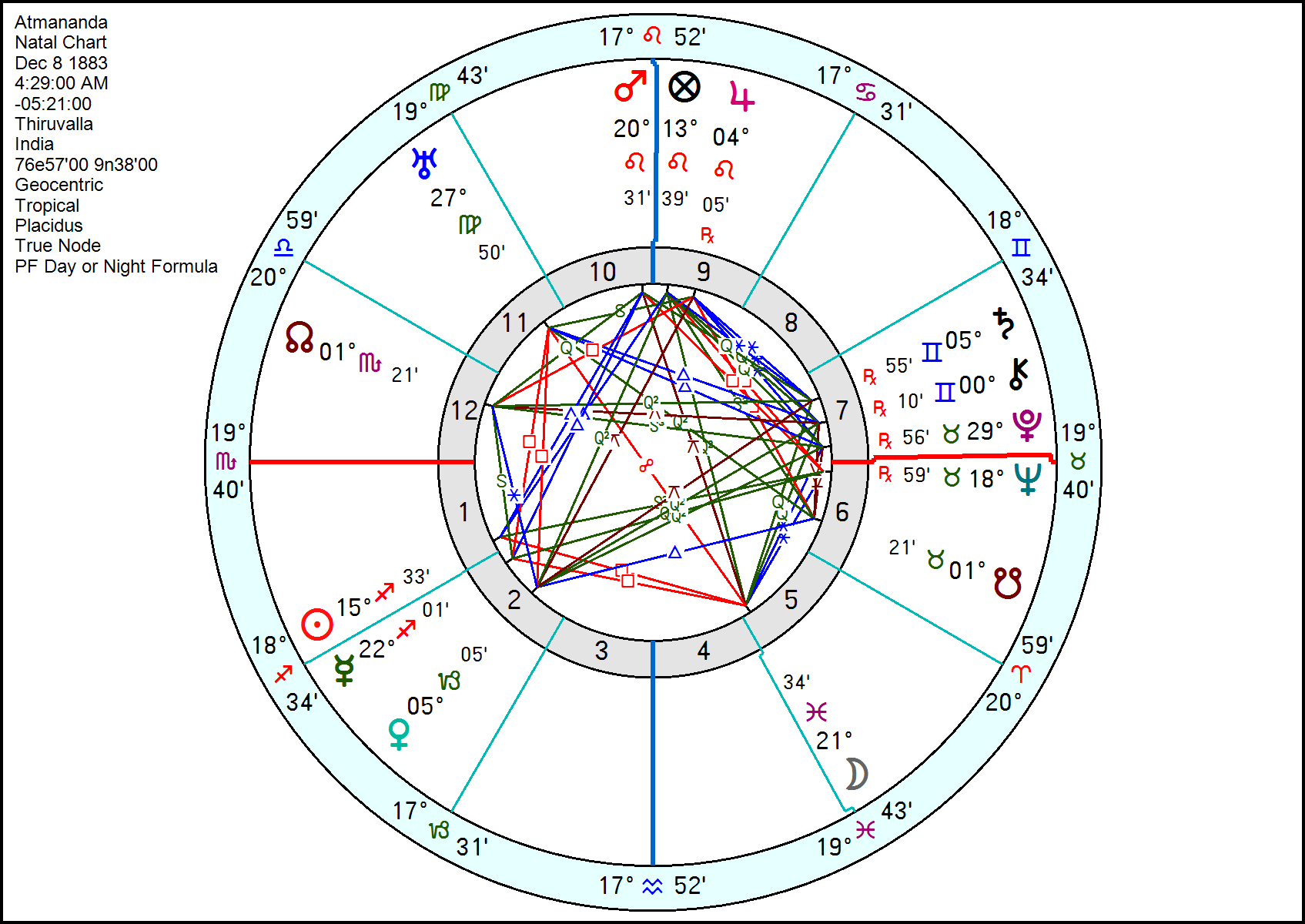
Student discussion of Atmananda's Uranus at Virgo 28 and its opposite
Uranus at Virgo 28: predominance of the intellectual function represented by bald-headed man; ego must be subdued by intellectual function
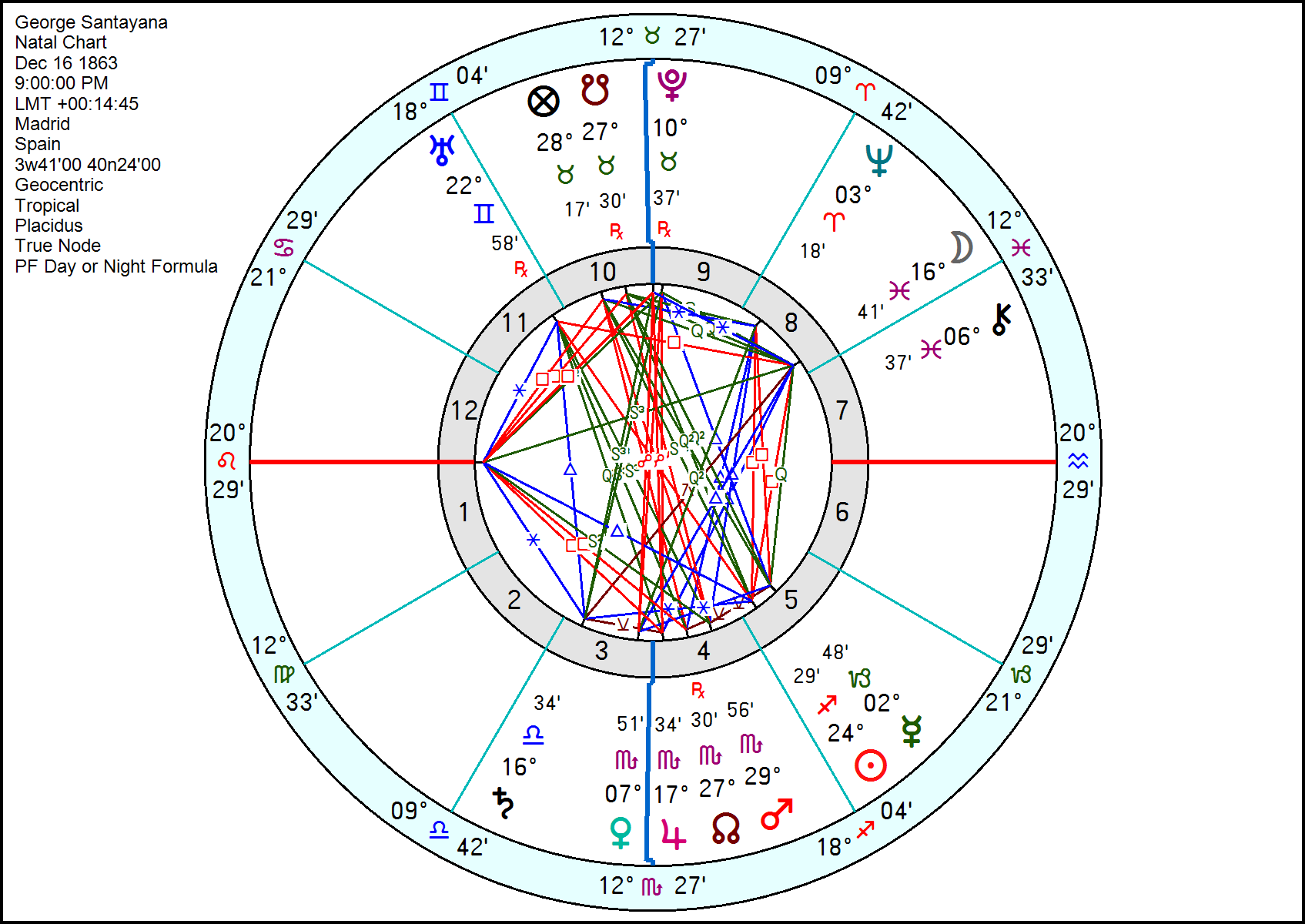
Atmananda and Santayana both had Uranus in eleventh house, both predominantly intellectual among friends, students, readers
You can't show insight in a chart
Head is the normal part of man; bald head symbolizes domination of intellectual over sentimental, why monks shave their head
Opposite at Pisces 28 (in fifth house): for Sage, night is like day; the discovery of your own interiority as fertile and alive; illumination of interior contents
Mercury has the facts, memorizes them, classifies them, is not the intuition as to what these facts mean; intuition brought in by transits
Relatively fixed root tendencies of ego represented by natal chart
Categories of imagination set for life, continue to function after enlightenment, function until death
Only way to read Atmananda's chart is by looking directly at the Sabian symbol and forgoing the psychological interpretation
Neptune at Taurus 19: Goddess of Reason finishes the task of universalizing the man; actualization of the faculty of understanding within infinite I AM consciousness; self-realization, birth of a Sage, shows that Atmananda will get enlightened in this life
Neptune giveth and taketh away
Opposite at Scorpio 19: expression of compassion
Pluto at Taurus 30: Atmananda stood in the glory and splendor of his Atma or the freedom of the will
Opposite at Scorpio 30: he could play his pranks
Plato: you choose your lot, what this means
Seeing the chart from the standpoint of the Witness-I
Natal chart is a medium through which Witness-I is reflected back to itself; tendencies in soul naturally drawn to vehicle that best represents/symbolizes it
Two streams
Sage is rich in the experiences of life
Dignities by house indicate that Atmananda always cooperated with World-Idea
Student discussion of miscellaneous astrological issues
BOOKS READ FROM OR REFERENCED:
Marc Edmund Jones, The Astrology of Concepts
Marc Edmund Jones, The Sabian Symbols in Astrology
Paul Brunton, The Notebooks, unpublished
Arthur Koestler, The Act of Creation
Ashtavakra, Ashtavakra Samhita
Plotinus, The Enneads (MacKenna translation, 4th ed.)
Richard Weiss, The Secret of Individuality: Reflected in a Hundred Historical Lives, 3 Vols.
Plato, Republic
PLOTINUS QUOTES READ OR REFERENCED: IV.3.13
SABIAN SYMBOLS: Taurus 19, 30, Virgo 28, Scorpio 19, 30, Pisces 28
CHARTS appended to this transcript:
FIGURE 1983 1212-1. Atmananda Natal Chart.
FIGURE 1983 1212-2. George Santayana Natal Chart.
NOTES:
- Atmananda also known as Sri Krishna Menon.
TRANSCRIBED Verbatim by IT prior to 2018 (V11a). This is V12a (2023) and has: updated prefatory matter, footer, and audio file name; Book List and TOC completed; Plotinus quotes section added; new notes within transcript; Atmananda chart replaced, Santayana chart added; new formatting to accord with new conventions. Archival verbatim transcript – V12a.
AUDIO FILES: 1983 1212a, 1983 1212b. [Note: "Tape" and "Side" refer to original audio cassette tapes that were later digitized into .MP3 Audio Files.]
1983 12/12 at Wisdom's Goldenrod
Astrology; Horoscope-Atmananda (Sri Krishna Menon)
[Audio File 1983 1212a Begins]
TS: Alright.
KD: Tim, could you just summarize [one/two words inaudible] (laughter) [three words inaudible]
TS: I got four pillows over here tonight. Summarize. Summarize the prevarications? (bit of laughter)
S: What's a prevarication?
LR: He just [few faint inaudible student words simultaneous with LR] said that we're going to do the trans-Saturnian(s).
TS: Yeah.
S (simultaneously): Oh.
S: Yeah.
TS: Uranus.
Marc Edmund Jones [The Astrology of Concepts, Virgo 28, TS reading]: "A bald-headed man in uniform, completely dominates an assembly of men: diplomats, scientists and industrialists."
Marc Edmund Jones [The Sabian Symbols in Astrology, Virgo 28, TS reading]: "This is a symbol of a simple satisfaction in the inner rather than outer manifestations of reality, and of the challenge to any purely personal attainment to become more than a visible proof of the special excellency. Man is not called on to make himself a scourge of his fellows any more than he is to be encouraged to neglect them, but there are illimitable areas in which the driving power of his personality can create or advance widespread opportunities for a richer and more enjoyable living. [The] keyword is DOMINANCE. When positive [TS reads: Positively], the degree is accomplishment through a completeness of self-mastery and a rigid control of others…"
[short pause]
TS: And do you have the long-form stuff Anne?
AK (very faint): Yeah.
Marc Edmund Jones [The Astrology of Concepts, Virgo 28, AK reading]: "This is a symbol of the unimportance of outer appearance, wealth or social position as matched against the driving power of real personality. Positively it is a degree of compelling manifestation of inner self; negatively, real capacity for hard work. The keyword is [AK reads: The word's] EMINENCE."
[15¼ second pause]
TS: Do you have the long-form of the opposite?
AK (simultaneously): Oh. Oh yeah. Here's the degree, it's 28 Pisces.
Marc Edmund Jones [The Astrology of Concepts, Pisces 28, AK reading]: "Night has seemed light as day and in the odd shadows of diffused whiteness the fertile fields appear quite alive. This is a symbol of the rising of nature to a point of compelling man's attention to vital forces unheeded by him or [AK adds: by] the call of universal mind to the inner heart. Positively it is a degree of real fruition; negatively, pandering to weaknesses [AK reads: weakness] of self. The keyword [AK reads: The word] is FULLNESS."
[short pause]
TS: This seems real different from this(--/.) [12¾ second pause] Ok. [10 second pause] So what do you think?
AK (faint): Ok, you want-- you want to talk about the 28 Virgo?
TS: Yeah.
AK: Ok. You talked about this this afternoon and you were taking the-- the assembly of men, the diplomats as-- diplomats, scientists, and industrialists as the three functions of-- of feeling, thinking, and willing. (bit of laughter) Ever-popular. (laughter, three inaudible student words, possibly AK)
S (amidst laughter): I'm glad you asked.
AK: Yeah, talking about the-- in part what is the unity, right? (students assent, laughter, student words) He's talking about Uranus [S simultaneously: (Does/Is) the feeling (die)?] as the-- being the dominant soul power, insight as the leading function, as above the-- the-- what would be seen as the trans-Saturnians. (I mean) it's very pictorial. It's hard to miss the pictorialness of it because he was a bald-headed man in uniform and he would dominate every assembly he was in.
[student assents, faint]
[10¾ second pause]
TS: And we talk about Uranus as the higher knower in some way, you know, it seems like here it's almost like that-- that idea of insight and it's a fusion, three different modes of operating, so it's dominating this individual. I'd say the Ura-- the keyword here is Dominance. [student assents] It's in the eleventh house, it's giving birth to a new order of knowing, a new way of knowing. It's a-- a fusion of the full development of other modes-- the three modes of knowing. And I'm trying to understand it both as Uranus and as Atmananda's Uranus (now). And what does it mean to say that his higher knower is a bald-headed [one word inaudible] It's more like you're saying that what is known is this mode of the idea that the degree carries is the-- is a form that this higher knowing or intelligence takes. Certainly we could s-- I mean the degree seems like the interpretation is immediately available in terms of his life, in terms of the kind of teacher that he would be. I usually look at the eleventh house as some kind of teacher, where one does one's teaching from. And, this would be a very impersonal kind of (teacher/teaching).
AK (faint): Can I ask you about that, and why do you have a house for teaching?
TS: Why not? (TS laughs, laughter)
AK: Did you ask yourself (and wonder (why/what))?
TS: What? Yeah. (some laughter) Six letters beginning with T and ending in R.
S: Seven.
RG (simultaneously): Seven (all/R).
TS: Seven. (laughter) See it fit. (laughter)
S (amidst laughter): How much?
S (faint, possibly part of background): [one/two words inaudible] at the end.
[9¾ second pause]
AK (faint): No I just had never seen it (applied for) eleventh house to the teacher (whose spirit is) the ninth, it can't be right.
JA: What was it [couple words inaudible] What was the word?
TS: Teacher.
JA (faint): Oh teacher.
TS: Counselor, teacher. [short pause with student whispering] There was another one, it just seems to make sense to me. I-- I don't know if I can come up with a good reason except in-- you know, you think about 3, 7, and 11 as having to be air houses. Well, so that's on the right track. (laughter, student words) Now give 'em that book.
LR: I know, I know one reason for-- that I call it (um--) and is that the-- the eleventh house is the place for ego refinement and development and transformation from one level to another. You grow up and that is [one word inaudible] by a teacher, that hurdle of development where one makes an attainment or that kind of transformation, grows through it. [short pause] That's one explanation for the-- [16 second pause] The interesting thing to me about Jones' explanation of that symbol is the kind of dominance that he describes, which is not-- where he says it's not a scourge of his fellows that's called upon to make him dominant but it's the kind of dominance that a person with inner self-mastery, (you know). It seems like that kind of attainment is the one that really marks-- I mean you were saying today that it wasn't-- it didn't have the kind of demands put on the people that came to him that people like Gandhi had in a sense [couple/three words inaudible] had that, it was his own power of self-mastery which was really the example in the symbol. If we speak about, which we will do in a little bit, if we speak about Uranus as the focus--
TS: Concen-- ekagrata.
LR: (Taking a) concentration, focus, one-pointedness, that his one-pointedness-- in other words, for him to be one-pointed, for him to be self-centered, meant a complete domination, meant that that kind of power was available to him. And, that's what the Uranus symbol means to me. (Tim where--) that the Uranus symbol will describe the (human) self-focus within a chart.
AK (faint): (I'm/You're) going with Linda to the eleventh house and yet you mention(ed) the locus of power. It would seem that his ability to lead would be the-- to-- to view-- to agree with this symbol and the-- the way he talks about it, it would seem that he was able to demonstrate how insight purely the leader of the soul at whatever level the student came from on, that it wasn't that he preached one particular path of one kind, not one kind of yoga or one kind of enquiry so much that he showed that from-- in any (of) the [couple/three words inaudible] that the Self should always dominate the functions.
[12¾ second pause]
TS: What do you make of the opposite degree?
[9 second pause]
S (faint): (Would/Could) you read the opposite?
Mac Edmund Jones [The Astrology of Concepts, Pisces 28, TS reading]: "Night has seemed light as day and in the odd [TS reads: cold] shadows of diffused whiteness the fertile fields appear quite alive."
TS: The interpretation in here is not as good as the one before.
[short pause]
S: But the word is 'odd', not 'cold'.
[short pause]
LR/S(?): Not in my book.
S: I have 'odd' too. (bit of laughter)
RG: Hm?
S (very faint): Yeah.
TS: Yeah?
S: [one word inaudible] in the old one.
[student(s) assenting, faint]
RG (faint): What do you have, Tim?
AK (faint): I only have 'cold'.
TS (simultaneously): 'Cold'.
AB (faint): (The one in the) book says 'odd'.
AK (simultaneously, faint): Well, we do-- we do have two incidents that sort of [one word inaudible] this one-- the night that he met up Yogananda. There's a night where they spent the night in the moonlight talking.
LR (faint): Do you know what date?
AK (faint): And also there's the-- the secret rite PB describes also that took-- took place in the moonlight. And that-- that was more a pictorialization of it. I don't know. [Note: See https://www.pbarchives.org/archive/document/writing/12, Asiatic Notes 4, pp. 697-698, quote 657-1 in text searchable version; pp. 657, 659 in original version. See also WG Classes 1983 1030a and 1983 1121a.]
JA: Well--
AK: I don't know what the opposite degree of a trans-Saturnian would--
TS: I know [one/two words inaudible]
JA (simultaneously): Yeah, that's just what I was going to say. (JA laughs a bit, student assents, very faint)
AK: You know.
TS: I mean it seems so different from-- in some ways. We-- we saw in the degrees that he was operating with, the natal degree and the opposite seem to be pretty well operative. But here it seems to be harder to understand, at least for me, on(--) something of what this opposite degree would mean.
LR: I think it's real possible to make a good argument for not reading the opposite degrees in the trans-Saturnian. In that we are-- you know, we were speaking of them as pathways to the Witness kind of consciousness? And that it was the way that the Witness had of manifesting itself in the chart through those three modes? And if that's so, there wouldn't be the kind of psychological polarity that there would be for the Chaldean. There wouldn't be the need of that-- well, there wouldn't be a subject-object relationship with modes of Witness-consciousness. The Witness could never be objective except-- So, even in the Witness contemplation of the primal image it's not a three-- it's not a-- a threefold relationship, in fact it's a identity more. And I would tend to think of those as more like self-identical than polar opposite.
TS: But if it's gonna be manifest and crystallized in to the consciousness of the psychosomatic organism, it's gonna have to take the form--
LR (simultaneously): But not as a psychological relation.
AK: I-- I thought we were talking about that it would be by progression that the trans-Saturnians, not by-- you know [couple/three words inaudible] the opposite degree but it would be the progressions of the trans-Saturnians, that that's how that would accumulate and become more conscious.
[short pause]
JA: I thought it was once suggested that the opposite of the Uranus degree would ne-- would indicate how the ego would manifest its higher knowing behind-- in circumstances. That was suggested. [9 second pause] And, would be manifested in circumstances, how it would be--
[short pause]
TS: Makes some sense, it's just hard to understand for me what this degree would mean in that way. I mean supposing we say it's some kind of expression of higher knower, of the out-- the image that it has, that it-- that it creates the outer form of it.
[short pause]
TS/S(?) (faint): Yeah.
AH: It seems that the presupposition is that qualitatively this-- the trans-Saturnian is different. Like the three trans-Saturnians are qualitatively different in some-- Starting with that presupposition.
TS: Yeah. We usually talk about them as-- as some-- you know, the agents of the Witness-I, as providing the willing, knowing, and feeling consciousness that the psychosomatic organism variously uses or is lit up by. And we've talked about them somewhat as this-- a notion of concentration, kind of concentrative act in Uranus and kind of diffusion that-- or dispersion, (adaptivity) in Neptune, cutting off or stopping, an absolute dissolution and reformulation in Pluto as the three s-- three ways in which one goes from one stage of consciousness to another. It seems like these are the agents by which real psychological-- real ego growth would-- would take place, real ego transformation would take place. [possible aside, faint: (No.)]
AH: It seems they could be described in-- in a way that would make them qualitatively distinct from the other planet. But experientially in regards to the native, would that-- would his conscious experience be qualitatively different.
[short pause]
TS: Again it would seem to be yes, that there is um-- From what Linda was saying it, in that there is a certain kind of reluctance to fully crystallize into the threefold relationship, that the very way in which these operate in the natal chart produces both the greatest instability and the greatest stability in the psyche depending upon the point of view one takes towards them. You know, here we're trying to see what it would mean for someone who is coming from that position, you know. And it may be that we're, you know, that's part of what this degree itself means, when you say that Uranus is the higher knower, keyword is Dominance, that that's what dominated the psychosomatic organism is (the entire) higher, the witnessing consciousness, the perspective of the Witness from the beginning. And it seems like that's a simple, you know, interpreting if you say that the degrees represent what has been-- the indication of what the soul has done, these are the ideas that show us something of its-- its act that this Uranus picked this degree.
AH: It seems like Uranus is especially difficult, you know, because you're going to describe it as Witness and at the same time describe it as somehow involved in the psychosomatic. [one word inaudible]
TS (simultaneously): Well the others-- yeah, the others are going to be just about as difficult, you know.
[short pause]
LR: You know, but we did say they were the regulators. They were the only knower, willer, (you know), in the chart in the true sense. Appropriated those function(s). I'm not sure I would say it was Wit-- Witness-consciousness per se. But that they would describe the modes of the Witness being the empirical. In other words, if-- if I were to look for what the chart showed me (was a--)
S (simultaneously, in background): Elliot, there's plenty of room somewhere else.
S (in background): [couple/three words inaudible]
S (in background): Yes you are.
LR: If I were to look for what the chart was pointing out in terms of a-- a path, I would say there's those three possibilities to achieve. But if you could really understand the trans-Saturnians in the chart you would have three real good clues about uniqueness of your way.
[short pause]
JA (faint): Way is what you said? What is-- what way do you mean?
[short pause]
TS: Well that seems to-- that makes sense to me because-- so between the three of them would be some kind of-- the path out of the psyche, (and/I mean) how does one concentrate such a way-- focus one's direction using the ideas presented through Uranus, how does one cut off the lower through the Pluto, and how does one establish oneself in a more rational sphere through the Neptune. You know, each one of them works towards that. [short pause] I think it's probably, you know-- part of the clarity of his degree is in that it isn't aspecting the Chaldeans, you know, that it's not-- it's not in as close an aspect to the Chaldean, Neptune is very strongly aspect with Chaldean [couple words inaudible] So it seems to me that, that consciousness, that knowing, that impersonal consciousness of the Uranus perhaps wasn't as colored by the personal preferences that might be carried in the-- the psyche. There aren't any fancy aspects, do you know?
LR: Uh-hm.
TS: Yeah?
LR: There's a septile.
RG: To Jupiter.
AS/S(?) (faint): What's that?
[short pause]
TS: A septile to Jupiter?
[student assents, very faint]
AD/S(?) (very faint): Is it wide?
S (very faint): Yeah.
S (faint): Too late.
[short pause]
LR: I don't know what kind of orb we're using [one/two words inaudible] But, maybe we should go through the planets [TS simultaneously: Yeah.] (and degrees) first.
S: [couple words inaudible]
LS (simultaneously): I just have one more thing to say about that degree, that I really thought that degree has a-- it really shows that the psychic form is really incorporated in the mental there. And that degree has this-- it's a power in sacrifice, that degree, a power of letting go of the-- of the outer form that comes from the fact there's a-- that the intelligence re-- resides in the mental. There's a great power that comes out of that, that-- it's a power of surrender. To me that-- that degree shows how the form-- that the real form of things resides in the mental side and the psychic is derived from that [one word inaudible]
TS: Uh-hm.
LR: Can you-- I don't understand your word, say more. Or just connect it with the degree.
LS: Well that-- I mean that's the way that bald-headed guy dominated. That he stores up the power by not identifying with the outer form of that. [students assent, faint] Or he radiates power by not identifying with the outer form of things, identifying instead with the mental side or the essence of it.
TS: So I think that's what we were s-- in-- was mentioning like this afternoon is the-- had very little tolerance for the kind of-- what do you call it-- the outward-- the outer sannyasin is the guy who would show up and be outwardly the spiritual quester but here he was-- his-- his strength came from doing his mental [couple/few words inaudible] as he found them in-- as he found it, and speaking to people's inner-- inner state and direction directly and in controlling or act-- interacting with them on that level but not on the level of manipulating their outer forms. And here where it says "rigid control of others, mastery over self and rigid control of others," that the rigid control of others is in terms of speaking directly to that inner being from his own self-mastery.
LS: But I-- to me it seemed that his teaching was that if you're doing anything genuine, that's right. It doesn't matter what the form is, it's the genuineness, and if you're not doing something genuine then whether your form is-- is great or not doesn't matter either. To me I see that teaching in that degree.
TS: Uh-hm. Well I see it too. Yeah, that fits like the dominance of silence. I mean it's such a characteristic flavor of him to see that, that radiant presence, you know, his-- an alertness. How do you see the opposite degree now? Would you say that it (shows/says)--
LS (simultaneously): I didn't see it.
LR: Yeah, the only thing I--
LS: Couldn't see the opposite degree.
TS/S(?) (faint): No.
LR: The opposite degree sounds like that kind of mysterious atmosphere that PB described of him.
TS: Yeah.
S: Look at this.
LR (faint): The (old-fashioned) [one word inaudible]
TS: I know it r-- it reminds me of that initiation ceremony, you know, but that's-- I can't see a meaning there.
LS: No, I just blanked on the opposite degree.
S: Yeah.
JA: I s-- I still don't understand though the degree itself. It's a bald-headed man in uniform, right? I mean what-- I didn't pick up what-- that symbol part from-- from what you were saying, I mean, that's part of (his/it--) image. I mean what do you think the uniform signifies?
TS: That uniform? Can I-- I-- I think of it as the uniform of the monk. I don't know.
S (faint): Why do you ask about this uniform?
JA (simultaneously): But--
TS: You're looking to what is the picture or what does it mean? What does each element mean?
JA: Yeah, we're not talking about the man, I mean, we're not talking about his appearance, I mean we're talking about what the Uranus symbolizes, and in terms of the Uranus, what is the uniform?
LS: Well the uniform usually stands for a group that-- whose power that you're representing, right?
JA: Well in this case it's obviously a military man, so what is a, you know, a military man?
LS: Well, just a-- he just says a uniform, and a uniform usually stands for a group whose power you're representing.
JA: Yeah. Now what--
LS: It's a manifested form of an essence, right?
JA (simultaneously): Let's transfer though that--
LS: It's a manifested form of an essence.
JA: Manifested form of an essence.
LS: Of an essence, yeah.
JA: That's kind of vague.
RG/S(?): [one word inaudible]
LS: That his surrender is-- he's bald, which means he's surrendered, and he's surrendered to the manifested form of an essence.
JA: What form?
LS: Maybe not.
S: Right. (bit of laughter)
RG: Jeanne (I like--) why do you want to pick apart the symbol so carefully?
JA: I just had a feeling that it-- that it signified something.
RG (simultaneously): What do you think it-- but what was your feeling?
JA (simultaneously): I don't know, I-- I don't know but I had wondered if I had missed something in your explanation.
LR: Why do you say it has to be military there? Just sort of ha-- it's obviously military?
JA: The impression I got that was-- was that it was a very sort of modern symbol in that the military dominates, you know, the intellectuals, the scientists, and the industrialists.
LR: Why? Well I don't see it as milit--
JA (simultaneously): That was the image I got Linda. (JA laughs a bit)
LR: But you say it's obviously military.
JA: It was obvious to me, I see that now that it isn't but-- I mean, it doesn't necessarily have to be that way but that is the image that I got of it. But maybe it's (the other). [one/two words inaudible] happens that the military dominates (the entire) [one/two words inaudible]
S (very faint): Yeah [few words inaudible]
LR (simultaneously): See because it's Uranus I would think that the uniform would be the uniform of the soul, I mean that would be the form, like you said, manifest form of the essence.
LS: Yeah, the (truth). The doctrine.
LR (simultaneously): It would be exactly what he is inside that he would be wearing that garb.
LS: But also the tradition of a [one word inaudible] nature.
JA: Well that's what more what I was thinking of. That is, the traditions, the--
LS: Yeah, that's what I thought.
AH: I think the uniform is juxtaposed with all these other people who are not in uniform, suggesting some special discipline or some initiation.
JA: Right.
MC: Or all the people who are in uniform but aren't bald. (some laughter, student words) Just like he's the one-- he's the-- the one inwardly back on-- in the collective. Maybe he gets some power out of that, maybe he's-- he's in the collective and yet he's sort of solitary, he's in that baldness, what that represents. I mean I saw that-- that juxtaposition as maybe being somehow related to the power he had, the ability to dominate. And, that's why I didn't see the uniform as so much of the monk as much as the collective.
TS: Well it's-- I just meant it as a-- a sample of another kind of uniform besides military which is, you know-- I think of the Dalai Lama's uniform and him dominating industrialists and diplomats [couple words inaudible] I mean it's the same kind of thing where he's a bald-headed man in the uniform of a tradition and (it/he) clearly is the inner being that's producing the dominance. And one thing that I didn't bring in that I hadn't pointed out was that this ashram was run very [S, very faint: Strict(./?)] strictly in terms of what kinds of activities and behaviors were allowed within its walls. He did not, you know, allow-- he didn't keep the same kind of hands-off attitude that say Ramana did, he was very aware of what was going on and very defined in terms of what was to be done or not done without being a-- you know, asserting that all should be done-- the same thing should be done by everybody in that sense. But you know the way the ashram ran after his death also was a-- it was sort of organized and it was not commercialized and what not.
LR: But-- and also he-- that ashram had a lot of Western-- I mean [TS simultaneously: Yeah.] it was a motley group of people, it wa-- it wasn't all monks, for instance, who were his disciples, you know. It was quite varied. I don't know if that would [one word inaudible] in the symbols though.
TS: Well, I think, you know--
LR: I mean just [TS simultaneously: I think he--] in terms of the diplomats, scientists, and industrialists that it's not-- you know, this man wasn't dominating one set.
[student assents, faint]
TS: So can we turn it around for a minute and then go on [one/two words inaudible] I'd like to see if we could go back the other way and see if this is-- What does the higher knower in itself know as a reason-principle? [9 second pause] In other words, I want to go back to the question of whether or not this degree carried-- if you put Uranus on this degree, with the work that we've done so far on his chart, could you say that there was some kind of idea of insight that was being developed in this through Uranus being on this degree, some kind of fusion or super-ordination of the Uranu-- of the willing, knowing, and feeling? Or is that--
S (faint): Yeah.
AB: Wouldn't you say that it knows itself as providing a superior perspective?
TS: Uh-hm.
AB: In other words, that realization was very grounded in him. I mean--
RG: Yeah, I-- that's what Lenny said was that his higher knower was already [one/two words inaudible] [AB simultaneously: Right.] the path and that he's-- and he had control over the forms of life, of his life.
AB (simultaneously): Right. It's not like he had the experience but he didn't know where or how to apply it. He was completely well-functioning.
[short pause]
CDA (very faint): I don't see where you get fusion from the [one/two words inaudible] or where you get-- [TS simultaneously: Well--] (how you get he was a teacher in eleventh house), and not just a domination (of) [possibly one/two words inaudible]
TS: Well there's three-- three things, there's the diplomats, scientists, and industrialists.
CDA: But, I mean, that could just as well represent the fullest spectrum of--
AD: Society.
S (very faint): Yeah.
LR (faint): Right, (you know--/yeah.)
CDA (faint): I mean I don't-- I don't-- I think three could be there are three examples of the [one/two words inaudible]
TS: Well it could be seven, I mean--
LR: Except [student assents] that it is a broad spectrum, it's not a limited kind of (pers--)
TS (simultaneously): Yeah. So it's a wide range I (can--)
LR (faint): (Right Tim.)
CDA (simultaneously): Yeah so, I mean I don't-- I-- I don't see why you--
LR: Well, the point I-- in the symbol I think is just that the man who's commanding has to be able to command not just the scientist, [CDA simultaneously: Right, yeah, (yeah, yeah). Yeah, and so far the--] but a-- but in-- so that's where the idea of insight came in, just as-- as that--
CDA (simultaneously): Couldn't it also be some philosophical overview that will incorporate and-- you know, the masses, uh--
RG: But, I do-- I don't think Tim was coming at the fusion from the degree necessarily but in the idea that, you know, this degree [couple/few words inaudible] (or/where) you might see a fusion of the higher knower, (can you get it from) the degree?
TS: Well, I was trying to put the two together, that in other words that, if you put Uranus on that degree that it would tend to-- how would you interpret that degree-- Well, let's see. In the degree there's a dominance of several functions. Now if you put Uranus on that degree and you say that there's this concentration that Uranus generates, and that concentration is towards dominating all these different functions through the position of the higher knower, would that create some kind of i-- kind of arisal of the function of insight.
RG/S(?): Well I--
KD: Why would you limit that just to Uranus?
RG (simultaneously): So that anyone-- I mean I-- that's-- that's a hard-- that's a big claim for Uranus, I mean, completely.
KD: Tim why would--
TS: Well I got my motivations for doing it! (TS laughs)
RG: Yeah! [KD simultaneously: Why would-- why would you--] Yeah right. (RG laughs) I think you're a little, you know--
S: [one/two words inaudible]
KD (simultaneously): Tim, why would you even--
RG (simultaneously): That's right [one/two words inaudible] (RG laughs)
KD: Why would you subsume something-- Tim--
TS (simultaneously): I figure if you go high enough up you'll get shot down sooner or later.
KD: Why would you subsume something so-- so big and integral as insight under one function? I mean why would insight, which would be--
RG (simultaneously): 'Cause we did talk about Uranus as-- as the representation of the higher knower, and what is the-- what is the functioning [KD simultaneously: How--] of the higher knower?
KD: Ok, [TS simultaneously, faint: Ok, (hold on).] ma-- let's back up a minute, how do you-- what do you-- what do you mean when you're using the word 'insight' Tim, maybe I don't understand.
TS (simultaneously): I'm meaning it the way he-- the way I understand PB to mean it.
KD: Which is what?
TS: The function (of/um)--
AD: The fusion of--
AS (faint): Knowing, willing, and feeling.
TS (simultaneously): Intuition and reason.
AD: Willing, knowing, and feeling. And which is different from those functions qualitatively.
TS: Right.
AS: They're--
AD: Well how would you equate insight with Uranus?
AS: Right if--
TS: No. I'm not equating insight with Uranus. I'm in-- equating the degree, Uranus on that degree with a knowing of the idea of insight that would be achieved, it would be presented as a goal to be achieved. Uranus would present this individual [S simultaneously, faint: Yeah, that's what he said.] the goal of achieving insight. And that would be something that would be given to him through an impersonal knowing, but it would take obviously all [couple inaudible LR words simultaneous with TS] three trans-Saturnians or whatever to achieve it.
AD: But wouldn't then it be more to the point to say that that degree represents the primary dominance of the intellectual function.
RG: In him.
AD: Him.
RG: As a-- as a m-- as a path to realization.
[student assents, faint]
TS (simultaneously): Yeah that-- ok, well that's the other way of saying it.
RG: (Right/Yeah). (laughter)
S (amidst laughter): Yeah, (you can't really know if that's true).
S (simultaneously, amidst laughter): Yeah.
CDA: Yeah. (bit more laughter, student words)
RG: Sorry Tim, nice try. (laughter, student words)
TS: Well I'm the one that's wrong and un-- and unintelligible (so--) (RG laughing)
AD: Well that's alright, I-- I build on what you're doing, Tim. (laughter)
AB: On the rubble.
TS: Yeah right.
AD: Well, how about the opposite? What does that symbol suggest?
RG: Can you see it? Can you see the oppo--
AD: Do you notice like for instance, who had that, Santayana had that, right? Uranus in the eleventh?
TS: Uh-hm, yeah.
AD: You notice something similar about their character?
TS/S(?) (faint): No.
LR: About their what?
RG: Their char--
S: Their character?
LR: They were [AD simultaneously, faint: No.] really dominant.
RG: Dominating. I don't know. (bit of laughter)
TS: They were a little cool?
AD: Well, I mean in a sense wouldn't you say that Santayana was predominantly intellectual?
TS (faint): Oh, I see, (yes/yeah).
LR: Because of the eleventh house?
AD: Huh?
LR: Because of the eleventh house?
AD: No, not because of the eleventh house.
LR: Wait, Santayana Uranus--
AD (simultaneously): (He/It) had a Uranus in the eleventh house, yes. [S simultaneously, faint: He's ready to go.] But there-- there was a similarity there, not exactly. I think his was the three fledglings.
RG: Right.
LR: Yeah but what were you seeing as the similarity coming from?
AD: Well among-- among friends and students and relationships of all kind(s), the dominant function was the intellectuality. In the case of Atmananda it was with his students, in the case of Santayana it was with his readers.
[student assents, faint]
RG: Oh so you're saying the eleventh house is your aspirations and your goals [AD assents, faint] and the planet that's in there is going to define that.
[short pause]
AH: Anthony, are you using intellectuality in a strict sense or in the broader notion that it would include insight or--
AD: That would include what?
AH: It perhaps might include a faculty like insight.
RG (faint): No.
AD: No.
RG: No. Strictly as the knowing function.
TS (faint): Yeah.
AD: You c-- you can't show insight in a chart.
CDA: I-- I was-- I can't even imagine it being symbolized in a degree.
AD (simultaneously): Symbolized. No, that's what I'm saying, you-- there's no way of showing it. It's intrinsic self-cognition, what-- how do you run up a flag for that? [short pause] Well anyway, Tim, if we say-- if we put it that way, alright, that showed the primary dominance of the intellectual function, and I think many of the things you said about(--) illustrated that, what about that opposite degree, could you read the symbol again?
S (faint): Would you read?
Marc Edmund Jones [The Astrology of Concepts, Pisces 28, TS reading]: "Night has seemed light…"
TS: Sorry.
Marc Edmund Jones [The Astrology of Concepts, Pisces 28, TS reading]: "Night has seemed light as day and in the odd shadows of diffused whiteness the fertile fields appear quite alive."
AD: You try once more, I-- [S, very faint: Didn't hear anything.] Try once more, I-- I don't think I got that first part.
LR: Night.
RG: Night.
AD: Night?
RG: Night.
LR (faint): Has (seem/seemed).
AD: Like darkness?
RG: Dark.
TS: Yeah right.
RG: Has seemed light.
AD: Seemed what?
RG (simultaneously): Light as day.
TS (faint): Seems as light as day.
AD (simultaneously): Yeah.
Marc Edmund Jones [The Astrology of Concepts, Pisces 28, RG reading]: "…and in the cold shadows of diffused [S simultaneously, faint: Odd.] whiteness…"
S: (Of--/Odd.)
S (very faint): Is that odd?
Marc Edmund Jones [The Astrology of Concepts, Pisces 28, RG reading]: "…the odd shadows…" (laughter)
S (amidst laughter): It is odd anyway. (laughter)
Marc Edmund Jones [The Astrology of Concepts, Pisces 28, RG reading]: "…the odd shadows of disused whiteness the fertile fields appear quite alive."
[students assent, faint]
S (faint): (That's the reason I like to (sleep/sweep) all winter.)
RG/S(?): That was--
S: Yeah me too.
S (simultaneously, faint): [couple words inaudible]
[student assents, faint, bit of laughter]
[short pause]
KD: Well, why c-- why couldn't that be like the light of consciousness illuminating or dispelling-- dispelling ignorance as far as the result of the-- or concomitant with the supremacy of the intellectual functioning? That's kind-- that might be simplistic, you know, but--
RG (simultaneously): 'Cause, you know, it's only seeming, it really is night that seems like the light of day, that's what's so--
[student assents, faint]
LS: 'Cause the Moon's out.
S: Yeah, but--
S (faint): [one/two words inaudible]
LR: Whose?
CDA: The Moon's the bald head.
S (very faint): Well of course. (laughter, student words)
AD (amidst laughter): That's Moon? No, the-- the bal-- (laughter, student words) the bald head in the symbol-- you know like-- (13½ seconds of laughter, student words) When you see a man with a bald head, what does it signify for you? [S simultaneously: That they get a lot of--] That there's a lot of traffic up here. (bit of laughter)
S (faint): There's a lot of traffic too [S simultaneously: Progressively going (one word inaudible)] [few words inaudible] street.
S (simultaneously): There's no light(s).
AD: A lot of-- a lot of traffic, see.
RG: A lot of what?
AD: A lot of traffic up here! (laughter, student words) It never occurred to you?
CDA (amidst laughter): No, it never occurred to me that it was [couple/few words inaudible]
AD (simultaneously): Well look at PB.
CDA: It always seemed hereditary to me. (laughter)
AD (amidst laughter): That's a scientific explanation, we don't have to consider that.
S (faint): No wonder.
AD: But generally, a bald-headed man represents a predominance of the intellectual function.
S (faint): Really?
AD: Yeah, sure, the head, that's the normal part of man!
[student assents]
S (faint): Oh.
TS (faint): If you notice exceptions.
S (faint): You got your hair, Anthony. (laughter)
AD (amidst laughter): They gave me excuse, yes, but that's an exception.
S: [couple/three inaudible words]
LR (simultaneously): Is that why the Dalai Lama shaves his hair?
S: No.
AD: Well that's why all the monks shave their head.
LR: To bring more intelligence in?
KD/S(?) (faint): Bring in the light.
AD (simultaneously): It's supposed to be the dominant-- the domination of the intellectual [S, faint: Sure.] over the other, the sentimental.
S: Ok.
[few seconds of background student talking]
KD: Is that why the Marines do it? (laughter)
AD: They don't get a bald, they get a crew cut, it's different. They don't get bald heads.
AH (faint): Anthony?
Marc Edmund Jones [The Astrology of Concepts, Pisces 28, AD reading]: "Night has seemed light as day…"
AD: Don't they usually refer to the Sage that for him night is like day and for us it's not quite so.
[short pause]
RG (faint): (Sounds good.)
KD: Yeah like they say that, you know, the three states like the deep sleep, waking, dream, whatever, wakeful consciousness, to the Sage-- to the Sage there-- there isn't that division anymore, [RG assents] nighttime, that deep sleep is no longer-- consciousness, that self-cognition is there in all three states, deep sleep, [RG assents] dream, wakeful. And so the night would not be night anymore, the fields are alive--
RG: So if you take the opposite degree as the field and the manifestation of the Uranus or the higher knower there, that higher knower would illuminate the contents of his consciousness as Consciousness. In other words, they wouldn't be dark, in-- inherent in the presentation would be the consciousness of (a--)
AB: Also, it's illuminating a fertile field so that the outward expression of this was to make available, you know, potentials which were previously undisclosed. And that's what he seemed to do as a spiritual teacher.
KD: And ignorance would render everything dark, ignorance of the truth of consciousness underlying everything would render everything dark. And the realization of-- of consciousness, as everything being consciousness, would make everything--
(Side 1 of original cassette tape digitized as 1983 1212a Ends; Side 2 Begins)
AD: --you know, the content or the-- the living content of that un-- so-called unconscious. You're not going to be unders-- you-- I don't think you can understand this chart by working with the con-- with the explanations that Jones offers you, you're going to have trouble. If anything maybe the symbols will help but the psychology is quite irrelevant. [student assents, faint] What do you think, Tim?
TS: Well, I wondered if in this-- would you say that the proof-- through the dominance of the intellect, that [short pause] the lower intellect was fully lit up and brought into a living condition instead of being an adorned corpse, that the-- the lower mind yielded up a productivity or life?
KD: I don't think it would refer to the lower mind, Tim. I think it refers to the reli-- peculiar, you know, relationship between-- not between the higher knower and the lower intellect but between consciousness and its content or between unconsciousness, which would be the ignorance that we normally live in [TS simultaneously: Well wouldn't that ignorance be the--] that creates the darkness versus this-- you know, the personal I-consciousness versus the world.
TS: But wouldn't that ignorance be that lower mind?
KD: I don't know.
S (faint): Tim--
KD: I don't-- I don't think so, I think it's the e-- the I, you know, the misappropriation (or/of) the-- or the "I", identity of consciousness with the personal egotism. I don't--
TS (simultaneously): Which is what I've been calling-- In any case, you're saying that-- I think we're saying almost the same thing, that there's-- there here is a lower level of what his ego is being lit up by that higher consciousness. It's a full Moon, it's not the Sun that's lighting it up. The Moon is reflected light. And the full Moon (is what is bringing--)
KD (simultaneously): I don't think the ego gets lit up, no, I think that's a weird way of saying. The-- no the [AD simultaneously: Well he (say/said)--] thought(--/,) there's not two things here anymore.
AD (simultaneously): He says here--
Marc Edmund Jones [The Astrology of Concepts, Pisces 28, AD reading]: "Night has seemed [AD reads next three words slowly and with emphasis] light [AB, faint: That's right.] as day and in the odd shadows of diffused whiteness the fertile fields appear quite alive."
AD: There's no Moon here.
S: In the short symbol it says full Moon.
AD: Let me work with one symbol at a time, huh? I can't be responsible for his schizophrenia. (bit of laughter, student words, student assents, very faint) How would you interpret that?
LS: That doesn't suggest the Moon to you?
AD: No. Not at all, not to me. [short pause] The material [one/two words inaudible] the introversion of attention to your own interiority spreads an odd cold white diffused light. And all of a sudden you find out that the contents or these fields are quite alive, quite fertile. I have no need for the Moon here. When I go to sleep at night, the images that you see in your mind, do you need the light of the Moon or the Sun?
AH: No.
AD (very faint, possible aside): Perfect.
S (faint whisper): Yeah. (bit of laughter)
KD: You see, but consciousness would permeate everything.
AD: Shut up, one minute. One minute. So then how do you get these two symbols together, what are they saying?
[short pause]
S (faint): (Conscious) [one/two words inaudible]
S (faint): What?
S (faint): That--
[student assents, faint]
[short pause]
S: [one/two words inaudible]
RG: [couple words inaudible] from-- his knowing both illuminated his own consciousness and the objects of his consciousness.
KD: Pursuit of Jnani.
RG: What?
KD: The pursuit of Jnani will lead you to cer-- self-realization, realization that everything's consciousness.
[20¼ second pause]
RG (faint): How would you say it, Anthony?
AD: Well I've said everything I could say about it. On the one hand the primary domination of the intellectual function, alright, and on the other hand, the obverse side of that or the o-- the opposite meaning is that it naturally entails the illumination of his interior contents, [RG and another student assent, faint] alright. That's the way I see that (degree).
RG (simultaneously): So, by interior contents you're meaning any thought?
AD: Hm?
RG: Any thought, by interior contents, or [AD, faint: Well--] all the states of his being?
AD: No, it would basically deal with the-- Let me try this way. If you un-- if you truly understand intellectual functioning, it means that the contents are brought to life. Otherwise it's-- it's not-- you're being-- you're being manipulated by it rather than you are manipulating that function. So what I'm saying is that this person had an [couple words inaudible] dominance of the intellectual function. And, it was based on the reality that he wa-- you know, he was inwardly. And I would agree even more when Tim says that that is like the-- the fifth-eleventh house axis represents the teacher. [14½ second pause] And I don't think the industrialist, the commercial, the-- all the others, I don't (really) think that they would represent the other three. I think they represent the-- the field or the ego which has to be subdued by the intellectual function. So the three na-- three there is just an arbitrary number, industrialists, commercial [couple/few words inaudible]
KD: Wouldn't you have to qualify the Uranus as the-- as being not just intellectual functioning but intellectual functioning towards self-enquiry, like Jnani? Turned-- you know, turned upon itself, the-- the supremacy of that intellect that the symbol suggests would be that it-- it's guided by the proper guide, in other words, the intellectual functioning isn't going to gear-- geared to something outer. It's going to be geared like to self-knowledge and it's the self-knowledge which would lead to--
AD: I-- you have to start again, I think I lost the question.
KD (simultaneously): Ok. Wouldn't you have to qualify the statement that the Uranus symbol refers to intellectual functioning by saying that it's a-- an intellectual functioning that is guided by something higher, in other words, it's intellectual functioning turned upon itself, like Jnani, self-enquiry. This--
AD: No, you see what you want to bring in is what Tim is trying to bring in too, insight. You can't do that from the chart.
KD: Are you equating insight with [one/two words inaudible]
AD (simultaneously): He had insight. Atmananda had insight. He was a man of insight. [KD: Yeah.] He was a man of gnosis.
KD: That would guide the intellectual function?
AD (simultaneously): So, yeah. That would guide everything. [KD simultaneously: Ok.] But, you can't use it to interpret the chart because it's not available. I mean by looking at someone's chart you're not going to be able to say he's got insight.
KD: So, what you're saying is that you can't say that that Uranus degree refers to any type of Jnani, the fact that he turned his intellectual functioning towards self-enquiry--
AD (simultaneously): Well I'm just sticking to the usage that we made of the trans-Saturnians as representing intellectual or the feeling and the willing.
RG: But-- but as a path to knowledge, you could say that you-- yeah wouldn't it represent a certain type of in-- inclination to the path of Jnana?
AD: Yeah I would think that a person of Jnana would be inclined towards intellectuality, as far as his relationship with others.
RG: Uh-hm. Yeah. [S simultaneously, faint: But that--] But ascribing co-- yeah, I think Anthony's objecting to ascribing consciousness to the Uranus functioning is inappropriate 'cause there's no function in the chart that is the function of consciousness per se.
KD (simultaneously): No, no, that was the opposite degree, yeah [couple/three words inaudible]
RG (simultaneously): No but even-- even in that case, the intellectuality is illuminating the contents of the opposite degree but the ascription of consciousness, the realization of consciousness to any planet is inappropriate.
KD (simultaneously): Refers to that development of the man, refers to the soul, right, this-- the level that he was operating from. It-- it still sounds like it suggests though the degree (that) the supremacy of some intellectual functioning, it's not just any intellectual functioning but the degree suggests like there's a-- some kind of highest kind of--
S: Yeah.
TS: Which degree did?
S: I don't know, I'm [one/two words inaudible]
KD (simultaneously): The Uranus degree, the suggestion of the bald-headed man leading-- you know, talking before an assembly of men.
AH: But wouldn't-- wouldn't someone who was powerfully intellectual, could-- it could manifest that degree whether or not it was toward philosophy. I mean he (could/couldn't)-- (but/that) he(--) could imagine that-- I don't see the necessity of calling it Jnana.
KD: No, I think that's what he said, that that would-- the insight that belonged to his-- to the man, you know, to the soul, would act as the guide for these functions. Right, it didn't belong--
RG: No, but it's because Uranus is on that that you give it the ascription of the function of intellectuality, if Jupiter was on that you might have a very powerful man but not necessarily intellectually oriented.
[student assents, very faint]
AH: I was trying to see how Kathy saw a specific inclination toward philosophy, toward self-knowledge in that--
KD: Well just because it's Atmananda, you know. (student assents, KD laughs, some laughter)
AK (faint): Anthony, could you say-- could you say a little more about particular methods?
AD: I (can/can't), Tim probably can.
AK (faint): But he already said he couldn't.
AD: Huh?
AK (faint): He already said he couldn't do it.
AD: Oh. [few very faint inaudible words]
AK (faint): (Well/Oh) why-- why don't you stay with this? (Maybe he could answer you.)
[9½ second pause]
AD: That drove Tim right to [few words inaudible] [10¼ second pause] There is something I think that is noticeable about people who have Uranus in the eleventh house, and that is there-- there's a tendency put themselves on a pedestal. Whether it's justified or not I'm not discussing. He's just saying that it seems that way.
[10½ second pause]
TS (faint): Guess in a sense that if you talk about the third house as siblings and the seventh house as equal relationships, and the eleventh house is talked about as friendship, (and/in) one idea I understand a teacher to be a spiritual friend where there's a-- an inequality perhaps of-- a level of inequality in terms of idealism or goal. And it certainly seems to me that the fifth house, which is usually the house of children, most people could mean teachers are children (of) that nature, they are-- that is to say that the teach-- the way I understand 11 and 5 is that there's a kind of teaching where the teacher is responsible for assessing the inner growth of the individual over and above that individual's own capacity [couple words inaudible] determine themselves. And, like a mother and-- or a parent and a child there's a phase of parenting where the parents of-- the parent will decide whether a child really is sick or really isn't sick, you know, the kid says he's not feeling well, well they'd have to really decide is that true or not. And then at a later age, it seems like you-- you know, you'd have to take it on a child's own judgment, you can't be as sure, and that would be more 6 and 12 or-- you know, I see that as at a later stage of a development, that the nature of a real teacher providing for some benchmark of inner and outer growth for the individual and some symbol for the goal he's trying to attain. And, that's-- those are reasons I've used in the past for understanding the eleventh house as the teacher. You know, it certainly it seems-- often (whence/once) you look at the eleventh house and you see what the person's going to leave behind, it's what he's giving away, you know, that he's making [couple words inaudible] and what he's going to leave behind. And you look at both-- like Jung and Freud had Mars there, and that-- then they left behind mostly this technique. And it's a tremendously--
AD: Well I thought they left their shadow behind. Ok.
TS: Well I thought that-- (RG laughing, some laughter)
AD: Let's try Neptune.
S (faint): Isn't that the one of seeing the cycles?
[student assents]
TS/S(?): That's true too.
TS: You mean we get the leadership. Is that a general principle or is that-- they-- were they exceptions?
AH: So how do you speak of Uranus as the higher knower? (bit of laughter, student words)
TS: 'Cause it ain't Mercury. Uh, Andrew, I don't know.
S (faint): Tim [couple words inaudible]
TS: As opposed to what?
AH: That seems to be the standard way of defining Uranus, as the higher knower.
RG: It's higher but not highest. It's higher than Mercury (RG laughing) but not as high as Nous.
AH: No in the case of a Sage's chart, [TS: Oh.] are we deciding that it's not the Witness but just pure intellectuality?
TS: Well, usually what we're talking about here is that we speak about the-- say Mercury in the natal chart we're talking about a psychological function of knowing. [AH assents] But there isn't-- it's the not-- psychological function of thinking, ok, the thinking activity, which as you so often point out, not necessarily provides a "who" behind it, ok, and that would be just the simple psychological process or the thought-- one thought following upon another. Now what we've said through our work is that the Uranus, Neptune, and Pluto represent the-- the triple mode or modalization of consciousness, ok, in terms of being the reflective light of the soul, the reproductive phase of the soul as having these three modes, willing, knowing, and feeling, and that these three modes could variously light up any of the psychological functions, that the psycholo-- the psyche per se is a mechanical clockwork just running along doing its various things but it's by virtue of the reflected light of the soul that it appears to have consciousness at all. And the modes of that consciousness we've associated with Uranus, Neptune, and Pluto.
AH: Alright now, what is the context for this reflection? Is it the psyche?
TS: Yeah. We're speaking about the reproductive soul illuminating the psyche.
AH: Is the higher knower construed as part of that psyche or something outside of it?
S (very faint): Yes.
AD: Outside of it but symbolically represented [S, very faint: In it.] in it by categories of the imagination which would be the Uranus, Neptune, and willing-- and Pluto.
AH: So-- so it's hi-- it's a higher knower because it's outside.
RG: No but it-- it's only the representation of the higher knower in the chart, it's not itself the higher knower per se.
AH: I'm sorry, I don't understand that, I-- you seem (to be call it)(--) [RG assents] inside and outside a little bit.
AD: Well you have to keep in mind that planets insofar that they are in your natal chart are representations in the psyche of functions which belong to the soul. Now as part of the soul they are immaterial, alright. They don't have any organs. But, if they have to be-- insofar that they are represented inside the psyche, then they have organs.
AH: That's so for all of the planets.
AD: Yeah. So the planets inside the natal chart symbolically represent the categories of the imagination, that's what you mean when you say categories of the imagin-- imagination, they're made of the stuff of the Dragon.
AH: Yes. Well then what is the distinction between the Chaldeans and the trans-Saturnian?
AD: Well, that's what we're trying to point out, that the Chaldeans would represent the organization of the psychosomatic organism, alright, the field within which is exercised willing, feeling, and knowing. Now Mercury does not represent intellectuality, it represents the registration of facts, the memorization of these things, etc., it doesn't-- it's not the intellect per se.
TS (faint): Uh-hm, right.
AH: I thought that was-- I thought that's the way we've been describing--
LR: Wednesday it's the Mercury.
AD: I don't hear.
S (very faint, possibly part of background): What are you talking about?
AH: I'm sorry--
LR: On Wednesday.
S (simultaneously): (On) Wednesday I'm--
LR (faint): It's the intellect in the way we've been discussing it in some other-- that faculty of regurgitating concepts and [AD: Oh.] manipulating, that-- I mean, you have to be careful using the word 'cause that is its-- I think that is exactly the way we use it.
AD: Yeah the Mercury as intellect is restricted, as we said, to the classification of facts, the registration of facts, etc., memory, alright. But, you-- I don't think you would call that intellectuality. Would you?
S (faint): Alright.
AH: Well--
S (faint): Not at all.
AH (faint): If it's Wednesday we have [couple words inaudible]
AD: Never mind Wednesday, Friday, Sunday.
RG (faint): But this is our-- it's the Merc-- Mercury could never generate the idea of truth. The Uranus could generate the fact that truth could be attained even though it wasn't the truth itself. And in that sense it's pure-- pure (and intellectual) in that it's revelatory of princ-- princ-- principle.
AD: For example, you have a lot of different little iota of facts, you know, this fact, that fact and the other fact, but you can't put them together. All of a sudden you get a brilliant intuition and you order these facts or these items of knowledge in a certain way and now you understand something. Now, the Mercury is what has the facts, memorizes them, stores them, classifies them, labels them, you know. And if you got a Mercury in Virgo that's little habit, right, you don't-- you-- opening this put-- box, put it in, shut it close(d), open that box, put it-- That's Mercury. But that's not-- that's not the intuition as to what these facts mean. There you have to have an aspect to it in order to give it some sort of light as to how to relate certain reasons or facts together to get something. Otherwise your Mercury just goes around collecting facts, information, storing them up, telling you that in 1878 you had breakfast with so and so, you know.
RG/S(?) (faint): Well, yeah, that's ok.
TS (faint): Yeah.
AD: Oh I mean 1978. (RG laughs, bit of laughter)
S: Yeah.
KD: Are you referring to all the trans-Saturnians as that which connects those facts?
AD: No, no.
KD (simultaneously): Or just Uranus here?
AD: No I'm-- I'm-- well I'm just trying to restrict the discussion. The Mercury could be transited by the other tr-- you know, trans-Saturnians. Could be aspected by Chaldeans. I'm just talking now about what we mean by intellect. Seems that we always have to take three feet backward in order to get one foot ahead. But at that rate, you go around the world backward.
RG (very faint): [few words inaudible]
AD: Ok?
AH: I don't understand. I'm sorry I-- I--
AD (simultaneously): Look you remember the-- you remember the Archimedes example? He had all these facts, right? But what (bought/brought)-- what was it that suddenly illuminated the relationship between certain facts and he suddenly understood how to do something?
AH: We can call it intuition.
AD: Yeah, you call it intuition, what I-- I'm saying that there probably was an aspect coming from, you know, one of the big planets.
AH: I [one word inaudible]
AD: Sometimes a fellow will do that for twenty years, go on collecting facts, on and on. Who was it, that fellow who made a great discovery in (urinology), Loewi? [Note: Otto Loewi, German-born pharmacologist and psychobiologist, discovered chemical transmission of nerve-impulses. See Arthur Koestler, The Act of Creation, pp. 204-207.] I think he worked at it for twenty years. The facts were always there.
AH: My question was really specific in regards to referring to Uranus as the higher knower. I think I understand Mercury, (I mean), but-- So if you-- are-- are we describing Uranus as intuition?
AD: Well all of them are intuition. All the trans-Saturnians are intuitive. You don't know exactly what they're telling you. The only way you're going to understand it is as they reveal themselves through the Chaldean structures. In other words, if you take the seven Chaldean planets as representing the-- the grouping of the instincts into an individual, this is the field of combat, this is where the feeling, willing, and knowing is going to be operating on. [26 second pause] Well you think it over for a while Andrew [AH simultaneously, faint: Yes, I will.] and maybe you can come up with question.
AH: They're described as principles, feeling, willing, and knowing. You just described it as some sort of principle that supervenes over instinctive organization. Is that principle within psychic life or outside of it?
AD: It's within it, [RG simultaneously, very faint: Within.] the Saturn Uranus in your natal chart is within it.
AH: It's a principle within--
AD: Yes. It's in your natal chart. Just like any one of the other planets.
AH: Ok.
AD: But let it come into aspect with the Chaldeans and then you see something happen.
AH: So it's a higher knower insofar as it's a principle.
AD: Well-- yeah, alright.
[short pause]
AH: I'm just curious because I just had that Uranus opposition, you know, and I was trying to make some sense of it for myself. But-- I think I understand.
KD: Well, you're not the only one that's [one word inaudible] I think it's real hard. Difficult to get a [couple words inaudible]
AS: Well, what about the example you used a few weeks ago about you have these scrawlings on the wall, and then this light of reason comes in and lights things up for a while or highlights them. Would that make sense? Could you say the Uranus--
AD (simultaneously): I like that, yeah, I like that. But I don't think--
AS: Well I'm just applying it to this example, you say the Uranus or Neptune or Pluto, any one of those three you're making a kind of wisdom and to be that illumination, that light. And the Mercury and the other guys represent the contents that are there. If they're-- though (there/they're) e-- any one of them be a whole storehouse of contents [student assents] which could be highlighted when the aspects come. But the Uranus, Neptune, and Pluto would be the light. And it seems the question of whether they're outside or inside is answered by the example. Really, that light comes from outside but it's trapped or it's operating within the ego [one/two words inaudible]
KD (simultaneously): Is what these higher knowers know yourself, you-- the reason-principles that constitute your-- let's say your Witness, is that what these higher knowers know, [AS simultaneously: Well, in that example.] would you say? Like, we said Archimedes, you know, where was the-- what he discovered, was it in the bathtub, was it in the water, no, it was his own mental processes that [one/two words inaudible] whatever he discovered (with).
AS (simultaneously): And, in that example it was lighting up something that was already in his ego or making a connection of facts that already were available to him and (you'll) just think (the/that)-- the ego or [KD simultaneously, faint: But--] the psyche couldn't see the relation [KD simultaneously: But the peculiar--] so it needed that intelligence and then there was the relation.
KD (simultaneously): Yeah but the-- the peculiar unity that united those, I mean the peculiar relationship between those ideas which was the institute-- was the-- which was the intuition, that particular law wasn't one of those facts. [student assents, faint] I mean, in other words, remember-- remember we said that-- or that at the moment of intuition, at the moment when that intuition happened there was no longer that circle that separate--
AD (simultaneously): Yeah but you see now, now you'll be bringing in the transits and we--
KD: Oh, ok.
AD: You have to watch this. That's why I'm giving him a static definition because we're speaking in terms of a natal chart, how the psyche of this individual is constructed. Now, when you speak about the psyche of an individual, alright, and you're speaking about the natal chart, you can speak about this as relati-- relatively a fixed order of the ideas that constitute his personality. Now, when you say thirty years-- when he was 35 years old he discovered something, you're bringing in transits, how they're going to affect that fixed natal chart, you see. [KD: Oh.] And that would be the light coming in illuminating these etchings that are on the walls of his mind, you know, and relating two unassociated things together to give him a certain insight or a certain understanding of the problem.
[short pause with student word in background]
AS: Ok. Ok but then if-- if that should be only-- if that example was valid for the transits, then-- then we're going to still-- then you'll have-- need another one for [LR/S(?) simultaneously: Natal.] what the Uranus, Neptune, and Pluto are in the natal chart, 'cause the same thing (applies here). I mean if you can't use that analogy for the Uranus, Neptune, and Pluto, then they would only be good for transits. And it's (usually in) another [one word inaudible]
TS: But it seems like the difference is that in the transiting Uranus, the higher-- the knowing consciousness available to the psychosomatic is focused on a specific reason-principle which is either the one it's on or its natal one plus the one it's one plus the one it's aspecting or whatever, whereas in the natal degree there's some indication of what role that knowing consciousness plays in relation to the rea-- the psychosomatic organism or the way in which that psychosomatic organism understands that higher knowing or that knowing consciousness. Right? So it seems like we could still carry the meaning of knowing consciousness with Uranus but it seems like the way in which we're interpreting a reason-principle it's on, the degree it's on, might be somewhat different. In other words, if you're looking at the "Eureka" example here, it's not an intuition in-- directly recognized as an intuition into himself per se, ok, he got an idea about specific gravity, ok. But when (you/the) natal-- the natal chart, there's some kind of way in which the person recognizes that knowing consciousness within himself it seems. And it seems like the way in which the natal degree is quali-- qualified that shows something of the mode in which he-- how he recognizes or the way in which that knowing consciousness operates. And we just had this degrees, 'cause we thought the bald-headed man shows that the knowing consciousness is the dominant function. It dominates the psyche.
AD: Yeah, if we-- if we want to make for ourselves a dossier of this person's s-- you know, personality structure, we're only abstracting, you know. And let me put it this way. If we say that the ego does represent certain root tendencies, they have a relative fixity, then we should be able to extract it or abstract it from the realm of the becoming, you know, where the transits are always going on, and try to portray or make a statue for ourselves of the relatively fixed ego structure that this person has and then try to see how the transits relate to the various aspects of this fixed structure. [TS assents] So, the reason why we approach it this way even though it's artificial is to see if we could make for ourselves a-- a statue of this man's root tendencies and how they're organized in relationship to one another, and then throw in the transits and see what happens. But to try to do both at the same time I don't think you're ready for.
LR: So--
TS (simultaneously, faint): Sort of have to.
LR: So is the natal [AS simultaneously: Well that (one word inaudible)] (where) Uranus, can (it/that) be in the psyche?
AD: I'm sorry?
LR: Is the natal Uranus a tendency in the psyche as well?
AD: Of course.
LR: And it would be a tendency towards knowledge?
AD: It wou-- The Uranus would represent, as we said, it would represent the intellectuality which is dominant in a person or which is operative in the person. It doesn't matter where your Uranus is but sitting on that degree that would seem to be-- that would s-- that would seem to be the intellectuality that it-- is dominating the psyche.
JA: So it-- in that case it might be that in transits that might be shaken out of its dominance at certain periods in a life, I mean if-- right? I mean, would that follow? If it's dominating the psyche then if there's any transit to the(--) [KD: Yeah.] (main/I mean)--
RG: To it.
JA: Right.
KD (simultaneously): That's the--
JA: Yeah.
KD: That's not-- yeah, 'cause one time we described the natal Uranus as the predetermination of your view of reality, that's like the ba-- the view, that's how you see reality, that's how you come in. So then the transits would, you know, tear-- would upset that, would change that view of reality some way.
JA: Yeah, or-- [KD simultaneously: Even though (few words inaudible)] you know, or temporarily displace that-- that dominance of the intellectual functioning.
AD: I don't think you displace it, you might enlarge it but you're not going to displace it. That would be operative all your life.
JA: Well I said temp-- temporarily. I was-- actually I was thinking of, you know, when he was asked to do the yoga path, you know, that might have been a case where, you know-- and he was reluctant to. It might have been a case where the intellectuality, you know, the dominance of that is--
AD (simultaneously): You're just proving my point.
JA: Yeah, I thought so. I didn't think I was disagreeing. Wait a minute, maybe I misunderstood you. What do you mean? (laughter) I can't tell what's going on. What was the point again? That it's never shaken, that it-- that it remains?
KD (simultaneously): It operates the whole (life).
AD (simultaneously): You may enlarge upon it, you may add to it, but you're not going to remove that point that he's operating with, that intellectuality that the Uranus was originally sitting on. You-- that happens when he's dead.
JA: Ok. Well I'm understanding you.
AD: Because we said this represents the structure, the categories of the imagination, the psychosomatic organism. To get rid of one of them is to get rid of all of them, you gotta kill the beast.
JA: Well, you said one time though that the functioning is often-- that structure's altered by transits, and you said-- so it's enlarged or--
AD: Yes.
JA: But not displaced or-- ok.
AD (simultaneously): Well sure, unless you're really retarded, you're going to get something out of the transits. (some laughter) I don't see what the point is. Take a look at any degree on your-- take a look at any planet in your chart and go back twenty, thirty years and you'll see it's still functioning. (student assents, faint, laughter) And that if you get enlightened, it'll still go on functioning. You're speaking about the way the psyche in-- the way the protoplasm is organized. (some laughter)
[student assents, very faint, some laughter]
JA (faint): Ok, yeah, I see what you're saying.
RG: Uh-hm.
TS: What you see is what you get.
AD: Let's try Neptune, come on.
TS: Right, Neptune.
Marc Edmund Jones [The Astrology of Concepts, Taurus 19, TS reading]: "A newly formed continent is seen, fresh and green within its setting of interminable ocean." (some laughter)
AD: Try again.
[short pause with bit of laughter]
Marc Edmund Jones [The Astrology of Concepts, Taurus 19, TS reading]: "A newly formed continent is seen, fresh and green within its setting of interminable ocean."
AD: Within a setting of interminable ocean?
TS (faint): It's just sitting out there in the middle of the water.
AD: Now do you want a searchlight for this one? Or would a candle be enough?
KD: [one word inaudible] (bit of laughter) Read what's the opposite, can you--
RG: Wait--
AD: (Just/He's) trying--
RG: --for the detail.
[short pause]
TS (faint): Full (scale) here at the moment.
AD: Do you know what that says?
S: No.
AD: But you're running home! (bit of laughter) (We) could tell her she's (gone), I-- I'll go with you. (AD laughing, laughter)
[21 second pause, faint background student talking]
AD: Come on, Tim!
[17¼ second pause]
LR: Takes billions of years to make a continent.
[13½ second pause with laughter, background student talking]
TS: Well I could [one/two words inaudible]
AD (simultaneously): Go ahead.
TS: --the opposite degree of what you said before was that-- but-- The embodiment of rational being in life. The birth of a rational being. [short pause] You said it so well before it seems a travesty to say anything more.
RG (very faint): Is that the Neptune?
TS (faint): Yeah, for the Neptune.
RG (simultaneously, very faint): For the Neptune?
S (faint): [one/two words inaudible]
TS (faint): No, no, no. The Goddess of reason-principle(s)?
LR: Yeah.
KD: What if they're the Sage?
TS: The Goddess of Reason finished the task of universalizing the man? I mean--
CDA/S(?) (very faint): Pardon?
TS: I can't [S simultaneously: What's the long--] say (as) I see that exactly but, [student assents, very faint] I was surprised here.
CDA/S(?) (simultaneously): This is what was said before? You said I didn't-- I didn't--
S: Yeah would you?
TS: Which part?
CDA/S(?): What you just said was said-- was what was said before [TS simultaneously: Yes.] last week? Could you-- want to run it by again?
[short pause]
AH: Goddess of Reason finished the task of universalizing the man.
CDA/S(?): This is the newly formed continent?
TS: Yeah.
CDA/S(?) (faint): I don't get it.
AD (simultaneously): What was said before? (some laughter) I'm sorry.
LR (faint): Gee I didn't want to (spoil it), seemed like a [TS/S(?) simultaneously: What?] (mouthful).
KD: We said it was the birth of a Sage and that Goddess of Reason finishes the task of what?-- u-- [few students assent, say what KD says] universalizing the consciousness?
TS: That all of-- all the functions of Nature were being-- were crystallized--
AD: I must have been drunk. (some laughter)
TS: Yeah I know, you were.
LR (simultaneously): You were.
KD: No you-- you described the millions of years that it took to-- [S simultaneously, possibly part of background: Finish.] to go into-- into allowing this thing, this miracle to happen, I mean out of the middle of the ocean, you know, comes this island, it takes millions and millions of years, it takes everything, all the forces of--
AD (simultaneously): Middle of the ocean of consciousness.
KD: In the middle (of) the ocean of consciousness to have a--
AD: An individual gets formed. [LR simultaneously: The making of us--] And that takes millions and millions of years. Correct. I said that?
KD: Yes, you said that.
AD: Good.
KD: You were the head of the class! (laughter, student words)
AD: You-- the only way you could view this chart is the symbols. Anything else is a waste of time. [student assents, faint] [short pause] You remember, we spoke about it a little differently, the indeterminable ocean is the I AM consciousness, unlimited consciousness, infinite, alright, in itself. And we pointed out that-- we said that it had to become self-realized, that is, actualize the faculty of understanding so it could realize itself. And, that would be the continent formed within that indeterminable ocean. [students assent, mostly very faint] Neptune is the Goddess of Reason for me, I mean that's the way I've seen (her/it), sometimes she takes away sanity, sometimes she gives it to you but-- One or the other, you either get or give.
[short pause]
S: Can you elaborate that a little?
AD: I don't know, I just noticed it, I still don't understand it. She gives you something or she takes away something. Sometimes a Neptune conjunction is the death, sometimes it's a love comes into your life or something. Doesn't have to be a physical love to come in. Let's try the opposite, what was the opposite of that?
TS: [one word inaudible]
S: Parrot.
S: Parrot.
RG (faint): Hey Avery, it's the [one/two words inaudible]
S: (What?/Right.)
Marc Edmund Jones [The Astrology of Concepts, Scorpio 19, TS reading]: "A wise old parrot has been listening attentively to the conversation and preening himself; [TS adds: and] now he begins to talk."
[20 second pause]
AD: Did we say anything about that?
[short pause]
TS (faint): I don't remember.
LR: I don't think so because [one/two inaudible student words simultaneous with LR] we-- that was done [S simultaneously: (It was.)] in terms of the Neptune Sun septile. That's [couple/three words inaudible] [TS assents] we worked on (it).
S (faint): What page?
[student assents]
TS/S(?) (faint): [couple/few words inaudible]
LR (simultaneously, faint): That symbol that Neptune was in was in reference [S simultaneously, faint: Sun.] to the Neptune Sun. It was--
AD: So(--/?)
S (faint): Good.
[short pause]
AD: See what happens, Susan? One party, these people will be dislocated for two months. (laughter)
S: How about me? (laughter)
S (amidst laughter): The rest of your life.
KD (amidst laughter): Yeah, what are you doing?
S (amidst laughter): Yeah.
AD: The rest of your life. (laughter, student words) [short pause] Well look at the symbol, you know, look at it, just close your eyes, look at it. (bit of laughter)
LR: You have to look at Avery.
RG: Right.
S: Yeah. (some laughter)
S (faint): Is that it?
[23 second pause]
RG: Once his inner being has become rationalized then he can ex-- be an expressive and--
AD: He can express that compassion, [RG: Perfectly.] yeah. [short pause] The expression of compassion. [short pause] See, it really doesn't pay to read a Sage's chart. (bit of laughter, student assents) You want to try Pluto?
[15 second pause with faint background student talking, flipping of pages]
Marc Edmund Jones [The Astrology of Concepts, Taurus 30, TS reading]: "A peacock parades its splendor on the quiet lawn of an old palace garden in dignified solitude."
TS (faint): I see.
[14 second pause with flipping of pages, very faint background student whispering]
[Audio File 1983 1212a Ends]
[Audio File 1983 1212b Begins]
JA: --just a guess, that his will would be directed toward displaying very [one word inaudible] qualities in the personality so that it would encourage others to imitate or aspire, you know, to (having a glimpse).
AD (simultaneously): Yeah, but the opposite is in the first house.
JA: What?
AD: The opposite is in the first house here.
JA: The opposite?
RG (simultaneously): Right.
AS: Yeah. And what he gave-- and--
AD: Well, it's in the first house it would be-- you'd be speaking about the way it's manifested in a-- a-- in and as his own inner identity.
AH (faint): That's--
JA: You're confusing me.
AD: I'm confusing you?
JA (simultaneously): I'm talking about the opposite. [student assents] You're confusing me because you were talking about the opposite degree all of a sudden.
AD: Yeah but, you said-- you're speaking about the way it relates to others and I'm saying if you looked at the outward manifestation it's going to be in terms of his own inner identity.
RG: But he does have Pluto in the seventh house [AD simultaneously: Uh-hm.] which is relationships to other(s).
AD (simultaneously): To others, yeah.
RG (simultaneously): So how do you interpret that part of it?
AD: Yeah. Go ahead.
TS: He saw the Atma per-- pervading through all circumstances. Say that "otherness" is the seventh house, and especially if this is retrograde, to me that would show you it would be coming from outside, it would be experienced as coming into him. That he would perceive that-- the agency of the Higher Self as revealing itself always in-- in perception. [short pause] [student assents] That's-- and then that would allow him to be in his own element, which is what the first house is, the self-- that there's a kind of a comfortableness or ease of the self with itself. If [KD simultaneously: Tim--] he sees the world as the-- sees the substrate of the world as consciousness or the Atma, then also sees that as the substrate of the subject, then the lower subject's in his own element, that is to say in the higher subject.
KD: Why do you bring in perception? He-- why [TS simultaneously: Seventh house.] would he be-- 'Cause that's seventh house?
TS (simultaneously): Seventh house and Pluto seems to give it the form of the imagery with which we operate. So it's (seventh house).
KD (simultaneously): But that's him though, that peacock is him, that refers to the-- [RG/S(?) simultaneously, faint: But it's in the seventh.] the little-- the [student assents] brilliance of his self-realization.
LR (simultaneously): As a rel-- as relating to others.
RG: Yeah. Maybe you could say it this way, I mean I don't know.
KD (simultaneously): Yeah, so, why would you have to say he would see it? Could you just go through that again, I didn't-- I didn't catch the seventh house perception part.
TS (faint): You-- did you s-- you want to-- can-- can you explain it?
RG: Ok. I mean his will, if you take Pluto as his will, [KD simultaneously: Right.] [student assents, faint] and the peacock, let's say that it was the perfect embodiment of his will as a mastery of his perception or mastery of objective-- his objective life. And that was the seventh house. And through that then is distilled an inner understanding that gave in his own self-identity, which was the opposite degree in the first house. (The mastery of his) perception.
KD (simultaneously): Could you read the opposite degree?
AH: He had that big quote
S (simultaneously): Jester at Halloween.
AH: Remember that quote, "Not for the sake of the wife is the wife dear." Would that be that seventh house, Tim?
MC: Andrew--
TS: Well-- I think in that he saw all things, not just his wife, but [student assents, faint] that in-- that's what I was trying to say, that in the actual perception of the objective psyche, or that kind of psychological "other", that underlying that was this revelation of the Self. He saw in that, in the phenomena.
AH: Yes, I was using that as an example of [TS: Yeah.] Pluto in the seventh.
TS: Right.
AH: The relationships were seen as uniform, homogenous kind of way according to that Pluto.
TS: Or seen as having their real dignity and meaning as the way which they reveal the agency or activity of that Higher Self.
LR: Self is revealing itself to itself.
TS: To itself, yeah, the Self, yeah.
LR: That's the Vedanta, yeah.
TS: The Self is constantly revealing itself to itself through-- through the circumstances. And it would seem the perfect place for the Pluto.
[10¼ second pause]
JA: So what about the opposite degree then? I still didn't get it. Anthony? What were you saying about the opposite degree in terms of his self-identity?
AD (simultaneously): I didn't look at it yet.
JA: Oh.
[short pause]
LS: Isn't the peacock a symbol of Juno? You know-- you know what that is about-- about that?
AD: Yeah, Juno, yeah.
LS: You know what that is, that [couple words inaudible]
AD (simultaneously): Now Juno is the Mother of souls. [short pause] And that I-- I would be inclined to interpret that in a similar way. His Pluto, it's like s-- it's almost-- it's almost literal in the sense that Atmananda stood in the glory and the splendor of his Atma or the freedom of his-- of the will.
[student assents, faint]
[10½ second pause]
TS: Well look at the name he chose.
AD: I'm sorry?
TS: Look at the name he chose.
AD: Yeah, the name he chose, uh-huh.
[student assents]
[24½ second pause]
TS: It seem-- I mean that to me seems to be the clearest of the three in some ways. You know, that power--
AD: You mean the Plu-- Pluto degree.
TS (simultaneously): Yes.
AD: Oh yeah. [TS assents] I mean, any self-realized man recognizes the splendor in the solitude of his own Self.
TS: Because that solitude would give his self-identity a kind of natural ease with itself. You know, the inner ease would be tremendous with that kind of outer presentation. And I could even see it in a low-- the earlier years of his life as the way in which circumstances very much were arranged for him, you know, that he-- he didn't-- you know, there was a-- there seemed to be an absolute economy of circumstances in his life. There was no-- no time wasted or no-- (and/I mean) he didn't have to travel all over the world to find his teacher or anything like that. Prayed for three months, his teacher showed up, I mean-- Seems like that Self was immediately organizing the circumstances and ordering them for-- in a way that the ego could respond to.
AD: Yeah, I think if I follow what you're saying is that even before his self-realization, the indications that his will was not tied down to the psycho-somatic organism and all its functioning was pretty obvious, you know. Yeah.
TS: Yeah that's-- that's what I'm trying to say. I mean [one word inaudible]
AD (simultaneously): What about the opposite degree then?
TS: Well-- um--
Marc Edmund Jones [The Astrology of Concepts, Scorpio 30, AD reading]: "The town jester is in his element; it is Halloween and there is now justification for any and all his pranks." (bit of laughter)
LR: I think it mea-- it means he could as a personality take on any identity. [students assent] Because of the security of the home and the--
AD: The security of what?
LR: Of the home that he rested (in), there's a place--
AD (simultaneously): A home!?
S (faint): Home.
CDA (simultaneously, faint): Inwards maybe she meant.
AD: No. If you keep--
LR (simultaneously): Stop screaming and let me finish the sentence.
AD: I-- I just want to know if I hear you right.
LR: You don't. (RG laughs)
AD: (You said) the home?
LR: I'll start over.
AD: I didn't hear you. (bit of laughter) We got interference.
S: (We got Atma.) (RG laughs)
LR: I think the opposite symbol means that resting in the security of the Self that (he/we) just described, the identity could be any-- just like the Halloween jester could-- (some laughter)
AD: Yeah, I agree, yes. They could play their pranks. You know like PB once came walking out, he had bangles on his ankles, you know, (laughter) his rings, had these pants on, I-- I looked at-- (AD laughing, laughter) I looked at him: "Huh." He looked at me, "So who are you?" (AD laughing, laughter) Yeah, they could get away with those things. (laughter)
TS (amidst laughter): If we ever get these.
CDA: Well just like you and your golfer's hat, right?
AD: Yeah but you notice I never wear it, I'm ashamed. (AD laughing, laughter) If I had some of that freedom I'd come in wearing it in class. (bit of laughter)
S (very faint): You're right, yeah.
KD (simultaneously): Oh. Oh maybe also too that the outer is no-- this is kind of-- but maybe forced but that the outer-- the outer mask that people take is no indication of their inner state. You know in Vedanta they--
AD (simultaneously): Exactly, exactly.
KD (simultaneously): Yeah, yeah, the Vedanta you know they always say, like in that book that PB advocated, (what was it), Ash-- the Ashtavakra, they make the point over and over again that-- that he could be a beggar or he could be a king but you never know from the outside that that guy's a Sage. [Note: Ashtavakra, Ashtavakra Samhita.] He never displays his intellect. He never lords it over people, you know, there's not-- none of this-- so he-- he takes on any, you know, any-- it's like a disguise, you know, because you-- there's no way of telling from the outer appearance the degree of that-- of that self-realization. And that kind of goes along with the opposite degree, the-- the-- the luminosity or the self-cognition is just, I mean, absolutely, you know, overwhelming, it's the--
LR: I don't agree with that.
TS (simultaneously): So you're saying that there's no-- no outer mark.
LR: I don't agree. If a Sage is in the room I want you to know there's someone in the room.
KD: Oh, it's [LR simultaneously: That--] because they told you it was a Sage, come on.
LR (simultaneously): Oh, come on Kathleen [one/two words inaudible] (some laughter)
CDA: [few words inaudible] point what's diff-- what's different [one/two words inaudible]
KD (simultaneously): Come on, you're telling me if you saw PB in the grocery store--
AB: No. There are a lot of people who did and then they [one/two words inaudible] especially about that time.
KD (simultaneously): Yeah but it's their soul.
LR (simultaneously with AB and KD): People opened (the/their) restaurants because he walked up to the door.
KD (simultaneously): Yeah, yeah, but that's something [CDA simultaneously: No but you--] else, that's something else, the soul-- your soul might recognize, right, that's why we're sitting here for twenty years trying to get, you know, some (knowledge).
RG (simultaneously): (Uh-uh/Uh-hm), fifteen.
CDA (simultaneously with KD and RG): I think she's just stating that that theory-- you couldn't tell by the outside. [student assents] You tell by an inner-- inner response but never from the outside.
KD (simultaneously): Right, the outer-- the outer costume.
LR (simultaneously): And a Sage doesn't have to look any particular way.
KD (simultaneously): The [S simultaneously, faint: Right. Yeah.] outer costume, like this Atmananda guy was a-- was your-- was your standard policeman, he did all this functions, he didn't go around walking in a daze, you know, like a space cadet out in the middle of the street is the point. That's the point.
AB: So that for him--
KD (simultaneously): You don't go acting spiritual in other words, you don't go-- the whole point is that you don't have to lay on a bed of nails, you don't have to go through asceticism. You don't go, you know, not eating celery or whatever, you know, you just-- you are what you are and that luminosity shows through the outward-- this [one/two words inaudible]
AS: Yeah, go on Kathleen! (laughter, clapping)
S (amidst laughter): You go!
AB: He did seem to have a greater variety of roles in the world than most. You know, he was a parent, he was a householder, he was a-- had a job. He did perform all these functions. I think that's the [couple words inaudible]
TS: Yeah.
[students assent, faint]
TS: I (think) it's more [one/two words inaudible]
S (faint): Anthony--
S (faint): What would you say about that?
S (very faint): --would you like to (determine) [one/two words inaudible] what year his-- his Neptune was (now) progressing?
AD: Well, we could try, I--
LR: What was the degree that progressed to the one degree that Uranus progressed?
S: The [AD simultaneously: It's--] next degree.
[student assents, faint]
LR: It wa-- yeah.
S (faint): What? Oh you want me to [possibly one/two words inaudible] (laughter, student words)
S: 29 Virgo, (I guess./yes?)
[11¼ second pause with background student talking, some laughter]
TS: If you say-- it progressed there when he was 18, stayed there until he was 43 and then it turned back around and went home. So--
AK (faint): Yeah, that's the other two--
AD (faint): It progressed to 29?
AK (simultaneously, faint): I guess they went back to the-- the early part of the degree(,) they (arrived) and went forward again, and never left the degree that they were natally on, Neptune and Pluto.
CDA (faint): What happened when the-- when it went back?
AK (very faint): Well, there's really no event for when he was 18 or [one/two words inaudible] And when he was about 43 he was the same. There was a-- a couple of years after he finished [couple words inaudible] and he was beginning to attract disciples as he was being transferred to [couple words inaudible] district superintendent [few words inaudible] And [AD, very faint, possibly part of background: You got it(./?)] [few words inaudible] That's the way I tend to look at him now. Is it ok if we read it?
AD: Hey Tim, could you tell how old he was when Uranus was on his Venus?
[24 second pause with background student talking]
S: 24.
TS (simultaneously): 23. 23, 24.
[15 seconds of faint background student talking]
TS: Ok.
S (faint): Looks like it's good.
S: What?
RG (simultaneously): Yeah that's good.
S: 23?
TS: 23? So that means it was 18-- 1906. 1906. 1906, thereabouts. Was that one of these-- (hold on). [student assents, faint] What?
LR (faint): Oh that guy [one/two words inaudible]
TS (simultaneously): Yogananda.
S (very faint): [few words inaudible]
TS(?) (faint): Yeah.
AK (faint): Yogananda was in 1919. [students assent, very faint] [short pause] 1906 would be(--/?)
TS: Thereabouts.
AK (faint): [one word inaudible] he was working his way through college.
JA: He was 23 or 24, is that what you're saying?
TS: Yeah. Roughly.
S (very faint): He was the last one [one/two words inaudible]
LR: There's not that good of record for him (though). The problem is there's not [AK assents, faint] really good records of his [AK, very faint: Personal life.] personal life.
DH (faint): Also didn't you say that when he was in college that he was professing atheism and meeting other people and--
AK (very faint): He started that when he was about 16, I think [couple/few words inaudible] when he was about 16. But, in 19-- 1899 [couple/few words inaudible] (So--)
[26¼ second pause]
AD: Oh that's alright Tim, don't go crazy. Tim don't-- don't worry [couple/three words inaudible] [short pause] Tim, if you wanted to apply, you know, what we spoke about yesterday and try to look at this from a different point of view? [short pause with faint background student talking] Would you like to-- would you like to try, Tim? You would have to like be-- take the position-- take-- we'd have to do something like this, we'd have to make out that we're Atmananda's Witness-I, alright?
S (faint): That's could take a while.
AD: Huh?
S (faint): That could take a while.
AD: And, this Witness-I has in front of it the whole world-image, alright. And it would say now, let's see, what would be the best vehicle by which I may be represent-- I may represent myself? And what would the, you know, aspects in my chart would have to be or what combination of ideas would be necessary in order for me to filter out from the primal image the kind of experience of the world that I'd want to have? [short pause] Do you think you could state it something like that?
[student assents, faint]
TS (faint): I see.
AD: Hm?
TS: Here you're saying something a little more positive in that you're saying that this specific concatenation of degrees and aspects is a determination out of the primal image which is deliberate choice of an experience which is needed. He wants this experience, not another experience. And then that experience which is wanted is what is this-- this organization of the degrees and the planets that are on those degrees. And that here out of the fluid potentiality of the primal image a certain specific actuality is being crystallized to accomplish a certain thing. And can we see that-- that crystallization, what it is, etc., crystallized, thrown out from that-- that primal image. Is that--
AD: Yeah.
[17¼ second pause]
AS: And further all-- when you say all-- all the planets-- all the places where a planet is on will function as determining the apparent subject and all the opposite degrees will function as determining the apparent object.
AD (simultaneously): Object.
AS (faint): And, [one/two words inaudible] pulsating of this world-image is getting represented by (an equation) or [few words inaudible] determination, giving a form to subject-object relation. Which is the whole o-- which is the determined object. 'Cause the object for the Witness is the subject and the object.
AD (very faint): Yeah, uh-hm.
AS: And his psyche or-- has these ten functions, and they appear to be the subject and the opposite degrees appear to be the object. Both sides known-- both sides illuminated or known by the Witness.
AD: You think this is what Plato meant when he said that you choose your lots?
AS: Yeah, I think, and also Plotinus says that each soul tends to that particular place where it inclined. [Note: See Plotinus, IV.3.13.] I think that Tim's point is good. That particular place and time towards which it inclined is that moment of birth. When it inclines towards that, that's the-- that's the determination that it will be subject to for this life. And that's esse-- it inclines there 'cause that's its essential nature. And it doesn't consciously deliberate (these things), which vehicle it'll take, its peculiar nature inclines it towards that particular space-time point where this chart (appears/appeared). And I think, you know-- I think Tim understood that too, he said that-- just-- there may-- given various aspects of the planets themselves, the degrees, there's quite a latitude of-- of like four or five minutes where-- or maybe more where you have the same planets on the same degrees with different aspects, but you get a whole different house system. [few words inaudible] You're right.
AD: I don't know if it would be more fruitful to approach it this way. But I think it is-- it makes available to us a kind of way of seeing the chart, you know, that puts you in the situation where you have to try to be the Witness-I, and, considering your past potential, whatever reserve you have, and you say, now there's the world-image, alright. Now from that world-image I have to select those reason-principles that most closely correspond to root tendencies that I've stored within the embodied soul. Now, since the cosmic circuit is producing continuously, you know, and uninterruptedly vehicles sim-- you know, different parts of the world, same time and at different times, there-- there usually will be a vehicle which would represent those root-tendencies or those ideas combined in a certain way that would provide the express vehicle.
AS: Yeah but that's the (trailer) from the soul.
AD (very faint): Uh-huh.
AS: Now, is it irrelevant to your-- ask the question and say, the cosmic circuit only provides certain vehicles. It obviously can't exactly provide what the soul's root tendencies are, (I don't know). Is it relevant or important or possible to say that what you see in your chart is only what the cosmic circuit has provided? And to the extent that it represents well what the root tendencies are in-- in a soul are, you can see the root tendencies in a soul but you can't directly see what's in the soul.
AD (faint): Exactly.
AS (simultaneously): You can only see what tendencies were in that World-Idea or world-image that are possible, one-- you know, that-- one whole vehicle. I mean it do-- the-- there's not an infinite varia-- variation of possibility. There are only certain vehicles. I mean if you-- I mean, in any given epoch there are only certain combinations of aspects and so on that would be produced. And, it seems-- I mean one view would say that that's-- that's what you're seeing in the chart. To the extent that it does-- that it's the best one for this particular soul, then you could see the soul but you can't directly see the soul.
AD (simultaneously): Do you follow that Andrew, (an) answer to your question? Your question was about, are these things-- these things are symbolized but they're not these things, alright. So, it's like, what he was just saying now is, there's root tendencies or, you know, powers in the soul which are immaterial, alright. But, they have to be symbolized. Now symbolization here is in terms of actual psychical processes or living processes. It isn't that I'm going to take a stone to represent something for me but an actual living organism is going to represent or symbolize those tendencies and powers that belong to that individual soul. Let me try this way. I have an inspiration, I hear or I feel a certain [one word inaudible] alright. Then I start looking around and I find out that there's a violin and a tuba and a drum and all these various instruments by which I can symbolize that which I've felt. But what I'm symbolizing isn't that which I've felt but symbolizes what I've felt. In a similar way, the powers and the tendencies which are symbolized by the psychosomatic organism are not those things as they exist in the soul.
AH: You attend to the example of a tuba as an analogy to-- (bit of laughter) as [one word inaudible]
AD (simultaneously): Why don't you use a violin? (AD laughing, laughter)
AH: As a mat-- (Anthony) I-- I think I-- I understand. When you speak of an individual, you know, when we speak of an individual who's-- who is a living symbol of something--
AD: Of the soul.
AH: Of the soul.
AD: Yeah, don't be afraid to say it. I know you're a Buddhist but it's alright. (some laughter)
AH: Well I say it with a certain trepidation, you know? Because, the more I learn about it the farther away it seems. But-- Where shall you speak of the individual?
AD: I'm sorry?
AH: You speak of the individual as manifested subjects and objects throughout incarnation. There's one there for sure, there's an entity there. But you-- you also speak of that soul as an individual prior to its incarnation. Is that so?
AD: Yeah. But that soul prior to incarnation we're referring to in this very expedient way of referring to it as a Witness-consciousness or an impersonal consciousness which has been evolving and presiding over an indefinite series of bodies or psychosomatic organisms or personalities, whatever you want to call it, alright. And in that process it acquires or builds up a certain background which eventually brings it to an understanding of what his experience is trying to lead it to.
AH: And what is that, Anthony? What-- what is it trying to (in fact learn)?
AD: Well, that's why in this particular example here, if you, you know-- if we play a game of imagining these things, we imagine that we're Wi-- we're the Witness-I of Atmananda, well we don't know what his past potential is and what has accrued. But, we can-- we can imagine, this man is going to incarnate and his Witness-I has reached a-- a point of sufficient-- sufficiency or let's say maturation of wisdom in the sense that it-- it wants to know itself, and so it will use that vehicle which best portrays these tendencies. And these ideas which in their togetherness constitute his personality becomes a reflection, a medium, through which its very nature is reflected back to itself. So when you read these trans-Saturnian degrees I mean it's so obvious, to me at any rate, that he-- his Witness-I would deliberately choose these kinds of ideas to best represent it.
CDA (faint): Can I ask a question, Andrew? [S, very faint: Yeah.] Do you mind?
AH: Sure, go on.
CDA (faint): When you say that it deliberately chooses these ideas to best represent--
AD: That's a metaphor. It isn't that you're up there and you choose. It's that here you are a magnet and the iron automatically comes to you.
[student assents, faint]
CDA (faint): Ok. Then what--
AD (simultaneously): These tendencies, the to-- in the soul, alright, automatically and naturally are riveted to what represents it.
CDA (faint): Ok. There's two-- two areas that we have been speaking about I wanted to ask about. One is the nature of this tendency and-- First of all, I-- I w-- I want to ask if as a presupposition in stating this, you speak about this-- the-- the World-Idea is that it-- that we say that the entire World-Idea is within each individual soul. Now, the entire-- the entire stream (of) incarnations of each individual soul is going to be within that World-Idea. And it's-- and it's interaction--
AD (simultaneously): Wait, wait, wait, again. The entire stream--
CDA (faint): All-- the-- all-- every-- the process or [couple words inaudible] yeah, the stream [AD simultaneously: Now--] of incarnations, one incarnation after another--
AD: Would be in the World-Idea?
CDA (simultaneously, faint): --(is it) somehow already predetermined in the World-Idea?
AD: No, that's not quite the way I understand it. You have two streams, alright. There is the genetic stream when you speak about these individual bodies. [CDA assents] That's a genetic stream, that belongs to the World-Idea, that's part of the World-Idea. [CDA assents] Now, individual souls that have experience through bodies, certain experiences, and extract a modicum of wisdom, a drop here and there, you know, of the meaning of that, they carry that in their soul. So [CDA assents] you have, you have-- you have these two streams, on the one hand there's the continuity of the material bodies so I can breed horses, ok, [CDA assents] there's a kind of genetic continuity, alright. On the other s-- on the other hand you're speaking about a soul where the traces of all its former live-- lives are deposited in the soul as its memory.
CDA: Yes.
AD: Ok, now.
CDA (faint): But if you, if-- I don't know if I'm asking this properly but, if you just step that up to the lowest principle within the soul, what I want to ask is, is s-- in some way the potentiality of all-- of all that development is-- is-- is-- is there within the formless principle in the soul. Is that-- is that first of all correct presupposition?
AD: I don't understand you.
CDA: Well-- I'm just-- I have-- I have problem of the World-Idea that this development of the soul's perfections and virtues and-- and wisdom of the World-Idea is the actualization of a potentiality within itself. And that-- that the-- the-- and in the development of these tendencies is not a choice but a compulsion of the World-Idea. And that's why-- why I don't understand why you-- why you say that there's this choice of the soul picking this body for--
AD (simultaneously): Well first of all I corrected the word 'choice' and told you it was a metaphor. It's the natural inclination of the soul, so don't use that word 'choice' in your way.
CDA (simultaneously): Ok, what do you mean "natural inclination" then? That it has to be just--
AD (simultaneously): The next incarnation, soon as I'm born I'm gonna tell my mommy "Put coffee in my bottle." (laughter)
S (amidst laughter): Oh no.
CDA (amidst laughter, faint): You'll talk about those tendencies, you're--
AD (simultaneously): But that's the natural in-- that's what I'm talking about!
CDA (faint): You're talking about those tendencies?
AD (simultaneously): But-- but those are tendencies!
CDA (simultaneously): Come on, (for) those-- that's not what the soul remembers.
AD (faint): No?
AS (faint): Says who, I mean-- (laughter, student words)
AD: You're a real lulu! (laughter)
CDA: Wait a minute. You're the one who was [one word inaudible]
AD: What do you think the first thing I'm going to look for? (some laughter, student words)
CDA: Listen, you're pulling [TS simultaneously: Cigarette.] my leg.
VM/S(?): Cigarette! (VM laughs)
AD (simultaneously): I'm not pulling your leg.
CDA (simultaneously): I don't buy it, I don't buy it.
AK/S(?) (simultaneously, faint): [one/two words inaudible] Didn't PB say you could recognize souls by the mistake they make consistently life to life?
AD: I'm sorry?
AK/S(?) (faint): Wasn't it PB that said you could recognize souls by the mistakes they made life to life?
AD: Oh no, that was somebody else, there was a fellow who wrote The Principle of Individuality. [Note: See Richard Weiss, The Secret of Individuality: Reflected in a Hundred Historical Lives, 3 Vols. PB gave Vol. 1 to the WG library, per AB.] And this fellow showed and thinks it's the same soul behind like ten different lives. And he shows how his error, you know, [few faint inaudible student words simultaneous with AD] his error, keeps getting more and more concreted. And he figures, now this is the same guy, you see the mistake he started with over here? (some laughter) Now over here he's really perfected it! (laughter) In other words, he used error to trace the individuality, was-- (AD laughing, laughter) But that may be true. Anyway, to get back to your-- (AD laughing, laughter, student words) But to get back to your point, there's no contradiction in what you said. On the one hand there's the Logos in the soul, forget about that because that's up on the top. We're speaking about the re-embodying soul, alright, which has to reach a level of maturation.
CDA: You're talking about the Witness as [AD simultaneously: Yeah.] the re-embodying soul, (uh-hm).
AD (simultaneously): The re-embodying soul or the reproductive soul. And it could only achieve that maturation and understanding or the wisdom through and by the experiences that are provided for it [CDA assents] by the cosmic circuit. Now, in order for it to reach maturation that means that it must retain traces of these lives. [CDA assents, faint] And those traces, alright, are in a sense, acquisitions of the soul. Now there's no contradiction in saying that these have been inserted in there by the World-Idea [CDA assents, faint] to lead that soul into that development, alright. Now, when that soul resumes re-embodiment, it wi-- it will not be out of place to say that it will find a body where those tendencies can be consummated. No contradiction. The beautiful thing is of, on the one hand, the individuality of the soul which is growing through the retention of the traces of all past experience, which is an absolute prerequisite. Because if the Sage is rich in anything, it's in the experiences of life. How would you feel if you lived with people that lived three or four hundred lives less than you did? That's the way a Sage feels when he's with us. (some laughter) He's lived three, four, five hundred lives more than we have, we're still barbarians. Although we go around with, you know-- Well, you know, we-- (with phony) adornments. Alright, that's what I was saying.
So, there's no contradiction that on the one hand there's the genetic continuity in the bodies created by the planets, you know, or the planet. There is that continuity there and there is that stream, you can call that karma, alright. There's also the continuity of the individual soul that by retaining these traces, alright, reaches a point of maturation where it starts becoming introspectively aware of its own development and now starts guiding that development, taking a hand in it to say this is what I want to experience out of it, alright. There's no contradiction. And, I was just wondering and-- if, you know, we played this imaginary game where we imagine that, well I'm the Witness-I of Atmananda and I try to look at these degrees from that point of view, the symbolic-- the symbol, not the psychological explanation. And, you know, you get a feeling that in a case like Atmananda, there was this extraordinary development of his intellect, you know, which was the only way-- he was only interested in Jnana, everything else was irrelevant, he didn't care. So it would seem that that would be very well, you know, symbolized by that degree, bald-headed (men/man) dominating a conference of-- And then the same with the Neptune degree. The Neptune degree more than any other, to me, gives the indication that it was this incarnation where he would get liberated. Well anyway if you can't find it useful now, you know, don't worry about it.
S (very faint): Anthony--
TS: I want to see if I can propose a question or theory with respect to this. [10 second pause] From what we were-- well-- It seems as though there's very little free will available to a human individual. But it seems as though that in the actual moment of birth, the place of birth, there's a certain amount of contingency that Avery was mentioning earlier. In other words, a difference of five minutes on the clock could change an interception or the house the planet is in, and the same set of Sabian symbols, the same set of aspects would be available. Now I'd like to ask you what you think of the idea that the tendencies in the soul would be drawn forth by this natural attraction to a particular moment (in/and) the primal image and that would be the configuration of the planets by sign and degree. But that the intelligence of that soul in choosing its own role within that world-image might be somewhat indicated by the house position of those forces.
AD: The what position?
S (very faint): House.
TS: The house.
AD: Ok.
S (faint): [one/two words inaudible]
RG (simultaneously, faint): He already said it Tim.
TS: The intelligence, the choice, the will of the soul as to what role it will play in the World-Idea, in the world and the working out of the World-Idea, would be indicated--
AD: I don't think that changes the stance of the-- the idea at all, I think it just introduces a further refinement just to the implications of that idea.
TS: Yeah well I-- well I was meaning to do that, I wasn't trying to challenge the idea, I was trying to (stay/see) within the idea you were presenting if we could discriminate a little, you know, just see the difference between the houses and the signs or see that there is this seem-- seeming-- that in that moment of attraction that you've spoken of, that there seems to be also a moment of choice and that, you know, like Plato speaks about at the end of the Republic that there are these-- that-- that the soul has some choice in the way it would-- in what kind of life it has. And I was thinking that that indication of what kind of life it would have, you know, hard, harder, and [one word inaudible, possibly another student]
AD (simultaneously): Hardest.
S: Yeah.
TS: Yeah. That that might be in-- reflected more by the position of the planets in the houses. 'Cause the signs, it has to be in those signs for those peculiar degrees to be what they are, for those reason-principles and functions to be integrated as a specific mindset. But the circumstantial role which will-- the way in which that individual cooperates with the a-- the general unfoldment or activity of the World-Idea would, you know-- that he-- for example, use this dominati-- his-- his intellectual dominance as part of his willingness to be a teacher would come out of the eleventh house. Had it been in the twelfth perhaps it would be, you know-- And I know that it's the objection, well, if he had been somebody else he would have been somebody else, that-- that-- (some laughter) But-- but here--
AD (simultaneously): No I-- I don't disagree with what you're saying, it's just that I-- well, I'll repeat my point, and that is it's a refinement, it's a further, [TS: Yeah.] you know, indication of the complications that are involved in the choice that is being made. In other words the affinity that draws a soul to incarn-- incarnate at a certain instant, at a certain moment, must consider those possibilities.
TS: Yeah.
AD: And she made a very good remark in regard to his chart that he's got exaltations and detriments more by house than anything else.
TS: Yeah.
AD: Uh-hm. That showed like it was a real cooperative-- you know, he really cooperated with the World-Idea, he went along with it. "I fail, good, I pass, good, alright, either case."
AH/S(?): When you speak of this--
CDA (simultaneously): Now would that indicate-- what you just said, would that indicate his fa-- or his trust in-- in the circumstances being ordained by a higher will, you know, the-- of the problems arising?
AD: Well I-- I thought it was [CDA simultaneously, faint: (You know?)] (pointed/acquainted) to the inbred Vedantic idea, you know, of a-- a non-existence of causality.
[student assents, very faint]
IF: The point of view which you brought up about looking at the chart as [one/two words inaudible] according to the tendency. Tim brings out one more difficulty I believe for people who trying to be on the quest. Because, if the chart tries to embody the best of the tendencies that let's say was the same Atmananda chart, there could-- there (will/would) be a very powerful person. But the individuality will be correlated and-- and embodied only if-- within a-- in a consciousness that will--
(Side 1 of original cassette tape digitized as 1983 1212b Ends; Side 2 Begins)
IF: --properly reflected within a personality or a person could bring you-- that particular soul to enlightenment if he would be willing to go with that intentionality. But if he's in need of that maturation of the soul for one more life(,) until he turned back (to look to) intentionality and come back for a reali-- a realization. Any of the charts which we were study(ing) previously and before give plenty of a power within the chart. Take anybody, Fermi, Oppenheimer, or Carl Jung, the one who can [one word inaudible] is usually is that the individual which is receiving lesson through this chart is not taking a willing sta-- stance to be the embodied life and go back to its own source. I mean if he's led by the [one/two words inaudible] and the power which is thrown into the horoscope which you see and it is formulated as the power of a personality. That one moment of-- of an enlightenment and being what chart is comes with the willingness of attracting the dharma or-- or your own-- your own life, complete-- complete.
AH: Irena, is it a choice between being a symbol of yourself or being yourself?
IF: Yeah. Because any chart, in a way, you know, like let's say the same [one/two words inaudible] us if we would know how to embody every tendency which is given, will give us a chance to be a cha-- a Sage. Isn't that what we're working at [one/two words inaudible] But the fact is that we're receiving all of the tendencies and much too much are led by them rather than being them. But one of the reasons why it's so easy to see Atmananda's symbols, that he actually is being of their symbol, he's not as much separate from what, let's say, is, let's say, trying to [one word inaudible] trying to [one word inaudible] planets are trying to ask him of-- of, to be-- But most of the other charts which you will read they always have a distance between like their symbol, a symbology of the-- of the planet, and the person who's trying to look at each of the contents of that symbol.
TS: Would it be fair to rephrase what you're saying this way, that the soul achieves the fulfillment of the chart when it manifests the essence of the degrees. But when it manifests the image of those degrees, that there is still a-- an immaturity in the soul. That when you say that the soul brings its capacity of being, its essential act-- when the soul's essential act is those reason-principles, then you see the chart clearly and it seems as though there's a certain spiritual presence that inevitably comes with that. Whether it's a Sage or not may be another question but certainly there's a spiritual presence when that-- when the soul's essential act becomes those reason-principles. And we always find that those degrees which are, oh, manifestly obvious and practically always literal. But for those people where the soul's essential act is disjunct from the-- is incomplete and all that is manifested is not the essence of the degree but the somatic or psychic-- the image-- imaged imaginal form that the degree carries, then there is a-- a relation between the essence, the meaning, and the form that the meaning is being presented in. And as long as that difference is there, then there's in a sense a resistance to the-- to the potential that the chart provides.
IF: That's right, that's (as far as) [one/two words inaudible] what I've been saying, that there is other part where just (with/both) appearance of the chart or appearance of individual there is always given a choice of free will of being that-- well, someone called, you know, enlightened being or state. That means (a) turning towards the power which manifests. [one/two words inaudible] (you really) are not [one/two words inaudible]
AH: Is it a turn-- is it a turning toward from within the manifest? Or is it recognition of the nature of the Self?
IF (simultaneously): Well, if you can an-- may-- I'm sorry, I see if I can give this question to Tim. What would be the main difference between-- in the [couple/three words inaudible] to be the chart? And this is what I call it's the difference, you know, you can sit-- describe the difference but the essential answer would be that within the big chart it was able to utilize not only vehicle (or) given such a choice but turn it towards of itself completely by being that.
S (faint): But I thought you really couldn't see your own chart.
S (simultaneously, faint): But how-- but can you see your [one/two words inaudible]
TS: Oh but what-- what Irushka's saying is that you can't see it in the potential way just looking at the-- [IF simultaneously: You can't see it-- no.] you can't see it in the chart but you could see it in the life by virtue of how much--
IF (simultaneously): You cannot see it in a life because this is what the life means, this is what the lesson is this life because the-- any chart will teach you lessons.
TS: Right.
IF: But to find out if you have a lesson is really being identical with that insight [TS simultaneously: Right.] which is given [couple words inaudible] which we never can read in a chart because it will be a [couple words inaudible]
TS (simultaneously): Right.
LR: [few words inaudible] in a chart.
TS: What?
LR (faint): To me it doesn't [couple words inaudible] in the chart.
TS: Well, that is a will that the--
LR (simultaneously): What, you can see all the [one word inaudible] in the chart?
S (simultaneously): Let me see if it's in there.
[11 seconds of mostly inaudible student talking]
TS: Wait, I don't think that's the same question, see. Irena's just saying that there's-- that there's (assumptance) of free will in the chart where you look at the chart itself, there's a certain lesson that the soul is essentially-- is the act of the soul. Now, if you look at the life, you may find a shadow image of that lesson or you may find that lesson itself achieved. And, it seems as though the requisite in-- in the achievement of that lesson is the quest, is a-- a turning of the individual consciousness towards its source. [IF assents] That's all you're saying, [IF assents] and that you won't find that, you know-- it seems like the potential [IF simultaneously: Is always there.] for a certain spiritual power is there in many charts but the-- the choice, the achievement of that seems to be more discoverable for us through the life.
IF: Yeah because [couple words inaudible] be a maturity of the soul. In the willingness of a soul.
TS (simultaneously): Yeah but I mean the question is going-- but that's a--
IF (simultaneously): In the willingness of a soul.
TS: Right, but that remains to me to be a question as to whether or not one could ever see the maturity of the soul through the horoscope. The-- that would--
IF: My life is [couple/three words inaudible] showing that on empirical level.
JA: Anthony I-- I don't think the horoscope is a living symbol of the root tendencies, I mean it's the person [IF simultaneously: Right, it's a-- it's (one word inaudible)] is a living symbol, [IF assents] and not a--
IF: That's why the horoscope becomes a-- a written-- a written lesson and how you're doing it would depend on individual. And (a) individual-- and of that (for) individuality probably would be formulated if you want to be all which you're supposed to. In other words you have to [one word inaudible] by the lesson of a life and follow the influences which is already increases-- in-- increases the program into that computer which you're receiving.
JA (simultaneously, faint): Yeah, yeah.
CDA: Isn't there--
AS/S(?) (faint): Uh-hm.
AS: That's definitely a interesting question, I mean when you say he's given this life, (supposed to be) a symbol of his life, you know, that's what [couple/three words inaudible] he's given this life, I mean if he's given-- does that vehicle include the potentiality of like the depth also of all the possible-- (a) depth of possibility for all these degrees? I mean it-- I mean, he's gotta have all ten planets with all the degrees and all these aspects, you can't give him a part of a chart. I mean whether he's more developed or less developed, he's gotta have all the ten planets with the degrees and so on. Now, in all the cases no matter how developed he is does he always get the same possibilities of depth? It's just his soul can't utilize it?
TS: Well, but then, I mean we have our-- [few inaudible student words simultaneous with TS] go into the whole problem of progressions and transits, [student assents, faint] that given a certain collocation of a-- of natal aspects, the natal clock that's set, some transits will never occur during a life and others will inevitably occur. And, it may be that he needs that living efflux of the higher planets into the natal configuration to bring about that awakening of the deeper potentials, and the very nature of some charts is such that it will prevent them-- it will not happen, it won't, you know. Of course then you can immediately think of Jones' chart where he didn't have any trans-Saturnian transits till he was 43. [AS/S(?), faint: Oh, that's good.] You know, not a conjunction anyway. But it seems to me, I mean that's-- we're still just at the stage of formulating what it is we're trying to see and to--
LR (faint): Yeah there's the other-- there's another-- a whole other aspect too which is--
AS (faint): Another aspect? Oh no, we're gonna be-- (AS laughs a bit, bit of laughter)
LR (faint): [one/two words inaudible] that-- which is more in the line with what you were talking about yesterday, that when you-- when you're talking about karma (says well), most of them are karma, most of the things which [couple/three words inaudible] But, very often if, you know, if there's a quester, if we're looking at the life of a quester the experiences that he will have for a long time will-- will be now provided-- a lot of trouble that's provided on purpose in order that we learn quicker. And that's because the soul has prayed to develop quicker, more quickly. It-- you know, in most cases the karma will coincide with them but in-- [TS simultaneously: And he says that's (couple words inaudible)] in many cases, it doesn't. You know, it's like that whole idea of what--
IF: Are you're trying to say that whatever we do-- do as a extra would not be karmic? That's hard to imagine because it can have more than-- than the regular [TS simultaneously: No, he says that--] guy who'll get it but--
TS: No, there's actually many statements in PB where he says that the World-Idea will actually present certain lessons to the individual which is not the consequence of the previous actions. And those lessons will be incorporated into that individual self.
AS: But there you go, [TS: But--] I mean-- but that-- I would agree with you, that just [three words inaudible]
TS: Yeah.
[student assents]
AS: Insofar as that [couple/three inaudible TS words simultaneous with AS] he takes the chart, and we already say that well, it's this-- the whole life, take all the transits and progressions, obviously it doesn't coincide one-to-one exactly with what the soul has accumulated before, there's [TS: Yeah.] some-- some-- there's differences.
TS: And it seems as though that-- differentiating that would be quite a leap.
LR (faint): Is that in the-- in that quote about the human [few words inaudible] and [S simultaneously, very faint: That would be (one word inaudible)] [one/two words inaudible] the predictive possibilities [one inaudible student word simultaneous with LR] are completely (born out) anyway? Well--
LS: But also some of these people have transits and nothing happens.
AS (faint): Uh-hm.
AS/S(?) (faint): Well--
[student assents, faint]
LS: 'Cause there's-- there's no room in their life's-- in their life conception [couple/three words inaudible]
AH: That was a question that I wanted to get to. If the perfected soul is-- is a soul not manifest, what-- how will you-- where do you find the tendency within manifestation to seek the non-manifest? Like, in the case of a man like Atmananda, it's like there's no-- there's no aspects. That apparent manifestation that we're talking about is for us, not him.
S (faint): Yeah.
AS: Or the other way Lenny said there's-- there's maybe a guy with lots of these big aspects and nothing happens. Maybe that's the answer to presented-- what the World-Idea presents, if he's ripe for seeing it, then there's a tremendous possibility there. But if the soul isn't ripe these big huge aspects can go on--
LS: (We/You) have a guy with his chart full of septiles and he can't find a mental presence anywhere.
AS: Yeah. And it makes no difference to him. But you get another guy and--
LR (very faint): That's [few words inaudible]
AS (simultaneously, very faint): You know, another case.
S (very faint): Yeah.
LR (very faint): That's my reason for not (taking the) [one word inaudible]
AS: Yeah.
LR (very faint): [couple words inaudible]
AS: Yeah, it is a good one.
AH: Avery, do you remember a long time ago there was this conversation about returning the reason-principle? The reason-principles are assimilated by giving them back.
[student assents, very faint]
LR: Then he plays perfect host to the (Godhead).
AS (very faint): (Right, but--)
IF: Well this is what it seems to me that that Neptune in-- in Atmananda's chart is that he's absolutely ready to give all the reason-principles back to the Gods after they're [one/two words inaudible] Now he's a full individual for the whole [one word inaudible] of his mind and he gives it to them one continent.
AS (faint): (Couldn't find it.) You're right. (bit of laughter)
TS (faint): There's a absolute independence. The Neptune gives him an absolute independence.
AD: [very faint: Yeah.] [short pause] Well [couple words inaudible]
[students getting up to leave, etc.]
[Audio File 1983 1212b Ends]
1983 12/12 V12a: CLASS: Astrology; Horoscope-Atmananda. Copyright 2023 Wisdom's Goldenrod p. iii