DIAGRAMS FOR 1983 1216a
Class
Friday, December 16th, 1983
Verbatim, unedited transcriptClick the series name to view more
CLASS at Wisdom's Goldenrod, Hector, NY
with Anthony Damiani (AD)
December 16a, 1983
PLOTINUS: SOUL
TOPIC: Plotinus
SUBJECT: Soul
SUBSUBJECTS: "Overview of Levels of Soul," One, Intellectual-Principle, Emanation, Insight
CONTENTS:
Plotinus has unmatched profundity of metaphysical understanding
Reading AD paper, "Overview of Levels of Soul"
Third Hypostasis, Soul, most difficult and complex notion
Enneads are formulations of Plotinus' intuitive realizations of ultimate truths; need to still the mind to receive them without coloration
Importance of understanding Soul properly
Overview of levels of Soul
Earth as fourfold
Human soul: I AM and Witness-I
Primal image
Moment of birth
Faculty of understanding developed through experiences provided by body
What gods think, we must perceive
Earth, footstool of the Gods, nurses our soul to heavenly maturity
In Plotinus, no need for daimons; when time appears you will be there
Rereading/discussing AD paper, "Overview of Levels of Soul"
Life of Intellectual-Principle determined by all the Ideas, Ideas made living and permanent possibilities within Intellectual by Soul
Demiurge as twofold
Star souls participate in universal manifestation; inerratic sphere
Part of soul remains in Nous; emanates a reflex, the I AM; this is co-extensive with infinite mind of the Earth
Consciousness contracted to Witness-I and conjoined with 360 degrees of planetary mind
If you live your life and understand it, you'll be experiencing what the gods (360 degrees) think
Soul has been conjoined with many planets
Two views of Soul, hierarchical and essential/simultaneous
No individual soul in Nous, its origin in Nous; individual soul can never become the Void
Demiurge straddles Void and manifestation
Energy proceeding directly from Void is organized by Demiurge into matter
Insight: life understanding itself without any intermediary
Union with the One is through life itself
Three initiations and union with the One
Most precious and intimate possession is your life; this is the clue that'll take you all the way to the One
Our life is borrowed, it belongs to the One
Reading/discussing Plotinus, VI.7.17, 31
Greeks didn't want to deal with infinity, only form; Plotinus brings in notion of infinite One but in a way that retains traces of form
PB on Plotinus: "This is it, burn the libraries."
Vedantists don't go beyond I AM; fallacy of divine identity
Radiating star analogy; doctrine of emanation, eternal self-generation
Possibility of positive metaphysics pace Buddha, Nagarjuna, Chandrakirti, Atisha, etc.
The Hypostases following upon the One are self-caused; the Overself is self-caused
'Cause' is synonymous with essence, Being
Intellectual-Principle requires the One for it to cause itself; Soul requires One and Intellectual-Principle to cause itself
Non-causality = self-caused
Eternal principles can't cause one another
Spinoza: only those things really are which are self-caused
The One is the only really actualized thing
Don't import your own associations when reading Plotinus
AD reads his favorite Plotinus quote, VI.9.9
BOOKS READ FROM OR REFERENCED:
Plotinus, The Enneads (MacKenna translation, 4th ed.)
Vyasa, Bhagavad-Gita
Plato, Parmenides
Paul Brunton, Notebooks
Pierre Hadot, Plotinus: or the Simplicity of Vision
PLOTINUS QUOTES READ OR REFERENCED: IV.8.4, V.7, VI.7.7, VI.7.17, VI.7.31, VI.7.34, VI.7.35, VI.7.36, VI.9.9
DIAGRAMS appended to this transcript:
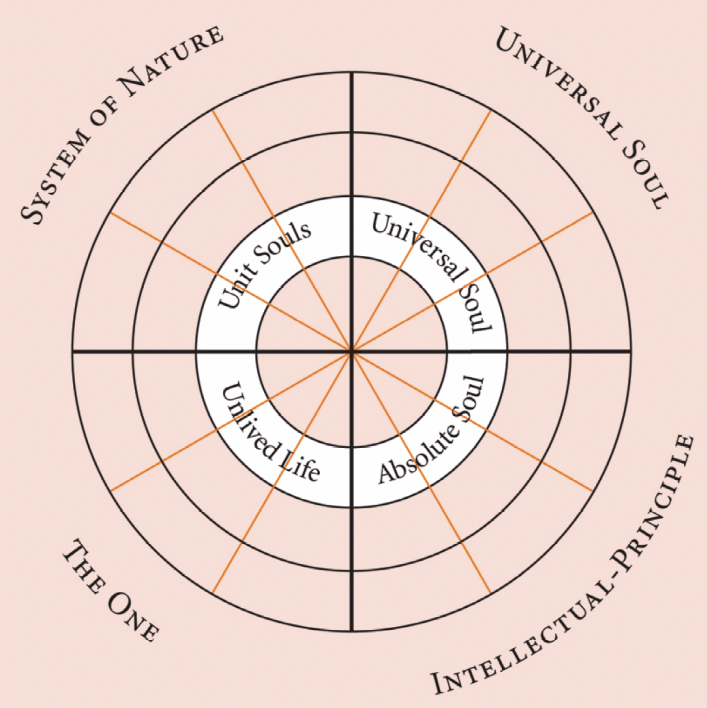
FIGURE 1983 1216a-1. Levels of Soul.
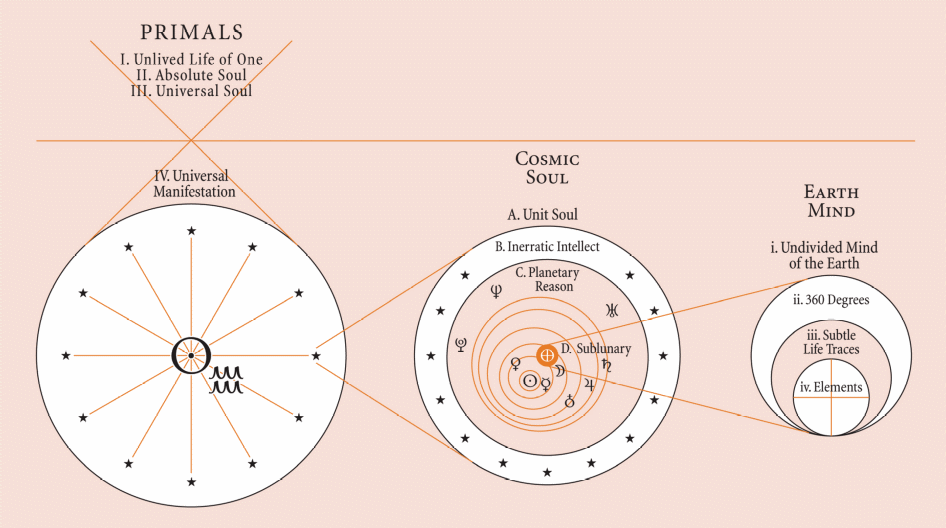
FIGURE 1983 1216a-2. Nested Levels.
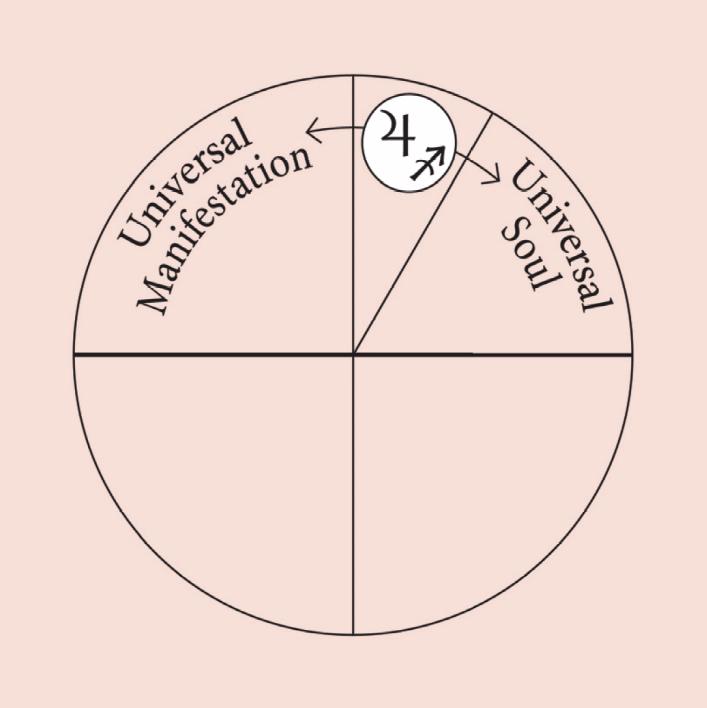
FIGURE 1983 1216a-3. Twofold Zeus.
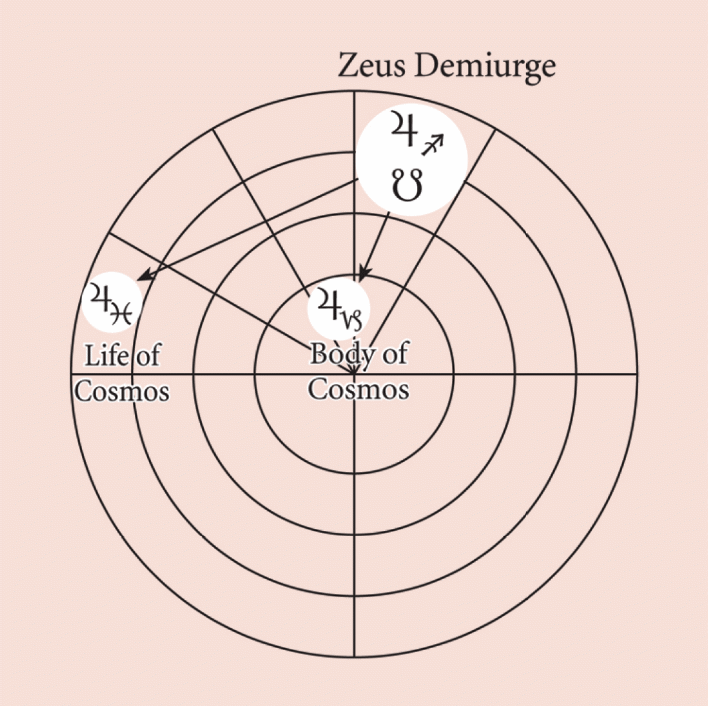
FIGURE 1983 1216a-4. Demiurge as Life and Body of Cosmos.
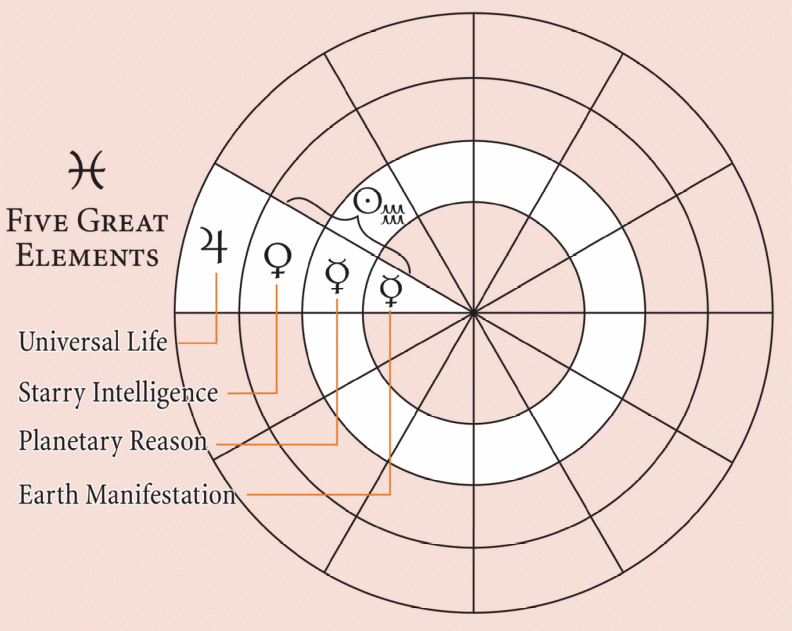
FIGURE 1983 1216a-5. The Central Sun and the Levels of Pisces.
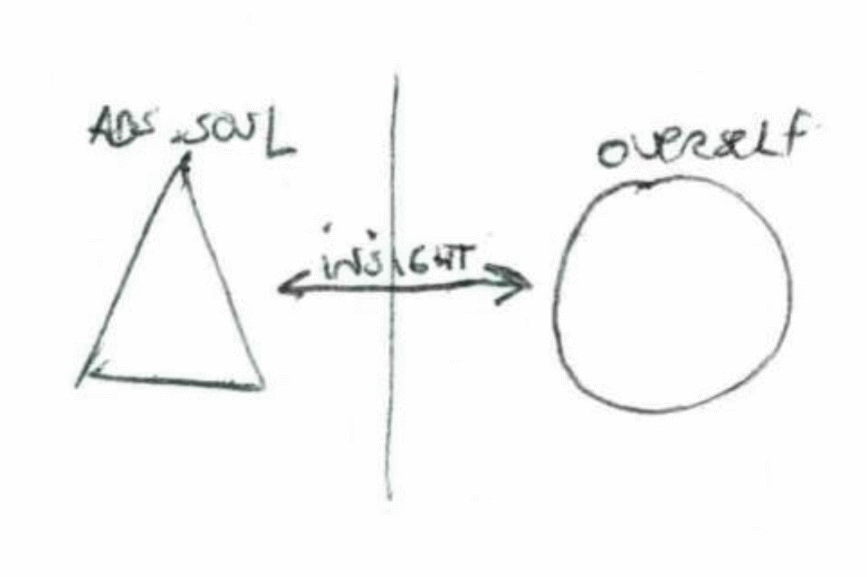
FIGURE 1983 1216a-6-AB. Overself and Absolute Soul.
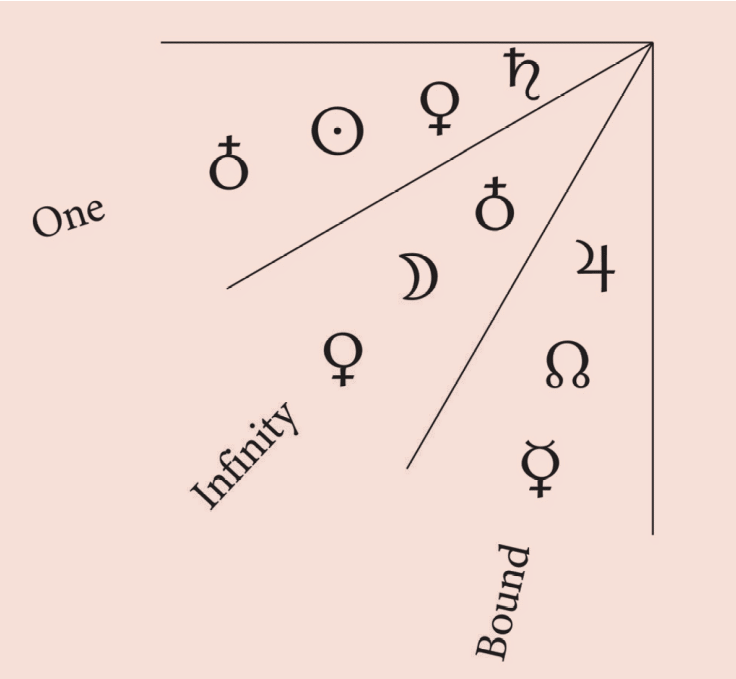
FIGURE 1983 1216a-7. Triad.
These diagrams are from Astronoesis, pp. 178, 250, 183, 334, 246, 223, and 58 respectively. [Transcriber note: [diagram] means the speaker is referencing a diagram as he or she is speaking. If someone is drawing or writing, with audible sounds of chalk on a blackboard, I indicate this by [drawing] or [writing].]
AD PAPER read in class:
- "Overview of Levels of Soul". Retyped as 1983 1216b V09MP. Astronoesis - Soul. This paper is published in a slightly different form in Astronoesis. There it is found primarily on pp. 175-177 in the chapter on Soul and is titled "Overview of Levels of Soul". There is one paragraph that is found on pp. 250-251 in the chapter on The System of Nature and one paragraph that didn't make it into the book.
NOTES:
This is 1983 12/16a, a class on Plotinus; Soul, and the first entry associated with this date. 1983 12/16b = Overview of Levels of Soul Paper.
The discussion begun in the second half of this class on the three Hypostases and emanation is continued in WG CLASS 1983 1223.
We have a partial transcript for this class with no AD edits (Scan File 1983 1216-04R02). It is mostly a transcription of the reading of the paper with the rest of the class left untranscribed.
TRANSCRIBED Verbatim by IT 2021. Archival verbatim transcript with AD Paper – V11ap.
AUDIO FILES: 1983 1216a, 1983 1216b. [Note 1: "Tape" and "Side" refer to original audio cassette tapes that were later digitized into .MP3 Audio Files. Note 2: In 2024-25, REP Studio improves the sound quality of both audio files, cuts dead air. Note 3: AD and AS faint until almost the 21 minute mark of Audio File 1983 1216a, rest of students more or less faint until beginning of Side 2.]
1983 12/16a at Wisdom's Goldenrod
Plotinus: Soul
[Audio File 1983 1216a Begins]
AD (very faint): --on top of a guru [S simultaneously, very faint: Oh no.] on top.
S (very faint): Yeah.
AD (very faint): Um-- [short pause] I think Plotinus is good; Plotinus of the very [S simultaneously, very faint: Tony?] friendly philosophers. I think Plotinus is an (omni) philosopher. He has a depth of metaphysical understanding, of knowledge that is incredible. But--
S (faint): Yeah.
S (faint): Paul could you speak up, I [S simultaneously, very faint: Yeah.] can't hear you.
AD (faint): Give it time. (bit of laughter) Energy come flowing in, (just like) [one/two words inaudible] What I was saying was that for the depth and profundity of his metaphysical understanding, I would think of Plotinus as (an equal). But, that's my personal opinion, I want you to remember that, alright, 'cause you may find someone who appeals to you that much. It wouldn't be right for you to say, "Well, Anthony liked Plotinus, I should like him," no. I'm just being very honest, it's my personal opinion. And, first time I heard the word Plotinus, I almost went ecstatic. And I was big-headed so-- But I couldn't find a copy so I started reading Blake. Took ten years before I found a copy of Plotinus. So, Plotinus of course, his Enneads were very esoteric, they weren't publicly distributed, he-- you would have the most difficult time in the world to get a copy of his writing. Same thing's happening now, it's out of print again.
S: Yeah.
AH: Time moves.
AD (faint): But anyway, what I thought we did tonight, uh-- You remember I spoke about Soul, the different levels of Soul? [Note: See WG Class 1983 1014.] I wrote it up a little bit, I think it's a little organized. And then after that, I'd like to read some quotations, and Avery's going to pick out some quotations on Soul. And we'll read them together, me and Plotinus, it's a nice holiday today. Alright, go ahead Avery, just start with the-- Would you mind? I'll have to do always that. And you know, we worked on these things considerable amount of time so-- On the one hand, it's difficult, but on the other hand, I think it's possible that it could be organized so that we could, you know, have clearer markings as to what he's talking about. So, the third section. [short pause] It's not too long, I think four pages.
S (very faint): Uh-hm.
S (very faint): Alright.
[Note: See FIGURES 1983 1216a-1, Levels of Soul, and 1983 1216a-2, Nested Levels, appended to this transcript for the following. These diagrams are from Astronoesis, pp. 178 and 250 respectively.]
[Transcriber note: The following paper is published in a slightly different form in Astronoesis. There it is found primarily on pp. 175-177 in the chapter on Soul and is titled "Overview of Levels of Soul". There is one paragraph that is found on pp. 250-251 in the chapter on The System of Nature and one paragraph that didn't make it into the book. It has also been retyped as 1983 1216b V09MP. Astronoesis - Soul. I transcribe it just as AD reads it.]
AD Paper ["Overview of Levels of Soul," AD reading]: "We may refer to the three primal hypostases as the Absolute in order to emphasize their transcendent aspect as well as their remoteness and inconceivability. If we do so, then the third degree of this mysterious Void Plotinus refers to as Soul. In some regards this is the most complex and difficult of all notions to articulate, because of its scope and diversity of application. So we're required at the very outset to try and organize our understanding of the manifold of meanings it is invested with, so that whenever the term is used the appropriate reference is brought into view and the proper context of connotations applied, hopefully so that the passage in question can be meaningful in terms of the intelligible vision which Plotinus is revealing.
"Now throughout the text, there are found statements about Soul articulated with a planned obscurity. We must remember that these were esoteric teachings not intended for public or mass consumption. The Enneads are formulations of Plotinus' intuitive realizations of ultimate truths to which only our inner being may respond. We must let the Logos in our soul absorb the impact and assimilate the meaning of his intuitions prior to allowing our critical and egotistical intellect to pounce upon them. In other words our mental activity must be stilled, so that the Silence within can receive the passages in question without coloration. And this may help us to understand the ordered classifications and the various levels of Soul and how they fit in with the overall scheme of reality that is implied.
"And this issue is crucial, for its ramifications extend from the unitary life of the universe to the least of the creatures within it. Within the universe there are to be found all the various grades of life or Soul, suspended from above, each fixed at that grade of reality appropriate to it.
"And there cannot be any ambiguity in our understanding if we are to properly appreciate this wisdom-knowledge that he is delivering. The profundity of his understanding makes it possible for us to distinguish the definition of Soul and the differentia that exist among souls and the consequent levels of reality that are being coordinated with them. This complex of problems associated with Soul must be comprehended and not explained away by reducing the many souls to one soul or confusing them with one another.
"We will attempt a brief resume or outline of the hierarchy implicit in his exposition.
"If we start at the highest level, we must understand Soul here is an indivisible aspect of the One itself. Here the formless form of the unsullied Life may be recognized as the transcendent paradigm or immaculate version of this principle from which flows the rest of the hierarchy.
"From Its perfection there radiates the life of the Intellectual-Principle, Absolute Soul, which is the recipient of all the Ideas. And just as the life of the Intellectual-Principle is determined by all the Ideas, so reciprocally are all the Ideas made living and permanent (possibility/possibilities) or presences within the Intellectual-Principle by Soul.
"The next hierarchical level of Soul, not to be confused with Absolute Soul, is the Soul of the Universe or the Demiurge -- Zeus. Here Soul is the principle of universal manifestation, and it is referred to as twofold -- on the one hand, eternally contemplating the Ideas or the Wisdom of God, a timeless and abiding wisdom, and on the other hand, organizing the samskaras or past traces of universal manifestation, that is, energy or matter, into a basic or primitive plan of the universe. This vast and cosmic sweep of its intellectual fabrication he refers to as"tentative illumination of matter," or the ground-plan of the universe to be.
"After this there follows that order of Souls which we may for convenience call Star Souls. Each Sun is such a soul. (We're ignoring for the moment the intellect of that soul and the unity of that soul.) Each of these Star Souls is a part of universal manifestation, and their totality constitutes the inerratic or immutable sphere of Ideas. Also each Sun or Star Soul is unfolding or manifesting within itself the content of its own Logos--i.e., a world or a cosmos of its own--through its own powers. So for instance our Sun, through its own powers, symbolically represented by the planets, which are both the agents and the vehicles that could-- [AD, faint: Quote unquote.] that are manifesting the Sun's intellectuality, is unfolding or manifesting its own world.
"And now, each of those planets is also a god, manifesting or unfolding the master-plan inherent in the Sun's intellectuality, providing in their respective sphere habitations for the next degree or level of Soul.
"Thus our Earth, a god, also included within our Sun's manifestation, has a Body, Soul, Intellect, and Unity. The grossest aspect corresponds to the elements, and this is equivalent to the Body of the Earth. The traces of life that have been left behind in the elements may be referred to as its soul. For these memories are retained by the planetary mind and constitutes our subconscious, which the ancients referred to as the Dragon. Then there is a third level -- the degrees of the zodiac around the Earth and which constitute its intellectuality. And they are often referred to in astrological literature as the differentiation of the Earth's aura. And lastly, the unity of our planet Earth or the Mundane god is a participation in the Sun soul's [AD reads: Sun's soul] unitary functioning. There is no contradiction in referring to the unity aspect of each of the Mundane gods to be the same as the wisdom-knowledge or the functioning of the Sun soul's power(s).
"Let's reverse the procedure, consider the Earth's unity as identical with or coinciding with the functioning of the Sun's powers. [S: Yeah.] [AD rereads:"Consider the Earth's unity as identical with and coinciding with the unitary functioning of the Sun's powers."] This will be equivalent to the-- equivalent to a-- referring to the unitary aspect of the Earth as the undivided or infinite mind of the Earth. Then follows the 360 degrees that are distributed around the Earth and may be considered as its intellectuality, and the traces of life left behind may be considered as its soul, and finally the gross elements as its body.
"Now ignoring for the present the herd or tribe of daimons [AD, faint: Angels should be the-- the word.] associated with each of the Mundane gods, [AD: Or that tradi-- in that tradition, Proclus brought that in. But in terms of Plotinus--] we come to the human souls. Here we must remind ourselves that Plotinus points out that there is a part of the soul that remains in the Nous, but it emanates a reflex of itself, a principle of intellectual Being that is similar to itself. It is this unit soul, the God within us, that may be referred to as our soul, our ultimate individuality, and the true knower within us. It is"man made in the image of God." Now this formless and infinite consciousness gets contracted and starts on a journey of self-realization, which we hope to explain later on. In order not to lose the thread of continuity, we will remark that this soul or mind is "reduced" and ultimately becomes identified with bodily vehicles that are being fabricated for its use in order to experience the sensible, i.e., in order to complete its contemplation of the Ideas. [BS, very faint: Alright.] [S, very faint: Yeah.]
"Now this contracted consciousness we may refer to as an impersonal or witnessing consciousness and is associated with the planetary mind from which it receives the image of the World-Idea. At this level the world image is in a pristine and subtle form, an alogical unity that includes all the features that will be found later on in the reflective consciousness. Included in this world image is the particular body which is being evolved with which that human soul identifies.
"The entrance of the soul into the world, to associate with a particular body, is determined by root tendencies inherent in it and compel it to identify with that body, which we all know has a certain ontogenetic and phylogenetic history and comes into being at a certain moment of time indicated by aspectual relationships among the planets. The human soul is now a fated member of the"Circuit." Here the experiences provided through the body will develop (its/his) faculty of understanding and reason through an indefinite series of incarnations. Soul incarnates or participates in the Ideas of the planetary mind by perceiving--[11¾ second pause] by perceiving [AD, faint: I can't read.] and experiencing, through a body, what the gods think. Thus the Earth -- footstool of the gods -- nurses our soul to heavenly maturity and manhood."
AD (faint): That was a simple resume of the-- put together all these various grades of Soul starting with the transcendent Soul, how the-- the-- that aspect of the transcendent is being referred to as the superior version of Life, the Life unlived; then the Absolute Soul in the Intellectual-Principle, and from that Universal Soul. And on this point, it agrees perfectly with the Bhagavad-Gita I thought. Then the Universal Soul which lays out the plan, alright, (there's an) integral star souls, different powers of that inerratic sphere constitutes what we call manifestation. And each of these stars has, so to speak, its own idea of what-- in other words, the Logos within it is the master-plan for the world that it wants to evolve from within itself. And those planetary powers bring that into effect. Now it could be a Sun like ours where there's seven planets or it could be a binary system, it could be any-- any other possibility but I'm not concerned about other possibilities. You have this one. And ea-- and then each of the planets which is a power of the Sun soul, each of those are in their own right gods. They too have a [student assents, very faint] quaternitary nature, Unity, Being or Intellect, Soul, and Body. And they evolve bodies within-- which are going to be used now by human souls to gain experience of that world, [student assents, very faint] alright. That's the hierarchy we spoke of. Any question (now)?
S (faint): Yeah.
AD (faint): Yeah [couple/three words inaudible] Not even [one word inaudible] [students assent, very faint] See I didn't speak about daimons because that came in much later with Proclus and in Plotinus there's no need for daimons. When the time appears you're going to be there. And I think most of us realize, you know. Something tells you, "Well, you gotta be there." Sure enough you're there at 3:42, 30 seconds so that [couple words inaudible] went over your toe. (some laughter) That was some one thing, something there, something. Now, what I'd love for you to-- would be to read some quotations and see if you could substantiate-- see, I didn't include quotations, I just want to run along so that the-- the scheme is presented without like you losing sight, you know? But if we stop, put in a quotation, argue about a quotation, we forget the thread and we keep arguing all the way down, not that arguing and dialectic is wrong, it's good but, this plan is what get out, now we could discuss it. So Avery-- Avery, suppose we pick on the highest one, the meaning of Soul up at the highest level?
S (very faint): (I see.)
AD (very faint): Was it VI.7?
AS (faint): Now-- now I'm not really sure which one.
AD (faint): Well, was it VI.7? Are there any questions before we start (the/with) quotation?
[few seconds of background student talking]
S (faint): I wouldn't mind hearing it again.
S (very faint): Uh-hm.
S: That's to stop us?
AS (faint): I don't know.
S (very faint): Yeah [possibly one word inaudible]
S (faint): (Why don't you read) the whole thing (once), read it one more time so--
S (very faint): Yeah.
S (very faint): (Uh-uh.)
BS (faint): Avery?
AS (faint): (We) what?
BS (very faint): It's part of the way [three/few words inaudible]
AD: In one sense it's [S simultaneously: Yes.] a grand vision but I'm-- in another sense it's like Thomas Taylor once remarked, we're like the dregs, the bottom of the ladder. I don't know whether to celebrate or not.
BS (very faint): Not yet.
S (very faint): Uh-hm.
S: Yeah.
S: (Uh-hm.)
[20¾ second pause with faint background student talking, shuffling about]
AS: "We…" No [one word inaudible]
LDS (simultaneously): [couple words inaudible]
[Transcriber note: I transcribe the paper as AS reads it, including any changes made during re-reading.]
AD Paper ["Overview of Levels of Soul," AS reading]: "We may refer to the three primal hypostases as the Absolute in order to emphasize the transcendent aspect as well as their remoteness and inconceivability. If we do so, then the third degree of this mysterious Void Plotinus refers to as Soul. In some regards this is the most complex and difficult of all notions to articulate, because of its scope and diversity of application. So we are required at the very outset to try and organize our understanding of the manifold of meanings it is invested with, so that whenever the term is used the appropriate reference is brought into view and the proper context of connotations applied. Hopefully, the passage in question can become meaningful in terms of the intelligible vision which Plotinus is revealing.
"Now throughout the text, there are found statements about the Soul articulated with a planned obscurity. We must remember that these were esoteric teachings and not intended for public or mass consumption. The Enneads are formulations of Plotinus' intuitive realizations of ultimate truths to which only our inner being may respond. We must let the Logos in our soul absorb the impact and assimilate the meaning of his intuitions prior to allowing our critical and egotistic intellect to pounce upon them. In other words our mental activity must be stilled, so that the Silence within can receive the passage in question without coloration. And this may help us to understand the ordered classifications and the various levels of Soul and how they fit in with the overall scheme of reality that is being implied.
"The issue is crucial, for its ramifications extend from the unitary life of the universe to the least of creatures within it. For within the universe there are to be found all the various grades of life or Soul, suspended from above, each fixed at that grade of reality appropriate to it.
"And there cannot be any ambiguity in our understanding if we are to properly appreciate this wisdom-knowledge that he is delivering. [The] profundity of his understanding makes it possible for us to distinguish the definition of Soul and the differentia that exist among souls and the consequent levels of reality that they are being coordinated with. This complex of problems associated with Soul must be comprehended and not explained away by reducing the many souls to one soul or confusing them with one another.
"We will attempt a brief resume or outline of the term Soul and try to reveal the hierarchy implicit in his exposition.
"If we start at the highest level, we must understand it as an indivisible aspect of the One itself. Here the formless form of the unsullied Life may be recognized as the transcendent paradigm or immaculate version of this principle from which flows the hierarchy."
S: Try that one again.
S (very faint): Careful though.
S (faint): Apparently this one.
AD Paper ["Overview of Levels of Soul," AS reading]: "Here the formless form of the unsullied Life may be recognized as the transcendent paradigm or immaculate version of this principle from which will flow all of this hierarchy of Soul. [short pause]
"From Its perfection there radiates the life of the Intellectual-Principle, or Absolute Soul. [short pause] This…"
S (simultaneously, faint): What is this principle? Is it--
AS: "From Its…"
AD Paper ["Overview of Levels of Soul," AS reading]: "[Here] the formless form of the unsullied Life…the transcendent paradigm or immaculate version of the principle of Soul…
"From this perfection there radiates the life of the Intellectual-Principle, or Absolute Soul, which is the recipient of all the Ideas. And just as the life of the Intellectual-Principle is determined by all the Ideas, so reciprocally are all the Ideas made living and permanent possibilities or presences within the Intellectual by Soul."
RG/S(?) (faint): Uh-hm. Yeah.
AS: Do you want to hear that again?
Few students at once: Yeah.
S (faint): [couple/three words inaudible]
S (simultaneously): Could you read a little slower, Avery?
S: Yeah.
AS: Sure.
S (faint): Ok.
AS (faint): Ok. Start from the top.
AD Paper ["Overview of Levels of Soul," AS reading]: "Here the formless form in the One itself…"
S (faint): Ok.
AD Paper ["Overview of Levels of Soul," AS reading]: "Here the formless form of the unsullied Life may be recognized as the transcendent paradigm or immaculate version of this principle from which will flow a whole hierarchy.
"From this perfection, from this transcendent paradigm, there radiates the life of the Intellectual-Principle or Absolute Soul, which is the recipient of all the Ideas. Just as the life of the Intellectual-Principle is determined by all the Ideas, so reciprocally are all the Ideas made living and permanent possibilities or presences within the Intellectual by the Soul."
S (faint): [couple/few words inaudible]
RG (very faint): Uh-hm. [short pause] (I'll read.)
S (very faint whisper): [few words inaudible]
S (simultaneously, very faint): Uh-hm, yeah.
S (very faint): (I'll read.)
RG (faint): I'll read [one/two words inaudible]
S (very faint): [one/two words inaudible]
VM (simultaneously): Isn't that what we talked about in the Parmenides, where the idea that the-- the Ideas are-- structure the soul, on the other hand the soul enlivens the Ideas, it gives being to the Ideas? [Note: Please see the discussion in WG classes 1983 0902b, 1983 0909b, and 1983 0916.] Did we discuss that in that light?
S (faint): Meaning of the Ideas?
S (very faint): That's doing the whole thing.
RG: No what are you going to do?
VM (faint): (Any advice?)
S (faint): There's a quote.
[12¼ second pause with faint background student whispering]
S (very faint): [couple words inaudible]
RG (simultaneously, faint): What do you think that means Avery?
AS/S(?) (very faint): [chalk on board sound] Right here.
S (faint): Right.
AS: Well, I think-- I think this is talking about the-- the simultaneity view of this radiation or the emanation from the One. Speaking about the reciprocal interpenetration or relation of the Intellectual-Principle with the Absolute Soul from the One when he says that this Life radiating from-- from the Supreme or from the One is like the recipient-- is indeterminate and then gets determined by all these Ideas. And at the same time, on the other hand, gets-- the Ideas are getting--
VM (faint): Enlivened.
AS: Enlivened, ok, say enlivened or whatever, within this principle of Absolute Soul. And now, in that view this-- there's a kind-- it's kind of a simultaneity view, I guess, the view that all of these unities are emanating simultaneously rather than sequentially. So, I mean he says, from-- from the--
AD Paper ["Overview of Levels of Soul," AS reading]: "We start with this formless form of the unsullied Life, the transcendent paradigm or the unity of the Soul within the One.
"Now from this perfection there radiates the life of the Intellectual-Principle, we're calling Absolute Soul. This life, Absolute Soul, is the recipient of all the Ideas. And just as it is determined by the Ideas, so reciprocally all the Ideas are made living and permanent possibilities or presences by the Soul or by this life."
PD: So like a-- maybe like a picture of that would be if you conceive of all the different life-- life forms that live on the Earth, there's possibilities of principle of life as far as the Earth's consciousness. And those possibilities or forms of life get conjoined to the soul or get manifested as the soul of the Earth. So those are the possibilities of life getting conjoined to the Earth's consciousness and unfolding as the existence in this sphere. You know, tree, plants, and you and I, the forms of life in the Earth's consciousness.
AS: And we have Soul. This would be the second-- I mean in this hierarchical notion, this would be the second level as it were of Soul. First would be the unity and then Soul in the Intellectual-Principle, how is it present there? And there it's present as the life of the Intellectual-Principle.
VM (faint): Absolute Soul (in the Intellectual-Principle).
AS (simultaneously, faint): The Absolute, yeah.
[short pause]
LDS: Avery, so you're saying that Life, Absolute Soul in a sense, devoid of or detached from the Ideas would be indeterminate and in a sense unintelligible without that connection to or binding to the Ideas that determine it or give it form. But on the other hand of course the-- [AS: Sure.] the Ideas [AS simultaneously, faint: (couple words inaudible) Life.] without Life, the Ideas without Life have no power, they have no-- have no place to go, I mean [three words inaudible]
S (very faint): Yeah.
LDS: Is that--
S (very faint): Uh-hm.
AS: Yeah, something like that.
S (very faint): (That's the way) Plotinus does it.
S (very faint, possibly same S as above): That's the way Plotinus does it.
[short pause]
AS (faint): That there (that's) the indeterminate Life of Soul as indeterminate or-- receives these Ideas. [student assents, faint] And at the same time, these Ideas then gotta be able to manifest as this Absolute Soul.
S: Uh-hm. Yes.
S (faint): Then where's the [couple words inaudible] power [few words inaudible] the Soul from here?
S (very faint): Uh-hm.
AS (faint): Yeah, I mean that sounds-- sounds like what you-- [short pause] Where he says-- yeah, "the Ideas are made in living, permanent possibilities or presences within the Intellectual." That-- Well there's a very nice quote on that [few words inaudible]
S (very faint): [couple words inaudible]
S: You miss(ed) that quote.
AS (simultaneously, faint): [couple/few words inaudible]
AD: Yeah.
AS: Yeah. Ok I'll--
S (very faint): Why don't you just start over.
AS (very faint): Ok. Then--
AD Paper ["Overview of Levels of Soul," AS reading]: "The next hierarchical level of Soul, not to be confused with the Absolute Soul, is the Soul of the Universe or the Demiurge--Zeus. Here Soul is the principle of universal manifestation, and it is referred to as twofold--on the one hand, eternally contemplating the Ideas or the Wisdom of God, a timeless and abiding wisdom, and on the other hand, organizing the samskaras or past traces of universal manifestation, or energy, into a basic or primitive plan of the universe to be. This vast and cosmic sweep of its intellectual fabrication is referred to as the"tentative illumination of matter", or the ground-plan of the universe to be.
"After this there follows that order of Souls which for con…"
S (simultaneously, faint): [couple words inaudible] do that again, (read it again).
S (very faint): Uh-hm.
AS: You want that whole thing?
S: Uh-hm.
S (simultaneously, faint): More of that.
S: [couple words inaudible]
S: (Yeah just) the last one.
S (very faint): Yeah David.
AS: What?
S (simultaneously, very faint): [couple words inaudible]
AS: Ok. So next is--
AD Paper ["Overview of Levels of Soul," AS reading]: "Here Soul is the principle of universal manifestation, and it is referred to as twofold--on the one hand, eternally contemplating the Ideas or the Wisdom of God, a timeless and abiding wisdom, and on the other hand, organizing the samskaras or past traces of universal manifestation, that is, energy, which is matter, into a basic or primitive plan of the universe to be. This vast and cosmic sweep of its intellectual fabrication is referred to as the"tentative illumination of matter"…"
AS: And this is the second aspect, why it's called twofold. On the one hand this timeless contemplation, on the other the organization of samskaras or past traces into a basic plan of the universe to be. And this second aspect-- and this second aspect a vast cosmic sweep of its intellectual fabrication is referred to as the "tentative illumination of matter" or the ground-plan of the universe. [Note: See Plotinus, VI.7.7, third para.]
LH (faint): This Soul itself is what he's talking about Absolute Soul.
AS: Nope, no, no, he made very clear there.
S (faint): (Uh-hm.)
AD Paper ["Overview of Levels of Soul," AS reading]: "The next hierarchical level, not to be confused with Absolute Soul, is the Universal Soul, the Soul of the Universe or Zeus, the Demiurge."
AS: So this is the-- this is the third level, as it were, if we're following [one/two words inaudible] the third aspect of Soul.
S: [three words inaudible] what was [couple inaudible student words simultaneous with S] (the) last step?
AS: The third--
S: The first was that Absolute Soul [couple words inaudible]
AS (simultaneously): Oh yeah (one/why)--
S (very faint): [one/two words inaudible]
S (simultaneously, faint): Just write them down.
AS: Write them down, here, first we had the unity of Soul [writing] in the One, the indivisible.
S (very faint): Ok.
[short pause while AS writes]
AS (faint): [writing] The One. Here we have the Absolute Soul equals the Life of the Nous. And now we have the Demiurge. [student assents, very faint] [S, very faint: Twofold (Zeus).] Twofold Zeus, Universal Soul. And now we have to have star souls.
S (faint): Right.
[short pause while AS writes]
S (very faint): I don't even see them.
[13 second pause while AS writes]
AD (very faint): Well [couple words inaudible] very good Avery.
S (very faint, possibly part of background): What is it?
S (very faint): Where's the next one?
AS (faint): What?
S: [one word inaudible]
AS (very faint): No I didn't-- I didn't finish (it). Ok.
AD Paper ["Overview of Levels of Soul," AS reading]: "After this there follows that order of Souls which we may for convenience call Star Souls. Each Sun is such a soul. (We are ignoring for the moment its intellect and unity that resides in the Intellectual-Principle.) Each of these Star Souls is a part of universal manifestation, and their totality constitutes the inerratic or immutable sphere of Ideas. Also each Sun or Star is unfolding or manifesting within itself the content of its own Logos, i.e., a world or a cosmos of its own, through its own powers. So for instance our Sun, through its own powers, symbolically represented by the planets, which are both the agents and vehicles…"
AS (faint): I've got to read it again.
AD Paper ["Overview of Levels of Soul," AS reading]: "So for instance our Sun, through…"
AS (faint): Yeah, ok.
AD Paper ["Overview of Levels of Soul," AS reading]: "For instance our Sun, through it own powers, symbolically represented by the planets, which are both the agents and vehicles, is manifesting that Sun's intellectuality. This is unfolding or manifesting its own world."
PC: Avery [couple inaudible AS words simultaneous with PC] could you just go back and [AS simultaneously, faint: (I--)] read it again just one more time?
AS: Yeah, I'm sorry, I'll try (to do) better.
AD Paper ["Overview of Levels of Soul," AS reading]: "Each of these Star Souls is a part of universal manifestation, and their totality, the totality of these Star Souls, constitutes what we may call the inerratic or immutable sphere of Ideas. Also each Sun or Star is unfolding or manifesting within itself, through its own powers, the content of its own Logos, i.e., is unfolding a world or cosmos of its own. So for instance our Sun, through its own powers, which we symbolically represented by the planets, which planets are both agents and the vehicles and are manifesting that Sun's intellectuality, is unfolding or manifesting its own world." [AS rereads: "Our Sun is unfolding and manifesting its own world through these powers of its own, which we have symbolically represented by the planets."]
LH (mostly faint): The first-- to the first part of that [S, faint: Sun.] sentence, where it says star-- that these star souls are participating in universal manifestation.
AS (simultaneously): Yeah.
LH (faint): Is that referring to like their participation in the (twofold) Demiurge?
AS: Right. Their participation in its activity, its outward activity. So it's like this one upwards [drawing] is in contact with this [diagram] and downwards it's manifesting the universal manifestation or laying the ground for universal manifestation [diagram], remember, and these-- all the lower souls are going to participate in that universal manifestation. [Note: See FIGURES 1983 1216a-3, Twofold Zeus, 1983 1216a-4, Demiurge as Life and Body of Cosmos, and 1983 1216a-5, The Central Sun and the Levels of Pisces, appended to this transcript These diagram are from Astronoesis, pp. 183, 334, and 246 respectively. See also FIGURE 1983 1216a-2, Nested Levels.] And, he makes clear to say that here we are ignoring for the moment that each of these star souls too has an intellectual aspect [drawing] in the Nous [diagram]. Right, I mean, just as the Demiurge is inwardly contemplating, each of the star souls isn't limited just to that manifestation. When he says each of these star souls is a part of universal manifestation, it's not to be limited to that. That's only in its outward aspect. [S: Mm.] I mean and the point was made--
AD Paper ["Overview of Levels of Soul," AS reading]: "(We are ignoring for the moment its intellectual unity that resides in the Intellectual-Principle.)"
AS: So, considering this-- in this aspect--
AD Paper ["Overview of Levels of Soul," AS reading]: "Each of these Star Souls is a part of this universal manifestation, [and] in their totality, the totality of these Star Souls, constitutes the inerratic or immutable sphere of Ideas. Also each Sun or Star is unfolding or manifesting within itself, through its own powers, the content of its own Logos, i.e., a world or cosmos of its own. So for instance our Sun is unfolding or manifesting its own world through its own powers, which are symbolically represented by the planets, and which are both the agents and the vehicles that are manifesting the Sun's intellectuality. [short pause]
"Now, [AS: Oh.] each of these planets is also a god…"
S (very faint): (Read it.)
S (very faint): What's that?
AD Paper ["Overview of Levels of Soul," AS reading]: "Each of these planets is also a god, manifesting or unfolding the master plan inherent in the Sun's intellectuality, providing in their respective spheres habitations for the next degree or level of Soul.
"Thus our Earth, a god, but also included within our Sun's manifestation, has a Body, a Soul, an Intellect, and a Unity. Now we can trace these out. The grossest aspect or Body of the Earth corresponds to the elements. The traces of life that have been left behind in the elements may be referred to as the Earth's soul. These memories retained by the planetary mind constitute its subconscious and correspond to the ancient notion of the Dragon."
S (faint): Would you repeat that?
S (very faint): Uh-hm.
AS/S(?): Uh-hm.
AD: Constitutes our subconscious, not "its".
AS (faint): That (was--) [student assents, faint] (yeah).
AD Paper ["Overview of Levels of Soul," AS reading]: "These memories retained by the planetary mind constitute our subconscious and correspond to the ancient notion of the Dragon. [AS: Right.] This is included in the notion of its soul, in the Earth's soul. In the third level, we can speak of the degrees of the zodiac around the Earth, which constitute its intellectuality. These are often referred to in astrological literature as the differentiation of the Earth's aura. And lastly, [AS: In this little description of these four.] the unity of each of the Mundane gods, for example, the Earth, is participation in the Sun soul's unitary functioning. There is no contradiction in referring to the unity aspect of each of the Mundane gods to be the same as the wisdom-knowledge functioning of the Sun soul's powers.
"Now, we can reverse this little procedure of the four aspects of a Mundane god and consider first the Earth unity as identical with or coinciding with the unitary functioning of the Sun…"
(Side 1 of original cassette tape digitized as 1983 1216a Ends; Side 2 Begins)
AD Paper ["Overview of Levels of Soul," AS reading]: "…may be considered as its soul and finally the gross elements as the Earth's Body.
"Ignoring for the present the herd or tribe of daimons or angels associated with each Mundane god, we come to human souls. Now here we must remind ourselves that Plotinus points out that there is a part of the soul that remains in the Nous, but it emanates a reflex of itself, a principle of intellectual Being that is similar to itself. It is this unit soul, the God within us, that may be referred to as our soul, our ultimate individuality, and the true knower within us. It is"man made in the image of God." Now, how this formless and infinite consciousness gets contracted and starts on a journey of self-realization we hope to explain later on."
PC/S(?): Could you go over that whole part on the human soul again?
AD Paper ["Overview of Levels of Soul," AS reading]: "We must remind ourselves that Plotinus points out that there is a part of the soul that remains in the Nous…"
AS: Just as for the Sun soul or--
AD Paper ["Overview of Levels of Soul," AS reading]: "…but this part, as it were, emanates a reflex of itself, a principle of intellectual Being that is similar to itself. And it is this reflex, this unit soul, the God within us, that may be referred to as [AS emphasizes following word] our soul, our ultimate individuality, and is the true knower within us. It is"man made in the image of God.""
LDS: Yeah, I'm sure. Are you saying Absolute Soul--
AS (simultaneously): The I AM.
S: What?
LDS: That the Absolute Soul radiates and the reflex is this I AM, is that what--
AS: Yeah. That-- this is saying, [S, faint: Right.] just as there is a part of the soul that remains in the Nous-- it says, just as a star soul has that part that remains in the Nous, but now we're speaking of its part that's concerned with the universal manifestation, similarly, your unit-- your-- your I AM principle is an emanation or reflex also from the Absolute [LDS assents, faint] Soul or from the Nous.
S (faint): Right.
JB: But is that-- that part of the reflex that is-- that remains in the Nous? Or is it-- is it not divided by (Saturn Mercury).
S: Well he--
S: It did seem a little--
AS (simultaneously): Speaking-- speaking here I think of the unit soul's highest-- if we're speaking of the unit soul, the ultimate individuality, we would be speaking of it as identified or in this-- as-- as co-extensive what-- with what we call the infinite mind of the Earth, the undivided or infinite mind of the Earth. But we'll read.
S (very faint): Go ahead.
S (very faint): Yeah.
AS: So--
AD Paper ["Overview of Levels of Soul," AS reading]: "This reflex is a unit soul, the God within us. It may be referred to as our soul, our ultimate individuality, and the true knower within us. It is"man made in the image of God." Now how this formless and infinite consciousness gets contracted and starts on a journey of self-realization we hope to explain later on."
JB: And that little bit, and that already contracted-- [S, very faint: Sure.] Is that the reflex? [AS simultaneously: That's the reflex.] Or is even the reflex the infinite formless consciousness?
AS (simultaneously): No, no, that's the reflex. The reflex [student assents, faint] is this formless and infinite consciousness.
JB: Well, that's what I mean. The reflex is still formless and infinite, [AS simultaneously: In the--] it's not the contraction.
AS: Right.
JB: Ok.
AS (simultaneously): In this-- in this speaking, there's the soul in the Nous but then there's its reflex which is a formless and infinite consciousness.
JB (very faint): Well (here's) that too, alright.
AS: That is what then gets contracted, [JB, faint: Ok.] as we spoke of it, to this Witness and so on.
AD Paper ["Overview of Levels of Soul," AS reading]: "But in order not to lose the thread of continuity, we will remark that this soul or mind is"reduced" and will ultimately become identified with bodily vehicles that are being fabricated for its use and in order to experience the sensible, i.e., to complete its contemplation.
"Now, this contracted consciousness we may refer to an impersonal or witnessing consciousness, and this is associated with the planetary mind from which it receives the image of the World-Idea."
AS: Remember, we had this infinite consciousness which is identified with the infinite mind of our Earth and now the contracted version of that is conjoined with the level of the 360 degrees.
S (faint): Uh-hm.
AD Paper ["Overview of Levels of Soul," AS reading]: "…the planetary mind from which it will receive an image of the World-Idea. At this level the world image is in a pristine and subtle form, an alogical unity that includes all the features that will be found later on in the reflective consciousness. Included in this world image is the particular body which is being evolved, with which the human soul identifies.
"The entrance of the soul into the world, to associate with a particular body, is determined by the root tendencies inherent in the soul which compel it to identify with a body, with a certain point in history, produced at a certain moment of time, which is indicated by aspectual relationship among the planets. The human soul is thenceforth a fated member of the"Circuit.""
DH: (Read it over.)
AD Paper ["Overview of Levels of Soul," AS reading]: "The entrance of the soul into the world, to associate with a particular body, is determined by the root tendencies which are inherent in the soul and which compel it to identify with a body with a certain point of history…"
S (very faint): Well, yeah.
AD (simultaneously): No with a certain phylogenetic and ontogenetic history.
AS (simultaneously): Oh, ok, sorry.
AD Paper ["Overview of Levels of Soul," AS reading]: "…a certain phylogenetic and ontogenetic history produced at a certain moment of time, which is indicated by aspectual relationship among the planets. The human soul is now said to be a fated member of the"Circuit." Here the experiences provided through the body will develop its faculty of understanding and reasoning through an indefinite series of incarnations. The soul incarnates or participates in the Ideas of the planetary mind by perceiving the world and experiencing, through a body, what the gods think."
KD: Read that again now.
S (very faint): Not too (loud).
S (very faint): Yeah.
AD Paper ["Overview of Levels of Soul," AS reading]: "Soul incarnates or participates in the Ideas of the planetary mind by perceiving the world and experiencing, through a body, what the gods think."
S (very faint): Uh-hm.
KD: Slower.
S (very faint): Yes.
S (faint): Do it [one word inaudible]
AS: Slower?
KD: Yeah, no just [one/two words inaudible] [AS simultaneously: Again?] (the pass--)
S: Yeah.
S: Avery--
AS: Stop?
S: No.
S: It was [couple words inaudible]
AS (simultaneously): There's only one more sentence.
S: Before that, (bit of laughter) can you read that one?
AS: What?
S: The sentence before that.
AS (simultaneously): Before?
S (faint): Yeah.
AS: Ok.
AD Paper ["Overview of Levels of Soul," AS reading]: "Here on Earth the experiences provided through the body will develop the soul's faculty of understanding and reason through an indefinite series of incarnations. Soul incarnates or participates in the Ideas of the planetary mind by perceiving the world and experiencing, through a body, what the gods think. Thus Earth--footstool of the gods--nurses our soul to heavenly maturity and manhood."
S: Uh-hm.
[18 second pause]
AH: It said what the gods think. Those are the gods, the planetary gods?
AD: Those are the 360 degrees.
AS (simultaneously, faint): [one word inaudible] (answer).
AH: This contracted consciousness is being described as-- as the Witness?
AS: Yeah.
AH: How would you speak of our consciousness?
AS: That is our consciousness. [AH simultaneously, faint: Well this--] What do you mean "our"?
AH: Well then what's this-- what's this experience of what the gods think?
AS: That's-- [S, faint: Yeah.] that's right.
AB (faint): (It's just) like contemplation.
S (simultaneously, faint): Thank you.
AS: Whatever-- whatever the gods think, whatever those 360 degrees are manifesting, thinking, that Witness will be aware of it, [one/two inaudible student words simultaneous with AS] namely that whole primal image.
AH: Yes, the Witness is obviously aware of the primal image. But how-- how shall we speak of my experience of what the gods think?
AS: Then-- then that Witness is associated with a body as he says, and must experience that stuff through a body. And that-- I think it referred to it as reflected consciousness, the-- I forgot.
AD: If you live your life out you'll be experiencing what the gods [AS simultaneously: (Right.)] are thinking. If you understand a little bit of what your life means, you'll be experiencing what the gods are thinking. You'll not only experience it, you'll perceive it too maybe at times.
AH: Those gods are the 360?
AD: Well, you could represent them, yeah, you could think of them as gods. You-- we could modernize the term and say "universal ideas".
AH: Is that contracted consciousness in the circuit?
AD: Yes, if it's-- it's identified with the planetary mind.
AH: Is it in the circuit?
AD (more forcefully): Yes, it's identified with the planetary mind. (bit of laughter) And I'm not going to do a rear-guard action and say the word 'in' or 'out' is a metaphor.
AH: Is the planetary mind objective to it?
AD: If 'in' and 'out' are metaphors, objectivity and subjectivity are metaphors. You gotta allow me a little poe-- poetical metaphor. (bit of laughter)
AH: No I'm just trying to understand what you're saying.
[10¾ second pause]
S: Is there a first time when the soul is conjoined with the Earth? And is there a first?
AD: The soul has been conjoined with many planets. When you don't like the environment here anymore you go somewhere else and there you get conjoined with the planetary mind of another planet.
S: So there is a first time.
AD: There's no first!! (bit of laughter)
S (faint): Declaring victory.
LH: Avery? I got--
AS (simultaneously): Hm?
LH (faint): I got two different pictures of the way he explains (those/the) [one word inaudible] [S, faint: Yeah.] to their higher principles.
S (faint): Yeah.
AS: Yeah, there are two. There are two (explanations).
LH (faint): What-- why?
AS: There are.
LH (faint): (Once) they fit, need to be pure [few words inaudible]
S: Uh-hm.
S (very faint): Well I wouldn't (go that way).
LH (faint): You know, one way it seems that the star souls participate in each of the higher principles and that in turn manifest everything below it. I mean, the planetary souls then participate in a star soul and the human soul say up to that level of star soul. And the other picture like, that the planetary soul or human souls participate all the way up.
AS: Right.
S: Those are the two--
AS: Those are the two ways. You know, on the-- on the one hand, there's a-- there's a hierarchical participation, [chalk on board sounds] human soul and planetary, planetary and star souls, star souls and the Demiurgic production, Demiurge and the Absolute Soul. On the other hand, [AS tapping on board with chalk] any true principle of Soul is also rooted directly in the Nous, in the Absolute Soul. Now there's no contradiction there in the-- I don't know, maybe there is seemingly one but that seems to be the way it has to be. On the one hand your soul is a direct emanation from the Absolute Soul or Nous because it's just that reflex. But on the other hand it's associated with the whole cosmic manifestation through the hierarchy of Souls which are as it were preparing this experience for it. [S simultaneously: But--] (So/Well) in terms [LH simultaneously: Yeah but the--] of the experience-- well, in terms of the experience, it-- it must be prepared by these levels of Soul. But in terms of its essence, its essence is the true essence of Soul and in that sense it's not fabricated. It is genuine. Your soul is a real soul. And it doesn't get its soulness from any other principle except itself. Well, you have to again have the hierarchical and simultaneous view. I think there's, you know, I mean--
LH (faint): I unders-- yeah I understand that each principle participates in the ones directly before it. What I was saying was that it seems to me to-- somewhere I got the idea that there's sort of a special relationship between that human soul say up to the level of star soul [AS, faint: Ok, yeah.] that is in a way similar to star soul's relationship to the One.
AS: To the--
LH (faint): To the One, that there's like a break there at star soul.
S (very faint): Uh-hm.
S (faint): Well--
AS: Probably, probably that's right. I mean, I'm sure there is a special relation between your soul and the Sun soul, that-- I mean I wouldn't doubt it, rather than some other Sun soul. Ok, I mean, part of the-- part of the break there can just be seen simply this way, that the Demiurge-- it's just one Demiurge as it were, but there are a lot of star souls [drawing] [LH assents] which are included within the universal manifestation and somehow each human soul could be conceived of as linked to-- as having its unity in that star soul, second aspect of it. Ok, if you think of the I AM, somehow that I AM is associated with that star soul.
LH (faint): Could you say it that way, that that soul as an individual soul, as an I AM, that's as far as it goes, and beyond that (it's just this--) it [one/two words inaudible] there would be no individual soul beyond it.
AS: Yeah, right.
S: Talk about the individual soul in the Nous, the unit soul in the Nous. I mean how could we talk the individual at the level of the cosmos?
AD: No there's no individual soul in the Nous. It's origin is in the Nous.
AS (faint): (Yeah/No).
S: The unit soul in the N-- in the [one word inaudible]
AD: It's the [AS simultaneously: No.] origin of the unit soul is in the Nous, not the unit soul.
AS: So Lar-- I think Larry stated very well (in--) that then the way this is-- that here, your individuality, your highest individuality is this reflex of the Absolute Soul. That reflex of the Absolute Soul or the I AM is-- it's associated with this-- with (a/his) star soul if-- with its higher. [couple student words inaudible simultaneous with AS] Now that's not saying that the unit soul can't experience the Absolute Soul.
RG: But what [couple/three words inaudible] to that tractate the Ideal Archetype of Socrates in the Intellectual Soul? [Note: Plotinus, V.7, "Is there an Ideal Archetype of Particular Beings?"]
AS: What about it?
RG: I mean doesn't that quote say individual soul is established at-- at the level of the Nous?
AD: Richard can you speak louder, I can't hear you.
RG (simultaneously): Yeah but the whole-- the whole tractate Anthony on "Is there an Ideal Archetype of Socrates?", in tracing that archetype to the Nous, doesn't that speak to the individual soul's station in the Nous?
[12¾ second pause]
AD: I thought that that passage was really the-- it was pointing out that the origin of the individual soul is in the Nous, [RG: Ok well--] not-- But there, like it wouldn't-- it couldn't be distinguished one unit soul from another. In the Nous that doesn't hold. [short pause] That's my interpretation, [RG simultaneously: Oh sure.] Richard, of course.
RG: But by distinguishing our origin from individual soul what do we mean by the origin of the individual soul?
AS: You know, he says you have a lot of individual souls, the principle of individuality is not the individual. I mean you have to go back to a principle, at some point you're going to get to the non-individual principle. [RG assents, faint] It's like the principle of motion is not in motion. The principle of individuality is not individual. So the principle of the unit soul is not a soul. It is the Absolute Soul. [student assents, very faint] And that's its origin.
S (very faint): Right.
S (faint): Yeah.
RG: Yeah that would be one way to think about it.
JA (faint): In what-- in what way is it a reflex, I mean-- Does that mean similar, I mean--
AS (simultaneously, faint): Well, I think the way (that we use).
AD: I didn't hear you.
JA: I was saying, in what way is it an-- a reflex and--
[short pause]
AS (faint): That it's similar to it.
[short pause]
AD: I maybe don't understand you, in what way is it a reflex?
JA: Well Avery was saying that the principle of a unit soul is in the Nous.
AS (faint): The Absolute Soul.
JA: What?
AS (faint): Yeah, the Absolute Soul [JA: Right.] prin-- is the principle of soul.
JA (simultaneously): Absolute Soul is the principle. But then I thought that in another place unit soul was spoken of as a reflex [AS: Right.] of Absolute Soul. [AS simultaneously: Yeah.] So I was just asking about that. You-- you know, in the way that you spoke of Absolute Soul as--
AD: Speak louder Jeanne.
JA: In the way that you spoke of Absolute Soul as a-- as an indeterminate life--
AD: Well you have to remember, you have to take the In-- Intellectual-Principle as an unsundered identity. And you can't chip pieces off of it. So, it might help if we do something like this where he has the first two lines, transcendental unity, and the Absolute Soul and Intellectual-Principle. If there, the next line, you put a dividing line [diagram], alright. [Note: See FIGURE 1983 1216a-6-AB, Overself and Absolute Soul, appended to this transcript. This diagram is from AB class notes for 1/27/84. It doesn't match exactly but it's close enough to help follow along.] Avery, yeah, if you put a dividing line there and call what's above that line, alright, call that the Void, [AS drawing] ok. Now, if you-- if you remember, in very many passages that we read, the individual soul can never become that Void. It always remains what it is, that is, a consciousness, a unit of consciousness or mind or soul in its own right. [AS: So they--] So to that extent, if you make that dividing line there, you'll have on the one hand the mysterious Void with the three degrees or the three Hypostases, alright, and then below it and separated from it, in the sense that there's an unbridgeable gulf, alright, you have the unit souls which emanate from it.
AS: Yeah, and those-- those could be spoken of as the I AM principle.
AD: Principle, yeah.
AS: The only one that's in this funny position is this middle-- this-- the Demiurge Soul.
AD (simultaneously): Yeah.
AS: Which, I-- but--
AD: But in a sense, in a sense it's almost like straddling both worlds, you know.
AS (faint): Yeah, that's what I was trying to say.
S (very faint): Yeah.
S (faint): Yeah.
AS: Put it in a separate class.
DH: Well that's the twofold nature, isn't it?
AS: That's its twofold nature.
S (very faint): [few words inaudible]
AS: Yeah. Here's the higher [diagram], here's the lower [diagram] and this one has (itself) a twofold [diagram]. [Note: See FIGURES 1983 1216a-3, Twofold Zeus, 1983 1216a-4, Demiurge as Life and Body of Cosmos, and 1983 1216a-5, The Central Sun and the Levels of Pisces, appended to this transcript.]
S (faint): Uh-hm.
S (very faint): Yeah.
DH (faint): Right.
AD: The other-- the other concept I didn't go into was this notion of-- now if we think of what's above the Void as Mind, if we think of that simply as Mind and then we speak about the first and fundamental attribute of Mind is energy, the way that energy is organized by the Demiurge is what we're going to call matter later on.
KD (faint): What-- what is this part?
AS: The energy proceeding directly from the Void is organized by the Demiurge into what you call matter.
VM (faint): Tentative illumination.
AS: The tentative illumination of that pure energy is the substratum of the entire-- of any universal manifestation.
KD: And that-- that energy we're calling what?
AS: Well, as above it's em-- as an emanation of the Void it's just pure formless indeterminate absolute energy.
KD: When we talked about this before, couple months ago we-- that-- we said like there was the con-- contemplation by the Absolute Soul or the Intellectual-Principle. And then there was a reflex act and that-- and that that reflex act produced that tentative illumination of matter or that [AS assents] [one word inaudible] order. So, in other words, what you're calling energy here would be that reflex act that-- what we-- we're calling the reflex act that would be like that activity of the Absolute Soul is a result of this contemplation. Is that (right)?
AS (simultaneously): Well no I-- I think Anthony is suggesting, although not wanting to commit to it, that if you trace the source of that energy itself, not the illumination of it but the very energy itself, this absolute indeterminate matter, it must be traced back to the Void. It's a direct emanation of the Absolute or the Intellect, the triple Hypostases. [student assents, faint] Matter too, matter too is a-- if you trace its roots it's an eternal principle. The [KD simultaneously: So--] energy of the Void.
KD: So we have a lot of reflex acti-- acts going on, we've got [AS, faint: Yeah.] the reflex act that produces the soul and we've got the-- what we were calling the World-Idea is like an emanation of reason-principles from [couple words inaudible] principles [one/two words inaudible]
AS (simultaneously): And I-- I don't think there's a lot-- not a lot of them so much as that this-- well reflex act. The outward act of the Demiurge is what we said is illuminating that pure energy or that absolute indeterminate energy. [student assents, faint] That (leaves--)
KD (simultaneously): Could you say that again slow?
AS: When he says the tentative illumination of matter by the Demiurge, alright, then he's saying that that pure formless absolute energy is getting organized in some way by that active aspect of the Demiurge. And that gives rise to-- the result of that organization or illumination or whatever we want to call it is now you have the substratum of the entire universe, of the universal manifestation. [KD simultaneously: Could you-- well what--] Vic would call it energy, force-fields or I don't-- I mean I don't know what, directionalized [KD simultaneously: But--] space or--
VM (faint): I'd say it's the group properties of physics, [AS simultaneously: Go ahead, (yeah).] they're actually the most abstract level of organization sort of where you can-- can speak about just the state. A symmetry is involved in Nature. [student assents, very faint] Something like that.
LD: But to call it matter is really-- I mean in a modern sense of the word 'matter' is really-- [student assents] is misleading.
AS: No, no, and I think it's very-- [VM simultaneously: I agree with you Lou.] again the modern [few words inaudible]
LD (simultaneously): That-- very very modern.
[few students at once, few words inaudible]
AS (simultaneously): In the very modern, I would say it's very preci-- I would say it's exactly precise.
LD (simultaneously): In the very modern, yeah.
S (faint): That's true.
AS: In fact--
LD: I'm not that modern.
VM: I know Lou. (laughter)
LD/AS(?) (amidst laughter): A little modern.
S (faint): [one/two words inaudible]
VM (simultaneously): (For us) Newtonian modern it's pretty coarse.
LDS (simultaneously): (Already) [one word inaudible] all the way.
VM/S(?): Ok.
AS: I-- you know, post-quantum modern.
AD (simultaneously): But, you have to remember that in this paper I wasn't concerned with that.
VM: No not details, [LD simultaneously: Yeah.] [AD simultaneously: Yeah.] you're trying to give them backbone of the whole thing.
AD (simultaneously): Because the thrust is just the souls, [VM: Right.] you know. When we get into the notion of so-called matter, then the thrust will be that and you have to keep that in mind, that it's eliminating everything that wasn't bearing on that. [students assent, faint] [short pause with faint background student talking] Now the-- the thing we, you know, we were discussing, I forgot which Wednesday night, we were speaking about the nature of insight, and I refer to it as life understanding itself without any intermedia-- intermediary. [S simultaneously, faint: Basically.] [S, faint: Right.] And that this was what insight was, if we could think of the three functions as simultaneously operating, then there would be this insight that life has, it understands itself and there is no hiatus between itself and its understanding. And I tried to present a view that this is what insight is like. And it is through that faculty I think that Plotinus speaks about identity with the One or the Supreme, not with the World-Mind, not with the planetary mind, not even with the soul of the Sun which, you know, is really a very exalted notion. Because the soul of the Sun is like equivalent to or identical with what you refer to as your-- your I AM, your Selfhood. But he goes beyond that. And he goes right to the One itself. And he speaks about the union with the One and it's in this very prescribed way, he usually-- it's usually through life itself that he speaks about the Supreme Identity. And I thought maybe we could pick that up in some quotes if we go to some of the-- those beautiful quotes where he speaks about how life achieves an understanding of itself and the result of that is the Supreme Identity. [student assents, faint] So maybe if we read some of those quotes and we start at the very top and try to understand, and, you know, work our way down various quotes but-- Avery, you know some of the good quotes.
AS: Ok well, there-- there are a couple of--
AD (simultaneously): I-- I think, I think you-- I d-- I don't think you'll find these things in PB. Because, having gone through his notes on the subject, you know, like the One-Only, the World-Mind, the World-Idea, [Note: See Paul Brunton, Notebooks, Volume 16.] I think he deliberately avoids getting into these discussions, beyond a certain point he-- he just peters out and very-- is very guarded. And you remember there was one quote where he says he-- he won't even talk about these things because, you know, the simple and skeptical attitude of the contemporary world. But it is remarkable that this man, you know, seventeen, eighteen hundred years ago, was talking about it out in the open. I'm surprised he wasn't stoned to death. I guess no one understood him. (laughter)
S (faint): Yeah.
AD: Avery, let's go to VI.7, maybe you can pick out uh--
AS: Now, Anthony, more exactly, do you want the quotes where he speaks of that-- that union with the One?
AD: Yeah.
AS: The-- the experience [AD simultaneously: (Yeah.)] that he speaks of?
S (faint): We need to write that on the board.
AS (simultaneously): Uh, I guess-- is it-- so in VI.7.34, 35, and 36 there's some [one word inaudible]
AD: We mentioned something like this before once when I was talking to Avery but I don't know if it reached-- When we speak about our Overself and we identify that as the unitary functioning of the Sun soul, we identify our O-- Overself with that, alright. And then PB says, having reached that Overself, alright, there are three degrees. You remember? [student assents, very faint] Three degrees of penetration into the Void. So, if we follow very carefully Plotinus I think he will be doing something like this. When you-- when the status-- when the Sage has achieved the status, you know, of identity with the Overself, he penetrates and recognizes that that's the same as the soul of the Sun, alright, then the next level would be where he penetrates deeper into that and now-- now you have to follow the root of the Sun, alright. In other words, the intellectuality of the Sun is the second degree, alright. And, that the Sun itself as an Intellectual-Principle is radiated or suspended from the One itself is the third degree of penetration. I think this is the way Plotinus would work with this vision.
S: What was the third one again?
AD: The third one is the actual penetration into the formless life which is an indivisible aspect of the One but the Sun is suspended from that. In other words, the-- if you think of the Sun as having a soul, as a-- as having an intellect, and as having a unity, alright, we'd have to follow that road back into the-- into the One. In other words, it's through the life, through life understanding itself, having insight into itself, that it reaches the One through that formless principle. [S simultaneously: Ok.] Now, if I could be dramatic, the most precious and intimate possession that you could think of, if you thought about it I think you would answer unreservedly: life, my life. And he's saying that's the cue, that'll take you all the way to the top.
VM: Anthony are you saying that a-- that-- that you have a-- now that you make an identification here or you appreciate that your I AM is co-extensive or-- well maybe not co-extensive, let's say conjoined with the soul of our Sun.
AD: Uh-huh.
VM: And then the three deeper penetrations are simply these three above it?
AD: Yeah.
VM: [one word inaudible]
AD: Uh-hm. And there you could understand why he said you need the Grace of Heaven to catapult you up into that, because when you're speaking about reaching the intellectuality of the Sun you're in the Intellectual Realm, alright, so that's the World-Mind or the Intellectual-Principle. And through its Grace, alright, that possibility of a unity is feasible.
KD: Is this life that understands itself that you're talking about that's required in order for that to happen, life understanding itself is-- is what, is that the identity with those 360 degrees, meaning the realiza--
AD (simultaneously): No, no, it's-- no, it transcends them completely.
KD: Well then what are you talking about? (laughter)
AS (faint): I think you gotta read-- I don't know, maybe--
KD (simultaneously): No. Wait, wait, wait, wait.
AS: Well you have to--
AD: Well, what I'm trying to say is that all life ultimately comes from the One. It's-- we live borrowed lives. Our life is borrowed, it belongs to the One. [short pause] You've heard that expression. We're all in debt. Let's try reading a quote, I think Plotinus says it much better than I do. (AD laughs a bit)
AS: Well let's start with this one, VI.7.31. [students assent, very faint] Doesn't matter, there's a few of them.
S (faint): 31 you said?
AS (faint): We'll try another one after that. On page 585. [short pause] It's um--
Plotinus [VI.7.31, AS reading]: "But since the beauty and light in all come from That which is before all, it is Thence that Intellectual-Principle took the brilliance of the Intellectual Energy which flashed its nature into being; Thence Soul took power towards life, in virtue of that fuller life streaming into it. Intellectual-Principle was raised thus to that Supreme and remains with it, happy in that presence. Soul too, that soul which as possessing knowledge and vision was capable, clung to what it saw; and as its vision so its rapture; it saw and was stricken; but having in itself something of that principle it felt its kinship and was moved to longing like those stirred by the image of the beloved to desire of the veritable presence. Lovers here mould themselves to the beloved; they seek to increase their attraction of person and their likeness of mind; they are unwilling to fall short in moral quality or in other graces lest they be distasteful to those possessing such merit--and only among such can true love be. In the same way the soul loves the Supreme Good, from its very beginning stirred by it to love. The soul which has never strayed from this love waits for no reminding from the beauty of our world: holding that love--perhaps unawares--it is ever in quest, and, in its longing to be borne Thither, passes over what is lovely here and with one glance at the beauty of the universe dismisses all; for it sees that all is put together of flesh and Matter, befouled by its housing, made fragmentary [by corporeal extension], not the Authentic Beauty which could never venture into the mud of body to be soiled, annulled."
S (very faint): [one/two words inaudible]
KD: Yeah.
S (very faint): Yeah.
S (faint): [couple/three words inaudible]
AD/S(?) (very faint): Go on then.
AS: Well, I guess I shouldn't have read that passage.
S: Uh.
S (faint): Yeah.
AD: Could we also in conjunction with that, and I think [one word inaudible] [S, faint: Go ahead.] 17, Avery?
AS (simultaneously): Oh yeah, you do want to read 17.
AD: 17 too.
AS: Ok.
AD: Yeah, the two of them together.
AS: Yeah. There's a-- there's a couple more, I didn't want to-- Yeah, this is-- [short pause] Should I just start with the third paragraph there or--
S (faint): Certain sentence.
AD (simultaneously): Well, I think [AS simultaneously: The whole thing.] read the whole thing, but, yeah, read 7.
AS (faint): VI.7.17, 574. Ok let's go.
Plotinus [VI.7.17, AS reading]: "[But] how does Intellectual-Principle acquire its content, and how does it come to exist, if the content was not in the Filling Principle? It was not in the filled which before that moment was void of all content.
"Giving need not comport possessing; [student assents] in this order we are to think of a giver as a greater and of a gift as a lower; this is the meaning of origin among real Beings. First there must be an actualized thing; its laters must be potentially their own priors; a first must transcend its derivatives; the giver transcends the given, as a superior. If therefore there is a prior to actuality, that prior transcends Activity and so transcends Life. The Intellectual-Principle contains life, and the giver of this life is therefore a principle of greater good, of greater worth than Life; in gaining life the Intellectual-Principle had no need to look for it to any giver in possession of Life's variety.
"The Life was a vestige of that Primal, not a life lived by it; Life, then, as it looked towards That was undetermined; having looked it had determination though That had none. Life looks to unity and is determined by it, taking bound, limit, form. But this form is in the shaped, the shaper had none; the limit was not external as something drawn about a magnitude; the limit was that of the multiplicity of the Life There, limitless itself as radiated from its great Prior; the Life itself was not that of some determined being, or it would be no more than the life of an individual. Yet it is defined; it must then have been defined as the Life of a unity including multiplicity; certainly too each item of [AS reads: in] the multiplicity is determined, determined as multiple by the multiplicity of Life but as a unity by the fact of limit.
"As what, then, is its unity determined?
"As Intellectual-Principle: determined Life is Intellectual-Principle. And the multiplicity?
"As the multiplicity of Intellectual-Principles: all its multiplicity resolves itself into Intellectual-Principles--on the one hand the collective Principle, on the other the particular Principles.
"But does this collective Intellectual-Principle include each of the particular Principles as identical with each other?
'No: it would be thus the container of only [the] one thing; since there are many Intellectual-Principles within the collective, there must be differentiation.
"Once more, how does the particular Intellect come to this differentiation?
"It takes its characteristic difference by becoming entirely a unity within the collective whose totality could not be identical with any particular.
"Thus the Life in the Supreme was the collectivity of power; the vision taking place There was the potentiality of all; Intellectual-Principle, thus arising, is manifested as this universe of Being. It stands over the Beings not as itself requiring [AS adds: a] base but that it may serve them as base through its vision of that Form of the Firsts, the Formless Form."
AD: I want you to notice, Avery, he says there the Form of the First in plural.
AS: Uh-hm. [S simultaneously: Forms?] Yeah, the Form of the Firsts.
Plotinus [VI.7.17, AS reading]: "…its vision of that Form of the Firsts…"
AS: Yeah, the unity.
AD: The Formless--
AS: "…the Formless Form."
VM: The One is the Form of the Firsts meaning the-- the primal Hypostases again?
AD: Well you know the way we [S simultaneously, faint: (Yeah.)] speak sometimes of the way-- you know, when we use our symbolism and we show that the whole first quadrant [VM simultaneously: Oh (couple words inaudible) First.] or the first Triad is the One [diagram]. [Note: See FIGURE 1983 1216a-7, Triad, appended to this transcript. This diagram is from Astronoesis, p. 58.] [VM simultaneously, faint: Yeah, I got it.] Now if you think of that the same as the One-Only, Absolute Mind, alright, but at the same time if you remember over and again he pointed out that the transcendent paradigm of everything found below that Principle is there. But when you go there, alright, when you get to the First itself-- In other words the transcendent paradigm of Soul is there, the transcendent paradigm of Being is there, all-- all of them are there. But when you go there, alright, there's only unity. Now-- [VM simultaneously, faint: I wouldn't say that (few words inaudible)] It's peculiar because I have this kind of feeling. The Greeks were frightened by infinity, they never wanted to deal with anything beyond form. It must have form, there must be an idea, you must express an idea. So they always thought of-- they always had to think in terms of form. Now Plotinus is bringing the notion of infinite-- infinity here, the infinite One, alright. But I think the way he did it was in this peculiar way that when we look at the One, we say it is One, Being, Life, and Body or Intellect, ok. Or we look at it as sevenfold when we say it's One, Being, Life, Intellect, Soul, Nature, Body, alright. And in this way he could think of a One but it-- it still has like traces of a form, alright. But now each one of these things in the One, One, Being, Life, Intellect, Soul, Nature, Body, each one of these is a First. That's why I s-- I think he's using the word 'First' in plural. Each one of them is a First. Any one of them is a unity. You see what I--
AH (very faint): I (don't/didn't) think so.
AD: In other words, he takes one aspect of the Unity and shows that that's the ultimate, takes another aspect of the Unity and shows that's the ultimate. Every aspect of the Unity that he takes he shows that that's the ultimate. If you remove all form, all, let's say, possible definition of what Being is, you got the First Being. That's a contradictory way he's speaking. Take away the form that makes this thing to be what it is, whether Being, Life, Intellect or whatever, and you're in the formless.
[Audio File 1983 1216a Ends]
[Audio File 1983 1216b Begins]
AD: I can understand after PB read this book says "This is it, burn the libraries." (AD laughs a bit) Yeah, go ahead.
LDS: Anthony, I just want to ask a general question. It-- is it true that it's peculiar at least in what we've studied so far of other systems that in Plotinus this requirement or this need to refund all the lower principles into the One, that is to find their transcendent copies there, is that one of the unique things about Plotinus that you've found, where if you speak of pure consciousness in the Vedantic tradition, you don't find that notion of transcendent copies of anything that's below it in-- in their Absolute. Is that--
AD: Yeah. The Vedantists don't go beyond that point where we speak about the I AM, although they often say that they are. But they're not. And as a matter of fact in the many quotations we read where PB points out that, what did he call it, the mistaken notion of--
S (very faint): You mean fallacy of divine identity.
AB (simultaneously): Fallacy of divine identity. [Note: See Paul Brunton, Notebooks, V16, Category 25, Chapter 1.]
AD (simultaneously): Oh yeah, the fallacy of divine what?
S (faint): Identity.
AD: Divine identity. And he says that's a mistaken notion. There's never a divine identity with the Void, it's with your own Higher Self. That's what the identity takes place with. Now when the Sage has achieved that identity with his own Higher Self, the I AM principle in you--now this is the important point, alright--he says only by going into that, into himself, into his I AM, alright, he penetrates in-- in other words, insight has these three-- three levels or degrees, alright, that takes him through the three primal principles. [student assents] The insight-- insight knows that.
S: Uh-hm. You have [one word inaudible]
AD: Now I don't know where-- I've never come across anything like this in the Vedantic text, I mean, I don't know of any. But then again I haven't read that many.
S (very faint): Yeah.
[short pause]
AS: Want to go on with this book?
S: What was--
AS: He didn't quite get to-- we didn't quite finish it. Herbert?
HS: Didn't finish the quote?
AS: No (we) didn't quite finish this--
S: I just didn't--
HS: Are you going to go over that a little or--
AD: Yeah, uh-- no, uh-- you're right Avery, we must go on, he says--
S (very faint): (I think--)
Plotinus [VI.7.17, AD reading]: "And it takes position…"
AS (simultaneously, faint): What happened with-- Right. 'Cause it's--
Plotinus [VI.7.17, AS reading]: "[And] it takes position towards [AS: The Intellectual-Principle takes position towards] the soul, becoming a light to the soul as itself finds its light in the One; whenever Intellectual-Principle becomes the determinant of soul it shapes it into Reasoning Soul, by communicating a trace of what itself has come to possess.
"Thus Intellectual-Principle is a vestige of the Supreme; but since the vestige is a Form going out into extension, into plurality, that Prior, as the source of Form, must be itself without shape and Form: if the Prior were a Form, the Intellectual-Principle itself could be only a Reason-Principle. It was necessary that The First be utterly without multiplicity, for otherwise it must be again referred to a prior."
S: What is the--
AS (simultaneously): But I think here he really lays out those-- he does it somewhere else too, where he says that the-- the Intellectual-Principle takes position towards the soul, becoming a light for it, just as the Intellectual-Principle finds its own light in the One.
VM: Well, I have to admit I'm kind of confused. I thought in some ways the Intellectual-Principle was what gave form to the soul but now it seems that it's also appropriate some time or other to speak about the One as being that principle which gives form in a certain sense to these unities, one of which is Soul.
AD: Well, [S simultaneously: No.] the First-- [AS simultaneously: Here I think he's doing the hierarchical.] the First gives form to the Intellectual-Principle and the Intellectual-Principle gives it to Soul.
VM: Isn't there a super-essential Soul in the One?
AD: Yeah.
VM: And that super-essential Soul in the One gets its form not from the One but from the Intellectual-Principle?
AD: That's if you're [one word inaudible]
VM: Let's say the super-essential paradigm of Soul, which I assume is in [one word inaudible] speaking in the One. It receives its form from not the One directly but from Intellectual-Principle?
S (faint): Yeah.
S (very faint): Yeah.
S (very faint): Uh-hm.
KD: See that's why Vic-- yeah.
VM (simultaneously): See, 'cause sometimes we speak that way, you know.
KD: Doesn't that say that the-- it's the-- it's the vision, that it's the contemplation of the prior that somehow determines itself. [AS simultaneously: Gives it form.] It's not the One, [VM simultaneously: Not the prior.] the One doesn't bestow form but it's the-- it's the vision of the contemplation of the Intellectual-Principle or Absolute Soul of its prior that somehow gives itself form, determines it.
VM (simultaneously): I know, I can understand that quote. I mean I can understand [KD simultaneously, faint: That--] that point of view but also--
AD (simultaneously): But look, look--
VM: Oh I'm sorry.
AD: Alright. No, no, it's perfectly-- no, the-- that's what we want. Let's-- let's go over this passage again, he says--
Plotinus [VI.7.17, AD reading]: "If therefore there is a prior to actuality, that prior transcends Activity and so transcends Life. The Intellectual-Principle contains life, and the giver of this life is therefore a principle of greater good, [VM assents, faint] of greater worth than Life; in gaining life the Intellectual-Principle had no need to look for it to any giver in possession of Life's variety [AD reads: activity]."
S (very faint): Variety.
S: (Oh so you're just--)
AS/S(?) (very faint): In other words it's [one word inaudible]
AD: But, then--
Plotinus [VI.7.17, AD reading]: "The Life was a vestige of that [AD reads: the] Primal, [AD emphasizes rest of this phrase] not a life lived by it; Life, then, as it looked towards That was undetermined; [VM assents] having looked it had determination though That had none. [AD: The One.] [VM: Ok.] Life looks to unity and is determined by it, taking bound, limit, form. But this form is in the shaped, the shaper had none…"
AD: That-- we have to discuss that, what does this mean.
VM (simultaneously): Yeah that-- I-- that's just the [S simultaneously: Right.] point that confuses me, [S, very faint: (Yeah.)] because it sounds there like Life is looking back up to the One metaphorically speaking and in that looking receives form. So it sounds like the One is doing the form-giving and he uses [AS/S(?) simultaneously: No we--] the metaphor of giving all the time.
KD (simultaneously): No, that's the-- that's the whole mystery of it, [S: Yeah.] that it's [AD simultaneously: You remember--] not-- the One doesn't-- [VM: Oh yeah.] doesn't act to de-- [VM simultaneously: That was just a guess, Avery.] to determine the form, it's-- it's somehow, you know, the mysterious function of an Intellectual-Principle which is not even an Intellectual-Principle yet, but somehow the act of vision itself creates itself, creates that's-- that so-called second thing which is the Intellectual-Principle, that's the mystery of it. It's not Intellectual-Principle but it's a looking which, looking to its prior, determines it as Intellectual-Principle, that's all over in the Fifth Ennead. I mean that's the real mysterious thing, it's not-- it's a looking but not a separate entity who was doing the looking, doing it.
AD (simultaneously): Let's-- let's try this way maybe-- I think Vic is--
VM: I got scared by it. (laughter)
AD: You remember the example we used where we said let's imagine a-- a-- some kind of a--
VM: Oh, red hot iron ball [one/two words inaudible]
AD: Yeah.
VM: Yeah [couple words inaudible]
AD (simultaneously): Yeah, you remember a star, it radiates, alright. That radiation contained in some mysterious way, alright, [VM simultaneously, faint: Its structure, yeah right.] everything that was inherent in that, [VM assents] alright. But, the way it is in the stone or the rock or the star is not the way the radiation is. [VM assents] So on the one hand you have this unlimited Life which is in the One which is not Life, alright, because it's unlived, but on the other hand the radiation, you know, leaving that Sun but looking back to it, now it becomes a determined kind of life. So we're-- I think you can see why they're going to call it Void. You remember the example we use?
VM (simultaneously): Yes, yes, I'm-- I'm quite familiar with it.
AD (simultaneously): Well, let's go over the example a little because that-- that's the only thing that's going to help us understand that here's this determined Life but it is undetermined, it looks to the One which is undetermined and now it gets determination. Unless you use the example of a stone, let's say, you know, radiating this-- what do you call it, this emanation radiating forth from it, and in this emanation the intrinsic structure and being of that is indicated, not that it is that, right, it's only indicating, I think if we use that example we may be able to understand these passages. Because on the one hand, we're assuming that first Life is in the One, and then this infinite Life flows out--I think this is the wrong assumption we make--and then this infinite Life which flows out looks back and gets determined.
VM: Yes, that was the sort of simple-minded approach I was--
AD (simultaneously): I think that's-- that's the simplest way of looking at it.
VM: But it's also incorrect.
AD: Yeah because there isn't Life in the One.
VM: Yeah, unlived Life, now that's-- [AD simultaneously: Well, yeah.] that's a hard one to be able to crack.
DB: Anthony?
AD: Go ahead (Dave), go ahead.
DB (simultaneously): Would it-- would it be fair to say here that-- that it's the-- [S: Uh-hm.] the expression of this power which in the One is un-- unlived and undetermined, that when that overflows, when that abundance of expressing itself, that inherent in expression itself is determination, that there's not a-- there's not an undetermined expression anywhere but that the notion of emanation itself requires that there be some understanding of specificity within it.
AD: Well, I don't think the notion of emanation requires specificity in it.
DB: Ok.
AD: Alright, that's a principle by itself.
DB: Oh, well ok.
AD: Alright? So, there's an emanation which flows from the One-- I mean, the whole doctrine of Plotinus can be considered the doctrine of e-- emanation. But, that which is projected or that which is emanated, that which is radiating, that content, alright, is where our problem is if I follow Plotinus here. [student assents, very faint] Go ahead, we're just talking.
DB: Well it just seems to me that there were in-- if I remembered the quote correctly, it seemed that there were two places where he said that you weren't going to see indetermination. One was in the One itself and one was in that undetermined Life that was flowing from the One, and it was the-- the interaction of these two that somehow was going to bring about some form of determination. Now I might-- I mi-- might have misunderstood it but--
JB: Only when it looks back, when it leaves the unity.
DB (simultaneously): Yeah but, I mean, I can-- that-- I guess then that is the big problem because I don't know, you know, I have this image of power all of a sudden turns around looks over its shoulder and it's not really adequate to the task of what's-- You see what I'm saying, I mean, [JB simultaneously: Yeah, just you--] this image I have is-- is inadequate for me to understand what he's talking about.
JB: I'm only speaking to your suggestion that it's intrinsic in emanation itself that it should be-- become a determination, and I don't think that's said there. I can't solve the other puzzle either. But I think on the question of whether it's intrinsic in emanation itself to generate determination, that's not said, it does seem to suggest that it's in looking back to the prior in each case that the determination is (accomplished). [HS/BS(?) simultaneously, faint: Would you say is (one word inaudible)] It's not in the prior and it doesn't seem to be intrinsic in emanation itself but requires the coming to know the prior in some way that does-- that embodies this differentiation.
S: But Anthony [couple words inaudible]
BS (simultaneously): But if our exa-- if our example is of the One (in/and) emanation, would you say that inherent in the One, or if you could speak that way, there's a reflex-- inherently reflexive act in it, the emanation look back-- looking-- the emanation let's say looking to the One could only know itself as One, that would be its form so to speak.
AD: Try again, Bert.
BS: It seems like we're speaking about some kind of a reflex, inherent act that takes place on the One itself, when we speak of the emanation looking back to its source which could only be itself. If we speak of it then getting determined in some undetermined way or some kind of formless [AD simultaneously: Well--] form that would be the One itself.
AD: Let's try this way. If we-- if we use the example. We think of this emanation coming forth from this object, alright. [BS assents] And from the examples we took in physics, that radiation we said contains all the properties which are in the object, right. [VM assents, faint] But, they're not the object, are they?
VM: No, no.
AD: Somehow they're differentiated within the radiation, alright, but they're not identical with the object so therefore we can say that the radiation on the one hand contains something of the object but in a determined way whereas the object is not determined in that way. I mean it's a unity, the object is a unity. And there's this radiation coming forth. Within the radiation which he-- we say that there is a-- a determination and a-- a differentiation, numerical or otherwise, whatever way, you know, physicists want to say. So that within that radiation, that which e-- you know, flowed forth from it, there's something of the object in it. But yet it's not the unity anymore, it's not the object anymore. I think this is about the closest we can get to it without going berserk.
S (very faint): Yeah.
S: Ok. (bit of laughter)
VM: You know, maybe I'm not--
BS (simultaneously): The emanation being the Intellectual-Principle.
AD: Yeah, [VM: Right.] yeah.
S (faint): Not (really).
AD: Yeah, and also the Absolute Soul.
VM: What is Plotinus trying to convey [couple words inaudible] this phrase "looking back"? I keep falling into a very-- like everybody else, here's a guy looking over his shoulder. It's clearly he's not speaking that way. But what-- does this mean some sort of reference to a higher principle, is that all looking back means, I--
AD: Yeah, I think so.
JC: Why not say it's a--
BS (simultaneously): What'd you say Vic, reference to what? I'm sorry [one/two words inaudible]
VM (simultaneously): Reference to a higher principle [BS simultaneously, faint: Oh ok.] or a reference to its prior, I mean it's just a poetic way of-- of dealing with that idea by saying "looking back".
S: Right.
RC (faint): Here's a French commentary that the-- the guy tried to do that, he says the process of emanation isn't to be understood as completely a-- [student assents, faint] a forward thrust. [VM simultaneously, faint: This reference (couple words inaudible)] But intrinsic in what goes out is a tendency to complete its own establishing of itself by contemplating its prior within itself. And that--
AD: Would you repeat that please?
RC: Yeah, he said not to think of emanation as just a bang-bang-bang [AD simultaneously: Uh-huh.] forward thrust. But intrinsic in each stage of what gets put out is the tendency for it to look to the presence of its own prior within itself.
AD (simultaneously): Yeah, that's exactly this passage here, [student assents] right, Randy?
Plotinus [VI.7.17, AD reading]: "First there must be an actualized thing; its laters…"
AD: Now, this is really--
Plotinus [VI.7.17, AD reading]: "…its laters must be potentially their own priors…"
S (very faint): Uh-hm.
S (very faint): Yeah.
RC: He said like it wasn't intrinsic in the One to really emanate complete Intellectual-Principle, that Intellectual-Principle had to exe-- exercise something of its own Act to complete itself, and likewise with Soul, that the distinctions were really intrinsic in the very nature of the three Hypo-- [student assents, faint] Hypostases.
AD: Alright.
VM: Anthony I don't understand that phrase, maybe if you wanted to simplify.
AD (simultaneously): Yeah, I think this is what Randy is-- you're quoting that French author that [RC assents, faint] I wanted you to translate, yeah. Larson Publications went default? [Note: Pierre Hadot, Plotinus: or the Simplicity of Vision, Michael Chase (tr.), Chicago: University of Chicago Press, 1993. Originally published in French, 1963.]
S: Yeah.
AD: This is the passage.
Plotinus [VI.7.17, AD reading]: "First there must be an actualized thing; its laters must be potentially their own priors…"
S (faint): Uh-hm.
S (very faint): I see. (AD laughs, laughter)
AS (faint): What's "their"?
VM: It's double-talk [S simultaneously, faint: Yeah (right).] to me Anthony, I know there's something there though.
AD: In other words, here's the object, alright, which produces or emanates the next object. But this object [VM simultaneously: Is its own prior.] is potentially already its prior.
RG (faint): Right.
S (very faint): Yeah.
RC: It's almost like if you said that--
VM (simultaneously): Oh it's own prior.
AD: It's own prior.
VM: In that sense.
AS/S(?) (faint): Uh-hm.
AD: And in that sense that means that the transcendent version of anything has to be found in the One.
VM (faint): Oh I see, in that sense the prior.
RG: Yes.
S (very faint): Uh-hm.
RC (faint): It's almost as if you were to say that like the parents don't really produce the child, they produce everything that's needed so the child could complete itself [couple words inaudible] (be).
AD (said slowly and with emphasis): You are the cause of your own being. [short pause] Well, let's stop for a minute and breath. (AD laughs)
S (very faint): Yeah.
S (very faint): Wait a minute.
VM: There's not much oxygen up here, you know.
AH: Anthony in regards to the question of cause--
AD: By the way, Andrew, I'd like to-- I'd like to ask you a question. (bit of laughter)
AH: Sure.
AD: You know? Do you think-- do you think that Plotinus would be able to answer Chandrakirti and Nagarjuna and Atisha and all the others that this can't be done?
AH: I--
AD (simultaneously): Do you think he would stand for their nonsense? (bit of laughter, student words) He would say, "Look, if you're incapable of explaining it, that's because philosophically you're deficient!" (laughter)
VM: I can't imagine Plotinus saying that.
AD: Well, he would be very gentle, (laughter) he would be very gentle.
VM: I could imagine you saying it though! (laughter)
S (amidst laughter): I can.
RG: You'd have Anthony there to say it. (laughter)
AD (amidst laughter): Do we-- Well wait, [S simultaneously, faint: You'd be there.] wait now, I can bring PB and he quotes, he says, "We are in sympathy with the Buddha but we do not agree with him. Traces of these experiences should be left behind for those that are not so enlightened." [Note: PB, Notebooks, V16, 28:2.59 & Persp., Ch. 28, #1.]
VM: Hm. Yes.
AD: Which is [AH simultaneously: Shucks.] exactly my attitude. As a matter of fact the silence of the Buddha caused a buzz for two thousand years.
S (very faint): Uh-hm.
S (faint): Yeah.
S (very faint): Uh-hm.
AH: Actually, yeah, it-- the quotation that's being discussed right now, I understand-- my understanding of that is precisely in regards to the analysis of the two truths. It's perhaps my own wildest fantasies but I see it as the very same sort of description of-- it's a non-causal, non-productive kind of relationship between these two terms.
PD: But I-- I thought he was speaking about what they normally call substantial causality or material cause.
AH: For what?
PD: The-- the way they were speaking of emanation. Call material causality. The effect is already contained in the substance of the being.
S: Yeah.
JB: I thought that's the antidote to causality.
PD: Well, no, that's the way of-- several metaphysical schools interpret causality.
AH (faint): This being a-- a [student assents, faint] description of a productive [one word inaudible]
PD: No, that's a-- that a becoming notion of causality, that's the [VM assents, faint] very entity [couple/three words inaudible]
VM (simultaneously): This is more like parinama.
AH (faint): Do you think that-- do you think that what--
AD (simultaneously): Well, let's-- let's leave it till after the holidays, we'll get back to that-- those schools because I think-- I think the Prasangikas would agree with some of this but, I don't know them that well. But let's go back here, now that we caught our breath.
AH (simultaneously): May I ask-- may I ask one other question? Is this-- is this a description of productive cause, this [one word inaudible]
AD (simultaneously): Well that-- that's what I want to try. Just one minute. Let's go back and do it again. You got your breath? Ok.
Plotinus [VI.7.17, AD reading]: "First there must be an actualized thing; its laters must be potentially their own priors…"
S (very faint): Uh-hm.
AH: This is not a causality that I'm familiar with. (laughter)
S (amidst laughter, faint): [few words inaudible]
HS: In [AD simultaneously: Well--] this discussion what's the actualized thing?
S (very faint): (Right.)
AD: Well-- alright Herbie, let's try. If we-- if we use a-- a word that's a little different. First there must be an actualized thing--the One. Ok?
HS (faint): Ok.
AD: Its laters, the principles that follow later, must be potentially their own priors, their own "ones". [HS simultaneously: But-- ok.] Let's try this way. You are the cause, the essence and being of yourself.
HS: So the potentiality there of the Intellectual-Principle to be its own unity is potentiality in what sense? In that it's not actually its own unity when it's the Intellectual-Principle?
AD (simultaneously): Well, well Herbie, stop for just one minute. Did you follow what I said?
HS: Yeah I did. I am--
AD: That the Intellectual-Principle or the Soul is the cause of its own essence-being. In other words, each is self-caused. Each one of these Hy-- Hypostases is self-caused. It's not caused by the One. [short pause] Now if we understand this--
Plotinus [VI.7.17, AD reading]: "First there must [AD reads: There must first] be an actualized thing; its laters must be potentially their own priors [AD reads: prior]…"
AD: Isn't that the same as saying I am the cause of myself.
S (very faint): Uh-hm.
S (very faint): Ok.
PD: Would [AH simultaneously: So is it--] another way to say that would be like any center of consciousness is its own principle and cannot be derived from an-- anything external to it. Like every object that it knows is a content to that knowing consciousness. That is, that knowing consciousness is not reducible to any of the contents that it knows.
[11 second pause]
AD: Well, I don't know about the analogy, Paul, if--
PD: Ok.
AD: You see, if you-- if you picked it up from the point of view of the Overself, that-- from that point of view that the Overself is its own cause, by looking to the One let's say, the Overself brings itself into existence or into actuality, if I could put it this way because that whole lower realm is meaningless where we are now. You know, anything below that divided line [diagram] is meaning-- that line is meaningless. [Note: See FIGURE 1983 1216a-6-AB, Overself and Absolute Soul, appended to this transcript.]
RC (faint): Anthony I'm looking-- that looking is intrinsic to the nature of the Overself itself.
AD: Yeah.
RC (faint): It's not something added to it [AD simultaneously: (Mm.)] but it's--
AD: It's intrinsic.
HS: But when it says--
AD: So the O-- Overself causes itself to be.
S: Right.
AH: Is that-- [S, faint: Yeah.] is that because-- (I wonder if this is) because is that the One cannot engage in a productive causal situation with any of its evolutes.
AD: I'm sorry Andrew, again.
AH: See the O-- the Overself is its own cause or if these-- all of these principles are-- have their cause within them, their own cause within them, it-- may we conclude that the One cannot engage in causal relationship [AD: Uh-huh.] with principle(s)?
AD: Uh-hm.
AH: So, if we speak of cause we'll--
AD (simultaneously): That's why they call it the Causeless Cause.
AH: Yes. If we [S simultaneously: But then--] must speak of cause we'd have to speak of it as contained in its own prior.
AD: No, I don't follow that.
AS (simultaneously): No.
VM: No [one/two words inaudible]
AH (simultaneously): I-- in the sense that [VM simultaneously, faint: Thanks.] the Overself is its own cause. It's not caused by the One. The One doesn't produce the Overself.
AD: Go on.
AH: Unlived Life doesn't produce Life. [short pause] I'm just looking for conclusions to this rather peculiar description of cause.
DB: Well it-- it almost seems as if from the perspective that's being taken here that to speak of cause at all as far as these three Hypostases are concerned is a contradiction in terms because they're eternal principles. And insofar as one could distinguish one from the other, the determinations that make that distinction possible are inherent in each of themselves. They're not derivable from something else.
AH: Which?
DB: If-- I think if it's assimilable enough that mind has to stop because [student assents, faint] it's where-- where the point where logic-- well, well, at a point-- I mean is that-- is that so?
S (faint): (Yeah.)
[short pause]
CDA: David, are you asking, how can you speak-- if you can't speak of cause in the One then how could you speak of it at a lower level [DB simultaneously: Well see, no--] anyway even then.
DB: I'm sorry Carol, I couldn't hear the last part of what you said, so could you (reenact it).
CDA: I-- I wondered if you were asking that insofar as you can't speak of cause from the One, how could you speak of it in the other Hypostases.
DB: Well, yes, sort of, I mean, it's almost as if-- it's almost as if these principles don't require anything other than themselves to be what they are, which-- I mean it's mind-boggling.
RC (simultaneously): I think-- I think that one you'd have to challenge, I mean, um-- That guy I was quoting, the way he was putting it in saying that-- like the One doesn't presuppose the presence of either Intellectual-Principle or Soul for its own completion. It's complete, it's its own cause, that you-- The Intellectual-Principle doesn't presuppose Soul for its completion but it does presuppose the presence of the One. Yet if the One were not then the Intellectual-Principle could not completely self-cause. And, then he said, that with the Soul, the Soul presupposes the presence of both Intellectual-Principle and the One in order to be able to effectively cause itself.
S (faint): Uh-hm, yeah.
DB (simultaneously): Well, that doesn't make any sense because then [S simultaneously, faint: No.] it's not self-caused.
AD (simultaneously): No, that makes a lot of sense.
RC: Not temporally though.
S: Well no but--
AD (simultaneously): Because-- First of all, you have to I think consider this possibility, that our understanding of cause is utterly worthless. (bit of laughter)
DB: Granted, [VM simultaneously: Yes.] but either something is self-caused or it isn't.
AD (simultaneously): One minute, one minute. You just stop and think of the word 'cause', think really hard. [student assents] And you would see that it's the same in meaning as essence, as Being.
CDA (faint): I don't understand that.
S: So-- yeah.
DB (simultaneously): Then, then, if-- if we're speaking of something which, leaving aside the word 'cause', has self-being and self-essence by its very nature and definition-- right? I mean that's the logical consequence of what he said.
AD: Then that's the same as saying self-caused.
DB: Right, ok. Now if that's the case, how is it that we say-- I mean if we're going to say this is self-caused, then it's not caused with respect to some other principle. Or if we're going to say that, then self-caused--
AD (simultaneously): I didn't follow you. In respect to some other principle, I--
DB: Right, is the Soul self-caused? I mean, we've said that.
AD: If the Soul is not self-caused, then it would have to have an origin.
DB: Right.
AD: If it has an origin, then it's not immortal.
DB: Ok.
AD: Then the definition of Soul falls to the ground.
DB: Ok. So then the Soul is not caused by any principle other than itself. And if that's so, then to speak of its completion as requiring the One or the presence of the Intellectual-Principle or whatever--
AD (simultaneously): Not its completion.
DB: I'm just arguing with Randy.
AD (simultaneously): No, no, not its completion.
DB: Ok. Its what? Its being?
RC (faint): Self-essentialization.
DB: I-- its perfection?
PD: Does-- does the Soul consider itself something other than it-- than the Nous or Unity?
S (faint): Uh-hm.
DB: Well if it-- if in some sense it doesn't, it doesn't-- I-- I mean-- Yeah, I would-- I would say that that would be-- I mean that you could speak of it that way. I mean otherwise why would there be any distinction, you would have three principles that don't distinguish amongst themselves. That's not-- I mean that doesn't follow.
PD: But it's also called one principle, isn't it?
DB: Well, alright, but then, what are we just making up these words (or/for) [few words inaudible]
PD (simultaneously): No, you-- you're approaching the topic with different modes of understanding that don't dichotomize the topic itself.
DB: So-- Alright, so the One is self-caused, granted. That was-- that was-- that was fine. Now if you're going to say Soul is the One and it's because of that it's self-caused, I don't see what we've added to our understanding.
RC: I guess what I was trying to say was that each of them can be called self-caused. But what's involved in that self-causality differs [student assents, very faint] for each of the three.
DB: Sure. [student assents] I mean otherwise there wouldn't-- otherwise they'd be the same thing.
LDS: Could we go over the difference [couple words inaudible]
S (simultaneously): I got to ask a question.
AS: Wait, Vic, let him go on. [S simultaneously, faint: Yeah but (couple words inaudible)] My-- Randy why don't you just finish--
LDS: Yeah.
RC: Well, just the way this guy was putting it was he was saying the self-causality of One doesn't require or presuppose the presence of either of the other two. [student assents, faint] But, at the other end, the self-causality of the Soul does presuppose and require the presence of the prior two. That it couldn't function but for their presence.
AD: It couldn't function--
AH (simultaneously, faint): Wait a minute, wait a minute.
RC: It couldn't be what it is if the other two were not present, whereas the One could be the One without either of the other two being present in terms of [DB: See that's what--] what it would mean to say that each is self-caused.
DB: See that's-- Randy, that's the part where-- where I break down because, if it's self-caused in dependence upon another, [S: Right.] it's not self-caused.
S (simultaneously, faint): [few words inaudible]
RC: But it combines them within itself in a way that neither of them is combined in itself.
S: Yeah [few words inaudible] Could I ask a question? I mean--
RG (simultaneously): Maybe, maybe.
S: The Soul-- within the Soul the-- or the One is within every Soul, but if I understand that. [S, faint: Yeah.] And so, therefore, the core, I mean-- that the Soul, the discussion is-- I mean it's within each unity there is all these things and in them there is the One. And then you can separate them from each other, you know.
AH: See I think it's just--
AS (simultaneously): [few words inaudible]
S (simultaneously): Speak about cause that way.
AH: Yeah I think you could say the Soul-- the souls are in the One.
AD: Now look, let's see if we understand what he said. He said, the One doesn't require anything for it to be what it is. The Intellectual-Principle requires the One to be in order for it to cause itself. Now there's no causality, the One is not bringing about the existence of the Intellectual-Principle. [student assents, faint] That's what it amounts to saying.
AH: Yes.
AD: It's self-caused.
S (faint): Right.
AH: But the problem I think David is having, I'm having it also--
AD: The problem you're having is that you're using the term 'cause' in the sense of A to B, you're relating A and B.
AH: I'd just like to ask if you-- if you agree or posit the Intellectual-Principle as being dependent upon the One--
AD (intensely): No, you can't use that terminology because you're using the terminology of cause the way I'm just saying!
AH: Listen.
AD (intensely): A, B. B follows A, therefore A causes B.
AH: Did Randy not say--
AD (simultaneously, intensely): That's-- Please, just one minute. Try to understand causality a little different than the way you're giving to me, that's not what they mean by causality!
AH: Alright, I'll try.
AD (intensely): Try, once more, alright. Think of a catalyst, alright. It makes possible a chemical activity to take place. But that catalyst in no way is involved in that activity. Would you say that the catalyst is the cause of that activity?
AH: No.
AD (intensely): Alright. The One is what it is, it's beyond Being, etc. Insofar that it is, the Intellectual-Principle can cause itself to be.
AH: If it-- if it wasn't, the Intellectual-Principle couldn't cause itself.
S (very faint): Uh-hm.
S (faint): Yeah.
S: Yeah.
AD: Yeah, if it wasn't, alright, if it wasn't, can I use my favorite expression? (bit of laughter)
RG: Yeah!
S (faint): Yeah.
S (faint): Yeah.
AD: Damn, you kil-- you gotta go right back to the same-- to the same groove.
RG: But Anthony, all-- but when you say that, (what/but) you are saying the Intellectual-Principle is and to say that it causes itself doesn't add anything to the meaning of its essence [couple words inaudible]
AD (simultaneously): Well, 'is' here, here the word 'is' is only being used analogically. Otherwise we can't speak at all.
RG: No, no, no, but in terms of Being, it-- you said cause-- if you thought about cause hard enough, you would see that it means essence or Being. But then--
AD (simultaneously): (The--) I'm sorry?
RG: You said before if you think hard enough about it you would see that cause means Being or essence.
AD: Yeah.
RG: Well that--
AD: Or Being and essence means cause, that they're synonymous.
RG: Ok, then to say that the Intellectual-Principle causes itself to be is just like saying the Intellectual-Principle has Being. Which-- which-- it doesn't add anything to the understanding-
AD (simultaneously): No, if you say has Being--
RG: Is Being.
AD: Is Being.
RG: Is Being. So then the-- then we don't even need to use the word 'cause' 'cause it doesn't mean anything at this level.
AD: Exactly. Now, now, now, what's the next step? Now you understand non-causality.
S (faint): Yeah. (bit of laughter)
S (faint): Yeah right.
S (simultaneously): Right.
S (very faint): There is no next step.
CDA: Then what--
AD (simultaneously): Not the way the Vedantists give it to you, alright, the--
CDA (simultaneously): Then why-- then--
AD: One minute. The only way (bit of laughter) you can understand non-causality if you understand the thing is a causa sui [AD pronounces: causa sua].
S: Is a what?
AD (simultaneously): There is no other way.
S (simultaneously, very faint): Causa sua.
S (faint): Own cause, [S simultaneously: Wait.] is its own cause.
CDA: Then why [KD simultaneously: Causa sua, what?] did what Randy said make sense?
VM (simultaneously): Latin for own cause.
AD: Why did it make sense?
CDA: I don't-- yeah. I understood-- (under)stand what you just said of non-causality. [RG: Right.] And it seemed like that what Randy was saying was that there was this dependent relationship between these three principle(s)--
AD (simultaneously, intensely): No, but I'm trying to explain that it isn't a dependent relationship! Again you're taking the word 'cause' and you understand it in this way that you've been misusing it for 25,000 years!
S (very faint): Yeah.
VM/S(?) (faint): Yeah.
RG: I mean, I guess that-- and then in-- in-- in a discussion of any eternal principle, the idea of cause is ridiculous.
AD: Of course. That's the whole point.
CDA: Well--
AD: So now you have an idea of what eternal generation means. You don't think of this giving that being. That would be absurd. [student assents, very faint] [AH, faint: (Anthony?)] All these discussions are within Being even if you thinking of the beyond Being. [student assents, very faint] And that's why PB even doesn't like the word 'Parabrahman' because that-- that be-- then, you know, that just chokes you dialectically.
AH: I'd like to just try a little more to understand what you're saying, that-- We said that this Intellectual-Principle for instance is in no way dependent or causally related to the One. But we're not going to go so far as to say that it can be without the One. Could you explain or amplify the necessity of that last phrase a little?
RC: Yeah. Well, the way that guy was putting it was he said if-- if I could-- I'm trying to remember it more clearly. He said, it's not that the One-- that the Intellectual-Principle is caused by the One. But that the Intellectual-Principle causes itself in the presence of the One. And then he says, and likewise it's not that the Soul is caused by the Intellectual-Principle or by the One but that it causes itself in the presence of those two priors. And, as you go down the ladder that presence of the prior is like part of the essential nature [student assents] of-- of the one that is said to emanate.
S (very faint): Yeah.
AH/S(?) (very faint): No problem.
AD (simultaneously): PB uses a similar language, you remember?
RC/S(?) (faint): Mind.
AD: The World-Mind arises. It's not caused by the Absolute Mind. It arises within the Absolute Mind but it's not caused by the Absolute Mind.
AS: He does that with the World-Idea too when he [AD simultaneously: World-Idea too.] says its karmic potentials are a self-actuating system.
AD (intensely): Exactly, because if these [AS simultaneously: (few words inaudible) the ground.] are eternal principles, to speak about them being caused--how could one eternal principle cause another eternal principle?
S: Right.
S: So far--
AS: See I would just-- I would just want to add one thing to the explanation Randy gave of that book, that I think you need also to include not just that the Soul depends for its ground on the One and Intellect, that's a hierarchical almost. You even have to go further and say that also you have to consider all three as simultaneous.
RC: Yeah.
AS: But I don't really agree [couple words inaudible]
AD (simultaneously): Well, that's-- that's the point that we-- [VM: I know.] we keep [AS simultaneously, faint: Yeah.] harping on and I don't think people appreciate it that way. When we say that there is the simultaneous point of view, alright, and the-- [one inaudible student word simultaneous with AD] as we-- as we-- we remarked before--the most precious thing about our-- is our life. And this is what he's asking you to con-- to think about very very intensely, the meaning of your life to you. You do not have to wait for you to-- for you to die. [student assents, very faint] You have to find out that it's that precious while you're alive! [short pause] I mean, but that's not so that you can go to parties. [possible tape break] Alright, this causes that, like I hit her and that causes her pain, alright.
AS (faint): Which is good because pain is very--
AH: But that-- (laughter)
VM (amidst laughter): Explanation of the Good.
AS (simultaneously, amidst laughter): [couple/three words inaudible] (bit more laughter)
AD: Emanation of the Good?
VM: Yeah.
AH: Gives you a causal view, gives (me/you) a causal--
VM (simultaneously): Fire extinguisher is good.
AD (simultaneously): But you see, you see, the problem here is not so much that I want to harp on the Buddhist or Vedantist or anything. The point I want to make is that, in our understanding, those who have studied Western philosophy are aware of a variety of meanings that cause-- the word 'cause' has for us, alright, and when someone says "This is what I mean by cause," I say "No, that's what you mean by cause." [student assents] There's at least a dozen different ways of understanding causality. Now this is one of the way that the Platonists understood causality--nothing truly speaking is unless it is the cause of its own being. [students assent, faint] Go ahead David.
DB: So, Anthony, in order for something to truly be, it must of necessity be eternal. And not only that but it must not be derivable from another principle.
AD (simultaneously): It must not be what?
DB: Derivable.
AD: Yeah. So--
DB (simultaneously): From anything other than itself. To even speak of cause in the remotest abstract fashion is to say absolutely a redundancy.
S (very faint): In this level.
DB: I mean at this level. I mean even to speak of the Soul as causing itself, there's no-- there's nothing there which was prior to itself before it was caused, [AD: Yeah.] it's always been, could never be anything other than what it ha-- what it is.
AD: Alright. [DB: Alright.] So then if we read this here when he says--
Plotinus [VI.7.17, AD reading]: "First there must be an actualized thing; its laters must be potentially their own priors; a first must transcend its derivatives; the giver transcends the given, as a superior."
AD: Etc, ok. Now, it's only one little sentence in English. [S, faint: Yeah.] But you won't get it unless you meditate on it. (AD shuts book) And you could go to Spinoza for instance and he speaks about causa sui. [student assents] Only those things really are which are self-caused. He speaks about it the same way. So it isn't a rarity in the West, it's-- I'll point it out to you in all these philosophers. When they're speaking about cause they know what they're talking about, and they're not talking about, alright, combined dependent origination. They know about that. They're not even interested in that.
S (very faint): Yeah.
PC: Anthony, if you apply that sentence you just quoted to what we've been talking about, what-- I don't follow the [one word inaudible] what is the actualized thing? But that--
AD (simultaneously): If you use the word-- if you-- if you use the term "the One" there--
Plotinus [VI.7.17, AD reading]: "First there must be an actualized thing [AD reads: be the One]; its laters must be potentially their own priors…"
PC: But he doesn't mean that the One is an actualized thing.
AD: It is the only really actualized thing.
[short pause]
S: Anthony?
AD: I don't know, I sometimes get the feeling we don't use the same English dictionary. (bit of laughter)
VM: We don't. [CDA simultaneously, faint: Who uses a dictionary? (CDA laughs)] You have your own dictionary.
LH: Anthony is the word-- the-- the word 'potentially' in that sentence, why-- why is it--
(Side 1 of original cassette tape digitized as 1983 1216b Ends; Side 2 Begins)
LH (faint): --trying to be conveyed by 'potential'.
S: Hm.
S: Oh yeah.
VM (very faint): Uh-hm.
S (faint): Yeah.
JB: Means power, (has) the power.
[9 second pause]
AD: Well, the way you're using the term 'potentially' or the way I think you understand the word 'potentially' is temporal, it's in time. I can become [LH simultaneously, faint: Right, it might--] something, alright.
LH (faint): Might be, yeah.
AD: He's not using it that way here. The word-- the word [LH simultaneously, faint: Doesn't make sense the way you've been explaining.] 'potential' here has no temporal associations. You're bringing them in.
LH (faint): Yes, I know that, but how else can you understand a word?
AD (simultaneously): If a thing-- if a thing, if Being is, alright, and we say that Being is or (it) can bring itself to be, alright, in the presence of the One, and then if you say well if-- there first has to be the One, then there has to be this Being which can become itself, you've mixed up the eternal and the eternal-- the temporal and the eternal orders of generation, you associated with potential, time. And so you think that a Being can become.
LH (faint): Yes, I see that [AD simultaneously: Yeah, yeah.] I'm doing that, I'm trying to see [couple words inaudible]
AD (simultaneously): Well that's what I mean when I say that the association that you import into the meaning, because this is the way the word is generally used, 'potential', is something that I can become, if I keep trying I'll be the world's greatest superman.
RG: But then--
LH (faint): Yes, I-- I can see that. I see that.
AD (simultaneously): But it-- it's not-- you're not to import that meaning into this-- into this sentence. [RG simultaneously: (What meaning?)] Because if you do you'll-- [LH simultaneously: But, so what--] you'll be mixing up the temporal and the eternal orders again.
LH: Right, and so what is the meaning of that word in-- in that context?
AD: It's just a word. (laughter)
AS: So then--
RG: If-- if you ask that the-- that the actualized thing, priors, are its potential(s), then the potentials are this-- these principles. They don't become a later temporal actualization but they're in fact the prior principles, are the potentials, but seen from the side of the actualization, its potential as the actualization doesn't realize that the potentials were its principles.
S (very faint): [couple words inaudible] (uh-hm).
S (very faint): [couple words inaudible]
AD (simultaneously): Well, anyway, I think we should conclude.
S (faint): Good.
VM (very faint): Temporal. I don't (know).
KD: Can we just--
AD (simultaneously): Just one quote, this is my favorite. I gotta read it, shut up.
VM (simultaneously): Oh let's do his favorite, alright.
S (faint): Let's do his favorite.
S (simultaneously, very faint): [one word inaudible] shut up.
S (very faint): Is it?
AD: In VI.9.9.
Plotinus [VI.9.9, AD reading]: "In this choiring, the soul looks up upon the wellspring of Life, wellspring also of Intellect, beginning of Being, fount of Good, root of Soul. It is not that these are poured out from the Supreme, lessening it as if it were a thing of mass. At that the emanants would be perishable; but they are eternal; they spring from an eternal principle, which produces them not by its fragmentation but in virtue of its [AD emphasizes following two words] intact identity: therefore they too hold firm; so long as the sun shines, so long there will [AD reads: will there] be light." (AD shuts book)
[short pause]
[bell rung]
AD: Thank you, for your patience.
VM: Thank you for your patience.
S (faint): Yeah.
VM (faint): We don't need this. (bit of laughter) It's now filled with less wine.
S (very faint): [few words inaudible]
S (simultaneously, very faint): The (manifest would station).
S (faint): I know.
AD: You could-- you could just literally, just off of any page in Plotinus memorize it and take it to meditation.
S (faint): Oh yeah.
S: We could.
S (faint): Yeah.
AD: Anything less I think you'll find that you will be doing this for many many years. (AD laughs)
S (very faint): (But I/Not) like this.
S (very faint): Might as well just prevent it.
[Audio File 1983 1216b Ends]
1983 12/16a V11ap: CLASS: Plotinus: Soul. Copyright 2021 Wisdom's Goldenrod p. v