DIAGRAMS FOR 1984 0106a
Class
Friday, January 6th, 1984
Verbatim, unedited transcriptClick the series name to view more
CLASS at Wisdom's Goldenrod, Hector, NY
with Anthony Damiani (AD)
January 6a, 1984
PLOTINUS; SOUL;
"DELIBERATE REPETITION"; DOUBLE KNOWER
TOPIC: Plotinus
SUBJECT: Soul
SUBSUBJECTS: "Deliberate Repetition," Double Knower, Faculty of Understanding, Solar Logos, World-Idea, Cosmology, Epistemology
CONTENTS:
AS reviews levels of Soul
Reading/discussing AD paper, "Deliberate Repetition: Cosmic Epistemology; Soul as Double Knower"
Deliberate repetition of the intertwining of cosmology and epistemology
Cosmic soul instigates development of faculty of understanding
Individual soul conjoined to Solar Logos manifests World-Idea
Primal image is object of knowledge for soul incarnating here
360 degrees/gods are stuff of psychosomatic organism used as vehicle by individual soul; soul as receptacle of the gods
Undivided mind organizes 360 degrees into bodies
Soul imparts ray of light to organized body which appropriates it as its own
Partial consciousness streaming out through organism gives rise to image of the world = lowest level of divided line
Body as medium and agent
Mercurius as double knower; your Overself conjoined with asmita phase of Solar Logos
Solar Logos receives aura from Nous, transforms it into World-Idea; gives individual unit souls determinate being
Three levels of World-Idea corresponding to three levels of faculty of understanding: intellection, reasoning, sense
Universal consciousness of I AM as substratum of World-Idea; simultaneity of knowledge in the soul
Prophet and Sage deliver universal laws from highest level of World-Idea
Three levels of subjectivity: 1) Overself conjoined with World-Idea, 2) Witness-I conjoined with planetary reason-principles, 3) ego/body
Soul can become the recipient of knowledge from beyond the solar system (philosophic wisdom) once it is able to identify with the undivided mind of the Earth; Plotinus V.3.7 on detached intellections
Witness-I receives Earth Mind's world-image and transmits it to ego drop-by-drop
Witness-I is an unembodied reasoning soul, has the freedom to conjoin with the reason-principles of any planet; has five kinds of knowledge; is the phase which seeks reincarnation
World-Idea doesn't make unit soul to be unit soul but gives it determinate being
Nirvikalpa means you have become unit soul void of World-Idea as content; the development of the second knower through the medium of the World-Idea individuates the soul and fulfills a certain potential in the Mind of God; Hegel's concrete universal
Glass of water example; many levels of reality involved; this is combined dependent origination
Plotinus VI.4.8 refers to the asmita principle of the Sun with which our soul is conjoined; this passage is not theory but actual vision
Student question about the relationship between insight and the development of the faculty of understanding
The amazing thing about the double knower is that it's only one knower
Does the faculty of understanding belong to the World-Idea, to soul, or to both?; various perspectives considered; no definitive resolution but discussion leans towards it being a product of the relationship between them
BOOKS READ FROM OR REFERENCED:
Plotinus, The Enneads (MacKenna translation, 4th ed.)
Paul Brunton, The Wisdom of the Overself
Paul Brunton, Notebooks
Plato, Parmenides
K.C. Bhattacharyya, Studies in Philosophy, Volume 2, "The Subject as Freedom"
PLOTINUS QUOTES READ OR REFERENCED: I.1.8, I.1.9, II.9.18, III.4.6, III.5, IV.3.1, IV.3.10, IV.3.31, V.3.4, V.3.6, V.3.7, V.3.8, VI.4.4, VI.4.8
DIAGRAMS appended to this transcript:
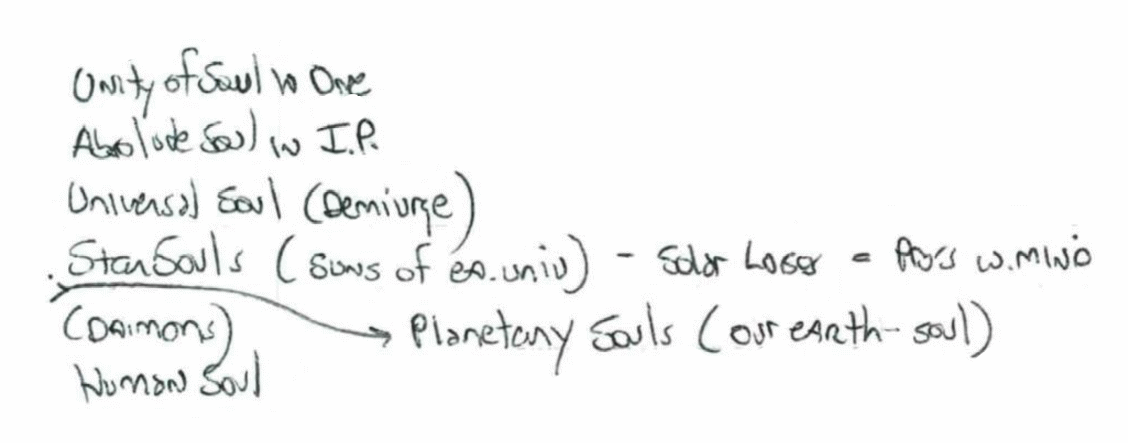
FIGURE 1984 0106a-1-AB. Levels of Soul.
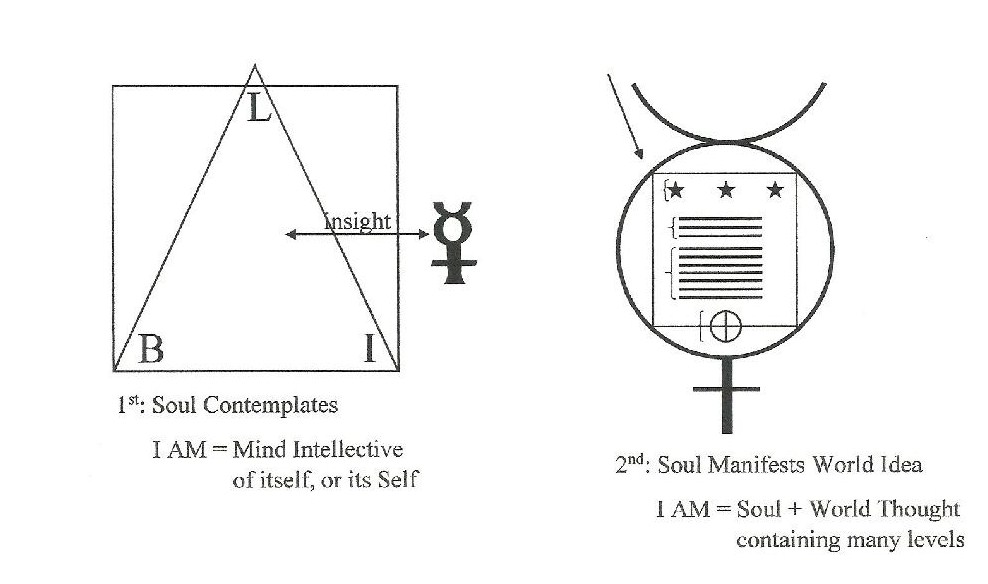
FIGURE 1984 0106a-2. Soul's Double Act.
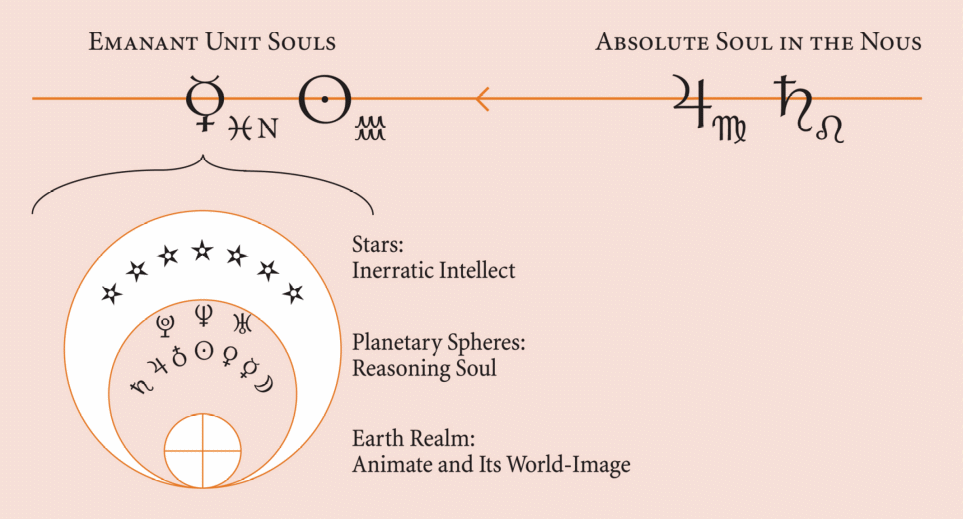
FIGURE 1984 0106a-3. Tripartite Soul and Levels of Cosmos.
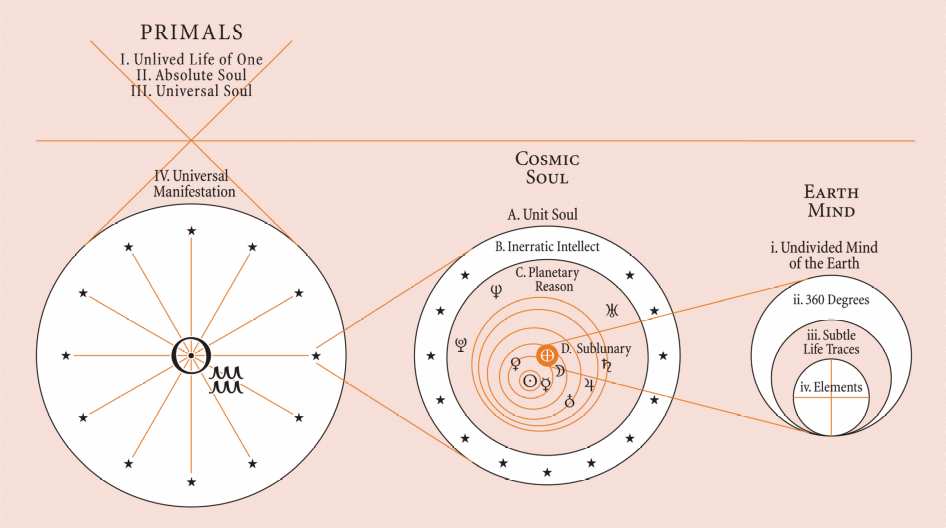
FIGURE 1984 0106a-4. Nested Levels.
The last two diagrams are from Astronoesis, pp. 203 and 250 respectively. Other diagrams also referred to are not with this transcript version. [Transcriber note: [diagram] means the speaker is referencing a diagram as he or she is speaking. If someone is drawing or writing, with audible sounds of chalk on a blackboard, I indicate this by [drawing] or [writing].]
AD PAPER read in class:
- "Deliberate Repetition: Cosmic Epistemology; Soul as Double Knower". The first part of this paper has been published in Astronoesis as "Deliberate Repetition: Cosmic Epistemology" (pp. 232-234). This paper was read in several classes during the time period of Jan-Feb 1984 and has been retyped as 1984 0106b V09MP. Astronoesis - Soul.
NOTES:
This is 1984 01/06a, Plotinus; Soul Class, and the first entry associated with this date. 1984 01/06b = Deliberate Repetition: Cosmic Epistemology; Soul as Double Knower Paper.
Earlier partial transcripts exist. Some of the partials have diagrams. As of Dec. 2023, two have been scanned, and both have diagrams: 1) Scan File 1984 0106P1-04R02.PDF, where the paper and comments on it can be found undistinguished; 2) AD SUPP 956-995.PDF (formerly AD SUPP 976-995.PDF) (pp. 983-986), where the second half of the paper and part of the class is summarized.
Excerpts from this transcript appear in Astronoesis in "What is an Idea?", p. 130, "Omnipresence of Soul to the Cosmos," p. 207, and "Unit Soul as Absolute Individual," p. 211 ff.
TRANSCRIBED Verbatim by IT prior to 2018, reformatted by jf 2018. In 2023, IT does one more pass, updates prefatory matter, footer, and audio file name, expands Subsubjects, completes Book List and TOC, adds Plotinus quotes section, fixes errors/typos, adds new notes within transcript, adds four diagrams and references within transcript to these diagrams, reformats to accord with new conventions. Archival verbatim transcript with AD Paper – V12ap.
AUDIO FILES: 1984 0106a, 1984 0106b. [Note: "Tape" and "Side" refer to original audio cassette tapes that were later digitized into .MP3 Audio Files.]
1984 01/06a at Wisdom's Goldenrod
Plotinus; Soul; "Deliberate Repetition"; Double Knower
[Audio File 1984 0106a Begins]
AS: --kind of Soul. And this is a new situation. [short pause with shuffling about] This-- this is just-- Next few pages pick up where that leaves off [few words inaudible] And then there are-- there's a discussion that follows that, which is [couple words inaudible] so maybe we'll--
S: Yeah.
AS: (I will/Then we'll) first read these three-- three or so pages that follow immediately upon that short or brief outline of the various aspects of Soul, levels of Soul and so on. [Note: See WG Class 1983 1216a, where this outline/paper is read. See also 1983 1216b V09MP, the retyped version of this paper.]
S: But you-- you're in here.
AS: I'll just put those words down, that was from the previous time, where we had the Absolute Soul in the One, the-- the unity of Soul. [writing] Then we have the Absolute Soul in the Intellectual-Principle. And then we had this Universal Soul or the Demiurgic Soul. Then the star souls or Solar Logos. And then [few words inaudible] [students assent, faint] And then the individual human soul. [short pause] I remember this. [11½ second pause while writing] These could be considered as individual souls, and this is Absolute Soul or the Demiurge. And that would show the Demiurgic Soul as being the borderline [FIGURE 1984 0106a-1-AB].
S: What?
AS: And, that was a brief discussion of those various levels of Soul. And this picks up from where that leaves off [one word inaudible] follow. Near the end of that.
[Transcriber note: The first part of the following paper is published in Astronoesis as "Deliberate Repetition: Cosmic Epistemology" (pp. 232-234). This paper was read in several classes during the time period of Jan-Feb 1984 and has been retyped as 1984 0106b V09MP. Astronoesis - Soul. I transcribe the paper just as AS reads it, including any changes made during re-reading. Sometimes it is unclear whether AS is speaking or reading; I use my best judgment.]
AD Paper ["Deliberate Repetition: Cosmic Epistemology; Soul as Double Knower," AS reading]: "Deliberate repetition and further amplification is necessary to emphasize the intertwining of cosmology and epistemology which Plotinus has as a backdrop for the acquisition of knowledge by the human soul in the sensible world. The manifestation of the World-Idea is the object of knowledge to the inhabitants of that world, and the interlocking of the various levels of reality within the structure of that manifestation is an infinitely complex situation that requires to be mentioned here.
"For the human soul which identifyingly inhabits a body fabricated by the planetary mind, which is manifesting its world according to the Solar Logos, which in turn is one of those principles of intellectuality among others and situated within the ground-plan or sketch of the universe which is provided by the Universal Soul, is the context within which we must place the object of knowledge."
AS: Read it again?
LR (simultaneously): We want the context again, Avery.
AS: You want to go back to the picture [couple words inaudible]
S: Oh yeah.
AS: Well that's why I put these words up, I thought that might help somewhat. All-- one nested within the other. Ok?
AD Paper ["Deliberate Repetition: Cosmic Epistemology; Soul as Double Knower," AS reading]: "The human soul identifyingly inhabits a body fabricated…"
AS: Yeah, identifyingly means that according to its innate tendency or whatever. Yeah.
AD Paper ["Deliberate Repetition: Cosmic Epistemology; Soul as Double Knower," AS reading]: "…identifyingly inhabits a body fabricated by the planetary mind…"
S: Did you leave that out?
AS: Oh yeah. Leave that one out.
[student assents, very faint]
[short pause with writing/drawing]
S: Could you read that again?
AS: Yeah.
AD Paper ["Deliberate Repetition: Cosmic Epistemology; Soul as Double Knower," AS reading]: "The human soul identifyingly inhabits a body fabricated by the planetary mind, which is manifesting its world according to the Solar Logos. The Solar Logos or Sun soul, in turn, is one of those principles of intellectuality among others [AS: Among other Solar Logoi.] situated within the ground-plan or sketch of the universe that is provided by the Universal Soul."
S (very faint): Uh-hm.
AS: Ok? So, this-- this hierarchy--
AD Paper ["Deliberate Repetition: Cosmic Epistemology; Soul as Double Knower," AS reading]: "…is the context within which we must place the object of knowledge."
AS: Or going the other way, we have this ground-plan or sketch of the universe provided by the Universal Soul, within which are these principles of intellectuality or Solar Logoi, among which is our particular Sun soul, within which are all these planetary minds or planetary souls, which are manifesting their own worlds, which will include the bodies for all of the different individual human souls that will identifyingly inhabit.
AD Paper ["Deliberate Repetition: Cosmic Epistemology; Soul as Double Knower," AS reading]: "Now at this point we must-- we place the human soul which seeks to gain experience of this sensible world or the sublunary sphere."
AS: The realm of the Earth soul.
AD Paper ["Deliberate Repetition: Cosmic Epistemology; Soul as Double Knower," AS reading]: "It was a tradition among the Platonists that the birth or generation of souls took place in a star (such as our own). [Note: See Plotinus, III.4.6.] The powers of a cosmic soul instigated the unit of being-consciousness to develop its faculty of understanding by providing the necessary environment within which its potential powers were evolved. For Plotinus, the unit soul or mind was a double knower. [Note: See Plotinus, I.1.8, IV.3.10, IV.3.31, V.3.4.] That is, it had self-cognition, undifferentiated being-consciousness, which included cognition of its source or origin. The lower knower or secondary phase--that is, the faculty of understanding and reasoning--would evolve by its journey through the cosmic circuit, which is providing the circumstances, the situations, and events that will educe its potential and make it actual through experience."
HS (faint): (Read/Do) that again.
AS (faint): Does that [couple words inaudible]
RG: Read it, yeah.
S (simultaneously): Read it.
AS: Maybe the whole thing again.
[students assent, faint]
RG (simultaneously): Yeah, read the whole thing.
[students assent, faint]
AS: Start from the beginning? (laughter, student words)
LR: Sure.
RG: Yeah.
AS: I'll start from the-- I'll start from the beginning of this paragraph.
S (faint): I didn't understand (part of it).
AS (simultaneously): (This is/They're just) three pages. (bit of laughter)
[student assents]
S (simultaneously): Backwards.
S (faint): Read it backwards, yeah.
AS: Ok.
AD Paper ["Deliberate Repetition: Cosmic Epistemology; Soul as Double Knower," AS reading]: "It was a tradition among the Platonists that the birth or generation of souls took place in a star, such as our own. The powers of this star or cosmic soul instigate the unit of being-conscious [AS: Our unit soul.] to develop its faculty of understanding by providing the necessary environment within which its potential powers were evolved. For Plotinus, the unit soul or mind was a double knower. That is, it had self-cognition, undifferentiated being-consciousness, which included a cognition of its source or origin. And the second knower or the secondary phase--that is, the faculty of understanding and reasoning--would evolve by its journey through the cosmic circuit. This cosmic circuit is providing the circumstances, the situations, and the events that would educe the potential from this lower or secondary phase of soul or understanding and make it actual through experience."
AH: Could you do the last sentence again please?
AD Paper ["Deliberate Repetition: Cosmic Epistemology; Soul as Double Knower," AS reading]: "Cosmic circuit is providing the circumstances or situations and events that will educe…"
AS: Well evoke.
S: Yeah, 'educe' is a word, (ok).
S (simultaneously): Educe.
HH: So Avery, is that like an explanation of the transits that a person experiences in their daily life?
S (simultaneously): [couple words inaudible]
AS: It's-- it's the-- an explanation of the education that the soul is getting (and/as) the World-Idea is provi-- is teaching it through all these circumstances, situations, and events that make up its actual experience. And through this experience is being evoked or educed potential that's within the soul, that's within the unit soul.
AH (faint): Could you read the sentence please?
AS: What? I just did, yeah. I'll read it again.
AH: Please.
AS: Yeah. I read it differently every time (too).
AS/S(?): [couple words inaudible] (bit of laughter, student words)
S: Ok.
AD Paper ["Deliberate Repetition: Cosmic Epistemology; Soul as Double Knower," AS reading]: "The lower knower or the secondary phase--that is, the faculty of understanding--[AS: in this world-view] will evolve by its journey through the cosmic circuit, where it is provided with the circumstances, situations, events that will educe this faculty of understanding or this soul's potential and make it actual through experience."
[student assents, very faint]
S: Uh-hm.
S (faint): Don't move it all the time.
AD Paper ["Deliberate Repetition: Cosmic Epistemology; Soul as Double Knower," AS reading]: "In other words…"
AS: Oh. (bit of laughter)
S (amidst laughter, very faint): [couple words inaudible]
RG: (Right.)
S (faint): What happened?
S (very faint): He got [one/two words inaudible]
AS (simultaneously): Well, I mean--
AD: Well, no, Avery why not continue now because [AH/S(?): Just read it.] this is just to lead us into what we did today.
AS: Yeah. So let me just finish. That's-- continuing. That's what it says, it says, "In other words". I wasn't (doing--) (bit of laughter) That's what the next sentence--
AD Paper ["Deliberate Repetition: Cosmic Epistemology; Soul as Double Knower," AS reading]: "In other words, the evolving World-Idea of our Solar Logos, our Sun, in its totality, is the stage upon which the soul's unfoldment occurred. This is the womb within which the gestation and birth of the Sage is finalized. Now the individual soul, whose selfhood is similar to the soul of our Sun and conjoined to its"elder sister", [Note: See Plotinus, II.9.18.] is the principle of our being--an eternal authentic existence--which manifests the World-Idea and simultaneously includes the knowledge coordinate with the various levels of being included or contained in that World-Idea. To the contemporary mentality, this is a superstitious myth invented by the overactive and heated imagination of our frightened forefathers. (laughter) For the achieved Sage, these silent and detached intuitions are self-validating and authentic instances of a growing body of knowledge which has been deposited as an esoteric tradition or a "metaphysics of truth."
"We return to the specifics involved in order to complete our short synopsis of heavenly wisdom. Neither allusions or innuendos can be substituted for definitive working principles. The sly remarks and one-liners by many of our contemporaries that imply a greater hidden knowledge on their part has been frustrating and found wanting. We, for our part, must be bold and make explicit these principles necessary for spiritual growth and deny the hostility and negation inherent in their attitude.
"The object of knowledge for the soul incarnating here is the world-ideogram which is given to an individual mind. This original world-thought is transparently lucid and subtle, and a constantly metamorphosing logical unity or whole of its own-- a constantly metaphor-- metamorphosing logical unity or whole of its own intellectuality or in other words the Ideas which are the same as the 360 degrees."
S: Would you read that sentence for me again please?
AS (faint): Yeah.
AD Paper ["Deliberate Repetition: Cosmic Epistemology; Soul as Double Knower," AS reading]: "This original world-thought [AS: is called a world-ideogram] is a transparent and lucid and subtle, and a constantly metamorphosing logical unity or whole composed of its own intellectuality or Ideas which are the same as what we would call the 360 degrees. It is these Ideas or gods of the planetary mind that are the very substance or stuff included in the organization of the psychosomatic organism and the vehicles used by soul to understand the World-Idea. Thus the soul is a receptacle of the gods.
"The powers of the undivided mind of the Earth, symbolized by the Chaldean planets, represented by our instinctual functioning, organize these Ideas or reason-principles into specific and adventitious unities--i.e., psychosomatic organisms. These combinations of function and substance are ever-ongoing processes that result in the creation of-- that results in the creation…"
[short pause]
AS: 'WI', is that World-Idea or Witness-I?
S (very faint whisper): World-Idea.
AD Paper ["Deliberate Repetition: Cosmic Epistemology; Soul as Double Knower," AS reading]: "This combination of function and substance is an ever-ongoing process that results in the creation of entities that we may refer to as an organization of the Earth's memories."
VM (very faint): Us.
AS: Yeah, us.
[students assent, faint]
AD Paper ["Deliberate Repetition: Cosmic Epistemology; Soul as Double Knower," AS reading]: "Now it is through this very medium, the organization of the Earth's memories into a functioning entity, that is imparted a ray of light or mind by the individual soul; or we may say that this functional entity or intruder captures that light from a soul and appropriates it as its own."
AS: Depending on which side you look at it from.
S (faint): Right.
AD Paper ["Deliberate Repetition: Cosmic Epistemology; Soul as Double Knower," AS reading]: "This partial consciousness streaming out through the organism gives rise to an appearance, the image of the world, within which it finds itself situated; and it is these images in their totality that will constitute the lowest level of knowledge, as, for instance, in Plato's Divided Line. So he must bear in mind that these bodies are the medium through which a soul becomes sensitive to the sensible world, but these bodies are at the same time agents in the process that has organized or are continuously being organized by the planetary powers." [Note: The last sentence, which was a handwritten addition by AD to the original typed paper, should read: "So we must bear in mind that these bodies are the medium through which a soul becomes sensitive to the sensible world -- but these bodies are at the same time agents of the powers that are continuously being organized by the planetary powers."]
AD/S(?) (very faint): Is that all?
AS (faint): That's (all/it).
[16 second pause]
PD: Do you-- but weren't you confused on--
AD: Well, that's as far as we got, what we wanted to do was show the development of the second knower.
S: (Perfect.)
AS: The--
[short pause]
AD: Why don't we go through that Avery, the development of the second knower?
AS (simultaneously): Keep going?
AD: We'll make the connection as we go along.
AS: Ok. You have to be a little more patient. Ok. The rest of this focuses on the second knower or this emanation as we spoke there.
[Transcriber note: The second half of the paper starts here.]
[Note: See FIGURES 1984 0106a-2, 3 for the following. FIGURE 1984 0106a-2 is a more detailed version of the diagram in one of the partial transcripts for this class. FIGURE 1984 0106a-3 is from Astronoesis, p. 203. See also Figs. 95 and 96 in Astronoesis.]
AD Paper ["Deliberate Repetition: Cosmic Epistemology; Soul as Double Knower," AS reading]: "The background that we have to keep in mind is the original distinction we made between the Absolute Soul [AS: and the Absolute Nous and the One] and its emanant, or this third phase or Mercurial phase."
AS: So we have to kind of keep in mind this diagram. [drawing/writing] And this probably helps. [14 second pause while drawing/writing] And another [one word inaudible]
[short pause]
AD Paper ["Deliberate Repetition: Cosmic Epistemology; Soul as Double Knower," AS reading]: "So the background is the distinction we made between the Absolute Soul and its emanant or reflex, the third phase of soul or Mercurius. This Mercury itself has a double aspect. It is both pure being of soul, contemplation, and is determined being when it exercises its power of understanding in grasping the World-Idea."
AH: Avery? Is that duality the-- the earlier dual phase of soul in the paper?
AS: Right, this is the double aspect or double nature of this reflex-- of this reflex or unit soul.
AD Paper ["Deliberate Repetition: Cosmic Epistemology; Soul as Double Knower," AS reading]: "This unit soul itself, in its higher aspect, (is/as) what Plotinus calls the higher knower or the higher self-knower, is a pure unit soul. As such, we can equate it with a pure being and infinite consciousness, Authentic Existent, Overself, and as such we can speak of it as having insight. This emanant, this unit soul, knows its prior, it knows the Nous."
AS: PB for example speaks of this aura emanating from the Nous. [Note: Paul Brunton, Notebooks, V16, 28:2.79 and Perspectives, Ch. 28, #26.]
AD Paper ["Deliberate Repetition: Cosmic Epistemology; Soul as Double Knower," AS reading]: "This unit soul knows itself as well as an authentic essence and an emanant. [AS possibly speaking this last sentence] And we can equate this faculty with insight."
AS: [drawing/writing] But because this emanation or this reflex is an authentic essence, it has insight. Now, its se-- in its second aspect, it's primarily the one that we're concerned with here in speaking of various levels of the understanding, or the second knower.
AD Paper ["Deliberate Repetition: Cosmic Epistemology; Soul as Double Knower," AS reading or talking]: "And here we can talk about the unit soul as understanding or knowing its content of the World-Idea."
AS: He summarizes this in V.3.8, which I won't read now, where he speaks about soul having a double aspect. Soul faces the Nous and has an intellection of its origin, and then soul is occupied with the outside, with the outer, with the World-Idea, and there it has various levels of understanding. [short pause] Now, in this as-- Your Overself or unit soul is conjoined with the Solar Logos's asmita or I AM principle. [12 second pause, student assents] Your unit soul or Overself is conjoined with the soul of the Sun, or the I AM principle of the Solar Logos.
AD Paper ["Deliberate Repetition: Cosmic Epistemology; Soul as Double Knower," AS reading]: "At this level of the Solar Logos, the whole of the I AM or Overself is conjoined to the whole of the Sun soul, pure"beings by the side of Being." (Plotinus, VI.4.4) The Solar Logos, or the World-Mind in PB's terminology, is the most immediate source to the unit soul of its World-Idea, which is going to be the content of its faculty of understanding and which will awaken and tutor the soul in its development."
AS: Ok? So, we have your unit soul or Solar Logos, [drawing] which is a unit soul. In the one direction it has insight, and in the other direction we can speak about its faculty of understanding. Now, for-- for the Solar Logos, this faculty of understanding is always awakened and it's manifesting a World-Idea, which we'll speak of. For the individual unit soul, this faculty has to be awakened by the World-Idea.
AH: So it's [BS simultaneously: But its content is still the World--] at the level of both insight and change?
AS: Yes it could have both. (Go ahead.)
BS: Both contents-- the content of both is the same World-Idea, above [AS simultaneously: Well that--] the Sun soul and the unit--
AS: That's what he'll speak about.
AD Paper ["Deliberate Repetition: Cosmic Epistemology; Soul as Double Knower," AS reading]: "The Solar Logos is also receiving this aura from the Nous, as it were, and it tr-- in order for the Solar Logos to grasp this aura determinately, it transforms it into a World-Idea for itself according to its, the Solar Logos's, own intellectuality. In other words, it has an idea of the Nous which we can symbolize as the inerratic sphere. [short pause] The World-Idea [AS: this World-Idea] will provoke the individual unit souls out of their state of pure Being and give them some kind of determinate being. So, the Solar Logos awakens the individual souls to a recognition of their own faculties. The individual or unit souls receive the World-Idea most immediately from this Solar Logos through their own power of understanding.
"Now, the World-Idea itself can be spoken of as having three levels which we'll see will correlate with the three levels of understanding of a soul. And this World-Idea is instructing the individual soul."
AS: So, facing inwardly as it were, the Solar Logos or your unit soul or any Overself has insight. When it's conjoined with the World-Idea, your unit soul is now going to exercise the power of understanding. And what it's going to understand is the World-Idea supplied by the Solar Logos. And that World-Idea and the corresponding understanding will have three different levels, ok. This understanding [drawing/writing] is the second knower [diagram]. And these three levels of understanding you can roughly call intellection, unembodied reason, and sense [diagram]. [short pause] Now I'll try and-- the short-- this is very long.
AD Paper ["Deliberate Repetition: Cosmic Epistemology; Soul as Double Knower," AS reading]: "The World-Idea itself has three levels correlating with the three levels of understanding of the soul which will be developed and this World-Idea is instructing the understanding of the individual soul. From the objective point of view or from the point of view of the World-Idea…"
AS: We'll describe these levels first, ok, try and get some understanding of what these three levels are. Remembering these are all on the side of the manifestation. They're within what we call the second knower or this understanding.
AD Paper ["Deliberate Repetition: Cosmic Epistemology; Soul as Double Knower," AS reading]: "…the level of intellection corresponds roughly to the Sun soul's vision of the World-Idea, its transformation of its contemplation of the Nous. We can speak of this symbolically as the inerratic sphere, symbolized here by all of the star souls."
AS: The totality of those star souls would represent the intellectuality of that Sun.
S (simultaneously): Would you just go over that whole idea again?
BS (simultaneously): Please Avery, yeah.
S: Just repeat that whole--
AS: Yeah. In-- at-- first in terms of the Solar Logos or in terms of the cosmic-- these three levels of the World-Idea can roughly be described as: first, the Sun soul, remember, receives that aura from the Nous and it (has/had) to transform it into the World-Idea for itself, according to its own intellectuality. Now that can be symbolized by the intellectual level of that World-Idea or the inerratic sphere or those relatively permanent Ideas within the Solar Logos, its grasp of the World-Idea.
AD Paper ["Deliberate Repetition: Cosmic Epistemology; Soul as Double Knower," AS reading]: "The second level of the World-Idea can be symbolized as the level of reason and this corresponds basically to the interpretation or understanding of this World-Idea by each planetary soul, and the deposit of all the reason-principles within that planetary soul."
AS: So for us for example, for our planet Earth, this would correspond to the level of the 360 reason-principles. So we have the Sun soul has a vision of the World-Idea, and this has to be interpreted according to the Earth soul's own understanding. And that Earth soul's own understanding are the 360 reason-principles and that's at the level of unembodied reason wherein the Earth soul tries to transform that World-Idea into its own understanding. Now the reasoning of the Earth soul-- the reasoning of the Earth soul will give rise to the third level, the sensi-- sensible level.
AD Paper ["Deliberate Repetition: Cosmic Epistemology; Soul as Double Knower," AS reading]: "The sensible level corresponds to the fabricated images through which each individual human soul, animal soul and so on, will experience the reasoning of the Earth soul in an imaginal way."
AS: So this will correspond to all-- the particular visions of that Earth soul's manifestation according to these individual vehicles which have been fabricated, and their imaginal experience of that world.
BS: Would you mind repeating that sentence?
AS: Yeah that's not a sentence. (some laughter) The sensible level corresponds to the effect of the reasoning of the Earth and the experience of the Earth's reasoning by the individual entities as their own particular imagined representation. In other words, the reasoning activity of the Earth soul gives rise to all these vehicles. [student assents] Through any of those vehicles there's a sensible representation of the Earth's own content. [student assents, faint] And that imaginal representation is the level of sensible understanding. Now for the individual-- these are going to correspond in the individual to what we'd call at the lowest level the ego, at the middle level the Witness-I, [writing] and at the highest level the intellection, or possibly intuition [diagram]. And all of these are to be distinguished from what we call insight, which is Nirvikalpa samadhi.
S (faint): Ok.
LR: Wouldn't it be ego, Witness, and Overself? I mean--
AS: Isn't that what I said?
[students assent]
LR: Well you said ego, Witness, and intuition and that these three will be--
AS: Yeah because this higher level, the hi-- this third level is not insight.
LR: It's-- it's the I AM, isn't it?
S (simultaneously): Yeah.
AS: Hm?
AD: No.
LR: It's not?
AS: No.
LR: Really?
AD (simultaneously): No.
AS: No, we're making a definite distinction. Let me--
LR: Well, it just s--
AS: Maybe, maybe I'm not doing it very well, I'm sorry but I can't--
AD: (No you're right.)
LR: Ego, Witness and intellection?
AS (simultaneously): Let me try-- Before I go through the individual one, let me just say a little bit more about the cosmic, [LR assents] which I tried to do here. Maybe these-- maybe these analogies don't help, but I also tried to conceive that from the objective point of view, if you think of for example the Earth, or the Sun, let's think about the Earth, you could think about its rotation around its fixed axis would be symbolic of its intellection, [AD or student assents, very faint] not insight but of its intellection of the whole inerratic sphere, of the whole starry heaven. And for us that starry heaven would be a representation of that level of the intellection, you know, the intellectual level of the World-Idea. In other words, all of the Ideas which are present in the cosmos. And the second level, we could think of the Earth(')s now not its rotation around its axis but now its travel around the Sun would be symbolic of its rational motion (of/while) trying to assimilate those Ideas. The result of that would be the 360 degrees in the Earth soul. At the third level we could speak of all the individual entities on the Earth having a sensible or imaginal experience through their own particular fabricated vehicles, and that would be the level of sensible manifestation of the World-Idea.
AD (very faint): Uh-huh.
AS: Now--
AD Paper ["Deliberate Repetition: Cosmic Epistemology; Soul as Double Knower," AS reading]: "Corresponding…"
S (simultaneously): (Just do it again.)
JC: Well yeah.
S (simultaneously): Yeah, sorry I just-- kind of it happened.
AS: Ok. Well--
AD Paper ["Deliberate Repetition: Cosmic Epistemology; Soul as Double Knower," AS reading]: "Corresponding to these three levels in the World-Idea, you have the three levels of understanding of any unit soul which is conjoined to the World-Idea. The World-Idea is evoking or provoking these various levels of understanding according to its, the World-Idea's, own levels. Now, in the individual the highest one of these three corresponds to what we'd called in other places his spiritual subjectivity. This is the level where we can think of the unit soul as conjoined with the Solar Logos and experiencing a World-Idea according to the Solar Logos's own intellection of it-- according to the Solar Logos's own understanding of it."
CDA: One more time please.
AS: At-- at the-- the three levels of the World-Idea correlate to these three levels of understanding which are being evoked from the unit soul. Now remember, these three levels of the unit soul's understanding are all within the faculty of understanding. They correspond to three different levels at which the unit soul is understanding the World-Idea. They don't correspond to insight, ok, we've left behind insight for the minute, we're not considering that. We're considering the lower knower, the power of understanding, which is conjoined with the World-Idea. The World-Idea is going to evoke-- to develop that power of understanding. Now the first level of this power of understanding correlates with the level of the intellections of that World-Idea. Or in other words we conceive here-- basically we can conceive-- conceive of the unit soul as conjoined with the Solar Logos, as conjoined with the Earth, and then as conjoi-- with the Earth Mind, and third as conjoined with the particular psychosomatic body that's been fabricated for him. [S simultaneously, very faint: Ok.] Those three levels of the World-Idea basically give a-- Yeah?
AH: The ideas from (little-- are from the thought), you said were ego, Witness-I, and intuition?
AS: And Overself.
S (very faint): Yeah, right.
AH: You're-- now you're going to call it Overself.
AS: Yeah, Overself's fine.
AH: That's within the faculty of understanding.
AS: Right. That's the aspect of the Overself which is looking down as it were or conjoined with the manifestation.
VM: Andrew likes to distinguish the Witness-I and that--
AS: Well, I'll try and do it in the picture. In the picture--
AD: Let's try this way, Avery. We think of the Overself, we think of the Overself as the substratum, the I AM, the unit consciousness, the infinite consciousness. And within that there's a determinate content which we're calling the World-Idea. Now, that substratum, the universal consciousness or the-- the consciousness of the I AM, is simultaneously present throughout the World-Idea, alright, so that when Avery is speaking about the division within the World-Idea of the universal Ideas, the unembodied reason, and then there are reason-principles embodied as psychosomatic organism, he's speaking about three levels of knowledge that could exist within that World-Idea of which the soul is the substratum to any part of it. It isn't a substratum just to one part but (for/to) every-- it's a substratum to all. So it can be simultaneously present at any one of those levels and at all three levels. So the soul would have simultaneously a knowledge, let's say, of universal reason-principles, the Intellectual Ideas, and could also simultaneously have knowledge of a sense particular. Alright, that's the difficult part, that's the simultaneity of knowledge in the soul. [student assents] All the levels of knowledge are simultaneously present to it. Now I prefer Avery refer to the highest level, we called that the celestial. And I think that's a nice name.
AS: Well, I think-- maybe we could also make clear the distinction here. The highest level of this faculty of understanding knows these Ideas as distinct, whereas this faculty of insight is what knows the reality itself. So--
AD (simultaneously): Yeah, the insight there would be no determinate content.
AS: There's no contents at all.
AD: Even--
AS (simultaneously): Here we're talking about content, even at the highest level. The highest content is like the Ideas which have been determined as this co-- as this cosmos. If we say that the first content, the highest content, is the-- that emanation from the Nous is converted into a World-Idea, or all of the Intellectual Principles that go into the fabricating of this World-Idea would be that celestial-- celestial aspect of the understanding [few words inaudible]
AD (simultaneously): Might also add here that when PB for instance refers to the fact that the Prophet and the Sage delivers laws or universal laws, that's what he's talking about, the laws that govern the universe. He's coming from that realm, that highest realm, these are the laws that govern the whole world, alright, so he would be give-- he would be enunciating those universal principles, alright.
AS: Also, I think it helps, [drawing] but I'm not sure, to say that at that first level of understanding-- and this is-- the whole cosmos is within the I AM as a substratum. At the highest level, the I AM is just identified as it were with the entire solar system, the Sun soul. At that second level it's been delimited or contracted to an identification with the reason-principles of Earth, and at the third level it's been contracted to an identification with this animate or psychosomatic organism. And so this third one we call the ego. At the next level we speak about it as the Witness-I or the unembodied reason, which is a mental being which is conjoined with the whole of the 360 degrees of the Earth. And then beyond that we would speak about the celestial, the Overself, as conjoined with the whole World-Idea. Now if you spoke about the Overself without any content, not even this content of World-Idea, then you would be speaking of something analogous to the first hypothesis, that is, pure insight. Now this would be the second knower where it knows the entire World-Idea as a content [diagram].
RG: Is this-- what am I-- I'm-- is this the level of Intellectual-Principle or not?
AS: No, the Intellectual-Principle per se [few inaudible student words simultaneous with AS] is here [diagram]. This is the intellection that's within the soul, within the I AM [diagram]. This is the Intellectual-Principle per se, this [drawing/writing] triple Hypostasis. If you wipe out the entirety of the cosmos and you just have the soul experiencing this radiation or aura, the Void, if you bring back the cosmos the first level of that cosmos would be the level of intellection of the World-Idea, [RG simultaneously: Right, and you're saying that intellection--] not this Intellection [diagram].
RG: That intellection prior than in-- we've used the idea that the intellection only can occur within the Earth Mind, the highest level of the--
AS: Yeah. [AS indicates on diagram]
RG: And now you're saying that there's a level, a me-- a middle level-- a higher level where it contacts the [AS: No.] Solar Logos.
[Note: See FIGURE 1984 0106a-4 for the following. This diagram is from Astronoesis, p. 250.]
AS: Ok except that I think here the infinite mind of the Earth is equivalent to [drawing/writing] the soul of the Solar Logos, which is equivalent to the unity of our individual I AM. The next level would be the soul of the Earth. Because there's no reason to say that the Earth itself doesn't have a mind which is co-extensive with the Solar Logos too. I mean if our individual I AM does, why not the Earth?
RG: I'm not-- I just-- I lost you.
AS (faint): I'm sorry, it's my fault.
RG (simultaneously): No go ahead, do it again, I can't follow it, go ahead.
AS (simultaneously): Well, ok.
RG: I don't know what you mean the soul of the one and the mind of the other.
AS: Ok. Well, maybe the terminology is confusing. But at the first level we said this Sun-- let's just consider a Solar Logos. It is receiving this emanation from the Void, ok, and it's gotta transform that into a World-Idea for itself. Now it has the power to do that, our unit soul doesn't. Ok? And it is-- it-- well-- well I think Anthony said it better in this paper where he spoke about the combination of all of these-- the thought-- principles of intellectuality being all of the star souls, ok. And he says that "our Solar Logos, which is one of those principles of intellectuality among others, and is situated within the ground-plan or sketch of the universe." So our Sun soul as a principle of intellectuality, and every star soul as a principle of intellectuality, and each one is interpreting the Nous according to its own intellectuality, which means each one in a sense is interpreting all the others or has an image of all the other star souls. [RG assents] Ok, so at that level we would speak about the Sun's vision of the World-Idea within itself, within its I AM principle. And actually that Sun is this [diagram]. [RG assents]
Now at the next level we could speak about each of those planetary souls itself [drawing/writing] has to get an im-- has to get, participate in that World-Idea, and it does so according to its own reason-principles. [RG assents] And then of course each one-- within each of those planetary spheres there will be all the particular entities [RG assents] as a third level (idea). Well now if we take any unit soul, like your human-- like our human soul or Overself, at the first level we imagine it-- we imagine it coming out of the Void together with the Solar Logos. All those I AMs all come out together with the Solar Logos, the World-Mind, the way PB says, they all arise, you know, metaphorically, come into manifestation and they're conjoined with the World-Idea first at the level of the Solar Logos, the way it's interpreted its World-Idea, would be the level of intellection. And then they get contracted to a level of one of these planets for a certain number of incarnations, it might be the Earth, it might be Jupiter. [drawing] But now they will experience a delimitation according to the 360 degrees that are in that particular sphere. And further, they will experience an embodiment, as it were, in a particular vehicle.
RG: Ok.
AS: And you're-- you're concerned with this level of the Solar Logos.
RG: Well that-- I don't-- I don't mind that, it's just that-- so then spiritual subject-- the [one/two inaudible AS words simultaneous with RG] subjective part is no longer the highest aspect of the Earth belt but a conjoining with the 360. But that's the highest level of the middle one, [AS assents] of the psychic.
AS: For now. Right, that's [RG simultaneously: (That's--)] the way that's-- that's-- right, exact, that's the way it seems to be reinterpreted.
RG: Uh-hm.
AS: If this is [drawing] [S simultaneously: Could you repeat that?] the Sun's-- the Sun's-- the conjoining of understanding with the Sun's Idea as it were is the level of spiritual subjectivity. Or we're calling it here [RG simultaneously: (Sort of.)] the intellection in the unit soul. At a second level, the conjunction of that power of understanding in the I AM with the Earth belt or the Earth soul we're calling the unembodied reason or the mental being. And then the further contraction to a psychosomatic organism, calling the ego.
MB (very faint): Ok.
AD: So, what we're doing, Richard, is we're-- instead of referring-- referring to bodily subjectivity, we're changing, we're saying the ego, ego is the subjectivity, the lowest level of subjectivity, alright. And if you remember the remarks made about the ego, it produces its own images, has its own mechanism to make images and live in its own world. This is the lowest kind of subjectivity that the soul can experience. The next level of subjectivity would be let's say the reason-principles, but not as embodied in matter, you know, but independent of that as pure essences in which case then you'd speak about the Witness-I as being, let's say, identifiable with that whole psychical-- the soul of the Earth, alright, and that would be the psychical subjectivity. Now, somewhere PB says that the psyche-- that insight is a function of the psyche. [Note: Paul Brunton, Notebooks, V13, 20:4.184.]
(Side 1 of original cassette tape digitized as 1984 0106a Ends; Side 2 Begins)
AD: At the same time the other thing that happens there too is that the identification with the next step, you know, the undivided mind of the Earth, now you become a recipient of what might be referred to as philosophic knowledge, knowledge that's coming in from even beyond our own solar system.
CDA: Where-- I'm sorry, I missed, where is that happening?
AD: Yeah. When the soul identifies with the undivided mind of the Earth, when it has reached that level, now it can also become the recipient of philosophic wisdom.
KD: But that is the level of intellection?
AD: Yeah, same as intellection. [short pause] And operates the same way in the sense that there(--) they are detached intellections. [student assents, faint] It isn't [AS simultaneously: Can I--] a steady stream.
AS: Let me read that-- that quote, I think, maybe here would be a good-- Maybe not. But maybe just as a kind of a summary of this position, in V.3.7. He has a short paragraph where he speaks of-- the same place where we read that thing on detached intellections. Maybe that's a good short summary of the whole thing. Maybe not.
AD: [one/two words inaudible]
AS (simultaneously): Says--
Plotinus [V.3.7, AS reading]: "…[AS adds: the] Soul has the [AS reads: a] double phase, [AS adds: the] one inner, intent upon [AS reads: on] the Intellectual-Principle, [AS adds: and] the other outside it and facing [to] the external…"
AS: But by "external" he means all the contents of the soul and by "internal" he means facing that Void or the Intellectual-Principle. Ok?
Plotinus [V.3.7, AS reading]: "…by the one it holds [the] likeness to its source…"
AS: So there we spoke about as an image of God, holds likeness to its source, the Nous.
Plotinus [V.3.7, AS reading]: "…[AS adds: but] by the other, even in its unlikeness, it still comes to likeness in this sphere…"
AS: That is in the sphere of the cosmic manifestation.
Plotinus [V.3.7, AS reading]: "…by virtue of action and production; in its action it still contemplates, and its production produces forms--detached intellections, so to speak…"
AS: In another place he speaks about these intellections as being unrolled within the soul, within the Nous it's completely unified, [student assents, very faint] completely unified in there. [student assents, faint] Here he's speaking about detached intellection.
Plotinus [V.3.7, AS reading]: "…with the result that all its creations are representations of the divine Intellection…"
AS: So everything within this manifestation is a representation of divine Intellection--
Plotinus [V.3.7, AS reading]: "…and of the divine Intellect, moulded upon the archetype, of which all our emanations and images, the nearer [AS adds: the] more true, [AS adds: but] the very latest preserving some faint likeness of the source."
AS: So, I took it here to be that all these levels of the World-Idea, from the intellection to reasoning to sensible, are all emanations and images molded upon the archetype, "the nearer the more true," the nearest being these-- the level of the detached intellections, the level of the Ideas within manifestation, which would be the closest thought to the wisdom-knowledge that the Sage would have or would be the wisdom-knowledge that the Sage has of the World-Idea. Ok, and, I suppose that he would simultaneously have the presence of that pure insight and also the presence of the World-Idea, which he would know at the intellectual level per se. Ok.
RG: But by World-Idea here, you mean in the function of the (soul).
S (faint): (What?)
AS (simultaneously): Mean in the--
RG: Your meaning of function of the soul or an aspect of the soul production, I mean here he says soul. You're saying World-Idea but, [AS: Right.] what's the difference?
AS: Well, I think saying there that the World-Idea represents that content of the soul. The reason content, the reason-principle content [RG simultaneously: Ok.] or as he says-- [S: Sir?] he says "it contemplates and produces form--detached intellection--and all its creations are representations of the divine Intellect." [RG assents] So the World-Idea is a representation within soul of this divine Intellect or the aura.
RG: So the soul produces the World-Idea?
AS: I think we would say that one type of soul or other, it may be the Universal Soul ultimately, is responsible for producing the World-Idea according to the divine archetype. The divine [RG assents] archetype would be the Ideas themselves or the Intellectual-Principle. Now I think the analogy-- oh yeah I remember one thing, the analogy we used which seemed good is, the soul (tried/tries) to grasp the indeterminacy of the Nous and in doing so it produces the World-Idea, just as the Intellectual-Principle in its indeterminacy (tried/tries) to grasp the One and in doing so it produces all the Ideas. So, we-- and then the individual tries to grasp that World-Idea and in doing so produces his represented world. And I-- I think that principle holds all the way down from-- in some sense-- again it's just-- it seems to be the idea that the-- the soul, whether it's in this case the cosmic soul, gives that form to the World-Idea, but the matter of it as it were is that aura emanating from the Nous, is what it receives from the Nous. And I think it's very similar to what the individual mind receives the World-Idea as its matter and then gives it a certain [RG assents] form. And I think the point here is that there's like a nested hierarchy of souls because the individual soul has to receive the World-Idea as it were from the planetary soul and the planetary soul is presenting it on the basis of the Sun soul and the Sun soul's World-Idea is a manifestation based on the Nous itself (so/say), or maybe the Universal.
S (very faint): Go ahead.
JA: Avery?
AS: So what's-- That's [couple words inaudible] What's form at one level-- and that [couple words inaudible] [few inaudible student words simultaneous with AS] that it's form in one level (is/the) substance for the next level. That which the World-Soul forms is the very substance of our experience which we then give a further form to.
AD: Yeah, it's much more (complicated/complicating) than the simple-- simplified version that commentators present you with when they speak about the World-Soul of Plato and let it go at that. This tries to give like a bird's eye view that all these souls, you-- you know, starting with the Absolute Soul which is (radiating), but from there on down the Demiurgic Soul, the star soul, cosmic souls and the planetary souls and individual souls, all of them have to be conceived of as simultaneously operative, alright. And it's not just a simple version of the World-Soul is doing, all of this is required and-- like a bird's-eye view, you've got to see it all at once operative. And, of course the analysis makes you think that it's in-- done in parts, but that can't be helped.
VM: Anthony, this may not be the appropriate time, but some time-- if possible I would like to see how you'd put this particular diagram in with the schema that was worked out that tried to speak about the individual mind taking in the world-image and going up through the heart center and the amplification in the brain and so on. I mean, there's obviously a lot of correlations and-- or maybe it's not the right time to do it now, but it would be helpful for me anyway to see how you're--
AS (simultaneously): Well, I think all of that-- that business of heart center business and so on is that third level, the ego is going to be-- [AD simultaneously: Another--] how (the/that) ego subjectivity is going to represent the World-Idea to itself.
VM: Right.
AS: I think the rest of this [couple word inaudible]
VM (simultaneously): [couple word inaudible] sometimes talked about the world-image prior to its--
PD: Yeah I think you could see all three levels here.
AS: But then it's the Witness.
PD: You know, all three levels as an individual example of this-- of the cosmic scheme, when you take like when Ramana speaks of the Self in the heart. It's through the heart that the Self-- you know, there's a contact to the Self, so that wou-- the heart level would be Solar Logos level of maybe like-- then the consciousness that shoots up to the brain would be the planetary sphere, and the actual sense consciousness would be the embodied consciousness. [couple/three inaudible AS words simultaneous with PD] You know, this-- [VM simultaneously, faint: That's something along (one word inaudible)] that's-- I-- I mean that's what I was thinking. You have those three levels within the individual.
AD (simultaneously): Well, when he speaks about that in the Wisdom, when PB speaks about the transmission of the World-Idea in the heart center, what world is being transmitted?
S (very faint): Go ahead.
S (very faint): (Thank you.)
VM: It can't be the-- [CDA simultaneously: (Yours.)] it's-- it's gotta be something like this world-image but precisely what level I'm not clear.
AD: Well--
AS (very faint): I think it's within [one/two words inaudible]
S (faint): [one/two words inaudible]
AD (simultaneously): If-- if then, if you're saying that the image which is being transmitted to the ego-complex, alright, is the idea of the world the way it is in the World-Mind, our World-Mind, [couple inaudible VM words simultaneous with AD] the Mind [S simultaneously: The Earth?] [AS simultaneously: The Earth?] of our world, no the [S simultaneously: The Earth?] Mind of our world--
AS: The Earth Mind.
VM: Earth Mind?
AD: Yeah.
S (faint): Right.
AS: I thought that was--
AD: The Earth's Mind has its vision and it is working out its contents in its world. This will be true of any planet in the system. Alright, now, you're-- when there's a transma-- transmission taking place from the heart center, alright, to the head, and let's say the World-Idea is being transmitted, it certainly is not the view in Jupiter.
VM: Guess (not then).
AD: So then the World-Idea which is-- he's speaking about there has to be this World-Idea, our world.
AS: As perceived by the ego.
VM: So this is a transformation let's say from the planetary--
AS (simultaneously): The Witness to the ego.
VM: Yeah, from the 360 degrees, let's say, to [AS simultaneously: Yeah, to the--] the imagined world.
AD: Uh-huh.
AS (simultaneously): I would say.
VM (simultaneously): From unembodied reason to sense.
AD: Uh-huh.
AS (simultaneously, faint): Yeah.
CDA: But it's also-- [VM simultaneously: Ok.] but there's also this-- there's the-- the Overself that we're saying is conjoined with this World-Idea, that is, the cosmic or the Solar Logos, right? And then--
AD (simultaneously): But why do you want to bring in now, alright, why do you want to bring in that in now--
CDA (simultaneously): Because I don't-- I mean, there's-- (bit of laughter) I can't--
AD: What you're asking-- let me put [CDA simultaneously: Big gap.] the question this way, let me put the question this way, can you have the vision of the worlds or the world [CDA: And--] beyond this World-Idea? And we said yes, the soul has a knowledge of the three levels of knowledge. Right? In other words--
CDA: The soul as--
AD: Has the simultaneous knowledge of all the levels of reality within the World-Idea.
CDA: Soul as the Overself has this.
AD: Soul as Overself, yeah, has a simultaneous knowledge of all levels [CDA: Ok.] of reality and the knowledge that's coordinated with those levels of reality. But that's not what he was talking about. What he was asking was, what World-Idea is being transmitted?
CDA: Yes I know that. I followed that.
AD (simultaneously): Now what-- now-- then if we answer that question, what world-image is being transmitted to the ego-complex?
CDA: Yes, [S: (Who is it?)] the world-image of the Earth soul.
AD: Yeah.
CDA: Yeah.
AD: You certainly don't know what the environment is like under the ice mist of the Jupiter surface.
CDA (simultaneously): [one word inaudible] does.
AD: Huh?
CDA: (For instance.)
AD: For instance? (bit of laughter, student words)
AS (faint): Well--
RG: Only in her mind Linda, come on.
AD: So then what I was saying was, the question has to be answered in terms of what you're asking.
VM: No, I understand the answer.
S: Yeah.
S (faint): Uh-hm.
AD: Alright, then, then the problem would be is then this world-image which is received by the Witness-I is what is being transmitted to the ego-complex drop-by-drop or thought-by-thought or any way-- or beat-by-beat, any way you want to express it.
VM: Normally when we speak of the cosmo-- or-- or the epistemology of the primal image, we're discussing this image in the unembodied reason, in the Earth's soul prior to its embodiment let's say in the psychosomatic organism.
AD: Yeah, uh-hm. [few inaudible VM words simultaneous with AD] That's-- that's what we're referring to when we speak about the primal image, [VM: Right.] yeah. In other words, what is the image of the world, what is the world-image like prior to [VM simultaneously, very faint: (Prior to) (couple words inaudible)] its introduction into the psychosomatic organism and reflected therein.
VM: Right, right.
CDA: May-- may I ask kind of--
AD: Go right ahead.
CDA (simultaneously): Can I try again, I mean I think I could formu-- I mean it's kind of an obtuse question but-- If we start at the highest level and there is-- the soul is conjoined to the Solar Logos, and this infinite consciousness now is going to be limited, ok, into the-- into the--
AD: No, the infant-- infinite consciousness is not limited. A phase of it [CDA simultaneously: A phase of the-- ok.] is what accepts reincarnation.
CDA: A phase of this infinite consciousness is going to be limited to the Witness consciousness. Now, this phase that is limited, how-- is it-- is it like a part of that infinite consciousness that knows those universal Ideas conjoined, those two conjoined, the being of the I AM-- is it those two things together that are sent forth as this-- as this part or is it just the pure consciousness of the s-- of the soul itself that is-- Is this making any sense?
AD: Not yet.
CDA: Ok. The-- the definition of the I AM is that it is an authentic existent, the first two hypotheses, it has a unity in this pure soul and--
AD (simultaneously): The first hypothesis.
CDA: And the second hypothesis [AD simultaneously: No.] that it has being.
AD: No, that-- now you're not speaking anymore of the I AM. As soon as you bring in the content, it's no longer the Overself. It's the Overself plus the World-Idea.
CDA: Ok.
S (faint, possibly part of background): (Thinking of the Mer--)
CDA: Ok, but-- yeah, but you can't speak of the Mercurial principle without it being part of it, right. Or do you? Ok.
AD (simultaneously): We can, of course, [CDA simultaneously, faint: Ok.] we can abstract it for our own purposes. Nirvikalpa samadhi shows that the whole world content can be momentarily cancelled out.
CDA: Right. See what I'm trying to find out is that if-- does this [AD simultaneously: Good, let's get to the point.] Witness consciousness bring with it in this limited-- in its limited form does it have anything of the Solar Logos World-Idea at its level aside from its-- aside from its-- what it receives from the Earth soul. That's what I want to know.
AD: Well, that's a part we should talk about because that's a difficult part. Avery if we go back to intellection, unembodied reason, and then sense-knowledge.
AS: Yeah.
AD: Let's talk about that middle phase because it's so difficult, the unembodied reason, [AS simultaneously: Yeah I (one word inaudible)] or what we're referring to as the Witness-I consciousness or that phase of the soul, alright, which is, let's say, evolving.
AS: Yeah, he has a-- in-- in one place he talk-- he says well, in working upwards maybe, he speaks of the life which is conjoined to make up the ego, conjoined to that psychosomatic organism, and he says that we have to mark off every-- separate off in our understanding everything that belongs to the couplement or the ego from that phase of the soul which stands by itself, or the understanding which passes judgment on the sense-perceptions and everything that goes on in the ego but is not itself an embodied part of the soul. [Note: See Plotinus, I.1.9, second to last paragraph.] So it has the real understanding as it were that the ego sometimes has access to. It may interpret what goes on and the images that appear within the psychosomatic organism or the images that are projected by the whole ego-complex but it itself is not embodied and does not belong strictly speaking to ego or the couplement. And that's what seems to have what we might call a mental being. It never has-- never was really embodied in--
AD: And the other way that you-- Like if you think of the impersonal consciousness associated with the Earth consciousness, alright, and then let's say you go on to another planet, alright, where you're evolving in different planets, different parts of the solar system. Now again, this Witness or this impersonal consciousness is conjoined to a set of reason-principles that are not of the Earth, alright, but let's say of Jupiter or Mars. Now again, this unembodied reason-principle, this Witness-I, must be able to be-- be conjoined with the reason-principles that surround the planet Jupiter, alright, or whatever phase or whatever plane of existence (or) planet that you're, let's say, gaining experience from. Now if you identify the understanding or the rea-- unem-- the reasoning phase of the soul, if you understand it as i-- as identified with the reason-principles that surround the Earth or Mars or Jupiter, then you would be giving it a content which it basically doesn't have. It is a reasoning soul, it judges, but it its-- it judges conditions, whether the conditions exist in Jupiter or-- or the Earth is secondary. What you have to keep in mind here is that this phase of the soul is a reasoning phase of the soul and is unembodied. It judges the contents regardless of where these contents are. And that's why even here, a person who has reached the depths of this kind of reasoning is unembodied. [CDA assents] He experiences himself as a mental being, not as belonging to this body or to any body.
CDA: Now, we-- remember we-- when we did the-- I don't know where it was from but the five kinds of knowledge that the Witness has, sleep and memory-- it has [AD simultaneously: Uh-hm.] knowledge of-- right [AD simultaneously: Yeah.] knowledge and wrong knowledge, you know. [Note: A number of WG classes from 1983 discuss this.] Now, does it have that-- does it get that kind of knowledge from the Solar Logos? I mean tho-- that-- those, whether they're powers or whatever you'd call it.
AD: No I would say that that's inherent in the very position or the very fact that you're referring to it as an impersonal consciousness.
CDA: That doesn't answer my question.
AD: Well I thought I did. [CDA simultaneously: (But isn't--)] It's inherent in the notion impersonal consciousness. Impersonal consciousness, alright, means that it could judge whether the knowledge is right or wrong, whether it's memory or whether it's sleep or the fifth, whatever that--
LR (simultaneously): Imagination.
AD: Hm?
LR: Imagination.
AD: Imagination.
CDA: That does-- I'm sorry, that doesn't-- it just needs to make sense to me.
AD (simultaneously): I told you dear, I'm required to supply you with a reason but not with the understanding. (bit of laughter)
S: What was your question?
CDA: I'm-- I asked whether those kind-- that the-- those are-- that power of knowing, those five powers of knowing, are from the Solar Logos. Does the Witness have those from Solar Logos.
AD (simultaneously): And I'm pointing out, if you consider what you mean when you say impersonal consciousness, Witness-consciousness, you will see inherent in that would be this position that it could make judgment whether a thing is right knowledge or wrong knowledge, whether it is imagination, whether it is memory, or whether it is sleep.
AS: And-- and I-- maybe just to say one thing further Carol, I think he's saying that that power is distinct from what, you know-- that power has nothing to do with the particular planet. Any planet that that Witness consciousness was [CDA simultaneously: Yeah, yeah, I get that.] operating in, it would have those powers. It would have [CDA simultaneously: So--] that function of right [CDA simultaneously: --it is of the very nature of--] knowledge, wrong knowledge. And so that's distinct from the content of reason-principles that it gets [CDA: Yeah.] from the World-Idea, from that [CDA simultaneously: S--] World's Idea. I mean I don't-- but maybe that's just a guess.
S: Ok.
CDA: But it's--
LR: But the Witness-- so you're saying the Witness in this case is just adventitiously joined with the Earth, that it could be not joined with the Earth?
AS: Well, I would think that if your soul evolved to a-- your understanding evolved to a certain point, the Earth would no longer have enough reason-principles to satisfy, or the right kind, and it might have to evolve to a different planet, [LR: (But--/Right.)] even a whole other solar system, I mean I don't know, it's endless.
LR (simultaneously): I just meant-- but Witness-consciousness seems to be conjoined with some planetary consciousness.
AS: To speak about a Witness--
LR (simultaneously): Because to go beyond that you wouldn't be Witness-consciousness anymore.
AS (simultaneously): Well I would-- yeah, right, I would agree [LR simultaneously: Ok.] with that, that you could only call it a Witness [LR simultaneously: Right.] consciousness [LR: If there's this--] when the soul is experiencing a certain manifestation.
LR: Yeah.
AS: To go beyond that, it doesn't need as Witness-consciousness when he's identified with the Solar Logos.
LR: Yeah.
AS: There it's just the Overself now. But, in itself that Witness-consciousness would have to have the freedom to operate through any system of reason-principles.
BS: Oh, say that again?
AS: In itself there's-- the soul would have to have the power-- the freedom to manifest or to understand any system of reason-principles, not just the Earth's.
BS (simultaneously): From any planet, from any--
AS: Yeah, from any planet or any solar system. Theoretically that soul could-- could be [one/two words inaudible]
AD (simultaneously): Otherwise it'd be very embarrassing, you reincarnate on another planet and here you operating with reason-principles belonging somewhere else. Be all kinds of difficulty. (laughter, student words)
AS: And, in fact-- (some laughter)
S: But--
BS: So there's definite a-- access to the [few words inaudible] Witness-- to the Witness-I.
S: Becomes accessible.
BS: This Witness-I is accessible, the knowledge of the Witness-I is accessible? Well obviously you've said that.
AD: Yeah.
BS: (It just amaze me.)
AS: But also Bert, I think the other implication that Carol was making was that the power of the Overself is accessible to the Witness-I. In other words, not only [BS simultaneously: Oh yeah.] does-- not only does the Witness-I have a certain content of reason-principles from this Earth sphere, but also that Witness-I has a direct influx of power from the Overself.
BS: Actually then going the other way it would ha--
AS: Yeah, going that way that's what would allow it-- the fact that it is a direct emanation or a con-- [BS simultaneously: If you get back to the Overself.] efflux of the Overself, that's what allows it to be able to incarnate as it were in any of these systems of reason-principles. It isn't tied to one system of reason-principle(s). What's intrinsic to the notion of the Witness as this essence is the soul essence. And what its determination is by is that system of reason-principle(s). It could be determined by another system of reason-principles if it were conjoined to another planetary system.
BS: And the relation of the unit soul to this Witness-I?
AS: I think he's-- the-- that Witness-I is a phase of that unit soul, the lower phase, the embodying phase of the unit soul. The unit soul equals Overself or I AM. [BS simultaneously: Oh ok, alright.] And the Witness is the phase of that soul or that part which seeks reincarnation.
BS (very faint): [few words inaudible]
AS (very faint): I don't know, that [possibly one/two words inaudible]
RG: But you know, where-- it seems you're putting no content on the side of the Overself, and all content on the side of the World-Idea. And all the determination comes from the side of the World-Idea and none of the determination comes from the side of the Overself. And I've lost totally where the individual soul-- where any individuality resides in-- in this understanding. [students assent, very faint] [AH, faint: It's interesting.] I mean it seems there is none.
LR (simultaneously): No, (the soul) conjoined with the World-Idea.
RG: (Oh.) Well that-- what kind of-- that's no kind of individuality.
LR (simultaneously): Well it's super--
AS (simultaneously): Well I don't think only.
RG: Well, I don't get it.
LR: I thought the idea was that each-- that the particular view of the World-Idea you had constituted your individuality.
RG: But that also is given by the World-Idea depending on where you are.
AD (simultaneously): But Richard, aren't you answering your question? Isn't it the World-Idea that is defining the individuality of the soul?
AS (very faint): Right.
RG: Yes, that's your position now.
S: I'm lost.
S (simultaneously): [one/two words inaudible]
AS: That's what--
RG (simultaneously): I don't understand that.
AS: But Richard I-- but-- saying it's defining the individuality is not the same thing as saying it's making it be a unit soul. I don't think. 'Cause A-- Andrew's-- [RG: Yeah.] the one passage we read before about [RG assents] before body existed--
Plotinus [VI.4.4, AS reading]: "[Now] as in Soul unity does not debar variety…"
AS: Well just simply he's saying, the soul itself is a one and many. It's not-- it's not that the World-Idea makes the soul many, but-- but it gives those many souls their determination.
RG: That doesn't-- I don't--
AS: It's determining them. Prior to that (you can speak) [one word inaudible]
RG (simultaneously): If the many souls are already many, then they're already determined prior [AS simultaneously: No.] to the determination by the World-Idea.
AS: No, that's the funny thing I think [few words inaudible]
RG (simultaneously): Well, then I totally don't understand it.
AS: Well, he says--
AD: Oh, don't say totally don't understand. (bit of laughter)
AS: He's saying that the soul essence itself, forgetting about World-Idea, the nature of the soul is to be a one and many. Therefore be-- without even speaking of the World-Idea theoretically or abstractly, you could say that that nature of soul or the essence of soul is not to be just a one but it's also to be a multiplicity 'cause there are many unit souls.
RG: Right.
AS: But to be able to distinguish them at all, one from the other, requires that they be conjoined with the World-Idea. Now that doesn't mean that the-- it's the World-Idea that makes your unit soul to be a unit soul. It's just giving it a determination. Your unit soul would be a unity without that determination but it wouldn't have a determinate being.
S (faint): [one word inaudible]
RG: Without the World-Idea.
AS: Without the World-Idea I would say that your unit soul is still a unity. Because even in that Parmenides thing when we interpreted it, the unit soul gave the unity side, the I AM or soul gave the unity, the World-Idea gave the being. [Note: See WG Classes 1983 0902b, 0909b, 0916.]
RG: But at that level there's only one soul.
AS: No, I wou-- at what level? I'm not-- I'm not speaking about in the Absolute Soul [diagram]. For example-- the example we gave. Now maybe this is a wrong example but your unit soul, you might have insight and I won't. Now if insight means that the entire world content or World-Idea is wiped out, then it's still your unit soul having an insight (into reality).
RG (simultaneously): Then what (that) means that if the World-Idea is [AS simultaneously: And what--] wiped out what gives the determination that it's your unit soul?
AS (simultaneously): Now only the Nous gives it any determination that it has which is no determination. Good. But it's still your unit soul.
RG: (And/Then) good.
AS: The only determination that's still there is the unity.
RG: A unity.
AS: A unit soul.
RG (simultaneously): A unity.
AS: And not the unity.
S (faint): Yeah.
RG: Right.
AS: It still remains a unit soul and doesn't become the Absolute. Therefore, if it still remains a unit soul and doesn't become the Absolute but it no longer has a content of the World-Idea, the implication is that it remains a unit soul even when the World-Idea's wiped out. [RG simultaneously: And what about-- right.] It doesn't become the Absolute.
RG: Good, and what about the determination that allowed that unit soul to have insight as a-- and not to have others? That [AS simultaneously: That--] seems to be a-- if the World-Idea is wiped out it doesn't seem you cou-- you can as-- as-- ascribe that kind of experience [AS simultaneously: Right, you can't ascribe--] within the World-Idea.
AS: You can't ascribe that kind of determination any more to the unit soul, that means the essential nature of the soul doesn't have this kind of determination. It just has some kind of funny unity to it which can never be taken away from it. And it doesn't depend on the World-Idea giving it to it. It is a unit soul [one/two words inaudible] (As a) separate [one word inaudible]
AD (simultaneously): I would be inclined to think that Nirvikalpa samadhi means precisely that, that you have become unit soul, soul per se, void of the World-Idea as a content, alright. And on the other hand, the-- the development of the second knower brings about the individuation or, let's say, what God had in mind for this individual soul to become is being done so or accomplished through the medium of the World-Idea. So that each unit soul or individual soul is being individualized accordingly to the World-Idea, but on the other hand each unit soul has an inviolable sanctity, you know. In a-- in the sense that it's an image of God, that can't be violated, alright. But that it can be individuated and determined and fulfill the certain potential which is in the Mind of God, I think the conception is extraordinarily beautiful.
RC: Seems to relate back to that notion we've talked about in other contexts of how it seems that the unity of the soul has-- has to be a unity that contains more than just individuality, the soul-- universality and individuality have to be seen as within the unit soul.
AD: Yeah, I-- I think there-- I think there you could almost think of the-- what Hegel referred to as the concrete universal. Each individual soul insofar that it is itself and also that which it has become or it is becoming all the time, this would be the concrete universal for Hegel, (yeah), I think he intuited that. I don't find it objectionable, I mean, you might, um-- But I thought it was a very beautiful conception in a sense, and that's what I mean in a sense when we said that you are becoming the World-Idea, Wednesday night when I spoke about it [RG assents] in that sense. [Note: See WG Class 1984 0104a.] What we mean here is that the universal consciousness or the-- let's say the infinite consciousness that the unit soul is, is getting specified in a very specific way.
It's-- it gives us both, so to speak, it gives us on the one hand-- let's say-- well let's say that this is an analogy in the sense that we could think of the mysterious Void, those three primal principles which-- from which the whole of universal manifestation comes forth and which is in a sense nothing in comparison to that Void. Because manifestation will come and go, I mean-- and it's something, alright, whereas that Void is nothing, alright, but the nothing will always be there and that something will always becoming-- becoming something else. And there's an analogy in the same way in the individual. The individual soul, you have that inviolable integrity that makes it to be that unit consciousness, and at the same time it's always becoming something too. And that's why this whole notion of the double knower we thought was a key notion.
To even-- even KC's three levels of subjectivity doesn't fit the requirement because the three levels of subjectivity still is concerned with the external knowing of the soul, in other words-- of course it's a metaphor when he says that it has internal knowing, self-cognition, external knowing, it knows the contents within it. Now, I think that KCB's three levels of subjectivity are in the second level, you know, they're-- [RG assents] they're in there. [Note: See K.C. Bhattacharyya, Studies in Philosophy, Volume 2, "The Subject as Freedom".] But, then there's this other higher subjectivity which is spoken of by Plotinus and the others and this is-- this is the difficulty of the concept but it's also the beauty of it too. We are very complex beings. And like Plotinus pointed out, what dubious questions can be asked about it. [Note: See Plotinus, IV.3.1, first paragraph.]
RG: Yeah, I mean, when you say that the-- the soul is also becoming, that becoming is organized by the World-Idea.
AD: Yeah.
RG: But there's also a I-thread that the-- that becoming is hung from.
AD: Threaded on.
RG: Threaded on.
AD (simultaneously): Yeah, yeah.
RG: Now where-- where is the I-thread in-- in this understanding?
AD: The way I understand it is that the I-thread is a substratum, [AS, very faint: That would be I AM then.] the substratum consciousness. That's the way I understand.
RG: I missed it.
AS (simultaneously): Yeah, and that would be like the I AM.
RG: Which one, the one conjoined with the Solar Logos?
AS: Yeah, why not?
AD: Yeah but-- [AS simultaneously: No I don't know.] but that's quite an enormous concept when you say it's conjoined with the Solar Logos, you know. [RG simultaneously: I know, I don't know (what it means).] As a matter of fact-- well, the way PB refers to it in the Wisdom he speaks about-- he doesn't even call that the Solar Logos, he calls that the World-Mind. [RG assents] Now I can see from his point of view as far as we're concerned, there's no difference between calling that Solar Logos and World-Mind. Because the Solar Logos wouldn't work any way except according to the Intellectual-Principle. So he identifies them and lets it go at that. Why complicate the-- [RG assents] the lives of these poor questers, you know? [students assent, faint] Let somebody else do it. (laughter, student words)
RC: Anthony there's one-- there's one question that has come up several times that kind of bothers me a little bit. When you talk in terms of there being the Solar Logos's World-Idea, and then the Earth's World-Idea, it seems that a lot of the questions are-- are presented as if those are two different things. Or, whether-- I don't know if I'm following you correctly or not but, I'm getting a sense that one doesn't need the Solar Logos's World-Idea in order to become more intimately acquainted with the Earth's version of it, that-- that maybe an analogy, let's say if there was a whole novel for example, and you would take a perspective of one specific character, you-- you haven't gone outside the context of the original story but you have a particular perspective on the whole story. And that if you were to come out and take a perspective of a different character, you'd be elaborating the-- the same fundamental idea but you'd be getting cert-- you'd be getting different perspectives on it.
[short pause]
AS: Yeah but, you're still assuming the background of that cosmic soul.
RC: Yeah.
AS: I mean just as-- maybe I didn't follow something.
LR: Yeah that's what Randy's saying.
AS: Yeah, yeah, I'm agreeing with what he (says/said), (uh--)
AS: But-- but just--
RC (simultaneously): Otherwise, when we ask like am I getting the-- the Solar Logos's Idea here or am I getting the Earth's Idea of--
AS: You can't really separate them.
RC: It seems like if you really got the Earth's Idea you'd be getting the Solar Logos's Idea of the Earth's Idea.
S: (You'd be) [one/two words inaudible]
AS (simultaneously): And you'd be getting the Earth's Idea of the Solar Logos's Idea.
LR: Yeah.
AS: A peculiar [LR simultaneously: That way.] form of the [one/two words inaudible]
RC (simultaneously): Exa-- well both ways.
[student assents, faint]
LR: I don't know about both ways.
AS: Why not?
LR: You think both ways? You'd be getting the Earth's Idea of the Solar Logos's Idea, but not the S--
RC: Also the Solar Logos's Idea (or) the Earth Idea.
S: (Who said that?)
AS (simultaneously): Well because-- only because R-- [CDA simultaneously: Right, yeah.] [few faint inaudible student words simultaneous with AS] Randy would claim that the Solar Logos's World-Idea includes within it the-- you know, the Idea that all these individuals need. Just as the Universal Soul's vision includes the possibilities for all the Solar Logoi which they're going to elaborate, the Solar Logos's Idea must include everything within it.
[student assents, faint]
AD (simultaneously): In a sense like we were trying to understand was like when you reach the limit of the conception of the Earth's Mind, alright, that's a boundary situation and it is the beginning of the-- of powers of the Sun soul, that's the beginning. Now you can reach the limit of that, alright, and then you would be going into the inerratic sphere. So what we're saying, or what the Platonists seem to be saying is, you have an Idea, when you reach the limit of that Idea you're at the boundary of the beginning of the next Idea which is going to include the lesser Idea and this is a process that goes on and on, so that the greater Ideas include the lesser Ideas. I think this is what you're getting at. [short pause]
But at any rate, the-- evidently the ancients thought it was, you know, an absolute necessity, a prerequisite, in order to explain how does knowledge arise, what is knowledge, alright, that they had to have all this as a background. And, once you begin to grasp the enormity of the conception they work with, I mean the categories of thought are going to seem like a petal thrown into the ocean. Not that I'm trying to criticize Kant or any of these people because I think it took all of these people in contemporary times to brings us back to the enormity of the conception they worked with. So that, like if you read a little of Berkeley, a little of Hume and Malebranche and Nicolas de Cusa and all that and you keep seeing that they all have a certain truth and as you start synthesizing it, you have to keep expanding the premises that you started out with which were very tiny, you know, love comes out of chemical reactions, things like that, you have to keep expanding. (bit of laughter) So that eventually the premises that you're going to ha-- have to end up with are going to be these premises.
In the same way like for instance-- and I think this is a good example, when you take a glass of water, you can drink it. But then you can analyze it, you know, biologically or whate-- I mean chemically and see it's made up of certain compounds. But then you could analyze it further and you can see that you're speaking about subatomic physics, alright. Now you can see right in the analysis of that glass of water, you got these different levels of reality. You have the level of reality where the Universal Soul is operative. You have the level of reality where let's say the Solar Logos is operative. You have the level of reality where the Earth's Mind is operative. Then you have the guy drinking the glass of water. [Note: See WG Class 1984 0413 for more on this analogy.] But all this was required. It just didn't appear out of a combination of chemical elements, that's a very short-sighted explanation and one which says I'll stop here and I won't go any further to explain these things. (Uh/I)-- by the way, this is combined dependent origination. (AD chuckles a little, bit of laughter, student words) [AH: Sure is.] Same thing.
AH: It sure is. Anthony, if this question's inappropriate please just ignore it. It-- we've spoken tonight of the Overself a little bit and-- and I heard it spoken of as conjoined with lower phase of soul as well as soul in itself. Could you-- would you like to clarify that?
AD (simultaneously): Well that sounds-- it sounds like we're downgrading the human soul when we say well it's conjoined to the lower phase of the asmita principle of the Sun, you know, it sounds like we just downgraded it and put it real-- But, when you say that that-- that your Overself is the same as the manifesting principle of the intellectuality of the Sun, I mean you're-- it's quite a mouthful.
[student assents, very faint]
S (faint): Is that right?
AH (simultaneously): That-- that's valid point, but-- but the-- to-- see that-- can I--
AD (simultaneously): Well here-- Avery you remember that passage I quoted-- we went through where he speaks about imagine a light without any corporeal base? And I said this is referring to the asmita principle of the Sun?
CDA/LR(?): Yes I remember that.
AD: Remember that passage?
DH (very faint): (Yep, I do.)
AD: Now I think that for instance this passage from Plotinus is actual vision. I mean, this is not theoria, this is vision. He saw this. But he makes out it's just-- he's going to give you a simple example. But if you listen very careful you can see this man-- this mystic had the vision.
AS (faint): Linda, do you know where it is?
LR: Um-- Do you know where it is Avery?
AS: I'm not-- can you say more about which quote Anthony?
LR: It's in the "Omnipresence of the Authentic Existent".
AS: Is that the one you read before?
LR: Yeah.
AS: The one about "in Soul unity does not debar variety" [one/two words inaudible]
LR: No.
AD: Wait, maybe I-- You know, not everybody's book is marked up the same way anymore. (AD laughs a bit)
[15½ second pause while AD looks for quote; faint background student talking]
CDA: V.8.9 is a--
AD (simultaneously): Uh, yeah, page 523. VI.4.8. I like you to listen to this when he reads it. Listen to it as an artist.
S (very faint): (526) [one word inaudible]
AS: "The light of [S simultaneously: 523?] our world can be allocated…"?
AD: Yeah, "The light of our world". Now for instance, we picked this out and he said this is a perfect example of what we mean when we speaking about the asmita principle or the principle of manifestness. In other words, if we think of our Sun as an Intellectual World, an Intellectual-Principle, alright, you think of the Sun, the highest phase of it has an Intellectual-Principle. Now it has a phase, a lower phase, alright, which we call the principle that's going to manifest a universe, alright. Now, we have to keep a sense of proportion, you know. You know what I mean by that? I know that in modern cosmology they speak about these vast distances, you know, 10 billion light years and all that, but that's part of the computer-- what could we call it, computer-- computerization of human feelings that's going on?
RG (faint): Uh-hm, yeah.
Plotinus [VI.4.8, AD reading]: "8. The light of our world can be allocated because it springs from a corporeal mass of known position, but conceive an immaterial entity, independent of body as being of earlier nature than all body, a nature firmly self-based or, better, without need of base: such a principle, incorporeal, autonomous, having no source for its rising, coming from no place, attached to no material mass, this cannot be allotted part here and part there: that would be to give it both a previous position and a present attachment."
AD: Now think of that as the manifesting principle of our Sun. Ok? And we're saying that our soul is conjoined to that.
Plotinus [VI.4.8, AD reading]: "Finally, anything participating in such a principle [AD: Our soul participating in such a principle.] can participate only as [AD adds: an] entirety with entirety; the principle is unaffected, undivided."
[Audio File 1984 0106a Ends]
[Audio File 1984 0106b Begins]
AD: Remember in "The Birth of the Universe" PB describes, you know, the birth of the cosmos, the birth-- what was it, birth of the universe in the same terms.
[students assent, very faint]
AH: Would that--
AD: But it's these kind of passages that show you the mystic he is. And, you know, when you read the commentators they say well he's a mystic par excellence, you know, philosophic mystic, but when you ask them "Well show me, what are you talking about," they have these generalities. They don't tell you well in this passage, you know, you can see why. Primarily because they have had none. It's as simple as all that, they don't know, period.
AH: Would it be appropriate--
AD: If you experience yourself as this kind of consciousness, which is absolutely immaterial, sizeless, dimensionless, all light, alright, then you can easily understand that the Sun also has something like that and that that principle in you is conjoined to that principle which we're calling the soul of the Sun. And it doesn't take great ingenuity to see that. But if you don't know yourself as that kind of a being, then you could never understand a passage like that, no matter how many Ph.D.'s you got from no matter how many universities you went to. (some laughter) [short pause] But anyway, if we go back to this discussion now, the double knower. Ok? [students assent] Ask questions, because I want to write this up, I--
KD (simultaneously): I got [one/two words inaudible] on the double knower. I think it's about that anyway. When you say that God's purpose for our soul is achieved through-- by the World-Idea, and we've spoken of the Overself has to be-- the purpose is to awaken the Overself so there is some kind of development going on, and you say that that's the faculty of understanding that has to be developed. Is-- is there a relationship between the faculty of understanding and-- and insight? Does the faculty of understanding at some point mirror that insight or does it achieve it like we've spoken of the vision that the second soul is trying to achieve and it does that through many bodies and many lifetimes. Is it achievement of that vision the complete development of that (or/of) the faculty of understanding and is that the same thing as insight like when a Sage achieves that?
S (faint): Yes.
[10 second pause]
AD: I don't know. Avery, you follow what she was driving at?
AS (faint): No I'm sorry, I lost (you/it).
KD: Let me start it out this way. We-- we say that that-- that insight is operative in all souls no matter what degree of development, right? Insight is the-- is the looking inward that occurs before there's any-- before there's any knowing of content.
AD (simultaneously): Yeah it's intrinsic, it's intrinsic to the unit soul.
KD: Uh-hm. It's intrinsic to the unit soul.
AD (simultaneously): To the human soul.
[student assents, very faint]
KD: Ok, now, we also speak of their-- the necessity for the Overself to awaken, the faculty of understanding has to be unfolded. The insight that the Sage achieves is a lot different from a primitive person whose unawakened soul has this insight operating. And I'm wondering what the relationship is between--
AD (simultaneously): I-- that part I don't understand what you're saying.
S (faint, possibly part of background): Ok.
KD: There's a-- there's a developmental process going on, the faculty of understanding has to be developed. And I'm wondering what the relationship is--
AD (simultaneously): Now, now, that process of development--for whom? What point of view are you coming from?
KD: When-- when we say-- when you say the soul--
AD (simultaneously): What point of view are you coming from when you speak about a developmental process?
KD: Definitely from the point of view of the lower-- the ego level [one word inaudible] the soul.
AD (simultaneously): Yeah, you're not coming from the point of view of the soul which is integrally omnipresent and [KD simultaneously: Right.] remains a unit. Right? [KD simultaneously: Right, right.] You're not coming from that point of view.
KD: No, no.
AD: Ok.
KD (simultaneously): No, we gotta remember that, I-- I won't [AD simultaneously: Ok.] forget that part I promise. (bit of laughter) Ok? (KD laughing) Ok so, from that point of view, in this diagram then when you speak of the development, the unfoldment of the faculty of understanding, doesn't that involve all those three levels that the soul is operating, the soul--
AD (simultaneously): Now, the unfoldment-- you mean the development of the understanding.
KD: Yeah. Those are-- those three levels of knowing, intellection, reason, and sense are simultaneously operative, the soul is participating in those, unbeknownst to us, ok, right there. Ok now, the development of the faculty of understanding, there-- there is a process going on, the completion of which-- you know, that's the birth of-- of a Sage.
AD: Yeah.
KD: Ok, and that-- that Sage-- the difference between an un-- unawakened person and Sage is all the difference in the world. They speak about insight as occurring--
AS (simultaneously): That's it, that's it, all the difference in the world because he-- the Sage has available-- (laughter)
KD (simultaneously): The World-Idea, right, and the World-Idea [one/two words inaudible]
AS (simultaneously): But if the-- the Sage has available all three levels of that World-Idea so he has available all the differences within the universe at once. (laughter) [few words inaudible]
AD (simultaneously): What-- what you have to understand that from the point of view of the soul, alright, it-- the world doesn't matter.
KD: Yes, I-- I promise I'll remember that, (don't worry). But, there is-- from the point of view of the ego, from the point of view of the-- the many part of the soul which is one and many.
AS: No but-- wait.
KD (simultaneously): This--
S: Let her finish.
S (simultaneously): Can I try? Kathleen, I don't know if this is what you're asking but, if we talk about insight as sort of the intermediary link that connects the two phases of the soul, how can you say that it becomes operative or what's the difference betw-- between it becoming operative in the soul--
AD: Insight doesn't-- is not a connecting link.
S: Well from the diagram that Avery just put up, he had this arrow [AS simultaneously: Yeah between what?] between-- between the two phases of the soul.
[Note: See FIGURE 1984 0106a-2 for the following.]
AS: No. No the two phases of the soul are both here [diagram]. They're both on the right. That's the funny thing. [S simultaneously, faint: Those-- yeah.] By the two phases you mean the two knowers, the [S simultaneously, faint: (one/two words inaudible) right.] higher and lower knower. [S: Right.] They're both here. The higher knower equals that insight. The lower knower is this entire-- it's the same thing as [one word inaudible]
AD (simultaneously): Yeah, well maybe, maybe we could dramatize the example. If we think of a Sage who has insight into what constitutes ultimate reality, alright, he has to have insight as to what constitutes ultimate reality, let's say pure consciousness is the ultimate substratum of reality, ok. You must have insight. Now, when he tries to find out something about the second law of thermodynamics, insight would be useless here. He has to use the faculty of understanding. Now, let's say, let's say that this-- the Sage on the one hand has insight, the ultimate substratum of what reality is, and on the other (stance) a developed critical faculty where he can understand the reasoning, the-- the whole, you know, application of reason to all three levels, universal Ideas, the way they're embodied by the reason principles in the middle domain and the way they are manifested as sensible, alright, and let's say he can reason all this out and hold both of them together. So you don't have two knowers. There's only one knower. [short pause] You follow? That's [KD: Yeah.] the amazing thing about the so-called double knower. If you take a Sage, PB for instance, alright, he sees the ultimate reality that constitutes this phenomena which he can explain to himself according to scientific reasoning procedures, alright. So on the one hand there's the insight which accompanies the reasoning which understands what the phenomena is. You don't have two knowers.
[short pause]
KD: So that-- ok so there's-- right, there's-- there's one knower, I don't disagree, I mean I don't see a problem with that.
AD: Alright, sometimes the question doesn't get answered but it-- it gets explained, which is better. So let's continue.
KD (simultaneously): Ok, the-- This development of the-- Avery I wish you'd put that other diagram up.
AS: Which one?
KD: The first one.
S (faint): Make [couple word inaudible].
AS (simultaneously): What's the other diagram?
KD: The one with the-- the one with the triangle on the left (of/and) the line.
AS: This-- the triangle's still on the left. This triangle on the left [diagram]?
AD: Yeah, she wants the insight into the-- [KD: Yeah Intellect--] [AS drawing/writing] into the Void.
KD: Intellect is in--
AS: The one we call insight or Nirvikalpa or whatever? And then on [KD simultaneously: Intellect--] this side-- and then facing this way we have three levels of the understanding [diagram]?
KD (simultaneously): Intellect, reason, and sense with the circle.
AS: Yeah?
[9¾ second pause while AS drawing/writing]
KD: Ok, the Intellect--
AS: Intellect, reason and [one/two words inaudible] (That would be) sense.
[students assent, faint]
KD: What-- [student assents, faint] Ok. What do we-- It's a-- it's a very simple question, what-- what do-- what do you mean when we say that the faculty of understanding, at the completion of this process, when the faculty of understanding is brought-- this is a direct quote from-- is brought into conjunction with insight. Faculty of understanding is--
AD: Well, yes, that's--
KD (simultaneously): Ok. Is this how this-- oh I [AD simultaneously: That's--] got it, I've got it. [AD simultaneously: That's one of those--] Is this how the soul awakens, is this-- is this the same thing as saying that the O-- is this the awakening of the Overself that we're talking about, to say that the faculty of understanding is completed, this process completed.
AD (simultaneously): I liked your first question because you said it's a simple question and to me it's the profound question that I keep knocking my head against, and that is, when we speak about this faculty of understanding, it seems, it seems to belong to the World-Idea. [KD: Yeah, that's--] Intellection, reason, alright, seems to belong to the World-Idea, so in-- The way I try to understand it is that the World-Idea working over the soul, alright, imparts to that soul the development of this potential. In other words, it's like some kind of transmission of this understanding. Or the way PB put it, he says that the-- if I could use his words although I think they're out of context, that the center of the consciousness is molded by the World-Idea. The center of each consciousness is molded by the World-Idea. So in a sense what we're saying here is that the World-Idea, which is the determinate content within that I AM and functioning, alright, is molding that consciousness. The core of that consciousness is being molded by the World-Idea, which leads it to develop these faculties.
S (faint): Ok.
RG (simultaneously): Leads the soul to develop these faculties? [KD simultaneously, faint: (Because they have) (couple words inaudible) that(--/.)] But they s-- why do you say they s-- so aren't they faculties of the soul? The World-Idea may be impinging on the soul to develop them, but as functions, aren't they faculties of the soul?
AD: Well, yeah I-- it's both, you know, like I want to be on both sides of the-- of the question. I honestly can't understand it yet.
RG: But-- (yeah/hm). But insofar that the World-Idea is giving a content, I mean couldn't you say that the Ideas that are in the structures of intelligibility that are imposing themselves on the soul demand a reflection-- a functioning of the soul in these ways to apprehend the content that's coming in.
AD: Uh-hm. That-- that certainly will be the way I'd like to answer it, alright. But there's another part that says, these things really belong to the World-Idea.
RG: And what-- what-- how do you get to that? I mean how-- how do you see that?
AD: Well, intellection, reasoning, and sense, alright, when we-- when we speak about these things, aren't they in terms of a determinate content? Aren't they dealing with the World-Idea's manifestation, in other words intellection is about the Ideas [RG: Uh-hm.] which are sym-- you know, symbolically portrayed by the inerratic sphere. Reason-principles, isn't that the World-Idea, the working out of the World-Idea? Sense manifestation, isn't that the embodiment of these reason-principles? So aren't all these things part of the World-Idea, and that the intellection and unembodied reasoning, you know, the pure reasoning that the soul is capable of, is really as much part of the World-Idea and maybe more so than it-- an individual soul.
RG: Well, [S simultaneously: But--] but in your first unders-- and yet the first way you expressed it, the contents of that functioning are aspects of the World-Idea, the intellect, the reason-principles. But that which apprehends the reason-principles or that which apprehends the sensible manifestation as the subjective correlative functioning to the object would seem to be on the side of the individual functioning. I mean what need would the World-Idea have of having a separate function to perceive its own Ideas, I mean, it seems to have its own inherent intelligibility.
AD: Yeah, the World-Idea of course is part of the World-Mind, in the big sense, the Intellectual.
CDA: So is the soul.
RC (simultaneously): I think maybe the point's being missed though of what you're saying about molding the center of that conscious [one word inaudible] But I think you meant to be saying [one/two words inaudible] (but literally) centralizes, like bringing its omnipresence to a focus so that it can manifest the World-Idea to itself individually with itself as the-- the center of that universe.
AD: Yeah, it seems that the answer's going to require both sides. Perhaps one way of looking at it would be to say well, what the World-Idea does is to focus or actualize or develop the powers which are inherent in the soul, and the development of these powers, you know, brought into sharp focus, now makes of this soul one capable of working within the World-Idea and as part of the World-Idea. That could-- it could be a possibility too.
RC: Yeah see, the one theme that we've come up with so many times about "Our way is to teach the soul how the Intellectual-Principle exercises self-vision," [Note: See Plotinus, V.3.6, seventh para.] that-- it seems that it's contained within this World-Idea, that the soul is put into such a position that it does have to learn how that self-vision is exercised.
RG: Yeah, sure.
RC: And that that's the sense that--
RG (simultaneously): But then, in tha-- tha-- that understanding would lead me to believe that it is the soul's functioning that has these because it has to learn how to mirror in itself the functioning that the World-Idea already (contains/contained).
AD (simultaneously): Yeah, yeah, you see we're stumbling for words how the World-Idea, so to speak, gets mirrored in the soul, alright, to develop its faculties, its powers. And if it develops powers, powers will always be part and parcel of that soul, alright. But it-- it is a difficult question. That's why I didn't-- don't consider it a simple question, like the question of, you know, what is knowing, willing, and feeling. Is it something that belongs to the World-Mind, I mean the World-Idea, or is it something that belongs to the soul? But, in Nirvikalpa samadhi there-- soul don't care about willing, knowing, and feeling, it throws all that out. It remains content in itself, absolutely self-absorbed and satisfied. [student assents, faint] Well what would-- what would it want with knowing anything or willing anything or feeling anything?
RG: Nothing.
AD: Nothing. So the messenger comes and says, "You gotta go down." "I don't want to go down." "You gotta go down." (bit of laughter) "I don't want to [RG simultaneously: But-- right, but you--] go down." (")Down you are!(") (AD laughs, some laughter) I don't [RG simultaneously: But--] know, some of these questions are-- I think we have to wait a while.
RC: Would-- well we read that quote a couple of times where PB says "When I refer to-- or when I use the expression"the center of his being," I'm referring to a certain experience which is had in meditation and I want to distinguish this from the philosophical realization, that the philosophical realization is not to be taken as this experience of the center of one's being but as being at once in the Overself and in the body." [Note: Paul Brunton, Notebooks, V13, 20:4.136 and Perspectives, Ch. 20, #83.] And it see-- it seems if I'm following you you're saying that this which is experienced as the center of one's being is caused by the World-Idea. Or it's made incumbent upon the soul to organize itself in such a way that it-- it does experience its being as centralized.
[18¾ second pause]
AD: How did PB put that remark again, would you repeat that?
RC: I'm not remembering all of it word for word.
AD (simultaneously): Well, [S simultaneously: Just say it.] the way you said it was fine.
RC: It said, "When I use the term"the center of his being," I'm referring to a specific experience in meditation, [AD: Uh-hm.] and I don't mean to be calling that the philosophical realization."
AD (simultaneously): Yeah, yeah.
RC: "That what I refer to as the philosophical realization involves being simultaneously in the Overself and in the body. And it's not experienced as being a centralized [one word inaudible]"
AD: Yeah, so for him the philosophic experience would be basically the recognition of the I AM and its content. That would be the philosophic experience of being the Overself, alright, and also being in the world and as part of the world and the two of them simultaneously recognized would be the philosophic experience.
RC (simultaneously): And that-- that nexus of evolving causal factors that presents the person in the world does have a-- a center to it.
AD: No there, there I think I-- I think I u-- I understand him differently. When in the meditation experience one has ex-- has the feeling of having a definite center, of being that center, alright, that's a m-- the mystical experience which by itself is not adequate to help you to understand that the two of them, on the one hand, this being that you are and the world which is within that point that you're referring to as your I AM, that the two have to be brought together. But the meditational experience always confused me because what he's referring to there is the inwardization of your consciousness or your attention let's say to the uttermost that it can go you will interpret as the center of your being. Whereas the experience just doesn't, you know-- these two added together because if that is the center of your being, alright, let's say that that's the Overself, then the world would surround it, would be like the circle around it. And the two have to be taken together to have the philosophic experience. I always do it differently, the circle, alright, is the experience of the I AM and the world is within that I AM. That's my mistake.
CDA: Well you can--
RC (simultaneously): Well I-- I was thinking of it in terms of, when they say the center defines the circle, like if you look at [AD simultaneously: Yeah.] it in terms of being a formless space and then you bring in the notion of center, then automatically the whole of that space is related to that center and in that sense you would talk about the whole of that universe's circle being contained within that center because it's defined by that center.
AD: But then, then again the question still remains, how-- how is the center of being, alright, the center of one's being, how within that is there reflected these-- this faculty, this understanding? Because it's like trying to bring something outside of it into the unity of the one, into the unity of a soul. And to me that's one of the reasons why I can't understand how these two are together. The faculty of understanding, if we say that the intellection, etc., right, if we say that this is something which is brought to bear upon the soul by the World-Idea, and if we keep in mind that the individual I AM is inviolate, alright, is has an integrity which can't be violated, and then we try to think of how can this faculty of understanding be introjected into the I AM, so to speak, can that be done? Or maybe we're approaching the problem the wrong way and that is that we have to constantly keep the first two hypotheses together to give us-- to give us the notion of soul. In abstraction they can't-- they can't be handled. You can't-- you can't think of a time when the World-Idea wasn't in the soul. And you can't think of a time when the soul didn't have a World-Idea or vice versa, I mean, both are always there. So, maybe the question is just theoretical.
KD: Well, [CDA simultaneously: Can I--] is it-- could-- could you look at it as a problem maybe of-- of knowledge or is that too-- in other words, the-- the whole-- the s-- the soul has to become what it's going to know and if the purpose is to awaken the Overself, I mean maybe that's the-- what it is in some way is a-- is a s-- what happens is a process of-- that results in self-knowledge. (I mean), where it did not know that before, through the process of becoming the World-Idea there's an approximation of its own nature to the reason-principles that it's going to be drawn to and in so doing-- (right) to the Intellect, right, there results self-knowledge or--
EC: But I thought PB also made a point of when you-- where-- when the Overself once reached-- that point was realized, that that was-- the Philosophic Sage had to go deeper into the-- into the Void, the three-- the three initiations. It didn't look back, it went deeper into itself. Didn't-- didn't all those quotes about the--
AD: Yes.
EC: That-- I thought that was how-- that the mystic stopped at the Overself satisfied but the Philosophic Sage went farther than just the I AM.
AD: Oh no, he can't go further than the I AM.
EC (simultaneously): I mean deepened.
AD: You can go only-- yeah, deeper [EC simultaneously: I mean deeper, that--] but-- but still I-- that's-- that's not the problem.
EC (simultaneously): Doesn't solve this problem, that--
AD (simultaneously): No, that's not the problem.
EC: But he did call it the Philosophic Sage. That's (how he mention).
AD (simultaneously): Yes, yeah. That's not the problem here.
EC: No and I know that.
CDA (simultaneously): Can I s-- can I-- could I try to see if I understand the problem, ok, 'cause I think it's related to mine too. You-- you were-- if you start off with a premise that the I AM is the first hypothesis only and that that is how you define the individual soul, as a one, pure, ok. And then-- then you have to be able to explain how this individual soul then has any faculties of-- of knowledge within the world, faculty of intellection or reason, etc. Now, if you on-- start off with the premise that in order to-- for a unit soul to be distinguishable from another unit soul that you have to conceive of it being determined by the World-Idea, then at that level that determination is imprinting or-- that's not the right word but is-- is these-- the faculty of understanding is-- is implicit in that determination, and how it will evolve in all of the-- the evolution of the karma of the World-Idea, alright, be involved in that. [12 second pause] I'm trying to say it simpler but--
[short pause]
LR: Just say the first part again. You start out with the premise (that what)?
CDA: That the I AM, the individual soul, is purely the first hypothesis.
S: You mean it abides, it's in the seventh?
CDA: Yeah, [LR simultaneously: Some pure--] a one, a one. That would be--
LR: [couple words inaudible]
CDA: Yes. I thought that's what-- how he was stating the problem, that then you have to explain how it is that there are these faculties of-- these knowing faculties that the soul has. And that-- and you-- you would have to surmise that they are coming from the World-Idea. [RG assents] I mean it's going to throw it to that side, that-- that the faculty of understanding is from the World-Idea. But if you s-- but if you take as a premise, as a definition of the unit soul the first two hypotheses, that in order for it to be determined as a unit that it has to be determined by the World-Idea which gives it its being, and that would define its o-- integral omnipresence, then unit soul could never be-- then you really can't separate it like that. You really can't.
AD (simultaneously): Yeah, essentially that's the solution I think that we spoke about, that if you think of them in this way without that artificial abstraction, that we s-- this is what's going on, on the one hand it's an in-- a-- an entity in its own right but on the other hand it's an entity in the sense that it has to be part of the World-Idea, be-- So that each unit soul is becoming the World-Idea is a way of saying that on the one hand it has its own intrinsic self-awareness, but on the other hand it's being forced or led to develop an externalization of that awareness and that externalization of the awareness through the channel of the World-Idea, alright, is being modalized into the faculty of understanding. But I-- I'm just not happy with it, that's all.
LR: Well, [LDS: Anthony--] the reason I can't quite--
AD (simultaneously): I-- I can remain unhappy [couple words inaudible]
LR (simultaneously): The reason the question seems somewhat hard to me is that why start the question there, I mean it's the same thing if you speak of the soul in the Nous. [AD simultaneously: Yeah but--] The question doesn't arise there. The contents--
AD (simultaneously): No, no, you can't speak about the soul in the Nous. (bit of laughter)
LR: What do you mean you can't? Soul is contemplating the [RG simultaneously: You can.] Intellectual-Principle. (laughter)
RG (amidst laughter): You can.
AD/S(?) (amidst laughter): (Bert, you ok) with that?
S (faint): No.
AD: That's the period. (some laughter, student words)
RG (faint): Oh no.
LDS: Anthony, what do you see as the-- as--
LR (simultaneously): I thought the question was starting at a point that's [couple words inaudible]
AD (simultaneously): There's no unit soul in the Nous.
LR: I know. You're sa-- I know you're not saying that there's a unit soul in the Nous. But there's a point of view from Absolute Soul where you speak of it as a pure principle of consciousness, and there's another point where you speak of it as totally conjoined with the contents of the Intellectual-Principle.
AD: No.
LR: Absolute Soul.
AD: No. Don't speak about it as conjoined.
LR: Contemplating.
AD: No we spoke about that as a deepening of its own insight, it brings about the revelation of the three primal principles or Hypostases. And I-- and--
LR (simultaneously): Right, and you also said that there they can't be separated. To speak of those three primal Hypostases.
AD (simultaneously): Yes, of course it can't be separated and insofar (it) takes cognizance of its own source. But--
LR (simultaneously): Right, therefore that's the se-- that--
AD: No, therefore-- that's not therefore, in other words you could think of having a hundred thousand Mercuries but you only have one Saturn Jupiter principle for all of us in the Nous [FIGURE 1984 0106a-3].
LR: Yes, I'm not-- But isn't this situation analogous? The problem of consciousness and content?
S (very faint): No.
AS: The problem isn't of consciousness and content I thought, it's of these different-- [LR simultaneously, faint: Then I just missed it.] it's of the two phases of the soul, the reasoning or understanding versus insight. I thought if there was analogous-- I thought the analogy would be to the Demiurge. And Anthony that's why I don't understand why you don't accept that there is this power of understanding intrinsic to the soul. Because within the Demiurge, if you go to the highest level there, the Demiurge, there it must be intrinsic that the Demiurge has the power of production, which seems would be analogous to the faculty of understanding. And there I don't see-- I guess you still could make the argument that the World-Idea is-- is what provides the-- the power of manifesting to the Demiurge but it seems more proper to say the Demiurge itself is two-fold. Now if that holds for the Demiurgic Soul, I don't see why it doesn't extend to the unit soul. But I don't know, maybe I'm wrong.
AD: Yeah I [CDA simultaneously: But--] could see the legitimacy in your point. Let me put the question down for now. I'll wait.
AS: There's only one other-- there was one other thing, there's-- what about-- what about the analogy of the-- the One, going from the One-- just-- just thinking of the question of the One (and) saying-- where you say that those unities, you have these infinite unities within the One which are in a way self-determining. As a distinct Hypostasis the Intellectual-Principle is self-determining, or any of those are self-determining. But within the One you just have these infinite unities. Now in some sense you can't say that the determination is there within the Intellect-- within the One, although the Intellectual-Principle itself seems to bring it about. I mean, I was just thinking analogously if you say that in the soul essence you have like a potentiality for these faculties, but in some way they're-- well, maybe that distinction's (confusing). I mean you can't-- you can't say that the soul essence itself has these determined faculties, just as you can't say that the One itself has these distinct principles within it. And yet you have all these unities or the prior [couple words inaudible] (in the One).
AD (simultaneously): Yeah, I follow that, I follow, that's the one that I-- I think I approached. In other words, the emanation of powers from the soul.
AS: Yeah but-- but looking at it as the soul essence there aren't-- [AD simultaneously: Yeah.] they aren't there as distinct at all [AD simultaneously: Uh-huh.] if (you're) not there. It's [LR simultaneously: (But--)] only--
AD (simultaneously): But they're drawn out.
AS: They're drawn out.
AD: Yeah.
AS: Now in the case of the One and Intellectual-Principle it's different 'cause the Intellectual-Principle itself draws them out. But here we have to speak about the World-Idea determining that soul.
LR: But isn't that what you mean when you say Saturn Jupiter?
AS: What? Isn't what what you mean?
LR: Those two phases that you're describing, aren't they pers-- principially pictured by what you mean by Saturn Jupiter phase, Jupiter being the governor of all those powers?
AS (very faint): Maybe it's Jupiter.
LR: And Saturn being that pure principle of consciousness? I mean, that's what I meant [AS simultaneously: We did (it/at) one time.] by saying the principle's already prefigured in the-- in the Nous, it doesn't arise just with its manifest stage. It seems to me that's the whole thing we were speaking of by Saturn and the Jupiter. [short pause] Or else I'm totally misunderstanding the question.
[short pause]
AS: I think the strongest argument Anthony's making is that in Nirvikalpa, he's saying, there is no power of understanding, it doesn't need it there. But the question is, is it gone? Is it not part of the soul then in [S simultaneously: I--] Nirvikalpa? Or [RG simultaneously: Or--] is it still part of the soul even when it's not operative? [RG: But why is that di--] Or is that begging the question.
RG: I mean-- I mean the whole quote was the double knower, I mean obviously in Nirvikalpa there's no double-- there's, I mean, at best a knower that--
AS: But if that's the case, and in-- but the point is there if in-- if in Nirvikalpa we're talking about the secession of the World-Idea, [RG: Yeah.] then that argues very strongly for the ca-- if in Nirvikalpa [RG simultaneously: Right.] the World-Idea is no longer there, and we're saying also that the reasoning faculty is no longer there either, [RG: Right.] then it argues very strongly for the case that the reasoning faculty comes from the World-Idea.
RG: Yeah, comes from but is coordinate with.
AS (simultaneously): (Well/When) everything comes from [few words inaudible]
RG (simultaneously): No, no, no, but in fact the definition of reason or any other lower phase of soul is that it demands a content and it isn't the unity and that's why it's the lower phase and not the higher. That doesn't explain [AS, faint: But it--] where-- the origin of the [LDS simultaneously: That's right.] faculty, [AS simultaneously: No but it begs--] you only explained its functioning.
AS: But it begs the question of what you mean by the reasoning phase. Is that really-- I mean, [S: Yeah.] it's [one word inaudible]
LDS (simultaneously): Yeah but why take sides once you've established that--
S: (No.)
AS: Ok no, I was just-- I mean I just thought I saw where-- you know, where Anthony's [student assents] thing was coming from. [S: I--] It's that-- it's that business of, if it-- if something is essential to the soul, it's essential to the soul. It doesn't suddenly not become part of the soul because it's in Nirvikalpa.
DH: I think [one word inaudible]
LDS (simultaneously): No that doesn't follow, that does not [S simultaneously: No.] follow Avery's--
DH (simultaneously): But why-- [VM simultaneously: I'm not sure I can follow (Avery).] why do you have to look at the faculty of understanding as being either part of the soul or as part of the World-Idea?
AS: Don't.
DH: I mean, can't-- [AS: You don't.] is there some problem with seeing it as just-- as something that arises in the relationship of the soul and the World-Idea? I mean that's-- [AS: Right but--] that's the only context in which it makes sense.
AS (simultaneously): Well that-- that's fine.
AD: Yeah, yeah.
AS (simultaneously): But then is it adventitious?
AD: Yeah that's the only context in which it makes sense, that's-- that's probably the answer.
[student assents, very faint]
DH: It's [one/two words inaudible] [S: Yes.] in the relationship somehow with soul.
AD (simultaneously): Yeah.
LDS: You know, following that Anthony, if you were saying-- let's say you took the side that the faculty of understanding comes from the World-Idea, you would still have to say that it never makes sense unless there's a subjective or a consciousness that's using them. So that there's never a situation where there isn't a c-- a conjoining of the-- of the subject with these faculties. So to-- to try to say, you know, which side it's coming from really wouldn't-- would it add anything in terms of consequences to your understanding. [short pause] If they're-- you follow what I'm saying?
[student assents]
AD: I think so.
RG: I don't know. [LDS simultaneously: If they're always conjoined--] I think it makes a big difference.
LDS: Ok, what would the consequences be if you take one side or the other, I-- that's what I don't follow.
RG: If you take the side that it's the World-Idea that has all these faculties, then it strips the individual soul of any kn-- of any function of knowing on the lower level. If you allow it to be the s-- the low-- the-- the soul's contemplation of the World-Idea as David was suggesting (in) their relationship, you have some sense that the individual soul has some-- some meaning and purpose in contemplating the World-Idea rather than just saying that the World-Idea is unfolding totally within the I AM and the higher knower. Then it seems the soul is only one knower and not a double knower.
LDS: And it would be hard to make sense of what that knowing would be for in-- let's say the lower knowing would be for if it was all on the side of the World-Idea.
S: Yeah.
LDS: You're saying the soul comes in and does this knowing but it's all for the consequences of the World-Idea, not for the soul.
RG: No, but I'm-- no.
LDS: No you're not taking that position, you're saying that would be a consequence of the other position. Well, I thought that's what you were saying.
AS (simultaneously): No but, the other [RG(?) simultaneously: Yeah.] position is nice 'cause it's saying that the only real knower is really that pure essence of soul. What's [RG simultaneously: Yeah.] wrong with that? [RG simultaneously: Nothing's wrong, the--] I mean in some sense this is a very nice-- [RG: Because the soul--] it's saying that the-- there isn't really a double knower. It just whatever is presented-- if the Void is presented that's what's known, if it's World-Idea is presented to the entire I AM, it's known by the-- by the soul entire. And that's the only real knower.
RG (simultaneously): But-- but that's [couple words inaudible] it's true [LDS simultaneously: But you're saying it doesn't matter.] but our definition of soul is more as a one and many and we make a big point of that and it seems that to hold to that you have to hold to the-- the double knower is actually part-- you know, within the principle of soul even though the super-essential part maybe is a higher knower.
AS: What's the many?
RG: The many are these many faculties.
AS: No, yeah ok, that's one interpretation.
RG (simultaneously): Yeah. Or, [AS simultaneously: You still (few words inaudible)] the many are the many souls, I mean there are a lot of ways to understand.
AH: Seems that you just defined faculty of understanding in this discussion as a generic term that can slide from sense to the Void. Now (it seem) to define the-- the question a little, you have to make a distinction between (understanding). But, does that-- does that seem necessary to-- that we not use a generic term 'understanding' but--
AS: See that-- maybe that's the point and maybe that's what David was saying and I would kind of say it that way. If you just have this one light of the soul, when it's operating through the different levels of the World-Idea you call it these different faculties but it's-- that understanding is a unitary faculty. And in fact were you to go one step further you'd see that that-- the real power of understanding was none other than the light of the soul. [students assent] [S simultaneously, faint: I agree.] And that the differentiation only-- well, forget about whether you said that or not. (laughter) I mean, I think we had (that) ideal (but--)
DH: I mean I was-- I was trying to say that this-- that these powers of understanding are in the relationship of the soul to the World-Idea, [AS, LR assent] not in the World-Idea and not [AS assents] in soul, in the relationship.
AS (simultaneously): Well maybe what I'm saying is a little different. I'm saying something like that but I'm distinguishing those [student assents] faculties from the power of understanding itself. [RG: Sure, yeah.] I'm saying that in the-- in-- in-- in the relation of that soul to the World-Idea, I would agree those-- those different levels of powers arise, sense, reason, and so on. But from the soul's side all you'll speak of is a single faculty, that light.
DH (simultaneously): Ok, and that's from the World-Idea's side?
AS (simultaneously): But from the World-Idea's side you'll speak of a multiplicity of reason-principles.
S (faint): That's good.
KD (simultaneously): David-- yeah, David I think you've hit something. You said that, you know this conjunction, there's something peculiar because to speak of it on one side or the other (will) lose you when you go below. There's something peculiar about the-- the point of identity between the soul and the World-Idea. And then somehow this-- what we're calling the faculty of understanding is-- is-- is this conjunction, [LDS simultaneously: But then though, Kathleen--] (or) is this relationship. And it's not a relationship of-- (you want to) know what it is but it's-- you know, it's a real mysterious thing.
LDS: What kind of status does that give those faculties though? If you say it only arises--
RG (simultaneously): Yeah right, that gives you a third thing.
LDS: Yeah, if you-- [KD simultaneously: (You know--)] if it only arises as a consequence--
KD: No, you know what it does? It eliminates-- it cancels out the-- Dickie.
S: [one/two words inaudible]
KD: And I-- I won't get emotional (though/about it). (bit of laughter) I'll say it very calmly. No it just seems-- (some laughter, student words) You know what it seems to do is that-- that it-- that it eliminates-- it kind of cancels out the propensity of the mind to think of the faculty of understanding as an accumulated wisdom, sort of-- you know how we impose our-- we ha-- we have a memory and I think we impose that idea when we try to understand-- when we try to figure out what the faculty of understanding is. And it's not an accumulated body of wisdom that's going to be held by the Witness or it's going to be carried over or something like that but that-- remember how we described the faculty of understanding is none other than the-- this process of life that the individual soul identifies with. [student assents] Because of the identity, because of the intrusion of the World-Idea into the soul, this process is-- of life is not anything different than this faculty of understanding. [student assents] Faculty of understanding isn't something that-- I mean I thought that's what Anthony [student assents] has kept saying (all along).
DH: Yeah, and we were talking about the life, I mean-- I mean, the life that (was) [couple/three words inaudible] comes from when the soul and the World-Idea come together.
KD: Yeah, and that-- and that that is-- it's this-- what you were calling a relationship, it's this-- that there's a point of identity with (the/this) soul is what we talk about as the faculty of understanding [couple/three words inaudible]
DH (simultaneously): I get confused when you say point of identity. [couple inaudible student words simultaneous with DH] What do you mean?
S: But--
KD: What you were calling a relationship between the soul and the World-Idea, when I say identity I mean a-- that there's like a contact between-- a contact between--
(Side 1 of original cassette tape digitized as 1984 0106b Ends; Side 2 Begins)
AH: There's a kind of understanding that wouldn't have to be tied to contents.
CDA: But then it wouldn't be understanding.
KD (simultaneously): I was just saying the opposite, I-- no, that there is no-- that what we're calling the faculty of understanding is not content at all, that--
AH: Well, you always have an object for the understanding.
KD: Well, it's through having objects of under-- understanding that we have discursive knowing, but what you're calling the faculty of understanding is not a content of knowledge, it's something else.
AB: What do we mean-- this is in the paper, we said that the World-Idea educes or draws out of the soul these powers which it contains and therefore is teaching it. How would we reconcile that with this view now that the only understanding, the lower, you know, understanding that the soul has is that it's drawn out of it or given to it by the World-Idea. [couple/three words inaudible]
RG/S(?) (simultaneously): [few words inaudible]
KD (simultaneously): Are you saying what does the individual soul contribute? Are you saying where is the-- or what does the individual soul contribute to this process?
AB: Look, yeah. The view we're taking now seems to me inconsistent with the view presented in the paper.
RG: Why?
S: Can't follow.
S (faint): (Good./Could--)
S: [one/two words inaudible]
RG (simultaneously): Can you do it again?
AB: Yeah. [S, faint: (Ok.)] What I thought was being said in the paper is the World-Idea is this field for education of the soul and it draws out of the soul knowledge which is contained, or all these powers are drawn out from the soul, the word was 'educed'. And that means to me that there's something pulled out of you, that you know you have this knowledge but you weren't aware of it. [RG assents] Now it seems we're saying the-- the soul (or/of) (this--)
DH (simultaneously): Yeah but, stop right there. Which-- what knowledge is that? I mean, it's not the-- [AB simultaneously: The reasoning (one word inaudible)] it's not the knowledge of the World-Idea [one/two words inaudible]
AB: Well, it's the-- the faculty of reasoning is developed through the-- your actual experiences of the World-Idea.
DH: Yeah but what-- what's-- what's getting drawn out? [couple words inaudible] it's--
AB: Just this faculty or ability to reason is getting developed through the soul's interaction with the World-Idea. Whereas I thought now we're saying the faculty of reason is given to the soul from the World-Idea and when the soul retreats into itself, say in Nirvikalpa when it exercises insight, that faculty isn't there. Therefore it is not of the soul, faculty of the soul. It is a [S simultaneously: But what--] faculty of the World-Idea and by participating in the World-Idea the soul participates in that faculty but that reasoning is not the soul's reasoning.
RG: Well that's a (question), I mean that's what we were debating, wasn't it?
AB: Right, right that's the problem.
RG: Right.
RC: See what I think is the weak link, it seems to me is, reasoning-- well, what we're calling reasoning here seems to be just one of the soul's many-- many powers. [students assent, very faint] And like human incarnation allows for the manifestation of that possibility within the soul. It seems that the World-Idea would allow for the manifestation of certain of the soul's possibilities and not all of the soul's possibilities. Like certain of the soul's possibilities could be manifested in the Earth Idea. Certain other of the soul's possibilities couldn't be manifested here.
AB: And you're saying the possibilities are in the soul and they're not given to it by the World-Idea but they're drawn out (from it).
RC (simultaneously): Well [couple words inaudible] to be educing.
LDS: Right.
RC: And it's only in the context of some association, some specific association with a World-Idea that's (being--)
AS (simultaneously): But-- but that's the whole--
[student assents, very faint]
RC: Yeah.
LDS: That's the question.
AS: But that's back to the-- [AD/S(?), faint: Yeah.] I mean that would seem to be the normal view you would take, I mean, [DH simultaneously: But what--] potential [one/two words inaudible]
DH: What I got out [RG/S(?) simultaneously: Yeah, that's (right).] of that phrase 'educing' isn't that it (educes) these kind of faculties of the soul but that it's the-- it-- I keep thinking of that quote from Plotinus that we've talked about, you know, going through the circuit [Note: See Plotinus, III.4.6, last couple paragraphs.] and [one word inaudible] I mean there-- it's e-- educing it in the soul so when we use(d) the term 'awareness' but I think that may not be the right term but-- awareness of the higher, the principle as itself. And that-- I mean-- what I'm trying to say, I mean that the-- [short pause] I mean what's-- what's getting educed in the soul is self-knowledge, in that these principles of understanding, which is part of the-- we were talking about it before, life, living. That's-- I mean the-- the principle of that I guess is-- is what-- these principles but-- but the li-- and the life it only makes sense in the-- in the context of the relationship of a soul and the World-Idea.
AB: Right, but to build on what you're saying, what we call reasoning is none other than the light of the soul or it is insight immanent in the World-Idea. It's not that something is added to the soul but that what we call reasoning is the-- the light of the soul operative in the lower realm.
DH/S(?) (faint): Ok.
AS: [few words inaudible] [student assents, faint] That light--
[AD or student rings bell]
CDA: Oh.
S: Oh yeah.
S: Oh. (bit of laughter)
CDA: It's ten more minutes in fact.
AD (simultaneously): Oh.
S (very faint): (Extremely punctual.) (some laughter)
RG: [couple words inaudible]
AS: Along with this [couple/three words inaudible]
LR (simultaneously): W-- well Anthony you should have an answer now, right?
AD: No, (I don't).
LR (simultaneously): All this enlightening conversation, [CDA simultaneously: Could--] (I mean you--) (bit of laughter)
CDA: One more ques-- one more?
AD: Go ahead.
CDA: Just one more?
AS: Well Jeff had a question too.
CDA (simultaneously): Just one more?
LDS: Yeah, Jeff had a question (too).
JfL: Well I was just wondering, lower it a little bit, I'm not sure if it's in the same line but, who-- let's take the ego person, you know the lowest end, how-- who's appreciating it, I'm-- I-- I'm having a hard time getting out of the World-Idea. I mean it seems that-- I'm-- I'm having a hard time imagining the soul right now lacking something. It's almost like it's just lending itself for the World-Idea. And I'm-- I'm-- I only see it sort of helping the World-Idea in its completion and its satisfaction.
AS: He definitely says it has a lack. And especially in that tractate on Love. [Note: See Plotinus, III.5.] He says that the soul definitely has a lack, it's indeterminate. But, the question is what does it have a lack of? It may be just that it has a lack of a determinate possession, the World-Idea, and not that it has a lack of these powers. I mean that's part of the question.
RG: Right.
AS: It [CDA simultaneously: Yeah.] has a lack, but what does it have a lack of? [student assents, faint] [CDA: You--] I mean you can say there's a lack of determinate self-knowledge, and that that determinate self-knowledge is the knowledge of the Idea.
CDA: May-- may I--
AS: Yeah.
CDA: 'Cause I think it's along these lines. When we spoke about the primal principles in the One and the life-- the life that we speak of or the soul, we find its root there, that those primal principles we spoke of each being in all and all in each. Now it's not that you could really separate Life from Intellect from Being etc. but at the same time it is a unity. Now, it seems that this is a similar problem in-- in a-- in a way, that-- that to define the soul as life, as we do, that life has-- it's the primary-- ok, (we/they) say the primary genera, primary definition is life but it doesn't not include the other genera, doesn't n-- does this-- the essence of soul is life. Does life-- has also unity, being--
S (simultaneously, faint): Sure.
S: [couple/three words inaudible]
LDS (simultaneously): Yeah, the genera apply to all the--
RG (faint): Right.
S (faint): (Well--)
S (simultaneously): (Five.)
CDA: Right.
S: Yeah.
LDS (faint): (I was trying to get) [one word inaudible]
CDA (simultaneously): So, if-- if you grant that, you know, [AD simultaneously: Yeah.] you-- [AS simultaneously: Even if you grant that--] you-- you have to-- you'd have to say that the powers of the soul are intrinsic to its identity, to its unity.
AS (simultaneously): I don't see what's being-- I don't see what those categories have to do with the powers of the soul. They're not separate things, it's not like you got Being and then you have Life and [one word inaudible]
CDA (simultaneously): No I know. I know.
AS (simultaneously): Those are all a unified description of it, (yes).
LR: So Carol's saying they're--
CDA (simultaneously): Yes. But that's one level that you speak of soul as one and many.
AS: Oh but I [CDA simultaneously: Right?] think that's a little bit of a-- but that's a funny way to speak of a many, it's not like those are many powers of the soul. [CDA simultaneously: No but--] That's a ess-- that's what the essence of the soul is.
CDA: Yes. But the soul infinitely di-- is di-- is infinitely divisible. Right? So the essence of life is infinitely divisible. So each unit of life is that sa-- very same essence of life which is-- contains in [one/two inaudible AS words simultaneous with CDA] some way these other principles.
AS: No but, it contains them in the sense that it [CDA simultaneously: Is them.] is those principles, it's [CDA simultaneously: Right.] not like those are separate [CDA simultaneously: Right.] powers it has. [CDA: Right.] And the infinite divisibility of soul may just be-- mean that it's amenable to the World-Idea determining it. It [CDA simultaneously: Well, that's bes-- but that's not--] needs to be defined-- it needs to be categorized by difference for example because it needs to be susceptible to the World-Idea [CDA simultaneously: Yeah.] giving it some kind of determination, and it needs to be sus-- needs to have sameness because otherwise it wouldn't remain what it always is (at least/and things) like that. It's not like those are distinct powers so I don't see how that-- [CDA: Well--] maybe I misunderstood.
CDA: Yeah I'm--
AS: I don't see how those defining its essence speak to the question of its power(s).
S (faint): Right.
AS: Well--
LR/S(?): Um [couple words inaudible]
CDA: Ok. I don't need a--
AD: Alright.
[AD or student rings bell again] (AS laughs)
AS (faint): That double (knower).
AD: (Oh), it's a strange thing I dreamt about this, uh-- And it was ju-- it was just brought to my attention.
AS (possibly part of background): What?
[few faint student words in background]
AD: By the way, Avery and I will meet Thursday morning about 11:30 and Friday, and we'll get the-- try to get the class together. Now, I'm not inviting anyone. I'm just saying it so that you don't feel offended. (bit of laughter) If you don't come or if you do come doesn't matter. So I just say it so that people don't think I have an esoteric branch. (some laughter)
S: At 11:30? (laughter)
[few seconds of background student talking; continues to the end]
S (faint): What happened to the 6:30?
RG/S(?): What?
AD: 6:30? No, 11:30 isn't it?
S: Yeah, and then at 12.
AD: People think we have seminars in a-- in a private closet somewhere.
LR (possibly part of background): Well that's what I mean.
[Audio File 1984 0106b Ends]
1984 01/06a V12ap: CLASS: Plotinus; Soul. Copyright 2023 Wisdom's Goldenrod p. iv