DIAGRAMS FOR 1984 0127a
Class
Friday, January 27th, 1984
Verbatim, unedited transcriptClick the series name to view more
CLASS at Wisdom's Goldenrod, Hector, NY
with Anthony Damiani (AD)
January 27a, 1984
PLOTINUS; SOUL;
"ESSENCE OF SOUL AS INDIVISIBLE AND DIVISIBLE"; "OMNIPRESENCE OF SOUL TO THE COSMOS"; SOLAR LOGOS
TOPIC: Plotinus
SUBJECT: Soul
SUBSUBJECTS: "Essence of Soul as Indivisible and Divisible," "Omnipresence of Soul to the Cosmos," Solar Logos, Overself, World-Idea, Cosmology, Three Grades of Subjectivity
CONTENTS:
Reading/discussing AD paper, "Essence of Soul as Indivisible and Divisible"
Soul as immaterial illuminating principle; offspring of Absolute Soul
Can't apply logic of sensible, have to be it to know it
Absolute Soul eternally engenders souls
Soul as indivisible and divisible
Absolute individuality as combination of Soul and World-Idea
Unit soul as intermediate between Absolute Soul and World-Idea
Need to isolate illuminating principle from ego in meditation before investigation into consciousness can begin; three stages of deepening insight
Fallacy of divine identity
Overself plus World-Idea as "principle" of manifestation
Soul present entire to whole of cosmos or any part of it
Reading/discussing AD paper, "Omnipresence of Soul to the Cosmos"
Tripartite nature of soul: asmita phase, Saturn-Jupiter phase
Interpenetration of souls at level of asmita: "beings by the side of Being"; at this level can speak indifferently of one soul or many
Sun's intellection as its understanding of all the Solar Logoi/Ideas represented in the sidereal zodiac; solar system as body of Sun
Sun soul referred to as Amitabha, the Buddha of Infinite Light
Archetypal/Intellectual Cosmos found within Sun soul and Overself
Sage can separate sensible manifestation from archetypal Idea and just contemplate on the Intellectual Cosmos within his soul
Atman (Overself) is Brahman (Solar Logos); Atman will have attributes (sheaths), Brahman no
Even a galaxy is a terrestrial incident in the Overself's eternal life
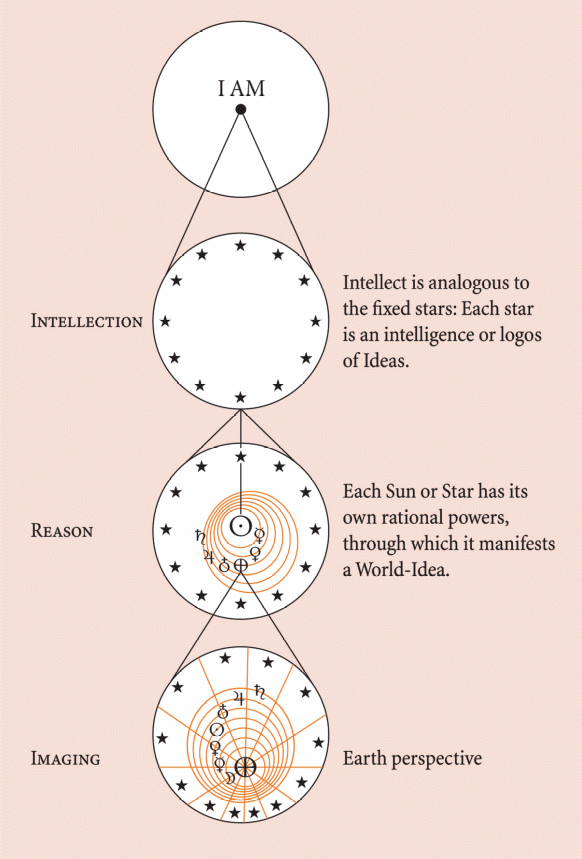
Atma, buddhi, ahamkara, manas correlated with I AM and three levels of World-Idea
Mysterious aura from Nous as glow of all the other Solar Logoi; soul as receptacle of Divine Beings
Continuing to read AD paper, "Omnipresence of Soul to the Cosmos"
Sun soul as "first condition of existence"; manifestation as unfolding of soul's light
Cosmos contiguous with soul; soul remains undisturbed
Soul as both still and active
Each soul a unique Logos
In the mystical experience of yourself as boundless light (asmita), you also have the experience of being in eternity, in the absolute present
Question: at what level are individual Overselves or Overself and cosmic soul distinguished?; not at level of asmita, not the soul of anything
Question: how do you distinguish Overself and cosmic soul if both have entirety of World-Idea present to it?
AD comments that student keeps insisting on applying logic of sensible to soul; why Guenon missed the point
Soul as one and many; many-ness of soul won't dissolve into its unity; each soul includes all other souls
Continuing to read AD paper, "Omnipresence of Soul to the Cosmos"
Power of soul modalized by the World-Idea into various powers
Three grades of subjectivity: 1) intellection; 2) reasoning; 3) mentality
Intellection: formless reason contemplating universal reason-principles in the sidereal zodiac; no subject-object
Reasoning: soul's power to project into and identify with the reason-principles of any planet; Witness-I; Plotinus IV.3.8, III.4.6
Mentality: Witness-I identified with a body; manipulation of images stored in the psychosomatic
Level of identification determined by what's dominant in the soul
As long as we're functioning within the Dragon, we're in a cul-de-sac; the only way out is to identify with the illuminating light and investigate it directly
Mystery of light
BOOKS READ FROM OR REFERENCED:
Plotinus, The Enneads (MacKenna translation, 4th ed.)
Julian (Emperor of Rome), Thomas Taylor (tr.), Two Orations of the Emperor Julian; One to the Sovereign Sun, and the Other to the Mother of the Gods
Paul Brunton, Notebooks
PLOTINUS QUOTES READ OR REFERENCED: III.4.3, III.4.6, III.9.3, IV.1.1, IV.2.1, IV.3.1, IV.3.8, V.1.6, VI.4.2, VI.4.4, VI.5.12
DIAGRAMS appended to this transcript:
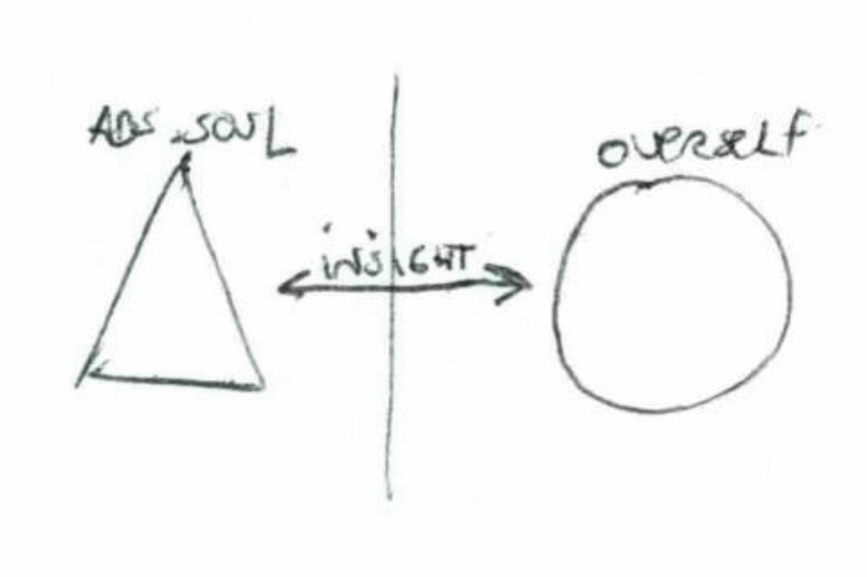
FIGURE 1984 0127a-1-AB. Overself and Absolute Soul.
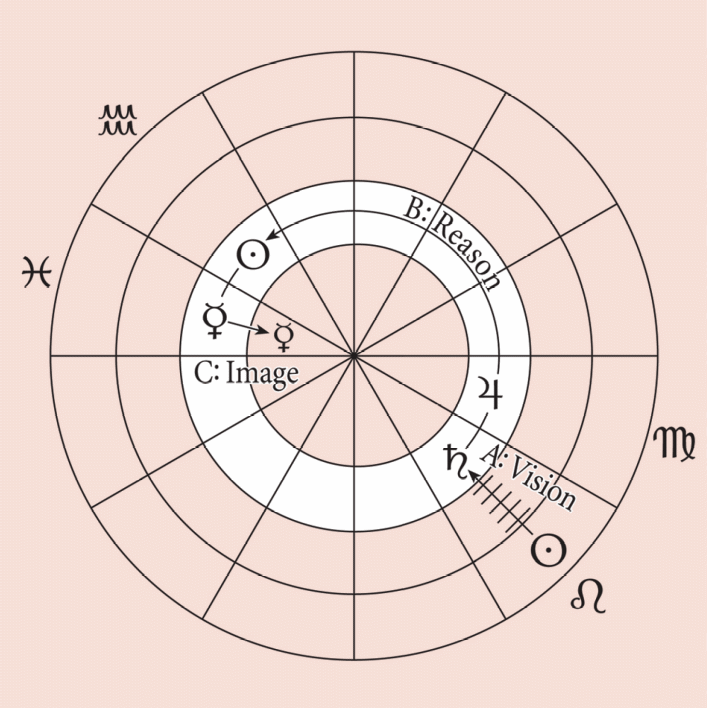
FIGURE 1984 0127a-2. Tripartite Cosmic Soul.
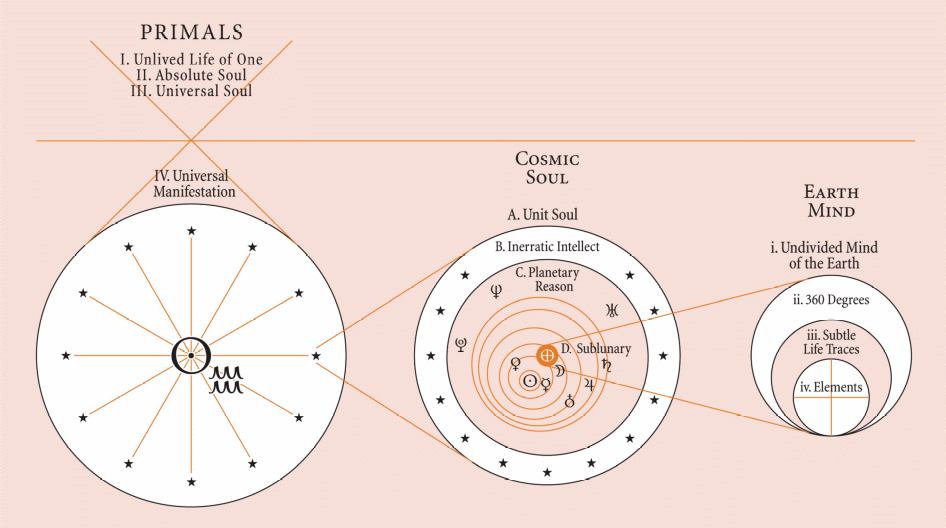
FIGURE 1984 0127a-3. Nested Levels.
FIGURE 1984 0127a-4. Fourfold Cosmic Soul.
Other diagrams also referred to are not with this transcript version. [Transcriber note: [diagram] means the speaker is referencing a diagram as he or she is speaking. If someone is drawing or writing, with audible sounds of chalk on a blackboard, I indicate this by [drawing] or [writing].]
AD PAPER read in class:
- "Essence of Soul as Indivisible and Divisible; Omnipresence of Soul to the Cosmos". This paper appears in Astronoesis as "Essence of Soul as Indivisible and Divisible" ("Our Venerable Guide…", p. 172 ff.) and "Omnipresence of Soul to the Cosmos" ("In their inner union…", p. 205 ff.). It has also been retyped as 1984 0127b V09MP. Astronoesis - Soul.
NOTES:
This is 1984 01/27a, Plotinus; Soul Class, and the first entry associated with this date. 1984 01/27b = Essence of Soul as Indivisible and Divisible; Omnipresence of Soul to the Cosmos Paper. 1984 01/27c = Plotinus; Soul Seminar, for which we have no audio, just JF notes.
Earlier partial transcripts exist. Some of the partials have diagrams. As of Dec. 2023, one has been scanned (Scan File 1984 0127C1-11R02).
The "Essence of Soul as Indivisible and Divisible" portion of the paper read in this class is also read and discussed in WG Class 1984 0113a Plotinus; Soul.
Excerpts from this transcript appear in Astronoesis in "Unit Soul as Absolute Individual," p. 211 ff., "On Deepening Consciousness," pp. 330-31, and "Notes on the Solar Logos/Cosmic Soul," pp. 336-38.
TRANSCRIBED Verbatim by IT prior to 2018, reformatted by jf 2018. In 2023, IT updates prefatory matter, footer, and audio file name, expands Subsubjects, completes Book List and TOC, adds Plotinus quotes section, fixes errors/typos, adds new notes within transcript, adds four diagrams and references within transcript to these diagrams, reformats to accord with new conventions. Archival verbatim transcript with AD Paper – V12ap.
AUDIO FILES: 1984 0127a (formerly 1984 0127b), 1984 0127b (formerly 1984 0127a). [Note: "Tape" and "Side" refer to original audio cassette tapes that were later digitized into .MP3 Audio Files.]
| NEW FILE NAME | OLD FILE NAME |
| 1984 0127a | 1984 0127b |
| 1984 0127b | 1984 0127a |
1984 01/27a at Wisdom's Goldenrod
Plotinus; Soul; "Essence of Soul as Indivisible and Divisible"; "Omnipresence of Soul to the Cosmos"; Solar Logos
[Audio File 1984 0127a (formerly 1984 0127b) Begins]
AD: --something sublime and the vision that Plotinus is working with, but we'll try to go without.
S: Anything?
AD: Any announcements?
S: I have an announcement. Some of you have probably read on the board that someone walked off with my boots Sunday night. (laughter) And they're the exact same boots as that person so when he-- it's a difference in width. That's all.
[Transcriber note: The audio file is spoiled from here until AS begins to read the paper and there is a repetition of what was just said simultaneously with whatever is being said, which makes it very hard to hear/decipher what is being said in some places. I do my best.]
AS: Anthony, do you want to start with the page we were reading, if the quotes start from--
AD (simultaneously): Yeah, I think if we read couple pages, stop, and then [one/two words inaudible] and we try this for, you know, and--
AS: Yeah, ok. So, I won't read any of the quotes that are related directly from Plotinus.
AD: (Why not Avery?)
AS: We've read (them/those). Ok.
AD: Yeah.
AS: Ok. Well, I'll-- I-- I guess maybe I'll just try and read enough pages that seem to be a unified idea to the end of a thought.
AD (simultaneously): I think there are [one/two words inaudible] [S: Yeah.] You have the [one word inaudible] [AS: Yeah.] [one/two words inaudible]
AS: Won't stop me from (reading). I know I could read (anything). I think the first couple of pages we might have read once before together.
[Transcriber note: The following paper appears in Astronoesis as "Essence of Soul as Indivisible and Divisible" ("Our Venerable Guide...", p. 172 ff.) and "Omnipresence of Soul to the Cosmos" ("In their inner union...", p. 205 ff.). It has also been retyped as 1984 0127b V09MP. Astronoesis - Soul. I transcribe the paper as AS reads it, including any alterations made during rereading. All paragraph breaks are from the Astronoesis Soul draft version and not the published version.]
AD Paper ["Essence of Soul as Indivisible and Divisible; Omnipresence of Soul to the Cosmos," AS reading]: "Our Venerable Guide reveals that he has penetrated into the mysteries of the Soul, its greatness and wonder, a Unity-Being integrally present in all its graded powers. And this knowledge is not by acquaintance--that is, the ego's capacity for creating concepts from the remembrance of previous bodily modifications. No, this is a knowledge that goes beyond such formulation; for this is that principle which illuminates the thoughts and is itself not one of the thoughts. This unobjectifiable and immaterial principle, which is illuminating the ego's functioning, is to be differentiated from it and isolated in the meditational practices. Only after that is done can begin the investigation or inquiry into the nature of the Soul or of this principle.
"And we are now speaking of Plotinus' intimacy with this innermost core of his being, which is an offspring from the Absolute Soul. In general, Plotinus is very guarded in his mystical utterances, and it will require a very careful reading of the text, even by those who have some proficiency in these matters. Nor can the reading of mystical literature be a substitute for such inner experience. We must make this clear to ourselves. The functioning of the psychosomatic organism is accompanied by bodily modifications, and it is these appearances--duly noted, registered, classified, stored away in the memory--that are the means whereby the individual ego is creating its world, the subject and object. In its conjectures as to the meaning of these appearances, it is dominated by the instinct for survival and biological adaptation. Now this realm of existence must be sharply distinguished from the immaterial principle of Illumination to which we have referred and it is altogether on a different plane. We cannot unreservedly apply the logic of the sensible to this immaterial principle. What is required is an intimacy and a recognition of this principle as our"I-ness," in contradistinction to its identification with a psychosomatic organism, in order for us to have accurate knowledge about this principle. If we allow ourselves to disregard those persons who have had intimate glimpses of this higher Self, but rather deal with that rare person who has profoundly established his residence in egoless Being--in other words, with those who know--we may be able to reorganize our conceptual understanding so as to evoke the intuition within ourselves.
"In IV.1.1 Plotinus points out that Soul is a content of the Divine Mind included with other Divine Beings, permanently stationed and resident there. Here, Soul or Mind is included in an undifferentiated unity. And he goes on to point out that it has a tendency or desire towards secession. We may also rephrase this in accordance with many previous statements: That what is authentically real has an outward-facing hypostasis; for what is perfect engenders, and the eternally perfect engenders eternally. (cf. V.1.6) We may take this to mean that Absolute Soul eternally engenders souls. Each and every soul, offspring of the Absolute Soul, is similar to but not identical with its prior. And it is this emanation, this thought of the Mind of God--our Absolute Self--that we have to investigate, for this is the key to the mysteries. This unit of Being-Life-Consciousness goes forth,"formed from the undivided essence and the essence divided among bodies." (Plotinus, IV.1.1) We may refer to this as the individual soul or mind. It is this point which is a combination of the mind with the World-Idea, which is our absolute individuality or Overself, and which is our concern here. We must now try to understand something about the nature of this individual mind or soul and this will require that we review certain passages from Plotinus and in great detail itemize our understanding of his statements."
S: Who can read it?
AS: Would that be a good place to stop somewhere?
AD (very faint): I-- I don't know.
AH: Are questions permitted at this--
AS: Yeah, I think that's good-- seems like a good-- [AD: (Uh-hm.)] just-- just take a break here.
JL: In what way can the soul be known? Like in the-- is it the soul that's be-- being known or is it the intelligible(s)?
[students assent]
AS: When he says "the rare person who has profoundly established [AS reads: establishes] his residence in egoless Being--in other words, those who know"?
S: Yeah.
S (faint): Uh-hm.
AS: Well, I mean, in what way? [student assents, faint] Well, to know by being, and he says this intrinsic self-cognition. In the true sense of "to know". You know when we talk about the higher knower, the higher self-knower? Not to know it as an object. Any of that would be what he calls his-- within the realm of his lower self-knower. That's except those who know would have this intrinsic self-cognition of their essence. It would apply to him.
[student assents, faint]
AH (faint): To pick up on John's question, then why at the beginning of the paper it was mentioned that it-- that it's very important to sharply distinguish-- look at these realms.
AS: Right. The realm of exis-- this realm of existence described as the appearances, the conjectures of the intellect, that-- the conjectures of the ment-- mentality based on appearances "must be sharply distinguished from the immaterial principle of Illumination".
AH: It's that principle which is apparently Soul.
AS: Yeah.
AH: It's not-- if-- if it's so important to make this sharp distinction, which obviously it is, in keeping with that sharp distinction, how shall we investigate that principle, like what's the motive for investigating the principle which has been sharply distinguished from the realm of investigation?
AS: Well, he says, by studying those writings of those who know "we may be able to reorganize our conceptual understanding so as to evoke the intuition without ourselves."
AH: So it's a question of reorganizing--
AS: The lower--
AH: The lower in such a way that intuition (arises).
AS: That's one answer. [AH, faint: Ok.] Yeah, I think that's the answer he-- the paper gives here. The reorganization of those-- of the mentality by that higher light itself to allow the light to shine through it.
AH: I just got the question. Is that reorganization specific to this sharp distinction?
PD/S(?): Yeah.
AS: Is it specific to it?
AH: Now, the reorganization [AS simultaneously: Yeah.] has to be [AS: Yeah.] an organization in keeping with the distinction that's been posited initially.
AS: Yeah.
RC: I think that's what PB was talking about when he distinguished the metaphysics of truth from [AS assents] [one/two words inaudible] philosophy. That because it's being given by a man in whom that distinction is permanently established, then the concepts that he provides will be that real in you.
S: Avery, wasn't the point made that-- [AS: Ok.] 'cause if we-- and the investigation was undertaken by somebody who had insight available to him?
AS: Well, yeah. Oh-- what? Oh, the ori--
S (simultaneously): Well why did you put [one word inaudible]
AS: N-- not exactly. You mean us, the person-- well-- (AS laughs a bit) Yeah. I don't think it said insight but I think it said an ability, at least some ability to contemplate these matters.
S: Well the [one/two words inaudible]
AS: "After this is done, the unobjectifiable…" Uh, yeah--
AD Paper ["Essence of Soul as Indivisible and Divisible; Omnipresence of Soul to the Cosmos," AS reading]: "The unobjectifiable, immaterial principle, which is illuminating the ego, is to be differentiated from the ego and isolated in the meditational practices. Only after that is done can begin the investigation or inquiry into the nature of the Soul…"
S: Well isn't that [one/two words inaudible] Isn't that the-- isn't that what this [one word inaudible] is that the person investigates into on his own, into the Soul?
AS: Well, if you-- I mean if you're talking about a real investigation in that sense, yeah. But later on it also speaks about reorganizing our conceptual understanding so as to evoke the intuition within ourselves. But I think in line with what Randy's saying that that's again referring to those two things that PB says are needed, [student assents, faint] both the development of the correct conceptual understanding and the ability to go beyond the ego as it were to this state of contemplation, and really both of those things are necessary for a full understanding.
S (faint): (Is that/You got) (a quote)?
AD (simultaneously): Andrew?
AH: Yes.
AD: Do you find that really difficult to understand? If you want to investigate the nature of consciousness, could you do it by reading books about it? Yes, to some extent, right? A little bit. But if you really wanted to investigate the nature of consciousness, what would you have to do?
AH: Be it.
AD: Be it, right? And then investigate deeper into it. So an inquiry into the nature of the Self, alright, sure it starts off with reading, getting acquainted with some ideas. You even think that you know what your teacher is telling you, right?
S: Uh-uh.
AH: I've had that experience, yeah.
AD (simultaneously): And then the next point is a little harder. In meditational practices you succeed in isolating what this "I-ness" is, this consciousness is in you. You're identified with this consciousness. You're no longer identified with the psychosomatic. You're no longer dwelling in memories, anticipations, reflections. That's all gone. You're in this state of consciousness, you're just consciousness; you're just awareness. Now you can start your investigation into consciousness.
AH: May I ask? You (see the) word like 'investigation' or "a knowledge of" or any of those words, like they're based on a transactional realm of languages and ideas.
AD (simultaneously): No, no.
AH: No I-- here's what I'm saying, if-- [S, faint: Yeah.] But when you take that term 'investigation' from the realm that I'm familiar with which is the transactional (one/realm), and apply it to the notion of investigating Soul, I don't understand-- I don't understand what you mean.
AD (simultaneously): Well, maybe if we rephrase it. Now that you are this consciousness, alright, you turn this consciousness upon itself. And it deepens. And you find out about that consciousness more. It isn't that when you get a glimpse and you're consciousness, this is it. But there-- there are depths within that consciousness.
AH: Anthony, as you're speaking I have to make an image of-- of the idea "consciousness" as an object to my mind.
AD (simultaneously): Yeah, you do.
AH: So I can only follow you in that way.
AD: Uh-huh.
AH: It's like a metaphor for what you're speaking about. Is that so?
AD: Yes, of course. Of course.
AH: When you speak about its deepening--
AD: Well, make a metaphor or make an image for yourself [student assents, faint] that now you are this pure-- you are awareness. You are this immaterial principle. [student assents, faint] Alright? Does it end there or is there a deepening of that inward-- of that consciousness? Is it possible that consciousness has depths in it? [short pause] This is an important point because actually what I'm saying is, an inquiry into the nature of the Self doesn't get off the ground until you yourself have realized that you are consciousness and now you turn that consciousness upon itself and deepen it, inwardize it more and more.
AH: Prior to realizing it I'm-- I'm ques-- my question is, I'd like to have the appropriate conceptual attitude, conceptual approach that one should have towards this, like--
[short pause]
AD: Well, for instance, a good attitude would be not to take the one that Chandrakirti has. He said very clearly, "There is no such thing as pure consciousness." I know that he did not arrive that-- at that by investigating into the nature of consciousness.
S (very faint): Right.
S (very faint): Yeah.
AH: Yeah, or what he's saying, you cannot have a concept or a word that [one word inaudible]
AD (simultaneously): No, no, no. [S, faint: That wasn't--] No, his wasn't a semantic analysis. He was actually saying that.
AH: So that's an inappropriate attitude.
AD: Yeah, very inappropriate. He already decides he knows.
AH: So, an appropriate one is--
AD: To let these men lead you, alright, into those realms. And they can give you some information about it, which is only conceptual but which sets the mind or orientates the mind in those states where it could investigate further into that nature, alright. So for instance if you remember when PB makes the remark that when consciousness is inwardized or when insight penetrates into itself, the first level there's a deepening, then he speaks about second level which is a contact with the Void, and then a third level, the Holy of Holies. [Note: Paul Brunton, Notebooks, V16, 25:2.109 and Perspectives, Ch. 25, #32.] Now that's an inwardization of consciousness, that's an investigation, an inquiry into the nature of consciousness. You can't do it outside of that nature itself. You had the same question the last time.
AH: Is it important when doing this to like recognize what it is that we're doing, that we're using a metaphor? [student assents, very faint] Is that--
AD (simultaneously): It's important for you to recognize and for us to recognize when we're talking about these things that we are using a metaphor, that you are not this pure consciousness at the present moment, alright, and that when I'm referring to the fact that we have to investigate by becoming that consciousness and then introverting that consciousness into yourself, all this is metaphor, all this is poetic license. But I don't know how else I can communicate it to you.
[student assents]
AH: I'm just very curious about the attitude, I always feel like I have to wash my mouth out after I'm finished, you know. It seems to me such a-- such travesty of-- of doctrine to communicate very (glibly) and in the same way that I use other language. Well (attack/take) the other person's questions tonight [one/two words inaudible]
S: (Uh-hm.)
AD: No, there's no harm in using these things as expediency, a means to get to what we want. They say that Zen has no philosophy. You'd be amazed at the number of books that they have on-- on it.
S (simultaneously): Yeah. Yeah they do.
[student assents, faint]
AD: Everybody has to do it this way. That's the purpose of the writings, to leave them behind for others to be guided with. I mean without any of this guidance you'd be in difficulty.
AS: Anna?
AP: Very (soon/good), I thought that the-- the ego is the part of the world-image that-- and the ego is going to be a part of a world and the value when-- if you get to explain this or believe this and have no conceptual framework on which to accumulate, I mean as much as could be accumulated into the ego, it may-- it may throw the ego in a-- what do you call--
S: [couple words inaudible]
AP: What?
AD: Disorientate.
AP: Disorientate the ego and maybe our mind. But if you have a framework, it makes all the difference in the world which is then-- then experiences [couple/few words inaudible] they can fit easily in their own-- own framework [student or AD assents] (or/to) the [one word inaudible]
[short pause]
AD: (Or I prefer Hegel?)
[student assents, very faint]
AH: Yeah.
S: Uh-hm.
AD: Don't be afraid about your mouth getting polluted, it's alright.
S: Tony--
AH: But I-- you know, (I/you) use--
AD (simultaneously): Don't (fight) me.
AH: --use that term like any other term, and-- for the sake of understanding that.
AD: Yeah, you remember the old Chinese saying, you catch the fish, now you can throw the net away and eat the fish. [student assents, faint] The same way, you catch the meaning, you can throw away the word.
AH: I see. So there's nothing out there that I [one/two words inaudible]
AD (simultaneously): Your original nature, you're not married to the words. Don't worry.
AH: But you know, it's peculiar that there's nothing else in my experience that-- that I refer to by way of a concept that isn't an object. It's the only thing that I have a word for that's not objective. So it is a unique kind of word or a unique kind of concept and-- Like every other one that we use refers to something objective until we pick our notion of consciousness or mind. It is peculiar in that way, isn't it?
[student assents, faint]
AS: You know, in that Chinese quote he just quoted too, it goes on-- Chuang-Tzu has one like that, he says in-- and the man, and-- you know, the purpose of fish(,) (trap/to have) to catch the fish, you throw the trap away. And he says words are like that too, the purpose of words is to catch the meaning. Once you've gotten meaning you throw the words away. Or you-- you don't let the words [student assents, faint] hang up to meaning. That, where is the man who's gone beyond words, he's the one I'd like to talk to.
AH: But you can-- an accommodation, a discussion about philosophy. (AS laughs)
S: Yeah.
AH: There's (a torn) word puzzle, you know what I mean?
AS: Yeah. (AS laughs)
AH: And I think that-- I think (you) use the word for mind or for consciousness. And I just use it like I use all the other words. [student assents] But it's the only one in the whole vocabulary that's not referring to something objective. I can use it [one word inaudible] stop and say "Well now I'm going to use the word."
AS (simultaneously): Maybe you should underline it when you use it.
AH: Yeah, maybe. (AS laughs)
AS: Put [student assents] quotes around it.
AH (faint): Put it in italics certainly.
S (faint): But--
AS: But-- but you know, when the-- but-- but when the Sage uses the word and he knows what it means, then it's different, I mean--
S (faint): Oh boy, yeah.
[short pause]
DR: Well I was [AS simultaneously: Well--] going to say-- well, I'm not a Sage.
AS: Dave? Yeah, good. (bit of laughter)
DR: I thought [couple inaudible AS words simultaneous with DR] since he was the-- the meaning of-- because it's a reference to something subjective makes it difficult to-- to understand what you mean when you say investigate the mind. You say consciousness turns as upon itself. But when you say 'investigate', you're looking into something deeper and yet you're trying to find out more about it, it's very hard for me to understand what it means for the consciousness to know more of what it is. In-- it-- I know that, you know, it's only a metaphor that you use to try to start the process but when you talk about this deepening of consciousness or this investigation of the soul by consciousness turning upon itself, I really don't have a grasp of-- of that meaning. I mean what is that further investigation?
AD: You remember when PB in the notes says that you have to-- there's a state of becoming aware of awareness? (And) then there's a further stage of being just this awareness? [Note: Paul Brunton, Notebooks, V4, Part 1, 4:1.128 and Perspectives, Ch. 4, #8.] [students assent, very faint] Do you remember that point?
DR: Yes.
AD: Isn't that consciousness or that awareness deepening?
DR: Is that-- is that a deepening or is that a discovery of-- of awareness? And once you-- or suppose-- suppose you've taken to do this, and-- and yet you strive for that awareness. It sounds as though when you reach that awareness that stands as the beginning of this investigation. That's the part that I can't understand. To-- to talk about a discovery of the soul, to find that awareness, somehow those words allude to something that I have some-- sometimes grasped but-- but that further investigation I have--
AD (faint): Well let him talk.
DR: Do you-- do you see any difference at all between that discovery and that further investigation?
AD: I'm sorry Dave, I don't think I follow you.
DR: Well maybe I didn't follow you. When you say that-- that that discovery of pure awareness is the-- the invest-- are you saying that is the investigation into the soul?
AD: The discovery of awareness, like if you were meditating and you realize yourself to be a consciousness, is this a discovery of the soul? Yes.
DR: Is this also what you mean by an investigation--
AD (simultaneously): Is it also, David, is it also possible to consider that this discovery may simply be at the fringes? That you're at the outermost? That you've only touched on the surface? That there's depths within it that are treacherous? Is that possible? [S: I bet.] [short pause] David?
DR: Yes, that makes sense.
AD (simultaneously): Yeah. That's all I'm saying.
[short pause]
DR: So you're saying it's that very continuing and striving for that awareness, that that is what's constituting this investigation.
AD: Yeah, that's the true investigation. [14¼ second pause] When the Sage, for instance, discovers the soul, alright, recognizes that he is consciousness, alright, that same Sage goes on and discovers that there is what we refer to as the Absolute Soul. And that Sage continuing further discovers the Intellectual-Principle. And investigating and deepening further his consciousness, alright, achieves Unity or the Supreme Identity, aren't these all stages within consciousness? The deepening, the inwardization of consciousness?
[short pause]
S: Hm?
S: Yeah.
S (faint): But (I was thinking) [one/two words inaudible]
AD (simultaneously): I mean what else could it be?
S (faint): [few words inaudible]
AD (simultaneously): And certainly, if we think of the Sage (as/is) quietly sitting down meditating, he's-- he's lost awareness of the body, he is this consciousness. Now he investigates further what is this consciousness and finds that it is a thought within the World-Mind. So he's discovering that it has-- it's a point within the World-Mind, that it can be deepened, and now he becomes aware of a greater principle. And he can go in deeper and become aware, so to speak, the way Plotinus points out, of the Supreme Identity. These are steps of inwardization of his consciousness. I'm not saying that he could permanently stay there but he knows that this can happen. So that's what we're talking about. It's-- it's not that difficult to conceive.
[11 second pause]
AH: Would it be possible to hear the first part of the paper again or-- just so there might be--
AD: No we've got more, it just continues later on.
[student assents, faint] (some laughter)
AS: Fathom those steps before. (AS laughs)
S: Of [one/two words inaudible]
AS: Of [one word inaudible] Well, any-- Whatever [one/two words inaudible]
[student assents]
S: No.
S (faint): Push on.
S (faint): Go ahead.
AS: You want to go on a little? [students assent, very faint] Anthony, go on a little?
S (simultaneously, faint): Yeah, go on.
AD: Well, read-- give him what he wants.
AS: Sure. What would you like Andrew, the very beginning?
AH (simultaneously): I'd like to hear-- I'd like to hear it from the beginning.
AS: Hear it from the beginning again?
AH: Please.
AS: Yes Andrew.
S (faint): And I wanted to keep going [couple/three words inaudible]
AS (simultaneously): And then keep going?
S (very faint): (And then) keep talking.
AS: Sure, it's nice.
S (very faint): Yeah [one/two words inaudible]
AD Paper ["Essence of Soul as Indivisible and Divisible; Omnipresence of Soul to the Cosmos," AS rereading]: "Our Venerable Guide reveals that he has penetrated into the mysteries of the Soul, its greatness and wonder, a Unity-Being integrally present in all its graded powers. And this knowledge is not by acquaintance--that is, the ego's capacity for creating concepts from the remembrance of previous bodily modifications. No, this is a knowledge that goes beyond such formulation; for this is that principle which illuminates the thoughts and is itself not one of the thoughts. This unobjectifiable and immaterial principle, which is illuminating the ego's functioning, is to be differentiated from it and isolated in the meditational practices. Only after that is done can begin the investigation or inquiry into the nature of the Soul or, that is, of this principle.
"And we are now speaking of Plotinus' intimacy with this innermost core of his being, which is an offspring from the Absolute Soul. In general, Plotinus is very guarded in his mystical utterances, and it will require a very careful reading of the text, even by those who have some proficiency in these matters. Nor can the reading of mystical literature be a substitute for such inner experience. We must make this clear to ourselves. The functioning of the psychosomatic organism is accompanied by bodily modifications, and it is these appearances--duly noted, registered, classified, and stored away in the memory--which is the means whereby the individual ego is creating its own world of subject and object. In its conjectures as to the meaning of these appearances, it is dominated by the instinct for survival and biological adaptation. Now this realm of existence just described must be sharply distinguished from the immaterial principle of Illumination to which we have referred and which is altogether on a different plane. We cannot unreservedly apply the logic of the sensible to this immaterial principle. What is required is an intimacy and the recognition of this principle as our"I-ness," in contradistinction to its identification with a psychosomatic [organism], in order for us to have accurate knowledge about it. If we allow ourselves to disregard those persons who have had intimate glimpses of this higher Self, but rather deal with that rare person who has profoundly established his residence in egoless Being--in other words, with those who know--then we may be able to reorganize our conceptual understanding so as to evoke the intuition within ourselves.
"In IV.1.1 Plotinus points out that Soul is a content of the Divine Mind included with other Divine Beings, permanently stationed and resident there. Here, Soul or Mind is included in an undifferentiated unity. And he goes on to point out that it has a tendency or desire towards secession. We may also rephrase this in accordance with many previous statements: That what is authentically real has an outward-facing hypostasis; for what is perfect engenders, and the eternally perfect engenders eternally. (cf. V.1.6) We may take this to mean that Absolute Soul eternally engenders souls. Each and every soul, offspring of the Absolute Soul, is similar to but not identical with its prior. And it is this emanation, this thought of the Mind of God--our Absolute Self--that must be investigated, for it is this which is the key to the mysteries. This unit of Being-Life-Consciousness goes forth,"formed from the undivided essence and the essence divided among bodies." (Plotinus, IV.1.1) And this we may refer to as the individual soul or mind. It is this point, this combination of the mind with this World-Idea, that is our absolute individuality or Overself, that is our concern here. We must try to understand something about the nature of this individual mind or soul. And this will require that we review certain passages [from Plotinus and] in great detail itemize our understanding of Plotinus' statements."
S: Avery?
AS: Yeah.
S: (Thirteen/Understand) what?
S: Almost got that it wasn't like about the Overself.
AS: Almost got the [one/two words inaudible]
S: The last [AS: Yeah.] sentence before there was you had said the combination [AS: Well--] of soul with the World-Mind.
AS: World-Idea.
S (faint): Or the World-Idea, that is the Overself. How could you distinguish?
AS/S(?) (faint): What?
S: How could you even distinguish? You have a sentence that says [few words inaudible] but I just totally [student assents] between-- It'll be nice to just read through it very very slowly.
AS: Yeah.
S: Yeah.
S: [few words inaudible]
S (simultaneously): That can refer to possible offspring of the Absolute [student assents, faint] Soul?
AS: Yeah.
S (simultaneously): Yeah.
S (very faint): Yeah.
AS: Um--
S: I know it's powerful [one/two words inaudible]
AD Paper ["Essence of Soul as Indivisible and Divisible; Omnipresence of Soul to the Cosmos," AS reading]: "Each and every soul, offspring of the Absolute Soul…"
AS: We start here?
S: Uh-hm.
AD Paper ["Essence of Soul as Indivisible and Divisible; Omnipresence of Soul to the Cosmos," AS reading]: "…is similar to but not identical with its prior. [short pause] And it is this emanation, this thought of the Mind of God--our Absolute Self--that must be investigated, because this is the key to the mysteries."
S: First sentence again Avery.
AD Paper ["Essence of Soul as Indivisible and Divisible; Omnipresence of Soul to the Cosmos," AS reading]: "We may take this to mean that Absolute Soul eternally engenders souls. Each and every soul, offspring of the Absolute Soul, is similar to but not identical with its prior. It is this emanation, this thought of the Mind of God--our Absolute Self--that must be investigated, for this is the key to the mysteries."
S (faint): Go over it again.
S: [one/two words inaudible]
AS: Anyway, you have this picture.
S (faint): I don't know if this will [few words inaudible]
[AS drawing]
AS: There he puts-- he's speaking about the pure Soul. 'Cause he says--
AD Paper ["Essence of Soul as Indivisible and Divisible; Omnipresence of Soul to the Cosmos," AS reading]: "This unit of Being-Life-Consciousness…"
AS: The Overself or the unit soul, this emanant--
AD Paper ["Essence of Soul as Indivisible and Divisible; Omnipresence of Soul to the Cosmos," AS reading]: "…goes forth…"
AS: And then he says in quotes--
AD Paper ["Essence of Soul as Indivisible and Divisible; Omnipresence of Soul to the Cosmos," AS reading]: "…"formed from the undivided essence and the essence divided among body.""
[short pause]
AS: And there is a subtle point here because now, with this quote--
AD Paper ["Essence of Soul as Indivisible and Divisible; Omnipresence of Soul to the Cosmos," AS reading]: "We may now refer to this as the individual soul or mind. And it is this point here which is the combination of the mind or soul with the World-Idea, our absolute individuality [or Overself], that is our concern here."
S: Couldn't you read this again?
[Note: See FIGURE 1984 0127a-1-AB for the following.]
KD: The Overself is on the other side of the line [diagram], and here by this statement the Overself is defined as being a combination of a-- of the mind with the World-Idea but that'll put it all over on a--
AS (simultaneously): Well, not exactly as that. He-- first he says that it's this-- this pure emanant and then he says that it's also in some way immediate-- the median between the Absolute Soul and that which is divisible, the World-Idea or becoming.
[student assents, very faint]
S: Yeah.
AS: So your Overself or the Overself, this emanant, is the intermediary between Absolute Soul, it's an emanant of the Absolute Soul. And it's conjoined with that which is becoming divisible, the world, the experience or the cosmos.
KD: Is it defined that way so that--
AS: You have to go to the Plotinus.
S: Yeah.
S: Why?
AS (simultaneously): He talks about this intermediary essence. But--
KD: Because he's talking about a unit of individual soul. In other words, you reach a certain insight over on the left side of-- [AS simultaneously: No, this line. (drawing)] (that would be) soul's self-- self-cognition.
AS: Intrinsic self-cognition of its own essence. The intrinsic self-cognition of the Overself's own essence as being, as he says, similar but not identical with its prior is insight. He says--
AD Paper ["Essence of Soul as Indivisible and Divisible; Omnipresence of Soul to the Cosmos," AS reading]: "We may take this to mean that the Absolute Soul engenders eternally souls. Each and every soul [AS: in its essence] is an offspring of the Absolute Soul, similar to but not identical with its prior. And it is this emanation…"
AS: That's the key point that we have to investigate. This Overself. What is the nature of this Overself [AS indicates on diagram], what is the nature of this emanant such that it can be an emanant of the Absolute Soul and also be concerned with becoming divisible, becoming.
KD/S(?): Yeah, definitely.
BS (simultaneously): I'm sorry Avery.
KD: This definition sounds to me like the way you-- way you define Logos as the combination of mind with the World-Idea. Isn't that the--
AS (simultaneously): Well that's going to come up. I-- I think [KD simultaneously: Is that--] that that-- [student assents, faint] I think that that will come up. The quote here is based on this-- the-- the IV-- the quote in IV.2.1. He says--
Plotinus [IV.2.1, AS reading]: "So far we have the primarily indivisible--supreme among the Intellectual [and] Authentically Existent--and we have its contrary, the Kind definitely divisible in things of sense…"
AS: So we have this Absolute Soul which is conjoined with the Nous, the One, and we have the appearance or the cosmos. And then he says--
Plotinus [IV.2.1 cont., AS reading]: "…that first utterly indivisible Kind must be accompanied by a subsequent Essence, engendered by it and holding indivisibility from it but, in virtue of [the] necessary outgo [from source], tending firmly towards the contrary, [the wholly partible]; [AS adds: and] this secondary Essence will take [AS reads: takes] an intermediate place between the first substance, [the undivided], and that which is divisible…"
AS: So that's-- that's what he's trying to describe here I think. And the point I thought of bringing in the divisible is that when it takes the place towards that which is divisible, we have to understand that also, that nature of it as well. Have to understand its nature as an emanant [students assent] and as this intermediary or linked with the whole appearance and what its relation is to that.
[student assents, very faint]
BS: And we're specifically speaking of this, what you got on the board, the circle, the Overself, is that the intermediary?
AS: Yes, if you speak of the circle with absolutely no content in it, nothing, no World-Idea of any level, then it's just-- just a pure emanant. Right? Has this intrinsic cognition of its own essence. And when we speak of that Overself as concerned with the cosmos which appears within it which has to be-- that has-- that's the whole thing that has to be elaborated, the World-Idea, now he speaks of that Overself as the principle of manifestation.
BS: Ok, do it again.
AS (simultaneously): But that nature of that Overself is this engendered unit soul.
S: Think you would put--
BS (simultaneously): Conceptually we have to distinguish from the insight?
AS: Distinguish from it? If-- I s-- I was trying [couple inaudible student words simultaneous with AS] to say that if-- its intrinsic self-cognition is [BS simultaneously: Is insight.] insight. Its cognition, its intrinsic cognition that its essence is not different from the Nous or the intrinsic cognition that its essence is similar in kind to the Nous.
BS: I just didn't know what [one/two words inaudible] is.
AS: It's I think what he calls insight. [few inaudible student words simultaneous with AS] And that's what Anthony spoke about deepening this insight in an invest-- it-- I think Anthony was saying that first you have to just be this pure consciousness [BS assents] without any idea, appearance, or anything before you can talk about that pure consciousness investigating into its own nature. Its own nature is an emanant of this Absolute Soul and Nous and so on and-- and it's the deepening penetra-- Guys that was misleading 'cause it looks like there's so-- you know, it-- you always have it in terms of content to content, it looks like there's a thing here and a thing here [diagram]. When we're talking about everything now that's left on the board being of the nature of consciousness, it can only be an investigation of consciousness into itself. I-- I think the diagram was a little misleading also.
AD: (Now/And) the other-- the other important point here is that, unless this is understood, what we're calling the Overself, alright-- You remember PB's quotations on the fallacy of-- what did he call it, the--
AS (simultaneously): Divine identity. [Note: Paul Brunton, Notebooks, V16, Category 25, Chapter 1, "Man is not, does not become, God".]
S (simultaneously): Uh-hm.
AD: Divine--
S: Yeah.
(Side 1 of original cassette tape digitized as 1984 0127a (formerly 1984 0127b) Ends; Side 2 Begins)
AD: --Overself is going to sound in your mouth that you can-- you are God, which is on the left [diagram], ok? That's where the-- the fallacy of identification with the Supreme comes from, not having that concept available in your understanding.
[students assent, faint]
RC: Is this-- is this principle that's eternally generated as being the conjoint of the indivisible and the-- the divisible--
AD: Try talking louder.
RC: Is this that's getting generated, would you call it the principle of manifestation itself being eternally generated here?
AD: No.
RC: Why not?
AD: Because the eternal generation, like we discussed and we brought out in our discussion, this eternal generation is that the-- it's a principle sui generis. In other words, it is the cause of itself.
RC: Uh-hm. But if it--
S: What?
RC: Ok. E-- even granting-- granting that as self-caused, why wouldn't you say that-- that it's the principle of manifestation?
RG: Well I don't understand that either.
[short pause]
LR/S(?): Randy, repeat your question again.
AS: Right, uh-hm.
RC: Well-- I'm wondering if-- if this principle which we're speaking of here is itself the very principle of manifestation.
LR/S(?) (faint): Which principle are we speaking of Randy?
AS: The Overself.
RC: The emanant here.
LR/S(?) (very faint): Oh.
RC: That manifestation takes place within it by the operation of it and so on, apart from it there is no manifestation.
S: Well--
AD: Well basically because it's only half of the story. On the one hand, it does make manifestation possible. On the other hand, the World-Idea is what's causing it to manifest. So I cannot accept Guenon's classification. [short pause] Follow what I'm saying now?
RC (simultaneously): Yeah, that's what I'm trying to-- that's what I'm trying to understand.
AD: Because the World-Idea is what imposes upon the Overself, alright, or enforces the Overself, and that's a clumsy and awkward word, but causes it to evolve. And that process of causing it to evolve, alright, how could I refer to the Overself simply and only the Overself as a principle of manifestation? Why shouldn't I include the hypnotic spell that the World-Idea, so to speak, imposes on the Overself? Why shouldn't that be the other half? You see what I'm saying? [RC assents] The principle of manifestation isn't the simple thing that we make it to be. It's a very complex affair.
RC: So when you say there that this is a compound of the-- the indivisible and the divisible, can you say more about what you mean by the divisible?
AD: The World-Idea.
AS: World-Idea, yeah.
AD: The World-Idea [RC: Ok.] which has inherent in it the World-Mind is what's bringing about and elucidating the potential that is in the soul, its power, alright, to effectually realize its powers and takes it to the point of self-recognition.
RC: Ok. Well, now I am confused (here/there) because-- [AS/S(?): Randy?] At the very point that you say that the emanant is produced or the-- that there is an emanant to speak of, it seems already that emanant is characterized as a-- as a compound of the indivisible and the divisible. And, if I follow what you just said I-- it's already a compound of the soul and the World-Idea, of Soul and the World-Idea.
AD: Yes. But it's also true, alright, that the World-Idea could be brought, so to speak, to a halt temporarily. Now, if in the state of Nirvikalpa the entity could reside or remain himself, in the true sense of the word, alright, then we have here a kind of lead that permits us to make a distinction between the Overself and the World-Idea.
RC: Can you maybe just say it again? Is that the same thing as what I said before?
AD (simultaneously): Insofar that the-- there is such a thing as Nirvikalpa, alright, it shows that the entity could reside in his own being, could be itself. If that is so, then we are allowed to make the distinction between soul per se and the World-Idea [RC assents] in soul.
RC: Yeah. But it does seem that the way we speak of Nirvikalpa we automatically say manifestation has lapsed.
AD: I'm sorry, manifestation--
RC (simultaneously): When you-- by Nirvikalpa we mean no manifestation.
AD: Yeah.
AS: Right.
AD: Yeah, and by-- right-- [AS simultaneously: Yes of course. No World-Idea.] and that's what I mean when I say that permits me to make an artificial distinction [RC: Ok, right.] between the World-Idea and the soul.
RC: Ok. No, I didn't mean to be saying soul was the principle of manifestation but that the compound of soul and the World-Idea together--
AD: Yeah but you see now-- now are you s-- are you speaking about a principle [RC simultaneously: Well that's what I--] or are you speaking about a complex [AS simultaneously: Well you can say--] of com-possibilities?
AS: You could [RC simultaneously: Well it--] say soul is a principle. (RG laughs) You could say [S simultaneously: Who cares.] it's a principle of manifestation.
RC: Well-- no, this is a real question. If it's eternally generated, if it's--
AD (simultaneously): If it's eternally what?
RC: If you're going to call it eternally generated it seems you have to say it's a principle.
AS: Well, yeah. So why not? That--
RC (simultaneously): Well that seems to be the only-- the only thing like a guarantee of individuality that we talk about.
AS: But--
AD: Where?
RC: That there is a-- an eternal conjoint of soul with the World-Idea.
AS: Well, but-- Now why is that the guarantee of individuality?
AD (simultaneously): Alright. Yes, that's what we mean when we say Logoi, soul is a Logoi. Now the point is this here. Is principle of manifestation the simple thing that we make out, that's the point. And that's why-- that's why I was trying to point out, the simple-- the simplistic classifications worked out is something I don't-- you know, I just don't see. I can't understand. Because it has to be this reciprocal relationship. You remember we pointed out on the one hand the soul is the ground within which manifestation takes place, alright, but on the other hand the World-Idea is what causes it, [RC assents] alright, to manifest. [RC or another student assents, faint] So that we speak about these two together when we're speaking about the Overself as a, you know, a particle from the World-Mind.
RC/S(?): Uh-hm.
RC: Yeah but, I think-- I think it would be legitimate to say that given that you do have this eternal conjoint of-- of soul and the World-Idea, that not all-- not the whole of the World-Idea is-- is by any means manifested all at once. [short pause] Or-- no that-- that doesn't matter anyway.
AD: Randy, I think if-- if we go on a little bit with the paper, [RC: Yeah.] you'll see how very complicated this whole business of manifestation is.
RC: Yeah, I-- I've been told if I don't get this [couple words inaudible]
AD (simultaneously): It's going to get very complex and I think you're going to even appreciate it. That's why I'd like to get on with it because those two pages is just the introduction.
AS: Yeah.
S: [couple words inaudible]
AS: And the rest [S simultaneously: Yeah, uh-hm.] of it's complications.
S: Yeah.
S (faint): You could go on.
[student assents, faint]
AS: Well, did you want--
AD (simultaneously): Let's try a few more pages now. Now--
AS (simultaneously): Richard, did you still have a question?
RG (simultaneously): No, go on, I'll ask another time.
AS: Ok. Where are we up to, the third page. [student assents, faint] But, the point, this point, but-- Randy, I think they come up again in here. I don't know. Ok.
AD Paper ["Essence of Soul as Indivisible and Divisible; Omnipresence of Soul to the Cosmos," AS reading]: "In IV.2.1…"
AS: Goes on. Where did we end? No. Yeah.
AD Paper ["Essence of Soul as Indivisible and Divisible; Omnipresence of Soul to the Cosmos," AS reading]: "In IV.2.1, he speaks of this offspring as characterized by unity which it derived from its prior, and each soul is distinct from every other, and that it is an intermediary, an intermediate between Absolute Soul and the Cosmic Circuit or World-Idea. [AS: The quote we just read.] Furthermore, regardless with what it is occupied--the Idea of the universe or a body within it--it gives itself to either or both without abdicating its unity. What, in effect, he is saying is that if the mind thinks the thought of a pinhead or of the continent of Australia, it is totally present to each of the items without its unity being sundered. In other words, its omnipresence does not fragment its identity, for it is at once both divisible and indivisible: [AS: In the quote he says]"Its divisibility lies in its presence at every point of the recipient, but it is indivisible as dwelling entire in the total and entire in any part." (IV.2.1) The recitation of these words is not a guarantee that meaning accompanies their repetition. Plotinus is referring here to the mystical experience of this illuminating principle as egoless Being-Consciousness. In other passages he even refers to it as the "All." (cf. III.9.3 and III.4.3) We must bear in mind the ego's intellect cannot--by its very nature--understand, let alone feel, the reality of such a principle (which is illuminating its activities) and, in all honesty, cannot accept such a position.
"If we examine these passages with the attention they deserve and deduce the staggering implications that arise as to what man is, a shift in the orientation of a culture may take place."
S: Orientation of what?
AS: Of a culture.
AH: That would make it easy. (bit of laughter)
AD Paper ["Essence of Soul as Indivisible and Divisible; Omnipresence of Soul to the Cosmos," AS reading]: "If we examine these passages with the attention they deserve and deduce the staggering implications that arise as to what man is, then a shift in the orientation of a culture may take place. However, there is no cause for undue alarm…"
S: Uh-hm. (laughter, student words)
AD Paper ["Essence of Soul as Indivisible and Divisible; Omnipresence of Soul to the Cosmos," AS reading]: "…Philosophy of Truth will not become a popular"ism" in the near future. (more laughter) The inner erudition and outer perspicuity required is a call to heroic souls to reclaim their own."
[short pause]
AS (possibly part of background): Oh yeah.
DR (faint, possibly part of background): (If you) looked at it in (his paper).
S: Hm.
AD: Alright Avery, let's get into the heavy stuff.
AS: Into the-- (some laughter)
S: Let's hear that again. (some laughter)
S (faint): Definitely too much (stuff).
S (faint): (I think I'll put him back.)
[student assents, very faint] (laughter)
AS: Yeah.
AD: That's just propaganda.
AS: Propaganda! (AS laughing, laughter)
S (faint): Really?
S: No.
[students assent]
AS: Shelley has this, "Whoever is listening is n-- is-- catch-- whoever is listening to this is not fit for--" (AS laughs, some laughter)
RC (faint): If you think you're following it you weren't paying attention.
AS: Right. (AS laughs, laughter)
S (amidst laughter, faint): If you're following it (you/you're) [one/two words inaudible]
S (faint): Yeah, you're weren't paying attention.
AS (simultaneously): If you think you're following it you're not pay-- paying attention.
S: Oh, I see. (bit of laughter, student words)
AS: Ok. Here we go. Alright, here we go. (some laughter)
AD Paper ["Essence of Soul as Indivisible and Divisible; Omnipresence of Soul to the Cosmos," AS reading]: "In their inner union with the soul of the Sun, or the All-Soul, all the Overselves are interpenetrating or associated as one Soul, yet each soul remains a distinct unit. This necessarily follows from our definition of Soul essence as a One-and-Many. And again, as souls are integrally omnipresent, and their power described as"infinite to the core" (Plotinus, VI.5.12), what could distinguish them? The term "the All" can thus refer to the Overself as well as to the cosmic soul. As they are unique logoi or expressions of the Supreme, souls remain with the cosmic soul--not produced by it, and yet not set apart from it. They are conjoined as whole soul to whole, or "beings by the side of Being." (Plotinus, VI.4.4) Identification with this immaterial presence which is within as an infinite light, everywhere present but contained in no place, is the mystery of our being wherein is lodged the glory of the archetypal cosmos. And thus he says our "souls are receptacles of divine beings." (Plotinus, IV.3.1; MacKenna trans., 1st ed.)"
[short pause]
S (faint): It must have been--
AS: Maybe we should (stop/start). (AS laughs a bit)
S: Read it again.
S: Yeah.
AS: You-- you want to stop at that? I'll do a little (go over).
AD (faint): Yeah, you could read-- read-- read it again slowly.
AS (faint): Ok.
AD Paper ["Essence of Soul as Indivisible and Divisible; Omnipresence of Soul to the Cosmos," AS rereading]: "In their inner union with the soul of the Sun, or the All-Soul, these emanants, these Overselves are interpenetrating or all associated as one Soul, and yet each soul remains a distinct unit. This would necessarily follow from our definition of Soul essence as a One-and-Many. Again, as souls are said to be integrally omnipresent, and their power"infinite to the core" (Plotinus, VI.5.12), what could distinguish them? The term "the All" can thus refer to the Overself as well as to the cosmic soul. As they are unique logoi or expressions of the Supreme, souls remain with the cosmic soul--not produced by it, and yet not set apart from it. They are all conjoined as whole soul to whole, or "beings by the side of Being." (Plotinus, VI.4.4) Identification with this immaterial presence which is within as an infinite light, everywhere present but contained in no place, is the mystery of our being wherein is lodged the glory of the archetypal cosmos. Or as he says, our "souls are receptacles of divine beings." (Plotinus, IV.3.1; MacKenna trans., 1st ed.)"
AD: Well Avery, let's work together on this here, maybe (you/we) (could do this). (bit of laughter)
S (faint): Oh.
S (faint): Yeah.
[short pause]
[Note: See FIGURE 1984 0127a-2 for the following. This diagram is from Astronoesis, p. 202.]
AD: Remember we spoke about the Sun as having a (ruler) (in Being/and being) in the Intellectual Realm [Saturn, Jupiter in second quadrant] and then it had a lower phase which we called its asmita principle [Nature Mercury in Pisces] but we could as well call it a manifest-- a manifesting principle. And then there was the lower, the sensible world itself [Body Mercury in Pisces]. So we had the Saturn and the Jupiter in the Nous, alright, and then the-- we made that tripart division of the soul and said this is the highest part of the soul, it's [student assents] in the Nous, in the Intellectual-Principle. And this is the asmita principle of the s-- the Sun, we're speaking about the Sun now, ok? And this asmita principle is the soul of the Sun. This would be the body of the Sun, this would be the soul of the Sun, ok, and this would be the Intellect of the Sun [AD indicates on diagram], ok?
[Note: See FIGURE 1984 0127a-3 for the following. This diagram is from Astronoesis, p. 250.]
Now this-- the soul of the Sun, soul of the Sun is prior to the s-- the sensible Sun that you see. In other words, it's the presupposition of the sensible Sun. This is an infinite formless light, he'll-- he wrote that quite well. [student assents] This is an infinite formless light. And you have to keep this in mind because we're not speaking about the sensible Sun yet, we're speaking about the soul of that Sun. Now the soul of this Sun is this infinite formless light which this is exactly what we're saying, alright, and there are other Suns also, infinitely-- infinite formless light. Consequently they all interpenetrate each other. You follow that? This would be the asmita principle or the principle of manifestation for any one of these Suns that we speak about, Solar Logoi, you can call it Ishvara, I don't care what you call it. [S: What's the (one word inaudible)] But it's the God that you know, the God that you hope to know. (bit of laughter) [S simultaneously: What if we--] Ok?
AS: [couple words inaudible]
S (simultaneously): It's like this, what are you pointing to on there?
AD: Oh. (laughter, student words)
AS: This is a formless in-- interpenetration of a whole-- (AS laughs, laughter)
S (amidst laughter): [few words inaudible]
AD: Ok?
AS: If we ever reach it.
AD: Do you follow that?
S (faint): Sure, the individual soul [one/two words inaudible]
AD: In the same way like we said, any soul has this tripart division, Unity-Being, alright, principle of manifestation or the asmita principle, the I AM principle, and then manifestation within it. Now this applies to the human soul too. Now at this level, [drawing/writing] when we're speaking about-- now, this is the soul of the Sun [diagram] and we're calling it this formless infinite (light/life). Associated with it, conjoined with it, any way you want to describe it, are a lot of individual Overselves. Now, if these-- if you remember what he just read, he says "beings [AS: By the side of Being.] by the side of Being(s)," alright, all these beings are by each other's side. There's-- there's no sense in saying "Overselves". [student assents, very faint] It's one Overself, it's one Soul. But you could also, if you speak from the point of view of manifestation then you've got to say an individual Overself. But from the point-- from this point of view where light interpenetrates light and all souls are conjoined with one another [AD indicates on diagram], one Soul.
RG: But I don't understand that.
AD: No, you won't. (bit of laughter)
AH (faint): Right.
[students assent]
RG: Now I mean--
AD: Because you're going to do it over and over again. You're going to perform surgery on words.
S: In the paper you said this power is infinite to the core.
AD: Yeah.
S: Then they're indistinguishable.
AD: Uh-hm.
S: But if you say-- but then what distinguishes them? I--
AD: Well we didn't get to that yet. The point is that in the definition of soul, alright, if each soul is infinite power to the core, how are you going to distinguish one soul from another? [student assents, faint] Not at that level. [student assents, faint] Now, you have to watch this, you'll be transposing the association that words have for you, alright, you're going to try to transpose it here. You can't. Like we're stating in the paper: don't you take the lead, let him lead you. (Look Andrew), you're not going to be working with a logic that's derived from the sensible world, are you? Now, again, go back to the essence and definition of soul the way Plotinus gives you. [students assent, very faint] Could you tell what's different or can you state one soul apart from another? And that's why he speaks about beings fringing upon Being, it's in contiguity of all beings, and this is what he's talking about, this is prior to manifestation, now that-- So, if this is prior to manifestation, I think we-- you're going to have to just talk a little bit and then we (look right here). [student assents] And imagine this board, alright, is the soul of the Sun. The board is the soul of the Sun, ok. And we said that here every Sun, alright, because it is this infinite formless light, interpenetrates with every other Sun, alright, they're all interpenetrating. So that means what? That means-- I-- I would assume that what follows from this is that we're speaking about [student assents] the Sun's intellection. [students assent] Ok? [student assents, faint] The Sun's intellection. [student assents, faint] In other words, it knows all the Ideas that each one of these formless infinite lights is conveying (through/to) it, because they're all interpenetrating. Let's restrict our vision, instead of saying all the S-- all the Solar Logoi, let's restrict it to the zodiac.
S (very faint): I see.
S (faint): Yeah.
AD: Now, if we think of the infinite light which is the soul of our Sun and you think of the infinite light that each one of those stars of-- that belong to the zodiac, and you think of them all interpenetrating one another, alright, then all those Ideas which are represented in the sidereal zodiac, alright, they are grasped by the soul of the Sun, that is intellection. [S, faint: Highest.] [student assents, faint] The highest phase of the Sun-- of the soul of the Sun's understanding, the highest phase. That is intellection. We're going to see it repeated again in the human soul. Alright, so then if this is the soul of the Sun, and then we put within him, we put within it the solar system, this would be the body of the Sun, ok. This whole thing would be the body of the Sun [diagram].
[student assents, faint]
AS (faint): That changes.
AD: Am I getting too far ahead?
AS: No.
S (faint): Yeah, uh-hm.
AS: Ask them.
[short pause]
AD: Well, alright, read a page then and I'll say what you need (to pass) and corroborate as we go along.
[student assents, very faint]
AS: Yeah. I wonder--
S (very faint): [few words inaudible]
AS: Ok.
LD: Can I just say, when you're u-- he's using the word infinite (is/means) with power and-- Is that in reference to the Sun soul or (also--/all) [possibly one word inaudible]
AD (simultaneously): Any soul, any soul.
S (very faint): Yeah.
AD: You see, now, with that kind of language, how could you possibly accept it?
[students assent, very faint]
LD: Well, maybe this is off the point Anthony but regardless I-- before you brought up the point of-- that the chasm between, you know, Divine Identity is-- is impossible, that's not possible. And if that is so then how can you speak of any soul as infinite? Because by your saying that Divine Identity is not possible it has already determined and limited that soul because infinite doesn't seem to be a-- a proper word or Divine Identity would be possible. I mean maybe that's off this whole--
AD (simultaneously): I'm sorry, I lost you. [S, faint: That's right.] What does this got to do with Divine Identity?
LD: Well, that you--
AD: The Divine Identity would be here [diagram], right, the three Hypostases. Then on this side of the Hypostases we have the principle of manifestation [diagram], the asmita principle of any soul, alright. [Note: See FIGURES 1984 0127a-1-AB, 1984 0127a-3.]
LD: Ok, I wasn't (aware of it).
S (faint): (I think--)
LD: Infinity has to do with that--
AD (simultaneously): Everything is-- now we're talking about is on this side [diagram], like-- now we're speaking about the inf-- the soul of the Sun as being this infinite light, alright. I-- I don't know, probably the astronomers know where the light of the Sun ends. [student assents] (bit of laughter, student words) I'm inclined to think that it's infinite. [student assents, faint] It may take a long time getting to (the--)
S (faint): Yeah, I see.
S (faint): Yeah.
S (faint): What do you see there?
S (faint): (Yeah.)
LD: Infinity has to do with the cosmos manifestation.
AD (simultaneously): Yeah, yeah, we're on this side [diagram]. We're not-- we're not talking about anything here [diagram].
HS: The soul is some part of the infinite (light/life)? So is it the intellection that we're trying to call?
AD: Its understanding of all the other Solar Logoi is its intellection.
HS: Its understanding [S: Right.] is-- But-- but does this intellection, understanding of these other Solar Logoi, the other Solar Logoi are independent, so to say, and established by their own [AD: Yeah.] self.
AD: Uh-hm.
HS: And established within that understanding?
AD: I'm sorry?
HS: They're established within that intellection?
[student assents, faint]
AD: I still don't follow, I--
HS (simultaneously): The other Solar Logoi, in that they are established within the intellection of the Sun?
AD: Each Solar Logoi--
AS (simultaneously): They already are intellection.
HS: Yeah, yeah, I know.
AS: No but within-- ok.
AD: Each Solar Logoi has its own intellection, [students assent, faint] in other words, of what all the Ideas are about.
[student assents, faint]
HS: It has its own intellection.
AD: Intellection, yeah.
AS: Yeah, the other ones aren't established by our Sun's intellection. [S simultaneously: Ok (couple words inaudible)] They're each their own principle, their own emanant, and each one is an emanant, an authentic. And then you'd have to say that they're all penetrating, each one is a-- an expression of the Divine. And they all interpenetrate, and each one knows the others in a peculiar form. Now that peculiar form in which each knows the others is its own intellection.
AD: In other words, it's own interpretation [AS, faint: Interpret.] or contemplation of the Nous through the intermediary of the Ideas where the-- that are represented by various Solar Logoi.
S (faint): (Uh-hm.)
HS (simultaneously): Ok, and Solar Logoi, what you're calling the soul of the Sun, that gives the ground for this whole Logos unfoldment?
AD: No. It's its own intellection, it's its own interpretation of the universal Ideas.
S: (Yeah/Uh-hm).
S (faint): Oh.
HS: But is that-- [S simultaneously: (Well I see.)] is that prior to this-- to this, that's prior-- this is going to be prior--
AD (simultaneously): That's prior to the manifested world. [student assents, very faint] [HS simultaneously: Ok now--] That's prior to the solar system as you see it.
[students assent, faint]
HS: So--
AS: In other terminology--
AD: The soul of the Sun is also referred to in Buddhist literature as Amitabha.
S (faint): Ok.
S (faint): But it--
S (faint): Yeah.
S (faint): Yeah.
AD: Right?
S (very faint): Why not?
AD: What do you think?
S: That's [one word inaudible]
S (simultaneously): Yeah.
S: [couple words inaudible]
AH (simultaneously): But I thought Buddha of Infinite Light. Or Infinite Mind.
AD: No, Infinite Light, the Buddha of Infinite Light. [student assents] When you say the Amida, the bitsu, that's what you're calling on.
S (faint): Yeah, and it's just like this infinite light, isn't it [student assents] [three/few words inaudible]
HS: But--
AD: So what we're saying that each Solar Logos, alright, has its own interpretation of all the universal Ideas. Each one has its own interpretation. Then each one creates its own world from within itself [HS: Ok, now that--] according to those universal Ideas.
HS: So-- so there you have just one Solar Logos and then-- and that's the body phase, one Solar Logos's creation?
S (faint): Yes, right.
AS: That creation within itself is its body.
HS: Is its body, what you're calling-- is-- this is what you put there on the board.
AD: Uh-hm.
HS: Now-- [S: Let me just--] The Solar Logos is an intellection, is a kind of intellection?
S (very faint): Right.
HS: It--
AD: It's a principle of intellectuality, [S simultaneously: It just goes with the rest of (them).] yes, it's an-- it's an Idea.
HS: And it contains within Itself all the souls that are going to be manifested within that [AD: Yeah.] Solar Logos?
AD: In other words, now we're speaking about the soul of the Solar Logos.
HS: Yes.
AD: Conjoined to it are all individual Overselves. At this level to speak about one and many can be-- you can do it indifferently, it doesn't matter.
S: Right.
AD: Them-- they can't be distinguished here. So the soul of the All, in other words the soul of our universe, our cosmos, and your individual soul, at this level, at the level of this formless light, cannot be distinguished one from the other. So you can say [S: What?] one Soul.
HS: And in that sense you'd say one-- the Soul of the All.
AD: You can say Overself.
HS: Or Overself.
S (faint): It's the same(?/.)
AD: Yeah.
AH (faint): Anthony, you said that you could not bring the logic in of association from the sensible. Can you discuss? What does that mean?
S: [one/two words inaudible]
S (faint): Uh-uh.
AD: Well, what that means is that I'm going to let Plotinus tell me how to think. Go ahead. Go ahead Dave.
DB: Anthony, is it-- is it-- would it be fair to say at this point that the-- the soul of the Sun's intellection which contemplates the-- this infinite light is what constitutes for us [student assents] the World-Idea(--/?)
S: Right.
[student assents, faint]
AD: What-- The soul of the Sun, in contemplating all the universal Ideas, [DB assents] and thus, so to speak, having an Idea of the world to be, that Idea of the world-to-be is like the archetypal Idea or the archetypal plan of the world. That's found in the Overself.
S (faint): Right.
DB: Ok.
AD: Yeah.
DB: Now when--
AD: In other words, if the archetypal world is within the soul of the Sun, it's also within the individual Overself. So insofar we s-- insofar that we speak about an Overself, the archetypal or the Intellectual Cosmos would be in that Overself, just as well as in the soul, the cosmic soul.
S (faint): Ok.
DB: So the-- the-- if the archetypal soul would-- or excuse me, the archetypal Ideas, the first soul's assimilation of a world via the Solar (Logos/Logoi)?
AD: Ok.
DB: And that's in the Intellect.
AD: Yeah. If you think-- if you think of this here, ok, and you say this is the soul of the Sun, alright, this would be the soul of another Sun, this would be the soul of another Sun and around you go [FIGURE 1984 0127a-3, left circle], ok? Now, all these are formless lights, ok? At the level of the soul of the Sun there is no way of distinguishing these things as far as we're concerned. But as far as the soul of the Sun is concerned, this interpenetration, alright, or this fusion is what we're calling our Sun('s) intellection of the cosmos, of the-- of a universal manifestation. But let's restrict it to our zodiac. Ok?
S (very faint): Yeah. So, is that--
S: Yeah.
S (very faint): [one/two words inaudible]
KD: Is that intellection what or-- that highest level of subjectivity, well that-- in other words, [student assents] that they--
AD: That's-- remember-- well I don't remember the quote but, there was a quote about PB where he speaks about the-- the way the Idea of the world exists in the Overself is different from the way we see it here? He speaks about it. You remember that quote?
S (very faint): (Uh-hm/Yeah).
S: Um--
S (very faint): Yeah.
DB (faint): I think so.
AD: In other words, in the Overself you have the Intellectual Ideas, the Intellectual Cosmos. There, so to speak, the Overself is dressed or robed in the glory of these universal Ideas. There is the-- what do they call it?
S: Speaks--
AS: The Augoeides?
AD: Hm?
S (very faint): (Yeah.)
AS: You mean the Augoeides?
AD (simultaneously): Well, that is the Augoeides but I'm trying to remember the particular quote where PB points out that the experience of the Intellectual World or the cosmos in the Overself is the world like in a pristine form, alright. It's the Idea of the World to be but not the way we see the world but in its pristine form, there the archetype [student assents] of everything exists. There's no coming, no going, there's no creaturely existence, none of that is there in the Intellectual Cosmos. And PB had a quote that I-- (in fact) I don't remember it, where he points this out, that this is the experience of the World-Idea within the Overself. But that's the same as saying that the World-Idea as the Overself experiences it and the World-Idea of the Solar Logos are the same. You see?
KD: Yeah.
AD: So if the way the soul, the in-- the human soul, the Overself, experiences the World-Idea in this pure golden hue, you know, is the same as the Solar Logos, you can see that this is what you mean when you say the Overself has contemplation or intellection of the World-Idea. The way the Sage perceives the World-Idea is not the way we do. Believe.
KD: So that the Sage is conjoined to that intellection of the-- of the Solar Logos?
AD (simultaneously): Yeah, because he's-- of the Solar Logos. So the I-- the existence of the World-Idea-- he can detach, he can separate the sensible manifestation of the World-Idea from the archetypal Idea, he can separate them, he actually can separate them, and ignore completely the sensible and just gaze or contemplate on the Intellectual Cosmos within his soul.
KD: That's why we say that the Sage is gnostic to the-- to the World-Mind, [AD: Yeah.] because it's-- because it leads to (the point), he's at that level of consciousness so--
AD (simultaneously): To the extent that he's identified with his Overself.
KD: Oh, this is the first time you in-- I saw it, ok.
AD (simultaneously): Well, [S simultaneously: You're by yourself.] if you get a chance [KD simultaneously: That's (one word inaudible)] tonight, it would get and get more out [one/two words inaudible] (some laughter)
KD (simultaneously): Well, in that-- when you're-- when you say that the Sage is the recipient of-- of Ideas even outside our solar system that could be because-- because of the identity with [AD simultaneously: Yeah.] the Solar Logos-- Logos's intellection. [S simultaneously: Very good.] It's because of the Solar Logos intellection of the I-- of the Intellectual Ideas, that's why-- [student assents] that he's identified with, he's doing [few words inaudible]
AD (simultaneously): Yeah, the-- the Hindus would call this Brahman, right? And the individual soul they call Atma and they say Atma is Brahman. [KD simultaneously: Oh.] At that level, alright, where we're speaking about the soul, the Overself conjoined to the cosmic soul, alright, this would be the cosmic soul [diagram], this would be the individual soul [diagram]. This [diagram] may later on have what they call-- what do they call? Attributes? You know-- Upadhis, right?
AS (simultaneously): [couple words inaudible] these are upadhis, yeah.
AD: This [diagram] never has upadhis.
HS: In the--
S (faint): Oh yeah.
LR: Then Anthony, [AS: You know all the--] from what point of view could we say that what distinguishes each soul is its own vision [one/two words inaudible] vision of the World-Idea? Where are you speaking from when you say that?
AD: Well, let's wait till we get to manifestation.
LR: That-- well that's my question, (was) only within manifestation that you speak of the [AD simultaneously: Uh-hm.] particularity of this soul's vision?
AD (simultaneously): Uh-hm. There's none up here. The Intellectual Cosmos is the same for all souls.
KD: Wow.
S (faint): See that was-- ok.
S (faint): Yeah.
S: That was-- ok.
JB: (Or) in earlier--
S: 'Cause you said that before.
[students assent, faint]
[couple seconds of inaudible student talking]
S (faint): I'm sorry.
S: It's in each and all souls. [one/two words inaudible] therefore they're all-- they're all [few words inaudible]
S: Yeah.
AH/S(?) (faint): I still don't understand.
JB: I just want to ask, (to inquire) about that. Earlier we put it that the-- that the Intellect of the Solar Logos, the intellection of the Solar Logos, whatever is in that is in the Overself, [AD simultaneously: Yeah, uh-hm.] that was right, the Overself. [RG assents] And I sense that there's a difference between that and that they are the same. And now you're going with that they're the same and I kind of have a sense that there would be-- wrong to speak of content but that the-- the intellection-- ev-- there's nothing in one that isn't in the other but that there has to be something hierarchical about, who knows, the nature, the amount of vibrations or something that was l-- like that was what-- Solar Logois there by the way of the intellection of each other's visions(--/.) I mean I want to make the distinction there and you would just say no, there's no distinction between that kind of [AD simultaneously: Well--] intellection and a particular Overself [one word inaudible]
AD (simultaneously): Let's see if we make-- if you made this distinction. Insofar that the-- the Solar Logoi, alright, has its own intellection of the universe, of all the Ideas, alright, that's its own and now according to that, alright, it has its own World-Idea because it's based on those universal Ideas. Now, it has its own World-Idea. That means that the Overself shares in that World-Idea, alright. So we could make that much distinction.
[student assents, faint]
JB: But it has-- but the Overself within that Sol-- within that Solar realm, it-- it seems to me to have a restricted-- a more restricted view than the Sun does.
AD (simultaneously): Than the-- than the intellection of the Solar [JB simultaneously: (Definitely.)] Logos, yes. But--
JB (simultaneously): So same content [AD: Yeah.] but not with the same [AD simultaneously: Uh-hm.] power or something like that.
AD (simultaneously): But still, [HS: Yeah.] still according to some of the Greeks, alright, that the-- the miracle or the prodigality of consciousness is of such a nature the way we're speaking about it here as to make even a galaxy a terrestrial incident in its eternal (life/light). Now, I don't know if you could work with this conception of what the Greeks are talking about, especially Plotinus. I mean, this is a vision that's utterly sublime. I've never come across it except in Plotinus. Anyway Avery, why don't you read a page and we'll try (AD laughs a bit) a little bit more.
AS: Yeah, in there somewhere he's got these-- like (to) other galaxies and you have a vision of other galaxies and, you know, [AD simultaneously: Oh yes, no.] he's not going to talk about that.
AD: We're not, no.
AS: But that he mentions-- but then he mentions it and he says well--
RC: Is that-- is what you just said to-- to Jonathan, is that really the basis of the-- the distinction PB works with when he says-- when he differentiates the World-Mind and the Overself?
S (very faint): Yeah. That's it.
AD: I'm sorry, Randy.
RC: When PB uses the-- the terms the World-Mind and the Overself, and you just talked about this, the difference in the Intellectual scope of the Overself and the-- and the Sun. Is that-- is that the basis of the distinction?
AD: I don't know, Randy, I have to get to the exact quote. Because sometimes PB uses World-Mind in this peculiar way, the Mind of this world. [students assent, faint] Sometimes he speaks about it in this peculiar way. Only the context tells you which one he's speaking about. Over here [FIGURE 1984 0127a-3, right circle] for instance, we identify the Witness-I, you know, with the-- the reasoning-- the intellectuality of the Earth [360 degrees]. And this is the Overself, even if it is only a-- an expediency but it's still the Overself and you could speak about this [Earth Mind] is the World-Mind, alright, and the Overself identified with that and this is the Idea that it's working with. But over here [diagram] it's a more inclusive whole, alright, and there again-- [student assents] Over here, over here [inerratic intellect in middle circle], for instance, when he speaks about the World-Mind-- the Idea which is in the Overself, alright, he's speaking about I think the same thing as Plotinus, that the Intellectual Cosmos is in the Overself.
S: Right. [possibly part of background] I forgot.
[Note: See FIGURE 1984 0127a-4 for the following. This diagram is from Astronoesis, p. 206.]
AD: Let's try because this gets really very involved. But it does work out. This would correspond then-- if this is Atma [top circle], alright, and this is going to correspond to Buddhi [second circle from top], this is going to correspond to Ahamkara [third circle from top], this is going to be Manas [bottom circle], is their terminology. Ok. You follow their terminology. So, shall we reread that, Avery, try again?
AS: Yes, could you just-- just clarify one-- one con-- one term before you go on? I-- in speaking of that-- Well, I'm trying to understand it, that interpenetration of our Solar Logos's inte-- intelligence with all the others, in that vision that it has, now we-- that, I mean, is that at the level of still of what you were calling Atma? [student assents, faint] Is that still at the level of its Atma or-- Yeah, (I/you) get the eternal, but what precipitates out of that vision is its own World-Idea [AD: Yeah.] and then we speak of Buddhi?
AD: Yeah.
S: So what [AS simultaneously: So that--] exactly is Anthony saying?
AS (simultaneously): So that-- [S, faint: Yeah.] because-- [AD simultaneously: Well--] because you once-- you once put forth the view--
AD (simultaneously): If you call this Brahman [diagram] and you call this Buddhi [diagram] you have to call this Mahabuddhi [diagram].
AS: Right, Maha.
AD: If this is Atma [diagram] [AS assents] then this [diagram] can also be--
AS (simultaneously): Is also Buddhi. But it's not the [one word inaudible] Mahat.
AD: Uh-huh.
AS: But yeah, you once put forth a view that-- that the entire emanation of all of these Solar Logoi represents the-- this total emanation of the Wor-- or they contain-- they are the expression of that emanation of the-- of the Nous.
AD: Yeah, yeah.
AS (simultaneously): In other words, if you look for a World-Idea somewhere else it's-- these Solar Logoi are what are expressing [S simultaneously, faint: (The World-Idea.)] the World-Idea. [AD assents] [Transcriber note: The audio file is spoiled from here until almost the end and there is a speaking of what is about to be said simultaneously with whatever is actually being said, which makes it very hard to hear/decipher what is being said in some places. I do my best.] And that each one has (a) peculiar facet of that Nous. And therefore each one interpenetrating with all the others knows all the other-- manifests the World-Idea. But is that different from the aura, when you speak of the aura of the Nous, the aura of the Divine Mind's radiating into the ground? [couple inaudible AD or student words] That means that all those other Solar Logoi [possibly one/two words inaudible]
AD: That is Solar Logoi.
BS: Ok, once more please?
AD: That's why I said--
BS: Is this the archetypal realm you're referring to?
AS: No. You-- Bert in-- in-- in Anthony's explanation of how each Solar Logos at the level of that Overself, at the level of that Solar Logos as an emanant, it's interpenetrating with all the other Solar Logoi and that infinite intelligence.
BS(?) (very faint): [couple/three words inaudible]
AD: Yeah.
AS (simultaneously): Yeah, world of our Sun. Interpenetrating with all those other intelligences, just at the level of each as just a pure emanant or radiation of the Nous, that its intelligence being whatever the light of all those other Solar Logoi is the-- wait, I gotta finish, that is the aura eman-- when PB speaks of the aura emanating from the Nous, the Nous, that aura emanating from the Nous is the aura or glow of those-- all the Solar Logoi. [Note: Paul Brunton, Notebooks, V16, 28:2.79 and Perspectives, Ch. 28, #26.]
S (faint): Right.
S: You're [one/two words inaudible]
BS (simultaneously): Ok, well that's easy to--
AS (simultaneously): I'm-- I was asking that, [S simultaneously, faint: Yeah, tell him.] I think that the--
S (very faint): Yeah.
BS (faint): You answered--
S (faint): (Subtle) form.
AS: Well, yeah.
S: Good news.
BS: So the emanation which is all the-- all the--
[Audio File 1984 0127a (formerly 1984 0127b) Ends]
[Audio File 1984 0127b (formerly 1984 0127a) Begins]
BS: --this point that there's an assip-- [AS: Yeah.] we're not yet speaking of the individual Sun's assimilation of the others as individual(s).
AS: No, no, we're speaking of all of them as emanating, he's-- the-- each-- [AD simultaneously: Gotcha.] each soul is an emanant [BS: Yeah.] and is interpenetrating with all the others. Each of them is a pure intelligence interpenetrating with the other pure intelligences. The glow, as it were, of all those intelligences interpenetrating with this-- our Sun is the aura emanating into our Sun, it's also the aura emanating into any one of them if you're in the position of any of those Sun souls. Now what--
BS (simultaneously): It is with them. [one/two inaudible student words simultaneous with BS] And who says this where?
AS: What it interprets that as is its World-Idea and then when it-- when it interprets that aura, it interprets it as its World-Idea, then you have Buddhi, [BS: Right.] the World-Idea within it.
S: Yeah.
BS: Its manifestation from that level.
AS: Then its manifestation. I mean that's what I understood he was saying. Well, that's not in the paper. (laughter)
BS (amidst laughter): I know, where's-- where's [AS simultaneously: That's--] the reference that you were speaking of?
AS: What?
BS: Where is this reference that you're speaking of?
AS: Which reference? (AS laughs a bit)
BS: The aura.
AS: Oh, that was a-- PB had a quote, in one of the quotes he spoke about that the most we can know is this aura emanating from the Nous. He doesn't say Nous though.
TS: Ok, Randy's--
AS: His aura emanating from the Divine.
[student assents, very faint]
BS: I'll call you tomorrow. (bit of laughter)
AS: But-- Anyway. Should I read-- should I read some of these people also [few words inaudible]
AD (simultaneously): Yeah, let's read the page over now, that page over.
AS: And I think that background helped somewhat. So continuing, he s-- from where we left off. He says--
AD Paper ["Essence of Soul as Indivisible and Divisible; Omnipresence of Soul to the Cosmos," AS reading]: "…this is the mystery of our being wherein is lodged the glory of the archetypal cosmos. And thus our"souls are [described as] [AS adds: the] receptacles of [the] divine beings." (Plotinus, IV.3.1; MacKenna trans., 1st ed.)"
AS: It's in this conjunction with the cosmic soul.
AD (simultaneously): You-- you [S simultaneously: What does that mean?] follow that. I mean literally the soul is the receptacle of the Divine Beings. [JB: (Don't know/Oh no).] If the archetypal universe, the cosmos, [one/two inaudible AS words simultaneous with AD] exists in the Overself, then your soul is a receptacle of Divine Beings.
HS: In that the Divine Beings are omnipresent and everywhere and this-- the Overself being of that kind can receive everything everywhere, that sort of thing?
AD: Well, something like that from what I heard but I didn't hear you all.
[students assent, faint]
VM: You're not [one/two inaudible student words simultaneous with VM] omnipresent then.
S: No, not yet.
AS: He got the drift. (AS laughs a bit)
JB: So what-- what's he mean [HS simultaneously: It--] soul is a receptacle of Divine Beings, what-- what's [couple words inaudible]
AD (simultaneously): Look, in [couple/three inaudible AS words simultaneous with AD] the same way that the Solar Logos is receiving from all the other Solar Logos, alright, each one a universal Idea, each universal Idea is a Divine Being! [student assents] What do you think it is, a rock, a stick, a stone!? It's a Divine Being! [student assents] This is [S simultaneously: You are.] what the Solar Logos takes into itself. [few inaudible student words simultaneous with AD] So then it is the receptacle of these Divine Beings. But, if your soul-- Overself is conjoined with that, then it too is a receptacle of Divine Beings.
S: Yeah.
S (simultaneously): Yeah, right.
JB: But not other than a Divine Being itself.
AD: It itself is a Divine Being.
JB (simultaneously): Good. 'Cause the word 'receptacle' has this harsh feeling, ok, it means receiving. (some laughter)
AD: Well, you gotta remember, for the Greeks the world is full of Gods. [student assents] No place without a God.
AS: Nature abhors a vacuum.
AD: Things have changed since then. (some laughter, student words)
AD Paper ["Essence of Soul as Indivisible and Divisible; Omnipresence of Soul to the Cosmos," AS reading]: "The third phase of our Sun which we are speaking of, itself an emanant of the Intellectual, is what is being referred to as interpenetrating with our innermost essence. This needs explanation. [students assent] If we include the unity and the Intellect, the Saturn and Jupiter phase, of the Sun, then we find that the Sun too has a tripartite division and this asmita principle of the Sun is its third aspect. Behind the visible Sun is this principle we are calling the soul of the Sun--an inconceivable, immaterial light and life, the substratum of the entire universe. This infinite light is a principle of manifestness, consciousness and intelligence. Associated with this immaterial light or consciousness of the Sun are the individual souls, and in this undivided awareness the souls hold together, not separated by any boundaries, and indifferently may be referred to as one or as many. In an analogy that he has used, the Overselves are like radii of a circle, attached at the center in inseparable union with the All-Soul, but manifesting their distinct worlds at the circumference. As abiding in the center they are inseparable, and yet the center remains the endpoints of all the distinct radiations."
S: Again just that last-- [S: Do it.] that last [one word inaudible]
AD Paper ["Essence of Soul as Indivisible and Divisible; Omnipresence of Soul to the Cosmos," AS reading]: "[As] abiding in the center they are inseparable, and yet this center remains the endpoint of all the distinct radiations. (In other words, only as they are active and manifesting can these radii be distinguished from their union at the center where they're inseparable.) Within this formless light--the soul of the Sun--is hidden the potentiality of the universe to be, the unmanifested Idea or archetype of the world.
"This principle remains the same regardless of the appearances for it is a substance. And this is never used by Plotinus as matter but as Being-Life-Consciousness. When this light is focused, then we can speak of the body of the Sun. Ultimately everything in our solar system comes from this principle. Every body, insofar as it is a body, is an appearance within that principle, and the entire solar system can be spoken of as the body of our Sun or its (form/forth). More precisely, we could say with Julian (Two Orations, p. 59) that this principle of soul of the Sun, this asmita principle of the Sun, is the source of"the secretion of forms and of the concretion of matter"--that is, the cosmos precipitates out of its form-bearing light. Even physically, science tells us that 98 percent of the elements of the solar system are derived from our Sun. [S: Oh really?] But it is the Sun behind the Sun, the infinite power which has no location, that we are referring to as present to the entire cosmic thought, and present entire to each Overself. [10¼ second pause] Only as-- [AS: I should continue on a little.] Only as embraced by the Mind's presence does a thought have existence; only as present in the solar light is the cosmos manifested. Here, to be existent means to be thought by the cosmic soul; and as he says, this soul or the All is the "first condition of existence." (VI.4.2) Soul is omnipresent to the World-Idea because it thinks that Idea. As a consequence, manifestation is the unfolding of the Soul's life, is not an illusion. The presence of Soul is not like some quality plastered onto the world. Neither is it spatially distributed nor a container of Ideas as in a box. And at this level, the intelligence of all the Overselves being inseparable from that of the cosmic soul, they too are pervasive of the entire cosmic thought or buddhi, just as a mind is present entire with its imaginations. There is no separation of Soul and its content, the cosmos. Nor does its presence to the whole cosmic thought or any part of it sunder the unmanifestable Being-Consciousness of the Soul. It is Real-Being or infinite power which sustains the cosmos, but it is important that we emphasize this relation.
"The cosmos is contiguous with the Soul. There is no separation of the Soul and the cosmos, just as there is none between a mind and its dreams. But this existence of the World-Idea or cosmos, sustained by Soul, does not in any way part the Soul. Its power to think the universe leaves it essentially undisturbed by the multiplicity of the thought-forms, again as in the dream example. It is not then necessary for Soul to spread itself out to accommodate the universe. Because it is not limited by the cosmos or by space, for the space too is part of that thought, it can be present entirely to the whole of the cosmos and can be present entire through any of its powers. When he speaks of authentic existent here, the meaning includes this notion that the mind or Soul does not become other. Whatever can become other does not remain itself--and so is inauthentic. It is the World-Idea which is becoming the cosmos. The Soul does not become the cosmic appearance which yet is appearing to it and in some sense within it. The placelessness of Soul ensures that everything within it will have a place in its presence without fragmenting it. Right here it is important that we are concerned with preserving this unity of the Soul. Bearing constantly in mind the thread theme of its sublime comprehensiveness, this will be the foundation for the theory of the soul's knowledge of multiple states of existence--which will become available to it."
S: Hm.
AS: And we should stop there?
S (faint): Yes, yeah.
S (simultaneously): Right.
[short pause]
KD: No, the notion of the--
AS (simultaneously): Sorry, use the diagram. It looks better than the-- you know? (AS laughs a bit)
KD (simultaneously): No, that the-- The notion of the integral-- integral omnipresence and the question of why isn't-- why isn't the soul's knowledge integrally omnipresent with it, what-- because of this explanation tonight, the soul's-- the soul's knowledge, the soul's consciousness, is co-extensive. In other words, when we say that the World-Idea is totally present to soul, there is no-- the soul isn't divided or anything, that the-- the World-Idea is totally present to the soul, because of the description of that level of intellection, because of the fact that it's conjoined with the Solar Logos, that's where the soul's omniscience is-- or the soul's knowledge is co-extensive with its-- [AS: Yeah.] whatever, integral omnipresence, right? [AS assents] I mean is that--
AS: Yeah. [few inaudible student words simultaneous with AS] Thi-- this whole discussion is staying at these top two levels [diagram], as it were.
KD: That whole last description was at that top level [diagram], right? That level we're speaking?
AS (simultaneously): Well the top level and not-- not below the level of the [student assents] apprehension of the entire-- entire World-Idea. May-- maybe we should go through-- [students assent, faint] go through it more slowly and then we'll--
AD: Yeah, go through a little bit more.
AS: A little--
AD: Go through a little bit more.
AS: Go through a little more, ok.
S (faint): Really? (bit of laughter)
AS: Yeah. Just finish this idea, ok. Ok.
AD Paper ["Essence of Soul as Indivisible and Divisible; Omnipresence of Soul to the Cosmos," AS reading]: "Because its essential nature is as we have described it, soul is both still and active, and both unity and multiplicity. What touches the soul in its still ground is only the intelligence of the Nous, radiating into it the mystery of creation. On the other hand, soul as a principle of Mind is also characterized by unlimited power. When its attention is upon the World-Idea present to it, then the Soul and the Idea form a union through this power. We have a unique logos expressing the intelligence of the Divine Mind. Each soul, in other words, is an incarnation of the Divine."
KD: Avery, could you just repeat that, where the soul in union with the World-Idea? Which is more the--
AS: Well, yeah. Ok.
AD Paper ["Essence of Soul as Indivisible and Divisible; Omnipresence of Soul to the Cosmos," AS reading]: "Because of this essential nature of the soul as we have described it, soul is both still and active. In the first aspect what touches the soul in its still ground is only the intelligence of the Nous, radiating into it the mystery of creation."
AD: We spoke about that a little while ago. Right?
AS (simultaneously): Yeah, that was the first--
S (simultaneously): Yeah.
AD: When we spoke about the soul of the Sun as this infinite light. Do you remember what PB said about that? He said if you ask Einstein how would you feel, Einstein didn't have an answer. What did PB say? [Note: Paul Brunton, Notebooks, V13, 19:4.102 and Perspectives, Ch. 19, #35.]
RC: That one about--
AD: Huh?
RC: --if you went (as) fast as the speed of light?
AD (simultaneously): If you went as fast as light, [AS simultaneously: Oh.] how would you feel?
TS: Yeah.
AS/S(?): Great.
TS: Infinite.
VM: No.
AD: You know, you'd be-- [AS simultaneously: You'd be eternal.] it would seem eternity.
S (faint): Yeah.
AS: Right. So this is--
AD: And that's why in-- when we were speaking about the soul of the Sun as this infinite light, alright, and it isn't going anywhere. It's, you know, over 186,000 miles per second.
VM: No motion there, huh?
AD: Yeah.
TS (simultaneously): That seems to be implicit in the-- in saying infinite.
AD: Well, the point here is that even-- even in the mystical experience when you experience yourself as this boundless light, [AD speaks more quietly here] you also have the experience of being in eternity, in the present, the absolute present. And that's this realm here [diagram].
[short pause]
S (faint): Uh-hm. That's true.
S (faint): That's true.
AD: Alright, let's read-- [AS simultaneously: May-- maybe we should read a little-- this lays out--] read a little more and then-- then we can go into some difficulties.
AS: This lays out the four-- this is where it goes into the levels of that World-Idea and the subdivisions. I think I'm going to read that in conjunction with the levels of the cosmology [AD: Alright.] that we-- would that be a good idea?
AD (simultaneously): Yeah, yeah, that's good, yeah.
AS (simultaneously): So we could lay out those four and that would--
AD: Yeah. Let's see, by that time you should be staggering. (AS laughs, student words)
S (faint): Yes, that wasn't (fair).
AS: Well, ok.
RG: So if you don't allow any questions I think--
S (faint): Allow any [one word inaudible]
S: I'm not that--
AD (simultaneously): You-- [one inaudible student word] Dickie, you better understand this because when I come at you at the Buddhist, this is where I'm coming from. That goes for all you Buddhists that are going to explain Buddhism to me.
S (very faint): No doubt.
[student assents]
RG: Well then you'll have to offer me (a/the) way to understand (you).
AD: You've gotta keep [AS simultaneously: Well I think we should--] working at it.
RG: Well, I'm working at it.
AD: Good, that's alright then.
RG (simultaneously): But I don't have any understanding of it. (RG laughing)
AD: Good, alright.
JfL: Avery, in the last line--
AS (simultaneously): Well he'll explain it. I'll read it and he'll explain it. In the last line--
JfL (simultaneously): In the last line where it says that the soul in its-- in its so-called lower phase has-- has a union with the World-Idea, is a unique logos of the Divine Mind, something like that. Is that--
AS (simultaneously): Yeah, I'll read that again, it's not really well said. But-- This is analogous to what Anthony just laid out with the Solar Logos itself. On the one hand, what touches the soul, whether it's the cosmic soul or it's your Overself, "in its still ground is only this intelligence of the Nous, radiating into it the mystery of creation." And we spoke about that in PB also, at that aura. And that's at the level of insight, ok.
AD Paper ["Essence of Soul as Indivisible and Divisible; Omnipresence of Soul to the Cosmos," AS reading]: "But now, on the other hand, this soul…is also characterized by unlimited power. When its attention is upon the World-Idea present to it…"
AS: If it's present to it in conjunction with that Solar Logos.
AD Paper ["Essence of Soul as Indivisible and Divisible; Omnipresence of Soul to the Cosmos," AS reading]: "…then the Soul and this Idea form a union through this power, a unique logos expressing the intelligence of the Divine Mind. In this sense each soul is an incarnation of the Divine.
"As concerned with manifestation of the World-Idea, the soul is simultaneously present to all the levels of the World-Idea. The Soul's power is spread out into the World-Idea and yet is"such that though you divide it mentally forever you still have the same power, infinite to the core.""
AD: Now that first step, alright, [S: Yeah.] the soul [AS simultaneously: Step down.] is present everywhere. Now, you're thinking about the Overself as conjoined to the cosmic soul prior to this manifested solar system. That is the highest level or degree of existence. In other words, here the soul is omnipresent everywhere. When you put a universe in it, there's not going to be no spot in that universe where the Overself is not. Now we're using misleading language. Because we've already established that the soul is omnipresent.
[students assent]
S: Is it the principle [RG simultaneously: Did you--] or the conjoint that--
AD (simultaneously): This hasn't been really worked out, written up in the kind of precision we'd like to but the-- the ideas are here. We first have to get the ideas down because they're so elusive.
[student assents, very faint]
RG: Did you say in there that the whole World-Idea is present to each soul totally?
S: Uh-hm.
AD: Uh-hm. Keeping in mind what we said before, restricting the whole World-Idea let's say within the compass of the zodiac.
RG: Including Overself and cosmic soul.
AD: Yeah. The World-Idea is present to both.
RG: The entire World-Idea.
AD: Yeah.
RG: Could I ask a question?
AD: Go ahead.
S: Uh-hm.
RG: If the entire World-Idea is present to both the Overself and the cosmic soul, and both the cosmic soul and Overself are defined by infinite power, and their mutual interpenetration of Being to Being, I don't under-- I don't even under-- I'm not-- how-- at what level would you even distinguish them?
AD: Distinguish the cosmic soul from the Overself?
RG: Or Overself from Overself.
AD: Well you can't there.
RG: But, you can't you said-- I mean our lack-- our thinking can't.
AD: Yeah.
RG: But in their being there must be some distinguishment there, otherwise they couldn't unfold as distinct here.
AD: Exactly, [S simultaneously: That's-- yeah.] you said it correctly. You want me to provide you now, you know, so to speak, with this kind of understanding of what it is for Being to be present to Being, alright. How can they be mutually, you know, inclusive of each other and numerically identical with themselves? And I can't do that.
RG: Alright, I'm not-- I'm not asking for that picture.
AD (simultaneously): No language that could do it either.
RG: I'm not asking for that picture, I mean I [AD simultaneously: Ok.] understand that that's impossible.
AS (simultaneously): I thought what you said was correct though Richard. [AD/S(?) simultaneously: Yeah.] I mean, you said that, on the one hand, they're infinite to the core and they're all omnipresent with this World-Idea and therefore it seems using our logic that there isn't anything that could possibly distinguish them. And yet he says that each soul is permanently a unity, distinct unity, [student assents, faint] right from the start as it were, right from its emanation. [student assents, faint] And that seems like a paradoxical kind of logic. Because you can't find any characteristic of distinguishing them. [RG: Right.] I mean you say well they're not distinguished according to soul essence 'cause they're all soul essence. You say well they're not distinguished because of the World-Idea because the World-Idea is present to all of them.
RG: Ok, my erroneous understanding in the past has been that it is from the side of content that you distinguish them even at that level, that in other words--
AD: No, not at that level. From [AS simultaneously: (one/two words inaudible) even there.] down here, a creature down here would refer to his Overself. But from the point of view of the Overself, you can't do that. In other words, up there it's not the soul of anything. (bit of laughter)
S (very faint): Yeah.
JB: But the difference is in Being. Isn't that what we read from Plotinus?
AD (simultaneously): Huh? What differences are there in Being?
JB: I just thought that's what we read [couple words inaudible]
AD (simultaneously): If you say Beings-- Beings fringe upon Beings, alright, or are contig-- contiguous to Being, what are the differences that establish them?
JB: I never understood it.
AD: Alright, let's try this way, maybe this way. Let's say I have the experience of being this infinite (light/life), [S, very faint: Right.] alright, you have the experience, alright. The experience is identical, [student assents] alright. Where's the difference?
JB: Not in [S simultaneously, faint: Ego's--] content.
AD: Here! [S simultaneously: The ego's interpretation.] You and me.
S: Yeah.
AD: There's no [AS simultaneously: It wouldn't matter.] difference in That.
JB: Ok.
RG: But-- but Anthony, when you say he-- it's not, I mean-- it's not just a sensible difference. I mean at what level does the difference stop, I mean-- isn't it--
AD: Well hopefully, hopefully, as you go down you'll see where the difference melts away.
AS: Before it comes back.
RC (simultaneously): Well you've also--
RG (simultaneously): And I thought--
AD (simultaneously): Before it comes back.
RG: Ok, because that's one side, but then the other question is, if you say that the cosmic soul has present to it the entirety of the World-Idea and each Overself has present to it the entirety of the World-Idea, then how do you distinguish-- I thought one of the marks of distinguishment between those two is that each Overself had a particular slice of the World-Idea, that part that related to its entirety of manifestation as distinct from another Overself's, you know, [LR simultaneously: Yeah. We're not saying that anymore.] celestial Idea that-- that unfolds its entire manifestation. [student assents] But if you allow the totality of World-Idea to be present to all souls, then I-- I can't-- then I don't [few inaudible student words simultaneous with RG] understand the distinction there.
JB: Right, right. Well it's present but that doesn't mean that the signal to noise ratio is [S: Right.] the same for all of us.
S (faint): Oh yeah.
S: Right, (right/yeah).
AS (simultaneously): But-- but you know, that may be a point--
VM: I feel there's an example.
AS (simultaneously): I-- maybe this is wrong Richard but you know World-Idea, I think in this view the World-Idea is being described as what that Sun soul itself has assimilated of that total aura or emanation of all those Logoi. Now, if it's only (the) Solar Logoses which seem to interpenetrate in that-- I don't know how to say it-- in terms of receiving that total aura of all of those Logoi, whereas the World-Idea it seems to be what that Solar Logos makes of that aura already. In other words, World-Idea-- maybe I'm wrong, I mean [AD simultaneously: No, go on.] maybe I'm wrong, but (I'm/I was) thinking that what World-Idea means here is the-- is the World-I-- is not what's prior to the Solar Logos but the World-Idea as it's within the Solar Logos. [student assents, faint] And it's not (at--) that concept could be thought of as not extending beyond to the Solar Logos's relation with this infinite aura.
S: Unless--
BS (simultaneously): You're making a dis--
RG: That's fine on the Solar Logos, but then [student assents] how do you-- each Overself has the totality of the Solar Logos's World-Idea present to it?
AS (simultaneously): No, but then I'm-- but I'm saying that would distinguish-- I don't know. It just seems maybe you could say that that-- the Solar Logos is capable of that reception [RG simultaneously: What?] that the Overself is not.
JfL: But Avery, it sounds [AS simultaneously: Well--] if you're saying that the-- [AS simultaneously: I mean I--] the differences in the soul as the grades of power that we've discussed would be the grades of power to manifest almost, I mean that sounds almost like what you're saying, that in their principle-- in their sense of Being they would be infinite and indistinguishable but since their character is-- [S: Right.] well, your essential nature stays the same but, I mean, you know, they're all infinite so-- I mean they're like (degrees) of infinite, (degrees--)
AS (simultaneously): I guess-- yeah. I guess I have to-- the only-- only thing I can grasp is that first position that you can't-- there's no characteristic mark of distinction in terms of their infinite power or their essence, and there's no distinguishment if they're all conjoined with the entire World-Idea, and yet they are distinct Overselves.
[student assents, faint]
LR: You also [AH simultaneously: Excuse me but--] said [AS simultaneously: And that-- and that seems--] they manifested the world, right?
[student assents, faint]
AS: I mean the soul is a one and many.
LR: Didn't you say--
RG (simultaneously): Yes it-- But now the soul is a one and one from your unfoldment of-- of the idea that-- and I'm missing the many part anymore.
LR (simultaneously): Avery, didn't you read that, that the-- they each manifest a slightly different world?
AS: Well in terms of manifestation it seems easier. Once you get down to a certain point, [LR simultaneously: No, no, no.] the world-image would-- Ok.
LR (simultaneously): No. You know the analogy you read of the circle with the radii? [S simultaneously, faint: No.] [AS simultaneously: Yeah, yeah.] And then there's-- each has a-- a [AS simultaneously: Yeah, well but that--] kind of distinct circle come [AS simultaneously: Yeah.] with each radii as--
AS: Yeah well that's a good picture but where he's saying, it's from-- from the point of view-- he-- he tried to make this point in that analogy but-- I mean Plotinus tried to make the point that, if you just view the center here [diagram] without looking at the radii, you think it's just a unity, there's just this one center and all the souls are there together with the All-Soul. Now when you put in the radii, now you see well they're-- now you really can distinguish them, if the radii represent the manifestation within each Overself. But now having thought of these as distinct radii if you now consider the center again, even though it is only one point, in some way it's one point-- it's an infinite number of endpoints super-imposed on one. [RG assents] See, if you consider the center without the radii you have to-- you can't-- there's not-- there's just [LR simultaneously: Oh.] the one. If you consider the radii you can see the distinctions clearly manifested. But now if you erase the radii and again think of the center as the endpoint of all of those radii, it's like a super-imposition of an infinite number of radii's endpoints, [student assents] which are indistinguishable at the center and yet in some way can be thought of as not just that one center but as the endpoint of infinitely number of radii.
LR (simultaneously): But [student assents] it's that exact point, so to speak, that-- [AS simultaneously: Yeah, that was for him.] that we're not-- and not-- that no explanation is really allowing for. There hasn't been anything in the explanation that has allowed for even seeing each radii (as/is) separate.
AS: He says somewhere that they're only distinct in that-- just one is not the other. (AS laughs a bit)
LR: Explanation?
S (simultaneously, faint): Perfect.
AS: I know, (bit of laughter) I don't see how you could-- I-- I don't-- I don't [LR simultaneously: Well, wait.] know. I don't see how you could explain the mystery that each Overself is--
VM: But look, the principle of difference is still accessible at that level, isn't it?
LR (simultaneously): You see, you see, if each is going to manif-- excuse me.
AS: Yeah, yeah.
LR: If you say that each will manifest a slightly different world, then you can't wait for the level of vasana, [student assents] let's say, that it picks up over on the-- to distinguish it.
S: Right.
AS: You're right, it's--
LR (simultaneously): You've got to find it way back at the beginning of its [AS simultaneously: True.] manifesting of that [AS: I agree.] distinct world.
AS: He says it's not the distinct bodies that distinguish-- [LR: Right.] that put-- that give a many-ness to the soul. It doesn't require that there be many bodies for soul essence to be a one-many. The essence of soul is a one-many.
LS: Sure.
LR: But if [student assents] you say that I (can) agree.
AS (simultaneously): And that-- that's its nature. Now the question is, what do you mean by that, I mean, what do you mean by saying that the soul is a one and a many when-- when you then go and say that each of these many is an infinite unfathomable power and it's omnipresent with the World-Idea on that side, so what could distinguish them?
AD (simultaneously): Don't you understand they-- don't you understand he refuses [AS simultaneously: They-- yes.] to accept the logic of the soul! [AS simultaneously: Yes. It's ok.] He insists on carrying [student assents] the logic of the sensible [AS simultaneously: Well, yeah, I know, I want to keep trying (one/two words inaudible)] to the soul, the-- [LR simultaneously: Becau--] that's why [KD simultaneously: Well also--] I don't answer it.
RG (simultaneously): [one/two words inaudible] you know, I mean--
KD (simultaneously): Also, why do you [S simultaneously: I try and see.] say beginning?
RG: Wait a minute, [S simultaneously: 'Cause this--] wait a minute.
LR: Excuse me Kathleen.
AD (simultaneously): I can't answer you!
S (simultaneously): [couple words inaudible]
LR: Kathleen, excuse me.
KD (simultaneously): But there's not a beginning.
AS: But the-- I mean--
RG (simultaneously): Well-- wait, wait. If you say there's a lot--
AS: I mean did--
AD: Go ahead.
LR: One-- just one more thing and then I'll-- I'll give up.
AS: And then Dickie will give up.
BS (faint): You would never give up.
AS: Go on Linda. (some laughter)
LR: If-- if you could just--
AS (simultaneously): Kryptonite.
AD: You and Dickie are going to give up!? (laughter, AD laughs)
LR: Temporarily I do give up.
AS: I understand, maybe--
LR: If you--
AD (simultaneously): Then the heavens have altered.
AS (simultaneously): I got a Taurus ascendant, I understand.
LR: If you just said to me, you can say there is distinguishment because each-- within the Nous each is a separate authentic existent.
AS: I-- I didn't say that.
LR: I know you didn't, I said if-- [AS: Oh.] if one were to say [AS: Oh.] that if you took it to its place in the Nous, each soul was an authentic existent.
AS: Well I'm using it-- he didn't say within the Nous that disting--
LR (simultaneously): No, I know, no, no, I'm not saying [AS simultaneously: Oh ok.] anyone said this.
AS: Oh ok. (some laughter) You're saying if somebody would-- (AS laughs a bit)
AD (simultaneously): You see, Randy, do you [LR simultaneously: Then I could understand it.] see why Guenon missed the point? It's impossible to grasp. [AS: (Hippie.)] No matter [S simultaneously: He didn't see it.] how brilliant [S (simultaneously): Sorry.] the intellect is, [RC simultaneously: He threw away--] this is one thing you're not going to grasp [S simultaneously: (Anthony--)] with your intellect.
RC: He threw away the very possibility of seeing it in the first chapter.
AS (faint): Yeah, but then he got [AD simultaneously: Uh-hm.] buried in (his own words).
S: Yeah.
S (simultaneously, faint): When did it happen?
BS: But that's the position of one-many, [S simultaneously: One-ones too.] not one and many. Would I be correct in saying that?
AS: What [S simultaneously: What?] Bert, say it again? [couple words inaudible]
BS (simultaneously): This-- this position-- it seems the position you're taking is one-many. Soul is a one-many, not [AS simultaneously: One and many.] a one and many [AS simultaneously: Well--] because you have a sharp distin-- [S simultaneously: No.] separation [AS simultaneously: No.] of one and many and it becomes more inexplicable. [AS: Well--] It seems it's (easy/easier) to understand [AS simultaneously: Yeah. He use-- he--] (counting/accounting) (through/for) the two--
AS: Yeah. It's g-- I use that language because he uses this technical language, maybe it's technical but, he very precisely distinguishes between one-many [student assents] and one and many. He characterizes the Nous as a one-many, whatever that means.
AD: Because that's a divine unity in the Nous. But one and many shows that it is a unity and a multiplicity. [RC: You (one/two words inaudible)] [AS simultaneously: Because here it won't dissolve.] But you can't say of the Nous that it's a multiplicity.
AS: Right. See that's the point Bert. For soul, that distinction will not dissolve. The distinction of one Overself from another won't, that's what he means by the phrase "one and many". The phrase "one-many" means that the many-ness, if you consider the many-ness of the Ideas, that will dissolve [BS assents] into the unity of Nous. [BS: Oh.] But that the distinctions, the dis-- the many-ness of soul won't dissolve into its unity. That's (correcting/connecting)--
BS (simultaneously): So when you speak of World-Idea, you're definitely restricting it to a particular Solar Logos. You're not speaking--
AS (simultaneously): Well--
AD: No. [AS: No I--] World-Idea is an expanding [AS simultaneously: It's a generic--] term. [AS: Yeah.] You can start with the entirety of universal manifestation, say that's the World-Idea. [BS: Ok.] You can reduce the World-Idea to the zodiacal sign and say that's the World-Idea. You can reduce it to a Solar Logos and you can say that's the World-Idea. [BS: So there's levels.] You could reduce it to a planetary soul's functioning, you could say that's the World-Idea. There is no fixtures in words!
[students assent, faint]
RG: Well, well, wait a minute, I don't--
LDS (simultaneously): You know, you know, if we could get back to one thing you said Dickie. [student assents, faint] (laughter) Ok? You seem to agree with Dickie that-- when he said there was--
AD: I always agree with Dickie.
RG/S(?): True.
LDS: The (laughter, student words) evidence, the evidence for the distinction between souls is in the sensible or in the manifestation, the evidence for that distinction, because the-- [student assents, faint] or that--
AD (simultaneously): Now Dickie really wants to know why two souls are dis-- numerically distinct.
LDS: Ok. First of all you're saying in principle they are distinct. You would agree with that position.
AD: I would say they are distinct and they are the same.
AS: Right.
S: [one/two words inaudible]
LDS: Ok.
AD (simultaneously): And you can't get that in yourself. [S: Ok.] You can't get it in, I can't get it in. There's only [LDS simultaneously: I--] one thing I could do, cluck cluck cluck.
RG: No, no, Anth-- I-- (laughter) wait a minute, wait a minute, wait a minute, I agree with that.
AD: You agree with that?
RG: That they're one and many. But I--
AD: It-- [TS simultaneously: No (one/two words inaudible)] they are one and they are many. [TS simultaneously, faint: You have to say (one/two words inaudible)] You agree with that? (LDS laughs a bit)
S (faint): Who (hired him)?
RG: Yes, I--
AD: That soul is both?
RG: Yes.
AD: Then what's the argument about? (some laughter)
RG: So far I've only heard that soul is one and one and one, I haven't heard the many part.
AD (simultaneously): No, but we said, [AS simultaneously: Well, if you got one and one and one you got many. (laughter)] but we said over-- we said over here the cosmic soul [AS simultaneously: And then another, another and--] and the (unit/individual) souls are one.
AS: It's like the kids.
RG (simultaneously): I know. But when you-- when you say-- look-- [AS simultaneously, faint in background: You tell them again one, another and another-- (AS laughs a bit)] I mean, right. You said they're one.
AD: Yeah.
RG: But then--
AD: And then when we s-- when you speak about that you have achieved the Atma, that you have become pure consciousness, alright, you speak about your Atma, you don't speak about as being Brahman.
RG: Uh-hm, right. Right.
AD: Alright, so all the other Atmas all go around saying "I am Brahman" too.
RG: Uh-hm.
AD: Both one and many.
RG: Right. [S simultaneously: Yeah (one word inaudible)] But where-- ok, I mean, where do you look, I mean-- in the logic of the soul, how would you-- how could you at least give a hint or a clue (bit of laughter) as to where you would look for the distinction?
TS: But Richard, aren't you saying that the soul's a one and then many? [S: Yeah.] [S: Yeah.] And that when-- when you say that the soul is one and many, that the place from which the soul is one is the same as the place from which the soul is many?
[student assents, very faint]
RG: Oh and what do you mean? Alright and how would you elaborate, how would you understand that?
TS (simultaneously): Well, when he points to the unity of the Overself with Solar Logos, that that is the one soul [RG assents] and that's also the many [RG simultaneously: Ok.] of the soul. And it's as the distinction (is) arising posterior is to speak of the soul as one and then many.
RG: So elaborate for me now that that [one/two words inaudible]
AD (simultaneously): Or let's try it-- let's try it this way. If my soul includes all souls, all other souls, is my soul one or many, or both one and many?
[students assent, very faint]
S (faint): I don't know.
S (faint): Say it again.
[students assent, very faint]
RG: I don't know what you mean that your soul includes all other souls.
AD: Yeah, that's the point. All-- each soul includes all other souls.
RG: Ok.
AD: They're not mutually exclusive, souls do not-- [RG, very faint: Ok.] Like my body excludes your body but that-- that's not applicable to the realm of soul. My soul includes your soul, [RG: Ok.] your soul includes my soul. Now, is my soul or your soul one, many, or one and many?
RG: One and many.
S (simultaneously, faint): One and many.
AD: You've got it. [AD hits something] What can I do for you? (laughter) What else can I do?
RG (simultaneously): Gi-- give-- give me the experience. (laughter, RG laughing)
AD: If we could work it out just a little bit more, I think-- I-- it is true we-- we would-- it's not possible to answer all the questions that you'll bring up because you're a very discerning lot, very (student laughs) penetrating, [RG: Right.] but I think you'll see that we do have a snatch of this huge canvas that he was working with. We have a snatch of it, we don't have the whole canvas. And if we can just quickly go through [RG simultaneously: Sure.] it because we won't have the time. So maybe if Avery and I will talk a little bit and we'll try to paint it. Because, it's not written up according to the way we want, you know, we spent four days on it already and we still didn't get anywhere. [student assents, faint] So, Avery where did we leave off in the paper?
AS (simultaneously): You want me to go-- Well I think it would be worth reading through now. I think Dick that you caught this distinction now between-- in the still ground of the soul all we can speak of is this Nous radiating into it. And now when we--
AD (simultaneously): And this is really a beautiful concept. [S, faint: Yeah.] I mean if you think of the soul, its infinite light as this still ground, alright, and you think of all the Ideas, so to speak, interpenetrating, alright, that's the aura that's penetrated from the-- the mysterious Void. You had no sticks and stones out there. They're not burning rocks. They're the statues, the bodies of Gods. And this is the way these people approach the whole cosmos, it was a Divine Being. Alright, let's read it through. Ok, [one/two inaudible AS words simultaneous with AD] we'll move--
AS: But now, the Sun-- as we spoke of the Sun soul interpreting this in terms of its own World-Idea, all of the unit souls which are conjoined with the Sun soul are also simultaneously present to the World-Idea and all its levels.
AD Paper ["Essence of Soul as Indivisible and Divisible; Omnipresence of Soul to the Cosmos," AS reading]: "The soul's power is spread out into the World-Idea and yet is"such that though you divide it mentally forever, you still have the same power, infinite to the core." When the Overself remains identified with the cosmic soul's thought, then the power emanant in it is pervasive of the entire archetypal thought-form of the solar system held by the cosmic soul. And this is equivalent to the sidereal zodiac. When the soul projects itself into the psychical, the planet's belt of reason-principles, then the soul's power is assimilated to the understanding of those reason-principles. Here the experience of the soul is contracted to the living activity of the planetary soul. And further, because of its desire for embodiment and experience--a complete differentiation of thought--the soul presides over particular embodiments on this planet, shining its light and power into the psychosomatic, and there emerges an ego subjectivity. The power of the Overself or Mind is thus modalized by the World-Idea into various powers of Reasoning, Memory, Perception, and so on, and we can distinguish three broad grades of subjectivity which correspond to the levels of the World-Idea. And if we include this first stage, we can set out our understanding of the soul's presence in four stages."
AS: And this is kind of a review or summary.
AD Paper ["Essence of Soul as Indivisible and Divisible; Omnipresence of Soul to the Cosmos," AS reading]: "1. First, the I AM of the individual and the I AM of the cosmic soul are conjoined in their Pure Essence, Pure Consciousness."
AD: And we'll think of that as the blackboard.
AD Paper ["Essence of Soul as Indivisible and Divisible; Omnipresence of Soul to the Cosmos," AS reading]: "A description of this as either a One or Many is really not adequate. All souls are also one Soul, the soul of the Sun, and we can call this our own Selfhood or Atma, what the Hindus call Atma."
S: Yes.
AD Paper ["Essence of Soul as Indivisible and Divisible; Omnipresence of Soul to the Cosmos," AS reading]: "2. At the second stage, we can speak of…"
AS: Let's see. Let's see, we can say that--
AD Paper ["Essence of Soul as Indivisible and Divisible; Omnipresence of Soul to the Cosmos," AS reading]: "2. The Sun soul, in trying to grasp this total presence manifests the World-Idea within it through its own Intellectuality. The Intellect of the individual soul has for its object then the universal reason-principles in this World-Idea."
KD: Avery, could you go slower?
AS (simultaneously): I'm sorry.
S (simultaneously): Yeah.
S: Please repeat the last line.
AS (simultaneously): Yeah. Well let me-- I'm trying to put together a few slightly different (things). Ok.
AD Paper ["Essence of Soul as Indivisible and Divisible; Omnipresence of Soul to the Cosmos," AS reading]: "2. The Sun soul, we could say, in trying to grasp the totality of this presence of the Nous, manifests to itself this World-Idea. Or the Sun soul manifests to itself the entire formless form or archetypal World-Idea which we've called the sidereal zodiac. The Intellection of the individual soul has for its object the universal reason-principles or sidereal zodiac which constitute this entire World-Idea that the soul of the Sun has brought into manifestation. [AS: Ok?] And this formless, universal reasoning of the cosmic soul is participated by the highest aspect of our individual soul's understanding. This is our Intellection or buddhi and this is equivalent to spiritual subjectivity.
"3. Now, at the next stage we can speak of the soul having this power, a power of immediate projection which can be present at any location. This associates with the planetary reasoning and we've termed this the Witness-I or in the Hindu terminology the ahamkara and this is our rationality. And this corresponds to the second level or psychical subjectivity wherein the soul is contracted to Planetary Reasoning. This we also spoke of as an Undifferenced Self or Witness-I, which includes within itself a Differenced Self."
AS: So that's the level of the reasoning.
RC: Would you just repeat that last stage?
AD: Oh we'll go over the whole thing.
AS: Yeah.
RC: Is it here--
AD (simultaneously): We're going to talk it out.
AS: You can say this better [one/two words inaudible]
AD Paper ["Essence of Soul as Indivisible and Divisible; Omnipresence of Soul to the Cosmos," AS reading]: "4. And then at the fourth level of the cosmos we can speak of the body or mentality within the planetary aura and corresponding to this is sensible subjectivity or the power of the soul functioning through this mentality or organism corresponds to the ego or the animate."
S (faint): Uh-hm.
S (faint): Right.
AS: I'm sorry, I put together a--
AD (simultaneously): Yeah well-- well we didn't get it together Randy.
AS: But [one word inaudible]
AD (simultaneously): He's working with a union guru, you know, [S simultaneously, faint: Great.] I mean-- You punch in, you punch out now.
AS: Well maybe you could briefly summarize these.
AD: Well I think we're better off talking, Avery, ok?
AS (simultaneously): Or get rid of this.
AD: Ok.
AS: Exactly.
[Note: See FIGURES 1984 0127a-3, 1984 0127a-4 for the following.]
AD: Alright, the-- the hi-- the highest one which is the most difficult I think to understand is we're saying that the soul's intellection at the highest level is-- has for its object the degrees which the Sun, so to speak, is focusing into its solar system, into our solar system. So that what we're saying I think in a sense is that, when we speaking about the soul's intellection, the object of that intellection are the universal Ideas that are in the sidereal zodiac. We're saying that's intellection of the soul.
HS: The in-- an individual soul's in--
(Side 1 of original cassette tape digitized as 1984 0127b (formerly 1984 0127a) Ends; Side 2 Begins)
AD: --(a/any) planet, alright, [AD or AS drawing] the Saturn, Jupiter, any planet. Now, if we take our planet as a model we said it has a Dragonic belt around it, ok, and that there's 360 degrees. And each one of these degrees represents some idea. Ultimately you know they're derived from the Ideas up there [diagram] but right now we're speaking about this here. So each one of the planets, each one of these planets has a phase, a soul phase, you know, and these are ideas of that planet so, when I'm speaking of the Earth I'm speaking about all the planets. Now we're saying the second phase of the soul, the reasoning phase of the soul, alright, is that it's-- it projects forth, and Avery, if you could get that quote about projection because this is important.
AS: Yeah.
AD: Um--
AS: Yeah, we should do that (I think) later on.
AD (simultaneously): And you can see that this is a Sage talking. Now, [three/few inaudible AS words simultaneous with AD] the soul has this power to project forth, alright, an-- any place in the universe, alright, and projecting forth let's say into the Earth belt, alright, into the reason-principles that surround the Earth, it identifies with those reason-principles. This is the reasoning phase of a soul. This-- that projective power of the soul could let's say go to Jupiter, alright, [someone drawing] identify with the reason-principles of Jupiter. That would be its reasoning phase too. If it does with-- if it does this with all the planets, alright, you can refer to that as the reasoning phase of the soul. [AS assents] Now, I'm quite sure this is the concept that Plotinus is working with.
AS: Uh-hm. Yeah, after--
HS (simultaneously): But, wouldn't you say it does-- if it-- if it does this with all the planets, what do you--
AD: In other words, this is the soul, right? [someone drawing] It's omnipresent throughout the solar system. [HS: Yes.] The highest phase is concerned with the interpretation of the universal Ideas, the degrees, ok, that the Sun traverses. That's the highest phase. The next phase, the reasoning phase of the same soul is that it could project forth from itself, alright, [someone drawing] and identify with the reason-principles of a planet.
HS: Ok now, you-- particularly--
AD (simultaneously): And it could that with all seven planets.
JB: With each or all?
AD: Each [AS simultaneously: Don't worry.] and all.
AS: Well--
JB: That's what I mean.
AS: Well one at a-- well--
AD: One at a time.
AS: Well--
JB (simultaneously): Ok, (I'll--)
AD: Yeah.
AS (simultaneously): Yeah, uh-hm. Right now it's conjoined with the reasoning activity and reason-principles [one inaudible JB word simultaneous with AS] of this Earth [JB: Ok.] and is being tutored that way, and when it gains that understanding it needs here it'll-- it can project that same power to another planet without losing it.
AD (simultaneously): Listen to what Plotinus says about that projecting power. Read this quote.
AS: Yeah. Actually there are two quotes but this one says that the s-- alright.
Plotinus [IV.3.8, AS reading]: "…we are not to think of it as going forth from itself (losing its unity by any partition (AS reads: by participation)): the fact is simply that the element within it, [AS: within soul] which is apt to entrance into body, has the power of immediate projection any whither: the Soul is [certainly] not wrenched asunder by its presence at once in foot [and in] finger [AS adds: and so on]."
AD: Do you follow that point he's making there?
RC: I do but it makes it difficult for me to think I understand the ones before.
AD: The one before?
RC: Yeah. The level-- the level above.
AS: Well, you know this imme-- well I don't know, yeah.
AD: You mean its Intellective phase?
RC: Yeah, if this projecting forth comes after that, then I-- I really don't have any idea at all what's meant to say that-- that prior to that it has any kind of object.
AD: Has any kind of--
RC: That prior to that it has any kind of object.
AS: Well prior to that it's omnipresent.
RC (simultaneously): I just don't know what that means.
AS: I think he's saying prior to that it's present entire to the whole cosmos.
AD (simultaneously): Intellection doesn't have an object.
RC: (No/Huh)?
AD: If you-- if we understand intellection it means being and knowing are the same.
S: Dickie--
RG: Well certainly not projected.
RC: Yeah, it would seem to me that-- that omnipresence would necessarily cancel that.
AD: And omnipresence would be required because you're speaking about formless universal subjectivity or consciousness grasping formless universal reasons and it will be equivalent to like they speak about the subject consciousnesses is empty in the--
AS (simultaneously): Water into water, yeah.
AD (simultaneously): Uh-huh. And--
AS (simultaneously): Like water [students assent] into water.
AD: Water into water.
RC (simultaneously): It would seem objectification isn't even possible there, that the objectification begins with this projecting power of it.
AS: Well, that (project) [one word inaudible]
AD (simultaneously): There's no object in the intellection. [RC: Ok.] In the realm of intellection the soul doesn't have an object. We're speaking analogously that we're saying that Inte-- at the highest level of intellection the object of the soul's intellection is the universal pre-- reason-principles. But if you understand that intellection is basically the use of formless reason, and if you understand the object of that formless reason is universal reason, to think about having an object and a subject is absurd. I mean, you're just not following the words. [RC: Yeah.] Ok? So that's out. The hard part is to understand that the soul also, simultaneously while this intellection is going on, could project any part-- could project a part of itself into any realm, identify with the reason-principles of that realm, and now go through a course of reasoning, [RC: Yeah.] reason according to this particular sphere of existence. [RC simultaneously: So--] You remember where PB says when a person dies he goes to different spheres of existence, learns there, then goes on to another, learns there. Now, of course if you've been too long here and then you go to Jupiter and you try to use the reason-principles that you (some laughter) had over here over there you're going to be all confused. [S, very faint: You're going to be too small.] [S, faint: Yeah.] I'm exaggerating the point but I [RC assents] think you see what I'm aiming at.
RC: So the first level seems to be these-- these depths of-- these depths of thought that haven't been evoked, you know, when you talk about the reasoning coming into operation.
AD (simultaneously): Yeah, yeah, sure, you could use it that way. But remember, if we're speaking about universal reason, the only way it could be grasped is through an informal or formless intelligence. And to speak about subject-object relationship when you have a formless Idea or universal Idea and a formless intelligence, to speak about an object is besides the point. [student assents, very faint] But at any rate, then there's a second part, second quotation, and that's under the achieved--
AS: Yeah. I was going to read that 'cause that goes with it.
AD (simultaneously): Now-- now that's the tractate he's speaking about the Sage.
AS: Yeah, because-- when it has this projecting power, he also speaks about it being withdrawn. And-- he says--
Plotinus [III.4.6, AS reading]: "6. What, then, is the achieved Sage?"
AD: That's the tractate, ok?
BS: Yeah, what number is that?
AD (simultaneously): You go to the last [student assents, faint] paragraph or next to it.
S (simultaneously): Page 185.
AS (simultaneously): III.4.6.
Plotinus [III.4.6 cont., AS reading]: "Emancipated souls, for the whole period of their sojourn there above, have transcended the Spirit-nature and the entire fatality of birth and all that belongs to this visible world, for they have taken up with them that phase of the Soul's existence in which the desire of earthly life is vested. This phase may be described as 'that which becomes divisible among bodies', for it is what enters bodily forms [and] multiplies itself by this division [among them]. But its distribution is not [(arithmetical, not)] a matter of magnitudes; wherever it is present, there is the same thing present entire…"
S (very faint): Yeah, right.
AS: But I-- I think this is-- this reference is to the same power of projection anywhere that-- when it projects that power and assimilates these reason-principles it takes back that understanding into itself for its sojourn. Its sojourn above means now not associated with any of those particular reasonings of any planet but now with that formless intelligence of the whole cosmic soul.
JB: Did you say it takes what it learns or just the facility to project because--
AS (simultaneously): No, I think it actually takes what it understands--
AD (simultaneously): No, it takes back, takes back.
AS: --what is has learned, whatever that (is/means) [one word inaudible]
AD (simultaneously): So, if we get the feeling that the soul has this power to project itself into any one of these spheres of existence then identify with the reasoning principles of that, we call that a reasoning soul, alright. Now, when that "I", that Witness-I which is identified with the reasoning principles, descends even further and identifies with a bodily subjectivity, alright, now we can speak about mentality. [students assent, very faint] Alright? Prior to that, reason; involved within it, mentality. Because now we speak about the intellect or the body which has all these modifications, register and stores them, manipulates them, that's mentality. That's not reasoning. You could reason upon those things, alright? [student assents, faint] But that's the-- the arisal and the manipulation of all these images which are stored in the psychosomatic organism, alright, and the understanding of what they mean are two distinct things, one is mentality, the other is reasoning upon the men-- the mental images.
So, then you have-- so, if you follow you have this kind of descent, the coming down, so to speak, into the-- from the intellection, the coming down into the rationality, and then you're coming down into mentality, alright, and then you could speak about the psychological individual. So you can see that you have these levels of subjectivity, the bodily subjectivity, the reasoning phase of the soul, and then the intellection of the soul, keeping in mind that this [diagram] is omnipresent all the time, alright, and you have the simultaneity of the soul's knowledge of this whole realm [diagram], alright, and also [AD indicating on board] of particular phases within it. Whatever is dominant in the soul, let's say a person is dominated by reasoning, then he tends to identify with the reasoning phase of this planetary sphere [diagram]. If he's dominated by desires that the body brings up, then he's-- he's identified with this here [diagram]. [student assents, faint] If he's dominated by the desire for intellection like in the Sage where he just wants to know the universality of the Ideas, then that phase of the soul is, so to speak, more pronounced. And like I pointed out, the Sage can separate and distinguish [AD indicates on diagram] the intellection from everything else. Yeah--
AH: From that-- now that we've got that mentality, if we could refer-- might I refer back to the beginning of the paper, and, from that point of view, the beginning you said it's important to make clear distinction from this-- from this mental level. This whole realm that we've discussed this evening is that other side [FIGURE 1984 0127a-1-AB, right side].
AD: Yeah. In other words, within the mentality, you cannot investigate consciousness.
AH: And, the last three hours has been an investigation of consciousness.
AD: Yeah.
AH: So from-- from the perspective of--
AD (simultaneously): In other words, if you notice the consciousness here [diagram], the Witness-I consciousness, alright, then the-- so to speak, the intellection of the soul, there's a higher intellection which we won't go into. But you can see there's this deepening and inwardization of your own consciousness and it goes through these various phases. Now, the Sage investigates reality. We investigate the images in our mind.
S: Uh-hm. (some laughter)
S: Not bad.
AH: From the-- from those images just that--
AD (simultaneously): You get-- from those images you get what? More images!
S: Yeah!
S (simultaneously): Uh-hm.
AH: And if we form a concept of the real--
AD: It's-- it's still an image.
AH: Yeah.
AD: In other words, insofar that we are functioning within the Dragon, alright, and the Dragon provides us with all these things, alright, we're enclosed within it, we can't get out of it, we're in a cul-de-sac. There's no way that you could know about that reality, you could-- I mean you could know the reality directly. The only way is to disidentify with the psychosomatic organism, identify with the illuminating light, alright, and then investigate what is the nature of that light. Just like everybody, you know, takes for granted light--"Well it's only light." But how the hell does chlorophyll, you know-- how does photosynthesis work? What is laser beams, you know? I mean light is a mystery! (AD laughs a bit) And, of course, we're waking up to that. But, we'll stop now. This is roughly the background we want to involve to speak about the multiple states of being and knowledge. [student assents] And I've got to have this concept [AD repeatedly hitting board for emphasis as he speaks] of a being, a unit being, a unit soul. If don't have this, alright, then I'm going to think that when I get out of here, I'm God, you know. [AD knocks on board] [student assents, faint] I'm God. We'll try to write it up a little more decently. But I doubt it'll happen. (some laughter) It's too big, it's too big as far as I'm concerned. [student assents, very faint] The vistas are utterly, you know-- All we get is, you know, little points of light coming through. But Plotinus was a Sage, when he says "emancipated soul", you know, the Hindu word is jivanmukti. "Jivanmukti? Oh yeah, I know what that is, emancipated soul, of course." I don't know what that is. What is he talking about? But you read that text carefully and you can see, the man knows what he's talking about. I can understand why when PB read this he says, "Burn the books, burn the libraries. This is it." Ok, union guru. Time's up. [S simultaneously: Thank you.] Thank you Avery.
S (faint): Thank you Avery.
AS (simultaneously): You're welcome.
S (faint): Yeah Avery.
S: Avery? What was that first quote on projection (you said)?
AS: On what? On projection?
S: Yeah.
AS: (But) that was IV.3--
S (faint): 8 [one word inaudible]
S: Yeah.
[Audio File 1984 0127b (formerly 1984 0127a) Ends]
1984 01/27a V12ap: CLASS: Plotinus; Soul. Copyright 2023 Wisdom's Goldenrod p. iv