DIAGRAMS FOR 1984 0203a
Class
Friday, February 3rd, 1984
Verbatim, unedited transcriptClick the series name to view more
CLASS at Wisdom's Goldenrod, Hector, NY
with Anthony Damiani (AD)
February 3a, 1984
PLOTINUS; SOUL; EPISTEMOLOGY
TOPIC: Plotinus
SUBJECT: Soul
SUBSUBJECTS: Epistemology (Synthesis), Cosmology, Solar Logos, World-Idea, Trans-Saturnians, Earth Mind, Witness-I, Reincarnation
CONTENTS:
Laying out cosmic levels to set background for epistemology
Four levels of Sun
1) unity/contemplation of Sun as interpenetration and omnipresence of Solar Logoi
2) intellection; reflex of Sun's contemplation as three levels of World-Idea presided over by trans-Saturnians
3) reasoning (six Chaldean powers); differentiation of Sun's infinite power and locus for planetary souls' manifestation
4) body (manifested cosmos) as final level
Plotinus, IV.3.2: souls as wholes not parts; particular soul not related to All-Soul as part to whole; souls enjoy each other's bliss as wholes, not excluding each other
Sun's contemplation and production as analogous to human artistic inspiration and creation
Sensible Earth has counterpart at level of intellection; earthly Earth and heavenly Earth
Triple mode of knowing willing feeling derived from Sun's contemplation; has to be applied to World-Idea; insight not applicable to World-Idea
Have to try to conceive what insight is but don't try to imagine it
Double knower is the best possible expression of the non-dual doctrine
Sun's intellection grasps the Nous; its reasoning power manifests that Nous as sensible; analogy with human artistic inspiration; everything will be found in miniature in the ego/chart
Four levels of each planet: unity/undivided mind, 360 degrees, life traces, elements
Each planetary soul interprets the Ideas coming to it from the Sun in its own peculiar mode but also functions as part of a whole; unity of Earth understands unity of Jupiter etc.
Science wants to reduce the particular to the universal; AD wants to apply the universal Ideas to particulars; can't understand law of gravity unless apple falls on your head
Earth relates to the entire solar system within which it's situated and makes allowances for its behavior in that system so that creatures on Earth could grow
Development of reason involves going through the reasoning and intelligence of all the planets, not just Earth; a lot of reverence is due to a Sage
Plotinus, IV.3.8, III.4.6, on soul's power of immediate projection any whither; this is the Witness-I
A Buddha has to will his incarnation; the tendency of soul to seek embodiment has to be eliminated before a person can be free
Intensity of suffering on Earth more acute than anywhere else
Witness-I can't be permanently canceled out; a Buddha will keep coming back
Plotinus, IV.4.27, on Hestia and Demeter
Earth Mind has already figured out every possible move you're going to make and how to rectify it; what's possible in the Earth's intelligence is already actual
Witness-I as the knower; identifies with a chart at birth which indicates specific lessons to be learned by living them out
Plotinus, I.1.12, on birth as conjunction of soul's light with psychosomatic organism; arisal of the animate
Witness-I can encompass entirety of Earth; example of mystical experience of Witness-I
It's the Witness-I that's getting differentiated through experience on many planets
Many factors involved in determining rebirth location and timing: individual and world karma, desires, Solar Logos' plan, etc.
Special ability of Buddhas to be present in many places at once through this power of projection
Plotinus, IV.7.14; power of projection can't be destroyed because it is an emanant of a real principle
Impossible to exaggerate the value of the development of the faculty of understanding because it's going to lead you to self-recognition
Soul is present to all three levels of World-Idea simultaneously; integrally omnipresent; how PB could be in Bombay
Distinguishing Witness-I and asmita; when Witness-I withdraws, you die
All epistemologies can be located within this cosmological framework
Planet on a degree and its opposite as empirical subject and object; field of Witness-I's judgment; specific understanding acquired is karmically ordained
Yogacara view of primary illusion as reifying subject-object split
PB: World-Idea is going to be achieved, how much time it takes depends on you; certain element of freedom; you can drag it out
Witness-I's judgment on the phenomena is not constitutive of the phenomena, which is fabricated by the planetary intelligence; Plotinus III.6.1; disagreement with Kant
The statement "Word-Idea is given to the individual mind" can be interpreted at various levels
BOOKS READ FROM OR REFERENCED:
Plotinus, The Enneads (MacKenna translation, 4th ed.)
Paul Brunton, Notebooks
Paul Brunton, The Wisdom of the Overself
K.C. Bhattacharyya, Studies in Philosophy, Volume 2, "The Concept of the Absolute and Its Alternative Forms"
PLOTINUS QUOTES READ OR REFERENCED: I.1.7, I.1.12, III.4.6, III.6.1, IV.3.1, IV.3.2, IV.3.8, IV.4.27, IV.7.14, IV.8.5, V.3.4, VI.2.6, VI.7.11-12
DIAGRAMS appended to this transcript:
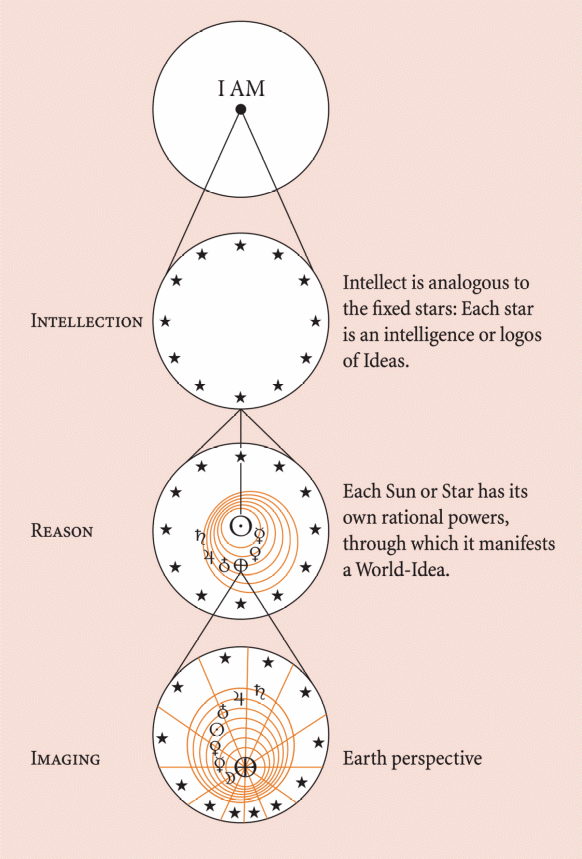
FIGURE 1984 0203a-1. Fourfold Cosmic Soul.
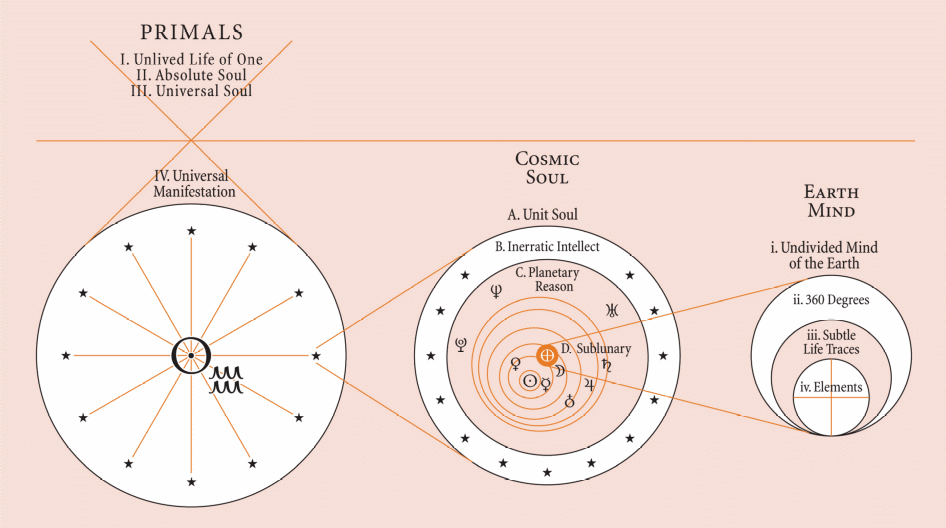
FIGURE 1984 0203a-2. Nested Levels.
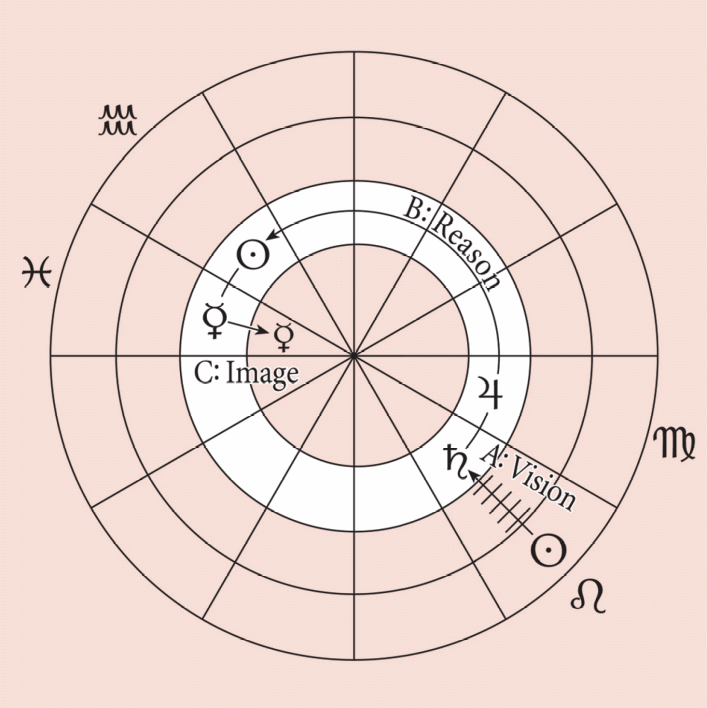
FIGURE 1984 0203a-3. Tripartite Cosmic Soul.
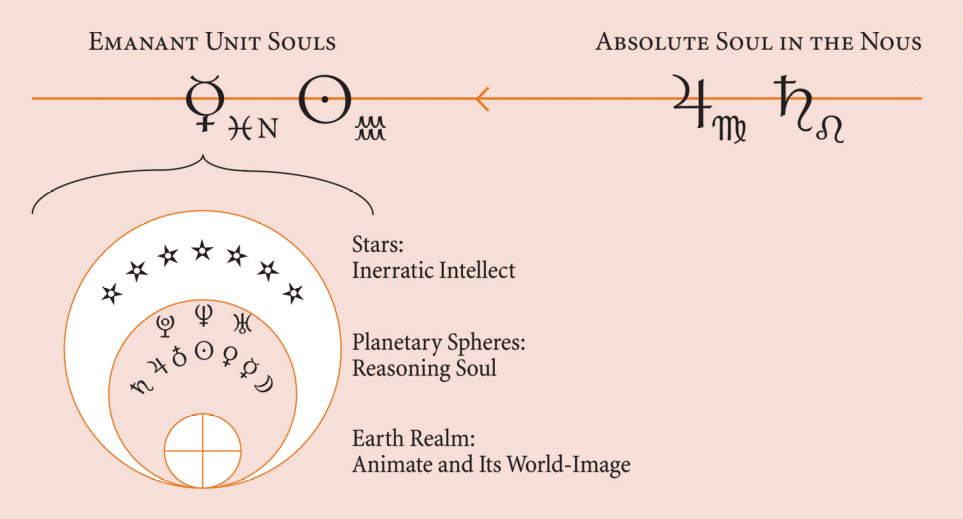
FIGURE 1984 0203a-4. Tripartite Soul and Levels of Cosmos.
Other diagrams also referred to are not with this transcript version. [Transcriber note: [diagram] means the speaker is referencing a diagram as he or she is speaking. If someone is drawing or writing, with audible sounds of chalk on a blackboard, I indicate this by [drawing] or [writing].]
NOTES:
This is 1984 02/03a, Plotinus; Soul Class, and the first entry associated with this date. 1984 02/03b = Plotinus; Soul Seminar, for which we have no audio, just JF notes.
Multiple earlier partial transcripts and versions of varying lengths exist.
Excerpts from this transcript in Astronoesis, in "Unit Soul as Absolute Individual," p. 211 ff., and "Notes on the Solar Logos/Cosmic Soul," pp. 336-338.
TRANSCRIBED Verbatim by IT prior to 2018, reformatted by jf 2018. In 2023, IT updates prefatory matter, footer, and audio file name, expands Subsubjects, completes Book List and TOC, adds Plotinus quotes section, fixes errors/typos, adds new notes within transcript, adds four diagrams and references within transcript to these diagrams, reformats to accord with new conventions. Archival verbatim transcript – V12a.
AUDIO FILES: 1984 0203a, 1984 0203b. [Note: "Tape" and "Side" refer to original audio cassette tapes that were later digitized into .MP3 Audio Files.]
1984 02/03a at Wisdom's Goldenrod
Plotinus; Soul; Epistemology
[Audio File 1984 0203a Begins]
AD: --(and/in) any epistemology. So, it would be a little difficult but I think it's awe-inspiring if we get through a part of it. So, we're going to try (it). Now, if you want, you could think of it this way. You could think of the three levels of intellection that Plotinus speaks about. You could think of the eight bhavas of buddhi, you could think of the four psychological functions, you could think of the divided line or the gnostic faculties of the soul. You could think of the antahkarana as the Advaitists think about it. All these various things we're going to try to subsume, if we could lay out the cosmological background in which all of this is happening. It's going to be a little difficult but it might be worth it. Anyway we-- I think we have enough material to do it now. So, let me introduce the speaker.
[students assent, faint]
[clapping, laughter, student words; laughter/student words continue in background for a bit as class continues]
AS: It's a nice speaker [couple words inaudible] Well--
AD (very faint): Well why don't you say [couple/few words inaudible]
AS: The speaker we had planned couldn't show (up). [loud microphone noise followed by laughter] Thank you! (laughter, clapping, student words) [loud microphone noise] And there it is. (AS laughing, laughter, student chattering)
LR: I didn't understand it.
S: Yeah.
AD/S(?) (faint, possibly part of background): [few words inaudible]
[Note: See FIGURES 1984 0203a-1, 1984 0203a-2 for the following. These diagrams are from Astronoesis, pp. 206 and 250 respectively.]
AS (simultaneously): Would you speak again and we'll-- (AS laughs, some laughter) The speaker couldn't make it so I'm going to try and do this instead, instead of the speaker. Alright. Part of this background framework we've gone through in some detail already. I think that maybe some new kind of details will come out tonight, if Anthony participates in [one/two words inaudible] But-- Well we started by trying to-- by laying out these levels that we've gone through to set this background of epistemology based on some of the things that we did before. And I guess the first-- at the first level, we spoke about the soul of the Sun, to which are conjoined all these unit souls. An-- this-- the soul of the Sun is interpenetrating with all of the other Solar Logoi. [student assents, faint] Ok? Each s-- each Sun soul is interpenetrating with all the others, and we could speak about this [drawing] two-way insight. We could speak about all the Sun souls, (alright). [10 second pause while drawing] Ok, and in this insight we also have this aura, (like) the Nous, emanating into this emanant. And in that are-- all of the Sun souls are interpenetrating with each other, and in that inner vision each Sun soul knows these others, it knows that emanation or all those other Ideas.
And outwardly, remembering that this Sun soul can still have this insight when the world appears, within this-- I guess-- let me try and show that this is all within the Sun soul and this would be the first knower [diagram], and then within here we have these three levels, within the cosmos, of intellection, reason, and the sensible [diagram]. [students assent, very faint] You remember this whole-- [student assents, very faint] This also corresponds to the three levels of the second knower. So I guess probably we should [drawing/writing] call this one the second intellection and reason and the sensible. And, (this) boundary [diagram] is supposed to represent the Sun soul interpenetrating with all the others when we think of it as contemplation, and manifesting these three levels of the World-Idea when we think of it as understanding, that second knower. So, put these (down), one-- [short pause while drawing] Ok? [students assent, faint] Through the-- through the intermediary of these other Solar Logoi, as it were, the Sun soul is contemplating the Nous. That is, each of these star souls themselves represent an aspect of that Nous, which all interpenetrating, the Sun soul has a vision of all those others, as that kind of nice idea we spoke about as all of these represent the total emanation from the Nous. And so within itself it's contemplating that emanation, that is, interpenetrating with all those other beings. So he says that each divine-- each soul is the receptacle for divine beings. [Note: See Plotinus, IV.3.1, second paragraph.]
Now, the reflex of that contemplation, we could say, is going to be the differentiation of the Sun soul's powers. That is, the reflex of this unified inner vision of all these other Solar Logoi in its contemplation, the reflex of that is going to be the manifestation-- the manifestation of the World-Idea. And in that, its own powers are going to get differentiated. And that, in a sense, sets up the second level, ok. Now instead of pure contemplation we can speak about the reflex of that contemplation being the manifestation of this World-Idea within the Solar Logos and the effective differentiation of that Sun's powers. So the second step we kind of spoke about. Now-- [short pause while drawing]
And now we have all of these-- Mars, Venus, Mercury [diagram]. Now we have all of these powers, and these powers on the one hand represent the effective differentiation of that Sun's own power, of that infinite power of the Sun. But then there seems to be this gap. I mean, some explanation is required because these are on the one hand the differentiation of the Sun's own power, but on the other hand each of these planets represent a soul in its own right. Ok? So, when the Solar Logos contemplates inwardly in this mutual interpenetration, the reflex of that is that the Sun's soul's power is differentiated through these six different-- in these six different ways. Now, one way of understanding that differentiation is that when it's active in manifesting this World-Idea, it's getting diff-- the differentiation of its power is an image of the Six Forces of Nature [Jupiter in Virgo]. If we remember back here, within the Absolute Soul, we would have those Six Forces [diagram]. [Note: See FIGURE 1984 0203a-3. This diagram is from Astronoesis, p. 202.]
[student(s) assenting, faint]
S (faint): Yes, Avery?
AS: Yeah.
S: Is there a realm that you're calling pure contemplation in between the Absolute and the-- the manifestation? I'm not quite following that.
AS: I guess I'm not doing this very well [S simultaneously: Well maybe it (couple words inaudible)] [few words inaudible] Well--
S: This realm where the mutual interpenetration of the various souls takes place--
AD: That's contemplation.
AS: (Right.)
S: And that is in the Absolute?
AD: No, no, that's in the I AM principle of the Solar Logos.
AS (simultaneously): No (we're--) [one/two words inaudible] right here [diagram]. We're on this (level). Remember, we're on this--
S (simultaneously): (Is that (one word inaudible) set higher than the manifestation of those three level(s)?)
AS: We're saying-- remem-- let me start back a little bit. We said that every one of these star souls is an emanant from that Absolute Soul. Now as an emanant it's a pure essence, it's con-substantial with its prior, the Nous. And in that state of contemplation of its prior which we called insight, this intrinsic self-cognition, it's also omnipresent with all the other star souls. And in that state there's no manifestation within it, there's no reflex yet, just conceiving of this soul as looking back to its prior, [S, faint: Yeah, now is that different--] contemplating its prior.
AD/S(?) (very faint): Uh-hm.
S (faint): Ok.
AD/S(?) (very faint): Uh-hm.
AS: Now remember, PB says something like that there's this aura emanating from the Nous and there's an answering, as it were, a complimentary gazing or fixating of the soul's insight on the Nous. [Note: Paul Brunton, Notebooks, V16, 28:2.79 and Perspectives, Ch. 28, #26.] So it's like this two-way thing. Now this-- this aura [diagram] emanating into the soul, what is that? Well the aura emanating from the Nous is all of the star souls. Now each star soul represents an Idea or a facet of the Nous. Now if they're all interpenetrating with each other, then each star soul has a vision of all the other star souls. And therefore that is its vision of the Nous, its vision of the Ideas is as it were its participation in all those other star souls. Its interpenetration with all the other Logoi is its vision of the Nous, so in that way we could-- in that sense we could say that its vision of the Nous is mediated by the other star souls.
S: Ok, then is there--
AS: It's receiving that emanation. That emanation is all the other star souls which are conjoined with the Sun soul.
S: Is there another state that would actually be in the Absolute or is that the--
AS: We're not talking about that.
S: Ok but, I'm-- that's what I'm trying to understand, we're talking about [couple/three words inaudible] Lower?
AS: Well--
S: Or am I trying to make a division that doesn't exist?
AS: Well, so long as-- so long as this Sun soul, remember, can remain in the state of contemplation even while its lower aspect-- like even while it's manifesting the cosmos.
S (very faint): Ok.
AS: Right? So the fact that a cosmos is going to appear here doesn't break its own connection with the Nous. It doesn't break its link with Reality, it doesn't break its insight. That's like saying it's in Sahaja [few words inaudible] It doesn't lose that insight.
S (very faint): Ok.
AS: But it doesn't become the Absolute Soul, it still is a Sun soul. [student assents, very faint] So that's the first stage (with it--)
S (simultaneously, very faint): [few words inaudible]
[Transcriber note: It sounds like there is some weird bleed through noise/words that starts to happen here and continues for a long time, on and off, in the background. I do my best to transcribe only the class.]
TS (faint): (Makes sense.)
AS (simultaneously): Well, I suppose you could call that Nirvikalpa in the sense that there is no vikalpa, there's no imagination, there's no appearance.
AD (possible bleed through): In the Sun?
AS: If you just-- if you abstract that from the manifestation. But what we're saying is that for the Sun soul, and of course for all the other souls, but just sticking with the Sun soul, there's a reflex of that contemplation, what it contemplates as those-- all those other-- the radiation which is all those other Sun souls. It then effectively wants to manifest that within itself or to itself. I'll read-- he has a real nice quote, maybe I should read that quote. And that's a good place to get started, he says--
Plotinus [VI.2.6, AS reading]: "Soul, then, is one and many…"
AS: This is in VI.2.6. [short pause] This-- this is the only quote that (we're/I'm) going to read from (right from the book). I thought it was nice.
Plotinus [VI.2.6, AS reading]: "Soul, then, is one and many--as many as are manifested in that oneness--one in its nature, many in those other things. A single Existent, it makes itself many by what we may call its motion: it is one entire, but by its striving, so to speak, to contemplate itself, it is a plurality; for we may imagine that it cannot bear to be a single Existent, when it has the power to be all that it in fact is. The cause of its appearing as many is this contemplation, and its purpose is the Act of the Intellect; if it were manifested as a bare unity, it could have no intellection, since in that simplicity it would already be identical with the object of its thought."
AS: This is the key: "it is one entire, but by its striving, so to splea-- so to speak, to contemplate itself, it is a plurality…" So, we'll try-- [AH simultaneously: A--] Yeah.
AH: May I ask a general question (about--)
AD(?) (possible bleed through): Yes (Andrew).
AH: We use the term 'to contemplate,' 'think,' [one/two words inaudible] (well/what) I assume to be metaphysical principle(s)? Is that to be understood in the sense that there's not a doer there or--
S (possible bleed through): [few words inaudible]
AH: Or is this to be understood from an epistemological perspective?
AS: Well, this-- we're trying to say that this is going to be the basis for all the epistemology, right?
AH (simultaneously): But we're thinking of this rather in metaphysical terms (so) there's not a doing or a doer or [one/two words inaudible]
AS (simultaneously): Well, the point here I think is that the soul is also characterized by power, remember? [student assents, very faint] So what it contemplates in this insight it has the power to effectively manifest or put forth. Now in that putting forth, in that interpreting of what it sees as the cosmos, as the World-Idea, its own power, its own infinite power, is going to become differentiated. And that's what he says here when he says--
Plotinus [VI.2.6, AS reading]: "…it is a plurality-- by that striving, so to speak, to contemplate itself, it is a plurality…"
AS: I think it's exactly analogous when we said that the individual unit soul and its power goes out to the-- get conjoined with this World-Idea, that power gets modalized by the World-Idea. And now we're going to see on this side that power of the Sun soul is going to get modalized through manifesting the World-Idea. Inwardly it contemplates, it's pure-- and that-- that contemplation it says intrinsic self-cognition. It's just-- it-- its being is its consciousness or its being-consciousness and there's a unity there. But to effectively differentiate its power as he (said/says), to be all it can be, the reflex of that act is the second act or the second knower or the second intellection, which is now the effective differentiation of that power, that power of going out as it were. It's not going out anywhere but just within itself, differentiating itself. So he'd say this is like a reflex [drawing/writing] of that inward contemplation.
Now in that reflex, we're going to find an effective differentiation of three levels of the World-Idea. And we're also going to find the differentiation of the soul power as all of these planetary powers. But that has to be explained somewhat. Ok? The soul contemplates the Nous or it contemplates the Ideas as a unity but the reflex is no longer a unity but it seems to be structured in a threefold way. Now this threefold structuring of the World-Idea we're going to see I think will correspond to the outer three planets, Uranus, Neptune, and Pluto. That's the effective differentiation of its contemplation. And the effective differentiation of all its powers, the-- of its reasoning powers that are going to unfold that and elaborate that further are going to be symbolized by the six planetary powers, the Chaldean powers. And we have to go over that and make (it) clear how that transition comes about from the contemplation to this reflex. And that's-- that's going to be a little bit-- That's going to be a little bit difficult.
We had spoken before of these [drawing/writing] three levels of intellection as the inerratic and the whole planetary spheres and the sensible, the entire sensible manifestation, as three broad levels of that World-Idea. And now I think part of the idea is the following, that prior to the effective differentiation of the Sun's reasoning powers, the World-Idea has to be organized by it in these three grades. And this is like the background or locus within which its powers can get manifested and differentiated. Now, I think maybe we could see that by-- from this paradigm. We're saying, principially almost, the Jupiter in Virgo represents the infinite power of soul and Saturn represents that pure contemplation or pure consciousness. Now this reflex, [drawing/writing] Mercury reflex [diagram], ok, also has this contemplation which then-- its contemplation of the Ideas gets distinguished-- let's say the reflex of that contemplation gets distinguished as three grades of the World-Idea, and (the/its) power, the Jupiter aspect, gets differentiated as the Six Forces, the six planetary powers. [Note: See FIGURE 1984 0203a-4. This diagram is from Astronoesis, p. 203.] I don't think I (made/make) this clear. Try again.
TS/S(?) (simultaneously): Which are only within the reasoning phase or [few words inaudible]
AS (simultaneously): Yeah, which are basically within the reasoning phase. Now I think that-- Yeah. Yeah, so-- let me try again (here).
DH: Avery--
AS: Yeah.
DH: I'm lost (with-- Is it--) is there particular (import) [couple words inaudible] the word reflex here, I mean-- I'm not (taking what that--/taken with that.)
AS: Well, is there a particular-- yeah, in the sense that, this notion that it's an act of its essence, in the sen-- reflex just in the sense that it's not a deliberate-- it's not a deliberated act. It's like automatic, it co-- the soul inwardly contemplates and outwardly gives forth this outward-facing power.
VM/S(?): Almost like the vision (it) (has/had)?
AS: Yeah, like its tendency to manifest its power. Now a reflex in the-- I don't know. There's no particular--
DH (simultaneously, faint): Oh, you mean a reflex in the sense of being automatic.
AS: Yeah. In that sense. [student assents, very faint] Now, I think maybe this helps also. If we go back to the second stage you said conjoined with-- conjoined with the Sun soul are all of these individual souls and all the planetary souls. Now, once the Sun effectively differentiates [drawing/writing] its powers as these six-- these six lo-- locati-- as these six forces, then these particular souls, the planetary souls that are associated with the Sun take up their locus in that sphere. Because that seems-- that seems like that has to be understood also, how-- [drawing/writing] how is it that these [diagram] represent differentiations of the Sun's powers and these [diagram] represent the differentiated levels of the Idea, the knowing, willing, and feeling. And yet they also represent souls in their own right. Ok? That seems to be a problem, and I think that-- that can (kind of--)
S: Say that again Avery [couple words inaudible]
AS: The way in which each of these planetary spheres is an effective differentiation of the Sun's own power and is also a soul in its own right.
S (faint): Yeah, [possibly another student: (right)].
[student(s) assenting, very faint]
AS (simultaneously): Ok? [student assents, very faint] And I think that can be explained by saying that each planetary soul or Overself, when it's conjoined with the Sun soul, just in the level of contemplation, it doesn't have a location yet for it to manifest. Only the Sun soul does. Like the Sun soul is one among all the Solar Logoi. So it elaborates that tentative illumination. And in order for the planetary souls to find their locus, the locus they're going to operate at has to be manifested first. So the primary elaboration is by the Sun souls. They establish the background or the locus for all these individual souls to operate. First of all they establish the locus for all of the reasoning of all the planetary souls. And the planetary souls in their elaboration of the World-Idea in turn provide place for all our unit souls to have bodies. Now, we don't have to bring in the planets from ad hoc, from outside, because we already stated previously that conjoined with this one Being are all the Beings. Conjoined with the Sun soul we have all the (Overself), all the planetary Overselves. So once this Sun begins to-- now this is-- this is really temporal, but once we conceive of the Sun as effectively differentiating its powers, along with that, concomitant with each grade of life is a grade of thought, a grade of the World-Idea. And so the World-Idea is effectively differentiated along with its powers and the locus arises for each of the planetary souls to take over its (duties). And then in turn within each one of those planetary souls we'll speak about a whole fourfold elaboration there in which all the particular entities, bodies, will manifest it, and so each particular soul has its own locus.
S: What's that like?
AS: Well (then--) we have to do that still.
S (very faint): Ok.
AS: But we're [AD simultaneously, possible bleed through: (Yeah.)] trying to lay out first the [student assents] levels in the Sun. Now I think he means--
VM: Avery, are you s-- [few inaudible AS words simultaneous with VM, very faint] is to you the Earth (moving) when you're speaking like that?
AS: No, I think we were using this. [drawing/writing] If we look at it this way, we have the inner planets out to Saturn. And I suppose you could use the Sun and then [VM, faint: Mercury?] Mercury, Venus, Earth, Mars, Jupiter, and Saturn. [VM assents, faint] And remember even astrologically we spoke of-- in the astrological chart, these Chaldean planets are differentiating that life power of the Sun. Ok? And here we're saying that, metaphysically or cosmologically, these are the effective differentiation of the Sun's powers. But at the same time each of those differentiated powers will become the locus for a particular unit soul which is one of the Sun's helpers as it were, you know, however you want to think of those planetary souls, they're in a s-- a sp-- a more special position than the unit soul(s). They're all conjoined with the Sun, but now as the Sun's powers get differentiated those souls take up their positions.
Now the thing that's interesting that came out and I don't know if I could bring it out is that [drawing/writing] when we did that, and then we asked the question, well, ok, that's good, but what about these, then what are these guys doing? If these six represent-- if the six Chaldeans represent the effective differentiation of the Sun's power, and even if they are the image of the Six Forces of Nature, that's the Jupiter [diagram], ok, and this is at the second level, then what about the Uranus, Neptune, and Pluto, what do they kind of represent? Well, it seems that, again let me-- this seems to be the view that the Uranus, Neptune, and Pluto represent not the differentiation of the soul's powers, which is in conjunction with the World-Idea, but the differentiation of that World-Idea itself. In other words, in the soul's contemplation, in the Sun soul's contemplation, it can't grasp the Idea as a unity, it manifests it [drawing] on these three levels [diagram].
S: Would you do that one more time?
VM: It's sort of substance [AS simultaneously: Yeah.] and function essentially.
AS (simultaneously): Something like that. It's like--
VM (simultaneously): [one/two words inaudible] they represent the substantial aspect of the World-Idea and the planetary-- planetary principles are a functioning, the explication of that substantial mode. Is that what you're saying (kind of)?
AS (simultaneously): Well, yeah I would kind of look at it like, first of all the World-Idea has to get modalized in these three levels [diagram] [VM assents, faint] before the Sun's powers can get modalized according to the World-Idea. So there's always this concomitant of a grade of life with a grade of thought. But the first reflex as it were is a reflex of that Sun's own contemplation of the Ideas. And that reflex is a reflex which is differentiated on these three levels, which I think we'll see in some way will correspond to knowing, feeling, and willing, although there may be some disagreement about that.
VM (simultaneously, faint): (That's right), yes.
AS: And that each of these, [drawing/writing] Uranus, Neptune, and Pluto, seem to represent the differentiation of that insight into these three levels of Idea, and that then, only then can we now speak about the reasoning powers of the soul being differentiated through shining into that World-Idea or in conjunction with the World-Idea. So it's like on the one hand the World-Idea has to be differentiated enough in order for the soul powers now to be further differentiated in conjunction with it. But I think there's some validity in saying that the Uranus, Neptune, and Pluto rule these three realms. It's almost like if you think of, without the planetary spheres, just the Uranus, Neptune, and Pluto, it's like saying this represents the intellection of the Sun. [student assents] It's like saying, first you have the unity of the Sun and that's its-- just its insight or contemplation [diagram]. And then the first reflex of that is the Sun's intellection, which would represent the Ura-- by Uranus, Neptune, and Pluto [diagram]. And that-- I mean you could conceive of that all at the level of the inerratic too, or you could see-- conceive of it as the three levels of the World-Idea conceived without the reasoning yet. Ok? And then the next step-- so this would be the second level, the Sun's intellection. Then the [drawing/writing] third level we would speak about the Sun's reasoning, its reasoning power is getting effectively differentiated and that will bring in this arrangement, the Chaldeans [diagram], ok. And then finally we could speak about the body of the Sun, that is, the actual bodies of all these planets and the body of the Sun, that is, the manifested cosmos, and that would be the fourth aspect of the Sun, its body [diagram].
[students assent, faint]
S: Avery, when you're talking about the World-Idea of the Sun, the Solar Logos, requiring or using Uranus, Neptune, and Pluto as its primary differentiating faculty, why would it differentiate Uranus, Neptune, and Pluto out from the-- from the whole set of planets?
[sounds like students assenting, faint]
AS: Because those are the particularly evolved souls that, [LR simultaneously: Can do the job.] I mean, can do that job. I mean I think that the--
LR (simultaneously): Well you made that-- I don't think you made that point, but the thing about presiding over, that [AS simultaneously, faint: Yeah (few words inaudible)] certain souls have to preside over.
AS: Yeah. They presi-- I meant-- that's what I meant by a locus, each-- each of these particular planetary souls will preside over that particular locus [student assents] or that sphere or that power that it's apt to. I mean here we preside over the particular body 'cause our level of soul differentiation is very low, but these souls, these planetary souls would preside over a whole planetary sphere, and that's the way their powers are being effectively differentiated. And the Uranus, Neptune, and Pluto are apparently souls which primarily are operating at this level of intellection. And then of course the Sun soul itself, its contemplation represents the unity. So then, again, the Sun soul's contemplation itself is like a unity(--/.)
VM: It's almost like four levels, like [AS simultaneously: It-- yeah, (that's it).] Turiya, Vaishvanara, Taijasa, and--
AS: Yeah, except we're speaking of the four levels of the Sun.
VM: I understand [one inaudible AS word simultaneous with VM] that, let's say the Mercury would be Turiya, and then the-- [couple inaudible AS words simultaneous with VM, very faint] the Uranus would be the Prajna [AS assents] and Vaishva-- or Taijasa and Vaishvanara would go with the other two. [AS assents] I'm not sure if you mean it though in that sort of way.
AS: Yeah, somewhat, I mean analogously, I think. The thing with these Uranus, Neptune, and Pluto is that I'm looking at it as-- even though they represent this level of intellection, [drawing/writing] within this reflex, [student assents, very faint] the first reflex as it were, the Sun's intellection, the three grades that are within that are already prefigured. You see, I'm saying that-- see that's why Uranus, Neptune, and Pluto, even though they represent the intellection of the Sun, the second intellection, not the contemplation, they prefigure the three grades within the World-Idea. [students assent, faint] So they in a sense rule over those three grades. Right, I mean, we-- [S simultaneously: (couple words inaudible) yeah.] you know, the three one way [S simultaneously, very faint: (I don't know.)] and the three the other way [diagram]. And the next level, now with the differentiation of its reasoning power, [drawing/writing] that primarily ruled over by Neptune, [VM, faint: Right.] because--
VM (simultaneously): [one/two words inaudible] by Pluto, right?
AS (simultaneously): And-- yeah. And the bodies are primarily ruled over by the Pluto function.
RG (simultaneously): But-- but they still have their place of cognition where?
AS: I would say they still have their place of cognition [drawing/writing] outside of this whole Saturn to Sun thing [diagram]. [student assents] [RG simultaneously: Which would in the intellect.] In other words, in the nature-- in intellection, yeah, in that top intellection.
RG (simultaneously): In that top intellection.
AS: Yeah, in the top or the-- [sounds like RG assents] this-- the first-- the first reflex intellection. [students assent] In other words, if loo-- I mean maybe you could say that if-- well-- [S: Avery?] [S simultaneously: (Before) you--] but it-- but it-- [S simultaneously: (Yeah but--)] (yeah), it's fine.
S: I can't hear you, you're saying that (the) Uranus, Neptune, and Pluto have a different status [couple words inaudible] from our point of view here. You're not saying the World-Idea from our point of view, you're just saying that they have status in the Solar Logos which is [AS drawing/writing] (just/this--) [student assents, faint] which is definitely (just--)
AS: Yeah. Look, I guess I'm saying, some souls operate primarily at a level of sense. That's us. Most of the time we don't realize anything that happens unless it comes all the way to sense. And (you) got souls that primarily operate at the level of reasoning and those are the planetary souls, maybe it's universal reasoning. Then you have souls that primarily operate at this level of intellection, this kind of intellection, and that's this Uranus, Neptune, and Pluto. And then (if--) then you have the Sun soul, ok, which is as it were encompassing all of them, and there seems to be this-- a kind of a hier-- hierarchy, that it's necessary for the Uranus, Neptune, and Pluto to set up the conditions or regulate or govern what's going to go on in these reasoning powers and those in turn-- in turn are manifesting what goes on within their own-- each one having its own sphere of activity. [students assent] So I-- you know, there's definitely a hierarchy but within the hierarchy the ones at the top level, these three [diagram], representing the differentiation of the Sun's contemplating, these three are-- have to rule over all the rest that goes on. The Pluto is the hardest one 'cause I think it's easy to--
RG (simultaneously): Then how do you conceive that what's below the-- the reasoning phase is prior to it in intellection?
AS: Of course he says that there's an Earth-- somewhere Plotinus says that not only there's the Earth here but there's the Earth that's in Heaven. [Note: See Plotinus, VI.7.11-12.] So in some way maybe Pluto has a precognition of what's going to manifest within any one of these [diagram]-- that all the particular manifestations are prefigured at the level of intellection, but at the same time the Pluto is actually ruling over embodied (that are beings). Maybe it contains the archetypal form of all the particular bodies, whereas Neptune rules over the archetypal reasoning, and Uranus rules over that archetypal intellection. And now these participate in intellection as well as having their spheres (governing) within that.
[student assents, faint]
DH: [half/one word inaudible] (you--) that quote you just read from-- from Plotinus, where he talks about the striving of the soul is what brings about the many.
AS: Yeah.
DH (simultaneously): Is that what you would relate to the Pluto?
AS: Well I-- I [DH simultaneously: Or not?] would relate it to all of these.
DH: Ok.
AS: I mean I'm-- I think you say the Sun in striving to-- it's just like the analogy we've used a lot of places, that in these contemplations the soul or whatever principle of life it is can't completely grasp that unific prior and so it manifest it as a multiplicity, breaks it up somehow. Whether it's the soul or whether it's because of (the/a) thought itself that contemplates [couple words inaudible] but in that contemplation it seems to have to turn it into a many, it can't grasp it as a unity but goes on multiplying it. Just-- [drawing] at this level of Uranus, Neptune, and Pluto [diagram] he talks about the intellection as unrolled. He talks about the Ideas as unrolled and separated, whereas here [diagram] he speaks about just the Idea, the Nous.
JA: Avery?
AS: Yeah.
JA: I don't understand what you're saying evidently.
AS/S(?) (very faint): Me either.
JA: First of all, I didn't understand what you meant by saying that the aura (emanates/emanating) (through) the star soul(s), [AS: Yeah.] and then, you know that--
AS: Well that idea came up last (week though).
JA (simultaneously): I know, and I didn't understand it then and I-- I would appreciate it if-- too if you would explain it without the diagram.
AS: Sure, let me (explain). I just-- I had this-- just this feeling last week that-- look, if you speak about the N-- he says the Nous emanates all of these-- or each of these unit souls is an emanation from the Nous. Right? But we're also speaking about the radiation or outward Hypostasis of the Nous in terms of the Ideas. Now, there's no-- there can't be like a separation, like there's the Ideas and then somehow the souls come along and conjoin themselves to the Ideas. It seems like those emanating souls are themselves the Logoi or carriers of the Nous. Now the whole thing interpenetrates. If all of those Sun souls are omnipresent with each other at that level of essence, (and) each one would effectively would know all the others. In knowing itself, it knows the others to be in essence the same because they're omnipresent and therefore it knows all the other Ideas that those other Sun souls represent. It interpenetrates with them. So each Sun soul is like the carrier of a facet of the Nous. It's a radiation of the Nous, [JA/S(?) simultaneously: Well, but I just don't--] and they all interpenetrate.
JA: I don't quite understand that. [AS simultaneously: Well, just (one word inaudible)] Because what you're describing actually is this sort of knowing [couple/three words inaudible] within the (light).
AS: No. Well, just in the soul, yeah.
JA (simultaneously): Interpenetration of the Ideas. Now you're talking about [AS simultaneously: (Yeah.)] emanation which (we) also had in that [one/two words inaudible]
AS (simultaneously): It's not quite the same. But we spoke about the omnipresence, I mean in-- in the omnipresence of soul we spoke about the soul essence, we spoke about this I AM, the emanant, [drawing] as interpenetrating with all the others at-- at that level of essence or insight.
JA: Well, I thought that was--
AS: And that wasn't in the Nous, that was speaking-- I thought, it was speaking of this emanant, the unit soul, the Overself of the Sun.
JA: Well, I just can't-- I can't quite figure that out, you know [couple words inaudible] because-- [AS simultaneously, faint: (Yeah.) Ok (couple/three words inaudible)] I mean we have spoken about the aura as the universal Ideas in (their/there)-- as (they're/their/there) being so-- I don't know what word to use but that you don't speak of a universal Idea and, you know, individual soul in the same way. And, you seem to be speaking about (particular) emanations in the same way that, (well) you speak of universal Ideas and I'm not-- I'm just not understanding what your presupposition is.
AS: Well I guess my presupposition is that these Solar Logoi-- I mean, Solar Logoi are the-- they're the-- [couple/three inaudible student words simultaneous with AS] they're the-- they are the universal Ideas, [S simultaneously, faint: Yeah (couple words inaudible)] just about, I mean you might as well say that, I mean I don't see-- you're trying to distinguish and say, oh, well universal Ideas, they must be much bigger or something than these(--/.) These Solar Logoi are the outpouring of the universal Ideas, I don't see what else they-- they would be.
VM (simultaneously): In fact, wouldn't you say at a metaphysical level we speak about the Ideas as being a unique and special version of the whole. Right?
AS (simultaneously): (Yeah/Right), yeah.
VM: That's an embodiment in its own unique way of all the other metaphysical Ideas. Wouldn't you say in some sense that this would be cosmological reflection of that [S simultaneously: Yeah(./?)] very principle?
AS: Sure. Now I would-- yeah, and I would say that then, when this [drawing] one soul interprets in a peculiar way all-- you know, its interpenetration with all the others, [VM: Right.] there arises within it that second knower, the-- the in-- the second intellection.
VM (simultaneously): Last week's peculiar representation, [AS: Yeah.] its sidereal zodiac let's say.
AS: Yeah, its sidereal zodiac or we could say its intellection. And that intellection itself prefig-- that intellection or differentiation or-- or distinguishment of the World-Idea will include those three levels of the World-Idea that are going to manifest, those three-- that background of the three levels (or four) levels.
VM (simultaneously): Yes, because when we say-- I mean just take the astronomical example. When you say sidereal zodiac you're defining a plane of the ecliptic. That plane of the ecliptic is occupied by all these planetary power.
AS: Yeah. We--
VM (simultaneously): And so that-- at least the two ideas are right there and then you say well the body's a symbolization of the third level, the (pseudo) level, [AS assents, faint] (so/where) all three of them come together in that [AS assents] concretization of that unique point of view of that Solar Logoi. Solar Logos.
AS (simultaneously): Yeah, I guess we were being a little, you know, uppity if we said that the Sun soul is receiving all the infinity of stars. [VM simultaneously: No I think we've said that before, yeah.] I think we made that point once that-- yeah, it's real-- I mean maybe you conceive of it as just the plane of its ecliptic with only five billion stars radiating it, [VM simultaneously: Yeah, right.] I don't know, maybe it isn't them all.
JA (simultaneously): Because I don't understand, are you using-- are you basing your metaphysical model on your cosmological sense-- sensible [few inaudible student words simultaneous with JA] appearing model? And I mean is that what you're doing and-- and is that, you know, (it's) what you want to be--
AD (simultaneously): No the first-- no the first [couple/three inaudible AS words simultaneous with AD] Jeanne retain-- We said we're speaking about the soul of the Sun, we refer to it as a vast entity of light. And if you think of each Solar Logoi in-- in the same way, then you (would/will) be speaking about how many Solar Logoi in that subtle state where their infinite (light/life), alright, extends throughout, to use a spatial metaphor, so there's this interpenetration of all Solar Logoi, one with the other. Now if we use an analogy at a lower level, in heaven, alright, if I go to heaven and you go to heaven, [student assents] I'll be enjoying your bliss and you will be enjoying my bliss and I will remain I and you will remain you. (some laughter, student words) The same kind of things apply here, right, each of the Solar Logoi, even though they are-- we think of their life as infinitely extending and each interpenetrating the other, yet each Solar Logoi remains distinct from other Solar Logoi but includes them within itself. Just like I (would/will) be including your bliss in my bliss and my bliss will be included in your bliss. [student assent, faint] The net result of this is that each Solar Logoi will have its own version of the World-Idea. [students assent, very faint] That's the [couple/three words inaudible]
JA (simultaneously): I know it. Yeah, it's (nice about something) [few words inaudible] I don't understand where the-- Ok. I do understand that there's a universal Idea of particular, particularity(,) Solar Logoi [one/two words inaudible] You know, I-- I don't understand--
AD (simultaneously): Well-- well that's what each Solar Logoi is, is a universal Idea. Each Idea participates in all the other Ideas and vice versa. [students assent] That's what we're saying. If-- if it applies to individual souls, you know, that the bliss of one includes the bliss of the other, certainly it a-- it will apply with each individual Idea that a Solar Logos represent. As a universal Idea it includes all the others. And all the others include one another. That's where you're coming off and that's the subtle level, that's not yet the level in manifestation. [students assent, faint] Yeah, yeah [couple/three words inaudible]
RG: (Right.)
JA (simultaneously): Well, I don't think I'm able to answer the question now Anthony.
AD (possible bleed through): No.
S (faint): I--
JA (faint): I can in--
AH: Jeanne, would you mind if I commented or picked up the question?
JA: No.
AH: It sounds as though we were using a-- a spatial description and you were asking a question about that, like the plane of the ecliptic only involved in five billion stars instead of all of them. But I lost in the discussion when-- whenever we use a sensible format for describing what must be a relationship of things that (it--) [JA(?) simultaneously: Are (one/two words inaudible)] is supersensible. Was that your question?
S: How can you help it when you're speaking, I mean even if you use the notion of interpenetration based upon sensible experience largely [couple/few words inaudible]
JA (simultaneously): I say how can you help it, but, you know, [S simultaneously: That's what I'm saying--] I think there are ways of speaking of immaterial [S simultaneously: (Don't use) that.] things without using images.
AD: But isn't that immaterial what I just told you? [student assents, faint] That in heaven I will be enjoying your bliss fully and my own, and you will be enjoying mine fully and your own, and we can speak of one soul or many souls or one and many [one word inaudible] You just don't want to stop on this point and understand it. [JA simultaneously, faint: (I was) trying (possibly one word inaudible)] That is the nature of Real Being. [JA, faint: What--] In heaven my mind will not exclude your mind and your mind will not exclude my mind, yet each mind will remain numerically identical with itself and not be the other. [JA: Well--] Well you have-- you have to stop and think for a minute--"What the hell is this guy talking about?"
JA: Well [one/two words inaudible] think a minute and then I'll ask the question. What do we mean numerically identical?
AD: Just what I said.
JA: I don't know what (that means) [one/two words inaudible]
S (very faint): Of course you do.
AD: One, one, one, this one is not that one, that one is not this one. Do I have to go through an arithmetic exercise?
S: Yeah.
JA: I mean, I--
PD: Is each one self-conscious? Or is only the whole soul (conscious)?
AD: Let me read you a quotation. [short pause] You see, this problem comes up without let-up. (bit of laughter)
RG (amidst laughter): Is that (let/led)-up?
AD (simultaneously): It's-- [AS simultaneously: (Or (let/led)-up?)] it's absolutely a problem that--
(Side 1 of original cassette tape digitized as 1984 0203a Ends; Side 2 Begins)
AD: --to soul. If I could remember the quotation. Well (here), Avery, what's that quotation where he shows (that/the)--
AS: Which one?
AD: Speaks about all souls-- one soul and all souls, it isn't a relation of part to whole.
S: There's IV.3.2.
S (simultaneously): IV.3.3?
AD: IV.3 what?
S (faint): IV.3.2, it's on page 251.
[15¾ second pause while looking for quote]
AD: Now, very carefully because what he's going to say he's going to say in five words or ten words and that's it.
Plotinus [IV.3.2, AD reading]: "Again, it is admitted that the particular soul--this 'part of the All-Soul'--is of one Ideal-Form with it, but this does not entail the relation of part to whole…"
[student assents]
AS: Yeah.
AD: You know what he's saying there? When we speak about your Overself as, you know, and the cosmic-- (the) self as conjoined to each other, your Overself is not a part of the cosmic soul. He says there can't be any such relationship between souls. That's like I was just telling you. I enjoy your bliss, alright, and my own bliss and vice versa. It isn't a relationship of a part to a whole but of entireties to entireties. That has to be understood and only when that's understood could we proceed to point out that when we say the Solar Logoi, alright, enjoys the bliss of all the other universal Ideas within itself but remains itself, and the same applies to all the other universal Ideas, they also enjoy the bliss of all the others but remain themselves. If they didn't remain themselves, that is, numerically identical with themselves, then we would have only one soul. Everybody of course has this reductive tendency in 1984 to reduce everything to scrap iron or something like that. (bit of laughter) [student assents, very faint] Or sex, you know, but you can't do this metaphysically. [student assents] [bit of laughter, student talking in background as AD speaks] We cannot reduce one soul to All-Soul, alright, and then reduce that All-Soul to Absolute Soul and then even get rid of that and put it in the One. You can't do that. [students assent, faint] I didn't [couple/three words inaudible]
But that's the thing that has to be grasped, that among authentic Beings, each one remains numerically identical with itself and has a relationship of a whole to another whole. And there-- there's no experience in the sensible world that could provide you with that. [students assent] [AH simultaneously: Anthony, (would you--)] And that's why I said(,) in the beginning(,) we have to follow Plotinus' lead because he's instructing us. He is instructing us, we're not going to tell him, he's telling us, "This is the way it is." When you get a glimpse of the soul, all of a sudden you realize that the soul is an absolutely immaterial principle. Reme-- and you-- if you remember I even mentioned to you that if you get that experience then you'll go back to what I said and you'll say, "That guy said that (their/the) lower self… (But) there's no lower self here." Of course not, they're just words, I can't help that. We have a glimpse of the soul, there's no over-- there's no lower self. [couple/three words inaudible] Well Plotinus generally is pretty accurate. He's pretty-- I would say [S simultaneously: Well, yeah (one/two words inaudible)] more than accurate, he's penetratingly analytical. And that's stating these things in very positive language, which something no Nagarjuna could do. (student assents, laughter, student words)
AH (amidst laughter): I don't want-- I don't want to talk about Nagarjuna. I-- I would love [VM simultaneously: Oh he's (young for the day), no doubt.] (to just) answer the questions that-- When you describe the-- or to remain one, the souls remain one, they remain-- they remain individual or they remain themselves-- See the--
AD: The soul is one and many. Listen to the definition. When I have the experience of her bliss, alright, in heaven, and my own, alright, on the one hand I remain myself and on the other hand I experience her bliss. My [AH simultaneously: Yes.] soul is one and many.
AH: Yes. But when you use the word 'remain' to de-- to describe this [one word inaudible] it's as if you take-- I(--) see, it's impossible for me not to take a notion of individuality or self from the sensible and imagine something of it remaining. And I know that's [student assents] an inappropriate, inaccurate way of understanding this, but--
S: That's (true/truth).
AH: I--
AD: Well, no, it's not that difficult, you just would have to continue lying that there is such a thing as self-inherent existence in the sensible world and apply it to the Intelligible world.
AH: Extend the lie--
AD: All the way up.
AH: All the way up.
AD: There it becomes true. (laughter)
AS (amidst laughter): There's a lie [couple words inaudible] believe.
AH: Very nice, thank you. (laughter)
AD: But this is the important point I think Avery's trying to make. We think of the Solar Logos (in the) [one word inaudible] alright, the I-- the I AM of any Solar Logos, which is an infinite light. And this infinite light interpenetrates with all other infinite lights. And this inter-inner-penetration of all the lights with one another is like soul is one and many, alright. Now, that results in each Solar Logos having its interpretation of what the World-Idea is by a reflex. [student(s) assenting] Like if you contemplate something, like you sit down and you want to write something, you ask what is contemplation. You sit down and you want to write something and you look-- and you stare at that blank paper long enough, all of a sudden you notice thoughts springing up and you start writing them down. What is contemplation? I can't explain it to you but you're always par-- doing it. If you're not doing it mentally you're doing it physically, in whatever activity you're engaged in.
[students assent, mostly faint]
AH: Could you say again how that fits the definition of contemplation?
AD: Well that's not a definition, it's like a description of something that you're always doing.
AH: I'm sorry, I missed that.
AD: Well, you take a poet, alright, who is capable of let's say sitting still and waiting and waiting and suddenly an inspiration springs into his mind, the ideas flow out, alright, and he's been contemplating. What is contemplation? It's kind of self-absorption which by reflex produces, alright-- produces and in producing we seem to think that that production is something which is like radiated out from it.
S (very faint): Right. Uh-hm.
AH: Is it so that you used an example from the sensible just now?
AD: Yes.
AH: Now that example is to be used metaphorically in order to understand the metaphysical application of this idea?
AD: Yes. But it is an example, isn't it. When you look at that blank paper long enough all of a sudden the thoughts spring up into your mind.
S: Yeah. (S laughs a bit)
AD: But you gotta look at it long enough. And it's gotta intimidate you. [short pause] Herbie's contemplating, he walks up and down. (bit laughter)
HS: That was him, I wasn't. (some laughter)
AD: But, alright, let's get back to the main point and this way Avery can try to lay the whole thing out and then (we/we're)-- we'll discuss because it is a little complex. There's this infinite light of each Solar Logos, alright, which assimilates the light from all the other Solar Logos's and what results in that is a-- a-- its version of the World-Idea. Now you have to remember the version of the World-Idea at this level is like-- is pre-sensible and all-- I don't have to go through that, alright, there the-- there, if you'll excuse me Randy, I could say that you have a stabilized ecstasy. In other words, the Solar Logos's contemplation of the other Ideas is a steady contemplation, it's like a stabilized ecstasy, it's a rapture that is uninterrupted, alright. That's the only place you'll find it so don't worry about it.
BS: Is this contemplation a self-contemplation where let's say a particular Solar Logos would contemplate itself as distinct?
AD: Well contemplating itself it would go in the other direction. It would-- in its self-penetration it would understand that there is this mysterious Void, would understand the-- the primal Hypostases.
BS: So you weren't talking--
AD: No we're not talking about that contemplation, we're talking about it contemplating all the S-- Solar Logoi.
BS: And only in that sense, only now [AD: Yeah.] we're speaking of it as distinct.
AD: We're speaking that-- that's the-- Plotinus [BS simultaneously: (As a man.)] (actually) calls that the second intellection and distinguishes it from the first intellection which is insight into its own nature.
BS: Ok, thank you.
JA: But when you say that it's contemplating the other Solar Logoi, is that what [sounds like one faint inaudible AD word in background simultaneous with JA] Avery was saying, he said that (this) [S: I don't know.] receives [AD simultaneously, faint: I think (we're saying the same--)] star souls, I mean is that the same thing?
AD: I think we're saying the same thing.
[students assent, faint]
JA: Well, I thought-- I thought that [couple/three words inaudible]
AD (simultaneously): Well, Plotinus for instance would-- puts it in this way, there soul is the recipient of divine beings.
JA: Yeah. But we don't use-- in other words, when he (says/said)-- he said star souls and then he translated it into the inerratic sphere, I don't see-- I don't understand the connection then because that--
AD (simultaneously): Well the inerratic sphere [AS simultaneously: It's already interpretation.] he's referring to is that the soul of each star, that's what he's referring to as the inerratic sphere. When each star gets manifested we call it the inerratic sphere but the soul of each star is that infinite life and they're all interpenetrating one another. That's the level that (he's/we) starting at. In other words, we're starting at the level where the Sun soul, alright, has intellection of all the other Sun souls, at that level. We'll start there. Because what we're basically dealing is with the second knower of the Solar Logos or any authentic I AM. That's what we're dealing with basically.
JA: So, you can say that each star soul is an I AM and it-- it's not going to be any difference.
AD: Yeah.
JA: Ok. Ok.
AD: Yeah, when we [S simultaneously, faint: (few words inaudible) what's going on.] speak about the soul-- when we speak about the soul of our Sun we're speaking about its I AM principle. It's like when you speak about an individual having this I AM principle too. Analogously, anything that you say about cosmic soul you're going to be able to say about an individual soul. Alright, shall we try continuing Avery?
AS: Hm? Ok, well-- So I don't know if we have sufficiently--
AD (simultaneously): You better wait 'til Elliot gets out.
AS: I don't-- I don't know if we have [AD simultaneously, faint: (It's) (one word inaudible)] sufficiently gone through these levels for the-- these levels for the cosmic soul or not, but I was trying to understand that the first reflex, that highest level of the second knower, that intellection, is-- is differentiating the World-Idea at the level-- or, say the Sun interprets to itself that World-Idea, it interprets to itself all the other star souls. And that's its second intellection, that's its highest intellection, high(--) second knower.
AD (simultaneously): Within which-- within that second intellection, alright, you're going to have the World-Idea at three different la-- levels.
AS: Right. [drawing]
AD: In other words, you're going to have a representation of the reasoning phase of the soul as well as the sensible. [AS simultaneously: Right. Now--] So, the sensible Earth here has its counterpart in the level of intellection. [AS: Right.] There's an earthly Earth and there's a heavenly Earth.
AS: Yeah, and I-- and this first reflex, this level of intellection, already has the threefold plan, the World-Idea is already structured according to this threefold plan. And I think we're saying that once that becomes effectively differentiated, [drawing] the-- that threefold differentiation of the intellection is conjoined with these particular souls, as it were, the highest souls that are conjoined with our Sun soul are the ones that are directly active(--) conjoined with its intellection, Uranus, Neptune, and Pluto. And so they represent the rulers.
AD (simultaneously): Alright, that's one way-- that's one application of that term, alright, [student assents] so it's not intended to be exhaustive. [student assents] So we're saying Uranus rules over the intellective field, alright, Neptune over the reasoning phase, and the Pluto over every sublunary phase.
AS: Yeah. And they also-- maybe it was Proclus' theology, called these the three Demiurge [couple/three words inaudible]
AD: Yeah. Uh-hm, yeah.
AS: But once-- this once-- ok. This first level of the-- of-- we called intellection, now once that establishes or once the soul represents to itself all these Ideas as this total World-Idea differentiated at this level of intellection just by knowing, willing, and feeling, I mean the real knowing, willing, and feeling, the way Bhattacharyya speaks of it--
S: Elliott?
AD (simultaneously): Elliot please [AS simultaneously: Un--] sit down, will you Elliot [S simultaneously: Elliot, (go back).] [S simultaneously with S and AD: Elliot, please.] [half/one word inaudible] straight down?
S: You're making [S simultaneously: (Go back.)] us nervous.
AD (simultaneously): Come on.
AS: Anyway. I think maybe we should bring this (up with it), this would correspond to Bhattacharyya's highest notion of the triple absolute which is un-unifiable at this level. [Note: See K.C. Bhattacharyya, Studies in Philosophy, Volume 2, "The Concept of the Absolute and Its Alternative Forms".] And maybe beyond that there is a unification in terms of insight or something, but this would be the spiritual functions of knowing, willing, and feeling.
RG: As in the intellectual phase.
AS (simultaneously): As in the intellectual, yeah, as in the intellectual phase. Whereas at the next-- now once that sets the ground, those have to--
PD (simultaneously): Are they intellections or contents of intellection?
AS: I think that they are also intellections, not first intellections but second intellections, if [sounds like RG assents] I understand, there are three modes of intellection (here).
RG (simultaneously): Right. I mean if you speak of them as knowing, willing, and feeling (there has/they have) to be modes of int-- of intellectual [one word inaudible]
AS: Yeah.
AD: Of what?
PD (simultaneously): Maybe for lower entity there's modes of intellection but at that level are they modes of intellection?
RG: Well, yeah.
AD: (Well--)
AS (simultaneously): But there [RG simultaneously: Why not?] intellection and its object are conjoined Paul.
RG (simultaneously): Are-- are conjoined by--
AS: At that level, at the level of intellection, the intellection and what it intellects are almost conjoined. I think there (one--) I think there you would probab-- properly speak of them as intellection, 'cause they rep--
PD (simultaneously): (That means there) what, type of cognition, cognizing?
AS (simultaneously): Yeah. Yeah, not this-- not intellection as in the Nous but the way we were speaking of the highest power of that Sun soul. Yeah, type of [PD simultaneously, faint: Well (I'm--)] cognition. But why not-- yeah--
PD (simultaneously): Cognizing.
AS: --yeah, a low-- but [S simultaneously, very faint: (It's) awareness (one word inaudible)] not intrinsic self-cognition but the first cognition of the World-Idea, the highest cognition of the World-Idea.
PD: But then they-- are they a content to (the) knowing or are they known?
AS: Both.
PD: Are they a content to the intellection?
RG: It seems when you speak of the con--
AS (simultaneously): [few words inaudible]
RG: Where-- but it-- when you speak of the content side aren't you referring then to the World-Idea there as content to that function of knowing, willing, or feeling? So--
PD: No, I [few words inaudible]
AD (simultaneously): Let's try this way, Paul. You know when PB speaks about willing, feeling, and knowing have to be evolved, refined, and brought to their highest pitch [student(s) assenting] before they can get fused and become insight. [Note: Paul Brunton, Notebooks, V13, 20:4.183 and Perspectives, Ch. 20, #13.] I don't know if you remember that quote, [student assents] alright. [S: See that's why--] Now, now reverse the process. Think of the possibility that insight exists and that it could have a triple mode.
[student assents]
PD: It has a triple mode?
AD: That it could evolve a triple mode.
PD: What do you mean "it evolves"? [couple/three words inaudible]
AD (simultaneously): Well reverse-- reverse the process, that from insight comes this absolute willing, absolute knowing, and absolute feeling.
PD: That's its own intelligence.
[students assent]
AD: Is it-- is it any more intelligible to say that you have a fusion of these three absolute modes of cognition that produces insight?
[student assents]
PD: Well that's a belief in the teleology of development functioning there.
AD: Well, the point is that according to his statement, alright, this does evolve into insight, from the point of view of human beings, alright. Now, the person who has insight, alright, hasn't, so to speak, cancelled out those three functions, they're still there, they still function. The Sage could still will, could still feel, and could still know.
[short pause]
PD: Is that the Sage's willing that-- when he's willing is he in insight or is he out of the insight when he's willing?
AD: Well that's what I asked you. (AS laughs a bit)
S (very faint): Right.
RG: Both.
AS(?) (possibly part of background): [few words inaudible]
AD (simultaneously): The insight has to remain, [PD: Yeah, ok.] if he's a Sage. The ultimate reality is always there available. It isn't that he has it and loses it when he goes to sleep, it's still there even when he's sleeping. That ultimate reality doesn't, so to speak, leave him, alright. But during the day he functions, he's got to write something or he's got to tell you something or he's got to do something. So those three modes still exist, they haven't been cancelled out. Now, what we're saying here is that it seems that the triple mode of knowing, willing, and feeling is derived from or has its origin in the contemplation that is being, you know, attributed to the Solar Logos, it has this inner vision. That's its inner vision. The outer version of that seems to be a triple mode of knowing. In other words, these have to be applied to the World-Idea. Insight cannot be applied to the World-Idea because it-- it'll remain, so to speak, as ultimate reality.
AS: Yeah. I-- it's like saying that that first reflex of the soul's contemplation [drawing] is this manifestation of the intellectual level of the World-Idea but accompanying that are-- is the differentiation of that contemplation (almost). But then the Uranus, Neptune, and Pluto are a reflex differentiation of (an/a) inner contemplation. And corresponding to that you'd have a reflex or interpretation of all the Ideas (and--) [RG simultaneously: And it also-- yeah.] that could arise.
RG: I mean and it also seem--
PD (simultaneously): (I-- I/But I) don't understand how [AD simultaneously: (Do you think that's) (one/two words inaudible)] [couple/few words inaudible] differentiates itself into three ingredients. What is it, a cake?
AS: Well-- well, you know, like-- (bit of laughter) it's like saying that-- [couple/three words inaudible] (don't ask me) [three/few words inaudible]
DB: Isn't it of the-- we know the Vedantists speak about this as causal, subtle, and gross. Why isn't that the-- you have Turiya consciousness on the one hand (then) you have your Prajna, Vaishvanara, Taijasa. That-- I mean isn't that the same in some respects-- the same idea?
RG: But David, I think [couple/three words inaudible]
AD (simultaneously): That they all evolve out of Turiya.
DB: Right.
RG (very faint): Yeah [couple/three words inaudible]
DB: (Right/Yeah), I mean--
AD: Or they seem to evolve out of Turiya.
S (possibly part of background): (Right here.)
AS: Or-- I don't know. It seemed like that example at the lower level, again that the-- (there would--)
PD (simultaneously): When you say they evolve out of it, that means when a Sage has that experience, they cannot be around.
[students assent, faint]
AS: When he has--
RG (simultaneously): That doesn't mean that.
AS: When he has this [student assents] experience they won't be around.
PD (simultaneously): That's a contradictory thought.
RG: No it isn't.
AS: No, I don't see why. I don't see why they can't-- it's not like saying that the insight turns into them. It doesn't become-- I think it's a fine point there by saying the insight doesn't become those three because if it became something else it wouldn't be what it is.
LR: Didn't you say it was the outward-facing [S simultaneously: Well--] hypostasis of them? And in that sense insofar as there is contemplation going on there will be that-- there will be those functions set up?
PD: So when a Sage is in trance--
LR (simultaneously): Instead of a second thing?
AS: They don't have to.
PD (simultaneously): --(they--) he has to be willing also?
AS: No.
RG: No, because [S simultaneously: No.] they're its emanant--
LR (simultaneously): No. That's the point about what [one word inaudible]
PD (simultaneously): So then the-- then that's not true.
LR (simultaneously): Wait Paul, Paul, wait. I thought--
AS (simultaneously): But, well, I don't-- I wo-- well go on, go on.
LR: Just that I thought the point of outward-facing hypostasis was-- wasn't a second act.
AS: No but Paul's point, [LR simultaneously: Inso--] but-- I'm sorry, (sorry, sorry), go on, go on. Go on, I'm sorry. (some laughter) Go on, go on, please, do it, do it, do it. (laughter, faint student words)
AH: I thought we-- to understand insight-- (laughter, student words)
AD: (You/You'll)-- you'll see-- you'll see the same tendency coming out in our desire to try to reduce those three states back to a primal state rather than always working with this double standpoint. You'll see you'll always have that tendency. [PD: (Vehicle.)] [student assents] You can't accept, we can't accept that there is an ultimate consciousness, a mind, and its act, both simultaneously. You can't accept that. And that's why Plotinus refers to the-- to us as the double knowers. [Note: See Plotinus, V.3.4.] He's not going to reduce you to one or the other. [mostly inaudible student talking in background simultaneous with AD] Go ahead.
AH: Anthony, we were admonished recently to not even try to form a concept of what insight is. Now--
AD: Let me correct that. (laughter, student words) Try not to imagine it. You have to try to conceive it but you can't imagine it. It's not available to the imagination in any way whatsoever.
AH(?): Alright.
AD: I wanted to correct that Wednesday night but it slipped my mind. Besides, why not give you back a dose. (bit of laughter)
RG: Give us back what?
S: [one/two words inaudible]
S (simultaneously): A dose.
RG: A dose?
AH: So-- (well--)
AS (simultaneously): Yeah, so I think what he's saying there Andrew is that (this/these) Uranus-- just to follow that point, Uranus, Neptune, and Pluto are the primary meaning of that lower knower. [AD possibly speaking in background to someone, very faint] And when [S simultaneously: (But) lower knower?] Plotinus says that the both are simultaneous, the Uranus, Neptune, and Pluto would represent the primary functioning of the lower knower, the lower self-knower. And he says that those two knowers are really in a sense-- that's the whole thing, just like with the soul, you can't say it's a one or it's a many, it's two knowers but it's one knower, there aren't two-- two-- there aren't two entities there.
S: Yeah.
AD: As a matter of fact, the double knower is the best possible expression of the non-dual doctrine. [students assent, very faint] You're getting dizzy? [students assent] Then let him continue because [S simultaneously, faint: Let him finish.] I want-- I want to see you really get dizzy. You wanted to [couple/three words inaudible] Let him try to finish it and then-- [couple inaudible student words simultaneous with AD] then we'll throw it out on a floor for discussion. (bit of laughter, student words)
S: By itself.
AD: I want to show you what we're in for. Since I found out about it I want to share it with everybody. (laughter) What we're in for. The reasoning phase of the soul.
[couple students at once, few inaudible student words, possibly part of background]
AS: Alright, so for-- what I understand is so far we've got two levels of this cosmic soul as it were, its unity or essence, and now we've got its intellection, and now it's also going to effectively differentiate its reasoning besides, it also has-- since it's a soul it also has this act of reasoning. Its power, its infinite power is going to get modalized or differentiated. And now once it effectively differentiates its powers, these other souls that were also conjoined with it in its essence, those now take up their particular locuses as governing or presiding over one of those planetary spheres, each sphere representing both a differentiation of the Sun's power, maybe in accordance with one of those six forces [AS indicates on diagram], and also representing a soul in its own right. And now again I think we have to conceive that each of these also-- at-- now we're still at the level of soul, this is the third level but it's still subtle or interpenetrating so each planetary soul itself is participating in all the others and that's the sense in which in astrology we could say Saturn can have a shadow or (ego) or whatever. Within the Saturn principle is also a reflection or-- or a participation of the other six and within the Mars principle is all the other six so, no matter which of these spheres you're in, all the other planets of-- all the other six powers are going to be operative or interpenetrating. I mean, we're still not at the level of body, I mean this is still at the level of soul pow-- of the reasoning powers of the Sun, [S simultaneously: (Not here.)] in fact, the undivided mind of the Sun still.
SC (simultaneously): Well wou-- wouldn't it be this-- the analogy would be that the interpren-- penetration would be, maybe you just said this, would be each planet as the soul's powers and the-- the many-ness would be each one as an individual soul. You have the interpe-- penetration--
AD: Yeah. Yeah.
SC: --oneness and the [AS simultaneously: Right (couple words inaudible)] numerical unity of them the manyness.
AS: Uh-huh. They interpenetrate because they're all the Sun's powers. And they're each a distinct soul in its own right [SC assents] participating in all those powers. And I think this universal reasoning of the Sun to differentiate its own Ideas is still at a subtle level. In fact, this whole reasoning thing in some way is the undivided mind now of any one of these planets. Now I think we should get into [S simultaneously, faint: Do that.] the-- I mean obviously the fourth level is the actual manifested body of the Sun, the actu-- the physical light as it were which becomes the bodies of all these planets and everything else. And now we have to consider each of these planetary souls.
JB: Very [S simultaneously, faint: So--] quick. [AS, very faint: (Uh-hm.)] Did you say that they interpenetrate only as the Sun power or also as they are individual souls? Did you-- [AS simultaneously: Well--] or did you mean to slur them?
S (very faint): Yeah [one word inaudible]
AS: I meant to slur them I guess because each-- each one of these souls participates in all the other soul-- in all the other powers.
JB: As individual [AS simultaneously: But I think S--] soul(s) and as power(s).
AS: I thought Sam's-- what Sam said was the best distinction that-- As powers of the Sun, as these fixed forces of Nature or the powers of (the/a) Sun, they're primarily interpenetrating. But as individual souls each one is a distinct sphere in its o-- is a distinct soul in its own right.
JB: Ok.
AS: That makes the most sense.
AD: Again, you see [S simultaneously, faint: (Oh.)] soul is one and many.
S: Ok, (good).
AD (simultaneously): Always you gotta have that around.
AS (faint): (Yeah), that was a good-- a good distinction.
JA: So if you're [AS/S(?) simultaneously, faint: But--] speaking of Saturn as a reasoning power of the Sun, what-- what about Jupiter, just as an example, what would we mean.
AS: What would we mean.
AD/S(?) (faint, possibly part of background): Yeah. Yeah.
AS (faint, almost to himself): Speaking of Saturn as the reasoning power of the Sun, what do we mean.
LR (faint): Jeanne, as like one of those six forces, is that [JA assents, faint] what you're asking?
S (faint): [few words inaudible]
JA (faint): The Sun soul's (reasoning).
AD (simultaneously): Well, Saturn isn't the reasoning. They're all the reasoning. All of them are the reasoning power of the Sun.
JA (faint): I know but, I said-- you said (that was) [possibly one word inaudible] the reasoning power of the Sun and so I said [couple words inaudible] Saturn.
AD (simultaneously): In other words, we're thinking of that power of the Sun as getting effectively particularized or modalized. And, this whole realm is going to be referred to as the reasoning phase of the soul.
JA: Right, and Saturn is one of the (powers) and I just [AD simultaneously: Sun-- yeah.] wondered what it meant in-- [AD simultaneously: Yeah.] in that way at that level of (the--) [AD simultaneously: Uh-hm. Yeah.] just an example.
AD: Yeah.
JA: To know what we mean when we're saying reasoning power of the--
AD: Alright, so [AS simultaneously: (Yeah.)] let-- instead-- instead of taking Saturn, take the Earth, alright, that would be easier for us to work with. [AS simultaneously: Right, (yeah/sure).] What do we mean by the Earth as being one of the reasoning powers of the-- of the Sun?
AS: Ok, that's [one/two inaudible student words simultaneous with AS] the next--
AD: This will apply to every planet.
[AS drawing]
RC: I can't-- I couldn't follow.
S (simultaneously, very faint): Why [few words inaudible]
[couple students at once, few words inaudible; student talking continues for a few seconds as class continues]
RC: I mean if we didn't have words like Saturn and the Jupiter, and we did (work) with words like other Solar Logoi, I-- I can't see how [one/two words inaudible] different from the (reasoning).
AD: I'm sorry, I didn't seem to follow the question.
RC: You have one, two, and three on the board there in (the context of) phases.
AD: Uh-hm.
RC: One was spoken of as-- as--
AD: Intellection.
RC: The intellection. I can't really tell how reasoning on the second stage is different, the level of [one word inaudible]
AD (simultaneously): If the first level represents the-- the Sun's contemplation of all the Ideas, universal Ideas are contemplated by the Sun, within them, within the totality of these universal Reasons or principles is the idea of the world that has to be formed. Now the idea of the world that is to be derived from the contemplation of those Ideas is something which is done by the reasoning power of the soul, not by its intellection. Its intellection grasps the Nous. Its reasoning power is going to manifest that Nous as sensible. So there is a distinction between the reasoning phase of the Sun soul [student assents, faint] and the intellection of the Sun soul.
RC: So in the-- in the analogy that you used of like staring at the paper, the blank paper, and then eventually the ideas start to manifest, that by analogy the Sun [couple/three words inaudible]
AD (simultaneously): Yeah. So if you use that analogy you say you're contemplating the blank paper, ok.
RC: That's the first stage?
AD: Yeah, that's the level of intellection. The next level-- of course this is a awful and clumsy example but the next stage your powers of perception, memory, thinking, all these have to be brought into play in order for you to organize them-- that inspiration into an articulate expression.
RC: So they actually produce what later appears in the world.
AD: They actually--
RC: Produce.
AD: What is going to appear as the sense-perce-- perceived world. Now I-- again, this is not so far away from your own being, that you have the power to contemplate something and then reason about the inspiration or the intuition when it's given to you, alright, and then, so to speak, manifest it. I know it's a far cry from what we're talking about but it is here in miniature. As a matter of fact you're going to see everything there in miniature in the ego.
[couple seconds of faint inaudible student talking, sounds like part of background]
LR (faint): As the planets in the natal chart?
AS/S(?): Yeah [one/two words inaudible]
AD (simultaneously): Over here in a chart [diagram].
AS (simultaneously): But, I think-- at this stage we're trying to see how the intermediary between the Sun soul and the individual ego (as this--) now examining those same principles that were in the Sun soul are going to be reflected in the planetary soul and mind. But that seems to be like the-- our world's Mind, the Earth Mind, seems to be the intermediary between the intellection of the Sun and the ego. [one/two words inaudible]
PD (simultaneously): But for [one/two words inaudible]
AS: Yeah. In this [S simultaneously: (Oh.)] way (the--) you know, when we spoke about now-- I think-- now we're-- so now we're-- we considered the intellection of the Sun, now we're considering the particular details of the reasoning powers of Sun, and we said the reasoning power of the Sun is both unified as all these six forces. In their totality they're that universal reasoning of the Sun, and that seems to represent [writing/drawing] a kind of unity of reasoning, which is like the undivided mind. Any one of those si-- six or seven [student assents] Chaldean planets can consider that reas-- that unity of reasoning as its own unific reasoning, as its undivided mind, because they're all rooted in that. And we said in terms of the six powers of the Sun, it's unified, it's all the Sun's power, so any one of those planetary souls could-- considers in some way the-- its undivided mind as all of those six forces, the tota-- as considered in their totality.
[students assent]
PD (simultaneously): Then why do you speak of its undivided mind, why not just the undivided mind?
AS (simultaneously): Well "the", yeah "the". "The", because once you're situated at "it", I mean just in the sense that it's-- Yeah, sure, "the". [student assents, very faint] The undivided mind.
SD: Is-- is there an analogy here between the way that the Solar Logoi interpenetrate at the level of the contemplation of their prior and the way that the planetary [AS simultaneously: Uh-hm, uh-hm.] souls interpenetrates at that level.
[Note: See FIGURE 1984 0203a-2 for the following.]
AS (simultaneously): Sure, it's an exact analogy because the first level within-- now analogously to that level of intellection for the Solar Logos, we're going to [drawing] speak about all the reason-principles of this [SD assents] Earth sphere and then we're going to speak about the life activity of this Earth sphere and then we're going to speak about the body of this Earth sphere [diagram]. Exactly analogous, Severin. And so the-- the analogy to the Sun soul's contemplation unified with all the other Sun souls would be the undivided mind that we're speaking of which is like the unity of reasoning. So the Earth soul-- the Earth mind's unity of reasoning, the unity, is the Sun soul's unified reasoning [diagram].
SD: And to carry it a little bit further, the way that that Solar Logos would represent the other Solar Logoi, because they're at the level of-- of intellection, unity, is in terms of the-- the intellectual level as the other stars [AS simultaneously: Right.] in the sidereal.
AS: Right.
SD: And here the other planets [AS drawing] get represented within the planetary mind as the various powers on the rational level, right?
[sounds like student assents, faint]
AS: Ok, but-- but within here [drawing] we first speak about the tropical zodiac. In other words, that would be the analog to the intellection of the Sun would be the Earth mind's belt of reason-principles. You know, we say 360 degrees but, I mean that-- we're speaking about a whole realm of intelligib-- intelligences for the Earth, the Earth God. And then we spoke about the level of life activity or prana, I don't know, and then the elements finally, the body. So, we'd have four levels to any one of those reasoning souls, any one of those planetary souls.
JB: Were you saying then that it's not just a convenience to limit the Sun's aegis to (the Earth's) tropical zodiac but yet you're more inclined to state that almost doctrinal?
AS: No, the sidereal zodiac.
JB (simultaneously): Five billion [couple/three words inaudible]
AS (simultaneously): Sidereal zodiac.
JB: Ok.
AS: That one out there would be the sidereal [drawing] zodiac [diagram].
JB: Alright.
AS: The plane of its [JB: Oh ok.] ecliptic defining--
JB: Then that-- the-- that wasn't just a convenience to restrict the-- kind of the connection, you want to go with (a-- right?)
AS (simultaneously): I don't-- I don't think it's just a convenience, [JB assents] the way that the astrologers used to speak of it is that it's only those particular stars in that belt, however they figured it, that were influencing our Solar system.
[student assents, faint]
AH: Are you talking about the sensible stars?
AS: No, we were speaking of the Solar Logoi but now we're-- but that-- that question jumps levels because we're now trying to consider [drawing] just the reason-principles within the Earth mind or Earth soul.
LR: So Avery, what you're calling unity of reason, you're only calling unity of reason because you were talking about one of the reasoning powers, namely the Earth.
AS/S(?) (faint): [one word inaudible] its-- yeah.
LR (simultaneously): But its unity of reason is really its intellection. It's a-- (isn't it) what you're saying? That the Earth as a reasoning bo-- one of the six or seven reasoning power(s) will repeat or reconstitute for itself those three--
AD (simultaneously): It will reflect on a lower level exactly what the Sun(--/.)
LR (simultaneously): The same three levels.
AS: Yeah.
LR: So (it/if)-- the highest level within it is its intellection.
AS: Within it, yeah. Within [LR simultaneously: So you're calling that the unity or--] it [drawing] is its intellection, that's this-- No, no, no, no. That's already the second.
LR: (And) what are you calling the unity of reason?
AS: That's the undivided mind of all-- all--
AD (simultaneously): (Collectively.) In other words, all the planets together constitute the undivided mind of the Earth.
LR: Of-- oh.
AD: Again, all the planets of the Solar system constitute the undivided mind of Jupiter. And you repeat that.
AS: Of any one.
AD: Of any one.
JB/S(?) (faint): That's unity (of) the whole.
AD: That's the [AS simultaneously: Yeah, yeah.] unity of the planetary soul.
AS: Now each planetary soul has an interpretation of the World-Idea that the Sun had, now that's already its intellection, the next level. All its reason-principles. Now that's different. [drawing/writing] See if I put-- I think he's saying if I put Jupiter here, Jupiter would have the undivided-- the same undivided mind as the Earth does, namely the total. But as soon as I'm at the next level I'm (saying/say) each planet though has an interpretation of the World-Idea, its own reason-principles, now we've distinguished one from the other as soon as we talk about that second level within itself. Just as analogously we speak of a Solar Logos interpenetrating with all, we say well all of them are-- all of them (is in/isn't) contemplation. But as soon as we speak of within one Solar Logos we speak of its intellection only as its peculiar interpretation. So each planetary soul has its own [drawing] peculiar interpretation of the zodiac [diagram].
JB: You have a name for that unity of intellection so that we can refer to it in the future?
LR (simultaneously): Undivided mind.
JB: Solar Logoi, this-- the unity of the intellections of all the Solar Logoi.
AS: No [couple words inaudible]
BS (simultaneously): Wouldn't that be the Nous?
AS: Nou-- yeah. (bit of laughter)
LR: The inerratic (sphere).
AS (simultaneously): Well--
AD: Good man.
RG: But in-- also, insofar that you're equating the six rational powers with the six forces, the coroll-- the corollary seems to be that it's-- that within each planetary sphere, insofar that the seven planets appear, the Sun is always taken as the unity of reasoning of that-- those pla-- of each planetary sphere.
AD: The Sun is taken--
RG: As the unity of the reasoning within any planetary sphere. Insofar that the seven planets are always pictured within any world event, whichever planet you're speaking about, and they're-- and the six forces are representative of the six reasoning powers, then it would seem that the Sun is always representing within any planetary picture the unity of the reasoning of those six powers.
S: Hm.
AD: So, if you went a little bit further then you would-- you would understand why in a sense the-- the Sun is like a Solar Logoi of the planetary sphere(s).
RG: (Uh-huh.)
AD (faint): (Uh-huh.)
RG/S(?) (faint): Yeah.
LR: (We need a break.) (bit of laughter)
AD: Well, analogously because this can go up and down all the way.
LR: But I thought it was the Solar (Logos).
AD (simultaneously): It is, yes. And all of the undi-- in other words, each-- when you think of each planet and all the spheres of the undivided mind of any one of those planets, alright, then that undivided mind of any of the planets also corresponds to the powers of the Sun soul.
RG: [faint, possibly part of background: Right.] But that-- and that gives us Linda a basis in a chart to understand why the Sun has a different status al-- almost than all the other planets because [AD simultaneously: Yes.] it is the unity of those planets.
AD (simultaneously): And that's why I always work on the principle that the Sun in the chart represents the individuation, the individual, the person as an individual, an idea which is infused into that life and prescribes or circumscribes that (life/light), and that the other planets will either manifest that idea or obstruct it.
RG: Right. And it also seems from that that the Sun is the intermediary between the infusion of Uranus, Neptune, and Pluto to the planet--
AD (simultaneously): That's--
RG: That it's the intermediary and receives the impulses of Uranus, Neptune, and Pluto and transmits them to the other six Chaldeans.
S (very faint in background): (Why are you bringing that up?)
AD: Well, let's leave that open now.
AS: That's the question I always had, are they [PD simultaneously: Each planet had an interpretation of all the others?] coming from Saturn through, are they coming from the Sun out.
AD (to PD): Yeah.
AS (faint, in background): Uranus, Neptune, and Pluto [couple words inaudible]
PD (simultaneously): Now is [RG assents with AS in background, faint] each separate [AS simultaneously, faint in background: And it (couple/three words inaudible)] interpretation seen by the other planets? Does Mars know what Jupiter is thinking?
AD: Oh yes.
RG: But in a Martian way?
PD (simultaneously): The Jupiter-- Now that's a separate-- that's not the undivided mind.
AD: If you take the point of view that each planet has a fourfold nature, it has a bodily nature, a psychical nature, it has a reasoning phase, and it has a unity. And if you place the unity, alright, and make it coincide-- if you take that unity and you say that that represents the undivided mind of each planet, and the undivided mind of each planet is of all planets, alright, then there certainly is a commonality that they share.
PD: Well I'm trying to get to what degree is that commonality. The vision that the Earth soul has, is that a distinct interpretation of the Ideas (that/than) Jupiter has?
AD (simultaneously): Yes, it's a-- it's a-- it's a distinct interp-- interpretation of the Ideas given to it by the Sun. In other words, the-- the-- the Ideas that the Earth has, or the intelligence that the Earth has, which is, let's say, determining its behavior in re-- relationship to the whole Solar system, has been acquired by its position in the Solar system.
PD: But is that a spontaneous interpretation on its part or is it an interpretation endowed to it from the Sun soul?
AD: Well, you'd have to say both. On the one hand it's its own acquisition, but on the other hand it's something which the Solar Logos has provided it. In other words, the Solar Logos, insofar that it relates itself to certain universal Ideas, then each planet, each planetary soul will interpret the Ideas coming to it from the Sun in its own particular peculiar mode.
VM (very faint): Yeah, (obviously).
[AS or another student assents, very faint in background]
PD: With that then, with what you just said, I don't see how you can say that each separate planet knows the position that the other planets have.
AD: Because we said that they share a common identity in the undivided mind.
PD: But that doesn't make them each share it (to/or) work distinct from each other.
S: They use 'em--
[Audio File 1984 0203a Ends]
[Audio File 1984 0203b Begins]
AD: Or the fact that they (are) n-- go about their business doing what they have to do, alright, and yet know their place in the scheme of things.
PD: But I'm just trying to understand if they have a separate world-view or whether they don't have a world-view at all and they're pure existentianal function.
AD: On the one hand, on the one hand they have a world-view, they have a view of the kind of world that they're supposed to build within themselves, which is given to it by the Solar Logos. On the other hand, that the world that they build within their own domain is according to that understanding that they've been given by the Solar Logos. And these are not contradictory things. [short pause] If a planet can't deviate 1/32 of a-- of-- 1/32 of a degree from its orbit, it's obviously s-- you know, pretty much determined by the whole rather than its own doing.
[few faint inaudible student words, most likely part of background talking]
PD: But that would-- that would seem to say then Jupiter doesn't know what's going on here on Earth.
AD: Well, what do you mean when you say "Jupiter"? Like if I said "the Earth," what would I mean by that? I would have to be referring to the unit-- the unity of the Earth. And if I'm referring to the unity of the Earth, the Lord of this-- of the Earth, he certainly knows what's going on in other parts of the universe, because his-- his action is based on the rest of the plan. You may not think there is a Lord of the World, alright, but in the esoteric tradition it's been around for thousands of years.
PD (simultaneously): Oh-- no I'm not doubting that, I'm just trying to understand the relationship between different centers of consciousness.
AD: Well I don't think of them as centers of consciousness, I think of each one as a unit soul and each one of these unit souls in collaboration with other unit souls.
PD: Well just-- you said the same thing. I mean unit soul, center of consciousness, what's the difference?
RC: But he seems to be saying that it's more than just a center, that it's also co-extensive with the whole intelligible (world/ruler).
PD: Well, if you take the word "center of consciousness" spatially, then you have created the problem.
AD: But anyway, if we continue a little bit now, alright, and we're speaking about the development of the reasoning aspect, alright, and we think of each planet having its own intelligence, like I wouldn't have to explain to Vic that the Earth has an intelligence, alright, which is how it relates to the rest of the Solar system. Would you buy that Vic, that it has certain rules, it knows what to do and what not to do, how much ozone to let in, how much not to let out, otherwise nothing could live on Earth?
VM: Yeah, but I would say it's an embodiment of rules which are more universal than the Sun is itself-- or not the Sun. Well, even the Sun [couple/three words inaudible]
AD (simultaneously): Yes but you see, you see again, what you're going to do, what you're going to do is what all scientists do, alright, (laughter, student words) and that is, that is(,) to reduce the particular to the universal and think you've explained something. (bit more laughter, student words) Whereas I'm trying to do the other, alright. In other words, I want the two of them together. There i-- there are the universal Ideas, I'm-- we're aware of that, ok. But now there's the application of these universal Ideas to particulars. And now we're speaking about how the Earth has to relate to the entire Solar system within which it's situated and make allowances for, you know, its behavior in that system so that the creatures on the Earth could grow, that it could manifest its own type of life activity. And that means it has to have an understanding how much air to let in, how much sunlight to let in, let me say, how much of a layer of ozone there must be to prot-- protect the creatures on the surface of the (E--) All this is part of the intelligence of the Earth and it operates with that. Now if you want to reduce it to universal principles, you just deprived me of everything that we're talking about. In other words, I can't understand the law of gravity unless an apple falls on my head.
S (faint): (Hm.) (bit of laughter)
AD: Ok?
VM: Fine.
AD: It's not only from deduction to induction, it's the-- the other way around too.
VM: Sure.
AD: Alright. This is-- this is basically the way we're working. Now, what we're saying is, if you think of each planet in that kind of a situation, where each planet has its own intelligence, alright, and that you can be embodied in any one of these planets and have experience of the body of that planet, now you begin to get an idea of what the development of reason is. It isn't the reason just of the Earth's intelligence you're going to have to go through, it's the reasoning and the intelligence of all the planets that you gotta go through.
RG (very faint): No doubt.
LR (faint): Wait a minute.
PD: But wait, I'm stuck here (Tony). (some laughter)
AD: Of course you'll be stuck. Some people when they come from another planet and come here, it takes them thirty years (laughter, student assents) to just get to learn how to cross the street, (laughter) because in the other place they didn't have no streets! (laughter, student words)
PD: If there's separate reasoning going on (to/for) each planet, then each one's got a separate world-view and that each one doesn't know what the other one's thinking.
RG: No, no. Or from one phase of itself, the part that creates its world-view or-- or its body, they do have separate views. From the point of view of the-- of their Intellect, which exists in--
PD (simultaneously): (So you're/Are you) saying the body is what's reasoning?
RG: The reasoning creates the bodies. But from the point of view--
PD (simultaneously): (Well) that's the-- that's the-- that's the cognizing activity.
RG: That's productive, its reasoning is productive.
PD: Of its own separate world-view.
RG: Sure.
PD: Ok.
AD: Of its own intelligence.
RG: But from an Intellectual-- from their Intellect, they're interpenetrating souls that-- that each know-- participate in each other's Intellect.
PD: But then if each one's reasoning is separate from each other one's, then the interpretation that one planet has of the next one doesn't include its subjectivity.
AD (simultaneously): No, the inter-- the interpretation-- the understanding that one Lord of the World has of another Lord of the World is through their unit-- [RG simultaneously, faint: Right, (uh-hm), uh-hm, not through their (one/two words inaudible)] through their unitary being, not from their reasoning phase. [faint student talking in background simultaneous with AD] It isn't-- it isn't the psychical element of the Earth that understands the psychical element of Jupiter. It is the unity of the Earth that understands the unity of Jupiter. That's where there's a commonality. The distinctions and the differentiations lies that the kind of bodies or vehicles that are built in Jupiter are going to be different than the kind of vehicles or bodies that are built on Earth. But nonetheless they're going to both be building bodies so that souls could inhabit them and through those bodies reason about the circumstances, situation, events and experiences that it has on that particular planet.
[door opening and closing in background]
AD/S(?) (faint, possibly part of background): Hit me. (some laughter)
PD: Then, that reasoning activity at each planet is really like a subjective activity that's not an ontological content of the Solar Logos.
S: (Hm.)
AD: Well it's a content of the Solar Logos and it isn't that at this level the human-- the soul has reached the level of the Overself, here the soul has reached the level of the Witness-I. When the Witness-I assimilates all the reasoning intelligence of one planet, alright, it hasn't assimilated all reason. It (has/had) just assimilated reason from that planet. It moves on to another location. There it assimilates the intelligence or the reasoning of that planet, and on and on this goes. After all, a lot of reverence is due to a Sage. Now maybe you'll know why. [short pause] He's not the product of a couple of days.
PD: But is he a product of Nature?
AD: You can see that he's a product of this developmental process which the Solar Logos provides through its environment, alright, of the development of its faculty of understanding from sense-experience through reasoning which impersonalizes and-- its consciousness and then from there it could move on to the level of absolute consciousness, or self-recognition. Not only that, we have to go further down because we haven't descended as far down as we can go and we have to go all the way down. If we say that the Overself identifies, alright, with that reasoning phase of any planet, then we have to also go further and say now-- I'm sorry-- with a Witness-I, that Witness-I is what identifies with the reasoning phase of any planet, now that Witness-I has to go further descend and identify with the empirical subject, with a body that's been created for it and through that body experience that particular sensible world.
PD: (But) what gives-- what has given birth to the Witness-I?
AD: We said-- we said that the Witness-I is the same as that power which the Overself has to project its attention any whither, any place.
PD: So that's not a product of Nature.
AD: No, that's not a product.
VM: I thought the Witness-I was that peculiar power of attention as identified with the atmosphere of the Earth.
AD: Yeah. Would you read a couple of [AS simultaneously: Or any (system)] quotes as to that Avery and--
VM (simultaneously): Or I guess any [AS simultaneously: Or with--] planetary system that (is/isn't) [one/two words inaudible]
AS (simultaneously): Or with any planetary system.
AD (simultaneously): I-- I think Avery could show you now where we're coming from.
[couple students assent, faint]
AD: If we think of the Overself as a pure consciousness, alright, as identical with the asmita principle of the Solar Logos, alright, in other words, [S, very faint, possibly part of background: Consciousness.] let's say simply, the Self consciousness is infinite, alright. We'll-- we'll take it from there. Take it from [AS assents] there Avery.
AS: Yeah, and that-- now he's trying to understand how it contracts from that position of identified with the All to being conjoined with this particular planetary reasoning soul. Like when he says here that--
Plotinus [IV.3.8, AS reading]: "[AS: The soul which is apt-- that phase of the soul or] that [the] element within [AS reads: in] it, which is apt to entrance into body, has the power of immediate projection any whither: [AS: it's--] the Soul is certainly not wrenched asunder by its presence [at once] in [AS adds: a] foot and in [AS reads: or a] finger. Its presence in the All is similarly unbroken; over its entire range it exists in every several part of everything [having even vegetal life], even in a part [AS adds: that's] cut off from the main…"
AS: The main point--
RC (simultaneously): Just read it again.
AS: Well the main point was that--
Plotinus [IV.3.8, AS reading]: "…the fact is simply that the element within it, [AS: within soul] which is apt to entrance into body, has the power of immediate projection any whither…"
AS: And he's just been speaking about the infinity of soul.
Plotinus [IV.3.8, AS reading]: "The infinity is a matter of power: [there is question], not of the Soul's being divisible into an infinite number of parts, but of an infinite possible effectiveness…
"This means that [it is] no external limit [that] defines the individual being or [the] extension of souls [AS reads: soul]…each in right of its own power is all that it chooses to be…the fact is [simply] that the element within it, which is apt to entrance into body, has the power of immediate projection any whither…"
AD: And the other quote Avery about the [AS simultaneously: The Sage?] emancipated soul?
S (very faint): Where was that, (may I ask)?
PD (simultaneously): Body includes all three?
AS: IV.3.8.
AD: I'm sorry?
PD (simultaneously): All-- when he uses the term 'body' includes all three levels of the circuit?
AD: No, in that passage I think he's referring to the body that is fabricated on [AS simultaneously: Particular body.] any planet, that the soul [PD simultaneously: But that--] has the power to inhabit that body.
[student assents, very faint, possibly part of background]
AS: He's saying that the--
PD: When you say the soul power to inhabit that body, again that soul in relation to the whole context of its nature.
AD: Yeah, if you think of the soul, alright, as the substratum within which the whole cosmos is manifested, alright, now that soul has the power to become or to localize itself in any one of those, let's say, parts of the World-Idea. And this is something that's also noticeable about even the human mind could do that.
PD: And whether it's located within Intellectual activity or sensible activity, [AD simultaneously: (Right/Uh-hm).] the soul has restricted itself and located itself (in Nature).
AD (simultaneously): Yeah, the Overself has restricted itself to that. But here's even another passage where he-- Did you find it Avery?
AS: Yeah. Here [AD simultaneously: Now--] he describes that same projecting power, and he says that--
Plotinus [III.4.6, AS reading]: "Emancipated souls…"
AD: Jivanmuktas, in other words. Jivanmukti (or mukta), [AS simultaneously: I'm sorry, this is in th--] emancipated soul.
AS: III.4.6, the last page of it.
Plotinus [III.4.6, AS reading]: "Emancipated souls, for the [whole] period of their sojourn there above, have transcended the Spirit-nature and the entire fatality of birth [and] all that belongs to this [AS reads: the] visible world, for they have taken up with them that phase of the Soul's existence in which the desire of earthly life is vested. This phase may be described as 'that which becomes divisible among bodies', for it is what enters bodily forms and multiplies itself by this division [among them]. But its [AS reads: this-- the] distribution is not [(arithmetical, not)] a matter of magnitudes; [AS adds: because] wherever it is present, there is the same thing present entire; its unity can always be reconstructed [AS adds: for example]…"
PD: Then how can you say it multiplies itself?
AD: Now, let me-- let me ask, I think it was Randy, uh-- You remember when PB spoke about the-- an enlightened or an emancipated person has to will himself to reincarnate? [S simultaneously, faint: Yeah (possibly another student, couple words inaudible)] Do you remember how he put it?
RC: Yeah. We were talking about-- The way that-- the way the Hindus put it, it's-- it had seemed to me that if he'd broken all connection with-- he had no karma, wasn't making any more karma and so on, I didn't see how he could come back. There was nothing to bring him back. And-- and he just said, "We'd have to will it."
AD: So a Buddha has to will his incarnation. It will not happen naturally. [background student talking simultaneous with AD] With us, for instance, and any one of us could notice this, go to sleep at night with a very intense desire, alright, like my dragon wants a cookie at 3 am. (some laughter) And no matter how deeply I sleep, 3 am he'll wake me up and he wants his cookie. (laughter) That desire actually brings me to-- to be and I awake, "Oh," ok? (bit of laughter) That's the nature of desire. Now if you think of the soul, alright, if you think of that phase of the soul, would you-- he just quoted, the quotes he just had, this desire or this tendency towards embodiment, and you'll understand something about the nature of the sexual urge too. It'll bring you into embodiment over and over and over. That has to be eliminated before a person can be free. Because that's what you got to get free of. That tendency of the soul to seek embodiment. And that tendency of the soul to seek embodiment will seek embodiment anywhere in the Solar system. And in "The Scorpion of Death" PB even makes the point that we go through many existences in many different places. [Note: See Paul Brunton, The Wisdom of the Overself, Ch. 7.] It isn't just here. Now, of course, the Buddhists may disagree with this because you only have I think seven days between incarnations?
VM: 49.
AD: 49, the most?
[students assent, faint]
VM (simultaneously): That's interesting so--
AD (simultaneously): So that doesn't leave you much, [VM simultaneously: No, you can't make up your mind.] you know, time to go anywhere else.
S: Uh-hm. (some laughter, student words)
VM (amidst student words): I asked PB about (their--)
AD (simultaneously): And that could be too. I mean a person could just keep coming back here for a while.
S (simultaneously): What do-- what do you mean there's not enough time?
AD: Huh?
S (faint): (Peter/Cheater).
S: You mean not enough travel time? (laughter)
AD (amidst laughter): 49 days?
VM: You get bad weather, you get laid up somewhere. (laughter, student words)
AD (amidst laughter): Well, it'll give me the time to find out where my mother's breast was located.
S (simultaneously): [couple words inaudible] was to check everything out, oh?
S (simultaneously): Give you what? (some laughter)
[few seconds of background student talking; continues for few seconds as class continues]
CDA: You know what the Buddhists say of that-- the Earth is-- I wonder if you agree with this, that they say that the Earth is the most painful but it's also necessary to be-- for liberation.
[student assents, faint]
AD: Yeah, sure, [CDA simultaneously: Do you agree with that?] when you've got your foot on the stove and it's very hot you take your foot off as quickly as you can. (some laughter, student assents) And if you come here, you try to get out as quickly as you can. (laughter, student talking)
S (possibly part of background talking): [couple words inaudible] of it is just on that level [few words inaudible]
PD (simultaneously): I don't believe that [one/two words inaudible]
AD (simultaneously with S and PD): It's-- the intensity of suffering here is supposed to be more acute than anywhere else. So that kind of--
CDA (simultaneously): But-- but they also go as far as to say that-- that an Earth embodiment is necessary for liberation I think.
AD: Yeah, but there's also another point of view that says that your karma is conjoined to this planetary soul, alright, and is evolving with the karma of this planetary soul and you're going to be around a long time with it…[CDA: So they might part?] until you rectify the situation over here. Now it's very nice to take Guenon's position and say there is no reincarnation, this way you could leave a mess behind. (some laughter) But I don't think it's going to be like-- like-- like that. You're not going to leave no mess behind, you're going to come back and straighten it out.
KD: Uhhh. (laughter)
AD (amidst laughter): Boy [couple words inaudible] (laughter, student words)
[background student talking continues for a while as class continues]
RC: Anthony, this last-- this last quote, he says he's taken up with him that power.
AD: Yeah. He withdraws that power to project anywhere, any whither.
RC: Now, [someone drawing] my question is, is that a-- is that taking up of that power what liberation means? (And/I mean) I've seen some places where I get the impression that they're saying that to separate oneself from that is what liberation means but it seems that maybe--
AD (simultaneously): No, the way I understand it and the way Plotinus says it's a withdrawal of that power. You cannot cancel that power out because a Bodhisattva comes back again and again and so does a Buddha, they co-- keep coming back again and again. [student assents, very faint] [PD: Their powers--] And even, even Plotinus says that if these powers have never been used they might have not have been. [Note: See Plotinus, IV.8.5, last two paragraphs.] So these powers must be exercised and that potential that the soul operates with must be available to it all the time.
RC: Then would you say that this is-- this is that same power that he speaks of in other places that gives him the ability to appropriate what he has seen in these higher realms?
AD: Yeah. That's exactly what happens. When that power now identifies with the reasoning or the intelligence of our planet Earth, which by the way in Plotinus, Avery pointed out that Plotinus uses the term Mind and Soul and he has the terms Hestia and what was the other one?
S (very faint): [one word inaudible]
AS (simultaneously): Demeter.
AD: Demeter. He actually refers to those words as referring to the Mind of the Earth and the Soul of the Earth; the Soul [AS simultaneously: Yeah.] of the Earth what gives life to everything on Earth, alright, the Mind of the Earth would be the intelligence of the Earth, alright. Now [AS simultaneously: In fact he--] that power, alright, can be projected to the intelligence of the Earth, identify with that, alright, and now appropriate that intelligence that belongs to the Earth, assimilate it, bring it into itself. And that's what it means to say that the Sage is the one who has lived out these reason-principles and now can (ply) them. You can't learn these reason-principles in a book, they have to be lived out. And then [student assents] the assimilation or the extraction of the meaning of those reason-principles in the life that's lived becomes, so to speak, appropriated by the soul.
RC: And I wonder if-- well maybe-- maybe this isn't the time to elaborate more on it but, taking up that manyness, can-- could you say anything of-- in terms of what-- what it means to take that manyness up? Because that-- like when PB talks about how the Sage will actually see each person in the Overself. Is that another consequence of having taken this power up (so) that he actually can see?
AD: I don't think so, Randy. When he says that, I think he's referring to the fact like we spoke before, that the Sage sees each person in the Overself. It's just like if I was in heaven and was enjoying the bliss that belonged to this Sage and he was enjoying the bliss that belonged to me, that's the realm he's speaking about [RC simultaneously: I'm asking really (specific--/specifically.)] when he says that the Sage sees it in the Overself or the Sage sees a person in Being. [RC assents] When he looks at you, he sees you in the realm of Being.
RC: I'm asking really specifically in terms of that quote where he talks about how the adept works on the individual, that he dismisses the [AD: Uh-hm.] ego-self, [AD: Uh-hm.] focuses on the higher self and then that's really empowered. [Note: Paul Brunton, Notebooks, V16, 25:6.242 and Perspectives, Ch. 25, #54.] If it's this force that we're speaking about as-- that he's taken up, that that's the force and the power that-- that he's using there. That's because he's taken it up that he can--
LR: Well why would it have to be that pow-- I mean--
RC: Well I'm just asking if it is that power.
[short pause]
S: I thought the reference there Randy was in case of the ego because he dismisses it and shows it-- didn't he-- and didn't he say in the quote that he-- it exposes itself for what it is so that it sort of can never really stand right again? I don't think that would happen to the Witness.
RC: No, it's a two-step thing that he talks about. First he looks and he sees the ego with all its faults. And then he dismisses that from his attention and he focuses on the-- the-- the higher individuality, and--
AD: Yeah, I see what you're saying Randy. You're thinking of the power that's (investing/invested)-- invested in that ability to project himself anywhere as a power which is now free to operate on the ego in the sense that the Sage tries to get that person to realize what he's really like. Let's leave that as a question mark. But Avery has a little further down to go. I mean we've got to go right down [AS simultaneously: Yeah, like right down into the--] into the dregs of matter here.
AS (simultaneously): Well-- Anyway he does have that line on Vesta somewhere. Doesn't matter. Vesta and Demeter. They're in here somewhere, (sit) IV.4.27. I don't know. He says--
Plotinus [IV.4.27, AS reading]: "We must [AS reads: have to] conclude, [then, that] every part and member of the earth carries its vestige of this principle of growth, an under-phase of that entire principle…next in order is the nature (the soul-phase) concerned with sensation, this not interfused [(like the vegetal principle)] but in contact from above: then the higher soul and [the] Intellectual-Principle constituting together the being known as Hestia (Earth Mind) and Demeter (Earth Soul)--[a] nomenclature indicating the human intuition of these truths…"
AD: You know, it's an amazing thing. If you look up in Greek terminology, they got at least-- I remember Michael Wakoff wrote them all down, there was sixty different ways that the Greeks referred to the Sun. How many do we have in English? [short pause] Alright Avery, let's go right to hell now, all the way down (here).
AS (simultaneously): Oh, right down to where we are. (some laughter)
AD: Where we are.
AS: So, we're-- oh we've gotten to this level where this-- in terms of the reasoning soul-- the planetary soul, we spoke of this fourfold [drawing/diagram] and now we've spoken about this power of projection is conjoined with the planetary soul, reasoning, and so he [drawing] speaks there of a Witness-I [diagram]. And then this same power he says has the power, ha-- can be projected even into one of these bodies that's constituted-- well, the planetary soul is constantly transforming or building these psycho-somatic organisms. I guess psycho-somatic refers to these two inner levels [diagram]. We had the-- [student assents, faint] the degrees and then we had the level of life and then the level of the elements [diagram]. And I guess when you say psycho-somatic, you mean the life principle in the Earth and in the elements [AD, faint: Yeah.] in the Earth, and that's the psycho-- [AD simultaneously, faint: See?] psycho-somatic constitution of all these entities, a particular body in other words. And so he says the coming to birth now is this light of the soul, this power of projection, conjoined with this organized body or with a psycho-somatic organism that's been fabricated. And, these old problems seem to dissolve the question of well, if the body is fabricated before and the soul only take-- conjoins its light at the moment of birth, how is it that it's the right body and that's the chart, but it's-- it's all-- this-- your soul is conjoined with that intelligence of the Earth which knows the exact right moment to be born so that it does get the right chart, so that-- all those questions seem to dissolve somehow. I mean, these-- these beings-- at least the Earth seems to know the exact positions of all the other powers, I mean it knows the right time (for everything it seems), it can't--
AD (simultaneously): It knows so much that it is utterly unbelievable. [AS: I mean--] He has already figured out every possible move that you're going to make, (laughter) the wrong ones and the right ones, alright, and how they could be rectified. [S: Oh.] What is possible in the Earth's intelligence is already real.
AS: Yeah.
PD: So then--
AD (simultaneously): It's not something that's unreal, it's already real for it.
PD: Temporal development is impertinent to its knowledge?
AD: Absolutely. [AS simultaneously: (one word inaudible) then, he has a line (couple/three words inaudible)] Among the choices that you have, alright, and the choice you're going to make is already included in its knowledge.
PD: So then the whole concept of time [few words inaudible]
AD (simultaneously): And the choices that you haven't actualized, alright, are actual for it.
PD: So then the experience of temporal succession doesn't belong to it, [AD simultaneously: No.] of temporal development?
AD: Just like for instance when-- when we speak about, you remember we were using the example, we said "Well who's the knower here," alright? The string vibrates at 440 and your ear responds to that and now you say "I know the tone A," and I ask you, "Who is the knower?" And right away you begin to see that that knower is this utterly impersonal consciousness which if you try to identify with the body is already to limit it. And the thing to remember, like we were trying to point out to Andrew, there is no objective relationship that you can establish with that knower. Don't try to think of it as out there somewhere, because then immediately you're putting it in time and space and it's not the thing that you're-- that I'm speaking of you as you are. Just like when I told Louie, alright, that I didn't imply this, I stated this: this is the knower. And then you point to me and you say, or you point to yourself and you say, "I'm the knower." But even this is known. So who is that knower, and that's who we're referring to. Now we're saying that that identifies with a particular chart. Soon as you put up the chart of the person, alright, where the planets are sitting on the various degrees, you can see the lessons that he's got to learn, that that soul has incarnated for to learn. And the living out of those ideas is what we're going to call the plying of the reason-principles, the living out of the reason-principles.
PD: The living out would be its interpretation versus the cosmic or Earth's interpretation [AD: Yeah.] which is simultaneous.
AD: It will be the soul's understanding of what those circumstances are, what those ideas are, by living them out. The way you know what a rose is is by becoming a rose. The way you know what anger is is by becoming angry.
PD (simultaneously): And all the-- all that's needed to learn about that rose will be-- happen in becoming the rose.
AD: Yeah. Then the soul from that extracts, makes judgment about the reason-principles.
JA: But, you seem to [AD simultaneously: Go ahead.] be saying two things. You seem to be saying that on one hand knowledge is static, and on the other hand that it's in progress.
AD: That it's what?
JA: In progress.
AD: Yes. Well I don't understand what you mean when you say knowledge is static.
JA: Well, in the sense of just like it's actual and not temporally--
AD: That it's actual(--/?)
JA (simultaneously): --pre-- presupposed.
AD: You have-- you have to state your question a little better, I don't follow you.
JA: You seem to be speaking of a complete and total knowledge, (uh--)
AD: No, we're speaking about the fact that the soul is going to learn something about reason, alright, by becoming an embodied being. An embodied being means reason-principles, alright, brought into relationship with one another to formulate a psycho-somatic vehicle. We're-- we're not speaking about pure knowledge or anything like that, we're speaking about the soul's development to acquire reasoning.
JB/S(?): (Well) if--
JB: The-- the knowledge that the World-Idea has or prior to-- to the soul [couple words inaudible]
AD (simultaneously): That the World-- yes, yeah. So in other words, when you're born into a body, alright, you say the Sun rises. When the reason succeeds, alright, when you begin to understand what reason is and the way it operates, you say no, the Sun doesn't rise. You give the reasons why it doesn't rise. You've assimilated or learned something about the intelligence that the Earth is functioning with. Go ahead (David/Avery).
DB: Anthony, could you please explain what you meant by saying that the choices that the individual has not--
AD (simultaneously): No, no. I can't explain it David, it's something you go through. Where you see that no matter how you might try to outwit that world intelligence, [DB: Yes.] that intelligence that belongs-- (bit of laughter) it already anticipated everything. (bit of laughter, student words)
DB: Oh no, I--
AD: I can't explain it. (AD laughs a bit, student words)
DB: No that part I don't-- (bit of laughter) that's not so much of a-- a problem in terms of understanding but the one that I don't understand is the ones that the individual does choose, what does it mean that for it-- you know, the choices the individual doesn't make, what does it mean that they are actual for--
S (faint): [couple words inaudible]
AD (simultaneously): For that intelligence.
[student(s) assenting]
DB (simultaneously): For that intelligence.
AD: The World-- the Mind-- the World-Mind.
DB: For-- for the World-Idea, yeah.
RC: There was an example of that one time when-- I think it was [one word inaudible] and PB was talking about what would have happened if the Turks--
AD: If the s-- if the Mohammedans overran Europe, he said there would have been a better civiliza-- yeah, that's an example, [few inaudible RC words simultaneous with AD] because already it was actualized that that possibility occurred.
[sounds like students assent, faint]
RG: What, what?
S (simultaneously): What?
[couple/few students at once, few inaudible words in background]
PD (simultaneously): But why isn't that just a speculative thought, what do you mean actualized?
S: Fair enough.
RG: Right.
[background student talking; continues for a bit as class continues]
AD: That's why I avoid a discussion about this until you get into first-hand encounter and you try to outwit it.
VM(?): It's not [one/two words inaudible]
HS (simultaneously): [few words inaudible]
PD: Well you're a lot of help Herb.
S (simultaneously): And that'll start [couple words inaudible] fix, that's why it's (not) to fix everything that's going on (in the world).
AD: You have to understand that anything that's intelligence, if you're speaking about the World-Mind's intelligence you're speaking about something that actually is, so all the possibilities have already been actualized in that intelligence. It isn't a possible that might become real. As soon as you say possible for the World-Mind, you said real.
VM (faint): Sounds (good).
[students assent, faint]
JB: But so the particularity of this manifestation is only particular to its-- the learning that the souls in that manifestation have to accomplish?
AD: Yeah.
JB: And it's just particular(./?)
AD: And I think that's where the beauty of the astrological chart comes in. And, I think Avery now would like to try to show that(--/.) (I see) [couple/three words inaudible] (laughter)
S (amidst laughter): Like to show what? (I mean I don't--)
AD (amidst laughter): Well-- well we worked (this page) [possibly one/two words inaudible]
AS (simultaneously): Yeah.
AD: After all, this is only the background necessary, the presuppositions necessary in order to make a synthesis of philosophy. This is not even-- we haven't even gotten into the synthesis of the epistemology, [AS simultaneously: Yeah, uh-hm.] alright. Now--
AS: Where are we here? I--
AD (simultaneously): Now, we have to show that that Witness-I, alright, descends into the natal chart and now the subject-object relationship [AS simultaneously: Can I--] appears.
AS: Can I read this one line?
AD: Please.
AS: Actually I would also mention that there's a whole section where he talks about the stars not needing any kind of memory in their traversing through the various parts of the zodiac. They have-- they really have no-- don't need any remembrance of that because they're always having intellection of it. They don't need any kind of process or reasoning but-- But there's this one line in I.1.12 where he says--
Plotinus [I.1.12, AS reading]: "Thus the life and activities of the Soul…"
AS: Oh no. Uhhh…
Plotinus [I.1.12, AS reading]: "The retreat and sundering, then, must be not from this body only, but from every alien accruement. Such accruement takes place at birth; or rather birth is the coming-into-being of that other [AS adds: the] (lower) phase of [the] Soul. For the meaning of birth has been indicated elsewhere; it is brought about by a descent of the Soul, [AS adds: that is, rather, by] something being given off by the Soul [and] coming down in the [AS reads: this] declension."
PD: I'm really confused.
AS: Well--
PD: Could you read that again?
AS: Yeah. He says, this-- he's talked about, at the end of the life you have this sundering not only from the body but from every alien accruement. Yeah, I think he's talking about the psycho-somatic as a total, the total of those memories.
PD (simultaneously): Then something in the soul is born at birth?
AS: No, not exactly, he says--
Plotinus [I.1.12, AS reading]: "Such accruement [AS: the association with this organized body/mentality] takes place at birth; [or] rather birth is the coming-into-being of [that other] [AS adds: the] (lower) phase of the Soul. [For] the meaning [PD simultaneously: (What's that?)] of birth has been indicated elsewhere; it is brought about by a descent [of the Soul], something being given off by the Soul…"
AS: That's where he spoke about that power of immediate projection any whither.
PD: Some phase-- lower phase of the soul is born at birth, [AS drawing] [AS: Is given--] one of them descends, then something's given off.
AS: No. The lower phase-- (some laughter) It's not funny. I mean [PD simultaneously: (See I see--)] it might be funny but it's not that funny.
S (simultaneously, faint): Yeah [few words inaudible]
PD (simultaneously with S and AS): No, I just don't understand what's happening.
AS: Ok, well I think the idea was that what is given off by the soul, as it were, is that power of immediate projection that we spoke of, the becoming divisible aspect of it.
HS: And is that also the light that's given off? [Note: See Plotinus, I.1.7.]
AS: Yeah, that's also the light, that's what's given off, that's what he says "descends" or gets conjoined with this body, the psycho-somatic organism, [drawing] which has been organized by the Earth. And now this light gets conjoined with that so-called alien. That's-- the alien or the body that's been organized by the Earth is what he calls the accruement. That's what accrues to the soul, it's not an intrinsic part of the soul. Although the light is an intrinsic part of the soul, that accruement or all of those-- the psycho-somatic is what accrues to it. You know, Tim will talk about the development of the physiology and the life energy that's inherent in that alien. And then he says, "The two are as one." Now the thing he seems to say is that, [drawing] that particular organized entity, which has been organized by the Earth soul, you know, your body, (well) it goes through gestation and everything, that has a particular affinity for a certain kind of soul or a certain kind of life. And your soul has a particular affinity for a particular kind of experience. The s-- the soul, the becoming divisible phase of your soul wants to differentiate its knowledge, it wants to experience the Ideas in a completely differentiated form, it wants to exercise its distinct powers. It needs a particular kind of experience in accord with whatever experience it's already had. And this body which has come into existence is as close to what it actually needs as it can find. And that body has an affinity or attracts or somehow appropriates or hoists itself, as he says, on the light of the soul. (Yeah, yeah) because it--
LR (simultaneously): But what-- I think what Paul is asking is what comes in-- what's born.
AS: The conjoint. The conjunction of those is birth. I think that's what he's saying. Birth is the coming together or conjunction of the light of the soul with the organized body. The light of the soul doesn't get produced because it's part of the soul. The organized body has been organized already or produced within the Earth sphere. And the birth is the coming together of those two. And that gives rise to what he calls the animate. Now I don't-- [TS simultaneously: Would it clarify to say that--] (I don't know) [couple words inaudible] held.
TS: --soul, the second phase of soul or the lower phase of soul comes into becoming [AS: Yeah.] at that point?
AS: Sure.
VM: Sensible being.
AS: Yeah.
TS: Because it's not that it's, [AS simultaneously: Yeah, that's good.] you know, be-- yeah [student assents, faint] it's a-- it's a fabricated being, not that it's-- enters existence.
AS (simultaneously): Yeah right, exa-- [drawing] it already is. [couple inaudible TS words simultaneous with AS] It's already conjoined with the enti-- with the whole of the Earth sphere.
PD: The lower phase of soul is already conjoined with the whole [TS simultaneously: Yeah, that's--] of the Earth?
AS: Yeah, let's say-- I guess the fairytale would go [drawing] that for a whole series of incarnations that power of projection is associated with the Earth entity, with the Earth soul.
PD: The power of projection in the quote being the power which descends?
AS: Yeah. The very power of projecti-- we had originally your unit-- your I AM was co-extensive with the whole Solar Logos.
PD (simultaneously): No, mine's very small.
AS: But anyway. (some laughter) Ok. Well, you know, not spatially but conjoined with the [S simultaneously, faint: Make it (big/bigger).] Solar Logos, and it has to contract itself [drawing] to association with the Earth sphere. Now, the soul-- the I AM is omnipresent and so on so that doesn't change at all but it has this power of immediate projection. 'Cause I think, like when he says that the soul is contiguous with the cosmos, there's no s-- distincti-- no spatial distinction 'cause everything is within it. So it immediate-- it can immediately project itself anywhere. Well, for a certain series of lives it seems to be associated with the Earth sphere. And then periodically, when the Earth builds the appropriate body that it's been waiting for, then that same power of projection descends even further or associates itself with a particular body.
PD: So is that power of projection what acquires a birth or gets [AS simultaneously: Yeah. And that power--] born somehow, it gets born in another?
AS: Yeah, and I think that power of projection is the understanding that's going to be developed. Now, s--
PD: And does that understanding persist after the separation [AS simultaneously: Yes.] of soul with the body?
AS: From what I understand yes, I think that's what he was saying that the essence-- when-- when that's-- when that body-- that body which is part of the world-image is continually being energized. So it's like a receptor, that body you get, that psycho-somatic is like a receptor. It's going to present, or represent, re-present, the image, you know, through the senses and so on of everything that's going on. That light of the soul is going to interpret and say(--) through that life is going to transform itself into those essences or take in the essence of that experience somehow. [PD simultaneously: It's interpreting--] That would be (kept).
AD: Let me-- [couple inaudible PD words simultaneous with AD] let me [AS simultaneously: Ok.] give you a-- an interesting example in reverse, alright, and-- and maybe you'll remember it. And this is an experience that takes place in waking consciousness. You think you're the Witness-I, you know you're the Witness-I, and you include everything. As far as you can see you know that that's you, alright. Then the experience starts lea-- leaving you. And it could happen gradually or all at once. But if it happens gradually you can see a contraction taking place, you can feel this contraction. The circle gets smaller and smaller and smaller and then finally you're back, you're located with your own heart center. [students assent] That's the reverse, alright, of what we're speaking about, that the soul has a tendency to project forth anywhere, wither, alright. So when we think of this light of the soul which enters into a body, alright, and let's say temporarily the mystical experience occurs where you are the Witness-I, you feel that everything, no matter what it is, the white of the cloud, alright, or the tree tops on top of the mountain, all that is you, alright. Then the experience leaves and you feel this contraction taking place. This you is getting smaller and smaller, the circle is getting smaller until finally it's gone and you're back with this prosaic feeling, "Here I am again, this little old rickety, you know, person." So, this is not theory when we speak about the Witness-I encompassing, so to speak, and can encompass the entirety of the Earth.
AS: He here-- here's [AD(?) simultaneously: Yeah.] a-- a great little [BS(?) simultaneously: Avery, could I (repeat--)] paragraph on that.
AD: Go ahead.
PD: For certain people it's theory.
AS: Yeah.
AD: Well, yes, but the-- the point is that, well, again, we're-- we're asking Plotinus to guide us through this maze and this labyrinth.
BS: Unless I misunderstood previously, which is very easy, the-- the idea of the Witness-I could be expanded to include let's say identity with another planet, correct?
AD: No.
BS: Then I misunderstood.
AD: Not identity with another planet. The Witness-I can go, or the power of the soul projecting the-- the Witness-I to another planet, and [AS simultaneously: Oh.] then to another planet.
AS: Oh, well that was the--
BS (simultaneously): Soul projecting [one/two inaudible student words simultaneous with BS, faint] the Witness-I to another planet.
AD: Yeah.
BS: Now, let's say someone accomplishes that, ok. Now that would be leaving, so to speak, the undivided mind of the Earth.
AS: No. No, the undivided mind of all of them are the same. He's going to a different divided mind. It's going to a di-- it's associating with a different set of reason-principles. See Bert, [BS simultaneously: Ok, it's associating with--] I think this is the point, I think the point here is that it's this power of projection that's getting differentiated. That's the part of the soul that's really getting differentiated, getting actualized or becoming effective. That's [BS/S(?) simultaneously: (But how--)] where all the powers, sensation, perception, memory, that's where they're all becoming effectively actualized.
BS: Yes, but that's the power of projection of the soul per se, correct?
AS: Well of the soul, yeah.
BS (simultaneously): Yeah. Now we're not speaking of an embodied soul now but its power of projection.
AS: Oh, its power of projection is what--
BS (simultaneously): Becomes it.
AS: Yeah.
BS (simultaneously): Is what becomes embodied.
AS: Right, it doesn't-- it's not something given off by bo-- it associates with a body.
BS: Yeah.
AS: But through that that's-- that's what's actu-- seems what's actually becoming differentiated.
BS: And if it could identify, if one could succeed in--
(Side 1 of original cassette tape digitized as 1984 0203b Ends; Side 2 Begins)
BS: Ok. You called it contraction, I'm calling it what causes one to come back. Is it the Solar Logoi or is it--
LR (faint): That-- wouldn't it be the desire for earthly existence?
S (simultaneously): [couple words inaudible]
AD: Well that would be a variety of causes be involved, the karma, desires, all these things would be involved. The timing is something that's not of your doing. But there would be a lot of factors involved. [students assent, faint] You couldn't get a straight [one/two inaudible BS words simultaneous with AD] answer from a que-- for a question like [AS simultaneously: Yeah.] that, there are too many factors involved as to what [AS simultaneously: Yeah.] would bring you back here and not there.
BS: Well, what I mean is, where is that contained?
AD: Where is what contained?
BS: Any of these factors. In the individual soul?
AD: Well, I-- I just pointed out that it would be-- some of the factors (will/would) be concerned with the planetary soul, some with the individual soul, some with the Solar Logos itself, I mean there's many factors that have to be brought together which determine where you're going to appear. [students assent, faint] It isn't one simple factor that is operative. Here-- here again you have-- you have to say it's the co-operation of many different factors or causal relationships that bring you into being one place rather than another. The karma of that world… All these things are involved. But, [AS: Yeah.] let me point out while we're at this point, and this might be interesting, if you understand this, you can understand the rationale behind the theory that only the Buddha, alright, can be present in many places at one time. Only a Buddha could do that. Now, obviously they're not referring to the body.
BS(?) (faint): Yeah, yeah.
LR: Plus we have to know [few words inaudible]
BS (simultaneously): I-- my question wasn't referring to in between [sounds like student(s) assenting with LR] (lives). (bit of laughter)
AD: Now I'm sorry then, I-- try again Bert, start from the beginning.
BS (simultaneously): (No it's alright), it's alright.
AD: Start from the beginning.
BS: No, that helped what you said. Maybe(--) sometimes I get surprised at what I ask, I just-- I wasn't necessarily referring to the-- to a stage in-between incarnations, going towards an incarnation, I meant that necessarily at any time (where would--) where would those factors be held.
AD: Well like I told you, there would be factors that are-- belong to your soul. There would be factors that belong to the World-Idea, that individual World-Idea. There (would/will) be factors that belong to the total picture that the Solar Logos is working with. I mean there are too many factors to say which one or what combination of them is going to make you appear here and at what time. And that's why I don't particularly buy the Buddhist version, that after 49 days you come back here. Because in some of the charts of some people that I've studied that I thought were one and the same person, there was a lifetime between incarnations and not 49 days.
VM: You know, An-- I a-- I asked PB about that particular problem because we were struggling [one word inaudible]
AD (simultaneously): Probably if you believe in it strong enough you'll come back in 49 days.
VM: It's exactly what he said.
AD: Oh, I'm sorry, I want a longer vacation, [VM simultaneously: Then you'll get one.] 'cause 49 days won't give me enough.
VM: Then you'll get one. (VM laughs, bit of laughter)
LR (simultaneously): How long Anthony? How many days?
AD (simultaneously): I'm gonna-- I'm not going to tell you. (laughter, student words)
LR: Avery, you made a statement a few moments ago that the power [AS simultaneously: Probably wrong, yeah.] of projection was the understanding to be developed? Why don't [AS simultaneously: Well--] you just elaborate what you meant by that.
AS: Well, remember he said this power of projection is what constitutes (his/this) Witness-I. I was thinking of the power of projection as being conjoined with this whole-- with the whole planetary reasoning. So it must be that Wit-- he spoke about as that Witness-I. That's what's getting effectively differentiated by having to manifest all these reason-principles, you know, these powers are developing. You know the way he spoke about that's the way you're retaining-- retaining the essences (of) retaining those ideas means development of that faculty or those powers of understanding. Didn't make any sense.
LR: Yeah, it does(--/.)
AS (simultaneously): Well, maybe I didn't follow your question.
LR: No, just repeat it. The power of projection which is that light of the soul--
AS (simultaneously): Well, the-- remem-- the power of projection, it i-- it's the light of the soul that identifies with this whole sphere but then it further, when there's a particular body, that same--
LR (simultaneously): And you're saying that very same power is the power of understanding.
AS: Yeah.
LR: That's what you're saying.
AS: Yeah, I don't think that's all it is but that's what-- that's where the power of understanding is. There may be other powers, there's a power of perception.
LR: So it's not that which is really getting developed, it's that which one must discover.
AS: But, isn't that what's really getting developed?
LR: I don't know. That's why I'm asking the question. In other words, if the Witness is what you're saying is the power of projection and it's also the power of understanding, [AS simultaneously: Yeah.] is that what's getting developed or is it [AS simultaneously: Yeah.] the faculties which can reveal that power of understanding that are getting developed?
AS: Oh. I know, we had this question once before. I took the point of view that it was really the power of understanding that was being developed but-- In other words, these-- now that the light is conjoined with this body, this body is going through all of these modifications, something has to interpret that experience. The power of understanding interprets the experience. What does that mean? It means through that life being lived, the power of understanding is experiencing and assimilating these essences so it's getting developed. Now I don't know if that's proper terminology or not, but I don't-- I mean if it weren't getting developed I don't see what the point of the-- the thing. There's also-- I wanted to read this one little line I found which he says that--
Plotinus [IV.7.14, AS reading]: "…souls upon [their] emancipation [will] put away all that has fastened to them at birth, all that increment which the others will long retain.
"But even that inferior phase thus laid aside will not be destroyed as long as its source continues to exist, for nothing from the realm of Real Being shall pass away."
S (faint): (Hm/Yeah).
S: [three/few words inaudible]
BS (simultaneously): Could you explain that?
LR: Uh-oh, [S simultaneously: That was (one/two words inaudible) we had earlier.] yeah, ghosts.
AS: Yeah. No, no I don't think he was talking about ghosts [LR simultaneously: Oh.] there. I-- [LDS simultaneously: Yeah but that's what (Anthony)--] you know, there's some schools that say upon liberation or emancipation, that's it for this embodying phase or the becoming divisible. And he seems to be saying here no, emanci-- that becoming divisible phase of the soul, that-- you know, that power of projection or whatever, that's not going to be thrown away or destroyed because it is [LR simultaneously: (Read it again.)] an emanant of a real principle. He says--
AD (simultaneously): It is what? What did you [S simultaneously: Where are you reading from?] just say? It is--
BS (simultaneously): [one/two words inaudible] yeah.
LR (simultaneously): Emanant.
AS: Because it is an emanant of a real principle, that power of projection is-- is a r-- is not going to be destroyed just because the so-- when the soul has become emancipated.
LR: Right, that's what Anthony said before.
AS (simultaneously): Yeah, yeah, I know, I was (just--) I (was--)
AD: Yeah, we were talking about that today, the mind gets differentiated, develops a sense of touch, hearing, sight, alright. You don't have to remember everything that you smelled, tasted, and saw for the millions of years before. (AS laughs) What was important was that you develop these faculties, seeing, smelling, hearing, etc. It's impossible to exaggerate the value of the development of this faculty of understanding, [AS: Yeah, now--] because it's going to lead you to self-recognition.
AS: Yeah, now I was just [LR simultaneously: Where (were you reading)(--/?)] trying-- I was just equating that faculty of understanding with that Witness.
AD: Uh-hm.
LR: Where were you reading from just now?
AS: I don't know.
LD: Is that power other than the soul or--
AD: It belongs to the soul. Remember, in his definition he says any power that is exercised by the soul, the soul is entirely immanent in that power.
LD: Well that's my question.
AD: Yeah. So it belongs to the soul.
LD: So it is the soul you would say.
AD: Sure.
LD: Because, that's my question, I think you-- But the soul projects the power of perception wither or thither, wherever. (laughter, student words) But, if the soul is-- is there, how can you speak of it as omnipresent entire, entire omnipresent, you know? How can you when you've said already that its power of perception is located right there, you-- how can you speak now that it is entirely omnipresent? Do you-- Am I--
S (faint): Yeah.
AD: Well, would you say that it can perceive the reason-principles at the same time that it's perceiving the sensible object, but what it perc-- what-- whatever it perceives of the reason-principles, it does so through the organ of the mind. And whatever it perceives of the Intellect, alright, at the highest level, also is available to it. And now to complicate it and make-- and give you nausea, all of these things, all three of them are simultaneously present to the soul at one and the same time. That's the definition of soul--integrally omnipresent. When you have the experience or you have a glimpse of the soul, you know you're infinite, there's no-- there's no brooking that. [AS speaks softly into tape recorder: Hi Red Witter.] [S simultaneously: (couple words inaudible) Really?] If you know that you infinite, you know that everything is within you. And if [student assents] everything is within-- within you, then think of the example of the mind and the image. The image is present to the mind and is the same as the mind but-- no, not the same as the mind but not different from the mind, ok? And the mind is totally present to the image and to any part of that image it is totally present. If you don't remember the definition and the description of the soul the way Plotinus gives it, you'll keep making this mistake over and over again. [slight pause] I don't know if that girl wants to know now how PB could be in Bombay. (bit of laughter)
S (possibly part of background): Yeah.
[couple students, few words inaudible]
S (simultaneously): (Couldn't he) just read my mind?
AD: Huh? Yeah but-- but you see, a Sage will make a remark like that, alright, and to understand the depths and the-- and the dimensions of such a statement requires that you-- you drag in all your understanding of metaphysics to understand a simple statement like that. How could he be in Bombay? No, Bombay is within him. Just like before when we said, when I'm in heaven I'm going to be enjoying your bliss, whether you like it or not. (AD laughing, laughter) And you're going to be enjoying my bliss [AS simultaneously: You will but we won't.] whether you like it or not. [S simultaneously: (That's it.)] And we're both going to be, alright, one and many, whether you like or not. [AS simultaneously: He'll be enjoying our bliss before we do. (AS laughs)] That's the way Plotinus would say, it's got nothing to do with what you think, because thinking belongs to the sensible world. It is part of the way that life, you know-- You remember the ex-- the-- the example we used, imagine this dark cave and on the walls of this dark cave there's all these scratchings and etchings? And a light shines on one scratching and etching and then on another. This is the way the intellect works. This has got nothing to do with the way the soul understands. [S, faint: Right.] Nothing at all. (AS laughs a bit)
HS: And the soul understands that way anyway no matter what-- how we think it understands.
AD: It-- it'll understand what's going on. And will even mock you.
HS: No matter how we think it-- it functions, right?
[student assents]
AD: No matter how we think of function that soul will still go on being what it is.
HS: In that it's omnipresent.
AD: Yeah.
HS: Ok, now when we speak of the understanding developing, the first thing it does, so to say, from down here is achieve the Witness? It recognizes that it's the (360)(?/.)
AD: Yell at me.
HS: I'll speak louder. The fir-- the first thing that the soul does, what-- like you-- you're embodied in a certain body, [AD: Yeah.] right, as the psycho-somatic entity, and you-- you seem to achieve development and the development now is toward achieving the Witness consciousness?
AD: Ultimately, yes.
HS: That's-- that would be like the first stage?
AD (simultaneously): Ultimately the purpose of your experiences here is to develop this impersonal consciousness, this really rational consciousness.
HS: Which you would call the Witness consciousness.
AD: Which we're calling the Witness-I.
HS: And this Witness-I is-- it belongs to the depths of the s-- it belongs to the--
AD: It's a phase of the soul, it's [HS simultaneously: (Of your--)] one of the powers of the soul.
HS: Of your own being, just as this ego is a power of the soul, this ego-consciousness is a power of the soul?
AD: The-- the consciousness which is present in the psycho-somatic organism, alright, and now we call this the ego-complex, alright, it's constituted of these two, he calls it a conjoint, alright. Yeah.
HS: That's a power of the soul(.) [AD simultaneously: Sure.] (within that consciousness./Within that consciousness) [AD: Uh-huh.] (The/the) Witness consciousness is where [possibly one/two words inaudible]
AD (simultaneously): If it withdraws, if it withdraws you die. [student assents] If it withdraws you die.
HS: If it withdraws I die.
AD: You die.
HS: That-- that consciousness (here).
AD: Yeah.
HS: Ok. The s-- the soul is omnipresent, is everywhere-- that everywhere actually that we spoke tonight, right?
AD (simultaneously): Yeah. It's the substratum of that whole World-Idea.
HS: The soul that wi-- that if it withdraws from me that I die is like that.
AD: No, that's not [HS simultaneously, faint: Oh.] the substratum of the World-Idea.
HS: Oh ok.
AD: The soul per se, the I AM principle, is the substratum of the whole World-Idea, alright. No matter what-- at what level you're operating, soul is there.
HS: Now the soul that-- that I would say would be-- so to say that I am of or that-- that is mine or whatever, this is of, (that/the)-- that's not the substratum(--/?)
AD (simultaneously): Now now, slow down and formulate your question.
HS: Oh I think you're right. I take-- I take it that there's a soul living through me, ok? Now my soul, which is-- that's not-- that's not-- in that it's omnipresent, it would seem it'll be conjoined with the All. But you say, no, that that's not the soul that's the substratum of the World-Idea.
AD: Yeah.
HS: That [half/one word inaudible]
AD (simultaneously): That's a lower phase of the soul, that's what he calls its projective-- projective ability, that it could be present anywhere.
HS (faint): Oh, I see (which one) [one/two words inaudible]
LD: That lower phase isn't omnipresent.
AD: It can be omnipresent, [LD simultaneously: Only a Buddha.] as far as-- as far as where you're concerned, as far as where you're located on a planet.
LD: Only a Buddha.
AD: Only a Buddha could-- could be omnipresent anywhere. That's a special feature and characteristic of a Buddha. But then what would be omnipresent? Certainly not the body of the Buddha because that body no longer is.
PD/S(?): The lower phase.
AD: Yeah, that lower phase can be present simultaneously in many places. But that's a special characteristic that only the Buddha has from what I understand.
LD: So then it's misspeaking that-- to say that the soul (in) entire. Only the higher phase is omnipresent, not the soul entire.
AD: Well, the-- the higher phase of the soul is what's omnipresent.
LD: Ok. But it says the soul entire [AD: Yeah.] is omnipresent.
AD: Yeah. So when-- when the Witness-I comes into being, is the soul entire present to it or not?
S: Yes.
S: Sure.
LD: The higher phase.
AD: Yes, [couple inaudible student words simultaneous with AD] it has to be. Because if we say that any emanation from the soul, any power come from-- coming from that soul, that soul is present entire. When you're thinking, when you're reasoning, when you're, let's say, memorizing, soul entire is present. If you say that a piece comes, (well/but) what does the rest stay upstairs? (bit of laughter)
LR: Feels like it. (laughter)
AD: Well, we had a little bit more to do and that was to show that in the natal chart the arisal of the subject-object relationship comes up, alright, [AS assents] and until-- I don't know, what do you think, it's pretty late now. [AS simultaneously: Well I think (few words inaudible)] But once we've laid that out, alright, what we claim is that we have the ground-- Now of course you could say well sure, the grounds are big enough, your initial premises is so big that [three/few inaudible student words simultaneous with AD] you can't leave anything out. (some laughter, student words)
AS (amidst laughter): (If anything it'll get more full.)
S (amidst laughter): Yeah but--
[couple seconds of mostly inaudible student talking]
AD: Now we have the ground, alright, to synthesize, and any point of view, any of the epistemologies can be located within this framework. And that means that I don't have to deny any of these different points of view but incorporate them within that ground. (The--) the advantage I think we have over the, let's say, the theore-- the theoretical speculator is that he'll say that-- he'll give, let's say, reason for why-- well he'll-- he'll give abstract reasons why he-- he thinks his epistemological theories are correct, alright, whereas I think we can come up with concrete reasons as to why and there we have to fall back on astrology.
[short pause]
PD: Well then finish it.
AD: Ok [AS simultaneously: He just did.] Avery, go ahead.
AS: Oh. (AS chuckles a bit) Thanks Paul, ok well I-- I thought that-- I thought that pretty much effectively finished it (laughter, student words) when we said-- well, just what he said that, in that conjunction of the light of the soul with that organized body, that organized body being represented by your natal chart, and then we have that-- then we have the whole business of the degree the planet's on and its opposite, that distinction or separation giving rise to the empirical subject and object, all of which is a content, all of which is a content to that witnessing subject, both ends of it, and both ends of it being an apparent subject and object.
S: Is it the degree--
PD (simultaneously): The understanding that gets developed, does that contain both the degree and its opposite or just the degree?
AS: Both, I would say, the understanding includes both degree and its opposite. Just like when(--) he gave the example like (when the--)
PD (simultaneously): You know, the understanding (that) gets acquired [AS simultaneously: The real underst-- yeah.] after our life is spent(./?)
AS: Yeah, the real understanding, because that degree and its opposite really form a unity or a whole for that witnessing. That was like the example we can understand like the thing vibrates, the instrument vibrates and your ear also responds to that. And from the point of view of the Witness, the vibration of the sound and the ear, the response and the-- the tone that you hear are all a continuum, they're not separated. From the guy situated at his ear he says, "Well my hearing is one thing and that sound is really something separate." But from the point of view of the Witness, which is what's reasoning on the situation or understanding it, the whole continuum is a-- is a-- is-- there's a continuum, it's not two separate--
AD (simultaneously): It's the field of its judgment.
AS: It's the whole field.
PD: The understanding--
AD (simultaneously): The soul judges that.
PD: That continuum that the degree and its opposite represent, [AS: Yeah. And--] that's just a whole spectrum of possibilities of understanding that could be acquired [AS simultaneously: Yeah.] or is it [AS simultaneously, faint: I guess, (yeah/right).] a specific understanding that is acquired?
AS: Is there a specific understanding that is a--
AD: Well the specific understanding that's acquired is a karmically ordained thing and your chart reveals what it is that you must specifically undergo and understand.
AS: Yeah. Like, you know, Paul maybe the aspects to-- it's-- see, 'cause then you might have to say, well, it's not just the degree and its opposite but maybe the house it's in, the aspects it makes, might determine what amount of that you might assimilate. I mean you can't just talk about a Saturn on a degree and its opposite abstractly. It would have to be in the context of a certain house and all the complications. So everybody with that Saturn on that degree won't understand the same thing.
PD: Well see what I was wondering was like certain people have more a subjective orientation, other people seem to have more an objective orientation. [AS simultaneously: Oh, yeah, (well--)] And, maybe they walk away with just half the understanding of the situation.
AS: Well that may be, sure. I would say within that continuum there can be an emphasis on one end or the other. Some people are oriented subjectively and maybe it depends on the house position too.
RG (very faint): On the chart, yeah.
AS: On the chart and every-- But I would-- why not, sure. That's part of it.
LR (simultaneously): But that doesn't conclude-- but that doesn't-- [student assents] that doesn't deny the fact that they'd be getting some of the intelligence in both the degrees. It just-- [AS simultaneously: Right. It's relative.] it g-- it just speaks to what side of the relation they--
AD (simultaneously): I hate to tell you how many times (we're) going to come back to the same thing. (bit of laughter, student assents, faint)
RG (possibly part of background): What's wrong with it?
LR (faint, possibly part of background): They did [few words inaudible]
AS (simultaneously): Oh, oh I know, there was-- there was one point there too. (Oh/Or) this isn't the sa-- I'm so-- this is off Paul's point but--
AD: Well go ahead.
AS: It was just related to that thing about [drawing/writing] the Yogacaras whole view of what the primary error is is taking the subject-object split as two separate things and they s-- always say that's the primary illusion. Because they're coming from the point of view of the Witness, that isn't a sep-- they aren't separate. So they say that's what you have to overcome is that separation of the apparent subject and object, the false--
PD (simultaneously): Yeah, but most people don't gain that understanding, I mean, how many people can you say acquired the understanding that their subjectivity and the objectivity are non-different?
AS: Well-- but--
AD: It takes time Paul.
RG/S(?): [couple words inaudible]
AS: No--
AD: Lots of time.
AS: --that's no reason to-- (some laughter)
AS/S(?) (amidst laughter): [few words inaudible]
PD: I wonder if that's even a guarantee. (bit of laughter)
AD: No, not even that's a guarantee.
AS: But of course [few very faint inaudible student words in background] that still leaves open several questions. (laughter)
AD (faint): I hate to [AS simultaneously: That still--] tell you, there are no guarantees.
AS: I'm sorry to bring this up but that still leaves open this--
AD (simultaneously): Do you remember the remark [AS simultaneously, faint: Right, yeah.] Randy made? He says that the World-Idea is going to be achieved is certain, how much time it takes depends on you. [Note: Paul Brunton, Notebooks, V16, 26:4.115 and Perspectives, Ch. 26, #13.]
[student talking/laughter for a few seconds as class continues]
BS: So, would you say that--
PD (simultaneously): So that means there's still a certain amount of element of freedom there.
AD: Yeah, you can drag it out [couple words inaudible] (around it). (some laughter)
AS (simultaneously): You postpone it, yeah prolong it more. (AS laughing)
TS: But if the warrantee expires first you (disappear). (laughter, AD laughing)
PD: What happens if the warrantee gets expired?
AS: Go back to the beginning.
S: (Crossed out.)
[student assents, faint]
TS: Yeah. (Three periods) were more expensive (then).
RG (simultaneously): Sent back to the manufacturer. (bit of laughter)
BS: Could we say that the understanding, let's say, by the Witness-I of what we are now calling the subject-object relationship--
AD: No, which is included within.
BS (faint): (Included/Including).
AD (simultaneously): I'm not calling the Witness-I the subject-object relationship. [BS: Yeah.] The Witness-I is like the undifferentiated Self. The empirical subject is like a self(--/,) a self-reflective self, an empirical [student assents] self. [BS simultaneously: But the Witness--] The Witness-I is in comparison to the empirical a one and the empirical is a many.
BS: But is the unders-- ok, now is the understanding that's gained, you know, like a knowledge of the-- the judgment of the tone A or the reaction of the organism, is that-- or we're calling that assim-- an assimilation of that experience in the understanding, is that understanding simultaneously a fabrication to the mind?
AD: I don't know what you mean, fabrication to the (mind).
BS: A fabrication to the soul or the mind of what the object is. [short pause] Or what the reason-principle is or what the experience is. What we're calling understanding it, can that also be considered a-- a simultaneous fabrication? See, I've always had-- I've always had the problem, I always have the problem of trying to understand what we mean by the physical body as separated from this understanding we speak of. Within the whole framework of mentalism.
AD: You have trouble understanding?
BS: Yeah-- Well, on to the original question. Is the understanding of--
AD: The phenomena in question.
BS: Ok, thank you. Of the phenomena in question is simultaneous fabrication--
[short pause]
AD: The phenomena in question [BS simultaneously: --of the organism.] is a fabrication of the World-Mind, alright.
BS: I'm sorry, say (that/it) again.
AD: The s-- the fabrication of the phenomena that we're speaking about is a fabrication of that Mind of the-- of that particular world.
BS: Uh-huh.
AD: Alright. Now the soul experiencing that phenomena passes judgment on it.
BS: But now the soul in experiencing that phenomena, [short pause] does it somehow-- [short pause] (what will--) it has to assimilate this phenomena into its understanding. Is that very understanding--
AD: It-- but it already assimilated that phenomena when it passed judgment on it.
BS: Is the judgment after the fact?
AD: No, it's the-- it's on the fact.
PD: So it's constitutive of the experience of the phenomena.
BS: In that sense is it a fabricative of the exper--
AD (simultaneously): No, no, I-- that would be Kant's position.
PD: Well it seemed to be what you're saying.
AD: No. If we say that the vibratory activity of the string and the response which my ear makes to-- to it, all these two, the two together constitute the phenomena, and the soul passes judgment on that, in other words, "This is what that is," ok, this is a judgment on the phenomena. This is not constitutive of the phenomena.
PD: If you say "This is what the phenomena is" you have hence constituted the phenomena.
AD: No.
VM(?) (faint): (No.)
AS: Here he has a-- here's a line on that Paul, he says--
Plotinus [III.6.1, AS reading]: "In our theory, feelings are not states; they are action upon experience, action accompanied by judgment: the states, we hold, are seated elsewhere; they may be referred to the vitalized body; the judgment resides in the Soul, and is distinct from the state--for, if it is not distinct, another judgment is demanded…[AS paraphrases: and so on]."
AD: Yeah, but that's what I just told him.
AS: What?
AD: That's what I just told him.
AS: Yeah, I know, but-- maybe-- never know who he'll believe. (AS laughs)
PD: Yeah but the notion of a state is a judgment that the soul has made [one word inaudible] its own experience.
AS: No, no, in this view the state is a p-- is-- goes with that couplement, with the vitalized body. The judgment may or may not be made upon the state. I mean you can just have these bodily states, the states of the energized organism, but the soul may make different judgments about it or possibly even no judgment about it.
PD: But to say it's a state of the bodily organism is a judgment you've already made.
AS: Oh. Oh yeah, but you don't have to ma--
AD (simultaneously): It's a judgment made on the bodily organism, [AS simultaneously: Yeah.] yes, [AS: But--] but is-- it is not constitutive of that-- of that phenomena because what constitutes that phenomena is what we're calling the planetary intelligence which fabricated it.
[student assents, faint]
PD: Well, that's a judgment upon the phenomena.
AD: Well, Paul, you'll find out that I have certain (AS laughing) disagreements with Kant as we go along.
PD (simultaneously): (Don't/Wouldn't) doubt it.
[short pause with faint student talking/laughter in background]
AP: Can I ask a (short/shortened) question?
AD: A short? Well, it's-- yeah, I'm-- I'm on double time now. (laughter, student words)
AP (faint): It will be short.
AD: Yeah, alright, very short, go ahead.
AP: Remember this-- this realm where individual mind receives the world-image and then projects it, it's this-- he speaks about how the Earth, [AD: Yeah.] the individual mind conjoining to the Earth--
AD (simultaneously): Yeah, when he says that the world-image is given to the individual mind, he's speaking [AP simultaneously: It is this--] about a very specific thing over here.
AP: Yeah. And the karm-- because (this/just) in the Wisdom when he describes the-- the part of the World-Mind that contains the karmic energies (and so on). It doesn't [one word inaudible] (with) higher, it must be just Earth mind.
AD (simultaneously): Yeah, but it can-- yeah, it can also be applied highwi-- higher. In other words, when you say that the World-Idea is given to the individual mind, you could think now, the individual mind let's say represents the I AM and there that pure golden germ, the World-Idea which is yet to be manifested, is given to the individual mind at that level. So it could be read at various levels. But once you have-- once you have the framework within which to place any of these statements, you (can/could) see where it's applicable and where it's not applicable. So if he's talking about our sense experience of this world, then you know he's applying it here, he's not applying it up there.
AP: And then he's talking about (this-- the--) this wisdom (or--) [AD: (This/Is) what?] how it is being fed piecemeal [AD simultaneously: Well--] into the mind and that (really one is--)
AD (simultaneously): Yeah, now that's-- that's one of the things we're going to have to work out because not only do I want to work out the Samkhya, eight bhavas and, you know, Jung and this and that, I also want to work out PB's epistemology (given) that as a basis, the transmission that takes place from the Witness-I to the empirical subject or the flow of the seed thoughts to the heart of the individual. So that that epistemology should be available there too. Thanks for your patience. [VM/S(?) simultaneously: Thanks for yours Anthony.] [couple/few students at once, few words mostly inaudible simultaneous with AD] (And/I--) I know it was very hard because we've-- we struggled over it too. Thanks again, Avery.
AS: Thank you An--
[Audio File 1984 0203b Ends]
1984 02/03a V12a: CLASS: Plotinus; Soul; Epistemology. Copyright 2023 Wisdom's Goldenrod p. iv