APPENDIX: AB CLASS NOTES FOR 1984 0210a
[Classnotes AB 1984 0210 Begin]
2/10/84 Samkhya and Platonism
Four levels within the Soul of the Sun:
First two levels of divided line --
① Intelligible Sun imparts the being to what is known -- interpenetrating with all the Logoi -- receiving their illumined emanation from the Nous.
② And the power to know it -- reflex of this intelligence that each Solar Logos interprets for itself in terms of its sidereal zodiac. Is modalized according to Knowing Willing Feeling -- ordering of the Ideas within the Solar Logos.
① is the ultimate clairvoyant vision you have before Nirvikalpa = insight into its own essence, while in ② the insight is modalized according to the triple form.
① = intellection (Being Life Intellect as unified) -- the Intellectual Cosmos in the soul.
② = universal reason -- contains everything that is in ① in a form unique to itself. (Cognition is distinguished from being and beings are distinguished from each other.)
①+② = the Intellectual Cosmos in the soul -- is the same for all Solar Logoi.
③+④ (lower half of line) is what distinguishes one Solar Logos from another.
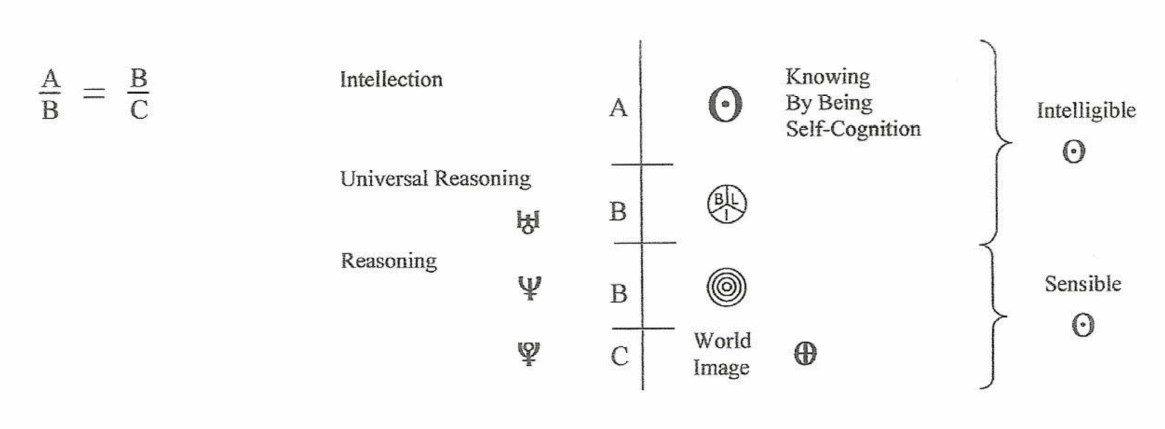
[FIGURE 1984 0210a-1-AB. Divided Line correlated with Four Levels of Sun Soul and Uranus Neptune Pluto. B L I = Being Life Intellect. Computer generated by NT from AB class notes.]
①+② Plotinus -- p. 386, paragraph 3 (V.3.5), paragraphs 4, 6 [Note: Plotinus, The Enneads.]
① = Intellectual-Principle. ② Activity of Intellectual-Principle (in the soul) -- everything Plotinus says about Intellectual-Principle applies at this level [words cut off due to xerox process]
P. 437 (V.9.5), third paragraph from bottom, p. 372 (V.1.4), second half of second paragraph -- quotes show inseparability of ① and ②
"Soul is the receptacle of divine beings" [Note: Plotinus, IV.3.1, second paragraph.]
①+② = Buddhi as Mahat, Universal Reason
①/② = World-Idea/World-Mind
You can experience the One and Void (One and Intellectual-Principle) above the soul (①+②), but what you understand of the three primal Hypostases is what is in your own soul.
When you reach the unity of your own soul, you experience the void of your own existence = Mercury [Pisces Nature] = Nirvikalpa.
Samkhya only takes you this far = kaivalya. The great purusha = Solar Logos, is still not beyond the level of kaivalya.
From that, inwardizing you can experience the three Voids which are the three Hypostases. Included in ①+② is ③+④.
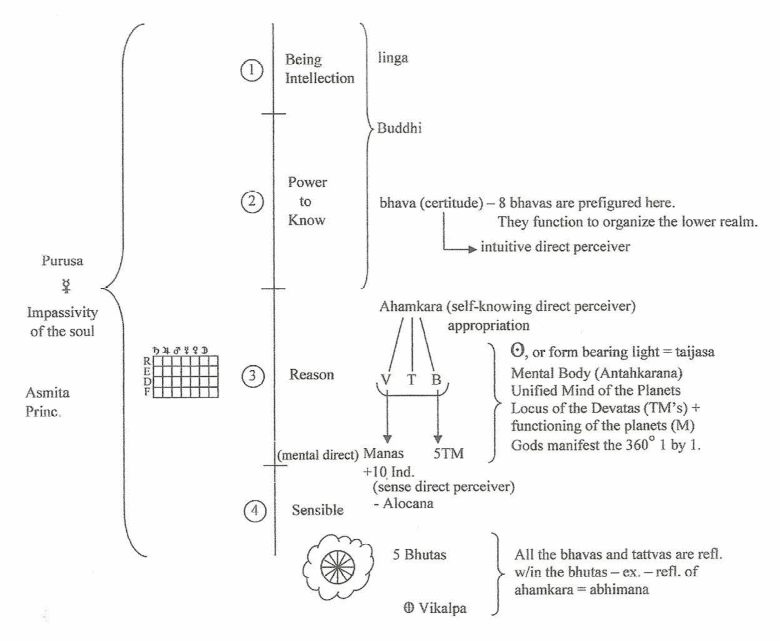
[FIGURE 1984 0210a-2-AB. Samkhya Scheme mapped onto Divided Line. Princ. = Principle; REDF = Rulership Exaltation Detriment Fall; V T B = Vaikriti Taijasa Bhutadi; TM = Tanmatra; M = Manas; Ind. = Indriyas; Refl. = Reflected/Reflection; W/in = Within. Computer generated by NT from AB class notes.]
Rulership Exaltation Detriment Fall = four pairs of bhavas as conditioning the levels of understanding of the planets.
In ③, planets are spheres including four levels and all signs. In ④ a planet is in a sign or degree.
The realm of ahamkara is constructing the Witness-I. This Witness-I or I-consciousness is a construct, and it then identifies with the planetary mind.
Yoga is from the point of view of the purusha willing itself into the cycle.
Samkhya is from the perspective of cosmic manifestation evolving itself separate from the purusha, which is independent.
[Classnotes AB 1984 0210 End]
DIAGRAMS FOR 1984 0210a
Class
Friday, February 10th, 1984
Verbatim, unedited transcriptClick the series name to view more
CLASS at Wisdom's Goldenrod, Hector, NY
with Anthony Damiani (AD)
February 10a, 1984
PLOTINUS; SOUL; DIVIDED LINE; SAMKHYA
with Appendix: Classnotes AB 1984 0210.
TOPIC: Plotinus
SUBJECT: Soul
SUBSUBJECTS: Divided Line, Samkhya, Solar Logos, World-Idea, Cosmology
CONTENTS:
Review of four levels of Sun and correlation with divided line
1) intellection as interpenetration and omnipresence of Solar Logoi; ultimate clairvoyant light before Nirvikalpa
2) universal reason; reflex of interpenetration of Solar Logoi as sidereal zodiac; modalized as knowing willing feeling; ideas as unrolled and separate
Top two levels represented by intelligible portion of divided line
Knowing willing feeling analogous to Being Life Intellect at level of Nous
Is Solar Logos individualized at level of universal reason?; no, that is still the Intellectual-Principle within the Solar Logos
3) reason; Sun and Chaldean planets manifest the Idea; undivided mind
4) world-image; Dragon; sensible appearance
Two lower levels represented by sensible portion of divided line; second and third section of divided line as geometric mean harmonizing Providence and Necessity
Do top two levels each have their own being and knowing?
Reading Plotinus, V.3.5, V.9.5, V.1.4, III.9.6, on Intellectual-Principle
Top two levels as Intellectual-Principle in any soul; Being and its activity/power
The only knowledge you have of the Intellectual-Principle is what you find in the soul; Sage knows anything through Intellectual Cosmos in his soul
Kant's reason not equivalent to Plato's dianoia; Kant discussing a priori categories of mentality
Is there such a thing as unity with the Intellectual-Principle and One?
Three levels of Dragon: 360 degrees, life activity, elements
Uranus Neptune Pluto at level of universal reason, reason, and world-image but each also rules over its own realm
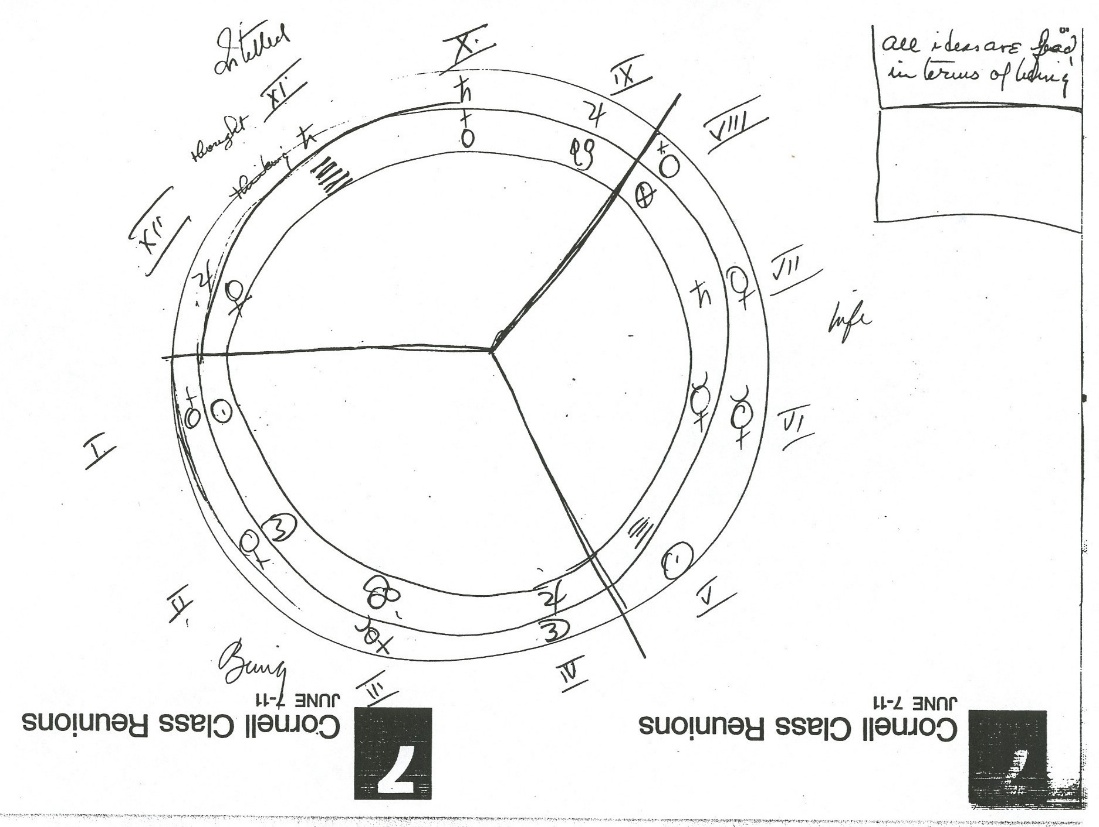
Levels of Sun/divided line correspond to twelfth house levels
Presentation of Samkhya scheme of 25 tattvas and correlation with divided line
Purusha as passive knower in Samkhya; not mapped onto divided line
If you concentrate on asmita you'll get total omniscience of World-Idea/Nature; no explanation in Samkhya or Yoga texts why that's so
Samkhya dualistic: soul on one side, Nature on the other
Is knowing willing feeling mine or something that belongs to World-Idea?; Samkhya says World-Idea, Plotinus says yours
Top two levels correlated with buddhi; absolute certitude; no error in Intellectual-Principle
Samkhya doesn't go beyond kaivalya, the loneliness of the soul; great purusha is Solar Logos, still not beyond kaivalya
Buddhi linga (substance, top level) and buddhi bhava (function, second level); eight bhavas prefigured in buddhi bhava; function to organize the lower realm
Ahamkara as I-maker with three aspects; evolves manas and indriyas on vaikriti side; evolves tanmatras (universal elements) and bhutas (particular elements) on bhutadi side; taijasa as form-bearing light
Tanmatras as felt substances of mental body/undivided mind; are the locus of all the devatas
A god (devata) focuses itself into the Sun and streams through the Sun; planets take that idea/god and manifest it; devatas not to be confused with gods at level of Dragon
At level of ahamkara/undivided mind, each planet has all the dignities within its sphere, doesn't move from dignity to non-dignity; no appearance yet but more actual than what you see at bhuta level
Bhutas as realm of compounded elements forming material body; conditions sensible appearances rather than being their cause; all bhavas and tattvas reflected within bhutas
Knowing function associated with each level; correlation with Buddhist position
Clock analogy for ahamkara and bhuta levels; three levels at sense/bhuta level
Mundane gods are the agents and vehicles; world-image constantly altering at level of bhutas; prefiguration of that altering comes from planet's undivided mind
Planets as symbols/signs rather than causes, material bodies not causes
Realm of ahamkara is constructing the Witness-I; in Buddhist terms, klista-manas fabricates subjective side
Witness-I as your higher individuality, as the knower
Four bhavas reflected at bhuta level as four psychological functions
Soul has knowledge of all levels simultaneously; empirical individual only knows psychologically and denies intuitive knower
Two interpretations: 1) knowing functions both cosmic and individual; 2) tattvas are cosmic and their functioning in the individual is the knowing functions
Appendix: AB class notes
BOOKS READ FROM OR REFERENCED:
Plotinus, The Enneads (MacKenna translation, 4th ed.)
Paul Brunton, Notebooks
Krishnachandra Bhattacharyya, Studies in Philosophy, Vol. 1, "Studies in Samkhya Philosophy"
Plato, Republic, Parmenides, 7th Epistle
PLOTINUS QUOTES READ OR REFERENCED: I.1.8, II.3.7, II.3.9, III.2.2, III.4.3, III.4.6, III.9.6, IV.3.1, IV.8.4, V.1.4, V.3.3, V.3.5, V.5.1, V.9.5, VI.7.7
DIAGRAMS appended to this transcript:
FIGURE 1984 0210a-1-AB. Divided Line correlated with Four Levels of Sun Soul and Uranus Neptune Pluto.
FIGURE 1984 0210a-2-AB. Samkhya Scheme mapped onto Divided Line.
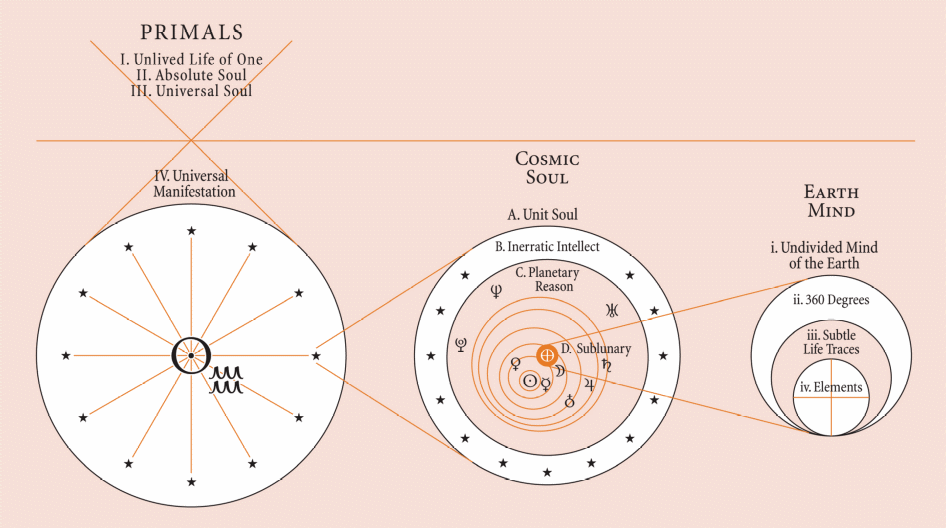
FIGURE 1984 0210a-3. Fourfold Cosmic Soul.
FIGURE AD_E_010. Intellectual-Principle as Being Life Intellect.
FIGURE 1984 0210a-5. Nested Levels.
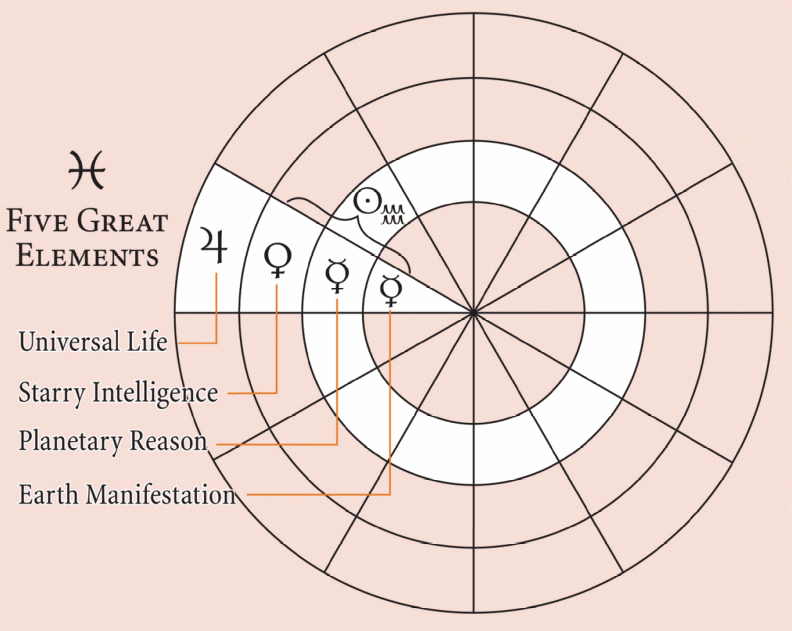
FIGURE 1984 0210a-6. The Central Sun and the Levels of Pisces.
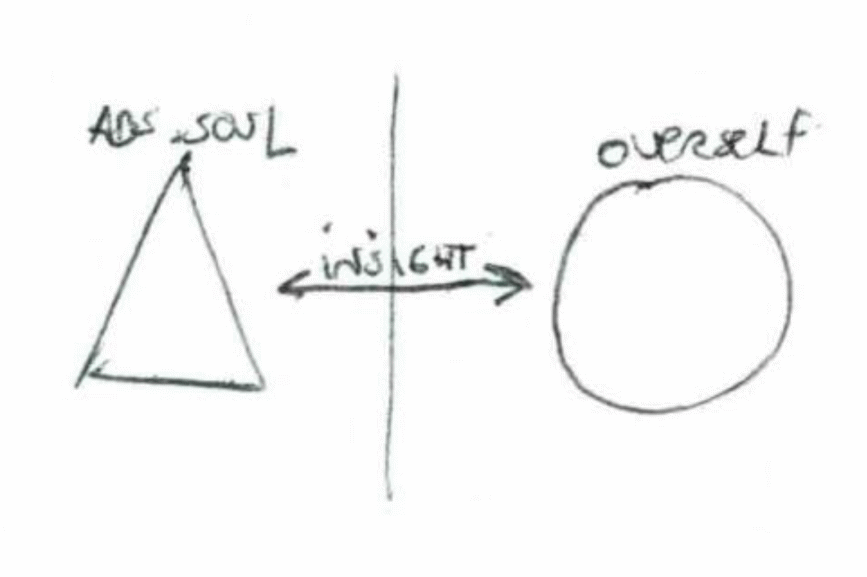
FIGURE 1984 0210a-7-AB. Overself and Absolute Soul.
[Transcriber note: [diagram] means the speaker is referencing a diagram as he or she is speaking. If someone is drawing or writing, with audible sounds of chalk on a blackboard, I indicate this by [drawing] or [writing].]
NOTES:
This is 1984 02/10a, Plotinus; Soul Class, and the first entry associated with this date. 1984 02/10b = Divided Line Seminar, for which we have no audio, just JF notes.
Earlier partial transcripts exist. As of Dec. 2023, two have been scanned. Scan File 1984 0210 PLO F38.PDF is a 38-page version by Mark Scorelle, 1986, and is a transcription from Tape 1 only. Scan File 1984 0210 PLO F12.PDF is a 12-page version which used both audio cassette tapes (and possibly notes).
AB class notes have been appended because they contain diagrams that AD refers to in the class and also because we are missing the second audio file for this class. They thus help round out the class. All spelling, capitalization, and punctuation corrected, all abbreviations spelled out in AB class notes.
Partial Transcript for missing portion of class follows first audio file verbatim transcript. Typed by IT from 12-page older transcript version.
TRANSCRIBED Verbatim by IT prior to 2018, reformatted by jf 2018. In 2023, IT updates prefatory matter, footer, and audio file name, expands Subsubjects, completes Book List and TOC, adds Plotinus quotes section, fixes errors/typos, adds new notes within transcript, redoes appendix by typing out/correcting AB class notes, adds five more diagrams and references within transcript to these diagrams, reformats to accord with new conventions. Archival verbatim transcript – V12a.
AUDIO FILES: 1984 0210a. [Note 1: "Tape" and "Side" refer to original audio cassette tapes that were later digitized into .MP3 Audio Files. Note 2: We are missing the second audio file for this class.]
1984 02/10a at Wisdom's Goldenrod
Plotinus; Soul; Divided Line; Samkhya
[Audio File 1984 0210a Begins]
AD: --is the upa-- people are gonna put a paper together on philosophical synthesis. Alright, we'll do it our way and you do it your way. (laughter, student words)
VM: You mean there's a right way and there's the wrong way, is that what you're saying?
AD (simultaneously): No, no, there may be many right ways.
VM: Ok. (VM laughing)
AD (very faint): There might be many right ways.
S (faint, possibly part of background): I just wanted to [couple/few words inaudible]
S (simultaneously, possibly part of background): [few words inaudible]
AS (faint, possibly part of background): As long as they're right [one word inaudible]
AD: Yeah, I wanted to make an announcement. We'll get-- we're gonna get together soon in a month or two and I'm g-- [tape break] Is that correct?
S (faint): I know what it's called in India.
AD (simultaneously): Samkhya.
LR: Samkhya.
AD: And Platonism.
S (faint, possibly part of background): May I use [couple words inaudible]
S (faint, possibly part of background): (Let's hope.)
S (simultaneously, possibly part of background): Next week.
AS: Vedanta and the world. This week Samkhya, next week the world. Well--
AD: That's assuming [AS simultaneously: You--] they remember the little about Samkhya(--) (or/oh) Samkhya [AD pronounces differently each time].
AS: Yeah, that's true.
AD: That's important.
AS: Ok.
AD: I mean, if you did any studying in the past--
AS: Gonna need it now.
AD (simultaneously): Remember we did (the) Samkhya, we studied it a lot? And, you-- is-- if you don't have it for background you're going to find it difficult. Don't bring up the question about failure on your part. I'm not interested.
AS: Ok, well may-- I guess we'll start out with the-- the cosmological scheme that we did last week and show first how that fits in with the divided line before we bring in the (chunk-- chunk) here.
AD (simultaneously): Yeah, quickly review what we did last week, (go/we'll) rush through it. [Note: See WG Class 1984 0203a.]
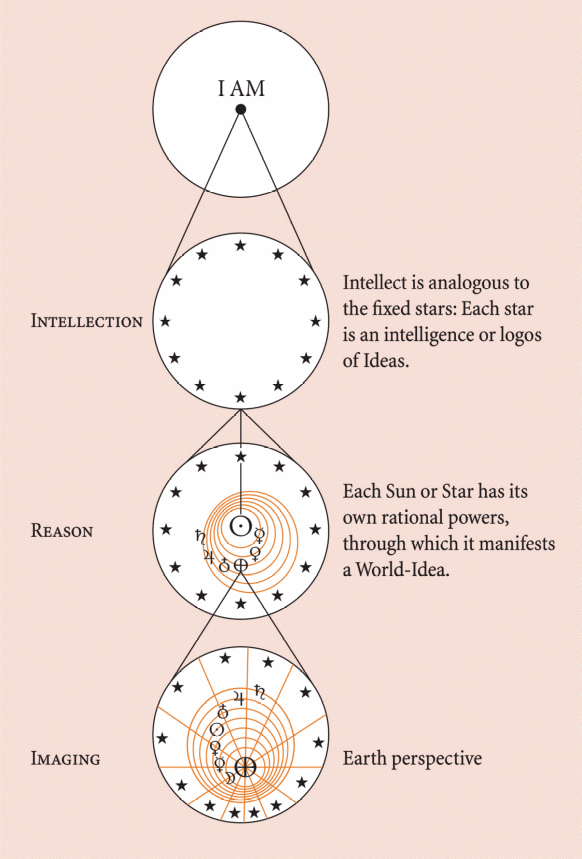
[Note: See FIGURE 1984 0210a-3 for the following. This diagram is from Astronoesis, p. 206.]
AS: Ok, last week we spoke about these levels within the soul of the Sun, and we laid out these various levels that are all [drawing] within the I AM principle or from the point of view of the I AM principle of the Sun. And we were leaving out this consideration and now just considering a Solar Logos [diagram]. And we can distinguish four-- I-- we can distinguish these four levels or phases--
MB: Do you want to elaborate on that diagram (first) please? (some laughter)
S (amidst laughter, faint): [couple/three words inaudible] get close to the bottom.
AS: Yeah, you got it, that's it. (some laughter) And, at the first level, we spoke about the soul of the Sun as interpenetrating with all the other Logoi in this inner-- in this inner vision which represented the wisdom or intelligence of all the Solar Logoi, all the illumination of the totality of all these Logoi interpenetrating with each other, which represented this illuminated emanation from the Nous say, ok, and each Solar Logos was interpenetrating with all of the others. And, that-- at that level-- Oh. I think also at that level we can speak about the participation in the Universal Soul as well. But I think maybe we should leave that.
Now the ne-- the second level we spoke about a reflex of this intelligence, that each Solar Logos would interpret-- had its own interpretation of that wisdom-knowledge of all those other Logoi which it represents to itself or knows in terms of its own sidereal zodiac, we could say. So on the one hand we would have Being, a state of Being, a state of Being-Consciousness interpenetrated, omnipresent with all the other Solar Logoi. And at the second state we could say that this Solar Logoi-- this Solar Logos through its own universal reasoning would interpret that to itself as its own intellig-- as its own belt of the sidereal zodiac or its own reason-principles, its own universal reason-principles.
[Note: See FIGURE 1984 0210a-1-AB for the following.]
And those-- those top two would correspond to the first two levels of the divided line, where Plato puts the Intelligible Sun, [drawing/diagram] and he says that that Intelligible Sun or the Idea of the Good he says impart-- the Idea of the Sun-- the Idea of the Good imparts the Being to what is known or truth to what is known and imparts the power to know to the Knower. [Note: Plato, Republic, Book VI.] So the Being or the truth of what is known is the totality of all of these Solar Logoi interpenetrating with each other. And that we said is equivalent to its-- the Solar Logos's experience of the Nous, of the Ideas. So that's like taking and considering the big chart of all the Ideas as One-Being, as the Intellectual-Principle, but now as it's emanated in terms of all the Logoi, all interpenetrating with each other.
And I think that that's also equivalent to the level of the life of the Demiurge. In other words, the Demiurgus' life, the ten-- that tentative illumination, [Note: See Plotinus, VI.7.7, third paragraph.] is the same as the shining out of all of these-- [AS indicates on diagram] of all these Solar Logoi. And that's like the first state of the World-Idea in [VM assents, faint] some way. PB has a-- has a line somewhere where he says that the-- the cosmic vision that's granted rarely is like the light of a billion Suns. And I think it's not like the light of a billion Suns, I think it is the light of that billion-- [Note: Paul Brunton, Notebooks, V16, 27:1.74.]
VM (simultaneously): So that's like (in) Krishna's vision, (sort of the) [one/two words inaudible]
AD (simultaneously): No, that's the ultimate clairvoyant vision [AS assents] that you have, the ultimate clairvoyant light.
VM: Is this one Anthony you're saying here?
AD (simultaneously): Yeah.
AS: I think--
AD: Before Nirvikalpa.
AS: Before-- yeah. And-- so this-- in Plato's terminology this is a state of Being [drawing/writing] and the reflex of that, and we're speaking from terms of the Solar Logos, is its knowing of that gets modalized. Its in-- its universal reasoning is modalized according to knowing, willing, and feeling [diagram]. The reflex of that interpenetration with all those Ideas is to now distinguish all of those Ideas through knowing, willing, and feeling. So here the Ideas would in some way be ordered or unrolled and separated within the Solar Logos as its sidereal zodiac.
VM: I don't understand knowing, willing, and feeling there, you're bringing in the trans-Saturnians or we don't want to make reference to that or-- I just don't understand [AS simultaneously: Well--] where the tripartite thing comes in.
AS (simultaneously): Yeah, I [AD simultaneously: Try with the insight.] think that it's the reflection of Being(--/.)
AD: Try with the insight.
AS: Excuse me?
AD: Insight, modalized.
AS (simultaneously): Yeah, yeah. [drawing] If we say that this way it has insight into its own essence, [VM assents, faint] when it's interpenetrating with all the others. But this way that insight as it were is modalized in this triple form [diagram]. Now that triple form might be a modalization of the Being, Life, and Intellect [AS indicates on diagram] which are inseparable in the Intellectual-Principle or in terms of Being. But here that intellection, that insight is modalized in this triple form. And-- yeah, and the symbolism, I think the Uranus, Neptune, and Pluto would be what symbolize that. [drawing]
In other words-- remember we had like this boundary [diagram], we consider the Sun on the one hand was interpenetrating with all of these other Solar Logoi and it-- and it both has an insight into that and also tries to differentiate that through knowing, willing, and feeling. But now within itself it's going to manifest that World-Idea through its seven Chaldean planets and through body, as body, and that'll be the lower part of the divided line [diagram]. So the lower part of the divided line is like what the Sun manifests within itself of that World-Idea. The upper part is the Sun's contemplation of the Solar Logoi and the way that it interprets that contemplation as these universal reason-principles. So, in some way I guess-- I mean it might correspond to the Uranus, Neptune, and Pluto. [student assents, very faint]
But I think the idea was that looking this way [diagram] we talk about just pure insight into its-- into Being or self-cognition and this way [diagram] that gets modalized, looking at it the other-- the arrow the other way, that gets modalized through knowing, willing, and feeling. And now we speak about the Ideas as unrolled and separate. I think analogous also to the way we spoke about here, the Intellectual-Principle would be like a one-many but indistinct-- a unity. And here [diagram] we would speak about something like (a/that) Separative Intellect [VM assents, faint] that would distinguish all of those Ideas, and yet not-- not yet manifest them within itself through its powers. [VM assents, faint] (It/It's) just the way it would know it to itself.
S: Is that [KD simultaneously: Avery?] also--
AS: So, we'd have here-- so Plato-- I call this universal reason, [drawing/writing] (if) I put in the word 'universal' just because of (the system) of reason, and this he calls intellection [diagram]. [short pause while drawing/writing] Here knowing all of the other Solar Logoi by being identical with them or in identity with them and not distinguishing one Idea from another. And here the state of distinguishing all of those Ideas within itself as an interpretation of that wisdom-knowledge which was here. So Plato says this is the power to know [diagram]. And this is the truth to what is known [diagram]. So the two of these are really-- seem-- for the Sun, it seems it's almost impossible to distinguish those from its point of view. Coming up this way [diagram] we say well you have to have this knowing, willing, and feeling developed and then you have to-- then that gets merged or transcended as insight, going up this way. But for the Sun which has that intrinsic cognition and has these knowing, willing, and feeling ways of apprehending, those are simul-- they have to be going on at the same time. It's not like it needs to develop knowing, willing, and feeling. It has those modes of apprehending its own content.
AD: Another way of looking at that, because this is a very difficult part, [AS assents] if you-- you know when we make the chart of the-- the metaphysical chart, and we conceive the Intellectual-Principle as a one, alright. But we could also see it as Being, Life, and Intellect [FIGURE AD_E_010], [VM assents] alright. At that level it might be better to say instead of knowing, willing, and feeling, [someone drawing] Being, Life, and Intellect, alright. Where-- whereas when we come down we speak about knowing, willing, and feeling. But, if you think of the chart, and you grasp it in its unity, the who-- the whole of the twelve signs, alright, and you'll see the first four represent Being, the second four represent Life, the third represented Intellect [diagram], there's like a modalization of the Intellectual-Principle. [VM assents] You have its unity but you also (has this) triple modalization, alright. So at that level we really have to speak of Being, Life, and Intellect rather than willing, knowing, and feeling. [VM simultaneously: But there is (something--)] Because they're anthropomorphic terms.
VM: Yeah. But there is a real distinction though when you go from the top level to those-- to the level of universal reason, there's some sense of individuality, I mean it's one Solar Logoi that's being, what shall we say, (physicalized), concretized, and identified--
S (simultaneously, possibly part of background): [couple words inaudible]
AD (simultaneously): No, no.
VM: Not yet?
AD: No, you're forgetting everything that you read about the Intellectual-Principle.
VM: But I thought the way Avery was talking about this, I guess I misunderstood, was it's our Sun's [AS simultaneously: (Only)(--/.)] vision.
AD: Yeah.
VM: Ok.
AS: That includes all. [AD/S(?): Uh-hm.] Each [VM simultaneously: But I thought--] one is a form of the whole.
AD (simultaneously): That's the Intellectual-Principle in the Solar Logoi. [VM simultaneously: The top (one).] Just like in an individual [VM simultaneously: The top?] soul, that's the intellectual cosmos in the soul.
VM: The top one.
AD: Yeah.
AS: Yeah.
VM: But-- but the transition be-- from there down to universal reason, you wouldn't say some sort of individuality is-- is being precipitated out of that unity?
AD: Well--
VM: I mea-- I mean it's not a big point, I'm not sure it's worth pressing.
AD: I mean if you take the unity of the Intellectual-Principle in the top level, alright, and then you say, like Plotinus said, unroll the Intellectual-Principle so that you have the differentiation of Being, Life, and Intellect, I don't see how you call that individual. [Note: See Plotinus, I.1.8, third paragraph.]
VM: Well, I-- here's one reason. For example, Avery said before that our particular Sun's interpretation, if I can use that word, interpretation of that universal interpenetration of all the Solar Lag-- [AD simultaneously: Uh-hm.] Logoi (in) the top could be symbolized by the sidereal zodiac, which is not all 360 degrees or no, 4 (pi) of the sphere but is only the band, right? [AS simultaneously, faint, almost to himself: Yeah (one/two words inaudible)] So, I don't know, I don't want to make too much of physical symbols that shouldn't be carried perhaps too far but somehow I thought there was a-- a limitation or a-- well, let's not say limitation, an emphasis of one particular Solar Logoi that would correspond to some kind of individuality at the (level) but if it's wrong, fine, it's wrong but--
RC: Actually I wanted to ask you a question about the sidereal zodiac.
VM/S(?): Yeah.
RC: Would that belt always have the same stars as a backdrop or is it conceivable that if you add the time dimension that (it then--)
AS (simultaneously): It doesn't always have the same stars.
VM: No, there's some precession of the equinoxes.
S: [one/two words inaudible]
AS (simultaneously): And also 'cause the axis of the Earth is--
VM: Spins around (them/those), yeah.
RC: So like if(--/,) at any point--
AS (simultaneously): Spinning around the pole. It's only (from) where the North Pole is now that it gets that particular--
VM: Right. [RC simultaneously: So--] So there's a band.
AS (faint): Ecliptic, (yeah).
RC (simultaneously): At any point in time there would be a band but if you bring in the time dimension, does that band transform itself after a while?
VM: I don't think so, the band has a certain [AS simultaneously: (No--) yeah.] thickness because of the precession that Avery [one/two words inaudible]
AS (simultaneously): It's 23 degrees.
JC: But do you mean do the stars change that are considered?
AS: And that may [RC simultaneously: Yeah.] change too.
JC: Well, yeah, as the [VM: Well it (jars) it.] Sun moves around the galaxy it's going to shift the whole panorama.
AS (faint): That's right.
S: Well plus more stars are within each realm of each star too, right? [VM simultaneously: Yeah, I mean--] The big bang theory.
VM: The-- the sphere of the fixed stars is only relatively fixed, but I don't think there's any confusion with that. I-- I just thought that by saying that it's the sidereal zodiac which you're symbolizing by this circle here--
AS: Well--
S: He may be [couple/three words inaudible]
VM (simultaneously): I don't know, I-- I don't want to-- [AD simultaneously: No, go ahead, go ahead.] I don't want to distract you from where you're going.
AD: Go ahead. I don't understand the bringing in of individuality.
VM: Well, it may be totally inappropriate, it's ok.
RC: Well it seems to be dependent on how the sidereal zodiac is understood, whether it becomes a limited number of--
VM: Of Ideas.
RC: Of Ideas that are included or if you're still dealing with the totality of the Ideas. [short pause] [possibly another student: But (PB--)]
VM (simultaneously): [one/two words inaudible]
AD: Yeah, I follow what you're saying but I still don't see why that refers to individuality.
VM: Alright, let's say this. [AS simultaneously: And he's-- I think he's agreeing.] The top realm is universal interpenetration of all the Ideas, you have a particular-- a Solar Logoi, our Sun for example, has a particular vision of that totality. That vision is symbolized by the sidereal zodac-- zodiac which is an excerpt from the totality of all possible Ideas. And I thought that excerpt helped to define a kind of individuality. Now, it may be just all wet.
[student assents]
[short pause]
AS: Or-- [drawing/writing]
[short pause]
BS: You mean individual as limited in scope?
VM: Well, it's not the infinite, I mean it's not what's above. I'm just trying to-- you know, I'm just trying to make a distinction for myself, or trying to understand the distinction between those two realms. What comes below I think is relatively easy, when you start speaking about the planetary spheres and so on. How to distinguish that from the upper I think is-- is simpler for me anyway. But to make a distinction between those two top realms, between the intellect and universal reason, I'm just looking for handles to grab.
RC: Seems the-- the question of individuality is being brought in with respect to the content side.
VM: Yeah, substantially they gotta be the same(,) (yeah/though).
[short pause]
DB: Well, there's also-- I mean (with) any given Solar Logoi is going to have a whole host of-- of individual souls associated with it. Right? I mean, our Sun has--
S: Namely you.
DB: Yeah. Yeah, right, exactly, not some other Sun.
AB (faint): Just right for you.
DB: And that sort of specificity has got to come in somewhere. Right?
RG (simultaneously): Well maybe if we see the whole thing unfolding [few words inaudible]
VM (simultaneously): Yeah, ok, it might be a premature question and I'm sorry if I distracted the flow of things.
AS (simultaneously, faint): No (it wasn't really a distracting--)
AH (simultaneously with VM and AS): I don't understand-- I don't understand the question. Could you state it just--
VM (simultaneously): Maybe we could state a question again after Avery lays it all out. Does that seem like a sen-- [student assents, faint] more sensible thing?
[student assents, faint]
RG: Yeah.
AS (faint): Well, I don't know, it wasn't that distracting a question. But I think--
VM (simultaneously): I'm just trying to understand the distinction between the top two realms, that's all.
AS: Yeah, and I think that--
AH (simultaneously, faint): [possibly one word inaudible] (principle--) principles of individuation?
AS: I think the way we were trying to understand it, although I-- I follow what you're saying, is just in that analogy with the Intellectual-Principle. If you just conceive the circle of the Intellectual-Principle and you say it's one. If you just take that same Intellectual-Principle and imagine everything within it as distinguishable or distinguished, then you consider it through the power to know as well and then you-- then you distinguish it as a many [diagram].
S (faint): Ok.
VM: So symbolically it's a-- [AS: So I don't--] the top realm can be symbolized by a circle. Now if I break that circle in three pieces that's (the) secondary realm or the realm underneath it.
[simultaneously] [student assents]
AS: Yeah, something like that.
VM: Symbolically anyway, now what stands for them.
AS (simultaneously): Like this one circle [diagram] is the interpenetration of our Solar Logos and all the other Solar Logoi, ok, and now when you speak of that as-- that interpenetration as modalized, and--
VM: But (you went--) didn't go from-- I'm sorry Avery, let me persist a little bit.
AS: Yeah.
VM: You went from a sphere to a s-- to a disc.
AS: Yeah, I know what you're saying, that makes sense to me.
VM (simultaneously): And so there is a little different qualitatively [students assent] than going from a circle to a threefold circle. [student assents, faint] And that's all.
AS: I'm-- it made sense to me what you were saying, that here-- that here it's the particular-- it's an in-- it's an interpretation of all-- of the entirety [VM: Yeah.] then it is a particular sidereal zodiac. But that-- that may not come out till-- till a lower--
VM: Ok.
AS: That may not actually come about till a lower stage. But I follow that distinction what you're saying.
LR: But you even said that same thing today, you said that second realm--
AS (simultaneously): (Yeah I did.) Yeah.
LR (simultaneously): You said that second realm was a particular Solo-- Solar Logos's [one/two inaudible AS words simultaneous with LR] version of [student assents] the Ideas.
AS: Well that was just a way of understanding what I don't understand. (laughter)
S (amidst laughter): [couple words inaudible]
VM (simultaneously): But [AS simultaneously: But then--] then we're all groping around, [AS simultaneously: Right.] let's keep groping. (VM laughs a bit)
AS: Yeah, I-- and I was agreeing, I'll-- I mean I was basically agreeing with what Vic was saying. I don't know how to-- how else-- I think the objec-- maybe Anthony's objection was in terms of calling that individual.
[students assent]
AS: Because in some way this [diagram] does represent the entirety of the Solar Logos in a unique form. I don't know if we could say more about that.
AD (simultaneously): The only individual you have there is the Solar Logos [AS simultaneously: Solar Logos.] itself [student assents] within which everything is-- is placed.
VM: That's right but it's one Solar Logos, isn't it?
AD (simultaneously): But the select-- the selection from the universal Ideas of a certain number from that total you referring to as individual and I don't understand that.
AS (simultaneously): Yeah.
VM: Well maybe it's a bad choice of words Anthony, [RG/S(?) simultaneously: No but if you took--] but it is a unique Solar Logos, isn't it?
AD: Yeah.
AS: Yeah.
VM (simultaneously): It's not some other one.
AD: Yeah.
VM: And [one/two inaudible student words simultaneous with VM] that's all I was trying to say is it's got to be a unique one. Now maybe individuality is a ima-- inappropriate word, and--
AD (simultaneously): Yeah, that's the whole point, [AS simultaneously: That was what he was saying.] that's why I didn't understand you.
VM: Alright, what word would you use for it? Unique or--
AD: I'm just-- I-- I'm just leaving that blank.
VM(?) (faint): Ok.
AD: That the Solar Logos interprets, you know, only certain-- a certain selection from the total Ideas [VM simultaneously: Yeah.] poured forth out of the Nous, [S: Right.] I mean, if you ask me for a reason we would say well that would be inherent in the Solar Logos but I don't know, [S simultaneously: Yeah I--] I have no idea.
VM: Ok.
AS: (This--/It's) like saying that, at the top level you have the whole Logos, the entirety of all of those, and here it's elaborating or it's with [possibly one word inaudible] particular locus. Now I-- I think the objection was mainly to just that word 'individual'.
VM: Yeah, ok, fine.
AS: Let's say it's a unique view of the whole.
VM: Alright.
RC: When it's said that each--
AS (simultaneously): But even that is--
RC: When it's said that each Solar Logos elaborates or formulates its own World-Idea, at this second level are we to conceive of-- of each of the Solar Logoi forming a World-Idea which is distinct from the World-Idea formed by any other one?
AD: Yes.
RC: And so each would be-- each would be formulating a complete World-Idea but not necessarily including all the possibilities of the higher level.
S: Yeah.
AD: Yeah, and I can understand that and that's a selectivity, you know, that's going on but I don't understand that in any way as(--) the-- the word 'individual' just throws me into--
VM: Ok. Bad word.
RC: But here you actually do have like the reason-principles of the universe being formulated.
AD: You have the reason-principles or the universal Ideas considered as an intellectual unity, and you have that same intellectual unity, so to speak, modalized in (the/a) triple form. [student assents] You haven't done anything, you haven't made any selection of anything (up top). [S, faint: Ok.] You have to start out that anything that's above is going to be below.
S (very faint): Ok.
RC: So could you say that each one say has the-- has the entirety of the Ideas [AS simultaneously: Yeah, in a unique form.] within it [AS simultaneously: In a unique form.] but its thinking elaborates them in a unique form.
AD: Well the word 'thinking' there is begging the whole question, [RC simultaneously: Yeah.] that's what we gotta fight about.
RC: Ok.
AS: (Well/Or) why don't you just leave it at each one has the whole in a unique form, instead of each one thinks the whole in a unique form.
RC (simultaneously): Why-- I think that's really the question. I mean it [AS simultaneously: Yeah.] seems-- it seems to me each one has the whole as the whole. [couple/three inaudible student words simultaneous with RC] But a distinctness of the form seems to be what's coming in at the second level.
AS: Yeah, the objection was just to thinking it though.
VM: Let-- let me ask this question [AS simultaneously: Except (one/two words inaudible)] which I think it ties in very much with the use of thinking or not. [AS assents] If you dropped-- dropped or whatever, neglected the bottom two levels of the divided line as you're doing, would it still then--
AD (simultaneously): That would be the intellectual cosmos.
VM: Pardon?
AD: That would be the intellectual [one/two faint inaudible AS words simultaneous with AD] [VM simultaneously with AD and AS: Right.] cosmos in the soul.
VM: I understand that, ok.
AD (simultaneously): It's one and the same in all souls.
VM: So there would be no way to distinguish one [AD simultaneously: Uh-huh, (nother--)] soul from another without that bottom realm.
AD: Yeah.
AS: Right.
VM: Good, that helps me to understand that.
[student assents]
VM: Wasn't that (some of the one weren't you working)?
RC: Yeah, you (say/said) the bottom two. (Did/Could) you name the bottom two [one/two words inaudible]
VM (simultaneously): I meant(--) [AS simultaneously: Yeah.] from that thick line down [diagram], ok.
AS (simultaneously): No he means this-- this whole thing [diagram]. If this was dropped off you'd just have the intell-- the Ideas within the soul, within [student assents] the Solar Logos. And, I think he said that the Being and Knowing form a unity here, in some way.
VM (simultaneously): So without the World-Idea there's no way to distinguish one Solar Logos from another.
AS: I think that would be the idea, that only once you see how that unique Idea as it were begins to unfold down here, [VM: Yeah.] that you would begin to distinguish(--/.) From here, here's the guy down here sees-- you know, he sees this band of the zodia-- of the sidereal zodiac and says, "Oh, well, that must represent the unique vision that this Sun has."
VM (simultaneously): In fact but I think it's may be--
AS: But actually--
VM: It may be inappropriate to speak about sidereal [AS simultaneously: Sure. Yeah.] zodiac up there because, [AS: Sure.] you know, that really requires an Earth-based view in a sense, [AS simultaneously: Yeah.] you know. [S: Yeah (one/two words inaudible)] Anyway, I don't want to quibble about words.
AS (simultaneously): But just some name for it.
VM: I don't want to quibble about words.
AS: Yeah, so this is the Intelligible [diagram]. And, he says that this is-- [drawing/writing] this is ruled over by the Intelligible Sun. Now that seemed to be a clue that this was referring to the soul of the Sun. Whereas now at the second half of the divided line, he's speaking about the way that that is-- the power of the Sun is gonna actualize that World-Idea, the way its powers, its reasoning powers are going to unfold that Idea as a sensible world here. (I mean) so this [drawing/writing] would be the point of view now, instead of the Sun in relation to all the other Solar Logoi or the intellectual cosmos, which is within it really, interpenetrating, now we're talking about the Sun with the seven Chaldean planets circling around it [VM simultaneously: There you can speak about (few words inaudible)] as manifesting-- as manifesting that Idea.
But at this level we're speaking of it also as-- and the funny thing is both of these are equal in length on the divided [student assents, faint] line. And this is also a kind of reasoning activity. And here we spoke about it as this whole undivided-- here we spoke about all the souls ha-- all the Sun soul's powers (as/is) a kind of undivided whole, the totality of its reasoning powers. And once that establishes a locus for these [drawing] individual planetary souls, then we could speak about on any one of those planetary souls there's going to be a primal image and so on, within ea-- its Dragon, within any one of these souls, planetary souls, there will be an appearance, a sensible corporeal appearance and that corporeal appearance for any particular planet, for example our Earth, will happen at the fourth level. And now of course it's gonna get involuted because at this level there's gonna be levels-- all of these are gonna be reflected down again within it. But this would basically be any-- any particular planetary-- planetary soul would have its own Dragon, its own [drawing] world-image, its own primal image, which is a manifestation of this undivided mind over here [diagram]. And that that-- that's gonna be a question of how this particular world-image precipitates out for each individual-- for each planetary soul and then the individual soul. So like all our unit souls are conjoined with this whole solar system or this unified reasoning. We-- I think [VM simultaneously: (couple words inaudible) the undivided mind (possibly one word inaudible)] we referred to this as an undivided mind. [student assents, faint] [drawing] Yeah, and a whole, you know, a unified reasoning considered as the reasoning of the Sun soul. So this would be the undivided mind of any one of the planets. Ok?
And then, finally, within the belt of any one of these planets will occur the manifestation of a pri-- of an im-- of the sensible world, or the world-image, I guess. If we want to say this is World-Idea [diagram], this would be world-image [diagram]. [students assent] And Plato says some nice things, for example, that the [drawing/writing] intellection is to this piece, if we call this A, and these are equal in length, and this is C, in some ways this universal reason and this reasoning here [diagram] are the obverse side of the same-- Well, I think we should do something else (now).
VM (simultaneously): I think you mean A [couple words inaudible] (to C do you)?
AS: What?
VM (faint): You mean that formula?
AS: Yeah, yeah. [drawing/writing] That's the way he does it is that this-- that A is to B as B is to C, he has the same mean, B forms a geometric mean between [VM simultaneously, very faint: Uh-hm.] the two [diagram]. [VM, very faint: Ok.] Plotinus says that the universe is the meeting ground of Providence and Necessity, and that the soul harmonizes the two. [Note: See Plotinus, III.2.2, second to last paragraph.] Now what the Greeks meant by harmonizing [drawing] two quantities was you put a single mean between them, such that A is to the mean as the mean is to the third thing, C. So in this sense I mean it actually is showing that this realm-- these two realms are harmonizing the-- the realm of Providence, the intelligible Idea, and the sensible manifestation. That's one-- one thing. And I guess another-- well let me see. [possibly half/one word inaudible] sensible. [short pause while drawing/writing] Maybe there are some more que-- but, I looked at-- (Oh.) I see. Maybe there's some--
RG (simultaneously): I-- I still don't understand why the A, the upper level, is the content of knowledge and the universal reason is the knowing of it. It seems each one should have its own being or its own level of knowledge.
AS: But-- well, I think this one [drawing] is a Knowing by Being [diagram]. This [student assents] is intrinsic self-cognition or the self-- it knows its essence as itself. I don't think there is-- I (don't) think he's saying there isn't cognition, there is. It's cognition by Being. But here the cognition is distinguished from the Being [diagram]. And the cognition is distinguished as Being, Life, Intellect. When the cognition is distinguished from the Being, [drawing/writing] the Beings are also distinguished from each other or unrolled and the cognition too is distinguishable.
RG: But though-- so then you would say what you know is not A but the contents in B.
AS (repeats to himself): What you know is not A.
RG: Because if the [AS simultaneously: It's not not-A.] cognition is separate from the Being but it can't be conceived of as A as it was in A, in--
AS: But it's not not-A.
RG: Nothing's not not-A. (bit of laughter)
[VM laughs a bit or assents]
AS: That's right.
RG/S(?) (simultaneously): Ok.
S: What? (some laughter)
S (faint in background): What?
AS: But-- yeah, I guess the way we were trying to say it is that this is the modalization of this [AS indicates on diagram], you know, whatever that means.
PD: Or like the intentionality of the knowing function at the reason level is always towards its prior.
AS: Yeah. (Alright) but that what it-- but that what it actually grasps is this distinguishable. Since these are [drawing/writing] incapable of dir-- of grasping immediately this entirety of Being, what-- what it's grasped as say is this distinguishable content [diagram]. But I don't think you would say there isn't knowing, it's just that here the knowing is by identity with Being.
RG (simultaneously): Right, but you could make the same analogy on the knowing level as you do on the Being level, I mean when you follow the Being down you say what it knows is A, what it knows is the intelligible even though it's operating from the level of universal reason. But why wouldn't you also follow the knowing-- the knowing side down and say that, as you just did, the knowing modali-- the insight modalizes itself.
AS: I did. That's [RG assents] right, the insight modali-- I think that's right, both. The insight modalizes itself as this Being, Life, and Intellect. At the same time, the Being gets modalized, the Being meaning the Idea, the intelligible, gets modalized as distinct Ideas.
RG: But isn't the modalization of the Being, the Being in the-- in the Being, Life, Intellect? That's not--
AS (simultaneously): Yeah, I don't th-- I don't--
RG: And you just said the knowing gets modalized as the Being, Life, Intellect.
AS: Yeah, and also the Being. But here [diagram] it's the knowing that's primary and here [diagram] it's the Being that's primary.
RG: That I don't understand, [AS simultaneously: Well 'primary' is the wrong word.] (like) why the (knowing is primary in one and it's Being in the other).
AS: Ok, that's the wrong word probably.
RG: Maybe or I just don't understand it.
AS: I'm not sure I see [one/two very faint inaudible words]
PD: (Well) you know in the 7th Epistle he puts reality above the means of knowledge.
AS: Yeah.
PD: He puts what is known, the real, and then the-- he has four levels of cognition.
RG: Right but, to say what is known is already-- I mean yeah, I mean-- (The) difference between cognition as organs of knowledge and the knowledge that's available to the-- to the Nous, I mean the Nous is a-- the knower and the known together as we've said, right?
AS: Except for one thing, that this is the Nous within the soul. I mean it's not-- we've-- we've left out the Intelligible per se.
RG: Ok.
S (possibly part of background): [couple words inaudible]
AS (simultaneously): But I don't know if that-- if that makes any difference. I think your objec-- your [RG simultaneously, faint: No objection, it's what I'm saying.] objec-- your thing is on this-- on the [student assents] one hand we s-- he speaks of this as the power of truth to what is known and the power to know to the knower [AS indicates on diagram]. And it seems [drawing/writing] like we're distinguishing these two realms, there's the truth of what is known and this is the power to know. And you're objecting by saying that there should be a kind of knowing that's intrinsic to this realm of truth.
VM: Yeah, but it's indistinguishable from the truth of that realm.
RG: But that's a matter of semantics, you could also characterize it by being the true knower. And then it would be the knowing of the truth at that level and not the truth of what is known. I (be--) I don't know.
PD: But [few inaudible student words simultaneous with PD] it seems to, anyway Dickie, that in his approach when he speaks of the power to know, in that very expression he's taking it out of the realm of Being.
VM: It's dynamic, yeah.
PD: It's that-- it's the dynamic soul act.
VM (faint): Right.
PD: Whereas truth is that which is self-abiding and self-standing. [AS assents] Now maybe that's not the only way it can be expressed but that seems to be how it's being expressed here.
AH: It seems that the cognition model of the sensible is not applicable to the higher levels. We have to understand it in some other way than the cognition model that's sensible. Is that what you're driving at?
AS: Well--
S (very faint, possibly part of background): [few words inaudible]
PD: I'm not sure, Andrew.
AH: Well, when you speak of knowing something, we have a model that we use here, at the level of sensible-- sensible world, there's something known, there's someone who knows it. But in the realm of metaphysics or in this kind of symbolic expression, that [AD simultaneously: Uh--] model is not appropriate.
AD: This is the way I would understand that upper realm, alright. If we go to "The Knowing Hypostasis" in-- look-- just read a couple of quotes, ok?
VM (simultaneously): What page are you on Anthony?
AD: 386, the-- Avery I'd like you to think of a few quotes because this is what we're talking about.
S (very faint, possibly part of background): Ok.
AS: What?
Plotinus [V.3.5, AD reading]: "In order to perfect self-knowing it must bring over from itself the knowing phase…"
AD: I'm sorry, the next paragraph.
S: What [one word inaudible]
Plotinus [V.3.5, AD reading (simultaneously with S above)]: "At that…"
AD: 386, page 386.
S: V.3.5.
Plotinus [V.3.5, AD reading (simultaneously with S above)]: "At that…"
AD: Just-- you just listen, you don't--
Plotinus [V.3.5, AD reading]: "At that, the object known must be identical with the knowing act (or agent), the Intellectual-Principle, therefore, identical with the Intellectual Realm. And in fact, if this identity does not exist, neither does truth; the Principle that should contain realities is found to contain a transcript, something different from the realities; that constitutes non-truth [AD: alright]…
"Thus [AD: Continuing,"Thus] we find that the Intellectual-Principle, the Intellectual Realm, and Real Being constitute one thing, which is the Primal Being; the primal Intellectual-Principle is that which contains the realities of, rather-- or, rather, which is identical with them. … The intellectual object is itself an activity, not a mere potentiality [AD: The next paragraph.]…"
AD: I want you to think that over in terms of the top level. That's what we're talking about in the top level. We're talking about the very highest as Being and the very next phase, universal reason, as the activity of that Being. That's the Intellectual-Principle in the soul, any soul.
AH: The quote refers to the identity between the-- the (soul--)
AD (simultaneously): Being and Knowing, in that realm.
AS (faint): Yeah.
AD: You're treating that realm as though it was something you-- you know, outside of Being, as though it was below Being. But, that's the same as the Intellectual-Principle. Because the only thing you're going to know about the Intellectual-Principle is what you find in the soul.
AS: You want some other [one word inaudible]
AD: So, if we say that the Intellectual-Principle, that the Solar Logos has the Intellectual-Principle within itself, alright, we're saying that it has, like I tried to point out before, alright, it has the Intellectual-Principle and it has the activity of that Intellectual-Principle. These two things are one. We're separating them up there, we're saying on the top you got the Intellectual-Principle, below you got the In-- the activity of that Principle [diagram]. You don't have knowing here of any kind that we are familiar with. And if that wasn't accessible to us, no intellectual cosmos would exist in us and we wouldn't know any of that intellectual truth that he's so insistent should be our goal. [short pause] I'd like to pick out a few more about-- about that, do you-- I [AS simultaneously: You know--] can't see that good.
AS: Here's one on 437.
AD (simultaneously): You j-- you just go over the meaning of the Intellectual-Principle in your mind and you locate that up there anywhere you want.
AS: 437. That's V.9-- V.9.5.
Plotinus [V.9.5, AS reading]: "The Intellectual-Principle, therefore, is itself the authentic existences, not a knower knowing them in some sphere foreign to it. The Authentic Beings, [thus], exist neither before nor after it: it is the primal legislator to Being or, rather, [AS adds: it] is itself the law of Being. Thus it is true that 'Intellection and Being are identical'; in the immaterial the knowledge of the thing is the thing [AS adds: itself]."
AD: Now you're in the realm of the immaterial up there.
Plotinus [V.9.5, AS reading]: "And this is the meaning of the dictum 'I sought myself', namely, as one of the Beings: it also bears on reminiscence."
AD: Just go through you-- for yourself. Go through the Intellectual-Principle or the Three Primal Hypostases and pick out these passages, and this way learn to-- learn to be constructive. Because you're going to need it.
CDA: So you're s-- you're saying that everything that Plotinus is go-- saying about the Intellectual-Principle will apply at this level.
AD: Yeah.
CDA: Everything.
AD: Everything he says about-- (huh)?
CDA (simultaneously): Including what he says about Number?
AD: Uh-hm.
CDA: All of that.
AD: Yeah. How do you think a Sage knows anything? The intellectual cosmos in his soul.
CDA: Yes.
AD: How do you think you know, you think you dive into the mysterious Void and you-- you know something there?
CDA: I used to think that but not anymore.
AD (simultaneously): Yeah, but sure.
S: [one/two words inaudible]
AD: That's like-- that's like a salt doll jumps into the ocean and wants to measure its depth. [short pause] [sounds like student assents] And he also says that the soul is the receptacle of these Divine Beings. [Note: See Plotinus, IV.3.1, second paragraph.]
S: Yeah.
AS: Yeah.
AD: Remember that?
AD/S(?): Yeah.
S (simultaneously): [couple/few words inaudible]
AS (simultaneously): Soul is receptacle of Divine Beings.
AH: I got a problem with trying to understand. It's pretty clear (you/we) can't use the logic or the association from sensible to understand this. That would a distortion of it. Is that so?
AD: Well, we're following Plotinus, we're not following this-- we're not following, you know, what do you call, down on Orchard Street. (bit of laughter, student words) We're following Plotinus here, what he says.
AH: Yes.
AD (faint): (Oh/Ok).
AH: But, you've mentioned several times recently the inappropriateness of using the logic from the sensible to understand these ideas. Could-- could you say a little more about that? [couple/few words inaudible]
AD (simultaneously): Well, can you-- can you from the point of view of the sensible say that the whole intellectual cosmos is within you?
AH: No, obviously not.
AD: Well, obviously(,) then we better listen to Plotinus. (some laughter, student words) Or like when PB says for instance that there's three levels to the deepening of insight. [Note: Paul Brunton, Notebooks, V16, 25:2.109 and Perspectives, Ch. 25, #32.] You think he's coming from the sensible world? He has no in-- that's irrelevant. He's investigating the-- into the very nature of self-cognition or pure awareness itself and he finds it has these three levels. And as you sink into the first level, it's Absolute Soul, Intellectual-Principle, and the One. Otherwise how do you think the-- the tradition would always maintain these-- these things? That there's been certain witnesses to them. And our witness here means that the person knows from his own soul.
AH: I don't understand how-- how to-- to grasp these ideas except from what I know of the sensible. I don't know how to do it otherwise.
[short pause]
AD: Well, Andrew just try to follow what he's saying for a while.
AH: Ok.
AD: But, I would-- I would like some of you people to go over what you knew-- You know because this-- any time when we do this it'll happen again and again, that you have to try to remember everything that you understood about the Intellectual-Principle and just apply it there. And (that) there would be no discussion, you could just throw the whole thing out. The same thing is going to happen as soon as we get into Samkhya, right, we're gonna have a discussion about what these 25 principles are. And we're going to have disagreement and argument and etc. [short pause] You find another one Avery?
AS: Well there-- there a lot of them [one/two words inaudible]
AD (simultaneously): There's so many of them, I mean--
AS (simultaneously): [couple words inaudible] There's V.1. That's nice. V.1-- V.1.4 I guess. This--
Plotinus [V.1.4, AS reading]: "…the Intellectual-Principle is all [and] therefore its entire content is simultaneously present in that identity: this is pure being in eternal actuality…everything has taken its stand for ever, an identity well pleased, [we might say], to be as it is; [and] everything, in that entire content, is Intellectual-Principle and Authentic-Existence; and the total of all is Intellectual-Principle entire and Being entire. Intellectual-Principle by its intellective act establishes Being, which in turn, as the object of intellection, becomes the cause of intellection and of existence [to the Intellectual-Principle]--though, of course, there is another cause…"
AD (simultaneously): Now, that quote there, you-- you see how impossible it is to separate those two realms.
S (very faint): Totally, yeah.
AD: You can't.
AS: Yeah. Says--
Plotinus [V.1.4, AS reading]: "Now while these [AS reads: the] two are-- of course, there is another cause of [AS paraphrases: both]…"
AS: Which is distinct from either which he's referring to.
AD: Yeah, above that.
AS (simultaneously): (Well), above it but--
Plotinus [V.1.4, AS reading]: "Now while these two are coalescents, having their existence in common, and [are] never apart, still the unity they form is two-sided; [there is] Intellectual-Principle as against Being, [the] intellectual agent as against the object of intellection…"
AS: But uh--
AD: So, I don't think that there's too much diff-- difficulty in understanding, we say well let's put Being on the top and let's put knowing, willing, and feeling down below [diagram]. And we'll say that this knowing, willing, and feeling is the activity of that Being. If you have Being you must have power. You ca-- to imagine Being without power is ludicrous. What are you talking about, a stone? Being has power. Power for what? To-- to do something, to know something, alright, and to feel something, alright. It's got to be these three, or, if you-- if you could add more to it, go right ahead.
AS: I think this is probably-- this line also is real good, where he says--
Plotinus [III.9.6, AS reading]: "We know ourse-- We know, and it is ourselves that we know; therefore we know the reality of a knowing nature: therefore, before that intellection in Act, there is another intellection, one at rest, so to speak."
AS: (Well) he's-- I mean I guess you could say this is intellection in A--
(Side 1 of original cassette tape digitized as 1984 0210a Ends; Side 2 Begins)
AD: --we correlate Samkhya, we're going to have to put buddhi for those two levels [FIGURE 1984 0210a-2-AB].
[short pause]
AS/S(?) (very faint): We should ask Tim.
AD: Yeah, buddhi, universal reason. We're going to have to use it for the two levels. And the next one like ahamkara will go the level below, alright, and then manas and etc. going down [diagram]. But, we're going to have to use one word for those two things whereas in-- in Plato he speaks about inte-- in-- intellectual intuition and reasoning. And the kind of reasoning he's speaking about is not the kind that Kant is discussing in his categories, I don't care what Kant says or Cassirer or anybody else. He's not discussing that kind of reason. What Kant is discussing was the-- the catego-- the a priori categories of mentality. Well, I see it's going to be that kind of a night, let's get going.
AS: Do you-- do you want to say more about the divided line scheme--
AD: Go ahead David.
DB (faint): (Ok/Oh yeah).
AS (simultaneously): --and the cosmology? David [few words inaudible]
DB (simultaneously): I-- I just-- I'm just curious if-- if this is supposed to be understood as-- given the context of the three Hypostases, you know, One, Intellectual-Principle, Soul, this is the vision of the Intellectual-Principle within that third Hypostasis. Right?
AS: Within the I AM or the soul, yeah.
DB (simultaneously): Within-- within the soul, right?
AS: Yeah.
DB: Ok. Is--
AD: This is not (the vision) of the 3rd Hypostasis.
DB: Not division.
AD: No, this is not (the vision) of the 3rd Hypostasis.
DB: Is it the-- not division, the vision? (bit of laughter, student words)
AD: I don't care how you pronounce it. (laughter, student words)
DB: This-- ok. Then how do I distinguish what is being discussed--
AD: How do you distinguish between World-Mind and the World-Idea?
DB: How-- how would I?
RG (simultaneously): (He/You) (wouldn't even do it.)
AD: Yeah.
DB: Well--
AD: That's-- that's all we got there. The World-Idea on the top, the World-Mind below [diagram]. That's all we got there.
DB: World-I-- the World-Idea on the top and the World-Mind below.
AD: Below, yeah.
AS: The top two. [student assents] He's talking about the top two levels there of the divided line.
DB: World-Idea on top and the World-Mind below. I would--
AS: Mind of the world, [DB simultaneously: I don't know, I--] the World-Idea of the world.
DB: Anthony--
AS: Think he's still got a question.
DB: I still have a question.
AD: Go right ahead.
DB: I don't-- I mean-- I guess my question is, what is the difference between the-- the-- the unity of Being and Knowing with this level as opposed to the unity of Being and Knowing at the level of the Intellectual-Principle per se? I mean, is there one or is there not? I mean if there isn't it's fine I just-- I'm having trouble--
AD: What we're saying, all that we [S simultaneously: Soul.] know about that is where [AS simultaneously: Here.] you find it in your soul.
S (faint): Yeah.
DB: Right but--
AS (simultaneously): It both is the same and different. In the one hand this is the consequence of that omnipresence of the soul, of the authentic nature of soul, that it's-- since it's an authentic essence, it has the same characteristics as the prior. But on the other hand it do-- it never becomes the prior, you know, in PB's terminology.
[short pause]
S: [few words inaudible]
AS (simultaneously): See, you want to say-- where are you going to get outside of it to say that it's different?
DB: I don't know if I was try-- I always thought those quotes that we read were a description of Plotinus' experience of the Intellectual-Principle. Now, yeah, of course, [AS assents] I mean-- now I [one/two words inaudible]
AS (simultaneously): Seems to be saying that your soul too is an intellectual cosmos.
DB: Well that's ok it's just that we don't have (any/anywhere) [possibly one word inaudible]
AD (simultaneously): Well that's a misunderstanding you better correct right now. That the only thing Plotinus understood about the Intellectual-Principle what he was he-- what he perceived in his own soul.
DB: Ok. So then what--
AS: Well David--
DB: Yeah.
AS: I think-- I-- maybe we should-- can I interpret 'cause I think he was being pretty precise when he said the only thing he understood of the Intellectual-Principle was in his own soul.
DB: Right, ok.
S: What about what he experience?
AS: Yeah, I-- you [student assents] have to be careful 'cause this is not denying that he had an experience of the One or that interminable Void of the Nous. (He's/We're) just saying what he understood of that was only coming from that intelligible cosmos within his soul. Seems it's really-- it's--
DB: So everything that he--
AD: That's excruciatingly difficult. [DB: No I--] [AS simultaneously: Uh-huh, there's-- there's a fine point there.] But it has to be grasped once and for all. Otherwise, ten years from now we'll still be arguing every time we want to make a comparison.
AS: There's--
DB: Alright, so (does/is)--
AD (simultaneously): That the knowledge that you have of the three primal Hypostases is in your own soul. You do not know the three primal Hypostases. You can't know them.
DB: I just read the book but I mean--
AD: I thought that was very clear in some of the PB discussions we had.
S (very faint, possibly part of background): [couple/three words inaudible]
VM: The fallacy of divine identity.
LD: Even in [S simultaneously, faint: Yeah.] experiencing those (ten), he experienced them outside his own soul?
AD: I'm sorry?
LD: In the distinction Avery was drawing in the experience, even in experiencing the higher Void, is that outside his own soul?
AD: Still in his own soul.
LDS/S(?): Yeah.
S (faint): Yeah.
LD: It's the One and the Intellectual-Principle in his own soul that he [AD simultaneously: Yeah.] experiences and knows.
AD: Uh-hm.
[short pause]
DB: The--
[student assents, faint]
CDA (simultaneously): Wait. Wait. What about the Void, whatever, (the) Void [one/two words inaudible] (some laughter)
AD: What about the Void?
CDA: Now, would I--
AD: Why do you think they call it the Void?
CDA: I understood that(--/.)
AD (simultaneously): Because you can't in the Void distinguish--
CDA (simultaneously): You can't know anything, right, I know that!
AD (simultaneously): You can't know the One and the second and the third.
CDA (simultaneously, loudly): There's no knowing there.
AD: Yeah.
CDA: I know that. I mean-- (laughter)
AD: Good, why?
CDA (simultaneously): I--
S (faint): [one/two words inaudible]
AD (simultaneously): How do you know it then?
CDA (simultaneously): But-- [S simultaneously: You can remember (couple words inaudible)] but yes, I have heard the word. But, I-- I thought that--
AD: And (what--/which) Void are you talking about? The voidness of the soul itself [CDA: No.] or the voidness of the three Hy-- Hypostases?
CDA: The voidness of the three Hy-- primal Hypostases.
AD: Ok. (Uh-huh/Ok).
CDA (simultaneously): That is not the One in the soul. That is the Absolute One. The soul-- the soul has to deny itself utterly and completely before that union can take place. It's not the One in the soul.
AD: Well I'll-- now you're bringing in another discussion, [CDA simultaneously: Well I just wanted to clarify--] for instance, is unity with the-- is unity with-- with your soul or is there such a thing as unity with the One itself, ok. And you have a lot of discussions there too.
CDA: Ok, I just wanted to clarify that what Louis said was one thing and what I'm saying is another and you know these are two-- two points of view about that.
AD: Yeah, well, [CDA simultaneously, faint: Ok.] you-- you'll have to understand them both simultaneously. When you reach the unity of your own soul, alright, the Void which is your authentic existence--
CDA (simultaneously): And-- and that would be the Mercury--
AD: Yeah.
CDA (simultaneously): --that would be Nirvikalpa.
AD: Yeah.
CDA: Ok.
AD: Then PB goes on to say if you penetrate [CDA simultaneously: Right.] deeply into this you will discover or find out about the other things, alright.
CDA (simultaneously): Yeah. Because the very ground of that soul is--
AD (simultaneously): Yeah, and through that you can reach the ultimate unity or the supreme identity with the One itself.
CDA (faint): Ok.
AD: So, some commentators speak about that Plotinus says there could only be unity with your own soul, some say [CDA: Yeah.] the other.
CDA: Yeah.
AD: Now-- [student assents, faint] if-- if we-- if we can proceed so that we're-- we can do what we ha-- I really don't want to go back and review the Intellectual-Principle and put it there and explain it all over again. I'm just going to take for granted you studied that, you remembered it, alright, and you went away satisfied to your heart's content. (laughter)
AS: Well, does anybody want to say any more on this? I guess we should've mentioned that of course now, you remember this from last week, also that-- (that/then) within this Dragonic realm as a reflection of what's above you'll also have these three levels. So that this undivided mind, or let's say this universal-- the reasoning of the Sun soul, the totality of its reasoning power, is the [drawing/writing] undivided mind for every one of those planetary souls that is participating in it. And each of those planetary souls then also has its own intellect and its own vital sphere and its own elemental sphere here [diagram], ok, this-- in other words, it has its own tropical zodiac or store of reason-principles, and its own prana life activity, and its own elemental sphere, the whole Earth sphere for example. [Note: See FIGURE 1984 0210a-5. This diagram is from Astronoesis, p. 250.] And that-- so reflected-- reflected down within this realm will be the prior principles.
HS: Which is the one that reflects the element?
AS: What? [couple/three inaudible HS words simultaneous with AS] This one [AS indicates on diagram], the third one.
HS (simultaneously): That itself is the elemental.
AS: Yeah, that itself is the reflection of the elemental sphere. This one [diagram] is reflected as the vital sphere, this activity or power, [drawing] and this sphere of its own tr-- its tropical sphere with all its reason-principles is like a reflection at this, top level [diagram]. And, if-- I guess if we wanted to, this Being, Life, and Intellect that we spread out here or knowing, willing, and feeling, we could also say symbolically that each of those [drawing/writing] three rules one of these three divisions [diagram]. [Note: See FIGURE 1984 0210a-1-AB for this and the following.] You know, in a sense that Uranus rules this-- Uranus rules over or is symbolic of this top level of--
AD: Intellection.
AS: Intellection. [AD assents, very faint] And--
HS (simultaneously): The whole-- the whole--
AS (simultaneously): The whole top. And Neptune rules over the reasoning sphere, the reasoning level. And Pluto rules over the sublunary, Pluto rules over the-- yeah, the material level. Which is not to say that they also aren't-- that-- you know, that the-- the whole business about them-- on the one hand [drawing/writing] they're simultaneous here as a modalization of the Sun soul's own universal reasoning [diagram]. But they're also the rulers as it were of the bottom-- of the other three-- of the other realms. So the Neptune rules over this realm and the Pluto over this realm [diagram].
HS: Ok Avery, (just do it again), above the line is absolutely immaterial, right?
AS: Is the what?
HS: Pure immaterial, right, above the line [one word inaudible] the-- this-- the line of this-- the section of the spheres is what we call like a subtle realm? Subtle immaterial?
AS (simultaneously): Yeah, yeah, the subtle realm. [drawing] The subtle manifestation or the-- the reasoning of the Sun soul. And this would be the result, the gross [diagram]. That might be a good distinction, sure. [HS, very faint: Gross.] Causal, subtle, gross [AS indicates on diagram]. And-- Well I thought also, I-- but-- I don't know if I should bring that in. [Note: See FIGURE 1984 0210a-6 for the following. This diagram is from Astronoesis, p. 246.] I think this whole [drawing] would correlate also with those 12th house-- the Mercury, Mercury, and then Venus [diagram]. And it-- it seemed that this is-- this insight here is conjoined with the univer-- the life of the Demiurge [diagram]. We spoke about that entire life of the Demiurge, that illumination, that Jupiter in Pisces. That would be where all of these Solar Logoi are (interpenetrated/interpenetrating). Because I mean, that illumination is the light of all these Solar Logoi in some way. Since they're immaterially interpenetrating, it's not like the Demiurge is some outside thing that imposes manifestation. It's like the conjunction is inward. Those Solar Logoi, their light is inseparable from the life of the Demiurge. And I don't see how you could separate them. So then you'd have that Jupiter in Pisces, the Venus, the Mercury, and the Mercury [AS indicates on diagram]. Well, I don't know [CDA simultaneously: Avery?] if there's anything else-- Go ahead, yeah.
CDA: It-- when you do the hierarchical view of the Uranus, Neptune, and Pluto--
AS: Yeah.
CDA: I'm just having-- I-- some problem(s).
AS: (Oh/Well) I know.
CDA: When-- when you-- in that level of universal reason, [AS: Yeah.] you're s-- Uranus, Neptune, and Pluto [AS drawing/writing] are a un-- a unity there, I mean they're not-- they're not split apart. [AS simultaneously: Well--] They are the very-- the [AS simultaneously: No.] very power of Being there.
AS (simultaneously): Yeah. But you remember that at [CDA simultaneously: Right.] this level of universal reason in the intelligible is prefigured the other two.
CDA: Right.
AS: And that prefiguration, [CDA simultaneously, faint: Ok (but then--)] right, would get unfolded as these two realms.
CDA: Right, but-- let me just finish the question, [AS, faint: Go ahead.] ok.
AS: Yeah.
CDA: Now-- [AS drawing/writing] well actually there's two parts-- two questions I think. In order for you to say that Uranus is gonna rule primarily over that realm where already all three are conjoined as a-- a unity, [AS: Yeah.] you're coming from a different point of view than that realm.
AS (simultaneously): Sure you have to bring in the other two to say that they're--
CDA: You're coming from the un-- level of the undivided mind or the level [AS simultaneously: Well--] below that(?/.)
AD (simultaneously): No, no, you're not coming from below, you're coming from above. Within intellection is already included all three.
CDA: Right.
AD: In other words, [CDA simultaneously: Right.] the Earth that's down at the bottom, [student(s) assenting] alright, there's a copy and a version of it [CDA simultaneously: Ok.] up in the level of intellection.
CDA (faint): Ok.
AD: So that means that there's already an intelligible or a heavenly Earth up there. The one you live in isn't exactly like it.
CDA: Ok.
AS: And there is a copy of these-- of the other realms as well.
AD: That's [CDA simultaneously: Now--] why you're putting the three horizontally as well as vertically.
CDA: Then-- you're going to yell at me again for this.
AD: Well why not?
CDA: I'll ask (another day). (some laughter)
AS: If you [CDA simultaneously: So when you say--] wiped out the two lower ones you'd still have Uranus, Neptune, and Pluto.
CDA (simultaneously): Right, right, right, no I grasp that part. Ok, [AS simultaneously: Or Being, Life, and Intellect.] but when you say that there's universal reason and reason embodied-- there's reason unembodied and reason embodied--
AD: Yeah.
CDA: --and they're [couple inaudible AS words simultaneous with CDA] both reason, yet Neptune rules over the lower reason.
AD: Uh-hm.
CDA: And Uranus rules over the higher reason.
AD (simultaneously): Yeah.
CDA: Can you explain that?
AD: Well you would have three levels there too, you would have Neptune, Pluto, and Uranus in that level too. Just like down at the lowest level you will have Pluto ruling that but you'll have-- you'll also have [AS simultaneously: Uranus and Neptune.] Pluto, Neptune, and Uranus. [CDA simultaneously: Uranus.] [AS simultaneously: Yeah because, here they are.] So like for instance you could refer to the archetypal ideas surrounding the world as Uranian, [AS simultaneously: Uranian, yeah.] alright, you could refer to the [AS drawing/writing] psychical element [CDA simultaneously: Ok, ok.] as Neptunian, [AS simultaneously: Yeah, there you go.] and the elements as Plutonian.
CDA (faint): Ok.
[student assents, faint]
AS (simultaneously): And, we're going to have that here too [diagram] when we see the reason-principles here, the activity of the planets, and, I don't know what the third one is there but, there's just [couple/three inaudible student words simultaneous with AS] these three. Go ahead. What?
CDA(?) (faint): [couple/three words inaudible]
AD (simultaneously): Well the substance, functioning, and [few inaudible AS words simultaneous with AD, possibly part of background] the degrees up there [AS: Yeah.] [S, very faint, possibly part of background: (I think.)] will give you again the three versions [diagram].
AS: Yeah in other words, within-- within the Dragonic sphere of any of these planets, you have all the reason-principles [drawing/writing] and that would be ruled by Uranus.
AD (simultaneously): In a mode peculiar to that planetary Mind. [student assents, faint] And you'll have the life that's peculiar to that planet. And you'll have the elements that are peculiar to that planet. There you have a representation of the triple modes of knowing, willing, and feeling, [AS simultaneously: Yeah, within (the 12).] in the second and in the third, alright? Now let's get on with it, let's do the Samkhya, huh?
AS: Ok.
VM (faint): Good.
AS: Time for Samkhya.
[slight pause, very faint background student talking]
AS: Let me leave this up on (the floor).
[Note: See FIGURE 1984 0210a-2-AB for the following.]
AD (simultaneously): Do you remember Samkhya, you got 25 principles?
[AS drawing/writing]
S (faint): I'm (waiting/reading).
AD: Huh? Start out with purusha and prakriti, buddhi, ahamkara, manas, the ten indriyas, the five tanmatras, and the five bhutas. You remember that, right? Let's see what else you remember. (bit of laughter)
S (faint): (I just) remember the words.
VM: Not much.
AS: Ok.
AD: I gotta write this book just to get even with you people. (We'll/I'll) never finish it. (bit of laughter)
CDA: But even--
AD: Yeah, yeah.
CDA (simultaneously): --you'll never finish book.
AD: You'll never finish the book.
[students assent, very faint in background]
S: [one/two words inaudible]
CDA (simultaneously, faint): [one word inaudible] You'll never understand it but you might finish it. (bit of laughter)
[AS drawing/writing]
AS: Well let me put these back again.
[short pause while AS draws/writes]
AD: Now we'll see what the great Samkhya expert does with this.
[short pause with some laughter, faint background student talking, AS drawing]
AS: It seemed like you're evading [couple words inaudible]
AD (simultaneously): Don't run away.
VM: Where is he? Hey Dickie.
[few seconds of faint background student talking]
VM: Come on [few words inaudible]
AS (simultaneously): Ok so, to repeat. You know-- you remember the 25 tattvas, the purusha [diagram]. And then on the side of the World-Idea, they have all these differentiations within the World-Idea starting with the first level that they call buddhi. [short pause while drawing/writing] And then ahamkara, [slight pause while drawing] which is threefold.
AD: Ahamkara's threefold, right? Vaikriti, taijasa, and bhutadi? [VM assents, faint] Why don't you be constructive and anticipate us? Come on.
RG/S(?) (faint): [few words inaudible]
[student assents, very faint]
AD: Because we're gonna do this with the four Buddhist schools [AS drawing/writing] and we're gonna do this with the Vedantists, we're gonna do it with every school.
AS/S(?) (possibly part of background): (Hm?)
AD: Well, go ahead, be constructive, anticipate.
RG (faint): (Hm.)
PD: In other words, complain. (laughter, student words)
AD: No, no, no, I want it to be constructive, sympathetic and constructive. You gotta go against the grain every now and then. (laughter) Isn't that what you said Sunday?
TS (faint): [one/two words inaudible]
RG/S(?): (That was.) (bit of laughter)
CDA: He was trying to get out of Samkhya Sunday [one/two words inaudible] (AD and RG laughing)
RG: I didn't know it would come back so quickly. (laughter)
S (faint): Just (a bad rap, right)?
AB: Avery, what level are you putting manas and tanmatras at?
AS: Alan, we didn't put any of these at a level but maybe you want to? (some laughter) I gotta get in my two cents. (laughter, student assents) No. He wanted to wait.
AB (simultaneously): It could be regarded either way.
AS: Well we had s-- we have a way to do it but you might have a different way. (bit of laughter)
AB: Ok I'll tell you if I do.
AS (faint): Well why don't you tell the class (about it).
HS (simultaneously, faint): Or how (you/he) would do it [couple/three words inaudible]
AS (faint): Well I don't know what-- [HS, faint: Or not.] what do you want to do [couple/three words inaudible]
AD: Well, ask for suggestions. (bit of laughter)
HS: So why don't you put purusha and prakriti conjoined in the realm where you have Being (and the Truth)? Being that--
AS (simultaneously): Because that's not the way the scheme goes. (laughter)
S (amidst laughter): (Except for) the suggestions.
AS: I'm willing to take any suggestions but they gotta be the same ones that we already [HS simultaneously, possibly part of background: (How would you divide--)] came up with.
AD: What did he say?
AS: Oh. Because in their scheme-- because the pur-- purusha doesn't do anything. You remember (Andrew).
S: Yeah but prakriti is not no--
AD (simultaneously): What's the-- what-- in Samkhya what do they say about purusha?
S: Just lays around heaven all day.
HS (simultaneously): Pure consciousness.
AD: Pure consciousness. [HS simultaneously, faint: And I think that's it.] Absolutely passive.
HS: Passive.
AD: Doesn't do anything at all.
HS: But it is the knower.
AD: It is the knower, yeah. But it doesn't do anything.
HS: It doesn't do anything.
AD: Anything, nothing at all.
JC: But it knows real good. (laughter)
S (faint): (You're/That's) correct.
AD (simultaneously): Yes, it's also-- it's also capable, it's also-- they say if you concentrate on asmita, (you/you'll) get total omniscience.
S (very faint): (Isn't that something.)
[student(s) assenting, very faint]
AD (simultaneously): Yeah, sure.
HS: Ok you--
S (simultaneously, very faint, possibly part of background): No but--
S: On asmita.
S (faint): [one/two words inaudible]
AD (simultaneously): Of what?
HS: Of what? Yeah, that's what I would say.
VM: Of [couple words inaudible] prakriti.
AD (simultaneously): Of the World-Idea. [student assents] Of Nature.
HS (simultaneously): (Yeah/Ok), now the World-Idea. Now what do [AD simultaneously: Of Nature.] you need to get the World-Idea in there?
AD: Well, what they call Nature, the whole World-Idea is Nature to them. Pradhana is the word they use.
RG: Uh-hm.
HS/S(?) (faint): Oh I see.
JC: But how do you know by omniscience they don't mean the-- the level you're calling universal reason here?
AB: But that would be the World-Idea.
HS: Ok, now what do we do?
JC (simultaneously): Right, right, but, I'm arguing for purusha and prakriti in the 12th house [couple words inaudible]
AD: Well that's exactly what they mean when they say omniscience, [JC/S(?) simultaneously, faint: Omniscience.] that you know the whole World-Idea. And you have to concentrate on asmita in order to know it. But they don't tell you why that is so. And you will find no explanation in any text why that is so. If you don't believe me, just go and read Dasgupta.
S: [couple words inaudible]
JC (simultaneously): (But) you know they just tell you [one/two words inaudible]
AD (simultaneously): There's a man who's gone through all the texts, [student assents, very faint] in the original, and says there is no explanation in Patanjali or any of the other Yoga texts on why the concentration on asmita delivers omniscience. [short pause] So, if we say that purusha's absolutely passive, alright, that would be the soul, the impassivity of the soul. [VM assents, faint] That would be on the left-hand side [diagram].
[VM assents]
JC: Isn't the impassivity of the soul exactly that in which the Nous is reflected [AD: Yeah.] most clearly?
AD: Uh-huh.
JC: So why wouldn't that be at the top?
S (faint): Just--
AD (simultaneously): What? What would be at the top?
JC (simultaneously): At the-- on the top of the ladder.
S: [couple/three words inaudible]
AB (simultaneously): The top already con--
AD (simultaneously): What would be at the top of the ladder?
JC: The impassivity of the soul and the presence of the Nous in it.
AB: But that's buddhi.
LR (simultaneously): You mean the two Mercury principles (Alan)?
JC: No, no, you're calling it buddhi. What?
AD: I didn't say anything.
JC: Oh. I'm sorry, Linda. (some laughter, student words)
AS: Linda, you sound strange. (bit of laughter)
AB: No, Jeff, if you have the impassivity of the soul with nothing reflected in it--
JC: With the Nous reflected in it.
AB (simultaneously): Ok wait. If you have nothing reflected in it, that's the purusha. But once you have the Ideas reflected in it, that's buddhi or universal I-- reason, universal Ideation.
JC (simultaneously): Ok. I'm following what you're saying but we don't agree(--/.) [S simultaneously: Oh.] I don't agree because we describe, I think, the impa-- the-- the passivity of the soul as self-cognition or life knowing itself.
AD (simultaneously): Well don't they have a clear dualism in Samkhya? Don't they [student assents] actually aver that there is a dualism? [student assents] You have soul on one side, you got Nature on the other. Isn't that the way they speak [RG assents] about it?
S: Sure, (yeah).
AD (simultaneously): That's what we're doing. Soul on one side, Nature on the other. And there is, alright, an established dualism. These people do not say they're monists of any kind!
VM (faint): Uh-hm.
PD: So it has to be at the level of asmita where you have omniscience or universal knowledge. The soul [AD simultaneously: Well--] in itself does not have that universal (know--)
AD (simultaneously): Well-- let's do it the way they do it. Purusha on one side, Nature on the other, the whole of Nature, the whole World-Idea on the other side, ok?
LR: And what do you put as concomitant with that pure Mercury principle?
AD: What do you put what?
AS: That's it, purusha.
S (simultaneously): [one/two words inaudible] purusha's [one word inaudible]
AS: That's the purusha.
LR (faint): I didn't say it was the purusha but I thought the purusha--
AS: That's what he said.
LR (faint): See that's-- that's the confusion that Jeff's trying to bring (up).
AS (simultaneously): Why? The whole-- look, the thing is still here.
AD (simultaneously): That's not a confusion girl, that's not a confusion, [AS simultaneously: The whole thing is--] that's the actuality of their [LR simultaneously: It's not?] system. (some laughter) I mean it. In other words, we-- (laughter, student words) willing, feeling, and knowing are not you. It's the same problem we had some time ago, didn't we? [LR simultaneously: Right, but remember--] [student assents] We were trying to understand is the feeling mine, is the willing mine, is the knowing mine or is it something that belongs to the World-Idea? [Note: See WG Class 1984 0106.] Did you answer that for yourself? [S(?) simultaneously: Right.] You didn't go home and ponder it, right, you went home and ate! (laughter, student words) I was up half the night!
LR: And what'd you come up with?
AD (simultaneously): Ask yourself, what do you think? Is the feeling mine, is the willing mine? If you understand that the World-Idea (includes/includes) everything, what is yours?
RG/S(?) (faint): Nothing.
AD: I mean Plotinus wouldn't agree with that, he'd say, "No, the willing is yours, the thinking is yours, you reason, you're held responsible for that." [Note: See Plotinus, V.3.3, second to last paragraph.] But these people are saying no, everything is on the side of Nature, alright, is not you, ok, and they proceed. You have buddhi, universal reason. Now what would you equate universal reason with?
AS: Um-- (new thought).
HS: Yeah.
AD: What Plotinus calls intellection. In other words, there it is absolute certitude there. There's no doubt in that kind of knowledge. So that's the same as intellection. Like Plotinus points out, there cannot be error in the Intellectual-Principle, it is not even possible. [Note: See Plotinus, V.5.1.] It either knows or it doesn't. Buddhi.
RC: I got a question on the-- just the diagram, I think it's the same thing Linda's trying to ask about. Are you saying that they don't have a concept that corresponds to your concept of the pure Mercury? [AS simultaneously: faint: (They do.)] And that the purusha corresponds with what you refer to as the Saturn and Jupiter?
AS: No.
AD: No, no, they're the sa--
AS (simultaneously): That is the Mercury--
LR: Ok, you just didn't say it.
AS (simultaneously): --Randy.
AD (simultaneously): Mercury is the-- the so-called asmita principle.
LR (simultaneously): You didn't say it, you said the other side, you know, [RC simultaneously, faint: Ok.] like they were unequal.
AS (simultaneously): Oh no, no I didn't. I put the purusha--
AD (simultaneously): But-- but look, why don't you-- why don't we go through [AS simultaneously: (couple words inaudible) this whole thing.] this and then you will-- you will get some really startling insights, [S: Ok.] [AS simultaneously: So they don't--] the way they do it.
RC: Yeah, it's just that what you were saying wasn't clear [student assents, very faint] what you (meant).
AD (simultaneously): Alright.
AS: No Randy, I think-- I think it was, that the purusha equals the whole asmita principle.
RC: Ok.
AS: And it's the same notion as that third phase of Mercury considered as without any content at all, not even buddhi.
RC (simultaneously): Yeah it was just-- like Linda said, from the diagram it looked like you had purusha where the triangle used to be [FIGURE 1984 0210a-7-AB].
AS: Oh, I'm s-- I meant it to mean that the purusha enco-- that's what they mean by-- when he said that you have a [half/one inaudible student word simultaneous with AS] simultaneous knowledge of any of the realms I just put it there to [LR simultaneously, faint: Ok (one word inaudible) let's put it--] [one/two words inaudible] but I'm sorry if that was [student assents, faint] confusing. [couple/three words inaudible]
SD (simultaneously): So it's the-- [AD simultaneous with AS and SD: (If now--)] if it's that triangle [AD simultaneously: (May--)] (then) they don't have any corresponding--
BS/S(?) (simultaneously, very faint): Yes they do.
AS: It's the triangle that they don't speak about, yeah. If they don't s-- that's what the Samkhya doesn't speak about.
AD (simultaneously): No, it's-- they go-- they only go as far as kaivalya [AD pronounces: kalivala], they [AS simultaneously: Kaivalya.] don't go beyond that.
AS: Yeah they don't-- [S, faint: (Don't--)] Kaivalya [couple/three words inaudible]
AD (simultaneously): In no text will you find any discussion above [AS simultaneously: (Next have) to have a text.] the loneliness of the soul.
[RG assents, faint]
AB (simultaneously): So, Anthony by that you would mean we said you-- when you experience Nirvikalpa that's the voidness of your soul. They'll take you to that but they won't take you into the deepening within that voidness [AD: No.] of the three other voidness.
AD: They don't go beyond that point.
AB: Right.
AD: Even when they speak about the great purusha they don't go beyond that point.
AB: Would the great purusha be the Solar Logos?
AD: Yeah.
JC: Are you saying then that purusha is the Life principle without the trace of the Nous in it and that prakriti is the World-Idea?
AD: Yeah, go ahead.
JC: And that that will be unfolded [AD simultaneously: Yeah.] then in the-- in the purusha.
AD (simultaneously): Same like Plato says you have the Unity of the soul and you have Being in that Unity. [Note: See Plato, Parmenides.] But these people are keeping them distinct and they're going to remain dualists and they're not going to change their position. And in a way, when you understand them, I think it's one of the most invigorating insights that you can have into philosophy. Avery, we better do it. Dickie don't want to be constructive and sympathetic, let's go on.
VM/S(?) (very faint, possibly part of background): [one word inaudible] sympathetic.
AS: I-- on his-- on his behalf, I guess it's hard to be constructive and sympathetic after (you be) antagonistic towards him. (AS laughing, laughter, student words)
S: Poor Dickie.
AS (simultaneously): But-- (AS laughing a bit)
PD: (But Vic--/Poor Vic.)
VM: Poor Dickie.
AD: Alright.
AS: But on the other hand-- (AS laughs)
AD: Let's try, [couple/few faint inaudible student words simultaneous with AD] the next one--
AS: --can't feel sorry.
AD: --alright.
AS: Although I think we should finish-- so, unless you've-- you may have seen some other insight into this thing which I have a feeling you have--
AD: Let-- let it come slowly, let it come.
AS: But I have some idea that-- I-- I guess-- now we tried this correlation, if you're still in agreement, that within buddhi, he distinguishes the buddhi as linga or as being and buddhi as function.
[student assents, very faint]
VM (simultaneously, very faint): Buddhi bhava and buddhi [one word inaudible]
AS (simultaneously): Right. I mean [AD simultaneously: Three of 'em?] in several places.
VM/S(?): Right.
AS: If-- Richard would (like that).
AD (simultaneously): So, we're back to substance and function.
VM: (So) that would be--
AS: Well, I suppose that an interpretation of that would be the same as when he said that we have-- in this intelligible Sun realm we had the Being and then we had the power to Know. [writing] This power to Know, which they call adhyavasaya or niscaya or certitude or whatever of those, the function aspect, seem to be equivalent to this [diagram], and the substance or buddhi as being [RG assents, faint] or linga seems to be equivalent to what we'd call buddhi as being, but what we call Being [diagram]. And he says they're both-- that buddhi h-- exhibits both aspects, existence and content(s) or--
[Transcriber note: I am using Studies in Philosophy, Vol. 1, by Krishnachandra Bhattacharyya, "Studies in Samkhya Philosophy," Progressive Publishers, Calcutta, 1956.]
K.C. Bhattacharyya ["Studies in Samkhya Philosophy," stanza 129, AS reading]: "As in the region of the manifest (which practically means 'within buddhi') [AS reads: that is 'within buddhi'], linga and bhava are distinct but interdependent…"
AS: Or substance and function are distinct but interdependent. They can be distinguished but they're interdependent so, buddhi as-- as being and buddhi as power or function.
AD: And then-- and then bhava-- there was how many kind of bhavas? Eight bhavas [RG simultaneously: Eight (of 'em).] of buddhi?
RG (faint): Uh-hm.
[student assents, faint]
AD: So they're prefigured in that. [AS drawing/writing] They're already prefigured, the way we see them.
CDA: In the objective side?
AD: In the functioning [CDA simultaneously, faint: (Do--)] aspect [student assents, faint] of buddhi.
RG (faint): Yeah.
PD: Well who wants to try to put that in English what was just read, and--
AS: That's what we tried but--
PD: Would it be correct to say that it's like the modalization of one's-- the substance of one's own mind in cognizing something is the linga and the forms of-- through which cognition's occurring would be the function?
AD: Yeah, except that I wouldn't apply it to your own mind, see. We're applying this to the Intellectual-Principle, that it has Being, and that it has the power to manifest that Being. In other words you have the-- you have the World-Idea and the World-Idea has the power to manifest, and that-- that's its Mind, World-Mind. Now, you've got to try to get this in the-- in the perspective that is required, [AD emphasizes rest of sentence] that all this is within the soul. Mind is going to come-- unless you use it in-- interchangeably with soul, it's gonna come much later on. If you think-- if you use the word mind as mentality, it must come much later on, alright. So, for the sake of some coherence in the terminology, we're going to say that within the soul, alright(,/--) like Plotinus, he says within the soul there is the intellectual cosmos. [Note: See Plotinus, III.4.3 (last paragraph), III.4.6 (sixth paragraph from end).] These people are going to say, alright, purusha is reflected in the processes of Nature. Now the highest level in Nature will be the-- of some kind of substance which also has a function. These two combined they're going to call buddhi or universal reason. [student assents, faint] Included within-- with-- included within the functioning, the-- what they call the bhavas of buddhi, I'm-- (there/they're) gonna be eight very specific bhavas they're gonna speak about and he-- he'll go on with it. Go ahead. Go right through, go right through.
AS (simultaneously): Ok, let me try and go right through this. And so at this level [diagram] we're saying these bhavas were indistinguishable but they function to organize the lower realm, there's an image of them when buddhi evolves into ahamkara. Ahamkara also means the I-maker. And that ahamkara has three aspects to it: a vaikriti, a taijasa, and a bhutadi [AS indicates on diagram]. Now the vaikriti side evolves into these functions of manas and the indriyas. The bhutadi side evolves into these felt substances or universal substances of the tanmatras and then the more particularized substances of the bhutas, the (matters) [diagram].
AD (simultaneously): Or if we use the other words, the tanmatra level you have the elements, the-- the five elements, fire, earth, air, water, in their universal aspect. [AS drawing/writing] In other words, ether there would be the substratum of sound. If you go through all their elements there, alright. The next level down they're no more universal elements, now they're particular elements.
AS (simultaneously): Now they're the Earth elements.
AD: You'll have them always in combination of some time-- of some kind and they call that quantista-- [AS simultaneously: Yeah.] quantized [AD pronounces: quanticized] [AS: Yeah.] matter.
AS: But, they say that the tanmatras are the substance-- the felt substance of the mental body and the bhutas of the material body. So that's basically what these two-- they would call this the mental body, the material body [AS indicates on diagram]. The mental body would be this unified mind of the Sun with all the planets. [drawing] And they say that the tanmatras are the locus of all the devatas. So, on this side--
AD (simultaneously): Well, that's important, that's very important.
AS (simultaneously): --on this side we have the locus of all those devatas, that is, all the reason-principles that-- that are going to be manifested by the Sun and its powers [diagram]. On the other side, although this seems to be taking it at quite a high sense, this manas might represent [drawing/writing] the functioning of all those planets. So, if we said that the taijasa itself would be like the Sun, the Solar (light/life) or the form-bearing light, that would include or be conditioned by all these devas or reason-principles in their tanmatric universal locus, [someone assents, possibly AD, faint] and all this functioning that we called manas [diagram]. Then, it does also correlate with the functions of manas, (all the--)
AD (simultaneously): Avery put it the way you had it, four by seven, [AS simultaneously: Yeah, that's--] that diagram there [diagram].
AS: [drawing] Yeah. (That/The)--
AD (simultaneously): Now, what we're saying is something like this, alright. You have the Sun moving one degree Aries, then two degree Aries, three degrees, ok? Now, at the level of the Sun, we're saying that a God focus itself into the Sun. One degree Aries is a God, alright. Then two degree Aries the same thing, three degree, you go around like that, alright, we're speaking about the Sun absorbing into itself or the Idea, the devata, alright, streaming through the Sun, alright. Now, the planets are going to take that Idea, that God, alright, and manifest it. [students assent] This is the vision we're trying to work with. [AB(?) simultaneously: Could I--] Now this is not the Gods-- the devatas are not in the Dragonic belt, these are not the same thing. When you got them in the elements then you're talking something different. [student assents, very faint] So in that middle realm, ahamkara.
AS: Yeah. And the third thing that goes into-- is that these eight bhavas are-- you remember they're split into four pairs. And those four pairs are what are conditioning these levels of rulership, exaltation, detriment, and fall [diagram]. So they're actually conditioning the understanding of these planets or the planetary activity. Now aishvar-- willing, aish-- aishvarya/anaishvarya and then knowing, jnana/ajnana, (and/then) [drawing/writing] vairagya/raga, and dharma/adharma. So we have those kind of functions, those kind of understanding-- that kind of an understanding or reason, and these activities which are manifesting and unfolding each of these Gods as the Sun is traveling through this-- through the ca-- 360 degrees. And it seems that, at the level of the unified mind, you wouldn't say that Saturn is in dignity, this or that, but that each planet has as it were all its dignities within its sphere. If we're still talking about the totality of the sphere, then at that level it seems you wouldn't necessarily say that, well Saturn moves from dignity to non-dignity or through any of-- it's like the sphere has all of these powers in it, that if there is some kind of a distinction it's that the Ideas are being un-- these Gods are being focused on one at a time. [three/few inaudible VM words] Now I'm not--
S (faint): Go ahead.
AS: Yeah, I'm not--
HS: Then why did you make the distinction if you then (get rid of it)?
AS (simultaneously): Why did--
VM: I mean you do have [one word inaudible] (those) though.
AD (simultaneously): (Yeah), why make what?
HS: You-- well you made a distinction now you're taking it away, I don't understand what you did.
S: Well--
HS: Why can't you say that, so to say, that the planets have these [couple/few words inaudible]
AS (simultaneously): 'Cause I don't think that becomes apparent until you take the position of the Earth.
AD (simultaneously): No, you can't say that a planet-- you can't say for instance Saturn is in Libra, alright, [AS simultaneously: Except here on the Earth.] you can't say it's in Aries, until you're down at the fourth [AS simultaneously: Here.] level [diagram]. There's no appearance yet.
AS: [drawing/writing] This is all a mental body.
S: But wouldn't you want to?
AS (simultaneously): We're just saying that they're all there.
HS: Yeah, wouldn't you want to have those distinctions, so to say, prefigured, you know, as above, so they can be figured below?
AD: Yes, but the whole point is that the prefiguration in that realm, alright, is not an appearance.
HS: But-- it's not an appearance. But the actuality (of--) is it an actuality?
AD: Yeah, it's actual. It's more actual than what we're going to see later on.
[AS drawing/writing]
AS/S(?): Yeah.
DB: Could you s-- could you say at that level that the dignities that you're talking about would be within each planet? I mean the-- I mean the appearance would be an unfoldment of that but-- but from-- from that second level there where you've got [AS simultaneously: Yeah.] the chart, the dignities would be all included within the planet's being.
AS: Or-- or like say (maybe) each one of these powers has, you know, free-- free activity, jnana, vairagya and so on.
AD (simultaneously): Let's-- let's put it this way, at that level the planet is simultaneously in all the signs.
AS: Yeah. [student assents, faint] Well the planet is the sphere.
AD: Yeah, because it's the sphere.
AS (simultaneously): It's not the-- it's not the-- the point.
AD: It's that sphere of (life/light). So it's simultaneously present in all the planets, I mean [one/two inaudible AS words simultaneous with AD] in all the signs.
VM: Or you could say only when you [AS simultaneously: Planetary sphere.] get down to the Earth level can you speak about signs or planets in the signs.
AS: Sure, particular planetary position of the planetary body because you can't speak about the [VM simultaneously: That's right.] planetary body until you speak about that level.
VM (simultaneously): Yeah, the a-- the angle doesn't make [AS simultaneously: And that's--] any sense either.
AS (simultaneously): Yeah, that's right. So, now, up until this point we have-- we've taken into account of everything except the bhutas. And that's one of their principle divisions of the-- of the tattvas, of these principles is a-- into everything-- all of the eighteen above here [diagram] and the bhutas, and all of the eighteen are mental, [VM assents] in the mental realm, and then the bhutas constitute the material. And they say that somehow the mental body, [VM assents] everything prior is immanent in the material body, and in fact organizes the material body. And they have this funny line that the experience is actually the tattvas forming and un-- becoming is equivalent to the tattvas forming and unforming the body of the Self. It's like these tattvas forming and unforming this body are your experience, are the becoming, the appearing, co-- or condition the appearing.
AB: Avery?
AS: And that would be the immanence of all of these in the bhutas. Now one other thing I guess we should add in before the bhuta realm is that each of these [drawing] four levels on the side of function, not on the side of substance, have a-- have a-- a knowing function associated with them [diagram], and its own-- [one word inaudible] own peculiar--
AD (simultaneously): This is from the-- this shows you how it correlates with the Buddhist position.
AS: --has its own peculiar mode of knowing or understanding. And this one we said is certitude [diagram], which actually includes all eighth-- you know, all eight of these bhavas. And that I think would be equivalent [writing/drawing] to what the Buddhists call the intuitive direct perceiver. They have four direct perceivers, you know, the intuitive one and then the self-knowing direct perceiver. And then the mental direct perceiver. And then the [VM simultaneously, faint: Sense direct.] sense direct perceiver. [VM simultaneously, faint: Right.] And Samkhya also has this-- has these four knowing functions, [VM assents] the lowest one, the sense direct perceiver, alocana, or direct sense-perception, manas has its own function of samkalpa-vikalpa, and ahamkara has its own of appropriation or abhimana, which is a self-knowing, a self-appropriation, an appropriation of this whole thing [diagram], and then buddhi has a function of certitude, which is equivalent to that intuitive direct perceiver intuiting the Ideas.
RC: (Avery) would you-- would you back up and go over what you were saying about that forming and unforming the body of the Self with respect to the bhutas again?
AS: Oh, yeah, I-- in fact I'll-- I'll go forward and do that 'cause that really should come after.
RC: Ok.
[student assents, faint]
AS: And but I-- but-- it's not only the-- the material body but it's also the mental body that they [few words inaudible]
AD (simultaneously): Well, go over it for him so he sees the point.
AS (simultaneously): Yeah. No, I was just thinking to myself they-- it's-- they have a line that the-- that the experience-- experience or becoming is in their scheme these tattvas as they're forming and unforming the body of the Self. [students assent, faint] Now, I was interpreting it just-- interpreting that line at this level. The f-- the continual or the incessant forming and unforming of this fourth realm constitutes your sensible experience, [RC simultaneously: Right, an actual circulation(--/.)] or conditions it.
RC: The actual circulation of the elements as the changing psychosomatic conditions that you put your name on?
AS: Ok.
AB: Wouldn't that be represented by the rotation of the planets, you know, as a totality?
AD: In other words, [AS assents] Randy, it's like down the bottom you got the face of the clock.
RC: Ok. But--
AD: Above it you got behind the clock.
RC: But even [AS assents] there it seems like, if I'm following it, even there you don't-- you haven't come yet to [short pause with faint student talking] the objectified sensible experience. Like you don't have [AS: Right.] trees and rocks and logs as pictures or--
AS: (Yeah.) That's what they say. In fact, that conditions the appearance. They say that these-- it's not that the c-- the experience is of the bhutas but that the bhutas con-- condition that experience. They're the final effect. And that the appea-- they have that funny, you know--
RC: Yeah, yeah, I (know what) [couple/three words inaudible]
AS (simultaneously): The appearances, that the appearance is through that body, it's through that constituted body.
AD (simultaneously): How about doing it this way, in a-- in terms of the general scheme? If you say that there's the mechanism behind the clock at that level, [AS drawing] ok, [AS simultaneously: This here (diagram).] then the next level [diagram] we say is the outward-facing clock itself, you see the hands (moving/move). [AS assents] Now, instead of imagining the hands moving down there, put the solar system there.
AS: The whole Sun-- the whole--
AD: Put the solar system there, alright, with its moving planets and everything, alright. Now, that would bring us down to the fourth level, alright. Now, you start on (the--) trying to understand the nature of let's say the planet Earth, in that sensible realm.
RC: Ok. Is this what was referred to as the felt "me"?
AD: No, not yet. Push that aside, follow what I'm-- I'm trying to do. Down at the bottom, alright, is the solar system that you see. If you were on a planet-- on another planet you may see it differently. But here on Earth, alright, which is that clock moving around, the hands of that clock moving around, alright, that's the integral solar system as we perceive it from where we're located. Now you've got the sensible world. You got the world that we perceive. Now, we start analyzing that sensible world and we'll come up with, so to speak, the three level--
[Audio File 1984 0210a Ends]
[Partial Transcript (Scan File 1984 0210 PLO F12.PDF (pp. 9-12)) Begins]
[Transcriber note: The following partial transcript might have some errors in it but aside from some spelling corrections and stylistic changes I type it as is.]
AS: Within the realm of phantasy you have distinctions. Within that is all the planetary motion you see and you have three levels. Only within that entirety of that primal image will you have that re-presentation of that sense world that you see. All of that is included within this instantaneously becoming. To experience that as a totality is quite different than to experience the sense world here. In fact, in our other scheme, this would be a Witness position and this would involve that power of projection that the soul has to identify with this whole planetary mind.
AD: Plotinus points out that everything is all right as long as you stay above that realm. Once you descend you are in the cosmic circuit. [Note: See Plotinus, IV.8.4.]
AS: That is still quite vast. That's that power of projection of our soul, identifying first with the entirety of that Earth sphere, and then, within that, there will be the bodies and the particularized experience of them and the three levels: the reason-principles of the Earth or the Dragon, the life activity, and the elements. The recapitulation of what is above but in the sublunar. This seems to be the most proper description of the sublunar. This is the realm of the bhutas, the compounded elements, the material body as opposed to the mental body. The material body is what conditions the appearances.
AD: It's like that quote from Plotinus where he says that the mundane gods are the agents and the vehicles, the will of the highest. [Note: See Plotinus, II.3.9, second to last paragraph.] If we say that the realm of the bhutas represents that constant transformation that is taking place, where our experience takes place. If the world-image is constantly altering, the prefiguration of that altering comes from the undivided mind of that planet. It is organizing the bhutas into the appearances. The transits are doing that all the time.
AS: That is why they call the planets significators, their symbolic activity. When you look at a planet it is a symbol of the soul's power. You are not seeing what the soul is producing, you are seeing the image of its effect.
AD: He speaks about that as an annunciation. [Note: See Plotinus, II.3.7.]
AS: Plotinus objected to the view that the material bodies are the cause of their own effect, rather they are symbolic of the real soul power which is the cause. All you see is just the body of it or just the shell or image. Each of these tattvas has a particular knowing function associated with it. Buddhi has certitude, the Buddhists call this the intuitive direct knower, adhyavasaya or niscaya, seems to be the basis for all eight of those buddhi bhavas. The eight buddhi bhavas are aspects of its own power of certitude. The ahamkara has its peculiar one which is appropriation. That seems equivalent to the Buddhist self direct knower [Note: self-knowing direct perceiver]. Appropriation of this entire planetary mind which includes these three aspects of the function and the substance side of the tanmatras and also the taijasic essence of the Sun itself. This realm of ahamkara is constructing the Witness-I. As soon as the Witness-I gets involved with the planetary mind, it is a construct of that functioning of ahamkara. The soul can go down to the level of the ahamkara and not get involved and could return up, but if it is going to go through embodiment, then a Witness-I has to be constructed. The Witness-I is not the ahamkara. The ahamkara makes the Witness-I.
AD: If we took that left-hand side, the vaikriti side [diagram], we could use the Buddhist's explanation that the klista-manas fabricates the subjective side and it had to use evolving consciousness, representational consciousness, and all that. We could see that they are talking about the construction of a Witness-I. I can't see it here. The only clue I have is by the meaning of the term, ahamkara, means the creation of an "I", and the only "I" is all that is above the bhutas that is being drawn down into becoming an "I".
AS: I suspect that is correct. When they say the mental is inherent in the physical body, that inherence is the Witness. The mental body functioning through the material body, that is unifying the material body.
AD: Wouldn't you call your Witness your higher individuality? What are you referring to when you say "I"? When I speak of the "I" that knows something, can I localize it? It is out of space-time. What kind of thing is this that I cannot objectively relate to? There is no possibility of relating to it. How can I relate to my "I"? I am speaking at an epistemological level, not a psychological level. (They call the reflection of ahamkara in the psyche as abhimana.) Those four are going to be reflected down in the bottom realm, the bhutas. Now you can speak about a psychological subject who says "I know". Jung takes these four functions, puts them in the psychology, and says this is the only "I" that I know. What else can you expect to know? This is the difficulty in Samkhya, you have these four bhavas of buddhi, and then you have their reflection in the elemental body. It's called a little different, abhimana. Those are the reflections of those four bhavas in the material body, and then you can speak about the existence of a psychological subject.
AS: When the mental body is immanent in the material it is only there that you have the actuality of the certitude of the self-knowing, mental knowing, and sense knowing. Up here [diagram] they are cosmic tattvas. In Samkhya these are cosmic tattvas.
AD: That's part of the difficulty we have. On the one hand they are cosmic tattvas, on the other hand, they bear their reflection in the empirical subject. You have to deal with the two of them. If you say that the soul could have knowledge of all those realms simultaneously, then the soul could know psychologically and intuitively at the same time. But we, as psychological individuals, could know only psychologically and deny the intuitive knower. All that you experience is your "mine". Keep these distinctions. When we speak of cosmic tattvas, use their terminology, buddhi, etc., when we use the reflections in the psychology of the person, use certitude, etc.
AS: There are two interpretations. One is that these certitude, appropriation, are cosmic principles as well as individual and the other interpretation is that the cosmic principles are these tattvas and that their functioning within the individual is the knowing powers of certitude, appropriation, mentality, and sense. When these tattvas form and unform the Witness, then the Witness really has these powers of certitude, etc.
[Partial Transcript (Scan File 1984 0210 PLO F12.PDF (pp. 9-12)) Ends]
1984 02/10a V12a: CLASS: Plotinus; Soul; Divided Line; Samkhya. Copyright 2023 Wisdom's Goldenrod p. v