METAPHYSICAL CHART FOR 1984 0217a
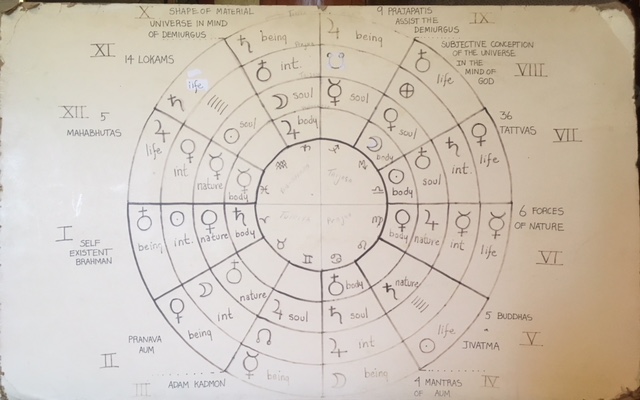
AB CLASS NOTES FOR 1984 0217a
[Classnotes AB 1984 0217 Begin]
2/17/84 Plotinus
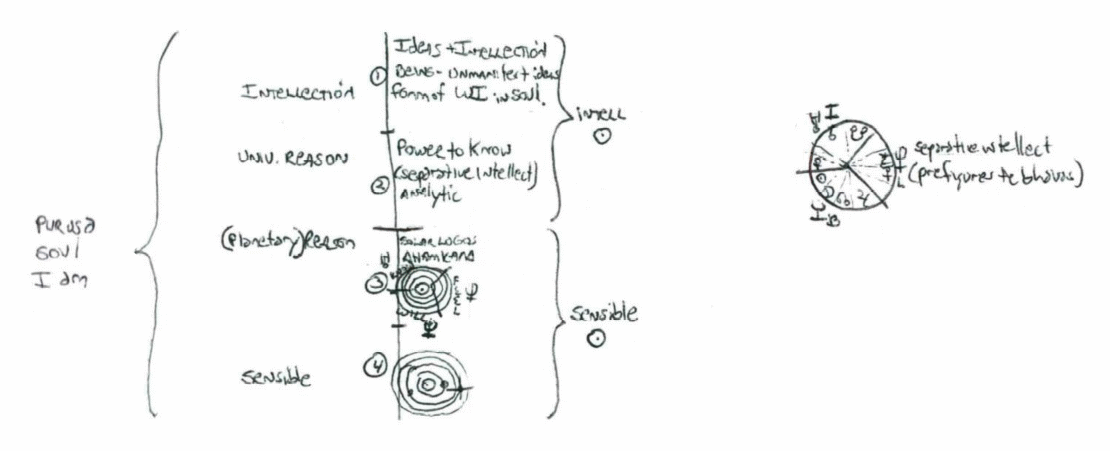
[FIGURE 1984 0217a-2-AB. Divided Line within Soul. Univ. = Universal; WI = World-Idea; Intell = Intelligible; B L I = Being Life Intellect. Facsimile scan from AB class notes.]
2) Sun is first exaltation = unity of a Solar Logos = soul of the Sun.
No exaltations in Leo, Scorpio, and Aquarius = three forms of man. Soul is infinite.
3) A Solar Logos conjoined to a particular Idea it is manifesting → a differentiation of the Sun's powers. Soul is finitized and projects its powers. Knowing Willing Feeling are gnostic. Seven powers are fabricative.
4) Body of the solar mind and planetary minds.
The light of the Nous shining in the soul makes it intellective -- eight bhavas are specifications of this light.
5.3.8, 6.2.20-21 [Note: Plotinus, The Enneads.]
The Separative Intellect is modalized according to Knowing Willing Feeling in the soul.
The World-Idea is modalized according to the soul powers in the soul.
Uranus Neptune Pluto = the World-Idea's knowledge.
Six Forces are paradigms of the exaltations (which separate and distinguish the Ideas).
World-Idea reflected in the soul of the Sun → Solar Logos (Solar Logos goes in 3).
Solar Logos is a combination of something from the Nous (World-Idea) and Soul → Solar Logos.
Infinite qualitied spaces (bhutas) = imagination of the Sun.
All the prior levels are reflected in 4:
Ideas = 360 degrees
Separative Intellect = Uranus Neptune Pluto
Life - reason-principles = planets
Uranus Neptune Pluto distinguishes the Earth mind from other planetary minds.
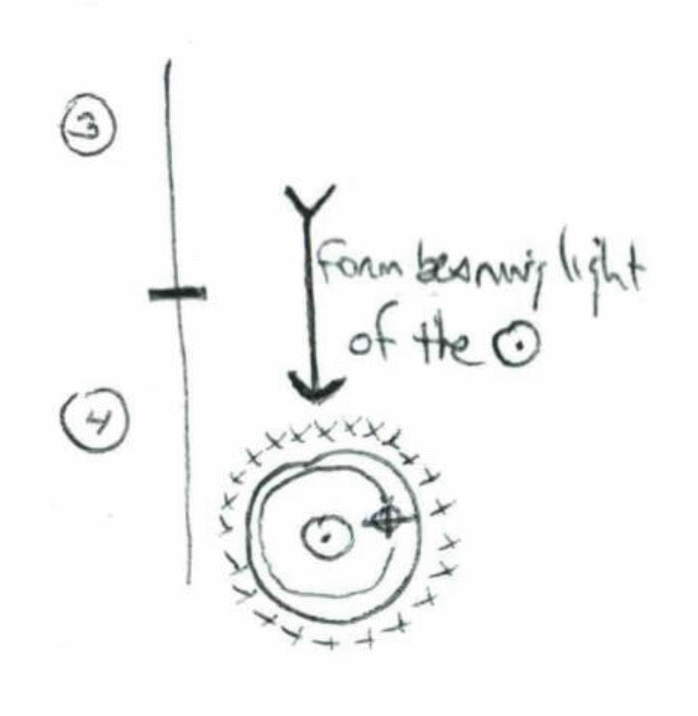
[FIGURE 1984 0217a-3-AB. Sensible Sun and Divided Line. Facsimile scan from AB class notes.]
The ideas for this Earth are determined by Uranus Neptune Pluto as Separative Intellect.
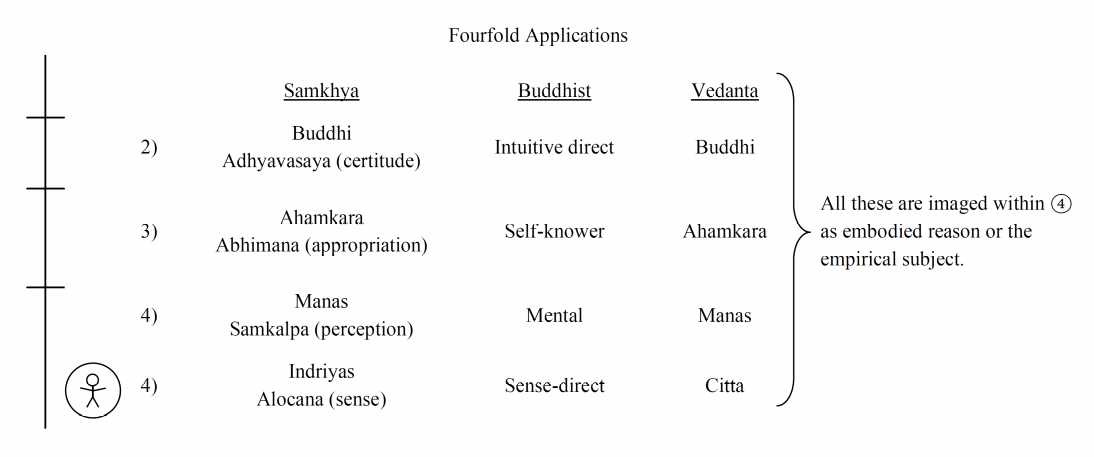
[FIGURE 1984 0217a-4-AB. Samkhya, Buddhist, and Vedanta Fourfolds. Computer generated by NT and IT from AB class notes.]
Citta = projective power of the soul -- 3 → 4, mind taking form of object = soul enveloping whole primal image.
[Classnotes AB 1984 0217 End]
JF CLASS NOTES FOR 1984 0217a
02/17/84, Friday evening. Plotinus, Soul
Exaltations: Bhavas of Buddhi:
Sun in Aries - unity of the Solar Logos - Intellect of Man.
Moon in Taurus: All existences in here: Being of Man: Three absent aspects of Man: Lion (Leo), Aquarius, Scorpio (hydra-headed beast).
Leo: Idea of Man
Scorpio: Soul in Man
Aquarius: Form of Man
"Each idea is a special and unique form of the whole"
Taking the first four exaltations:
Sun Moon Head Jupiter (to get an idea of Will aspect).
Next two: Saturn in Libra, Mercury in Virgo (Feeling).
Last ones: Tail in Sagittarius, Mars in Capricorn, Venus in Pisces. (The way the material intelligence is manifested - as Knowing).
The 8 bhavas of Buddhi are really coming from the Intellectual-Principle. They tell what constitutes the Idea, the components of the rulership Idea.
PB: "The World-Idea incarnates in an atom, the human soul, a solar system." [Note: Paul Brunton, The Notebooks, V16, 26:1.72.] So the World-Idea, in order to reach self-recognition, this atom has to become man, this man has to become the solar system.
The Soul of the Sun is Thought and Life, and the intellection that comes into it makes every life a grade of thought (Sun in Aquarius).
Rulers & Exaltations: Being of the One
VI.2.20 & 21. [Note: Plotinus, The Enneads.] "We may distinguish two phases of the intellect…"
V.3.8. "Light of intellect shining in the soul…"
The World-Idea has Being-Life-Conscious, or Willing-Feeling-Knowing. It's one operation to it; triple to us.
Any Idea, say that of the 36 Tattvas (Libra) has a unity, 4 states, 6 powers, etc. To get an idea, to understand what makes it One & Many, other than "the One", see what the separative intellect [exaltation] does.
The separative intellect distinguishes that Idea from all the other Ideas, and from the Nous in its entirety.
"Dia-noia" means "divided Nous"; the separative intellect; vi-jnana.
It is not possible to (understand) the rulerships all together, no-one can encompass that wisdom, not even the World-Idea. You can reach to the level of the power to know, but not beyond that.
The Soul can use the Nous, but we do no always employ the Nous. "Deliberate usage".
Put the individual soul and its contents in the Absolute Soul; the Solar Logos is a content to that individual soul.
AD: It's not enough to be critical, you have to be synthetic [or: to synthesize]. [Note: Verbatim transcript says "sympathetic".]
Perception - Sense, falls: psychological functions of Jung.
Citta - the power of projection.
The numinosity of the dream is the soul projecting itself; the light projecting itself.
[JF Class Notes End]
Class
Friday, February 17th, 1984
Verbatim, unedited transcriptClick the series name to view more
CLASS at Wisdom's Goldenrod, Hector, NY
with Anthony Damiani (AD)
February 17a, 1984
PLOTINUS; SOUL; DIVIDED LINE
with Appendix: AB and JF class notes for 1984 0217a.
TOPIC: Plotinus
SUBJECT: Soul
SUBSUBJECTS: Divided Line, Astrology Theory, Solar Logos, Cosmology, Separative Intellect, Metaphysical Chart, Samkhya, Vedanta, Buddhism, Bhavas of Buddhi
CONTENTS:
Four levels of divided line within soul
Truth, Being = Ideas and rulerships; Power to Know = Separative Intellect, exaltations
Top level: Intelligible World/Nous within soul; Ideas are unified
Second level: Separative Intellect particularizes World-Idea for a Solar Logos
Third level: Ahamkara, Solar Logos; your soul comes into manifestation conjoined with a Solar Logos
Sun soul becomes a Solar Logos because the World-Idea is in-generated within it; mysterious aura coming into soul
Fourth level: Body of Sun as solar system which has one heliocentric and six geocentric views
Sun's powers unfold World-Idea, World-Idea differentiates Sun's powers
Two levels of Knowing Willing Feeling (pure and impure bhavas)
Each Idea unique version of all the Ideas
Eight pure bhavas (exaltations) belong to Intellectual-Principle, tell us what constitutes an Idea
World-Idea incarnates in an atom, in a human soul, in a solar system
Reading Plotinus V.3.8, VI.2.20
Trans-Saturnians are functions of World-Idea, are guiding the powers of Solar Logos
No exaltations in Leo, Scorpio, Aquarius (Idea of Man)
Discussion clarifying the symbolism of Uranus Neptune Pluto
Six Chaldeans represent Solar Logos' participation in Idea of Six Forces of Nature
Dianoia = divided Nous = Separative Intellect
Metaphysical chart: not even World-Idea can encompass wisdom of the rulerships; exaltations necessary to divide God's undivided wisdom and produce World-Idea
Can't go beyond the power to Know
World-Idea gives soul its being, not its unity
We are reasoning soul, can employ the Nous but do not always do so (V.3.3)
Sage has access to intellection, can use Nous
Reading Plotinus V.3.8, 9
Rodin; learn to concentrate on one problem at a time
Philosophic mystic has experience of Intellectual Cosmos and what follows upon it within his own soul
Yogacara says everything is my mind; doesn't tell us how
Being critical not enough; learn to be sympathetic; music helps with this
Fourth level: each planet has all the prior principles reflected in it
Bhutas as Sun's imagination
Planets as vehicles and agents
Samkhya: material body constituted by all manifest principles from buddhi to bhutas
The word 'illusion' explains nothing; understand the principles that go into making a body
Ideas represented by 360 degrees
Separative Intellect represented by Uranus Neptune Pluto; septile level; presiding deities of an epoch
Ahamkara represented by transiting Chaldeans
Elements as the place of manifestation
Discussion of what is meant by 'body'
Samkhya, Buddhist, and Vedanta fourfolds
Prior principles imaged in empirical subject
Citta as projective power of soul
Mind takes form of object = projective power of soul takes form of primal image
Soul's projective power contains within itself the powers that are going to formulate perception
Numinosity as soul projecting itself
Yogacara says consciousness constructs world of experience for itself; AD wants to know the details of how it does this
Once three prior principles are imaged in a body, how to symbolize astrologically?
Appendix: AB and JF class notes
BOOKS READ FROM OR REFERENCED:
Plato, Republic
Plotinus, The Enneads (MacKenna translation, 4th ed.)
Paul Brunton, The Notebooks
Krishnachandra Bhattacharyya, Studies in Philosophy, Vol. 1, "Studies in Samkhya"
Immanuel Kant, Critique of Pure Reason
PLOTINUS QUOTES READ OR REFERENCED: II.3.9, III.4.3, III.4.6, IV.3.8, V.3.3, V.3.8, V.3.9, VI.2.20, VI.2.21
DIAGRAMS appended to this transcript:
FIGURE IMG 2202-Posterboard Metaphysical Chart.
FIGURE 1984 0217a-2-AB. Divided Line within Soul.
FIGURE 1984 0217a-3-AB. Sensible Sun and Divided Line.
FIGURE 1984 0217a-4-AB. Samkhya, Buddhist, and Vedanta Fourfolds.
Other diagrams also referred to are not with this transcript version. [Transcriber note: [diagram] means the speaker is referencing a diagram as he or she is speaking. If someone is drawing or writing, with audible sounds of chalk on a blackboard, I indicate this by [drawing] or [writing].]
NOTES:
This is 1984 02/17a, Plotinus; Soul; Divided Line evening class, and the first entry associated with this date. 1984 02/17b = KCB seminar from earlier in the day, for which we have no audio, just JF notes.
AB and JF class notes with diagrams have been appended. AB class notes retyped from Classnotes AB 1984 0201 to 1984 0309.PDF. All capitalization and punctuation corrected, abbreviations spelled out in AB class notes.
This is a Friday evening Plotinus-series class.
TRANSCRIBED Verbatim by IT prior to 2018 (V11a). This is V12a (2023) and has: typos corrected; updated prefatory matter, footer, and audio file name; Book List and TOC completed, Subsubjects slightly expanded; Plotinus quotes section added; new notes within transcript; AB notes/diagrams and Metaphysical Chart appended and references within transcript to the diagrams/Chart; new formatting to accord with new conventions. In 2025, IT updates audio file markers to match new REP audio. Archival verbatim transcript – V12a.
AUDIO FILES: 1984 0217a (formerly 1984 0217b), 1984 9217b (formerly 1984 0217a), 1984 0217c. [Note 1: "Tape" and "Side" refer to original audio cassette tapes that were later digitized into .MP3 Audio Files. Note 2: Audio File 1984 0217a (formerly 1984 0217b) was originally recorded back to front, i.e., Side 2 followed by Side 1; REP Studio fixes in 2024. Audio Files 1984 0217b (formerly 1984 0217a) and 1984 0217c have only one side each.]
| NEW FILE NAME | OLD FILE NAME |
| 1984 0217a | 1984 0217b |
| 1984 0217b | 1984 0217a |
| 1984 0217c | 1984 0217c |
1984 02/17a at Wisdom's Goldenrod
Plotinus; Soul; Divided Line
[Audio File 1984 0217a (formerly 1984 0217b) Begins]
AD: --do that.
AS: Ok.
[students assent, very faint]
AS: Um-- Would you like me to start? What would you like to start with?
AD: Well, go over what we did today.
AS: Ok. Yeah. And-- ok, we'll go over what we did today and we were [three/few words inaudible] [short pause] Ok. And start with-- We'll start with the divided line.
[Note: See FIGURE 1984 0217a-2-AB, Divided Line within Soul, appended to this transcript for the following.]
VM: Uh-hm, uh-hm, oh yeah.
AS: Is that ok?
VM/S(?): Oh yeah.
S (faint): Yeah.
AS: The divided line.
VM: I love the divided line.
[couple seconds of laughter, background student talking]
AS: Remember the divided line?
S: I think.
S: Wasn't it [few words inaudible]
S (simultaneously): (Go ahead/Ok).
AS: On one cycle I wish that she could read it to them [couple words inaudible]
VM: Come on, tell us Avery. (some laughter) You've always wanted to know.
AS (simultaneously): No, I don't want to start this off with a [couple/few words inaudible] attitude. (bit of laughter) Ok and, we understood that [S: Already.] in Plato he-- he talks about this [drawing] being ruled over by the Intelligible Sun [diagram]. [VM assents] And this by the Sensible Sun [diagram]. [short pause] And we have something which gives us a fairly nice picture of these upper two levels. Namely we have the big metaphysical chart diagram of the Intellectual-Principle [diagram], which I think gives us a-- a pretty good idea of what the nature of this Intelligible realm as opposed to the sensible realm. Even though it's true we're taking the point of view here that this whole is within the purusha or within the soul [diagram], [drawing/writing] in Samkhya terms, which is equal to this emenant-- which is equal to the soul, the I AM. So we're talking about the Intelligible within the soul. But as a matter of fact the Intelligi-- when he says the whole Intelligible World is within our soul, it's hard to make that distinction then between the Intelligible World and the soul. We could make the distinction between the Intelligible World in the soul and the Intelligible World per se but this Intelligible World in the soul is the Intelligible World that we will-- that we understand or that we know. So, leaving that question out--
S: I have to (sit down/settle).
AS: Yeah, he-- he speaks about then this Intelligible Sun.
[couple seconds of very faint background student words, bit of laughter]
S: Why don't [one/two words inaudible]
S (simultaneously): [couple words inaudible]
AS (simultaneously): (Particularly.) Well and then (laughter) you have-- you have to go into the Void I guess to--
S: We could go into [couple words inaudible]
AS: So, if we speak about-- oh. Well Plato talks about the power to know and the truth to what is known. So the truth to what is known is the truth of the Ideas, the un-- which are unmanifest. [student assents] [drawing/writing] The Ideas together with the Intellection. In other words, the whole of the circle of Intellectual-Principle, all the Ideas together with the rulerships, would constitute this realm of Being, or the Ideas as unified [diagram]. And he [one word inaudible] that the corresponding power is Intellection [diagram]. Ok? And we can say that this is the unmanifest form of the World-Idea and all of the Solar Logoi we-- or all of the Sun souls are interpenetrating in this infinite Being. [student assents] No-- no one is separated off from another. Ok? And they're in a unified condition, unified within-- within this realm of Being. And the-- in the Intelligible-- the Intelligible also gives the power to know, [drawing/writing] the power to know this separatively you would say. And Plotinus-- well, he speaks of this also as a Separative Intellect [diagram], alright. Separative Intellect is almost like Universal Reason for the soul, yeah.
VM: But that kind of separation is [AS simultaneously: You call that dianoia.] separating one Idea from another, not necessarily a subject from an object.
AS (simultaneously): Right, good. Very good. So, what this does-- (laughter, student words) Yeah, you got it.
AS/S(?): How did you get it so quickly? (laughter, student words)
S: Oh.
AS: We don't know. So?
VM (simultaneously): I don't know what I'm talking about.
AS: Yeah. So up here all the Ideas are in a unified condition interpenetrating with each other [diagram]. [student assents] The first thing is this Separative Intellect has to distinguish out from that the peculiar o-- is going to have to take out from that unmanifest unity of the Ideas one particular Idea, unify it, and distinguish it and characterize it so that it can be conjoined with a Sun soul and give you a Solar Logos. So, in terms of the World-Idea, the Separative Intellect is distinguishing the Ideas or characterizing them or pu-- or pulling one out and finitizing it, pulling one out and characterizing it. Because here [diagram] they're unmanifested, uncharacterizable, and here [diagram] if a particular Solar Logos is going to have a locus to manifest, it can't manifest an Infinite Being. It has to manifest a particular organization of Ideas. For example, the Idea of Man. [drawing] For example, its particular zodiac that it's going to manifest, particular organization of Ideas. Separative Intellect would know that-- know those Ideas dis-- distinctively, and then this going this way [diagram] would conjoin a particular unit soul or Sun soul with an organization of Ideas and now you get a Solar Logos, Solar Logos meaning a Sun soul manifesting one particular Idea. Now, to back up a second. In the big metaphysical chart, this would correspond to the exaltations [diagram]. [Note: See FIGURE IMG 2202-Posterboard Metaphysical Chart appended to this transcript for the following.] [drawing/writing] [VM: Nice.] And so if we went around, [VM: It does there too.] if we went around those exaltations we'd notice a couple of things. We'd notice that what these are doing, if we went around with each one, we'd see how this arrangement of-- of dignities was taking an Idea, unifying it, giving it a certain being, giving it certain samskaras, characterizing it according to certain samskaras, putting four levels of existence to any Idea or four states of consciousness, that would be the Jupiter one, and so on right around. It would be imposing or employing the six forces of Nature. The tattvas would all be incorporated in there. There would be a particular state-- a particular kind of existence, ok, and finally it would have a power of sensible appearance, meaning (about/you got) that last one [diagram]. But if you went around the exaltations, ok, Head, Tail, Saturn--
SD (simultaneously): Avery, you're saying this-- this is what's done to every one of the Ideas, this whole ring works on each Idea?
AS: Sure, you could conceive it as working on each Idea so, if each Solar Logos is going to be conjoined with the I-- with an Idea or the particular form, a particularized form of the Ideas, of the unified Ideas, then for each Solar Logos you'd have to have this arrangement doing that. This would be doing-- this would be the power to know, this Separative Intellect. Now, notice one thing. The Sun is the first one in that ring [diagram], so that almost represents the unity of the Solar Logos. This is what's going to be determining a Solar Logos. Second thing is, notice the three, [drawing] at least here, that are absent [diagram], which seems significant because those three represent the three aspects of Man, [VM assents] the lion, the hydra-headed beast and Aquarius, the Form of the Man, you know from the Republic when he speaks about the Form of a Man, you know, take these three things and put them together? Well, the fourth one, the unity-- we say this is the Intellect of Man, the Soul of Man, and a Body of Man [diagram], the fourth one, the unity, represented by the Moon [diagram], well, in that unified condition all of the samskaras are there [VM simultaneously: To distinguish it (one/two words inaudible)] so you can't really distinguish [VM assents] one from the other. And that Moon in some way corresponds to Being of Man and the Leo to the Intellect of Man and in Scorpio to the Soul in Man and then finally the actual Form of Man is down here [diagram]. So I know people don't like these interpenetrating levels where the-- where the one thing is outside it and then it's also found within the schema but-- Well, you--
DH: I thought you-- especially--
AS (simultaneously): Sorry about that.
DH: That was actually [one/two words inaudible] exaltations running around and [few words inaudible] Imagine some of those too.
AS: I left those out?
DH (simultaneously): It sounded like you were talking about-- I mean-- I mean the notions you were saying I-- I heard the houses in there, you know, and then the-- [AS: Yeah.] the six things but-- [AS: Good.] but what made it the exaltations as opposed to going around rulerships or [AS: Oh well--] detriments or the falls. [AS simultaneously: I--] We want--
AS: Well, we'd have to see how each of these particular functions is appropriate to that sign or that house. But the idea kind of was that in Being all of those are a unity, all the-- all the rulerships. We had this argument at once before but it went something like, in the state-- in the rulership condition, the-- the functions are identified with Being, and actually therefore with the totality of Being or with the Intellectual-Principle as a whole. [student assents] Or they represent the functions of Being as a whole and not-- and not the functioning which was distinguishing one Idea from another.
[student assents, faint]
DH: Ok.
AS: Or, to put it another way, in the rulership, [drawing] the function is identified with the being of the Idea, [DH assents] but in the exaltation, it's distinguishing itself from the being of the Idea, maybe that's better.
DH: Uh-hm, uh-hm.
AS (simultaneously): Ok, something the way [DH assents] Samkhya says now, when we bring in Samkhya, that in buddhi, the function of buddhi is to distinguish itself out from prakriti. [DH assents] And that's something about what would be happening here. In order to give rise to a manifestation-- in order for manifestation to occur, a function has to distinguish itself from prakriti as substance.
DH: So in this context you're putting the rulerships at the top level?
AS: Right, yeah, oh, in this context the rulerships with the Ideas would symbolically go up here [diagram] and there you would just have the unified Being [DH assents] or all the Ideas as unified. As soon as you begin to distinguish them out or distinguishing functions from this whole, which is the same as distinguishing the I-- the World-- particular form of the World-Idea, or particular form of the Idea of Man, or the Idea, conjoined with a Sun, [drawing] that will give rise to ahamkara at the next level [diagram] when we speak about the particular Solar Logos, [S, faint: That's brilliant.] Solar Logos, meaning a Sun as conjoined with this particular Idea that it's manifesting.
DH: Uh-hm.
AS: And, I mean, in some ways too, if you want to continue the symbolization probably you could look to the next ring, the detriment ring, as soul [diagram]. [drawing] Now, at this third level [diagram], ok, we were-- we speak about the whole solar system. So we have a Solar Logos or an Idea associated with (a/the) Sun Soul. And, we al-- we spoke about this as the planetary reason. And-- I think we went through this before but it-- it still seems to make sense that when the-- when this particular Idea's distinguished out, unified-- distinguished out from the whole of Being and unified, organized here, that along with that the Sun Soul's powers are also going to be differentiated along with the differentiation of the World-Idea. [VM assents] So now instead of just power, this infinite power of the Sun Soul, we now have the distinction or differentiation of these powers in some way, where you have that they're all functioning here [diagram], [VM simultaneously: Uh-hm, we have to--] but as a unity.
VM: There's two levels of separation going on there [AS: Yeah.] in some ways, the Idea(s) or the set of Ideas that go to make up that particular Solar Logos are separated out from the totality and then the powers of the Sun are also separated out.
AS: Yeah, because when the Sun is-- when that power of the Sun is conjoined with that differentiated Idea, you get the differentiation of its powers, which then is going to function and these powers are going to function to give rise to the body of the Sun, namely now considering the bodies of all the planets, Chaldean planets at least, [student assents] and you would have now the Solar mind [drawing] with all of these six individual planetary minds [diagram]. Each one of these is a distinct mind in its own right or a distinct entity.
VM (simultaneously): Yeah but couldn't you make-- couldn't you make the top o-- I mean the-- the one you just--
AS: Make it look different, yeah.
VM (simultaneously): Well, why wouldn't you make that one geocentric, [AS simultaneously: Oh that--] the one on the bottom [diagram]?
S: Yeah.
AS: Because it's also the body of the Sun.
VM (simultaneously): Because you could make it Venus-centric or something if you want to.
AS (simultaneously): You could make it any-centric. But you could also make it Sun-centric.
AD: The bottom one has to be six geocentric and one heliocentric [AS/S(?) simultaneously: And one helio.] view.
AS: Yeah.
VM: Say it again Anthony, I didn't hear it.
AS: Six geocentric and one heliocentric.
AD (simultaneously): Take a bottom-- the-- the solar system has one heliocentric and six geocentric views.
VM: Ok, they're all possible [student assents] um--
AS: Yeah. And the Sun-- the Sun too has a body. If this is the sensible light, [VM: Yeah.] that's like the actual light that's mani-- we say that 99% of our solar system is made up out of that light, the Sun, or whatever percent, that it's primarily its body and secondarily the bodies of all-- [drawing] of the other six planetary souls. Now, (these-- yeah). Yeah.
DB: Avery?
AS: Yes?
DB: Where does the-- where does the association with-- by the multitude of souls that is-- that are brought together with the-- with an individual Solar Logos come in? Where does that take place?
AS: Where are they [DB simultaneously: Yeah.] conj-- where is your soul?
DB: Well, yeah, I mean is it-- can it be considered as part of the powers, like the planets in-- and it would be part of the powers of the-- of the Sun. But, at the same time, I-- I understood them as also having a particular soul, or are they part of the World-Idea itself?
AS: No, I think that-- that when the Sun soul is conjoined with its Idea, all of these other souls which have an affinity with that, that separation out of the Idea of Man for the Sun--[DB: Oh.] this is the Idea of Man [diagram]--or its zodiac, whatever you want-- whatever you want to symbolize [DB simultaneously: Yes, right, whatever.] it as, that's for all of the individual souls within there as well. And so when the Sun soul is conjoined with that Idea, so are all the other I-- so are all the other souls, [DB simultaneously: Yeah but where are the--] all the particular unit souls, they're all omni-- they're interpenetrating with our Sun soul.
DB: Right, this is the problem, that in the highest level-- no, for me, in my understanding, at the highest level you have all the Solu-- the Solar Logoi interpenetrating [AS simultaneously: Ok. Ok, sure.] as well, as-- as I assume all the other--
AD: No, the Ideas.
DB: The Ideas.
AS: He wants to speak-- See, we-- I think he's talking about this-- to keep it, to keep it-- to keep it kind of straight, as it were, in our mind which thing is going with which and also to of course relate it to Samkhya, this is a description I think he's saying of the way [drawing] that the Idea is being separated out. One Idea is being unified here, distinguished out from the totality of Being. And in doing so a soul is conjoined with that Idea.
AD/S(?) (faint): Uh-hm.
AS: Sorry maybe I didn't-- say it again David, maybe--
DB: Yeah, I-- You see, I was-- I was understanding what was going on here was the-- was the unfoldment from the highest level of soul, which is what I understood the divided line to be concerned with, (of/from) the unfoldment of the unmanifest condition of the soul at its highest level.
AS: No. Ok, that the problem. Of the unmanifest condition of the Ideas.
DB: The Ideas.
AS: That's what we're saying here. I mean that's interesting, the power to know, the Separative Intellect, is separating out from that unmanifest condition of the Ideas, the Ideas as unified in Being, it's separating out and unifying one particular Idea that this Sun soul is going to associate with. Now also all the other individual souls [AS hitting board] that are associated with that Sun are going to be associated with that particular World-Idea here.
DB: Right.
AS: Now before that you're asking what's the condition of those Overselves that-- prior to their being associated with the Solar Logos?
DB: I'm just wondering where the assoc-- if the association is part of that Idea or-- or you-- or what. I mean, it's perhaps a moot point but--
AS: No, we said that the-- this-- a Solar Logos means a Sun soul conjoined with a particular World-Idea [DB: Yeah.] that has been separated out by that Separative Intellect.
DB: Right, that part-- that--
AS: And conjoined then also with that World-Idea will be all the other unit souls that have an affinity for this Solar Logos, [DB simultaneously: Right, and--] that belong or that-- you know, that are going to participate in this solar system.
DB: Ok.
AS: Yeah. Lots of other solar systems.
DB: So that the-- that that affinity then-- Ok, I guess that's-- that's what I don't understand there. [AS simultaneously: No I--] Where does that come in?
AS: Well, [drawing] they would say that the potential for that affinity resides within the unmanifest Idea of the World, the karmic potentials, I mean maybe PB calls them karmic potentials. Or maybe they call it-- maybe Samkhya calls it the unmanifest traces of activity that's residing there from beginningless eternity or your karma or whatever. But that would be-- that's probably stored here and so when this World-Idea comes into manifestation again, it's going to include the seeds of your karma [DB assents] as well, and your soul will participate again-- will participate in that manifestation. Now I don't think that's saying that the soul can't know at these levels [diagram] either also.
S: Oh.
AS: (But/So) what's happening here is like, from this level to this level, this [diagram] is like they speak of buddhi as infinite and universal knowledge and over here [diagram] it's already become particularized some way in [CDA simultaneously: Avery?] ahamkara. Maybe we should-- yeah.
CDA: This is still on the same point but, I wonder why-- I mean if you were speaking of the soul as a unity to start out with, you know, and-- and the differentiations are taking place on the level of the I-- World-Idea, that he's-- [AS drawing] if you approach the problem of the individual soul's relation to the Solar Logos, it seems to me that that would also be prior, that that unity of a-- of all souls is-- is the same as the-- the unity of the Solar Logos or any s-- You know what I'm saying? Why would it be a-- yeah.
AD (simultaneously): (Yeah/Well), yeah. [three/few words inaudible] You have the soul. Everything is taking place [AS simultaneously: Here's purusha.] within the soul, [CDA simultaneously: Yes, yes.] alright. [AS: You got--] Now, within the soul there's a whole Intellectual World.
AS: Cosmos.
CDA (simultaneously): Yes.
AD: That means that the Idea of the World is in your soul. That's the top, the [CDA assents] very top [diagram], alright. [CDA simultaneously: Good.] Included in that in-- included in that is the analytical or the Separative Intellect which is going to separate the World-Idea or let's say modalize, particularize the World-Idea. [student assents] This in turn is united with a Solar Logos. Now, a soul comes into manifestation, it comes in with (a/the) Solar Logos or with the soul of the Sun, [CDA simultaneously: Ok, yeah.] that's where it comes into-- [CDA: Ok.] if it comes into manifestation. [student assents] So right there you can conjoin it if you wish, ok?
CDA: Conjoin the individual soul(s) with the Solar Logos?
AD (simultaneously): If you want to think of that purusha which is surrounding everything [diagram], [CDA: Yeah.] if you want to think of it as conjoined with anything, you conjoin it with the soul of the Sun.
AS: Before that it's not conjoined. (Or/Well) it's [CDA simultaneously: I'm sorry.] not particularized.
AD: Well yes, [AS: Yeah.] I know, that's the problem. Above the divided line on the [CDA assents] top half is the differentiation of the Nous into a World-Idea that's modalized or particularized [diagram], because--
CDA (simultaneously): Which is happening within the soul.
AD: Well, let me finish.
CDA: Ok.
AD: Because in the Nous the possibility of worlds are infinite.
CDA: Yeah.
AD: And we're not talking about infinite worlds. [CDA: Right.] We're speaking about our world. Now, how does the Idea of our world get differentiated from the Nous and then so to speak is-- is like the influx into the Solar Logos. Now you can speak about it as a Solar Logos. Before that, before the World-Idea comes into the Solar Logos, and of course this can't be except mental abstraction here, before the soul is a Logos, alright, is what we're trying to understand. The soul becomes a Solar Logos because the World-Idea is in-generated within it. Now it becomes a Solar Logos, now it's going to evolve the World-Idea. It is at this point that if you want to speak about the purusha manifesting, alright, it is at this point you can do so, [slight pause] at the level of the soul of the Sun. And that's where souls are conjoined.
CDA: Ok then, when-- May I pursue?
AD: Sure.
CDA: Now, this is different than-- a little different than before.
AD: Yes, of course, [CDA simultaneously: Right.] it's very different. We suddenly saw that it's [CDA assents] the Idea that's being conjoined to the soul, the soul of the Logos. Or I mean the soul of the Sun.
CDA: Ok, so what I would like to understand is, how the soul is related to the top half of the divided line. Is--
AD (simultaneously): The Intellectual Logos exists within the soul.
CDA: The Intellectual Logos [S: Yeah.] exists within the soul.
AD (simultaneously): The Nous is within the soul.
CDA: Now, which soul are we talking about?
AD: We're talking about the I AM, the purusha, the certain--
CDA (simultaneously): The I AM of a Solar Logos.
AS: Or any one.
AD (simultaneously): No, [CDA simultaneously: My soul.] your soul!
CDA: Of my soul.
AS: Yeah but-- Carol, you know, I think gotta just-- I think-- I think the words are-- are quite important here because, the soul can have universal knowledge [drawing] of this realm [diagram], [CDA: Yeah.] this is within the soul [CDA: I'm-- yeah.] that he's-- but, [students assent, faint] when it's conjoined with a particular [CDA simultaneously: Oh, ok.] organization of that Idea, [CDA: Ok.] then you speak about it as being finitized. [one/two inaudible CDA words] That's why they say ahamkara, now the soul is finitized. Here it's infinite [diagram], it's-- this isn't a limitation [CDA simultaneously: Ok, I see. So only if--] of it at all. If it's no limitation in what sense is it conjoined?
CDA (simultaneously): So only at the level can you speak of an individual-- [AD(?): Well--] of a [AS simultaneously: A particularized.] soul that's been finitized or particularized that you [VM simultaneously: The Witness.] can-- then [AS simultaneously: Yeah, or jiva(s).] you can even speak of-- about a relation to the Solar Logos.
AD (simultaneously): That's the point-- that's where you-- that's the point where [CDA simultaneously: Ok.] you say the soul projects its powers.
AS: Right. Projects.
AD: Below that divided line, not above it [diagram].
CDA (simultaneously): Right. But the point I thought that you made since I didn't quite-- that because-- because it's only at that point of ahamkara that you can speak of a Solar Logos, that it's only there that you can speak of a relation to a s-- my soul to a Solar Logos. [students assent, faint] Because above the line [AD simultaneously: It's universal.] it's the Intellectual [AS simultaneously: They're all related.] Cosmos within the soul.
AD (simultaneously): Yeah, yeah.
AS: Or-- or above that they're all related to each other, there's no particular relation of one to another except [CDA: Ok.] through that. Now, um-- [S: See.] Do-- do you want to bring in some of the Samkhya terminology?
AD: No, not yet. Just go all the way down first and--
AS: Ok. Good.
CDA: Prolong it as long as possible.
AS: So-- (bit of laughter) So, (bit of laughter) [drawing] here we have the soul of the Sun--let's go back to this level [diagram]--separating out from the infinite World-Idea, we separate out the Idea for this solar system, for this Solar Logos. That gives rise to the differentiated Idea of the-- perhaps it's the zodiac for our Sun. And, along with that, the infinite power of the Sun is also being differentiated and modalized, as far as I can understand, both the power side along with it.
AD (simultaneously): So, I think that's what we said, we said now that you have the Idea, ok, the World-Idea is given to the Solar Logos, [AS drawing] alright, [AS assents] now the Solar-- the soul of the Sun, its powers become operative, it ha-- it has to differentiate that World-Idea, you-- [AS assents] its powers start becoming operative. So on the one hand you have the powers of the Sun and on the other hand you have the Idea which comes into the Sun, [AS assents] and the powers differentiate that World-Idea.
AS: Right.
AD: Alright.
AS: And, the powers differentiate the Idea and the Idea through its multiplicity is differentiating the powers or structuring the powers, however you want to put it, there seems to be an interrelation. And now--
S: Could you just repeat that again 'cause it's-- [few inaudible student words simultaneous with S] repeat what you said again?
AD: The World-Idea, alright, [S: Uh-hm.] from above, where you have Being and the power to know Being [diagram], [S: Yeah, uh-hm.] that differentiates or let's say that extracts the World-Idea, the world for this Solar Logos, alright. Now that Idea is given to the Sun, [AS drawing] the soul of the Sun. Now the soul of the Sun has powers, six or seven powers, whatever, alright. These powers are going to differentiate, unfold, manifest that World-Idea. In the process, like Avery said, in the process, the powers of the soul of the Sun get differentiated and reciprocally of course the other-- the World-Idea's getting differentiated. In other words, as the powers of the Sun are employed to differentiate the World-Idea, the powers of the Sun are being so-- so to speak evolved too. So there's that mutual and reciprocal relationship between these two, [AS: And--] the powers of the soul of the Sun and the World-Idea, which is the same thing you're going to (know/do).
AS: And the particular-- when we say that the World-Idea's received within by that soul, by this soul, the Solar Logos, the particular faculty that's receptive to it is this knowing, willing, and feeling [diagram]. What's gonna mani-- the powers, the differentiated powers that are going to manifest that World-Idea are the Chaldean planets [diagram]. [drawing] Or you'd have willing, feeling, and knowing [diagram]. So, the Separative Intellect works two ways. It's pulling out or distinguishing out that particular I-- World-Idea from the unmanifest Being. And it also seems to be what is organizing the ahamka-- what is organizing the Solar Logos. And-- and that represents the Solar Logos' own understanding of that World-Idea, knowing, willing, and feeling, whereas the Chaldeans represent-- are going to represent the pow-- the differentiated powers of the Sun that are going to manifest that World-Idea. So these [drawing] knowing, willing, and feeling are an image of that Separative Intellect, or let's say are the outward functioning of the Separative Intellect, which up here [diagram] would be pure knowing, willing, and feeling. And over here [diagram] they're knowing, willing, and feeling as guiding the manifestation. Call me(--/,) Dave.
DB: Yeah, I--
AS: Go ahead.
DB: I hope I'm not being overly dense [AD simultaneously: Well--] but I don't understand the knowing, willing, feeling part.
AS: Carries it [one/two words inaudible]
DB (simultaneously): Yeah, could you do it again? No, I just-- could you just repeat it, I-- I didn't follow the transition.
AS: Well-- You know, 'cause we'd like this-- we'd also like this just to tie in with the cosmological diagram where you have(--) the seven Chaldean planets are the specifications of that World-Soul's powers [DB: Right.] that are going to manifest that World-Idea. Then you also have Uranus, Neptune, and Pluto. Those repre-- seem to represent the functioning of the Separative Intellect which is what is grasping that World-Idea and delivering it to the Sun. [DB simultaneously: Well--] So they seem to represent the modalization of this Separative Intellect or buddhi, if you want to call it that, for the Sun, its own understanding of that World-Idea.
DB: So, the--
AS: And this [diagram] represents its manifestation of that.
DB: But the willing, feeling, and knowing of-- of the Solar Logos is an image of the relationship between the Separative Intellect and the Ideas?
AS: Pretty--
DB: I mean (it/if)-- [AS simultaneously: Ok (Dave).] I don't know.
AS: Neither do I.
LR: Say it again David please?
DB (simultaneously): That the-- that the m-- the knowing, filling-- feeling and willing of the-- [one word inaudible]
LR (simultaneously): Filling and wheeling [couple/three words inaudible]
DB (simultaneously): Right, feel [couple words inaudible]
VM (simultaneously): Wheeling and dealing. (laughter)
DB: The Uranus, Neptune, and Pluto is an image of the relationship-- is-- is an image within the Solar Logos of the relation between the Separative Intellect and the Ideas.
AD (simultaneously): Yeah, yeah.
AS: Yeah.
S (faint): Yeah.
DB: Ok, (then--/thanks.)
AD: Yeah, up there [AS drawing] they're going to be called the pure bhavas, down below they're going to be called the impure bhavas.
DB (simultaneously): Ok.
AS: And now here [diagram] they are the soul's powers or-- powers of apprehending that World-Idea. That's an image of this Separative Intellect's power to apprehend Real Being, to apprehend Being.
AD: You see, [LR simultaneously: Well--] the six powers or seven powers of the soul, of the Solar Logos, [AS drawing] and the willing, feeling, and knowing are two different things.
AS: Uh-hm.
AD: Willing, feeling, and knowing, let's say, are cognitive and non-cognitive modes, alright, of functioning, Intellectual functioning, alright. But the powers of the soul of the Sun are different, they're referred to in liter-- in the Yogic literature as, [one/two inaudible AS words simultaneous with AD] what was it, motion, stoppage-- [AS: Uh-hm.] I forgot them, you remember?
AS: Yeah. Parinama, change, chesta, [S: Chesta.] power, [S simultaneously: Nirodha.] stoppage, life, the power of perception or forming.
AD: Forming, uh-huh.
AS (simultaneously): Um-- I forgot [few words inaudible]
AD: Ok?
AS: Dharma.
AD: Do you see the difference between [AS assents] the powers of the soul of the Sun [AS: Dharma.] and willing, [AS assents] feeling, and knowing?
AS: Yeah. And-- and they-- they-- their kind of terminology goes something like the willing, feeling, and knowing represent aspects of-- that we need a wor-- you know, we always need that one word to represent cognition in the three form(s). Whereas these represent more willing. So, the feeling [drawing] and willing are also modalizations of a kind of cognition which they call buddhi, whereas the planetary functions are specifications of willing or ahamkara.
[students assent]
S (simultaneously): See but--
[students assent simultaneously with S above]
S: Then--
AD: No, I don't see that Avery. I don't see that.
AS: Ok.
AD: The planetary functions cannot be restricted to willing because they're a combination of all three all the time.
AS: Oh, right, but I think that-- [S simultaneously: (That's just what he means.)] yeah, but they're specifications of willing just as-- let me try it this way.
AD (simultaneously): I just disagreed with that.
AS: I know. (some laughter) But that never stopped me before.
AD (simultaneously): Now, you tell me why you think so [AS simultaneously: Ok.] and I'll, you know, see if I could--
AS: Ok. Just as within what you called cognition or Separative Intellect you have aspects that prefigure or represent feeling and willing as well, within willing you have aspects that represent knowing and feeling, namely you have vaikriti, taijasa, bhutadi, you have the-- You have all three aspects within willing, within ahamkara, but subsumed or characterized primarily by willing [diagram], and so here [diagram] you have all three aspects within buddhi, within knowing, although they're specified as feeling cognition, willing cognition, and knowing cognition.
AD: Ok.
AS: So I was just trying [AD simultaneously: Ok.] to say-- yeah, I would-- [drawing] I would say that there's all three-- this three-- all three within each but [AD: Ok.] just--
RG: Or another way to say that would [AS simultaneously: Yeah.] be that knowing, willing, and feeling are more on the gnostic-- more gnostic and [AS simultaneously: Yeah, gnostic, that's the word.] those seven planets are more fabricative.
AS: Yeah. [drawing]
S (faint): Ok.
DB: So--
AS: In fact the will or ahamkara is more fabricative [RG: Good, good.] than gnostic. Maybe that's the word Richard, yeah, gnostic. Gnostic takes in knowing, [S simultaneously: (Knowing/Feeling), uh-hm.] feeling, and willing.
SD: And you're-- you're also going by the fact that ahamkara has a predominance of rajas and that(--) that's what you were working with?
AS: That would be another way and that buddhi has a predominance of sattva.
RG (simultaneously): Uh-hm, yes, right, good.
AS (simultaneously): Because pri-- because the buddhi is primarily coming from this level of the Separative Intellect.
AS/S(?): I don't know.
DB: But Avery?
AS: Yeah.
S (possibly part of background): Who's that?
DB (simultaneously): I mean, don't [one word inaudible] The three knowing, willing, and feeling are coming from-- from the-- the top half of the divided line [diagram], ok, from above, from Being and the Separative Intellect. Now, are these six functions or the six planets, the powers of the soul which are going to manifest the Idea, is the idea that the-- that the knowing, willing, and feeling is part of the World-Idea and the powers of the soul there are associated [AS drawing] with that Solar Logos when it makes its appearance, and that it-- I mean does the Solar Logos that's going to be manifesting-- See I'm just trying-- you said at one point earlier that the-- the three on the outside represent the Solar Logo-- Solar Logos' receptivity to the World-Idea [AS simultaneously: Right.] and the interior six represented its powers of manifestation.
AS: Right.
DB: Ok. I'm just asking, are its powers of manifestation coming along with it, ok.
AS (simultaneously): Well, it seems the way we've tried to formulate it is that at this level [diagram] both sides are conjoined, that's why you call it a Solar Logos. But if you wanted to make a distinction you-- it seems you would say that these powers [drawing] are more characterized by soul, the soul as coming in, the soul's power differentiated according to the World-Idea, [DB: Ok.] and the knowing, the gnostic here is more like the World-Idea modalized according to the soul. [DB: Yeah.] So, in both you have both but you're right, the gnostic division is-- seems to be coming more from the side of the World-Idea, whereas the powers, the fabricative powers seem to be coming-- to be coming more from the side of the soul's own power getting differentiated. So here the knowing, willing, and feeling, the gnostic, are like the World-Idea becoming differentiated [DB assents] according to the soul and the six powers seem to be more like the soul's power becoming differentiated according to the World-Idea. I mean unless you had both at this level [drawing] you won't have any of these distinctions.
S: Right.
S: Uh-hm.
S: Right.
LR: Avery can you try to-- I-- I don't know, I keep getting back to the same question I asked from before, (that/about) (who those-- who those) definition of Intellect-- who are those [one word inaudible] who is this [couple words inaudible]
AD: [couple/few words inaudible]
LR: It seems like now you're speaking of them-- just in this last thing you say that you're speaking of them as symbolized by the-- these eight bhavas which are knowing, willing, and feeling, which are powers of the World-Idea itself to differentiate itself from [AS simultaneously: Yeah. What?] the unity of the Ideas?
S: Uh-hm.
AS (simultaneously): He says it's the light of the Nous shining in the soul that makes it Intellective. So if you really wanted to trace it I would say that this World-Idea, the Ideas of Being, the Intelligible World that's within the soul, is a trace of the Nous within it making it Intellective. So you-- I would say they're specifications of the Intellectual-Principle, of the light of the Intellectual-Principle, which is the Intelligible World in the soul.
LR: So what you're saying then in terms of the-- within the Intellectual-Principle itself is the power to distinguish off any particular Idea? In other words, soul is not necessary to distinguish the Ideas within the Intellectual-Principle, [AS simultaneously: But it's nece--] (it's) something within the power of the unity of the Ideas per se can distinguish one Idea from the other.
AS: Yes. He says-- I think he says in places that these Ideas are distinct. Or they have to take form.
LR (simultaneously): Yeah, but they're distinct even when they're somewhat unified, I mean--
AS: Yeah, but they're also distinct here [diagram] [drawing] in terms of the Separative-- the Separative Intellect belongs to the Intellect-- in the big metaphysical scheme, the Intellectual-Principle includes a Separative Intellect.
LR: Initially I didn't know(--/.) I thought Uranus, Neptune, and Pluto were knowing, willing, and feeling.
AS: You mean over here [diagram].
AD (simultaneously): No, by the Separative Intellect and then by Neptune--
AS (simultaneously): They're-- they're-- these-- they're-- [LR: Yeah.] I put-- I think I [LR simultaneously: Oh you want to keep those down below the line, you don't want them coming back up, ok.] purposely-- I had purposely put them because it's only here [diagram] that you have this-- only when you have the Solar Logos do you have its Uranus, Neptune, and Pluto.
LR: Good.
AS: Up here [diagram] [couple inaudible LR words simultaneous with AS] they're just the pure Separative Intellect and you won't have a Uranus, Neptune, and Pluto 'cause you won't have any of the Chaldeans either.
AD: Let me try, let me try this way Linda, this might help you. Remember he says that each and every Idea's a special unique version of the whole?
AS: Uh-hm.
LR: Uh-hm.
[student assents, faint]
AD: The Intellectual-Principle? Well, the way that you could do that, the way that you can understand that each [AS simultaneously: Thank you.] and every Idea is a special and unique version of the whole is apply the exaltation to each or any Idea and the component constituents of the Idea would be indicated by the Separative Intellect.
AS: Yeah, if we did one you-- If we did that, and he says-- I don't know.
AD (simultaneously): Did you follow, Linda?
LR: Once more.
AD: Huh?
LR: I-- I think my problem is more that-- maybe symbolically than it is with that notion of what you're saying.
AD (simultaneously): Is more what?
LR: Symbolically, the-- a way of-- It's hard for me to see-- well if you take the chart or make the chart and you look at the twelve Ideas--
AD: Yeah.
LR: And you think of them as all unified and all [couple words inaudible] ok. (You/We) might-- that's-- that's [one/two words inaudible]
AD: That's Intellectual-Principle, ok.
LR (simultaneously): That's Intellectual-Principle.
AD: Now, one of the Ideas from the Intellectual-Principle, let's say you want to understand it. Let's say Idea, fourth house Idea, ok. Now you take the fourth house Idea, alright, and in order to understand its constituent parts, you take the first four Ideas, in other words, the first four exaltations, and you get an idea as to the nature of the willing aspect of that Idea. Then you take the next two exaltations, the Saturn and Mercury, and you get a feeling-- you get a(n) indication as to its felt content. And then the last two exaltations will give you an idea as to its material intelligence [AS drawing] and the way that material un-- intelligence is manifested as knowledge. I know this is kind of difficult but I'm trying to understand their notion of bhavas, the eight bhavas of buddhi. And, the eight bhavas of buddhi basically are really coming from the Intellectual-Principle itself. They [LR simultaneously: (And--)] tell us what the-- [LR simultaneously: That's the part (I don't understand).] what constitutes the Idea, the components that are included in any one of the rulership Ideas.
S: Uh-hm.
LR (simultaneously): I guess I just have some kind of difficulty [AD simultaneously: Well yeah you have to-- you have to sleep on it for a while, yeah.] thinking of this divorced from the Solar Logos.
AD: Hm? With what?
LR: My difficulty is in trying to think of this as divorced from the Solar Logos. In other words, to think of it as [AD: Well--] powers of the Intellectual-Principle per se rather than soul.
AD (simultaneously): How do you-- Yeah, then, like in the quotation from PB when he says that there is this mysterious aura [AS(?) simultaneously, faint: That was PB.] that comes into the soul which contains the World-Idea. How do you think about that?
LR: I'm personally still thinking of it the way you did last week, that-- where you brought in a notion of Solar Logoi to do that.
AS: But-- but Linda you know, I think he's just saying that that's equivalent to the-- [LR simultaneously: To the actual--] to the-- to the light, yeah, to the light of the Nous. The top two [diagram] is like the light of the Nous shining in the soul. And he-- he has some real nice quotes where he says that's what makes the soul Intellective. Because without that light shining into it the soul in itself is not Intellective.
LR: I guess-- yeah, let me just say it really simply and then-- and then I'll just try to forget it until it goes away.
AD: No, don't try to forget it, try to sleep on it.
LR: Ok I'll sleep on it but let me say it once more. It seems like where you had the unity of these Ideas, and-- and you get a particular soul, a particular unit soul (let's say) is going to be this-- a Solar Logos or a complete universe, that when you bring in the Idea of that Solar Logos amidst the interpenetration of all those Ideas, then that will attract, that Solar Logs will draw out its particular version which will be its solar system. In other words, it's the idea of soul within that undifferentiated interpenetrating power of Ideas which will distinguish a World-Idea. And to think of one getting distinguished out prior to the notion of the Solar Logos or a Sun soul is very difficult for me because I don't think that it would be necessary to do that or what power would have to do that maybe. In other words, to get this conceptual, to get down until you--
AD (simultaneously): Look, look, try this way, let's go all the way back, down, all the way, ok. PB makes a remark. The World-I-- the World-Mind which incarnates in an atom, in a man, in a-- and a solar system. What's he saying there? [short pause] On the one hand, you have a World-Idea. On the other hand you have a soul. And he's saying the World-Idea incarnates in an atom; or incarnates in a human soul; or incarnates in a solar system. Then, what would happen? The World-Idea, in or-- in order to reach self-recognition, alright, this atom has to become man. This man has to become solar system. Because the I-- [LR simultaneously: Uh-hm. The greatness of the World-Idea, yeah.] the World-Idea is of that nature that it keeps on-- alright. Now what we're saying is something similar there, the World-Idea which is above [diagram] is inserted or emanates or radiates into a soul, in this case the soul of the Sun. At that level it is just pure (life/light). There's this radiation of the World-Idea into the soul of the Sun. Now that Sun, alright, with its powers, in interpreting that World-Idea, the World-Idea so to speak is incarnated in the soul of the Sun--
(Side 1 of original cassette tape digitized as 1984 0217a (formerly 1984 0217b) Ends; Side 2 Begins)
AD: --it would seem like the x-ray machinery to use in order to understand the nature of how each Idea is a special and unique version of the whole Intellectual-Principle, then you have to use the Separative Intellect or those eight exaltations in order [AS assents] to see how that is so.
LR: Ok. Those eight exaltations, what are they exaltations of?
AS: The Ideas. Well, go ahead.
LR (simultaneously): What are they within the Idea, what-- what kind of power--
AD (simultaneously): Well, if you speak about the eight exaltations in the metaphysical chart, obviously they-- it's the Separative Intellect of the One. [short pause] Just like if you speak of the rulerships, that's the Being of the One.
LR(?): Ok but I see that.
AS: You do? Yeah.
AD: Ok?
AS: Yeah, you know what, he had some marvelous passages but I don't think you want to go into, but-- but like--
AD (simultaneously): Well, well go ahead and-- go ahead and read them to us.
AS (simultaneously): Well I'll just mention, like VI.2.20 very--
AD (simultaneously): I think, I think you have to see that our justification and the corrections that we make and the order we're following is-- is coming from Plotinus and we're trying to follow his line of reasoning.
AS: So anyway. I'll just mention the passages 'cause I think they're up, V.3.8 and VI.2.20. You people could go read them.
AB: Avery?
LR: (Giving) us more than one Avery, just give me a few of (those/them).
AS: VI.2.20 and VI.2.21 and V.3.8.
VM (simultaneously): No, she wants you to read (for us).
LR (simultaneously): Just-- well [AS simultaneously: Uh-hm.] just give me an idea of what--
AS: Oh, give you an idea of what they say?
LR (simultaneously): Just give me a few words or--
AS: Well in V.3.8 a few words are that-- (bit of laughter) says--
Plotinus [V.3.8, AS reading]: "This light shining within the Soul enlightens it; that is, it makes the Soul intellective [AS reads: It is the light of Intellect shining within the Soul that enlightens it, that makes the Soul intellective]…"
AS: And then he says it doesn't [LR simultaneously: Ok.] give the sensible light or anything like that but--
Plotinus [V.3.8, AS reading]: "This means in sum that the life the Soul takes thence is an intellective life, a trace of the life in the (divine) Intellect [AS reads: This life that the Soul takes thence is an intellective light and life, a trace of the life in the divine Intellect]…"
AS: And then he says in-- VI.2.20 he speaks about the Separative Intellect, says--
Plotinus [VI.2.20, AS reading]: "We may, [then], distinguish [AS adds: the] two phases of [AS adds: the] Intellect… …
"The great Intellect, [we maintain], exists in itself and the particular intellects in themselves…"
LR: Ok, now, one more thing, if you won't mind.
AS: Particular is the same as the [one word inaudible]
LR (simultaneously): Uranus, Neptune, and Pluto that you're bringing in now at the next level, [AS: Yeah.] are you conceiving of that too as a reflection of the Ideas within a Solar Logos or conceiving of it as powers within the Solar Logos contacting the Ideas?
AS: I tried to say how I conceived of it, I'll try again.
LR (simultaneously): No I-- I didn't [few words inaudible]
AS (simultaneously): Same way. Yeah, yeah, I said I'll try to just say it again, may be wrong but-- You are already have here [diagram] a conjunction of this differentiated Idea, Separative Intellect, it doesn't matter, with the soul. Now the way I was looking at it is Uranus, Neptune, and Pluto represent the way that the Separative Intellect is modalized in the soul, is differentiated within the soul, and the Chaldean powers represent the way the soul's power is modalized by the World-Idea.
LR: Yeah, I know, but that doesn't--
AS: But you're asking which one it-- well, I'll try again.
LR (simultaneously): You're saying it's both.
AS: Yeah, I'll-- and I [one/two inaudible VM words simultaneous with AS] was trying to say specifically though how it was both.
LR: Well I understood the interaction that you explained.
AS: Well--
LR: That the Ideas are differentiating the powers as the powers are differentiating the Ideas.
AS: Well--
S: [couple/few words inaudible]
AD: Let me try, Avery, for a minute?
AS: Yeah, sure.
AD: Remember the way we did the exaltations, Avery would you put the-- the circle with the exaltations [diagram]? [AS simultaneously: Yeah, I have it here.] Yeah, yeah, you have it there, alright?
AS: Yeah.
AD: Now, those are the exaltations, right? And the first third, if you notice, has Sun Moon Head and Jupiter. [AS assents] Alright? The second third has the [AS drawing] Mercury Saturn, the third third has Mars Venus. Alright? Now, we're symbolizing them with the trans-Saturnians. The first [AS assents] part is willing. [S simultaneously: I like that.] If for instance you take the metaphysical chart you'll see that the first four Ideas are under Being. The second four Ideas are under Life or feeling. The fourths-- the next four Ideas are under Intellect. [AS and another student assent] So we're symbolizing them by the trans-Saturnian(s). Now, those are part of the World-Idea, if I followed what you were saying, right? [AS: Yeah.] And they're being super-imposed on the Sun, in other words, [AS assents] they're guiding the powers of the Sun in the same way that the powers of the Sun look up to it. So that when you look at the physical Sun with the six planets around it, the trans-Saturnians are outside that realm.
LR: So they don't come from within the cos-- the Solar Logos per se. They come more from the World-Idea.
AD: Well, yeah, that's what we-- that's what we seem to be heading towards, [LR: Ok.] that the trans-Saturnians, [AS assents] the-- these cognitive and non-cognitive ways, are functions or operations of the World-Idea.
AS: Yeah.
S: What?
AS: But sti-- but they're the presence of the World-Idea in the soul, they're not the pure World-Idea [AS hits board] anymore because then we'd be back in the Separative [AD simultaneously: Separative Intellect.] Intellect here [diagram]. It-- so-- so therefore they also are planetary souls. I would suppose that Uranus, Neptune, and Pluto is each a soul in its own right.
AD (simultaneously): They would be symbolized by planet.
LR: And-- ok, and how are you (cli--) how did you understand the fact that the houses representing the Idea of Man did not have exaltations in them? What were you seeing there?
AD (simultaneously): Well that was a reference to the Book IX in the Republic when Plato [AS simultaneously: Reason (one word inaudible)] speaks about the Idea of Man, we'll make one up in words. And he speaks about the brute part, the lion, and the hydra-headed beast.
LR (simultaneously): Yeah. But does that mean that there's no particular Idea that could be-- that the Idea of Man could be limited to, is that the implication? I'm just trying to draw out the implication of there being no exaltation in that-- in those houses.
AS: Yeah, well, I think there's no specification.
LR: Yeah. I mean what's the implication by saying-- by noticing that? What does that-- what does that mean to you, that there's just no exaltations in (this/those) house? Does it mean that the Idea of Man could not be restricted to any one of those Ideas or--
AS: Or that those three Ideas can't be restricted when they're brought into Man. In other words like with the tattvas you have to maybe restrict the tattvas or you have to restrict unity in some way but it seems-- may-- one possibility is that those three Ideas in some way have to be entire in-- in it-- in it.
S: Or (there's an affinity).
AS: Or that-- the other possibility is that they're evolving. They represent the non-final nature of the person. Or-- then there's the correct interpretation. (AS laughs, students assent)
[short pause]
RG: No I don't get something in the symbol there though. We symbolize by the Chaldeans the order of the exaltations. Well I mean the whole chart is the symbol of the Chaldeans. And yet we're saying Uranus, Neptune, and Pluto is more on the side of the World-Idea which is also represented by the Being of the Intellectual-Principle but that isn't symbolized in the-- in the whole chart. And then somehow that's superimposing itself on the-- on the soul powers of the Sun. I mean the-- there's something in that unfoldment of the symbols that I don't get.
AS: Oh you mean because we used Chaldean planets to symbolize the Separative Intellect?
RG: Yeah. Why would you do that if what's at the level of the Separative Intellect is-- is prior to the differentiation of the powers of the Solar Logos?
AS: Because I think the whole symbol is derived from-- I mean the symbol as a symbol is derived from looking up from here [diagram].
RG: Yeah. But it should refer-- but to be an adequate symbol it should refer to those things. I mean I--
AS (simultaneously): Well, I don't see why it can't ref-- Then-- [couple inaudible RG words] then maybe I [RG(?) simultaneously: I think (one word inaudible)] [couple words inaudible]
AD (simultaneously): No, could you try again Dickie, I don't think I followed what you said.
RG: Yeah [few words inaudible] (bit of laughter) [VM(?) simultaneously: I don't have to put up with (that/you).] That we're symbolizing by the Separative Intell-- Intellect that-- the exaltation ring which is the Chaldean planets.
AD: Yeah, which belong to the metaphysical chart.
RG: Right. Um--
AS: Well, that a-- I think that answered (AS laughing) your question.
RG (simultaneously): Right, it belongs to [S simultaneously: Right, right.] the metaphysical chart. (RG laughing a bit) But it belongs to our solar system too, I mean I--
VM: You're saying, why aren't Neptune-- [RG simultaneously: Uranus--] well the trans-Saturnians in the metaphysical chart if they're going to appear here? That they come in out of nowhere? I mean was that your point?
RG (simultaneously): Yeah, some-- problem of the relation there of the trans-Saturnians to the Chaldeans insofar that-- in saying that the structure of the World-Idea is being reflected in the-- in the char-- in the symbol of the chart, and then that's only brought in at the level of-- the third level down there [diagram], and yet the Chaldean picture is prior to it--that's just confusing.
VM: Yeah, I see your point.
S: Yeah, uh-hm.
RG: Go ahead.
AS: I don't quite see it because the sensible world where the-- where the symbol is drawn from, from the Earth-centered view you speak of the rulership, exaltation, detriment, and fall of those Chaldeans. The whole sensible world where the symbol is is an image of the Intelligible, directly, it's not an image of the soul power, it's not the-- taking it as-- taking it as an image of the [RG simultaneously: Ok, so then those--] Intelligible rather than as an image of the--
AD (simultaneously): But, in the metaphysical chart would you call-- would you still call them Chaldeans?
S: No.
RG: Um--
AD: I mean, in the-- as powers of the [VM: Why not?] soul of the Sun, I con-- I conceive of them as Chaldean planets.
RG: Ok. And powers in the me-- and what do you-- and in the meta--
AD (simultaneously): But in the metaphysical chart they're no longer Chaldean planets.
RG: Right.
AS(?): Yeah.
AD (simultaneously): I mean because, when we speak about them as Chaldean planets you're speaking about them as the mundane Gods. [student assents] But if you think of the Separative Intellect, those aren't mundane Gods.
RG: Right. What are they?
AD: Well they're powers that belong to Being.
AS (simultaneously): [one/two words inaudible] God.
RG: Ok. So now we have the powers that belong to Being in the-- in the metaphysical chart. Why are they then reflected conversely as soul powers in the-- in the s-- in the ring below it and then you bring in the trans-Saturnians to reflect the things that it's already reflected in the symbol above it?
S: Yeah.
AS: Double reflection theory. (some laughter)
AD (faint): (Do/Go over) it again.
RG: You know what I-- you know what I mean?
AD (simultaneously): You go-- go over that again slowly.
LR: [few words inaudible]
RG: Ok, to quote Linda.
LR: No [S simultaneously: Yeah.] [few words inaudible]
RG (simultaneously): We have-- you have in-- I agree, in the metaphysical chart they're certainly not Chaldeans but they're powers of the Separative Intellect which are pa-- which are aspects of Being.
AD (simultaneously): Yeah, what you call the eight bhavas of buddhi.
RG: Ok, whatever you call them, [AD/S(?) simultaneously: Yeah.] they're part of the Intellectual-Principle.
AD: Yeah.
RG: Reflected one l-- below that, as it gets reflected in the Universal Reason [diagram], they now are reflected as the powers of a Sun soul. Now we bring in Uranus, Neptune, and Pluto to reflect the very thing that the symbol already has in its prior as the-- as the powers in the Intellectual-Principle. Doesn't seem to make much sense. We already have the symbol for that above it, what--
LR (simultaneously): No, and I think that it makes sense, it's just the symbol-- the symbology [RG simultaneously: Yeah.] is presenting a problem.
RG: You see if you want to bring another thing in, why-- I mean-- I don't know. We don't have Uranus, Neptune, and Pluto anywhere in the-- in the metaphysical chart diagram. So, it's almost as if those should be reflected as the relationship where the soul is brought in in terms of the Solar Logos because that's the thing that's being brought in that's not in the metaphysical chart per se. [AS: Uh-hm.] But the seven other principles which are already reflected in the metaphysical chart, they seem-- should be carried through on the same line of symbolism.
AS (simultaneously): Yeah I follow what you're saying. You want to say that Uranus, Neptune, and Pluto represent the a-- the soul, the individual soul. And the Chaldeans represent the functions-- functioning of the World-Idea.
LR: Yeah.
AS: You want to switch the thing around.
RG: Well I-- I mean I'm just trying to follow the symbol.
AS: Well, I'm just-- that's fine.
RG (simultaneously): Yeah, no, I get-- I get to that sense and I looked at it--
AS (simultaneously): That's the implication of what you're saying.
RG: The triple distinction of the soul is represented by Uranus, Neptune, and Pluto, [AS: Right.] and the seven principles as already previously given in the metaphysical chart should reflect the structure of the World-Idea mo-- on-- more on that side of the equation. Well, I don't know, I mean--
AS: Right. And--
LR (simultaneously): That would be fulfilling the World-Idea more, I don't-- I don't know if that's the idea but that's the way you've-- that's the way to see that [one word inaudible]
AS: Uh-huh. And I would-- ok, let's move. I guess I would-- I can see that. I mean I could see them as being-- representing the three aspects of the soul.
VM: Why can't you say that those three aspects-- [AS simultaneously: But--] I'm sorry (Avery/maybe), go ahead, please go on.
AS: But um-- Well, go ahead, I'm-- I mean-- I can see how to turn the whole thing around the other way and say that it's the Chaldean planets, the powers of the individual soul, which are going to play the role of unfolding those functions which are in the World-Idea.
S: Uh-hm.
AS: Whereas the Uranus, Neptune, and Pluto are going to actually represent the Ideas. But I don't-- I don't know. [S: Me either.] It's a substantial point. [student assents, very faint] Go ahead.
S (simultaneously): [one/two words inaudible]
AS: Go ahead, Anna.
AP (simultaneously): Well, before and-- before we talked about Uranus, Neptune, and Pluto as reflecting the triple Godhead and so-- and within that soul(--) objectifying the soul in the three levels, Intellectual and soul and fourth level?
AS (simultaneously): Yeah, I remember, yeah. So?
AP (simultaneously): Did you stop talking-- did you leave that or drop that or is it still--
AS: No, that would still apply.
AP: Ok.
AS: Because it's both horizontal and vertical, they still would rule those three realms.
AP: The way you have it now, [AS simultaneously: Yeah.] isn't that the-- there between the second and third [diagram] where that would be? I mean [AS simultaneously: But it's still-- but--] the way it is [one word inaudible] is now [AS simultaneously: Yeah, who--] it-- this an Intellectual thing's going to be below this(./?)
S: Uh-hm.
AS: I don't disagree with that but I-- I don't-- does that-- Anna, are you meaning that as a response to Richard's objection?
AP: No, when I was wondering about was [couple words inaudible]
AS: I [couple words inaudible] live. (bit of laughter) Or Pluto rules [couple words inaudible] so on.
AD (simultaneously): Well what's wrong with the way it was just stated? If we think of the World-Idea as-- or having, you know, knowing, what's wrong with thinking of it that way? The World-Idea knows, alright, wills, and feels, although, if we s-- if we use this terminology it's misleading, we would have to say the World-Idea has Being, Life, and [S simultaneously: Exactly.] Consciousness, [RG: Right.] (and), you know, we're using those terms Beings, Life, and Consciousness as knowing, willing, and feeling.
RG: Right.
AD: Can't we say that even though from the point of view of the World-Idea this is all one and the same to it, from our point of view that it has this triple mode, that the World-Idea does will itself, does have a feeling and known-ness. In other words it's all one operation to it but it's triple to us.
RG: Uh-hm. Yeah.
AD (simultaneously): And, if we do that, then why can't we use the trans-Saturnian?
RG: We can, I mean--
VM (simultaneously): But, in fact, wouldn't you say that those trans-Saturnians are pe-- peculiarly or exactly the way those-- that triple form within the World-Idea gets, let's say, modalized in this Solar Logos.
[students assent, very faint]
RG (simultaneously): You mean Being, Life, and Intellect in total.
VM (simultaneously): Yeah, in other words, let me just say [AS simultaneously: Yeah.] something. Being, Life, and Intellect get modalized in this Solar Logos, the one that we're in right now, as those three trans-Saturnians.
AS: (Well) yeah [one/two words inaudible] yeah.
VM (simultaneously): So I don't see why-- why choose [AS simultaneously: Yeah.] the-- [one/two inaudible RG words simultaneous with VM] Initially I thought I was-- [RG simultaneously: Wait, wait, wait.] understood your problem but now it has eva-- evaporated.
RG (simultaneously): No. Ok, they can and on that side they can. But the seven principles which are prior to that are also at-- in the sec-- in that-- in the top level [diagram] you have them as aspects of the World-Idea.
VM: Alright.
S: Well--
RG (simultaneously): Now, what is the rationale or the meaning in saying that when you come down a level they now become powers of the Solar Logos and they're not taken as refle-- as reflections of-- of powers of the World-Idea of which they are the principles on a level above the level of the Solar Logos.
VM: Well you're saying it's ok to talk about the trans-Saturnians as being modalizations of the [couple inaudible RG words simultaneous with VM] Being, Life, and Intellect. [DB: Yeah but it seems like--] But somehow you've-- you've changed the functioning of the Chaldeans, not of the Chaldeans, those seven planetary symbols. They get-- their function changes when you come into the Solar Logos because there they seem to be now functions of the Sun instead of aspects of the World-Idea?
RG: Yeah, but what's the meaning of that transition, because it seems symbolically there's a big transition there. Ok?
S (simultaneously): Well--
TS: But it seems like what you're saying and what it seems you're doing is that-- it's exactly what Uranus, Neptune, and Pluto represent as functions or powers of the World-Idea that allow the translations of the eight bhavas, the Separative Intellect in the World-Idea, to appear as powers [RG assents] for the soul, within the soul, with-- within the realm of Reason [diagram], and what converts those eight bhavas of buddhi as parts of the World-Idea into forms in which the soul can associate itself with, whereas the whole thing's already within the soul.
RG: Right.
TS: And it would seem like this-- the Uranus, Neptune, and Pluto or these-- this Being, Life, and Intellect or this knowing, willing, and feeling of the World-Idea and its ability to transform itself in its manifestation such that a soul can associate with that.
RG: Uh-hm.
AD: I don't follow you.
RG (simultaneously): Yeah and that makes sense.
AD: I don't follow you. (laughter) [few seconds of laughter, background student talking] I don't want people all the time.
S: What does that mean? (laughter)
RG: What? (RG laughing)
AD: Of course Dickie's forgetting that soul has these powers inherent in it if-- if it's-- if it's soul.
S: Yeah.
AD: It's got to participate in the six powers of Nature. [students assent] [LR simultaneously: Go on.] And those six powers of Nature are being represented by the Chaldeans. [student assents] And I don't see why that's confused with the trans-Saturnians. The trans-Saturnians, for the sake of argument now 'cause later on it's going to get a little involved, but if trans-Saturnians represent the World-Idea's knowledge, alright, knowledge in a triple mode, [RG assents] ok, these six Chaldean planets represents the way the Solar Logos or the soul participates in the Intellectual Idea of the Six Powers of Nature, [RG/S(?) simultaneously: Ok.] the Six Powers of Nature in the Intellectual-Principle.
[students assent]
S: Right [one word inaudible]
AS (simultaneously): And those are the paradigm-- those-- excuse me, those Six Forces of Nature are the paradigm, from what I can understand, of those funct-- of the functions [AD simultaneously: Yeah.] that are separating the Ideas.
AD: Uh-hm. And that's the way we've been speaking about them.
AS: When we-- when we did that Idea, the sixth house Idea.
RG: Yeah. So that's [couple words inaudible] exaltations.
AS (simultaneously): And that was that whole business with the double Mercury. Yeah, I would say that that's the real-- well-- but that's what we did, that the real paradigm for those-- not real, but the paradigm for those would be the Six Forces. Because we said it's the Six Forces which are separating and distinguishing all of the Ideas one from the other, Number.
RG: So in that sense the six powers of a Solar Logos are participating in this-- the structure of the World-Idea and reflecting themselves then in-- in the powers [AS assents] of the soul.
AD (simultaneously with RG and AS): Participating? I'm sorry?
RG: In the-- in those principles of the World-Idea at the Separating Intellect.
JB (faint): (What was that?)
AS (simultaneously): Well, Vic, you know--
RG: Or-- those are powers of the Intellectual-Principle above [diagram], right, as the Separating Intellect?
AD (simultaneously): That they're interacting with the World-Idea.
RG: Right.
AD: Uh-hm.
RG: Right. But when we go down a level, now you're saying those are getting reflected as powers of the Solar Logos.
AD: Uh-huh.
RG: And they take in the World-Idea.
AD: Yeah.
RG: Which is now represented by Uranus, Neptune, and Pluto.
AD: Yeah.
S (simultaneously): Uh-hm.
RG: Well then I agree with Tim, that it seems that Uranus, Neptune, and Pluto are allowing for the translation of the exaltation principles of the Separating Intellect into the association with a Solar Logos as its power(s).
AD: Again, I missed it.
AS: But the-- [student assents] but that-- but that would be the level of the detriments [diagram] now. That's right, I mean you're going from-- in the metaphysical chart you're going from the level of the exaltations, the Separative Intellect, to the level of Soul, which would be the detriments' representation in the metaphysical.
RG (simultaneously): Well, ok. (It/I) could.
AS: And [CDA simultaneously: Wait, I don't know(--/.)] that seemed to make sense. [few inaudible student words simultaneous with AS] And we also said at one point that those six forces of Nature which are distinguishing the World-Idea, those-- those powers are-- are getting associated with those particular planetary souls here [diagram]. [RG assents] So there is some kind of an association between them. [RG assents] Or when we say that the power of the Solar Logos is being differentiated through being associated with the World-Idea because of the multiplicity in the World-Idea. [RG assents] That would come from the Six Forces as one of the Ideas.
[student assents]
RG: Ok.
AS: But I'm--
TS: You said that the eight bhavas of buddhi, the Sep-- the Separative Intellect are actually an image in the World-Idea of the powers of Nature, the Six Forces of Nature? I didn't follow that.
AD: No, I don't say that.
TS: Ok.
AD: No, I said the eight bhavas of buddhi, in the sense that we're referring to them as the exaltations, ok, represents the power of the Nous, alright, to understand what the constituent Ideas or what the constituent com-- what the components are of anything that's a unity. [TS simultaneously: That's (one word inaudible)] Now if we reverse that, alright, we could reverse that and try to understand how a unity is constituted and it would mean, alright, those eight exaltation(s). If you wanted to understand, for instance, coming from an analytical point of view, what makes a unity to be a unity, alright, or how can a unity remain a unity despite the multiplicity within it, how would you go about doing that?
[short pause]
S: B-- bite your tongue.
[student assents]
[12¼ second pause]
AD: Alright, at any rate. [AS: Because they're in a soul.] We have to-- we have to, you know, you know, go aside now and work on-- work on that. In other words, take any one Idea, alright. Take for instance the 36 Tattvas, alright. It would have a unity. That would be number 1, right? Many possibilities, that would be house number 2. And you go around like that, 3 and 4. In other words, the combination of these two would give us the thing that is going to be manifested and then it would have to have four states of consciousness, four states of sound, etc, ok. And then the-- it would have to have the-- the six powers of Nature and the 36 tattvas, ok. Now, when we go around like that with the exaltations, you get a feeling of what constitutes an-- a unity. In other words, on the one hand you have a one, on the other hand included in that one are all the component factors that make that one to be what it is, a one, and that one and not any other one. This is what the Separative Intellect I think leads us to understand. Otherwise, what do those exaltations do?
[short pause]
LR: They provide for the uniqueness of that Idea.
AD: I'm sorry?
LR: They provide for the uniqueness of that Idea, distinct from all the Ideas.
AD: Yeah, it pulls out-- it pulls out that one Idea, in other words, from the Nous, alright. You take Saturn, the exaltation in Libra, and it distinguishes or separates out the Idea of the 36 Tattvas from the Nous in its entirety. Now what?
LR: Now what?
AD: Yeah.
LR: What do you mean now what?
AD: Now what have you got? You got one Idea, right? You-- the 36 Tattvas. Now, what constitutes the 36 Tattvas or-- you know what constitutes them according to Kashmir Shaivism, alright? And if you go through an analysis of those 36 Tattvas, wouldn't that give you an Idea? In other words, could I take the 36 Tattvas and show you it has a unity, possibilities that are going to be combined with that unity, [LR simultaneously: Yeah but if they-- if it encompass the whole, (yeah).] that those 36 Tattvas are going to be spread out into the four realms of consciousness, sound, etc, going all the way down, that it's going-- Alright? That's the whole point of what the Separative Intellect's function is. [short pause] There's no sense calling it the eight bhavas of buddhi because no one knows what the hell that means. At least-- at least if we ride on the formalism of the chart we get an idea of what they're talking about.
S: They're not [one/two words inaudible].
LR: It's just that--
VM: Couldn't fall off though [three words inaudible]
AD: Huh?
VM: As I fall off.
AD: What do you mean?
KD/S(?): Riding on the formalism.
VM (simultaneously): Riding on the formalism. (student laughing)
S (faint): That's right.
VM: I could fall off. (bit more laughter)
KD: What does that have to do with reason [S: Here we go.] particularly? I mean I understood what you said. (laughter) No I mean what-- we put the divided line up there and now in doing it this way I've lost-- I've lost what the heck the divided line means now above that top level. I mean who's--
AS (simultaneously): Dianoia.
KD: Who's [few words inaudible]
AD (simultaneously): Well let's wait till everybody who wants to leave leaves.
KD: Who's--
AS: Kathleen, dianoia.
KD: No I-- see but there's no--
AS (simultaneously): Dianoia means divided Nous.
KD: Wait, wait.
AS: I think you just-- I think--
AD (simultaneously): But listen to what he's saying!
AS: I just answered-- I'm trying to answer your question, you said what is-- what do you mean by putting Reason in that second level [diagram]? Dianoia means divided Nous, Separative Intellect. It's the same word. You could tran--
KD (simultaneously): So-- so you're saying--
AD (simultaneously): Just like vijnana. Same word.
AS (simultaneously): Vi-jnana, yeah.
AD: Vijnana's the same word. [AS: Vi-jnana.] Divide wisdom.
KD: So but-- so Reason you're saying is the activity of that separation or of that-- [AS assents] getting, [student assents] [AS simultaneously: But-- yeah.] in other words-- after you've got the interpenetration [AS simultaneously: Universal Reason.] of the Ideas, Reason is an equivalent term meaning the separation out from that interpenetration into one Idea.
AD: Yeah.
KD: Is Reason an equivalent term?
AD: Maybe, maybe this might help you. It is utterly inconceivable if you [KD simultaneously: You're right.] look at the metaphysical chart (bit of laughter) to understand the rulerships.
S: Right.
KD: Yes.
AS: Yeah.
AD: It's not possible to put them all together. You can't.
KD: Right.
AD: It's out of the realm of possibility.
KD: Yeah.
AS (simultaneously): Bring it together [few words inaudible]
AD (simultaneously): You follow that?
KD (simultaneously with AS and AD): You're right, yeah. Oh yeah, I understand (KD laughing) how it's inconceivable. Yeah.
AD (simultaneously): No one, no one could encompass [KD: No.] that wisdom. Ok. (laughter, student words) Ah, let me go further. Not even, not even the World-Idea could encompass that wisdom.
KD: So-- yeah. (laughter) Wait, so I mean I really-- yeah, wait a minute, (laughter, student words) you're right, we see that. I can-- I can really see how it's inconceivable. That's the problem [couple words inaudible]
AD (simultaneously): Well then, then what is the principle, alright, that separates that undivided, immutable, eternal wisdom that is God's, alright, and makes it into a World-Idea?
KD: Well you're saying the principle that does that are these-- what you're calling the exaltation(s).
AD: Yeah.
KD: That those are the--
AD: The bhavas of buddhi.
S: Right.
[couple seconds of laughter, background student talking]
AD: That wisdom has to become divided.
KD: Ok so, we're not speaking then of the divided line at the to-- at the above levels as any kind of knowing really. Reason is this activity of separation, right? Because--
AS (simultaneously): It's a knowing. It's a knowing of the Ideas.
KD (simultaneously): Who's knowing?
AS: But of course that that's the-- what do you mean by this is knowing? That's the knowing of the Ideas.
KD (simultaneously): Well, I could follow-- I could follow what you said, that the World-Idea, [AS simultaneously: Knowing is separating. Even in-- even in Samkhya. Distinguishing.] the knowledge-- wait, that the knowledge that the World-Idea has in terms of knowing, willing, and feeling here, (laughter) that is not [one/two words inaudible]
AS (simultaneously): Samkhya's numeration.
AD: You can-- you can reach to the [AS simultaneously: Distinguishing.] level of the power to know [diagram]. You can't go beyond that.
AS: That makes sense.
KD: And-- and the pow-- who-- [AS simultaneously: Second realm.] who reaches there if the individual soul--
AD (simultaneously): That soul that is all around that [diagram].
AS: You're forgetting [KD simultaneously: But they--] Kathleen, that's alr-- the soul's always (the same).
KD (simultaneously): Yeah, why do you put the individual soul-- why do you put that circle around it [diagram] when the purusha, the individual soul, you can only speak of it at the bottom-- bott--
AS (simultaneously): No, no, [RG simultaneously: No, no.] no, [AD simultaneously: (one/two words inaudible) Don't--] no, no this [KD simultaneously: That's your soul.] is the soul [diagram]. This is the I AM.
AD (simultaneously): This [KD simultaneously: Yeah but--] is like a merry-go-round.
KD: Yeah.
S: Uh-huh. (laughter)
AS (amidst laughter): Well--
CDA: Some of us fell off.
AS: Or an un-merry-go-round. (AS laughs, laughter) You're riding on the formalism of the merry-go-round instead of of the chart Kathleen!
KD (simultaneously): I know he's putting it there. (laughter)
S (amidst laughter): That's the hard part.
KD: You asked a question, how do you retain the multipli-- how do you retain unity.
AD (simultaneously): You won't find it there, you won't find it there. In here maybe, in here, but you won't find it there. (AD laughing a bit)
S (faint): [couple words inaudible] looking for it.
AS: This is great.
S: [few words inaudible]
DB (simultaneously): Anthony, is this-- (bit of laughter)
AD: No, answer her question because this is-- [AS simultaneously: Oh here, well--] if this is a question, I mean, [KD simultaneously: Yeah wait David.] it takes us back through this--
[AS drawing]
DB (simultaneously): Well I was trying.
S (faint): Exactly.
CDA: No.
AS: How about this?
CDA(?) (simultaneously): I'm sorry, I just got kind of--
S: I'm telling you(--/.)
AD (simultaneously): No, no, no, that part didn't change.
AS: I know.
AD (simultaneously): That the purusha, that the soul is a unity, [S simultaneously: Oh, ok.] it always what it is, and that [S simultaneously: Oh.] it has the power to project itself into the realm of where the Sun is [AS simultaneously: But--] and now becomes conjoined [CDA assents] with the Sun, that hasn't changed.
AS (simultaneously): You know, I [CDA assents] think there's also an analogy here between the phases of the soul itself. And that is that this second level of the divided line [diagram] is an analogy to that second aspect of the soul in the Nous, the Jupiter, which is in the-- I mean the whole thing really fits that way. If this-- if this second aspect of the soul from the Nous, the dianoia, that's the Jupiter in Virgo [diagram]. Or the Separative Intellect.
KD (simultaneously): Yes, but we also said that like all Solar Logoses are-- you don't even speak of as individual Solar Logos. I realize you've gone over this the whole first part of class but I just don't--
AS: No, no, he--
KD (simultaneously): It-- I know (this--)
AS (simultaneously): But Kathleen, you gotta remember this thing-- we had this funny thing that-- it's-- this World-Idea coming in doesn't give the unity to that soul. The soul is a unity prior to that. This is giving it its Being if you will, or its existence. [KD simultaneously: Ok.] It doesn't make the individual soul to be a unity. It already is. This [AS indicates on diagram] [KD simultaneously: Ok, good.] is already a unity. It can't fabricate that, [KD simultaneously: Good.] that's an eternal unity. [KD: Ok.] But this is giving it existence, if you want to equate giving it existence with [half word inaudible]izing as it were.
KD (simultaneously): Ok, that was a good explanation, ok. Ok.
AS (simultaneously): You see, so--
KD: Yeah.
AS: It's not making that unit soul, it's just you can't distinguish-- you may not be able to separate off any one unit soul from another until it has existence [AS indicates on diagram]. But that doesn't mean that the existence is giving it its unity. Its [KD simultaneously: Ok.] unity is, you know, sweet and narrow.
KD: Ok then-- [AS: Well--] then one-- ok then.
AS (simultaneously): Or like, you know, like Samkhya says, the purusha-- well I'm going to [couple words inaudible] I mean but [couple words inaudible] if you follow that (thing/through), yeah.
S: (Uh-uh/Uh-hm).
KD: Well, how do you-- I don't understand why we bring in-- why we can identify the metaphysical chart with the infinity of Solar Logos, you know, why we bring that in, why-- 'cause even that--
AS (simultaneously): Well, then leave that out. Well then leave that idea out. It's just that Plotinus says that the in-- the form of the Intelligible World is within the soul. [Note: See Plotinus, III.4.3 (last para), III.4.6 (sixth para from end).] [KD: But isn't that refle--] Every soul has the Intelligible World within it, omnipresence of it or PB speaks of the aura shining into it. But that's represented by these top two levels [diagram]. [student assents] That's the Intelligible World within the-- this Overself [diagram]. The Overself has to have the Intelligible World within it.
KD: But isn't our highest grade of knowledge in terms of our Solar Logos so that any symbol (it) would be [couple words inaudible]
AD (simultaneously): No, he says that's properly [AS simultaneously: Our Sun also.] rational soul. But he says the rational soul can take possession and use the Nous within it. And when it does so, then it is the Nous. [KD simultaneously: And it's not the Solar Lo--] When it do-- when it doesn't do so then it is not the Nous, then it is properly speaking rational soul.
S: Yeah, I understand.
AD: In other words, [couple/three inaudible KD words simultaneous with AD] the soul can be or can use the Nous. And, if I-- Avery could probably get the passage out for me, he says "But we do not always employ the Nous." [Note: See Plotinus, V.3.3, eleventh para.]
AS/S(?): Yeah.
S: Yeah notice that? (bit of laughter)
AS: Yeah, I was thinking of that one and also--
KD: So, um-- your-- remember when several weeks ago or months ago there-- there was this--
AD (simultaneously): Day by day there's discoveries being made.
KD: Right, changes. (student laughs) But I'm just wondering, I'm just going to ask you this question, if this has changed. Remember that we said, [AS: Here.] over and over again, I'm just wondering if this is different now, that the highest we can go--
AD (simultaneously): You know, this notion came in, I don't know if it was yesterday morning, where we were saying all the stars represented Solar Logoi, and this notion came in to-- to me, says "No, they're Ideas." And I looked at him and said, "Get out. What are you trying to do, put me to work?" And I went back and came back and says, "No, they're Ideas." Very quietly. Says "I'm sorry, you're going to have to disregard everything you've done up to now." (laughter)
JA: I believed that three weeks ago.
[students assent, sighing, bit of laughter]
AS: The Oracle.
AD (simultaneously): Maybe it was you that [LR simultaneously: He doesn't listen to me.] was creeping in the (laughter) back of the [one word inaudible]
JA (simultaneously): Your-- you have time-lapse in a dream. (bit of laughter)
KD: Don't bite but I changed them into Ideas.
AS (simultaneously): And then you got to listen to the Oracle.
AD: Yeah. [KD simultaneously: You're saying that our--] By changing into Ideas--
AS (simultaneously): Kathleen, here-- I got a good-- I got a good quote.
KD (simultaneously): Wait a minute, well wait a minute [one/two words inaudible]
AS (simultaneously): Oh, sorry.
S (faint): [one/two words inaudible]
S: Just wondered.
AS: I thought Kathleen was done. I was going to ask [one/two words inaudible]
S (simultaneously): By changing [S simultaneously: Yeah but--] it to Ideas--
KD (simultaneously): No, go on, go on. By changing it to Ideas, what? Well you set this up, go on. Go ahead, you--
AD: But I wasn't going to say anything.
S: I-- you were.
S (simultaneously): But not anymore. (bit of laughter)
KD: Could we say [few words inaudible] By changing it to Ideas instead of Solar Logos, what's the implication of that, that if you-- [S: Well--] You know how that-- is this how it changes because you-- you don't-- be-- because this-- be-- because this is-- you're now differentiate-- differentiating Ideas-- [AD simultaneously: (The order--)] or, in other words, there's no World-Idea.
AD (simultaneously): (The order) we want is Plato's divided line. The top half says that the Intelligible Sun or the One gives to the Intellectual-Principle the power to know, alright, and what it knows is Being [diagram]. And the second half of the divided line is the Sensible Sun [diagram]. And we want to stick to that-- the way he's working with the divided line. So that means if-- if Plato says that, in the top, you know, he says that the One gives to the Intellectual-Principle its Being and the power to know itself, alright, then we have to do it that way, I would do it that way. And that means that at the top half of the divided line you have Being and the power to know Being. [student assents, faint] And not the Solar Logoi. I could also think of an interpretation of using the Solar Logoi but in Plato's divided line we're going to have to use the Ideas there.
LR: Ok. So one of the implications of the-- of this change or in the viewpoint is that before the whole circle, the highest point of the circle where what we're now calling purusha was thought of as the Solar Logos and all this was within the Solar Lo--
AD (simultaneously): I'm sorry?
LR: The ultimate-- the ultimate source, the ultimate point of this diagram formerly was the asmita principle of the Solar Logos.
AD: No, [S: No.] no.
LR: So that all the knowledge--
AD: No, we never changed that.
S: Yeah.
KD: Oh.
AD: We never changed that.
CDA/S(?): [few words inaudible]
LR/S(?) (simultaneously): Wait a minute, let me finish my--
AD (simultaneously): The soul, the individual soul, all that is within the individual soul.
LR: Yes. But now the individual soul-- the knowledge that an individual soul can attain to is the-- now can transcend the sphere of a particular Solar Logos. That's what the diagram seems to imply.
AD: Oh yeah.
LR: Ok, and that's a change.
AD (simultaneously): See, you just said that insofar that the-- the soul uses the Nous.
LR: Right, now that's a big difference from what we've been saying.
AD (simultaneously): No, that's-- that's something I think we always agreed on. [student assents] Avery and I at least have always felt--
AS: That's right, or at least [few words inaudible]
S (simultaneously): No-- well I know but [possibly one word inaudible] (some laughter)
AD (simultaneously with AS and S): Avery-- that the soul had access to Intellection.
KD: Yes but again it's--
LR (simultaneously): No but it's-- yeah it had some-- it had access to the Solar Logos' (Intellection).
AD (simultaneously): That means it can use the Nous.
KD: No, but before when we said [AS simultaneously: (You have a big problem, that.)] that the job of Intellection, like for instance if a Sage is identified with our Solar Logos that he has access to Ideas outside our solar system but at that level there wasn't that interpenetration of all Ideas, he had access to it through--
AD (simultaneously): No, he-- no, the S-- the Sage has access to Intellection, he can use the Nous.
AS: Hey I have a good quote on that.
CDA (simultaneously): (Just) this [few words inaudible]
AS (simultaneously): Let me read a quote on that?
AD: We're not saying different things, (student laughing) that-- that we haven't changed.
CDA: Well how come it sounds that way?
AD: I cannot account for-- Go ahead Avery.
AS: Well you-- this is just a nice quote, but he says that--
Plotinus [V.3.8, AS reading]: "If the Soul is questioned as to [the] nature of that [AS reads: the] Intellectual-Principle--the perfect and all-embracing, [the] primal self-knower--it has but to enter [into] that Principle, or to sink [all] its activity into that, [and] at once it shows itself to be in effective possession of those priors whose memory it never lost…it draws upon that within itself which is most closely resemblant, as far [AS reads: so far] as resemblance is possible between divine Intellect and any phase of Soul. [AS reads the following fragment out of order, it's from earlier in the sentence] …it can make itself the medium by which to attain some vision of it…"
AS: And then somewhere else he says--
Plotinus [V.3.9, AS reading]: "[And] by its own characteristic act, though not without reasoning process, it knows the nature of the Intellectual-Principle which, on its [AS adds: own] side, knows itself without need of reasoning…"
CDA(?): Uh-hm.
AS: That's--
S: That would be the top level.
LR: Can I--
AD: And then the other quote [AS simultaneously: Yeah.] where he speaks about when we use the Nous, when we're-- you could own something and not use it.
S: Yeah.
AS: Yeah. Deliberate usage?
AD: Uh-huh.
AS: Don't know where that is. (AS laughs a bit)
S: Not funny.
AS: No, I can't find that one.
AD: What is it? (laughter, student words)
CDA: I'm going to try, if you could be so kind, try and ask--
AS (simultaneously): I know where deliberate usage is.
AD (simultaneously with CDA and AS): Alright, I'm going to be tolerant for two minutes, hurry up. (laughter)
AS: Oh I know where deliberate usage is. [to himself] Yeah, yeah. II.3.9, II.3.9. [Note: Fifth para.]
CDA (simultaneously): Trying to ask the same question that I think Kathleen's asking and I thought you were answering differently. Before, ancient history, we used to put-- when we put the Solar Logos above the divided line, the realm of Universal Reason [diagram] was the Solar Logos'-- the individuated World-Idea, you know, it had-- it had taken the World-Idea into itself at that level. And we spoke about Reason there [diagram] as the individual soul's par-- participation or grasp of the World-Idea as it was within the Solar Logos. Now the change now is that the Wor-- the Universal Reason now is-- seems to be distinct from an individual soul and the Solar Logos, that participation seems to be removed. So that when-- when the soul [AD simultaneously: I don't--] energizes at that level of dianoia [diagram], it seems as though the diagram is saying that it's no longer participating in the dianoia of the Solar Logos but that the Intellectual Cosmos as it is in itself in that soul and not in any other. Now, I'm sure we're going to have to say that they're all conjoined at that point but the specific relation to the Solar Logos is hazy there. Does that make sense?
AD: Hazy-- hazy where?
S: Hazy (wazy). (bit of laughter)
CDA (simultaneously): At the level of-- at the level of dianoia. See, before the whole thing was within the Solar Logos. The World-Idea there was within the Solar Logos. Now you're saying you only can speak about a Solar Logos at the level of Reason [diagram], right? So, what's happening at dianoia, is it--
AD (simultaneously): No, no, no, no wait I-- what do you mean you could only speak of Solar Logos at the level of dianoia?
CDA: Well of Reason, [AS simultaneously: No, no, the third one.] you were saying.
AS: Right.
CDA: That it's only-- the whole thing with the Separative Intellect, that it didn't become a-- you couldn't speak of a specific Logoi until you got-- till the Separative Intellect distinguished the Ideas for that particular soul.
AD: Yeah.
CDA: Ok? That happened at the level of Reason on the lower part of the-- of the line. Now I'm asking, [couple inaudible AS words simultaneous with CDA] what's going on at the upper level for soul to par-- to energize with dianoia? Is it participating in the dianoia of this-- of the soul or of the Intellectual Cosmos within the Solar Logos, or is it now distinct?
AS: I think he's saying more s-- more simply--
CDA (simultaneously): Come on! [couple/three words inaudible]
AD (simultaneously): He's going to answer you, I'm just asking (bit of laughter) him to answer you.
S: Could you repeat that?
AS: I could-- I could repeat what she said, but I-- She's asking about what happens when you speak about a-- a unit-- or any soul going above the level of the middle of the divided line, going up to the level of Universal Reason and Intelligence [diagram]. She wants to knows if it's still interpenetrating with the Sun soul's intelligence or is that association stop at the level of the planetary Reasoning here [diagram]. She wants to know what happens when you go past that line. Do you--
CDA: Are you on your own?
AS: Yeah, that's [couple words inaudible]
[student assents]
RG: Well you're out of the realm of the Solar Logos.
AD (simultaneously): But-- but I-- I thought-- I thought Avery made it clear that the World-Idea which is being formulated at the level of dianoia is what's being, so to speak, in-- injected or ingenerated in the soul of the cosmos, the S-- the Solar Lo-- the Sun, soul of the Sun, [student assents] and now the World-Idea is within the soul and you call it a Solar Logos.
CDA: Yes, yes.
AD: And now, that World-Idea is going to be manifested through the powers that the Sun has.
AS: Yeah.
CDA: That doesn't answer my question.
AS (simultaneously): She wants to know what happens in the prior state. Prior to it being injected--
CDA (simultaneously): [couple words inaudible]
AD: Prior to being what?
CDA (simultaneously): You're saying you can use the Nous if-- you just said before you can-- you can energize with the Nous any-- and I thought--
AD (simultaneously): That the soul could have knowledge of the Nous?
CDA (simultaneously): That the soul-- the soul could have knowledge of the Nous. And then it becomes the Nous. I-- then I thought-- (oh well).
AS (simultaneously): But there you go, you just answered your question. You s-- you answered your ques-- your own question [CDA simultaneously: I did?] by saying that at that level it's outside of the realm of the Solar Logos.
CDA: That's the way it seems, yeah.
AS (simultaneously): Well you just said it, and that--
RG: Sure, but you know I-- (that's not--)
CDA (simultaneously): But I'm now-- I-- but I'm not going to take my own word for it, I mean--
RG (simultaneously): Just-- but--
AS: Why not?
CDA: That's just--
AD: Look, the same way that you have an individual soul outside [diagram], [S simultaneously: Go there.] alright, you could put the soul [AS simultaneously: Solar Logos.] of the Solar Logos outside [RG assents] and you would say everything is within it.
AS: Right.
RG: Right, now take-- do that.
AS: Or any soul.
RG: Do that and we'll have to ask-- answer Carol's question. It is the-- [S simultaneously: Uh-huh.] that's the-- say the purusha or the soul, it is the Solar Logos. That is the soul of the Solar Logos.
CDA: And it's also my soul, yeah.
AS (simultaneously): Sure.
RG: Well ok, but let's say for now it's the Solar Logos.
AD (simultaneously): One at a time, huh?
CDA: Ok.
RG: Then the meaning of calling the middle level you have there the Solar Logos has to change. It's not the Solar Logos per se. It's just-- it's that level differe--
AS (simultaneously): The soul.
[Audio File 1984 0217a (formerly 1984 0217b) Ends]
[Audio File 1984 0217b (formerly 1984 0217a) Begins]
AS: --now as conjoined with the particular World-Idea that it's gotta manifest. If it isn't conjoined with this particular Idea, World-Idea that is has to manifest, then it's just the Overself with this Universal Reasoning, with this Intelligible Idea within it.
LR: Alright, [AB simultaneously: And that's the soul of the Sun?] so [one word inaudible] to the Overself.
AS: You could say it's the soul of the Sun, sure, yeah. The Sun's Overself, the Sun's I AM.
KD (simultaneously): Oh it's like-- but it's like the soul-- is it [couple/few inaudible student words simultaneous with KD] like the soul almost bring-- brings you into manifestation in other words, it's like the association of the soul with the Solar Logos, with our World-Mi-- with-- with our [AS simultaneously: Yeah.] Solar Logos is what draws you-- the--
AS (simultaneously): No. [LR simultaneously: He's saying that you--] The Solar Logos [KD simultaneously: Why don't you do--] is the association of--
KD (simultaneously): Of the soul with the World-Idea. Right.
AS (simultaneously): Yeah, Logos.
KD: And that-- so when [AS simultaneously: They-- yeah.] they speak of the soul as being a Logos, you only speak of it from below that divided [AS assents] line [diagram] 'cause the Logos is (below) that.
AS (simultaneously): He uses the word 'Logos' to mean not a-- he says it's not a direct-- not only-- it's not derived only from pure principle of Soul, nor is it an emanation directly from the Nous but it's a combination, an emenant which is a com-- or it's a combination of both something from the Nous and something from the Soul. So we're interpreting the thing, it's a combination of this World-Idea with this power of the soul. And that together makes a Logos. Now, soul in itself is not a Logos, it's soul. Before you speak about that World-Idea being present in it, before you speak of that particularization of the World-Idea, it's still a soul and it still has the Intelligible World in it. I think Anthony is just using the word "Solar Logos" to refer to this level [AS indicates on diagram], to the level when it's manifesting a World-Idea. Prior to that it has the Intelligible Idea.
RG: But it also has the World-Idea in an unmanifest condition.
AS: That-- yeah, the unman-- the World-Idea in an unmanifest condition equals the Intelligible World within the soul.
VM: Yeah, but that World-Idea and all other World-Ideas too. Like prior to the Solar Logos, right?
AS: Well the-- and there you couldn't distinguish them.
VM (simultaneously): Well does it make [couple words inaudible] me?
RG: Yeah.
VM (simultaneously): Can we speak about multiple World-Ideas prior--
LR (simultaneously): You don't speak about-- you don't use the word 'world' there, you would just say the Ideas, it has all the Ideas within it.
VM (simultaneously): Ok, fair enough.
RG: No, but it can-- no, but it could have the World-Idea also because [LR simultaneously: No.] tho-- that's the part of the unmanifest that's going to manifest.
LR (simultaneously): No, but that's what he meant by Solar Logos, he meant this great Being that we'll call the Sun, [S simultaneously: (Not literally.)] and let's just call it the Sun, it's this great Being, this Overself, [RG assents] that has all the Ideas within it. [RG assents] Now when you call it Solar Logos, this is where the new definition is coming. When you call it Solar Logos you mean that great Being of the Sun associated with one of the Ideas which is that World-Idea. So, [RG assents] that's the level that you speak of Solar Logos is that particular World-Idea, you wouldn't say [RG assents] World-Idea prior to that, you would say it has the Intellectual Cosmos within it.
S: Mm.
LR: And that's-- that's the difference [RG assents] and that's the-- [S simultaneously: Could I--] that's a different thing.
AD (simultaneously): Try again.
S: Yeah.
AS: Yeah [couple/three words inaudible] [student assents] in this case but--
VM (simultaneously): Isn't Solar Logos a truly eternal principle, I mean would you say it lasts for--
AS: Anthony?
AD: Why don't-- why don't we speak-- stick to the framework we're working with, you know, [LR/S(?): Right.] instead of bounding all the different frameworks. If we s-- if we put the individual soul as what we're speaking about and the contents of that individual soul which is going to include an Intellectual Cosmos, the soul of the-- the soul of the All or the cosmic soul, alright, and just work within that framework before we start running about, you know, whether that applies to the Solar Logos or anything else.
[students assent]
VM: That's fine.
RG: It's all--- it's all in there though. I mean you have-- I mean I don't--
AD: It's all in there--
RG: It's all in the diagram, you're saying-- it's the Solar Logos that's the-- within the soul of the individual, within the I AM, there's an appearance of a Solar Logos. Right?
AD: Yeah.
RG: Within the individual--
AD (simultaneously): That's a-- that's a content.
RG: That's a content to the individual soul.
AD: Uh-hm.
RG: And when you say that, you're not considering the soul of that Solar Logos 'cause that's another consideration.
AD: Yes but-- you know, like I can't jump on a horse and go in all directions at once.
RG: Right I know but I-- I know so-- I know we're trying to--
AS: [few words inaudible]
AD (simultaneously): But [RG simultaneously: Could I--] why-- what I want to know is why do you people insist on working that way?
S (very faint): What way?
RG: Because you--
S (possibly part of background): [few words inaudible]
AD (simultaneously): Don't you think one idea has to work-- be worked out fully with all the implications before we worry about another idea?
RG: Right so--
AD: This is difficult enough without, you know, trying to bring in other ideas.
RG: I know but An-- I know but part of the problem people are having I think is when you say the word 'Solar Logos', and we've been unfortunately [AS simultaneously: Conditioned.] trained to think of the Solar Logos in a wider perspective than the individual soul.
AD: Yes.
RG: And therefore when you put the Solar Logos--
AD (simultaneously): Well, the World-Idea too seems to be something bigger than the individual soul.
RG: Right. So when you take all that and--
AD: But when-- when I have the experience, so to speak, when I have any kind of experience, the World-Idea, the Solar Logos and all that is presupposed as that which my mind is manifesting.
RG: Right.
AD: Now isn't that the fundamental problem we have to understand, rather than worrying about how the Solar Logos goes around getting his experience.
RG: Yeah, yeah, yeah, you bet.
AD (simultaneously): I think that's more important.
RG/S(?): Yeah.
RG: But when you're stan-- ok. But the-- yeah, ok. (laughter, student words)
AD: Do you see why I have to be dictatorial? You remember there was that little quotation in PB, he said, who was it, Stefan Zweig, he went to the studio of Rodin and he says "There I learned what concentration was. One-pointed attention to one problem." [Note: Paul Brunton, Perspectives, Chapter 4, #54.] He watched Rodin work and he was so completely absorbed, alright, in just the way Rodin was making the nose, nothing else, just the nose! (bit of laughter) Can you guy(s) be like that? (bit of laughter) [S: (We'll try.)] I'd like to try to be concentrated on one thing.
S: Could try.
JfL: But he put the nose in the middle of it.
S (simultaneously): (Puppet.) (laughter, student words)
AD: Believe me, believe me, that's the worst lesson you're going to learn, how-- what it is to be obsessed with one thing.
[short pause with faint background student talking]
AH: Anthony, would you mind stating the fundamental problem again?
S: Yeah.
AD: There is [AS simultaneously: There is none.] no fundamental problem (laughter, student words) because we didn't get to it, you know. What we're trying to do is basically very simple--follow the guidance given to us by the divided line, [one/two inaudible AS words simultaneous with AD] alright, [AS assents] show how the divided line is or includes the contents within the soul, trace those contents all the way down until a solar-- a solar system appears, then from that solar system, alright, pick out the Earth as one of the geocentric points of view and work its-- your way up again. [AS: Good.] Then when you have this kind of whole picture, alright, then bring in to-- to see if it's true or it correlates, bring in the Buddhist-- Buddhist system or the Samkhya system or the Advaita system and see the way they're all talking about the same thing. Now all these people are preoccupied with the individual soul, none of them are preoccupied about how the Solar Logos knows anything. How does Brahman know anything? And they would turn around and walk away from you.
S (faint): Yeah. All these problems. (bit of laughter)
S: But A-- but--
AH: Are we to conceive of this all happening within soul?
AD: Within the individual soul, yeah.
AH: And this is--
AD: As inconceivable as this is, the experience of the philosophic mystic is that within the soul of an individual is the whole of the Intellectual Cosmos, and from that Intellectual Cosmos how a particular World-Idea gets extracted, how that's irradiated [AD pronounces: irridated] into the Solar Logos, how the Solar Logos manifests that World-Idea which is the appearance of the world you're living on and then from there work your way back up again.
AH: Now, could I ask one thing.
AD (simultaneously): Now, [S simultaneously: For sure.] I have-- I think the first requirement would be, and this is an old story here, permit us to put the canvas up.
[student assents, faint]
AS: [few words inaudible]
AH (simultaneously): I was just wondering just in terms of your general perspective, can we conceive of, you know from this point of view where we are in appearance, we're to conceive of this discussion or this process as somehow occurring within the subjective side of our experience, uh--
AD: Yeah, what I call within your soul.
AH: I see.
AD: All-- in other words, if you say that your-- this is your experience of the world, the Sun you see, the cloud you see, alright, [student assents] this is nothing but your own mind. When a Yogacara Buddhist says "Everything is nothing but my mind", that is all presupposed.
AH: I see.
AD: He's not telling us how this comes about, alright. We're trying to figure out how this comes about. I made my criticism last Sunday, I won't do it after this here. [passionately] You people are too critical. You're not-- You say well I taught you that. Yes, but I also tried to teach you to be sympathetic, get into something at the same time. It's not enough to be critical. That's why I like you to listen to music. Your critical faculties are useless there. Your synthetic are not, they're quite to the point. You-- you project a certain empathy. And you get to feel with that thing and you feel whole with that thing. As a matter of fact that's one of the most important points we're going to bring up if we can, what the hell the meaning of projection is. [S, faint to himself: I don't know.] And if you read through-- if you read through any of the texts you're not going to get a definition. [short pause] You want to continue, Avery, to get--
AS (simultaneously): Sure, where would you like to pick up?
AD: Get it down to where we were. We said that now appears a Solar Logos. Now, this is important. What appears is the solar system. Think of the Sun with all the planets--that's what is appearing.
AS: Here [diagram]. [VM assents] Now you said that at the bottom level [diagram] we have both the-- the heliocentric view, namely this is the body of the Sun primarily, and even science says that 99 or whatever percent of our solar system is composed of the light of the Sun. And we also have the six geocentric views [diagram], namely the view of any one of those particular planetary minds which is participating therein. And now I think-- so you would say that for each one of those particular planetary minds you would have reflected in it the three-- Now-- maybe now we'd have to work our way up because in a sense for the point of view of the Sun we're at the bottom. This is the body of the Sun. And it's also the bodies of all of those particular or-- of all of the Earth-- of all of the planets. And so now we could see within each one of those planetary spheres or represented within each we'd have the prior principles reflected down into it. [JA simultaneously: What-- I--] I don't know if you want to--
JA: What do you mean, reflected-- reflected into it?
AS (simultaneously): Well, I didn't say what I mean. I gotta go through-- (AS laughs a bit) I mean I-- I-- I didn't say what I meant yet.
AD: A full Moon, [JA simultaneously: Well you said it twice now and now I want you to explain it.] be patient. Be patient, full Moon.
JA: What?
AS (simultaneously): Oh. Oh ok. Yeah. Well I was just about to explain that, I was just-- [S simultaneously: Go ahead.] that was just a prefatory statement that now we have to see how-- oh I didn't say the complete sentence, now we have to see how those prior principles are reflected down or immanent in the body. Samkhya says the mental body (in--/and)(,) you know, everything above it immanent in the material body. In-- in the-- in their system, not to-- and not to bring in the whole of Samkhya but, they speak about these qua-- infinite qualitied spaces within which you have the appearance. That infinite qualitied space is like the imagination of the Sun.
VM (very faint): Ok then.
AS: Ok, I mean [S simultaneously: Ok.] that's--
S: Fine.
VM: (Fine/Right).
AS: So it's not even primarily the bhutas aren't the Earth's, they're like the Sun's own imagination.
RG: The bhutas are spoken of as infinite qualitied spaces?
AS: That's a quote I think from [student assents] somebody. (AS laughs a bit)
AD (faint): That (makes--)
AS: I don't know about the in-- I think he says infinite.
S: Yeah.
S: (Interesting.)
AS: If he doesn't then-- (AS laughs a bit)
S: Wow.
S (simultaneously): [one/two words inaudible]
AS: Now this is kind of-- kind of difficult, seeing how within each of these spheres-- Well we could try. For example, up here [diagram] you'd have the Intelligible World with all the Ideas. [students assent, very faint] Ok? And now, remember we said that this-- we once had this notion that the form-bearing light of the Sun, within the form-bearing light of the Sun there's a concretization of matter and a secretion of forms, that this-- this sensible world, the last realm, the body of the Sun, is like an emanation or an oozing out of the soul of the Sun, or a concretization within its own light or within its imagination. And so all of these prior principles will-- that go into the formation of this body will be represented there. [Note: See FIGURE 1984 0217a-3-AB, Sensible Sun and Divided Line, appended to this transcript.]
S (very faint, possibly part of background): Well does he use it?
AS: He has a really excellent line where he says that all the prior-- oh yeah, that's a great line. That one where he says that the whole caused and un-caused manifestation meets in this material body. And he says this is constituted and conditioned by all of the manifest principles from buddhi downwards. All of them all the way down go into the constitution and conditioning of this material body [AS indicates on diagram]. [Note: Krishnachandra Bhattacharyya, Studies in Philosophy, Vol. 1, "Studies in Samkhya," stanza 57.] So that means that you should be able to find, 'cause he says they go into the constitution of it. [S: Who says this?] So these planets-- [VM: Bhattacharyya.] that's Bhattacharyya and Plotinus says it the same e-- almost the same exact thing when he says that these planets are the vehicles and the agents. [Note: See Plotinus, II.3.9, second to last para.]
AD (simultaneously): Agent(s).
AS: They're both vehicles and agents. So they're the agents for bringing about this manifestation and then they're also the vehicles or the receptacles for the whole of that manifesting activity of the soul. So that present right within the material body is the presence of [drawing] prior principles. And for example we tried, but just taking-- now just limiting I guess to the Earth Mind, the Earth Manas, or the Earth Mind would be easier, we say that present there is going to be an image [drawing] of the Intelligible, a trace of the Intelligible Ideas, which I suppose we would say are these 360 reason principles [diagram] as we usually do. [short pause while drawing] Now it's anybody guess. Then the next two realms I have trouble with. These-- These are too hard. But I guess that the-- this realm [diagram] would be symbolized by the planets seen from the geocentric point of view. The Separative Intellect is the one that's particularly difficult.
LR: But the Separative Intellect [AS simultaneously: But--] is presupposed by the fact that you drew the body circle [diagram].
AS: But so are all the-- all of them.
LR: No, no. I mean insofar as you drew a particular circle signifying the Earth or signifying an embodiment.
AS: Yeah, but I want-- I wa-- I want to see-- I was trying to see how each--
AD (simultaneously): Avery, Avery, would you do me a favor, would you read that quotation again? Because now, alright, I wa-- I want to direct something to you. You're damn good being critical, let's see how constructive you can be. Let's see how sympathetic you can be. [AS simultaneously: Yeah, help us out.] Read that quote again, please.
AS: Help us figure out how all these principles are within-- within body.
AD (simultaneously): Yeah. Yeah, instead of staying there with a sledgehammer and hammering us.
AS: It's pretty hard. The one where he says that--
AD (simultaneously): Do you see what I'm driving at, Vic? It's damn easy to be analytic. Let me see you be constructive, let me see you be visionary. Let me see you put something together.
AS: Or-- I would just put it this way, you know, when--
AD (simultaneously): Ok? Alright. Then you'll appreciate an artist.
AS: There's lots of details to be worked out.
AD: Never mind the philosopher but you'll appreciate an artist. You sit down, you listen to the Kreutzer Sonata, you say "Amazing, unbelievable," ok, sure. He had to use that sympathetic attitude. He had to get inspired, that means he had to bend his inward-- he had to bend his vision inward. The analytic, the extroverted--you had enough of that. Please, for me if not for them.
AS: This one about the constituted--
AD (simultaneously): And you'd understand why we-- I-- I, and I think Avery, don't believe in the word 'illusion'. [following sentence spoken intensely] That explains nothing. Go ahead, read it.
AS: Illusion explains (no--) uh-- The-- the one about "the caused and un-caused manifestation meet in this material body [AS or AD indicates on diagram] which is constituted and conditioned by all the manifest principles from buddhi all the way down to the bhutas." All-- all those principles there constitute and condition this appearance.
AD: Alright, now, one other thing I'd [couple inaudible AS words simultaneous with AD] like to ask Randy if he remembers. You remember, PB said now you could talk to him? What was the condition under which he said you could talk to him now? About-- you remember you were talking about the body?
RC: Oh, um-- I remember a couple of them. You mean the one about Plotinus? He asked--
AD (simultaneously): No, uh, [RC simultaneously: I think that's the one you mean.] he said as long as, you know, you know you have a body and you realize it's there and you gotta do with it, alright, now we can talk, [RC simultaneously: Yeah that--] that as long as you didn't have this attitude that the body was illusory.
RC: Yeah, that one came out of-- he-- he asked me about Plotinus and uh, what was-- wasn't that my bible and I said that the one thing that I wasn't satisfied with what was presented in there was the treatment of the body, that I didn't feel that it was adequate. And that-- that was when he said that, I believe. If that was the case then we had things we could talk about.
AD: Ok? As long as you admit you have a body we have things we could talk about. If you think it's an illusion then there's nothing for us to talk about. And, that's why I'm referring to that quote. Look at what goes into making that body what it is before you dismiss it as illusory.
[short pause]
AD/S(?): [couple/three words inaudible]
AS: Well--
JA: Avery, in the quote where it says the manifest, what is manifest is put forth--
AS: Yeah.
JA: Maybe just give another word for manifested. You know obviously doesn't mean appearing.
AS: Well--
JA: That they're distinguishable.
AS: He means everything except-- yeah, distinguishable, everything except the unmanifest prakriti and the purusha.
JA: Right, ok.
AS: He's saying that all the principles directly except for unmanifest prakriti and except for pure purusha, all the other ones, Intellect, ahamkara and so on, all go into constituting the body. And prakriti obviously goes in there because it's the substratum of all the other ones anyway so--
LR: Could I make a suggestion?
AS: Sure.
LR: Jane, are you--
S: Yeah, sure.
LR: What else can-- what represents the Separative Intellect in this body?
S: (Well/Or) what represents mul--
LR (simultaneously): And it see-- it-- I mean--
S: Yeah.
LR: Either it's the whole circle as already separated out from the total possibilities and made distinct as one or-- Or it's the Sun within that circle.
VM: Or how about the [LR simultaneously: I mean it seems--] fact that you can distinguish the individual Ideas in the tropical zodiac?
LR: Yeah but how-- how do you symbolize that, I mean that--
VM (simultaneously): You symbolize that because you say you have 360 and I know precisely when the Sun moved from one to the other.
LR (simultaneously): Right, so that's what I was saying, that's-- that's what I meant by [VM simultaneously: Yeah.] the whole-- it's that [one word inaudible] per se as [VM simultaneously: Distinguished.] having been separated out.
VM (simultaneously): As distinguished.
RG: Right.
S: Right.
LR: Or, it's the Sun within the-- as having a particular vision which will be this [VM simultaneously: This one, yeah.] Earth and not another one.
AS: You know, I keep thinking there's another-- you know, some place we had this line once from Plotinus, he says, you take away the body and all you have is these totally immaterial principles which are almost, you know, inconceivable. Well, I mean, in the soul and so on. But somehow here-- in here, in this fourth level [diagram], I-- I keep-- you should be able to find a representation for everything that's prior, maybe not.
[student assents, faint]
RG: Yeah, and I don't see why it wouldn't be Uranus, Neptune, and Pluto.
AS: Yeah, I agree, yeah. I would--
RG (simultaneously): That's symbolized by the Being, Life, and Intellect [AS drawing] of that-- [AS simultaneously: Oh, very good.] of the Separative Intellect of it.
AS: (There you go.) [student assents, faint] Yeah. I mean, so that's a possibility, the Uranus, Neptune, and Pluto. Now I-- I was taking the 360 degrees in their total as a sensible image of the Intelligible Ideas up here [diagram].
RG: Uh-hm.
AS: So, as Richard's suggesting, then something has to now-- I mean, not all of them are operative all the time. It's from the point of view of a particular entity here. And the Uranus, Neptune, and Pluto as already symbolizing those bhavas seem to indicate the specification or the Sep--
RC(?) (simultaneously): What's the question you're answering, I lost it.
AS (simultaneously): I'm trying to see within the sensible representation from the geocentric point of view of the planets [S simultaneously: All the planet(s).] going around and so on, [student assents] I'm trying to see an image of the-- all the prior principles. Staying within the Earth Mind--
HS (simultaneously): You'd find reflections of the whole-- the Earth, the thing called the Earth's body.
AS (simultaneously): The Earth('s) Dragon. Yeah, say the Earth Dragon is going to have-- is going to be the body that's constituted and conditioned by everything that's prior. And so there's a trace of it right there, supposing that there--
HS (simultaneously): The sensible universe exhibiting that-- everything prior, is that-- is that-- The sensible universe will exhibit everything prior?
AS: Yeah, exhibit-- yeah. Symbolize or image everything that's prior. [student assents, faint] And so that seem-- you know, that's one-- (but) for the Uranus, Neptune, and Pluto symbolize or represent the Separative Intellect and the Chaldeans [drawing] this level of the ahamkara or Sun soul and the-- and then the elements [diagram]. That seems the simplest uh--
CDA: Avery?
AS: The Chaldean planets would represent the life activity, [RG assents] would represent the life forces of the Earth.
CDA: Avery?
AS: Other ideas? I don't know.
CDA: Well I just recalled something that was said this a-- this morning and I wondered maybe I-- got changed.
AD (simultaneously): Say it, say it.
CDA: That there really wasn't a separate-- that you-- there really wasn't a Separative Intellect for the Earth because the way that the Separative Intellect was defined was that it individuated out a particular Idea and that at the lev-- at the level bes-- below the Sun it was all within the Sun's-- it was all within the Sun. So you couldn't really say that something more had gotten [LR simultaneously: That's what I (objected).] separated out--
LR: That's what I said by saying it's presupposed by drawing it out of the circle, you've already used the circle.
CDA: Yeah, and so, but then-- I-- oh ok then I--
AD: Yeah. But Dickie made a suggestion that the trans-Saturnians are what is the Separative Intellect and individualizing planetary mind.
CDA: The individualizing of planetary mind.
AD (simultaneously): The planetary mind.
AS: Yeah. What's wrong with that, that sounds right.
[student assents, very faint]
HS: You mean the Separative Intellect functions as a kind of continual separative thing, like it could-- [AS simultaneously: Yeah.] sustains the-- [AS simultaneously: If-- yeah if you ask what is--] the fact that it's manifesting.
AS: If you ask what is distinguishing this Earth Mind say from other--
HS (simultaneously): Then to distinguish [three words inaudible]
AD (simultaneously): Other Earth Minds.
AS: From other Earth Minds, it's-- it's the particular functioning of the Uranus, Neptune, and Pluto. [S simultaneously: That's the same, yeah.] But I think that-- I mean I would g-- I'll give some astronomical hocus pocus for that, um--
AD (simultaneously): Go ahead, Avery.
AS: I see, maybe that-- maybe that's the meaning now-- just this funny thing about where-- from the Earth-- only-- from the Earth's point of view, not from any other planet's point of view, the Uranus, Neptune, and Pluto, which are quite far away in s-- and move close to the same, they appear to go stationary and retrograde in the same relation to the Sun all the time. [VM simultaneously: Uh-hm. (We know) that.] What I mean is-- now this is a s-- I-- do you want me to do this faster?
AD (simultaneously): Go ahead, yeah, go ahead.
AS: I mean it-- from the per-- if you look in the ephemeris it seems like Uranus, Neptune, and Pluto they're doing whatever they want. No, no you-- they all-- let's just take one of them, Neptune. Neptune stations [drawing] and goes retrograde every time it's making a particular aspect to the Sun from the Earth point of view. In other words-- well, I don't know if I'm drawing picture right, yeah. Let's say when-- when the Neptune's here and the Sun's here in the ephemeris, the Neptune then begins to go retrograde until the Sun moves around to this position [diagram]. It retrogrades about three degrees or so. And then it goes-- then it goes direct again. And every year that happens about three days later. Right now it's happening around December or something, I mean it has to be.
S (simultaneously): That's true for every planet.
AS: What? Yeah.
S: That's true for every planet.
AS (simultaneously): Yeah, every one has its cycle but the trans-Saturnians are particularly notable because they're so far they're close.
S: So far they're close?
S (simultaneously): So far they're close?
AS: They're so far they're close to each other.
AD (simultaneously): How far apart is-- does that take place?
AS: Anyway, this takes place on the average and maybe Om can correct this if it isn't right but at about-- [drawing] on the average of about 102 degrees. Actually the Uranus one is the closest to that. Neptune is more like about-- well, Uranus is about 103, Neptune's about 102, and Pluto's about 101 or so. They all happen at about the bi-septile. The Sun then goes through a quincunx while the planet's retrograding, while the trans-Saturnian is retrograding, and when it gets to the bi-septile again, the planet goes direct, the Uranus, Neptune, and Pluto go direct. Now--
VM: What does that suggest to you though Avery, I don't--
AS (simultaneously): Well it's suggesting to me that the form-- that-- what we're speaking about is the particular form of the Ideas for this Earth [VM assents] are somehow being inculcated by the Uranus, Neptune, and Pluto. The Separative Intellect is determining [student assents] the particular Ideal-- Idea-Form for that soul but here the analogy is how they're doing it for the Earth also is almost directly symbolized by the planet-- by the motion of the Uranus, Neptune, and Pluto. Now remember we spoke about the septile, our conjecture was the septile had to do with the way that the Ideas were known.
[student assents, very faint]
VM: Avery, I think I understand how you're trying to view--
AD (simultaneously): In other words, in other words like if we think of the septile as the influx of ideas into an individual and the way they alter [VM simultaneously: Oh I see why.] him, in the same [couple inaudible AS words simultaneous with AD] way, alright, these septiles or bi-septiles are altering the world-image. In other words, they're the presiding deities of the epoch of a time.
AS: Yeah. And like, while they're going retrograde, that Idea is like now almost being assimilated or something, I don't know. And then they go direct again and pick up, get-- they get [drawing] a certain distance a little bit further and then that gets assimilated and so on. And the patterns are indicated by the septile. [student assents] Now it's funny, it's the septile to the Sun but remember, there's no Earth in the sky from the Sun-- from the Earth's point of view. So, in some way it is the relation to the Earth, or even if you say it's the relation to the Sun it's from the Earth's point of view [AD simultaneously: From the Earth's point of view.] that they have this relation to the Sun, and so they're-- that's almost the way, if you say the Sun traveling around is picking up an Idea as it goes, it's like this is saying Uranus, Neptune, and Pluto are specifying how those Ideas are going to be inculcated into the Earth. [RG assents] And [KD simultaneously: Don't they--] that's Separative Intellect.
KD: What did you say they do, that they change the-- that the--
AD (simultaneously): Look, when you look at an individual chart, ok, and let's say a big idea comes into your chart, into your life, alright, it alters your life, it alters the meaning in your life, alright, on a small scale. So like you think of the time he had a septile, Einstein, the idea of relativity came into him and it changed, it altered com-- considerably his understanding. The World-Idea altered for him, he understood it dee-- differently, deeper, and all-- etc, ok. So, in that image, alright, in that example you could see that the image was altered. Now, in the same way if you apply it to the Earth, to the planetary mind, what we're saying is that when that takes place, there's an alteration of the Earth's mental make-up. [AS and other students assent, faint] It's individualizing that. You have a certain epoch, for instance, the romantic epoch, alright. You have-- prior to that you had the cla-- baroque, before that you had the classical. These are spirit of the times which are indicated or there must be some indication in the heavens that these images that the world is, the world-image is being changed around. Then we have to go one step further down and try to understand how the individual who's born on that planet is participating in that spirit that's presiding over an epoch.
VM: Yeah, alright.
AD: Go ahead, go ahead.
DB: So-- so we-- [LR, possibly part of background: Yeah.] is what you're saying something like that the Separative Intellect of the Earth is that principle or that power of the Earth which is going to unfold the Ideas that are appropriate for it?
AD: Well, I think Dickie suggested that it is the trans-Saturnians that are doing that.
DB: Yes right, yes.
AD: And that would-- that would be like the representation in the sensible world of the Separative Intellect.
DB: Right. I-- I was just wondering if, with respect to the planetary mind, if the Separative Intellect would be the power of the Ideas that it was in the process of incarnating on its surface, so to speak.
AD: Uh-hm.
AS: Yeah.
LR (very faint): Yeah.
RG: So it sound-- I mean if you take that view of the bhavas then, that the knowing, willing, and feeling bhavas are represented by Uranus, Neptune, Pluto. I mean it could be that the way we account for that aspect before, that in the septiles and quintiles the potential for the pure bhava functioning in there and in the regular aspects the impure bhava functioning was shown. He makes that point [AS assents] (possible).
AD (simultaneously): I can't hear you, Dickie.
RG: That in the septile or quintile the potential for the pure bhava functioning is shown. And in the regular aspects because they're tending towards manifestation the content of the world is given as the impure bhava(s).
AD: Uh-huh.
S: Yeah.
AS: Yeah, that's good. I like that.
AD: Well, let's-- let's tentatively accept that and then we move on to the next aspect of the-- we want to see reflected down into the material body, ok?
VM: Yeah.
AS: Yeah. The ahamkara.
AD (simultaneously): Go ahead. The ahamkara.
AS (simultaneously): The next one, the will, [student assents] the-- that which is primarily characterized by will would have to be these planetary functions of chesta, jivana, nirodha, the life-- those life functions or the functioning of the Chaldean planets I suppose.
RG: Uh-hm.
VM: The Sun's included in that Avery or is the synthesis of them or something?
AS: Well, if the Sun is jivana, repres-- symbolized by-- [VM simultaneously: Ok so it's jivana, ok.] symbolizes jivana, that would be that central life purpose [VM: Ok.] again being um-- Hm. Yeah so ahamkara, individualization-- individuation, I mean if you speak of the Sun and the Chaldean planets as what is being individuated, or is the individuation, that might correspond-- that might be an image at this level of aham-- it might be an image down here [AS indicates on diagram] of the ahamkara, I guess.
RG (simultaneously): Well that would be the bhava of ahamkara, that organization [AS simultaneously: Abhimana.] of the Chaldeans into an [student assents] ego structure would be a-- would be that projective function.
AS: Yeah, and then if you put them in the sign you could have alocana. Well I don't know if that-- but le-le-- we lost manas there.
RG: Or in the houses you might have alocana.
AS: Yeah. Well let's get back to--
CDA: Would you [couple words inaudible] I've lost you.
AS: Well the-- if the image of the Separative Intellect is Uranus, Neptune, and Pluto, which are providing for the Earth or separating off particular Ideas that it's going to be concerned with and modifying that world-image slightly, modifying the Earth's reason-principles slightly, then the next thing you'd have to speak about is the life functions which are manifesting those Ideas for the Earth and that seems would be primarily those transiting Chaldean planets.
AD (faint): Uh-hm.
CDA/S(?) (very faint): Right. Ok.
AS: They're interested in actually carrying out those orders or manifesting those Ideas that Uranus, Neptune, and Pluto are bringing in, manifesting them through their own life activity. And the place of the manifestation would actually be the elements, the four-- you know, the elements on the Earth, you know, the ether-- the-- well, the life ether, the heat ether, the fire, earth, air, and water.
HS: Which in some sense [AS simultaneously: I don't know.] has no prior representation, right?
S: No they're tanmatra.
AS: Yeah but-- but see-- yeah but he's saying that the-- the last-- the last level here [diagram] is the representation of this level, is itself.
HS (simultaneously): It would be itself.
RG: Yeah, right.
AS (simultaneously): Yeah, is itself, sure.
S: Ok [three words inaudible]
[student assents]
AS: And it's the first place it actually appears you're saying. Although I think Alan tried too, I think it's a-- an-- a differentiation of the tanmatra. But it's the first place that--
HS: So the tanmatra up there [diagram], where-- what is that, how-- what do you take that to mean? There's some-- just left it up there?
AS: Oh yeah, we didn't talk about the Samkhya system. That was [HS simultaneously: Ok, ok.] the lokas of the Gods, lokas of the I-- these reason-principles.
HS: And it's with the fourfold-- with the elemental level you get-- you get what someone would call appearance? Up until then there's no appearance?
AS: Sensible appearance. [student assents] Yeah, here [diagram]. So I think we should make this diagram bigger. Down here where you have as an image of the prior-- [drawing] of the priors we have all the 360 degrees, and we have the Uranus, Neptune, and Pluto. And then we have the level of these life functions, Chaldean-- an image of the Chaldean planet which are going to be the life functions here manifesting the Ideas that Uranus, Neptune, and Pluto are bringing in, and they're manifesting them in [student assents] the elements. Well what are the elements though, I mean what do we mean by the elements? I mean that seems kind of vague just to say the elements. And-- we need some more specific notion of what we're talking about, [one/two inaudible student words simultaneous with AS] assuming we're speaking about the Earth, right, so we're not yet speaking about an individual chart, we're talking [someone assents, possibly AD, faint] about the planet-- the transits to the Earth. We're saying these are the [drawing] actual transits that you see, they're for the whole Earth, you see the transits of Uranus, Neptune, and Pluto, the transiting Chaldean planets as viewed from the Earth and their relation and so on. Now we're saying that that represents the third level of the divided line [diagram].
VM: Why can't you just say the [AS simultaneously: And now--] planets are the principle of body as body?
AS: I gue-- yeah, I mean, that's all bel-- above the Moon so that brings us to the sublunary I guess, the actual-- I mean-- if viewed from the Earth you look and you see the-- the 360 degrees, the trans-Saturnians, the Saturnian planets, the last of those would be the Moon. Within the Moon I'd say were-- were (ideas).
HS (simultaneously): Would you say, would you say down at the Moon everything is Idea and its power?
AS: No but this is all sensible here [diagram], this is all the-- this is all the manifest appearance that you see.
HS (simultaneously): But only at the-- at the elements, right?
AS: No, no, this is already withi-- the-- which elements? See, this is already-- all of this [diagram] is within the five bhutas, [S simultaneously: So it's within the elements.] the way I'm understanding it.
RG: Right, so it's within the elements.
HS: Oh, so then the whole thing is within the elements.
AS (simultaneously): Yeah. The whole thing is within the fourth level-- within the qualitied spaces of the bhutas.
RG: So the elements are the substrate of the Earth, the substance-- substantive nature of the Earth and [AD simultaneously: Yeah.] would function that way.
AS: Yeah.
HS: But all the-- all the other ones too.
AD (simultaneously): And then they're organized, alright, the-- these [AS simultaneously: The given appearance.] perceptual elements are organized, alright. And that would have to be done by the planetary scheme. [RG: Right.] And then above that is the Ideas which are presiding over the organization. [AS drawing] And we call this here combination the Dragon [diagram].
RG: Uh-hm.
AS: Uh-hm.
HS: So when you speak coming down, would you say at the Dragon level that-- that those Ideas are beginning to form the elements which then precipitate out as the Earth? [AS simultaneously: Yes, those--] Then you got the elements up there [diagram]?
AS: Up here, that's-- that was what Alan was bringing out, that at the level of the soul [diagram], the reason-principles are in the universal substances of what they call the tanmatras, the felt mental body. Here [diagram] the reason-principles or the tropes are within the substance of the bhutas rather than the tanmatras. Right here they're s-- in sensible space rather than in mental space.
HS: Ok, when you say the bhutas is-- are you talking-- now what's the distinction between that and like you have the Sun [AS simultaneously: Yeah, this is the--] projecting the totality [AS simultaneously: Well, for the Sun--] of everything manifested, like whatever it is. Protons?
AS: Yeah, that's right, that's [HS/S(?) simultaneously: Sun?] what it is.
HS: That's what it is.
AS (simultaneously): Just what you [couple inaudible student words simultaneous with AS] said, that light of the Sun. Primarily it's the sensible light of the Sun I would say which is this-- I mean because everything in this physical space, everything in the sensible sace-- space is a manifestation of the Sun. So we're s-- we're speaking within the context of the Sun's body, the body of our solar system. And we're picking on now just the body of the Earth.
JA: Well, maybe-- maybe Earth is the only being which has a body.
AD: What'd she say?
AS: She said maybe the Earth is the only being that has a body. But the Sun has a body. [JA simultaneously: Oh.] The whole thing is the body of a Sun.
JA: Well, sure, it looks like it has a body.
S: Yeah. (bit of laughter)
VM: From the Earth it looks like it [JA simultaneously: From here.] has [one/two words inaudible] (VM chuckles)
AS: Ok. Well in that case then, we-- we're justified in just speaking about it-- about the Earth, sure. That's why we're taking the Earth point of view because that's where we're living at.
AD (simultaneously): But then-- then we would be disregarding everything we said before, that the-- the last thing was the appearance of a solar system.
S: Yeah.
JA: No, if you [one word inaudible] this--
VM (simultaneously): From-- from the point of view of any of those planets.
JA: You just haven't explained some things well enough so that I can say stupid things like-- (excuse me).
AS: Yeah but-- but Jeanne, you know what, you're pres-- you're presupposing that we understand everything we're saying.
JA: No, no.
AS: When we-- I mean these are just, I mean-- you [JA simultaneously: Yeah, you're--] expect the whole thing to come out from the head of Zeus, [JA simultaneously: You're--] fully blown (laughter) [JA: Wait a minute.] and completely manifested in all the details with [JA simultaneously: (couple words inaudible) Avery.] all the explanation-- I didn't finish-- with all the explanations. (laughter, student words) And it's-- I mean, c'mon! (laughter) Who do you think you're talking to? (laughter)
JA: (If you were quiet) for a second you'd recognize-- [AS simultaneously: Yes.] you could also appreciate that my question was not a criticism, it's a question, you'd take it seriously.
AS (simultaneously): Oh, I understood that. I did take it seriously. And I answered it by saying well, if it bothers you that the Sun may have a body or not, you can just-- then just think of this as the Earth body. And just skip that question of the Sun.
S: Why do you say that Jeanne, I don't even understand.
AS: I don't know why.
S: How would you think of the other planets as not having bodies?
LD: Can you prove sensibility from any other point of view than the Earth?
S: Than the Earth point of view.
[student assents]
RG: Can you prove anything (from the Earth)?
AS (simultaneously): Well, can you prove anything?
S: Yeah.
RG: Right.
LD (simultaneously): Ok, then it's [VM simultaneously: Fine.] a valid question.
S: [couple words inaudible]
AS (simultaneously): Ok but, if the-- if her question is valid, then you have to throw out that this is really s-- that this is symbolizing any reality.
RG: Right.
JA: Why?
AS: For the same reason you just gave, that Louie just gave that you can't prove anything because it's all within the Earth's sensibility and therefore anything that's represented there is totally fallacious 'cause it's just an appearance. And you'll ignore the whole quote where it said that the elements--
JA (simultaneously): I don't see why you say that.
AD (simultaneously): And you'll take the painting and throw it out.
AS: That--
JA: I don't see why you say that.
HS: You don't have to go that far, Avery.
AS (simultaneously): Well I-- that's not my fault.
AD (simultaneously, to HS): Oh yes, yes.
HS: Well you could throw it out if you want, I [couple words inaudible]
AD (simultaneously): You want to know what obsession is.
JA (simultaneously): Yeah I-- well you can--
S (simultaneously): Well but lis-- but you're going-- you don't have [AS simultaneously: I was (one/two words inaudible)] to take [few words inaudible]
AD (simultaneously): Let's continue, [S: Yeah.] let's go right through, ok?
S: Alright.
AS: I thought-- we almost got there to the end of this--
JA (simultaneously): You know, in three weeks from now, you'll have a different attitude.
AS (simultaneously): It'll be all different. So what? (AS laughing)
AD: Three weeks from now what?
JA (simultaneously): So why don't you just save some time?
AD: Three weeks from now [JA simultaneously: Yeah.] I'll save time? (laughter) I already lost three weeks!
AH: It would be nice to know what is being conceived of as the body at this point. Is it the Earth, is it the solar system, is it the whole universe, is it my body?
RG/S(?): All of it.
[few inaudible student words, couple students]
AS (simultaneously): Well Andrew, I think specifically by body we're speaking about the solar system, (the/what) sensible light of the Sun within which the whole solar system, our solar system is manifested, all the bodies of all the planets which as science tells us is 98--
VM (simultaneously): The field of natural science.
AS: --98% of it is the light of the Sun.
JA: But from the point of view of Earth, right, isn't that part of [couple words inaudible]
AS (simultaneously): Well, no but we-- we already said that we were-- that was the first picture. Now we're changing our framework to discuss particularly that part of the solar system which is our Earth's [AS indicates on diagram]. We said that-- oh yeah, remember we originally said there is one heliocentric view [S simultaneously: And six, yeah, yeah.] and six geocentric views. For convenience we're taking the geocentric view of that body from our Earth because we don't know so well [LR: Right.] (AS laughing, some laughter) what it is from the other ones, it's true.
JA: But like, you know, I mean what I'm asking is, is it a-- is Earth a state of consciousness in which you could speak of (body/bodies).
AD: Oh. I can't hear [S simultaneously, whisper: Yes.] you!
AS: Oh.
AD: Is it a what?
AS: I see now.
JA: A state of consciousness in which you can speak of body and [AS simultaneously: That's right.] experience body, and a Sun-- that doesn't hurt the Sun. You can speak of the Sun's body but you can speak of the Sun as a state of consciousness which is illuminating or had this, you know-- say that it's a-- you know, it's a solar system in terms of state of consciousness that [couple/three words inaudible] I mean I don't see why that's so--
AD: What'd did she say, Avery? [JA: --hard to do.] I didn't hear.
AS (simultaneously): She's saying that God doesn't have a body. Only from the point of view of Earth.
JA (simultaneously): I didn't say that.
S: Yeah.
AS: I interpreted.
JA (simultaneously): Is that what I said?
S (faint): Yeah.
AD: Yeah.
AS: Yeah, you said that the Sun doesn't have a body.
S: No.
RG: Only from the point of view of Earth does it have a body.
AS (simultaneously): Only from the point of view of Earth does the Sun have a body.
S: If you see--
JA: I didn't say the Sun at all.
AS (simultaneously): I know you didn't say those words but that was the-- in my faulty logical reasoning, that was the implication of what you said, that from the Sun's point--
JA (simultaneously): So why don't you say it? I am at a-- yeah.
AS: From the Sun's point of view it has no body, only from the Earth's point of view.
JA: Well, does it-- does it exclude-- does the Sun's consciousness exclude the Earth [DB: No.] body?
DB: Jeanne, could I-- could I interpose something that--
JA (simultaneously): Wait, what--
S (faint): Uh-hm. (AS laughs, student words)
RG: Could we-- let's conti-- can we continue the rest of the presentation?
DB (simultaneously): Hey look, I think that-- I think that what Jeanne's saying is look, we have this Earth, alright, we're talking about body, alright. Now earth is one of the elements, alright, our planet is named after one of the elements. So, in-- you-- the-- aren't you-- isn't the problem that you're taking this one bhuta, earth, and saying that that's what it means, body? And from the point of view of the Earth body means this element, ok. I mean isn't that what you're getting at and that-- and it's possible to conceive it from another perspective where body might mean something like fire or something entirely--
[Audio File 1984 0217b (formerly 1984 0217a) Ends]
[Audio File 1984 0217c Begins]
AS: That's very nice, yeah.
[Note: See FIGURE 1984 0217a-4-AB, Samkhya, Buddhist, and Vedanta Fourfolds, appended to this transcript for the following.]
AD: You know the fours, right, like the psychological functions of Jung, alright, the-- the Samkhya has alocana, abhimana, etc, ok, the Advaita has [AS drawing] buddhi, ahamkara, manas, and citta. You know, everybody's got their set of fours. Everyone has his with a different twist.
HS (simultaneously): Ok, now you're presupposing they're all-- everything is participate--
AD: Huh? In Buddhism you got the four perceivers, right?
HS: You're talking about a human person now precipitated out by the-- by the set of principles and you get-- you'll find things in there?
AD: Uh-hm. In other words, the quotation that he used before, remember, that these immaterial pri-- principles are constitutive and immanent in the material body? This is what we're-- this is the goal we're getting at.
HS: Ok.
AD: You-- Tim would express it by saying finally we got to Valois.
[short pause while AS draws]
AS: Oh, let's not make them look like they're the--
[short pause while AS draws]
AD: Now we're going to see your great constructive concentrative abilities.
S (very faint): Oh yeah.
S: [couple words inaudible]
AD: Yeah that goes-- that goes for the Buddhists too. This'll go for the Buddhists. Their four perceivers are right in here too.
AS (simultaneously): Didn't we have somebody else?
AD: Everybody's got different names for the same thing.
HS: Just put the image-- (well I could) put the image right under that Sanskrit there?
AS: Oh, yeah, sorry. Um--
S: Uh-hm.
[25¼ second pause while AS draws/writes, faint background student talking]
AD: I can imagine when you people went to play the piano the only thing that comes out of the damn thing is concepts. (laughter)
[9¾ seconds of laughter, faint background student talking, AS drawing/writing]
S: Concept, huh? Ok. (bit of laughter)
VM: That's right. (VM laughs)
AS: Huh, well--
S: What's the third thing Avery, I can't read it.
AS: Neither can I. Which one?
S: The whole--
S: The [one word inaudible]
AS: Putting together perceptions--sam-kalpa [diagram]. [S: Hm.] 'Sam' meaning [S: With.] I think 'with' and 'kalpa' meaning the imagination. And these ones are-- these are Buddhist terms where they speak about the four direct knowers: the sense direct knower, a mental direct knower, the self direct knower, and an intuitive direct knower [diagram]. And, Vedanta has four functions in its antahkarana. [S: The soul?] You remember, the mind goes out.
RG: Yeah but he comes back.
AS: He gets to come back. (laughter) It's so-- it's so happy it went out that it doesn't want to go back. (laughter) Sounds like a genie in the bottle [HS simultaneously: Yeah.] once you let it out. (AS laughing, student assents) And it won't come back. Was-- was there any other-- there was some other-- oh, well the fourfold of the divided line of course is the main [S: It's the paradigm.] paradigm, although, in some ways-- in some ways it's almost sufficient to look at the bottom two-- well, no. [short pause] We have to keep the divided line in mind, [drawing] where we have the Sun and then we have the Earth.
[student assents, faint]
VM (faint): Alright.
DB: That's the one you had before, right?
AS: Yeah, same-- same picture as before. Power to know and what is known [diagram].
HS: You gotta put a person. Put a little guy on the Earth though.
S (whisper): Yeah.
AS: Oh yeah, [S simultaneously: Put Herbie there.] and then there's-- there will be-- there would actually be a guy here.
AD (simultaneously): Put Herbie there, put Herbie there. (laughter)
AS: Now, there are two--
HS: I could play Heart and Soul, the melodic line [few words inaudible] (laughter, student words)
S (amidst laughter): [few words inaudible] (laughter)
AS (amidst laughter): With concepts or with feelings? (laughter) So we have-- we--
AD: Is Bert here?
S: Yes, right here.
AD: Bert?
S: Right here.
S: Right here.
AD: Oh.
BS: I've been too quiet tonight.
AS (simultaneously, faint): Bert is right here.
AD: Wouldn't you agree with me that if these people play the piano all they'd come out with would be concepts? (some laughter)
BS: That's why they appreciate (children) piano. (laughter, student words)
AD: What do you call it, conceptual phrasing?
BS: What?
AD: Conceptual phrasing? They'd never let the m-- melodic line phrase itself, they would always have a concept there to phrase the melody. (student laughing)
S (faint): That's very sad.
[6¾ seconds of laughter, background student talking]
VM: I'd play electronic music. (laughter, student words)
AD (amidst laughter): It's gonna get nasty now.
[student assents]
[short pause with faint background student talking]
AS: Well the-- maybe this start, I don't know we're going to get it, it's pretty late but the general scheme-idea--
AD (simultaneously): Now we have to run on-- we have to run on because next week we're off [AS simultaneously: Alright.] and they will forget in two weeks.
AS: And besides after that the Buddhists will be here.
S (simultaneously): I'm hoping we-- we hope we forget! (laughter) You're fine with it for now!
KD (simultaneously, amidst laughter): Change it, change!
VM: What do you mean, it'll be all different.
AS: No, [KD simultaneously: Now (you/we) won't forget.] he's gotta make sure that this concept gets in there so the next time when it gets changed you can experience the change.
AD: I could-- (laughter) I could [AS simultaneously: If it doesn't get in--] mention this here. Did you ever-- I don't remember but Paul just read it so he can correct me. But if you read Kant's Critique, when he goes through the reasoning process, you go back and forth over the same territory [AS simultaneously: Oh. Ten, twenty times.] a half a dozen times. He's not interested in conclusion, he's just interested in this [AS simultaneously: The reasoning process.] dialectical process of keep-- [AS simultaneously: Sure.] you know, what do they call it, wheedling, when you keep sharpening the point, [S simultaneously: Whittling.] and after a while--
AS: Wheedling. (AS laughing, some laughter)
S: Whittling.
LR: Whittling.
S: Whittling. (laughter, student words)
S (amidst laughter): You don't know what I've been doing, right?
VM (simultaneously): Wheedling. That's what we do. (laughter)
KD: You know-- you know what Paul said, he said he reminds you of you, he read the Critique and he said "You know, this guy goes in circles and circles and he never rises up to the conclusion but he [couple/three words inaudible]" (bit of laughter) He said maybe you were Kant. (some laughter)
AD: No, no, no, no, no, I wasn't (Kant). (laughter) No. Not with my temperament.
S: In what way?
AS: No.
LR: Yeah, took a walk every day at the same time.
AS (simultaneously): Kant was very-- (laughter) Kant was so sedate.
AD (simultaneously): At 4 o'clock. They even set their watches by-- [LR simultaneously: It sounds a lot like you Anthony.] when he took a walk they set-- even the trainmaster (laughter) used to set his watch. I think he missed his walk twice in his life. [students assent] It must-- it must have been when he was dead and when he was born. (laughter)
[12 seconds of laughter, background student talking]
AS: Well--
AD: Alright, Avery, I'm sorry but-- (laughter)
AS (simultaneously): Well-- no that's fine. (AS laughing, bit more laughter, student words)
VM: Tell us the joke about the divided line.
AS: Yeah, here's a joke-- (laughter, student words) You talk about the divided line.
VM (simultaneously): In fact you said you can just put it in if you can-- you can get out. (laughter continues)
AS (amidst laughter): No I-- I forgot.
S (amidst laughter): I don't get it.
S: Come on Avery, (it's not fair).
AS (simultaneously): No I really did forget, I don't remember what-- Well, I don't know, did-- (laughter) This is [VM simultaneously: Honestly.] ridiculous (people), we're trying to-- (laughter) We're-- we have two big points of view. We have this cosmic point of view and then we have everything as immanent in the-- in the material body. And that Samkhya says too. The mental body-- all these priors are immanent in the material body [diagram]. How does that quote say? They're all immanent. So in one way you could say well this is a pure-- the pure intuitive direct knower is here [diagram] and the self-cognitive knower is here [diagram] and the mental direct knower is like the Witness [diagram] and then the sense direct is when guy is in here [diagram], just the appearance. But now all of these are also inserted in here [diagram] so that when you speak about an [drawing] embodied subject, now instead of reason unembodied, as Plotinus would say, where you have these direct faculties, now you have reason embodied working through a body and you'll have the arisal of sensation and an image of all of these prior ones. So this guy in here having a perception of a world, he has sense perception, ok. He seems to have an ability to put together concepts with his perceptions or to organize them in some way. He seems to have some-- or seems to appropriate his experience as his. And he seems to have some certitude about his experience also. So these functions here [diagram] become psychologized. I mean saying they're psychologized is equivalent to saying that there's an image of them in the embodied knower down here. Now, when he frees himself from the body, when we now have reason unembodied, now we could still speak about the functioning of the mental body or reason freed from its association with a body and he has a direct self-knowing and a direct intuitive knowing. And Samkhya speaks about six sets of-- [drawing] levels of differentiation from that. Ok? That's ok.
SD: Avery, are [AS simultaneously: Yeah?] you using one column to discuss what's outside and the other to discuss--
AS: No.
SD: You seem to be using the terms on the left for the-- [AS: Yeah.] the part that's inside.
AS: Yeah. It's true. These terms of certitude, appropriation and so on, putting together and sense, seem to be more like psychological terms rather than the more cosmic equivalents, whereas these [diagram] seem to be more terms that refer to the whole, you know, to the-- to the cosmic functions. Or that, to speak of a mental direct perceiver is more or less like what we call the Witness. To speak about a self-knowing direct perceiver corresponds to the Sun-centered point of view here [diagram]. And to speak about an intuitive direct knower seems to speak about the level of buddhi here on the big divided line [diagram]. Whereas a sense direct knower, that only happens when the mental body is immanent within a particular little physical body here.
HS: Ok but-- [S simultaneously: But--] but an intuitive direct knowing of buddhi gives you certitude. Is that what that-- that's what-- (in/an) actuality.
AS (simultaneously): But the image-- yeah, the [couple inaudible HS words simultaneous with AS] image of that-- when he says that all of these cosmic principles are immanent in the body and constitutive of it, ok, then that means that this feeling of certitude that you have about the object must be a reflection of the true certitude of the Ideas that's in buddhi. But as embodied you can't experience that directly. 'Cause now as Plotinus would say you have reason embodied rather than the unembodied reason. The light shining in here casts a reflection, and I think Vedanta's going to say that the best, of how you have a reflection within the body of these prior functions so the embodied person says "Well I have certitude about something" or he appropriates something. That's an image of these true functions out here [diagram]. Now, this is-- this is interesting. Let me just get this out 'cause I thought this was the be-- the-- the best thing that came out of our discussion in the afternoon, and that was trying to do the Vedanta one with buddhi, ahamkara, manas, and then they have this one called citta. Remember, this whole thing is what they call this antahkarana [diagram]. You remember the antahkarana.
S: Oh yes.
AS: The mind goes out--
AD (simultaneously): The mind goes out and it's lost.
AS: The mind goes out (bit of laughter) and takes the form of the object. [students assent] Well, remember that we had-- at this level we had the buddhi, and then we had ahamkara, ok, and from ahamkara we also had manas included within that [diagram]. It seems that what they're saying by the mind going out, and we'll have to go into this-- 'cause at the citta, the word citta comes from cit, ok. But these [drawing] four aren't exactly the same as the Samkhya four, buddhi, ahamkara, manas, and indriyas. But citta represents the projective power of the soul. When they say the mind goes out, and Plotinus says the soul has a power of projection any whither, [Note: See Plotinus, IV.3.8, second to last para.] it seems to be the same exact thing. Now this power of projection or the citta, cit, now the power of projection, if the soul is cit or consciousness, its power, when you add this suffix, this is supposed to make it diminutive in some way, functional. 'Cause like you're saying the cit, the soul, has this power of projection, cit-ta. That's their-- you know, in their funny terminology. So the mind goes out is like saying this power of the soul, the power of projection goes out from this-- from the position of the Sun soul [diagram]. You're identified with the soul of the Sun, the whole solar system. The mind goes out and takes the form of the object means it's enveloping this entire Earth primal image [diagram]. Now contained within the citta, within the taija-- citta would also be taijasa. Remember from ahamkara you have buddhi-- oh you have bhutadi, taijasa, and vaikriti [diagram], which we didn't mention before. But this nature of the Sun is taijasa consciousness. That taijasa is the same as citta. A ray from the soul goes out, takes the form of the object. Inherent in the citta are these previous principles, the buddhi, ahamkara, manas [diagram]. They're all part of that Sun. So that form-bearing light has these functions of the antahkarana--buddhi, ahamkara, manas--which are going to condition perception; knowing, willing, and feeling [AS indicates on diagram] are gonna condition or give rise to perception when it's in the body. And the form-bearing light from within also has the World-Idea. It's got both. So it's got that seed form or the subtle form of the World-Idea and it contains this knowing, willing, and feeling functions or--
SD: Where are you locating those knowing, willing, and feeling?
AS: Now remember, buddhi, ahamkara, manas as-- [writing/drawing] as principles are all part of the Sun. They're all part of the Sun system that we put here, the threefold aspect of the Sun [diagram]. We didn't do the-- I know we didn't do the Samkhya thing. We're saying that that-- those are all the functions, those tattvas apply the mental-- or if you want, this is the mental body.
VM: Wait a minute though, those-- in other words, you're saying that those four are primarily within the third (of/or) (the ahamkara).
AS (simultaneously): Right, exactly. Primarily--
VM (simultaneously): But the previous four actually span the whole divided line?
AS: Hm?
HS: The four [few words inaudible]
VM (simultaneously): The previous four, the Buddhist ones span the whole divided line or not?
AS (simultaneously): Well-- but these do too [diagram].
S (faint): (Maybe./Avery--)
VM: No.
AB: Avery, doesn't citta have to do with memory?
VM: That's what they say [couple words inaudible]
AB (simultaneously): Like when--
AS: One interpretation.
S (simultaneously): Yeah.
AB: But it's like when the mind takes the form of the object (laughter in background, student words) which is the whole primal image, that citta is what retains [VM(?) simultaneously: Good.] the traces of that experience.
AS: Uh-hm.
AB: Just like we speak of the Dragon.
AS: You remember we said that you have Uranus, Neptune, and Pluto here [diagram], and that represents buddhi. [drawing/writing] Now remember we said you have the planetary-- the seven Chaldeans, which is the ahamkara [diagram]. [short pause] Ok? And then the manas side, the manas aspect we didn't re-- actually discuss but that was part of it, I think the manas and vaikriti represe-- the manas represents the fivefold form of knowledge, the five vrittis of right knowing, wrong knowing and so on, that's a possibility, perception. In other words, we have to see how these-- [drawing] all this here [diagram] is determining the form of that perception. When the mind goes out, when the soul's power of projection goes out, it contains within itself the powers that are going to formulate or form that whole perception. [student assents] What's needed to do that is these, exactly, buddhi, ahamkara, and manas [AS indicates on diagram]. But you have to talk about how they do that. But--
RG (simultaneously): Now when Samkhya says b-- I mean in Samkhya the bhavas do that, they're projective as well as knowing, [AS assents] they project the form of the content [AS: Right.] as well as knowing.
AS/S(?): Right.
HS: But are those things bhavas in the Samkhya?
AS: Well, no, thi-- in the Vedanta system these aren't bhavas.
HS: From the Samkhya aren't they-- thought they had bhavas and vrittis and universe-- and those are universal principles in the Samkhya.
AD: Well, look, instead of using the word 'bhava' let's use the word 'function' ok? [S: Yeah.] Because we'll get lost with the word. Alright, wha-- if you [HS simultaneously: Good.] say bhavas of buddhi, what do you mean? Functions of knowing, [student assents] right?
AS: Uh-hm.
RG: Uh-hm.
AD: Functions of consciousness.
[AS drawing]
HS: And when the Samkhya goes for lower principles does it project downward or does it causally manife-- you know, and [RG simultaneously: Both.] is there a difference.
AS: Both.
RG: Both.
AS: They have causal and a [RG assents] non-causal and there's a distinction.
RG (simultaneously): And the functions are the non-causal [AS: Right.] principles which make the world appear.
HS (simultaneously): Which is whi-- now which now, which now is?
RG: What?
HS: Which are the non-causal?
S: What?
RG (simultaneously): The--
AS: The functions.
S: [one/two words inaudible]
RG: The functions, the subjective functions of buddhi, the eight functions are the non-causal projections of appearance along with the bhava of ahamkara which would be abhimana on the left there [diagram], the appropriation. [one/two words inaudible]
HS (simultaneously): And this is all-- this is all prior to experience as it's in buddhi, the non-causal part?
RG: The non-causal part projects appearance [AS simultaneously: Projects the appearance, yeah.] on whatever level you're at.
AS: Projects, and that's the word, projects. And Plotinus says the soul has a power of projection, ok, and these guys say the mind goes out. Now this mind is like [drawing] the Solar mind, the soul level here [diagram]. That has a projecting power let's say, projects itself to identify with this planetary mind and then with any particular body within it. And that mind that goes out is projecting the World-Idea from within. [RG assents] It's projecting-- it has the subtle form of the Idea and it has all of the functions necessary to manifest it. How? It can certify its existence, you know, appropriate it, distinguish all the parts of it, samkalpa-vikalpa, and the result of that functioning would be the perception, would be sense-perception. But here sense-perception in the primal form would be the primal image. Ok? And now the funny thing happens, that's all within citta. Citta is like the intelligence which is the taijasa, which is somehow the background for the whole subject-object relation. These functions now will appear as imaged within it as well as the fourth, the actual-- sensation. So once this whole thing functions to give rise to perception, now the Samkhya functions will operate.
S: Yeah.
AS: I mean I'm not saying that right.
HS: Now a person finding himself in the world [AS drawing] has certitude about objects [couple words inaudible]
AS (simultaneously): Yeah, now you have an embodied perceiver, right. Once you have that these have given rise to perception, once the mind has gone out, takes in the form of the object, once the soul has projected its power, projected the World-Idea, now you have an embodied person who appears to have a-- has a sense-knowledge, appears to have some certitude about it and can appropriate it and distinguishes the various parts of that image for himself.
AD: See no-- notice, the knowledge is from within out.
AS: Uh-hm.
VM: Yeah, right.
AS: And, you-- you know what else you got here I think [S simultaneously: Anthony--] Herbert but I'm not sure, is a symbol of the five Dhyan Buddhis too. The citta is the vijnana. And the lowest one, the sense, is form, rupa. And in between that you have the other-- the three functions, the samjna, [one inaudible student word] the samskaras, and the feeling, vedana. And those-- those could go here [diagram].
AD (simultaneously): (And), this one notion of projection, do you get a feeling for it?
AS: Yeah.
S (simultaneously, whisper): Yeah.
AD: When he says like the soul has a power to project itself any whither, you get a feeling for that? You ever have a numinous dream? The soul is projecting itself forth. What does numinosity mean?
AS: (Aspects with) other people.
S (whisper): Yeah.
S (very faint): (Yeah.)
AS: Yeah, numinosity (means/needs) the soul.
S (simultaneously): Does it mean that you're-- you have an acquaintance with an idea that's coming from the soul?
AD: No, no, that's-- numinosity is very very specific, I mean, actually like if you have a numinous dream, it is almost-- one could almost say it's intensely lit up. [student assents, very faint] [AS simultaneously: It does.] That lighting up, alright, [students assent] is like more presence of the soul. Like the soul is projecting itself at a certain rate in our ordinary consciousness. Increase the intensity of that projection and you'll experience the soul, so to speak, much more.
VM/S(?): Uh-hm, sure.
AS (possibly part of background): Think of the soul.
AH (simultaneously): Anthony, this is to be conceived of, this projection, there's nothing that's being projected upon. This is like a projection from within [AD: Within.] that also provides the upon or the backdrop.
AD (simultaneously): Yeah, yeah, yeah.
AH: Yeah. See that's-- that's what I thought. (laughter, student words)
VM: It's what you thought all along, right?
AS: Yeah. (VM chuckles, some laughter)
AD: If you take for instance a dream, alright, that's numinous, and very often the contents could be almost, you know, like trivial. But the very numinosity, the very light of the soul which is thrown on it gives you an experience which is extraordinary, it's not the usual dream. [VM or AD: Alright.] That numinosity, alright, is the soul projecting itself, the light projecting itself.
AH: Is it-- can we [S simultaneously: But that--] go so far as--
AD: Now, in the Platonist view for instance, they speak about perceiving an object, the light goes out to the object, alright. Now, that's projection, the soul is projecting. Now, it's not projecting itself but this power it has to project something.
AH: The object, the experience of the object.
AD: All those things that we're putting there.
AH: Could we go so far as to say that the whole of-- of the universe is projected in that way?
AD: Of your universe. Of your world of experience, yes. In other words this is like the Yogacara position. [student assents, faint] Everything must come from consciousness. Jeannie's gonna say, "There you are, you're back three weeks ahead." Right? (laughter, student words)
S (amidst laughter): Three weeks ahead?
AH: There's not-- there's not--
AD: In other words, consciousness is constructing for itself a world of experience and necessarily the vehicle through which it can experience that world. [student assents] But I don't want that word, alright. I want the actual process that's being involved, what is involved in that. To say consciousness constructs the world for itself, alright, i-- is to deny me, you know, any understanding of what's going on. I want to get behind the stage and find out what-- what they're-- what they're acting out.
VM: Right.
AH: I-- I used to try to understand that there's a ontic principle that somehow provided a base upon which mind projected itself. But I understand now that that was a-- an error.
AD: Well that's not completely an error because for Plato, alright, that would be the original [AH assents] receptacle [AS/S(?): The receptacle.] or that would be the matter of Plotinus. But [S simultaneously: Didn't--] that's not ontic.
VM: But it has no inherent self-existence.
AH (simultaneously): That-- but that's an [AS to VM simultaneously: Right, yeah.] interior principle. It's not something out there from the point of view of appearance.
AD: It's neither in nor out.
AH: Yes, yeah.
AD: Alright. But the po-- the point you're gr-- that's the point to grasp, [AH: Yes.] that the Ideas, the Ideal qualities, alright, are working their way from above, from buddhi, going through the ahamkara, going through, so to speak--
AS: Manas.
AD: Manas, alright, and then these three, the pow-- the soul's power to project into the body, alright, then you have sense-perception. But inherent in that sense-perception are going to be these three-- [AS simultaneously: Three prior.] three prior immaterial pres-- presences in that sense-perception.
AS (simultaneously): And that's his line where he says the priors are constituting and conditioning the perception, the body. [student assents, faint] The body is that projected perception, I mean that's body. Body is what's produced by these immaterial principles. [student assents, faint] And what they produce they condition. And what they condition they're also in some way immanent in as constitutive of.
AD: Now we got another problem, Dickie. [students assent] How do you symbolize those astrologically? In other words, [AS simultaneously, possibly part of background: Well that's a good book.] when you psychologize those three immaterial principles and put them in a body, how do you, so to speak, you know, symbolize them astrologically?
S: Yeah.
AS: Well that would be--
S: [few words inaudible]
AS: Oh I think [one/two words inaudible]
VM (simultaneously): Buddhi, ahamkara, manas.
RG/S(?) (simultaneously): [one/two words inaudible] manas (essentially).
AS: Yeah, or-- or the four, the certitude, appropriation-- [S simultaneously: Oh those.] putting-- those I would [RG simultaneously: Oh, those are the--] really like to do, the certitude, appropriation, putting together, and sense ones.
RG: I guess the cross.
AD: The cross?
RG: Yeah.
S (faint): I mean it's not clear.
S: Yeah.
S: Yeah.
AS: You mean that's the one you're nailed to or-- (AS laughing, laughter, student words)
S: Both.
RG: Both, yeah.
AS: Yeah.
CDA: The one Herbie's nailed to.
S: Yeah, right. (bit of laughter)
S: Stupid.
RG: Yeah, I thi-- actually, [S: It's stupid.] let me just-- I would think sense is like the ascendant and the samkalpa is almost the descendent, and the way they talk about certitude that--
AD: Well look--
RG: Go ahead.
AD: Samkalpa, vikalpa means the putting together of ideas. How could that be a stationary position?
S (very faint): I don't know.
AB(?) (faint): Perception.
LR(?) (faint): Rewind.
RG: How could it be a station--
CDA (simultaneously): It's gotta--
AS: Uh, wait.
RG: Alright, so where do you want to put it?
AS (simultaneously): Awful. I think Carol was going to--
AD (simultaneously): I don't know, I mean-- [RG simultaneously: What puts together the ideas then?] it's cause for a couple of seminars.
AS: Yeah.
S: [couple words inaudible]
AD (simultaneously): There'll be I'm sure a lot of yelling at each other but it'd be worth it.
S (very faint): Yeah.
AS: Yeah.
LR/S(?): Not really.
JA (simultaneously): Now what are you calling a stationary position?
S: The cross, uh-hm.
AD (simultaneously): The cross is stationary.
JA: Why is it stationed?
AS: Why?
S (faint): It doesn't change [one word inaudible]
[students assent, faint] (some laughter)
AS: Because [S simultaneously: Can I--] it's body! (RG laughs)
S (very faint): Ok.
AS: Body is stationary.
S (faint): The body doesn't change.
S (very faint): Body is (still).
RG (simultaneously): But it will. (bit of laughter)
S: For how long?
RG: Insofar that-- I mean the descendent is the point which--
AD (simultaneously): If you were ten years younger I'd say let's stay and work it out tonight.
S: [three/few words inaudible]
[someone rings bell]
LR (simultaneously): But they were saying [couple words inaudible]
S (simultaneously): Ten years?
[few students at once in background, few words inaudible]
AS: But we have you! (AS laughing)
AD: No, (if you) were ten years younger.
S (simultaneously): We were ten years older or ten years younger [one/two words inaudible]
S (simultaneously): We used to do it when we were ten years younger, [S simultaneously: Right.] what happened?
AS: I remember that. Remember till 3 in the morning?
AD (simultaneously): You have all become bourgeois, fat, and [couple words inaudible]
RG/S(?) (simultaneously): At 6 am [couple words inaudible]
AS (simultaneously with AD): Oh yeah, we remember 6 am!
CDA (simultaneously): 6 am! (AS laughing, some laughter)
S (faint): Turn it back.
S (possibly same S as above, faint): Oh that's good but I ain't (doing it).
VM (simultaneously): That's good, I'm happy.
AD: Thank you, thank you for your patience. Even though I yell at you you take it as-- you take it as good sport.
AS (simultaneously): Go ahead, Richard's ready.
VM: Richard's ready, go ahead.
AD/S(?) (simultaneously): And I'm ready for the next week [few words inaudible]
AS (simultaneously): He (would/will) get out the cots and we'll stay all night. (some laughter)
VM: He's-- he was very numinous.
[laughter, background student talking until the end]
[Audio File 1984 0217c Ends]
1984 02/17a V12a: CLASS: Plotinus; Soul; Divided Line. Copyright 2023 Wisdom's Goldenrod p. iv