DIAGRAM FOR 1984 0222
Class
Wednesday, February 22nd, 1984
Edited transcriptClick the series name to view more
CLASS at Wisdom's Goldenrod, Hector, NY
with Anthony Damiani (AD)
February 22, 1984
PB PARAS; PHILOSOPHY; BALANCE
TOPIC: PB Paras
SUBJECT: Philosophy
SUBSUBJECTS: Balance, Reembodying Soul, Animate, Glimpse, Soul Powers, Reason
CONTENTS:
ONLY A GREAT (PURIFIED) PERSON CAN HAVE A GREAT ILLUMINATION; BALANCE AS THE RELATION BETWEEN EMBODIED AND UNEMBODIED PSYCHE
EGO AS EMBODIED PSYCHE/ANIMATE – A COMBINATION OF THE ANIMAL BODY AND THE LIGHT OF SOUL
GLIMPSE AS SELF-RECOGNITION
SOUL AS ONE AND MANY
HUMILITY WHEN ASKING AND LISTENING FOR GUIDANCE; BALANCE OF HUMILITY AND SELF-RELIANCE
THE CLEAR LIGHT OF REASON
WHO WANTS ENLIGHTENMENT; THE REEMBODYING SOUL IS EVENTUALLY BROUGHT TO SEEK ENLIGHTENMENT
MORE PB PARAS ON PHILOSOPHY
BOOKS READ FROM OR REFERENCED:
Paul Brunton, Notebooks. 16 vols; Vol. 1 entitled Perspectives.
Plotinus, The Enneads (MacKenna translation, 4th ed.)
PLOTINUS QUOTES READ OR REFERENCED: I.1.7, I.1.9, IV.1.1
DIAGRAM appended to this transcript:
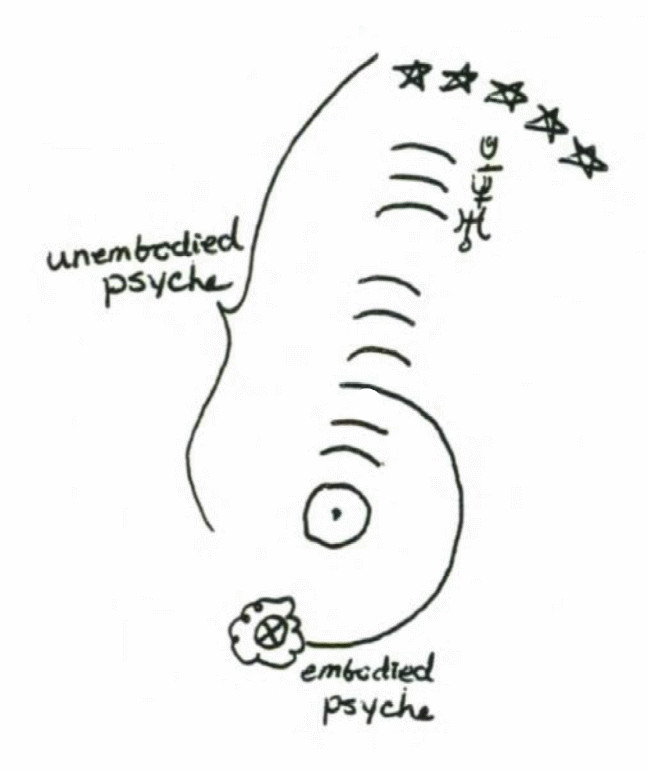
- FIGURE 1984 0222-1. Psyche as Embodied and Unembodied.
NOTES:
PB paras are from Red volumes 5v and 18v.
Earlier transcript versions exist, including Scan File 1984 0222C1-25R05.PDF.
TRANSCRIBED from Audio Cassette Tapes (and also using the original Pat Campbell 1983 transcript as a basis) by HP, et al. in 1993 as part of the set for Living Wisdom. V11 version 2018. Reformatted from V11 version by JRM & JF 2019-2020, with Subheads and Table of Contents added by JRM. In 2024, IT updates prefatory matter and footer, replaces tape markers with audio file markers, expands Subsubjects, alters most Subheads and adds some new ones to make more accurate, completes Book List, adds Plotinus quotes section, corrects typos/errors, adds new notes within transcript, moves diagram from within transcript to appendix, reformats to accord with new conventions. Readable edited transcript – V14.1r.
AUDIO FILES: 1984 0222a, 1984 0222b, 1984 0222c.
1984 02/22 at Wisdom's Goldenrod
PB Paras; Philosophy; Balance
Readable Edited Transcript
ONLY A GREAT (PURIFIED) PERSON CAN HAVE A GREAT ILLUMINATION; BALANCE AS THE RELATION BETWEEN EMBODIED AND UNEMBODIED PSYCHE
[Audio File 1984 0222a Begins]
PB: "Only a great nature can take a great illumination and not become unbalanced by it. That is why the full cultivation, all-around development, and healthy equilibrium of the man is required in Philosophy." (20c-a.2(5v/86/12) 20.3.377)
PB: "He not only has to receive this illumination in all the parts of his being rather than any one part, but also to receive it equally. It is the obstruction arising in the undeveloped or unpurified parts which is the further cause of his inability to sustain the illumination." (20b.3(5v/96/53) 20.3.208) (para read twice)
(DB/CdA/)
DB: With respect to the last quote where he spoke of the obstructions and lack of purity of these three areas--the thinking, willing, and feeling--would this be the fact that there are vasanas that are still associated with these?
AD: Don't restrict it to knowing, willing, and feeling.
DB: --Like you had a complex that is associated with your feeling, and that is presenting you from their further development-- . . .
CdA: I just got a communique that you don't restrict it to knowing, willing, and feeling.
DB: Ok. This balance that we're speaking of is not restricted to the knowing, willing, and feeling. What else should we include within that?
(S: What else should we include in the balance of psyche? = paraphrase of student questions above)
AD: Bring in (more)? What parts of the psyche? Any and all parts of the psyche. Any one instinct can come and overwhelm you if it lacks development. So a person might get an illumination, and because some part of his being--let's say the lower intellect or the erotic nature--can come up and completely overwhelm a person and deprive him of retaining that illumination. (pause) Or one that perhaps many of us are familiar with is: we have a good meditation, and we get up and go to the refrigerator and attack it furiously. (laughter) And that would be like gluttony, you know?
KD: (inaudible)
RC: He's saying that's one of the reasons why you need the balance, to develop the balance in advance to some extent. But he doesn't go into specifics.
DB: Could you say that the reception of the illumination is by the psyche, not in spite of it? And that, depending on the condition of the psyche, (is said to be?) the eventual good use to which that illumination is put.
RC: I would go with that 300%.
DB: . . . You don't develop the psyche in order to throw it away when you're done with it. If here the psyche is what's receiving that illumination, and that gives a different perspective on what the psyche really is.
PD: But, David, you seem to be equating psyche with ego now?
DB: I didn't mean to . . . I guess it depends on what you mean by ego . . .
(NH/RC/NH/)
RC: . . . In quotes we read before he talked about how you needed to achieve this balance to make the illumination be abiding, or to be ready for it. This one just speaks specifically to the--
NH: An unbalanced illumination?
RC: Well, there can be an illumination and an unbalanced reception and reaction to it. I mean, that's what usually happens.
AD: Tim, would you put up that diagram that I did Monday night, the one that shows the psyche as embodied and disembodied? [Note: See FIGURE 1984 0222-1, Psyche as Embodied and Unembodied, appended to this transcript.] That balance we're speaking about is the relation between these two.
(Diagram being drawn on blackboard; diagram is included in original PC manuscript.)
RC: Is there any real chalk left?
CdA: Avery, buy us some chalk, could you steal us some chalk?
AD: No, BUY it, don't steal it.
AS: Here--(sounds like he throws chalk)--don't drop it.
RC: (inaudible) (laughter & student comments.)
AD: That's what we're talking about when you're speaking about the balance of the various faculties of the psyche. So sometimes if you eat dinner you may find it necessary to have a cookie to get rid of the acidity so that you remain balanced. (laughter)
S(LR?): Is that all you have to do?
AD: Well, that's all PB had to do. I don't know about you!
But if you look, for instance, inside is the natal chart, the chart that you're working with, the way your psyche is organized and the relationship that it has to the unembodied psychic, and you speak about balance, you're speaking about all those psychic functions are kept in equilibrium. Also that your willing, feeling, and thinking are distinguished out from one another, and each one evolved and developed.
Now most of us will get an illumination or a glimpse of the higher Self, and then the great work begins. But that's if you want to be a sage.
RC: There are a few quotes in the section about the Quest, where he basically says that it's only after there's been enough mystical illumination for the person to have absolute conviction of the reality of the goal, and after enough insight into the ego's nature to see that that's precisely what keeps you from it, that you're ready to decide whether or not you want to go on the Quest.
EGO AS EMBODIED PSYCHE/ANIMATE – A COMBINATION OF THE ANIMAL BODY AND THE LIGHT OF SOUL
LDm: In the main part, would you equate the ego with the embodied psyche?
RC: Could you be a little bit more specific about that? Do you think it be worth it?
AD: What?
RC: In terms of equating the ego with the embodied psyche or not? . . .
AD: Yes. It's a little more complicated. But if we say that the psychosomatic organism is a fabrication or an organism built by nature, and therefore it's part of the World-Idea. But the other part is the light which is illuminating it or the presence of the soul in that psychosomatic organism. So the ego complex becomes a difficult concept. On the one hand, we speak about it as an organism which has evolved genetically and philogenetically, but on the other hand, you have to keep in mind that involved in it is this presence of the soul, the immaterial principle that's illuminating its functioning, and that, too, is part of the ego complex. If you take that out you have an organism: but you don't have an ego there; there's no one there. But it could still be a functioning organism, so it's complex in the sense that these two things are required.
And that's why I often translate what Plotinus calls the living animate in this way. It's a combination of the animal body and the presence of the soul. He calls this the living being or the living animate. [Note: See Plotinus, I.1.7.] And that's why it's complex.
But for most of us the strength of the animal organism is such that that's primarily the problem. I don't know if I could add anything to that.
LDm: That embodied psyche would have also those three levels of the spiritual, mental, and physical, but that is still not the light of the soul within it. Those are the three bodies within the dragonic sphere?
AD: Yes. You have a representation of the cognitive faculties of the soul in the body, as present in the body, and that representation in the body or what you call the immaterial principles of knowledge in the material body, you have that and also have it as disembodied, because one could reason, so to speak, in a very contemplative way, and not be quiet about it. But assuming that you're an embodied soul, both these faculties are available. On the one hand, you have to use the body; but on the other hand, you could, let's say, be in a contemplative state where you're not using the body. So, again, it's a very complicated situation.
LDm: To persist a little bit, it seems that within that embodied psyche that there would be instances, like you're saying, of disembodiment. That that highest level of the dragonic belt, if one were to contemplate those degrees within that, it would be like you're approaching or are in disembodiment. There's no real clear line--
AD: In a contemplative state, yes.
It's very, very difficult to understand how these mental faculties are present in the physical body. And it would require that you go back to the definition of soul the way Plotinus has given it to us, to be able to grasp that the entity or the person is constituted of these two different aspects: soul as unembodied, what we call the I AM, and soul as embodied. Soul as embodied would be that part of the soul which we refer to as the reproductive or embodying soul. And these two things together Plotinus calls the "we." So it's very complicated. And in the "we," which is the soul that seeks embodiment, you're speaking about that soul as in an organism.
So rather than try to come up with definitions, it's better to try to just simply explain it, because definitions sometimes cannot be had. Like sometimes you can't define something, but you could describe it.
So if you take that point of view--that there's the I AM, the pure soul, and there's a part or a phase of the soul which we call the lower phase of the soul and refer to it as the embodying soul, we refer to it as the reproductive soul, or the ability that the soul has to project itself anywhere, any whither--and you think of these two, and you call that the "we," this is what Plotinus is doing. Now from the "we" you can also factor out the I AM, the eternal, immutable, intellectual being that soul is, and on the other hand, you could factor out that part of the soul which seeks embodiment.
Now that part of the soul which seeks embodiment locates itself in a body which has been fabricated for it by the World-Idea. Now, that body is part of the World-Idea. So on the one hand, it seems that the ego is part of the World-Idea; but on the other hand, since the soul which is present in that cannot be part of the World-Idea or, part of, let's say, manifestation, (then/and) that part is not. So that makes the ego complex a very difficult thing to pin down, and say it's this or it's that. It's both these things; a combination of these two things.
GLIMPSE AS SELF-RECOGNITION
LaurD: . . . What is it that has the glimpse, is it the reproductive soul which has the glimpse?
AD: Yes. It's the lower phase of the soul that has a glimpse and not necessarily of the entire.
LaurD: (inaudible)
AD: Well, the glimpse would mean self-recognition; it's not something outside.
LaurD: In other words, of its source.
AD: Yes, but it IS that source.
Let me try it a little differently. If the reembodying soul or that lower aspect of the soul--let's call it consciousness--if this consciousness is what gets embodied and is always preoccupied with externals, when we say that it gets a glimpse, the glimpse that it gets is of its own nature, not of something outside. That's what you mean by a glimpse. It recognizes that its nature is consciousness. It doesn't mean something out there. So when you get a glimpse, don't think it's something outside. It's just that Consciousness recognizes itself to be its own principle. That would be a glimpse.
AH: Would it be appropriate to speak of that glimpse as being the embodied soul having a glimpse of the unembodied soul?
AD: Well, again, Andrew, we pointed out that soul was constituted of these two aspects. One was the I AM, the eternal and immutable, and that's immaterial--and the lower phase of the soul, that phase of the soul, which--let's call it consciousness now--seeks embodiment and gets embodiment. When that gets a glimpse, what it recognizes is its own nature. I'm sorry, I forgot your question.
AH: Can you speak of that glimpse from the point of view of embodiment? But I understood that it isn't appropriate to speak of that now.
AD: The point that's being expressed now is that the glimpse essentially brings about the recognition of its own immaterial essence. But we are talking about the reembodying soul--that's what gets the glimpse. And what it gets the glimpse of is its own nature. So you could speak about it as unembodied if you want, or you could speak about it as embodied. If you speak about it as "I got the glimpse," then you're speaking about an embodied soul that got the glimpse. But what it got a glimpse of was its own immaterial essence, which cannot, so to speak, be understood in any other way except that it is immaterial, and in that sense it can NEVER REALLY be embodied; you can't wrap a body around it.
AH: Would it be appropriate to think of it as what it is that one looks for in a glimpse is what is looking?
AD: Yes, yes, and of course you could see that the question could be answered from the point of view that you want to answer it from. If you want to say "it was I who received the glimpse," then of course you have to refer to yourself as embodied. But if you think about the intrinsic nature of the glimpse itself, then you would not consider yourself as embodied. Very complex situation.
RC: . . . The ways we've talked about it in the past, if the words give the impression that the higher soul and the lower soul are somehow two distinct things. But talking about it this way--it seems that to say that the "lower soul" glimpses its own nature--it wouldn't perceive itself as the lower of some higher but as actually in essence being that one soul.
SOUL AS ONE AND MANY
AD: Yes, that's because the soul, by definition, or unity of soul, by definition, is present wherever its powers are. And this is one of its powers--that it could send forth a projection, and it would have to be present in its entirety in any of its powers. You follow this?
AH: . . . That is very confusing, because as Randy suggests, that is typically spoken of as two things, and from that point of view we always conceive of the soul as some kind of an object or some kind of a plurality. But this way of speaking tonight seems to suggest that it's a singular; that it can be no object.
AD: It's--The way Plotinus points out, he says it's a one and many. It's a unity and it has powers, many powers. But the many powers that the soul has, we have to remember that the unity of the soul, that the soul as a unit, is present in each and every one of those powers and in all of them.
So, if we took an example: mind is present, and totally present--it isn't a piece of the mind that's present--when you're thinking or when you're memorizing or when any mental faculty is being exercised or all of them being exercised at the same time. The mind as mind remains integrally entire and undivided when you're thinking or when you're memorizing something. Now, the part that remains integrally undivided and totally self-present is what we're calling the higher phase of the soul, the I AM. The powers that it operates with--memory, reasoning, etc.--those are powers that belong to it, but when you reason, your mind is totally present in the reasoning. When you memorize something, the mind is totally present in that power of memory, in that ACT of memory.
So it is, in a sense, like speaking about two souls. But if you keep in the back of your mind that it is A soul, with MANY powers, and that it is integrally present to each and every one of those powers--either simultaneously or singularly, it doesn't matter--then you begin to see how difficult the concept of soul is that you've got to deal with.
You won't get that in a psychology book, but you will get it from these people, and the one, of course, that we get from is Plotinus, where he points this--what the definition of soul is. And the definition or description is pretty accurate. If you don't understand it this way, you will always run into difficulty.
AH: Although it partakes of those powers, in itself it is no object. Is that so?
AD: No. It could never be an object.
AH: It is very difficult to understand how it can be a one and a many.
RG: He didn't say it partakes of its powers, Andrew, he said the powers partake of it.
AH: The powers partake of it?
RG: Yes. And if it's totally omnipresent to its powers, it can't partake of a power.
AH: I remember the phrase from Plotinus "partition without partibility." [Note: See Plotinus, IV.1.1, last sentence of last paragraph]
(RG/AH/)
RG: So what do you think that means?
AH: I don't know what it means.
AS: "Parted without partibility": isn't that the same thing as saying it's a one and many?
AH: Yes.
(AS/St/AS/)
BS: Would it be proper to say that for any one of these powers of the soul, such as thinking and memory, if the whole soul is present to this power, to a particular power, any of the powers, that would there be a unity between the soul and a particular power? A complete unity?
AD: If you say that, then you've just abolished the distinction you made.
St: How is that?
AD: The point in saying soul is one and many is precisely to keep apart in your mind or to help you distinguish in your mind, the power of thinking and the undivided mind present to that power of thinking. But if you say that they're a unity, a unity of what? A unity of the soul with the power of thinking? Then you have JUST unity.
You could try the experiment now. You could think, and at the same time you realize that your mind is present to that thinking. But the power is not to be confused with the unity. Like I do many things--I walk, I talk, I sleep, I yell, I get angry.
BS: I don't really mean to preclude all the other powers.
AD: Yes, but the point here is that perhaps it would be worthwhile to say it's one substance, many functions.
RG: Anthony, if we say that one substance, many functions; one soul, many powers; the powers are an unfoldment of that soul. How do we hold the distinction of the powers from the soul? It seems to be a distinction that really isn't a distinction. I mean it's a distinction, a function, but the essence of the function seems to be the soul or the mind that's inherent in manifesting it.
JA(or LrD): Rather than the World-Idea?
RG: I don't know. In this view it's hard to understand how those functions are not thought of as the mind's inherent nature externalizing itself.
AD: Well, that is the paradox, isn't it--that the mind, as we put it, externalizes itself, and yet remains undivided, remains a unity.
(Approx. 12 minutes student discussion on mind and functions, glimpses, balance, through end of Audio File)
[Audio File 1984 0222a Ends]
[Audio File 1984 0222b Begins]
(Student discussion, continued, 10 minutes)
HUMILITY WHEN ASKING AND LISTENING FOR GUIDANCE; BALANCE OF HUMILITY AND SELF-RELIANCE
PB: "It is out of such a splendid balance of utter humility and noble self-reliance that the philosopher gets his wisdom and strength. He is always kneeling metaphorically before the Divine in self-surrendering renunciation and often actually in self-abasing prayer. Yet side by side with this, he is always seeking to develop and apply his own intellect and intuition, his own will and experience in life. And because they are derived from such a balanced combination, this wisdom and strength are beyond any that religion alone, or metaphysics alone, could give." (20d-a.g(5v/12/1) 20.5.16) (quote read twice)
PD: Even if a philosopher practices self-abnegating prayer, who is it that gets enlightened? (inaudible)
(RC/JL/ME/AH/CdA/PD/)
RC: I think I have a practical example, an application of the same thing. I was trying to ask PB how would you know when you really knew, as opposed to when you just think you knew. When you have to do something, is there any way that you could really know? And I mentioned part of it before. He said, well, the first step is that you have to be able to make yourself completely humble. And that if you can put yourself in that state, then you're in a state where you can receive guidance. And if the guidance doesn't come, then you do nothing. But if the guidance does come, then it's perfectly clear--you know what you need to do, and the strength to do it comes with it. There seems to be a relationship there between the ego and the soul that--
PD: A total absence of egotism as a state of mind.
(LR/PD/RC/JL/RC/PD/. . ./quote reread/)
AD: Now ask your question, Paul, again.
PD: What does it mean for a philosopher to be practicing self-abnegating prayer?
AD: Shouldn't your question be, "This is what a philosopher is?"
AH: Is that to suggest that the philosopher is trying to abnegate himself? Is that this form of prayer?
AD: You have been de-railed. (laughter) Again, this is what a philosopher is.
EC: . . .
AS: I thought of something more to it--if you say that the philosopher doesn't exclude the thinking or the ego or anything--if it includes everything--then there must be a proper functioning now for that ego. And if the proper functioning for that ego is no longer ego-TISM, then what is its proper functioning? The proper functioning is not to be annihilated, it still exists. And it is still a part of the philosopher. So it must still have a proper functioning, that of self-abnegating prayer.
. . . If you say that's no proper functioning then you're saying it doesn't exist anymore. But if he's a philosopher, he still has that ego and it must have its proper function--balance. Every part of that whole picture on the board has its proper function in the philosopher. And that's the ego's proper functioning, self-abnegating prayer.
(PD/AS/PD/RC/=less than 1 min.)
AD: The other part, Avery, the other part now, that part that's not embodied.
AS: The part that's not embodied has also its own proper functioning . . . Let's reread . . .
PB: ". . . Yet side by side with this, he is always seeking to develop and apply his own intellect and intuition, his own will and experience in life. . . ."
AS: There he's saying that from the other side he's seeking to use those powers--each of those powers of the soul has its function. And it will be active in whatever ways are appropriate.
PD: . . .
AS: He says those functions are active in his life. So each one of those planetary functions has its proper activity in a life. And the ego has its proper activity in life. They all have their proper activity.
(PD/AS interchange & other student comments = less than 1 minute.)
AS: Each one of those things on the board has a proper function. If he's the yogi and goes into Nirvikalpa, he doesn't care a fig about all those functions. But if he's going to be a sage, then each one has to have its own proper function, and I thought that's what he meant by balance. And that includes their function is to be active in this life, not to go into Nirvikalpa, but use the intellect, use the will, in their proper functioning. And the proper function of the ego is to use self-abnegating prayer, or whatever, and let those functions function.
(Student discussion to within 5 minutes of end of Audio File, then PB quote below.)
THE CLEAR LIGHT OF REASON
PB: "The mastery of philosophy will produce a supreme self-confidence within him throughout his dealings with life. The man who knows nothing of philosophy will declare that it has nothing to do with practical affairs and that it will not help you to rise in your chosen career, for instance. He is wrong. Philosophy gives its votary a thoroughly scientific and practical outlook whilst it enables him to solve his problems unemotionally and by the clear light of reason. He will, however, be under certain ethical limitations from which other men are exempt, for he takes the game of living as a sacred trust and not as a means for personal aggrandizement at the expense of others." (20d-wrth.4(5v/74/19) Perspectives p. 278 and 20.1.176) (quote read twice)
[Audio File 1984 0222b Ends]
[Audio File 1984 0222c Begins]
DB: In that last quote, what did he mean by "the clear light of reason" he uses there? (pause)
AD: If you have an overall view of the meaning of philosophy, it would be implicit in that view the fact that the functions that you're working with--knowing, willing, feeling, and the others--are each distinguished from one another. EACH has reached a level of development--not perfection, but of development--where the proper weight and due for any given situation, event, or circumstances can be examined, and on the basis of that, base your action.
AH: That decision wouldn't be made from within one of the functions? Is that so?
AD: I'm sorry?
AH: The decision of proper action--
AD: The question is irrelevant.
AH: We spoke of an overall view of philosophy.
AD: Yes, that is, an overall view in the sense of what it means to you, and if you have that kind of bird's eye view of philosophy, there's already presupposed that there's a kind of development of each of the functions. And that means that whenever any situation arises it can be examined in the light of these various functions, each one developed, so to speak, according to its own mode, and that the examination of that situation with this function or combination of functions--but each held distinct from one another--gives you an understanding of the situation and then what it is that you can DO about it, if anything can be done. (short pause)
So to act according to the clear light of reason means that you first have to REACH the reason that's embedded in a situation, and then when you understand what the reason is that underlies that situation, you'll know what to do. But if you don't understand the reason that underlies a given situation, circumstance, or event, then you would not be able to act according to the clear light of reason.
AH: Is that clear light of reason one of those functions?
AD: No. Those functions help you to get TO what the reason is that underlies a situation. And if those functions, like we said, are not distinct--if, for instance, operative in you is a mixture of feeling and willing or any combination of these, and you cannot distinguish one from another--you would have a great deal of difficulty getting to the reason that underlies something, because there would be a confused functioning that goes on. And if there's a confused functioning that goes on, there's going to be error and illusion. So you first have to get to the underlying reason of a given thing, and that presupposes that your functions are available for that purpose. If they are, then you get to the reason that underlies that thing, and you can act according to the light of reason. But it's very difficult to act according to the light of reason if you don't understand what the reason is that underlies that particular thing.
RC: Could you talk about that as a relationship between these two levels here--on the board? All the functions of the embodied psyche including the trans-Saturnians--all their reports have to be sorted--
AD: Have to be what?
RC: Have to be sorted, looked at, seen to what extent their contribution is valid--while at the same time that being is in contact with this disembodied soul?
AD: While at the same time it's in contact with REASON or the faculty of understanding.
RC: So then it could actually be--I don't know if this is too metaphorically speaking--sort of poised between these two realms and seeing to what extent this one corresponds with that one and where any aberration might be being introduced. That seems particularly to be related to that quote about learning how to function with the ego and without the ego, that the critical part of this balance is a balance of those two, that we did last week.
AD: I don't remember, Randy.
RC: Most of the quotes talk about a balance of functions that we could easily say are within the ego, but there was this one:
PB: "The required condition of balance as the price of illumination refers also to correcting the lopsidedness of letting the conscious ego direct the whole man while resisting the super-conscious spiritual forces. In other words, balance is demanded between the intellect which seeks deliberate control of the psyche and the intuition which must be invited by passivity and allowed to manifest in spontaneity. . . ." (Perspectives p. 269 & 20.3.278) (quote not finished)
AD: Yes.
RC: . . . We were talking a little bit this afternoon that the problem we've discussed in the scholastic tradition, and we did Santayana where we have the universal in the mind and the universal in itself, and the universal in the object. And a lot of people are concerned about how do you correlate the universal in the mind to the universal in the object. It seems like this access to the clear light of reason seems to be where that correlation is made. But this whole mechanism here, the dragonic belt, is like the presentation of the universal in the mind. But that may or may not correspond to what the World-Idea is actually up to at that particular moment.
AS: Well, there's a Plotinus quote where he says that the understanding is a point of vision of ideal forms, and its function is the reconciliation of the inner with the outer . . . [Note: See Plotinus, I.1.9, fifth paragraph.]
(silence)
KD: . . . Can you equate that description of the overall view of philosophy the same as being the withdrawal of consciousness into an impersonal state? In other words, is there a (seam?/scene?/???) that occurs where you can stop thinking, if you can withdraw into an inclusive state of consciousness? Is that what you were just describing?
AD: No, you could make it much more simple, if a person, let's say, is caught up in a situation--let's say, in some sort of relationship--and it's a tangled affair; and he doesn't know what to do with it. Now it would be REASON that could understand the springs of motivation--let's say, certain neurotic tendencies which are manifesting. It takes reason to be able to single them out and see them as the underlying causes or motivation that is going on. And again, it would take reason to see whether that would fit in, in accord, with the, let's say, developmental process that you have in mind. In other words, you have a certain ideal goal that you're striving for according to what you understand of philosophy. Now, on the one hand, it will take reason to understand the situation, single out or factor out those springs of motivation that are of a disturbing character, and, on the other hand, it will take reason again to see, according to your philosophic understanding, whether they accord WITH the goal that you have set yourself or not. And if not, then reason has to point that out and show you the correct course of action to follow. We're talking about something very practical here.
KD: (inaudible)
AD: It does presuppose--let's say if you're investigating into the causes of the behavior that you're exhibiting--it does presuppose that you can think, that you could feel, that you could will, and a few other things. If these functions are not clarified--that is, that they're not primitive--they have to be developed, because you can't THINK yet if they're undeveloped. So what is presupposed is that you have, so to speak, to some extent isolated the thinking function from the other functions and developed it. If the thinking function is caught up with all the other functions, then you can't think, because every time you make an effort, you'll bring everything else up to the surface. So that's why I'm saying it presupposes a certain development of each of the functions.
So from a very practical point of view, assuming that the person has these functions somewhat developed, then he can use them to understand the nature of the neurotic behavior by getting to the causes that underlie it. Now, if you can get to the causes that underlie it, and you can see the appropriate behavior or the proper course of behavior that you're to follow, then you are acting according to the light of reason. This is what we're trying to understand. And I suspect that sometimes when people say "according to the light of reason" they expect a great, booming light to come into their minds and isolate some factor in our behavior. Whereas it's a metaphor: "the light of reason." I don't know, David, if that helped you or not.
DB: Yes, thank you. It seemed like such an elevated form of the word 'reason.'
AD: It is. It is, David, it is. Perhaps it doesn't have the glamour that Hollywood would give to it, but it's a very elevated form of, let's say, action. As a matter of fact, if you remember, the Buddha insisted that you live according to the light of reason. You don't HAVE anything better. Even if you get intuition, it must be explicated by reason, because it's the only guarantee you have whether this intuition is correct or not. So again you're forced to rely on reason. So it is quite elevated.
AH: In the example you gave, is it that the functions are objective to reason?
AD: What?
AH: That the functions are in some way objective to reason?
AD: I thought it would be the other way around: that reason would be objective to the functions. In other words, if I examine my behavior very minutely and microscopically, and I see, "Ah! Here's a complex hidden, which is manifesting itself in my relationship with others," this has become objective to the functions of thinking, willing, knowing--I mean, well, the functions. See all the gold you've got buried in you?
RC: This seems to be drawing out why this balance is so important, because it would seem that if the functions were not balanced that they couldn't objectify reason without distortion.
AD: Yes. You remember also he pointed out that before we can speak about balancing them that they have to be developed. That to try to balance undeveloped functions will only give you a very unstable product.
(AS/RC/AS/=less than 1 minute.)
LR: . . . Can the light of reason be contacted through various of the functions? You spoke of it being contacted though the development of the function of thinking, but I was wondering whether that light of reason which seems very impersonal--
AD: Seems what?
LR: It seems like an impersonal power of the soul.
AD: Seems like an impersonal power of the soul?
LR: . . . Can this light of reason be contacted through other functions besides the thinking function?
AD: Yes. When we say a reason, that a reason-principle is objective to these functions--like you could think of your feeling function as giving a situation, or let's say, the reasons involved in a situation their proper weight or evaluation in terms of their felt value, it doesn't necessarily have to be a cognitive thing. So through those things, or through those functions, each one has its own weight. And you know, many people, for instance, will FEEL the value of a situation, and if they have a highly developed feeling function, they're usually correct. They've made contact with the substratum reason-principles, and given it the proper weight, they know that they have to act according to the way that feeling function has revealed to them to operate.
To understand a reason-principle, I would go a little further, only on a cognitive basis, and ignore the other aspects of knowing, willing, and feeling, is not to really understand that object. So if we took a very simple example, and you take a musician who writes a piece of music, all three functions, let's say, are distinct within him. He has a cognitive ability--he could think--and he could feel, and he could execute or will. And doing these three things makes him feel like he's a total man, a total person when he's operating. That's why so many people want to also play besides just read and feel.
St: Play music.
AD: I think it's the experience of most people that they get a different result or a different experience when they also play the piece than when they just listen.
(silence)
AnnaP: Could you explain a little more in detail what you mean by the psyche (inaudible) has to be separated out one from another?
AD: In some other class, Anna, not here? Probably tomorrow morning--
You have any more, Randy? Ok?
(TS reading:)
PB: "The peace to which he has become heir . . ."
KD?: Could you speak louder?
AD: Will you speak?
PB: "The peace to which he has become heir is not self-absorbed rest from old activities that he deserts, but a divine awareness that subsists beneath new ones that he accepts." (20d-svc.4(5v/8/29) Perspectives p. 280 and 20.4.225) (read twice)
KD: New activities?
TS: Yes. "The peace . . . is . . . a divine awareness that subsists beneath new ones that he accepts."
AD: That means when you become a sage, you get more work! Next one.
WHO WANTS ENLIGHTENMENT; THE REEMBODYING SOUL IS EVENTUALLY BROUGHT TO SEEK ENLIGHTENMENT
PB: "It may be said that the world's supreme need is exactly what the illumined man has found, therefore his duty is to give it to the world. This is true, but it is equally true that the world is not ready for it any more than he himself was ready for it before he underwent a long course of purification, discipline, and training. Accepting these realities of the situation, he feels no urge to spread his ideas, no impulse to organize a following. However that does not mean that he does nothing at all; it only means that he will help in the ways he deems to be most effective even if they are the least publicized and the least apparent. He is not deaf to the call of duty but he gives it a wider interpretation than those who are ignorant of the state and powers which he enjoys." (20d-svca.4(18v/138/52) Perspectives p. 278 & 20.4.264)
AD: Remember the story about the Buddha? Someone came over and told him, "Why don't you give nirvana to everybody?" He says, "Well, nobody wants it!" (AD laughing) "Go out and ask them what they want!" And so he went around asking, you know, "What do you want?" "Oh, I want another ten acres." "What do you want?" "Oh, I want a daughter." "What do you want?" Nobody wanted nirvana!
St: I don't understand.
AD: You don't understand?
St: (inaudible)
AS: Somewhere he says enlightenment isn't very popular these days.
PD: Who wants enlightenment, anyway?
AS: That was it. (& inaudible student comments)
AD: What was that, Paul?
PD: Who wants enlightenment?
RG: Who wants to know?
AD: I DO. (& inaudible student comments)
Tom, could you read that sign above your head?
(TM reading Sign in WG Meditation Room:) "I Will Obtain The Ultimate Truth and Ultimate Reality, and the ultimate aim of my life in this world--whether my body may remain with me or it goes into pieces. My bones and flesh may go into complete annihilation or may remain with me. I Shall Obtain The True Form of the Universe. Through innumerable incarnations' good results, I have obtained a human body. I will not lose this golden opportunity and will certainly obtain samadhi and the Real Form of Consciousness. Calamity may come or go, mountains may break on my head, but I will not leave my promise to obtain Nirvanam. -- Lord Buddha"
AD: In that case we know who wanted it; he wanted it.
St: I never understood that. How can mountains break on his head?
CdA: It's metaphorical.
AD: It's metaphorical, it's (inaudible), it may be literary, too.
CdA: With mountains--
AD: The mountains may have to break over your head yet.
CdA: You're being metaphorical, too, come on.
AD: Tim, you remember that quote I asked you to write out and I put in front of my desk, about how hard the sage has to work to get to where he is. (laughter) (inaudible) Well, it's alright.
RG: That was the gist of it?
AD: Yes, that was the gist of it.
AH: . . . How could I want something that's the undoing of everything I know of myself? What is that motivation? It's certainly not the ego's motivation to want enlightenment . . . It couldn't want that because it has to get out of the way.
AD: Yes, but again, this calls into play what you understand in philosophy. If you understand that there is an eternal and immortal soul in the sense that it is what it is--we speak about it as the Intellectual, the Being that we truly are--and if you keep in mind also that lower phase of the soul that we spoke about as the embodying soul and which progressively transmutes the essence of the experiences it goes though until it evolves to a position where it begins to understand the truth, even in this conceptual way, then you can easily understand what is it that seeks enlightenment.
AS: And in that point of view, you can also understand why it takes quite a level of development to WANT the enlightenment. And that was the point of the quote you made from the Buddha that people DON'T want enlightenment because that's really quite a high stage already, that development has gone to a certain point already to presuppose that it even wants enlightenment.
AD: But you follow the point here, Andrew, that there is an entity that is progressively accumulating experience and transmuting that experience into some kind of understanding, and this is what you might call a sort of progressive development that's taking place all the time. In the earlier stages, it is not interested in enlightenment. But as it goes through a variety of experiences. Like we speak about in astrology: you've reached the goal of life; you've assimilated the basic ideas, and when you think of the experiences that you go through in any given lifetime you extract the essence of that experiences and that essence is what's building up this entity in progressive stages. Then, it does reach a point where it cannot turn back any more. That shouldn't be surprising.
AH: It can't turn back even if what the Buddha says is true. Even if that happens, even if there's (a/no/???) choice, it's the motivation of the soul itself, though, isn't it?
AD: Well, we could say it's the motivation resulting from the accumulation of the distillation of this experience into understanding. And then it has its own momentum.
AH: . . . The ego thinks it's going to get something out of this in the beginning, and then by the time it finds out that it isn't going to, it's too late to turn back.
AD: Yes, you got the point. (laughter) Remember, I mentioned to you Sunday that I try to take advantage of this, insofar that I get a person involved in teaching, and then he has to. Because the ego is involved, he's got to show his superiority to everyone else, so he studies, and he understands what he's got to teach, and then he teaches it to others. But then there's a subtle influence that starts operating. The very understanding that he's developed through researching and working out the ideas and then presenting them to others now this very understanding starts acting on his ego! And it begins to understand more and more that what it's doing is erecting a technique and a method and an understanding how to dismantle itself. Then he reaches a point where he doesn't want to teach nobody; he doesn't even want to teach himself any more now. Now the ego's come in, and it's begun to recognize the DANGER if this goes on. (laughter)
Isn't there a remarkable difference in the case of--I think this was in PB's notes, but it's also pretty well known--Thomas Aquinas wrote, and wrote, and wrote, and explained the doctrine--I think from the time he left Paris and was given his doctor's degree until he was about 54--when all of a sudden he got the beatific vision. And after that, he stopped writing. He never picked up his pen again after that. He died a short time after that. [Note: See Paul Brunton, Notebooks, V11, 16:9.44 and V16, 24:4.193.]
Now, on the other hand, you have a man like Shankara, who after his illumination which was relatively young, THEN he started writing. And one might speculate--I'm not saying it's so, but one might speculate--that in the case of Aquinas there was a desire on the part of his ego, and this desire on the part of the ego to, let's say, advance itself and show its superiority, etc, etc. Whereas in the case of Shankaracharya, not until AFTER his illumination did he teach. Now there was no ego to interfere with what he wanted to do, and he went ahead and did it. In the case of the other, it was the ego that prompted him, and to such a point that it actually achieved the beatific vision.
These are paradoxes, but that's the way things are. In one case, the person's driven by his ego; in the other case, he was driven by an impersonal desire to help others.
You notice how much more frequently the great teachers usually stay in the background. They don't even want to be known. They don't even care to be known. They send out others to do it. Let's try another one.
MORE PB PARAS ON PHILOSOPHY
PB: "This silence which enwraps him does so only where his spiritual life is concerned. It is not quite the pride of feeling inner greatness nor a way of protecting that life against sneering laughter or inquisitive intruders. It is the sense of a holiness around it, the attitude of reverence for it." (20d-g.g(18v/194/23) 20.5.154)
AD: The sage is quite different from the guru. The guru is trying to see how he can increase his popularity; the sage is trying to hide from it and become more and more anonymous.
PB: "This silence . . ." (repeat)
PB: "The effect of his studies and meditations will slowly but surely reveal itself in his life. His world outlook will sparkle with vitality, his speech will form itself with precision, his deeds will be wise and more virtuous. For philosophy, unlike metaphysics, is not only a theory to be learned from books but even more an integral way of life to be practised in society." (20a-prac.g (5v/63/127) 20.1.335) (read twice)
PB: "The philosophical attitude will appear in balanced judgements formed after clear and careful thought, in the harmonious way whereby idealism is tempered by realism." (20b-g (5v/73/6) 20.5.43)
AD: Once more, Tim.
PB: "The philosophical attitude . . ." (repeat)
PB: "In observation a scientist, at heart a religious devotee, in thought a metaphysician, in secret a mystic, and in public an efficient honourable useful citizen--this is the kind of man philosophy produces." (20d-a.4 (5v/31/17) Perspectives p. 273 & 20.5.22)
AD: Once more.
PB: "In observation a scientist . . ." (repeat)
[Audio File 1984 0222c Ends]
1984 02/22 V14.1r: CLASS: PB Paras; Philosophy. Copyright 2024 Wisdom's Goldenrod p. ii