DIAGRAM FOR 1984 0309a
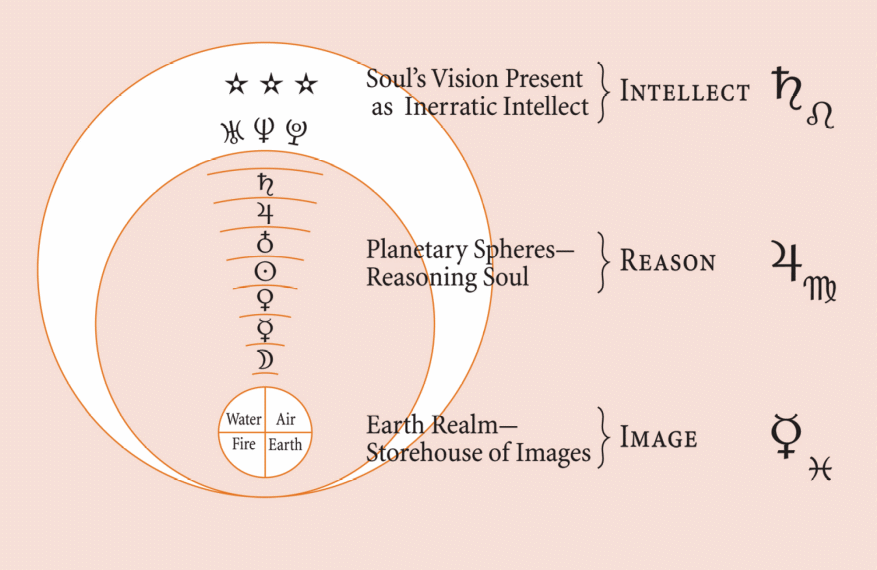
APPENDIX: 1984 0309a PARTIAL TRANSCRIPT
[File AD SUPP 1164-1180 1984 0309 PLO soul.PDF Begins (pp. 1164-1177, 1179)]
Plotinus Class 3/9/84
Soul has a paradoxical nature; on the one hand it transcends all relations, on the other, it can be included in the world circuit and experience the World Idea. It manifests the W.I [World-Idea] but the W.I gives it exist. [existence]. You can think of the Overself (OS) as a unit mind or soul; & in two ways. As a point within a circle, the OS is within the World-Mind (WM). On the other hand, you can think of the WM within the OS. Let us keep both alternatives available as we proceed. If we restrict ourselves to thinking of the OS as just a point within the WM, then we will be spatializing our understanding. If we use the other one, that the circle is within the OS, it will help to cancel out the spatial fixity or rigidity in our understand [understanding]. So one part of the soul which we refer to as transcending relationships, and at rest, abides in a state of tranquility and which is that with which….. So soul really is without past or future – within the Nous but at the same time the Nous or light (ie Knowing) of the Nous is shining within that soul, within that authentic being. The soul at this point is undifferentiated life or egoless being. Then we spoke about this paradoxical or second aspect of the soul, its power of projection. Soul in itself as indeterminate life is not self-knowing in itself. It is Nous which is self knowing & soul can attain to the self knowledge which Nous always has. When the soul identifies with it, soul will get an insight into its own nature. If we imagine that the soul is an authentic being within the Nous, then Nous has knowledge of soul because Nous knows itself and its entire content. If Nous shines an image of itself into the soul, and by image here I mean a reality, then the knowledge which Nous has of soul would also be 'reflected' into soul. So the image of Nous in soul would contain the knowledge that the Nous emanated the soul to begin with. So if soul came to a self recognition of that image of the intelligible world that is within it, it would come to a self knowledge of itself. It would come to a knowledge of itself the way the Nous knows it. Nous has the true knowledge of soul as soul…ie it is its true selfhood.
AD: Nous gives birth to the soul eternally, on the other hand, the Nous is in the soul, there is an Intellectual Cosmos in the soul. In so far as Nous is within the soul, in order for soul to get true self knowledge it has to get to know the Nous which is within it. Within here is a metaphor. WM is the selfhood of soul and is within soul as the Intellectual Cosmos. In the intellectual part of Soul is contained the knowledge of its own selfhood. What is present in soul is an image of the Nous. This image is the actual reality.
AS: Plotinus says Intellectual-Principle (IP) is an image of the One and soul an image of Nous. The soul has knowledge of these beings and not indirectly.
AD: Passages say the Nous illuminates the soul, it irradiates the soul with its presence. Language is difficult here--this is a mystery.
"Of what is there we have direct knowledge, not images or even impressions, and to know without image is to be. By our part in true knowledge we are those beings, we do not need to bring them down into ourselves for we are there among them." [Note: Plotinus, VI.5.7.]
AD: These Ideas in Nous are divine beings, they're not concepts or abstractions. The gods, Intellectual Ideas have divine characteristics whatever their aseity is--& are divine beings that are within the soul. The soul knows itself to be among them, to be the recipient of their presence. These are advanced doctrines, unpublicized even today, except in Plotinus and one other source they do not appear. The IP is the true knower. The soul must become the IP.
READ 5.3.2 "reasoning develops to wisdom…."
AS: The soul has within it this reminiscence or wisdom of the IP.
AD: Take the spheres--the transiting planets, they would represent the reasoning soul. Take anything on the Earth as sense perception. So the reasoning phase of soul, the transits, are judging, distinguishing, combining what it perceives, and then if it has reminiscence of its intellectuality, it adapts those sense impressions to the Ideas. The reasoning phase of the soul is a midpoint, between the Earth where the sense perception is taking place, and the intellectual or inerratic sphere where the Ideas are located. For the Greeks, they would call this the Sun-like body. Soul reasons on sense perception and adapts them according to the Ideas which are above.
VM: What does it mean to "adapt"?
AD: If you see a man walking you say "that's a man." You recognize the Idea in the phenomena.
PD: That sounds like conceptual knowledge.
AD: Yes it is conceptual knowledge--but what makes conceptual knowledge knowledge? It is the presence of the Idea in the concept which makes the concept true. Would communication be possible unless concepts had fixed meanings? The fixity of the meaning is derived from the Idea--not the phenomena. The phenomena here is the percept and concept. The concept is valid because the Idea is somehow present in it. Square is a unit of meaning because the concept has a heritage and the stability of that concept depends on the Idea, and yet no one has seen the ideal square, because you can't see it.
AS: In any knowing, it's the presence of the Ideas that's the real knowing. Even at the conceptual level, all knowledge is evoked from the soul.
AD: If the Ideas are organized, structuralized, brought the actual man into being, it can certainly do it with concepts. We Our bodies are fabricated by the cosmic wisdom from the Ideas and it can fabricate human beings, concepts are quite secondary, it could do that much more easily than bringing about the physiology of the human being.
AS: We want to speak about how the Ideas are bringing the reasoning soul to a certain state of wisdom, how they are instructing us. They have to be guiding our thinking.
AD: It is possible for us to be in error or mistaken in how we understand phenomena. This goes without saying. The purpose of your intelligence is to become objective. If there is error as to what the phenomena is then it has to be located in the subjective factors, the psychology. If your reasoning, understanding is not able to correlate the phenomena with the Ideas, it is in error. If you perceive a horse and you align it with the Idea of the horse, then your reasoning is correct. Your reasoning understands the phenomena for present in the phenomena is the Idea. In this quote, he is pointing out that the soul through a process of reasoning can align the perceptions with the Ideas, and have some knowledge of the phenomena. If reminiscence has taken place then he is driven back to the originals, the Ideas, the archetypes.
AS: It is the intellectuality of the Ideas present in the soul that is allowing it to be gnostic.
AD: How does the reasoning principle grasp the reminiscence of the Ideas? If reason grasped the Ideas themselves, then it would have to be intellectual wouldn't it? So it doesn't grasp the Ideas themselves, rather the Ideas in the mode of its own being, in a mode which is peculiar to the reasoning soul. If we are speaking of soul as reasoning soul and it apprehends the Ideas and then we go on to say that it grasps the Ideas directly as the Ideas are, then we can't distinguish it from the Intellectual-Principle. If we say in some mode peculiar to its own being, it can grasp the Ideas, that means it might have to translate them in order for the Ideas to be available to it, then we are leaving it as reasoning soul.
5.3.2 cont. "….but is there also introversion and self-cognition or is that power to be reserved strictly for the Divine Mind?"
We spoke of soul in one case as transcendent, abiding in a serene tranquility, it is an undifferentiated consciousness, then we speak of the soul as having the power to project, from within itself, itself anywhere and it does so, in that it projects a stream of life and this germ of life should be understood as a stream of life not a lump which is projected and left on its own. Think of it as a continuous stream of life from the OS to this part of itself which is going to traverse all the kingdoms of nature--you will see what is referred to as a karmic continuity. This life is continuous and consequently you can speak about a karmic continuity. On the one hand the soul is transcendent (the I am principle, undifferentiated consciousness), on the other hand the emanant from the transcendent soul, Plotinus refers to as the "we". These two together are the "we". The soul in traversing the various kingdoms of nature reaches a certain point where it has to throw itself completely over to the other side. When it does so it becomes something completely different than man. The transcendent soul projects from itself a stream of life which we call a unit of life. This is what reaches all the way down to the Earth and starts out as an amoeba. It goes through all the various kingdoms of nature, rising up to the level of man. It is this stream that enters the reasoning phase when it reaches the level of man. The transcendent OS and that emanant from the OS which we are now calling the individual ego--the two together is the "we".
AS: The description of the emanant of life evolving through all these kingdoms, was its association with that developing World Idea (WI).
AD: The OS as absolutely transcendent has nothing to do with the WI, abiding and resting in repose in itself. We also said the WM is in soul, just as soul is within the World-Mind. The WM or IP in soul, in order for our transcendent being that our soul is to have experience of that world, it emanates a part of itself into that world which we call our ego and it goes through all the kingdoms of nature. It is discovering and finding out something about the WI. This transcendent being which is our I am has to send this offspring into the WI and it must evolve through that WI. The richness, variety and the incomprehensibility of the WI is something we don't have to discuss. If you take a primitive he will give you his version of the world, a scientist will give you his version, the sage will give you his. You can see that there is a deepening, an inwardization, a widening, a comprehension of the WI as you deal with people of different levels. The WI will satisfy all of us on one way or another.
AS: When the emanant is going through this evolutionary process, it is still always conjoined with the transcendent OS, it is the "we" that is having the experience when the lower has the experience, the higher is also in some way having the experience, is the real subject behind it all.
AD: The OS is present with you here and now, it never leaves. You can refer to it as the "we".
AS: All the realms of nature are part of the WI that's within the soul. Just as soul is within Nous and there is an image of Nous in the soul and then the soul sends a projection of itself to be within the WI that's within itself. The soul gets to know the WI discriminatively through the projection of itself. In terms of divine OS, the presence of Nous is in undifferenced way, whereas the stream of life in actually becoming the WI and is becoming differentiated. The soul has the WI but hasn't assimilated it, this power of projection makes it able to assimilate the WI. When the power of projection, the stream of life understands something, its reminiscence in the sense that the Idea that makes it possible to understand it was always in the soul in this undifferenced way. The reminiscence is reason evoking it into actuality or differentiation. It is reminiscence because nothing new could get in soul, but something could be differentiated out that was already present in soul.
BS: That would account for the unfolding of individual consciousness?
AD: Yes, the traversing through the realms of nature will develop and unfold that consciousness more and more, i.e., the experience of the world forces the consciousness of an individual to evolve. The faculties get developed.
AS: It's not just the differentiation of the Ideas and the actualizing of the wisdom, but the evolving and evolution of soul's powers as well. You have to keep both sides of that development together.
AD: The soul is in the IP and the IP is in the soul. The WM in the soul is what we are referring to as the transcendent aspect. When you say it's in the soul you mean the soul is transcendent to its content. When you speak of the transcendent soul or the soul as part of the IP, then you're reversing it -- this is when the soul identifies with the IP.
LDS: If the soul in one phase is transcendent and self abiding, how does it experience what the lower phase is….
AS: It's omnipresent. The emanant has a formed understanding, the higher phase remains formless.
AD: The "we" has been developing, unfolding its potential power through its experience of the WI and it reaches the level of reasoning soul.
5.3.4 p. 385 "Thus the self-knower is a double person…..(to end)."
AS: He's been speaking of "we" and there is a development of the projected phase to a certain point and now he's speaking of going beyond (the second phase was identified with the reasoning phase)--the "we" is both the higher soul and emanant but here he seems to be speaking of the higher soul, the better phase, that it is no longer the "we" that has this intellectual act but the higher phase of the soul that now has the intellectual act for that is winged for the intellectual act.
AD: The "we" reaches a point of development where it is capable of making the intellectual ascent. What would it have to leave behind? Do you think it really has to leave reason behind? Wouldn't it have to leave behind the ego, or I should say egotism? Not the ego because that is what has been developing--egotism is something different. So it has to leave the lower self behind completely, the sense perception. The reasoning phase which prepared it for the flight, would it be left behind? The kind of illumination you are going to receive depends on the kind of preparation you have made. The reasoning is formative of the possibility of provoking the intellection and to that extent it may not be left behind.
AS: The reasoning phase is not cut off.
AD: The higher phase of soul and the most advanced aspects of the ego are involved in trying to catapult itself into the divine mind, or the IP within it is what the soul tries to identify with.
AS: The soul wants to come to a self-knowledge of itself. The only thing that has self-knowledge is the Nous therefore the soul has to become aware of the Nous the way the Nous is aware of it.
AD: The soul can't know itself objectively because it is soul. What knows soul is the IP. IP generated soul so it would know soul. For soul to know itself objectively, it has to know its own selfhood, the IP within it. It identifies with the IP within itself and then it has an objective knowledge of soul. It isn't that the ego is present when the divine intellection takes place, but on the other hand, I don't want to deny it because when I speak of having an intellection of something in the intellectual realm, it is I that am having it and not you.
AS: The IP always knows itself, it has no problem. The soul wants self-knowledge of itself.
AD: If we say IP in soul realizes itself in the "we" or through the medium of the "we", on the other hand the "we" realizes the divinity within itself or the IP. From the point of view of IP in soul, it realizes itself through the medium of the "we"--that's one way of stating it. Another way is that the "we" realizes the IP within itself. These are complimentary for me to speak of a sage. If you think of the void mind in your soul (the IP in you), this is what realizes itself in you. When realization dawns on a person that he is the void mind he also has the feeling (metaphorically) that the void mind has come to realize itself in you. I want to reverse that and say that "we" realizes the void mind. The I couldn't realize the void mind but I am referring to some entity, individuality, consciousness to whom that has happened that is distinct from someone else's consciousness. If we try to describe this idea rather than explain it, we might get some idea of what we are talking about. If we try to explain it, we'll only end up in frustration. Scientists describe laws, they don't explain. If you ask what is gravity they can't say. The whatness will escape us.
AS: The power of projection is returned to its source, the two become one again. And in that union there is a self recognition.
AD: That is truly speaking the union. PB said the highest man can achieve is union with his soul. On the one hand, the IP is within the soul (a transcendent being); on the other hand, this transcendent being has to emanate a part of itself, get involved in the WI, penetrate the depths of the WI to reach prajna consciousness to come to a self recognition within itself. The Nous contains the selfhood of that soul. When soul is identified with Nous we can say soul can know its selfhood and know its soul objectively. As long as it is soul it can't know itself, it has to become IP so it can objectively understand soul and this is taking place within itself. The IP is present in soul which through the emanant evolves to a point where it reaches the Nous, they penetrate into the Nous, they identify with the Nous and soul now is itself. The selfhood of soul is Nous. When it reaches identity with Nous, it has objective knowledge of soul as well as objective knowledge… Only when the selfhood is reached is the panorama of soul's incarnations available to it because now all of it is objective. In PB's notes he points out that the extent of the illumination that is available depends on how prepared you are for it. If only one or two faculties are developed, to that extent those faculties will get fully illuminated and developed, the others will be left behind. Balance is necessary so that when the illumination comes he will receive a full illumination. There are many schools of yoga and philosophy which are concerned with preparing us for illumination--the recommendation is to use the philosophical schools so that the training you subject yourself to will be according to the highest teachings and which will prepare you in the most complete way for illumination. Anyone who has a glimpse and has distortions or complexes, those complexes get enormously exaggerated just like the good parts get very developed and become useful and penetrative. The emanation can be withdrawn and held in abeyance, then if that entity wants to incarnate he has to will it, it won't happen just because of habit. The sage returns so it is not an absorption or annihilation. The higher levels of that evolved ego is what makes the flight. The lower self is left behind completely. The ego is a complex entity with many levels in it. You can speak of an ego that has been ennobled, reached a level of perfection through training where even the traces of a lower self can't be found. We are speaking of this kind of emanant as ready to make the flight. The ego does not according to PB enter into the void. When the situation arises that the yogi is sitting in meditation and he is going to enter the void, who will do it? His higher ego will make the effort; it may not succeed without the grace of the OS but that is what has to make the effort, that is what has to crucify itself. When you reach the void and you have to make the plunge into the abyss, we're speaking about you making this plunge, not me or someone else. So we're speaking about the higher phase of the ego, because it's only the higher phase of the ego that could reach that level, in so far as it plunges in and accepts whatever comes, annihilation or whatever--that's the ego. The fact that it can't go into the void is irrelevant. The ego when it reaches the highest level of which it is capable through discipline and practices reaches the abyss, it is what has to attempt to crucify itself. It's not anything else but that. Now that doesn't get into the void. The sage who comes out of that experience picks it up and resumes. If it was destroyed he'd have to start over again as an amoeba. This is what PB refers to when he says that after all the work, development that the ego goes through, it isn't to be thrown away. The ego is the formative force that projects itself into the void. But not that it itself goes into the void. It gives it the momentum to go in but it doesn't go in.
AS: The first level of insight is the attaining of self knowledge where the soul knows itself the way that the Nous knows it. This is knowing the unity of the soul or I am. Once he's attained that he can deepen the insight to attain a union with IP itself. The penetration beyond that is to the One. You trace the I am back to the Absolute Soul and then to the principle of life itself in the One.
AD: We spoke of soul as unit of life. When we speak of One, we say it has indistinguishable aspects. It has an intellectual aspect, an aspect of life, of being. Those are distinctionless distinctions. One of them was life. This is the origin of soul itself. Plotinus was referring to union with the One itself as well as with soul. The soul becomes identified with Nous and has an objective knowledge of itself, now soul knows itself as this unit of life; without it going anywhere it recognize Absolute Soul, then the origin of life in the One. We spoke of One having double act, one act was the power flowing out from itself. It is that which soul recognizes as its transcendent source.
DB: I thought the OS was involved in a conscious understanding of its self knowledge Are we now saying the highest phase of the soul is what is undergoing this development?
AD: It's the summit of the soul that can have this penetration into the depths of its own origin of being. The OS or I am is a unit of life or mind as an offspring of the Absolute Soul.
AS: Even though it is the ego which evolves, not the OS, it is the OS which has this insight, deeper penetration into the Nous and One. The ego catapults the OS into a self recognition, and it knows itself the way the Nous know it, it is up to the grace of Nous to lift the OS to a deeper penetration of Nous itself. OS doesn't evolve but it receives a revelation.
AD: The OS did not have knowledge of the world. It can only get that through its emenant. OS doesn't know WI in nirvikalpa. OS is blissful serene and tranquil.
AS: OS knows itself the way a soul principle can be self-knowing, by being this blissful being but it doesn't know itself the way the Nous knows it, that's what it has to gain. For that it requires the "we". Having knowledge of itself as an undifferentiated life principle is different from having knowledge of itself as an intellective essence. As a part of Nous it is an intelligible being. As a pure undifferentiated life essence it's just a blissful consciousness.
AD: The OS can be in repose without the WI. OS can abide in its own act--it doesn't need the WI. It is transcendent to any content within it. The WI is perpetually radiated into the soul. The soul doesn't have it the way the IP has the fixed idea of the universe. When Arjuna receives the cosmic vision it is from Krishna who represents the WM, not from his OS.
AS: The WM knows the series of lives in a total vision; the emanant life is the thread soul that connects the many lives. For the vision of the entirety of those lives, it would have to attain to the self knowledge which Nous has.
AD: The OS as transcendent. For it to become aware of itself, objective to itself has to go through the WI and through penetrating the depths of the WI and reaching the void mind which is the background of the WI in order for it to become objective to itself. Soul can't know itself in the sense that its selfhood is the Nous. The wonder of all this is that the cosmic circuit or purpose of manifestation becomes much more important. The purpose of manifestation is to guide and instruct the soul, then manifestation becomes meaningful. The sutratma is the stream of life which strings together all the incarnations. It's the continuity of the life stream which is never broken. It can be withdrawn but not broken. The stream of life becomes gnostic through your experience in the world.
AS: If you say Nous is self knowing, the soul has a different kind of intelligence, an active intelligence and has to come to self knowledge through its activity. Nous doesn't have to come to self knowledge that way. It is essentially self knowing. If soul were self knowing essentially, it wouldn't be a distinct kind of intelligence. It can't know its total nature because its nature is to be an active intelligence; its abiding nature alone is not enough to know its total nature.
PB Quote--concerning the unit of life. [Note: PB, Notebooks, V16, 26:4.257 and Perspectives, Chapter 26: World-Idea, #49.]
AD: If we think of a sage living on Sirius we're still thinking of a unit of consciousness. There is no egotism but ego. Hegel thought the ultimate development of consciousness was to lead to the universal particular.
AS: Soul is not just an eternal principle, that's not what soul is; it will perpetually go through this evolution because that is what it is to be a soul.
AD: There is some truth in Freud's notion of an instinct for death. We all insist that somewhere we write the word finis. It's very possible that this is one of the psychological obstacles that has to be overcome in understanding soul; the desire to come to a rest. There is no end. The Christian conception of history is that there is an end. You see how important the ego is. If it was so worthless, why did he make so many of them? The ego when sufficiently evolved then it thinks of being of service to the WI and cooperating with that Idea. The ego in its present state is in a state of conflict and horror.
[File AD SUPP 1164-1180 1984 0309 PLO soul.PDF Ends (pp. 1164-1177, 1179)]
Class
Friday, March 9th, 1984
Verbatim, unedited transcriptClick the series name to view more
CLASS at Wisdom's Goldenrod, Hector, NY
with Anthony Damiani (AD)
March 9a, 1984
PLOTINUS; SOUL; DOUBLE KNOWER
with Appendix: 1984 0309 Partial Transcript.
TOPIC: Plotinus
SUBJECT: Soul
SUBSUBJECTS: Double Knower, Reminiscence, Concepts, Reasoning, Enlightenment, Union with the One, Insight, Unit of Life, Sutra-Atma, Ego, "What is the Use" PB Para
CONTENTS:
AD encourages exploration of meaning rather than seeking definitive answers; should resist dogmatic formulation of these ideas
Dual nature of soul: 1) transcends all relations; 2) can be included in world-circuit and experience World-Idea
Can be thought of in two ways: 1) Overself within World-Mind; 2) World-Mind within Overself; keep both perspectives available to avoid spatial fixation
Nous gives birth to soul eternally and is also present within soul as Intellectual Cosmos; soul attains self-knowledge through knowing Nous within itself
Image of Nous in soul is actual reality; soul has direct knowledge of divine beings
Reading/discussing Plotinus, V.3.2, on soul's reminiscence
Reasoning soul (transiting planets) as midpoint between sense-perception and Ideas; recognizes Ideas in phenomena
Presence of Ideas makes conceptual knowledge knowledge
No communication possible unless concepts have fixed meanings; fixity derived from Ideas, not phenomena
Ideas structure both physical reality and mental concepts
Error occurs when reasoning can't properly correlate phenomena with Ideas
I AM gets to know World-Idea within itself by projecting stream of life which traverses kingdoms of Nature up to human/reasoning level; levels of comprehension from primitive to Sage
I AM and emanant together are the "We"
Reminiscence as differentiation of already present but undifferentiated Ideas
Soul is omnipresent and thus present with its emanant
Reading/discussing Plotinus, V.3.4, on Intellectual ascent
"We" reaches point of making Intellectual ascent; must leave behind sense-perception, egotism (but not evolved ego); question of whether reasoning left behind
Soul attains objective self-knowledge by identifying with Intellectual Cosmos within itself
Complementary descriptions of enlightenment allow for distinctions between Sages
On attainment of self-knowledge, the "We" no longer a dual thing; uroboric nature of this process
Full preparation necessary for full illumination
Sage can withdraw emanant, has to will his incarnation
Ego gives soul momentum to enter Intellectual/Void but does not itself enter; on coming out of Void, Sage resumes using evolved ego; importance of ego, not to be thrown away
Three levels of insight: 1) self-knowledge through Nous; 2) soul's recognition of Absolute Soul within itself; 3) soul's recognition of the One's Life as its transcendent source
The Overself's deepening penetration into Nous and One is revelation, not evolution
Overself in itself doesn't have knowledge of World-Idea, can only get it through emanant
Overself knows itself as an undifferentiated Life principle, doesn't know itself the way Nous knows it; that's what it has to gain
Overself doesn't have fixed Idea of universe the way Nous has it; Arjuna receives cosmic vision from Nous, not Overself
Sutra-atma as stream of life projected from Overself; Nous, not Overself, has eternal vision of whole series of lives
Paradoxes make life happy, meaningful
Sage only partially identified with Nous within him, is not omniscient
Purpose of manifestation is to guide and instruct the soul; makes manifestation meaningful
Stream of life not inherently gnostic but becomes gnostic through experience
Reading PB para, "What is the Use?", on reincarnation; rejection of merger/annihilation theories
Ultimate development of consciousness is to lead to the universal particular
Soul as perpetually evolving principle
Notion of final end state a psychological obstacle to understanding soul's nature; built into Christian conception of history
Importance of ego; not to be destroyed but transformed; eventually serves World-Idea
Blavatsky: "All this is not for me, it's for him."
Appendix: Partial Transcript
BOOKS READ FROM OR REFERENCED:
Plotinus, The Enneads (MacKenna translation, 4th ed.)
Mundaka Upanishad
Paul Brunton, The Wisdom of the Overself
Paul Brunton, Notebooks
Frithjof Schuon, Esoterism as Principle and as Way
PLOTINUS QUOTES READ OR REFERENCED: I.1.8, IV.3.8, V.3.1, V.3.2, V.3.3, V.3.4, VI.5.7, VI.7.40
DIAGRAM appended to this transcript:
- FIGURE 1984 0309a-1. Tripartite Soul correlated with Three Levels of Cosmos.
NOTES:
This is 1984 03/09a, Plotinus; Soul Class, and the first entry associated with this date. 1984 03/09b = The Paradoxical Nature of Soul Paper.
Retyped partial transcript with handwritten AD edits appended from AD Supplementary Material, pp. 1164-1177, 1179. AD started to edit this partial into a paper but never finished. We also have a duplicate of this partial transcript with no AD edits, Scan File 1984 0309C2-15R02.PDF.
Other partial transcript versions exist, including the 2006 version by jf that was included in the Soul series transcripts.
Excerpts from this transcript appear in Astronoesis in "Unit Soul as Absolute Individual," p. 211 ff., "Cosmos and the Unit of Life," p. 231, and in Living Wisdom.
TRANSCRIBED Verbatim by IT prior to 2018, reformatted by jf 2018. In 2023, IT updates prefatory matter, footer, and audio file name, expands Subsubjects, completes TOC and Book List, adds Plotinus quotes section, fixes errors/typos, adds new notes within transcript and appendix, adds one diagram and reference within transcript to this diagram, removes appended AD paper which now stands alone, reformats to accord with new conventions. Archival verbatim transcript – V12a.
AUDIO FILES: 1984 0309a, 1984 0309b. [Note: "Tape" and "Side" refer to original audio cassette tapes that were later digitized into .MP3 Audio Files.]
1984 03/09a at Wisdom's Goldenrod
Plotinus; Soul; Double Knower
[Audio File 1984 0309a Begins]
S: That was (roofing)?
[tape break]
AD: --the double knower, so-called double knower. But, I want you to be relaxed, don't get anxious, don't get frustrated. (some laughter, student words)
VM/S(?): Impossible.
S: Yeah.
S: Yeah.
AD: There won't be any answers that-- that will satisfy us but there can be exploration…exploration in the sense of the depths of meaning that-- and the possibilities of meaning that this might contain. And, perhaps we'll benefit in that way, if we take it in that sense. They're very difficult passages, they're also very obscure, they're very advanced. I don't even know if it's proper for us to ask questions about this matter. But, since many of you are going to start tackling so-called great thinkers, you're going to need all the information and all the different ways of looking at a thing so that you will resist to the uttermost of your ability any dogmatic formulation of these ideas. And that when an-- anyone says that he's said it all, don't believe it. You know the passages we're referring to.
CDA: IV.3.5.
AD: Huh?
S: V.3.6.
AD: V.3.5?
CDA: I mean V.3.1, 2, 3, 4. (bit of laughter)
S: Right. I put three.
[18 second pause with background student talking, page flipping]
AD: We are already aware of the fact that the soul the way it has been defined has a paradoxical nature, that is it-- it is dual. On the one hand, it transcends all relations. And on the other hand, it can be included within the world-circuit and experience the World-Idea. Another way of putting this will be to say, you could think of the Overself, the way it's been defined for us, as a unit of mind or soul. We could think of it in two ways. And, again, this will make the complexity. On the one hand we could think of the Overself as a point within a circle, the Overself within the World-Mind. And on the other hand, we could think of the World-Mind within the Overself. And we have to keep those alternatives both available all the time as we proceed so that all the alternatives, the different ways of looking at it and trying to understand, will be available. Whereas if we restrict our understanding to thinking of the Overself as just a point within World-Mind then we'll always be using that spatial and-- metaphor and understanding it in that way. Whereas if you use the other one that it is within the Overself, the Overself is within it, it kind of helps cancel out that spatial metaphor in the back of your mind when we're speaking about it. So, we can say that the World-Mind is within the Overself, and we could also say that the Overself is within the World-Mind. One part of the soul which we refer to is transcending relationships, and that it rest and abides in its state of tranquility, and which is, so to speak, that with which-- you-- you know, we had some discussion about Wednesday…is what we're going to try to expand on the meanings that Plotinus had in these four, five tractates. So, why don't we-- why don't we start Avery, read. Yeah.
AS: You want to just start discussion, discussing?
AD (simultaneously): Yeah, let's--
S: Right.
AD: Let's talk and, you know, relax, inquire.
AS: Well, the first-- the first point you just made about the soul being an authentic Being within the Nous, and that at the same time the Nous or the light of the Nous is shining within that soul, within that authentic Being. But, to say also that at that point the soul's knowledge-- or the soul is-- is somehow-- or this undifferentiated life. And it seeks to understand some way, to get a determinate understanding or a determinate self-knowledge of itself. And so then we spoke about the second aspect of the soul. Like in the PB quotes and even Plotinus he als-- he speaks about this power of projection. [Note: See Plotinus, IV.3.8, second to last para.] Maybe we should speak some about that?
S: Uh-hm.
AD: Sure.
AS: And then, I don't know, could I read it? The one thing I think also maybe on that first point, I think we mentioned something like the-- Plotinus' view is that the Nous is the only-- is-- the Nous is what is self-knowing. And that the soul in itself as this indeterminate life principle is not self-knowing in itself. But it's only the Nous which can-- which has self-knowledge and somehow that-- the Nous shining into the soul or the soul attaining the self-knowledge which the Nous has always, then the soul would become self-knowing. The soul would get an insight into its own nature. And then I think we said something like this, that if we imagine that the soul is an authentic Being within the Nous, then the Nous has knowledge of the soul because the Nous knows itself and it knows its entire content. Now if then the Nous shines an image of itself into the soul, and by image we mean still-- the image is such that it's a reality, then the knowledge which the Nous has of the soul would also be reflected into the soul. So that this image of the Nous within the soul would contain the knowledge that Nous emanated the soul to begin with. So if the soul came to a self-recognition of that image of the Intelligible World that's within it, it would come to a self-knowledge of itself. That is, it would know itself or have some knowledge of itself the way the Nous knows it, that being the only way it could know itself, because it's the Nous which has the true knowledge of the soul as soul.
AD: Then what you're saying sounds very paradoxical, on the [AS assents] one hand you're saying that the Nous, alright, gives birth to the soul, you know, it's an eternal generation, and is the generator of the soul. On the other hand, alright, the Nous is in the soul, alright, there's an Intellectual Cosmos in the soul. And that insofar that the Nous is in the soul, in order for the soul to get true self-knowledge, it has to get to know the Nous which is within it. Now, keep in mind "within", you know, and "without", these are metaphors. You follow that? On the one hand the World-Mind gives birth to the soul and is the selfhood of the soul. And on the other hand, the World-Mind is within that soul, alright, and if it's within the soul, if the World-Mind or the Intellectual-Principle is within the soul as the Intellectual Cosmos, then in the intellectual part of the soul is contained the knowledge of its own selfhood.
VM: Uh-hm.
AH: I don't understand how the Nous can be in the soul. I know you just-- just explained that part. I s-- I still don't-- may-- perhaps it would help if you-- if I was able to understand what-- clearly what was meant by the Intellectual Cosmos.
AD: By the--
AH: Intellectual Cosmos.
AD: Well that's the same thing as the Nous in the soul, the so-called Intellectual-Pric-- Principle is in the soul. And Plotinus makes the remark that what's present in the soul is an image of this reality but he doesn't mean by the term 'image' here a picture of that reality but he says that it is the actual reality. I think Avery could even point-- point out the passage.
AS: Right.
AD: Do you remember that passage where he says--
AS (simultaneously): Yeah, there's one where he says "of an image so great that it stands a reality." [Note: See Plotinus, VI.7.40, fourth para.] That's even in reference to the Intellectual-Principle itself with reference to the One, that the Intellectual-Principle is an image but-- of a power so great that the image stands a reality. And in another place he says that the soul actually has knowledge of these Beings, not indirectly.
AD (simultaneously): These Divine Beings, yeah.
AS: Yeah, that one I know, ok.
AD: Now, there's-- you know, there's passages or there are quotations where he could say the Intellectual-Principle illuminates the soul, we could say that it radiates into the soul its presence. But no matter what language we use, we're not going to understand because this is a mystery.
AS: Yeah. He says--
Plotinus [VI.5.7, AS reading]: "Of what is There we have direct knowledge, not images or even impressions; and to know without image is to be; by our part in true knowledge we are those Beings; we do not need to bring them down into ourselves, for we are There among them."
[short pause]
VM: Are you understanding Beings as let's say the principles, Ideas, or reason-principles within the Nous?
S: [couple/three words inaudible]
AD (simultaneously): Yeah, they're Divine Beings.
S: Yeah.
S: Yeah.
AD: You know, they're not concepts, they're not abstractions, they're [student assents] Divine Beings. When they speak about the Ideas they speak about them as having this divine characteristic, whatever their aseity is, and these are Divine Beings that are within the soul and the soul knows itself to be among them or, you know, to be the recipient of their presence.
VM: Anthony, is it premature to try and get an astrological example of this or-- maybe just too early in the discussion.
AD: I'm trying to avoid that, I'm trying to have a, you know, nice, easy [VM simultaneously: Oh ok.] flow of discussion, no anxiety, if you [VM: Alright.] feel you don't understand something, don't worry. (laughter)
S (faint): Ok.
S (faint): Yeah.
AD: These things are very very advanced. They're doctrines that I feel quite certain that as you go through all the Traditionalists you will not find anything about. You will not discover in most of the ancient writings the things that we're talking about, they're just not-- they-- they-- they're not publicized, they haven't even been printed except, as far as I know, in Plotinus and one other source but-- they don't talk about these thing(s). [few seconds of background student whispering/talking] So, you know we have to be humble about what we're trying to understand and surrender to the possibility that you may not understand.
[some laughter, few seconds of background student talking/joking]
VM: I believe it.
LD: Well, could I ask one question of this? The soul that has self-knowledge must become cognizant of the intellectual portion. And yet on the other hand you said that that's the only thing that truly knows. Is that-- is that correct?
AD: Yeah.
LD: And so that's already--
AD (simultaneously): The Intellectual-Principle is the true knower.
LD: So then what do you mean that the soul must know that? A--
AD: The soul must become that Intellectual-Principle. And there's-- you know, there's passages in Plotinus where he says that-- maybe you could turn to that passage in-- where he speaks about the soul making judgment upon sense-perception reasons according to the Ideas that it held from long before.
AS: Yeah. He says--
Plotinus [V.3.2, AS reading]: "…reasoning will develop to wisdom where it recognizes the new [and] late-coming impressions (those of sense) and adapts them, so to speak, to those [AS adds: that] it holds from long before--the act which may be described as the Soul's Reminiscence."
AS: That's where he's talking about the reasoning facing both ways.
PD: That seems to be that-- the correct knowledge of the phenomena as occurring, and no change with regard to the soul itself.
[9¼ second pause]
VM: Uh-hm.
AS: Right.
S: What do you mean no change?
AS: Well somebody in [couple words inaudible]
S: No activity in the soul matters or--
PD: What's a correct insight into the nature of the latter impression in the sentence there?
AD: Well, what he's saying--
PD (simultaneously): It's not an insight into the Intellectual-Principle that is becoming--
S (faint): I don't know.
AS: Except he talks-- he says the soul's reminiscence. And you-- and on-- from that side it implies that it has within it the wisdom or understanding to interpret, even if you say it's an interpretation of the impressions of sense, he seems to be saying it has within it this reminiscence [PD simultaneously: Yeah but the reminiscence--] or this wisdom of the Intellectual-Principle.
PD: Yeah, the reminiscence would-- is regard to the Intellectual-Principle [AS simultaneously: Yeah.] or its-- its eternal being.
AS: Yeah.
PD: But the knowledge that's gained in that instance is an insight into the nature of phenomena.
VM: But as an expression of those principles.
AS (simultaneously): In that example.
PD: No as being seen in contradistinction to the wisdom.
VM: I thought it was that you see the actual wisdom in the phenomena.
PD: Well maybe you gotta read it again.
VM: Yeah ma-- read it again. What page is it Avery?
AS: You [S simultaneously: V.3.2.] (want me to) read it again?
S (faint): Yeah [one/two words inaudible]
[background student talking simultaneous with AS]
AS: It's on-- you want the page number.
S: And the--
AS (simultaneously): It's V.3.2, the top of page 383. And maybe I should have read the whole paragraph.
AD: Yeah, give-- give us the whole paragraph now.
AS (simultaneously): So that's-- You remember here he was asking about whether the reasoning principle in the soul could have self-knowledge and first he tries to understand what it actually can have knowledge of before he tries to understand if it can have self-knowledge. Then he says--
Plotinus [V.3.2, AS reading]: "The reasoning-principle in the Soul acts upon the representations standing before it as the result of sense-perception; [AS adds: and] these it judges, combining, distinguishing [AS adds: so on.]: or it [AS reads: the reasoning principle] may also observe the impressions, so to speak, rising from the Intellectual-Principle, and [AS adds: it] has the same power of handling these; and [AS adds: the] reasoning will develop to wisdom where it recognizes the new and late-coming impressions (those of sense) and adapts them, so to speak, to those it holds from long before--the act which may be described as the Soul's Reminiscence. [AS: He says--]
"So far as this, the efficacy of the Intellectual-Principle in the Soul certainly reaches…"
[Note: See FIGURE 1984 0309a-1, Tripartite Soul correlated with Three Levels of Cosmos, appended to this transcript for the following. This diagram is from Astronoesis, p. 190.]
AD: Now, we could-- you-- we-- you know, if we wanted to illustrate what he just said and use a picture in our mind, if you take the spheres, the transiting planets, they would represent the reasoning soul, alright. And you take anything on the Earth, alright, as sense-perception. So the reasoning phase of the soul, the transits, alright, are judging, distinguishing, combining, alright, what it perceives, and then, if it is aware or it has reminiscence of its intellectuality, alright, it adapts those sense-impressions to the Ideas. So, the reasoning phase of the soul is like in-between, it's a mid-point, it's between let's say the Earth where the sense-perception is taking place and the intellectual or the inerratic sphere where the Ideas are-- are located. So the reasoning phase of the soul is in between. For the Hi-- for the Greeks that-- they would call that the Sunlike body. So it can reason on sense-perception(s) and adapt them according to the Ideas which are above it.
VM: Anthony I don't-- I don't understand this word 'adapt,' exactly how it's being used here. Does that mean that you s--
AD (simultaneously): Well, if you see a man walking you say "That's a man."
VM: You recognize the Ideas in the phenomena, is that another way of saying it?
AD (simultaneously): Yeah, you recognize the Idea in the phenomena.
CDA: But if you-- [S, possibly part of background: What?] but if you want to speak about that you know that it's a man, you ask that-- Is it because-- if we start out saying that the soul prior is this undifferentiated consciousness, how could a moment--
AD (simultaneously): There is no-- there is no need to bring in the soul as undifferentiated consciousness now because we are speaking about the reasoning phase of the soul.
CDA: But when we speak about reminiscence, aren't you pointing to that part of the soul that is conjoined or within or-- within the Nous, or where the Nous is within it?
AD (simultaneously): Yes.
CDA: And, my question is that, is it one of those Divine Beings that has-- that having knowledge of itself is--
AD: You're jumping too far out.
CDA: Ok.
AD (very faint, possibly part of background): [couple words inaudible]
PD: The way you just spoke though I don't see how that's different than conceptual knowledge to say to recognize a man is what you're calling this wisdom.
AD: Um--
AS (faint): Yeah.
PD: That seems just very conceptual knowledge.
AD: Well, yes, it is in a sense conceptual knowledge but what makes conceptual knowledge knowledge? [couple/three inaudible PD words simultaneous with AD] Isn't the presence of the Idea in the concept what makes the concept, so to speak, true?
[students assent, faint]
PD: I don't know.
AD: Would communication be possible unless concepts had fixed meanings? And if they don't have fixed meanings then how could we communicate with one another? So the fixity of the meaning is derived from the Idea, not from the phenomena. And the phenomena here also is the concept. A concept is valid for the-- for the reason or basically because we can say that the Idea is somehow present in it. So when I say "a square" which is, you know, a unit of meaning, I can convey something to you because the concept or the words that are delivering that Idea, alright, the concept, has for a heritage and has for-- the basic stability of the concept depends upon that Idea. [slight pause] Stop and think for a minute if communication were possible if concepts did not have fixed meaning. [PD simultaneously: Well--] Square, circle, you know. And yet no one has ever seen the ideal square or the ideal circle. Because you can't see it.
[student assents, very faint]
S (very faint): That's true.
TS(?) (very faint): That's true.
LDS: Continue with what you were asking about?
S (faint): Yeah.
LDS: I see what you're saying Anthony about how the Ideas must be structuring the concepts in order for the concepts to have any real significance or value. But isn't it true that the notion of reminiscence, if it-- if it really occurred for a person, would be first of all quite rare for a person to have true reminiscence, for sense-knowledge to be the occasion for that reasoning phase to then become truly conscious of the Idea. Like, I see what you're saying that we must presuppose that even conceptually those Ideas have structured and fixed the meanings and concepts. But, the other thing about having the experience of reminiscence, conscious experience of that intellectual phase of the soul, would be a rare occurrence.
VM: Yes.
LDS: Would that be the case?
AD: Yes, that may be the case but the fact that unconscious mentation is taking place and we're trying to explore what the presuppositions of our thinking are, alright, is exactly, you know, what we're trying to understand when we do understand let's say some phenomena.
AS: Yeah.
LDS (very faint): Alright.
AS: And I think he's trying to stress the point that, in any knowl-- in any knowing, in any what you call knowing, it's the presence of the Ideas that's the real knowing.
S (simultaneously): Yeah, it's how you know.
LDS: Ok.
AS: And that even if it's at the conceptual level, it's the presence, you know, that's-- I mean that's also the Plat-- Plato's idea, [LDS: Right.] that all of kn-- all knowledge is just evoked from within the soul.
JC: In that sense it's reminiscence isn't it?
AS: Right, yeah, and I would say in that sense--
JC (simultaneously): The Ideas are within you.
AS: Yeah. Exactly.
JC (simultaneously): It's not that it's a mystical, you know, (transportive) [one word inaudible]
AD (simultaneously): But certainly, [AS simultaneously: Yeah.] certainly if the Ideas have organized, structuralized, brought the actual man into being, it could certainly do so with concepts. [student assents] That would be quite a secondary issue. In other words, if we're saying that we are fabricated by the cosmic wisdom from the Ideas and it can fabricate human beings, concepts is going to be quite a secondary issue. [AS simultaneously: Yeah, and--] It'll do that much more easy, you know, than it'll, so to speak, bring about the physiology of a human being.
AS: But seems also that it's important because we-- we do seem-- we are gonna want to speak about how those Ideas are bringing that reasoning soul to a certain state of wisdom, how they are instructing us and guiding us. Now if they're not even present-- if it's not possible for them to be present organizing our concepts, we-- you'd lose the whole link of how that reasoning can be efficacious, of how the Ideas can be guiding the thinking, the understanding, and so on. So it seems important that the--
AD (simultaneously): Alright, so before we stray too far away from this point you go back. Yeah.
AS (simultaneously): Yeah.
AH: I-- I would like to pursue Paul and Louis' comment just a little more, if it's alright. The-- as we've spoken about percep-- perceptual sensory knowledge being adapted to reason. And when it-- as if-- as if there's sensation without being adapted to reason.
AD: As if [AS simultaneously: But--] there's what?
AH: Like there-- are there two possibilities? [S: Yeah.] There's a possibility of it being adapted to reason [AS: Or not.] or not. [AS: Sure.] In the case of it being adapted to, Louis has spoken to that [S simultaneously: No.] point about reminiscence and the rarity of that experience. Could-- perhaps this is a-- an issue not necessary to deal with but, how would you describe sensation being unadapted to reason? (some laughter)
S (amidst laughter): That's just an analogy.
AD: Error.
AS: Sure. Error's a good one.
AH (simultaneously): I would like-- I would like to push the point to kind of the experience like we have right now. Is it safe to assume that my experiences are not adapted to reason?
AD: Is it safe to assume that? (AS laughs a bit)
AH: Yeah.
AD: Well you're a better judge than I. (laughter)
AH: Well certainly-- well certainly--
AS: To some extent.
AH: Well that's the-- that's the point I would like to get to. To what extent is my [AS simultaneously: Oh.] experience adapted to reason [one word inaudible]
AS (simultaneously): You'd I think-- there you'd have to be a Sage to say-- to say the precise extent.
PD: Well, I'll have to question you Andrew, let me ask you: do-- do the elements of your perception conform to your bodily center of consciousness?
AH: Do the--
PD: Do you locate yourself in your body?
AH: Yes.
AS: There you go.
PD (simultaneously): Well that would seem to be a condition of error.
AS (simultaneously): There's one error.
AH: That's a condition of error(./?) But, I can-- I can sublate that one because I can locate myself in-- in my mental sphere. Am I [S simultaneously: So?] closer to reason then?
AS: Hm.
AH: Obviously not.
PD: I would think you could say you're closer to-- to reason then.
AD: I don't think your question is that difficult at all, uh-- Andrew what you're asking is, is it possible for us to be mistaken about our reasoning and the answer is obviously yes. That there could be error in our pheno-- in the way we understand phenomena goes without saying. How often I've mistaken a bush for a man and a man for a bush.
AH: But that's an-- that's an illusion, that's not an error.
AD: That's error.
AH: See, in other systems they talk about the error being the error of inherent existence or the error of taking phenomenon as self-standing. Is-- could you speak to the error in this presentation a little more specifically? In regards to the-- this doctrine, could we describe error a little more articulately?
AS: There's so many examples. [laughter in background] Seem to be so many examples that--
PD (simultaneously): Andrew, maybe I can try another approach.
AH: Yeah.
PD: How can we say in all honesty that the impressions arising from sense can conform to the Intellectual World in any sense?
AH: We just said it. We've been saying it for half an hour.
PD: I know, that's-- I'm just trying to rephrase the question. How can we say in any sense that the impressions arising from sense can conform to an Intellectual Realm?
AH: That's the problem I have, I don't understand that.
S: Right.
S: See to me--
DB (simultaneously): Well I mean it's-- like if you get a-- if you get fifteen guys who [one word inaudible] the middle of having played, you know, a Beethoven symphony, (some laughter, student words) I mean it's still a Beethoven symphony but I-- (some laughter) it's not quite exactly what he had in mind. (laughter, students assent) I mean there's a correspondence, you know, it's not an identity. Right?
AS: Yeah, he sees a man, (ok).
PD: And you consider the intellectual object Beethoven's symphony?
DB: Analogically, yeah.
PD (simultaneously): No, I'm not asking analogically.
DB: Oh. Well then what-- how-- how are-- well--
PD (simultaneously): Is Beethoven's symphony an intellectual object?
BS: Reverse the question, why isn't it?
DB: Yeah, start it out that way.
PD (simultaneously): It began a certain point in time, it was composed at a certain point in time, and it's going to cease to exist in a certain culture, cease to exist.
BS (simultaneously): Beethoven's symphony began at a point in time?
PD: Yeah.
VM: Yes, the [AS/S(?) simultaneously: (No./Well--)] symphony but not the inspiration.
AD (simultaneously): No, no, no look, we're going away. (laughter, student words)
S (amidst laughter): Well I thought this--
AD: We're going away. The-- the phenomena of the horse is a fabrication, an embodiment, a correlation to the Idea of Horse. The species Horse is inviolable. You're not going to change the meaning of Horse. Even if you happen to see a donkey where there is a horse, it's still a horse. The whole purpose of your intelligence is to become objective. Now if there is misunderstanding as to what the phenomena is, then it has to be located in the subjective factors, the psychological make-up. Let's not get off on that tangent, that's endless.
AH: Ok. To take-- to take your comment specifically, if I mistake a horse for a donkey, I've obviously [S: Become mad.] not be-- (laughter) In that case, my perceptions are not adapted to reason. If I correctly perceive the horse as horse--
AD: It's not that your perceptions are not adapted to reasoning-- to the Ideas, it's that your reasoning, your understanding of the phenomena is not able to correlate the phenomena with the Ideas, and so your reasoning is mistaken, it's fallic-- fallacious.
AH: Yes. [student assents] But in the case of correctly perceiving horse as horse, is there anything-- is there anything in error about that?
AD: No, there's not-- no error there.
S: Sure.
AH: If-- even if-- even if [few words inaudible]
AD (simultaneously): If you make a judgment "This is a horse," you are correct.
AH: Even if I perceive that horse from the center of my bodily consciousness?
AD: I don't know what you mean.
AH: Is the perception of horse adapted to reason if I experience the horse from the point of view of my own--
AD: If you perceive the horse and you align it with the Idea of the horse, then your reasoning is correct.
AH: Even if that alignment is done from the perspective of my individual bodily organism?
AD: Done through the individuality of your mentality which is reasoning about these things. You don't reason with your body. You reason with your mind…[AH simultaneously: So that would be--] I think.
AH: So that would be adap-- adaptation to reason.
AD: Yeah, to the Ideas. Reason is adapting the phenomena or understands the phenomena because there is present in the phenomena the Idea. You say there's a circle, you're looking at a wagon wheel, there's no circle there. But it reminds you of the Idea of a circle but you ever remember seeing the Idea of a circle? [9½ second pause] But maybe this will be handled a little more as we proceed in the sense that this quote wants us to go ahead, alright. So in this quote, alright, he's pointing out that the soul through a process of reasoning can align the perceptions with the Ideas, alright, and have a knowledge of-- have some knowledge of the phenomena. But, if there-- if reminiscences has taken place, then he's driven back, so to speak, to the Ideas, the [AS simultaneously: Yeah.] originals, [AS simultaneously: Yeah and he--] the archetypes.
AS: He makes it-- the next-- the line seems important where he says--
Plotinus [V.3.2, AS reading]: "So far as this, the efficacy of the Intellectual-Principle in the Soul [certainly] reaches…"
AS: So he says that this reminiscence is the efficacy, the fact that he can make this correct judgment about the phenomena is the efficacy of the Intellectual-Principle.
S (simultaneously): Beautiful.
AS: So I mean-- accept-- whether we accept it or not it seems to be what he's saying.
JC: Have you looked at that quotation in any other texts? 'Cause the other two say intellectual power in the soul.
AS (simultaneously): Oh, ok, that's-- [couple/three inaudible JC words simultaneous with AS] that would be fine. Yeah--
JC (simultaneously): But that would be gnostic power. The [AS simultaneously: Well--] reasoning power is an intellectual power.
AS: I don't think it would make much difference here.
JC: Ok. I mean it still gets up to the Nous, right?
AS (simultaneously): Yeah. No, I wasn't even saying it was the Nous per se, I was just saying it was this intellectuality, the Ideas or whatever, that's present in the soul that's allowing it to be gnostic or to make a correct judgment, yeah Jeffrey.
JC: [one/two words inaudible] when he-- when he says we receive the impressions rising from the Intellectual-Principle, is that when you receive the Ideas themselves from the reasoning and corr-- correlating with sense? Or does that mean we're understanding the reason-principles which are the-- the impressions we receive from the Nous? In other words, we're understanding some content, you know, that the power of reason grasps not the Ideas per se, you know, the way I understand it, but reason (could get--) which are an image of the Ideas, I mean it's-- still can be traced back obviously, but-- I mean if we're trying to understand the double knower I think those kind of distinctions are important 'cause we're talking about the second knower here.
AD: Now, we don't want to make claims as to what we're talking about yet.
JC: Or-- well-- That's ok.
AD: As a matter of fact I don't even care for that terminology, first knower and second knower.
AS: There's only one knower.
JC (simultaneously): Well, we're talking about the reasoning principle in the soul, that might be a better way--
AD (simultaneously): Yeah, you're speaking about how does the reasoning principle grasp the reminiscence of the Ideas.
AS: Right.
AD: That's what you're asking?
JC: No. What is the meaning of impressions as opposed to why doesn't he just say it grasps the Ideas themselves instead of the impressions?
AD: Uh-huh. [short pause] If it grasped the Ideas themselves, then it too would have to be an intellectual, wouldn't it?
AH/JC(?): Yes.
AD: So, it doesn't grasp the Ideas themselves, it somehow grasps the Ideas in the mode of its own being, in a mode which is peculiar to the reasoning soul.
S: Reason-principles?
AD: That is, if the soul-- if we're speaking of the soul as reasoning soul, and we say it comprehends or apprehends the Ideas, and then we go on to say that it u-- it grasps the Ideas directly as the Ideas are, then we cannot distinguish it from the Intellectual-Principle. But if we say that in some mode peculiar to its own being it can grasp the Ideas, that means it might have to translate them in order for the Ideas to be available to it, then we're leaving it as reasoning soul. [short pause] At any rate, if we continue Avery?
AS: Do you want to read some more from this?
AD: Yeah, let's read a little bit more.
S (simultaneously): Yeah.
AS: Ok, so then he asks this question.
Plotinus [V.3.2, AS reading]: "So far as this, the efficacy [of the Intellectual-Principle in the Soul] certainly reaches; but is there also introversion and self-cognition or is that power to be reserved strictly for the Divine Mind? [AS: Well--]
"If we [AS adds: do] accord self-knowing to this phase of the Soul [AS adds: then] we make it an Intellectual-Principle and will have to show what distinguishes it from its prior; [AS adds: but] if we refuse it self-knowing, [AS adds: then] all our thought brings us [step by step] to some principle which has [AS reads: does have] this power, and we must [AS reads: we'll have to] discover [AS adds: in] what such self-knowing consists in."
[student assents]
S: Uh-hm, well--
AH (simultaneously): Avery, could--
AS: Yeah.
AD (simultaneously): Now, let's back up a step, alright. We said that-- we spoke about the soul as-- there was one face of the soul we spoke about as transcendent, abiding in a serene tranquility, ok. And it is an undifferentiated consciousness. And then we speak about that this consciousness can project from within itself the power, alright, it has this power to project itself anywhere, any whither. And it does so in the sense that it projects a portion or a stream of life. And this stream of life or this germ of life, and I told-- we've mentioned that it should be understood as a stream of life, alright, it projects this stream of life. If you think of it as a lump, you know, here it projects that lump and there it is, now you go on your own way, ok. But if you think of it as a continuous stream of life from the Overself to this part of itself which is going to traverse all the kingdoms of Nature, then you could see what they're referring to as a karmic continuity. This life is continuous and con-- consequently you can speak about a karmic continuity. Alright now, this-- these two together, on the one hand the soul is transcendent, on the other hand the emanant from that soul-- transcendent soul, these two together Plotinus refers to as the "We". Well keep that in mind, that's important. Those two together are the "We". Now he's-- he's going to-- Avery's now going to read the part where he says now the soul, in traversing the various kingdoms of Nature, alright, reaches a certain point where it has to throw itself completely over onto the other side. And it-- when it does so it becomes something completely different than man, other than man. Would you read that Avery?
AS (simultaneously): You want to go to that, the--
S (simultaneously): Could you first just repeat that [one word inaudible] or maybe just go over it.
AD: The "We"? On the one hand we think about the transcendent-- the soul as transcendent, alright. I speak of it sometimes as the I AM principle, alright. And that it was an undifferentiated consciousness. And we speak about this soul as projecting from itself a unit of life or a stream of life which we will call a unit of life. Now, this is what, let's say, reaches all the way down to the Earth and starts out as a-- an amoeba and goes through all the various kingdoms of Nature, rising up to the level of man. It is this stream of life, when it reaches the level of man, that means it's entered the reasoning phase. That-- these two together, the transcendent Overself and that emanant from the Overself which we're now calling that individual ego, these two together is the "We".
AS: Uh-hm. Now we-- we-- I think we also made one further point that, the description of that emanant or that stream of life evolving up through all these kingdoms was its association with that developing World-Idea.
AD: Yeah.
AS: That stream of life was what got associated with all these vehicles which are part of the World-Idea or with the developing World-Idea, and that it was evolving with that.
AD: Yeah, now that point is very important because if we think of the Overself as absolutely transcendent, alright, nothing to do with the World-Idea, abiding and resting in repose in itself, alright, but then we also kept in mind that, or we said that the World-Mind is within the soul just like the soul is within the World-Mind, alright. Now theoretically we could abstract these things, alright, and we could say alright, now if the World-Mind with the World-Idea is present in the soul, [student assents] alright, then the World-Mind or the Intellectual-Principle which is present in the soul, in order for this transcendent being that our soul is to have experience of that world, it emanates a part of itself into that world which we call the ego and it goes through all the kingdoms of Nature. But in doing so, it is discovering and finding out something about the World-Idea.
S: Wednesday's idea.
AD: Hm?
S: Wednesday's idea, I mean this idea was the World-Idea.
AD (simultaneously): Yeah they're the-- yeah these things are the same [student assents] for me.
AS: Uh-hm.
AD: So--
S: That's good.
AS: I--
AD: So that the-- this transcendent being which is our I AM, alright, in order to know something about the Nous, the-- the World-Idea, has to send, so to speak, this offspring into the World-Idea and it must evolve through that World-Idea. Now the richness, the variety, the incomprehensibility of the World-Idea is something we don't have to discuss, right? I mean if you take-- if you take a primitive, he'll give you his version of the world. If you take a scientist he'll give you his version of the world. If you take a Sage he'll give you his version of the world. And you could see there's a deepening, an inwardization, a widening, a comprehension of the World-Ideas as you deal with people of various levels. So you can see the World-Idea is going to satisfy all of us in one way or another.
AS: Should we also keep in mind one other thing that, when this emanant, this stream of life is going through this evolutionary process or from its point of view is, that it's always conjoined still with that transcendent Overself, that is, it's the "We" that's having the experience. When the lower has the experience in some way the higher is also having the experience or is the real subject behind it all. In other words, this is all happening within that I AM or as with the-- all happening within the soul. So--
AD (simultaneously): Yeah, and I think the notion of the "We" has to always be kept in mind because [AS assents] even here and now as you are, that Overself is present with you.
AS: Yeah.
AD: It-- it never leaves, and you could refer to it as the "We". You know, you and I, me and my shadow. (bit of laughter)
AS: The two birds.
AD: The two birds. [student assents] Sitting on the tree, remember? One descends to taste the fruit and the other stays above looking on indifferently. You remember that passage from the Upanishad. [Note: See Mundaka Upanishad.]
S: Avery, is this-- are these realms of Nature that it traverses through different from the World-Idea that's inherent in the soul that gets projected as the world or as what we take to be--
AS: No, they're-- [student assents] they're all-- all those realms of Nature would be part of that World-Idea that is within the soul. And then paradoxically, agai-- see, it goes-- it goes in, out. Just as the soul is within the Nous and then there's an image of the Nous within the soul, and then that very soul sends a projection of itself to again be within that World-Idea that's within itself. Just what you said, all those realms of Nature [student assents] are part of that World-Idea that would s-- that's within this I AM or eternal soul. And then that I AM or eternal soul sends a projection or stream of life to be conjoined with a part of that World-Idea that's within itself. And through that projection gets to know it discriminatively. I would s-- I mean I would say.
SD (simultaneously): Is that what you're making the distinction then between the World-Idea that it experiences, the kingdoms of Nature, and the intellectual vision that it has inside is that the mode in which it gets to know that.
S: Mode in which it's what?
SD (simultaneously): That wh-- well, when you [AS simultaneously: Yeah that-- yeah (couple words inaudible)] experience it through-- through living, you see it in a distinguished sort of way--
AS (simultaneously): Yeah. That's a good-- Yeah, I think that's a good-- a good kind of general principle.
S: Once more.
AS: That in terms of the Overself's-- the Divine Overself's-- the presence of the World-I-- the presence of the Nous to that is in an undifferenced way whereas this stream of life is-- in actually becoming or identifying or assimilating that World-Idea is really becoming very dis-- completely discriminated or differentiated. That form(--/,) formless--
SD (simultaneously): It's in that sense that the Overself needs to--
AS: Has it but it doesn't.
SD (simultaneously): --emit this life in order [AS assents] to experience the World-Idea, in other words(--/,) in order to experience it in that manner.
AS: Yeah, and almost you say it ha--
(Side 1 of original cassette tape digitized as 1984 0309a Ends; Side 2 Begins)
AS: --stream of life understands something, it's reminiscence in the sense that the Idea that lets it understand it always was within the soul in this undifferenced way in some sense. But the reminiscence is that that in-- that reasoning has evoked the particu-- has really evoked it into actuality or into differentiation. So in that sense it's reminiscence 'cause it's not-- nothing new could get into the soul but something could be differentiated out that was already within the soul, if that's what you're saying, that the reminiscence is like the unders-- what the understanding understands is wha-- what is in some way present within the soul, I think-- thought of as the higher soul. Yeah, that makes sense(,) (I don't know if it--/a little bit.)
BS: And that would account probably for the unfoldment of an individual consciousness.
AD: Again Bert?
BS: That would-- that would account for the unfoldment of individual consciousness.
AD: Yes. That-- that traversing through the realms of Nature, alright, is what's going to develop that and unfold that consciousness, bring it out more and more. In other words, the very experience of the world forces the consciousness of an individual to evolve. [AS: Uh-hm. (Well he--)] The faculties get developed.
AS: Yeah. In that sense Richard it's not just the differentiation of the Ideas and the actualizing of the wisdom but it's also the evoking and evolution of the soul's powers as well. I mean you always have to see 'em-- you have to keep both sides of that development together I think. I mean, the soul-- in other words, the [AD simultaneously: Anna, Anna.] reminiscence but also the power of the soul is getting [AD simultaneously: Go ahead.] evoked or--
AD: Anna has a question too?
AS: --made more clear.
AP: Well, yes. Does the-- so the-- the transcendent aspect of the soul, is that through the-- the soul in-- in the Intellectual-Principle, is that the transcendent, [AD simultaneously: No, no.] what you're calling the transcendent?
AD (simultaneously): No.
AP: No?
S: Uh-hm.
S: That positi--
AD: Unless you say the other part too you're wrong. Unless you say the other half.
S (simultaneously): Intellectual-Principle in the soul.
AP: Well, the soul-- the Intellectual-Principle--
AD (simultaneously): The soul is in the Intellectual-Principle and the Intellectual-Principle is in the soul.
AP: Well those two describe the two phases of the soul, right?
AD: Well we're trying to understand the soul as we've said before, the [couple inaudible AP words simultaneous with AD] World-Mind in the soul, the soul in the World-Mind.
AP: Yes. And if-- if you take those two together, the soul in the World-Mind would represent the transcendent aspect, then is the World-Mind in the soul the-- the emanant?
AD: The World-Mind in the soul-- No Anna, the World-Mind in the soul, [AP: Yeah.] [AS simultaneously: And both of those are the high--] (alright/right), that is what we're referring to as the transcendent aspect. [student assents] [AS simultaneously: Yeah, it--] You say it's in the soul so that means that soul is transcendent to its content. And then when you speak about the transcendent soul or the soul as part of the Intellectual-Principle, alright, then you're reversing it.
AP: As part of the Intellectual--
AD (simultaneously): Intellectual-Principle.
AP: The one--
AD: When it identifies with the Intellectual-Principle.
AP: Then you [AD simultaneously: Now--] say the soul in the Intellectual-Principle.
AD: Uh-hm.
AP: And that's the [one word inaudible]
AD: No.
AP: No, that's the part that [couple/three words inaudible]
AD (simultaneously): No, no, you see, those of you that are in-- in the morning should not anticipate, you know, try to jump ahead. I don't want to do that otherwise then they'll get lost. Well, you feel comfortable so far? (bit of laughter, student words) Even though it's very complex, you see, but it's a tremendous complexity. And if you start looking for definitions like a Virgo, you know, you're in for trouble. (bit of laughter) But if you start trying to understand the interrelationships, you know, then you begin to get a picture of what he's talking about. Don't look for definitions.
AS: You want to read the-- oh ok.
AD: Yeah Louis, one more.
LD: I just wanted one more from-- when we talk about the "We" it-- this isn't being talked about here but I-- I can't understand it. When we talk about the "We" as experiencing this, how-- how do we say that the transcendent part of the soul is in some way experiencing this and still yet on the same hand transcendent and self-abiding? I don't understand the relationship that exists. If it's transcendent and self-abiding, how does it experience [AS simultaneously: Omnipresent.] what the lower phase it--
AS: It's omnipresent. Omnipresent. You're-- you're making it sound like it would have to go somewhere or do something in order to-- in order to be present where the lower phase is.
PD: But to cognize [AS simultaneously: But--] in a finite way and at the same time cognize in an infinite way is dilemma I think Louis is asking about.
AS: Well, I don't know. If we keep distinct saying that it's the-- the formed-- the emanant which has this formed understanding, but that the higher phase remains form-less--
[slight pause]
AD: Well I thought the answer that he gave you Louis was quite adequate.
LD: Omnipresent, yeah.
[students assent, faint]
S: I-- I'd like to ask a-- a little more elaboration of-- I'm sorry, did--
AS: I think he's-- I think he's finished. (AS laughs, bit of laughter)
S (amidst laughter, very faint): I think he is too.
AS: I don't-- Louis?
S (simultaneously): Uh--
LD: Yeah I tend to think so.
S: In relation to the question that Severin asked about the involvement with the World-Idea on the part of the emanant soul being so that it could understand it in a more differentiated mode.
AS: I-- ok, and I-- I think-- yeah, go on, yeah.
S: Ok I-- maybe you won't want to get into this but--
AS: I think it's premature.
S: It's premature you think?
AS: I-- I think so. 'Cause--
AD (simultaneously): Well what is it Peter?
S: Well, I've had--
AS (simultaneously): But what's your quest-- (some laughter)
S: Are you saying then that if the soul in the Nous doesn't know the Nous in a differentiated way at all? Its knowledge of the Nous doesn't have--
AD (simultaneously): Let's wait for that, we're coming to that.
S: Ok.
AD: Soul in the Nous.
AS: Yeah, that's good.
AD: Alright, so the-- that--
AS: Do you want to read that passage?
AD: The "We" now, alright, has been developing, unfolding its potential power through its experiences of the World-Idea and it reaches the level of reasoning soul. Would you read the passage now where he speaks about it as making that flight?
AS: Yeah.
Plotinus [V.3.4, AS reading]: "…only that [AS reads: the] better part [of the Soul] which [alone] is [RC simultaneously: Where?] winged for the Intellectual Act…"
[multiple students at once asking where quote is]
AS: In V.3.4, page 385, somewhere near the top. Some-- That whole paragraph, the self-knower is a double-- do you want to read? Or just the part with the [possibly one word inaudible]
S: Uh-hm.
AD (simultaneously): No, where he speaks about having reached this [AS: Yeah.] level now it-- it is capable [AS simultaneously: Says--] of, uh-hm, flight.
Plotinus [V.3.4, AS reading]: "…this latter knows the self as no longer man…"
Plotinus [V.3.4, AS reading]: "…there is [AS reads: there's] the higher, [AS adds: the higher self-knower] knowing himself by the Intellectual-Principle with which he becomes identical: this latter knows the self as no longer man but as a being that has become something other through and through: he has thrown himself as one thing over into the superior order, taking with him only that better part of the Soul which alone is winged for the Intellectual Act and gives the man, once established There, the power to appropriate what he has seen."
AS: Then he says a little later almost the same thing.
Plotinus [V.3.4, AS reading]: "[And] a man becomes Intellectual-Principle when, ignoring all other phases of his being, he sees through that only and sees only that and so knows himself by means of the self--in other words attains the self-knowledge which the Intellectual-Principle possesses."
[short pause]
AD: Go ahead, sure.
AB: Avery, when he says that "he throws himself into the superior, taking with him the better part of the Soul"--
AS: Yeah.
AB: You really can't speak of the soul as having parts but, the aspect of the soul that is taken over, is that really soul per se or is that [AS simultaneously: I would say--] the intellect of the soul?
AS: Well--
AB (simultaneously): Yeah, or you know the World-Mind in the soul.
AS: Well, I interpreted it-- when we just spoke of the "We", we just spoke-- we've just been speaking of the "We", and there's this development of the projected phase to a certain point, whatever that point is, and now he's speaking of going even beyond, and basically that second phase was identified with the reasoning phase. And we said the "We" was this higher soul and the emanant. [AB assents] And here he seems to be speaking of just the higher soul, the better phase, that it's no longer the "We" that has this Intellectual Act, I-- I'm interpreting, but it's that higher phase of the soul [AB assents] that now has this Intellectual Act. Because that-- I would-- I mean I would interpret that that's what is winged for the Intellectual Act. 'Cause "this [AB simultaneously: I think--] latter knows the self as no longer man."
AB: But that's my confusion, that on the one hand it's the soul which is brought over--
AD: It's the "We" that reaches a point of development, right, where it's capable of making the Intellectual ascent. [AB assents] Now what does it have to leave behind?
AB: Definitely has to leave behi-- behind second-- the emanant, the emanated soul.
AD (simultaneously): What particularly does it leave behind, because I don't know what you mean by the emanant.
AB: It has to be-- leave behind its reasoning and sensing faculties or its relationship to the World-Idea.
[student assents]
AD: It has to leave behind sensati-- sense-perception?
AB: Right, and [AD simultaneously: Yeah.] reason.
AD: Reason?
AB: Right.
AD: Do you think it really has to leave reason behind?
VM: Certainly reasoning [S simultaneously: How about--] with images.
AD: Hm?
VM: Certainly [S simultaneously: How about--] reasoning with images.
DB: If it leaves it behind w--
AD (simultaneously): Well reasoning with images [VM simultaneously: Cer--] but reason per se?
AB: Well if [DB simultaneously: If--] it's going into the Intellectual--
AD (simultaneously): But would-- wouldn't it also have-- well, let's hold that in abeyance now, the reasoning, that it'll leave the highest reasoning phase of the soul behind. Wouldn't it have to leave behind also what we call the ego or [student assents] I should say egotism?
S: Uh-hm.
S (simultaneously, faint): Sure.
AS: No that's a different--
AD (simultaneously): Not the ego because that's what's been developing, egotism is something different so it has to leave the lower self behind completely, the sense-perception, it has to leave that behind. But the reasoning phase of the soul is that-- was that which was formative in the sense that it prepared it for this flight so sh-- would it leave it behind?
AB(?): Well--
DB: Wouldn't it be present--
PD (simultaneously): The last-- the last sentence that you read there Avery, can you read that again?
AS: Yeah.
AD: Because the kind of illumination you're going to receive depends upon what kind of preparation you made. [short pause] Yeah, go ahead Dave.
AB: Anthony [DB simultaneously: I would s--] the pro-- the problem I'm having is that he-- he speaks of it as no longer man once it makes that transition. So from that point of view I wouldn't even think of it as soul or as reasoning. On the other hand, I could see the other point that the higher phase of the soul which has this pure reasoning is brought above.
AD: Well, it isn't brought above, alright. Still the point I like to make here is that it is formative of the possibility of provoking the intellection [AS assents] and to that extent I don't know how far we'll leave it behind so let's leave that with a question mark.
AS: Well, certainly it doesn't cut it off, can't-- it won't cut off the reasoning phase.
AD: So then-- [AS: But there's still--] so then we have this higher phase of the soul, alright, and the most advanced aspects of the ego, so to speak, involved in trying to catapult itself into the Divine Mind, or the Nous within it. Now this is important. Right? It's trying to identify with the Intellectual Cosmos that is within it.
AS: Yeah this is-- this is the second half here where he says that he actually becomes-- um--
Plotinus [V.3.4, AS reading]: "[Or] may we not appropriate that principle…and thus attain to awareness, at once, of it and [of] ourselves?"
AS: The original premise seems to have been that the soul wants to come to a self-knowledge of itself. Now the only thing that has self-knowledge is the Nous. Therefore, the soul has to become aware of the Nous the way the Nous is aware of it or the way the Nous is aware of itself.
AD (simultaneously): You follow, you follow this point? [PD simultaneously: No (couple/three words inaudible)] That the soul cannot know itself objectively, no way, because it is soul. What knows soul is the Intellectual-Principle. Intellectual-Principle generated soul so it would know soul. So in order for soul to know itself objectively, it has to know its own selfhood. What is its selfhood? The Intellectual-Principle within it. If it identifies with the Intellectual-Principle within itself, then it has an objective knowledge of soul.
AS: Ok now, the--
S (simultaneously): Does it get cancelled out from that point of view?
AD: No, nothing gets cancelled out.
AS (simultaneously): No, the soul doesn't.
S: I'm getting the feeling that-- that something gets cancelled out.
AD: No, nothing's [AS simultaneously: No.] going to cancel out here, just--
PD: I'm very confused here, how--
AS (simultaneously): No he says it takes the better part of [one/two words inaudible]
AD (simultaneously with PD): You're confused?
PD: I'm very confused. How can we say that there's divine intellection and the ego present simultaneously?
AD: Well, again, I'm trying to say that it isn't that the ego is present when the divine intellection takes place, [AS assents] alright. But on the other hand I don't want to deny it because, when I speak about divine intellection, let's say I have an intellection of something in the Intellectual Realm, it is I that am having it and not you.
PD: But if you have divine intellection then you've ro-- relocated the center of your being so you're not the ego any longer.
AD: True.
PD (simultaneously): The principle within you has recognized itself.
AD: True.
AS (simultaneously): Through you. Gotta add the words, the principle within you has recognized itself through you. It always knows itself.
PD (simultaneously): Only if you're still attached to phenomena will you say "through you".
AS (simultaneously): No, no. But-- no but the point-- but all I was trying to make the point is that that principle in you always knows itself, the Intellectual-Principle has no problem. It's always self-knowing.
PD: Yes, so [AS simultaneously: The point is it's self-knowing--] when you s-- when you-- when you keep the "through you" you're still in a transition period.
AS: But if you throw out the "through you" all you have is Intellectual-Principle knowing itself.
PD: Very good, [AS simultaneously: But you don't--] you've returned to the principle.
AS: No, but then there is-- but then there is not the soul which wants the self-knowledge of itself.
PD: Then you've stepped down from the principle.
[students assent]
S: Uh-uh.
AS: Well it seems pretty strange, that's true.
AD (simultaneously): That's, again, because the notion of the ego here that we're working with or the higher individuality can be a difficult thing to comprehend. But let's try this way. If we say that the Intellectual or the Nous in the soul realizes itself in the "We", alright-- You follow that? In other words, the Intellectual-Principle, the Nous in the soul, realizes itself through the medium of the "We". [VM assents] On the other hand, you can say it this way. You could say that the "We" [AS simultaneously: (one word inaudible) itself.] realizes the divinity within itself or the Nous. They're two ways of saying the same thing. From the point of view of the Intellectual in the soul, it realizes itself through the medium of the "We". That's one way of stating it. Another way of stating it is that the "We" realizes the Intellectual-Principle within itself.
PD: I can't [AS assents] see them as the same. Because the latter is coming from the point of view of the lower, like--
AD (simultaneously): The latter coming what?
PD: Is coming from the point of view of the lower. And the former is coming from the point of view of the principle cognizing itself through a medium.
AD: You see that as contradicting. I see that as complementary and absolutely necessary in order for me to be able to speak of this Sage, that Sage, and another Sage.
PD: Oh I didn't say contradictory, I just didn't see them as the same thing.
AD: Well, they're not the same thing, there's a-- [PD simultaneously: Ok.] there's a difference but there's also a complementrism-- a complementarism. [PD simultaneously: Yeah, fine.] And you-- state it a couple times to yourself. If you think of the Void Mind, alright, or the Void in your soul, which is, like we're saying, the Intellectual-Principle within you, this is what realizes itself. Now of course, this is a metaphor. This is what realizes itself in you. When-- when realization dawns on a person that he is the Void Mind, he also has the feeling that the Void Mind has come to recognize itself, again this is metaphor, has come to realize itself in you. Now, I want to reverse that and say I, and by "I" I mean the "I" and the [HS: The "We".] greater "I", alright, the "We" in other words-- let's-- let's-- I come about and I'd say "Well I realize(d) the Void Mind." Now the "I" couldn't realize the Void Mind. But I am referring to some entity, to some individuality, to some consciousness to whom that has happened [PD simultaneously: So that-- the latter--] that is distinct, that is distinct from someone else's consciousness.
PD: So the latter, the po-- the stance you've [S simultaneously: Well--] just taken is the culmination of a person's development and realization.
AD: Yeah.
PD: The former stance is the detached intellection coming from the principle itself.
AD: Good. Now you see why we have to work this way, because what we're trying-- what we're aiming at, and I think you'll see this (for--) as we go along, is that in trying to describe the thing rather than explain it. If we try to describe it we might get some idea of what we're talking about. If we try to explain it we're going to end up in frustration. The same thing like a scientist, he doesn't explain anything, this is probably what Vic is going to tell me. (bit of laughter) He only describes, he only describes the phenomena in Nature, he describes laws. But has he explained anything, because I ask him "Well, tell me, what is gravity?" [AS: I--] And then, you know, we're at fundamental issues. That there is such a thing as gravity is a great merit, and they've shown that there is such a thing, but when we actually ask what is it, that's a whole diff-- just like if we ask, what is electricity? The what-ness will escape us.
AS: (Will you--)
AD: Yeah.
AS: Well let me try then, it seems what you're saying is something like this. If the soul has a power of projection, it's its power of projection. We've explained the soul as being-- having this nature of both unity and multiplicity. And this power of projection is its. So when we speak of this power going through this whole development or the understanding or the reasoning going through this development, at the culmination of this process or at some culmination of it, it's not cut off but say it's returned to its source. If it's an emanant of that pure soul, then it's returned to the source, it grows to a point where it's re-- yeah, ok, let's say returned to the soul, even though it's never cut off. And at the point of this self-knowledge, of this insight, rather than saying that the lower is cut off could you say that the two have become one again? If you say it's the "We" that has the insight--
AD (simultaneously): Yes, I-- yes, I think that--
AS (simultaneously): It's no longer the "We" as a dual thing.
AD (simultaneously): That would be-- that would be, truly speaking, the union.
AS: Yeah. So it's no longer-- it's-- the "We" is no longer a dual thing, it's return-- that power of projection is returned to its source and in that returning to its source that the soul too now has become self-cognizant through the Nous, that is the Nous realizes itself in the soul. And maybe that's the point of why, if you want to say theoretically, you want to describe the soul before this whole process of its understanding developing, it couldn't realize the Nous within itself.
AD: Wouldn't this [AS simultaneously: If you keep that--] also correspond to what PB said, [AS simultaneously: That's true.] that the highest that man can achieve is union with his soul.
AS: Yeah. And that's what he's saying, it's like you're saying that the lower, the projection, attains union again with the higher soul and in that union now there's a self-recognition.
AD: Isn't it paradoxical and almost like uroboric [AS assents] when we-- when we conceive of this because we're saying look, on the one hand, alright, the Nous is within the soul, and we're speaking about the soul as this transcendent being, alright. On the other hand we're saying that this transcendent being has to emanate a part of itself, get involved into World-Idea, penetrate into the depths of the World-Idea, alright, so that it cou-- it could reach le-- what we might call prajna consciousness, the World-Mind itself, the Void, alright, penetrate into that, alright, so that it comes to a self-recognition within itself!
AS: Yeah, right.
AD: Go ahead David.
DB: Yeah, um, there-- I think-- I think I understand part of this. Other part that I'm not sure of. Are we saying that within the higher soul, within-- within the I AM principle is this real image of his-- of the Nous, of the Intellectual-Principle, ok. That image or that radiation from the World-Mind in the soul contains that-- the Nous' understanding of that soul's relationship to itself, ok, and that that would constitute self-knowledge for the soul.
AD: That that Nous would contain the selfhood of that soul.
DB: Yes. And-- and the-- so that for the soul self-knowledge would be the comprehension of the World-Mind within itself, and in so doing the soul would know itself as being a-- a-- in terms of its relationship to the Intellectual-Principle itself.
AD: No, at that point, when it is identified with the Nous, then we could say that the soul can now on the one hand know its selfhood, on the other hand know the soul objectively.
DB: Ok.
AD: See, as long as it is soul it can't know itself.
DB: Yeah.
AD: It has to become Intellectual-Principle so that it could objectively understand soul. [DB: Ok.] But this is taking place within soul.
DB: Ok. Now, I--
S (simultaneously): Could you say that one more time please?
[short pause with background student talking]
AD: We're saying that the Nous is present in the soul. That the soul, through the faculty of the emanant, to combine the two of them, evolve to a point where they reach the level of the Nous. They penetrate into the Nous, they identify with the Nous, which is the same as saying they've come into self-identity, they-- the soul is now itself. That's its selfhood. The selfhood of the soul is the Nous. When it reaches identity with the Nous, now it has objective knowledge of soul, alright, as well as objective knowledge(--) through objective knowledge.
[short pause]
PD: That-- might that be analogous to when they say-- or Buddhahood, they have insight into all their past lives and see the-- their panorama of their past? That that's that-- preceding that stage where they'll gain complete objective knowledge of their historicity?
TS/S(?): Ok.
PD: If you're saying that's when the soul becomes objective to itself is in that union--
AD: Yes, I see what you're saying but I can't answer truthfully. I can only say it seems to be correct to say that only when that selfhood is reached there is the panorama of the soul's incarnations available to it because now all of it is objective. In other words, everything is objective to the Nous, it's objective knowledge. Yeah Irena?
AS: David [one/two words inaudible]
S (simultaneously): A variation on that-- on that [one/two words inaudible] question. That union or that recognition of the selfhood, isn't that recognition is really a statement within the soul or within a higher state of individuality that the only principle which ever was making soul was Intellectual-Principle.
AD: The only principle what?
S: Which was ever making the soul or making the experiences of the soul was the Intellectual-Principle.
AD: Uh-hm. [slight pause] And that's the ultimate in us, sure. Now, so far let's stop and take a breath, ok?
BS: Ok.
[student assents]
AD (simultaneously): Take a breath, breathe, breathe a couple times [BS: I'll breathe.] slowly. (bit of laughter)
BS: I'm just curious-- (bit of laughter)
AD: Again? Yeah.
BS: --about a statement you made about 15 minutes ago which you probably have amplified since using different words but then-- question of how does reason-- how reason may affect illumination. (Can you) just [one/two words inaudible] I wonder if you can(--/.)
AD: You will find adequate description of that in PB's notes. And he keeps pointing out that the extent of the illumination that is available to you depends how prepared you are for it. To the extent that the-- only the reasoning or let's say one or two faculties are developed, to that extent when the illumination comes those faculties will get fully illuminated and developed, the others will remain behind. So that one has to prepare himself in all possible ways, balance his psyche in every possible way, evolve, develop, and refine each of these things so that when the illumination comes, it-- he will receive a full illumination. But Bert, there's quite a few notes on that in PB's writings, they're much more adequate as far as a response to your question is concerned.
BS: But this is--
AD: If there's any--
BS (simultaneously): This is other than--
AD: Huh?
BS: This is other than a discussion that followed.
[student assents, faint]
AD: Yeah, I recognize it but, like I say, there's, you know, so many different schools of yoga and philosophy that are devoted to this task of preparing ourselves for the illumination. And, the recommendation of course is always to use the philosophic and the highest schools so that the training that you subject yourself to will be according to the highest teachings which will prepare you in the most complete way for illumination. Anyone who gets a glimpse and has, let's say, distortions or complexes, those complexes get enormously exaggerated. Just like the good parts also get very developed and they become very useful and very penetrative.
[student assents, faint]
AH: Anthony? Well, we talk about this emanation as a ray of light. And is-- is it the emanation that returns to its source? [one word inaudible]
AD (simultaneously): Well--
AH: Is the emanation one side of the "We"? Obviously that is the way it's been spoken of tonight.
AD: Yes, and he speaks about that and I think PB speaks about it too, where that can be withdrawn, the emanation can be withdrawn, and held in abeyance. And then if that entity wants to incarnate, he has to will his incarnation. It won't happen, you know, just because of habit.
AS: Yeah, he says that [couple words inaudible]
AH (simultaneously): It's-- it's very-- it's very hard to understand how this emanation or this ray of life that goes from a protozoa to a Sage can be ab-- absorbed into its source and remain an emanation.
AD (simultaneously): Well I think the-- I think the point here is he says not absorbed, he says withdrawn.
AH: Withdrawn.
AD: Uh-huh.
AH: Returned to that point--
AD (simultaneously): But insofar, then inso-- but insofar that the Sage does return, it shows that it's not an absorption, it's not an annihilation.
AH: The passage that Avery read of the flight-- is that-- is that what (it really) was a flight of-- that is it the emanation that leaves man behind, everything that was man, to go to the transcendent source? Is it-- is it the emanation that makes that flight?
AD: Well, the higher levels of that ego that has evolved is what makes the flight.
AH: That leaves something--
AD (simultaneously): The lower-- the lower self is left behind completely. Go [AS simultaneously: And, I'm not--] ahead Avery if you wish to.
AS: But I'm not--
AH (simultaneously): But the emanation is-- the emanation is to be construed as both the lower and higher self.
AD: Yes, when you say that this ego has evolved, I mean you're speaking about a very complex entity that has many many levels within it. And we can speak about an ego that has been ennobled, alright, and reached the level of perfection through training where the-- even the traces of a lower self cannot be found. We're speaking about that kind of emanant that is capable or ready to make the flight. Now, again, we know, PB says that entrance into the Void, the ego-- the ego does not enter into the Void, [AS simultaneously: Does not.] we know that, he said that. So then, what am I talking about? Well, when the-- let's say the situation arises where the yogi has reached a level where he's sitting in meditation and he is going to enter the Void. Who will do it?
AH: We know-- we know it's not his ego that will do it.
AD: It's his ego. His higher ego is going to make the effort.
AH: It's going to make effort but it won't--
AD (simultaneously): That-- yes, it's going to make the effort, I'm not saying it-- it will succeed without the Grace of the Overself but it-- that is what has to make the effort, that is what has to crucify itself.
AH: Can it [AS assents] enter the Void?
AD: Yeah.
AH: I thought that you said it couldn't.
AD: Exactly! (laughter, student words)
AH: Oh now I understand. (laughter) I'm sorry that it took me so long. (laughter)
S (amidst laughter, faint): Yeah, right, it did.
AH: I don't mean to be mincing words but--
AD (simultaneously): No, no, no, that's perfectly alright Andrew. But the point is that when you enter or when you reach the Void and you have to make this plunge into the abyss, alright, we're speaking about you making this plunge, not me or someone else. So we're speaking about the higher phase of the ego, alright, because it's only the higher phase of the ego that could reach that level or the abyss which it has to face. Now insofar that it plunges in and accepts and says, "Whatever comes, annihilation or whatever it is, I'm going to do it," [AD hits board with chalk] that's the ego. [AH: Would it be--] But the fact that it can't go into the Void, alright, that's irrelevant.
AH: Would it be appropriate to think of PB's description of this in his book where he talks about the Biblical allusion of a sacrifice of-- was it Isaac and his son? [Note: See Paul Brunton, The Wisdom of the Overself, "Some Fruits of Philosophy," p. 268, 1943 edition.] Like, at the last moment, he has-- he has to--
AD (simultaneously): Well that-- that would be a pictorial representation [student assents] of it.
AH: He has to be willing to do it, he's ready to plunge the knife into his son and sacrifice, [AD: Uh-hm.] and he's committed himself to it, and then he's given his son back.
[student assents, very faint]
AD: And so in a similar way I think we can say that the ego, the highest development that the ego is capable, when it reaches that level where it could, let's say through its discipline and practices reach the abyss, the Void, it is what has to make the mo-- the attempt to crucify itself, it's not anything else but that. Now, that doesn't get into the Void. But certainly when we speak about the Sage who's come out of that experience, he picks it up and resumes. Whereas if it was destroyed, alright, then he would have to start all over again as an amoeba. (laughter)
AS: So--
AD: And that's what I think PB was referring to the fact that, after all this travail, all this work, and the development that the ego goes through, it isn't to be thrown away.
AH: But you have to be willing to throw it away.
AD (quietly): Yes.
S (very faint): Yeah you [couple/three words inaudible]
AS: Take off your shoes at the door.
AH (simultaneously): The only way-- the only way you get to keep it is by throwing it away.
S: Yeah.
AD (very quietly): Yes.
[sounds like student assents, faint]
AS: Hm?
LD: You know in reference-- this in reference to the deepening of the Void in a three-- three deepenings of the Void, [Note: Paul Brunton, Notebooks, V16, 25:2.109 and Perspectives, Ch. 25, #32.] and it's only in that last-- last plunge that all traces of egoism are destroyed. So doesn't that imply that there's some traces of ego left in the first two levels of Void? And that does go into the voidness.
AD: Yes, in the sense that I try to point out before that it is like formative, alright, it is the formative force that projects itself into that Void.
AS: It's the direction.
[student assents, very faint]
AD: But not that it itself goes into the Void.
LD: There's no level of the Void(--/.)
AD (simultaneously): Like it gives it the momentum to go in but it itself doesn't go in.
AS: Yeah.
[student assents]
LD: At any level?
AD: At any of those three levels.
AS: (Right/Yeah).
AD: It can't. But, let's try just one little bit more now, Avery maybe you remember the way we formulated the way it reaches the One, since he brought it up.
AS: Oh, yeah, no that was a good point, since he brought [AD simultaneously: Now--] that up. Well, we spoke about that-- This whole thing about attaining this self-knowledge I think we spoke about as the first level of-- say, the first level of insight, where that ego has catap-- the ego's directed attempt has catapulted the soul into the self-knowledge, in other words, now it know-- the Nous knows the soul and now the soul knows itself the way that the Nous knows it. But that's only the first level of insight. Now he has to speak about-- once he's attained that, we can speak about knowing the Nous-- now that would be equivalent to knowing the unity of the soul or knowing the unity of the I AM, knowing the soul the way the Nous knows it. But now can he actually attain the knowledge of the Nous in itself. So he speaks about a second, a deepening of that insight to attain a union with the Nous itself. And then even a penetration beyond that, all within the soul though, to a knowledge of the One. And I think the way we spoke about that as tracing back this principle of Life to its very source. [student assents] It's like tracing back even that emanant-- even the I AM back to the Absolute Soul, and then from that Absolute Soul or Absolute Life in the Nous back to the principle of Life itself within the One. And so in some way we could speak about a deepening of that insight. And those would be like those three levels that I think equivalent to the three levels that PB speaks about of a deepening insight. Or-- but the first level to attain would be a knowledge of that soul, a self-- a self-cognition of the soul the way that the Nous has it.
AH: Avery? At some point in these various levels--
AD: No, we-- I want to go over this again because this is very very subtle. Alright? I just want to repeat it once more.
AS: Yeah.
AD: Let's try again. You remember we spoke about-- we spoke about the soul as a unit of life or a unit of mind, alright. So that ultimately we know from, you know, sheer speculation that when we speak about Universal Being or the Absolute or the Mind or the One itself, you remember we spoke about it having aspects that were really indistinguishable one from another. It's only from our point of view that we s-- we think of the Infinite One as having this aspect--what?--the Nous, the Intellectual aspect. It has an aspect of Life, it has an aspect, so to speak, of Being, alright. You remember we spoke about that, alright, so that the Transcendent in some way or other when we try to conceive of it had these various distinctionless distinctions within itself. And one of them was Life, alright. And this is the origin or the-- yeah, the origin of soul itself. So that ultimately if we wanted to trace, if we wanted to speak, or let's say if we wanted to speak that Plotinus was referring to union with the One, the Absolute, and not with the soul(--/,) now that's a distinction. Because he does speak about union with the soul, alright, but he also speaks about union or the supreme identity with the One itself. So then, the only way that we can conceive of it happening is that when the soul, alright, has come to an objective knowledge of itself, that is it has iden-- identified with the Nous and now soul knows itself, alright, as this unit of life, without it going anywhere, without it, you know, leaving or moving or anything, it recognizes within itself Absolute Soul, that's the second penetration. And the third is that the very source and origin of the Life comes from the One itself and in that there's the possibility of the supreme identity with the One, with the Absolute. Again, I didn't say it any better than Avery, probably [AS simultaneously: And-- and yet paradoxically--] worse but, it has to-- we have to s-- try to s-- you know, see our way through this.
AS: I think what you said there was an important point, the way we spoke of-- it doesn't go anywhere and in some way it realizes the Nous and the One within itself, even though it is the One itself. It's almost like the analogy with the Nous. If we say the soul is within the Nous, but then paradoxically the Nous is also within the soul, in some way, that unit of life, the soul, is also an emanant directly of the One. But then again the One in some way is within it or consubstantial with it or interpenetrating with it. So it doesn't-- it-- [S: Ok.] at that point we have to leave apart-- leave aside the logic of A and not-A and try and understand this, I don't know, inter-permeation of essence.
LD: Or its recognition of the-- maybe another way of saying it, the recognition of the immanent aspect of the One but yet still not its transcendent aspect.
AD: Yes, yeah. [AS assents] Because we spoke about the One as having a Double Act, (one/One), so to speak, and the-- in the Double Act there was the power flowing out from it, alright, and it is that which it recognizes within itself as its [AS assents] transcendent source, [AS: Well--] alright, but the Transcendent itself, no.
AS: But-- but you know, that leads one to this point of view that's sort of-- if the soul itself is originally an emanant from the One, if we take both the simultaneity view and the hierarchical view, in the hierarchy view you had the One and then Nous and then soul. But if in some way even our unit soul is an emanant directly from that Life principle in the One or the infinite Life or the infinite beyond Life that's in the One, then the soul being-- now let's see if I can say this. Since the One in some way doesn't become other or it emanates-- but yet it emanates this unit soul, the soul itself is an emanant of the One and in recognizing itself it does recognize the One. In other words, in some way it is-- it is-- it recognizes itself to be not(--) a part of the One or it recognizes itself to be an aspect of the One or an emanant of the One, I don't know how to say it.
AD: Now you understand all this is very mysterious, (bit of laughter) I hope you [VM simultaneously: It certainly is.] don't think this is any kind of explanation or anything. (AD laughing a bit)
S: [few words inaudible]
BS (simultaneously): But then (like--)
AD: Alright, all the hands. Go ahead Avery, now the questions.
BS: Then could I--
AS: Yeah, go ahead Bert.
BS: Well, I probably just go through myself, (some laughter) that this Intellect, the-- the image of the Nous, the Intellectual Cosmos in the soul, would be a complete image of this reality.
AS: That seems to be another way to put it, that in being a complete image [BS: Yeah.] reality, image of the reality, [BS: Well, reali--] it includes also within itself the Nous [BS: Yeah.] and the One.
BS: Right.
S: Right.
BS: See I was thinking of it as a partial individually--
[student assents, faint]
AS: Well in deepening its insight it recognizes that the One is present to it.
BS: I was previously [AS simultaneously: Yeah. You know, he has this line, he--] but I see now that it has to be-- I think it has to be complete now.
AS: He says that, you know, how do we stand towards the Intellectual-Principle and the One? And he says, well we have an image of the Intellectual-Principle but we also have a direct contact with that.
Plotinus [I.1.8, AS reading]: "This [also] we possess as the summit of our being."
AS: And then he says--
Plotinus [I.1.8, AS reading]: "And do we-- [And] how do we possess [the] Divinity?
"In that the Divinity is poised upon [AS reads: on] the Intellectual-Principle and the Authentic-Existence [AS reads: Authentic-Existent]; [student assents] [and] We come third in order after these two…"
AS: [couple words inaudible] (right there).
JC (simultaneously): So isn't he saying that we know the One insofar as the Intellectual-Principle's dependent on it and we're dependent on the Intellectual-Principle?
[student assents, very faint]
S (faint, in background): [couple/three words inaudible]
RG (possibly part of background): I'm too tired.
AS (simultaneously): Or that we know the One through-- that we first have to know the Intellectual-Principle.
[student assents, faint]
JL: What um-- [AS simultaneously: I just--] what realizes all this stuff? It's certainly not the One.
S (simultaneously): Of course(--/.)
[Audio File 1984 0309a Ends]
[Audio File 1984 0309b Begins]
AS: --all the faculties whatsoever. [student assents, faint] I mean it's just that higher part of the soul. Because-- I mean these are supposedly just difference of state within that Void state-- within that Void state.
JL: So in PB's terminology the Overself is--
AS: The Overself.
JL: --realize its own [couple words inaudible] the Mind, the World-Mind.
AS: Yeah.
JL: And simultaneously realize the, (you know), the (world unity).
AS (simultaneously): Yeah. I think you're right. [JL simultaneously: (If you follow that--)] It first realizes itself--
JL (simultaneously): It follows the higher part is that it's not a realization.
AS: Well, I think in his terminology you'd say first the Overself realizes itself or has self-knowledge of itself through the Nous. Then it has knowledge or it attains union with or has some experience of or deepening insight of that aura or Nous itself. And then it has some insight into the One itself, the Absolute.
DB: Excuse me but--
AS: I don't know. What?
DB: Excuse me but I'm-- [AS: Yeah.] right-- there's somewhere along the line where there was a collision in my train of thought.
VM: Thought I heard something in there. (bit of laughter)
DB: I mean, I-- I thought it was--
AD: I was hoping for an explosion.
DB (simultaneously): I thought we were talking about the evolution of this emanant, that that was the-- like the topic in-- insofar as it was the emanant which was in the process of trying to, through its association with the World-Idea, come to a recognition of the Nous' knowledge of it [AS: Right.] in its higher phase, being the Overself, and that the Overself was-- in some sense had to be understood as perpetually involved in a-- in a conscious understanding of its knowledge of-- its self-knowledge. I mean, I-- are we now saying that the highest-- not even the highest phase of the ego but the highest phase of the soul is what's undergoing this development? I mean [one/two words inaudible]
AD (simultaneously): That's not a development.
AS: I don't think there's a development here.
DB (simultaneously): Ok, alright, so that's firmly established there from beginningless time, there's no question of growth. So--
AD (simultaneously): Yeah, it's the summit of the soul that can have this penetration into the depths of its own, let's say, origin of Be-ing.
AS: Uh-hm.
DB (simultaneously): Ok (now--/no.) And by the summit of the soul you mean the summit of the emanated life unit which can have this penetration.
AD: No.
DB: No. [AS simultaneously: He means the I AM, Overself itself.] You're saying that the Overself primarily-- I'm just trying to understand it, now that this always remains at the level of the Nous. But it's this part of the soul which--
AD: What remains at the level of the Nous?
DB: The In-- the highest Intellective phase of-- of the soul, I mean--
AD: No, we're speaking about the Overself as, [DB simultaneously: So--] you know, a unit of mind or the offspring of Absolute Soul, the I AM.
DB: Alright. Now that's different than us, I mean, that which is emanated from it.
AD: That's different from what emanated from it?
DB: Yeah. I mean-- Maybe I'm just getting lost terminologically.
AD (simultaneously): You're s-- you were saying the Overself and a projection from the Overself?
DB: Right.
AD: Yeah. And what we refer to as the "We".
DB: Yeah, ok.
AD (simultaneously): Yeah, what about it?
DB: Now, the ego goes through this process of evolution, [AD simultaneously: Uh-hm.] attains to a possibility of awareness of-- [AD: Uh-hm.] of itself at the level of the Overself.
AD: It what?
AS: That's the funny point. Remember we said David it projects itself--
DB (simultaneously): I mean wait-- just very simply, very-- wait a minute, very simply, [AS simultaneously: Yeah.] is the-- are you saying that the Overself is evolving?
AS: No.
DB: Ok. Are you saying that the ego is evolving?
AD: Yes.
AS (simultaneously): Yes.
DB: Ok. The Overself remains permanently established at the level of Intellectual-Principle.
AS: And yet even though we just said that the Overself doesn't evolve but the ego does, it's the Overself which is having this insight, deeper penetration into the Nous and the One. It's not the ego.
DB (simultaneously): So, then-- then you're saying that it's-- [AS simultaneously: It's not the ego at all.] the Overself depends upon the ego for its-- for the development of its own [AS simultaneously: No.] awareness.
AS: No, we said that [DB simultaneously: The--] the ego catapults it into a self-recognition. But once it comes to realize itself, whatever that means, and we described it as knowing itself the way the Nous knows it, it's then up to the Grace of the Nous to lift the Overself to a vision or to enable the Overself to penetrate more deeply into the Nous itself. The ego's out of this consideration as far as I can understand, [DB simultaneously: Ok, so then the Overself--] I mean those deeper levels.
DB: The Overself does evolve.
AS: That's not-- except that that's not an evolution because in order to-- it doesn't become anything else.
AD (simultaneously): That's not an evolution, that's a revelation.
AS: It doesn't become anything else. And now it just is what it is, and yet the Nous and the One can choose to reveal themselves to it, or 'choose' isn't right. [DB(?): (Oh--/Ok.)] I don't-- there's-- that's where-- PB says he doesn't speak about, he doesn't happen to speak about.
S: What--
DB (simultaneously): So-- wait, excuse me, I'd like to [AS simultaneously: Yeah, (it's fine).] just get one thing straight first. [AS: It's (fine).] You're saying that the ego goes through this evolution, it reaches the level of the Overself which up until that time did not have self-knowledge. The ego gets there, at this level, and then the Overself all of a sudden has a deepening--
AD (simultaneously): It had-- did not have knowledge of the world.
DB: The Overself did not have knowledge of the world?
S (simultaneously): No.
AD: No, it can only get that knowledge of the World-Idea through its emanant.
DB: Yes, that part I-- that-- that part is ok. Are we saying though that the Overself doesn't have knowledge of itself?
AD: What knowledge of itself would it have?
DB: The knowledge of the World-Mind's-- of the-- of the World-Mind within it. That the Overself didn't know that?
AD (simultaneously): Well then, then when we say that the Overself, alright, in Nirvikalpa samadhi, you have knowledge of the World-Idea you would be saying.
DB: No.
AD: Well, that's what you're saying, if-- if the person reaches Nirvikalpa samadhi he has knowledge of the World-Idea.
DB: No, I understood that.
AD (simultaneously): Well then, then the soul as it is in itself doesn't have knowledge of the World-Idea.
DB: Does it have knowledge of itself?
AD: Well what would that be?
DB: Well, it would be the World-Mind's-- the [few words inaudible]
AD (simultaneously): But why are you bringing in the World-Mind if you s-- if you just said that you're excluding the World-Mind [AS simultaneously: No, you can't (break) in.] and the World-Idea if we're speaking about the soul as it is in itself?
DB: So the soul as it is in itself, even the highest most divine level of the soul, is ignorant, not only of the world--
AD (simultaneously): No, [AS simultaneously: No, it's not.] we didn't say it was ignorant, we said it was blissfully-- blissfully serene and tranquil.
DB: Unaware of both itself and the [AD simultaneously: Would--] World-Mind.
AD: To [S simultaneously: Yeah.] be blissfully secure in tranquility is to be unaware?
DB: Well, I mean-- alright, does it have self-knowledge or not?
AD: But what [few inaudible student words simultaneous with AD] do you mean by self-knowledge?
DB: I want-- I mean by self-knowledge an awareness-- I mean the way you defined it earlier, the-- that self-knowledge for the soul is the [AS, in background: Oh, (snaps fingers) I see his--] Intellectual-Principle's image of its--
AS: No, it doesn't have that.
DB: The Overself does not have that.
AS (simultaneously): Right. See David, I-- David listen, listen, wait.
DB (simultaneously): Well then how in God's name is it possible with it--
AS (simultaneously): Wait, I see the-- I s-- [AD simultaneously: Wait, wait, wait.] let me just try and say it, [S: Yeah go ahead.] I think I-- I think I see what you're saying. The-- [few inaudible student words, possibly part of background] it knows itself the way it as a s-- now remember soul principle he says is not self-knowledge the way the Nous is so the soul knows itself the way a soul principle can be self-knowing by its being this blissful being, but it doesn't know itself the way that the Nous knows it. That's what it has to gain.
DB: And that-- for that it requires us.
AS: It requires this-- [S simultaneously: What do you mean?] that's right, [student assents] that's why it requires this emanant to go through.
AD (simultaneously): It requires "We".
AS: The "We".
DB/S(?) (simultaneously): The "We".
DB: Oh, well, whatever.
AS (simultaneously): Yeah. You see the--
AD (simultaneously): Because that will not exclude it.
AS: Because, having knowledge of itself just as an undifferentiated Life principle is different from having knowledge of itself as an Intellective essence. There's really a difference. Because as an Intellective essence, as a part of the World-Mind or a part of the Nous, it's an Intell-- Intelligible Being. But as just a pure undifferentiated Life essence, it's just a blissful undifferentiated consciousness.
DB: Well how--
AS: Now that's a distinction.
PD (simultaneously): In that sense it doesn't have self-consciousness.
DB: Oh I don't see how it-- I--
PD (simultaneously): It hasn't experienced its own negation.
DB: It sounds like it's-- I-- I fail-- uh, excuse me, but this [couple/three words inaudible]
AD (simultaneously): Well David, stop for a minute and don't get frustrated because I don't want to talk if you've got anxiety and frustration in the being. (bit of laughter) This is too serious a subject for me.
DB: No Anthony I--
S: Yeah, give it time.
AD (simultaneously): Well, just wait a couple minutes until you calm down.
AS (simultaneously): Yeah, you could ask again.
RG: Well may--
AS: Richard--
AD: You may be right, you may be wrong, (bit of laughter) alright, it doesn't matter. What does matter is your state and your condition. That does matter.
AS (simultaneously): Richard you--
RG: But, I mean, the-- you would say the Overself is established in the Intellectual-Principle in some sense. And if it's established in the Intellectual-Principle, then it seems it wouldn't only be blissfully tranquilly aware but it would also have within it something-- it itself is an Intelligible principle. So it would seem to have to partake of in some sense of the nature of the Intellectual-Principle prior to its unfoldment through its r-- its emanant. There seems to be-- there seems to be two things there. And in so-- it learns some-- the emanant learns something by its unfoldment through its relationship to the World-Idea. And yet the Overself per say, pure Overself, seems to be established in some other way in the Intellectual-Principle. I mean doesn't the-- that Overself also have to contain let's say the totality of unfoldments that its emanant is going to unfold? Otherwise it wouldn't have any knowledge of its-- its own historical context, so may-- maybe-- maybe that's not-- is that what you're saying? It seems to have to know it prior in order for it to-- the emanant to know it later at all.
AS: Well does it?
RG: I would say yes. I mean if the world is given to us by the Overself, and if each individual receives the world-image from his own Overself, then it [AS assents] seems that each in-- each Overself has to contain within it the totality of possibilities that the emanant is going to evolve through.
AS: But does it have to be cognizant of them in [RG simultaneously: Yeah.] the way that you want to say?
RG: Well I don't see the difference of what you're saying, that when you say objective knowledge, I-- I cou-- I would understand that its establishment as an Intellectual principle grants it that kind of knowledge, it knows the way the Nous knows 'cause it itself is in the Nous.
[student assents]
AH: But doesn't self-knowledge preclude any kind [AS simultaneously: Wait.] of dualism?
RG: No, no, we don't-- I don't mean-- no-- [AS simultaneously: (No/Yeah).] I don't see why you need self-kn-- that isn't self-knowledge at all, dualism. That's non-self-knowledge.
AS: Right.
RG: Self-knowledge to be anything has to be non-dual.
AH: But I thought you just described it--
AD (simultaneously): I think, I think the difficulty right now is the one that you both are expressing, and that is that the Overself could be in repose. That it doesn't have to have the World-Idea.
RG: The World-Idea as evolving or the World-Idea that--
AD (simultaneously): It doesn't matter, any way you look at it. If we s-- if we speak of the-- if we speak of the Overself abiding in its own act, [RG: Right.] it doesn't need the World-Idea. That's what we mean when we say that the Overself is [S simultaneously, very faint: Transcendent, yeah.] transcendent to any content within it.
[student assents, very faint]
RG (simultaneously): Ok, I-- but--
AD (simultaneously): So then it has to be abiding and in repose.
RG: Yeah.
AD: Alright. But then we have the problem that the World-Mind is present in the Overself.
RG: Right.
AD: Just like the Overself is present in the World-Mind, alright.
RG: Ok.
AD: Now we have to pick up the two-- the two threads in order to, you know, get a complete picture of what the Overself is.
RG: Ok, so at that first level, the Overself is no longer tranquilly in repose as Nir-- in Nirvikalpa samadhi.
AD: Nirvikalpa it would be in transfer-- [RG simultaneously: Right.] it would be.
RG: Right. [student assents] So the first contact of the Overself with the World-Mind, wouldn't that be a certain kind of eternal contemplation of all its historicity? [short pause] I mean doesn't each Overself have to contain the totality of incarnations that are going to flow from it [AD simultaneously: If you say--] some integral way?
AD: You're saying, you're saying that the in-- that the Overself contains the-- the World-Idea in its-- in all its ramifications in a total fixed way.
RG: For it.
AD: For it.
RG: Not for the world.
AD (simultaneously): But-- but [VM simultaneously: Just for it.] then what would it mean to say that the Nous radiates into the soul?
RG: Just that.
AD: But [PD simultaneously: I--] wouldn't the radiation be something that is perpetual?
RG: Well I think it has the perpetual aspect also.
AD (simultaneously): Well then if it is perpetual, evidently it doesn't have the fixed idea of the universe the way the World-Mind has it.
RG: I don't think it has the fixed idea of the universe the way the Mind-- it has its own fi-- vision of it for itself.
AD: Let me, let me-- let me turn the tables just for the-- When Arjuna receives cosmic vision, who does he get it from?
S: Krishna.
AD: Krishna representing what?
RG: Ishvara?
AD: Yeah, World-Mind.
RG: Yeah.
AD: He doesn't get it from his Overself.
S: Say Anthony--
PD (simultaneously): Several points of view there. In terms of the totality of lives that the soul is going to experience, that totality as-- conceived as a totality from the World-Mind's point of view, in terms of the experiential development, then you're speaking from the soul's point of view.
RG: Ok, that makes-- I mean that really doesn't make any sense to me but I could acce-- I mean, I'll take it on faith. I mean it makes no sense to me to deny the Overself that kind of vision. Not for the world-- not for [AD/S(?) simultaneously: Uh-huh.] omniscience's sake, but for the totality of its own lineage historically. When PB talks about the thread upon which all the-- all the incarnations are held, is that purely an-- it can't just be in the World-Mind, I mean there's gotta be an individuality there that's-- that is thread all those incarnations on, and it seems not only perpetually but also eternal, there's an eternal aspect to that. I don't deny the perpetual aspect.
[short pause]
AD: This thread of lives or what I think you're referring to, the sutra-atma, [RG: Ok.] would be what?
S: Would be what?
AD: Wouldn't it be that stream of life which is [AS simultaneously: It's what I was saying.] projected forth from the Overself but not the Overself?
VM: Uh-hm.
RG: But that-- ok, that stream of life, can you conceive it as not only in time but as organizing the temporal unfoldment of its inc-- of its lives?
[student assents, faint]
AS: Huh.
AD (simultaneously): Conceive that's--
AS (simultaneously): I-- but that--
RG (simultaneously): That that stream of life is organized(--/.)
AD: But now-- now you must bring in the World-Idea [AS simultaneously: The World-Mind.] [RG simultaneously: (one/two words inaudible) right.] otherwise we can't speak about it.
AS (simultaneously): But isn't that [RG simultaneously: But, this is-- I mean--] the point Richard that-- just what he said before, that then it's the World-Mind or the Nous that knows that it-- that has the eternal vision of that whole series of lives.
RG: But why-- I don't understand why it isn't known by the Overself.
AS (simultaneously): Why this-- why the Overself?
RG: Why not? It-- because it's the Overself's lives, it isn't the World-Mind's lives. The World-Mind ha-- I mean contains all the Overselves within it.
PD (simultaneously): But when you speak of lives you're speaking of existence in and in relation to the World-Idea, and [RG simultaneously: I (would/wouldn't) deny that.] that World-Idea is sustained and supported by the World-Mind.
RG: Right, so that's it.
AS: Oh I'll try it again. I see, I was just trying to say that from the Overself's point of view even, the-- its view of that is the way that that reasoning phase of it has gone through the series, it's that perpetual series.
RG: So the Overself--
AS: In order for the Overself to have an eter-- a vision of the entirety of those lives, it would have to attain the self-knowledge the way the Nous has it.
RG: Which it already doesn't have.
AS: Which it-- which apparently it does not have unless it attains that.
AD: Now, of course, I can understand the complexity here because I-- or the-- the paradox of it all because is what we're saying is that on the one hand the Overself transcendent in itself, alright. And then on the other hand we're saying that the Overself, in order for it to become aware of itself, objective to itself, has to go through the World-Idea. And through the World-Idea, evolving and penetrating into the depths of the World-Idea, reaching the Void Mind which is the background of the World-Idea in order for it to become objective to itself. Now, this is paradoxical and maybe for you even contradictory. [RG simultaneously: When you--] But that's what we're saying, yes, that's what we're saying.
RG (simultaneously): Yeah, but when you say objective to itself, what are-- what is-- what do you mean?
AD: Well the soul cannot know itself in the sense that its selfhood is the Nous.
[students assent, very faint]
AS: Yeah.
[students assent]
RG (simultaneously): Unless it is an Intellectual principle also.
AS: I don't know.
AD (simultaneously): But, is it an Intellectual principle?
AS (simultaneously): No, it's a Life principle. That's the point though Richard. Even though it's within the Intellectual-Principle, it's a Life principle within that, it's a distinct hypostasis as it were that it emerges from, [RG simultaneously: But if it's (one word inaudible)] a Life principle, not the Intellectual.
RG (simultaneously): Is it a real being?
AS: To be-- it's a funny word, what do you mean is it a real being? It's a real being in the sense that you have the One and you have the Nous and you have a soul as a real being. Now it's not an Intellectual being.
RG/S(?): Right.
AS: What-- I don't-- I think also there's an argument from the other point of view which says-- which is a bad one but, if it already had that knowledge that you're speaking of, then why did it bother to have this other business?
RG: But that's, you know, the-- I mean that should be another question, we shouldn't--
AD: Alright but, could we restate that paradox and even contradiction?
S (simultaneously): Yeah.
S: Yeah let's--
AD: Could we state it again?
AS: Yeah.
AD: Because I like paradoxes. I like contradictions. It makes life happy. (some laughter) Yeah, it makes it meaningful.
RG: You're saying on the one hand the Overself in its solitary aspect is eternally self-abiding and has direct con-- is directly aware of itself, [AD/S(?) simultaneously: Obviously.] of its--
AD: Yeah, alright. In other words, its repose in its own act.
RG: Right, the soul's act. But it doesn't have any kind of knowledge, direct or indirect, of the ground of its being which is the Nous.
AD: Uh-hm.
RG: So it must emanate a part of itself in conjunction with the World-Idea in order for it to become aware of its selfhood which is the Nous within it.
AD: Uh-hm.
S: Yeah [couple words inaudible]
AS (simultaneously): And in doing that, and one further [couple inaudible AD words simultaneous with AS] step, in doing that, it then knows itself the way the Nous knows it. Prior to that it knows itself the way itself knows it. But then it has to attain knowledge of itself the way that the Nous knows it, which is a higher form of knowledge than what itself would have in itself.
RG: How could it ever-- ok, but wait--
AS (simultaneously): That makes sense, doesn't it? [RG simultaneously: No but--] I mean, to attain knowledge of itself the way the Nous knows it is different from having knowledge of itself the way itself knows it.
RG: But how could it ever attain to knowledge the way the Nous knows it if it didn't always have the knowledge the way the Nous knows it, [AS simultaneously: That's the paradox.] 'cause the way the Nous knows it is an eternal kind of knowledge.
AS: Isn't that the paradox right there.
AD: Try that again.
RG: How could you speak of the Overself attaining to a knowledge the way the Nous ha-- N-- the Nous' knowledge of it [one word inaudible]
AD (simultaneously): Well, it's a partial-- it's a partial attainment. I mean the i-- the identity that the Sage has with the Nous within himself is not a-- an omniscience, you know, [RG assents] it's-- It is in one way but in another way it's not, it isn't-- he doesn't claim to have the knowledge like the World-Mind has [RG assents] but he some knowledge with [couple words inaudible]
RG (simultaneously): But that that-- that knowledge that the Sage attains to is not inherent in the Overself itself regardless of the attainment of the Sage's insight you're saying.
AD: Yeah. And to me the-- the-- the wonder of all of this is that the cosmic circuit or the purpose of manifestation becomes much more overwhelming in importance. In other words, when they say that the purpose of the-- of manifestation is to guide and instruct the soul, and only the World-Mind could do that, nothing less than that could do it, then this manifestation is for that purpose. And manifestation becomes meaningful. And then I'm reminded of that other thing that Eckhart said, was that if God could-- could create anything greater than soul he would have done so. Well, anyway. It's, to use Tim's phrase, it's a fairytale.
RG: Right.
CDA: But no, I think [one/two words inaudible] no.
VM (simultaneously): I thought (you were/we're) going to use Tim's phrase, if you think you understand this then you haven't been paying attention. (laughter)
CDA: [few words inaudible]
S (simultaneously): Let's ask if it--
AD: You don't like the part that it's a fairytale?
CDA: No. I mean--
RG: Well I mean-- but Anthony what-- I mean in the various traditions when they speak of sutra-(atrama-- atrama) or the alaya-vijnana, would seem to be storehouses or some kind of organization-- or karana-akasha-- some kind of organization of all these lives. Whe-- now how do-- I don't understand how you would speak of that in relation to a-- to an Overself or to a [one word inaudible]
AD: Well the way I understand that, Dickie, is that what they call the sutra-atma, alright, is the stream of life which strings together all the incarnations, it's that continuity of that life stream [RG assents] which is not broken ever. And it can be withdrawn but it cannot be snapped or broken off any place. So I think of that as the sutra-atma. In other words, all the individual lives, body A, body B, body C, it's that life streaming through all of them which is like the thread on which all those beads are strung. I think of that as the sutra-atma. You have to remember, I'm not coming from the Traditionalist point of view. I don't care what Guenon says the sutra-atma is.
RG: No, no doubt.
AD: I don't consider him a Master, Coomaraswamy can. I don't have to.
[student assents] (bit of laughter)
RG: But that stream of life is not gnostic?
AD: Well, if that stream of life was gnostic, then what would be the purpose of your experiences [student assents] in the world? Isn't it that s-- that that stream of life is going to become gnostic? [short pause] Now I'm not announcing this as dogma, I-- we're just [RG assents] speculating, exploring, alright, and trying to avoid the technical language in Plotinus, first knower, second knower. We get rid of all that so that we could just try to penetrate the meanings that are buried in this man's exposition of the doctrine. I mean I know-- I'm reading this book of Schuon about esotericism, he thinks he's being esoteric. [Note: See Frithjof Schuon, Esoterism as Principle and as Way.] I think it's about as e-- exoteric as you can get.
AS: I think there's another-- another aspect of that which seems to make sense but I don't know. If you say that the Nous is self-knowing, then the soul as a different kind of intelligence, you know, as an active intelligence, has to come to self-knowledge through its act, activity, its actual, you know, outpouring activity. Whereas he says I think the Nous doesn't have to come to self-knowledge that way. The Nous is self-knowing by its very essence. If the soul were self-knowing by its very essence, it would be-- it wouldn't be a distinct type of intelligence. It would be a self-knowing intelligence, it would be a Nous, an-- a Nous type intelligence--
RG (simultaneously): And if the soul has the Nous in it, and we're not saying that's the totality of soul and maybe that's the (different--/difference.) And yet there may be an aspect of soul which is the Nous in it and yet the soul has many other aspects, those of life, those of projection, those of evolution and unfoldment. But I don't [AS simultaneously: They--] see why you can't hold that both are part-- are-- are aspects of the soul and that one aspect of [AS simultaneously: That's ok.] the soul has the Nous within it and [AS simultaneously: But--] is gnostic that way and the other aspect of the soul has to learn.
AS: But that means that if the soul is an activity principle, as we just said, or a active intelligence, then just in its abiding, or in just knowing its abiding nature it won't know itself totally, just-- I'm agreeing what you're saying basically. But that it doesn't--
AD (simultaneously): Yeah, I think what you said makes-- is-- makes sense.
AS (simultaneously): It-- it just doesn't know itself in its totality because its abiding nature is not the only-- if it were Nous that would be fine because Nous is an abiding intelligence that's self-knowing. But because of the paradoxical nature of soul that it is an active intelligence, just by abiding in repose by very definition it can't know its total nature because its total nature is to be an active intelligence. And so it only comes to self-knowledge through that.
RG: Uh-hm.
AS: Now I don't know, that's not very [one/two words inaudible] (AS laughs a bit)
AD (simultaneously): But anyway, now if we could stop for just a few minutes. If we go back Wednesday's quote. [Note: See WG Class 1984 0307.] Does it make more sense? Is it more meaningful, I (notice--) Like he says for instance--
PB [V16, 26:4.257 and Perspectives, Chapter 26: World-Idea, #49, AD reading]: "The true teaching about reincarnation is not that the divine soul enters into [the] captivity and ignorance of the flesh [again and again] but that something emanated from the soul, that is, a unit of life that eventually develops into the personal ego, does so. The Overself contains this [AD reads: the] reincarnating ego within itself but does not itself [AD reads: but it itself does not] reincarnate. It is the parent; the ego is only its offspring. [AD adds: And] The long and tremendous evolution through [AD reads: in] which the unit of life passes from its primitive cellular existence…"
AD: Alright? And--
PB [V16, 26:4.257 and Perspectives, Chapter 26: World-Idea, #49 cont., AD reading]: "The Overself never descends or climbs, never loses its own sublime consciousness. What really does this is something that emanates from it and [that] consequently holds its capacity and power in latency, something which is finited out of the Overself's infinitude and becomes first, the simple unit of life and later, the complex human ego."
AD: And by the way I think you've begun to see that the way PB uses the term 'ego' in its integral meaning is really a very very difficult concept, it's not something that you're going to get out of reading Jung or Freud. [short pause] And then he goes on--
PB [V16, 26:4.257 and Perspectives, Chapter 26: World-Idea, #49 cont., AD reading]: "The belief in the merger of the ego held by some [Hindu sects] or in its [AD reads: the] annihilation held by some Buddhist ones [AD reads: held by others], is unphilosophical. The"I" differentiated itself out of the infinite ocean of Mind [AD: Which I assume is the Overself.] into a distinct individuality [AD adds: and] after a long development through [the] diverse [AD reads: different] kingdoms of Nature. Having thus arrived at consciousness [AD emphasizes next four words] of what it is, having travelled the spiral of growth from germ to man, [the result of] all this effort is certainly not gained only to be thrown away."
AD: Well, most of you have-- remember this here, you discussed it Wednesday. And, of course I felt some of these things to be so true when I was a young man. I mentioned to some that when I heard about absorption I got nauseous. (AD laughs a bit) "You mean I went through all this--" Like somebody once told PB, he says that "You people don't make sense, you-- you say I should b-- when I stop banging my head against the wall then I'll feel good. So I'm going to go through all this evolution so that I get back to where I started, then what was the sense in going through it all?" He says it don't-- you people don't make sense. And PB I think is answering this person. It's in-- it's in the notes. So--
PB [V16, 26:4.257 and Perspectives, Chapter 26: World-Idea, #49 cont., AD reading]: "It would be a stupendous adventure but also a stupid one. (AD laughing a bit, RG assents, bit of laughter) There is something more than that in his movement. Except in the speculation of…"
AD: Alright.
PB [V16, 26:4.257 and Perspectives, Chapter 26: World-Idea, #49 cont., AD reading]: "The self-consciousness thus developed will not be dissolved, extinguished, or re-absorbed into [AD reads: in] the Whole again, leaving not a trace behind. Rather will it [AD reads: it will] begin a new spiral of evolution towards higher altitudes of consciousness and diviner levels of being…"
AD: Now, [RG assents] I-- we may have difficulty in-- Well, let me throw out a speculation. If we think of one of these Sages or these very highly evolved spiritual beings as living in Sirius or Pleiades or whatever, alright, we're still thinking of an individual unit of consciousness, even though-- even though we could say it's egoless Being in the sense that there's no egotism there. [student assents] But ego here would mean that this universal consciousness as-- is concrete. So you have the universal concrete or the universal particular. But I think this is what we're leading to. This was also one of the ideas of Hegel. That the ultimate development of consciousness is to lead to the universal particular.
AS: Anthony? Isn't he also really explaining-- and could we put it-- turn the whole thing around the other way and say, he's really explaining what the nature of soul is.
AD: You mean in--
AS: Yeah.
AD: Yeah.
AS: In other words, that if-- you know, we keep-- we have this notion of omnipresence and so on, but he keeps talking about it as a one-many, and we ha-- it must be conceived as both indivisible and divisible and so on. So if you just think of the soul as just an eternal principle, that's not what the soul is. That it must-- it will perpetually go through this evolution. And it's because that is what the soul is. That's what it is to be a soul. I mean it's almost like that's-- that is part of that intrinsic [AD/S(?) simultaneously: Uh-hm.] definition of what a soul essence is or at least a unit soul.
AD (simultaneously): There seems to be almost a-- some truth in Freud's notion of the instinct for death. That we all insist that somewhere we write the word Finis, you know, somewhere along the line he could write the word "It's all finished now, it's all ended." [students assent, faint] And, it's very possible that in trying to understand and, you know, how they're describing soul, that this is one of the psychological obstacles that has to be overcome. In other words, this inherent desire, you know, to come to a rest, to write Finis, you know, is one of the things that in trying to understand soul, and when we do begin to understand it, this has to go, this ideas that there is an end, it has to go. Which by the way is built into the Christian conception of history. It's built right into our very culture, you know, so that--
VM (simultaneously): The last judgment, uh-hm.
AD: Huh?
VM: The last judgment, picking up [few words inaudible]
AD (simultaneously): Yeah, last judgment, first day of creation, [students assent] you know, it started at a certain time, it's gonna end at a certain time.
[student assents, faint]
VM: Anthony, the way you're trying to work tonight though there seems to be at least a-- I was getting an idea that-- you say that the-- the Intellectual-Principle in the soul is what allows the soul to know itself. And on the other hand you also maintain that-- that this-- this-- this lower emanant, that which constitutes the lower of the "We", is required in order for this experience to take place and this knowledge to eventually accrue. So I used to have this idea that knowledge was somehow a static vision. But now it seems the way you're describing it is that this knowledge is the actual experience of all these innumerable lives and that kind-- it's hard for me to put it into words but-- It just seems that now knowledge and experience or-- well knowledge and experience seem to be much more united--
AD: Yes.
VM: --in this-- [couple/three inaudible student words simultaneous with VM] in this vision.
[student assents, faint]
AD: Well, alright, I'm going to ask to be excused, I'm tired. And I want to thank you for your patience for allowing me to be so dictatorial. (bit of laughter, student words)
S: It was lovely, I mean [VM simultaneously: It was a treat.] [three words inaudible]
AD: I hope you continue with your studies.
VM: Which (studies/study)?
AD: The Traditionalists.
S (faint in background): Enough Andrew.
AH: [couple words inaudible]
AD: I think you'll be able to penetrate into their teachings. I mean, what we're doing or what we have been doing, alright, will be like a kind of background when you approach Guenon. And I think in one of the classes you two had, you saw something wrong in Guenon's understanding of the supreme identity and you brought in that T. Subba Row had a better comprehension of that, do you remember? I think you will have much more ammunition now to be critical both-- in both ways, to see the good points and to see the points where he might be mistaken. Ok, thank you.
AS: Yeah, thank you.
AH: Anthony, one-- one segue before you leave. (some laughter, student words)
VM: But let the poor man go.
AH: I-- a few minutes ago you described a stream of life as not being self-gnostic or else there wouldn't be any point. It's-- it's-- the goal of the stream of life is to the gnosis. [S, very faint: I think that was Avery.] But it's not in itself gnostic.
AD (simultaneously): Uh-hm.
AH: Now Vic's comment seemed well received that this view allows us to see experience and knowledge in some sort of s--
AD: More unified, yeah.
AH (simultaneously): More unified. I can't-- I can't solve tho-- those two--
AD: Ah, well then you have to talk to Vic. Good. That question's [one/two words inaudible] (AD laughing, laughter) David? (AD laughing)
DB: One quick one.
[many students at once protesting DB wanting to ask one more question and few inaudible student words]
AD: Go ahead Dave.
S: Come on. (laughter, student words)
DB: Let's take a vote, everybody raise your hands.
AD: Come on, [three/few inaudible student words simultaneous with AD] one quick one.
JL: Come on Dave.
DB: The question I was going to ask was, [LD: Ask it.] does this mean that really the-- the life that the ego lives for however many millions of years is only rightly lived as one of service because everything else is-- is nonsense.
AD: Yeah--
DB (simultaneously): Like a service particularly to its own Higher Self.
AD (simultaneously): I thought-- I thought you were going to say, or you were heading towards this point of view which-- yes, it's of service but also, you see how important the ego is.
DB: Oh yeah, yeah.
AD: And that all this notion about its worthlessness, alright, is besides the point. If it was so worthless, I mean why'd He make so many of them? (AD laughing, laughter) Yeah. Yeah, eventually that is the idea, that when the ego sufficiently evolves [VM simultaneously: For practicing with it, uh-hm.] and is in harmony with the World-Idea, then it thinks of being in service to that Idea and cooperating with that Idea. [DB assents] But, considering the ego in its present stage, of course, it's in a stage of conflict and horror.
DB: Right, (some laughter) but-- but even, even, you see, I mean, even in that stage, I mean it seems that in order for it to-- to have any meaning or sense, it has to be going through that as-- in some sense as a service to that Higher Self of which it's an emanant.
AD: Yes, as a matter of fact you know at one time Blavatsky made the (AD laughs a bit) remark, it was an off-handed remark, I think I'm c-- phrasing it or paraphrasing it, she said, "You know, all this is not for me" or "it's not for us. It's for the other guy." [student assents] [S: (Terrific.)] In other words, you know, taking the point of view of the "We", the lower part of the "We" was saying "Hey look, all this is not for me, it's for him!"
[student assents, faint]
S (simultaneously): Oh. That's true.
[student assents, faint]
AD: Alright, [TS simultaneously, faint: It's for him.] thank you.
S (very faint, possibly part of background): [few words inaudible]
AS (simultaneously): He is [couple/three faint inaudible student words simultaneous with AS, possibly part of background] doing that.
S (possibly part of background): Oh.
S (simultaneously): Thank you.
[student assents, faint, possibly part of background]
S (very faint): (You just don't know it.)
AS: You just don't know.
VM: Well [few words inaudible]
AD (simultaneously): This chair's a good idea.
S: Yeah.
AD: And it's always on (speaking) from some-- Bill, you got co--
[Audio File 1984 0309b Ends]
1984 03/09a V12a: CLASS: Plotinus; Soul; Double Knower. Copyright 2023 Wisdom's Goldenrod p. iv