DIAGRAMS FOR 1984 0316

Class
Friday, March 16th, 1984
Verbatim, unedited transcriptCLASS at Wisdom's Goldenrod, Hector, NY
with Anthony Damiani (AD)
March 16, 1984
PLOTINUS; INTELLECTUAL-PRINCIPLE
TOPIC: Plotinus
SUBJECT: Intellectual-Principle
SUBSUBJECTS: Dyad, Turiya consciousness, One, Monism, Emanation, Non-duality
CONTENTS:
Reading/discussing Plotinus, V.1.4
Intellectual-Principle as unity-in-duality, Ideas and rulerships
Intellectual-Principle is self-gnostic, soul is not
Being and Intellection are both one-many
To speak of Intellectual-Principle as a duality-in-unity and as one-many is not contradictory
Can't import quantitative meaning into Divine Mind
Eternal Act of Eternal Beings; Thought thinking Thought in eternality
Reading/discussing Plotinus, V.1.5
Indeterminate Turiya consciousness, in contemplating the One, gets determined as the Ideas (Number and Beings)
Does the One determine Intellectual-Principle or does Intellectual-Principle determine itself? Discussion.
Intellectual-Principle finds within the One the paradigms it needs to compose itself; in composing itself, the Ideas will appear, each with their powers
Monistic and hierarchical views are complementary, both are necessary
Discussion of emanation
Turiya as the underlie of the Intellectual-Principle; underlies both its unity and duality
Reading/discussing Plotinus, VI.7.40, V.4.2
Reality as paradoxical; no truth without paradox
Twelve Ideas as the underlying principles of any universe
More discussion of monistic vs. hierarchical view
Thought thinking Thought = Idea, Turiya consciousness, Rulership
BOOKS READ FROM OR REFERENCED:
Johan Wolfgang von Goethe, Maxims and Reflections
Plotinus, The Enneads (MacKenna translation, 4th ed.)
Plato, Republic
Rene Guenon, The Multiple States of Being
PLOTINUS QUOTES READ OR REFERENCED: V.1.4, V.1.5, V.1.6, V.3.10, V.4.2, VI.7.17, VI.7.40, VI.9.6
DIAGRAMS appended to this transcript:
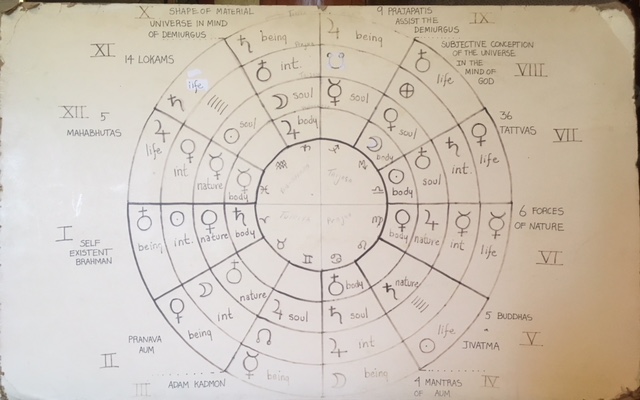
FIGURE IMG 2202-Posterboard Metaphysical Chart.
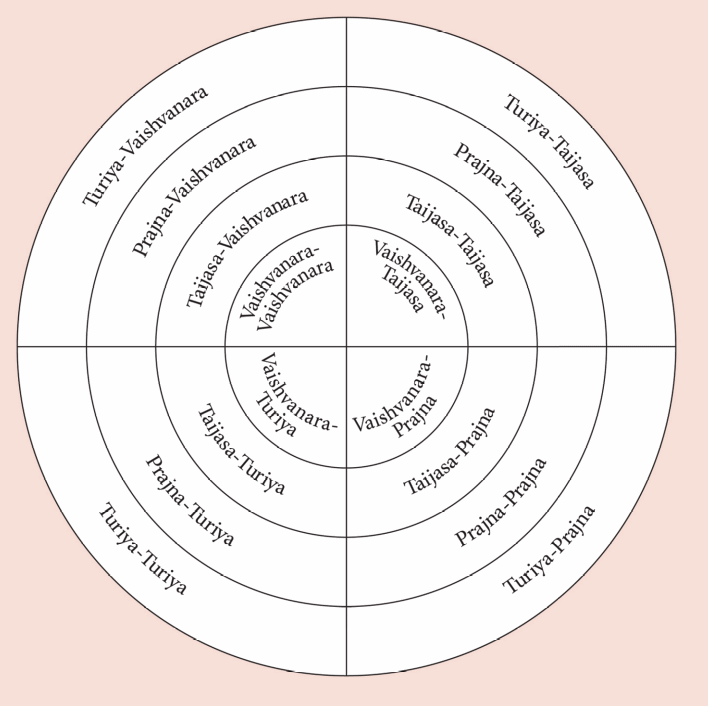
FIGURE 1984 0316-2. Four States of Consciousness in Four Rings and Four Quadrants.
FIGURE AD Supp 242-digital. The One: Triad Dignities.
The second diagram is from Astronoesis, p. 250. Other diagrams referred to are not with this transcript version. [Transcriber note: [diagram] means the speaker is referencing a diagram as he or she is speaking.]
TRANSCRIBED Verbatim by IT prior to 2018, JF adds cover sheets and footer in 2018. This is V12a (2023) and has: updated prefatory matter, footer, and audio file name; TOC and Book List completed; Plotinus quotes section added; typos/errors corrected; new notes within transcript; three diagrams appended and references within transcript to these diagrams. Archival verbatim transcript – V12a.
AUDIO FILES: 1984 0316a, 1984 0316b. [Note: "Tape" and "Side" refer to original audio cassette tapes that were later digitized into .MP3 Audio Files.]
1984 03/16 at Wisdom's Goldenrod
Plotinus; Intellectual-Principle
[Audio File 1984 0316a Begins]
AS: --bias. And we're going to start by-- [short pause] Maybe actually we're going to start with this quote. [short pause] Everybody notice the quote? [short pause] [students assent] And Gretchen? Yeah, I think it may be applicable to the class, [student assents] the quote.
[Transcriber note: The following quote is from Maxims and Reflections by Johan Wolfgang von Goethe. There are numerous translations. I am unable to find the exact translation AS is using.]
Johan Wolfgang von Goethe [Maxims and Reflections, AS reading]: "And then only are we really thinking, when it is impossible to think out the matter on which we are thinking."
AS: Goethe.
AD: I think they'll appreciate it after the class. (laughter)
S (amidst laughter): I understand.
[11¾ second pause after laughter subsides]
AS: So-- So where would you like to start?
AD: Well let's try it.
AS: Would you like to start with some reading some?
AD: Yeah, uh-hm.
AS: From where we started, the Intellectual Cosmos?
AD: The very beginning, yeah.
AS: Yeah. Ok. The last couple of mornings we had some-- some discussions, preliminary excursions into the Intellectual-Principle.
S: Where?
AS: And I guess we'll start with this, V.1.4. I think he makes a couple of good points here. V.1.4, which may be 372. [short pause] Starting-- starting with the paragraph, "That archetypal world…"
[10¾ second pause, faint background student talking]
Plotinus [V.1.4, AS reading]: "That archetypal world is the true Golden Age, age of Kronos, whose very name suggests (in Greek) Abundance [(koros)] and Intellect [(nous)]. For here is contained all that is immortal: nothing here but is Divine Mind; all is God; this is the place of every soul. Here is rest unbroken: for how can that seek change, in which all is well; what need that reach to, which holds all within itself; what increase can that desire, which stands utterly achieved? All its content, thus, is perfect, that itself may be perfect throughout, as holding nothing that is less than the divine, nothing that is less than intellective. Its knowing is not by search but by possession, its blessedness inherent, not acquired; for all belongs to it eternally and it holds the authentic Eternity imitated by Time which, circling round the Soul, makes towards the new thing and passes by the old. Soul deals with thing after thing--now Socrates; now a horse: always some one entity from among beings--but the Intellectual-Principle is all and therefore its entire content is simultaneously present in that identity: this is pure being in eternal actuality; nowhere is there any future, for every then is a now; nor is there any past, for nothing there has ever ceased to be; everything has taken its stand for ever, an identity well pleased, we might say, to be as it is; and everything, in that entire content, is Intellectual-Principle and Authentic-Existence; and the total of all is Intellectual-Principle entire and Being entire. Intellectual-Principle by its intellective act establishes Being, which in turn, as the object of intellection, becomes the cause of intellection and of existence to the Intellectual-Principle--though, of course, there is another cause of intellection which is also a cause to Being, both rising in a source distinct from either.
"Now while these two are coalescents, having their existence in common, and are never apart, still the unity they form is two-sided; there is Intellectual-Principle as against Being, the intellectual agent as against the object of intellection; we consider the intellective act and we have the Intellectual-Principle; we think of the object of that act and we have Being.
"Such difference there must be if there is to be any intellection; but similarly there must also be identity (since, in perfect knowing, subject and object are identical).
"Thus the Primals [(the first 'Categories')] are seen to be: Intellectual-Principle; Existence; Difference; Identity: we must include also [AS reads: also include] Motion and Rest: Motion provides for the intellectual act, Rest preserves identity as Difference gives at once a Knower and a Known, for, failing this, all is one, and silent.
"There must be Difference also among the objects of intellection [AS adds, from first edition: (the ideal content of the Divine Mind)] compared one with another; and Identity in the self-identity of each, and, again, in the common ground of their diversity--the diversity which constitutes Difference. [AS: Better translation.]
"The Intellectual Cosmos thus a manifold, Number and Quantity arise: Quality is the specific character of each of these Ideas which stand as the principles from which all else derives."
[short pause]
AS: Maybe we should stop there. [student assents, faint] [38¼ second pause] Well-- I can make a point of-- a picture of that first point and then maybe go on from there. [13¾ second pause] Where he's-- uh, well-- Maybe we should start with that to set the context I guess, where he says these two diff-- these two aspects of this duality-in-unity, this "pure being in eternal actuality". And he says--
Plotinus [V.1.4, AS reading]: "…everything, in that entire content, is Intellectual-Principle and Authentic Existence… Intellectual-Principle by its intellective act establishes Being, which in turn…becomes the cause of intellection and of existence to the Intellectual-Principle…"
S (very faint): Yeah. Yeah.
AS: And he says--
Plotinus [V.1.4, AS reading]: "…these two are coalescents, having their existence in common, and are never apart, [AS adds: but] still the unity they form is two-sided; [there is] Intellectual-Principle as against Being…"
VM (faint): Well that's (not clear/unclear).
AS: Vic, did you want to say something?
VM (simultaneously): No, I was just saying that seems to be the most-- at least for me anyway, the subtlest part of that reading, to try and really understand what that-- that twofold and simultaneous unity is. What kind of picture are we doing right now?
[Note: See FIGURE IMG 2202-Posterboard Metaphysical Chart appended to this transcript for the following.]
AS: Well, uh, we've used-- we've used this picture [diagram] above you before, [VM: Well--] at some times.
VM: You mean the Ideas and the-- and the exal-- or the rulerships?
AS: Yeah, yeah, uh-hm.
VM (simultaneously): Is that the one?
AS: Yeah. [S: Uh-hm.] Sounds like a good idea, we've-- we've used that from time to time to speak about this unity-in-duality where neither of the constituents is apart from the other. You have the rulerships and you think of the intellectual act. And you have the Ideas and you think about the Being. And the intellectual act is always established in the Being and at the same time establishes the Being. So you don't have just Mars or Aries, you have Mars in Aries. (And/Then) you have Venus in Taurus. And this entirety-- if you-- if you imagine the entirety of the whole circle, then the entirety of that whole circle of rulerships, of course including the Ideas, would be this unity of the Intellectual-Principle. And in some way it's a-- it would all be Turiya consciousness or Turiya intelligence. [Note: See FIGURE 1984 0316-2, Four States of Consciousness in Four Rings and Four Quadrants, appended to this transcript. This diagram is from Astronoesis, p. 70.] You say this Turiya intelligence has two aspects to it, a Being aspect and an intellection aspect.
AD: Uh-hm.
AS: And that could possibly symbolize this-- what he says is also a multiplicity in this Intellectual-Principle. It's a duality-in-unity, and it stands as a multiplicity. And then we'd have to try to think about what-- what are these Ideas in this realm of Being like he says. I mean we're even-- we're even above-- we're even above the manifested cosmos or [one/two inaudible student words simultaneous with AS] any manifestation that the soul is going to take care of. Eternal principles. [S: (What/Well)--] [12¼ second pause] Well, maybe there's some more comments, I don't know, discussion.
MC: Avery? Is there any way of further characterizing what seems to be a distinction between the two when they speak of the coalescence, (unless) there must be some way of describing it, something that (most likely) try and hold on to to understand the difference (bit) further.
AS: Uh-hm. Well, sometimes we've used other terminologies. For example-- oh, I don't know if any of them helps but like substance and function is one terminology we've used.
MC: Function begin on the side of Being?
AS: No, function being-- function being on the side of intellection or vision. And substance representing the-- the Ideas or the Being. [short pause] And-- And I guess the thing about it is that-- Well one thing is we can't think of them as two separate things that somehow co-- come together. 'Cause somehow they are together or they-- the two-- the two aspects are the Intellectual-Principle. [student assents, faint] So like if you think of the intellection and you say what's having this intellection, they say it's the real Beings or the Ideas are having the intellection. So the intellection isn't the intellection of some other agent but it's the Intellectual-Principle itself knowing itself. [student assents, very faint] Or the Ideas are knowing themselves as this intellec-- through intellection.
MC: And they call that [few words inaudible] substance about the Intellectual-- the Intellectual-Principle and soul where you couldn't make such a fine distinction because--
AS: No, this is even worse than that. (bit of laughter) This is even-- this is even worse than that, I mean, this is even-- this is even above that dua-- duality of Intellectual-Principle in the soul and the soul I think, this is even a closer identity of-- if we could speak of it that way. That, um-- Oh, I should go-- What-- or like when he says, in-- in the Republic he talks about the power to know gives the truth to what is known and the power to know. So this Intellectual-Principle is self-gnostic. It knows itself in that intellection, at the same time is establishing the determinations within itself.
MC: Are [couple/three words inaudible] Be?
AS: About--
MC: Be.
AS: Yeah, this is Being. [student assents, faint] You could say that about Being, about Intellectual Being. But you couldn't say that about the soul. Because in the soul example, the soul is not self-gnostic. If there's a light shining within it that makes it self-gnostic it's other than itself. [student assents, very faint] But here, in this case, that which makes the soul-- what-- that which makes the Nous to be knowing is itself. And what it knows is itself. So it's like, somebody else said this idea of self-thinking Thought. [student assents, faint] The Intellectual-Principle is thinking or knowing but what it's knowing is always itself. And itself that it knows is what is established in that knowing as the content. And you barely can distinguish between that principle that knows itself-- in a principle that knows itself you can barely distinguish between the knowing and its self that it knows. [student assents, faint] And except for that, except for just seeing that distinction, there's almost no other difference between the--
JA (simultaneously): Well, there is [AS simultaneously: Yeah.] a fundamental difference [AS simultaneously: Oh yeah. Yeah, I was trying to get there.] in the way it's expressed, I mean-- [student assents] The knowing is [S simultaneously, faint: For sure.] uni-- like a single eye of vision and the object is multiple. I mean that's a fairly fundamental difference.
AS: Hm. Did you think that was implied here that one-- on one side you had unity, on the other side you had multiplicity? I agree that the Intellectual-Principle is a unity and multiplicity. True. But I'm not sure why you're putting the unity-- you seem to be saying Jeanne that the unity side is the vision and [JA simultaneously: Oh I just--] the multiplicity side is the Being.
JA (simultaneously): I'm just saying that from another tractate, I'm going to [AS simultaneously: Oh.] speak to the [one/two words inaudible]
AS: Oh.
JA: Just so you--
AS: See, it seems that the both aspects are multiple. I mean just in the diagram you would-- it seems that if you spoke about what the unity was (at/of) this Intellectual-Principle, the way it's unified, you wouldn't say it's through the vision side or the Being side.
JA: Well may-- you know, maybe what I'm, you know, referring to isn't applicable. But in another-- in another place he does speak of the Intellectual-Principle as a single eye of vision directed to multiple objects. He says that this has [S simultaneously: Where?] to be [AS/S(?) simultaneously: Well Jeanne--] if you're going to--
VM: Well could you read it?
JA/S(?): (Yeah.)
Plotinus [V.3.10, JA reading]: "We repeat that the Intellectual-Principle must have, actually has, self-vision, firstly because it has multiplicity, next because it exists for the external and therefore must be a seeing power…"
JA: Um--
AS: Well right there.
S (very faint): Uh-hm [couple words inaudible]
JA: That's in V.3.10.
AS: Yeah, but, I don't-- that--
Plotinus [V.3.10 cont., JA reading]: "And this which the seer is to see can be only [JA reads: only be] a multiple, no undistinguishable unity…"
[short pause]
AS: Uh-hm.
JA: He actually calls it a multiple organ of vision but then says that it-- that it's [AS simultaneously: Yeah, I remember that.] an eye receptive of many illuminated objects.
AS: Yeah I remember that quote about the multiple organ [JA assents] of vision. Yeah I like that. I mean that's-- that seems to be what this-- what the diagram suggests.
JA (simultaneously): But at the same time he's speaking of it in the sense that it's a multiple organ of vision in terms of what it receives, not in terms of it actually being multiple. [AS simultaneously: Well--] Although you could read it both ways.
AS: Yeah, I don't-- I don't know what you mean-- I'm not sure yet what you mean Jeanne by saying that it's not actually multiple but only in the act of vision. See, when we go-- go on a little bit, if its vision is occupied upon the One, the One itself is not multiple. The One itself-- the One itself--
JA (simultaneously): But why is-- The One itself isn't.
AS: Yeah.
JA: But, Intellectual-Principle's vision of that.
AS: Yeah, and since-- since-- since the One-- Wait a minute. Since the One which is its object of vision is not multiple, the multiplicity must be conferred by that Intellectual-Principle itself. So I'd almost want to say the multiplicity is the function of the Intellectual-Principle or intellection.
S (simultaneously): Oh, far out, (deal with) that.
AS: I mean it's not-- it's not because of the One.
JA: Well-- I-- well I know that you're heading towards saying that and that's why I wanted to ask you about it. Because I didn't understand, you know, the two different views.
AS: Well it's a tr-- yeah, two different views, we're going to have to get into that.
[student assents]
JA: Well, you know, I just wanted to be sure that I did what you were saying. [AS simultaneously: Well, I wasn't-- I--] I don't want you to refer [one/two words inaudible]
AS: No, I wasn't trying to bring that up here 'cause he hadn't yet talked about this question of-- which he will later on, how and what does Intellectual-Principle see, how come it's a multiple whereas its prior is not and things like that. That seems to be the next point.
JA (simultaneously): But he always talks down. The only point I wanted to make is that you were saying there's no difference and I was saying, oh it does seem that there does seem to be a difference in that it is spoken of as one with a multiple [one/two words inaudible]
AS (simultaneously): Oh. And I-- and I-- my point was, not that there was no difference between Being and intellection. I just said there's hardly any-- you can hardly distinguish because of the thing we said. But I-- but you-- you seem to be making the point that the intellection side or the vision side is a unity whereas the content side is a multiplicity. [VM/S(?): Right.] And I-- I don't follow that, I don't grasp that.
VM: Well, if it's so it's a nice distinction to hold on to. I didn't get it from the quotes you read though Jeanne. Where's the one the single eye of vision? That (sounded) nice catchy phrase.
JA: Well actually it says a multiple organ of vision but an eye receptive of many illuminated objects.
AS: Yeah, see. I think-- I would rather interpret it that the Intellectual-Principle is a unity. He says it's a unity, a unity-in-duality and so on. But that as soon as you talk about a multiplicity, when you do-- which you have to, you have to speak about Being and intellection in each of these Ideas, each of these Ideas itself is a-- is a self-knowing Being. And I don't-- and I'm not sure why you would say the intellection side is one whereas the content side is many.
JA: Well it does seem to [AS simultaneously: Now I-- (go ahead).] imply here that the multiplicity, that actually it was granted by the cognitive side and that the Intellectual-Principle like it becomes a multiple organ of vision because there is a multiplicity of Being(s) with them.
AS (simultaneously): No. [S simultaneously: (All) the Ideas.] But in other places he says that the intellection establishes the multiplicity because its original object of vision is the One. And vision occupied upon the One even there cannot be a multiplicity because it's intellection.
JA: But I also thought that--
AS: He says almost-- he almost says the opposite, that intellection itself cannot operate with just a pure unity.
JA: Right, so that's why it--
AS (simultaneously): It has to break it up.
JA: That's why it develops successive impressions. [student assents] I mean, that's all(--/.)
AS: Well, well--
JL: I would confer with Jeanne also. I think there's something in the tractate that you read that would lean toward the idea that the Be-- the Being of that is the multiplicity, [AS simultaneously: Oh.] is-- is the multiplicity to the intellection.
AS: I'm not saying that the Being side is not a multiplicity. He says-- maybe I should read the other-- the other translation is a little bit better at the top--
AD (simultaneously): No, there's no need to go to the [student assents] other translation Avery, let's try with this, uh--
AS: Try.
AD: He says here--
AS: We can try.
Plotinus [V.1.4, AD reading] "Intellectual-Principle by its intellective act establishes Being [AD reads: Beings]…"
AD: Could we use the plural Jeanne? "Self-thinking Thought, intellective act, establishes Beings by its intellection." Could we use the plural? [JA or another student assents] Sure, why not? No? [student assents, very faint] And then we have this plurality of Beings or Ideas. And that each Idea, so to speak, is a special and unique version of all the Ideas. So that in saying Being instead of Beings we comprehend one and the same thing? [student assents] Because Being-- Beings would include one another and so you could reduce it to Being.
AS: Well that just makes the point that either side can be considered a unity-- a one and many, whether you look at it from the side of intellection or from Being.
AD (simultaneously): Or, try this way. Think of the Turiya consciousness, alright, and within Turiya consciousness you have two aspects, you have intellection and you have the Ideas. The Turiya provides the unity. Alright? [student assents, faint] And either the intellective act or the Beings will esta-- will be the duality. Again you'll have duality-in-unity. It-- we have the same problem when we try to understand our soul is one and many. And we point out that one soul enjoys the bliss of another soul and that soul enjoys the bliss of the former soul. How many are there, one or many? Remember that discussion? Now, in a similar way, if you speak about Beings or the Ideas, yous-- you could speak about them as being one and many or one-many. And if you could speak about them as one-many then you could speak about-- speak about them as Being.
JA: Would you speak of intellection as being-- [AS: Yeah.] as multiple?
AS: Many as the Beings. I don't see why you wouldn't make the same-- why-- I'm sorry. [short pause] Maybe not.
JA: Well, in what way?
AS: No, go on.
AD (faint): (No.)
LDS: Could I-- Jeanne, could I ask? In the quote on the multiple organ of vision, couldn't the im-- meaning there be that the Ideas are each an organ of vision, and if the Ideas are both the vision and also the Being, then in that way the intellection is as multiple as-- as the Ideas or as the Being.
JA: Yeah, I mean-- yeah, I mean I think that could be certainly said but, still it seems that-- Wait, on either side, whether you're going to speak of-- if you speak of intellection as unitary and Being as multiple, or if you reversed it you can say Being is unitary and intellection is multiple, it seems like-- but it's still surmised to be, sort of in a way when you speak about Intellectual-Principle, a unity and a multiplicity in some sense.
AS: But I don't see why you don't say--
JA (simultaneously): It helps again.
AS: Oh. But I don't see don't-- why you don't say you have Being and intellection together. You could think of them together as a unity or you could think of them both together again as a multiplicity. I don't see how the one is-- there's a-- there's a duality-in-unity and there's also a one-many. Now the one-many is a different distinction than the unity-in-duality of intellection and Being. Whether you have it-- whether you-- if you consider the Intellectual-Principle as one, Intellectual-Principle, it has intellection and Being. If you consider it as a multiplicity, it's a multiplicity of Beings, each self-intellective. In both cases as [JA simultaneously: But--] one or as many you have Being and intellection. I don't see why you would limit or put the intellection on the side of one.
JA (simultaneously): Alright, for one side it would be limited to saying that-- you wouldn't speak of intellection as unity knowing unity. But you could speak of multiplicity knowing multiplicity, is that what you're saying, I don't understand.
RG: If-- if you took the-- the knowing aspect of inte-- if you took Intellectual-Principle as a unity that knew its content as the multiple, then you'd need a third thing to unite them to speak of--
JA (simultaneously): Not with Intellectual-Principle, that's the very definition of Intellectual-Principle.
RG: Well then there aren't two things but the definition of Intellectual-Principle is not as a pure unity. It's always thought of, as Avery said, conjointly as knowledge and its object.
JA: Right, and the reason it's not a pure unity is because it's a unity knowing a multiplicity (we've been speaking).
AS: Hm, well it's an interesting point of view.
JA: Oh thank you. (laughter)
RG: Jeanne, [AS simultaneously: No, I wasn't (gonna)--] how could a unity-- how could unity know multiplicity?
JA: Well, well, [few inaudible student words simultaneous with JA] I don't know, you know, maybe I misread V.3.10 and I'll go home and read it.
RG: No [AS simultaneously: Well, maybe you (solved) it.] but I mean maybe you're right too, I mean I-- maybe you could elaborate it a little.
JA: I just read some of the passages from there that I thought that [AS simultaneously: But every--] indicated that [couple/three words inaudible]
S (simultaneously): Well, yeah.
AS (simultaneously with JA and S): They all talked about multiplicity though. [JA simultaneously: What?] I mean, they all talked about it as a multiple organ of vision and [JA simultaneously: No.] its multiplicity. Well then I didn't hear. Show me-- show me-- show the passage where it talks about vision or intellection as a unity.
VM: (What?)
AD: But I think the argument is going around in circle. Jeannie, there's no contradiction in saying that the Intellectual-Principle is one-many and to say that the Intellectual-Principle is a unity-in-duality. [JA simultaneously: I just--] They don't stand against one another.
S (faint): (I think) that's right.
JA/S(?): (And) there was a conflict.
AD (simultaneously): Then what did you-- then what are you saying?
JA: I think I only was pointing out to Avery that there is a fundamental difference if you're to speak of Intellectual-Principle as a unity and multiplicity. He was speaking about there being very little difference between intellection and Being. And I was saying, well, there does seem to be this one difference. And, it just sort of took off from there, I really wasn't--
AD: I'm sorry, I still don't grasp your point.
JA: Avery was talking about the correlation between knowing and Being. And I said well, it does seem that in this one tractate he does speak of knowing as unitary, the Being as multiple. And that was the only, you know, comment that I was really trying to make. I don't quite understand his response. [AS assents] And I don't see why it was contradiction because I guess I didn't understand your point. (JA laughs a bit) Why is it a contradiction?
AD: Well, I s-- I said it's not a contradiction.
JA: Oh ok.
AD: To speak about the Intellectual-Principle as a duality-in-unity, to speak about the Intellectual-Principle as a one-many, these are not two contradictory statements.
JA (faint): Ok.
[short pause]
AD: As a matter of fact, they permit for the comprehensiveness necessary to understand the Intellectual-Principle.
AS: Yeah. I just-- I just-- Jeanne I-- (what--)
JA (simultaneously): Well, that's what I thought was exactly the point of V.3.10.
AD: I'm not at V.3.10.
S (faint): Ok.
S (faint): I agree.
AS: Yeah, the diagram maybe was interpreted differently but I think it gives a good view that, on the one hand you have the Ideas or substance and the rulers as function [diagram]. You have a unity-in-duality, because it's not two things. It's all Turiya. Or you say you have a multiplicity, you have this multiplicity of Ideas with their corresponding multiplicity of rulerships. And so you have a one-many. Yeah. I didn't think it would-- Jeff, go ahead.
JC: Yeah, I-- I thought Jeanne's point was that Intellect or intellection [AS simultaneously: Is one.] is singular, that it's the knowing act of an Intellectual-- of a Divine Mind, of the Divine Mind. [student assents, faint] So intellection is the singular knowing. But the content whi-- which is itself, Being, is multiple in the sense that all of the Ideas are-- are present as known.
AS (simultaneously): Yeah. That was her point and that was what I disagreed with to begin with.
JC: (Ok.) And you're saying that the knowing act is a multiple-- the knowing itself could be multiple.
AS: I don't see why not. I mean I don't-- why limit it, I mean why limit it to saying that one aspect-- I just-- I just don't see the distinction--
JC (simultaneously): Well, well, let me ask you this.
AS: Oh I'm sorry, go on.
JC: Could one knowing act know another knowing act? [AS/S(?) simultaneously: Could one knowing act--] I mean you run into the problem of multiple subjects. You have one Being.
AS: Well you remember that example Anthony just gave when a Sage knows my bliss.
JC: Yeah, but that's a content there.
AS: True. Yeah but--
DB (simultaneously): Well, that bliss is not an object in the same sense as a-- you know, as a tree or car or something. I mean that bliss that Avery-- the Sage knows of Avery is a--
AS: Is very little.
DB (simultaneously): --a state of his knowledge. (laughter)
AS: No but, if he's gotta rely-- if he's got rely on my bliss [couple words inaudible] (AS laughing, laughter, student words)
DB (simultaneously): No but I'm-- I mean, the point is there that that's one's-- one-- one state of knowing knowing can operate another state of knowing and I don't-- I [AS simultaneously: No.] don't really see that that's [JC simultaneously: No.] necessarily a problem.
AS (simultaneously): Yeah. Jeff, I [S simultaneously: Uh-hm.] think you stated the thing clearly but I think we have to leave the question there, may-- you know, I think we should drop that particular question. I don't think that the passage right here speaks to which is the unity aspect and which is the multiplicity aspect. Maybe we will come to passages as Jeanne suggests that shed some light on which side is the unity and which the multiplicity and so on, but I-- I don't-- I, you know, personally I've said my particular viewpoint.
DR (simultaneously): Avery, I hate to have to [one word inaudible] it over but I need clarification on just one more thing before we do. Anthony, when [AS: Yeah.] you answered Jeanne by saying there's no contradiction between the Intellectual-Principle being a one-many and the Intellectual-Principle being a duality-in-unity, what would those two different points of view be? Avery seems to explain the one-many. What would the other be?
AS: I thought I did that one too.
AD: Well it wasn't [one word inaudible]
DR: I thought that you were-- that--
AD (simultaneously): I was just trying to show that by making these statements, you were getting more comprehensive, it was a more comprehensive way of understanding the Intellectual-Principle than simply saying it's a u-- unity-in-duality or to say that it's a one-many. And again like for instance I don't understand what Jeff means when he says is the Intellect singular. I don't know how he applies any quanti-- kind of quantitative notion to the knowing principle.
JC: It's a single act, is it not?
AD: It's a single act. [one/two words inaudible]
JC (simultaneously): It's a single Being, is it not, whether you think of the Intellectual-Principle as a whole or as containing a--
AD: Well what do you mean single?
JC: One Being.
AS: [couple words inaudible]
AD: What do you mean one Being? Do you mean one thing like one apple?
S: No.
JC: When you speak of the Divine Mind, are we referring to-- [AS, faint: Ok.] um-- [S simultaneously, faint: Uh-hm.] [AS, faint: Uh-hm.] [short pause] yeah, a single Being, [S: Yeah.] that in its-- in its--
AD (simultaneously): Yeah but-- I know. I know it's what you're saying.
JC (simultaneously): That also contains a multiple (time)-- also contains a multiplicity of Being(s).
LR: And you mean something very different when you [one/two words inaudible]
JC: One Divine Mind.
LR (faint): [couple words inaudible]
AD: If you say Divine Mind and you add "one", it's not only redundant, it's superfluous and meaningless because we're not saying anything.
JC: Alright, so just [couple/three inaudible student words simultaneous with JC] say Divine Mind, if (you won't say) that it's one I won't say one.
AD (simultaneously): Ok, alright, I'll say Divine Mind. (some laughter) Ok. Now if you say Divine Mind, alright, why impose a notion that it's only a duality-in-unity or a one-many?
AS: Yeah.
JC: Well, what else is it? I mean [one/two inaudible AS words simultaneous with JC] [one word inaudible] composed only those two (notations).
AD: What is it?
JC: It contains all the possibilities of our universe so-- but--
AS (simultaneously): Of every universe.
RG: Yeah, it's (not a man--)
AS: And-- well that [one word inaudible] the--
JC (simultaneously): Yeah, but you're getting off the point. What is the point [AS simultaneously: No!] you're trying to make? (laughter, student words)
AS: I won't--
JC (simultaneously): Well, see--
AS: 'Cause his question is off [one/two words inaudible]
AD (simultaneously): Point I'm trying to get is that you're importing a meaning into the Divine Mind, a quantitative meaning which it cannot bear.
JC: How about one uni-- one universal principle?
AD (simultaneously): Let me-- let me try this way. It is foolish for us to think that when we say "one Intellect," we've said anything. You said it all when we said Intellect. Now how it functions, how, so to speak, its intellection brings about the multiplicity of the Ideas, is a discussion we'll get into as we go along. But I don't see why there's an objection to stating it in two, three, four ways or as many ways as we can.
S: I agree.
S: Yeah.
LR: Could I ask a question about this quote?
AD: Yeah.
[couple seconds of faint background student talking]
LR: Jeffrey, are you-- are you-- when you--
AS (possibly part of background): (Bring it here.)
AD: I didn't intend to answer Jeffrey, I just intended to bring up a question of what do we mean when we say "one Mind".
JC: Yeah, sure.
LR: Um--
AD: Is knowing plural or singular? [KD simultaneously: Plotinus says knowing (couple/three words inaudible)] Can you apply such notions to it?
AS: Can't.
KD: But he says knowing is a unitary thing.
AS: No but Kathleen-- yeah. But the point Anthony just made is good. You say intellection, period, at this point that's all you can say. Because for any other thing you'll say you'll have the complementary view also. If you say it's one, you'll say no, it's also many. The Intellectual-Principle is a one-many. And you won't be able to say it's either of the two.
LDS: Yes, if they characterize it as one-many, that's its very constitution, then there's no way of isolating any element within it [AS: Well--] to say that's the one side of the issue. Is that what you're saying? One-many [AS simultaneously: (Ok.)] pervades-- pervades every-- every aspect that we want to abstract from it. It's [AS simultaneously: Well--] not like you can isolate any element.
AS: No, I mean I wasn't saying you couldn't distinguish out that there was a unity and there was a multiplicity. But--
LDS (simultaneously): But to throw on one side either of those characters is the problem.
[student assents]
AS: I just think that doing it-- doing it that-- a certain way will reduce the one-manyness to the unity-in-duality in this and I'd like to keep those two notions distinct. It's a duality-in-unity, it's a one-many, it's any of the other complementary things we could say about it. And I just wouldn't yet want to reduce one of those distinctions to another of those distinctions.
JC (simultaneously): Excuse me, I don't think that was being done, because the unity-in-duality is the unity [couple inaudible AS words simultaneous with JC] of the Divine Mind which includes the dual aspects of Intellect and Being, right?
AS: Ok, go ahead, ok.
JC (simultaneously): But the one-manyness [AS: I'm (reading too).] could be used when looking at Intellect and Being as describing the distinction between those two themselves.
AD: Well, if we use the chart Jeff, we could think of the one as that Turiya consciousness running around the circle, [Note: See FIGURE 1984 0316-2, Four States of Consciousness in Four Rings and Four Quadrants, appended to this transcript.] [AS assents] and we could think of the many as the Ideas and the power through which they manifest. That would [AS assents] be the one-many.
AS: Right.
AD: Alright? We could also, when we say uni-- duality-in-unity, you could think of on the one hand the rulerships and on the other hand the Ideas, alright, and you could see them unified in the consciousness. So we could say a duality-in-unity. [student assents] Now, I don't know, the-- [JC: Ok.] the illustration is about as clear as you could want it. So why get hung up on a point that hardly needs any elaboration when in a few tractates you're [couple inaudible AS words simultaneous with AD] going to go berserk trying to figure out what he's saying. You'll have something to put your teeth into in a very short while. (bit of laughter, student words)
AS: Linda, did you-- do you have another thing?
LR: Yeah, I'd like to-- I'd like an elaboration of the word 'establishes'. It says Intellectual-Principle establishes Being.
S: Right.
AD: We spoke about it this morning when we said for instance, when you speak about eternal Beings, their act is eternal, [student assents] thisness. On a lower level if you say you have fire, its act, heat, is concomitant with fire. You don't have fire without heat, alright. So, at that level you speak about fire establishes the principle of heat. It's always concomitant with fire. Now, if you think of eternal Beings, Intellectual Beings, Beings that are beyond even soul, their act is eternal in the sense that if-- if this Being thinks an Idea, like the Idea of Man, that self-thinking Thought is an eternal established Thought, it is eternal in the sense that there'll be no variations within it. If there are variations within the Idea, they would-- they too would be established by its act. So this is the act of an eternal Being, alright, established in eternity. There's no variations, no change, it's a possib-- a permanent possibility for ever and ever and ever.
LR: Ok but my problem is, when you-- when you use the example of fire and heat, that you ca-- it--
AD: Don't give me numbers. [S, faint: What?] I don't know what you mean 5.19.
S: No, fire--
LDS: No, fire and heat. (laughter, student words)
BS (amidst laughter): Oh, I thought you meant [one/two words inaudible] (more laughter)
VM: You must have been thinking 5.19. (laughter, student words)
AS (amidst laughter): Yeah, let's read 5.19.
S (simultaneously): Read it, really, look it up.
AS: Make her look it up.
[laughter, background student talking, 12½ seconds]
AD: (Or try) fire and heat. (laughter)
CDA/S(?) (amidst laughter): [couple/three words inaudible]
S: Yeah.
CDA: Ok.
LR: Then it's not-- it's not a reversible problem (there), in other words I can understand in what way fire establishes heat. But we've used the example of-- but he says here the intellection-- Intellectual-- the intellective act establishes the Being.
AD: Alright honey let's change the analogy, think [LR simultaneously: If--] of an analogy where that might hold, [LR simultaneously: When we--] fuel and fire.
RG: What?
LR/S(?): What?
S (faint): What?
KD: What?
S (simultaneously): Fuel-- fuel and fire.
S (simultaneously): [three/few words inaudible]
AD (simultaneously): Fuel and fire.
S: [couple/three words inaudible]
LR: Or we've used mind and its thought, you know.
AD: Alright, if you want to.
LR: But I-- and, I still have-- I still went into the problem in this way. I can understand in what way mind establishes the thoughts but I can never reverse it, I don't understand in what way the thoughts establish mind. Because it always seems that if you took away the thoughts you would still have mind. But you couldn't take away mind and still have thoughts.
AD (simultaneously): What mind would you be talking about if you took away thought?
LR: (Not-mind/Not mine).
AD: Ok.
AS: That's it. [student assents, very faint] Well that's it.
AD (simultaneously): You're talking nonsense.
AS: You can't have-- it--
LR (simultaneously): (Well/Oh) (this is) not mind.
AS: Establishes just-- Oh. (laughter, student words) But Linda, you know, where he says "establishes", I don't-- I don't think he means cause. I don't think he means cause in the sense that Being makes Intellect--
LR (simultaneously): But he doesn't use cause, he says establishes [couple/three words inaudible]
AS (simultaneously): And all he means there is that intellection can't even operate unless there is Being, unless there is the Idea, the content, what it's going to have a vision of. Vision can't [LR simultaneously: But-- but doesn't it--] have vision of nothing.
LR: Right, so what does he mean by establishes? I don't [AS simultaneously: Just what I said.] understand how the intellective act establishes the Being. [AS: Well--] What does he mean by establishes?
AS: You said that before, remember when you were talking about the self-reflective or self-gnostic nature of the Intellectual-Principle? [LR: Yeah.] In knowing itself it establishes Being. It doesn't need something outside itself to establish itself. As soon as it exercises its characteristic act, immediately its self is its content and the Ideas are itself. And so they arise through its intellection.
LR: Ok, once more. What do you actually mean by the word 'establishes' then? You don't mean creates. [student assents, faint] Do you mean defines [one word inaudible]
AS (simultaneously): Invariable concomitance. You never have the one without the other. If you have Intellectual-Principle you never have one of the-- one of those without the other.
[student assents, faint]
AD (simultaneously): And it's reciprocal.
AS: And reciprocally, [student assents] yeah, invariable--
LR (simultaneously): Ok, but that-- that I can follow, [AS simultaneously: Well, he had to say each half at the same time.] you know, (but is) he implying something more about--
AS (simultaneously): I don't think so, I think he just had to say each half of it separately. But you have to put both of those halves together, you can't just take each--
LR (simultaneously): To get a notion of Intellectual-Principle.
AS (simultaneously): Yeah, they're-- there's a reciprocal-- it's a reciprocal concomitant, they're always together. You can't have A without B and you can't have B without A. Not having B without A means that A establishes B, and not having A without B means that B es-- no. Not having A without B means that B establishes A and not having B without A means that A establishes B. And if you put the two together, they're invariably concomitant, you never have one without the other.
LR (simultaneously): So, you would agree that establishes in no may-- way means cause.
AS: Exactly.
S (very faint): Right.
AS: It's self-caused.
LR: But it means-- it seems more--
MW (simultaneously): Just like [one/two words inaudible]
AS: In fact that's what-- [MW simultaneously: Yeah, both.] yeah, as Michael--
(Side 1 of original cassette tape digitized as 1984 0316a Ends; Side 2 Begins)
AD: --don't arise.
AS: [few words inaudible]
LR: To say that they are concomitant [AS simultaneously: To say they're concomitant--] is-- is stating a fact of Intellectual-Principle but doesn't even have the fullness of the import in it in the sense that, when we were talking about vision-- the vision of the intellective act actually-- I don't know how to say it, what words to use except that it's only correct in that way. When we say that Intellect-- that it's actually in the vision, that scope of it, the actual Being of Intellectual-Principle is established, we're stating something that's very different from its prior, you know, from our talking about the One. In other words, we're saying that it takes that kind of reflective act or it takes that vision to even define what Being is, so that the actual existence of Being, I don't know how-- what word to use, I don't mean existence in terms of manifestation but the actual existence of Being is established by intellection, you know, I think he's saying something like that, that the actual aseity of the intellective act is established by Being and vice versa. That there is no Being or intellective act otherwise.
AD (simultaneously): Look, why don't you-- why don't you try this formulation: Thought thinking Thought. [student assents, faint] I don't think it will shut you up but, (bit of laughter) try it. Thought [AS simultaneously: Well at least for a while.] thinking Thought…in eternality. [9 second pause] No, I-- I appreciate this Linda because this is why we're going over the Intellectual-Principle or the second Hypostasis because I always discount the first run around and the second run around. It's when we start getting to the fundamental unit meanings, what precisely is he saying, can I formulate it so I understand what he's saying. And we're going to be struggling with a lot of these very basic fundamental conceptions that he uses. In explaining them to ourselves, either we understand them or we don't. [short pause] Alright so--
AS: Well, yeah, um, did--
AD (simultaneously): I'd like to do--
AS: Do you want to go on a little?
AD: Yeah, I want to go on a little, yeah.
AS: Ok I'm-- I think somebody else-- no, ok.
S (faint whisper): Act quick.
AS: Act quick. Ok, you want to go 5? Now I'm going to [couple words inaudible]
AD: And the other point is, you see how we're using it on the diagram, the one-many, [student assents] unity-in-duality, (ok)? We're ignoring the discussion on the categories for now because there's a bigger section on that.
[short pause]
AS: You want to go into the discussion of the Dyad Anthony?
AD: Yeah, sure, yeah. (laughter)
AS: That'd be easy in com--
RG (simultaneously): Much easier, right. (RG, AS laugh)
AS: Ok, um-- [short pause] Ok. The Dyad. [students assent] Yeah well, we're on 5, V.1.5. I guess I might as well read it from the top because otherwise then somebody'll bring in something from the top and (laughter) we haven't read it and then-- We might as well just read it so don't think we're trying to just hoodwink somethin'.
S (simultaneously): Pull one over (on me).
AS: "As a--" right.
Plotinus [V.1.5, AS reading]: "5. As a manifold, then, this God, the Intellectual-Principle, exists above the Soul here, the Soul which once for all stands linked a member of the divine, unless by a deliberate apostasy."
S: (Yeah/Uh-hm).
S: Stop?
S (simultaneously): Exists within the soul.
AS: Huh?
LDS (simultaneously): I got 'within'. [student assents, faint] You got 'above'.
S: So--
AS (simultaneously): Uh-- Oh yeah, I have 'within' with a question mark, I guess the other edition [Note: first edition] has 'within'.
JA: I have [S simultaneously: Which one?] 'above' with a question mark.
AS: Huh. (laughter)
CDA: I have [couple words inaudible]
Plotinus [V.1.5 cont., AS reading (simultaneously with CDA above)]: "5. As a manifold, then, this God, the Intellectual-Principle, exists above/within the Soul here, [AS: Hm.] [one/two inaudible student words simultaneous with AS] the Soul which once for all stands linked a member of the divine, unless by a deliberate apostasy.
"Bringing itself close to the divine Intellect, becoming, as it were, one with this, it seeks still further: what Being, now, has engendered this God, what is the Simplex preceding this [AS reads: the] multiple; what the cause at once of its existence and of its existing as a manifold; what the source of this Number, this Quantity?
"Number, Quantity, is not primal: obviously before even [AS reads: even before] duality, there must stand the unity."
AS: Yes, my book has "before even".
S: Prove it.
Plotinus [V.1.5 cont., AS reading]: "The Dyad is a secondary; deriving from unity, it finds in unity the determinant needed by its native indetermination: once there is any determination, there is Number, in the sense, of course, of the real (the archetypal) Number. And the Soul is such a number [AS: for example]. For the Primals are not masses or magnitudes; all of that gross order is later, real only to the sense-thought; even in seed the effective reality is not the moist substance but the unseen--that is to say Number (as the determinant of individual being) and the Reason-Principle (of the product to be).
"Thus by what we call the Number and the Dyad of that higher realm, we mean Reason Principles and the Intellectual-Principle: but while the Dyad is undetermined--representing, as it were, the underlie (or Matter) of the Intellectual World--the number which rises from the Dyad and The One is always a Form-Idea: thus the Intellectual-Principle is, so to speak, shaped by the Ideas rising within it-- or rather, it is shaped in a certain sense by The One and in another sense by itself, since its potential vision becomes actual and intellection is, precisely, an act of vision in which subject and object are identical."
AS: Let me-- We might as well use that translation Bert, it's good. [student assents, faint] There's a slight difference [one/two words inaudible] (bit of laughter) Should read that again. [11¼ second pause] Should read those main points again maybe.
S: Yeah.
AS: "The Dyad is a secondary"?
Plotinus [V.1.5, AS rereading]: "The Dyad is a secondary; deriving from unity, it finds in unity the determinant needed by its native indetermination: once there is any determination, there is Number, in the sense, of course, of the real (the archetypal) Number. …
"Thus by what we call [the] Number and [the] Dyad of that higher realm, we mean Reason Principles and the Intellectual-Principle: but while the Dyad is undetermined--representing, as it were, the underlie (or Matter) of the Intellectual World--the number which rises from the Dyad and The One is always a Form-Idea: [AS: In other words, determined.] thus the Intellectual-Principle is, so to speak, shaped by the Ideas rising within it--or rather, it [AS reads: the Intellectual-Principle] is shaped in a certain sense by The One and in another sense by itself, since its potential vision becomes actual and intellection is, [precisely], an act of vision in which subject and object are identical."
[15 second pause]
AS: The third (Dyad)?
VM: I find the Dyad very confusing. It's not a real hypostasis, I can't quite understand why, you know, why it's brought in. I mean, you know, I guess it's an aspect of his vision and one shouldn't ask for justification but--
AS: Indeterminate Dyad.
VM: Well, yeah.
AB: I mean, the pr--
AS: Alan?
AB: The problem seems to be the-- (some laughter) if the Intellectual-Principle is multiple to find a unified source above it. But then I would agree with Vic that the One we would speak of-- I mean we would speak of the One as uniform so the Dyad seems very mysterious.
[short pause]
JL: Why, wouldn't you want to (say/save) that indeterminate-- indeterminacy?
AS: Gotta speak up.
JL: I said wouldn't one also have the possibility of that indeterminacy?
[short pause]
S (faint): I think.
S: What?
AS: That's the line we're trying to understand there--
Plotinus [V.1.5, AS reading]: "The Dyad is a secondary; deriving from unity, it finds in unity the determinant needed by its native indetermination: once there is any determination, there is Number, in the sense, [of course], of the real (the (AS reads: or) archetypal) Number."
VM: But you wouldn't say these numbers are in the Dyad, would you, [AS simultaneously: No, Intellectual.] they're in the Intellectual-Principle.
LR: Really? Are you taking unity to be the One there or is it One?
AS: (Yeah.) Yeah Vic-- Vic's--
VM: Yeah.
LR: Yeah ok.
VM: I mean, I don't know what-- what else to take it as.
RG: Well, right below that Vic he says [AS simultaneously: Uh-hm.] but what we mean by Number and Dyad we mean Reason Principles and Intellectual-Principle.
LR: I know.
RG: So it seems he's equating there Dyad with Intellectual-Principle in some sense. And in some sense it might be the indeterminate aspect of the Intellectual-Principle which (yet) from another aspect would be the power of the One to unfold its emanation as Intellectual-Principle.
S (faint): Uh-hm. Yeah.
AD: Good beginning Dickie. Now tie it in with what I was telling Jeff. He-- you remember we were speaking about the Intellect as one and I said no, don't speak about it as one. If you think of Turiya consciousness, alright, we spoke about that as the unity of the duality. [S: Oh yeah.] If we speak about Turiya consciousness, in itself it's indeterminate. [RG assents] I mean, that seems to be clear, huh? Then when he goes on and he says, it finds in the One the determination-- the determination needed by its own indeterminacy. [RG: Mm.] If the Void consciousness is indeterminate, alright, and it looks to the One, then it would be-- it would get determination from the One. In other words, the Ideas which would arise within that indeterminate consciousness or that Turiya consciousness, alright, would be, I think, the-- how did we s-- we looked upon the One as having many distinctionless aspects, or another way we looked upon the One as having the transcendent paradigms of everything that we find in Being. So if we say that the native indeterminacy or the indeterminacy of Turiya consciousness by looking to the One, alright, receives determination, that is the various Ideas.
AS: That arise within the Intellectual-Principle.
AD (simultaneously): They arise within it, that is now the Intellectual-Principle determined.
AS: Right.
RG: So by Turiya there you mean Intellectual-Principle undetermined contemplating the One, [AD: Yeah.] in eternal contemplation of the One. That eternal contemplation grants Intellectual-Principle's content determinately, [AD: Uh-hm.] because unity is present to this indeterminacy.
AD (faint): Uh-huh.
LR: Why [couple words inaudible]
S (simultaneously): Say that-- say that last part again Dickie?
S: Would you say the whole thing again? (bit of laughter)
S (faint): Ok.
S (faint): [few words inaudible]
RG: If the Void aspect of Intellectual-Principle is in eternal contemplation of the One, 'cause we're talking about eternal principle(s) here, the unity that's principial to the One grants that indeterminacy determinate content as the Intellectual Beings or Numbers of the Intellectual-Principle per se as-- as-- in its own right. 'Cause in-- in its indeterminacy I don't think you would-- could speak of Intellectual-Principle per se as a separate principle yet. It has to be determined by unity.
AD (simultaneously): Uh-hm. In other words, we're-- we're starting out with the indeterminate Turiya consciousness and then we say that by contemplating or trying to grasp the One as in its essence it ends up with a multiplicity. This multiplicity is the Ideas, alright, Number and Beings. Now, after we finish saying all that, we cancel it all out and try to understand that this is in eternal actuality. [student assents] There isn't any origin in other words, this is forever. [RG assents] It's in an-- how did he put-- how did you put Avery, an invariable concomitant or pure Being in eternal actuality. As long as there's fire there must be its heat and if we can imagine that the heat draws the fire-- No, that analogy's no good, we better use fuel and fire, each depends upon the other. Or any analogy that we can get which will be very difficult where there's this reciprocal and mutual relationship of one upon the other. In other words, when we say Thought thinking Thought, it would be hard for you to decide which one is function and which one is substance.
AS: Now once again we have a problem now.
AD: Sure.
AS: And, I'm not-- I have trouble with this sentence. Because we also have to bring in the other side. This interpretation seems to be saying that the Intellectual-Principle per se as just this pure indeterminate emanation or Turiya has to get determined by the One. Whereas in o-- in other words-- let me see how I could say this. [short pause] In some way the Intellectual-Principle is determined by itself and in some way derives from its prior. Ok? It's an emanant from its prior and it's also self-determining. This passage is very funny in that it seems to say here that it derives its determination from its prior whereas its reality is-- is so to speak its own. Whereas in other places he says that the One grants reality to the Intellectual-Principle but the Intellectual-Principle is self-determining. That the Number and characteristic way that it breaks up that power is its own essential act. Whereas here he's saying that the d-- or it seems to be saying that it's in unity, in its prior, in the One that it finds the determinant for its own native indetermination. In the other places he seems to say no, it's given its reality by the One but it has its own native characteristic and that's what is self-determining. So it's very funny. I mean, he seems-- seems to bring in both of these points of view if we interpret it this way.
LR (simultaneously): Unless of course you put the Dyad as part of the Intellectual-Principle. And that the underlie that's looked at is the underlie of the Intellectual-Principle.
AS: Well, no I'm-- I mean I'm [couple inaudible LR words simultaneous with AS] willing to hold both of these views, I don't-- I mean I-- seems like you look at it one way and you see it that way but then--
JA: Well, that, I mean-- That's not unusual, you know, in Plotinus, and in each case he's emphasizing something. You know, if like two explanations seem to contradict.
S (faint): Yeah.
S: Uh-uh.
AS: No, I didn't say that.
JA (simultaneously): It does-- it isn't a-- it isn't a contradiction, it just seems to be an emphasis, so what would you think he was emphasizing say in the first quote that you mentioned? [short pause] I mean if you think of the Intellectual-Principle having one definition, alright, and one way of thinking but then-- then there will be contradiction but if there--
AS: Jeanne, I'm not talking about contradiction.
JA: Avery. (JA laughs a bit) I thought you were saying well on the one hand he says this and on the other hand he says that and that seems to be confusing to me. So, I thought you were talking about a contradiction. (JA laughs)
[student assents]
AS: No.
AD: What Avery was saying was that [AS simultaneously: Not at all.] he says at one place that [JA simultaneously: Excuse me Anthony, could I just say something?] it determines itself and another place he says that it gets determined by the One.
AS: Yeah, that's-- that's what I'm [JA simultaneously: Yeah.] saying, that's not contradictory.
JA: Avery?
AS: Yeah.
JA: I just don't understand (JA laughs) one thing is, you'll twist and turn, you know, to disagree with whatever I say (JA laughing) and apparent-- it seems unnecessary.
AS: Well, I'm real sorry, I d-- I didn't mean to be disagreeing with what you're saying, I just-- all I-- I just-- just when you said contradiction I just-- I wasn't looking at it as a contradiction. [JA: Oh.] I was just trying to see how [S simultaneously, faint: Were complementary.] these two were complementary. [S, faint: Yeah.] He has the same point of view-- you know, just-- as what we did before when we said we had to hold two points of view in mind.
JA: Yeah. Yeah, complementary.
AS (simultaneously): And I was just trying to see how these--
JA (simultaneously): That's what I-- I was trying to think of [few words inaudible]
AS (simultaneously): Oh well, good.
S (simultaneously with JA and AS): You were agreeing with each other.
AS: I was agreeing, yeah.
JA (simultaneously): Yeah, really agreeing with each other.
S: Right. (laughter, student words)
S (amidst laughter): (Wonderful.)
S (amidst laughter): Except--
S (amidst laughter): Wonderful [few words inaudible]
AS: Yeah.
JA: So what do you think (of/uh) Anthony just said that the two views could-- I mean what-- so what do you think is being emphasized?
AS: Well right-- well right here, to go-- to-- to-- to go along with this interpretation that was just given, deriving from unity it finds in the unity the determinant needed by its native indetermination. All I was trying to point out, agreeing with what just being said, that Richard was saying and, you know, that-- that here he seems to be saying it's natively indeterminate. Whatever this Dyad is, if we think of it as the Intellectual-Principle, not as-- the prior to the Intellectual-Principle, Intellectual-Principle not yet determined as this duality-in-unity, not-- in a sense not yet Intellectual-Principle. It's natively indeterminate as a pure emanant of the One, say. But it needs for its determination the One, its prior. This is the view that says something like it's-- it's an indeterminate emanation or vision and it looks to the One and gets determined. Ok, now in that sense-- I mean it seems to be implying, maybe I'm misreading it, that it's from the One that it gets this determination. Maybe even as we're saying these indeterminate or these infinite unities within the One in some way are determining it, I don't know. But the other point of view which is complementary to this if you want, is that what it gets from unity it borrows is sheer indeterminate power, which is not its native nature, but the Intellectual-Principle's native nature or essence is to be a determinate intellection. For it has within itself natively some character which makes it intellective. And through this side the determination comes of that purely indeterminate power that it receives from the One. We agree that there are these two things. As he says, in a certain way it's shaped by the One, in another sense by itself. And it's always this funny question of in what way what it receives from the One and what it has in its own essential nature. [student assents] Now maybe it depends on whether we take the hierarchy view, the strict hierarchy view, or whether we take the other view of the simultaneity. And maybe that's-- maybe when you switch those two points of view where the indeterminacy and the determinacy come from also switch. If you take the strict point of view that the Intellectual-Principle and Soul are distinct hypostases, they receive this indeterminate power which is only characterized by their own act. But if you take the point of view that everything is contained within the One to begin with, then these-- all these different principles within the One are natively indeterminate and it's the One itself that gives them their determination, or the unity of the One in some way. And so in that point of view each of these infinite principles, even looking at that line of the Triad [diagram], each of those is indeterminate except as it receives determination by the One, in virtue of unity that they gain their peculiar aseity. [Note: See FIGURE AD Supp 242-digital, The One: Triad Dignities, appended to this transcript.] Now I--
DR: Avery, do you think we'd have a Dyad in both of those cases?
[11 second pause]
AS: Yeah.
DR: That's hard for me to-- to imagine, if you-- if you say that some kind of prior to the Intellectual-Principle is some state whereby these Ideas are fully determined but without any power, [RG: Uh-uh.] without any kind of reality, that seems like a hard prior to grasp.
RG: Well, I don't-- I don't think that's what Avery was saying.
AS: Yeah [one/two words inaudible]
RG (simultaneously): I don't think he was saying they were fully determined at all.
DR: (Well I thought what he said--)
S (faint): Uh-uh.
VM: Could you say the first--
DR: I thought that one side was-- one possibility was that the prior was this-- had this native indeterminacy and then by looking to the One got determined. And the other side was, no, the Intellectual-Principle carries in itself the very forms and from the One it receives this power.
AS: Well let's say that the Intellectual-Principle had its own characteristic act, even if we don't say [RG assents] its determinate forms, 'cause that act, when exercised upon that power of the One, when it tries to grasp the One, it will become a multiplicity, just in temp-- I mean we're using sequential terms. Well I-- Go ahead. That's alright, maybe we should just follow one at a time.
JL: Avery? Avery, could I ask something? Could it be [AS simultaneously: Yeah.] so that the-- that the Dyad is the potentiality or the power of the One to-- to manifest or become the Intellectual-Principle (and then) your Higher Self and [couple/three words inaudible] And it beco-- it's-- it's determined by the-- by the One? And in being determined it is the Intellectual-Principle?
[short pause]
RG: You know, it's funny, that view, I mean, that's one view but it seems the view here is a little different. Because if the Dyad in this view was particularly the power of the One, there doesn't seem to be a need to talk about it as being a secondary and deriving from unity. It seems you'd speak of the unity emanating itself. [AS: Yep, (I know).] And that this view it really is in this-- and I think that's why you might opt for the Dyad to be the underlie or matter of the Intellectual World rather than in the other translation where it's the underlie of the One.
AS: Uh-hm.
JL: But why-- why couldn't it be seen as the power which is the ema-- the emanation?
RG (simultaneously): 'Cause then you'll have to explain why then that would be conceived as a secondary and deriving from unity.
JL: Because it's an emanation.
RG: But, it's hard for me to think of that as a real secondary. And why that would be natively indeterminate if it's an emanant of the One would ha-- it would-- seems it would carry the unity of the One in it-- in the-- in its power and it wouldn't be natively indeterminate.
AD (simultaneously): That's-- that might be another way of looking at it Dickie and when-- [AS simultaneously: Yeah, would be absolutely indeterminate.] when they [RG simultaneously: Yeah.] say here-- when he says that the Intellectual-Principle or the Turiya consciousness is indeterminate and it gets determined by the One, "gets determined by the One" might simply refer to the fact that the One offers a model, [short pause] offers just a paradigm of what the Intellectual-Principle is to do. [student assents] It doesn't put forth a pair of hands and start shaping the Intellectual-Principle.
RG: Uh-hm.
S (faint): Right.
LD: But isn't that paradigm indeterminate? [S simultaneously: It could not be.] [AS simultaneously with S and LD: That's ok.] So how can that determine-- I'm totally lost in--
AS: But that's ok 'cause that's-- Louis that's what he says in another place. [LDS simultaneously: It's ok (one/two words inaudible)] It's funny that although the One has none of this distinction, the Intellectual-Principle itself does have all the distinctions. None of them are within the One, even though the One is what the Intellectual-Principle looks to. He says "giving need not comport possessing". [Note: See Plotinus, VI.7.17, second paragraph.]
LD: So again how--
AS (simultaneously): He said that that's what the Intellectual-Principle does with that vision that it sees of the One, or that's what it makes of the One. It makes itself an Idea of the One.
LD: So [couple inaudible AD words simultaneous with LD] Intellectual-Prin--
AD: I think now, now, just for a minute, read that thing on the Void. (some laughter)
S: Uh-hm.
KD: Yeah. (KD laughs, bit more laughter)
S: [couple/three words inaudible]
[students assent, faint]
AS: (Yeah), I know where (you're going).
AD: We're going to push your head right into a brick wall, let's keep going.
KD: Wait.
AS: Yeah.
KD: Wait. (laughter)
AS (amidst laughter): So wait, now you know [one/two words inaudible]
S (simultaneously, amidst laughter): No, no, can't wait. (laughter)
AS: But I think that's the point Louis, what you said is important, it-- The One [three/few inaudible student words simultaneous with AS] has-- on the one hand the One has no determination in it whatever. But the Intellectual-Principle as determined, it exercises it back then it gains its determination. Now, it looks to the One and gets determined but the One that it looks to doesn't have the determination in at all. And yet it's only in looking to the One, as it were, that the Intellectual-Principle gets determined. So the--
LD (simultaneously): So still you'd have to say Intellectual-Principle is determining itself, not that--
AS (simultaneously): Right, exactly.
LD: --the One is determining--
AS (simultaneously): But if it wasn't for the One, it couldn't determine itself at all because that power that it recei--
LD (simultaneously): Well if it wasn't for the One it wouldn't be [couple/three words inaudible]
AS (simultaneously): No, no, but in a very specific sense. (laughter)
KD (amidst laughter): Yeah but [few words inaudible]
RG (simultaneously): No, but I think that's exactly what determination means there. [student assents, faint] Without the One it couldn't be and that's the u-- and that's [AS simultaneously: Well that's one.] what unity is determining, its Being.
AS (simultaneously): Well that's one way.
RG: Well, (ok).
AS (simultaneously): But al-- but there-- but it may be even more. If we say not just the One but the power from the One.
RG: Right. But I thought-- yeah.
S (simultaneously): [one/two words inaudible]
AS: You see you say, in exercising its vision, its intellection, on this absolutely indeterminate One, the multiplicity of Ideas arises. They're not in the One so it doesn't-- like it's not like it sees them in the One. It's determining them in itself. If-- yet if it weren't for the presence of the One or the power of the One it couldn't determine them at all. And Dickie's point is just that the way it-- what it needs the One for is to give them self-subsistence or unity. I'd rather say self-subsistence than unity.
RG: Right.
S: But then it--
AS (simultaneously): It gains self-subsistence for the Ideas through the One.
LD: And self-subsistence you're saying is determination.
AS: Well, or we're saying without that self-subsistence there couldn't be any determination at all. There couldn't be any characteristic isness of any of the Ideas. None of them could even be.
RG (simultaneously): I mean-- I mean 'cause in this passage he-- he's trying to ascend it seems to the three Hypostases and he's asking, is there something prior to Intellectual-Principle. And from that point of view it seems you have to establish unity as prior to the multiplicity of Being. And if you say from this point of view that Intellectual-Principle is totally self-subsistent or self-caused or whatever kind of words like that you want to use, it'll be hard to establish a [couple inaudible student words simultaneous with RG] prior principle. If you hold that it's completely self-subsistent, there's no need for a prior principle. And yet there is need for a prior principle.
LD (simultaneously): No, that's why I opt for the first way you described it, that the One gives reality to the Intellectual-Principle, the Intellectual-Principle determines itself, [RG/S(?) simultaneously: (No but) (one/two words inaudible)] not that the One gives determination and the Intellectual-Principle has its own reality, [RG simultaneously: Yeah but that's just--] I just can't see that.
RG (simultaneously): But that's just words, I mean we have to understand what those words mean. [LD simultaneously: Well--] I mean he uses the words 'determinate,' now why-- what do you mean by deter-- by determination, he just may mean the presence of unity to grant Being to that level of reality. So then--
LD: I agree with you, I would like to understand what determination means, what reality means, in the way you're using it. (bit of laughter) [RG: Yeah.] Because it is just words.
AS: Well actually I'm sorry, I shouldn't have brought 'cause-- he doesn't-- it's not in this passage per se where he speaks about the One granting reality to the Intellectual-Principle.
S: Well get Richard's book.
JfL (simultaneously): Well I think you could still see both of-- both points of view if we recall the idea that the One, even though it's indeterminate, it is also not to be confused with a point, you know they had that quote? [Note: Plotinus, VI.9.6, second para.] Even though it's a point it's not simple. [S simultaneously: Oh yeah.] And he says something like that, it does contain it all sort of inclusively as something that's (like--) [student assents] So the determination can still be provided in a sense fully that way even as-- as Intellectual-Principle. You know, the same way that Louis was just talking about it. So you're still say-- saying-- saying one thing, you have the determination or reality provided by the Intellectual-Principle, and yet it-- the One is also providing the-- you know, the subsistence in a s-- in a unitary sense, and the differentiation of the determination is going to come by the self-determining aspect of the-- of Being itself. Or I'm-- I'm just saying that both of those can still be kept in mind.
LR: But the notion here is of the Dyad, right?
AD: No, the notion here is not the Dyad, it could be ver-- very simply this way. The Intellectual-Principle is a secondary deriving from unity. When we say "deriving from unity" we are speaking about metaphysics in the sense of establishing a hierarchy of principles, alright. [AS assents] Now it finds in the unity the paradigms or the models it needs so that it could compose itself. And in composing itself, the Ideas will appear each with their powers. And this is what we're going to call the Intellectual-Principle.
VM: Anthony, didn't you attempt to symbolize this in days gone by with the notion of the Triad and the, let's say the dignities in the first quadrant as being sort of super-essential zeros, whatever kind of language that could mean but, they really totally interpenetrate, yet there is-- [student assents] there is some distinction there, it's not a blank homogeneity.
AS: I don't--
VM: I'm not sure to bring up that old history is of value but, I'm, you know, sort of searching for a picture of some kind.
S: Yeah.
AD: Well, alright, for a picture then let's try it this way. Turiya consciousness is derived, it's a secondary. It's derived from the unity or Turiyatita, you know. It finds in that higher the determination it needs, in other words it finds within that higher consciousness the model on which it can base itself or bring into beings-- bring into being its own indeterminacy, [student assents] in other words, shape the Turiya consciousness into content. In other words, it has forms and it has the power by which these forms could get manifested. In other words, Intellect and Intellectual Object. And once, once you have that, you have the Intellectual-Principle. Why try to squeeze more out of this?
LD: Can I-- and just-- not to fall on Guenon but if he helps me, he helps me. [Note: See Rene Guenon, The Multiple States of Being.] And, instead of-- see, the mistake I think I might be making is, ok when I try to conceive of the One I'm going to say to myself it's a pure simplex undifferentiated, like Vic was saying, homogenous. But no, in-- in it we can maybe envisage that it is infinite possibilities and-- and if we look at it like that then I can see the Intellectual-Principle looking at it as a paradigm. Is that-- Do I make any sense? That in the Intellectual-Principle looking towards this One, it is not just this pure undifferentiated-- I don't know, I-- I'll stop.
AS: Well he's saying it is. I mean, (some laughter) it is this (pure and/purely) undifferentiated.
LD: Yeah, that's why I stopped. (laughter)
S: But--
LR: Not simple.
S (faint): No.
AS: No, no, sim-- well-- I mean in-- in the diagram--
VM (simultaneously): Well look, in the principial mode, to use our [AS simultaneously: Yeah.] friend's language, wouldn't you say all those [AS simultaneously: Right.] possibilities [S: Yeah.] do reside analogically in the One? I mean you can't, you know-- a lot of times we've tried to emphasize that it's not a total simplex or a total homogeneity.
DH (faint): Everything to the left. Everything to the left.
VM: I'm sorry, I can't--
DH: Everything to the left.
S (faint): Yeah.
S (faint): Pardon?
S (very faint): (Uh-hm/Uh-uh).
S (faint): (Uh-uh.)
AS: Well that's [one/two words inaudible]
LD (simultaneously): Now it's all one and everything's good so-- (laughter)
S: Yeah.
S (very faint): That was the problem.
S (faint): Yeah.
S (faint): [few words inaudible]
VM: It's just hard to keep-- keep the [AS simultaneously: No but I'm--] total indeterminacy of the One balanced [AS simultaneously: Yeah, I--] with the multiplicity [AS simultaneously: I think--] that somehow seems to reside there in a super-essential way.
AS: That's why I think this passage is coming from one of those two complementary views that we had to keep in mind.
VM: Ok, ok, good.
AS (simultaneously): I really think so. I mean I'm not-- I don't know. I mean I think in other passages when he says that the Intellectual-Principle has its own characteristic essence then he's coming from a different point of view.
S: Uh-hm.
CDA (simultaneously): You haven't Avery, you haven't made-- or explicated that. [few words inaudible]
AS (simultaneously): Well I just-- no just-- I was-- there wasn't anything to explicate, I'm just saying the view [couple inaudible CDA words simultaneous with AS] that Anthony is saying here, that-- and this view, that the Dyad-- We spoke about the Intellectual-Principle as a unity-in-duality, this intellection and Being. Now if we start from that point of view and we speak about this unity of it as this Turiya consciousness, and we ask where does it arise from or where is it from, we have to still say it's a secondary, it's not the One itself. It's a derivative from it. Ok. And yet, it becomes determined. The Intellectual-Principle is a determined intelligence. So you also have to ask where does this determination come from. And in this view the determination is somehow the making actual or the-- not making actual, that's not the right word either, but making manifest or making determinate those super-essential paradigms which are in the One.
S (faint): Yeah.
S: But after the One too.
[student assents, faint]
AS: And so in this-- in this view all I'm saying is that the Turiya or-- derives from the One. And the determination also derives from the One.
VM: Uh-hm.
AS: And I think this is the view that everything in that sense derives from the One.
JL: But in different senses though.
AS: Well, yeah, in different senses.
JA (faint): Well, it just seems--
AS: I just, I mean-- may-- I may be wrong, my interpretation was that there-- that this is one of two complementary ways of looking at that Intellectual-Principle and its relation to the One. And it seemed to me that it-- that there are other places where there's this complementary view which emphasizes more the self-subsistent character of Intellectual-Principle.
S: (Yeah/Right).
JA: So, in this case you're saying--
AS: And not of determination by the One.
JA: --the Turiya consciousness is derived from unity, [student assents] and power to shape the Turiya consciousness into forms is derived from unity. And then would you say that the forms themselves are derived, [S, very faint: Right.] or-- And I was interested in what Anthony said about the unity offering a-a-- the-- a model of what that Turiya consciousness, how it could operate or what it could be, what it could be.
AS: Yeah.
JA: Do you see the difference in those? [students assent, very faint] You could-- in other words you could say a couple of things, you could say well it's all derived from the One, on the other hand you can also say at the same time that it's self-established in the sense that its actual operation is of itself upon the--
AS: Uh-hm, yeah.
S (faint): Yeah.
AB: Those are the two complementary views, yeah.
S (simultaneously): Yeah.
AS: Yeah, I see what you're saying, sure. It needs to exercise its own act in order to make that paradigm manifest [JA assents] or determinate. Uh-hm.
DB: Avery?
AS: I can't (move).
DB: What is-- I was just wondering if you could speak about the-- the-- that determination that's made possible there is a kind of a making authentic anything which the-- which that power will know. The authenticity of its knowledge is something that is guaranteed by the One with if-- if that made any sense in terms of the determ-- you know, the determinate part. [21 second pause] I mean, the fact that it-- its knowledge there is of real Being is due to the fact that that real Being is provided by its association with the One, by that power its association with the One.
[18½ second pause]
AS: Hm. Yeah. I don't-- [19¾ second pause] Try the last sentence again David.
[short pause]
DB: Well the-- the knowledge--
AS: [one/two words inaudible]
DB: What was that?
S: Uh-hm.
AS: Yeah, with words (it says a) [one word inaudible] to this (if--)
DB: Yes, the knowledge that the Intellectual-Principle has, ok, the content of its knowledge, is of real Being, ok. Alright, and that real, the-- that whatever it knows, that authenticity is derived from the One. [short pause] You see-- do you see what I'm trying to get at?
AS: I'm not sure, I'm not sure what you mean by that authen-- Are you saying something other than the One as granting reality?
DB: No, well, yes, reality-- well, alright, I guess-- well I was cheating a little bit, I was just going back to that one line from the Republic where he says that the truth of the object known by the Intellectual-Princ-- Principle is granted by the One. Now if it's the truth of whatever is known, whatever is known there, the fact that it's a real Being is give-- given to it by the One itself, ok, and insofar as that's the case, you have to speak of a-- of a determinate-- of-- of some specificity and not of-- Even there it's not a homogenous [one word inaudible]
AS: Well I thought there was a little more in what Anthony's saying, I-- maybe I-- Anthony would you mind the diagrams to go over what you're saying or is it just obvious and we should leave it?
AD/S(?): I didn't hear.
AD: I forgot what I said.
AS: Well, [S, faint: Uh-hm.] um--
S (faint): Yeah.
S (faint): I don't know.
AS: It's ok.
AD (simultaneously): What does I s-- what did I say?
AS: I'm not sure either (some laughter) but-- Just these-- just this passage right-- right here, we ca-- it's--
AD: The Dyad is a secondary, that passage?
AS: Yeah.
[Audio File 1984 0316a Ends]
[Audio File 1984 0316b Begins]
AS: --and, when we say that this is indeterminate, we mean-- we mean prior to its being determined, this Void consciousness or Turiya is indeterminate. Now we know as determined it's going to be this unity, this duality-in-unity of intellection and the Ideas.
AD: Yeah.
AS: Now we're saying that it receives or he says it re-- it finds in unity the determinant needed. And there I suppose we could think of the line of the Triad. [Note: See FIGURE AD Supp 242-digital, The One: Triad Dignities, appended to this transcript.]
AD: Yeah, yeah.
AS (simultaneously): And that is-- that is the determinant that this indeterminate Void consciousness [AD simultaneously: Consciousness.] will find in the One. Now, all I'm trying to say is that in this view, both that Void consciousness, which is an emanant, and the determination it finds, are both derived from and found in the One. In this view, in this particular view in this passage. Or maybe I'm-- maybe I'm misreading it. But I thought that's what you said, if I follow those two things. Alright now, I just--
[19 second pause]
AD: [couple/few words inaudible] I-- I would have trouble understanding what you mean "found in the One".
AS: Ok, what I mean by found in--
AD (simultaneously): As soon as he says secondary, he's speaking in terms of emanation.
AS: Right. I said-- I meant the "found in" was the determinant and "deriving from" is the second.
AD (simultaneously): Second. Yeah, found--
AS: The word 'derived from' is referring to this indeterminate emanation, this Void consciousness. And the word 'found in' is referring to the determinant or paradigm of these unities which is in the One.
AD/S(?) (faint): Uh-hm.
AS: So it's derived from or an emanant of the One insofar as we speak of it as an indeterminate nature and its determination it finds in the One.
AD: So you're saying that he's expressing the two points of view. On the one hand, the point of view that Mind is ultimate, Mind is everything, alright, and everything has to be derived from that. And then from the other point of view, the point of view of emanation, alright, the s-- the secondary or the Intellectual-Principle is an emanant from the One, by that we mean that it is an eternally subsistent, self-subsistent principle, alright, and that there will be other eternally self-subsistent principles, you know, following upon that, ok. [AS simultaneously, faint: Ok.]
So that you have on the one hand established the point of view of what we spoke about when you speak about Mind as ultimate, like we say the only reality is the gold but not the shape of the trinkets. [AS assents] Then there's the other point of view coming from the point of using [couple inaudible AS words simultaneous with AD] the analogy of radiation, [AS: Yeah that's--] where you have the object and then it radiates and what it radiates is distinct from itself, alright, and that radiation produces another radiation so you have a third principle, alright.
So you have-- you-- this is the problem, [AS: Yeah.] that you have to hold both points of view, on the one hand [AS assents] that Mind is ultimate, the only substance, the only reality, but then that Mind establishes within itself, or establishes these eternal principles, each emanant being a self-subsistent reality, alright, and as an eternal self-subsistent reality you have emanation as the principle of causing-- of cau-- the emanation of principles, each one distinct from any other. Now, he has to also work with that because when he says Soul is Soul and can't become Intellectual-Principle, alright, that depends upon the guarantee that each emanant is distinct and a self-subsistent eternal reality. You're soul, you never going to be Intellectual-Principle. In order to make that statement, that means that there are these eternal principles, each one eternal and self-- ok? [student assents, faint] You follow that point (Andrew)? You follow that?
Now, the other point of view says that there's only Absolute Mind. There isn't any other substance, there's only Absolute Mind. That point of view abolishes all these principles. [RG simultaneously, faint: (Well) you're right, yeah.] Now, if you don't work with the two points of view you're-- we're not going to understand what he's talking about. [RG: Yeah.] One point of view leads you to monism. The other point of view leads you to non-dualism. They're not different but you can't reduce one to the other, alright.
VM: But Anthony, the peculiar kind of non-dualism that the Advaitins are famous for, don't they in some sense reduce all three of them, you know, the Soul--
AD (simultaneously): Reduce everything to Mind.
VM: Yeah, Soul, Intellectual-Principle, and One to just Mind, Atman is Brahman and all that.
AD: Uh-hm. Now, what kind of an explanation of the hierarchy of causation, value, and knowledge would we have come up?
VM: Well you don't get any as far as I can tell.
AD: That's why you have to reduce everything to an illusion.
VM: Yeah, that's right, you get all that business about the unex-- inexplicable or anirvacaniya and illusion.
AD: Alright now, if we complement that with the point of view that Mind this-- differentiates or establishes these various principles, each one is an eternal-- an eternal self-subsistent reality, the contrary of that is that each eternal self-subsistent reality is self-caused. [student assents, faint] See what you did?
AS/S(?): Yeah.
RG: It's (impossible).
S (faint): [couple words inaudible]
S: So it wouldn't [one word inaudible]
AD (simultaneously): Why is it impossible? [S, faint: Yeah.] Why is it impossible Dickie, I-- I like-- I like the reason more than the, you know, statement. Come on.
RG: And-- if you hold emanation the way you've said it, and that each principle is emanated from the prior, I don't see how you hold that each level of reality is self-caused and self-subsistent.
MW: 'Cause the prior can't do anything [student assents] [couple/three words inaudible]
RG (simultaneously): Then what do you mean-- then what do you mean by emanation?
S: Well--
MW: Self-cause.
RG: No but-- well that's good.
MW (faint): No I think-- I think that's what it means.
AD (simultaneously): What do you mean by emanation?
RG: I'm trying to understand what you mean by it, I don't mean [S simultaneously: Right.] anything by it.
AS/S(?): Yeah. (some laughter)
JA: Avery said-- Going back to what Avery said, you said well its-- its determination is-- its model is found in the One but, if it's an emanation and reproduces, you know, it's an offspring then its own determination would be found in itself not in the One, right?
RG: I don't-- I don't--
AS: No I--
JA (simultaneously): You would say that--
AS: Yeah, (well) [one/two words inaudible]
RG: I don't know what that means.
JA: Are you going to disagree [one/two words inaudible]
AS (simultaneously): Hey-- Yeah, I definitely am, (laughter) that's not all I said. I don't mind you saying something but say it-- don't say I said it, I didn't say that. (laughter) I'm sorry to disagree!
JA: I disagree. (laughter)
AS: But if you say I said something I didn't say anything. But it's ok.
JA: What did you say Avery?
AS (simultaneously): But I-- I was going to say the other way around again. (some laughter) [couple words inaudible] worse.
JA (simultaneously): Of course!
VM: By definition.
AS: By emanation he's saying that the One has such a power which it doesn't have to exercise willfully but by its very being or by its very beyond Being, it has the power to grant reality to a second. I think that's the-- that's the sense in which it's an emanation, not in the (granting--)
RG (simultaneously): But that-- you see, [JA simultaneously with AS and RG: What?] the granting of reality by unity determining the secondary doesn't seem to be emanation precisely.
S: Yeah.
RG: It seems to be the Intellectual-Principle's presence or level of Being is granted by its prior principle. That understanding doesn't seem to demand emanation.
AS: Don't follow.
LR: He says what he means by emanation in the next-- right in the next page. Says--
AS (simultaneously): Just go ahead.
Plotinus [V.1.6, LR reading (simultaneously with AS above)]: "All existences, as long as they retain their character, produce--about themselves, from their essence, in virtue of the power which must be in them--some necessary, outward-facing hypostasis [LR reads: Any existence, as long as it retains its character, produces--about itself, in virtue of its power--some necessary, outward facing hypostasis]…"
AS: That's what I said. Just--
Plotinus [V.1.6 cont., LR reading (simultaneously with AS above)]: "…continuously attached to them [LR reads: it] and representing in image the engendering archetypes…"
AS: Isn't that what-- [S simultaneously: Right.] isn't that what I said?
AD (simultaneously): Now, [LR: Yeah.] now-- Yes, alright, now, (RG laughs, bit of laughter) what is it-- what in the world does this mean?
VM: Oh boy.
AD: If the-- any principle that's authentic has always an outward-facing hypostasis, why can't I say that the outward-facing hypostasis is (an) eternally self-subsistent?
S: Yeah.
[student assents, very faint]
RG: Self-- well, it just mean-- depends what you mean by self-subs-- yes, it's subsistent eternally 'cause it's eternally emanated from its prior principle. But it doesn't-- it doesn't seem to-- you-- I don't know what you mean by self-caused.
AD (simultaneously): It is distinct-- it is distinct from its prior principle.
RG: Yes, [AD simultaneously: Right?] distinct but not totally separate.
AD: No, it can't be separate because then it wouldn't be its outward-facing [RG simultaneously: Right, exactly.] hypostasis, it (wouldn't) be an invariable concomitant, alright, but, nonetheless it is eternal s-- eternal and self-subsistent because that's the nature of the prior.
RG: Right, yeah.
AD: Now, does-- are we saying-- are we in a sense saying therefore that these principles are eternally self-subsistent sui generis? In other words, [RG simultaneously: It didn't seem you could say sui generis.] Intellectual-Principle from unity, Soul from [RG assents] Intellectual-Principle, alright. Now, the tendency, and it's very strong in us, is reduce that Soul back to the Intellectual-Principle, reduce that back to the One. Get this whole business over with!
VM: Yep, there's some (intuition).
RG (simultaneously): No, I'll-- I'm happy to agree with the distinction of levels. But what-- but I don't see that you could say sui generis, that it's self-caused in-- I mean if it's an emanant and a hypostasis emanates-- radiates itself to the-- as the next level of being say, even eternally, I don't know what you mean by self-caused, it seems to take away the meaning from emanation.
AH: Does emanation mean cause?
CDA (simultaneously): No, but if it wasn't self-caused, [RG: Uh-hm.] how could it be an eternal principle?
RG: Because it's an emanant of a divine hypostasis [CDA simultaneously: But then how--] which is an eternal principle.
AS: Which gives it the power to cause itself.
S (faint): What [CDA simultaneously: But--] do you mean?
AS: Because, [CDA simultaneously: How are you--] you know, if we speak about the-- oh I'm sorry, go.
CDA: Well I was just going to [AS simultaneously: Go on.] ask Dickie, how would you establish it as an eternal principle? You'd-- it-- just to say that because it's [RG simultaneously: Just--] an emanant, that-- that's not enough.
RG (simultaneously): There's no problem holding that it's an-- that it's eternal even though it's an emanant, I don't see any contradiction there.
CDA (simultaneously): Then how-- how is it eternally what it is? How do you explain--
RG (simultaneously): It could always be-- 'cause it's in eternal relationship that the em-- this is in a-- the emanant--
CDA: But that-- doesn't that bring you back to monism?
RG: No. No, I--
CDA: You're [AS simultaneously: 'Cause it--] saying that the causing principle is the One that--
RG: Yeah. [AS simultaneously: Except--] But that doesn't mean that the [CDA simultaneously: If that--] other levels of reality are abolished.
AD: But-- but soon as you say that we're back again in the-- in the-- in the view of monism.
RG: No, not necessarily. As-- as ultimate cause, the One grants Being or grants unity to any level of being, but that doesn't ny-- deny the distinction from the levels of being in itself.
AD (simultaneously): As ultimate cause? [RG simultaneously: Well--] But, I can easily show you passages where the One doesn't cause anything!
S: But (we) need to talk about [one word inaudible]
RG (simultaneously): Whatever you want to say, in this passage unity is determining the native indeterminacy of the Dyad.
DB: Yeah but I thought-- emanation doesn't sound like it's a doctrine of causality.
RG: No.
AH: If emanation is thought of as-- as cause, it leads to a monism.
S (very faint): That's true.
RG: Forget the word 'cause'.
AS: In the One in that--
JA (simultaneously): If the One is self-caused then its offspring must be self-caused in some sense, if it's going to be-- have the nature of its prior.
RG: But it has the nature of its prior and doesn't, otherwise everything then would be the One.
JA: Yeah, well-- [couple inaudible student words simultaneous with JA] In this one aspect (some laughter) it has the nature of its prior and otherwise it's different but in this one aspect--
RG (simultaneously): Well, right, we know.
AD: No [S simultaneously: Well--] but I think-- [S simultaneously, faint: Yeah.] I don't think you've answered her question.
RG: Ok, what's the question?
AD: If the One is self-caused, then all-- all the emanants will have that nature.
RG: Well-- I mean the One is pure unity but all the emanants don't have that nature so I don't--
LR: I don't see why that follows.
CDA: That doesn't follow. (some laughter)
S: No, what Di-- Yeah, that's what Dickie said.
S (faint): Yeah.
LR: No, [S simultaneously: No, no.] I agree with Dickie, [couple/three inaudible student words simultaneous with LR] I don't understand why what Jeanne said followed. (laughter)
VM: I don't see why anything (follows/followed).
S: Why what?
DB: If [LR simultaneously, faint: I just don't follow (one/two words inaudible)] the Intellectual-Principle [couple inaudible student words simultaneous with DB] [AS simultaneously: Pure meaning.] is an image of the One [S simultaneously: I see. (bit of laughter)] and the One is self-caused, then the I-- the Intellectual-Principle must in some respect be self-caused.
RG: That-- and that doesn't-- [AS simultaneously: No (that isn't--)] I mean-- that-- I don't see that that follows at all, [students assent] I mean because then you would say that the Intellectual-Principle has to replicate the One in every respect and then [JA simultaneously: No, why do you say that?] it wouldn't be a distinct principle.
DB (simultaneously): No, that's not so.
JA: Why do you say that?
RG: Why do you pick on the aspect of self-causation?
JA: To understand-- to explain why it establishes Being. Or Being is established by the intellective act [couple/three words inaudible] I mean one-- what-- how do you understand-- how did you understand that anyway? (some laughter)
[student assents, faint]
AS: Yeah, I mean in this case I would agree with Jeanne('s) [couple words inaudible] (laughter, clapping)
JA/S(?) (amidst laughter): Oh!
S (amidst laughter): Well can you write that down.
S: Finally. (some laughter)
AS: Self i-- the self-sufficiency.
VM (simultaneously): Well only partially though.
[few seconds of laughter, background student talking]
JL: We better hang on to that one. (bit more laughter, student words)
AD: Alright, I think we had enough discussion. Alright? Let's just read a little bit further.
VM/S(?) (faint): Ok.
AD: Alright, we [S simultaneously: Yeah.] said the Intellectual-Principle is a secondary deriving from the unity and finds in the One the models that it needs in order to shape itself into the various forms that it will. Then the next paragraph.
Plotinus [V.1.5, AD reading]: "Thus by what we call [AD reads: called] [the] Number and the Dyad of that higher realm, we mean [AD adds: the] Reason Principles and the Intellectual-Principle: but while the Dyad [AD reads: Turiya] is undetermined--representing, as it were, the underlie (or Matter) of the Intellectual World…"
AD: Do you like that translation?
S (faint): Uh-hm.
RG: I could see both. I mean-- [AS simultaneously: Uh-hm, I like that.] yeah I prefer it, in this view I prefer that one.
AD: In other words we're saying like the Turiya which is the-- the unity of this two-sided duality, alright, is the underlie of the Intellectual World. The word 'Matter' here could, you know, mis-- mislead people.
Plotinus [V.1.5, AD reading]: "…the underlie [(or Matter)] of the Intellectual World--the number which rises from the Dyad [AD reads: Turiya consciousness] and The One is always a Form-Idea…"
AD: Any one of those numbers, any one of those houses.
Plotinus [V.1.5, AD reading]: "…thus the Intellectual-Principle is, so to speak, shaped by the Ideas rising within it--or rather [AD reads: so], it is shaped in a certain sense by The One [AD: Because the One provides the models.] and in another sense by itself, [AD: That--] since [its] potential vision becomes actual and intellection is, precisely, an act of vision in which [AD adds: the] subject and object are identical."
[short pause]
AD: Now, I think if we see that-- if we said that the Turiya consciousness is the underlie of the Intellectual-Principle, then we could see how the subject and the object of the vision are one, alright. And on the same-- at the s-- on the basis of the same Turiya consciousness as the underlie, we could see how they could be two.
CDA: Can you say that again please? I just--
AD: Um--
S (faint): (Thank you.)
AD: If we speak of Turiya consciousness as the underlie of the Intellectual Realm, then we could see how the Turiya consciousness-- I forgot, what did I say?
RG: You said that [S simultaneously: What's that?] you could see on the first that that Turiya consciousness is the underlie of [AD simultaneously: Uh-hm.] the unity of the subject and object.
AD: Or the-- [AS assents] the seer and the seen.
RG: Right, as identical.
AD: Uh-hm.
RG: And on the other hand you said you could see the Turiya as the basis for the distinction. How do you see that, the last part, how--
AD: Easily. How Turiya is the basis for--
RG (simultaneously): Is the basis for the distinction of the subject and object.
AD: Well, if you take an example for instance like you have a total undivided consciousness, alright, and perception takes place within that consciousness, and that consciousness fragments itself or divides itself into a subject and then the object within that perception. But it is the underlie, so to speak, of both.
RG (simultaneously): Yeah, yeah.
[short pause]
AH: Anthony? That passage you just read and the explanation you're offering, could you-- could you go a little farther please and talk about how it's on one hand the One and on the other hand intellection?
AD: [one/two words inaudible]
AH: (That/If) the Intellectual-Principle has-- has its foot in both camps in some way.
AD: Yeah, we're saying Turiya or consciousness, alright, is the unity which underlies the subject-object relationship. Just like [AH assents] in a dream, alright, the mind is the unity of the dream subject and the dream object.
AH: I understand that.
AD: Ok. In that sense we can say that consciousness is the unity of the act of intellection and the object.
AH: But how does that relate to the One in this passage?
AD: Well, it doesn't relate to the One, it relates to the unity of the Intellectual-Principle, we're trying to understand how the Intellectual-Principle is a unity.
AH: But this passage quite clearly mentions the One.
[short pause]
Plotinus [V.1.5, AD reading]: "…the number which rises from the Dyad and The One is always a Form-Idea…"
AD: I think what he's saying here is, any thing which arises from this Turiya consciousness, alright, a Turiya consciousness which is contemplating the One and there finds the model or the paradigm by which it can shape itself, alright, and in so doing there arises the Idea.
AH: But the notion of One is not to be thought of as consciousness, as pure consciousness? That's-- that's a limitation on it?
AD: No, you could think of the One as pure consciousness. But, you'll have to remember, to this man pure consciousness is really a very complicated thing. Avery, you remember when he speaks about the-- the passage where he speaks about the completing act and the-- produces no new thing?
AS: Yes. Do you really want-- do you really want that one? (bit of laughter)
S (very faint): Yeah.
S (faint): Yes please.
AD: Well, that was to show Louis how much better said Plotinus works with the notion of total possibilities.
[student assents]
AS: Ok.
Plotinus [VI.7.40, AS reading]: "There is the intellection that remains within [AS reads: in] its place of origin…"
S (possibly part of background, faint): [few words inaudible]
S (simultaneously, faint): [one word inaudible] no.
S: No. (laughter)
RG: No.
AS: That's the one you [S simultaneously: Oh.] wanted?
RG (faint): No.
VM: Well let's see [one/two words inaudible] attitude, it's more of a [one word inaudible]
AS (simultaneously): Or-- I mean there's another one that we don't have to use that-- that goes similar where he says--
Plotinus [V.4.2, AS reading]: "…it [AS reads: the One] is self-distinguishing throughout; it is the seat of life as of all things; it is, itself, that self-intellection which, stemming from an inner consciousness, takes place in eternal repose, [that is to say], in a mode other than that of [the] Intellectual-Principle."
AD: Now, I would say, I would [AS simultaneously: Use that one.] say here that Plotinus, [AS: Yeah.] alright, is making an effort to say something about the nature of the One even though [AS simultaneously: Yeah (few words inaudible) of it.] it was always, you know, a kind of carefully guarded and they didn't speak about it, and even PB makes the remark that they won't say anything about it, they'd rather not, so-- In these passages I think, and in a few others, Plotinus does give us a hint as to the awful awesome complexity of the One. And when we say simple, you know, we're going to think of, well if we get it down to a simple element like pure lead or pure iron or pure tin, you know, I mean this is the way we understand simplicity. But the simplicity I think of the One, alright, is not of that nature at all. [student assents, faint] I mean if we could think of the totality of all the Ideas, and all the Ideas are not the ones that are there [diagram] but all the Ideas, homog-- actualized and in that actualization have become real and homogenous-- homogenous, then I think we'd get a little better understanding of what he means by simple.
AS: Hm, but-- ok, yeah.
AD: Yeah, Avery.
[short pause]
AS: I don't know, I-- maybe you could explain this then.
AD: I told you, that was foolish.
AS: What?
AD: No, I was talking to someone else.
AS: Ok, maybe what I was going to say is foolish too, but-- Now, w-- when we take these two-- we have these two points of view, the point of view of multiplicity and the point of view of the Absolute, and we have to see them as complementary in order to get a view of the non-dual. Right? Let's start from there.
AD: Uh-hm.
AS: Now when you're-- this way of describing the One, which we have done a lot of times, that the One is not to be thought of as a simplex but as this tremendous complexity, you know when he says it's a simplex but it's an infinity, you know, it's infinite in power and so on. Now, a question I'm trying to ask, maybe it's unanswerable-- On one hand you could say that's the origin of this non-dual point of view right there without bringing in any hierarchy of Intellectual-Principle as this-- as a distinct hypostasis or the Soul as a distinct hypostasis. If you take the point of view of the One as we've discussed it before, you already have that point of view of non-dual, in the sense that yes, it's one but he also speaks about-- he also speaks about it as being this infinity. [short pause] I'm not making myself clear. [short pause] I-- I didn't make my question clear, can I-- No. [couple very faint inaudible student words] Should I try again? No I know what I'm saying, I just want to know if I made it clear.
AD: I understand what you're saying but I can't relate it to--
[short pause]
AS: Well-- ok.
[18 second pause]
AD: You said something to the effect that what I had just spoken about as the actualization of total possibilities which can be conceived of as homogenous is the estab-- establishment of the non-dual point of view. In other words everything could be reduced to that. And I don't see that that would be so.
AS: I wanted to--
AD: Well, alright, then I didn't understand you. 'Cause that would be the point of view of monism.
AS: That's what I'm trying to say. Yeah.
AD: [simultaneously] Ok.
AS: Ok. So-- Then I have difficulty it seems where-- I'm not going to argue with you. Look, that is the point of view of monism--
AD: Yeah.
AS: --the reduction of everything to the One.
AD/S(?) (faint): Yeah.
AS: And the point of view of non-duality is we have to bring in the other point of view of hierarchy of principles.
AD: Yeah, we have to bring in the emanation point of view.
AS: Ok, the emanation point of view where we-- [student assents, faint] where we--
AD (simultaneously): In other words what we're saying is you have to have these two points of view so [student assents] that the-- the stark paradoxical nature of reality is always confronting us rather than any solution to it.
[short pause]
AS (faint): Hm. (Right/Uh-hm).
AH: Is that-- is one possible implication of it to reduce everything to the One in a monistic view, so you're left with the necessity to reduce that One to something.
AD: No.
S (faint): I don't follow Andrew.
AD: The One here is no quantitative measurement. The One that Avery was speaking about was metaphysical infinity.
AS: Yeah, I--
AH (simultaneously): What-- what am I trying to suggest Avery was, if you take just that side of it where you reduce everything to the One in a monistic view without the non-dual complement--
AD: Without its other, yeah.
AH: Without its other, you don't confront the paradox, there's just one half of it.
AD: Uh-hm.
AH: You're left with that opportunity for thought to--
AD: To have an-- to-- for thought to have solved everything.
AH: To have solved everything. But the non-dual expression, it can complement (it).
AD: Yeah.
AH: It forces the paradox.
S (very faint): Yeah.
AD: Yeah. That's exactly the point of view, that that paradox must always be kept open and never resolve. As soon as you resolve that paradox you don't have the non-dual point of view. As a matter of fact you don't have the truth. And I'm not going to do the-- like the Prasangikas, take away the appearance and take away the substance that underlies the appearance. I'm going to keep them both there.
AH: I think they do too, let's not get into that view. (some laughter)
AD: Avery?
AS: Yeah, let me try and ask it this way. Does-- let me try to ask it this way using that Turiya, the notion of-- that's-- maybe that's what I'm trying to understand. Because I followed these-- I'm inclined-- and these two-- the complementary views. You brought in this notion of Turiya, and I'm not sure yet how I see why that falls on the side of the-- They always suspect that the view of every-- that the view of the underlie of everything is this Turiya was the first view, the monism view, rather than that other view, than the view of the hierarchy, and that's why I guess I got confused.
AD: Try again.
AS: You were usi-- you were using Turiya in ref--
AD (simultaneously, possible aside): (As a--/Bless you).
AS: You were using the Turiya consciousness idea in reference to this hierarchical view of emanation.
AD (simultaneously): Yeah, Turiya, Prajna, etc.
AS: And that's-- and I had always looked at that-- see I always associated the view-- in the view that says well, the Intellectual-Principle is really Turiya, Turiya-Prajna, and then the Soul is really Turiya, Turiya-Taijasa, [Note: See FIGURE 1984 0316-2, Four States of Consciousness in Four Rings and Four Quadrants, appended to this transcript.] I had always thought that that was the view that emphasized the reductionism rather than the mult-- rather than the hierarchical view. And now that's why I found it strange that you were using the Turiya notion in regard to the hierarchical view. I follow the two views, I just wasn't-- I couldn't follow what-- maybe you could elaborate more why you were using the Turiya notion on the side of the hierarchical view. Now I have hard time seeing how saying that the whole of-- that the underlie of-- that-- I mean in some way you were reducing the Intellectual-Principle to Turiya, that Turiya consciousness or Turiya intelligence.
AD: No I was reducing the unity, or I'm speaking of the unity of the Intellectual-Principle as the Turiya.
AS: Right. And the multiplicity of it?
AD: The multiplicity would be the Ideas.
AS: Right.
MW: But is the question is that Turiya something spoken of dis-- distinctly from the One. Seems that you're thinking of it that's Turiya that you're not speaking of the One. Is that true Avery?
[short pause]
AS: I'm sorry, I'm-- I'm gonna try understanding, ok, yeah. Ok.
LDS: Anthony I think-- if I follow what you responded, you're-- you're answering or elaborating the suggestion in this passage that we just did of how the One can be thought of as part of the determination and how the Intellectual-Principle also offers from itself the other aspect of the determination. You're saying the Turiya is the contribution, so to speak, of the One in determining the Intellectual-Principle and the Ideas are its own contribution in determining itself.
S: Uh-uh.
CDA: I thought the Turiya [LDS simultaneously: Is that how--] undeter-- undetermined influx.
KD: No, Turiya--
LDS (simultaneously): The Tur-- yeah but the Turiya is-- Anthony was speaking of the Turiya now as the unity of the Intellectual-Principle.
CDA: Yeah.
LDS: Ok. So he's not speaking there-- he's not emphasizing the indeterminateness of it in that sense.
CDA: Well I-- I don't know.
KD (simultaneously): He was describing it as the other [AD simultaneously: No.] two aspects.
S (faint): Uh-uh.
AS: I thought he said the Turiya was the indeterminate [AD simultaneously, faint: Yeah.] Dyad itself.
VM: That's what I thought too.
S (simultaneously): [one/two words inaudible]
CDA: The power is equal to--
LDS (simultaneously): You said-- you were saying--
AD (simultaneously with CDA and LDS): If you speak of consciousness, alright-- [AS simultaneously: It's indeterminate.] if you think of any state of consciousness, Turiya, Prajna, whatever, it is basically indeterminate in its nature.
AS: Yeah. See that's [LDS simultaneously: Ok.] why I thought that the Tur-- the notion of Turiya running through all these grades, I thought that emphasized more, along with the Vedanta, the monistic view saying that in that view the unity of Intellectual-Principle is the Turiya, and funny to call the unity of it the indeterminacy of it, I'm not sure [LDS simultaneously, faint: Yeah it's (one word inaudible)] what you mean there but-- but that that seem-- in that view you're emphasizing the unity of intelligence, of pure intelligence running throughout all the grades. And the emphasis therefore in that view is on the-- on an-- on the mon-- I don't want to say on the monism side per se but--
AD: I don't see why you're reducing it to a monistic level when we're saying that the Turiya, alright, which includes the Prajna and the other states of consciousness and that the Ideas are associated with various states of consciousness. In other words, the 36 Tattvas are associated with the Taijasa consciousness. [AS: Yeah.] The Six Forces of Nature are associated with a Prajna consciousness. Now, the only thing that provides us with a unity for all those Ideas is the Turiya-- Turiya-Turiya, Prajna-Turiya, Taijasa-Turiya, Vaishvanara--is the only thing that's going to provide us with some kind of unity that tethers together all these Ideas [AS: Right.] and puts them in their place. [Note: See FIGURE IMG 2202-Posterboard Metaphysical Chart and FIGURE 1984 0316-2, Four States of Consciousness in Four Rings and Four Quadrants, appended to this transcript.]
AS: Well yeah.
S (simultaneously): That's what he said, uh-hm.
AS: And-- [short pause] And there-- and not their distinction. Right?
S (faint): No.
AS: From the point of view of Turiya you're speaking of what unifies them all and not what distinguishes them.
AD: And-- and-- I'm sorry, and what?
AS: Isn't that right? From the point of view of Turiya, you just said you-- the point of view of Turiya is-- of bringing in Turiya is to explain the unification and not the distinction, 'cause from the point of view of just Turiya, you won't speak about the distinction(s).
AD: Uh-huh. Yes.
AS: And if we say that that Turiya, as he says, is this very indeterminate Dyad which is the underlie of the Intellectual-Principle, [9 second pause] it just--
[short pause]
LDS: But doesn't every authentic existent have to have unity as its-- as its first or primary attribute or-- not attribute, but constitution in order to have it as a truly authentic existent? So--
AD: Look, if we keep in mind-- [AS simultaneously: Well it's (alright).] no, you're getting--
AS: I'm sorry.
AD: If you keep in mind, Avery, you remember what we spoke about, if you take those Ideas that are going around the circle, and you can see-- you-- you remember, you conceive of this universe, any universe, any galaxy, alright, no matter which one you talk about, those Ideas are going to be the underlying principles that govern--
AS (simultaneously): Yeah right. Uh-huh.
[student assents, very faint]
AD: Now if we say that we think of a galaxy now or ten billion years from now or twenty billion years from now, those principles will underlie that universe, in other words each galaxy, universe, solar system, whatever, is going to have those principles, 36 Tattvas, alright, Six Forces of Nature, etc.
AS: Uh-hm.
AD: We follow that?
AS: Yeah.
AD: Alright. Now, at one and the same time, the underlying unity of the Intellectual-Principle there, alright, would be the unity that provides the-- the correlation between the Idea and the power for it to manifest itself, alright, and also will be the underlie of any and every universe to be. You--
AS (simultaneously): Right, and-- and then--
AD: You follow this point?
S: Uh-huh.
AS: Right, and--
AD: Those Ideas are not the Ideas or the content of a particular universe. They prescribe the underlying Ideas of any universe.
AS: But, including in every universe is underlie(d) by this Turiya consciousness and the Intellectual-Principle is and the Soul. Right?
AD: And the Intellectual-Principle and what?
AS (simultaneously): That the Turiya consciousness is the underlie of the entire Intellectual-Principle, and the Soul.
AD: Yeah.
AS: And all of manifestation of any particular kind.
AD (faint): Uh-hm.
AS: And-- and in fact it's none other than that intelligence of the One, as emanated perhaps. No I'm not-- I'm-- all I'm-- I'm not saying anything different, it just seem-- it alm-- it just seemed like you're saying right there we seem to have this complementarity but that the Turiya is emphasizing the oneness of it all.
AD: The oneness of--
AS: The-- the-- the-- it seems-- I just seem-- I don't see why you can't interpret that this-- the Turiya side is emphasizing the oneness. Not redu-- maybe it is reductionism, I don't know, but from the point of view of that Turiya, it's from there that you can say that the reality is present right in the-- right in the universe.
AD (simultaneously): But-- but you can't, you can't-- you can't reduce it to the Turiya consciousness because we j-- I think I just tried to point out the concomitance of the Ideas with that.
AS: Exactly. That's exactly what I'm saying. That--
AD: Well then how could you reduce it to a one? It's a [AS simultaneously: Be--] one and many.
AS: That's right, yes, that's-- I'm s--
AD: Well then how do you come up with a monistic interpretation of what I'm saying?
AS: I'm trying to say if you leave out and just consider Turiya, and leave [AD simultaneously: But--] out the consideration, just, you know, just abstractly considering the Turiya nature, I thought that then you would be talking about the point of view of absolute monism. Whereas when you bring in that each of these lev-- layers, levels, hierarchies, Intellectual-Principle, Soul, and even the Body of God, have their own peculiar characteristic, then you're bringing in the multiplicity point of view, the different levels of hierarchy. And you have to keep both of those together in order to get this non-dual point of view.
AH: But don't those distinctions depend on Turiya as well?
AS: That's--
AH: It's because of--
AS: That's really the-- that-- maybe [AH simultaneously: That's the question.] that's really the question that's-- that I'm asking, I--
AH (simultaneously): Yeah. It's because of emptiness that things can arise.
VM/S(?): Well--
JA: Well I could-- I look at it another way and say that Turiya is that which is-- it's infinite because it contains everything without being determined by anything. And that-- and then you wouldn't be reducing everything to one thing, you would just be saying that it's not determined by any of its contents, the Turiya consciousness.
AS: Maybe.
KD: Can I ask [AS simultaneously: I'm sorry (couple words inaudible) yeah.] a question about the chart up here 'cause I didn't (hear/get) it. We were saying that the outer-- that the rulerships-- the rulerships and the Ideas would represent the Intellectual-Principle actualized, right? [S: Yeah.] The intellective act would be the rulerships and the-- what it knows is Being and that would be the Ideas. Is that-- is that--
AS: Yeah.
KD: Ok. Now, are you Anthony saying also that the Turiya we're talking about here that we've also called the Dyad, would also be the rulerships? But I thought [AS simultaneously: No, he never said that.] we're staying within the Turiya. He didn't, ok.
AS (simultaneously): No, he said-- no he said that the Turiya is--
KD (simultaneously): I thought he was saying the Turiya consciousness would be those--
AS (simultaneously): No. If you consider Mars in Aries and Venus in Taurus and Mercury and so on in Gemini, those are all established in Turiya consciousness. [KD simultaneously: Those are established--] If you say the Intellectual-Principle [S simultaneously, faint: Right.] is a unity-in-duality or duality-in-unity, (and/then) you look at the rulerships versus the Ideas and you have this duality. But that--
KD: Wait, you're talking about Turiya now? What are you talking about?
AS (simultaneously): I'm trying to expla-- I don't--
KD: Go ahead.
AS: Well, guess I don't understand. Both of those, tho-- those are the two aspects of Turiya consciousness. One way of looking at it is that the rulerships and the Ideas are two aspects or determinations of, or within, Turiya consciousness. Not that either one of them was the Turiya consciousness alone. You always have both of those when you speak about Intellectual-Principle.
KD (simultaneously): See-- Ok, those would be the two-- the two aspects of-- of Turiya consciousness manifested, like-- as Intellectual-Principle actualized.
AS (simultaneously): Intellectual-Principle determined is intellection and Being. Intel-- [S simultaneously, faint: Ok (couple/three words inaudible)] if you speak about what the prior to the Intellectual-Principle is, or what its native-- as he says there, its native indetermination, we were speaking of it as just Turiya.
AD: In other [KD simultaneously: Ok now--] words, if you think of it this way, Thought thinking Thought, ok, the thinking would be Turiya, the Thought would be the Idea, the other Thought would be the planet. Thought thinking Thought.
S (very faint): Ok.
KD: So the-- so the Thought that's doing the thinking-- (bit of laughter) You said the Thought-- the ori-- the original Thought would be the Turiya and what it's thinking would be this--
S (very faint): No.
S (very faint): No.
AD: On either side, the planet or the Idea.
KD: Ok.
S (faint): I (feel) thinking is Turiya.
KD: The thinking is the Turiya.
AD: Thought thinking Thought. Thinking here will be equivalent to the unity that is necessary for the two Thoughts, Thought on one side, Thought on the other. You think of-- you think of the rulership, that's Thought. You think of the Turiya consciousness, that's thinking. You think of the Idea, that's Thought. Thought thinking Thought.
KD: Ok.
VM/S(?): Right.
KD: [one/two words inaudible]
AD (simultaneously): Mind thinking itself.
KD: Now that-- that thinking, that Turiya, (what's/was) also called before the-- the Dyad that he talked about in this passage that we just read, [AD: Uh-hm.] ok? Now, does this-- does this Turiya have also two aspects, does it also have a dual nature before it becomes Intellectual-Principle actualized? In other words, this Dyad looking-- or this Turiya consciousness, is it looking towards its prior, is it looking towards the One and then in its attempt to grasp it, it becomes Intellectual-Principle actualized? Is that what--
AD (simultaneously): Yes.
KD: Ok.
AD (simultaneously): And now that you've said that you cancel out "before".
[short pause]
KD: Ok now, is-- is-- is Turiya--
AD (simultaneously): Because there is no before, you understand that?
KD: Yeah, but I (know I/now) have trouble. Now--
AD (simultaneously): I know-- I know Dickie doesn't appreciate this because he-- he's leaning in one direction but I'm going to keep the two alive.
KD: Ok now, is Turiya-- Ok. When it looks--when it looks up and it gets determined by its prior, is that the im-- is that the impression of unity that-- would Turiya be equated with that-- with that impression of unity that is-- how does he describe it, that becomes the impression of multiplicity, and that impression of multiplicity would be this rulerships and Being, that the actualized Intellectual-Principle? That would be--
AD (simultaneously): Yes, you're repeating Kathleen, [KD simultaneously: Oh.] wh-- yes, you're repeating.
KD: Oh.
AD: You're saying that this Turiya is contemplating-- contemplates the One and the One provides a paradigm or a model by which it can actualize itself accordingly, alright, and this actualization is what we're calling the Intellectual-Principle. Now that we've said all that, we cancel out the notion that the indeterminate consciousness is looking on the One, that it started at some time to look at the One to get actualized.
KD (simultaneously): Oh. I see what you're saying, ok. Now, that paradigm is-- is that the-- is that the vision that the-- That is the impression of unity. Is that-- is that what you're calling the paradigm? The paradigm is that impression of unity?
AD (simultaneously): The One provides all the paradigms necessary for the Ideas which are going to appear in the Intellectual-Principle.
KD: Yeah I know, we've said that but that-- that's imply-- see that's implying as though there's a-- there's a a-- there's an activity of seeing where there's like a-- you know, a transmission of these paradigms and what I'm saying is that the-- that entirety-- would that entirety-- would Turiya be that en-- that en-- that entire impression of unity and is that the-- the paradigm that you're talking about, 'cause I think it's something different. In other words, there--
AD: The impression that the Turiya is taking in-- Go on.
KD: To say that the-- to say that the One provides the paradigm, is-- is that the same thing as saying that there's an impression of unity that becomes this multiplicity?
AD: Yes.
KD: Ok. Well-- Ok. And the only way that you can speak about the One providing a paradigm is after the fact, after it has already become intellective act knowing Being. That's what--
AD: Knowing the One.
[short pause]
KD: You can say that (it--)
AD (simultaneously): It becomes intellective act after it kn--
[Audio File 1984 0316b ends abruptly. We have no more audio files for this class.]
1984 03/16 V12a: CLASS: Plotinus; Intellectual-Principle. Copyright 2023 Wisdom's Goldenrod p. iii