DIAGRAM FOR 1984 0413
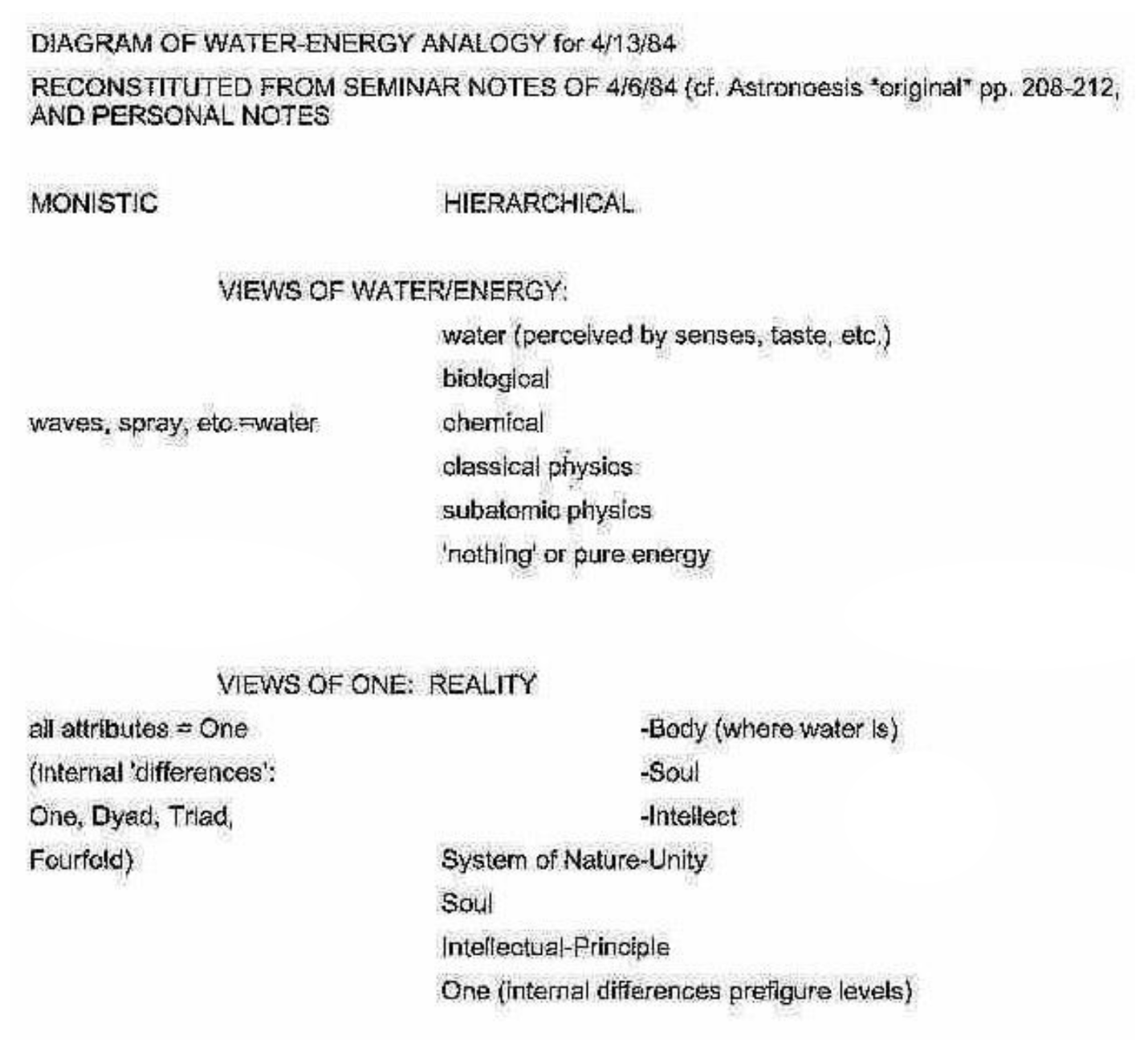
Class
Friday, April 13th, 1984
Verbatim, unedited transcriptCLASS at Wisdom's Goldenrod, Hector, NY
with Anthony Damiani (AD)
April 13, 1984
PLOTINUS; ONE; WATER ANALOGY
TOPIC: Plotinus
SUBJECT: One
SUBSUBJECTS: Water and Energy Analogies
CONTENTS:
Descriptions of water: Vedantic = waves, foam, spray etc.
Scientific = water sensed, biological, chemical, atomic, energy
Juxtaposing, confusing of frameworks is the problem
Vedanta monist position: only homogeneous Mind, waves, etc. just forms of it
Emanation: different experiences and laws at distinct levels
Plotinian doctrine: monistically–first three Hypostases, all aspects of One, God; emanation–distinct eternal hierarchy
Sage sees both world and Brahman
Analogy with Plotinus V.1.8, V.1.10, three Hypostases and System of Nature
Sensible levels reflect superior levels in V.1.10
Analogy is a description
Vedanta & reductionism to Pure Consciousness
Simultaneous both points of view in double act of Absolute Mind
Static Mind vs. Dynamic Mind as One vs. Nous (PB quote)
PB had great respect for Plotinus
The Sage and 'to know without image is to be'
Knowing without images and intuition
Sages' writings
Spiritual vs. subhuman understanding
On reading and studying inspired or philosophic texts
Return to water and energy analogy, levels of Reality
Absolute Mind as homogeneity, nothing outside
Pure Energy analogy for System of Nature
Immanence and Causality
Hierarchy view: higher principles transcend lower
Applying analogy to One and its contents
Light
The study of human psychology as a different way to do analogy
Complexity of phenomena involves World-Mind's intelligence
Modern rational scientific thinking vs. Tradition
Energy analogy, continued
In universe, laws that govern a level prior to that level, chain of causation and knowledge
PB anecdote about half a glass of water
BOOKS READ FROM OR REFERENCED:
Plotinus, The Enneads (MacKenna translation, 4th ed.)
Rene Guenon, Man and His Becoming According to the Vedanta
Vyasa, Brahma Sutras
Swami Madhavananda (tr.), Brihadaranyaka Upanishad (with the Commentary of Shankaracharya)
Paul Brunton, Notebooks
John N. Deck, Nature, Contemplation, and the One: A Study in the Philosophy of Plotinus
Gaudapada, Gaudapada Karika
Lao Tzu, Tao Te Ching
PLOTINUS QUOTES READ OR REFERENCED: V.1.8, V.1.10, V.2.1, VI.5.7, VI.8.16, VI.8.18
DIAGRAM appended to this transcript:
- FIGURE 1984 0413-1-JF. Water-Energy Analogy.
Other diagrams also referred to are not with this transcript version. [Transcriber note: [diagram] means the speaker is referencing a diagram as he or she is speaking. If someone is drawing or writing, with audible sounds of chalk on a blackboard, I indicate this by [drawing] or [writing].]
INITIALS: AD = Anthony Damiani; AS = Avery Solomon; all other initials are those of students.
NOTES:
For more on the Water Analogy: See Astronoesis, p. 310, Endnote 10 for a synopsis of some of the concepts in this transcript; see also Astronoesis Working Draft, section on the One (AD Notes and Papers, p. O208-212).
Multiple earlier partial transcripts exist, including the V11r version done by jf as part of "One series" from Audio Cassette Tapes 2002 (DG helping), and a version done by Mark Scorelle in 1987.
TRANSCRIBED Verbatim by IT, front matter and footer by jf 2018. This V12.1a (2023) and has: updated prefatory matter, footer, and audio file name; Book List completed; Plotinus quotes section added; new notes within transcript. Archival verbatim transcript – V12.1a.
AUDIO FILES: 1984 0413a (formerly 1984 0413b), 1984 0413b (formerly 1984 0413a). [Note 1: "Tape" and "Side" refer to original audio cassette tapes that were later digitized into .MP3 Audio Files. Note 2: In 2024, REP Studio separates off Physics & Philosophy class fragment from file b.]
| NEW FILE NAME | OLD FILE NAME |
| 1984 0413a | 1984 0413b |
| 1984 0413b | 1984 0413a |
1984 04/13 at Wisdom's Goldenrod
Plotinus; One; Water Analogy
[Audio File 1984 0413a (formerly 1984 0413b) Begins]
AD: --they understand this. [short pause] You know, modern scientists-- mayan-- modern science sometimes offers examples of certain things we wish to understand in philosophy, that these examples are really far superior to anything that (we/you) can find in the past. And, one of the things we're trying to find is a-- an analogy, you know, some way of talking about the One that brings us to grip with the fundamental problem that's inherent in understanding it. And you remember the analogy about the water, the waves, the foam. You remember that analogy? [student assents, faint] And, you'll find that in the Vedantic tradition over and over again, you know, everything, so to speak, can be spoken of-- You think of the ocean or think of water as Mind, and waves and the foam and the spray and everything could be, so to speak, reduced back to Mind, because the spray, foam, waves, all of these ocean-- all of this is water, and no matter which way you twist and turn, alright, you got water all the time.
But now, with my nasty and irritable disposition, there's something else to be considered, and that is that water itself is the product, let's say, of two chemicals. And, on a-- on a most gross level water is necessary to the life processes and it could be studied biologically as a necessary fluid, etc, go through all that, and then you could study it at the chemical level, where water is a result of two chemicals, H2O(,) combined, alright, and that would take you into the laws of chemistry.
Now remember, we're talking about this stuff that we call water (subs--) you know, you put a glass in your hand and you could drink it. Then there's another step you could take, and you could understand the molecules and the atoms that the chemists are dealing with from the point of view of the physicist. And the physicist(s) come up with certain rules, laws, and how the-- how this should be understood, alright, and that gives you another level. And then there's the quantum physicist who come up with even a deeper set of laws concerning the structure of subatomic particles, alright, and that's another set of laws, alright. And then if you go beyond that they say, well, we don't know, it comes out of this indescribable, intangible, invisible energy that, you know, all of a sudden you have either a wave or a particle and from that, if we reversed it, alright, then you would have the structure of the laws that govern quantum physics and then if you go beyond that you have the laws that govern classical physics, you go beyond that you'll have the laws that govern chemistry and if you go beyond that you'll have the laws of biology, you know, and then you finally come to water, alright.
So you got this-- you got this vertical example where water has within itself, alright, these four principles. [student assents] And, [AD hits something for emphasis] that's like a hierarchy. Water will always have these four hierarchical principles, alright, and we could think of-- we could say, well, we're looking at it in this vertical way. Then there's another way, we could look at it horizontally, we can take a look [AD hitting something as he talks] at the water and say, now look, the water includes the ocean, the fraying-- the spray, the foam, steam, everything, all of that, ice, can all be reduced to water.
So you have these two kinds of examples. With one and the same thing, water, alright, you'll have this hierarchy of principles that are eternal. As long as you have-- as long as we're speaking about water, there would be these laws that are eternal. In other words, the laws of subatomic physics, physics, classical physics, and chemistry and biology, till you get water, alright, they'll-- that's a hierarchy, that's-- that's like an eternal hierarchy. It doesn't alter, never changes, if you speak about water that hierarchy is there, alright. And then there's the other hierarchy, alright, but I don't know if we could call this a hierarchy-- The former we can say, well that's a hierarchy of causation and knowledge. You have a hierarchy of causes. You have the laws of subatomic physics all the way down to the laws of biology, ok. Now the other one, the other one is more difficult because there you don't have (the/a) hierarchy of causation.
Now the interesting thing would be, how could we work this problem out, Avery? How can we look at this problem? If we say that-- if we took water and say, now that represents Mind, you see, then when you break-- break the water down, so to speak, into this intangible, invisible energy from which it comes, then the analogy will fall apart. It seems that we have to start by saying Mind, alright, which is where those two things come from, you know, the particles and the waves, you have to say that that invisi-- that invisible energy, if we say that that's Mind, ok, and that it differentiates or emanates from itself these various strata or hierarchy of them-- (of) principles, alright, if we say that, then we can understand how on the one hand, Mind-- I mean, because we're trying to work-- we're trying to work out-- Avery and I are trying to work out a perfect example.
I want to be able to butt every Vedantist over the head with this. Stop giving me waves and spray and foam and ice, because, like I'm pointing out, they're leaving out half the problem. If we say that that's Mind, this invisible, intangible realm, you know, where Vic is always shooting these pellets from, you know, the electronic gun shooting this energy and it go-- becomes either a particle or a wave, ok. Now, that's the realm of Mind. Out of that no-thing-ness, alright, comes a particle or a wave. Now if we say that that's the realm of Mind, then in the example we could say that Mind is both immanent in the water and transcendent to the water.
[students assent]
[student sneezes, laughter, student words]
AD: What do you think Avery?
JL (simultaneously): I--
AD: Go ahead.
JL (simultaneously): I think-- I think a lot of the scientists are quite aware of the-- the difficulty in ascribing, let's say, a physical reality to-- to law, you know. I think there's kind of two schools that sort of go in different directions, one saying that the law is transcendent to the phenomena and the other I suppose attempt to say that what law is seen is only a description of-- of order.
AD (simultaneously): By now you should be acquainted with the fact when there is this indeterminable or interminable discussion whether the law is immanent in the phenomena or whether it's transcendent to the phenomena, [JL assents] by this time you should recognize: it's both. [JL assents] As soon as you've taken a side you're just showing the narrowness and the parochial point of view of our education.
JL: Well they try to reduce it to one or the other, you know. And--
AD: I (could), and I think any intelligent man to come up with just as many pros and cons. In other words, if you take situation A, I can come up with as many situa-- I can come up with as adequate a response as if you took situation B, it wouldn't matter to me. [JL assents] Is the law of gravity immanent in the apple that hit you over the head?
JL: Of course.
AD: And isn't it also transcendent?
S (faint): (Uh-hm/Of course).
JL: But-- but it's strange because it's-- it's [one word inaudible]
AD (simultaneously): It's not the law of gravity that fell-- falls on your head.
JL: It's not the object, oh certainly. (bit of laughter) It's a function that the object performs.
S (possibly part of background): Out of the line.
S: So--
AD: Let's keep it simple.
JL: Yeah.
AD: What is it that falls on your head, the apple or the law of gravity?
JL: Well, on your head? (JL laughs a bit) Well I-- I think I-- the apple of course.
AD: The apple, yeah. [student assents, faint] But, on the other hand, the fact that s-- the apple can fall is a formulation of the law of gravity. So on the one hand it's something which is immanent in the phenomena and on the other hand it transcends the phenomena. Why try to separate them?
[short pause]
JL: Well, it's a seeming paradox to the materialistic physicist who--
AD: Yeah, but we're not going to worry [JL simultaneously: Oh I know.] about that [one/two words inaudible] I'm not going to worry about the materialistic physics.
JL (simultaneously): I-- I'm just saying, you know, to ascribe it to any-- any condition of a-- of a substance, you know, as a-- as a property of the substance, is-- it-- it betrays problems, because the actual law of gravity in this particular instance is kind of independent of the apple. I mean it could be a stone or a feather or anything else.
AD: Yes of course.
JL: I mean--
S: [couple/few words inaudible]
AD: Sure, go ahead.
DB: Anthony, are you saying that the-- that in the-- in the Hindu analogy that the water is transcendent to the foam, spray, and so forth and (here--)
AD (simultaneously): In the example of the Hindu analogy when they say that the water-- that you can reduce everything back to water, [DB assents] alright, and that this is an exemplification or an-- an exemplification of the non-dual theory, [DB assents] in-- in that-- in that illustration, I-- I find it inadequate because they're leaving out what we said is just as important, and that is that Mind, if we take the water to be like Mind, Mind has an internal and eternal differentiation or emanation within itself. In other words, Mind, Absolute Mind, insofar that it differentiates itself internally in a distinctionless mode, these differentiations are of an eternal nature. [DB assents] You're not going-- you're-- you can't wipe them away for me. You can't say "I'm reducing it all to water." Because when you say you're reducing it all to water, now, the problem is, but water itself, alright, is a component of the chemicals. The chemical-- the laws of chemistry are, so to speak, reducible to the law of physics and those laws are reducible to the subatomic laws, ok, and there-- and there you have a whole different way-- a different way of looking at the problem.
DB (simultaneously): Yeah. They-- they only-- their-- their analysis is-- remains basically you're saying on a-- a horizontal level, and it doesn't go into a hierarchical, [AD simultaneously: Yes.] vertical consideration of--
AD (simultaneously): It's the same thing like saying there's only Mind, alright. There's no Intellectual-Principle, everything can be reduced to Intellectual-Principle. Well, that's the reductive tendency that we all operate with, that everything could be reduced to the Intellectual-Principle. [DB assents, faint] Now-- Or reduced to Mind. Now, let me ask you this here, has there ever been-- has there ever not been Intellectual-Principle? Has there ever not been Soul? Has there ever not been manifestation? If you say that there has never been such an occasion, then I cannot accept your example even though I will agree that Mind is ultimate.
AD/S(?): (Yeah?)
AS: Uh-hm.
AD: Go ahead Avery.
AS (simultaneously): Oh so-- Let's see if we can understand in these two complementary views that are being presented in the example. In the hierarchical view, you could say something like, if I taste the water, and I know what it tastes like on this kind of a level, I can't get from that the hydrogen, I can't taste it and tell you hydrogen, oxygen, and I certainly can't taste it and tell you about atoms and so on, and that level of experience is really something quite distinct from my tasting of the water. On the other hand, if I explain to you all about hydrogen and oxygen and all this stuff, I can tell you from today till tomorrow about it but it's not the same thing as tasting the water, and there's no way to reduce hydrogen to oxygen to my experience of water. And there's no way to reduce hydrogen-oxygen to the subatomic level without losing hydrogen, oxygen, and so on. So in that sense you have to keep a hierarchy of these views. That seems to be the scientific view that each of these levels of descriptions or aspects of the water is intrinsic to the water but is really distinct one from the other.
Now the other-- the other view however, is that it's all-- all of these are pervaded by water. So it's not like you have water versus H2O or water versus the atoms or subatomic nature, what you have is water as H2O, or water as biological necessity or water as subatomic particles. So this "as", this "as" is a very funny relation. It's the One as all these things is immanent, water is immanent in all of the levels. On the other hand, all these levels are distinct one from the other and can't be reduced to each other or-- or to-- well that's the thing, or to what? It can't be red-- completely reduced to just this homogeneous nature. Right? Now--
PD: I'm not sure if I understand you Avery. You're saying that the two analyses--one is that water as a-- a composite of functional meanings represents a hierarchical view?
AS: Right.
PD: And the water can be examined and function in different frameworks, the chemicist, the physicist, the glass of water you drink--those are all different functional analyses of the object. [student assents] And--
AS (simultaneously): Well, functional, ok, except that I think by functional you're going to try and do something with that word. If we use the word 'functional' very loosely.
PD: I don't--
AS: I'm not sure what you mean by functional analysis, that's all.
PD: Well, when you define water in terms of H2O, [AS: Yeah.] that's a-- that's a functional analysis in terms of chemistry, and the chemical-- the 102 elements, etc, etc.
AS: Well, yeah, ok, I just-- I don't know what you mean by functional analysis but fine, yeah.
PD: But the immediate experience of water, the taste of water, is the other approach.
AS: No, [S simultaneously: No, that's not right.] I was-- I wasn't saying that, but that's a possibility. I was trying to think that this experience of the taste of water is one experience of water. But the experience of it as H2O is another way of experiencing the water.
PD (simultaneously): But, can you ever say that you experience it as H2O? Wouldn't you say that that's a theoretical formulation, a functional analysis of the object?
AS: No, I'm not sure it's completely functional. I'm-- and that's what I meant, that's what I had thought you were going to do with that functional. I think it's intrinsic to the water.
PD: But, you never experience H2O, you taste the water, that's our experience of the object.
AS: Well that's one experience of the object.
PD: Well, in terms of immediate experience the taste of water is what we have of that object.
AS: Oh but, I don't see why it's any less immediate to [S simultaneously, faint: Analyze the water.] analyze the-- analyze the water, it's not sensibly immediate but--
PD: But it's not something that you will experience. The H2O is a theoretical formulation.
S: No.
LD: Yeah, but one's a sensible experience and one is a rational experience, but they're both of water. You're trying to--
PD: What's the experience of H2O like?
AS: Well, I see what you're saying.
LD (simultaneously): It's through understanding. You're trying to take it and make it an abstract-- abstract these principles from the water. But through reason I can show that the water is more derivable from those principles than vice versa.
S (faint): Yeah, uh-hm.
AD (simultaneously): In other words, the H2O here is the-- is an object of cognition but rational cognition, [AS simultaneously: Right, rather than sensible.] whereas the taste of water is the object of sensible cognition. [student assents, very faint] [S: But he--] But the fact remains that you have a different framework by which to test either one. You can't use the sensory apparatus to test the rational hypothesis and you can't use the rational hypothesis to taste the water.
PD: Yeah, I just don't see how you could say H2O is an experience. That's all.
LD: Yeah, because you're (too--)
AD (simultaneously): Well, let me ask you this. When we speak about the world or that there's these 100 elements, odd elements or so that constitute the-- whether we speak of matter or whether we speak of the perceptual manifold doesn't matter to me, the fact is that we're speaking about what has organized or constituted the perceptual manifold or matter, ok. And the analysis that the chemists have come up with and all scientists have come up with and which has been validated, alright, again, again, and again to the point where they can do anything they want with it, I mean this is an object of rational cognition and understanding.
PD: And that's what I'm saying is a functional analysis of the object, there's not an H-- there's not two H's and an O, because if you did hypostatize that analysis, then you would not allow for the next level, the physicist's analysis of the object.
AD: But, it's quite-- it's quite the other way around, we hypostatize that, that there are so many elements, alright, and that they do combine under certain laws and all these laws in chemistry we would refer to as hypostazations, I mean, we assume that they'll always work. Any time you have hydrogen and oxygen and an electrical charge, you'll have the production of water taking place. Now, this is a fact and it's an irreducible fact, there's no way we can get around it.
PD: Well, I wouldn't say it's a fact, it's a functional description of how phenomena is happening.
AS: Alright, well-- uh-hm. He don't like the analogy [couple words inaudible]
DB: Yeah but [S simultaneously: But--] Paul, so is-- so is-- you know, so is your-- if you want to take that perspective, so is your knowledge that the light's on in the room as well. Light's on in the room, I could tell 'cause I'm reading a book now. I mean, I don't see how that's any different.
PD: Well that's perceptibly immediate to your consciousness.
S: Right.
DB: No but-- yeah but your knowledge of that, your ability to take from that perception, say certain things about it, knowle-- you know, to go from there and say well the light's on-- I'm reading, therefore the light's on, therefore the electricity's working, therefore I paid the power company this month, so on and so forth, I mean, I don't understand what the problem is.
S: Yeah.
LD: Well in a way I think he's getting back to what Johnny initially asked about gravity and the apple. He saying we could only speak about gravity in relation to the apple so in some ways it's derivable from the apple, but in fact we can speak of gravity as prior, as principle, as operating transcendent to the apple as law and as immanent within the apple. And the same with these laws of science.
DB: Right but I-- what I don't understand is the implied, you know, system of-- or implication that the-- that the rational is somehow less real than the perceptible.
LD (simultaneously): I'm totally agreeing with you.
PD: Well, [S: Yeah.] you're misunderstanding me 'cause I've never used the word 'real'.
DB: Ok, what are you saying Paul?
PD: I said that one is sensible, direct perception, and the other is the formulation [AS drawing/writing] through the theoretical cogitation.
DB: Yeah but-- I-- that's--
PD: Neither one are real. We're not analyzing reality now.
LC: I thought Paul [DB simultaneously: But, it's a question of theoretical Paul.] gave you a good answer, the example of the apple and the gravity and I--
LD (simultaneously): I'm Louis. (laughter)
LC (amidst laughter): Louis, yeah, I know, uh-hm.
MW: One of the Damianis.
LC: Did you s-- did you think that-- did-- did you like Louis' response too? That actually you're bringing up the same question that John brought up.
DB (simultaneously): I-- yeah, I was coming from Johnny.
LC (simultaneously): Yeah, yeah. [student assents, faint] And that the-- so that you can have the law of gravity, it's-- is it in the apple, you can talk about it in the falling apple, you can also talk about it as a principle apart from the apple.
PD: But that [LC simultaneously: But you don't want-- and you don't want to.] doesn't change my-- that doesn't change where I was coming from Leslie.
LC (simultaneously): Doesn't change your opinion [one word inaudible]
PD: No.
AS: Yeah before we go into this question of the in-between, can we get something straight about-- there seems to be [student assents] two ways to use the analogy, one is you subsu-- one way we could subsume this all under water and say these are various [drawing] descriptions of water, and hierarchical descriptions which can't be reduced to one another or whatever. And then there's the other way you seem to be doing, Anthony, is coming up from the bottom, [AD: Yeah.] just saying that it's pure energy, [AD simultaneously: (Exactly.)] and insofar as it's pure energy which splits in some way into this complementarity say of wave and particle, which in turn goes to-- which is the basis for all atomic nature, which is the basis for the chemical laws. So for example we could say you have the pure space or pure illumined matter, pure-- the "tentative illumination" which then within the Sun you have this fusion process which builds up these atomic particles, which then on the Earth is built up into chemical molecules, which then finally evolves into a certain biological entity which we call water. And in that way we can see it as all built up from pure energy, and we could see-- Now, would you call that the transcendent view, the view that the [AD simultaneously: Yes, yeah.] energy is transcendent to all of those different--
AD (simultaneously): You see, the energy, the energy is transcendent.
AS: [drawing] To all of the different [AD: Uh-huh.] things. Whereas, I think if you say now-- however if we say it's all water, if we say that's the primary unit-- you see, if we're using this as an analogy for the One, there are two--
AD: Yeah.
AS: There are [LC assents] two different way you can go.
AD (simultaneously): Which view will you take, [AS simultaneously: What are you going to take a view on.] will you take the view of water or will you [AS simultaneously: Or of energy.] take the view of that pure energy?
[Note: See FIGURE 1984 0413-1-JF, Water-Energy Analogy, appended to this transcript for the following. It is not technically from this class and is included here to help follow along.]
AS (simultaneously): Exactly. Now if you take the view of the water, you're saying it's all-- it's-- this seems to be a view of immanence, because water as biology, water as chemical laws, water as atomic, water as all these. In this one [diagram] the pure energy gives rise to or emanates these various--
AD: Yeah. Now--
AS (simultaneously): And actually we should have the thing on its head because the pure energy would be like the One emanating these various levels [diagram].
AD: Alright now, if you put a line through [diagram], you know, and you show that these are different [AS assents] [AS drawing] levels or frameworks.
AS: Well-- yeah, now-- in-- and in one view, these [drawing] different frameworks or levels are distinct from the pure transcendent energy or emanated [AD simultaneously: Uh-hm.] from it. In the other point of view, these levels are permeated by water. They're not anything other than water. When you discuss-- whenever you discuss water, you c-- you c-- you can bring in all of these intrinsic things, you don't have to go outside of water [AD simultaneously: No.] to discuss the biological nature of it, the chemical laws and atomics and so on. Now is that one way that you-- that you could use this analogy, [AD simultaneously: Yeah.] I mean in one way it's-- it's immanent--
AD: Where water is, for instance, alongside on a horizontal [AS assents] you could put waves, you know, [AS: Oh (couple/three words inaudible)] spray, foam, etc, [diagram] ok.
CDA: But in the analogy, the water itself is not-- is still-- is Mind also, I mean, I'm confused, example--
AD (simultaneously): Well, no, no, we're just discussing which way would be the proper way to use this analogy.
CDA (simultaneously): Oh which way, not both. Which-- is it one or the other.
AD (simultaneously): We don't know which way is the proper way [AS simultaneously: Yeah. (one/two words inaudible)] to use this analogy, whether to use the term [CDA simultaneously: Ok.] 'water' as correspondent to the notion [AS drawing] of Absolute Mind or to take the physicists' example and show, no, that's what we mean, where it's coming from is what Absolute Mind is, and that that Absolute Mind is immanent in water and transcendent to water at the same time.
[student assents, faint]
DB: Right.
AS: Or that-- or that water is [drawing] immanent in all the levels, and yet stands in itself as a unity.
CDA (faint): It's--
AD: Well, now what do you mean by that?
CDA (faint): It's difficult.
S: [one/two words inaudible]
AS (simultaneously): Well that's the hard part. If I take water to be Mind in itself, then I have a hard time looking at the transcendent nature of the water. Except by [S simultaneously: Why?] saying-- except by saying that in that view, if I take the water as Mind, I can reduce all of these and say these aren't anything other than water. And then I reduce everything to a homogeneous block of water.
JL: You have to introduce intelligibility there. If you don't, you have nothing [student assents] but pure energy.
PD: The different [AS simultaneously: Well (one/two words inaudible)] functions that water will serve represents (the/a) different types of intelligibility that water is going to manifest--biological, chemical, atomic. Those are different functional intelligibilities that the water acquires, based [AS simultaneously: From where?] on the theoretic framework that the [student assents] apprehending mind brings to it.
AS: But the other view, Paul, is that they're intrinsic to water and you just discover it. You're do-- you're putting forth a point of view that we impute these things to water, which we might, but the other-- another person could just as easily say, all this stuff is part of the water, what do you mean impute, it's water.
PD (simultaneously): No, I didn't say necessarily impute, Avery, but it does demand a certain framework in order to manifest that type of activity.
AS: True but the water may be what it is without your discovering it. In other words, even before people knew about quantum physics or about atomic laws or any of this stuff, that was still part of the water, the water doesn't care whether you know about it or not. The water-- the water says, "The heck with you, I'm water. And I-- and all of this is included within me, in my internal differentiation. If you want to come and discover it, that's fine. If you don't want to discover it, makes no difference to me anyway. I've got all this as part of me. And not only that, even when I have it all as part of me and it seems to be all homogeneous within me, [AS tapping on board] there really are distinctions, they're really distinct."
PD: Well if they're really distinct then how are they integrated into the nature of water?
AS: Isn't that funny, isn't that just [student assents] the paradox.
PD: Well, it's a paradox or it's a lie.
AS: Well, it may be a lie and the Vedantist says it is a lie. The Vedanta says exactly, that maya is phony, it's false, illusory appearance, whereas this point of view tries to integrate the multiplicity into the unity instead of saying you just have a pure monism and throw out all the multiplicity. If you want to take that point of view, it's much easier, it's true. It's easier to see the Vedantist view.
PD (simultaneously): No, you haven't been following what I'm saying.
AS: Oh yes I am.
PD: The functional analysis--
AS (simultaneously): Ah. No, I think you're wrong, I am following what you're saying. I disagree.
PD (simultaneously): The functional analysis is revealing different intelligibilities.
AS: It's revealing-- that's right, it's revealing intrinsic aspects of water. It's not producing them. It reveals them, it's true. Well forget about how you know it, it's there, it's part of the water.
PD (simultaneously): But that's the assumption I can never make.
AS: Well that's too-- ok, that's fine.
SC: It-- so-- s--
AS (simultaneously): You're a Vedantist, what can I say.
PD: No, I'm not a Vedantist Avery.
AS (simultaneously): And the Vedantist says the same thing. [SC simultaneously: Paul are you--] The Vedantist says there's just water and anything you impute to it is a transformation of maya.
PD (simultaneously): No. The [SC simultaneously: Paul are you s--] part of the object that's revealed is coming from a certain mode of knowledge and you cannot ignore that.
AS: Well for-- let's just say that for now, we're including those modes of knowledge within the water itself, or within-- or as a development out of the pure energy.
SC: Paul, are you saying that those different modes [AS simultaneously: (Business/This is) of knowing it.] are productions [S simultaneously: Of what?] of the individual mind? And that--
PD (simultaneously): That's not even at issue yet Sam.
AS (simultaneously): No.
SC: I'm trying to-- well then what is at issue, I'm trying to understand and I don't quite get it yet. Are-- you're saying that those different modes, biology, the chemical way of looking at it, you're saying when you analyze and you see them, you're not seeing a quality of the water, you're seeing [student assents] something of the mi-- of your own mind, or [PD simultaneously: No, you--] a formulation of your own mind.
PD (simultaneously): That you're getting at certain determinate type of knowledge.
SC: And, where is that-- what's-- where is that coming from, what's causing that, is it-- is it an imaginary creation, is there some thing-- some essence in the water that you're discovering through these different modes, where is that coming from, what is it?
S: Yeah.
PD: Where is [AS simultaneously: Well if the-- see--] the object that is--
SC (simultaneously): Yeah, when you say that--
PD: The object that is being investigated is the water.
AS: No but the--
SC: Ok, if the object that's being investigated is the water, and when you investigate it from different standpoints, different apparatus, [PD: Right.] you're coming up with different formulations, aren't you just then going back-- don't you have to return to the idea that there is this water and that this water has different levels of manifestation?
JB: Like what's your preference for the tongue over the [SC simultaneously: See--] microscope? It's no more accurate.
PD: Because if you say they're different levels of manifestation, [SC: Yeah.] then you're making the water produce the different hierarchical levels. [AS simultaneously: No, not produce them Paul.] But water doesn't produce them. [AS simultaneously: Doesn't produce anything.] They always were and always will be, so there's [AS simultaneously: Right.] no causal production out of the nature of water.
AS: That's exactly the point, isn't it?
PD: So simultaneously there's water.
SC: Right.
AS (simultaneously): Right. Simultaneously there's all of these views.
PD (simultaneously): And simultaneously whatever level of cognition is going on the object is going to get cognized that way.
AS: But Paul, but forget about that, simultaneously you have all these different aspects of water. Isn't that the point just what you just said? That's exactly the point. You have simultaneously the intrinsic nature of water is to include all of these levels.
PD: Yeah I--
LD: Within [AS simultaneously: So right--] those levels, I don't think he's trying to make permanent separations between them. We're making distinctions, that within the water there is distinct aspects of them but not-- they are not-- you cannot take the chemical laws out of water and have it as separate from water, I don't think we're trying to do that, if that's-- Is that-- do you think--
AS: Never mind. David?
PD (simultaneously): I was explaining from where I was coming from. I mean--
LD: No I'm just trying to understand what [student assents, faint] that is.
AS: Oh no.
DB: Well, [S simultaneously: Yes.] I just wanted to suggest that it seems that-- it seems to me that the Vedantic analysis is an analysis of phenomena, and a reduction of phenomena whether it's the foam or the spray or the wave to the reality, to the water, ok, now this is-- starting from that perspective, we're no longer really dealing with an analysis of phenomena except that what they've reduced everything to in their analogy we're starting out with as the phenomena and trying to understand the principles that underlie it. Ok, we're saying alright, here's Mind, now what are its internal constitutions or differentiations analogically. I mean, isn't-- isn't that-- isn't that the issue? I mean, the-- the Vedanta is looking at it from a completely different perspective than what we (do/are). Because their-- their analysis results in this very--
LD: Yeah I think the Vedanta is saying-- is homogeneous, totally homogeneous. [DB simultaneously: See but it's an analysis of phenomena.] And we're saying there are distinct aspects within that, but, you know, and in some ways each is inclusive of the others. But it's not homogeneous, pure-- it's not pure and simple block.
DB: Right.
S (faint): That's true.
DB: But see--
AS (simultaneously): But you know, I think-- [couple inaudible student words simultaneous with AS] Well go on, go ahead. Yeah.
AD: It's both.
AS: Yeah. And I think those "both" are what we have to understand. We have two kinds of-- we have two kinds of complementarities. The one complementarity is we're complementing or juxtaposing homogeneous absolute reduction to pure whatever, pure substance. And we're juxtaposing that with this hierarchy of distinct views, aspects. Ok? But then there's this other thing we're also juxtaposing which is transcendence versus immanence.
AD: Let me-- let me try to state the first position.
AS: Uh-hm.
[short pause]
AD: We have Absolute Mind, alright, which is homogeneous, and we have Absolute Mind which is hierarchically structured or differentiated. [AS: Yes.] These are two positions that are both simultaneously and ultimate.
AS: Right. Now, when we use these two also--
AD (simultaneously): Wait. You follow this?
AH: No. Could I ask a question about the way you've described it? You have Absolute Mind on the one hand, you have Absolute Mind hierarchically expressed. Why did you use the term Absolute in the second case?
AS: 'Cause it's the Absolute.
AH (simultaneously): Why-- why do you carry the notion of Absolute across the equation?
AD: That's [AS simultaneously: That's the whole point.] what I mean by Absolute. [AS assents] That's exactly what I mean by Absolute. In other words, if I were to say, when I say Absolute Mind, I mean just the homogeneity of water, that wouldn't be true to what I understand to be Absolute. What I understand to be Absolute will be not only the homogeneity of the water as water, alright, but also the hierarchy, and this you have to listen to, [AH simultaneously: Ok.] the hierarchy of causation and knowledge inherent in that Absoluteness.
AH: Yes, ok. Would you--
AD: You-- in other-- in other words, well, let's talk a little bit, in other words, can I have that homogeneity of water without having the hierarchy of principles?
AH: If you're [AS simultaneously: Only logically.] using-- if you're using the word 'Absolute' as a synonym for Reality, I would question that.
AS: Yeah.
AD: Well of course I'm using it as a symbol for Reality, sure.
[student assents, very faint]
AS: Yeah.
AH: Well you said [AD simultaneously: Now-- alright.] earlier tonight you would-- you--
AD: Now suppose I say Reality, ok, instead of saying Absolute Mind. And I, again, would repeat and say to me Reality would have to be of a homogenous-- a homogeneity. In other words, it has that nature which is homogeneous, alright, and it has also that nature which stratifies it into various hierarchical principles which are of eternal-- of an eternal nature, and that these two together is what I mean by Absolute.
AH: Ok.
AD: I just want to make clear what I mean by Absolute, it may not be, well, what others mean. But [AH simultaneously: Actually--] this is what I understand. Let me try this way. As long as there's Absolute Mind, there will be Intellectual-Principle, there'll be Absolute Soul. There will never be a time when you have Absolute Mind and no Absolute Soul and no Intellectual-Principle. There will always be that hierarchy of these principles as well as the nature-- the-- that the substantial nature of all three is absolute homogeneous Mind.
AH: Anthony, I understand that, I understand your view.
AD: Alright.
AH: Intellectually.
AD: Alright, now let's see how long-- how long you can balance it.
AH: No, is this-- are these two points of view the Ultimately Real?
AD: Yes.
AH: This is the One?
AD: Yeah.
AH: Ok.
AD: No, it's not the One! It's the non-dual!
AH: See, that's where I can't follow.
AD: Why can't you follow it?
AH: Because it's an-- it's an intellectual paradox that I have to accept (out of faith).
AD (simultaneously): If you say this is the One according to Plotinus, yes. Is that what you meant? Yeah. This is the One according to Plotinus, yes. This is Ultimate Reality according to Plotinus. This is Absolute Mind according to Plotinus.
[student assents, very faint]
S: Yeah.
AH: I'm trying to [one/two words inaudible]
AD (simultaneously): Go ahead. Well go ahead--
KD: I can-- I can see the-- this taking it from the top, that water has within it these-- they're like announcements about its nature, and I can see that analogy that, you know, it keeps the biological law part, it keeps-- it keeps it as like qualitatively different-- different things altogether, you've got water and then you've got the-- the laws that announce the nature of the water, and it leaves those two like qualitatively different and yet those laws wouldn't be there without the water, so you've retained like-- because they're like qualitatively different you've kept the water as-- as like absolute, I mean you haven't touched that, it-- the water hasn't become something, you know, the water hasn't become something else or transformed itself into-- into anything else. But, I don't-- I don't see the part about the energy at all, I don't--
AD (simultaneously): Think of-- think about--
KD (simultaneously): I don't see how you can use the analogy and take it the other way and say that energy becomes all those things because then you've-- you've--
AD: Think of the water as the sensible. Think of the water as the sensible, alright, waves, spray, steam, ice, but think of the water as the sensible. Then that energy, alright, is immanent in the sensible all the time regardless of what form the sensible has.
KD: I don't-- I don't see it.
S (faint): That's true.
AD: You don't see it?
KD: No.
AD: Well what does [KD simultaneously: (If/That) water is the sensible--] Plotinus mean when he says that these three hypostases exist in themselves and also for the entire system of Nature? How do you understand that?
JL: I could even draw a parallel right here, in this-- in this one. If you-- if you take the three-- the three hypostases as-- as-- in regards to this example, substance, intelligible, and the transformative power of-- of the soul that creates the actual thing. You know, you can have the energy and you can have the-- the-- the intelligible character that determines the hierarchy, but separate they're not really-- you don't have water, you only have water when there's actually a combination of the two which may in this case involve soul as the transformative nature. Because it can be transformed into many different levels. It can-- it can move from one intelligible form to another. [short pause] I mean it's not just energy, it's not just hierarchy, and it's not just-- just the object itself, it's-- it's these things all in combination.
S (very faint): No.
AD: No.
S: Yeah.
JL: [few words inaudible]
AD: Well then--
PD: See it seems-- it seems [AS simultaneously: Could--] to me that if you-- if you posit an energetic relationship between the two aspects, then you have returned-- [S: Yeah.] you have yourself become reductionist, so that to characterize an energetic source to the different hierarchies seems to be inappropriate. That itself is another point of view within the hierarchy.
AD: I didn't follow-- don't follow you yet.
PD: Well you posit an energetic outflow from one aspect towards the--
AD: You mean from the bottom up.
PD: Right, towards the hier-- different levels of the hierarchy, which is creating a relationship between the hierarchy and what's non-relatable.
AD (faint): Uh-hm.
PD: Which seems to be another point of view within the hierarchy.
AD: I-- I-- I don't follow.
[students assent, very faint]
AH: I follow what Paul's saying, I think.
[students assent, faint]
AD/S(?) (faint): [couple/three words inaudible]
AH (simultaneously): Instead of reducing everything to a monism, there's a kind of reduction to a energy. Is that so Paul?
PD: Well the point about the energetic outflow from the unmanifest to the manifest is a type of relationship that you're creating now between the hierarchy and what's outside of the hierarchy. And that only seems to be true from within the hierarchy, any type of relationship or causation.
S (very faint): Yeah.
AS: Well, when An-- when you first gave the analogy though, or the example rather or the description, that the way we're considering the Absolute is as a non-duality of these two views of pure homogeneous substance and a hierarchy of intrinsic aspects.
PD: Ok.
AS: And we're trying to use the anal-- the example or the analogy to illustrate, to get some illustration of how something could possibly be on the one hand all of one homogeneous substantial nature and on the other hand have intrinsic to it all of these hierarchical aspects, [AD, faint: Uh-hm.] and how the two of those then have to be juxtaposed and brought together.
AD: In order to give you a concept of the Absolute.
AS (simultaneously): In order to have a view of Reality or the Absolute. So, this is-- this picture, whatever this whole thing is, is supposed to be a picture of Reality or the Absolute. And, we're just-- I think the first thing to decide or try to decide is, are we going to use the analogy with the energy representing the pure homogeneous substance, or are we going to use water to represent the homogeneous substance point of view.
AD: Yeah.
AS: And I think either one seems to-- yeah, at least right now seems to be open, and in this energy-- if you take energy as the pure homogeneous substance then you could say this whole stuff is nothing but energy, you could do reductionism.
AD (simultaneously): Yeah, the differentiation of [AS simultaneously: Of energy.] energy within itself.
AS (simultaneously): Yeah. And if you do-- if you do reductionism, scientific reductionism, then you're taking the homogeneous substance point of view. This [diagram] is nothing other than energy and this [diagram] is notha-- nothing other than an exfoliation of energy and so on. But also-- but, still even sticking within the scientific view, if you take another perspective, each of these can't be reduced one to the other because as soon as you do you lose the-- the objective nature of those laws. You lose the objective distinctions that are inherent in the water itself, that are inherent in this.
AD (simultaneously): I want you to make a correlate with what Plotinus is saying when he says there's a One which is a principle, there's an Intellectual-Principle which is also another hypostasis and there is Soul which is another hypostasis, alright. Now he takes these three--
(Side 1 of original cassette tape digitized as 1984 0413a (formerly 1984 0413b) Ends; Side 2 Begins)
AD: --more hypostases, we're taking about God, and only for the purposes of the neophyte do we speak about them as three primal hypostases. And I'm saying no, no, not at all! What we're doing is running away from trying to understand the nature of these three primal hymo-- hypostases by saying it's God and therefore avoid the attempt to penetrate into the nature of these principles. Now I'm taking a whole different point of view. In other words I'm disagreeing with what PB says here and what a few others have said, "Well all of this is God, don't worry about it. The three primal hypostases are God, forget it. Ok, now we can go on." And I'm saying no, Plotinus went into a lot of discussion about each one of these principles, alright, and each one has an eternal validity which is not going to be denied or blocked away by reducing it to a one. Ok?
PD (simultaneously): Well that's what I'm afraid you're doing, you're being reductive and you're--
AD (simultaneously): No, not at-- No, you're-- [couple/three inaudible AS words simultaneous with AD] It's the very opposite, you keep on trying to see it that way and I'm telling you don't look at it that way!
PD: But then if it's [AD simultaneously: Look--] not reductionism, don't tell me that one comes out of the other. Because that's reductionism.
AS: But that's only one [S simultaneously: That's one view.] of the two views. That's-- When we [AD simultaneously: Hold on.] said non-dual, that's one of the-- we're not-- in the non-dual view, you're not throwing away the homogeneous view, you're including it as one of the complementary aspects of Reality. So in your example you have to also see the reduction to the homogeneous point of view because that is one of the two complementary necessary views of the Absolute. You have to also have that view. Otherwise you just have a multiplicity. If these-- if you just have the distinct levels and you don't have the unifying homogeneous nature of whatever it is, you'll [AD/S(?) simultaneously: You don't have the actual--] have the pure multiplicity and you don't have an Absolute.
MW: Avery maybe-- I think maybe it's [AS simultaneously: Do it.] just partly the diagram. I think--
AS: Yeah.
MW: Be-- before when we've used the-- when we've tried to describe the two aspects, when we speak about the homogeneous aspect, we don't show anything coming out of it because now we're speaking about it in its homogeneity and we can't even make the distinctions.
AS: It didn't come out of it.
MW: Right. And when we speak about the distinctions we don't-- Remember the whole discussion about self-caused, the principle is self-caused.
AD (simultaneously): That's the point, that's why we're doing [AS simultaneously: (Is getting you) to understand it.] this, to get you to-- to get an understanding of what it means to speak about self-cause.
MW: Right and I-- [AS simultaneously: Well-- yeah.] and the way I've understood self-cause, [S simultaneously: Maybe it's (one/two words inaudible)] it's not so much a-- a flowing out from the way-- I-- that's what I'm saying, I think it's just a problem with this-- [AD/S(?): No.] the diagram.
S (simultaneously): Look, Michael--
AS (simultaneously): We already said that in the one view of homogeneity it's all energy.
MW: Right.
AS: There's no-- nothing outside of energy. This isn't anything other than energy [diagram]. [AS hitting board as he talks to emphasize point] Quantum mechanics, atomic physics, chemistry, biology, it's all energy, there's nothing [MW assents] else but energy. That's one view. And the other view says, no, these [drawing] are distinct emanations. It's not pure-- just pure energy. If it's just pure energy, how come I experience waves or how come I can-- how come I can analyze H2O? [student assents, faint] That's not an illusory superimposition [one/two words inaudible] that's--
AD (simultaneously): And both have to be held together, [couple inaudible student words simultaneous with AD] you have to hold both [AS simultaneously: (And then) you can hold them together, I know.] points of view. [S simultaneously, faint: (That's not so.)] Let go of one and you're in trouble.
AS: Yeah. Well so maybe the diagram was misleading.
LD (simultaneously): Is it better to say in the second view though that instead of the quantum level coming out of pure energy to say because pure energy is, quantum arises, instead-- is that still a causal--
AD: Well--
LD: Is that-- you know, is that a better way of stating it?
AD: There probably is better ways of stating it and we try to tr-- we'll have to try to be more precise. I'm quite sure of that Louis but, I think we have to just slug out the main point here right now and then worry about the refinement of the detail. And the main point is, could you give it back to me, what the main point is?
LD: That there's two views, that-- and this pure energy goes through all the levels, and, you know, everything is reducible to pure energy. And in the second view, these levels that do come out of pure energy are permanent internal levels of that.
S: (Very good) [couple/three words inaudible]
[9 second pause]
LD: That in the one the three hypostases are God and that in the other there's a-- there is a distinct hierarchy that is eternal and one is not the other.
[students assent, faint]
[short pause]
AD: I think you got the idea. I mean that fundamentally what we're saying, alright, and this is very fundamental, that Reality cannot be understood except through this paradoxical nature that it exhibits. On the one hand there's an eternal-- an eternality-- an eternality of its internal differentiation or the laws of causation and knowledge. Ok? And on the other hand, there's also a homogeneity as to the nature of its substance. This is the paradoxical nature of Reality. If we're to grasp in any way what Reality is, it has to be done through this paradox. Yeah?
JL: What's strange is they can't be reduced either, one to the other.
AD: Well that's what we mean by paradox.
JL: No, like in the example of water, you don't have pure energy there. When you speak of water you're speaking of a-- of a specific characteristic [AD/S(?) simultaneously: Uh-hm.] element of experience. It's not pure energy. And-- and if-- if you go to the extent of reducing in a-- in a physical experiment to an energy-- to an ener-- energic process, where, you know, you've reduced it to its-- it con-- or its electrical forces--
AD (simultaneously): Well the ultimate analysis that science will come up with is that it's a pure energy, that it's pure energy. That will be the ultimate analysis of it-- of the experience of water, just like--
JL (simultaneously): Well--
AD: Huh?
S (possibly part of background): Let me [one word inaudible]
JL: I'm not so sure that they would even-- would even go to that conclusion because they could never experience a pure energy, it's always a formed energy. [student assents] And what I'm saying is, the formed character of the energy is not reduced-- Well, to get back to what Paul was trying to say, the energy form in itself-- energy itself is an aspect of the hierarchy. [student assents] And that the formed character cannot be reduced to the-- the purely substantial pole.
AS (simultaneously): No, I don't-- John, I would disagree.
JL (simultaneously): And just like-- just-- huh?
AS: Yeah I-- I think no, I think that too would happen. You-- [JL simultaneously: But it's always-- it (also--)] that you would also-- they would also, that's-- you have to say that not only would you keep water as distinct from the other levels but you would also-- and so on, but you also-- they would make a reduction and say it is all just energy. [JL simultaneously: But that's--] That would be the other view, [JL simultaneously: But that's by--] and you'd have to-- I think we're saying you have to have both.
JL: That's by analogy though. But what I'm [AS simultaneously: No, not by analogy.] saying-- what I'm saying, in cont-- in analogy with the metaphysical--
AS: Yeah.
JL: Ok.
AS: In analogy with the metaphysical [JL simultaneously: (Now) I'm--] you'd better be able to reduce everything to just-- to just that pure homogeneity also.
JL: Oh no, no, no. No.
AS (simultaneously): Well, if you can't do both things, [JL simultaneously: No. No, no, no, no.] then you're gonna have an ul-- then you're going to just remain on the one side-- the side you want to put it on, the side of multiplicity.
JL (simultaneously): I-- I don't think we have to demand a purism there. [AS: It's not a purism.] Because the intelligible form is not the same as, you know, the pure source. And yet it's not other than the pure source. You see what I'm-- you see what I'm saying?
[student assents]
AS: I'm not sure. Saying that the form is-- saying that these forms of quantum, atomic, chemical, and so on are other than the pure source is taking the hierarchical point of view, yeah.
JL (simultaneously): Right, right.
S (very faint): Yeah.
AS: But, saying that they're not other than that energy, that biol-- the quantum, the atomic, and so on, all of these are not other than the pure energy and it all is just pure energy is taking the homogeneity point of view.
JL: Yeah, but the problem is, you don't have water anymore. (AS laughs a bit)
S (faint): Well that's [one/two words inaudible]
AS (simultaneously): Well the way we're using the analogy, [S: (Yeah.)] why-- that-- but--
JL (simultaneously): You can have-- you could have [one word inaudible] or any-- any other kind of thing, you know, I [student assents] mean it's--
AS (simultaneously): No, but that's--
JL (simultaneously): You don't even have any-- you don't have anything anymore.
AS: No, you have the-- you have the wa-- but-- (AS laughing)
JL: No, you don't, you've completely wiped out the hierarchy point of view and there's a [AS simultaneously: That's right.] reductionism of that character.
AS: Well, in the complementary view you have wiped out the hierarchy. When you consider the homogeneity view--
JL: But they're not [S simultaneously: But they--] opposed, they're not opposed.
AS: Well, put them together then, why do you want to wipe one out? Why do you want to take it--
JL (simultaneously): I'm not wiping it out, I'm just--
AS (simultaneously): Yes you are, you're taking a [JL simultaneously: No, no.] hierarchy view and saying there's no-- there's no pure energy view.
JL: No, no, I don't take-- I know that-- I don't [AS simultaneously: No matter what you do.] think the hierarchy view and the homogenous view are opposed to each other.
AS: They're not opposed but [S simultaneously, faint: Who said?] you're throw-- no, not they're not opposed the way you do it when you throw one of them out completely. Then--
JL (simultaneously): Nor is one derived from the other. (laughter)
AS: I didn't-- didn't say that one was derived. That's-- we're trying to explain that thing about how all these could emanate and depend on the pure energy and yet each is self-determined. It's just that same business we [JL simultaneously: Ok.] were doing before. Each is self-determined and yet each of them is none other than the pure energy emanating or radiating or none other than pure energy period.
LC (simultaneously): Why don't you say [JL simultaneously: But--] each is none other than a description of water?
AS: Ok, well see that's another view, we-- I mean, could be.
LC (simultaneously): Because that way you maintain the [MW(?) simultaneously, faint: (That's cool.)] water analogy and you hold to-- and if you're going to--
AD: No, the [AS simultaneously: We-- but we were trying to do this--] point here is that the paradox has to be held on to. [intensely] The Sage sees the world as Brahman, the both of them are there!
AS: It's that "as" which is really the-- see I think the "as" is the statement of the non-duality that's really [AD simultaneously: Uh-huh.] there. When he says, "sees the wo-- the world as Brahman," [AD simultaneously: Brahman.] it's the "as" which is the statement of non-duality. He doesn't say he just sees Brahman. He sees the world as Brahman. [LC simultaneously: Ok, so now (couple/three words inaudible) until you see the water as--] He has to posit world and Brahman. You see all these different hierarchy and you see pure energy. Ok, do it with the [LC simultaneously: Well--] water. Fine, if you like the water better, you [LC simultaneously: Yeah.] see only water, but you [one/two inaudible student words simultaneous with AS] see molecular structure and chemical structure, the quantum structure and so on.
AD: [AD bangs on something for emphasis as he speaks] You see the cat as a cat and you see the cat as forms of pure energy or pure consciousness. Both!
AS: Yeah.
LC: Ok but--
AS: As.
LC: I just think that--
AD (simultaneously): [AD bangs on something for emphasis as he speaks] I see the water [AS simultaneously: (As) (one/two words inaudible)] as water and I see it as pure consciousness. Both! They're-- that's the paradox of this whole thing that we're talking about.
LC: I see an inconsistency, (excuse/sue) me.
AD (simultaneously): Go ahead, an inconsistency.
LC: I thought-- I thought that what we were doing was taking water and taking the Vedanta description of water and the waves and--
AD: And saying that's nots-- that's not good enough, that's no good.
LC (simultaneously): And saying that too-- and that that's a--
AD: That's no good.
LC: Ok, saying that's no good. So now you're taking the same analogy, you're taking water, and you're showing how water-- within wa-- you're taking water and you can have a hierarchic description of water, you've got four different-- you've got four different ways.
AD (simultaneously): You got all these things included in this glass of water.
LC: Ok, four different ways [AD: Yeah.] that that the glass of water can be described, and they're all unfold--
AD (simultaneously): Or understood, yeah.
LC: And they're all lawful in their turn.
AD (simultaneously): All together.
LC: That's right. Then there's another-- there are other ways that water can be described in a more sensible world, you can des-- you can talk about ice, steam, [AD: Uh-hm.] spray, waves. [AS assents] That's another way of describing water. What we want to-- what you're attempting to show is that--
AD: If we use the scientific idea or the example that they're working with, alright, that this energy, which is as close as we can get to Mind--
LC (simultaneously): Well I want to know what-- I want to stop there. Why are you using any-- why did we just now [AS simultaneously: (Now--)] use a word 'energy'? We're talking--
AS (simultaneously): Because more scientific. (bit of laughter) No really, [S simultaneously, faint: (That's true), yeah.] I mean it's a-- it's much-- it's-- it's a much-- [LC simultaneously: I wa--] in fact more obje-- I mean-- it's more in conformity--
LC (simultaneously): But we're talking about-- we're using water as the--
JA (simultaneously): [one/two words inaudible] down to the bottom of it would be this [one word inaudible]
LC: First of all water was the-- is our base--
AD (simultaneously): Water will be the ul-- water will be the ultimate-- wait a minute, water will be the ultimate result of this energy and that there could be a variety or a change in the water itself. It could be ice, could be foam, could be steam, could be spray, could be any of these things.
LC (simultaneously): In the water, that's right.
AD: Ok?
LC: Right.
AD: Now if we do it this way, then we could take-- we could take the analogy that Plotinus is working with and say you have Absolute Mind, in other words you have the three hypostases.
LC: You have Absolute Mind, Mind is like water [MW simultaneously: No.] in the analogy?
S (faint): [couple words inaudible]
MW (simultaneously): No.
AD: Wait a minute, we're-- wait a minute. [aside] Let me have your Plotinus. [34½ second pause while AD looks for quote] If we take, what is it, V.1.8 or V.1.10, how would we understand this passage? [short pause] Alright let's-- let me just read the specifics.
Plotinus [V.1.8, AD reading]: "8. This is the explanation of Plato's Triplicity, in the passage where he names as the Primals the Beings gathered about the King of All and establishes a Secondary containing the Secondaries and a Third containing the Tertiaries [AD reads: Tertiary]."
AD: Alright. There's this passage, alright. And then the one at 10.
Plotinus [V.1.10, AD reading]: "10. We have shown the inevitability of certain convictions as to the scheme of things:
"There exists a Principle which transcends Being; this is The One, whose nature we have sought to establish in so far as such matters lend themselves to proof. Upon The One follows immediately the Principle which is at once Being and [the] Intellectual-Principle [AD reads: Intellectual]. [AD adds: And] Third comes the Principle, Soul. [AD reads following paragraph with emphasis]
"Now just as these three exist for the system of Nature, so, we must hold, they exist for ourselves. I am not speaking of the material order--all that is separable--but [of] what lies beyond the sense realm in the same way as the Primals are beyond all the heavens…"
LC: So the three are the One, [student assents] Being, and then Soul. Is that the three that you just read?
AD (simultaneously): Uh-hm.
LC: Ok now, and now you're-- now you want to know--
AD (simultaneously): Now how do they-- how do they exist in the water?
LC: How do those three, the One, Being, and Soul, exist in the water?
AD: How do they exist in the sensible?
LC: How do they exist in the sensible?
AD: Just the same way--
LC (simultaneously): In the sensible you have--
AD (simultaneously): Now wait, wait. Now, in the same way, when the scientist says, here you have this pure energy, alright, which delivers, and in delivering it'll deliver all these realms which are the differentiation within itself.
LC: Again, um--
[short pause]
AS: One--
AD: How are [LC simultaneously: Do we want--] those laws going to be immanent in the water!?
LC: In the way we-- you just told us.
AD: Huh?
AS: No, [LC simultaneously: That--] not the one.
LC: The-- [AS simultaneously: Leslie, I think--] I thought your analogy-- I thought you s-- [AS simultaneously: Sorry.] you were saying that how the three are immanent in the water is you (had/have) the principle of w-- you have water, water-- that's how I was taking it, there's water. That's the first principle.
AS: No. But--
LC (simultaneously): And then--
AD (simultaneously with AS and LC): Very (good), very simply, very [LC simultaneously: And then you have the hierarchy, and then--] simply, how are the three primal hypostases present in [AS simultaneously: In the world.] the sensible world, alright. How [AS simultaneously: Leslie--] will all the laws, so to speak, of m-- of pure energy inherent in water?
AS: Leslie, were you-- the way the analogy is being used is that the water as sensible is what Plotinus calls the sensible world. And when he asks, "Just as these three exist for the system of Nature", the system of Nature would be like the water, and the "these three" are everything below it which are immanent in it. But then, I think the nice thing about the analogy is, then when we talk about the One and we say, now from the point of view of the One, we have the One as-- we say the One (is/as) pure homogeneous substance running through all, now we're talking about the energy. So in the analogy, the energy represents the One, the water at the top level represents the sensible. And we could play the duality, we can play the complementarity off of both ends.
AD: Right to the hilt.
AS (simultaneously): That's what's really nice about it.
AD (simultaneously): Right to the hilt.
AS: You can play-- you can play the complementarity off of the pure energy or the One and say that the One is present through all of its emanations but these emanations are distinct, self-determining. Now turn the whole thing on its head and say now you're the sensible world. From there we also have this complementarity. We could see that all of these principles are immanent in the water but they're also transcendent to it. So the immanent-transcendent thing is from the point of view of the sensible world. But this other-- the other complementarity, the one about the-- the homogeneous intact identity versus the hierarchy of emanations is from the point of view of energy. So in the example, I think if we just take the pure energy as the One and we take water as the sensible and we take these levels [AS hitting board to indicate] as the Intellectual-Principle and Soul in between, I think it's my-- I think that might make the sense. In other words, we're not using this notion of water to say-- to be the analogy for the One. We're using the pure-- we're using the scientific view that energy, this [LC simultaneously: Well ener--] pure energy or whatever it is, is the analogy for the One.
LC (simultaneously): And then I have to go to what John said, you use pure-- that's true for anything, I mean energy-- you-- you've done--
AS (simultaneously): That's right, doesn't energy-- [S simultaneously, faint: Why?] [LC simultaneously: But you've done--] but doesn't the One underlie everything?
LC: But you-- [SC simultaneously: Don't--] but--
PD (simultaneously): Then you can't have an [SC simultaneously: I know.] experience of water and have the One.
AS: Why not?
PD: Because you just negated it by definition.
AS (simultaneously): No. No but Paul, that's the nice thing, when he sees Brahman-- when he sees the world as Brahman, he sees the water and at the same time he knows that the very reality underlying it is always this pure energy. [drawing] 'Cause the pure-- the pure energy is not only transcendent.
PD (simultaneously): Why the characterization of energy then, because you're making a causal nexus.
VM: Doesn't [one word inaudible]
AS (simultaneously): No not causal, no we'll say-- we're saying-- you said it, you said simultaneity.
PD: That's-- ok, then take away the characterization of energy as being the medium connecting substance and function.
AS: No, didn't say that. See--
PD (simultaneously): But you're thinking that.
S (simultaneously): [one word inaudible] you did. (laughter)
AS: Gee! What eyes you have to see what I'm thinking. (AS laughs)
AD (simultaneously): You know Paul, you had it the right way upside down. You are right. You will have water and you will have Brahman, both at the same time. That's exactly what I'm trying to get across.
AS: Yeah. I don't know why he's objecting, he keeps saying it [couple/three words inaudible]
AD (simultaneously): In other words, when they say that the Sage sees the world as Brahman, you've got [AS simultaneously: It's the "as".] to have that paradox right there and then. Don't get rid of the paradox, live with it! And then you'll see what these people are talking about and you'll see why I'm rejecting their analogy. Shankara's analogy was great for the, what was it, 8th century? This is 1984. Modern science could gives us thousands of example that do a better job of illustrating what he was talking about. I'm not saying he was wrong but we got better examples now. And by the thousands! And this is one of them where you can see that both these things are simultaneously operative. Just like when Ramakrishna says, "Look I see the cat, there's the cat. But it's nothing but a form of Consciousness!" [AS: That's right.] Both were there! [JL: Right.] That's what I want you to see. And then you'll understand why I want to use an analogy where it's, you know, impregnable. I don't want to use an analogy like, who was it, Guenon in Man and His Becoming starts talking about the way Brahman could differentiate himself with-- internally without the use of any organs, blah blah blah blah blah. Hey look, I'm not a moron. You got to give me a better example. And that's all I'm looking for, I'm searching for an example that, so to speak, could stand up to criticism and yet at the same time illuminate these principles that we're talking about, if we go-- Plotinus makes it very clear, we've got to understand how could these primal hypostases be present in the whole of the sensible manifestation? Let's not run away from that because the fact is that there can't be no world without these primal hypostases. And if there is a world, these three primal hypostases have to be there. There's no running away from that.
AS: Yeah, and in--
AD: Go ahead.
AH: Anthony, could I [couple/three inaudible AS words simultaneous with AH] ask for a little further explanation of the point you just made in regard to the quote that was read? You said-- you said, this is not of material order. We are-- we are speaking analogically, but "what lies beyond the sense realm in the same way as the Primals are beyond all the heavens," could that sentence be explained please, and the way it connects to this analogy?
AS: Yeah, this-- the heavens are included as this whole sense world, including the heavens you see, everything. That would be like the water, the water you-- the sensible experience of water. And beneath that or below that or behind that or whatever you want to say, concomitant with it is ok too, is all these levels of-- levels of reality which are both immanent in water, in the sensible, and also transcendent to it.
AH: So Avery, you said, even if-- this passage [V.1.10] (gonna) explain how "they exist for ourselves. I am not speaking of the material order…[AS: Right.] but of what lies beyond the sense realm…I mean the corresponding aspect of man, the interior man."
AS: Yeah, so when--
AH: So--
AS: Yeah.
S (faint): Yeah.
AH: Is this a-- is this a logical description or is this an intuitive perception? I--
AS: Well, I think [AH simultaneously: I--] he's just saying "beyond" because he's trying to say well if you-- you know, if you think of yourself as just the sensible body, you're-- you're not going to-- you have to look beyond that to find these principles. If you think of-- if man thinks of himself as just the sensible being that's going to decay and be no more when he dies and so on, you aren't going to find those principles in that kind of a man. So [AH simultaneously: Ok.] he's saying we have to think of man in this much deeper sense [AH simultaneously: So we're gonna use--] and then we'll find those principles.
AH: We're gonna use an analogy from the sensible to speak about this passage. And this analogy is the one that you've described on the board in regards to water. Is that so?
AS: Well, in that passage he-- I think he's just saying that the same principles that hold for the universe also hold for man.
AH: But not sensible.
AS: The sensible is one of those four-- of one of the four that we're talking about.
AH: And those principles cannot be found in the sensible.
AS: Well, not ex-- well, that's what this analogy was trying to show how they ins-- they are immanent in it as well.
AH: They're immanent but an analogy will forever and always be an analogy of this and not this.
AS (simultaneously): In other words they're-- how are they immanent? I think that was the idea, one i-- [AH simultaneously: (See), I--] one of the ideas.
AH: I'd like to pursue the point, the analogy will forever and always be an analogy and not a description of. Therefore, I can't (conceive--)
AD (simultaneously): No, no, no, no, an analogy is a description. [AS simultaneously: Yeah, I (know that).] It's trying to describe something. [AH simultaneously: Ok.] But if you expect words to deliver the thing, you're mistaken.
AH: Is this an example or an analogy?
AD: This is an analogy, this is a description to help us understand what the meaning of immanence is. [AH: Alright.] But it's not going to give you immanence in your pocket!
AH: Ok, that was [AD simultaneously: Ok.] the point I wanted. Now, when you describe the significance of this view by incorporating modern science as being more complete than Vedanta or etc, etc, I'm-- I'm missing the impact of what's so significant about this view or why this view is--
AD: Well, for instance in s-- in the Vedanta or in many of the religious traditions, alright, they'll speak about God as immanent in the universe, alright.
AH: Yeah.
AD: And many people have difficulty understanding that--how could that be, what does it mean? I'm not saying they're wrong, understand that, alright. I'm not saying that, I'm just saying, well what does it mean to be immanent? Well then, let's look at it this way. How is the law of gravity immanent in the ha-- in the apple that falls on your head? What do we mean by immanent here?
AH: So that's an analogy.
AD: That's an analogy, yeah.
AH: Ok.
AD: So the meaning of immanence, alright, becomes obvious. Instead of arguing the way the Scholastics did that the universal is always present in the particular and the particular is an exemplification of the universal, alright, here science comes along and not only says the same thing but proves it. That if you have an example, alright, of the universal in the particular, it'll show you again and again, every time you got this kind of a particular, the universal is going to be present in it. This law will be operative in it.
AH: Ok. I-- is it being suggested that because the analogy works so well and so precisely, that it actually in some way reflects or is-- I think-- I think it's being suggested that the analogy is a little bit more than analogy. It may be an example.
AS: No. Not really, because the law of gravity doesn't equal the-- the pure Soul. And the laws of physics don't equal the Intellectual-Principle. So it's still an analogy. [student assents, very faint] But it's an example, I mean, and it's a-- yeah.
S (faint): Yeah, uh-hm [one word inaudible]
AH (simultaneously): I'm just trying to understand what it [AS simultaneously: I'm not sure.] means to hold two points of view simultaneously because the other traditions speak of this-- of this duality, I mean Buddhism does, Vedanta does. They speak of this dual nature of Reality, form and emptiness, Brahman and Maya. It's [AS/RG(?) simultaneously: Right.] always spoken of.
AD: No that's not quite so, they always emphasize one or the other.
AH: But one-- but-- but we live in a world where there's something lacking in our perception of what is real. Is that not so? I mean that's what the pa-- the path is in some way an effort to correct an error in perception?
AD: I'm sorry, Andrew, I-- I [AS simultaneously: Yeah.] missed your point. The point I'm-- the point I'm making is that the Vedantists would not agree with your statement. [intensely] If you want me to quote to you a half a dozen or a dozen Vedantists, I will, who will say that what is ultimately real, alright, is this pure undifferentiated matter, in other words, the homogenous conception of the Absolute.
AH: Is that-- is that statement offered to those who do not know that?
AD: Is that statement off--
LD: He's-- I think he's getting to the point that they're coming from [AD simultaneously: No for heaven's s--] a methodological point of view.
AD: They're coming from what?
LD: A-- a metho-- their--
MW: Their teaching.
LD: Their teaching is all method, it's not an exposition of truth. It's a-- a methodology [student assents] to correct your [AS: But--] incorrect view.
AS: But that would be a nice-- that would be a nice thing to say but [AD simultaneously: You go around in circles.] if you read their texts I'm afraid you'll see that's-- their statement is that is it and when you attain that, the world disappears, is gone, dissolves, not a rack left behind, over and over again, twenty thousand pa-- I mean you can quote a hundred of them from the-- from the Upanishads. There's one after the other,
AD (simultaneously): That you've gotta-- that you gotta still go through this is really-- really kind of ridiculous.
AS: One, two, th-- I mean a hundred of them Louis, really. I mean you-- one after the other.
LD (simultaneously): No, I just--
AS: Yeah. No, no, I'm just saying, it's [S simultaneously, faint: Avery--] not just a methodology, if it-- [S: Right.] I mean it's their do-- it's the essence of their doctrine.
LC: Avery, what [S simultaneously: What then--] is the difference between that and reducing everything to pure energy?
AS: If that's the only thing that you do, if that's the only thing that you do, then it's one-sided and I think this isn't-- reducing it all to energy is saying that is one of the two ways you have to look at Reality.
LC: And [AS simultaneously: You can't deny that!] what-- what Andrew said, they're-- Vedanta [one word inaudible]
AS (simultaneously): This isn't denying the Vedanta view, it's not denying the view that you can look at everything as energy. You have to have that 'cause otherwise it's an absolute multiplicity, you don't have a unifying principle. So, it's that-- it's not that you have to throw out the Vedanta, you have to see how the Vedanta is a good exposition of one of the two complementary views of Reality, and integrate it in with this other view of this hierarchy and say no. I mean Vedanta says simple, these are all illusory forms, what are you talking about the-- all this whole bus-- this-- whatever, what Paul want to say, functional-- you know, a functional distribution of pure Reality, it's just pure ill-- it's-- (no, it's) illusory.
PD (simultaneously): Well, I don't think we want to-- chasing because, you know, the Vedantists do maintain five levels, the different sheaths in their different levels of the analysis of the object and [AS simultaneously: All maya.] different level of experiences.
AD: Oh no, no, no.
AS (simultaneously): All maya Paul, come on, [PD simultaneously: (Well), let's--] a hundred examples from the Upanishads.
AD: I mean, [PD simultaneously: Yes, we can take many examples.] do you want illustrations from the Vedantists [AS simultaneously: Shankara.] of what their point of view is?
AS: You want the ones from the Brahma Sutras and the Brihadaranyaka Upanishad by Shankara's (commentary)?
PD (simultaneously): [one/two words inaudible] vehicle. (bit of laughter) And when we're speaking of ultimate reality--
AS (simultaneously): I've just been reading them Paul. I've just been reading them Paul. [PD simultaneously: Very good.] Over and over again, [PD simultaneously: Maybe you'll assimilate them Avery.] one after the other paragraph. One after the other Paul, same thing, if you can find one quote in Shankara that says otherwise, then bring it out.
PD: Brahman is Truth, Infinity, and Knowledge.
AS: Yeah and what does that mean?
PD: What would you like it to mean Avery?
AS: I-- you'll-- you show me the passages in him where he says anything else than it's absolute undifferentiated pure consciousness and the world disappears.
AD (simultaneously): Because that's what you just quoted.
PD: Truth, Infinity, and Knowledge.
AD: That's what you just quoted--pure [PD simultaneously: Yes.] Consciousness.
PD: Pure Consciousness and the non-negation of any limitation.
AS: The non-negation of any limitation?
PD (simultaneously): It is inclusive of any reality. So, I don't, you know--
AD: All he said [PD simultaneously: Flag waving I-- I don't really interested.] there, all he said there is what we've been saying, (bit of laughter) that the Vedantist point of view is that ultimate or pure Mind is the ultimate Reality. And I'm saying that's not enough. That's why it's a lot of fun to work out something that you're going to use for an analogy.
AS: But, I see your point. Yeah you're right, but in-- you're right in a sense, we shouldn't bring in the Vedanta because we don't have the texts or anything and so on.
LC: So you're--
AS: But she just a-- I mean she asked the question about how it's different from the point of view-- let's leave out-- about how it's different from the point of view of a monism which redu-- which just reduces everything, forget-- whoever does it, straw man, whatever, [PD: Ok.] but just reduces everything to a pure homogeneous blank or (not/let's) say blank, but just a pure homogenous substance. So, we're juxtaposing it to that kind of point of view.
LC: You're saying on the one hand there is a pure homogeneous substance, you're calling it pure energy. And that's the--
AD (simultaneously): If you take just that point [AS simultaneously: In the analogy.] of view, then you got monism.
LC (simultaneously): That's one point of view.
AD (simultaneously): Then you got monism.
[student assents, faint]
S (simultaneously): That's right.
[students assent, faint]
LC: And on the-- you're saying--
AD: You follow that?
LC: Yeah.
AD: Ok.
LC: You're saying you have to look at--
AD: Or if you take a look at the point of view of water. [student assents, very faint] From the point of view of water, fra-- spray, foam, ice, etc, alright, and you look at it just from that point of view, you got monism. When you take a look at both points of view simultaneously, hold on to them simultaneously, now you got non-dualism. Now you got what Plotinus calls Absolute Mind, where there is intrinsic within it, alright, the double act, passive and active perfection.
AP (very faint): Is it my turn?
S (very faint): [couple/three words inaudible]
MW: Avery?
AS (faint): Yeah.
MW: I wanted to say one thing.
S (simultaneously): I'd call on Anna who's had her hand up a long time.
MW (simultaneously): Ok, I won't do it.
AP: Oh. Then--
MW (simultaneously): Take it.
S (simultaneously): And nobody else will.
AP: Then-- (bit of laughter)
S (faint): Ok.
S: Yeah.
AP: Good. (bit of laughter) The difficulty I think with the analogy on the hierarchical view is that you can't really use pure energy as the cau-- you know say where the chemical laws are pure energy there. Because if you [AS: Want to bet?] say pure energy you're already out of-- it-- I-- I mean, it's more of-- gives a feeling of [one word inaudible] that is transcendent. But if you say energy, biological laws of energy, then you can hold that concept of-- I mean the homogeneous concept with the differentiation.
PD: I'm going to be real stubborn. You cannot call that pure energy, you can't call that energy at all because to do that is to draw a relationship between the two, between Brahman and appearance. Then you're going to be [AP or another student assents] trying to make Brahman do something. [AS simultaneously: Brih.] Then you're creating it-- you're bringing Brahman back into the hierarchical relationship.
AS: Root meaning of the word Brahman, better look it up, 'brih', you look up and see what it means Paul, 'brih', you look what the root means.
PD: (Do) you know?
AS: That's right.
PD: Tell us.
AS: Just what you said it wasn't.
PD: Tell us.
AD: To grow, to expand.
PD: The non-dual point of view does not allow for reductionism, and to say that the hierarchy rose out of reality--
AD (simultaneously): Does not allow for reductionism? But that's what I thought that-- we're-- the point we're making, that the Vedantists are always reducing reality to pure Consciousness.
PD: They-- that's because they do not have a hierarchical viewpoint.
AD: Yes, and I'm say-- [PD simultaneously: Ok.] yes, and the-- [PD simultaneously: But what I'm saying--] that's what I'm disagreeing.
PD: That to maintain a hierarchy and the substance point of view, you cannot draw a relationship between the two of them. To draw a relationship between those two aspects is to turn it into monotheism. Because then you're going to say that Reality does something to bring about the different self-determinations within appearance.
MW: Well I think-- yeah, I think Paul's got a point there, I-- I think when we-- when we state the two points of view, when we state the hierarchical-- ar-- hierarchic point of view, we're not speaking about it as coming from something. Is that true? I mean that's one point of view which in some sense--
AD (simultaneously): You see-- you see what we're trying to understand, which of course is some kind of-- [short pause] a futile gesture. I-- I don't want to get worse. (some laughter) What we're trying to understand is what in one of the quotes PB says, as to the nature of the static Mind, alright, nothing can be said. Somewhere, I don't know if you remember the quotation, he says something, we can only understand something about the dynamic nature of Mind, the Intellectual-Principle in other words. [cf. PB Notebooks 28:1.62 & Perspectives, Chapter 28, #20: "As Mind the Real is static, as World-Mind it is dynamic. As Godhead It alone is in the stillness of being; but as God it is the source, substance, and power of the universe. As Mind there is no second thing, no second intelligence to ask the question why it stirred and breathed forth World-Mind, hence why the whole world-process exists. Only man asks this question and it returns unanswered."] [student assents, faint]
Now, Plotinus is giving us, I-- I'm inclined to think, I-- I could be mistaken, we could look these things over again and again. But Plotinus goes into the nature of the static conception of Absolute Mind, as much as we may or-- may disagree or agree with (him/it). And into this-- and into-- when he goes into the-- trying to understand this nature of static Mind, alright, he points out that it is constituted by a double act. The double act we can refer to as substance and function, or we can refer to it as active and passive perfection which is totally and completely actualized in the concept of the Absolute Mind or static Mind. Now, to bring up-- to bring up the notion of a relationship between substance and function and the Absolute Mind is to completely misunderstand the fact that total possibility here is actualized completely. There isn't any potential. There isn't anything that's going to be done.
MW: Yeah, I think that's what Paul was trying to say.
AD: Yeah. (bit of laughter) No, the point I'm making is that if he's coming from there then he hasn't understood what Plotinus is referring to as the One.
AH: Well then to-- it seems important, in regards to Paul's point, to speak in a way not to imply a causality or a nexus of-- of connection (involving--)
AD (simultaneously): Well, that would mean that you'd have to be acquainted with some of these passages in Plotinus, alright, [AS assents] where we try to understand this. And I couldn't say offhand but Avery might remember, uh-- We could take one or two passages [AS simultaneously: Which ones?] where he goes into an analysis and an understanding of this notion of the static Mind or the Absolute Mind, and he talks a little bit about it. Now, I don't have to explain to anyone of my affection for PB and my devotion, I think I-- I'm right alongside of anyone here when it comes to that point. But this man is talking about something, and even PB had the greatest respect for this man. And after he read this book he says, "This is the book." So evidently PB has some mighty opinion about Plotinus. Now just listen to one or two places when Plotinus starts speaking about the nature of the Absolute Mind. Could you think of a couple quotes there (Avery)?
AS (simultaneously): Yeah, I think this is a good one in VI.8-- VI.8.16 maybe. It says-- The Deck translation's better. [Note: See John N. Deck, Nature, Contemplation, and the One: A Study in the Philosophy of Plotinus.]
Plotinus [VI.8.16, AS reading]: "That his being is constituted by this self-originating self-tendance…"
AS: How about that one?
AD: Ok. Ok?
AS: Or another one?
Plotinus [VI.8.16 cont., AS reading]: "…at once Act and repose… [AS: He says] Thus, he created Himself… This self-directed Act is therefore his peculiar being, one with Himself. Thus, He created Himself because his Act was inseparable from Himself. If then this Act never came to be but is eternal--a waking without an awakener, an eternal wakening and a supra-Intellection--He is as He waked Himself to be. This awakening is before being, before Intellectual-Principle, before rational life, though He is these; He is thus an Act before Intellectual-Principle and thought and life; these come from Him and no other; his being, then, is a self-presence, [issuing from Himself]. Thus not 'as He happened to be' is He but as He willed to be."
AS: Yeah, well there's lots of them.
Plotinus [VI.8.18, AS reading]: "The Supreme is cause of the cause: it is cause pre-eminently, cause as containing cause in the deepest and truest mode; for in it lie the Intellective causes which are to be unfolded from it…"
AS: Um--
AH: Yeah, I certainly wouldn't quarrel with the validity and the beauty of this expression, and-- but I'm having-- I always have the same difficulty at-- when you spoke about emanation in the past, it's not a question of not agreeing or being belligerent about it, it's just that it-- when I hear this it's like a koan for me. It's like my mind can't grasp the meaning of what's being said. And I always wind up in these silly arguments as if to understand it is to repeat the words and go on to the next point. I-- I don't understand what it means to understand this, if you forgive that convoluted expression. It's not to be understood in the way that we understand other things, this is an intuitive perception or an insight that's required to und-- Because if you analyze the logic and the meaning of this grammar, the mind would have to stop. "The cause of the cause." Forgive me for the personal comment but I--
S (very faint): That's ok.
AH: Does anyone else experience this with Plotinus? Or does it-- does it soak right in as an intellectual-- (laughter)
AS: Well you know sometimes by setting up so many resistances to it you can keep it from coming into you, by [AH/S(?) simultaneously: Ok.] immediately setting up a resistance [AH simultaneously: Thank you for shining that light on me.] and immediately determining that-- No, no, I'm serious.
AH: Yeah.
AS: I wasn't kidding around.
AH: I know you weren't kidding around, that's the problem.
AD: Well let me try [AS simultaneously: So maybe I shouldn't be so blunt then, I'm sorry.] it this way, maybe-- maybe instead of putting it that way Andrew, how about this way, if I tried this way. You know we spoke some thing-- we speak-- you remember that famous phrase by Plotinus, he says "To know without images is to be." [Note: Plotinus, VI.5.7: "To know without image is to be."] Remember that phrase? [student assents] Now that's-- that's really something tremendous. Let's say that you go to a Sage and his mind has no thought. There are no thoughts in his mind. And you ask him a question, a question let's say that he will be able to answer. And so, at the moment that he answers that question, he knows because he is. There are no images, there isn't a picture in his mind and then he answers you. [student assents] But, the very nature of his being is such that he's identical with what he knows and that's what he's going to deliver. Now we're going to have to try to excavate this a little bit because it's really worthwhile trying to understand. I'm sure that there's been instances here where everybody at some time or another had the experience where he knew [AD claps or hits board with chalk for emphasis] something and had no thought, no image, about what he knew.
AH: Is this the way that-- to understand these passages?
AD: Yeah. That's what I'm trying to get to.
AH: That's what I was trying to say, you know, and that's why I always wind up in [AD simultaneously: Well--] theses stupid arguments.
AD: No, it's not stupid, it's just that we have to go around the mulberry bush until we finally pick up something. Now, I'm trying to think of an example, the one that came to mind but maybe others will come to mind, like Jeff was telling me at one time he had Uranus on his Pars Fortuna or I don't know what, and he had to do something. He had no image. Is that right Jeff?
S (very faint): [couple/three words inaudible] (laughter)
JC: Well I didn't know why I was doing it, I mean I had no image for why I was doing it. I just knew I had to do it.
AD: But you knew you had to do it. Now here's a-- this is what I'm trying to-- I'm trying to build on an example like this, when you will find yourself acting according to something you know but you don't know that you know it in the conventional word. That is, you have no image--
[Audio File 1984 0413a (formerly 1984 0413b) Ends]
[Audio File 1984 0413b (formerly 1984 0413a) Begins]
AD: --don't-- no verbal, no. [S, faint: Ok.] Because anything-- by image, by image we would mean a feeling, a thought, a verbal, you know, verbal concept, any-- any of those things will be considered an image. So when someone says, "To know without image is to be," alright, you have to wipe out anything that in any way could be an image, any nuances and-- or shades of feeling, any images, any pictures, any words, any concepts, all that has to be out. At that moment it's like your mind is a total blank. At that moment you are most intimately the being that you always have been. If that's so then you know, because being and knowledge are identical. Now we've got to try to find examples because when P-- when Plotinus writes there's many passages where what is required is this understanding that arises without any processes of reflection, without any recourse to memory, without any, you know, discursive thinking at all. Now we use the classical example the time that Eisen-- Einstein had the aspect and all of a sudden he knew. But the most he could say is, "I didn't know what I knew but I knew." Or--
[short pause]
CS: Anthony, my personal opinion, I have-- There was one couple here at the Center that were going to get married, and I had heard about "This is not for him." And I'd heard about the man but I'd never met him and when this girl walked in the Center with the man I knew that they were right for each other and then I went on talking to somebody else. And I just knew just by looking at this couple that they were right.
AD: Uh-huh, yeah.
CS: And it wasn't any feeling or any thought, I just knew and then I went on enjoying my conversation with whoever I was talking to, but I knew.
AD (simultaneously): Yeah, so-- it's something like that, it's something like that. Another instance, I don't know if-- oh this happened many years ago. I looked at someone and suddenly tears welled up in my eyes, I felt very sad, and that was it and I didn't think about it anymore. I don't know if it was a week later or some, I heard he was killed in an accident. Now, there was a knowing that I couldn't comprehend. But I do know that at that instant I didn't know anything. And like, the mind was in this condition where let's say there was no images or any kind of knowledge, any kind of picture or image, [AD snaps fingers] [CS/S(?), faint: It just came to you.] the knowledge was there. The next [CS simultaneously: And then it left you.] instant it went on to something else. [student assents] Or let's say the images or the verbal concept would come in and the whole thing was blocked, [students assent, faint] stopped, yeah. So, this whole notion of trying to understand what it is "to know without images is to be" [S: Yeah.] is the thing that we have to understand to some extent, to some depth, in order to understand the way this man writes. Because in reading it in that way, then we can pick it up for ourselves sometimes this knowledge that he's communicating.
CS: And this is how it was that Plotinus wrote.
AD: Well basically, yes, a very intuitive writer. Remember it was pointed out that he had this tremendous power to concentrate inwardly [student assents] as well as external.
LD: C-- can I ask you a question though in reference to Andrew's question? Any-- any Sage, though, or so-called, seem to write in this way, they-- I mean the Sages don't seem to write in logical fashion, it's the commentators, understated, I mean-- Can you say like of Guadapada's Karika or Lao Tzu, that they write in a logical fashion? I mean, these men write like this, that in-- only really the--
AD (simultaneously): Well what's your point Louis? Yeah, what's your point?
LD (simultaneously): Well, I-- I'm trying to ask in reference to Andrew that he seems to be saying that just Plotinus writes like that. But it seems like any Sage writes-- you know what I'm saying, [AD: Uh-hm.] Andrew?
AH: Yeah. When you read something that causes the logical mind to experience a kind of paralysis, and you try harder to understand what is meant by those words, it's not necessarily a form of resistance or a form of negativity but-- Plotinus always produces that state of mind for me when I read it. You know? It's like the logical mind has to stop, unless you want to concede to just mouthing the words.
LD: I'm agreeing with you.
S (faint): Yeah.
S: Yeah I think--
AH (simultaneously): But I think-- I think much of mystical literature is like that.
LD: Yeah.
S (faint): Yeah.
AH: Inspired scripture is like that. [student assents, very faint] And I was-- well, that was [student assents] the point that I was--
S (faint): Ok.
[students assent, faint]
AD: But you know, I-- I [students assent] al-- I'll bring this in for the sake of completion and not for the sake of criticism. That, from a certain point of view, these people are logical and the others are absolutely psychotic. (laughter) I mean from a certain point of view. And very often, I have that experience, almost like I get sick to the stomach when I read the so-called great philosophers and wonder what the hell makes anyone call these people great when what they're saying is sheer nonsense. That's a different point of view, but it's one that if you keep in the back of your mind, there may come a time when you begin to say what these people are saying is the only coherent and logical understanding that we as human beings should have and that the other really belongs, you might say to a, you know, to, you know, to like a subhuman culture. [10¾ second pause] Would you say that if you go early-- you know, you go back, you know, as far back as you want to go, ok, in this life, and you look back and you look at some of the things you understood and the way you understood them now, wouldn't you say that to s-- in some ways it was like subhuman? It was like an animal understanding? I'm not saying it wasn't any understanding but it was really at that level, subhuman, animal understanding, which certainly works, I mean you can do things with it. But it's not this here. It's not human knowledge, or even better than human knowledge, spiritual knowledge. [student assents, faint] And that's why I was trying to say, Andrew, there comes a time when the spirit awakens in us and then these things make the greatest sense and all the other stuff is all nonsense. [short pause] Let's try reading another one, Andrew, and see how you take to it, ok? Let's try. I don't know, [one/two inaudible AS words simultaneous with AD] you recommend one, Avery?
AS: Yeah, which one? You-- do you have any particular-- here, I had one here for Louis, I was trying to [one/two words inaudible] There's one in-- I like V.2, how about this?
Plotinus [V.2.1, AS reading]: "It is precisely because there is nothing within the One that all things are from it… Seeking nothing, possessing nothing, lacking nothing, the One is perfect and, in our metaphor, has overflowed, and its exuberance [has] produced the new . . ."
AS: Or--
AD: Could we try-- now, when we read a passage like this, alright, I would say to you, follow it this way, on the one hand, he's using the notion that Reality is homogeneous, alright, and on the other hand, he has to use the notion, when he says Reality overflows, alright, that Reality is also heterogeneous. Could we have that passage again?
AS: Yeah. I should read the first line of it too, he says--
Plotinus [V.2.1, AS reading]: "1. 'The One is all things and no one of them'; the source of all things is not all things; and yet it is all things in a transcendental sense… …
"It is precisely because there is nothing within the One that all things are from it: in order that Being may be brought about, the source must be no Being but Being's generator, in what is to be thought of as the primal act of generation. Seeking nothing, possessing nothing, lacking nothing, the One is perfect and, in our metaphor, has overflowed, and its exuberance has produced the new…"
[17¾ second pause]
AH: It seems to be a total-- there'll be a choice, you know, or a passage like that you could say well, I can accept that as a religious truth, as a mysterious and beautiful thing. Or, we could approach the passage from the perspective of its being a philosophic presentation of Reality and try to make the mind conform to the truth.
AD (simultaneously): No, that wouldn't be good enough Andrew, that wouldn't be good enough. What is expected of the student, you know, like in the Vedanta they say you must meditate and you must reflect on these things, alright. You remember the three-- what was it, reflection, meditation, and study are required of us. Now, like we were saying before, as a student, you take the text in your hand, alright, and you read it. And you must ultimately reduce yourself to a state where you are without any images. Otherwise you haven't studied the text. To study the text doesn't mean like you go home and I'm going to prepare for a test because tomorrow I know he's going to ask me a question on this and I want to be able to give him back these words that I'm reading. No, that's not the study that is required of us. The study that's required of us is to practically reduce our mind to an almost senselessness. And then, at that instant all of a sudden you understand. When you do, now you pour everything you got into it. There'll be times when you'll do it over and over again and you won't understand. Well that passage is beyond you. You go on to the next one, a next one. But suddenly one of these passages will open up to you. That's where you're to take your lead, follow it through. This is the way these things are studied. You can't read these things in the order that they're written. I used to hope, well, isn't there-- isn't it possible that they start out with A, end up-- and end up with Z, you know. No, doesn't work like that.
CDA: There's a very nice quote by PB, how to read philosophical text.
AD: Sure.
CDA (faint): Ok, well--
S (very faint): Yeah.
[10 second pause]
S (faint): [one/two words inaudible]
S: Uh-hm.
CDA: Somewhere.
AH/S(?): [few words inaudible] yeah.
AD: It's in there [one/two words inaudible]
CDA (simultaneously): Well, here it is. Um--
PB [V9, 14:4.149, CDA reading]: "The way to use a philosophic book is not to expect to understand all of it at the first trial, and consequently not to get disheartened when failure to understand is frequent. Using this cautionary approach, he should carefully note each phrase or paragraph that brings an intuitive response in his heart's deep feeling [CDA adds: which is] (not to be confused with an intellectual acquiescence in the head's logical working)."
AD: You follow?
AH: Yeah.
AD: Uh-huh. Read that passage again Carol.
PB [V9, 14:4.149 cont., CDA reading]: "…he should carefully note each phrase or paragraph that brings an intuitive response in his heart's deep feeling (not to be confused with an intellectual acquiescence in the head's logical working). As soon as, and every time, this happens, he should stop his reading, put the book momentarily aside, and surrender himself to the activating words alone. Let them work upon him in their own way. He is merely to be quiet and [be] receptive. For it is out of such a response that he may eventually find that a door opens to his inner being and a light shines where there was none before. When he passes through that doorway and steps into that light, the rest of the book will be easy to understand."
[students assent, very faint]
[3 minute 51½ second pause]
AS: You want the other one?
S: Well, yeah.
AD: (It) was better without words. (bit of laughter) And so-- well-- So we were saying, yes?
[short pause]
S: Our friend Carol.
AD: Alright, let's go back to our analogy. Can we use such a thing?
S (faint): Sure. Yeah sure.
S (simultaneously, faint): Yeah.
SC: Yeah, I had a question about the transcendent side of the analogy, the idea of energy. And-- I was thinking that when you speak about the-- the transcendent, you should really be using both the energy and the water, because wouldn't you say that the One prior to any kind of hierarchical manifestation had to be spoken of both from the point of view of unit-- the unities or Ideas and also from some kind of infinite-- the idea of ini--infinite energy, and it kind of goes along with what both John and Leslie were saying. But I was thinking that you actually can see that right in the transcendent point of view, that you have to imply that that unity isn't either just an infinite energy or some kind of quality of specific unity, but it-- but both have to be seen there.
[short pause]
AD: I don't think I understood you yet (Sam, you--/Samuel.)
SC: Ok. If you-- if you look beyond the hierarchy, the manifest hierarchy, and you say that prior to that you have pure energy, it seems to me that you're not giving a full picture of what is prior to the hierarchy. That prior to the hierarchy, the One that's prior to the hierarchy would have to have both the energy or the-- the infinity side, and also the water or an essence or Idea side. And that those-- you'd have to see the One, in the analogy, the One being what's prior to the hierarchy, as being-- as not being one or the other but somehow containing both of those ideas. We were saying that is it the water or is it the pure energy. And I can't understand how it could be one or the other as opposed to somehow both. And that when I think of the One prior to Intellectual-Principle or Soul, I still think of the One as somehow having both a Bound and an Infinite side, containing the unities or the Ideas and also an infinite-- (an/a) infinity.
[12 second pause]
MC: I relate to that and when I think about the water example, like if you talk about the ocean, there is always a wave or there's always an apparent color of blue along with that water it seems like. It's really hard to separate just one or the other and say that that's all there is. And I-- I think that correlates to what you're saying, at least. No?
SC: I didn't quite get it.
MC (simultaneously): It's like you're saying how can you take just one side or the other and make that exclusive. Weren't you getting at that?
SC: I-- I guess I still didn't quite get that, I was trying to talk about the-- the point of view prior to any hierarchy or prior to any manifestation.
AD (simultaneously): But isn't that the point of view of the homogeneity of Absolute Mind?
SC: Right.
AD: Ok.
SC: And in-- I know, it's peculiar way-- it's peculiar because it's [one/two words inaudible]
AD (simultaneously): But if you use the word 'prior' and if you mean that this homogeneity exists before the hierarchy, that wouldn't make sense.
SC (simultaneously): Right, and I don't intend it that way.
AD (simultaneously): Ok, so you-- you-- you don't mean that.
SC: No. What I mean is that-- that the homogeneity shouldn't be characterized either by the word 'pure energy' or by the word 'water' [AD simultaneously: Well--] because the homogeneity has got to somehow include the essence and also the infinity or the infinite energy.
AD: When we say homogeneity, [SC: Yeah.] we mean, or at least I think we should mean, that there's nothing outside of Absolute Mind.
SC: Yeah.
AD: Right? That's what we mean when we say homogeneity. No matter which way you twist and turn, there's fundamentally and ultimately nothing but Absolute Mind. The steel bridge that you're driving your car over as well as the thought which you're reciting to yourself about a poem you learned. All of this is ultimately reducible to Absolute Mind. Alright?
SC: Right.
AD: Nothing can be outside of that Absolute Mind.
SC: Yeah.
AD: Ok. That's the homogeneous point of view. Now, simultaneously, has there ever been a time when this Absolute Mind did not contain Intellectual-Principle and Absolute Soul?
SC: No.
AD: Then the heterogeneous point of view is also simultaneous with that homogeneous point of view.
SC: Right.
AD: This is the paradox. Can you live with it? No.
[short pause]
JfL: I-- I think you use non-dual-- I-- I am getting confused in that the-- I thought that both of these were the One. I thought that--
AD: Both of these-- both [JfL simultaneously: Well, both (views/these)--] of these points of view [S simultaneously, faint: Yeah.] are the Absolute according to Plotinus or the One, yes.
JfL (simultaneously): So does the Absolute-- the Absolute One is not just the homogeneity. I thought that's what you were just saying to Sam is that the homogeneity-- Ok. You're saying that Absolute [one word inaudible]
AD (simultaneously): I'm saying that the One or the Absolute has a double paradoxical aspect and it has to be looked at from these two points of view simultaneously to give us some idea of what we're talking about when we say the Ultimate Reality.
JfL: So it is both, the Absolute Mind is not just the homogeneous aspect.
S (faint): No.
AD (simultaneously) (No/Uh-huh).
JfL (faint): Ok.
S (simultaneously, whisper): Yeah.
LC: Then I-- then you read a passage from Plotinus that said, if you go to the world and in-- and in our experience find the replication of this over and over and over again. Was that (the/a) point of the passage? That this occurs in Nature and it in-- occurs--
[short pause]
AD: No, in regard to these two points of view, we quoted from Plotinus, alright, what he called active and passive perfection as giving us some kind of understanding as to what the nature of Absolute or static Mind is. [LC assents] And there was that particular passage, Avery, would you tell me which one it was, what number it was?
AS: Which one, act and repose?
LC/S(?) (faint): Yeah.
AD: Yeah.
S (very faint): Uh-hm.
AS: At once act and repose? VI.8.16? The--
Plotinus [VI.8.16, AS reading]: "That his…self-originating self-tendance--[AD simultaneously: Uh-huh.] [AS adds: was] at once Act and repose… [That] his being is constituted…"
JA (simultaneously): 'Cause Leslie was talking about the passage that "These three exist for the system of Nature."
LC (simultaneously): That's right.
AS: Oh that one? [LC simultaneously: But yeah.] Oh, sorry, [S simultaneously, faint: Yeah.] V.1.8, [LC simultaneously: Thanks Jeanne.] V.1.10. V.1.10 is these three exist for the system of Nature.
LC: And does that mean that you could then go-- you go into Nature and you can fi-- you can find the same explanation al-- the explanation will hold true always, it will always be true in Nature, is that what that passage means?
AS: Yeah, I think [LC simultaneously: Yeah, is it?] so, this explanation will be true.
LC (simultaneously): Ok. So then is that why we go now to something like water and try to make an analogy, hoping--
AS: That I'm not-- don't-- don't follow the connection.
TS: Let me see if I can answer this (clear). [few inaudible student words simultaneous with TS] I think what he means here by Nature is manifestation.
LC: Yeah.
TS: And so he's saying that [S: Right.] when you look at-- that these three primal hypostases, the Absolute, the Intellectual-Principle and Soul have within them Ideas or are themselves principles which can been seen as at once immanent in and transcendent (through/to) Nature. And that would be speaking about the way in which this simultaneously created hierarchy is ordered for the sake of the One, ok. [LC/S(?), faint: Ok.] It seems he's also saying in the first part of this passage that you could speak about that hierarchy, that simultaneous hierarchy, of the Absolute Mind, the Intellectual-Principle and Soul as the-- the differentiated aspect of this non-dual. And if you-- it's one way, one of the two sides of the simultaneous vision of the non-dual. When you speak about non-dual as either a hierarchy or at once a hierarchy and a homogeneous substance, then it seems as though one need not necessarily refer to Nature. But if you speak about Nature it seems as though you speak about this-- you can speak about these three hypostases as at once immanent and transcendent in it. And I thought that in the analogy, that water was understood here as Nature to whom the tran-- the-- that which is Real is at once transcendent and immanent. Pure energy is the homogeneous-- pure energy as the pouring out of itself a hierarchy is the un-- unfolding perspective, pure energy as imm-- as having no differentiations within it is the monotheistic view.
[12 second pause]
S: I don't know.
DB: Um--
AS: I followed you Tim, I didn't-- I don't follow-- I didn't follow-- I-- was that-- well, I didn't follow that in relation to what Leslie just asked.
S (faint): I don't think it was in relation to her.
LC: Well--
AS: Did it-- Yeah, go ahead, yeah.
LC (simultaneously): Wait it's got-- no, he got-- well no, he got to what I was going to go on, I was going to ask a question after that, it's just-- that is just exactly what I (always) wanted to make the connection from the Plotinus quote to the analogy that you had on the board and that's what Tim did. [student assents, faint] And then I have a question after that, which is now once you make the analogy, can you make an analo-- although never mind. Can you make an anal-- mm--
AS: Can you make an analogy between--
S: Yeah.
LC: Um-- [short pause] Tim, what did you call pure energy when you just de-- in your description just now?
TS: Well I think, (you know), the way the diagram-- I've understood this analogy here, you speak about this hierarchical thing of as biology, [LC assents] chemistry, etc, as an emanation or a growth out of pure energy, then you're speaking about pure energy as the fundament of the differentiated pers-- well, hierarchy. You could also speak about the pure energy without-- not as having an outgrowth but as a static-- as the One as that-- as in repose. But it seems as though if you speak about the pure energy as in repose, then you don't speak about this hierarchy speak-- arising out of it as in repose but only as it is in act.
LC: Ok, and then that pure energy then that we're using is-- would be the same underlie for any substance we would find in Nature. Right, we-- we called it water just now but it could be anything, it could be earth, it could be fire, [student assents] it could be--
TS: I don't know how that would change the analogy.
LC (simultaneously): Right. No, no, I'm just a-- it-- that-- that's-- it wouldn't change the analogy.
TS: Right.
LC (simultaneously): It would be the same analogy.
TS: Ok.
LC (simultaneously): Now I'd like that-- now I would--
TS (simultaneously): Oh I see. No that's-- if I understood what Sam was saying, remember Sam?
LC (simultaneously): That's what I'm going back to.
TS (simultaneously): Then-- From the point of view of the non-- the Absolute as homogeneous, that pure energy could underlie equally water, earth, air, whatever. From the point of view of the hierarchy there are Ideas that-- out of-- which are growing out of [LC simultaneously: No but specific to that.] the pure energy, in which case it's water, it isn't earth.
LC: Right, right.
S (faint): Yeah. Yeah, (uh-hm).
TS: Well, it seems as though it depends on which side you're taking (the product).
[students assent]
JB: You think Tim in a hierarchical view that the pure energy is already differentiated into what it will become, is that what you're suggesting?
TS: Yeah. I thought that the hierarchical view is the differentiation of the pure energy now.
JB: But it doesn't have to be at the level of the pure energy that it's already differentiated, that's not necessary. It isn't so in the physics field. I mean you-- you need to follow the parallel. It's [David] Bohm's view is that the pure energy that is the underlie of all manifestation is not itself differentiated in any way. But it isn't yet--
PD: But I think Tim was saying that to characterize it as pure energy is characterizing it as the fundament from within the hierarchical understanding.
JB: I follow that (one). [student(s) assenting] I follow that. And you might wish to use another term when speaking of it as the homogeneous underlie [PD: Right.] that does not generate the hierarchy. [PD: Right.] But all the same, even within its role as generating the hierarchy, there's no reason to assume that it's already differentiated as pure energy.
TS: No, because then you'd have an already differentiated-- pure energy already differentiated as pure energy manifesting as differentiated hierarchy. Which means you got two-- three sets of three initial hypostases.
S: Yeah.
S (faint): (That was) a few minutes ago.
JB (simultaneously): I'm sure that the physicist doesn't formulate-- (laughter, students assent)
TS: Refers to my usual level of clarity.
DB: Well I-- I [S: Yeah.] have a small question. Within this context, I'm-- I'm not sure I understand how to distinguish the notion of causality and the notion of immanence. It's possible I don't understand immanence very well. But, could we just-- could that just be distinguished with respect to this pure energy?
[18 second pause]
AD: Don't think I understand your question.
DB: Alright. You speak of-- we speak of the water or the end product as having-- being caused by the four prior principles here that-- In the analogy we've got the subatomic and the-- whatever, the-- I can't read it any longer, these four levels of Reality that participate in the production of this parti-- of this phenomena. And at the same time we speak of the underlying reality of this phenomena as being immanent with phenomena. Now is that to say the same thing or is that to say something different? And if so, what's the distinction? I mean, the cause of the apple falling is the law of gravity, ok, that's the cause of that movement, but at the same time the law of gravity is-- is absolutely understood as being immanent within that phenomena. And I'm-- well I guess you could say what I'm asking is, to be considered as cause of something, is that the same as being considered as immanent?
[15¼ second pause]
AD: I think you're speaking about different aspects of one and the same thing.
DB (faint): Ok.
AD: When he says that the Intellectual-Principle is a-- is the cause, he'll also say at the same time that it's immanent in what it is causing, so that you could speak about-- could speak about immanence and causality in a similar way. So if you say that any principle which has an outward-facing hypostasis, you could say that that principle is the cause of the principle below it. You could also say it's immanent in what's below it. And if it wasn't, that lower principle would have no reality.
DB: Ok. So that, so that immanence then is the-- is a way of speaking of the relationship between a higher principle and a lower principle from the point of view of the lower principle where-- I mean could that-- could it be said that way?
AD: Yes.
DB: Whereas causality is from the-- from the point of view of the higher.
AD (simultaneously): You speak of causality from the other point-- from the higher point of view, [DB: Ok.] that that is the cause of the lower.
DB: Alright. Now, if I could just step-- go one step further, when one would understand-- say the Intellectual-Principle as being transcendent to the principle that it is fabricating, would that imply that--
AD: I'm sorry, when--
DB: When the principle-- when the higher principle is understood as transcending the lower principle, ok, does that mean then that, um-- well, yes, do--
AD: It's like a larger c-- smaller circle within a larger circle.
DB: Ok.
AD: It's not that the smaller circle is outside that, [DB: Yeah.] the larger circle.
DB: Ok.
AD: Transcending there means that.
DB: Ok. But it has-- it contains more, it's greater in some sense.
AD: Yes, [DB: Ok.] yeah. [short pause] Well, Avery, I don't know, do you think I should take the trouble now, work this thing-- and-- this analogy out? I think now I've got an idea of what objections people would come up with. You think it's an analogy that's worth working on?
AS: Yeah, I think it's a good analogy too. I don't think that we've gotten to the real thing [couple/three words inaudible]
AD (simultaneously): Well no, because they're so-- [AS simultaneously: (I mean--)] Most of the discussion has been like anxiety-ridden, you know.
AS (faint): I know.
CDA: Also, we haven't spoken about this analogy as within the One itself and I think--
AS (simultaneously): That's what I meant.
AD: Within the One itself?
CDA: Without spea-- speaking of the internal structure within the One and not in talking about the hierarchy, of the actual immanence, but the One and its internal structure. The Triad, like the Triad, remember the Triad?
AD (simultaneously): I'm sorry, I still don't know.
CDA: Remember the Triad?
AD: Yes, I remember the Triad very well, sure. (laughter)
CDA: Or else(--) like that. (bit of laughter) I mean I would-- I think that this analogy could be applied [AD simultaneously: Well, like we said--] to the One itself, would that include the One?
AD (simultaneously): Yes, we could work with the analogy of the One itself, ok. And we could work with the analogy, so to speak, as the Absolute Mind which includes not only the lower hypostases but even the sensible world. I could work with the analogy [CDA assents] in both ways.
CDA: Yeah.
AD: Yeah.
CDA: I'm just--
S: Well, Carol--
CDA: I'm just pointing out that we didn't do the first one tonight.
AD: Well--
CDA/S(?) (faint): (Ok/Uh-hm).
AD: That, of course, is, you know, something that we have considered on the side but the big thing is, can I use an analogy like this without throwing everyone into confusion.
PD: Somehow the example of water just doesn't seem to be provocative enough an analogy [one/two words inaudible] (student assents, very faint, laughter)
S: It's not provocative for you!
AD: Well, we could make it wine. (laughter)
[few seconds of laughter, background student talking]
PD: You know, if you want to get modern thought hooked into it, [S: Yeah.] they s-- and they spend so much time on the nature of light, you know, something like that, where there's a multiplicity of frameworks that have been investigated and they can't reduce the phenomena to any one of those frameworks.
AD: Oh yes, oh yes, but light is much more mysterious than all our scientific [student assents] tech-- technology knows about it. It's ab-- absolutely incomprehensible. Physical light, psychical light, the intellectual light. I wouldn't want to get into that one. But water, everybody knows what you're talking about. [S: Right.] (bit of laughter) At some time or other they have all taken a sip of the stuff.
[students assent]
S: Most people may know a little about it in relation to biology and a little about it in relation to chemistry.
AD: But it-- but it is a remarkable thing that science has shown us, that-- You know, we don't have to use the example like that, we could use an example in a different way, like you could say, well, I'm going to study human beings. Good, ok, now what do I do? I go out to the city and I start watching the crowds and I watch the way they behave. And then I talk to someone and he tells me, "Well, if you really want to get to know human beings, you got to study them a little better than this way. I would recommend that you go and study psychology." So I go to a psych-- college and I start studying psychology and then I have-- and come across a professor who's biologically orientated, he says, "Now if you really want to understand human beings, alright, you have to study their physiology, their anatomy." So I go and give up this psychology and I go study the physiology and the anatomy of human beings to try to understand how their psychology works, alright. So I'm getting into the physiology of human beings, alright, and along comes a teacher, he says, "Well if you really want to understand them, you got to go deeper than the physiology and anatomy, you got to go into the chemistry of the body, alright, and really get to know the chemical laws that govern the way the body functions, you know, what produces enzymes and hormones, and--" Ok, alright, I'll go study that, ok, boom! I get into that and then someone tells me, "Hey look, there are laws that are more fundamental that you have to go to, alright." And, I look at them-- the person I wanted to study and say, no good, impossible, I'll never do it, I can't do it. Because the complexity of the phenomena, alright, is such that it involves practically the intelligence of the World-Mind.
But we do have short indications, you know, we do have these broad frameworks, that you can study the psychology of the person, then the biology of the person, and physiology and the chemistry of his body and the physics, and you begin to recognize--and science does recognize these--as very distinct disciplines. It doesn't confuse chemistry with physics or physics with biology. It knows precisely the determinations and the boundaries of these studies. And I'm not going to ever ignore science, I don't care what any sacred text says. These are the facts that have been proven! [AD hitting something for emphasis as he speaks] Not once, but a million times, over and over again! I can't, I can't say they don't exist, they're Maya. So I have to go by that understanding and knowledge which has been produced by the intelligence of man in the past 300 years. And I think an offhand remark will be that it's too damn bad the Traditionalists don't realize that that's exactly what's been happening! [intensely] That the World-Mind says enough of your stupidity through its science! You've got to develop your rational faculty. Oh no, let's not do that, we want mankind, and this is almost a quote, we want mankind to remain with the naive notion that we're the center of the universe, that everything revolves around us. We prefer that mankind remains in this mythological state for their eternal salvation. You know who I'm referring to? (bit of laughter)
S (very faint): [one/two words inaudible]
AD: Huh?
S (faint): Yes.
LR: No.
S: [one/two words inaudible]
AD: Well one of the Traditionalists that I'm sure you'll become acquainted with next week or the week after. He actually believes this. He's got a superior intelligence to the Wisdom of the Intellectual-Principle or our World-Mind which says, hey, look, you people have been savages long enough. [AD hits something] In comes science. Either you grow up or you're not going to be around anymore. That's it, boy. You know, just like sometimes you lay down the law to your kid, "Hey, this is the way it is. You go beyond this point and I'll bang your head off."
(Side 1 of original cassette tape digitized as 1984 0413b (formerly 1984 0413a) Ends; Side 2 Begins)
AD: --example: that in this one glass of water that all these different levels of Reality simultaneously coexist, alright, and make possible, alright, the complexity of the phenomenal world. It never was an easy world to understand and if it became harder so much the better. (laughter)
S (amidst laughter): There you go.
KD: Can I ask an example-- a question about the analogy again? Pure energy is down there, from the point of view that everything is a manifestation of energy.
AD (intensely): We can't even [KD simultaneously: I--] say it's pure energy. All we know is there's nothing and something comes out of it. If you listen to the experiments that Vic was talking about, there's nothing, and something comes shooting out of it, and we don't know what that nothing is that it comes shooting out of.
KD: Is that what that-- is that "nothing"--
AD (simultaneously): Yeah, down at the bottom, down at the bottom [diagram].
KD (simultaneously): Is that-- is that "nothing" that you're call-- referring to--
AD (simultaneously): I'm calling that nothingness.
KD: That's not-- that-- is that what pure energy [AD simultaneously: Yeah.] is supposed to be down there? If through science--
AD (simultaneously): The energy is already the packet that's delivered and which contains a number of possibilities to resolve itself one way or another. But it comes out of pure nothingness.
KD: The energy does.
AD: Yeah.
KD: Oh. And then do the scientists say then that that-- that that energy gets transformed into those levels above it? Or do they say [AD: Well that's--] that they are principles in relation to that energy? Like--
AD (simultaneously): Well that's-- that's why I would have liked Vic to be here tonight, alright, because we need a couple of well-informed scientists to argue these points about. [student assents, very faint] But the [KD simultaneously: What--] assumption I made was that this is a revelation of the various levels of Reality that are going to show up. Just like for instance when he pointed out the early stages of the universe, alright, only three or four basic elements existed--helium, hydrogen, nitrogen, etc, alright, and as the universe began to get differentiated and get older, more and more elements came into existence. And then when the solar system came around there was even a further differentiation so that you ended up with [KD: Oh.] 90 or a 100-odd elements, alright. [KD simultaneously: Ok. I see, yeah.] So that in other words, with the differentiation of the manifested universe there's a differentiation of this energy into various elements. Then [KD simultaneously: I see, ok.] the laws that govern how these elements relate to one another to produce certain things puts it on another level. You see what I'm getting at? There are distinct stadia of existence which are brought about by laws which govern it. Those laws which govern it are usually prior to it. But when you go to what was prior to it, alright, then you find that prior to that there was laws that govern that priority. [KD simultaneously: Oh yes.] So that you have this chain [KD: Ok.] or this hierarchy of causation and knowledge, they go together.
KD: And that would be from that point of view [three/few words inaudible]
AD (simultaneously): Yeah, so starting from the bottom and you end up with water on the top. [KD simultaneously: Oh, so--] Water on the top simply means the sensibly manifested world.
KD: Ok. I just wondered if there was any separation there from that point of view like there was between the water and-- and the principles from the other point of view, if you could make that correlation. In other words from the point of view of water and the principles or the laws that announce something about it, it seems like there are two different orders, they're qualitatively different. You can't reduce the one to the other. Ok. And in other words like the-- those-- those four levels would refer to the-- say something about the Intellectual nature or the Intelligible nature of that water. And you can't reduce the one order to the other whereas in the other point of view--
AD: From the other [KD simultaneously: From a point of pure energy--] point of view you can reduce one to the other.
KD (simultaneously): You can, and that's the point, ok.
AD (simultaneously): Yes, now, if-- you-- if you grab that you've got again the essence of this paradoxical nature of Reality, that from one point of view you can reduce it all to Mind, from another point of view you can't.
KD: Ok, 'cause I-- 'cause I thought we were-- there was like a separation maybe scientifically between that pure-- that energy and that-- that first level which would make it like a leap. I wondered if there was like a different--
AD (simultaneously): Well I wouldn't say a separation, I'd say a distinction.
KD: A distinction, yeah. And you're saying, no, that there's one-- that the-- that that differentiation is like a-- a process that's like automatic.
AD (simultaneously): Within--
KD: Once you have the One then you've got an automatic [AD simultaneously: Within it, within it, yeah.] process that's going to differentiate itself out into the sensible, into that water. Yeah.
AD: The One differentiates itself internally into this variety of principles which are eternally concomitant with its absoluteness. [KD: Right.] Alright, we had enough tonight. I'm going to use the example anyway, I don't care what you (think of it). (laughter) I really don't (give--/care.)
TS: Well Anthony?
AD: Yeah?
TS: I have to tell you an anecdote.
(bell rings)
AD: Good.
TS: Um-- PB was traveling with Ra-- with Mahadevan, and they encountered a Russian Orthodox mystic. And, Mahadevan was trying to explain to him the Advaitic doctrine of Non-Dualism and how the water-- the wave and the water were one. (There was) a glass of water, and he was talking about the surface of the water and the glass and the water in the glass. And the Russian Orthodox mystic listened very intently and then after the dialogue was over he said, "But what if you only have half a glass of water?" (laughter, student words) Mahadevan actually lost his temper. (laughter, AD laughing)
AD: I didn't lose my temper, Tim. (more laughter)
S (faint): Ah, the Zen people.
AD: Didn't lose my temper. (bit more laughter) As a matter of fact very often we have to throw these things out so that later on Avery and I can get together and consider logically and see which are legitimate, and most-- very few-- very few are legitimate. (laughter) You have to remember we do go over this over and over again. I mean it isn't once or twice. We've gone over passages sometimes twenty times, and, it gets-- gets to a point where your mind suddenly takes a stand. If you do what I told you, if you do what I told you. Sometimes you could read the passage ten times, nothing comes through, you-- and you just forget about it in sheer disgust. (Then) you pick it up, all of a (AD snaps fingers) sudden the answer is there. I've experienced that many a time and I think Avery has too. And that's what we wait for, to take a solid position. Until then it's always dubious. Anyway, I'm going to use the analogy. (bit of laughter, student words)
[Audio File 1984 0413b (formerly 1984 0413a) Ends]
1984 04/13 V12.1a: CLASS: Plotinus; One; Water Analogy. Copyright 2023 Wisdom's Goldenrod p. iv