CHARTS FOR 1984 0423a
Class
Monday, April 23rd, 1984
Verbatim, unedited transcriptClick the series name to view more
CLASS at Wisdom's Goldenrod, Hector, NY
with Anthony Damiani (AD)
April 23a, 1984
ASTROLOGY; THEORY; QUINTILES
TOPIC: Astrology
SUBJECT: Theory
SUBSUBJECTS: Quintiles; w/ref. to Horoscopes of Jung, Wagner, Napoleon, Gandhi
CONTENTS:
Quintile and bi-quintile, student discussion
Quintile as individualizing mental activity; as organization of mental processes not so tightly bound to tropical functioning but rather derived from it, lifted up out of it, quintessentialization of it; as fluid psychic functioning
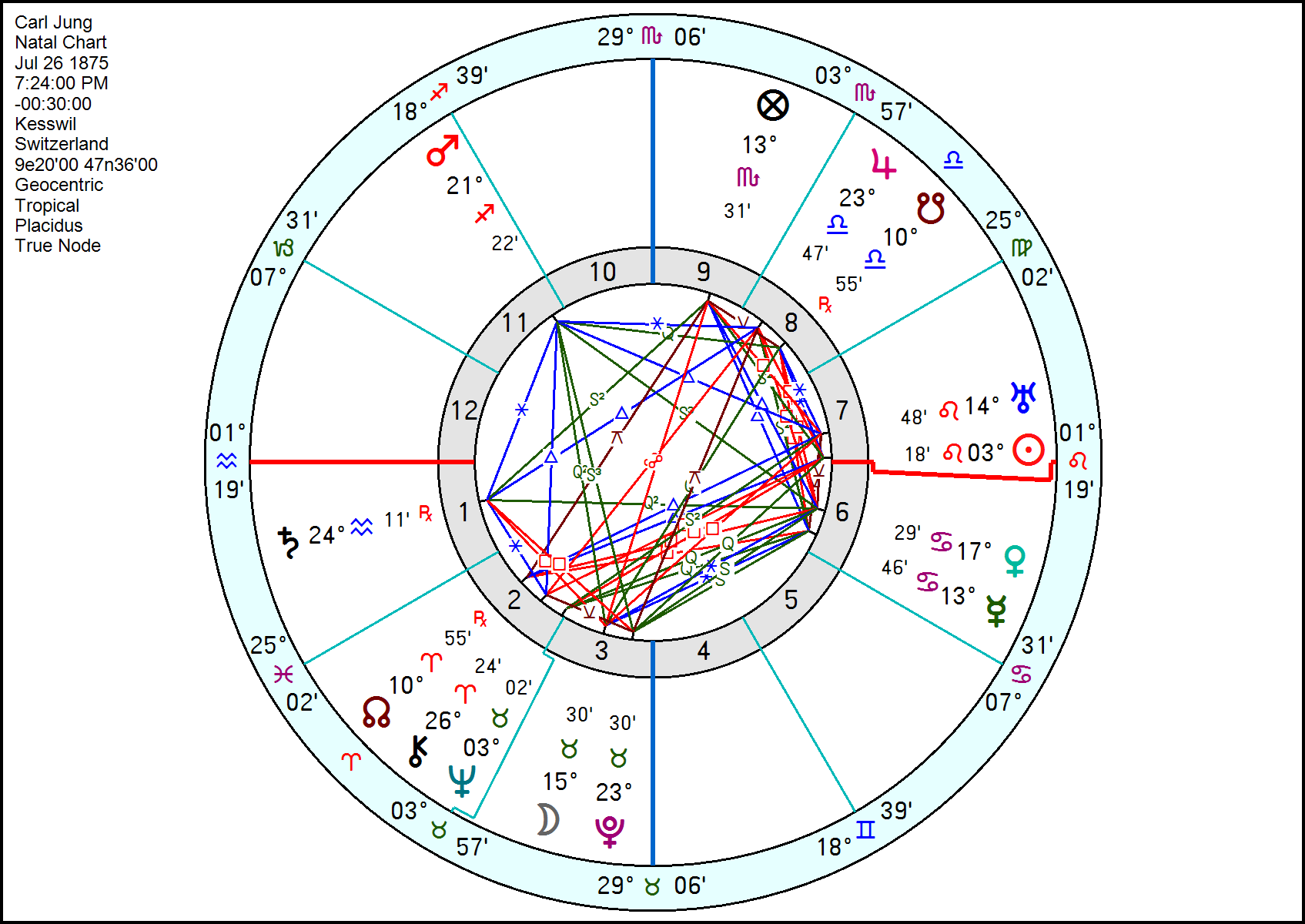
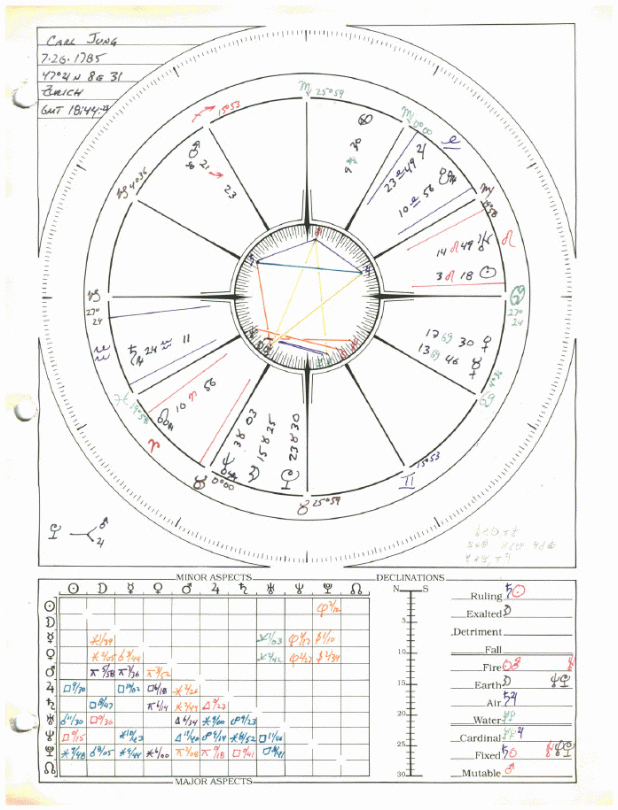
Jung's Sun Pluto quintile
Sun at Leo 4: to deliver the appropriate image demands a military posture on the part of Jung's life
Pluto at Taurus 24: spiritual power
Sun quintile Pluto: the will making a demand on the life of Jung to come up with a commanding image that will correctly interpret and give power over a situation
Inherent in the body is enough phylogenetic and ontogenetic experience to deliver up the appropriate image
The image is the idea pictorialized and is also the interpreting idea
This quintile was forged during Jung's confrontation with the unconscious; from then on he had access to unconscious contents, broke into the astral world
Jung's "Commentary on Kundalini Yoga" an example of this kind of knowledge
Quintile relates two psychic processes to create psychic function
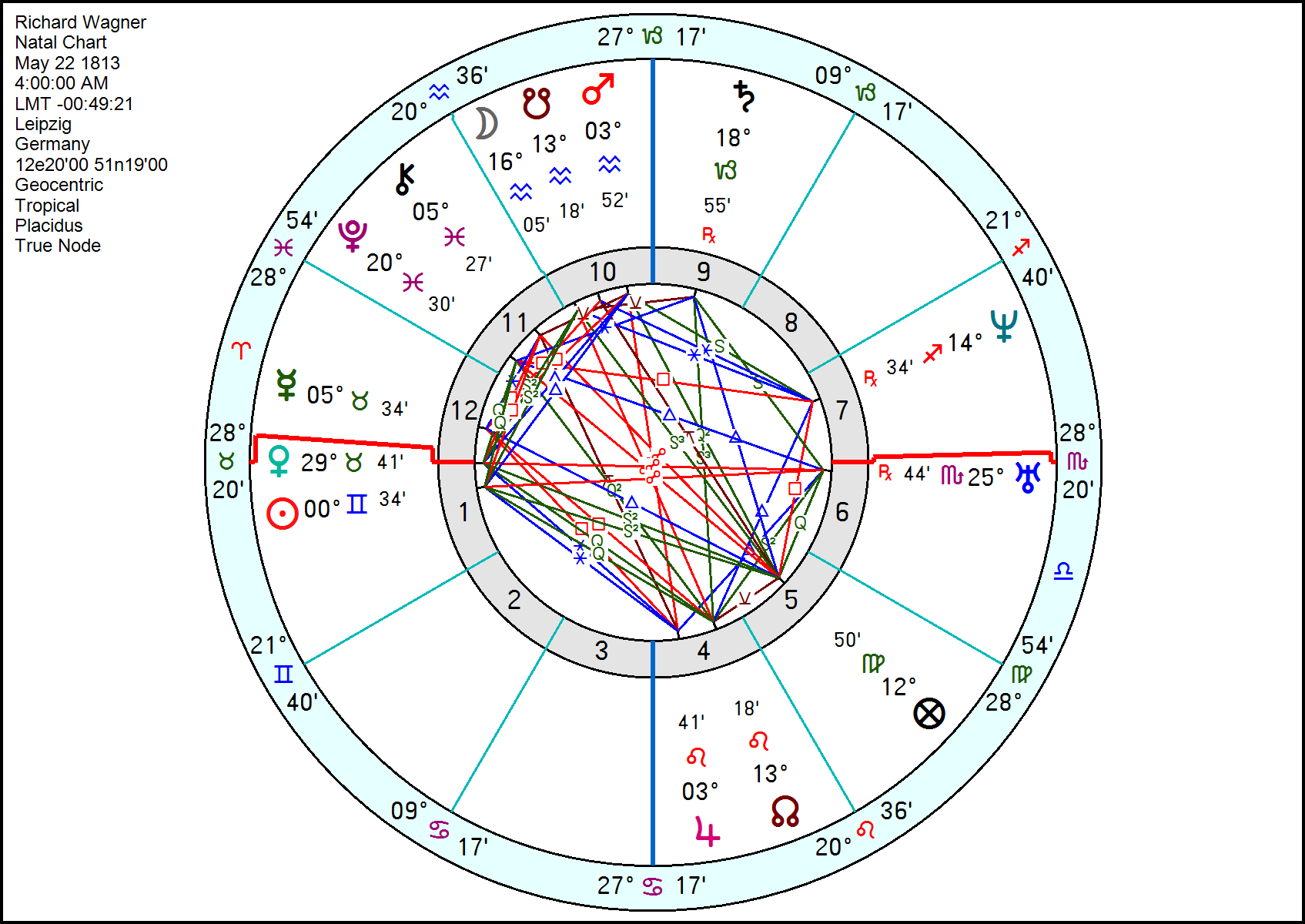
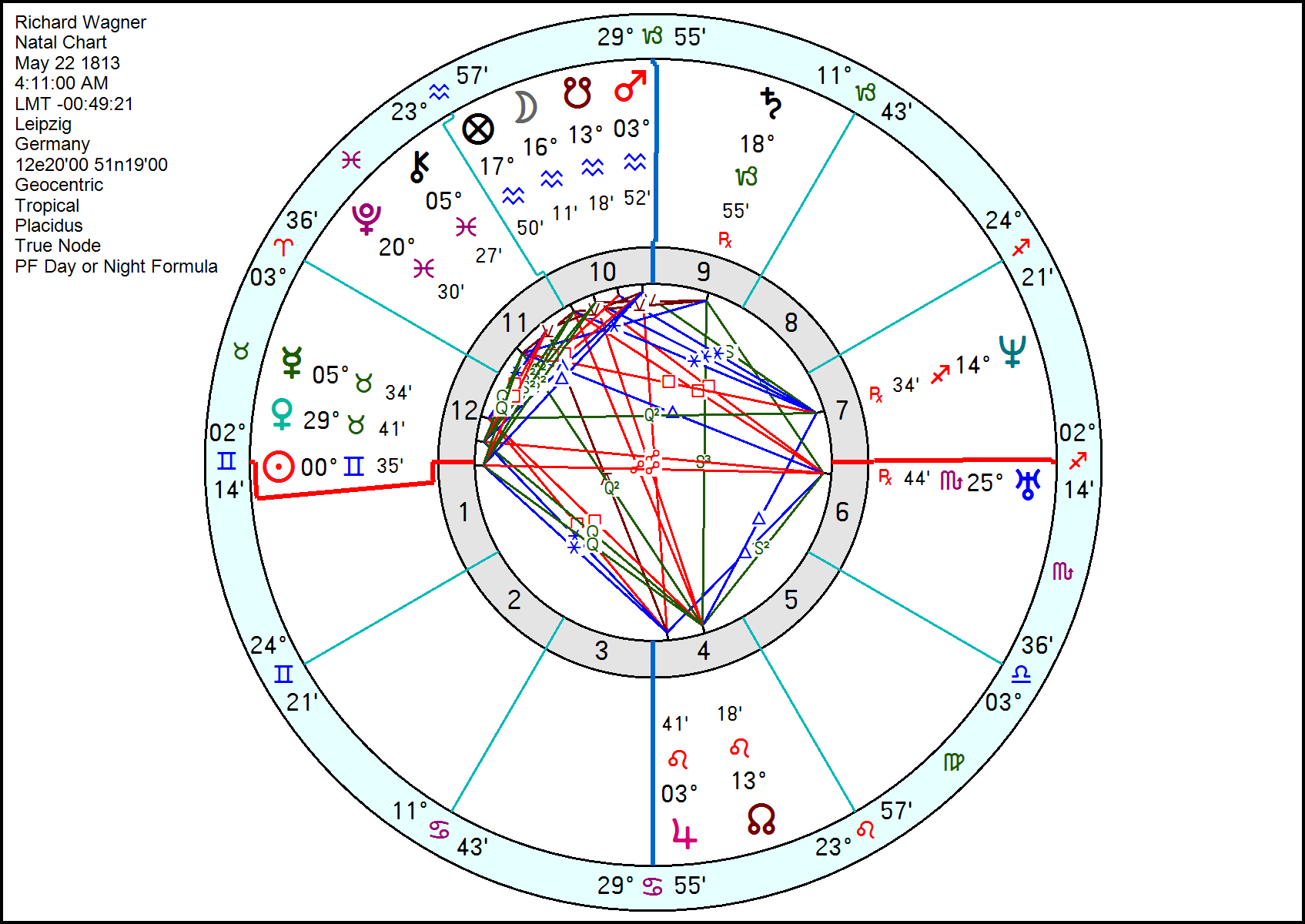
Wagner's Sun Pluto quintile
Sun at Gemini 1: perception of the contents of his own unconscious, life's content
Pluto at Pisces 21: wills strange combination of forms
Sun quintile Pluto: willing the strange combination of forms onto his own unconscious content
Artist attempts to evoke vasanas within you in an ordered sequence
Your unconscious material can be combined in different ways to produce different effects; most people don't do this
Pluto as will; no such thing as pure will, organized by the idea it's on
Pluto at Pisces 21: Chinese servant smiling means forms willed by Pluto have higher approval
Septile as truth psychically congealed, quintile as (mental) processes psychically congealed
Most quintile processes that a person operates with are unconscious to him
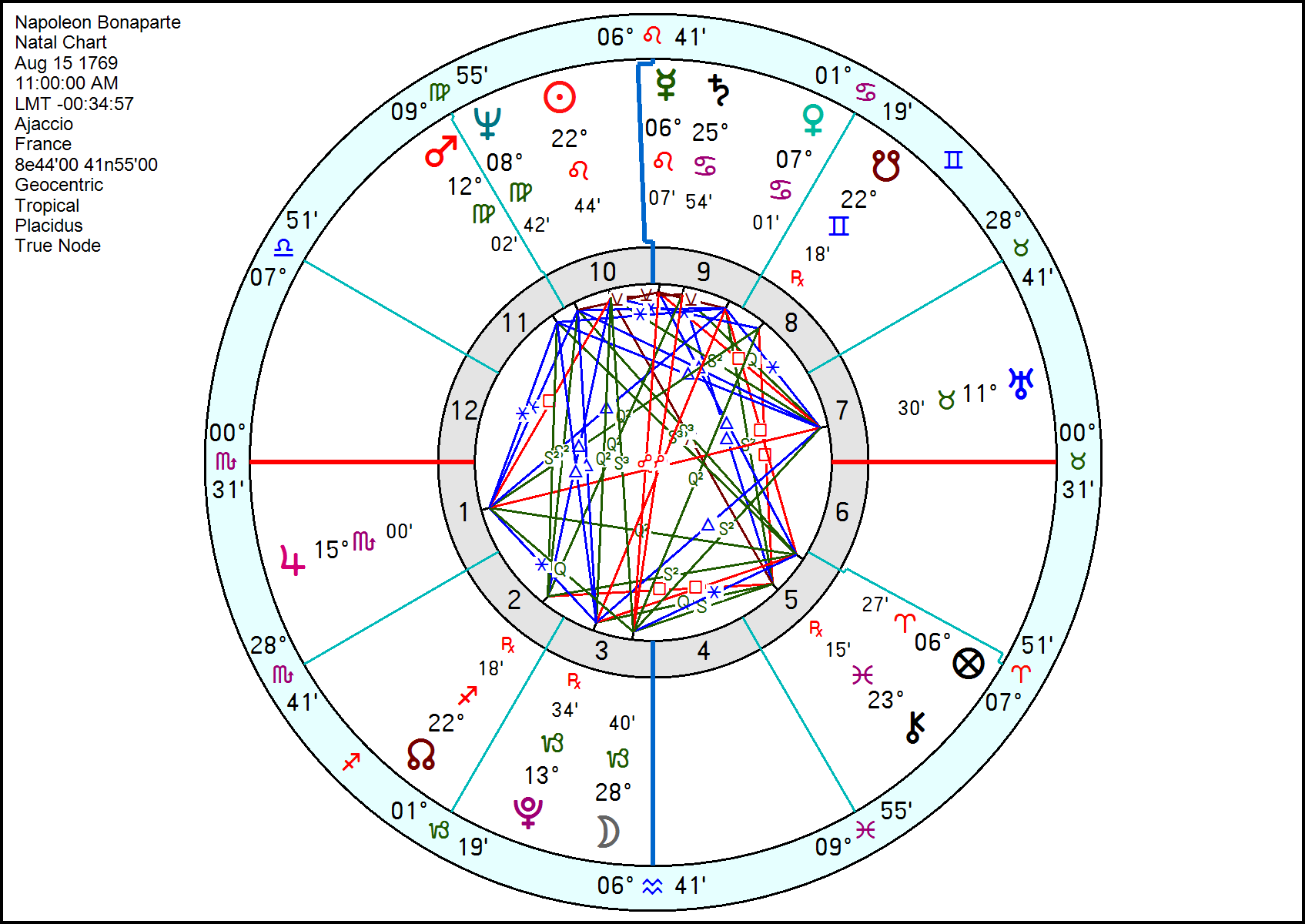
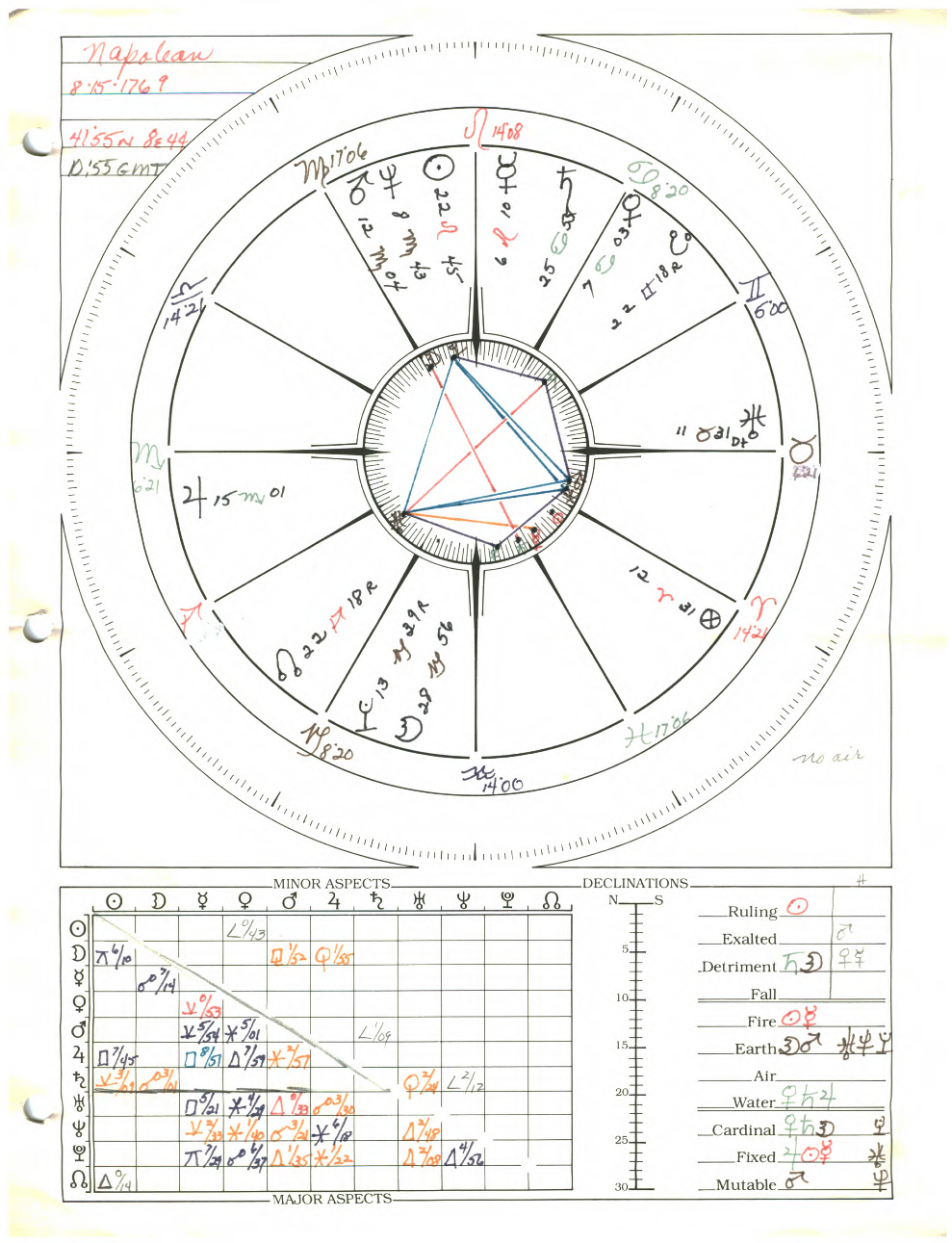
Napoleon's Sun Pluto bi-quintile
Sun at Leo 23: audacity; could only be an audacious individual like Napoleon who could destroy the old order and initiate the new
Pluto at Capricorn 14: that which is already written in the stars
Sun bi-quintile Pluto: "I am a man of destiny chosen to destroy the old order and bring in the new."
AD doesn't distinguish between quintile and bi-quintile yet
BOOKS / ARTICLES READ FROM OR REFERENCED:
Marc Edmund Jones, The Astrology of Concepts
Marc Edmund Jones, The Sabian Symbols in Astrology
C.G. Jung, "Psychological Commentary on Kundalini Yoga (from the Notes of Mary Foote)" in Spring 1975, 1976: An Annual of Archetypal Psychology and Jungian Thought, James Hillman (editor); also published as The Psychology of Kundalini Yoga
Wallace Stevens, "The Man with the Blue Guitar" [poem]
SABIAN SYMBOLS: Taurus 24, Gemini 1, Leo 4, Leo 23, Capricorn 14, Pisces 21
CHARTS appended to this transcript:
FIGURE 1984 0423a-1. Carl Jung Natal Chart (astro.com).
FIGURE 1984 0423a-2. Carl Jung Natal Chart (WG version).
FIGURE 1984 0423a-3. Richard Wagner Natal Chart (astro.com).
FIGURE 1984 0423a-4. Richard Wagner Natal Chart with 3 Gemini Ascendant (alternate version).
FIGURE 1984 0423a-5. Napoleon Natal Chart (astro.com).
FIGURE 1984 0423a-6. Napoleon Natal Chart (WG version).
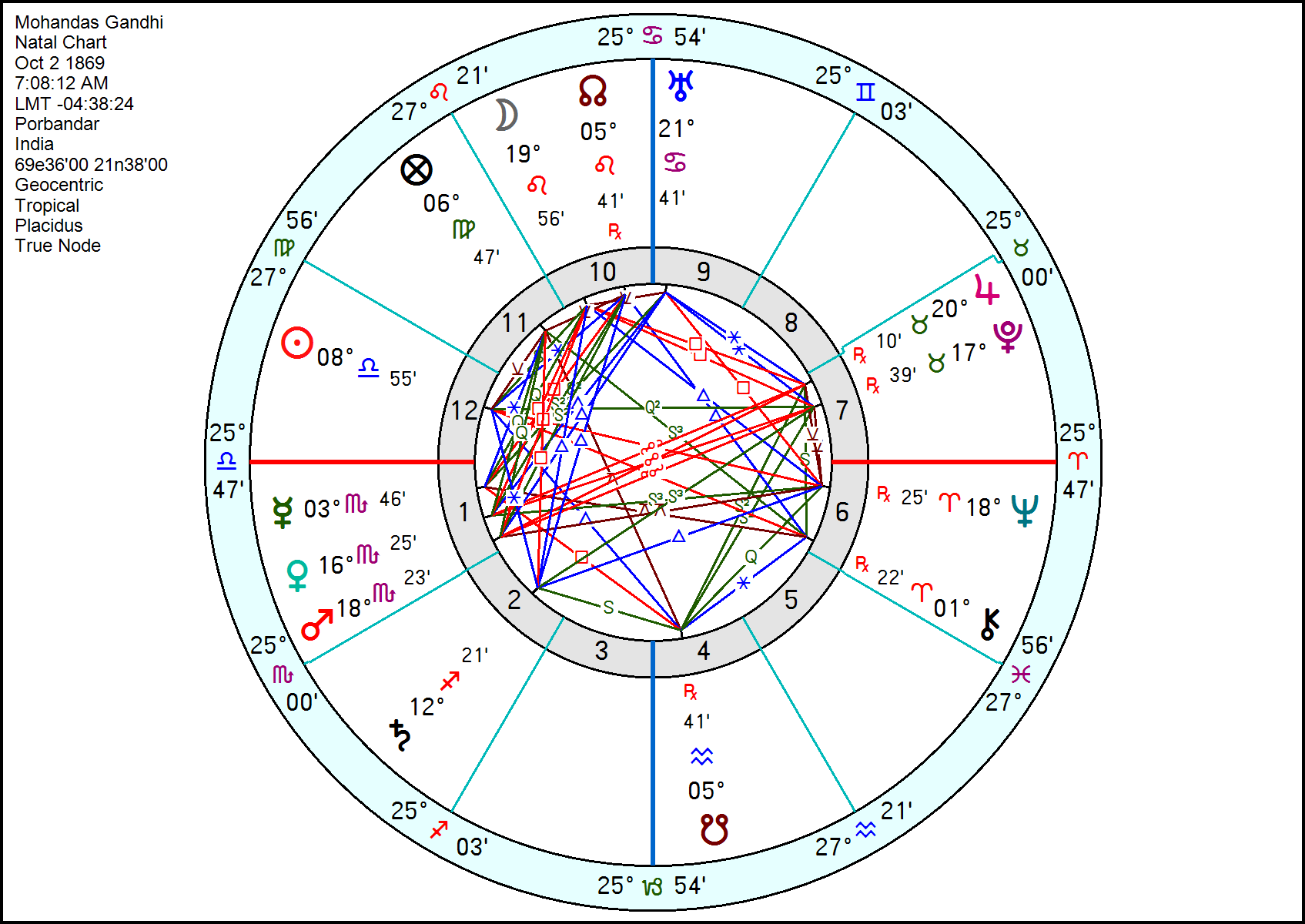
FIGURE 1984 0423a-7. Gandhi Natal Chart (astro.com).
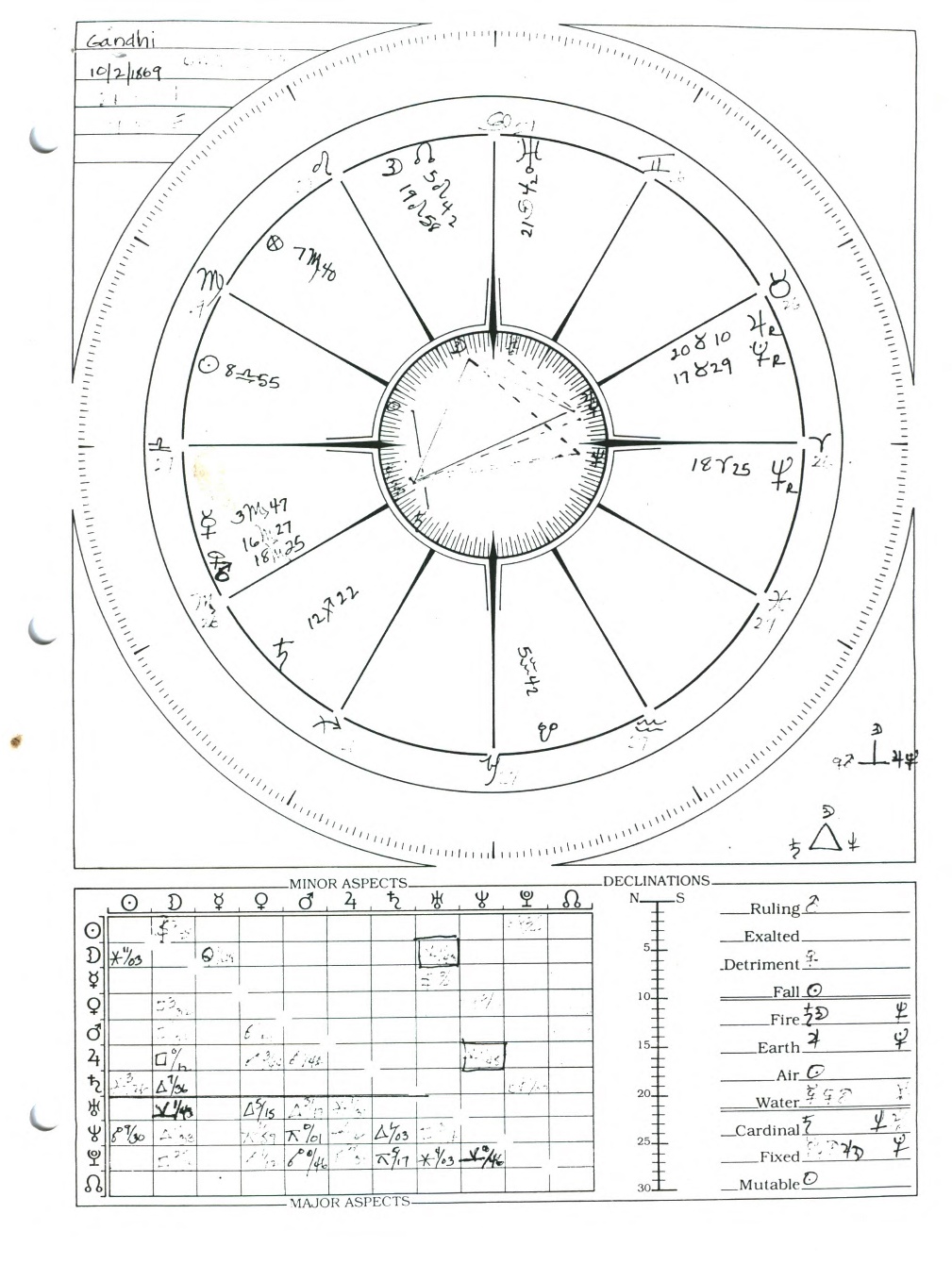
FIGURE 1984 0423a-8. Gandhi Natal Chart (WG version).
Other diagrams also referred to are not with this transcript version. [Transcriber note: [diagram] means the speaker is referencing a diagram as he or she is speaking. If someone is drawing or writing, with audible sounds of chalk on a blackboard, I indicate this by [drawing] or [writing].]
NOTES:
- This is 1984 04/23a, Astrology; Theory; Quintiles Class, and the first entry associated with this date. 1984 04/23b = Astrology; Theory; Quintiles Seminar, for which we have no audio, just JF notes.
TRANSCRIBED Verbatim by IT prior to 2018 (V11a). This is V12a (2023) and has: updated prefatory matter, footer, and audio file name; Book List completed and TOC expanded; new note within transcript; natal charts section completely redone. Archival verbatim transcript – V12a.
AUDIO FILES: 1984 0423a, 1984 0423b. [Note 1: "Tape" and "Side" refer to original audio cassette tapes that were later digitized into .MP3 Audio Files. Note 2: In 2024, REP Studio separates off Hidden Teaching class fragment from file b.]
1984 04/23a at Wisdom's Goldenrod
Astrology; Theory; Quintiles
[Audio File 1984 0423a Begins]
TS: --or something like that, says Avery. And uh-- So I made a kind of table of the planetary pairs like Sun Moon, Sun Mercury, Sun Venus, and then the quintile, the bi-quintile, the septile, bi-septile and tri-septile, to see if we could take one planetary pair and examine that planetary pair as it appears under these different aspects and see if we could find a couple blanks. Now, a few-- there are a few examples. We've settled on a particular one I think which we can start with and then perhaps go back to some of the others. Just so you can play with it I'll tell you a couple of them. If you take the Sun Moon, Krishnamurti has the bi-quintile, Gandhi has the septile, Wagner has the bi-septile, Napoleon has the tri-septile. So, you guys wanted to use-- Um-- [short pause while flipping through papers] Well-- Anyway, we started-- we started on that one and then we backed off because we sort of got an idea about the quintiles and we found out that both Wagner and Jung have a Sun Pluto quintile in their chart and both Napoleon and Gandhi have a Sun Pluto bi-quintile in their chart and that was the first thing that we attacked.
Well, I thought a couple of interesting theories came out. We've talked about the quintile as a kind of process or activity of individuation, of the tendency in the mind to-- or a flow of energy within the mind which tends to individualize that-- that manas, that mind function. And it seemed as though a couple of differences were beginning to emerge as over-- as to-- from which to examine these four individuals. That is, that the bi-quintile is a process of individuation as the mind seeing itself as the specification of reason-principles or recognizing itself as the instantiation of universal-- universals, um, as a kind of impersonal perspective on the individual. That seems to be in the bi-quintile. And we also have-- well-- and opposed to that we seem to think that the quintile is a process of individuation which is more like extracting the-- the meaning that is in the tropes, the l-- the forms of life in matter. And that through this kind of ac-- process of extracting the meaning or the essences from matter, that the individual mind is-- takes on a specific form. So we talked about it, in general I guess you could say that we've had these three levels: that which is the purely psychosomatic and then the psychic realm or the unembodied mind, or the unen-- undivided mind, and we've talked about the septiles as working primarily in that undivided mind as a more impersonal kind of consciousness. And that quintiles are in this funny place where they can look in either direction, that they can either draw on the meanings that are in-- embodied in matter or they can regard the reason-principles, the 360 degrees which are prior to them. And we seem to find some evidence that the bi-quintile seems to be the one which is more upward looking and the quintile is that which is building up out of life itself.
So it's almost like, to me it-- the way I'm getting it right now anyway, that a person has a quintile and through-- through their living in experience, in their psychology, there's like a gradual extraction of a-- and a creation of an individu-- of-- a process which forms their individuality. And they come to know something of the power or strength or intelligence of that individuality through this effort of extracting meaning from circumstances. Seems with the-- these individuals that have the bi-quintiles, that rather the individuality is formed in an almost a priori way and they try to bring that form of themselves or assert it into this flow or the flux of the psychosomatic circumstances and that gradually through their life they come to recognize something of the strength, power, wisdom, of that psychosomatic flux, and there's a certain modification of that original sense of self-- self-identity or self-individuality that they were given at the beginning of their life with this quintile. Avery, would you say other things about it?
AS: Well, I was thinking just add a little more on that middle-- that middle nature of those things, a couple of those (that actually--) the-- just the way you-- you spoke about it being organized as this purely psychosomatic or the embodied person, and then you have this pure thought, which is in some ways inexpressible, and between them you need this via media which we might call the manas or the imaginative activity which is based upon the-- the tropes, you know, the memory patterns and so on, but is not exactly that, say it uses that as material, it either-- either-- it could be looked at in two ways, it's developing out of that after a certain amount of time a certain organization of mental processes based on the body but, you know, somewhat one level above that, or it could be looked at maybe as the other way, as the medium for the expression of this immaterial thought which then is organizing or ordering those bodily tropes in a certain way. So, in any case, seem to be talking about this-- the quintiles in this realm of this medium, as mental processes, the manas, imagination, representing certain forms of that imagination being transformed, that itself transforming the-- the tropes, the experience, the bodily experience.
Well, there was-- oh, there was some speculation too about like-- I don't know, maybe the thing, the correlation with individuality that we mentioned. That in some ways these bodily processes, just taking the actual physical organism, is not individual in some ways. [TS assents] Might be hereditary or, what do you want to call it, racial memory and so on, whereas above that, in the higher realm, the realm of thought, let's say, is more universal in some way, the idea is universal, but here in the middle realm, that peculiar middle realm, we have the development of a peculiar individuality, peculiar mental processes or the most-- seems to be the more individual of three, the most individualized of the three in some way.
JA (simultaneously): What makes them individual? I mean--
AS: Well, that's a-- that's a good question. In some way it has more freedom or fluidity than the other two. I don't-- maybe this is wild speculation but in some way the tropes are-- are so tied to the bodily heredity and so on whereas the-- the Ideas themselves are more-- are more fixed in a certain way, you know, the higher realm, but that middle realm seems to be the most fluid and the most, you know, imaginal. Well I don't know, you know, I don't have any (clue), but subject to individualization.
S: Uh-hm.
KD: What were you saying was most individual, the quintile or--
AS: The quintile. [student assents] I was just trying-- trying-- trying to get some feel-- feeling for why we might say it's the most individual, fluid, and so on. Maybe it'll come out when we do some of these. I'm not sure.
JA: I-- I was just wondering what your use of-- basic definition of individuality was.
AS (simultaneously): Oh yeah, yeah, I guess-- yeah, since we've been having all these things with individuality, personality and so on, that maybe I (should/shouldn't) be more careful with that. Well, I guess just as I'm saying, even an evolutionary point of view you have-- you have this animal activity which is completely instinctual, it's based on the body and the bodily heredity, racial heredity and so on. The chicken hawk as soon as he's born he goes and he-- he knows exactly where to go in terms of, you know, how to-- you know, he could see-- or, you know, he sees the shadow of the hawk above and he knows [student assents, faint] (about) (a/it) completely instinctual base. And I guess I was looking at these quintiles as a process of building up-- I don't know, maybe building up a vehicle of thought or a thought-vehicle, building-- which is not con-- which is based in the psychosomatic but extracted from it, abstracted from it, no longer in the medium of the four elements, but like the quintessential thing built up of mental processes, these quintessential processes which are not tied so much to the elemental, to the-- to the tropes but have more of a fluidity and are much more based on that individual's own thinking activity rather than on the inherited bodily activity so much. So, I mean I don't know if that's--
S (faint): Yeah.
AS: That's kind of-- that's, (I think), somewhat--
TS (simultaneously): I think also that, not that it's any sounder reasoning, but that the-- the thing that you pointed out a while ago about the use of the pentagram with the divided line. [AS simultaneously: Oh, yeah.] There is the-- a kind of a translation of [student assents] the whole of the divided line into the lower half of it, it's-- you know, the symmetry of the divided line is built around the pentagon and the five and I thought about it as being the way in which the-- it seems to translate or it seems to be the-- the psychic realm seems to be that way in which the individual is a-- is the cross-over between the-- the un-- reason-principles and the products of Nature there, and I thought that that was also a reason why, you know, it's peculiarly-- It's like the-- [drawing] it's like this point here in an hour-glass [diagram] or something like that, it's like the individual forming a point or the intersection as the-- these reason-principles are translated into tropes or these tropes, the meaning is extracted out of them and seen back as essence. And I thought that that idea of the divided line using this or employing the-- the five-pointed [student assents, faint] star as part of that.
S: Tim, isn't it rather like what Joscelyn is talking about too, is that one triad, man between heaven and earth, analogous to that?
AS: Yeah, I could-- I mean I could [TS simultaneously: I--] see some-- some analogy there. [short pause] Some strange way. (AS chuckles)
TS: It's not-- yeah. I don't feel sound enough in what I follow from what he was saying, I don't know.
S: As a form of thought, not as a [TS assents] one-to-one correlation.
TS: Ok well, sure, in that case. (bit of laughter) This is quintile night, we'll work on-- we'll build off any castles. (bit of laughter) Well maybe we could--
AS (simultaneously): Yeah, we had a couple other-- there were a couple other catch-phrases too like the stuff in-- Like one catch-phrase from Jung, that the-- the transformer is itself what's being transformed, [student assents] that this is the realm where the Ideas can begin individualizing a person but at the same time these processes are transforming the sensible experience, at least, you know, whatever-- whatever-- whatever of this mental realm or mental processes gets transformed is in turn-- its turn a transformer for the experience. And then that other catch-phrase about the Ideas are individualizing the-- they're individualizing the processes (in our understanding). Seems to depend on which way we're--
TS: Yeah, which way you go.
S (simultaneously, faint, possibly part of background): Thank you.
JC: How did you come up with the quintile, bi-quintile differentiation? I mean I-- [AS simultaneously: Oh.] I see the two directions but [TS: Ok well--] why should [couple/three words inaudible]
AS (simultaneously): That came from the examples, Jeff.
TS: Yeah, first of all--
JC (simultaneously): From the examples?
TS: Yeah.
AS: It came out a lot in these two-- these two examples where we had the-- the quintiles and the bi-- the two bi-quintiles in Napoleon and Gandhi and Jung and Wagner quintiles.
TS: Can't wait to [couple/three words inaudible]
AS (simultaneously): There seemed to be something that we saw in them.
TS: Yeah. The only other thing that was-- I mean again, perhaps isn't particularly useful but we would-- Avery had suggested at one point that the quintile might be sankalpa and the bi-quintile might be vikalpa, kind of an analytic process, where the-- the quintile would be a synthetic process. And I was thinking, you know, that in one way, if you say that the quintile is-- is this thing which is drawing the essence out of the tropes, ok, that a bi-quintile is sort of like if you take one degree and see two different quintiles coming out of that as a kind of a polarization of the meaning of this degree that-- that is the intermediate quintile to the two points which form a bi-quintile, that it seemed as though there was just like an outpouring of the meaning that's in this reason-principle or the degree that's between the two degrees that are-- form the bi-quintile. And, I don't know, that picture helped me. (some laughter) But then again I like merciful things. You know--
S: Uh-hm. (laughter)
S (amidst laughter): Do it again.
TS: But I thought-- I think most of it came out of these examples, I mean I think it-- don't you think it's a pretty striking set of-- of individuals to-- to see these two guys as having a bi-quintile?
JC: Well yeah, I'm overwhelmed but--
TS: Yeah. (laughter)
S (amidst laughter): That's what you get.
AS: Really gets you, huh Jeff?
TS: Yeah.
AS: You get it? Just look, there it is.
TS: Right.
AS: Well Tim, [S simultaneously: I (couple words inaudible)] you know I didn't see before that Napoleon and Gandhi just happened to also both have a Pluto Venus oppositions.
S: Shh. (some laughter)
AS: Because we've used the Pluto example, I just-- it's exactly on (his--) [TS simultaneously: Well we got-- yeah.] that's too bad.
VM: That's too bad. (VM laughing)
AS: I mean that didn't come in for discussion at all, probably shouldn't.
[students assent]
S (very faint): (Manifestation.)
AS: Biases and-- sorry Jeff.
JC: Yeah that's alright. I-- I didn't know-- you know, sometimes it helps to understand the aspects by looking at the natural twelve beginning with the ascendant. And bi-- the bi-quintile falls in the Fifth House, at least going in this direction, it doesn't in the other. And the--
TS: Jean, you have a friend.
JC (simultaneously): No, no, no. (TS laughs a bit) Yeah, she has a friend but-- and the-- and the quintile falls in the Third and you're [TS assents] saying the Fifth House is normally a house of creativity where something inner-- inner being is being translated externally. And that seems what you were saying, that an o-- a reason-principle gets individualized in the imagination or through the thought-processes of this person and-- and the third one--
S: Yeah, that seem--
AS (simultaneously): That's a-- in the Third you could say maybe something's [TS simultaneously: Quintiles are there.] getting defined, Tim was [student assents] trying to say something's getting defined out of the trope.
JC (simultaneously): Out of the-- yeah.
AS: Oh good, you're getting it.
JC: Well-- (bit of laughter)
[students assent, faint]
AS: Doesn't matter how he got the-- got the results. (bit of laughter)
JC: Yeah.
JA: I like them.
TS: Yeah I-- sort of sounds good to you? (some laughter)
S: Get me a cup of coffee. (more laughter)
AS (amidst laughter): Well tonight maybe you should go-- why don't you go [TS simultaneously: Yeah.] through those four and--
TS: Yeah. I thought if we could try these four then it turns out that if-- if we can see something and refresh our memory of these charts that-- well, we'll see where we go from there but one possibility is that then within Wagner and Jung, Wagner has-- where did they go--
S: Neptune--
TS: The-- [couple inaudible student words simultaneous with TS] Jung has a Venus Neptune quintile, Wagner has a Venus Neptune bi-quintile, so there's a further differentiation in their chart there. Ok, let's do these gentlemen. Who wants to read Jung's Sun degree, at least to start?
LS: Can you read off what those degrees and minutes are, I can't see them.
S (simultaneously, faint): I think (there's just) Sun and Pluto (there).
LD: In Jung?
S: Right.
TS: Jung's Sun-- degrees and minutes?
LS: Yeah.
S: Where is Jung?
JC (simultaneously): Are you doing Sun [S simultaneously: Yeah.] Pluto?
S: Yeah.
JC: You just have one there, I mean-- oh Jung, 3 [degrees] 18 [minutes] for the Sun, it's 3 [degrees] 18 [minutes] Leo, and his Pluto is at 23 [degrees] 30 [minutes] Taurus.
AB: What are the degrees on?
[short pause]
TS: So Jung's Sun is--
AB: Lovely mounted moose head.
TS: Yeah, well--
[short pause, flipping of pages]
AS: An elderly man of poised and military bearing stands before a lovely mounted (moose head). (bit of laughter)
S: Thought you were reading it.
Marc Edmund Jones [The Astrology of Concepts, Leo 4, S reading]: "An elderly man in evening clothes, of poised and military bearing, stands alone before a lovely mounted moose head."
S (faint): Ok.
[11¼ second pause]
AS: [couple/three words inaudible]
S: [couple/three words inaudible]
AS: 24 Taurus.
S: And 24?
[short pause]
S: (Where/What) do you want(--/?)
Marc Edmund Jones [The Astrology of Concepts, Taurus 24, S reading]: "A mounted Indian brave rides proudly with human scalps as trophies at his belt."
[short pause, noises, moving around]
AS (faint): (Tim), if you want to start the--
[35¾ second pause]
S (very faint): Well, what should we do?
AS: Yeah.
TS: Alright well, how are you going to interpret the Sun? We talked about that Sun [one/two inaudible student words simultaneous with TS] as-- What? Um-- Well, he says a--
Marc Edmund Jones [The Sabian Symbols in Astrology, Leo 4, TS reading]: "[This is] a symbol of self-assertion at a point of effective impact on the world…"
TS: A sort of an extreme of a kind of, would you say masculine consciousness, that sort of assertive sense of self that's-- sense of self-purpose, um-- [short pause] What if this degree means so much?
[15 second pause]
AS: Yeah and--
S (faint): Uh-hm.
TS: When he says here--
Marc Edmund Jones [The Sabian Symbols in Astrology, Leo 4, TS reading]: "His achievements become evident in the trophies by which he makes his consistent contribution of the real essence of himself to his fellows."
TS: Now if you take that-- that line together with the Taurus degree--
Marc Edmund Jones [The Sabian Symbols in Astrology, Taurus 24, TS reading]: "[This is] a symbol of pride in personal prowess… [There is here] an appreciation of the potentials in [TS reads: of] nature [herself], and of the senses as they can be brought to [TS reads: into] the full service of an individual's aspiration and ambition."
TS: Keyword is COMMAND for Pluto and MORALE for the Sun. Um--
[32¾ second pause]
AS: Thought that one too from the--
Marc Edmund Jones [The Sabian Symbols in Astrology, Taurus 24, TS reading]: "The conquest of an enemy becomes not so much a momentary supremacy over him as an acquisition and subsequent use of his particular genius."
AS: I mean that was one important thing I think we mentioned about him that, in this he was able to extract, you know, as-- extract and assimilate something of that power. That Pluto obviously is a degree of power but it seems here in the-- in the sense of actually, you know, extracting from the s-- from any situation, yeah. And he's a-- and that's the way his-- his own individuality, the Sun, this [one/two words inaudible] and that that's the way he grows is by assimilating this power of the higher will, continually tries to assimilate it in a-- in a very masculine type way and in an aggressive way. And also maybe there's something making it a-- a formal part of his psyche, there's something there-- moose head there is a kind of formalism or objectifying it. [short pause] Let me give-- let me just give some of those example-- you know, he really was able to-- to-- to assimilate the-- the real pow-- you know, the power in any situation even when he didn't take comma-- to take command of the situation, even when he wasn't completely familiar with it in any way. And that-- that it--
TS (simultaneously): Yes, he certainly had that quality.
AS: Like that example we on-- we gave a couple of times of the-- the-- where was he?
AB: In Africa?
AS: In Africa.
AB: Yeah [couple/three words inaudible] a tribe [one/two words inaudible]
AS (simultaneously): Yeah, and he was able to size up the situation, see where the power lay and how to wield it. He re-- he really saw how to wield the power in any situation and to make himself a center for that power, to make his own--
S (simultaneously): Uh-hm.
S: I agree.
LS (simultaneously): And I think his consulting room must have been a terrifying place.
AS: Yeah, it's interesting-- we men-- yeah, we mentioned something about the Se-- that Seventh House Sun, it got-- it really got played out in terms of his relationships with his-- he had these patients.
LS (simultaneously): Well just imagine, you go in there and you put your scalp in his hand.
AS: Yeah.
LS: And he's going to epitomize the human qualities that are there in your neurosis and cure you [AS assents] that way by-- by becoming the best that he could be with the scalp he's taken from you.
AS(?): Yeah.
[students assent, very faint]
[short pause]
AS: It seems that for his own, you know, in terms of his own growth, it seems that's what he does all the time, he tries to-- like the brain sucker and he tries to-- (AS laughs, some laughter, student words) I mean that was a good image for-- [student assents] He assimilates that power, that was the scalp idea I think too. It wasn't just a question of the-- you know, the scalp, that you actually got his manu, you know, the guy's-- the guy's power was [S simultaneously: Oh yes (one/two words inaudible)] now your-- the guy's power was now yours.
S: Uh-hm.
S: Hm.
AS (faint): You would say. Yeah.
S: Well--
AS: And that's it with our--
TS: So far (sometimes--)
AB: Well just if you look at the Pluto as having to do with the World-Idea, the way it's being willed into you, into your sense of "I" or your life purpose, that was his theory, you know, that by consciously assimilating what the World-Idea was giving you either through-- from without or from the unconscious, there was an empowerment of the ego, you know, an expansion of the field of consciousness that the ego operated with and a strengthening of it. And that seems to be the way this Pluto is empowering the Sun and vital-- kind of vitalizing it.
TS: Now do the Sun degree.
AB: Now do the Sun degree? Well that would be the-- I think what you said about the masculine kind of assertive consciousness, he related to that empowerment in a very individual way, you know, an Apollonic way, like it was "me" that had this power and--
TS: There's a certain dominance.
AB: Right, a certain dominance and a sense of him own-- it giving him a sense of himself and maybe you would say that was a quintile, giving him a sense of himself. But you could see maybe with a different planet there or a different degree he would experience that power coming into himself in a different way, he wouldn't possess it in that masculine assertion in the way he did.
TS: Well let's see here, we could say that-- that with the Sun there's this compel-- compulsion or-- say in the Sun there is a tendency to assert himself and make himself the center of any situation if he possibly could [AB assents] and sort of come to the forefront in some way. And the Pluto degree is the capacity to recognize the power in the outer and to take that into himself and there's a demand to acquire that power for himself, so whether he, you know, goes into a theoretical analysis of Catholic ritual and pulls the-- the symbols out of that and builds them into his ideas of the archetypes or he's working relationships and he pulls the energy out of the people and-- and into himself in some way, there's-- those two things seem to be there within him, he's like always pushing himself to the forefront or asserting himself. [AB assents] Now there's no doubt where, you know, that he's Jung and he's the center of his world, you know. Then that seems to be the Sun degree. And it seems in the Pluto degree is this dem-- demand to really grasp the essence or the-- the energy that's available to him through whatever is given to him in day-to-day circumstance. It's the Third House Pluto I think, isn't it? [student assents, very faint] And, it seems as though that he formulates the whole idea of individuation as the kind of redeeming meaning for living his life the way he did, that this will produce an individuality, [AB assents] you know. And it seems like that would be the quintile to me or a sense of-- on one level, you know.
AB (simultaneously): Well, yeah. You know, also like Freud would say that you have to make the unconscious conscious and it would seem that Jung went further in that he was dealing with the collective unconscious and maybe you could see that in that Pluto. There was something primordial about what had to be taken into and made over into the individual, you know, that kind of Plutonian that has that cosmic flavor to it.
S (simultaneously): (Very good.) Yeah.
AS: Except-- Yeah, but that's a lot in the Neptune Uranus thing there too, Alan.
S: Right.
AS: I think it's Neptune.
[10¾ second pause]
AB: Oh he has a sextile-- bi-septile there.
LS: See, I wanted to slant it just a little differently though. I wanted to see that that Sun Pluto process is really impersonal, it's really happening. The guy comes into his consulting room and presents him something and he steals it. [AS: Yeah.] Willy-nilly, he steals it. And he steals it in such a way that it's no longer an illness in that perspective but it's something which has a center. And that Jung catches himself doing this and the theories and the deliberateness of it comes later. But that the quintile process is that he finds himself doing this and he grows to love it.
AB: And he develops him-- a sense of himself through that.
LS (simultaneously): A sense of himself as doing this--"Look what I can do. [S simultaneously: Yeah (one word inaudible)] I don't even know what this is, look what I can do."
AB: He was always putting himsel-- himself in these situations of great un-- unconsciousness, ei-- either through the people he was working with or in primitive cultures and societies.
LS (simultaneously): Well I would say it puts him in that situations.
AB (simultaneously): Right, right, but he felt himself very strongly in the-- those [LS assents] situations.
LS: Yeah, later he grew to love it and to-- and to understand it and project it, but even-- even very young he (did that).
AD: What could he do though? What is it that he could do?
[short pause]
LS: Well he could steal your manu and give it back to you whole.
[9½ second pause]
AB: Couldn't he al-- he could see the individual meaning of the situation or the symbol, that something universal was being presented but he would see its individual application?
S: Yeah.
IF: Yeah, seems like it's a kleptomania of the individuation process because it's--
LS: Kleptomania.
S (very faint): Yeah.
IF: Kleptomania of individuation process because it can be described through the functioning of a thought(,) of a mind, because he (feeds/gives) you back of his description how it's done. It's not wild [one/two words inaudible] Through it himself he can describe it how it's done, but I-- it seems in a-- on a [one word inaudible] chart, a quintile it just done all of that description of form. I do not know if that will, (either through) what it is than objective some universal, objective but only because it's described, you know, but he can describe it to you.
LS: No, not so much just describe it. But that-- You say-- let's say I dance, ok, and I'm really crazy, I'm out of my mind but I dance. And my dancing isn't coherent or-- or doesn't make sense to me but there's a real talent in it. And somehow in his presence, in his consulting room, the dancing develops into patterns that begin to make sense and begin to constellate meaning so that the psychological flow which was all stuck before begins to unwind, so that it's his Sun shining in the middle of what was previously my chaos because of his ability to take it into himself, to steal it as it were.
[short pause]
IF: Yes, but that--
LS: And that afterwards he identifies with this process, and afterwards he sees, "Oh, look what I can do," and [AD simultaneously: Yeah.] afterwards he makes an ego out of it (to be--)
AD (simultaneously): Yeah I follow what you're saying. Could we say more simply that it was capable of drawing up the correct image which had the power in it [LS: Yeah.] that Pluto wanted to work off of?
LS: Yeah.
AD: You want to go over that again? He was capable of formulating the precise image which contained the power that Pluto would extract in order to it-- in order for it to relate to others. Think of the power that you wield when you come up with the correct image of the situation that is-- you know, that is basically unnamed until you can come up with that image.
[noise or student assents]
[short pause]
IF: Anthony, but are you saying then that it still is working on only one level, Pluto, while it is that image is appliable to that process of individuation.
AD: I'm not talking about the process of individuation. I'm talking about what the quintile, Sun Pluto quintile is. And in the example that I just gave as an example of the quintile itself, the [S simultaneously: It's the power.] example I just gave as an example of the quintile, that the ability to be able to draw and demand from life the image which is appropriate to explain something has a power. And this is related to his Pluto, the Pluto works off of that power, the Pluto is demanding from the Sun, from the life principle, that it come up with the correct image, an image which is the interpreting idea, and then he works off of that. [short pause] I think of a quintile basically like the banks of a river. [13¼ second pause] They'll be-- the banks will remain the same but the images that'll flow will alter or change according to whatever the situation calls for, and in this sense I think of the quintile, as that kind of a process. [short pause] But, let's work with the idea first and then we'll worry about coming up with a clearer conception of the quintile. Isn't it true that very often in a discussion, people are looking for that image which will interpret what they seek to understand? [short pause] And that if you were capable of coming up with an image which explains what you seek to understand, alright, and the-- and the Pluto is always making a de-- such a demand upon the Sun. It's always willing that activity.
S (faint): That's true.
AS: Yeah. The fact that this is a quintile seems to be what allows that harmonious flow of energy between the Pluto and the Sun. In fact more than harmonious, it seems to put-- could you say that it tends to put that interaction at a mental level, at the level of mental processes. It's abstracted one degree from the level of the bodily organism. I mean is that a-- is that a valid-- a valid description?
AD (simultaneously): Well try again, try again Avery, uh--
AS: Yeah. I'm trying to understand, you know, just so we can get some-- some data on this quintile as it were, when you say that the Pluto makes a demand on the Sun to come up with the right images so that the Pluto can then work off that and extract this power, you're saying that that interrelation between the Pluto and the Sun is this quintile, it canal-- it somewhat canalizes the flow of that-- those mental processes between the Sun and the Pluto. And it--
AD (simultaneously): Yes, canalizes the images, yeah.
AS: Yeah, it canalizes it. And I'm saying, it seems peculiarly this is at this im-- imaginal level. The quintile works at that imaginal or mental-- just that idea of a mental level, that it's above-- one-- a level above the level of just the pure bodily [AD simultaneously: Uh-hm.] processes or tropes. It doesn't operate in the four elements but at this-- it-- it really is interesting that it's-- it's in the level of image-- imagination. Or interesting-- But it's-- it's typical of the quin-- well, I should-- don't want to say that.
TS: Significant.
AS: The quintileness-- the quintileness of this particular relation is exactly this flowing process between the two functions. Just what you said, you know, that's-- if we focus on just-- on the quintileness part of it, it would be this transformative nature or this flowing process between the two functions which is at a mental level.
S: Yeah.
AS: You know, that (uh--) there's-- you know, when you-- it seems to be-- there's no-- there's no-- there's a fluid interaction there, there's no hitch or blockage there. The Sun is always can-- for Jung, always seems to be able to come up with a proper image, which the Pluto can then work off of.
KD: How does that relate to the definition given at the beginning that this is-- the quintile relates two levels, [AS simultaneously: Yeah. Well I--] this psychosomatic, the substance, and the realm of the Idea.
AS (simultaneously): I think it would work well here. You say the Sun is-- if you just think of the Sun just purely as a life func-- think of all the planets as just, you know, psychosomatic functions, the life function so-- It's ba-- it's bodily-based, I mean that's where all the images are stored, say. But, in this quintile there's a possibility that-- that those images can be transformed, or the quintessence of that image, that bodily image, can be transformed or extracted so it can now be a vehicle for this higher will or for some kind of power or some meaning. [KD simultaneously: So you're saying the Sun--] It can be expre-- it can be a vehicle now for this meaning to come through it. [KD simultaneously: Why--] It's rea-- really the images are bodily-based.
KD: So you're saying the Sun and the Pluto represent these images locked up in the body?
AS: No, the-- just this-- [KD simultaneously: What--] see, in this-- it's-- I don't know, I just-- it seemed to me that we're dealing with the peculiar case of the trans-Saturnian, it's not as clear what-- that the Pluto also plays the role of the bodily function. But the Sun clearly does. I mean I think the Chaldean planets clearly do. They're-- they are always working with the tropes in the body. And so where do these images come from? Well they-- there could-- they're s-- they s-- they could be stored in the body but the-- here they're being used for the Pluto to play off of and build up this tremendous power that this individual has.
S (faint): Hm.
KD: So-- so what are the--
AS: And I think that's the quintile.
KD (simultaneously): So what are the ideas that are being tied to the-- to the bodily substance, are those the two degree symbols that-- that those functions are on?
AS: No well, I just [KD simultaneously: Or the--] (thought--) we were saying the Pluto is making a demand of that Sun to bring up these proper images. Well those images must be bodily-based, I mean if we use a, you know, a real concrete examples, they're based on bodily functioning, they're based on a sensible experience or whatever it could be. But here they're being transformed for the use of that higher will. [student assents] 'Cause in here there's a possibility that they're-- you know, that they're-- they become these processes on a mental level rather than on a bodily level, and I think that's part of the quintileness of the thing. [student assents] That's-- I think it's unfortunate the Pluto is there too which we're taking as the higher will and not necessarily [couple words inaudible]
TS (simultaneously): Well but it's the will that's-- it's also the will that permeates the ego it seems to me, [AS or another student assents] and it would be a building up of power within the individual psyche, [student assents] that through the cul-- through being capable of at once drawing on the-- creating the right image and then sort of forging an interpretation on these indeterminate processes which are the unconscious or biological undercurrents of the person's experience, he at once interp-- gives it meaning and gives power to that meaning by naming them, by determining them according to his own sight.
S: Yeah.
S (faint): Uh-hm.
AS: So that's [TS simultaneously: Yeah.] what I want to say, is those meanings now become a quintessential body as it-- they become a vehicle [TS assents] of-- of some kind of understanding. They're not completely bodily tropes anymore, they're-- they've been [TS simultaneously: Yeah, it's his doctrine, yeah.] quintessentialized, (you know)?
KD (simultaneously): Where-- what meaning (is) he--
AD: What--
KD: What-- I don't get it at all.
AD: It's alright. What the will is demanding of Jung's life is that that comes up with an image, a command image, that will give his will not only a command over the situation but the power necessary to deal with the situation. Go back and read the Pluto very carefully and it's on a degree where it's not only a command or let's say, what was it, the trophies?
KD (simultaneously): The scalps, yeah.
AS: Yeah.
KD: The Indian brave and the scalps, yeah.
AD (simultaneously): Indian brave. And the theory behind the Indian brave's scalp-taking was that he not only wanted the-- the victory over the life of the individual but also the spiritual power that belonged to that individual. [AS assents] Alright?
KD: Ok.
AD: Now, you'll get the feeling therefore that the will is demanding not only that life, in this case Jung's life, can command the situation by delivering the appropriate image, but also that em-- embodied in that image is the power by which his will can be exercised effectively. And that's a continuous running process in Jung's life. He will always make demands when-- whatever the situation he may find himself, whether in the therapeutic situation or in any situation, you know, like in Africa or India, he will always make those demands upon himself that he comes up with the appropriate image, without which he cannot command the situation or exercise power over it.
[students assent]
KD: Is that image that he comes up with, is that what you're calling meaning, is that the-- the understanding of a life process that--
AD (simultaneously): It doesn't matter, it doesn't matter, Kathy, it doesn't matter. The point is that inherent in the body there is enough phylogenetic and ontogenetic experience that it can deliver up an image which is appropriate.
[student assents, faint]
KD: You see, I'm trying to understand two levels Jeff, I don't think I-- I see it.
AS (simultaneously): Well--
KD: Can you give like a concrete example of coming up with an image that--
TS: I think I could suggest one Kathleen.
AD: Yes, there was this scarab on the window when he was [student assents] given in a-- [student assents] you remember that one?
KD: Yeah.
S: Uh-hm.
AD: And he came up with an image, right? Synchronicity.
KD: Wait, so the image in that-- in that particular event was what? I remember those-- he-- he was--
AD (simultaneously): He was talking to someone and they were speaking about a certain rebirth theory and all that--
(Side 1 of original cassette tape digitized as 1984 0423a Ends; Side 2 Begins)
KD: --said before that the quintile ties the substance, the actual--
AD (simultaneously): Is relating-- the quintile is relating two psychic functions to each other.
KD: Yeah.
AD: One is the Sun which is the life itself, the life processes, the vitality, life itself, ok. The other is the-- is the Pluto or the will, [KD: Yeah.] alright. Now, [KD, faint: Right.] the life itself is capable of delivering those images because it has experienced an indefinite variety of situations, events, etc.
KD: Uh-hm.
AD: And embodied within it, of course, are these images, it contains these images. Ok?
KD: Ok.
AD: Now, to pull out the appropriate image to explain something also gives you power over that. [AB assents] When, for instance, I look at the water falling off of-- falling down a pore, alright, and I can come up with the image of a-- [aside] no, not right now-- the dynamo, you know, [KD and another student assent] how to conserve that en-- energy, [AS assents] alright, that image gives me not only a, so to speak, an insight or tells me about the situation but also gives me power over that situation, what can be done.
AS: And, the connection between those, between the right image and the power inherent in it, that's what the quintile is always doing. It's making that connection between those two. And-- and that's really something to distinguish that, that's something distinct from either one of those two things, that relation between them really gives you something new in a way, I mean in a-- in a real sense, it's a real--
KD: You mean, you mean--
AD (simultaneously): Aren't you-- aren't you always looking for images? You ask me a question and you want me to come up with the right image. [KD: Yeah.] Once the right image comes up, then you have some power over the situation, you understand something about it. Until then, we flounder.
[student assents, faint]
AD (simultaneously): Alright?
KD (faint): Yeah.
AD: So in the image is inherent that meaning which you're looking for. The image is the idea pictorialized and it is also the interpreting idea.
[student assents]
KD: Hm.
[short pause with faint background student talking]
AB: Also, the way you're formulating the bi-quintile as--
AD: I'm formulating quintiles, I don't care what you call them. (AS laughs)
AS: This one's a quintile.
AB: Right. [KD simultaneously: In--] Sorry, I meant bi-quintile.
TS (simultaneously): Well, we're just doing--
AB: Right.
TS: Stick with the example.
KD (simultaneously): When you say the power [S simultaneously, faint: Yeah.] over it, [AB simultaneously: No, I was going--] is this because of the Pluto?
AS (simultaneously): [couple words inaudible]
TS: Ok.
AB (simultaneously): I said the wrong thing.
KD (simultaneously): Oh I'm sorry, what now?
AB: Oh.
KD: I'm sorry.
AB (simultaneously): The way you're formulating the quintile as building up out of this-- the tropes the sense of I-ness, you know it's from the-- from below up, Jung was very sensorial, like whenever he was going through an inner struggle or trying to formulate something, he would go sailing or he would sculpt out of rock or he would build something. It seems like that describes the process you're talking about where he would almost draw it out of life. It wasn't that he would get an idea and then apply it to life but he would draw it out of--
AD: Yes, that's what we said.
TS: Yeah.
AD: It's out of the situation that he demands the image which will command it.
[short pause]
[student assents]
KD: So the power is intrinsic to that process of an image arising if it's not because of the Pluto, I mean--
AS (simultaneously): Yes, it is because of it.
KD: Or in his case it's--
AS: The Pluto is what really either you say it invests that image with the power or demands that the right image come up that can be invested with this power. If it's the wrong image, it won't have that power over the situation. But the-- because of that Pluto quintile those images that Jung comes up with do have tremendous power. We come up with images and they have very little power, mostly. (AS laughing)
TS: Well the other thing too [AS simultaneously: Like his images really--] about that is that the-- the image that he comes up with is not-- he doesn't come up with an image like-- which is impersonal but it's distinctly his own vocabulary, I mean he comes up with ideas which are Jungian ideas, (AS laughs) you know, the images that are-- I mean he-- I mean if you had a [AS simultaneously: Like synchronicity.] situation-- in other words-- Well yeah, that's what I mean, in other words instead of saying, "Ah, Aquinas was right," you know, he-- in the situation he is for-- he forges some image, whether it's a concept or whatever, but he forges it out of himself, out of his own se-- his own view of things, his own view of life. He doesn't, you know, go to any tradition or go to Nature or whatever, but he comes out of his own psychic structure, he forms a concept or an image or a name, like where he goes through his whole period of the psychic distress after he broke up with Freud and all that, and Neptune on the Sun, and he comes up with all his-- his own vocabulary, "anima," "shadow," "mandala," "individuation process". I mean there's a-- that whole language of Jung seems to be-- I mean at the same time that it gives a-- a certain command of the experience, it also gives Jung a certain command of that experience, you know.
AB (simultaneously): That's the Sun degree you're talking.
TS: That's the Sun degree I think.
AB: Like when he reads Plato and Plato didn't realize he was formulating the theory of archetypes [TS: Right.] but then Jung came along and really [TS simultaneously: And helped him out.] said it properly. (bit of laughter)
TS: You know. [student assents, faint] You know I think--
LS (simultaneously): You just brought Mercury in.
TS: What?
LS: You brought Mercury in.
TS: Well, I don't-- I don't think so, Lenny, I think that in terms of-- if you talk about it as an intellectual image, yes, but if you think about it as-- I mean just in that-- the tendency to go into himself to find it rather than--
JC(?): Ask.
TS: Yeah.
IF: Yeah, it seems that that what [student assents] Avery all the time call it, (you know), trying to say, that that's the second part-- formulation of thought, a mental-- of a mental vehicle, and [student assents] that men-- mental vehicle is very particular to Jung, so all of that sort of synchronicity or anima or whatever it is, it's very distinctly describing a Jungian quintile [students assent] rather than any of ours. [AS simultaneously: But that's the-- but the nature of a quintile is-- I mean--] And he found those-- he almost found those muscles for that inner-- for that mental im-- for that mental vehicle [TS simultaneously: Mercury Pluto septile.] that's described [AS simultaneously: But I think-- yeah.] by his words.
AS: I think-- and I think that's what Alan was saying, that that process of the quintile is his individuality. I mean it's not-- [IF simultaneously: Yeah (one/two words inaudible) vehicle.] it's not like it's another thing. That-- the very process he's always going through, that does define-- that is defining his individuality, that is what's peculiarly--
IF (simultaneously): But it just sort of like comes up like a-- that obstruction, [AS simultaneously: Peculiar aspect.] that what-- that-- like let's say synchronicity, anima, or [one/two words inaudible] it's that kind of-- it's almost the obstruction of that vehicle for him. The process going on and the resulting-- the result comes out also together with it.
AS (simultaneously): Well, yeah.
JA: You know--
AS: Well go on, yeah.
JA: It's-- it's strange that it seems that you're saying that he would go to a situation like sort of without preconceptions to let the situation present itself and then there was a demand that the proper image be put on it. And then you're saying also that he tended to develop a vocabulary say almost unique in a sense to explain the situations. So that in one sense he was trying-- he didn't-- he didn't have s-- stereotypes, I mean he didn't go to the Indians, you know, with the idea that they were worthless Redskins, you know. I mean he went and-- and tried to-- [student assents] But his whole-- his whole vocabulary actually has been something-- has become something that is so easily, you know, used to stereotype all kinds of situations, you know. I mean just a strange kind of--
TS: Yeah, well they're words of power, they have a certain Rumpelstiltskin [JA assents] value to them, [student assents] you know.
JA: And it's-- [students assent, faint] yeah, stereotypes have that power too and, you know, and-- I mean they can usually get people to-- relieve people really from thinking, you know. (JA laughs a bit) But he, you know, he-- he thought it out but then, you know, like it actually sort of accomplished the same kind of purpose in a way, you know, and ordered situations, you know. He was open to situations and then ordered them, you know, by naming the images.
TS: Yeah, and I think that's also true, that the difference between Jung and the commentators on him in a sense is that in Jung's processes of-- of whatever image that he would form, whether it's synchronicity or whatever, that it was in the kind of immediate confrontation with his own life experience, or that the, you know-- or life in general, whether it was through coming through someone else or his own unconscious, that there was a certain urgent demand to give some im-- you know, to give a correct image to these things 'cause the power of the unconscious pressures that's tried-- came into him or confronted him were, you know, very threatening to his stability. [JA assents] And so for him to come up with it, you know, is one thing but then to take that-- that magic name and for another person to borrow that magic name and apply it to a-- another concept which they think of as their life is-- [JA assents] is where it seems to gain a certain power, you know. But I think in his own process, you know, that he's constantly working on staying-- you know, on keeping control and gaining control and gaining a certain dominance over the-- these kind of indeterminate forces that are pushing up within him, [JA assents] you know. I could see that.
JA (faint): Yeah.
S: Ok.
AS: You want to [S simultaneously: (You could--)] turn right to the Wagner?
TS: Well excuse me, we have another one.
AP: Anthony, you asked-- you asked if it is necessary for-- I mean this process is inherent to life it seems, but [AD simultaneously: Yeah.] is it necessary for the ego to appropriate that power?
AD: No, the-- the way you're saying it Anna, well, is not exactly what I'm saying. What I'm saying is really quite simple. It's a mental process. It's an image-forming process that culminates in a perception which delivers power to command the situation and understand the situation. If you don't write it down and think about it carefully, you'll misinterpret it. [short pause] Is a mental process, alright. Images are organized, I mean the images are organized to result in a perception which delivers the power and the meaning of what that situation is so that the will can actualize it.
[14¾ second pause]
AS: Uh-hm. Yeah. Yeah, hm. Yeah that does so-- I don't know, I mean--
S: Right.
AS: Yeah. [paper noises] What do you got? [37½ second pause] Yeah. [S: It's--] In that-- in that formulating of that-- in the forming of that mental process where this can happen, it's almost like a whole new-- not-- not necessarily new but a whole realm is almost created by that quintile within which this con-- this relation can go on.
[short pause]
[student assents, faint]
S: Seems like there-- there's a very special congruence between the-- the two degrees just in reading them in that they both have to do so directly with the idea of a trophy, [AS assents] or something that-- yeah, well a trophy. That appe-- that word appears in both descriptions. Seems there is a-- this difference between the two degrees though, that in the Indian-- the mounted Indian degree, there's a necessity to go out and conquer the enemy to act in order to possess-- to-- the power, to gain the power, whereas in the Sun degree, there's a special kind of reflectivity. The military man didn't necessarily go out and shoot the moose that's-- that's on the wall. He's simply there, well, you know, of poised and military bearing, and this moose who may well have been taken, a trophy taken by somebody else, by virtue of his relation to it, he can somehow garner its power, but he doesn't have to-- to go to act in an outward sense in order to-- [student assents] to do that. That seems like the combination of the two degrees brings together this necessity of going out and conquering the enemy in order to possess their power and this ability for-- just to take the-- take the power by virtue of an act of self-reflection, for almost the-- the images or the trophies to come-- come to him in some way.
S: Hm.
[15 second pause]
AD: The demands that Pluto will make on the life of Jung are such as to-- are such as to in-- or they insist upon the delivery of the appropriate image which animal life has stored in itself. And, to deliver those images which the animal has procured through, you know, indefinite or varied experience, will demand almost a military posture on the part of Jung or the life of Jung. I don't think I said that quite accurately but I'm trying to say that when you have Pluto willing that your life delivers the appropriate images so that it can deal with any-- the situation at hand, what I am saying is that that life will be almost commanded or under military discipline.
AS (faint): Yeah, that's true.
[31 second pause]
AD (faint): (Well/Oh) excuse me.
S (faint): Go ahead.
AD: No?
S (faint): Go ahead.
[short pause]
TS: It's-- you know, it's so intere-- it's interesting that that's even literally true for him in that the time that was the most intensely threatening to him in terms of not understanding what was going on in his own life experience when he was going through that kind of attack, he said the only thing that-- the only thing that held him together was the fact that he was functioning as a military medical officer for those years and that he-- you know, he was working-- he was out in the field working as a military officer. [student assents, faint] And that that kind of discipline-- All he knew was his name, rank, and serial number, and everything else was totally unknown. But that life did-- that life of tremendous discipline and, you know, order--
AD (simultaneously): He had to, he had to. I think he also kept a pistol under his [AB assents] pillow.
TS: Yeah.
AD: Or in his desk drawer.
AB: His night-time lamp.
JA: I-- well it seems very interesting, the way that that was interpreted is it seemed that the-- the aspect itself altered the-- or how do you-- how do you say it--
AS: Influence.
S: Yeah.
[short pause]
JA: Can't think of it.
AS: Influence?
JA: Influenced, yes, thank you Avery. Influenced the meaning [TS assents] of the Sun degree in a very, you know-- simply-- I mean, that Sun degree without that [TS: Pluto.] aspect would just-- would be quite different (here/yeah) I think.
TS: Yeah, it seems as though, in other words, that when we bringing-- like with the septiles where we found that there was a certain kind of amalgam of meaning that was created out of the two degree symbols, here again it seems as though the very char-- it seems here though it's not quite the same as an amalgam but that the Sun meaning takes on a certain quality or significance by virtue of the presence of the Pluto and it-- the degree that Pluto was on, [JA assents] and that it gives a certain determinateness to that, a certain slant or emphasis on the Sun degree.
JA: Right, I mean, [TS: Yeah.] if-- there's the element of discipline in the degree but, you know, to put the Pluto in aspect to it, then you really begin to see where it's coming from and how it's to be interpreted.
TS: Was your hand up again? Did you have a question?
AD: No, let's try the-- let's try another one.
TS (simultaneously): Oh.
[students assent, very faint]
TS: Ok. Which one?
AD: Doesn't matter.
TS: Doesn't matter.
AS: Why don't you do the Wagner?
TS: Ok, well I would-- I would tend to pick the Wagner next.
AD: Sure.
TS: 'Cause that's the same aspect.
AS (simultaneously): The same, similar-- it's the same-- [student assents, faint] the same aspect, the Pluto Sun quintile.
AD: I-- I think, I don't know, this is just an offhand commentary. I think that period of time, Tim, I think the quintile was being forged. In other words, the connection between these two psychic functions was being forged at that time. From then on, he had access to contents which ordinarily we are unconscious of.
[student assents]
S: What?
TS: Yeah.
S (faint): How do--
S: How do you see--
AS: Was there a Pluto--
S: It was completely-- yeah.
AD (simultaneously): It was a-- it was a period of time, it was a few years where he was going through this. [students assent, faint] In occult language you might say that he broke into the astral world. And, it can be quite overwhelming to completely lose your orientation. And you go [S simultaneously: So--] psychotic, in other words. [TS: Amazing.] But what-- what I'm-- what I'm speculating was at that time when this happened was when the link between these two functions [student assents, faint] was forged. [KD: Wow.] And from then on he had this access to his-- to these unconscious images or to images which are in the unconscious.
S: Yeah.
KD: That link to the images in the unconscious, is that-- is that one of those functions, is that represented like by the Sun?
AD (simultaneously): No, that's what you mean by quintile.
KD: Ok, that's what I meant, ok.
AD: That's what you mean by quintile.
KD: But--
TS: So he's the one that's [three/few words inaudible]
AD (simultaneously): That quintile was [KD simultaneously: Wait Avery.] forged then.
KD: What?
S (faint): You say the what?
AD: The quintile was forged then.
KD: The quintile.
AD: At that time it was forged, it was made into, let's say, it was steadied as a psychic process within him.
KD: And-- and that quintile which you're talking about now is-- you're talking about the quintile, the meaning of that quintile s-- divorced now from the Sun Pluto relationship but the actual [AD: Well the quintile is--] psychic process, the quintile is this--
AD: Is what relates those two psychic processes together, and all [KD assents] I'm saying it was at that period of time when he was going through these changes when it was being forged, it was coming out more and more into the open, and he had to, so to speak, achieve that. Because from then on he would depend upon those images to provide him with what understanding or meaning he was looking for. You know, like someone would come to him and re-- you know, relate certain symptoms. And Jung would have an idea as to the nature of the illness through the fact that an image would arise in his mind, let's say the image of an insect, some kind of insect would appear, and that would give him the meaning of what the situation was in that person. In other words, that insect or that creature embodied certain functions which had gone awry, you know, in his make-up and then he would be able to see, "Ah, that's what this man is suffering from," and work off that image and through the understanding that the image gave him would be able to help him.
KD: Huh. So are-- yeah, I think I see what you mean because I certainly have--
AD (simultaneously): You could see-- you'd get that very clearly if you read his commentary on Kundalini Yoga, you get it very clearly. Because there at each stage of the kundalini's ascent, a different kind of animal is pictured. Did you ever read the commentary? "On Kundalini Yoga," [student assents, faint] it's in the--
TS: Spring.
AB: Spring.
S (faint): Spring.
AD (simultaneously): I forgot, in one of the magazines.
TS: Spring, yeah.
AD: Spring, yeah. [Note: C.G. Jung, "Psychological Commentary on Kundalini Yoga (from the Notes of Mary Foote)" in Spring 1975, 1976: An Annual of Archetypal Psychology and Jungian Thought, James Hillman (editor); also published as The Psychology of Kundalini Yoga by Princeton University Press, etc.] And as he-- as he ascends, as he goes through each chakra and speaks about the animal that's-- symbolizes that chakra, you can see that he has a very profound knowledge of the kind of forces a certain animal symbolizes; and through that knowledge is able to explain to you what it means to pierce that chakra, what kind of forces would be released in you.
KD: Gee.
AD: Well, you know, [KD simultaneously: So--] you read it and you'll find it very self-explanatory.
KD: In other words, those experiences provided the material that he was going to use much later to interpret-- to be able to produce this image.
AD (simultaneously): Those experiences? What do you mean?
KD: Those-- the ex-- the experiences that he had-- so like the-- like the kundalini or you said that the-- these experiences in the astral plane, that he had to (have it) built up.
AD (simultaneously): No, that-- that provided [AS simultaneously: It was building it up.] him with the necessary psychic function to be able to understand those experiences.
KD: Yeah.
AD: Until [AS simultaneously: They (weren't here).] they're forged-- In other words, until a person-- let me give a different example, until a person is stabilized in the-- in understanding how the reasoning process works, he experiences a great deal of anxiety. But once he becomes established in the processes of reasoning, knows all the laws of formal logic, symbolic logic, etc, ok, then he is-- he experiences a certain ease and he could function very easily. [KD: Ok.] But until that time he'll feel uncertain. In a similar way, until these two functions were brought into relationship by the quintile aspect, alright, he would not be able to exactly understand what an image meant, but once these two psychic processes were brought into a firm and an established relationship, then he was able to dip into the unconscious, understand what the message was when an image was delivered to him.
[student assents, very faint]
AS: Yeah. I think he's saying that this isn't for-- this doesn't arise out of some experience he had of the unconscious. This is giving him the faculty [student assents] to be able to [AB: Perceive.] get at the unconscious. This is the necessary tool or psychic processes that he now has available to get at that unconscious. Not that he previously had some experience of certain particular contents and then that-- that's what he's going to use those images. This is like a doorway that's open, the function is available to him [couple/three words inaudible]
KD (simultaneously): So, is that-- can you make a general statement about that and say that the quintile-- this is-- this is true--
AD (simultaneously): Not yet, not yet.
KD: Ok.
AD: Let's do a few quintiles.
KD: Ok.
AD: Let's do a few. Then you start forming your ideas, or what's more important, you start getting a feeling because undoubtedly you have a quintile, and if you haven't there's always transiting quintiles going on which you can observe. Let's try another Tim, alright?
TS: Alright.
AD: Wagner you said? Good, yeah, (do it/good).
TS (simultaneously): Yeah, Wagner had a Sun Pluto quintile also. Wagner's Sun is the 1 degree Gemini.
[short pause, shuffling about, flipping of pages]
S (very faint): What?
AB: Glass-bottom boat.
TS: Uh-hm.
Marc Edmund Jones [The Astrology of Concepts, Gemini 1, TS reading]: "A glass-bottomed boat drifts silently and easily over a constantly shifting panorama of marine wonders."
Marc Edmund Jones [The Sabian Symbols in Astrology, Gemini 1, TS reading]: "[This is] a symbol of man's alertness to every ramification of experience open to him, and of the necessity that he take definite action on his own account if he is to capitalize on any particular opportunity. The emphasis is on an objective inactivity of value to the individual as it becomes a poise through which he is able to regrasp his destiny at each point of advantage, [and as it gives him] a readiness of touch with the transient stream of everyday affairs. [The] keyword is CURIOSITY. [When positive, the degree is high] [TS adds: a] competence in the estimation of life's potentialities…"
TS: I don't know, Mary. The symbol seemed to be more accessible in this. Um-- [short pause, flipping of pages] The Pluto is 21 Pisces.
S: Uh-hm.
Marc Edmund Jones [The Astrology of Concepts, Pisces 21, TS reading]: "A child who is strange to rural life has taken violent fancy to a little white lamb and a Chinese servant smiles."
Marc Edmund Jones [The Sabian Symbols in Astrology, Pisces 21, TS reading]: "…the necessity that he brings [TS reads: the individual bring] the threads of his diffusion [TS reads: diffusions] into a skein of meaning and opportunity. He must learn that nothing acts alone or persists in a vacuum, [and] that in consequence there is an integrating significance throughout his own experience. He must find this and draw it to a single focus in some special design of self-expression. [The] keyword is TALENT. [When positive, the degree is] completely unconditioned self-discovery out of wholly unlimited potentialities…"
TS: We had a nicer-- Well where's that interpretation from this morning? Um-- In the other version, Jones says that the Sun degree--
Marc Edmund Jones [The Astrology of Concepts, Gemini 1, TS reading]: "…conscious realization of the sources of selfhood…"
AB: Yeah--
Marc Edmund Jones [The Astrology of Concepts, Gemini 1, AB reading]: "…constant touch with the underlying basis of all being."
AB: Another way he puts it in here.
[student assents or noise]
[9¾ second pause]
TS: So we got the Sun, the glass-bottom, the boat over the marine wonders, and Pluto as the Chinese-- the little white lamb, the girl and the white lamb. [31 second pause, flipping of pages, background student whispering] Uh-hm.
[13½ second pause]
MC: Tim, in terms of his music, the Sun seems like a motif that might keep running through a piece amidst all the different melodies and variations that the Pluto might present. The glass-bottom, some reason, I guess maybe what Alan suggested about that underlying theme, struck me as similar to a-- to a motif that [TS assents] keep appearing.
S (faint): (Yeah.)
AB: Even actually the-- the way you read the Pluto degree, that Pluto is providing the motif in the sense of providing the--
TS: Thread.
AB: --the thread that links together, you know, there's a white lamb and a little kid, I mean, all these potentials of life are linked together and the Pluto's giving him that wholistic, and the ego has this window which it can receive and perceive.
TS: Yeah, I can see how you guys are getting that out of there. That's what I would-- I mean tend to, Michael, go with that interp-- you know, where the Pluto says that it's the necessity to bring the threads of his diffusion into a skein of meaning, that there's a kind of-- that seems to be more the quality that-- in there. Seems like the Sun is just this alert looking into the mythic consciousness, [AB assents] you know, you're looking at all them there critters down there, you know. (bit of laughter) You know he's just immediately alert to any shift or change within the-- within life or within the mythic-- the flow of image, the flow of myth.
AB: And Pluto would allow him to unify it.
TS: Well, I don't-- I don't quite see the Pluto that way myself but--
AB: (I thought/It's already) [one/two words inaudible]
TS (simultaneously): No.
JA: It seems in a-- almost the reverse in this sense that, literally it forced him to because it was presenting so much.
TS: Yeah. "Allow" doesn't seem to be the [JA assents] right word to use with Pluto somehow, [JA assents] you know. (TS laughs, laughter) It's-- yeah--
JA (simultaneously): Well, in a-- in a sense, in the last interpretation of Jung it's 'cause it was giving-- it was demanding from the Sun, I mean this-- this is slightly different, it's-- it's justified, overwhelming, you know, [LS simultaneously: Yeah, that Pluto is--] threatening to overwhelm this and forces it into-- into a sort [LS assents] of a focus.
LS: Yeah well let's look at pretty pictures.
S: Hm?
LS: He-- that Pluto tells him, "You're looking at real big pictures. You better draw them."
[students assent, very faint]
TS: We had some more of it, I mean there is this--
AD (simultaneously): What else about those pictures, Lenny?
LS: Well that child and the lamb, is there some kind of a--
AD: Aren't they strange combination(s)?
LS: Yeah, that's really a strange combination, [AD simultaneously: Then--] you know, and--
AB: The Chinese servant.
AD: So it seems as though the Pluto wills these strange combination of forms. And then the Sun, a glass-bottom boat?
LS: It-- it's just that he observed them and not just get caught up in them.
AD: Well, yeah, if we think of what went into making our life our life, in other words, the contents of our own let's say personal or collective unconscious.
S: Well I think he was quite [one word inaudible]
LS (simultaneously): That he was in touch with the-- with the-- with the images that were coming to birth in the times [AB assents] and was actually-- he was going to be a prophet of these images.
AD: Yeah. I-- that's the feeling I had, that he was willing the strange combination of forms onto life's content.
[short pause]
S (faint): Hm.
AD: This-- this is personal speculation so-- but I'll mention it because it-- it's part of my explanation. And that is that, in a work of art, assuming that the-- the artist has control, you know, mastery over his equipment, he will attempt to use that material in such a way as to bring out from you the vasanas, the memories from the past in a certain ordered sequence.
[student assents, very faint]
AS: That will evoke the experience in you.
AD: That he had. Exactly. So Pluto represents this will, alright, to combine these strange forms, and then these strange forms are superimposed upon his own unconscious content. And the interpretation of course is quite different, what comes out I mean, the musical form that he evolved was unusual.
AS: (But) it seemed-- is there an implication also that his own personal unconscious is quite a storehouse of various images too? The [AD simultaneously: Yeah, yeah.] Sun degree, there's quite a rich-- a richness of experience of images that he has to work with as the material for these unusual forms to order. And that would be very necessary--
AD (simultaneously): I think the-- I think in the quote-- in the degree there-- will you [AS simultaneously: Sorry.] read it again? It suggests that richness of material that went to make your life what it is.
AS (simultaneously): Yeah.
Marc Edmund Jones [The Astrology of Concepts, Gemini 1, AS reading]: "A glass-bottomed boat drifts silently and easily over a constantly shifting panorama of marine wonders."
AS: And, I think if we just-- if instead of using his word "being," but he means his-- well, I mean-- I mean his being.
AD: Yeah, his being, yeah.
AS (simultaneously): It's the-- it's the expression of the constant touch with the underlying basis [AD simultaneously: Of his being, yeah.] of his personal being there, of his existence, of these image-- of the images of this-- this vari-- tremendous variety of-- storehouse of images that he's experienced.
LS: I don't throw bricks at that wording.
AS: Yeah. (AS laughing)
AD: Well, [AS simultaneously, laughing: No, there was (few words inaudible)] it's one of those words that could be used in such a variety of ways. I enumerated six different ways that Aristotle uses the word 'being' so if anyone attacks Aristotle and isn't aware, he's going to come up-- out utterly confused. There could be sensible being, it could be intellectual being, it could be organic being, biological, well, I don't know. But-- [AS assents, faint] um-- If we consider that Sun degree like a kind of awareness or perception of the contents of his own unconscious, alright, which is going to be the material that is going to have superimposed on it these strange forms that are being willed by the Pluto onto them, if we think of it this way-- well-- I mean this is just, you know, five and ten cents store, five-and-ten store. If you think that you have this storehouse of all kinds of images, nuances, feelings, memories, alright, and you think of the different possible ways that you can combine them to produce let's say a certain image, alright. Now, ordinarily we're not that gifted that we can combine them to pro-- produce images, but when you got this Pluto willing this strange combination, saying "You order these different memories according to this form that I'm providing," then these vasanas, alright, get comple-- interpreted completely different than they had been up to that time. So you can take the material from your unconscious and combine it in different ways and produce different effects. But we don't do that ordinarily because we don't have the will to see how we can combine our memories into different patterns and experience them differently. We're too stupid, and lazy.
AS: But-- but once again you're saying it's the quintile that really allows him to do this.
AD: Yeah.
AS: This process of imposing forms on the images, [AD, faint: Yeah.] this-- that exactly is the quintile right there.
AD (simultaneously): And you can see that development take place throughout his life, it gets stronger and stronger as he goes along. Becomes extremely, you know, well established by the time Tannhäuser comes.
[few seconds of background student talking]
LS: Do you see that Pluto degree just as the strangeness of the combination of the images and not delve into the particularity of the lamb and the-- and the child any more than that?
AD: Well, it is a child who's not used to rural life. So it-- to me it's like a combination of these strange-- I mean for a city dweller to go live in the rural area and he has these peculiar idiosyncratic attachments to this animal and not that animal, he knows nothing about them, I would say that this shows that there's a-- that forms are being combined in a very arbitrary and strange ways. Now the other thing is, I think of Pluto as will. But I don't conceive of will, feeling, or knowing as pure functions. They're functions that are organized by the material, the idea, that they're sitting on. There's no such thing as a pure will in my opinion. It's always-- it's got component parts to it. [students assent] Because I noticed again and again that I may will something, but to will what I want to will is beyond me. To will what I should will is beyond me. [short pause] In other words, that the will is already decided.
[short pause]
LS: So then the will-- the will that he's prophesying, the will that he sees in these times, is going to bring-- bring some odd combinations, some-- what were previously seen as very odd combinations, into being so that they'll several years later be thought of as complex.
AD: Yeah. But strangely enough some of those forms were well known, like the forms in Tristan, you know, (leitmotif/lead motif) and the triad arrangement. That was well known by a Jesuit priest and written up very thoroughly in the sixteenth century.
LS: Do you mean Gesualdo, is that who you're thinking is--
AD: I'm sorry?
LS: You're thinking of Gesualdo, the Italian [one word inaudible] who--
AD: Ah, no.
LS (simultaneously): Maybe you're thinking of someone else, ok.
AD: No, it was a [LS simultaneously, faint: Ok.] very specific-- it was a Jesuit who had evolved this triadic structure of music the way he does in Tristan and he wrote a long treatise on it and it was forgotten about. Now I'm not saying Wagner went and read that. He didn't do anything of the sort, I mean, he just-- it came from within himself, [LS assents] but the form was in existence. The part of a Chinese Savant smiling seems to be that-- seems to mean that these forms have higher approval.
TS: Yeah. So, it seems [couple words inaudible] arbitrariness.
AD (simultaneously): The approval of something higher in him, yeah.
LS: Yeah.
TS: Yeah, that that arbitrariness on one level provided a certain kind of opportunity for the-- something higher within him to mold them or leave its stamp or its mark within them.
AD: Uh-hm, ok. Can you understand the quintile, his quintile, in that way? I mean it's just-- you know, it was just speculating, playing tennis.
[student assents, very faint]
AB: In [TS simultaneously: Ok.] terms of-- if you want to go to why-- how it's a bi-quintile
TS: It's not.
AB: Sorry, I just keep reversing it, I mean a quintile. (some laughter) Excuse me. How it's a quintile.
AS: You mean bi-quintile?
AB: Right. (some laughter) Like he had this real obsession with the fabric-- you know, the fabric in his-- in his apartment, and everything had to be in exact certain way sensorially, and also a lot of his ideas he got when he was sick, he was in this waking kind of fever, you know, seemed to come through the body. Or in order for this faculty to function, there had to be a certain physical milieu created that was very connected, you know, to the actual physical environment. And that seemed to me the way you--
TS: Yeah, there's that-- there's that alright.
AB: --describing the quintile. [9¼ second pause] And then that--
TS: (Do you have) a lot of injunctions in your chart today?
AB: Injunctions? (bit of laughter)
TS: Uh--
S: Injunctions?
TS: Uh, yeah. Well-- (bit of laughter)
S: It seems pretty speculative to pin something like that on a q-- what the guy who's got Taurus rising and Venus in Taurus immediately conjunct his Sun, I mean. [S: Yeah.] That could have something to do with it speaking through it.
KD: Yeah but he was obsessed with it, I mean he had-- he ordered these rich velvets from Paris all the time and he-- without any money at all he decorated all his houses with velvet and, if that's not Venus, you know-- those Venus in Taurus still do that.
AS (simultaneously): If what, [S simultaneously: What?] what?
AD: He had to, he had his--
[Audio File 1984 0423a Ends]
[Audio File 1984 0423b Begins]
KD: --forms in-- [S simultaneously: Isn't what we get--] it relates two functions in such a way as to produce these forms or images. Is that-- is that so in--
AS: Except it's the process. I-- I thought that more is the process of doing that [AB assents] rather than the contents [AB assents] that you are willing, you know.
AB: But Kathleen, you said that any aspect relates two functions but I think in the case of the quintile, the quintile is the-- a functioning which is derived from those two aspects, an actual way of perceiving in terms of, you know, the mentality of the person.
[students assent, faint]
KD: Go ahead, I just-- I still don't see it. Just move on.
AS: Well, maybe we can try again if it's not clear.
KD (faint): No.
AS: Try and make it clear because otherwise we won't be able to extract any principles from it if we don't have the particular examples clear enough.
TS: It seems to me that, see if I can co-- try to give more ideas on it. See first of all he has the Sun degree, there's a kind of looking into this pleroma of vasanas within himself, within his own unconscious. That's just the Sun, ok. [student assents, very faint] Now in the Pluto degree is this demand in the will that he put together these sort of unusual images as-- put to-- put together meanings in an unusual way and in something which is fairly arbitrary from a conscious point of view. You know, like in Tannhäuser where he-- he brings in these mythic figures from nine or ten different mytholo-- you know, traditions and just sort of jumbles them all together as a-- you know, but that's a-- an extroverted or extrinsic way of operating. But just say the Pluto is this penchant for combining things in an unusual way, in an arbitrary way, but yet because of the kind of pe-- total arbitrariness and the intensity with which they are combined, there is a certain kind of opportunity for something higher within him to interfere with that process or leave its mark on that process. 'Cause I see there's a certain intensity in that Pluto degree as well. It's a violent fancy that the child has taken to the rural lamb, so these-- this-- these images in Nature if you will. Now, he takes these images and he imposes them on his own unconscious, these vasanas within himself, in such a way that his own inner experience is at once reformulated or is formulated by-- by these-- these-- the intensity of his creativity and the strangeness of his creativity. He experiences it something within himself, his own unconscious is very strange and very intense and having this quality within it, in such a way that he is driven into states of inspiration, driven, you know, he's pushed into (his--/this.) Through contemplating these fantasies and stuff, what's going on in his own unconscious, he ends up in a state of very concentrated inspiration that these images-- that the Pluto sort of puts him in, ok. And so that they become his own experience. And I think that in the way in which the Pluto is [short pause] deepening his own individuality is part of what the quintile is about. And at the same time as he deepened as an individual, those arbitrary forms that he came up with became more and more profound. And that would be the way in which the Sun-- the deeper he looked within himself, you know, in the Sun degree, the-- then the more unique and significant that combination of images were that became his operas. That would be in the Pluto.
KD: So where's the quintile? No. (laughter) You said-- I mean is that the state of inspiration or was that the-- the creative process or was that the-- [TS: Um--] These-- those two functions are related and I see that, you explained that well, you know, the Pluto-- Pluto demands a-- a new and varied combination of these forms as the-- the quintile relates two-- two processes. But just talking about Wagner now, the-- the two processes are related in such a way--
AS: No but--
KD: I don't--
AS: Yes but I think [AB simultaneously: Can I just (say something)?] they're saying there that-- [KD simultaneously: I mean I see the connection between Pluto and the Sun, I've heard that three times now. Where's the quintile in this whole--] (they're) saying is-- what they're-- what they're-- but the quintile-- the way the thing is happening is those images, that tremendous storehouse of rich images, is transformed now from just a storehouse of, you know, like a collection of images, [KD assents] it's transformed by those unique forms imposed on him to a higher-- to a mea-- more meaningful level. They're not just storehouse of images now, when he's done, this process-- he's now able-- but let's not even say-- let's not even talk about the images, let's not(--) say now he now has available to him a means, a tool, a process for transforming images into some more meaningful form. Now maybe he's acquired the-- the power-- the psychic power to take-- just take this-- take images and do this, and be able to do this now, to order them in a certain way that they become meaningful. It seems very similar to that Jung example. There he was able to take these, you know, to-- to get the correct images to embody this certain will, you know, to express that will and here again it seems that he has these images and he's able to order them in a certain way that they almost become etherealized, and I-- they may have started out as bodily-based images that are residue of all this tremendous experience he's had, say, the personal unconscious storehouse, but now they're transformed, they're lifted up, he's able, that he-- he has the ability or the function or the process, whatever you want to call it, mental process, to quintessentialize these. And the [KD simultaneously: So--] way it's-- the peculiar way he does it here is through the Pluto [TS simultaneously: And again, too, you're saying that--] [one word inaudible] imposing strange forms on them. [TS simultaneously: Yeah. (The man/Demand)--] So you can see a etherealization, it's [KD simultaneously: Is the mental processes always one--] not just on one level. I guess I'm trying to say it's not just on one level. In that quintile it seems to be-- to be raised up a level out of the-- just the pure instinctual functioning.
KD (simultaneously): Is image-making then intrinsic to these mental processes? In other words, that's the quin-- is that the nature of the quintile then, image-form--
AS (simultaneously): I don't think it's image-- it didn't seem to be particularly image-making as-- so much as forming that's-- that were there, unless that's what you mean, image.
TS (simultaneously): Yeah, the imagery would be Pluto and the Sun. The imaging is [AS simultaneously: Is the Sun.] especially it's the Sun, the Sun we say is the function of imagination, and here it's being formed or transformed through the will. Ok, the personal imagination is being formed and transformed through the will to a specific end or purpose. And I would say that the guy that wrote Rienzi and the guy that wrote Parsifal were not the same guy, you know, his--
AB (simultaneously): He was individuated through this.
TS: Yeah, he was-- he became, you know, he-- himself, he became more fully himself, and at the same time his-- the images he worked with were much more uniquely his own also. Yeah but I think, you see, what I was trying to do, Kathleen, before we were saying that the Sun is this process of imagination through which he looks within himself at his own unconscious. Now the Pluto isn't the imagination, the Pluto is the will, the will to put together things, put together something, whether it's the imagination or feelings or whatever, but just the Pluto was this putting together process of-- which is a-- an apparently arbitrary process and an apparently strange process and an intense one and an impersonal one. Now that's the will but there's no necessary reference to image or images in the Pluto. That's the Sun. Ok, now in-- in our interpretation of the-- that what is getting put together, it is the imagination that is-- it is what is getting put together in this strange unique intense creative way. Now that's putting the-- the two, the Sun and the Pluto together and that makes Wagner, you know, it is through this process of-- of trying to find what exactly are the right ima-- not exactly the right but the-- those most attractive and strange of images within himself, he would try to sniff out these most, you know, unusual forms or images or sounds within himself and wh-- and when he would find them then there would be a self-seeing, you know. As it had been said, you know, there seemed like there was a certain state of al-- tangible kind of inspiration within himself that he was, you know, operating. And he said that, you know, like when he would come out of a period of-- of ins-- of writing, that he would have a certain atmosphere around him that (must be) very unusual, and I thought that this quintile would be part of that, this kind of forging intensity.
AB: Hm.
S: As long as we're talking about images, a couple come to my mind (bit of laughter) that might-- an image that would--
TS (simultaneously): (Unfortunately/Well fortunately) I think you're not limited to (it/him), um--
S: Wallace Stevens poem, "The Man with the Blue Guitar," it seems like the blue guitar is a-- comes to my mind as an image of what the quintile is about, you know, it's that which transforms things as they are into what they weren't. But it's an artistic translation. And it's always in process, it's not the content of that translation, it's the ongoing artistic translation of-- of things into forms or what have you.
IF: Remember when we start-- in the very beginning, not when we started to study Jung but when we studied Jung as reading him years ago, we-- first time we tried to imagine what it means to meditate and by meditation building a organ for meditation. It seems that quintiles are like building that organ through using the imaging within (itself/himself). Because meditation is after all (in an/an) image. But then while you're using the images, that organ is built within you which is actually a mantle-- What does that organ for meditation do? We cannot really experience it as your mouth or your hands or anything else but it builds you an organ. And, seems to me that that image is the closest to that banks of a river, (it--) within a-- But then using that power of the imagal within, the organ appears as well.
[1 minute ¾ second pause]
AD: So you're saying then that the practice of meditation or-- this is an analogy, [student assents] the practice of meditation is like learning control over certain mental processes which then are available or at your disposal.
IF: Right. But they somehow formulate itself in that even if-- in a shape because they become ordinary from the very fluid or a fluid way.
AD: Well they're fluid because they're processes.
IF: Right.
AD: Whereas a septile represents a truth psychically congealed, quintile would represent these processes psychically congealed. [20¼ second pause] Shall we try another quintile?
TS: Uh-hm.
AS: Excuse me, could I just ask a theoretical question on this-- the paradigm for that congealed psychic process is the forming of images itself, [AD, faint: Uh-hm.] is the very process of forming primordial-- image af-- that the whole world is the formation of image after image. [AD simultaneously: Yeah, and--] That's the paradigm for it.
AD: Yeah, and in the case of an individual, when he meditates, and let's say he carries on with a visualization exercise, he's learning to control the mental processes to produce an image. [student assents, faint] Once that gets stabilized, it's what you're [AS simultaneously: Then it's (your--) available to you.] going to call a quintile. Yeah, then it's available.
AS (simultaneously): Yeah. It becomes an organ of [one/two words inaudible]
AD (simultaneously): Now most quintile processes that a person operates with are-- he is unconscious of them.
AS: Hm. [short pause] Hm. [short pause] Well that-- that seems to indicate, although this is wild speculation, that if you could become conscious of those quintile processes in your chart, that would constitute a kind of a yogic path. I don't know if I want to say yogic.
AD (simultaneously): I don't know if it would be a path but it would certainly-- [AS simultaneously: I mean a method, let me say a-- a tool.] it would certainly show you're being introspective.
JA: Avery--
AD: It might be a path Avery, I don't know, it might be.
S (faint): Yeah.
JA: Just seems that relation of what Irena was saying, that selecting mental discipline disciplines the mind and there's an-- you don't have to go beyond that, you know, like to give it a raison d'etre, you know. I mean that is-- doesn't give you a path, it is one.
AS (simultaneously): Well, yeah I see what you're saying, yeah it's not-- I didn't mean to make it a separate thing.
JA (simultaneously): Yeah.
AS: Yeah, yeah, I see what you mean, hm. It's its own reason-- raison d'etre, well yeah.
S (faint): Right.
[short pause]
LS: Bootstrap.
[student assents, very faint]
[9¾ second pause]
AD: Want to go after another one, Tim?
S: And then--
S (possible aside, faint): Oh look at you.
AD (aside): I'm sorry.
S (very faint): Tim [couple words inaudible]
S: Napoleon.
TS: Napoleon.
S (faint): That was that guy that--
[few seconds of faint background student talking]
TS: Napoleon has the Sun at 23 Leo and Pluto at 14 Cap.
AD (faint): Ok, let's do his [one/two words inaudible]
S: Hm.
TS: Well this one is a bi-quintile. (bit of laughter)
S: It's a quintile?
TS: What?
AB: It's a quintile?
S (faint): Yeah.
TS: Yeah.
Marc Edmund Jones [The Astrology of Concepts, Leo 23, TS reading]: "The scene is a circus - crowded with spectators, and in a moment of hush a bare-back rider performs extraordinarily."
S (faint): [few words inaudible]
Marc Edmund Jones [The Sabian Symbols in Astrology, Leo 23, TS reading]: "[This is] a symbol of man's absolute mastery of his immediate world of experience, [and] of his ability to capitalize on any special function of life with which he is concerned. There are illimitable opportunities for the human spirit to dramatize its personal achievement or individual aspiration, and to do this is the way of most effective self-refinement if only it is pursued assiduously [TS: Good. (TS laughs, bit of laughter)] and valiantly enough. [The] keyword is AUDACITY. [When positive, the degree is] uncompromising courage…"
[short pause]
TS: And Pluto, I think this Pluto is so amazing.
Marc Edmund Jones [The Astrology of Concepts, Capricorn 14, TS reading]: "A vast pile of Mayan ruins in tropical America discloses a perfectly preserved bas-relief carved in [the] granite."
Marc Edmund Jones [The Sabian Symbols in Astrology, Capricorn 14, TS reading]: "[This is] a symbol of the immeasurable potentiality of the present [moment] as a recurrent manifestation of all that has ever been or that ever can be, and of the ability of man to capitalize on opportunities thus brought to [TS reads: into] focus in himself and his world at large again and again. Here is an absoluteness of self as it proceeds to express itself with a true conviction, and a completeness of its achievement as it acts with the over-all perspective of which it is capable."
AB: Yeah.
[20½ second pause]
S: (Yeah.)
TS: Go ahead.
AB: Seems like the power of the World-Idea in its full force was like directly imprinted on that Sun and that Sun which is the conscious superiority of-- of yourself among your fellows occurred, that force or that sense of destiny that he had was what gave him that-- that complete sense of himself as having that superiority.
[students assent, faint]
[20½ second pause, flipping of pages]
TS: Can't-- I mean I see this in two levels, you know. I would be interested to know how they're taken, but one level is in terms of the interpretation where the Pluto is spoken of as an absoluteness of self as it expresses itself with true conviction and the Sun degree is effective self-refine-- refinement pursued-- if it is pur-- pursued valiantly enough, that there seems to be in Napoleon's individuality this compelling will to-- to be con-- have a conviction in himself, to believe in himself, that that's-- that there's an unmovable-- there's an almost immobile self-certitude that-- that is demanded of him by Pluto and it is in that immobile self-certitude that his courage to express himself or be himself or even just to live a life of valiance is-- oh, is created. And that seems to me to be one of the meanings of the Pluto Sun, that there's this sel-- a valiant-- a kind of l-- demand to be true to himself and express himself coura-- courageously at all times, to pursue the courageous path. Now, another level of it seems to be that in the Pluto degree is to me the capacity of seeing what is differentiating the-- the nobility of man out of the jungle of the vasanas that are making up the totality of the tropes in the Earth and that seems to be in the Pluto, is this demand to see what is the evolution of the human condition that is the next step and that-- that in a Sun degree there is a careful balance, up to a certain point in his life anyway, between asserting him-- his own individuality and subordinating his own individuality to the task presented. And that's how I understand that.
[students assent, faint]
AS: I like that Sun-- that Pluto interpretation Tim [few words inaudible]
TS: You know, I--
AS (simultaneously): Or that [few words inaudible]
AB: The Sun seemed to have a real sense of the task Pluto was imposing upon it and the task had something to do with making humans, you know, what they could be, like [TS assents] unfolding the Idea of Man.
TS: Yeah, I means that's-- I'm thinking that it's from something like this Sun Pluto aspect that we get the Napoleonic Code, ok.
AB (faint): Uh-hm.
TS: That the-- there's an-- you know, I'm thinking that more than say than his ability to obliterate 50,000 Austrians, you know, but that he sees-- that from the-- some of the notes we've read about him that there was this pa-- potential for unifying Europe in some fashion, [AB assents] so forth and bringing a-- a sort of-- a new phase of culture into Europe, and I see that as being in the Pluto degree. And the Sun, he's at once he has to be a leader and yet he has to be the hand of destiny, so he's balanced very precariously on the back of this destiny. You know, when does he assert his own individuality and make-- and when does he draw back and let fate take its course?
AB: Were they really two separate things or did he see himself as a leader because he was the instrument of destiny? [10 second pause] I mean maybe that was his mistake, was to see it that way.
S (faint): Yeah.
TS: I mean-- if we look at that time where there seems to be a-- a turning away from something in his life, most of it has to do with Uranus and Jupiter. I don't think it has to do with the Sun or being changed in some way. And there's a certain kind of pursuit of happiness that seemed to have obscured (it/him). Uh--
JA: It-- it does seem that, you know, that distinction we made at the beginning about quintiles and bi-quintiles, that the individuality is more or less given or established already in the bi-quintile, you know, there's a sense of it. And in the Pluto degree there seems to be the sense too that the individuality that is established has to be continually asserted to be preserved [TS assents] despite definitions or-- And that would-- there would be that force, you know, from the Pluto degree (almost) applying to the Sun degree.
TS: And the Sun degree you would see as--
JA: I don't know. Whatever you said. (TS laughs, bit of laughter)
TS: I (don't--) Well two out of three.
JA: But the-- I don't quite understand the interpretation of the Pluto degree image but it-- where it says that, you know, that "…opportunities thus brought to focus in himself and his world at large again and again. Here is an absoluteness of self as it proceeds to express itself with…" You know, it just seems like it has to be a continual self-expression to maintain the individuality that is felt to be the-- the foundation. Otherwise it would be obliterated by the circumstance, or could be.
AS: Or just the will to preserve order through chaos.
TS: Yeah.
S: Uh-hm.
AS: In the midst of chaos there.
AS: That [JA simultaneously: Yeah.] order could be the order of his own personal-- of his own individuality.
JA: Or maybe the ordering [AS: But it could be--] would be-- yeah, felt to be [one/two words inaudible]
AS (simultaneously): But it could be more impersonal order, Jeanne.
TS: Or-- yeah.
JA (simultaneously): Yeah.
S (faint): Yeah.
TS: But I think-- but I think there is a certain, you know, where he speaks of, he says focus of himself or self-expression and in the terms of the bas-relief that referring to that--
S (very faint): What is a bas-relief?
TS: What? What's a bas-relief?
AB: It's a raised [possibly one word inaudible]
S (faint): Yeah.
TS (simultaneously): (Yeah.)
AS (simultaneously): Oh, yeah, ok.
S (faint): I think so.
TS: Yeah, that-- It's like at that-- when something is uncovered like a-- a figure that's been covered in the jungle is suddenly encountered in the jungle, the assertion of-- of human civilization sort of having been there where you thought something was totally primeval has kind of this shocking sense of the perennial reappearance of these-- this individuality or something like that. [student assents] I was thinking of that moment in "Raiders of the Lost Ark" where the guy, you know-- (laughter, student words) That--
JA/S(?): Similar [AS simultaneously: Oh yes.] energy, (uh-hm).
TS: Yes. But, you know-- or like when they say like the Sphinx has been buried a few times, you know, and each time it remerges there's a kind of a re-encountering of this ancient civilization and something of the human within Nature, you know, somehow out of-- even though Nature has buried this moment of human civilization or human expression, some-- when it's revealed it's in-- its immobile quality, its immobile fact or-- is sort of especially highlighted, you know, and in-- that's what I saw as how he got that interpretation out of this thing, is this guy is clearing away the jungle and all of a sudden boom! he sees this perfect, you know, freeze or you know some mythic or battle figure or whatever that's carved in stone and it's, you know, older than the jungle that's grown over it, you know. Maybe it's certainly a disorienting experience, you know. Uh--
AS: So-- so again we have to apply this to the Sun as we did in [one/two words inaudible] in the other quintile.
TS (simultaneously): Right. Sun, um-- he's riding his horse to the jungle. (some laughter)
AB: No but--
AS: Is that the process going on (maybe)? (some laughter)
S: But, (I mean), how big orb can you have in-- in the bi-quintile? (some laughter)
TS: Oh, as big as I need. (laughter)
S: This is three degrees so I don't know if that (has/is) any--
AS: Until it becomes a square.
TS: Yeah. (laughter)
S: Ok. (bit more laughter)
[students assent, faint]
S: Hm.
KD: What degree is that Pluto?
TS: 14.
[few seconds of background student talking; AS faint in background explaining to student that they've used orb up to three degrees]
AB: Couldn't you say that if you bring the Sun in, which is like a superiority among your fellows and he says here an-- a full mastery of your own nature, it-- didn't Napoleon have an ability to see himself in term-- in terms of that enduring contribution to, you know, humanity, like his role in the World-Idea or the sense in which he was a vehicle for unfolding that bas-relief to the rest of the world? It's like a personal task.
LS: Or creating the chaos in which it could unfold.
AS: Uh-hm [one/two words inaudible] Willing [AB simultaneously: But--] the chaos in which the order could unfold.
S: Hm.
AB: Yeah, it's-- it's harder for me to see this as a mental faculty the way we were talking about it with the other three.
TS: It's 3 [degrees] 07 [minutes], that's why I took it. It's almost-- it's just a little over three.
S: Yeah.
S (faint): Uh-hm.
AS: Did it help you?
S (very faint): Should be a secret.
TS: Right. [short pause with faint background student talking] See I thought of this, Alan, in a different way, that-- like that moment where he said, you know, when they asked him to leave the army of Italy, you know, and they-- the-- the-- can't even think of the name, the-- the French governing body during the revolution, they asked him to take over the fifth a-- the army of the Italy, [AB assents] and he said, "From this moment, I am the revolution," [AB assents] you know. Now that to me is-- I would see as being this Pluto Sun in the sense, [AB assents] if I follow what you were saying before [one/two words inaudible]
AB (simultaneously): Right, like you said, [S: Yeah.] the enduring contribution that he left was the Napoleonic Code but he also made himself king. So there was a way in which he identified himself with this enduring contribution which sometimes might have been appropriate and sometimes not.
LS: Well there he's saying, "I am the principle of ordering the chaos here."
AB: Right.
TS: Yeah. The funny thing is that he was, you know. Well he--
S (faint): Uh-hm.
AB: There may be an-- in the spiritual sense there's a lesson of his life as the absolute incarnation of the ego or of an ego as fulfilling a bigger purpose. Like the bareback rider is bringing that faculty to its-- you know its best balance and utilization of all its powers. I mean, just to be a bareback rider you have to really be-- have everything completely integrated and at your disposal.
[13½ second pause]
JA: But [S: Yeah.] there's two ways of, you know, sort of expressing it, you can say how he experienced it, the quintile, and then you can also say what, you know, what was the meaning of this quintile. In other words, what--
TS (simultaneously): What is the effect of this experience, yeah.
JA (simultaneously): Yeah, what-- what will was it-- you know, what-- what was the foundation that's referred to in the Pluto degree? Was it the foundation, you know, that-- that he recognized himself as the orderer of his experience, you know, as the ordering principle of his experience? Or you could say, what was the ordering principle of his experience? Do you see what I mean? [student assents, very faint] No matter what he felt it to be, what was it?
TS: In other words, what you want to-- yeah, there's the difference between interpreting it at a-- as a subjective process or state of s-- you know, [JA assents] state of mind, and then there's the kind of authentic significance of the thing from an objective perspective, you know, not as a-- just an internal process within the psyche. And he might think it to be one thing when in fact he might learn it to be another, you know, and-- See, the thing is what I was thinking about these, the bi-quintile, is that it's a kind of the obverse of the quintile in that here I think that the understanding of what it is that foundation is, is what is-- is known. What comes to be learned is the way in which it is appropriately to be expressed in life, [JA assents] [AB: Hm.] you know, and--
AB (simultaneously): Is that what's being developed [TS: Yeah.] in the quint-- is [one word inaudible]
TS (simultaneously): I mean that's the way I-- I'm not saying-- I shouldn't say it so--
AB: But what's given is this-- is the idea [TS: Right.] and what's being developed is the ability to apply or incarnate that idea into the experience.
TS: Yeah. Yeah, in other words like with Napoleon, and with Gandhi for that matter, but with Napoleon, the idea that he was a man of destiny wasn't something he struggled with, it [AB simultaneously: Or he developed.] sort of occurred to him late in life, you know, [AB assents] he realized, "Oh, I must have been a hand of de--" He knew, you know, and he knew from pretty young.
AB: But didn't he also seem to have pretty early the ability to express that in the circumstances completely appropriately especially as a general, you know, as a military genius?
[student assents, very faint]
TS: Yeah, but it seemed as though that, you know, it reached up to a certain point where-- that as the size of the destiny he felt within himself began to be expressed within the field that was appropriate to it, then the problems of his own, you know, imbalances began to be revealed, whereas when it was in the-- kept in the smaller scope that he was protected from that in a [AB assents] way. But that it was only when it-- it finally fully flew-- you know, flowed out into being, you know, really a very large scope of responsibility of who to, you know-- for whom that destiny was, that then the flaws and the exaggerations or distortions within himself began to be revealed. But the sense-- the destiny seemed to have always been there, [AB assents] you know.
AS: So Tim, Tim, could you briefly say that the Pluto is demanding him to a line, that audacity or the-- you know, very self-centered audacity of his individual life with the-- with the-- with the idea rather than with the chaos within-- in any situation, to line it-- to-- almost to align himself with the thread of the general trend of the World-Idea.
TS: Yeah. Whenever he followed the World-Idea and he followed the-- he became the agent of order. And the one point where he turned away from that, which was when he-- he left his army in Egypt, you know, [student assents] that seemed to be the beginning of his poor judgment.
AS: But I meant is that the product-- that's what it-- was that the-- [TS simultaneously: Yeah.] like the psychic power that he's learning or the-- the mental process that's developing in him?
TS: Yeah, and in the way in which he as an agent, as-- [S: Yeah.] as an individual has to balance a subordination to or an assertion of his individuality as forming that World-Idea. In what way is the individual ego structure contributive to that World-Idea, you know. It seems to me that's the other part of that degree, the audacity, that is that the individual has to assert itself in order for that World-Idea to come about, it's not going to come about excepting as individuals assert themselves or make effort to achieve them.
S (very faint): Right.
AB: When you learn that, then you can become a Sage.
TS: Yeah.
S (faint): Ok.
S: Ok.
TS: Jeanne?
JA: Well, I can't help but-- I mean, what you just said that-- seems to align with my idea of the bi-quintiles fine because it really seemed like you were talking about the incarnation of the monad in fourfold Being, you know, the incarnation of the individuality in terms of the World-Idea, you know, sort of moving the metaphysical idea down into an experience.
TS: Jeff, you have a friend. (TS laughs)
JA: Which [TS simultaneously: I--] as very distinct from the way you spoke about the quintile, you know [one/two words inaudible]
TS (simultaneously): Yeah that's-- it's interesting, I mean you may be right, I was trying-- thought that I saw those meanings in the degrees but I may be seeing it in the form of the aspect.
JA: Yeah.
TS: Yeah. (Sorry/Sir).
LS: I don't-- I didn't study Napoleon so-- something, just looking at these degrees. That Pluto degree suggests to me that there's a-- that what's being forced upon him is there's a chaos which conceals or reveals a deeper principle of order. In a philosophical temperament it might bring out somebody who's a-- a very deep skeptic, who keeps pushing skepticism deeper and deeper until the real principles of order come out. But that-- that Sun degree suggests some kind of sacrifice, somehow. And to me, I-- this was the thought-- and not having studied his life I don't know how to check it, it almost looks as if he was sacrificing something of himself or taking upon himself a (destiny) of being nemesis so-- in order to bring forth some deeper principle which would come later, some principle of order which was yet to come.
[short pause]
TS: Well I follow you up to the-- to the last sentence or so in that, you know, his-- from his life-- There's this point where he was in Egypt and he, you know, heard rumors about Josephine and said, "From now on, I go only for myself," ok, and from that point forward his strategies and plans began to wobble, ok. Before that point he was unerring in his-- either in his strategies or in his evolution of the Napoleonic Code or his bringing a-- he-- remember he brought two hundred or more scientists and linguists to Egypt, he found the Rosetta Stone and all that. And there was this kind of absorption or-- of these ancient cultures and that he was preoccupied at the time with trying to rewrite the Koran, you know, he had images of going-- following Alexander's footsteps and going into Turkey and India and then he suddenly-- Uranus hit his ascendant and that Uranus in the seventh house caught up with him, you know.
LS: What he couldn't bring forth then he brings full of order himself. It wasn't time for it anyway. It wasn't time for it yet.
TS (simultaneously): Well, there are some notes [S simultaneously: Yeah.] which were in-- indicate that maybe it was time for it.
AB: That he didn't--
TS: But that he didn't do it. [students assent, faint] Notes, I mean in PB's notes. He has a few essays on-- on Napoleon, and that that's some of my-- my own thinking about it has come from those comments, [S: I see.] you know, which is cheating in some ways but--
LS: No, that's alright. (laughter) [TS simultaneously: To bring in--] Trying to get you to reveal your sources.
TS: Yeah. (laughter) You know, you know, bringing in the truth seems [one/two words inaudible] (TS laughs) our speculation.
S: It does seem that in the-- in the Sun there's a sense of-- of the truth of a performance, or the truth of the performative, and in a sample speech-- language theory there's a particular class of s-- of speech called the performative which signifies that when you baptize a ship, the very christening of the ship itself has truth because in saying, "I christen this ship the, you know, S.S. Napoleon," or whatever, it's done, you know, that ha-- that has a-- a factuality to it, truth, and it seems like there's something of that truth in act in that Sun degree. And you put that together with the Pluto, which implies a monumentalization. I mean the bas-relief is a kind of monument with writing on it. It's maybe not easily readable but it is pres-- preserving in writing the origins of human civilization. You put those together you have a tremendous drive to make himself a monument and to enforce that by acting so that his own actions would be this unerasable monument in-- in history. I mean I think the drive to forming himself as such would be-- would be immense with this kind of (configuration).
TS (simultaneously): But do you see that drive towards forming himself or do you see himself as having been so formed that he was then driven to form the world, form life, form experience?
S: Say that again?
TS: That-- do you see that he was-- that there was a drive to make a monument out of him-- out of himself or that he felt himself to be such a monument, if you will, [S: Yeah.] that he then felt a certain freedom to so manipulate or go out into life experience, and it happened that it took on where early [one/two words inaudible] [student assents] but, besides that, that he-- you know, he manipulated circumstances, you know.
S (simultaneously): Sure.
S: Yeah, more the latter I think.
TS/S(?): No I--
TS: And it doesn't seem to have quite the same quality as like saying, "Well gee, I got to build an individuality here," I mean I just don't get that feeling [S simultaneously: No, uh-uh.] from Napoleon, you know.
S (very faint): Yeah.
S: No.
S (very faint): Yeah.
TS: But I do get the feeling from him that, "Gee, I've really gotta," you know-- "these circumstances need straightening up," you know, and him-- and "I'm the guy who's going to do it."
S: Yeah, you do get a sense of the way in which he--
(Side 1 of original cassette tape digitized as 1984 0423b Ends; Side 2 Begins)
IF: --destroys in a bad way (is/his)-- There's a possibility of interpret this way, that usually either in art and pal-- paleontology, you describe time by whatever you discover in terms of remains and you try to place it in a certain period. So, within the Pluto, we receive that power within the Pluto symbol, the power of measuring something timeless, whatever it is, the-- the Mayan history or their-- the time it's-- the time-- measuring something which is timeless by the time, by identification of time. [TS assents] Within their power of (appension), which Napoleon showed through his life, it always was a learning of and identification of observer and that which is observed, like mind and a World-Mind or separation of a-- of-- of the infinity and a fi-- and juxtaposition of the finite and the infinite. And his whole life, or the power of Napoleon's life, was within that ability to realize that they do have that connection, there is always infinite po-- power behind the very finite incarnation within that particular life. And the learning, you know, there-- if there is that measurement which was learned, was exactly that, that there was no separation between two. I mean within-- I'm trying to figure out what that bi-quintile is and it seems it is that correspondence of obser-- of observer and observed or the power in a representative of-- of that whole presented power.
[13¼ second pause]
TS: Yeah, I think I see what you're saying, it's-- [12¾ second pause, bell rung] Hm.
AB: Anthony, do you have any comments on how you see this in Napoleon?
AD: "I am a man of destiny chosen to destroy the old order and bring in the new."
[sounds like AD shuts a book]
[short pause]
AS: Well what was your comment on Napoleon? (laughter, student words)
AP: Do you see any difference between the quintile and bi-quintile?
S (faint): Uh-hm.
TS (simultaneously, possible aside): Have a nice walk then.
AD: Not yet. [short pause] But certainly that ba-- bas-relief seems to suggest that which is already written in the stars, and that he had to-- you know, that it could only be an audacious individual like him who could destroy the old order and initiate the new. [short pause] There may have been more to the idea, like, you know, Confederation of-- or United States of Europe. But I think the fact remains that what was important was that the old order, the feudal order, had to be destroyed, a new-- the new modern era initiated, brought in. And he was audacious enough to do that. [short pause] Well thank you Timothy. I think we're getting closer to quintiles. [students assent, very faint] I don't know about bi-quintiles yet. (AD laughs bit) We'll try, well, next week.
TS (simultaneously): Well we have a few more pairs that-- I don't know if you-- anybody wants to know these but-- to think about them but I can mention a few of them.
AB: Yeah.
TS: Just staying with the quintile/bi-quintile dialogue, and among the people we've already done. [student assents, very faint] Sun Neptune quintile is Vivekananda. Sun Neptune bi-quintile is Eleanor Roosevelt. There aren't that many actually. Venus Neptune quintile is Jung. I'm sorry, Mercury Neptune quintile is Jung. Mercury Neptune bi-quintile is Wagner. [AB: Hm.] Venus Saturn quintile is Eleanor Roosevelt. Venus Saturn bi-quintile is Jung and Ramakrishna. [short pause] Venus Pluto quintile is Wagner. Venus Pluto bi-quintile is Atmananda and Enrico Fermi. Almost done [one word inaudible] Mars Saturn quintile Atmananda, Mars Saturn bi-quintile Eleanor Roosevelt. This is one I'd really like to do though is this next one. Mars Head quintile, Atmananda, Puccini, and Edison. (bit of laughter) [KD: Nice.] Mars Head bi-quintile, Rimsky-- Rimsky-Korsakov. It turns out that there's every-- we got that straight across with septiles as well. And the last one is Saturn Head quintile is Vivekananda, Saturn Head bi-quintile is Oppenheimer and Napoleon. That should be an interesting three and-- threesome. (bit of laughter, possibly AD)
[students assent, faint]
[short pause, faint background student words]
AS: (I'd like to) have to have another one.
KD/S(?): Ah.
AB: Tim, are you using--
[Audio File 1984 0423b Ends]
1984 04/23a V12a: CLASS: Astrology; Theory; Quintiles. Copyright 2023 Wisdom's Goldenrod p. iv