DIAGRAM FOR 1984 0720a
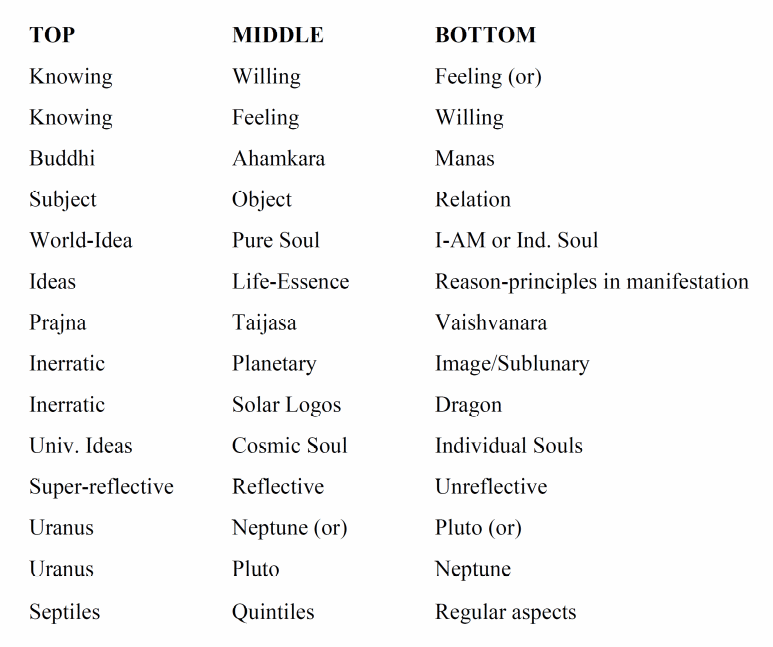
Class
Friday, July 20th, 1984
Verbatim, unedited transcriptClick the series name to view more
CLASS at Wisdom's Goldenrod, Hector, NY
with Anthony Damiani (AD)
July 20a, 1984
HINDUISM; KNOWING WILLING FEELING
TOPIC: Hinduism
SUBJECT: Knowing Willing Feeling
SUBSUBJECTS: Epistemology, Trans-Saturnians (Uranus Neptune Pluto), Astrology, Cosmology, World-Mind (Solar Logos), Soul
CONTENTS:
More & more mysterious
RG exposition of 3-folds, vis-a-vis Murti & KCB
Kant: reflective willing
Ramanuja
Astrological degrees, planets, & natal
Vision of Sun Soul, Solar Logos
Soul & Ideas in universe: Buddhi, Ahamkara of Cosmic Soul, Manas of Individual Soul
Hierarchical vs. horizontal view
Whether Feeling or Willing in middle
Levels
Matter as Feeling substance with three modes
Mulaprakriti, Life of the Sun
Content for Individual Soul
Attention of Sun Soul, Individual Soul
Omnipresence
What's meant by Individual Soul
Momentary vs. permanent consciousness: Buddhist vs. Hindu
Momentary involved with Sun's taijasa
What are powers of Soul?
Powers vs. vehicles of those powers
I AM as principle of manifestation
Soul powers are gift of Solar Logos
The Diagram
Not a hierarchy
Your life, past traces, & Neptune
Buddhi-Citta
Neptune
Sun's taijasa & memory traces
Bodhicitta
Buddhi & Citta
Vedantist view
Atmananda
Vehicles for evolution from World-Idea
Soul learns through emanants in differentiated way
Nous in the Soul
Uranus Neptune Pluto at unreflective level: regular aspects
At reflective level: quintiles
Contemplation of an object
No differentiation between these three for cosmic intellect
Psychic subjectivity
Dexterity & reflective
"Doorway"–resting in Feeling relationship
Subject as Freedom/Will
Planetary powers & virtues
Pain & wish to be free from it
Writers vs. Sage
Unreflective, reflective Willing
Yoga vs. Samkhya
Plenty vs. Poverty
Septiles super-reflective
Experiencing KWF in pure mode
KWF below Insight
PB & Pure Feeling
Karma bhakti jnana yogas
Raja yoga
Will formulates aspects
Sunset meditation
Compassion
Neptune at super-reflective
Super-reflective Willing & Sage
Nirvikalpa before understanding World-Idea, then compassion
Unification of three functions as Insight
Schools under one trans-Saturnian or another
Anthony would write this class up as a paper
BOOKS READ FROM OR REFERENCED:
T.R.V. Murti, Studies in Indian Thought, "Knowing, Feeling and Willing as Functions of Consciousness"; "Illusion as Confusion of Subjective Functions"
K.C. Bhattacharyya, Studies in Philosophy, Volume 2, "The Concept of the Absolute and Its Alternative Forms"
Paul Brunton, The Hidden Teaching Beyond Yoga
Surendranath Dasgupta, Yoga As Philosophy and Religion
Plotinus, The Enneads (MacKenna translation, 4th ed.)
Rene Guenon, Multiple States of Being
Paul Brunton, Notebooks
Walt Whitman, Leaves of Grass, "Song of Myself"
PLOTINUS QUOTES READ OR REFERENCED: III.5, III.8.8, IV.8.2, V.1.2, VI.5.7
DIAGRAM appended to this transcript:
- FIGURE 1984 0720a-1-JF. Threefolds.
This diagram was created by jf based on her notes. The actual diagrams referred to in class are not with this transcript version. [Transcriber note: [diagram] means the speaker is referencing a diagram as he or she is speaking. If someone is drawing or writing, with audible sounds of chalk on a blackboard, I indicate this by [drawing] or [writing].]
NOTES:
This is 1984 07/20a, Hinduism; Knowing Willing Feeling Class, and the first entry associated with this date. 1984 07/20b = Plotinus; Soul Seminar, for which we have no audio, just JF notes. 1984 07/20c = Knowing Willing Feeling Seminar with Red Witter and AS, for which we have only one Audio File (1984 0720c) with 15 minutes of student discussion and are missing the rest. AD may or may not be present but doesn't speak.
Anthony suggested writing this up into an article.
Friday night class, usually Plotinus (hence originally categorized as Plotinus: Soul). However, this class covers a wide-ranging mixture of Topics/Subjects. As of 2018 jf now thinks Hinduism; Knowing Willing Feeling best fit for Topic; Subject.
Related to WG Class 1984 0713a Hinduism; Knowing Willing Feeling; Murti.
Older transcript version exists; done by jf 2006 from audio cassette tapes (w/diagram).
AD present for class.
TRANSCRIBED originally by jf 2006 from audio cassette tapes; transcribed verbatim (another three passes) by IT in 2012 and 2018. This is V12a (2023) and has: updated prefatory matter, footer, and audio file name; Book List slightly expanded; Plotinus quotes section added; typos/errors corrected; new notes within transcript; diagram section redone. Archival verbatim transcript – V12a.
AUDIO FILES: 1984 0720a (formerly 1984 0720b), 1984 0720b (formerly 1984 0719a). [Note: "Tape" and "Side" refer to original audio cassette tapes that were later digitized into .MP3 Audio Files.]
| NEW FILE NAME | OLD FILE NAME |
| 840720a | 840720b |
| 840720b | 840719a |
1984 07/20a at Wisdom's Goldenrod
Hinduism; Knowing Willing Feeling
[Audio File 1984 0720a (formerly 1984 0720b) Begins]
RG: --the one is--
S: (Sattvic/Tattvic).
RG: And I'm combing the library and other sources but there really is not much in the way of real investigation into the three function(s). So, I don't know, apart from the guidelines we've used.
AD (faint): Uh-huh.
AS: I mean to finish up some more on the article tonight [one/two words inaudible]
RG: Well we could see. I mean we really-- I mean we used the article as a jumping off point last week, which I think was fine. [student assents, faint] I don't care.
HS: Could you without doing the entire class, if you could just summarize what you did last week?
S (very faint): Yeah.
RG: Sure. Uh--
AS: You want-- you want to assimilate that diagram we had first?
RG: Which diagram?
AS: The one you put up, you know, with the knowing, willing [few words inaudible]
RG (simultaneously): Last we-- yeah, why don't we just put up that, um--
AS (simultaneously): Yeah, put that on one board and [possibly another student: you put up on the other one].
RG (simultaneously): Ok, and you put up your diagram on the other one.
AS: Ok.
RG (simultaneously): Ok.
BS: Oh good.
S: Great.
S (very faint): Yeah.
RG: This diagram is controversial.
TS (very faint): Yes it is.
S: Go (over it).
TS (simultaneously, faint): Ok.
S (faint): Yes.
S (very faint, possibly part of background): What are you (speaking of)?
S (very faint): (Uh-hm.)
[58½ second pause while RG and AS draw; shuffling about, background student talking/whispering]
AD (talking very quietly to someone in background while drawing continues): No. And remember he's talking (even more specific). [16 second pause with drawing, background student whispering] Now meaning becomes more and more mysterious. What we mean when-- what we mean when we say feeling or willing or knowing.
[students assent, faint]
AS (simultaneously): What?
CDA: Now do that again.
AS: What did he say?
AD: I say it's becoming more and more mysterious.
AS: Yeah.
RG (simultaneously): Yeah.
AD (faint): (Go ahead/Ok).
RG: The basic idea from-- from the article who doesn't have (none/one), [AS drawing/writing] from what we did last week was, there were three basic modes of approaching any experience. And he-- and tho-- I think they're basic a priori modes that really on their own can't be transcended. In other words, when you're looking for something behind them, you have to look with one of these modes.
CDA: Even louder.
RG: Yeah.
CDA (simultaneously): Just a little bit.
[AS drawing/writing while class continues]
RG: And, these three basic functions, if we-- as we've discussed before are willing, feeling, and knowing, and the rel-- they relate on the epistemological level to the threefold distinction of the subject, object, and the relationship between them; the subject being an embodiment of willing or nat-- or related to willing and that object being a content of knowing and the relationship between them being established through feeling. So-- Now, in terms of three of the fundamentally i-- fundamental ideas we use, I think we-- I think we break some of this down, at least when we're looking up, to the soul as being the light of consciousness, the undifferentiated mind-stuff, and that would all-- that would be on the Subject series [diagram]. We speak of the World-Idea as the content of our experience or the reason-principles, and this would be an approach through knowing, primarily through knowing [diagram]. And then we have what brings them together, and that could be called the I AM in which the soul contemplates the World-Idea within itself [diagram]; individual or cosmic, I don't think it really matters. The cosmic soul has the World-Idea in total but we each have our own-- the World-Idea as within our own Overself. And I think that threefold distinction is one way that we formulate our experience, or the principles of our experience. Now-- So, that would be the primary distinction. And even above this it seems like-- even when you're formulating the Intellectual-Principle, most traditions resort to a threefold method of talking about it, whether it's Being, Life, and Intellect, Sat-Chit-Ananda of the Vedantist. I don't know if the Buddhists have a threefold, I'm not up there but, most traditions [student assents] seem to formulate Being in a threefold way, which also seems to point to this demand in the human mind to come up with conceptions of what's beyond itself through these three faculties. Now that comes, you know-- and we know, we-- we've studied a lot KCB's article on The Concept of the Absolute, which we have to bear in mind he calls it the concept of the Absolute, it's not the Absolute, it's the way the human mind formulates its approach to a Transcendent-- Transcendent. What it is in itself you don't know until you get there.
HS: Are you taking those functions as-- or structuring experience?
RG: Yes, definitely, structuring experience.
HS: And it'd be prior to (your) experience?
RG: Prior to [S simultaneously, very faint: (No.)] experience?
HS: Within experience?
RG: Yeah, both, prior to and within but-- Within, I would say, these functions are usually confused, and it's only prior to we-- where you can probably clearly differentiate them. Now, a subset of this I think-- now, when we're looking at, let's say, the point of view of the s-- the individual soul as the substrate or-- of consciousness and say it's primarily willing, well, there's a willing, feeling, and knowing aspect within willing or within this principle; and within feeling there's a willing, feeling, and knowing aspect; and within knowing there's a willing, feeling, and knowing aspect. But they're degrees, they're degrees of which is-- which is more principial and which is more [S, very faint: (Ok), yeah.] predominant, but-- now then--
The other point that's made in the article is that in manifestation [drawing] or in the sensible, say down here [diagram], these functions are always confused and we never get a clear differentiation of any of these functions in our normal experience. In other words, when we say we're thinking, [student assents, faint] and by think-- and what-- if I take thinking. We say we're thinking real hard and trying to get to the object of knowledge, and we always-- we talk about that in a purely knowing mode. And in fact, in most philosophical thought, when you're-- when you're thinking in a-- in a rational manner, you are operating according to knowing. [S: Well--] This view differentiates that, because it says as long as you're moving towards the object, say, in a process of thought, you're not knowing, particularly, you're more willing, you're in act. And, you only really know the thing when you are it, when you become one with the object and stop conceptualizing or thinking about it, 'cause all conc-- con-- conceptualization is imagination and all imagination is a product of the will. So to get to a pure knowing position you have to cut out all imagination, cut out your own subjectivity to get to the thing itself. And that's the proper definition of knowing. Now, in the-- in the world we say we-- we know that the tree exists, I don't-- I don't just will it. Yes. Insofar as we take the thing to be independent of us, we're said to know it. But on careful analysis, Hidden Teaching analysis or epistemological reflection, we realize that we contribute an awful lot to what we think is really there, and it's only by peeling away those layers that we could start getting to what really is presented, by eliminating more and more of our subjectivity. Well, Herbie, that's one approach.
HS/S(?) (faint): Yeah.
LR (simultaneously): Which is to say eliminate more and more of the willing aspect of the perception?
RG: Yeah, yes, yes. If you could become totally non-willing in reference to the object and just contemplate it by becoming one with it, then you would be in a knowing position, you would [CDA simultaneously: Is--] fulfill knowing.
CDA: Could you--
HS (simultaneously): But this all presupposes a neutral awareness, so to say, behind them all or--
RG: Yeah, you know, Murti uses the word 'attention', he calls these three form-- [writing] aspects of attention that, so to speak, have three aspects. [Note: See T.R.V. Murti, Studies in Indian Thought.] Bhattachar-- charyya calls them-- calls them three modes of relating to a content, three modes of consciousness, [student assents, very faint] three modes of awareness, but-- you know, it depends what we mean by that.
JB: This level in which there is willing, feeling and knowing [one/two words inaudible] feeling [one word inaudible] right here, is that clear, is that made clear in the article, and that's not the sensible, that's not the level of where they're confused in the sensible?
RG: I don't think that's made clear in the article (Lou/though). Now I-- [couple inaudible student words] I think-- I brought this in 'cause we're going to elaborate that in Avery's diagram a little bit, so I just-- I want to prepare us for it. And also to point out that in-- that for example in knowing-- I think it is pointed out to some extent, also in Bhattacharyya article it's pointed out, that--
HS (simultaneously): (There's) Bhattacharyya (article).
RG: What?
S: There's not-- I remember [AS simultaneously: Yeah.] (the sequel but) [few words inaudible]
JB (simultaneously): (And/In that) they're not instances of pure knowing. Are you suggesting [RG assents] that they are examples of un-confused willing, [RG simultaneously: Wait.] in that--
RG (simultaneously): No, I'm saying these three in its as-- having aspects, if we don't differentiate them then [JB simultaneously: Right.] they'll be confused.
JB: But even in the unconfused state above the sensible, [RG: Yes.] those aspects exist in the-- [student assents, very faint] [AD, very faint: Yeah.] those three types of attention.
HS (simultaneously): He means is the dotted line in the right place to put them [couple words inaudible]
RG (simultaneously): Here [diagram]?
JB (simultaneously): That's sort of right, sort of what I mean.
RG (simultaneously): Well I'd like to put another [drawing] dotted line here [diagram]. And then-- you know, there-- I think there are-- there are-- there are sets, and--
JB: Oh ok.
RG: You know, I think you could have a willing and feeling that come out of knowing. And-- Maybe the knowing should be here, maybe it should be like that [diagram], I don't know. You'll have to think about it.
AH: Could you say again what this willing aspect, like is it the-- the willing is being equated with a process of imaginative thoughts and it's a-- it's being driven toward-- to use the notion of willing, the thought is being driven toward the objects.
RG: In willing?
AH: In willing?
RG: Well no, actually in willing the thought is being driven towards the subject because there is no object except by willing.
AH: Alright. [S simultaneously: (If--)] So then, [RG: Yeah.] excuse me, [RG: Go ahead.] well then how is it that anything is known by becoming the object?
RG: Oh, because they're different objects.
AH: Alright.
RG: Right, in-- because when you're-- when you're talking from willing, you're creating manifestation. Say it's the point-- a point of view of individual mentalism. [AH, very faint: Alright.] Your world is entirely given by your own mind--
AH: And senses.
RG: Yeah, and your own senses, from within yourself, ok? And that seems to be one of the points of view of willing.
AH: It's a different object, that was my question.
RG: Right, I think in knowing you'd say that it's like the cosmic mentalistic object rather than the individual mentalistic object.
AH: And not necessarily discrete in regards to subject or object.
RG: Right.
AH: Epistemologically discrete.
RG (simultaneously): Uh-huh, right, yeah.
HS (simultaneously): And when you-- so when you say there's no object except the willed object you're talking from the point of view of willing?
RG: Yes.
HS: Looking from the consideration of the will?
TS/AS(?) (very faint): Yeah.
RG: No, I think that's-- that's a point [AS simultaneously: That's from willing.] of view from willing.
HS: Ok, and that doesn't subsume the point of view from knowing which the object is distinct from (your) will.
RG (simultaneously): Exactly. And I think those two points of view we alwa-- we often get confused but cosmic mentalism says there's an object independent of our knowing but we must give form to it through our own mind.
HS: You [couple/three words inaudible] ask someone how to-- how (they) like to move a Sage. They don't say how to move him but they say it's a nightmare.
[students assent, very faint]
RG: So, I mean I would put individual mentalism here [diagram]. [student assents, faint] And-- see, I think the-- here's the confu-- here's the interesting thing though, in cosmic ment-- [student assents, very faint] in this position [diagram] though, the cosmic mind is also willing, alright. Under the aspect of the World-Idea there's a willing aspect. But from the point of view of (knowing), when you come to know, you know that it exists independent of you, so it qualifies for being a known object as well, but from itself being willing consciousness. So I think you could take any of the points of view and look at any content and come up with a-- That's one reason it's so confusing here, there's-- any-- any idea can be approached from any one of these points of view and you can't pigeonhole them.
HS: But can it [student assents] actually be formulated in other than knowing?
RG: Which?
HS: This-- the entire.
RG: Can it be formulated as other than knowing?
S (faint): Yeah.
RG: Yeah, I think every doctrine does it differently. I think Yoga formulates this according to willing, [student assents, very faint] and Vedanta--
HS (simultaneously): Formulates this according to willing or-- or it-- or when it-- when it knows its willed formulation [student assents, very faint] it appears, so to say, formulated according to willing but it's known-- considered all as object.
RG: It's considered as object--
HS (simultaneously): Like to formulate according to willing seems to be to remain, so to say, in activity.
AH (faint): (It's/Its) (functioning/function).
RG: Well--
HS: (And then/I mean) maybe you can write it down.
RG: No, but he ha-- but, you know, in the [drawing/writing] level of say reflective willing, which isn't just ordinary willing, no, I mean, because-- You know who I think philosophically comes a lot from this position is Kant, from reflective willing. How do we know the Self? We don't know it. In fact he denies that it's from knowing that you know anything. You can't know anything according to Kant because you can only know through the categories of the imagination. Therefore, there is no real knowledge. [HS simultaneously: That's good.] There's only-- there's a knowledge that you can't know the Intelligible. That's as far as his knowing gets. But in fact his willing goes higher, because he says you could know the Self through willing, through acts of will you can know that-- you know, through-- through--
HS (very faint): I think by feeling is the other way.
[someone drawing]
RG: Yeah. So I think he exalts willing, even though he's a-- his-- he seems to be a great exponent of knowing, I-- I don't think so.
HS (simultaneously): So it's in the realm of the mixed where you know, where you-- or you do this thing.
RG: Yeah, yeah. And you take a bhakti-- you know, maybe Ramanuja's Vedanta is within feeling because it allows for the World-Idea, it allows for manifestation and allows for the soul or-- I don't know, that's a possibility. But, so, I think--
JB (simultaneously): But (maybe) doesn't Zen control the--
RG (simultaneously): The willing? Yeah, Zen, sure.
JB (simultaneously): Because you're always in action you can't write it down, I mean I only got [RG simultaneously: Yeah.] the idea [student assents] from how Herbie described [RG simultaneously: Right.] his own belief.
RG: So, I mean I think we could use the model to look at various philosophical doctrines too and see where-- what point of view they're looking-- coming from [couple words inaudible]
S (simultaneously): Unsolved.
HS: Because at one point you switched from like this objective psychological discussion to a-- a cosmolo-- you know, an actual objective cosmological discussion.
RG: Right, and in that switch I switched from willing to knowing.
HS (simultaneously): I just want to be there when you do it, that's all. (bit of laughter)
S: So do I.
HS (simultaneously): I want it to be clear to me exactly what you're doing.
RG: Right, right.
AH: And in that regard I would like to ask, the epistemological model below the last diagram--
RG: Uh-hm.
AH: Is that going to be used as a way of explaining these relationships that-- above it?
RG: That's where we start. We start with the given and then there are three levels that cause it. One is the unreflective, where everything is confused. [AH assents, very faint] Then there's the reflective level where you realize that you're, so to speak, embedded to this function and using it but you're not totally free of the functioning. [AH, very faint: Ok.] And then the highest level where you become the object of that function completely. So--
JL (simultaneously): I don't believe that.
RG: What? [AH simultaneously: Sure.] You don't believe what?
JL: That you ever become an object of anything.
RG: Well, I-- I formulated it in terms of knowledge but don't you think-- I mean-- well then all Yoga [AS simultaneously: (one word inaudible) explain it.] would be a sham if you couldn't become what you were try-- what you were trying to will, I mean--
AS: Well, one of the-- we could give examples of just [RG simultaneously: Right.] the meaning for that.
S: Hm?
AS: We'll have to give some examples of possible meanings for saying that these reach their-- these three functions can reach a certain epitome or super-reflective state in which they are developed-- fully developed and distinguished one from the other. Like whether or not some idea can be contemplated shining-- shining out in its own right without it being interfered with by feeling or without it being experienced as your own-- as being put forth by your willing. We have some examples, I mean we could [RG simultaneously: Yeah.] just go through.
[short pause]
S: Do you have to look for it?
RG: Or let's say the example of a samadhi on an object, then you would become the object for that moment, right, the object would reveal itself and you would [few inaudible AS words simultaneous with RG] fulfill knowing. Or let's take an astrological example.
S: Degrees.
RG: You contemplate [AS simultaneously: (The/Your) degree(s).] your degrees, as were talking the other night, and you really for a moment know what that degree means for you. I think that would be--
LR (simultaneously): Or how you are-- you are that.
RG: Right, how that is your substance, ok. You forget your imaginations about it, you forget your concepts but you really have a direct penetration into that degree. [students assent] Then that knowledge would seem to reveal itself. [10¾ second pause] No?
S: [one word inaudible]
JL (simultaneously): Now if we--
AS: Well we'll have to--
LDS: Well, using the example of the degree that you contemplate in your chart, [students assent] there's like-- there's two things you can realize about that, you can realize that the willing function is what-- ok, is structured somewhat or is always willing that form, that idea in terms of its experience. But the contemplating of that degree and coming to know what that degree means and what it entails is a fulfillment of the knowing. So like both the-- I think as you mentioned before, any idea, whether it be a degree in your chart or whatever, [RG assents] can be approached from these three different modes and each in some way is a fundamental constituent of the-- of the being.
S (faint): (What being?)
LDS: I didn't say what being.
S (simultaneously): (Good./What?)
AS: Yeah, that's a problem.
RG (faint): Yeah.
AS: That's really a problem, because-- M-- maybe I should-- that would be a good place, I-- [S simultaneously: Yeah.] I'd jump off into this example. Just 'cause you use the chart. There's a pro-- there's-- well, there's all kinds of problems but--
RG (simultaneously): Go ahead, do-- do that one.
AS: So-- 'cause I'm going to use that-- try to use the chart example eventually. In fact, in your chart exam-- just starting from the bottom for a second or from the notion of the chart, if-- if you say that-- I was trying to conceive that if you could get to that idea, the meaning of an idea in your chart, without-- but without the planetary function associated with it, so let's say without the willing added (on), and without it even being seen as part of your own life, which, I don't know, maybe that would be hard, but just what is that degree in itself, what is that idea in itself. Or in a transiting planet there's an idea septile, like Uranus septile, Einstein has some kind of-- some idea is delivered to him. Now, it's like try-- the-- the goal of the knowing would be to just have that reason-principle or idea shining out in itself, without a planetary function associated, and without-- without it being part of your life.
LDS: A-- yeah, yeah.
AS (simultaneously): Just in itself. In other words-- well, let me try to finish all the notes and then it's all clear.
LR: Is that possible?
AS: Well-- I-- that's a question of whether that's possible, but--
RG: Is it possible to what? Contemplate the degree without having willing?
LR (simultaneously): Outside of a life.
S (faint): Yeah.
RG: Outside of your life?
LR: Well-- I mean it seems like they're only-- I mean as they're brought into life that you are able to gain access to them.
S (faint): Yeah.
AS: Uh-hm.
LDS: But I think Avery's suggesting that the access through knowing would be this approach where the idea in no way is then possessed but rather just allowed to be what it is [LR: That's--] and appreciated for what it is.
LR: Yeah.
HS: Yeah, universal, not--
LDS: See, [AS simultaneously: Yeah, a universal.] it's an impersonal--
AS: I appreciate it as the universal. [student assents, faint] That's why I was conceiving in the other two, if-- I mean maybe his analysis isn't right, I mean maybe what he says about the subject-object business and then the relation isn't right but I mean I think Richard presented that before, [writing/drawing] that each one of the three are-- in the empirical situation where you apparently have a subject and a relation and an object, you use that as your starting point and obviously the three ends are all related and each of the three functions, the way Bhattacharyya describes it, tries to isolate one end of this threefold, where knowing tries to eventually arrive at a situation where just the object shines out without subject or relation, and willing where just the subject stands out, pure will without the relation or object, and feeling just the relation.
Now, I-- it's-- if I started from the bottom I tried to think of that, [drawing] in the chart the planets would represent the willing. So you have a planet on a degree, that's the willing. The degree would represent the reason-principle or the knowing side. And it seems that if you wanted to talk about the feeling, what related them, be the fact that this is your life, you can't understand this chart unless you understand, let's say, the central life-purpose or life-essence or medium would be like the taijasa nature of the Sun, it'd be your life essence. This isn't just Mars on a degree, it's Mars on a degree in your chart, as part of your life. So if we traced back one of tho-- any-- either one of those three, we should be a-- through either knowing, willing, or feeling, you know, respectively, we should be able to try and understand that knowing would demand the degree itself be traced back to its source as a reason-princip-- as ultimately the embodiment of an Idea; that the planet be traced back to its source as primarily a planetary function of the Sun, [student assents, faint] of the Solar Logos, [student assents, very faint] whatever, or your own individual function; and that the life, your life itself, your life be traced back, ultimately, as this taijasa life of the Sun. Or maybe it's your own life, that's ok, your own life essence. But any one of those three should be able to be traced back. And, if-- if a--
HS (simultaneously): [couple words inaudible] so which-- and you hold the subject to be the [AS drawing] manas, so to say?
AS: Well you see, that's-- that's where-- yeah, in a manner of speaking, but that's where it really-- that's where there seems to be some confusion I think there.
AH: Is it that the perceiver is a consequence of the position of those planets, [RG assents] [AS simultaneously: Ok, that's--] so to speak-- to speak [student assents] of a perceiver was really a consequence as being able to look at its own prior. Is that the issue?
AS: No, I don't think so. I'm not sure.
AH: Is that Herbie's issue when he asked about the subject?
HS: No I just asked if he was-- if in the-- if in the way-- the way he was just discussing if the planets then become the subject because-- because he wasn't able to or they're moving.
AS (simultaneously): Well-- see, there's a problem. If they-- if they-- if I resort to--
S (very faint): Yeah.
S (faint, possibly part of background): (Rudy--)
RG: They do in this view but I would say this view is from within not-- not the willing side. So in this view(--) I think the willing [couple inaudible AS words simultaneous with RG] aspect or subject [AS drawing] is subsumed within a feeling relation. Like it-- this diagram brings together the subject and object side in re-- in relational consciousness. And therefore in-- the subject side of this is within the feel-- felt context and it doesn't get out of the-- doesn't get to the pure soul say, 'cause it's with-- it's already within it.
AS: Well that's a question.
RG: Yeah.
AS: Well let me-- let me do it then from the-- I think in this scheme here, this is more the cosmological side [diagram] that I was trying to unfold or understand. And-- just to put a context to what these three functions might mean, when we speak about the Solar Logos [drawing] or this Mind of the Sun [diagram], which is taking that Intelligible World within it or the Ideas, trying to translate that through its own activity-powers, trying to translate that into a sensible appearance, which is going to appear here [diagram]. Now the combined functioning of the Sun Soul and its powers and the reason-principles it has are going to give rise to an actual-- to an appearance, let's say in the Dragon, let's say this is the Dragon [diagram], it doesn't matter, any one of those-- on any one of those planets, it will give rise to a certain percept, ok. The Sun Soul is organizing the continual manifestation of a world-image. Now, if we start from the top say, I mean, if-- using kind of a Samkhya scheme or just analyzing the cosmology, it seems that there are three different aspects, three different streams by which that understanding power of the Sun is going to take that Idea and manifest it. And applying cosmologically but-- First of all it has to deal-- first of all-- the one-- on one side we could talk about the reason-principles or the Ideas.
HS: It's got information coming to it from the World-Idea.
AS (simultaneously): Yeah, objective, yeah.
HS: Ok.
AS: On the other hand, it has certain functions, apparently [HS simultaneously: Soul.]] subjective functions say that are giving-- getting differentiated also through that World-Idea, [LR simultaneously: Excuse me.] like the planetary functions. Yeah.
LR: Avery, would you just read what's written up there?
AS: Yeah.
LR (faint): Because (I can't see that).
CDA (simultaneously): It's very little.
AS: I'll try and make it intelligible. Unintelligible but wrong. Ok, if--
HS (very faint): What happened? (laughter, student words)
S (amidst laughter): (She) said "read it" not "reason".
AS (simultaneously): Well it's hard-- is if it's hard to see--
S (simultaneously): [couple words inaudible] (laughter)
HS (amidst laughter): Well--
AS (amidst laughter): On one side, on this side [diagram], we're talking about--
S: You lost that one. (bit more laughter)
S (faint): Yeah.
AS: Well I'm trying to make sense out of-- think-- um--
AD (simultaneously): How about next time go up there and look at it. (laughter)
LR (amidst laughter): I may.
AS: Sorry, my fault. Let me try-- let me try again. I have patience.
S (faint): Start it up, go.
AS: Right-- So again-- You remember we spoke about this is like the second phase of the soul, this is a Solar Logos [diagram], finds itself in a certain place within the World-Idea, and it's got to manifest for itself something of this World-Idea, something of the Ideas, [drawing] ok, the Intelligible or the Intellectual within the Sun Soul. So we'll forget about that. Let's say that it has a vision of, that's its insight, its own insight. It's going to manifest that to itself in terms of sequence, time, manifestation. Now, it's able to do that or, I think I-- I'm claiming that the way it's going to organize and unfold those Ideas to itself is through-- primarily through these three functions. [student assents, very faint] Ok? So let's say that it has these three ways [drawing/writing] of grasping these Ideas, of grasping the Intellectual within it, and portraying that Intellectual Idea in time as this moving-- as this pulsating world-image. Ok? And there seem to be three different-- and that's the underst-- we talk about that as the understanding phase of this World-Soul. In this case it's like the Undivided Mind. It has these three different modes to it or three different aspects to it. And, in the one of them, I was trying to conceive, along and-- let's back up a little bit. Along with a kind of Samkhya definition of [drawing/writing] this activity, which they primarily call Ahamkara, if you remember, they have these three different aspects of Ahamkara. And one of them corresponds, it seems to me, to the embod-- em-- the reason-principle side, the Ideas now as content, as reason-principles embedded in the substance of the Sun [diagram]. On the other side we have the planetary functions, which are the Sun Soul's activities, the differentiated activities, for example the planetary powers as fabricative [diagram]. But now, the middle one [diagram] seems hard. And this planetary functions would answer [drawing/writing] to the willing of that cosmic soul, ok. And these reason-principles to the knowing aspect. But--
DP (simultaneously): Would that just be the Chaldeans there, under [AS simultaneously: Hm?] the planetary-- the planetary function, would that be specifically the Chaldeans?
AS: The Chaldeans specifically, yeah. And these [diagram] specifically the reason-principles that are organizing those, that are [student assents, faint] here felt reason-principles 'cause they're in the substance of the Sun. [student assents] And that leaves the middle one [diagram], which seems to be the taijasa consciousness [drawing/writing] of the Sun itself. Now either we could call that the-- the taijasa consciousness or the light of the Sun, the subtle light, which is the medium in which these Ideas are embedded and in which this willing activity is going to occur, almost like, imagine your mind, the imagination, the substance of the imagination, there's a certain activity which goes on in that taijasic imagination, and there are certain contents or reason-principles which are going to be embedded in there.
Now, we spoke about this prior, when we spoke about the Undivided Mind at one point we said this organizes the object side [diagram] [drawing/writing] and this would organize the subject side [diagram] and this would be like the medium [diagram], the life stream, we could say, this would be individualized as your life. So when-- in the effect, the result of this triple functioning, of these [drawing/writing] three functions-- let's say each of the functions here of the Sun is governing one of these three aspects of the understanding and the result of all this functioning would be to give rise to perceptions, would be to give rise to an appearance, [AS indicates on diagram] which includes your body, and your chart in particular. So in your chart there's an image of this, which seems pretty obvious, in that-- that you have the degrees in your chart, you have certain planets [drawing/writing] on those degrees, which are an image of this planetary willing, the fabricative activity, and the medium is the life motion of the soul.
Now, I just thought, whenever we read a chart, we never read the degree and the planets in isolation, it's this guy's life that we're looking at, it's his life, and these degrees and planets are part of his life. And you can't leave that out because other-- and-- and in-- and it may be specifically, the fact that it's his life may be something indicated in the whole aspectual pattern, the interrelation to all the other planets, it may be that if you could look at the Sun correctly itself and its position by sign or something, you might get a s-- feeling for the felt sig-- the felt significance of this life too. Even-- even divorced from all of the seven or ten particular planets in his chart and the seven or ten particular degrees, there would be this life essence that these planets and degrees were really trying to express. So that each degree itself would have a particular nature, each planet will of course have a certain willing activity, but what holds them together is that they're expressing the one life essence of this guy, I mean of his life, his soul's life or whatever we want to say, life essence.
LR (simultaneously): Which-- which-- that's what I was trying to suggest before, I mean, that's the reason I think why if you look at two degrees in two different charts they really have a different meaning also [AS simultaneously: Yeah. A--] very often. It's because the actual quality of that life is different.
AS: Yeah.
LR: And different aspects of the degree meanings will show up according to whose chart you're reading [student assents, faint] and it's really tricky.
AS (simultaneously): So-- yeah, so that seemed a possibility, and again there would seem to be two ways, I don't know, that were suggested maybe to look at that as, either when we looked at all the other planets as unfolding the Sun, the Sun would represent the taijasa consciousness, or, again, in a more particular way, maybe the aspects because the aspects inter-relate all planets to everything else, so maybe the aspect pattern itself [LR: Is--] would represent the particular life that this guy is living out, the-- but, I--
LR: I'd put that on a different level. I would say more [AS simultaneously: Yeah.] like the aspect would be the-- the [AS simultaneously: Well--] particular mind through which--
AS: Well, let me-- yeah, let me say one more thing before-- let me just unfo-- try and say one more thing, because then the question is going to come up-- [student assents, faint] I-- I think-- I thought this description was mainly from the point of view of this cosmic process, we haven't brought in the individual soul per se yet.
RG/S(?): Before you go on--
AS: So here's a changing world process. And now you got to bring in that there's this light of the soul, the unchanging soul as it were, the soul's own awareness or embodying phase, that is now going to be identified with and permeate this [drawing] thing here [diagram]. And now here's where the real-- this is where it seems the real problem is going to come in because these Chaldeans are actually fabricating or putting together the form of your perception. If you look at your natal chart, I mean we keep saying, that's like this pile of vasanas which is going to determine the very form of your actual sense-perception, ok, or the image that arises. And now your soul is going to get-- because it can't understand directly, it's going to understand or grasp the Ideas through this circuitous route, through this continual flashing World-Idea. Now, it just seems to me that what's happening is that this perception [drawing] is evoking-- and this is where-- I mean it might come from either way. Either we're going to say that this-- these modifications are evoking from within the soul its own powers because this individual soul also is conjoined with the cosmic soul, or that this World-Idea is delivering the immaterial reason-principles as well.
Let me say that in another way. In other words, this product, this sensible image or this perception which is organized, may be perc-- sensually perceptible but we still have to talk about the soul grasping some meaning out of that and not just on a sensible level but actually getting the meaning of this experience--what does it mean, how does he-- how is the soul assimilating some knowledge and some feeling and-- how is the soul assimilating understanding. And I think that's where we now have to back up the line on the subject side, on the individual soul side, and say, it's these very [drawing] functions of the World-Soul that-- or govern the fabrication here or organized it that the soul is now going to have to participate in in order to grasp some meaning out of this image. This image is just a sense-- is a sensible appearance-- appearance which is evoking some immaterial understanding, and that immaterial understanding is what is going to be grasped through Uranus, Neptune, and Pluto. Either the soul is going to know it in terms of it being revealed objectively here, or it's going to actually will from within itself the ideas to correspond with or to project onto the bodily modifications, or it's going to get it through some kind of a feeling, some kind of indistinct relation between itself and that activity. Now that's pretty vague.
HS (simultaneously): Between itself and that-- the activity and-- between itself and the object.
AS: And-- between itse-- yeah, the object isn't-- [drawing] is the activity though, is this changing-- this continually changing world-image.
HS (simultaneously): Ok, it'll give you the World-Idea, yeah.
AD (simultaneously): Avery, why not leave it that way, diversify it?
AS: Yeah.
AD: The Ideas that the Solar Logos is bringing into Himself and ultimately translating into the world, alright, [AS: Uh-hm.] let's say that's Buddhi, Universal [AS simultaneously: Yeah.] Buddhi, Universal Intelligence.
AS: Yeah, ok. [drawing/writing]
AD: Ok? Then the cosmic soul, the Ahamkara, alright, of that cosmic soul, is not to be confused either with that Universal Bu-- Buddhi or the individual soul. [AS assents] Leave that as that is, [AS simultaneously: Good.] the cosmic soul which is working, [AS: Yeah.] alright, [AS: Yeah.] and you'll have all the ingredients you need to understand or let's say the context in which you can understand willing, feeling, and knowing.
AS: Yeah.
[student assents, very faint]
AD: And that also shows how Guenon couldn't possibly put together in those chapters, if you remember when he was speaking about Universal Intelligence, the Buddhi and the Ahamkara, alright, there wasn't-- there was neither the contextual background in which he could place these terms. So [AS assents] for us when he says Buddhi or the Universal Ideas, alright, we're [couple/three inaudible AS words simultaneous with AD] speaking about one level.
AS: Right. [drawing]
AD: When we're speaking about Ahamkara, we're speaking about another level, an individual cosmic soul that [AS assents] is going to interpret that Universal Intelligence and build its own form of the world, alright. [AS: Right.] And then the individual soul which has-- or participates in the-- in the-- in the world that is a second remove.
AS: In fact, Manas.
AD: Manas, yes.
AS: In fact, the-- what this last thing you just said really ties in, I thought, very consistently, 'cause we talked about this a little bit last night, that a-- you have-- we-- remember, and we always had a hierarchy and a horizontal view.
AD: Yeah.
AS: I think they're very consistent now, if we see the correlation. The hierarchy view says that the Ideas (or/of) the Intellectual soul corresponds with knowing, at least in this view.
RG (simultaneously, faint): Uh-hm, yeah.
[students assent, very faint]
AS: The middle realm corresponds to--
S (faint): That's good.
HS (faint): No, I have to reword it (now).
AS (simultaneously): Well, Sam-- this is-- [RG simultaneously: Gotta reword it.] this was a little problem because Samkhya says it's willing but I think it should be feeling--
HS: Then you gotta change the word 'Ahamkara'.
AS (simultaneously): --because it's the Sun Soul.
LDS: It's the tai-- taijasa medium that's all important there.
AS: Yeah but, they call the taijasa medium willing. And then you have the third level which is Manas. Now, the higher one [drawing/writing] should be hierarchically under Uranus. The World-Soul activity and all its doing should be under Neptune. We kind-- and we kind of agree with that.
LCG (simultaneously): Yes, [AD simultaneously: Yeah.] yeah.
RG (simultaneously with LCG and AD): Yeah, clear.
AS: And the lower one, the actual-- [RG simultaneously: Right, it would be under (the direct) body.] the actual instantiations of the body--
AD (simultaneously): But there will be a diversity of applications of those three that (we/you) see.
AS (simultaneously): We even-- you know, we-- we even-- I think we even formulated a way to see them is that depending on which of the three functions the school or system is coming from it will treat the middle realm, and probably consequently the others, from-- they'll call it something else. [student assents, faint] But anyway this seems to fit in with the hier-- with the horizontal view because this we speak about the Universal Intelligence as Buddhi [diagram]. Its representation within the middle level is ruled by knowing [diagram], which is reason-principles, and down here [drawing/writing] it's also the degrees [diagram], and that's consistent, ok. And the middle level [diagram], the feeling, ok, again here the feeling always represents the common medium or the commonality between the act and the content on all the levels. And again, this is the-- that's why I think that the middle level seems primarily a feeling level, the point of view of the World-Soul is-- if you reach that point of view you recognize the common medium of the taijasa consciousness of the Sun. And the third one [diagram], the will, seems to always represent the rule-- what rules the actual embodiment or the organization of the appearance, and that fits consistently [couple words inaudible]
AD (simultaneously): You know, that-- Avery, there was one other-- [AS, faint: Yeah.] I don't know if this-- you remember the quotation from Dasgupta in the Essays, where he speaks about matter as this feeling substance, [S simultaneously, faint: Oh yeah.] [AS simultaneously with S and AD, faint: Yeah, feeling substance.] it has three modes?
AS: Yeah, the gunas.
AD: And rather [student assents] than think of the-- you know, the ultimate Mulaprakriti, [LR, faint: Something.] if we think of it as applying to the substance of the Sun, [AS: Yeah.] [RG simultaneously: For sure.] that it has these three modes, [RG assents, faint] these are the feeling substances, or the residue, the traces [RG: Right.] of manifestation which has been left behind and the Sun which then withdraws back into itself.
AS: Uh-hm. So-- yeah, so that would say that primarily these three feeling substances, [drawing/writing] what they call Mulaprakriti, are really part of this light of the Sun or the [AD simultaneously: Uh-huh.] life of the Sun. Does that-- does that make sense?
RG: Well, but their Mulaprakriti is beyond Buddhi.
AS: I know. I know their Mulaprakriti is beyond Buddhi but--
RG (very faint): I don't know what you're saying.
AD: But you see, this-- this makes me a little happier as to what feeling, willing, and knowing is a little bit about. I mean we use these words, like we use all other words, without, you know, any-- any [AS simultaneously: Well let me--] hint, you know, as to their import.
AS: Can I-- can I understand one other thing that you were saying, or that we seem to be saying, I'm not sure, that when you take-- when you've now-- after the cosmology laid out and you bring in, associate the light of an individual soul with this Manas here [diagram], your-- your embodying s-- the embodying soul of an individual is really associated right here, and is learning through the modifications here. But when-- if-- if it [drawing] were just a sensible appearance here, if it were cut off, there-- you wouldn't really learn anything. The fact that these three functions have gone into the constitution (or/of) that image, and the fact that the soul can actually participate in that activity, is how it's really learning to grasp for itself the Ideas through knowing, willing, or feeling mode. I mean that's like-- it's almost like this is present-- I mean maybe somehow I have to conceive that it's present in-- in or to the manifestation.
RG: But in this diagram we-- yet-- we haven't brought in the soul yet, I mean the indi-- the in-- the soul as consciousness.
AS (simultaneously): That's-- I was trying to do that, that the-- Well I was bringing it in as the embodying soul.
AD (simultaneously): Well we-- we first have to make sure that you understand this tremendous diversity, [RG: Right.] you know, which is the background and the context. You won't have no trouble now putting in an individual soul.
RG: Where does it come in?
AD: It's right there with the rest.
AS: It's right-- participating in the whole thing, it doesn't matter.
LR (simultaneously): It's (about) right, yeah.
RG: No, no but--
HS: As you come down any of the lines [diagram]?
AS: All the-- [LR simultaneously: No, it's the whole s--] the individual soul is-- remember [HS simultaneously: Come down all (the way).] the soul is omnipresent, it's present where it needs to be. [S, very faint: (Yes it is.)] Unfortunately it's attenti-- I would say the difference is, the Sun Soul's attention is on what it's doing up here [diagram], the individual soul's attention is on this [diagram].
HS: Ok wait.
RG: That's the lower soul.
HS (simultaneously): You call-- you kind of would speak [AS simultaneously: I--] (of/at) this-- [S simultaneously: We've been (doing this).] the individual soul will come down this-- the individual soul faculties generally, [AS simultaneously: Yeah, you--] and yet-- and yet-- yet it is the entire say.
LR: I disagree.
AS: Well, I just-- [student assents, faint] I'm talking to Herbie, I'm-- I'm going from something we were just reading this afternoon [S simultaneously: Yeah, let me see it.] which we read before.
HS: You identify with the totality [AS simultaneously: Right.] of manifestation.
LR: I disagree that you identify more with the planets than you would the degrees for instance.
HS: Oh I was just saying you identified more with the subjectivity and I don't-- I don't know what you're calling it.
AS (simultaneously): Yeah. But you know, the thing we were just reading again is that quote where he says that the soul is both partible and impartible, and even in its partibility it's impartible. That even when this changing World-Idea, the content, the entirety of content, is present en--
(Side 1 of original cassette tape digitized as 1984 0720a (formerly 1984 0720b) Ends; Side 2 Begins)
AS: --it's of the soul.
RG: But where is that in the diagram?
AS: I think it's pervasive of his-- of his experiencing. Like just when he says that it's parted without partibility.
RG: Uh-hm.
AS: Or ano-- or if we say that this is the World-Soul's activity, [drawing] I don't see why the individual soul isn't also participating in that activity.
RG: Yeah, certainly it's participating.
HS: And the individual soul is other than that life, you want to hold, that comes down the middle [diagram]? It's other than that and it's other than the subjective function [diagram].
AD: Well, it depends on what you mean by individual [AS simultaneously: What do you mean other?] soul. You mean the I AM? You're [S simultaneously: Yes.] speaking about the circle [diagram]. You mean the embodying soul? You're speaking about somebody born in 1902 at 6 a.m., [HS simultaneously: Right. Him.] July 5th. What do you mean? Which one are you talking about?
HS (simultaneously): Him, that guy you-- July 2, 1905.
AD: Well, then you have to go downstairs.
AS: Then he's agreeing.
HS: I don't have to go anywhere, I am downstairs.
AS: But-- but I think he's not cut off from the higher.
HS (simultaneously): Ok how, do-- ok. So show how he's not.
AS (simultaneously): But that-- but see, that-- that doesn't speak to any of the contents, when you say he's not cut off. The part-- part that's present is--
AD (simultaneously): And, you have to have it because then you're going to be able to resolve the problem that's going to arise, alright. [students assent] You have that [AS simultaneously: The Buddhist and the Vedantist.] changing momentary consciousness, [RG: Uh-hm.] and you have to have a stationary permanent consciousness--they're both there.
RG: Right.
AS: And-- [S: Yeah.] and you're saying that the changing consciousness is what we've just described as this cosmic process [AD: Uh-huh.] presenting this changing world-image.
AD: Yeah.
AS: And the unchanging consciousness is the fact that your individual consciousness is linked directly to the I AM principle.
AD (simultaneously): The I AM, yeah.
AS: And that the--
AD (simultaneously): And now, and now the Buddhists and the Hindus could take sides and start fighting.
RG: Right.
AS: Yeah.
CDA: When you s--
S (faint): You want to bet?
LDS: But the-- I think the point came up Wednesday night that it's a matter of what the soul is attending to. Like, if the soul takes the World-Idea to present it and takes the chart that it identifies with as itself, in other words, if its attention is to that natal situation, then it can't extricate itself or appreciate the permanent or the-- the light of the soul.
AD (simultaneously): But you're telling me that an unbalanced view is not worthy for us to consider.
[student assents, very faint]
S: Yeah. (some laughter)
LDS: Yeah. (more laughter)
AD: How could you deny the fact of your self-identity, and how could you deny the fact of the ever-changing contents? I mean, you have to submit to both facts. Well then, the-- you have to-- you have to ex-- understand in terms of those two facts and not take-- not take one point of view as being ultimate, whether you like it or not. Because, there's such a resounding success that the Buddhists, you know, work with. I mean this notion that thought is constantly-- the world is constantly changing, its impermanence is overwhelming, it's a truth, there's no getting away from it. But then the other thing, when they try to say that your identity is a fiction, a 70-year-old fiction or a 50-year-old fiction's a long fiction.
RG (simultaneously, faint): Right, (it is/yeah).
AD: No.
LDS: Well--
S (simultaneously): Is there--
AD: There is a consciousness which is also stable and unchanging.
LDS: The interesting thing about that is (where/when) you brought up the notion of a consciousness both on the objective side, which is provided I see tonight by this diagram of the-- of the Sun, the taijasa, is that-- is that consciousness that's involved with or constitutive of the World-Idea's formulation.
AD: Yeah.
LDS: And that is momentary and so on, and that-- that's where the Buddhist can [couple inaudible AS words simultaneous with LDS] validly speak of the moment-- that each moment has its own consciousness.
AD (simultaneously): The moment-to-moment consciousness, yeah. That principle could explain everything.
LDS: And even PB says, each thought contains its own space-time form of consciousness.
S: Uh-hm.
AS: Then--
LDS (simultaneously): He talks about the occult link.
AD (very faint): Yeah.
AS: And [RG simultaneously: Right.] would you say that that changing aspect, that World-Soul, includes also the developing aspect of all the individual souls within it? 'Cause that's important. You know, we keep [LDS simultaneously: Right, developing--] speaking about this developing phase, the embodying soul.
S (very faint): What is that (really)?
AS: Yeah, [RG(?) simultaneously: Yeah, but why not (one word inaudible)] what is that embodying soul? The individual, the individual soul has this embodying phase, which actually gets embodied or we speak about Bodhicitta, its developing phase.
LDS (simultaneously): You could say that the forms, the--
AS (simultaneously): Is that part of-- is that developing the phase--
LDS (simultaneously): --the vehicles-- the vehicles would be appropriate to the-- to the maturity of the powers of the soul. In other words, there's two--
RG (simultaneously): But are those powers of [AS simultaneously: Yeah, what are those powers (one/two words inaudible)] the soul, are those powers of the soul aspects of the I AM principle or the pure soul or are they parts of the World-Idea?
LDS: I would say as powers, as--
HS: Is the I AM the conjoint?
LDS (simultaneously): Wait a minute, wait a minute, wait. [HS simultaneously: No just--] As powers, as--
RG (simultaneously): Before he was [S simultaneously: Uh-hm, uh-hm.] using I AM I think was not as the conjoint but as the pure--
AS: The pure.
S: The pureness.
LDS (simultaneously): You can speak of the powers and the vehicles of those powers, and I would s-- I would-- I would make that differentiation so that I could make sense of why it is that soul comes down and does anything here. In other words, the powers are being developed but they need to develop through vehicles. [RG simultaneously: So are they part of--] So the vehicles are provided by the World-Idea and the powers come from the I AM principle.
RG: So the I AM emanates these powers as an emanant, and that's these powers.
LDS: Or those powers are-- are innate or in-- constitutive of it.
RG: Ok.
LDS: They're not other [RG simultaneously: Now--] than the I AM.
RG: Now from that view I would say then you use Uranus, Neptune, and Pluto differently. Instead of looking at Uranus, Neptune, and Pluto as an un-- as unfolding the cosmic process, then you look at knowing, willing, and feeling as the three primary ways that the I AM unfolds its own powers.
LDS: Ok, I thought--
AS (simultaneously): Oh but-- but why are they different though Richard? Because [RG simultaneously: Because they're not the same.] in-- yeah-- no! (some laughter)
RG: Because your soul isn't the cosmic soul(s).
AS: No, no, but what I meant was, in principle, the Sun Soul too has its I AM.
RG: Right.
AS: And everything we described here wasn't just the-- that's-- I take the obje-- [RG simultaneously: Go on.] take-- take exception-- [S simultaneously: You should(--/.)] exception to that [RG: Yeah.] because is-- this isn't just a view of World-Idea evolving in isolation. [S: Right.] This is a view of the World-Idea together har-- being harmonized in its unfoldment by the cosmic soul. So these really are an emanant of-- In other words, we could say that the powers themselves are an emanation from I AM considered as soul; [RG assents] whereas the Ideas could be from the side, [S: Yeah, of the World-Idea.] the Intellectual-Principle within the soul. [RG assents] And if you take an individual soul, why not have the same possibility? In other words say that there's a certain phase of soul that is bound up with the cosmic process, even for the cosmic soul. There's a phase of soul which is absolutely unembodied and there's a phase, aspect of that soul which is involved in what we call the changing consciousness. [RG assents] And why wouldn't that be so with an individual soul too? In other words its own [RS assents] ray or developing aspect is also bound up with the whole cosmic process.
RG: Yes.
LDS: Or what sense would it make to speak of an individual soul coming into relation to what the World-Idea is presenting? Like if both--
RG: We speak about it all the time.
LDS: Ok, but how do you make sense of the ra-- the-- the raison d'etre for that process?
RG: Well, that's a good question, how do you [AS simultaneously: Yeah, it is.] make sense out of it?
LR: What do you mean the raison d'etre for that process?
LDS (simultaneously): The reason for being of that very fact that we just spoke about, the fact that the-- the individual I AM descends or emanates this-- these powers and develops them through embodiment and through living in relationship--
AD (simultaneously): No, through manifesting, not through embodying. [LDS: Well--] Through ma-- [LDS: Through--] The I AM is a principle of manifestation.
AS (faint): Right, I know.
LDS: But if you speak-- if we're speaking of-- we're speaking of an individual I AM now--
AD: Yeah.
LDS: --a-- [AD simultaneously: Yeah.] a human I AM.
AD (simultaneously): Yeah, you're speaking about a authentic being.
LDS: Now, you've got-- we've got two streams we've got to take care of, we got the World-Idea or objective stream, and-- ok, you're going to put the I-- the I AM's going to be pervasive of the whole process.
AS: Yeah.
LR: Yeah.
AD: Yeah, now the-- [LDS: Ok.] the word 'pervasive' is going to be misleading.
AS: Right. But you know, we--
AD: The [LDS simultaneously: Well it's often--] I AM is the principle of manifestation and this way you take away any spatial connotations.
AS: It's directly present. You know, we had an interesting thing that came up this afternoon as a way of trying to understand what does develop there.
AD (simultaneously): But wait a minute Avery. [few inaudible student words simultaneous with AD] You-- do you see how beautiful this thing is?
LDS (faint): Yeah, yeah, absolutely.
AD: This is all from what you've been dealing with in, you know, the cosmology of Plotinus that we've been evolving. You won't say words like feeling and knowing as though you think you-- as though you know what you're talking about.
[student assents, very faint]
LDS: But Anthony, even if we put this in the context of the I AM as the principle of manifestation--
AD: But what other context can you put it in!?
LDS: Well, if we go-- if we want to trace back, if we want to trace back let's say the objective-- what we speak of as the objective series, (wouldn't we/would it be)--
AD (simultaneously): But that's what we've been doing!
LDS: Ok. Wouldn't we trace that back to the Ideas in the Nous?
S (simultaneously): No.
AD: You-- you'd [AS simultaneously: In the I AM.] trace it back to the World-Mind and the World-I-- Idea.
LDS: Ok. Now, within the World--- within the World-Mind you have two--
AD (simultaneously): Isn't that what-- isn't that what we called the Buddhi present or the Universal Intelligence [student assents] present?
AS (simultaneously): In-- in the I AM.
AD: In the I AM.
LDS: Yeah, but you're keeping (bit of laughter) it within the I AM and I want to--
AD: But of course!
AS: Where else you gonna be Lou?
AD: If you be-- [LDS simultaneously: But you got to account--] if you become a Sage and you going to go [S simultaneously, faint: No, no.] live in Syrus [sic; Sirius], [S: Really.] you're going to-- it's going to have to be manifested within your I AM, otherwise you'll never [LDS simultaneously: I--] make it.
LDS: Ok, I buy that, I really do.
RG: What'd he say? (some laughter)
AD: What do you mean "you really do"? (bit of laughter)
RG: (Right/Yeah).
LDS: How do you account for those-- ok-- the elements within the I AM that we're speaking about, we speak of the vehicles that have to be developed and we speak of the powers that develop.
AD (simultaneously): You don't develop them, all that is given to you. The Solar Logos [couple inaudible student words simultaneous with AD] comes along and presents you all these gifts. You just have to work through them and suffer the consequences. (laughter)
S (amidst laughter): So the way--
S (amidst laughter): [couple words inaudible]
LDS (simultaneously, amidst laughter): But now-- but now you've brought in the psychological(--/.)
RG (simultaneously): Wait, so the pat-- no, no, so now he's saying the powers are all from the Solar Logos.
AD: Yes, yes! we're saying that, and then the individual soul is going to [couple/three inaudible AS words simultaneous with AD] evolve because the Solar Logos made it possible for you. In other words, Ishvara is doing all this for your soul's growth.
AS: Right. Otherwise your soul is rather indeterminate without all this.
AD/S(?): Oh.
AD: And it'll remain that way. Avery, I think it's a very nice presentation, I really was surprised, very clean, very clear.
S (simultaneously): Yeah. (laughter, student words)
AS (amidst laughter): How shall I take that? (more laughter, student words) Well now I'll mess it up. (bit more laughter, student words)
AD: Alright, go ahead, now you mess it up. (AD laughs a bit)
AS: Now--
S (very faint): (Don't) erase it.
AD: Don't erase it.
AS: No I-- (bit of laughter) Well maybe if you-- instead of the-- why don't-- I think-- Richard, why don't-- why don't we-- let's do questions if we can, [RG simultaneously: Yeah, yeah, people are here, that's good.] address-- and address us the questions, we'll-- [RG simultaneously: Yeah.] we'll try and answer them as best we can and-- and if we can't then Anthony will.
HS (simultaneously): Ok, then (after class) repeat what we've been doing.
S (faint): Yeah.
AS: What?
S (simultaneously): (We/We'll) [couple/three words inaudible]
RG: Will--
HS: Willing, feeling, and knowing.
S (simultaneously): Willing and feeling and the three--
RG (simultaneously): Well we could go to the particular example(s) [student assents, very faint] that we did.
AS: Oh yeah, oh we didn't-- wait, we didn't finish our presentation on it (some laughter) because-- [S: Almost.] because Richard-- Richard has some really good examples of three-- [S simultaneously: Let-- alright.] let going-- give examples of [AD simultaneously: Let's continue.] knowing, willing, and feeling at each of the levels and try and-- and in terms of what the Uranus, Neptune, and Pluto would actually mean function-- you know, at each of the three levels and maybe try and understand some empirical--
AD: You mean like at the level of the Dragon?
AS: Yeah.
RG (simultaneously): Right.
AD: Solar Logos and the Inerratic?
AS: Yeah, el-- and we're gonna-- we're gonna kind of [student assents] claim that a representation of this within the chart would be the regular, quintile, and septile aspects.
AD (simultaneously, faint): Ok.
RG: Uh-hm.
AD: Let's do that, yeah.
RG (simultaneously): Right.
AS: So, we ha-- and we'll-- we'll both--
LR (simultaneously): A representation of what?
RG: Of the-- of the--
AS (simultaneously): The way we've done it before, Buddhi, Ahamka-- you know, the three levels.
AD (simultaneously): Of-- of facthood as you find it in the Dragon, in the Solar system, and in the Inerratic.
AS: Yeah.
RG: Right.
AS: Yeah.
RG: So, uh--
DP (simultaneously): Can I ask you one question about that chart?
AS (simultaneously): We've done-- we did it bef-- Richard just has a couple of good-- [DP simultaneously: Avery?] he picked some good examples. [DP simultaneously: About that chart.] Yeah sure, sure.
DP: At the beginning of your talk you identified the line down from Pluto [diagram] with the planetary functioning that [one/two words inaudible] that's--
AS (simultaneously): Yeah, primarily, 'cause they're cosmocrators here [diagram].
DP (simultaneously): Right. And the-- the one on the other side with the reason-principles or degrees in the chart [diagram], is that correct?
AS (simultaneously): Yeah, right.
DP: The one down the middle [diagram] you associated with-- (bit of laughter) [AS simultaneously: The--] with light, [AS simultaneously: The--] with the life. I'm assuming (it/if)--
AS (simultaneously): Yeah, the light-- light or life of the Sun. [DP assents] The Sun's life as a-- as the medium for this whole business.
DP: Uh-hm.
AS: Now I--
DP: That was a little less clear to [AS simultaneously: Yes.] me and I wondered-- (AS chuckles) wondered if [LR simultaneously: Neptune is (one word inaudible)] that might not be-- [S: Yeah, uh-hm.] [AS: Go on.] might not be thought of in terms of the-- the transits as a temporal principle, the-- [AS simultaneously: That-- uh-hm.] the working out of the-- the [AS simultaneously: That too.] planetary functioningcy [RG assents] of that--
AS (simultaneously): [drawing] Yeah, motion. Any-- [DP simultaneously: Right.] anything in the chart seems that speaks to motion or life I think would fall in that middle-- the middle one. But-- but also I really kept thinking of the example of the way we seemed to be doing charts of a person is, it's always any degree and planet we read is in the context of the life that's there, and somehow that life is being unfolded by the particular planets and degrees but there's something in the life of the person, this taijasa life felt essence(s) that's--
DP (simultaneously): Well isn't the life-- isn't the life in unfoldment through the transits, and in a way that's the way of [one word inaudible]
AS (simultaneously): Yeah, it is unfolded through the-- Yeah, maybe you can say it is unfolded through the transits.
S: Right.
DP: So (there's/it is) a temporal kind of process, it's--
AS (simultaneously): Yeah, yeah, that's right. I don't know, what do you think?
LR (simultaneously): And also-- yeah, I think that fits really well with the idea that Neptune is the-- the idea of the quest in some way, that there is a process, I mean I-- it seems like Neptune more than the other-- the other [AS drawing/writing] two trans-Saturnians really describes a process of unfolding which--
CDA/S(?) (simultaneously): Why not-- why doesn't willing do that?
[student assents, very faint]
AD: Well, she shouldn't say-- she shouldn't give that-- she shouldn't make that hierarchy.
AS: Yeah.
LR: That's not a hierarchy. I'm [S simultaneously, faint: What?] just e-- I'm just-- Daniel suggested that Neptune has a certain temporal-- scheme for the temporal unfoldment of the life, that it rules over the transits possibly because it's the life as evolving.
AD: I would-- I would put that just a little different honey. [student assents] I would say that your life is the medium in which the traces of all experiences are left behind. [AS assents, faint] And this is what Neptune symbolizes as that [AS simultaneously: That's what I was trying to say.] strange planet.
AS: Yeah. So that-- that's right, that's what I was trying to say, they're the medium of the activity [student assents] and the knowing.
AD: As a matter of fact, [student assents] isn't-- isn't that the highest vehicle that the Vedantists have when they refer--
AS (simultaneously): The Anandamaya.
AD: Yeah, they refer to that as Buddhi and Citta, the combination of Buddhi and Citta.
AS: Uh-hm.
AD: In other words, the Citta would be the life principle and Buddhi the reason-principles that are left behind in the Citta.
LR: I lost you Anthony [LCG simultaneously: Say it again?] [couple/three words inaudible]
AD (simultaneously): Well no, I don't expect you to follow that, I was just-- Avery and I [one word inaudible] conversation. (bit of laughter, students assent)
AS: But anyway, I lost it, but tha-- (some laughter) but that-- oh where did he go?
LR (simultaneously): You say that's Neptune?
AD: Yeah, yeah.
AS (simultaneously): That's represented by Neptune.
AD: Yeah, Neptune is the-- the very nature of the life-principle which we refer to as the Sun, the taijasa, the substance of the Sun. [AS: Yeah, (it's/its) substance.] Everything that is going to be made is going to be made of that substance, alright.
AS (whispering): Oh but that-- yeah.
S (faint): Wait a minute.
S: Yeah.
AS: Does--
AD (simultaneously): The individual has also something equivalent to that, but they call it the Citta, the Vedantist(s).
AS: Big Citta. This would be the big Citta [diagram] [AD: Yeah.] as the Nep-- as the higher one.
AD (simultaneously): If you think-- if you think of the Sun, its substance, the taijasa, is what's going to manifest the whole universe, then when it draws back that universe, alright, the traces of what was manifested remain in that life-principle, what we're calling the taijasa consciousness. Again, when it re-manifests the universe, alright, those traces which are in that life-substance are going to be part of what it's going to be manifested. They're [AS assents] going to play their role in it.
AS: You know, and that-- one thing that fits in that, these traces are of two sorts too. They're of will-- they're traces of willing and they're also traces of knowing as it were. They're willed in terms of having a specificity of tendency [AD simultaneously: Yeah.] and they're also know-- traces of reason-principle(s).
AD (simultaneously): Those are what they refer to as the three gunas.
S (faint): Yeah.
RG: Uh-hm.
[student assents, very faint]
HS (simultaneously): And considered there as the life, as the felt quality of life that we have?
AS: Right, [S simultaneously: ('Cause--)] yeah. Remember-- I wish we had that Dasgup-- he had a very nice description of it. Yoga as Philosophy and Religion, [RG simultaneously: And Religion, right.] [Note: Yoga As Philosophy and Religion by Surendranath Dasgupta, 1924.] that-- that chapter, remember? But it's ok, we'll-- we'll-- we'll look at it some. Now Anna.
AP: Um-- could I--
AS: Yeah, Anna.
AP: I mean, is that Buddhi-citta, is that on the side of the World-Idea or is it-- it-- if it is on the individual soul's Buddhi-citta, is it on the side--
AD (simultaneously): If you say Buddhi-citta then you're speaking about individual soul.
S: Uh-hm.
AP: Yeah. Is that on the side of the World-Idea or on the side of the soul?
AD: Well can't you see Buddhi is Universal Intelligence; Citta is on the [AS simultaneously: (Is) (one word inaudible)] side of the individual soul. It's the Universal Intelligence that's going to form [RG assents] the individual soul.
AP: So it is the individual soul's ev-- evolvement of understanding?
AD: I'm sorry.
AP: Is it the individual soul's evolvement of understanding?
AD: Yeah, yeah.
[student assents, very faint]
AP: So, when you say-- when you said before that [student assents] there was the changing, which is the World-Idea changing from moment-to-moment, and then the unchanging soul, was this aspect-- this-- [AD simultaneously: Yeah, I mean you could e--] the Citta aspect part of the soul side?
AD: Yes, you could evolve it that way. You could speak of--
AP (simultaneously): Because it's not really change, it doesn't add anything, does it?
AD (simultaneously): Look, Buddhi-Citta is just an-- a Vedantic abbreviation, alright?
S: Yeah. (some laughter)
AD: Don't-- [AS simultaneously: Shorthand.] in other words, if you ask a Vedantist what are the constituents of the person, alright, they would come along and say Buddhi, Citta, Ahamkara, Manas, the five-- or the senses and the five action-senses, alright. This is what they would consider to be the constituents of the personality. Now, don't expand that into this vision that the Pla-- Platonists are working with. See I [AP simultaneously: Yeah.] don't want them [S simultaneously: (Alright.)] mixed up, huh?
AP: I just wondered [AS simultaneously: Anna?] about the-- we talked [AS simultaneously: Go ahead.] about this in the afternoon, about the soul, the un-- [AS simultaneously: You--] you said the unchanging soul, or the unchanging. Do we mean by that also-- also the-- the part of the soul whose understanding grows [AS simultaneously: Everyone, yeah.] through incarnations?
AD: No.
S: Yeah.
AP (simultaneously): No?
AD (faint): No.
AP: Is that understanding [AD simultaneously: Is the--] on the [couple inaudible student words simultaneous with AP] side of the World-Idea?
AD (simultaneously): No the-- the consciousness that they're speaking about, when the Vedantists are speaking about Pure Consciousness, it's unchanging, it is always itself, it is always, so to speak, the same.
AP: So, does that rule out that other phase of the soul?
AD: Well, from the point of view of the Vedantist, how would you answer?
AP: But how would you answer? Let's--
AD: Oh, I see.
AP (simultaneously): I know, [RG simultaneously, faint: No, no, no.] they would say-- they would say--
AD (simultaneously): They would say no, they would say this is the real consciousness, [AP simultaneously: Yeah, they would--] this is the only one.
AP: And they would say that--
AD: And PB would say, it's such a pity that they take this view. [student assents, very faint] And then he says of the Buddhists, it's such a pity that they take that view.
S: Yeah.
AP: So we don't take either.
AD: No, (we--/well) you're not supposed to take either view.
LR: Right.
AD: Like Atmananda, this fellow came over and he told him, "See, I can go into Nirvikalpa any time I want." He says, "Yeah, but that's not enough, you got to use your mind to understand the world, or you don't get enlightened." See how easy? (bit of laughter, student words) You follow that Anna?
AP: Yeah.
AD: Yeah? He was [AP simultaneously: Then--] very-- you know, Atmananda was very-- he didn't like to mince words. You know, like one sentence, he didn't want to-- and he-- and it couldn't be a run-on sentence. Said it and that was it. (bit of laughter)
S (faint): That's for sure.
AD: He'd be a good teacher for a lot of you people.
[student assents, faint]
RG: But you know, it's in this position, I mean it's like the Vedantists take the pure soul position, the Buddhists take the pure object, but it seems Plotinus and PB and you're evolving the Middle-- the Feeling position [AD simultaneously, very faint: Yeah.] which unites-- unites [student assents, faint] both of them.
[student assents, faint]
AS: That's important, yeah.
AD (simultaneously): Yeah, you have to-- [S simultaneously: Puts (a--)] you have to consider the truth of both positions.
RG: Yeah.
AS: There was a one-liner we read this afternoon too, this thing about every Life is some form of Thought, [Note: See Plotinus, III.8.8, eighth para.] and the first and clearest life and the first intelligence are One Being, the first life then is an Intellection, and so on. That sounds like that Buddhi-- the idea of a Buddhi-Citta that we're speaking of (here).
AD (simultaneously): I-- yeah, I follow you.
AS: But anyway-- now-- but Richard--
AD: Now--
RG: What?
AD: I'm sorry.
AS (simultaneously): Unless people--
AD: Yeah, let--
AS: Unless people have more discussion on this.
AB: Wow. Oh.
JC (simultaneously): Well I'm just still trying to understand a little of what you're doing. What are you saying is the individual soul then?
AD (simultaneously): Louder Jeff, I want to hear you.
JC (simultaneously): Ok. What is the individual soul's part in this schema? Are you saying it's just the higher soul is present to each of these three levels, and the-- the evolving soul is something that's projected or comes from the World-Mind's side? So you (basically--)
AD (simultaneously): No, the embodying [AS simultaneously: Individual soul.] soul doesn't come from the World-Mind.
HS (simultaneously): But he said evolve-- evolving just now.
JC (simultaneously): The-- it-- no, the embodying--
AD (simultaneously): But all the vehicles, [AS simultaneously: The vehicles come.] but all the vehicles through which it will evolve come from the World-Idea.
JC: Alright.
AS (simultaneously): That ray--
JC: The ray comes from--
AS (simultaneously: Every-- yeah, the ray is [RG assents] from the individual. [JC simultaneously: Individual.] There is something-- even though this is the whole cosmic process [diagram], we're the World-Soul, the individual soul's ray is also part of that process but, it seems you're saying it's [JC simultaneously: You mean--] undifferentiated to begin with. [JC simultaneously: Each Over--] The light of your I AM, [JC: Yeah.] the light of your I AM is present with one-- conjoined with one of these vehicles [diagram] and is-- as these vehicles are being developed by the World-Soul, your ray is conjoined with them, developing with them.
JC: Ok but, you're saying-- you're considering this ray and the soul as sort of undifferentiated consciousness, [RG and another student assent] and the powers [one/two inaudible AS words simultaneous with JC] and the vehicles [AS, faint: Yeah.] are on [AS simultaneously: But I don't--] the side of the objective (vehicle).
AS (simultaneously): Yeah but, I don't think it stays that way.
AD (simultaneously): Alright, ask yourself the question, ask yourself the question: Annomaya, Pranomaya, Manomaya, Ananadamaya, alright, where do they come from?
JC: Well, I would agree. (laughter)
S (amidst laughter): Wait a minute, who do you agree with? (laughter, student words)
AS: Jeff, let's see what-- (AS laughing)
LDS: [couple words inaudible] 'cause that's-- (more laughter, student words)
AS (amidst laughter): He knows-- he knows what you do to me! (AS laughing, student words)
AD: As a matter of fact, as a matter of fact, I would say take this tape, honey, write it up and write-- and publish it as the Multiple States of Being and save them a lot of headache. [Note: Larson published R. Guenon's Multiple States of Being in 1984.]
S: (We should, huh?)
S (faint): Bless you.
S (faint): Whew.
S: (Do it.)
RG: Right.
LR (simultaneously): It's too late.
AD: Too late? No, never too late.
RG (faint): That'll be our letter to (Whitman), right. (bit of laughter)
LDS (very faint): What about the powers?
AS: What?
LDS (very faint): What about the powers?
RG: No, he was including powers.
AS (simultaneously): That was included. There are two sides [LDS simultaneously: But we can distinguish.] to each vehicle. Right, you can distinguish but as the quote said there in Plotinus, "Every grade of thought is also a grade of life." (Plotinus, III.8.8, eighth para)
LDS: Yes.
AS: Ok, and every grade of life is a grade of activity. At each of these vehicle's level there's a content side and an activity side which is conjoined by life, and it includes all of these, all the aspects are included within each vehicle.
JC: So how do you say it's the soul that is growing in understanding? Because it seems like all the-- the process of growing in understanding is on the side of the-- [student assents] the World-Mind.
RG: Because they're [AS simultaneously: I don't know.] going to say that this ray--
[students assent, very faint]
HS: Who's "they" though?
RG: The Platonists.
S (faint): Uh-hm.
RG: The present school that's on the floor--
HS (simultaneously): Oh, these guys. (some laughter, student words)
RG (amidst laughter): Is going to say that--
LR: The Ithaca school.
RG: The-- yeah, the [AS simultaneously: Valois.] Valois school, [VM simultaneously: They don't want (couple words inaudible)] which is taking [DR simultaneously: Inside.] this position of uniting the subject and object.
AS: And you better say "we" and not "they".
RG: No, no. (laughter)
S (amidst laughter): Easy way out [couple/three words inaudible] [AS simultaneously: Because--] back here.
HS: That's one of the peculiarities of this school, they all say "they". (laughter)
RG: The "They"-school, the "I am They".
S (amidst laughter, faint): The "They"-school. (bit more laughter, student words)
AS: Go on Richard.
RG: No, no [one/two words inaudible]
S (simultaneously): [one/two words inaudible]
AS: Yeah, what are they going to say?
[few inaudible student words]
RG (simultaneously): I don't know, the "They"-school is saying--
AS: What are they going to say about this developing life?
RG: That this is a ray of the pure undifferentiated consciousness, and it must learn from the emanants and the manifestations of the World-Soul and the World-Idea which is an unfoldment of the Nous within the soul in order for that soul to learn what it didn't already have within itself.
HS (faint): Uh-huh.
AS: In a differentiated [one word inaudible]
RG (simultaneously): In a differentiated way what it didn't know [JB simultaneously: (Right, didn't) have, didn't know--] itself. 'Cause that soul doesn't know, [AS simultaneously: Ok but--] it only is. [AS: But--] Which I don't understand at all. (laughter, student words) How could the soul be without knowing if it's a-- if it's a real hypostasis?
AS (simultaneously): No, its knowing is the vision.
AD (simultaneously): The soul-- I mean if you keep in mind that when you're speaking about the Nous in the soul, when you're speaking about that-- that Intelligence which we're referring to as the Nous, it wouldn't be-- it wouldn't be embarrassing for the soul to learn from it.
AS: Right.
RG: Ok.
AS (simultaneously): That's the point. It has vision but it still has something to learn from the Nous. (bit of laughter)
RG (simultaneously): But I-- ok, I-- It has to learn something from the Nous within it by unfolding this manifestation.
AS (faint): Yeah.
RG: But that's different than saying the soul isn't gnostic.
AD: Well, I don't want to pin it down to one word, I'd rather, you know, have explanatory sentences [RG: Ok.] point out for instance that on the one hand, the soul is, you know, an image of God, alright, and there in that sense it is divinity itself. But on the other hand that it is evolving, alright, evolving through the World-Idea an inconceivable, you know, an inconceivable invol-- evolution is taking place, that's another aspect of it which, you know, is heartening in the sense that you recognize there's no limit to its growth. So, the-- could the Creator do anything less? [AS simultaneously: You know, could I--] Could that Divine Wisdom be any less than giving the soul the i-- making of the soul on the one hand the eternal, you know, principle that it is, and on the other hand that it will evolve according to His Wisdom.
S (faint): (I see.)
AS: Can I [one/two words inaudible]
AD: Paradox again comes in and helps us understand, whereas any-- any kind of Aristotelian logic will just blow this-- explode it into smithereens.
LR: Wouldn't that [AS simultaneously: I wanted to tr-- alright.] also answer the question of whether the soul is gnostic or not, I mean, how-- yet-- [AS simultaneously: It is gnostic.] If you're speaking about the I AM principle, and you're speaking of-- and you're not going beyond that because you want to speak about soul now as it is, [AS simultaneously, faint: I don't know.] well, the I AM principle contains these Ideas within it. So it's not improper to say the soul is gnostic in that way, [RG simultaneously: Good.] except that when you want to differentiate the Intellectual-Principle from soul, then you would say only from the point-- only-- only because of the Intellectual-Principle within soul does the soul know. [RG simultaneously: I don't mind that.] But that's not to say it's not part of the I AM. I mean [student assents] that's--
RG (simultaneously): Good, that's (not--) I-- that's ok by me, [student assents, faint] now that I see where I am.
AS (simultaneously): Well I-- [LR simultaneously: Oh, Avery's disagreeing with (me/you)?] well I had a different tack. Well I-- No I'm not, but I had a different tack of-- a slightly different tack which I would like to try just for a minute 'cause it seemed helpful but, maybe it's confusing.
JB (simultaneously): Avery can you restate that one before saying the opposition?
S (faint): (Go ahead.)
AS (simultaneously): No, it wasn't opposition. She-- Linda was just pointing out that these-- I won't speak for her, do it again, I'm sorry.
JB: Just to restate-- restate what you said.
LR (simultaneously): Well I-- you know the question of is this-- this is [AS simultaneously: Yeah, yeah, I know.] an ongoing question, does the soul per se know anything, does it [AS assents, faint] have gnostic-- is it gnostic. And I would-- I would say, if you really try to appreciate all the meanings of the I AM without distinguishing off parts that sort of, so to say, make it to be what it is, you would say yes, the I AM is gnostic, the soul is gnostic by virtue of the fact that the Ideas are part of it, constitute part of it. But then if you want to separate well, what is Intellectual-Principle as opposed to what is the soul part, then you would say no, actually the soul would-- itself is not gnostic, it's only by virtue of Intellection within it. But I would-- but either way you formulate it I-- [AS simultaneously: Well, I still--] I don't see why that's a problem.
AS: Ok. I had a slightly different formulation, it's not relevant but, I think he does speak, the soul is intelligent and has vision, but it doesn't have Self-vision. [student assents, faint] And it doesn't have the same kind of-- that Nous itself is defined as self-gnostic intelligent, [student assents] whereas the soul is not self-gnostic, it's of a different grade or order of intelligence, but it [student assents, very faint] does have Vision. [student assents] And when its vision is conjoined with the Nous' self-knowledge-type vision, then soul too can have [LR assents, faint] self-knowledge. But I think the other point is that, even though the soul is a real authentic existent as it were, it's of a lower-- I mean in a hierarchy view it's of a lower grade than Nous. It certainly-- certainly don't say that the Nou-- that the soul knows everything as the Intellectual-Principle knows it. Therefore it has something to unders-- there's something for it to learn. And it can never grasp the entirety of the Nous and therefore it seems no problem that it can-- that it must keep evolving it.
RG: Right, but that's a different understanding(,) to say-- those two things are different. To say that the soul doesn't hold the entire Intellectual-Principle within itself does not mean to say that the soul is not self-gnostic. I don't see why the two-- [AS simultaneously: The are distinct.] why one is concomitant with the other. [AS simultaneously: They are distinct.] Cert-- Right, they are distinct so I don't see-- think you can say-- [AS simultaneously: But--] use one as a proof of the other.
AS: No, I'm not using it as a proof but I'm saying those two things and that the first one says that the soul's type of vision is not self-aware, it's aware but not self-aware.
RG: I don't know what that means at that level. When you [AS simultaneously: Neither do I.] say it is divinity, how could it not be self-aware of its own existence? And knowing is being, I mean to know without images is to be, right?
AS: Yeah but you keep [student assents] leaving out the first line of that "to know without images is to be". [Note: See Plotinus, VI.5.7, first para.] (bit of laughter)
RG: Well that see-- (why/when) we were told (to) [one/two words inaudible]
AS (simultaneously): But-- but the previous line of that says: "Of what is There [AS adds: in the Intellectual] we have direct knowledge…[RG: Right.] and to know without image [AS reads: images] is to be…"
RG: Right. But is that available to--
AS (simultaneously): That is its Selfhood.
RG: Right.
LR: But you wouldn't say [AS simultaneously: It needs to get to that.] the Selfhood of soul is Intellectual-Principle.
AS: Why not?
LR: You would say that?
S: (No/Yeah).
AS (simultaneously): Maybe we shouldn't be off on this discussion [couple/three words inaudible]
HS (simultaneously): What's the S, Q, and R on your diagram [one/two words inaudible]
AD: Could I [AS simultaneously: Sure, sorry.] hear that? I'd like to--
RG: Ok, um--
AD: I'll-- [AS assents] I'll get a-- [student assents] an insight in your thinking with that.
AS: Right, right. [one/two words inaudible]
RG (simultaneously): I don't know if that gets-- (RG laughing)
[couple students at once, few words inaudible]
AD (simultaneously): No, I'll see where you're coming from, you know, better.
RG (simultaneously): Yeah, cool. (bit of laughter, student words) Alright we-- you've done this before in four different ways, um-- You know, these guys posit three levels of knowing, willing, and feeling: unreflective, reflective, super-reflective. And Bhattacharyya starts out that article where he says philosophy starts in reflective consciousness. So, we-- we should be thinking about that too, but what happens at that middle level where you can start to really think about your experience in a way that qualifies it for being philosophy. But I was trying to understand what are these three-- at ea-- at ev-- at each level how do these three work? So you take, I mean, the normal man in the street view, how does knowing, willing, and feeling work, [drawing/writing] or Uranus, Neptune, and Pluto say. And I would say on the unreflective level, the knowing aspect works because you would say it's pu-- it's the side of pure realism. Everybody knows that the o-- that the objects of our experience are independent of our knowing and that's a commonplace. In fact that's the first thing you get when you ask anybody to describe what the world is to them. There are-- there are-- there-- "this is real". They point to the manifested image and say it's real. So it's almost as if you--
LR (simultaneously): Dickie, excuse me, there's a light that shines on that board that might be helpful.
RG: Ok.
S (faint): Uh-hm.
S: You have to punch it real slow.
RG: What?
S (very faint): Real slow, uh-hm.
S (simultaneously): Push it.
S (faint): (Yeah.)
S (possibly same S as above): It's very (important).
RG: So I think that the knowing coming down at the unreflective level certifies somehow that there is a true object of experience, that-- that reals do exist, and that that's present in our-- in our-- in our everyday experience, ok, I mean something in everybody knows that. Now, what does Neptune provide, or feeling? It seems that at the everyday level ever-- you also know that you're not just your own ego. You're aware that you're part of a world experience. You don't call it World-Idea, you may call it society, you may call it the collective you're in. But in some way or another, un-- you're unreflectively aware that you're connected to a whole larger than what you call yourself.
S (faint): Yeah.
RG: Right? And I think that's the fee-- the unreflective feeling position: you're related to (something). You know, Jones uses social obligation for Neptune, I think that-- in that level. You realize that the ego has to somehow relate to something beyond itself, there are other egos, there are-- there is a common-- common world that we live in. Alright? And then willing at the unreflective level seems to-- [DP: A little hard.] it seems to demand that we actually act, we're active beings and that we're go-- we have to, through our own participation somehow, create our-- our own world, we have to do things, and that we take ourselves to be the doer. And that's say Pluto at the unreflective level. Um, you know?
S (faint): (And that you can afford it.)
S: (Everybody) ok?
S: Sweet.
S (faint): We're ok.
LR (simultaneously): Can we say we enact [AS simultaneously: Yeah.] our desires [S simultaneously: Yeah.] at that level, [RG assents] our desires determine our experience?
RG: Yeah.
LR: Our compulsions determine [student assents] our experience?
RG: Yeah and I guess you'd take those compulsions to be your will or your ego. [LR assents] You find out later they were foreign. Alright, then what happens at the-- and so I would say this is the a-- this is the level of r-- of regular aspects also, [drawing/writing] or their-- the--
AS (simultaneously): Me-- meaning-- meaning that all three of these involve-- involve the person being identified in some way with those changing vas-- with that-- those changing modifications of a body [RG assents] in a wor-- within a world-image, within the world-image.
RG (simultaneously): Right. Within the world-image we'd have perception, and this perception has three sides: the objective side of perception, which says the perception is real; the perception itself almost which says there's something in it that I can't explain that somehow unites myself as a-- as an observer and the observed object, and that would be the middle position; and the-- the ego that's perceiving that says I'm actually involved in this world and I'm going to-- I have to do something with it. Alright, fine. Think those are the three unreflective positions. Now then we go to the reflec--
HS (simultaneously): But tho-- tho-- just-- just let me say, in practice though they usually say these are all mixed now, like real objects do exist as like a-- as a-- has to do with the will applied to the known object, something like that?
RG (simultaneously): Exactly because-- right, when we say real-- right, because the unreflective level as Avery showed before was-- was really an embodiment of Pluto or the will and that [drawing/writing] perception on the whole is ruled by Pluto, [HS: Mm.] then this is really under the auspices of the will. Ok? So wi-- the-- the object in a-- in unreflection that is taken to be real is really the willed object. It's not the true object. But even within that, Uranus somehow knows that the Plutonian willed object is-- has a reality to it and has to trace it back, that would alrea-- ready being the start of reflection, the starting to trace it back. But still within it, even if this [diagram] is ruled by Pluto, each of these other functions still have an aspect of their functioning which assert the reality, the unity, and the distinction.
AS: Yeah because-- 'cause -- maybe this thing too, it's like-- it's kind of mild to say that the Pluto regular [student assents] aspect is changing around his willing, it's changing his-- [RG: It's around his body.] his actual-- yeah, the actual body through which-- which is the instrument of his will.
RG: Right, but then we're talking about a transit, right, in this [one/two words inaudible] right.
AS (simultaneously): Oh yeah, right, oh ok, good. So we're just sticking to the natal.
RG (simultaneously): But I was trying to get natally [AS: Yeah.] what does-- what [AS assents] does-- what does it mean.
AS (simultaneously): Good.
RG: Um--
AS (simultaneously): Ok, sure, ok.
S (simultaneously): Uh-hm.
RG: So then we go to the reflective level and say this is the level of the quintile aspect, and, it seems in-- if you're-- in Uranus or in knowing, it's almost as if-- Now the Quintile aspect seems to be ruling-- ruled by Neptune almost, which is trying to unite-- unite the subject and object say, and, let's say when you're operating through knowing at that level, you're actually trying to draw down and manifest reason-principles. You're actu-- you're trying to grasp them, but not in a total contemplative way. There's a manifestation of them that has to go on through your thought, and you have to somehow bring them into the world. So s-- so say, I mean, an aspect of genius happens through a-- a Uranus quintile, where there's an unfoldment of a-- of an ideal or the unfoldment of the reason-principle, or the formulation of it, say.
AS: The genius is in-- is in being-- in the ability-- the process of-- is in the process of knowing more than in the actual content, [RG assents] you know, [LCG simultaneously: Like the--] it's still not the pure content, it's the a-- the process of it that's-- [RG assents] or the way of thinking that makes it [RG assents] genius.
LCG: Like the [RG assents] contemplation is the evocation of the idea, and the evocation into-- into manifestation. The contemplation of the idea [RG: Yeah.] is that acting probably, right? 'Cause the way you said it at the beginning-- the way you first said it it sounded like you were going to tr-- man-- try to manifest this reason-principle. That's not--
LR (simultaneously): Sounds very much like Pluto.
LCG: It sounds like a very willing aspect but--
RG (simultaneously): No, no, but I mean it in terms of your thought, not in terms of action.
LCG: Well, in the-- in the [AS assents] contemplation of an idea, well-- well but we talk sometimes about the contemplation of an idea as evoking-- almost to evoke that presence of the idea, [RG: Yeah.] in that way like it's [RG simultaneously: But at the--] in manifestation, but not--
RG: But at the reflective level I'd say you can-- you're not fully contemplating the object if you're not one with it. [LCG simultaneously: Right but--] You're still distinct from it.
LR: If from-- the Uranus point of view of that middle level, [RG: Uh-hm.] wouldn't that be more like a knowing, allowing the reason-principle to shine by fa-- the fact of your concentrating on it, [LCG: Yeah.] rather than to be manife-- I mean I see the act of really putting those reason-principles into manifestation is through the [RG simultaneously: Then what's the re--] will, in other words, you're perfecting them or you're--
RG: But what's the reflective aspect of them, then what's--
LR: Of?
RG: Of-- of knowing the way you just described it?
LR: That-- that you-- that the lower, that the subjectivity is canceled by virtue of the focus which get-- which gets right through the thinking of the ego to just the intelligence that's there.
RG (simultaneously): But then that seems to the highest and how would you then talk about the one above it, the super-reflective one?
LR: Because there's still an act going on of the subject in the ego.
RG (simultaneously): And what is that? How would you describe that? It seems in-- you haven't described that, you've described the contemplation of the object per se rather than the act--
LR: No, I'm agreeing that you're still-- I'm agreeing with the fact that you're-- you're manifesting the reason-principle, with an emphasis not on the-- I'm trying to say [RG simultaneously: Emphasis, yeah.] different words for what manifest is because it doesn't [student assents, faint] seem like it's so much an act of the will as it is (of) thought, the p-- the trying-to-think, which when getting conc-- when you can concentrate or focus, [RG assents] the mind assumes that reason-principle or--
AD: I think what you're trying to get at, Richard, if I follow, is that you're speaking about the formation of the psychic subjectivity, alright, and not the reason-principles nec-- involved in that formation, [RG and another student assent] but rather [S simultaneously, faint: It's the act.] the dexterity that's required.
RG: The de-- right, uh-hm.
AD (simultaneously): Yeah.
AS: Yeah, that's what-- the genius is in the ability [student assents, faint] to be-- do the process of thinking in a unique way [RG and another student assent] more than in the actual shining of the--
RG: Right.
S: Well--
S (simultaneously): And the (self) [one word inaudible]
AD (simultaneously): And, you know, we could [AS simultaneously: Yeah. And that's (one/two words inaudible) yeah.] think of these three as undistinguishable for a cosmic intellect. The distinctions we're making are for our benefit. [RG: Right.] But from the point of view of cosmic intellect there's no difference between these three.
AS: Yeah. Even at this level. Right.
AD: Alright, so then if we continue, that's the forming of the psychic subjectivity, [RG assents] the dexterity involved, we see [RG assents] that very often in the mentality that a person operates with. By mentality I mean here the-- the skill, you know, with which he can formulate, bring together an idea and express it. It's more the process of expression or the image that has to be formed.
[student assents, very faint]
RG: Uh-hm, yeah.
LR (simultaneously): And can you see that in three ways Anthony, where-- [AS assents] Uranus, Neptune, and Pluto? Or can you Dick?
AS: Yeah, Richard can do it, yeah.
RG (simultaneously): I think he just spoke of it in the knowing way, that the dexterity of the thought-process to bring together a variety of reason-principles in a-- in a unique form that coincides with a certain truth. But that the mental-- you know, let's say that the newness of-- or the revelation of it would be what that level concentrates on rather than a full contemplation [LR assents] of the thing itself.
LR: Yeah.
HS: But even though you talk on that level, isn't it until you so to say you get to-- if you can, actually isolate the functions in-- in so-- internally, isn't-- like though you're talking there the dexterity involved, the movement toward, there you-- there's like a conjunction of the willing and the knowing. So you-- [student assents] you're intending toward knowledge.
AD (simultaneously): But of course, we're speaking [AS simultaneously: Yes, of course.] in the abstract Herbie.
RG (simultaneously): Right.
HS: No, I know, I know.
RG: Right, that's right.
AS (simultaneously): But-- but that's also the point.
AD (simultaneously): There's no way [one/two words inaudible]
S (simultaneously): [couple/few words inaudible]
RG: Yeah.
LR: That's why it's hard to [one/two words inaudible]
RG (simultaneously): I like the word 'dexterity' 'cause if you move over to feeling-- [S: Do it.] (we might have to) first-- if you move over to feeling on the reflective level it is almost a dexterity that, even from the way Bhattacharyya describes it, that allows the al-- he talks about it as an alternation, an awareness that beauty or the-- we could-- I think we could almost call it omnipresence. It's the awareness that omnipresence pervades both the subject and the object and that the Nous is present simultaneously, and that feeling at that level is aware that-- that, let's say the beauty that shines forth is neither from the subject nor the object but is transcendent to it. He doesn't come fully into the transcendence but-- but has separated from the object the beauty that's in it or from the subject what he thinks is there.
LDS: Doesn't he speak of experiencing the beauty as coming from the object and also then [RG simultaneously: From-- and then-- yeah.] from the subject? [couple words inaudible]
RG (simultaneously): Then realizing that it's from neither, [LDS: Yeah.] that it has to be from a principle that's beyond [student assents, faint] the two.
LDS: Yeah.
HS: So like in that case, in that case, feeling could actually structure and lead the will. I'm just, you know--
RG (simultaneously): Yeah, yeah.
HS: Something like that, which would then-- toward a knowing, you know, it would be like in terms of fluid.
RG: Yeah, yeah, I think so. Yeah but I mean the functions I think interpenetrate a lot there.
LR: But let's just try to see them separate.
RG (simultaneously): Right, see them distinct. So, does that make sense? I mean we use the example a lot of listening to music and you have that experience where you don't know where the feeling tones are coming from, when at first they come from you, then you think that they're coming from the music, then [student assents, faint] you could stop the music and they're still there. [HS assents] So where are they? They're obvious-- you know, it obviously pervades both.
S (faint in background): Why don't you ask him?
AD: That's what I call the Doorway. Because if you can rest in that feeling relationship, alright, you're at one thought-- you're one-- how could I say it?-- your mind is pointed, it's one-pointed, [RG assents] if you could stay in that.
RG: And it's almost like you're a fulcrum between both sides.
AD (simultaneously): Yeah, the experience of Unity is next door. [student assents, very faint] You drop that then you'll experience the Unity.
RG: Uh-hm.
AD: But, let's go on a little more.
RG: Ok. Now--
[Audio File 1984 0720a (formerly 1984 0720b) Ends]
[Audio File 1984 0720b (formerly 1984 0719a) Begins]
RG: --but the World-Idea. But it's not a known-- it's not a kn-- a known realization. It's not where that-- there's a fixed object, it's a process realization. It's where you have to every moment realize that you-- you have to live in accord with what's presented. Ok? But you're not fully living in it yet, you have that realization that you have to, but you still don't have the freedom to-- the ultimate-- the absolute freedom to do it.
LDS: There's-- there's the example of this--
AS (simultaneously): Plus, there's still an impeding. Yeah, because there's an-- still an impeding, in fact the ego is impeding [RG simultaneously: Right, right.] the free-- the free essential production of the soul.
RG: Right. So at that level you might impose a lot of disciplines on yourself in order to make yourself a vehicle for that-- for that-- the will that has to come through, ok.
LDS (simultaneously): And he s-- he speaks of that as an experience of some of the freedom that the will can have. In other words, through discipline you get a taste of what freedom is.
RG: Right, ok.
AS: Well also, doesn't-- if I understand that then, when he speaks about still at this level the will is impeded because there's some content it's willing towards. And that's why I like the-- maybe that's why [RG assents] it's associated with purification. You'd have to be purified of all preconceptions and of all, you know, compulsions, before you could act spontaneously with the World-Idea every moment, which would be the goal [RG and LDS assent] for the willing. And so purification is appropriate to the willing aspect because it's gotta purify the imagination of everything that would impede the free activity of acting with the momentary unfoldment.
[student assents, faint]
AS: [couple/three words inaudible]
AH (simultaneously): Now, I thought true willing is freedom from willing.
RG: Right, right. [one/two inaudible AS words] And the other way of taking this, you don't-- I mean if you don't-- you don't-- if you take it in terms of your own soul rather than the World-Idea, you-- you might say that-- you realize that your mind puts forth your manifestation but you don't yet have the freedom to stand in the mind that's putting it forth, you're [S simultaneously, faint, possibly part of background: I'm sorry.] still within it looking at it. [student assents, faint] And that would be a different-- an alternative understanding from--
HS (simultaneously): You mean-- there you're talking about the soul-- the self-unfoldment which is more in conformity to-- to the original definition of the will as coming from the self's unfoldment [RG: Right.] toward the World-Idea, [RG: Right.] so to say. Or the retraction of the incorrect unfoldment.
RG: Uh-huh, right. So I think we'd put virtue-- you know, [AS simultaneously: Uh-hm, the virtues.] the Platonic virtues there. Uh-hm.
AS: Yeah, on that willing side [RG simultaneously: Yeah, right, uh-hm.] but I don't know-- the-- when he talks about-- [to RG] Oh no, the left-- oh that--
RG: Where?
AS: That's where I put it.
RG (simultaneously): That's yours on the right.
S (faint): Yes.
AS: Oh I see, we're over-- but-- Yeah, these-- 'cause he says following-- following on the purification is this likeness and then a conformity, that conformity to the World-Idea, [RG assents] or the conf-- actually the conformity to the higher soul.
RG: Yeah.
TS: But wouldn't you think that there you would have more of a conformity to the unfoldment of the planetary powers of-- of the soul?
AS: Yeah.
TS: That the conformity of the World-Idea really resides at the super-reflective level?
AS: Yeah. Yeah, I agree.
TS: And if you're following your diagram [AS simultaneously: Yeah.] on the left [diagram], it would seem as though that that level of the will is the differentiation of the-- of the virtues or the [AS assents] planetary powers.
AS: Right. It is the virtues.
RG (simultaneously): Right, that's why I said you realize that you must live in accord with it, you're not yet living in accord [student assents, faint] with it. But--
TS (faint): Ok.
AS (simultaneously): But he's right, but in accord with the planetary powers.
TS (simultaneously): What you are living in accord with is the planetary powers.
RG: Right, but isn't that then taking the planetary powers as the virtues there?
TS: Yeah.
RG: Yeah, the seven [TS simultaneously: Right.] rational [AS assents] virtues, we talked about it in terms of its ideas.
TS (faint): Yeah.
S (faint): Uh-hm.
RG: Uh-huh, yeah.
TS (simultaneously): And the World-Idea doesn't really come in from the point of view of the will, the-- and super-reflective knowing?
RG: Well, I don't know.
LR: Dickie, can I ask you something about the articles we've been reading in this context?
AS: What article?
RG (simultaneously): Oh yeah, the article, sure. (RG laughing a bit)
S: Yeah.
LR: I don't know if it fits in with [RG simultaneously: Go ahead.] this so I want to know, [AS simultaneously, faint: Yeah, go ahead.] but when they define "pain", I've never been able to understand that definition of pain the way Murti, KCB talk about it.
RG: You mean pain as constituted by the [LR simultaneously: By the will.] wish to be free from it?
LR: Yeah. I just don't-- I just don't--
S: Uh-hm.
AH: I think it's--
RG: Really? (Kind of) [one word inaudible]
S: [few words inaudible]
LR (simultaneously): He's saying pain is the wish to be freed from it?
RG: If you didn't wish to be free from anything, you wouldn't be in pain. It's on--
LR (simultaneously): I just don't buy that.
RG: Think-- but think about it. (AS laughs a bit)
LR: Yeah, I'm thinking about it.
S: Uh-hm.
RG (simultaneously): Well then, maybe you shouldn't (think/talk).
LDS: Think of any pain you've ever had if you didn't wish to be free of pain, I mean--
LR (simultaneously): No, no. To [AS simultaneously: It's alright. (David--)] say that you would like to be free of your pain [LDS simultaneously: Doesn't constitute pain.] is not to say the same thing [RG simultaneously: Really?] as to say that pain is synonymous with [RG simultaneously: The moment you stop it--] the wish to be free of it.
RG: But the moment you stop wishing to be free from it--
LR: You're not in pain anymore?
S: Indeed.
S: Yes.
S (faint): I don't know if you're (not in) [S simultaneously: Yeah.] (pain).
TS (simultaneously): [few words inaudible]
LR (simultaneously): What do you think?
AD: Well, that's certainly part of the definition but it's not enough.
RG: Yeah.
S (faint): Yeah.
S: Uh-hm. (bit of laughter)
AS: The other part is, [RG simultaneously: Is he's still in pain.] it hurts. (laughter)
S (amidst laughter): Right. (laughter, student words)
RG: You're talking about felt-pain. (LDS laughs a bit)
S: What other kind of pain is there?
LR (simultaneously): As opposed to what other kind of pain? (some laughter, student words) What do you mean felt pain?
AS (simultaneously): There's willed pain and known pain.
HS: I think they're just ways to get into the psychic--
AD (simultaneously): I don't think it's-- I don't think it's meant to be a complete definition, no.
RG (simultaneously): No, no, it's a one-liner, I mean--
AD: Don't take it to be a complete definition.
RG (simultaneously): [three/few words inaudible]
LR (simultaneously): Well I thought there-- that was [AD simultaneously: No.] their definition of pain, and I [AD simultaneously: That-- no, that's--] never grasped--
S: Yeah.
RG: No, that isn't the only definition.
AS: [couple words inaudible]
AD (simultaneously): You have to remember, even though they are writers, there are very few people who could see all the aspects of a given thing and present you with it. So, [LCG: Why are you asking that?] since they can't do that you just assume that they're only presenting you with an aspect. Except in the case of a Sage, you know. So you take PB's quotes on the ego and you can see, he's giving you every aspect of it. That's a Sage. Only he could do that, the rest of us only pick up pieces here and there.
AS/S(?): Yeah.
AD: Ok, go ahead Richard.
RG (simultaneously): Ok, so let's-- Anna, go ahead.
AP: Well I just wonder with the-- with the will on the reflective level, well isn't it what the-- what makes it possible for you to know the-- or to choose or that you want to conform to the World-Idea, isn't it that you have conceived that the-- that there is a dawning consciousness that you're not those things?
RG (simultaneously): A what consciousness, sorry?
LCG (simultaneously): Dawning.
AS: Dawning.
AP (simultaneously): That you are not that content.
RG: Yes, definitely. Definitely, that's what willing realizes.
AP (simultaneously): (Now/And) that's what makes it possible because before it was con-- you were content, [RG: Exactly, uh-hm.] and unconsciously so.
RG: Right. And in fact, Bhattacharyya-- I mean, at this level [diagram] there's a relation of content to content. There's no idea that there's a consciousness involved. You're just dealing with objects, whether they're known, willed, or felt. But at this level [diagram], and the reason he says philosophy starts there is 'cause it is the dawning that in each mode there is a consciousness that in some way can get free of the content that it assumed itself to be. So in willing you took yourself to be only the embodied thing on the unreflective wevel-- level. Well it dawns on you in the reflective level that you actually put forth this object and that you could-- you could some sense be free of it, that your consciousness could free yourself from the identification to it. And that's the dawning of reflective willing.
LR: So wouldn't that be the fact or level of realizing yoga or the value of [RG simultaneously: Sure, definitely.] yoga, I mean at that point, because there's actually a comprehension that as you think so you are, or as you will so your experience unfolds.
RG: Yeah.
LR: That would be reflective, not super-reflective.
AS: Yeah. There's a realization [RG simultaneously: Right.] that that's the case, and then there's a working on that [LDS simultaneously: There's an appreciation of what yoga can do.] to try and free-- there's an appreciation of what the real value-- a appreciation of the fact that you could be free, that-- but you aren't [student assents] yet.
RG: Right. That's right, I think Yoga-- I mean Yoga is clearly the wi-- you know, willing par excellence and in fact in their formulation of will-- of-- of the-- of Yoga, they put Ahamkara or willing first and Buddhi second. And Samkhya flips it. So there Yoga is first taking the willing mode and subsuming knowing under willing. But Samkhya does the reverse.
LR: You know, it's interesting, the time that I got struck with that idea is having Uranus transit.
RG: Uranus on what?
LR: Well, I don't want to get [RG simultaneously: Oh, ok.] in too deep but it's just-- I think they do get--
[student assents]
RG: They-- well it depen-- Uranus may reveal it but what it reveals may be the function you're dealing with.
LR (faint) Right. Ok.
RG (very faint): Ok. Start another one now?
S (simultaneously): Yeah.
S (very faint): Yeah, go ahead.
S (faint): Go ahead.
LR (faint): (Quintiles.)
RG : Quintiles.
AS: Yeah, the middle-- the middle level was also we were talking-- we're doing that one on-- the chapter on Eros, [Note: See Plotinus, III.5.] [RG: Right.] where he brought in that Eros is the-- born of the relation of Possession-- Plenty or the reason-principle and Poverty. [students assent] Now-- And again, I mean that speaks to this common medium again between that-- the World-Idea and the-- the indeterminate nature of the soul perhaps.
RG: Uh-hm.
HS: You mean like the Poverty is the indeterminate, is the subjective side, something like that?
AS: Yeah, uh-hm.
HS: And that's the (world/will) to the objecti-- you know-- what are (the/those) three things, Plenty you (say/said)?
AS: Plen-- yeah, the other one is [HS simultaneously: And Possession would be--] Posse-- no, Plenty is the same-- Plenty-- Plenty and Possession is just a translation of the same word.
RG (faint): Uh-hm.
AS (faint): (Follow that?)
RG: Yeah. Yeah.
AH: Would you like to explain that a little? [AS simultaneously: Um, well I'd like to explain. (AS laughs a bit)] The notion of the Eros born of these two? This notion that the Poverty is connected to the subjective series, and Plenty is associated with objective series?
RG: Well, I think the idea [AS assents] was that the indeterminate, the indeterminacy was-- was the soul, the individual soul almost ready--
AS (simultaneously): Its lack of determination.
RG: Right. Ready to be filled up by the Plenty of the-- of the World-Idea.
AS: Just the way we were speaking before, that this indeterminate-- the-- that light of the soul, that individual ray of soul, is indeterminate and is going to get determined and differentiated by the World-Idea, by the reason-principles flowing into it. And so this peculiarly speaks to that relation, not the one or the other but what happens in the relation between (them), the relation itself being conceived as a separate aspect.
RG (faint): Uh-hm.
S (faint): Go ahead.
AH (faint): That's what they-- like it seems that the reason the soul can learn is because of its indeterminate relationship to [one/two words inaudible]
AS: Its indeterminacy in relation to these World-Idea or reason-principles that are continually coming into it. [short pause] And that-- that relation, I mean also in a hierarchical view this is the middle level [diagram], [RG assents, faint] I mean going, well, vertically [diagram].
RG: Ok. [student assents] Fine. Yeah, this is the-- we call this the psychic [diagram], you know, [drawing/writing] again, and the-- and the other-- and another threefold the psychic (evolved) with, you know, mental or spiritual. Alright so--
LR (simultaneously): Avery, I'm sorry, could you just do that again?
S (very faint): Yeah.
AS: Yeah. No, maybe we should [LR simultaneously: It seem--] wait. I--
LR (simultaneously): Alright. Ok.
AS: There-- we-- I-- [S, faint: We should (couple/three words inaudible)] it'll extend.
S (simultaneously): Wait a little bit.
RG: Ok, so now in the super-reflective level, what-- or maybe relates to the septiles, we have the knowing here, and in the super-reflective there's a pure contemplation of the object. Your subjectivity just isn't there anymore. You are the object that you contemplate, and the idea is revealed directly. Ok with that? I mean, [student assents, faint] we try to use the example of the deg-- a degree in your chart. If you could really get to that degree in its essence, you might, you know, you might be coming to that. Or you come to, you know, a real idea. You know, we use the example of Einstein's Uranus and his septiles, that that-- that idea just pervaded him and he had access to it.
AH (faint): This is the example of knowing as being [one/two words inaudible]
RG (simultaneously): Right, uh-huh, right, right.
AH: So, there has to be some revision of what has been--
HS: Andrew, could you speak up?
AH: There'd have to be some revision of what has thus far been spoken of as the knower and-- and the known object, at this super-reflective level.
RG: Right, that threefold-- in each [AH assents, faint] case of the-- of the super-reflective level the threefold distinction is abolished, [AH, very faint: (Exactly.)] and as you follow up the knowing, because you're looking for what-- what the true object is, you are it, you become it. [student assents, very faint] Ok? And that's when you could say there's true knowledge.
S: [one word inaudible]
AH (simultaneously): Knowledge by identity.
RG: Yeah, knowledge by identity.
HS: But why do you say you become it rather than just saying "It is"?
RG: It is.
HS: It is known to be.
RG: Right, better-- [student assents] better said.
HS (simultaneously): Because "you become it" is again the language of the will.
S (faint): Yeah.
RG: Ok, better said.
AS: It-- or it assimilates it.
RG: Right.
AH (simultaneously): But isn't that what happens here?
HS: I don't know. (bit of laughter)
AD: Yeah but Richard when you say you're becoming, or the-- the Absolute here can be in three modes. [RG: Right.] You can experience--even if I use the wrong word--you can experience yourself as pure feeling, or pure willing, or pure knowing. [RG: Right.] In other words, you can experience yourself as Idea, alright, felt relationship between Idea and Function, or just Function.
RG: Uh-huh.
AS: And I-- and I claim, although I don't-- this-- (bit of laughter)
RG: Me too.
AS: It seems to me that these three-- well in PB's language, these are below the level of Insight, ok?
AD (simultaneously): Below?
AS: Below the level of Insight, they lead to insight [AD simultaneously: (May be/Maybe) the Insight.] and that if the man is operating with Insight from above, then he can freely use any one of the three in its pure--
AD (simultaneously): Yeah, if he's operating with Insight you're saying that those would be the modes of his operation.
AS: Right, [few inaudible student words simultaneous with AS] in any one of the pure forms. If he looks at you, he operates with pure knowing, he just knows-- your essence shines forth for him; or he acts in conformity with the World-Idea; or he has the appropriate sense of beauty and harmony.
S: Uh-hm, isn't--
RG (simultaneously): You know, PB had-- has this discussion where he says at one point he got so sensitive to everything that he just felt everything around him completely, it's like that-- I mean that u-- upper feeling level and [AD simultaneously: Uh-huh.] pers-- as [AD simultaneously: Yeah.] that he just became one with everything.
AS: Yeah, agree.
AD (simultaneously): Yeah, we have to be careful.
RG: Yeah.
LR: Would-- would-- wouldn't perhaps the middle level of feeling be the place where there's the dawning of the yearning for the soul? I mean you [AS simultaneously: Aspiration.] [RG simultaneously with AS and LR: (one/two words inaudible) aspiration, yeah.] realize that in [AS simultaneously: Yeah, aspiration.] some ways all of your yearnings are really a yearning to unite with the soul essence.
AS: But I-- that's what the--
RG (simultaneously): Yeah, I think that's what Avery meant by Ero-- [AS and other students assent] Eros there, yeah, aspiration.
AS: Yeah, that's really so-- the-- the Eros is-- the lack part of it is because the soul does lack the Nous. And it feels that lack intensely when it's not caught up being happy with its particular relation of the body to the world.
RG (simultaneously): Yeah.
S: Yeah.
RG: And I think the three [S simultaneously: (couple words inaudible) too though.] yogas really get differentiated there too, I mean, karm-- you know, the karma yoga really gets off [AS assents] the ground there, the bhakti where you realize you want to totally aspire to one object of devotion, or you realize that, wow, there really is a real object that I might get to know in jnana.
AS: And that concept of meta-- [one/two words inaudible]
JB (simultaneously): Does the idea you presented about Insight mean that someone could have kind of attained super-reflective feeling and still be in unreflective knowing? It seems [one/two inaudible student words simultaneous with JB] unlikely but is that the--
RG: No, I would say that's possible because I would say the a-- the-- the absolute of the will for example is Nirvikalpa Samadhi, as the yogis formulate it. [JB simultaneously: Couldn't you do that without any thinking at all?] And somebody could-- could have an experience of absolute knowing and when he comes out, if he hasn't developed these other functions, he doesn't have it.
AS: Wait, you said that was [JB simultaneously: I'm just listening Avery.] the absolute for knowing?
RG: No, for willing.
JB (simultaneously): For willing he said.
AS (simultaneously): Oh for willing.
RG: For willing.
JB (simultaneously): And you [AS simultaneously: Yeah.] couldn't-- you could have that and not know.
AS (simultaneously): But you wouldn't know.
S: Yeah.
RG: Right.
JB: [couple words inaudible]
AS: That's it, you s--
RG: Right, then I'm sorry.
AS (simultaneously): You just said that word (Gabriel) but it--
LCG (simultaneously): What happens with Raja Yoga in all this, we never bring it up, is it not cons-- I mean it's-- [S, faint: I don't know.] I mean it's never considered.
AS: The fourth one?
LCG: Yeah, Raja Yoga, what (about it)?
AS (simultaneously): (I don't know.)
LDS (simultaneously with LCG and AS): I thought in some form Raja includes [RG simultaneously: Includes all three.] the three yogas.
AS (faint): Yeah, right.
LCG: Well--
LDS: The way I've seen it.
LCG: Yeah?
AS (simultaneously): In Vivekananda's formulation where he has those four Yogas. Do you remember [one/two words inaudible]
RG (simultaneously): Maybe in Raja you're trying to bring in all three of them simul-- harmoniously. I don't know, (Lauren).
LCG (simultaneously): That would seem like-- [couple inaudible student words simultaneous with LCG] I mean, if that were the case then one would think it's the-- you know, if you really want to bring it in, if you're talking about [student assents, faint] all three being harmoniously--
S (very faint, possibly part of background): I don't remember it.
S (faint): Um, no.
LCG: (Maybe/Avery)-- Anthony, what-- where is Raja Yoga in all this, we never-- it's never spoken of.
AD (faint): What's the difference?
LCG: Well they-- it-- (laughter)
S (faint): Do (we/you) know? (bit more laughter)
LCG: What the diff-- well they'd make [S simultaneously: Who cares?] a distinct yoga.
S: Great, ok.
HS (simultaneously): Yoga is yoga.
RG: Hm.
AS (faint): [couple/three words inaudible]
LCG (simultaneously): But they talk about Bhakti, Jnana, Karma, and Raja.
S (faint): [one/two words inaudible]
AD: No sir. Yoga is yoga, all Yogas are thought-- are thoughts of (him/Him). [student assents, very faint] Even Raja Yoga.
S: [couple words inaudible]
LCG (simultaneously): Right, but where in this scheme-- I mean we're use-- we're speaking of-- well, Richard just happened to bring up the three Yogas that's maybe associated or--
AD (simultaneously): Well that's the Yoga interpretation that there's three Yogas. (bit of laughter)
LCG: Ok.
AS: It's going to be a will.
RG (simultaneously): Right, that's from the side of the will.
AS: Right.
LR: [one/two words inaudible] [RG simultaneously: Right.] of course.
S: Of course.
AS: Will [RG simultaneously: Yeah right.] says there's lots of different-- will formulates there's-- [RG simultaneously: That theory.] that there's a willing, feeling, and knowing aspect to the will.
S (faint): Yeah, right.
RG: Right. Right. So that would be just-- (yeah/right).
AS (simultaneously): And-- and that-- and also it formulates that there's a supreme willing path which they [TS assents, faint] call Raja Yoga but, it's still just-- it's still-- it's still a form of yoga.
TS (simultaneously): Local advertising.
S: Yeah.
RG: Right.
[few seconds of background student talking]
RG: So--
AS (simultaneously, part of background talking): They're not going to say any [three words inaudible]
RG: So in that-- alright, so that would be the pure object. Now in pure-- in a super-reflective feeling--
S (very faint): What does that mean?
S: Don't know.
S (very faint): What is the difference?
RG: The goal is--
S (faint): Uh-hm.
LR: You're not separate from the--
RG: You're not--
LR: Oh.
AS: I think in the formulation we had here though it would have to be not-- recognizing your source in the World-Soul or in the Solar Logos.
LR (simultaneously): Yeah, instead of the World-Idea.
RG: Uh-hm.
AS: The taijasa-- I don't know. That-- if that wou-- that sense of oneness in a true sense would be of the pervasion of the cosmic soul of all beings.
RG: I don't know, it's almost-- I think you'd be--
LR (simultaneously): Well that would fit because of-- you know what Anthony just said about relation of the ideal substance and the function, [RG: Right.] that that-- and that in a s-- that is what the Solar Logos combines, I mean you wouldn't say that it's either-or.
RG: That's right, and I think it's a realization that you constantly have to keep in mind both positions.
LR (simultaneously): Both, right, right.
RG: That you are the pure soul [LR assents] but you also-- the emanant also has to learn through experience, and that realization.
AH: Uh-hm. In the first two levels it was understandable that the functions are distinct. [RG: Right.] In the description of super-reflective functioning, the functions seem indistinct. From a certain point of view it's hard to hold distinction between them.
S: Between--
AS: No.
AH: Is that an important point?
S (simultaneously, faint): Yeah.
RG: Um--
AS (simultaneously): It's a form-- uh-hm.
RG: I think when if you got to any one of the a-- one-- any one of those super-reflective functions, you couldn't formulate the difference between the three of them.
S (very faint): Right, that's true.
RG: I think we're only talking about the mode of approach to, you know, [AH assents, very faint] to what's real.
AH (faint): (Thank you.)
TS (simultaneously): Would you say also that in-- in the reflective level would be for each of the three modes what is conceived to be the object and the subject are unique to each of those modes, [RG assents] whereas [student assents] for the super-reflective level what is the object and what is the subject are identical for all three modes? [RG assents] In other words, what you just were saying about-- what was just going on with the idea of Yoga, that within the reflective will the subject is conceived of in one way and that that's not going to be the same kind of subjectivity as the subject is conceived of from the point of view of reflective knowing. [RG: Right.] But, from the point of view of super-reflective knowing or super-reflective willing it's the same subject.
RG: Or if it isn't you certainly can't tell the difference [TS assents, faint] in that state 'cause there's no distinction of subject and object. Yeah, I-- yeah, I agree with that, sure. I mean at that level you're talking-- Yeah, I don't know how you would know. Ok, so now in the-- [RG/S(?): Yeah.] in the Pluto--
HS (simultaneously): So you say aesthetic perception [student assents, faint] is what? I--
RG (simultaneously): Well, I [VM simultaneously: I agree.] think it's this perception-- I don't know what it means, maybe-- (RG laughs a bit)
LR: PB talks about it, you know the-- in the section on "Arts and Culture", he does a lot about what that experience is like. [Note: See Paul Brunton, Notebooks, V9, Category 14.] [student assents] I don't have any quotes on that.
HS: I mean just in terms of the diagram it's like the fact of the I AM, you know, reflected somehow in this frin-- you know, the highest part of the psyche or something.
RG: Uh-huh, yeah.
HS (simultaneously): And that's what that is but--
[students assent, very faint]
S: [one word inaudible]
RG: I think you realize that your consciousness pervades everything, I mean--
HS: In terms of feeling, you mean aesthetic--
RG (simultaneously): Yeah, in terms of-- well, any way, I mean I, you know-- that is an aesthetic perception, I mean, [LR simultaneously: The aesthetic--] the co-- you know, the conti-- the undifferentiated continuum of which everything is a part.
HS: Yeah, I heard, I-- well that word-- those words have been formulated (before).
LR (simultaneously): Well, you know when we-- when we do the sunset exercise, the advice we've been given when we do the sunset exercise, to be gazing at the Sun and see that as non-different from me?
RG: Right. Yeah, we use that example.
LR (simultaneously): See that substance as being [RG: Right.] the substance that, you know, and to try to unite yourself to that Sun [RG assents] in some way. That would be that idea of Neptune I think, if you were able to do that.
RG (simultaneously): If you could rea-- to really do it, right, right. But [LR simultaneously: And then--] sometimes you can get to the position where you can alternate, you could see that the Sun is outside and then you see the Sun as inside and that somehow it hovers, it's omnipresent, and that would be the reflective level if you [LR simultaneously: But not (one/two words inaudible)] could really get to the-- what that was.
HS: Would it be a sign, maybe when you see other people you actually see that there's souls there, you know. (bit of laughter)
RG: Yeah, something like that. (RG laughs a bit) Yeah.
[students assent, very faint]
AS: Yeah because that would maybe be the basis of what he calls compassion.
TS (faint): Yeah, that's what I was--
S: Yeah.
RG: Uh-hm.
AS: That highest level. Because then you wo-- you'd have to, as P-- PB says it somewhere too, you would have to have compassion because you would recognize this-- the presence of soul in every person.
HS: You mean your own soul.
AS: Well, ok but-- well, just let's say soul because then you-- otherwise you're in a cosmic solipsism, you say it's your soul that's in him. No, just say soul, presence of soul.
AH: This is very speculative, [AS simultaneously: The soul is (here).] when you speak-- speak of the presence of soul in a-- as an observable fact, a person let's say--
S (faint): (But the--)
LCG: You didn't say it, you said the presence of soul, the presence--[AD or student assents, very faint] stop right there, I mean, isn't-- wouldn't that be an experience of it? Rather than saying "of the soul" and trying to make the soul into something particular or, you know, definable or anything but presence--stop at presence.
AH: I was going to ask whether it's, you know-- there could be any possible way of describing its attributes or qualities but [one word inaudible]
RG (faint): Right.
DP (faint): I would think, in the way of trying to understand that Neptune at the super-reflective level-- supra-reflective level would be to read Song of Myself, Whitman's poem. [Note: "Song of Myself" from Leaves of Grass by Walt Whitman, 1892.] That seems to-- to read that, if you read-- to epitomize the--
AP (simultaneously): Could you please speak up? We don't hear.
S: Ok.
DP (simultaneously): I said Whitman's Song of Myself seems to me to epitomize what the meaning of Neptune at the super-reflective level would be.
S (very faint): I don't know.
S (very faint): [few words inaudible]
DP: I don't know.
AS: Well-- or how about the one where he says: each separate soul lives by-- each life lives by Soul entire? [Note: See Plotinus, V.1.2, fifth para.]
[student assents, very faint]
RG: Uh-hm.
S: Yeah.
DP (simultaneously): And he has lines in there about [AS simultaneously: Yeah (few words inaudible)] you know, the-- if the Sun would-- the Sun would-- Sun's light would abolish me if I could not send an equal light out of myself, something along [students assent] those lines.
[student assents, very faint]
AH: "(Now that you) look for me under your boot-soles."
RG: What?
AH (faint): One line, "if you look for me under your boot-soles." [Note: "If you want me again look for me under your boot-soles."]
RG (faint): Boot-soles.
S (very faint): Sure.
S (very faint): Yeah.
AH: Not souls in--
S: Uh-hm.
S: [one word inaudible]
RG (simultaneously): Right, in-- (bit of laughter) right.
AS: Those are the ones in boot camp?
RG: Right. [student assents, very faint] Right, so now [S: It's ok.] the super-reflective [S simultaneously: Ok?] willing, which is hard, it's almost as if in super-reflective willing here, I mean, you're free of the necessity to manifest but you-- but you abide by the manifestation and that's the u-- that's your ultimate freedom, that you-- you work with it, because you-- You know what I mean?
AS: Yeah, well-- [S, very faint: Just repeat that.] wouldn't that-- I mean it's almost like-- [S simultaneously, faint: It's like an intuition.] I still s-- it's almost like all three of these are trying to understand how a World-Soul operates rather than an individual. It-- it [RG assents] opera-- he says "deedless command," [Note: See Plotinus, IV.8.2, fifth para.] I mean, [RG: Right.] it's not (the/d--) not compelled to manifest but it does so [RG: It does so by--] through its own essence, I mean, because-- not because of some external compulsion, just because that's the way it is, or-- or maybe the way we spoke about the Sage, only the Sage [LR simultaneously, faint: Yeah, could use it.] acts from moment-to-moment.
S (simultaneously, very faint): [three/few inaudible words]
LR: Yeah, and can't-- well, the Sage can't [HS assents] do other than the command of the World-Idea from what I've been able to follow.
AS: Yeah.
LR: Like he isn't capable of [AS simultaneously: That's his perfect (one word inaudible)] giving it out (to what) isn't at that moment in conformity with that World-Idea, that seems-- [AS: Yeah.] (but) you no longer [AS simultaneously: But that--] (trying/try) to enact a virtue or trying to become that [AS simultaneously: No, I know.] but you're constantly-- So that what PB might say at one moment might be different than what he would say [RG assents, faint] the next time he was asked that question, it would be a fresh instantiation. Wouldn't that be sort of the will at that level?
RG (simultaneously): Yeah, yeah. You know, there's a problem here-- well I think there are two ways to look at it [student assents] because, if you looked-- if you follow up the World-Idea, we're following up almost the object of knowing. [AS: Yeah.] And I think when you say [LR, faint: Oh.] that you're living in accord with the World-Idea, you're under the willing aspect of [AS simultaneously: Uranus.] Uranus here. [LR assents, very faint] But, I think if you follow up the Pluto, and as Tim said, rather than say live in accord with the World-Idea, here you're manifesting the planetary functions and you say this is the yogic path, the goal is isolation, and the goal is Nirvikalpa somehow.
AS: Yeah.
LR (simultaneously, faint): So you're going to see this Pluto.
RG: Why? Stoppage?
AS: Yeah.
TS (simultaneously): Yeah.
RG: Stopping all thought?
AS (simultaneously): You (stall) the World-Idea.
LR (simultaneously): Yeah (alright/ok). Ok.
TS: [few words inaudible]
RG (simultaneously): So if the goal [one/two inaudible AS words simultaneous with RG] of this is Nirvikalpa, then the pure will would end in its own isolation. But, I mean we always talk about willing as living in conformity with the World-Idea but I think-- I mean we really [S simultaneously: Oh yeah.] emphasize this aspect [diagram].
S: Ok.
AS: Yeah. That sounds right.
RG (simultaneously): So I think it would be the willing aspect under knowledge or under-- under the unfoldment of the-- the World-Idea rather than the soul's willing back to its [student assents] own indeterminate consciousness, [AS: Yeah.] which may be tracing [student assents] the willing particularly.
AS: Uh-hm, and that sounds (right).
JB (simultaneously, faint): Is that different than the World-Idea? I don't think so.
S: You don't think so?
RG: Yeah.
AS: Yeah.
RG: Yeah.
JB: Ok. No, I mean Nirvikalpa is not the--
AS: Right, it is [RG simultaneously: Nirvikalpa, it is not the World-Idea.] not the World-Idea, the World-Idea is not there.
JB (faint): Ok.
DP (simultaneously, faint): Can you mistake Nirvikalpa?
RG: Um, no. (RG laughs, laughter)
JB: You know the World-Idea is not there.
AS: Needing--
RG: Um--
LR: It's just--
AD (simultaneously): Co-- say it again, what was the first one?
RG: That in the first one, say we're living in accordance with the World-Idea, with the-- with the true object, that that willing would be under the domain of knowledge. In other words, the-- the individual accedes to live in conformity to the knowledge inherent in the World-Idea. Ok? So I think knowledge is-- in that level, knowledge is prior to the-- the o-- the World-Idea is given and we live by it. And so the--
AS/S(?): Well [couple words inaudible]
AD (simultaneously): Well wouldn't you have to start with the Pluto first?
AS: Yeah, uh-hm.
AD (simultaneously): You'd have to be capable of Nirvikalpa first as a requisite [RG: Right.] before you can understand the nature of the World-Idea.
AS: Right.
LCG: Huh.
AS: Uh-hm.
RG: Yeah. You would say that.
AS: Yeah.
RG: You have to have that experience before you could accede.
AD (very faint): Yeah.
RG: Good, well-- ok, well that's what--
AS: That's what [few words inaudible]
AD (simultaneously): That was the point that Atmananda made, you see, now that you've succeeded in Nirvikalpa, you use your mind to understand the World-Idea, then you will be enlightened.
[student assents, very faint]
RG: Ok. (So) that's--
AD (simultaneously): So if you could bring your mind to a state of Nirvikalpa, alright, now you could speak about penetrating into the knowledge of the World-Idea because you can focus your mind, and then there arises the infinite compassion which you're going to refer to as feeling.
AS: Yeah.
RG: Ok, and then-- [student assents] ok, so that's good. So in this case, we can conceive of this level that each function fulfills itself, [AS: Yeah.] but they're not yet uni-- they're not yet unified. [AS assents] And that when you unify the three of them then you could speak about Insight.
S (faint): Hm. That's fine.
RG: So-- yeah, so the soul could stand in itself but then it has to come out of itself into--
AD (simultaneously): Yeah. You'll see that even in the West, there's many schools for instance that will go only the way of Pluto. You know, like the Kabbalists all get stuck there. They think that's the way to go. And there's other schools [S simultaneously: I don't know.] that think [RG simultaneously: Oh.] only knowledge is the way to go. [RG assents] But as, [RG assents] you know, we get acquainted with PB's notes he points out, you have to go through this process, alright, of bringing about Nirvikalpa. Once your mind then is under that control, then you can use it to understand the nature of the world, World-Idea, work with it. [student assents, very faint] And then there will arise the value of that Idea or the felt-quality. But, remember this is one of the ways, [RG assents] not-- it's not in-- you know, inclusive.
AS (simultaneously): There may be other-- there may be other orders though.
AD (simultaneously): There may be other approaches, sure. [RG assents] Well, thank you very much, [S, faint: Sure.] I feel quite rewarded, if I had the o-- the strength, I would write up what you've said tonight.
AS: Hm. Uh-hm.
S: Thank you.
S (faint): Welcome.
[background student talking as class comes to an end]
[Audio File 1984 0720b (formerly 1984 0719a) Ends]
1984 07/20a V12a: CLASS: Hinduism; Knowing Willing Feeling. Copyright 2023 Wisdom's Goldenrod p. 54