DIAGRAMS FOR 1984 0824a
Class
Friday, August 24th, 1984
Verbatim, unedited transcriptClick the series name to view more
CLASS at Wisdom's Goldenrod, Hector, NY
with Anthony Damiani (AD)
August 24a, 1984
PB BOOKS; WISDOM OF THE OVERSELF
"BIRTH OF THE UNIVERSE"
TOPIC: PB Books
SUBJECT: Wisdom of the Overself
SUBSUBJECTS: "The Birth of the Universe," Buddhism & Vedanta, Cosmology, Solar Logos, Soul, Intellectual-Principle, Metaphysical Chart, Causality
CONTENTS:
FINDING FOUR SCHOOLS OF BUDDHISM AND THREE SCHOOLS OF VEDANTA IN THE WISDOM OF THE OVERSELF
DISCUSSION REGARDING UPCOMING DALAI LAMA AUDIENCE
MIND, WORLD-MIND (SOLAR LOGOS), WORLD-IDEA; KARMA, CAUSALITY
THE SOLAR LOGOS MANIFESTS SOMETHING OF ITS OWN SELF BY AND THROUGH THE USE OF THE IDEAS; DISTINGUISHING SOUL AND IDEA
IDEAS ARISE WITHIN THE SOLAR LOGOS
THE TWELVE IDEAS GUIDE THE MANIFESTATION OF ANY SOLAR LOGOS; WHAT IS THE SELFHOOD OF THE SOLAR LOGOS?
STATES OF CONSCIOUSNESS BELONG TO THE WORLD-IDEA
THE LIFE OF THE SOLAR LOGOS AS TAIJASA, NOUS AS PRAJNA; SENSIBLE SUN AS AGENT OF SUN IN THE NOUS
THE SOLAR LOGOS' CONTEMPLATION OF THE ZODIAC HELPS IT TO UNFOLD ITS INNERMOST LIFE
STUDYING THE WISDOM OF THE OVERSELF IN TERMS OF THE I AM AND THE WORLD-IDEA
THE UNIVERSE AS EVER-BECOMING; THE CIRCLE REPRESENTS BEGINNINGLESS / ENDLESS
FIRST UNDERSTAND "THE BIRTH OF THE UNIVERSE," AND THEN LOOK FOR THE CORRELATION WITH THE FOUR BUDDHIST SCHOOLS
BOOKS READ FROM OR REFERENCED:
Paul Brunton, The Wisdom of the Overself
Paul Brunton, Notebooks. 16 vols; Vol. 1 entitled Perspectives.
Plotinus, The Enneads (MacKenna translation, 4th ed.)
Bible, Numbers
PLOTINUS QUOTES READ OR REFERENCED: III.8.8
DIAGRAMS appended to this transcript:
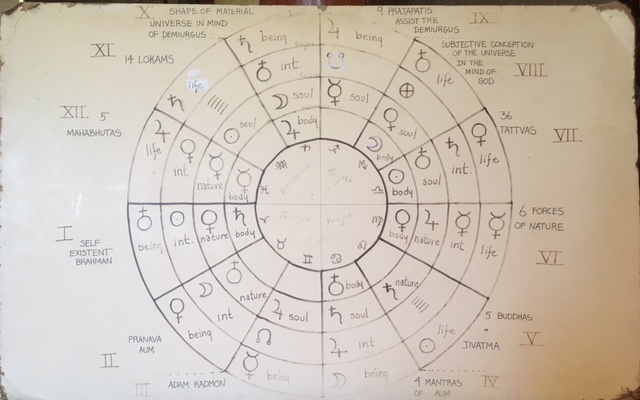
FIGURE IMG 2202-Posterboard Metaphysical Chart.
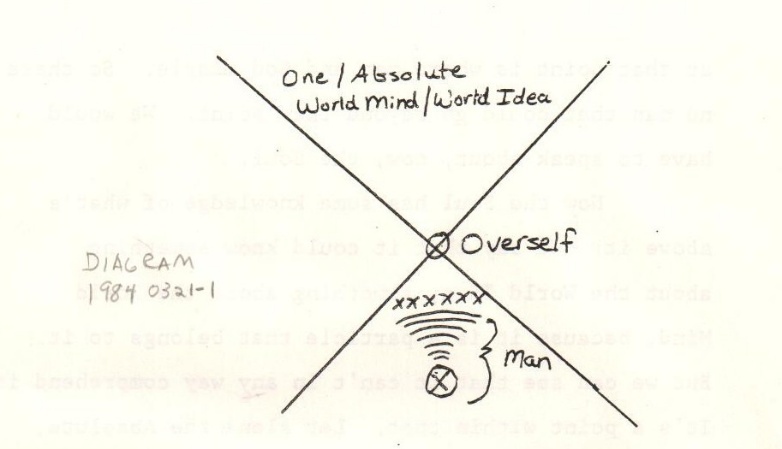
FIGURE 1984 0824a-2. Overself as Intersection of God and Man.
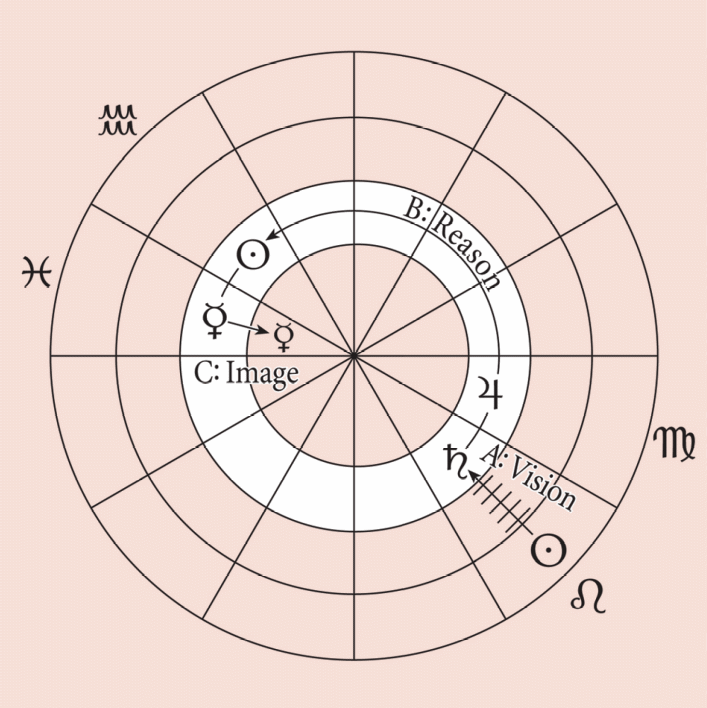
FIGURE 1984 0824a-3. Tripartite Cosmic Soul.
The second diagram is from Astronoesis, p. 202. Other diagrams also referred to are not with this transcript version. [Transcriber note: [diagram] means the speaker is referencing a diagram as he or she is speaking. If someone is drawing or writing, with audible sounds of chalk on a blackboard, I indicate this by [drawing] or [writing].]
NOTES:
This is 1983 08/24a, PB Books; Wisdom of the Overself Class, and the first entry associated with this date. 1983 08/24b = Buddhism Seminar from earlier in the day, for which we have no audio, just JF notes.
Anthony Damiani and WG group met with His Holiness the Dalai Lama Sept. 29, 1984, and therefore many WG classes in Aug-Sept. 1984 had at least a semi-focus on Buddhism.
Partial transcript (Scan File 1984 0824C1-13R01.PDF) exists.
This is a Friday evening class.
TRANSCRIBED Verbatim by IT 2019; reformatted by JRM & JF 2019-2020, with TOC/Subheads by JRM. In 2023, IT updates prefatory matter, footer, and audio file name, alters Subheads to make more accurate, completes Book List, fixes typos and minor errors, adds three diagrams and references within transcript to these diagrams. Archival verbatim transcript – V14.1a.
AUDIO FILES: 1984 0824a, 1984 0824b. [Note 1: "Tape" and "Side" refer to original audio cassette tapes that were later digitized into .MP3 Audio Files. Note 2: The first 24 minutes of the first audio file have mediocre sound quality.]
1984 08/24a at Wisdom's Goldenrod
PB Books; Wisdom of the Overself; "Birth of the Universe"
Archival verbatim transcript
FINDING FOUR SCHOOLS OF BUDDHISM AND THREE SCHOOLS OF VEDANTA IN THE WISDOM OF THE OVERSELF
[Audio File 1984 0824a Begins]
AH: --do not work with the distinction between [student assents] phenomena and object in their analysis. They don't note that distinction. A point that Anthony has made several times recently was that-- that Yogacara follows the Madhyamika and I'll just explain that very quickly in terms of (this) [one word inaudible] They refer to the three turnings of the wheel, three turnings of the Dharma wheel. That-- those are considered as three enunciations and discussions of their basic doctrine. The first turning of the wheel bases itself in Abhidharma. This is all in India, this starts in India, the Abhidharma tradition, and that the Hinayana schools of Vaibhashika and Sautrantika would be considered the first turning of the wheel, obviously the oldest. The second turning of the wheel is the Prajnaparamita tradition, Mahayana school, of which Madhyamika is representative in this approach. But that Mahayana tradition is close to many many cultures and places in the world, [S, faint: Yeah.] because we're not even talking about how the Chinese and Japanese speak about that. Finally the third turning of the wheel is the basis for the Yogacara view, which came last. And Anthony made the point several times that not to forget that Yogacara came after Madhyamika.
S (faint): Ok.
AD (faint whisper): Yes.
AH: It's a peculiar dilemma that we've struggled with from time to time. In the Tibetan tradition, Dalai Lama's expression of this thing, he would turn this little chart upside down, referring to the-- what's lower and what's higher. In their view, lower and higher doesn't mean what we mean by lower and higher. For them, higher means an approach with fewer ontic principles. They consider as-- that a higher view, not in the sense of superiority but in the sense of proceeding with analysis with fewer ontic realities. So, there's certainly two ways of viewing it. (You could) say, well, there's a pretty good case for saying Vaibhashika is actually the highest view because they certainly elaborate the most ornate and most sophisticated ontology. And then you can turn the thing over and you could say, well, there's this other way of looking, that Madhyamika's accomplishment is also being considered, that they express-- they express a view without ontic realities. And we've been around and around and around that, ok, and we're going to do-- go around it again tonight. And with that I'll turn control to our-- Tonight, Herb and Vic are going to discuss the chapter on the Wisdom, bring out the salient points, and Avery is going to help us understand [S simultaneously: Hey Andrew--] those points from the point of view of symbolism we're all familiar with. And whenever they come to a-- a possible point of synthesis, and then Andrew's going to wave a little flag (bit of laughter) of which school is being represented.
S (very faint): Yeah.
S (very faint): Yeah. (bit of laughter, student words)
AH: Ok?
RG/S(?): [couple/three words inaudible]
AS (simultaneously): And if it works out like that it'll be quite a nice little-- (some laughter)
VM (faint): It'll be American all the time, [S: Now--] seems like a--
AH: So I think-- should we start with the Wisdom, should we start with the chart? What would you like to do now?
S (faint): I would start--
MW (very faint): I would start with the Wisdom.
S (faint): Let's follow our (plan) that we made.
S (simultaneously, very faint): Ok, yeah.
S (simultaneously, very faint): That's not what he's saying.
S (very faint): [couple/three words inaudible]
AS (simultaneously): Let's follow our plan so that we don't get [couple words inaudible] Well, I guess also some of the things Andrew didn't mention, obviously if we're going to try and make some correlation with the four schools which I guess (would be on camera), then we've got to make sure we all understand the Wisdom in the same way to begin with, and that's not clear that we do. So it would be interesting--
S (simultaneously): Right, four people [couple words inaudible]
AS: It's clear that we don't so that's clear that everybody else doesn't either. So, therefore I guess we've decided that we should try and present a brief summary of our understanding of "Birth of the Universe". [students assent] And, just because it-- it felt like if we did that first and then tried to do Buddhism strictly after doing all that, we probably wouldn't get to Buddhism. The chances are very good that on [student assents] any one of these points in the Wisdom we'll spend much time discussing it. And that was the idea that in trying to outline the key-- the key points in this chapter, that we kind of try and flag them and bring in possibilities of correlations right now, even though I-- I think we kind of thought it would be best if we didn't discuss those possibilities too much, just point out, "Hey, this is a possible correlation with one of the schools." I guess one of the ideas is that--
DB (very faint): Avery?
AS (faint): Yeah.
DB: Avery, could-- would some of this apply to why this [one word inaudible] (that) we've been given this [one word inaudible] or--
AS (simultaneously): This is just going to say that, I was just going to say that. I-- one of the-- one of the ideas I think is that when PB wrote the-- this book on the Wisdom, do you remember(,) keep reading that one of the main tasks PB set himself was to translate the Eastern wisdom into Western terms. And certainly the things that he was versed in indeed were the Buddhist schools, he had this teacher in Therava-- um--
S (very faint): Cambodia.
AS: Cambodia, the Yaka-Kulgan school, and he certainly spent much time on the Vedanta. And so, although it's not something we particularly thought of before, Anthony just made this comment a few times and it seemed to just be, yeah, it's-- and if you-- if you look and see-- look at "The Birth of the Universe", it seems that this "Birth of the Universe" is a translation in Western terms of the source of the world and the World-Idea. And if that is indeed what the Buddhists are tracing, the ever-becoming of the World-Idea, then it seems pretty clear that perhaps the whole basis of this chapter is understanding of Buddhism translated into Western terms. And if indeed the Vedanta is always hitting the idea of an unchanging consciousness, then it seems pretty clear that the chapters on the Overself certainly and the Witness-I have to do with the Vedanta understanding of Atma and their pure consciousness, the unchanging unconsciousness.
So, represented within this one volume of PB, and that's only going up to the Overself, not to the reconciliation of Mind, but represented within PB's volume we have these two points of view that he's (beginning) with, changing consciousness of the World-Idea and the unchanging pure consciousness of the observer and ultimately the Overself (doctrine/chapter). And so, Anthony also did suggest that three schools of Vedanta should be able to be found in "The Secret of the I" and the-- and the Overself chapter and there'll be people who speak about that kind of thing too, you know [couple/three words inaudible] three schools [few words inaudible] [RG simultaneously: Which part?] [couple/three words inaudible] And, that might be a good contrast to the Buddhists. [student assents, faint] Now you want to know specifically why-- what-- you want to know specifically what is the Anthony approach to the immediate [DB: Well I--] end that we hope to achieve [DB simultaneously: Right, I know-- I know what that is, ok.] [couple/three words inaudible] particular products of paper. [DB simultaneously: Right.] Some people would have to follow along (on paper).
DISCUSSION REGARDING UPCOMING DALAI LAMA AUDIENCE
DB (faint): Right, right, I thought maybe [few words inaudible]
AS: Well, yeah, or maybe we could-- [RG, faint: I don't know.] maybe we [S simultaneously, faint: I don't know.] could say something about that. [S: Ok.] Anthony's suggestion was that, well, we should think of some questions for the Dalai Lama. And since we didn't seem to be able to come up with the right questions on our own, (AS laughs a bit) he further suggested that a thing to discuss with him was this very chapter and our understanding of the four schools in terms of this chapter on the birth of the universe. Now, it's not clear the logistics of how that would go about. Obviously if we spent the whole time of our interview telling him our understanding, we'll get very little from the interview. (bit of laughter) On the other hand--
VM (faint): And that's all (it ate). (laughter)
S (amidst laughter, faint): (But Steve--)
AS (faint): The soul is pure.
RG: Good point, good point.
AS (simultaneously): On the other hand, there's been a continual problem of finding some common medium by which we can communicate with the people. Some of the people we've met are like Serkong and so on, and we're sure that our understanding is tremendously-- problems [one/two words inaudible] trying to communicate terminology. So it seem-- I just got the feeling that if we could find some way of-- and now I don't know how but (prior) presenting to the Dalai Lama how we view the four schools in terms of this chapter and if he could correct our understanding and tell us, you know, whether our correlations and so on with this particular view of PB were more or less correct, we might have a common ground for some kind of communication or some kind of a dialogue. Maybe-- maybe the terminology in the Wisdom would serve-- kind of like suppose he said, "Yeah," you know, he reads this stuff and says now that--
RG (simultaneously): When's he going to read this stuff?
AS: Well that's a problem.
S: No he can't. (bit of laughter)
VM (simultaneously): [couple words inaudible] go [S simultaneously, faint: (Well--)] like this with your-- (bit of laughter)
S: No.
AS: No well--
S (simultaneously): Are you sure of this or--
HS (simultaneously, faint): What do you think?
AS: Ok, well, this is a logistical problem.
RG: This is a-- (bit of laughter)
CDA: It's more [RG simultaneously: This is news to me, I--] than that, (laughter) it's more than logistical.
AS: Well, [RG(?) simultaneously: A bit shocking but--] ok, [MW simultaneously: (Maybe--) maybe he could read the--] then let's-- then let's say that-- then let's-- then let's-- then we could just-- we could just perhaps (try that), in order to prepare ourselves for this talk, that at least our understanding of the four schools should be firmed up as much as possible in terms of something that we supposedly do already understand, [S simultaneously: Yeah Avery.] and that would be a help.
VM: I would think we'd generate some help.
AS: We'll generate [one word inaudible]
LR (simultaneously): What were (you asking about)?
VM (simultaneously): Good questions.
AS (faint): Yeah, fine [one/two words inaudible]
CDA: Yeah, uh-hm.
AS (faint): I'm sorry, I didn't let you say anything but go on.
CDA: No, no, it's just-- it's like, I don't know if this is the time and place but--
AS (faint): For?
CDA: I understand that the value of-- of our attempts to understand the (status today), invoke, you know-- that is the-- part of our training here. I've always felt [one/two words inaudible] at all. I've always felt in the previous interviews or previous opportunities we've had with the Dalai Lama that we-- there's been this sort of-- we've tried to show off a little bit. And, I've always felt that we've missed something and I felt that we've missed part of the opportunity because of [couple words inaudible] you know. And I just started getting scared when you started talking that-- [AS, faint: Ok.] that that was going to happen again.
AS (simultaneously): Well I-- I'd-- I'd like to speak to that because I-- some people [one/two words inaudible] have said that also. And from my understanding, a remark or two I think he made to Richard [couple/three words inaudible] Richard, this little interchange with him when he was up in Toronto, that this was the mo-- perhaps the most valuable thing we could do in an interview with him, try and understand. It's true it's our way but he said after the-- he said-- I mean at the end of the talk in the library and at the end of the talk up in Toronto he said he really enjoyed talking with us about it. He said "I can't make you enlightened but I can try and impart the doctrine and help you understand it." I mean that was-- I mean that-- I'm not quoting exactly.
CDA (simultaneously): You're taking that out of context though.
AS: Well I-- well I don't know. I don't-- I don't know but I-- I mean-- I don't know if we need to-- want to go into length-- I don't think a lengthy discussion of this and so on, maybe I-- but--
VM (simultaneously): Maybe you can just leave out [one word inaudible] By discussing this chapter and the four schools and kind of getting our head back into [CDA simultaneously: Right, right, I think that's more what's happening here, yeah.] Buddhism, some good genuine questions would come up that we've been thinking about, so what we'd like, we're trying to wing it, (decide) enough to finally say well what should we ask him? You know, these [CDA assents] will come from your own efforts, and maybe through that kind of approach we can get the most out of the interview, if it is even conceivable, although I agree it seems [one word inaudible] that we'd actually have something in the way of a moderately finished paper or something. That seems hard in such a short time given his writing.
AS (simultaneously): Well-- yeah. [SP/S(?) simultaneously: Yeah.] That was-- I mean that was-- it seemed like that would be [VM simultaneously: Well that might be-- yeah.] the best thing, that he probably wouldn't have time to read it but if there were two or three pages we could get to him beforehand, that-- that might be possible, I don't-- I don't really think that it's possible.
AH: Little bit, little bit more perspective on doctrine. The initial assignment was to work a little bit on Tibetan Buddhism because we're going to see the Dalai Lama. And your-- Anthony's suggestion was that this Buddhist study and research continue and branch out into other areas of philosophy. So, and then recently what the suggestion was, that we should approach these four schools of Tibetan Buddhism by way of a comparison and-- with the Wisdom. So, I'm pretty clear about-- personally I'm clear about what it is we need, so let's take the [one word inaudible] right now.
LR: Oh, ok.
S (simultaneously, faint): Oh yeah, say--
AS (simultaneously): Ok, well let's-- so--
RG: Could I just ask what-- Sid-- Sidney here, is Sidney here?
HS: Sidney is here.
S (simultaneously, faint): He's in the back.
RG: Sidney!
S: Sidney.
SP (simultaneously): What?
RG: What do you think?
SP: I think this preparation is good and I think, you know, there should be allowance of Dalai Lama to like bring up some of his own topics too, you know, it doesn't go-- you know, trying to force something which is-- you know, (it/there) has to be some kind of balance between our own in-- inquiry and then, you know, what he may have in mind to impart. And so, you know.
RG (simultaneously): But how did you feel the other meetings with him went?
SP: How did I feel what?
RG: How the other meetings we had with him went.
SP: I thought they went pretty good, I mean-- I mean I had a positive feeling about them. I was a little concerned when I heard about doing a paper because I felt it might be too forced and at the end when somebody says well the time's up, you know, there may have been things that he would want to say to us. I could certainly say there was certain [one word inaudible] he had, I wouldn't-- wouldn't want to exclude the possibilities, you know, or he got something in mind or, you know, even if he seems casual, just like general conversation, he probably has a purpose to what he says and I really would want to respect that.
[student assents, very faint]
S (faint): Super.
AS (simultaneously, faint): That was the idea of not [S simultaneously: Uh-hm.] presenting something (done), [SP assents] that it would (put against) something more important. Certainly we wouldn't want to do something like prevent him (wanting to think), that was the idea.
MW (simultaneously): That's how I would see it [couple words inaudible]
SP (simultaneously): I would seriously doubt that he would be able to read it beforehand, [GA, faint: Yeah.] and I-- you know, there's a chance but I would seriously doubt it. And I don't know-- I mean I'm not saying not-- you know, you shouldn't do it or anything but I don't know what his capacity with English is, you know, [AS simultaneously: But--] and-- and in terms of the technical terms he may want to work with a translator to go over the paper, but, you know, just [AS simultaneously: Yeah, yeah.] [couple words inaudible] not be the time or [couple words inaudible]
BS (simultaneously): However, do you think-- if it could be done do you think it will do any harm to present our up to date understanding [couple words inaudible] limitations, if it could get there ahead of time, would that do any harm?
SP: Well, I don't think it would do harm unless-- if it was done properly so that it wouldn't appear as if [one word inaudible] we forced us to have [few words inaudible] in other words, in an honest kind of way, you know, then--
S (faint): What?
S (very faint): Uh-hm.
DB (faint): One of the things that I thought of when I was-- I was hoping to get involved was what happened up in Toronto. (We/Well he) came and we sat down and he proceeded to say what he's been doing for the last year and a half [few words inaudible] so on and so forth. He got through this thing and he said, "But what have you been doing?" And we all sat there.
SP: Well if he said something like that then it would be appropriate to say, "We've been trying to understand the four systems and this is what we've come to and"--
VM (faint): Well we've-- alright.
SP: You know. (bit of laughter)
S (very faint): Uh-hm.
S: Right.
SP: I mean that's a case of, you know, give and take where there was an opportunity to-- to say something, you know, and this kind of preparation I think is real good.
DB: What you're saying is that if the opportunity were to present itself it would make sense to [few words inaudible] I mean if he asks.
SP: I don't know.
S (faint): He'll just leave.
VM (simultaneously): I think, putting it briefly, [AS simultaneously: Yeah.] prepare as much as we can, let's do it, whatever [student assents, faint] we do.
LD: Yeah, I mean even-- even if he doesn't read the paper it's not going to hurt us to do it, that's-- that's pretty certain.
VM (faint): It could focus us.
AH: Or we could-- we could correspond after the visit, we send a paper and maybe months down the road we get a response. I don't think it's--
SP: Yeah, right.
S: That's right.
AS: No we're not-- I mean, this is by no means no set game plan. This is ju-- you know, general outline from Anthony that it would be profitable to try and correlate the Wisdom. And if we do Vedanta and the Buddhism then I think he could speak with that. And probably we can't determine right now what's going to come of it anyway, [SP: Yeah.] so--
SP: Yeah, this [AS simultaneously: I--] might have been real good to do six, eight months ago or a year ago instead of now. (laughter)
S (amidst laughter): Yeah right.
RG (amidst laughter): Right.
AS: Well--
SP: I mean, you know.
AS (simultaneously): We do it when we do-- [S simultaneously: Yeah.] better late than never.
SP: Yeah.
AS: It's called cramming.
AH (faint): Kathy, did you (have something)?
KD (simultaneously): Um-- Maybe something that-- you know, that-- when you say a paper it sounds like very final to me, like something's been completed, you know. And, maybe what would be a-- a better idea is to-- is to get questions [couple words inaudible] so that people aren't speaking off the top of their head. And maybe after-- you know, after two months of doing these classes some-- some real penetrating questions could be asked and they could be (reception) before or else, you know, a couple good questions maybe.
S (very faint): Yeah.
AS: Ok.
KD/S(?) (faint): Yeah. Uh-hm, yeah.
AS: I think that's pro-- that's probably what I think would-- will [S simultaneously, faint: (Well--) yeah but the--] come of this [few words inaudible] particular thing.
VM: We'll do the work on these four schools and maybe those questions-- our questions--
S: [few words inaudible] whether--
S (simultaneously, faint): Uh-hm.
VM: Then it was satisfying the openness [S: Yeah.] required of the situation. On the other hand if he says "Well do you have any questions?" [S simultaneously: We have (one/two words inaudible)] [three/few faint inaudible student words simultaneous with VM and S] No, we've had a chance to reflect on them and say this is the ques-- the question, it's a good one, we feel that it's [one/two words inaudible] Or whatever.
LD (simultaneously): Yeah, it leaves a choice up to him.
VM: Yeah, right, leave the choice to him, say "If you have time or day or two"--
BS (faint): [couple words inaudible] yeah.
KD (simultaneously): Yeah, and also, also it would save time because he wouldn't have to translate [VM simultaneously: Sure, all that horsing around.] right-- right then, he could get the trans-- translation [AS assents] correct. It would--
LD (simultaneously): And if he did think a question was really important [few words inaudible] [S, faint: Yeah.] Say, "Well, I'm glad (to/you) see you're working on that." [few words inaudible]
VM: Well good.
S (very faint): Yeah.
AS: Well-- So I don't know what's next or-- We-- we worked last night and there was a lot of energy, maybe (for what it was) [one word inaudible]
S: You want the paper?
AS: We've-- a lot of energy. We've got through most of the first two sections. So that's what we'll concentrate on, bring those points from there. And of course people should-- some people have points [three/few words inaudible] not of class but more general. I think (they've established them) [VM simultaneously: Sure.] a long time ago, (a) long time ago, and it seems why try and understand something first that-- not that we all agree on it but--
LD: That's a-- [S simultaneously: Yeah.] just to interrupt you for a second, Anthony did say that, you know, he said the Friday night class will develop into a-- a really great thing, there's enough material that everybody can get involved.
AS (faint): Right. And that--
LD (simultaneously): There's a lot to be (constantly) thrilling.
AS (simultaneously): [couple/three words inaudible] I think that's real important.
LD: He said it can develop into really something pretty good.
AS: Yeah, I think it is important Louis that as many people as possible really get involved in this. I don't know why I'm-- I-- I had this crazy idea that I would present the diagram but it turned out that (bit of laughter) that didn't work. So, I'll just start off with it.
S (faint): Well that shouldn't be, no.
S (faint): [couple words inaudible]
VM (simultaneously): I thought that-- (student laughs) to see how much agreement we came to (after) and just to-- and I would like to see it again unless you feel strongly to [one/two words inaudible]
AS (simultaneously): Yeah. No, no, no, I don't-- no I was going to do it [VM simultaneously: Oh ok.] but I'm just saying that--
VM: Oh yeah, that's not the-- the final word but-- but then again that's ok.
AS (simultaneously): No, no. It's not the final word, I want to-- (bit of laughter, student words)
MW (laughing): But we already have the final word.
S (very faint): Get out of here.
MIND, WORLD-MIND (SOLAR LOGOS), WORLD-IDEA; KARMA, CAUSALITY
AS: Ok. So, we've done-- we've done this chapter in terms of cosmology before. I thought it might be useful, try a little bit of a context. We-- we start off right with the first page and he talks about the World-Mind and its own self.
[Transcriber note: I am using The Wisdom of the Overself by Paul Brunton, Rider and Company, London, 1943.]
PB [The Wisdom of the Overself, "The Birth of the Universe," p. 27, AS reading]: "…the World-Mind manifests something of its own self in the cosmos. And its own self, as will be shown later, [AS reads: And as it will be seen, this self] being uniquely eternal and undying, it is [AS reads: it's] inevitable that the world-ideas which [AS reads: that] have arisen within it are eternal and undying too."
AS: And, no sooner that you finish that, that he speaks about--
PB [The Wisdom of the Overself, "The Birth of the Universe," p. 27, AS reading]: "Mind is…"unborn, uncreate, unoriginated"."
AS: And he immediately starts speaking about this continual process of ever-becoming, which is an eternal one and a law of the universe's own being. So right off the bat, ok, we've got, you know, six or seven different terms [few words inaudible] In particular, what does he mean by World-Mind and that it manifests something of its own self, and that there's this-- these innumerable causes stretching like an endless chain and so on. So I pulled out the old diagram. And we had some discussion about this. There's a-- there's a point [student assents, faint] that really was a problem. Maybe Richard'll-- Richard uses a--
VM: Wisdom.
AS: Either Wisdom or, [AD simultaneously, faint: Wisdom is--] you know, (that/bad) example. The point we talked about with buddhi. Buddhi. [S, very faint: That's right.] Question-- In a cosmological context, we've interpreted this World-Mind as the Solar Logos. And it seems to me that he's talking about the-- the eternal or immaterial intelligence of Mind which we could say is a formless Mind, formless Ideas, and that within that there is the-- let's say that's this universal intelligence and within that we have-- within or without-- we have this World-Mind or Solar Logos, which is going to manifest something of that uniquely eternal and undying self in and as the cosmos. So looked at from within, we just have this reality of Mind. And whether we say that in that reality of Mind there's a universal intelligence or immaterial formless Ideas or anything else, there's nothing to be seen, there's no manifestation, it's unmanifest. [VM simultaneously: What's wrong with the microphone?] Ok? So that's good.
VM (faint): The microphone on?
S (very faint): Yeah.
AS: Yeah. It's on. Ok. So, something-- "something of its own self" is Mind. Mind must be the self of World-Mind and that's Divine Intelligence, Universal Ideation. PB even has a quote where he ma-- where he calls the World-Mind the Adi Buddha and he says--
PB [V16, 27:2.9 & Persp., Ch. 27 #13, AS reading]: "The World-Mind is called Adi-buddhi in the Nepalese-Tibetan esotericism [AS reads: esoteric tradition]: meaning Divine Ideation, [the] First Intelligence, the [AS reads: or] Universal Wisdom."
AS: But that's nice, I mean that's [couple words inaudible] So, I thought then-- now then if we delimit [drawing] our context and say that the World-Mind now-- now instead of speaking of the Mind's self, Mind, we now talk about manifestation, we're going to be talking about that within this immaterial or unmanifest intelligence, there is this World-Mind which is the active aspect of Mind [drawing/writing] and that this World-Mind is manifesting the cosmos. And so, I was trying to equate World-Mind with the Solar Logos, a Solar Logos. PB makes clear in a lot of places that there may be many World-Minds coming in and out of manifestation. But we can ignore that I suppose and just speak about the World-Mind as the Solar Logos manifesting something of itself in the cosmos. And so, I tried to-- just to set this as a context before we [one word inaudible] do-- do this outline. And maybe Anthony can comment on it. Well, ok, so-- So--
PB [The Wisdom of the Overself, "The Birth of the Universe," p. 27, AS reading]: "…the World-Mind [AS: he says] manifests something of its [own] self in the cosmos."
AS: And, I think this is-- this is very similar to things we've done in many other places but-- that this immaterial intelligence of the Ideas, unmanifest, is being manifested by the Solar Logos as the cosmos. And so that the cosmos is not a thing but is this incessant energy of ideation. [drawing/writing] [S, very faint: Ok, right.] Ok? We could say that these World-Ideas, the immaterial World-Idea, is manifesting-- Now, as manifesting, it's pulsating, it's active, it's in flux, it's con-- it's instantaneous, instant-by-instant vibratory activity. As unmanifest, we could say, without considering World-Mind, just the stillness of Mind, we have unmanifest Ideas, unmanifest Intelligence. But when we speak about World-Mind, we're speaking about this continuous energy of ideation manifesting a cosmos, and that this is-- this is the context he's going to speak about. He's going to speak about the birth of the universe not as some historical thing but as the eternal or perpetual ideation of Mind, ok, and it seems that the [drawing] context then could be that the Mind-- the World-Mind he's speaking of is the Solar Logos. I-- [short pause while drawing]
We could, I mean-- it seems we could speak also of the-- the Mind of our world as conjoined with that Solar Logos. And so this cosmic ideation instant-by-instant would be indicated by the whole condition of the Undivided Mind, [student assents] the entire Solar Logos, and that instantaneous-- either you want to say the instantaneous position of the planets or the instantaneous differential of their movement indicates that instant-by-instant manifestation. In any case, what the whole-- the context is completely within the realm of the Solar Logos' activity. Now, even in physical terms we talk about the light of the Sun as what is 98 percent of our universe, and in this case, the obverse side of that is saying that this-- the subtle nature-- the-- what that Sun represents is this energy, Fohat, or the energy of the Sun's ideation [drawing] projecting a universe. The background may be, in fact is, the Universal Intelligence, which that Sun is manifesting. But in this chapter at least, he-- his reference to that-- his references to that are mainly by way of principle and not directly involved in this ever-becoming activity. So, I mean, in a lot of places in the Perspectives and elsewhere, even-- even later on in "The Unveiling", he talks about the World-Mind-- if I could find it-- [student assents, faint] He says that--
PB [The Wisdom of the Overself, "The Unveiling of Reality," p.194, AS paraphrasing]: "The aspect of Mind as it stands in inseparable relation to the universe is called World-Mind. If we regard it as infinite, transcendent Being, self-contemplative wherein it is solely aware of itself we call it Mind but if we consider it as bound up with the cosmos, self-evolutionary, wherein it progressively manifests the world and thus limits its own life and consciousness, then we speak of it as World-Mind." [Note: The actual quote reads as follows: "Thus Mind exhibits two aspects: the first as self-contemplative wherein it is aware solely of itself; the other as self-evolutionary wherein it progressively manifests the world and thus limits its own life and consciousness. The first aspect is sheer Mind-in-itself. The second aspect is Mind as it stands in inseparable relation with the universe. The first we call Mind and the second World-Mind, but both are really one. We can arrive at a correct notion of God only by thinking of it in these two ways. If we regard it only as an infinite and transcendent being wrapped up in the static contemplation of its own perfection, remote and aloof from this finite world of ours, we see only a half of the truth. If we regard it as the universal energy working actively within every cell and every star, creating, preserving and destroying tier after tier of its space-timed universe, inspiring an evolutionary endeavour in countless series of conscious creatures, we see the other half. The World-Mind possesses both characters and is at once power active in the universe and absolute being withdrawn in rest."]
AS: So, it seems that we could use this context of the Solar Logos as the World-Mind and in other terms we've spoken about that ideation or the constant fluctuating of the World-Idea as the reason-principle of the universe which is of contrariety of all these different parts. Ok? And that this process of ever-becoming he says is an eternal one. And the reason-- the reason why it's eternal it seems is-- I mean we do have to go back to this context of saying that because these-- because [drawing/writing] Intelligence is eternal, the unmanifest Ideas are eternal, ok, that because that's eternal that the emanation of those Ideas is also perpetual, never-ending. There's no time at which this Divine Intelligence will cease to exist and therefore there's no time-- I mean there's-- there's never any time at which this pulsating ideation will stop-- will stop energizing. The Intelligence is always emanating.
Ok, and then just-- Almost done. Then there are-- then there's this question, the next-- the second main-- or the next main point is the idea of this ideation is governed by certain laws of karma, the ideation-- in connection with ideation we have to talk about these laws of causality and what we mean by causality. In one sense, in one sense we can see that they're-- it's non-causal, it's the appearance or the manifestation or emanation of Mind. But in another sense he says now within that pulsating ideation, the-- the ideation may be a whole, in other words, the entirety of the-- of the reason-principle or idea is manifested instant-by-instant. So in that sense, there's no real causality within it. Because if the thing is manifested entirety instant-by-instant, [drawing] then within that manifestation you can see there isn't a real causality of A to B. The real causality is that this ideation is being instantly-- instant-by-instant put forth by Mind. So in that sense that's the real causality.
But now within that momentary series of stills, there is another kind of causality which in-- which adjusts this kind of historical-- there's a kind of a historical causality in which innumerable causes he says stretch like an endless chain through the beginningless past. And even here it's not a one-to-one causality. It's like the entirety of one instant is going into the formulation of the next instant and this he says is possible because of this notion of the World-Mind's memory, which he calls karma. Ok? So although the World-Mind emana-- manifests, and it can manifest anything because of its protean imagination as he says, the emanation or manifestation or ideation is subject to its own law of internal consistency, ok, and in this sense he says then the universe also constitutes a self-actuating system. There are these laws inherent to its own-- to the manifesting activity.
Ok, this is very general, this is all very general and, I mean, you can't argue with it because I haven't said much. (AS laughs a bit) Or maybe you can, but-- you can argue with anything. But then the question is to pin down more clearly some of the lines in here that he uses, what exact-- what are the different views of causality that he illustrates with his ideation and what does he mean by karma and memory. So these are some of the things that we took up.
VM: Uh-hm.
AS: And-- you know, if-- if we can put any more of them on the picture as we go along-- one-- just one before we pass on to that, one [drawing] further thing that's going to be a big problem is this levels, distinctions of levels we kept hitting, talking about the memorized impressions as within the Dragon as this process of ever-becoming but also talking about the World-Mind as a whole, let's say the Solar Logos as having the karmic forces within it. Was he speaking of two levels of memorized thought-forms, you know, I mean-- In-- in others-- in some of the Buddhist systems there are two levels of thought-forms or seed-forms. Can we find that in here, I mean can we make those distinctions in here? Maybe-- maybe we can and then he'll-- we'll see how he uses them slightly differently. You know, the Dr-- the notion [drawing] of the Dragon as the-- the images of that ideation and yet the World-Mind itself or the Solar Logos must hold within itself, its inerratic sphere or something like that, these-- these eternal-- as he says, eternal immutable forces, what we just said. [student assents] [short pause] Like he says the excitation of karmic impressions, you know. Is this what he means by karmic impressions, those tropes that we find in the Dragon? [VM: What if you don't know?] Or-- or does-- or is he also speaking of these karmic forces when he says for example--
PB [The Wisdom of the Overself, "The Birth of the Universe," p. 27, AS reading]: "…the [world-]ideas which have arisen within it are eternal and undying too."
AS: And--
RG: And how [AS/S(?): Yeah.] about the ones that come from the Overself?
AS: Hm?
RG: What about the ones that come from the Overself?
AS: Yeah, what about those?
RG: I mean those seem to be a third, if you don't, I mean-- [student assents] which is in here too.
AS: Yeah, it's in here but where?
BS (faint): Do you mean to an individual?
AS (simultaneously): Not to-- in the individual.
VM (simultaneously): It's in the first two sections.
RG: Yeah.
VM: Well [RG/S(?) simultaneously: I mean try(--/.)] we're going to try and-- even that's fairly ambitious, to keep [S simultaneously: Well (few words inaudible)] focus primarily on the first two sections, "The Birth of Individuals".
RG: Ok.
AS: Yeah, that will be [VM simultaneously: Yeah. That's--] a que-- because that's-- that will be a good question [VM, faint: Yeah.] later on, [student assents, faint] to bring in the Overself. In the first two sections he doesn't [RG: Doesn't.] so we can speak of the whole things as a cosmic process [RG, faint: Ok.] and at least focus on that first before-- That worked out well without bringing in on top of that the problem of the individual.
S (very faint): Ok.
AS: There's one-- so this one-- Ok, well--
LDS: So Avery, just to review some of the issues that you've brought up. We're trying to decipher what level of ideas he's working with in this "Birth of the Universe", where the law of karma and this notion of memory fits in this scheme, [AS assents] and you've delin-- delineated-- delineated the World-Mind here as a-- as a Solar Logos.
AS: Right, [LDS simultaneously: So--] yeah, we're try-- I'm trying to do that, see if that works out.
BS: Well, if you-- Avery, if you haven't [AS simultaneously: Yeah.] got the individual and have the Earth-consciousness up on your diagram there, in the-- in the universe, individual or humans or any form of life is taken for granted along with the Earth. So it's possible to consider in a personal way the individual included as part of that consciousness yet not separate-- separated out as a human consciousness [couple words inaudible] the second law of karma. And it would be possible, at least I thought it's-- it's almost conceivable to collapse that diagram into one and have the Undivided Mind as one diagram [AS: Yeah.] and every law would be immanent within it. You still will have the twofold seed. And then when you deal [AS drawing] with the individual within that you still would have two seeds.
AS: Yeah, I guess you're saying we could, if we wanted to, [drawing] this is an alternative simplified diagram where we could talk about ideation just in terms of this Earth putting forth this world-image. And that the seed-- the impressions, the memorized impressions were right here.
BS: Yeah because it already would include within it the Ideas.
AS: Uh-hm. [drawing]
BS: But I suppose you could say it's the same thing except you divide it into two parts.
AS: Ok. Anyway the-- the only-- the main point, let me-- let me try and say the main point I wanted to make and then we should turn it over to them because I-- I mean I--
S: Yeah, they're going.
AS: Them or him or however many are left, (the chart's on) them. But-- if-- it seemed-- it seemed to me that there-- that there were two-- there were two notions of, let's say, causality that were going on here, and that these two had to be kept in mind. On the one hand, we're talking about causality almost as a non-causality. In other words, instant-by-instant this ideation of the World-Mind, the instantaneous becoming of this whole manifestation wherein you couldn't say one part of it caused another because the cause so to speak is this emanation of Mind of the Ideas or ideation. But now within that, there's also this historicity in terms of when the Mind manifests it leaves a trace, it's-- the Mind itself takes a form incessantly and there are traces of this. So the manifestation has to obey the conditions of all its previous manifestations. Now those conditions are actually within the thought-moments themselves, and so within the thought-moment there's a certain historicity. But even there it's not an Aristotelian A-- one cause and one effect. Even within that it's the totality of previous thought-moments as it were that are going-- stretching back he says to the beginningless past which are going to condition the next thought-moment. [S, very faint: Yeah, uh-hm.] And perhaps--
LDS (simultaneously): I don't see why you put that within the thought, why that kind of thought--
AS (simultaneously): Because I think that that's inherent-- he says the-- this universe is like a self-actuating system and inherent in the very ideation is the law of its ever-becoming, the laws which adjust effect to cause and so on. So I-- I'm trying to look at it, saying look, this ideation is happening instant-- [drawing] instant-by-instant the Mind is emanating them or ideating, but that ideation includes within it the seeds and conditions of its prior manifestations, and those go to condition the manifestation. In other words is it doesn't ideate arbitrarily but it has to obey the very laws of its own historicity, the manifestation of the universe has to obey its own [couple word inaudible]
LDS (simultaneously): Well I've always thought of that law of karma as being extrinsic to the Ideas.
AS: As extrinsic?
LDS (simultaneously): In a s-- in a-- in a way governing the manifestation of the Ideas rather than saying [AS: Yeah.] that it comes from within the Ideas.
AS: Well, I think-- well, remember, the Ideas, and Michael made this nice point, that the Ideas or Intelligence themself-- [drawing] I mean, if we speak about Ideas, [LDS: On that level.] this is Ideas also [diagram]. So [LDS simultaneously: Yeah.] in one level we're speaking about the law of karma applies to everything, he says any ideation, the whole manifestation, ok. And on other hand, he says there's also this specific one. And I-- [drawing] I think we took-- you know, in some way we could see this as the specific one, as-- as the traces of the prior activities of all beings say just within the Earth sphere or within any sphere. Well, I don't know, that-- that was one-- that was a view of causality, that there are these two notions. I guess I got-- I got-- I got off on that because of something we were doing in another-- another class, but--
S (faint): Well, ok.
VM: What--
AS (simultaneously, faint): Well go on, finish it.
VM (simultaneously): I thought we-- the way we agreed that we would proceed last night was try and keep this-- the diagram in the background and supplement it by reading selected quotes from these two sections, the idea being to help put these quotes in a context and also to maybe draw out some of the implications of the diagram and back and forth sort of thing. So, if I understand it, Herbert and I are just going to pick quotes that we feel are supportive of the ideas that we really want to get out.
S: Ok.
VM: And-- so, for lack of a better place to start, I'll start sort of in the beginning and try to work forward as the chapter proceeds. Everybody's got-- not everybody has a book but there are probably many editions. So what I'll try and do since there seems to be no more sensible way to do it is to mention the number of the paragraph, because you can't say "page" or anything like that, it's hopeless. So this is from the third paragraph in the chapter, starting from the top. And, it goes something like this.
PB [The Wisdom of the Overself, "The Birth of the Universe," p. 27, VM reading]: "In the same way…"
VM: Well, the same way as what? Oh, I guess I should (maybe) read the whole paragraph. Well I want [AS drawing] to focus on the last couple of sentences but we've set the stage.
PB [The Wisdom of the Overself, "The Birth of the Universe," p. 27, VM reading]: "The cosmos, being a thought-formation, can never really disappear any more than a human idea can really disappear when it is put aside from attention. [VM: Ok?] We may understand this point better by considering how thoughts exist in a man's mind. What happens to them when they vanish? Where do they come from when they appear? At any time he can call them up again even though during the interval they have seemingly been non-existent. His ideas are manifestations of his own mind, not creations out of some external stuff."
VM: Ok? That's a big point, this-- something-- like the ideas being creations out of-- out of an individual's own mind-- own mind and the parallel with the World-Mind is made. But, the sentences I want to focus on are here.
PB [The Wisdom of the Overself, "The Birth of the Universe," p. 27, VM reading]: "In the same way the World-Mind…"
VM: Or, we were trying last night and I think with reasonable success to use the term cosmic soul or Solar Logos, Sun soul.
PB [The Wisdom of the Overself, "The Birth of the Universe," p. 27, VM reading]: "In the same way the World-Mind [VM reads: cosmic soul] manifests something of its own self in the cosmos."
VM: Now, maybe we're doing-- well, let me read it-- finish it.
PB [The Wisdom of the Overself, "The Birth of the Universe," p. 27, VM reading]: "And its own self, as will be shown later, being uniquely eternal and undying, it is inevitable that the world-ideas which have arisen within it are eternal and undying too."
VM: Well one of the things we were trying last night was to see this quote in the following way. When he says here "In the same way the World-Mind manifests something of its own self," we were trying to interpret "own self" as being this unmanifested Intelligence that Avery has outside the primary circle there [diagram]. If you like, just think of those perhaps as the Intelligible Ideas in the Nous.
AS (simultaneously): Uh-hm, yeah.
VM: Go ahead.
AS: Just to say that outside or inside, if this World-Mind itself has this inner nature to it then-- yeah.
VM (simultaneously): Of course. Outside, inside are really not [AS simultaneously: Ok.] quite relevant. Symbolically we could say these are the unmanifested forms of these Intelligences and to speak about outside and inside is kind of meaningless but, symbolically they're outside the circle. Ok. The World-Mind manifests something of its own self, its own self being these eternal principles or Ideas in the Nous.
PB [The Wisdom of the Overself, "The Birth of the Universe," p. 27, VM reading]: "And its own self, [VM: Or these intelligibles if you like.] as will be shown later…"
VM: I assume--
(Side 1 of original cassette tape digitized as 1984 0824a Ends; Side 2 Begins)
S: [one word inaudible]
HS: And this is ok.
JL: Go ahead, Herbert.
HS: Ok, that was Louie.
LDS: To say that you're within a cosmos is to say that you don't have static Ideas, in that context, yeah.
VM (simultaneously): Right, the-- the emphasis of this chapter would be in the unfoldment of these Ideas, not in their-- their static eternality.
LDS (simultaneously): Not in (the paradise--) not in (the paradise) realm.
VM (simultaneously): Right.
HS: Ok but [AH simultaneously: Right.] yet, yet as Steve points out and in the next chapter, I think it's chapter 4-- paragraph 4, he talks about the stuff and it is eternal-- of universe itself is eternal because the stuff you can ultimately trace it to is nothing else than Mind and there's no conceivable ginni-- beginning and no conceivable end. Now, [S, faint: Well, ok.] again, wha-- you're talking about the eternal Ideas manifesting as the universe, it's-- for me I was trying to-- I was trying to think in terms of-- I get-- like eternal manifestation, it's hard for me to-- to come to that idea. It seems that I sort of want to go to like a stasis, like a being that has static reality and then on that kind of static reality [VM: Wait a second.] there's like-- there's a movement which emanates out of it. And I-- and I don't know if he's not talking about Ideas here as living Ideas, as participating like life itself and in that sense they-- like what i-- what does-- what does he-- what does like a living Idea do? It lives, you know, it's alive.
VM (simultaneously): How about this chapter-- this paragraph 10 Herbert, we've [HS simultaneously: (I don't know). Yeah.] tried to read that 10 several times.
THE SOLAR LOGOS MANIFESTS SOMETHING OF ITS OWN SELF BY AND THROUGH THE USE OF THE IDEAS; DISTINGUISHING SOUL AND IDEA
AD (simultaneously): But, could we read that paragraph again?
VM: Which one Anthony, the one--
AD: The cosmology.
LR: The one you just read.
VM: The one I just read?
AD: Yeah.
VM: Quote 4?
S: 3 to--
S: 3.
VM: 3 rather. Uh-- yes.
PB [The Wisdom of the Overself, "The Birth of the Universe," p. 27, VM reading]: "In the same way the World-Mind manifests something of its own self in the cosmos."
AD: Now, he's saying there if we-- we're equating the Sun, ok--
VM: I'm saying that's the cosmos in this sentence.
AD (simultaneously): Yeah, we can call that the World-Mind.
VM: Yeah.
AD: We're saying that the Sun is manifesting something of its own being [student assents, faint] [VM: Yeah.] through-- by and through the use of the Ideas.
S (simultaneously, faint): Ideas.
VM: Yes.
AD: Is that what he's saying?
AS(?): Yeah.
AD: Is that what you were saying?
AS: No, that's not what we were saying.
S (simultaneously, very faint): Uh-hm.
AD: That's not what you were saying.
AS: No.
AD: But what he is saying is that (RG laughs) in order [AS simultaneously: No but, I do.] for the-- in order for the soul of the Sun or the Sun itself, which is a cosmic being, Ishvara, in order for that Ishvara to manifest something of his own self, he has to do it through the agency of the eternal Ideas. Is that-- is that what he's saying?
LDS: I was--
VM (simultaneously): Yeah, yeah. Well maybe.
AD: But that's quite different than what you said.
VM: But [AS simultaneously: Yeah.] how do you understand [S simultaneously, faint: (Very different.)] the distinction Anthony between its own self and the Ideas per se?
AD: Well the Ideas for instance would belong to the Infinite Mind of God.
VM: Right.
AD: Alright.
VM: Right.
AD: That would be the Intellectual Ideas, [VM simultaneously: Right.] alright. But the soul of our Sun for instance would be an intellectual being. It's a soul, alright, and it's innermost self requires that in order for it to get manifested, in order for us to understand something of its inmost nature, the Ideas of God have to be employed to manifest that innermost being that our Ishvara is.
VM: Let me-- can I just pursue this a little bit? You wouldn't say then that the inmost essence of the Sun is those Ideas.
AD: No, no, I wouldn't say that, no.
VM (simultaneously): It has a distinct nature.
AD: No, those Ideas are God. Those Ideas are the wisdom of the Infinite Mind.
VM: Ok. Did you hear?
AD (simultaneously): They will [AS simultaneously: Yeah, yeah.] be used by a soul.
AS: That I-- I follow that they're used by a soul. I don't follow why that would not be called the selfhood as we have defined it before.
AD (simultaneously): Yes, you're trying-- you're tr-- from what [AS simultaneously: I--] you said, you're saying that these Ideas are the selfhood [VM simultaneously: Of this--] of that soul, [VM: Yeah.] that Solar Logos.
VM (simultaneously): Right, right, but you're not [AD simultaneously: Yeah.] saying that.
AS: Yeah I know, I noticed there was something different.
AD (simultaneously): Or, or, another way of putting it would be to say that the wisdom of God is the selfhood of [AS simultaneously: Of the Sun.] the Sun soul.
AS: Yeah.
VM (simultaneously): Yeah, yeah.
AD: No! He's not saying that.
AS: Ok, good, that--
AD (simultaneously): Ok? [AS, faint: No I--] That's from my understanding. You got to prove your point to me, because I think it's very clear he's saying "no".
AS: Ok.
S (faint): Uh-hm.
AD: He's not saying that. So you prove your point and I'll listen to you.
CDA: The wisdom of God is not--
VM (simultaneously): Well, it wasn't clear to us.
CDA: Excuse me, I'm just a little slow.
AD: You're a little slow?
S: Uh-hm.
CDA: I'm a little slow. The wisdom [S simultaneously, faint: Yeah.] of God is not the selfhood of the Sun soul, that's [AD simultaneously: That's right.] what you just said. Because--
AD: That's what I think he's saying, alright, and I'd like you to de-- point out that I'm wrong.
CDA (faint): Ok, uh-hm.
AS: Well I think that-- well-- I took it that when he said the selfhood of the World-Mind, he meant Mind. He's said that in a lot of places, also in-- in the Perspectives where he says--
PB [V16, 27:3.65 & Persp., Ch. 27 #16, AS paraphrasing]: "It would be wrong to consider World-Mind and Mind to be two separate things. It would be truer to think of World-Mind as the active function of Mind. Mind cannot be separate from its powers. The two are one. In its quiescent state it is simply Mind. In its active state it is World-Mind." [Note: The actual quote reads as follows: "It would, however, be a mistake to consider the World-Mind as one entity and Mind as another separate from it. It would be truer to consider World-Mind as the active function of Mind. Mind cannot be separated from its powers. The two are one. In its quiescent state it is simply Mind. In its active state it is World-Mind. Mind in its inmost transcendent nature is the inscrutable mystery of Mysteries but when expressing itself in act and immanent in the universe, it is the World-Mind. We may find in the attributes of the manifested God--that is, the World-Mind--the only indications of the quality, existence, and character of the unmanifest Godhead that it is possible for man to comprehend. All this is a mystery which is and perhaps forever will remain an incomprehensible paradox."]
AS: Now, I don't-- I don't understand him as making it-- when you get to-- if you say Mind is the selfhood of World-Mind, this Mind, at least I-- I mean-- is to me the pure-- pure Intelligence and I-- it seems to me you would say that the selfhood of World-Mind is Mind and that that Mind has, and I know you can't say "has" or "is" or inseparable from it, is this In-- is this Divine Intelligence, is Go-- um-- [student assents, faint] Well I--
VM: I-- I agree (there) but Anthony's not saying that.
HS (simultaneously): Wait, state--
AS (simultaneously): No, I know he's not saying that [few students at once, few words inaudible simultaneous with AS] but he said he wanted us to--
RG: [one or more words inaudible] point to be proved.
S (simultaneously, faint): [one word inaudible] sentence.
VM/S(?): I (could agree).
AS (simultaneously): He said he wanted us to-- [students assent] And if we don't clear it up sooner or later the doubt's going to come up again so--
DB: Could you please read the quote again.
VM: Ok, I'll read the quote and I'll tell you our perverted [LDS: Go.] understanding that we were working with although I think that's clear.
AD (simultaneously): Well, you know, you've been at this a dozen years and now you may have-- or we may have enough maturity to understand what that book is about, what [VM simultaneously: Yeah.] this book is about.
AS: Ok.
VM (simultaneously): It gets better every time but that doesn't mean I understand it.
AD (simultaneously): Oh yes.
AS: Well Anthony there-- which--
AD (simultaneously): This book, this book is revelation. [AS simultaneously: Yeah.] Now there are errors in this book, there are errors. [AS: An--] You have to weed them out.
AS: Anthony, would-- would it be-- I'm sorry but a methodological question 'cause I--
AD: There's no use telling me that ultimately it's all Mind, I don't want that.
AS: No, I know.
AD: I want the in-between.
AS: I understand that.
VM: Ok, I thought we were--
AS (simultaneously): But-- but I-- I-- would it be better methodologically if we don't try and-- I mean would it be better-- just be honest, would it be better methodologically if we not-- you said you wanted us to try and show, you know, if we thought differently, would it be better if we don't?
AD (simultaneously): I think you're doing-- I think you're doing wonderful.
AS: Would it be better if we don't do that because--
AD: No, I think you're doing wonderful.
LDS (simultaneously): We were going to do that.
S: We were going to do-- (S laughing)
AD (simultaneously): Don't back away.
AS: Well--
VM: We gotta run our show again?
AD (simultaneously): Don't-- don't back away.
AS (simultaneously): No, no, but I'm just-- I th-- I-- we should, you know, just--
AD (simultaneously): You're doing very good. As a matter of fact, that's exactly what I would have done. I would have put up the diagram and say, "Let's use this whenever we need to to understand what we're talking about."
AS: Yeah. And I-- I really would like to get straight, you know, maybe once and for all a couple of points (AS laughs a bit) about the diagram. But I-- I-- but that point really bothers me because the thing about that-- I think I see what you're saying about the selfhood. You're saying in our understanding let's say from Plotinus that the World-Mind is al-- also has an I AM, a pure eternal I AM principle or an Intellectual Soul and that's its selfhood rather than the Nous. Right, I mean that's what you're pointing at, that this, what we've drawn here [diagram] is not the I AM then?
AD: Wasn't it you that told me once that you have some glimpse or some glimmer of what a [AS simultaneously: I might.] soul might be like? Well what in the world would an Intellectual Being be like?
AS: Right, right, I understand that.
CDA: You understand what?
S (simultaneously): You do?
AD: He's [CDA simultaneously: A question?] beginning to understand that distinction.
AS: Yeah.
CDA (simultaneously): The question, oh.
S: Tony, what you meant--
AD (simultaneously): Because we can understand a little bit, we can understand a little bit what it means to say that the soul, through the use of the Ideas, alright, is evolving. But what do you do with an Intellectual Being who is an Idea?
AS: It can't evolve. It has no soul, that's why they say an Intellectual Being like a God has no soul, it's above even the point of view of soul. But the soul has to manifest. So this is clearly a soul [diagram]. It has an inner nature too, right, we say this is its outward aspect [diagram].
AD (simultaneously): Uh-hm, yeah, sure.
AS: But then we will really have to clear up some of the things PB says when he says [AD simultaneously: Of course.] that the World-Mind is the-- he says very clearly in a lot of the quotes that the Mind is-- when we see its inner aspect we call it Mind and in its outward aspect it's World-Mind. Now in that inner aspect then he hasn't distinguished between the selfhood of the World-- of-- of the Solar Logos and the Ideas or any of that so--
AD (simultaneously): Yeah.
VM: Ok, well let's do that then.
AS (simultaneously): And-- and I'm not-- I don't know what (that is).
AD (simultaneously): So, we're going-- we're going to be forced to try to see that as we go along and we're going to have to go along slowly. [VM simultaneously: Ok.] But I think this is the way to go at it, the way yous-- the way you've just started, I think it's ideal.
VM (simultaneously): Great, [S simultaneously, faint: Oh.] ok [couple words inaudible]
AD (simultaneously): It is going to bring out everything you understand about the Wisdom. (AS laughs)
AS (faint): Every wrong (idea).
RG (simultaneously): Well, well--
AD: It's going to bring out the errors too, [VM: Yes.] you know, and he says there's a great deal in this book that's worth preserving and saving and there are things that have to be, you know, choked out.
S (faint): (Hm/Yeah).
RG: But, you see, even just-- I mean reading this sentence, I-- I don't-- I don't see how we could interpret it to get out the distinction even, [AS: It's hard.] Anthony [few words inaudible] But, I mean it seems-- I don't know. Maybe there are some lines in there that I-- that-- that are, you know, like invisible to us.
S: Yeah.
AS: You didn't read between the letters.
RG: Yeah.
AS: Well, Richard--
LD (simultaneously): But, could you express yourself a little better than this--
HS (simultaneously): But there's a distinction in there.
VM (simultaneously): It's hard to get this distinction out of the quote is all he's saying.
RG: I mean his i-- here. The World-Mind--
LD (simultaneously): What distinction? State it.
RG (simultaneously): The--
VM: As--
RG (simultaneously): The distinction that the Solar Logos [S simultaneously: Yeah what--] or the cosmic soul is distinct from the Ideas which are-- which it manifests and that the selfhood of the cosmic soul is not those Ideas. [VM: Right.] That's what Anthony's saying.
VM: That's right.
LD (simultaneously): Yeah but, doesn't that say that though right there?
RG (simultaneously): No it doesn't. [AH simultaneously: Where Louis?] Where do you think it says that?
AD (simultaneously): Go ahead Dickie, go ahead.
RG: Where do you think it says that?
LDS: Where?
IDEAS ARISE WITHIN THE SOLAR LOGOS
PB [The Wisdom of the Overself, "The Birth of the Universe," p. 27, LD reading]: And its own self, as will be shown later, [RG: Right.] being uniquely eternal and undying, it is inevitable that the world-ideas which have arisen [RG simultaneously: Within it, right.] within it [LD emphasis] are eternal and undying too."
RG (simultaneously): Are eternal and undying too.
[AS drawing]
LD: There's a--
AD: The ideas arise within it!
LD (simultaneously): --a very sharp distinction between [S simultaneously: Right.] the soul and [couple words inaudible]
LDS (simultaneously): But they arise within it (Lou).
AD (simultaneously): Just-- just like for instance when you look up into the Sol-- your Solar-- into (the/your) cosmos, alright, the Ideas arise within, let's say, what we would call our Solar Logos.
AS: Right, in the (aura).
AD (simultaneously): So the Sun at 1 degree Aries, the Sun at 2 degree Aries, the 1 degree Aries, 2 degree Aries is not an Idea which is possessed or owned by our Solar Logos [AS and another student assent] but is something which our Solar Logos is going to use to bring out something of its inward nature.
VM: Hm.
RG: Right, I--
AS: And that's--
CDA: Wait.
RG: I understand-- I understand your interp-- I understand the idea you're presenting, but I-- the way I read this or have read it before now is that-- the point he's making here is that the eternality and undying of the world-- undyingness of the world-ideas can be traced to the World-Mind because they are aspects of it, because they arise within it. If they just arose within it, it doesn't prove that they're different by saying that they'd be unique and eternal. It proves the similarity by making the corollary between their eternality of the ideas and the eternality of the World-Mind. It doesn't prove the reverse. It doesn't prove that the ideas are distinct from the World-Mind in which [student assents] they arise. It only proves their similarity. You have to use some other kind of argument if you want to prove their distinction.
VM: Look at [AS/S(?) simultaneously: But (one/two words inaudible)] the next line Richard.
S (faint): [couple/three words inaudible]
LD (simultaneously): No, it does prove their distinction, [RG simultaneously: How?] not their separateness.
RG (simultaneously): How? It doesn't prove their distinction at all.
S (simultaneously, faint): No.
TS: Supposing [LDS simultaneously: The--] you said the Ideas were in the Intellectual-Principle and as such they had neither the characteristic of eternality or-- or perpetuity, [RG: Uh-hm.] ok.
RG: Yeah.
TS: But the characteristic of eternality and perpetuity is what the World-Mind gives them [RG: Right.] by them being internal to itself.
VM (possibly part of background): So nifty.
RG: Right, I got it.
TS: The Ideas in themselves are in the Intellectual-Principle, the soul or the Solar Logos in its inner glance participates in those Ideas in the Intellectual-Principle, when it manifests them within itself they then take on the characteristics of eternality and ever-becoming, right?
AS (simultaneously): But see Tim, what you [VM simultaneously: No.] just said about it manifests them within itself, that's where I was playing off of too. And I would have said that what this cosmic soul does manifest in the universe is not soul but it manifests those Ideas, in other words, that the cosmos which has arisen within it is an image not of soul so much as an image of the Nous, [TS simultaneously: Right, (the Nous).] and that that's why it seems that--
TS: So is it the Ideas that are of-- that are the Nous, but the characteristics of those Ideas, the laws of like karma and ideation, that these laws that are spoken of what are characteristic of the act-- act of the Solar Logos.
AS: That's possible. And also, when it says the world-ideas which have arisen within it, I would take those as the inerratic that are within the Solar Logos. But the question was on this-- this-- this "its own self [TS: Yeah.] being [one/two inaudible student words simultaneous with AS] unique and…" I think--
RG (simultaneously): I think by qualifying it with world-ideas and not Ideas as prior to the World-Mind, he's also showing that these world-ideas are aspects of the Solar Logos from which they arise, he--
AS (simultaneously): No, not aspects though, no, within it.
RG (simultaneously): Well I-- Also in a previous--
LDS (simultaneously): It's the level that he's--
RG: Also in a previous paragraph I think he very--
PB [The Wisdom of the Overself, "The Birth of the Universe," p. 27, RG reading]: "For being a vast thought and not a vast thing, it [RG reads: the world] is brought into being by the World-Mind out of itself, out of its own mental"substance"…"
RG: What else is its own mental substance but those Ideas that constitute the cosmos which are its unfoldment?
AS: Ok but maybe he's saying, [VM: No, no, no.] just to try and-- just to try and follow, maybe-- maybe he's saying that Ideas are here in the mode of soul and that's why he's saying it brings them out of its own substance, that-- he's not-- we're not speaking about the Nous here, we're speaking about Ideas in the mode of soul and [VM simultaneously: Right.] therefore it's out of its own substance. [VM simultaneously: Well, I want to (couple words inaudible)] And eternal is almost-- it-- you have to say "eternal" because-- since they're not the originals in the form of the Nous but they're in the mode of soul it's strange that they're ac-- they still are eternal. They're not-- they're not just copy images which are temporal, they-- they still are eternal because the nature of soul is also eternal.
VM: Yeah.
AS: That-- [VM simultaneously: I--] go ahead.
S: (No./Well--)
VM: I think [AS simultaneously: Yeah, yeah, go on.] you've stated your position [AS simultaneously: Yeah, yeah.] and I can easily go that way because it seems popular but, I'll stick with my ignorance. Let me go down just a couple of lines, in paragraph 4, and he's asking here-- Well I'll just read it all, otherwise it jumps out of context.
AS (faint): Unborn, uncreated, (yeah).
PB [The Wisdom of the Overself, "The Birth of the Universe," p. 27, VM reading]: "Thus there is no particular moment in the universe's long history when it could be said to have been first created. It has never had a beginning and consequently will never have an end. It has never been started so it can never be finished."
VM: Ok, here's the sentence.
PB [The Wisdom of the Overself, "The Birth of the Universe," p. 27, VM reading]: "It is eternal [VM: I understand the universe is eternal.] because the stuff to which we can ultimately trace it is nothing else than Mind…"
VM: So, I was going to use this [HS simultaneously: What do you mean now?] to support the idea that the eternality comes from its relationship to Mind or it's an outflow of Mind and therefore I was going to try and continue to maintain that these Ideas are coming from the Nous and they are the stuff which gives the eternality, if you like, to the world. In other words, it's hard for me to accept the idea that it's the-- [AS simultaneously: (one/two words inaudible) to the point.] the cosmic soul as manifesting these Ideas which are distinct from it.
HS: You know you say "uses the same stuff" as in the previous paragraph which is-- which are the world-i-- world-ideas? There's this difference there.
VM (simultaneously): Well, I'm on [few words inaudible]
AS (simultaneously): Oh but-- but that's-- but Vic I follow but "stuff" might-- "stuff to which we can ultimately trace it is nothing else than Mind," but now, what does he mean by the Mind there then?
VM: Well I'm taking that to mean this non-manifest Intelligence.
AS: But that's where-- you see-- but that's-- it seems that that's where part of the problem arises because in all of the places where he says that the-- that Mind, when we think of it in stillness and World-Mind as [VM simultaneously: Uh-hm, uh-hm.] active, but now-- but in other places we talk about this Mind as having both, uh-- are we going to call that the Nous or are we going to call that the-- the eternal soul?
VM: Well see, I thought we were trying to hold a distinction, it may break down, that when he speaks about Mind with a capital M and no other qualifying adjectives, I was trying to understand it as the Nous. When he speaks about World-Mind, especially in the context of this chapter where there's this emphasis on cosmology, on becoming, on manifestation, that it was quite correct to think of that World-Mind as cosmic soul, Solar Logos, Sun soul, and so forth, ok?
JL: Uh-hm.
LD: Now could we--
HS: Ok, that's good.
LD: So what do you think he's saying here in this line again?
PB [The Wisdom of the Overself, "The Birth of the Universe," p. 27, LD reading]: "It is eternal because the stuff to which we can ultimately trace it is nothing else than Mind…"
VM: Ok, let me-- I have to go back and try and tie it to the previous sentences that we were struggling with. Let me read those over again.
PB [The Wisdom of the Overself, "The Birth of the Universe," p. 27, VM reading]: "His ideas are manifestations of his own mind, [VM: This is the individual.] not creations out of some external stuff."
VM: Ok? The individual's ideas come out of his own mind, fine.
PB [The Wisdom of the Overself, "The Birth of the Universe," p. 27, VM reading]: "In the same way the World-Mind manifests something of its own self in the cosmos."
VM: Ok?
PB [The Wisdom of the Overself, "The Birth of the Universe," p. 27, VM reading]: "…manifests something of its own self in the cosmos."
VM: I started out by saying that that own self is the Intelligible Ideas in the Nous. Ok? Now Anthony is saying no, its own self is this hypostasis soul that uses those Ideas and to-- to display something of its own self. But then this sentence down here--
PB [The Wisdom of the Overself, "The Birth of the Universe," p. 27, VM reading]: "It is eternal because the stuff to which we can ultimately trace it is nothing else than Mind…"
VM: I thought that was some support for the idea that the stuff of the world, if you're going to use that term, is genuinely coming from Mind or the Nous.
LD: Instead [S simultaneously: (No.)] of being an outgrowth or representation of the Solar [VM: Yeah.] Logos.
DB: Well this book is, I mean, still within the perspective of cutting down materialism that-- I mean, it-- the stuff of the world is traceable to mind rather than to matter and I thought that was the-- the-- [VM simultaneously: But--] where his cosmology (was--)
VM: The question I thought was this. Let me say it as bluntly and simply as I can. "Own self"--what does that mean? I'm [TS simultaneously: Yeah, what does it mean?] trying to understand that as Ideas in the Nous. That's "its own self" is what's being manifested in the cosmos as World-Idea and subsequently manifest sense world, [VM knocks on something] down here Valois, New York, ok? Now, [LD(?) simultaneously: It's its own (self).] what is that "own self"? Anthony wants to maintain and, you know, we obviously have to consider this seriously, that that "own self" is something distinct from the Ideas in the Nous. Some renegades are still trying to hold to that identity between "own self" and Ideas in the Nous. I'm saying that perhaps, I may be wrong, this sentence supports the notion that the "own self" is an aspect of this Mind and the aspect I'm considering as the Intelligible Ideas because it says here--
PB [The Wisdom of the Overself, "The Birth of the Universe," p. 27, VM reading]: "It is eternal [VM: The universe is eternal.] because the stuff to which we can ultimately trace it [VM: Its own self, in a previous sentence, it's own self was that stuff.] is nothing else than Mind [VM reads: is traced back to Mind]…"
VM: Mind with a capital M without World-Mind hooked on to it. So I'm saying, it's not proof, but I'm saying this I think supports the argument that the "own stuff" out of which the universe-- sorry, its own stuff which unfolds in the universe is traced back to the Intelligible Ideas in the Nous.
JL: That's the "own self"?
LD: And this stuff would have to be equated with its self, you're saying.
VM (simultaneously): It's a substantial view of Ideas, that's all. Ok?
JL (simultaneously): Yeah but he makes a distinction in that-- in that sentence though, Vic, between-- between the undying reality of its own self and the undying reality of its ideas. [S, faint: Yeah.] He [S simultaneously: He does, yeah.] does make that distinction.
VM: In which sentence?
JL: In the last sentence in number 3, paragraph 3.
VM: Well I agree. I thought I was trying to make a distinction too by saying "its own self" was the Intelligible Ideas in the Nous and the world-ideas were the inerratic sphere.
BS: Could that-- could that paragraph be-- be split into two parts, a distinction, one part advocating that "its own self" is distinct from the Ideas in the Nous and the last part you just read, the fact that the eternal motion of the Ideas, the ac-- the active aspect or the World-Mind is eternal because it can be traced back to the Ideas in the Nous.
VM: I guess. I'm not sure I want to--
LD: See, I thought you were [RG/S(?) simultaneously: Talk a little more.] trying to do what Richard is doing and draw a relationship of identity and saying it's all Mind instead of the one of distinction between its own self and the Ideas that are evolved out of it.
RG (simultaneously): Yeah but prove the distinction Louis. You haven't done that yet.
LD (simultaneously): Ok, but let's--
RG (simultaneously): The line that says "the world-ideas that have arisen within it" does not prove that the w-- that could be taken in a lot of ways.
LD (simultaneously): Let's read it.
PB [The Wisdom of the Overself, "The Birth of the Universe," p. 27, LD reading]: "His ideas are manifestations of his own mind, not creations out of some external stuff."
RG (simultaneously): Right, so start with that.
TS (simultaneously): Would you agree with that sentence? Before you-- that's the analogy he's basing it on. Now in what way would you agree that the ideas are the stuff of the individual mind and what way would you say that those ideas are something that the individual mind participates in?
RG: Depends on your view of individual mind-- of mind.
TS: Yeah I know, but I think that's-- I don't know that we would agree with that sentence as it's simply stated.
PB [The Wisdom of the Overself, "The Birth of the Universe," p. 27, RG reading]: "His ideas are manifestations of his own mind, not creations out of some external stuff."
VM: Well, how do you think he's using the word 'ideas'? I think in a very colloquial sense in that case.
AS: Yeah but what does he mean by mind is Tim's point. What is "his own mind'?
DB: Well in this analogy he's talking to a person who hasn't read the book for twelve years. I mean it's--
TS (simultaneously): That may or may not be true.
DB: I mean um--
LD: Well, that--
DB: I mean it just seems like--
LD: That's even more speculation than what we're doing.
AS: Well, yeah.
DB (simultaneously): Well, but I mean it seems like-- (some laughter)
AS: Go on David. (AS laughs a bit)
S: I'm sorry, David.
LD: I'm sorry. (laughter)
VM: Awww, you hurt his feelings.
LD: David go ahead, I'm sorry.
VM (simultaneously): What did I miss?
AS: Shall we wait?
VM: No.
AS/S(?) (faint, possibly part of background): [few words inaudible]
RG: "His ideas are manifestation of his own mind," meaning that ideas can't arise out of-- anywhere from except from within your own psyche. They don't--
TS (simultaneously): What about-- would you claim those ideas are unique to the-- are the unique creation of your own mentation [one/two words inaudible]
AD (simultaneously): Well, we wouldn't deny that the Ideas arise from the Absolute Mind either.
RG: I know.
AD: That's not the point.
RG: I know, [S simultaneously: Yeah.] but I'm-- but I'm--
AD (simultaneously): Ideas-- You start out with the Absolute Mind or the unity [RG: No.] and from it you're going to derive the Intellectual-Principle.
RG: Well, I didn't want to-- I was-- just thought I was trying to understand the sentence but--
AD (simultaneously): I know, I'm trying to too.
RG: No.
THE TWELVE IDEAS GUIDE THE MANIFESTATION OF ANY SOLAR LOGOS; WHAT IS THE SELFHOOD OF THE SOLAR LOGOS?
AD: Well, could I try this way?
RG: Uh-hm.
AD: This is just speculation again, alright? (bit of laughter) Take a look at that chart over there [Note: See FIGURE IMG 2202-Posterboard Metaphysical Chart appended to this transcript.] and you'll see the Ideas there going around the circle, [RG assents] alright, you start out with the unity, the double act, quadratic being, ok, and you go around that circle very carefully, very slowly, and you'll see that something strange is being asked of us to consider, and that is that, if we think of any-- any particular solar system for instance, any one, it doesn't matter which one we consider, and we know that our universe is of infinite dimensions, infinite in the sense that it goes on and on, alright, every individual solar system is subjected to those Ideas. [AS simultaneously: Has power in them.] [students assent, faint] So, to speak about those Ideas being something that belongs to an individual Solar Logos doesn't make sense. [RG assents] If we say that those Ideas are the Ideas of the Absolute Mind, alright, and that those Ideas are provi-- are given by the Absolute Wisdom to the Solar Logos, any and every Solar Logos, for their individual development and unfoldment of their own selfhood, see-- seems to make more sense.
VM: Right.
RG: Ok, I-- [AS: See I--] I ag--
AD (simultaneously): But if you think of--
VM (simultaneously): I like (them).
RG (simultaneously with AD and VM): I agree-- I agree.
S: [couple words inaudible]
AD (simultaneously with RG and S): Wait, wait, let me finish, [RG: Go ahead.] let me finish. (bit of laughter) Seems to make more sense than to say that these Ideas are [VM: It's own self.] ingredients of the Solar Logos.
VM: Yeah.
RG: I agree. I agree with that.
AD: Ok.
RG: I think the question then is, are those the Ideas that he's talking about in those sentences?
AS: No.
RG: In other words, [S, faint: Right.] certainly the Ideas that are the constituency of the Absolute Mind constitute any cosmic soul and the cosmic soul has to contemplate those Ideas and you could never say that the cosmic soul-- that that's the self of the cosmic soul, I-- I agree with that. But when he says that the world-ideas which have arisen within it, it seems that those twelve Ideas around the circle [AS: That's different.] is different than the-- [VM: The World-Idea.] the [AS simultaneously: Right but--] Ideas that are constituting the Absolute Mind.
AS: But Richard when he sa-- when-- when he just said that these-- this is the paradigm for every Solar Logos.
RG: Right.
AS: So therefore the world-ideas which have arisen within any Solar Logos are not the ori-- they're-- they are the presence of this but they're distinct within each Solar Logos.
VM: Uh-hm.
AS: I don't think there was this-- I didn't think the question [VM simultaneously: That wasn't a problem.] was on that. I thought the problem was, for example, when we say the stuff to which we can ultimately trace the cosmos is nothing else than Mind, that-- maybe the problem is we have to interpret that differently from the sentence that says "its own s-- the World-Mind's own self being uniquely eternal and undying" [VM assents] because it appears that the stuff to which we can trace the cosmos, well maybe I'm wrong here, but we have two choices. What is it? Do we say we trace-- is this-- is this paradigm, namely the Nous, the stuff to which we ultimately trace the cosmos or do we ultimately trace the cosmos, the stuff [RG simultaneously: To the soul.] of the cosmos to the soul which is in fact the ground for the presence of these Ideas within it?
RG: Well from this understanding now I'd say you trace it to the soul.
VM: Uh-hm.
RG: And that, um--
AS (simultaneously): Yes, well then--
RG: No, be-- and that then it would be cons--
AS (simultaneously): And that agrees, yes, but--
RG (simultaneously): --but in the same way [AS simultaneously: Yeah.] the World-Mind manife-- [AS simultaneously: Well--] then you have to explain it.
AS: Then it's consistent.
RG: What is the World-Mind's own self then if it isn't those Ideas?
AS (simultaneously): Then it's that soul.
AD (simultaneously): Ah, what is the World-Mind's own selfhood.
AS: Right.
VM (simultaneously): Yes, yes, what is it then.
AD (simultaneously): Aren't we preposterous.
RG: Yeah, [VM: Well--] right. (bit of laughter)
VM: Well but we want to make a distinction [one/two words inaudible]
AS (simultaneously): How could we say? That's right, we can't-- you can't--
RG: So why are you making us make the distinction?
TS(?) (simultaneously, faint): Maybe we could do it.
VM: We're trying to do this [possibly one word inaudible]
S (simultaneously): No, no.
AS: But then it'd blow us [S simultaneously: Right.] apart! (RG laughs) Wait a sec! (VM laughs) So we can't--
AD (simultaneously): Could you think of a better way to spend your evening? (laughter)
AS/VM(?): Wait a sec.
VM: You already threw out your TV.
AD (simultaneously): I tried television for a while, it didn't work. (AD laughs, laughter)
VM: So Anthony, if I understand you you're saying you do want us to hold a distinction. On the other hand when we address the question, what is the "own self" of the Solar Logos, you say "Well, [AS simultaneously: You can't do it.] that's-- little man that's [one word inaudible] preposterous."
AD (simultaneously): The same way like for instance when you speak about your own selfhood, alright, your true selfhood, you refer to the I AM principle, [AS: Right.] alright, and you're taking the route of the psychological introversion, [VM assents] alright. But when you speak about the nature of the World-Idea which is, so to speak, manifested by this soul or your soul, alright, then you're bringing in the World-Idea. I'd like to hold on to these distinctions because as we try to analyze the-- let's say the Buddhist, the Mahayana Buddhist conception of all experience, I think you'll see more and more they fall back on understanding the nature of the World-Idea which is in the individual soul and ignore the individual soul.
AS: Right.
VM: Uh-hm, but they--
AD (simultaneously): Now I'm not saying this is going to be so all the time but I think we're going to see-- see that heavily, [S: Yeah.] you know.
S: Yeah.
AS: Well then-- then I have a suggestion then. It seems to me then when he uses the word 'Mind' even in two different paragraphs, if he [LDS simultaneously: Yeah.] says something of the selfhood of the World-Mind and in the next one he says we can trace ultimately to the stuff of the universe, I don't see why we can't alternate between which one-- which aspect of Mind we're speaking of. I mean if the selfhood of the World-Mind is the I AM principle, that still leaves open that the stuff of the universe, namely that out of which it arises, is the World-Idea, is the Idea side, in fact ultimately traces its source back in Nous. Because if you trace universe to the World-Ideas and you say that the World-Ideas are an emanation of [RG assents] the Divine Idea, namely the chart, I-- I don't see what-- I don't get (that) [one word inaudible]
AD (simultaneously): Well, again, I would-- I would like to keep that distinction, although it may-- I think of the selfhood of the-- of Ishvara or the Solar Logos, alright, and I think of the World-Ideas which, so to speak, are guiding it and manifesting-- or guiding the way the Solar Logos is going to manifest. Now we could very easily reduce everything to Mind and get over the discussion and forget about having discussion. Or we could make these very fine distinctions. On the one hand you have the soul of the Solar Logos. Its life, its innermost being, ultimately will be manifested, and that manifestation is being guided by the wisdom of God or the In-- the wisdom of the Infinite Mind. [VM assents] And so [AS simultaneously: (Infinite Mind.)] I like to keep that distinction because that same wisdom is going to guide any Solar Logos' innermost being. Now, what this innermost selfhood of our Ishvara is, is, you know, like an immaculate conception. What do we know? [couple inaudible LDS words] But it certainly, it certainly portends, you know, some glorious outcome.
RG: Right, but then if we don't know at all what it is, how do we don't-- how do we not know that it isn't the Ideas? (AS laughs)
AD: Again, again, look. (bit of laughter) If you say it is the Ideas then what you're saying is that there are no individual [VM simultaneously: Solar Logoi.] Solar Logoses, [RG/S(?), faint: Exactly.] there's only the Ideas. [RG/VM(?), faint: Yeah.] And we can't keep to the distinction of Intellectual-Principle, Soul, and Unity. [VM assents] And I d-- I don't particularly appreciate when someone tells me, "Well that's all God, what's the difference?" Because then I could say "It's all one, let's close down, burn the place and go away."
RG: Right, but-- [S simultaneously: Is it possible--] only in the spirit of trying to-- trying to ask about [AD simultaneously: Alright, I'll take it that way.] if-- when he-- when he says, "The World-Mind manifests something of its own self in the cosmos," is that its conscious-- the cosmic soul's consciousness? I don't-- we don't know what that is, but, I mean--
AD: I think of it more like it's the Ishvara, is-- that the life of Ishvara is being manifested, just like I like to think that the individual life, our individual life, [RG assents] is what is going to be manifested within that greater life of Ishvara.
RG: So insofar that the essence of soul or this life, the life of this cosmic soul is what's going to manifest let's say subjectively as the stuff from one-- from one angle it's going to be the subjective aspect of (the) universe. And from the angle of the World-Idea or the Nous, well that could-- the suspension of the Ideas from the Nous within that, then that's the objective side manifesting, so it could hold--
AD: Within-- within the Solar Logos(./?)
RG: Yeah.
AD: So like for instance if you think of the fact that you want to-- let me see by using an example. We think for instance, well, in our understanding, we want to understand the nature of the World-Idea, alright, and we know that on the one hand we have the individual soul, the I AM principle, the Overself, and on the other hand we have the World-Idea. Now this World-Idea fabricates or the Mind of this world, alright, fabricates every article within this-- its universe. So that means it has to fabricate this body through which that soul, alright, the I AM principle, can get an experience of the World-Idea. [RG assents] So this body has to provide the means by which I can experience vaishvanara consciousness, manifestation in the wakeful consciousness. This body is also going to be the means by which I can experience taijasa consciousness, which like would correspond to the eighth house Idea, you know, the Subjective Conception of the Universe in the Mind of God [diagram], alright. [Note: See FIGURE IMG 2202-Posterboard Metaphysical Chart appended to this transcript.] So that the very vehicles that the selfhood of the Solar Logos is providing is the ver-- is the means by which the soul can get to know that World-Idea. Now this is just one Solar Logos. [RG assents] The rest is inconceivable. What-- what are other Solar Logoses doing? Who knows? Only God. And maybe not even Him.
DB: Anthony, is-- is it what-- what you were saying, that the Solar Logos' relation to the Intellectual Ideas, its contemplation, so to speak, of that or its relation to that, to the Ideas, makes it possible for within itself to generate what he speaks of in this chapter as world-ideas? That the world-ideas that come from the Solar Logos are relations--
AD (simultaneously): No, what he generates from this is not world-ideas because the world-ideas simply are there and they-- they can be-- they are available to the Solar Logos. [AS simultaneously: If it's (one word inaudible)] What it generates or manifests is its own inner being according to, guided by, these Ideas, these eternal Ideas. [RG assents] So in the same way that our solar system for instance may have a quad-- its being may be of a quadratic nature, so will the individual within the solar system. [student assents] They are guiding the manifestation. They themselves are not in manifestation.
AS: Which are not? The Ideas.
S (simultaneously): Yeah.
AD: The Ideas.
LDS (simultaneously): But the Ideas change.
DB (simultaneously): Yes, no, that I understood, it's just that within this chapter I thought the way he was using world-ideas was as the-- this production, the relation of it-- of the Solar Logos to the Ideas in-- in the Nous. But, I'll drop it.
AD: Well, that's [LDS simultaneously: Maybe.] what I am disputing because-- it might be because of the conception that I'm working with as to what the Intellectual-Principle is. You know, I would say like for instance the great philosophers of the East, they won't even make a distinction between Intellectual-Principle and the One. There-- to tell someone in the East, Being and Beyond Being, he'd say, "What the hell"-- he'd say "What the hell are you talking about? (student laughs) How could you tell?" (bit of laughter)
VM: You have to ask the One.
AS (simultaneously): Anthony I-- I have to say I--
AD (simultaneously): Well, I mean we'd-- we'd really have-- we'd really be in difficulty. We're working with his conceptions, [VM assents] Plotinus, and I'm also of course working with my own understanding. I mean I'm not criticizing PB except that my knees are bent, don't misunderstand, [VM simultaneously: Of course, yeah.] please. But I do see certain things and I'm going to speak them-- speak them out. [RG: Right.] And we could, you know, speculate about them. And each one could go on believing what he wants, that's the nice thing. (laughter) You won't get burned at the stake! (AD laughs)
AS: But you're saying that the fourfold-- you just spoke about the fourfold Being, for example. Now, isn't-- isn't that indicated here in the Nous [diagram]? [Note: See FIGURE IMG 2202-Posterboard Metaphysical Chart appended to this transcript.] Isn't that the paradigm for the fourfoldness of any being? Isn't this Nous that we have here [AD: Yeah.] paradigm of fourfold Being? In fact, any of the distinctions you could make at all--
AD: All come from--
AS: All are--
AD (simultaneously): From Being
S (faint): Yeah.
AS: Or-- all come from--
AD: Being, yeah.
AS: Yeah, from Being, so-- and-- and when you say something is manifested in the cosmos, isn't the cosmos what's manifested?
AD: Yes.
AS: Now that cosmos that's manifested, (it/if)-- if it has a fourfold nature for example, isn't that fourfold nature of the cosmos, for example it has a-- [AD simultaneously: Uh-huh.] a gross aspect [AD simultaneously, faint: Yeah.] and so on, I always understood that to be an image of this fourfold nature of the Nous.
AD (simultaneously): Ok, sure, sure, I would-- I would buy.
AS (simultaneously): And in fact, in fact any particular--
AD: Would be an image of that, yeah.
AS (simultaneously): And any-- and in fact it's an image of that--
AD (simultaneously): Could you go further, could you [AS simultaneously: Yes, it's an image of that within soul.] be more exact and say it's an image of that but that can never manifest.
AS: Yes, but it's an image of that within soul. In other words, this Idea has formulated the soul of the Sun to manifest a cosmos in a certain way.
AD: In a certain way, yeah.
AS: But now, [VM simultaneously: What's the "own being"?] it seems-- it seems funny though then, and maybe it's just-- maybe it's just the words, I see-- it's almost what-- I'm not sure what you're saying. When you say it manifests something of itself, that's why I always-- I always thought, well actually it's manifesting something of the nature of this-- this-- these Ideas.
AD: Alright, now let me try, let me try just now, at this point here [AD indicates on diagram], [student assents, faint] we said that an individual, such as you or I, alright, has an Overself. [Note: See FIGURE 1984 0824a-2, Overself as Intersection of God and Man, appended to this transcript.] This Overself is a particle of the World-Mind. [AS: Right.] And that through that we ha-- we have a connection with the highest. Now, let's take-- let's take a Solar Logos.
AS: Same thing.
AD: Ok, same thing, huh? It has an Overself, it has a soul. That soul is, so to speak, the connection to the higher. Now, when that individual Solar Logos manifests a universe, he's manifesting something of his own being.
AS: Right. That's the taijasa nature of [AD simultaneously: Yeah.] the Sun. That's it's own being.
AD (simultaneously): Ok, ok. [RG assents] But what guides what is manifesting in that taijasa are the Ideas.
AS (simultaneously): The Ideas, the Ideas. And not only that but what forms manifest in that taijasa, I-- I would take to be of the n-- of-- an image of, if you want to say, but the presence of that guiding principle of Nous. Because without that guiding principle that taijasa will just-- would just be the formless--
AD: Matter, yeah.
AS (simultaneously): The formless nature of the soul.
AD: Ok.
RG: But I have a question about that. It seems there's--
AD (simultaneously): Alright. Wait, [RG: Go ahead.] you follow [RG: Yeah.] so far?
VM: Yes
AD: Ok.
VM: I do.
AS: Yeah, I think I do.
VM (simultaneously): But, if we could just-- I think well, [RG: Go ahead.] I'll try to go in the same or similar point but Anthony, the-- from the discussion you were just having, it seems that anything you can differentiate in the universe is an expression of these Ideas. I don't know where to look to find something that's unique to the Solar Logos or the cosmic soul. What is it that's contributed by the cosmic soul? All I can see is like motion, expression, ideation, but the actual content, the intelligible content of the ideation, seems to come from the Ideas. What is the soul contributing or is it [RG simultaneously: Yeah, well--] enough to say the soul gives it [RG simultaneously: Right, right.] life, the soul gives it unfoldment.
AS: But it's also this particular cosmos, it's not the Intelligible Cosmos, I mean, this cosmos. I think it's this cosmos because it's the substance of this Solar Logos maybe.
S: Hm.
AS: I mean it's not-- this cosmos is not the Intelligible one and each manifested cosmos is different.
RG: But then--
VM (simultaneously): How is it different [RG simultaneously: Right, but there's (one word inaudible)] though, I mean all its (karma--)
CDA (simultaneously): Why would it be different?
AS (simultaneously): What do you mean? [LDS simultaneously: Yeah but now you're saying--] It's this one and not that one.
LDS (simultaneously): Now you're [RG simultaneously: In that statement there's one--] saying it's the Solar Logos that individuates the Ideas and not the Ideas that individuate--
AS: Well, now-- well, that's the--
RG (simultaneously): That's right, but there's one le-- wait, there's one level we yet haven't brought in. We've talked about the level of Being with the Nous, we've talked about the level of taijasa and vaishvanara but we haven't talked about the causal [AS simultaneously: Prajna.] level or prajna of each [VM/S(?), faint: Yeah.] cosmic [AS simultaneously: Yeah but we're not--] soul and that I think is coordinate with each soul. Just like our own individuality is coordinate with our Overself, each cosmic soul must have its ideation coordinate with itself and that is at-- I mean those are the interpenetrating karmic forces that he seems to talk about that are working out the karma of this cosmos say. Now they may be guided principially by the Ideas in the Nous but there is an [AS simultaneously: It's the same thing.] individuality to each cosmos.
AS (simultaneously): But if there's an individuality to the prajna there certainly is an individuality to the taijasa and vaishvanara.
RG (simultaneously): Right, right, right.
LDS: But where does it come-- what--
VM (simultaneously): How can you point [AS simultaneously: So that's--] to that individuality though?
LDS (simultaneously): Yeah, what are you--
VM: You say it's individual but it seems [RG assents] to me that anything [AS simultaneously: Maybe that's the wrong term.] that you-- anything that you describe or anything that you try and differentiate is an aspect of the intelligible principles coming from Nous so I can't see how to identify what's peculiarly from the cosmic soul.
TS (simultaneously): Seven Chaldeans, three trans-Saturnians.
AD (simultaneously): Well let's--
TS: Or 37 [one/two words inaudible]
VM (simultaneously): But even the word 'seven', 'three' and so on, aren't those the--
RG: But there is--
TS: Yeah, but [S simultaneously, faint: No.] if you looked at another solar system they don't have the same organization of planets even from the perspective of ours, you know. [S: Yeah.] Even to the eyes that (were/we're) seeing, which is admittedly terrestrial and geocentric but that you-- I thought that was pointed out or suggested at one point, that there-- some are binary star systems. Well what does it mean two Solar Logoi being coordinated to each other? I mean there is in the-- in the embodiment, in the life activity which seems to be the planetary patterns or the functions of the soul or the Solar Logos, there seems to be in fact some indications of an individuality.
AS: Yeah, you know, and even if you do a spectral analysis of that star of light you'll see that each one is quite-- [LD: Yeah but--] each one is unique.
LD: Isn't Vic's disagreement still hold that-- that distinction that you're talking about is on the side of body and it's on the side of being giving-- given by the World-Idea. The World-Idea are supplying those bodies to the cosmic Sun or the Solar Logos and--
VM (simultaneously): I wouldn't say the bodies, I would [student assents, faint] say [LD simultaneously: Well, I'm saying the bodies.] principles that allow you to distinguish.
TS (simultaneously): [couple words inaudible] (concepts) which allow a body to be (consciousness/conscious now).
VM (simultaneously): Right, right.
TS: But the peculiar organization and interaction of the various parts of that whole seem to be what is characteristic of the soul.
RG: But you-- you know-- yeah, but we went in--
AD: Now, Richard, if I could try to pick up?
RG: Yeah.
STATES OF CONSCIOUSNESS BELONG TO THE WORLD-IDEA
AD: We speak about the world we live in as one where wakeful consciousness and dream consciousness and prajna con-- I think this ought to be pursued a little bit. Let me ask you something like this. And again, we're just speculating, alright? The-- what we know of as wakeful consciousness, is that something that belongs to the I AM principle or do you think it belongs to the World-Idea? Again, the question continuing. The taijasa consciousness, the dream consciousness, is that something that we participate in? In other words, is it something that belongs to the World-Idea or is it something inherent in the I AM principle? Ok? And (continue/continuing) with the next one, prajna consciousness.
RG: Uh-hm.
AD: Now, the I AM principle, if I understand the, you know, thoughtless or thought-free consciousness, is of one nature. You-- we could speak about it, just for the sake of discussion, as being of an abiding kind of consciousness. There is no changes in it. It is what it is. And if we alter it in any way then we're not speaking about this I AM principle anymore. [student assents] So then, it is this-- this principle that gets differentiated in the bodies which are provided by the World-Idea that bring about the refraction of that consciousness and it gets known as wakeful, dream, or prajna.
RG (simultaneously): Right, yeah, right.
AD: You think-- does that sound legitimate? I don't know, I mean I--
RG (simultaneously): Uh, yeah, yeah, [VM simultaneously: Yeah.] I agree with that.
AD: We ought to ask some of the girls too, what do you think Jeannie? This sound legitimate?
JA: Yes.
AD: Alright. (laughter)
RG: But-- but there-- there's still one point left out and we-- you wouldn't-- (more laughter) we've touched on this a couple of Wedn-- Wednesdays ago--
AD (simultaneously): But-- no, no, we should-- we really should pursue this a little bit.
JB (simultaneously): That's (rough/right).
RG: We touched on it a couple of Wednesdays ago and you didn't want to answer it then but maybe you'll answer it now, that we make this sharp distinction between the I AM and the World-Idea and then we ask the question where does the individuality come from. Is it totally on the side of the World-Idea or is there something in the individuality of the Overself and then we-- then we speak about what the Overself emanates that goes through this unfoldment and planetary wandering. Now, from this description-- and-- it seems-- it comes-- it seems it should come from the Overself, that that's its emanant. But in the description we have, there's almost nowhere to put that because every-- all-- everything else is on the side of the World-Idea [VM simultaneously: Yes, exactly, (uh-hm).] so where does the emanant fit in? And what-- what is its nature.
AD (simultaneously): I think the question you're asking, I-- correct me, is what kind of consciousness does this emanant have?
RG: Yeah.
AS: Yeah.
TS (faint): [three/few words inaudible]
AD (simultaneously): I mean, we can't pin down and say, hey look, it's got a wakeful consciousness or taijasa consciousness or any of that, right?
VM/S(?) (very faint): Uh-hm.
AS: It would have to have a reflection of the Overself's own awareness. Yeah.
S: The only distinction--
AS (simultaneously): And that reflection-- Vic, that's funny. Do you-- do you want to go into this at all, I mean we-- we talked about this a little bit today.
AD (simultaneously): Well yes, I think-- I think to some extent we have to go into it a little bit because we're trying to understand some of these pa--
[Audio File 1984 0824a Ends]
[Audio File 1984 0824b Begins]
AS: --"something of its self" and we could take that as this very taijasa essence of the Sun. And that's what it manifests.
AD (simultaneously): That is the medium in which manifestation takes place.
AS (faint): The Sun, [S simultaneously, faint: Right.] right.
AD: Is that right?
S (very faint): Right.
AS: Well, it may be.
AD (simultaneously): I mean that's not getting manifest. [AS simultaneously: Yeah. Well both.] It is the medium in which things get manifested.
AS: And that medium is not of the nature of itself?
AD: Well that medium is of the nature of taijasa consciousness.
AS: And that taijasa consciousness ultimately is not the Sun's own nature.
AD: I didn't say that.
AS: No, I'm asking. Isn't that--
AD: I would assume that it's the Sun's own nature.
AS: Yeah, that's what I'm saying. [RG simultaneously: Right.] So therefore, if we say that the Sun is a soul and the paradigm for soul, a paradigm for individual soul(s), then it seems that, for example, taijasa consciousness is on the side of the soul, [RG simultaneously: Right and not on the side of the World-Idea.] is of the nature of the soul [student assents, faint] and not of-- and not of the World-Idea.
VM: Right. But that's just opposite of what he [student assents] said a few minutes ago, (I think--)
DB (simultaneously): Yes but isn't that because-- isn't that be--
AS (simultaneously): Well that's why I want to understand him.
DB: Isn't it possible--
AS (simultaneously): We said that originally, yeah.
DB: Is it not possible that the taijasa consciousness, the-- is intrinsic to the-- intrinsic to the Solar Logos is so because the Solar Logos has acquired it in virtue of its association with the World-Idea for however long it took. I mean the consciousness that-- the vaishvanara consciousness that we have, the wakeful consciousness that normal people have is something that they get because they're associated with a body, [S simultaneously, faint: Yeah, that's (one/two words inaudible)] ok, but my understanding is that as you develop along this business you get to a point where you're able to maintain a wakeful state of consciousness that's independent of that, the World-Idea.
AS (simultaneously): Yes I-- I follow that, I guess I was going back to couple of previous points. I see that but-- but-- On the one hand we say the I AM is pure immutable awareness, just pure awareness.
AD: Well, I know the point you're making that-- you're making now and I-- again I could-- I could perhaps present this so that you see--- see it a little differently. [AS simultaneously: Ok, I'd like--] We're saying that the life of the Solar Logos, or the taijasa consciousness of the Solar Logos, alright, we're saying that I as an individual soul also have-- am a life, a unit life. The Solar Logos is a unit life, my soul is a unit life. Therefore, alright, I'm sta-- s-- soul does have taijasa consciousness, my soul has taijasa consciousness. Well I don't think we're using it that way. [AS: Well--] The way I'm using it is to say that the taijasa consciousness of the Solar Logos is its life. That's its life.
AS: I know Anthony, I was talking about the S-- I wasn't talking about the individual at all. I was really trying to not bring in the individual [AD simultaneously: Alright, let's speak about the--] because I understand how the individual might get its as a participation of the Solar Logos. But now, I was trying to just speak about the level of the Solar Logos. You say that is its life.
AD: Yeah.
AS: And that means that it basically is of the nature of that soul, the Solar Logos?
AD (simultaneously): That the-- that what it manifests will be in terms of its life.
AS: Right, and therefore its life is really of the soul nature, not of the [AD simultaneously: Yes.] World-Idea nature.
AD: Yes. But what is being manifested?
VM: The Ideas.
AS: I thought you said the-- if--
AD (simultaneously): The Ideas are being manifested in its life!
RG: Right, but you also-- well--
AS (simultaneously): But you said that something of its own self is manifested in the cosmos.
AD (simultaneously): Well isn't that [VM simultaneously: Yes.] its own self?
VM: Its life.
AS (simultaneously): What is its own self?
AD (simultaneously): Isn't that life it's self?
AS: Yes, yes!
S (simultaneously): Uh-hm.
AD: And that's-- that life's being--
AS (simultaneously): And that life is taijasa.
AD: Yeah, and that's being guided and manifesting [VM: Right.] the World-- by the World-Ideas.
AS: But then that taijasa which is its own self being manifested is its-- is on the s-- is of the nature of soul, and therefore I would have to say if you asked about that level, you know, the real taijasa, and therefore I would assume prajna and vaishvanara, are of the nature of soul. And that it's the World-Idea which is helping the soul to manifest is own taijasa consciousness. And differentiating its taijasa consciousness.
BS (simultaneously, faint): [few words inaudible]
S: Well [one word inaudible]
AD (simultaneously): Well I can't disagree with that because we already have decided to say that the World-Mind is the same thing as soul.
S (faint): Yeah.
VM: Oh wait a sec. Right.
AD: In other words, we're saying when PB uses the term World-Mind, alright, we are speaking about--
AS (faint): Right.
VM: Soul. Consciousness, right.
AD (simultaneously): Soul, alright. Now, the nature of soul is that it is life, [students assent, faint] that the Ideas will mani-- get manifested by and through that life.
AS: Right.
AD: Alright, that's what we're saying?
AS: Uh-hm, (right/yeah).
RG: Alright, but Anthony, then when we had our little discussion, you said where does the consciousness come from. If I ask you if vaishvanara--
AD (simultaneously): Where does the consciousness--
RG (simultaneously): Yeah is vaishvanara of the soul or is it of the World-Idea, is--
AD (simultaneously): Yeah, now, now wait a minute. Where does the vaishvanara, the taijasa, and the [RG simultaneously: And the prajna.] prajna consciousness come from?
RG: Right.
AD: Does it come from the individual soul, yours and mine, or [RG simultaneously: Or--] does it come from the Solar Logos' self.
RG: The Solar Logos.
AD: In other words, the Solar Logos has the conception or the imprint of the World-Idea within itself, [RG: Right.] [TS: No.] alright, [RG: Yeah.] and then this-- this is in a prajna state, [RG: Yeah.] and the expansion of that into a taijasa state [RG simultaneously: Yeah.] is it-- into the actual life, and then through the process of reflection it becomes wakeful consciousness.
RG: Yes. Yeah, so I think what you're [couple inaudible TS words simultaneous with RG] saying is that the four states of consciousness are on the side of the soul.
AD: No I--
AS (simultaneously): No I--
TS (simultaneously): No, the Solar Logos.
LDS: Solar Logos.
AD (simultaneously): I'm saying [RG simultaneously: The side of the soul-- well the Solar Logos is a soul.] that the three states of consciousness are on the side of the Solar Logos.
RG: Right.
AD: Yeah.
RG: But that's a soul, right?
MW (simultaneously, faint): Think we did it (first) time.
AD: Alright, but you decided to say that the World-Mind is the same as soul [RG simultaneously: Right.] so it is-- In other words what I'm saying is our Solar Logos is an intellectual being!
RG: Ok. Ok.
AD: So you're trying to prove to me that it's soul but I told you, yes, it is soul!
THE LIFE OF THE SOLAR LOGOS AS TAIJASA, NOUS AS PRAJNA; SENSIBLE SUN AS AGENT OF SUN IN THE NOUS
RG: No-- ok. (bit of laughter) The only-- the only question there, you-- we were saying that this principle-- when you think of the soul principle or the soul side, you think of it as a pure principle of awareness. And it seemed that the distinctions that were evolved within it were from the side of the World-Idea, a reflection of the World-Idea within that soul, ok. And therefore the distinction of the four states seems to be a distinction that is suspended from the World-Idea being dis-- distinguishing itself within the Solar Logos. But then-- then you ask what is the nature of the Solar Logos and we say its life is taijasa consciousness. Well if this life is taijasa consciousness as a-- and is essential to its nature as Solar Logos, then it can't also be essential to the nature of the World-Idea which is within the Solar Logos. I don't know if that was clear.
S (very faint): Yeah.
AH: Yes.
AD: It is-- you said it cannot be essential to the World-Ideas which are within the Solar Logos and I would agree with that.
RG: Ok.
AD: Because the Ideas which are within the Solar Logos are beyond taijasa consciousness. We're saying that taijasa consciousness is the life of the soul, the life of our Solar Logos, and will bring them into manifestation, life, [RG assents] will bring them into life, alright. [RG assents] Above that is prajna consciousness which means we have to go back into the Nous.
AS: Aha. [RG simultaneously: Oh, no, no, no.] See, now that's going to-- [S simultaneously, faint: Oh no.] now, yeah, you ask about that, right?
RG (simultaneously): (Well), [S simultaneously: Is it--] wait a minute, wait, ok, now--
AD: Yeah, go ahead.
RG: I'm sorry, if-- when you get tired just stop, right [one word inaudible] I thought prajna, taijasa, and vaishvanara were all distinctions from below the principle of soul or Atman in a-- or the fourth fourth.
AD (simultaneously): Well, I don't even understand what you're saying.
TS/S(?): Well if you (think/take)--
AD: If I think of the Sun, if I think of the Solar Logos, the Sun, my Father out there, the sensible [RG assents, faint] Sun, ok, and then I think of its soul, which is the taijasa consciousness which is the-- the generator of the primal image, alright, [RG: Uh-huh.] and then I want to think of the principle beyond it which would be above it, alright, [RG: Right.] would be the prajna consciousness. That would have to take me into the Nous.
RG: I don't see that, I don't see why it wouldn't take you into its causal nexus of Ideas or--
AD: But that is the causal nexus!
RG: Or-- well, that's what I'm sa-- or ca-- or let's say its karmic his-- historicity.
AD: I don't know what that would be.
RG: Well, isn't there a distinction [couple inaudible AS words simultaneous with RG] between [S simultaneously, faint: Yeah, right.] the Nous and the inerratic sphere say, or not?
AD: I'm getting lost.
RG: Ok.
S: Yeah.
S: But then it seems like a whole--
RG (simultaneously): Wait, let me-- let me just try to clear--
AD (simultaneously): I-- all I'm trying to do is tell you keep in mind that the connection is always-- is al-- forever there, never lost. This very sensible Sun, alright, is immediately and directly the agent for the Sun which is in the Nous.
RG: Ok.
AS: Yeah.
S (faint): Oh yeah.
RG: Yeah.
AS (simultaneously): And he's saying now-- he's saying when you-- when you go beyond this manifesting [RG: Right.] activity of taijasa and you talk about the inward nature of that Sun soul, as soon as its attention is there and there's no more manifesting then where is it? Its attention must be in the Nous. But it's still Nous in the form of soul.
AD: Yeah.
AS: You still don't have to talk about-- it's [S simultaneously: Knowledge of soul.] that whole problem again, it's-- when the soul's attention is inward-turned to the Intellectual-Principle [RG simultaneously: Yeah.] within itself, it's not an image of the Nous, it's the direct presence of the Nous. Is that-- [RG: Well--] I mean is that--
VM/S(?) (faint): Yeah.
AS: Is that what you'd say?
RG (simultaneously): Ok.
AS: And that's prajna but-- So-- I see, so--
AD: Now you can have the experience of prajna consciousness. When I say "you" I mean your I AM can experience that directly in trance. [AS/RG(?): Right.] And not even trance! You remember the story about the-- the Tibetan Lama who was being tortured and said, well there was pain and there was suffering but there was no "I"? And there was a correction made. That man was experiencing himself in prajna. So there-- of course there would be no distinction of a-- a "you" and an object in that consciousness, but it was there potentially. Now what I'm trying to get at, the point is this here, that there was an individual soul, this Lama, alright, his soul, that was experiencing the depths within the World-Idea itself. [AS, faint: Right.]
So you have these two factors always to keep in mind. On the one hand the I AM principle which could remain utterly transcendent to any experience. By just shutting down everything it remains completely self-isolated, alright. But then it comes out of that, there's a World-Idea within it. It wants to understand the nature of that World-Idea. When we say it wants to un-- who do we mean by "it"? I don't care, you're going to say the emanant. To me it's one and the same soul! [RG assents] That's the only way that that soul can experience the World-Idea, it's got to, so to speak, participate. How can it participate? It inhabits this body. This body was made and fabricated by (this/the) Solar Logos. This Solar Logos has so many Ideas that it's going to manifest its own inner being, its own inner life, so this soul can experience this variety. And there's no end to it either.
Now, with that kind of a background, alright, when someone says "the world-ideas", I'll keep telling you again and again, the Ideas are utterly transcendent. They're beyond any kind of reckoning. They don't get exhausted if-- This might be an example. We think of the universe as infinite. Let's think of it as infinite in the sense that this universe dissolves, another one takes its place, another one, another-- goes on and on and on, no end, alright. Every one of those-- every one in that series will be guided by those Ideas. [VM assents, faint] Those Ideas are never going to alter.
VM: Uh-hm.
AS: (Yeah.) Aren't-- aren't those the Ideas that we had put out here [diagram] when we talk about this universal intelligence though?
AD: Yeah.
AS: And that's immutable. And that this Sun soul [drawing] then is-- in its taijasa consciousness aspect or in association is manifesting those Ideas. And if it's not manifesting them, then it can have a vision of them within, and that's prajna.
S (simultaneously): (Right.)
AD: Uh-huh.
AS: So if there's no manife-- if there's no manifestation but this I-- but the soul experiences the Ideas within, it's in prajna.
AD: Ok, now--
AS (simultaneously): And if it's manifesting it's in taijasa and [AD simultaneously: The next step would be taijasa, yes.] if it associated with a body, if it's associated with a body it's in vaishvanara.
AD: Yeah. But it-- there's exactly what I'm talking about. In prajna it experiences the Ideas in the Nous. Alright, soon as you speak about that same soul, Solar Logos, as soon as you speak about it as manifesting, [AS simultaneously: It's in taijasa.] you must bring in the taijasa aspect of its consciousness.
AS (simultaneously): Right. And what-- and that soul itself that you're talking about is this metaphysical wanderer or a pure I AM. So if my I AM is associated or-- the so-called developing phase just means that my I AM's attention is on this particular body. The I AM of the Sun, its attention is on the whole of this taijasa consciousness, the whole manifestation, or is that not a proper way to speak?
AD: Well you could speak of it that way, sure.
AS: But it wouldn't be right. (bit of laughter)
AD: No, you could speak of it that way.
AS: I mean that's-- that was where I-- what I lost in there was the I AM because I see that if-- if the Sun soul is turned inward, there's prajna. It is where its attention is.
AD: Uh-huh.
AS: If it's manifesting or in taijasa, and if there-- that's the ideation but you-- the effect would be vaishvanara, let's say a particular Earth consciousness [couple/three words inaudible]
AD (simultaneously): Yeah, if we think of an individual soul, so to speak, inhabiting the body of the-- which is the product of the taijasa consciousness, then the possibility of vaishvanara arises.
AS: Right. And that vaishvanara has within it an image of taijasa and also prajna. [drawing/writing]
AD: Good.
AS: So we get vaishvanara-vaishvanara, [AD simultaneously: Good, ok. Ok.] vaishvanara- taijasa, vaishvanara-prajna, and if it gets outside of that [couple inaudible student words simultaneous with AS] Dragon, gets to vaishvanara-turiya [diagram].
AD: Yeah.
AS: But who-- but that's the I AM experiencing that you're saying.
AD: Yeah.
AS: Now, if the I AM of this-- now let's take the Sun's I AM. Isn't the Sun's I AM omnipresent with the whole of that ideation, I mean there's no-- there's no [one/two words inaudible]
AD (simultaneously): There's no fragmentation, no.
AS: There's no fragmentation [AD simultaneously: There's no--] whatsoever.
AD: Yes, exactly. In other words [AS simultaneously: (But--)] what we're saying is that the very Intellect of our Sun is immediately present to this-- to what's taking place right here and now, this flower that I'm pulling out of the ground, this bird that's (fall/falling) off the tree.
AS: The Intellect of our Sun.
AD: The Intellect of our Sun, yeah, which is this-- which of course would be in the Nous in Heaven.
VM (faint): Yeah.
AS: The Intellectual phase, that's this-- [drawing] that one [diagram]. [Note: See FIGURE 1984 0824a-3, Tripartite Cosmic Soul, appended to this transcript.]
AD: Uh-huh.
AS (faint): Oh, I see, (alright/uh-huh).
AD: Now, [S simultaneously: So--] let's read the next paragraph. (laughter) No we're going to have to-- we're going to argue this for a while. We're going to-- we're going to have to try to see what-- what things, you know-- how a coherent picture will come about and what will not produce a coherent picture. PB won't come and shoot us or burn us at the stake.
VM (faint): Well I'm not worried about that.
AS: No.
AP: Could I ask one-- one--
AD (simultaneously): Sure, ask a question.
VM: I knew they can move in.
AP: When you said that the Ideas guide-- guide the manif-- guide the Solar [AD simultaneously: The soul, yeah.] Logos in its manifestation, it-- and helps it to manifest some of itself, if you take-- if you take the example of the fourfold, that Idea, would you say that (what my existence filled the) [one word inaudible] was a fourfold bra-- fourfold breaking up of the unitary consciousness in the Ideas? But it doesn't become taijasa, prajna, or vaishvanara until there-- until the soul-- the soul's consciousness has-- until this Idea has arisen as a-- a-- a world-image within the soul.
AD (simultaneously): Until what? Again.
AP: Until this Idea has manifested within the soul and become merged or the soul has merged its own consciousness with it. So when you speak of taijasa and prajna it's these two sides that-- the two aspects of-- on the one hand (where/or) it gets the Ideas, that is, the fourfold stuff, and on the other hand what make-- what makes it-- makes-- you are able to say a consciousness which is the sort of subjectivity that-- that-- well that you have these two aspects.
AD: Yeah I followed you up till about the last sentence, uh--
AP: Well, you (could not) discuss this so much in [AD simultaneously: The-- well--] the seminar today that--
AD: You-- you what?
AP: We had discussed this so much in the seminar today and we never get to understand what it-- what-- what does the soul contribute and what comes from the Ideas in a state like taijasa or prajna or--
AD: Well I think we could, you know, try to say very simply that the soul's contribution is its life, alright, and the Intellect contributes the Ideas or the Intellectual-Principle contributes the Ideas. Now the s-- the Ishvara, our Ishvara, is a soul. And as such it is the principle of life for this universe. And as such its contribution or the medium in which the universe will get manifested will be life. So the medium of manifestation is life, the Sun's life, and there isn't anything in the universe that isn't living. [AS simultaneously: Right. Yeah.] But that's the medium that is contri-- contributing. [AS: Right.] Now, I'm sure you must have-- or Avery must have pointed out the quote where Plotinus speaks about that life is qualified, it's an Intellectual life or a vegetative life or [one/two words inaudible]
AS (simultaneously): Every grade of life is accompanied by a grade of thought. [Note: See Plotinus, Enneads, III.8.8.]
AD: Now you just try to conceive of what kind of life does an Ishvara have that includes all these.
AS (simultaneously): Yeah. Right. Well, yeah.
AD (simultaneously): And then you begin to get an idea of the immensity of the-- [AS: Right.] the immensity of the ideas that you're working with.
AS: Ok, so you're saying [CDA simultaneously: Exactly.] that because this life is eternal, is Ishvara's life, the soul's life, therefore the Ideas arisen within it are as eternal [student assents] as its own life is.
S (very faint): Exactly.
AD: And if we keep in mind, you know, that the traces which are left behind in the life of Ishvara, these traces are never lost, they're always there. They might become our great ideas, the great ideas. In other words, what we're referring to as the Zodiac.
AS: Uh-hm. Yeah.
TS (faint): Try again now [couple/three words inaudible]
AD (simultaneously): So, try to see where I'm-- the point I'm try-- I'm simply trying to convey is that these Intellectual Ideas are utterly awesome. I have not come across anyone that has properly, you know, given them the status, the write-up that they deserve or the consideration, nowhere have I come across. They all seem to have such a familiarity with them, you know. It's really quite amazing. Well you try, you try. You think about it, when you say the Idea or the wisdom of God, see if you could possibly, you know, exhaust its meaning. Never.
KD: These Ideas that you were just speaking about, you're-- and those are like the metaphysical-- like the metaphysical chart, those Ideas. You said that's what's guiding the Ishvara. Is that term-- is that what you mean by World-Idea, the World-Idea as [AD: Yeah.] fresh from the Nous is going to guide--
AD (simultaneously): Yeah, among the Intellectual-- in the Intellectual-Principle there's an Idea of unity. Nothing can be unless it first is a unity. Secondly, it must have a double aspect, static and dynamic. Third, there must be-- it must be capable of being rendered into four different ways or divided among the elements. And you go around the circle like that, alright. You will never, no matter what Solar Logos you go to, [student assents] the first thing in order to have a Solar Logos is it must be a unity. That's the first Idea that deman-- that is demanded of our understanding. In order for us to say something is, alright, we first have to say it is a thing, "a". As soon as you put the "a", boom, you've got the first Idea. You go around the circle. Now, you go up to the tenth house [diagram], it-- it has a certain shape, you go to the eleventh house [diagram], it exists in any one of these seven planes or seven levels or lokas, alright. You go to the twelfth house [diagram], it has a threefold kind of manifestation. How are you going to exhaust that-- those Ideas? [Note: See FIGURE IMG 2202-Posterboard Metaphysical Chart appended to this transcript.]
S (faint): I don't know.
AS: [couple words inaudible]
AD (simultaneously): And they're only a hint, they're only a hint.
AS: But Anthony, isn't it then proper to say that it's the very fact that these Ideas are inexhaustible and the fact that therefore-- not therefore but that these Ideas contain from the beginning everything that can manifest, and therefore we have this paradoxical nature of the Ideas. On the one hand they're immutable, eternal, and yet everything in the universe is an image of them or an emanation from them. And that in that sense because these I-- because this is what it is, that the cosmos itself con-- continually forms-- forms which image this can continually stream forth from it without-- without end, endlessly. Because since this is eternal and immutable and continually emanating from itself, because all authentic existences do have an emanation, therefore this will-- this will never end. It would be an endless-- an endless procession of universes without ever exhausting the nature of the World-Idea. But it can never be exhausted, I mean it just perpetually manifests.
S: Ok.
S (faint): Uh-hm.
S (faint): Uh-hm.
AD (faint): Yeah, you could put it like that.
AS: Well anyway(s). I don't know, that-- that was-- see that was-- I-- yeah. I thought that was not very [one word inaudible]
AD (simultaneously): Well, good, now-- now with that kind of a background, that kind of a framework, you'll read the next paragraph.
VM: Ok.
AS: See I [S simultaneously, faint: Well (one/two words inaudible)] [one/two words inaudible] one.
VM (simultaneously): I was actually going to-- going to consider to go on to the issue [AS simultaneously: Cause.] of causality [one word inaudible]
AD (simultaneously): The opening-- I [S simultaneously, faint: Uh-hm, yeah.] had to be here for the opening guns because I simply want you to understand the perspective you've got to operate with.
VM: Yeah. (laughter) But you did-- you did back [S simultaneously: Go ahead.] us up a level Anthony. There's-- there's no doubt about that.
AD (simultaneously): There's-- there's nothing better now, there's nothing greater.
VM: Yeah.
THE SOLAR LOGOS' CONTEMPLATION OF THE ZODIAC HELPS IT TO UNFOLD ITS INNERMOST LIFE
KD: Could I just ask one question about the previous paragraph? You know when we spoke about (student laughs) these--
AD (simultaneously): Well read it.
KD: Ok well--
AD: I don't-- I haven't memorized.
KD: Just um-- um--
VM: "In the same way the World-Mind…"?
PB [The Wisdom of the Overself, "The Birth of the Universe," p. 27, KD reading]: "[In] the same way the World-Mind manifests something of its own self in the cosmos."
KD: When you-- when you just described these eternal Ideas as guiding the soul--
AD (simultaneously): You want to stop for a minute? And I would say that we can't even comprehend that. Read it again. If you really do it literally, look at what happens.
PB [The Wisdom of the Overself, "The Birth of the Universe," p. 27, KD reading]: "In the same way the World-Mind manifests something of its own self…"
AD (simultaneously): If you think of all the Solar Logoses manifesting, alright, the Ideas in the World-Mind, you can't even conceive that. No one can. Just out of the realm of possibility. Huh?
KD: Yeah. So is this--
AD: We're accommodating our-- we're accommodating those sentences to our understanding. Read it again.
PB [The Wisdom of the Overself, "The Birth of the Universe," p. 27, KD reading]: "In the same way…"
AD (simultaneously): You see why in Tibet they take 28 years? I would say it probably takes longer.
PB [The Wisdom of the Overself, "The Birth of the Universe," p. 27, KD reading]: "In the same way the World-Mind manifests something of its own self in the cosmos…"
AD: Now what manifests the World-Mind? We said the Solar Logos manifests the World-Mind, right?
[students assent, faint]
KD: But wait a minute, wait a minute, no [RG/S(?) simultaneously: No.] we didn't, we said the Solar Logos--
AD (simultaneously): Di-- isn't it all these Suns that we see that are manifesting the Nous?
VM: Sure.
KD: Yes.
AD: Alright, [S: Uh-hm.] read the sentence again, see if you could see the impact it should have on your-- on your brain.
PB [The Wisdom of the Overself, "The Birth of the Universe," p. 27, KD reading]: "In the same way the World-Mind manifests something of its own self in the cosmos…"
AD: Go on.
PB [The Wisdom of the Overself, "The Birth of the Universe," p. 27, KD reading]: "And its own self…being uniquely eternal and undying, it is inevitable that the world-ideas which have arisen within it are eternal and undying too."
S: (Uh-hm/Hm).
AD: Go ahead. No, I mean what-- whatever your question was.
KD: I-- I just wanted-- I just wanted to make sure I understood what you were saying, that what you're saying is that those-- that those eternal immutable Ideas, at the level we're talking about, at the level of the Solar Logos, those Ideas are the World-Idea for it, that is-- that is the-- that is the presence of Nous to that Ishvara which is a-- which is a soul. So that-- we spoke before about there being different levels of the World-Idea, and that at the highest level what the Solar Logos receives would be these immutable Ideas, and at a lower-- and that it elaborates-- I remember you using the phrase, it elaborates from its own interiority this World-Idea. The World-Idea we receive is not those immutable Ideas. We receive the Solar Logos' interpretation of the World-Idea.
S (faint): Uh-hm.
KD: I mean (somewhat/so what)--
AD (simultaneously): So, so, try to say it in one comprehensive run-on sentence. (laughter)
S (amidst laughter, faint): Yeah.
KD: Ok. So-- so what I think--
AD: Well we--
KD (simultaneously): I think what you're saying is too that that relationship between--
AD (simultaneously): We have done this before. I think Avery was up there for an hour giving this at one lecture. We-- we think of the World-Mind, alright, [AS simultaneously: Yeah, this is (couple words inaudible)] on the one hand, and we think of the Ideas in the World-Mind. And we say the Intellectual-Principle is the unity constituted of this-- these two. What it thinks, alright-- what it thinks are the World-Ideas but the Ideas are the cause of the World-Mind's thinking, alright, you remember that?
KD (quietly): Yes.
AD: Ok. Then the next thing, and this is all in the Nous, this is in the Intellectual-Principle, then the next thing we have to keep in mind is that each individual Solar Logos has within itself a representation, let's say, of these Ideas and it's going to manifest-- these Ideas arise within it, and by contemplating these Ideas, it will-- it will be like an aid to help it manifest the nature of its own innermost life. Each Solar Logos, ok, by contemplating these Ideas which arise within it, help it to contemplate-- by contemplating on these Ideas helps to unfold its own life. So if we take our Sun, alright, insofar that it contemplates the Ideas, the Zodiac, alright, by contemplating those Ideas it unfolds its own interior life.
KD: But that's static awareness, that-- it's life because it's of the nature of soul.
AD: I'm sorry?
KD: What is thi-- that's what I'm--
AD (simultaneously): That-- again, that Solar Logos has an awareness that's both static and dynamic. The static awareness is the one that's in the Nous, the dynamic awareness is the one that is manifesting the universe. What-- what's the problem here?
CDA: What does "unfolding its own life" mean? I mean what--
AD (simultaneously): You don't know what "unfolding its own life'?
CDA: If unfolding is unclear to me or--
AD (simultaneously): Like when you take a teaspoon and you stir your-- your cup of tea, aren't you manifesting life? [S, very faint: Yeah.] I mean if I have to get down below that level I'll (bit of laughter) stop talking.
CDA: Well no, I wou-- I just want to know what you mean by your i-- what your words mean.
AD (simultaneously): What is the manifestation of your own life? You're talking to me, you're looking at me, all this is a manifestation of your life.
CDA: So if-- all the Ideas are a manifestation of life.
AD: No, the Ideas are the functions now, you also have the functions that are necessary in order to manifest your life.
CDA (faint): [couple words inaudible] confused.
AD: Of course you're confused! [S, faint: What'd he say?] (VM laughs) I haven't been around in a long time to beat your brains up! (laughter)
CDA: It's true. (student laughs)
S (faint): Really. Right.
CDA: So, the Ideas--
KD (simultaneously): My life doesn't get manifest [AD simultaneously: Your--] but the Ideas get manifest.
AD (passionately): No? What are you doing now, aren't you manifesting--
KD (simultaneously): But this is (delirious), this is--
AD (passionately): You're talking to me!!
RG (simultaneously): That's right [one word inaudible]
KD (simultaneously with AD and RG): You said over and over again that the-- that the nature is soul.
AD (simultaneously, passionately): But you're talking to me, isn't that a manifestation of your life?!?
RG: Kathleen, you got life come out of you, not just awareness. (RG laughs, laughter, student words)
AD (amidst laughter): That's alright, that's-- that's-- don't-- don't worry about it. [passionately] Doesn't the Sun, so to speak, insofar that it unfolds this vast panorama, this whole universe, isn't that a manifestation of its life? That's its life! What do you think it is!? Sticks and stones!?
CDA: I don't-- I'm sorry.
AD: You don't what?
AS: She doesn't anything.
CDA: I don't understand.
AD: You can't [few inaudible student words simultaneous with AD] understand life. [CDA: Are you s--] You can appreciate it. (AD laughs, laughter)
AS (amidst laughter): But you can't understand life. You can only appreciate. (laughter)
CDA (amidst laughter): Alright, alright!
AS (amidst laughter): Feeling, you got to [AD/S(?) simultaneously: Ohh (yeah).] feel it, you can't understand.
AD (simultaneously): I mean there's [CDA simultaneously, laughing: I can dig it. (more laughter)] some things-- there's some-- [AS simultaneously: That's it.] there's some things that are like what I call unit meanings, you can't define them. If you ask me to define life, I'd just have to walk away [CDA: Well--] and go "cuckoo". (laughter)
CDA: Could I find out-- I can try to find out what you don't mean by life, right? (AS laughs, laughter)
S: [couple/three words inaudible]
AS: She's got it, the-- the negative function of reason.
VM (simultaneously): That's right, that's a [LDS simultaneously: That's a (bloha, bloha).] Sautrantika view (of life).
CDA (simultaneously): So, you don't-- you don't mean the functions-- functions that set--
AD (simultaneously): Well, the functions (will/would) be something else.
CDA: What do you mean by functions though? So I know what that-- (CDA laughs)
AD (simultaneously): Well, the planets, what are the planets doing?
CDA: Ok so, so--
AD: They're manifesting the life of the Sun.
CDA: Ok so, the life is not the functions, the-- the life is not the Ideas, the life is the motion, the activity, the presence that-- of--
AD (simultaneously): Well you remember we pointed out, we pointed out that the life is not the idea but in order for your life to be meaningful it has to have an idea. So the Sun is on a certain degree, now boom!, [CDA: Right.] that idea, alright, determines your life and your life becomes meaningful.
S (very faint, possibly part of background): Yeah.
AS (possibly part of background): Oh that's right Lou.
CDA: Now--
AS: And it has certain functions which are the act or the will side.
CDA (simultaneously): But what-- I think what I don't-- I didn't understand by the way you were just-- (RG laughs) I guess what I didn't understand by the way you were just--
AD: You know you're lucky, [AS simultaneously: Carol--] because in front of you I feel like I am nothing. (laughter) I mean that for all of you. I've been the recipient of so much kindness that I can't help but feeling like nothing in front of you. So don't-- don't get upset if I tease you a little. I got to try to keep balanced.
CDA (simultaneously): I love it, come on, (some laughter) keep it up!
AS: It's the only way we're going to learn, yeah.
S: Yeah.
AS: It's the only way to get a reaction. Hey Carol, but you know you missed that interchange, I think it was the key point in this thing. Remember when we were talking about Mind transforms itself into every Idea, therefore the very essence of every Idea is self-knowing. Well something like--
CDA: Yeah I didn't-- I missed that.
AS: Remember we had this notion that Mind was transforming its-- this was at the level of Nous, but it's like a paradigm, that Mind was transforming itself into these Ideas and therefore at the core or essence of each Idea was the self-knowing nature of Mind. [CDA: Uh-hm.] Right? Now, if you take that notion and plant that within a soul-- Ok now that's Beings, Beings are different, they don't need souls to evolve their understanding, they have-- they have that eternally. But somehow if you take that notion of Mind transforming itself into Ideas it must also be transforming itself into the essence of every soul or-- or that transforming of Mind or that [CDA: Ok.] self-knowing must be at the core of every soul and that's what the soul is going to-- is going to evolve, that's what's going to guide that soul's evolution.
CDA: Ok.
AS: I don't know. I mean I--
S: [few words inaudible]
KD (simultaneously): You're talking [CDA simultaneously: I missed that(--/.)] about the Ideas then.
AD (simultaneously with S, KD, and CDA): (Yeah/Well), actually-- you know, actually metaphysics now is much closer to poetry than anything else because these are really poetic insights for one to see that the Mind in transforming itself into some kind of activity, alright, and this activity is, so to speak, and requires life itself, alright, then to ask, well what is life. It's that very activity that you're involved in.
CDA: Yeah, I thought-- I'm-- I haven't ever-- well, I am still looking here but, what confused me about the way you said it but that you made that primary, that you made the manifestation of the life primary it seems to the manifestation of the Ideas.
AD: Well, among eternals why worry about which comes first? (bit of laughter, student words)
CDA: Well, I-- I had not ever been worried about that. (bit of laughter) I am only wondering (CDA laughs) why you said it that way.
AD: Well, I do have the-- I do at times say things reverse.
AS: No, it wa-- you didn't get it Carol? 'Cause whatever way-- if we had-- you don't get it, if we had put it up the other way--
CDA: It would've had to been the other way.
AS: It would-- 'cause [CDA simultaneously: Ok.] we missed the other side of it. [CDA, faint: Ok.] No matter what you do you're going to miss the other side.
AD: I think we ought to read a little bit more [AS: Yeah.] and continue the-- you know, discussion, the argument, the speculations.
VM (simultaneously): Yeah. Anthony, I was considering going on to a quite different point, if that seems acceptable.
AD: What point?
AS (simultaneously): The process of ever-becoming.
VM: Ok. Causality now seems to be a-- an issue that not only is relevant to this chapter but will have some connection with Buddhism.
S: I hope.
VM: Chapters-- paragraph 7 of this chapter.
AD: And try to follow s-- paragraph by paragraph, don't skip.
VM: Oh you want to do it [one word inaudible]
AS (simultaneously): [few words inaudible]
STUDYING THE WISDOM OF THE OVERSELF IN TERMS OF THE I AM AND THE WORLD-IDEA
AD (simultaneously): You know, what I would do, I-- (laughter)
VM (amidst laughter): Yeah but, Anthony?
AD: What I would do would be [VM: Yeah.] like what I said before, [AS simultaneously: Write it (couple words inaudible)] read paragraph by paragraph, and see, this goes in the I AM side, this goes in the World-Idea side. Build up-- build up a little background and reference. Different chapters will deal with different things, you know like the chapter on "The Immortal Overself" will deal with the I AM principle, [VM: Right.] the chapter on "The Birth of the Universe" will deal basically with the World-Idea principle, [VM: Right.] alright. But you also have to see like when he speaks about the metaphysics of sleep and the dreaming self, you have to see where are these, you know, coming from. Are they part of the World-Idea or are they part of the I AM? Now we can see that there's a lot of mixing up. I as an individual soul will inhabit a body and therefore there's going to be a mixture. But we should be able to see and distinguish that the soul of the individual could be distinguished from the products of the cosmic soul, alright, which prepare for that individual soul the habitat where it can have the experience of, let's say, getting into the depths of the World-Idea. [VM: Yeah.] And that's why the Buddhists could do such a beautiful job. They could explain memory, perception, the I AM identity all based on [VM: That's so, yeah.] the World-Idea shooting, you know, one idea after [VM assents] the other. And they can come up with a complete explanation. And the Vedantists of course could do the same coming from-- No they can't because they keep saying that the world is an illusion, and that's where I've got trouble. (AD laughs a bit) You don't tell someone who's suffered a lot that the world is an illusion, it's, you know, it's-- [VM/S(?), faint: Yeah.] it's not polite. (laughter)
LD: Yeah but that's only taking one-- one school of the Vedanta too.
AD: Huh?
LD: That's only taking one school of the Vedanta [AD simultaneously: Yeah.] by saying it's illusion. The-- and you're-- you're comparing four schools of Buddhism to one school--
AD (simultaneously): And the reason-- the reason why I ask you people now to go into these various schools, like the Vedanta say they got three schools or five schools, and you can see how they-- they are pieces and fragments of the whole teaching. [student assents, faint] And if you investigate that way after a while you begin to see, hey look, here's one school that thinks it is it and all it has is one little fragment of this total doctrine that we're trying to understand. And you could start-- you could start working at-- at a comprehensiveness that's really a delight, you know, I mean-- It'll stand-- stand up when you need it, it'll stand up for you. Well, why don't-- why don't then-- why don't you just go to the next paragraph. And let me hear the argument, let me hear you.
VM: Ok, you mean really the next paragraph, you don't mean jump in.
AD (simultaneously): Yeah, I really mean the next paragraph.
VM: Alright. Go right to the next paragraph, ok. And our goal at least in part will be to try and--
AS: Get through the paragraph.
S (simultaneously): You set a goal?
VM (simultaneously): [couple words inaudible] on--
AS (faint): Get (through/to) the paragraph. (AS laughs a bit)
VM: Get (through/to) the paragraph, that's the goal, ok. (laughter)
THE UNIVERSE AS EVER-BECOMING; THE CIRCLE REPRESENTS BEGINNINGLESS / ENDLESS
PB [The Wisdom of the Overself, "The Birth of the Universe," p. 27, VM reading]: "Thus there is no particular moment in the universe's long history when it could be said [AS simultaneously: Wait.] to have been first created."
AS (faint): Oh (you said) the Nous [couple/three words inaudible]
VM (simultaneously): I thought I took [couple words inaudible]
S: You did already, yeah.
S (very faint): Yeah.
S: [one/two words inaudible]
AD (simultaneously): No, I think he's talking about the World-Idea there.
VM: Yeah, I agree.
S (very faint): [one/two words inaudible]
PB [The Wisdom of the Overself, "The Birth of the Universe," p. 27, VM reading]: "It has never had a beginning and consequently will never have an end. It has never been started so it can never be finished. [VM: This sounds like this class. (bit of laughter)] It is eternal because the s…"
AD: No, no, [VM simultaneously: No, no, no, the class gets--] we've-- we've been spiraling.
VM: That's good, [S, faint: (Oh no.)] it's a spi-- it's an upward spiral.
AD (simultaneously): We've been spiraling.
S (very faint): [couple words inaudible]
VM (simultaneously): It's an upward spiral. [AS simultaneously: He says (couple words inaudible)] Some days I fall off.
PB [The Wisdom of the Overself, "The Birth of the Universe," p. 27, VM reading]: "It is eternal because the stuff to which we can ultimately trace it is nothing else than Mind, to which there is no conceivable beginning and no conceivable end."
AD: There I would suggest-- I would suggest, alright, there he's speaking of the World-Mind as a substratum of the Idea, [VM simultaneously: Ok.] the World-Idea, alright, [VM: Right.] in the same way like for instance you could speak about the Overself as the substratum of my, you know, psychological being or [VM simultaneously: Yeah, uh-hm.] something like that. But over here I think he's really referring to the World-Idea and the World-Mind as its substratum.
AS/VM(?): Ok.
PB [The Wisdom of the Overself, "The Birth of the Universe," p. 27, VM reading]: "Mind is what it has been since the beginningless incalculable past; as Buddha said:"unborn, uncreate, unoriginated". There is no first or last moment for it."
VM: Well, alright.
AD (simultaneously): Well we got through that.
VM: Yeah. In my impetuosity (some laughter) I'd like to skip a couple of paragraphs, if I could.
AD: No, next paragraph.
LDS (simultaneously): No, wait, wait, wait, wait, wait.
S: There.
LDS: What's the Mind here?
VM: See-- you know, there's Anthony. You said do the whole chapter, the Wisdom, and then compare it to four schools and we're going to see the DL in four weeks. (laughter) So, you know, it's-- (laughter) When you say go paragraph at a time I get anxious.
BS (amidst laughter): Geez.
S (amidst laughter): (Oh no.)
AD: I'm sorry, yeah, I forgot I said that. (laughter)
AS: "The Birth [CDA simultaneously: He didn't--] of the Universe," [VM simultaneously: Well look--] he just meant the title, we should understand the title.
AD (simultaneously): By the way, I sent the-- the Dalai Lama has this book, the Perspectives.
VM: Oh, that's nice.
S (simultaneously): (You're kidding.)
AD: I told him he better read it. (bit of laughter)
TS: Oh good.
VM: He may ask us what some of it means, huh?
S: Yeah.
VM: Oh good. Alright well, let's forget that deadline, it's not a--
AD: No, don't worry about the deadline, you-- questions will come up.
VM: Ok.
AS/S(?): General question(s). (AS laughs a bit)
AS: Certain questions [S simultaneously: Will they?] will naturally arise so--
VM (simultaneously): Certain questions naturally arise in the student's mind. David?
TS/DB(?): Yes. (laughter)
AS: But are those ideas that arise in this-- questions that arise, are they from the side of the World-Mind [VM simultaneously: I believe those--] or the soul's own questions?
VM: I believe those ideas are from the intelligence in the Nous but they're [AS simultaneously: Oh yeah, David uh--] manifesting something of the nature of the soul.
TS: David's got a question.
VM: Go ahead, David.
DB: Well, there is one very big question there but I wanted to ask a smaller question. (bit of laughter) The smaller question is, if the universe doesn't have-- it never had a beginning, it will never have an end, ok--
S (faint): Right in the middle.
DB: It's right-- it's right in the middle. (bit of laughter)
S: Isn't it?
DB (simultaneously): Now, this is-- that's-- (bit of laughter) I-- I guess what I'm trying-- what I'm really trying to get out-- get at there is that something which has a beginning and something which has an end and a middle and so forth is what we call-- and that's how we understand time, like the past, present, and future. Past there was a beginning, in the future there'll be an end, so on and so forth.
S (simultaneously): [few words inaudible] there(./?)
AS (simultaneously): You need to repeat this question. (bit of laughter) Go on.
S: Sorry.
DB: What--
S (simultaneously, faint): [few words inaudible]
S (simultaneously, faint): I think there's another question. (JL chuckles)
DB: Alright. What's the context for this? You're not speaking of this thing as something which is manifesting in time, alright. It's got no beginning, it's got no end. I don't understand it as a manife-- as it being time manifested.
BS: The time has no beginning or end either.
VM: How about if I tried this one on you? I have to jump ahead, I know this is a bad habit (laughter) but--
S: Good work.
MW (laughing, faint): Ok.
PB [The Wisdom of the Overself, "The Birth of the Universe," p. 28, VM reading]: "…the process of ever-becoming is an eternal one and is the very law of the universe's own being."
DB: Ok, now--
VM: So this continuous unfolding of the universe is perpetual and eternal. I'm not going to try and distinguish those two words although I know you can. But this continuous unfolding, never had a beginning, never had an ending. That doesn't mean that the universe as he points out in this chapter is always in some concrete form of existence, it can be in a potential form or pralaya if you like to call it that, but that there's never a place for-- or a time when it wasn't and there'll never be a place when it'll stop. So, that's its-- its own being is this perpetual becoming. And I don't-- maybe I'm not addressing your question but--
DB: I-- yeah, I guess-- [S: Yeah.] well I guess what I'm trying to get at is I'm trying to get a-- a clearer idea of what this perpetual becoming really means. What-- what exactly are we talking about, I mean, you know, it sounds sort of like a machine, it never started, it's never going to end, it just keep-- keeps going on but that's not-- that's [S simultaneously, faint: That's not it.] not it, [VM simultaneously: How about if I--] you know, that's not enough.
AS (simultaneously, possibly part of background): [few words inaudible]
VM (simultaneously): Ok, how about if I do this.
PB [The Wisdom of the Overself, "The Birth of the Universe," p. 27, VM reading]: "This tenet…"
VM: The one you're exactly speaking about.
AS (faint): Tenet.
S: Tenet. Ok. (S laughs)
VM (simultaneously): Tenet, tenet system.
PB [The Wisdom of the Overself, "The Birth of the Universe," p. 27, VM reading]: "This tenet is usually illustrated in the hidden teaching by asking the student to draw a circle. The point whence he commenced to draw it marks its beginning and the point where he stopped marks its end. He must think of this circle as a type, standing for all the circles which ever existed. It will then be impossible for him to assign any particular point as its actual [DB simultaneously: Right.] beginning or end. [DB: Right.] The points previously marked were merely temporary. The circle is then understood to be really an endless and beginningless figure. Even if it be [VM reads: Even if he] said that the universe was specially created on a particular historic day, as the founders of religions are compelled to say when they address the masses who, being ignorant of the true mentalistic character of time, take it to be something absolute and fixed, this day can be but a temporary mark at best. It is like a temporary mark on the student's circle, for there is no moment when Mind was not. The manifestations of Mind have therefore always been in either abstract or concrete existence. The Swastika-wheel of the universe gyrates without end."
DB: So--
VM (simultaneously): That was the next paragraph but I think it's an attempt to-- to address your point.
DB: Yeah so-- then I guess [S simultaneously, very faint: Yeah.] [S, faint: Yeah.] the way I try to ask the question at this point is, given this (confession) of the universe or, you know, given this-- yeah, this discussion of the universe, how is it not ideal?
S (faint): How is it not what?
VM/S(?): David--
DB: Ideal.
S (faint): Ideal.
DB: Right, I mean just with the analogy--
VM (simultaneously): As opposed to what?
AH: You mean like subjective idealism?
DB: No, no, no. No, no.
S (very faint): [one/two words inaudible] Start again.
DB: What-- what basis do I have for distinction, when we speak of the universe as an image of the Intellectual-Principle or an image of the Ideas which the Solar Logos has, [VM: Uh-hm.] ok, given-- in the analogy that he's giving here, he's speaking of the circle as like an archetypal circle, it's not, you know, image of a circle but it's the circle to end all cir-- or begin all cir-- whatever, that--
(Side 1 of original cassette tape digitized as 1984 0824b Ends; Side 2 Begins)
VM: --to grasp those intelligibles. It grasps them by embodying them in some taijasic motion.
BS: Could you say that's actually how it [S simultaneously: No.] grasps and not just [one/two words inaudible]
VM (simultaneously): That's the only way it can.
BS: Yeah. It's an attribute of the soul itself.
TS (simultaneously): No, not the only way it can.
S: (Right/No).
VM: Maybe [couple words inaudible]
TS (simultaneously): With prajna it could have them too.
VM: Ok.
KD: Tim-- [AS simultaneously: Well--] Tim would just also say that the-- that that metaphysical chart is the paradigm for every universe, for every Solar Logos. There is-- every universe has to have that fourfold, every [RG assents] universe has to have a subjective conception, every universe has to have a sevenfold, and there you've got your ever-becoming, it's like there in the interaction or in relationship of those-- of those Ideas.
AS: Yeah. But I think the question was though why is it-- yeah.
KD (simultaneously): You're not going to-- you can't lop off the last quadrant of the chart and [AS simultaneously: Yes. Yeah she (didn't mean by) that that's one of the Ideas.] say that what's real is only-- is only the first quadrant [diagram]. You-- you've got to-- if you-- soon as you've got the first quadrant you've got the whole chart. [Note: See FIGURE IMG 2202-Posterboard Metaphysical Chart appended to this transcript.] You're not going to lop off--
AS (simultaneously): And you're saying one of the eternal Ideas is the Idea of ever-becoming.
KD (simultaneously): You're not going to lop everything off at the soul level for instance and say that only what's above the level of soul is-- is immutable and (house) and the rest of it is--
HS: Which Idea there when you say (it's/that's) the Idea of ever-becoming now?
KD: That's not the point. See the point [HS simultaneously: Right.] is is that the-- that whole thing, that the paradigm of a-- it's like a-- an image of the facthood of the nature of the One and so the facthood of it is is that it's got all these-- all [student assents] these levels. [AS simultaneously: It's like--] It's not one-- I don't think [AS simultaneously: But--] that's the point, that it's one Idea.
AS: Yeah but just having a multiple unity like this does not in itself give you a notion of becoming, you know, you need to bring in some other [S simultaneously: Soul.] principle, otherwise you have this-- just eternity.
KD (simultaneously): Soul is included in there.
RG (simultaneously): Soul, soul.
AS: Right, ok, but then you have to--
KD (simultaneously): Soul is the third ring in-- in a-- and the third quadrant [diagram]. [Note: See FIGURE IMG 2202-Posterboard Metaphysical Chart appended to this transcript.]
AS (simultaneously): Ok, but that-- ok, but then-- ok, but then you have to bring that in too and say that the ever-becoming--
KD (simultaneously): But that's right there, it's not some place--
TS: But it's not an Idea, it's soul.
AS (simultaneously): But you know, but you know, [LDS simultaneously: It's no longer the Idea.] we've had-- we've had-- we've had discussions before about this ever-becoming business and this is confusing. Because sometimes we've said that the ever-be-- now maybe it's the same problem again, that the ever-becoming and changing-- the changing World-Idea, right, and we used to talk about the changeless eternal nature of soul. And we usually put-- and-- this goes back and forth, but you could say that the chan-- in one sense that the changing nature of the World-Idea is the-- is the emanation of the Nous.
RG: Uh-hm.
S (very faint): Yeah.
HS: But can it become at all if it isn't so to say [AS/S simultaneously: Which only--] conjoined [RG simultaneously: Right.] with the soul.
AS: Which only becomes as it's conjoined with the soul [student assents] or as its-- or as that emanation is within-- is in the life of the soul. But now-- but--
HS (simultaneously): Yeah ok. But can the soul become at all unless it's conjoined with the Nous?
AS: Right, both, so--
KD: It isn't ever not conjoined to the Nous. I mean-- you know.
HS: Ok good, so [LD simultaneously: Nirvikalpa samadhi.] the universe is an ever-becoming, and that's-- [KD assents] that's part of its actual make-up.
BS: And if you said--
KD (simultaneously): Yeah, that the soul is an eternal--
BS: And if you said the soul [S simultaneously: What?] is actually in the chart then ever-becoming, which is, you know, we include that within-- as an attribute of the soul or as the soul, then that is an Idea, like Dickie.
AS: But you know, there's a funny thing though. You say well, you can't have the ever-becoming of the universe unless it's in soul.
BS: Unless it's what?
AS: Unless it's within soul, right, within the soul's own life, that ever-becoming. That ever-becoming is ever-becoming within soul, within the life of soul.
BS: But you're going to postulate a-- an Idea above soul that's ever-becoming and [AS simultaneously: No.] soul is ever-becoming also?
AS: No, no, I said that the o-- ever-becoming is only within the soul that it's ever-becoming. [BS simultaneously: Oh you're stating that--] As Nous it's not.
BS: You're stating that as a fact.
AS: Well yeah, I thought. Well I-- (laughter)
BS: I thought you had more--
AS (simultaneously): No, as a conjecture.
BS/S(?): But I don't think--
S (faint): Right.
AS: But there's a--but the-- [couple words inaudible] how about if we get up--
LD (simultaneously): Yeah but wait a minute, now you're saying Being doesn't have a dynamic aspect?
AS: No, that's exactly-- what I was going to say is [BS simultaneously: Yeah.] exactly on that point, that the Being-- Being itself or the Nous also emanates.
LD: Has a dyna-- a more--
AS: And that dynamic-- we've usually or we have at times attributed that dynamic nature to that emanation itself.
PB [The Wisdom of the Overself, "The Birth of the Universe," p. 28, VM reading]: "…the process of ever-becoming [LD assents] is an eternal one and is the very law of the universe's own being."
AS: Yeah, in other words, it's the law of the universe--
VM (simultaneously): Yeah, the facing hypostasis is always facing outward.
AS: Yeah but now-- agreed that you always have to bring in both sides, it's the outward-facing hypostasis of the Nous and it's within the life of the soul. [couple/three inaudible RG words simultaneous with AS] But at times we've spoken about the-- that very a-- incessant activity is not necessarily the soul's own activity but is the very emanating activity of the Nous.
LD (simultaneously): Yeah. I thought he brought that out before, that first you had to postulate a unity, that a thing is. Next you bring in the static and dynamic aspects of that, and after that, then you bring in the manifestation through the elements and what have you and that takes place within the soul. But the two aspects of the Nous would-- would be the Nirguna and Saguna Brahman.
RG: Right, but usually when we talk about the principle of manifestation as becoming we refer it to the soul, right, and not [LD assents] to the Nous, when we dis-- when we talk-- what is the principle of manifestation, it's the Overself, it's the soul, it's not the Nous as Being because-- I mean Being on its own right doesn't seem to emphasize the aspect of-- of emanation.
LD (simultaneously): Then you're-- then you're taking Being as pure unity.
RG: No, no, no, [S simultaneously: No.] one Being, you don't have to have it-- no, not at all, you could have a Being with parts and-- and not have that Being emanate.
AS: Yeah, that's not what I was--
S: Yeah.
AS: That maybe-- that-- yeah.
LD: No, because then you have a completely static picture of Being and that static lends itself to a homogenous view.
RG: Not necessarily.
TS (simultaneously): No but it's a-- there's a-- here, Louis, he's speaking in this paragraph not of a-- [three/few inaudible AS words simultaneous with TS] a dynamism but a historic dynamism that-- And it seems that when you speak about Being as dynamic you wouldn't apply historicity to it. You speak about a-- a non-temporal or but-- instantaneous emanation of Being or this dynamism. But it seems as though when you bring in the reference of historicity, [RG simultaneously: Uh-hm.] that has to be a characteristic of some-- a perspective which is within life rather than within Being.
RG: Uh-hm.
LD: Yeah but it is eternal. When we refer anything as eternal we're speaking in terms of Being. When we speak in terms of soul we're going to speak in [TS simultaneously: Nothing above--] terms of perpetuity.
TS: Nothing in the Intellectual-Principle [AS simultaneously: It's not the way we use--] but Being is eternal?
AS: No, that's not the way we've discussed this.
S (very faint): Yeah.
AS: Yeah.
TS: None of the intelligibles are eternal, you couldn't distinguish them? And I don't see that that's [student assents] necessarily so.
S: Is that--
AS: No, take soul, isn't soul eternal.
LD (simultaneously): Yeah. No, I can see your point.
HS: Well could you think of eternal becoming then?
AD (simultaneously): What are you talking about? (bit of laughter)
S: I don't know.
S: What are we talk-- I don't know.
AD: What was the problem?
S: I don't know.
AD: I lost it.
VM: I lost it too.
AD (simultaneously): I lost it.
S (simultaneously): Uh-hm.
AS: David's question.
VM: I never had it so it was (very) [one word inaudible]
S (simultaneously): [one/two words inaudible] lost it [one/two words inaudible]
HS (simultaneously): It was the question of was--
LD (simultaneously): David wanted to reconcile the becoming with--
KD: Is ever-becoming a real Idea, right.
JL: Why don't you let David ask the question. (Your question), David.
AD: Is that-- is that the question, yeah? Is ever-becoming a real Idea?
S: An Idea or is the--
S (simultaneously, faint): What was the question David?
AP: No. The question [S simultaneously: It was isn't it--] was whether it was the I-- the World-Idea that was ever-becoming or the soul.
AD: You see, we can't even find out what the question is! (laughter) [S simultaneously: What was the question?] What was the question David?
BS: This sounds like [couple/three words inaudible]
DB: Well-- (laughter, student words) There were three men and [S: Yeah.] (bit of laughter) they were the fourth. The question was basically, is ever-becoming, it's-- it's an eternal activity, but is it something that's extrinsic to the-- is it the effect of the relationship of the Solar Logos with the Ideas or is ever-becoming itself included within those Ideas? And that the universe then is not so-- I'm trying to understand in what sense the cosmos or the universe is an image of the Ideas and in what sense it's contained within the Ideas. [S: Yeah.] Like that.
JA: David, could I just ask it? Are you saying, is ever-becoming a way (laughter) it could-- that conditions the life of the soul?
RG (possibly part of background): Oh yeah. What are you going to do with that now?
S (faint): Uh-oh.
S (possibly part of background): Hm?
JA: Is that what you're asking?
S (faint): I guess so. (laughter)
AS (faint): (Yes.) (AS laughs a bit) Yeah these are (my leads).
DB (simultaneously): Well that's-- yeah. (AD laughs)
FIRST UNDERSTAND "THE BIRTH OF THE UNIVERSE," AND THEN LOOK FOR THE CORRELATION WITH THE FOUR BUDDHIST SCHOOLS
AD: Listen, do you think you could work this chapter out so that the Buddhists could find all the material that they need in it?
VM: They're trying hard and there seemed to be a lot of opportunity for it.
GA: No way.
VM: No way? Oh, you ought to come to the seminars then Chip, see if you can make that point.
GA: Not real-- just-- I-- just to take a diametrically opposed point of view. (MW laughs a bit) But I'll-- Why not, I mean if I could bring in the Nous and the-- and the whole Greek point of view, you know, and-- and lend it to each paragraph, rather than picking out different parts of the paragraph and say "Well that looks like Prasangika or that looks like Sautrantika," why don't you have someone who's read on the Greek(s) actually come in and bring in the whole bag of Prasangika and apply that to each paragraph. See what I'm saying? If you're really trying to take that view.
AD (simultaneously): Try again? Try again.
GA: Ok, rather than, you know, say, getting to a-- the meaning of a paragraph and then saying, well that's Prasangika or that's Sautrantika or that's coming from here or there--
AD: No, I think that what we're--
GA (simultaneously): I'm saying the-- the whole other way around. [AD simultaneously: No I--] Why not--
AD: No, what we're doing now Chip is to try to understand what that chapter means or what a paragraph means [AS: Right.] [GA simultaneously: Yeah I know, I know.] before we start worrying about whether the Prasangikas would say it or whether the Yogacaras would say it.
AS (simultaneously): You can't compare two unknowns.
GA (simultaneously): I know, but [AD simultaneously: In other words what I'm--] you're superimposing that you know what they mean.
AD (simultaneously): In other words, in other words, what I'm saying is, [AS simultaneously: No, no, we're trying to understand what they mean.] you don't understand this chapter. Alright?
AS (simultaneously): Right.
VM: Right.
GA: Yeah.
AS: That's what we're trying to do first is understand the chapter.
AD (simultaneously): That's what I'm saying. [GA: Yeah.] And so the reason I want to go through the chapter is to see now if we can understand the chapter. I-- after all, it's only been a dozen years, it's not a long time we've been working at these things, and they're very difficult.
GA (simultaneously): Yeah I'm just saying-- like say as a parallel thing say you had someone like Sidney who's got their point of view pretty well.
AD: Uh-huh.
VM (faint): Yeah [one/two words inaudible]
GA (simultaneously): Say just as a parallel thing he applied their view. If someone has an intuition that that's part of what this chapter is about, which is what I was told, that there was an idea that this point of view was embodied in the chapter-- Is that-- am I-- did I miss something?
AD (simultaneously): Yeah, [AS simultaneously: Chip--] [S simultaneously, faint: Uh-hm.] that [S simultaneously: Well--] there are [S simultaneously: Ok.] many Buddhist ideas [GA simultaneously: Yeah.] incorporated in this chapter.
GA (simultaneously): Yeah.
AS: Yeah.
GA: So, just as kind of a parallel stream, [S simultaneously: Thank you.] I mean what if there was this parallel commentary [S simultaneously: What--] going on saying, "Yeah, well you know, the Prasangikas would take the same idea and boy they'd flip it upside down and turn it inside out and they'd say this," [student assents] you know, I think, well--
AS (simultaneously): Gabriel, were you there at the begin-- at the beginning of [AD simultaneously: (No.)] class we suggested that that was what we were going to try and do and that a couple of people including Andrew and Sidney if he was here were going to, as we went along, put markers on the particular sentences even that seemed to belong to one or the other school.
GA (simultaneously): Yeah, I was saying a little different, I'm saying let them give a running commentary parallel, [AS simultaneously: Well, but we don't unders--] rather than-- rather than them su-- See, because you're-- you're taking the point of view that you already know what they're saying, therefore when we got the meaning, we're saying, "Well yeah, this is what they're saying."
AD/S(?): Uh-hm.
GA: See how--
AD (simultaneously): Well, yeah, I see what you're saying.
GA (simultaneously): I'm saying, go around the other way around, take somebody who holds their point of view or allow them to take that point of view as a straw man, and-- and let him comment as you go along.
S: Now--
VM (simultaneously): But you have to understand what you're commenting about though.
AD (simultaneously): But wouldn't we first have to agree though, wouldn't we first have to agree as to what it means in English?
GA (simultaneously): No. No.
CDA (simultaneously): No, I want to-- [AS simultaneously: Yeah.] I want to [VM simultaneously: No?] take-- I want to--
AD (simultaneously): Wait, can I-- can I get an answer?
CDA (simultaneously): Ok.
AS: Yes, [VM simultaneously: I would agree.] definitely, [AD simultaneously: Wouldn't we have to (know)?] that's what-- that's the way we-- that's the way we were saying.
AD (simultaneously): Like the passage we [CDA simultaneously: I--] just read, the passage we just read, is it the soul of the self that evolves or is it the Ideas in the soul that evolve? Wasn't [S simultaneously: Right.] that a cause of disputation [VM simultaneously: Yes.] that we disagreed?
VM: Yeah.
GA: Right.
AS: Yeah.
AD (simultaneously): I disagreed with what you said that meant.
VM: Yeah.
AD: Now I'm [CDA simultaneously: Ok.] not saying I'm right, I'm just saying, if we don't agree as to what it means, then it's foolish to talk about well what the Yogacara might think it means or the Prasangika or anyone else!
GA: No, no, we have--
CDA (simultaneously): So--
AD: We first have to know what it means in English!
GA: But I-- but [one/two words inaudible]
CDA (simultaneously): So the point is we're not doing Buddhism then.
GA (simultaneously): Yeah, exactly, that's-- [CDA simultaneously: That--] Yeah, if you had a guy doing Buddhism he would say, "Well wait a minute, I think that means that there is no absolute soul and-- and that the universe and the World-Mind are mutually inter-- interdependent." Maybe he'd come from a completely [AD simultaneously: Sure, yeah, sure.] ninety degree angle rather than-- that-- if you presuppose first that the Nous is in a certain relationship to the soul and then say well that's a certain point of view that comes from Yogacara, then I don't think-- [student assents, very faint] I think you're just labeling it, I don't think you're getting-- you're-- there's a dynamism there. I think you're just labeling what are the Buddhist schools that he took that from rather than applying the particular school--
LD (simultaneously): Yeah, but aren't you presupposing that he's speaking from a Prasangika point of view when we don't even know what PB [GA simultaneously: No. Who knows-- who knows where his point (one word inaudible)] might be saying here, you're making the presupposition that the Prakan-- Prasangika can explain it.
CDA (simultaneously): He's not making any presupposition [S simultaneously: No, he's offering a suggestion.] at all, he's [GA simultaneously: I'm saying--] just offering a suggestion.
BS (simultaneously): Yes he is [one/two words inaudible]
CDA: He is not!
GA: I'm saying you could take any one of those [AS simultaneously: Calm down, calm down. (AS laughs a bit)] four schools. Maybe you want to take four people and have one take each of the schools and give a running commentary.
AD (simultaneously): Well, yeah, that's what we had-- that's one of the things we had in mind, to see the, you know, to see the Yogacara position, to see the Yoga-- the Prasangika, to see the Vaibhashika and the Sautrantika. I mean like for instance, implicit in our discussion any time and regardless of what the discussion may be about is the Sautrantika view, alright, that the phylogenetic and ontogenetic development of the human being is an absolute prerequisite in order for us to talk about reality or unreality. I mean that goes without saying. Does he have that in this chapter, does he have hints about that?
VM: I think so.
S: Yeah.
AD: I don't know, I'm just saying. So someone who's versed in that school would say "Yes, I can detect it here or here," or "No, I don't see it at all." But, the point I'm making is this here. Do you understand the English, do you understand the book, the chapter that's being presented to you? [S simultaneously: You'll see.] That's what I'm [S: Yeah.] getting at. [S: Uh-hm.] And this will be like a big contention if you told me-- if you told me as a Platonist, alright, well let's say I'm a Platonist, if you came and told me that the Ideas are in the soul, I would think you're crazy, that you're [one/two inaudible AS words simultaneous with AD] stark-raving mad.
TS/S(?): That's the way it--
AD: Just from the point of view of, you know, Numbers in the Bible.
AS (faint): Right.
[students assent, very faint]
AD: Even-- even [few inaudible AS words simultaneous with AD] the Hebrews knew that. (bit of laughter)
AS: But if you say each soul has an Intellectual-Principle (some laughter) within it--
AD: That's another story, isn't it! (AD laughs)
AS: Well not-- yeah but, (AD laughing) it's close.
AD: Yes, but that's another story. (AD laughs)
AS: And what do you mean the soul is evolving and not the World-Idea? We've been saying for years how it's the World-Idea which is evolving.
AD: The World-Idea may evolve but not the World-Mind.
AS: Right. But then if the World--
AD: But the World-Mind contains the entirety and integrity of the World-Idea.
AS: Right.
RG: And if the soul didn't evolve what's the purpose of it all?
AD (simultaneously): Alright, we'll continue next week if [VM simultaneously: Next week, huh?] you feel like having a battle.
VM: Thanks for your contribution Anthony.
AD (simultaneously): But I still think-- I still think that-- and I'm not disagreeing with you, Chip, but I still think that they first have to understand the thing in English. Years ago when PB asked me to write a commentary, I just dropped the pencil and said "Nothing doing." I won't put [S simultaneously: Right.] myself through this.
GA: Buddhism's written in English.
AD: Huh?
GA: Greek was in Greek.
AD: No, this chapter--
AS (simultaneously): Greek was in English.
GA (simultaneously): Greek was in Greek, Buddhism was in-- was in Tibetan and Lat--
AD (simultaneously): "The Birth of the Universe", this chapter "The Birth of the Universe" requires a commentary. Don't have any illusions about it.
GA: Well I hear Nous and I hear all these-- all these Greek words.
AD (simultaneously): Well that's simply a word for Being. Being, it's--
VM (simultaneously): Chip, come on Thursday and give us some help with the Buddhism.
AD (simultaneously): They like to elaborate, instead of saying--
GA (simultaneously): I heard of Nous, I heard (all you said), that Ideas are kind-- I didn't hear just-- all I read was Mind didn't have a beginning. I didn't hear all these other words.
VM: Chip I'd like you to come on Thursday and help us with the Buddhism, I'm serious.
GA (faint): I'll try.
VM: We don't already--
AD (simultaneously): Yeah, you can--
VM: You know, [GA simultaneously: I'm just saying--] we are going to try-- if I understand you [one word inaudible]
GA (simultaneously): I'm just saying, you know, if you're doing that you got these guys, you know, Sidney, I've talked with trans-- I've talked to a lot of people and he's got as close to their point of view as I've ever seen. So why don't you utilize him?
AS: How--
VM: If he would come we would utilize him.
AD (simultaneously): What's your criteria, what's your criteria?
LDS (simultaneously with VM and AD): He never comes.
S (simultaneously with AD): He doesn't show.
S: He doesn't come.
VM: If he would come we'd utilize him, just, you know-- (AS laughs a bit) He's very--
AD (simultaneously): What's your criteria, that's he's got a closer point of view to the Prasangikas as a-- as is available?
GA: I would s-- I'm just saying, if you were going to pick a person to stand there and give you a commentary from their point of view, he could do it.
AD (simultaneously): Well, alright, we'll bring him down and tie him to the pole [VM simultaneously: Right.] and we'll get it out of him. (laughter, clapping, student words)
GA: Sid hides well, you know.
RG: You got to [LDS simultaneously, faint: If he shows up.] find him first! (RG laughs, laughter)
GA: If you can get him here, then that's as close to Prasangika as [few words inaudible]
AD (simultaneously): Ok. You get him down here next Friday and we'll tie him to the pole and we'll get it out of him. (laughter) Where is he anyway?
GA: He left.
AD: He left. (laughter)
S: What was the last one?
VM: He's [one/two words inaudible]
AS (simultaneously): That's right, [S simultaneously: Where is he, he left.] that's why [S simultaneously: Those Buddhists!] he's close-- He is [GA simultaneously: He is close.] close, see? Emptiness.
VM (simultaneously): They never stay in one place.
AD: What do you expect of a triple Pisces?
S: Yeah, so right.
VM: Right.
AS (simultaneously): He no sooner is than he isn't.
AD: Well you know, Michael.
JC: Yeah.
TS: Right.
VM: Well--
CDA (faint): He's got [one/two words inaudible]
[background student and AD talking till the end, 42 seconds]
[Audio File 1984 0824b Ends]
1984 08/24a V14.1a: CLASS: PB Books; Wisdom; Birth of the Universe. Copyright 2023 Wisdom's Goldenrod p. iii