Paper
Undated paperThe Cosmos as Symbol: The Complementarity of Philosophy and Astronomia
by Anthony J. Damiani
Paper V09P
3-LETTER CODE: ASL
TOPIC: Astrology
SUBJECT: Theory
SUBSUBJECTS: Astronomia, Symbolism, Neoplatonism
ORIGINAL LOCATION & FILE NAME (of PDF used for typing): AD SUPPF 1-33.PDF (pp. 1-13) [pp. 14-33 = "Outline of Soul Chapter," 1985 or later = not typed]
CONTENTS:
Chapter 1 Outline: 1) opening foundations; 2) core thesis: Astronomia and Philosophy must complement each other; 3) methodological requirements
Overall philosophical framework: 1) the ancient problem: how the many arose from the One/Absolute; 2) Neo-Platonic solution
Fundamental principle: sensible cosmos as arena for philosophical problems; empirical statements requiring all philosophical levels
Approach through symbolism; references
Source materials and foundations: Plotinus quotes on symbolism; Plato's Epinomis
The sensible universe as universal framework; embodies wisdom of primal principles; best of all symbols
Integration of Astronomia and Philosophy
Reciprocal investigation method: dual approach; progressive synthesis
Conze's statement applies to Neo-Platonism; understanding "the Sun, the Moon and the 5 wandering stars"; Astronomia as key to symbolic metaphysics
Requirements for understanding Platonism: bring entire symbolism of cosmos to bear
Goal: return astrology to proper status as science of individual soul
Cross-cultural validation; quote from E. Conze, Thirty Years of Buddhist Studies
The vast undertaking
Governing vision
Hartmann's definition of Astronomia (from Paracelsus)
BOOKS QUOTED FROM OR REFERENCED:
Plato, Republic, Epinomis
Franz Hartmann, The Life and the Doctrines of Philippus Theophrastus, Bombast of Hohenheim, known by the name of Paracelsus
Edward Conze, Thirty Years of Buddhist Studies: Selected Essays
Plotinus, The Enneads (MacKenna translation, 4th ed.)
Houston Stewart Chamberlain, Immanuel Kant: A Study and a Comparison with Goethe, Leonardo da Vinci, Bruno, Plato and Descartes, 2 vols.
Ernst Cassirer, The Philosophy of Symbolic Forms, 3 vols.
PLOTINUS QUOTES REFERENCED: II.4.18, III.8.14, IV.3.11, IV.4.35, V.1.6, V.1.9, V.8.6
DIAGRAM embedded in this paper:
- FIGURE AD SuppF-1. Four Quadrants; Tertiaries in 3rd Quadrant.
AD HANDWRITING: Mix of AD handwriting, AS handwriting, and typed with AD/AS handwritten edits
COMPLETENESS: Fragments
PUBLISHABILITY: Yes
VERSION OF PAPER IN ASTRONOESIS: Similar to Invocatory Prelude
TYPED by MP 2020, FORMATTED by JF 2021, REFORMATTED/CORRECTED by IT, MW 2025
NOTES:
RETYPED AD PAPER (V09P).
This appears to be an Outline, lists of Quotes, and collated Astrology fragments. However it was edited/developed into a cohesive paper for the From the Heart Book, 2022.
The much more reader-friendly edited version, which includes both the Conze and the Hartmann "Astronomia" quotes, is included in the 10-page From the Heart August 24, 2022 AD-Birthday booklet and in Discussions on Perennial Philosophy: Plotinus, Paul Brunton and Cosmic Astrology (Burdett, NY: Tollbooth Books, 2025), where it is titled Astronomia.
Different authors/editing indicated.
Strikeoutsindicate crossed out text in original. Handwriting source indicated for each page in this document, as [Noted in red].
THE COSMOS AS SYMBOL: THE COMPLEMENTARITY OF PHILOSOPHY AND ASTRONOMIA
[File AD SUPPF 1-33.PDF (pp. 1-13) Begins]
[AD Supp p. F1] [Note: Handwritten by AS.]
Outline for Introduction Ch. 1
1A. Astronomia Quote (Republic p. 373)
1B. Astronomia – Hartmann
2. Appropriateness of sensible universe
3. Astronomia and Philosophy must complement each other.
In Astronomia we must include the occult/practical investigation of the workings of the cosmic forces on our psycho-physical organism. This is what Conze must mean by astrology. It is in the sensible cosmos that the Problems of Philosophy must be worked out. Conversely, to understand even such an empirical statement as "I see a tree" requires all the levels and presuppositions of Philosophy.
4. We must precisely map out the principles which connect the Empirical Functioning and the Transcendent Principles.
5. Brief summary of position. Tracing of One → [to] Man.
6. Methodology: the meaning of symbolism
[AD Supp p. F2] [Note: Handwritten by AS.]
Overall view (for Introduction)
(Quote: From such a principle as we have declared the One to be ...) [Note: Plotinus, V.1.6, second para.]
The problem is an ancient one. How from the One, the Absolute, the many arose. The answer to this is sought by Platonism, Vedanta[,] and every tradition. The Questions can as well reveal ignorance as profundity, for the solutions have often been as simplistic as some illusionism or "everything is one" philosophy which do not consider the awesomeness and complexity of the Question. The Neoplatonic Tradition has attempted to answer, and in our opinion succeeded, in considerable detail and precision the implications involved in this question. Given the One and a definition of its absolute nature, all the consequences are to be drawn from it. How each principle from [the] Divine Mind is a level of spiritual reality, How Soul both is and is not involved in the universe, How the universe is a manifestation of the primal principles. To seek out the tracings of the operation of these principles right into the empirical personality and then to re-ascend in thought to those principles is the hazardous but necessary undertaking of Neoplatonism.
[AD Supp p. F3] [Note: Handwritten by AS.]
Note: It is in the sensible cosmos that the Problems of Philosophy must be worked out; and conversely, even in such an empirical statement as "I see a tree" all the levels and presuppositions of Philosophy must be understood.
[AD Supp p. F4] [Note: Handwritten by AS.]
Symbolism for Introduction
- The method will be through a symbolic approach
- We are not using diagrams as a sign only – but a true symbol
- As a symbol points beyond itself to the reality it expresses, there is an almost unlimited meaning which can be derived from it.
References: Chamberlain, Cassirer, Kant, Jung, Eliade.
(Mythological Consciousness)
[AD Supp p. F5] [Note: Handwritten by AD.]
Pl. [Plotinus] quotes on Symbolism
V-1-9
III-8-14
IV-3-11
V-8-6
II-4-18
IV-4-35
Epinomis
[AD Supp p. F6] [Note: Typewriter typed, with a mixture of AD and AS handwritten edits.]
What phenomena is vast enough to provide us with all the necessary symbolism to explicate the precise yet all encompassing vision of Plotinus and distinguish and synthesize the various philosophic and religious traditions?
There can be only one answer: the sensible universe itself. In this tremendous panorama of the starry sky above, if we come to be aware of the overwhelming penetration of its presence into every fibre of our being, then we will find a framework sufficiently vast encompassing to reflect all the principles presupposed by any point of view ever illumined in the mind by the light of consciousness
This, the sensible universe, the stars above, is the primordial scripture that transcends all boundaries. (It is the purest revelation of God.) and escapes the nationalizing and secularizing tendencies of men.
The study of this cosmic science (ie the Astronomia of Paracelsus) should be combined with that pursuit of pure explicated and aligned with the abstract principles which are found [in] Philosophy. The two must be reciprocally compared and integrated by any serious student. Each of the sciences, astronomia and philosophy, emphasizes a different aspect of the whole, to be apprehended through a dialectic and reasoning approach and the practise of mystical philosophy as revealed thru various disciplines within it.
Philosophy is the concern of the more lofty abstractions (Ideas?) even independent of their concrete actuality and any contingent application. One modern philosopher calls philosophy the pursuit of Truth, which he defines thus:
"Truth is that which is beyond all contradiction and free from all doubt; which is indeed beyond the very possibility of both contradiction and doubt; beyond the changes and alterations of time and vicissitude; forever one and the same, unalterable and unaltering; universal and therefore independent of all human ideation." Paul Brunton, Hidden Teachings Beyond Yoga, p.155
Astronomia, in contrast, emphasizes the mechanism of manifestation, and how pure principles are involved in manifestation. It takes the [Note: continues on top AD Supp p. F8] sensible universe as a symbol of the Transcendent, and then shows how the pure principles are embodied by the living universe. The two must ultimately correlate; they can be synthesized into a coherent whole (this is true philosophy). Within this coherent whole, the Word is not contradicted by its manifestation.
[Note: cut off, looks like another typed page pasted on = bottom of AD Supp p. F6]
[AD Supp p. F7] [Note: Back of AD Supp p. F6; handwritten by AS.]
We are speaking here of the sensible cosmos, the System of Nature, as the Nature of the One. As such it embodies the wisdom of the primal principles which are beyond it – The Good, the Divine Mind, the Soul. the best of all symbols for our study.
[AD Supp. p. F9, top]
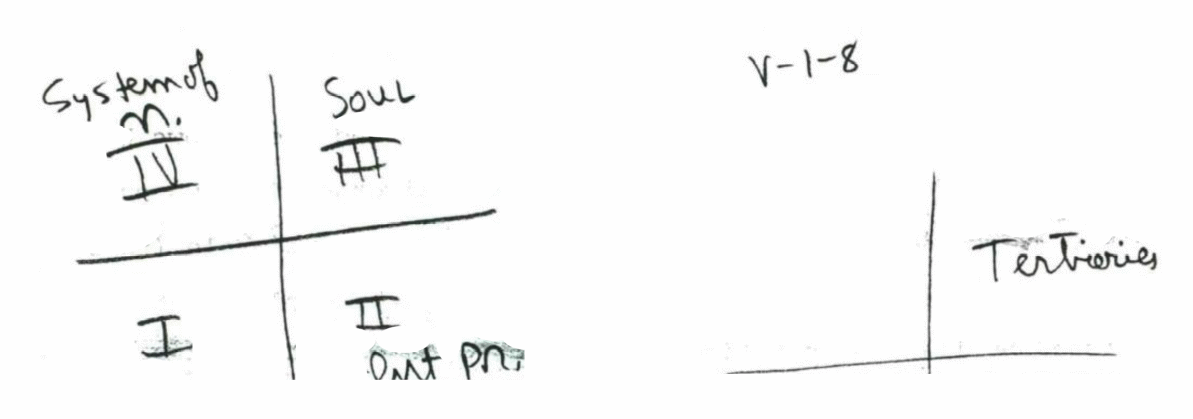
[FIGURE AD SuppF-1. Four Quadrants; Tertiaries in 3rd Quadrant. Int Pr. = Intellectual-Principle; System of N. = System of Nature. Facsimile scan from AD SUPPF 1-33.PDF, p. F9. V-1-8 handwritten by AD, diagrams by AS.]
[AD Supp p. F10] [Note: Typewriter-typed with edits by AD.]
We intend to show that the presuppositions of Philosophy are revealed through Astronomia, and that the presuppositions of Astronomia are in turn brought to light through careful consideration of philosophic principles. At first each must by studied separately – one must investigate the principles to understand what they are, and then separately consider the cosmos as actualizing these principles. Each point of view must also be applied as a constant check on the other. This tentative bifurcation in thought, required by simultaneous development of both points of view, gradually resolves into an organic unity which will be appreciated by their synthesis. The result is an integral cosmic conception that Astrology can refer to as its foundation, and that philosophy is implied in the cosmic functioning.
[AD Supp p. F10 bottom = typed, paste-up from separate item]
Conze's statement applies with equal validity to the works of the Neoplatonism. Without an appreciation of his knowledge of "the Sun, the Moon and the 5 wandering stars" (as Plato speaks of them in the Epinomis), we are as unlikely to penetrate to the living meaning of their symbolic metaphysics as is any scholar who lacks the prerequisite background set forth above. With insight into Astronomia as another key, however, the vantage point is much improved.
[AD Supp p. F11] [Note: Typewriter typed with edits by AS.]
To fully understand what Platonism is saying about the visible and the intelligible, we have to bring the entire symbolism of the cosmos to bear. This provides us with an adequate vocabulary to work out all the details of the Philosophy in a meaningful way. At the same time, the detailed relation of our symbol to the Philosophy gives us some clear indications of what astrology can mean. Indeed, without this type of approach, it is impossible for astrology to be returned to its proper status as a science of the individual soul. This is our goal – to ground our thought in the experience and the experience in our understanding. (Will the images which arise in the Soul give us an indication of what the Intelligibles are which fabricate these images?)
[Note: Remainder of page = dup of bottom of p. F10.]
[AD Supp p. F12] [Note: Typewriter typed, no edits.]
This necessary correlation of astronomia and philosophy does not apply only to western thought. Mr. Edward Conze, in Thirty Years of Buddhist Studies, says:
"What I am trying to say is that ... In order to disclose to us people of the twentieth century the living meaning of the Tantra, a scholar must not only know Sanskrit and Tibetan, but also be familiar with modern psychology and one or more of the occult arts. ... Likewise, though many readers will not believe it, it is obvious that no one can do justice to the occult side of the Tantra without knowing at least one of the magical arts, such as astrology, and without actual experience of the working of magical forces within and all around us. If such a marriage of linguistic scholarship with first-hand psychological and occult knowledge should ever take place, then and only then, will the Tantra become a vital ingredient of Western Buddhism." Conze, Edward, Thirty Years of Buddhist Studies, 1968, University of South Carolina Press, p. 26.
[Note: Remainder of page = also dup of bottom of p. F10.]
[AD Supp p. F13] [Note: Handwritten by AD.]
Before summary
To discern the operation of principle in the empirical will require traversing vast domains of unmapped areas of spiritual reality - for the hiatus between these two levels is a vast abyss. We find it necessary to tentatively sketch the domains in between to connect seeming divergences in the numerous standards of references. (ie philosophic viewpoints) What will govern our choice of material selected is a presiding vision - the hidden side of n.p [Neoplatonic] insight into the nature of the One's being in the world of becoming. Let us repeat, that this is not a scholarly exegesis, but a symphony of celestial suggestions; before we start on as detailed a survey as we are capable of - let us briefly indicate a a [sic] bird's eye-view; the frame within which to locate our glimpse.
[File AD SUPPF 1-33.PDF (pp. 1-13) Ends; AD SUPPF 14-33 not typed]
Definition of Astronomia from Hartmann's Paracelsus:
The science which deals with the comparison of the Microcosm and Macrocosm for the purpose of elucidating the nature of the two (which are in reality one), and to bring to an understanding the rational principle governing their activity, is called by Paracelsus, Astronomia, and this term is not to be confounded with the modern physical Astronomy. . . The Astronomy of Paracelsus means Wisdom, or a direct manifestation of the truth . . . The sphere of the Universal Mind is the upper firmament, and the sphere of the individual mind the lower firmament, but the two are intimately connected together and are essentially one. 'It is the knowledge of upper (outer) firmament) that enables us to know the lower (inner) firmament of man . . . Upon this knowledge the true science of Astrology is based. . . . (Franz Hartmann, The Life and the Doctrines of . . . Paracelsus. New York: Macoy Publishing and Masonic Supply Company, 1932, pp. 48-49) [quote not in paper, but referred to; needed for definition of Astronomia])
V09P: PAPER: Astrology; Theory; Astronomia (SuppF 1-13). Copyright 2025 Wisdom's Goldenrod p. iii