APPENDIX 1: SHAIVITE VIEW—36 TATTVAS
BY ANTHONY J. DAMIANI
[File ASN MASTER ONE and IP 51-70.PDF Begins; page numbers refer to pages in Astronoesis Master as typed in 1988. ASN Master p. 67]
References:
G = Garland of Letters
K = Kashmir Shaivism
1. [(G 90)] Corresponding to the self-existent, Parasamvit "is the coalescence into one undivided unity of the"I" and the "This," that is, of Shiva and the supreme unmanifest Shakti. The former is the…knowing aspect, and the latter…"the known." But here the two are undistinguishably one."
Here we have a view of the Transcendent One which has both Siva (Transcendental Repose) and Sakti (Transcendental Act or Power) inherently united in it. It is said to be beyond all the Tattvas, i.e., beyond all limitation or differentiation.
The two following Tattvas are not really separate from Parasamvit, but are described as respectively "I" and "This":
2. & 3. [(G 92)] "Shiva has two aspects in one of which He is Transcendent [(as Parasamvit)] and in the other Creative and Immanent." The latter is Siva-Tattva, which represents the Bisexual Adam Kadmon. (K 64, 65) … Parasamvit "brings into operation that aspect of his Shakti [(i.e., Pranava Aum)] which manifests as the principle of Negation…and allows Himself, as it were, to feel the want of a Universe… … It is thus only the pure 'I' without even the thought or feeling 'I am'…"
G 92--"…Shiva Tattva is called"the very void"…"
K 65-66--"This the Universe-negating aspect of the Divine Shakti is called the Shakti Tattva…"
[ASN Master p. 68]
Again, Woodroffe makes clear how these two are the same as the (infinite symbol) or Power and Bound or Pure Cit aspects of the Dyad which is not really other than the One. In fact, although Siva is described always before Sakti, it is clear that it is the Sakti (of the Absolute) which allows the distinction of the Siva Tattva from Parasamvit by interposing a "veil" as it were, on the Absolute, so that its aspect as Bound or Adam Kadmon (Siva) can arise. Siva-Sakti are inseparable as the Indeterminate Dyad.
G 93--"This account of Shakti's operation is extraordinarily subtle, explaining as it does how the supreme unitary experience is also the first source of dual experience. … In Para Samvit the"I" and the "This" existed as one indistinguishable unity. In Shiva Tattva through the operation of associated Shakti Tattva, the "This" (Idam) is withdrawn from experience so that the "I-experience" (Aham-vimarsha) alone remains."
Finally, "The Shiva-Shakti Tattva is not [italicized by editor] an emanation, because it ever remains the same..." with Parasamvit.
4. The Fourth Idea of Tetradic Being is here described as Sadakhya Tattva which Kashmir Shaivism calls (p. 71) "the principle of pure Being," also the manifestation of the Iccha or will aspect of Sakti. Each of the next three tattvas (4, 5, 6 houses) are aspects of Power which included a dual I-This.
K 76-77 --"…in the Pure Order, the things are realised as they truly are . . . the Experiencing entities are Universal beings who realise themselves actually as such, and have for their Experience the whole of the universal 'All-this'…" These three houses correspond with the Intelligible Realm, Being or Knowledge-Beings in which there is the duality in unity of Knowledge and Being. The emphasis in this quadrant shifts from "I" to "This" to the relation of these two or "I-This."
[ASN Master p. 69]
G 93, 94--"The first emanation or manifestation (Abhasa) of and by Consciousness is called the Sadskhya or Sadashiva Tattva." He notes that the cause (Siva-Sakti) remains ever what it is even while it appears differently through emanation or Abhasa. Here, though, [comma added] the effect is real, not illusory as in Vedanta. Here is the "first subjective formation [Note: Typed text has 'foundation' here.] of ideas. … It is the first step in evolution and last in involution." Here is Being entire, but not as differentiated or involved in a center. "It is called Nimesha" [Note Typed text has 'Unmesa' here.] or closing of eyes.
5. The next tattva is Aisvarya, "the state of the Self as Being." [(K 69)] It is equated in Kashmir Shaivism with the Jnana Sakti or Power of Being Conscious.
G 94-95--"…Consciousness here completely identifies itself with the Universe as unmanifested Idam [(this)], and thus subjectifies it and becomes with it a Point (Bindu) of Consciousness."
6. Suddhavidya. G 95--"…the region of pure spiritual ideation," said to be the nature of Mantra. "It is experience of difference because the Idam is separated from the Aham. It is the experience of non-difference because they are still regarded as part of one Self. The experience is compared to that of the Ishvara of the Dvaitavadins…"All this is my manifestation"…" This seems equivalent to the Inner view of Demiurgus as having the 6 Forces as Pure Powers--spiritual Ideation. The 5 Pure Powers and their Unity as the 6th or Suddhavidya are described in (K 79). They refer to the "universal experiencer" before it is delineated through Maya. These 5 seem to correlate to the powers of the 5 Dhyan Buddhas as follows: a) all authorship ( Kala = little doer) = (W[illing]) all accomplishing wisdom, b) all knowledge = (vidya = little knower), discriminative wisdom (K[nowing]), c) all interestedness, or equal interest or fullness = Wisdom of Equality (Raga = desire) (F[eeling]), d) all pervasiveness, unrestrictedness = [ASN Master p.70] mirror-like Wisdom (Niyata = space), e) Alwaysness of presence of the All-This = Dharmadatu (Kala = time).
7. Now, when these 6 are in their unique aspects we have the Tattvas called Maya and the 5 Kancukas. The All-knowing Self is restricted to a little knower and etc. and these 6 forces restrict the Self to many Purusas, binding each to certain aspects of the Tattvas or Prakriti. Instead of the Unity of I-This or Knowledge-Being in the 2nd quadrant, we now have the Separation of Purusas-Prakriti, starting in the 7th house, which is effected by the six forces as restrictive and "binding" the Self to certain restricted vehicles.
G 96--"Purusha in Shaiva-Shakta philosophy is the Atma or Shiva subject to Maya and the Kanchukas which are limiting forces whereby the Self as Pure Consciousness loses its natural perfections." Again, 6 Forces from the view of Atma in the 5th house are its pure power of knowledge, etc., but looked at as producing the dichotomies which begin in the 7th, the 6 Forces restrict and bind the Self. K 93--Prakriti is called "the generally experienced."
8. "The Universe Subjectively Conceived in the Mind of God." Here, this applies to the Universal or impersonal state of consciousness in which the Ideas are contained in Buddhi. K 110--speaks of Buddhi as something of "the memory of the Shuddha-Vidya Experience" or "Something of the Prakriti to which that [(pure)] experience has been reduced…" Thus the Universe no longer is in Phanes or in Pure Knowledge, but in a subjectivized or Taijasa state--which, however, is not individual here.
[File ASN MASTER ONE and IP 51-70.PDF Ends]
[File ASN MASTER ONE and IP 71-90.PDF Begins (p. 71)]
9. Nine prajapatis here are the Ahamkara principle which fabricates, or is a will toward manifesting but is not yet that manifestation. [K 111] "…Ahankara is not a mere abstract 'I', but it is always an 'I am so and so'" identified with so and so. A particular section of Buddhi is appropriated--assimilated.
Ahamkara is the maker of wholes, literally the I-maker, which has assimilated the conception of the universe and wills its existence.
10. In the 10th house we put the tanmatras--the seven universal states of matter, or the substantial or feeling evolute of Ahamkara. Tanmatra is the substratum for any mental body--for any mind--and is thus the principle of existence and basis for manifestation. In the cosmological scheme of Samkhya, the highest three levels of this cosmic substance would reflect the three prior principles. The first images Prakriti, followed by the evolutes Buddhi, Ahamkara and then the four tanmatras, totaling then the seven prakritis.
11. The other evolute of Ahamkara is manas--the knowing activity described as the state of activity, the kinetic and synthesizing factor. The synthesis of this form with the matter of the 10th gives all the hylomorphic entities in the 12th--the sensible appearance.
12. This is the 5 mahabhutas, and here in the Saivite school we place the five bhutas or elements as well as the five senses. The five elements are determinators of the tanmatras, the five senses determinators of manas, and together these give a material based experiencing entity.
[File ASN MASTER ONE and IP 71-90.PDF Ends (p. 71)]
APPENDIX 2: TWO ADDITIONAL DIAGRAMS WITH LEVELS/TATTVAS
added 01/2023 by the Editors
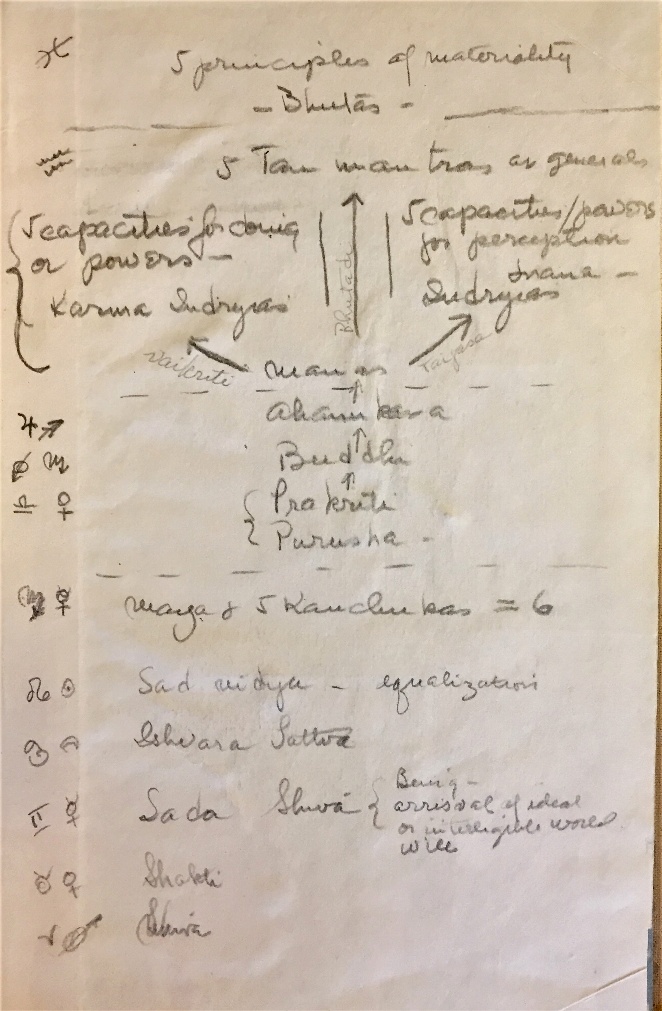
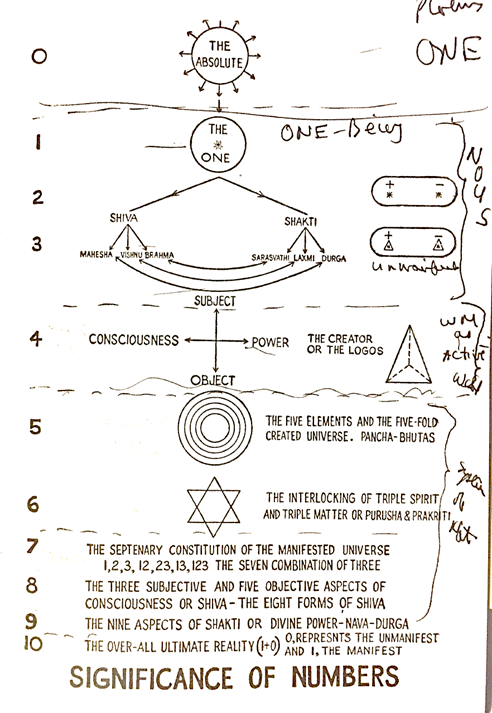
Paper
Undated paperThe 36 Tattvas of Kashmir Shaivism as the 12-fold Mandala
by Anthony J. Damiani and edited by the editors of Astronoesis
Paper V09P
with Appendices: 1) original typed version (AD Notes and Papers O67-71); 2) two additional diagrams with levels/tattvas.
3-LETTER CODE: HIN
TOPIC: Hinduism
SUBJECT: Kashmir Shaivism
SUBSUBJECTS: 36 Tattvas, 12-fold, Siva, Sakti, Intellectual-Principle
ORIGINAL LOCATION & FILE NAME (for original paper and basis of endnote): ASN MASTER ONE and IP 51-70.PDF (Astronoesis page O67+); ASN MASTER ONE and IP 71-90.PDF (Astronoesis page O71)
CONTENTS:
Kashmir Shaivism overview: Hindu system emphasizing Consciousness as power; common basis for Hindu and Buddhist tantrism
Theoretical foundation: system of tattvas—hierarchy of principles from Absolute to manifestation
The 36 tattvas arranged in 12 houses:
1. Parasamvit (Self-Existent); coalescence of Siva and Sakti
2. Sakti—infinite Power
3. Siva—unlimited Void Wisdom; inseparable from Sakti as indeterminate Dyad
4. Sadakhya (or Sadasiva)—principle of pure Being; first emanation of Consciousness
5. Aisvarya—Thisness; state of Self as Being; consciousness identifies with universe as unmanifested "This"
6. Suddhavidya—pure intelligence as complementarity of "I-This"; experience of both difference and non-difference; the five pure powers and their unity
7. Maya and the five kancukas—separation of purusa and prakriti; six forces as restrictive and binding
8. Buddhi—the inner form of universal wisdom; universe in subjectivized state
9. Ahamkara—the maker of the "I"; "I am so and so" identification; will toward manifesting but not yet manifestation
10. Tanmatra—universal substance; seven universal states of matter; principle of existence and basis for manifestation
11. Manas—mind as subject to conditions and form; knowing activity and kinetic synthesizing factor
12. Five elements (bhutas) and five senses; elements as determinators of tanmatras; senses as determinators of manas; together create materially-based experiencing entity
Appendix 1: original paper version
Appendix 2: additional diagrams
BOOKS / PAPERS QUOTED FROM OR REFERENCED:
AD Archives, papers and diagrams
T. Subba Row, The Twelve Signs of the Zodiac
Mark Dyczkowski, The Doctrine of Vibration
J.C [Jagdish Chandra] Chatterji, Kashmir Shaivism, Chandigarh: Galav Publications, 1981 [originally pub. 1914]. This edition matches edited endnote and is still in print and widely available as of 2023. The original endnote's pagination [version typed in 1988] is from Kashmir Shaivaism, Research and Publications Division, Government of Jammu and Kashmir, Srinagar, 1962, and can be found online at <kupdf.net_kashmir-shaivism-jagdish-chatterjee-ksts.pdf>.
Sir John Woodroffe (Arthur Avalon), The Garland of Letters, Sixth Ed., Madras: Ganesh & Company 1974 [originally pub. 1922]. This edition matches edited endnote. The original endnote's pagination [version typed in 1988] has been matched to The Garland of Letters, Madras: Ganesh & Co., London: Luzac & Co., 1922, and can be found online at <https://archive.org/details/GarlandOfLettersOrStudiesInTheMantraShastra>.
Astronoesis: Philosophy's Empirical Context; Astrology's Transcendental Ground (published 2000)
DIAGRAMS embedded in and appended to this paper:
FIGURE KS-1. Kashmir Shaivism Tattvas, diagrammed as a tree. Computer generated diagram from 1995-1996 that accompanied original endnote, lost from some subsequent (Astronoesis class) versions.
FIGURE KS-2 (file name IMG_2331 copy.JPEG). Shaivite Scheme of 36 Tattvas. Facsimile scan of posterboard drawing done in early 1980s by LCG per Anthony's instructions.
FIGURE KS-3. Kashmir Shaivism Tattvas, in the mandala of the houses. Computer generated diagram from 1995-1996 that accompanied the original endnote.
FIGURE KS-4. Kashmir Shaivism Tattvas. Hand-drawn by AD. (appended)
FIGURE KS-5. Facsimile of p. 237, from I.K. Taimni, Man, God, and the Universe. With AS annotations. (appended)
AD HANDWRITING: JF typewriter typed originally, some handwritten AS edits, some unidentified person, AD = bottom of p. 71 "Make chart for Shaivite school."
COMPLETENESS: Full
PUBLISHABILITY: Yes
ALTERNATE VERSIONS: ASN ALT Intellectual principle Intro.PDF (original typed version, pp. 22-26)
RETYPED, REFORMATTED, AND PROOFREAD by JF, IT 2023; REFORMATTED FOR WEB by IT, MW 2025
NOTES:
RETYPED ASTRONOESIS ENDNOTE (V09P).
This paper by Anthony Damiani was edited and supplemented by the editors of Astronoesis so it could be included as an endnote to the Intellectual-Principle chapter in Astronoesis, but it wasn't included in the published version.
Contextual Note by JF: This paper was originally typed for AD & WG working groups by JF approx. 1981-1983, to be the example of "each Idea is a special and unique form of the whole," in this case the 7th house, which T. Subba Row correlates with the 36 Tattvas of Kashmir Shaivism, or the outward-facing hierarchy. (See Astronoesis p. 140 on the 36 Tattvas, which have a hierarchical unfoldment.) The "outward-facing" has to do with the Purusha-Prakriti separation that takes place in house 7; Anthony thus associates Plotinus V.1.6 with this house: "All existences…produce…some necessary, outward-facing hypostasis continuously attached to them."
The 36 Tattvas were diagrammed variously. Embedded in this endnote/paper are three diagrams (the 1988 typed original lacked diagrams but they were implied). Two additional diagrams can be found in Appendix 2.
The endnote was converted from earlier version in older Word version dated 1995-1996; diagrams added; paper lead-in by AS (see note below).
This endnote has been revisited in Astronoesis class every 3-4 years, thus there were several versions of it. This edited Kashmir Shaivism endnote is based on the original 1995-1996 version. However, it has been expanded for 2023.
On the spelling Shaivite, Saivite, Chit, Cit (consciousness), depends on which book edition used; variations because of differing conventions for transliterating Sanskrit diacritical marks into English. At this time we prefer: Shaivite, etc., but Cit-Shakti, citta vrittis, as spelled in Astronoesis. However, spellings in this paper otherwise conform to that as in published books, and as in the original paper (see PDF scan from Astronoesis Master). Either Sakti or Shakti, Siva or Shiva are acceptable.
Note from AS to MBW, HP, JF, email of Jan 7, 2021: Parasamvit (not counted as a tattva), Shakti, Siva; Sadasiva and Mahesvara in 4 and 5, but in reversed order; Suddhavidya in 6 (with Siva/Sakti are 5 "pure" tattvas); Purusha/Prakriti in 7 (which is really Purusha + Maya and 5 Kanchukas (delimiters) = 7 more tattvas pure and impure); Buddhi (Mahat is cosmic form) in 8 (idea form of universe); Ahamkara (cosmic I-maker = Demiurge) in 9; 5 Tanmatras (subtle elements) are shape of Material Universe in 10th; Manas, 5 sense organs, 5 action organs in 11th house. 12 is 5 gross elements (Bhutas). One tattva left out: the Antahkarana is Buddhi, Ahamkara, Manas and Citta. But Citta (consciousness) is not a tattva.
See ASN MASTER ONE and IP 51-70.PDF (Astronoesis page O67+); ASN MASTER ONE and IP 71-90.PDF (Astronoesis page O71) for the pre-edited version of the endnote text. Quotations proofread Jan. 2023; diacritical marks omitted in quotations in this paper. Footnotes by editor.
Original typed version of paper Appendix 1 (for reference), Appendix 2 consists of two diagrams with levels/tattvas.
THE 36 TATTVAS OF KASHMIR SHAIVISM AS THE 12-FOLD MANDALA
Editor's Introduction, for 1996 endnote version: Kashmir Shaivism is a Hindu system of thought and practice originating in Northern India which emphasizes the nature of Consciousness as power. Historically, it provided a common basis for both Hindu and Buddhist tantrism.
alt from 1995: Kashmir Shaivism, a Hindu system of thought and practice originating in Northern India, emphasizes the nature of Consciousness as power. Historically, it provided a common basis for both Hindu and Buddhist tantrism. The theoretical basis of Kashmir Shaivism is a system of tattvas, a hierarchy of principles extending from the Absolute into manifestation.
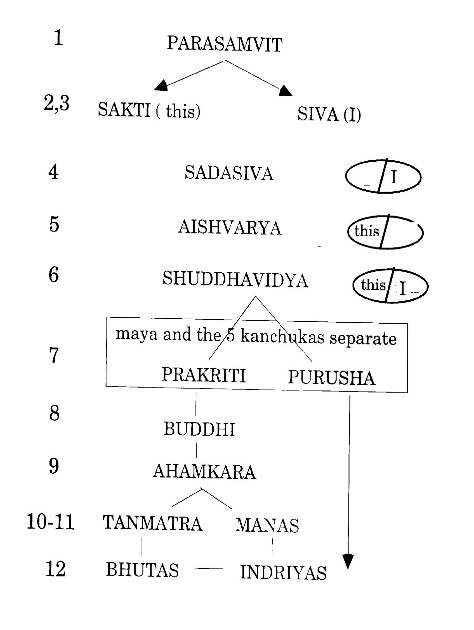
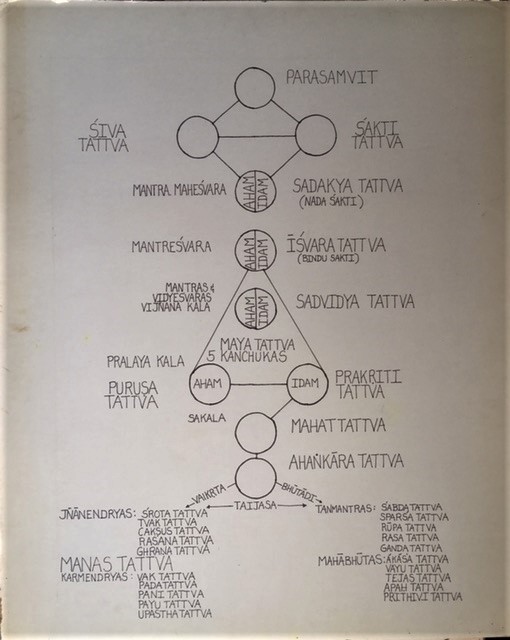
FIGURE KS-2 (file name IMG_2224 KS-a.JPEG). Shaivite Scheme of 36 Tattvas. Facsimile scan of posterboard drawing done in early 1980s by LCG per Anthony's instructions.
For T. Subba Row, the 36 tattvas of Shaivism represent the multiple principles extended from the One and are placed in the 7th house, opposite the One-Only in the first. Briefly, Kashmir Shaivism describes 5 pure tattvas and a supreme transcendent Absolute "Parasamvit," all of which are beyond "maya," or the split into a self and other.
In The Doctrine of Vibration by Mark Dyczkowski (a commentary on Kashmir Shaivism theory and practice) there is the following interesting parallel to the 12-fold mandala:
Although the Wheels of Energies are innumerable . . . only a few are important in the Doctrine of Vibration . . . foremost among them is a cycle of twelve phases. It represents the twelve aspects of Kalasankarsini (The Attractress of Time), the Goddess of Consciousness. Technically called 'the Wheel of the Absolute' (anuttaracakra), all the other Wheels emerge from it and are all eventually dissolved in it. . . . The twelve-spoked Wheel thus represents the cognitive cycle (pramanacakra) and is symbolised by the sun which passes through the twelve signs of the zodiac in the course of a year. (Mark S.G. Dyczkowski. The Doctrine of Vibration (Albany, NY: SUNY Press, 1987), p. 124)
When considered as a doctrine in its own right, AD spread the 36 tattvas around the circle, constituting a sacred mandala closely paralleling T.S. Row. We place the Parasamvit and the 5 pure principles in houses 1-6, and the rest of the 31 principles in houses 7-12.
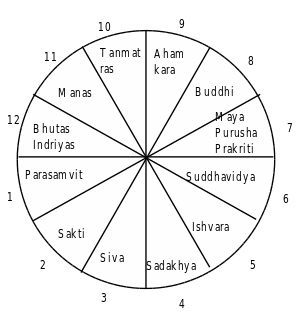
FIGURE KS-3. Kashmir Shaivism Tattvas, in the mandala of the houses. Computer generated diagram from 1995-1996 that accompanied the original endnote.
~~~~~~~~~~~~~~~~~~~~~~~~~
The following Astronoesis text describing the principles placed in each house consists of quotations from two primary sources interleaved with Anthony and other commentary from the ENDNOTE version of this paper ~1995-96. These sources are The Garland of Letters and Kashmir Shaivism indicated by (G) and (K) respectively. G=John Woodroffe (Arthur Avalon), The Garland of Letters, 6th ed. (Madras: Ganesh & Co.: 1974); K = J.C. Chatterji, Kashmir Shaivism, (Chandigarh, India: Galav Pubs.: 1981 (reprint of 1914 ed.)))
SAIVITE VIEW: 36 TATTVAS
by Anthony J. Damiani
1. PARASAMVIT (Beyond or highest self-cognition)
Corresponding to the self-existent, Parasamvit
is the coalescence into one undivided unity of the "I" and the "This," that is, of Siva and the supreme unmanifest Sakti. The former is the . . . knowing aspect, and the latter . . . "the known." But here the two are indistinguishably one. (G 94)
Here we have a view of the Transcendent One which has both Siva (Transcendental Repose) and Sakti (Transcendental Act or Power) inherently united in it. It is said to be beyond all the Tattvas, i.e., beyond all limitation or differentiation. [The word Parasamvit means either beyond self-cognition, or the transcendent self-cognition. It is quite clear that the words and the two possible interpretations are parallel to the problem of the One's "super-knowledge" discussed in the Astronoesis chapter on the One.—Eds.]
2. SAKTI—Infinite Power
3. SIVA—Unlimited Void Wisdom
The two Tattvas Sakti and Siva are not really separate from Parasamvit, but are described as respectively "This" and "I":
In Para Samvit, the "I" and the "This" existed as one indistinguishable unity. In Siva Tattva through the operation of the associated Sakti Tattva, the "This"(Idam) is withdrawn so the "I-experience" (Aham-vimarsa) alone remains. (G 97)
The Siva-Sakti Tattva is not an emanation, because it ever remains the same . . . [with Parasamvit.] (G 98) [This part of the quotation from Chatterji was omitted from the endnote version: "[Parasamvit] brings into operation that aspect of his Shakti [i.e., Pranava Aum] which manifests itself as the principle of Negation . . . and allows Himself, as it were, to feel the want of the Universe. . . . It is . . .pure 'I' without even the thought or feeling of 'I am'" (K 62-63).]
If we interpret Woodroffe's quotes in terms of the Dyad, Sakti and Siva are the same as infinite Power and Pure Cit (Wisdom). Siva and Sakti are not other than Parasamvit, just as Power and Intelligence are not other than the One. In fact, although Siva is described always before Sakti, it is clear that it is the Sakti (of the Absolute) which allows the Distinction of the Siva tattva from Parasamvit by interposing a "veil" as it were, on the Absolute, so that its aspect as Bound or Adam Kadmon (Siva) can arise. Siva-Sakti are inseparable as the indeterminate Dyad.
This the Universe-negating aspect of Divine Shakti [Power] is called the Shakti Tattva . . . (K 63-64)
This account of Sakti's operation is extraordinarily subtle, explaining as it does how the supreme unitary experience is also the first source of dual experience. . . . (G 97)
Siva has two aspects in one of which He is Transcendent [as Parasamvit] and in the other creative and Immanent. (G 96)
Siva Tattva is called "the very void" . . . (G 97)
4. SADAKHYA (or SADASIVA)—the Being of the I.
Sadakhya Tattva, which Kashmir Shaivism calls the "principle of pure Being" (K 69), corresponds to the fourth Idea of Tetradic Being. It is also known as the manifestation of the Iccha or will aspect of Sakti. [Sadasiva is also described as the pure "I" without a "This."—Eds.]
. . . in the Pure order, the things are realized as they truly are . . . the Experiencing entities are Universal beings who realize themselves actually as such, and have for their Experience the whole of the universal . . . (K 74-75)
Each of the next three principles, represented in houses 4, 5, and 6, are said to include a dual-unity of I and This, which corresponds to the dual-unity of Intellection and Being in the Intellectual-Principle (i.e., the duality in unity of Knowledge and Being in the Nous).
These three houses 4, 5, and 6 correspond with the Intelligible realm, Being or Knowledge-Beings in which there is the duality in unity of Knowledge and Being. The emphasis in this quadrant shifts from "I" to "This" to the relation of these two or "I-This."
The first emanation or manifestation (Abhasa) of and by Consciousness is called Sadakhya or Sadasiva Tattva. (G 98)
Woodroffe notes that the cause (Siva-Sakti) remains ever what it is even while it appears differently through emanation or Abhasa. Here though, the effect is real, not illusory as in Vedanta. Here Sadasiva is the "first subjective foundation of the ideas." (G 98) It is the "first step in evolution, and last in involution." (G 98) Being is entire, but not as differentiated or involved in a center. "It is called Nimesa (closing of eyes) as contrasted with Unmesa (opening of the eyes) of the next stage of experience." (G 98)
5. AISVARYA—Thisness
The next tattva is Aisvarya, "the state of that Self as Being." (K 69) It is equated in Kashmir Shaivism with the Jnana Sakti or Power of Being Conscious.
Consciousness here completely identifies itself with the Universe as unmanifested Idam [this] and thus subjectifies it and becomes with it a Point (Bindu) of Consciousness. (G 99)
6. SUDDHAVIDYA—pure intelligence as a complementarity of "I-This."
Suddhavidya is placed in the 6th house.
. . . the nature of Mantra . . . [is] in the region of pure spiritual ideation. . . . It is the experience of difference because the Idam is separated from the Aham. It is the experience of non-difference because they are still part of one Self. The experience is compared with the Isvara of the Dvaitavadins . . ."All this is my manifestation." (G 100)
This tattva, Suddhavidya, is equivalent to the Inner view of Demiurgus as having the 6 Forces as Pure Powers--spiritual Ideation. The 5 pure Powers and their Unity as the 6th or Suddhavidya--are described in (K 77-78) a) all authorship b) all knowledge c) all interestedness, or equal interest or fullness d) all pervasiveness, unrestrictedness e) Alwaysness of presence of the All-This.
They refer to the "universal experiencer" before it is delineated through Maya.
7. MAYA & THE 5 KANCUKAS separate the PURUSA and PRAKRITI
When these 6 are in their unique aspects we have the Tattvas called Maya and the 5 Kancukas. The All-knowing Self is restricted to a little knower and etc. and these 6 forces restrict the Self to many Purusas, binding each to certain aspects of the Tattvas or Prakriti. Instead of the Unity of I-This or Knowledge-Being in the 2nd quadrant, we now have the Separation of Purusas-Prakriti, starting in the 7th house, which is effected by the 6 forces as restrictive and "binding" the Self to certain restricted vehicles. [It is interesting that in applying the 12 houses to this idea, the pure principles of the system fall in the 6 houses prior to the application of the idea to "itself"--in the 7th. For each of the ideas there seems to be an important division in its nature at the particular point at which the idea applies to itself.—Eds.]
Purusa, in Saiva-Sakti philosophy is the Atma or Jiva [Self] subject to Maya and the Kancukas which are limiting forces whereby the Self as Pure Consciousness loses Its natural perfections. (G 101)
Again, 6 Forces from the view of Atma in the 5th house are its pure power of knowledge, etc., but, looked at as producing the dichotomies which begin in the 7th, the 6 Forces restrict and bind the Self.
Prakriti is called the
'generally-experienced' . . .(K 91)
8. BUDDHI—the inner form of universal wisdom
Buddhi means the Universal or impersonal state of consciousness in which the Ideas are contained in. Kashmir Shaivism (Chatterji), p. 108 speaks of Buddhi as something of "the memory of Suddha-Vidya experience" or "'Something' of the Prakriti to which that pure experience had been once reduced." Thus the Universe no longer is in Phanes or in Pure Knowledge, but in a subjectivized or Taijasa state--which, however, is not individual here.
9. AHAMKARA: the maker of the "I"
Ahamkara is the maker of wholes, literally the I-maker, which has assimilated the conception of the universe and wills its existence. It is a particular section of Buddhi which is appropriated--assimilated.
Ahamkara is not a mere and abstract 'I,' but it is always an 'I am so and so'. (K 109) Ahamkara thus constituted and the Buddhi consists in the fact that, while the former is the experience "I am all this and all this is mine:, the latter is simply the experience "all this is," without as yet the realisation of an 'I' or 'mine' in reference to it. (K 111)
As the principle which fabricates, or is a will toward manifesting but is not yet that manifestation, Ahamkara is similar to the Nine Prajapatis.
10. TANMATRAS—universal substance
In the 10th house we put the tanmatras--the seven universal states of matter, or the substantial or feeling evolute of Ahamkara. Tanmatra is the substratum for any mental body--for any mind--and is thus the principle of existence and basis for manifestation. In the cosmological scheme of Samkhya, the highest levels of this cosmic substance Tanmatra would embody the prior principles of Prakriti, Buddhi, and Ahamkara.
11. MANAS—mind as subject to conditions and form
The other evolute of Ahamkara is manas--the knowing activity described as the state of activity, the kinetic and synthesizing factor. The synthesis of this form with the matter of the 10th gives all the entities in the 12th--the sensible appearance.
12. 5 SENSES & BHUTAS (ELEMENTS)
Here in the Shaivite school we place the five bhutas or elements as well as the five senses. The five elements are determinators of the tanmatras, the five senses are determinators of manas, and together these give a materially based experiencing entity.
[Original p. O71 ends with handwritten note by AD: "Make chart for Shaivite school."]
V09P: PAPER: Hinduism; Shaivism; 12-fold. Copyright 2025 Wisdom's Goldenrod p. iv