Paper
Undated summary of a published workOutline of the Eight Hypotheses from Plato's Parmenides
translated by F.M. Cornford, with edits by Anthony J. Damiani
V09BN
3-LETTER CODE: PLA
TOPIC: Plato
SUBJECT: Parmenides
SUBSUBJECT: Eight Hypotheses
ORIGINAL LOCATION & FILE NAME (of PDF used for typing): PLA EIGHT HYPOTHESES OF PLATO B 4p.PDF.
BOOK QUOTED FROM:
- F.M. Cornford, Plato and Parmenides: Parmenides' Way of Truth and Plato's Parmenides
DIAGRAM:
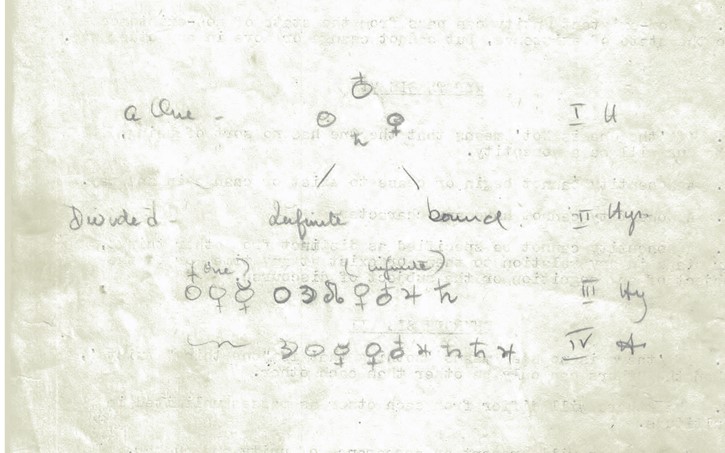
- FIGURE PLA Eight Hypotheses of Plato B-p.4.PDF. Facsimile scan of Anthony Damiani hand-drawn diagram (originally on back of copy of Cornford Eight Hypotheses): Hypotheses I-IV, with 1st Quadrant Dignities (Hyp. I-III) and Rulerships (Hyp. IV). [Note: This diagram is also appended to WG Parmenides Classes 1981 0102 and 1981 0109.]
AD HANDWRITING: Typewriter typed, a few AD edits
COMPLETENESS: Full Paper (Outline)
PUBLISHABILITY: No, already published
ALTERNATE VERSIONS: One widely circulated photocopy of the Eight Hypotheses has "Brumbaugh" handwritten on it – this is a student note referencing the Eight Hypotheses version from Brumbaugh's Plato on the One that is read in the Sept. 1983 Eight Hypotheses classes.
RETYPED AND REFORMATTED by IT 2022
NOTES:
RETYPED AD PAPER (V09P).
The following translation of the Eight Hypotheses is found in Plato and Parmenides: Parmenides' Way of Truth and Plato's Parmenides by F.M. Cornford. It was typed out and used in the WG Eight Hypotheses classes. AD made some handwritten edits and these are noted accordingly. On the back of one copy of these typed-out Eight Hypotheses (Scan File PLA EIGHT HYPOTHESIS OF PLATO B 4p.PDF), Anthony drew a diagram with levels of Hypotheses I-IV, which is appended to this outline. Also note that one widely circulated photocopy of these Eight Hypotheses had "Brumbaugh" handwritten on it – this was a student note referencing the Eight Hypotheses version from Brumbaugh's Plato on the One that was read in the Sept. 1983 Eight Hypotheses classes.
OUTLINE OF THE EIGHT HYPOTHESES FROM PLATO'S PARMENIDES (CORNFORD TRANS.)
HYPOTHESIS I
1. If the One is defined as absolutely one, it is in no sense many or a whole of parts.
2. The One (having no parts) is without limits.
3. The One (being without parts) has no extension or shape.
4. The One (being without parts or extension) is nowhere, neither in itself nor in another.
5. The One (not being a physical body in space) is neither in motion nor at rest.
6. The One (lacking the above qualifications) is not the same as, or different from, itself or another.
7. The One is not like, or unlike, itself or another.
8. The One is not equal, or unequal, to itself or to another.
9. The One cannot be, or become, older or younger than, or of the same age as, itself or another, or be in time at all.
10. Since it is not in time, the One in no sense 'is', and it cannot even be named or in any way known.
HYPOTHESIS II
1. If the One has being, it is One Entity, with both unity and being.
2. A 'One Entity' is a whole of parts (both one and many).
3. A One Entity (having parts) is indefinitely numerous and also limited.
4. A One Entity (being limited) can have extension and shape [AD handwrites 'schema' above 'extension and shape'].
5. A One Entity (being an extended magnitude) can be both in itself and in another.
6. A One Entity (being a physical body in space) can have motion and rest [AD handwrites 'Power + being' above 'motion and rest'].
7. A One Entity (as above qualified) is the same as, and different from, itself and the Others.
8. A One Entity (as above qualified) is like and unlike itself and Others.
9. A One Entity (as above qualified) has, and has not, contact with itself and with the Others.
10. A One Entity (as continuous quantity or magnitude) is equal and unequal both to itself and to the Others.
11. A One Entity (as discrete quantity or number) is equal and unequal both to itself and to the Others.
12. A One Entity (as above qualified) exists in Time, and is and is becoming, and is not and is not becoming, older and younger than itself and the Others.
13. A One Entity (being in Time) has existence and becomes. It can be the object of cognition and the subject of discourse.
HYPOTHESIS IIA
COROLLARY ON BECOMING IN TIME
1. A One Entity (being in Time) comes into existence and ceases to exist, is combined and separated, becomes like and unlike, and increases and diminishes.
2. The transition in becoming and change is instantaneous.
HYPOTHESIS III
1. If the One is defined as One Entity which is both one and many or a whole of parts (as in Hyp. II), the Others, as a plurality of other ones, form one whole, of which each part is one.
2. When the element of unity is abstracted from any one whole or one part, what remains is an element of unlimited multitude.
3. The combination of the unlimited element with limit or unity yields the plurality of other ones.
4. The Others, so defined, have all the contrary characters proved to belong to the One Entity of Hyp. II.
HYPOTHESIS IV
1. If the One (unity) is defined as entirely separate from the Others and absolutely one (as in Hyp. I), the Others can have no unity as wholes or parts and cannot be a definite plurality of other ones.
2. The Others, having no unity, cannot possess any of the contrary characters.
HYPOTHESIS V
1. If 'a One is not' [AD handwrites '(the otherness)' above 'a One is not'] means that there is a One Entity that does not exist, this Non-existent Entity can be known and distinguished from other things. [in one version, in the left margin AD writes what looks like 'and Being']
2. A Non-existent Entity, being knowable and distinguishable from other things, can have many characters.
3. A Non-existent Entity has unlikeness to the Others and likeness to itself.
4. A Non-existent Entity (being a quantity) has inequality to the Others, and has greatness and smallness and equality.
5. A Non-existent Entity has being in a certain sense.
6. A Non-existent Entity can pass from the state of non-existence to the state of existence, but cannot change or move in any other way.
HYPOTHESIS VI
1. If 'the One is Not' means that the One has no sort of being, the One will be a Nonentity.
2. A Nonentity cannot begin or cease to exist or change in any way.
3. A Nonentity cannot have any character.
4. A Nonentity cannot be specified as distinct from other things, or stand in any relation to them, or exist at any time, or be the object of any cognition or the subject of discourse.
HYPOTHESIS VII
1. If 'there is no One' means 'nothing that is "one thing" exists', then the Others can only be other than each other.
2. The Others will differ from each other as masses unlimited in multitude.
3. Such masses will present an appearance of unity and number.
4. There will be an appearance of greatness, smallness, and equality.
5. There will be an appearance of limitedness and unlimitedness.
6. There will be an appearance of likeness and of unlikeness and of all the other contraries.
HYPOTHESIS VIII
1. If 'there is no One' means 'there is no such thing as an entity', the Others will be neither one nor many, but nothing.
2. The Others cannot even appear one or many, or as having any character. There is nothing that has any being whatsoever.
V09BN: BOOK NOTES: Plato Eight Hypotheses Outline-Cornford. Copyright 2022 Wisdom's Goldenrod p. ii