DIAGRAMS FOR 1983 0107
Class
Friday, January 7th, 1983
Verbatim, unedited transcriptCLASS at Wisdom's Goldenrod, Hector, NY
with Anthony Damiani (AD)
January 7, 1983
ASTRONOESIS; INTELLECTUAL-PRINCIPLE; SIXTH HOUSE IDEA
TOPIC: Astronoesis
SUBJECT: Intellectual-Principle
SUBSUBJECTS: Sixth House Idea, Six Holy Forces, Power, Soul Powers, Number, World-Idea, Soul, Astrology, Metaphysical Chart
CONTENTS:
Sixth House Idea correlated with soul powers, with number
Tentative correlations between planets and shaktis
Categories of imagination are a deposit of a power which originates in Intellectual-Principle
Jupiter in Virgo as six powers of cosmic soul which are used to articulate and make manifest the universe which is pre-sketched
Individual soul evolves its version of six powers in environment provided by cosmic soul
Tripartite division of soul–Saturn, Jupiter, Mercury
Mercurial phase as principle of manifestation, uses six forces to evolve a universe
Six forces unified in Intellectual-Principle, distinguished and particularized in manifestation
Soul as infinite, World-Idea as pinpoint of light implanted in it by Intellectual-Principle; symbolism of rising Sun and rays
Both "who" and "what" are necessary
World-Idea as Hiranyagarbha
World-Idea = wisdom-knowledge of Nous
Ego included as part of World-Idea
Intellectual vision of World-Idea in fifth house is actualized in twelfth
No one can answer the "why" of manifestation
Twelfth house as realm of Justice
Can apply Sixth House Idea to all other Ideas
Ego gradually learns to conform to World-Idea
Ego has continuity, no identity
Ego as soul's means of actualization
Dominant phase of soul usually determines what is meant by 'self'
No hiatus between Body and Intellect of a God, hence twelfth house as realm of Justice
Stars don't cause, only announce causes in Intelligible World
Four causes applied to four quadrants, last four houses, and four levels of twelfth house
What's happening here is the actuality of the Intellectual-Principle's compulsive power
Neo-Platonic tradition tries to reconcile Plato and Aristotle
World-Idea working towards producing Buddhas
Shaktis of individual and Solar Logos in essence same, but in actuality different
Six shaktis represented by Jupiter in Virgo, six gnostic powers represented by constituent parts of Soul ring
Discussion differentiating shaktis and gnostic powers
All Ideas have at their disposal the Sixth House Idea
Reading Plotinus, VI.7.2
Sixth House Idea the only place where rulership and exaltation are the same dignity
Power of the One immutably present in each and every Idea, symbolized by double Mercury in Virgo
One's power involved in two ways: One imparts to each Idea its aseity; each Idea unique version of Intellectual-Principle
Double Mercury in Virgo as ontic version of meta-ontic principle of Number (Head in Gemini)
One imparts itself to each and every Idea through the Head
Double Mercury in Virgo: the principle that each Idea is a unique form of the whole; this is where the transcendent unity of religions is found
Only Intellectual-Principle has the absoluteness that each view proclaims for itself; truth is superior to any manifestation of it
Twelve absolute philosophies
Head as meta-ontic principle of order, double Mercury in Virgo as ontic principle of order
In empirical chart Head represents activity of planets and their ultimate aim
Reading Plotinus, VI.3.21, 22, 27, on Motion in Intellectual-Principle
Six is a perfect number
BOOKS READ FROM OR REFERENCED:
Iamblichus, Porphyry, Thomas Taylor (tr.), Iamblichus on The Mysteries of the Egyptians, Chaldeans, and Assyrians
Plotinus, The Enneads (MacKenna translation, 4th ed.)
PLOTINUS QUOTES READ OR REFERENCED: II.3, III.2.2, III.2.12, V.9.8, VI.3.21, VI.3.22, VI.3.27, VI.7.2
DIAGRAMS appended to this transcript:
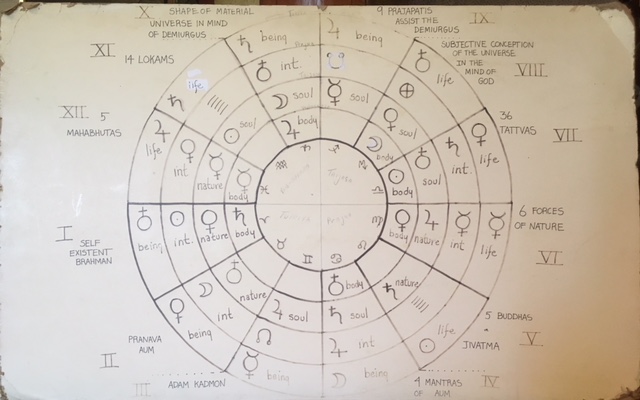
FIGURE IMG 2202-Posterboard Metaphysical Chart.
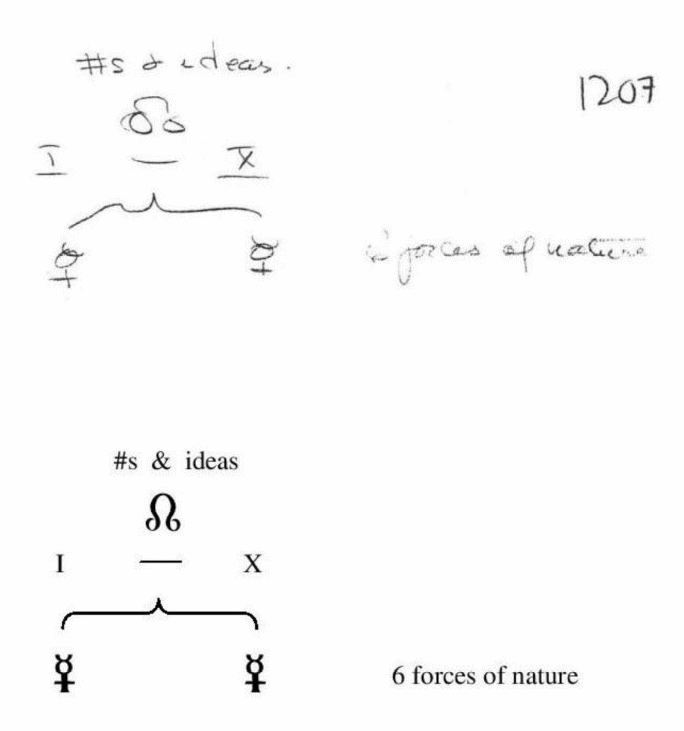
FIGURE 1983 0107-2. Numbers and Ideas: Six Forces of Nature.
See Astronoesis, Soul Chapter, for Soul-Powers diagrams, pp. 187-197. Other diagrams also referred to are not with this transcript version. [Transcriber note: [diagram] means the speaker is referencing a diagram as he or she is speaking. If someone is drawing or writing, with audible sounds of chalk on a blackboard, I indicate this by [drawing] or [writing].]
NOTES:
We have a typed summary of this class in AD Supplementary Material, pp. 1199-1206, followed by a hand-drawn AD diagram on page 1207 that goes with the class. Both the hand-drawn diagram and a digitized version of it are included at the end of this transcript.
We also have an older partial transcript (of 21 pages) done by Bob Bennett, Scan File 1983 0107-21R09.PDF. The summary in AD Supp. is titled "The Sixth House Idea" and B. Bennett's partial is titled "Six Forces or Six Shaktis". Both titles refer to content covered in the class but "The Sixth House Idea" is more accurate as a general categorization and is thus used here as the main Subsubject, with Intellectual-Principle as Subject.
TRANSCRIBED Verbatim by IT prior to 2018 (V11a). This is V12a (2023) and has: updated prefatory matter, footer, and audio file name; Topic, Subject, and Subsubjects redone; Book List and TOC completed; Plotinus quotes section added; new notes within transcript; Metaphysical chart appended; new formatting to accord with new conventions. In 2025, IT updates audio file markers to match new REP audio. Archival verbatim transcript – V12a.
AUDIO FILES: 1983 0107a, 1983 0107b. [Note 1: "Tape" and "Side" refer to original audio cassette tapes that were later digitized into .MP3 Audio Files. Note 2: In 2025, REP Studio cuts dead air and corrupted audio from file a and improves its sound quality. Older partial transcript (of 21 pages) by Bob Bennett is used to stand in for all missing audio.]
1983 01/07 at Wisdom's Goldenrod
Astronoesis; Intellectual-Principle; Sixth House Idea
[Partial transcript begins (to fill in for corrupted audio at very beginning)]
[Note: See FIGURE IMG 2202-Posterboard Metaphysical Chart appended to this transcript for the following.]
Ques: What are the correlations between the six forces and Intellectual-Principle in Plotinus [diagram] or between shaktis and 3rd quadrant Soul [diagram] or working down the two Mercuries to that Jupiter in the 6th house [diagram]?
AS: In the soul ring we did have a way of correlating them with the soul powers, with the powers of the Universal Soul [diagram]. We did that, Para-shakti.
Ques: You're saying the Jupiter is Para-shakti?
AS: Yes, that is one way of doing it. Remember, you know we did this notion that the universe--for the soul anyways in terms of the individual soul--we said that this was the cognitive-isness [diagram], that the soul had to employ all of these powers when it was operative in the universe. For example you could go this way [diagram], you could say more simply that the individual soul had to employ these powers when it was involved in manifesting the universe or experiencing the universe. Here were the Ideas that it contemplated [diagram] and it was going to use these six forces [diagram] to break up these Ideas, combine them and so on, manifest them. We used the 6th house Idea very much connected to the notion of number. Remember we said that this particular Idea [diagram], the notion of six and the six forces had to do with its peculiarity, represented the powers by which(--) [Audio File 1983 0107a Begins; verbatim transcript follows] (or) the other Ideas would combine and be manifested. So its peculiar pow-- these six forces, its peculiar nature was to not have any particular content of its own but to be involved in the manifesting of all the other Ideas. And that showed up in a couple of places, the notion of the number six. Ok, and here in terms of the soul [drawing] it seems the most obvious that these powers of the soul, these six forces as appropriated by the soul, are going to be the powers through which the soul manifests its contents, the Ideas which it contemplates, but-- that these themselves won't be any kind of content, they have to be kind of fluid in order to combine, manifest anything that's in the soul. And in terms of the Ideas, I-- it almost seems like also you could correlate the six-- possibly-- (I mean) possibly at the level of the-- [short pause] well one idea was correlating with the idea of number, close relation to the idea of number. But maybe even it has some relation to the-- to the genera. You can say it's just the genera representing eternal structure and logic of the Ideas. And there may be some relation of the six forces to those possibly. But-- I don't think--
S (very faint, possibly part of background): It's fine.
AS (faint): (Could/Should) it also be [one word inaudible]
LC: I found in old notes that you once called [one word inaudible] the Ideas of Universal Soul. And then you had quotes there. That Jupiter.
S (faint): Ideas of Universal--
AS (simultaneously): In the Nous or--
LC (simultaneously): The Ideas of--
S: Yeah.
AS: Well I-- no, wrong-- you sure it was that Jupiter in Virgo?
LC: Well, I could've written it wrong, that's what I have, Jupiter in Virgo, the Ideas of Universal Soul.
AS: Well, the terminology doesn't seem to fit the most recent one that we've been using. In terms of the soul it seems more obvious, in terms of the soul it's those powers should represent the powers through which-- the powers of dianoia through which the soul is going to manifest the Ideas that are within it. In terms of the Intellectual-Principle, [drawing] looking at this as the 2nd quadrant [diagram], the Intellectual quadrant, the Mercury rulership here [diagram] should represent the Mind of the World-Mind, if you want to do it that way, or the organization-- the principle which organizes the Ideas, which correlate to the principle of number. The Intellectual energy which gonna correlate-- which is going to organize and through which any Idea will be manifested, (as) this represents the-- just like number. Or coordinates and organizes the manifestation of any Idea.
AD: Would you say, Avery, that the-- the six planets or the seven planets in the 12th house [diagram], each cosmic soul would be using those powers which--
AS: Yeah. [drawing] Yeah, if we trace-- we trace the Jupiter in Virgo into the-- sorry, into the 12th house, you want to do it here [diagram]. I thought Bob was asking about there [diagram] but an image of it-- we correlated those shaktis with the planetary spheres. In other words, this [diagram] is like the principle of that organization but here [diagram] you have the actualization of the powers of the soul. Now remember this [diagram] could be a cosmic soul or Sun soul as well as, you know, m-- be better to think of it that way than an individual because in most of us individuals these shaktis aren't too well actualized yet. You could say for our Sun, its shaktis are active in organizing the reason-principles and manifesting. So, each of these [drawing] planetary spheres would symbolically be one of those six forces of Nature through which that Sun is going to manifest the Ideas in the inerratic sphere, combine those reason-principles and manifest them as all the living beings.
AD: So if you make a tentative correlation between a planet and a shakti.
AS: Yeah well, you mean, one-- for one [drawing/writing] we should try and do those. The Venus-- Let's see. Venus I think was Iccha-shakti. Ok, Iccha-- Iccha mean-- came from a word similar to Timothy, came from a word similar to (AS laughs a bit) Ishtar or devotion and feeling. So we seem to correlate that with Venus. The word for Mars, Kriya, means "to do" or "to will". So Kriya-shakti seemed to go with the Mars, ok. Oh, I'm sorry, I-- To make it a little easier let me draw it vertically. Well, that'll help with the correlation, because they-- they also should correlate with the microcosm principles, the ones in the chakra system. So this one [diagram] could-- would be Jnana-shakti. (You have to wait for it.) And this was Mantra-shakti [diagram]. Let me leave Jnana for a minute. Mantra-shakti was the one which meant the power of the word, protection of manas. That's what communicates the word, it's the outward communication, and that seemed to go with Mercury, expression, communication, so on. And then Venus was Ishta-shakti [diagram], we just did it. And Mars [diagram], Kriya, meant will. But it's a huge process. Ishta was feeling, devotion. Mantra means speech or communication. [short pause while drawing/writing] And then Jupiter, the one at the-- the one that corresponds to the Svadhishthana [diagram] or-- was Para-shakti. And this corresponds with all of the instinctual forces. You know, we've talked about Jupiter as the instincts. I mean this is the actual instinctual forces that, for example, run the body. And then the one at the bottom [diagram] of course is always correlated with Kundalini. So we correlated the Saturn with the Kundalini-shakti that is up (on the chart). The Moon-- the Moon seems to be the hardest and why that's Jnana-- why that's Jnana-shakti. I mean they do associate that with Jnana, the third eye, the Ajna. Of course the Sun would be up here, the Sahasrara [diagram], in the individual. In the individual this would be the principle of the individuality or the central life. For the Su-- solar system of course this is going to be the cosmic soul itself, its life. But the-- I-- maybe I-- that was the one I had the hardest trouble, with the Moon--
AD: Why Avery?
AS: --as Jnana-shakti.
AD: Open your third eye, you have Jnana.
AS: No, I followed the correlation of the chakra with the Jnana-shakti, and I know they associate the Moon with that chakra. But-- [students assent, faint] I-- I didn't-- just didn't understand which level of Moon we're speaking of.
AD: Well, if we go further (with) the-- [AS: But that's--] if we say that those seven represent the deposit-- the categories of the imagination. [AS assents] Or, if we say that they represent the ossification of reason-principles. In other words, if we say that, you know, our ego structure is-- includes those seven aspects, has all these tendencies, then what we're saying is that these tendencies are a deposit [AS assents] of this primeval power which is really its origin is in the Intellectual-Principle.
AS: [drawing] Well, if we follow that chain I think we're just saying is, if we start in the Intellectual-Principle with the six forces, we say those are the powers that the cosmic soul is employing in manifesting any being. Insofar as the cosmic soul is operating and manifesting this being it will leave deposits of that activity in the being. So like the deposit or the trace or the organizing activity, say, of the Kriya-shakti will give rise to one category of the imagination. And the organization of Jupiter will give rise to another category of the imagination for the individual.
AD: So, it almost [couple inaudible AS words simultaneous with AD] seems that we're saying that the ultimate effect of the primeval-- primeval forces is what we're calling [AS drawing/writing] the tendencies in our-- of the ego, [AS: Yeah.] or the thought, the multiple thought that constitutes ego.
AS: Right, or he'd-- (he'd/you'd) call it a nucleated thought-structure would be nucleated or a combination of all the different effects of these powers, these forces of Nature operating on the-- (or) manifesting. Well, (personally/person) anyway. Yeah them-- do you want-- should we put up the ones that go with these or-- [students assent, very faint] I don't know if this go-- we'll leave this one [diagram] out. But these were like co-- [drawing/writing] cosmic soul's powers [diagram]. On the other side [diagram] we had individual soul(')s or the-- the categories of the imagination that corresponded to these, like feeling-- no, value. You better be careful. (I think the) Mars, did we-- you had will. Are we still putting in those-- [TS: The archetype?] those archetype ones?
TS: I think so. But those would be the objective. When they function they'd be the-- how about the shadow.
AS: [drawing/writing] So he had shadow, then he had anima [diagram]. [student assents] These seem to be kind of pairs. And for this [diagram] we had instinct. (Do/Did) we have a better one for that?
TS: No.
S (faint): Right [one word inaudible]
AS: Ok.
HS/S(?): Guru.
S: Guru.
TS (simultaneously): Hierophant.
AS: Hierophant. [drawing/writing] Hierophant. Well you know, I mean that's just self-apperception [diagram].
[short pause while AS draws/writes]
TS: And the senex.
AS: [AS drawing/writing] And Moon was memory [diagram].
LR: Or assimilation. [AS simultaneously: Assimilation.] You know, in that way it goes with Jnana. [short pause while AS draws/writes] I mean I could see that correlation. Assimilation at that level is a lower level of the Jnana-shakti.
[11 second pause while AS draws/writes]
AS: This [diagram] is going to be the same, communication, speech, thinking. Thinking's a bad word to use 'cause then we use thinking for three or four other different things. Ok, and then this one, the ego [diagram]. We use this as ego and the Hero.
S: [one/two words inaudible]
LR: Avery, I never got the way-- what-- the reason that there was seven and six holy forces in-- [AS knocking on board] I mean it seems in the 6th house it's the Jupiter that they're all six in there.
S: Uh-hm.
LR: Ok.
S (simultaneously): [one word inaudible]
AS: But that Jupiter is-- is just this-- is the Jupiter in Virgo, that [LR assents] Jupiter isn't one of the--
LR: Right.
AS: So this whole thing [diagram]-- I mean, [drawing] this whole thing is supposed to stand for that Jupiter in Virgo.
LR: So then there's six plus Jup-- see-- The Sun as an-- as the imagination is one of the powers I would think. [AS simultaneously: Well--] I mean is there-- I guess what I'm seeing is there's some conversion of Jupiter to the Sun. [AS drawing/writing] What is in the 6th house as Jupiter would be--
AD (simultaneously): No, we're just-- what we're saying [AS simultaneously: How about the Jupiter in Pisces?] is that the Sun will be a Saturn in Leo [diagram], will be an individual cosmic soul. And that it has [AS simultaneously: That's alright.] at this-- it has at its disposal these six forces. And those six forces were represented by one of the lower [one word inaudible]
S (very faint): Oh I see.
LR (faint): Oh you want to refer the Sun in Leo.
AS: No, the Sun in-- the Sun in the-- the cosmic Sun for the Saturn in Leo.
AD (simultaneously): Any Sun, any individual cosmic soul is equivalent to a Saturn in Leo. [S, faint: (Ok/Alright).] And it has at its disposal these six forces. And in the planetary system we operate with you gots-- [AS drawing/writing] you got the seven planets but the Sun would be the soul and those would represent the six powers of the soul that it uses to articulate and make manifest the universe which is pre-sketched. [couple inaudible AS words simultaneous with AD] Now, what he is saying is that later on in the individual, the microcosm, there's a representation of those same things in the microcosm.
LR: Yeah, no, I got that part. You're just-- you're saying that the Saturn in Leo [AS drawing/writing] is what's analogous to the Sun--
AD: Sun, yeah.
LR: --of the--
AS: Yeah.
LR: --on--
AD: An individual Sun soul, let's say, elaborating or fabricating its own world uses these six powers. [student assents, faint] [AS drawing/writing] An individual microcosm, alright, in evolving through the environment which the cosmic soul, the Sun, set for it, has to evolve those six powers and bring them, so to speak, into operation. [student assents, very faint] And it does so by learning first of all to participate in the way the cosmic soul does it and then doing it for itself.
MB: Is-- is there some reason why imagination is not one of the six powers? Is it because imagination uses those-- [AS drawing/writing] like on a lower level imagination makes use of all of those powers?
AS: Yeah, it seem-- seems like either imagination the lower is like the receptacle or locus of all those powers.
MB: Uh-huh.
AS: Or else at the higher level it could be the focus through which they all are going to come, if you think of the productive imagination.
MB: Yeah, that's what I was thinking of. The power of production is not included as one of those powers.
AS: No, I-- I mean they're all productive, yeah.
S (faint): I don't get it.
AD: What's the question (Anna), I'm sorry, try again.
MB: Just whether the power of productive imagination--
AD: I'm sorry?
MB: The power of productive imagination is not listed as one of those powers. So I was wondering whether that's because--
AD: Well, if you took-- if you took the Sun and you say it too, the cosmic Sun-- I mean the cosmic soul, the individual soul, and if you say that it is a soul and it has a tripart division, alright--tripart, you're throwing in the Saturn, Jupiter, Mercury--and the Mercury phase of the tripart division of the individual soul would be the intellectual imagination within what-- with which, so to speak, it entifies, it makes it to be an entity in its own right, and within which all development is going to take place--all manifestation let's say. You want to go over that?
MB: Yeah I [S simultaneously: Uh-hm.] think you lost me [one/two words inaudible]
AD: You understand the first part, right? Each and every soul, insofar that it is soul, has a tripart division.
MB: Yeah, we've spoken of building up the soul and-- or--
AD (simultaneously): Hm?
MB: We've spoken of conceiving the soul as being threefold, [AS drawing/writing] sometimes fourfold, sometimes sevenfold.
AD: Well, I'm answering a very specific question, I'll answer any of the questions you want but--
MB: Uh-hm. No.
AD: If you want to talk about fourfold or sevenfold then we're talking about something else. Right now we're--
MB (simultaneously): We're talking about threefold.
AD: Right now your question was very, very specific.
MB: Ok.
AD: And what we said was that each and every soul has a tripart division. This [AD knocks on board] is number one about any soul.
MB (faint): Ok.
AD: It has a phase which we say is in the Intellectual. It has a reasoning phase and it has a-- a phase which you might refer to as a principle of manifestation, alright. The third part of the soul, of the tripart division of the soul, the Mercurial phase of any cosmic soul. Now, we're equating that with the Sun, an individual Sun, like our sensible Sun. And insofar that it is the principle of manifestation for our cosmos, alright, then you could speak about it as imagination but in the sense that we qualify imagination not the way we understand it but that which produces the primal image or the Intellectual Archetypes stored within.
MB: Uh-hm.
AD: Ok.
MB: Yeah I followed that. But how does that-- how does that relate back to the six forces?
AS: [few words inaudible]
AD (simultaneously): Well those are the forces that it uses to articulate and evolve a universe.
MB: Ok. So that all of those forces--
AD: Hm?
MB: All of those forces then are subsumed or used by that Sun, that productive--
AD (simultaneously): Yeah. Yeah that's why if you think of the tripartite division of the soul, we say the highest phase is the cognitive aspect, [MB assents] the cognitive-isness. The second phase is the Jupiter in Virgo, alright, and that will be the reasoning phase of the soul. There all the six forces are together, so to speak, in the Intellectual-Principle. But in the Mercurial phase, alright, those forces are displayed, alright, and particularized.
MB: Ok, so I think I understand. What-- where-- what Mercury um-- when you speak of the--
LC (simultaneously): Pisces.
MB: That's Mercury in Pisces? The Mercurial phase refers [AD(?) simultaneously, faint: Yeah, (oh) yeah.] to the Mercury in Pisces. Ok.
AD: Now if you want to speak about the four phase-- the four phases, you mean like the four gnostic functions of the soul?
MB: No, that's not it.
AD: You want to speak about the six powers of the soul?
S (simultaneously): You want to [one/two words inaudible]
AD: No, I just want to show that the-- the question, you know, when [S simultaneously: Yeah.] you say well the soul has four-- a fourfold phase, well you're referring now specifically to the gnostic functions, alright? So-- You know, you could speak of one and the same thing in such a variety of ways that it can be confusing, true, but if you keep them in order-- Go ahead and (try).
LC: The-- those three phases of the soul, the first one is the Saturn in Leo, is that [AD simultaneously: Uh-huh.] the first phase? And if you-- What is that, the I-- the-- if it's--
AD (simultaneously): That's the-- that's soul in the Intellectual Realm.
LC: Yeah but you'd-- can we call-- the Jupiter you just called that the reasoning phase of the soul and the--
AD (simultaneously): Yeah.
LC: And following from that is the Mercury which is the actualizing [AD: Yeah.] phase of the soul.
AD (simultaneously): Or you can state it, its principle of manifestation.
LC (simultaneously): The principle, Saturn is the principle.
AD: No, the Mercury.
AS (simultaneously): The Mercury.
LC: Mercury is the principle.
AD: Yeah.
LC: So what's the Saturn?
AD: It's like the third part of the soul which is the principle of manifestation, [LC simultaneously: Right.] so it's that third part of the Sun's soul, the Mercurial phase, which it can-- is concerned manifesting the universe that we live in.
LC: Right.
AD: Alright? What powers does it employ? Well, those powers which are in the Intellectual-Principle.
LC: Right.
AD: And what are they? They're six powers. But in the sensible world you're not going to see them as unified, you're going to see them spread out or displayed as, you know, those-- what is manifest in the universe, [AS drawing/writing] the world we live in.
LC: So what's the Saturn in Leo, how would the-- what words can--
LR (simultaneously): It's the [couple words inaudible] soul(')s [LC simultaneously: The what?] in the Intellectual-Principle.
S (simultaneously, faint): Vision.
LC: The vision.
S: Vision.
LC (simultaneously): That's a good word, ok, the vis--
AD (simultaneously): I'm sorry?
S: Soul's vision [LC simultaneously: That's a good--] of the Intellectual-Principle.
LC (simultaneously): Ok, I see. I wanted a word, you know, like it's the first idea of-- it's the first becoming of the soul. [AS drawing/writing] I wanted an idea, the vision, is that good, the vision of this--
AD: Yeah, you could put it that way or you can give yourself a pictorial ima-- you know, you could pictorialize it. Imagine the soul in its in-- infinitude and imagine like a-- a pinpoint of light within it. And that would be the germ of the World-Idea that has to evolve and develop. And it needs those powers in order to evolve that World-Idea which was let's say implanted in it by the Intellectual-Principle. [student assents] Every individual soul would have the same experience, it would experience itself as sort of infinite awareness and then there would be planted within it the germ of light, germ of light, which is the World-Idea for that individual soul. And then it evolves that universe, alright, and that germ of light as it expands and evolves into a universe, that's going to be the what, the "what" in the "who".
[short pause]
S (faint): (Would/Could) you say that again please?
S (faint): [couple/three words inaudible]
LR/S(?) (very faint): Well just repeat it.
AD (simultaneously): Hm?
LR: Just repeat it.
S (faint, possibly part of background): [one word inaudible]
AD: If you think of the soul as a kind of infinite awareness, whether an individual soul or your soul or the soul of the Sun, there's implanted in it a germ of light. And this is the Idea of the World that is to become in that soul. That's the Idea of the World that's to become within that soul. So our Sun, for instance, has implanted within it the Idea of the World that is to be. And this Idea of the World that is to be is constantly expanding and-- just like the symbolism of the rising Sun, (you know), the rays. And this germ of light expands within this infinite awareness. And it-- it is the powers of the Sun, those six powers which are going to articulate the details that are in that germ of light. And that becomes the what in the "who". The "what" referring to the Idea of a World within the soul, the "who" refers to the soul within which the Idea of the World is. The "who" and the "what" all over again. So, in some instances you'll see that some people will insist that the truth is in the "who" and some will insist that it's in the "what". And a good Libran will insist that both are necessary.
LR: Yes but, [student assents] when you speak of that World-Idea, the pinpoint of light within the infinity of awareness, how are you envisioning that pinpoint of light as related to the actual wisdom of the Nous, the knowledge?
AD: (That/It) comes from the Nous. As a matter of fact I-- they often refer to that as Hiranyagarbha.
LR: Say more.
AD: Yeah, the egg within this infinite awareness.
LR: The World-Idea--
AD: Yeah.
LR: --they refer to as Hiranyagarbha?
[students assent, very faint]
LR: It seems that that-- how would you distinguish it that way, though, that you're speaking of? When you're speaking of the Saturn as the infinity of awareness, how-- how would you distinguish the World-Idea from the pure principles of Nous?
AD: How would I distinguish the World-Idea from the principles of Nous?
S (faint): Uh-hm.
LR: Not at this lev-- this level--
AD: Well, yeah--
LR (simultaneously): --but up there where you're speaking of so--
AD (simultaneously): Yeah, but if you want to-- if you want to remain within the premises of mentalism, alright, ea-- the World-Idea would have to be established in each soul.
LR: Yeah.
AD: And you have to start there. By putting the World-Idea even, you know, in a germinal condition which is implanted into the soul by the Nous, alright-- in other words, you remember the remark that in each soul there is the whole of the Intelligible World within it.
LR: That's the question. That-- the whole of the Intelligible World, how would you distinguish that from the World-Idea at the level of the Saturn in Leo? It seems like the Saturn in Le--
AD (simultaneously): How would you distinguish the World-Idea in the Saturn in Leo? You're going to (correct me).
AS: It's for it, the Nous for it, not the whole of the Nous.
LR: But the Saturn in Leo is established in the knowledge of the Nous, the wisdom of the Nous.
AD: Well that's what we're speaking about when we say that this germ of light is in Leo, alright, or, you know, the Idea, the Intellectual Idea is in the soul, we're speaking about at the level of the Nous.
LR: I know. So what I'm asking is, I don't see at that level how to distinguish or see the difference in the World-Idea from the knowl-- the wisdom-knowledge of the Nous.
AD: The World-Idea and the wisdom-knowledge of the Nous are the same thing.
LR: That's-- Alright, so why-- so why say-- In other words, it's not-- it is the wisdom of the Nous that the soul is conjoined with in the Saturn in Leo.
AD: That's what I said.
S (faint): Yeah.
LR: But that at the lower level becomes a manifest world which is then just a reflection of the Nous.
AD: Well, it's not a reflection there. I think it would be more accurate to say that at the lower level in the 12th house the principle that we refer to as principle of manifestation of that soul is what converts that germinal idea, alright, into actuality, articulates it into actuality. Otherwise you're going to have the problem of saying that the whole world is out there and then you're going to have to bring it into the soul. But if you start with putting it in the soul to begin with in the Intellectual-Principle, alright, [LR simultaneously: (couple words inaudible) outside.] then it's simply a question that the reasoning powers within the soul, alright, ex-- (extrapolate it/extrapolated), you know, put in and (manifest it/manifested).
LR: Yeah right. And so what you're saying is the world that that individual in the 12th house say contacts is none other than the-- principially is none other than the world that it was unified with as being identified with the Nous.
AD: Yes.
LR: Except in the 12th house it perceives that world as external.
AD (simultaneously): As though it were outside, external and manifested.
LR: Right, um-- So that the World-Idea we speak of that the ego confronted-- I mean this has been a question for me for a long-- the World-Idea that the-- you speak of the ego as confronting (that--)
AD (simultaneously): No, the wor-- the ego does not confront the World-Idea, the ego is included as part of the World-Idea.
LR: But in the 12th house we speak of the ego-world bifurcation.
AD: Yes but that's not the World-Idea, the ego is included within the World-Idea.
LR: Ok. Then you want to-- you want to restrict the term 'World-Idea' to the Nous, to the Intellectual-Principle?
AD (faint): (Well/No), I don't(--/.)
LR: Ok. Let me be more specific. When we speak about an entity becoming-- getting born into a world, say this is-- this is the impo--
AD (simultaneously): Like you and I?
LR (faint): Yeah.
AD: You don't get born into world.
LR: When you give birth to a world--
AD (simultaneously): You and the world are born together.
S: Ok.
AS/S(?): Well--
LR: But something-- something happens at that moment in-- in time (and space). That World-Idea is projected would you say? There's a similar--
AD (simultaneously): The World-Idea and you are projected simultaneously. I'm not going to lo-- I'm not going to dislodge, don't worry.
S (faint): Good Anthony.
[students assent, very faint]
LR: I wasn't worried.
AD: No.
LR: About that anyway. You say the World-Idea and the ego are born together.
AD: Yeah.
VM/S(?) (faint): (For instance), no.
AS: The ego and its world are born together out of the World-Idea.
VM: Two aspects of the world-image [couple words inaudible]
AS (simultaneously): The World-Idea contains tr-- if it's-- if it's the seed of everything that's going to manifest, it must also contain the seed of the ego as well as the possible worlds it could experience, all those possible worlds that it can experience. The actual manifestation of those possibilities must manifest as an ego and its correlative world.
S (faint): That's good.
AS: Right? I mean--
S: Right.
LR: In its evolution in the world, in its wanderings in the world, the ego-- I don't want to call it the ego anymore. The [one inaudible student word simultaneous with LR] entity who (was/is) in the world gets to know more and more of the World-Idea and tries to learn how to conform better with that World-Idea.
AS: Yeah.
LR: Ok? Both are getting unfolded together. Now, that-- how would you distinguish between that process, the meaning of that process, and the meaning of saying that the soul contains the germ-- in germ-- germinal form the World-Idea in the Nous?
AD: When you say germinal form we mean by that [couple inaudible AS words simultaneous with AD] that it contains the world in an Intellectual form.
AS (faint): Uh-hm.
LR: Right. Yes. I understand. It's in an Intellectual form there and it's in the manifest form--
AD: Uh-hm.
LR: It seems that there's something different about--
AS: About the manifest world and the unmanifest world? Yeah.
LR (simultaneously): Well that, yes.
AD (simultaneously): Well it's--
AS: Seems (like it/likely).
LR: Seems so. Well what is--
AD (simultaneously): Well, if you take an example, you have all these grooves on that record plate and through the medium of a mechanism you make them manifest. They're like in a germinal condition in the grooves, alright, and the machinery or the six powers of the soul makes it possible for you to hear them.
LR: But the relationship between the entity there and the-- the entity there in the Intellectual World and the World-Idea which is part of itself, [AD simultaneously, faint: It's not relation.] or as-- the relationship between the soul--
AD: Between the Idea--
LR (simultaneously): The Saturn in Leo, [AD simultaneously: Uh-huh.] yeah, and the Nous--
AD: And the manifested?
LR: No. The Saturn in Leo and the Nous which--
AD: It isn't a relationship there really.
LR: The identity.
AD: Yeah, ok.
LR: The identity is--
AD: It's my fault because I said the light is implanted in [AS simultaneously: Yeah.] the infinite awareness and so you think of them as two things, alright.
S (faint): Uh-hm.
LR: Ok.
AD: It's my fault but they're actually one, they're, you know, only verbal distinctions.
LR: There-- there in the 5th house [diagram]-- well I hate (sounding that) stupid but--
AD: Go ahead, go.
LR: That Sat-- that thing we're calling Saturn in Leo again, which is unified with that wisdom-knowledge of the Nous, has a different relationship to the World-Idea when we speak of it in the 12th. There [AD simultaneously: Has a--] it's confronting--
AD: No, it hasn't got a different relationship.
AS (faint): It doesn't have one.
AD: It's an expanded version of the Intellectual Idea which is in the Nous.
LR: And is it simply put there to expand that version?
AD: Is it simply put-- the 12th house?
LR: Yeah.
AD: Yeah, it's to actualize that.
LR: What is it discovering if it-- [S, faint: Oh.] it has to be taking--
S (faint): [one/two words inaudible]
VM: Here we go.
S: Uh-oh, yeah.
S: Oh.
S (faint): Yeah.
AS: If it already has the World-Idea (some laughter, student words) and it's identical with it in the 5th house, [VM simultaneously: Why does it bother?] why does it bother doing the--
LR: Well, I (know/knew) what you were going to say--
AS (simultaneously): That's what-- that's what it amounts to.
S: [one/two words inaudible]
AD (simultaneously): Those are questions that are not necessary because there is no answer to what is the purpose of manifestation.
[student assents]
LR (simultaneously): I know, I was trying to avoid asking [one/two words inaudible] (some laughter, student words)
AS (simultaneously): Yeah but that's what-- but that's what it [one word inaudible] (AS laughing)
LR: I was trying to go in a different door.
AD (simultaneously): No one will ever answer that, don't feel bad.
LR: No, no, but I--
S: [few words inaudible]
AS (simultaneously): Try [couple/three words inaudible] the window and ask. (some laughter, student words)
AD: Well, why--
LR: I mean you're-- you could say that meanwhile it's not aware-- self-aware of that vision in the 5th house and so it has to do all this to become aware of itself as unified with the Nous.
AD: Yes, we said that that was one of the way that-- to get Buddhas down here.
LR: But how is it that [S simultaneously: (Buddhists confuse me.)] it isn't in conformity with that world-image in the 12th when it was in conformity and [AD simultaneously: It isn't--] perfect harmony in the 5th?
AD: Well, it's in perfect harmony in the 12th.
LR: I didn't notice that. (laughter)
AS: That's 'cause you're not it. You're-- the ego isn't but it is. I think that's the-- Even when the-- it seems like you're saying even when the wor-- whole world is manifested in the 12th, that Saturn in Leo principle is in perfect conformity, that's not the problem.
AD (simultaneously): As a matter of fact you can call the 12th house the realm of Justice.
LR: Justice will be done.
AS (simultaneously): Well, the ego doesn't think so.
AD: Well, the realm of Justice.
VM: Yeah.
AS: The-- the ego doesn't think [one/two words inaudible]
VM (simultaneously): You mean you deserve it, being here right now? (laughter)
LC: Karma. [couple/three words inaudible] karma about that [one word inaudible]
AD: Justice, you know. [S simultaneously: No.] You know what Justice is, don't you?
VM (simultaneously, faint): (No), what?
AS: Judgment [couple words inaudible]
[student assents, very faint]
LR: Actually I don't. (bit of laughter)
S (faint): Well--
AD: Well, you've heard [AS simultaneously: It's not (one word inaudible)] the term Adrastea?
LR: Necessity. Karma.
AD: Yeah, necessity I like better.
S: Right.
LR: Justice.
AD: Justice.
S (faint): What did he say?
VM: Ok.
BS: You mean you'll have just as much of the Intellectual vision as you should get?
AD: It's a just-- it's a just exemplification of what's in the Nous. There won't be anything in the 12th that doesn't belong there. [student assents] Even though there the parts seem discordant. But that's because we're judging from the point of view of time and space. And parts.
[student assents]
LR: Yeah, Jeannie.
S: Can I ask this question that I--
JfL: I have a related question I--
S (simultaneously, faint): [couple/three words inaudible] (should) be doing.
LR: You know--
JfL: Anthony, do the-- (AS laughing a bit) can we use the 5th house--
AD (simultaneously): No, ask Avery, I'm only a spectator. (some laughter)
JfL: Avery--
AS (faint): I'm only a spectator (spectating/inspectating). (bit of laughter)
JfL: Could you-- [one inaudible student word] could you go through some quotes where you can discuss a little bit the determination--
AD (simultaneously): No, no, I'm-- I'm coming-- there-- [couple words inaudible, possibly student] you-- you see the question that Robert asked, I don't think you'll find in the Enneads. [students assent] You'll only find it in the sense that you'll bring-- you amplify the meanings that are buried in there. Part of the difficulty of the Enneads is that there's this tremendous hidden philosophic assumption of the principles that underlie the universe. And part of our task has been in the past few years to make all these meanings explicit, alright, and that's what we've been doing. So, the same way that we just did that with the soul, you could take those six forces of Nature and then apply them, so to speak, to the Intellectual-Principle. Each and every Idea will make use of those six forces. If we say that the immutable is present in each and every one of the Ideas, then present with each and every one of the Ideas would be the forces or the power necessary for the Idea to unfold itself. So that would be implicit, alright, in each and every Idea, those six powers, just as they are implicit in the soul.
LR: May I (pursue this) for another minute?
AD (simultaneously): Sure, go ahead.
LR: If you say that the Saturn in Leo represents a particular vision of the Nous, that each-- each soul at its hyparxis has a unique and specific vision of that wisdom-knowledge--we'd say that-- does that vision get changed in any way, does it evolve in any way, does it get expanded in any way?
AD: In our way, in-- insofar that we're speaking about it in manifestation, we'll speak about it as evolving. But as it is in the Nous, it is always what it is, and the Idea will get fulfilled regardless of what difficulties may occur in-- you know, in the realm of manifestation.
LR: Does the understanding of--
AD: There won't be no alterations in the Idea in the Nous.
LR: So that the understanding accrued by the entity in the-- in the manifest world, the evolution that can-- the-- well, the understanding accrued--
AD (simultaneously): That is accrued, yeah.
LR: --in no way changes that specific vision it has of the Nous.
AD: No, it's the other way around, it'll learn to conform to that vision. Now in the case of let's say the cosmic soul, our Sun, alright, it doesn't have to confo-- it doesn't have to ch-- make changes because it is already in conformity with the vision that it has of the world it is to make, alright. But us as individuals, you know, errant individuals, we all have our fantasy life and we think this is the way the world should be, little by little, alright, that gets demythologized, alright, and gradually you learn to conform more and more to what the World-Idea is, and your part in it and your co-- your cooperation with it.
LR: Ok, then from what you've been s-- the-- those remarks you've been saying, the entity which-- oh I know why this is-- ok-- the entity which actually does accrue knowledge and does get expanded and does grow and change is neither the entity in 12th house nor the--
AD (simultaneously): No-- neither-- neither the entity where?
LR: The entity which is actually altered by its contact with the world in, say, an unfolding of greater understanding through whatever experience it (would/will) have--
AD (simultaneously): Is our-- is our precious little ego, that's who.
LR: That entity--
[short pause]
AD: Regardless of how long it takes. That precious little ego is going to learn to conform to that World-Idea sooner or later.
LR: But--
AD: Usually later. After it's learned to make contact with the higher Self.
LR: But the ego does not, so you-- would you like to say then an ego is an ongoing continuum from lifetime to lifetime?
AD (simultaneously): Yes, the ego is an ongoing thought, yeah. But it is not an entity.
LR: The ego is an ongoing thought but it isn't an (entity).
AD (simultaneously): Yeah, a matrix of thoughts, you know, that are ongoing. They have a sort of continuity, not an identity, sort of continuity. You know like you get up tomorrow morning and you're whistling Dixie and then the morning after you're whi-- whistling Dixie, and the fourth morning you-- there's a sort of continuity but no identity. (laughter)
S (amidst laughter): You're whistling Dixie.
LR/S(?) (faint): You're whistling Dixie.
VM: I'm going to go sign up for [couple words inaudible]
AD (simultaneously): So your ego has a sort of continuity but no self-identity. In other words, Linda Ruth, I'm not going to see you in the next incarnation as Linda Ruth.
VM: But you'll rec--
LR (simultaneously): Who will it be?
AD: Nor will [S simultaneously: (Burn.)] you see me as AD.
LR: Who will it be? (bit of laughter)
AD: I don't know.
S: Mary.
RG: Mary.
S: Mary, yeah. (laughter)
AD: You'll probably be Mary and a little ram.
S (faint): Kill that little ram. (some laughter)
S (faint): Mary and a little ram.
AD: Well, probably be Mary and a little bull. (bit of laughter)
VM: Probably.
LR/S(?) (faint): We already did that.
S (faint): Could I--
VM: Can I change course or is this still an ongoing discussion?
JfL (simultaneously): No, not-- not yet.
LD: So, a couple of weeks ago when it was maintained-- (laughter)
LDS: Go ahead, Louis. (laughter)
S: Yeah.
LR/S(?): You can change course, (Lou).
LD (simultaneously): A couple of weeks ago when it was maintained that--
AD: He's got Mars in Aries! (AD laughing, laughter)
VM: It's ok.
AS (faint): Well Vic's only got Mars in Capricorn.
VM (simultaneously): I defer to you.
LD: --that the-- the highest phase of the soul becomes--
(Side 1 of original cassette tape digitized as 1983 0107a Ends; Side 2 Begins)
AD: --doesn't become self-gnostic.
S (very faint): I think it's--
LD: Yeah, it seemed to be a contradiction because if-- if it's Being and Knowledge in unity, then to be self-gnostic is part of that unity it seems.
AD: Uh-hm.
LD: Whereas the self-realization part comes in is within the rational soul looking up, and also--
AD (simultaneously): Well I-- I don't see your point Louis.
LR: I do.
LD: Well I'm trying to-- I'm trying to see what--
LR: Who becomes self-gnostic.
LD: Who becomes self-gnostic and it doesn't seem like--
AD (simultaneously): How about-- how about our downgraded denigrated little ego.
LR: But you would never [one word inaudible] gnostic--
LD: But--
AD: Wouldn't you say that it's--
LD: It seems to be both, the ego and the rational soul though. I mean there seem to be quotes that substantiate the rational soul can look either way and there also seem to be quotes that substantiate the self-will or this ongoing continuum of the ego. But the highest phase is self-gnostic and it must remain so.
AD: Yeah, I don't see the point you're getting at.
LR: Well you'd--
LD (simultaneously): Well the point I'm getting at is that a couple weeks ago it was maintained that the highest phase becomes self-gnostic [student assents] and I don't see that as making any sense.
AD (simultaneously): Did you write that down?
LR: Right, but (you're leaving--)
AD (simultaneously): Did you write that down--
VM: Erase it.
LDS: No, that's [AD simultaneously: --that the soul becomes self-gnostic?] been a tradition, that's been a tradition here.
AD: Huh?
LDS: That's been a tradition.
LR (simultaneously): Well let's not get off on the history 'cause you'll--
LDS (simultaneously): No, it's true.
LR/S(?): [couple words inaudible]
VM (simultaneously): But it doesn't become self-gnostic.
LR (simultaneously): If it's not the soul which becomes self-gnostic--
AD (simultaneously): The soul in the Intellect becomes self-gnostic, that's a-- that's a tradition here?
LDS: Yeah. Oh yeah, that's part of the Platonic tradition I thought.
AS: That's what Louie said.
LDS (simultaneously): That's what we said about a month ago.
MB(?) (faint): What did we say?
S (very faint): No, I don't [one word inaudible]
AD: I don't think-- I-- I don't recall that, that the soul becomes self-gnostic.
LR: Alright, if it's not the soul, it's certainly not that unalt-- that one that doesn't get altered in any way.
AD: [one/two words inaudible]
LR: And you don't speak of the ego as the knower. [students assent, faint] Do you? Because you just said the ego isn't an i-- isn't an identity, it's a matrix of thoughts that we get-- that the consciousness identifies itself with.
S (simultaneously, faint): [one word inaudible] right.
AD: You mean-- wait a minute, we're rambling on.
LR: Who is growing-- what principle in us is growing in knowledge?
AD: Isn't it your ego that's getting smarter, hopefully?
LR: Is it? [student assents] Because it doesn't [S simultaneously: How could--] know-- it isn't the knower.
AD (simultaneously): When I-- if I speak to a Sage, who am I speaking to? [AS/S(?), very faint: Self-knower.] Am I not speaking to a manifestation of this man's soul which we refer to as the ego which has a unique individuality? Isn't it the ego that finally reaches Nirvana when it sacrifices itself? Isn't it the ego that develops refined manners, impeccable wisdom and knowledge?
LR: Ok. I'm willing [AS/S(?) simultaneously: Well, I don't know if it's so impeccable.] to accept that. But I didn't think you wanted to [TS simultaneously: (Well--)] call the ego a knower.
AD: Well, alright, if you want to leave him in the primeval swamp, go ahead.
LR: Ok, if he's the knower then he's the one that's going--
AD: He's going to become a knower. (He's) going to become-- become, so to speak, the means through which the soul can get actualized and it is the ego that realizes its soul.
LR: Ok, then the functions that the ego works with are actually knowing functions, they actually can know something.
AD: I'm sorry?
LR: The functions that the ego works with actually have that gnostic ability.
AD (simultaneously): No. Again if-- if we ramble on like this we're not going to get-- First of all, if we're speaking about [LR simultaneously: It's--] the ego we're going to speak about it as having psychological functions, which when it transcends then recognizes that there's a higher Self in it than the one it knows. And then we're going to have-- have to be speaking about that higher Self in it that knows through it.
LR: Aha.
AD: But it's always the same problem over here. It's always the same problem, over and over again. When you speak about what a self is you have to tell me and in what context you mean self.
LR: I just want to know--
AD (simultaneously): The dominant phase is what I usually will pick up on.
LR: Dominant phase of soul--
AD: Of soul, yeah. If the soul is basically identified with the ego we're going to say it's the ego.
[student assents, very faint]
S (very faint): But--
LR: But--
AD (simultaneously): If it's identified with the reasoning phase, we say it's that phase.
LR: Ok but then none of those are actually the knower, that's the highest part of the soul that knows.
AD: I'm sorry?
LR: Then now you're saying that none of those are actually the knower, it's always the highest part of the soul which knows.
AD: Well, no, I'm saying both.
[students assent, faint]
LR: You can't say both.
S: Why not?
AD: I'm sorry.
LR: You are saying both?
AD: I am saying both.
LR: In one sense you'll call the ego the--
AD (simultaneously): If the soul is submerged in the ego or with the vasanas which are incarnating and living out the life of the vasanas, then we say the soul is the ego and this is all that it knows of itself. So you have two phases all the time. If you speak of the soul as dominant in the reasoning phase of the soul then we say we have a reasoning soul.
LR: Ok Anthony. Then-- then I can speak of the Chaldean planets as aware and conscious and knowing in that sense insofar [AD simultaneously: Yes.] as the higher part of the soul is identified with them.
AD (simultaneously): If-- if you say-- if you say that "I", the ego, am a conscious knower, alright, you're saying two things at one and the same time, you're saying that this structure of thought is suffused by the light of the higher Self and considers itself the thinker and doesn't consider that light which suffuses it the thinker.
LR: Yeah.
AD: But, [S: Oh.] let's stick to the--
LR: Ok.
AD: Well, merry go-around.
BS: Would we say-- would you say that each phase of the soul, whether-- each phase whether it was identified let's say with the ego or the reasoning phase or the intuitive phase, each phase distinctively-- distinctively taken, would each be a complete-- a completion-- or each is guaranteed a completion of the World-Idea as it is in the Nous?
AD (faint): I don't understand you, the basic meaning.
[simultaneously] [students assent]
[9¼ second pause]
AD: Well I don't understand.
BS: Each phase of the-- each phase of the soul-- each phase that we identify the soul with such as the ego or the reasoning phase, possibly the intuitive phase, could we say that each distinctively is a complete "unfoldment" of the World-Idea in the Nous-- from the Nous, or in the Nous?
AD: Yeah.
AD/S(?): Uh-hm.
BS: (Thank you/Ok).
AD: Only don't compartmentalize them too much because it doesn't exist like that.
BS: What do you mean?
AD: You can't say here's the ego phase, alright, from one inch to two inches, here's the reasoning phase from two inches to three inches, here's the Intellectual phase from three inches to four inches.
BS: Ok.
AD: Don't do it like that because those phases are all mixed in together, that they all exist simultaneously at each one of the levels.
BS: Yeah I think I see that. But-- I just wanted to be sure. Or no, that's the wrong way to put it, I just wanted to see how-- if I would be correct in understanding that when you say there's a guarantee of the fulfillment of the Idea that it happens on all levels.
AD: That (simply) [one word inaudible] refers, if the World-Mind or the Intellectual-Principle has an Idea, it will be fulfilled. There is nothing that could stop it.
BS: Yeah. On any level.
AD: On any-- any level.
BS: And it-- in some sense there is a correspondence, maybe not a-- an identity on each level with the primal Idea, but a definitive-- a definite correspondence?
AD: Yes, there is (a) very definite correspondence.
BS: Like the self-vision in the soul is a correspondence with that which is in the Nous. Well, I don't know. (I can't go on with it.) [student assents] A one-to-one correspondence.
AD: A one-to-one correspondence between what?
BS: Any-- a manifestation at any level and the Idea in-- in the Nous.
AD: There's a correspondence but I-- I don't know that it would be one-to-one. I don't even know what you would mean by is there one-to-one.
BS: Well I'm probably-- you were speaking of [one/two words inaudible, possibly AD]
AD: You have to be pretty precise or I can't answer you. [short pause] Alright, let's go back to Bennett's question.
S (faint): I don't know.
LD: May I [possibly AS: just--]
AS: Well, did we want to say more on that? Um-- some [one/two words inaudible] I mean-- That particular Idea as we were saying can be illustrated here in the 12th house [diagram] but also as we were saying those six powers through which any Idea itself will manifest.
AD: Do you remember the quotation from Iamblichus where he pointed out the-- that the bodies of the planets immediately reveal and manifest the will of the Intellect? [student assents, faint] You remember that quote? [Note: See Iamblichus, Porphyry, Thomas Taylor (tr.), Iamblichus on The Mysteries of the Egyptians, Chaldeans, and Assyrians.]
AS: Yeah, that the bodies are in complete continuity with the will of the soul.
AD: There is no hiatus, I mean the Intellectual-Principle, alright, or let's say the Idea which is in the Intellect, and the-- let's say the planet, Jupiter or Mars, doing something, there's no hiatus between the Idea which is in the Intellect and the body of a God performing and completing the will of that Intellect. [AS assents] There's no hiatus between them.
AS: There's a similar one in here where he says that-- [short pause with faint background student talking] well--
VM/S(?): Who this?
AD (simultaneously): While you're looking it up, Avery, [AS simultaneously: It's here.] [one word inaudible] what does that mean then?
VM: Well isn't he speaking to the immanence of these six forces right in--
AD (simultaneously): The immanence of the Intellectual.
VM: In the planetary system for example.
AD (simultaneously): Ok. That's why I said it's perfect Justice. [short pause] If you see that then of course you see the nature of the compulsion that gets forced upon us when we're operating-- operating and look at our transits. But again, always remember what Plotinus said, the transits or the-- when you're looking at the stars, they're only announcing or symbolizing something which is taking place prior. It isn't that they're causing anything, they're announcing something but they don't cause anything. The causes already lie in the Intelligible World. Is that right? [Note: See Plotinus, II.3.]
BS: That's curious.
AD: Go ahead Avery [one/two words inaudible]
AS (simultaneously): I think that was the main purport of his discussions on astrology as to whether the planets were the causes. I think the point was they aren't really the causes because if the Intellectual-Principle is the cause they themselves are just being moved by that World-Idea. And so it's in that sense that they're not causes, not in the sense that the moderns-- yeah, the modern scientist says it's not a cause because he says the planetary movement has nothing to do with what goes on. Plotinus was saying that the planets weren't causes but not in the sense they have nothing to do with what was going on but because the causes were even higher than the planetary spheres or the World-Idea, they were just the transmitters. So you couldn't blame the planets and say, "Oh Mars is doing something bad to me." No, that's ridiculous, Mars is in-- in absolute conformity with the World-Idea. It couldn't do anything bad in that sense, it's doing what's necessity, that it's necessity to do. And that the fault, if there is one, comes in-- as he says, the recipients, namely us, [AD: So--] are incapable of--
AD: So if we-- if we-- if we can [AS simultaneously: (I can just change power(s).)] go-- if we go in more, then that would mean that what's happening here is the actuality of the Intellectual-Principle's compulsive power?
AS: Somewhere he says--
S (very faint): Go ahead.
AS: Somewhere he s--
S (faint): Go ahead.
S: What-- what about like vasanas and matter and all that, I mean that's all included in that compulsion of the Intellect, the Ideas, I mean--
S (faint): [chuckling or couple/three words inaudible] yeah.
AD: I mean you haven't got a question articulated, you just got an anxiety thrown at me.
S: Well no, I (have a question).
AS (simultaneously): Here, I got-- I got a general-- general answer. This is a good one, he says--
Plotinus [III.2.12, AS reading]: "12. Suppose this [AS reads: that the] Universe to be the direct creation of the Reason-Principle applying itself, [quite unchanged], to Matter… The Reason-Principle cannot be a thing of [entire] identity…"
AS: And so on.
S (faint): Yeah.
AS: And he says that there-- there's another place too where he says that the universe arises directly from--
Plotinus [III.2.2, AS reading]: "The Intellectual Principle, [then], in its unperturbed serenity has brought the universe into being, by communicating from its own store [to Matter]: and this gift is the Reason-Form flowing from it."
S (faint): Uh-hm.
AS: He says--
Plotinus [III.2.2, AS reading]: "For the [AS reads: This] Emanation of the Intellectual Principle is Reason, an emanation unfailing…"
S: Right.
AS: Well and then he says-- in other-- that the soul is what he-- what actually harmonizes this compulsive power or force of the Intellectual-Principle with all the creatures [few words inaudible]
HS: Then what's a distinction there between the Intellectual-Principle's cause and the souls as a cause in-- in that way?
AS: Well, they're-- and that's a-- they're both a kind of cause. One is like the-- how do we say, the teleological (personally), I mean the tele-- teleos that-- It's like the final cause. Or actually the Good would be the final cause. But isn't this the-- you could have several--
AD: Why don't you go on? Go on Avery, [couple inaudible student words simultaneous with AD] the Good is a final cause.
AS: Yeah. He--
AD (simultaneously): And the World-Mind is what?
AS: The World-Mind is the-- I don't know which-- which one [HS simultaneously: Formal?] is called the formal or--
AD (simultaneously): Efficient cause?
AS: Well I think [couple inaudible student words simultaneous with AS] the soul would be the efficient cause.
AD (simultaneously): And the soul would be-- alright.
AS: In his language. It's almost like the--
AD (simultaneously): Then--
AS: Well we gotta go-- it's-- that (does/the)-- um--
AD: You have final, you have efficient, [AS: Right.] you have instrumental, [AS: Yeah.] and you got material.
AS: Yeah, the instrumental would be the soul.
AD: Ok.
AS: The efficient cause would be [couple words inaudible]
AD (simultaneously): So then-- so then the World-Mind would be the efficient cause, soul [AS assents] will be instrumental, ok, [AS simultaneously: And-- and then the material--] and the System of Nature or the principle of non-being will be the material.
AS: Yeah that's-- and that-- and that, you know, the causality, some of the higher-- that Aristotle uses. But each one has its appropriate causality, I mean-- Obviously just because one is a cause-- it just requires all of these principles. If you leave one of them out you won't have the sensible world. That's also those quotes he says we have to imagine that the System of Nature has for itself these three priors. So for any individual, without-- if you leave out one of those priors, then you won't ultimately be able to explain(--/.)
AD: So look at the different ways you can combine this. You can take the three Hypostases, alright, and you could think of it as the final, efficient, instrumental, and material cause, just in terms of the three Hypostases. The One would correspond to the final cause. The Intellectual-Principle would correspond to the efficient cause. The Soul-- one phase of the Soul would correspond to the instrumental cause. [student assents, faint] And the other phase of the Soul looking down would correspond to the material cause. The same way, take Nature in its entirety or universal manifestation in its entirety. You have the unity, which would correspond to the One, alright. You have the gnostic or the noeron, and that would correspond to the Intellectual-Principle, ok, and you go down the line that way and you'll have the four causes also that can be applied in a total way to universal manifestation. Another way you could think of the three principles in Nature and again you have the four causes. This is where Aristotle was coming from.
HS: In Nature.
AD: In Nature you would have this-- the four causes, you would have-- there's a unity to Nature, alright, there's an Intellectual-Principle to Nature, there's, so to speak, soul in Nature and a ma-- matter of Nature, matter of Nature.
HS: When you speak-- I mean you spoke before of the Intellectual-Principle as the actual cause of, you know-- of what's going on here so to say, that-- is that the-- is that the principle of Intellection in Nature or is that you would say the Intellectual-Principle anywhere you find it?
AD: Well that-- that would be the Intellectual-Principle. In other words, if you say well, why am I going through this experience, you can say it's because of the compulsion that the Intellectual-Principle is exercising on (me/you).
HS: Ok and you're talking--
AD: Through the intermediary of soul naturally. But the ultimate compulsive power is coming from the Intellectual-Principle.
HS: And in that sense it-- now you're talking real concrete, I mean like-- in that sense a human life, (didn't/don't) you say, why are you going through the experience, the efficient cause would be to-- to accrue some meaning. Would that-- is that what you mean?
AD: No, no, no, there I was-- I was using the four causes to show you where Aristotle was coming from and the way they could be applied, so to speak, in terms of the three Hypostases by themselves, the system or the unity of universal manifestation by itself, or the two of them together. I was just-- I was just giving you an example of how these four causes (could/would) be applied. See, among the Aristotelians there was always the desire to understand a particular object here and now, this man, this pole, this horse, alright, whereas the Platonic tradition was not concerned with that, they were concerned with trying to understand the nature of the Hypostases themselves, the pure Hypostases. So that the tradition, the Neo-Platonic tradition, there's always been attempts to reconcile these two together, [HS: The two, yeah.] the Aristotelian and the Platonic tradition, to bring them together. But I don't think they can unless they understand what the presuppositions are of the Neo-Platonic tradition. And I don't think they've grasped them thoroughly.
HS: Ok, so when you spoke before that the bodies of the planets are-- exhibit actually Intellection. Right?
AD: They're actually-- they're actualizing the-- the very Idea, the World-Idea, they're actualizing that World-Idea.
HS: Could-- when-- in the phrase 'World-Idea', do-- do you mean like the-- what do you mean? How about that.
AD: Well, if-- if you think of the evolution that's taking place of all the creatures on this planet, [HS: Ok.] you could think of that as the World-Idea, the fulfillment of that which has got no finality, there's no finality to it. But eventually you're going to become a superman, alright, very wise, beneficent, kind, compassionate and all that. Let's say that that's part of the World-Idea, to make of all the creatures, all the humans here, ultimately Buddhas. That's [HS simultaneously: So--] included in let's say the notion of the World-Idea, alright, and it's working towards that goal. You could also think of it as the-- as the whole solar system working towards it. You could think of the whole of universal manifestation working towards it.
HS: Ok, universal manifestation being the whole up to 10th house, that-- that [couple words inaudible]
AD (simultaneously): Returning to the One, returning to the One. [few words inaudible]
HS (simultaneously): So that would be like a fluid concept again, the World-Idea you mean-- usually use it as fluid, I mean it's the guiding principle of whatever division you're going to circumscribe.
AD: Well yeah, within the context that you're speaking. So, if we're speaking about this World-Idea, we're speaking about let's say its evolution according to the Idea which is in the Intellectual-Principle. And that Idea would include to make supermen of all of us. Superwoman too, or should I say Wonder Woman? (laughter)
VM (amidst laughter): [one/two words inaudible]
[short pause with background student whispering]
HS: The World-Idea as Idea, as part of the Intellectual-Principle contains all-- contains all the prior principles, right, the One, the Intellectual-Principle and the Soul, and now it's ma-- it contains all those 12 Ideas?
AD: Well it embodies all of them, yeah. The world has a unity, has an intelligence, has a soul, and has a body. An individual has a-- so to speak, a unity, an intellect, alright, a soul and a body. [short pause] Alright let's-- let's go on with his question, let's--
AS: Well where--
AD: It was a legitimate question. Oh, Vic, you got stopped before.
VM: Well no, my question is at a very different-- different type [S simultaneously: Well--] of question. And it-- and it would be moving away from this rather [one word inaudible] (and so) I'm happy to hold it.
CDA: I think I had a question related. I-- I'd like to understand why it is that these [one word inaudible] of the cosmic or the Solar Logos are not gnos-- considered as gnostic powers. Or if they are then I misunderstood (perhaps).
AS (faint): You could [three words inaudible]
AD: Well--
CDA (simultaneously): I-- (no/well) go ahead.
AD: When you take those powers in this 12th house you have that problem, they're both, aren't they? [CDA simultaneously: Well--] They're [AS simultaneously: And fabricative.] shaktis and gnostic powers.
S (very faint): Yeah.
VM(?): Gnostic and fabricative.
CDA: Well--
S (faint): That's true.
CDA: If-- ok, so you're-- [AS simultaneously: Well--] you're considering the-- the gnostic powers-- are you considering the gnostic powers of-- of Solar Logos as being of um-- quite different than of an individual soul or as the same, having--
AD: In essence they're the same.
CDA: In essence, (I see).
AD (simultaneously): In actuality you have tremendous differences.
CDA: But it--
AD: The Kundalini-shakti that's in you is the s-- is similar in essence to the Kundalini-shakti of our world.
CDA: Yeah, I asked that while ago. Are the-- do you s-- conceive of the s-- the shaktis of an individual soul as gnostic in a similar way?
AD: Yes.
[short pause]
CDA: Ok. Then-- For a Solar Logos, is that knowing that those shaktis [couple words inaudible] is that knowing there-- is the principle of that knowing the Sun, is it themselves, or is it the powers of the Universal Soul?
AD: I'm sorry, is the--
CDA: The principle of the knowing, of knowing of the shaktis of the Solar Logos--
AD: The shaktis, alright, are the possessions and the gnostic powers are the possession of whatever soul you're postulating in the 5th house. If you're speaking about an individual cosmic soul such as ours, it has both these powers which we are referring to as Jupiter. Six powers, alright, the six forces, and also it has gnostic powers.
CDA: You're saying the individual soul has the gnostic power, not the individual sh-- not the shaktis themselves?
AD: He has both. You have both, you-- you [CDA simultaneously, faint: Ok.] notice you can speak? That's Mantra-shakti. [CDA, faint: Ok.] Do you notice you can think? That's Jnana-shakti.
CDA: I didn't notice that, (no). (some laughter) But--
AD (simultaneously): Well, insofar that the laws, for instance, of associations work for you, it shows that Jnana-shakti is operative in you.
CDA: Ok. Well, let me try to-- I'm not sure (I could question it) but-- The-- the principle of that gnostic power, of those shaktis, ok, just the shaktis themselves, is that the power of knowing from the indi-- you're saying is from the individual Saturn entity. It doesn't reside in those shaktis themselves.
AD: No, if you use the diagram, alright, the six shaktis would be the Jupiter [diagram]. The six gnostic powers would be the constituent parts of the soul ring [diagram].
CDA: Ok. [student assents, faint] So then you're saying the gnostic power of those shaktis that we're looking in the 12th house--
AD (simultaneously): The gnostic-- I'm sorry, the gnostic power?
CDA (simultaneously): Ok. An individual Solar Logos in the 12th house, you're saying those shaktis are both fabricative and gnostic.
AD (faint): Uh-hm.
CDA: The fabricative you're saying is from the Jupiter in Virgo.
AD: Yeah.
CDA: The gnostic is from the six-- the soul ring, the Universal Soul powers.
AD (simultaneously, faint): Uh-huh. Yeah.
[student assents, very faint]
CDA: So the-- ok. Hm, ok. Now would you s-- would that also--
AD (simultaneously): And that gives you 12, right?
CDA: Would that also be true for an individual soul--
AD: Yes.
CDA: --in your diagram.
AD: Yes.
CDA: Ok. Ok.
AD (simultaneously): Plotinus made that very clear, that the essence of an individual soul and the essence of Universal Soul and even the essence of the Absolute Soul, essence is the same in all of them.
CDA: Right. But the [AD simultaneously: (Excuse me), if you speak about--] powers are different, that's why I'm asking these questions so--
AD (simultaneously): The powers are different, yes, a baby can't speak as well as you can. But give-(given/give him) time then he universalizes his experience and starts calling you Mama.
CDA: So when you-- can I-- I'd like to bring this [few words inaudible] When you speak of the rati-- the soul powers-- when we speak of the chart and we say the ultimate knower is the trans-Saturnians, and that, you know, all-- all of the-- all of our understanding is ultimately from there, um I-- I have the difficulty in-- in understanding the difference in that know--
AD (simultaneously): Because that's a whole different problem. That's not related to anything we're doing now.
CDA: It's not related--
AD (faint): No.
CDA: See then-- then I don't see how it's not related.
AD (simultaneously): Ev-- everything-- everything in the trans-Saturnians has to do within the principle of manifestation, the third division of the soul.
CDA: Ok.
AD: Which is a whole different ballgame, a whole different question we've gotta go (in).
LR: But on that same question that she asked first, you say that the six shaktis contained within the Jupiter in Virgo are six fabricative powers, and then there's six within the soul ring that are gnostic powers.
AD: Gnostic, uh-hm.
LR: And you're saying that as we see those Gods in the cosmic circuit in the 12th house, those two are combined.
AD: Yeah.
LR: So it's impossible now to split them up and say which part of them are gnostic and which are fabricative. So that when you look at a chart, they're already combined there. That's what you're saying.
AD (simultaneously, faint): Yeah [couple words inaudible] there.
LR: Now, leaving that aside, going back to the principle, how would you distinguish or describe the six powers in the soul ring differently from those six shaktis? Because I think I've been confused with that for a long time.
AD (simultaneously): They're quite different.
AS/S(?): What was that?
LR (simultaneously): I mean can we actually go through them? [AD simultaneously: Well I--] We just went through the six shaktis.
AD: Do you want-- (beyond) the six-- the s-- the other six represent the gnostic functions of the soul or the knowing aspect of the soul.
LR: No, the other six you're speaking about--
S: Ring soul.
S (simultaneously, faint): Yeah.
LR: --the six (in the ring--)
AD (simultaneously): Jupiter all the way down to Mercury [diagram].
LR: So you're speaking of [short pause] Mars in Libra [diagram], [AD: Uh-hm.] Venus in Scorpio [diagram]?
AD: Uh-hm.
LR: I don't have names for those other than-- I mean it seems like in my understanding those six are very much confused with the six shaktis.
AD: No they're not confused, no.
LR (simultaneously): No, in my understanding of (those/them).
VM: Well I think one time we did go through and Avery picked out a series of quotes--
AS: Yeah.
LR (simultaneously): Yes, I remember that.
VM (simultaneously): --for each of those.
AS: Yeah.
LR (simultaneously): But you see--
AS: And they were gno-- they were gnostic-- you know, we had aesthetic perception--
VM: Courage and so on.
LR: Yes but that--
AS (simultaneously): Except that those weren't for Universal Soul.
VM (faint): They're individual soul.
LR (simultaneously): No that's ok, even if they're not for Universal Soul I still confuse those-- For instance, courage.
AS: Well, no actually we'd have to use some-- you'd have to try something like the principle of separation, I mean courage would be a hard one (for) gnostic.
VM (simultaneously): Well and courage doesn't retract from manifestation.
LR: Principle of separation you're saying would--
AS (simultaneously): Purification or separation (there/yeah).
LR (simultaneously): --would be the Mars--
AS: Yeah.
LR: --in Libra?
AS: Yeah.
LR: And--
AS (simultaneously): Well all separati-- we [drawing/writing] had it knows-- I mean if you talk about it gnostic, this [diagram] was the principle that separated out the particular tattvas that apply to this individ-- that-- this soul and no other, say. [student assents, faint] And the Venus [diagram] is what bounds certain particular feeling states that had to accompany those objective tattvas.
LR: Yeah but that's very much the way we've described the Iccha-- Iccha-shakti too, you know?
AS (simultaneously): I think they're related, they're not diff-- they're not completely separate, they certainly correlate, I mean--
LR: They have to correlate, they're combined [AS simultaneously: Yeah, except--] in the 12th, that's why--
AS: Except that one-- again, you're going to see one of them is going to be, you know, a fabricative power, the other one is going to be associated with each particular Idea here [diagram].
LR: You're saying the gnostic ones are defined as [AS simultaneously: Well I don't know (few words inaudible)] part of the Idea of that sign.
AS: Yeah well, I mean it seems like the point here is that-- [drawing] [LR: How are--] in the way we described it, that these are associated-- what's making them gnostic is the fact that they're associated (and/in) having some knowledge or have a power of knowing that's associated with that Idea [diagram]. Ok? Whereas these are fabricative [diagram], in the sense that they're combining various of those Ideas. Right, I mean, I could-- I could imagine that if you had-- like you say Venus in the cosmic circuit here [diagram]. Let's say you have to look here [diagram] for Iccha-shakti, [drawing] ok, and you'd have to understand the Venus in [LR simultaneously: In Scorpio.] Scorpio [diagram] principially and kind of combine those to [LR simultaneously: Right, to--] understand what Venus [LR simultaneously: Venus is in the circuit.] is doing in the cosmic circuit. Because it's partly a combination of the Universal Soul with this individual soul shakti.
LR (simultaneously): So you're saying it would get its gnostic pow-- its [AS simultaneously: (Well/12)(--/.)] gnostic ability from the Subjective Conception of the Universe [diagram].
AS: Well what's more interesting is if this is true. The gnostic functions are part of the Universal Soul, whereas the fabricative ones are part of the individual soul, and I don't-- that I-- In other words--
VM: Seems the other way around.
AS: [drawing] Yeah [S simultaneously: I know.] well in an-- in other words-- (bit of laughter)
LR: I see (where you're going).
AS: Yeah it was thing, there were-- the consequence of that is, these planets, Mars, Venus, Mercury, Moon, Sun, [diagram] that's part of that Universal Soul.
AD: Uh-huh.
AS: I mean if we follow the Universal Soul down.
LR: Right, that's right.
AS: From Jupiter--Jupiter in Gemini, Saturn in Cancer, [LR assents, faint] Mars, Venus, Mercury, Moon, Sun, [diagram] those are all part of the Universal Soul the way we diagram it.
VM: Uh-hm.
AS: So you would-- you would expect-- I'd--
S: The Moon [one/two words inaudible]
VM: Well, maybe that's [LR simultaneously: No, not Mars in Cancer.] appropriate in the sense that the true knower is the Intellectual-Principle.
AS (simultaneously, to LR): No, the Saturn in Cancer--
LR: (Was/Is) that--
AS: [drawing/writing] Leaving these [diagram] in. The-- these three, the Saturn, Jupiter, Mercury [diagram] were the individual soul and the Universal Soul would be Saturn, Mars, Venus, Mercury, Moon, [LR assents] Sun [diagram]. Well I mean, I see the association with the Ideas [diagram]. But now, the problem with that is if you say those are powers of-- if these are gnostic powers, they're ultimately not powers of the individual soul in the di-- according to the diagram, they're powers of the Universal Soul. So-- It's hard. [student assents, faint] I mean I don't know why you don't say-- I-- I don't-- I don't know why you wouldn't say that the Saturn in Le-- we-- if we put the Five Dhyani Buddhas [AS pronounces: Dhyan Buddhis] here [diagram], and they say that each one of those has a peculiar light associated with it, a peculiar cognitive nature, it seems that ultimately the gnostic power is-- is a-- is like a-- like a prismatic effect on this light of this cognitive-isness [diagram]. It's-- contained in that would be the six gnostic functions. And here would be the six fabricative powers in the 6th house [diagram]. So if you put together the 5th and 6th house it seems like you would got cognitive and-- gnostic and fabricative for an individual soul, I don't know why you need to go up to the other-- to the other ones [AS indicates on diagram]. I don't know [student assents] [couple/few words inaudible] Like-- I mean like each of those [student assents, faint] Dhyani Buddhas [AS pronounces: Dhyan Buddhis] had a peculiar gnostic power, it seems anyway, a peculiar light, a gnostic power, whereas they also had a peculiar shakti associated with them, [student assents] you could get here the 12 there [diagram].
LR (simultaneously): In other words-- in other words, the question is why wouldn't the gnostic part come from the Saturn's [AS simultaneously: Cognitive-isness.] contemplation of the 5th house and the sh-- fabricative [AS simultaneously: Well (one/two words inaudible)] part come from the Jupiter [student assents, faint] (is what you're saying).
AS (simultaneously): Well I wasn't saying it was coming from the contemplation. I'm saying from the contem-- [AS knocking on board] from the cognitive-isness nature [diagram]. You might get a-- the knowing-- the Nous might be imparted to--
SD: But when you bring all--
LR (simultaneously): Yeah, well that would be the kno-- the real knower.
AS: Yeah but I'm not-- I'm not saying [LR simultaneously: You're not saying?] that the soul gets its gnostic power from the Nous in the sense of the way we're using gnostic power now.
SD: Well and you bring [AS simultaneously: The soul (couple/three words inaudible)] the Five Dhyani Buddhas [SD pronounces: Dhyan Buddhis] aren't you bringing in the Idea there?
AS: Where?
SD: In the 5th house. The Five Dhyani Buddhas [SD pronounces: Dhyan Buddhis], I mean isn't that bringing in the Idea [AS simultaneously: That's true, yeah.] rather than the Saturn as a functioning?
AS: That's true. But I'm just saying that those might differentiate that cognitive-isness. Just like if you say this is reason [diagram] but [drawing] there are six powers of reason, that's coming from the Idea also. I'm saying here [diagram] the soul has a cognitive nature. But if you say that cognitive nature is kind of colored in these five ways, or six ways, I don't see why you couldn't attribute that to the-- Ok, so ultimately you would say that differentiation is from the Idea. Maybe, yeah.
AS/S(?): Well I didn't understand a word.
LR: You said--
AD: Yeah that-- I-- I still explain this [couple words inaudible] The Universal Soul is what fabricates the universe, we-- you said that, on one hand [AS assents] it contemplates the Ideas and on the other hand it fabricates the universe according to those Ideas.
AS: Right.
AD: Alright, now if you take an individual soul, alright, it needs the powers to elaborate the universe which it is, so to speak, manifesting.
AS: Right.
AD: Alright?
S: Uh-hm.
AD: But then in the very process of doing that, it assimilates the gnostic functions that the Universal Soul operates with. Otherwise [student assents] they're-- then we would be (saying) soul doing something and not benefiting by the production or the lack within it.
AS: Fine, so then you are attributing those gnostic functions that it obtains through our tracing them through the Universal Soul.
AD: Yeah. The assimilation by an individual soul through its experience or manifestation of the universe according to the Universal Soul.
LR: (Hm/Yeah). Which it seems in my mind, in that they're each rooted in a different Idea--
AD: Yeah.
LR: --speaks to the ultimate knower in us as being the Nous. I mean, that would be the principle of (that), that would show [AS simultaneously: And I don't follow that.] (how that was) actually true.
AS: But I don't see--
LR (simultaneously): When you say that-- well--
AS: I don't see why each of those itself isn't a gnostic function. You could make the same claim about the Jupiter too. And then you'd have to say the Jupiter itself is gnostic because it's rooted in an Idea and that's-- it's the Idea working through it that's the knower.
LR (simultaneously): Well, then that's the next-- then that's the question. Whether it's that--
AS (simultaneously): Yeah but we're talking about the gnostic functions of the soul, not the gnostic--
LR: But you just said those are the Universal Soul.
AS: Right, but I'm say-- you're s-- Ok. I s-- I'd like to clear up then, if we're talking [AS tapping on board] about the gnostic functions of soul. [LR: (Yeah/Right).] Now these are the gnostic functions of the Universal Soul [diagram], true. But the individual soul is going to acquire those gnostic functions. That's the not the same thing as talking about the Nous as the knower.
LR: No it's not.
AS: Ok, that's the only point I was making and since we're talking about the soul as the knower it seems it's-- [LR simultaneously: Right.] you're talking about these powers [AS knocking on board] as gnostic.
LR (simultaneously): No. I'm not saying it's the same Avery, I'm just saying when we-- when we use that quote, I'm just saying that the knower in us is twofold. There's the soul taking itself as knower and then there's a stage beyond that where it's actually the Nous which is seen as the true knower. And there must be a way of showing that through the diagram and I was just suggesting that this is one way in which that can be seen. If each of those soul-- planets in the soul ring are contemplating the Idea-- I don't know.
AS: I follow.
[short pause]
LR: I mean mainly what we see is that those-- the gnostic and fabricative are combined as the planets in the 12th. And you can't any longer separate which part is fabricative and which [AS assents] part is gnostic.
AS: No, I just thought it was an interesting idea that the gnostic part of those powers of the planets come from the Universal Soul [LR: Yeah.] and the fabricative aspect comes-- coming from the six forces. The six-- I follow the fabricative part with the six forces, it's interesting to say that the gnostic part comes from-- and I guess ultimately you're right it seems then, that the-- they're gnostic because they are what transmit those Ideas to the universe. They're transmitting the Intellectuality. Or they're transmitting some intelligence into the universe and therefore gnostic.
SD: I--
AS: I mean it seems a funny way to put it but--
VM: I don't see how we can separate those.
AD (simultaneously): I think you ought to try again for B-- Bennett's question.
AS: Well I thought we've been talking about it.
HS (faint): He said--
AD: Well I think we ought to go to the-- you know, the core of the question [possibly one word inaudible]
S (faint): Which was?
AD: Bob said that the Idea of the six forces in the 6th house, you have to see if we could perceive how they are used by every Idea.
AS: Uh-huh.
LC/S(?) (faint): By (what)?
AS: By [AS continues to talk, audio file corrupted]
[Audio File 1983 0107a Ends; partial transcript follows (to fill in for corrupted audio)]
AD: In other words--would the Idea of the 7th house need all those forces; the 8th house, etc. Is there anything in Plotinus which would justify us thinking that each and every Idea of the Intellectual-Principle insofar that it is a unique and special version of the whole with each and every Idea--therefore also included in itself these six forces? I'm talking about the way all this should operate within the Intellectual-Principle. Must each and every Idea insofar that it is an Intellectual-Principle on its own account have at its disposal the six forces of Nature to implement whatever Idea--insofar that it is a universal substance--whatever Idea it has to operate with. So any Idea--the 36 Tattvas--does that have the six forces at its disposal through which the immutable which is present in it can get manifested?
AS: There is a passage in which Plotinus says that each is the cause in the truest sense--the cause of everything that will manifest from it. It is its own self-cause of all the particulars of everything which will come from it. In that sense it would need to use the ordering principles which we symbolized as that particular Idea called the 6th Idea.
AD: Do you see what we are doing? It isn't only that the Five Dhyani Buddhas have the six forces at their disposal but each and every Idea insofar that it is an Intellectual-Principle has at its disposal these six forces.
[Audio File 1983 0107b Begins; verbatim transcript follows]
[flipping of pages (noise of)]
AS: Uh--
S: Where-- where is it again?
LR/S(?): VI.7.2.
AS: VI--
S: V.6--
S: 7.
AS: VI.7.2.
AS/S(?): Found them? [possibly another student: Ok.]
[student assents, very faint]
[11¼ second pause with flipping of pages, faint background student talking]
AS: So the point is this one I think.
Plotinus [VI.7.2, AS reading]: "…[for] the essence of a thing is its cause. I am not here saying that the informing Idea is the cause of the thing--though this is true--but that the Idea itself, unfolded, reveals the cause inherent in it.
"A thing of inactivity, a lifeless thing, cannot include its own cause; but where could a Forming-Idea, a member of the Intellectual-Principle, turn in quest of its cause?"
AS: So um, it says--
Plotinus [VI.7.2, AS reading]: "…[and] if that Principle must contain the Ideas complete, their cause must be contained in them. The Intellectual-Principle itself contains every cause of the things of its content…"
AS: It says--
Plotinus [VI.7.2, AS reading]: "…none of them, thus, [AS reads: none of these, then] can lack its own cause; each springs into being carrying with it the reason of its being. No result of chance, each must rise complete with its cause; it is an integral [and] so includes the excellence bound up with the cause. This is how all participants in the Idea are put into possession of their cause."
AS: And then he gives the example of the universe. But he-- he seems to be saying that each Idea contains within it the springs of its own manifestation, its power-- it has power. I mean he often says that, they're universal substances, and each Idea is itself power, characterized by power. And part of this power to manifest it must be this ordering principle. After all an Idea doesn't manifest haphazardly. And so-- I mean if we don't think of these spatially cut off but we [drawing] say that any Idea contains this principle of the six forces within it through which it can manifest its content in an intelligible s-- in an intelligible and in an orderly sequence. And also through those powers, more, each manifestation is linked up-- you know, that quote we had before, each manifestation, each sensible manifestation of the Idea is linked to its prior, to its original cause also through these six forces. They seem to work two ways, they manifest the Idea but they also ensure that each thing that's produced is linked to its own cause. See-- well, that's one thing (I saw there) and-- I mean I don't know if he has a specific line where it says that the six forces of Nature are inherent in every Idea. (AS laughs a bit) But I think that's as close as he comes to saying that, the very cause of its manifestation is inherent in the Idea itself. And I would see that as speaking about that 6th Idea. But--
LR: Is there any way to see that diagrammatically do you think?
AS: Well, there was one thing we mentioned about this Idea that seemed to be relevant, [drawing/writing] and that was the fact that it was the only house where the rulership and the exaltation were the same dignity [diagram]. And, one of the points of this seem to be-- well first of all that the Life and the Intellect of this Idea were the same, but that if you think of the second dignity as the separating Intellect, that's what distinguishes this Idea and knows it as a unique Idea. Whereas this one is the way that-- the rulership [diagram] is the way the Idea participates in the whole Intellectual-Principle, its way of being or existing, whereas this one [diagram] is its particular separating power. This says that the peculiarity of this Idea is being this-- the peculiarity of this Idea is not to have any peculiar nature of its own. But the peculiarity of this Idea being the same as its way of being part of the Intellectual-Principle says that this Idea is kind of universally diffused. That is its unique peculiarity, to be universally [AS says: universably] applicable to all the Ideas. Well, then I gotta [one/two words inaudible] And I don't know if we can show that.
[student assents]
LDS: Avery?
S: [one word inaudible]
LDS: Avery?
AS: I can try again but--
S (faint): Yeah.
LDS: Avery, with that-- with that thought in mind, could you go the other way now with the correlation in terms of the metaphysical sector of the chart and speak of a relationship or an extension of the power of the One or the Dyad as connected or related to that.
AD: Related to what?
LDS: That 6th house, you know, Idea.
AD (simultaneously): Well, the power of the One is immutably present in each and every one of the Ideas.
LR: Right, so Louie's saying--
LDS (simultaneously): So how is that distinct, you know, what is the-- how do you think of that in distinction from the 6th house Idea? What-- or isn't there some kind of extension of that-- of meta-ontic principle through the 6th--
AD (simultaneously): Well no. No, I would interpret that to mean precisely what we're looking at. If we say that the power of the One is present in each of the Ideas, then we're saying that 6th house is present in every Idea. [LDS: So that's the--] (The knower--) the double Mercury is present in every Idea.
LDS: So that's its-- ok, that would be a relationship.
AD (simultaneously): The six forces of Nature are at the disposal of every Idea.
LDS: The diffusion of the 6th house Idea is [AD simultaneously: Uh-hm.] similar to or correl-- correlate to that meta-ontic [AD: Yeah.] principle of power in the One.
AD: Yeah because if we say that the Ideas represent or are-- are a manifestation of the indivisible aspects of the Unity, then each one of these indivisible aspects acquires let's say an ontological status in the Intellectual-Principle.
LDS (simultaneously): Yeah, yeah.
AD: It becomes Being in the len-- in Intellectual-Principle. One of the indivisible aspects of the One is its power. And that is represented by the 6th house.
LDS: Ok.
AD: So now, if we say that each Idea must have this power, alright, then-- in order for the One to be present immutably in each and every Idea, then those powers must be available to each Idea.
LDS: The ontic level of that was found in that 6th house.
AD (simultaneously): The ontic level, yeah. Yeah not-- yeah.
LDS: Ok.
AD: Yeah, go ahead Avery.
AS: I don't know, I-- but I could also see it as-- doing it as the 6th one of those unities [diagram]. In other words, this is related to the Head [diagram], the double Mercury, the power of relating the substance and function in each Idea. In other words, the power of relating-- the peculiar nature of number in relating the substantial nature of the Idea with its manifestation.
AD: So you're saying each rulership, [AS drawing] insofar-- or each Idea insofar that it is an emanation from the One would have this power present in it.
AS: Yeah.
AD: Yeah, but how [one inaudible AS word simultaneous with AD] would that be symbolized?
AS: Well, I was relating it to--
AD: In other words, how is the power which is the emanati-- the emenant of the One, how would that be symbolized?
AS (faint): I-- I don't (know).
AD: How would you symbolize the power which is inherent in each and every Idea?
AS: How would you symbolize the power?
S (very faint whisper): The (rulership).
S (faint, possibly part of background): Yeah.
AD: If we say that the power of the One is immutably present in each and every Idea, [AS assents] alright, this power of the One which is present in each and every Idea, how would you symbolize it or what would you look for in terms of the symbolism?
AS: I would look at the dignities, for example, and rulerships in particular.
AD (simultaneously): And I'm saying, I'm saying the double Mercury.
LDS: What you said before about the double Mercury--
AD (simultaneously): In the metaphysical chart-- I mean in the Intellectual chart.
AS: Wait, I guess I was trying to be more specific about that power as characterized by just the double Mercury, seeing it as symbolizing that-- In other words, we had the meta-- the meta-ontic notion of number and we also had-- we spoke about number as operative within each of the Ideas and organizing it, manifesting it-- well [couple/three words inaudible] organizing it.
AD: Go on, persist.
AS: Well, so I was just seeing that-- I mean each of the Ideas has a peculiar power. And it seemed like this particular one was symbolizing the ordering principle within the Intellectual-Principle, particular, more particularly. I mean, the Moon is also a power-- if I asked-- if I said that each Idea has a power I would say it has a certain power of being and I wouldn't look to Mercury for that, I'd look at the Moon. I'd say the Moon in Cancer [diagram] symbolizes the power of each Idea to be. Because that would be the power of be-- the-- the Moon in-- yeah. I wouldn't say the Moon Cancer rulership [diagram]. But if you looked at the peculiar power of Intellection, the power of ordering, I would look at the double Mercury.
HS: Ok now how does the double Mercury specifically indicate that the six forces are in each-- in each one? That-- I think that's what you (said/says) Avery. How would you see that?
AD: Yeah, I'll agree with that Avery, I think you're right. [AS assents, faint] And, the other part is right too, that it's immutably present in the sense that the six forces are part.
AS: Yeah.
AD: So it's both. On the one hand, insofar that the One imparts to each and every Idea its aseity or its being and its essence, alright, and there you say power is going to be present, alright, that's what you're saying. And the other thing I was saying was that the six forces of Nature, insofar that they are a special and unique version of the whole Intellectual-Principle and each Idea will include that special and unique version, that would be another way that power (will/would) be present in an-- in an Idea. [AS assents, faint] So then the two of them would have to be considered. You follow?
S (very faint): Uh-hm.
AS: Right [couple words inaudible]
AD (simultaneously): Your point of view, alright, the other point of view says that if each and every Idea is a special and unique version of the whole, then each and every Idea will have present within it the double Mercury in some fashion, the six forces.
AS: Ok.
AD: Ok? Because when he says that the One imparts to each and every Idea its peculiar essence and being, alright, there we're saying that there's power present. A power which is present and which comes from the One.
AS: Right.
AD: Right? Alright. Then at the same time we're saying that in the Intellectual-Principle each and every Idea is a special and unique version of the whole, then each and every Idea will have in its own version of the whole [AS simultaneously: A trace of that power.] the six forces of Nature [AS: Yeah.] at its disposal. So it's a combination of the two ideas.
AS: And every other Idea.
AD: Yeah.
LR: But I think-- going back to the first thing that was said. I think you said Avery that in each-- that because Plotinus says that each Idea has the cause of its own manifestation within it, that's the way in which he's saying specifically that each Idea contains those six holy forces in its own special version.
AD (simultaneously): No, no, Avery was saying something much more fundamental. Insofar that the One imparts to each and every Idea its peculiar being and essence, the One is present in each and every Idea through that power by which it imparts being and essence. [short pause] Oh I'm sorry, you people just-- it's a new year, it's not fair to start off like that.
LDS: Anthony, I thought-- I thought another interesting thing that Avery [LR simultaneously: I--] was making [three/few inaudible AS words simultaneous with LDS] a point about, then if I could just make-- When you talk about the double Mercury you said the peculiar thing about the 6th house Idea is that the double Mercury there, its peculiar nature is that it's not peculiar, it's diffusive, it's-- its universal aspect is not-- is not really different from its being aspect.
AS: I-- I think that goes with what we were just saying, that [LDS: Well--] the peculiari-- not its universal aspect is peculiarity, its peculiar aspect is its universality.
LDS: Is it universality, ok, that's the--
AS (simultaneously): Yeah. [few words inaudible]
LDS (simultaneously): And you were saying that that's the ontic symboli-- symbolization of or ontic version of the meta-ontic power of the One.
AS: Yeah, I [LDS simultaneously: That's what I thought.] was looking specifically as the ontic version of the meta-ontic power of numbers.
LDS: Or number. Ok, well--
AS (simultaneously): I mean I can-- that was just my point, I keep seeing particularly in terms of that metaphysical principle because, again, he says that numbers relate any-- any of the, you know, Ideas (involved).
LDS (simultaneously): Ok, that was your slant, that number would be more-- I--
AS (simultaneously): But the point here I think is that s-- it symbolized the particu-- the peculiarity of it is the principle of being universally applicable, that the power being u-- a power being universe-- universally applicable to any of the Ideas, (being) the power of the One.
LDS (simultaneously): See I thought that would correlate directly with the power-- the way we speak of the power of the One as being present in each of the Idea(s).
AS: That's what-- that's-- I think that's what Anthony was thinking.
LDS (simultaneously): Yeah.
AD: They're two sides of looking at the same thing. How is the One present in each Idea, alright. So we go back to what we were speaking about when-- or speaking about the Head [diagram] was what coordinated the Ideas and their powers and [AS assents] distributed them in the order that they are, alright. But if the Head is part of the One we're saying the way the One imparts itself to each and every Idea through the Head.
LDS (faint): Ok, [possibly another student: ok].
AD: So what we're really doing is amplifying that statement or showing how the power of the One is immutably present everywhere in the Intellectual-Prison-- [LDS/S(?), faint: Ok.] Principle. So all we did was bring out the meanings which are implicit in the sayings of Plotinus but it's-- I mean you just can't, you know, get them, you know, at the top of your head. You're going to have to do a little exploration.
AS: Oh I see. I mean--
AD (simultaneously): And that was the problem I wanted to show Bob, that you're not going to find these things just by reading this, you're going to have to really apply them to the symbolism.
AS: Yeah I see. The point being that [drawing] the Head symbolism though is like prior to the whole Intellectual-Principle, showing how all of the unities are combined or determined as Intellectual-Principle. Whereas the double Mercury here is that same power but within the Intellectual-Principle.
LDS (simultaneously): Yeah, within the ontic level.
AS: Yeah, within the Intellectual-Principle.
LDS: Ok.
AS: And the double Mercury again is showing that it's universally diffused. I-- I mean keep seeing that because it's the-- the indi-- what's [drawing/writing] individualizing it or specifying this Idea is exactly the same as the one that's universalizing it [diagram].
LDS: You were bringing in the Head too.
AD: Wait, wait, do-- do you follow what we're doing or you're just paying taxes?
HS: No, what do you mean by what's-- that last sentence, what's individualizing it is what's universal.
AS: Well, each one of these Ideas [drawing/writing] has a peculiar nature, right? It [couple/three inaudible HS words simultaneous with AS] refers to a pecu-- this was one way of looking at it is that each Idea brings out a peculiar facet of the Intellectual-Principle.
HS: Ok.
AS: Now, this particular I-- now-- and-- let me start again. Each Idea [drawing] represents a peculiar facet of the individ-- of the Intellectual-Principle.
S: Right.
AS: But it also is part of the universal-- of the Intellectual-Principle. Now that's its-- [drawing] it's got a rulership, an exaltation [diagram]. The rulership is more the way that it-- it is [HS: It's universal.] in a universal part of the Intellectual-Principle. The exaltation that seems to be it-- its peculiar individuality.
HS: In that it's the separate Intellect, separative.
AS (simultaneously): It's in that separative Intellect. Now, this Idea here shows to have a peculiar peculiarity.
LR: Wait, before you-- say that again what you just said, the rulership shows--
AS: We have that line that he says each Idea actually is the Intellectual-Principle. [Note: See Plotinus, V.9.8, third para.]
LR: And that's the rulership.
AS (simultaneously): So the rulership is the way that it is, the way it participates in Being per se. It is part of the Intellectual-Principle. But the exaltation seem to be its peculiar form of that Intellectual-Principle, peculiarity. I mean-- So each exaltation as it were shows something of the peculiarity of that Idea rather than its universality. (But--) and each Idea gives you a unique facet. I mean one way of thinking of the Ideas is each Idea of these 12 is a unique facet of the whole Intellectual-Principle. It's a necessary constituent, it is the Intellectual-Principle. They all are the Intellectual-Principle. Now, what is this one-- what is this Idea telling you about? What is its uniqueness tell you about the Intellectual-Principle?
LR: I see. Its uniqueness is that it's universally--
VM (simultaneously): Is saying (its/it's) universality, or--
AS (simultaneously): Yeah, it-- this is the particular Idea that says that even that uniqueness of each Idea is universal in some way. (bit of laughter)
S (faint): That's good.
HS (simultaneously): Could you say why-- how it says that?
VM/S(?) (very faint): Sure, Mercury [one/two words inaudible]
AS (simultaneously): Because the two-- [drawing] just the symbolism that the two-- that the-- this is the only one where--
AD (simultaneously): Same symbolism.
AS: --the two powers are the same symbol, trying to indicate that its individuality gets lost in the universality or the other way around, that its universality is its individuality.
HS: Ok, so if--
AD (simultaneously): You see, for these profound reasons, you have astrologers come along who don't want a double Mercury in Virgo.
HS: Don't want it.
AD: No.
HS: What do they say?
AD (simultaneously): They say that there's a mistake here. Let's put one Mercury in-- in Aquarius.
HS: But you're saying that-- so-- so in that the Mercury--
AS: In other words, it's almost [LR simultaneously: In that it's--] like saying that it's a universal principle that each Idea is a unique form of the whole. That's-- that's-- that's one of the things that that particular Idea, the 6th Idea is allowing. [HS assents] The very principle that each Idea is a unique form of the whole is being allowed by this Idea. Say one of the-- one of the characteristics-- there are 12 characteristics of Intellectual-Principle. One of the characteristics is that each Idea can be a unique form of the whole.
LC/S(?): Oh and that's [one/two words inaudible]
HS (simultaneously): Ok now [one word inaudible]
AS (simultaneously): That [LDS simultaneously: That's symbolizing (one word inaudible)] Idea is saying-- [LC/S(?): I see.] is-- that's one of the things that that Idea is saying.
HS: In that that that's the symbolism acquired-- that that's what one Idea which is a whole-- which is a unique version of the whole contains.
AS: Yeah. And its-- what it contains is the Idea that each Idea can be--
HS (simultaneously): Could be a unique version of the whole.
AS (simultaneously): Yeah. [student assents, faint] Insofar as that-- it's a unique [AS tapping on board with chalk] version but of the whole thing because its uniqueness and its [drawing] universality have the same symbol here [diagram].
HS: Ok.
AS: So that's allowing--
AD (simultaneously): Now, in that statement that he just made, alright, you can see the transcendent unity of all religions. You won't find it anywhere else. You won't find it in sentimentalism, you won't find it in goody-goody feeling or compassion (bit of laughter) or anything else. This is where you've got to find the transcendent unity of all religions.
HS: In (there/that) any religion would be an Ide--
AD: In that for instance [AS simultaneously: Any Idea could be the whole (one word inaudible)] the 7th house [diagram], alright, you (have/had) the Shaivites coming out saying "Our religion is the greatest," alright. In the 10th house [diagram] you'll have Santayana coming out and saying Matter is the greatest. And in the 4th house [diagram] you'll have the Pythagoreans coming out and saying the Tetractys is the fundamental truth. Each and every-- the Buddhists will be coming from the 5th house [diagram], the Five Dhyani [AD pronounces: Dhyan] or the seven Dhyani Buddhas, alright. Each one will be claiming for his religion or his philosophy an absoluteness which it doesn't have. The only thing that has that absoluteness is the Intellectual-Principle itself.
HS: Ok and-- and that each--
AD (simultaneously): Now how are you going to combine and bring together all these faiths? On the level they're functioning? Never.
HS: But you'd have to look to that transcendent Source, the Ideation from which it--
AD (simultaneously): You'd have to get some Idea of the Intellectual-Principle, [HS: Yeah.] yeah.
HS: The Ideation from which it comes out.
AD: And that's why philosophy or truth is superior to any manifestation or any particular religion. It has to in principle be. You're not going to restrict philosophy to any religion.
HS: But in this idea religion would-- if-- religion properly, if it's-- if it's, so to say, done right, manifests an Idea which is a universal Idea.
AD: Yeah.
HS: Ok, and if you do, so to say, one religion you just follow-- could-- you could find that Idea.
AD: Yeah. So you could take let's say the 7th house Idea, put it in the 1st house and swing everything from there on [diagram]. So you'd explain everything in terms of that 1st-- that 7th house Idea.
HS: But you still-- in terms of (our/a) meta-ontological understanding you'd still be just doing one Idea.
AD: Yeah. And that's why when some of the Traditional writers speak about the superiority of their point of view, I can't buy. Because they're coming from a traditional framework and religion, and by definition it's going to be restricted. Within the human race, all these Ideas will manifest in some form or other. And Steiner at some time said that-- I don't know why but he did make the remark that there will be 12 absolute philosophies.
HS: Ok, so he could see--
AD: I think that's what-- where he was coming from. The recognition was coming actually from the zodiac itself, and insofar that you have the 12 signs, which ultimately represent in a sensible way the Intellectual Ideas.
[students assent, faint]
[short pause with faint background student words]
AD: Alright, Robert?
BB: Thank you very much.
S: Yeah [one word inaudible] (bit of laughter)
AD: When you ask a question, remember, it can go on for a few days. (bit of laughter)
ME: How does that double Mercury relate back to the six forces of Nature though?
S: Yeah.
ME: I see what you said about the Mercury, [AS(?) simultaneously: (Well--)] you know, representing both principles, the relationship to the--
AS (simultaneously): Life and Intellect.
S (very faint): Yeah.
ME: --you know, to the total and then also the individualizing.
AD: Well-- I think you're going to have to put up the Triad uh--
[11½ second pause]
S (faint): I know.
AS/S(?) (faint): There is no [one word inaudible] yet. (bit of laughter)
[AS drawing/writing]
AD: By the way, while he's putting that down I have an announcement I forgot to make and that was (at/that) the end of the month there'll be a sit-in. (laughter)
S (amidst laughter): A sit-- sit in.
S (amidst laughter, simultaneously): A sit in?
S (amidst laughter, very faint): But that's [couple/three words inaudible] much later.
AD: At the end of the month, the last week.
LR: The last [VM assents] weekend of the month?
AD (very faint): Yeah.
VM: Can you give us the date of that Anthony, what is that?
LR: The last [one/two words inaudible]
AD (simultaneously): I don't [S simultaneously with LR and AD: 29th.] know the dates.
AS: 29th is a Saturday.
S (very faint): 29th.
VM: Alright.
AD: So 29?
S (faint): Five Saturdays in a row?
LR (simultaneously): 28, 29, 30th?
[students assent]
AD: Well you'll know, the last Friday, Saturday, Sunday.
AS: How come?
MB: I've never said [one/two words inaudible]
AS: Is that the weekend you normally--
MB: (No one) would use it. (MB laughs a bit)
S (faint): Did you want to--
S (faint in background): (Get) my water glasses.
AS: Oh ok, sorry.
AD: Should I announce that one of those days I'm going to lock the door and no one's going to leave?
S (very faint): No. (S laughing, bit of laughter)
MB: No, you better not announce that.
S (simultaneously): [one/two words inaudible] I'm staying.
S: Which day? (laughter)
S (amidst laughter): Which day. (S laughing)
S (amidst laughter, faint): Don't announce it.
TS: Then you can't get out.
AS: No, don't announce it.
S: Yeah.
MB: Don't announce it.
S: How about the bathroom door?
[few seconds of mostly inaudible background student talking, laughter]
AS: Or just--
S (simultaneously): How about the windows? (laughter)
S (faint): Better lock it.
S (faint): Yeah. (bit more laughter)
AS: You can't lock the door from the inside, can you?
MB: No. (MB laughs)
AD: And (we're/you're) going to sit for two hours. By hook or by crook. I guess it's going to be by crook. (laughter)
S: Who can buy hook?
S (simultaneously): [couple words inaudible]
S: [one/two words inaudible] yeah. (S laughs)
SD: We need a hook. (SD laughs)
AS: And by (hook/crook).
S (faint): And by hook?
AD: Alright, [one inaudible AS word] did we show--
AS: I don't mind, that's-- at least I'm not at the door. (laughter)
S: Oh no.
S (simultaneously): [few words inaudible]
VM (faint): It's funny, it is.
AS: Ok, you wanted to put up the--
AD: Well--
VM: [three/few words inaudible]
AS: So you want the-- put up the Triad in order to see the nature of the double Mercury.
AD (simultaneously): Yeah, underneath you could put the Intellectual-- the diagram [AS assents] of the-- you know, the circle but in terms of Being [diagram], not in terms of the One.
S (faint): Yeah.
AS: Yeah. [one word inaudible]
AD (simultaneously): (Well I just) stick with that [AS drawing] as all the Ideas now, (let's go over).
AS (simultaneously): Well I thought we could relate it to-- [short pause while drawing/writing] And this is the particular Idea, double Mercury [diagram].
AD (faint): Ok.
AS: Um-- [short pause] Well I think Michael's question was particularly how these-- [AS taps on board] the double Mercury here is related to the 6th Idea [AS taps on board] and why is it part of the six forces here [diagram]. (And meanwhile--)
[short pause]
AD: Well Michael, could you repeat your question very specifically?
ME: Well you drew the-- the correlation that the-- the double Mercury represents a very special principle. And yet I don't see why that represents-- how the six forces are represented in that symbolism of the double Mercury as-- and when you take it around the chart why it's necessarily the six forces. It seems like the principle that was explained was how each Idea was a special and unique version. But how the six forces are incorporated into that is not clear.
[Note: See FIGURE 1983 0107-2, Numbers and Ideas: Six Forces of Nature, appended to this transcript for the following.]
AD: Well, one thing that was the-- that's number six, the Head is represented by the number six. Now you can put the numbers in a [AS drawing] horizontal fashion or in a vertical fashion and we have to use both actually.
ME (faint): Ok, right.
AD: And one of the metaphysical meanings of six if I remember was that there was no finality [S simultaneously, faint: No finality.] in its operations.
AS: Represented all possible combinations, possibilities.
AD: Let me try this way. This is the example I use. Let's take ten ideas, alright. Now, the ten ideas, if you multiply ten by nine by eight by seven, you know, go all the way down, you-- that'll combine and permutate them in every possible conceivable way so that there's-- they're fully exploited and there's n-- not a rack left behind, ok? Now, having reached-- having reached a concept where these ten ideas are permutated and combinated and fully exploited, and that means that the power is also [one/two words inaudible] we would have an occasion there where we can say we have unlimited activity and infinite substance coinciding. [student assents, faint] Alright? Just for background. Continuing the example. Now if you had these ten ideas done in this fashion, alright, so that it becomes a monolithic integral fused mass that is ungraspable, unthinkable, unseizable, alright-- You're getting the feeling of what the One is now? This is what the One would be, where every possibility-- every possibility that it contains, alright, fully exploited, actualized, and now you think of all these actualizations as a monolithic block.
Now within that monolithic block(--) we're speaking about the interiority of the One. The inner perfection of the One is of this nature. It cannot be-- it's like the Egyptians say, it's a thrice unknown darkness, no one can understand what is this interiority of the One. But Plotinus gave us some examples and he speaks about how within the One there is the perfection and the paradigm or the model of everything else. So, in the One there's the perfect model of Being, the perfect model of Intellect, ok? And you go down the list. Now, the number six or the Head, alright, is the principle, the transcendent principle, of Intellectuality or ordering, the ordering principle. It is that which determines and decides, alright, how, when the Intellectual-Principle reveals all these aspects which are within (the--) it reveals all these aspects, alright, but in a segregated way in comparison to the way they are in the One. Follow so far? Alright, that Head is the principle that determines all these aggregate-- this entire aggregate of Being and Power. Am I right so far? Huh? (bit of laughter) Maybe. I kind of got lost.
AS: Yeah, I follow, you're trying to make the analogy that-- now what this Head does for ordering-- what this Head does for ordering all of the Intellectual-Principle as a determinate image of what's in the One, [AD: Yeah.] now the 6th house Idea within the Intellectual-Principle should be an image of that particular power peculiarly.
AD (simultaneously): (Right), yeah, right away.
AS: Right? I mean that-- you're using this model. You know, if you string them around [diagram] you say the particular paradigm for this double Mercury we should find in the nature of the Head (which I/we're trying) see before, so somehow this Head-- the double Mercury peculiarly has to do with the ordering within the Intellectual-Principle [student assents, faint] in some way.
AD: And that's a representation of the Head in the One itself.
ME: Yeah, yeah. Now [S: Now--] when you say that's the six forces, I guess that's where I-- the-- I can see that from what you [BB simultaneously: Right, ok.] said but now how does that represent or how is the Idea called the six forces as you laid them out represent--
LR (simultaneously): Because the six forces are [S simultaneously: It's what's in it.] in the same way the order, in some way represent the aggregate or the ordering-ness-- the ordered-ness of [ME simultaneously, faint: Oh I see (one word inaudible)] the Intellectual-Principle.
AS: Yeah, just as--
LR: It disseminates that unity in Intellectual-Principle the same way that the Head did.
S (faint): (No/Well) how could--
ME: Oh, so those six forces would be like the ordering principle. That's what you're saying.
LR: That's what I think [ME simultaneously: Ok.] the analogy means (there/yeah).
ME: So, when you-- when you line them up saying-- you know I just went around saying that they are six powers, the shaktis, [one/two inaudible LR words] you're saying those are the ordering principles [AS: Well--] of [LR simultaneously: Of the Intellectual-Principle.] the Intellectual-Principle.
AD: Uh-hm. [ME assents] Whereas they-- they are also at the same time symbolic and representative of the Head which is in the One itself.
ME/S(?) (faint): Right, yes.
AS: And also no finality meant all the possible interrelations between the Ideas.
AD: In other words, there's no end to this, so when someone says "Well, we're going to evolve, when does it end?" And you remember the remark PB made, "It doesn't. It goes on." (AD laughs a bit) Everybody wants, you know, the chapter, they want "The End" at-- when they finish a book. This book doesn't end!
MB: But doesn't the notion of forces or powers indicate more than just an ordering? It seemed like before we were talking [AS simultaneously: Manifesting.] about it as being manifesting as well.
AS (simultaneously): Well that's the interest-- I think that's where the double Mercury comes in again. It's the relation between the Ideas, [MB: Uh-hm.] the interrelation between the-- all the Ideas and also the interre-- the manifestation within any one Idea.
MB: Uh-hm.
AS: Again, it's like this: the numbers [drawing] go this way and the numbers go this way [diagram]. The same thing with the Ideas, the Ideas are related to each other in a very particular ordering and also within any Idea is a particular ordering or manifesting power. So manifestation means-- I mean, [MB: Uh-hm.] you need to have both kinds of relations.
MB: Now when you talk about the Mercury [AS simultaneously: (couple words inaudible) ordering.] in that way are you s-- this is-- this is sort of an obscure question--
AS (simultaneously): You can even see one Mercury as one of them [diagram] and the other Mercury as the other [diagram].
MB: Yeah, are you speaking symbolically or are you speaking actually that this is the function of those two Mercuries?
AS: Well, it seems it also is related to the particular mundane power of Mercury in terms of communication and so on [MB assents] and speech, I mean, to peculiarly order (exactly).
AD: I [S simultaneously: It's the number.] might add to what he's saying Myra is that everything that we're going to work off in the mundane chart is going to come from these abstract principles.
MB: Uh-huh.
AS: In fact--
AD: Because we would not be able to justify anything that we're speaking about when we're speaking about the chart unless we establish them as principles independent.
MB: Yeah, what I meant by symbolically was before he--
AD: Well, we're using both, we're speaking [MB assents] symbolically and we're speaking of them as best as our metaphysical understanding of them allows us to.
MB: Ok.
VM (simultaneously): Yeah. An interesting thing, just-- just to sort of add to what you said about how the-- the-- let's say the astrology would have to be let's say an outflow from this metaphysical understanding. Remember when we talked about Jung's notion of Mercurius, it was so broad and so pervasive and multi-faceted in some ways, [couple inaudible AS words simultaneous with VM] it didn't seem to have--
AS: Remember that quote though, which is the one and which is the other?
VM (simultaneously): It drove-- yeah, he always drove him nuts, he could never sort out those two Mercuries too but--
AD: Yeah well he picked up the thread, that was evidently [VM assents] the case but--
VM (simultaneously): No, no, I'm just saying that that's an example of how Mercury at the lower level is a manifestation of this very universal principle.
LC: How did you get the Head to the 6th house [diagram]?
LC/S(?): [couple/three words inaudible]
AS: Oh that was easy. (laughter)
LC: But you didn't just go 1, 2, 3, 4, 5--
AS (simultaneously): Count it. 1, 2, 3, 4, 5, 6 [diagram].
LC (simultaneously): No, I don't believe it! No come on.
AS (simultaneously): Yeah! (AS laughing, laughter) It is simple. (laughter)
LR: No show her Avery that--
LDS (simultaneously, faint): They say (that truth) [one/two words inaudible]
AS: See if you put all the rulerships [drawing] [LR simultaneously: Yeah.] line underneath this [diagram]--
LC (simultaneously): Yeah but that-- but that's-- what do you mean?
AS: No if you put the string-- well, what do you mean? (laughter, student words)
LC: That-- that the Head is in the-- is the--
AD (simultaneously): Wait, wait. Leslie, you'll have to remember that we are taking the chart for granted. In other words, the [AS simultaneously: 6th house. It's the 6th unity.] traditional chart which has been handed down to us is what we're taking for granted, that they established dignities and rulers and [LC simultaneously: Right and--] whatever they did, and that this was some sort of model or some sort of an example of an Intellectual knowledge that we had no access to. And I think Proclus somewhere says and I-- Jeff might bear me out, doesn't he say somewhere (bit of laughter, student words) that within the soul there is a paradigm of the Intelligible, in our soul there's a paradigm of the Intelligible?
JC: Yes.
AD: So you could almost say that in a sense in our soul there's this model. (AD laughs)
VM: (Well it suits--) (some laughter) Who cares.
JC: And if you count up in your soul, 1, 2, 3, 4, 5, 6-- (some laughter, student words)
S (amidst laughter): [few words inaudible] (with/at) the Head.
AS: Yeah, six is the first perfect number.
AD (simultaneously): But go on with your question Leslie, go ahead.
LC: Yeah I think so too.
AS (simultaneously): Six is-- no, no, (Vic never) [few words inaudible] (laughter)
LC: I was born 6/6, I love six.
AS (simultaneously): Six-- six is the only perfect number [LC simultaneously: Um--] just in this ten. [couple/three words inaudible]
LC: You've got-- you have that [AS simultaneously: Ok, this is the--] Triad [diagram] up there that you've taken from the 1st quadrant, right?
AS (simultaneously): Ok look, this is the-- but this is the-- we could do the [LC simultaneously: How did--] link this way. We discuss(ed) the 10 metaphysical principles and we showed that they [drawing] could be associated with the 10 dignities in the Triad [diagram].
LC: Right.
AS: Now that same-- those metaphysical principles [drawing] are the ones that we said ordered the [LC simultaneously: What--] Ideas in the Intellectual-Principle, those six structuring principles.
LC (simultaneously): Yeah.
AS: And so it's through that, through that ordering principle of six [drawing] that we can-- you can see the link to the 6th house, to the 6th one of these unities [AS indicating on diagram]. And I don't think it's arbitrary.
LC: I-- [S, faint: Yeah.] I'm hoping it isn't arbitrary. I just never [AS: I mean--] saw [couple words inaudible]
AS (simultaneously): And in other words, the other way is saying that--
LC (simultaneously): That-- well you have the Sun there [diagram], do you-- do you mean that you just reverse it as Moon Sun [diagram]? It is Sun Moon, right, so then you're going to explain the 4th house with the Sun [diagram]? You're [AS simultaneously: No.] going to have the Sun on--
AS: Well, the manifestation there of that principle of this--
LC: Moon-- Sun.
AS (simultaneously): Sun. Remember [LC simultaneously: Yeah.] the Sun was the author of Being here [diagram].
LC: Uh-huh.
AS: So what mi-- what images that in the Intellectual-Principle is this 4th Idea, the Idea of Fourfold Being [diagram]. Now it happens that in Being you need this particular power of the Moon [diagram] to be the principle of Being.
AD (simultaneously): And there again if he uses astrology the Moon has four phases.
AS: And not the Sun.
[students assent, faint]
MB: And that Head relates to the Mercury [few inaudible AS words simultaneous with MB] in the 3rd house [diagram] also maybe, 'cause they're both from 3rd, so--
AS: Yeah I-- you know, the other thing, this Head [drawing] is the double Mercury, substance and function.
LC: Hm.
AS: If that's again, it's the power-- that double-- you know-- you remember we said number relates (as/is) either the substance of Being or its activity. Or both. The point was both, and that here, again the six forces being both the substance-- referring both to the [LR/LC(?) simultaneously: Substance, uh-hm.] substance and activity. That's what I was trying to say, they're ei-- they refer both to the actual (word) interrelation of these 12 Ideas or substances and also to the manifesting activity of each one.
AD: Let me tack on to that, if you take the empirical chart, alright, [AS drawing] the Head would represent the activity of the planets and what their ultimate aim is.
S (very faint, possibly part of background): Ok.
LC/S(?): Hm.
AS (faint): And Mercury (do this before) [one/two words inaudible]
SD: Well I mean, you can see how you get six out-- in there and you can see how you get-- that represents the power of the One. But how did-- and to relate that to the two Mercuries. But I'm not sure if this is Michael's question where I still don't see the six specific [AS simultaneously: Forces.] forces that we correlate with that, how that ties into it.
MB: I can tell.
SD (simultaneously): The six [AS simultaneously: Well--] shaktis.
AS: If this Idea isn't the image of the Head, then which one is?
SD: No, ok, I could believe the Head [couple words inaudible] (laughter, student words) That's not the problem. (more laughter, student words)
VM (amidst laughter): Why not five chakras, or why those six?
SD: Yeah, why those six chakras?
S: Right.
AS: Well, because six is [VM simultaneously: Each (couple words inaudible)] the perfect number, again, because it represents--
SD (simultaneously): No, not the number of them but [AS simultaneously: Oh ok.] which-- you know, the specific qualities.
AS (simultaneously): Why(--) of those--
VM: Why can't you use--
AS: Oh, you want to trace those six particular ones [SD: Yeah.] back to the One.
SD: Yeah right. Each--
AS (simultaneously): It's not an unreasonable question.
SD: And Para-shakti itself. (laughter)
VM: Why isn't it thermonuclear shakti? (laughter) No I mean, you know, why does--
TS: That's one of them [one word inaudible] so--
BS(?) (simultaneously, faint): [one/two words inaudible] questions [one/two words inaudible]
MB/S(?): That's Kundalini, that's the one.
VM (simultaneously): That is one of them, ok.
S: Whew.
VM: Is that Kundalini or--
S (simultaneously, faint): It's Kundalini.
AS: I don't know if that was what Michael was [TS/S(?) simultaneously: Oh yeah, it's not.] asking but--
ME (simultaneously): Each-- no but it's related to it, in other words, when you say let's say Kundalini-shakti or, you know, Kriya-shakti, [S: Oh.] how that relates to the ordering, [SD assents] you know, what-- [student assents] of the Intellectual-Principle.
SD/S(?) (simultaneously): Yeah. How does that order the Ideas?
AS: Well that-- those partic-- how do those particular ones, oh I see.
SD (simultaneously): Yeah.
AD: Well in the One they wouldn't be those shaktis.
S (faint): Ooh.
AS: But he wants them in Being.
AD (simultaneously): For the One it's just an ordering principle that's a transcendent, alright. In the Intellectual-Principle they will be considered as six different forces.
[student assents, faint]
ME: Yeah I guess the specifics of why [student assents] those, why-- I guess why those forces or the-- how those forces order the rest of-- how they're-- how each of those six forces are represented in [AS assents] the different Ideas.
AS: And he says well, you can see them operative in the cosmos as Mantram, [ME assents] so on. But what do those six forces mean when we apply them to the Intellectual-Principle per se and we say that those are the ordering--
AD (simultaneously): Well-- well that brings in the whole problem I think of the genera.
AS: Yeah, that's what I [SD simultaneously, faint: Huh.] said before.
BS(?) (faint): Genera [one/two words inaudible]
S (simultaneously): Oh no. (some laughter)
LR: What time is the class over?
S (very faint): (For you) [possibly one word inaudible]
AD (simultaneously): 10 o'clock. (some laughter) We're finished.
AS/S(?) (simultaneously): Saved by the bell.
VM: Saved by the bell.
AD (simultaneously): No more questions, go home. (AD laughing, laughter)
S: Ding.
TS: You know though, I found a passage in-- in here on the genera-- (bit of laughter)
S (faint): Oh (dear/Tim) [S simultaneously, very faint: Oh yeah Tim.] (Lord).
S: [one/two words inaudible]
TS (simultaneously): --motion as applied to Intellectual-Principle, which really seems to speak a lot to what-- what-- the last two things he speaks of here that--
AD: I can't hear you Tim.
S (faint): Read it out loud.
TS: I was looking up in "On the Kinds of Being", you know, when he talks about the genera [one/two words inaudible] that when he discusses motion, he speaks about motion in the Intellectual-Principle as necessarily double.
AD: As--
TS: Necessarily double.
AD (simultaneously): Who?
TS: I pulled out a couple little passages.
AD (simultaneously): Would you read it?
TS: Yeah.
Plotinus [VI.3.21, TS reading]: "If we are agreed…"
TS: This is-- starts at VI.3.21.
Plotinus [VI.3.21-22, TS reading]: "If we are agreed that Quality and Quantity, though attributive, are real entities, and on the basis of this reality distinguishable as Quality and Quantity respectively: then, on the same principle, since Motion, though an attribute, has a reality prior to its attribution, it is incumbent upon us to discover the intrinsic nature of this reality. We must never be content to regard as a relative something which exists prior to its attribution, but only that which is engendered by Relation and has no existence apart from the relation to which it owes its name: the double, strictly so called, takes birth and actuality in juxtaposition with (the single measure represented by) a yard's length [TS reads: in juxtaposition with measure], and, inconceivable before, by this very process of being juxtaposed with a correlative acquires the name and exhibits the fact of being double. …
"That Motion is a genus we may be all the more confident in virtue of the difficulty--the impossibility even--of confining it within a definition."
TS: (Then/And) he goes on. (bit of laughter, student words)
AS: You know what's also interesting Tim, the next in 22 where he says--
Plotinus [VI.3.22, AS reading]: "It may roughly be [AS reads: Motion may be roughly] characterized as the passage from [the] potentiality to its realization."
TS: Yeah.
MB: Hm.
SD: Hm.
TS: This whole area, this whole thing-- this whole set, there's 22, 23, and 26-- 27 I mean, he talks about [student assents] Motion in the Intellectual-Principle. I think there's some-- some passages [AS or another student assents] in (there/here).
AS (simultaneously): But the other-- well, isn't this on--
SD (simultaneously): Would attribute-- is-- is he referring to the Aristotelian categories here?
AS: Yeah, that's the problem Tim, is he-- where does he mention Intellectual-Principle in this?
TS: Where?
AS: Yeah.
TS: Oh well at the-- ok--
AS: Because [TS simultaneously: Well, he uses it--] this Ennead in general is on the sensible categories.
TS: I know. Well at the end he sort of tells you that's what he was-- it says here--
Plotinus [VI.3.27, TS reading]: "Why, then, did we not in discussing the Intellectual realm assert that Stability was the negation of Motion?"
TS: And then he goes on.
Plotinus [VI.3.27, TS reading]: "Because it is not indeed possible to consider Stability as an annulling of Motion…"
TS: If-- you know, I wouldn't want to read that whole tractate but-- (bit of laughter) In 27 he summarizes and says what-- what he had been--
AD (simultaneously): [few words inaudible] it's a very difficult tractate.
[students assent]
TS: --what he's been doing before you can also apply to the Intellectual-Principle. That's a, you know--
HS: And you're relating the double there to double Mercury or--
TS: Yeah, to the-- the nature that Motion is at once an attribute which can be attributed to any-- like the way that-- that I thought Avery was speaking of--
HS: Mercury's universal and--
TS: And particular, yeah.
HS (faint): Ok.
TS: That as an attribute it's-- each-- each Idea is an attribute of the whole and also is a s-- is part of the whole, is intrinsic to that whole. I didn't say that well. It's as-- it's at once an attribute and prior to being an attribute, [student assents] ok, so that quality of Motion is an-- is essential to the Intellectual-Principle and (has) also an attribute of everything which is part of the Intellectual-Principle, each of the Ideas which are part of the Intellectual-Principle.
MW (faint): Yeah.
TS: Alright.
AS: Oh, oh, one other (pair). That property, I-- I should mention that the-- which might make some sense with the six, I know it's kind of numerical ho--
(Side 1 of original cassette tape digitized as 1983 0107b Ends; Side 2 Begins)
AS: They're [drawing/writing] the [few faint inaudible student words simultaneous with AS] three numbers that go into six.
TS: Yeah, uh-hm.
AS: And it is a perfect number. Ok, so in some sense it does represent the total possibilities of ordering all those, [student assents, very faint] of the Triad.
SD (simultaneously, faint): Yeah, ok, that wasn't what he (said) but--
AS: Well, I mean-- Yeah, I know, why those particular ones, Kundalini--
VM (simultaneously, faint): Yeah. It's-- this is (pre-factorial), that's why.
AS (simultaneously): I think the-- the ge-- you have to relate them to the genera to see that. [student assents, faint] I mean that's where you're going to find the [few words inaudible]
[student assents, faint]
AD: Alright. Tomorrow Timothy we continue with where we left off (with/for) the other? Ok? Want to get on with that?
[few seconds of background student chatting]
[Audio File 1983 0107b Ends]
1983 01/07 V12a: CLASS: Astronoesis; Intellectual-Principle; 6th House Idea. Copyright 2023 Wisdom's Goldenrod p. iv