DIAGRAMS FOR 1977 1002
Class
Sunday, October 2nd, 1977
Verbatim, unedited transcriptCLASS at Wisdom's Goldenrod, Hector, NY
with Anthony Damiani (AD)
October 2, 1977
CATEGORIES; SYMBOLIC FUNCTIONING
TOPIC: Categories
SUBJECT: Symbolic Functioning
SUBSUBJECTS: Plotinus (Genera of Being), Kant, Aristotle, Intellectual Monad, Soul Monad, Images, Perception, Knowing (Direct & Symbolic)
CONTENTS:
Concept of symbolism as a fundamental problem; recommendation of key authors on symbolism
Sketching a rough hierarchy of symbolism
First major symbolism: the Intellectual Monad/World-Mind; defense against accusations that Platonism is dualistic
Five categories of Being applied to Intellectual Monad; connection with World-Mind dividing itself up into innumerable centers of consciousness
Translation of Forms (in Causal Intellect) by the Soul; fixed stars as sensible representation of Intellect/World-Mind; planetary spheres projecting Forms which become body
Discussion of Soul translating indeterminate Being into determinate elements of our experience-perception; this act as granting existence; requires application of the five categories; the first level of symbolism; dream analogy
Individual mind (Soul) as Saturn in Cancer, Mars in Libra, Venus in Scorpio, Mercury in Sagittarius
Contrast between Eastern focus on substance and Western focus on essence
How is the symbol capable of carrying meaning? How can the material portray the immaterial?
Debate about whether the five categories are epistemological or ontological
All knowledge is symbolic other than knowledge by identity; analogy of image transmission through wireless telegraphy
Vedantic analysis of how knowledge occurs; Thought is Being only when substratum consciousness of object illuminates vritti
Sun in Aries as Permanence (fixed knowledge/immutable plan); Jupiter in Cancer as substance necessary to effectuate this plan; Mars in Capricorn as prakritic entity
True knowledge occurs when Soul abnegates its activity; higher part of Soul always in contact with Intelligible; Soul's identification with different phases of itself
Question about whether five categories involved in guiding assimilation of ideas through experience; Overself as guiding archetype of your existence
Only after five categories grant existence can one speak of modes of being within existence
Debate about whether Kantian categories are: at the same level as Plotinus' categories; constitutive of experience or separate from it; prior to experience or part of it
Discussion of isness/existence as granted by the mind vs. inherent in objects; mind's functioning as the hyphen between experience/perception and non-experience/non-perception
For Kant, Cassirer, etc., product and functioning are synonymous; makes image knowledge the most perfect kind of knowledge
Intellectual-Principle as the intelligence inherent in Soul; Kant assimilated Intelligence to Soul but purely as functioning
Perception the only true knowledge (identity of Thought and Being); all mediated knowledge really a form of perception; there is no symbolic knowledge
Discussion of whether Kantian categories can be applied to level of planetary spheres producing psycho-essences
Reading from Iamblichus' On the Mysteries of the Egyptians, Chaldeans, and Assyrians about the relationship between visible and invisible gods; description of the fabrication of the imaged world
Symbolism as self-revelation; intentionality as an aspect of all perception
Categories that lower mind extracts from experience already inherent in producing Soul
Example of water as symbol; meaning transferred from physical reality to mental reality; question of whether Kantian categories operate in this translation process
Lower mind isolates categories from experience and they become available to build up reflective consciousness
Paradox: reflective consciousness both separates us from reality and enables evolution; rational center built up through irrational means
Attempt to create a hierarchical model of categories (Plotinus, Kant, Aristotle)
Debate about where specific categories like quality and quantity belong; RP argues quality is psychical while quantity is material; discussion of whether animals make qualitative judgments
Reference to PB describing Plotinus as revealed scripture; critique of academic approaches to Plotinus
Cassirer: science also symbolic activity
Recommendations for further reading on symbolism
BOOKS READ FROM OR REFERENCED:
Herbert V. Guenther, Tibetan Buddhism in Western Perspective, "The Concept of Mind in Buddhist Tantrism"
J.E. Cirlot, A Dictionary of Symbols
Rene Guenon, Fundamental Symbols: The Universal Language of Sacred Science
Plotinus, The Enneads (MacKenna translation, 4th ed.)
Ernst Cassirer, Philosophy of Symbolic Forms (3 vols.)
Immanuel Kant, Critique of Pure Reason
Aristotle, Categories
Plato, Timaeus
Iamblichus, Thomas Taylor (tr.), On the Mysteries of the Egyptians, Chaldeans, and Assyrians
Harold Bayley, The Lost Language of Symbolism
Manly P. Hall, Lectures on Ancient Philosophy
PLOTINUS QUOTES READ OR REFERENCED: III.4.2, V.7, VI.1, VI.2
DIAGRAMS appended to this transcript:
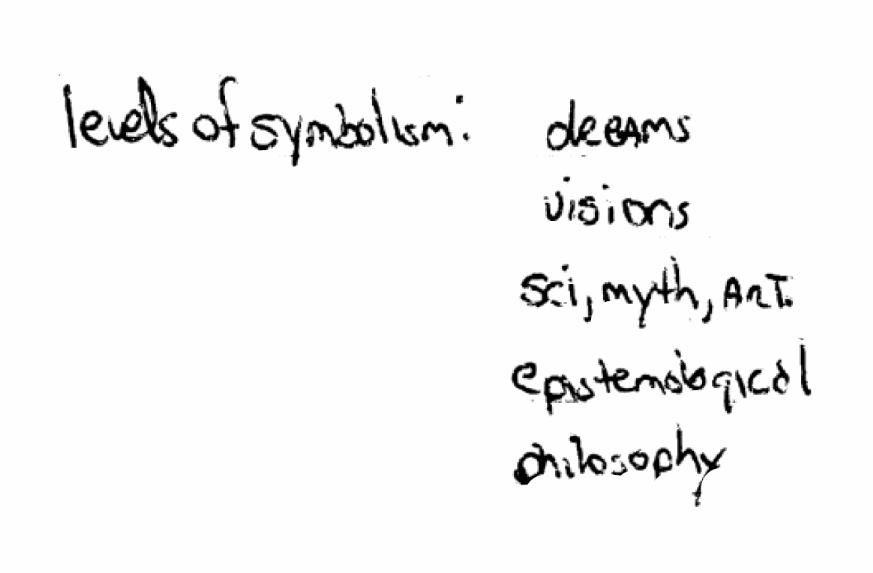
FIGURE 1977 1002-1-AB. Levels of Symbolism.
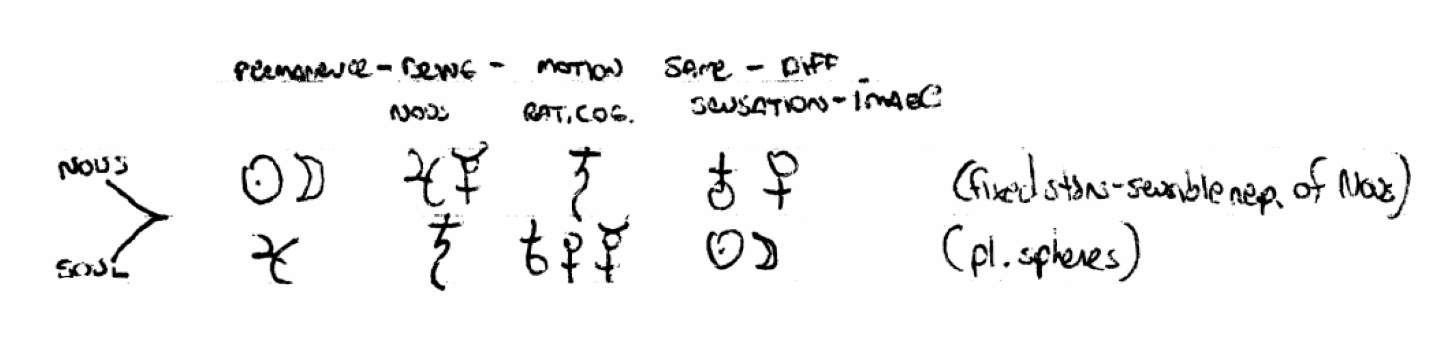
FIGURE 1977 1002-2-AB. Intellectual and Soul Monads correlated with Gnostic Functions and Five Genera.
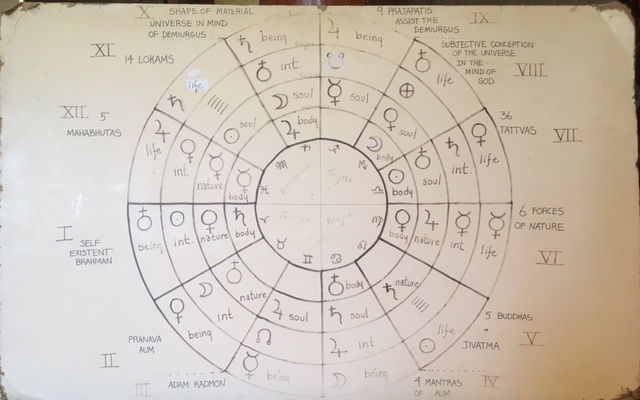
FIGURE IMG_2202-Posterboard Metaphysical Chart.
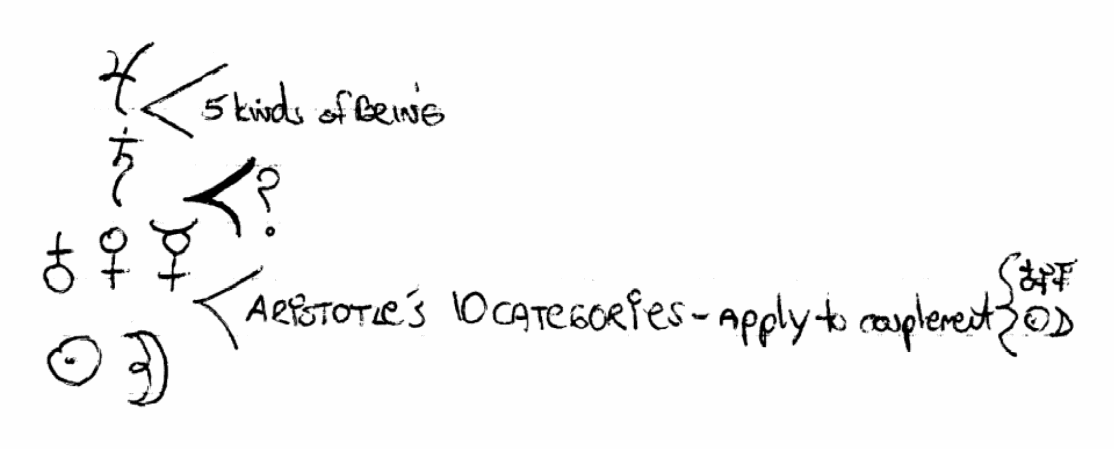
FIGURE 1977 1002-4-AB. Soul Monad correlated with Three Levels of Categories.
Other diagrams referred to are not with this transcript version. [Transcriber note: [diagram] means the speaker is referencing a diagram as he or she is speaking. If someone is drawing or writing, with audible sounds of chalk on a blackboard, I indicate this by [drawing] or [writing].]
NOTE: For readability's sake, the following substitutions/edits made in Verbatim Transcript: cuz = because; gonna = going to; gotta = got to; yeah = yes.
TRANSCRIBED Verbatim by IT prior to 2017, reformatted by jf 2017. In 2023, IT updates prefatory matter, footer, and audio file name, alters Topic and Subsubjects to make more accurate, completes TOC and Book List, adds Plotinus quotes section, fixes errors/typos, adds new notes within transcript, adds four diagrams and references within transcript to these diagrams, reformats to accord with new conventions. Archival verbatim transcript – V12a.
AUDIO FILES: 1977 1002a, 1977 1002b. [Note: "Tape" and "Side" refer to original audio cassette tapes that were later digitized into .MP3 Audio Files.]
1977 10/02 at Wisdom's Goldenrod
Categories; Symbolic Functioning
[Audio File 1977 1002a Begins]
AD: He announced or wanted me to mention tomorrow he's going to start a class. Anyone interested in the way he worked this problem is welcome to come.
S: [few words inaudible]
AD: Any other announcements?
S: No.
S: [one/two words inaudible] (bit of laughter)
AD: Yes, the next announcement will take a couple of hours. (laughter, student words) Well we got off to quite a few interesting problems and we've been [student assents] working on for a while. In the Buddhist class we have an interesting-- very interesting example of the problem we're working on now. In the Buddhist class the article we were studying by Guenther on the meaning of mind in Tantricism, [Note: See Herbert V. Guenther, Tibetan Buddhism in Western Perspective, "The Concept of Mind in Buddhist Tantrism".] they make a division of basic problems into three-- three forms. They speak about appearance, and they speak about symbolism in the widest and most comprehensive sense of the term. [student assents] So that in their division, in their twofold division, alright, the whole notion of symbolism comes up very strongly and we'll try to deal with it in their way, which I personally consider kind of inadequate for the reason that there isn't a sufficient penetration and understanding into the details of what they're talking about. They always take for granted either that we know it-- I take for granted that, you know, I expect the author to explain it to me but they take for granted that I know it, and I don't--
At any rate, the problem comes up in Buddhism quite accidentally, I mean we didn't plan it or anything, you know. (student laughs) We got someone to (watch/wash) now. Anyway, the three basic problems they come up with, one of them which they considered in their whole understanding of reality, is symbolism. And we're forced, I mean you're brought up to that now in our own understanding. So, we'll just continue some more. It's kind of haphazard, it's not organized yet, but we'll continue the way we've been going for the past two weeks or so, just trying to bring in a lot of related material so you can get some insight into the-- the depth, the width, comprehensiveness of symbolism in general, ok? And-- We have some very fine writers in this field, if you're interested of course. You could look at the works of Cassirer, could look at the works of Jung. Eliade is excellent. Who was this fellow you just mentioned, Cirlot, Cirlot--
S (simultaneously): Cirlot.
AD: Cirlot? Has a very interesting preface to a book on The Dictionary of Symbols that I think is a long [couple words inaudible] but very useful. Oh. May I see [couple words inaudible] [student assents, very faint] It's this book here. [student assents, very faint] It has a very long preface and it deals on symbolism. Evidently he went into it somewhat. Guenon wrote a book, in case any of you are interested, called The Fundamentals of the-- of Symbolism. It's in French though. (laughter) I don't think it's been translated. [Note: English translation entitled Fundamental Symbols published 1995, tr. Alvin Moore.] But, it's a problem that just will, you know, runs right through the warp and woof of everything that we're doing. Well, uh-- [short pause] So we left off somewhere. [student assents] And what we wanted to do, just a rough-- like a rough sketch of a hierarchy, not that it is in this way, I mean it isn't "This is the first step," you know, like you make a ladder for yourself and you say "This is the way symbolism is working," alright, but we'll try to make a sketch of ourselves and we could speak of symbolism, let's say, over here. [drawing] [Note: See FIGURE 1977 1002-1-AB for the following.] So down here [diagram] where let's say, you know, we spoke about the symbolism that appeared in dreams. So we could speak about dream symbolism. We could speak about visions--those are symbols [diagram]. We could speak about within, let's say-- [short pause while drawing] (Well, you're hardly--) [short pause while drawing] Epistemology as symbolism [diagram]. You can go into [student assents] science, myth, art [diagram]. All these are various forms of symbolism. Of course, you could put philosophy here [diagram], what we call philosophy, alright, and it would have many levels. Perhaps we could put it all inside--in other words, we can take all of this [diagram] and shove it inside epistemological symbolism, I don't know if we could do that, we'll try-- we'll try doing that. But I think the first real major symbolism that comes up is what we were doing when we decided to take the Intellectual Monad or the World-Mind. [drawing] [Note: See FIGURE 1977 1002-2-AB for the following.] (We--) we referred to that as the Intellectual Monad [diagram]. And-- [14¼ second pause while drawing] And perhaps the translation, you know, the translation of the Intelligible World into-- (baby cries, laughter)
S: [couple words inaudible] but I'll talk to her.
AD: Baby girl, ok.
S (faint): We start--
AD: Start them young, don't we? (AD laughs, laughter) Maybe in this division, the way we spoke about this division, that is, we did something like this here, we put the-- [drawing] above that we put [student assents] the rulers [diagram]. And we pointed out that this here realm, this realm here referred to sensation and the image [diagram]. This here realm dealt with rational cogitation [diagram]. This here would-- is spiritual Noesis or Nous [diagram], ok, and this [diagram] of course we didn't refer to. But we pointed out that this was the sensible world [diagram] and this was the Intelligible World [diagram], and that the entirety of everything that can be known would be the two of them together. Now, many people accuse Platonism and Platonists of being dualistic. Well, I have to disagree even with PB about that, that it's not dualistic. It has implications of dualism, sure, but, that's my point, in a sense that-- that the recognition of the non-dualism and the recognition of dualism are both there.
Alright so, then we went ahead, we were working on this Friday, and we came to the conclusion that perhaps, perhaps if we broke down this Intellectual Monad according to Plotinus' notion, that there would be five different kinds of Beings, [Note: See Plotinus, VI.2.] if we worked out with the categories-- with the categories or the kinds of Being that he worked out with, and we came out with the notion [AD drawing] that this might be Permanence [diagram]; this would be Being [diagram]; this would be Motion or Life [diagram]; over here Sameness [diagram], over here Difference [diagram]. Now, PB speaks a little bit about it, you know, he speaks about the World-Mind dividing Itself up into innumerable centers of consciousness. And the mechanism, I suppose, the intermediary mechanism, would have to be some sort of categories of that nature. And the problem, the problem that I-- the way I understand it is, if we follow the academicians, you know, Sameness and Difference, you know, I mean, what the hell are you talking about? I mean that's the way I express it, what are you talking about, Sameness and Difference? If you talk about the sameness of some thing to itself or the difference of that something to another, then it starts making sense to me.
You see what I'm saying? It's like this is like a disjected mem-- members of some whole. And if-- if the-- that of which they're, you know, that of which is the substratum or what provides the thread of continu-- continuity isn't there, it's like I'm speaking abstractions, Motion, Life, Being, Essence, Substance, I don't know what they're talking about. But as soon as I say that this is the way the Intellectual Monad or the way the World-Mind seems to divide Itself, because we'll probably end up with-- with it as a kind of seeming, seems to divide Itself up into these here five (ways), then we have-- then we're talking about something which is to me very concrete. We're talking about how the World-Mind is dividing Itself up. Ah, this is very very meaningful. (bit of laughter) It might even-- might even be possible to apply this onto the-- you know, the astrology that we're trying to bring together.
Alright so, this was what we were working on Friday night, and then we didn't get to the next position where we're going to try to see how this can be translated, alright, how this can be translated by the Soul. And it would have to be translated by the Soul, the Forms-- We spoke about it briefly, [drawing] how these Forms which are contained immutably in the Intellect are going to be projected outwardly, you know. The symbolism you'll have to use is of course that over here like we will have [student assents] to use the symbolism of the fixed stars [diagram]. Now the fixed stars are a sensible representation of what we call the Intellect, the World-Mind, or the Intellect. And the planetary spheres over here [diagram] would be what takes the Forms which are contained in-- immutably in the Intellect and through Motion or Life projects them outwardly and they become what we call the body [diagram], ok. So we'll have to work with this sensible representation so that, you know, you don't feel like you're floating around a vacuum.
Alright so, when we were speaking about it I think Mr. Richard and I were talking about, we take the 360 degrees of the circle and consider that like something equivalent to the Causal Intellect, tur-- the-- the Forms or the Ideas contained in the World-Mind in an immutable way. And we speak about the Soul as having to take the-- that immutable contracted and implicit unity of the Causal Intellect and the planetary spheres are going to be directed or guided by the Forms or the Ideas in the World-Mind and translate it into, let's say, the imagined or imaged world.
Now, I had to write this down because I don't think I could say it yet, and I wrote a-- I wrote something down but I don't think even that's going to help. But I'm trying to say something now which is very difficult. [18¼ second pause] Can you think of now, for a moment, the individual Soul at the level of Saturn, you know, in Cancer [diagram]. Taking it from there, let's say that that level of the Soul receives the pure Intellection from above, which would be the Jupiter in Gemini [diagram]. So it receives and it is subject to this pure Intellection. The product of that eventually is going to be our experience. Now, it translates, through the intermediary, through intermediaries, this Unmanifest or Being or Isness, pure Isness, ok, and it's going to translate it here [AD hits board] into this (subtle) image [diagram].
And the point that I wanted to bring up here is that, in a sense, in a sense, that is indeterminate and un-- unmanifest Being. And what we're going to get is a product, a product that is determined in comparison to that. So, I don't know if I could put it this way, um-- It'll translate the indeterminate or indeterminate Being into determinate elements of our experience-perception, hyphenate experience-perception, or-- or imagination. And it is the link or the copula that connects the "I", the pure subject, the "I", the subject, and the predicate of a judgment. "It is that," for instance, as an example. It hyphenates the subject and the predicate. Now I'm-- of course I do not mean here that, you know, "existence is perception," that this has got nothing to do with Berkeley, please don't confuse it.
More concisely, perhaps I could put it this way: Existence may be an element in perception as an imagination. It's a meeting point between determinate and indeterminate elements of our experience. Existence is this meeting point. [short pause] I'm going to have to try to explain that word, (ok)? [short pause] Above the level of Soul or-- we have what we refer to as the Unmanifest, or the Intelligible World. And we spoke at times of the individual mind or the finite mind which grasps this Intelligible and then portrays it for us, portrays this for us as our experience, experience-perception, whether in the imagination or, you know, in terms of perception. And here the point I'm trying to get out is that it is that very act when it grasps the Intelligible that these five get manifested, Being, alright, Permanency, the five categories. In other words, that very act is existence and these categories. Yes?
RC: Are-- are you still referring it to the Saturn in Cancer?
AD: Yes, you could use that. It may not be so, but tentatively let me put it there. Let me try this way. We have-- we have an unconscious complex, falling back on the use of an analogy, we have an unconscious complex, we don't know what that complex is. And our mind will grasp that complex and translate it into terms of a dream experience or sensible dream. Now, what was formerly indeterminate, unavailable, indescribable, alright, let's call it indeterminate being, alright. Now through the activity of the mind grasping it and translating it into experience, alright, this indeterminate being becomes determinate being. You-- do you follow that?
S: Uh-hm.
AD: What was, so to speak, an unconscious complex now becomes an actual sensible representation of that unconscious a-- so that something comes into existence. That's what I'm trying to bring out now. What was before indeterminate, unmanifest, and you couldn't speak about as existing, now you can speak about it as actual, in manifestation, in existence. And that these categories will be applicable. Alright, I call that the first level of symbolism.
S: (But you--)
AD: Did you all have enough coffee? (laughter) Alright, go ahead [one/two words inaudible] (bit of laughter)
RG: What-- when you refer to in-- indeterminate Being that way, what are you actually referring to?
AD: Underlying substance, or like the Overself or the Intelligible in Act. And the World-Mind would be the Act of that Intelligible Being. I'll speak in the singular, ok, not [RG assents] to confuse it. Alright, and, at-- in that very-- in that very act, ok, which is unmanifest, unavailable to us as sensible being, it is the mind that has to take it and make it available to us as a sensible representation, so that, of course there's going to be an ordering of that experience. I mean it's going to be ordered as our experience. So, the entirety of the contents will have to be represented sensibly for us in order to have some sort of-- let's say, the way the Platonists say, there would be a re-assimilation bringing us back to the source-- source of our being. If we take the example of the dream, it's like this Intelligible-- I mean, this unconscious complex is the content, alright, and the mind has to take it and translate it into an actual existential situation where there will be a divi-- division in life, a division-- the thing being itself and being other than itself or things being other than it. Ok. Yes go ahead, just talk a little bit.
LR (simultaneously): I was going to ask a similar question. It seems from this description you gave, it's a relative-- and even using the analogy, it's hard to put-- to figure out which level you're speaking of because it would be a relative thing for each individual. If you're speaking about an individual, what would be indeterminate becoming determination would be different for each man. I mean, something which is still indeterminate or--
AD: Yes, that wouldn't-- I wouldn't deny that, there would be a relative determination because one and the sa-- same object which one person sees just as a sensible object [LR assents] the other person would see, let's say, with the-- you know, a value judgment, a meaning judgment, a symbolific meaning, sure.
LR (simultaneously): Right, so I'm-- in that respect it's very difficult to see, I mean, you say-- It would be very difficult to locate, say in a house or in planets. You say the individual mind translates, ok, that's where you started. The individual mind portrays or pictorializes--
AD (simultaneously): Let's say it (projects) out this experienced world [LR simultaneously: --the Ideas in--] [couple/three words inaudible] producing intelligence.
LR: Ok now-- I guess Randy just asked, is that-- you're speaking-- what are you speaking of as the individual mind here?
[Note: See FIGURES 1977 1002-2-AB, IMG_2202-Posterboard Metaphysical Chart for the following.]
AD: Well, it's going to be a combination of [drawing] this here, the Saturn in Cancer [diagram], and this here [Mars in Libra, Venus in Scorpio, Mercury in Sagittarius]. Because if you remember, we spoke about the Saturn as-- in Cancer as representing a Tetragram or Being, the four different (ways/modes) of Being, alright. And we spoke about the Mars here in Libra [diagram] as the-- let's say the-- the way the desires are particularized or embodied, the way Venus in Scorpio [diagram] represents the subjective conception necessary for that individual and of course the Mercury there [diagram] would have to do with what his past karma would allow him to perceive now in the present. Because it isn't a question of pure perception but a perception which is qualified by our past samskaras. So what I'm trying to say is that even though Saturn, let's say, in a sense [drawing] receives pure Intellection from one level, alright, from another point of view, you know, going down this way, this here would have to-- I'm sorry, this here [Mars in Libra] would have to-- individualizes the Soul insofar that the desires or the activity to this Soul is peculiar to it and different from others, ok. The consequent subjective conception of the world is going to vary because of this here [Venus in Scorpio] too. And, of course, what we just said about the Mercury [in Sagittarius] where perception will be qualified by past.
LR: I guess-- I guess the confusion in it for me in your description would arise in trying to-- I mean if you were to speak of an epis-- of epistemological categories or something like that, then you'd say that all indetermined-- undetermined-- this undetermined set [AD simultaneously: Which is--] of Ideas or something like that--
AD (simultaneously): Yes, isn't this unconscious complex undetermined and undifferentiated and unavailable and unmanifest?
LR: But I-- well-- yes. [AD simultaneously: Right?] But my--
AD: Isn't it possible that the mind that takes this undetermined and undifferentiated complex could portray it in-- in a thousand different ways, [VM and LR assent] until the meaning is grasped? So in a similar way, I would say that the human Soul, for instance, which has this rich storehouse of experience behind it, and whatever way that it can be made, you know, suitable for the experience at hand, so-- so will the higher Soul operate.
LR: So are you saying then that, given a man's experience, there would be certain epistemological categories that would be necessary for any man-- for any man's experience to manifest as a world for him, that would run through any man, because they're epistemological and they'd have nothing to do with his sub-- his psychology, say, or disposition.
AD: Yes, so--
LR: But at the same time, the--
AD (simultaneously): Use the analogy.
LR: Well, the reason I'm having trouble with the analogy is it makes-- it makes the translation, what you were calling the translation of the Ideas into experience, relative to an individual, whereas there would also be categories that all men would have to participate in, that would be tran--
AD (simultaneously): Well, those are the categories that we're calling at the highest level. In other words, this unconscious complex, a certain operation has to be performed on it by the mind, ok? First of all, there's the guarantee that the unconscious complex has some permanency, because, if you know, it usually persists a long time. (laughter, student words) Secondly, we would have to say that in order-- in order for that to become available to-- to us through sensible representation, it has to be like broken down, like let's say beings have to be created, you know, dream characters have to be put in the dream, ok. They would have to have a certain kind of-- or a certain life in them, invested with life, ok, and the dream character would have to be the same with itself and different with others. Now, just in terms of the analogy of the dream of this unconscious complex, if this isn't immediately applied by the mind to the unconscious content, no experience is available. [LR assents] Now I'm not saying that our experience is simple-- s-- simple, because evidently it is not, it's going to be invested with these categories besides whatever the content may be.
And here we have a strange situation because in most of the Eastern doctrines their analysis is always aiming at the one-- one thing, the substantial side of existence, they keep hammering away at that with a purity almost. Whereas I think the Greeks, and I think in the West, the tradition is to try to understand more the essential side, try to understand, "Wait a minute, what is the content of this experience? Never mind the substantial side. What is the content, what is the essence of this experience that I'm going through?" Alright, so it's a little different. You see what I'm saying? Look, in the tatt-- tattva situation where there's an emphasis on the underlying substratum of the entity, alright? Alright, so everyone has these same tattvas, [student assents] alright, they all operate, we all have eyes, you know, ok. But why this difference or plurality of meaning between various entities? And I would say there you'd have to bring in the primals, you know, Soul, World-Mind, and above, if necessary, in order to account for the difference in experiences. Because you cannot account for the difference of experiences in terms of just the substantial side. You see what I'm trying to get at? [VM assents]
Alright, now going back to this point of view. [drawing] We're saying that this individual mind has to grasp this unconscious complex, and through the application of these categories, which would be a priori to your experience, alright, make it possible for there to be a sensible representation or what we call perception, experience, or imagination, and then within that you are going to have to find out what are the a priori categories which made this experience possible for you. Now, Aristotle will come along and speak about ten categories. Kant has a galaxy, twelve of them, just like the Zodiac, twelve categories, alright. But everyone will come along and say what these categories of experience are going to be for, you know, their school. Alright, go ahead Randy, (keep--) keep bugging me, maybe I'll come out with something (different).
RG: [couple words inaudible]
RP: Well I--
AD: Go ahead Richard.
RP: I always thought the ma-- the major problem in this whole area of symbolism is how the symbol is capable of carrying the meaning. How does the Soul go out-- the Soul-- the Soul grasps the Intelligible by portraying it to itself in elements that are really foreign to the Intelligible, namely, well [couple words inaudible] space, extension, color, blah blah blah, all the ingredients that we've experienced. And yet the purpose is to gain this experie-- experience of the Intelligible in a-- in a psychical way. But what's being gained, what's being come-- coming to be known is something which in some sense is above the Soul, this Intelligible Essence. And how are these foreign elements capable of actually conveying this intelligibility to the Soul? I mean, that's a-- it's a major problem. I can't understand when I read a book how I'm capable of reading the book. My eyes beholding the letters and I'm grasping the meaning of the words. That-- that to me has always been the greatest mystery, how material, you know, the material can carry the immaterial, you know, portray the immaterial.
S: Yes.
AD: Do you see the question he's asking? [students assent] Yes, of course, that's-- I think there's possibility of some explanations, I don't know if they're going to satisfy us but I think we can poke at some of the explanations. But for now could I ask if-- if this is legible, I mean, not legible but--
S: Intelligible.
AD: Intelligible. (laughter, student words) Legible might be right. [student assents, faint] Yes?
VM: Isn't it also possible to use Permanence, Being, Motion, Sameness, and Difference to these Intelligible Ideas irrespective of their manifestation by a given individual mind? In other words, I'm coming back to a question I asked a couple of weeks ago: are these categories epistemological or ontological? Again, the way you described them here, it was an individual mind grasping a given Intelligible Idea and through these categories manifesting this thing in space, time, and so on, bringing it into existence. [RG: But I--] But-- but prior to bringing it into existence or, let's say, irrespective of that act, can one still speak about Permanence, the Being, the Motion, the Sameness, and the Difference of these Ideas, or doesn't that make sense to speak that way?
AD: No, that sentence again.
LR: [one word inaudible]
VM (simultaneously): Prior to or irrespective of the manifestation of these Intelligible Ideas in terms of sensible experience, is it possible to still speak of these Intelligible Ideas or a content to this realm, if you like, in terms of these five categories?
LR: Yes.
AD: Prior to the experience can you speak of--
VM (simultaneously): Yes, take Souls out of the picture if you can.
LR (simultaneously): You can just speak [AD simultaneously: Yes.] about Ideas (there/Vic).
VM: Ok, take Souls out of the picture, in other words-- But let's not concern ourselves with manifestation for an individual. Is it still possible to-- to use these categories in an intelligent way or lawful way, whatever you'd like to say, to these-- to the Intelligible Ideas? In other words, can we do a purely ontological analysis?
RG: But we stood on-- but I think Tony did when he-- when he spoke of the World-Mind's vision of the indeterminate grants you those categories, that's an ontological view. It's not an epistemological view, (say).
LR: When did he say that?
VM: Say it again, when did he say that?
RG (simultaneously): Said it before, he said--
LR: The World-Mind--
RG (simultaneously): Play it back on the tape.
VM: I wa-- I wasn't here.
RG: He said the World-Mind's--
LR: Vision?
RG: --vision of the indeterminate Being establishes the five categories of Being. That's the Intellectual-Principle of Plotinus.
AD (simultaneously): And that's the meaning of Permanency. You see, the-- this notion of Permanency is a very difficult one to grasp and perhaps maybe we ought to repeat it again. Remember, I could always be suffering hallucinations so you shouldn't let my words slip-- slip by you without, you know, asking for identification. When we were speaking about the divided line, one of the difficult conceptions that was involved was this notion of Permanency, alright, Being, Motion, Sameness, Difference. And as long as I followed the chronological listing the way the Platonists give it, although there would be discrepancy, the Middle Platonists jumble them around, they don't have them in this order, and that immediately made me think perhaps it's not in this order, it's just written in this [student assents] order but perhaps this is not the order. And then of course it was very obvious because the Sun in Aries, now--
Again, let's fall back on the use of-- let's fall back on the use of an analogy. Permanency here would be something like this. The mind, let's say, is going to grasp the-- the unconscious complex. Now in that grasping of what the unconscious complex is, it structuralizes completely the portrayal of that. [student assents] Now this would be equivalent to Permanency. What I'm saying is that the Intellect, Sun [in Aries], in its total grasp of the meaning of the unconscious complex, and when I say total grasp that means it has already incorporated it as the sensible world in its own understanding with all the necessary divisions of being--motion, life.
In other words, let's say-- let's say a composer, you know, the example we use of Mozart where he conceives the totality of the sonata in an instant. [VM assents] But in that [student assents] conception, in that conception what we have to keep in mind is although there's a turtle-- a total permanency of the whole sonata-- the turtle permanency, (better). (laughter, student words) Maybe he did tell you, I probably read it-- (laughter, student words) In that-- in that conception, alright, in that conception of the sonata, [student assents] alright, there will be included within it all the movements, you know, the slowing down, the speeding up, the juxtaposition of melody, count. All that's already in-- that's permanent. That's the totally fixed knowledge, that's Permanence. That's one of the categories, ok? And, of course, if Mozart had this vision of the sonata, the tempo is included in that, it doesn't exclude-- In other words, what I was trying to say is, it's not a featureless unity, everything is there, but not like broken apart the way the lower manas breaks things apart. The lower manas operates quite differently. But over here you have this absolutely featureless-- I mean this featured unity, everything is combined with each other, everything interpenetrates, interfuses, ok, and there it is, total. All those categories are already included, alright.
Now interesting enough, that brings up the problem we have with the World-Mind. Because on the one hand, when it looks down this way [diagram], alright, it gets arrested and Being gets determined. When it looks up this way [diagram], it's an entirely different relationship. In other words, this is the act of contemplation [diagram]. But the act of contemplation fixes and determines the contents which are within.
LR (simultaneously): Ok, then this still isn't clear. It seemed like we're-- Did we get that cleared up? It's--
VM (simultaneously): Well, it didn't seem to answer my question.
LR: Ok, it seemed like the way you started out was to say that the translation of the Ideas from your first level of the Intellectual Monad to the Soul Monad accounted--
AD (simultaneously): To the Soul Monad, yes.
LR: --accounted for the arisal of the categories at that point where the Ideas had to be translated into the Soul, [RG: No.] or the Soul had to receive the Ideas. [RG: No.] When you drew the--
AD: No, because there, there you-- (laughter)-- yes, that [one word inaudible] there, you see, when you speak about-- about these categories there, what's happening there is like there's a division, let's say, in the All-Soul of various Souls, of one reason-principle from another reason-principle. It isn't like down here where there's a division between, let's say, my body and your body.
LR (simultaneously): Whoa, could you go back, could you start over again?
AD: The categories over here [diagram], the categories of existence, are applicable to Soul. These are [VM: Good.] eternal generated entities. We're not talking about beings (like us).
LR (simultaneously): No I know, so that's what I said, it seemed like when you began you were speaking of the categories as fitting in, in the place, if you can speak of such a place, where the Soul met the Intellect, or in other--
AD (simultaneously): Where the Soul what? I'm sorry.
LR: Where the Soul met the Intellect, in other words, where the Soul was to [AD simultaneously: Alright, yes, ok well--] receive from the--
LR: Ok.
AD: Alright.
LR: Then what [AD simultaneously: And then there's the other (one word inaudible)] Mr. Goldman said--
AD: Yes, there's the other aspect where there's the unity of it. In other words, at one and the same time, I think your paper expressed that, at one and the same time there's this World-Mind which, looking down, seems to be split up into a plurality of Souls, which are eternal Beings by the way, alright. On the other hand, alright, looking upward, there's a unity of the World-Mind.
LR: Alright, but Tony, can I just-- [S simultaneously: Well I--] can I just push this question once more?
AD (simultaneously): Push, push.
LR: We're just trying to find the place in which-- the proper place for these categories, which we were also trying to do Friday night. On the one hand--
AD: Well, alright.
LR: --it seemed as if you were putting them at the point where Soul met Intellect so that in-- Soul could in fact receive the Intelligibles into itself-- self. Ok? Now what Dickie was just bringing up was that, no, those categories are applicable prior to this and they ca-- they arose from the World-Mind gazing at the Absolute or something like that. [AS simultaneously: Yes, could be, but--] And what Vic and I were asking about--
RG: At the indeterminate Being, that's all you have to [one word inaudible]
LR (simultaneously): Alright, indeterminate Being, alright. [AS: Yes but the inde-- see--] That got a little confused Friday so--
RG (simultaneously): Ok, but not at beyond Being, at--
LR (simultaneously): Ok. And what Vi-- I mean, which is it, or is it both, or--
AD: Well I think your confusion shows a great deal of understanding. (some laughter)
RG: Very good, Linda. (laughter)
AD: No I wasn't-- I [few words inaudible]
LR (simultaneously): Well no, I'm just-- I'm just parroting what was said before, I mean I didn't just make this up, you know. (laughter)
AD (simultaneously): No, no, I'm quite serious, I'm not joking, I'm not joking.
LR: Oh, do you have an-- any answers?
AD: But you answered it.
MW: See that? Yes. Very good Linda.
S: Good.
LR: What was the answer Michael? (laughter)
S: Richard, the answer exists.
MW: I'll play back the tape. (some laughter)
S: [few words inaudible]
AD: No, let's try again, sure, let's try.
AS: Yes. But I think--
S (simultaneously): It's starting to make sense (with what--)
AD: Alright, go ahead Avery.
AS: The one we said on Friday, alright, there's two things going on, that the Intellect before-- before Soul can determine the context-- contents of Intellect, the Intellect must determine that indeterminate Being for Itself. The Intellect itself is a dete-- is a determination of Being, of indeterminate Being, and its determination of Being is in terms of those five categories [S: Ok.] before the Soul does any-- can do any translating.
LR (simultaneously): So it's both.
AS: It must be-- Yes. I would--
LR (simultaneously): You're saying it's both, they arise at both places.
AS: No, I'm saying that they [student assents] arise primarily in the Intellect.
LR: And they're used by--
AS: To the Intellect. But simul-- it seems like simultaneously with the Intellect determining Being, that that necessarily-- I mean there's this necessary outpouring then of Intellect [RG assents] down as the Soul, and the Soul becomes a downward power of the Intellect. But I think the other thing though, it seems that the actual notion of symbolism, I mean (then/though), it seems like here you could make the distinction between symbolism and the categories because the determination that the Intellect makes of the Intelligibles would not be symbolic, it would be the actual-- the actual determination of those Intelligibles. It would be at the level of Soul that it would be an actual separation let's say, or the Soul would-- let's say, wouldn't be able to grasp those Intelligibles directly but would necessitate it as sy-- what-- a symbol of those Intelligibles, which is the whole world that it produces.
AD: Uh-hm. Go ahead [three words inaudible]
VM (simultaneously): Avery would-- well let me just ask this question but Avery or whoever.
AD: Look, I'm only chairman, [VM simultaneously: Ok, ok, fine.] go ahead, continue.
S: Vic doesn't know.
VM: When the Intellect, let's say, to use a metaphor, gazes on indeterminate Being and in that-- and in-- in that Act establishes the categories of Being, do you think the categories Sameness and Difference are also established or just the first three? [AS: Yes, I--] In other words, is Sameness and Difference--
AS: I think all of them here.
VM: (Yes), because the reason I asked that is--
AS (simultaneously): I would-- I would say all of them and in-- because als-- also a lot of the Greeks call it like, in fact, Sameness and Difference.
VM: Is that right?
RG: You could [one word inaudible]
AS (simultaneously): Yes, and in fact it would seem like those-- It's very strange but it's interesting because you see, the Sameness and Difference seem to-- with those two the other three come in also, you get all five with the Intellect. Now you might talk about Motion, like Life, prior-- They talk about Life, in some sense Power, prior to Intellect. Being even prior to Intellect, or Permanency. But when you bring in Sameness and Difference, you get-- you get all five of them there with the Intellect. Yes, because Sameness and Difference separates the other three of them too. See before Sameness and Difference, Permanence, Being, and Motion, let's say, are-- are inseparable in some sense.
RG: Well, but on the other hand, Difference has to establish even those three as si-- I mean you say [AS simultaneously: Oh. We'll get to that (one word inaudible)] three, I mean, I have to associate--
AS: Alright, alright. Alright [few words inaudible]
LR: Do it.
S: No.
LR: So then this-- these do apply to the Ideas in the Intelligible World as well as to our experience, [student assents, faint] I mean, they would have to apply all the way down.
[short pause]
AB: I think the way we're using symbolism, alright, is that any kn-- any knowledge other than knowledge by identity is symbolic.
S (faint, possibly part of background): Mercury is symbolic knowledge.
AD: In other words, I would like to push Alan's point a little bit, it's that unless Thought is Being, and Being is Thought, anything short of that will be symbolic, [VM assents] you know, my-- my peculiarity. [student assents] And you remember how this came about, the identity between Thought and Being? Very briefly let's review. If we take the analogy that PB gave us, there's a picture of a character in London [drawing] and there it is, boom!, complete, you know. Now we got to get it to New York, over here [diagram], ok? And through some means which is beyond my comprehension, system of wireless telepathy [sic; telegraphy], which deposits a sequence of dots, [one/two inaudible student words simultaneous with AD, laughter] alright, ok, till finally this [diagram] is an exact duplication of that [diagram], [VM assents] ok? [S, faint: I see.] Now this we call totally fixed knowledge [diagram], ok? [drawing] This is totally fixed knowledge. [VM: Beautiful.] Alright? [student assents] And this is the knowledge of Brahman, eternally fixed, ok. Now I'm going to get a little bit of that, very little, I know, but I'm going to get a little bit of that. And he's going to transmit this through a series or what they call the doctrine of vrittis. I'm going to get some of that. Now how? Well, Richard worked this out, you remember the last time, when we spoke about the mind in the body or the mind as the (aham), the mind going out as a vritti, the mind grasping the object. Because the mind grasps the object, not because of that but because the substratum of the object is pure consciousness, illuminates the object and through the object goes in, illuminates the vritti, then the subject's-- the subject whose antahkarana that is that flowed out, in that instant and that instant only, Thought is Being. You miss this point, you missed a capital point, go home, go wash your dishes.
LR: Thought--
S (faint): Well--
S: Yes.
AD: It took a long time to bring-- bring us up to this level.
LR: Thought is Being?
S: You say that [one/two words inaudible]
LR (simultaneously): Is that what you said? [student assents, faint] So then would-- it would be inappropriate in this statement being made that way to ask what the relationship is between those two pictures.
AD: Well, if you understood that Thought was Being, there was no relationship.
LR (simultaneously): There is no relationship. And yet why do they speak of things like likeness and stuff like that?
RP (simultaneously): [couple words inaudible] That's always the easy one. The hard one(s) are the pramanas because that's symbolic knowledge, like for instance, I don't know [couple words inaudible] [LR: Oh yes, ok.] because in there, there is not the identification of Thought with Being. And for example, when you infer something, this thought isn't-- does not take the same form as the being. Maybe that's why you say this is about [few words inaudible] Seeing is believing, you know. Now it's-- because I guess they do call that knowledge too [one word inaudible] Vedantins in strict [one word inaudible] obviously. [LR assents] Yes, symbol-- for them too, mediated knowledge or what we were calling symbolic knowledge is also a species of knowledge, but what pops through in that case is not the underlying substratum of the object because somehow you're not in contact with the object, at least not through the senses. So how do you get to that with the, you know-- That's the same problem I'm bringing up I brought up before.
AD: Uh-hm, yes, I know (that/this).
RP (simultaneously): How is inference get invoked? I've never understood that. I take a thousand instances, then you have-- you infer, well, you drop the ball, you know exactly when it gets to the ground and all that, and you do it and it comes out right. I never knew how the ball knew to go there. (some laughter, RP laughs) I just-- well--
LR: Yes, yes, that was my question that, you know--
AD (simultaneously): Oh, by the way, that brings to mind that I'm going to start swapping with Richard classes in the Vedanta and Platonism. I won't give you no schedule, there won't be no advanced notice or anything like that [couple words inaudible]
RP (simultaneously): They need [couple words inaudible] (laughter, student words)
AD: Huh? If I-- I-- I want to go and do-- [S simultaneously: Cool.] redo some of the things in the Ve--
(Side 1 of original cassette tape digitized as 1977 1002a Ends; Side 2 Begins)
AD: --to my own avidya, my-- surrounds me like an egg-- a shell surrounds an egg, alright. And every time I want to get to know what's out there, a vritti is what establishes that identity between a subject and the object or makes possible the knowledge of an existent object. So that, if-- if I say that-- if I take this analogy here, here's-- [drawing] here's the subject and here's the object [diagram], ok, and I'm surrounded with a kind of ignorance, alright, avidya. And every now and then a thought breaks through, grasps the object, coincides with the object, alright, and the form of the object is in the vritti or in the antahkarana of this entity. And they'll-- they go further and say that the substratum consciousness of the object illuminates this vritti, which of course is your antahkarana and which gives you knowledge of the object. It is at that instant, at the conjunction, at the exact conjunction, [AD snaps fingers] that you have precise or real knowledge. [student assents] Ok? That-- if that is so, then Thought is Being. At that instant, not any time, because you could have a lot of thoughts but they're not-- they're not Being, yes. No way, ok? So at that instant and that instant o-- You see that operating in the chart. You have an exact aspect, something comes into you and you have knowledge of something. And when the aspect is over, you're as stupid as you were before, (laughter) but of course with this addition, you know you're-- you know a little bit more. [S, faint: Yes, so--] Alright, so the favorable aspects are always, so to speak, opening us up to the cosmos and you get a little further insight into it. The next problem Richard was so anxious to get into I'm going to just put off a little bit. So-- Well, where's Linda, she was-- Linda!
LR: Yes.
AD: So, is it alright with the categories now, we [LR assents] deliver a little bit of insight?
LR: Well, do you mind if we repeat the question once more?
AD: Sure.
LR: In your description where Thought is Being, there would be no question. But, in-- in the (transition--)
AD: Well that was in reference to this [AD knocks on board] Permanence.
LR: I see. You mean totally fixed knowledge?
AD: Yes.
LR: Yes. But--
AD: Permanence as one of the categories is referring to that totally fixed knowledge. Otherwise that category is meaningless. [Note: See FIGURE IMG_2202-Posterboard Metaphysical Chart for the following.] That's exactly what the Sun is. In other words, the Sun in Aries, alright, this is Aries [diagram], that's the Intellectual Monad, alright, there it's in identity with the Will of the Self-Existent, so it's one and the same thing. I mean it isn't that a person has a conjunction or union with you call the Absolute. And yes, I must disagree with Aurobindo, that's out of the question, there's no such thing possible. What you come into conjunction with or what you reach union with is the World-Mind of your system. That's infinite enough, believe me. So, what we're saying is that this Sun, which represents the unity, the unity of the Intellectual Monad, is in conjunction with the Mars of Self-Existence [diagram]. There the immutable plan, the plan of the entirety of what the Idea of the Absolute is in terms for It to manifest is contained in a permanent state. I mean the Sun has no doubt what it's going to manifest, how, where, how long, when and all that. So that's a permanent fixture of this knowledge.
Just like, this Being here, the Jupiter [in Cancer], would be the-- the material, the ingredients, the being(s), the actual being or substance necessary in order to effectuate this plan, actualize this plan, the individual lives, alright. And the end formation or the end result which is going to be this prakritic entity [probably a reference to Mars in Capricorn]. So, I'm just-- I'm just trying to establish over here a very firm anchor into something that would give me a position to understand these categories. And unless I have this absolutely firm anchor of the absolute knowledge of the Sun as the Intellectual-Principle, I would have no place to stand. Then, I would have to agree with the others who speak about the categories of Being and I keep wondering, "What do they mean, Motion, what do they mean, Mo-- Rest?" I can't understand it, it's like in a vacuum. But if we speak about this in reference to this totally fixed knowledge, ah, now I know, I got something. I'm dealing with an actuality. [student assents, faint] Sure, go-- go back.
S: Tony, earlier when you spoke of the--
AD: You have to speak louder.
S: Earlier when you spoke about first-- what you were calling the first level of symbolism, were you speaking of that one moment when Thought is Being, when that object is experienced directly and embodies the ca-- those categories in experience? [couple words inaudible]
AD (simultaneously): Well, I think-- I think that Avery disagreed with that, and not without good reason, I may-- [student assents] May I ask you to repeat what you said?
AS: Well yes, sure. So what if the-- If you take the categories as within Intellect and you talk about Intellect's determination of that Real Being, that first moment as it were, and it seems that there the Intellect isn't-- is in conjunction with its object. It doesn't-- I don't-- Maybe there you wouldn't speak of symbolization because there's no, as it were, copy. It actually has the real Intelligible object. It's only when you speak of Soul translating that, any motion away from that unity, that you would speak of symbolization. It seems that you can speak of determination of the Intelligible before you have to bring in the notion of symbolization. Another place--
AD (simultaneously): I don't know if I accept your viewpoint Avery, [student assents] it seems [one/two words inaudible] carried symbolization a little too far.
AS: Well I don't know, I mean--
S: But that would imply then that that moment of experience which is delivered by this vritti, you're saying, is not at-- is not at the level of Soul.
RP: That's in manas.
S: It's not-- Well, [AS simultaneously, faint: That's right.] it's-- by saying it's not at the level of Soul--
AD: Yes, but he just told you.
S (simultaneously): But, you know, I mean--
RP: [couple words inaudible] [AD simultaneously: How--] how could a person know(--/?)
AD: I'm sorry?
RP: I said you got-- you got this (as) vijnana, you know, [student assents] and at the moment of perception. [one inaudible student word simultaneous with RP] Manas is what can be brought about (as/is) presented.
S: Uh-hm.
AS: I mean that's-- yes. Her point also really is--
RP (simultaneously): You know, there's no content. At that moment that Thought is Being, there's no content.
S: Uh-hm.
S (simultaneously): But does that-- does that [RP simultaneously: Right?] confine Soul entirely to like apperceptive thoughts?
RP: No, no, I thought that it has no content. When you see an object, the moment you see the object there's no content. It's almost void. The app-- the-- the-- oh, de-- determination-- but the manas can't grasp it, it tells you nothing. The determination of it within the manas, and now Thought is no longer Being, [student assents] conceptual and everything under the Sun, now there's full content.
S: Uh-hm.
S: Right, but it's no longer perception.
[student assents, very faint]
RP: That's right.
S: [few words inaudible]
AD (simultaneously): Just like when you say "I'm listening [couple inaudible student words simultaneous with AD] to music," you're not listening.
RP: What happens then?
S (simultaneously): Yes, right, because-- yes well I think about what it was, you know [one word inaudible]
AD (simultaneously): Whereas at the instant of the actual identity with it, there's-- there's no [student assents] awareness of two ends of a stick, you know. [student assents] But, Avery, I think I'll have to go along with you on that. [students assent, faint] (Sure/Yes), please. Yes, go ahead.
S: This may be besides the point but, I think that the idea of the Soul not-- as having anything to do with it, there seems to be some kind of natural growth or ripening of-- of when that Intel-- that Intelligible content would be, you know, made manifest. Like in the-- in the dream it seems like when that could come through would be at a certain stage of development of the Soul.
AD: I'm sorry, I did not [S simultaneously: Oh--] hear you, ei-- either of you understand? [S simultaneously: Yes, I (couple words inaudible)] Don't listen to (him) if you understand.
S: Well let me see if I can restate it and get (to the actual point in). [student assents] It seems that, you know, I can-- I can understand how at the moment when, like in the dream analogy, when the unconscious complex becomes a dream, at that instant Thought is Being or Being is Thought, at that instant in the-- I could see that the dream character is secondary and that would be the-- the Soul's contribution to it. But it seems that at that moment when the unconscious complex becomes the dream, I can't understand why at that moment it happened. You know, it seems like it's-- You know, in the sense then I guess in a-- when you have a conjunct--
AD (simultaneously): No, at that moment it happened--what happened?
S: At that moment, there's an identity.
RP: Well, you're mixing metaphors because you wouldn't call that perception, these vrittis (flashing).
S: Ok, alright. Well ok. Say some kind of knowledge is made available to you. At a certain moment there's an identity, like when you listen to music, say, when you're not listening to music but when you're in identity with the music. But, it seems that at that moment the Soul is-- I mean I don't know, is at that moment the Soul ripe for that experience?
RP: Yes but [one/two words inaudible] at that-- but at that moment the Soul is fully assimilated to its object. Now it's true, the knowledge that's included is not the kind of knowledge the Soul could call its own. Its own is the critical faculty through which it will review what's going on. And that-- that is a question of likeness, and that's what education, for example, is all about, there's a [one word inaudible] gives the Soul a specific number of forms so it could understand its experience. But the education or the development of the forms in the Soul doesn't give the Soul experience. Nor does it delay the understanding of experience. I mean if it's [couple words inaudible] anybody, anytime-- even an amoeba's knowing Brahman all the time. [couple words inaudible] But why do some Soul un-- [few words inaudible] I mean why is it just some Souls completely understand with a faculty? Now the understanding part, that reflective part on the Spirit, that's-- if you're going to call that knowledge at all, you must always go back to the experience and say there's a mystery there. You must go back to the actual occasion.
AD: That help you?
S: No, but--
AD: Well, keep trying, keep trying, sure, it's a very difficult point.
RG: Is your question back on why the categories of Being are established in Intellect and not in Soul?
S: Yes.
S: Well, I don't see how-- I mean on the one hand, Soul can-- it's (process/processed) at that point, I mean there's no-- there's almost no-- no grasping of the Soul to understand because at that moment there's like an image of the Soul in the Intelligible.
RG: But then you wouldn't speak of Soul, you'd [S simultaneously: Well that's what I don't--] speak of the direct identity with the Intelligible. [S: Yes but that's--] Soul is what will manifest it and break apart that identity in-- into a formal experience for you. You wouldn't speak of Soul in that identity.
S: But that's-- I think that's the question I'm asking is what-- If you don't speak of Soul until after this identity then there's a gap to me for how that experience then is related in (certain) images.
S: (Uh-hm), sure.
AS: That's Richard's [one inaudible student word simultaneous with AS] problem.
S: Oh.
S: [few words inaudible]
AD (simultaneously): Well that's the next problem, that's-- [S simultaneously: No but-- no, ok, but what is the identity--] that's another problem. The point here, the point here is, if you got what they've been trying to tell you that, it is at that instant of union that there is produced a real-- real knowledge.
S: But when you said that union-- If the Soul-- the higher part of the Soul is always in contact with the-- the Intelligible, right, the way Plotinus speaks about it.
AD: Only when it happens to abnegate itself in this very peculiar way.
S: Yes, ok, so then it's-- so kind of like what it projected is supposed to be out doing all this stuff but it's really in contact with the--
AD: Alright, you could put it that way. Then in that moment it's in contact with it and stoo-- soon as it gets about its business of doing things, it loses that contact. [student assents] It's the reverse of the way you're thinking, [student assents] that's all.
S: Yes.
RP: [one/two words inaudible]
AD: Go ahead.
RP: [couple words inaudible] is always in contact, I mean, the Soul is always intent on intellection, it's just that it happens [few words inaudible] totality of the Soul. And it's when the lower part of the Soul energizes, it overpowers its knowledge of the higher part of the Soul. You speak of (intelligence, you're already in the desire). It's a hard-- it's always in a contact with the [one/two words inaudible] it just becomes a sphere, which is, I mean, equivalent to the hyperbolic.
AD: So what he's saying is something like this here. [drawing] [Note: See FIGURE 1977 1002-2-AB for the following.] If you have the Soul, alright, there will be a tendency-- The Soul is all this [diagram], I mean, alright, but it can identify with any phases of itself, [VM assents] alright, and over here [diagram], let's say, if there's a complete attachment to the sensum-- sensible corporeal part of itself, then sensation is the predominant in this person's understanding. [RG assents] But at the same time, let's say, and here we have to understand, of course, that all this is Soul, Soul is of the same kind, and that if the Intellection-- down here let's say sensation [diagram], alright, over here it tends to be more mental [diagram], ok, and over here let's say more in the sense of intuitive [diagram], ok. Now, the Purusha or the entity could identify with any phases and whichever one is dominant, even Plotinus was saying, that is the man, [student assents] whichever one he's dominant with. [Note: See Plotinus, III.4.2, second para.] So if this here [diagram] completely captures the attention, then of course it's all with this sensible corporeal man and you've seen enough of them around, alright? (bit of laughter) Then when it's identified with the mental portion of its being, alright, understanding, rational apperception, all these things, then it's in this realm [diagram], ok. But when it starts becoming intuitive there isn't even any room for it, you know, to take a-- take a breath.
Alright, I think we got a little bit there. I think you're seeing what's going on. It's at that instant of conjunction where the Soul abnegates its activity, and the activity here are all the higher rational processes starting with apperception and going all the way down, ok, in that instance there is a conjunction, there is true knowledge. And, you know when most people have that experience? You know what they say? They say, "For a moment I didn't know anything." That was the only moment they really knew something. And that's the way it comes to people. [S, faint: Yes, that's right.] It's like a denial, it-- Because we're so confirmed to this rational discursive way of understanding, that any other, you know, is-- you know, that's not knowledge, that's like a block (for/to) you. "(Something) was blanked out for a minute". Sure, that was the moment. Well, alright. [AD erasing picture] We will take this wireless telepathy out of here. (bit of laughter) Yes, I have no doubt, Richard, that enormous problems are going to come out in symbolism, problems that I don't think Jung or Eliade have, you know, dealt with sufficiently, or Cassirer, because for that matter they state the problems and they don't answer them.
RP: And they begin-- yes, they assume you're interested in symbolic knowledge rather [couple words inaudible]
AD (simultaneously): Yes. Whereas our whole effort here is going to be, "What is this, [RP simultaneously: There's no--] what's going on?" By the way, your-- in terms of the Intellect, if you look there'll be 12 and 7 planets so you'll have 19 [diagram]. You could try it-- you know, we use this as our (symbols), Being, Life, and Intellect [diagram]. But if you remember, [drawing] this here would be Being, Being, Life, Life [diagram] so Intellect is like a unity in duality, I keep trying to point that out. [Note: See FIGURE IMG_2202-Posterboard Metaphysical Chart.] The Intellect is unity in duality. Ok. [14 second pause while erasing] To go back, we go back to where we left off then Linda. [S: (Right.)] Richard?
LR: Yes--
AD: Yes.
LR: I think this is-- this question I have I think has very much to do whatever people have been asking but I can't quite understand where the question belongs. We're talking-- you're talking about symbolism, and you're talking about these categories. And, pertaining to the categories, how is one to understand-- Let me give an example. Say there's some idea which is trying-- which has to be lived by an entity, ok, and the way the entity has to begin to assimilate the idea is that it's brought into him and projected as his world and he gets a certain experience over and over and over until you say maybe eventually he'll learn his lesson or grasp the idea that's-- that's trying to come into him. Ok [AD simultaneously: Yes, uh-hm.] so far? Ok. Well now when you want-- when you want to know what-- what relation the i-- [S, faint: What relation?] what relation the idea has to these experiences that he keeps having, the idea which has no physical form certainly, it has no manifest qualities, that he's-- he keeps having these same experiences or the same dream year to year, and through these experiences he's to be brought to the understanding of this idea or this unconscious complex. Ok? Now, what is the relation between this--
S: That's your question again.
LR: Yes [S simultaneously: It is, right, just (that/the)--] I think it is but I'm just-- I mean is it-- is it-- I mean you have to say it's in some way the same as the idea because the experiences have to in some way relate. [student assents, faint] You also have to say it's different because the idea doesn't partake of sensible manifestation. I mean is that the proper way to think of the categories? What's the relation between our-- the way we live our symbolic life and the ideas we're supposed to represent? I mean, is that to be explained in the categories? I guess that's what I'm asking.
S (faint): I don't think so.
AD: No, I don't think the categories would be the sufficient.
[9 second pause, some moving of something]
LR: [few words inaudible]
AD (simultaneously): I think in a general way we should be able to see that because when we're speaking about the categories, we're speaking about like the entirety of the universe, you know. It-- those-- the representation of those categories is going to take place in the entirety of the universe. And like perhaps it would be closer to put it this way. In the experience which, let's say, through a reflective apparatus I get closer to the meaning and then finally I get to the meaning, is there some chief idea, is there some leading motif there, is there some guiding principle which is trying to reveal itself through a string or-- a string of experiences, rather than just the categories? In other words, if we take it the way Plotinus and Plotinus would put it this way. He says, is there a real archetype of an individual? [Note: See Plotinus, V.7.] Is there of yonder a real authentic Socrates of which this here is a sort of copy or, you know-- and is this what, so to speak, is in the background guiding us through the experiences, the variety of symbolific conscious experiences that we're going through, rather than the categories. The categories I think are simply to establish the primal-- the primal possibility of experience. In other words like, if we say that the Overself, you know, the World-Mind and the-- has to divide Itself up into innumerable Overselves, alright, now it's going to be the task of each individual Overself, you know, to preside or let's say guide or be in the background somehow or another guiding the destiny of whatever incorporates its Essence or its Being or its, you know, its Principle. And I would look there to find out where and what the symbolic meaning is. [RG assents] Now, the reason I spoke about this here is because of Cassirer's position and Kant. Alright?
S: Ok.
LR: Why, or what?
S (simultaneously): [one word inaudible] (experience).
AD: These categories.
LR: Ok, I mean, obviously you'd look there to the meaning, you'd look to the source.
AD (simultaneously): Yes, the guiding archetype of my existence and not to the division of the World-Mind into these five ways. Go ahead, sure, go on.
RG: But if you speak of this epistemological symbolism, it seems that the epistemological side of symbolism would reflect the categories of Being.
AD: Yes, reflect.
LR: Richard?
RG: Yes.
AD: But that's actual. What takes place in [few inaudible student words simultaneous with AD] epistemological considerations is precisely a reflection of this here. In other words, after I grant Plotinus and the Platonists or any of the other traditional metaphysicians, after I grant them these categories, then I could start speaking about the modes of being within existence. [student assents] So when, let's say, Aristotle comes along with relation, quantity, modality or Kant comes along with his galaxy of affirmative and negative and infinite [one word inaudible] and so on, now I can start doing that. But first I have to be presented that experience and then I start deducing these categories. That's why they consider the categories of Aristotle like the introduction into the categories in the vulgar side of the Analytics, and not the esoteric side of it. Ok? So, assuming now, assuming, if we-- if we can, let's assume that a presented world, alright, perception-experience, or imagination, presented world, is made available to us. Now of course, this experience is the product of, you know, many factors, we won't get into that. But one thing now, now that this world is experienced and we are in it and we're trying to understand the nature of our experience, if I remember like Ka-- Kant's position was something to the effect that through transcendental reflection one gains an insight into the factors involved or the cons-- constituent factors involved in the making of that experience.
[students assent]
AS: Yes but--
AD: Yes go ahead.
S: That--
AS: Well those wouldn't-- those 12 constituent factors wouldn't be those five-- the categories of [one/two words inaudible] [S simultaneously: No, they're not.] I mean those would be the ones like, I said, a reflection, but those would be the operation of the Soul, let's say.
RG: Yes.
AD: Yes, go ahead.
S: There's-- [RG: They're definitely--] let's say those would apply to the Body Monad and how the Body Monad, let's say, manifests the Intelligible.
AD: Why don't you go a little more into what you just said.
AS: Alright, I was just-- I was trying to tell if it-- you know, the question of, well, you know, to understand our life do-- do we have to look to these categories of Being. And it seemed like first you would have to look to this-- to the-- the categories as they're reflected within the Soul, as the Soul uses those or planetary sphere uses those to produce the whole world of imagery, and that's what Kant-- Kant is mainly speaking to. The unity of apperception is-- is that Nous still functioning as a Soul.
AD: Yes.
S (faint): Uh-hm.
S: [three/few words inaudible]
AD: In other words, what we're saying, if we-- if we kind of amplified, blow up out of all proportion what we're talking about, we're saying something like this, alright. [drawing] You have the Causal Intellect, alright, and the planetary spheres which would be equivalent to the Rational Soul, alright, is going to take what is in the Causal Intellect, alright, and project them outwardly as our experienced world, ok? And then in that experienced world there's going to be all these factors that they're speaking about, time, space, causality, etc, etc. But in between here and here [diagram] can we apply them, can we-- can we apply the Kantian categories?
S: No.
S: No.
RG: No.
AD: I don't see how. [S simultaneously: They don't (seem) (couple words inaudible)] Go ahead Richard.
RP: Um-- Ok. Kant justifies his catego-- categories by saying that it's impossible to contradict them within experience. He's quite right. Within experience it's impossible to contradict him, that is, ordinary experience. Now everybody who's gone-- who aren't a Kantian, who said, "Well, there are some it does," although it's an [one word inaudible] at the time, cannot be contradicted within experience, can be contradicted within thought. You know, in our thinking we could-- we could see that-- we could conceive of a possibility of operating in a world without time and so on, but on a-- on the other hand, there are some types of cate-- some categories that can't even be contradicted in thought and thinking itself presupposes certain categories. Experience presupposes those plus others but (it's not) others as the Kantian or, let's say, the epistemological or experiential categories onto those which would be even those that are more ontological.
VM (faint): Alright.
AD: Let's make a diagram. [11¼ second pause] Ok, well let's, you know, let's stiffen up here, let's see if we could get these two opposing points of view into contradiction. I think what I'm saying is something like this. The Soul would have as its presuppositions the ontological distinctions or categories. The categories that Kant is working with are the categories of the lower mind, not the categories of the Soul. Let's keep pushing against each other, see if we can get out whatever.
RP (simultaneously): Well I'll just say sure.
AD: Alright like--
RP (simultaneously): So what we're-- they're saying, introductory point, he's saying-- he's saying the categorical is of no experience in contradiction and now the Kantian, when doing (that), is defining experience, not the categories. [students assent] He's defining a limiting experience, this very ordinary experience, and he's got-- he's speaking, (you know), different [few words inaudible] daily kind of experience here, the one we got to go through [couple words inaudible]
RG: Right.
[20¼ second pause]
AD: I forgot my-- I forgot the Critique. Do we have one around? We could certainly be even more specific now. The Critique, [S simultaneously: Yes, I know where it is.] let's read the chapter on the concepts of the understanding. Try to remember something about his concept of-- the concept of the understanding or even Aristotle. You got to push this real hard now, Richard, because we got to really get them to confront each other. In the categories-- in the categories like, for instance, that Aristotle uses-- Do you remember some of them? [writing] Relation--
RP (simultaneously): Quality, relation [one word inaudible]
AD (simultaneously): Quantity.
RP: [three/few words inaudible]
S: Quality.
S (faint): Quality.
AD: Quality.
S (simultaneously): [couple words inaudible] thought?
S: Coming down?
RP: Any kind of motion, you know, [AS simultaneously: Motion.] motion.
S: [couple words inaudible]
RG (simultaneously): (Inward) motion?
AD: Habitu-- habitatude. Well, [S simultaneously: Put it in the board.] I guess I'll have to.
S: Planets.
AD: And I'm organizing. I don't want to go through all ten of them, yes, Plotinus goes through all ten, alright. [Note: See Plotinus, VI.1.] Now, I'm pretty sure that if we look up-- Look up the chapter, categories-- the concepts of the understanding. I'm pretty sure that if we look very carefully at this, I would say something like this to Kant or Aristotle. If these are within experience and through transcendental reflection we can grasp that they are constitutive of our experience. [student assents] Because it is not possible to have any experience without these categories involved in that experience. Ok? Now, insofar as they are included within that experience, they are not a priori categories. They are part and parcel of experience. [student assents] In no way do they affect or have any relationship with splitting up or dividing Being by this-- by this system.
RP: Yes, well, that was the point-- what [one word inaudible] says, "No, but that's what we mean by a priori. A priori doesn't-- don't-- doesn't mean"standing above", Mr. Kant, but "impossible to deny" and "non-contradictory". [couple inaudible RP or student words] Experiences always come with these categories (in a shape). That's what I mean by a priori."
AD: Good. Then could we say this here, could we establish a hierarchy of categories?
RP: Only if we have unusual experiences. But since all our experiences are within this--
AD: Then [RG simultaneously: Yes.] all these categories are at the same level.
RP: For him, it has to be same level except for the ones that are like intuitive, you know, space and time, the-- the categories not of understanding but the [couple words inaudible]
AD (simultaneously): Alright, there's quantity, unity, plurality, totality, reality, negation, limitation, inherence, and subsistence, causality, independence, possibility, impossibility, existence, nonexistence, necessity, contingency. These are the table of the categories he works with. Get the feeling of what they're doing? Let's stop for a minute. You-- do you see what's going on here?
S (faint): Yes, I guess so.
AD: I mean, if you don't ask questions we can't tell. You got to [S simultaneously: Well--] ask questions. Yes.
AB: I was playing with-- with sort of with the dream analogy about how something that's indeterminate being made determinate. If you would take the dream and the dream subject that's walking around in the dream, and you would try and specify all the conditions under which a dream would take place, then you would have Kant's categories, that the dream would be in some kind of space, some kind of [student assents] time. Whereas if you would specify the conditions of a dreamer's mind which was manifesting the dream, those would not be Kant's categories, those aren't Kant's (categories).
RP (simultaneously): Yes but, yes but, he was right. For example, if you tried to make a hierarchy or eliminate some of the categories, you would not be-- you'd be operating in some kind of fantasy, alright, [AB simultaneously: You wouldn't have the dream.] [couple words inaudible] (all) speculative. And his whole point was, there's now a better route, we're going to follow the same method, more or less, that they did [couple inaudible student words simultaneous with RP] in the [one word inaudible] in the philosophy, namely "Thou multiply hypotheses" [couple words inaudible] etc. Namely, if you're not-- if experience comes un-- una-- un-- It doesn't come marked, "This is a higher experience, this is a lower experience," you know, you don't know that one category has a right to dominate over another. You're-- you're looking to product of [one word inaudible] I mean that's all even at the same level, unless you claim to have access to some higher realm. Do you? No, nobody does. Now the point is, is it possible for-- No, I'm not talking about a mystical experience. Philosophically is the man open to (breach) of contradiction through reflection. Can you show him that within-- when they're experienced just as he claims to be looking at also, it's not as simple as he thinks, (says) you can, you can. That these categories are not a given as a-- as a, you know-- He claims that like they're a given--all you have to do is draw attention to them in reflection and there they are, and make an announcement here.
AD: But Mr. Kant, when you say "given," aren't you saying that existence is prior?
RP: Existence in not a predicate.
AD (simultaneously): Existence would be prior.
RP: Existence is not a predicate for him, therefore there's no, you know-- "To exist" here, it's not extra se, right, I mean-- We don't-- we can't even speak [couple words inaudible] over existence. Existence is what, you know, what actually occurs and you cannot speak about it in a-- it's incapable of talking about it.
AD (simultaneously): But what actually occurs is the activity of the mind [RP assents] which provides the productive imagination with the experienced world. So something is given. And that givenness, that production-- that inflation of the production or the givenness into our experienced world is what I'm referring to as something existing.
RP: Yes, the thing-in-itself.
AD: Yes, whatever it is. And if that is so, then there is a logical priority of the given over, let's say, categories like relationship or [couple words inaudible]
RP (simultaneously): Well-- but I do not-- I do not-- [RG simultaneously: He would disagree with that.] To him, to him, the given has no characterization.
AD: But that would be absurd because our everyday experience shows that the-- when something is not given there's no experience and we either are in a state of sleep or swoon or fainting.
RP: Oh but, but, [S: Wait a minute.] (the last) [one word inaudible] There's the givenness part and the understanding part, and all we could understand is the understanding part. [student assents] Givenness permeates all of our experience [student assents] and is unanalyzable--it just is.
AD (simultaneously): But I don't want to call it 'givenness,' I want to call it 'existence'.
RP: Well existence [RG simultaneously: Right.] isn't anything separate from the object.
AD: Ok, alright, ok, ok.
RP: So you mean we have to go back to [one/two words inaudible] we got experience, right there, in that experience.
S: Yes.
AD: And what make possible experience? The categories or thought?
RP: What makes possible? You mean, what-- what-- what does it presuppose, if it presupposes a unity of a-- of a-- of a thinker, (a perceiver/an apperceiver), and it presupposes a givenness and it presupposes the categories. There's meaning that's between [couple words inaudible] and it could form an experience.
AD: Well, let's try a blind sort of thing, ok? Again we have to employ the imagination. How often we perceive an object, let's say something under the tree, and we don't know it's a man, we say it's a stump. Then someone tells us, "No, it's a man," alright? Something was given, but it wasn't determinate, it was indeterminate as far as our understanding was concerned. But it wou-- I think it would be foolish to deny that there was something existent there and that it, so to speak, that would be immediately the prior category. In other words, what I'm-- what I'm trying to get at is something like this. It is precisely the activity of the mind, alright, that very activity is the copula, the isness, the is, between the subject and the predicate, what connects my I-ness with the object. And here the object could even be my own ego.
RP: Um, yes, well, he would agree. [few words inaudible] any understanding so--
AD: Hm?
RP: Your turn.
AD: I'm sorry.
RP: Not any understanding [one/two words inaudible]
AD (simultaneously): I (don't) want it for him, (just) help me do it again.
RP (simultaneously): Ok, good. But you know, it's just as much to say, "I see a tree." You say, "Well, the mind grants isness here."
AD: The mind grants you this but--
RP (simultaneously): No, no, no, no, no. You would say the mind grants the isness to the tree.
AD: That's the whole point.
RP: I know, I'm just saying that that's what you would say.
AD (simultaneously): But that's exactly-- that's exactly where I'm aiming.
RP: No, I'm with you. Yes, I know, I got it, I think that's what you would say. You would say-- (laughter) The mind grants the isness to the tree. For Kant, isness is nothing that's granted to a tree. Isnesses cannot be predicated [one word inaudible]
AD: That's the point I'm arguing.
RP (in a high squeaky voice): I know! (laughter) [few words inaudible, possibly another student] (laughter)
AD: You have to excuse me for, you know, exaggerating.
RP: I'm just playing the other man's side. What he-- what he would say--
AD (simultaneously): Yes. I-- I'm exaggerating it deliberately.
RP: What he would say is isness is nothing added to the tree. The mind doesn't grant isness to the tree. It's-- it's not something-- isness is a separate (sidekick), the tree is oak but it's-- (RP laughs, laughter)
AD/S(?) (amidst laughter): We know.
RP: [one/two words inaudible] oak [one/two words inaudible] the tree stopped.
AD: Let's fall back on the analogy. There's this unconscious complex, ok? And you have to-- you really have to see the traditions that have been running side by side. I have to use a straw man, I got to-- got to bounce these things off someone. The point I'm trying to get at is that to me there was this constant steady degradation of Intellectuality until finally [RP: Sure.] you're crunched. (laughter) This is-- this will be the same position in Buddhism, they'll tear apart his categories into nothing. They'll even-- they'll even-- they even go into the ontological categories, the Buddhists. So don't-- don't think that this is something new. Only Kant thought it was a Copernican revolution. I'm sure Copernicus didn't think so. (laughter)
AD/S(?): Throw a chair.
S: He's dead.
S: Where's the (son/Sun)?
AD: We noticed before when we were using the analogy how this unconscious complex-- we could speak of it having-- having some sort of existence, but you could see by the very nature of the thing they're speaking about, there's no kind of an isness that we can grasp. It is only the activity of the mind which takes this indeterminate, unmanifest, let's say, forces in your subconscious mind and translates it and gives it isness. [intensely] Well this is the whole point, [RP simultaneously: No, no, now as soon as--] on the whole point!
RP: As soon as you say 'translate,' you don't have to add isness. It doesn't [one/two words inaudible]
AD (simultaneously): Equivalent, equ-- Exactly! [RP: But that's it.] Exactly.
RP: As soon as it translates, then you're talking about-- you're talking about the functioning mind.
AD (simultaneously): Now, now you see what we're doing? We're bringing it right into the mind, that activity is the mind.
RP: Right, as soon as you said that, because (otherwise) I think they're just granting everything. You were talking about the mind's function. That's all this is. [knocks on board]
AD: You follow?
RG: No.
AD: Go.
RG: No, I thought-- I don't un-- I follow that, I don't follow why you say the mind grants isness.
AD: Well, in the [RP simultaneously: It manifests.] analogy of the dream, alright, this unconscious complex has no existence that you know of.
RG: But it doesn't mean it doesn't have any existence.
AD: Oh but that's the whole point, I beg to differ with you. If it remained in that condition you would never know about it.
RG: Does that-- well, you don't have-- to be healthy you don't have to know that you're healthy. (laughter)
VM: That's a good line. (VM laughing)
AD: I didn't know you got copies, Richard. (laughter) No, I have to disagree, I don't have to-- (more laughter)
S (amidst laughter): How (did) you mean!? (S laughing) What do you mean disagree?
AD (simultaneously): I'm disagreeing with the analogy here. [RP: No, I think that--] I don't think it's appropriate here.
RP: I think [couple words inaudible] (appropriate/inappropriate) because knowledge is a f-- health is a kind of knowledge.
RG: Ah, that's stretching the analogy too far.
RP (simultaneously): Oh [couple words inaudible]
S (simultaneously): [couple words inaudible]
S: No, no.
AD: Well, let me--
S: I mean you've always [RP simultaneously: All you need is (couple/few words inaudible)] used that to me on this very point, you can't do that!
AD: No, uh--
RP: Go ahead.
AD: What we're essentially saying is something of this nature. That the mind's activity or the mind's functioning, alright, is exactly the hyphen between what we call experience-perception and non-experience-non-perception. It is exactly that activity or that function. Now, if you want to take this functioning, alright, and break it down, let's divide this functioning, and say it is constituted by these categories, if you're willing to say that then I'll listen to your discussion. In other words, when we say the mind's functioning or activity which translates the Intelligible into the perceptible imaginative world--and this-- this is a criticism that I'm also going to apply to Dignaga, for instance, ok--are these the activities of the mind--unity, plurality, totality, inherence, causality, community, possibility, impossibility, etc? Or, is-- is it these categories here [diagram]? Which one would you postulate?
RP: Oh, the first are the ones-- are the way the mind functions.
AD: The first?
MW: Which are the first?
S: [one/two words inaudible]
RP: Well it's the Kantian [three/few words inaudible]
AD (simultaneously): Unity, plurality, totality?
S: Uh-hm.
RP: Oh-- No, those are the ones we-- ok-- those are the ones inherent in this product of this functioning.
AD: Ah, that's exactly the point, that's the product. Exactly.
RP: But, for Kant, [AD simultaneously: Yes, yes, go ahead, go ahead.] but, you know, for Kant the product and the functioning are synonymous, and that's the point.
AD (simultaneously): Yes, because for these people, for these people, what he's trying to say now, and this is-- this is the important point Cassirer and all the others make, right, that the meaning and the product [student assents] are one and the same.
RP: One and the same.
S: I see.
RP: There's nothing other than what occurs [one/two words inaudible]
AD (simultaneously): So what happens now? With this situation, what happens? Then image knowledge is the total and most [RP assents] perfect kind of knowledge, there is no subsistent world and these [student assents] images carry their own authority.
RP (simultaneously): Or, the way a Platonist would see it is the mind is a set of symbols of which it's constituted.
S: But that's just the-- that's just a--
RP: The Soul, the Soul is.
[student assents, faint]
VM: Yes, but that's limiting the mind to Mars [in Libra], Venus [in Scorpio], and Mercury [in Sagittarius; FIGURE 1977 1002-2-AB] then, [AD simultaneously: That's it, yes.] right? And the point that Tony's trying to make is there's some existence of the mind prior to its imaginal functioning to, let's say [one word inaudible]
AD (simultaneously): In other words, if we speak of the mind in these five ways. Let's not say mind but let's say Permanence, Being, Motion, Sameness, and Difference, [student assents, faint] alright. Now, with this division in the mind, alright, any activity that this mind en-- engages in, as-- granting this distribution of function, now you will have certain products which will include time, space, causality, etc, etc.
RP: Yes. I think it's-- you-- the way you have to hit them is to show that Intelligence is separate from mind, that mind is only a channelization, mind is not [couple words inaudible] you know [couple words inaudible]
AD (simultaneously): Alright then-- alright, then you push that point.
RP: No, [few inaudible student words simultaneous with RP] but that's exactly what they mean by the Intellectual-Principle. The Intellectual-Principle, the Intellect, is the Intelligence that's inherent in Soul or mind, and that that-- You can think-- It's not-- it's not true that you're not in contact with that. I mean you are that Intelligence, and-- and there is a kind of reflection in which this will achieve-- the nature of that Intelligence becomes available. And-- and that's this type of-- that's the type of discipline that the Platonic tradition tried to make available to people--the reflection upon the Intelligence itself and it's called dialectic. And it's true, it went by way of symbolic knowledge, dianoia, you know, mathematics and all that was very important but always to drop [student assents, faint] the object, to see-- you know, to symbolically manifest the Intelligence as a-- as an effect but, I don't know [one/two words inaudible] it's a hard one.
AD (simultaneously): No, go ahead, go.
RP: Once it's sufficiently manifested, Intelligence knows Intelligence itself directly and there's an immediate loss of interest in the object. You may even [three words inaudible] You can't keep [few words inaudible]
AS: I think you could-- so you're saying there's two-- they're saying there's two factors in the production of our experience and Kant is only looking at one factor. He's saying, well, the-- his categories refer to-- to this content.
RP: [few words inaudible] he assimilated Intelligence to Soul, [AS assents] (or at least) [couple/three words inaudible] [AS assents] He assimilated Intelligence but purely as functioning rather than a convenient aspect or even decision aspect, judgmental. Ev-- even what he calls judgment is, you know-- they take it for granted that the certainty that's inherent in the judgment, they're taking for granted the act of knowledge. They think, "Oh, let's take [couple words inaudible] example." They're piecing together all the examples of knowledge, he says that constitutes knowledge. But, I mean, you don't need-- you know, that's why you have thousands of words. You don't need all those examples. You need one example, sufficient, for me to show you that knowledge is a very peculiar thing [one/two words inaudible]
AS: One example's [couple words inaudible]
RP: In fact, they try to-- there is no examples.
S: Well?
RP: Well, you know [student assents] [one/two words inaudible] I mean if I think [student assents] therefore I am. [VM: Oh.] [couple words inaudible] he says the only knowledge [one/two words inaudible] it began with self-knowledge. Now that's a good example that [couple words inaudible] tonight.
AD: Alright, now if you got some insight into this, see if you can come up with some questions. [S simultaneously: Ok.] Let's not move too fast now (because--)
S: [couple words inaudible]
RC: Kantian categories are inherent in the product. Did-- did you mean to imply by that that you're imposing five categories are inherent in the functioning and that--
AD: Randy, you have to speak to all of us, louder, so that anyone can answer you, anyone.
RC: A point that you talked about with Richard is that the-- that Kantian categories are inherent in the product of the mind's functioning. And then Richard said that for Kant the functioning and the product were identical, that they were the same. Did you mean to imply that, if you conceive of the mind--
[Audio File 1977 1002a Ends]
[Audio File 1977 1002b Begins]
RP: I would-- I would lump the functioning with its product. Why not?
RC: Well thinking of the-- we talked about Being as an activity, you know, Being in Plotinus' activity.
RP: Act.
RC: Well-- well, I could find quotes, I mean, the word's there.
RP (simultaneously): Well, I (don't--) find quotes, that's not the point. You see like-- The-- the reflection of Intelligence, my point in reflection is you're not standing anywhere far away from it. But the self-revelation of Intelligence to itself is a-- is a-- is this immediate act which immediately reveals everything about Intelligence directly to it, and we-- you don't have to think about it, you know.
RC: But you spoke of--
RP: Now these five categories, upon hearing them and understanding them, you recognize that the Intelligence does have these five aspects. It makes judgments of same and different. It can move from one-- it can-- it can move from lighting up one experience to another.
RC: Ok, let me put the question a different way, we talked about two powers inherent in an Intelligible, one being its power to maintain itself, another being its power to produce. [student assents, faint] You say like the Kantian categories apply to the power to produce?
RP: Well that's [S simultaneously: No.] what I think.
RC: Ok.
S: But (if--)
AD: Ok, are you [student assents, faint] getting into this? Go ahead.
S: Yes.
S: This is probably the same question that keeps coming up. I'm just not altogether clear what it means for these categories of-- of the Intelligence, these five categories, to be somehow brought into the kind of motion that results in a function. How do they actually become experience? What's the link between this constantly varying world of experience and these Ideas which in themselves are-- are everlasting principles?
RP: Yes, that's-- you're just getting back to the--
S: Yes--
RP: --problem that [couple/three words inaudible]
S: Soul.
S: Yes.
AD: Well, of course the problem bears and needs repetition so, would you?
RP: You want the answer or the question?
AD: No, the answer.
RP: The answer? [student assents, faint] The answer is there's no symbolic knowledge.
S: Ok.
RP: So your answer is this knowledge does not take place in the Soul. Well it takes place in the Soul, but not of the Soul. It's like Soul is the place where it takes place. But you don't-- When you read the book, you read the book--you're directly in contact with the concepts.
S: Right.
RP: Alright? [student assents] Not the words on the page, [AS simultaneously: So-- so what--] not the letters on the page.
AS: So that's--
RP (simultaneously): See, would you even know, and I keep pointing out to people, you read a book, could you tell me the style of print that the type was in?
AD/S(?) (very faint): Yes.
AS: So we--
RP (simultaneously): You could talk about [one word inaudible] the characters in there.
S: But if you don't read [RP simultaneously: "She was a happy girl."] the book, you don't find out what it said.
RP: Huh? [one inaudible student word simultaneous with RP] Only a contingency.
AS: That's not so. (bit of laughter) I mean that what-- what you're saying is the real knowledge has nothing to do with the reading of the book.
RP: Yes, I'm just-- I'm (using an) example, I know.
AS (simultaneously): The reading-- the reading of the book itself is a sy-- is a symbol.
RP (simultaneously): No, no, no, but let me use the [AS simultaneously: Yes.] an-- no, no Avery, let me use the analogy-- [AS: No, no, but--] analogy. (some laughter)
S: Ok. Do it some more Richard, keep going. (some laughter)
RP: Work with the analogy?
S: (Yes.)
S (simultaneously): Just go on, talk. (laughter) I don't have the concept yet. (S laughs)
AB: You see Richard, wouldn't Kant--
RP (simultaneously): There is only perception. As memory points out before the [one word inaudible]
S: Yes, [students assents] it's right, right.
RP (simultaneously): Ok, now how are these other pramanas which seem to be mediated, [S: Right.], like inference, [S: Right.] how are they really in contact with their object? Well it must be that e-- that what we're thinking is inference, it really must be a perception. But it's not a perce-- it's not our perception. It's because wh-- the part we're grasping of it is a mediated part, a symbolic part. But in order for it to really be knowledge, there's only one kind of knowledge and that's perception, [student assents] or identity of Thought and Being.
S (simultaneously): Right, right, right.
RP: Therefore there must be this perception going on, although not directly available to us, that is, not through our so-called (eye/"I"), not through any-- Well, we're limited in our perception to the channels-- We call perception is that [student assents] kind of knowledge that it's associated with our sense-organs, but actually perception means identity of place, thought, and being or pramana, vritti, and object [one word inaudible] But that must mean in order even to us to have mediated knowledge, somewhere is going on a direct knowledge that really is the knowledge, that's re-- that's sort of-- an echo of it is what we know.
S (simultaneously): So we're just getting like symptoms.
RP: Sympt-- ok, ok, yes, yes, and that's what we call symbolic. But actually it's not symbolic because with the real knowledge that's going on is really going on at that time. [student assents] The Soul is always intent on Intellection but unless the thing permeates down and so on through the lower part, it doesn't have what it calls knowledge. Now the lower part may be only our inferential thinking or shabda or listening to scripture and so on, but if it's understood-- if you can say "I heard it and understood it", [student assents] that must mean somewhere-- Well, that's a kind of a hard one. "I inferred that there's fire in there and so on there"--let's say I see smoke on a hill and I-- and I infer fire--that must mean a part of me is in contact with the-- what's going on on the hill. So how could that be? Only if a part of me is actually involved in making a fire on the hill--I'm an arsonist. (laughter, student words)
AS: That-- but that--
AD: Yes, go ahead Avery.
S (simultaneously, faint): Avery--
AS: Well, I want to get back to Kant. Can we-- if we use this analogy, the Causal Intellect, the planetary spheres, let's say, and then the images were below [diagram]. Now-- there's one point I'm not clear on. The-- take these Kantian categories and we said they apply to the object, let's say these-- the-- the imaged world. But, do-- do they also apply-- Let's say, we've talked at times, you know, when there's a-- an aspect, let's say, between two planets. Now, there's an actual, let's say, a producti-- there's a production of a psycho-essence going on there I would think. There's some real Soul activity. Now this isn't the-- this isn't the fixed knowledge, this is-- this isn't the realm of fixed knowledge. On the other hand, it isn't in the realm of the im-- I mean, it isn't completely an image, let's say, and it isn't-- let's say it's not represented to us, it may or may not be represented, but say there's some activity, some psychical essence, let's say, is being produced [student assents] in the Soul. Now, is-- is that-- do these categories, do these Kantian categories apply to that? I mean it seems like there's even a-- there's-- either there's a middle level of these categories that hasn't been brought in or that these Kantian categories--
RP: Not at-- no, as he-- as he mentions in the-- I know your point, but you know, not as he mentions them.
AS: No, that would seem to--
RP: You're saying, yes, you know there's a-- um-- the psycho-essences are, let's say-- they're more-- have less unity than an Idea, they're further away from the One, [student assents] and therefore there should be more categories that describe them [AS: Well I don't know.] mo-- in more, you know, I'm just restating, in more detail than let's say the five. Perhaps now there's seven, seven is probably the answer.
AS: Seven, yes.
RP: But these aren't the ones that are directly available in our experience, these are intermediaries.
AS: Because that-- yes, because that was the thing that you kept saying that these ten really right are-- are right in. They're a priori in the sense that they're concomitant--
RP (simultaneously): Constituent.
AS: --constituents of the experience. So the others really are in-- in some way [student assents] causative of the experience. But, I don't know.
AD: I don't know if I followed you Avery but can I try to present it to myself? It's like we're saying that at the causal level where the-- the Intellect contains an entire or the-- the entirety of Forms in a fixed contracted condition of unity, ok, and that that's where the division or the categories have to be applied.
AS: The category-- the five.
RP (simultaneously): Five.
AD: The five [few inaudible student words simultaneous with AD] categories have to be applied there.
AS: Yes.
AD: And after the application of these five categories which will produce, let's say, the planetary spheres or-- Remember, I'm trying to make a correlate now, you know, between the astronomical phenomena and our epistemological understanding. Then after those categories are applied to the Causal Intellect so that it's broken up, broken down from its unity to this ability to function, ok, now these here [diagram], in producing the imaged world, [drawing] ok, these produce the imaged world, that is, here's the Earth and here's the Sun, you know, the images which-- which we're inserted in and which constitute our experience, then within these here we can apply these categories that Kant and Aristotle work with.
RP: Yes, but he's asking a still further question.
AD (simultaneously): Is that-- yes? Huh?
RP: Yes, but he's [AS simultaneously: Right.] asking a further-- Now if we look at the psycho-essences that are being compounded and by the planetary spheres, according-- what would be the categories relevant there? They're not the categories which are constituent of experience because that's already down on the Earth, that's already within embodied experience. But-- and they're not the ones of Being because [AD simultaneously: Uh-hm.] that's above it. So there's something-- there's a real psychology, let's put it that way. There's a real psychology which would have to lay out the-- the principles of compou-- of building psycho-essences, what's-- what goes into making [student assents, faint] one of those.
AD: And I--
AS (simultaneously): For-- for example, I mean maybe this is wrong but like Jung does-- Jung speaks of the archetypes, for example. Now, those seem to be in some way, in this highest sense, transcending the-- the actual images and the images are like molded by them. [S simultaneously: What would make them--] And yet they're not the-- they're not the Ideas per se.
RP: Well, if you look at-- I think-- I think the arch-- [AS/S(?) simultaneously, faint: (one word inaudible) structuring it in some way.] the thing in the Timaeus about making ratios [student assents] and proportions would be the-- would be the corresponding level. Those are the ones--
AS (simultaneously): We once did that thing on the-- the three levels of number also.
RP (simultaneously): Right [couple words inaudible] intell-- the intellection section [one word inaudible]
RG (simultaneously): Well wouldn't that be the planetary spheres here?
RP: Yes it is, [AS simultaneously: Yes (one/two words inaudible)] but he wants more like-- he wants it--
AS: Yes, I'm saying is-- [VM simultaneously: Isn't this--] is this a separate realm [one/two words inaudible]
VM (simultaneously): But isn't this the place in some sense where Samkhya comes in though, at this sort of level, the enumeration of tattvas?
AS (very faint, possibly part of background): What?
AS/S(?) (faint, possibly part of background): No.
[short pause]
AD: Well, [AS simultaneously: I don't think so.] any possible answers to that?
S (faint): Yes.
AS: I mean, is it wrong to think of that as a separate, you know, as something separate going on? In other words, is what-- is what we see as the imaged world simply the functioning of the planetary spheres? I mean is there a direct-- it doesn't seem like there's a direct-- It doesn't seem like we have directly available to us even the functioning of-- the real functioning of the planetary spheres.
RP (simultaneously): No, of course not.
AS: I mean we [S simultaneously: Well--] have the-- we have the production of that, we have what-- what that functioning throws off as it were, the images which are thrown off by the Soul. But-- [27¾ second pause] Well maybe I-- maybe I'll try [chalk on board sounds] the Soul, maybe the Soul might. Now we have Mars, Venus, Mercury [diagram].
RC: [few words inaudible]
S: Socrates.
AD: I'm listening, (look--)
AS (simultaneously): Oh. Ok. (laughter)
AD: Do you see anybody here who's head eman-- emits light? You-- ask him the question.
AS: How can I [one word inaudible] (bit of laughter)
AD: Alright, then just ask the question. (bit of laughter)
RP: I'm used to that. (bit of laughter) Go ahead.
S: Well-- (some laughter)
AD: Are you trying to say like the-- [AS, faint: Well--] you know that the planetary spheres have something to do with the production of, let's say, these images in the sublunary sphere, [student assents] alright, and that there's some intermediary that is in operation. I mean, they use some mechanism, some intermediary mechanism to produce those images.
AS: Ok.
AD: You say images, of course a lot of people feel superior to it. But, you know, we're talking about ourselves, I mean--
S: Surely.
AS: Experience.
AD: Yes.
S (simultaneously): Yes, the psycho-images [one/two inaudible student words simultaneous with S] on [couple words inaudible]
S: I mean it's obvious that there are.
AD (simultaneously): Any ideas, any suggestions? Sure.
DB: Well, what is it that they're-- why-- why does there have to be a medium? I mean, to what is there that a medium has to be considered to bring this functioning to? I mean why is it one thing for the medium and then the planetary spheres? Do you see the question I'm asking? [student assents, faint] I mean, what besides this functioning is it possible in our experience to speak of?
AD: You know, that's what we're trying to get to, what that means, [DB: Well--] 'functioning'. I mean, everybody uses that word, we're trying to find out what that means. [DB: Well, it's--] Most of us here have kicked and bit the dust enough times to say "Ah, that's a beautiful word, 'function'. (some laughter) [DB: Well, I mean--] I'm going to use it." (some laughter)
DB: Like-- (more laughter)
AD: Sure, we're the product of the planetary functioning or the-- the activity of the planets. Now tell me, what does that mean?
DB: Well, you know, I'm not-- I-- I wasn't trying to simplify it exactly, I'm just trying-- if the analogy fits, you spoke of, with the unconscious content--
AD (simultaneously): No, what you said wasn't wrong, I think it's very apropos because this is the way most of us in the academic world operate. (bit of laughter)
DB: I brought out--
AD (simultaneously): We substitute a word for a meaning and go on to the next blank page. (bit of laughter, student words) I know, anyone have any ideas? We might be silent for the next hour if we don't come up with one. (AD laughs bit) [14 second pause] Of course more systematically we might state the problem in this fashion. What I refer to as a schemata, and I'm going to ignore Cassirer's and Kant's interpretation of that term, but what I refer to the schemata which is the body, alright, the body with everything that's implicit in the notion of the body, alright, what goes into the production of this body, and we say, well we know that the-- these-- the planetary spheres have something to do with it, and there's three realms of planetary sphere-- spheres we have to deal with. We have to deal with the mundane, we have to deal with the supermundane, and we have to deal with the Intellectual. And of course, Iamblichus isn't much help, I went through that. He gives us something like this.
[9¾ second pause, flipping of pages]
[Transcriber note: I am using Iamblichus on the Mysteries of the Egyptians, Chaldeans, and Assyrians, translated from the Greek by Thomas Taylor, London, 1821.]
Iamblichus, Thomas Taylor (tr.) [On the Mysteries, Chapter XIX, pp. 72-73, AD reading]: "I say, therefore, that the visible statues of the Gods originate from divine intelligible paradigms, and are generated about them. But being thus generated, they are entirely established in them, and being also extended to, they possess an image which derives its completion from them. These images likewise fabricate another order; sublunary natures are in continuity with them, according to one union; and the divine intellectual forms, which are present with the visible bodies of the Gods, exist prior to them in a separate manner. But the unmingled and supercelestial intelligible paradigms of them, abide by themselves in a unity, and are at once all things, according to the eternal transcendency of themselves."
AD: Let's put this in English. (bit of laughter) What is that which conjoins the Gods that have a body in the heavens, the actual planetary mundane s-- you know, when you look out at the heavens, you actually see the Moon cross, the wandering Gods. He's speaking about this--what it is which conjoins the Gods that have a body in the heavens with the incorporeal God? [student assents] In other words, what is it con-- conjoins the planetary spheres, alright, with their Soul and their Soul with their Intellect, ok?
RG: Yes.
Iamblichus, Thomas Taylor (tr.) [On the Mysteries, Chapter XIX, pp. 71-73, AD reading]: "For if these Gods, as [AD reads: are] incorporeal, intelligible, and united, ride in the celestial spheres, they have their principles in the intelligible world, and intellectually perceiving the divine forms of themselves, they govern all heaven according to one infinite energy. And if they are present with the heavens in a separate manner, and lead the perpetual circulations of them by their will alone, they are themselves unmingled with a sensible nature, and exist together with the intelligible Gods.
"It will be better, [AD adds: therefore] however, to answer you more particularly, as follows: I say, therefore, that the visible statues of the Gods [AD: That is, the planet-- mundane spheres."…of the Gods] originate from divine intelligible paradigms, and are generated about them. [AD: About the intelligible paradigms.] But being thus generated, they are entirely established in them, [AD: That is, in the intelligibles. "…they are entirely established in being intelligibles] and being also extended to, they possess an image which derives its completion from them. These images likewise fabricate another order; sublunary natures are in continuity with them, according to one union; and the divine intellectual forms, which are present with the visible bodies of the Gods, exist prior to them in a separate manner. But the unmingled and supercelestial intelligible paradigms of them, abide by themselves in unity, and are at once all things, according to the eternal transcendency of themselves."
AD: Of course, Kant would call all of this superstition. What do you think he was saying there? Well while you're thinking, I'll go inside have a coffee. (bit of laughter) That gives me a half hour break. Go ahead, go ahead, I'll just--
S (simultaneously): Well I'm not saying what he wants to say or what he's saying, [AD simultaneously: Please, go ahead.] I'm just asking, can all this be put on your chart, you know, what-- (some laughter)
AD (simultaneously): Well first we have to understand what he's saying before we try to put it on the chart. (laughter)
S (simultaneously): [couple words inaudible] even your five categories--
AD: I mean, as soon as we explain what he's saying I'm sure Om Gupta will get it in that machine. (laughter) Take a guess, what do you think he was saying? Go ahead, please. Well, all we could do is work at it.
RP: We have-- we-- David, everything resolves back in the essential paradigm of how the One can produce something lower than Itself, and that it's sort of an outward facing hypostasis or an intentional being as you put it, and as it's capable of having a part of Itself expressed in a-- in a lower order. And-- and that's the paradigm for image. Image doesn't here-- here does not mean necessarily geometric shape, it means something of a higher order can project a part of itself, can actually be present in a lower order subject to the conditions of the lower order. Well, you see that yourself, I mean in some sense your Soul is there in the body subject to the conditions of the body. Someone steps on your toes and you feel a pain and so on. Now that part of you that's down in the body is like an image of your Soul that's down in your body. Here well I think only image means manifesting under conditions which are not its native conditions. Right? So the Soul manifests in a body. Similarly in-- you take the entire scheme that they have, and wherever you have two orders of existence, the higher order is always capable of projecting a part of itself or say manifesting a part of itself [AD whispering in background: Mystery, (yes).] under the conditions that define the lower order. And then you would say the thing on the lower order contains an image of its product and that's the connecting link that runs up and down. It's always this transference of Power, which ultimately comes with a kind of identity.
AD (simultaneously): Do you get the feeling, do you get the feeling that you think he's trying to explain even perception in this very obscure way?
S (faint): Uh-hm.
RP: Well, all-- yes, not even perception, all symbols, I got--
AD (simultaneously): Huh?
RP: All symbols, all activity.
AD: In other words then, it's like saying that we've got to find in here the meaning of all the symbolism that we're going to work with.
RP: This is-- well, even Cassirer, you know-- [S simultaneously: You need a (one/two words inaudible)] which, for Cassirer, all the symbolific activity is a revelation of the self to itself. So you could say, well, the self stands in the symbol, although it's not symbolic, I mean the self is real, yet it's capable of standing in this mode which is foreign to itself and sort of portraying itself to itself, you know, reflecting itself in this foreign-- in this foreign item, in this foreign-- [AD simultaneously: Yes.] under these foreign conditions. [students assent, faint] And that's what we [one word inaudible] by image. But of course, what you really see in the image, the self sees itself in the image. The-- the conditions that define a lower order are adv-- are-- what's the word, adventitious?-- adventitious to the actual thing which is actua--which is seeing itself in that order. And it recognizes it, it recognizes it always. When you-- you know, you look in the mirror, you know you're looking at yourself and you know the glass of the mirror, oh, it's just a means of putting your face in front of you, you know, but you know you're looking right at your face. Similarly, in your always symbolific activity, you know that everything you see is yourself.
HS(?): Oh come on now. (laughter)
DB(?): (Give me a break.) (more laughter)
S: Herbert, what do you mean?
RP: Or else you wouldn't pay attention, there'd be no attraction, there'd be no-- there'd be no intentionality. People say the attention has to be there, the attention has to be directed, right, or else nothing becomes manifest, you don't direct you a-ttention. So intentionality is a-- is a-- is a product of all perception. Right? But isn't that just what they mean by intentional being, the intentional-- Why-- what do you mean intentionality is the product-- is an aspect of all perception? [RC, faint: Well, you want it.] You must will yourself into the obje-- into-- into the scene.
S: Doesn't--
AS: [one/two words inaudible]
AD: I might add as a postscript [possible aside: Oh no.] to this um-- To me this is one of the grandest conceptions that mankind has. I mean, we-- we are talking now about the actual fabrication, production, of the imaged world or what we call perception. And they're going through, and probably what they reveal is much less than what they know, and they're giving us hints as to what it is, and later on come along these men who think that these abstract thoughts that they're dealing with, you know, which has no relation-- like when they tell me "motion," I-- I just-- you know, I couldn't believe that I had to look at that word for a month! I couldn't understand what aberration took place in the human mind that life was reduced to motion. Oh come on, are you people alive tonight?!?
S (very faint): (No/Yes).
S (faint): We're not moving.
S: No motion. (laughter, student words)
S: Why, you don't see them moving, is that [one/two words inaudible] (laughter)
AD: I mean usually in meditation there's so much vibration going on, you know, I think that they must be answering these profound problems of the meaning of life. (student laughs) As soon as we get into a discussion there's that utter stillness (laughter) which should be in meditation! (more laughter, student assents) Go ahead Avery.
AS: Now Richard, use-- using your terminology, maybe that would help the problem, so could you say that the-- Ok, now we said that the Soul's functioning is identical with its content in a sense, right, in terms of Kant. So we could say that Kant's categories are the image of the Soul in-- in the pheno-- in the [RP simultaneously: In body.] experienced-- in the body, in the experienced world, and that's what we're seeing, the reflection of that functioning of Soul. Now, could you similarly say that within the Soul there's an image of the Intellect's eternity, you know, like they have the circle of same and the circle [RP assents] of different. Now, it doesn't seem you would use those five categories to explain that image even, [RP: No.] I mean, but it seems that has an appro-- that would have an appropriate level of--
AD (simultaneously): There-- are you suggesting that it is there where we would have to use let's say the qual-- the categories that Aristotle or Kant deals with?
RP: No.
S: No.
S (simultaneously): No, no.
AS (simultaneously): Well I-- I was-- From what we said before I thought that the categories of Kant dealt with the reflection of the Soul in body. In other words, we examine our experien-- we exa-- not within-- in our experience, when we examine our experience, we see these categories of Kant, says these a priori cate-- categories which are inseparable concomitants of our experience. Now that seems like [someone drawing] it goes down there [diagram].
AD (simultaneously): It's like if I'm looking-- if I'm looking at, let's say, a barn, [drawing] ok, this is the actual barn, alright. And if it's my barn it's got a broken door, ok, and I'm actually looking at it. And let's say that these factors, the geometrical forms, ok, let's say that they're right in the image of the barn that I'm looking at, ok, but they're not separate. In other words, there's no experience that I have where I take these categories and I take the given matter and [AS simultaneously: Yes. They're already (one word inaudible)] I put them together and I say "Now I got experience." [students assent] But they're inherent right in that very image that I'm working with.
AS (simultaneously): Yes, yes, yes and that proves the-- the fact that the Soul has functioned to produce the image, [AD simultaneously: The fact--] that that thing is ordered like that, because without that there would be just-- it would be totally unintel-- complete-- there would be no experience there, there would be no forms in experience.
S (faint): Mercury.
AD: So are we [AS simultaneously: Yes.] saying then that in order for the Soul to produce this imaged world, alright, it would have to have these categories within it [writing]--relation, number, quantity, magnitude, etc., etc.?
AS: Yes, ok. But the-- now those categories relate to the-- to the way in which the Soul functions to produce this world, the whole world. That's like the So-- the Soul looking down producing the world, and in its functioning to produce the world uses these categories.
AD: And could we [AS assents] say something like this, I don't know, I'm just, you know, leisurely looking at this problem. (laughter) Could we say something like this, that it's the distinction between what we call [drawing] Venus and what we call Saturn? [Note: Reference is to Venus in Libra as higher manas and Saturn in Libra as reason per AB notes for other classes from this time period.]
S: Yes.
[sounds like student assenting]
LR: What is?
AD: It's like this would be-- [drawing] this would be the Soul [diagram], the productive intelligence which produces, let's say, a world of experience for us, [AS: That--] and this here [diagram], alright, all the categories that we spoke about here that the Soul needs in order to produce a world of image. In other words, this object is different from this object because it's, let's say, got a-- a round and this has got a square aspect, ok, so these forms are in there [diagram] and these-- this object that is produced is round and this object that produced is square, alright, then we would say that in that very experience it is the empirical or the discriminating lower mind which separates this from that, this triangle from the actual barn in its-- in its reflective consciousness and says, "Ah, this here [diagram] is constitutive of my experience of the barn."
S: Ok.
AS: Then that's-- So you're say--
AD: Well, I'm just talking.
AS (simultaneously): Then you're saying-- If that's so, ok, then that means that those categories that the Saturn, let's say, pulls out from its experience, they're already there in the experience.
AD: Yes. [AS simultaneously: Ok, (very--)] But it has to be made-- but it's the empirical lower consciousness that has to pull them out and say, "This [AS assents] is what constitutes part of that experience."
AS: But actually, they're-- they're already inherent in the Venus, in the higher manas.
AD: Because the Soul can't produce without those images, I mean without those categories.
AS: Ok, so all-- then (that--)
AD: [drawing] But the Soul [S simultaneously: Would go--] itself, but the Soul itself is a product of a rela-- of a cutting up of the World-Mind.
S: Yes.
AS: Ok, I see, so now-- then we could do an analogy too and we could say, well, if you take that Soul itself, the Venus there, that manas, it appears to have these cat-- now we could take it one step higher. It appears to have these categories, let's say they're the Kantian categories, the ones which will later be structuring experience.
AD: The experiences.
AS: However, those themselves, now we could say, are just the way it's seen from the point of view of Soul, really-- (if) you can do the analogy-- Just as the Saturn-- jus--
AD (simultaneously): We could make-- we could make a different kind of analogy. Instead of using the square, [drawing] you know, let's think of water, ok? Now for innumerable incarnations that was a source of life, ok. And, you know, without it, without it, life wouldn't be possible. So, it's become part of your psyche to think of water as, you know, source of life, the origin, the sustenance, all these things, ok. But now suppose in a-- I mean in a-- you know, let's say in a dream or a-- in some intangible way even in wakeful experience, a vision for instance, the symbol of water appears, alright, but the meaning is not that of drinking because you al-- you already drank too much. So it has-- the meaning over here would have to be transported from that level of physical reality, alright, to this mental reality of-- let's say you have to get in touch with the source of your being because that's the source of your life and without that water, alright, you're going to die. I just want to change-- I just want to change the symbols.
AS: Yes, I--
AD: Over here [diagram] this is easy enough to understand, sure, if there aren't triangles, squares, circles, and all these things, all these forms in the Soul, then it cannot, you know, in a productive way produce a world that's going to involve, and I agree with the Greeks, straight motion or round motion. There's only-- those are the only two kinds (there).
VM: There's only one kind.
AD: Hm?
VM: Well only one we see there, only circular.
AD (simultaneously): Look, I haven't given up the problem, I'm doing my own little research because I got to answer people who-- professor symbolic logic, astrophysicist, [student assents] mathematician, I want to be prepared when I talk to you people. (laughter) But, the point that we're getting at here is if this vision does occur in a person's experience, alright, then it is like in that-- in that experience that there is carried this actual symbolic meaning, like it's transferred from one level of being to another level of being, let's say from the physical level to the mental level. Don't limit yourself just to circles and squares, ok? Because if the soul is going to be a repository of all this experience that you went through, there it is, you got all these receipts, what are you going to do with them?
AS: Yes. Ok, can I ask this then? Let's take that example, the water. Now that's-- symbolically that represents life, let's say, for-- you know, for many years, for-- for--
AD (simultaneously): Yes, it can, in a dream it can, it can.
AS: --you know, for our culture [one/two words inaudible]
AD (simultaneously): I would have to agree with Jung and disagree with Freud that there is no fixed meaning to these symbols, that the way the Soul sees fit it will use the symbol accordingly to get a [S simultaneously: No.] message across.
AS: Now, could we say that what takes that inherent meaning and produ-- and implants it into a symbol or translates it into a symbol, are those-- is that what Kant means by his categories? In other words, taking the Soul-- the psychical essence, like the mean-- you know, some meaning of life, and transplanting it and importing it into a symbol like water, an actual image of the water--is that where these categories are operating?
LR: Say [S simultaneously: What?] that again Avery?
AD: Well, which categories are you re--
AS: I'm talking about Kant.
AD: The Kantian categories?
AS (simultaneously): The Kantian categories.
AD (simultaneously): Yes.
AS: You have like this psychical essence, you know, life, this inexpressible life, and the only way it can get-- can get-- [AD simultaneously: (Well--)] the only way it can come through to us, let' say, is through this image of this symbol of the water.
AD (simultaneously): Yes but-- I think if we follow through now, what we're saying is something like this. True, the productive intelligence requires these categories and they are inherent in the very production of experience for us and so there it is, part of our experience. But then when we learn about them and we understand them then the-- the tables are turned, so to speak, alright. Then they become the very means, so to speak, for us to build up our own inner understanding.
AS: Right, yes. But what I'm saying, it is the categories though-- though that the link both ways--
AD: Yes. Yes that's what I'm (trying--)
AS (simultaneously): --between, let's say, that that symbol and the meaning--
AD (simultaneously): That it is both ways, going-- going down into the production [AS assents] and then, as the lower manas assimilates the meaning of those categories, alright, now it has isolated them from it, says, "Ah, this is what the meaning of this experience is," alright, and now this becomes available to it to build up its reflective consciousness and now it starts going up with the use of that reflective consciousness. Because unless the reflective consciousness is there operating, alright, then I would say that it-- it is difficult to imagine the evolution and unfoldment of the entity involved. Yet strangely enough, it is that very reflective consciousness, you know, the activity of the lower discriminating mind, that separates us from the very reality we want to contact. It's paradoxical, true, but only at a certain point, up to a certain point, and after that it let goes. So you have to use these categories in the beginning, "I'm different from you, therefore I'll eat more than you will, or I'll get to the bed before you do," I mean there's this real selfish building up of one's personality, alright, and only after that rational center is built up, and you can see it's going to use all these irrational ways, ok, then when that's built up, alright, now, now you have a different-- an entirely different story on your hands.
AS: Maybe that-- that point is where they-- you know, what I've said before, that they stop being these opposites which are in-- irreconcilable and becoming more like this whole-- this unity of these categories comes in. You begin to see the-- you know, they're all as-- as-- seeing them all as aspects of the Soul rather than [one/two words inaudible]
[Note: See FIGURE 1977 1002-4-AB for the following.]
AD (simultaneously): Ok, could we try then just for, before we close up, could we try making for ourselves some sort of hierarchy, just for the-- you know, just preliminary. [drawing] If we say that this is the unity of the Soul [diagram] and we'd call this-- you can call this the Soul [diagram], ok? [student assents] [10¾ second pause while drawing] And perhaps maybe, you know, we could get some sort of hierarchy going on here in terms of symbols. [students assent, faint] Alright, this is Soul entire [diagram], ok. Let's work with it.
AS: Ok, well, it seems like the first-- from Jupiter to Saturn [diagram] it seems that's where those five categories, you know, Plotinus' categories could operate.
S: Yes.
AD: Alright.
AS: Yes because [one word inaudible]
AD (simultaneously): [drawing] So you would put the five kinds here [diagram]?
AS (very faint): Yes, something like that.
AD: The next--
S (faint): Already [one/two words inaudible] yes.
VM (simultaneously): Wait a minute, may I back up already?
S: Yes [couple/three words inaudible]
AD (simultaneously): Well let's put up any old model.
VM: Alright.
AD: Any old model. [student assents] [three/few inaudible AS words simultaneous with AD] I mean it's only a mannequin, you know.
AS: See, I think that the Kantian categories seem to be-- [AD drawing] no I-- I don't think-- well, ok, I think the Kantian categories go in the next one but maybe Kant's go there [diagram] and then say some kind of psychological categories go there [diagram].
RC: Categories of the imagination.
AS: Categories of the imagination, right.
S: In other words, both of those go--
AB (simultaneously): No, but how could you put Kant's categories between [AS simultaneously: Well that's-- see I-- I--] the Intelle-- Intellect of the Soul and the Soul? Because Kant's categories are (there) so it's producing, let's say, the body, the image.
AD: Well, if this here [drawing] comes from Cancer, ok, then over here you would have like the unity of Being [diagram]--could we say that?--the four-- four (mantras/matras), the four Oms, the four of [student assents] everything. Sounds like a poker game but-- (laughter) Could we say that? So this [diagram] would be in the Intellectual realm, wouldn't it?
AB: Right, so why wouldn't the five categories come between the Intellectual and the Soul?
RG: Because we just discussed before that the five categories are established in the Intellect's contemplation of the Intelligible, not-- it's not in the Intellectual's vision of the Soul.
RC(?) (simultaneously): Yes. Ok.
RG: I wouldn't see why you wouldn't put Aristotle's categories in there.
AS(?): That's after [couple/three words inaudible]
AD (simultaneously): Well, do you know them?
RG: No. (laughter) Well you've described them-- we've talked about them before, [S: Yes I know.] you know, from Plotinus' ten genera, whatever they are.
AD: Yes, the ten genera, ok.
RG (simultaneously): I don't know what they are but they seem to fit between Intellect and Soul! (RG laughing, laughter)
AD: Well what-- there's my Plotinus there, why don't you look them up, ok?
RG (simultaneously): Here, here they are.
AD: Oh you got it there?
MW (simultaneously): Quantity, quality--
AD: Come on, let's--
RG: Michael knows them, he's our old Cornell philosopher. (some laughter)
LR: Number, (passivity).
AD: Come on Michael, (you're assistance maker).
RG (simultaneously): Yes Michael, you-- you know 'em.
MW: Quantity, quality--
[AD writing]
S (very faint): It's the only one he knows.
MW: I know. (laughter)
LR: Great Michael.
S: Eight more. (laughter)
S (amidst laughter): There's eight more of them. (laughter)
MW: Is number one of them?
VM: You're batting two hundred [one word inaudible]
S (simultaneously): Action.
S: Relationship.
RG: Here, possession--
AB: Relation.
S: [one word inaudible]
RG (simultaneously): Passivity.
S: Action.
MW: Oh yes, passive.
LR/S(?): Those are more-- those are qualities.
S: Act.
AS: [one word inaudible]
S: No.
AD: Well, we'll discuss them in one minute.
MW (simultaneously): Yes.
RG: Action.
MW (simultaneously): Passive and active.
S (faint): Action.
AD: Action.
AS: Activity, I mean--
AD: [writing] That's good, activity.
AS/S(?): If we use--
AS: Well if relation's there, probably there's some identity, something like similarity.
S: Habitude.
S: Where?
AS: Oh, habitude we mentioned before.
AD: Yes, habitude.
S: Oh.
RG: Location.
AD: Location, yes, that's one.
AS: That-- isn't that habitude?
AD: Seven. [S: Possess--] Well we got seven here, that's enough for us to work with. Huh?
S: Possession?
RG: Possession.
AD: [writing] Possession.
S: Couldn't find possession.
[few seconds of background student talking, bit of laughter]
S: Do you have act?
RG: Yes.
AD: Yes.
S: Yes.
S (faint): Uh-hm.
[short pause]
S (faint): Situation?
AD: [writing] Permanency, life--
[few seconds of background student talking]
S: How about same?
AS: Be-- being.
RG: Substance?
AD: [writing] Substance is even better than being because--
S (simultaneously): Put substance down there, (uh-hm).
AD: I'm going to put substance down, yes. (laughter) I think it's more meaningful to us.
S (faint): I got to fit in (there).
AS: No I [few words inaudible]
AD (simultaneously): Ok. Let's take-- let's take a shot at it, yes. Any more?
AS: Yes, sub--
RG: Substance goes down there too. There's one in (the 8th) house too.
AS (simultaneously): --substance [one/two words inaudible] the ones down there [couple words inaudible]
AD (simultaneously with RG and AS): Over here [diagram]?
AS: Yes.
RG: Substance or existence.
S (simultaneously): I want to call it relation, because nine.
AD: Does he have accidents? Oh these are all accidents. (some laughter, student assents)
LR: Accidents? (some laughter, student words)
AD: Yes like--
VM: Insurance.
S: Like Richard said, adventitious [couple/three words inaudible]
MW (simultaneously, to LR): You know what accident means.
AD: Huh?
RP: Those are the--
S: They're adventitious [couple/few words inaudible]
RP (simultaneously): Those are the Nyaya categories.
LR: Category of the Soul, accidents?
AD (simultaneously): I'm sorry?
RP: Those are the Nyaya categories [one/two words inaudible]
[Note: MW and LR having their own separate conversation in background about category of accidents, first part inaudible, continues down below.]
AD (simultaneously): The Nyayan?
Few students at once: Yes, Nyaya, Nyaya, Nyaya, Nyaya Logician.
AD: Oh Nyaya-- oh.
RP: I think I'm going to [couple/three words inaudible]
[Note: The following bracketed conversation is continuation of MW and LR background conversation and runs parallel to the class.]
[MW (simultaneously with RP): Accident's like a thing and its essence, an accident or--
LR: Say again?
MW: The accident, an accident of (a/the) thing is like the-- an actu--
LR: Act-- outshoot or something, offshoot.
MW: [possibly couple words inaudible] that is not essential to it. The color is accidental (LR assents) property or--]
[Note: The following five lines are the actual class that runs parallel to MW/LR conversation.]
S: Yes well I-- In other words, wouldn't both go in there?
AD: Oh probably, sure.
AB: [one/two words inaudible] it's in the middle.
AS: [couple/three words inaudible] it's in the middle of it?
AD: Well, the Kant categories, of course(--/.) Let's work with one of them, alright.
[resumption of normal dialogue]
AD: Can these [diagram] be applied, let's say, to Soul where Soul is dominant as the sensorial and corporeal being?
S: Could you please say that again Tony?
AD: Can these categories be applied in terms-- within the experience of this sensorial corporeal being? Or prior to it, are they-- are these categories the prior, alright, or that-- are they a posteriori?
RP: But no, that [couple words inaudible]
S (simultaneously): But they s-- they seem to be going up and down [one word inaudible] don't they?
RP: I don't know because they don't put-- he-- [VM simultaneously: (couple/three words inaudible) they are.] [couple words inaudible] to explain. [LR: Yes, they're in-- they're (one/two words inaudible)] But let-- let's take a look at quality, I mean, that's a very metaphysical thing for Aristotle, that's the ability of the object to reveal the absence of impediment on the side of the matter so that the form can be revealed and this thing is felt to be of high quality, not-- That kind of judgment that this is a qual-- that this is a-- you know, a good, I don't know, banana, (some laughter, student words) I mean this portrays its form without it-- with lack of impediment, that's a real-- that's a super judgment.
S: Yes.
S: Well--
RP (simultaneously): Well, I mean, to say quality is embedded in sensorial is [one/two words inaudible]
AD (simultaneously): Well, no, I'm just asking a [RP simultaneously: No I'm saying--] question, if you could knock the question out then we got to move it up.
RP: Yes I'm saying, I don't know, let's just take the one of them, quality.
AD: Yes.
RP: Well certainly like-- you take something like number [couple/few words inaudible] you know, quantity, the judgment that there's five things or something like that, you know, that that's-- that you could relate to. I mean, birds can count their young, you know, so that seems to be a-- a more biological-- it could be considered a biological function. But quality implies a judgment or more of a Soul quality. [student assents] The Soul manifests itself more when it makes a qualitative judgment.
AD: You made a very good case for quantity.
RP: Well tell me what you mean?
S (simultaneously): [couple words inaudible]
AD (simultaneously): [writing/drawing] Quali-- I mean quality. Now how about quantity?
S: [couple words inaudible]
RP (simultaneously): So I'm saying, quantity is-- it seems like could be completely kept on-- on the-- on the material plane, if by quantity you mean the ability to see one potato, two potato, three potato, [student assents] four. That--
LR (simultaneously): No Richard.
S (simultaneously): Birds don't do one potato, two potato.
RP: Birds know when you steal an egg.
S: Yes but they don't do it by going "one potato"--
RP (simultaneously): No, this is how they [S simultaneously: Doesn't matter.] know it. That means quantity is part of their life, quantity is part of their experience.
S (simultaneously): Yes but it's also a lot bigger than that.
S (simultaneously): Oh but so is quality, they know if it's the right kind of egg.
RP: I don't know, I don't know [couple words inaudible]
S (simultaneously): Sure they do.
S: No.
RP: No, no--
S (simultaneously): I'm sure if the egg's too big [few words inaudible]
LR (simultaneously): That'd be definitely what [one/two words inaudible]
RP (simultaneously with S): [couple words inaudible] it's too big. Do they know a perfect egg from an imperfect egg? See they're all in the same-- quantity doesn't mean--
S (simultaneously): They know a rotten egg.
RP: (No they don't.) (laughter) Do they say, "Ah, that's a perfect egg." (laughter) [few words inaudible] [RG simultaneously: They could say "Thank you".] No, not at all, I mean-- They can't make that judgment, they can't (think).
S: But they-- no, yes they do, they choose nesting material, they want that straw because that straw--
S: Yes, yes.
RP (simultaneously): No wait a minute, that's-- I-- that's different, that's already something to do with predication. That straw means just kind of straw. It isn't the right kind. Qualities mean that (you) [one word inaudible] kind [couple/three words inaudible] kind--
LR (simultaneously): You guys were robins together in your last life. (laughter)
RG/S(?): A bunch of bird brains.
S: Talking about your past.
[many students at once in background, few words inaudible]
RP: It means-- [someone drawing] if you mean predication of kind, the ability to understand what the perfect--
AD (simultaneously): Well Richard, could I get-- can I get more brief, could-- [RG: Yes, please. (bit of laughter)] could I say that what you're suggesting [couple/three inaudible RP words simultaneous with AD] is that these-- that these categories really apply to this entity [diagram].
LR: Right.
RP: Yes, let's take the one about--
LR: You have to take one at a time.
RP: Let's take the one about quality, I mean, doesn't that seem to--
AD: Yes, like this Soul is different from another Soul [diagram] because of certain qualitative differences.
RP: Yes but-- but on the point-- the-- you know, the recognition of perfection-- the effort of a-- under "quality" Aristotle put ethical judgments, that that's the perfect act, a good act, or also aesthetic judgments. And where's that coming from?
AD: Well, I wouldn't be able to locate it there [diagram].
RP: That's what I mean.
[short pause]
MW: He's probably got a whole mixture, [S: Well--] [RP simultaneously: It's--] you know, I--
RP: Yes, the quantity is much very more material. That would be the words--quantity is obviously material, quality is obviously then something very psychical.
S: Uh-hm. Yes.
AD: Any suggestions, any ideas?
[short pause]
S: Well what it looked like to me was that that was more like a description of the qualities that we can-- or the factors we can perceive in our experience. So there's a general-- general modes of experience and that-- that they're not necessarily confined to experience but somehow coincidental with experience as we know it. And we make qualitative judgments and we make quantitative judgments and we conceive the action, the others, I'm sure if we examine them in our everyday life and-- That's how I took it to mean but--
(Side 1 of original cassette tape digitized as 1977 1002b Ends; Side 2 Begins)
AD: Now, I think, I got a suspicion that this here [diagram] is going to be incorporated in the next one. Hey what time is it?
S: It's late.
S: 10 o'clock.
AD: 10 o'clock? Oh you seem to call it quits.
S: Yes.
S (faint): Can I just ask--
AD: 10 o'clock, you put in a long-- No, these are very difficult problems. [students assent, faint] They're hard. I used to try to pin my professors down to some sort of adequate discussion instead of all this baloney about giving me a test or anyone else. (bit of laughter) And then, you know, I used to find out they didn't know what the-- what they were talking about. So PB said-- As I said, we're stabilized at a certain level of philosophic understanding. If you've been following, you're doing very well, believe me, [LR assents] because this is a level [student assents] that we--
LR: And if you haven't?
S (simultaneously): What if you haven't been following?
AD: If you haven't then we go over it until you do! But I told you, your confusion is very expressive of your understanding, and you've got quite a bit of it, you got to remember confusion's normal with all of us.
LR: Uh-hm.
AB: One of the categories.
AD: One of the categories. (laughter, student words)
RG/S(?): Put it down.
S: Yes right.
AD: Listen, you know--
LR: We could come up with some good categories. (laughter) Categories of our experience: confusion, murkiness--
AD (simultaneously): Some of the people in Columbus were speaking to PB and-- I think it was Red, he was asking why I was getting so insistent now with Plotinus and the whole Plotinian approach and all that, you know, Platonist. PB said, "It's obvious, it's scriptural." [MW: Yes.] It's revealed scripture, Plotinus is revealed scripture. Now, I don't know if you ever read Plotinus in college, they certainly don't treat it like revealed scripture, or that you could learn anything from it. And when I read these other people it's li-- it isn't like they're going to go to Plotinus and see if they could understand and learn but they already got this whole equipment of all the criticisms they're going to apply, you know, indiscriminately and categorically on everything he said regardless of if they understand it or not. And you'd be surprised, it works. [students assent, faint] It actually sounds like a real meaningful discussion about Plotinus until you start nailing down, you get very specific, "What do you mean by this?", and then you begin to see, like I told you yesterday, [drawing] alright, they are unaware of the three Primals above the heavens and they confuse this substance [diagram] with this substance down here [diagram]. It shows you-- So the discussion becomes indeterminable, unmeaningful, and unrelatable to any other work of-- And I-- This is my experience, so I have to struggle through it, pull it out. So we could do it together, a hundred heads is better than one, believe me.
Alright, why don't we call it quits and continue next week. It's going to be a difficult thing to work out the meaning of symbols here. The question Richard asked is-- it's like another one of those duds, you know, it blows up two weeks later. (noise, laughter) They-- they're not simple questions, they're very profound questions, they require-- they require a real-- a lot of work. And all these levels of symbolism will be very very obvious. After a while you can understand why myth could be a symbol, religion a symbol, art a symbol, even science. You know, you can't approach them, they're the high priests today. But, you know, I admire Cassirer for telling 'em, "Hey, look, that's a symbolic activity too, don't get carried away with your importance." And you go back to what Plato (said/says) about science, you know, it's a likely story. (laughter) Alright, you did enough today. [students get up to leave, background chatting] See whatever you could read on symbolism, try to read it, you know, Cirlot was good, Jung, Cassirer, Eliade-- Some of the old timers are not available, like Bayley, Lost Language of Symbolism, that's not available anymore.
MW (simultaneously): No, there's a chapter in Lectures on Ancient Philosophy [one/two words inaudible]
AD: Lectures on Ancient Philosophy, there wasn't much in that chapter, I was a little [MW simultaneously: No?] disappointed with that. Um-- [short pause with background chatting] Well he's got a pretty good bibliography there. I mean you have to try to get what's available.
LR: Turn it off Michael.
MW: What?
LR: Turn the tape [MW simultaneously: Oh.] recorder off.
[Audio File 1977 1002b Ends]
1977 10/02 V12a: CLASS: Categories; Symbolic Functioning. Copyright 2023 Wisdom's Goldenrod p. iv