DIAGRAMS FOR 1977 1023
Class
Sunday, October 23rd, 1977
Verbatim, unedited transcriptCLASS at Wisdom's Goldenrod, Hector, NY
with Anthony Damiani (AD)
October 23, 1977
EPISTEMOLOGY; SYMBOLIC FUNCTIONING
TOPIC: Epistemology
SUBJECT: Symbolic Functioning
SUBSUBJECTS: Form, Matter, Cosmology, All-Pervading Continuum, Astrology, Aspects, Number, Quantity and Quality, Essence and Substance, Senses as Exits and Entrances of Knowledge
CONTENTS:
Goal is to understand epistemological standpoints of various traditions; most traditions are saying the same thing but with varying completeness
Reading/discussing Guenon, The Multiple States of Being, on senses as entrances and exits of knowledge
Dual movement of knowledge from subject to object and object to subject; issue with Guenon's claim that the two acts are one and the same
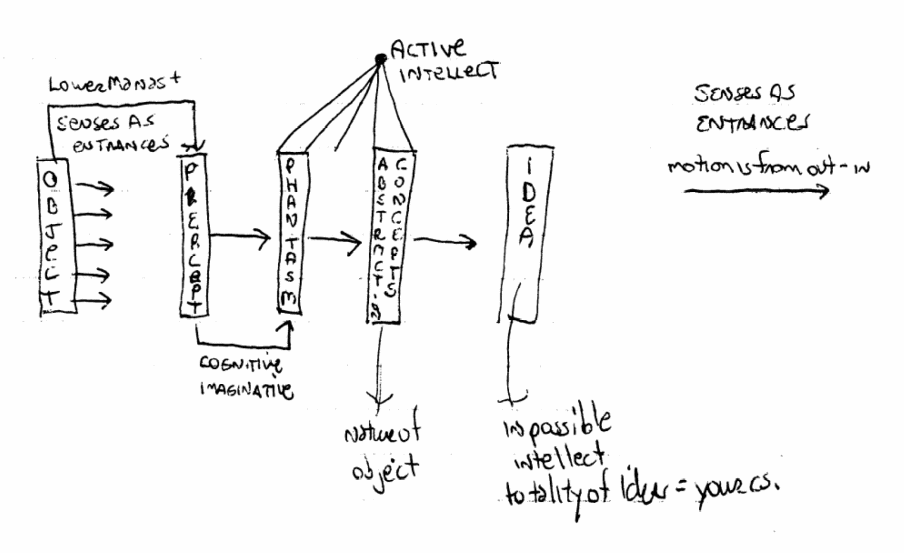
Review of "senses as entrances" diagram
Reading/discussing von Franz, Aurora Consurgens, on active intellect; Thomas Aquinas attributed abstract thought capacity to intellectus agens within human soul; represented an advance in consciousness
Descent of Nous into human psyche, building up concept of individual
Plotinus one of first to work on idea of self in Platonism; distinguished self from ego, body
Reflective consciousness develops gradually, not abruptly; subsumed under senses as entrances
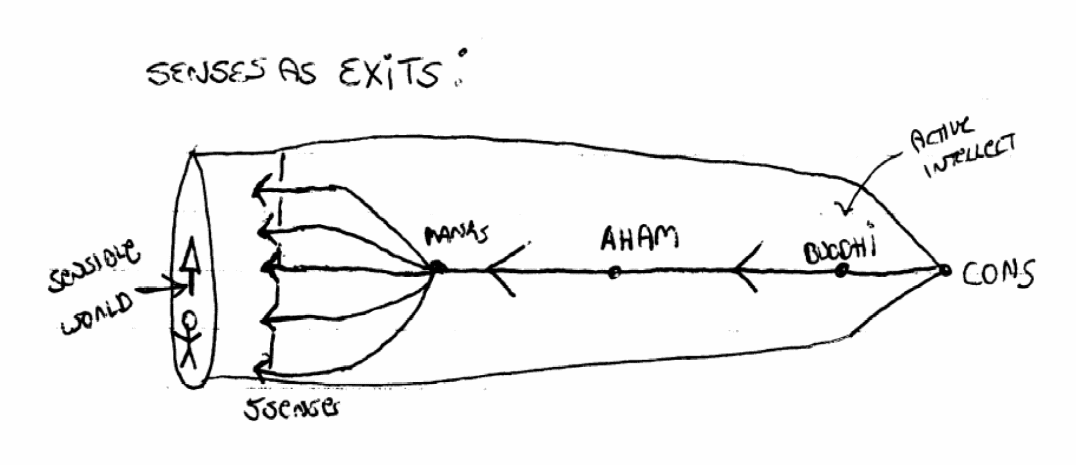
Review of "senses as exits" diagram
Reading from Chatterji, Kashmir Shaivaism, on role of manas, ahamkara, buddhi
Active intellect an anthropomorphization of concept of buddhi; a recognition of the Nous within you
Constant new revelation; cannot think like a primitive anymore
Continuing discussion of "senses as exits" diagram; dream analogy
Continuing to read and discuss Guenon on senses as entrances and exits of knowledge; mediate and immediate knowledge
Object constituted by form (quality) and matter (quantity); ontological composition; scientific vs. humanist perspectives
Reading from Kayser, Akroasis: The Theory of World Harmonics; Pythagorean approach: derivation of quality from quantity; evaluation of quantities through qualities
Process of immediate knowledge: 1) mind (vritti) goes out and envelops object, reproduces its form from within; matter of object not absorbed, only meaning; 2) consciousness underlying object illuminates vritti
Deepening knowledge of both subject and object through this process
Reading from Taylor, Aristotle on His Predecessors; Aristotle's criticism of Plato's idea that numbers are the elements of things
Reading/discussing von Franz, Number and Time, on unus mundus and synchronicity
Psyche and matter two aspects of an underlying unity (unus mundus); role of number as key to mystery; number as both quantity and meaning
All-containing continuum concept (Wang Fu Ch'ih): lawfully ordered but without perceptual manifestation; dynamism inherent in universal continuum; role of number (aspects) in ordering the flow of manifestation
Two approaches: qualitative experience of images and quantitative numerical analysis; aspects in natal chart as numerical archetypes determining the individual
Critique of epistemological theories: all academic theories considered insufficient; need for more detailed understanding
Reorganization of one's real substantial being (ahamkara) a rare and monumental event
Universe not perfect, mistakes happen; Demiurge working with recalcitrant matter
Jung got many of his ideas unconsciously from astrology; unconscious equated with soul
Archetypes as nonperceptual dispositions ordering the unus mundus; equivalent to zodiacal degrees
Difficulty is always in understanding interplay of individual and cosmic mentalism
Object has its own formal aspect
BOOKS READ FROM OR REFERENCED:
Rene Guenon, The Multiple States of Being
I.K. Taimni, The Science of Yoga
Marie-Louise von Franz, Aurora Consurgens: A Document Attributed to Thomas Aquinas on the Problem of Opposites in Alchemy
J.C. Chatterji, Kashmir Shaivaism
Rig-Veda
Diamond Sutra
Hans Kayser, Akroasis: The Theory of World Harmonics
Aristotle, Metaphysics, Book 9
Plato, Seventh Epistle
Plotinus, The Enneads (MacKenna translation, 4th ed.)
A.E. Taylor (tr.), Aristotle on His Predecessors, Being the First Book of His Metaphysics
Marie-Louise von Franz, Number and Time
PLOTINUS QUOTES READ OR REFERENCED: V.3.3, VI.6
DIAGRAMS appended to this transcript:
FIGURE 1977 1023-1-AB. Scholastic Epistemology: Senses as Entrances.
FIGURE 1977 1023-2-AB. Senses as Exits.
Other diagrams also referred to are not with this transcript version. [Transcriber note: [diagram] means the speaker is referencing a diagram as he or she is speaking. If someone is drawing or writing, with audible sounds of chalk on a blackboard, I indicate this by [drawing] or [writing].]
NOTE: For readability's sake, the following substitutions/edits made in Verbatim Transcript: cuz = because; gotta = got to; yeah = yes.
TRANSCRIBED Verbatim by IT 2017 (V11a). This is V12a (2022) and has: updated prefatory matter, audio file name, and footer; Subject and Subsubjects altered to make more accurate; new formatting to accord with new conventions; completed TOC; updated Book List; Plotinus quotes section added; new notes within transcript; two diagrams appended from AB class notes and references within transcript to these diagrams; typos within transcript fixed. Archival verbatim transcript – V12a.
AUDIO FILES: 1977 1023a, 1977 1023b. [Note: "Tape" and "Side" refer to original audio cassette tapes that were later digitized into .MP3 Audio Files.]
1977 10/23 at Wisdom's Goldenrod
Epistemology; Symbolic Functioning
[Audio File 1977 1023a Begins]
AD: --but we did start off with, and we got interrupted halfway, that was the chapter from Guenon. [students assent] [9 second pause] We have a little bit of a background, we've been building up a little bit of a background and, [short pause] perhaps-- [10 second pause] perhaps a preface might give you an idea of what I'm trying to do, alright. It's like(--) something like this. We'll try to explain to ourselves the epistemological standpoint that is taken by the Buddhist, the Vedantist, the Platonist, the Scholastic, PB, whoever, whatever, and we'll try to see if we could understand where each one is coming from, you know. And, we'll try to illustrate it, try to draw diagrams. And if we could illuminate our understanding, I think the way we would have to do it is by juxtaposition, you know, put things in contrast with each other. So that even if we get into a-- an obstacle or something stops us from understanding, we could see the relative points of view that are being expounded. Now it's my theory that most of them are saying the same things but in some cases the statement is more complete, more thorough, than other cases. And in this chapter here, of Guenon, where we have the two positions simultaneously pointed out. In other words, we could think of senses as exits of knowledge and entrances of knowledge and we could see-- if we take both those positions, we could see almost where any tradition is coming from. So in that chapter we had-- we had worked with, we have these both-- two points of view. But, you know, there's shortcomings because-- there's shortcomings in these works because, from my point of view anyway, there's a lack of sufficient precision, you know, conceptual precision. [short pause] That was the chapter on the two, yes.
S: It's chapter 8.
S: Page 101.
AD: (Right.) [short pause] We'll start from the beginning. Now I ha-- I may have to bring in-- I may have to bring in some strange ideas but I'd like you to consider them, you know, as we go along because this is a very-- there's a great deal of mystery tied up in this whole epistemological approach. The first point, he says that the-- the being assimilates more or less completely all of which it becomes conscious. And he-- he makes the remark that there is no other true knowledge unless it's immediate living knowledge. The se-- the second kind he calls mediate knowledge or reflective or symbolic knowledge. [short pause] The next point I think that we made was that-- [short pause] He speaks of--
[Transcriber note: I am using The Multiple States of Being by Rene Guenon, translated from French by Joscelyn Godwin, Larson Publications, Inc., Burdett, NY, 1984. I do not know which edition AD is using, quotes should be checked.]
Rene Guenon [The Multiple States of Being, pp. 116-117, AD reading]: "…one can regard knowledge as going simultaneously from the subject to the object which it knows (or… (AD: vice versa) from the subject to the object which it makes into a secondary modality of itself) and from the object to the subject, which assimilates it to itself."
AD: Second. The third-- the third point--
Rene Guenon [The Multiple States of Being, p. 117, AD reading]: "Thus where the sensible and corporeal world is concerned, the sense organs [AD: And include there manas. Manas and the sense organs] are, for the individual being, the"entries" of knowledge; but from another point of view they are also the "exits"…"
[13 second pause]
AD: Then the following point, I think this is about where we were. He says--
Rene Guenon [The Multiple States of Being, p. 117, AD reading]: "It is [AD reads: It's] important to observe, [however], that such a prolongation is exterior only in relation to the individuality envisaged in its most restricted view [AD reads: only in relation to the most restricted point of view of what the individuality is], for [AD reads: in which case] it is an integral part of the extended individuality. In extending itself thus by a development of its own possibilities, the being does not have to go outside itself…no being, under any condition [AD reads: circumstances], can be other than itself."
AD: And I think that's about where we left off. [short pause] The next-- the next point I objected to was that he says--
Rene Guenon [The Multiple States of Being, p. 118, AD reading]: "…since the [AD reads: these] two acts are [AD: At the very bottom of the page.] inseparable from each other. [AD adds: And] We might even say that they are basically only one act [AD reads: basically one and the same]."
AD: And there I raised an objection. Because this-- this hides the whole problem. By saying they're one and the same, that problem has been avoided.
VM: Which two acts? You mean the exits and entrances [couple words inaudible]
AD: Yes, when he refers to them as one and the same.
Rene Guenon [The Multiple States of Being, p. 118, AD reading]: "…since the two acts are inseparable from each other."
AD: We won't disagree with that.
Rene Guenon [The Multiple States of Being, p. 118, AD reading]: "[AD adds: And] We might even say that they are basically only one act [AD reads: basically one and the same]."
AD: If they're one and the same, one is going and one is coming, how could they be the same? It's the same thing like when Jung makes the remark that sensation is perception. Well then why call it sensation?
LR: Tony, is that-- (is/it's) that-- is that what he's referring to in this sentence?
AD: Yes.
LR: [one/two words inaudible] the last paragraph on page 103, he speaks of the possession by the individual. How do you see-- can you explain how that-- that's what he's describing as the exits and entrances? Because that-- that paragraph confused me anyway, I mean he doesn't mention exits and en-- entrances there.
AD: In the-- in the first part of the paragraph he points out that certain states of the being, let's-- oh-- Oh, if we want we can think of for instance of prajna wisdom, you know, is acquired or let's say significantly assimilated by a simultaneous act of going out, you know, and going in at the same time. He points out that these-- these two acts are involved in that too. In other words, if we say someone operates from the point of view of buddhi or wisdom, or the ideas that are inherent in the wisdom, there would have to be a coming out and a going in at the same time. In other words, let's say a person is looking at a situation, object, event, person or anything and has immediate buddhic knowledge of that situation, ok. There would have to be the two acts going on simultaneously. In that case of course you're eliminating the lower portion of the soul, alright, in the sense that you can take in the sense-perception but you ignore it, you just paying attention to the buddhic judgment or the judgment involved in that perception. In that case there's an immediate possession of a higher state of knowledge. But even there, to speak of them as one and the same act don't make sense. So either way you interpret it, either way, I don't accept that. I don't accept the--
Here, this might be an idea. You know how we sometimes speak about the soul [drawing] and we speak about one phase, this here phase [diagram] having the higher intellection-- I'm sorry-- alright, and the sense-perception takes place down here [diagram]. Now sometimes it goes all the way down, sometimes it stops here [diagram], doesn't have to go all the way down. But in either case there will be a-- there'll be a double act, one going up and one going down; unless you stay here [diagram], in which case you don't speak about immediate possession, there's nothing to take possession of. So, whether he's referring to higher knowledge or whether he's referring to sensible knowledge, the issue here is first of all we have to explain to ourselves these two acts, and it's going to be difficult. And secondly, we're going to have to follow them, alright.
We had the same problem, if I could remind you, we had the same problem when we were reading Taimni, I don't know if I could find the quotation but-- [26 second pause while AD looks for quote] I can't find it. Well-- well we'll [couple words inaudible] Remember in Taimni when he speaks about the fact that there-- when the object impinges on the senses, that an object can be conceived of as a totality or a significant combination of various motions. The combination of these motions, so to speak, triggers off some sort of mechanism and then we u-- we have sense-knowledge. And he says this is very complicated and [AD makes "off he goes" sound] off he goes, alright. [Note: See I.K. Taimni, The Science of Yoga, pp. 268-269, p. 408 ff.] Well, we're not going to do that. We're going to get stuck in the mud and see what they're talking about.
[short pause]
MW: Tony, could you say that when he's talking about-- See in that paragraph that Linda's talking about, he's talking about true knowledge and the effective possession of this knowledge by a being, and he says that each implies the other. Now, wouldn't it-- would it be correct to say that the en-- the exits is what he's talking about the knowledge and the entrances is when he's talking about the assimilation, and that's the two acts that-- that he says are inseparable. And that's-- that's how he's talking about--
S (simultaneously): Say, could you repeat?
S: (No.)
MW: The exits is when he's talking about the knowle-- the true knowledge, and the entrances is when he's talking about the assimilation. And that-- that's how this paragraph is talking about entrances and exits.
S: Tony?
MW: Well that's a question, you know?
LR: So that-- so that when he says it's by this very knowledge that the being gains possession, he means the knowledge is right there and without that knowledge couldn't possibly gain possession of the object?
S: Couldn't be assimilated, huh? [student assents] Yes.
S: Go ahead.
S: But--
S: But that's not true Linda.
S (faint): Yes.
AB: I would think that in the se-- entrances or exits you would have some kind of immediate knowledge in either case, and the symbolic knowledge that he's talking about which is mediated is even once further removed, [short pause] like the fantasy about the object or some--
[Note: See FIGURE 1977 1023-1-AB for the following.]
AD: Look, why don't we do something like this? [drawing] Let's imagine this is the object, ok. From the object we construct a percept, alright. [short pause while AD draws] What's involved over here, let's say, would be the-- the lower manas and the five senses. We're speaking now of the senses as entrances of knowledge, ok, [student assents] so that let's imagine some sort of situation like this, ok. There's an object out there and the light from the object reaches the senses or the senses-- Like for instance something touches your skin, alright, so there has to be an external object that comes to you, or the reflection from a mirror let's say, and the light reaches your eyes, alright. So that the senses here [AD indicates on diagram] are like recipients, they're taking in something, alright. And when we speak about the senses here, the five senses and the lower manas, we have to remember all that we said about these senses. We have to remember for instance that they are over here conceived of as part of the physical organism. The eyes do not go out, they stay where they are-- where they are and the light goes there, so we have to think of the antahkarana as identified with the body, alright. So that we're taking this position, alright, so we have here [AD hits diagram].
Then the next thing that results from this here, the percept, there's a c-- a kind of image in our mind of what this percept is insofar that we could make a phantasm for it, some sort of memory image of this. [drawing] [student assents] This-- this was the old jukebox version, ok? And over here one would-- would have to bring in that what's working here is some sort of cognitive imaginative aspect of the restricted person, the restricted individuality. Then we said that from the phantasm, in other words in my mind's eye I'm thinking about this triangle and-- this is the Scholastic version-- and I abstract from that triangle certain attributes which we say are common to all triangles so that I end up with, let's say, the nature of this object but like abstracted, in other words, the object void of its matter. In other words when I take an image in of an-- of a triangle or a wheel, you know, I don't take the wheel into myself. I only take in the image of the wheel into myself, so that I have in a sense left the matter behind and just am dealing with the form in my mind of what this object is, so I'm abstracting. This is-- Of course not everybody agrees with this but, you know, this is one interpretation. So that what I come out with is that what the nature of the object is-- [drawing] And, we could say that it's some sort of abstraction. Now, if, for instance, the nature of the object, I know everything that is intelligible about this triangle, then I have an idea of what that triangle is and I could put over here "idea in my mind" [diagram]. Uh, no-- that is, my consciousness would be-- could be conceived of as the totality of all these ideas that I've through experience have been gathering, ok?
VM: I don't see the distinction [S simultaneously: Uh-hm, right, uh-hm.] between the last two steps [few words inaudible]
AD: Well, when I take the object in my mind, when I'm thinking about the triangle, and I abstract the nature of the triangle from the object and I consider all the properties that make this object, the nature of this object to be-- In other words, like I'm thinking of the ideas in abstraction from the material thing. [VM assents] Now I have-- I have at my disposal so to speak let's say a c-- a number of concepts, ok. [drawing] Now, those concepts, the totality of all these concepts, is going to be, maybe this would be better, your consciousness. [students assent, very faint] In the same way like, you remember the way Jung pointed out, all these images that we have, they become part of the mind of the person, you know, and so the totality of all these images-- This again is similar to that, you know. The totality of all these images, the totality of all these concepts, the totality of all experience and from which we abstract let's say some meaning, all this will be your consciousness, ok. [student assents] So a modern-- the modern consciousness is weighted down with all this experience.
S: Yes.
S: Tony, but then you are talking to this-- to nature of the object and its knowledge, would you say that manas [few words inaudible] or what would you-- Like you had the other two, like the function or the means, so to speak, what would be the means of awareness (of the/be here) [one word inaudible]
AD: This one here [diagram]?
S: Yes.
AD: Yes, [few inaudible student words simultaneous with AD] what we left out here was that the ancients, that is, the medievals and the ancients, spoke about what they call the active intellect. And this active intellect or the intelligence which was in myself would-- would do that work. In other words, it was at about the time of Thomas Aquinas when this kind of understanding of epistemology started operating. And the purpose here, like for instance-- [short pause] I'd like you to read for instance what a modern, alright-- [short pause] [couple words inaudible]
[short pause]
[Transcriber note: I am using Aurora Consurgens: A Document Attributed to Thomas Aquinas on the Problem of Opposites in Alchemy, edited with a commentary by Marie-Louise von Franz, A Companion Work to C.G. Jung's Mysterium Coniunctionis, Bollingen Series LXXVII, Pantheon Books, New York, 1966. Originally published in German as part III of Mysterium Coniunctionis by Rascher Verlag, Zurich and Stuttgart, 1957.]
Marie-Louise von Franz [Aurora Consurgens, p. 168, AD reading]: "Thomas Aquinas modified the idea of the intellectus agens [AD reads: intellectual agent] as a cosmic principle outside the psyche by attributing the capacity for abstract thought to an intellectus agens [AD reads: intellectual agent] within the human soul…calling it a"natural light." Its other aspect, that of a source of illumination external to man, he identified with God or with Sapientia Dei [AD reads: the Wisdom of God]."
AD: Now, the remark that she makes concerning this is something like this.
Marie-Louise von Franz [Aurora Consurgens, p. 169, AD reading]: "The Thomist splitting-up of the nous-concept signifies, from the psychological standpoint, an advance of consciousness. Generally when an unconscious content becomes conscious it is first split up, one part entering into association with the field of consciousness centered by the ego, the other remaining in the unconscious or being projected into the extrapsychic realm. Our Western intellect, as it developed at the time of Scholasticism, seems to have arisen in this way: one portion of our"pre-conscious thinking" was asserted to be the operation of the subject, the rest remained pre-conscious and was projected into the non-human realm, in other words, it was personified in the "metaphysical" figure of Sapientia Dei [AD reads: it was personified as the metaphysical]."
AD: What she's saying is something like this, that about the time-- about the time of the-- remember we spoke about the early Greeks? They never doubted the Nous. They never doubted that the Intellect was adequate. They assumed, and everyone with them assumed, that the Nous could give you accurate information about an object, all you had to do was to work on-- you know, concentrate on it. And they took for granted that this active intelligence couldn't be mistaken. Now, we pointed out that about that time we said something strange started happening, and I think you'll see it in the history of philosophy, East or West, that there started to descend, so to speak, this intelligence of which one part went into the human psyche and another part, alright, which did not go into the human psyche, if we follow what she's saying, was projected externally. So that for-- so that for Aquinas and the Scholastics, this part [diagram], alright, was descending into the human being, alright, and the part that was not descending into the human being of course would be projected outwardly and become the world.
S: Oh and that's the objective, right?
S (very faint): Right.
AD: So what Aquinas was saying was that this here is what works in us to separate from the object, to separate the attributes of the object, ok, and it couldn't falter in its judgment because it would know, look, three angles make a triangle, I mean there's no two ways about it, they were absolutely certain about that.
[students assent, faint]
S: Are we to understand from what you're saying, it isn't only man's ability to seize upon the object of his thinking his own-- his own consciousness has changed but also that the true nature of the object of experience changed at the same time as the-- It-- when you say that this-- this force descended and a certain part of it became the world of experience, does that mean that the-- the object really underwent some sort of change too?
AD: Not necessarily, not necessarily.
S: Ok.
AD: Let me take you back to what we said in a previous occasion. We tried to imagine in our mind about the time of (Herakleides/Peraclides) when man felt and thought of himself as part of Nature. He did not distinguish his "I" as other than the world that confronted him. It was like the Garden, you know, of Eden, Paradise, alright. The same thing like an animal. The animal doesn't distinguish others from himself except that this is something that's going on little by little. There's an absolute reliance on his instincts. He doesn't argue with them. They tell him what to do, he's got no problems, he doesn't have to sit in a corner and say, "Now, let me think, [S simultaneously: Believe it or not (one/two words inaudible)] it's hurt-- it hurts between my ears, you know, what's going on?" alright. (laughter)
That was about that time, but, like we were trying to say, now this spirit of the age, whatever we want to call it, there was a descent and this consciousness came deeper into man. It's like now he began to feel that when he scratched his nose, you know, it wasn't a natural phenomenon, that he was doing it to himself, scratching himself, whereas before it was just like part of the phenomena of the universe, lightning, thunder, clouds, it was all part of the same image. In other words it was a pre-logical mentality. There wasn't this distinction between the "I" and the not-I. With the descent of this here, then that distinction started making itself felt. The alienation that man felt from the universe-- of course you understand this is all a fairytale-- the alienation that he felt from the universe was building up the concept of an "I," the "I" as an individual was being built up. Now in order for this to happen the Nous had to descend, come down further, alright, instead of hovering above for guiding, you know, above, it had to actually come down.
Well sure, you may feel a little pain between your ears but the point here that I think the Scholastics-- This is very noticeable because even someone like Whitehead pointed out that the differentiation of the intellect which took place at about the time of the Scholastics, also in India too, where you had this tremendous controversy going on for about seven hundred years between the realists and the Buddhist idealists, that this descent of the Nous into it was really bringing about the concept of an individual.
Now Friday I made a remark, I quoted from Dodds. Dodds pointed out-- well, he didn't say this part. But prior-- prior to Plotinus, one of the remarkable things about Platonic philosophy was to the effect that they really were not concerned with you as an individual. It was for you to rise up to the level of the universal and there, so to speak, preside and speculate on eternal existence. So they weren't concerned about that, ok, about the individual. But this is-- this is a little different. This is like that Universal Nous coming down and distinguishing and separating all the individuals because if the Nous is in you and in me, but it op-- it'll operate in me differently than you, then this will start individuating me. Now, we can't see this here, I don't think we really understand it or appreciate it, but it was a remarkable thing that one of the few great forerunners of Platonism, Plotinus, he worked on the concept of the self, alright. And there we get a premonition of the notion of what the self is. And that's what we started the last few minutes of class last week. In Plotinus, the concept or the idea of a self comes up and he holds on to it and tenaciously builds up the meaning of that. So far, from what I've understood, it is the most demanding, exacting concept in all of Platonic philosophy because this man was bringing up the notion of a self, an individual self. You want to call it 1% ego, call it 1% ego. But-- In this quotation by Dodds, he makes the remark that Plotinus had proceeded and discussed and foresaw the notion of the concept of a self and he distinguished the self from the ego and pointed out that they weren't co-extensive with each other, and further on even went on to the-- went on to point out that the body which contains traces of the psyche, alright, is not to be confused with the psyche, and that the ego is like a spotlight of consciousness, ok.
And these distinctions were something which I imagine you saw very clearly when you were reading Jung, he makes the-- this point and keeps-- In other words, to Jung, he would call-- he speaks about the ego-complex and the self, alright. And in the self or the notion of the self of Jung, he refers to as the totality of all the psychic processes. But this would be equivalent to what Plotinus would call the soul. All psychic processes, the totality of all psychic processes, is the soul, is the psyche. And, again, Jungians get carried away and they speak about "discovered the unconscious" and all that but we won't worry about that.
LR: I have a question. From what you say about the disposition of man previous to the separation, it would seem then that it would have required a great act of will to have reflective-- what we call reflective consciousness which is most of the time all we're-- well, all that's going on in us. I mean it would've had to have required a great effort to acquire that kind of reflective consciousness whereby one could reflect on himself. [student assents] Because if-- if everything subjective is also [few words inaudible] with the object but closer, then what act would it have been that can separate himself and see himself(--) to raise himself?
AD: What act would it have been?
LR: Yes, I mean-- I mean there would-- the idea of self-transformation will [couple words inaudible]
AD (simultaneously): Yes but first, first would have to be built up this whole reflective apparatus--
LR: Well that's what I'm saying.
AD: And-- and that happens in a very natural way, sometimes without our awareness even. We're hardly aware that this is going on.
LR: But-- yes but that's my question [one word inaudible]
AD: It isn't, it isn't--
LR: I mean surely they had reflective consciousness somehow.
AD (simultaneously): No. No, we wouldn't say that they did.
LR: Well, what about the guy on the [couple words inaudible]
AD (simultaneously): Did you-- do-- do you ever watch-- you ever watch a young child, does he have reflective consciousness?
LR: No. I know, you're comparing it to that childlike state before the separation but-- I mean there were the men of great-- and were [couple words inaudible] and philosophy.
AD (simultaneously): Oh I'm-- we're not saying that everyone went through this process, there always are people that are ahead or in advance, you know, [LR: Yes.] teaching those behind them just like they're being taught, ok?
LR: Right, so a man--
AD (simultaneously): But we're not denying that.
LR: A man in that state say had a teacher that-- that had some kind of reflective consciousness, and most of-- most of his consciousness was [couple words inaudible] undifferentiated, unseparated, the notion of the "I" is in-- indi-- indistinct. I'm asking, wouldn't it have had to require a great act of will for a man to see himself as not that? [student assents] I mean how would we acquire that--
AD (simultaneously): Well, again, again, how--
LR (simultaneously): We're given it, you know, [VM simultaneously: How come you see Nature?] get it when we're four years old [one/two words inaudible]
AD (simultaneously): I insist on reminding you what we spoke about when we said that the world will assimilate you, one way or another(,) it will impose what it has to teach you, it will impose it on you. You may think that you can jump off-- jump off a hill but you'll find out that it won't work. The world was here before you and will teach you. And also, do not think of reflective consciousness as something which-- Well we have to remember that everything, every conscious being has some reflection within it, so it's not an abrupt, you know, deus ex machina sort of mechanism. Anything that's living has reflective consciousness. The question is, you know, to what degree does he become aware that he is self-reflective. Now, in the case of Jung, he felt that the entire evolutionary development that Nature was putting us through was to lead us to this level of reflective consciousness where man in his reflective consciousness became aware, alright, in a very significant way, that he was building up meanings for himself. And this building up of meanings for himself, in other words, providing himself with an explanation and a meaning of what was going on, that this was the individual myth that he had to live out. And that this was what finally brought him to a level of understanding that within his consciousness, which Jung referred to as where the second cosmogony took place, within that consciousness is where mankind or the evolved species really differed from all the others. It is right there. Why?
Because it's like that reflective consciousness-- If-- if we take a primitive man or someone that doesn't have a developed reflective consciousness and simply does what's there for him to do, whether to eat, sleep, or whatever, to work, and he doesn't think about it-- Of course, he could be an advanced Sage, I mean, that would be-- (laughter, student words) But, the-- the men we're speaking about are not Sages. The identification is so total that they're unaware that they-- that they are not these things. It's the-- how can we put it, the situation here calls for the development of a reflective consciousness. The agony of going through this alienation from Nature, from this primordial womb, the working out of himself as an individual, this is a long extended process, it doesn't occur in one time. I think we'll cover that in a-- a more academic way in a minute if we could return to this here.
Now, in this situation here we can see the arrows are pointing all this way [diagram], and, if we imagine that this is a blank slate [diagram], ok, and the experiences of the world are just pouring into this person, then eventually he'll build up consciousness with all these contents, alright. Now here we can see the senses-- senses as entrances. Now how could we conceive of them as exits, before we get caught up in side issue, how could we conceive of the senses as exits of knowledge?
S: Yes.
[short pause while erasing]
AD: We'll use the same diagram but we have to go a different way. Well--
[18 second pause]
SD: Tony, in that diagram all those boxes that were going to the right [few words inaudible] pure consciousness. But all those things that you had on the top or all those functions which brought [couple words inaudible] together, weren't they also pure consciousness?
AD: Yes, one part, one part we would refer to as the functioning and the other part as (for/to) the content, ok. So when we think-- If we take terminology that we're acquainted with, for instance, [writing] buddhi, ahamkara, manas, ok, the senses, citta, ok. Here [diagram], for instance, these are all functions, operations all the time, ok.
SD: Yes. But then doesn't the content also [one/two words inaudible] (like for instance/I think that) there may be object in the form of percept of it. Maybe the kind of percept you get is going to be dependent on the gross content that you're dealing with from previous experiences. But when you abstract the nature of the object [few words inaudible] experience [one word inaudible]
AD: Yes, but now you're asking another question.
SD: Well, I guess I'm trying to see, it seems to be like a borderline area where-- where the senses are both the entrances and the exits, so the mind is both forming that experience and the recipient of that experience.
AD: I'm sorry, repeat that.
SD: I guess what I'm trying to get at is that, even in that diagram that we had where the senses were the entrances of knowledge(,) (or/where) the mind is a recipient of the experience, that even in that diagram the mind is also forming that experience and to that extent the senses were also the exits of knowledge.
S: Uh-hm.
AD: In other words, in the second box where we say that the-- a percept is formed, the necessary qualifications or let's say description of what that object is must come from the mind itself. Yes, ok. I don't see your point (though/there).
SD: Well in that sense [one/two words inaudible] would be considering that [couple words inaudible] the entrances of knowledge. If the mind itself is at work and it is creating that experience, then there's also--
AD: I-- if you notice, I didn't use the word 'pure'. Like it's not an activity that's pure, it isn't one activity is going out and the other one's coming in, you know like two one-way streets. I'm not referring to that.
SD: But then you still have--
AD: I'm going to use the same diagram but work backward, so that, you'll see that-- I think we should be able to see that a reversal here [diagram], alright, doesn't, you know-- we can leave the same diagram and reve-- reverse the direction.
S: Uh-hm.
AD: Alright?
MW: And that would show how the-- how that-- that primordial image gets built up to--
[Note: See FIGURE 1977 1023-2-AB for the following.]
AD: Yes but there would be a difficulty, ok. And I think-- I think we spoke about this difficulty in one of the other classes and we brought it up a little bit here, and that would be if we started out here, let's say consciousness, [AD hits board] the very next thing that would [writing] show up would be buddhi, [student assents] or what they call the active intellect.
S: Who calls it the active intellect?
AD: The Scholastics. It's going to be a little difficult because, it's easy enough to start off with an object out here and say you're talking about an object. But when you start off at the other end, you're going to have to start off either at the level of Platonic theology, Platonic Ideas, or the notion or-- and meaning of what buddhi is or Mahat. And, I'm not-- I'm not capable of doing that, but I'm going to try something. Do you remember we spoke about the ahamkara? The manas selects certain material, puts it together, and then presents it to the ahamkara and the ahamkara refers it to buddhi and says, "What is this?", ok, "This is mine but what is it?", ok, and buddhi makes a judgment out abou-- of what this is. In other words, buddhi is like a participation in the totally fixed knowledge, public knowledge, there's no-- We're not concerned here about what your hallucination is but what is this object here in front of me and a judgment would have to be made. And a judgment here about an object which is a public object, that is, we all perceive it, alright, this would have to come from the higher level of being. Last time I read something where we-- I don't want to repeat this but just to-- He says--
[Transcriber note: I am using Kashmir Shaivaism by J.C. Chatterji, State University of New York Press, Albany, 1986.]
J.C. Chatterji [Kashmir Shaivaism, p. 60, AD reading]: "Manas is what 'desires', [i.e.], seeks for and singles out a particular group of sensations from among a whole crowd of them, [and] builds up particular images therewith; or to use a different metaphor, carves an image out of a whole block of sensations given by the senses at the time. From another point of view it is what synthesises the discrete manifold of the senses, and builds up 'mental images' of them.
"Ahankara is what gathers and stores up the memory of personal experiences, and 'identifies' and 'assimilates' the experiences of the present, of which the experiences the sum total, [thus] held together by it, constitutes what we realise as our personal 'Ego'…"
AD: Remember we were referring to this as the "I", this "I" has got this whole bag full of all kinds of experiences going back into dawn of history.
J.C. Chatterji [Kashmir Shaivaism, p. 60, AD reading]: "…as the individual and particular 'I' of [the] everyday life of limited experiencers, such as human beings ordinarily are."
AD: Going on. Finally, when this image is presented and ahamkara presents it to buddhi, now buddhi sa-- the buddhi operation goes something like this.
J.C. Chatterji [Kashmir Shaivaism, p. 61, AD reading]: "Finally, 'Buddhi' is that which, holding in it such general ideas as do not form the direct object of experience as concrete facts,—facts which one can definitely picture to oneself, [like], for instance, the mental image of a particular cow or that performance of [a particular act of] kindness, [AD adds: or] ideas, [in other words], which lie in the back-ground [of, and are thus beyond], [AD: etc, ok] the 'personal Ego', [i.e.] the Ahankara—not only supplies the st-- [AD: the Buddhi] not only supplies that [AD reads: the] standard of reference which is needed for the formation of judgment, but also serves as the means whereby concrete experiences are, as it were, taken up into itself for such reference [AD reads: references] and comparison. Buddhi may thus be spoken of as the impersonal or superpersonal state of consciousness, or experience in a limited individual…"
AD: I'm just going to pull out the extracts. Again-- this is a Hindu speaking, alright.
J.C. Chatterji [Kashmir Shaivaism, pp. 66-67, AD reading]: "And as the Buddhi, being such a manifestation of the Sattva Guna, is a glorious vision of ideas, [(Dhi) i.e.] the memory of [the] 'All-this' at this stage, it is a state of pure knowledge or Intelligence in which the feeling is one of bliss [no doubt], but without anything of a moving, reacting or passional nature [in it]."
AD: Forgive me for cutting it the way I--
J.C. Chatterji [Kashmir Shaivaism, p. 67, AD reading]: "Further, this experience of the Buddhi is one in which there is only the notion of a mere existence—of only the fact that certain things or ideas are—without any thought of an 'I' [AD adds: who has them] on the part of the Experiencer…a fact which may account for the name of its chief Affective Feature, namely the Sattva [AD reads: namely that it is Sattva]…"
[9¼ second pause]
AD: I think with this we'll-- It's enough for us right now. If we think of this buddhi as this-- the seat where the Ideas are. And these Ideas are not ideas like we understand them, they're not personal ideas, psychological ideas. These are more equivalent to the Platonic notion of the Ideas, the Ideas as forces which are going to generate and produce an experienced world. So that, if we try to start out here [diagram], ok, and work ourselves back to the object, we're going to get into a lot of difficulty but it's worth a try because this is-- this will bring up a lot of interesting problems. [student(s) assenting] Alright, we refer to this as buddhi, and therefore we'll have to put the totality or we'll have to put the whole intelligible world--
(Side 1 of original cassette tape digitized as 1977 1023a Ends; Side 2 Begins)
AD: It's a metaphor. [student assents] That's just a metaphor because-- That's why, for one reason, they refer to it as the active intellect because it seems to be an act but no act-- no one could point to such an act. I mean there isn't-- there isn't something in you which takes the phantasm, deduces all the attributes of it, comes up with a concept of this here and says "Now I'll compare this with buddhi and see if that's so." [student assents] It's-- that's why we have to work it back this way to see that it's already predetermined. It's already decided what that object is, and it's only the consciousness or the personality at this reflective level of consciousness that's going to say, "Ah, this is what it is." Ok? [students assent, faint] That's why I try-- we have to try to keep in mind that the moose has-- the Nous has knowledge of everything. (laughter, student words) So does the moose, uh-hm, the moose has it too.
S: Uh-hm.
[few seconds of laughter, background student talking]
S: So-- so ac-- so actually when they speak-- when they're speaking of active intellect, they really do mean buddhi? They don't mean the act in the reflective awareness that feels like it's doing this?
AD: Uh-huh.
S: Ok.
AD: You-- you see, here's the-- again the point that we were trying to make, one of the psychological presuppositions of that whole Scholastic movement was the recognition that the-- Remember when we speak in Plotinus, he says you are not the Nous but you can, so to speak, operate with the Nous. [Note: See Plotinus, Enneads, V.3.3, eleventh para.] Remember that?
S (faint): Yes.
AD: We have that problem here. It's almost like a thousand years later the Scholastic recognized that this active Nous is within us. Whereas before that time they thought of it as something out there, now these people are bringing it down into your consciousness. So that in that very process, they're going to anthropomorphize it and say it's active in us. But it doesn't do anything, I mean, like this gentleman just pointed out, the buddhi isn't active, it isn't passional, it doesn't react. It's a pure presentation of the intelligible and we are going to, so to speak, take our sensible-- the sensible world which we produce through our imagination, and try to compare it unconsciously with that intelligible world and in that very act of doing so, we're informed, "This is this and that is that." Now all this seems as though it's an activity, that somebody's doing something.
[student assents]
S: Tony, when you say that it was only at-- at that time that there's-- that (seemed to get) [couple words inaudible] were entering in, it must have been there all along or how would they have been able to discriminate unreal thoughts from-- from objective thoughts? I mean isn't--
AD (simultaneously): No, that's not true. That's not true. We must keep this in mind. I've had this discussion at previous times, that people feel such an obligation, and I'm including myself, to reverence the past that we forget that there's also new things being delivered up to us right here and now in the present that are as much revelatory as anything that's gone on in the past. So what I'm trying to say is the situation or the circumstances or the condition of mankind three thousand years ago does not prevail now. [student assents] You don't have that consciousness deal-- you're not dealing with that type of a person anymore. Five, ten thousand years ago when a-- a king of a tribe or like high-- these highly organized tribal areas, where if a priest or a king died, twenty, thirty people thought nothing to immolate themselves and be buried with him. Try that today.
S (faint): Uh-hm.
S: That's retarded. (S laughs)
AD: No, they won't do it, they won't do it because the consciousness of that time was a collective consciousness, everybody felt himself to be a member of something, ok. That isn't so today because there's been this descent of the individual, more and more it's coming into a-- it's like forcing it's way right down into the roots of our being. And it's this very thing that I'm speaking about which is individuating people, alright, and some are reacting blindly to it, some, you know, are resisting and some cooperating. But it is descending and there has to be a recognition that what was so three thousand years ago isn't so today. Alright? I don't-- I'm not saying that we should disown it but we shouldn't be shackled to it, you know, you read the-- you read some of the poems in the Rig-Veda and they're beautiful but some of them are utterly absurd. (bit of laughter) I don't care what the Hindus say. I mean everybody thinks his-- his scripture was perfect and safe and absolute, it was handed down by God. I think He has better things to do, more important things to do, and what I would say is, errors have been made, tran-- translation and transcription and inspiration, all that. Especially when you study just one scripture you see how many translations it goes through and how much gets lost. So that, the point I'm trying to get at is very simple, Drea, and that is that there is constant revelation going on. And the world and people and-- and the people in the world are constantly progressing or going back, but they're not going to stand still. So it's nothing unusual to see that this descent of the spirit, so to speak, or this Nous consciousness, alright, coming down and down, more and more into the people, individuating them even against their will. We cannot think, and I-- I think this is obvious, we cannot think like a primitive anymore. I mean you just can't turn around and say, "I'll disown my past." It won't work. And that's why sometimes I laugh when some people are out plant-- planting turnips and their soul is laughing at them. Because they're going to live just like Nature wants them to live. Plant turnips? 1977? (bit of laughter) Practically a revelation of a knowledge that's never been available before. Still want to plant turnips. (some laughter)
S: What are you-- what are you really talking about? (laughter)
AD: I'm talking about-- I'm talking about people who are, so to speak, resisting the changes that are coming on and they're going to live a very natural life and plant turnips. (laughter) This is going to be-- this is going to be the meaning of their life, they got a garden, now they're living according to Nature. That's nonsense.
S: [few words inaudible] (some laughter)
AD: You have to find out what that means, living according to Nature. Because Nature is constantly changing everything as she goes along because your body's a laboratory, she's working with it, and, you know, in a past life you were-- wanted to be a happy farmer. [few seconds of laughter, faint background student talking] Ah, well alright. We have to try to find a way, we have to try to find a way of making a diagram of this here that would be acceptable or at least illuminating. If we start out by putting the intelligible world here [diagram], we're going to have tremendous difficulties. It would be something like this. We have to take the analogy where we-- we imagine an unconscious complex, ok, and this unconscious complex is going to project [drawing] a dream, a sensible dream, so that the unconscious complex here [diagram] would correspond to something like the intelligible world, and over here [diagram] we would have the dream world or the sensible representation. So if we start here [diagram] and say-- and say that-- (oh so--) we try to imagine the-- the senses as exits of knowledge, alright, then we would have to start here [diagram] because if we got the five senses here, you know, [drawing] then we have to imagine the intelligible world getting organized according to these five senses and producing, alright, producing this intelligible-- I mean the sensible dream. So that over here we have to imagine the intelligible world pushing its way out through the five senses, ok, and becoming the dream sensible reality. Now, if possible, or-- could you think of an idea of how we could start working that backward? [10¼ second pause] Any suggestions?
[short pause]
MW: Well, when you-- when you talk about it simply as just-- one would say well, the individual mind takes this complex and transforms it into an imaged world, seems that-- that process could be-- you could pull out the different constituents of that process [AD drawing/writing] as being-- would have to order that world according to something coming from the world, it would be like the function of the active intellect in actually producing experience, it would have to draw on all the past experience of that individual [one word inaudible]
AD (simultaneously): Alright, then suppose over here in buddhi, Michael, suppose in buddhi we have the intelligible world, ok, or the Ideas which basically are going to constitute the intelligible world, in other words we-- I mean the sensible world. We don't have the sensible world here [diagram]. All we have is what we might say, a plan for that sensible world. So if we start with the-- the-- put the intelligible world there [diagram], we'll equate it with this unconscious complex. Now, if we think of an unconscious complex, alright, how does the unconscious complex, so to speak, duplicate itself? Let's say that I have a complex, ok, let's say I am this unconscious complex. So I say "Well, I want this cluck here to know that I'm around, ok. Now what do I do to try to impress him with the fact that I exist? So I have to make a-- an image, a picture for this fellow, you know, because he doesn't understand. So I'll do that when he's sleeping, I'll make a dream and try to portray the seriousness of the situation." Alright. So then he has to duplicate or make an image of himself. Now, the unconscious complex would call for-- let's say he says "I-- what I want to do is really scare this man out of his wits and show him how serious his problem is, so instead of having a little mouse gnawing at his toe, alright, I'll have a huge forty foot boa constrictor wrapping around his neck, alright, maybe he'll get the idea." (bit of laughter) [few faint inaudible student words]
Alright, so, what are we saying? We're saying something like this. The general idea of what the dream was supposed to represent is already in there. But through this intervening mechanism he's going to have to translate the intelligible or something which let's say is meaning into a picture. So he has to go through this whole process, he's got to go through the ahamkara, "This is my picture," ok. He's got to take the images out of the manas, "These are my images," and, of course, these-- like we referred to the images, you remember, that they contain this tremendous potentiality to become anything and everything, they could describe, reveal, speak about, anything they want. In other words, in a dream you've noticed that no matter how obscure or unintelligible a situation may be, you'll come up with the images that are perfect, they'll fit perfectly, they'll have the proper feeling, they'll bring out all of your-- they have this life-enhancing effect, ok. So that when these images get thrown out, you get thrown out with them because you haven't disassociated yourself from these images. So then working this way here we would say well then the manas here, where all the images are, ok, will-- from the manas we will take the necessary images to describe [drawing] that plan here and then we'll project them onto the screen of his consciousness and it'll be the object that we want to do-- that we want to explain.
LR: So the manas would also be responsible for that division, right, the division of the world into a subject and object relationship. I mean, [AD simultaneously: Yes, yes, yes.] wouldn't one of it-- one of them is-- factors have to be the split? Or else there would be no possible--
S: Yes, is that ahamkara?
LR (simultaneously): No--
[students assent]
S: Doesn't that occur in ha-- that split [S: Uh-hm.] occur in ahamkara?
AD: Why do you say ahamkara? She said manas, you say ahamkara, why?
S: Well, it seems to me that if you're going to say "This experience [S simultaneously: Yes.] is mine," abhimana, I mean that's that notion, that you have to make a distinction between the experience and the experiencer or I mean there has to be some sort of bifurcation there or it doesn't make sense to talk about--
AD (simultaneously): Yes, because even in the Samkhya, when the split comes, they start from [drawing] ahamkara, you remember, [few inaudible student words] and then they split it up in three ways and they speak about the manas here [diagram], the tanmatra which is going to underlie the object [diagram], [S: Right.] you remember, and the-- I don't know, well, what was it, the-- the manas, the ten senses, the five of action and five of sense, and-- and the third effect of ahamkara-- Timothy, help me [couple/three words inaudible]
AB (simultaneously): Taijasa and bhutadi, vaikriti.
AD: Hm?
TS: It doesn't really have one. In other words, the hypostases doesn't have any (of the) tattvas. In other words, [one/two words inaudible] manas, ten senses, I don't know how they made the tanmatras. Then you have that--
AD (simultaneously): That's-- that's the subject and object division, right? In other words, from ahamkara we have coming out of it the split. Over here we have the senses, lower manas [diagram], ok, ten senses, lower-- and over here the tanmatra [diagram], right?
TS: Right.
AD: This becomes the object series, this becomes the subject series [diagram].
S: Right.
AD: And we said over here in the subject series, ok, over here in the subject series, there's all the images necessary to make a picture of anything you want to, with all the necessary nuances of feelings and shades of delicacy necessary while he's being strangled, you know, that we should experience every moment of it.
S: [couple words inaudible] totally.
AD: I mean the mi-- the mind has all these images, it can do this, ok. And this [diagram] would have to be the objective series. In other words, the tanmatras underlies the object. Is that right?
TS: Yes [one/two words inaudible] underlies the object series.
AD: It's much harder this way. The other way, always easier. It's much harder. It's like we have to reconstitute what we're doing here.
TS: And one way I think seeing that the-- the tanmatra in some way underlies or is bound up to the idea of the manas, seems [one/two words inaudible] it provides substance to the manas as well as to the-- the object, you know. Certainly the bhutas would be included on the object series [couple words inaudible]
AD: In other words, like, if I follow you, you're saying like in my ordinary everyday experience, alright, the object that I perceive, the underlying substratum of that object, alright, is the tanmatra that comes from my mind.
TS: Right.
AD: Yes. And the substratum of my own subjectivity, alright. So this ahamkara is the basis of both. Alright, so to get back to what he said, he says he would put the feeling of "I" over here [diagram], alright, not in the manas. What do you think, ok?
S: Yes.
AD: Alright. So then starting from here there's going to be this "I" [drawing] that's going to collect the information, I'm sorry, attach itself to these images which the manas is going to produce and then project them out on the screen. So now the problem for us is to try to see if we could work out this way, how the senses are the exits of knowledge. Let's go back, let's see if the simplistic version that Guenon feeds us would satisfy. If it does, you know, class could be over right now. [short pause] He says--
Rene Guenon [The Multiple States of Being, p. 116, AD reading]: "We have spoken of identification or [AD adds: of] assimilation, and we can use these terms almost indifferently here [AD reads: and we can use these terms interchangeably]… In the same way, one can regard knowledge as going simultaneously from the subject to the object which it knows (or more generally, to avoid limitation to the conditions of certain states, from the subject to the object which it makes (into) a secondary modality of itself)…"
AD: From the subject, alright, from the subject, to the object of which this is a secondary modality of itself [AD indicates on diagram]. In other words, this is like me [diagram], alright, but a different-- It's not the me that I work with but all these images that compose me, all my prior experience. This here [diagram], so to speak, modifies this "me" and gets projected out there so that this fellow who's experiencing what out there is really, he's experiencing himself. In other words, if I project out all these images, feelings, associations, alright, then what I am experiencing is a mode of my own being. I think that's what he's saying here, ok?
Rene Guenon [The Multiple States of Being, pp. 116-117, AD reading]: "…(…from the subject to the object which it makes into a secondary modality of itself) and from the object to the subject, which assimilates it to itself."
AD: From the object to the subject, then we would have to take the other diagram, the one we had on Friday, and say that this object [diagram], because it reformulates the consciousness of the person who's having the experience of this object, that consciousness gets reformulated or reordered.
S: But it's not that consciousness that gets reformed but the manas through it, right? The in-- well--
AD (simultaneously): Oh no, no.
S (simultaneously): No? That consciousness [couple words inaudible]
AD (simultaneously): The experience, the experience gets deposited in the manas but the actual transformation of the being, alright, is that consciousness that is using and working through that manas. Otherwise there would be no assimilation of knowledge.
S: Hm.
S: And [one/two words inaudible]
AD (simultaneously): You actually have to experience your mind, let's say, operating, presenting you with a certain significant meaning, and then you get changed. Not the mind, how could your mind get changed? It's never-- you know, never stands still for two minutes to ever get-- to speak about it changing.
S: Wait. (I'm so sorry), I no longer know which one to think of when you say that you get changed. From a certain way of thinking, the sense of "I" who gets changed begins with ahamkara which is a center of this-- a center for this consciousness. And if I think of buddhi as getting changed in this process, we spoke already of buddhi as being impersonal and objective so how could it be that that's appropriated to an individual? [student assents, faint] I'm not-- I'm not sure where the individual being is, in this schema, that's being changed in that way.
AD: The ahamkara.
S: The ahamkara--
S: [few words inaudible]
S: But you just pointed [few words inaudible]
AD (simultaneously): I'm sorry, the ahamkara.
S: Oh ok, thank you.
AD: Because that's where the-- it is at the ahamkara where the different reflective levels of consciousness accumulate and grow up, alright, you could say they become much more self-aware as more and more experience is fed to it. Eventually of course that ahamkara is going to be seen to be a pseudo-I. [student assents] But that won't be an experience of reflective consciousness.
S: But in this diagram that consciousness is pure consciousness(./?)
AD: I heard--
S: In this diagram would that consciousness be pure consciousness?
AD: Yes. Before it there would be the buddhi, alright, and before it would be ahamkara. And generally the association that we make is with the ahamkara, we consider ourselves to be the ahamkara, the "I", the feeling of "I" is from there. [11¼ second pause] So, if we continue--
Rene Guenon [The Multiple States of Being, p. 117, AD reading]: "Thus where the sensible and corporeal world is concerned, the [AD adds: manas and] sense organs are, for the individual being, the"entries" of knowledge; [AD: Well, that was before.] but from another point of view they are also the "exits"…"
AD: And the only explanation that he gives here is that in all knowledge it implies an act of identification--
Rene Guenon [The Multiple States of Being, p. 117, AD reading]: "…leaving the knowing subject to go [AD reads: leaving the knower, going] to the individual object, like the emission of a kind of exterior prolongation of the subject [itself]. It is [AD reads: It's] important to observe, however, that such a prolongation is exterior only in relation to the individuality envisaged in its most restricted view [AD reads: only in relation to the most restricted view of the individuality]…"
AD: That is, if you think of the individual as identified with his body, then that's the most restricted view of the individuality, but if you think of the individual, so to speak, as the "I", the Witness-I, alright, then you would have an extended notion of what that individuality.
Rene Guenon [The Multiple States of Being, p. 117, AD reading]: "…for [AD reads: in which case] it is an integral part of the extended individuality. In extending itself thus by a development of its own possibilities…"
AD: Alright? And here again we have these words, "development of its own possibilities," and we're left in the dark as to what-- [student assents, faint] or even a clue, an indication, "Well what do you mean," you know?
Rene Guenon [The Multiple States of Being, p. 117, AD reading]: "…the being does not have to go outside itself…"
AD: Of course. You don't have to call people dirty names. No one could-- he's saying here that no one has any experience except of himself. There's no way that you can get out of yourself. You can't jump out of your own skin. Now, if-- The-- the viewpoint here is of course that when we say "you", you have to take in the totality of all that image which is a-- you know, the primordial image which your Witness-I produces and you're included in it. Now, of course, there's no way that you could jump out of that, ok, so-- But the point here is that what he's leaving out here is that this storehouse of images which the manas contains or the vasanas, the totality of all these vasanas, the plurality, the indefinite signification that's embedded in all these here, later on are going to be used in a variety of ways, for instance, if one develops into the subtle level and wants to live in the subtle world where these become very useful in developing his individuality in that direction, alright. These are things that we'll get into later when I try to put this out astrologically.
Rene Guenon [The Multiple States of Being, p. 117, AD reading]: "…for [AD reads: in which case] it is an…"
AD: I'm sorry.
Rene Guenon [The Multiple States of Being, p. 117, AD reading]: "…the being does not have to go outside itself…no being, under any condition [AD reads: circumstance], can be other than itself."
AD (to himself, deciding what to read): Alright, let's leave out that part.
Rene Guenon [The Multiple States of Being, p. 117, AD reading]: "All this remains true…"
AD: No, no.
Rene Guenon [The Multiple States of Being, p. 118, AD reading]: "…it is by this very knowledge that the being takes [AD reads: gains] possession of them, since the two aspects are inseparable from each other. … Naturally, this should only be understood of immediate knowledge which, [when] it extends to the totality of states, itself incurs [AD reads: help encourage] their realization…"
AD: How about that notion of immediate knowledge? You-- you re-- recall how we worked with that. Remember? Immediate knowledge?
S: Yes.
AD: In the instant that there's a conjunction between the subject and the object, at that instant of the conjunction of the subject and an o-- object, where the substratum of the object's consciousness reflects itself in the vritti of the subject consciousness, in that instant and that instant only, there is a true assimilation of the object, what the object is. That is immediate knowledge. Now, let's say that passes by and then you reformulate it symbolically, you write it out and all that--that's mediate knowledge, that's symbolic knowledge. That will not do it. That won't change you. But that's not true because you-- you know there's tremendous variety, a person could read-- You know, like Hui-Neng was listening to a woman nun saying the first few lines of the Diamond Sutra and he [AD snaps his fingers] got instantly enlightened. Let's not buy his propaganda. You see what we're saying? In true knowledge-- Go ahead.
MW: I always get confused when you (talk this) because sometimes it sounds like it's saying that there is this-- the true knowledge is this immediate-- this coalescence of the subject with the-- the-- the-- this object-consciousness which is illumining-- illuminating the-- the functioning of the mind and the consciousness that's underlying the mind and related with that consciousness.
AD: No, let's put it this way Michael, let's put it this way. We have a-- we have an object, ok. We have an object and this object as we tried to point out at one time-- [short pause while drawing] Let's for our sake, ok, let's for our sake let's see, what is an object constituted of? Let's see if we could bring together some fa-- facts on it, ok? We said for one thing, it would be a composite of form and matter, ok? [drawing/writing] Ok? Come on.
MW: I mean, what kind of object are you talking about? Are you talking about a sensible object now?
AD (simultaneously): Well, let's take one object at a time.
MW: Ok.
AD: Any object you want.
MW: Alright, (they'll) all be the same kinds of [couple words inaudible] I thought and so on.
AD: Well, the most fundamental thing that a scientist will tell you about an object.
MW: Different kinds of motion you mean?
AD: Hm?
MW: The atomic structure?
AD: Yes.
S (very faint): Uh-hm.
AD: Would-- would that be so, Vic?
VM: Uh-huh [one/two words inaudible]
AD (simultaneously): So we could say the aggregate of all types of motions that constitute this object?
VM: Ok, moti-- motions and [one word inaudible]
[short while drawing/writing]
AD: What else would constitute an object? [16¼ pause] Hm?
S: How about quantity?
AD: What?
S: How about quantity, how about quantity?
S: [three/few words inaudible]
AD: That's reducible to motion too, wouldn't it?
S: Uh-hm.
AD: How about qualities? [student assents] A variety of qualities?
[short pause, AD drawing/writing]
S: Why quantity? You said(--) you got one apple and then--
AD (simultaneously): Well, if you say two pounds, what is that?
S: What if I got one apple?
AD: If you have one apple, yes--
S: Yes [few words inaudible] a number.
AD: Isn't that a quantity? And isn't that reducible to--
S: Motion.
AD: Motion, yes.
S: Ok. Obviously. Oh I thought [few words inaudible]
[student assents, very faint]
AD: The one apple.
S: Yes.
AD: Well apple will be under qualities, ok.
S: Yes.
AD: And quantity--
S (simultaneously): Quant-- the idea of the apple.
[short pause]
AD: We do have these two basic things, quantity and quality.
S: Yes right.
AD: Yes, these are the two basic, alright. Tha-- this is a metaphysical composition. And by metaphysical composition we mean that these things are so integrated that there's no possible way that they could be separated one from the other. Now of course the scientists insist on reducing the entirety of the sensible world to a quantitative order. And the classicists and the humani-- humanists refuse to accept that, and they-- they go the other way and think of the object as composed of basically of qualities. Now, this is an interesting point because we're getting-- we're starting to get a little bit-- In a-- [AD flipping pages] in a book on harmonics that the Greeks-- Here's a-- an interesting study, let me point this out, read this.
[Transcriber note: I am using Akroasis: The Theory of World Harmonics by Hans Kayser, translated by Robert Lilienfeld, Boston: Plowshare Press, 1970.]
Hans Kayser [Akroasis: The Theory of World Harmonics, p. 29, AD reading]: "[Although] Pythagoras, undoubtedly following very much older traditions, transformed the audible (qualities) into numbers (quantities), for him and for those who thought and worked as he did, the reverse was at least of equal importance: quantities, material things measurable by means of number [(string lengths, monochord)] acquired a spiritual meaning, a psychic value [(intervals, tones)], for one could in fact hear the numerical ratios. … [AD: Going on.] Did not the essence of matter reveal itself to us and did not the relations of numbers of the strings show a deep inner correspondence between the"I" and the "you"? The principles of measure and value here enter into a miraculous union: each recognized itself in the other, the measure of the strings saw itself reflected in the value of the experienced, sensed tone, and the value of this tone saw itself reflected in the measured length of the string."
AD: And watch this juxtaposition between essence and substance going on all the time. This-- what we're trying to understand about what a thing is. Going on.
Hans Kayser [Akroasis: The Theory of World Harmonics, p. 29, AD reading]: "It is especially this latter aspect of Pythagorianism that again and again must have inspired and even deeply stirred his followers. Through this experience of [AD emphasizes following two words] sounding numbers…"
AD: That's what you do when you pluck a string, you're sounding number.
Hans Kayser [Akroasis: The Theory of World Harmonics, p. 29, AD reading]: "…the world began to sound. Matter acquired a structural counterpart anchored in the psyche, and the spiritual, the realm of ideas, became anchored in [AD adds: the] harmonical shapes and forms."
AD: Just a little patience because this is really worth listening to and try to get a feeling of an entirely different approach to what a thing is, what constitutes the thing, the form and the matter.
Hans Kayser [Akroasis: The Theory of World Harmonics, p. 30, AD reading]: "The Pythagorean approach then is two-fold: the first is the derivation of quality (tonal sensation) [AD adds: for instance] from quantity (numbers); [AD: That is, the lengths of the strings.] this Pythagorean approach is the basis of the present day exact sciences. The second approach is the evaluation of quantities [AD adds: that is] (numbers, everything material) through qualities (psychic sensation of numbers as tones)."
AD: You want to go over that again?
S: Yes [one/two words inaudible]
AD (simultaneously): Just a minute. Ok.
S: Yes, uh-hm.
Hans Kayser [Akroasis: The Theory of World Harmonics, pp. 30-31, AD reading]: "The Pythagorean approach then is two-fold: the first is the derivation of quality (tonal sensation) from quantity (numbers); this Pythagorean approach is the basis of the present day exact sciences. The second approach is the evaluation of quantities (numbers, everything material) through qualities [AD adds that is] (psychic sensation of numbers as tones). … The question arises: why was the"qualitative" side of Pythagorianism, even as early as the time of Aristotle, either no longer understood or frankly rejected, and only its [AD reads: the] "quantitative" side pursued…"
AD: I'm going to read you Book 9 from Aristotle's Metaphysics and show you-- show you how Aristotle ridicules Plato when Plato insists upon that the elements of things are numbers. 400 B.C.
VM: Can (we/you) back up just a little bit Tony?
AD (simultaneously): Yes.
VM: Well when you speak about the quantitative side of Pythagorianism, this is the idea where a given numerical ratio of say lengths of strings gives rise to certain--
AD: Tone, yes.
VM (simultaneously): --tonal qualities. Ok. I don't quite understand going in the other direction. Like a modern, I don't understand. How do you quantify a qualitative notion or exactly what's that other process?
AD: Alright, let [few inaudible VM words simultaneous with AD] me read some more, I think he-- I think he tries to explain that.
S: Tony, what are you reading?
AD: Sorry?
S: What's the book that you're reading?
AD: Hans Kayser, The Theory of World Harmonics. There's going to be three main thrusts here to try to understand the symbolism of number which essentially constitutes the thing. And this is one approach, number symbolism, alright. There'll be two others but, let's try-- let's try working with one because this understanding of form and matter is very difficult. As I said before, and underline this, this is-- Not metaphysical, I'm sorry. This is an ontological composition. You cannot separate them. There is no way that you could have an essence without a substance or a substance without an essence.
VM: Could we stop there then? You brought in two new words, 'essence' and 'substance' [couple words inaudible]
AD (simultaneously): Quantity and quality.
VM: Essence is quantity?
AD: Uh-huh.
VM: And substance is quality.
AD (simultaneously): Essence is quality.
VM: Oh, essence is quality. [student assents] Essence is quality.
AD: Yes. Alright, so that you're going to have quality and quantity here and these are combined in such a way, alright, that you can't separate one from the other. There is no such thing that you could reduce it right down to the electronic orbits and have a quantity without a certain quality. [VM: Sure.] Ok? Going on, he says this, that--
Hans Kayser [Akroasis: The Theory of World Harmonics, p. 31, AD reading]: "The inner world of the Greeks [AD reads: In the world of the Greeks], especially of the early Classic and pre-Classic men, was so filled, indeed overfilled, with mythological and symbolical conceptions, with purely psychic forms and experiences, that they absolutely required a footing in [AD adds: the] exact basic concepts. In [AD reads: Through] precisely intelligible and graspable logical forms a balance was given against the mythologies…which threatened to overwhelm their souls [AD reads: soul]. Plato's theory of knowledge is the first European attempt to contain within stable form the luxuriant jungle of psychic life…"
AD: Um-- [short pause] Now, this quote is not really necessary but I like it so much every time I read it I-- I reread it. (some laughter)
Hans Kayser [Akroasis: The Theory of World Harmonics, p. 37, AD reading]: "…and [AD reads: now] Plato emphasizes the necessity for [their] secrecy [AD adds: here]…"
AD: This-- [S simultaneously: What (couple words inaudible)] this is from his Seventh Letter where he says--
Hans Kayser [Akroasis: The Theory of World Harmonics, p. 37, AD reading]: ""The publicizing of those secrets I do not deem a boon for [AD reads: to] men, excepting for those initiates who are able to discover them with no more than a given hint. For the others it would produce a stupid derision or else a self-glorification in [AD reads: and] a mistaken idea that they have eaten wisdom with spoons."" (laughter)
AD: I always have to read this to scientists, you know.
VM: That's right.
AD (simultaneously): I'm picking on you Vic. (AD laughing)
VM: Ok. (some laughter) It's nice and spooned. (AD laughs, more laughter)
S: [few words inaudible]
AD: [flipping through pages] I just want to read a little bit-- I'm trying to bring in this notion-- Continuing.
Hans Kayser [Akroasis: The Theory of World Harmonics, pp. 52-53, AD reading]: "The fundamental phenomenon of the tonal number contains within itself a synthesis of two worlds: of nature and of the soul. This phenomenon has its own laws. Out of them arise the harmonic theorems, a formal syntax of the harmonic language. These harmonic theorems in turn comprise the building material for [AD adds: the]"harmonical values"… … In harmonics the ear as much as the mind plays the role of sensory mediator, a decisive role. Because the ear possesses before all other senses the advantage of a direct, a priori (pre-existing) perception of numbers, [we can hear numbers as tones]. Now since all harmonic number relations are proportions, and since each proportion can be represented visually, the possibility exists of a direct transposition of the auditory into the visual."
AD: [flipping through pages] Should we just one more?
S (very faint): Uh-hm.
AD: We get the feeling of what we're saying here? Huh?
S: (It's--/Yes.)
AD: Yes--
BS: I'm confused between the two terms 'essence' and 'substance'. Essence is related to qualities and substance related to quantity. Quantity you mean numbers? I've-- I've understood qualities to be a characteristic [one/two words inaudible]
AD (simultaneously): Well, why don't you just accept it for now and let me build it up? Sure, we all have our own versions, you know, what [few inaudible student words simultaneous with AD] substance is. You ever try reading the Ennead on Numbers? [Note: See Plotinus, VI.6.] Alright, then, watch it. So Michael, what else-- If-- if we were speaking about this object, ok, and we would say that it would be constituted by a variety of motions or quantitative and qualitative distinctions, alright, but so combined in such a way that you cannot separate one from the other, alright. Now, when we're speaking about immediate knowledge we have to say something like this. Let's imagine that there's the substratum of consciousness, alright, this here [diagram], let's say substratum of consciousness, which underlies the object.
Now look, I'm trying to understand these things, you know, with you, ok. I don't accept any of the writers, you'll see the way I work now. I mean, all writers have this habit--they like to write, ok. I have-- I happen to be cursed with, "I want to understand." And so it's never sig-- significant-- It's like this guy says something, fine, and I got to go ahead and find out what everybody else says until I develop my own understanding on it. And I expect by this time you've begun to see that you have to do this for yourself. There is no writer that is that comprehensive that he knows all that he is saying. And most of them, frankly, write because they want something else than Truth.
Alright, this is a substratum, we said the substratum of consciousness underlies this object, whatever this object is, ok, substratum of consciousness. We don't know anything about this [diagram] right now. Let's put the subject over here [diagram]. Now we-- according to our understanding, we pointed out that the mind goes out, alright, goes out, grasps or envelops the object. Now this is a vritti [diagram] that envelops the object, ok. Let's imagine, let's imagine that this vritti which envelops the object can produce from within its own self, that is, the mind, from within itself, with all these images, associations, feelings, everything, all this prior experience, whatever this object is, that the mind can produce the form of the object, not the matter. It can't, so to speak, create the matter of this object, but it can reproduce the form of the object. So, then we have to try to understand, well what do these people be my-- mean by form? Because the form, it seems that when the mind grasps the object, it can create the form of an object, but it has to disentangle the matter because when I grasp-- when my mind grasps you, alright, and provides all the necessary ingredients to make an image of you, fine. But it doesn't also create you, alright. The matter of your being is not something that my mind could grasp and bring into itself and say "I gotcha." Ok? What it does get is this form that it makes for itself. But we said that this form which it makes of the object, all the material comes from within itself. So then, here's one point where we can understand. It experiences itself but in another modality, like a different way of experiencing yourself, ok? And you know, variety is necessary here. Alright.
S: Except it's also a point that you-- that you (offered).
AD: No, over here, over here the point I'm making, Crystal, is that the form that it's going to create-- in other words, this thing is angular, [drawing] it has biting edges, it tastes sour, all these forms must come from within the manas storehouse, the manas itself, [student assents] alright, so that from within myself I will make a picture of what this thing is. This is an experience of myself but in a different mode of being, so that the subject is assimilating himself in this way. He's getting to know about himself, ok. Now at the same time, insofar that the object has certain peculiarities-- Let's say that you always thought the object to be straight. Now it's presented to you as round, you have to accept the fact that that object is round and not straight, so that whatever preconceptions you have about what that object is, your mind, if it's true to its functioning, which is not always the case, but if it's true to it's functioning, it will present that object as-- as it is, as closely as it can approximate what that object is. So that you would say, "Ah, I always thought that thing was a bent object." No, it's straight, ok, or vice versa. Alright, so then this form is something that your mind can deliver to you and this is what you have a conjunction with. But, what we're trying to understand is something coming from the other end. We said that the substratum of consciousness underlies the object. Now that would-- that would seem to mean something like this. If we think of all these forces, the aggregate of all these forces, as the matter of a thing, then we could extend ourselves by saying well, all-- all this matter are like forces in the World-Mind. So you can't, so to speak, take the forces of the World-Mind into yourself or the matter of the in-- individual. What makes you to be you and what makes me to be me, so to speak, is let's say there's a difference of matter here, ok? Yes--
MW: When we broke down qu-- let's just say quality and quantity, are you now saying that this is on the matter side of the object, [S: What?] this is a (duplex)?
S: Yes.
MW: I mean doesn't the object have certain virtues, powers that are inherent in itself? I mean-- Because there's just these forces [couple words inaudible] in the World-Mind does-- is it only quantity?
AD: What do you mean "only quantity"?
MW: Well, I'm sorry.
AD: I mean if we reduce the entirety of the world to an organized system of various motions in the World-Mind, what do you mean "only motions"?
MW: Well you just said before, you couldn't separate quantity and quality [few words inaudible]
AD (simultaneously): Ok. Yes. No, I'm not attempting to. I'm making-- I'm just distinguishing here what the mind can grasp and what it cannot grasp. [MW simultaneously: But from--] It cannot bring into itself these motions or let's say the-- the forces of the World-Mind or the matter that, let's say, underlies this entity.
MW: So you're saying it does grasp the qualities.
AD: It does grasp the qualities. So that what the mind makes when the mind makes a form for itself, alright, to know what that object is, it can identify with that form, which is like identifying with a mode of its own being. But now the next question we ask ourself is something like this. If the substratum consciousness of the object-- In other words, if we break down that terminology and say something like this. The totality of all the motions which constitute this object or which is the matter of this object are forces in the World-Mind. And even further, if we go further and we say that underlying these forces in the World-Mind is the consciousness itself which is illuminating or shines through the-- these totality of or aggregate of forces, alright, we can see therefore something like this, that that consciousness which underlies the object, the matter of the object, goes into the vritti, or the form of the object, alright--see what I'm saying?--illuminates the vritti, and in that instant that you are identified with the form of the object which your mind has produced there is almost an identification with what the nature of this object is. There isn't a supreme identification, that's nonsense, because you can't be other than yourself. So how could there be a supreme identification with the motion or the forces which constitute this entity? What the identification with is a form in the mind produced by your mind for the-- to help you understand what that object is. Follow this much? Ok. So then, this here substratum of consciousness [diagram] shining through, so to speak, this a--
[Audio File 1977 1023a Ends]
[Audio File 1977 1023b Begins]
AD: Please, your turn, you ask questions. Immediate knowledge, mediate knowledge, the distinction between them.
MW: Well, in that explanation I-- I don't understand why the substratum consciousness is necessary for the immediate knowledge if the knowledge--
AD: For the mediate knowledge?
MW: For the immediate knowledge [couple words inaudible]
AD (simultaneously): Well how would your vritti get illuminated?
MW: What about the consciousness underlying [one/two words inaudible]
AD (simultaneously): But then(--) the consciousness underlying your mind would illuminate you!
MW: But that's exactly what he said.
AD: No!!
MW: Yes.
AD: No, the whole point is you want to get to know the object, not yourself.
MW: I know but you're-- [VM simultaneously: You're also (few words inaudible)] you're only knowing that much of the-- of the object as--
AD: But don't you also want to know the object?
MW: Yes [one word inaudible]
AD: So don't you have to have both acts? On the one hand an assimilation by the object and another hand assimilation by the subject. And it's an act common to both. Otherwise what are you going to go knowing the world for, why bother? If all it is that you know are part-- is part of your own mind, alright, then there's no necessary need of commerce with the world of experience, why bother? You could have all that in, let's say the subtle world. You don't have to have a real world of experience. But over here [AD indicates on diagram], alright, like this belongs to the World-Mind, this is an experience that the World-Mind imposes on you, you can't say "I refuse". You can, I guess, but it won't last long. Try to grasp this point. At one and the same time, ok, at one and the same time, you become aware, so to speak, of yourself in a deeper way, you know more about yourself. Ok? On the other hand, you also know something about the object because the form that the mind grasp-- in other words in grasping the object it creates this form for you so that you know what the attributes of that object are. Two acts simultaneous, yes, they're working together.
MW: Would it-- would it make any sense to-- to speak about the-- the consciousness underlying the object having something to do with the actual formation of the vritti of the mind? I mean--
AD: Yes, I wouldn't deny that, I wouldn't deny that. Yes, what you're saying here is something like this. If we conceive of, let's say, a certain type, a variety of motions which constitute the-- what we call the matter of this individual, does it play or does it have a part in the production of the form? Of course it has. I wouldn't deny that. All I would deny is that you absorb that matter of that individual, ok. You remember the example we took. [MW assents, faint] When I eat food, I assimilate it, I digest it, I destroy it and make it part of myself. But if I did that every time I looked at you, this world won't be around very long. So in knowledge there isn't this destruction of the object of knowledge. There's an assimilation of what that object means. And you see this magnificent operation--one and the same time, both of them are going on. The object, so to speak, is informing you or, let's say, you're being informed of the object's exi-- existence, the characteristics that make this object to be what it is, ok. The mind provides you with a form so that you could know at one and the same time something about the object, and of course the deeper, the more penetrating your understanding, the greater your-- you know, your identification with that, and also something about the way you function, what constitutes the essence of your being, alright. You could reduce this to almost any level. You can take your psychology, think of how you related to your mother and those emotions that you had when you were a two year old are re-- reduplicating themselves when they're thirty in another relationship. This is what Jung was speaking about. You project out what you took in at one time. Now-- now that doesn't mean that when I was a little child and related to my mother that, you know, I took her in physically. Certain forms, relationships, emotions, alright, everything which molded my consciousness and became part of my storehouse of images, gets projected onto the woman and you have the same relationship as this object here [AD indicates on diagram]. But here's where-- I have to move ahead a little faster. Here's where we're going to stop for a minute, ok, because this is-- this is really fascinating. This notion that numbers constitute the element of things, ok. [S, faint: Uh-hm.] Because, we said this is a form, this is a thing [diagram], and that a thing is composed of form and matter. We don't understand-- we really don't understand what matter is, it's still one of the greatest mysteries. And nothing fascinates me more than a detective story. So, I like to just for a moment-- This is the shortest, easiest explanation of Book 9 from Aristotle's Metaphysics. I have to read it to you because it's really amusing.
S: Well--
BS: You're making a-- a real distinction now between like the-- what's given by, let's say the World-Mind on one hand, and a finite-- and what's understood by a finite center on the other hand.
AD: Yes, in other words the relationship between individual mentalism and cosmic mentalism.
BS: And you're equating or-- or attempting to equate numbers with quantitative aspect now.
AD: With the substance of a thing.
BS: Now the substance would be like the World-Mind's original-- what it distributes every--
AD (simultaneously): The forces in the World-Mind would be the substance of a thing.
BS: But we're still keeping it separate from the subject for the sake of--
AD: Which subject? This one here [diagram].
BS: Yes.
AD: Of course. But I too will be a subject, I too will be a force in the World-Mind, right, ok. In other words, I would have a part of me which is matter and let's say that would be the forces in the World-Mind, ok, like this thing here.
BS: So in some sense number then, if you include the subject as a force-- forces in the World-Mind, to the World-Mind number would be like a secondary modality.
AD: For World-Mind what?
BS: To the World-Mind. From the World-Mind's point of view number would be also a modality.
AD: Of it's being, of World-Mind's Being, that may be so. PB referred to that primordial substance which is given to us by the World-Mind. Now that's what we're going to try to investigate a little bit. It's-- [short pause] Now this is a synopsis of Book 9 of Aristotle's Metaphysics, I don't want to take you through that. But it's a fine synopsis, it's done by A.E. Taylor, where you can almost see these snide remarks Aristotle is making about Pl-- Plato and his "notion" that number constitutes and is the element of things. Now this was an old Pythagorean notion, ok, and probably was even prior to that and Plato was very careful to, in his enunciation of what-- They use the word 'number' very-- very often and you really can't figure out what they mean until you start digging in. [one/two inaudible student words] [short pause] Well Alan, do me a favor, just read randomly, randomly, selections from that 9.
AB: What page?
AD (simultaneously): If you want and you have Aristotle's Metaphysics, read his first Book, chapter 9, ok, and in a sense-- in that first Book of Aristotle it's a history of Greek philosophy actually, and you can see how Aristotle only understands people according to his ideas, he never understands anyone according to their own ideas. But, you see, this fellow here was really leading to the great ideas I'm working with, you know, the four (quarters) and all that.
S: Yes.
[Transcriber note: I am using Aristotle on His Predecessors, Being the First Book of His Metaphysics, translated, with Introduction and Notes, by A.E. Taylor, The Open Court Publishing Company, Chicago, 1910.]
A.E. Taylor [Aristotle on His Predecessors, Summary of Chapter IX, pp. 54-55, AB reading]: "To the Platonist doctrine of Ideas or"Ideal Numbers" we may object: (1) That it merely duplicates the unsolved problems of the sensible world by postulating a [precisely] similar "ideal" world as its counterpart. (2) The supposed proofs of the existence of Ideas are all fallacious. … [The most exact of them] [AB reads: This would] lead [either to the admission of] [AB reads: to] Ideas of relatives or [to the indefinite regress] [AB reads: even in infinite regresses]. (3) The arguments for the theory of Ideas involve assumptions inconsistent with the [Platonic] view of the One and the "Great and Small" as [the] primary elements of Being.
"(4) Those [AB reads: These] arguments are also inconsistent with the theory of the"participation" of things in the Ideas. …whereas [AB reads: because] it is implied by the doctrine of "participation" that there can only be [AB reads: be only] Ideas of substances.
"(5) The Ideas are useless as principles for the explanation of the sensible world. (a) [AB adds: Because] They do not account for [our] knowledge of [the] things, since, [by hypothesis], they are outside them [AB reads: things], in a world of their own. (b) For the same reason, they do not account for the Being of other things. (c) Nor do they account for the production of [other] things. …
"The mere existence of a Platonic Idea is insufficient to cause the existence of a corresponding sensible thing; and, on the other side, some things come into being [of] which the Platonists do not recognize [AB adds: as] Ideas.
"(6) Special difficulties arise from the view that the Ideas are a class of Numbers [AB reads: from viewing Ideas as a class of Numbers]. (a) How on such a view are we to understand the assertion that they are causes of sensible things? [AB reads: How can we understand that they are causes of sensible things?]"
AD: Do you hear that? [S: Uh-hm.] How can we understand that numbers are the causes of sensible things. [S, faint: Yes.] Continue.
A.E. Taylor [Aristotle on His Predecessors, Summary of Chapter IX, p. 55, AB reading]: "(b) What relation among Ideas corresponds to the arithmetical relations between numbers which are combined by addition into a sum? (c) The theory requires us to construct a further [AB reads: another] class of numbers which are [to be] the objects of arithmetic. (d) It is difficult to reconcile the assertion that the Ideas are numbers [AB reads: assertion of Ideas as numbers] with the [other] assertion that they are [AB reads: assertion of Ideas as] substances."
AD: Reread that last sentence, because I'm going to try to answer his criticism. It may be two thousand years too late, but I'm going to try. (bit of laughter)
A.E. Taylor [Aristotle on His Predecessors, Summary of Chapter IX, p. 55, AB reading]: "It is difficult to reconcile the assertion that the Ideas are numbers with the other assertion that they are substances.
"(7)…"
AD: In other words, for this man, Ideas are substances, numbers are substances.
AB: For Plato.
AD: Yes. [student assents, faint] They constitute the thing.
S: Can you read it once more?
S (faint): I didn't get it.
AB: Well, this is easy.
AD: I don't know how you people understand aspects.
A.E. Taylor [Aristotle on His Predecessors, Summary of Chapter IX, pp. 55-56, AB reading]: "(6) [AB adds: The] Special difficulties arise from the view that [the] Ideas are a class of Numbers. … [AB: And then he says--] (d) It is difficult to reconcile the assertion that [the] Ideas are numbers with the other assertion that they are substances.
"(7) It is [quite] impossible to bring the fundamental concepts [AB reads: conceptions] of geometry into connection with the Platonic theory of the One and the"Great and Small" as [the] universal constituents of Being."
S: [few words inaudible]
AD: Alright, that's enough, that's enough.
S: Yes.
S: Exhausting.
[short pause]
AD: Vic and I at one time did a little bit from this book called-- by what's her name, [S simultaneously, faint: Bicycle.] Franz, I never could remember her--
S (simultaneously): Bicycle.
AD: Huh?
S: Von Bicycle. (S chuckling)
AD: And there we started to try to understand a little bit of this-- of this matter. Now I think we ought to try for a second spin. We're working on this notion here, ok. I think, I think most of us have begun to see a little bit of this notion here, that the mind from out of itself, alright, provides all the material necessary to create an imaged world, ok. Now the next part that was difficult was to understand the underlying substratum which is going to be, let's say, the substance part of a thing. That you cannot, so to speak, bring into yourself, you can't ingest it. All you ingest is, what we said, the mind flows out, projects out, says "This is what the thing is like." The second part is harder to understand, the whole notion of what matter is.
VM: Tony, in the past, you know, we've used 'matter' and 'substance' and we really-- it's quite the distinct principle. It seems tonight that you're not keeping that distinction, maybe you're changing the idea, is that right?
AD: Yes, I'm using them synonymously. And I'm-- like I'm asking you to disassociate any meanings that you may have of when you think of Plotinus or anything like that, you know, the way he referred to matter, because evidently you can see that this is not the matter he was referring to. At [couple inaudible student words simultaneous with AD] least so far it seems that way. Ok?
VM: That's not clear.
AD: Huh?
VM: That's not-- that's not all that clear to me, that it's not--
AD: No, it's not all that clear, it's not-- not at all.
VM: No, I mean, I think one could make an argument that you could try to [one/two words inaudible] Plotinus [couple words inaudible]
AD (simultaneously): Yes, but it would be after we've gone through some of this [VM simultaneously: Oh yes.] material rather than now.
VM: No.
AD: Because that would be like a prejudgment, it'll prevent us from understanding.
VM: I'm sorry, go ahead.
[9 second pause]
[Transcriber note: I am using Number and Time by Marie-Louise von Franz, Northwestern University Press, Evanston, IL, 1974.]
Marie-Louise von Franz [Number and Time, pp. 6-7, AD reading]: "The difficulty for the Western mind in attaining a proper understanding of synchronistic phenomena lies not so much in their occurrence, since every introspective person can easily recognize them, as in their fundamental acceptance in the realm of scientific thought. Science is inclined to dispose of them as"pure chance." These phenomena…"
AD: And he's speaking about here of synchronicity, because this is going to be a-- a way, a clue, of getting into it.
Marie-Louise von Franz [Number and Time, p. 7, AD reading]: "These phenomena conflict with our preconceived notions that the psyche, as a realm"only subjectively experienceable," differs from matter which is "objectively present in the outer world.""
AD: Please stop me if you want-- you know, you want to reread, ok. And you see that already now, you're beginning to see the Samkhya notion that matter and mind are really two aspects coming from ahamkara, that they're not going to be, you know, different from one another, that fundamentally what underlies them is going to be this one thing, ahamkara. But he's not going to use the word 'ahamkara', obviously. Go ahead.
S: Could you please [few words inaudible]
Marie-Louise von Franz [Number and Time, p. 7, AD reading]: "These phenomena conflict with our preconceived notions that the psyche, as a realm"only subjectively experienceable [AD reads: experienced]"…"
AD: In other words, when we think of psyche, we think of only something that's occurring within us. You can't accept the fact that psyche might be more than that. It might be the very object I'm looking at.
Marie-Louise von Franz [Number and Time, p. 7, AD reading]: "…differs from matter which is"objectively present in the outer world." This view is only correct, [however], if we equate the psyche with ego consciousness."
AD: If you think that this is what the psyche is, then you're correct, if you think of it as the ego-consciousness. But if you-- if you understand by it something more, then we got a different problem.
Marie-Louise von Franz [Number and Time, pp. 7-8, AD reading]: "In situations, [however], where the collective unconscious, the archetypal realm, is activated such"improbable" psychophysical events are [frequently] observable. As Jung points out, [AD: Listen.] the lowest collective level of our psyche is simply pure nature, "Nature, which includes everything, thus also the unknown, inclusive of matter." In it the preconscious aspect of the object is to be found, as it were, on the "animal" or instinctual level of the psyche. It is only with the activation of this level that synchronistic events appear to be constellated.
"Insofar as similar structures manifest themselves through synchronistic phenomena both in the unconscious psyche and in matter, the unity of existence (already conjectured by the ancient alchemists) [AD reads: (which was already conjectured by the ancients), the unity of existence] which underlies the duality of psyche and matter becomes more comprehensible to us. [AD adds: And] Jung applied [AD reads: applies] the term unus mundus to this aspect of the unity of existence."
AD: Um-- [short pause] I'm-- very carefully selected these quotations for a very cogent argument.
Marie-Louise von Franz [Number and Time, pp. 9-10, AD reading]: "[Even] the psychic world is rooted in the same universe. [AD adds: And] Jung stresses, however, that there is little or no hope of illuminating [AD reads: illumining] this undivided existence except through antinomies. But we do know for certain that the empirical world of appearances is in some way based on a transcendental background. It is this background which, suddenly as it were, falls into our conscious world through synchronistic happening. He says:
"I think you are correct in assuming that synchronicity, though in practice a relatively rare phenomenon, is an all-pervading factor or principle in the universe, [i.e.], in the unus mundus, where there is no incommensurability between so-called matter and so-called psyche. Here one gets into deep waters, at least I myself must confess that I am far from having sounded these [abysmal] depths.
"In this connection I [AD adds: have] always come upon the enigma of the natural number. I have a distinct feeling that number is a key to the mystery, since it is just as much discovered as [it is] invented. It is quantity as well as meaning. [AD: He's talking about number.] For the latter I refer to the arithmetical qualities…"
AD: Alright, let's ignore them. Now, he gives us an example from an old Chinese book. A fellow by the name of Wang Fu Ch'ih, in his attempt to interpret the I Ching, he says--
Marie-Louise von Franz [Number and Time, p. 10, AD reading]: "According to Wang Fu Ch'ih's [AD reads: Wang's] interpretation, all existence is finally based on an all-containing continuum which is itself lawfully ordered, but which"in itself…is without perceptual manifestation"…"
AD: I'll repeat this, alright. Chinese are very clever sometimes. (laughter) And this is not Confucius, this is Wang Fu-Ch'ih.
[bit of laughter, background student words]
Marie-Louise von Franz [Number and Time, p. 10, AD reading]: "…all existence is finally based on an all-containing continuum which is itself lawfully ordered, but which"in itself…is without perceptual manifestation"…"
AD: Alright let's think of this board, alright, as this all-containing continuum with all the necessary-- Everything that we s-- we will see is here, but in this continuum it's not perceptible. Going on.
Marie-Louise von Franz [Number and Time, p. 10, AD reading]: "In Wang Fu Ch'ih's [AD reads: Wang's] view the dynamism inherent in this universal continuum…"
AD: And we could think of this universal continuum as the term, "the forces in the World-Mind", ok?
Marie-Louise von Franz [Number and Time, p. 10, AD reading]: "In Wang Fu Ch'ih's [AD reads: Wang's] view, the dynamism inherent in this universal continuum differentiates certain images which, in their structure and position, participate in the conformity of the continuum. [AD adds: Now] Since these images are in themselves ordered and therefore lawful, they participate in the world of number and can be grasped in a numerical procedure. In other words, they enter the playfield of number and can, as legitimate subjects of theory, be numerically structured. These images can of course also be grasped directly, emotionally and experientially, without the benefit of arithmetical procedure [AD reads: arithmetic procedures]. But number opens up a theoretical and speculative method of approaching the situations represented by such images."
AD: You follow so far?
S: No.
S: [few words inaudible]
AD (simultaneously): Well ask, ask.
S: What-- I mean what-- you know [few words inaudible]
AD: Well, could I give you a clue already the way I'm working? You have this vast continuum of an unperceptual or, let's say, unmanifest field. And the way that these images which are already implicit are going to be manifested is through the ordering that number gives it.
S: [three/few words inaudible]
AD (simultaneously): In other words, let's say that there's some contents that are unperceptual, ok, a certain aspect comes up, which is number, the object gets revealed, becomes perceivable. So number here is like all-determining insofar as what becomes perceptual and what's not. Because all the images are there. All the images are there, ok. And the images will get revealed in a certain order--not any way, not haphazardly, but in a certain order. The order will be done or provided by number. This is one of the meanings of number.
S: Yes, right [couple words inaudible]
S: I don't think it's that. Usually we say that non-psyche has an order because [couple words inaudible] has meaning and we've got to--
AD (simultaneously): Look, look, no, you follow me now. No, don't bring in your suppositions.
S: What-- what do you mean by number? I mean--
S: [couple words inaudible]
AD (simultaneously): If I could answer you that question, I would certainly be given the Nobel prize for [S: Ok.] extraordinary genius.
VM: No, no, I mean on the [couple inaudible student words simultaneous with VM] level that he's talking about it I don't think it's that-- I mean, he's using the example of the I Ching. He's saying you take three coins and you throw them three times or however many times, there's a certain order, you-- how many heads you got this time, how many tails you got that time, and that group of numbers will give you some indication of the archetypal structure that's [one/two words inaudible] at the moment.
S: I thought he was saying that you could use the numbers when you look into archetypal structures, not [few words inaudible] here but--
AD: Oh no, no.
S: Oh.
AD: No, you're using number in that very peculiar way that Westerners do.
S: So what Vic said is what [couple words inaudible]
AD: But, Vic's right in pointing out that, for instance, in the sixty-four images that the I Ching presents you with, these are typical images. The throwing of the stalk, so to speak, provides you with a-- an ordering of what kind of images you want to deal with. But that's like a cut, a slice, [VM simultaneously: Yes, that's right (few words inaudible)] you know, of-- of the moment, alright. Now, in Wang's idea, there's two ideas or two approaches that he's using and she points out.
Marie-Louise von Franz [Number and Time, pp. 10-11, AD reading]: "[Wang Fu Ch'ih's idea of] the two avenues of approach to the nuclei of the unconscious strikes me as exceedingly meaningful; the one a purely qualitative approach on an inner psychic level, the other more technorational and related more to the structural arrangement than to the contents of the images."
AD: You see what-- what's going on?
S: I (do/don't).
AD: Let me repeat. Wang's approach to this whole problem-- In other words, this is-- this is as simple as we can make it. There is this space-time continuum with all the images but not manifested. They will manifest in a certain way. What orders, what determines, that manifestation? In other words, what we're asking is: Hey, how does the World-Mind know which one goes before which? I mean, I come before you or you come before me, I mean, does it have some sort of organization working that out, alright. And boom, numbers come in, the whole notion of number. Give him a little time to develop his-- her argument. She says, these two approaches--
Marie-Louise von Franz [Number and Time, p. 11, AD reading]: "…one a purely qualitative approach on an inner psychic level, [AD: That means images. Two] the other more technorational [AD reads: technical and rational] and related [more] to the structural arrangement than to the contents of the images."
AD: These are the two approaches. We spoke about them just before. There's this approach through quality, or let's say the emotional experience or-- [drawing] This here [diagram] would be the way the mind grasps the object, this [diagram] way would be what underlies that object, the substratum, the actual material or being of that object, yes.
S: [few words inaudible] Could you-- you want to read it once more?
AD: Yes, there's these two approaches.
Marie-Louise von Franz [Number and Time, p. 11, AD reading]: "…one [AD adds: is] a purely qualitative approach on an inner psychic level, the other [AD adds: is] more technorational [AD reads: technical and rational] and [AD adds: is] related to the structural arrangement than to the contents of the images."
AD: Now, we're going to work with one of them much more intensely when we begin to realize how number is all-important, all-determining in a chart--the aspects are all-determining, what kind of imagery, what kind of meaning, what kind of understanding you will operate with. I'm-- this is no theory I'm working with. If you look at a person's chart, the most important thing you can look at is, "What are the aspects?" Otherwise you have just a homogenous (blah/block). Going back.
Marie-Louise von Franz [Number and Time, p. 11, AD reading]: "From this…"
AD: Continuing.
Marie-Louise von Franz [Number and Time, p. 11, AD reading]: "From this background flow the archetypal images…"
AD: Now "archetypal images" here, of course, would be the primordial images we spoke about.
Marie-Louise von Franz [Number and Time, p. 11, AD reading]: "…the archetypal images, and indeed it was assumed in the I Ching that this flow takes place in a certain order and sequence."The I Ching," Jung [therefore] says, "is a formidable psychological system that endeavours to organize the play of the archetypes…into a certain pattern, so that a 'reading' becomes possible.""
AD: Ok. Let me quickly move (on/over).
Marie-Louise von Franz [Number and Time, p. 13, AD reading]: "Number, at all events…should not be understood solely as a construction of consciousness, but also as an archetype and thus as a constituent of nature, both without and within."
AD: In the same way that number is involved in structuring what kind of images are going to be released within the inner being, number is also going to be involved in rec-- in ordering the structure of the archetypal images or the primordial images which Nature is going to release. Alright. [short pause] Um-- Continuing.
Marie-Louise von Franz [Number and Time, p. 16, AD reading]: "[AD adds: For instance] The Einsteinian four-dimensional model of the universe, [for instance], is conceived of as a geometrical continuum. In quantum physics, on the other hand, natural numbers are considered to be the ultimate structural element of being."
AD: Pace Aristotle. (laughter) Now--
VM: I knew you couldn't pass that up. (some laughter)
AD: No, it's-- [VM simultaneously: I agree, I--] it's a perennial problem, you know, every time it comes up, over and over again, the superficial claiming, you know, that we understand just because we read something. So they tell me Aristotle was in Plato's Academy for eighteen years. I know some kids who went to school for fifty years. Nothing changed. Is that supposed to prove something to me, he was there eighteen years and he knew the Masters-- he understood the Master? No, I don't have to buy that. I don't have to buy that. You remember the [few inaudible student words simultaneous with AD] remark she makes? I'm going to repeat the remark she makes about Beauregard.
S: Beauregard? (some laughter, student words)
S: Yes, Beauregard.
Marie-Louise von Franz [Number and Time, p. 17, AD reading]: "…of [AD reads: in] the Minkowski-Einsteinian"universe" by postulating that a co-existent cosmic infra-psychisme should be coordinated with the four-dimensional continuum of the relativists. This infrapsychisme contains the pictorial representations of the outer world which we produce in our psyche. These images constitute the basic elements for the production of all higher orders [AD adds: that is] (negentropy and information)."
AD: It's an interesting idea. I mean--
S: I've looked up stuff--
AD: Huh?
S: I've looked up some of Beauregard's stuff on--
AD: He doesn't think so?
S (very faint): I think there's stuff on (that).
AD: Huh?
AB: Hey Tony, are you working?
AD: Yes, I work.
AB: 9:30.
AD: 9:30, night and day, yes. That's alright, I'll continue just a few--
AB (simultaneously): Numbers, number.
S: It's just number.
AD: Uh--
S: Well number don't share.
AD: Well, we're getting into this really fabulous discussion between the-- the Platonists and the Aristotelian Peripatetics and the Pythagorean. The Pythagoreans, of course, worked out these problems to a point where they understood how number really dominated the nature and the constituent substance of what a thing in it's reality is and they knew how to manipulate that. All che-- all alchemists must deal with that. But that's what they were-- that's what they're working with. So we're getting into a little bit of a-- an occult understanding. But look, what I'm saying is something like this. Somehow, all these epistemologies are phony. All of them!
S: That's because you [three words inaudible]
S: Because--
AD: Because of the very superficial treatment that they're giving to epistemology. The tremendous mechanism, the difficulty, the technical difficulties in understanding how these things work, is really mind boggling. [short pause] It's like we have to issue propaganda leaflets and say, "You read this and this will make you an idea, this will get you started, someday you'll understand more," alright. And the materialist, he has his propaganda leaflets. But more and more I'm convinced that all academic epistemological theories, including Guenon's, is a lot of nonsense. It requires so much detail that it just boggles the mind. Go ahead, Amy.
S: When you were talking before about how the very substance of the being can be changed, the ahamkara, does this have to do with say the-- the structuring of number? [one/two words inaudible] would be there and [few words inaudible] buddhi.
AD: Wait, that the structure of ahamkara can be changed, go on.
S (simultaneously): You were talking about this [one word inaudible]
AD (simultaneously): I wonder if you understand how deep this is.
S: Yes, I don't, uh-hm.
AD: No because [one inaudible student word simultaneous with AD] actually-- [S: Yes.] because in the assimilation of knowledge, when there's a reorganization or a reconstitution of one's real substantial being, I mean that's a tremendous leap. It's unbelievable, it's almost like a hiatus. When a person, let's say, going one way, all of a sudden there's an experience where completely reorganizes what constitutes his feeling that "I am", this is a cataclysm in a person's substance.
MW: You mean in a technical sense.
AD: Yes, in a technical sense.
S: [couple words inaudible]
S (simultaneously): Yes well I was-- what (this/the)--
AD (simultaneously): Do you remember the story we said about this man who's walking in the woods and this tiger appears and boom! Boom!, [AD snaps fingers] everything got reorganized right then and there. He put on a monk's robe, that was it. He was going to look for the Truth. That one encounter where death really almost froze him in his tracks, you know, alright, it was like everything got reconstituted in his being. Now that's really a tremendous thing and it doesn't happen very often. Although except for this group seems to happen often enough.
S: Ok but (what/when) you were talking about before was that the images are there and they don't-- the images are already in that storehouse.
AD: Yes.
S: And-- and yet, when they're brought to life, like in that--
AD: When they're projected out onto an-- an object.
S: Yes. And then they're re-assimilated, it seems that-- that that order that he's talking about is-- is what brings each of those images meaning, and that at a certain point in someone's development that very ordering of experience from those images is what changes the person and that's why--
AD (simultaneously): Yes, yes, that's what we meant when we said that the world, the inorganic world, assimilates the subject. I mean a person is going along, you know, thinking everything is right and then all of a sudden-- Like you've heard the remark, you know, "Art is art," you know, "There's only one reason for living, for art," you know. Then let's say there's a shattering experience. That's over. Everything is reorganized. It's like the world told him, "You change your mind or else." And he does change his mind because that will put you through a horrendous, you know, situation. So this man who believed that the only purpose in life was art and art, you know, all of a sudden that's gone.
S: And yet the image is still the same except the meaning it has is-- is totally--
AD: Yes but you see what happened to those images which were the same. Let's say you brought out the same or similar images, yet the way they were organized by the objective data gave it a different meaning. I mean we all have five cans of paint, you paint a-- a saint on a mountain top and I paint a-- an apple. Same five cans of paint.
S: You-- you had once said that it was possible that if someone receives an experience before they were ready, it could be a real catastrophe. You know, that if in some way--
AD (simultaneously): Yes, but generally Pro-- Providence provides the necessary illusion.
[sounds like student assenting] (laughter)
S: Well, no I was-- I was ask-- I was asking if-- assume that in some way that had to do with the ordering or the-- or the-- one of us has to stay Tim.
TS: (I know.)
S: No, but I'm sure-- (laughter)
S: [few words inaudible]
AD (simultaneously): Yes. [S: Yes.] Sometimes there could be errors, there could be errors, but-- [S simultaneously: But--] mistakes could be made, yes, mistakes can be made. [S: Really?] The universe is not perfect. Mistakes can happen.
S: I think--
AD: I know, you don't believe it but I do. I mean I just look around and I know it. (laughter) I'm a private general. (AD laughs, more laughter)
VM: But maybe they only appear as mistakes in the short run. I'm serious.
AD: Ok, yes, you-- I mean, I could-- [S simultaneously: It's not quite--] I could accept that, I could also buy that, you know, it could've been a little better, it just didn't work out. After all, the Demiurge does have reconsi-- reconsistent--
AB: Matter.
AD: Yes, matter to deal with, you know. We don't easily bend, you know. Some of us are real stiff. Now let me try to finish because I really want to work this problem out, I think-- I think with this here you'd be able to get a very significant grasp of the meaning of aspects, also the meaning of what they mean by immediate knowledge. I think it would be tremendously useful in astrology because the-- this whole thing Jung unconsciously got, I hate to say the "unconsciously", you know. [S: He got--] He unconsciously got all of this from astrology but he doesn't recognize it, what he's doing. [student assents] What he calls the unconscious I call the soul, ok? So we don't know what the soul is doing except as it manifests itself through conscious contents.
Marie-Louise von Franz [Number and Time, p. 17, AD reading]: "[Consequently], there seems to be two tendencies at play [AD: she says]…on the ultimate order of existence, one consisting of images, and the other of geometric or numerical structures. In this connection Jung expressed [AD reads: expresses] himself guardedly by saying that the unus mundus contains all the preconditions which determine the form of empirical phenomena. These preconditions must be considered completely nonperceptual and to some extent both pre-image-creating and premathematical. Only when they reach the threshold of psychic perception do they take on the form of images or geometric or numerical structures. [AD adds: And] By"preconditions" Jung [AD reads: he] refers to the archetypes in their aspect as nonperceptual dispositions latent in the unconscious which are manifest on the threshold of consciousness…"
AD: I would make this much more our level, ok. When he refers to the archetypes in their aspect as non-perceptual dispositions, think of the degrees of the Zodiac, every degree. These are non-perceptual, ok. When a clairvoyant tries to read them, you have to remember, what the clairvoyant is doing is bringing up the images from his storehouse. He's not reading the intellectual symbols there, ok, there's none there.
Marie-Louise von Franz [Number and Time, p. 17, AD reading]: "…Jung [AD reads: he] [thus] refers to [the] archetypes in their aspect as nonperceptual dispositions latent in the unconscious [AD: Which I call the soul, the rational soul.] which are manifest on the threshold of consciousness in regularly appearing images, thoughts, and typical…"
AD: And you could watch this. All you have to do is watch, for instance, the cycle of the Moon or Mars, and you see when they come back to their natal position, [AD snaps fingers] the same images appear. After a while you say, "But, you know, when's this circus going to stop?" you know.
Marie-Louise von Franz [Number and Time, p. 18, AD reading]: "In this connection…"
AD: Alright, never mind, I'm sorry I better cut-- It's 9:30, alright?
S: [couple words inaudible]
AD: I better--
[sound of book slamming]
S: Are you [one word inaudible]
AD (simultaneously): It's this whole triggering mechanism that, you know, I'm working with, the mechanism, so to speak, that translates the so-called objective into subjective contents or the subjective into the objective contents, otherwise-- It's-- it's the one big block now in the chart, I got to work it out. And mathematics is the abs--
VM (simultaneously): Are you going to be working from [one/two words inaudible]
AD: Huh?
VM: Are you going to be working from this book?
AD: Yes, Number and Time I'm working from. Well, I-- I mean I can't restrict myself to any book.
VM: No, no, I don't mean that.
AD (simultaneously): I carry a couple of boxes, I'll find what I'm looking for.
[students getting up to leave, background talking as class goes on]
S: Tony, you've once talked of-- talk of one vritti and within that vritti the subject and object come differentiated. Now when you speak of that vritti in this context, is this vritti the World-Mind in which the subject and object get differentiated [few words inaudible] or is it the vritti of the individual?
AD: This here [diagram] would be an individual vritti, ok.
S: Yes would--
AD (simultaneously): That which contains [S: But--] both and reveals [S simultaneously: Right.] both would be the [S: The World-Mind.] cosmic vritti.
S: But there would have to be some sort of connection between these [couple words inaudible]
AD (simultaneously): Yes because it's always the same problem, the [S simultaneously: Yes.] difficulty is always between understanding individual mentalism, [S simultaneously: Right, right.] cosmic mentalism, and the combination in various ways. [S: Right.] That's why some time ago, you know, we had this discussion about shristi drishti and drishti shristi, because it's not that simple. It's a very complicated argument and when people like Malkani just try to reduce the whole argument by saying perception is irrational, I throw this out the window. That's like saying God is insane, he doesn't know what he's doing.
S: So we-- so we're actually learning from the form of the object and part of the form of that object is what we call the contamination and autonomy that the World-Mind gives it too. I mean, that form of the object does not entirely come-- come from within our self but is also coming from the objective order.
AD: Yes. And also you remember that if the substratum of the object, alright, [S: Yes.] is this consciousness, you know, it's embedded in the World-Mind, [S: Yes.] so then the presentation of this object into your consciousness is really tremendously vivid, you know, so that it produces an overwhelming effect and ultimately produces what he calls that contamination where you actually identify with it because [AD snaps fingers] it's so vivid, alright. You think of an image you create in your own mind, it doesn't have that vividness. It doesn't have that life, that appeal, that fascination.
S (simultaneously): Well, that's why the moment's contact is so important, that's why [AD simultaneously: Yes.] the form that we're throwing out is that autonomy that's making the form too.
AD: It's the autonomy that what?
S: Is making that form too.
AD: Yes.
S: Tony?
AD: Yes?
S: I have a question on how you're using form and matter. Were you saying like form, essence, and quality were all stuck together, a form and its qualities?
AD: A thing, a thing, alright, is going to be constituted of form and matter. And now we're--
S (simultaneously): But you were [one/two words inaudible]
AD: Huh?
S: [one/two words inaudible] form was essence and quality?
AD: Yes, now form, you see is beginning to associate itself with quality, ok. Matter seems to be associating itself with number or substance.
S (simultaneously): Yes. And did-- when we perceive that object and we provide the images from our own, is the form a property of the object or is it totally imposed on the object?
AD: It's both, it's both. On the one hand, the thing, alright, imposes upon the projection which the mind does to it, let's say certain inroads, contours, inlets and says "This is what I'm like" and the mind has to make an image of that, because if the mind projects out, so to speak, it gets informed by that object of what constitutes that object. But the matter that constitute the qualities or the meanings of the images must come from within you so it's both these things. It isn't that the mind goes out and grasps a vacuity. It grasps some object which has a very definite nature. And this nature informs the mind of what it-- constitutes it.
S: But the matter then is only from the side of the object.
AD: The matter comes from the side of the object, yes.
S: The form is within me.
AD: The form comes from within.
S: But [couple words inaudible]
AD: "Within" here of course means the extended individual, the Witness-I, not the empirical "I".
VM: Yes but I think Devon's question is there's a certain formal aspect to the prakritic entity or the force in the World-Mind. And that formal entity is reflected or in some way connected with the form that the individual mind imposes on it, otherwise-- otherwise knowledge would be meaningless to me.
AD (simultaneously): Oh yes, these essence-- the essence, the quality that an object has it has in its own right too.
VM: Sure, sure.
AD: Sure.
S: Otherwise, it'd probably be a mess.
[short pause]
MW: Hey Tony [one/two words inaudible]
AD: Yes.
MW: We mentioned--
[Audio File 1977 1023b Ends]
1977 10/23 V12a: CLASS: Epistemology; Symbolic Functioning. Copyright 2022 Wisdom's Goldenrod p. iv