DIAGRAM AND CHARTS FOR 1982 0715
Seminar
Thursday, July 15th, 1982
Verbatim, unedited transcriptClick the series name to view more
SEMINAR at Wisdom's Goldenrod, Hector, NY
with Anthony Damiani (AD)
July 15, 1982
ASTROLOGY; THEORY; DIGNITY AND NON-DIGNITY
TOPIC: Astrology
SUBJECT: Theory
SUBSUBJECTS: Dignity and Non-Dignity, Gnostic and Fabricative, Jung's Natal Chart and Transits, Native's Identity, 360 Degrees, Aspects, Number, Orbs
CONTENTS:
Gnostic/fabricative distinction only makes sense within the Dragon
Dignity planet: soul is preoccupied with its own faculty (the soul power itself)
Non-dignity planet: soul is preoccupied with the contents of the perceived world (the reason-principles embedded in the houses)
Cosmological framework
Transits to dignity planets as occasions for knowing reason-principles outside the Dragon
Can non-dignity planets yield some experience (if not knowledge) of the reason-principles outside the Dragon?
Doubtful — non-dignity planets organize matter, and only knowledge can then extract the reason-principle at work; knowledge belongs to the gnostic side
Intuition grasps a meaning before it enters the Dragon
Diagrammatic model: image (the underlying organizing principle) → planet (sitting on a specific degree) → symbol (the perceived world/houses)
Dignity relates the planet to the image; non-dignity relates the planet to the symbol
Kekule's dream of the benzene ring an example of real knowledge coming through an image
TS's proposal that the inerratic sphere has its own dignity structure; AD and AS's refutation (signs are Earth-relative; Gods cannot be bifurcated this way)
Dragon as Earth's memory; the chart locates everything within that frame
Fabrication requires the greatest wisdom — constructing a body is a profound spiritual act; the Chaldeans call those who do not appreciate this 'haters of life'
Application to Jung's chart: review of all trans-Saturnian conjunctions to both dignity (gnostic) and non-dignity (fabricative) planets, with life events matched
Gnostic conjunctions correlated with ideas and conceptual breakthroughs; fabricative conjunctions correlated with experiences, travel, relationships, events
Jung's Africa vision (Pluto on Mercury, fabricative) analyzed; distinction drawn between numinous vision (mind projecting itself) and real knowledge (something foreign entering from outside)
Compulsive character of trans-Saturnian knowledge delivery
Channel effect when natal gnostic and fabricative planets are in close aspect
Aspects for Symbols of Transformation
Napoleon's chart: aspects concentrated among trans-Saturnians; predominantly fabricative — his conformity with the World-Idea more significant than his knowing of it
Right action as conformity with the being of the planetary spheres
Jung's trip to America (Neptune on Venus) as an instance of fabricative conformity
"In the beginning was the Deed"; Old vs. New Testament
Reflective knowing vs. real knowing: error possible in the former, not in the latter
Gnostic and fabricative inseparable in practice
Soul faculty that is 'dignified' is determined by the type of dignity, not by which planet is in it; exaltation → preoccupation with thinking
Uranus on Jung's Saturn: idea of archetypes
Jivanmukti-Viveka: liberation as going beyond the vasanas constitutive of one's psychical organization
Real renunciation requires a trans-Saturnian restructuring of personality
Jung's instinctual-ideational polarity as a naïve approximation of the gnostic-fabricative distinction
Trans-Saturnian conjunctions to Jung's Sun as the occasion for his three most significant ideas
Three identities of the native: empirical, Witness-self, true Self — correlated with Dragon, planetary spheres, and inerratic sphere
First house as identity of the native; do the first house degrees condense the meaning of all natal aspects?
First house as bodily unity, aspect pattern as psychic unity; persona vs. ego-image: first house or fourth house
Reading a degree and its opposite: a more complete picture of the native
Image as unified, symbol as necessarily bifurcated into subject/object; Aries 7–Libra 7 read and discussed
Image always relational — never discrete, always associated with others
Structure of the 360 degrees: seven organizational principles corresponding to seven aspects
Aspects as inherent in degrees or vice versa
Number as the ultimate ordering principle; the Head in the inerratic sphere
Major vs. minor aspects
Orbs in practice: the 8-degree practical boundary; wide-orb aspects as resonances
BOOKS READ FROM OR REFERENCED:
Plotinus, The Enneads (MacKenna translation, 4th ed.)
C.G. Jung, Aniela Jaffe (ed.), Memories, Dreams, Reflections
C. G. Jung, The Red Book: Liber Novus ("Septem Sermones ad Mortuos")
C.G. Jung, CW 5, Symbols of Transformation
C.G. Jung, CW 7, Two Essays on Analytical Psychology
C.G. Jung, CW 8, The Structure and Dynamics of the Psyche
C.G. Jung, CW 9, Part 2, Aion
C.G. Jung, CW 10, Civilization in Transition
C.G. Jung, CW 11, Psychology and Religion: West and East, "Answer to Job"
C.G. Jung, CW 13, Alchemical Studies, "Commentary on 'The Secret of the Golden Flower'"
C.G. Jung, CW 14, Mysterium Coniunctionis
Ann Conrad Lammers, Adrian Cunningham (eds.), The Jung-White Letters
Marc Edmund Jones, The Astrology of Concepts
Marc Edmund Jones, The Sabian Symbols in Astrology
Bible, Genesis (1:2), John (1:1)
Swami Sri Vidyaranyasaraswati, The Jivanmukti-Viveka or The Path to Liberation in this Life
Manly P. Hall, The Secret Teachings of All Ages: An Encyclopedic Outline of Masonic, Hermetic, Qabbalistic and Rosicrucian Symbolical Philosophy
PLOTINUS QUOTES READ OR REFERENCED: III.3.26
SABIAN SYMBOLS: Aries 7, Cancer 14, Libra 6, 7
DIAGRAM and CHARTS appended to transcript:
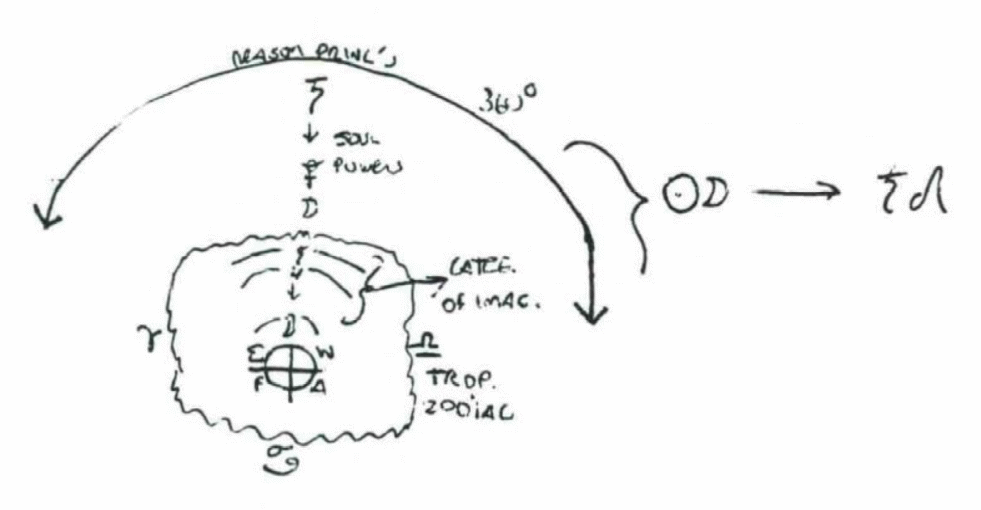
FIGURE 1982 0715-1-AB. Three Levels of the Cosmos, also showing Sun in Aquarius, Moon in Capricorn, and Saturn in Leo.
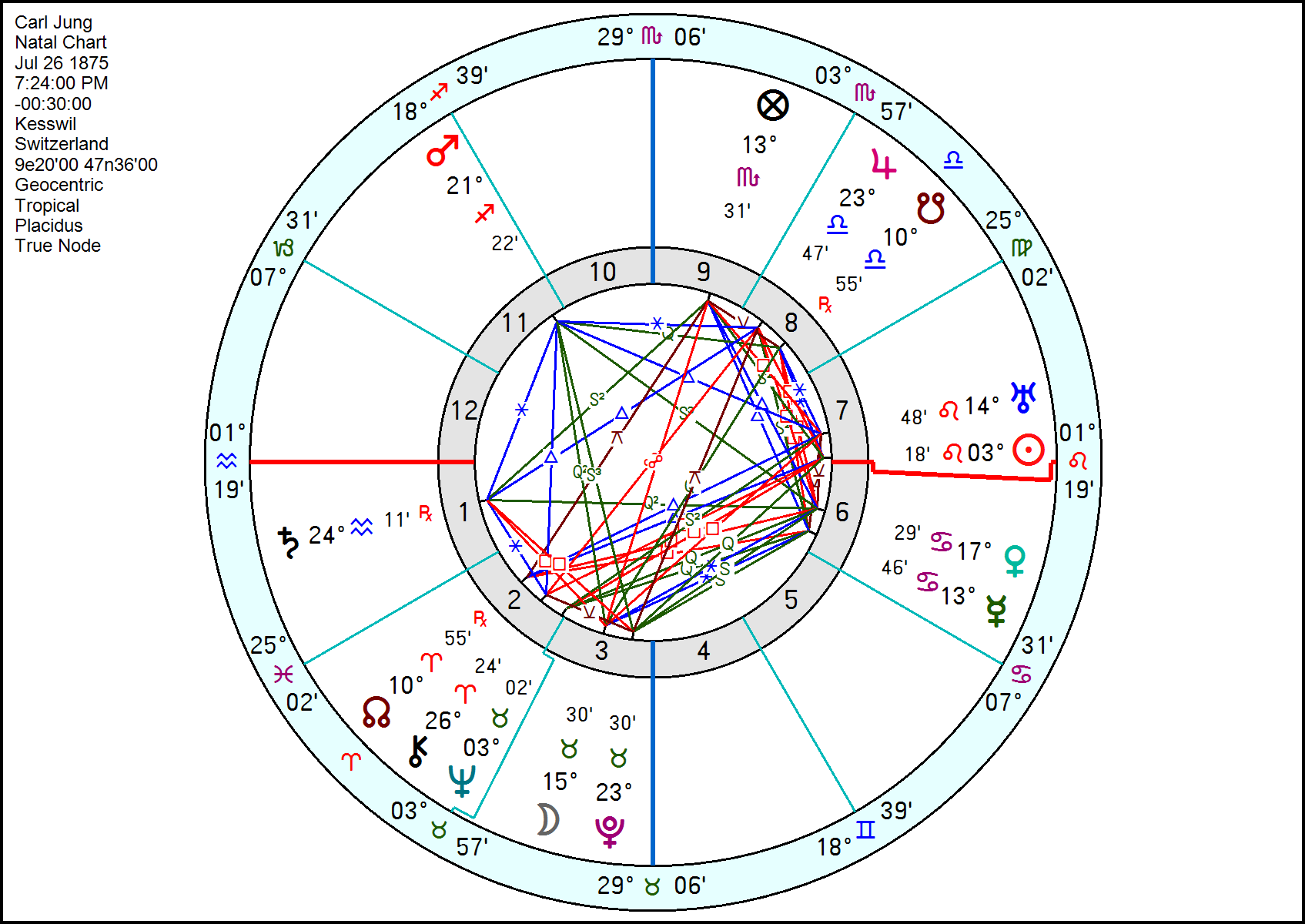
FIGURE 1982 0715-2. Carl Jung Natal Chart (astro.com).
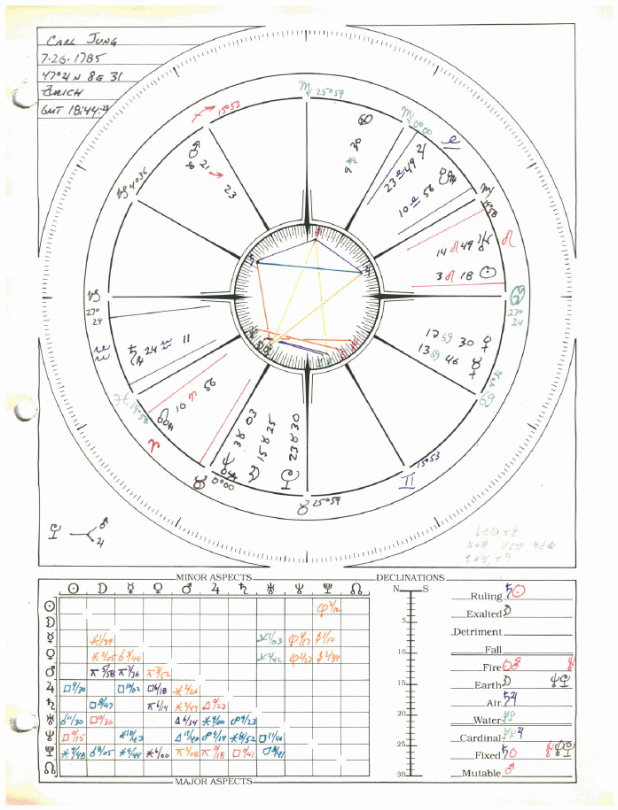
FIGURE 1982 0715-3. Carl Jung Natal Chart (WG version).
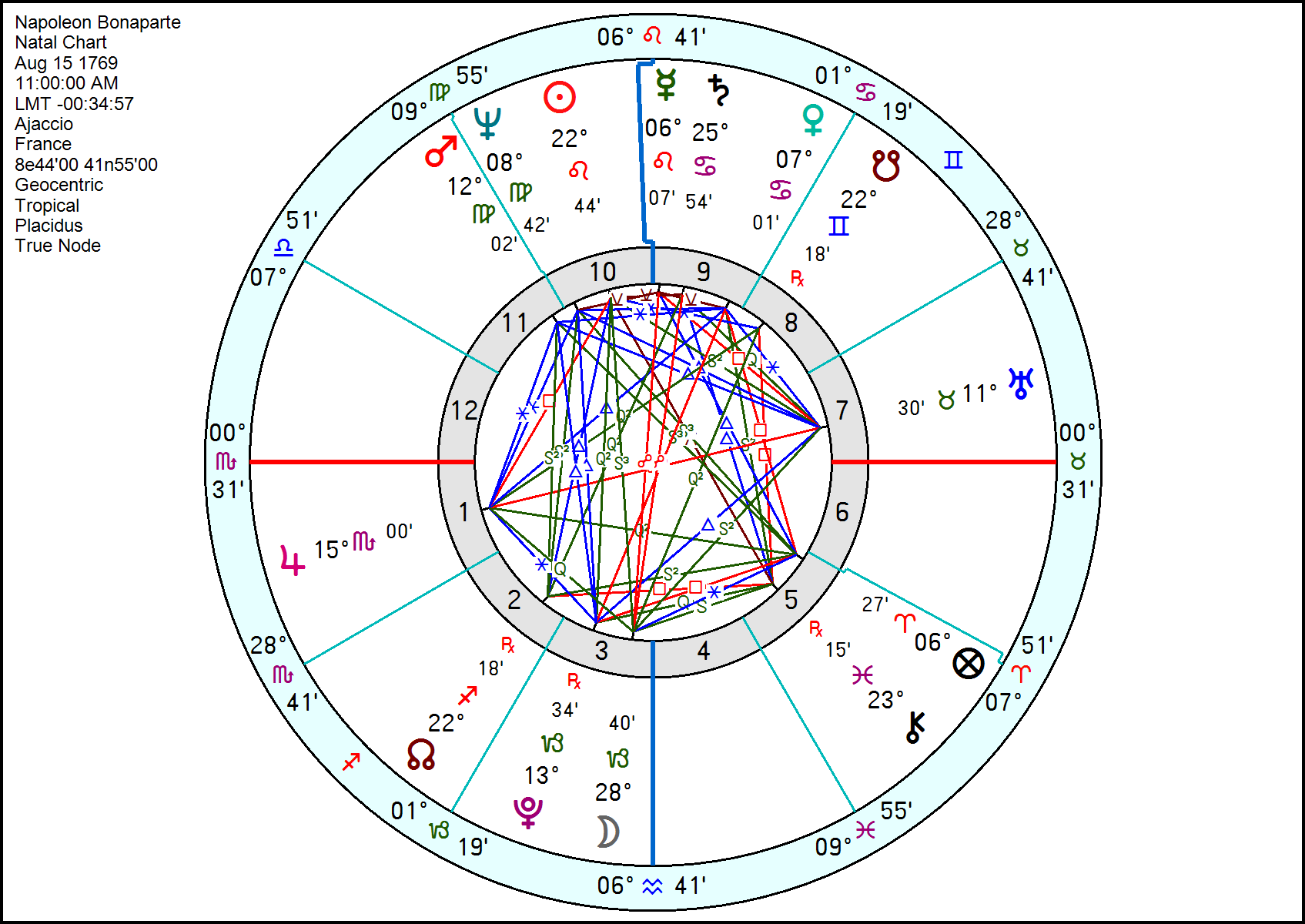
FIGURE 1982 0715-4. Napoleon Natal Chart.
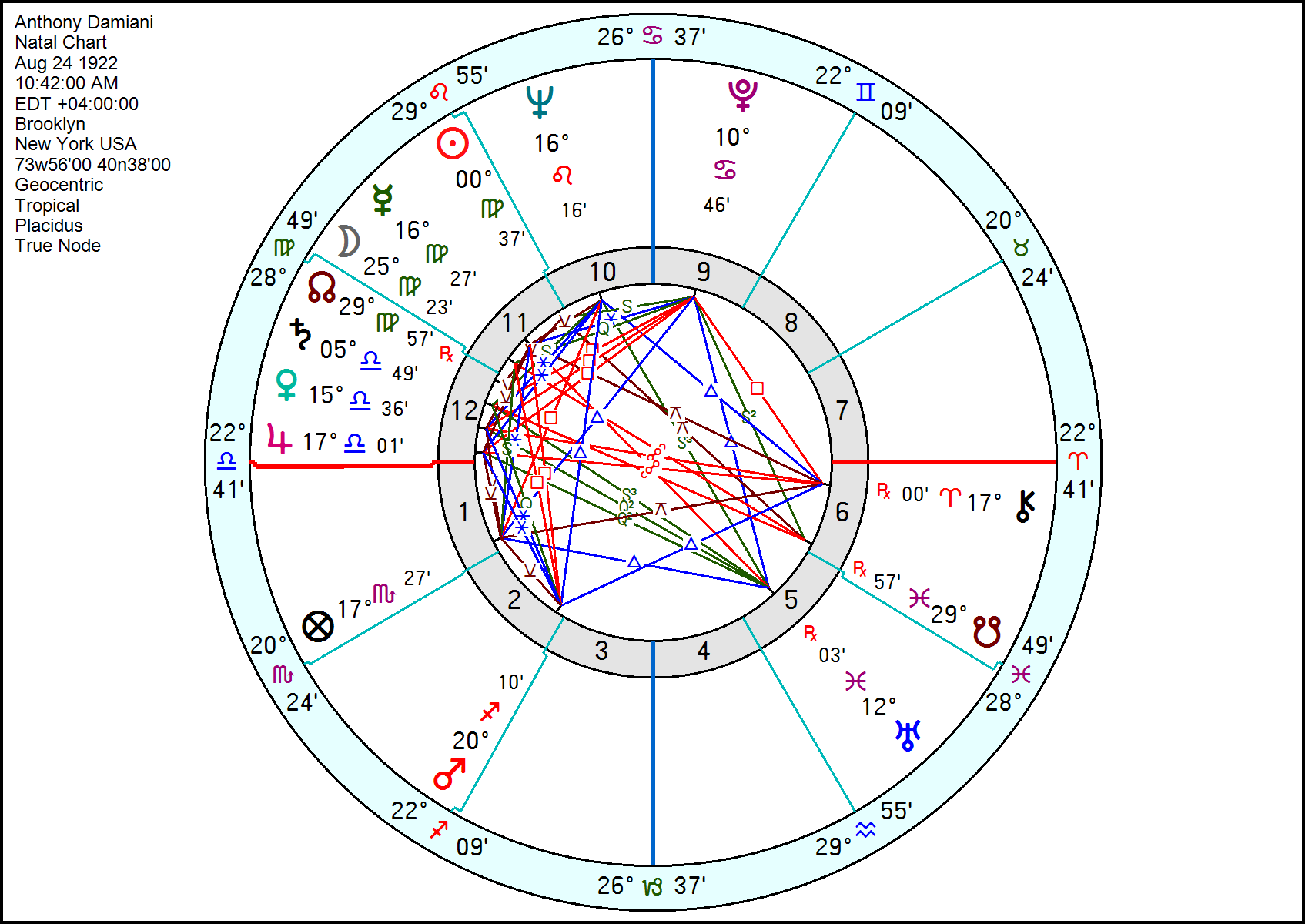
FIGURE 1982 0715-5. Anthony Damiani Natal Chart.
Other diagrams also referred to are not with this transcript version. [Transcriber note: [diagram] means the speaker is referencing a diagram as he or she is speaking. If someone is drawing or writing, with audible sounds of chalk on a blackboard, I indicate this by [drawing] or [writing].]
TRANSCRIBED Verbatim by IT 2026. Archival verbatim transcript – V11a.
AUDIO FILES: 1982 0715a, 1982 0715b. [Note 1: "Tape" and "Side" refer to original audio cassette tapes later digitized into .MP3 Audio Files. Note 2: Audio remastered by REP Studio, 2024; first eleven minutes difficult to hear, remainder fair.]
1982 07/15 SEMINAR at Wisdom's Goldenrod
Astrology; Theory; Dignity and Non-Dignity
[Audio File 1982 0715a Begins]
TS: --weren't fully (developing). Went into a clear [one/two words inaudible] with Buddhism and gnostic and fab-- these dignities, non-dignities of each of the planets taking place only within the Dragon, within the reproductive imagination, or whether transiting do that. Ok, because we have two levels, in other words, of the dignities and non-dignities, or you don't need the third whenever you talk about [one/two words inaudible]
AD: Doesn't make any sense to speak of gnostic and fabricative outside of the Dragon.
TS: Well, tho-- ok.
AD: Just wouldn't make any sense.
TS: Insofar that we spoke last-- sometime, that whether a planet was in dignity or not in dignity or gnostic and fabricative-- gnostic and fabricative both, hinges on the soul, then the difference was in terms of what was known and what was created. Seemed like one point of view was that outside of the Dragon, on a planet in dignity, the gnostic functioning was primarily with respect to-- the object of the gnostic function was the power of the soul itself. And the fabricative was the way in which that power is being organized by the reason-principle or the meaning was manifested and expressed in the Dragon. Whereas for the non-dignity, what is the object of the knowledge of the planet or soul function was a reason-principle, in other words, being fabricated inside the Dragon as a category of imagination. And that that couldn't be-- seems that the soul power would be itself actually fabricating. But it would seem like it mainly [few words inaudible] imagination.
[9¾ second pause]
AD: Go back where we started.
[short pause]
TS: Moving along.
S: I didn't say it was.
AD: Well, go over it again.
S (very faint): [few words inaudible]
AS: Tim, (is) that what you just said was the system from last week.
TS: But I haven't changed my mind over that.
S: Evidently.
AS (faint): But say [few words inaudible]
[14½ second pause]
TS: When a planet is in dignity or-- seems that the distinction of dignity and non-dignity to me should arise [short pause] in the planetary spheres before the reproductive imagination (reflects), as well as the reproductive imagination. [few words inaudible] related to the first question.
[30½ second pause]
AD: You want to restate that some more? [short pause] Maybe we better restate it [few words inaudible] because that would indicate the distinctions are valuable.
TS: Yeah.
AD: In other words, the planet-- the dignity planet is preoccupied-- in the chart, you are preoccupied with that soul faculty, ok. The non-dignity, you are preoccupied with the content, with the perceived world.
S (very faint): Ok, I follow. I think I follow.
AD: You sure?
TS: What about the Mars, we can--
AD: Well, if you say-- if you say that you have Mars in Gemini in the second house, ok. Second house or the houses in general represent the perceived world. And the perceived world--
S: [three/few words inaudible] This is our charts. This is in our charts?
AS: Oh no [couple words inaudible]
AD (simultaneously): (Nobody's/Always) here when you get back.
S: How was nobody--
AS: Nobody's here.
S: Then nobody should come and visit [couple words inaudible]
AS: There's nobody here.
AD: Nobody here ('cause I'm) on vacation.
S: Well then how--
AD: Oh, come on [one word inaudible]
S (simultaneously, faint): But there isn't [one word inaudible]
S: What if you ask him?
[few seconds of inaudible student talking]
TS: Well, if you're gonna-- we don't want to focus right now on what's happening outside of--
S: No. Just what is on the-- down there.
AD: At the bottom. In other words, we're saying that-- we're saying that the houses represent the perceived world, and then a non-dignity planet would be preoccupied with the reason-principles which are in that perceived world.
TS: Ok.
AD: Say it again, Tim. If you have a planet in dignity, then you're preoccupied more with that faculty by planetary sign. Now it isn't that-- it isn't either/or. It's more a question of relative emphasis.
TS: Ok.
AD: So if you have a planet in exaltation or a detriment, I would say [couple words inaudible] detriments and falls (or) [couple words inaudible] all the soul powers, preoccupation might take [couple words inaudible] or be (spoken) in general terms (as) the falls and the detriments would be preoccupied with [couple words inaudible]
AS(?) (faint): I'm just matching [few words inaudible]
AD: Huh?
AS(?): I'm just matching [few words inaudible] (bit of laughter)
S: Is it (Jane)?
S: You know, Kurt Lichtmann.
AS: Oh yeah he's still in Ithaca. He could talk to the school director and get it done.
S: Closed for the summer.
AS: Oh yeah, I think I'll do that.
[short pause]
S: I didn't know you knew that.
[short pause]
AD: [one word inaudible] it's that very few (years) can come around.
JC (faint): It seemed that that principle was [few words inaudible] Principle distinction bringing in [couple words inaudible]
AD: Those are planets in a-- that are fall, detriment, they're very (gnostic). Have you noticed that? The preoccupation with it is always obvious. The only difficult point I'm using-- (there's) already one. [9 second pause] What do you think of that, Avery?
S (faint): Ok [one word inaudible]
AD: We're talking about dignities and non-dignities within the Dragon. [student assents] And, the non-dignity planets are preoccupied with the houses. Dignity planets are preoccupied with the soul faculty.
AS (simultaneously): No. Yeah, I-- I heard that.
TS: But you seem--
AD: Go around the circle with that.
TS: Well--
AS: Well isn't that what-- no I know.
TS: That part seems to be more sort of, you know, acceptable within here. When you say that a non-dignity planet is preoccupied with the houses, I get anxiety. Well then, what does it mean to have a planet in a house? A planet in a sign-- would you say a non-dignity planet in a sign--
AD: What does it mean to have a planet in a house?
S: Yeah.
TS: It would seem like it's a tautology if you say a planet in a sign is occupied with a house.
AD: How? The reason-principles that are embedded in the house, let's say you got thirty degrees, thirty reason-principles in a house, then they should be projected out into that world of that house. So though if you have-- if you have thirty degrees, let's say, in the seventh house, in terms of relationships with others or business or whatever that house deals with, there should be the reason-principles, those thirty reason-principles projected in your perceived world. And then that's what you will be preoccupied with.
TS: The extracting of reason-principles.
AD: Yeah.
TS: Assimilating them [couple words inaudible]
AD: Now, a person could make a statement that from all experience he is trying to extract some meaning. That wouldn't be-- that wouldn't be false either. Because even if let's say a person has planets in dignity, he's trying to-- let's say he's preoccupied basically with the faculty. That doesn't let go of reason-principles that are in that house. That doesn't let go of the possibility of going to the reason-principles more directly.
TS: No it's-- as you say, it's a matter of emphasis on it. Seems like what happens is it adds maturity-- some kind of maturity, really the other half is whatever is missing from [one/two words inaudible] [S simultaneously: (Nothing.)] the reason-principle for the dignity, the function for non-dignity because [one/two words inaudible] any.
S: Yeah but you won't understand it.
TS: (Stay there), I guess I don't have planets. I got no planets in [couple words inaudible]
AD: Then the next-- the next thing is that, if you go outside of the Dragon, you said well what do you mean by the reason-principles?
S: [couple words inaudible]
[Note: See FIGURE 1982 0715-1-AB for the following. This diagram is not from this class but is used as a stand-in to help follow along.]
AD: Now we are talking of the inerratic sphere, and then you're talking about the pure reason-principles or the forms in the soul, alright, or the Idea of Man, these forms in the soul, and that the Idea of Man as the inerratic sphere represents it. And then the soul combines various parts that are included within the Idea of Man to produce the sensible man. So that you have the pure reason-principles in the inerratic sphere, they're eternal, immutable, and in terms of scientific parlance they speak about universal fields, alright. Now, what we're saying is that those reason-principles that are represented by the inerratic sphere determine or guide the soul-- the World-Soul's powers, combine the forms within it. These forms then use the substance of the Earth, that is the tropes, to organize the tropes into a body. And then we speak about the insertion of that reason-principle's-- that reason-principle in that matter that belongs to the Earth--fire, earth, air, and water. And then the insertion or the-- the reason-principle which is inserted into that material species, alright, goes out through that material species and projects itself out through that material species, that material entity. In other words, what we're-- what we're bringing up here is the karmic seed-thoughts, if you want to use that language. 'Cause at this point where the reason-principles which have organized the fire, earth, air, and water so that it could become a vehicle for its manifestation, it's at this point where you speak about the seed-principles from the subtle body which is outside the tropes going inside that subtle-- I mean going inside the physical body and coming up through the heart and through the head and taking up a possible or perceived world.
[short pause]
TS: Go ahead.
S: [three words inaudible]
AD: Go ahead Tim, don't stop. I think it would be very difficult to really try to make the differentiation and the distinction of gnostic and fabricative planets outside the Dragon. But we did make this distinction, we said that within the Dragon, the gnostic function could work in such a way that they could give you some knowledge of what's outside the Dragon. So, when let's say we participate in a real instant of knowledge, there you're participating in the knowledge of the planets which are outside the Dragon, the realm of the Dragon.
TS: Now would the non-dignity planet be able to give some-- not knowledge but experience of the reason-principle that's outside the Dragon?
AD: How would that work?
[short pause]
S (faint): How would that work?
TS: Well--
AD: I mean how-- I think the question you're asking is that, could the reason-principles which are organizing everything within the Dragon, and which form matter, organize matter, [short pause] can the non-dignity planets, so to speak, extract, well-- [short pause] I don't see how that would work. The only way I can understand that to work is if the non-dignity planets, so-called non-dignity planets, organized matter and then in organizing matter a vehicle is created, it would be only knowledge that can extract the reason that's working here. [9½ second pause] I mean you could say that, Avery.
S: Me and Avery (buy a) trans-Saturnian [one word inaudible]
AD: Well if we sa-- he says-- I think Tim was saying (both). Well, when you have a planet in dignity, there's the possibility of a real instant of knowledge, which means that you're participating in the planetary functioning which is outside (this sphere). Then he wants to bring that over and say well, the non-dignity planets can also supply a real instance of knowledge. Well I don't know what that would mean inside the Dragon. Unless he wants to try to explain.
TS (simultaneously): Yeah well, not inside the Dragon but similarly in a way that you've said that, as a non-dig-- as a planet in dignity would-- well when it functioned gnostically wouldn't it function-- in other words, knew the soul power that was outside of the Dragon? That when there's a real instant of knowledge, the planets in dignity, what is the object of that knowledge? Is it the-- the function that is known or that the reason-principle that it [sic] is organizing the function?
AD: Well the assumption would have to be that the soul faculty or the power of the soul is sufficiently highly organized and developed to be able to penetrate and get the instance of real knowledge.
TS: Yeah, and the content of that knowledge would be--
AD: The content of that knowledge could-- could be the reason-principle, the actual truth of that-- let's say that transit.
[short pause]
TS: Well this is coming out and saying to me, I guess what-- why I keep hammering at this question is that this question produces--
AS: Anxiety.
TS: What?
S: Anxiety.
TS: Oh I already experience this anxiety but, uh-- It produces it-- a problem in where exactly is the natal horoscope. What is the natal horoscope? And it seems like in saying this you're saying it's some kind of hybrid compound of two levels of functions. There are those functions which are exclusively evanescent and then there's categories of the imagination. And there's-- there are those which are based on some existential realities as being capable of some kind of real knowledge, and hence possibly some contact with the soul.
AD: Tim, try again.
TS: If we say, if-- well, I don't know. By saying that the non-dignities are entirely just-- function within the reproductive imagination, within the Dragon, and that the dignity planets are not only functioning within the Dragon but capable of moments of real knowledge of something which is inherent in themselves, the reason-principle that's organizing [couple words inaudible] or whatever, it seems to me in saying that that-- that the chart of an individual native has now become some kind of bi-level hybrid of some parts of soul, some functions of it, some parts of it are transcendent to your i--
AD (simultaneously): Why-- why e-- why even refer to it as bi-level? A person could be introverted and extroverted. Introverted about certain things, extroverted about other things.
TS: 'Cause the introversion is authentic and the extroversion is not. And that you're saying that the--
AD: The extroversion isn't authentic?
TS: You said that the-- only the planets in dignity are capable of real knowledge. Therefore it would follow that the planets in non-dignity are not capable of real knowledge.
AD: Well there it would-- yeah, they're not organized for that. Ok let-- let's proceed.
[short pause]
TS: So if the planets in dignity are capable of real knowledge they have some contact with something outside of the Dragon.
AD: Yeah.
TS: Those planets which are not in dignity have no contact with anything outside the Dragon.
AD: I wouldn't say no contact. We're saying that their preoccupation is with circumstances, with what's inside the Dragon.
TS: Well then what would be their contact with what's outside of the Dragon?
AD: Well, what-- let's go back to what would there be-- what would their preoccupation would-- would be with. Planets in non-dignity. What would their preoccupation would-- would be with? We said that it would be with the perceived world.
AS: Wouldn't there be some meaning embedded in the perceived world and that would be their content. Hence their contact with what's outside the Dragon would be medi-- mediated by the actual experience. Seems like it anyway.
AD/S(?): In what [few words inaudible]
AS (simultaneously): Yeah that-- in his formulation-- Maybe that's not-- I think the formulation was, and I don't know, you're-- you may claim it doesn't apply, I don't know. The formulation was in terms of the soul could look two ways. It could look to the experience and get guided by that. Or it could look within itself, to those powers which are actually from the higher soul and its own. Seems that that's the kind of distinctions you're making.
JC: Yeah. That was what we said before, you said when the soul looks down it's guided by opinion because you have your sensible perception and, you know-- and the mental in common, (and in the) reflective knowledge, you draw from experience. In the dignity, there's a possibility of knowing what's happening as it's happening. Right in the very functioning, as it were, would be the knowledge that the planet is delivering while it's doing what it's doing. It's not working-- doesn't have to reflect it(,) right, you know, it-- knowledge is available. Like in a rulership, as it's fabricating it would be knowing or, you know, intuiting what it's doing.
S (faint): Uh-hm.
JC: (That's) clear in either case. [14 second pause] But I thought we had said that both dignities and non-dignities, insofar as they're fabricating, they're both to be conceived of as outside the Dragon guiding something that's inside the Dragon. Tim seems to say the non-dignities are operating only within the Dragon. But I didn't think that we were saying that in the previous discussions. Rather that the dignities-- the planets remain where they are. The focus of the gnostic power of the soul with the non-dignity would be towards the sensible world and would be-- would be reflectively based on the circumstances that one finds there. And the non-dignity, there was the concentration on the power as manifesting and the knowledge that was available of that production as it was happening [couple words inaudible] availability of the reason-principles that were organizing the experience a priori.
S: Yeah.
[short pause]
AD: Well, what are we saying?
S: Should we try and find it from degrees? In other words, we have a busy day a non-dignity [one/two words inaudible]
S: Uh-hm.
S: You have a (day with) dignity-- in dignity, want to see the results.
AD: Well the-- we're working on Jung's chart, (with) you and Richard going over it.
S (very faint): Uh-hm.
TS: Gonna get stuck with Jung for today.
AD: We better. [27 second pause] When did he have instances of real knowledge? Didn't you say when something was hitting the dignities?
TS: Well let's see.
S: Anthony, what about the day you spoke about Uranus?
AD: Yeah, the trans-Saturnian hitting a dignity.
[short pause]
TS: But that's the trans-Saturnians. I mean, Uranus.
AS: Well that's ok, I-- It seems like the formulation really is that both of these-- if you just take the reasoning powers of the soul outside the imagination, that order of fact is [one word inaudible] That would have nothing to do with-- [S, very faint: Anything.] If you just consider the productive powers of the World-Soul, cosmocrators or the planets outside of the Dragon, that's one order of operation, and we're not going to apply the distinctions there.
AD: No, we're not.
AS: Because we just leave those alone again and those are both-- whatever they-- whatever they do, they're operating with those pure reason-principles in the sidereal zodiac as it were, they're combining those. And the result of that is the organization of this whole image, the whole primal image, and that includes the categories, ok, and ultimately all of our experience is previously included in that. And we're talking more of the experience that happens within that imagination. [AD assents, very faint] We're looking at that chart [few words inaudible]
AD (simultaneously): Within that Dragon.
AS: Within the Dragon he's got a dignity or he doesn't have a dignity. And, (just) the basic formulation seemed to be saying that within that, in a dignity you're preoccupied with the functioning-- you said with the functioning of the soul power.
AD: Uh-hm.
AS: Did you mean with the operation of the category or with the pure soul power?
AD: Well, it can lead to pure soul power.
AS (simultaneously): It can lead to-- either one, right.
AD (simultaneously): (It can) [one word inaudible] soul power.
AS: But the-- but the emphasis is on the side of the-- the operation, [AD: Yeah.] the functioning of the soul.
AD: In other words, in other words, let's say you've got Mercury in rulership, alright, then your brain is going to be put to work.
AS: Ok and that could lead to an instance of the real soul power coming through.
AD: Yeah, coming through that.
AS: As in that quote. Whereas in the non-dignity, the preoccupation of the categories is with the--
S (faint): Yeah.
AD: So let's say you got Mercury in Ge-- in Gemini, I mean any-- Leo.
AS: Still seem to be saying that in the case of non-dignity, that the knowledge has to be mediated through the circumstance. There may be a reason-principle embodied in the circumstance.
AD: And there-- there is.
AS: And there certainly is. And that's the way that you will get at it.
AD: Yeah.
AS: Whereas in the dignity there's a possibility that you could get at the reason-principle before it is even embedded in the imagination if that category is kicked off for the-- if the soul power is kicked off to its higher level of operation wherein it functions for an instant purely or outside the imagination. For example you're saying that probably would happen or could happen when a trans-Saturnian hits it.
AD: As a matter of fact that's the way I understand an intuition. That you grasp the meaning before it even enters into the functioning of the rulerships.
AS: And so that-- that planet, the dignity, whatever dignity, (as) [few words inaudible]
AD (simultaneously): In other words, we would be saying something like this. If the planets outside the Dragon are formulating, are organizing some sort of experience for a person, we're saying that intuition would be a recognition of what is going on there before it actually even becomes part of the imaginal process.
AS: He-- he has this line here, he says--
Plotinus [IV.3.26, AS reading] "…we are forced to recognize two orders of fact, an order in which the body is a means but all culminates in soul, and an order which is of the soul alone."
AS (faint): I'm trying to look at the (assumption).
AD: Yeah. Now that which concerns the body you're speaking about as inside the imagination. But concerning the soul alone, alright, then you're outside the imagination, it's almost like any of these gnostic functions are operating clear of the-- you know, of reproductive.
S: (Of course.)
AS: I think Tim was asking about the dignities as within. I mean in certain instances, dignity might indicate that there's a pure soul operation, pure apprehension but-- In the cases where dignity is-- planet that the dignity's operating within the Dragon or in the imagination, it's still-- you could still distinguish it from the operation of the non-dignity you would say because this-- there's still more of an emphasis on this power functioning. There's still more an emphasis on the cate-- let's say on the category. You're saying that? On the category or function rather than on the circumstance. There's still a more, what do you call it, introverted function. But that introverted functioning could, if there were a trans-Saturnian there, lead to an instance of real knowledge.
AD: You know the example we use all the time, Archimedes? And when he arrived at a state of almost contemplation or gazing and left the imagery behind. And he must have at that moment come into contact with the real reason-principle [S: Yeah.] without the intermediary of the imagination. [student assents, very faint] Then when he had to formulate it and communicate it, of course he had to use the realm or the categories of the imagination.
AS: Now my problem is, see-- I mean I follow the distinctions that you're making ok. I-- I think probably Tim's-- and Tim, I think Tim does also, it's just a question of-- I think Tim's question is, and now we have to go to examples I guess of whether-- does this-- is this actually what's happening in the dignity or non-dignity.
AD: I think so and I think that's why we're going to use an example.
AS: Yeah. But I'm saying--
AD: And again it's, remember, a relative thing. Don't expect complete--
AS (faint): Yeah, yeah.
TS: I guess I'm-- I am very confused but that's--
[short pause]
AD: Well it's not enough to say you're confused, you gotta be specific.
TS: Well I don't understand why it is that-- When a planet is in dignity we said that that means that the planetary function is functioning both gnostically and fabricatively.
AD: I don't follow you. When a planet's in dignity, [TS: We say--] the planetary function--
TS: The-- yeah the soul power is both capable of operating fabricatively and gnostically. And functioning fabricatively through manifesting certain types of the reason-principle(s). And functioning gnostically to know that fabrication and to re-- to know itself. [9 second pause] I don't really know.
AD: You're speaking about the planets outside the Dragon.
TS: Well inside the Dragon when a planet functions gnostically, it's in dignity. That's my problem, I-- Thought I understood that when a planet inside the Dragon was in dignity, what it knew, when it knew something outside the Dragon, was more of the order of the soul powers and the reason-principle which [is] organizing that soul power.
AD: Well I-- I don't follow because you're saying that what the soul power would know would be the soul power.
S (very faint): Yeah.
S: Ok.
TS: Soul power. What the category of imagination would know would be the soul power which is its progenitor, [student assents] [AD simultaneously: (Now wait.)] of which it is an image.
AS: What if you catapulted out of that altogether and you've reached the real knowledge now. You're not in the categories at all. [TS assents] You're in pure reason power. Now what-- wouldn't the content of that be a reason-principle, what we call this-- I mean-- I reme-- I know-- some preface. I remember we formulated something like that, that what's known in the dignity is the soul power. But that never made sense, I mean, what's known has to be an idea, one of the-- one of the ideas, the reason-principles in the--
AD: You know with the soul powers. What you know is the reason-principle. But to speak about knowing the soul powers just don't make any sense to me.
TS: They're never known? I mean--
AD: Well they're experienced, but not known objectively. Do you experience or know thinking? (TS laughs a bit)
TS: You think (for me). (laughter)
S: Yeah.
AD: You experiencing think-- you experience thinking as a soul power. It's the very means that you're using to understand something. But what is it you know? Can you say you know thinking? Or you experience thinking?
[12¼ second pause]
BS: And the powers of the soul are the reason-principles according--
AS: No. Powers of the soul are not reason-principles. That's the whole thing.
RC (simultaneously): You know-- you know--
AS: You know.
AD (simultaneously): You're knowing.
S (faint): Yeah, ok.
AS: Well, right? I mean--
BS: Soul powers, reason-principles. Alright.
AS: The rea-- reason-principles are ideas as known by soul powers, by the soul. They're not the absolute Ideas.
BS: I got it.
AS: They're--
BS: That's the contents of it, as we've said. The reason-principles give you the contents of the powers of the soul.
AS: Yeah.
BS: [couple words inaudible]
AS (simultaneously): I mean, in particular-- I don't know why this is [one/two words inaudible] when you get, let's say-- Uh-oh. He's resorting to magic now. (laughter)
AB: Anthony--
AS: You can't toss aside that.
AB (simultaneously): --you can't step out of that circle.
AS (laughing): We got him. Quick, ask him the questions.
S: [few words inaudible] (you know).
AS: Quick, just do it. (bit of laughter) But--
AD: Let's make [one/two words inaudible] [drawing] this will be the Earth, ok? These will be the planets out here. These will be the [one word inaudible] [FIGURE 1982 0715-1-AB]. (bit of laughter)
TS: Anthony?
S: No.
TS: Oh, ok.
AD: You're ready for now, ok? [drawing] Moon. Venus bi-quintile Sun. Well, let's put the Sun here.
S: Anthony--
AD: Now we said that these here working with those reason-principles, alright, or better still, [drawing] the forms that are in the orbs of the planets, the vital living forms, are organized by the Ideas. The organization of these vital-- vital forms which are in the soul, alright, are then the so-called species. If we think of the species as some o-- sort of algebraic formula which organizes all the matter here [diagram], so we would have, let's say, the fire, air, earth, water, and earth. I mean it's going to utilize the matter of the Earth, alright? So then a creature gets built here, [drawing] alright, and he has a perceived world, which would be the twelve houses. The twelve houses is the realm of experience and circumstances, isn't it? Or, it's not then tell me what the houses mean. (AS laughs)
S: (Pay attention), I don't know.
AD: Yeah.
[short pause]
TS: Well-- ok. Last time I-- I thought I was speaking of the houses [few words inaudible] (them) back.
AD: Well go ahead, tell me how you were disturbed, maybe [TS: Well I--] you know, we could get it more clear as we go along.
TS: Well, the last time I thought about the houses and the signs in terms of the Dragon and the-- this Dragon being the zodiacal-- [AD, faint: Uh-hm.] was that, according to what-- in that paper I guess is image, [Note: See WG Paper 1982 0705b.] that [AD: Tim?] the symbolization or the pictorialization of an image-meaning in space and time would be what the houses would be about. So, you know, unity as through the various--
AD: Alright, let's try, Tim, ok? We have a planet sitting on this degree, and this would apply to all planets, ok? We have it sitting on a certain degree, let's say 6 degrees Libra, ok? Now, what we said was that this was the image, alright, and by the image we're not speaking about what you see.
TS: Right.
AD: Ok? So, if we think of the Saturn (in/and) the degree it's sitting on and we s-- we say that this is the way that particular function is organized. This is the image, the underlying image which is organizing this function. And then there's a duplication of that, and the duplication of that is the perceived world. So over here you have the image [diagram], [TS assents] ok. But this over here, the houses here [diagram], would be the symbol.
TS: Yes. Ok. So far so good.
AD (simultaneously): Ok. So then the planets are like in between [diagram]. On the one hand, the planet is organized by this here but on the other hand it's reflected or let's say it carries a reflection of that [TS assents] as the perceived world of circumstance. Ok, good. So far so good? Ok, continue.
TS: Now, when-- when one speaks of the relation of this planet to this degree, it seems like-- or this sign, it's in the relation of this planet to the sign would be issue of ruler-- dignities and non-dignities first could arise.
AD: Uh-hm.
TS: Ok. Now it seems that what is being said is that if a planet happens to be in dignity like this, then it has within it the potential to refer to this soul power, and the way in which this soul power of Saturn, this Saturn is-- [drawing] [AD: (Ok.)] is being organized and [AD assents] knows that degree.
AD: Exactly. That's a possibility, a potentiality all the time. In other words, if we took the example of Archimedes, ok? And when he came up-- You know what would be an interesting-- you remember that fellow who invented the formula for the benzene ring?
TS: Yeah, should I--
AD (simultaneously): Kekule who? [Note: Friedrich August Kekule (1829-1896), a German organic chemist.] And that one night he had a dream and in the dream he saw all these figures dancing around? What would be nice would be if you get his time, his birth, make out the chart for that day that he had that dream. I don't know if it's even possible. But, if it is, I think it will be a rare instant where you would see that coming through even his sleep state, came through this knowledge, and there probably would've been very strong aspects, alright. And I would say something like this, that at that moment when he had the dream, you know, with these-- with this chorus going around dancing, I would say that there must've been some aspect within his chart, alright, which was delivering-- knowledge which is from this realm [FIGURE 1982 0715-1-AB, soul powers] was being delivered to this entity, right through the imagination and everything. But naturally, when it comes through the imagination it's going to be clothed with imaginal forms or with verbal forms or whatever pictures you can make. But out here [diagram] it doesn't have any of that. It doesn't have a formula KH23478. That's the way we verbalize the understanding which is coming out from out here.
So we could say these principles are ordering the imagination, the content within the imagination. If that wasn't so, if there was no possibility of the imagination being ordered by superior principles, there would be no knowledge for us. Because the imagination could be of anything. But if the imagination is specific and telling you something, in other words, you go over and you go see something and then you bring me back a report, you have to tell me in the report what you saw and I read the report, I'm assuming that you clothed verbally as best as you could what the original experience is about.
Look, the point I'm making Tim is, you may not agree or you may not see but if you don't see you've got to be very specific in-- in the-- [S: Yeah.] you know, what it is that you think is wrong. Because you may very well be right. But if you're not stating an objection very clearly then, you know, I don't know how to get back at you.
TS: Well, let me ask again. When a planet-- if the planet Saturn is at some degree, [AD: Uh-huh.] 6 degrees of Libra. Now, these reason-principles out here [FIGURE 1982 0715-1-AB, 360°], are they in some kind of signs or are they in no kind of signs?
AD: Well let's-- let's take them as in signs, go on.
TS: Well, ok. If they're in signs, which would seem to me-- in other words, what I've understood this 360 degrees to be so far is a differentiation of the indi-- and-- a differentiation and an emanation of the Saturn in Leo's original vision of the Intelligible Cosmos, or-- or the Ideas which are-- go to make up something of the Idea of Man. And this is the final--
AD: This is the Idea of Man [diagram].
TS: And this is the only--
AD: 360 degrees, the Idea of Man is self-(determining/determined).
TS: And as the Idea of Man then this 360 degrees is 360 degrees and also twelvefold in some way.
AD: Yeah, or 72 x 5 or any of those possibilities.
TS: Well, it is a twelvefold, it's-- Are there dignities and non-dignities out here [diagram]?
AD (quietly): Well what do you think?
TS: I think there are.
AD (quietly): I wouldn't know what that means.
TS: Well--
AD: So you would have to explain to me what it means for there to be dignities and non-dignities out there. You'd have-- you would have to explain to me how Saturn here or Jupiter or any of these here can be divulsed, you know, separated into dignity and non-dignity.
S (faint): Dignity, yeah.
TS: Well not into fabricative and gnostic. I think that point was well made last week that by dignity and non-dignity we weren't saying that the planet was exclusively fabricative or gnostic. But simply that, if there are signs out here, that this is-- if this 360 degrees incorporates in itself some reproduction of the twelve Ideas, then it would seem to mean inherent in that also would be the ring structure. And there would be a harmonic resonance between that ring structure and these planetary spheres. Now whether that--
AD: Tim, again you'd have to explain to me what it would mean for Saturn, you know, to be separated in this twofold way. And you're speaking about a God, alright.
TS: Well, I thought-- I think that it is here that the question of the soul looking upward or downward is relevant. Here it doesn't make sense to me because it's not the soul and then how could it, you know-- this is-- this is (within) the soul.
AD (simultaneously): Well why would it make sense here? Here's you and I, alright, discussing this thing right here and now, alright, and we're trying to look upward, we're trying to understand something which is outside the Dragon. So to that extent we would say we're looking up and we're trying to understand, so we would have to try to tread-- go outside the Dragon. But insofar that we look for what's within the Dragon, and we're trying to understand [drawing] what's bringing these events about inside the Dragon, then I would say we get lost. You would get lost in opinion.
TS: But, when a planet is here [diagram], I mean that-- I don't see that there's any way I could disagree with what you just said. But I don't see why one wouldn't say if the planet is functioning here, Saturn say-- if Saturn I thought was in say-- Saturn here knows a degree and manifests it there [diagram].
AD: Uh, I kind of--
AS: Tim, can I-- can I try something?
AD: Sure, please.
AS: Tim, this isn't a good--
AD (simultaneously): (Poke a hole), poke a hole.
AS (simultaneously): That's fine, this isn't a real good example. I mean I [three words inaudible]
AD (simultaneously): You better buy some cheap chalk when you get a chance, that we could write on this board.
AS: Um--
S: You need to get close.
AS: I-- I don't think that dignity means-- means the same thing outside, [TS simultaneously: No, I don't think--] if it means anything. I don't think it means-- [S: (Uranus.)] Look, here's this--
TS: Let me just try and do--
(Side 1 of original cassette tape digitized as 1982 0715a Ends; Side 2 Begins)
AS: I mean if you go to the Sun it's in some place else, if you were on Venus or on Saturn or on Jupiter and Mars it's not going to be-- [TS: Probably.] In other words I'm saying that the signs that we're using to say that are really in a way determined from [drawing] the Earth's position here, the fire, earth, air, and water, the elements of the Earth, broken up into this certain twelvefold we're ultimately calling the signs. In other words, if it's just Mars in dignity you say well Mars is in Capricorn. Yeah? But what do you mean, if I'm on a different planet, what about the Mars itself? What if I am Mars, and then the other argument, what if I am Mars itself, if I'm the God Mars, can I be in digni-- do I change as I go around the zodiac, sometimes I'm only dignity and sometimes I'm not? It does-- that doesn't sound so good. And also if this-- the thing of Mars being in Capricorn is also-- seems to be relative, strange though it is. And if you go through this, [TS simultaneously: Well (three words inaudible)] from where-- from where do you say Mars is in Capricorn?
S (faint): Capricorn.
AS: [few words inaudible]
AD (simultaneously): See the interesting thing is the Dragon, or I think that's true, that's the way that I think is the-- how do we say, the memory of everything that has transpired on this planet. So that's the actual memory, the tropes or the vasanas or-- any kind of living that's gone on on Earth, alright, the Dragon is the memory of those lives. You could almost say like it's almost like the subconscious or the unconscious of the Earth. And anything that has been experienced, alright, leaves traces of its functioning in that unconscious. So I-- I think we have to stay within this framework here to understand what we're talking about. So when we say-- when we say for instance, we take a chart, Jung's chart, and then we-- and we start speaking about the degrees, we're locating everything within the Dragon. But every now and then we can see that a big insight comes into him. And usually it's the trans-Saturnian planets, alright, which are hitting some of the Chaldean planets, alright. More often than not when it's an instance of real knowledge it's hitting planets in dignity. But that doesn't mean when they're hitting planets in non-dignity that something also doesn't show up. And I thought maybe if we took the example of Jung and see what happens when the trans-Saturnian hits the gno-- the gnostic and see what [couple inaudible TS words simultaneous with AD] happens when they hit the non-dig-- dignity.
S: Ok.
AS (simultaneously): [few words inaudible] the questions, I mean, [AD simultaneously: What hap--] you seem to describe what happens when it hits a dignity. [TS simultaneously: See, the way that (I--)] But what would happen when it hits a non-dignity.
JC: Tim I think your point is good if you say, "How do you explain Hindu astrology?"
AD: I'm not [S simultaneously: That's right.] interested in Hindu astrology, I got enough of a problem right now with this one!
JC (simultaneously): Alright. But they're using, you know-- but we're using the sidereal zodiac.
AS: It doesn't matter.
JC: And you're speaking of dignities, what we mean by (them).
S: Yeah.
S: I have Jupiter in Sagittarius, ok, that's a dignity. But if I-- in a si-- sidereal chart I don't, it's in Scorpio.
AS: I know but the-- that's a funny-- there's a further-- sider-- when they say it's the sidereal chart that's no-- that's kind of a misnomer. Saying it's sidereal-- it's still sidereal relative to the Earth. [S simultaneously: That's the point (one word inaudible)] It's still the Earth's sidereal, [student assents] yeah. It's not-- if I went to some place else, if I went to Mars itself or somewhere else, [S: Yeah, right.] that whole thing would be--
JC: It's not conceiving the [AS simultaneously: Then--] planet as out in s-- beyond-- roaming by itself [AS: Yeah.] in either case.
AS: It's not an incorporeal power anyway. I mean, besides the argument that if you talk about an incorporeal soul power, what do you mean by saying that it's in a sign? In-- you know, the whole spatial, you'd have to understand it some other way.
JC: Yeah, with reference to itself it's not in any sign, and you're all within it.
AS: I mean it may be [one word inaudible]
JC: They're all within a sphere. All the signs are in that sphere of--
AS (faint): Well it seemed like that but-- ok. How about that Jeffrey, do you see any difference between the dignities and non-dignities? Anyways [couple words inaudible]
S (faint): I don't know [couple/few words inaudible]
[12½ second pause]
AD: Don't you disappear.
S: Who?
AD: Well, I wants-- I want to talk to you before you go.
S: Ok.
TS: I just have such a terrible annoyance. I'll go through that but I'll give up now, I just can't see why a planet in non-dignity couldn't have some spiritual meaning.
AD: I didn't say it doesn't have spiritual meaning.
TS: But if it can only function within the Dragon, then what's its value?
AD: I see. [12½ second pause] I gotta answer you decisively, once and for all. You're a hater of life. If you don't recognize that the greatest wisdom is required to build these entities, then you don't understand fabrication. The greatest wisdom conceivable is required to build this body, or any body. Can you imagine the wisdom behind that?
TS: Obviously not, you just told me I couldn't.
AD: But that's the whole point, you say what's the distinction? Isn't the body a spiritual organ, to be used for spiritual purposes, and isn't that in itself a remarkable thing? I'm only using the term literally, you know, the Chaldeans say we're haters of life because we don't appreciate the [TS simultaneously: No.] wisdom that went into making these things.
TS: But I-- I was trying to claim that a planet in non-dignity came to some knowledge of that. And you said no, a planet in non-dignity is not capable of real knowledge.
AD (simultaneously): Well, no, the way we're stating it is that a planet in non-dignity is basically preoccupied with that world which it has constructed and tries to find the u-- the understanding in that world that it has made. Now any creature has to go by that. And the reality of the fabricative part of the world it lives in. And I don't see why you-- you haven't seen that, I mean the-- Certainly, insofar that this body is constructed and he's put in-- it is in part of the world that, let's say, is a manifestation of its own activity, [S: Yeah.] in some ways the fabricative aspect seems to be more decisive because you're speaking about how does the whole, or how does the-- how does mentalism work. And so we have to bring in the notion of the fabricating or the projecting of the world from out of the soul of that individual creature itself.
TS: But then that says that fabricative and gnostic found out here [FIGURE 1982 0715-1-AB, soul powers]. That--
AD: Yeah, you could do that, Tim, I would have no objection, it's just that I can't do it because I can't bifurcate the planets out there as gnostic and fabricative. That distinction doesn't exist out there. But you could do it, I wouldn't say (well don't).
TS (simultaneously): No, no, maybe they aren't bifurcated here but that planet which is in non-dignity inside the Dragon is one which is emphasizing a recognition or experience of the fabricative power of the soul to project or emanate something of the reason-principle, its vision of the Idea of Man that's involved.
AD: Well then our best-- our best choice would be to go right to an example, take an example, see if we can see it. If we can't see it in a practical way then it may very well be we're barking up the wrong tree.
S (very faint): Yeah.
TS: Ok. Jung has the Moon in dignity, Sun in dignity, Saturn in dignity [FIGURES 1982 0715-2, 3]. Right?
AD: Yeah.
TS: I think those are the only three. [9¾ second pause] So I've got here a list of all the conjunctions of Uranus, Neptune, and Pluto to all the planets. Ok. And we can go through and give you the dates of-- And then I could go through the events.
AD (simultaneously): Well, I think, I think the-- I think the thing to do is pick out what you think were some of the major events.
TS: I couldn't tell you, I don't know at this point.
AD (simultaneously): Oh you pick.
TS: I've got-- I mean they're all within here, it might not--
AD: Alright, um--
TS: And there's only-- there's this only--
AD: Read 'em out, read 'em out, and we'll pick a couple.
TS: If you take-- these are just the trans-Saturnians to the dignity planets. I'll read that group.
AD: Ok, and then--
TS (simultaneously): And then I'll read this other group, ok?
AD (simultaneously): Good. Good.
TS: So in order: Neptune on the Moon. School began, his mom went crazy, and he was afraid of the Church. Neptune on the Sun, he wrote the Septum Sermon. [Note: See Septem Sermones ad Mortuos (The Seven Sermons to the Dead) in Jung's Memories, Dreams, Reflections (1962), Appendix V, or in The Red Book: Liber Novus, ed. Sonu Shamdasani (New York: Norton, 2009).] He got the idea of the mandala and the collective unconscious. Uranus on Saturn, first use of archetype. Uranus on the Moon, he went to India, then he write-- real-- realized that he really wanted to go to England and investigate the Holy Grail and he started his lectures on the mother archetype. Let's see (then). Pluto on the Sun, struggled with the idea of Mercurius, and Uranus on the Sun he wrote Mysterium Conjunction [CW14]. Ok?
AD: Ok.
TS: Now, the other set. Start out with this. Uranus on Jupiter, disillusioned by father's and Church's activities. He had (twenty-three) of them. Uranus on Mars, he want to see Janet and he lived out his shadow in Paris [couple words inaudible] Neptune on Mercury he began to pra-- his private practice and met Freud. Neptune on Venus--
AD (simultaneously): I'm sorry, would you repeat? Neptune.
TS: Neptune on Mercury he began working with clients himself and he also met Freud. Neptune on Venus, he and Freud went to America. Pluto on Mercury, he traveled in Africa and he had the vision at Mount Elgon. Pluto on Venus, Studies in Alchemy [Alchemical Studies, CW 13]. He wrote Studies in Alchemy and volume 8, Structure and Dynamics of the Psyche [CW 8] and the Two Essays on Analytic Psychology [CW 7].
[Note: Studies in Alchemy is not a single work written during this period but the title of CW 13, a collection of five essays composed across several decades. The only essay in CW 13 that falls within the Pluto-on-Venus transit (September 21, 1927–July 12, 1929) is the "Commentary on 'The Secret of the Golden Flower'" (1929), which Jung later said was the beginning of his engagement with alchemy. CW 8 (The Structure and Dynamics of the Psyche) is likewise a collection spanning many years rather than a single work; the essays within it that fall during the transit are "On Psychic Energy" (1928), "The Structure of the Psyche" (1927), "Analytical Psychology and Weltanschauung" (1928), and "The Significance of Constitution and Heredity in Psychology" (1929). CW 7 (Two Essays on Analytical Psychology) is a more unified volume, containing just two essays, both of which have long revision histories; the 1928 revision of "The Relations between the Ego and the Unconscious" falls within the transit, and the volume was republished as a unit in 1928. Also written during this transit, though not mentioned by the student, are two essays now in CW 17 (The Development of Personality): "Child Development and Education" and "The Significance of the Unconscious in Individual Education," both 1928.]
AD: That was which one?
TS: Pluto on Venus. Um-- Uranus on Mercury, "Answer to Job" [in CW 11]. Uranus on Venus, Toni Wolff died and he wrote the essay on "Synchronicity" [in CW 8]. [Note: Both "Answer to Job" and the "Synchronicity" essay were written in 1951 and published in 1952, placing both within the Uranus-on-Mercury transit rather than split between the two transits as the student suggests.] And Neptune on Jupiter, he-- he was totally caught up with the correspondence with Father White on Christianity and the Church. [Note: See Ann Conrad Lammers and Adrian Cunningham, eds., The Jung-White Letters (London and New York: Routledge, 2007).] That's it.
AD: Now can we draw any conclusion from these two sets?
TS: Almost. I mean there's (a lot) from the Pluto on Venus and the Uranus on Mercury. Those two don't jive, every-- the other ones, the rest are pretty easy.
AD: Alright now, those two that you picked out--
TS: Pluto on Venus, Studies in Alchemy, volume 8. I can check to see whether or not [one/two words inaudible]
S: If they wanted (him).
AB: What's the date?
TS: I have that down as August 10th, 1928 through July-- June 20th, 1929. [Note: Pluto was at 18° Cancer (the rounded degree of Jung's Venus at 17°30' Cancer) from September 21, 1927 to July 12, 1929. The student's dates of August 10, 1928 through June 20, 1929 refer to the period when Pluto was at the exact degree of 17°30' Cancer -- and while the start date is correct, the end date should be June 24, 1929, not June 20th.]
AD: And you say Uranus was on Venus?
TS: No, [S simultaneously: Pluto.] Pluto was on Venus.
AD: Pluto was on Venus.
TS: I could check and see what else was going on at that time.
AD: No, that's plenty, that-- That's more than a mouthful. [few inaudible student words simultaneous with AD] [few words inaudible] that. But you say Pluto on Venus seems to disturb the basic idea that we're working with.
S: Well--
AD: Where was his Venus?
S: Cancer.
TS: Sixth house.
AD (faint): Yeah.
AB: And Mercury, (was it) the--
RC (simultaneously): Tim, say that was when he wrote Alchemy?
[short pause]
TS: Yes.
S: No?
TS: He wrote--
[short pause]
RC: I just remember when I read that book the first time that-- I don't know if I remember it [one word inaudible] now, but there didn't seem to be an awful lot concluded. It seemed [one word inaudible]
S (simultaneously): [couple words inaudible]
AD (simultaneously): Well, just refresh my mind, [RC simultaneously: I mean, he was presenting a lot of the theory.] Alchemical Studies. "Paracelsus as Phenomena," [AB simultaneously: "Spirit Mercurius."] "Philosophical Tree."
AS (simultaneously): "Zosimos."
AD (simultaneously): Huh?
AS: Yeah.
AB: "Spirit Mercurius."
AS (simultaneously): ("The Tree,") "Zosimos," "Mercurius."
AB: Did you say the "Philosophical Tree"?
AS: "Tree," "Philosophic Tree."
AD: What volume was that?
AS: Ok. Alchemical Studies was volume 13?
S: Uh-hm.
AB: "Commentary on the Golden Flower," "Visions of Zosimos." Well-- but Tim you see, these are all written at different times. These were all written--
TS: This was the beginning of his alchemical studies.
AS: Oh yeah.
TS: What?
AD: The beginning of--
TS: His alchemical studies. He wrote volume 8, that-- according to these notes.
AD: Well I think volume 8 is meaningful, that's the one-- The Alchemical Studies, I-- I don't know if it's--
TS: Well, the actual publishing of that was later, wasn't it Alan? (I think that--)
AB (simultaneously): Well, volume 8, like "Psychic Energy" was '28.
TS: Yeah.
AB: Not all of it.
AD: Well what I'm saying is the Alchemical Studies are studies drawn from various periods in his life. [TS assents] And they're notes put together. [student assents] It isn't something that he was compelled at that moment or that period of time (he wrote) down. [AS: He wasn't (couple/three words inaudible)] And I don't care what he tells me, those are notes.
S: But, wrote it down.
RC (simultaneously): Yeah, but it seemed like a collection of material.
AD: Yeah, it's a collection of material he put together. [AB simultaneously: But that (Chip--)] And you have to remember, he is a very creative man and he's always going to be preoccupied with getting things together. [AB: I thought what Tim--] But the Dynamics, the-- the volume 8, that's another story.
TS: Yeah.
AB: But see all these volumes are written all at all different times.
AD: Yeah I know.
AB: I think what's important, when he began his preoccupation with a certain problem, a certain idea, and even though most of Alchemical Studies was written much later, I got the impression Tim was saying he became-- it became numinous for him at that time that he had the Venus aspect.
AD: When he had Pluto on Venus.
AB: Right.
TS: In other words, it seemed to me, Anthony, if you just go through these, and as you said, most of them there's some kind of idea or an insight came in when it hit a gnostic planet, but with the fabricative planets--
AD: You see him going around doing something, traveling.
S: (With some--) the people in his life [one word inaudible]
TS: There's experiences but not necessarily ideas, like Pluto on Mercury he had the Mount Elgon vision, ok, so it wasn't exactly [one word inaudible] but-- [Note: See C.G. Jung, Memories, Dreams, Reflections, ed. Aniela Jaffe, trans. Richard and Clara Winston (New York: Pantheon, 1963), chap. 9.]
AD: You mean when he was looking at the herd of--
TS: Yeah that one-- he had several right in there, he was looking at the herd, they were nodding, and then he went out on top of Mount Elgon and he saw the Sun rise and he experienced the second creation.
AB: He saw the guy leaning on a spear.
AD: He saw what?
AB: The African leaning on a spear and he had this-- a spear, saw him. And he had this like experience of just the primordial oneness, you know, of Nature. All at the same time.
TS: He had a couple in this period, vague dreams and visions around this time [few words inaudible]
AD: You thought that was a big experience, that vision when he saw the hundreds of millions of animals developing reflective consciousness for no purpose, you thought that was a vision? Assuming that it was a vision, what do we mean by a vision? A vision is an intrusion of something from the personal psyche into a perceived world? Isn't that his definition? [students assent, faint] Yeah? And consequently the indication is something more about the personal psyche than of any trans-- transcendent knowledge. [student assents, faint] In other words, when you have a vision, what I'm saying is a vision is a content coming from your own mind [AB: That's external, right.] and coloring the perception that's taking place, or let's say melding or welding with that perception so that part of your own unconscious, alright, is in that perception. So a vision means you're taking a look or you're pictorializing something within you.
AB: What are you saying, in that experience he just saw his own preoccupation [AD simultaneously: Yeah.] with reflective consciousness?
AD: Yeah.
TS: So you're saying that people--
AB: Yeah, ok.
TS: What I'd say was that it-- it seemed like even that as an experience more than an idea coming in, it still seems like it's some kind of experience. [student assents, faint] I mean, 'cause I--
AD (simultaneously): Yeah but basically, basically I think what I'm saying is something like this. I am saying that the mind was interpreting and included itself in what it was interpreting. The preoccupation with these things that he was concerned with entered into the perceived world, into his perceived world, alright. This is not an instance of knowledge. [student assents, faint] Because if you think this is knowledge, then you're going to be mixed up like all the other mystics. Not that the vision isn't authentic and of value and does-- and has compulsive power. But that's quite different [student assents] than an idea which comes into you from [couple words inaudible]
TS (simultaneously): Right, exactly. So that's why, you see-- that's-- that was really (following/follow in) here, understanding that the fabricative planet is not giving you any real knowledge, that this is a fabricative planet so there is an experience which is a-- has a compulsive or [AD: Yeah.] numinous quality to it but there's not necessarily any wisdom or-- it's not like a vision in the sense that you would speak of a vision as a samadhi or--
AD: Uh-huh. It's difficult--
TS (simultaneously): It's a vision out-- it's not a vision in the sense that it transcended the imagination but it was nonetheless a powerful experience, [AD: Yeah, uh-hm.] and that it-- in that experience he-- caused him to expand and enrich his world-view.
AD: Let me elaborate just a little bit more. Very often, and this is quite common among mystics, they will have visionary experiences. This is quite common, among mystics I mean, not among-- Now, the strange thing about those experiences is that when the mind does project itself in-- into the wakeful consciousness, there is the feeling of numinosity. And so one is almost compelled to accept that as a truth. But, philosophical exegesis would point out that that is not truth. That is the working of your own mind interpreting. On the one hand, it created the experience and then interpreted the experience and this is while-- while you're in that wakeful consciousness. You're not in a dream slate-- state, you're not in a trance, you're awake when this is going on, that's why it's called a vision. Now, truth is quite different. Quite different. And when the idea comes into you, you do feel the source that it's coming from as overwhelming, I mean it brooks no denial, and it carries its-- almost its own explanation. And it's novel, very novel, it's something the mind can't even fathom in the beginning.
AB: He does speak of the time in Africa more as a confrontation with his own unconscious.
AD: I think so, I think that's-- I think it was that more than for instances [sic] the experiences where he had where a big idea was coming into him. Much more so.
JC: Was that experience, that-- when they speak of the apperceptive structure, apperceptive functioning of the mind stopping and you're left with just perception of the visible--
AD (simultaneously): It's both, it's both. It's perceptive and apperceptive.
JC: Well-- The example is when you're-- for instance when you're very frightened, let's say, and the mind just comes to a halt, the inner workings seem to just come to a standstill, you know, you're just faced with the situation that there's no-- almost like you feel that the ego stepped out of the way, was gone for that instance, it was just this-- you were completely involved in the situation, um--
AD: But if there's a world, there's an ego present.
[short pause]
JC: How do you mean ego? I don't know.
AD: Any way you want to mean it, as long as it's not Atma.
S: Uh-hm.
JC: Yeah there's a-- a body's-- and there's consciousness operating. There's a very particular type of functioning towards that world. I mean it's still structured, the mind's still structured. You know we can step out of the chart. It may be the chart functioning without the reflective appa-- the reflective processes going on I'd say.
AD: Yeah, well the way we would say, we would say the mind perceives and what we mean by that is the mind fabricates, alright. And then it apperceives what it created. So you have perception and apperception simultaneously taking place. The apperceptive part is where all the conscious memories, everything that you're aware of in [JC simultaneously: Uh-hm (couple words inaudible)] let's say the span of life that you live [JC assents] gets into the act and tries to interpret that. [JC assents] But the primal thing is the functioning of the mind which is the perceived world. If the mind functions there's a world perceived. Or let's say there is perception. And then the attempt to apprehend that perception brings in the operation of a-- apperception. You bring in what you have to what's there and you try to weld them or meld them into one thing.
JC: But what I was wondering, I didn't want to just discuss that, the case of this experience was not that kind of stopping of the apperceptive framework of memories coming in and all that, doesn't necessarily mean that that perception is delivering what we're calling this knowledge [student assents] (but a being) more, it's just--
AD: Yeah, the prec-- the perception does not deliver the knowledge.
JC: The knowledge, right.
AD (simultaneously): Something comes into perception which is foreign to it.
JC: That's what-- [AD: Yeah.] so this is just in terms of the functioning of the mind you could say, [AD assents] that it's just-- it operated at an animal level rather than the apperceptive and memories and reflections. The peculiar human reflective capability might have been shut down in that experience of heads nodding and all that, yet something (back of) the instinctual unity that's within the Dragon, that the animal [couple words inaudible] Am I off the wall?
AD: Wait a minute, wait a minute.
JC: What he got back to I'm saying was the thing about the original unconscious--
AD: Innate knowledge.
S (simultaneously, faint): [couple words inaudible]
JC: In-- yeah, innate knowledge that the animals have that's right in the perception and it's right in their activities.
AD: Right. And this is what of course Santayana calls animal faith.
JC (simultaneously): Animal faith, ok.
AD: But let's go back to this, Timothy. I think even you'll see, maybe with one exception, the distinction between those two. [short pause] I think you've noticed that the trans-Saturnians seem to have some way of coming in and really delivering in spite of him or even of ourselves. Very often trans-Saturnian aspects deliver knowledge almost to the point of saying, "Whether you care or not." [11 second pause] That's why I wanted to restrict the discussion to (with) inside the Dragon first, yeah, Tim, so we could be able to catch it easier and to see the significances we got going on.
[short pause]
TS: Ok. That point is a long way.
S: (I don't--)
AD: Yeah, go ahead.
TS: Concerning.
S: (Let John read.)
JC: Another thing, when Tim was reading these off, I mean for instance The Structure and Dynamics of the Psyche for one, he could-- he could've possibly, I'm going to assume, at some point in his life just sit [sic] down and say, "Well look, I've got this-- all this background and I'm putting together some essays that I wanted to be on a certain idea (at some time)." That doesn't necessarily mean some knowledge was delivered at that moment. Like maybe with Mysterium Conjunction, it might have been lit up. He just sat down and wrote one, two, three, four.
AD (simultaneously): He thought about-- how about the Symbols of the Unconscious? [Note: C.G. Jung, Symbols of Transformation, CW 5.]
S: What?
AD: What do you call that, the--
S: Yes.
S: [one/two words inaudible]
AB: 5. Volume 5.
AD (simultaneously): Volume 5, what do you call that?
JC: Symbols of Transformation.
AB: Yeah, well that was when he broke with Freud and he really came into his own. And he wrote that. [short pause] And most of his stuff, a lot of it was he was asked to give a lecture to a certain group so he just put it together, so he'd just write an essay, but you can't always look at the dates of when he wrote something.
S: It was more [couple words inaudible]
AB (simultaneously): Unless it was something that really came into him.
JC: Yeah.
[short pause]
TS: Well, Symbols of Transformation?
AD: You got anything on that?
TS: Um--
S (faint): (What year was that?)
S: (Guess.)
S: [couple words inaudible]
AS: There's-- or you're doing more-- all of these are just the conjunctions.
TS: Yeah.
AS: And no other--
TS: Well this is just going to get some--
AS: Yeah. Yeah but, thing I was going to talk-- start over but-- Whenever the-- whenever there's an aspect to the Mercury Venus, there's also the sextile to the Moon, which is in dignity.
AD (simultaneously): Yeah, yeah. That's what I wanted to know. [AS: So--] That Venus was aspecting one of the gnostic [AS assents] functions.
AS: Yeah [one/two words inaudible]
AD: 'Cause that's very important.
AS: The Mercury-- the Mercury's at 14, Venus is at 18, and the Moon is at 16. So either one of those it hits [few words inaudible]
AD (simultaneously): No but I've seen that myself, I saw that myself [AS simultaneously: (Still an/They're an) aspect.] that, you know, when planets in gnos-- gnostic planets aspected the non-dignity planets, I saw knowledge operating.
AS: Well the thing is, I mean what I was trying to say is that when the-- when the trans-Saturnian hits the non-dignity it is aspecting the dignity at the same time, or--
AD (simultaneously): Yeah. So let's say, let's say you have a dignity and a non-dignity in aspect, [AS assents] exact sextile, ok? [AS: There must be some (one word inaudible)] And the trans-Saturnian hits the dignity, the non-dignity or the dignity, either one, the possibility of knowledge is right there, because of the aspect, it's almost like a channel between the two of them.
[short pause]
MB: Could I ask a very-- When we do the charts of these famous individuals, when they have an aspect, even if they don't have a personal experience they're producing something that may have an influence on the world, that they may be used as an instrument of some kind, so that something flows through them sometimes and for the people. So maybe there's-- maybe you have to consider that too like what Jeffrey was saying. He may not have a revelation but he may have written a book that was important.
AD: I'm not denying that, [MB simultaneously: No, I'm just asking whether that could (happen).] I'm not denying that, you see, but the question here is one of what is the dis-- distinction between dignity and non-dignity, ok. And I'm denying that that was an example of knowledge coming through. Because I can get you those kind of visions a dime a dozen, or a dozen a dime. I can get you as many as you want among mystics, they're very common. We got one person here who gets them every other day. If you think that's knowledge you're in for trouble. That could lead you into a lot of misunderstanding, a lot of confusion. But there also are moments and instances where she does have very specific knowledge, very specific.
MB: So you're saying that when-- when there's a vision and it isn't-- doesn't involve gnostic-- it doesn't [AD: Doesn't involve real knowledge.] involve knowledge, then it's not a gnostic--
AD: Not gnostic.
MB: --operation now, not a gnostic [one/two words inaudible]
AD (simultaneously): Because, in the case of real knowledge, in the case of real knowledge, something will come through into the individual which is not his personal property although he can assimilate it and make it his, you know. But it's not his personal property.
[short pause]
TS: Hm.
AD: Alright Tim?
TS: Well he had-- It's hard to say, you wanted to know about Civilization in Tran-- Symbols of--
AD: Symbols, not Civilization in Transition [CW 10] because that's another work that's, you know, a potpourri. I mean I'm not interested in a guy believing that there's going to be the end of the world going around trying to find out who has dreams and visions about a holocaust.
AS: What about the Aion [CW 9ii] book too, that was one. Wasn't that one where he just wrote like pretty much straight through? He talked about that also, he'd gotten some inspiration? That wasn't the Aion?
AD (simultaneously): Yeah, he probably got inspiration for that.
AS: And if you--
AD: Well let-- let me see. What did you find for the Symbols of Transformation?
TS: He had Uranus [AB simultaneously: Well--] on the ascendant. I mean Uranus-- Uranus started on (ascendant) and ended up opposed to the Sun. And it was in that period somehow, I don't know [AD: Ok.] offhand but it was-- looks like it was Uranus--
JC: The central idea in that book is the Hero archetype, breaking with the Mother (archetype).
AD (simultaneously): Uh-hm.
JC: That might make sense with the Uranus on the ascendant there too.
AB: And also that was his break with Freud.
JC (simultaneously): I mean opposite the Sun, 'cause the Sun is the--
AD: But, Uranus was on the ascendant, nothing was [TS: Well--] on the Mercury, no aspects to the Mercury?
TS: The Mercury? Let's see, let's see here. Well, you want the Chaldeans or trans-Saturnians?
AD: Yeah, is there any aspect to that?
TS: Yeah there's as-- but-- yeah there's lot of aspects [one/two words inaudible] I thought you just wanted trans-Saturnians.
AD: Well what aspects did he have for that one?
TS: He had-- ok, see-- we went through them all, he's got-- Saturn was stationary direct on the Moon sextile the Mercury.
AD: Ok.
TS: And Jupiter was trine the Sun and quincunx all-- quincunx Mercury. This (ought to) be alright. Well the Saturn is I mean quite operative through that period, it was stationary so it was sitting-- sitting on his Moon, sextiling his Mercury. But--
AD: What was the Mercury degree, you remember?
TS: Man facing the northeast. Man-- [Note: Cancer 14, "A very old man, whose feebleness adds strangely to his dignity, stands alone facing a vast dark space to the northeast."]
AD: Yeah.
[11 second pause]
TS: He had Pluto-- I mean he had odd little aspects, he had Neptune quincunx Mars, sextile Pluto. Uranus quincunx Saturn. No, no. Let me check. It says Uranus on the ascendant. But I was looking to see if there were any trans-Saturnians hitting Chaldeans that are in dignity or non-dignity in 1911, 1912. And, only at the end of 1912 which is when he-- I think he published it.
S: Uh-hm.
AD: You know, Robert just showed me a very strange thing in Napoleon's chart [FIGURE 1982 0715-4]. How many aspects among the Chaldeans?
BC: Well, a whole bunch, I mean he's got that grand trine.
AD: No, within the Chaldeans themselves.
S (very faint): Not many.
BC: Oh. Just the Chaldeans?
AD: Yeah.
BC: Not a whole lot.
AD (simultaneously): Just look at this fantastic thing.
S: Not a whole lot.
[14 second pause]
AD: Practically no aspects among the Chaldean planets. All or most of the aspects are among the trans-Saturnians. [short pause] We don't even know what that means yet.
BS: You mean trans-Saturnians to trans-Saturn-- [couple words inaudible]
AD: The three, the trans-Saturnians.
S (simultaneously): No, just they're being [one word inaudible]
AS: Only three of them?
S: Well [one/two words inaudible]
TS: But then if you-- you go to eight degrees on that side. One, two, three, four, five.
AD (faint): Alright.
[short pause]
AS(?): Oh.
TS: And Mr. Jung didn't have it, I mean (how do we count)?
AS: Six, seven.
S: He had eight.
TS: No, he had quite a bit more than that--nine, ten, eleven, twelve, he had twelve, twelve aspects.
AD: Offhand, alright, if you look at Napoleon's chart, I mean there are hardly any planets with gnostic-- I mean the gnostic signs.
TS: Three.
AD (faint): Ok.
TS: That's-- that's better than the going rate, that's--
AD: Yeah.
S: Yeah, yeah.
[12 second pause with faint background student talking]
AS: Three is just about average.
S: And what is the average?
AS: Three.
S: Three exactly.
AD (simultaneously): The point-- [AS: Three.] the point, the point I'm getting-- I think the point I'm getting at is that the fabricative here are more than the gnostic. What he did, where he was going, the facts he left behind was all important, not his knowing. There it's like he was almost a tool being used by the World-Idea to push-- push out, you know, what it wanted to happen in the world.
AS: But wouldn't you say it was more the-- all the num-- the great number of aspects from the trans-Saturnians and so few in the-- well not more than, but that that was a lot of it also, the way you just pointed out. It was the effect on the world as a whole, you know, and manifesting it. He has all the aspects from the trans-Saturnians, very few within the Chaldeans. [few words inaudible]
AD (simultaneously): Yeah and also you read some of his remarks, he doesn't have the highest opinion of scholars or wits, literary wits or any-- [student assents, faint] He doesn't think so highly of them.
TS: Would you say that the fabricative planets there, the emphasis on the fabricative being pushed by the high--
AD (simultaneously): Doing something.
TS: That there's a way in which that person is functioning towards manifesting something of the Idea of Man or (the opposite)?
AD: Or the Idea of the World that's to be.
TS (simultaneously): (Certainly) of the World-Idea?
AD: Yeah. That's why-- that's why I think-- I think there's an enormous prejudice among this group to think that the gnostic planets are so superior to the fabricative.
AB: Well, you know what the problem is? When we use the expression, we're talking about the gnostic and we say "real knowledge take place," or there's a conjunction with something outside the Dragon. And that kind of leaves me feeling that something less real takes place when the fabricative is going on, even though there could be wisdom embodied in the cosmos just as easily.
AD: Well wouldn't it seem to you-- I-- yeah I can see that point of view and I concede to it but the fabricative is really quite important. [AB simultaneously: So we have to say that--] I mean you can't choose between knowledge and being, don't ever be asked to choose between them. [student assents] I wouldn't want to ever be put in that position of saying which would you prefer.
MB: That's true.
AB: So the gnostic is not more real.
AD: No. That's why to some extent his question was legitimate, well, what about these people who have more non-dignities, alright, what is it that they perceive of reality? I don't think they operate in knowledge, therefore it isn't a perception of knowledge that's coming through, but they act in conformity with the World-Idea that's being evolved. And so it isn't a question of knowledge there but of act. So the creatures with the Dragon are acting in conformity, alright, with the World-Idea and consequently in-- to that extent you could say or from that point of view you could say that there's an alignment within the Dragon, alright, of those non-dignities, alright, with the realm of the planets. In other words, when this person acts in conformity with the ideas which are contained in the planetary spheres themselves, then we could see like there's a relation running right through. Do you follow me, I-- In the same way that we could say when a person really understands something he gets to an instant of real knowledge, alright, well also in the case of doing. When a person is really doing what he's supposed to do, he's acting in conformity with the being of the planetary sphere(s).
TS: So you'd say something like this, that when, for example, Jung had this aspect which-- the Neptune on Venus took him to the USA, that the idea of bringing analytic psychology to American-- to William James and [AD: Yeah.] company, that that--
AD: It was the act of doing.
TS: He was-- he was acting in conformity, that it wasn't that he knew something but that his coming to America was-- with Freud and Feren-- the Italian.
AD: Ferenczi?
TS: Ferenczi? Those three guys, when they came to America, that their-- they were acting in accordance with some World-Ideas, they were bringing--
AD: They were bringing to the--
S: [couple/three words inaudible]
AD: So there it wasn't so much-- and how much could they possibly inform people of, you know, of their ideas in such a (short circuit). But evidently it was their presence that was required here in the country.
TS: No, it seemed like [few words inaudible] things.
AB (simultaneously): It had a big impact.
S: (Did it really?)
AB (simultaneously): It did have a big impact, I'd say that-- But it didn't produce anything for their own, I mean-- wasn't like [TS: Maybe (one/two words inaudible)] Jung got this great insight from William James and--
AD (simultaneously): How did it produce an impact?
AB: It produced an impact in terms of the acceptance [AD: Acceptance?] and development of the psychoanalytic movement.
AD (simultaneously): I think it produced an impact in the sense that it set up and started the organization of a few psychological societies.
AB: Yeah, that's what I mean, exactly what I--
AD (simultaneously): But that's doing.
AB: Right, it didn't ha-- it didn't give them ideas that [AD simultaneously: No.] were seminal to their theories or--
AD (simultaneously): Yeah well that's-- that's the distinctions we're making now.
S (faint): Uh-hm.
AD: So, I don't think we're far from the point in making these distinctions. It comes back to being and knowledge all the time.
S (faint): Uh-hm.
JA: Anthony, you've been talking about the circumstances, you know, their acting. Now, would that be acting within what you're calling say the Dragon?
AD: Yeah.
JA: Ok. Now that's happening in accordance with an idea [AD: Uh-hm.] most-- mostly. But the actual acting is within I think what you're calling the imaginal existence.
AD: I'm sorry?
JA: Ima-- that the being within the Dragon is imaginal existence.
AD: Yeah.
JA: And you've said that any planet couldn't be considered strictly gnostic or strictly thought about so-- Like I don't-- non-dignity planet would be operating in this way. Is there also some knowing going on?
AD: Yeah but you see then to call that knowing would be to confuse the distinctions we're making.
JA: I know, but--
AD: Why not call it doing?
JA: It's a doing.
AD (simultaneously): In the beginning was not the word but the deed. I mean if-- if Saint John was a man who had a lot of non-dignity planets he would've said, "In the beginning was the deed." He had a lot of gnostic planets (bit of laughter) so he says "In the beginning was the Word." [Note: See Bible, John, 1:1.]
AS: That's the difference between the Old Testament and the New, the Old one it's-- the beginning was the-- that's the ruach, the wind which is (always) the spirit hovered over the water (and--) [Note: See Bible, Genesis, 1:2.]
AD: Genesis.
AS: Yeah, in Genesis. There it was in-- there it was to be put in terms of doing.
AD: I-- but I think I follow.
JA: So you would say that actually-- you would say just that the-- the doing was primary. But I thought (the dignity) there is a knowing conforming. Is it conforming to the rational wisdom or the knowing that unconsciously conforms to the World-Idea?
AD: If we-- if we speak about the knowing which goes on to conform to the placement of entities within the Dragon, we'd speak about that as intuition. But if we speak of the conformity of that entity with the World-Idea, then we're speaking about fabrication. He's-- he's working perfectly the way he's supposed to be as part of the-- as part of the world. I think [student assents] this problem keeps coming up over and over again, the inability to distinguish between knowledge and being.
JA: I'm trying to by asking you some questions.
AD: Well then why import the notion of knowing into doing?
JA: Because of a lot of the (things that you--)
AD: Yeah, but the-- the point here is look, everybody says in order for us to understand anything, in order to understand A, you must have its opposite B because you can't understand A without B. Alright? Now, then that means hot can only be understood in terms of cold, right? You don't know what hot is unless you know what cold is. But then hot is cold and cold is hot, right?
S (faint): Right.
JA: Where does reflective knowing come in?
AS (simultaneously): Somewhere along the line. (AS laughs)
S (faint): Reflective.
AD: Exactly.
JA: Oh, reflective knowing. Could there be a reflective knowing associated with imagination?
AD: Yes, that would be the gnostic function. That's reflective knowing.
S: Maybe that's not right. Gnostic function?
AD: Now, the only-- [JA simultaneously: The gnostic--] the only confusion there is that you could have reflective knowing going on, and you could have knowing going on which is not reflective. So you could be within the Dragon, alright, and have reflective knowing going on. You could be within the Dragon and real knowing could be going on.
JA: Yeah but-- alright. What are the circumstances?
AD: I'm sorry?
JA: [couple words inaudible] What are the circumstances of false knowing in the Dragon? Of--
AD: I don't understand.
JA (simultaneously): If it's not real knowing. You're making the distinction between real knowing and reflective knowing.
AD: Yeah. Within reflective knowing there could be error. But there can't be error in real knowing.
S: Why?
JA: Um--
AD: There could be error in real knowing in this way, you could have an instant of real knowing and then falsify it by the way you verbalize it. That happens all the time even among the best. I'm sorry you're getting into such minute distinctions, Tim. Even you-- you would have to avoid this in a conference. [JC: Right.] You can't get into philosophic discussions at this seminar. [Note: AD is referring to the AFA (American Federation of Astrologers) Convention in Chicago, late August to early September 1982, at which TS presented "Reading a Chart" (formerly "Jung Paper"). Sessions such as this one served as preparatory discussions for that presentation. See also WG Seminar 1982 0717a.] The point is that in our language, alright, knowledge could be-- knowledge could be right or wrong and they give it the name knowledge. But the-- the fact of the matter is if it's knowledge it can't be wrong. Otherwise you're-- you're just calling it, you know, by the wrong name.
JA: Well I was thinking of the distinction between valid knowledge and true knowledge, and that there could be valid knowledge--
AD: Well then what would be the distinction? How?
JA: How? Alright. [one word inaudible] (maybe) a little more about the value of something, ok. It seems that if you have an [few words inaudible] if you have imaginal existence-- [Note: The last five words transcribed from original audio file; cut off in REP Studio version.]
[Audio File 1982 0715a Ends]
[Audio File 1982 0715b Begins]
JA: But, I think I'd have to (derive/deprive) that in terms of what you said about non-dignity.
AD: No I think you could leave that the way it is and just try to understand non-dignity in its own peculiar way, which is conformity-- conformity of the things with that which made them to be what they are and for the purpose that they are and leave out all notion of knowledge. Only in an abstract sense.
JA: Well, leave out noti-- any notion of reflective knowing [AD: Yeah.] of it. Yeah, what I'm--
AD: So-- and then there's the further difficulty. Let's say-- let's say that I have a Mars working at-- and it's in a non-dignity and it projects a world for me, alright, of which there's a preoccupation with what the contents of that world is. But that doesn't exclude the functioning of let's say a planet in dignity operating with that. So that if there's this (massive/mass of) confusion that can't be helped because it isn't that I operate with just a Mars projecting the circumstantial world. If there's a world projected all seven of them are operating in that pro-- in that act. Now we're speaking about Mars in this isolated abstract way which is really meaningless. But we're just simply trying to emphasize the fact that if the planet Mars is in non-dignity, then the preoccupation is with-- is with the circumstances. Alright. That's an abstraction because the fact of the matter may be that you may have Mercury or Saturn in dignity or rulership or something like that and it's more preoccupied than the Mars is. The Ma-- those planets in dignity would be trying to understand what's going on and the Mars is only concerned about throwing this stuff out like confetti. So, we have that difficulty that you can't isolate these things from one another and think the Mars is throwing out the second house and saying, "Now let me take a look at it." I-- it's-- you know, that's (falsification). But, from what I've seen in a non-dignity, preoccupation with the contents rather than with his own subjective functioning is something that is brought to attention over and over again, (with a) person (or) [couple/three words inaudible] of others that's the way I've seen it.
TS: So you're saying that the non-dignities are capable of conforming-- capable when evolved in conforming with the act of the World-Idea.
AD: Yeah, like it would be able to respond to those circumstances adequately.
S (faint): Right.
TS: Is that the same thing?
AD: Yeah, I think so. I think so. An evolved Mars, for instance, in non-dignity, alright, would recognize its place in the scheme of things and act accordingly. And then if you say well, now it's knowing something about that, I think then you're bringing in other aspects of the Chaldeans.
TS: So-- and a planet which is in dignity would be more involved with the knowing of the world yet being in conformity with the soul's knowledge of the World-Idea or the Idea(s).
AD: Yeah, you're complicating. I would say that the planets that are in dignity, alright, there's a preoccupation with that dignity.
TS: With some kind of knowing.
AD: Yeah. But basically with that soul faculty. So you have--
S: (Rulers.)
AD: Yeah, I-- it's the same thing. You think I'm saying that you're going to be preoccupied with knowing that soul faculty. I'm not saying that. What I'm saying is there's a preoccupation with the exercising of that soul faculty. So you have a planet in rulership, alright, or in exaltation, there's a preoccupation with that soul faculty. What? Thinking.
TS: Oh with the soul faculty which is the dignity, not the soul faculty which is the planet.
AD: The soul faculty which is the dignity.
TS: Not-- in other words, it doesn't matter which planet is it that-- in exaltation. As long as it's an exaltation it'll be preoccupied with thinking.
AD: Yeah.
TS: That's the soul faculty.
AD: Yeah.
TS: What planet gets you there is not relevant, [AD: Yeah.] you're not-- so--
AD (simultaneously): So, [couple/three inaudible student words simultaneous with AD] take a person who has-- you ever see a person who has three exaltations? You ever watch them? [S: Yeah.] They can't stop thinking.
S (faint): Why do you say that?
S: Yeah but the soul-- the particular soul powers [one word inaudible] (so I mean can you use that)?
TS: I'm not trying to follow up what's been said, not try to--
AD: I didn't hear you.
S: I don't understand that when you say that that doesn't-- it doesn't-- it doesn't matter what soul power is on that dignity. If it's an exaltation, it's a thinking faculty.
AD: If you got three planets in exaltation you're going to be preoccupied with thinking. Now you're going to be thinking about something, obviously!
S: But the di-- saying that one--
AD (simultaneously): But, will you wait and listen!?
S: Yeah.
AD (intensely): So if you got three planets in exaltation you gonna come over and tell me when you sit down to meditate you can't stop thinking! You can't stop! You've got to go on doing it. You're preoccupied with that faculty.
S: Ok.
AD: Alright?
S: Yeah.
AD (intensely): But that doesn't mean that you're preoccupied with nothing. You're thinking about something but you're always thinking! So I go to the other guy he doesn't have any. He says "I'm never thinking."
S: Ok.
AD: "I find it, I got-- I find it an effort."
S: Alright, I-- I understand it, yeah.
AD: Alright. You do?
S: Yeah.
AD: Ok.
TS: So--
S: No, I mean, I don't understand, I hear what you're saying, I don't understand it.
[short pause]
AD: Go on, Tim.
AS: Got an exaltation?
S: Yes, Mercury.
AD: That's both in rulership and exaltation so that's a very special problem. There I think you will find in pla-- Mercury in exaltation and rulership, you will find that you are preoccupied with thinking and with what you're thinking about.
TS: Yes, but what you're saying clarifies one empirical observation, (correct me) Anthony, and that is that, if a person has five or six dignities, it seems like they're dragged around by the world quite a lot, which can-- on one hand it would seem contrary to what-- what we've said about it. And it's true, we're not working with 24 karat individuals but, the--
AD: But then, in that case it could be very simply explained you have to look at the ideas and you could see that there are ideas that are pre-- preoccupied with that type of activity.
TS: Ok, I was thinking that what-- if you said that the planets in non-dignity are the individual's ability to conform with their circumstances or World-Idea [few words inaudible]
AD (simultaneously): Or work with those circumstances.
S (faint): Yeah.
TS: Then you don't have a lot of organs for that. In other words by-- by virtue of having five sevenths of the chart which is locked up in the dignities, there's an inability to recognize the proper mode of conformity to circumstance with a lot of dignities. Whereas if you have lots of non-dignities, there may not be much of a-- there would be difficulty in perhaps understanding your-- that conformity.
AD: No but you see you're drawing a conclusion which is not something that I would work with. Because that's the-- that's purely theoretical. I would have to find out what degrees are operative in those dignities or non-dignities in order to be able to make that kind of a statement. [13½ second pause] Now you see there goes our publisher.
S: (You had) [one word inaudible]
S: Yes.
AD: What, he wasn't here? And you have, you know, ask him questions to find out if this [one word inaudible]
S (simultaneously): No they can-- they can question.
AD: Huh?
S: They can question.
AD: Oh please. (student laughs)
AS: You got his ok?
S: Does he have fabricative planets?
S (faint): Yeah.
AD: Well Tim, then we'll try another way, try-- try a completely different approach. [few words inaudible] (come with) a reason.
RC: When you change viewpoints like (you/we) often do in classes here between when we try to work out principles on the one hand and then we turn to empirical observation on the other, can you see a switching in perspective from working from the dignity to working from a non-dignity, the-- you see yourself operating with a different function, coming from a different place within your own chart [FIGURE 1982 0715-5]? Like does the Mercury work in principle and then when you want to turn it over to the Sun you'd say, let's see if it actually works that way or-- Basically it'd be--
AD (simultaneously): My Sun is a beachcomber, (you know that). You mean Saturn.
RC: No actually I was thinking in terms of the non-dignities.
S (simultaneously): (Fabricative), yeah.
AS: They were in doubt?
RC: It's the empirical viewpoint-- the empirical viewpoint may be demanded from the perspective of a non-dignity.
AS: But it might be the Sa-- the Saturn too. [Note: Saturn at Libra 6, "A pilgrim sits on a rustic bench and one by one his ideals in a sort of trance-vision take form before him."] The ideas, you know, there was [few words inaudible] the way we talked about that the other day, there's this demand to actually see them worked out by an actual empirical observation. [Note: See WG Paper 1982 0626.]
AD (simultaneously): [few words inaudible] not only idealistic.
S (faint): Uh-hm.
RC: It's even more the idea behind the Saturn. But the way we've been talking though, it seems that in saying that the non-dignity planet acquires what knowledge it has through relating to the circumstance, it does seem like that's really an empirical point of view. And to say that the-- that the dignity planet in one way or another as a-- an interior receptivity to something beyond the tropical zodiac, it doesn't seem to be empirical. I mean, (it seems we) keep trying to put the two together. Ok. I see--
AD: I would reverse it.
RC: Ok.
AS: Reverse it?
AD: Alright Tim, then let's go back to the example we want to use and see what we're talking about.
RC: [few words inaudible]
AD: Well I think-- I think you saw that the-- the aspects a [trans-]Saturnian made to the gnostic planets is really fabulous in relationship from this point of view that something-- some knowing is coming in.
[short pause]
S: [few words inaudible]
S (simultaneously): Yeah.
AS: Something that's contained?
S: Yeah.
TS: That seems to be true, I-- I don't under-- there's only one but that's enough, not bad.
AB: You could just read them through again, Tim.
TS: Ok.
AS: But what are you do-- what are you reading, Tim?
TS: The trans-Saturnian conjunctions to the gnostic planets. I mean you can of course Avery bring in (all the) aspects but I wanted [AS simultaneously: Yeah, no, no I know, I just--] to get on one page.
AS: I had only mentioned that because it seemed that if you did come across a clinker, it might be because-- I mean it certainly is as valid to talk about a sextile or a square or trine to a dignity as it is to a-- it is to a conjunction and that may-- well, we-- is this Jung?
TS: Yes. Neptune on the Moon, he had his first experience of fear of the Church. And that happened--
AD: The Moon-- the Moon was in Taurus.
TS: Yeah.
AD: Ok.
TS: That and his mother was taken away for a while. Neptune was on the Sun, he wrote Septum Sermon and the mandala, idea of mandala, the meaning of mandala. Nep-- Uranus on Saturn, first use of archetypes.
AD: Now that's pretty big. That's a big event in his life. Because the recognition of archetypes or vasanas, samskaras, the delivery of that idea that should-- that something like that should pour into someone, alright, in a Western culture. Just think of-- The implications are so tremendous. What does it mean, for instance, when you read and when you were studying biology and you were reading about tropisms? Did it carry any of these connotation(s)? No. It had to come in in that peculiar way. So that he could see the vast significance underlying every individual life, the way the archetype is so formative, and later on of course the recognition that the archetype is formative of the category of the imagination. Then the natural consequence is that this is the idea embodied in flesh and blood. I mean the idea just got bigger and bigger for him.
AS: What year was that, Tim?
AD: I considered-- like I wanted to reprint that book Jivanmukti-Viveka. [Note: Swami Sri Vidyaranyasaraswati, The Jivanmukti-Viveka or The Path to Liberation in this Life.] Alright? Why? Because I considered that so important. But I like to see the We-- the Eastern version of what's [sic] archetypes are and not just the Western version. Go ahead.
TS: Anthony, we can--
AB: You wouldn't even let us look at that book [few words inaudible]
S: What's that, Alan?
AB: He used to not let us look at that book.
S: Uh-hm.
AB: Even though we'd want to xerox it he wouldn't let us. (bit of laughter)
[couple students at once, few words inaudible]
AS (simultaneously): You already had enough of those tendencies. You didn't need any more [couple inaudible student words simultaneous with AS] monkish tendencies.
S: Yeah.
AS: Cut off the-- cut off the vasanas.
S (faint): [few words inaudible]
AB: Remember you wouldn't-- used to not even want to let us look at that book.
S: (Listen.)
AD: Well, to look at it prematurely could be harmful too.
S: He wants a new friend to look at it together.
AB: Don't look at this book unless you're ready.
AS: Well that's the thing in there--
AD: There is no book that I know of that uses such sledgehammer blows [AB simultaneously: Yeah, to answer--] to bring home the recognition that unless a person is torn away from the vasanas, liberation is impossible. That's like saying you gotta go beyond the very archetypes that are constitutive of your psychical organization.
RC: That a demand (must die).
AD: That's true.
RC: Well, would you say that the demand to do that comes from within the personality inside the Dragon at all?
AD: No.
RC: Ok. But that it's from the transiting [one word inaudible]
AD: No because if you ever notice, even in sincere and earnest experiences where a person experiences, let's say, the de-evaluation of the world completely, a loved one die or his profession is no longer meaningful, the renunciation will last for about three days, [student assents] then he'll pick up another one.
RC: So in a sense they may tell you you better expect that a person would have to be having some type of trans-Saturnian aspect that will actually restructure the personality inside that--
AD: You mean when-- when the urge [RC: Yeah.] for renunciation comes. [RC: Yeah.] Yeah. Yeah that's-- that's the way I think about it too.
RC (simultaneously): It would be taking place at a level deeper than either the gnostic or the fabricative that-- [AD assents] (right there) that you're talking about.
AD: Uh-hm. Those would be the trans-Saturnians that we could--
RC: And-- and it could get formulated in terms of ego, that one might take a path of jnana, another might take a-- take path of the will.
AD: Yeah but all of them would have to deal with that problem.
RC: Yeah.
AD: Whether bhakti, jnana, or [RC simultaneously: (couple) yeah.] any of them, karma. They'd all--
AS (simultaneously): In other words--
RC: Yeah.
AS: The renunciate himself--
AD (simultaneously): They all fundamentally recognize that but each in its own way.
RC: Yeah. Like the (renunciate) himself could be fabricated as either a-- a knowing (living) or an unknown will.
S (faint): Uh-hm.
AD: Well, don't you think that the basic yogas come from this [couple/three words inaudible]
RC: Oh definitely, the (impact).
AD: Karma yoga, [RC simultaneously: You have to (one word inaudible)] bhakti yoga, jnana yoga.
S (faint): Uh-hm.
RC: So in that sense, (you even expect) Sages would have dignities.
AD: Yes, but here's the difficulty, with Sages they're already people that are so highly advanced that prior to Sagehood they choose precisely that kind of incarnation where there's specific problems that they want to work out. So don't-- don't use a Sage for an example 'cause I think you're in trouble there. I mean it doesn't surprise me go over see a Sage's chart, you know, without gnos-- you know, planets in dignity or maybe one. I mean, they do know the specific problems that they have to iron out, work out, in order to achieve Sagehood. And they're called Bodhisattvas, which means a being of light coming into incarnation. And it's not something that's unconscious with them. So that-- that's a different category, that's why I'm so skeptical about working on the chart of a Sage. You ever work out a Sage's chart and you see no gnostic functions you know he's not stupid. You know his intuition's more valuable than all of the functioning of all your gnostic planets.
RC: So would you say that that-- going back to the personality within the Dragon, (we) would speak of it having these functions that when Jung talked about the archetype actually having a gnostic soul and a fabricative soul or instinctual soul, that it would be [one word inaudible] basically the same level that we're trying to understand as this distinction [few words inaudible]
AD (simultaneously): Oh yeah, yeah, and I think he garbled it up. He speaks about-- he speaks about the archetype, if you're functioning close to the instinctual level, alright, you're more in the realm of matter, you think more of the ideational level, you're more in the realm of-- [Note: See C.G. Jung, CW 8, The Structure and Dynamics of the Psyche, "On the Nature of the Psyche," paragraph 414.] And so that's a very cheap and very naïve way of looking at one and the same, let's say, planet. [student assents, very faint] That it has a functional-- I mean that it has a gnostic side and it has a-- a fabricative side.
RC: Yeah.
AD: We-- I think we're trying to make distinctions that are much more precise here. But, the other thing to notice here was-- was very strange and it was brought out and I think you have to keep it in mind, that Pluto on Venus was almost like saying Pluto on the Moon because of the exact relationship of Venus to the Moon.
S: You've said that before, that you can never really see any particular planet in itself, you always have to see it in the numbers. You have to see it in the aspects, you have to see that the numbers that are being activated in the soul, that no-- whether-- whether you have-- and despite the mix that you have of gnostic or fabricative function of planets, that they-- and they always have to be seen only in-- not in itself but always in the context.
AD: Yeah and especially like the sextile, you know, where you say something is being defined very precisely when you have a sextile with two planets. It's impossible to affect one without the other being affected. So if a trans-Saturnian hits one of them, the other is affected automatically.
S: So is--
AD: I mean you do that automatically when you say for instance you have an opposition and the planet goes square one of them, you know that you got a T-square automatically, you can't relate to one without relating to the other. So why not do that with the other aspects that the Chaldeans have among themselves, that that's automatic. [S: So--] But that-- that immensely complicates the problem.
TS: Yeah if you look at Jung's chart then we throw the whole rest out because all of the Chaldean-- all the gnostics have at least-- have a one or two degree aspect to all the fabricative, and it's-- it's very [couple words inaudible]
AD (simultaneously): So you can see how hard it's going to be.
S: Uh-hm.
TS: See I could use the [one word inaudible] because it's-- you know, his Mars is sextile the Saturn actually, Mars is fabricative, [AD simultaneously: And Jupiter is trine the Saturn.] sextile Saturn, Jupiter's trine Saturn, Mercury is sextile the Moon, Venus is sextile the Moon. So no conjunction is not without a sextile or a trine to a-- a gnostic planet.
S (simultaneously, faint): Oh, yeah.
AB: Except the Sun.
TS: What?
AD (simultaneously): So you see the complexity [AS simultaneously: The Sun.] of the problem you're working with.
AS: Well the Sun's pretty-- like the Sun's pretty [couple words inaudible]
TS: But the Sun's gnostic originally.
AS: Yeah, I'm saying, but that's a good clean-- that's a clean one. It doesn't have any--
TS (simultaneously): Well, if you don't count the square to Neptune you say.
AS: No but it doesn't have any non-- I-- it doesn't have a non-dignity aspect to it. So that-- that might be a good--
TS: Yeah well he had three aspects to the Sun, Neptune on the Sun, Neptune--
AS (simultaneously): It's a good clean one, that Neptune on the Sun, yeah, you said that was when he got the idea of the collective unconscious.
TS: Neptune on the Sun--Septum Sermon, mandalas, collective unconscious. Pluto on the Sun he got the idea of Mercurius. Uranus on the Sun, Mysterium Conjunction.
AS: Oh that's-- I think that's a great one.
AD: Yeah.
AS: That's a great example right there, I mean that's-- those are-- those seem like three of the real biggest-- biggest things in his whole life.
AD: Biggest ideas that he worked with.
AS: Yeah. Yeah that's--
TS: There's no way that I can.
AD (simultaneously): If you think of Mercurius, you know, as this-- this diagram here [diagram].
AB: And he might not have worked them out, you know, but something came in.
AD: But he was preoccupied with that all the time, [student assents] you know, in his later works that's-- that was constantly out.
AS: Oh and that's-- and that's that order too, right Tim, the Neptune, Pluto, Uranus, [TS simultaneously: (Well he uses that--)] the one he uses for conjunction(s).
TS: Yeah I know, that's his-- that's his idea of [half/one word inaudible]
AD (simultaneously): Neptune, Pluto--
AS: Neptune, Pluto, Uranus, the order that they hit the Sun and of course also the other planets but, right there, well that-- the collective unconscious, the Mercurius--
TS: Well, second-- that's the three conjunctions the way he orders them. [AS assents] Neptune first and then Pluto and then (there's), you know-- beginning with [one word inaudible] (squares) Neptune and then bringing it back into the body which is Pluto, and then third the Uranus getting (out), acting (from/through) the noetic. But that's the order he had those.
AD: Alright but that's worth-- that's certainly [AS simultaneously: That's good.] worth putting down.
S (very faint): Yeah.
[short pause]
S: I'm not sure I understand [couple/few words inaudible]
AD: We don't know that this is the only order. [student assents] I think that order was in my chart too, wasn't it, Tim? Neptune?
TS: Yeah.
AD: Yeah, Neptune, Pluto, then Uranus.
S (very faint): Uranus?
S: No.
S (very faint): Pluto went [one word inaudible]
S (very faint): Uh-hm.
TS: Actually no.
AD: Well Neptune's [TS simultaneously: No.] in the tenth.
TS: Neptune and then Uranus then Pluto.
AD: Neptune, Uranus, Pluto?
TS: For the Sun. Neptune, Uranus--
AD: Oh no, I was thinking of the whole-- I got six [couple inaudible TS words simultaneous with AD] plan-- I got seven planets, alright, and six of them are in that eleventh and twelfth house [FIGURE 1982 0715-5]. So as Neptune went through, it hit each one of those six. Pluto went through and went (in), Uranus went through, hit each one. But Uranus goes faster than Neptune and Pluto so it's ahead of them now.
TS: Right. So your--
AD (simultaneously): So-- yeah that-- it's catching-- catching up to Neptune.
TS: So in other words it wasn't the same order as him.
AD: Well, up to a certain point and then the order changed. Uranus is racing ahead now. Anyway, I had those [few words inaudible] The point here is though, I think-- I think that those-- that scheme that you read is very indicative of what we've been doing and I think it'll stand up in court. Astrological court, that is.
[short pause]
TS: The scheme (that are a few mystery) aspects, the Neptune on the Sun, Pluto on the Sun, Uranus on the Sun (like that). Is that what you mean?
AD: And the order of those works. [student assents, very faint] Now again, can you think of other problems that, you know--
[short pause]
TS: So you're saying that that-- whether a trans-Saturnian makes a conjunction-- wait a minute, um-- [14¼ second pause] Oh well, I have to see the paper. [31½ second pause] Ok. It seemed to me that if after trying to work out in specific the meaning of the non-dignity that-- first problem which is still a problem but evidently wasn't-- we're not-- we're not-- isn't really appropriate in this paper [i.e., "Reading a Chart"] is, what does a natal chart mean, where-- what does it con-- what constitutes a natal chart? What are the constituents in terms of, you know, is it only something that happens inside that Dragon? Is it something that-- that is-- has a-- is the entity that is represented by a natal chart something which is transcendent to that Dragon in the sense that it involves [one word inaudible] planetary spheres as well? And when you look at a natal chart what are-- what are you trying to see? Is it something that when you-- if you look outside the Dragon do you throw out the natal chart or is [sic; does] it still have some meaning there? That-- but that question-- I mean I can just leave it aside but that's a question that I have in terms of, you know-- it was one of the things, what are we looking for in a chart? Well, what's a chart a chart of, you know.
AD: In other words, then you're asking the identity of the native.
TS: That's a second question. There seem to be three main questions for me: the identity of the native, or an elaboration of the problem of the identity of the native; an elaboration of the problem of what is the chart itself as different from that identity or is it inevitably only that identity; and, [AD/S(?): Hold on.] when we talk about the--
AD: Well the identity of the native, first if we took that.
TS: Ok.
AD: We would have to keep in mind that there's three identities we're speaking of, right? [TS assents] We're speaking about the empirical personality, we're speaking about what you might call a permanent self or a Witness-self, and you're speaking about the true self. So you have three identities that you're speaking about. And they're not gonna have these nice clear distinctions when we're in the chart. So, we would have to posit that first, alright. We would have to show how the empirical personality is the field within which the permanent Witness or the Witness operates or let's say that the empirical personality is the subject matter which the permanent "I" or the Witness-I manipulates or tries to manipulate. It doesn't always succeed because sometimes the empirical personality have-- has a momentum of its own. [short pause] And the-- the-- the equation of the empirical "I" will be well what's within the Dragon. The identity of the Witness-I would be let's say the spheres of the planets themselves. And the highest level will be let's say the inerratic sphere which supposedly should coincide with the Bodhicitta or the formless light which is projected from the soul and which is of the same essence of the soul [FIGURE 1982 0715-1-AB]. So there you would have the three identities that you have to work with or keep in mind. Then the second problem was? I wanted to add, you can see it's going to get very confusing because at times, at times there are instances where it's the Witness-I that's operative in the chart, where a person really knows something, alright, you can almost see that the empirical personality is like an appendage or almost a participant. But it's really the "I" that's knowing something.
TS: Then that we would-- it seems like so far there's been some correlation between that functioning (of/or) that witnessing of consciousness and the functioning of the trans-Saturnian(s).
AD: Yeah. Yeah we-- we want to keep that open 'cause I think we have to work on that more. But I-- it wouldn't surprise me if those three do represent that permanent "I".
TS: And it would-- ok, here's another question--the Head.
AD: Let's not get into that now. [TS simultaneously: Are we going--] What was the other thing you have?
TS: Well, in terms of that-- the empirical identity, empirical native-- This is-- I mean this is not really a question [one word inaudible] ok.
AD (simultaneously): No, yeah, but you have to-- you have to try to resolve whatever, you know, questions or anxieties you have because otherwise you have difficulty writing it up. I don't want you to write and talk about something you don't believe in. [10¼ second pause] But you just asked something now when you enunciated those questions, you asked (a good) question.
TS: Well it was a-- it was more a question of what-- something that needed elaboration for myself and that was the identity of that native, whether it was empirical or Witness.
AD: Oh, yeah, now I know. The identity of the native in terms of the first house, the identity of the nerve-- native in terms of all the aspects that were, you know-- That's really quite a problem now.
TS: If it's the first house then there's a question of what is the rest of that field, what-- in terms of that identity. If it's the aspects then what are, you know--
AD: That's-- that's really confounding. There's-- there's some validity-- I mean the mundane astrologers, especially, you know, the ancients, they couldn't be so naïve, I mean, for them to think that the first house was so important and refer to it as the identity, (they also) had some intuition or unconscious intuition [student assents] why that was so.
AS: But why couldn't you make a distinction say of his bo-- the bodily existence or the psychic, even within the empirical, even within the lower [one word inaudible] that we spoke of. You have the personality, the psychic identity would be the actual relation of the Chaldeans. But the bodily, as an em-- as an embodied person that had actual physical existence, a bodily existence, would have to be given by the first house.
AD: Wouldn't that be given by all twelve houses?
S (faint): What do you mean? I don't get it.
S: Well if all the twelve houses are the projected world--
AD: Huh?
S: It seems there would have to be some focus within that projected world of the-- of the body.
[short pause]
JC: Jung defines the persona as the way the ego adapts to circumstances or relates to circumstances. It would seem like that the way the planets and signs are organized about the houses would indicate the way that entity relates to the world, circumstances. And the first house might be particularly the focus 'cause it represents the-- you know, some center of the body between the fo-- the relation, the central point in relating to the rest of the houses whether it's your, you know, your children, your home, your money or whatever. It's all sort of in reference to the physical, I mean as Avery was saying. That I wonder if the first house cusp, the house of all the rest of the houses, it would represent that particular aspect of the way the psyche is relating to circumstances say, maybe in particular what Jung calls persona. I mean that would-- see that wouldn't include all of the-- the egos. You know, that would be-- you're still within the Dragon, it still would include all this-- the way he relates to the inner processes which he calls the anima, all these other archetypes. You'd only be looking at that one outward face which (either) projects or sort of functions through its relationship with (the/a) world.
[12¾ second pause]
AD: Say it again, would you (Jeff)?
JC: Ok.
AD: Slowly.
JC: Avery started by saying something about-- (and I'm) asking about. Jung speaks of the persona as the way the ego adapts to circumstances and on the other side, the inner side, he speaks of anima or animus the way it adapts to the inner. And that the houses as they represent circumstances-- Let's say that the planets in the houses and the signs would r-- indicate the way this individual, the psyche is relating to the circumstances. And-- so it would seem to show the structure of the persona, you know. In particular the first house would be the central focus because it's the body of the individual and where he's centered or where he's coming from in relating to all these various circumstances that the other houses represent. Or, you get into first house and we talk about the rest of the circumstances. Self-identity somewhat seems to be centered there, hence is the circumstantial field.
TS: You'd say that that first house is a-- is a picture in the mind-body complex of the center of the ego [S, faint: No.] or the individual? [S: Yeah.] The symbol?
JC: Symbol of--
TS: Of the "I"?
JC: The outward expression [AD: The head.] of the inner being.
S: What?
S: Of the inner?
AD: The head?
JC: The head, the body, 'cause that's the most individual. The outer expression would be in a person's life.
AD: It's almost-- almost the whole rest of the body is (for) the head. Yeah.
S: [one/two words inaudible]
AB: Yeah the difference is in the persona and self-identity.
JC: But if you're identified with the persona, [AB: Right.] Jung allows for that.
AB: But he says that's not good.
JC: Well, yeah, it creates an imbalance in the psyche if you [AB assents] took yourself only to be the circumstantial being.
AB: So like would you-- if you said the first house is the persona, if you had a lot of planets in the first house you'd say that person had a tendency to be identified, right?
S (faint): Yeah, (I think).
AB: Who knows? [few inaudible student words simultaneous with AB] I just always thought the way we spoke of the first house as the identity of the native had a deeper significance than the way Jung speaks of persona although I see what you're saying.
AD (simultaneously): Yeah but the way I was thinking of the-- the way I was thinking of the identity of the native, is there some way to correlate the entirety of the meaning that the angular relationship of the planets brings into operation, is there some way to condense all of that into the degrees of the first house? Or vice versa.
AB: The degrees of the first house.
AS: But I-- they still seem to be two-- seems like the angular relation though, it's like the psyche in itself. [student assents] And the relation to the first house is the psyche as the unity of the body. I was trying to talk about it in terms of not the whole body spread out but of the first house (being) unity in that symbol. That's the unity of the whole body or physical terms the head. Now what is the unity of the body? The psy-- the psychic functions or the life functions of the planets would be ca-- would be the unit-- what unifies the whole functioning of the body. [student assents, faint] So there there's at least a theoretical relation of the unity of physical with-- with the psyche, 'cause the psyche is what unifies the body. And so there should be some peculiar relation between the first house representing the unity or self-identity of the whole body system with the angular relations which is the psyche.
TS: See I'd almost want to (say they're) consistent with [one word inaudible] and also there's a difference between the cusps and the degree. It almost seems to me that the degrees in the house, the number of degrees in a house, the signs and what have you, is the way in which that cusp will be elaborated (or) what is required to fulfill or elaborate it. But the cusp itself is very peculiar. Because it's neither exclusively or exclusively in a sign or a house. It's the nexus or the bindu between the two.
S: This is incredible for me.
S: Yeah.
S (faint): Yeah.
AS: Well that seems another problem, Tim. You're using it as bringing another problem now which is what do those house cusps mean.
TS: Well when you say the first house is the identity of the native I want to [S: Uh-hm.] ask--
AS (simultaneously): Do you mean the house cusp or do you mean the degrees in--
TS: You mean the first house or you mean the degrees in the first house, do you mean the ascendant degree and the-- hence the planets which are peculiarly in dignity there plus the archetypal Mars, Sun, Venus, and Saturn? So it's not--
JC: Have you looked at many ascendant degrees and read the image to see if you could see, or the ruler of that sign [student assents] [few words inaudible] something you offer, the way that person's body's in a--projected himself or that--
TS: Well what I find that he-- is that-- or as far as what I understand Jung to mean by the persona actually, and the way you just described it as-- as the adaption, what the ve-- or the self-image that the person uses to adapt in circumstance, to adapt himself to circumstance, I find that comes out in the fourth house, not the ascendant. Ascendant is more the ego-image, the image of the ego, and I find that trying to read the degree of the ascendant or verify the degree of the ascendant is very tough unless you have someone who's worth very-- full of consciousness. And if they're under forty, it's pretty tough. But that's--
S: Yeah.
JC: What do you say the fourth house symbol--
S: [couple words inaudible]
TS (simultaneously): Nama rupa.
S: Yeah.
TS: Name and form as a-- as a persona, as an image of a-- an image of "I" which I can relate-- You say it relates the ego to circumstances, it seems what it's relating the ego is getting related to circumstances, that ego is what I think of as being on the ascendant.
S: Now--
TS: But that's--
AD: That's a problem going crazy over.
TS: Anyway, that doesn't have to be-- The only question--
AD: I got another problem. Ok?
TS (simultaneously): Let's do that.
AD: You know, when we-- very often I find that the-- I get an insight into the degree by reading the opposite. You've noticed that I believe. I think-- I think if you study a chart, you really very often have to fall back on the double. Now what do you think that's doing?
TS: The degree and its opposite?
AD: Yeah, you know, 1 degree Aries, alright, and you also read 1 degree Libra. And it seems that you get a more complete picture of the person.
TS: By reading the opposite degree, or by reading [AD simultaneously: The two of them.] the two of them, yeah. Well I thought that--
AD: Well you remember the remark that Manly Hall makes, he says well among occultists, they never take the degree that your Sun is on as your native sign but the opposite. [Note: See Manly P. Hall, The Secret Teachings of All Ages (San Francisco: H.S. Crocker Company, 1928), "The Zodiac and Its Signs."] I don't know what the hell he's talking about. So why bother having it there? (AD laughs) So--
TS: Well us Pisces don't care, so-- (TS laughs) You know?
S (faint): What did he say?
TS: But--
AD: You got any other ideas on--
RC: I think Plotinus, that first Plotinus quote today, keep trying to work on. He spends a lot of time trying to talk about the descent from the-- the integral person in the Nous as a process of self-doubling, that you-- the reason-principles as far as the soul gets cut in half and half of it will go into a subjective pole and half of it into an objective pole. And he keeps talking in terms of how at that level knowledge is not possible, that to have knowledge you have to get above the level of this self-doubling that's going on.
S (very faint): Yes.
TS: It seems like that would be a more [couple words inaudible] but also a similar kind of thing as referred back to ideas that-- that knows it's in the Dragon, the image in the Dragon seems to be-- [couple words inaudible] the image that one is trying to get to underneath the Sabian symbol or sense, that seems to be unified. It would simply unite-- give that meaning. But when it's pictorialized it seems like it has changed. Being put into space-time consciousness it seems to be also polarized into subjective and objective terms, and that in that pictorialization of the image, the way in which it is subjectively pictured would be like the degree the planet is on, and when it's objectively imaged the opposite object is going to be pictured. And it seems like it's-- there's no way to, you know-- within the-- within the reproductive imagination it seems like all things can get polarized into subjective and objective.
AD (simultaneously): Yeah but, I don't-- I follow what you're saying I think, let me see. The image which is underlying the symbol when it gets reflected into the symbol gets polarized. Why?
TS: Well, I thought because the-- there is a polariza-- In the image, if I understand, in the image the experience of the Witness-consciousness of the mind and its contents as being individual and universal but not self and other, that when it's manifested in space and time, the sense of object is outside of the subject as what arises. The polarization-- it is projected, it's not just manifested in space and time but there's this now-- just there--
AD: Let's see. You're saying that when the image gets manifested as a symbol, it must necessarily do so in a subjective and an objective way.
TS: The nature-- the nature of symbol or space-time consciousness being dualistic and the subject-object.
S (faint): Uh-hm.
[17 second pause]
JC/S(?): Or a time [three words inaudible]
S (very faint): Uh-hm.
TS: Yeah. Simply seeing it-- [one word inaudible] everything is related but to see the world as actually a symbol of ego, or what--
(Side 1 of original cassette tape digitized as 1982 0715b Ends; Side 2 Begins)
AD: Tim, I think what you just said may be extremely valuable (to her). I think what he's saying is that what do you mean it's manifested? The opposites come to be. And it's the reconciliation of the opposites that Jung is so preoccupied with. Let's take a symbol just out of curiosity. I mean let's take a degree.
RC: 7 Libra and Aries I think-- On a particular point I think 7 Libra and Aries get played out.
AD: 7, yeah?
RC: Yeah, just in the images themselves.
AD: Alright, would you read 7?
AS: Can I-- can I just say one more thing about that, I-- would this also be valid, Tim, this notion of an outward-facing hypostasis would have to relate to the first house and the seventh? That the symbol as opposite-- whenever-- in the-- in the primal image you don't have the-- (except/accept) (what I was going to say). You take the--
[12¼ second pause]
AD: Well back up and think about it. [students assent, very faint] Read 7 degrees Libra.
S: 7 Libra is an eccentric old witch.
AD: Well, why not start with Aries?
S: Ok.
Marc Edmund Jones [The Astrology of Concepts, Aries 7, S reading]: "A man comes forward flushed with the successful and simultaneous expression of his talents in two separate realms."
Marc Edmund Jones [The Sabian Symbols in Astrology, Aries 8, S reading]: "This is a symbol of a [S reads: the] naïve creativity, or the fundamentally phallic stirrings of a man as these keep him…"
S: No.
Marc Edmund Jones [The Sabian Symbols in Astrology, Aries 7, S reading]: "This is a symbol of a creative division of labor within the self, such as distinguishes human kind from the lower orders of life and enables any individual to participate in the experience of many interpenetrating realms of reality. There is capacity here for a complete control of events by shifting from one to another focus of emphasis whenever it proves convenient or expedient. [The] keyword is PROFICIENCY. When positive, the degree is unlimited versatility and a special gift for divorcing things of issue from whatever lacks immediate pertinence, and when negative, a tendency to defeat all self-competence in an unintelligent scattering of interests."
[9½ second pause]
AD: And if you read the opposite?
Marc Edmund Jones [The Astrology of Concepts, Libra 7, S reading]: "An eccentric old witch is feeding her chickens and seeking to allay their fear of a hawk whom she has just tamed."
Marc Edmund Jones [The Sabian Symbols in Astrology, Libra 7, S reading]: "This is a symbol of the creative division of labor between the functions of man and nature, and of the dual constitution of the soul in its responsibility [S reads: responsibilities] of conservation on the one hand and of development on the other. There is here every capacity for a control of events through a nurturing of the things which are desirable and a rejection of those which [S reads: who] have no immediate value. The keyword is SHREWDNESS. When positive, the degree is a high competence in administering the duties of normal experience and a very special skill in protecting the self's real interests, and when negative, a complete personal ineptitude in the face of life's everyday [S reads: of everyday life] and recurrent complexities."
[26¼ second pause]
S (very faint): Read it again.
S: Tim says it's a new (symbol).
Marc Edmund Jones [The Sabian Symbols in Astrology, Aries 7, S reading]: "…a symbol of a creative division of labor within the self, such as distinguishes human kind from the lower orders of life and enables any individual to participate in the experience of many interpenetrating realms of reality."
S: On the Aries side. And the Libra side--
Marc Edmund Jones [The Sabian Symbols in Astrology, Libra 7, S reading]: "…a symbol of [the] creative division of labor between the functions of man and nature…"
AS: But these aren't prima-- primal images in the [few words inaudible] 180.
S: It seems that with what you're saying.
S: Uh-hm.
AS: They're not [few words inaudible] 180 of these primal images. I mean this is what happens when-- when there's a planet on any one of-- on any one of these 180. As it's manifest it must be manifested as (planets on degree) and the outward facing world of the planet.
JC: They call it vijnanamaya, right? And the planets is what's split.
AS: Ok Jeff.
S: And you say ok I'm going to [one word inaudible] of the productive (can) be--
AS: Well, I don't know, I'm just saying, the other-- the other-- because the other-- then the only other choice is if there are 360, but if they are inherently related as opposites even before they're manifested.
S: Before it's manifested, right?
AS: Yeah, if you look at-- because that's the way it is, I mean, you know-- you have a planet on one that's-- that opposite degree is the one that's opposite it.
TS: Seemed like, if you say that-- one-- one other maybe kind of obscuration [one/two words inaudible] One thing I thought I understood about the meaning of image was that if there's a-- an intrinsic relational mode to the meaning in the-- in the image. That it's in-- it's not ever discrete or unrelated. There's always-- it's always in some--
AD: Always associated with others, yeah.
TS: Now, if that is true then the kind of thing that-- well-- that the arch-- that the different kinds of numbers that would be applying to the 360 degrees, the-- you know, would probably produce attent-- you know, the-- if you're trying to get to the root meaning of an image without any planet on it, like taking that image as a-- well, say whatever planet's on there plus the image another planet's on, you're just trying to understand the meaning of the degree in itself it would seem, you know, you could take the opposite, you could take the four in-- at the-- the cardinal points to it, this-- you know, the squares, you could take the quintile. 'Cause remember that, we did the quintiles and we found (a) certain elaboration within the quintile, every 72 degrees. We found if you take (the same/a single) degree and run it around the zodiac, take some [one/two words inaudible] in every sign, there's a certain continuity of meaning seems to be established. So it seems that when you-- one is getting to the meaning of a degree just in-- without referring to a natal chart, there's-- try to-- when I try to understand its relational-- its matrix of relational modifications in terms of the other degree meanings, other reason-principles, all 360 degrees, there's a specific and just-- you know, a-- it's large but it's specific.
S (very faint): Yeah.
AS: I think that's kind of what I was trying to get at, that the other-- There seem to be two ways to go, one-- one way that Tim's bringing up which I was going to say is that, within the 360 themselves there's already this relation of say 1 degree Aries to one 1 degree Libra. Within the very structure of the-- those primal images themselves there is an inherent relation. Although the planet-- when you put a planet on the degree it may manifest that distinction, it may manifest that-- that o-- those opposites. But it's the-- it is there-- one way of-- you could understand it as pre-existent in the degrees, the pres-- the presence of number structuring [few words inaudible]
AD (simultaneously): Well yes, the 360 degrees, alright-- Let's see, we start out, that's the matrix of meanings, all the possible meanings. [AS assents, faint] One approach is, each is a degree. You have actually 360. Ok? [AS: Yeah.] The second was that there's only 180.
AS: Opposites.
AD: Just opposite.
AS: Yeah, or 180-- yeah, (ok).
AD: The third was what?
AS: Well, Tim suggested it, and it would be-- well trine, I mean--
AD: Every--
JC: The midpoint.
AS: Every sign, I mean you could do--
TS: Every sign, all--
AS: Every sign, say the first degree of every sign is all related, that would be the third. There are probably all kinds-- all the ones in between.
TS: Well what I-- ok what I was [AS simultaneously: In fact--] suggesting that remember--
AD: What I'm trying to get at is, there probably is as many ways to arrange the 360 degrees as there are aspects.
AS: Right.
TS: Right.
AS: [three words inaudible]
AD (simultaneously): Alright now-- so from conjunction [AS assents] all the way to opposition.
AS: Right.
TS: Yeah.
AD: So there should be seven different possible ways of looking at those 360 degrees.
AS (simultaneously): Of grouping this, yeah. And those seven I'm trying to say-- in that view they are-- that is inherent in the degrees, that structuring. Yet-- in that sense-- you know we talked about the aspects before. There's one way in which the aspects are inherent in the degrees. They're-- the aspect patterns are already prefigured in the arrangement of the degrees in a way.
AD: It could also be said the other way around.
S (faint): (Can?)
AD: Can?
S: Which?
AD: That the aspects already have determined how those 360 degrees [AS simultaneously: Yes, are organized, that--] are related to each other.
AS: Yeah, that's the pri-- the numbers which determine--
AD: Yeah.
AS: --are determining how the 360 images are arranged. Yeah, that-- that's usually--
S (faint): But that--
AD: Now, can you take one? That's a big problem.
S: Well, it would seem that that--
AD: Yeah we'll try and (get to them).
AS (simultaneously): That-- but if-- if there-- if those 360 are already prefigured, you would have to ask what principle it is that's ordering the [AD simultaneously: That-- yeah.] primal images to be that way and it would have to be number.
AD (simultaneously): So a degree-- a degree, 1 Aries, could mean something in itself. The degree, 1 Aries, can only mean something in relationship to 1 Libra. The degree, 1 Aries, could only mean something in relationship to-- the third was the trine?
AS: In Leo and Sagittarius.
AD: Yeah, Leo and Sagittarius.
AS: Yeah.
AD: The degree can only mean something in terms of four, square.
TS (simultaneously): Cancer, Capricorn, [student assents] yeah.
S: Yeah.
AS: (Yeah right.) And all of those are--
TS: Yeah.
AD: So then, there must be, there must be a principle there that's at work that we can see. In other words when we say the degree has a meaning in itself, there's one principle that applies to that which makes that valid. Then when we say a degree only means something in relationship to its opposite, there's another principle that's applying there.
AS (simultaneously): Uh-hm. Another qualitative principle and so [AD assents] you're saying something different about the way every-- the way manifestation (could--)
AD: Then the three. Like in the four it might be the four intellects, the four quadrants of the circle.
AS: Yeah, that was the one that-- that's the one we thought of, as it were, before.
AD: And the five, remember?
AS: Yeah, the five was the Ma-- something of the Mahabhutas, had to do with the actual [few words inaudible]
AD (simultaneously): Alright, you better write this down, you better-- we gotta work on this problem.
S: But we get to the essence.
AS: That's basically all we saw.
AD (simultaneously): And we'll try to go over what we did and then--
AS: But you just did it, you-- I think you just got about as far as we've gotten, speculating on-- No you-- that was about as far as we speculated, to five.
AD (simultaneously): And we have seven aspects, so there should be seven different principles and seven different ways of relating all the degrees or understanding them all.
S: And the work [AS simultaneously: Pertaining to number?] [few words inaudible]
AD: Basically we were coming from the meaning of aspects, like conjunction. [S: Right, that means--] The degree stands on its own merit. What was it, semi-sextile.
AS: (Certainly) separation.
AD: Not-- yeah.
AS (simultaneously): Certain separation.
AD: Certain separation. Well-- if we start with one, [S simultaneously: That's what?] conjunction, then the opposition, alright, the bifurcation of that meaning.
AS: That's another question too.
S (faint): Yeah.
AS: That's a side-- that's a little, very little minor side question, I have two--
AD (simultaneously): You can (perhaps merely say--)
AS: --two days-- two--
TS (simultaneously): Semi-sextile.
AS: Yes, it's through the semi-sextile or the opposition. Now I've had those two different orderings of-- of the seven aspects, two possible orderings.
TS: One thing I've done as an exercise with people in a group with their charts--
AS (simultaneously): Did you tell them?
TS: What?
AS: Did you tell them?
TS: Yeah actually, but not-- not together but then-- So take a Sun degree on say 4 Virgo or a Sun degree in 4 Leo or Sun degree in 4 Libra. And take two different people and they're going to have exactly the same (set) going around, but the one that's a unity, see, sort of sets the tone and everything else-- it is in a relational mode, the other degree meanings really unfold as being an elaboration, blocking and [one word inaudible] them or whatever, actualization of that original degree meaning. And it seems like when you bi-- when you get all the way back to the first, the-- the original degree the Sun is on, the unity, then the meaning of the Sun degree to me is available. Sometimes when I read a degree I can't get it. But if I take it all the way around and see the houses and the aspects it makes, when I get back home again then I know. I can see what that meaning is for that Sun and then if it shifts-- this happened by accident where two people came in and I did it one day one-- with one person and the next day the person has a Sun in the succeeding sign. And when-- and when I went around that, it was vastly different because, in one case, an aspect-- you know, there might be a certain meaning of the degree-- well, you know, glass blowers (Leo 9) or whatever, and it was square where in the previous case it was trine, you know. So that the very-- you know, the aspect which is the relation, all those relations shift as you go from one to the next. So it seems like there is-- in some-- at some point there is an authentic 360 meanings which are then being elaborated or defined somewhat by these aspects and whether you take the opposition or whatever.
S: Yeah.
MB: Yeah, but Tim--
AS: See I think also--
MB: Yeah.
AS: [few words inaudible]
TS: Go ahead.
S (very faint): (Sun) degree.
S: Well-- well is it-- you know, you were trying before to use fabricative and gnostic on these 360 degrees you're saying is outside of the Dragon. Is this the ordering, this approach you want to use instead of aspects and not the dignity? Use number on those 360 degrees as the reason-principle and not--
AS: Uh-hm. And (we/he) did that one. But the-- yeah, but there's one-- there is a speculation that these very aspects themse-- you know, we talk about the aspects and the orbs. Well they seem to be somewhat different. But the way they would get unified, that both principles would-- might come out of that original ordering of the 360. I mean you take any two planets and you say a seven degree trine or whatever, that's already determined, we mentioned this before, it's already determined by the angular relation between those two degrees that those two planets are on. [student assents, very faint] [one/two inaudible TS words simultaneous with AS] Or the actual-- not-- the aspects and the orb you could-- you know, you could get from just the angular relation of the two--
AD: Give an example.
AS: Well like you have a planet at 1 degree Aries and 3 degrees Libra, ok. Now, I already-- it's on 1 degree Aries, 3 degrees Libra, I know that any planet on 1-- on 1 degree Aries and 3 degrees Libra is going to be two degrees opposition. Ok, sure. Yes, but [AD: Yeah.] let me ask simplistic question.
TS: Yeah but [few words inaudible]
AS (simultaneously): [few words inaudible] two and I'm saying that that-- the deter-- the determination of aspect and orb is both already embedded in those-- the 360 degrees.
S: (They're both--)
S: And this finally goes back to the idea that no power can be seen as [one word inaudible]
AD (simultaneously): Yeah but, Avery I know it's embedded.
AS: I know we-- this is-- I-- I know, I know.
AD: You're telling me the pie is baked, I want to know [AS assents] what the hell the ingredients are and what the proportions!
AS: No-- oh ok, my [S simultaneously: I mean--] point, my point with that-- no, I remember, there was a specific point I wanted to make, was that-- Yes. Yeah, that's not telling me what the principles are that determine orb or degree, or orb or aspect. But I'm just trying to say, whatever the numerical principles are that are structuring the 360 are the ones that are also determining square-- you know, aspects and orb.
S (faint): (I don't understand.)
S (faint): (I don't understand.)
S (faint): [three words inaudible]
AB: But aren't we just saying that the ideas are all in all, I mean--
AS: No. No, I wasn't saying the ideas are all in all. [AB: But--] I was saying something more specific I thought.
AB: That the way-- the way, you know, 1 degrees [sic] Libra and 1 degrees [sic] Aries is in the form of an opposition where Cancer is related to that too. [student assents, faint] In other words, the ideas are all interrelated with each other but each idea is unique because its interrelationship with all the other ideas is different.
AS: So what I would-- [few words inaudible] about this ordering principle that we've been talking about. I say I thought that's what you--
TS: [couple words inaudible]
S: Ok.
S: Only because you're speaking before the-- a planet can be seen as isolated and despite whatever-- whatever combination of gnostic and fabricative planets that you happen to have that-- that that possibility can come through number [couple words inaudible] by aspect of the gnostic to the fabricative planet.
AS: That wasn't even interesting. But, remember, we had this-- this is really [one word inaudible] some time ago. We talked about what was determining the aspects or what-- what level of number determining orbs, talked about aspects [one/two words inaudible] he had mentioned of course [three words inaudible] Now, seems that the aspects and the orbs could be looked at as already inherent in the 360 degrees which would mean that we're really pushing this principle back to what's organizing the degrees. The principle [student assents] organizing the degrees is the same principle which is determining aspects and orbs.
AD (simultaneously): Now, the principle organizing the degrees, alright, now you're speaking about the inerratic sphere?
S: Yeah.
S: Yeah.
AD: Let's push it there just for the fun of it, ok?
AS: Ok, if it is-- yes.
AD: Then you're speaking about the Head.
AS: [few words inaudible] What-- in other words, this is the (number--)
AD: In other words, in other words, there's-- there's a principle of the Head in the inerratic sphere which is determining the validity of the degree by 1, 2, 3, you know, 1 through 7.
S: Yeah.
AS: Yeah, just as-- I mean on a bigger scale we-- we only had twelve Ideas in-- in the Intellectual-Principle. But here we're talking about 360. So again it's the Head subsuming all these-- all those-- the ordering principle of (the whole vision).
TS: (I don't understand) [few words inaudible]
AD: Well, this requires that I go take a bath and see-- and think about it, maybe I'll get an answer. [few inaudible student words simultaneous with AD] I think, I think we're onto something here.
AB: Also when we did on a--
AS: Yeah. Oh what I was trying to say with the aspects, if we could un-- I just-- all I meant was, not that that was solving, but if you could understand that, that should filter down to an understanding of the aspects and the orb. I-- I mean it seems that there's a hi-- hierarchic (filter--) the ordering principle [few words inaudible]
TS: Could also bring on the back (end) [one/two words inaudible] Seems like another minor question that-- that gets the ordering of number and the degrees in the planetary sphere, the aspects and orbs as coming out of the Head, then the-- then the aspects to the Head or Tail in the chart seems like there might be some significance to them if the Head contains number in it.
AD: Yeah, the principle of number.
TS: Then, is it possible that-- I mean in that-- I'm asking if--
AD: Well we sure got far away from Mr. Jung's chart.
S: That seems to me definitely Mr. Jung's chart.
AD: [one/two words inaudible] doctor will be annoyed with us.
AS: That's even-- that's another-- I mean now why does seven come up again with respect to the 360? Now 360 should-- shouldn't have to do anything with seven but it seems like it does. Aside from the fact that there are very ma-- there are mathematical permutation where you can employ [one/two words inaudible] Again we went through this before. The number of arrangements of seven objects in a circle is 360. That is just a mathematical fact and there's no meaningful significance to it but that's a fact.
JC: One thing I don't understand, Avery--
AS (simultaneously): The number-- or I'm going take seven planets and put them in a circle.
JC: You're getting seven because there's seven aspects, right? Is that why you get seven?
AS/S(?): (This thing), yeah.
AD: Yeah.
JC: But, if you get-- [S: Why?] when you apply the numbers to 360, first you take 1, then you get-- 2 is the opposition, 3 is the trine [student assents] and so on--
AD: (You mean) it's a sextile, isn't it?
AS: You have-- that's the other way of doing it, if you do 1 as-- [few inaudible TS words simultaneous with AS] you did 2 as a semi-sextile.
TS: Of course those--
JC (simultaneously): You do 2 as a semi-sextile, [AD assents] and then 3 is a sextile and 4 is a square.
AD (simultaneously): 3 is just a sextile, 4 square, yeah.
JC: So on, ok. But when you took the number 2 and said the opposition, because it's polarizing all the degrees--
AS: Now you're in another order.
AD: No let's--
JC: (That's) how I always (look at it).
AD: Yeah, I know, that's the way he said it but I would go from [JC assents] conjunction to semi-sextile, and sextile to square. I would go that way, I'd go around the circle.
AS: Yeah.
TS: So one thing that that does is that maintains a unity, the integrity of the twelve Ideas. If you bring in a quintile and septile, [JC: Right.] you could box off the Ideas into--
JC: Right in here.
TS: In something. Well that's why I think in-- they're called minor aspects, because they're in the 360 degrees but they're not in the signs. They're not a-- they're not a-- an archetypal relation of one sign to another but one degree to another only. Now that--
AS (simultaneously): Or something else.
TS: What?
AS: Or something else that we don't--
TS: Yeah, or something else that [one/two words inaudible]
JC (simultaneously): Yeah, because every degree would have a numerical relationship.
TS: Yeah, but some of them would be so-- would be a participation. [JC: Yeah, some are--] Like a semi-sextile is Aries to Taurus. All of Aries to all of Taurus is a semi-sextile, [JC assents] you know. But 1-- and 1 degree Aries to 1 degree Taurus is a semi-sextile but that's a participation in that. But the-- you know, a semi-square, 45 degrees, you can't say you're going to take all of Aries to half of Taurus, you know.
JC: Right, I know.
TS: That's right.
JC: 2 then becomes more-- in the way we do it in the chart is the representation of power, just-- rather than the seventh house which [AD assents] we spoke of as objectification, the meaning of number 7.
AS (faint): Yeah.
JC: So, that's the reason for going this way.
AD: Yeah.
AS: Yeah, uh-hm. The opposition is [few words inaudible]
AD (simultaneously): Well, what we did Tim, what we did at that time made a lot of sense, we just couldn't get any further with it, um-- [student assents] But I think if we could organize these seven principles as to what relates these degrees in themselves and all the others I think that would be very (good) because that would be a big sledgehammer blow into the whole notion of the inerratic sphere or the 360 degrees.
AS: That would be another (justification) going around the 7 in the order.
JC: Yeah.
AS: Not justification but--
TS: Well, that was my fault [couple words inaudible] earlier.
AD (simultaneously): I'm not saying that 8 and 9 and 10 don't work but I think there they work quite differently. Whereas what I'm saying is up to 7 and 8 there seems to be a certain compulsion, you got no more any choice. But in 8 degree it seems that there is, you know, a freedom to manipulate.
TS: 8 or 9?
AD: 8, 9, I don't work with a microscope, although I better start.
TS: See, I don't know if you notice but, when I try working out these charts they usually make breaks at 4, 8, and then beyond 8. And I-- I noticed that, that most charts-- it's true, most charts like after 8, the aspects are there but they're not really-- they're not there excepting as resonances. If you see, you know, a person has a like Uranus on the Moon, you know, and they have one, you know-- 11 degree square to Mercury, well now you'll know about it, you know, because I mean-- or more-- say there's an 11 degree square to Mer-- to Uranus--
AD (simultaneously): Yeah, yeah I follow.
TS: --that-- it seems like there that those resonances are there. Or in the case we don't see with these people because they seem to be well, fairly integrated. But, in some people's lives, there's a lot-- oftentimes there aren't any close aspects and you-- and one has to go out and one finds that-- that life, the fabricative planets in a way, if a person's chart is more involved with, you know, very wide aspects, that their psychic integration it seems to be (integrally) invested in-- in mundane circumstances. Now there's a-- the idea of introspection or psychological growth is-- doesn't seem to connect whereas for most people around here, you know, it's there, I mean it's there. Oh I would agree with you that at 8 degrees there's a jumping off point, you know. Past 8 it seems to be much more peripheral to-- to the subject.
AD: Alright, let's call it quits, 11 o'clock. And all is well, all is perverse.
AS: Ok. [one/two words inaudible] Tim, you know the thing-- you know that there's two [few words inaudible]
AD: He was here the 27th.
[Audio File 1982 0715b Ends]
1982 07/15 V11a: SEMINAR: Astrology; Theory; Dignity and Non-Dignity. Copyright 2026 Wisdom's Goldenrod p. iv