CHARTS FOR 1982 0717a
Seminar
Saturday, July 17th, 1982
Verbatim, unedited transcriptClick the series name to view more
SEMINAR at Wisdom's Goldenrod, Hector, NY
with Anthony Damiani (AD)
July 17a, 1982
ASTROLOGY; THEORY
TOPIC: Astrology
SUBJECT: Theory
SUBSUBJECTS: "Reading a Chart," Monotheism vs. Polytheism, Substance and Function, Psychology vs. Philosophy, Dreams, Living a Symbolic Life vs. Living a Real Life, Witness-I, Three Subjects, Bodhicitta, Santayana, Dignities and Non-Dignities, Jung Natal Chart and Transits, North Node as Image of God, Jung's North and South Nodes, General vs. Specific Interpretations
CONTENTS:
Reading/discussing "Reading a Chart" working notes
Sense in the sensible ordered by native's unconscious presuppositions; behind both perception of world and understanding of it
Origin of presuppositions is in higher soul's vision of intelligible world; chart a miniature metaphysical mandala
Structure of presuppositions indicated by natal chart as a whole, not just ninth house
Each soul's development is unique to itself; entire unfolding of chart from within individual soul, not from external planetary forces
Degrees represent totality of meaning being worked out through life; chart given to soul at birth but unavailable to psyche
Repetition of same mistake(s) across lifetimes is where soul is most persistent; used by PB to identify same incarnating soul
Both reason-principles and soul faculties have meaning and develop together; polytheism vs. monotheism argument is misguided, both perspectives needed
Refinement of soul powers and actualization of reason-principles directed toward goal of becoming a true knower
Primary concern is with rational soul's intentions, not empirical personality's interpretation; meanings always understood by soul, no guarantee empirical personality will understand
Astrology being evolved can become an impersonal tool through which one becomes aware of what is required
Critique of living a symbolic life (Jung's approach); perceived world enough of a symbol without adding symbol of symbol
Critique of using dreams for guidance rather than conscious understanding; rare numinous dreams and people struggling with psychological issues as exceptions
Rational soul's intentions can be misleading; necessity of philosophic doctrine and silence to correct and guide it
Reason-principles can be intuited: 1) through circumstances of native's life; 2) directly from the chart; 3) through the native's peculiar works/creations
The basic preoccupation of self-examination is what are a man's presuppositions; unexamined life not worth living
Presuppositions of rational soul will affect its inquiry into Truth; example of AD's Saturn automatically rejecting Santayana's view of essences as fictions without power
Soul's intentionality circumscribed by its karma; submitting to silence an attempt to transcend aspectual pattern of all the planets
Question about whether chart itself contains mode of discovering presuppositions
Santayana's view of essence reduces solar system to fortuitous conglomeration of atoms; undermines basis for astrological understanding
RG reads his paper on Dignity and Non-Dignity
Discussion of Jung's chart and dignity/non-dignity distinction
TS reads three series of events and transits in Jung's life: 1) trans-Saturnian conjunctions to planets in dignity - more focused on understanding ideas; 2) trans-Saturnian conjunctions to planets in non-dignity - more externally eventful; 3) trans-Saturnian conjunctions to natal trans-Saturnians and to Head/Tail - individuation, individual path
Three transit series correlated with introversion, extroversion, centroversion
North Node (Head) at Aries 11: working towards notion of himself as Witness-I; Jung's "image of God" and goal of his individuation process; explains his rejection of Vedantic teachings about higher Self
South Node (Tail) at Libra 11, eighth house: teacher in past but not Master; lacked ingredients for highest understanding of Self/Atman; lack of doctrinal understanding the true poverty
Discussion of "looking over glasses" (in Libra 11) as overlooking his own presuppositions
How to reconcile uniqueness of individual soul with generalized astrological principles?
Reply: soul's unique vision still contemplates universal principles; have to include natal degrees when looking at transits; statistical correlations work to the extent people live at similar levels of consciousness
Debate between humanist vs. scientific astrology approaches; statistical analysis vs. direct intuition of principles
TS on dignity/non-dignity distinction: 1) dignity - attention more on soul power function, reason-principle known but not yet actualized; 2) non-dignity - reason-principle experienced in circumstances, soul power recognized later
It is a prejudice to value dignities more than non-dignities; aspects between planets ultimately more important than dignity status
BOOKS READ FROM OR REFERENCED:
Plotinus, The Enneads (MacKenna translation, 4th ed.)
C.E.M. Joad, Mind and Matter
C.G. Jung, Aniela Jaffe (ed.), Memories, Dreams, Reflections
C. G. Jung, The Red Book: Liber Novus ("Septem Sermones ad Mortuos")
C.G. Jung, CW 6, Psychological Types
C.G. Jung, CW 7, Two Essays on Analytical Psychology
C.G. Jung, CW 8, The Structure and Dynamics of the Psyche, "On the Nature of the Psyche"
C.G. Jung, CW 10, Civilization in Transition, "Flying Saucers: A Modern Myth"
C.G. Jung, CW 11, Psychology and Religion: West and East, "Answer to Job", "A Psychological Approach to the Dogma of the Trinity", "Transformation Symbolism in the Mass"
C.G. Jung, CW 13, Alchemical Studies, "Commentary on 'The Secret of the Golden Flower'"
C.G. Jung, CW 14, Mysterium Coniunctionis
C.G. Jung, Dream Analysis: Notes of the Seminar Given in 1928-1930
C.G. Jung, Modern Man in Search of a Soul
Ann Conrad Lammers, Adrian Cunningham (Eds.), The Jung-White Letters
Erich Neumann, The Origins and History of Consciousness
Marc Edmund Jones, The Astrology of Concepts
Marc Edmund Jones, The Sabian Symbols in Astrology
PLOTINUS QUOTES READ OR REFERENCED: III.4.2, V.3.6, VI.7.6
SABIAN SYMBOLS: Aries 11, Libra 6, Libra 11, Sagittarius 25
CHARTS appended to transcript:
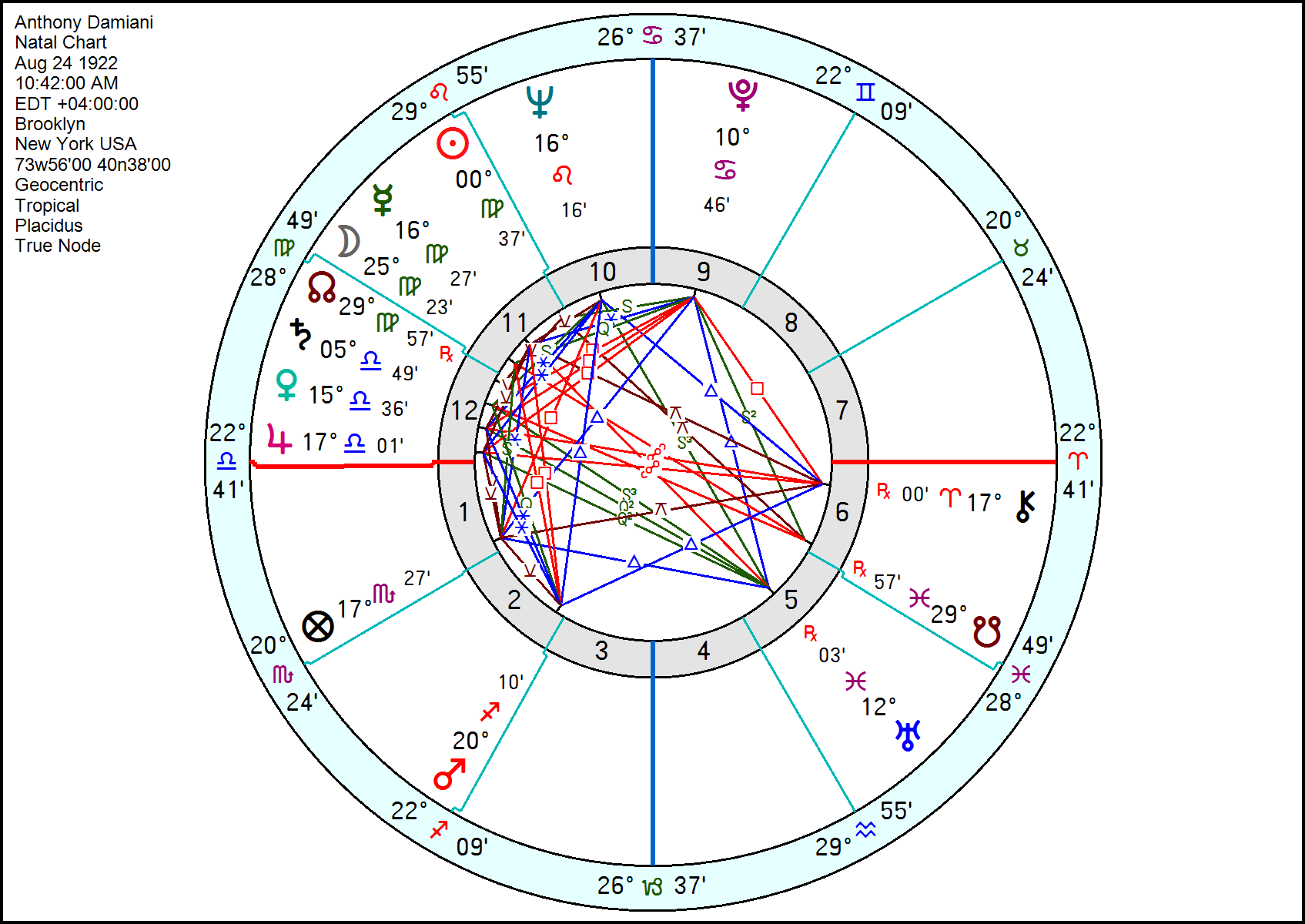
FIGURE 1982 0717a-1. Anthony Damiani Natal Chart.
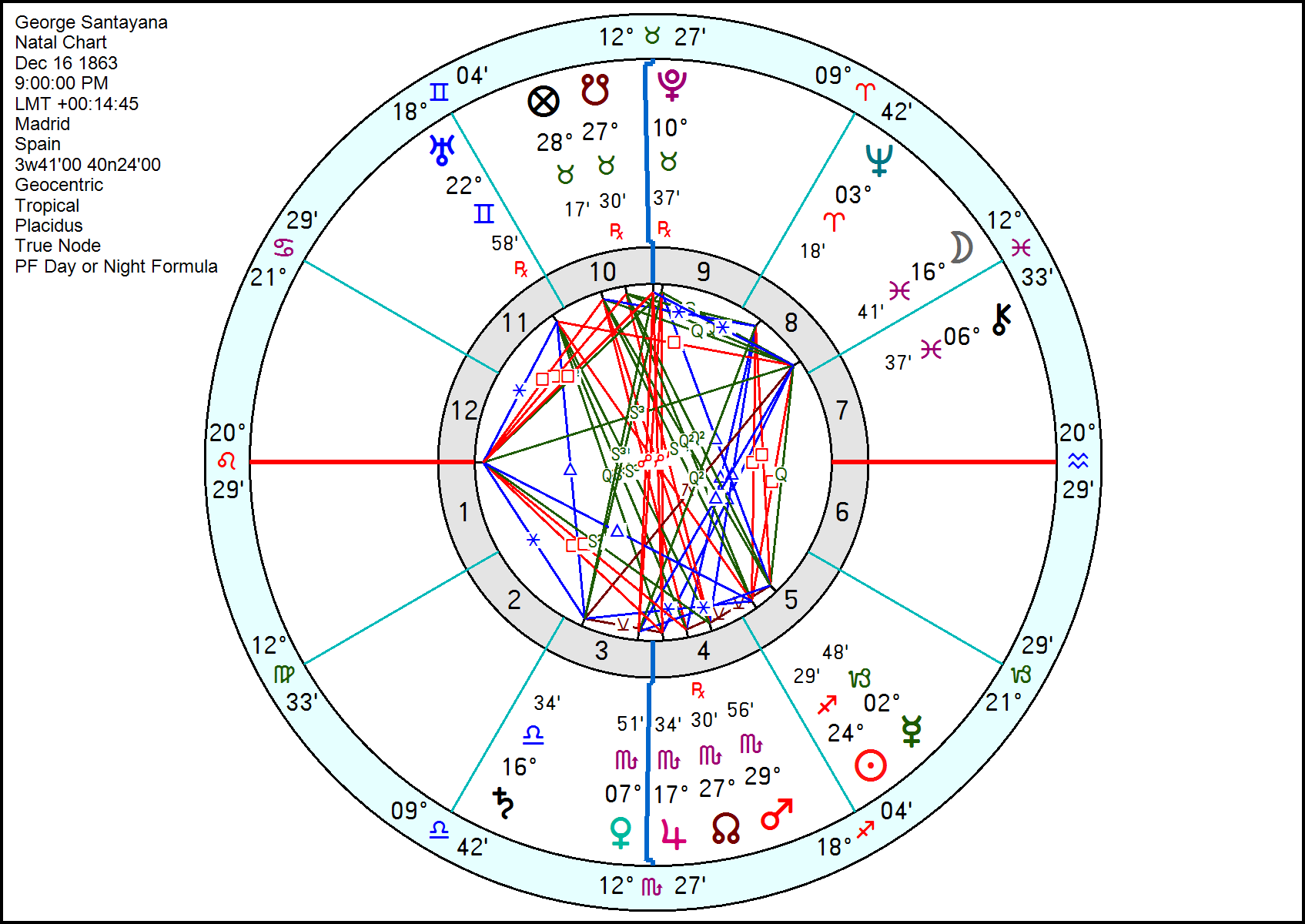
FIGURE 1982 0717a-2. George Santayana Natal Chart.
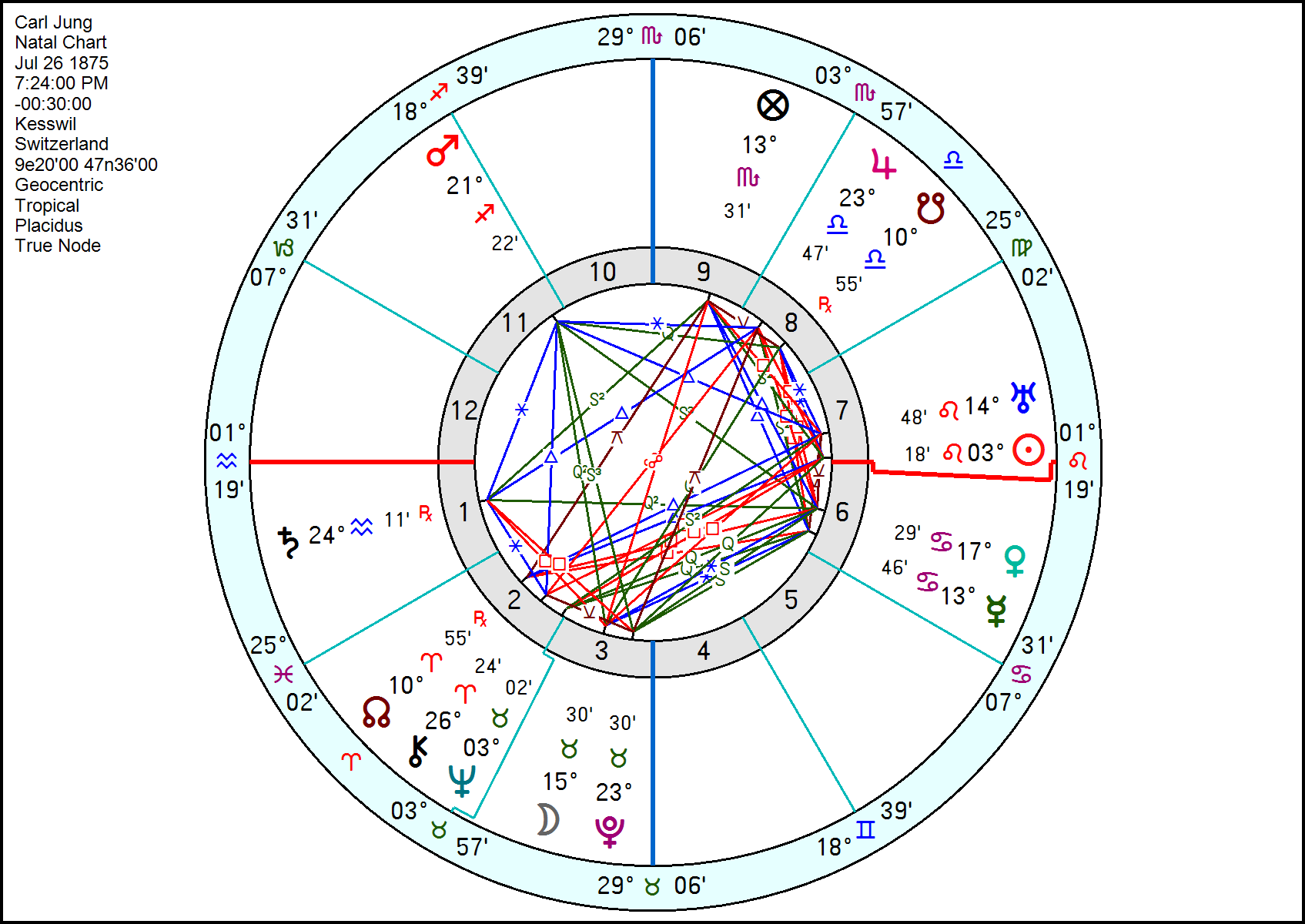
FIGURE 1982 0717a-3. Carl Jung Natal Chart (astro.com).
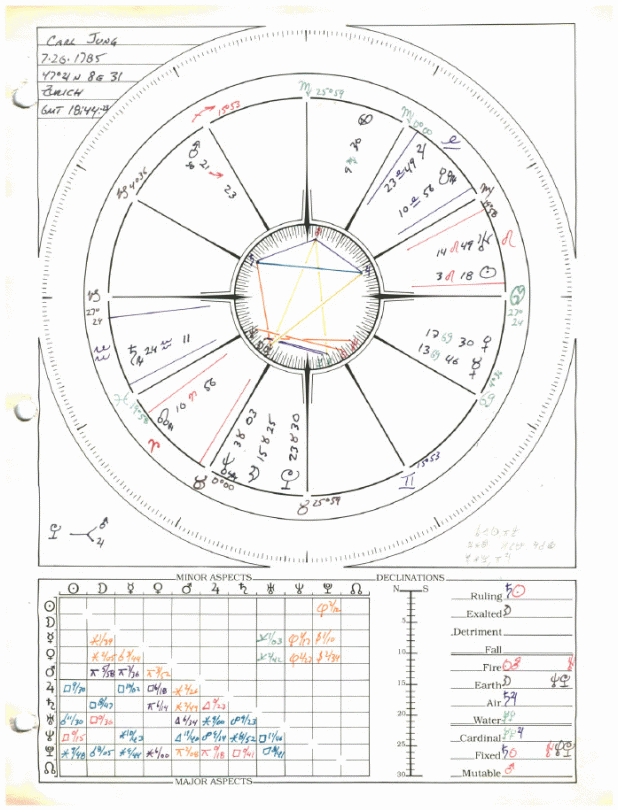
FIGURE 1982 0717a-4. Carl Jung Natal Chart (WG version).
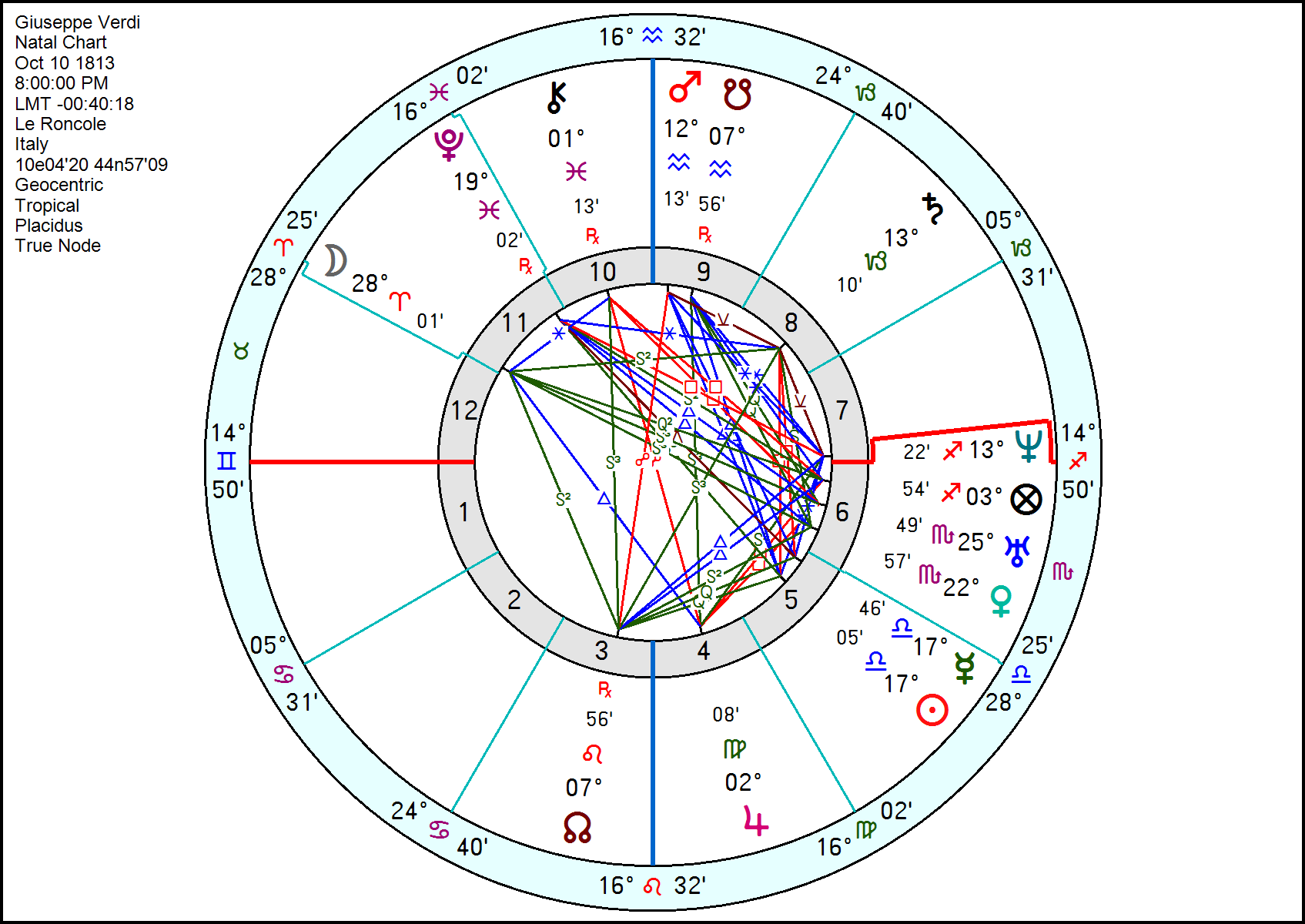
FIGURE 1982 0717a-5. Giuseppe Verdi Natal Chart.
Other diagrams also referred to are not with this transcript version. [Transcriber note: [diagram] means the speaker is referencing a diagram as he or she is speaking. If someone is drawing or writing, with audible sounds of chalk on a blackboard, I indicate this by [drawing] or [writing].]
NOTES / PAPER read in class:
"Reading a Chart" working notes, which later became "Reading a Chart" paper. The full, almost complete paper has been retyped as ASL Astrology - Theory - Reading a Chart V09MP from Scan File ASL Reading a Chart P 25p.PDF. A version of this paper is in Astronoesis in "Astrology: The Topography of the Subtle World". It used to go by the name "Jung Paper" and was written for a presentation by TS at an astrology conference connected with the Digicomp DR-70 Astrology Minicomputer. This paper is read and discussed in WG Class 1982 1009b Colombus; Astrology and it is also briefly discussed in WG Seminar 1983 0829b Astrology; Horoscope-Wagner.
RG Paper on Dignity and Non-Dignity. There is no Scan File for this paper, it only exists as embedded in this transcript.
NOTES:
This is 1982 07/17a, a Seminar on Astrology Theory, and the first entry associated with this date. 1982 07/17b = Astrology; Theory Seminar.
An earlier partial transcript exists, Scan File 1982 0717P1-08R06.PDF, with student and AD handwritten edits that were incorporated into a later version of "Reading a Chart" paper (see Paper notes above).
TRANSCRIBED Verbatim by IT 2023. In 2025, IT updates prefatory matter and audio file markers to match new REP audio. Archival verbatim transcript with Notes/Paper – V11ap.
AUDIO FILES: 1982 0717a, 1982 0717b. [Note 1: "Tape" and "Side" refer to original audio cassette tapes later digitized into .MP3 Audio Files. Note 2: In 2024, REP Studio separates off astrology class fragment from file b.]
1982 07/17a SEMINAR at Wisdom's Goldenrod
Astrology; Theory
[Audio File 1982 0717a Begins]
TS: First of all there's four main-- I think-- it seems to me there are four main areas that (we're/we were) trying to focus on. Um-- [short pause while searching through papers] Somewhere. First area is: what are we looking for in a horoscope? The second area is: approaches to the-- various approaches to the unity of the horoscope, and the underlying presuppositions that are inherent in that horoscope. The third is various questions in terms of the elements of the chart, the aspect pattern, the-- Jung's typology, seeing the groups of aspects, stuff like that. And, then the last one would be to-- to work through Jung's chart as an example of and an illustration of some of these various general areas. So, I think those are the four main areas of-- four main categories of-- that we worked on. [student assents, faint] Now if we get to the first one, uh-- The first one was: What do-- what are we looking for in a horoscope? Um-- We have down here some-- some statements or thoughts about that.
[Transcriber note: I have titled the following notes "Reading a Chart" to match the title of the partial transcript (Scan File 1982 0717P1-08R06.PDF). Please see prefatory matter for more information. I transcribe it as TS reads it, including any changes made on rereading.]
AD ["Reading a Chart," TS reading]: "We acknowledge that there is significance and meaning to life, that there is some sense to the sensible. But beyond that there is a principle ordering that sense in the sensible, and these are the native's unconscious presuppositions."
TS: Ok, that's--
S (faint): Yeah.
S (very faint): Ok.
TS: And the second point is that eas-- each chart and each soul's development is unique to itself, within each chart there is a certain uniqueness. In individual soul there's a certain uniqueness.
RC: Tim would you read that first-- first one again? [couple/three words inaudible] all the way back or--
TS: Oh. Uh--
S (simultaneously): Tim--
AD ["Reading a Chart," TS reading]: "We acknowledge that there is a significance and meaning to life, that there is some sense to the sensible. But beyond that, there is a principle ordering that sense in the sensible, and these-- that-- those principles are the unconscious presuppositions of the native."
AD: Now Randy, a point we'd like to make here is it's really difficult to imagine the immense magnitude of this statement, [TS: Yeah.] because, especially today where everything-- everyone thinks that his truth is the only truth, we want to show that for most people, they're simply living out-- that is, their life is a flowering and an actualization of certain ideas. Or even if we want to be cruel we could say that they're learning se-- certain lessons, and they want to turn this into a worldwide philosophy. And so, what we're-- what we will attempt to do is to try to see when a person with a sufficients-- a sufficient maturity of judgment that he can stand aside even from his psychic functioning and see it for what it is, and this is a task of the first magnitude. It's the goal of all our studies naturally to free ourselves from these things, not that freedom means here that they're destroyed but we know what our suppositions are, we know the limitation of our understanding and we have to work within those limitation. But it's always feasible that someone could rise above them such as a Sage, and then see them in their discretion. But I-- they're-- the philosophers are always talking about, well what are the presuppositions of the man, alright, never thinking that they have presuppositions too which are already going to predetermine how they understand the other guy's presuppositions. So it becomes a real, you know, jungle.
RC: So say-- so when-- when this ordering principle that Tim's speaking of here is spoken of, that's being addressed to the psychic level.
AD: That the--
RC: That's being addressed to the psychic level, that that's not the same thing as saying that each person has an Intelligible Cosmos within him, you're saying that--
AD: Well that's included there. If we try to find the principle as to what's beyond the sense which is in the sensible, we're looking for something higher than the conceptual meaning which we're working with in the sensible under-- you know, sensible world, there's a principle behind both which is ordering the two of them. Not only is the perceived world which is manifested to each individual ordered by a reason-principle, but even the understanding that he has of that perceived world is s-- also ordered. So we have to try to get behind those two things to see what is ordering or, you know, regulating this kind of [one word inaudible]
[short pause]
HH: Anthony? So-- so what you've just explained, you're relating that to the unconscious presuppositions of the individual?
AD/S(?) (very faint): Yeah.
HH: And that somehow is symbolized in the person's natal chart?
AD: I think so. There's indications of it in his natal chart. Because the natal chart or the horoscope to me represents like a miniature-- a miniature metaphysical diagram for each person, it's like his version or his interpretation. If we say man is the microcosm of the macrocosm, alright, then that chart is a communication, a revelation, of the analogy that exists between him and the macrocosm.
[9½ second pause]
HS: Is that the common astrological use, I mean is that-- is that what they say in--
AD (faint): Oh no, not in astrology.
S (simultaneously): [couple words inaudible]
HS: Are there any common (astrology/astrologer) [one word inaudible]
AD (simultaneously, faint): They don't think like that.
TS: It's very seldom that you see any astrologer that asks the question what does the chart mean.
HS: What is-- they don't ask that question.
TS: No.
S: That's a no.
S (simultaneously): (Really?)
TS: I couldn't find five books that begin with that question. Seriously.
HS: But-- so you're first-- you're first addressing that question [one word inaudible]
TS: Yeah. Right or wrong, at least we have-- have to begin at the beginning.
HS: And your presupposition is that there's meaning there?
S (very faint): Who thinks there's meaning here? (some laughter)
RG: No.
AS/S(?): What?
TS: Yeah.
S: [couple words inaudible]
RG (simultaneously): I mean e-- every [S simultaneously: (Thank) you.] astrologer [one word inaudible]
S (faint): [couple words inaudible]
VM (simultaneously): That was a real Madhyamika [one/two words inaudible]
RG (simultaneously): Exactly, every-- (laughter)
AS/S(?): Of course, Herbie.
RG: (I mean) astrologer [HH simultaneously: Definitely not.] couldn't do astrology if they didn't think there was meaning in the chart.
HS (simultaneously): Yeah I know, I-- yeah, yeah.
VM (simultaneously): [one word inaudible] maybe they just think there's money in astrology. (laughter)
RG (simultaneously): Right. (laughter)
S (laughing): Yeah.
RG: But even if they think there's money in it, the meaning has to accompany-- at least be adjectival to the money.
VM (simultaneously): Money is money. (RG laughs)
RG: No but they have to-- but they may not-- as Tim said they-- they don't ask the question, they just read it, I mean in whatever mundane or whatever way they want.
HS: Ok so people could read charts without-- without saying what does this mean? I mean--
S (simultaneously, very faint): Yeah.
S (faint): Of course.
TS: Without looking to see-- yeah.
S (simultaneously): They do it all the time.
RG: Right.
TS: Yeah. [RG: And--] "Wow, I've got such and such sesquiquadrate such and such."
S (faint): Right.
RG: And they give it a meaning but they don't ask what does it really mean, I mean-- you know.
HS (simultaneously): Like they never try to figure out what the meanings that he-- the presuppositions of the process here.
TS: Yeah.
AS (simultaneously): Descriptive "as though".
HS: Ok.
RG (simultaneously): Right.
TS: Yeah.
RG: Right.
HS: This way I know where you people are coming from.
S: Yeah well, the astrologer's got his presuppositions so he's trying to read into the chart's presuppositions, there's just so many presuppositions (some laughter) before the presuppositions that it's confusing. (some laughter, student words)
TS: Well in order to follow through Anthony though, that someone asked was that, when you speak of this-- this ordering principle that orders the sense and the understanding of the sense, for the moment we're going to say that that-- that is an unfoldment of the individual's unique perception of the Intelligible Cosmos or we don't-- is that sufficient at this point?
AD (simultaneously): I didn't hear you Tim. It's an unfoldment of?
TS: Of the individual's perception, of the indi-- a vision of the Intelligible Co-- world. How--
AD: Yeah, it's a reflection of that. [TS simultaneously: And how is the reflection--] If we say, if we say that the whole of the Intelligible World is within a person or within the soul, and then this soul incarnates and experiences, and grossly experiences, what we're really saying is that this is the way that soul is actualizing and realizing many of the meanings that are there within him, but it seems that he has to project them out and it has to become a perceived world in order for them to gain the intensity, you know, and the-- to gain the intensity to-- to see that there is a significance.
TS: And how it gets from that vision of Intelligible Cosmos--
AD (simultaneously): From the potential to the actual. Of course if you're a Platonist you say from the actual to the potential.
TS: Potential.
AS: Yeah.
TS: But that process of descent from the Intelligible World to the reflection of it, that's not something we're going to investigate right now.
S (very faint): Uh-hm.
AD: No, um-- although, as we said, we-- we wou-- we would include a page or two, you remember the way we wrote that page, which would give a very brief thumbnail s-- survey of the idea. I mean, it would be impossible to undertake to do (astronomy) short of (any event).
[14¾ second pause]
S: Tony, do you-- would it be correct to say that the-- the whole chart itself would be an unfoldment of those presuppositions rather than trying to pinpoint it to one, you know-- I mean if you're looking at it as-- as the soul's vision of the In-- Intelligible, then wouldn't you have to say that the whole chart was that-- that-- You know, 'cause we sometimes-- or I've heard it, you know, confined to the ninth house, for example. [student assents] What would be the difference?
AD: No, ninth house you're speaking about it as the metaphysical chart.
S: Ok I don't-- I'm mixing on levels then, I don't--
AD (simultaneously): Well when we worked out that the Gods are working out the-- when we took the chart and divide it into three parts [diagram]. And we showed one-third of it was the sensible part and one-third was the psychical part [student assents] and then the other third was the Intellectual part. Some Gods are concerned with working (out/on) the sensible world, some with the meanings that have to accompany that sensible world, and then a third group of Gods were concerned with ordering those two and making them simultaneous, alright, so that the meanings that accompany the sensible world (would/will) become available or not according to the karma of the individual. But the point, the point that we want-- I think that we want to make here-- [short pause] his writing [couple/three words inaudible] Go ahead.
RG: Well-- [S: But--] but you-- often (as) we speak about the ninth house as like your unconscious presuppositions. And that you're asking what's the difference between that and the whole chart as your unconscious presuppositions.
S: Yeah, that's one of my questions.
S (faint): Uh-hm.
TS: Well I think at this point though it's-- the main idea here is that the-- the whole chart is the-- is in some way a-- a re-- an analogy or a structuring of one's understanding and one's perception of the world. I mean we could break that down there maybe that some of those presuppositions one's more attached to. And maybe that would show up in the ninth house or I don't know. But I think we have to look at the whole chart first.
S: Right.
RG: It see-- it seems when you speak of--
S (simultaneously): That's what it seems like.
RG: Seems when you speak of the ninth house in a chart you're speaking of o-- of the empirical personality already taking a part of his world to be his presupposition rather than the soul's presupposition prior to attachments, right.
S (simultaneously): In other words he's attached to c-- those functions.
VM: Yeah. Already within the imagination.
S: Right.
RG: I mean certain philosophical ideas can certainly [couple/three words inaudible]
S (simultaneously): And he blows it up into a philosophy.
RG: Right.
VM: Maybe you could say it this way that one level is trying to understand the-- let's say the unconscious presuppositions of the productive imagination and the other is the unconscious presuppositions of the reproductive imagination. [students assent] Just looking at the ninth house as an aspect of the total natal chart would be more trying to narrow it down on the unconscious presuppositions of just the reproductive [student assents] imagination.
S: Ok.
RG: Yeah.
[students assent, very faint]
[short pause]
TS: Ok. So second point-- not-- these aren't necessarily in order, just another point, is that each soul's development is unique to itself. Now-- um--
AS/S(?) (very faint): (Why don't you say something about it?)
S (simultaneously, faint): Yeah.
TS: Well--
S (faint): Go ahead.
TS: Yeah. [one/two inaudible student words simultaneous with TS] Yeah it does.
S (faint): [one word inaudible]
VM (simultaneously): Otherwise you get a herd instinct.
TS: Yeah that the-- the whole unfoldment of the transits, the-- and so forth is-- is in-built in the natal horoscope or in-- in-built in the individual's unfoldment of the contents from within himself. I mean it's not some external Jupiter coming in and aspecting your Sun. That that unfoldment is from within the individual. And it would be unique to that individual.
S (faint): (Is that true?)
S (very faint): Uh-huh.
TS: Any more on that? Leave it?
LDS: Would you read it again, Tim?
TS: Well just--
S (faint): [couple/few words inaudible]
AD ["Reading a Chart," TS reading (simultaneous with S above)]: "Each soul's development is unique to itself."
TS: Just this?
S (very faint): Uh-hm.
S (faint): (What do you mean by that?)
TS (faint): Yeah, ok.
MW: So Tim, for example, this is-- this--
TS (simultaneously): Well, ok.
MW: This seems to be counter to possibly a copy of me that would say that, you happen to be born at this particular time, there (were/are) these various influences on you at birth, and so you're the kind of person you are now. [student assents, faint] This is like reversing all that [students assent, faint] it seems and is saying--
TS: Thank you, right.
S (very faint): Uh-hm.
S (very faint): Right.
S: Such a different [possibly one word inaudible]
TS: The soul chooses this moment of birth rather than [couple words inaudible] yeah.
MW (simultaneously): Yeah, this-- this is already--
AS: It's in the soul.
S (faint): Uh-hm.
MW: This pattern's already within the soul and it's being expressed the-- by this person being born at this time. I mean you have [student assents] a lot of people who think, well I just, you know--
VM (simultaneously): They're victimized.
TS: Well--
AS: All the circumstances and--
MW (simultaneously): I just happen to be born at this time and-- [student assents] you know--
AB: But even that would attest to the--
MW (simultaneously): --randomly--
AB: Even that would attest to the individuality of [S: What?] each person, ea--
VM (simultaneously): Not to the soul though.
AB: Not to the soul, yeah.
TS: Yeah. [student assents] It seems like one of the points that-- that has to be brought in with that or in this is-- is a mentalistic perspective, you know, that is within that unfoldment of the chart in the circumstances or perceived world is within the soul's vision, it's not s-- it's not like he's being injected into some alien cosmos.
S (very faint): Yeah.
RC: Seems implicit in what you're saying then, the presupposition is that there is such a thing as individual soul, [student assents] and that at no time is that soul to be taken as some kind of tabula rasa.
TS: That's good point also.
S (simultaneously): Uh-hm, yeah.
S (very faint): [couple words inaudible]
S: Yeah.
AS(?) (faint): I'm the only one?
MW (faint): [few words inaudible]
AD/S(?) (simultaneously, faint whisper): What did he say?
S: The next page.
TS (very faint): [few words inaudible]
AS: I think that's in the-- [VM: The next slide.] I think that's implicit in that original short paper to preface. I don't know if it's explicit in there. That's how they wrote it.
RC(?): I see.
TS (faint): Yeah.
S (faint): (Maybe/I think) you can make it up front.
S: Yeah.
[15 second pause]
TS: Ok. [short pause] I suppose-- I don't know-- I think later in the second section here that that second point gets really attacked head on and just, how can we see that unique development, you know, what is its-- that especially-- I don't know. Out of the myriad of transits and progressions can we capture those moments which most focus on that, that revelation of the uniqueness of the individual. And I think the-- the whole second section we worked on was the identity of the native, is gonna s-- gonna be an elaboration of this single point here, so--
[students assent, very faint]
S (very faint): (You need to write this over.)
TS: (Well let's go.) Um-- Third point is--
AD ["Reading a Chart," TS reading]: "The degrees represent the totality of…"
TS: Alright, here we go.
AD ["Reading a Chart," TS reading]: "The degrees represent the totality of meaning -- which is in the process of being worked out…"
S (very faint): Yeah.
TS: Ok, um--
AS: The point we made that, it's only after the total-- after the life-- yeah, the end of the life as it were, only then will you actually see all of the meaning which was inherent in those original degrees. After they've gotten worked out.
TS: Ok, um--
S (very faint): That's what you mean by [one word inaudible]
RG: Or you may not.
S: Yeah, uh-hm.
AS: Or you may not.
RG: There's no guarantee that you're going to see the meaning.
S (faint): [one/two words inaudible]
S: And what do you mean by "you", you mean the soul? Or do you mean--
RG: Yeah.
TS (faint): I haven't (done that).
AD: That's the next question, let's wait.
S: Yeah.
TS: Yeah.
HS: The degrees you're talking about are the planets on the particular degrees of a particular configured chart?
AS: Primarily.
TS: Yes, at this point.
HS: Contains the totality of meaning for an individual that he can live out?
TS: Yeah. But those-- the parti-- peculiar organization of reason-principles that are being understood and actualized by the planets or the powers of the soul or the categories of the imagination would be what is the potential meaning that is going to get worked out and actualized through life experience.
S (very faint): Ok.
HS/S(?): (The--)
AD (simultaneously): I usually notice that, Herbie, by the repetition of the same mistakes.
HS: Huh.
S: Yeah.
S (faint): (What does that mean?)
AD (simultaneously): People like doing the same thing wrongly over and over again. Those of you that are familiar with PB's notes, you know, he keeps emphasizing to try to extract the meaning from your failures as well as your successes and that this is the whole purpose, that if you-- if you don't try to draw and understand what those experiences mean, alright, then they're-- they just have to be repeated.
AS: I-- was-- wasn't that the part-- wasn't that the part of that point the guy was trying to make that, even though you look at a chart that has say these ten degree meanings where these planets are, that's not-- and even though it is given, it's not something that's immediately available at the beginning of a life. In fact, part of the reason you have those degrees is because that is some-- that is the meaning that the soul is gonna try and assimilate during the life. It's not-- just the fact that it is your presupposition doesn't mean that those meanings are available at the beginning, in fact, the opposite almost, they're not available [student assents] yet. And they may or may not be activated.
HS: But they become activated as the living out?
AS: Yeah. Or they may not be if you don't assimilate the meaning. I mean tho-- those meanings will be inherent in your experience all the time. That may-- it may be another question as to whether the individual actually does assimilate those meanings.
HS: Yeah but the life will be lived out in a particular pattern regardless if there's assimilation of meaning or not, right?
AS: That seems to be [student assents] more or less the case.
AD: Again you-- after a while you begin to notice you keep repeating the same [student assents] mistakes [couple inaudible HS words simultaneous with AD] ad infinitum and nausea.
AS (simultaneously): Yeah.
S: Uh-hm.
AS: Well, and confronted with--
AD (simultaneously): And, that by the way is an interesting point because that's exactly where the soul is most persistent. That's where it is revealing itself the most.
AS: Is there.
RC: It's like PB mentioned that one time that that was part of the way he would look to see if it was the same soul incarnating, see if it was repeating the same mistake(s).
AD: Yeah, that's that-- [S, faint: Me too. (bit of laughter)] that's that crazy theory about psychic trans-undulation.
TS/S(?): Yeah. (bit of laughter)
AD: But--
HH/S(?): If what?
TS (faint): Trans-undulation.
AD (simultaneously): Well there's one man who has a theory that we leave certain psychic remnants behind and they're picked up by other people and they repeat that and then it's dropped and picked up by another person. But what PB was saying is if you see a repetition, in other words, if you see that the same problem is accompanying a person for a few lifetimes, you know, that if you go through his lifetimes you'll see that same problem running through those lifetimes, alright, and this is almost like-- it's almost like a tool that you can use to say, "Ah. This is that person. He's going through that same merry go-around."
RC (simultaneously): I've seen-- I've seen in a couple of places he's written down that it's not uncommon for a soul to set itself a task that will take fifty lifetimes to achieve.
AD: Fifty?
RC: Yeah. (laughter)
TS/AS(?) (amidst laughter): Shut up, Randy. (laughter)
AD (amidst laughter): Scared me, you scared me. (laughter)
S (simultaneously): Forty. (laughter)
AS: Not supposed to let that (out).
RG: Well-- But, I have a question about this. I have a hard time saying that the, you know, the psychic undulation, that, I mean-- why confine the totality of meanings to the degrees?
S (faint): Yeah.
S (faint): Yeah.
S: That--
AD: Well could you elaborate, Dickie?
RG (simultaneously): Well, in other words, I mean it seems-- it takes away any meaning from-- from these-- the planets as the soul powers. I mean-- for example-- In other words, if you say the totality of meaning is the degrees, then what meaning does the soul powers have? In fact can't you conceive of meaning as being the development of the soul power? And in fact in the dignities isn't that part of the formulation? That that is the meaning?
S (faint): I--
AS (faint): (The--)
AD: Well, that's certainly [TS simultaneously: (Yeah.)] not incidental.
RG: I know, but by saying the degrees represent the totality of meaning, ki-- kind of leaves everything else out.
S: But the so-- don't the soul powers have to be--
AD (simultaneously): Well then-- then that has to be modified accordingly.
AB: Well the soul powers are reviewing everything [S simultaneously: Right.] [one word inaudible]
RG (simultaneously): Oh right but-- that's right.
AD: But also that they come in for development--
AS: Right.
VM/S(?): As well.
RG: And they have a meaning too.
AD (simultaneously): As you're going along, yeah.
AS: Right.
RG: I mean the development of Saturn as reflective consciousness may be the overriding meaning of-- of a-- of a life for example, or [VM simultaneously: Yes but--] a certain soul power.
VM: Wouldn't you say that meaning is developing a peculiar form depending upon the degree. So it's necessary.
RG (simultaneously): I'm not denying that the degree-- yes, I wouldn't exempt the degrees from meaning but I wouldn't exempt the soul power from meaning either.
AD: Yeah well that's-- that's why, you remember in the discussion of polytheism and monotheism, that in a sense the argument is a little foolish because both have to be available to us. It isn't only that the soul powers develop. What will they develop, what will be their content if there isn't reason-principles, alright.
RG: I agree.
AD: But if there's reason-principles that are all(-)perfect, alright, and no one is benefiting by them, (then/and) what's the soul all about? [student assents] So, those two are always, you know, going along. [student assents, faint] But also the other thing is that one sees the potentiality or the possibility of the universalization of the Intellectual soul through those reason-principles. Because our acquaintance with them is at the most ru-- rudimentary level. And the depth of significance, you know, and the dimensions that each reason-principle is capable of revealing is unlimited. [student assents] So both of them have to always be taken one alongside the other.
RG: Ok, so I-- I mean I'm-- we could say that they represent the totality of content.
AD: Alright, sure.
RG (simultaneously): And yet the soul powers represent a functioning intelligence, and yet they both have meaning. They both repre-- that together represents a-- this totality of meaning.
AD (simultaneously): Well wouldn't that be a beautiful portrayal also in a sense, I mean, beautiful in the sense that the chart is so revealing of the-- of the Intellectual soul in the Nous which has a partial vision of the Nous and its own vision of the Nous, and that this is revealed in whatever humble way in the cosmic-- I mean in the astrological horoscope itself.
[10 second pause]
VM: Can we say something like this, that the 360 degrees are the-- the contents, the-- the objective contents, and their unfoldment or revelation through the functioning of the soul powers is the meaning behind an individual life.
AD: Yeah but Dickie wants to add that concomitant with that is the development of the soul faculties of that individual. And, like for instance if you think of a time when there wasn't [one/two words inaudible] alright, and that through the development of the faculties of the soul, these forms which are hidden within the soul, [AS(?) simultaneously: Are developed, yeah.] in the sense that they're the reason-principles, [TS(?) simultaneously: Yeah I know.] are brought out and manifested, alright, there's a simultaneous evolvement of two things, on the one side-- on the one hand, the understanding or the reason-principles, the forms that are in the soul, and on the other hand, the faculties of the soul developing to bring them out. So, the-- you know, that argument of polytheism versus monotheism is really a mistaken one. To take sides is again, you know, one of these foolish controversies that people like to indulge in. [RG: In other words--] Is the Atma, you know, substantial or is it functional. Why should I make a choice, that's so ridiculous.
RG: In other words, function and substance both have meaning. One may be the content and when-- one may be the subjective functioning. But they both have meaning.
HS: Yeah well isn't it the-- you-- we make a distinction here between like the Saturn on a degree and the degree that it's--
RG: That's what I-- right.
HS: Ok now what-- you're saying they both have meaning, isn't there a [RG simultaneously: Well--] priority to the degree actually?
RG: No, I don't think so at all.
AD (simultaneously): No, why do-- why do you think like that?
RG: I don't think so at all, in fact in the service-- I mean, in some cases, the degree is adjectival to the development of the soul power and is-- and it may be the form in which the soul power gets developed, but it's not the essence of the development. The essence of the development is in the soul power. Now in another case--
HS: You're talking about in a particular life.
RG: Yeah, and in another case the soul power may be adjectival to the development of the reason-principle as manifesting the World-Idea or the world content say. And that-- then it becomes the function of revelation rather than the meaning aspect of it.
HS: Ok, so in terms of existent then you give no priority, the con-- there's a conjunction then of essence and function?
AD: Yeah, [TS simultaneously: It's all (in your head).] I think it's-- I think it's much wiser to work without the, you know, presuppositions that we have to establish a hierarchy. And this is where it may be advantage to keep in mind what we were speaking about when we said on the other side, you know, when you're talking about the three Hypostases in themselves, that the distinctions we're making are really from this side and they're verbal. But, from that point-- from that side, they really are almost non-distinguishable, so to establish a pri-- priority between one (and/or) the other-- I mean which came first, the reason-principles or the soul? (Well this is) meaningless.
S (faint): Uh-hm, yeah.
HS: Ok now, but-- and yet when you-- you're talking about the existential level now and you're saying it's the same indistinguishability?
S (very faint): Uh-hm.
RG: No, in fact we're try-- in fact we-- and lately try to work this distinction out through the idea of dignity and non-dignity, I think.
AD: Which we could leave just for a little while till we get to it because that's going to be the thorniest thing to deal with.
HS: Ok but I just I-- ok now I'm-- Here's our problem, i-- I take it that if it's the Nous that's exhibited as the reason-principle then it's the soul that's exhibited as the soul powers functioning in the chart--
RC (faint): Say the virtues.
HS: The virtues, ok, then it seems to me that, unless you want to do away with the distinctions, which you seem to want to do away with, that the Nous would be higher than the soul in some way.
TS: But here-- ok.
HS (simultaneously): Not that I want to say that it's higher.
TS (simultaneously): No but I think that that's not quite-- ok but it's not the way I understand it.
HS (simultaneously): That's what you said, that was your sentence.
TS: That the 360 degrees or the reason-principles aren't-- isn't the presence of (a) Nous, but it's the soul's vision of the Nous. It's [couple words inaudible]
HS (simultaneously): Ok so everything takes place in soul now.
TS: Yeah, so the whole-- the whole thing is within the soul, it's the-- the Intellectual aspect of soul which would be the 360 degrees, the soul and powers of the soul, the soul itself would be the powers of the soul but you couldn't-- the way I understand it at the moment is, you couldn't dive-- divest one of them or the other as being without-- outside of the soul as prior to soul. And if you go back to the metaphysical chart and you say Saturn in Leo is working at the Intelligible World, then the-- then you say yes, that Nous-- that vision-- what its vision is of is something outside of itself. But when we're looking at the 360 degrees, that is its-- that's contained within itself, that is its vision.
S (very faint): Yeah.
HS: But it's soul now.
TS: Yeah, [student assents, faint] it's the soul's--
HS (simultaneously): Ok.
TS: So it's the Intellective soul and the soulful soul, the soul powers, would be the planets and the degrees.
AD: I'd also add, Dickie, to the statement you made that the development of the soul powers through the content, you know, working out a content, I would also add that the-- or extend to its logical conclusion, and that is that the ultimate purpose and goal of the development and refinement of the soul faculties is so that one can become a true knower. And that would be the goal. That doesn't, you know, [RG assents] exhaust the potential that's in the Nous. [student assents] But it raises a person to a level where he can start working off the Nous.
DB: Excuse me but, I'm afraid I don't quite understand yet what is meant by speaking of the soul powers as in themselves meaning. Meanings, [RG simultaneously: Meaningful.] meaningful, whatever, yeah. I don't understand it.
RG (simultaneously): Does re-- does reflective consciousness have meaning or is it only the meanings--
DB: For who, for me?
RG: For anyone. You, yeah.
DB (simultaneously): Barely, barely.
RG (simultaneously): Well, just take it for you. Barely but something.
DB: Well, no. I mean--
RG (simultaneously): Your reflective [few inaudible student words simultaneous with RG] consciousness certainly has a meaning for us. (RG laughs)
DB: That's your problem. (laughter)
RG: That's true, but--
DB: No I really don't understand. I mean I can understand how an idea-- to speak of a--
RG (simultaneously): How--
DB: No [few inaudible student words simultaneous with DB] wait a minute, wait a minute, I'm not trying to be-- I'm-- wait. Dickie, I'm not trying to disagree, alright. Really. I'd be happy to disagree. What I don't-- I don't understand was, we've got this one thing, meaning, and we're putting two, in some respects, different categories within it, alright.
RG (simultaneously): Function and substance.
DB: Right, function and substance.
RG: Now even at the highest level, we look at function and substance as like the-- the ultimate way (the) duality in which we look (towards Intellect).
DB: The Intellectual-Principle.
RG: Right.
DB: Right.
RG: Now if you can understand meaningfully a function and substance at the highest level, why have a problem with it on a-- at a lower level?
DB: Well, I guess because it seems that-- because they're not identical at this level, for starters.
S (faint): Uh-hm.
AS: Yeah but--
DB: I mean--
TS: Well they aren't there either.
AS: Well couldn't you use an example, you say well does Venus have a meaning distinct from Mars, and you have to say yes.
DB: Yeah.
AS (simultaneously): Does Venus have a distinct meaning of fu-- a-- the-- there's meaning of its function distinct on various levels and you'd have to say yes too.
DB: Yes.
AS: Then why can't you speak about a soul power that way?
DB: Great.
AS (simultaneously): It has a meaning at a cer-- at the level of the empirical, we talked about, you know, the anima archetype, we could talk about aesthetic perception. Those are meanings, I mean that is a cer--
DB (simultaneously): Yeah, undoubtedly. Undoubtedly.
AS (simultaneously): Well that's all-- I think that's all Richard [RG simultaneously: Right.] was saying.
DB: I'm not saying they're not, all I'm trying to do is ask what's the difference [AS simultaneously: Oh, that's better.] between speaking of that sort of meaning [AS simultaneously: And the meaning of the reason-principle.] as soul power and the meaning of the reason-principle [AS simultaneously: Oh well that's a good question.] because they're not the same thing. [AS simultaneously: No, (no).] I mean you've got one word covering two specific meanings, if you pardon the expression.
TS (simultaneously): Well, because at this point-- I think at this point what we're [AS simultaneously, faint: You have to distinguish.] trying to do is see the-- we're trying to look at the cake, we're trying to look at the whole unity of the chart or the wholeness of the chart. Now, that question which is boiled back down to the question of polytheism and monotheism or the archetypes as categories of the imagination, the archetypes as re-- as the Sabian symbols or reason-principles, that's going to be a real fun-- (a lot) of discussion. And that's the question you're asking, how can you distinguish the soul powers from the reason-principles from the point of view of meaning.
DB: Right.
TS: Ok. [few inaudible student words simultaneous with TS] That's a good question, and I don't know that that's-- this is where there's a-- I'd calculate a-- a third of (this/his) whole paper is try to deal with that question.
S: Thank you.
TS: Ok?
S: (Yeah.)
TS: But all we're trying to say right now is that there is-- that the meaning of a chart is involved-- is revealed both in terms of the elaboration of those categories of imagination and-- and soul powers which are their prior. And also to the actualization of the reason-principles which organize those soul powers.
DB: Right, ok.
TS: Ok? Well it seem like let's leave it [student assents] for now? I mean that's a problem. I'm going to get more [one/two words inaudible] just--
S (faint): [few words inaudible]
TS: Ok. Ok 'cause the next point is an interesting (one). Um--
[short pause]
AD ["Reading a Chart," TS reading]: "Our real concern is with the Soul's intention, not the empirical personality's interpretation of those intentions." (bit of laughter)
TS: Well that's--
S (faint): Right.
HS: How to win friends and influence (people).
S (very faint): Yeah.
TS: Beg your pardon?
AH: Read it again, Tim.
AD ["Reading a Chart," TS reading]: "Our real concern is with the Soul's intention, not with the empirical personality's interpretation of those intentions."
S: Tim, would-- would you say that at the end of somebody's life, anybody's life, that there's a guarantee that the--
S (very faint): There's no guarantee. (laughter)
MW: As long as you (make--)
S (simultaneously, amidst laughter): It sounds like--
RG: There are no guarantees.
[couple students at once, few words inaudible]
VM: Guarantee, you stop right there, there's no guarantee(s).
DB: Double your money back. (bit of laughter)
S: Alright well maybe [MW simultaneously: (If you give) her that, that's as far as she get.] I should turn around and face the other way then.
TS (simultaneously): Double your karma back, oh.
S: When you [VM simultaneously, faint: Double your karma.] say that-- that at the end of somebody's life that there's a-- some kind of guarantee they're--
AD (simultaneously): Well, again that's a question that it's difficult to answer because from the point of view of the higher soul there is the guarantee.
S: That's what I was gonna ask.
AD: From the point of view of the empirical personality there may not.
S: I was-- I was gonna ask from the point of view of the--
AD (simultaneously): But the-- the soul won't be, you know-- you know, won't deviate from what it-- what it set out to do, it will move via that necessary knowledge but here again we have to wait until he goes over the notion of the three kinds of subjects that we have to deal with. And so when a question is asked, we have to try to pin down which subject we're speaking about.
TS (faint): [few words inaudible]
AD: Well I think that's going to become a really crucial issue in philosophy as we go along. [students assent] That when we're speaking about a subject we're going to have to be very precise what subject are we talking about. Is it the empirical or the permanent Witness or the immortal soul itself. And-- and like Plotinus made that point clear, he says that part which is dominant is the part that we're mostly associated with and identified with but that doesn't necessarily mean that it's truly the higher Self at all. [Note: See Plotinus, III.4.2, VI.7.6.]
S: Right, uh-hm. But from that point of view it doesn't seem that there'd be any guarantee of anything.
AD: Well, it'd be pretty hard to refute the soul except like when a person maybe might commit suicide or something like that, then-- then you have another problem. But usually, the experiences that are (destined, are--) we are meant to go through we're going to go through, willy-nilly or consciously. But I think one of the things that's being evolved here as we're talking is that then astrology might very well become kind of impersonal tool that is used by anyone with some understanding, and you go along and consciously understand what is being required or asked of you to do and to be conscious about it. But I don't mean in a symbolic way because I think by now it is clear to you that that's not my approach and I don't think that's the way of philosophy. I could give you example. Some time ago-- well-- a person once came to stay here for a couple of weeks and one-- one day he just packed his bags and he left. I got to talk to him and he told me, he says well one night he had a dream and in the dream I was scolding him. So he assumed the dream to mean to leave the Center, just pack and he left, alright. Now a person who allows his life to be lived by symbolical (meanings), and the-- the margin of error is so tremendous. (laughter, student words) I mean it's so absurd, then why the-- why bother studying philosophy and consciously articulate in this transparent understanding that you wanted to evolve, why bother studying it if dreams give you the answers to everything? And people can't see why I'm so strictly, you know-- I keep pushing Jung at a distance. I don't want to live a symbolic life. I'm not trying to develop my understanding so then I can go back to the symbols and say, "Ah, I'm living out that life, look at what happened." That's not my life. That's not the soul's intention. You'd have to be very careful there, really.
VM (simultaneously): Anthony this is a s-- it's a subtle point though because in some ways you speak about the chart as a-- let's say a symbolization of the unconscious presuppositions of the individual. And if you take some interpretations of dream they say that one of the functions of the dream is to give a partial revelation of those unconscious presuppositions.
S (faint): Right.
AD: But isn't it true that you much better understand with your conscious mind [VM: I agree.] than when the dream is given to you.
VM (simultaneously): I agree, I couldn't agree more.
AD: I mean a dream-- a dream will regurgitate certain experiences you had during the day, and you go back and you say, "Ah, that's what it meant." But didn't you understand that to begin with [VM assents, faint] much more clearly?
VM: Sure.
AD: Well then why fall back on that dream?
VM: I'm not-- I'm not trying to argue for dreams by any means, I try not to dream. (laughter)
AD: There are exceptions to that, there are exceptions to that, yeah.
VM (simultaneously): But there's occasionally a numinous dream which really does--
AD (simultaneously): Yes, those are the exceptions where almost you might say there's a-- a descent of the higher understanding and conscious mind is knocked out of, you know, [VM simultaneously: (Power.)] (center), so that it can get directly in and speak directly. But those instances are rare. I mean very few people have numinous dreams every night. And you-- if you get a half a dozen or so in your lifetime that's more than enough. So, we have to be very careful not to be fooled. Let's try this way: the actually perceived world is enough of a symbol without getting a symbol of the symbol, or an image of the symbol.
RG (faint): Uh-hm, definitely.
S (very faint): Uh-hm.
TS (very faint): (Yeah.)
[short pause]
AD: Go on.
AS: And the other--
AD: This does not apply to Dr. Berkowitz. (laughter)
TS: [few words inaudible]
AB (simultaneously): You mean I should take my dreams literally?
AD (simultaneously): He-- he's dealing with neurotic people so he's gotta take everything in. (AD laughs a bit)
VM(?): Oh my.
TS: Yes.
AB (simultaneously): So, I could [VM simultaneously: (couple words inaudible) here.] tell you my dreams and-- (laughter)
AD: Well I think the people that you have to deal with, [AB simultaneously: No I know what you mean.] that's a whole different-- that's a whole different ballgame.
AB: Well yeah, well that was the next point is it does have some meaning, the [AD simultaneously: Yeah.] point of-- is that to replace your--
AD (simultaneously): But not to-- to philosophic students it should be given a very low priority.
AB: To displace your understanding [AD, faint: Yeah.] and take those images literally--
AD (simultaneously): Isn't that absurd?
AB: Stupidity.
AD: And yet-- and yet people have these ideas after studying Vedanta, Buddhism, Platonism and everything else we can throw in, they'll still come up with these ideas.
AB: I mean, it might have meant something for that person that they dreamt that you were angry at them, but to move out of the (Center--) (some laughter)
AD: Well I would have interpreted it quite differently [one word inaudible]
AB (simultaneously): Yeah but that's the point, to move out of here (wasn't the--)
AD: I wasn't mad with him, he was mad with him.
S: (Yeah.)
[few seconds of faint background student talking]
AD: Alright, let's continue a little more.
[16¼ seconds of background student talking]
TS: So I guess the-- the summary of that is that, when you say that our concern is with the soul's intention, one of the points you're making is that-- to be made is that, to apprehend-- to attempt to apprehend that soul's intention, we're gonna have to develop a mode of looking at the chart that is not a-- not entirely symbolical.
S (very faint): Yeah.
S: Yeah. Go ahead, Tim.
AD: Try again.
S (very faint): Yeah. (bit of laughter)
S (faint): Another one.
TS (faint): Well, for me, alright.
S (faint): You're going to get it.
TS: Uh-- When you say that the concern is with the soul's intention, not with the empirical person's interpretation, how--
AD (simultaneously, faint): [couple words inaudible]
TS: What?
AD: Irrelevant.
TS: Yeah.
AD: I mean--
TS: You can't leave out--
AD: You don't cut off the empirical.
AS: You can't leave out [TS simultaneously: No.] the empirical (in a sense), because that's--
S (faint): (Ok.)
S (faint): [couple words inaudible]
TS: No.
S: Uh-hm.
TS: Uh--
S (simultaneously, faint): (Ok.)
S (faint): Uh-hm.
AS: Tim, I thought that this was just-- is very similar to the previous point, we're trying to get at the significance which is underlying the empirical personality, that the intention is really the soul's intention, although that soul's intention of pre-- that soul's predisposed organization is expressed in his empirical life and in the circumstances. But if we just take the astrology as a description of his circumstances, then we weren't-- we aren't going to get to the actual soul's intention of putting you through these circumstances. Yeah, just getting-- same thing, getting at the [TS simultaneously: So would you say--] pre-- the presuppositions that the soul has, manifesting (them).
TS: Could you say that in looking at the symbolic content of a chart, the Sabian symbols, the geometry of it, that one could look at that as either being say from a psychological point of view one might tend to see that as the underlying meaning of the perceived world and its experiences and that would be attempting to live what you call a symbolic life. Or one could take that same symbolic content and look-- try to see in it an em-- an embodiment of that soul's intentions which will also be unfolded through circumstances and living.
AD: The second part, Tim?
S (faint): Uh-hm.
TS: That in looking at the symbolic-- symbology of the chart, the Sabian symbols and organization of the planets and what not, that one could try to see in that-- see that as the embodiment or emanation of that soul's intention which then will also be played out as the em-- the empirical personality's understanding and experience of the perceived world.
AD: Ok.
TS: Rather than seeing the symbolic as the underlying meaning itself.
AD: Yeah. Now could we go one step further to the second position. The soul may have certain intentions and they're revealed by the imagery underlying the symbolic mode, yeah. Now, this-- I think this is controversial but so important that it's worth bringing up. And-- and that would be: does the soul need instruction here? And this brings up the whole question of the value of philosophic understanding. Because it is conceivable, it is conceivable that the soul's intentions can be misleading.
S: (That) pardon me?
S: That would what?
S (very faint): (Intention.)
RC: [one/two words inaudible]
RG: (Uh-hm.)
AS: Yeah the last--
AD: That the soul's intentions could mislead.
AB/S(?): (Be afraid) of what?
VM (simultaneously): When you speak about the soul at this level, aren't you saying sort of the second soul that we've talked about? Not the Intellectual soul.
AD (simultaneously): It's the permanent-- the permanent or the Witness.
VM: You're talking about the Witness needs instruction? The one Plotinus says our job is to teach our soul about this permanent vision in the Nous and so on, [Note: See Plotinus, V.3.6, seventh para.] I mean, aren't you saying something like that now, I mean--
AD: Yeah, so what we're saying is that only through a philosophic acumen and understanding can--
(Side 1 of original cassette tape digitized as 1982 0717a Ends; Side 2 Begins)
AD: --to understand in our understanding of reading a chart. So the whole question that's thrown open is now is there a philosophic doctrine available that could do that? And the value of the various traditions becomes immediately very apparent.
S: Yeah.
RG: (And the) [one/two words inaudible]
AD (simultaneously): But without that guidance, I mean, it's very easy to be misled.
RG: And the corollary question is what is the organ that can perceive that if in fact all the soul powers and the Intelligible Cosmos within it are within that soul that could be misguided, what organ does he need to actually-- to get to that?
AD: I'll give you the opportunity to answer that.
S: Ok.
[short pause]
AD: Go ahead, Richard, it could be answered. You asked the question so you must know the answer. (bit of laughter)
HS: Richard, do the question again.
RG (simultaneously): (The) part of me that knows the answer isn't talking [one/two words inaudible]
HS (simultaneously): Richard [one word inaudible] just say it again. (RG laughs, laughter)
S (faint): [few words inaudible]
S (simultaneously): What a great thing.
RG: What?
S: It's not in there.
SC: The question again, could you do the question again?
S (faint): Yeah.
RG: If-- if the state-- if it's true that the soul could be misdirected and it's philosophy that teaches us about the misdirection, and yet all the organs we talk about that-- that we're using are within the soul, then we have to posit another organ that's outside the soul.
AB: Didn't we just talk about philosophic understanding?
RG: Yeah well what-- what-- what in the being does that?
S (simultaneously): [few words inaudible]
AB: No within the soul, well--
VM: It's within the Witness.
AD: Well Richard, aren't you asking how can I communicate with that ultimate knowledge?
S (faint): Yeah, right.
VM/S(?): Yeah.
RG: Well normally I would think that within the soul, the soul reflects that knowledge. But if that very soul that reflects it can also be misdirected then we need another organ that can correct that soul's vision.
AD: And what could that possibly be?
RG: Perhaps Soul in the Nous.
BS (simultaneously): The Nous.
AD: Huh?
RG: Is that why we have to train ourselves to enter silence?
AD: Silence, and through the silence get intuition.
RG: Ok.
AD: A direct speaking from the highest.
RG: And that transcends the chart.
S: Right. So that organ is not within that structure then, that--
AD: Well, it'd be very hard to put silence in the chart. (bit of laughter)
VM: It's erasing the board.
S (simultaneously, faint): Yeah.
AD: 'Cause what we're speaking-- what he's speaking about is intuition.
TS/S(?) (faint): Right.
S (faint): Yeah.
TS (faint): Ok.
AD: Not that there's any guarantee that it'll come.
TS/S(?) ( simultaneously, faint): Uh-hm. Uh-hm, yeah.
AD: But we're called upon try to get an intuition.
HS: And you say the-- and you say the fact of getting intuition will not be exhibited in the chart then by the unfoldment of the chart, aspects or--
AD: Well, not that it won't be, I don't think we're-- we have the necessary microscopic vision or understanding of astrology, but I think we all know that there are moments when we do get a kind of illuminating flash and if we look in the chart we can see that there are certain aspects going on, alright. But, to what extent we go all the way with the intuition is again another problem and I think when we do Jung's chart we're going to see that, or when we do a few other charts you'll see [S: Right.] that that intuition isn't carried out to its limit.
HS: That it is-- isn't carried out. But you wouldn't say though that the process of the chart is accidental, you wouldn't say that.
AD: No, no, not accidental.
HS: Ok. Then I can't understand why you can't say that the soul powers are in-- are given by the astrological chart. And that's the actual organ that--
AD: But the soul powers (are) [one word inaudible] by the astrological chart.
RG (simultaneously): Right. But--
HS (simultaneously): And that's the organ-- and that's the actual organ of knowledge, that one which is getting developed.
RG: Oh but--
AD (simultaneously): I'm not saying it can't be done, I'm just saying it's extremely difficult and requires almost microscopic vision, x-ray vision. [student assents] But it's there, I mean, your greatest moments I think are the silent ones. And they're the ones where the soul's intuition did percolate all the way down into the empirical personality. But remember, we're always working with three subjects. You're working with an empirical subject, you're working with a permanent Witness-I that wants to enjoy the experiences that the empirical subject is having, alright, and then you have the third, the Intellectual soul. I didn't mean to bring all this confusion in but you think about it yourself, alright, your readings of PB.
RG: So if [S simultaneously: Yeah right.] the individual soul powers can't do it, and yet we seem to have representatives in the chart that do bring in a different order of knowledge than what's in the individual soul, whether it's a trans-Saturnian, a Uranus transit or whatever it is. Would you say those are the representatives of the Nous in the chart that can correct-- come correct the soul?
S (faint): Right.
HS: And you're making a distinction those are not within the individual soul power? Or they're not explicated as the individual soul power?
AD: No, they're part of the soul powers but I don't understand in what way.
[short pause]
MW: Anthony?
CDA (simultaneously, faint): Anthony, when you say that the soul needs a direction, that isn't the-- the chart of all previous lives that certain--
AD: Identity of the continuity of a certain error as ins--
CDA (simultaneously): It's not inherent in the soul per se or in the individual.
AD: Can be misled.
S (very faint): Uh-hm.
CDA: Right. It's something that's [one word inaudible] you think of the continuity of an error from previous (lifetimes and to me--) And so the accumulation of understanding could be wrong. That's, I mean-- I mean in terms of if you were going to look at [couple words inaudible]
AD: It could mislead you. It could lead you to what someone mentioned, fifty lives [S, faint: Really?] of incarnating the same-- and trying to live out that same (page).
AS: So you-- you're really-- so in this-- using a distinction we made once before, you seem to be talking about that per-- the Witness, the permanent principle which oversees the whole series of incarnations, we spoke about like it's the permanent bodhicitta [AB(?) simultaneously: The bodhicitta.] or the reflex. Now, we're not-- not speaking of the Intellectual soul per se, the one which is permanently in the Nous. So, in other words what-- the corrective seems to be through-- what corrective there is seems to be through the link to the Intellectual soul, the Intellectual soul. What in the chart-- if we suppose, in other words, you're saying that the seven Chaldeans are like the empirical personality or the basis of it, and the trans-Saturnians-- well no I-- they're like--
RG: Well no, but if you say the [AS/S(?) simultaneously: Well, yeah.] seven Chaldeans are the second soul, [AS simultaneously: The second soul, right, (one/two words inaudible)] and refer to the [AD(?) simultaneously: (Yes.)] Witness, then the other three would [AS simultaneously: Part of the soul (too).] refer to the permanent bodhicitta, or the reflection of that.
AS: Of the permanent bodhicitta or the--
TS/S(?): Or [one/two words inaudible]
RG: Oh, did you mean that second to be the permanent bodhicitta?
AS: Yeah I meant the second soul to be the p-- the one you were ta-- the Witness would be like [RG: I don't know.] (caught/thought) in the other-- in the example would be like the permanent--
RG: Ok well-- well then it would have-- the first one has to be [couple words inaudible] Plotinus called the ideal archetype of the individual soul. That would be (another one).
S (very faint): What is the archetype of?
AS: Maybe I'm confused. We made a distinction at one time between the-- which pretty much held but I think the first-- the Intellectual soul, the pure soul, and then the reflex, the bodhi-- the permanent-- the permanent bodhicitta as distinct from the first soul, the Intellectual soul. That bodhicitta is what I think you were calling-- that needs-- that may need a corrective.
S (very faint): I don't know why you say.
RG: How would that [S simultaneously: What?] need a corrective?
AD: The bodhicitta?
AS: Yeah.
VM: There's two bodhicittas, which are we talking about?
AD (simultaneously): Well, what does the bodhicitta represent, Avery, doesn't it represent, you might say, the principle in man which can lead to the possibility of Buddhahood?
AS: Yeah.
AD: Can that go astray if it's the possibility of Buddhahood? In other words--
AS (simultaneously): And I would say yes.
RG: But then it wouldn't be--
AS (simultaneously): Can it go astray, yes. I-- it-- it's [AD simultaneously: That--] what has to be brought to the Buddhahood. The possibility of Buddhahood means that has to develop into a perfect likeness of the original. Therefore it could go astray. If it couldn't go astray it would just be the-- I mean, it would just be the first soul already.
AD: Yeah.
AS: I don't unders-- (then) that has to be the (developing) [one word inaudible]
RG (simultaneously): Ok but then why call it the permanent bodhicitta if it's evolving and developing and moving forth [couple words inaudible]
AS (simultaneously): Oh-- oh that was your point, I-- yeah that--
RG: That was my-- the point, each--
AS (simultaneously): Yeah but the-- even the permanent-- permanent just meant that it was a permanent principle, not that it didn't undergo change, that was the point we made before, that it's both permanent and evolving.
RG: Ok, and the first one then in your definition is what?
AS: The Intellectual soul, like the Saturn in Leo. It's [one word inaudible]
RG (simultaneously): But of an individual?
AS: Yeah.
S (very faint): Yeah.
RG: Yeah I'm fine.
LD: Aren't you saying that bodhicitta in a way is the light given off by the Intellectual soul and in this emanation there can be a distortion. And this is what needs to be corrected.
AD: The distortion can come or does come through-- through the actualization that it goes through. In other words, that life which we say is the bodhicitta, alright, insofar that it tries to actualize something permanently within itself can misunderstand experience, alright, so that it can-- it can deviate from let's say the straight line for that permanent possibility, it can deviate somewhat. And the whole point of a doctrine is to keep that permanent soul more or less informed as to the direction.
S: Yeah.
LD: So the correcting of that is on an empirical level you're saying [AD simultaneously: Oh yeah.] and not-- I mean-- I would think that I would have to become conscious of the Witness-Self before I could talk about the possibility of correcting it.
AD (simultaneously): Well, even if you don't become conscious of the Witness-Self, if you become conscious of your rationality, that's good. Because if you say Witness-Self you keep looking for something. You say your rationality, the development of the reason within you, alright, that would be closer to what we're speaking about. To follow the dictates of reason and to bri-- to bring the emotions under control. That's a good foretaste of the Witness or the permanent self.
LD: Then-- and you're saying that is the link from the empirical self to the highest soul, that controlling of the passions is the link with the empirical self and thereby being able to correct-- well you don't want to say Witness-Self.
S: Yeah.
RG: Yeah, you-- you would say correct the Witness-Self in this view.
AD: [one word inaudible] if an intuition comes and points out a faulty reason that's going on, what have you corrected?
S (faint): (Don't know.)
LD: Ok but, I want to say that the intuition coming from the highest soul would come through the Witness-Self or the bodhicitta, whatever you want to call it. So, it would have to come through that principle. So how could I get a correct intuition in the empirical individual of the highest when it has to come through the medium of the Witness-Self?
AS: Yeah but Louis, when it comes through, wouldn't it then-- as it was coming through correct--
LD (simultaneously): Be distorted itself.
AS: No, no, no corrected. If, when it does come-- when it does-- when this intuition does come, say it does come through the Witness it is correcting the Witness as it's coming through.
LD: So then there's no [S simultaneously: It could be distorted by the Witness.] need to bring it down to the empirical level.
S (faint): Yeah.
AS: It could be.
LD: There's no need to bring it down to the empirical [few inaudible student words simultaneous with LD] level if in the coming from the highest to the Witness it's correcting it there, why-- you're not bringing it down to the empirical level.
AS: Because it comes through-- consciously known in the--
AD (simultaneously): Well there's no-- there's no strict orthodoxy that says the intuition has to go through the Witnessing-I, alright. [LD simultaneously: Ok, good.] Because if you say, if you say that silence is the means by which the intuition-- is the means by which intuition is made available, that means keeping the two of them pretty quiet. Which one will pick it up would vary upon what-- what is strongest, what the soul is most strongly identified with. If it's identified with the empirical self it'll pick up there, if it's identified more with the reasoning self it'll pick it up there.
S (faint): Yeah.
S (faint): Yeah.
HS: And see (it) depends on which one it picks it up as to how corrective it's going to be. It might not be corrective at all [couple words inaudible]
AD: Yes, that-- that's true. That's very true. If you notice carefully how often we ignore our better advice. More often than not.
LD: It just seems a strange way of talking about the Witness-Self, I mean--
AD: I know it seems like a strange way.
LD: I mean it seems like I'm, you know-- I'm going to bring it to the classroom. Just--
AS: But that-- (but that--) I mean that is the meaning of--
LD (simultaneously): Seems spoken of very differently by PB and--
AS: No, but that's the mea-- that seems to be the meaning of the quote that-- [LD simultaneously: Uh-huh.] that we did before from Plotinus, "Our way to teach our soul". [LD assents] And also that quote-- the other quote about you develop-- you know, the developing, you know, there is something to be learned-- Other way. Otherwise [one word inaudible]
LD (simultaneously): It does seem to make more sense out of the world we--
S: It seems like in a lot of the charts that we've done, those-- when those intuitions have come through and there's been a sight, whether there's a choice having been made, like when there was a moment when the intuition came, and if the choice was taken and really grasped then you could see an alteration in the whole course of the life. And if it wasn't then it was clear that that-- that preoccupation of the soul-- you know, that the path that it started out on just continued and was even strengthened. But it does seem like in a way the soul could still just keep going on that, the-- you know, the path that it set out on. And it seems like-- it almost seems like the-- the astrology-- the value of the astrologer would be to actually gain that capacity for seeing past the soul's intention to really the astrologer himself being able to really get to the intuition. So that even if he saw in the chart that this was the soul's intention that he might be able to pick out how it could get to sort of the betterment of the-- of the soul.
LD: So you want to call him a doctor of souls?
S: Well it's almost like it seem--
S (simultaneously): That's what they call it. (bit of laughter)
S: It seems like that-- it seems like it's the vision that the focus is towards, [few inaudible student words] [LD: Yeah.] you know.
S (very faint): Uh-hm.
S: (Very good.)
AD: Alright, let's move on a little more Tim, ok? Because we have to remember that (soul is/it's always) astrology.
TS (faint): Oh good. [couple words inaudible]
AS: Ok.
TS: Ok uh-- [short pause] Do you want to go straight to that then?
AD: Well, whatever you want. You're the one that's going to talk.
S (faint): [few words inaudible] (bit of laughter)
TS: What?
S: (Goes with Aries.)
TS: Ok.
S: (Self-control.)
TS: Uh--
TS/S(?) (faint): Well at least say something.
TS: Ok well, these other three are basically, I mean there's elaborated in the-- a number of ways. Another point we m-- was made here was that--
AD ["Reading a Chart," TS reading]: "The reason-principles may be intuited through the circumstances of the native's life or directly or through his peculiar works."
TS: 'Cause then his-- whatever works he-- [student assents] that individual puts (up/out). In other words, he could-- if you want to get to those reason-principles you could try to look directly at the chart and understand it or also you could see it as it's being played out in his life, lived out and actualized through the life circumstances and also through whatever creative work, whether it's artistic or intellectual, what have you. You would see those reflected.
VM: I don't see how-- I don't see how you can distinguish those three levels because it seems to me that when we do somebody's chart, whether it was Verdi's or Santayana or whatever, we're always looking at the chart and then we go and look through his [AS simultaneously: Exactly, yeah.] characteristics, [AS assents] then we go and look through his creative work and so on and so forth.
AS (simultaneously): Exactly, that's what the-- I think that's the point.
VM (simultaneously): Oh I thought you were saying you could take either of these three roads. [AS simultaneously: No I-- yeah, (uh-hm).] In fact it's a synthesis [AS simultaneously: Well-- yeah I--] of (that) particular meaning as in life.
TS: Well, but that may be partly because of our limited expertise.
AB: Maybe you could just understand Verdi's chart from his music.
RG: Sure.
VM (simultaneously): Yeah, yeah, alright [one/two words inaudible] But we're talk-- I thought we were talking about order.
RG (simultaneously): Or, I mean, he-- or his reason-- his reason-principles through his music or [TS assents] through his chart or through his life.
TS: Yeah. [student assents, faint] And then the other one is--
AD ["Reading a Chart," TS reading]: "The basic preoccupation of any self-examination is what are a man's presuppositions and this is especially important in philosophy and its pursuit of truth."
AD: You remember Socrates' dictum? [student assents, very faint] [couple inaudible student words simultaneous with AD] An unexamined life is not worth living.
[14 second pause]
TS: I think that's-- that-- and of course we're just reiterating that or-- that especially in light of this-- this discussion we just had of correcting the soul and that this is the same idea, that there's some kind of-- to understand-- to undertake to understand something of truth one would have to also try to exhume one's presuppositions and-- and get them out to see what they were that were inhibiting one-- one's approach to the truth. [MW: Hm.] Ok.
S (faint): (Tim--)
AD: So if we took an example, Tim, ok? Remember we spoke about Michael's Libra, my Libra, ok. [Note: Reference is to AD's Saturn at 6 Libra. See FIGURE 1982 0717a-1, Anthony Damiani Natal Chart, appended to this transcript. See also WG Seminar 1982 0708a and WG Paper 1982 0626.]
TS: Uh-oh, here we go.
AD: No.
TS: Oh.
AD: This is for the purs-- purposes of actually illustrating the concrete world.
VM: Yeah.
AD: Remember the-- the remark was made that in one case this apperception is working in a certain way, that is, the very mode of being of that image is such that it organizes the self-apperceptive functioning to try to see the ideas in themselves and then also the ideas as they are applied and that one without the other is kind of meaningless. Now right away if we see that, alright, and let's say that's one of the reason-principles that I have to bring to conscious understanding and see that-- that the self-apperceptive mode is being organized in that fashion and to that extent I understand something of the reason-principle, I also will begin to realize that for instance, if a man like Santayana says that essences are pure fictions in the sense that they're ideals, alright, and that they employ no power, they have no power to change matter, I also have to understand immediately, alright, that my-- my self-apperceptive principle or functioning prevents me from accepting that statement. [students assent, faint] Do you see what I'm getting at? Because if essences are purely ideal, they have no power to [VM simultaneously: (You're saying) (couple words inaudible) the power besides matter, yeah.] transform matter, alright, then the basis on which my self-apperceptive function is going on would prevent me from accepting that statement. [students assent] So I've got to look at that straight in the eye and say, now look, I got on the one hand this subjective mode of functioning which-- which says that if there's an ideal it must also be embodied and that if-- vice versa too, that there-- if there is an object it is an embodiment of a reason-principle. So that as soon as Santayana says that they're fictions, they have no power, they can't do it, right away I've got to look at that right in the eye and say, "Now, I'll reject this offhand because of my presuppositions." [student assents, faint] Do you follow?
VM: Yeah, yes.
AD: Then-- then this starts qualifying me to penetrate more deeply into the truth, because I'm able to hold on the one hand the presuppositions I'm working with and on the other hand the suppositions Santayana has and back off from both of them. [Note: See FIGURE 1982 0717a-2, George Santayana Natal Chart, appended to this transcript.]
S (faint): Uh-hm.
VM: So if you say like, I really do want to study Santayana but I know that I'm not gonna be able to accept this notion that the essences are impotent in [AD simultaneously: Yeah.] their ability to let's say manipulate matter and so on. On the other hand I do want to understand what Santayana's saying so I'm going to have to set that aside and just go in. On the other hand if you don't know the presupposition then it's going to thwart you right in the beginning and you never really can get [one/two words inaudible]
AD (simultaneously): Yeah. I'll reject it automatically. But then what has this got to do with the search with truth?
VM: Yes, both of you are caught in the same trap as-- unfolding [AD simultaneously: Yeah, he--] your own psychology and nobody's talking to anybody.
AD (simultaneously): He's caught in his and I'm caught in mine. [VM, faint: (Ok.)] So, we'll never have a dialogue.
VM: Right.
AD: Never. And that's why I can re-- you know, it was very easy to understand why Santayana walked away from someone who used to get very enthused about epistemological discussion.
VM: Yeah.
AD: Yeah, ok.
LD: Doesn't that kind of go back to where Joad says in that book, [Note: Possibly a reference to C.E.M. Joad, Mind and Matter, p. 77.] no realist would ever be able to refute an idealist and-- [VM simultaneously: Oh, different logics, yeah.] and vice versa, that they're both working from different presuppositions.
AD: Yeah. [VM assents, faint] But the overcoming of these presuppositions is really a task of enormous magnitude.
S: Yeah.
AB: Anthony, that's an example of where we said the philosophic understanding [AD simultaneously: Is absolutely necessary.] [couple words inaudible] intentionality of the soul.
AD: And that's why you have to turn to those who already can ply reason-principles in the sense that they're independent of a compulsion to live out their own psychological presupposition. They don't-- they don't have that. Not that destiny won't break a leg if destiny includes that. But they're not mentally compelled, alright, to live out those psychological presuppositions.
VM: Anthony I want to just go to Mr. Santayana, I'm sorry if I interrupt this thing but-- When you say that you're not compelled to live out these reason-principles, that would seem very much to support Santayana's notion that the reason-principles do not manipulate matter. (some laughter) Right? It's the force of destiny you say that breaks a leg, he would say "Yes, that's the flow of matter." Well, maybe we should do this on Monday [couple inaudible student words simultaneous with VM] if we're going to talk about--
AD (simultaneously): Yeah let's do it on Monday. (some laughter)
S (faint): Yeah.
VM (laughing): But I couldn't [AD/S(?) simultaneously: Yeah.] help but bring it up.
S (faint): [few words inaudible]
RC (simultaneously): Anthony when you-- [VM simultaneously: Sorry.] when you speak about that soul's [S simultaneously, faint: [one/two words inaudible] based on that.] intentionality, [S, faint: Right.] and you say the intentionality--
S: You [few words inaudible]
AD (simultaneously): You have to speak louder, Randy.
S (simultaneously): That was-- that was-- that was kind of true.
RC: In the context that you were just talking, when you speak about the intentionality of the soul, are you speaking of the actual planetary pattern in the natal chart as the soul's intentionality at this moment?
AD: Yeah.
RC: So in working--
AD: So in working with that, alright, [RC simultaneously: Maybe it would be-- be--] philosophy will-- philosophy will show me what the limitations are that I operate with, and philosophy will also point out that there are other possibilities and ways of working that-- [RC simultaneously: So if I see I have like--] which gives each person a valid standpoint.
RC: So if I see I have like-- oh some aspect is always interfering. What-- could I say that the continuity of that aspect is a part of the soul's intentionality?
AD: Yeah.
RC: And my getting beyond that is getting to a level where I can see how that square or that opposition is actually interfering [AD, faint: Uh-hm.] with having a pure perception.
RG: But I don't understand--
AD (simultaneously): Now in a way, in a way what we're saying here is that the soul's intentionality is circumscribed by its karma.
RC: Ok. And that intentionality is something entirely different than an internal submission to the silence.
AD: Yeah.
RC: So that when you say the soul has--
AD: Yeah, because when-- when you try to submit yourself to that silence, I mean, you are attempting to transcend [RC simultaneously: And drop your inten--] (the/your) whole aspectual pattern of all the planets.
RC: And actually drop your intentionality.
AD (simultaneously): Uh-hm, (sure).
S: So that spark which-- which tries to-- which urges us to break out of that pattern, that intentionality--
AD: That's Grace. [students assent, faint] Once-- once a person even dimly recognizes that, that's a form of Grace that's been showered on him and it's up to him to push it through. Otherwise what happens would be that the intentionality which the aspectual pattern(s) reveal just goes on operating. Go ahead.
RG: But you know it seems-- the kind of examination you were talking about where one tries to look at their presupposition(s) is in fact a functional kind of intelligence. And that examination isn't done in silence, particularly.
AD: Oh no, that's very vigorous thinking.
RG: Right, right, now-- so insofar that it's a-- it's a-- it seems to be a functioning intelli-- power, it seems to be-- you know, we could ascribe it to various planetary functioning within the chart. I mean, let's say you're examining from Saturn or from Mercury or from-- from somewhere in the chart. Now I don't-- so it seems that examination itself is al-- is also determined by reason-principle. So, I don't understand then how you get--
AD: Yeah, but reason-principles where, from where?
RG: Well I don't know, I mean let's say it's-- you're-- you're examining your presuppositions from somewhere, let's say from your Mercury or from, I don't know, from Mercury. And you're looking at them, you're still looking from a--
VM: Conditioned point of view.
RG (simultaneously): From a condition--
S (faint): Right.
S (simultaneously, faint): Right.
RG: Right? I mean you're looking from somewhere.
AD (simultaneously): Well, don't you have the feeling that you're getting further and further away from the condition when you begin to see-- I'm not saying that at the moment you recognize your presupposition that you're free from their compulsion. But I'm saying there is a deepening of that to the point where one could feel a release from those compulsions. And then he knows that he's approaching, not the reasoning portion of the soul but a higher level of the soul. Now, you won't get to it as long as the discursive reasoning goes on. But it'll stop and then, then in that silence the intuition will come forth that will even order that reasoning that you're working with, [RG: But it--] it'd give you an insight into it.
RG: It seems that you could see that reasoning in the chart, in the-- in the-- in the aspects and in the certain soul powers that point to that too.
AD (simultaneously): Yeah, now, there again, I would say that that would be an indication that the soul, alright, has reached a level of understanding where it could see that. And that the patterns and the aspects would be revealing that.
RG: Right.
AD: Yeah.
RG: Right, right.
AD: Right.
RG: That's right, so you would still claim that in let's say your case or Santayana's case, the soul used the chart to see his own presuppositions and in fact the aspect pattern and everything was given so that you could do that. But, so-- I mean you both may have Saturn in Libra, but your Saturn may function even through the degree to reveal a more objective structure of content and Santayana's might not. And that would show up in the chart through all the aspect patterns, through the degrees we read, you know, hobby-horse degree or whatever. [Note: Santayana's Sun degree, Sagittarius 25, "A chubby little rich boy rides on a hobby horse of bright colors and wishes for hazards he may never know."] So I-- I (think--)
AD (simultaneously): But that-- that already shows a kind of astute understanding of the chart.
RG: Sure.
TS: So you're saying that [one word inaudible] if I followed that, you're saying that in the chart itself is the very mode of discovering presuppositions.
AD: Yeah. Yeah, I think that's what Dickie [RG assents] was saying.
TS: And the-- even you were saying I think, the relative [short pause] maturity of that functioning or the potential for that discovery to occur, whether or not that discovery will have blocks to it or whether it's something which is more or less available to the person.
RG: Uh-hm.
AD: Well, the three are quite an extraordinary doctrine.
S: Hm?
S: Yeah.
VM/S(?): Ok (yeah).
S (very faint): Yes I would agree.
S (very faint): Uh-hm.
VM: Could you restate the last point?
RG (simultaneously): But I mean there, you know-- I mean you were using-- Anthony, that example you used of your-- of your Saturn or whatever degree, your Saturn degree I think you were using as seeing the essence and the power together as it--
S: (And one other thing), 17 Libra?
S (faint): Uh-hm.
S (very faint): Yes.
S (faint): [couple words inaudible] you're right, 17 Libra.
RG: That the-- I mean there could be a claim that that vision Saturn has is in fact a more appropriate vision of how essences work and you can freely express it, if the rest of the chart is able to reveal it. Now in Santayana's case he has Saturn in Libra too and you might claim that there's a certain objective contemplation of the ideas going on which we might claim the meaning for Saturn there. But, in fact the rest of his deg-- his aspect pattern may prevent that coming through or his Sun let's say we looked at prevents him from using the Saturn to its full extent to reveal the objective [AD simultaneously: Yeah.] formulation.
AD: And that's why those aspects after a while become very important, the same way that we see like for instance if you have a planet in dignity aspecting a planet in non-dignity, if a trans-Saturnian hits one of them it's like it hits the two of them. And so the gnostic one will understand in a way that we don't understand how it could unless we go to that aspect and see that the two of them are being aspected. And I've seen that again and again so many times that it's almost irrefutable, from a-- an empirical point of view. He has no aspect to a gnostic planet, he has an aspect to a non-dignity, and he understands something very clearly. Then I look and I see that he's got aspects (to dignities) too, Chaldean planets. Very strongly aspected. So it's gotta go that way, rather than, you know, through the gnostic, it's gotta go through the non-gnostic.
LD: Could you say on the other hand possibly that maybe the one Chaldean planet is like the-- the power-- the function of Saturn could correct a-- the certain other functions such as the Sun and you wouldn't need to say that the-- the highest soul--
AD: I don't think so, Louis. I don't think that the corrections come within the categories of the imagination, I think the corrections always come from outside the Chaldeans. But, there-- there again I-- I don't have enough empirical data. It certainly seems if Saturn is sitting on a Mars or something that maybe some correction goes on but I don't know if it's correction or just alternation or change or what. [student assents, faint] [short pause] Change I'm sure of. Whether it's for the better, I have doubts.
RC: It seems to me that like a appropriate place to apply that idea that Santayana worked with was at this level where we make the distinction between the degrees and the planetary (power). And, if we took like the degrees as being the essences you were talking about, you said apart from some particular circumstantial planetary pattern they won't manifest.
AD: What I'm saying is the whole of the planetary pattern is nothing but the power of the essences manifesting, [RC simultaneously: Yes, yes. And I think--] informing matter and applying it through.
RC: Right. But see, he made that split that-- he was calling--
AD (simultaneously): Yeah. Yeah, he considers, he considers the notion I just made, he would consider that mythological and poetical, that essences have the power to do that. And that the whole of the planetary configuration-- I mean what it really comes down to, alright, that the whole of the planetary, the whole of the solar system, is a haphazard and fortuitous concurrence of atoms striking in space. I mean don't kid yourself, that's what it comes to.
HS: That would be the implication of the non-pow-- non-powerful--
AD (simultaneously): Of the-- of the non-power of these-- or the impotent-- impotentiality, the un-potential--
VM: Impotent.
AD: The impotent essences.
HS (simultaneously): Of the (essences)? That would be that-- the implication.
AD: That would be to deprive the astrology of every possible basis of understanding it.
VM: And he really is locked up-- he really is locked up in his imagination there in some ways because he would say let's say natural scientist is not really studying anything but his own projections into the matter. In fact, almost anything is there.
AD: Doesn't this remind you of the theory of illusionism?
VM: Yeah it is.
AD: After all, all we're studying are our illusions.
VM: All psychology [one word inaudible]
AD: Therefore the possibility of true knowledge is out of the question. [VM simultaneously: That Sun degree--] Now you see why he's a skeptic.
VM: That Sun degree of his [Note: Sagittarius 25.] seems very revealing in this sense.
S (faint): His whole--
S: Do you like it?
S: Yeah.
AD: Alright, going (down) right along. We better get right away to the--
S (faint): Uh-hm.
TS: [one/two words inaudible]
AD: Yeah.
TS: Well--
VM: So much was [couple words inaudible]
AD (simultaneously): Go ahead. This is the fun part.
S: Which point of view?
VM: This is in a--
AD: This is a point we've been arguing pro and con and up and down and in and out.
S (faint whisper): Yes.
TS (faint): I'll try to begin [couple words inaudible]
S: Unsheath that sword. (bit of laughter)
S: And it's still here a few minutes.
TS: Right. (bit of laughter) Uh--
S (faint): Oh God, Tim. (bit of laughter)
TS: I won't claim this is a review because every time it-- (TS laughs a bit)
VM: (Let's explain.)
TS: There's been this question about dignities and non-dignities which has been resolved once and for all recently a number of [one word inaudible] (laughter)
S: Alright.
TS (faint): I need Michael.
S (faint): (Look at you.)
TS: Ok Dickie, you say you have an understanding? (some laughter) Go ahead.
AS: Dickie wrote up [VM simultaneously: Oh come on you guys.] a few-- a couple of pages [TS simultaneously: No I--] on it [one word inaudible]
S (simultaneously): [couple/few words inaudible]
AD (simultaneously): [couple words inaudible] Dickie. You wrote up a--
VM/S(?) (faint): A little.
RG: Yeah.
S (simultaneously): (Speak.)
AD: Good, go ahead, let's have it.
AS (simultaneously, faint): [couple words inaudible] Tim. How unusual [few words inaudible]
RG (simultaneously): I'll be out of town. Ok.
[Transcriber note: RG is reading his own paper on Dignity and Non-Dignity which I do not have access to, quotes need to be checked. I transcribe it as RG reads it, including any alteration made on rereading.]
RG [Dignity and Non-Dignity Paper, RG reading]: "We start with the Intelligible Cosmos within the soul. Symbolically we represent the Intelligible Cosmos through the dignities in the chart. [RG: In the big chart.] As reflected in the individual or as manifested as in an individual's chart, when a person has a dignity, could it mean that his imagination has the capacity to reflect the soul powers that contact the Intelligible Cosmos within him? A planet in non-dignity, on the other hand, would represent the soul power as manifesting the reason-principle or the zodiacal degrees as his manifested world. In this sense, the planet in dignity has its attention directed to the soul power and the substance that gets manifested as sign, degree, and house is adjectival to the awareness of the soul power and is the vehicle for the planet to exercise its function. In the non-dignity, it seems that what is foremost is the manifestation of sign, degree, and house, and the planet is adjectival to the manifestation and is the vehicle for the manifestation of the world."
VM: That's nice and short, read it again.
S (faint): Read it slower.
S: Read it slower.
S (simultaneously): Read it louder.
VM: Read it faster, [S simultaneously: Too fast.] we give-- maybe--
S: Uh-huh.
TS: (I thought about) read a little faster. (some laughter)
VM: Where is she?
S: We haven't heard from her [couple words inaudible]
RG [Dignity and Non-Dignity Paper, RG reading]: "As reflected in the individual or as manifested in an individual's chart, when a person has a dignity, could it mean that his imagination has the capacity to reflect the soul powers that contact the Intelligible Cosmos within him? A planet in non-dignity, on the other hand, would represent the soul power as manifesting the reason-principle or the zodiacal degrees as his manifested world. In this sense, the planet in dignity has its attention directed to the soul power and the substance that gets manifested as sign, degree, and house is adjectival to the awareness of the soul power and is the vehicle for the planet to exercise its function. In the non-dignity, it seems that what is foremost is the manifestation of sign, degree, and house as the substance of his world, and the planet is adjectival to this manifestation and is the vehicle for that manifestation."
S (faint): Uh-hm, (right).
[short pause]
MW: Richard, was there also a relative emphasis on the-- the Intelligible versus the sensible, because (you said) in the dignity the imagination is less-- the soul powers will contact the Intelligible and that the non-dignity soul powers are manifesting the reason-principles as the manifest world.
RG: Yeah, well this [MW simultaneously: So if--] goes back-- yeah, the distinction we had made that the non-dignity tends to be extroverted as content (though) its attention is directed to the manifestation. [MW: Huh.] And in the dignity the attention is directed more to the soul power, not the-- not that the world isn't being manifested, but it's almost in the service of the soul power that the world gets-- the-- I mean there's a very large manifestation [one word inaudible] But it's in the service of the soul power, rather than the other way around in the non-dignity.
VM: Harking back to a point you made earlier in the class then, the reason we wouldn't want to restrict the meaning let's say just to the degree symbols, because that would be an appropriate description for the non-dignities but it would be more difficult if one is trying to understand the dignities because as you're saying and as we were saying Monday night, I don't know about Thursday night, the dignities are more an unfolding of the subjective soul powers and the circumstances and the degree symbol and so on are less central to that-- to that particular function.
TS: We had Thursday night too [couple words inaudible]
VM (simultaneously): Ok I didn't hear Thursday night, [few inaudible RG words simultaneous with VM] Monday-- this sounds very close to Monday night, I don't know (what--)
RG (simultaneously): Yeah, yeah, I was just writing up Monday.
VM: Ok, [TS, faint: Yeah (few words inaudible) Only on Thursday night.] so let's hear Thursday night. Is there iteration on this that's changing around (a little)?
TS: Yeah. Um--
VM: No?
S: Avery already (started disagreeing). (bit of laughter)
MW: They just reverse.
AD: Well you know what was interesting, Timothy put up a list. I don't know if he has it with him [TS simultaneously: Yeah.] but he showed-- would-- would you read that list out? Listen to this list very carefully, this is on Jung, and he has events that happened in Jung's life, some-- and they're divided. [Note: See FIGURES 1982 0717a-3, 4, Carl Jung Natal Charts, appended to this transcript.] The events are divided in this way. Certain things that happened to him which we would consider like a preoccupation with ideas, [student assents] alright, the mani-- the understanding of ideas. And then--
VM: Uh-hm.
AS: Sort of activity, the knowing.
AD (simultaneously): Activity. You know, like the difference between a s-- a scholar and a soldier. It isn't that the soldier doesn't think when he fights, he has-- he's gotta do something, alright. Whereas in the case of the scholar he's gotta think something. But there's a mixture, they're-- they both do thinking in a-- That's why I like the use of that word 'adjectival', that's really quite to the point. Now, in this-- in this list I want you to listen very carefully and see if you can see, alright, that distinction between what we call dignities and non-dignities. Tim?
S: Uh-hm.
S (faint): Well just--
TS: I'm going to read first of all a list of--
VM (faint): Don't tell us which.
AS: His dignities were Moon, [TS simultaneously: Don't tell you which?] Sun, and Saturn.
VM (simultaneously): Oh that would be much more fun. Which is which.
TS (simultaneously): Ok, I'll read one list and then I'll read the other.
VM: Yeah, sure, and then we--
S (faint): Yeah.
RG: No.
TS: I think--
VM: (We/You) only have a 50/50 chance to get it wrong.
TS: Alright, I just (retracted).
AD (faint): That's good.
TS: First-- ok this is the first list. School began-- the first event is, he went-- went to school, he realized his mom was nuts, (bit of laughter) and she was taken away for a few years. And, his fear of the Church, he-- he had a tremendous-- that dream that he--
VM: He had (this apartment) [one/two words inaudible]
TS: Ok. That's the first event, the second event in that series is Septem Sermon breakthrough, [Note: See Septem Sermones ad Mortuos (The Seven Sermons to the Dead) in Jung's Memories, Dreams, Reflections (1962), Appendix V, or in The Red Book: Liber Novus, ed. Sonu Shamdasani (New York: Norton, 2009).] the understanding of the meaning of mandalas, and the formulation of the idea of the collective unconscious. That's one event, ok, one transit. The next event in that series, couple years later, first use of the-- of the meaning of archetype. He begins to introduce the idea of archetype. The next event is when he goes to India, he realizes that he really has to understand the meaning of the Holy Grail so he heads off to England and he begins to work on the lectures on the Mother archetype. The next event is the struggle, he's completely (captured the) problem of Mercurius, the meaning of Mercurius, and is trying to understand the meaning of Mercurius in the alchemical text. And the last bit in that series is the writing of Mysterious Conjunction. [Note: C.G. Jung, CW 14, Mysterium Coniunctionis.] That's one set, that's set A.
S (very faint): Yeah, uh-hm.
S: Yeah. You (can't) figure out which one that was. (bit of laughter)
TS (faint): Well, we got it.
[few students at once, few words inaudible]
AD: No, don't mention the transits, now read the other list of events. And see if you can see the distinction.
TS: Ok. Ok.
VM/S(?): Uh-hm.
TS: The second set is a disillusionment by his father and the Church, he went to holy communion and nothing happened, ok. (some laughter) The second event in that series is he-- he went to Paris and lived out his shadow, according to his own [one word inaudible] He met Janet but he didn't really do much stuff. The next event is when he-- he began private practice and he met Freud. The next event is when he went to the United States with Freud, just the three of them, he and Ferenczi and Freud had a journey to the US. Then, the next event is the travel-- went traveling through Africa, he had those visions at Mount Elgon, he met with (Bayle). The next-- the next event, he began his researches into alchemy and write-- wrote-- around the time he wrote the Two Essays. [Note: C.G. Jung, CW 7, Two Essays on Analytical Psychology.] Then-- the next one is when he wrote "Answer to Job". [Note: C.G. Jung, CW 11, Psychology and Religion: West and East, "Answer to Job".] Then the next event Toni Wolff died and he started that work with Pauli, ok. Then the next event is when he got into that conflict with Father White, the correspondence about the Church and Christ, and he sort of really broke off [S simultaneously, faint: That was in what?] from White. [Note: See The Jung-White Letters, edited by Ann Conrad Lammers and Adrian Cunningham.] Ok. That's the second series. Ok. For entertainment's sake I'd like to read a third series we didn't get. Can I do that?
AD: Sure.
MW: Became his first [one word inaudible]
TS: Right. Third series begins with the birth of his little sister. Then the realization that he was poor, (some laughter) which was a (shock). Then the first use of the idea of the Self and the different-- the development of psychological types. Then the writing of "The Secret of the Golden Flower" and Dream Analysis. [Note: C.G. Jung, CW 13, Alchemical Studies, "Commentary on 'The Secret of the Golden Flower,'" and C.G. Jung, Dream Analysis: Notes of the Seminar Given in 1928-1930.] The founding of the Jung Institute. The writing of the "Psychological Approach to the Dogma of the Trinity". [Note: C.G. Jung, CW 11, Psychology and Religion: West and East, "A Psychological Approach to the Dogma of the Trinity".] The second heart attack, the writing of "The Nature of the Psyche", [Note: C.G. Jung, CW 8, The Structure and Dynamics of the Psyche, "On the Nature of the Psyche".] his writing on the Self, his writings on the nature of the Self, and the further elaboration of the Jungian Institute, and the writing of Modern Man. [Note: C.G. Jung, Modern Man in Search of a Soul.]
S: Uh-hm.
S: And those are three sequences of--
TS: Now shall we-- I'll just mention what those three are, ok. The first set we did would be the trans-Saturnian conjunctions to his planets in dignity.
S (very faint): Uh-hm.
S (faint): Uh-huh.
RG: Uh-hm.
TS: These are all-- ok. Second set is the trans-Saturnian conjunctions to the planets in non-dignity.
RG (faint): Ok.
TS: And the third one is trans-Saturnians to trans-Saturnians, and also trans-Saturnians to the Head.
S (faint): Uh-hm.
S (faint): Uh-hm.
S: Trans-Saturnians?
TS: Conjunctions of the trans-Saturnians to other trans-Saturnians, and then that [one word inaudible]
S (simultaneously): I didn't (get--)
AD (simultaneously): So then what do you think the middle one represents, the last one you read?
TS: The last one I read?
S (faint): No.
VM: That's not the middle one [couple words inaudible]
RG/S(?) (simultaneously): [couple/few words inaudible]
TS (simultaneously): [couple words inaudible]
AD: The last series that you read, what do you think that represents?
TS: That's really an interesting one, that's why--
[Audio File 1982 0717a Ends]
[Audio File 1982 0717b Begins]
S: So you want to just go over that?
AD: Yeah.
S: I don't have it in front of me. [one inaudible AD word simultaneous with S] I mean it's just one (reference).
AD: Well if you remember it, just tell us.
S: It was just a quote from the-- I can't remember the-- the reference that Jung was making about the image of God was in the Dragon's Head.
VM: Say it louder. Image of God [S simultaneously: Is in the Dragon--] is in the Dragon's Head, is that what you said?
S: Yeah.
TS: It's in Volume 8 somewhere.
AS: And the image of God--
S (simultaneously): It was in the Mysterium Conjunction where he said it.
TS (simultaneously): Oh really?
AS: And the image of God, we said, was his own soul's vision. I mean if we translate it in terms of our terminology, the image of God is the Nous within (him/us).
AD: So then, so then that last series was the way he was individuating, the way he was combining these two things.
RG: Right.
AD: The way he was individuating. [S simultaneously: You know, matter of fact--] It was his Head.
S: Yeah.
JfL: Didn't we find that a little bit in Verdi's chart, when Verdi would have work to do? [Note: See FIGURE 1982 0717a-5, Giuseppe Verdi Natal Chart, appended to this transcript.]
S (faint): Uh-hm.
AD: Yeah, I think we found it a lot, Jeff. I think it really was standing out in Verdi's chart, that the Head was very pronounced.
AS: And also all the trans-- the transits of trans-Saturnians [JfL assents] to trans-Saturnians (in) all those work(s). That-- that's what-- the list Tim read was also trans-Saturnians hitting other trans-Saturnians.
RG: Not just trans-Saturnians to the Head.
S: Tim, could you read that list again?
AS (simultaneously): As well as trans-Saturnians to the Head.
S: Well--
AD (simultaneously): So it seems, it seems that that remark that Neumann made is quite to the point here. [Note: See Erich Neumann, The Origins and History of Consciousness.] We have the introversion, we have the extroversion, [AS simultaneously: The centroversion.] but we got the centroversion too, the way these two things are related and this is bringing into focus or precipitating out the individual's path, his own way.
S: Could you just read that third series again?
AD: The third list, yeah.
TS: Yeah? Ok. Should I separate out the Head and Tail from the trans-Saturnians for you? I mean I read them-- I mixed-- I mixed [few words inaudible]
S (simultaneously): Well I don't know how to put them together.
RG (simultaneously, faint): Put (them down).
AS (faint): Think Tim--
TS (simultaneously): Well [couple words inaudible] You want to--
AD (simultaneously): Well read that list over again once more.
TS: Should I tell you-- I'll tell you what the transits are as I go and you can see how you want to do it, ok?
AS (faint): Uh-hm. Yeah.
TS: Um-- um--
S: Ok?
TS: Ok. Uranu-- Neptune on Pluto, his little sister was born and he was sexually assaulted. Uranus on the Tail, he realized he was poor. Neptune on Uranus was the writing of Psychological Types [Note: C.G. Jung, CW 6, Psychological Types.] and he first used the term Self. [student assents, faint] Ok. Uranus on the Head, "Secret of the Golden Flower" and Dream Analysis. I guess [couple words inaudible]
S (very faint): Yeah.
TS: Uranus on Neptune, he appointed-- he was appointed a professor of-- in-- in Zurich and he founded the psychological group. Uranus on Pluto, "Psychological Approach to Dogma of the Trinity" and "Mass", ok. [Note: C.G. Jung, CW 11, Psychology and Religion: West and East, "A Psychological Approach to the Dogma of the Trinity" and "Transformation Symbolism in the Mass".]
AD: I'm sorry, repeat that, Uranus on Pluto?
TS: "The Psychological Approach to Dogma of the Trinity" and "The Symbolic Meaning of the Mass".
AD: "Symbolic Meaning of the Mass"?
TS: Yeah.
[short pause]
S: Interesting [one word inaudible]
TS: Interestingly enough the next one he had was Pluto on Uranus.
S (very faint): Yeah.
RG: Uh-hm.
TS: That gave him his heart attack and-- the second heart attack, and he wrote "Nature of the Psyche". [short pause] [S: (Ok.)] Neptune on the Tail, he wrote "On the Self" and started the-- the actual foundation of the Jungian Institute. And Uranus on Uranus he wrote "Modern Myths". [Note: C.G. Jung, CW 10, Civilization in Transition, "Flying Saucers: A Modern Myth".]
S (very faint): Uh-hm.
S (faint): Ok.
S (faint): Uh-hm.
RG: I don't know, I don't get-- I don't-- it seems like they're really like, you know, big collective events a lot of-- a lot of the trans-Saturnian trans-Saturnians.
AB: Isn't it like we said in introversion the-- the concentration is on the soul power, in the extroversion it's manifested in the circumstances, it seems almost like in some of these events Tim's reading was a combination of both, that what he had to do or develop as faculty had to be incarnated into these either circumstances or particular work that his-- was the expressions of his focus. That's what I thought [S, faint: Ok.] (you were) trying to say they're a combination.
S (very faint): Uh-hm.
S (faint): Uh-hm.
AS: [couple words inaudible] like-- like the fou-- like founding of the Jungian Institute, the who--
RG (simultaneously): Yeah, you know and-- I mean there were a lot of what else-- there were a lot of--
LDS: Professorship.
RG: Professorship and--
LD: What happened when he had Uranus on the Head?
S (very faint): He realized he was poor.
TS (simultaneously): "Secret of the Golden Flower".
HS: And also you said Dreams though.
S (very faint): Dreams.
TS (simultaneously): Yeah, and the Dreams-- the essays in dream-- dream interpretation.
HS: Is that-- aren't those two of his like super-key insights, the-- you know, like the integration of Oriental thinking to Western alchemy, and the opening up of dream understanding?
LDS: He made that claim I think.
S (very faint): Yeah.
VM: You know--
TS: I'm not sure about the second one Herbie, but the first one-- 'cause I don't know when his-- I just have Dream Ana-- I should research to see what-- what that Dream Analysis is by. I think the ideas came earlier than that though. But the "Secret of the Golden Flower" I think is-- is more (appropriate).
HS: Yeah isn't that one of his key things, I mean it's like a unification of that thinking into Western alchemy?
TS: Well it was like an introduction into his Christian occidental mind of the-- the potential meaning of the East and--
LD: He goes into the mandala quite a bit in there.
TS: Yeah but--
AS: Yeah in that one, that Head, now that-- that's peculiarly important for him too, [TS: Yeah.] (and) from what you're saying, [TS simultaneously: Yeah.] I mean then-- a n-- a new direction for his-- for that self, [RG: Yeah (that definitely).] for the-- for his individuation process.
VM (faint): You know, [LD simultaneously: Yeah.] it might help if you read the others again, so in some sense [AS simultaneously: Anthony--] to get a contrast.
AS: Yeah, you know-- Anthony I-- is it-- it seems like that might be one thing that could be said about him, of the-- that there was-- even though the whole Christian background and so on, the whole Western background, he never really wanted to get into the East but everything he did seemed to be leading him that way. I mean if you look at his-- well, I mean-- he rejected a lot of the Eastern things, he wouldn't see Ramana, but still all the things he was doing seemed to be-- had to ultimately leading-- leading him to some kind of-- I don't know.
LD: It would lead to the-- in a way the importance of the Self as far as Eastern is concerned compared to the Christian which brings that down, I mean--
S (faint): Yeah, Tim--
VM: I would like to say it slightly differently, well, somewhat along the lines Louis is saying, that perhaps the key idea for Jung in his whole work is the notion of individuation.
LD: Yeah.
VM: And to support that he would draw on whatever tradition he thought was helpful. If he could go to alchemy in the West, or alchemy in the East, or Buddhism or some small aspect of Hinduism or mandalas in the East or West, he would draw on many of those strains in order to develop his central notion. And does that central notion come out with that Uranus on the Head? (If so--)
AD (simultaneously): What was the Head symbol, do you remember?
RC: Is it 11 Aries?
S (very faint): Uh-hm.
VM: Is that it?
S: Uh-hm.
S: Uh-hm.
S: Uh-hm.
TS (simultaneously): Yeah I've got it here.
AS: Yeah, it's 11 Aries.
RC: The president of the country?
AD: Would you read it?
RG (simultaneously): Well, yeah, go on.
VM: The symbol--
Marc Edmund Jones [The Astrology of Concepts, Aries 11, RG reading (simultaneously with VM above)]: "The president of the republic or ruler of his country is presented."
S (faint): Oh no.
AD: Would you read-- do you have the--
RC: Yeah.
S: Uh-hm.
Marc Edmund Jones [The Sabian Symbols in Astrology, Aries 11, RC reading]: "[This is] a symbol of [RC adds: the] high ego on the impersonal side, evident in the complete and naïve dedication of the individual to some part [RC adds: that] he chooses to play among his fellows. Implicit here is the selection of such a role as will have a [RC reads: the] maximum breadth of recognition, so that the player may be established in a reality which he would be quite unable to sustain by himself. There is a subordination of all other considerations to one primary act of individual assurance. [The] keyword is IDEALIZATION. When positive, the degree is the self-sacrifice required of anybody [RC reads: anyone] who would become the creative representative of eternal value, and when negative, an often well-meaning but usually destructive assertiveness or vain pretense."
AD: What we've gathered together on Jung, do you think that this is the image of God [RC assents] that he's working with within the self?
VM: Process of individuation, that uniqueness [AD, faint: Yeah.] of the higher ego in the very first line. Bad choice of words perhaps, ego, but, that higher sense of individuality which--
AD: Now I thought that that was remarkable.
VM: Yes [couple words inaudible]
AD: Because that's what I refer to as the permanent Witness. [VM: That's-- yes.] And not the-- not the soul itself, yeah.
VM: It's not the permanent-- I mean not the Intellectual soul but [AD, faint: Yeah.] his representative towards manifestation.
AD: Yeah.
AS: And that was what his notion of the ego was all-- of a Self was always loo-- leading him to, [VM: Himself.] not the-- not the pure-- not the pure soul [VM: Right.] but that notion of a Witness. [student assents] So that's-- that was his-- goal of his individuation process.
AD: You follow what we're saying here?
S: So that [couple words inaudible]
DB (simultaneously): That-- wouldn't that mean that the Uranus on the Tail was-- his poverty was not something dealing with economic issues?
AS: Yeah, that's good.
DB: 'Cause it didn't make sense to me before, "Well, I'm poor now." Was that when he was a young man?
S: That's when he was [one word inaudible]
TS (simultaneously): He was five.
S: Yeah. (bit of laughter)
S: Alright.
DB: But--
S: [few words inaudible] he was young.
VM: That's--
TS: No he was ten, I'm sorry, he was ten.
[few seconds of background student talking, some laughter]
AB: With the Tail aspect, wasn't it like he had to accept something that he didn't want to accept about his destiny and he-- when he realized he was poor that was a really big breakthrough and then the founding of the Jungian Institute he'd always said he didn't want to have that kind of thing but, you know, didn't want to write his biography, he didn't want to have an Institute but he had to accept that as a carrying out of the impulse.
RG: But that was Neptune on the Tail, right? Wasn't it?
TS: No.
RG (faint): What was that transit?
AB: What--
TS (simultaneously): Uranus on the Tail, realized he was poor, Neptune on the Tail he wrote-- yeah you're right, he started the Jungian Institute, he (allowed) that-- he started the psychological group earlier but the actual founding of the Jung Institute was at that time. He wrote "On the Self" also.
AS: But one other thing, that's the only trans-Saturnian aspect he had to that one [TS simultaneously: Yes it is.] was Uranus on--
S: Uh-hm.
TS (simultaneously): That's right.
AS: Was only-- is the only one.
S (faint): Uh-hm.
S (faint): Was the only way.
[short pause]
LDS: Anthony? What-- what he said about the Head as the place of the image of God in the individual, you-- would you s-- you said something about that earlier. You're saying that that was what he saw it as-- he saw his Head as the image of God.
AD: Well the vision that he was working with, alright, [LDS: Yeah.] as to what the image of God was within him was towards this notion of a permanent Self which was feeding itself almost parasitically from the experiences that the empirical personality is going through.
LDS: So you're saying that his-- the degree of his Head gave this compulsion or this meaning to him, was-- But, in a-- in a-- in a univers--
AD (simultaneously): It's what he was working towards all the time.
VM: Because-- let me say it this way, because-- let's say in a general sense the Head may represent the image of God or that reflection of the vision of the soul in the Intelligible into the sort of manifest world. We can say that as a general principle, but in Jung--
LDS (simultaneously): Ok that's what I was asking, that it-- at what-- it is a general principle.
VM: Think so.
AD: Yeah but image--
VM (simultaneously): In Jung it was peculiarly emphasized because of the degree he had there. So that organized his whole life.
AD (simultaneously): Yeah. The image of God here, you have to remember, would be relative to each person's chart [VM simultaneously: Yeah. Of course.] and the-- and the Head, alright.
VM (simultaneously): No, of course.
LDS: Ok, that's what I wanted to know.
AD: But it's relative, it isn't that we all have the same image.
LDS: No.
VM: No.
AD (simultaneously): So the accomplishments or the achievements of one life or the goal towards which that life is working for should be symbolically represented by the Head.
LDS: Ok. I see.
MW: For example, someone else may take the idea that there was a correction necessary for the Witness-I as totally repugnant.
AD: Yeah but wouldn't-- wouldn't here-- [MW: Right?] wouldn't-- wouldn't the very thing that he avoid and that he looked down upon, wouldn't have been-- wouldn't philosophy here have been able to help him to see? [one/two inaudible MW words] Because the soul's intentions was to work towards that definition of himself as a Self, a permanent Witness-I, alright.
MW: Right.
AD: Yeah. You know, this is common doctrine about three kinds of self. You'll find it as far back as you go into Egyptian, you know, 4,000 B.C. or as far ahead as you want. You'll find the same enunciation of a-- an empirical "I", a-- a Witness-I and a permanent or let's say really s-- or let's say the animal, ok, the human, and the angelic, [MW assents, faint] alright. And I think in this particular case it's really quite specific. That's the definition that he was working towards, that was the image of God that was within the soul and that's what he-- he wanted to achieve. [RG assents] And, again, the remark he made-- he made, that it's understandable now why he would push aside Ramana, alright, or push aside any Vedantic text, which he considered, you know, of such primitive value.
VM: Well [few words inaudible]
LDS (simultaneously): He didn't transcend that presuppos-- that-- [S simultaneously, faint: Yeah.] that reason-principle as a presupposition of his. In other words--
AD: The goal that he was working for precluded this.
S (simultaneously): (Oh yeah?)
AD: Yeah.
S (simultaneously): That's right.
DB: Would-- would that have--
LDS: The philos-- you're saying the philosophic--
AD (simultaneously): The understanding of the higher-- [LDS: Yeah.] the higher notion of the "I" that-- than the one he says. Because his notion of the "I"-- let's say-- let's give him the benefit of the doubt, would amount to the anandamaya kosha. It still would never be what (their/they're)-- what others would call the Atma, the real Atma.
DB: Would that be because he had in some sense neglected the Tail, point of view that he was coming from?
S (very faint): (No.)
S (faint): (It's alright.)
AD: Neglected the Tail?
DB: Yeah, well the meaning of-- I mean that the Tail-- what do you call it, the degree meaning that the Tail is on.
AD: Well what is the degree of the Tail?
RC: It's a professor peering over his glasses.
AD: Huh?
RC: And a professor peering over his glasses.
LD: He emphasized that, didn't he?
S (very faint): Uh-hm.
AD: I'm trying to understand what he's saying. [RC: Well, yeah.] So if a professor is looking over his glasses, yeah--
DB: Yeah, well I mean that the whole symbol of the professor is looking over his glasses at a group of students [couple words inaudible] I mean it would seem that-- that there is that attitude there of learning, being open to what is being taught. I mean he came into the life with a certain interest in developing and learning and so on and so forth, but it was limited by the symbol of the Head. I mean the-- I mean that was the direction that he was going to but--
AD: Well it seems that, it seems to me that the Tail indicates that he was a teacher in the past.
DB: He was, ok.
AD: Yeah. I mean that's what it would seem to me. And that the fact that he's doing it again in the present is nothing new, well, but, it also seems that there's a shortcoming in the Tail. A professor teaching-- professor teaching students or peering over his glasses, alright. The assumption that most people would make was well, that's a Master. I don't make that assumption that that's a Master, that's a teacher. And a teacher is not a Master.
S (very faint): Uh-hm.
S (faint): Yeah.
S (simultaneously, faint): [one/two words inaudible]
AD: So, the consequence-- the consequence of that-- of looking at it that way would be that he did not have the teaching, he did not have the doctrine.
DB: So that that's the-- for him with his Tail on that degree would indicate a lack of discrimination, which would be a-- [couple inaudible student words] and that the consequence of that would be the-- the meaning in the Head for him.
AD: It would indicate, yeah, that basically as a teacher, alright, he lacked certain qualifications or prerequisites which would provide him sufficient-- sufficient background to come to grasp the concept of the Self at the highest level.
AS/S(?): You know--
VM (simultaneously): So maybe that was the intuition of his poverty, he just took it-- at five years old or ten years old he took it on a material level. Maybe [few inaudible TS words simultaneous with VM] when the Uranus did go over that he had an intuition of the poverty and for him poverty meant he couldn't have as many material--
AD (simultaneously): Yeah but-- ok, alright, that [VM simultaneously: It's actually (couple words inaudible)] was the other symbolic level but if you go down even further to the imaginal level, we would say that the way the past-- the experiences of the past, even though they were sufficiently organized to point to the future, lacked the necessary ingredients to give him a decent concept. So the poverty that we're speaking about is that the Tail indicates there was a lack of, let's say, the doctrinal understanding. That's the poverty that he's really speaking about.
S: Yes, he already thought that he knew something.
TS: And when that-- in the whole symbol, Anthony, let's see if I can see some of what you're saying from the symbol, is that-- It says--
Marc Edmund Jones [The Astrology of Concepts, Libra 11, TS reading]: "A kindly old professor from his battered desk looks out over his eyeglasses at a class eagerly awaiting his words."
TS: Now, going the wrong way and looking at the images first or the symbols first, in that looking out over his eyeglasses, there's not only this inherent-- this obviously great facility of being a teacher and comfortableness with being a teacher and wanting to instruct students, but it's almost like what you're saying be-- what we were saying before is that he overlooked his own presuppositions and that, [S: Uh-hm.] you know-- [S: Yeah.] [S, faint: Looking around.] you know, and he wasn't looking through his glasses, he wasn't looking through that which would rectify his vision.
S (simultaneously, faint): [one/two words inaudible] yeah.
RC: He thought of his-- Either that or he's near-sighted and he has [few words inaudible]
S (simultaneously): Right, that-- (some laughter)
AD: Either case, that would be to the point.
RG: Yeah right.
HS: But why-- why can't you say that he-- that he purposefully overlooked his presuppositions [TS simultaneously: What?] [couple words inaudible]
AD: Purposefully?
HS: Yeah. Why not?
DB: He's trying to say [HS simultaneously: That's it.] it in a positive way.
S: Try to avoid some--
AD (simultaneously): But if he-- if he purposely overlooked his presuppositions he would worry much [couple words inaudible]
HS (simultaneously): No, I mean in that his psychology was of the unconscious he was like trying to look behind his own presuppositions all the time. And the glasses-- and he's not looking through his rose-colored, you know-- you know, glass in that--
AB: But he's looking at a [S simultaneously: It's not rose-colored.] class of students, not the unconscious.
HS (simultaneously): Yeah that would mean-- ok but that would indicate that the attention was so to say turned toward that direction.
AB: That means in what he had to give to the world he overlooked his own presuppositions [student assents] in what he was giving.
TS: If, I mean-- in-- in looking at the [S simultaneously: Pothole.] symbol, what-- (some laughter) what I would be trying to say Herbie is that-- you know, that--
S (simultaneously, faint): Look over your glasses [few words inaudible] (bit of laughter)
TS: May be nothing compared to one of my pets. (laughter)
S: [few words inaudible]
S (simultaneously): (That's the point.) That would be the whole thing.
S (faint, amidst laughter): Oh yeah [one word inaudible]
S: Kindly [S simultaneously: (Bring it all the way down.)] old professors are far-sighted and not near-sighted. [TS simultaneously: That-- no but--] They can see through [couple words inaudible]
S (simultaneously): But there's a kind of disdain to that too that--
TS (simultaneously): It's the Tail that the degree's on but, you know, it's not the Head, it's the Tail [S simultaneously, faint: Yeah, the Tail.] so this was to indicate-- usually what we bring from our past is a certain amount of ignorance. So I would think that in the Tail there would be some indication of-- of that tendency or that deflective tendency in the individual. So we'd look to see that symbol as being deflective of it.
S: Uh-hm.
AS: That would-- that would also-- it would also [TS simultaneously: I mean, he--] seem when he says here--
S: I could see the Tail.
S: Yeah.
TS: See-- That's your [couple words inaudible]
AS (simultaneously): You know, even in that event where he says here-- continue-- Jones says--
Marc Edmund Jones [The Sabian Symbols in Astrology, Libra 11, AS reading]: "…to continue the role of superiority he has elected to play among his fellows."
AS: If you say the objectification of this is that whole Jungian Institute, he had the Tail aspect when that's founded. So that would be an objectivization, a continuing of that understanding which he brought in to the life. [student assents, faint] And you could see the adequacy or inadequacy by-- by the whole, you know, (Jungian) method which does have a value but [student assents] is overlooking, certainly always overlooks a certain higher presupposition.
TS: The refine-- yeah.
Marc Edmund Jones [The Sabian Symbols in Astrology, Libra 11, TS reading]: "Implicit here is the refinement of self in whatever particular phase of excellence will promise recognition for itself, and also the acceptance of the form in which it is manifest."
TS: That practically seems to be his-- one of the messages he has in terms of process of analysis, to let the psyche work itself out and reveal its own authenticity.
S: Right.
S: Hm.
AS (faint): (Maybe) actualization. The keyword is (Specialization).
S (faint): And it's certainly--
DB: It's interesting is that it seems that in some respects his whole doctrine is-- ends up being defined by that specific quality which is absent from it, you know, I mean it's fairly broad and comprehensive with respect to just about any other psychological system in the West but, I mean it is defined and limited by it.
LD: What happened when Uranus hit his Part-- Part of Fortune? Do you have--
TS: [one/two words inaudible]
AS (simultaneously): Another--
TS: Ok.
AS (simultaneously): Another-- another can of worms.
RG (simultaneously): And-- (well) I've been searching for that today. (bit of laughter)
AD: Well-- [AS simultaneously: (Really.)] well look, [S simultaneously: Yeah let's do.] just for a few moments now, could we listen to your version or your understanding of what's been going on and your comments on it?
S (simultaneously): Right.
S (faint): I don't know [couple words inaudible]
S: (Presiding) exactly what the Head--
AD (simultaneously): Yeah, go ahead, (Harold).
HH: Anything or--
AD: Yeah, Tim is-- Tim has got to be able to stand up to what he's saying.
HH (simultaneously): I want-- ok, I wanted to address myself to the uniqueness of the soul, you know, you talk about the uniqueness of the soul, the second principle you gave and, you know [couple words inaudible] uniqueness of the soul. So when you go down there and you have to express the uniqueness of the soul, how are you going to express where these people give meanings to particular transits? If each soul is u-- well you know, you take a transit, it sets up a certain, you know, a dynamic, and they're able to say something is going to happen. How will you address yourself to that? If each soul is unique, I'm experienc(ing) a particular aspect, I should experience them in a particular way. How do the astrologers then set up that if say [TS simultaneously: No. A general--] Mars square Mercury, x [one word inaudible] [TS: Yeah.] generality, a generality, exactly.
S (simultaneously): [few words inaudible]
MW: Book of transits.
S: (What?)
HH (simultaneously): So how-- how do you relate the uniqueness of the soul to the derivation of generalities from the chart?
S: 'Cause you know him.
HH: You know what I'm trying to say there?
TS: Yeah.
HH: Ok.
TS: Um--
TS(?): You'd have a-- oh well--
S: Well--
HH: No, you wouldn't be able to then either.
TS (simultaneously): So insofar as-- [S simultaneously: Ok but--] insofar as that the-- the horoscope of a person you may be looking at, that uniqueness has not been recognized, then there is a certain collective applicability of meaning. [student assents, faint] The way I-- I'm falling back on our revered friend Mr. Jung, he says something I-- he made one remark that I really like in terms of this point which is that, the way in which each individual individuates is unique to himself. But the way in which each individual resists individuation is collective. (laughter)
HH: But-- but you [TS simultaneously: So--] (as a--) [few inaudible student words simultaneous with HH] no but you as an astrologer, you're accruing a certain-- oh, ok.
AD (simultaneously): For instance, you know, when he didn't go to see Ramana. (AD laughs a bit)
TS: Right.
HH: But--
S (faint): [few words inaudible]
MW (simultaneously): That was the tenth time he didn't see Ramana.
RG (simultaneously): For exam-- I mean, I would say it this way, for example, even though-- I mean you have Mars on Mercury, right, or Saturn on Mars say. A traditional astrologer might say, you know, beware of accidents or something. Well, that doesn't mean that the experience of the Saturn on the Mars for each individual is unique, and the accidents may be in many different realms that you have to watch out for. And there's a great deal of particularization in the quality of an experience. The fact that Saturn on Mars means that there's a conjoining of S-- of Saturnian and Martian forces allows for multiple meaning even though there's a thread of-- [S, faint: Of coincidence.] a coincidence of meaning that might mean accident in some level.
S (very faint): Right.
TS: And when we speak of the uniqueness of the soul too, we're speaking of the soul's unique vision of the Intelligible Cosmos. But in that it's-- it is contemplating something which is universal, those principles which are-- which it uniquely views and those principles by which it uniquely makes that-- has that vision are universal. So the powers of the soul are uniquely evolving for an individual but they still are universal powers of the soul. The power of courage or the power of aesthetic awareness as a function of the soul is-- is generic as well as specific. [student assents, faint] And that would be internal to the soul's vision of the universal.
MW(?) (faint): Yeah.
LH: Aren't you just saying that when you speak in those generalities you're abstracting particular co-- common meaning [TS: No.] from a-- from experience that is integral and very complex, you'll abstract one-- one common factor. Why no?
S: [few words inaudible] yeah.
VM (simultaneously): Well maybe he's-- you mean how the astrol-- astrologer come by his description of Mars square Saturn or whatever [few words inaudible]
TS (simultaneously): Yeah but I think that how he thinks he comes by it may not be how he really does it because otherwise we have to throw our understanding out the window, [S: Yeah.] that the-- you know, either mentalism is authentic or it only applies if you understand it, (bit of laughter) you know. So--
RG/S(?): And then it may not even apply.
TS: Ok, well [AS simultaneously: But also (couple words inaudible)] there's-- yeah what I'm saying is that what may be guiding the astrologer to make that generalization is coming [VM simultaneously: From his own-- of course.] from his own internal [VM: Sure.] vision of these principles as universal. He may not recognize that's what he's trying to get to. That may not be explicit to himself (and there's an) inquiry, but in that there-- he is trying to get to it in some kind of universal way. And the more-- more directly he approaches it as a universal, as being a principle in itself and not just to be extracted out of a plurality of circumstances--
LH: Well all you're saying is that a good astrologer will-- will try to see the meaning in-- in the matrix-- in the total matrix of meaning surrounding it, and not-- not abstract.
RG: Yeah but even a good astrologer who doesn't have this idea of the uniqueness of each individual soul will apply a common meaning of Saturn any-- of Sa-- of impre-- San-- Saturn transits to your unique Mars. [DB assents] The vision here is that the Saturn transit also is uniquely individual because it's coming from the particular place of the person's Saturn in his natal chart, which you don't find normally that.
S: Yeah.
VM: Right. Here, well let me see if I understand what you're saying. Instead of saying oh you have Mars square Saturn, whatever the degree, we often go to the degree symbol first and say, "Oh, what kind of symbol is that Mars, now what kind of symbol is that Saturn on." And then, let's say weave those directly into [TS: Yeah.] the square.
TS: Your Saturn square.
VM (simultaneously): So that you get-- yeah, that's right, so you get the individuality or the uniqueness of the soul very directly infused into the square. So that might be a way of really trying to answer Harold's question more-- more directly, I don't know.
HS: And then how do you relate that-- how do you get that into an actual particular experience though? [couple words inaudible]
VM: Then you have to talk about the houses and all that. Right?
HS: Then you'd have the transit outside so-called, and then I guess--
RG (simultaneously): No that's-- that's the point, it's the so-called outsideness of the transit that's in question.
HS: So you're-- so you're saying there's no such thing as statistical or phenomenological astrology, I mean-- that's not how they get their meanings at all?
S: Yeah [few words inaudible]
LD (simultaneously): Aren't what you saying that instead of the common notion--
TS (simultaneously): Well let me answer-- let me answer the last question. Unless that's what you're asking.
LD: The-- the common notion that by generalizing a bunch of particulars you come to the universal, instead you are saying by maybe a direct intuition or some kind of intuition into a universal, you can see how it operates in the particular instead of the-- the empirical notion of by [TS: Right.] getting a bunch of dogs you get the idea of dog.
TS: Right. Yeah there are a few astrologers who attempt that [one word inaudible] and his crew. But, there are also-- there's-- there is a split in the astrology community between a humanist and the scientists. Those people who claim that there are-- that the planets-- or the elements of the horoscope, whatever they want to choose as being the elements, the elements of the horoscope are certain principles which then are-- can be seen to apply. And there are those that claim that the whole thing has to be on statistics. And-- but I think that Louie's comment--
LD: Yeah but-- yes. Just this--
TS (simultaneously): David's (hand) [couple words inaudible]
S: What?
AB: That's-- that's how we do.
S: (You guys) want--
S (faint): Ok.
DB: You guys make up your mind. Go ahead.
HS: If the-- what you said, Louis comment is apropos but it doesn't seem-- it wouldn't-- I don't think it would answer the question for a person who depends on statistical data to get-- you know, you need to gather in your statistical data and say Mars square Saturn, you break a leg. Now that's ga-- you know, people would think if the-- you know, whatever it is, that the astrological has gathered over a period of time, a lot of guys broke their leg, Mars square Saturn.
RG: Ok. But the statistical correlate to the fact that there's a percentage of people that with Mars square Mercury break their leg means those are the people that live on x-level of existence. For somebody else it may mean they think a lot.
HS: Break their thinking pattern.
RG: Yeah. I mean--
TS: A statistical analysis will work insofar as there-- these are universal principles which are being elaborated through a multitude of phenomena. I mean, going to statistics isn't going to answer the question one way or the other.
HS: So you say that because there are these principles that-- that analysis via statistic will work.
RG: Right.
TS: Yeah.
HS (simultaneously): That's what you're trying to say.
TS(?): Right.
RG (simultaneously): Yeah. For example [one word inaudible] just, you know--
TS: Authenticated.
RG: Yeah, his major study was Mars and people in sports. You know like, he skewed all the people with Mars on the midheaven or something, a lot of them were sports figures. Well, yeah, well wouldn't you-- I mean from knowing Mars, you would-- you would-- you might think that. So it's reflected from the meaning of Mars into the statistics, as we were talking last night the monadic can't be completely separated in that way from--
TS: Exactly.
S: That same [one word inaudible]
S (simultaneously): [couple words inaudible]
S: Yeah.
TS: Because the monadic number is going to be an em-- an embodiment, a reflection of the meaning that's in the essential.
HS: Ok but if you have generals, every-- you-- everywhere-- everywhere you're speaking in terms of general principle. And now you're getting to a concrete specific, shall I invest in this-- you know, that's the kind of questions they-- I mean right? Shall I spend my money to buy this thing. Now, can you get that far down so to say by working by generals?
TS: Well no.
HS: Or would you say to the person, wait a minute, you don't really want to invest your money, you're just-- you know, you-- you real-- there's really a motion of your soul, you know, you want to strike out in new areas, I mean-- And the guy [couple words inaudible] (from the) stock market. (laughter)
AS (simultaneously, amidst laughter): No, no, Herb [few words inaudible] Apparently he made a killing on the--
TS: No, Herb, I think the best question, the problem is that--
AS (simultaneously): [one word inaudible] market. That what? Yeah?
S: (Degree/The Greek)?
TS: In speaking, saying that the individual horoscope shows the uniqueness of the individual soul, when we speak about the individual soul in that vi-- in that soul's vision, there is-- there is a vision of universal. That reflection or out-playing of those universals will be seen in the investigation of phenomena. So both the individual is-- the uniqueness of the individual is in the chart. If you want to see the uniqueness of the individual you can't do statistical analysis.
HS: You can't.
TS: No. But you can see that part which is-- you can see some reflection of those universals, like the soul power of Mars or the soul functioning of the will, whatever, which is going to be elaborated because in each individual soul's unique vision there is not a unique vision only of itself as unique but of [one/two inaudible HS words] (something) universal.
S: Right.
TS: Ok?
S (faint): Uh-hm.
TS: I mean I think we've been around on that.
RG: Yeah.
DB: Yeah, um, let's say I'm, you know, an astrologer from Fargo, North Dakota or somewhere, and-- and I say well, by the uniqueness of the individual soul, you mean me or you or what? 'Cause I mean it-- you know, we're familiar with these ideas somewhat and I just-- I'm just wondering what their perspective is on the-- on that issue is going to be.
TS: If I tell them they're going to (write the story).
S: Yeah.
S: Thank you [one/two words inaudible]
AS (simultaneously): Actually that's a whole part of the outline, we never actually got to those whole possibilities [DB simultaneously: Oh.] to seeing [few inaudible student words simultaneous with AS] the unity or uniqueness of the soul.
TS(?): Oh yeah [S simultaneously: That--] [few words inaudible]
AS (simultaneously): [few words inaudible]
TS(?): [few words inaudible]
S (simultaneously): Going to give Randy [couple words inaudible]
TS: No.
S (faint): Oh that's [one word inaudible]
TS: Yes I know. But I think David, you know-- Well let's just say it'd be better if we just ask a specific question instead of a "what if" because so-- you know--
S: Yeah.
DB: Well--
TS: The people to who-- to whom the question will be meaningful will ask the meaningful question, the other people won't even recognize that something got said, you know.
DB: Well then, you know, is there-- is there a way within the chart to distinguish what is meant by--
TS: What is the individual soul.
DB: Right, the uniqueness of the individual soul as both the empirical personality--
TS (simultaneously): That's (what) the whole [one word inaudible] to do is to try to say what do we mean by-- we're saying that that's what the chart represents.
DB: Right. Right, yeah, and for most [TS simultaneously: So--] astrologers, you know, it's well-- you know, this is my life and so on and so forth.
S: [few words inaudible]
TS (simultaneously): We intend to illustrate that through the whole paper then.
DB: Uh-hm.
TS: At the end of the paper they-- that's exactly--
RG/AS(?): What'll come out.
TS: What'll come out hopefully is what exactly is a-- an inquiry into that question, what is the individual soul and how can we see it.
S (faint): [few words inaudible] paper.
AS (simultaneously): Tim, could you--
BS (simultaneously): You read that--
AS: Could you--
TS (simultaneously): Pardon?
AS: Tim, could-- do you think you could go over again the distinction of dig-- what you understand as dignities, Chaldean dignity, Chaldean non-dignity and trans-Saturnian?
S (very faint): [couple words inaudible]
S: [couple words inaudible]
TS/S(?) (very faint): Ok.
AS/S(?) (faint): I don't know if I follow.
TS: Well I wanted to see it there was a question there. I've got-- Dignity, non-dignity and trans-Saturnian(s)?
AS (faint): Well I don't know, maybe it's a bad time for that.
TS: The last time [AS simultaneously: Seems we were getting (couple words inaudible)] I had a thought about that, it went like this. A planet in dignity, by being in dignity we mean that it is-- it is functioning with one of the gnostic faculties of the soul, whether it's sensing, feeling, thinking or knowing, or intuition. Now it seems like whenever you speak about a planet as a function of the soul or as a category of the imagination, it's always as being organized by some reason-principle. You can't speak about it as-- those two things as absolutely distinguished. So, when we speak about a planet in dignity as a specific soul power which is functioning gnostically, it seems to me that what we're saying is that the-- and this is a little different from what Dickie was saying, is that what is known by the planet in dignity is that structuring or organization by the reason-principle of the soul power. What is experienced by the planet in dignity is the soul power's functioning itself. So that the attention is on the soul power, [student assents, faint] the content of its knowledge is on the reason-principle. Ok? [students assent, faint] The planet in non-dignity, not having that gnostic ability, seems as though what is experienced by the soul power is the-- of the emanation and actualization of that organization in the circumstances. And what comes to be known or comes-- or is built up through that emanation is the, say, recognition of that soul power, the fruition that (proves) born. But what is actually-- where the attention goes is towards the act of emanating this reason-principle.
RG: And see, everything's the last part why in the non-dignity then you have to talk about the recognition of the soul power. It seems-- I don't understand that [one/two words inaudible]
TS (simultaneously): Well at the end of the life say, it would be-- when that-- when that-- as that act is-- as the reason-principle comes to be actualized or recognized as being actualized in circumstances, then it seems like at that point there-- there is a certain kind of accomplishment within the Dragon, and that the-- the soul power has been built up such that it becomes some kind of-- there is some experience of (intellective) [one/two words inaudible] And if-- in other words, if the-- there is an objectification of the reason-principle, then in that objectification it provides some potential for there-- there to be a distinction between it and what was the objectifying medium which would be the powers of the soul. Hence there would be a residual recog-- subjective experience of it as soul power. Soul power-- if the reason-principle isn't objective, that there would be no distinction between it and-- and the soul power, you couldn't recognize either one. As-- as one becomes objectified by being actualized in circumstance, seems like then the other one is free to be more made subjectively experienced.
RG: And I could understand that as one of the dignities though. I mean that process--
TS: You can understand anything that way.
RG (simultaneously): No, no. As what-- one of the processes in di-- I don't see why you have to go-- it seems to me the process in a non-dignity is the manifestation of a content. [TS: Right.] And that the correlate realization in the soul power I don't-- I mean I don't see it in a--
TS: Well everything is-- I mean there is a coincidence of the knowing and the-- and the building of when you get outside of the Dragon, ok, I mean and you [one word inaudible] the imagination. Every soul power as a soul power (has) both gnostic and fabricative. So it's (always--) seems that as some-- something is worked out in the reproductive imagination, there is a-- a better chance to reflect something of that-- that higher level, ok. So in other-- from the point of view of the dignity, the knowing may be there but the actualization may take a little work. So the knowing of the reason-principle may be there, but the way in which that is actualized is what takes a long time. Because as you said, the attention seems to be on the soul function. And, although that knowing may be available, until that soul function is really established in the imagination, the imagination is sufficiently refined so that soul function is present, that knowledge may not be available. So we see this in the way in which we say a planet in-- in dignity you could recognize the existence of that planet, but you might not recognize so immediately the Sabian symbol, [student assents] ok. But later in life, the Sabian symbol will be very apparent, [RG assents] ok. In the non-dignity, the Sabian symbol, the recognition of the Sa-- the presence of the Sabian symbol in circumstances is apparent. What's not so apparent is the soul functioning, manifesting or elaborating. That's what comes later on.
JC: Well, (some truth).
RG: Ok, I just don't see them practically in chart, but--
TS (simultaneously): Well, we'll have to go [RG simultaneously: Yeah.] through these guys again.
S: What's a--
S: Ok.
S: Go (on).
S: Is it that--
RG: I see the building up of the-- in the non-dignity of the-- attention directed to the building up of the world-picture but not the turning back and the recognition of the soul power.
VM: Well, what would be the purpose of building up the world-picture if [couple words inaudible]
RG (simultaneously): To learn about the world, to learn about the contents in the No-- in the Intelligible [student assents, faint] Cosmos.
S: I think that just the personal planets, Vic. I don't think that that's--
RG: There's a great meaning to learn about the world, the world is revealing the contents of the Intelligible Cosmos.
HS: Of your own soul or of itself? And what do you mean?
S (faint): Of [one/two words inaudible]
S (simultaneously): (We already) did that.
RG (simultaneously): Of your own soul say. So in one case, you're learning about your own soul through content or obje-- objectivity. In the other case you're learning about your own soul through its own functioning.
AD: But that would have to be, wouldn't it, if we said-- if we started out by pointing out the twofold nature of what's going on, the development, the-- of the soul faculties and also the understanding of reason-principle. And it would make sense to be able to see that on the one hand there could be a concern with the projection of the ideas as the circumstances or as your perceived world, because in that way the reason-principles could be projected, you know, amplified and magnified. And on the other hand, it would make sense to say that there are certain-- certain soul powers and you're preoccupied with the building up of those soul powers. I don't see it as a conflict, I see it as a necessary complementarism. Because philosophy understands-- understands it that way. The ego and the world are inextricably inter-wound with each other and you're not going to have one without the other. If you get rid of the ego, you're going to get rid of the world.
VM: We-- in reading practical-- or, you know, [S, faint: Uh-hm.] in doing practical astrology, one tends to value the dignities more than the non-dignities. Is that inappropriate or is there some meaning behind that saying that, well, a higher goal is trying to develop (this).
AD (simultaneously): But that's prejudice, that's a prejudice.
S (simultaneously, faint): (That's) [couple words inaudible]
VM: Yeah we fall into it around here, (or at least we have, next) five years.
RG: Well, but there is a-- but there is--
AD: Yeah, but if you're really smart you look at the aspects.
S (very faint): Right.
RG: But Anthony, in a sense it's not-- there--
VM(?) (faint): Very smart.
AD: He can have two dignities and have-- have a-- a square and-- (AD makes puckering sound) (laughter)
TS: Well that's your (thing).
RG: Comes to opposition. There's-- but-- but there is a sense in which--
AD (simultaneously): Again, that gets qualified because he's got one in rulership.
S: Two.
AD: Two in rulership, and they're in opposition. Now, that's-- that's even better. More agony, more overcoming.
RG: But, there is a sense in which the dignity-- in which the dignities reflect the metaphysical chart's symbolism and a sense in which the non-dignities don't. So there's a difference there somehow.
HS: But the non-dignities reflect the metaphysical chart the same way the dignities do.
RG: No they don't.
HS: Or they're not dignities in the metaphysical chart?
AD (simultaneously): But if you take-- if you--
RG (simultaneously): No they're not.
HS: That's right.
AD (simultaneously): If you take the premises, if you take-- (some laughter) if you take the premises that knowledge is-- is the introspection of Being into itself-- in other words, if we think of these things the way Plotinus-- the quotes that Avery was using last night, where one without the other is quite meaningless.
S (very faint): Uh-hm.
AS: But that seems to indicate again that in both-- the point you're making is, even though we're making this distinction, in both cases there's no-- I mean there's no doubt about it, you have a dignity it's on a degree. You could say that the soul power is being focused on and there's an inward attention on the soul power. But the content of that dignity is still that degree, the meaning of that degree. And if you're focused on the experience, the reason-principle manifested in your experience, there's no doubt that it-- that's-- that arch-- that category that is manifesting.
RG: Yes.
AS: And that-- and [RG simultaneously: Undoubtedly.] there's that relative-- there's a relative emphasis on one or the other.
S (faint): Can we include the notion that Anthony brought up earlier, that that aspect going on will really determine how that dignity, non-dignity [couple words inaudible] aspect in one. They both are active (on each) way.
AS: Yeah but then that blurs the distinction because then you have both of them.
VM: We want to make--
S: No, we've made the distinction, what I'm asking is can we-- can we bring that-- can we--
TS: We haven't yet made the distinction clear yet, Lauren.
S: We have.
MW: Do we have any examples that have been worked over that we can-- are good examples of this (last distinction), the dignity and non-dignity? I mean you have any examples of that?
TS (simultaneously): I'm going to try to do it this way, yeah.
RG (simultaneously): In fact, yeah we--
MW: Well if the Jungians-- [AS: If that's--] and that's-- I mean--
RG (simultaneously): Yeah that's what--
AS: I mean that's what I saw Tim in this way, those exa-- See (especial) ones, those-- the-- there were three of those trans-Saturnian aspects to his Sun, I thought those were the real good examples which none of the [couple words inaudible] some of the others had aspects to non-dignities. But the Sun doesn't have any aspects to a non-dignity. [MW assents] And those three trans-Saturnians that went over in order--
(Side 1 of original cassette tape digitized as 1982 0717b Ends; Side 2 Begins)
AS: I think you'd have to say that within the circumstances, the soul-- there was a functioning also, obviously.
RG: Right.
AS: There's a functioning of the individual (soul).
RG (simultaneously): But is there no meaning to the fact that the dignities handed down to us and what we use as our bible in a sense is reflecting these through that individual vision?
AS (simultaneously): Well that's what I'm saying, that the way this image-- Ok, we say symbolically the dignities represent the metaphysical chart. And in the experience it seems to be indicated that those are the ones that are delivering more of the gnostic, [RG: Right.] the actual knowledge more directly, [student assents] through the soul power itself. Whereas in the other one if there is-- it's more indirect by manifestation. Yeah, it have to be manifested there. I'd (say) [couple words inaudible]
RG: Ok, that's fine.
JA: Dickie, do you think that the idea of soul's intentionality is involved in both of these [one/two words inaudible] equally?
AS: Yeah.
TS: Yes.
S (very faint): Yeah.
S: (Yeah.)
AD: Alright, [VM: Good.] you all now deserve to go jump in the lake. (laughter) [few seconds of background student talking] I know. It's hot.
[background student talking till the end]
[Audio File 1982 0717b Ends]
1982 07/17a V11ap: SEMINAR: Astrology; Theory. Copyright 2023 Wisdom's Goldenrod p. iv