CHARTS FOR 1982 0731
Seminar
Saturday, July 31st, 1982
Verbatim, unedited transcriptClick the series name to view more
SEMINAR at Wisdom's Goldenrod, Hector, NY
with Anthony Damiani (AD)
July 31, 1982
ASTROLOGY; HOROSCOPE-JUNG
TOPIC: Astrology
SUBJECT: Horoscope-Jung
SUBSUBJECTS: Three Souls, Dragon, Ego, Jung natal chart
CONTENTS:
Soul as tri-partite: irrational, rational, intellectual
Seven categories of imagination constituting the irrational soul (Chaldean planets); a hylomorphic compound with certain fixity; natal trans-Saturnians aspecting but distinct from Chaldeans, indicate potential for transformation
Method of analysis: first delineate irrational soul from Chaldeans; then look at trans-Saturnian aspects to see their influence
RG's counterargument: cannot accurately delineate chart without including trans-Saturnians
There are many people for whom the trans-Saturnians don't operate due to the predominance of the irrational soul
Is there a way to delineate the irrational soul and include the trans-Saturnians?
Historical argument about astrology before trans-Saturnians' discovery
Example of Mercury-Mars trine being modified by Pluto; possible to read correctly without Pluto?
Earth's dragon belt as matter organized by seven Chaldeans to produce hylomorphic entity; trans-Saturnians not involved
Not sharp division but methodological distinction; need to understand empirical irrational soul before seeing trans-Saturnian effects
Three types of people: 1) dominated by irrational soul; 2) rational soul operating, bringing about changes in irrational; 3) identified with intellectual soul
AD on his Uranus Mercury opposition; not operative until after 30; in Santayana's chart, Uranus never got into irrational soul
Possible to reject Grace; inwardly some choice, though physical destiny is fixed
Compulsiveness of Dragon operating through images derived from organization of psychical essences
Irrational soul has to be transformed into a vehicle through which rational and intellectual souls can manifest; example of transiting Uranus conjunct Venus: if Venus not sufficiently refined, will interpret in terms of anima image
Divergence from Jung: stop functioning of anima, animus, etc., to get to the idea coming in; otherwise, perpetuation of samsara
The only way to transcend the psychical being is to understand the images constituting it and through philosophy; philosophy transcends the imagination and understands its ordering
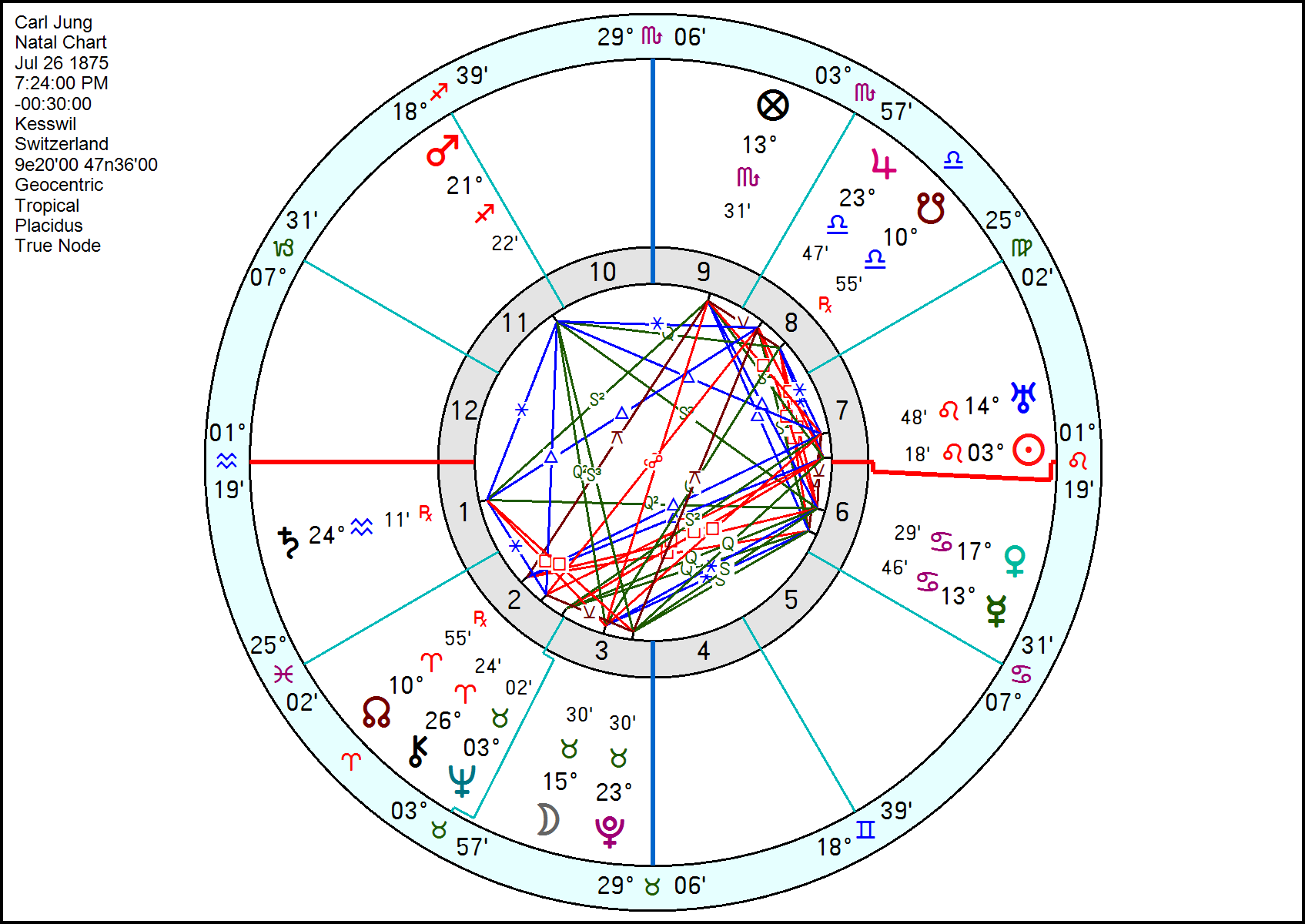
Carl Jung chart analysis: two groups joined by quincunx, Sun unaspected
Saturn at Aquarius 25: self-apperceptive function organized to be able to understand and assimilate unusual and abnormal contents of experience
Jupiter at Libra 24: ability to recognize wisdom and intelligence in abnormal/pathological expressions of psyche
Saturn trine Jupiter: individuation process; birth of reflective consciousness out of instinctual consciousness; enrichment of reflective consciousness through incorporation of abnormal archetypal contents
Trans-Saturnians are what know and understand the functioning of the categories of the imagination; example of transiting Uranus conjunct Jung's Saturn
Moon at Taurus 16: deep recognition of wisdom and power of images locked up in body as ultimate substance of selfhood and wanting to share that with others
Mercury at Cancer 14: ready to face higher mysteries, starting with mystery of body
Moon sextile Mercury: desire to limit higher mysteries to mystery of body; Mercury getting defined as a vehicle by the Moon
Venus at Cancer 18: strong attachment to empirical point of view; valuing of normalcy
Mercury-Venus-Moon group: empiricist investigating Dragon imagery; limitation to psychosomatic perspective
Wang Yang-ming: transcendental lessons learned in the empirical; PB anecdote about reading Parmenides and cooking a meal
Mars at Sagittarius 22: instrumental in Jung's decision to become a psychiatrist; courage to go against the grain of the times
Mars sextile Jupiter and Saturn: ability to maintain poise amidst inundation by unconscious
Venus-Mars quincunx connecting the chart's two major groups; discussion of quincunx meaning as point prior to or after complete objectification
Tail at Libra 11, eighth house: teacher in past
Tail as thread of continuity from past lives; organizes natal Chaldeans as an embodiment of the past; Head organizes the transits and progressions that will transform the past being
Sun at Leo 4: birth of the hero/Apollonic consciousness; integral unitary consciousness necessary for investigating higher mysteries; detachment and divine pride
Distinction between spirit working through psyche vs. spirit as knower; example of Einstein; have to stand outside categories to see special theory of relativity
Suggestion to look at Einstein's chart for comparison
Discussion of Wednesday classes: plan to work through PB's notes; goal of creating an organized selection of notes; call for active participation from students
Logistics for next meeting
BOOKS READ FROM OR REFERENCED:
Plato, Republic, Parmenides
T. Lake Harris, Arcana of Christianity, Vol. 1, Part I
A.J. Penny, Studies in Jacob Böhme
Plotinus, The Enneads (MacKenna translation, 4th ed.)
Paul Brunton, Notebooks
Marc Edmund Jones, The Astrology of Concepts
Marc Edmund Jones, The Sabian Symbols in Astrology
PLOTINUS QUOTES READ OR REFERENCED: V.3.6
SABIAN SYMBOLS: Taurus 16, Cancer 14, 18, Leo 4, Libra 11, 24, Sagittarius 22, Aquarius 25
CHARTS appended to this transcript:
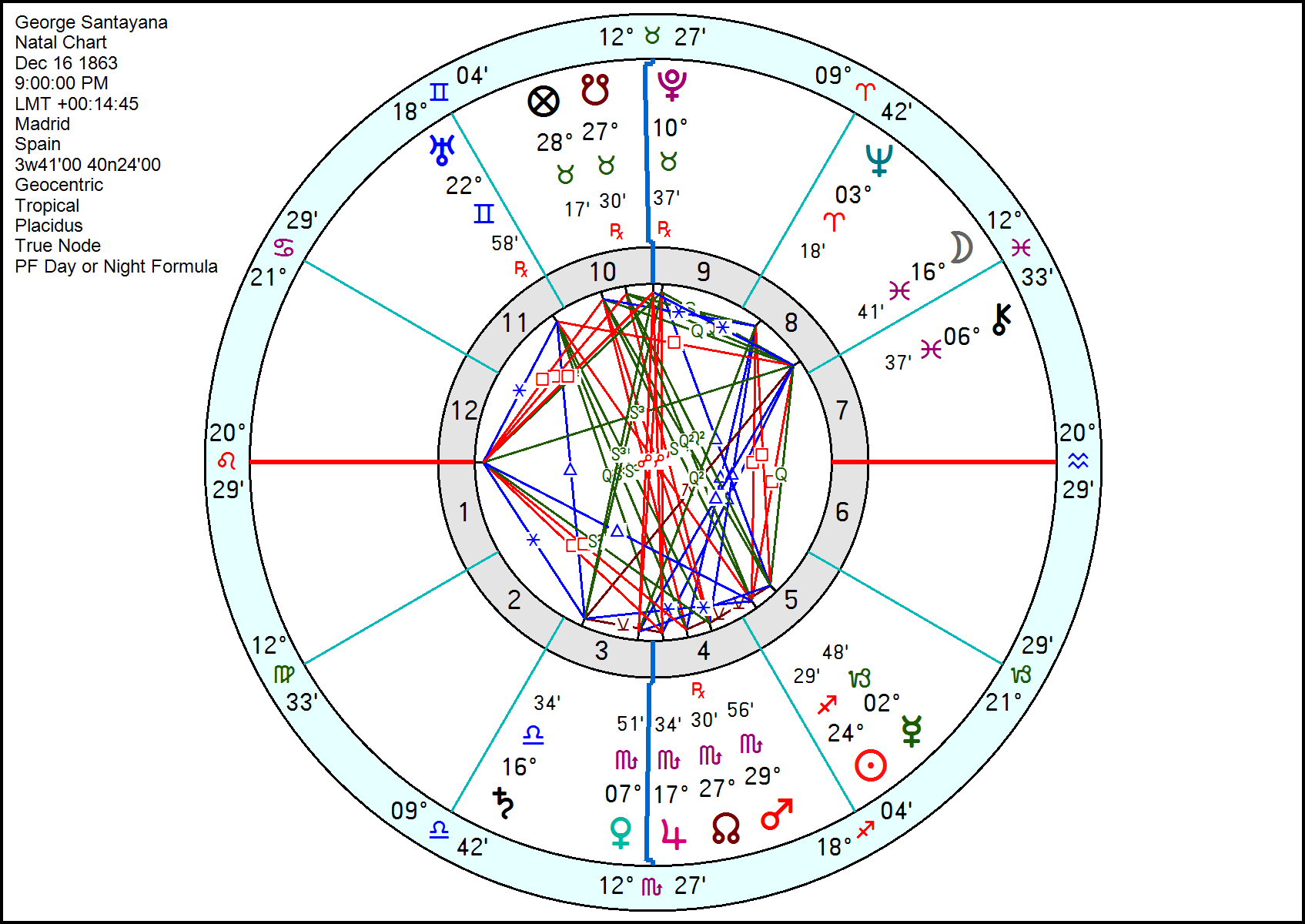
FIGURE 1982 0731-1. George Santayana Natal Chart.
FIGURE 1982 0731-2. Carl Jung Natal Chart (astro.com).
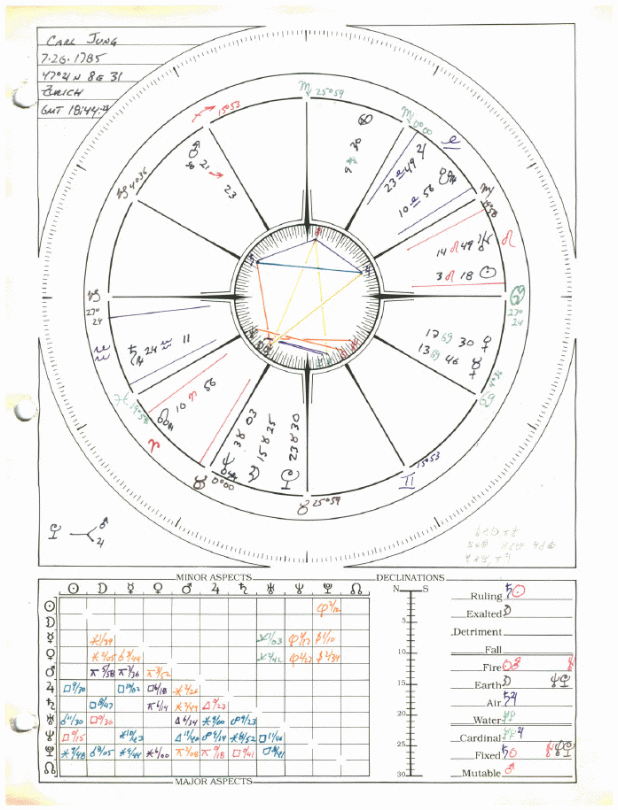
FIGURE 1982 0731-3. Carl Jung Natal Chart (WG version).
Other diagrams referred to are not with this transcript version. [Transcriber note: [diagram] means the speaker is referencing a diagram as he or she is speaking. If someone is drawing or writing, with audible sounds of chalk on a blackboard, I indicate this by [drawing] or [writing].]
TRANSCRIBED Verbatim by IT prior to 2018, reformatted by jf 2018. In 2023, IT updates prefatory matter, footer, and audio file name, alters Subject, completes Book List and TOC, adds Plotinus quotes section, adds new notes within transcript, replaces Jung chart with two new ones, adds Santayana chart, and references within transcript to these charts, reformats to accord with new conventions. Archival verbatim transcript – V12a.
AUDIO FILES: 1982 0731a, 1982 0731b, 1982 0731c, 1982 0731d.
1982 07/31 SEMINAR at Wisdom's Goldenrod
Astrology; Horoscope-Jung
[Audio File 1982 0731a Begins]
TS: Any other stalling actions? (laughter) [25¾ second pause] I guess we're going to try to review what we did Thursday night, whatever that was. Can go on from there. Oh, what did we do Thursday night? What we started looking at was the-- the three subjects again but starting with the-- the empirical subject, trying to get some image of the empirical subject, the psychosomatic organism. Now, we'd begin by looking at the seven Chaldean planets as the categories of the imagination, both in their house-- not so much in their houses because that would be the percei-- the way they're worked out through perception but in terms of the degrees they're on, and we were trying to get some kind of image of all of those seven together, (in/and) their aspects to each other, the Sabian symbols, and try to see that as the sort of fixed and somewhat intractable psychosomatic organism. And, there's some lengthy discussion of-- on the involvement of the trans-Saturnians, and-- I think the outcome is that-- the upshot is that, you would say that within the individual psyche, it as such is constituted only of the seven Chaldeans with the Head and Tail. That when you look at the trans-Saturnians, they function only through the modes provided to them by the Chaldean planets. They themselves don't have-- are not individual psychic functions, because we talk about the individual as having seven souls or seven powers to the soul. So that these other three would seem not to be either truly imaged in the psyche-- well, that they wouldn't be truly imaged in the psyche. So--
RG: And is that open for discussion or should we just assume that it's fact and go on?
TS: I ain't discussing it. (TS laughs)
RG: I mean--
VM: Just explain it a little more then.
CDA: Yeah.
AD (faint): I'm sorry?
RG: Should we assume that statement as fact and proceed or is it open [AD simultaneously, faint: What?] for questioning? What?
AD (faint): Which statement?
RG: The one that-- the relation between the Chaldeans and the trans-Saturnians in-- in the-- what's imaged in one's chart.
AD: Well you could discuss it. You could discuss that and I think the point should be discussed because some may not understand. The main point was something like this. You remember Plato speaks about the soul looks up or looks down. On the one hand, if it looks down into the sea of generation it gets confused and on the other hand if it looks upward it knows. [Note: See Plato, Republic, Book VI, 508d.]
So what we're saying (now) Plato's position, you remember he spoke about-- speak about three parts, he speaks about the soul as tri-partite, speaks about it as the irrational soul, the rational soul, and the intellectual soul. And what we're doing is in a sense a little artificial. But, basically, we're saying that the irrational soul is the same as what Jung refers to as the categories of the imagination. And that the irrational soul is like a unit in itself. There's seven souls that go to constitute that irrational soul and they're not ten, they're not twelve, there's seven souls, and this has been, you know, traditional doctrine in occultism for a long time. And I'm holding onto that and saying the seven planets do represent the basic composition of the irrational soul or the categories of the imagination and that they form an empirical unity, hylomorphic compound. It has a certain, 'intractability' is a good word, (and/or) there's a certain fixity about the ego. And that it's going to be worked over is without-- I mean (here) is the obvious thing. The (clue) here may be that when you look at a natal chart, whether you like it or not, there you have the seven Chaldean planets but they're being aspected by the trans-Saturnians.
So, at the very beginning, as soon as you start off, you got this intermixture of the intellectual, the rational, and the natal or the irrational soul, you got it at the very beginning. [RG: Right.] And what we were doing was abstractly trying to separate them one from the other but abstractly, you know, you always have in the back of your mind, you got a Saturn square Pluto, and if you make a dossier or you paint a portrait of the irrational soul, that(--) that Saturn is square your Pluto but nonetheless the basic structure that you have is those seven planets and the process how they're going to be transformed and modified throughout, you know, the unfolding or playing out of time. So, I think it might be wise to discuss this for a few minutes even though it's very confusing.
RG: I'm still not precisely clear on that-- on your formulation there. I mean, are you saying that the trans-Saturnians are not imaged as the functioning personality? Or that within the functioning personality there are these different aspects of which all the planets participate and now you're just distinguishing the irrational soul part as the seven Chaldeans and the intellectual image as the trans-Saturnians and yet they all function together within the personality.
AD: Uh-huh.
RG: The latter?
AD (very faint): (Yeah/Uh-huh). Yeah.
LR (simultaneously): I think also the point we made was that, it's not exactly that the trans-Saturnians aren't seen from the seven.
S (very faint): Yeah.
LR: It's not exactly that the trans-Saturnians aren't considered along with the seven as much as I think Anthony was saying they're viewed from the point of view of the seven, there are only seven structures of images and yet an influence by Uranus, Neptune, and Pluto in the natal chart will be seen only insofar as its effect, the effect it has on one of those-- on one of the-- one of those seven, so that you could see for instance-- you've used the example of a Sun Uranus (conjunction). You could see from the point of view of the image of the Sun the way in which Uranus was working on it. But you could never see Uranus from the point of view of Uranus because that would be to objectify the subject in some way. I mean if we take Uranus, Neptune, and Pluto to be the cosmic knower, they could never be objectified. I thought [RG simultaneously: (But I--)] that was somewhat of a good point.
RG (simultaneously): Ok, but I would claim that in fact none of the planets in themselves can be objectified. They all function as subjects. And that it's only through their-- their embodiment as an image in the chart that they're unfolded. And therefore the same criterion applies to the Chaldeans in that case [LR: Right but--] as to the trans-Saturnians.
LR: I think he-- I-- I think the point was that there really wasn't an image in the same way of the Uranus, Neptune, and Pluto.
RG: Ok, it may not be in the same way but I'm hard put to not see that it can also image itself in the psyche. It may be a different kind of image. But I don't-- I don't see any justification for saying that it doesn't image itself. I mean it is on a degree, it is operation--
AD (simultaneously): It's the same argument we had, yes, [RG simultaneously: Ok.] it's the same argument.
RG: And in fact if-- go ahead.
AD (simultaneously): Look, here's-- here's the point Dickie. Suppose I ask you to paint a portrait, to take Jung or anyone that we've studied.
RG: Yeah.
AD: And I ask you to paint a portrait. And you'll have to go to each of the Chaldean planets sitting on a certain degree and their aspectual relationship to each other. Now first you take each of the planets. Now, this is basically method because otherwise we get so confused. You take let's say Jupiter, he's sitting on a degree. You try to get beyond the symbol and you try to get to the image that's underlying it, alright, you try to get a feeling for that image that underlies. In other words, the way the basic organization of the psychical essence. And then you do that with each of the seven Chaldeans. And you get some kind of a-- of a picture of the person, you know. It's almost like you're pulling out-- someone just said the shade of the person. And then you have to also keep in mind that they have aspects so, let's say a person has Jupiter conjunct Saturn and there's some kind of self-ordering going on, going-- On the other hand a person may have no conjunction, no aspect between those two, and there isn't any kind of self-ordering going on. So you try to make a portrait of this person. Now, what I'm saying is if you bring in the trans-Saturnians, you're asking for a lot of trouble. Whereas if you can make a portrait of the seven Chaldeans and the interrelationship they have with each other, then you could take the trans-Saturnians and relate it to that image of the Chaldean. [short pause] Do you follow the discussion? You follow what we're doing (now)?
JL(?): (I--)
RG: Ok I-- methodologically, I think if you paint a picture of Jung without the-- or any-- you know, any of the people we've studied, without the trans-Saturnians inherent in them you will not get a portrait of the person, that you will get a lim-- you will only get a portrait of the irrational soul part and--
S (very faint): That's what he's trying to say.
AD (simultaneously): That's what I want.
RG: No, no-- oh, ok, well if that's all you want, fine, [AD simultaneously: And that's what I want.] but to say that it's a portrait of the person isn't-- I don't--
AD (simultaneously): I want, I want-- I want a portrait of the irrational soul so I can understand the changes that are being brought about by the trans-Saturnians and the rational soul on that.
RG: Ok.
AD: But I'm saying is we come in with a certain amount of capital, we're born, we have a certain amount of capital, this is the way our ego is organized and the Chaldeans represent that. And the possible potential for transformation is indicated by the trans-Saturnians and the transits of the rational soul. But, if we try the other way, I mean if you look at a chart and you throw everything in it at once, alright, you try to make a picture of that entity, it's too vast.
RG: Ok, then let-- ok then-- then you're not saying-- when we say a portrait of the person, we're only meaning a portrait of one aspect of the person, the irrational aspect.
AD (simultaneously): Yeah, of the irrational soul, yeah, absolutely.
RG: Ok, fine, and in fact, that may gi-- that gives you a very limited portrait of the person. And until you bring in the other aspects you don't get a-- a portrait.
AD: But to bring in the other aspects you-- you would have to unfold the chart.
RG: Well, I don't think that's true. You mean in transits?
AD: Yeah you have--
RG: Why?
AD (simultaneously): In other words, if you want to bring in-- if you wanted to bring in what Jung was like, let's say how those ideas affected him, you would have to-- you would have to bring in many many years.
RG: Oh but-- but wha-- alright, then what is the reasoning for saying that in the natal chart you look at-- he has a Neptune-- a one degree Neptune Sun square.
AD (faint): Uh-hm.
RG: From that square you don't need to know his transits. You can-- we could interpret the Neptune Sun square very well without looking at one of his transits as to part of what it meant [AD simultaneously: What is the Neptune--] for him as a portrait of his person.
AD (simultaneously): What is the Neptune operating on?
S (very faint): Right.
RG: What is the Neptune operating on? It's revea-- it's operating on the degree it's on, it's operating in relation to the S-- the one degree Sun square, it's operating on the-- in the 3rd house consciousness. It's operating on a lot of things.
[short pause]
AD: Do you have-- let me put it this way, do you have to posit the existence of an entity in this que-- in this case, the irrational soul, before you can speak about Neptune squaring that? Or do you start out by assuming that the irrational soul already has a Neptune square to it?
RG: Yes I ass-- I-- it's given.
AD: Yeah.
RG (simultaneously): Why take one part of the given and assume that it's given and not the other part of the given and say that it works on the given when it's already within it?
AD: But now-- good, that's the issue, uh-huh.
RG: Right. I mean otherwise, all we would need would be-- I mean, we wouldn't be given a chart with the-- with the ten planets inherent in it. In other words, all we-- we then just would have the seven Chaldeans, and you're saying you don't need natal trans-Saturnians, all you need is transiting trans-Saturnians to reveal the Chaldeans.
AD (very faint): (No), I [RG: Ok.] was saying--
RG: What?
AD: What I was saying was that, relatively speaking, if you think of three circles, one within the other, and you think of the circle that's innermost as representing the irrational soul, and if you think of the next circle as representing the rational soul or the modifications it's bringing about on that irrational soul, and then the third would be-- the third circle would be the trans-Saturnians, how they are affecting the irrational soul.
RG: Uh-hm.
AD: But if I don't have an irrational soul to begin with, then what will these-- what would the rational soul and the transcendental subject be modifying?
RG: And conversely, if you don't have an intellectual soul there would never be an image of anything else in order to work on.
AD (faint): I'm sorry. If you don't have an intellectual--
RG: I mean if you don't have a soul in the-- if you don't posit an intellectual soul in the first place that knows the essence of the entity, there is no irrational soul connected to it, to the subject. Then it's a pure free-floating corpse that has no connection with the person's own identity. I mean I think you could-- you could understand it both ways, that you need them all, you need-- you have to understand them all together. Now I think we could s-- you could certainly separate, say (it's--) this is the irrational part, this is the rational part, this is the intellectual part, but you could see all that natally, you-- I don't-- I don't see that you need to go to movement and the motion. I mean, didn't we do that with Santayana's Uranus Sun opposition? [Note: See FIGURE 1982 0731-1, George Santayana Natal Chart, appended to this transcript for all references to Santayana's chart.] You didn't have to look at the transits, you knew right away from his Uranus the-- how the intellectual soul was going to portray his kn-- his knowing to his imagination. Didn't need to go to any transits, you had it right from the symbols in the Uranus Sun opposition.
[11¼ second pause]
LD: But aren't what (you/you're) saying is that experience that the Neptune Sun say is giving to the character is not necessarily going to be assimilated by the higher soul or change the character any way, that it might be giving some input or affecting it but there's no assimilation taking place, it's still on a potential level, and, in fact it does seem, they say, that the-- the intellectual soul doesn't assimilate that many experiences of the individual throughout a lifetime and in fact very few are taken up and [RG simultaneously: Yeah but I still don't--] the essence of the experience left in the-- the higher soul.
RG: But I only made the point that the intellectual soul is not per se the in-- the Ur-- the intellectual soul as portrayed through these degree symbols.
LD: But it still represents a higher [RG simultaneously: Granted. No doubt--] individual in some way.
RG: Yeah.
LD: And you're saying that higher individual is always going to assimilate [RG: No.] [three/few faint inaudible student words simultaneous with LD, possibly part of background] the potentials exhibited by these aspects and that's obviously not so.
RG: Didn't-- no, no. That's not what I said. Did not talk about assimilation. Just talked about you can see prac-- you can see in the natal horoscope the functioning of these things. Whether the s-- the irrational soul assimilates or not--
LD: I don't think it-- that it's affecting the character is denied, that it's putting some-- it's doing something, granted, but if it-- whether it's affecting the character as a whole is questionable. That character, he's saying, in a way I think is fixed and that the possibility of it not being changed in any radical way by these aspects is a definite possibility.
RG: Yes, and I-- and I-- I would say--
LD (simultaneously): And if the character's not being changed, then you can get a portrayal without-- if the character is fixed, then you can get a possible portrayal without looking at these aspects.
RG: Ok, and I would say that you could read that inherently from the aspect pattern and the degree symbols that the trans-Saturnians have.
TS: I think this is a-- if I-- if I followed what was being said at one point, although I admit I agree with you, that-- (laughter, student words) I think that part I came to understand in this is that the seven-- if you take the seven Chaldean planets as the psychosomatic fun-- the categories of the imagination, what is needed to constitute this em-- irrational soul is that-- just that, those seven functions are what are-- what is essential to the irrational soul's functioning, [TS/AD(?), faint: ok], or their images in-- as the categories of the imagination. Now it seems to me that what's being said is, that is the field in which both the rational soul's functioning and the intellectual soul's functioning can appear or can occur, ok, that-- that when you talk about the actual field of the imagination, of the individual imagination, what-- that is constituted by these seven Chaldeans and the Uranus, Neptune, and Pluto do not go to constitute it. They may act on it or they may-- their actions may be reflected in it potentially or actually, but that they don't-- they aren't constitutive of it or essential to it. So it would seem that-- ok. [RG(?) simultaneously: Yeah that's fine.] So, in that view then if you say that when you're looking at Santayana's Uranus Sun opposition, it's only once you've got that psychosomatic-- that mind-body complex as a whole, now you can say in what way that Uranus is going to be potentially apprehended by that or affecting-- in what way it will affect that.
AD: I'll go even further Tim and I'll say that there are people and many many people, especially for those of you who had the opportunity last night to witness 'em, (some laughter, student assents) (the) trans-Saturnians do not operate on them at all.
[few background student words simultaneous with VM and RG]
VM: That's right.
RG: They may-- I disagree. They may [AD simultaneously: I know.] not operate on them-- wait a minute, [AD: I know.] they may not operate them on the way we would like them to operate on them.
AD (simultaneously): No, no, no, not at all, not at all. Now I'm making an extreme statement.
RG: You mean when they have a Uranus transit nothing happens?
AD: When they have it transiting, then something happens and soon as it's over, it's over. They're back to what they were.
RG: Ok, granted, ok but if we looked at (the/their) charts of those people, I still claim that within their charts we could see natally why that was so.
AD: Yes.
RG: Would you?
AD: Yes. The dominance of the irrational soul.
RG: Right, ok. So-- and I would-- I mean po-- perhaps--
AD: Well then according to your theory, why aren't they operative?
RG: Because--
AD (simultaneously): Except in extreme cases where-- Now, in this discussion I'd like to keep out the mundane aspects, of which you cannot avoid.
RG: Ok, why aren't they [AD simultaneously: (Stay--)] operative?
AD: They're not operating, [RG simultaneously: They're not operative.] for many people they're not operating [RG simultaneously: Uh-- right.] and the trans-Saturnian planets are utterly incapable of coming into the irrational soul. [RG: But-- but wait.] And that I'm saying that a dossier of the irrational soul could be painted without bringing them in. And unless, unless I make a dossier, I make some portrait of some-- some image in my mind of the basic irrational soul of this person, I will not understand how the trans-Saturnians are operating on (him/it), if they operate at all.
TS: Now by operate you mean they operate as the intellectual soul.
AD: As intellectual soul.
TS: Yeah.
AD: Look, let-- we could make it even simpler, we cou-- we could paint it much simpler. How many people that you know, alright, would you say that their intellectual soul is functioning and that they have some dim apprehension of it?
TS: [one/two words inaudible]
RG(?) (simultaneously, faint): [one/two words inaudible] (laughter)
VM: Thank you Dickie.
S (simultaneously): Stand up. (laughter)
VM: Very nice.
RG (simultaneously): (You're tied) Vic. (RG, VM laughing)
S: But, Tony are you s-- are you saying that the pre-- that the reason for the fact that the intellectual soul doesn't-- doesn't operate is because of-- this may be too simplistic a way of putting it but if-- is there so much fixity in the-- in the [AD: The--] irrational soul, in these seven configurations and relationships that it just won't allow it to come in?
AD: Yeah. And I think this is a certified fact.
RG: But-- but you know Anthony it's funny that in the charts of the people we did there are very tight trans-Saturnian aspects.
AD (simultaneously): Well-- well look at the people we're doing.
RG: No, no-- well, I know it's a correlate, [S simultaneously, very faint: (couple/three words inaudible) people (one word inaudible)] they're correlate. And I'd say if you pull out the people that you want to use as examples of non-intellectual soul types, that-- that when you study their trans-Saturnian degree symbols and you study the-- the non-aspected relation that the trans-Saturnians have or the-- and whatever aspects they have, you'll see why they don't relate to that image. Or you'll see how they relate to it. Now somebody may have a very close Neptune Sun aspect and they-- they do a lot of things in the world, I mean they-- you know, they take the world as real, I mean in Jones' sense of social obligation for Neptune. It do-- I don't think-- doesn't mean Neptune's operating, they're not self-conscious at a level that Neptune should be operating from(--/,) from the vision that's being given. But is it to say that Neptune isn't operating or it isn't self-conscious? I mean that's very different.
[student assents, faint]
AD: Once more [one word inaudible] [36¼ second pause] Is there some way then, because I know Tim would like me to compromise on this one, is there some way that you can make a delineation, the irrational soul, alright, bringing in the trans-Saturnians but yet keeping in tact the hylomorphic entity which we're referring to as the irrational soul? Is there some way of doing that?
RG: Yeah, yeah, definitely.
AD (simultaneously): Any ideas Tim?
TS: Well, I think it-- you know, you would have to start with first of all trying to get that irrational soul per se in itself and then seeing in what way [short pause] it was-- it is aspected to or it-- it envisions the functioning of those trans-Saturnians, I mean, which is not the same as their functioning in it. Seems to be two different--
LR: In other words Tim, would you be saying that-- did I cut you off?
TS: (Yeah.)
LR: Would you be saying that first we could possibly look at the seven and try to-- I mean that in itself is a hard task, try to get an image of the ossified members of the Dragon. [AD, faint: (Look--) (bit of laughter)] And then, if we were-- then the next question to ask would be, does this person have a notion of a higher subjectivity. Or, what kind of idea would this embodied being have of spirituality, of a higher spirituality. And then we could perhaps look at the aspects like-- in Jung's case those three one degree aspects. (You have) Neptune and Uranus and Pluto are all (grabbing) at one degree. [RG simultaneously: But in fact--] And say what kind of idea or receptivity this na-- natal one(,/--) seven would have to the higher spirituality and then just analyze those aspects to the seven, Neptune square the Sun, Uranus square the Moon, Pluto square Saturn.
TS: I mean there seems to be-- I don't know if this is directly answering Anthony but I-- seems like there's the functioning of the intellectual soul on the irrational soul. Now that would require first of all seeing both of those and that would I think come out of, first of all, forming that image of the-- or-- and then-- then looking at those aspects which are the close aspects to see if there are any and to see what the Sabian symbols are. There seems also to be a third sort of intermediate phase which is to see in the-- their-- to see in the delineation of the empirical subject the way in which it distorts the intellectual soul or the way in which that intellectual soul does not function in it. [student assents, very faint] In other words, there seems-- like you could speak about a certain-- when he's-- when Jones talks about Neptune is social obligation, that's not what I think Anthony means by the-- Neptune as functioning [S simultaneously, faint: Right.] but it's sort of a dysfunction of Neptune as [S simultaneously: As (couple words inaudible)] totally appropriated [RG and student assent] by the psychosomatic organism.
RG: Uh-hm. Yeah.
TS: Yeah.
RG: Sure, right but it still functions(,) (at this) [one word inaudible]
TS (simultaneously): But it-- well it's not-- it's present, it's--
LR: That is what it is [TS simultaneously: Yeah it's--] though Dickie, that's the point.
RG: Gritin-- granted, but if you're talk-- if you're going to read a chart, and if you're not-- if-- I mean, you have to include it. If-- to say that it's not functioning as the intellectual soul is one thing, to say that it's not functioning at all is very different.
LR: Yeah that's like the positive and negative dialectic here. You say, this thing is not itself, cannot be itself, therefore what does it look like. And then you describe what it looks like not as [RG and VM assent] itself but (through) another than itself.
RG (very faint): Ok.
LR: So-- and I don't think anyone's disagreeing with (you).
RG: Ok, I think that's a more substantial approach. But if you take a more functional approach, and you want to look at aspect patterns say and just to the Chaldeans, I really don't think you can interpret the chart by looking just at the aspect pattern for example of the Chaldeans 'cause you-- let's say somebody's got a Mercury-- a Mercury Mars trine.
AS: Why not?
RG: Well I'm going to give you an exa-- tell you why. Let me--
AS (simultaneously): Well let me-- let me give you my-- [RG simultaneously: Let--] let me give you (one example). (bit of laughter) For about two thousand years--
S (simultaneously): Let him-- let him finish.
RG: Go ahead, go ahead [one/two words inaudible] (laughter, student words)
TS (amidst laughter): [one/two words inaudible] he'll never say anything.
RG: Because-- Let me just say why and then you give me your answer. Yes, for two thousand years certainly there-- they-- Uranus, Neptune, and Pluto were not functioning. That's ok.
AS (simultaneously): Wait-- wait a minute.
RG: As in the chart.
AS (simultaneously): For two thousand years Uranus, Neptune, and Pluto were not functioning (AS laughing) until they were discovered by humanity and then they started functioning!?
RG: That's right. [VM/S(?) simultaneously: Why is--] In the collective psyche of humanity, I mean that's-- that's not-- that's-- that--
AS (simultaneously): Well then, well then, well then aren't you saying there that there certainly is a validity to interpret-- I mean how do these astrologers [RG simultaneously: Not--] for so many years interpret charts, all these billions of astrologers, are you going to say there were none [RG simultaneously: It was a different ti--] functioning with just the seven planets?
RG: Yeah, I would say at that time you-- the seven planets were functioning, that was enough to--
AS (simultaneously): Isn't [one/two words inaudible] that as a unity also valid? I mean and doesn't the entity that they looked at with just those seven planets have some validity even today? Or we got rid of that (entity).
RG (simultaneously): Oh no doubt. No doubt that it has a validity, I'm not denying the validity of that entity. But I'm saying when you look at the aspect pattern and we do know that the Uranus, Neptune, and Pluto were involved in that aspect pattern, (that) if you let's say for example just look at a Mercury Mars trine, and you say oh this person has a-- you know, his thinking flows very easily and has a lot of energy. And then you look and see that he's got-- and the person's gonna say, "What? I do not, my thinking doesn't flow at all. It's contorted, it's terrible, I can't think two thoughts in a row," [VM simultaneously: Oh it's got Pluto there. (VM laughing)] and-- and then-- and then you're going to look at his chart and see that he's either got a Pluto conjunction or a Uranus square or something like that. Now you're not going to make any sense to the person talking about a Mercury Mars trine. [AS, faint: Yeah but--] You're not going to know what you're talking about.
AS (faint): No but there's something else going on.
RG (simultaneously): Well, answer that-- first answer that point and then I'll--
AS: Ok, but suppo-- now maybe this is a bad theoretical example but suppose two hundred years ago, Lilly-- or four hundred years ago astrologer Lilly or something looked at this Mercury Mars trine and was able to delineate very well the person's personality without knowing anything about the position of Uranus or Pluto or Neptune.
RG (simultaneously): Right, and I'd say they weren't operational [couple faint inaudible student words simultaneous with RG] at that time in-- particularly.
S (simultaneously): [one word inaudible]
TS: And [one/two inaudible VM words simultaneous with TS] that's going to-- going into that [RG simultaneously: That-- yeah (couple words inaudible) you can go (to historical), sure.] situation [VM simultaneously: That's--] you-- you could use that either way, that's not going to answer the question.
VM (simultaneously): Yeah, uh-hm.
S: [couple words inaudible]
RG (simultaneously): [couple words inaudible] here right now with our charts.
AS: I know but I-- I thought the only point was not that they weren't influencing but that you could look at the seven--
RG: But Avery I'm just saying in practical astrology, when you look at a chart, and you try to relate to somebody across the table and say, "You have a Mercury Mars trine," and you just try to interpret that, the pers-- if you don't bring in other close aspects in the tot-- that-- I'm saying though those ten planets together as an aspect pattern represent the given psyche of the person and that it's a theoretical formulation to separate in-- in psychic functioning the appearance of the seven Chaldeans and the appearance of the trans-Saturnians.
TS: But the-- there's a slight--
AS (simultaneously, faint): Ok well, [one/two words inaudible] disagreement.
TS: Yeah. The--
RG: Well you show me how-- [AS simultaneously: Oh I'm not-- I don't know.] how it could work otherwise.
AS: I don't know, I'm just saying--
TS (simultaneously): Well this is the way it's-- it's being stated. See if you took-- I think if you take a partial view of the chart, like you take a Mercury Mars trine, you may require to-- to see the-- you know, if there's a close aspect to say Pluto's opposite that Mercury or something, it may affect that whole partial thing. But-- but that's not the, you know-- that's not the premise that things are being worked from, see. First of all take the psychosomatic entity, the empirical subject, as a totality, try to form one image(,) (like/or) get to the primal image of that irrational soul. Once you have that image as a whole, now looking at the way in which Uranus, Neptune, and Pluto contact that whole is going to-- I think is going to modify the potentials or the-- the meanings of that irrational soul as a whole but I think if-- and if we break it down into the-- into the parts it's going to be-- there'll always be a little-- there'll be problems with it. But if you look at it as saying, what is the field that, you know-- of the individual mind and what is that as a-- as a unit first, that's-- certainly we could-- [RG assents, faint] the idea that there's a sevenfold unity of-- at some level. And if you stay there and then you say now let's bring in these other things in(--/.)
And then if you go back once you've seen that entity as a whole, and the potentials-- the way in which that entity appre-- responds to or is going to potentially be adjusted by the functioning of the intellectual soul, now then if you go back to the context of the Mercury Mars opposition-- I mean it may be that not only does he have a Mercury Mar-- Mars trine with Pluto opposite, but he's got a Uranus Sun-- [RG(?) assents] Saturn conjunction-- [student assents, faint] you know, you can't-- you c-- you know that any cookbook astrology is going to fall apart at a certain point [RG assents] 'cause, you know, you can't-- if you take any a-- pair of planets, the fact that one's in rulership, the other's retrograde is all going to mess it up so, it seems like (the/this)--
AD (possibly part of background): (No.)
RG: Ok, that's fine, [one inaudible AD word, possibly part of background] [one/two words inaudible]
TS (simultaneously, faint): Ok.
AH: Tim, could-- could I see if I understood what you said? Ok, put it in the context of this-- of the subjective entity, in other words, first level empirical subjectivity, the case of the Mercury Mars trine, that level of empirical subjectivity would be experienced as a certain flow of ease. But, in the case that there was a transiting Pluto, it would like in some sense inhibit that empirical subject in such a way that it might-- it might allow access to a higher subjectivity?
TS: Well what you're saying may be true but that's not what I was trying to say. I was trying to say that to look-- to understand a Mercury Mars trine to begin with, you'd have to take that in the context of the whole pattern of the seven Chaldean planets. To isolate it as a part isn't going to give us a true image of the individual. Because we could take two people who have exactly the same Mercury Mars trine but (as/has) a Moon-- one's Moon might be in rulership and the other might be (one) [one/two words inaudible] (in) Virgo something. And, that's going to be-- that's going to affect that-- that image of the irrational soul to begin with. And it seems like what we're trying to do is establish some image of the individual subject and not just sort of these autonomous psychic functionings or components of the psyche. So when we're looking at any-- any planetary pair of aspect we're going to have to go towards the way in which it is involved in a specific subject, the way in which-- to try-- we're trying to find it as constitutive of some individual subject, then look at how the trans-Saturnians would affect it once we have some real entity there to whom this is occurring. 'Cause we've seen that with a few people where we've had the same Sabian degree show up in different horoscopes, you know. But it doesn't mean the same thing because the planet it's on, the individual psyche that it's-- that it's a con-- that it's a part of the constitution of, is going to modify that meaning, it's-- Seems like we're trying to take these different images of the planets, the Sabian symbols, and sort of in an alchemical process transfuse them into one solid image of an irrational soul.
S (faint): Or through.
AH: You say-- you speak of an entity. But it seems that you speak of an entity as the natal horoscope it's like an almost kind of a schizophrenic way of talking about what an entity is because [student assents] at once it belongs to the tropical zodiac, but that entity also has a connection with trans-personal elements. Like Dickie said earlier, both are given, why take one part of the given and withhold it from that givenness of the entity and like talk about-- talk about the entity in such a schizophrenic way that it can't be put back together [one word inaudible] I-- this [couple words inaudible] from this [one word inaudible]
TS (simultaneously): Well it may well be schizophrenic, [S simultaneously, faint: That's right.] I mean it's-- (TS laughing)
LD: You tell me what entity you know isn't schizophrenic and (bit of laughter) isn't a dominance on one aspect of him. How many entities do you know (that) [couple/three words inaudible]
[student assents]
AH (simultaneously): That's what I'm saying Louis that it's not, you know-- I don't see how you can speak of the tropical man as being divorced from his transpersonal element, [RG: Yeah but--] at the same [TS simultaneously: It's not (one/two words inaudible)] time speak of them as given as one entity.
AD (simultaneously): Well, let me-- [S simultaneously, faint: But in terms of (the same entity).] let me try-- let me try this way. You remember the quotation from the Arcana of-- by Harris where he speaks about a belt of atmosphere that surrounds the Earth? [student assents, faint] And that he referred to this here as the-- the life-- the life of the Dragon or the atmosphere of the Earth from which all living entities are going to be made. You reme-- you remember that quotation? [Note: See T. Lake Harris, Arcana of Christianity, Part I, Vol. 1, pp. 100, 101. See also A.J. Penny, Studies in Jacob Böhme, pp. 162-163.] [students assent] Now, if we say that-- if we say that this belt of life which surrounds the Earth is the matter which is going to be worked on to produce this individual, our understanding or at least mine is that there's seven planets that basically go into arranging the matter of that-- that matter into an entity. And that the images, and here I'm speaking about the way the psychical essence is organized to constitute an ess-- an entity, that it is these seven images that have to be welded together to produce an entity. (I/Uh)-- now I-- I'm repeating what I've been saying.
AH/RG(?): (If we get--)
[student assents, faint]
AH (simultaneously): Anthony excuse me. Those seven images that are welded together to produce a entity, there's also other images that are welded to those seven (to) produce the entity which we speak of as the trans-Saturnians.
AD: No.
S: Uh-uh.
S: (Uh-uh.)
AH (simultaneously): Well, then how come we do natal--
AD: No, you don't have-- you don't have Uranus or Neptune or the other planets organizing the matter of the entity.
AH: Well then why bother with them when they do mundane astrology? [AD simultaneously: And--] Why just not ignore that tradition? That they're not part of that entity-- entity's presence here, why bother even considering their transits or (their) [one word inaudible]
LD (simultaneously): I think that was stated, it's the potentiality that that-- that might be open to that entity. The potential.
RG: But you know, that--
LD (simultaneously): Like you take the case of Santayana, that Uranus Sun, now that opposition might mean certain experiences that he goes through but whether that changes the character of him is questionable because anybody who has the same philosophy from the time they're seven onward seems like they pretty much haven't been changed that much and that they're pretty caught up with like their Mars and--
RG: Well wait a-- ok wait, wait. [S simultaneously: What do you mean Lou?] And I would claim that from-- we analyzed very well that Uranus Sun opposition without looking at any transits and we saw a lot of transformation, as much as was possible given the nature of the power of the Sun degree (gives you) a limitation of the-- of the symbol of the Uranus.
TS (simultaneously): Sure. But what was being transformed, what--
RG: The Sun.
TS: Yeah so--
RG: Sure.
TS: The tran-- what is to be transformed [RG simultaneously: Is the irrational soul.] is itself-- is the irrational soul and that's what is being-- what is--
RG (simultaneously): [one word inaudible] right.
TS: Ok?
RG: No argument with that. But to call a--
TS (simultaneously): Well I don't see what--
RG: But then to say that that is the entity seems to be--
TS: No, but--
RG (simultaneously): It seems the entity contains all those parts.
TS: Surely.
RG: Sure, that's all.
AH: As-- as evidenced by quite clearly just in-- you see people who have aspects, natal aspects like Neptune Moon or Sun Pluto or some kind of connection with-- that it's very clear that that's present in that entity, that aspect is present there, you know, it's not-- you don't have to wait for transits.
AD: But you see that's not what's being discussed, what's being discussed is this here, is there an entity which is other than or different than the rational soul and the intellectual soul, that's what's being discussed.
S (simultaneously): Uh-hm.
AH: No I don't think you could s-- I don't think you could segregate it. (TS laughing)
S (very faint): (What do you mean?)
S (very faint): Exactly.
S (very faint): So what [possibly one/two words inaudible]
AH (simultaneously): I-- [RG simultaneously: Yeah but Anthony-- yeah.] I hear you saying that it is but I haven't-- [RG simultaneously: Look--] but I haven't understood how it's been discriminated apart from that total entity.
RG: Right [one/two words inaudible]
TS (simultaneously): Saying that there's nobody who isn't-- who is not a-- [few inaudible student words simultaneous with TS] only aware of their psy-- psychology who is-- (they're/their)-- every person is always functioning rationally and intellectively as well as psychologically?
AH: I (say/said) every person is always functioning in such--
AD (simultaneously): Irrationally.
AH: --in such a unique-- in such a diverse way in terms of these-- in terms of these aspects that I don't see how you can make this delineation between them.
RG: Right, let me just ask the question in a positive way, Anthony. If-- the idea that there is an ossified sense in which the irrational soul exists seems to be the presupposition of this idea, that there is a unit called the irrational soul that has a coherence and an integrity to it. Is that [AD: Yeah.] correct? Ok, now, I don't quite grasp-- I mean what i-- what is the necessity of holding that there is an integral entity called the rational soul-- the irrational soul when it's so irrational, when it's so schizophrenic to begin with? I mean insofar that it interacts with other aspects of the s-- of the psyche-- of a soul, it seems that-- that parts of the irrational soul could never get-- don't need-- have-- would never get integrated for example into the rest of it or that itself it is a-- it-- it is very fragmentary by nature. And it's only when you get to the rational part of the soul that you speak about a coherent entity.
[student assents, very faint]
AD: Well-- well I-- I think (dossier), 'cause that's what I was saying.
RG: That's what you're saying. [student assents, very faint] Ok.
AD: Let's try this way. In one and the same entity, alright, we could speak about an empirical subject. Again in the same entity, we could speak about the rational soul within that empirical subject. And persisting further, within that rational soul there is an intellectual soul, alright. [student assents] So like there are three layers superimposed one on the other. [RG, faint: Right.] Ok? And what we want to do is theoretically abstract the irrational soul from that context within which we find it. So to separate it out abstractly and say well this is the basic personality, empirical personality, that I have to understand in order to see the transformation of this irrational soul so that it can become a vehicle through which the rational soul and the intellectual soul can operate.
RG: Ok.
AD: This is basically what I'm saying. [RG assents] Now I am not saying that you could actually separate these things.
RG: Ok.
AD: I'm not saying that, I'm just saying that given-- given that I have this kind of view, then the next thing is if I could bring together in my mind, make a picture in my mind, of the seven Chaldean planets, how in their togetherness they make for me this empirical subject, alright, and then put on the side, the description on the side, the aspects that they have let's say to the trans-Saturnians, to see how much they're going to influence, reorganize, transform that empirical or that irrational soul. And I feel quite sure that very often you'll see that they don't do anything. [RG assents] The intractability of the ego is of such a nature that it could take-- take ten lifetimes before one lesson finally gets through. Now, in your experience I'm sure you've met people you'd say well, he's basically irrational soul. This is what he's identified with and there isn't anything else that he's identified with. Then there's another person that you could speak to and you can see that the rational soul is operating. It's really getting into the em-- empirical irrational soul and bringing about changes, telling him to stop drinking coffee and not do this and not do that and he tries to live the rational life with(--) and within the irrational soul. Then of course you have the superior person who goes even beyond that. But, if we're to try to analyze-- if we're to try to analyze a person, we first have to work with the givenness of the ego structure that he has. Now the big discussion we had was this here: does the ego structure include those aspects that it's making to the trans-Saturnians? We compromise(d) by saying, let's leave them on the side, let's first make a picture of the irrational soul, and then it has-- let's say you got Uranus opposite Mercury, tha--
[Audio File 1982 0731a Ends]
[Audio File 1982 0731b Begins]
AD: And I think you will s-- you might become aware that he himself, Einstein, probably experienced himself as a transcendental knower for a while. But when those-- when those aspects were over, the lapse I think is going to be very obvious. [students assent, very faint] [RG assents] I'm willing to wait to see that but--
TS: You'll see.
AD: Anyone who's had experiences with the trans-Saturnians will recognize that while they're going on there's an alteration in his subjectivity and that after the aspects are over there-- he's-- there is either a definite transformation of the personality, he has assimilated something and now operates according to it, or there's a lapse back to what he was before, as though nothing ever happened. And for many people trans-Saturnians are like he g-- he has a Sun-- or Uranus on the Sun he breaks his neck.
RG: Yeah.
AD: That's it. (It/He) goes on from there. [student assents, very faint] There was no real modification of what you can call the categories, no real modification. Now that's the principle I'm working on. Now it would be an unfair representation of this position to say that I'm saying that you could, you know, separate them.
RG: Ok.
AD: I only want to distinguish them.
RG: Ok. Now let me just ask you one more question. Given this picture-- [AD, very faint: (Uh--) uh-huh.] I'm asking is it-- is it even possible to get a picture of the irrational soul in a person's life, of the seven Chaldeans-- in other words, when you form that picture, is that going to be an appropriate picture for that person given that these other elements appear alongside and simultaneously with and in that picture? Like--
AD: Like for instance, I have an opposition between Uranus and Mercury. Could you have drawn a picture of me, alright, and exclude the Uranus Mercury opposition?
RG: No.
AD: I think so.
RG: Yeah?
AD: [couple words inaudible]
RG (simultaneously): Yeah but the picture-- yeah but--
AD (simultaneously): Till I was past 30.
RG: Yeah?
AD: Until the ego structure really got built up, organized, a maturity of the physical being took place, I would say so. But I'm not going to generalize from this.
RG: Alright, but you're--
AD: I'm just saying that I've noticed this to be so, that for many people the trans-Saturnians really don't come into operation till after their maturity.
RG: Uh-hm, you mean-- so you would say it's bo-- you wouldn't say that the Uranus Mercury opposition wasn't functioning, would you?
AD: I was absolutely un-preoccupied with Uranus.
VM (simultaneously): Maybe you could just say it's unconscious. Could we-- can we do it that way?
S (simultaneously): In terms of the empirical personality it wasn't.
[student assents, very faint]
VM: Can we just say unconscious?
RG (simultaneously): No I think in terms of the--
S (simultaneously with VM and RG): [couple/three words inaudible] that personality.
RG: I think (it/it's)-- in terms of the empirical personality it was functioning, he may-- you may not have been self-- may not have been self-conscious.
VM (simultaneously): Yeah, how about if we just say conscious?
AD: Yeah, but [S simultaneously: Yeah.] don't you see the point here [TS simultaneously, in background: That (is really--)] is that, [VM simultaneously, to TM in background: Huh? That may be the word that'll get us (one word inaudible)] yes I was functioning. But that transcendental subject that Uranus represent wasn't.
TS (to VM in background): Yeah, that's what he means by function.
VM: Can we say [few faint inaudible student words simultaneous with VM] unconscious Ansithony-- Anthony and that's the word?
AD (simultaneously): It wasn't functioning, I had no insights like I had after 30. There was no incorporation of Uranian-- Uranian meaning in the Mercury.
TS: Yeah but-- but one-- one small question. Would you say that there was a deliberate non-functioning of it? (AS laughing in background)
S (very faint): What? (laughter, student words)
TS: No really.
VM (faint, to himself): Deliberate non-functioning.
TS: Do you see the-- the mode of that Mercury's functioning as distinctly [one/two inaudible VM words simultaneous with TS] involved with the non-functioning of the Uranus?
[short pause]
AD: I think so Tim. I could say, I think I could say that when it started functioning, I was aware that something other than myself was trying to come in and it was for-- and it was experienced as a foreign entity, as though there were ghosts in my chambers. And I would say the same thing like when I had the Neptune sitting on Saturn for six months. Something was trying to come into the organism as-- into the self as I knew the self, alright, which I felt was utterly foreign.
TS: So there would be a way in which one-- it seems that all that us local astrologers are anxiety ridden about is that, there is-- seems to be an intermediate phase where the functioning of the higher soul is experienced as somehow other than the empirical subject and that one is capable of delineating the empirical subject's experience of that alien-- alien otherness, and that when one is speaking about certain-- oh, trying to delineate the character of the irrational soul, part of that characterization involves that awareness of the rational soul as other, that in some people's lives it may not even be experienced as other, it's altogether absent. In other people's lives it's not altogether absent but it's experienced as alien and their own-- say the intensity of that empirical subject is somewhat modified by the-- by the effort of it to-- to maintain that rational soul's functioning as other than itself. Which is-- and then you-- finally you get the person who is able to recognize that rational soul as himself, and there I would see-- that that's when the Uranus, Neptune, and Pluto are truly functioning.
But there does seem to be this intermediate 'cause it's what I think [RG assents] Richard and I are objecting to is-- or trying to modify and-- when you say sketch a portrait of the person, you know, it is hard to-- seems to me that you can sketch a portrait (of/of the)-- of the irrational soul first by just simply looking at the Chaldeans. This is some [RG assents] whole entity, some whole part of the individual that can be completely delineated within itself. But then to actually sort of, I guess, to complete that picture, one needs-- one is-- is always tempted to add the way in which it tries to maintain itself as central and how it tries to experience the Uranus, Neptune, and Pluto as somehow alien to itself. [RG assents, very faint] And that alienness is what we ordinarily use as the meaning of Uranus, Neptune, and Pluto, the way in which it's kept out of being truly in function. That's I think the standard meaning is of Uranus, Neptune, and Pluto is, you know, the way in which the psyche rejects it.
AD (simultaneously): Yeah-- yeah [one/two words inaudible] I would put it like that. Now, let me remark, like for instance in Santayana's chart, I don't think Uranus got in.
RG: At all?
AD: No, it didn't.
RG (simultaneously): Oh come on. If Uranus didn't get in at all, he never would have even looked at anything other than his own imagination.
AD: I think he kept his ego intact. I mean this is a difference of interpretation.
RG (simultaneously): No-- no I think there are two questions there, not-- I would agree that the Uranus didn't become a knower in Santayana, [TS: That's what he means.] a self-knower. But to say that Uranus didn't get into his chart, it certainly affected the way his imagination--
AD: Not into his chart because that is always there, you mean [RG simultaneously: Right.] into his-- the irrational soul.
RG (simultaneously): Into his-- [TS simultaneous with RG and AD: Being.] in-- into his irrational soul. I think it did to some extent but not as a self-knower, it di-- it seemed to somewhat deliver to his Sun, into his imagination, certain ideas of transcendence, some ideas. But he never consciously made it to the point of himself as a self-knower. But that doesn't mean Uranus wasn't teaching--
AD: Did it ever occur to you that in Santayana there are-- there are two Santayanas?
RG: Uh-hm. [student assents, faint] Two.
AD: And that there's almost like a phase of schizophrenia? That there's one part of him which is the Uranus and which is what I think you recognize when you read the chart. And there's another part of him which I call the irrational soul, the ego structure, which will persist in keeping it at an arm's distance.
TS: Uh-hm, that seems to [couple/few words inaudible]
RG: Sure, sure. [few words inaudible]
AD (simultaneously): But right now-- right there I distinguish two parts, I distinguish two knowers. I distinguish the irrational soul [RG assents] from, you know, the trans-Saturnians.
S (simultaneously, faint): [one word inaudible] that was another thing.
AH (faint): Anthony?
AD (faint): [possibly one/two words inaudible] yeah [one/two words inaudible]
AH (simultaneously): In the case that you mentioned (of/in) your own experience where you had Neptune on Saturn, certainly there are other people in the world that were having that transit and it didn't mean to them what it meant to you. Now, the pa-- the fact that-- the fact that it worked on you the way that it did, is that not given as part of your natal horoscope?
AD: Yes it's given, but I could have just as well have refused it. [VM simultaneously: (Oh/Mm).] I could have refused it.
AH: But you didn't because of the way your natal planets were-- [VM simultaneously, possibly part of background: They're very deterministic.] were working. There's like a predestined acceptance of that lesson in the case of your life and that's part of that natal horoscope. Now you can't limit that to the seven planets, you-- that has to include the other three.
AD: I could have gone out and got drunk every one of those six month-- or every night of those six months and never have the-- the Neptune experience. And many people do that. [TS/S(?) simultaneously: Seems like that--] (The) prefiguration of the aspect, alright, which is supposed to bring about a certain result could have been negated.
AH: But it wasn't. And it wasn't because of the predestined [TS simultaneously: No.] plan that's in your natal (horoscope).
TS (simultaneously): It might have to do with free will too.
LD (simultaneously): No, aren't you saying that [one/two words inaudible]
S (simultaneously, faint): It might have--
TS (simultaneously): It might be a deliberate choice.
LD: --aspects [S: Yeah.] that the [AH simultaneously: You know about (one/two words inaudible) determinism, (you know).] trans-Saturnian(s) seem to indicate are only [TS(?) simultaneously, in background: Do we? I doubt it. (VM laughing)] certain experiences that the individual might go through but these experience don't necessarily affect the character, but you're not denying that they are going to give some experience.
AD: Yes but I'm not going to go on repeating [TS simultaneously: Let's go on.] myself forever about that. I'm saying that all we're doing is distinguishing the fact that there is a higher knower in you, it might come into operation, it might come into being, or not.
S: [couple words inaudible] [TS simultaneously: Louie's got a question.] something you're saying that regardless of-- of the configuration, of what the configuration of the-- the irrational soul represents there always is that-- somehow there always is a choice, so-- there's something open to that, even-- even in its fixity, there is--
AD: Inwardly there's some choice, inwardly.
S (simultaneously): Inwardly, and that may have nothing to do with the irrational soul the way-- it may-- may be coming from somewhere else regardless of the fixity of the irrational soul. Are you also saying that?
AD (faint): I'm sorry [possibly one word inaudible] Try [possibly one word inaudible]
S (simultaneously): When (you--) when you were just saying that you could've just as easily gone out and gotten drunk. Weren't you saying that regardless of what that-- of what was inherent in that fixity of the ration-- or irrational soul, there was-- there was still a choice left over, somewhat.
AD (very quietly): Yes.
S: Even in the most fixed-- even if it's not--
AD: As a matter of fact, it's surprising-- surprising that the old ways didn't persist and overcome what was trying to come in.
RG: Can that be seen in the chart or not?
AD (very quietly): I don't-- I don't know.
RG: I mean was there--
[short pause]
AD: Well, [S simultaneously: Yeah.] let's not get bogged down on this, let's just, you know, keep the both positions open and we'll see it because [VM: Ok.] I know we'll never agree about this, right Tim?
AH: Anthony, is it possible that even if you did go out and get drunk every night (that) you had precisely the same lesson as [few words inaudible]
AD (simultaneously): No sir, [TS: Yeah.] no sir. You can reject Grace, don't kid yourself.
S (faint): That's what I was trying to say.
AD: You can reject it.
S (faint): (Yeah/Hm).
AH: Anthony?
AD: You think there's guarantees, I don't think so. Although like I said, from the physical point of view there's a fixity about destiny which you cannot avoid. You're going to break a leg when you're 28, you're going to break that leg. But when you're 28 you can either accept Grace or not accept it. There you do have something [S simultaneously, faint: Anthony--] to say. You have nothing to say that that leg is going to be broken when you're 28. [AH simultaneously: Anthony, who is this--] So--
AH: Excuse me. Who accepts or denies Grace? Is that a (parable)?
AD (intensely): We all do, every day, every moment, every hour of the day!!
AH: No but-- but which entity is accepting or [one/two words inaudible]
AD (simultaneously): The irrational soul. That's why I give it a fixity, alright, and an intractability, I like that word, alright, that makes it persist for ten years-- I mean for ten lifetimes. That's why I don't buy the Buddhist no-- notion that we are momentary. Because my experience has been that if there's anything solid, fixed, enduring, primitively adamantine, it's your ego. (some laughter, students assent) Everything else could flow but not that.
AD/S(?) (very faint): (I got you.) (laughter)
VM: Seems like it's [one/two words inaudible] (resonance/residence) (there). (more laughter, student words)
AD: I don't-- I don't think-- I don't think, you know, most of us realize how-- how really solid it is, (bit of laughter, student words) how it's impossible to change it, that even three-- three trans-Saturnian planets sitting on your-- on your Venus, the next day you'll go out and date again, looking for more trouble. And you remember the other point we made and maybe this point was very crucial because it's the only thing that I think gives us an idea of the fixity of the ego, and that was you remember what we said, that the Dragon's presence is in the very images which we said in their totality organize and constitute the hylomorphic entity.
Now if we take the seven basic images(--/,) your seven Chaldean planets are sitting on certain images, alright, certain degrees. And we say that underlying-- that the underlie of this degree is the image and by image we mean here is the way the psychical essence is organized. The way that psychical essence is organized, the aspectual relationship of all the seven planets, will produce certain images which are direct derivatives of the Dragon. And the power that they have to keep you in conformity with the way they are organized is indescribable. Now again, let me repeat this because it's a subtle point. The compulsiveness with which the Dragon operates is through the way those images are organized and through those very images. You could-- the vulgar example we use was you put up a beautiful pin-up girl and you take a look and (you/you'll) see an image. In that image, in the image, is the Dragon's life. You try to change that…and you're a Sage. Now, this is what I'm saying is the basic irrational soul and this is what has to be transformed.
Now, we are distinguishing the trans-Saturnians, we're not separating them from the chart, we're distinguishing them from this basic hylomorphic compound. And then we're going to see how they go hammering at that psychosomatic entity to reorganize the way the categories of the imagination are and to reorganize them so that he becomes a greater and greater vehicle through which the intellect or the rational soul can come through and reveal itself. But basically that is the raw crude material that the-- let's say the two higher subjects have to work on. They don't have anything else. So, let's go on from there, otherwise--
TS: Shall we try this gentleman again then?
AD: Maybe I have to learn to express more precisely what I'm trying to say because I'm not trying to bring in a sharp division between it, I'm not trying to do. I'm just trying to isolate and say, I want to write about this re-- man here, I want to try to see the kind of empirical irrational soul he's got, alright, so that I can better understand how the trans-Saturnians are working on him.
RG: Ok.
AD: That's what I really want to do.
RG: I know, ok, and I think it's clearer now than-- at least to me than it was in the beginning, but just like in what you just said, the empirical irrational man, it seems to me you can distinguish within the empirical the irrational and the appearance of the trans-Saturnians and they both-- and this was Andrew's point, they both can function empirically. So it's not like you're saying (that/it's) you want to see the irrational part. But within the empirical don't you think that these show themselves, they show their images? They may not be self-conscious function(s).
AD: (Well), no you see that was another difficult point because whatever of the trans-Saturnians-- when they're sitting on certain degrees, whatever we know of the ideas that they're trying to communicate is always in terms of the images which are organic or intrinsic to the categories of the imagination. So when it wants to make-- when it wants to understand let's say a degree that Uranus is sitting on, [RG assents] alright, the Venus or the Mars or whatever has to do so in terms of images that it gets from within itself. So it n-- it never really gets directly to that but it gets to the mode of being of its own functioning.
RG: Ok. In ter-- in terms [TS simultaneously: To be--] of the-- in terms of the degree sym-- the--
AD: Here's a good idea, here's an example, you know, you get a Uranus Venus conjunction. What kind of images you going to get? Basically I would say--
RG (simultaneously): Venus image.
AD: Yeah I would [student assents] say basically that some imimage-- image of a woman will come up. [RG assents] Usually you're in for a quite terrific bout, alright, and then it leaves. Why doesn't the image for instance come in of the beauty that Venus as the higher mind might suggest? Why doesn't that image come in? Because we can't!
RG (simultaneously): 'Cause the psyche can't take it.
AD: Yeah. We don't have it in the very substance of the being of the Venus function. [RG simultaneously: But don't you (think)--] So the only way we're going to understand that Uranus is that way.
RG: Right.
LH: Anthony? Several-- several years ago, we-- I think we were studying Jung, we were using an image of-- we were speaking about cosmic forces streaming through the entity and the development of consciousness as a building up of-- of organs that stop and reflect [S, whispering in background: Steiner.] those cosmic forces. [VM, faint in background: Yeah, Steiner.] And I've been trying to use that image to follow this conversation, (seeing if-- as all the planets), Chaldeans or trans-Saturnia-- turnians, as those cosmic forces. [AD/S(?), very faint in background: Well yeah.] But certain of (those will) have in-- well, I just ossified those, would build up organ(s) [AD simultaneously: Well--] to stop those forces.
AD: (But/Well) that's right, the trans-Saturnian are those cosmic forces streaming in and trying to organize vehicles through which they can be manifested. So that the Venus ultimately should become a vehicle-- let's say a mind of light and beauty by which the idea which Uranus is trying to bring into us can be manifested. But the very fact that what we have for a Venus is generally a relationship with woman, then that's the image that's going to come up and the distortion of the Uranian idea is tremendous.
LH: Uh-hm, so-- yeah, the distinction here between the-- the Venus and Uranus is that there is no organ to stop that-- that Uranian-- that higher level of cosmic forces.
AD (simultaneously): There is no organ to understand that.
LH: And how can you speak of it in the entity if there's no introjection(--/.)
AD (simultaneously): Well this is exactly-- this is exactly the point that we're making, that these trans-Saturnians are trying to evolve that ego structure so that it become a vehicle through which it can get manifested.
[student assents, faint]
LH: Could you say then--
AD (simultaneously): It's the whole point.
LH: Yeah but--
S: I thought--
AD (simultaneously): But if we make them one to begin with, alright, now here's-- here's-- here's the crisis. [S: Uh-hm.] If we make them one to begin with, if we say that Saturn, Uranus are all one, then what's going to come in?
RG: No, no but-- none of us ever said that, that they were one.
AD: No, I-- I'm just saying, if we-- if we have this homogenous view, which I think you'll find prevalent in astrology, whereas-- I mean mundane astrology, alright, whereas if we make these distinctions for ourselves then we can see how the Uranian idea is trying to come into the Venus and manifest itself, alright. But that would-- that would mean that our Venus would have to be sufficiently prepared or refined so that it could bring in that idea.
TS: Uh-hm.
RG: Ok, yeah.
JC: Could you say that if the-- the organ cannot-- if the Chaldean planet doesn't represent a sufficient organ that the-- it won't interfere with the trans-Saturnian, that the trans-Saturnian relationship to the psychosomatic organism will only be experienced in a projected form.
AD: Yeah.
JC: So, in that way you could say that it does affect the personality but it's constantly being projected and not experienced as an inner knower, as a standpoint from which the [AD: Yeah.] organs of [RG assents] the psyche could be vehicles [one/two faint inaudible student words simultaneous with JC, possibly part of background] rather than--
[student assents, faint, possibly part of background]
AD: That's exactly the point, that insofar that the Venus will experience itself again as Venus, samsara has a guarantee, you know, the long run. (some laughter, student words) But as soon as you begin to recognize otherwise, in other words, as soon as you begin to recognize that what's trying to come in is not that Venus, alright, there's an end to the performance. [students assent, faint] Alright, I think we understand a little bit.
And the reason-- the other reason why I want to make this-- why I emphasize this is because each and every one of us want to have some understanding of ourselves and the chart is one of the ways we can understand ourselves. And maybe we can understand more clearly what idea's coming through because we're willing to, so to speak, recognize the fact that the symbolical portrayal of this idea is not sufficient. And you have to be-- you have to look at it with (askance). That's why I'm always very critical of Jung. [RG assents] Always. I remember from the first day I was always critical of that point of view, because I'll get caught up in more of the same stuff. [RG assents] Whereas what I want to do is really understand the idea as it's coming through and that would mean, if at all possible, stop the functioning of the animus or anima, whatever the(--) may be, so that it doesn't interpret that idea in terms of its own imagery, the basic image that it's operating with. That means I have to be quiet, I have to be silent. And then the r-- the formulation will take over but it's going to be abstract.
Alright, I think, I think you have the point now. On the one hand we have the irrational soul, alright. On the other hand we have the intellectual soul on the top. In between we got the rational soul, alright. And the hope is that eventually we identify with the rational soul that-- so that we could understand what is going on in the irrational soul because we're looking up at the intellectual soul. This is the basic format which Plato laid out 2300 years ago. Remember?
[students assent, faint]
RG: Now do-- are you still conceiving of the rational soul as the Chaldeans not in the Dragon?
TS: Yeah, just--
AD (simultaneously): Yeah.
TS: Yeah.
AD: The rational soul is always moving. [TS simultaneously: (Not) here.] So if we make a diagram, like inside, inside we have the rati-- inside the Dragon we got the irrational soul, outside the Dragon we got the rational soul, and beyond the rational soul, beyond the Saturn we have the trans-Saturnians. So we have a sensible representation of those basic three principles, in other words, the Saturn [in Leo], Jupiter [in Virgo], Mercury [Nature Pisces] [diagram].
RG (faint): Uh-hm.
AH: In terms of-- in terms of these images of the seven planets that constitute the irrational soul, like (you) speak of a-- of a subject, from the point of view of the subjectivity that's experiencing those (reason-principle). Like, is this-- or is it as if that empirical subject has to get closer and closer to the fundamental aspect (within him) in order to transcend it or is there a way of leaping over the (instincts here), of leaping over-- (of/like) jumping over our own shoulders?
AD: Well that wouldn't be jumping over your own shoulders, I would say that that would be basically to recognize the limitations that constitute us as beings, psychical beings, alright. But, the only way that I know of transcending that, and that's not really a transcendence in the sense that-- the only way I would unders-- know of transcending that will be to understand it, to understand what the images are that constitute our psychical personality, how and to what extent they are our limitations, but also to bring in philosophy to see them more and more clearly. Because ultimately it's going to be the philosophic or a transcendental subject that sees himself within the Dragon and how he must operate within the Dragon. This is-- this is fundamentally declared by Plotinus when he says "We teach our soul." [Note: Plotinus, V.3.6, seventh paragraph.]
AH: (I was) interested in that possibility of-- the way this-- (we've spoke) about earlier, you know, (like how does) those degrees, those images constitute you, the-- the natural man or--
AD: Yeah.
AH: You said there's like archetypal degrees, the archetypal images.
AD (faint): Yeah.
AH: And-- and in some sense identification with those images is from the point of view of philosophy. (Well I--)
AD: From the point of view of philosophy, the idea is not to identify with those archetypal images. See if you (identify/identified) with the archetypal images, then all you could do is expound them, project them, amplify them, alright. And this is where Jung was correct in saying all philosophy is nothing but the archetypes. Whereas the philosopher sees the realm of the archetypes, understands its limitations and also knows there's a realm beyond those archetypes. So he's coming from the point of view of a doctrine, where people have reached a level of understanding beyond the imagination and can understand how the imagination is ordered to function in the way it does. [AH simultaneously: I guess what I'm (one/two letters inaudible)] So the philosophy is transcendental to the imagination.
AH: I guess what I'm driving at Anthony, you talk about in Jung's case what you said like about having to pay debts to Nature. Like the-- the natural man has to become aligned with himself before he can talk about the-- [S: (Before he--)] think about becoming a normal man.
AD: Yes, he first has to live the natural life before he-- he can s-- you know, speak about something better than that.
AH: Just to jump out of that tropical zodiac--
AD: No, we all have to live through these things, that's true. But the point, the point is that when we understand it for what it is then we should be on our way out, not stay in bondage to that. No one's going to claim, you know, that is here, you know(--/.) Oh by the way, I found a quote from the Dalai Lama that interests you. He says "Anyone who would deny his own existence is a damn fool." (laughter) Actual quote, every word of it, just the way I said it. (more laughter, student words) Alright, let's continue (a little).
S: But perhaps [TS simultaneously: So--] (there's a) language [one/two words inaudible]
TS: Do you want to try to build this gentleman then?
AD: Oh why don't you give a sampling of that, what we're [TS simultaneously: Ok.] trying to do, alright, give a quick sample of that. (And/Well) I'll try to [couple/three words inaudible]
TS: Um-- (No.) [short pause] This is CGJ, this is--
VM: This is our friend.
TS: This is our friend Mr. Jung.
VM (simultaneously): Walking high tide.
TS: Um-- So I'm hoping you (cut/caught) your finger.
VM/S(?): Yeah.
[short pause]
AD: You see Richard what I mean, in disagreement there's understanding always.
[9¾ second pause]
[Note: See FIGURES 1982 0731-2 and 1982 0731-3, Carl Jung Natal Charts, appended to this transcript for all references to Jung's chart.]
TS: Now taking those Chaldean planets and their-- their organization, (what/where) we tried to do on Thursday, we began trying to do, is to build this image of this irrational subject, irrational soul. And maybe we'll get a little further. This is a review of what the approach is that-- We're going to take the Chaldean planets and their aspects to each other and try to build little units of images out of them, try to get to some point where we can see that as some kind of whole unity (or the/more than) irrational entity. Now this is-- the organization in Jung's chart is he's got a-- a Jupiter Saturn trine exact, his closest Chaldean aspect in the chart. Then he's got these-- Moon is sextile the Mercury and the Venus. So they produce a little group, Moon Mercury and Venus work together. Then Mars makes a sextile to Jupiter and Saturn. So that if you look at it over here, the Moon is-- [drawing] makes a sextile to both the Mercury and Venus. Saturn, Jupiter, and Mars make a little group together, ok. And those two groups are brought together through a Venus Mars quincunx, ok. After that, it's all redundant, the other aspects come in just, you know-- bring in further interactions between these groups. But that's the essential set of aspects which are going to form the dynamics within this irrational subject, within this empirical subject. Interestingly enough, at no point does the Sun come in. Ok, the Sun does not have any aspects to the natal-- [S simultaneously, very faint: That's kind of strange.] with a Chaldean planet. So, somehow we'll have to integrate that too it-- in its non-relation as being a part of the way this empirical subject is-- is functioning. Now of course when we do bring in the trans-Saturnians, it's going to change that picture rather dramatically. But we'll try to start with this, alright. So, um-- Oh yeah. We started with the-- the Saturn symbol and the Jupiter symbol. [student assents, faint] Um-- [short pause while flipping through pages] S-- the Saturn is a-- is 25 of Aquarius. We've done this enough times that I mean--
AD: (Would/We'd) never do it enough times Tim, there's nothing as difficult to understand as a human being. Nothing.
TS: Of that I have no doubt, (yeah/you know). (TS laughing, some laughter)
AD: There was one motto on the Greek temple which I think we all remember, it says "Man, Know Thyself," and, I think we only have now recently begun to realize what a task that is, of what magnitude. I certainly would prefer to go back to chemistry and say we're worth ten dollars worth of chemicals. [student assents] That certainly would solve it.
[students assent, faint]
[few seconds of background TS and RG talking, mostly inaudible]
TS: So--
AD (faint): (Sorry I reflected.) (laughter)
S (faint): [few words inaudible] there's a certain [one/two words inaudible]
AD (faint): And how do you [couple/three words inaudible] (laughter)
VM: Big chemical executive.
RG: Right.
TS: (Right.) (some laughter) Let's see, what--
AD (simultaneously): Well anyway the structure or the organization (would have to--) apperceptive-- self-apperceptive mode, alright, [TS: Yeah.] has to be brought into trine with the Jupiter functioning, the libidinal energy.
TS: Yeah.
AD: And it's a trine, you know. And as soon as you speak about Saturn and Jupiter you're speaking about the way the person orders himself, organizes his life.
TS: Yeah there's two different trines there which I sort of tried to work out a little bit. Ok, in another words, Saturn is trine Jupiter, Jupiter is trine Saturn, and to try to get the-- an identity of an image I tried to hold all of that together and I wrote a little fairytale about it. What-- I just was going to refresh--
AD: Yeah.
VM (simultaneously, faint): (Just first--)
TS: --first with the-- the Sabian symbols and the interpretation, then make a suggestion as to what it might mean. The Saturn which is in rulership, pretty powerful Saturn. The degree was--
Marc Edmund Jones [The Astrology of Concepts, Aquarius 25, TS reading]: "A butterfly struggles to emerge from the chrysalis and it seems that the right wing is more perfectly formed."
TS: Jones says--
Marc Edmund Jones [The Sabian Symbols in Astrology, Aquarius 25, TS reading]: "This is a symbol of man's capacity to overcome any handicap imposed on him by the abnormalities which at times become an inevitable part of his own nature, and of his underlying stamina or psychological integrity. Here is a functional integration of conscious existence, with the variations which constitute an individual remaining the basis of all self-knowing on any or every level of experience. The self mobilizes its powers effectively as it takes full advantage of the significant differences in both itself and its world. [The] keyword is UNIQUENESS. When positive [TS reads: Positively], the degree is a genius for turning deficiency into [a] real asset, and when negative [TS reads: negatively], unhappy and rebellious conceit."
TS: You got a remark Dickie?
RG: I just agreed [TS: Um.] [one/two inaudible student words simultaneous with RG, faint] [couple words inaudible]
TS: It seems to me, if you say this is the way in which he saw himself, I guess the only thing I wanted to add to-- to the degree meaning itself was that, it's almost like he saw himself as able to overcome any of the abnormalities of psychology through developing reflective consciousness, through developing the ego structure. [student assents, faint] And that-- that I think is part of the meaning of the Saturn itself, Saturn degree. Ok?
AD: So you're saying basically that the self-apperceptive mode was organized to be capable of assimilating exigencies and experiences and circumstances [S(?), faint: The rational (mi--)] which would not be of a collective nature.
RG: Right. Uh-hm.
AD: Because you know, the butterfly emerging, the reference is very clearly to the growth of the rational soul within that category of the imagination which we're calling the self-apperceptive (being). [students assent, very faint] Ok? You follow that?
TS (simultaneously): Yeah.
RG: Uh-hm.
AD: Basically his self-apperceptive function was organized to be able to assimilate experiences, exigencies, which were outside of the collective norm. [RG assents] In other words, the ego structure had to be of such a nature, alright, that it would include and assimilate experiences, it (would/will) not say well this is unreal. There was an openness there that permitted him to see that there would be-- there-- there was something of value in a certain experience and not just relegate it off and say "Well he's crazy." Because it was in the crazy people that he saw the functioning of the archetypes. So if the mode of apperception was let's say different in the sense that it would not include that kind of experience, then that wouldn't be his mode of self-apperception. So we get this little tiny fragment and we gotta conjoin it to the Jupiter, how that functions.
TS: Well the Jupiter is 24 Libra.
[10¼ second pause]
Marc Edmund Jones [The Astrology of Concepts, Libra 24, TS reading]: "A marvelously colored and figured butterfly is spread before the eyes; on its left side is an extra and third wing."
Marc Edmund Jones [The Sabian Symbols in Astrology, Libra 24, TS reading]: "[This is] a symbol of the illimitable potentiality of both man and his world, and of the practical fruits of his efforts whenever he retains his own unconditioned uniqueness of make-up and is alert to whatever opportunities arise in his particular milieu and permit his own special destiny to fulfill itself. There are here the fundamental affinities of all [TS adds: the] differentiation as these are able to make their particular contribution to human experience. [The] keyword is DISTINCTIVENESS. When positive [TS reads: Positively], the degree is an idealistic originality and [a] high facility in quick analysis, and when negative [TS reads negatively], an interest in the worthless or an obsession with the improbable and [TS adds: the] ridiculous."
TS: Now-- and that's the Jupiter which is the instincts, the instinctual-- way the instincts are organized.
HS: What do you mean by that?
TS: What do I mean by that?
VM/S(?): What do you mean by Jupiter?
AD: Speak up, I didn't hear.
HS: Oh what-- I just asked Tim what he meant by the phrase "the way the instincts are organized".
TS: Well usually we've talked about Jupiter as-- when we talk about the seven functions of the irrational soul, we talk about Jupiter as the instinctual consciousness. Ok? And using instinct in a-- the broad definition that Jung gives it.
AD: Also the wisdom that is necessary, prerequisite for the functioning of the instincts.
HS: The wisdom itself that's necessary (for--)
AD (simultaneously): The wisdom that's inherent in instinctual functioning. Take a pigeon, alright. And you take it away and you let it go and it flies back home. Now that's a case of clairvoyant instinct, alright. Now that's an instinct, but notice the wisdom that's embodied in it. Ok? Now-- alright. Now you say there's a trine between these two. Now the first thing you have to recognize is that that-- that Saturn is so organized that it will see that the abnormality of Jung's instinctual function was something that rather than deny, he investigated.
S: (Right.)
S: Uh-hm.
S: Yeah.
RG: Right.
TS: Uh-hm.
RG: And in turn that Jupiter degree--
HS (simultaneously): [couple/three words inaudible] instinctual functioning was shown by the degree symbol of the Jupiter?
VM/S(?): Uh-hm.
AD (simultaneously): I'm sorry.
VM/S(?): Uh-hm.
HS: The abnormality of the degree-- of the Jupiter, of the instinctual functioning was shown by the--
AD (simultaneously): Yes, yes, just go over that symbol, [RG/S(?): Yeah.] would you please? Go over that symbol.
Marc Edmund Jones [The Astrology of Concepts, Libra 24, TS reading]: "A marvelously colored and [TS adds: a] figured butterfly is spread before the eyes; on its left side is an extra and third wing."
AD: That's something peculiar, isn't it, a third wing? How do you think Jung felt when all this stuff started inundating him that was coming from the unconscious?
HS: So a third wing on the left side you would s-- would indicate an extraordinary amount of unconscious activity?
AD: It would indicate certainly that there was a kind of inherent wisdom and that the stuff that was coming out in him, alright, was something he had to investigate. Now if he had a different kind of Saturn he would go to a psychi-- his psychotherapist and try to get cured.
RG: But you know, it seems in both degrees there is the essence of his psychology, of his formulation.
TS: Yeah.
RG: On the one side from reflective consciousness and on the other side from the image that the unconscious gives [AD simultaneously: That's true.] (and--) and the integration of that is that trine.
AD: That trine, yeah.
[student assents, very faint]
TS: Yeah, it seems--
AD (simultaneously): So you get like a little fragment of the kind of person this man is, alright, the way he's inwardly orientated. I'm not interested in that he owned a castle or that he had a stone brook or any-- that-- [RG assents] we'll leave that to the mundane astrologers. [TS simultaneously: See, um--] But here we already have a little gem, we begin to see the way he inter-- the way these various categories of the imagination interrelate with each other.
S: Well do it again Richard, you just say Saturn [one/two words inaudible]
RG (simultaneously): But from the Saturn (I mean/and) he had a-- his reflective consciousness was able to distinguish the various individual components of the psyche in terms of imagery and differentiate it. And from the Jupiter, his unconscious, the flow [S simultaneously, faint: (What?)] of his libido also gave him very-- a variety of unique images in-- in which to investigate. And that trine was his definition of the individuation process, how that interrelates, he--
TS (simultaneously): Yeah.
AD (faint): (Right.)
TS: In other words, that the individuation process is on the one hand the coming to birth of reflective consciousness out of the instinctual consciousness and on the other hand it's the fuf-- the enrichment of reflective consciousness is to incorporate into itself the benign intentionality of the-- [one/two faint inaudible student words] [VM/S(?): Archetypal realm.] the contents from the archetypal-- [RG and VM assent] from the archetypes.
S (faint): Right.
RG: Right.
TS: And it seems like that trine in itself really delineates his whole understanding of the ordering of life.
RG: Yeah, it's amazing. I mean [TS simultaneously: Yeah.] it really is amazing.
[student assents, faint]
DB: So you'd say that the-- the [TS simultaneously, aside: Good morning.] fact that it's a trine aspect indicates understanding and harmonious state of relationship? Well I haven't quite gotten--
TS: The trine part?
DB: The trine (part), yeah.
TS (simultaneously): Ok well, if you-- if you do the trines there's two trines.
S (faint, possibly part of background): [one/two words inaudible]
S: Yeah.
VM: (Those two.)
TS (simultaneously): ('Cause) you [RG simultaneously: (No, yeah.)] think that-- no, you got [student assents] [drawing/writing] Saturn in Aquarius trine Jupiter in Libra and Jupiter in Libra trine Saturn in Aquarius. Ok?
DB: Yeah, (right).
TS (simultaneously): So, in other words, if you take this bottom trine what we say is that the first-- this kind of a trine shows that-- that the-- we talk about that as some kind of incarnation, some kind of bringing into life. [student assents, faint] So it seems to me that (he's/it's) saying that through the encounter with these unusual-- this unusual experiences with-- in his unconscious, ok, that-- that through his confrontation with the unconscious there was something sort of peculiar or extraordinary contents he had to deal with, but that forced a coming to birth of that Saturn. That's one of the trines, ok. The other one is, given he's identified with that rational Saturn and the evolution of that rational Saturn, he saw that that encounter with the unconscious was something which would help build up that rational Saturn function. So then if you take the two together there's a certain kind of flow between the two, a flow of life between the two. Ok, so it's this-- You see what I mean?
DB: I think so. In that-- in that you can look at, you know-- is this just with reference to the trine that you can identify with each one of them [TS: No.] through the reciprocity?
RG: No.
TS: No, no, it'd be--
DB (simultaneously): (Good), ok.
RG: No, but it does formulate I think part of his methodology. I mean if there was an opposition he would have seen them as in conflict, the instinctual imagery and the reflective consciousness, but he didn't.
AD: Right.
RG: He saw them as having to interrelate in a harmonious way and let the imagery from the unconscious appear and then work on it with the reflective consciousness and-- I mean you know-- I mean he'd-- he would take a neurosis as the point of where you have to get healthy from. I mean he wouldn't try to normalize you as Freud would, he'd take that as what you need to work on because he-- what's being revealed through the unconscious imagery is utterly appropriate to your nature.
TS (simultaneously): Yeah. He assumed that there was an intelligence in it and that by grasping that intelligence there would be a further stabilization of the ego structure and an enrichment of it.
RG: [one/two words inaudible]
TS: And then it seems like--
DB: So it-- it would be that assumption then which would be the-- the fact of it being in trine.
TS: That it would be a building-- something that we-- you let life do to you which builds up your reflective consciousness. That's the trine.
DB (faint): (Uh-hm.)
TS: He didn't see the unconscious as polarized and against the conscious mind(,) as a conflict or attack on the conscious mind. See if they had been in opposition he might have seen it that way.
RG (simultaneously): Right, right, well he didn't from this aspect.
TS: Oh yeah we'll go to other aspects, we'll--
RG (simultaneously): Right, right, he didn't from this aspect.
S: The un-- the encounter with the unconscious is the Jupiter--
TS: Jupiter.
S: Is the Jupiter. And that's related to the instincts.
TS: Yeah.
[student assents, very faint]
S (faint): I don't understand (that), [RG/S(?), faint: Well--] how-- what the connection-- how--
TS: Well Jupiter's--
[Audio File 1982 0731b Ends]
[Audio File 1982 0731c Begins]
TS: --an inevitable encounter with the peculiarities of one's own nature.
[student assents, faint]
AH: It seems that we're now speaking like in-- particularly in the case of Jung as those seven planets as having some sort of inherent wisdom in themselves, you know, and earlier today we spoke of that wisdom or that potential for understanding as coming from outside of the seven.
RG: We never denied that the seven have their own wisdom and that the other three have another kind of wisdom. We're defining the kind of wisdoms that are inherent in the-- in the rational and irrational soul there, not that they're lacking wisdom.
AH: Could we say something more than [few words inaudible]
AD: See that's something that he got to know, alright, when the trans-Saturnians became operative within him. [AH simultaneously: What about--] Then he began to see and understand that.
AH: But wasn't there something given about his Jupiter?
AD: I'm sorry, what?
AH: Did you s-- we seem to be saying Anthony there's a inherent wisdom in his Jupiter, inherent, distinct from any transits to trans-Saturnian, as part of the givenness of-- of what constitutes him as an entity, a wisdom. Now that's a different kind of wisdom than the wisdom he's learned--
AD: Yeah but you see, that's what you are. That's what Jung is. Now to understand that, he's going to be coming from somewhere else. In other words-- in other words, when-- when he was interested in investigating the abnormal phenomena that was happening to him, the inundation by psychic contents, you know, the recognition that there was another person in him, the strange dreams that he used to have, alright-- and we pointed out that the Saturn was open and receptive to receive that, alright. But what that really was in terms of understanding it in depth, alright, you have to wait for the trans-Saturnians. Because if the trans-Saturnians don't act on that, all his theory-- his theories would not come out.
TS: Yeah, he would have had to go through that confrontation and he might have been shattered by it or survived it, but that he would understand it and be able to see it as a-- a-- a-- a natural process of the psyche that he could commu-- create as a theory or an understanding of the-- a general understanding of the psyche, would seem like that would come out of the-- the transits of the trans-Saturnians.
AD (simultaneously): (Transit.)
TS: (Yeah.)
AD (simultaneously): The ordinary person he'd cure himself and let it go at that.
RG: But wait. But we're talking about Saturn. I don't agree with that, because the Saturn-- here we go with Saturn again but-- the Saturn in Aquarius is a treme-- a tremendous reflective organ and it has capabilities of understanding without Uranus attached to it I think, I mean it can reflect in its own world. You may not-- and it seems that with the Saturn in Aquarius trine the Jupiter you could understand the-- the arisal of the instincts in a-- in an imaginative way and interact with them. The theory of them being archetypal contents and that the reflective consciousness itself is a manifestation of ar-- archetypes--
AD (simultaneously): Let me put it this way Dickie, I see what you're getting. There's sense in the sensible, and that would be the Saturn that sees the sense in the sensible.
RG: Ok.
[student assents, faint]
AD: It would be the Uranus that's going to regulate so that he can see that sense in the sensible.
RG: See it-- and see it as intelli-- see a-- see it as in his way the intelligible streaming in, [AD, faint: Uh-hm.] which he called the archetypes.
AD: Yeah.
RG: And didn't he have Uranus Saturn aspect?
S (faint): (When?)
RG: That was a major--
TS: That's when he got the idea of the archetypes.
RG (simultaneously): When he got the idea of the archetypes he had [TS simultaneously: Yeah.] Uranus on Saturn.
AD (faint): Uh-hm.
TS: (Yeah.)
RG (simultaneously): Up until that time though he was still working as a psychologist understanding-- trying to understand what this Saturn Jupiter aspect was delivering it seems.
AD: Yeah but I think [TS simultaneously: Yeah.] you'll see that the trans-Saturnians put you in the position of the knower. The knower of what? How the categories [RG assents] are operating and why they operate the way they do.
RG: Uh-hm.
TS: See 'cause I think one of the things that showed up is, for example, in especially the atmosphere of the psychology of his own time is that just being able to rationally regulate these encounters from the unconscious, that standing with-- identify with Saturn and looking at Jupiter wasn't going to be enough to hold one's act together because he saw other psychologists who were going through their own development, confrontation, losing it, I mean there was-- that just standing in that rational ego wasn't enough, that he had to see that there was some-- some other regulatory process, I mean that-- to be aware of that-- that reflective consciousness of the Saturn in a detached way would require some other-- other-- other vantage point.
RG: Right.
AD: Yeah, the classic example in Jung is when he has the Uranus on Saturn, [RG simultaneously: Saturn on Uranus.] Saturn on Uranus, and there's relationship between the Chaldean planets so there's this descent from the intellectual soul all the way down into the categories of the imagination and the ascent up to what the idea is. And there you see how the three knowers are connected, almost, you know-- they're-- they seem to be one and the same.
RG: Uh-hm.
[student assents, faint]
AD: Alright, let's add a little bit more [TS simultaneously: Ok.] to this dossier.
TS: So next one would be the Moon Mercury aspect, which I've tried to work out. The Moon-- Moon is really a puzzle but I'll try. Moon is 16 Taurus. Um--
[short pause, flipping through pages]
Marc Edmund Jones [The Astrology of Concepts, Taurus 16, TS reading]: "An old man is attempting with a degree of success unsuspected by him to reveal the Mysteries to a motley group."
TS: Uh--
[short pause]
Marc Edmund Jones [The Sabian Symbols in Astrology, Taurus 16, TS reading]: "This is a symbol of the need to share whatever may be…"
TS: I'm sorry.
Marc Edmund Jones [The Sabian Symbols in Astrology, Taurus 16, TS reading]: "This is a symbol of the need to share whatever may be the ultimate substance of selfhood, as here brought to a personal realization on the intellectual side. Implicit in the negative symbolism is an awakening to a transient inadequacy, and a stirring to the effort which of itself is a promise of fulfillment once the proper conditions have been established. There is revolt against an inertia which threatens the very core of selfhood. [The] keyword is PERTINACITY. When positive, the degree is the uncompromising integrity of higher vision and an unshakeable determination to dramatize it, [and] when negative, a failure in accomplishment through a loss of touch with everyday practicality."
TS: Now that's the Moon, ok, which we've talked about as the process of recognition or assimilation or something of the mother archetype would be associated with the Moon. Now-- or-- and also we've talked about it as brain consciousness.
AD: I like-- I like mother archetype.
TS: Up all night. (some laughter) Uh--
AD: Just think of the Dragon and you'll see what I'm talking about. The Dragon is the mother.
TS: Yeah that I've noticed, uh--
[student assents, very faint]
[short pause]
AD: And that's in Taurus, right?
[short pause]
TS: It's almost like what I see in this degree with the Moon on it is like there is an attempt-- there is a really ancient recognition of the wisdom of that Dragon that's inborn in this person that he's trying to differentiate through his investigation of other contents.
HS: When you describe there, (are you) describing the rationalization of the irrational part but how would you speak of like the truly irrational part?
TS: I thought that was pretty rational (on--)
HS: That's irrational, to find an inborn wisdom--
TS: In the Dragon itself. In other words, he took that wisdom of the Dragon to be the mysteries or the doctrine. That's would be a more blunt way to put it.
HS: No but I thought you were trying to get a dossier on irrational [TS: Yeah.] [one/two words inaudible]
AD (simultaneously): Yeah but first, first we have to try to get an idea of the way the underlying image which constitutes the mother archetype in him is organized. So when he says, "This is a symbol of the need to share whatever may be the ultimate substance of selfhood, brought to personal realization," what did he personally realize about the mother archetype?
RG (faint): (What?)
AD: The thing I told you that is really important.
TS: That it has a power.
AD: Yeah, that these images come right from the very substance of your body! That's why they have that compulsiveness. The way the Dragon is present in you, alright, is through these images which organize the categories of imagination and then like an efflux or like (a/um)-- a vapor, they-- from that arises these images or thoughts that you have, these fantasies, that exercise the peculiar compulsiveness that they do. Now if you can understand that that's his Moon, then the symbol is easy, "An old man attempting to reveal the Mysteries to others."
HS: And that's the-- and that you would say that would be here the picture of the irrational nature of the Moon? That seems to be like the rational part. I'm not (quite--)
AD: Again, in order to explain that, yes, the rational soul has to be operative, we're not denying that. [S: (Well--/Right.)] Throw that out the window. What we're trying to do is understand the basic organization of this archetype which you can call the mother or you can call the self-recognition, assimilation, [half/one word inaudible] brain consciousness, any of this, alright. [S simultaneously: It (organize--)] Now, basically, basically, how was this organized? And he tells you here. The ultimate substance of selfhood for Jung was the images which were embodied in the very blood and flesh of his being. And he wants to share this realization with others.
TS: Yeah. Yeah that seemed to be-- you know Anthony, it's this aspect to then-- of taking that substance of self or substance of the subject as being of that embodied Dragon, ok, we take that to be what he's trying to di-- differentiate or share or communicate through his writings or whatever 'cause it's the 3rd house, and go directly to the Mercury it seems to me that that's the problem aspect. I was really surpri--
AD (simultaneously): That's the what?
TS: That's the problem aspect in the chart. I was really surprised to find that but, in our analysis of the chart and its strengths and weaknesses, the Saturn Jupiter doesn't seem to be a problem. It seems to be a natural ability-- there seems to be a real genius in that aspect. But here if you take this Moon degree and now we go to the Mercury, which is the-- where is it here, [one/two very faint inaudible student words] [flipping through pages] the-- no. No, no, no. It's the--
Marc Edmund Jones [The Astrology of Concepts, Cancer 14, TS reading]: "A very old man, whose feebleness adds strangely to his dignity, stands alone facing a vast dark space to the northeast."
TS: And we said that in that Mercury degree, that on the positive side there was a sufficient living of life that he was ready to try to face the mysteries of transpers--
AD (simultaneously): Higher mysteries.
TS: Higher mysteries.
AD (very faint): Uh-hm.
TS: Ok.
AD: But the first mystery you must encounter is the mystery or the nature of the body.
TS: Now, because they're in se--
AD (simultaneously): The mysteries of the body, the mysteries of the soul, the mysteries of the spirit.
TS: Yeah. Now--
AD: This is the one he's trying to communicate, the first one.
TS: (Oh) yeah. But it seems that the-- because Mercury is sextile-- being sextiled by the Moon, if we go back to the way we unfold the aspects we'd say that this Mercury is limiting or defining that function of the Moon, ok, 'cause the Mercury would be in the 3rd house of the Moon. (Now/And) it seems like what happened was that he saw that conf-- confrontation with the higher mysteries exclusively in terms of the establishment and expression of that first mystery, of the mystery of the body and the mystery of the mind. (And) it seems like that's the thing that limited his vision-- limited the Mercury.
AD: Yeah, limited his vision, sure.
TS: Whereas, if you took it the other way, he was able to see how all the other mysteries were reflected in that--
AD (faint): Ah, that's something different isn't it?
VM/S(?) (faint): Biological.
TS: Than the biological, ok. [couple faint inaudible student or AD words simultaneous with TS] That he could see, that was-- [AD simultaneously, faint: Yeah.] that's the Mercury sex-- that's the Moon being sextiled by Mercury and that seemed to work remarkably well but the price was--
AD: You see what's interesting here too, Richard, in terms of the methodological way that we're approaching this is-- (oh) alright, he's an unusual person, I mean he's not the ordinary. But you can see a strange cooperation between the various categories of the imagination to make this man do what he does, [RG: Yes.] to be what he is. There has to be that cooperation [RG/S(?) assents] between Saturn or Jupiter or this never can come out.
RG: That's right.
AD: Alright.
RG: It's coherent.
AD: Yeah. So that's why I want to first get this little image first to work with and then make it bigger and bigger as I go along. [RG assents, faint] Then ultimately, there should be a complete, you know, homogeneity between the knowers.
RG: Uh-hm.
TS: So far so good?
VM (simultaneously): Yes, yes.
S: Well just in two-- the two sextiles Anthony was (quoting) [few words inaudible] And one of them was a problem and the other one wasn't. I mean it seems like you--
TS: Well one is-- (yeah).
S: You defined the-- that sextile as being (the/a) problem in the chart. But when you-- when you explained it, it seemed like it was only the second aspect that would effect the-- the way the mysteries were (dire--) the other mysteries would be defined in terms of body, [TS: Yeah.] by the (closer) planet or the sextile.
TS: Yeah. But it seems like it's in-- if you take this-- the unity of the Moon Mercury combi-- combination, that in that there is a certain kind of deep penetration of the mysteries of the-- of the Dragon, but also a limitation (of/to) the idea of the mysteries of man to that penetration. And it seemed like to me that would be, if I was going to say that there was a-- a problem in the chart which would obscure the individual's receptivity to the higher-- the rational soul, it might be in that sextile, which [S simultaneously, very faint: Yeah (one/two words inaudible)] really sort of surprised me [possibly one word inaudible]
RG: I agree, I agree, I mean Anthony you've often called him like the gr-- one of the greatest mediums of the 20th century.
AD: (Oh) I'm sorry.
RG: You've often called him one of the greatest mediums [AD simultaneously: (Mm), oh yeah.] of the 20th century and it seems in this aspect, from that Moon degree, he had a tremendous ability to unfold what he took to be the mysteries.
AD: Yeah.
[student assents, faint]
RG (simultaneously): But as Tim says, what he took to be the mysteries had to be reflected through the image and through the body.
AD: Yeah.
HS: Because of the Moon degree here?
RG (simultaneously): Yeah. Well the Moon degree was the ability to unfold it, the Moon was on it, and it's also 'cause of the-- I mean Mercury [TS simultaneously: The sextile.] in Cancer and Venus in Cancer have to do with Nature to some extent also.
HS (simultaneously): But, just let me (ask), now you're saying like because of the Moon degree and the Moon relationship to the Mercury, the Mercury which is kind of like you describe as an open-ended kind of visioning, that it was bound to the Moon because of [TS simultaneously: Yeah.] the sextile?
TS: Yeah, to what-- to what did that open-ended vision direct itself? To the mysteries of the Moon. In other words, that's the closest aspect Mercury had, ok, and interestingly enough we'll see when we get done with this that Mercury is the one Chaldean that is not aspected by a trans-Saturnian.
RG: And I would s-- yeah. And I-- I mean we've talked about this before, that (if) Mercury in Cancer for him was a real limitation in some sense.
AD: Yeah but at the same time I think it was also getting defined as a vehicle by that Moon.
VM (faint): Yeah.
TS: Yeah.
RG: (Yes/Yeah).
AD: It's getting defined. So let's say that it would get defined and organized and again we can see that the interaction between the categories of the imagination also brings about let's say a certain evolution of the categories themselves, [RG assents] because of their interaction within themselves.
RG (simultaneously): Right.
S(?): [one/two words inaudible]
AD: So what let's say the Mercury learns from the Moon then becomes the very method by which it can understand higher mysteries.
RG: Uh-hm.
AD: But (the) sextile is always very conducive to defining, you know, what you're-- the skills, certain skills that you have to learn.
RG: Uh-hm.
AD: Go ahead now.
AH: You think-- you think this (like/that) part of Jung's nature, excuse me, explains his interest in alchemy? It's like (it's/his) continual interest in the transmutation of substance(./?) [student assents] Like he recognized the mysteries within that substance. I don't know, it's just--
RG: I think-- I think to some extent, it's in the 6th house, yeah (and we all--)
TS: It could be, it could.
S (faint): Could be.
TS: I wouldn't know where to look for alchemy in a chart.
AD (simultaneously): Alright, then let's-- let's try to move very quickly Tim so that we get the seven Chaldeans together and maybe an image will arise of this kind of person. [TS simultaneously, faint: (Ok.)] Because the real [AD snaps fingers] fireworks take place when the trans-Saturnians start hitting it.
TS: How-- how about "the rest is obvious." Is that-- is that quick enough? (bit of laughter)
VM (simultaneously): Ah, not bad.
S (faint): Ok.
VM: That's quick.
RG: [one word inaudible]
AD: I found out that [VM simultaneously: An (exercise in/exercising) (student).] the greatest wisdom is always buried in the things that we're most familiar with and that very familiarity blocks it. As soon as you feel, "Well, I know it, I've seen it, I've heard it a hundred times," that's enough to cripple it, no longer will you think that there's a wisdom buried in it. So, I'll always go the opposite way. What is obvious is what gets investigated.
TS: Yeah well, I hope you don't have much to do today. Venus-- The next aspect would be the Moon Venus sextile and that's going to form then a little group, ok. The Venus is-- is it 18 Cancer? (Well this is a part), we'll have fun with this, ok. We got the same Moon degree, ok, the man and his motley group. And the Cancer Venus--
Marc Edmund Jones [The Astrology of Concepts, Cancer 18, TS reading]: "On all sides is the bustle of the barnyard, and in its old-fashioned and natural life a hen clucks among her chicks."
Marc Edmund Jones [The Sabian Symbols in Astrology, Cancer 18, TS reading]: "[This is] a symbol of the maximum protection which life at large will provide for the individual in general, here given emphasis on the personal side. There are always high rewards for any effort which is self-consistent or industrious at base, and by the reverse implication of the symbolism it is always possible for human creativity to endow its own manifestations with a gift of self-continuousness. Normality is exalted in the simple business of self-being. [The] keyword is PROVISION. When positive, the degree is a marked capacity for meeting every demand of existence advantageously and with a persisting self-fulfillment, and when negative [TS reads: negatively], idle bustle and unprofitable labor."
TS: Would you say that Moon Venus sextile was his empiricism, his insistence of himself as an empiricist? So--
AD: Notice how that keeps him on the ground, the Venus.
TS: (No.) So in that group there we have a person who is going to investigate the-- if we take the three together now, you have a person who's going to investigate the mysteries of the body and try to see the higher mysteries as they are reflected in that-- that first mystery of(--) the secrets of the Dragon. And at the same time, insofar as that he's looking at that, there's-- there is an extraordinary empiricism. He's-- he doesn't bring a lot of axes to grind on that, he wants to see it for what it is, whatever it might be, ok. The-- the negative side would be that he's limited to always taking that point of view of the em-- he-- of claiming himself to be uniquely empirical in terms of his experience of the Dragon. And anything else he doesn't take as being an empirical experience. Whereas in his own life he in fact had experiences which really took him out of that perspective. Yet he didn't seem to claim them as authentic, as empirical.
AD: Yeah he always insisted on the empirical basis of all his work and he always insisted on looking at the empirical world and understanding that, almost like when, who was it, Wang Yang-ming said you learn the transital-- transcendental lessons of philosophy in the empirical. [student assents, faint] In the empirical, alright, or better still was when Randy was discussing the Parmenides. Remember what PB told him? He says, "Alright, that's enough of that mun-- mundane stuff, let's go do something," and they went and cook or did something like that. Now notice, notice, alright, the theoretical understanding of the Parmenides in comparison to the actual cooking of a meal, the cooking of the meal was a me-- truly metaphysical whereas the Par-- Parmenides exercise was theoretical.
VM: Ah. I'll cook lunch today. (some laughter, student words)
AD (amidst laughter): But-- but then what-- what would it mean to call one and the [TS simultaneously: You're on tape jack.] same person when he says that the transcendental lessons are learned in the empirical?
S: (Right.)
AD: Where else can we learn them? (AD laughing)
TS: Would you say here that the empirical lessons that the-- what he's trying to see though isn't the-- the transcendental essence in the empirical [student assents] but the-- the psychological or the-- the-- well say the irrational, the or-- the way in which the empirical organizes and orders the irrational and reveals that underlying-- the underlying forces of the irrational, to take it-- to try to combine it with the Moon degree again.
AD: Yeah, and I think there you would see why he insisted that all our understanding is basically a projection of the archetypes. [S: Right.] He's coming from there.
[student assents, faint]
TS: Yeah.
AD: Whereas someone else might be coming from another point of view and say no, the totality of all the empirical is exactly the immanence or the incarnation of the pure Hypostases and that's the way they're revealing themselves to us.
RG: Seem-- well it seems-- (I'm just) answer that, that the Venus in Ca-- on that degree was a real preoccupation and value to Nature-- to Nature. And Mercury conjunct that had to formulate its ideas according to that. That formulation got expressed through the-- through the Moon as-- oh, that's what he was revealing as his doctrine.
AD: Do you-- do you get a feeling of this being of m-- a feeling of the mentality of this being now little by little as the picture gets-- I'm not thinking of his nose and his eyes, I'm thinking of the mental being that's behind all that.
TS: Yeah, it's beginning to show up a little bit.
[student assents, very faint]
AH: Anthony is it so that he mistakenly equated the empirical with the psychosomatic being? [TS simultaneously, very faint: No, why do you say this?] Is that his limitation?
AD: No, I don't [TS simultaneously: No.] think so.
RG: No.
TS: No.
AH: How are we speaking of empirical in this context?
TS: As the psychosomatic.
AH: As the psychosomatic.
S: That's the good one.
TS: Yeah.
AD: One more Tim, let's try another one.
TS: Ok, Mars sextile Jupiter? Oh you'll like the Mars.
AD: I'll tell you, my respect for Mars has been growing with these readings.
[10¼ second pause]
Marc Edmund Jones [The Astrology of Concepts, Sagittarius 22, TS reading]: "A perfect bit of the old world is found in the new; a Chinese laundry has its shutters [couple inaudible student words simultaneous with TS] up and is now itself."
[students assent, faint]
VM: I don't get that, [S simultaneously, very faint: Sounds (one word inaudible)] (yeah/you know), shutters up, does he mean shutters closed and--
S (simultaneously): Yeah.
S: Uh-hm.
TS/S(?): Yeah.
RG: Yeah.
TS: Ok. Moving right along, ok? (laughter)
HS(?) (amidst laughter): (Yeah, no, they're open.)
S (amidst laughter): It means they're open.
S (faint): Means they're [one/two words inaudible]
RG (simultaneously): We can spend two hours arguing about them [one/two words inaudible] [one inaudible VM word simultaneous with RG] whether the shutters [S simultaneously: They're fine.] are open or closed.
S (simultaneously): They're open. They're open.
Marc Edmund Jones [The Sabian Symbols in Astrology, Sagittarius 22, TS reading]: "This is a symbol…"
VM: Sorry I asked. (bit of laughter)
Marc Edmund Jones [The Sabian Symbols in Astrology, Sagittarius 22, TS reading]: "This is a symbol of complete self-refinement through the unsuspected or even generally unaccepted activities of the community…"
TS: Well I think sometimes they did suspect it.
Marc Edmund Jones [The Sabian Symbols in Astrology, Sagittarius 22, TS reading]: "…and of a consummation of the being through specialized interests which may tend to deny man his more superficial communion with his fellows. A richness of living comes from a concentration on goals with remote reward, and from an association in spirit with souls of very high achievement. Here is imaginative self-sustainment through unremitting hard labor. [The] keyword is SECLUSION. When positive [TS reads: Positively], the degree is an unusual gift for maintaining poise and self-perspective in every unfamiliar or alien situation, and when negative, unnecessary acceptance of self-inferiority."
TS: Now that was-- see, in the-- in the chart that was pinioned between the Saturn and the Jupiter, ok, it was-- it formed a-- two sextiles to-- to both the Saturn and the Jupiter, ok. So it would seem like he-- one thing you might say is that he deliberately undertook to investigate that self-ordering process of the-- the way in which consciousness could be extracted out of unconscious-- the confrontation with the unconscious, and that he tried to-- well I think this first part--"Self-refinement through the unsuspected and unaccepted activities of the community, a consummation of the being through specialized interests which may tend to deny man…" I think that's where the alchemists would be. That he tried to-- (and/in) he tried to bring in the-- his inherited wisdom into a pl-- to-- to define and--
AD (simultaneously): Well first, first let's refer back to what function this Mars referred to.
TS: The shadow, the will, the-- say the sense of willfulness or courage in the person would be the-- the Mars.
AD: All these things, yeah.
TS: Ok.
AD: So then the very first thing when he says "unsuspected or even generally unaccepted activities of the community," the first thing you'd have to think of was, this was decisive in his decision to become a psychiatrist. [RG assents, faint] Go back to the times when he was living, alright. One of the unaccepted activities of the community was the insane asylum.
TS: Yes. Well that he-- and that he chose from-- he pretty much forged his own way even through the psychological community, he didn't really [S simultaneously: Yeah, (I know).] try to-- yeah he was a pioneer, he-- he didn't try to-- to cur-- to build his career on what would be popular but he really tried to deliberately go after what he saw as being--
AD: "Consummation of the being through specialized interests which tend to deny man his superficial communion with his fellows." And in those days you went into an institution, you went in too, looked just like the patients. So he accepted this, alright, [TS and RG assent] so that Mars is showing itself up. I'm not denying that also this would show itself up in his alchemical researches because again that kind of (guardedness) was necessary as an individual, a certain amount of courage to-- to go against the es-- the grain at that time, you know alchemy was put down absolutely. If you read any history of alchemy at that time you'll see, they turned it into a-- an absurd [one/two words inaudible]
[VM assents]
TS: Yeah it's really is remarkable in that sense, that although he went agrai-- against the-- the grain of the general psycholog-- atmosphere of the medical and psychological profession, he didn't particularly seem to get involved with the-- the shadow battles and the negativity the way that say Freud did, he didn't take himself to be a cause in the same way, he didn't spend a lot of time beating the--
AD (simultaneously): The other interesting thing Tim is you said it makes a sextile to both, alright. Now notice how imperative that was in order for him to investigate the inundation that was taking place within him.
TS: Yeah, to-- to have the inundation would be the Jupiter trine Saturn.
AD: Yeah.
TS: To actually have the courage to investigate that inundation--
AD (simultaneously): To keep the poise.
RG: Uh-hm.
TS: --that would be-- have to be that Mar--
AD (simultaneously): Even though he had a pistol in his drawer, just in case.
TS: No that would s-- to be able to willfully go after it and let it happen on himself, to have its-- that would have to be that Mars.
AD: And look at this, "the degree is an unusual [TS simultaneously: I can't imagine what he'd do--] gift for poise-- maintaining poise and self-perspective in every unfamiliar or alien situation…" It's almost literal.
RG: Uh-hm.
RC/S(?): [couple/three words inaudible]
AD: And so that-- that Mars was defining the Jupiter and-- [couple/three inaudible RG words simultaneous with AD] and the Saturn and in itself was being defined, [RG assents] the sextile. Again, try to feel this mental being, the way he's organized.
DB: What-- I was wondering, wouldn't this also have been the-- the planet that-- what told him not to go to Rome, he was standing at the ticket counter and he couldn't go to Rome all of a sudden. He knew that he couldn't go there because it would be too powerful for him. And also perhaps the one that would keep him from seeing Ramana for somewhat similar reasons, because of the innate-- his poise wouldn't be able to be kept in those situations?
[13¾ second pause]
AD: The only way I think we can answer that is to see what aspects were going on when he refused to go to Rome.
[student assents, very faint]
TS: When was that David?
DB: I think it was in the latter part of his life.
AD (faint): Oh no, we have to have a date now.
DB: Oh, I'm sorry I--
TS: I know when he went to see Ramana and that I got. Or when he didn't go to see Ramana. [one/two words inaudible] animals, Mt. Elgon, alchemy, [VM, faint: (India.)] India, Holy Grail-- Neptune square Mars.
[students assent, very faint]
TS: Um--
S (very faint, background talking): (He was really scared.) (S laughs)
S: Yeah, yeah.
S (faint, possibly part of background): (This is you.)
S (very faint, in background): [couple/few words inaudible]
VM: See let me just build on David's point. One of the things that Chinese have done in any ethni-- well, not any ethnic group but-- but particularly the Chinese, in order to maintain their identity, their poise in this country, they had clung doggedly to their culture, more so than certainly many other groups. And you could say in the same way Ein-- well Einstein--
RG (simultaneously, faint): That's right.
TS: That's it. (bit of laughter)
VM: Jung in order to--
AD (simultaneously): Yes. [TS simultaneous with VM: Wait.] Yeah, I think I see what you're saying, that he recognized to go to Rome was in a sense to give up his position.
[student assents, very faint]
VM (very faint): Yeah.
AD: Yeah. Because that was a running battle with Father White all the way to the end.
[student assents, very faint]
AH: I think that quality really comes out in his letters like, there's a kind of poetic arrogance about his letters where he maintains that poise and posture in regards to everyone and everything he did. You say well that's belligerence and arrogance but it really isn't, it's like a certain secu--
AD (simultaneously): Well the-- it's the stand he's taking, [few inaudible student words simultaneous with AD, possibly part of background] it's where he is, just the same way like Santayana stands on that Mars and is immovable. You can't budge him from it. Primitive will, well-- Let's do-- let's do another one Tim.
TS: Ok well the next one is-- is the linking aspect that binds all of the-- the planets together, excepting for the Sun. I mean that-- I mean that would go to the Venus quincunx Mars.
S: Uh-hm.
AD: Go ahead.
TS: Ok because-- now we've got the Saturn Jupiter Mars in a sextile as one group, ok. (We/We've) got these three [TS indicates on diagram].
AD: Uh-huh.
TS: And then we've got the Moon Mercury and Venus as a-- a group. And this one quincunx is the thing which is going to draw them together. He gets other quincunxes but that's, you know, the main one. Alright, um-- I'll read the symbols we're getting to.
AD (simultaneously, very faint, possibly part of background): [couple words inaudible] (you should be able) [possibly one/two words inaudible] (bit of laughter, student assents)
S (very faint, possibly part of background): [couple words inaudible]
TS/S(?): It's your bag [couple words inaudible] (bit of laughter)
TS: Let's work [couple words inaudible] So let's see, it's the Venus in-- Venus is the barnyard.
[student makes chicken sounds]
DB: Could we-- excuse me Tim? I'm sorry, if you don't want to do this go ahead but I-- could you just distinguish what-- I mean we have these three groups and it's interesting because they seem to be planets [TS/S(?) simultaneously: Yeah.] that are on the outside of the Sun and those that are on the-- the inside of the Sun, ok [one/two words inaudible]
S (simultaneously): Yeah, I've noticed that.
TS: Yeah.
DB (simultaneously): But Mercury Moon Venus, and the Jupiter Mars Saturn. Now, wou-- you know, in terms of aspects we've distinguished them but in terms of what the groups are, those two groups, is there any way that we could-- I just want to see what we're linking together.
S (faint): I disagree.
TS (simultaneously): Um. Ok, I thought that was a-- Well we said that the Moon Mercury Venus, so the Moon is this in-- the-- that that was the empiricist, the guy who's [DB assents] investigating the-- the Dragon, who's trying to un-- who has an ability to understand the wisdom of the psychosomatic organism [DB: Right.] and is able to communicate that. That's the Moon Mercury Venus, ok. He's able to recognize the meanings in the body and what not. [DB: Right.] That's-- ok, that comes off of that three. On the other hand, here's this person who sees that in the growth and the establishment of the ego, that for that to occur there needs to be an-- a confrontation with the unconscious and a willfulness to ch-- to deliberately choose that confrontation and allow it to build up that refle-- reflective ego and to maintain his position as-- within his own tradition as a way of sort of interpreting or defining that process, ok, that would be the Mars defining the Saturn Jupiter. Ok? So (we/you) got the ego, the unconscious, and the will, the primitive will, in one (clot/glot) and in a group, and you have the-- the intuition, the value-- the communication, values, and thought processes held in another place. And there's-- these are going to be brought together, well, [couple inaudible student words simultaneous with TS] by the quincunx of Venus which is-- the Venus which is this-- the valuing of the empirical say as just a simple catch-word for the Venus, the-- the coming to birth or the valuing of the empirical standpoint, the natural life in the Venus, to that Mars which is the identification with his-- the orthodoxy of his own tradition, an ability to maintain a certain kind of self-containment, ok. Now we gotta come up with a meaning for the quincunx. See Venus--
AD: We spoke of the quincunx as the point at which-- just the point before complete outer manifestation (occurred/occurs), or the point after that complete outer manifestation occurred. Prior to complete objectification. [TS: And posterior.] It's the moment after complete objectification.
TS: So what's prior to-- if you stand in the-- if he stands identified with the Venus, then the Mars is prior to completion. If he stands ide-- if he stands identified with the Mars, the-- the Mercury Venus-- (If) he stands here [diagram], [AD simultaneously, faint: Yeah.] (then/and) it would seem like this is what's prior-- this is what becomes the substance-- the internal substance of the individual, ok, which is prior to being completed. If he stands identified with the Mars or the will, what seems to have already been completed and what he wants to manifest is this Mercury Venus Moon, which seems pretty directly straight-forward. What he kept to himself with his-- was he took-- he always had a natural value for that-- for this ongoing process of development within himself, ok, that-- I could see that being in this-- this Mars Jupiter Saturn aspect, that he never-- he conceived himself as always trying to grow and always trying to develop himself psychologically, to continue to deal with contents that were coming up within himself, to rationalize them, to investigate them, to investigate the-- and to investigate their origins. That was something he saw as (an--) continually ongoing process interior to himself. And that's what he took to be his own interior. What he took to be something that he would objectify and communicate to others was the empirical investigation of the functioning of the body and its ir-- its imagery and what not. Ok this is what--
AD (simultaneously): Alright, so now we have these strands of the empirical personality, alright.
TS: Do you want to bring in the Sun or no?
AD: Well tentatively, for now, you get-- you get a little bit more of a picture, more and more of the picture of-- of that mental being that he was? Or should we say that Dragon being that he is(./?)
VM/S(?): (Hey Tim?)
TS: Yes.
AD: Bring in your Sun now.
TS: Ok. So the Sun then is not aspect but it would be still one (of his--) Hm. It's really an interesting (trick/trip).
S: You mean the moosehead?
TS: Yeah, [couple faint inaudible student words simultaneous with TS] there's the moosehead.
S: Dr. Moosehead.
S (faint): Yeah.
[student assents, very faint]
Marc Edmund Jones [The Astrology of Concepts, Leo 4, TS reading]: "An elderly man in evening clothes, of poised and military bearing, stands alone before a lovely mounted moose head." (bit of laughter)
AH: Tim--
TS: That [student assents] seems pretty obvious there.
AD (simultaneously): Could I ask one more reading? The Tail. Because you remember the theory was that the Head-- that the Tail organizes the categories of the imagination. And the Head represents what those categories are aiming at. [student assents, faint] Now, if there's some validity in what we're doing, some, I'm not asking for much--
RG: Right.
TS/S(?): Good. (laughter)
RG: Yeah right. (more laughter)
AD: 20%. If there's some val-- validity in what we're doing, the Tail-- the Tail ought to give us some sort of insight as to the organization of the Chaldean planets, the natal.
TS: I'll try.
Marc Edmund Jones [The Astrology of Concepts, Libra 11, TS reading]: "A kindly old professor from his battered desk looks out over his eyeglasses at a class eagerly awaiting his words."
Marc Edmund Jones [The Sabian Symbols in Astrology, Libra 11, TS reading]: "This is a symbol of…"
AD (simultaneously): Would you say he was a teacher in the past?
TS: Yeah.
S: Yeah.
AD (very faint): Ok.
S (very faint): Sure.
TS: That much seems to be available to us from the Tail and the fact that the Tail and Jupiter are both intercepted together in the 8th house. That's-- it's an inheritance from his past.
AD (very faint): Past [one/two words inaudible]
TS: His ability to take on that role and so forth.
AD: People think that all you inherit from the past is money. (bit of laughter) They don't know that they inherit from the past consequences of their deeds in the former. [student assents] That's the real inheritance. But, let's hear that Tail.
TS: But money is more fun to talk about, it's--
VM: I like money.
Marc Edmund Jones [The Sabian Symbols in Astrology, Libra 11, TS reading]: "[This is] a symbol of high ego on the personal side, or of the naïve self-confidence by which an individual is enabled to continue the role of superiority he has elected to play among his fellows. Implicit here is the refinement of self in whatever particular phase of excellence will promise…"
AD (simultaneously): You pick it up now. Does that give you an indication of the six, seven Chaldeans toget-- in their togetherness?
S: Uh-hm.
AD: In other words, what he comes with from the past. [short pause] Now you see before when we speak of Mars or Jupiter (any--) you're speaking about one function, right, you're speaking about one of the categories of the imagination. Now with the Tail you have to see them all together. Would they represent this past operation, this past functioning? Reread.
Marc Edmund Jones [The Sabian Symbols in Astrology, Libra 11, TS reading]: "[This is] a symbol of high ego on the personal side, or of the naïve self-confidence by which an individual is enabled to continue the role of superiority he has elected to play among his fellows."
RG (very faint): (Hm.) It's amazing.
[student assents, very faint]
TS: [one word inaudible]
[student assents, very faint]
RG (faint): (It's) amazing.
AD: Go on, [TS simultaneously: Yeah.] finish this, finish that.
RG (simultaneously, faint): (Nice, ok.)
Marc Edmund Jones [The Sabian Symbols in Astrology, Libra 11, TS reading]: "Implicit here is the refinement of self in whatever particular phase of excellence will promise recognition for itself, and also the acceptance of the form in which it is manifest [TS reads: in which it manifests]. There is a [TS reads: the] subordination of all other considerations to the immediate dramatization of responsibility. [The] keyword is SPECIALIZATION. When positive [TS reads: Positively], the degree is a quiet mastery of events through a developed insight or depth of understanding, and when negative [TS reads: negatively], a joy in depreciating others and compelling their subservience."
RG: It was from there he didn't go to see Ramana. I don't know.
AD: I think that that's pretty nice way of saying that those Chaldeans have been organized.
S (faint): Yes.
AD: Go ahead Dave.
DB: Yeah, I was just wondering, it-- it seems so convenient in this particular case but it almost seems that you've got (to--) to speak of the-- the individual mind manifesting the subject and the object for the individual, like, I mean just simply speaking it seems like the Mars Jupiter and Saturn functions as his felt subjectivity whereas the other three are the contents that that subjectivity's going to be dealing [VM simultaneously: I don't see it.] with, you know, in terms of the mental state.
DB/S(?) (very faint): (No)(./?)
TS: I don't see-- I can't-- it seems--
DB (simultaneously): Well, I mean, in terms of-- in terms of the mental state that he lived in, alright, the way his mind functioned, Mars Jupiter and Saturn is spoken of as the interrelationship between his conscious standpoint and the instinctual [one word inaudible] within himself. The Mars was a sextile which enabled him to define, understand that inner world for him. Whereas the empirical emphasis from the Venus and the more or less objective way in which he dealt with the images in the body and so on and so forth seemed to-- seemed to in some sense be the content for him.
RG (simultaneously): No but David, in-- in terms of functioning though, he functioned as much with the Venus Mercury Moon as himself as he did the Mars Jupiter and Saturn, I mean he really-- I would say he took himself to be the Moon Mercury Venus more-- if anything more than the other, I mean--
TS (simultaneously): That there was-- yeah. [sounds like someone assents in background, possibly AD, faint] In that he was-- he undertook to investigate things objectively from the Moon Mercury Venus, I could see that. But, I c-- I couldn't see how a planet would be a content to another one. But let's-- [S: Yeah, it's--] [DB: Well--] do we-- could we go back to what Anthony was talking about, 'cause I really didn't grasp that, I mean--
RG (simultaneously): Yeah, uh-hm, when you say the Tail is the organization of all the Chalde-- I could see how it is what [TS simultaneously: I could see--] you're bringing in from the past.
AD: Yeah.
TS: Yeah that's--
RG: But why is it-- why does that correlate with the organization of all the Chaldeans now?
TS: Well that's the hard part.
VM: How do you bring in the past unless you organize the present?
AD: Well, again this is kind of speculative but I-- I think it has some validity. We go back to each of the images that the various categories of the imagination are organized, you know, how they are organized, and-- like if we go back to that Saturn we said that this is the way that self-apperception is organized to permit the inclusion of any abnormal or-- exigencies that might occur, ok. [student assents] And what I'm saying is, that's a carry-over from the past. It isn't-- it isn't something that just comes out of the blue but it was a definite mode of self-apperception, alright, with which he was operating with in the past and now when he-- at this moment of birth, this is the kind of inheritance that-- [student assents] let's say this is the way the inheritance of the function is in this manner and no other manner. Now if we do--
[Audio File 1982 0731c Ends]
[Audio File 1982 0731d Begins]
RG: Uh-hm.
AD: It would be brought up into the present consciousness.
RG: Yeah.
AD: Now how it organized the Chaldeans to be this specific entity that we have on our hands now, I don't know.
TS(?): Uh-hm.
RG: That's what we don't know.
TS (simultaneously): That's what I was ask--
RG: Yeah and I don't see that it [TS: Yeah.] does.
TS: So, we-- you were saying that there's-- [slight pause] I thought one of the suggestions was that if you took this whole image of all the Chaldeans together, then we looked at it through the lens of the Tail, we'd see some kind of unique ordering of them which would be in(--) perhaps with the intent of maintaining that past continuum.
AD (simultaneously): Yeah, that contin-- yeah. It's an attempt to maintain the continuity of that past being. And the Head should indicate of the transformations that that past being is going to go through. The Head would organize let's say the aspects and progressions that are going on, alright, to reorganize and transform that past being.
HS: You say like the Tail generally means that, that it brings over-- carries over the information?
AD: The continuity of the past entity.
HS: Ok, and this particular case I could see that they-- the Tail (as a) particularly apt and it shows up really well?
AD: Uh-huh.
HS: I mean in the-- in the actual reading [AD, faint: Uh-hm.] of the symbol. Would you say that's because he-- he was so-- or he was somewhat close to being rational here? I mean I don't know if (that--)
AD: Well no, rational would be just one of the aspects, there would be many others.
HS: Right. But, [one/two inaudible student words simultaneous with HS] would-- wouldn't it be that he was in conformity to the reasonable part of his soul that the Tail symbol is so almost transparent or something like that?
[12 second pause]
AD: Reread the Tail please.
[short pause while shuffling through papers]
Marc Edmund Jones [The Astrology of Concepts, Libra 11, TS reading]: "A kindly old professor from his battered desk looks out over his eyeglasses at a class eagerly awaiting his words."
Marc Edmund Jones [The Sabian Symbols in Astrology, Libra 11, TS reading]: "[This is] a symbol of high ego on the personal side, or of the naïve self-confidence by which an individual is enabled to continue the role of superiority he has elected to play among his fellows. Implicit here is the refinement of self in whatever particular phase of excellence will promise recognition for itself, and also the acceptance of the form in which it is manifest. There is a subordination of all other considerations to the immediate dramatization of responsibility. [The] keyword is SPECIALIZATION. When positive [TS reads: Positively], the degree is a quiet mastery of events through a developed insight or depth of understanding, and when negative, a joy in depreciating others and compelling their subservience."
[20¾ second pause]
AD: Let me back away from it.
AS (faint): Seems to make some sense Tim. You speak about the seven Chaldeans, the natal-- what is that natal-- what is that natal aspect pattern must be very much determined by what the previous many lives were before. And there's obviously there's a continuity of ego incarnation [one word inaudible] (especially) with that quote from PB. This incarnating ego has developed lifetime after lifetime. [Note: See Paul Brunton, Notebooks, V16, 26:4.257 and Persp., Chapter 26, #49.] Well there must be a thread of continuity going through all of it. The natal aspect pattern that we said represents the organization that this psychosomatic organism [one/two words inaudible] seems obvious that that's based upon his past lives and certainly continuity, and we've often associated the Tail with that as what he brings from the past or even the past continuity. So there definitely seems to be a relation between the organization of seven Chaldeans as his personality and what he brings from the past. [RG: Yeah.] And in fact, it almost seems like the organization of the seven Chaldeans is (the--)
S (faint): [one/two words inaudible]
RG (simultaneously): Right, that's-- that-- [AS simultaneously: (In it--)] yeah [TS simultaneously: Yeah.] right. So why-- right.
AS (simultaneously): In it-- in its totality it seems that [RG: Sure.] they're very similar, that-- except the only difference is [couple/three very faint inaudible student words] maybe there's some unifying thread [RG simultaneously: But I don't see any diff--] that's running through-- [RG: Yeah.] which, you know, other than the seven as-- as even a complex or as-- as an interrelation maybe there's some wholeness to that seven or some unifying thread there of seven [couple/three words inaudible]
TS (simultaneously): Well that would seem to be what the Tail might mean is that-- that--
AS (simultaneously, very faint): [few words inaudible]
AD: Yeah how it does that, I mean, [TS: Yeah.] I have no inkling into.
RG: But what does that mean from this degree? I don't get it. [VM simultaneously: Right, right.] I mean if you say that the Tail here represents the thread through the organization of the Chaldeans, how-- what does that-- I don't know what [couple words inaudible]
TS (simultaneously): I have one-- one fairytale I'd like to suggest because looking at his life and especially his earlier years, he did-- if I took part of that Tail symbol to mean that he could take on the role of being a personal teacher, either having a personal teacher like Bleu-- Bleuler [S: Yeah.] or Freud or himself being a personal teacher who had students immediately under him. Even when he was in college, he--
AD: Automatically organized them-- yeah.
TS: Yeah, but it seems like in that Tail degree is a symbol of-- of functioning as a personal guru type where there's a personal relationship and as he fell into that situation of a personal student-teacher relationship, parts of himself, of his own nature, was drawn out and connected to his past. Whereas if you looked at the Head degree which is the republic-- the leader of a republic is revealed, that he would have to see himself impersonally would be the thing that would be the task, that would be very difficult [couple inaudible student or AD words simultaneous with TS, very faint] for that person(--/.)
AS: Weren't there so-- I think the Jungian-- the example he-- you know, seeing (a/him)-- the future thing being like the Jungian Institute.
TS: Yeah. That was incredibly painful for him. For him to function with the students, his devotees as, you know, learning psychology from him in Zurich or wherever, that seemed to be (an-- an--/an-- and) there was a certain actual ease and he could go on doing that forever. But when they actually, (you know), [S, very faint, possibly part of background: Pardon me?] formulated the Institute this-- and saw him not in a personal way but as embodying a certain point of view, that was really tough, that was a leap of self-awareness that he had to look at himself from a vastly-- from a very different point of view. It almost required a detachment from that perpetuity of the power of the empirical subject. That as he took the role of the teacher on, he discovered the power that he had as a person. 'Cause he-- he was an unbelievably powerful individual. It seemed like the way that power(--) that's(--) discovery of that power came to him was through these things, like he stopped the (one-- once) conference. And he single-handedly blew apart one-- one whole conference of psychologists when they went after Freud. And he did it and you could-- there was a real delight in him in that-- in that moment, mostly in discovering the power that he had (in/and) defending Freud's point of view and so forth and so on, you know.
RG: So you're saying then that it's through this student-teacher interaction that he had that the rest of his chart was evoked?
TS: Well that the connection of that chart to the depth of this-- of the pa-- say-- the threading of this organization of the Chaldean to the past development of the rational being was made, that he discovered the irrational underlie of himself through that-- through taking on that role and life process or that relationship, and Tail being in Libra maybe that's why it comes out as a relationship.
AH: Is it so that the Tail is the organization of the Chaldean planets and look for some sort of unifying thread? So it had to tailor-- (it actually) connected. Why isn't the Head the organization of the trans-Saturnians as part of the natal horoscope?
TS: Well, when we get the first one done maybe we'll see [AS: It's amazing.] what the other one points to.
VM (simultaneously): Yeah, I was going to take off on Andrew's idea, I was thinking a similar thing, maybe the Tail in some ways is a-- is an embodiment of the form of resistance to the trans-Saturnians and the Head is the means of access, [TS simultaneously: (I--)] perhaps, I mean just a speculation.
TS: I mean if we took them starting out from your science, Doctor, the astronomy, the Tail and Head would be the-- I think would be where the rational soul dips into the Chal-- the empirical and pulls itself back out.
VM: Ok, well then-- then [TS simultaneously: So--] maybe it was-- I jacked it up too high. You could say that the Tail is the resistance to the functioning of the rational soul and the Head is the access to the functioning of the rational soul.
TS: Oh I see. I was even trying to suggest that it's through the Tail that the rational soul is brought into the empirical. [VM assents] And the empirical is enlivened by the rational soul. The way in which they say that the thought is completed in the image, ok, that the-- the way in which that rational soul bring-- is brought into that kind of mechanical form of the psyche would be through the Tail. But then the way in which that-- that functioning entity of the empirical subject sought to then be detachedly aware of itself and return to the rational subject might come from the Head. But it's, you know-- see--
VM (simultaneously): Ok, I'm-- alright.
TS: Seems like it would be either--
AH (simultaneously): (Possibility) just to connect the entity, whether it's Jung or whoever, with some transpersonal connection with evolution of his destiny.
[student assents]
VM: One thing at a time.
RG (faint): We didn't get there [one/two words inaudible]
AH: What?
VM (simultaneously): That's a--
RG (faint): We didn't get there yet.
VM (simultaneously): Impatient.
[student assents, very faint]
AD: Alright then let's move on to the Sun, let's leave that an open-- an open thing.
TS: The Sun?
VM: Moose head.
RG (simultaneously): The Sun, the Sun, his Sun.
VM (simultaneously): Moose head.
RG: We didn't do it yet.
TS: Well we did.
VM/S(?): We read [S simultaneously: No.] it at some point.
TS: Uh--
AB(?) (simultaneously): It's like a--
S: Not really.
S: Yeah.
TS: Oh I thought that was--
HS: So why don't we do it so I can see how you do it.
RG: I mean, it was-- (I mean--) I would say everything else is peripheral to the Sun, [TS simultaneously: Amazing.] ((that/it) was) his life, I mean--
Marc Edmund Jones [The Astrology of Concepts, Leo 4, TS reading]: "An elderly man in evening clothes, of poised and military bearing, stands alone before a lovely mounted moose head."
TS: That seems like that whole chart is the mounted moose head, you know? (laughter)
S (faint): That's what it said.
Marc Edmund Jones [The Sabian Symbols in Astrology, Leo 4, TS reading]: "This is a symbol of self-assertion at a point of effective impact on the world, dramatized here on the side of an established and everyday reality. Formality becomes a magical ordering of the automatisms of lesser things, enlisting them in an enduring service to each individual's more outstanding talents. His achievements become evident in the trophies by which he makes his consistent contribution of the real essence of himself to his fellows. [The] keyword is MORALE. [TS, very faint to himself: That I could understand.] When positive [TS reads: Positively], the degree is exceptional capacity for winning and holding the esteem of men, and when negative [TS reads: negatively], dependence on applause and a playing to the gallery to get it."
TS (quietly to himself): "Self-assertion at a point of effective impact on the world."
LD: Can you see the mounted moose head possibly as the Tail?
TS: I thought of it as the whole-- I mean, the Sun doesn't aspect(--/.)
LD: Yeah but in-- insofar as you say the Tail represents the-- the whole in a-- in a certain way of looking at it, so does it seem that mounted moose head.
TS: Well, maybe you could elaborate? What-- what do you mean by the mounted moose head?
LD: That (it--) that it's a picture of the empirical person possibly.
AH: Like seven-- the seven planets equals the Sun or something?
LD: Yeah it's a picture of the egotistical person, the-- the ego as a--
RG: And so what does that mean [couple/three student words simultaneous with RG] on the Sun degree? [S, very faint: That's his moose head.] [couple inaudible student words simultaneous with RG] I'm asking. Seems from this point of view the Sun has to be treated completely independently.
S: (What do you mean?)
TS: It was (a rational) function.
VM (simultaneously): Because-- because it's not aspected.
RG: It's not aspected. From this-- from this level of the irrational soul, it's not connected to any of the other parts and it seems to act independently. And you would-- I mean it seems that you-- I mean his relationships in the 7th house acted pretty independently of the rest of his psyche in some sense. And you'd look to the transit-- I mean then you'd look to the other aspects to see what insight but it seems that function didn't interrelate (with) the rest of his psyche.
VM: I don't really understand the symbol yet, you know, I mean I can see it-- (well), I have a mental picture but I don't see Jones' explanation of it. [RG assents, faint] So if we could maybe just go back to that. Can you amplify it Tim?
RG (simultaneously, faint): Andrew had a good (name/meaning) [couple/three words inaudible]
S (faint): Andrew?
RG: Yeah. (RG laughs a bit)
TS: Two stuffed (children).
S (simultaneously, faint): [couple/three words inaudible] it's so (foreign/formal) [few words inaudible]
RG (simultaneously): Say it louder.
S (faint): [few words inaudible] I think that, you know(--/.) Oh, when you discussed it in terms of--
VM: Two stuffed shirts or something like that you said once.
S (simultaneously): (Two) [one/two words inaudible] two penguins (or is it) (bit of laughter) [one/two words inaudible] Oh because (it) would go (for/from) both formal [one/two words inaudible] it was a-- [couple faint inaudible student words simultaneous with S] a greater self-respect in terms of having a great respect for that formalized nature or the-- not to the point of conceit or, you know, a higher value to the natural inclinations of [couple/few words inaudible] embodied wisdom.
VM: Maybe even always these gems from the unconscious that he unfolded were somehow his trophies. And he formalized them and ordered them and stuffed them in a way and held-- you know, beheld them. And in some ways, this stuffiness or this rigidity was one of his undoings in a way too.
AH: Instead of stuffiness why could-- why couldn't that stuffed head be considered as a sort of accomplishment in the sense that [VM: Yes.] the moose is no longer crashing around [student assents, faint] through the [RG simultaneously: Tim you're only-- I'm--] (woo--) [VM: Yeah, yeah.] through the bogs, you know [one word inaudible]
VM (simultaneously): I agree, the stuffiness is the man in the evening clothes who's standing in front of him.
AD (simultaneously): But wouldn't it be-- it would be much more to the point, I think we mentioned this before, that the Sun represents the birth of the hero. [RG assents] I don't want to fall on clichés but isn't this what--
RG: Well that's what we've talked (about) that as the Sun, meaning of the Sun.
AD: Yeah.
RG: Ok, so the Sun's the birth of the hero. How does that interact with that degree?
AD: Well is-- isn't that exactly what happened?
RG: The birth of that degree?
AD (simultaneously): Wa-- wasn't there the birth of an Apollonic consciousness?
RG: Ok, how is that reflected in the degree symbol? Or that is the degree symbol.
AD (simultaneously): That is the degree symbol. [RG simultaneously: The-- the mastery--] That's what that degree symbol is telling me.
RG: The mastery over Nature? [one/two words inaudible] that--
AD (simultaneously): Not so much that as the birth-- you know [student assents] about Apollo?
RG: Uh-hm.
AD: What did Apollo represent? The Apollonic consciousness. What does the Dionysian consciousness represent, like a submergence into the unconsciousness, [RG assents] [VM simultaneous with AD and RG: Life, vitality. Yeah, yeah.] identification with its contents [one/two inaudible TS words simultaneous with AD] and all that, [students assent] [AS simultaneously, very faint: The Apollo (couple words inaudible)] and a loss and disintegration of the personality. [VM: Right, right.] What does Apollo represent (to you)?
AS (simultaneously): It's [couple faint inaudible student words simultaneous with AS] the reverse, [S simultaneously: (Frees)(--/.)] Apollo's the one that puts Dionysius back together or has him put back together after he's dissipated. [S: (Free.)] So A-pollo means the unification [couple words inaudible]
AD (simultaneously): Alright, now read it, now read the degree and see if that's the Sun consciousness.
Marc Edmund Jones [The Astrology of Concepts, Leo 4, TS reading]: "An elderly man in evening clothes, of poised and military bearing, stands alone before a lovely mounted moose head."
AD (faint): Yeah.
VM: So [student assents, faint] he's bringing order to--
AD (simultaneously): That's the A-- Apollonic consciousness or the hero.
RG: Uh-hm.
AD: I said the birth, I didn't say the (deepening).
RG (simultaneously): Uh-hm. Ok, well it is the Sun in rulership so [AD: Yeah.] should mean something close to the Sun (meaning).
AD: (If) you get an opportunity go-- when you go home, let's call it quits now, when you go home, read a little bit on Apollo and Dionysius, and see if you have to go through this [student assents] to achieve an A-- Apollonic consciousness, you know. There we're speaking about a conscious-- a clarity of consciousness, the distinction and distinguishing of all the items that go to make one what he is and his experiences and all that. [RG simultaneously: Ok and what--] That would be an Apollo consciousness. And also it has a kind of detachment and a divine pride. Whereas a Dionysius, you've seen pictures of their drinking the grape and (bit of laughter) they're all dancing and in revelry and there's this unconscious identification with everything else which means like it's a lowering of the A-- Apollonic consciousness.
AS: Well-- (well it's a) dispersion.
AD: A dispersion.
AS (simultaneously): Di-- dissolution.
[student assents, very faint]
AD: Whereas the Apollonic consciousness is this stand-offish attitude, this aloofness, having achieved a kind of identity and a divine pride, alright, and then you could say that the birth of the hero is taking place. And this I think was the basic organization that was underlying the s-- the functioning of that consciousness, that Sun. Because all the great stuff came through that. A lot of great stuff came through every time that was aspected. [RG: Right.] The birth of the hero.
RG (faint): Uh-hm.
CDA(?) (faint): But don't-- you would be taking ultimately that consciousness [few very faint inaudible words] [students assent, very faint] You're saying this was-- this was the birth of the Apollonic consciousness.
AD (simultaneously): Well bef-- yeah I-- I think-- I think that that would qualify a person to pursue the higher mysteries. So there has to be this A-- Apollonic consciousness because without it, there's no possibility of investigating the higher levels of these mysteries without being dismembered. There has to be an integral, dignified, unitary kind of consciousness before that could take place, one that has command and respect for itself. Now, this is just the seven categories, alright, we haven't even touched the surface because with this man the trans-Saturnians are so important. [student assents] And, they illuminate so aptly, you know, transformations that this entity is going to go through. So that the best we can do for now is just hold on to what we have and the next time repeat and go-- see what the trans-Saturnians are doing and see if we can validate our notion about three subjects existing in one and the same entity and it'll be very hard to notice the third subject. [student assents, very faint]
Because, the discussion we had one night here during the week again was the same thing, the difficulty of distinguishing the spirit which is in the psyche and uses the psyche as a base within which it can mi-- have experience of the world, and that spirit as the knower which in no way can be identified with the contents of the psyche. [RG: Right.] The discussion we were having? You're going to have the same problem when the trans-Saturnian hit let's say some of the categories, alright, and this-- and this knower becomes operative in him. You're not going to be able to tell from reading of the chart, you can only-- you're going to have to fall back on your own experience whenever you had some big trans-Saturnians, and maybe the Einstein chart will show us that when the trans-Saturnians were going over the categories, the way he was for that time and experienced himself as a transcendental knower. Because you have to have that position to evolve these kind of ideas. [RG assents, very faint] You have to almost like stand outside the categories of the imagination to see the special theory of relativity.
Same thing like when I, you know, point out that because each mind manifests the intelligible contents in its own way, therefore relativity is already implicit in that epistemology, alright. Doesn't sound as cataclysmic as, you know, his enunciation of the theories but it's the s-- it's right there with them. [VM assents] And I-- I think you'll see that at that instant, you have to recognize that there's something in you which knows the contents of the psyche without being identified with those contents (and) maintaining this aloofness that, you know, that Sun degree is pointing to. [student assents, faint] Ok.
RG: Wait, Anthony, did you want to talk a little about Wednesday (or what) [couple words inaudible]
AD: Well, I was hoping [RG assents] Randy was going to be here but-- Ba-- basically I wanted to wait until Randy came here and see if he had any idea on how to organize. 'Cause what I wanted to do with the Wednesday classes was to bring in PB's notes and try to go through as many of them as we can with, you know, detailed discussions, understanding each (and whether) the notes that we read so that we could make a selection that we think might make a nice volume (to/for) (the--) it will be a selection from all the notes. But they would be categorized and organized and person reading them would get like a sampling of what is in all the notes. [student assents, faint] And that would mean that we'd have to do some reading on a side that a lot of people here will simply try to participate instead of just sitting back and letting someone else do the work. If they can (endure) it I think they'll benefit by it.
And an intelligent discussion of these notes I think is going to be called for sooner or later. I know that they sound very simple but sometimes there's-- you know, they're really very-- they're very-- there's-- there's a possibility of misunderstanding a lot of the things that he says. And a discussion might bring it out into the open and then we decide whether it's-- what is worth putting in a collection and also we decide what category it should fall into, there'd be a lot of ambiguity about that. And in general that maybe people will get off-- up off their butt and start practicing. You know, this would be a nice introduction to actually putting yourself to work. Well, let's wait for Randy and we'll [RG simultaneously: Ok.] add to that and see where (it'll take us). I know that (it should be geared) for something in the future but I don't think we should wait too long. A year has passed and that's why I am bringing back all that (to figure it out). It's part of it.
I still think you have the most complete statement of the doctrine in PB for modern time, in contemporary fashion, in a way that we can all appreciate and understand. And, it is the formation of a tradition in the 20th century, pace Mr. Guenon. The tradition is not something dead, it's always reformulating itself, it's always living, acquiring new branches and shoots and spreading itself out. So, we can all give it some thought, we could make this more like, you know, something we could all participate in. We could have a couple people lead the discussion and all that, (like me), but I think we should all get into it this time. [student(s) assenting, very faint] And so you think about it, by Wednesday I'm sure you'll come up with some interesting ideas. Alright, you can go jump in the lake now or whatever suits your fancy.
TS: One question. Vic, you have a suggestion?
AD: Yeah.
TS: (Or) should I make (the--)
VM: Yeah go ahead.
TS: Vic has this--
AD (simultaneously): Oh, Vic is going to show us a film of Einstein.
TS: Right. And we were wondering [AD simultaneously: Uh-huh.] because (it's/its)-- of its length if you wanted to start class a little early?
RG: Yeah.
AD: (For/To) what?
TS (simultaneously): Uh--
VM: You want to start class a little early because of the length of the film Anthony or is that too much of an inconvenience?
AD (simultaneously): (Of course, I agreeable), let's start (it/at) anytime you want, 5 o'clock?
RG (simultaneously): 5:15?
[student assents, very faint]
VM: Well, it's a little hard for me.
S: (Yeah) [AB simultaneously, faint: That's good.] but [S simultaneously, faint: But that's--] people who aren't here won't know.
AD: You have to remember, [one/two inaudible student words simultaneous with AD] I am relaxing and I'm being a little more considerate of you people because you have families, children, and all that, you know. [VM simultaneously: Well I want to be--] So if you want to make it two hours, fine, but if you want to make it four or five hours that's even better.
[student assents, faint]
VM: Ok.
AD (simultaneously): I won't argue.
RG (simultaneously): (Well we) should start at 7:15.
[student assents, very faint]
VM: Alright, [AD simultaneously: Then--] well I don't know what that-- how to implement that suggestion but--
AD (simultaneously): Well, do you want to start ½ hour for a bite and then start right off, [student assents, very faint] 7 o'clock?
S (simultaneously): Well we'll start at 7, (yeah/yes).
VM: Alright well, the movie will [few inaudible AD words simultaneous with VM] begin at 7, does that seem too much of a hardship or what? See a lot of people go home for supper so that makes a squeeze.
AB/S(?): [couple words inaudible]
RG (simultaneously): 7:15.
AD: What time are you [TS simultaneously: 7:15.] planning to start, [RG simultaneously: 7:15.] let's put it that way. [S simultaneously, faint: So was (I/that)--] Yeah.
TS (simultaneously): Yeah.
RG: (About) 7:15.
S: But we [AD simultaneously: 7:15?] almost never start till a quarter of eight so if we really start at 7:15--
AD (simultaneously): Alright, 7:15 we start the film.
S: Yes, uh-huh.
RG (simultaneously): We'll turn the projector on at 7:15.
VM (simultaneously): Yeah, right.
S (simultaneously): Oh right.
TS (simultaneously): Right.
VM: Ok.
[background student talking until the end]
AD: [three/few words inaudible]
VM: Yeah I'll have to 'cause he's not here obviously. I'll get 'em from my house.
TS: I haven't found it. Let me (wor--)
S (simultaneously): It's pretty hard because her family is here.
TS (simultaneously): I know. Let me keep looking. I mean I [VM simultaneously: Maybe David Ruth--] spent an hour looking for it yesterday, [VM simultaneously, faint, possibly part of background: Linda's here.] an hour today.
S (faint): (It activated?)
TS: Yeah for sure. I--
S: She could go through them again, it would be [half word inaudible]
[Audio File 1982 0731d Ends]
1982 07/31 V12a: SEMINAR: Astrology; Horoscope-Jung. Copyright 2023 Wisdom's Goldenrod p. iv