DIAGRAMS AND CHARTS FOR 1982 1009b

#/media/File:Orphic-egg.png)
Class held on multiple days
Saturday, October 9th, 1982
Verbatim, unedited transcriptClick the series name to view more
Multiday Class Held in Columbus, Ohio
with Anthony Damiani (AD)
October 9b (evening)-10, 1982
Astrology; Theory
TOPIC: Astrology
SUBJECT: Theory
SUBSUBJECTS: "Reading a Chart," Jung chart (natal and transits), Sabian Symbols, Dragon, Chaldean vs. Trans-Saturnian Transits, Knowing Willing Feeling, K.C. Bhattacharyya ("The Concept of the Absolute and Its Alternative Forms"), Questions & Answers on Misc. Topics
CONTENTS:
AD paper on Philosophy of Astrology ("Reading a Chart") and commentary
Jung's chart (natal and transits)
Ego-complex as combination of reason-principles
Reading Sabian symbols
Tropical Zodiac
Archetypes/Vasanas
Dragon
Chaldean vs. Trans-Saturnian transits (persuasion vs. compulsion)
Trans-Saturnians, KCB on knowing, willing, feeling ("The Concept of the Absolute and Its Alternative Forms")
Questions and answers on: matter, mentalism, Jiva, bodhicitta, divided line, serpent's path and philosophy, four intellects
BOOKS READ FROM OR REFERENCED:
Marc Edmund Jones, The Astrology of Concepts
Marc Edmund Jones, The Sabian Symbols in Astrology
Guenther Wachsmuth, The Etheric Formative Forces in Cosmos, Earth and Man: A Path of Investigating Into the World of the Living
C.G. Jung, CW 5, Symbols of Transformation
C.G. Jung, CW 8, The Structure and Dynamics of the Psyche, "Psychological Factors in Human Behaviour," "The Structure of the Psyche," "On The Nature of the Psyche"
C.G. Jung, CW 14, Mysterium Coniunctionis
C. G. Jung, The Red Book: Liber Novus ("Septem Sermones ad Mortuos")
C.G. Jung, Aniela Jaffe (ed.), Memories, Dreams, Reflections
C.G. Jung, Man and His Symbols
C.G. Jung, Gerhard Adler (ed.), C.G. Jung Letters, 2 volumes
William McGuire (ed.), The Freud/Jung Letters
Paul Brunton, The Wisdom of the Overself
Paul Brunton, Notebooks
Plotinus, The Enneads (MacKenna translation, 4th ed.)
Plato, Republic
Krishnachandra Bhattacharyya, Studies in Philosophy, Vol. 2, "The Concept of the Absolute and Its Alternative Forms"
Charles Gould, Mythical Monsters
John N. Deck, Nature, Contemplation, and the One: A Study in the Philosophy of Plotinus
Susanne K. Langer, Philosophy in a New Key: A Study in the Symbolism of Reason, Rite, and Art
PLOTINUS QUOTES READ OR REFERENCED: IV.3.30, V.3.4, V.3.6, VI.4.2
SABIAN SYMBOLS: Aries 6, 24, Taurus 4, 16, 24, Gemini 22, Cancer 14, 18, Leo 4, 15, 25, Libra 6, 24, Scorpio 16, Sagittarius 21, 22, Capricorn 14, 18, Aquarius 4, 25
DIAGRAMS and CHARTS appended to this transcript:
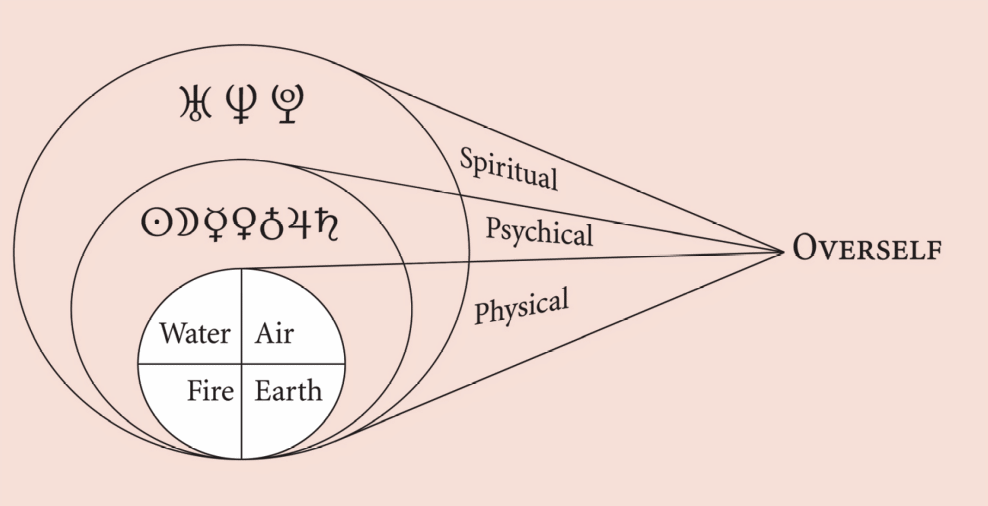
FIGURE 1982 1009b-1. The Overself and Spiritual, Psychical, and Physical Subjectivity.
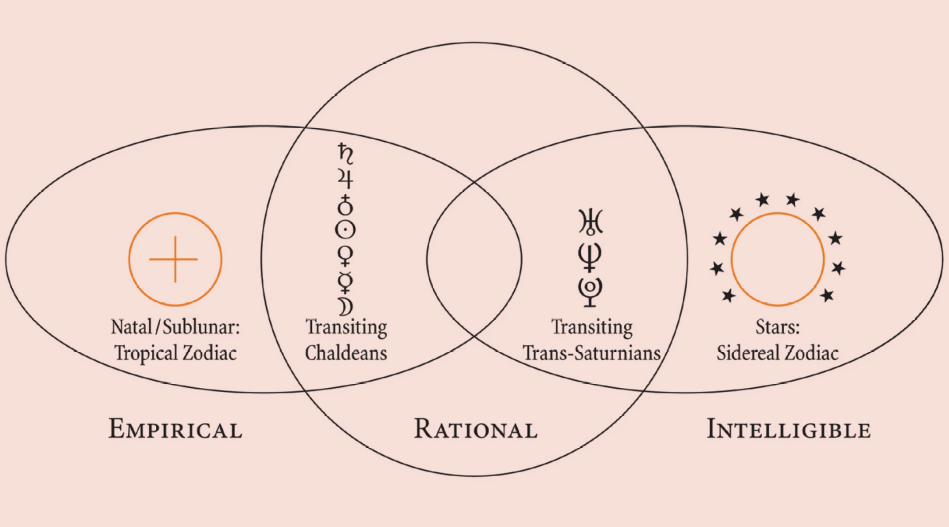
FIGURE 1982 1009b-2. Levels of the Cosmos – The Natal Chart, Transiting Chaldean Planets, Transiting Trans-Saturnian Planets, and Stars (Sidereal).
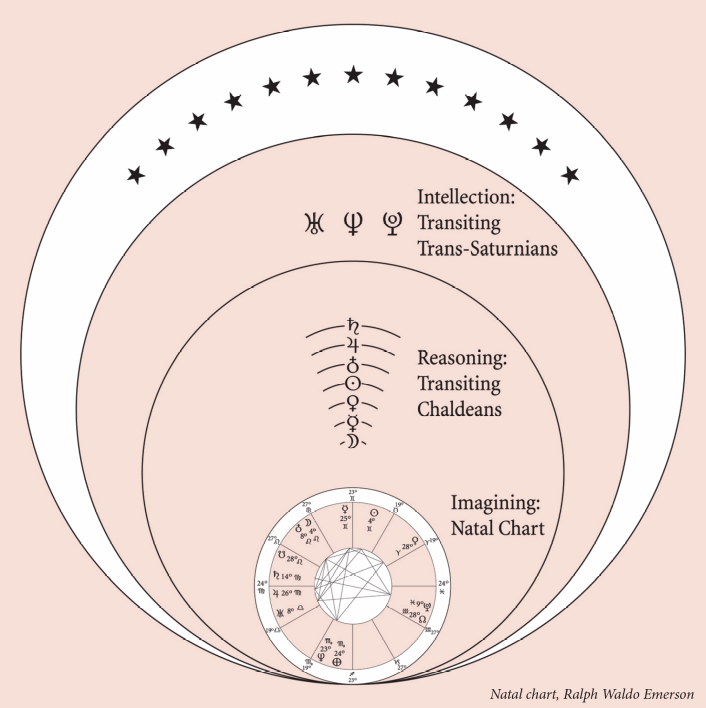
FIGURE 1982 1009b-3. Three Levels of the Cosmos and Astrology.
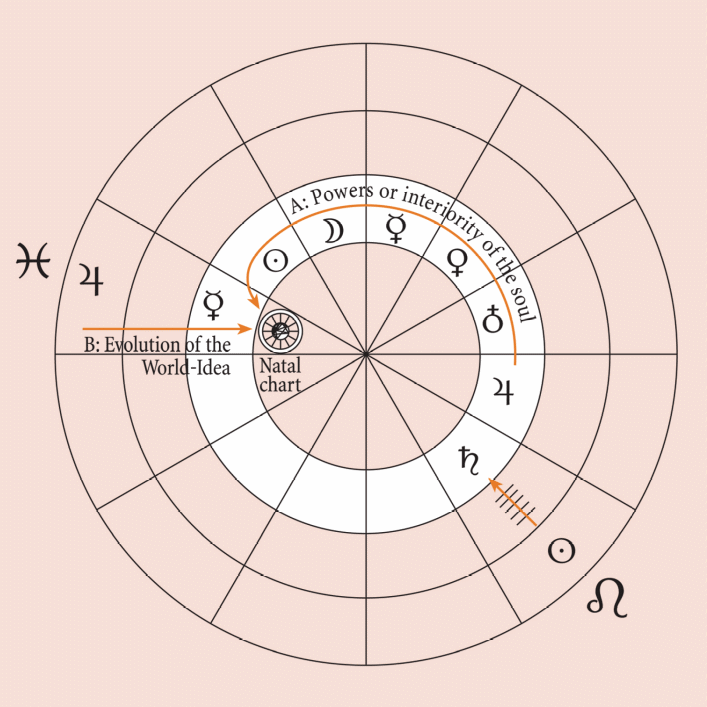
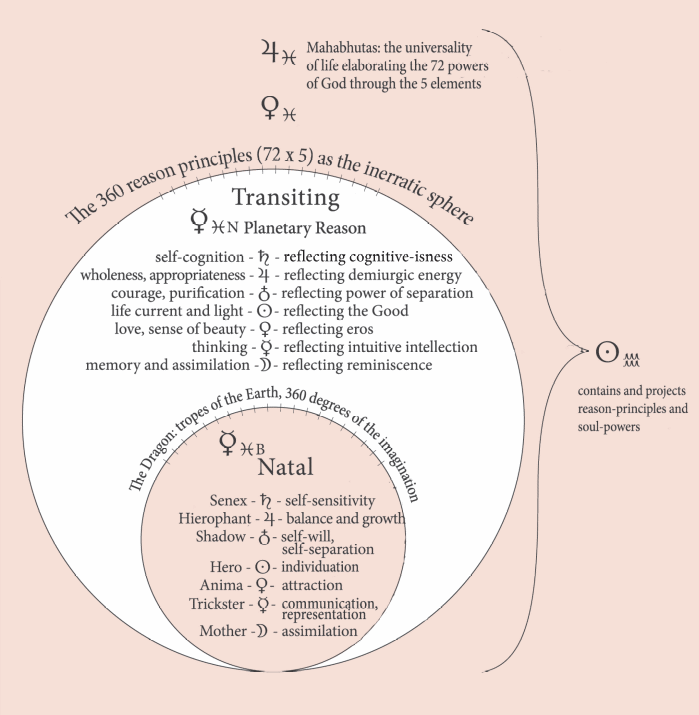
FIGURE 1982 1009b-4. Two Streams of Soul.
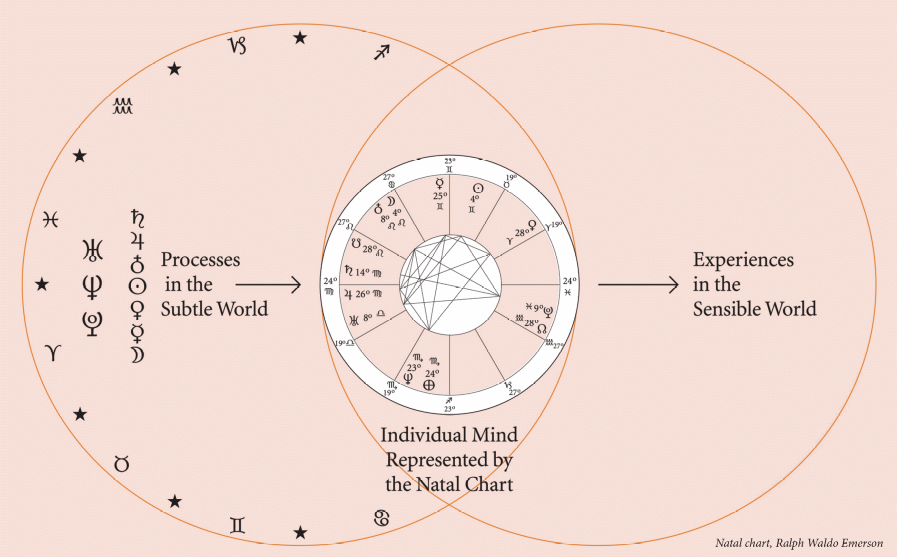
FIGURE 1982 1009b-5. Individual Mind Transforms Subtle Forces of the World-Mind into Our Experience.
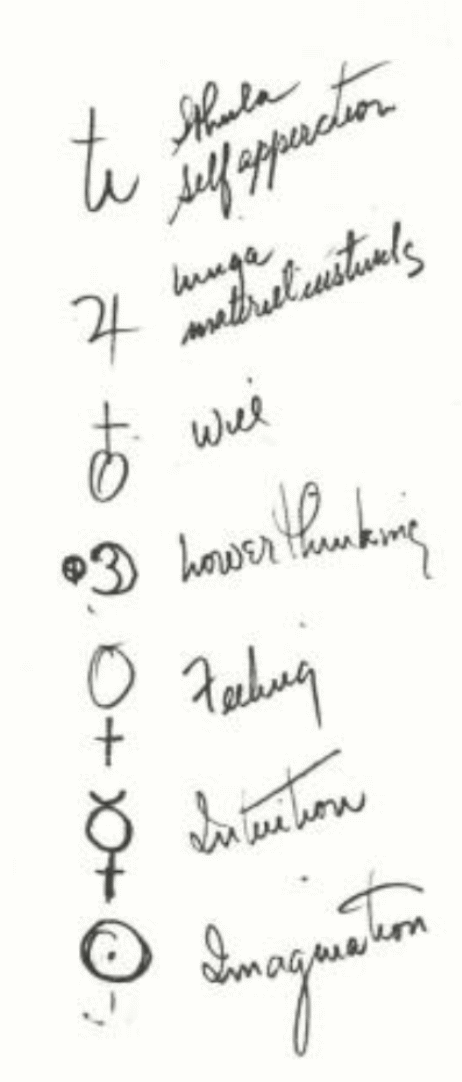
FIGURE AD_D_038. Categories of the Imagination.
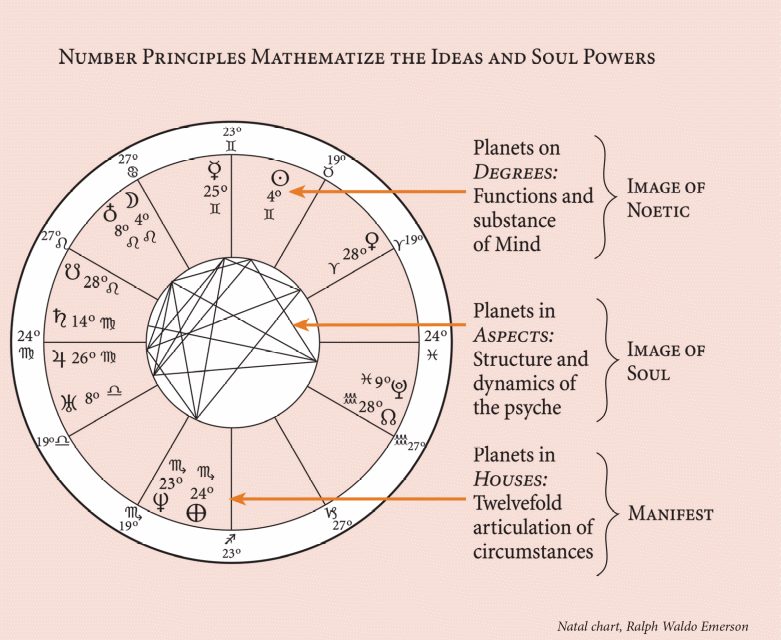
FIGURE 1982 1009b-7. A Suggestive Schema of the Components in a Natal Chart – Numbers, Planets, Degrees, Aspects, Houses.
FIGURE 1982 1009b-8. Sun in Aquarius and Twelfth House, with Jung's Archetypes and Planets.
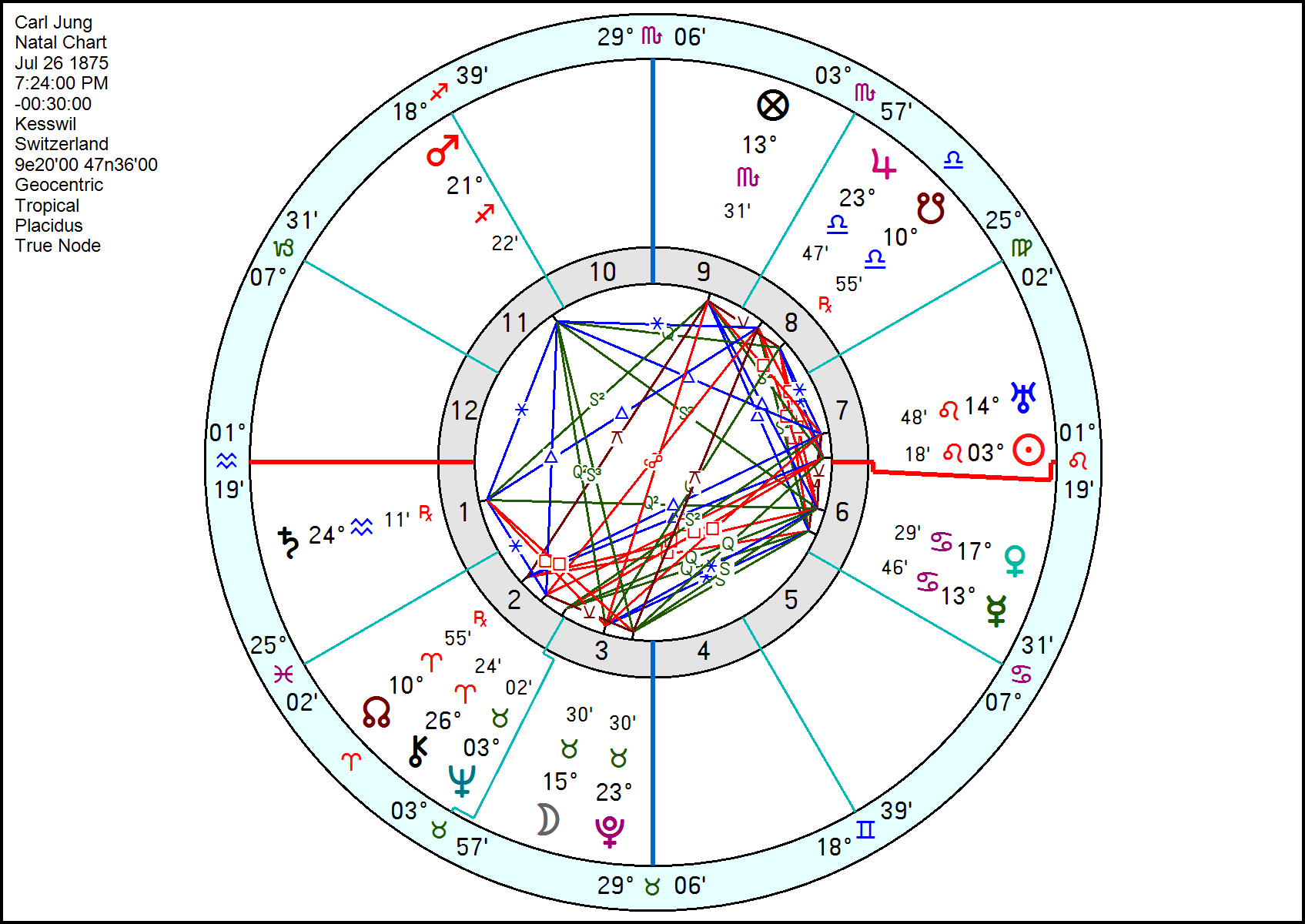
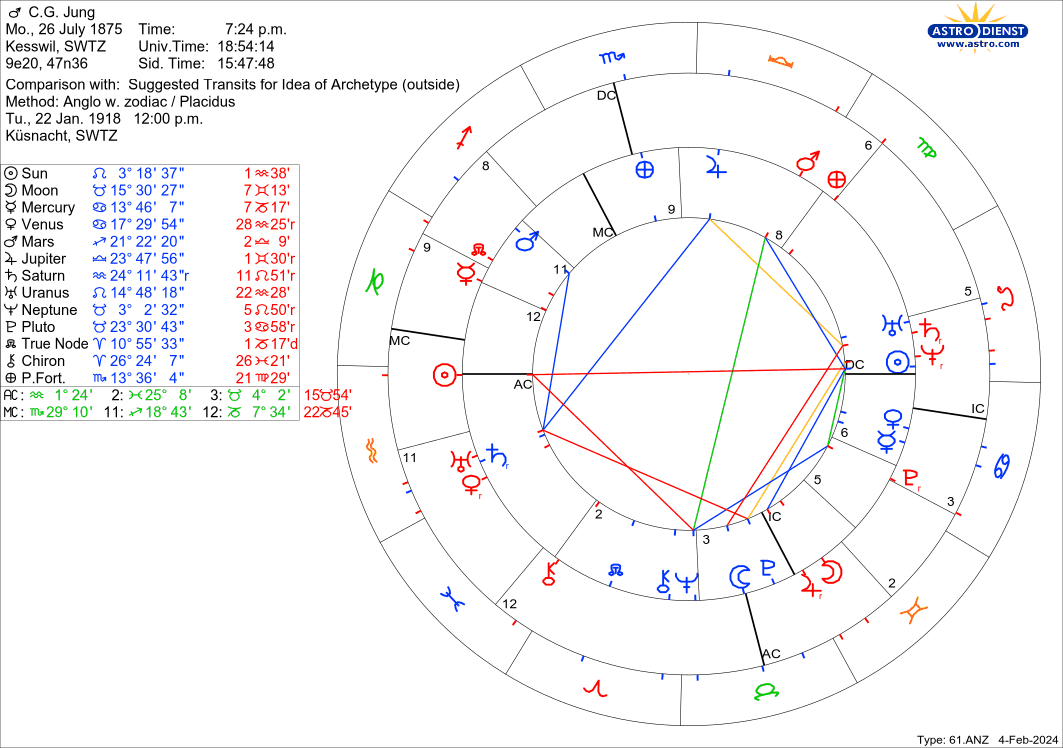
FIGURE 1982 1009b-9. Carl Jung Natal Chart (astro.com).
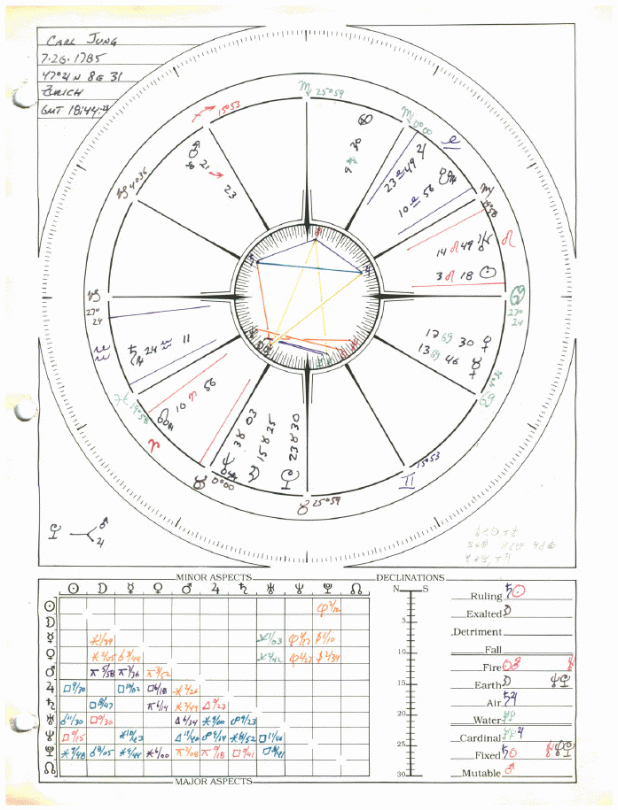
FIGURE 1982 1009b-10. Carl Jung Natal Chart (WG version).
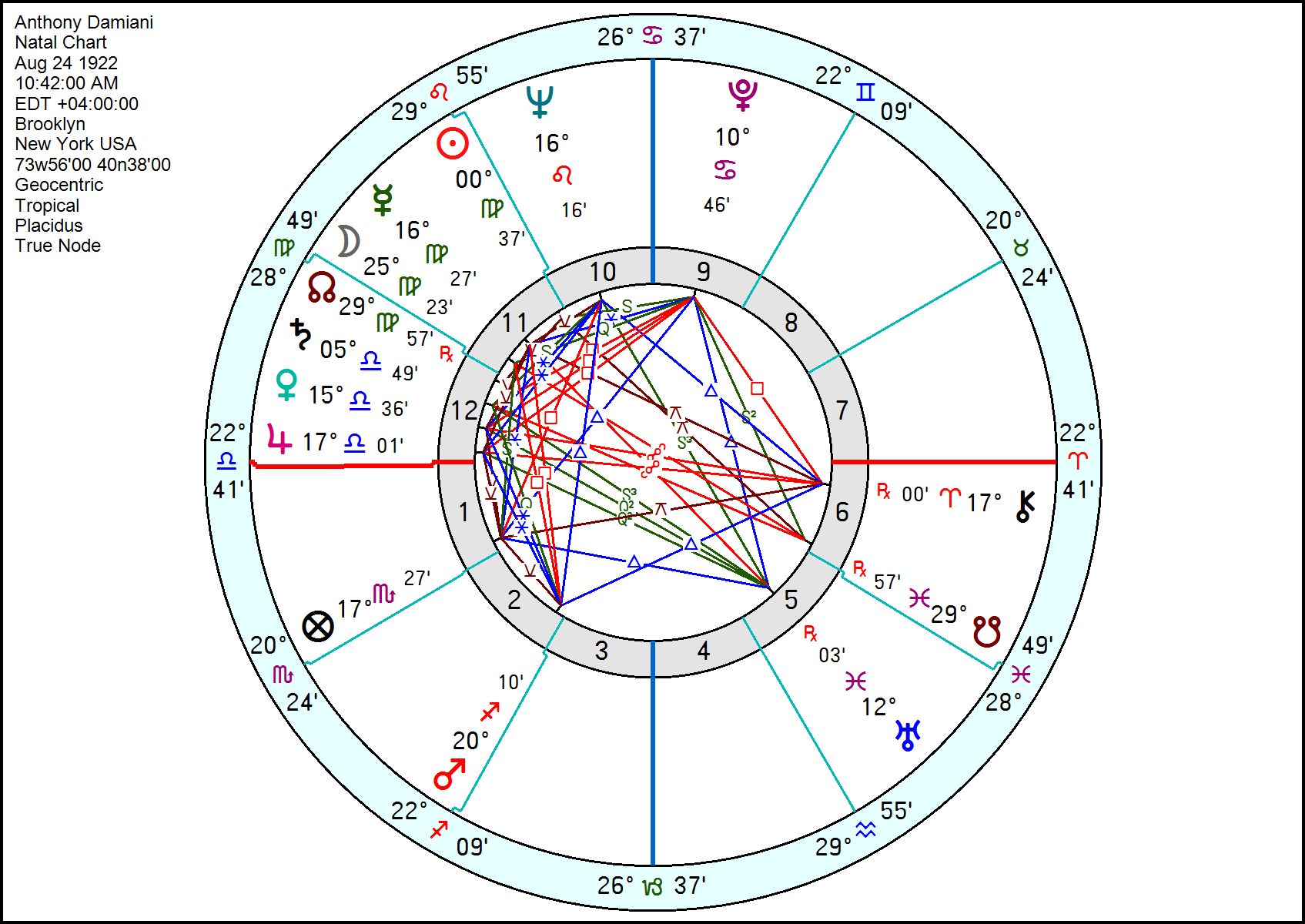
FIGURE 1982 1009b-11. Anthony Damiani Natal Chart.
FIGURE 1982 1009b-12. Jacob Bryant's Orphic Egg (1774) and Ananke.
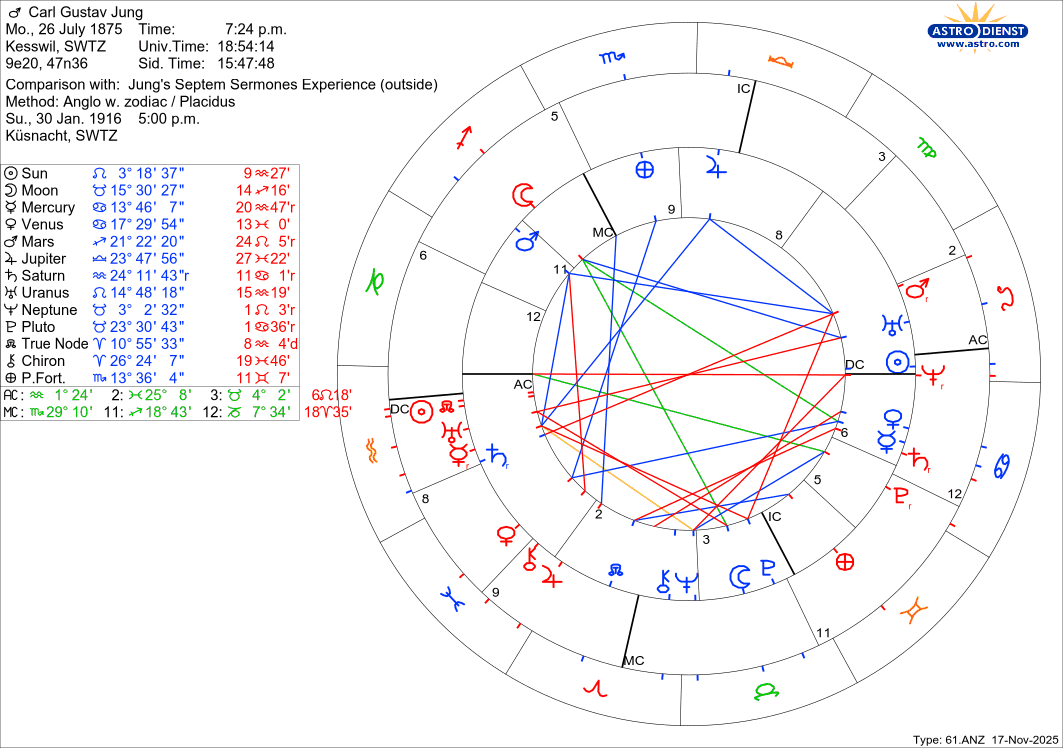
FIGURE 1982 1009b-13. Transits for Jung's Septem Sermones Experience.
FIGURE 1982 1009b-14. Suggested Transits for Idea of Archetypes.
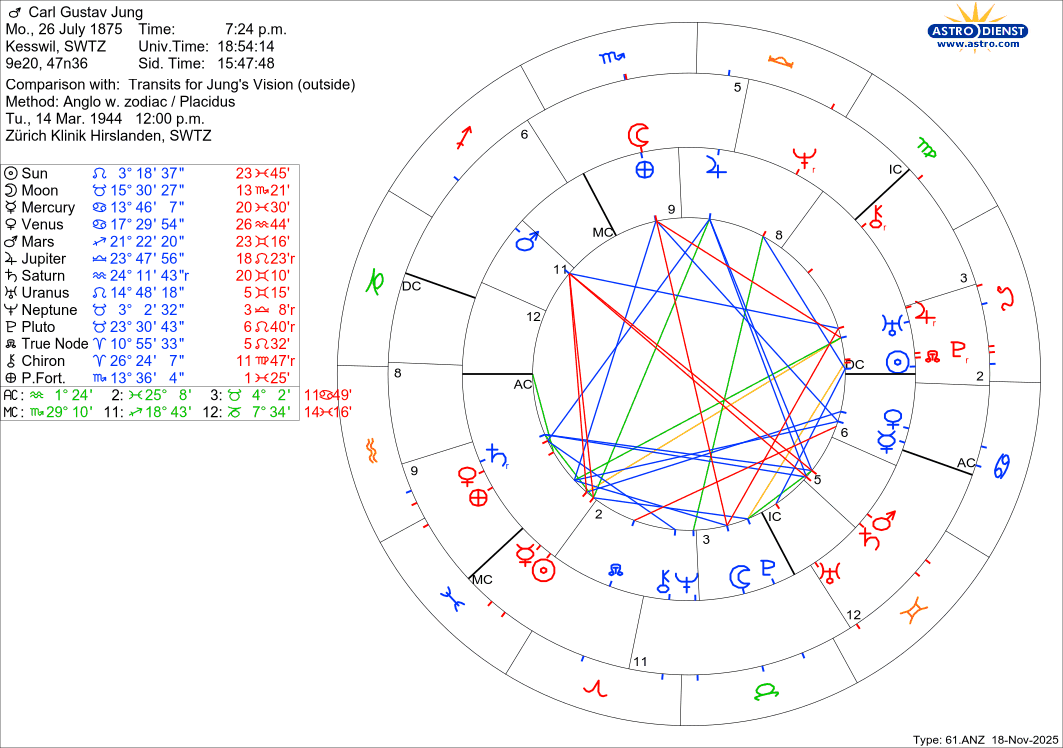
FIGURE 1982 1009b-15. Transits for Jung's Vision of March 14, 1944.
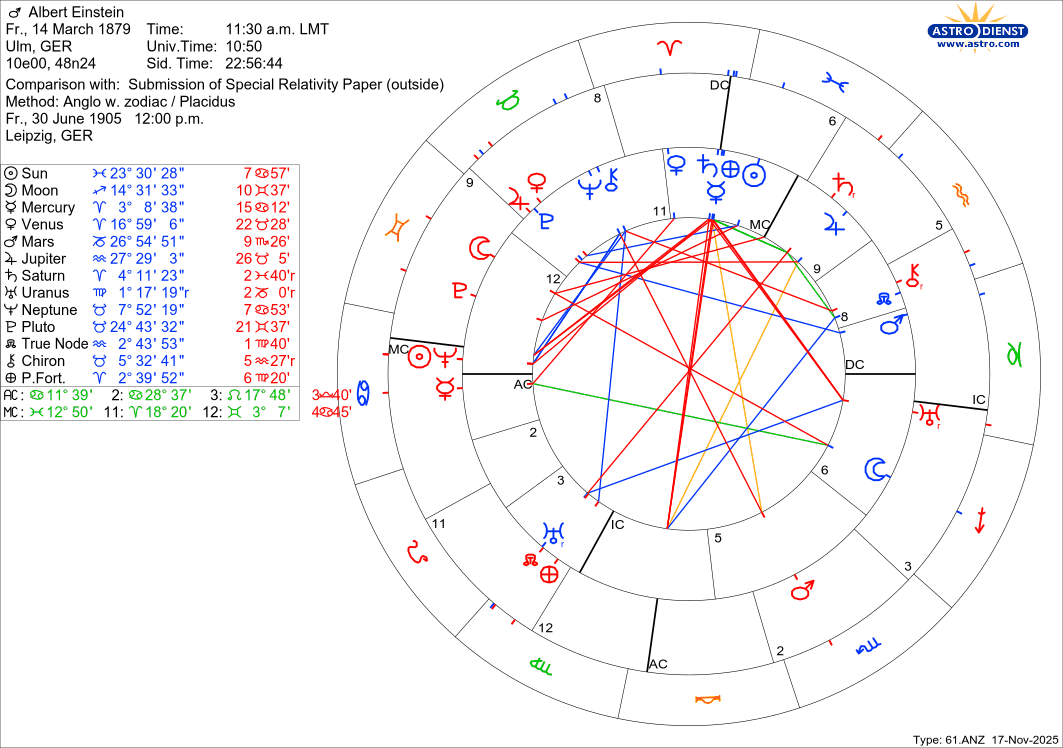
FIGURE 1982 1009b-16. Transits for Submission of Special Relativity Paper.
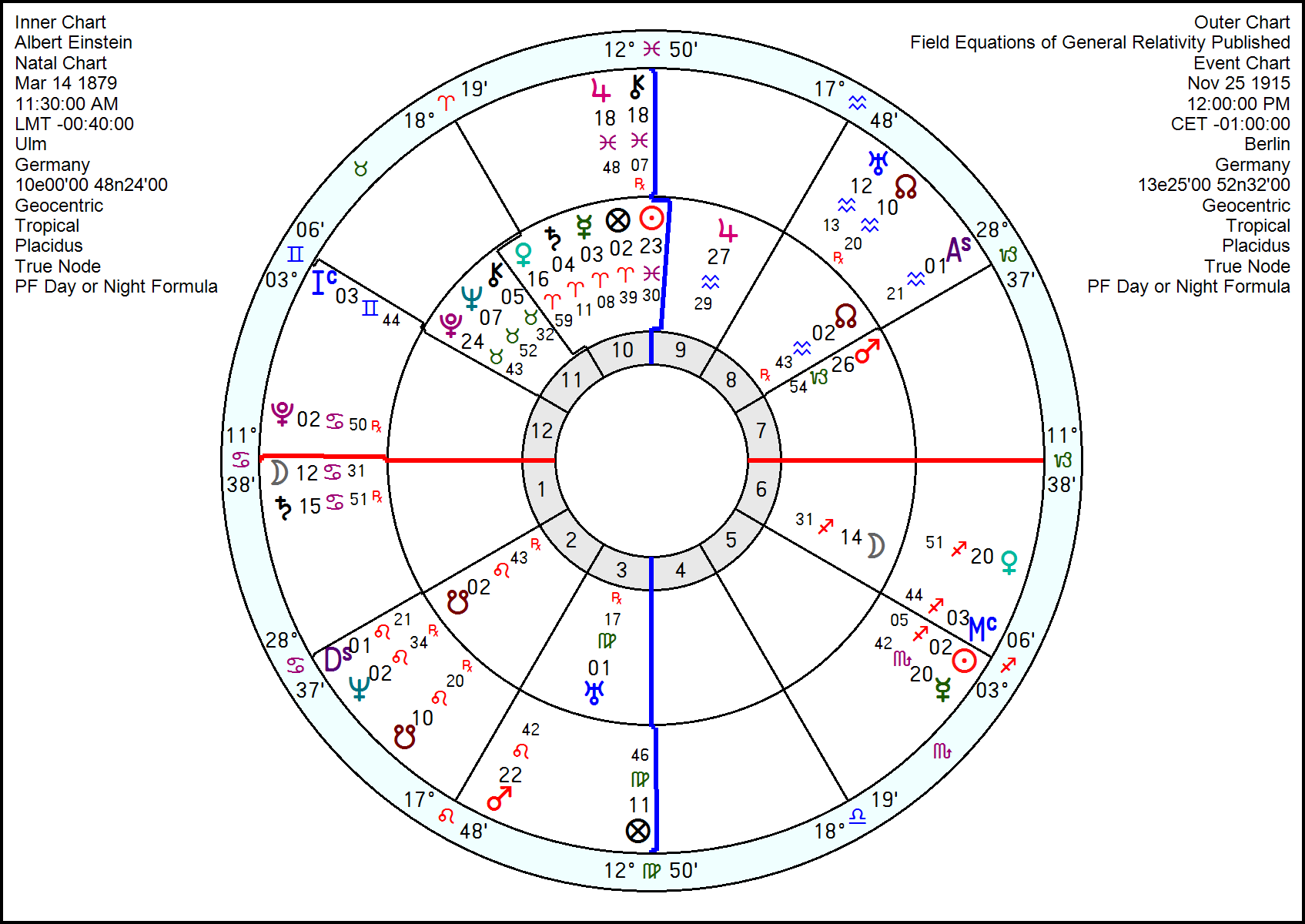
FIGURE 1982 1009b-17. Transits for Publication of General Relativity Field Equations.
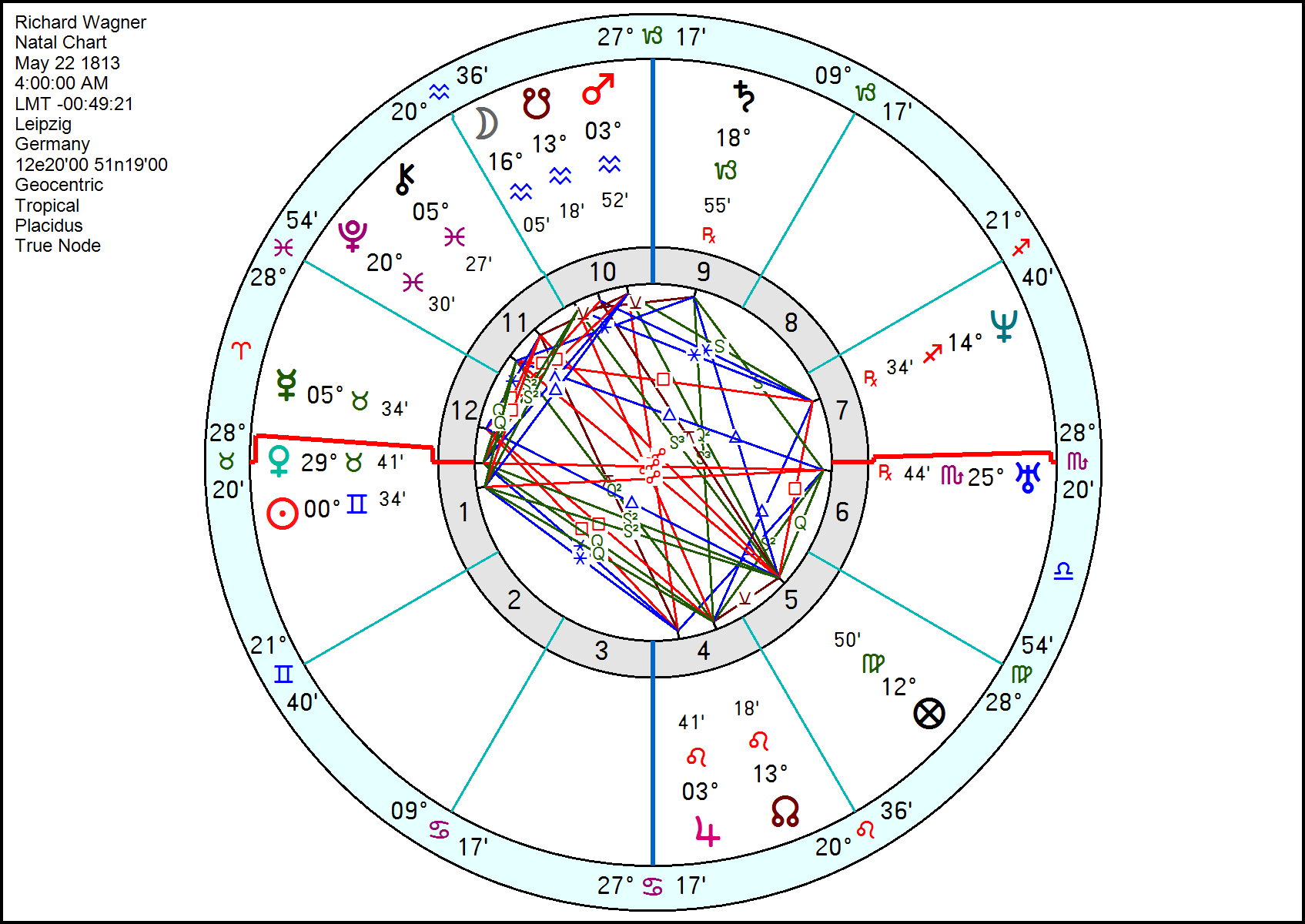
FIGURE 1982 1009b-18. Richard Wagner Natal Chart.
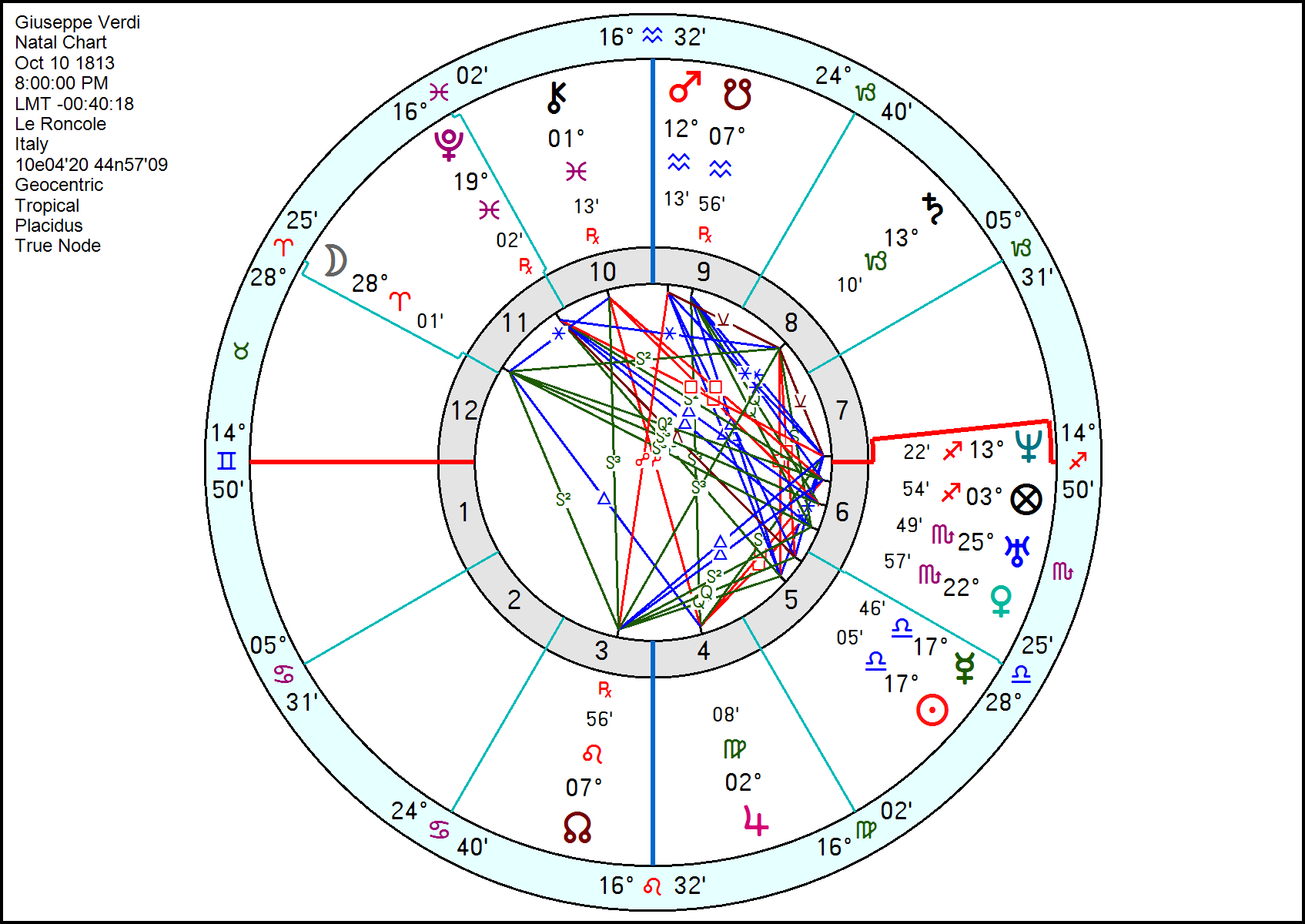
FIGURE 1982 1009b-19. Giuseppe Verdi Natal Chart.
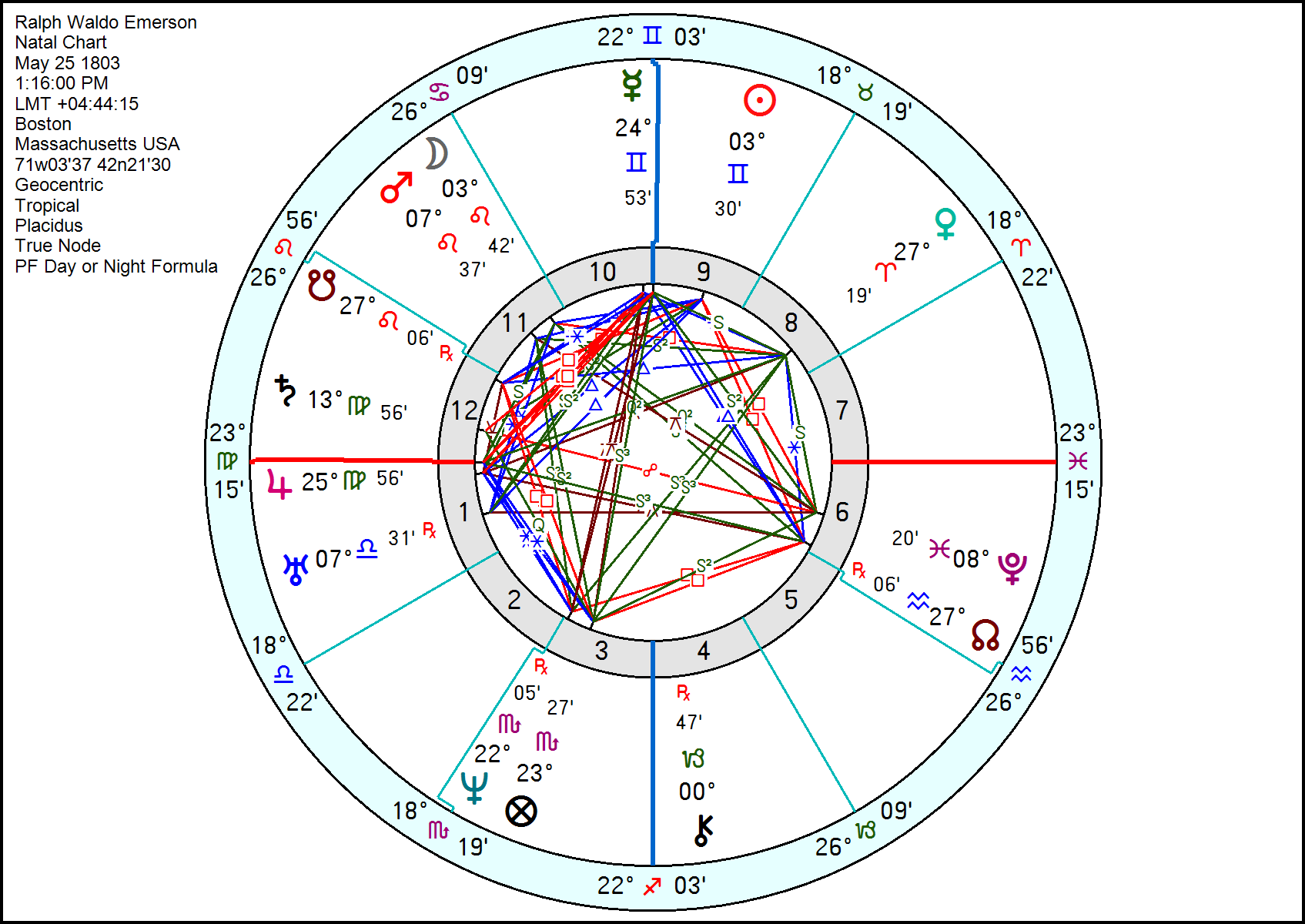
FIGURE 1982 1009b-20. Ralph Waldo Emerson Natal Chart.
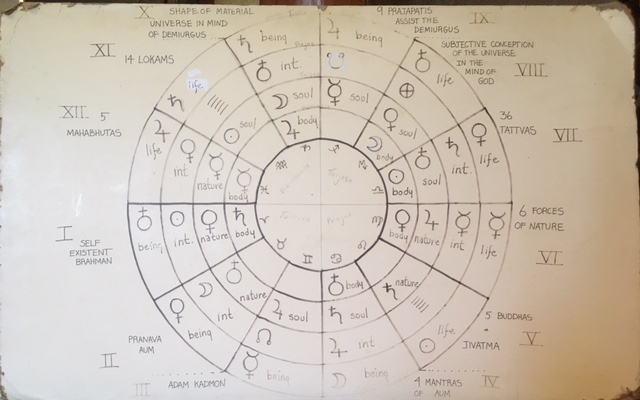
FIGURE IMG_2202-Posterboard Metaphysical Chart.
Other diagrams also referred to are not with this transcript version. [Transcriber note: [diagram] means the speaker is referencing a diagram as he or she is speaking. If someone is drawing or writing, with audible sounds of chalk on a blackboard, I indicate this by [drawing] or [writing].]
AD PAPER read in class:
- "Reading a Chart". Retyped from Scan File ASL Reading a Chart P 25p.PDF. This paper was written for a presentation by TS at an astrology conference connected with the Digicomp DR-70 Astrology Minicomputer. The first part (on astrology theory) was written by AD (Anthony Damiani) and AS; the second part (on Jung's chart) was written by AD and TS. This paper used to go by the name "Jung Paper". Portions of this paper's precursor are read and discussed in WG Astrology Seminar 1982 0717a, and it is also briefly discussed in WG Seminar 1983 0829b Astrology; Horoscope-Wagner. This paper has also been retyped as ASL Astrology - Theory - Reading a Chart V09MP and a version of it can be found in Astronoesis, in "Astrology: The Topography of the Subtle World".
NOTES:
This is the Astrology portion of the weekend and runs from the evening session of Sat. Oct. 9, 1982 through Sun. Oct. 10. See 1982 1009a PB Paras; Ego for the first part of this Columbus weekend. It is possible there was a Friday night session (1982 10/08), but there are no audios for this as of 2023.
Some mislabeling of Audio Files (see below). Verified corrected date info from AD Blue Book & Events Master spreadsheets.
TRANSCRIBED Verbatim by IT prior to 2018; reformatted by jf 2018. In 2023, IT updates prefatory matter and footer, expands Subsubjects, fixes/completes Book List, adds Plotinus quotes section, fixes errors/typos, adds new notes within transcript, redoes diagram section by removing all previously appended diagrams and adding twenty-one new diagrams and references within transcript to these diagrams, reformats to accord with new conventions. In 2025, IT updates audio file markers to match new REP audio. Archival verbatim transcript with AD Paper – V12ap.
AUDIO FILES: 1982 1009c(2), d, e, 1982 1010a, b, c (formerly 1982 1019c (second part), d, 1982 1009a, 1982 1010a, b, c respectively). [Note 1: "Tape" and "Side" refer to original audio cassette tapes that were later digitized into .MP3 Audio Files. Note 2: In 2024-25, REP Studio splits Audio File 1982 1009c into c(1) and c(2), tries to reduce background static on both, cuts dead air from Audio Files 1982 1009c(2) and 1982 1010a, puts Side 1 first in Audio File 1982 1009e. Note 3: A few minutes of Audio File 1982 1009c(2) are speeded up.]
| NEW FILE NAME | OLD FILE NAME |
| 1982 1009c(2) | 1982 1019c, second part |
| 1982 1009d | 1982 1019d |
| 1982 1009e | 1982 1009a |
| 1982 1010a, b, c | 1982 1010a, b, c |
1982 10/09b Class Held in Columbus, Ohio (Day 1 of 2-Day Event; Evening)
Astrology; Theory
[Audio File 1982 1009c(2) (formerly 1982 1019c, second part) Begins]
S: --last week?
AD (faint): Yeah.
S: Were you referring there to the imagery that lies within somebody [AD simultaneously: The body.] that had the Sabian symbols?
AD: The body.
S: Within the body? [short pause] The body of the world?
AD: Your body.
S: The physical body, right.
AD: Yeah.
S: Yeah but--
AD: It has an image-activity, the ego is capable of making images. The body-based ego can make images. You know that when you were sleeping.
S: Oh, yeah. Big time imagery.
AD: But, I'll ask Tim to read the paper very slowly.
S: Yeah.
AD: And we'll try to explain it as we go along, ok?
TS: Well this quits a lot sooner than--
AD: This quits a lot sooner?
TS: [flipping through pages] (Well/No) don't ask (instructions).
AD: Hm?
TS: [flipping through pages] Ok, well I'll get the rest.
AD (simultaneously): Well he'll start with the first few pages, ok.
TS: Ok.
AD: First-- first few pages. The philosophy is more important [S simultaneously, faint: Than the transit(s), yeah.] than you think.
TS: I had the rest of it. I thought June typed the rest of it out.
AD: Hm?
TS (simultaneously): Well-- I thought June had typed the rest of it.
AD: Oh no.
TS: Well ok, well ok.
AD: Tim read this at an astrological conference by the way. I don't think anyone understood it but then again it doesn't matter. (AD laughing)
[short pause]
[Transcriber note: The following paper, titled "Reading a Chart," was written for a presentation by TS at an astrology conference connected with the Digicomp DR-70 Astrology Minicomputer. The first part (on astrology theory) was written by AD (Anthony Damiani) and AS; the second part (on Jung's chart) was written by AD and TS. This paper used to go by the name "Jung Paper". Portions of this paper's precursor are read and discussed in WG Astrology Seminar 1982 0717a, and it is also briefly discussed in WG Seminar 1983 0829b Astrology; Horoscope-Wagner. This paper has also been retyped as ASL Astrology - Theory - Reading a Chart V09MP and a version of it can be found in Astronoesis, in "Astrology: The Topography of the Subtle World".]
AD Paper ["Reading a Chart," TS reading]: "The central purpose of this paper is to propose a specific viewpoint towards astrology and human nature. Basically we wish to put the interpretive art of astrology on a sound philosophic footing, rather than relying solely on the body of traditional empirical knowledge for our meanings. Hence this paper begins in the abstract and moves towards the concrete as a specific illustration of the abstract. The illustration has two parts, first an interpretation of Jung's natal chart [TS reads: horoscope], and then an exploratory [TS reads: explanatory] look at a few major transits in Jung's life. The philosophical [TS reads: philosophic] proposal basically is suggesting that there are three grades of subjectivity in man, one empirical, one perpetual and one eternal. [Note: See FIGURE 1982 1009b-1, The Overself and Spiritual, Psychical, and Physical Subjectivity, appended to this transcript. This diagram is from Astronoesis, p. 277.] These three subjects are in all our experience and hence in the chart. In fact, the paper will suggest that astrology is uniquely structured to reveal these grades of subjectivity."
TS: That's just for the preface.
AD: Preface? Alright, we'll give you one paragraph at a time?
TS: Well this has already been changed.
[Note: See FIGURES 1982 1009b-2, Levels of the Cosmos -- The Natal Chart, Transiting Chaldean Planets, Transiting Trans-Saturnian Planets, and Stars (Sidereal), and 1982 1009b-3, Three Levels of the Cosmos and Astrology, appended to this transcript for the following. These diagrams are from Astronoesis, pp. 273 and 271 respectively.]
AD Paper ["Reading a Chart," TS reading]: "It is our belief that the astrological mandala is a fragment of an archaic wisdom, and was [TS reads: that it was] devised by the profoundly wise sages of the past. This mandala of the signs and planets is a rare instance of -- and product of -- the archetypal imagination; it presents the topography of the subtle world through the forms available in sensible becoming. This root symbol of astrology represents a formulation by reason principles of a symbolic method through which those very reason principles are being manifested. Reason principles are those living meanings or categories of thought that are the substantial forms of the soul. Here we are stating that the totality of these categories of thought, or reason principles, are being arranged and combined in an indefinite variety of ways by the intermediary powers of the soul according to the Ideas in the Zodiac. This perpetual act of the soul produces the invisible physical reason principles which are then"inserted" into matter and which evolve and develop into material species. These species will therefore inherently contain them and manifest those very reason principles in their perceived world. It is these reason principles projected into physical circumstances that are the very understanding one must assimilate in order to become the knower, the higher soul."
RW: Are we allowed to ask questions or--
AD: Yeah, I think-- I think it's best to read one paragraph and [RW simultaneously: Ok.] then stop and ask questions, ok? Tim translate, Tim. Please, go ahead.
[22½ second pause while AD draws]
RW: Ok. Start back just about a line before the categories of thought--"This symbol of…"
AD Paper ["Reading a Chart," TS reading]: "This root symbol of astrology represents a formulation by reason principles [RW: Ok.] of a symbolic method through which those very reason principles are being manifested."
RW: Ok, so the reason-principles or the degrees are being manifested through this astrological mandala. Ok, now me-- my next-- my next question's coming up now.
AD Paper ["Reading a Chart," TS reading]: "Reason principles are those living meanings or categories of thought…"
RW: That's it.
TS: Yeah, that's the part I made up. (laughter)
RW: That's it right there! (RW laughing)
AD: What did you say?
TS: That's the part I made up. (laughter, AD laughs, student words)
AD: He's-- he's alright, he understands, don't let him (fake), go ahead, read it.
RW: Oh.
AD Paper ["Reading a Chart," TS reading]: "Reason principles are those living meanings or categories of thought that are the substantial forms of the soul."
TS: Uh--
RW: Ok now the-- if the reason-principles are the degrees, are these-- and you're calling them categories of thought, I just need a clarification what you mean "categories of thought" at the degree level.
AD: Same thing, it's a reason-principle.
TS (simultaneously): I was just trying to use a different word because reason-principles might not be a clear use. We talked about (four/form)--
RW (simultaneously): Ok, but [couple words inaudible] I'm so used to hearing "categories of the imagination".
TS: Right, that would be these [diagram].
RW: Yeah, ok.
TS: So they would be-- prior to that they would be that which (in-structured), you know, [RW simultaneously: Ok.] the-- the meanings or ideas that are going to be manifested in the psyche, [RW simultaneously: I see.] and in these-- these categories-- these categories of the imagination are going to try to image those categories of [RW simultaneously: Of thought.] thought or i-- or reason-principles.
RW: I assume that's what you're saying but when you said "categories" my presuppositions got stuck down there [diagram]. Go ahead.
TS: Um--
AD Paper ["Reading a Chart," TS reading]: "Here we are stating that the totality of these categories of thought, or reason principles, are being arranged and combined in an indefinite variety of ways by the intermediate powers of the soul according to the Ideas in the Zodiac."
S: I (couldn't--)
RW (simultaneously): So wait a minute.
S: Yeah [couple words inaudible]
TS: That's a popular one.
RW: But--
TS (faint): Go ahead (Red).
RW (simultaneously): Ok, now we got--
AD (very faint): [one word inaudible]
RW: Oh ok, alright I'm listening.
S: I want to know the intermediate powers of the soul, is that the seven--
S: Planetary spheres?
RW: Yeah, that would be a--
S (simultaneously): So that's the soul there, is that what you're talking about?
AD: Why don't you shut that air conditioner and open the door.
[couple students assent]
RW: Kick out a window.
AD: Kick out a window, [student assents] (RW laughs) and stop breathing. (AD laughs, some laughter)
S: Breathing?
TS: Get some cigarettes [couple/three words inaudible]
[short pause while TS draws]
TS: So we're saying, Joan, [S simultaneously: Yes.] these-- [drawing] here are these reason-principles up here [diagram], [student assents] ok, and there's 360 of them (embedded), ok. And then the Uranus, Neptune, and Pluto are out there too [diagram], (don't mind me), ok, we'll get to them. [S: Ok.] But these rational soul powers or the seven transiting planets [diagram], ok, which is-- these are the planetary spheres which are always in motion, ok, so they are representative of powers of the soul which are-- oh dear-- which are going to actualize or-- not actualize, form an image of these reason-principles which will be manifested in the psycho-somatic organism.
S (very faint): Ok.
AD: Let me say this. When you think of the Zodiac, [TS drawing] it's an enormous circumference. And within-- within that circumference you have to locate many many solar systems, many many planetary spheres, alright. You have all kinds, binary, trinary. But we're only interested in our solar system and consequently we're only concerned about the way our planets revolving around the Sun, our Sun, which is an integrated solar system in its own, alright. We're only interested in that. We're not concerned about the fact that within the range of the constellations, alright, you might have millions and billions of other systems, we're not concerned. We're only concerned about our own solar system. Within our solar system, the Sun, which let's say is a soul, a cosmic soul, has its own powers, planets represent its powers, ok? Try to-- try to keep that [student assents, faint] framework in mind. In some other solar system something else may be evolving. But the degrees of the Zodiac are tremendous, I mean, you're speaking about 365 degrees. In modern physics they might refer to them as field forces. So, we won't-- we won't get into that right now.
[short pause]
TS: Ok.
S (faint): (Uh-hm.)
TS: Uh--
AD: So, what Tim was saying was that these planets here [diagram] combine the various degrees, alright, in a plu-- indefinite plurality, alright, and produce over here [diagram] the entities or the creatures. Ok?
RW: Is there any mathematical limit to this plurality?
AD: No.
RW: Ok.
AD: As a matter of fact there's one interesting statement in PB's notes, he says that the World-Mind, and he's speaking about our world, is constantly manifesting an infinite variety of men. [RW: Uh-hm.] And that's part of the meaning, it's trying to express itself, so every variety of man is manifested. [Note: See Paul Brunton, Notebooks, V16, 25:1.157 and 26:1.145.] Alright let's-- let's try.
AD Paper ["Reading a Chart," TS reading]: "This perpetual act of the soul produces the invisible physical reason principles which are then"inserted" into matter and which it will…"
TS: I'm sorry.
AD Paper ["Reading a Chart," TS reading]: "This perpetual act of the soul produces the invisible physical reason principles which are then"inserted" into matter and which evolve and develop into material species."
TS: So-- [S: Jupiter.] this is the perpetual act of the soul [diagram], ok, 'cause this-- the-- the rational soul is per-- always in motion. So it's translating these reason-principles or Ideas [diagram] and manifesting them in the psycho-somatic region, in the body, in the psyche here [diagram], and in particular it's manifesting them in material species. So like you might see certain qualities in some animals, much less in individual human beings, or much more so in individual human beings. So actual physical circumstances here [diagram] would be structured by these-- these reason-principles, ok, and what ins-- what does that structuring process is this-- these functions or powers of the rational soul. [10½ second pause] I better say it again?
AD: No, go on. The most you can get is a glimpse in one shot, so-- we'll go on. If there's something that disturbs you, just ask a question. That scheme too.
[short pause]
TS: Um--
AD Paper ["Reading a Chart," TS reading]: "It is these reason principles projected into physical circumstances that are the very understanding one must assimilate in order to become the knower, the higher soul."
AD: How was that?
S: You take it again?
RW: Uh-hm.
AD Paper ["Reading a Chart," TS reading]: "It is these reason principles projected into physical circumstances that are the very understanding one must assimilate in order to become the knower, the higher soul."
[student assents, very faint]
TS: What we said about that is that [drawing] if this is the knower [diagram], and it's represented possibly by Uranus, Neptune, and Pluto, ok, then these reason-principles are imaged forth through the functions of the rational soul, manifested in space-time consciousness in the empirical, ok. But then it's only when they're here [diagram] that they become a content to this knower, ok. So then as they are known here, they are then assimilated back up to this knower. So this is the subject or consciousness, and then this is the content of that consciousness fully manifested.
(Side 1 of original cassette tape digitized as 1982 1009c(2) (formerly 1982 1019c, second part) Ends; Side 2 Begins)
TS: --or of the circumstances, his personality, yeah.
AP: So then [couple/few words inaudible] knows right in the beginning, right, before [one/two words inaudible] doesn't it?
AD: I didn't hear you, what did you say?
TS: It knows-- she says that doesn't this knower know these reason-principles prior to them being projected?
[10¾ second pause]
AD: Yes.
AP: But it needs to know in-- through the empirical. [S: Yeah but--] The empirical subject has a goal for it, it has a-- it has a need for the empirical subject or--
[short pause]
AD: Try again Anna, I didn't hear you right.
AP: Like the (goal/role) of the empirical subject, when the empirical subject understands something, say, you said it-- it is through the empirical subject that the knower of that knows or experiences.
AD: Remember what was said this afternoon was that the ego is what ultimately tries to find Nirvana.
AP: Yes.
AD: And, we said that the-- we said that the Overself has to create or make, fabricate the image of the world, and the ego, its representation, in that world. So in order for the soul to do that or the Oversoul to do that, the willing, feeling, and knowing, alright, that, let's say, represents a triple aspect of the soul, the willing, feeling, and knowing, the [AP assents] trans-Saturnians, they're producing or they're fabricating this imaged world for the soul, for each individual soul. So my soul is making the image of the world for me with its ego in that world, and then it must bring that ego to a point of fulfillment. Do you remember [AP assents] when we spoke about the ego has to reach Nirvana. Now, that's not going to help up there because those are the Ideas that the willing, feeling, and knowing is going to work with. And the rational powers of the soul are going to combine those Ideas, alright, make the object here and the subject, the three trans-Saturnians, are going to know it. So it isn't that the trans-Saturnians are involved in the beginning. In the beginning what's involved is the rational soul powers combine the Ideas and try to produce the imaged world, alright, and then the higher subject comes into operation. It beco-- this [diagram] becomes a content to that higher subject, the higher-- the trans-Saturnians.
AP: But does it need-- I mean does [AD simultaneously: Huh?] it need, the higher subject, the person, the empirical person? Does it get enriched by it?
AD: Does the higher person--
AP: The higher subject, the higher knower, does it get enriched by the empirical, the understanding of the empirical subject?
[short pause]
AD: Well-- Well I would think that it's the ego that's going to get enriched by what the higher subject or the triple powers bring into it and not that the higher powers-- I mean, the higher knowing gets enriched.
AP: No, yes.
AD: I figure it's the ego that has to be enriched.
AP: Yes.
AD: So that as more and more is brought into the ego's point of view, into its world, alright, the more it becomes-- the more comprehensive it becomes, the greater its understanding is bru-- is (raw/wrought).
AP: So what is changing is in the realm below. Why would you say things change in that scheme, why is it change(d)?
AD (simultaneously): Why is the ego being changed?
TS: Right.
AP: Just down there [diagram] that changes go on?
AD: Yeah. All the time. [short pause] Let's try going over that.
[56 second pause with some very faint mostly inaudible background talking between AD and TS]
TS: Where it says--
AD Paper ["Reading a Chart," TS reading]: "It is these reason principles projected into physical circumstances that are the very understanding one must assimilate [AD: Yeah.] in order to become the knower, the higher soul."
TS: Now--
RW: Oh.
TS: Would you say this, that it is in the nature of the soul to manifest or evolve its content, its-- its-- it-- the forms that are inherent in it have to be unfolded or elaborated, and that's part of the sort of essence of the soul is that it manifests its content. And that for that content to be fully-- fully actualized it must be explicitly as a content to itself, and this content being the ego. So that ego's subjective states and knowledge must conform to the soul's original vision.
[short pause]
AD: Yes. Maybe-- maybe we could make it very comprehensive by going back to the original premise, although I-- you know, we left this all out of the paper because that would be too vast an introduction. This is supposed to be a very abbreviated introduction. What we're saying is that the soul contains the whole of the Intelligible World within itself. And so the soul must produce the idea of the world for every individual. So my soul will produce the idea of the world for me, and produce me with-- included in its idea of the world. Alright? [student assents] That's the first point.
Now the second point is that in order for the soul to do that, its powers, that is, the powers of the soul, has these reason principles which it combines in-- in various ways, you know, like an algebraic formula, and produces its idea of the world, and included in its idea of the world it's the ego which is going to be a channel or a representation of the Overself. So then the ego, so to speak, will be a product of the soul's functioning as well as the idea of the world which that ego is living with, alright.
Then the next point will be that the powers of the soul, the seven planetary spheres, are combining the various reason-principles which we locate in the 360 degrees, and creating the psycho-somatic organism, which we're calling the categories of the imagination that combine the psycho-somatic organism. And now this very creature that it created, alright, on the one hand it based itself on the Ideas, took the Ideas to make this man, and then this man is himself a manifestation of the Idea of Man. [student assents] So that on the one hand the soul has the reason-principles to produce the man and then the man, alright, through his own evolution and unfoldment realizes that he is Man. So, on the one hand, he's made by the Ideas and on the other hand-- naturally with the soul's powers, but on the other hand, he's not only a manifestation of the Idea of Man, but he is that actual Idea. [student assents] You are the Idea of Man, alright, materialized, if we can put it that way.
Alright now, the point would be-- point that she brings in was something, does the-- she says, does it enrich-- does it enrich the higher soul powers or the-- the higher knower, not the soul powers. In other words, does it in any way enrich the Saturn in Leo? No, it doesn't enrich the Saturn in Leo, he's not going to-- The Overself is already to begin with, alright, in no need of that. So evidently the one who is in need of that enrichment is the ego and the whole--
TS (simultaneously): Mercury in Pisces? [Note: See FIGURE 1982 1009b-4, Two Streams of Soul, appended to this transcript. This diagram is from Astronoesis, p. 267.]
AD: Yeah, Mercury in Pisces. So the whole point is that as the ego or the en-- the psycho-somatic organism is built, alright, [student assents] that Ideas are poured into it and, through the functioning of the planetary spheres, the Ideas are made available to the ego and at times inserted in the ego even against its will, and after it has the experience of the Ideas, the understanding and the assimilation of the Ideas, then this remains a property of the ego. So now the ego is enriched and this process is continuous, it keeps going on. Then the ego reaches a level of comprehension where it begins to understand the very nature of its own stuff, its own being. So it isn't that the Overself gets enriched, [student assents] it's the ego that has to get enriched. And when you look around the world and you see how primitive the ego at one time is and how it constantly evolves through a series of experiences, an Idea is being imparted to that ego, that ego is being assimil-- I mean that Idea is being assimilated and the ego grows with it. And we're going to use Jung's chart to show that that's exactly what happened to him, that the idea of the archetypes, alright, came into him, was delivered into him, and that he brought it into his personality, assimilated, he wrote about it, he discussed it, and he understood finally what was going on, alright, and this enriched him. It doesn't enrich his soul. His soul has no need of that. Ok? Alright, let's try some more. Go ahead, go ahead.
TS: [few words inaudible]
AD: We could turn this into a seminar very easily Tim. If you do, they'll get nothing except a headache.
S (faint in background): That's true.
AD: So I--
TS (simultaneously): [one word inaudible] can't footnote a question. (TS laughs, some laughter) Yeah. Alright, I'll-- I'll be good today.
RW (simultaneously): I-- let me just ask something which may settle the whole thing for me right now. We want to keep our questions within the scope of the paper, don't we?
AD: Yeah.
TS (simultaneously): I think so.
RW: Ok. Because then it took care of--
AD (simultaneously): Yeah, otherwise, otherwise I'll have to do a whole different thing.
RW: Ok. I'll ask you the other questions later. (RW laughs a bit)
TS: Alright. Moving right along. (bit of laughter)
AD Paper ["Reading a Chart," TS reading]: "The astrological chart therefore attempts to join the processes going on in the subtle world with the experiences going on in the sensible world." [Note: See FIGURE 1982 1009b-5, Individual Mind Transforms Subtle Forces of the World-Mind into Our Experience, appended to this transcript. This diagram is from Astronoesis, p. 268.]
RW: See--
TS: Ok, back we go in the paper.
RW: Anyway.
AD Paper ["Reading a Chart," TS reading]: "The astrological chart therefore attempts to join the processes going on in the subtle world…"
TS: I think we're including both of these here [diagram] in the subtle world, that those--
RW (simultaneously): The (solar) and the rational soul?
TS: Yeah.
RW: Ok.
AD Paper ["Reading a Chart," TS reading]: "…with the experiences going on in the sensible world. These experiences [TS: going on in the sensible world] have a compulsive nature which cannot be avoided…"
TS: Huh. (RW laughs) Uh, and keep doing business.
S: You have to Tim.
AD: You know what that means, like you see your Saturn let's say is opposite Venus or let's say Uranus is opposite Venus and you got to leave your wife. (bit of laughter) It's a compulsiveness, you have no choice in it, unless you're a very spiritually evolved man and you go beyond [one word inaudible] and in the nature of the psyche itself. But ordinarily, we find it necessary that we have to live out these compulsions. Now, the nature of the compulsion is itself part of the subtle world, we don't know it. All we know is the way it sensibly affects us or psychically affects us and all of a sudden you hate your wife, or you hate your husband, I (don't know), whatever the case may be.
[short pause]
TS: Hm. Ok.
AD Paper ["Reading a Chart," TS reading]: "These experiences have a compulsive nature which cannot be avoided and that forces the individual's attention towards understanding them. Through this process the individual soul powers are developed and refined until a full understanding is attained."
TS: And so these-- these soul powers, in attempting to understand what's going on here [diagram], they're manifested in-- they're manifested in the object and develop the understanding in the subject and these guys get developed and refined, these soul powers.
S: Excuse me Tim, is the-- are the-- is the rational soul trying to understand the empirical level or is the rational soul trying to understand the (degree)? I mean my concept would be that in trying to-- in looking up and in trying to understand the higher knower, this is projected out and they're trying to unders-- Am I incorrect in that?
TS: I think both, if I understand it. In other [S simultaneously: Alright.] words, it looks both directions and it [S simultaneously: Ok.] looks on that-- like in that drawing. [S: Right.] Plato-- it gets a little confused when it looks downward but there is a knowing there too.
RW: Sir--
AD: Let's try to remember the-- the labels that we give to the categories of the imagination.
TS: So this still (stay up here)?
RW: Uh-hm.
TS: [few words inaudible]
[Note: See FIGURE AD_D_038, Categories of the Imagination, appended to this transcript for the following.]
AD (simultaneously): So like the Sun stands for the ego-complex.
S: Uh-hm.
TS: You want-- you want to go through those?
AD: Yeah, go through them.
S (faint): Uh-hm.
S (faint): Yeah, do it.
TS: Well the functions, let's see, the Sun would be the ego-complex or the ke--
AD (simultaneously): Imagination.
TS: The imagination. The Moon would be like thinking or assimilation. The archetype would be the Mother.
RW (simultaneously): Wait a minute, wait a minute, wait a minute, assimilation. Ok.
TS: The--
AD: The Moon would be recognition, assimilation, the archetype of the Mother.
TS: Mercury would be communication or intuition. It'd be the archetype of the trickster. Venus would be valuation-- evaluation and the archetype of the anima. Mars would be--
S: So what was the archetype?
S: (Anima.)
TS (simultaneously): Anima.
S (faint): Ok, anima.
TS: Enema, anima?
S: What was the archetype for the Sun?
S (faint): It was the [couple words inaudible]
AD (simultaneously): Ego-complex, the hero, the Apollonic consciousness.
TS: And then Mars according to Jung-- well according to this-- the category of the imagination, Mars would be the will or desire nature I guess you'd say.
AD: Shadow.
TS: Yeah, and it'd be the shadow, yes.
S: So--
RW: The shadow is the archetype?
TS: Yeah. And then--
S: Jupiter.
TS: Jupiter is instincts and hierophant.
S (very faint): Excuse--
TS: Hierophant, guru. Uh--
S: Jupiter archetype is the guru?
S: Uh-hm.
TS (simultaneously): Yeah.
S: [one/two words inaudible]
TS: Oh ok. And Saturn would be the self-apperception and the senex, the wise old man. That's all of them.
RW: Apperception.
TS: It's self-apperception.
AD: Now remember, these are psychological descriptions of one and the same thing, the-- the psycho-somatic organism, the ego, looking at it from seven different aspects, [RW simultaneously: (So they're both--)] and looking at it as a-- a product of and within the imagination.
RW: Would you consider here the distinction between guru and teacher falling both under the Jupiter?
S: Tim, I have a hard time with the word 'instincts,' [student assents] I mean, can you--
AD: You have a hard time?
TS: So do I. (TS and RW laugh)
S: Yeah I--
RW: Well--
S: Tell us there's something [one word inaudible]
S (simultaneously): Well, are you-- are you-- are we talking about body-based instincts like thirst and hunger and--
TS: Understanding.
S: Understanding is an instinct?
AD: Reflection is an instinct.
TS: Creativity.
S: Ok.
TS: Jung has a whole essay (where) he talks about creativity, reflection as an instinct, [S, faint: Ok.] um, um-- [Note: See C.G. Jung, CW 8, The Structure and Dynamics of the Psyche, "Psychological Factors in Human Behaviour".] Hunger of course would be more the patterns of biotic energies, [student assents, faint] ok. Like the instinct for religion is an instinct, or instinct of belief.
S: Ok so you're saying that you have instincts at various levels of your-- you know, at a body-based level and then of--
AD: We're speaking about the organization of the energies and the wisdom behind their organization, why they function the way they do. And if you-- if you consider very carefully there's a tremendous primal wisdom in instinctual-- even at this level of instinctual functioning, there's a very fundamental intelligence operative. [short pause] [student assents, very faint] Ok. Look at it that way, don't-- don't limit it to the-- to the notion of a-- a material instinct, don't limit it, (ok). That's easy.
RW: Which Mercury in Pisces? You only relate to one here.
TS: Detriment. These are the three Nature planets [diagram] [few words inaudible] Mercury in Pisces is just Nature. But that'll get us off of this paper.
AD: You see what we're doing is if you-- if you keep in mind the soul as represented by Saturn in Leo, Jupiter in Virgo, and Mercury in Pisces, that's the tripart division of the soul. [RW assents] And the Saturn in Leo would be represented by this, the Jupiter in Virgo by this and the Mercury in Pisces by this [diagram]. [Note: Represented by the three levels of the cosmos. See first three diagrams.] That's a classical formulation of the triple division of the soul. This would be the highest aspect of the soul, the middle aspect, and the lowest [diagram]. This would be the irrational soul, the rational soul, and the higher knower in the soul [diagram], the knower, you remember when-- remember when Plotinus speaks about the-- the twofold knower? [Note: See Plotinus, V.3.4.] This is the higher [diagram], [RW assents] ok, and this is the soul [diagram]. Now, the same way that you have a representation in-- within the imagination, alright, so when you're speaking about a person you speak about his ego-complex, and you say that these are different aspects of one and the same person. The Sun would represent the imaginal essence and the Jupiter the instincts. The Saturn represents the way the ego-complex looks at all its contents, alright, self-apperception. These are within the categories of the imagination. Over here [diagram] they're not in the cate-- they're not in the imagination. This is what orders and structures the imagination, so these are powers of the rational soul. So there they would mean a little bit-- the meaning there will be a little different. You--
RW: That's the way the ego looks at its imagination.
AD: That's the way the-- I'm sorry.
RW (simultaneously): Is that what you're saying? [S, faint: I see.] That self-apperception was the way the ego looks at its imagination?
AD (simultaneously): Yeah, in other words, all the contents, all the contents that include your ego.
RW (simultaneously): Including the physical body. Yeah.
AD: So you're looking back and you say "All of that is me," that like's a [RW assents] self-apperception, alright.
[12¾ second pause]
TS: Let me warm up, ok.
AD Paper ["Reading a Chart," TS reading]: "Through this process the individual soul powers are developed and refined until a full understanding is attained. This implies that along with the manifestation of the individual, the World-Idea as represented by these categories of thought [TS: or reason principles] is being manifested and known through this progressive and individual unfoldment. Otherwise the commonality of experiences can't be explained. Here at this level is an instance of identity of knowing and being; that is, of those reason principles which are becoming the sensible being, which in turn is assimilating those reason principles."
RW: Here the subject being the Tail, the object being the Head.
S: Hm?
TS: No, I just threw those in for confusion. This being, I think-- Where am I at, the subject-- Well this is the object here [diagram].
RW: Only after it's manifested.
TS: Yeah.
RW: But the object-- [short pause] It appears there is a subjectivity and an objectivity aspect to this [TS simultaneously: Yeah.] production [drawing] of the empirical.
TS: Yeah.
RW: And that that could be represented by the Tail and the Head.
AD: No, no.
RW: What's the inference there that you have the Tail and the Head?
TS (simultaneously): Oh. Well, when we put it in-- we'll get to it somewhere in this paper, I just-- it seemed like a likely place for the Tail and the Head was that something of the interrelationship of the rational soul and the empirical psyche, ok. In other words, the way in which the rational soul [drawing] may come into or what development it's gone through in the past as brought into the empirical is perhaps indicated through the Tail symbol and the way in which this empirical subject is being organized to recreate an awareness of the person-- of the rational soul would be organized through the Head. So this is sort of an exit from the empirical into the rational soul and this is sort of a-- a way in which what has previously developed is brought into and organizes the meanings, the way these meanings are originally going to be (unfold). [RW simultaneously: Ok, I didn't--] It doesn't got to do with this point here.
RW: Ok, that makes--
[Note: See FIGURE 1982 1009b-4, Two Streams of Soul, appended to this transcript for the following.]
TS: This is more-- See what we're saying is, you know, I think, isn't that that you have [drawing] the Saturn in Leo has an image in the Intelligible World, ok, of-- of-- well, it has in itself an image of the Intelligible World. That Intelligible World is common to all souls, so there would be commonality of experience which you'd find down here based on--
RW (simultaneously): Find that where, he can't see.
TS: In the empirical.
RW: Ok.
TS: That that would be un-- that original vision would be [drawing] unfolded through the functioning of the rational soul [RW: Ok.] and it would take certain reason-principles to actualize some part of that and-- and organize it to be worked out as the meaning of a natal-- [RW assents] you know, of one lifetime, ok. And then that-- when the-- this meaning was fully worked out and established down here, then there would be an identity between the meaning as a reason-principle and its expression or actualization in circumstances. Ok, so what's knowing it here [diagram] and the being that's known [diagram] would be then (in/an) identity. [14¼ second pause] Or--
[short pause]
AD: Do you think it would be easier if we go through Jung's chart and let the insights develop rather than give them-- give them the abstract interpretation first? What do you think?
RW: I like this.
S: I like it, I--
RW: I think this is--
S: [few words inaudible]
AD: Alright. Alright, reread.
S: [one/two words inaudible]
TS: You got coffee here?
AD: That's why when the Rinpoche told me that this is very complicated, I wanted to tell him, "Yeah, you don't know how complicated."
AP: Do read the last before you go on, just read the last again.
TS: Ok, uh--
S: Tim?
TS: This paper used to make sense to me Anthony. (laughter)
S (amidst laughter): You wrote it.
AD: Well, that's because I've withdrawn a lot of energy tonight, so I can survive. But, [RW/S(?) simultaneously: (Oh I get it.)] here's the idea, it's very simple, ok? Crank me up. (bit of laughter)
TS: No, no, it's just that-- I had-- I have a question too about some of these things.
AD: Yeah, of course you'll have questions.
TS: But I can--
AD: Let's see if we can give it to them very simple first, ok? I'll repeat. The soul, the way Plotinus speaks about the soul, alright, or the way the Greeks, including Plato, speak about the soul, is that in itself it is an absolutely indeterminate principle of animation, and that it is supplied with a determination, that is, it is determined as a human soul because the Intellectual-Principle imposes upon it the Idea of Man. Now soul is human soul. Human soul at this level, human soul at this level has received the Idea of Man within itself and now you can speak about a human soul. Soul at this level functions in terms of contemplation and vision. It doesn't think. It receives the presence of the Idea of Man in a total way, continuously, uninterruptedly, and eternally.
Now that's not the way you know yourself. You don't feel that you're that kind of a person, yet. Now the soul has to actualize this Idea, make it concrete and real, in a sensible way. So what it does is it has to fabricate the Idea of the World which is given to it the same-- with the s-- in the same way that the Idea of Human Soul, or Man, the Idea of Man, is given to it. These two are given to it simultaneously. So the soul has the Idea of Man and the role-- and how-- I'm sorry-- how this Idea of Man can be fully manifested in terms of the Idea of the World. So the soul has to manifest its version of itself as a human soul within the context of the Idea of a World. Alright. So that means that the soul has to manifest the Intelligible content within itself.
Now soul has many powers, and as a matter of fact we speak about them as six or seven powers, the Holy Forces of Nature, the Six Shaktis--Kundalini, Jnana, Iccha, all that. These are the powers that the soul uses to apprehend the reason-principles, and by working with the reason-principles, combining the reason-principles, it produces from within itself its Idea of the World which later on is going to be sensibly manifested. And you remember when Plotinus says that the reasoning part of the soul takes from the indivisible whole, alright, and spreads it out in the imagination. [Note: See Plotinus, IV.3.30, second para.] That's what we're talking about. So now these powers of the soul, alright, which we're calling-- which we're referring to as belonging to the soul, is the very means that the soul uses to construct and produce.
Now, because of its c-- you know, it's very complex. Our soul does not produce this world. Our sister soul has produced the world, that is, the Sun, the Sun that you see up there. That's our sister soul. It has produced the world and so we can't say that we produced it but in another way we can because our soul conjoined to that sister soul produces the world, alright. Now, when it produces the world and the ego which is going to represent it in the world, it has to actualize the vision of the Idea of Man in that sensible world and in that ego. So that means that the soul has to constantly be manifesting itself and building up through that ego a represent-- a representation of itself so that finally or ultimately that ego reflects the Overself fully, completely, you know, without any reservations. And so this whole process is required, ok?
S: Uh-hm.
AD: That's a simple idea behind the whole thing. Now, the two things that are very difficult to understand is how the soul does this. I don't want to get into that right now, first of all because I don't understand and I have no-- and I have no intuition on the subject. What was the other?
[short pause]
TS: Oh, (you-- one) of the-- the Ideas, the-- of the content as the Ideas and--
AD: No what was the question you had?
TS: Well, the question I had, um-- In here?
AD: Yeah.
TS: The question I had was, does the soul-- [short pause] Is it the function of the-- the will of the s-- the-- I want-- I want to do a-- apply the KCB article. [Note: See Krishnachandra Bhattacharyya, Studies in Philosophy, Vol. 2, "The Concept of the Absolute and Its Alternative Forms".] Does the knowing act of the soul ha-- to know its content, does it have to manifest it as subject and object to-- for it to function in a knowing way? I mean, is that conceivable?
AD: I don't see-- I don't understand yet, try again.
TS: Well it's kind of similar to Anna's question, I'm just-- When the soul-- does this-- it-- it seems to me that the organization of the soul powers it must unfold its vision of the a-- of the Intelligible, and so it does it when you speak of the soul's knowing, is that act completed in that potential state or must not it be--
AD: Yeah be patient, what the soul's--
TS: When we say that the soul-- we talk about the function of knowing in KCB or we [AD/S(?) simultaneously: Uh-hm] talk about knowing-- in knowing the object is absolutely-- is known as ende-- as independent of the consciousness, ok. It seems that in that-- if that's the characteristic act of knowing for the soul, that the content has to be independent of it, then it would have to be objectified or actualized in the empirical for it to be actually known. To be willed--
RW: (Oh yeah/Try again).
AD: Try again and I'll help you as you go. Try it again, say it again.
TS: Do-- when-- i-- is it the case that the soul's act of knowing as soul is to know its content as independent of its knowing act?
AD: No.
TS: No.
AD: That's the higher knower. No I'm sorry, it's the other way around.
TS: I thought it was the soul's knowing that had to do it that way, I thought the s-- the higher knower in the soul could know its content as identical with itself, that that would be the Nous in the soul, but that the soul would have to know its content as other than itself.
AD: [two/three words inaudible] confusing these people, don't listen to this discussion. The-- the higher knower just discovers the content, it doesn't make the content, [TS: Uh-hm.] because the maker of the content is not the higher knower but the soul.
TS: Uh-hm.
RW: Uh-hm.
TS: Ok.
[student assents]
TS: And the soul then would, in knowing that content, would know it as independent of itself because it would be--
AD (simultaneously): The soul? Wait, what'd you say?
TS: If the soul makes the content--
AD: This soul makes the content [diagram], yeah.
TS: Oh, ok, I thought this-- Oh dear.
AD: This soul [AD indicates on diagram as he talks] makes the content. This soul combining the reason-principle makes the content .
TS: And then this [diagram] knows it as other than it.
AD: Uh-hm. Because this is the higher knower [diagram], this is the double knower.
TS: Oh that's the higher knower?
AD: Yeah, that's the higher knower. This is-- this is you [AD indicates on diagram]. Rational soul is your nature.
[short pause]
TS: Was the--
AD: Quote the two knowers.
TS: Uh-oh.
AD: Don't pay attention [RW simultaneously: V.4.] to this argument.
TS: Where is that double knower?
AD: You sleeping Red? Where's this double knower?
RW: Well, [TS simultaneously: It's (semi-sextile).] this is the question that I wanted to ask but I thought was not within the scope of the paper.
AD: Well, I didn't want to bring it up, [RW simultaneously: I know, that's why I didn't.] I wanted-- I wanted to keep-- I wanted to keep this for us at the Center so I could, you know-- we could have it out.
RW: Let's have it out.
TS (simultaneously): Is that V.4.3? Is it V.4.3?
S (simultaneously, very faint): [few words inaudible]
AD: Do you remember where the passage on--
[short pause while looking for quote; background student whispering/talking]
S: You couldn't have gotten away from it 'cause I was going to ask you a question, I was going to ask you if the System of Nature was [couple words inaudible]
AD (simultaneously): No. No, the whole point is to work with an empirical chart and to see-- to see it empirically. Because if you try to follow me abstractly you'd have to carry all the loose ends as you go along.
RW: Is this the one on how we teach our soul?
TS: Yeah, right.
RW: Oh. It's not V.3.6?
TS: Is that where that is?
RW: See if that's it. "Our way is to teach our soul."
[9¾ second pause while looking for quote; background student whispering/talking]
AD: You got enough pencil marks on this here.
RW: I know, that's my ignorance. Don't pay attention to that. That changes each year. Or each-- each time I read it. (RW laughing)
[18¾ second pause; background student whispering/talking]
AD: Look.
TS: My [one/two words inaudible]
RW: You go home and sort the rest of the papers at home. I think I put them in there.
S: I think-- oh I have it. His master.
TS: No, it's a PB quote.
RW: Anybody got that list of soul quotes, no?
S: Got what?
RW: List of soul quotes? Plotinus soul quotes?
AD: Well look, I could tell you what it's about, you don't need the--
RW: Why don't you tell us?
AD: Alright.
RW: We'll take your word for it.
[student assents]
AD: When you-- He speaks about there's two kinds of knowers. He speaks about when the soul is in the Intellectual-Principle, he speaks about the soul knowing itself. There the soul's knowledge of itself is not as complete as when the soul is identified with the Intellectual-Principle and when it is identified with the Intellectual-Principle then it knows the soul in all phases, all aspects. But when the soul is identified as the knower, then it cannot know itself completely because as a subject it cannot know itself as a subject. Only when it is the Intellectual-Principle can it know itself as soul thoroughly and completely. So he speaks about the two knowers, the lower knower and the higher knower, alright. And you can see what he's saying. On the one hand, he's saying the higher knower is the Nous in you. [RW assents] The lower knower is the soul in the Nous knowing, so to speak, its own being. And that was the quote, that's what the quote dealt with. Now, the soul as knowing itself would correspond to the rational powers of the soul, because these are the powers of the soul and this is what the soul works with, alright. But when the soul is identified [drawing] with the Nous, [TS: I see.] then it is the higher knower. [students assent] And that's why I didn't want to get into this discussion right now because it's something that would require Avery's command of all the quotes, [RW: Right.] you know, [TS simultaneously: Yeah.] all-- every-- Because I can think of a quote and what it means but I can't for the life of me ever think of what number it is, what tractate, you know, what sentence and all that. But anyway, you got the point of the discussion [student assents] there?
[students assent, faint]
RW: Yes.
AD: Tim?
S: Anthony, is this what--
AD: So, like when Plato says, if the soul looks downward into the sea of generation, it gets lost and confused. [Note: See Plato, Republic, Book VI, 508d.] So that means this soul [AD indicates on diagram as he speaks] [TS simultaneously: Soul.] is looking down here. He says, but when the soul looks above, then it knows what this is all about.
[student assents, very faint]
TS: Oh dear. [short pause] So the higher-- it's the higher knower in the soul which is-- has the triple form which it-- which the soul participates in and the soul knows-- knows, wills, and feels according to that triple form but that triple form-- it participates in it.
AD: Yeah. And PB even remarks that when those three are fused you'll have [TS: Insight.] the highest. In other words, you have direct communication with the Intellectual-Principle and he calls that insight. Insight is this ability to penetrate the object and see the reality that underlies it. Obviously that's only the Nous. That's the point. Alright, so we go back and we'll try again.
TS: IV.3.6 maybe.
AD: I have to walk a little, arouse my wi-- my will.
TS: Well we can just read-- read to them.
AD: Yeah.
TS: It was somewhere in here, IV.3 somewhere.
[couple faint inaudible student words in background]
[12¾ second pause while looking for quote]
AD: IV.3?
TS: Something. [short pause] No, it's in the other one. Where's Avery when I need him.
AD: Hey, call him up and ask.
[students assent]
TS: I've got his phone number, I have that much.
[11 second pause while looking for quote]
AD: It's not necessary, don't worry about it, I gave--
TS (simultaneously): Ok.
AD: I gave it to you straight. I have-- I didn't have all three [few words inaudible]
TS: Yeah. Ok well that's-- I'll go on then.
AD: Yeah.
AD Paper ["Reading a Chart," TS reading]: "This then…"
S (simultaneously): Ok.
AD: Do you see how complicated this is?
[Audio File 1982 1009c(2) (formerly 1982 1019c, second part) Ends]
[Audio File 1982 1009d (formerly 1982 1019d) Begins]
AD: Like when he asked him questions and he says it was too complicated. I wanted to tell him, "What the hell do you think I've been doing for forty years?" [short pause] Of course it's complicated. And if it wasn't it wouldn't be worth anything. And you're not going to get it without a lot of hard work, don't tell me it's complicated, tell me what your answer is. But it never came, and I don't expect it to be honest with you. I'll tell you why, too. 1966 I had Pluto Uranus conjunction on my Mercury for four, five months. We've been assigned a job. Let's go, go ahead Tim.
AD Paper ["Reading a Chart," TS reading]: "This then is a bare outline of the meaning of soul-making…" (RW laughing, laughter)
RW: Well if that isn't a truthful statement. (laughter) That's the best line in the paper so far! (RW laughing, laughter, student words)
S: Heaven.
AD Paper ["Reading a Chart," TS reading]: "…and [TS adds: making] its expression in the symbolic language of astrology [TS reads: expression].
"So, the next question is, what do we see when we look at a chart? We naturally assume that there is a significance and meaning to life; there is some sense to the sensible -- beyond that -- there are principles ordering that sense in the sensible, and these principles are the native's unconscious presuppositions. It's difficult to emphasize the magnitude of this point. Even with a sufficient maturity of philosophic understanding, we cannot stand aside from our presuppositions, or even recognize them. (RW chuckles) These presuppositions are behind both the perception of the world and the understanding of that perception; they underlie and order both the psychic and [the] somatic elements of experience. The structure of these presuppositions is indicated by the natal chart. The origin of these presuppositions is in the higher soul's vision of the Intelligible World, or what the Greeks call the Divine Mind [TS reads: Nous]; the horoscope is a reflection of that, and is part of the working out of that vision. So the chart is like a miniature of the metaphysical mandala [TS: That thing.] we referred to earlier.
"Each soul's development is unique; as is its vision of [TS adds: the] universal truth. Hence all that it expresses in the symbol of the chart is from within itself. So, as the mentalist points out, the entire unfolding of the chart, including the chart itself, is a projection from within the individual soul, and as such reflects the soul's unique vision of the Truth. This is quite different from thinking of the individual as some structureless innocent enshrouded by a clockwork cosmos. Rather there is an organized interiority to the subject, one which develops the powers of the individual soul. To be precise one must add that this organization of the soul is coordinated with the evolution of the world or the World-Idea -- and that it's through this same World-Idea that the soul manifests its vision of the Intelligible World as sensible. The sensible image of the World-Idea is the cosmos itself -- the stars and the planets [TS reads: the stars, the planets, the Zodiac]." [Note: See FIGURE 1982 1009b-4, Two Streams of Soul, appended to this transcript.]
AD: Alright, now, I'd like to try again. Could you read the whole thing through without a break? Now it's true you may not understand in detail but you may get a glimpse of what I'm trying to say. [student assents] Sometimes a glimpse, an intuition, is worth a whole lot of detail. You know one picture is worth a lot of words? Well maybe, maybe you can get a picture. See, if you notice, Tim says, "I have trouble understanding it now." When he wrote it, he didn't have no trouble. The point is that these things are very elusive. And you write them out, you understand them, you put the paper down, three days later you pick it up-- It's the same-- you have the same trouble with KCB. You read it, "Oh, [AD snaps fingers] now I know," you go away, the next day you come back--what happened to your knowledge? (bit of laughter) [S: Anthony--] It's elusive, it's difficult. [one/two inaudible student words simultaneous with AD] The mind can't grasp these subtleties and retain them. Go ahead, Barbara.
S: Well, is this correct, that what I grasped when he was reading it is that this-- this is really answering the very basic question that comes up all the time is, "Why does astrology work?"
AD: Yeah. Yeah, that's the question--
S (simultaneously): That's what it-- that's what it's addressing.
AD: That's the [student assents] question I'm addressing and I'm trying [student assents] to show that there are philosophic assumption(s) in a-- in your chart which make that chart valid, which makes it work. [S: Right.] That's why it works, because there are these principles. [S simultaneously: Right, and that--] An apple must fall. Why? Because the law of gravity is a universal field and it must.
S: That's right, and why are the heavens above, why with that picture, why does that work in the sensible? That's [TS simultaneously: Because it is-- yes.] what you're trying to explain, because it is the Intellectual, uh--
TS (simultaneously): Yeah.
AD: And we'll see [TS simultaneously: It is an image of it, yeah.] the same thing when we [few inaudible student words simultaneous with AD] study certain people. We'll see that the s-- the planets are sitting on certain degrees, and those degrees have certain meanings, and you will see that man struggle throughout his life to unfold that meaning. [students assent] And he can't do anything else. And we've done it with, you know, men, musicians, scientists, Einstein. Well he can tell you what we're-- We expect to work up a repertoire of about twenty great men so that we could really see these things happening. And of course when you go to the individual life, the individual says "But nothing great is wo-- happening in my life." Well maybe you better take a good look at it. Maybe you have myopia, intellectual myopia, (you know). (laughter, student words) It's impossible that a rose doesn't have perfume. There's gotta be something wrong with your nose, and it's impossible that you have a life and that an idea isn't being evolved. He doesn't waste His time, He's got better things to do. Let's reread the whole thing without break, [TS: From the beginning.] but slow, yeah, but slow, ok?
TS: Straight through?
AD: Yeah, not the first page. Start [TS assents] with the-- I thought Tim wrote it up nicely [students assent] but now he has doubts so I have to [one/two words inaudible] (laughter) I'll have to drop him off in Indianapolis. (laughter)
TS: Actually this-- ok, this [half word inaudible]-- so [S simultaneously: Tim--] far the only problem I'm finding that really stumps me is this-- this identity of knowing and being in the sensible. That's a--
AD: Tim, don't you know you're a man?
[student assents, faint]
TS: On Tuesdays and Thursdays, yeah. (some laughter)
AD (simultaneously): Isn't the very substance, isn't the very substance of your knowledge Being? [10½ second pause] Isn't Intelligence perceiving its own activity and recognizing in that activity its own Being? Just-- [TS assents] just follow the way I-- the way I (say/said). Ok. You could change it and put it that way if you want.
TS: Yeah, I see what I did again.
AD: You see, you have to remember, when you say certain words, to me they're going to mean something, which, you know, it might be slightly different from you. But basically the idea is there, that when Intelligence functions, it recognizes itself and that recognition of itself is its own Being. And this is what Parmenides said and meant when he said Knowledge is Being. What the hell else can it be? What else can it be? (AD laughs a bit) That's why I couldn't become an Exis-- Existentialist, I-- I would rather be a bum. (some laughter)
AD: That's what you call esoteric stupidity. (bit of laughter, student assents)
S: Could you define Being, Tony, in its highest form?
AD: I'd rather not. I'd rather let your intuition work on it.
S: I've heard the term "to be".
AD: That's good enough. It's the mightiest verb in any language, "to be". Even Hamlet went crazy over it. [short pause with faint background student talking] It's too primal, it's too primal. Isness is too primal. You cannot define it, [S: Oh.] it is always presupposed. So when someone tells me he doesn't, you know, believe in Being, well I-- you know, like Mohammed said, why sit down and argue and dispute with an unbeliever? It's like the guy say "Look"-- and I-- believe me, this is the truth. A Vedantist actually told me, to my face, he says, "I don't exist!" And I went and kicked him in the shin and he yelled and screamed and I walked away. (laughter)
TS (amidst laughter): You told (him/me). (laughter continues for a while, student words)
S (amidst laughter): (Yeah), I'm not here. (laughter continues, student words)
S: [few words inaudible] to get him.
TS: He didn't walk to him. (TS laughs a bit)
[students assent, faint]
RW: Yeah, I found this [one/two words inaudible]
AD(?) (simultaneously): Did you pass it?
TS: Did you find it?
RW: Yeah. I got a list of quotes but it doesn't say that. Go on, read the paper.
TS: Alright.
RW: Don't stop.
AD Paper ["Reading a Chart," TS reading]: "It is our belief that the astrological mandala is a fragment of an archaic wisdom, and was devised by the profoundly wise sages of the past. This mandala of the signs and planets is a rare instance of -- and product of -- the archetypal imagination; it presents the topography of the subtle world through the forms available in sensible becoming. This root symbol of astrology represents a formulation by reason principles of a symbolic method through which those very reason principles are being manifested. Reason principles are those living meanings or categories of thought that are the substantial forms of the soul. Here we are stating that the totality of these categories of thought, or reason principles, are being arranged and combined in an indefinite variety of ways by the intermediary powers of the soul according to the Ideas in the Zodiac. This perpetual act of the soul produces the invisible physical reason principles which are then"inserted" into matter and which evolve and develop into material species. These species will therefore inherently contain them and manifest those very reason principles in their perceived world. It is these reason principles projected into physical circumstances that are the very understanding one must assimilate in order to become the knower, the higher soul.
"The astrological chart therefore attempts to join the processes going on in the subtle world with the experiences going on in the sensible world. These experiences have a compulsive nature which cannot be avoided and that forces the individual's attention towards understanding them. Through this process the individual soul powers are developed and refined until a full understanding is attained. This implies that along with the manifestation of the individual, the World-Idea as represented by these categories of thought is being manifested and known through this progressive and individual unfoldment. Otherwise the commonality of experiences cannot be explained. Here at this level is the instance of identity of knowing and being; that is, of those reason principles which are becoming the sensible being, which in turn is assimilating those reason principles.
"This then is a bare outline of the meaning of soul-making and its expression in the symbolic language of astrology.
"So, the next question is, what do we see when we look at a chart? We naturally assume that there is a significance and meaning to life; that there is some sense to the sensible -- beyond that -- there are principles ordering that sense in the sensible, and these principles are the native's unconscious presuppositions. It's difficult to emphasize the magnitude of this point. Even with a sufficient maturity of philosophic understanding, we cannot stand aside from our presuppositions, or even recognize them. These presuppositions are behind both the perception of the world and the understanding of that perception; they underlie and order both the psychic and the somatic elements of experience. The structure of these presuppositions is indicated by the natal chart. The origin of these presuppositions is in the higher soul's vision of the Intelligible World, or what the Greeks call the Divine Mind; the horoscope is a reflection of that, and is part of the working out of that vision. So the chart is like a miniature of the metaphysical mandala we referred to earlier.
"Each soul's development is unique; as is its vision of universal Truth. Hence all that it expresses in the symbol of the chart is from within itself. So, as the mentalist points out, the entire unfolding of the chart, including the chart itself, is a projection from within the individual soul, and as such reflects the soul's unique vision of the Truth. This is quite different from thinking of the individual as some structureless innocent enshrouded by a clockwork cosmos. Rather there is an organized interiority to the subject, one which develops the powers of the individual soul. To be precise, one must add that this organization of the soul is coordinated with the evolution of the world or the World-Idea -- and that it's through this same World-Idea that the soul manifests its vision of the Intelligible World as sensible. The sensible image of the World-Idea is the cosmos itself -- the stars and the planets [TS reads: the stars, the Zodiac, and the planets]. [Note: See FIGURE 1982 1009b-4, Two Streams of Soul, appended to this transcript.]
"So we can see that it is these planets, these stars, and the 360° of the Zodiac within the soul which image the totality of meaning unfolded into life. Let us call the seven Chaldean planets representative of the powers of the soul, and the degrees of the Zodiac representative of the reason principles (or units of life-wisdom). [Note: See FIGURE 1982 1009b-7, A Suggestive Schema of the Components in a Natal Chart -- Numbers, Planets, Degrees, Aspects, Houses, appended to this transcript. This diagram is from Astronoesis, p. 264,] These, taken together, are the basic meanings to be established in the native's life; these reason principles and soul powers are invisible potencies at birth, and will become actual perception [TS reads: perceptions] drawn from [the] life itself. So at birth the chart is given to the soul, but is yet unavailable to the psyche; it indicates the meanings that the soul is going to try to assimilate through the life experiences. As meaningful experience always contains both functional and substantial aspects, in the chart we'll represent the substantial part by the degrees and the functional part by the planets; that is, in a given life there is a development both of the powers of the soul as specific abilities -- and of reason principles as specific ideas. Ultimately there is the possibility of the universalization of the soul's outlook in the maturation of this development. This is tantamount to the soul's recognizing its original vision in the Divine Mind. So the refinement of the soul powers and the actualization of the reason principles are directed toward the goal of becoming a true knower. That our central concern is with the rational soul's intentions, not with the personality's interpretation of those intentions, should be clear. What the Greeks call the rational soul might be explained as a permanent subjectivity, timeless, but containing time, alternatively aware of the eternal and of the transient; in fact, it is this subject which is itself the Ratio between eternity and time, and so takes its name as rational from this function. As we were saying, the fundamental meanings of the horoscope will always become understood by the rational soul of the native. On the other hand, whether the empirical personality will or can understand these meanings is a very difficult question. A more urgent difficulty, and one which emphasizes the importance of astrology, is that the rational soul itself is not free from its own presuppositions -- symbolized by the chart. These presuppositions of the rational soul will always affect its inquiry into Truth.
"To review, there are three levels of subjectivity to be seen in the chart: the most immediate is the empirical subject; then there is the rational soul; and the highest is the intellectual soul. These are all levels or grades of the same individual, so they can't be entirely separated or distinguished from one another. Hence there's always some fluidity in their definition, as well as in our ability to distinguish them within ourselves. Nevertheless we shall try to understand these three levels of the soul, how and where they may be seen in a chart.
"Let us begin by equating the natal Chaldean planet-pattern [TS reads: planetary pattern] with the empirical, the rational soul powers with the transiting Chaldeans, and the Intellectual soul with the trans-Saturnians. [Note: See FIGURE 1982 1009b-3, Three Levels of the Cosmos and Astrology, appended to this transcript.] The psychological subject has a given pattern of fixed functions; these functions are symbolized by the natal Chaldean planets. The transiting planets -- carrying with them their natal modifications -- represent those powers of the soul which will rationalize these fixed attitudes of the ego -- that is, the transits may make these psychic functions responsive to the unfoldment of the higher soul's vision.
"These powers of the soul themselves have varying degrees of maturity and strength, since they are always evolving. For example, one's understanding of the meaning of truth changes and becomes increasingly open as one's spiritual awareness deepens. So, there must be something which organizes and adjusts these rational processes, communicating to them something of the higher soul's vision of the Truth. This higher order of functions is represented by the trans-Saturnians. It is this recognition of the original structure of the rational soul together with its mode of alignment with the higher soul's contemplative act that completes our understanding of the chart as it is the motive for spiritual discipline. [Note: See FIGURE 1982 1009b-2, Levels of the Cosmos -- The Natal Chart, Transiting Chaldean Planets, Transiting Trans-Saturnian Planets, and Stars (Sidereal), appended to this transcript.] Thus spiritual astrology is a tool through which one may become aware of what's required of him; that is, it may provide an understanding of and ability to work with the Ideas being brought in by the trans-Saturnians. The trans-Saturnians not only inform the rational soul, they also work directly on the irrational soul -- using its structure as the material and medium for the expression of the Divine Mind's knowledge, and in so doing the trans-Saturnians actualize the World-Idea through the empirical subject."
AD: Alright Tim, let's hit the Jung chart, alright, and see if we can (fill/filler) these things. Do we have a Sabian Symbol?
TS: Yeah, I got 'em.
[Note: See FIGURES 1982 1009b-3, Three Levels of the Cosmos and Astrology, and 1982 1009b-8, Sun in Aquarius and Twelfth House, with Jung's Archetypes and Planets, appended to this transcript for the following. These diagrams are from Astronoesis, pp. 271 and 352 respectively.]
AD: Alright. We want to take Jung's chart. I don't know if you know anything about his life, alright, this is Jung's chart, ok. Let me just quickly review, alright. This is the empirical subject, ok. This is the chart, when you're born you get a chart, alright. That moment you're born, you have certain aspects. That's the empirical ego. That's what Jung calls, for instance, his psychology. So when he speaks about the ego complex, the anima, alright, these are all categories of the imagination. What he simply means by that is like, for instance, when you have a dream and you imagine yourself as a very hideous kind of sinister figure, alright, you would say that your soul or the subconscious part of your mind organized and pictorialized a certain characteristic about yourself in this nefarious way. So you look-- you look into the dream, you say, "Hm, he's not such a nice guy," alright. That "he's not such a nice guy," that's the category of the imagination called the shadow. Now, you're still looking at that nefarious character but you could see, alright, something else about him. You could see he has a very aesthetic sense and you say, "Oh, that's the Venus," ok, but you're always speaking about that one entity. So when Jung speaks about the categories, when he speaks about the ego complex, this trickster, the anima, the hierophant, he's speaking about different aspects of one and the same person, these are all aspects of that, [student assents] alright. That's over here [AD indicates on diagram], that's the psycho-somatic organism, ok.
But, when you reflect on it, this is very difficult to follow, but once you understand it it's as clear as daylight, when you really reflect, and you'll see this as we do the chart, then you're locating yourself over here [diagram]. Reflective awareness means that you no longer participate willy-nilly, you're no longer, so to speak, unaware of what you're doing but you reflect on what you're doing. In other words, you started distancing yourself from the empirical subject. [AD indicates on diagram] That puts you here. When some really great idea comes in, and it might take you years to understand it, [AD indicates on diagram] then it's coming from here. So he's speaking about three grades of subjectivity--the empirical knower, the rational or reflective knower, the trans-reflective knower, the superior knower, ok?
Now, you're not going to find them in your life like this. In one and the same moment you could have all these three fused together. You have an instant of transcendental knowledge and you'll come over and say, "You know, I knew something but I didn't know what it was." That would be transcendental knowledge. It's a-- it's a difficult thing to work with but after a while you begin to get-- you get it when you read these lives of these people. Who was it, Einstein, he got up in the morning, one morning, and as clear as light after working for seventeen years on the general theory of relativity, the whole thing was right there in front of him. That's knowledge from the Nous. That's how you get knowledge from the Nous, your mind is absolutely clear and the thing is crystal clear, what you were trying to understand. [S, faint: Sure.] A moment [AD snaps fingers] later, the ego comes in and swamps it and you got to disentangle everything. That's why I tell you, try to get your ideas of what you're going to do early in the morning before your ego starts functioning because it's usually pretty lazy, it takes a couple of seconds for it to come into operation. (laughter, student words)
Alright, rational soul powers, when you study Plotinus, he speaks about the powers of the soul, he calls these rational soul powers. And by that, I think you're familiar, like for instance, (we/he) refer to Mars as courage, fortitude, alright; Venus, aesthetic sensibility, differenti-- highly differentiated aesthetic sensibility, alright; Mercury as intuition, alright. These are powers of the soul when it-- when you're speaking about them as belonging to the rational soul, alright. This here [Note: intellection] we get to know little by little because this would be the most difficult. I think one of the main preoccupations of KCB was to try to understand that realm. He speaks about it in five, six essays. By the way, KCB's granddaughter sent us-- is going to send us about a hundred articles that he never published.
S (faint): (Wow.)
S (faint): How many?
RW: That (seems early). (bit of laughter)
AD: No, he won't (take that). (bit of laughter) Another thing I have found out is this diagram don't lie. I may not understand it but it doesn't lie. That has corrected me over and over again and has, you know, pushed my prejudisms right up into my nose and says, "Take a look. This is what you think but this is not the way I am." So I've learned to respect that chart. And, you know, it wasn't given to us by shepherds. (laughter) That's Dane Rudhyar, you know, and I couldn't believe it when I read it. I still think it's one of the best jokes of the century.
S: What'd he say? I don't really know him.
AD: A couple of shepherds were sitting out tending their flocks and they came up with the astrological mandala. (bit of laughter) They had nothing better to do. (bit of laughter) [few seconds of faint background student talking] Alright, let's try it, alright? This is going--
TS (simultaneously): Ok.
AD: Yeah.
TS: Just start from scratch or from the paper?
AD: Let's-- your paper is organized so let's work with the paper and I could read, ok?
TS: Ok, I've got the s-- the symbols written out on a paper.
AD: Yeah I know. It's alright, we could read it right off the-- the book or the paper, either way, it doesn't matter.
TS: Huh, [flipping pages] yes.
AD: What?
TS: What-- how-- what do these symbols mean and how they're used? Ok, um--
AD: Well what they can--
TS: Alright.
AD: I wouldn't worry about that now.
[Note: See FIGURES 1982 1009b-9, 10, Carl Jung Natal Charts, appended to this transcript for the following.]
TS: Ok. Let me just do-- we're going to break into this chart. I'll read-- instead of doing-- reading you this page I'll just point out something. We already listed what these seven categories are, we're going to start by looking at the empirical-- the structure of the empirical ego, ok? Now, in Jung's chart we're going to be looking at two sets. His Saturn in rulership in the 1st house trine Jupiter in Libra in the 8th sextile Mars in Sagittarius in the 11th, [drawing] and those three form a group [diagram], they have aspects only to each other, ok? He also has the Moon in exaltation in Taurus sextile both Mercury and Venus [diagram], ok. So that forms a second group of three and we'll try to understand these two groups of planets together. And then as it happens, he has a quincunx between Mars and Venus which connect these two groups, ok. Then we're just looking at the seven Chaldean planets and the interesting thing is that when we even do that, we're still missing one planet in his chart, namely the Sun, ok. So we're going to go through and look at the Sabian symbols for each of these planets, ok, try to see something of these aspects, ok, and these different groups, ok, and see if we can sense something of the structure and organization of this empirical subject or ego which is being evolved by that rational soul.
AD: You follow?
S: I-- well I can't.
AD: The first thing we're gonna do is try to get a picture of his ego. That's what we're going to do, first thing. We're going to forget the trans-Saturnians, [S: Ok.] alright, we're not going to bother with that. You know, like if you were a writer and you're writing a novel and you gotta depict-- de-- delineate a character and you got to bring together certain things so that you have a character of flesh and blood in front of you. Now, we're not literary men, alright, we're not writers, but we're going to try. Let's-- let's try Tim, ok?
TS (simultaneously): Ok.
S: Could I ask a question just for a second? Are you saying by those two sets of-- of aspects there, that there are two com-- basic complexes within Jung's personality that were only fused then by the quincunx?
AD: In a way we're saying that, [S simultaneously: Or integrated?] yeah, in a way we're saying that. [S, faint: Ok.] You know this book so I don't have to explain it to you. We're going to use-- and only this book.
S (very faint): Ok.
AD: Alright, we're going to stick to the symbols of this book, it's a-- it's a necessity that you don't mix up symbols from various books.
S: Ok.
TS: So you want-- should I just read straight through the images?
AD: Yeah, [TS: Ok.] go ahead.
TS: I thought one way just to sort of give an overall picture of-- of these, I wrote out all of the degree symbols and then we're going to go through them one at a time, ok?
S (very faint): Ok.
TS: Saturn's at 25 Aquarius.
Marc Edmund Jones [The Astrology of Concepts, Aquarius 25, TS reading]: "A butterfly struggles to emerge from the Chrysalis and it seems that the right wing is more perfectly formed."
[student assents, very faint]
TS: Jupiter at 24 Libra is--
Marc Edmund Jones [The Astrology of Concepts, Libra 24, TS reading]: "A marvelously colored and figured butterfly is spread before the eyes; [TS adds: and] on its left side is an extra and third wing."
TS: Mars is--
Marc Edmund Jones [The Astrology of Concepts, Sagittarius 22, TS reading]: "A perfect bit of the old world is found in the new; a Chinese laundry has its shutters up and is now itself."
TS: The Moon at 16 Taurus is--
Marc Edmund Jones [The Astrology of Concepts, Taurus 16, TS reading]: "An old man is attempting with a degree of success unsuspected by him to reveal the Mysteries to a motley group."
TS: Mercury at 14 Cancer is--
Marc Edmund Jones [The Astrology of Concepts, Cancer 14, TS reading]: "A very old man, whose feebleness adds strangely to his dignity, stands alone, facing the darkness in [TS reads: facing a dark space to] the northeast."
TS: Venus at 18 Cancer is--
Marc Edmund Jones [The Astrology of Concepts, Cancer 18, TS reading]: "On all sides is the bustle of the barnyard, and in its old-fashioned and natural life a hen clucks among her chicks."
TS: Finally, the Sun at 4 degrees Leo is--
Marc Edmund Jones [The Astrology of Concepts, Leo 4, TS reading]: "An elderly man in evening clothes, of poised and military bearing, stands alone before a lovely mounted moose head."
TS: Now in the writing here I start with Saturn. Do you want to start with the Sun instead?
AD: No, it's alright.
TS: Ok.
AD: Now, you remember what we s-- we refer to Saturn as.
S: Self-apperception.
S (simultaneously): Self-apperception.
AD (simultaneously): Self-apperception. [S, faint: Senex.] The way you see yourself. [students assent, faint] Go ahead.
AD Paper ["Reading a Chart," TS reading]: "So let us begin with Jung's Saturn [TS reads: Beginning with Jung's Saturn], which is in dignity both by house and by sign, as well as being in the 1st house and ruling his Capricorn ascendant. [TS: So it's a very strong Saturn.] Saturn's Sabian symbol is"A butterfly struggles to emerge from the chrysalis and it seems that the right wing is more perfectly formed." [TS: It's 25 Aquarius.] Marc Edmund Jones says, "This is a symbol of man's capacity to overcome any handicap imposed on him by the abnormalities which at times become an inevitable part of his own nature, and of his underlying stamina or psychological integrity.""
TS: Well, should we read the rest of the symbol interpretation?
AD: Well, why don't we discuss this, ok? I-- let's be loose-- free and loose, just [TS simultaneously: Ok.] for the Saturn. Alright, you notice the Saturn is in the 1st house, it rules self-identity, alright, and he's pointed out it's very strong and it's in-- intercepted beside. And, he says--
Marc Edmund Jones [The Sabian Symbols in Astrology, Aquarius 25, AD reading]: "This is a symbol of man's capacity to overcome any handicap imposed on him by the abnormalities which at times become [AD reads: becomes] an inevitable part of his own nature, and of his underlying stamina or psychological integrity. Here is a functional integration of conscious existence, with the variations which constitute an individual remaining the basis of all self-knowing on any or every level of experience. The self mobilizes its powers effectively as it takes full advantage of the significant differences in both itself and its world. The keyword is UNIQUENESS. [When positive], the degree is a genius for turning deficiency into a real asset…"
AD: Now, the planet is sitting on that degree. What we're saying is that that degree, that reason-principle organizes the way that function is constituted. This is the way he must perceive retrospectively. The opposite now, the opposite s-- the opposite sign, 25 Leo, alright, is like the external manifestation of this internal functioning. And again, we'll read it.
Marc Edmund Jones [The Sabian Symbols in Astrology, Leo 25, AD reading]: "A large camel crossing the desert. This is a symbol of man's capacity to overcome the handicaps imposed on him by the normal limitations of the world in which he elects to function, and of his underlying and basically inexhaustible endurance. Here is a psychological integration of human character, revealing an effective self-mobilization which the least of men may accomplish. His achievements in the face of [the] difficulties to be overcome are the real foundation of his self-refinement and ultimate self-discovery. The keyword is ADEQUACY. [When positive], [AD adds: and] the degree is uncompromising persistence and uncomplaining self-expenditure in any course to be followed…"
AD: Now we're going to discuss this, Tim, ok, we'll try. First read what you said in your paper. It'll give us a jump-- a jump springboard.
TS: Ok.
AD Paper ["Reading a Chart," TS reading]: "From this we learn that Jung saw himself as able to understand and assimilate the unusual and abnormal contents of experience. Not only could he directly accept these contents -- whether they came from his own visions, his patients, or the region of the mythic and the occult -- he was able to rationally account for them and articulate his understanding of them. On the objective side Saturn represents the senex, or the archetype of the wise old man; the degree of Saturn's placement indicates that in Jung this senex has unusual flexibility, and through an extreme focus on rationality, it expanded and grew beyond the ordinary limits of the empirical subject. We might add that instead of restricting him as Saturn is so often wont to do, it's through this archetype that Jung was able to get free of his personality [TS adds: or psycho-somatic subjectivity]."
[short pause]
AD: Alright. Let's talk a--
S (simultaneously): You're saying that through Saturn he got free of this--
TS: He saw himself as being able, through the development of that function of the wise old man, to-- to emerge into rational consciousness.
S: Is that true of everyone's Saturn?
AD: No.
S: [few words inaudible]
TS (simultaneously): No, no, that's that degree symbol.
S (simultaneously): Butterfly?
S (simultaneously): The Saturn's at that degree.
S: Uh-hm.
AD: Now look at how strange that is, a butterfly with the right wing more perfectly formed. Now the right wing would usually represent the rational, the conscious side of the personality. The left usually represents the unconscious, alright. Now, what he's saying here in this-- in this 25 Aquarius, he's pointing out, alright, that the way he apperceives, the way he assimilates material outside of himself is in terms of this symbol, this is the way that self-apperceptive function is organized to function. It's already built in, it's inherent in self-apperception. When, let's say, I have an experience, the only way that I can assimilate that experience or bring it into myself is that I have to have enough material to take that foreign experience, alright, and be able to latch on to it and bring it into myself. If I had no claws by which to grasp it, that experience always remains beyond me. So let's say if I bring a Rolls Royce down to a pair of Bushmen in Australia who never saw technology, they have no concepts, they have no experience by which they can take that car, that Rolls Royce, and assimilate it and make it into something. So they would say, "Hm, it's like a rhinoceros, you see it pull along?" Because the only material by which they can assimilate that is their experience of a rhinoceros. Wait a minute, there's no rhinoceros in Australia. (laughter)
S: Uh-hm, right. (more laughter)
TS (amidst laughter): It's like a small rat.
[students assent]
S (simultaneously): Kangaroo. (more laughter)
AD: But you see the basic [student assents] thing I'm talking about. He has to have within himself the material by which he can assimilate [student assents] that foreign thing so he can bring it into himself and try to explain it to himself. Alright. Now what we're saying is the mode of self-apperception with which Jung operated with was so constructed that it permitted him to do exactly this, to understand experiences that were happening in the unconscious, you see. [students assent, faint] That's important because if he didn't have this self-apperceptive mode of operating, alright, he would have no means, so to speak, of taking in-- like when he would be listening to these crazy people, alright, and he began to realize that what they were talking about, oh, it was crazy, but it was archetypal, it was based on some kind of archetype, and with that understanding he was able to bring it in. So for instance if he s-- if he sees the vision of a crazy mystic and she sees a big tube coming from the Sun and inserted under her skirt and into her uterus, alright, he began to understand, "Oh wait a minute, this-- this woman is thinking that she is spiritually impregnated," alright. He had already built into the very structure of self-apperception the ability to take this in and understand what these crazy things were about, these abnormalities. That's the way he was internally structured. You don't see that. You only see the opposite symbol, the way he operates out in the world. So it says, he operates--
Marc Edmund Jones [The Sabian Symbols in Astrology, Leo 25, AD reading]: "…man's capacity to overcome the handicaps imposed on him by the [normal] limitations of the world in which he elects to function…"
AD: Now, when he went into, what was that hospital, where he had to deal with crazy people? Already there was a limitation imposed on him as to how he should treat sick people and crazy people and all that.
TS: You mean the one where he's with Breuer.
AD: Yeah.
TS: I don't know the name but I-- Burghölzli?
AD: Yeah, Burg-- Burghölzli, right. And there-- and there we could see that the handicaps that were imposed on him by the milieu in which he lived was one of the things he had to deal with, he had to fight against those things. And it says here, he would have this inexhaustible endurance. And he did, he did persist.
TS: Yeah, everybody said who encountered him that the amount of energy he projected into relationships, it was just incredible.
AD: Yeah. Now you see, that you could see, that's external. [students assent] The other degree you can't see because that's internal, alright. So when you read a degree, when you read your chart, you gotta read what your planet is sitting on and you also gotta read the opposite degree to see the way it's manifesting externally or I should say objectively, ok?
S: Uh-hm.
AD: He goes on.
Marc Edmund Jones [The Sabian Symbols in Astrology, Leo 25, AD reading]: "Here is a psychological integration of human character, revealing an effective self-mobilization which the least of men may accomplish."
AD: I don't know about this "least of men". (TS chuckles) Ok?
S (faint): Yeah.
AD: So that means he had to bring to bear and mobilize his energies to-- for this-- these encounters that he had to deal where he brought all this energy into operation.
Marc Edmund Jones [The Sabian Symbols in Astrology, Leo 25, AD reading]: "[His] achievements in the face of difficulties to be overcome are the [real] foundation of his self-refinement and ultimate self-discovery. … [When positive], the degree is uncompromising persistence and uncomplaining self-expenditure…"
AD: Now, that's the way you would see him on the outside, this uncompromising s-- self-expenditure, he really threw himself into what he did. There was no reservation. Did you-- have you read his life, you're acquainted with [student assents] him in any way? Otherwise we'd have to go through all that.
TS: I could do that.
S: We've all read(--/.)
AD (simultaneously): Go ahead, go ahead.
S (simultaneously): We've done it. We've [student assents] read all that.
AD: Well then--
S (simultaneously): Oh you see his life [TS simultaneously: Yeah.] [few words inaudible]
TS (faint): Ok.
AD: Alright Tim, go ahead, you add, subtract, detract, cross out.
TS: Oh I'm good at detracting.
AD: Don't do that, no do--
TS: Well you'd say that that degree, that that's what he--
(Side 1 of original cassette tape digitized as 1982 1009d (formerly 1982 1019d) Ends; Side 2 Begins)
TS: --of the objective manifestation of his self-apperception, trying to bring in Saturn, the meaning of Saturn, that-- the way in here which Jung internally saw himself would be according to the degree it's on, but the way in which that internal self-perception was manifested would be in the opposite degree. So someone else would say, "Oh, well Mr. Jung"-- they wouldn't say Mr. Jung was oriented towards developing his rationality so much as they would say he's oriented towards a-- being-- remaining very independent and very energetically encountering these obstacles and overcoming these-- these limitations of the-- the time in which he lived [couple words inaudible] this psy-- the atmosphere of psycho-- the-- his fellow-- his colleagues, you know, that the other peo-- the other psychologists, his relationships to them, he had to break out of that all the time. Is that something like--
AD: Yeah, do you follow what he's saying?
[students assent]
S: Yes, uh-hm. [couple words inaudible]
AD (simultaneously): When you read his life, did you feel-- feel that?
[students assent, faint]
S (simultaneously): The psychology of his day and Freud's impact on all of his colleagues could've actually been a handicap for most people, most colleagues in that profession, and [TS simultaneously: Yeah.] he had to overcome that handicap.
AD: Besides, yeah.
S (faint): Right.
TS: And see, most of the people those times were locked into a biological proof of the psyche and Jung really s-- chucked that, you know, he started with a-- a subjective or a mental or psychic proof of the psyche. He said, "No, it's not, you know-- the body is an efflux or is inherent in the psyche," but these-- you know, he was-- all the people at that time were into more of a medical and biological approach towards psychology, you know.
S: I have a question. Did he-- or could anybody perceive the way other people see them? You know, like they give [one/two words inaudible] so to speak, and he-- Jung saw himself image-- his self-apperception was the image of the butterfly with the right wing. Now could he-- or it-- maybe it's not even relevant, can he conceive of in his self as the other people do objectively? I'm trying--
TS (simultaneously): I woulds think-- yes, I think that insofar as that a person is functioning within that more rational soul, there would be some awareness of a-- of that.
S: Of how you objective-- manifest--
TS (simultaneously): Of the object of his-- of his psychic functioning.
S (very faint): Yeah.
TS: Let's see if I can think of an example.
S: Maybe-- Tim, I just want to make sure we're understanding. In other words, I have an image of myself and you see me as another way. Do i-- do I have any possibility of seeing myself the way you see me? Is that-- that's saying [TS simultaneously: Well--] the same thing analogous.
AD: Well there's no need to bring in those analogies right now.
S: It's not important? Ok.
AD (simultaneously): The important-- the important thing is to-- to recognize this here, that subjectively Jung knew, and I think he was ins-- introspective enough to know, the way he functioned inwardly. [S, faint: Ok.] The manifestation of that functioning, alright, is the way we would see that, alright. In other words, we can't see the way his subjective functioning is [S simultaneously: I understand.] going on, although he would be experiencing it and he would be acquainted with it, alright. But we wouldn't see that, we only see the way it manifests itself externally. [student assents] And that's all we want-- [S: Alright.] we want to get to. Now the point is that when-- when you read a chart, alright, I always-- I always read the opposite degree because that's the most obvious, that's what I see in the person.
S: Uh-hm.
AD: Ok?
S: Uh-hm.
AD: I don't see his internal functioning till I really get more and more intimate with him. But when I start seeing that, then, you know, I can zero in and see the way the two of them are correlated. Now what I did in one of the classes was I took my own example because I'm always up on a platform, you know, playing the entertainer. [Note: See FIGURE 1982 1009b-11, Anthony Damiani Natal Chart, appended to this transcript.] So I take my Saturn, and I-- I read the Saturn and I think-- I think it's available to you because you know me long enough. You remember "The ideals of a man abundantly crystallized," that's my Saturn. [Note: Libra 6, "A pilgrim sits on a rustic bench and one by one his ideals in a sort of trance-vision take form before him." (long form) "The ideals of a man abundantly crystallized." (short form)] And it says--
Marc Edmund Jones [The Sabian Symbols in Astrology, Libra 6, AD reading]: "[This is] a symbol of experience as the practical or everyday substantiation of inner insight and conscious understanding. Idealistic reality is found to be sheer escapism if ever [AD reads: if it's] taken by itself…"
AD: The opposite degree is the one that you would be acquainted with, right, and it says--
Marc Edmund Jones [The Sabian Symbols in Astrology, Aries 6, AD reading]: "[This is] a symbol of experience as the over-all sustainment of any personal or conscious being. A materialistic reality is found to be sheer illusion when taken of [AD reads: by] itself or given any power on its own account [AD reads: of its own]…"
AD: Let me just--
Marc Edmund Jones [The Sabian Symbols in Astrology, Aries 6, AD reading]: "When positive, the degree is the absolute unimpeachablity of [a] genuine self-direction…"
AD: That you could see, [student assents] alright, but you can't see the opposite.
Marc Edmund Jones [The Sabian Symbols in Astrology, Aries 6, AD reading]: "When positive, the degree is power through the full employment of [AD adds: the] imagination…"
S: Uh-hm.
AD: You can't see me employing my imagination, alright, but you can see the outer manifestations of the way I employ my imagination. Now you have to do the same thing with these people as we do them. Now as we go through Saturn, Jupiter, Sun, and each one of the planets, there starts building up like a picture, you know, of this empirical personality, you get a feeling for it, an intimacy springs up. Then you begin to get an idea of what this man is like, alright. Then you watch the way the planets start hitting the natal chart. Then you watch the big planets hitting and you see the way that goes through this vast transformation, alright. Like when the idea of the archetypes came in and boggled his mind, alright, bog-- let's say he spent forty years writing about it, discu-- you know, discussing it and all that. When the man dies, alright, as traces of his living there is now in that matrix of thought, his ego, there is this experience of the ideas of the archetypes. The next incarnation that's already part of his ego, [student assents] alright, so now, alright, more ideas will come in. Then the ego reaches a point of maturity. It starts saying, "Who the hell am I?" Alright, now-- [student assents] This is the-- so we can-- it's incorrect, but nonetheless we can say it's like the birth, the genesis, the development, and the return of the ego to its source. It's that kind of growth that it has to go through. So to say that you have no ego, do you see [students assent] what you're saying to me? Alright, let's try another planet. Ok? Come on Tim. I know you're tired and I am too.
TS (simultaneously): No, no, I just want--
AD: But that's through the auspices of Mr. Red Witter. Oh, [S, faint: Richard Platek.] supply! Inspiration!
TS: Yeah.
RW: See you gave-- you bad-mouth [S simultaneously: Are we here--] him and eat his candy at the same time. (RW laughs)
AD: This your candy?
TS: You didn't think I'd give you some of mine? (laughter)
AD: We're friends. And friends have certain prerogatives--I don't have to share my chocolate with you either.
TS: No, I'll share Red's with you. (laughter, student words)
AD: Let's try another planet.
TS (simultaneously): You want to do the Jupiter that's trine it?
AD (simultaneously): Yeah, whatever you like, go ahead Tim.
TS: Whatever I like?
AD: Yeah.
S (simultaneously, faint): One of those planets.
RW: You got to [couple/three words inaudible] (RW chuckles)
TS: Would you li-- let's-- Bother. Jupiter's exactly trine it so I suppose they're connected.
AD (simultaneously): Let's do it, yeah, let's do it.
TS: Um, I'd like to [couple words inaudible]
AD (simultaneously): This is really very beautiful because he's got a Saturn trine Jupiter, and trine always means, to us, the humanization of this entity, whoever he is.
[short pause while flipping pages; faint background student talking]
RW: These tapes are for sale for 10 dollars a piece after. (laughter)
AD: Let me tell you something. And this is something we've discovered as we've been working on this here. The symbol gives you a feeling for the image that you got to work with. Now an image is not something you can see, it's not sensible. It's just pointing. The psychological explanation you can understand, you can work with it because it's something you deal with. But the image is very hard. I mean the symbolic degree reading is very hard and as we go along I'll give you a couple examples. It gives you a smell of-- of something beneath the surface but it is not that which is beneath the surface. It's only this-- it's only pointing to it. So a symbol is really multivalent in its values. You can't pin it down, it's this or it's that, it's-- it could-- it could be the whole bundle of meanings. As we go along I'll try to show it to you.
TS: Ok, we'll do the Jupiter. I guess I'll read the degree first and then its opposite.
AD: Ok, go ahead.
TS: Or do you want the opposite first?
AD: Tim, do it your way, just follow your-- follow-- follow your promptings.
TS: Ok. The degree Jupiter is on in the 8th house there, and it-- it's also intercepted as--
Marc Edmund Jones [The Astrology of Concepts, Libra 24, TS reading]: "A marvelously colored and figured butterfly is spread before the eyes; on its left side is an extra and third wing."
AD: You get the feeling of that peculiar symbol? Where'd you ever see a butterfly with three wings? And if you did, wouldn't you stop? (AD laughing)
[student assents]
S (simultaneously, faint): You would be crazy.
AD: Go ahead, continue. (AD laughing)
Marc Edmund Jones [The Sabian Symbols in Astrology, Libra 24, TS reading]: "This is a symbol of the illimitable potentiality of both man and his world, and of the practical fruits of his efforts whenever he retains his own unconditioned uniqueness of make-up and is alert to whatever opportunities arise in his particular milieu and permit his own special destiny to fulfill itself. There are here the fundamental affinities of all differentiation [TS reads: of all the differentiations] as these are able to make their particular contribution to human experience."
TS: I think that made sense.
AD: Don't worry, we'll translate [TS simultaneously: Alright.] it into English, go ahead.
TS: Ok.
Marc Edmund Jones [The Sabian Symbols in Astrology, Libra 24, TS reading]: "The keyword is DISTINCTIVENESS. When positive [TS reads: Positively], the degree is an idealistic originality and a high facility in quick analysis…"
TS: Ok, opposite degree.
Marc Edmund Jones [The Sabian Symbols in Astrology, Aries 24, TS reading]: "An open window…"
TS: Oh-- well I should-- alright.
Marc Edmund Jones [The Astrology of Concepts, Aries 24, TS reading]: "An open window of an old-fashioned room is seen, the net curtain blowing inward into the shape of a cornucopia [TS reads: and a net curtain is blowing into a cornucopia]."
TS: And that's the opposite degree.
Marc Edmund Jones [The Astrology of Concepts, Aries 24, TS rereads]: "An open window of an old-fashioned room is seen, the net curtain blowing inward into the shape of a cornucopia [TS reads: and a net curtain is blowing into a cornucopia]."
AD (very faint): (Alright.)
TS: Blowing inwardly.
Marc Edmund Jones [The Sabian Symbols in Astrology, Aries 24, TS reading]: "[This is] a symbol of the mutual prodigality of man and his world whenever he retains his uninhibited enthusiasm and so welcomes every varying and recurrent opportunity opening up before him. There are here the continued outer manifestations of what at times may seem to be an unmerited good fortune, but they merely show the human and cosmic facts of reality in a convenient and joyful realization of each other. [The] keyword is MUNIFICENCE."
TS: Oh I see.
Marc Edmund Jones [The Sabian Symbols in Astrology, Aries 24, TS reading]: "When positive, the degree is an irrepressible genius for capturing the richer rewards of life and providing a wider distribution for the higher realities…"
TS: So, this is Jupiter which is his un-- his instinctual-- the way his instincts are organized and the way in which he saw the instincts in the unconscious. In this opposite degree, that inward blowing cornucopia, it's like he saw the wealth and value of the instincts. That would be the content. And there's a certain kind of inwardization--
AD (simultaneously): You see, you're getting to the feeling of the symbol. Just imagine there's a window, alright, and there's a net over it, [TS simultaneously: And there's blowing air.] the window's open, it's an old-fashioned room, alright, which gives it a feeling of archaic, alright, and the wind's blowing it and it makes a shape, a cornucopia, alright. What was that, the horn of plenty?
[student(s) assenting]
TS (simultaneously): Yes. [AD simultaneously, faint: (Alright/Right).] So he saw that the instincts as-- that would be the content of his-- or the way in which other people see his experience of the instincts, as this inward fullness and benign wholeness that he would see. Because his capacity to see-- like when he would see any person having an-- a-- or someone would have a complex in analysis and he would see the benign intent of the instincts to evolve that person.
AD: Exactly. [students assent] You saw it. [S, faint: Yeah.] You see what I mean? [TS simultaneously: That's remarkable.] You catch it on a wing or you don't catch it. And that means you got to be in the state of enthusiasm 24 hours a day. Who the hell's got that much energy? (some laughter)
TS: Where's that toolbox? (some laughter, AD laughs)
S (very faint): Yeah.
S: Yeah.
TS: Oh. Now I'm going to get-- Now if I pushed further with that Jupiter degree, [AD: Go ahead.] or the third wing, that fascination with the abnormal in Nature, could you also see that as his compulsion to try to conceive of something like the collective unconscious, that there is a sense of a-- of something underlying the organization of the instincts that is-- um-- uh-- say a priori to the instincts?
[short pause]
AD: Is that a question or a statement?
TS: Depends on your answer. (laughter, student words, possibly couple inaudible AD words) I don't think that--
AD (simultaneously): It certainly could, sure, sure.
RW: Then it's a statement. (laughter)
AD: I'd agree with you. If, let's say, you walked into the forest and you see an animal that you never saw before, alright, and you didn't understand it, yet you have this implicit faith that there's an Supreme Intelligence which is constantly manifesting an indefinite variety of forms, every one of these forms complete in itself, wouldn't you begin to have faith that there's an Intelligence beyond that apparent object?
TS: Yes.
AD: Then after-- how long would it take you to recognize that behind every object there is this-- this massive Soul revealing itself in that one particular thing? How long would it take you to reach the next step, that there's a Supreme Wisdom?
TS: Well, evidently-- ok, yes.
S: Uh-hm.
TS: My-- the hesita-- hesitancy I have there is that it almost seems that the symbol is implying that there's a certain kind of-- I don't know if that's true.
AD: The wind that blew the net into the shape of a cornucopia, alright, [TS simultaneously: Is that Divine Intelligence.] is invisible, is invisible, [student assents] but it's present nonetheless. The Intelligence [TS simultaneously: That is--] which is guiding and manifesting itself in all these forms is in-- invisible. But there's the form for you to s-- to go ahead and say there is no Intelligence behind it, the way people are working today. But any observer would say that he has to postulate the activity of a-- an Intelligence which he neither sees nor understands. And this was his ca-- his-- where was it, in the 2nd house, the [TS assents] external manifestation. And if you think of the 2nd house as representing the body, then each and every body would be a manifestation of that kind of Supreme Intelligence of which, let's say, is a manifestation of that Jupiter. Remember the example we used of Steiner, where he showed the six instincts in a certain marine animal? [Note: Reference is to the siphonophoran. See Guenther Wachsmuth, The Etheric Formative Forces in Cosmos, Earth and Man: A Path of Investigating Into the World of the Living.]
TS: Each one is separate.
AD: Each one separate and yet they all combine together to form the individuality of this thing? Remember that?
TS: Uh-hm.
AD: You have the same thing in any creature. That's why I said that the instincts represent a very superior kind of intelligence.
TS: Well Jung certainly seemed to penetrate that.
AD (simultaneously): (Jupiter is referring) to this innate knowledge. How does a vulture know that on the other side of the mountain where it can't see there's a carcass waiting for it? So when you say instinct, Judy right away got upset--"Jupiter, that's all Jupiter stands for, instincts?"
S: Uh-hm.
AD: I'm not-- I'm not picking on you Judy, it's just-- it's just the-- the fact that we tend to downgrade the intelligence that's involved in all instinctual operation. But, think of it this way. Suppose you go to (eat) piece of bread. Imagine if you were required to also know how to digest it. [students assent, some laughter] Read it again now, let's read-- Now he's talking about-- and remember, this is an interception so it's very pronounced, alright. He read-- he's reading this degree here, where is it?
TS: It's in Aries.
AD (simultaneously): This would be--
TS: Yeah.
AD: Yeah, and [TS simultaneously: Reading this one.] the internal-- the external manifestation of it would be here [diagram] and the internal manifestation of that would be there [diagram], alright, and we're going to read it again and see if you can get an insight into it.
S: Would both--
AD: And then combine the Saturn and Jupiter, Tim.
S: Would both those symbols, the fact that they both show a third wing, are you saying represents the intelligence that will come into manifestation--
AD: No.
S: --that we had read [TS simultaneously: No.] with the Saturn and Jupiter?
TS: Jupiter-- Saturn doesn't have a third wing. Right.
[few inaudible student words]
S (simultaneously): The Saturn didn't have a third wing.
TS (simultaneously): No, it's just-- Let's do this one first and then--
S (simultaneously): It says right, just the right-- the right wing.
S: One was more perfect, yeah.
S (simultaneously): The right wing was more developed.
[students assent]
S: Could I ask one question?
TS: Yeah, I guess so.
S: Well this is the left side.
S (simultaneously): How does-- how does [couple/three words inaudible] the interception, in what way would you say the interception pronounces it, makes it work, you know, how would you [few words inaudible]
TS (simultaneously): I don't know that that would be helpful to go into right now.
S: Ok.
TS: In another [S simultaneously: That's fine.] disc-- Let's [S simultaneously: I think it's remarkable that these two butterflies--] focus on these two symbols, ok?
RW: Yeah.
S (simultaneously): I know, it's good, should be a [one word inaudible]
TS: Ok. The opposite symbol is--
Marc Edmund Jones [The Astrology of Concepts, Aries 24, TS reading]: "An open window of an old-fashioned room is seen, [TS adds: and] the net curtain blowing inward into [the shape of] a cornucopia."
Marc Edmund Jones [The Sabian Symbols in Astrology, Aries 24, TS reading]: "This is a symbol of the mutual prodigality of man and his world whenever he retains his uninhibited enthusiasm… There are here the continued outer manifestations of what at times may seem to be an unmerited good fortune, but they merely show the human and cosmic facets of reality in a convenient and joyful realization of each other."
TS: Now that's the objective expression of Jung's-- and structured Jung's-- Jung's instinctual knowledge. And he would know the instincts as having both a cosmic and human facets and he would see in them a-- un-- what may seem to be an unmerited good fortune or a benign quality to them. Now in the 2nd house, it's almost like the repeated experience, like he would con-- If I could say this, you take the degree it's on, "A marvelously colored and figured butterfly is spread before the eyes; on its let side is an extra and third wing." Now we said that there was a structuralization of the energy in this man such that he was habitually interested in the unusual and the peculiar in the psyche.
AD (simultaneously): The abnormal, the abnormal, the psyche [one/two words inaudible] ok.
TS: So he was always attracted to it from very young when he was looking at the-- well, anyway. So he was-- he was always compelled to confront the unusual and investigate it till he got to some bottom of it. And that would be the organization of the energy. Now it seems like-- it almost seems to me Anthony, that if that's the Jupiter in Scorpio-- Jupiter in the 8th [AD simultaneously: In Libra, yeah.] house, that what is being built into the opposite in the 2nd is a vasana or a samskara of a ha-- a habitual coming to this ability to see that intelligence that's functioning in the instincts.
AD: Every external manifestation of subjective functioning results in the building up of a vasana.
S (faint): Yeah.
TS: But would you say that vasana particularly becomes a possession for this man because it's in the 2nd house?
AD (simultaneously): Oh yes, it's the 2nd house. It's a very intimate possession, yeah.
TS (simultaneously): It would seem like that would be the-- the important thing.
AD: But you can keep that as a general rule, that the internal functioning produces a vasana.
TS (simultaneously): Some vasana.
AD: Ok. And it's the same like the law we enunciated, that everything which is external-- internal has to get externalized, and your external has to be internalized and this law is always operating.
TS: Ok but we just-- w-- when we put this one, that this-- that what's being internalized here is that awareness of the intelligence that's underlying the instincts?
AD: Of course.
TS: Ok.
AD: Don't you think it's obvious? (AD laughing)
TS: Well I-- I don't--
AD: I mean if anything overwhelmed him-- overwhelmed him was it that recognition.
TS: Uh-hm.
AD: And so he even got to the point when he would see certain, let's say, insects in a person's fantasies or dreams, he almost knew what disease was being indicated and at what level it was. [Note: In WG Astrology Class 1984 0423 this ability is attributed to Jung's Sun Pluto quintile.]
[student assents, very faint]
AD: Hm?
S: Wait--
AD (simultaneously): Well let's-- let's continue.
TS: Ok, so you want to match these two together and--
AD: Match the two together.
TS: Ok. Oh well.
AD: Because they're in trine, alright, a trine. And a trine is usually considered-- the way we look at it is the person is becoming more and more human. I know we all assume that we're human--except me. I don't assume that. The fact that men have-- that you see men with arms, ears, legs, doesn't mean that they're human. All you have to do is turn to history. And the worst monsters ever had the same shape and form that we have, that doesn't mean they-- they were human. But, we think of the trine as the humanization process that's going on, the person is gradually going to become humanized. (AD laughing) They think I'm kidding! I know they are.
S: No.
S: No.
S (simultaneously): Uh-uh.
S: I believe, I believe you. (laughter)
S: Where is this?
S: I believe!
AD: You know, all you have to do is think of for instance what happened in Nazi Germany. And you say, "How the hell could humans do that, incinerate other humans?" And you say "They can't be human, they must have been devils in disguise." So the process of humanization is what seems to be going on. But anyway, [TS: Ok.] this is a [TS simultaneously: Yeah.] trine, go ahead.
TS: So we're going to try to do is say that there's an identity of the Saturn function and the Jupiter function which is characterized by the quality of the trine. It is not quite a rela-- it's not quite-- This is one entity, so it's not that there's two components which are rel-- being related but there is some identity, some integral identity or-- the-- of the-- of the Saturn and the Jupiter function, ok. So through an identification of the self-apperceptive process which is a rational-- tremendous focus of the rational mind, the rational thought-processes, together with an organization of his psyche towards a fascination with the abnormal in the unconscious, that those two things are being brought together and making this gentleman-- making him human. Say-- I'll say it again. That what he was able--
AD (simultaneously): Basically he was discovering what the human potential is through the self-apperceptive function.
TS: And what he is self-apperceptively aware of is this-- the intrinsic rationality which is--
AD (simultaneously): Of these processes.
TS: Which are these processes in the unconscious.
AD: Uh-hm.
TS: And you've seen that the-- that self-apperception itself is one of the instincts which is intrin-- which is a human instinct, not an [AD simultaneously: (Uh-hm --stinct.)] animal instinct. So he saw that Saturn was an instinct of Jupiter in a sense, ok. On the other hand, Jupiter was getting-- was seen as having the pro-- was seen as producing this rational awareness. That in the proc-- in the structure of the evolution of the unconscious, it was towards some end, that end being the rationalization of the self-apperception, you begin to see yourself as a rational being. [one/two words inaudible]
AD (simultaneously): Now if you take a look there too, you see-- Look, this is the house of mystery, alright, 8th house; 1st house, identity. These two are in trine relationship, alright.
TS: So it was a mystery of self-identity that he was capable of--
AD (simultaneously): It would be-- was becoming available to him.
S: Wait.
AD: You-- we-- we're only touching very superficially the depths of profundity that are hidden in each individual. Let's try another one. We won't be able to finish it tonight. And I can assure you, you'll go home with a-- a-- an a-- a headache, but we do what we can and tomorrow we'll try to go right through. Because he's got some notes, I want to hear them out. You see, when we have a dialogue, you see, things come out, we rectify each other's observations or add to them, and things have to be put down because ten minutes later it's gone. [students assent, very faint] It's [S simultaneously: I--] like the wind that blew that-- that shape and form into the net. If you wait another minute it's not there.
RW (faint): Uh-hm.
TS: Right.
S (simultaneously): Can I ask a question about the-- the-- When you're looking at Jupiter representing instinct, is that-- was it the way he looked at his instincts from some subjective point of view or just the way he functioned with his instincts? I'm trying to apply this. Cu-- if Saturn is the way he's looking at himself, self-apperception, [AD simultaneously: (Fabulous.)] ok, now when we-- when we work with Jupiter and the-- and the instincts, is this the way his instincts fu-- are functioning? It's not the way he's looking at his instincts.
TS: No, the way he's [S simultaneously: Ok.] looking at his instincts would be part of the Saturn because the Saturn is the mode of self-apperception and the instincts would be part of that self [S simultaneously: Ok.] which is being perceived. [S: Ok.] I wanted to say too that in that-- seems like in that trine we're saying that it's almost like through that confrontation or through that intuition into the intelligence that's in the instincts that he was able to see how self-apperce-- how the development of rationality would lead one out of psychology.
AD: You follow what he's saying?
S: Uh-hm. Through the development of rationality--
TS: Which is in the Saturn, so that-- it seems like that trine is really one of the--
AD: And that's a one degree trine, wasn't it?
TS: Yes, it's an exact trine.
AD: If we go back to this-- [S simultaneously: Yes.] the-- to this bushman in Australia, alright, and he tried to apperceptively or retrospectively or reflectively understand what that Rolls Royce was, that would bring him out of his psychology and into the reality of the object, alright. And I think this is what he's trying to say. The development of rationality such as the Saturn represents, his self-reflective awareness, that development depends upon the fact that it could include a potentiality of the functioning of the instincts which is unknown. I mean we don't know how the instincts operate. [student assents] We don't know what kind of wisdom and what possible manifestation of their activity is. And it's our duty to try to understand what's going on. In that very attempt to understanding, alright, the self-apperceptive mode must become more rational.
TS: You know, it's amazing. I can see how-- you make that remark that-- that-- the-- that that-- the character is so fixed. And then even when he was a kid when he had that vision of the Church being [one word inaudible] crushed, [AD simultaneously: Yeah.] he-- he saw that he was-- remember, he described that vision and he-- he knew that he was being compelled to have that vision. Remember how he-- [AD simultaneously: Yeah.] in one of these description he said he had this image and he didn't want to finish it so he-- but he knew eventually he had to finish it and he knew in that that there was a--
AD: A meaning that he had to assimilate and bring into himself, sure.
TS: And that would seem like that trine operating right from that point.
S (faint): Uh-hm.
AD (faint): Uh-hm.
TS: Ok. Should we add the Mars to it then?
AD: Let's add the Mars and we get one cluster, alright.
TS: Ok.
AD: Let's try, go ahead, let's--
TS (very faint): Uh-oh. Sagittarius, which is in here somewhere.
AD: I figure it's next to Gemini.
TS: Well-- (bit of laughter)
S (faint): Yeah.
TS: Huh.
S: [few words inaudible]
TS: What?
S: You're lucky you have the two chair(s). (laughter)
TS: Good, yeah. (TS laughing, laughter) Maybe it's in the Zodiac symbol(s).
S (very faint): Is that true, Tim?
AD: Now you remember we spoke about Mars as the primitive will, the shadow personality, the desire nature, alright. Now, you have to think of his desire nature in this certain way, ok? Go ahead, read it.
Marc Edmund Jones [The Astrology of Concepts, Sagittarius 22, TS reading]: "A perfect bit of the old world is found in the new; a Chinese laundry has its shutters up and is now itself."
AD: I won't ask you to concentrate on the symbol, alright, because we want to push through. Later-- some other time he or I can talk about the meaning of how to get underneath the symbol and see-- and sense, smell the image. Because the image is part of the primal world. We don't see the primal world, we only see it as it's reflected in our own consciousness. But the symbol tries to point to that primal world.
S (faint): Ok.
Marc Edmund Jones [The Sabian Symbols in Astrology, Sagittarius 22, TS reading]: "This is a symbol of complete self-refinement through the unsuspected or even generally unaccepted activities of the community, and of a consummation of the being through specialized interests which may tend to deny man his more superficial communion with his fellows. A richness of living comes from a concentration on goals with remote reward, [TS: Huh.] and from an association in spirit with souls of very high achievement. Here is imaginative self-sustainment through unremitting hard labor. The keyword is SECLUSION. When positive [TS reads: Positively], the degree is an unusual gift for maintaining poise and self-perspective in every unfamiliar or alien situation…"
AD: Alrights, let's start at the beginning.
Marc Edmund Jones [The Sabian Symbols in Astrology, Sagittarius 22, TS reading]: "[This is] a symbol of complete self-refinement through the unsuspected or even generally unaccepted activities of the community…"
AD: So he refined his ac-- he refined his ego-nature-- I mean his [TS: Shadow.] desire nature, the shadow, by working in a crazy house. Later on, of course, he started take-- undertaking activities like investigation into alchemy. If you notice, everything he did was something the community didn't exactly think the best of.
[students assent, very faint]
RW: Like astrology.
AD: Yeah. Studied astrology. You know, many of his own close students considered him schizoid. Yeah, you read his biography, Aniela Jaffé [AD mispronounces] even said that. There was a big argument going on, they thought he was crazy. Because he didn't follow their collective values he was crazy. It never occurred to them that maybe they were crazy.
[student assents]
S: This was also discouraged.
AD: Huh? Yeah, it was discouraged.
S (simultaneously): This was also discouraged.
AD: And another thing to keep in mind, this man started talking about the reality of the psyche when materialistic science was at its height. Try to remember that. It was at its height. Everything had to be explained in terms of matter. This man started saying, "But the psyche is the principle of existence. You never know the matter. You only know your psyche." It's like, you know, what we were saying yesterday, you never know the world in itself, you only know your idea of the world, you only know and are intimate with your own mind. What thing are you talking about? "Well this is black and it's four inches long." "But these are all mental." "Naw, you're crazy, get out of here." Alright, let's try it.
RW: Yeah.
TS: I could see how this is the shadow too though.
Marc Edmund Jones [The Sabian Symbols in Astrology, Sagittarius 22, TS reading]: "…and of a consummation of the being through [TS adds: the] specialized interests which may tend to deny man his more superficial communion with his fellows."
TS: So in other words, he would pick up a problem and he could so direct his will that he would follow it through till he really got to something of it in himself, and he had to understand it for himself. [AD, faint: Right.] And those problems which-- they would be-- this Mars is sextile the Saturn so he would think something through till he got to where he wanted to go with it, even though that might cost him a certain amount of sociability or popularity.
AD: At a superficial level.
TS: Yeah, he wouldn't find too many people that would follow him.
Marc Edmund Jones [The Sabian Symbols in Astrology, Sagittarius 22, TS reading]: "A richness of living comes from a concentration on goals with remote reward…"
TS: Ok now, I could see that as the shadow in him, Anthony, in that he would-- there was a tendency in him to conceive of the-- of the psychic processes as coming to a conclusion at some remote point of time and they-- the organization of his will was never towards anything that-- there'd be-- there's a certain incompleteness he always wanted to engage in his conception of psychological activity or thought-processes. [AD, very faint: (Ok/Uh-hm).] In other words, supposing he had conceived of the objectification of psychic contents as an immediate re-- goal instead of a remote one, there would've been a more of a detachment from his psychic processes perhaps. But I could see the shadow function.
AD: Uh-hm.
S: Well, didn't you also say that he was such a-- oh he liked to sing beer songs and get together with his friends and he was very rowdy. Yeah, I mean there was-- maybe that was that Mars trying-- that he was not a part of the collectivity and maybe that was the shadow in a sense trying to form--
S (simultaneously): Bring it to a form.
TS (simultaneously): I don't think so myself but you could be right, I think the-- well remember the Venus symbol, when we get to there, is a barnyard and so there's a certain enjoyment of the natural life. This-- the shadow is on the Roman Church and his battle with Father White. I think that would be his shadow if you wanted to put it somewhere. Anyway.
AD: In other words, I think what Tim is saying is that his shadow was engaged in a process of self-refinement un-- unknowing to Jung himself.
TS: Yeah.
AD: Let's read it again, let's read it again.
TS: Ok.
AD: No one willingly undertakes to refine his shadow. So it happens in very strange and peculiar ways.
TS: So his shadow would lead him into these pro-- these problems, such as the problems of understanding alchemy which would gradually [AD: Yeah.] force a refinement of himself?
AD (simultaneously): Uh-huh, yeah.
S: Hm.
TS: I see what you're saying.
S: Hm.
TS: Huh. That's very sneaky. Yeah.
Marc Edmund Jones [The Sabian Symbols in Astrology, Sagittarius 22, TS reading]: "[This is] a symbol of complete self-refinement through the unsuspected or even generally unaccepted activities of the community, and of a consummation of the being through specialized interests which may tend to deny [man] his more superficial communion with his fellows."
AD: Yeah. So instead of me being different from you by going out and being a bank robber, I'm different from you because I'm interested in this crazy alchemy. But in that interest, alright, my-- my-- my--
TS (simultaneously): The re-- the refinement is [one/two words inaudible]
AD (simultaneously): --is going to take place. Whereas the other way it wouldn't take place.
S: Oh dear.
AD: Go ahead, a little more.
TS: Ok.
Marc Edmund Jones [The Sabian Symbols in Astrology, Sagittarius 22, TS reading]: "A richness of living comes from a concentration on goals with remote reward, and from an association in spirit with souls of very high achievement."
AD (faint): Yeah.
TS: And again that would be the alchemists.
AD: Yeah. He wasn't interested in immediate profit-taking. It was a long range thing he wanted to work at. Now read the opposite.
TS: Ok.
Marc Edmund Jones [The Astrology of Concepts, Gemini 22, TS reading]: "An old-fashioned harvest home…"
TS: I'm sorry.
Marc Edmund Jones [The Astrology of Concepts, Gemini 22, TS reading]: "An old-fashioned harvest home festival is at its height with flashing dancing couples crowding the barn floor."
S: Read it again.
TS (simultaneously): And--
S (simultaneously): There it is, there it is, that--
S (faint): Uh-hm.
Marc Edmund Jones [The Astrology of Concepts, Gemini 22, TS rereads]: "An old-fashioned harvest home festival is at its height with flashing dancing couples crowding the barn floor."
Marc Edmund Jones [The Sabian Symbols in Astrology, Gemini 22, TS reading]: "[This is] a symbol of complete self-fulfillment through the established or normal activities of the community at large, and of a consummation of self by the broadest possible participation in the divisions of labor which constitute [a] human society. Richness of living comes from an uninhibited sharing of everyday potentialities, together with a maximum of happy give-and-take between any one individual and any other. The keyword is GREGARIOUSNESS. When positive [TS reads: Positively], the degree is an ability to plunge into major and rewarding experiences without the least self-reservation, [and when] negative, a dependence on superficialities for self-satisfaction and on petty indulgences for self-assurance."
TS (quietly to himself): An old-fashioned harvest home. An old-fashioned harvest home festival is at its height. An old-fashioned harvest home [few words inaudible, very faint] Wouldn't it have to be--
[short pause]
AD: [one/two words inaudible]
[short pause]
TS: I think it's in the 5th, isn't it in--
[short pause with faint background student talking/whispering]
AD: Try cutting out some of the phrases and we'll try understanding it. This is the external manifestation of his-- of his [TS simultaneously: Mars.] desire nature, the kama rupa.
TS (simultaneously): Which would be the shadow.
AD: Yeah, shadow.
TS: Oh ok, this is the kama rupa one. "An old-fa…"
AD (simultaneously): In his dream psychology.
Marc Edmund Jones [The Sabian Symbols in Astrology, Gemini 22, TS reading]: "…complete self-fulfillment through the established or normal activities of the community at large…"
AD: Would you agree with that?
[students assent, very faint]
TS: A complete self-fulfillment through these--
AD: Didn't he, didn't he live in many ways a collective life up to the hilt?
S (faint): Mars was--
TS: Yes. I could see that, I could see-- [short pause] I mean he had-- he really was-- totally lived in his own community.
AD (very faint): Yeah.
TS: I mean he was incredibly Swiss.
AD: Yeah, yeah.
TS: You know. And I can see--
AD (simultaneously): Maybe that summarizes it--he was incredibly Swiss. (laughter) Exactly. And that was the southern German type, you know, with-- with their beer drinking and big feasts and, you know, holidays and all that. I don't think that's any problem.
Marc Edmund Jones [The Sabian Symbols in Astrology, Gemini 22, TS reading]: "[The] keyword is GREGARIOUSNESS."
TS: I can see the sh-- you know what I was thinking is almost seems like the-- this degree is the actual embodiment of his shadow where the Mar-- the degree Mars is on is more like the subjective functioning or that primitive will, if I can make such a distinction, it's almost-- The form the shadow takes is this opposite degree, the harvest home festival, the-- this-- this gregariousness, but the way in which that will is organized, which is sort of it draws on that energy of the shadow, is in the opposite degree-- in the degree Mars is on. I don't know if that makes any sense. I-- Because if I was to describe Mar-- Jung's shadow, it would seem to be of this nature of his opposite degree. If I was to describe the organization of his will power or the orientation of his unreflective drive, it would be in the degree Mars is on.
AD (faint): Yeah.
TS: But, um--
AD: You seem to be perplexed about the obvious. The difficult doesn't perplex you but the obvious perplexes you.
TS: Ok.
AD: Look, even his secretary came and sat down next to him and he slapped her on the knee and says, "Remember, I got a good shadow." (bit of chuckling) [short pause with student whispering] He participated in community affairs [two/three words inaudible] (laughter, student words)
TS: Some affairs are [few inaudible student words simultaneous with TS] more community-oriented than all the others. (bit of laughter)
S: But this picture of the shadow with like a top-hat and cane and [one word inaudible]
S: That's the Sun.
AD (simultaneously): Oh no, that's the Sun degree. (AD laughs)
S: Oh, that's his Sun degree?
TS: Yeah.
AD: (Literally/Literal). (AD laughing)
S: Oh yeah.
AD: We have big arguments about that one. (AD laughing)
S: Wasn't it his shadow in that movie we saw, you could think of that as his shadow.
S: His community (it fits him), it just--
RW (simultaneously): Can't remember how they knew that.
AD: Who did it, Hillman?
RW: No, this was a-- the BBC did a movie on his life.
S: And they said it was his shadow, I'm sure of it, because I thought, "Man, what a classy shadow" and that night I had the most (AD laughing) horrendous dream. (some laughter) But maybe that was [one/two words inaudible]
AD (simultaneously): You were right when you said the most classic shadow you ever saw.
S: It was classic, I thought "Man, what a classy shadow" [AD simultaneously: That's his Sun degree.] [few words inaudible]
AD: All you have to do is turn to the Sun degree and you'll-- That to me is not the shadow.
S: We've had a picture of his manuscripts, he drew a picture [few words inaudible] he was talking about.
Marc Edmund Jones [The Astrology of Concepts, Leo 4, TS reading]: "An elderly man in evening clothes, of poised and military bearing, (RW chuckles) [S simultaneously, very faint: He wasn't poised, he was (couple words inaudible)] stands [alone] before a lovely mounted moose head."
AD: This is the Sun degree. That's no shadow.
Marc Edmund Jones [The Sabian Symbols in Astrology, Leo 4, TS reading]: "[This is a] symbol of self-assertion at a point of effective impact on the world…"
S (faint): Uh-uh.
S: Um.
S (faint): [couple words inaudible]
AD (simultaneously): That's the birth of the Apollonic consciousness, that's the birth of the hero. I'm not going to call it the shadow, not yet. Although from the highest traditional religious point of view you might call it the shadow. But then in that case everything would be the shadow. [TS: Right.] [couple inaudible student words simultaneous with AD] The whole ego would be the dark--
[Audio File 1982 1009d (formerly 1982 1019d) Ends]
[Audio File 1982 1009e (formerly 1982 1009a, Side 2) Begins]
AD: I swear, I think that's-- that's your alter ego. You'd never go anywhere without it. (AD laughing) Do you talk to it?
RW: That's like my like crib notes. I told you, it was like stop action on television.
AD: Go ahead Tim.
TS: If you ever confuse this--
[tape break; tape gets normal again, doesn't seem continuous with last few sentences]
TS: This is my favorite thing to do on a tape.
S (faint): Tim? (laughter, student words)
S (amidst laughter): This, this, and this, dot, dot, dot, dot. (more laughter)
TS (amidst laughter): You could do these and [TS draws dots on board] it's over here (now).
[few seconds of many students talking at once, inaudible]
RW: I noticed that all of you at the Center do it. (laughter, AD laughs)
AD: And we even say it.
S (simultaneously): It's the shadow.
S: It's the shadow. (laughter)
RW: Right.
AD: Red's shadow will come out with this, this, and this. (AD laughing, laughter)
TS: We talk about Aries in-- [couple words inaudible] Aries, Taurus, and Gemini [writing] that-- that in--
[10½ second tape break with some strange talking]
TS: --Aries to Aquarius [writing/drawing] seems to have some indication of an elevation or a functioning in a certain loka that would be in that also, ok. So the Mars is being defined but it's-- it's trapped in the sextile. And even sextiles have that and it's like in the (boxes). (some laughter)
S: Did you [TS simultaneously: Yeah.] want to think about it?
TS: That it-- it's trapped in the sextile and it's forced into some kind of definition, [writing/drawing] ok, through this process. Ok, the will is able to-- that will to remain himself would be very strongly organized so that he was able to really think things through, focus on a point and think something through. On the other hand, he saw and he knew that that Mars was being defined by the Jupiter, ok, so that this-- these-- that the-- these instincts, he knew the-- where his-- his shadow's inheritance came from is that instincts, like that incident Anthony mentioned where he-- he said, "I-- watch out, I've got a big shadow." He knew [TS knocks on diagram] that this power came from those instincts and was defined by them, ok? Now, you know, I don't know if I can quite get this out but I [S simultaneously: Yeah, me too.] um-- Remember he talks about a number one and number two personality?
AD: Yeah.
TS: And he talks about the number one personality as this refined man who-- who-- he reminded him of an incarnation in the 18th century in his carriage and so forth. It struck me when I was reading that, that this is the number one personality [diagram] and this is [S simultaneously: That's what I thought.] the number two personality [diagram]. That this [diagram] is the-- the young-- young boy when ta-- totally connected up with his mother and his feelings and emotions, and that this [diagram] is that refinement, the reflective apparatus, the self-apperception, he's aware of himself, he's capable of organizing himself according to that rational process, but that it's not the ego and the self, it's these two functions within the ego [diagram].
AD: Well, you may be right. I saw it a little different. I thought what I recognized when he spoke about number one and number two was that [someone drawing] the way I know myself the way I am as an ego, here and now in the present, is number one. Number two is the guy I suspect underneath all of that, the ego in its depths. What I'm acquainted with, alright, is superficial in comparison to the age of this ego. The aged ego, the guy who's the accumulation of millenniums of evolution, is the number two. The number one is the superficial conscious personality that I am now. But it's alright, it doesn't matter, I mean if he--
TS (simultaneously): Well see, I don't know if I'm on this but I thought that in-- do you remember this Moon degree of the wise old man who's attempting to communicate a-- [S simultaneously, faint: A motley group?] the mysteries to a motley group? Ok, it seemed like that in this Moon or lunar consciousness there was that ev-- more receptivity to that primitive or older part of himself. Anyway-- well it doesn't matter.
AD: Well it's alright Tim, it's just a--
TS: Just a little different.
AD: Just different interpretation, it's alright. I see, I see those remarks differently than you, doesn't matter. But, the important thing is now, do you see that cluster with those three together? [students assent, faint] The Mars Jupiter? See the way the-- he spoke about the Mars getting defined, he understood the nature of, let's call it the-- his shadow. He understood something about his self-reflective awareness, the way it operated. He understood something about the instinctual nature, the way all these three were brought into a relationship with each other, and they form like one cluster of the personality.
S: It seemed like there was a-- in the degrees, they evoke-- well, for all three of them there's-- there's something of getting out of the limitations of the particular function.
AD: Well, yes, we could say that because obviously what's happening and what will happen as we go along, is we'll see that all that is going to be modified and transformed by the impact of the, you know, the planets themselves, the rational soul, and by the impact of the trans-Saturnians on that.
S: But did-- you did say that the Saturn degree in itself was a--
AD: Very conducive to a rational development, yeah.
S (simultaneously): Yeah, getting out of the limitation of the personality.
AD: The very fact that he points out a perfect-- perfectly formed, uh-- how did it--
TS (simultaneously): Right wing more perfectly formed.
AD: Formed, yeah.
TS: So there's a-- there-- and it seems like the Mars is-- is capable of pursuing that without any distractions because there is a certain self-containment in that Mars and a refinement that-- If that-- if that Mars, that shadow function or primitive will was in itself totally bu-- you know, say in a more of an instinctual way of operating, then there would be-- it might go against that Saturn, that development of reflective consciousness or rational consciousness. But that Mars itself being constantly refined from the instincts and determined from the instincts would seem to then add power to that rational process. There was a gradual building up of that and there's a humanization of the entity through that-- that whole dynamic, that the growth process through his life. Shall we do the other three?
AD: Well, it's 10 to 11. Yous want to try to do the other three and then you work on the trans-Saturnians tomorrow?
[students assent]
AD: Because it'd be very difficult and it's really time consuming.
S: Well, how tired are you (when we) do it?
AD: Well Tim is doing the work, I'm just walking up and down. (student assents, some laughter)
S (amidst laughter): [few words inaudible]
S (whispering): Oh, ok.
S: What time is that--
RW (simultaneously): What time-- what time do you do charts in the morning?
TS: Uh--
RW: 8 o'clock.
TS: No. I think we're going to have to [one/two words inaudible]
AD (simultaneously): Don't worry about it. Let's do these three.
S: Yeah.
[2 min 3¾ sec of AD and student talking about what time to meet the next day, etc.]
TS: Let's have the prajna consciousness over here.
RW: C'mon, let's move [TS simultaneously: Alright.] here, let's get this going.
AD (simultaneously): Some prajna please!
TS: The Moon. We figured that Anthony has something like this (for/where) (the--) Oh, I shouldn't do this, how am I going to do it.
S: [few words inaudible] (some laughter)
AD (simultaneously): No, it is-- [S simultaneously: My mind is (one/two words inaudible)] it is difficult, [TS: Well you--] you know, because these degrees do have a symbolical rhythm and they have-- they have depths and layers of meaning that really go beyond this. Like I've contemplated my Mars degree over and over again, and then I saw what the hell he was talking about, you know, the one about the dog and the man changing [TS assents] glasses. [Note: Sagittarius 21, "A child and a dog are having all the fun in the world, gravely attending to things in borrowed eyeglasses."] And I realized it was-- I could operate with the viewpoint of an animal or with the an-- with the viewpoint of a man. Who's going to win, I don't know. (laughter) But after Neptune got finished with it, I knew. But you know, if you read this-- if you read it in the literary fashion, you know, a boy and a dog exchange eyeglasses, you say "What the hell could it possibly mean?" you know, it's so ridiculous. But then if you go back to the principle, what does a dog mean, alright, what does a man mean, or a boy. I think it was a boy, wasn't it? Yeah.
TS: A child and a dog.
AD: Yeah.
TS (simultaneously): Yeah.
AD: So, alright, if I succeed in overcoming the animal nature then I'll have an apprenticeship to manhood, I'll start entering the realm or human species.
S: That could give you loyalty, why does it have to be animal?
AD: The same reason that PB pointed out, you don't kill the animal. Change him, you transform him, you tame him.
TS: It's Mars.
S: Oh.
AD: The animal himself isn't, you know-- I mean if you train an animal, he's going to do what you tell him. If you don't train him he's going to do what his instinctual nature tells him to do.
S: Yeah.
AD: But the point is that we always have to try to uncover the principle that those symbols are hiding in their peculiar combination that produces a whole matrix of different ways that a thing could be-- provide that. So one and the same symbol could often give you that feeling, that here you have a matrix of possibilities or different ways of operating and you'll only see which way it's going to operate under the circumstances and not in a vacuum.
TS: Oh.
AD: Let's try the Moon now.
TS: Ok.
Marc Edmund Jones [The Astrology of Concepts, Taurus 16, TS reading]: "An old man is attempting with a degree of success unsuspected by him to reveal the Mysteries to a motley group."
Marc Edmund Jones [The Sabian Symbols in Astrology, Taurus 16, TS reading]: "[This is] a symbol of the need to share whatever may be the ultimate substance of selfhood, [as] here brought to [a] personal realization on the intellectual side. Implicit in the negative [symbolism] [TS: Oh, here we go. TS rereads:"Implicit] is an awakening to a transient inadequacy, and a stirring to the effort which of itself is a promise of fulfillment once the proper conditions have been established. … [The] keyword is [TS reads: was] PERTINACITY. [S: Oh no.] [S: Oh God, pertinacity.] When positive [TS reads: Positively], the degree is the [TS reads: an] uncompromising integrity of higher vision and an unshakeable determination to dramatize it, [and] when negative, [a] failure in accomplishment through a loss of touch with everyday practicality."
TS: Well I better fetch this out for the opposite. [quietly to himself] 16 Scorp. I don't think I have Scorpio in here.
Marc Edmund Jones [The Astrology of Concepts, Scorpio 16, TS reading]: "A girl's face is revealed, of fine, delicate [TS adds: or] aristocratic features; suddenly these break into a glorious smile."
Marc Edmund Jones [The Astrology of Concepts, Scorpio 16, TS rereads]: "A girl's face is revealed, of fine, delicate aristocratic features; suddenly these break into a glorious smile."
TS: That's the opposite.
AP: Is that the opposite?
TS: That's the opposite. That's Scorpio in the 9th house.
AD: Let's try to get them looked at. Moon.
TS: The-- you want the interpre-- yeah, go ahead.
AD (simultaneously): No. What did you write down? Repeat what you wrote down.
[18¾ second pause while flipping through pages]
TS: Ok.
AD Paper ["Reading a Chart," TS reading]: "[Now], the Moon itself indicates that Jung had an objective knowledge of body-bound consciousness. Joined with the symbol meaning, there is here a deep recognition of the wisdom and power of the images locked up in the body itself and an ability to communicate that insight to others. These are the very images by which we understand our immediate sense-data in that we do not usually experience bare percepts -- a sound, a shape, without the mind providing some image to which the sound can be related -- as Jung points out in the example of hearing a hissing noise -- first imagined to be a snake, then recognized as the radiator; hence we primarily experience images arising out of sense-data, not the sense-data itself. As we can see that it's also from this Moon that Jung saw the psyche as the ultimate resource of all the wisdom. He could understand embodied reason principles -- that is, meaning cloaked with form -- but not unembodied reason principles -- imageless meaning. For Jung, spirituality and philosophy had to come from within the psyche. Although this Moon limited his outlook towards traditional philosophy, it also gave him the recognition that the body, as the treasure house of images, is what the human soul depends upon in order to meaningfully experience the sense-world."
AD: I think it will be very difficult to improve on that.
TS: It almost seems like that last sense of the opposite degree meaning, that it's through that recognition of the treasure house of images in the body that that soul-- he saw it as the coming to birth of the knowledge of the soul.
AD: He says over here "the symbol of the need to share whatever may be the ultimate substance of selfhood". And until the very end of his life, the last few years, he always felt that identification with the ego and the body and-- and how the source of selfhood is derived from that. And I can-- I can say of-- I think that pretty much captures this meaning here, the ultimate substance of selfhood is brought to a personal realization through his explanation of what that was. And that would be, if we-- if we used another example like-- If-- if for instance you're in bed and the bed clothes are strangling you, the image that arises in your consciousness is like a boa constrictor, alright. Now, what we would be saying would be something to the effect that the only knowledge we have is the images that are provided by our body-based consciousness as to what the reality is, and this would be the ultimate substance of selfhood for him. This was what constituted his self, he-- Later on of course he changed that but if-- it was much much later on, and up to the very end he almost held that belief. Um--
[short pause]
S: Are you saying that-- are you saying there is this power to be had--
AD: One more-- one more thing. The attempt vainly to reveal the mysteries, I-- I would think of that, that he was trying really to convince himself. The [TS simultaneously: The motley crew.] motley crew would, yeah.
TS: That's the rest of the chart.
AD: Yeah, that's the rest of the chart.
TS: It's like the soul is trying to communicate something of the insight of mentalism to the rest of the chart but it's trying to base itself on something of a dualistic physiological reality.
AD: Although his conception of the body-based consciousness, you have to remember, his body was a psyche, a body of the psyche, it wasn't the body of matter. [TS: No, it'd be--] So it wasn't the level of the materialist he was coming from.
TS: But there seemed to be a certain kind of effort to maintain dualism almost that he held, and he didn't want to ever commit himself to saying that [AD simultaneously: (Oh/No).] it was really a-- that it was entirely kind of idealistic. He wanted to keep some kind of realism to the object, to the sense-data.
[14¼ second pause]
AD: Why don't you read them the Moon?
TS: Read this again?
AD: Yeah, read it over.
TS: Ok.
AD Paper ["Reading a Chart," TS reading]: "[Now], the [TS reads: this] Moon itself indicates [TS restates: The Moon in Taurus itself indicates] that Jung had an objective knowledge of body-bound consciousness."
AD: Yeah, remember we referred to the Moon as the archetype of the Mother? [students assent] And Matter is al-- you can see the relationship, Matter, Mother, how close they are to each other. So Matter, in a sense, is the Mother of all things. And, think of it in that archetypal way, don't think of it, you know, in the 20th century way of thinking of what Matter is. So his Matter which was, let's say, the psyche was organized in a certain way and it could deliver certain information about itself, but it can only deliver that information in terms of images, and that he had an intellectual-- I-- I think he had more than an intellectual realization of that, I think it was a-- an actual experiential realization that images were where basically we were bouncing off. All our understanding is coming from that.
TS: It seems that that-- that expression he has like at the beginning of "The Nature of the Psyche" which says all experience is intrinsically psychic experience. [Note: See C.G. Jung, CW 8, The Structure and Dynamics of the Psyche, "On The Nature of the Psyche".]
AD: Yeah.
TS: Or all sense-perception, all thought phenomena has to be-- it's all within the psyche and there is no other experience. The most-- you know, all experience is primarily the experience of the psyche or most immediately such. It seems to me this-- this knowing, it came from the Moon, he had that.
AD (simultaneously): Uh-hm. And you can see, from a philosophic point of view that wouldn't be enough. Knowing, alright, is more than knowing the images in the psyche. You could have images, let's say, when you have a square, alright, but knowing would mean that you can separate the ideational elements that are in that image and distinguish them from the sensible image itself. So from a philosophic point of view we would say, no, the images are not knowing, they're just a little part of knowing. There's greater elements. In other words, the Ideas are getting instantiated in that image. So from a philosophic point of view that's not acceptable. But if you remember, his antagonism to philosophy was very real for a long time. And he said that every philosopher is simply expounding his own archetypes. That includes him too. Alright, let's read-- let's read another-- the opposite.
[short pause]
Marc Edmund Jones [The Sabian Symbols in Astrology, Scorpio 16, AD reading]: "[The] keyword is ACQUIESCENCE. [When positive, the] degree is man's ingratiating gift for employing the simple things of life for surmounting any momentary obstacles [AD reads: obstacle] to his self-fulfillment…"
[9¾ second pause]
AD: Alright, let's start off.
Marc Edmund Jones [The Sabian Symbols in Astrology, Scorpio 16, AD reading]: "This is a symbol of the need to share any true essence of selfhood…"
AD: So, we're speaking about the Moon now, the opposite degree of the Moon. So, the external or the objective manifestation of that--
Marc Edmund Jones [The Sabian Symbols in Astrology, Scorpio 16, AD reading]: "This is a [AD reads: The] symbol of the need to share any true essence of selfhood, as here brought to an immediate actuality in everyday living."
AD: And so he applied this immediately, alright, and he saw, he saw in images, he dealt with images constantly. I mean that was an external [TS: Yeah. (one/two words inaudible)] manifestation of this internal functioning.
TS: So in other words you'd say that like all this knowledge of this theoretical quality, the-- not theoretical, but this intimate knowledge of the struc-- the nature of the psyche was something which he wanted to communicate in terms of practical application.
AD (simultaneously): Of-- yeah, yes.
TS: He wanted to have-- help other people or communicate to them in terms of giving them practical illustration(s).
AD (simultaneously): Illustration(s), and that was-- that was an external manifestation of that, alright.
Marc Edmund Jones [The Sabian Symbols in Astrology, Scorpio 16, AD reading]: "No ultimate values can be cloistered forever in the depths of self, and implicit in the symbolism is the gregarious nature of the human soul as revealed in the naïve [AD reads: native] friendliness it shows for all other creatures."
[short pause]
AD: (And/I) could read.
[short pause]
TS: "No…" I beg your pardon? The "No…"
S (faint): Could you just read that first part?
Marc Edmund Jones [The Sabian Symbols in Astrology, Scorpio 16, AD reading]: "No ultimate values can be cloistered forever in the depths of [AD adds: the] self…"
AD: Over here he's simply saying is that this knowledge which may have been considered secret and was secret in his time, had to come out, it had to be given to the world. So, you know, the symbol, that girl-- a girl's face breaking into a smile, it's like the recognition of a secret, you know. So, over here when he says these values couldn't be hidden, they had to be revealed, and his definition of what the self was constituted by, that is basically it was psychical, had to be revealed to the world, ok.
TS: I see what you're-- ok now I've got it. In terms-- if you think of the-- the 3rd house Moon as being something-- being where he wrote from, one of the ways in which he was writing, [AD: Uh-hm.] in his writings he'd always start out-- and, in "The Nature of the Psyche" he starts out with this scientific approach or this sort of more or less officialese writing, but he breaks out of that very quickly into a much more subjective and feeling expression of his ex-- his awareness of these truths, and that that always has to come out. It's like he starts off with this more rigid and intellectual formal writing style and he-- that resolves and he starts revealing what he's really thinking.
AD: Yeah.
TS: And I could see that as being the opposite degree [AD simultaneously: Yeah.] and his real-- his innate presupposition and beliefs come out and he-- he always ends up doing that in his writing, he confesses, "Well, this is-- I can't help that I'm an empiricist, this is how I experience it, it's the way I see it." And I could see that the 9th house as one's innate presuppositions or beliefs, and he always sort of expresses them, that they-- they come out with a certain kind of a-- a spiritual or [AD: Uh-hm.] religious quality [S simultaneously: Quality.] to them.
AD: And then he goes on, he says--
Marc Edmund Jones [The Sabian Symbols in Astrology, Scorpio 16, AD reading]: "…in the symbolism is the gregarious nature of the human soul as revealed in the naïve [AD reads: native] friendliness it shows for all other creatures."
AD: And that was an obvious thing about Jung, and even when he was in Africa, when he was in India, it was very obvious.
Marc Edmund Jones [The Sabian Symbols in Astrology, Scorpio 16, AD reading]: "Here is a magic of personality by which any desired reality may be conjured into being."
AD: You remember that one? Remember when he [TS simultaneously: Yeah, right.] interrupted the war horse, the war, and they were ready to attack him and he conjured up this situation where-- what did he do, he took out a bullwhip and [TS assents] started swearing and cursing and-- (bit of laughter)
TS: That was the scene where the-- In other words, they were traveling in Africa and there was these three white people and they were suddenly attacked by this group of natives who had crossed their war path. And the natives were mo-- going in a circle and getting closer and closer around them. And, so Ju-- they were-- the three of them were standing in the middle of the circle and suddenly Jung got out of the middle and started going around with the natives in a circle (some laughter) with a big bullwhip, singing German drinking songs and swearing [couple/three words inaudible] (laughter) He got right into it and the natives just fell in love with him, "This is great." (laughter) He handed them all cigarettes and left. (laughter)
AD: Here, now, what he just said.
Marc Edmund Jones [The Sabian Symbols in Astrology, Scorpio 16, AD reading]: "When positive, the degree is man's ingratiating gift for employing the simple things of life for surmounting any momentary obstacles…" (laughter)
AD: So you can see the way that Moon was operating and that external functioning of the Moon. But the internal was this awareness that all that we know is based on images that are derived from the body. And he had an uncanny insight into that, I mean just to read his case histories, he would even be able to tell what sickness a pers ha-- person had just by listening to his dreams, the kind of animals that were operative in the dream, he would know what kind of illness the man has.
TS: (Whereas/Or is it) in terms of the functioning I could see that, like he says also in that sentence that he would-- he was very able of sitting down and talking with practically anyone. Remember he [AD simultaneously: Yeah.] got this-- the Hopi Indian or the-- this or that, he-- he could just sit right up, connect [couple words inaudible]
AD (simultaneously): Yeah, to connect immediately. The Hopi Indian is a good example, you know, and that man who was his friend who he helped rise the Sun.
TS: Yeah, the other one.
AD (simultaneously): They got up together in the morning and they went through this ritual performance so that the Sun would rise. You know, the Indians felt that if they don't do this ritual the Sun won't rise, so Jung joined them.
S: Huh.
S: Do you think that's part of having the Sun in Leo? [few words inaudible]
AD (simultaneously): No, no.
TS (simultaneously): No.
S: No?
S: Uh-hm.
AD: Let's hear what his Sun in Leo, (AD laughing) because she's-- [TS simultaneously: Can I just get this Moon (test)?] she's keep-- (AD and S laughing)
TS: Ok. [background student talking; continues for a bit as class continues] You want to do that or the Mercury [one/two words inaudible]
AD: No, we got to do the Mercury and the--
TS: Ok.
AD: You got to stick to the arrangement we made.
TS: Ok.
AD: You see, we're trying to stick to this arrangement, [student assents] alright, and then how they're connected together by the quincunx. And the Sun in all this is left out, the Sun is too-- too big in his chart. It's in rulership in the 7th house.
S: Uh-hm.
S: Decaffeinated?
AD: Huh?
TS: Is there any real coffee over there?
AD (simultaneously): Decaffeinated?
S: No, I'm talking--
AD: No, I'm not interested in decaffeinated.
S: No, I was asking [few words inaudible]
AD (simultaneously): Oh, you want real coffee Tim?
TS: Yeah, if they're ready.
[33½ seconds of coffee talk, AD and students; talking continues in background while AD speaks]
AD: Do you know what a session it is to work out the chart of these men, it takes-- it takes us weeks. We got to read their biographies, we got to get to know the details of their life, we got to get all the events, then we got to correlate them with the transits, alright. And then on top of that I yell at them. (laughter)
S: In that case they're alive.
TS: 'Cause they--
S (simultaneously): [couple words inaudible] suggest yesterday?
AD: What does Herbie say, when I yell at him he goes into ecstasy? (AD laughs, laughter) Lazy bum, that means he doesn't do anything. (bit of laughter)
RW: He say-- he says "Is it bliss when you're not yelling at me? (some laughter) Is that-- is that the definition of bliss?" (RW laughs, some laughter)
AD: But it's a lot of work, it's a lot of work.
RW: Yeah.
AD: And, you can see basically what we're doing is, we've taken and attempted to understand the Neo-Platonic tradition in considerable detail. I mean considerable detail. We'll go over a passage twenty times and we think we understand it, and maybe the twenty-fifth time we understand it. And then when we understand it we try schematize as we're going along in the back of our mind. So we first have to understand the Neo-Platonic tradition in detail, alright. None of this nice glib talk like the academicians who have what I call the Goebbels technique. They have these generalizations that cover everything under the Sun--nothing is said, but it sounds very profound. And I'm so fed up with the academicians I don't even bother reading them, and that's not because I got the Sun on that degree. (some laughter) And I just got to a point where I don't want to bother with these people no more. So we have to do all this work ourselves and we got the Platonic tradition itemized. Then we, so to speak, illustrated it in terms of the metaphysical chart.
Now we're condensing everything into the natal chart. Everything [couple inaudible TS words simultaneous with AD] has got to be in that natal chart, so that you could actually come to the realization that that natal chart is your cosmic identity. [Note: See FIGURE 1982 1009b-7, A Suggestive Schema of the Components in a Natal Chart -- Numbers, Planets, Degrees, Aspects, Houses, appended to this transcript.] It's a real-- it's a real significant piece of identity in terms of understanding where you've been, where you're going, alright, what it is you got to learn in this-- in this lifetime, what are the experiences that are meaningful to you, what ideas are really pertinent, alright, and work with those things. So, some kind of spiritual astrology is being evolved and developed and I'm-- if we ha-- if we're strong enough tomorrow we'll read you sections from Bhattacharyya and show you he was struggling to understand these things in his own way, like the cosmic willing, the cosmic feeling, the cosmic knowing. And if you think this is difficult, you go read KC and--
TS: The thing is that when you get it it's-- it's so, so [one word inaudible]
AD (simultaneously): It's illuminating, sure, yeah. But he himself speaks about a spiritual or a transcendental psychology, remember, and he says the need for that is so obvious. And these people keep talking about their psychology as though it's-- it's a psychology. It's all garbage. [couple/three words inaudible] [TS simultaneously: (couple words inaudible) model.] The best commentary on psychology today is that when you want to study psychology, they make you experiment with rats. That's the best commentary. It's like when one of the Rinpoches says, "Well what about a dog, can you make a chart out for him?" And I told him, I says, "If you wish you can, but the problem would be to communicate what you know about him to the dog." (some laughter)
S: Not if he's wearing eyeglasses. (laughter)
[some inaudible student talking amidst laughter]
AD: Go ahead Tim.
Marc Edmund Jones [The Astrology of Concepts, Cancer 14, TS reading]: "A very old man, whose feebleness adds strangely to his dignity, stands alone facing a vast dark space to the northeast."
S: Mercury?
TS: Mercury.
Marc Edmund Jones [The Sabian Symbols in Astrology, Cancer 14, TS reading]: "[This is] a symbol of the immeasurable reaches of past experience as a strengthening of the human spirit for its immediate destiny…"
AD: Stop right there, ok? Do you get the feeling? Read that first line.
Marc Edmund Jones [The Sabian Symbols in Astrology, Cancer 14, TS reading]: "[This is] a symbol of the immeasurable reaches of past experience as a strengthening of the human spirit for its immediate destiny…"
AD: So when he writes and you read his writing, alright, and he's talking about the archaic nature of our instincts, of our vasanas, of our archetypes, don't you get the feeling?
TS: Also his-- his profound and res-- He always is able to write in such a way that he reveals the mystery and leaves it alive.
AD: And leaves?
TS: Leaves it alive. He says, "Well, as best as I can understand it, this is what I understand." And there's a certain life in his writings that's there. And that's-- and that's positively what was said about--
AD: Read that again now.
Marc Edmund Jones [The Sabian Symbols in Astrology, Cancer 14, TS reading]: "[This is] a symbol of the immeasurable reaches of past experience…"
TS: So the Mercury is a very old and developed Mercury.
AD: But, when that Mercury is describing, alright, the archetypes, alright, when he's communicating that knowledge about the archetypes, you see how apt it is there [TS simultaneously: It really is.] in that explanation.
Marc Edmund Jones [The Sabian Symbols in Astrology, Cancer 14, TS reading]: "…a strengthening of human spirit for its immediate destiny…"
TS: That of communicating this insight into the archetypes.
AD (faint): Uh-hm, yeah.
Marc Edmund Jones [The Sabian Symbols in Astrology, Cancer 14, TS reading]: "…and of the eternal rebirth through which man may discover that present aspiration and future achievement are without the slightest limitation in any terms of events to come."
AD: You see what he's saying there? When you recognize the illimitable potentiality that is buried in the archetypes, you're not going to restrict yourself to one of these, let's say, you know, very limited view of what a man is. Because if you recognize that buried in the potentials, man's potential, is this immense reservoir which has been accumulated through thousands of incarnations, you're not going to restrict your potential to what they tell you in school! When someone tells me, "Well look, you only got an IQ of 90 and therefore you're a little retard and we're going to put you in a retard class," you don't have to believe them! [10½ second pause with laughter, very faint background student talking] You don't have to accept the postulates and the presuppositions that are inherent in your current psychology when you understand something like that degree. If in your body is based an antiquity of functioning in life which is immeasurable, where the hell does anyone come over and tell you what your limitations are?
Marc Edmund Jones [The Sabian Symbols in Astrology, Cancer 14, TS reading]: "There are no dark moments of outlook that cannot yield inspiration or assurance. [The] keyword is SANCTION. When positive [TS reads: Positively], the degree is a highly effective enlistment of deeper and hidden elements of life for some momentary end, [and] when negative, lack of purpose and utter chaos in understanding."
TS: Well, that would be the book on alchemy. [Note: See C.G. Jung, CW 14, Mysterium Coniunctionis.] [16¼ seconds of laughter, faint background student talking] Otherwise, I mean, if you think about like-- I could see both the positive and nega-- negative there in his writings that-- For example when he's writing on the Miller fantasies in-- well, I forget which volume it was in, 9, [sic; 5] [Note: See C.G. Jung, CW 5, Symbols of Transformation.] and he brings in all this knowledge of the myths of Egypt and so forth and illuminates the-- this woman's dreams and fantasies. And he brings that knowledge of all these ages into interpreting or giving meaning to what's going on in his personal psychology, ok, and that would be where he says here, "Positively, an effective enlistment of deeper and hidden elements of life for some momentary end." That is some of this moment-- using the knowledge of all its mythology to apply to this one dream it took three minutes and pulling out of that all the structure and organization that's going on in his personal psychology. And I could see that as being the positive meaning of this Mercury. The negative, where he says "lack of purpose and utter chaos in understanding," we pointed out that the northeast would be a symbol of spiritual philosophy because that's what that quality, that direction would be, and there's a certain lack of organization that is still there that-- that would come out. And then there, you know, I think in-- in the alchemy book there was a little bit of a confusion.
AD: Well I think he-- he went deeper than his element.
TS: And that would be what this Mercury was saying, (and/that) he would try to do that. Go for the opposite degree?
S: Uh-hm.
AD: Yeah, please.
TS: Ok. That was a-- well, never mind. Uh, it's 14 Capricorn, wherever that is.
AD: By the way, have you been able to pick up anything of the way the archetypal degree constitutes your personality, the way all these degrees in their totality is the way you are? Have you picked that up at all as we've been working?
[students assent]
TS: Yeah.
AD: In other words, then when I say that you are constituted by psychical essences, that the way you function is the way these psychical essences are combined and their combination constitutes the way you function and the way you externally are manifesting yourself to the world, you follow that now? [student assents, faint] Then you understand the way you are the ideas. You are a manifestation of those ideas. You understand that then, good. You understand more than I do. (laughter, student words) The worst about these things is you solve one thing and you see, you understand it, and another mystery opens up.
S: [few words inaudible]
TS: You know, I was thinking that guy who-- Hercules, who-- was it the hydra-headed beast? He was really lucky, he got one and when he cut off the head only two more appeared. I figured he was really-- (AD laughing, some laughter) he got a bargain.
AD (simultaneously): We cut off the head and five appear! I'll read the symbol.
TS (simultaneously): [one word inaudible] yeah.
Marc Edmund Jones [The Sabian Symbols in Astrology, Capricorn 14, TS reading]: "An ancient bas-relief carved in granite."
TS: Oh I di-- if I remember right, it's in the midst of this jungle, this ancient bas-relief just lies carved in granite.
Marc Edmund Jones [The Sabian Symbols in Astrology, Capricorn 14, TS reading]: "[This is] a symbol of the immeasurable potentiality of the present moment as a recurrent manifestation of all that ever has been or [that] ever can be…"
TS: Oh bother, I'm not-- um-- Here it is, I know where it is. [to himself, very faint] I thought I wrote it down.
[9 second pause with very faint AD and student talking in background]
TS: Yeah.
Marc Edmund Jones [The Astrology of Concepts, Capricorn 14, TS reading]: "A vast pile of Mayan ruins in tropical America discloses a perfectly preserved bas-relief carved in [the] granite."
TS: That's the symbol.
S: Is that from the long form (of symbol)?
TS (simultaneously): Yeah.
Marc Edmund Jones [The Sabian Symbols in Astrology, Capricorn 14, TS reading]: "[This is] a symbol of the immeasurable potentiality of the present moment as a recurrent manifestation of all that ever has been or ever can be, and of the ability of man to capitalize on opportunities thus brought into focus in himself and his world at large again and again."
TS: And again, through nineteen volumes.
Marc Edmund Jones [The Sabian Symbols in Astrology, Capricorn 14, TS reading]: "Here is an absoluteness of self as it proceeds to express itself with a true conviction, and a completeness of its achievement as it acts with [the] over-all perspective of which it is capable. [The] keyword is FOUNDATION. When positive, the degree is a gift for bringing all things [TS: I see."When positive, the degree is a gift for bringing all things] into a pattern of convenience and thereupon precipitating an inevitability of [TS adds: the] desired results…"
TS: So in other words, through the functioning of this planet [one/two words inaudible] he-- he precipitated that-- the idea of Mercurius.
AD: Yeah.
TS: (That/And) that's what got solidified or objectified.
AD (simultaneously): Yeah, by the constant writing.
TS: Yeah.
AD: Yeah.
TS: He understood what Mercurius was about and that's the bo-- that's [AD simultaneously: Uh-huh.] the thing that came out.
AD: Exactly. And that's external.
TS: Yeah.
S: Hm.
AD: You saw (it) good.
S: Hm.
TS: Amazing.
AD: After a while you feel like you're a-- a bunch of wa-- of ideas walking around. (some laughter)
S: That's what you just told us.
AD: Huh?
S: That's what you just told us, we are the ideas.
S (faint): God.
AD (quietly): Yes. [10 second pause] Thank heavens you're also something else.
S (possibly part of background): [couple words inaudible]
AD: You have to remember, now I'm going to say this now, these are not really the Ideas [diagram]. Like we pointed out, the Ideas are up here [diagram], alright. [Note: See FIGURES 1982 1009b-2, Levels of the Cosmos -- The Natal Chart, Transiting Chaldean Planets, Transiting Trans-Saturnian Planets, and Stars (Sidereal), and 1982 1009b-8, Sun in Aquarius and Twelfth House, with Jung's Archetypes and Planets, appended to this transcript.] And the way, so to speak, they function, is that their-- Let me put it this way. The Ideas in themselves are unavailable to us. All we know of the Ideas is the way at one time they have--
(Side 1 of original cassette tape digitized as 1982 1009e (formerly 1982 1009a, Side 2) Ends; Side 2 (formerly Side 1) Begins)
AD: --ideas and I shouldn't say this because-- This is the tropical Zodiac up here [diagram], this is truly the tropical Zodiac. This is the Zodiac which is beyond the stars [diagram]. This is the Zodiac where the real Ideas are. What we call the tropical Zodiac here, alright, is like the traces of life left behind by the Ideas, but they're not the Ideas themselves. Nonetheless, you remember, if you studied Egyptian religion or even looked at it a little bit, they worshipped all these various animals, and that was their way of indicating in some degree that each animal embodies a certain intelligence and that that intelligence is in that animal and that if we could understand that animal in its depths we would get to that intelligence which they (embody/embodied). And I don't think it's going to be that easy. [short pause] Alright, the Mercury is pretty obvious. Let's go to the Sun, put out your-- oh, we got Venus.
TS (simultaneously): We got Venus.
S: Wait, I have a question about the-- the Mercury. Somehow I don't see it as the archetype of the trickster, I mean--
AD: Well, that'd be a little hard but by trickster, remember the connotation?
S: Uh-hm.
AD: It takes on any kind of shape, any kind of form. That's why it's capable of communicating, because it could take on the view of anything. That's it.
TS: I put it this way, I could see it in this sense, that Jung was capable of using practically any tradition he wanted to communicate his own opinion.
AD: Yeah, and not the tradition.
TS: And in that sense it's the trickster who you think it would-- he could be misled into thinking that that was a-- the point of view-- that was a tremendous insight into the tradition itself rather than an articulation of his own understanding of things.
AD: Let's put it this way, thinking could be s-- could be molded, be like a clay nose, you can make any shape out of it that you want, alright. That's the trickster. You know like you imagine a clay nose, I could make it pointy, I could make it squat, I could do anything with it, alright.
S: Look at all the writing that he did and all those drawings that he made. Is that another trickster in the writing?
S (faint): That would be the trickster.
S: It assumed so many forms I mean, so many interests.
AD: Well true or false is not the question here, the-- the point is that it could do all those things.
S: Uh-hm.
TS: Yeah.
S (faint, possibly part of background): [one/two words inaudible]
AD: That's what the basic meaning of the trickster is, although that's not what we're talking about, alright. We're saying that as communication basically this is the way he was operating, this is the way his communicating apparatus was organized, this was the outward manifestation of the way that communicating apparatus was organized. That's all we're really interested in, so that we see that the way he functions internally, this is the way it expressed itself externally, relate it to the Moon, because it was in aspect to the Moon, and then relate it to the Venus and show how those three things work together. I mean that's basically what we're-- we're rushing towards so that we can call it quits, or at least get to the scene.
TS: Ok. Venus.
Marc Edmund Jones [The Astrology of Concepts, Cancer 18, TS reading]: "On all sides is the bustle of the barnyard, [and] in its old-fashioned and natural life a hen clucks among her chicks."
TS: This is the Venus or the values of the person, their affects and their anima.
Marc Edmund Jones [The Sabian Symbols in Astrology, Cancer 18, TS reading]: "[This is] a symbol of the maximum protection which life at large will provide for the individual in general, here given emphasis on the personal side. There are always high rewards for any effort which is self-consistent or industrious at base, and by [TS adds: which] the reverse implication of the symbolism it is always possible for human creativity to endow its own manifestations with a gift of [TS read: for] self-continuousness. Normality is exalted in the simple business of self-being. [TS: There we go, that's really what his point is.] [The] keyword is PROVISION. When positive [TS reads: Positively], the degree is a marked capacity for meeting every demand of existence advantageously and [with] a persisting self-fulfillment, [and] when negative, idle bustle and unprofitable labor."
[short pause]
AD: I'll try just saying a few words with them and translate it into English. [short pause] Come on, it's not that hard.
S (simultaneously): [couple words inaudible] (get into it).
AD: Huh?
TS: Um--
AD: Wouldn't you say that his evaluat-- evaluative function is always working for his benefit in a material way? [9½ second pause] Cleta, you're gonna wake up soon. (laughter) Ok?
S: Mother hen clucks-- what was the symbol again?
TS: Oh, in the symbol?
S (simultaneously): Lost in the barnyard.
S: Bustle barn-- [S simultaneously: Bustling barnyard.] barnyard in a-- what was it?
Marc Edmund Jones [The Astrology of Concepts, Cancer 18, TS reading]: "…[TS reads: an] old-fashioned and natural life a hen clucks among her chicks."
AD: Read the psychological thing.
Marc Edmund Jones [The Sabian Symbols in Astrology, Cancer 18, TS reading]: "…maximum protection which life at large will provide [for] the individual in general…"
AD: Alright, that's just general, go ahead. You know that Nature makes provisions for us.
TS: Yeah, that doesn't tell us anything (new/really).
AD: Go on.
Marc Edmund Jones [The Sabian Symbols in Astrology, Cancer 18, TS reading]: "…here given emphasis on the personal side. There are always high rewards for any effort which is self-consistent or industrious at base, and…it is always possible for human creativity to endow its own manifestations with a gift of self-continuousness."
AD: So it's like liking what is good for you materially. It's like a natural liking for what is good for you materially, you just do it naturally. That's his Venus function. So the evaluative function was basically at the service of, let's say, the natural life.
TS: I see that part.
AD: Wouldn't that be necessary in order for him to appreciate the immensity of reservoirs that are built into the functioning of the body?
TS: Yeah.
AD: Oh.
TS: I could see that. I could see that connected to the Me-- Venus-- it's connected to the Moon as being a valuing of the normalcy of everyday life, an appreciation for that-- the simplicity of natural life.
AD: So he had really an appreciation for the simple and classical gifts that life brought him, [TS: Ok, that would be--] and he knew how to value that, sure. So there was immense value in the way a natural creature or-- functioned.
TS: Yeah, ok, I can see that and I could see that expressed in things like when-- whenever he became disoriented and he needed to become introspective he would go down to the lake and--
AD (simultaneously): Yeah, and hide.
TS: Yeah.
AD: Just like a dog, when they're sick, they go and be alone.
TS: And he would, you know, go work with stone or-- [AD: Yeah.] or go out on the lake and sail or whatever. You know, there was that [couple/few words inaudible]
AD (simultaneously): So he had an appreciation that was almost like a built in appreciation for those things that gave meaningfulness and value to the normal functioning.
TS: You know, Anthony, I had a-- a person tell me after my lecture that-- that I wasn't to understand that he actually really built a physical stone tower at Bollingen, it was really a symbolic act. And when I showed her a picture of it she was most [one word inaudible] (AD laughing, laughter)
S: When you showed her a picture, what?
S: Of the tower.
S (simultaneously): Tower, yeah, the tower.
TS (simultaneously): Of the tower.
S: That's good.
AD (simultaneously): She didn't understand Saturn, did she?
TS: Well, I seemed to know that that was in this too.
S: Well are we going to point out the contrast between the natural life then of this threesome with the interest in the unusual and eccentric of the other threesome and that was like a basic--
TS: I'll try to get to that.
AD: No.
TS: Um--
S: Ok.
TS: A--
AD: A quincunx is what connects those two, [TS: Yeah] and then the amazing revelation that the Sun operates with.
TS: Also I wanted to ask you if (you/we) can say that the Venus connects to the Moon that way, there's a certain naturalness there. Also we could see the Venus connected to the Mercury, it's in conjunction, [student assents] and that there is a kind of a-- a-- a valuing of this indefatigable research into the mysteries of things, ok, I mean, that he would see that as basically (a value of/an evaluative) [one word inaudible]
AD: And in the same way I o-- I very often see quite an earthiness in his writing, even though it takes metaphysical flights, or let's say psychological flights of fancy.
TS: Uh-hm. Yeah, that seems to come out of the [AD/S(?) simultaneously: Yeah.] anima function, the anima-- and he had a certain kind of earthiness to his anima [AD: Uh-hm, uh-hm.] [few words inaudible] um, in that-- um-- Hm.
AD: Read the opposite degree.
TS (simultaneously): Ok.
Marc Edmund Jones [The Astrology of Concepts, Capricorn 18, TS reading]: "From the proud new warship of Britannia in token of her maritime power flies the Union Jack in calm dignity."
TS: [couple/few words inaudible]
Marc Edmund Jones [The Sabian Symbols in Astrology, Capricorn 18, TS reading]: "This is a symbol of [the] maximum protection which life at large will provide for the individual in general…"
AD: Ok, I [one word inaudible]
TS (simultaneously): He just said that already.
AD: Yeah, he already said that, life at [TS simultaneously: Ok.] large provides the tiger with his claws and his teeth. Ok, go ahead.
TS: That (wasn't) [one/two words inaudible]
AD (simultaneously): And a stupid gazelle will run in front of him. (bit of laughter)
Marc Edmund Jones [The Sabian Symbols in Astrology, Capricorn 18, TS reading]: "There are always high rewards for common effort, since the organized nation is able to bring benefits to man beyond anything any person or group could ever win in a [TS reads: any] lesser dimension of enterprise."
AD: And he still hasn't got to the point, right?
Marc Edmund Jones [The Sabian Symbols in Astrology, Capricorn 18, TS reading]: "A greater community of interest is exalted through every possible phase of normal and everyday being."
AD: Ok, now we're getting to it, huh?
AD/S(?): (Just--)
Marc Edmund Jones [The Sabian Symbols in Astrology, Capricorn 18, TS reading]: "[The] keyword is SUPERVISION. [When] positive, the degree is the self's ever-widening spread of interest in its insatiable desire to leave some permanent imprint of itself on everything it touches…"
TS: Community of interest exalted.
AD (simultaneously): I would say there's a recognition of the tattvas as common in all life, or the principles that are common in all living organisms. And the recognition of that brings about a desire, let's say, for the individualization, that a person can single himself out from that commonality. And that that was externally manifested in his operation, in his appear-- you know, in his work in the world. [short pause] Go ahead.
TS: Ok. Well I could see it also, I mean I-- I was thinking of the Jungian Institute and that [one/two inaudible AD words simultaneous with TS] [couple words inaudible] and he had-- and he had all the chairs and maybe a certain kind of animosity.
AD: Oh, the zoo club?
TS: Yeah, the zoo club. (student laughs) Each one had to have a dream with the animal [couple words inaudible] [AD simultaneously: Mm.] before they were worthy to come in. There was an ability to work when he would try to bring together different people's opposing inferior functions and connect them up. That would be a-- a certain ability to use the power of the inferior function to see through that.
AD: (Ok Tim.)
TS: Well, ok, what--
AD (simultaneously): But you see, what had to be-- what had to be grasped and exploited and externalized was the realization of a common principle which underlies and is in each and every creature. And the evaluation of this had to be externalized, its value had to be externalized, made manifest.
TS: Almost the common principle innate in every creature?
AD: Yeah. And every animal has something that distinguishes it, alright. Some animals have claws, some have teeth, alright. Each is a certain principle that, so to speak, is being exalted.
TS: Uh-hm.
AD: Read it, read it.
Marc Edmund Jones [The Sabian Symbols in Astrology, Capricorn 18, TS reading]: "A greater community of interest is exalted through every possible phase of normal and everyday being. [The] keyword is SUPERVISION."
TS: Or you want the whole symbol?
AD: So, all you have to do is take his notion of the images which arise and look at the way he exalted them. A common, [TS assents] normal, everyday feature in everyone's individual life is day-dreaming, and he takes that and shows its worth and its value and its persistence in every human member.
TS: Uh-hm, ok, now I could understand. And then you could say that this--
AD: That's the external [TS simultaneously: The external (functioning).] functioning of Venus. Venus shows you what that value is, ok. Internal it was different. [TS quietly: That's kind of interesting.] You worn down or you're beginning to get a feeling of what Jung was like? [S, faint: Yeah.] Is any intimacy springing up?
S: Intimacy, what do you mean by intimacy?
AD: You get a feel that you know him?
S: Well, yeah, I understand his archetypes better, yeah. Understand what makes him great.
AD: If you came into contact with him would you, let's say, almost be able to predict the way he's going to be?
S: Yeah, that helps you understand-- it helps you understand his writings better too.
AD: Yeah. If I [S simultaneously: Ok (few words inaudible)] met this man and let's say I had to go for an interview, I'm pretty sure I would know exactly what he would say, how he would operate, how he would talk, alright, how he would deal with me.
[12¼ second pause with faint inaudible student whispering/talking in background]
S (faint whisper): Let's do the Sun (degree).
S: Uh-hm.
AD (simultaneously): Let's do the Sun because I think-- I think they've had it.
RW: Uh-hm.
TS: Ok.
[laughter followed by couple seconds of faint student chattering in background]
S: Come on, tell [one word inaudible]
[couple seconds of faint student chattering in background followed by laughter]
S: Please Anna?
RW: Please Anna?
TS: [couple words inaudible] If the page stops maybe I'll read it.
S: [couple words inaudible] (laughter)
Marc Edmund Jones [The Astrology of Concepts, Leo 4, TS reading]: "An elderly man in evening clothes, of poised and military bearing, stands alone before a lovely mounted moose head."
TS: And Anne Kandt's explanation is the best.
RW: Go ahead.
AD (simultaneously): Go ahead and read the explanation.
TS: Two stuffed shirts. (laughter) [S: Oooh.] Two stuffed animals. But that's really not, you know--
Marc Edmund Jones [The Sabian Symbols in Astrology, Leo 4, TS reading]: "[This is] a symbol of self-assertion at a point of effective impact on the world…"
TS: And then I think that's--
AD: That's-- that's obvious.
TS (simultaneously): --so oblique. The-- the organization of the individual ego is one where-- I mean-- His whole life had that impact on the world and he was-- to say he was self-assertive was-- I mean let's just show a picture of him.
[short pause with some inaudible student talking in background]
TS: Yeah, that would--
AD (simultaneously): I don't think they have a picture book of Jung here.
TS: Have you ever seen those pictures-- he was 6'1" and he was this--
S (simultaneously, faint): I didn't know he was that tall.
TS: What?
S: I didn't know he was that tall.
TS (simultaneously): Yeah he was-- he was very large, especially for that area.
S: Yeah.
TS: And, he was very-- There's this wonderful picture of him sitting on this-- this sort of throne-like seat in this very formal attire and he-- very dominating presence.
AD: Yeah, and he's sitting like this [AD demonstrates].
TS: Yeah, uh-hm.
S (simultaneously): Uh-hm.
AD: And you can put the moose head right in there, alright. (some laughter)
TS: And he was a quite a presence, you know.
Marc Edmund Jones [The Sabian Symbols in Astrology, Leo 4, TS reading]: "…dramatized here on the side of an established and everyday reality. Formality becomes a magical ordering of the automatisms of lesser things, enlisting them in an enduring service to each individual's more outstanding talents. His achievements become evident in the trophies by which he makes his consistent contribution of the real essence of himself to his fellows. [The] keyword is MORALE. When positive, the degree is exceptional capacity for winning and holding the esteem of men, [and] when negative, dependence on applause and a playing to the gallery to get it."
TS: Now if you say the Sun is the org-- the ego, the center of the ego in this like course of the life, it would seem like-- I mean, one thing is that he lived life absolutely fully, [AD: Yeah.] and he-- there was-- there was a complete kind of a pre-eminence of that need to go through every experience and sort of like it says make a trophy of it. He would gain the-- [AD: Yeah.] the meaning right out of the very experience.
AD (simultaneously): Yeah, that's very good, he made a-- he made a trophy of every experience, that's very good.
TS: Yeah.
AD: Read that first sentence again.
S: Uh-hm.
Marc Edmund Jones [The Sabian Symbols in Astrology, Leo 4, TS reading]: "…a symbol of self-assertion at a point of effective impact on the world…"
AD: No, keep reading.
Marc Edmund Jones [The Sabian Symbols in Astrology, Leo 4, TS reading]: "…dramatized here on the side…"
TS: Oh you want--
Marc Edmund Jones [The Sabian Symbols in Astrology, Leo 4, TS reading]: "Formality becomes a magical ordering of [TS reads: every]…"
AD: Did you notice that? Yeah, read that.
Marc Edmund Jones [The Sabian Symbols in Astrology, Leo 4, TS reading]: "Formality becomes a magical ordering of the automatism [TS reads: automatisms] of lesser things…"
AD: He put all the so-called instinctual automatisms into a form. [TS assents] He gave them form, he gave them bearing, dignity.
TS: You mean these life-- these animal instincts or animal intelligences, he was able to give them the-- [students assent] the intelligence they deserved as archetypes.
AD: Exactly. Now read that sentence again.
Marc Edmund Jones [The Sabian Symbols in Astrology, Leo 4, TS reading]: "Formality becomes a magical ordering of the automatism [TS reads: automatisms] of lesser things…"
TS: So instead of denigrating the images and inheritance of the animal, such as Freud did, by re--
AD: Reducing them always to their insignificance, [TS: He's--] he gave each its due.
TS: That the intelligence that's [AD simultaneously: Yeah.] ordering and structuring human consciousness.
AD: Ok. Now, now you see why that sentence is very beautiful. He made a trophy of every experience because every experience, alright, to him was the embodiment of an archetype and the exploitation, the manifestation, of that archetype, so as he lived out every experience fully, grasped its meaning, it was a trophy. Now he organized all these trophies and he had a beautiful display. You have a-- you have a right to stand up in front of that moose head, like you were a general. That's the birth of the Apollonic or the heroic consciousness. Only a man who's lived fully will reach the point of satiation where he'll look for something even higher than that.
TS: Namely--
Marc Edmund Jones [The Astrology of Concepts, Aquarius 4, TS reading]: "A Hindu pundit emerging from the sleepy and idle warmth of his hut (laughter) suddenly glows with [a] mystic healing power."
AD: That's the opposite?
TS: Yeah.
S: Hindu pundit. (laughter)
S: What was it, what was it?
S: A Hindu pundit.
S (simultaneously): A Hindu pundit.
S (faint): He was like (a Hindu) hermit.
Marc Edmund Jones [The Sabian Symbols on Astrology, Aquarius 4, TS reading]: "[This is] a symbol of self-assertion at a point of effective impact on the world, dramatized here on the side of [an] inner and transcendental reality."
AD: Uh-hm.
TS: So that was what was-- he was preparing a way for.
AD: For, yeah. For himself too.
TS: Yeah. No, that's what I mean, that's what I mean.
AD (simultaneously): If he hadn't gone through this I don't think he ever would've got to Vedanta and spent the last few years attempting to understand those heights of philosophy.
TS: But there it was like a-- a natural evolution of [AD simultaneously: (Yeah/Uh-hm).] meaning, it wasn't an abstract--
AD (simultaneously): And he-- he grew-- he grew into it from life, from the very roots in the mud right up to that.
TS: Yeah.
Marc Edmund Jones [The Sabian Symbols on Astrology, Aquarius 4, TS reading]: "A spiritualized self-discipline achieves a magical ordering of the whole course of events…"
TS: Similar, yeah.
AD: I'm sorry I put you through this [S, faint simultaneously: No.] but, [S simultaneously: No, it's a great way.] this gives you an idea of how awfully complicated the whole of the ego complex is, how much is involved, how all these ideas which have been brought together by the power of reasoning that belongs to the superior soul, brings them together, makes them into this ego, not that you are, alright, and you have to work out the meanings that are already born with you. They're born, these meanings are born with you. I think you said that, right, the meanings that are implicit in the natal chart when you're born, and it's going to take your life, you-- the living out of this life, alright, to understand what these meanings are that are buried in you. You know, PB in one of the notes made a very interesting remark. He says it is true-- what was it, he says-- I-- I'm paraphrasing, I can't quote him. But he says somewhere, he says, that you can get to the reason-principles or the ideas through the process of reasoning. There's another way and that is through the cosmic consciousness, where you see them in their nakedness, alright. But he says you can also get to them through the process of reasoning. And I thought that was really something because, you know, it's something that we don't think that-- you know, PB doesn't seem to be occupied with that. But boy, when you run across a sentence like that, you know he knows.
RW: Uh-hm.
AD: Now he-- he may have been referring to an experience, you know, his-- his first cosmic experience where he saw intelligence revealed, intelligence revealed without, so to speak, the superimposition of any form on it and he saw them in their nakedness and in their purity and their beauty. But, the amazing thing is he made the remark that through reason you can also get to an understanding of those reason-principles. I think I cut it out. I think I cut it out. If I didn't, I should have my head examined. Alright, we'll try to continue tomorrow, you've got to hold on to what you've picked up 'cause tomorrow I got a lot of problems.
RW: [few words inaudible amidst noise]
[tape break]
[1982 1009, day 1 (evening) ends. Discussion continues below with 1982 1010, day 2 (morning).]
1982 10/10 Class Held in Columbus, Ohio (Day 2 of 2-Day Event)
Astrology; Theory
RW: You have subject and object there. Could that just as well be the subject on the other side that-- underneath the chart?
TS: Oh, uh--
RW: Is there a significance to it being on that side?
AD: No.
TS: No, what-- I think from what we were doing yesterday that you might say the degree the planet is on and the planet would be the more subjective functioning of it and the opposite degree would be more the objective content. But, so, (if) you get all of your planets over here then, I mean-- subject and object just means that every point in this-- this level of the chart would be split into a pair, [RW: Ok.] so that we have a-- this planet and its opposite.
RW: Uh-hm.
S: Did I understand that the archetype works on the objective side only, the-- I didn't quite understand that.
TS (simultaneously): Seemed to me-- Well neither did I.
S: Oh. It seemed like when you were talking about the objective or you know, opposite--
TS (simultaneously): Seemed to me that the-- that the objective seemed to be more characteristic of the way a person would perceive that archetype in another, [S: Oh, and see it there.] but the subjective is the subjective functioning which is producing that.
S: How can you see an archetype if you're seized by it?
S (simultaneously): [couple words inaudible] if I should do that.
S: How can you perceive an archetype when quite often you're seized by an archetype?
TS: Well--
AD: Well it's a manifestation of the archetype.
S: Oh, manifestation.
TS: So I guess we'll continue on with the Tail and the Head. I wrote something down about that.
S (very faint): [few words inaudible]
TS: No we didn't, but--
[short pause]
AD: Tim, before you proceed, maybe-- maybe we ought to emphasize this point. When you look at your chart, when you're studying your chart, and you take each of the Chaldean planets sitting on a degree, and we refer to that that that's the way you subjectively function, and we said that the opposite degree would represent its objective manifestation. Now these two are always together. If you have subject you must have object, in that sense, in the sense that, if there's any kind of subjective functioning, there's always a manifestation of that. Now this pair, this polarity, is what might be referred to as the a-- imagination of unreality, to use a Buddhist term. But, in terms of-- in terms of your own understanding, what you have to do is to see that that opposite degree is what you know of as your external world. Do you follow? [students assent] The-- we think of the ego and you think of its object, you know, what object it perceives, and you think of that as outside. It isn't outside. The functioning of the ego is the external world and they're all included within this whole. So when you make that circle and you put the natal planets in there, the functioning of those planets on those degrees gives you simultaneously your objective world with it. Does that help? We-- I-- The point-- the point that must be grasped here is that the experience-- the experience of the world as objective is but-- is but your subjective functioning manifested.
[short pause]
TS: So you're saying like, for example, um-- I-- if one has a-- your organ of sight, one doesn't directly objective-- know that organ of sight as a content but one sees visible things and these visible things are the content which are the result of the functioning of that organ of sight. And the way in which I would originally know my sight organ is through that content which is being structured by its functioning.
AD: They're two sides of the same coin, they're two-- two ends of the same stick. You can't have one without the other. So you can't have a subjective functioning without an objective manifestation. And these seven planets, the opposites of the seven planets, is a description of your external world. So if it was conceivable, which it is not, if you took the opposite degree of all the seven planets and it was possible to make a picture of those seven combined, you would get what you call your objective world. Again, if it's possible to ignore the objective and just deal with the subjective, then you would get an image of the kind of subjective world you live in. You put those two together and you call it your world, the ego and its world, if you put them together. There isn't one without the other. Ok? So very often, very often they speak about it in that way, they speak about the fact that subjective functioning produces external manifestation, and you think it's outside you but it's not, it's included in that very subjective function(.) I should-- Yeah, call it the (prototypal). So you go to a degree and you try to understand it and you see that you won't without the opposite. You have only a partial understanding if you work with only one of them. So then when you take the seven planets, the seven degrees and the opposite degrees, that is your subjective and your objective, that is(,) the ego and its world is right there.
[10¾ second pause]
S: So would the subjective in a sense be more real to us than the objective world, [short pause] to get back to that rational soul?
AD: No, we're not talking about the rational soul, we're talking about everything within that chart. And, it's really a question that can't be answered because if you have no objective world you're asleep. You're not functioning. You can't have one without the other. So as soon as the ego starts its activity, at the same time there's a world presented to it.
AP: How-- how could-- how could you describe the-- say it's subjective transcendental subject, like you said apperception?
AD: I'm sorry?
AP: If you would describe, take a planet like Saturn and you say that subjective function is self-apperception and the objective manifestation would be then everything you are not sort of--
AD: Everything that--
AP: That your-- your picture of yourself or your apperception of yourself had excluded, right?
AD: I don't know what you mean.
TS: No.
AP: No?
TS: No. She's saying, asking, is the opposite degree the antithesis of the content of the degree a planet is on, that [one/two words inaudible] is--
AD: They're not opposites. They're complementary.
AP: Yes. Yes I know and they're not so because it is whole, it is whole by everything I think the general picture of the world. Perception represents-- the self-apperception, right, is you know your self or the innermost--
AD: In the peculiar way that that degree organizes Saturn.
AP (simultaneously): Yes, yes. And that is a-- a-- a determination within that general picture, general picture, right?
AD (simultaneously): No, it's not a determination within the general picture but it is that which determines the general picture.
AP: I see, so the general picture hasn't been determined before Saturn.
AD: No, not before. Simultaneously with the function of Saturn, simultaneously with the function of the seven Chaldean planets, your world is given to you.
[short pause]
AP: So what would be the manifestation of that?
AD: What would be the manifestation?
AP: Yes, of self-apperception, of that function.
AD: I-- we just said that that is the world given to you, that is your perceived world.
AP: So the opposite degree of Saturn would--
AD: The opposite degree of the seven planets--
AP: Yes.
AD: --gives you your perceived world.
AP: But if you just take the opposite degree of Saturn what do you get?
AD: But you can't do that.
AP: Oh.
S: What did he say last night that was [couple/few words inaudible]
AD (simultaneously): You can't have self-apperception functioning without the ego-complex, without all the others. I said that these represent seven different aspects of one entity, so don't tell me to take one of the aspects, pull it out, and say now what kind of world does my Saturn see. We can only understand Saturn's functioning of self-apperception within the generally determined picture that the seven planets are giving simultaneously. The world doesn't arise in bits and pieces.
AP: No. Does that hold for everyone? So if you try to get a picture of your world, you can't--
AD: You (can/can't).
AP: --[one word inaudible] function [one/two words inaudible]
AD: You cannot get a picture of your world unless you step out of your ego.
AP: Yes.
AD: So that means that when you're in the reflective consciousness, it's possible, if it's a developed rational consciousness, it's possible to see the ego objectively, to see the ego and its world objectively. [student assents] All I can suggest is you go and you look at your chart, look at where your planets are, read the opposite degree, and see if that's not the way you perceive the external world. And your activity in the external world is according to that opposite, so-called opposite degree. I don't know how it's possible for-- to understand-- understand them without using the two of them simultaneously. It's true that sometimes it's easier to see an objective manifestation of a subjective functioning rather than to see the subjective functioning. [short pause] Go over that in your mind, that's very very important. The ego and its image-making activity can be referred to as the seven planets and their functioning. And the ego does make an imaged world for itself. And that of course is one of the things Jung discovered too. Do you follow this point? [students assent] Let's take for example Jung's Sun degree.
[short pause]
TS: You know, you want the opposite degree first then?
AD: Yeah, read the opposite degree, sure.
Marc Edmund Jones [The Astrology of Concepts, Aquarius 4, TS reading]: "A Hindu pundit emerging from the sleepy and idle warmth of his hut suddenly glows with a mystic healing power."
Marc Edmund Jones [The Sabian Symbols in Astrology, Aquarius 4, TS reading]: "This is a symbol of self-assertion at a point of effective impact on the world, dramatized here on the side of an inner and transcendental reality. A spiritualized self-discipline achieves a magical ordering of the whole course of events, and in its perfecting it provides a spectacular ministry for the minds and bodies of all. The individual ever dramatizes his immortal capacities as he translates these into his tangible achievements on one or another level of life. [The] keyword is THERAPY. (bit of laughter) When positive [TS reads: Positively], the degree is high personal skill in bringing the least of human potentials to some ultimate consummation, and when negative [TS reads: negatively], false claims of psychological power in an effort to impress others." (some laughter)
TS: Now that's in his 1st house, that degree of Aquarius, which would be in the house of personality. I mean how-- how would you improve on it, (yeah/you know)? (laughter)
AD: Is that the way you understand Jung, is that the way you see him? That's external, that's the opposite degree. That's the way he sees himself. That's his world. Now, you have to remember that you got to take the seven planets together and their opposite degrees together. That is the obverse side, the objective side, of the ego's inner being. The ego's inner being we said is sitting on these degrees, pumping out, cranking out stuff, ok. What it cranks out is the world that it lives in. These two are always together, you can't have one without the other. Now it's only in reflective consciousness that the opposite degrees, when you're re-- reflectively are thinking, that you see the two opposite degrees are really one. From one degree Aries, one degree Libra, you see that these two represent two ends of one stick, and you stop separating them in your reflective consciousness. But when you're not in the reflective consciousness, when you're operating as the ego, alright, then you're either on one side or the other. You're flitting back and forth. You're functioning internally and you're manifesting an external objectivity. And I think the question (will/would) be answered as we go deeper into the three subjects that are in-- involved.
S: [couple words inaudible]
[students assent, faint]
AD: Alright, let's-- let's try. Since you had coffee I'll have some too.
TS: Is this half and half? [students assent, very faint] So far.
AD: Is that mine or yours?
RW: Oh, that one over there is yours, the blue one.
AD: Blue one? I forgot to add to that list Tim. You don't have to share coffee and chocolate. (some laughter, student words)
TS: Well you drink that half and half stuff. (some laughter)
[short pause with background student talking]
S: One question while you're getting coffee.
AD: Yeah.
S (simultaneously): How about an-- [TS simultaneously: Where's the real coffee?] how about an exact opposition?
AD: Yeah?
S: How does that work in terms of your subjectivity and objectivity? [TS: Well--] You got another [one word inaudible]
TS: Sort of like water in the gasoline. (TS laughs a bit)
AD: You remember the tribesman who used to blow the spears and kill you with them, you know, they blow those little--
S: Oh yeah, uh-hm.
AD: Imagine the other end is (caulk/caulked).
S: Caulked. (student laughing)
Couple students at once: Oooh.
[few seconds of inaudible students talking, laughter]
RW: Take that one back to Ithaca.
TS: [couple words inaudible]
[Transcriber note: Inaudible student talking going on in background while class continues; sometimes hard to tell if it's part of class dialogue or not; do my best to get it right.]
AD: Well, that's very complicated, yeah, because it's like you have two subjective functions confronting each other.
TS: I think that's right. That's [couple/few words inaudible] Moon in Scorpio.
S: Isn't there any way out of it? [couple words inaudible] by other aspects? Aren't you--
AD: No, no, what-- I think-- I think we'll try to show it, it'll be better if we deal with Jung's chart and see these [one word inaudible].
RW/TS(?): Do it for real.
[more inaudible student talking in background as class goes on]
S (possibly part of background): I don't have it, I just am curious.
[10¼ seconds of background student talking, couple words from AD]
AD: Alright, let's start. We're going to try to-- we're going to try to work with Jung's transits.
S: I have a question I wanted to ask and that-- and that was, it didn't seem to me that you took a lot into account last night into your explanations of the symbols whether or not the planets were in dignity, and yet we had put so much time on that before. Is that al-- still also to be considered in the quality of the manifestation of those symbols or in the-- the meaning of how-- I mean, what are the words?
AD: I-- I think we'll see it with the transits, that when the dignities get hit, big things or important things happen.
[short pause]
TS: It seems to be more of a knowing if the dignities-- I mean more of an understanding or ideas and more of a doing with the non-dignities.
RW: Did you say more of a doing?
S: With the-- with the dignities.
TS: Non-dignities.
S: With the non-dignities. And knowing with the dignities?
RW: Uh-hm.
S (faint): Ok.
[short pause]
AD: Alright. [short pause] We'll take the-- we'll try to get a hold of some-- Do you happen to have maybe a little itemization of some of the major events in his life?
TS: I have the major events but I don't-- I don't have that list of the transits, that one that-- I just realized when you said what you wanted. I know where I can get it but--
AD: No, could you just run through, you know, give them a refreshment as to the major events in his life? Just a simple organization. You have a [TS: Yeah.] list of them? Just-- [TS simultaneously: Well I--] just read them right off. I think these people have some ephemerises around.
S: Yes.
S (simultaneously): We have.
TS: The ephemeris I got but-- well, maybe [one/two words inaudible]
AD: Alright, and then--
TS (simultaneously): Um, you want the-- Let's see here. Do you want like-- ok, the idea of the archetypes came in, Uranus on Saturn, Saturn on Uranus. You want the transits with them? I think that--
AD: No, I just-- I just wanted an itemization of some of the major things in his life, ok, events [TS simultaneously: Ok.] in his life.
TS: Ok.
AD: If you could briefly, you--
TS: I think I could go through them.
AD (simultaneously): He was born.
TS: He was born.
AD: He suffered and he died, ok, now-- (laughter, student words)
RW: Tell us what happened on those days.
TS: Then he wrote a book about it. (more laughter) Ok, let's see. He was born, and I guess the first-- there was a series of dreams and confrontations with his mother that happened when he was fairly young. He got eczema and he even got epilepsy and he cured himself of it when he was about seven or eight. Then they moved and he found that he was very poor and that was a real shock to him, that there were-- they grew up in the sticks in Switzerland. And, from the time he was eleven [tape gets weird; do my best to transcribe it accurately] till he went to college--he was large, he was 6'1" and [RW: He was very large.] a very physical and large [one word inaudible]--he was something of a bully. He-- he gradually headed towards medicine, sort of sporadically [few words inaudible] and do medicine. First I guess major event was that he went to study with Piaget, Paris, and he had really--
[Audio File 1982 1009e (formerly 1982 1009a, Side 1) Ends]
[Audio File 1982 1010a Begins]
TS: These planets [diagram] all progressed into Virgo. Then, I guess, that would be-- From there he went into private practice and then he met Freud, 1906, and really after a lot of study I don't know that it was that devastating a break. Freud had a pretty good reputation of breaking with people. And he did-- he and Ferenczi and Freud went to America and there was an encou-- I think that was an important trip for Jung 'cause he had quite an impact at Harvard. Then-- that was-- well I'll get the transits. Then, after that he did break with Freud, he began his affair with Toni Wolff and he went nuts, ok. That was a bad year, ok. That was Neptune on the descendent. And out of that year he went through a very tough time for about three years and the confrontation with the unconscious, and I think that was a real formative period. Out of that came most of his-- many of his major ideas, the idea of the anima, the shadow, the mand-- use of mandalas, the first use of the idea of the Self, the first use of the collective unconscious. All of that sort of came at once. He had a-- an experience where he-- one day this-- the whole thing broke and this wind went sweeping through the house and all the lights went on and the bells all rang in the house and he wrote this thing called the Septem Sermones. [Note: See Septem Sermones ad Mortuos (The Seven Sermons to the Dead) in Jung's Memories, Dreams, Reflections (1962), Appendix V, or in The Red Book: Liber Novus, ed. Sonu Shamdasani (New York: Norton, 2009).] And he had transits that you wouldn't believe on that day. [Note: See FIGURE 1982 1009b-13, Transits for Jung's Septem Sermones Experience, appended to this transcript.] And that was a break. After that then that confrontation was over and his writing began in earnest. I guess that would be one of the major points (up to) 10th and 11th.
AD: Well just give them a feeling of the flow of events instead.
TS: Well, then from there he began-- He was always in private practice but he began to really take some hold there. He had broken-- he was on his own. He did-- he did some private practice. He was only an average therapist, he was not an excellent therapist. He was-- he only cured about 30% of the people that came to him. He did travel in Africa twice and went to America a number of times. He built that stone tower at Bollingen, continued this relationship with Toni Wolff together with his wife for-- well, for the-- until they died. So it was from the time he was 20 or 30-- 30 in his-- The next I guess event would be his idea of the archetypes, which was in there somewhere about the time of his trip-- first trip to Africa and he had that vision in Mount Elgon of the-- the kind of second creation, reflective consciousness. Then he had his heart attack. And, you know, when he had his heart attack he had that experience or this vision where he was out of his body and saw himself going up to this temple, and he felt that he would get all these answers but he was sent back into his body. And from there forward there was a change in his writing, he began his studies in alchemy and his difficulties with the idea of the Mercurius and the three conjunctions all were around that period of the-- in the first heart attack. And that was right after writing-- Yeah, I think it was right after WWI or II, it was 1944, and that one had been a very bleak period up to that point of the heart attack and then there was this sort of rebirth of direction for him. And that persisted until the second heart attack. And from the second heart attack on there was-- he revised almost everything. After his second heart attack he then went back, revised a great deal of what he had written, but he didn't quite do much more, he wrote a few things on Buddhism. His wife died-- let's see now, Toni Wolff died, who-- Ruth Bailey moved in as his nurse and companion 'cause he was now in his late 70's, early 80's, and, then his wife died. See then-- There's one other event there at the end.
AD: He wrote Memories, Dreams, and--
TS (simultaneously): Yeah. He wrote Memories, Dreams, and Reflections, and that was the last sort of major-- of course he did Man and His Symbols but I think that was really the last kind of major work, that was Uranus on the Sun. Then, after that, you know, he died around the time Uranus hit his Sun-- his Uranus. He made one full Uranus transit. The last two years, about the time he began writing Memories, Dreams, and Reflections, he did begin studying Buddhism and Hinduism in earnest. He was a very vital person to say the least. And of course the Jungian Institute got formed in there somewhere, that was Neptune on the Head. He sort of wasn't too happy about it at first but he went along with it anyway.
AD (simultaneously): Also the Eranos Ascona lectures were formulated by Froebe-Kapteyn, [AD mispronounces] I think around the 30's.
TS: It's the late 30's I think.
AD: Late 30's?
TS: Um--
AD: [one word inaudible]
TS (simultaneously): You don't have his Letters here, do you?
AD: Got Volume 1 over there.
TS: Oh, that's all I need. Is that the Freud/Jung Letters or just Jung Letters?
AD: Freud/Jung Letters.
TS: Oh, well that's not (it). In Jung Letters when [one/two words inaudible] there's a really nice summary. Well--
AD (simultaneously): And just-- just get a little bit of flavor of his life.
TS: No, this doesn't have it. No, this doesn't have it, but this does have a couple pictures of him. So I guess, you know, he did have his-- [short pause] I guess you'd say his major effort was in researching and writing, you know, and dealing with psychic contents. Oh, um-- he did have some-- some of these sort of psychic [one word inaudible] you know, psychic experiences of his own like when he-- there was the table that-- that-- the bookcase that cracked when he was arguing with Freud. Remember that? There was a situation where he and Freud were having an argument about occult phenomenon and the table-- or the bookcase cracked. Well if we read the description, if you read the description, Jung was aware of this tremendous heat being built up in him and he said, "Something's about to happen." And it's almost like he did it and--
AD (simultaneously): Almost like he did it, yeah.
TS: And then Freud says, "That was nothing," he says, "Those things don't happen." So Jung says, "Alright, do it again," and he says, " I guess I'll have to do it…" and he-- and it happened again. But he did have several-- but he had this vision of-- when he was on the train and suddenly the train was filled with blood and he knew then that WWI was coming. He did have those experiences throughout his life and he did investigate them and-- Of course he investigated astrology and other things as well, but he had these-- these visionary experiences throughout his life at different times. [short pause] He was a very parochial person as far as his personality was concerned, he was a very-- very formal Swiss citizen [couple words inaudible] He was a stone mason in the village he worked in. He-- he and his wife bought a house right after he started his pr-- his practice, on the outskirts of the outskirts of Zurich and Zurich gradually grew to catch up with him but he never moved, that was it. And he was in his early 30's when he bought the house and that was it, he stayed there the whole time. He built this separate tower down the way but he-- I mean he stayed right there, he was very conservative part of his village and spent a lot of time doing stone work and that kind of thing when he relaxed, and he was not particularly fond of the arts and such. Did a little of that, was aware of it, but that's not what his own delight was in. He-- he liked to get people roused up and drinking and singing all night long and-- [short pause] Um--
S: Just want to understand, he died the next day after his-- after he finished his last book. Was his last book re-- rebuilding in the-- in some-- is there some connection with that?
TS: Maybe. I don't (quite think) so myself. He was working on the manuscript of Man His Symbols-- Man and His Symbols, seemed to me a more popular book. He wrote 19 volumes. Read all of Agatha Christie. But I don't-- I don't know that-- that much about [couple/few words inaudible] That's pretty exciting, Anna.
S: He read so many books. Wasn't there a tree outside his home that was hit by lightening at [TS simultaneously: Yeah.] the moment he died or something?
TS: Or about the time he died.
RW: Anthony had said it was-- the lake was clear and it was a nice clear sunny day and he died and all of a sudden a storm came up and huge clouds came over and lightening struck the tree and--
TS: He did have a temper, yeah.
RW (simultaneously): It was all very symbolic, (RW laughs, some laughter) like "You can't do this to me." (more laughter)
TS (very faint): Yeah, he was-- and he had a [one word inaudible]
AD: It was a tree he planted.
S: Yeah, there was something very special about that tree, I remember.
[short pause]
AD: Ok, now--
S: Sort of was fighting the issue. (some laughter)
AD: Now let's take a major event, one of the major events in his life, and let's try to see the transits that were going on at that time.
TS: Ok. You got your choice of four.
AD: Alright.
TS: (So--) (TS laughing a bit, bit of laughter) Sorry, I left that list at home.
AD: That's alright Tim. Four is plenty.
TS: These are the notes for those four [one word inaudible] [short pause] We could start with-- We could do the idea of the archetypes if you want, that was--
AD: Ok, let's do that.
TS: There's-- you-- there's that, there's the writing of the-- I have all the transits he had for Uranus on the Sun, when he wrote his autobiography. We didn't actually work that out before but I have--
AD (simultaneously): Well, well let's do the archetypes, I think that one--
TS: That's an easy one. But then there's the heart attack aspects, I have those too, and the vision that he had there. So we could do that one as well.
AD: Start with the archetypes?
TS: Yes, ok.
AD: What were the transits when he had the ar-- [TS: Ok.] when he got the idea of the archetype?
[Note: See FIGURE 1982 1009b-14, Suggested Transits for Idea of Archetypes, appended to this transcript for the following. The date selected is a random date in January of 1918 based on TS's statement below. Uranus did not actually reach 25 Aquarius until late February.]
TS: As near as I can figure, ok, um [short pause] that was Saturn on Uranus and Uranus on Saturn. Let me get the transits, let's see if I got them all. [22½ second pause] Make sure I got them together. Ok, that would have been some time in January. I guess that it was some time in January of 1918. We know when it was published, we know when he sort of began writing it up but-- So he had Uranus on Saturn, Saturn on Uranus. Pluto was at 4 of Cancer, which means that Pluto was sextile Neptune. Should I write them up on the board?
AD: Yeah, please.
TS: I better just as well. [18¼ second pause, TS erasing] Oh, let's see, I could start with the Uranus. Ok. [writing] Pluto sextile Neptune. [short pause] Neptune was past the-- Well, I better put it down. Neptune was conjunct the Sun. Uranus was conjunct Saturn, ok. If Uranus was conjunct Saturn then it would also be trine Jupiter, alright. Saturn then was conjunct Uranus and also then square the Sun. No, not the Sun. And Jupiter-- Jupiter wasn't making aspects (with--) That was it, as far as the major aspects go. So he had-- especially there was the-- this reciprocal relationship, ok, of Saturn on Uranus and Uranus on Saturn. Now, I guess we'll do it-- we-- [writing/drawing] We talked about this kind of function, we have this knower and we have the rational soul. The transiting Saturn would be part of that. Then you have the empirical chart.
AD: Tim, you got to write (in red-- red pen).
TS: What?
AD: Yeah.
TS: Well, ok, I was going to do it this way.
AD (very faint): Yeah.
TS: So Saturn was transiting conjunct that Uranus [drawing/writing] and Uranus was conjuncting the Saturn, ok. Also because Saturn was conjuncting Uranus, it was making an aspect to the Moon, ok. So he had an aspect from a Chaldean to a Chaldean, from a Chaldean to a trans-Saturnian, from a trans-Saturnian to a Chaldean, and also this one, trans-Saturnian to a trans-Saturnian [diagram]. So, for those of us who like truth tables, he had all four possibilities, ok. He had trans-Saturnian to a trans-Saturnian-- he had trans-Saturnian to a trans-Saturnian, he had a trans-Saturnian to a Chaldean, Chaldean to a trans-Saturnian, and a Chaldean to a Chaldean. So there's a link but if we said that the Chaldeans represent the rational soul or-- ok, the functioning of the rational soul, and the trans-Saturnians are the knower within that soul, then there's a link between both of these and the empirical. So not only would-- we would suggest that it's not only some kind of idea was being given to this person but they would be able to-- to recognize that idea and work it out. We saw in some cases where a person might get half of those transits and something might come in but they might not really recognize what it was about, they might not work it all out, ok, at first. But when the rest of the transit, when like the-- they might get a Uranus on Saturn and an intuition would come in but it might not be so clear. Then when the Saturn got to Uranus, [snaps fingers] then the understanding of what it was about would happen. But here he had the fortune of having them linked, ok, so there's like a full circle from-- from the-- from all of the-- from one level of subjectivity all the way down into the empirical subject and that being connected back up, (which) I tried to draw. [short pause] So I should read the Uranus degree in this class.
AD: Yeah, let's read the degree then.
TS (simultaneously): Yeah. Yeah.
AD: Because this is kind of abstract and confusing, have all these details thrown at you.
TS: Oh.
S: Yeah.
S: Tim would you take just a minute and go back through that again?
TS: Sorry, I don't--
AD: Well, you could do it this way. Use the dream analogy Cleta. You're having a dream, alright, and within the dream Cleta is playing a game of chess with your husband, ok, and she's losing. But then the real Cleta, the Cleta that's having the dream, is going to communicate to the Cleta that's in the dream playing checkers with her husband, an idea how to beat him. (some laughter) So there has to be like a channel open how Cleta can get into the dream, inform Cleta that-- the dream Cleta how to win, the idea is get-- gets injected into the dream Cleta and then she beats her husband at the game and of course he beats her up. (laughter, AD laughs) But basically--
S: Not in my dream. (laughter)
AD: But basically that's the idea, there's this superior type of consciousness on top, Uranus, Pluto, ok, and it's got to communicate something to the empirical ego. And in order to do so, the connections have to be there. So they-- he had these transits going on when this-- these ideas came into him. Not only did the ideas come into him, alright, but they also were connected back to the source so there's like a complete circle. So now, let's do this here, let's read the Saturn degree all over again and the Uranus degree sitting on that.
[14 second pause]
TS: So Saturn degree is--
Marc Edmund Jones [The Astrology of Concepts, Aquarius 25, TS reading]: "A butterfly struggles to emerge from the chrysalis and it seems that the right wing is more perfectly formed."
Marc Edmund Jones [The Sabian Symbols in Astrology, Aquarius 25, TS reading]: "This is a symbol of man's capacity to overcome any handicap imposed on him by the abnormalities which at times become an inevitable part of his own nature, and of his underlying stamina or psychological integrity. Here is a functional integration of conscious existence, with the variations which constitute an individual remaining the basis of all self-knowing on any or every level of experience."
TS: I guess that would be it.
AD: Yeah, so we could simply [TS simultaneously: Ok.] say that he's-- his apperceptive function is so organized that it could include phenomena which ordinarily is regarded as abnormal and strange, he could include it and assimilate it and understand it. That's the way the apperceptive function is organized, ok. That's what we spoke about yesterday. Now, Uranus is on that degree. Try to keep in mind, we're saying that the self-apperceptive function is so organized that it tries to assimilate and include all kinds of abnormal phenomena and integrate it into itself. Now, Uranus sits on that degree, alright. Let's read Uranus.
Marc Edmund Jones [The Astrology of Concepts, Leo 15, TS reading]: "The great American carnival, the Mardi Gras at New Orleans, is seen with a wealth of floats, decorations and merriment."
Marc Edmund Jones [The Sabian Symbols in Astrology, Leo 15, TS reading]: "This is a symbol of man's constant delight in exhibiting the fruits of his achievement, and of a naïvete dramatized in the world of everyday through a very human pride in common works and cooperative accomplishment. There is high magic in the public display of all [the] things in which the least of individuals may have had some minor part… [The] keyword is DEMONSTRATION. When positive [TS reads: Positively], the degree is an irresistible heightening of self-significance across the whole face of experience, and when negative [TS reads: negatively], unconvincing claims and embarrassing self-assertion."
[short pause]
S: Tim, were the symbols in the manuscript originally what was revealed to Marc Edmund Jones or did he cut them off when he put them in his book? Which-- You seem to be going back to the manuscript quite a bit so I'm kind of wondering which are the--
AD (simultaneously): Well they're the original symbols in the-- the manuscript.
S: Ok.
AD: And, they're much more suggestive, much more poetical.
S: Yeah, I agree with that.
AD: [three/few words inaudible]
S (simultaneously): They seem to be chopped off and--
[student assents]
AD: At any rate, what does that symbol mean to you, that carnival degree? Because we said that was sitting on the Saturn.
S (very faint): (I have no idea.)
AD: Think of a carnival. What does a carnival remind you of?
S (very faint, possibly part of background): [few words inaudible]
AD: You've seen carnivals haven't you, or pictures of them? All kinds of floats, all kinds of animals running around, people put on costumes, you know, dressed as different animals.
S: You think it's more like that abnormal type(,) (one) at the end [few words inaudible] he later dealt with and gave meaning to his psychological dreams? Spiritual (dreaming)?
S (simultaneously): Exaggerated.
S: Sort of like the something played out, all the little parts played out so that (he could be seen).
AD: Go ahead Tim, think about it a little bit. Go ahead.
S (simultaneously): Carnival animals are nearly always symbolic of something.
AD: Of what? Like the Egyptian animal? [student assents] Symbolic of what?
AP: To stay in contact with the-- with the Gods.
[student assents]
S: [one/two words inaudible]
AD (simultaneously): In contact with the Gods? Yeah, a little-- a little closer.
S: Well doesn't it-- doesn't the whole idea of a carnival come from the celebrations of the forces of Nature, such as the-- like pagan-- pagan holidays I think.
AD (simultaneously): They usually celebrate it before Lent.
RW/S(?): Huh?
S: It's kind of a continuation in modern times of these like May celebrations and [couple words inaudible]
AD (simultaneously): Yeah, but it's a-- it's a celebration that takes place before Lent. And you know what Lent was, like a forty day period where you gave up desires, fleshy desires, desires of carni-vale, you know, a parade or mask-- a parade of--
TS: Of the flesh.
AD: Of the flesh, yeah. So, you said it's symbolic of the animals, she says the Gods, now put these things together, and the carnival represents what you might call the incarnation of the Ideas in flesh. [student assents] That's what we spoke about the Egyptians worshipped the animals, each animal represents a certain intelligence, the way it's incarnated in an animal, in the flesh, blood and flesh.
S: Uh-hm.
AD: Yeah, ok. Now, if that's the meaning of that degree, put it on the Saturn. [RW assents] And what would you come out with, if you were Jung?
RW: Archetypes.
AD: Hm?
RW: Archetypes.
AD: Yeah. The recognition that the Ideas get incarnated in the flesh.
TS: And wouldn't you say-- would you say also that with it on Saturn that there would be an awareness of how those-- those incarnated forces constitute reflective consciousness or the--
AD: Well, I think what you mean is in reference to that, how they constitute the substance of selfhood. [short pause] You follow it? [students assent] I don't see you jumping out a window.
S: I can't relate the intelligence with the carnivore. I'm having trouble with the carnival.
AD (simultaneously): You can't im-- I'm sorry?
S: I'm having trouble with the carnival part in terms of the archetypes.
AD: Well if you went to a carnival you'd see all these animals jumping around, alright, and each and every animal is a very differentiated and specific type of intelligence.
S: Well that I understand. I've never been to a carnival [couple words inaudible] years.
S: Well people dress up as animals and it's sort of like a celebration of the-- of the-- of the symbolic spirit of animals, only-- They do it today, they name all our sports teams after animals.
S: That's true.
S: And the sports festivals have a kind of a carnival type of atmosphere. You-- you know, you have parades and things like that.
AD: But get back to the original meaning of what a carnival means, and you can see that we got a carnival going on right here. Carnival means the incarnation of the Ideas, the Word become flesh. The Idea, so to speak, alright, ma-- [S simultaneously: (one/two words inaudible) taking a form, yeah.] manifested, yeah. And when Uranus hit that Saturn, that's what hit him. Because, we said that the Saturn was that kind of self-apperceptive functioning that could include and assimilate ideas which seem of a normal-- abnormal nature. [students assent] So now here's a man in-- in Europe, at the very height of materialism when any of this kind of talk would've been utterly absurd, alright, unless he was a Platonist or something, all of a sudden realizes that what is going on is the fact that the archetypes or the Ideas, because the archetypes are a lower version of the Platonic Ideas, incarnate themselves, manifest themselves, in the actual living body of a creature. And the totality of all these Ideas needed in order to manifest a living intelligent creature required that the combination of these Ideas be the substratum. That's the very substance of the selfhood of any creature. When this idea hit him, alright, it was mind boggling. Now in the East, alright, even among the Platonists, they would have understood right away because they speak about-- they speak about that all the time. The Ideas must get instantiated or incorporated in Matter so that they could manifest themselves. So in Platonism it wouldn't have been a big thing but we're talking about Europe at the turn of the 20th century where materialism was riding high and everything could be explained in terms of atoms. And here's a man who suddenly realizes how the psyche gets structured and organized and how the archetypes manifest themselves through that organization and structure.
S: (Yeah.)
RW: Did he see this as his, you know-- we know that this is a subjective [one word inaudible] projection. Did Jung see this as his archetypes being projected out or did he see this as somebody else's archetypes? You know, when he dealt with his patients, did he see this as, "Well these are my archetypes that I'm talking about"?
AD: Well wouldn't he see them in both ways?
RW: Yeah I think you could, I just didn't know whether he did. Did he see this as objective, did he ever remark about that?
AD: Well, he-- he would-- he would-- he certainly would think that it was objective truth that he was talking about, and that would-- it would apply to him as well as everyone else.
RW: I know that's what you say but I just wondered if he said that.
AD: If we have personal things from him? I don't know, I-- Well, maybe you might remember some of it.
TS: Um, yeah. I'm trying to catch what your question is, 'cause it seems to me that he did-- I mean-- not referring to this transit because I think at the time he saw this transit he saw these non-psychic forces as structuring the psyche and incarnating themselves in the circumstances and that was what he saw, that the intrinsic structure of the psyche, ok, now I don't know that he applied it specifically, you know, at this moment, with this insight, I mean. He had already begun to get some of these forms, like the anima, the shadow and so forth, but the seeing that that was essentially the structure of the psyche, and that that then was what was incarnating itself in the-- in the physical circumstances was what he saw here, ok. I think that as far as his-- both his own s-- He-- he seemed to be pretty-- pretty objectively aware of both influxes of subjective content, psychic contents of archetypal contents that came into himself and those which came into other people and he tried to be-- like there's a-- that-- remember the question there, that story where he was-- he had a dream of a woman who was a client or patient of his, [someone drops microphone, tape gets faint for a few seconds] saw her standing on (the/this) [one word inaudible]
[someone fiddling around with microphone, laughter]
RW: I knew that was coming! (RW laughing) I could've-- I could've predicted your action. (more laughter)
[student chattering in background for a few seconds while class continues]
TS: This is without the headphones [one/two words inaudible]
RW (simultaneously): Yeah. (some laughter) You had a good night's sleep last night too.
S: [couple words inaudible] looking for (Aaron's/Erin's) headphones.
AD: Let's do this now. Let's take the Saturn on Uranus, alright. He had-- he had the Uranus on Saturn, he had this one--where's Uranus--he had this here [diagram] on top of this here [diagram]. [student assents] Ok? Now notice it's in the 1st house, it's the identification of the rationality with a-- his self-identity, ok. Now, we take the Uranus-- I'm sorry, we take the Saturn and put it on the Uranus, alright. So, he had Uranus on Saturn and Saturn on Uranus. Now, let's reverse the procedure. Uranus came into Saturn, he got the idea of the archetypes. Now Saturn on Uranus, what would happen?
S: He was able to assimilate them or--
AD/S(?): [couple words inaudible]
TS: [few words inaudible]
S (simultaneously): --or [AD, faint: No.] expound them in some way? In other words, if the ideas come in it's one thing but then to be able to [S: Put them to work.] make use of them would be the other part.
AD: Uh-huh.
TS: So what got incarnated in the flesh would be-- would be that self-apperception, the mode of self-apperception as rational.
AD: Yeah, that helped him to apperceive. In-- in other words, an act of apperception took place, alright. Then with the Saturn on Uranus, we got to speak about, now he perceived this, now he could expound it, alright, he could talk about it, he [one/two words inaudible]
TS (simultaneously): Right, form a rational--
AD: Yeah, form a rational understanding and articulate it. And remember, the Saturn was trine the Jupiter. Remember what the Jupiter was.
(Side 1 of original cassette tape digitized as 1982 1010a Ends; Side 2 Begins)
S: Anthony, can I ask one question, going back to carnival a little bit, the Zodiac has always been in terms of like animal imagery. Was the carnival, do you think, sort of like a residual type expression of some vague memory people had of this animal Zodiac, that they were acting it out in some way? Did Jung get an actual glimpse of the [one word inaudible] of the chart, is that what you're saying, [AD simultaneously: No, no.] in the archetype [couple words inaudible]
AD: No, I think it was a recognition of the Zodiac, [S: Uh-huh.] because the Zodiac means the belt of life, animal life, that's what they refer to it. And this idea of the Zodiac as the animal belt has been prevalent in our culture, you know, for thousands of years. So you could say he even perhaps saw what it really meant, I don't know. But we do know that he suddenly at that time began to re-- recognize the tremendous importance of the archetypal structure of all life. Life is based on form, there is no life without it, so to speak, incarnating in a form. The only way life could reveal itself is through a structured form. It's not amorphous. There can't be life of Brahman, Brahman is infinite, he can't possibly have a life, as we understand life. So, this came into him.
S: Ok.
TS: Would you say that that-- that your Saturn on Uranus, that there was-- that there was a-- an ability to bring that rationality that he had into life also, that there would-- that there-- that that rational-- that the self-apperception saw himself as wanting to emerge from his subjective emotionality of the subjective womb and become more rational or that with Saturn ,when Saturn hit Uranus, that there was a-- a real-- a recognition of sort of the authenticity of that in that way, of bringing that into life and out of a kind of a conceptual mode of operating? In other words I'm trying to see that his writing before that may have been a little more pedantic and still in the scientific vein but after that point it became more descriptive and vital and he was trying to think out things more directly for himself and then he would see that after that point with Saturn on Uranus.
AD: Yes, I think that would be included, sure. [short pause] For most people, of course, the notion of archetypes or the Hindu notion, samskaras, vasana, is not regarded and looked upon as so important. But, it is so fundamental a philosophic concept in the Eastern tradition that they speak about, you know, the potentialities of future experience resides in these very samskaras and without them, alright, the life is undetermined and a person is free. And so they have a lot of texts in Hinduism about what to do and how to get rid of these vasanas or these structuralized potentials that bring about experience constantly. So in the East, the value and significance of something like an archetype is understood and taken for granted. In the West, hardly. The notion came up in biology about tropes and they began to recognize and, you know, the biological implications that are involved in the nature of tropes and the transmission that takes place constantly of hereditary patterns of living. But they still haven't realized, you know, the overwhelming operation of this in our everyday daily consciousness.
And that's why [AD snaps fingers] when one for instance tries to practice, let's say, an exercise, the Hua-T'ou exercise, he sees the tremendous power and force behind an idea or a thought as it's starting to rise and you attempt to combat it and you begin to see that you're fighting with a force that's primeval and insists on exploiting or let's say living itself out as your consciousness. And its momentary life, alright, is your death. As it lives in you and as it becomes this manifested state of consciousness, you become unaware, or let's say you're under the realm of ignorance or you're dominated by ignorance. And so many of the scripts and texts are, you know, intensely focused on the notion of how could we burn up or destroy these vasanas so that our mind is left free and clean and we could function with what they call, you know, a mind that's like a polished mirror and simply reflects what's there without turning it into a project or reifying it into an object.
So, I really didn't expect you people to jump out of the windows, you know, because the recognition of this comes the hard way. All you have to do is watch a planet go over-- or let's say you have a certain aspect, and you may have taken a vow to be a celibate and you find yourself chasing someone, because a vasana's been brought into operation when those aspects occur and all of a sudden you're doing-- you're doing that very thing that you said you were not going to do. And the compulsive nature that's inherent in the vasana or samskara or an archetype is something that, if you try to deal with it, you would see how immensely overwhelming it is and that it could subdue you. So of course this is not important to you, but it took a major transit, it took a major transit, I would say all those major transits, for Jung to recognize what the meaning of carni-vale is. Don't you get no feelings when you hear the word 'carnivale'?
S: Wonder what it means.
S: I think of the [couple words inaudible]
AD: Well, that's a good beginning.
S: Then I go look it up, and if I find it--
AD (simultaneously): Yeah, that's the next step, that's the next step. Then inquire into the folklore about carnivale and why they always have it before Lent. Read some of the-- you know, like Gould's Mythological Monsters of the Middle Ages. [Note: Charles Gould, Mythical Monsters.] But at any rate, we get back to the point, that he recognized the existence of these ideas or the archetypes and the way they constituted and brought together the personality or the ego. They are-- they are what is behind that which orders and regulates the combination of the archetypes that constitutes you as a person. And when you meditate, that-- those are things that you're going to confront. You sit down and you meditate and you get all kinds of what they call afflicted or impure images, and these images are, so to speak, like the echo or the dim reflections of these vasanas which are working in the subconscious. What do the Buddhists call them, the klesas, something or--
S: Anthony, I wanted to ask you about that, you were talking about how a certain transit has a-- an-- you said that you were going to be celibate and suddenly you're chasing somebody, I mean the-- Tibetan Buddhism has a culture with so many members of the society become monks that they have worked out techniques to transform these energies, that you don't go running off after the vasana that comes in, that somehow there are techniques that they have brought in that must be very powerful to transform these forces.
AD: Is that why the monks get married?
S: Well, a lot of them don't or didn't, they may [one/two words inaudible]
AD (simultaneously): A lot of them? Most of them get married.
S: But look at them, I mean it's hard to experience--
AD: Well that-- that's true, many of-- many of them don't get married but it's also true that many of them do. [student assents] And the-- the whole process of transforming these samskaras is really quite a problem. At any rate, Jung didn't try to transform them, he just spoke about them and went on living them out.
S: Uh-hm.
TS: So you'd say--
AD (simultaneously): Anyway, let's pick up another, let's pick [TS simultaneously: Ok.] up another. The square to the Moon now?
TS: Oh, these aspect-- yeah, well I think that would be-- If these two were what brought in the idea and made him able to be reflectively aware of what was that intuition or understanding that came in, we-- remember the Moon degree, I'll-- well I'll read it, the symbol anyway 'cause it-- Symbol is--
S: 16 Taurus.
TS: Ok. [to himself] 16 Tauru-- Taurus is--
S: It's [two/three words inaudible]
TS: Huh?
S: [couple words inaudible]
TS: Yeah. Oh here it is.
Marc Edmund Jones [The Astrology of Concepts, Taurus 16, TS reading]: "An old man is attempting with a degree of success unsuspected by him to reveal the Mysteries to a motley group."
TS: Now, usually we'd say that the planets in the 3rd house would have to do with the writing activities of a person, ok, so-- Well I think the one-- one could say from that degree that he-- the mysteries that that Moon would be concerned with is the mystery of communicating this insight into the meaning of the archetypes, and that the square there being that he would become aware of seeing himself as having to do this work of finding a way of communicating this mystery through his writings, ok, to his-- to the general-- the motley group of his readers, his psy-- the other psychologists at the time, his-- which would be his reading-- readership at that point. And so the square-- the square isn't a negative transit but it's-- it's one which shows that that's the work he's going to have to do, ok. And, if he hadn't had-- that would be this kind of aspect [diagram], Chaldean to Chaldean, so there's something within his own reflective consciousness that he's able to see that this is something that's a-- a development of a function and an orientation of his writing towards communicating that idea. I think that's all that means to me. And that-- So Saturn square the Moon set him to work writing about it, the expression of it, the Saturn on Uranus I think gave him the insight into it. 'Cause he had that Uranus-- Eventually I'll get this straight. Yeah. [faint, to himself] Well, well, that's (appropriate). [short pause]
Saturn, Uranus trine Jupiter. Of course, Uranus trine Jupiter would be the insight that-- that these archetypes were not only that which was structuring the ego or the-- the-- well, I won't use Jung's words here, that the states of mind that one-- the subjective states of mind would be structured by these archetypes, the emergence of these archetypes, these vasanas, the birth-- these vasanas would create subjective states of awareness, but also then Uranus trine Jupiter, he would see the depths to which they resided in the unconscious and the-- the way in which they were [one word inaudible] is the sort of nucleus of complexes within the unconscious. So that would give him the insight that these complexes didn't come only from, let's say, repressed contents but if the un-- if an archetype invaded or a vasana is aroused then they nucleate something in the unconscious and any repressed content may, you know, be attracted to it but that would be their beginning. I think that that Uranus trine Jupiter would, in other words, give him a deeper insight into the unconscious. Ok?
RW: Any repressed consciousness would be--
TS (simultaneously): Content. In other words you--
RW (simultaneously): Any repressed content would be attracted to what was evoked from the unconscious, is that what you said?
S: [one/two words inaudible]
RW: [few words inaudible]
TS (simultaneously): Take the Freudian idea, Freud-- Freud says that if-- an unconscious complex is a repressed conscious content.
RW: Ok.
TS: Ok. Jung says, no, that's not quite enough, [S, faint: Right.] that if you have an archetypal invasion, then that archetype comes in and it will attract repressed conscious contents around itself and build up sort of a-- an affective area. You [RW simultaneously: Ok.] can't talk about your mother or something, ok, [RW assents] there's a whole affect, but there is an invasion of the mother archetype [RW: Uh-hm.] that's attracting all that repressed content and it has its own intelligence and it's going to structure both your unconscious and your state-- your conscious states of mind as well, ok. So, it's not just doing something with the conscious personality but it's also working on the unconscious. [RW: Yeah.] But Freud would say, "Well no, if you could just get rid of these repressed memories, then you'd be free." Jung would say, "No, I'm sorry, that's not enough," [RW assents] you know, that the archetypes are-- if that archetype has been aroused or energized, then that's going to go on creating this problem and it's going to work itself out and we have to see what is being-- wisdom that that has within itself that's patterning this unconscious development as well the conscious attitude also.
AD (simultaneously): And Jung also pointed out how often the contents that come up have nothing to do with repressed memories. [couple/few words inaudible]
TS (simultaneously): Uh-hm, you might not-- yeah.
RW: So-- oh, oh that's interesting. So the content that comes up, this archetypal vasana, may come up and not attract any repressed memory. [TS simultaneously: And--] It's just going to-- that archetype's going to just sweep you along and--
TS: And it won't be from your personal experience. Like he talks about the guy who had the dream of the snake biting him [RW assents] on the heel and they resea-- he researched it and pointed out, there's no way this man would ever have known of this-- this particular myth of, oh, I think it's I-- Osiris, [RW assents] it's one of the images of Osiris, it's in the mythic story of Osiris, which indicated a certain kind of submission of-- to his desire nature, ok, in Osiris, but this-- this image in this-- this experience that this man was going through, this complex this man was suffering from, came straight out of the collective unconscious. [Note: See C.G. Jung, CW 8, The Structure and Dynamics of the Psyche, "The Structure of the Psyche".]
RW (simultaneously): Uh-hm.
AD: It couldn't be explained by personal repressed memories.
RW (simultaneously): Uh-hm. Uh-hm.
S: Well, if you take repressed memories back to past lives, do you think some of these images that come up, like an Egyptian mythological image, could be indicative of past memory going way back to--
AD: Do you think going way back it would be a memory image or would it be a tendency?
S: Well, a tendency or a content but, I mean, there must be a sort of residual type of memory from that [possibly one word inaudible]
AD (simultaneously): Yes, there is a residual memory. The point I'm trying to get at, would it be an image or would it be a tendency? In other words, when you forget something, alright, and, alright, use the phrase "it goes into the unconscious," what do you think, it's a picture that goes into a barrel and it gets stored with a lot of other pictures? Or do you think it's just a tendency, a vibratory motion of some kind, which is what we're talking about and which is Jung's language. He's speaking about a tendency which is dropped behind, not an image. And that tendency could reoccur but when it does, alright, it will make use of whatever personal material is in the-- is in the unconscious of this individual, I mean, the personal material that is in the conscious, forgotten or otherwise, of this individual. So, the basic point here that Jung was making was that there's material in-- He himself had gone through the experience when he was confronting the unconscious in himself, that a lot of material that came up he never had any experience of and had nothing to do with his personal life. [S: Right.] So he had to-- he had to try to understand what possible reasons there were for this reoccurrence of these mythological motifs. And by recognizing that there were basically tendencies within the psyche, the collective psyche of a race, at that time that's what he thought, that [TS: Yeah.] when they get activated then they would reappear but use whatever memory images you have. So it-- it was really, you know, it was really an astounding discovery for 20th century biological psychiatry to suddenly recognize that there are factors involved, alright, which can't be expressed or understood in the simple language that Freud was trying to expound.
TS: Think that's the only-- I don't know if it would help you--
RW (simultaneously): Still not accepted today.
AD: No, it's not accepted.
TS: Thank God (he has/yes).
AD: But like I tried to point out, in the East it's axiomatic.
RW: Uh-hm.
TS: You know-- remember that thing he did when he was a child with the-- with the mannequin, would that be a helpful example?
[short pause]
AD: I don't know, maybe-- I don't know if you know the story he's referring to, the mannequin. You can tell them about it, maybe--
TS: I don't know, I-- thi-- I think this might help. When he was-- he had this experien-- he had a series of experiences when he was very young, 8, 9, 10, 11, where he felt that he could no long-- he felt very threatened by the secrets of the Church and he felt very s-- there was something very unsafe about the Church. And he ended up carving this little statue of a little man and dressing him all in very formal clothes and putting him in this little casket with a rock which he painted half red and half black and then he wrote little scrolls, little secret writings and he wrapped that up around him and he put it-- and he hid this figure, ok, in this little casket up in the house somewhere. And wha-- as-- he said as soon as he did that he felt this tremendous release, that he had taken the secret and hidden it. Now, later on, much later on, he discovered that that exact sequence, including painting this rock half red, half black--
AD: This ritual.
TS: --this whole ritual was something that was done by the Australian aborigine boys at a certain age when they went out to gain their initiation into the tribe. And he further researched his father's library, his grandfather's library, to find out if there was any way he possibly could've come across that story or that image and he-- he was sure that there was no way that it could ever have been in his conscious experience, ok. And yet he did this whole ritual, repeated it precisely, you know, and it did produce the same affect. And he would say that that would be this kind of invasion of something from the collective unconscious.
AD (simultaneously): You see, so basically what he was trying to point out, Jung was trying to point out, is that the transmission of myths doesn't take place necessarily cross-culturally. It isn't that I'm in Australia and I happen to travel to India and I tell them the myth and then they pick it up and it goes around the world, he says, "No. It's inherent in the psyche itself." These tendencies, these activities that we carry on, they're deposited in the psyche and they just have a perpetual continuity of their own. Again, we call-- we call that a matrix of possibility. Now, if you think of many of them and combined in a certain way, that would constitute your natal chart.
S: Is there ever anything that's original then? I mean you could use-- you could use that for all your creation, I mean your-- your music, your art, it could be something--
AD (simultaneously): Oh come on, don't worry about that now. You could be creative, don't worry. There's-- there's no end to the creative potentiality in the Intellectual-Principle.
TS: You got to-- you-- Jung there was speaking about the Dragon, the-- the vitality of the memory traces in the Earth. But, we are going to-- you know, there-- there are a few other things outside of the psyche that Jung didn't particularly focus on, like the Soul, the Intellectual-Principle. [student assents, faint] So, you know, there might be stuff that's come in to the psyche from there.
S: But all--
AD (simultaneously): But, let's try this-- let's try this picture to show you that the Intellectual-Principle won't get exhausted, ok. If you think of the Earth rotating around the Sun, alright, and it's within a vast field of unified field forces and let's call those the inerratic sphere. Inerratic sphere simply means immutable and eternal Ideas which dominate that whole-- that whole spatial area within the Zodiacal constellation. Our particular Solar system with its planets revolving around it only use some of the Ideas and combine them in various ways to produce whatever creatures, whatever creatures, whatever living creatures, living animals, are here, and it produces them. Now, I don't know if you've seen a diagram of the egg with the snake coiled around it, [S simultaneously: Yes.] they call it the Orphic Egg. [Note: See FIGURE 1982 1009b-12, Jacob Bryant's Orphic Egg (1774) and Ananke, appended to this transcript.] [student assents] And if you look at that carefully you see that it is the-- the revolution of the Sun like casts a shadow upon the Earth and that shadow which it casts upon the Earth is this snake, the Orphic snake, and that's the belt, so to speak, the shadow that is on the Earth. And that is the-- that is where our life comes from. But, that is originally the product of the Sun going through the signs, alright, and grasping with the aid of its powers the meanings that are in the inerratic sphere and making with them certain, let's say, creatures. But it doesn't exhaust the immense possibility that are in the Ideas, alright. So there-- there could be-- there could be in the making, so to speak, species that we can't even dream of. So creativity won't be destroyed, don't worry.
TS: See, what about Neptune on the Sun?
AD: Yeah, let's-- let's do that.
TS: Because that brings in the other trans-Saturnians.
AD: Now, you can see that-- you can see at this particular period, I mean, he was-- he was really subjected to tremendous aspects. It's really hard to explain. I mean you've got to go through something like that to realize the impact that's being made. When the Dalai Lama came to Valois, I had six major aspects going on--Pluto on the Ascendant, progressed Jupiter progressed Sun conjunction, Neptune on Mars, Uranus on the Pars Fortuna, I don't know, what was Saturn on--
TS: Saturn on the Moon, Jupiter on the Sun.
AD: And-- yeah. Oh I had about six or seven. As a matter of fact I went and made out my will. I didn't know-- I thought it was going to be the (Easter vale), alright. If you get something like that, you're in for a real change, whether you like it or not. So, I-- I mean in looking at that I got a pretty good idea, and I'm surprised he didn't go psychotic.
TS: That was when he finally un-- went un-psychotic.
AD: He went un-psychotic.
TS: Figured he had to get sort of-- and I think the reason he didn't was because of this Neptune Sun aspect actually.
AD (simultaneously): Yeah, let's read it, would--
TS: Just-- If you notice, in the chart, the Neptune and Sun are exactly square and they don't aspect anything else, so this conjunction I think would be particularly benign for him. The Neptune symbol is--
Marc Edmund Jones [The Astrology of Concepts, Taurus 4, TS reading]: "The rainbow's pot of gold is revealed in the midst of a shower of sparkling and flashing colors."
Marc Edmund Jones [The Sabian Symbols in Astrology, Taurus 4, TS reading]: "[This is] a symbol of the true incentives of the outer and physical world, and of the rewards which are guaranteed by an eternal covenant between the least of individuality [TS reads: between the individual] and the universal matrix of life [itself]. … [The] keyword is FAITH. When positive [TS reads: Positively], [the degree is] an inner assurance which enables man to hold steady in every course of his choosing…"
TS: Yeah. Um-- well that's the (Neptune).
AD (simultaneously): Try to get the feeling of Neptune again. Let's go over that passage.
S (simultaneously): It's 3 or 4? That's 4.
TS: I'm sorry, that's 4, it should be 4.
S: Oh, ok.
TS (simultaneously): Was 3 and change, alright. [short pause] Uh-- no, it ain't 3.
Marc Edmund Jones [The Astrology of Concepts, Taurus 4, TS reading]: "The rainbow's pot of gold is revealed in the midst of a shower of sparkling and flashing colors."
Marc Edmund Jones [The Sabian Symbols in Astrology, Taurus 4, TS reading]: "[This is] a symbol of…the rewards [which are] guaranteed by an eternal covenant between the least of individuality [TS reads: between the individual] and the universal… … [The] keyword is FAITH. [When positive, the degree is] an inner assurance which enables man to hold steady in every course of his choosing…"
TS: Hm, I don't know what we're going to use [one word inaudible] Neptune. Neptune is the feeling function or the--
AD: Yeah. Let's say it's the feeling function, sure. And that was sitting on his Sun. He had an exact conjunction going on at that time. Now how do we understand the Sun Neptune conjunction, 7th house? What was it that came into his consciousness?
TS: The value of the ego.
AD: The value of the ego.
TS: The value of the, you know-- it seems like that-- especially considering the influx of the-- this archetypal content, to see that there was an in-- a-- an undeniable integrity to the individual ego which could be invaded by the archetypes but there was still some aseity to that ego structure, which if lived fully would be a certain reward and a certain kind of a-- a wholeness would come out of that.
AD (simultaneously): Recompense, yeah, uh-hm. Alright but, you see that's not telling us about what idea it was that come in. It was like it prepared the ego complex consciousness, alright, and 'consciousness' is wrong here, but let's say the Apollonic consciousness was-- You know, when you think of the Sun, generally it's the bright spot in your life because that's-- all you have to do is go out there and take a look, Sol Invictus, alright. And in man it would correspond to what he refers to as his consciousness, it's the light of his life, alright. Now that light of his life was given the assurance, the feeling assurance, alright, to persist in this course and to find out what the value of that very consciousness which was taking in the Neptune, what its value was. But, alright, this is not the idea which was coming from Uranus, the carnivale. So, what we're saying is that the Neptune was giving to the Sun, the Ap-- the ego-complex consciousness, was giving it a faith, an assurance, which are felt values, an assurance of its own value, and then, so to speak, we can think-- we can say, well now the other things will be meaningful because--
If we look at it this way, if we say that the ego is the depository of all the Ideas that are coming into it, then what we're saying is as incarnation after incarnation is lived, these Ideas going around the circle, alright, are deposited as traces of their existence in the ego structure, so the ego becomes a meaningful individual. Meaningful, and the way PB pointed out in the notes, it's something that evolves, matures, reaches impeccable refinement and all that, that's part of what's got to happen to the ego. And we can see the process going on in this particular case where these Ideas come into the ego, gets incorporated into the structure of the ego, worked on, and then given out to the world, and all this activity is now, let's say, a heritage, a deed that was done by the ego and the deed has its own consequences. So, what we're watching, what we're watching, is the birth, the genesis, the growth and development and ultimate refinement of the ego.
TS: It would seem like-- would you say that the way Jung would have formulated it for himself was that this is the-- unique importance of the individuation process got formulated with this transit [few words inaudible]
AD (simultaneously): Why don't we try the Pluto Neptune and see if that's the individuation process?
TS: Why, sure. (bit of laughter)
AD: You-- do you follow what's going on?
[few inaudible student words]
TS: Oh.
S: Partly.
TS: Oh, you won't with Pluto.
S: There's something that I am not understanding.
AD (simultaneously): You see with the Pluto, there's no kibitzing about the individuation process.
TS: With his Pluto you mean.
AD: Yeah.
TS: Yes, that's true.
RW: Why do you say that?
AD: That represents will. The [S simultaneously: Pluto?] Pluto represents the actual reorganization and restructuring of the imaginal essence which constitutes you.
S: I thought Uranus represented will.
AD: No.
S: No it's thinking, and thinking in terms of [AD simultaneously: Well--] thinking, willing, and feeling would go on Uranus--
AD (simultaneously): Yeah, thinking, willing, and feeling. You see, I regard those three as the superior consciousness which is a reflection of the Saturn in Leo.
S: Uh-hm.
AD: In other words, they-- they're reflecting the higher consciousness in a way that we could deal with it. Because consciousness of the soul in itself is neither knowing, willing, or feeling, but the way PB refers to it is insight, direct access to the substratum of Reality. But the way we get it here is in this trip-- triple form.
S: What-- Anthony, we say when you have these trans-Saturnian planets activated as Jung did with these transits, if he could not somehow have assimilated it and expressed it and shared these collective ideas with others, then that's what brings on the craziness is when it can't come out, when you can't share it somehow.
AD (simultaneously): Yeah, he had to work with it, he had to work with it. It's like accepting what your destiny is, spiritual or otherwise, and working with it. But you got to remember, you have no choice here. You may think you have. These transits are too big. The World-Mind always operates by compulsion. The soul operates by persuasion. [Note: See Plotinus, V.3.6, fifth paragraph.] So when you're in the middle realm, the reflective awareness, you could try to persuade yourself that this is the right thing to do and you may or may not do it, but when you get the big transits--
S: I've been hearing about that. I-- World-Mind--
S (simultaneously): Well then it's important with-- with big transits that you bring them out on a collective level.
AD: Yeah, you--
S (simultaneously): You can't just hold them within and--
AD: Let me put it this way, the World-Mind says, "You're going to do it," and that's it.
S: You're gonna.
AD: The soul says "You're going to do it" and the ego could refuse. It could-- it'll suffer for it but it can refuse, and does.
S: And that's when you go crazy, it's when you have [one/two words inaudible]
AD (simultaneously): Well, not necessarily crazy, no. [few faint inaudible student words] It won't be the kind of life you'll enjoy.
[couple inaudible student words in background, some laughter]
S: Can I ask my question? I've been trying to get it out (for--) [some inaudible student talking in background while class continues] Could you just explain one time how those trans-Saturnian planets pick up the symbol that they're on and bring that around when they have the conjunction. Is that symbol communicated into the degree symbol that the planet is on and then works within that realm or does it work within the realm of the trans-Saturnian planet that's doing the transiting?
AD: Well, if it worked within the realm of the trans-Saturnians how is your little ego ever going to know about it?
S (simultaneously): You wouldn't ever see it. But does it sometimes do that? I mean, is it always taken in?
AD: Is it always--
S: Taken in? Is it always able-- there are people who have these conjunctions, one of them, maybe not--
[Audio File 1982 1010a Ends]
[Audio File 1982 1010b Begins]
S: --that say that it has to be this two-way process, this is what I'm trying to-- to-- [short pause] to understand. This realm of thinking, willing, and feeling, what you're calling insight--
AD: No, they're not insight. When they're [S simultaneously: Together.] fused together they're insight.
S (simultaneously): They're together they're insight--
AD: Yeah, but that--
S (simultaneously): --that's right, that they're going to bring-- they're going to lead to this cosmic expansion. And the degree that they sit on--
AD: Is going to bring it into the ego structure somehow or other, yeah.
S (simultaneously): Is going to bring it into the ego structure somehow and expand the ego structure.
AD (simultaneously): Yeah.
S: And do we-- are you in-- in your interpretation blending together the degrees they be-- that Neptune is on with the degree that the Sun is on?
AD: Let's wait for an answer to that when we get to Bhattacharyya because you'll see that that's a problem we haven't worked on. [short pause] Exactly what happens when you have that transmission, when you have that conjunction, for instance, Uranus on the Saturn, exactly what is it and how is it. We're going to try, but before we try I wanted to read a few paragraphs from KCB to give us a spring-board jumping off place. Right now see if you can get the flavor of the-- like the superior mind coming into the ego in its own way or another, alright, in-- inveigling itself, you know, into the ego structure and this e-- this person is doing what that wants it to do. Let's try to work with that and then later on we'll see if we can understand a little more. Let's go to Pluto. Pluto was on Neptune.
TS: Ok. [S, faint: Yeah.] They're both [S simultaneously: See, that's--] semi-sextile the Sun but I don't know if you (want--)
AD: Which one?
S: Pluto.
TS (simultaneously): Pluto. [student assents] [few words inaudible]
AD (simultaneously): But let's do the big one, Pluto sextile Neptune.
Marc Edmund Jones [The Astrology of Concepts, Taurus 24, TS reading]: "A mounted Indian brave rides proudly with human scalps as trophies at his belt."
AD: You know anyone who's got that degree?
S: Yeah, my son.
AD: Huh?
S: My son. His Venus.
AD: Your Sun?
S: Yes.
S: S-o-n.
S: His Venus is on that degree.
AD: Oh. He's got his Venus on it?
S: Uh-hm.
AD: How old is he?
S: 19.
AD: You notice anything peculiar?
S: Well, (bit of laughter) he just went away to college and I--
AD: He just went away to college?
TS: Have new postcards from-- (TS chuckles)
S: (What's that?)
S (simultaneously): Yes I (know/have).
AD: It's a very powerful degree.
S (faint): What degree-- well what degree is that again Cleta?
S: 24 Taurus.
S: Oh.
AD: Very powerful degree. But let's read the degree and we'll see if we can understand it.
Marc Edmund Jones [The Sabian Symbols in Astrology, Taurus 24, TS reading]: "[This is] a symbol of pride in personal prowess, [and] it suggests an exceptional capacity for gaining and administering authority among men. There is here an appreciation of the potentials in nature herself, and [of] the senses as they can be brought to the full service of an individual's aspiration and ambition. The conquest of an enemy becomes not so much a momentary supremacy over him as an acquisition and subsequent use of his particular genius [TS adds: and power]."
AD: Do you follow that?
TS: That would be really [one word inaudible] and the key word is command, so that's--
RW: It's what?
TS: Command. But that idea of acquiring the genius and power--
AD: That belong to your enemy. So in the old days like for instance when they used to have these little minor skirmishes, a man go over and-- (take) the Indians, cut your head off, you know, scalp, because there was your spiritual genius and essence and if they got that it became-- it got incorporated into them and now they had the power.
RW: That's why they wore it on themselves then.
AD: Yeah.
RW: (Well, I'll be darned.)
AD: You heard of many of the stories of the tribes, the ancient tribes, the way they used to do that. They would-- the-- the shaman for instance would go out and live-- you know, fast and not eat for weeks and weeks and counter, so to speak, some of the instincts within himself and this conquering of those instincts was then power he had at his disposal. That's what that degree is. That's a very powerful degree.
TS: That was a-- yeah.
AD: You got that, you got that degree, you're going to use it. [short pause] I know-- I knew a certain person who had that and it was absolutely ince-- necessary that, you know, a kind of Don Juan complex. And, once-- once he had achieved what he wanted, then had nothing to do with it, and it wasn't-- it wasn't sexuality, although that's what he thought. [9½ second pause] Anyway, how do you put that on Neptune? How do you see the two of them together? [short pause] Pluto Neptune sextile.
TS: The Pluto was at 4 Cancer so it was being defined in terms-- it was what was defining that Neptune. [short pause] And--
AD (simultaneously): That's right.
TS: So Pluto, if you say that this capacity to conquer-- to acquire this power or genius of these in-- these ideas or life-experiences [couple words inaudible] that that was that Pluto's-- that if that was his Pluto there was an absolute compulsion to take into the-- to acquire these-- the energy or the power from these things, and I would think that from the archetypes it's like he would want to in-- internalize or assimilate an archetype and take that power into himself with that Pluto degree.
S: Would those psychic [TS simultaneously: Well--] manifestations be a-- an instance of actually incorporating it?
S (very faint): Yes.
TS: I think so. If that's-- if that Pluto was what is defining Neptune and Neptune was the rainbow's pot of gold, which would be some idea of a reward or a goal, that there's some value in there being a reward to life and is there a higher value to living life with some idea of a reward or goal to be accomplished, then it would seem like what that reward or goal would be would be defined as this Pluto, as this process of acquiring--
AD: Would you say that he got it or that it was defined in his vision? Pluto was sextile.
TS: Oh, I mean that's-- you know, he-- I, um, yeah. The compulsion to want to do that was what was defining this vision of Neptune. It's not that he actually got the power but that he was-- he had this will to want to acquire power and that will was what was defining that vision of the goal, not that he really did it then.
AD: Yeah, you see the way I would see that, he would recognize, he would recognize through a sextile. In other words, the sextile defined-- defined the power and the nature of the archetype in the sense that he knew that if he could assimilate the value or the ideational content of an archetype he knew that he would then have the power that he wanted.
TS: Yeah. No, I didn't mean to suggest that he actually did it then, just that that would be the-- the understanding that would be-- the direction he was-- that will would drive him towards after that. And I think that maybe when it hit-- oh that's right, (uh-hm).
AD (simultaneously): Alright, so the Pluto then--
TS (simultaneously): Actually that's true.
AD: Go ahead.
TS: Well, he only got three out of-- three shots at it. He had Pluto on Mercury, Pluto on Venus, and Pluto on the Sun. Pluto on Mercury gave him Mercurius, Pluto on Venus gave him alchemy, Pluto on the Sun killed him. No, Pluto on the Sun gave him the vision, the out-of-body knowledge. [AD: Uh-hm.] It was right around the first heart attack. So there was an (acquire) and he-- and his ego almost became a possession for him with Pluto on the Sun. That's when he had the first heart attack.
AD: When Pluto transit.
TS (simultaneously): So-- so those were the three things that he was able to conquer.
AD (simultaneously): Go over them again, see if they got it.
TS: When he had Pluto on Mercury he worked out the idea of Mercurius and the alchemical conjunctions, but mostly it was just Mercurius really, the idea of this trickster and this intelligence that could be released from psychic processes. When Pluto hit Venus is when he really-- which was right at-- almost at the same time, he really did get into the idea of alchemy and the naturalizing-- the natural processes in the symbolism of alchemy as being a very rich resource for understanding the psychology of individuals. And when Pluto hit the Sun he had his heart attack and he had this vision of himself lying on the bed and he had-- and he also had this experience of himself in his primal form, and it was some re-- some sense of really being himself at that time and really being ready to start getting some answers that happened with Pluto on the Sun.
AD: So, the example here is simply to show that Pluto was that powerful-- that power that he exercised. But, if we-- if we go-- if we keep in mind just these aspects here for the-- for the event, the Pluto was sextiling the Neptune, alright, it wasn't conjunct anything, it was sextiling the Neptune, what we're saying was that these things were being clearly defined or let's say there was a predisposition and an inclination to not only define these things, you know, that the psyche was predisposed to understand them, but then the others made it possible to see. The others were the content and that was a predisposition to understand what that content was, the sextile.
TS: What-- let's see if I can do this. Uranus is the knower, so-- and Saturn is this self-apperception. Now those two were brought into-- to a-- a mutual conjunction and that gave him the understanding of-- intuition into, and also articulate-- ability to articulate that intuition, into the archetypes.
AD: Uh-hm.
TS: Well that's that. Now, at the same time he had Neptune on the-- on the Sun so that there was a real authentic kind of valuation of the-- of the aseity of the ego.
AD: And the way it got lived up and incarnated these Ideas, yeah.
TS: Ok. And then with Pluto on Neptune he-- Pluto sextile Neptune, that this whole idea of the goal or reward that is to be accomplished in life, which is what would be the supreme value for Nep-- with Neptune on that degree, would be defined in terms of a will towards conquering or acquiring this--
AD (simultaneously): Yeah, let's say it was clearly-- yeah, clearly defined, yeah. You see what's-- what you got to go through to find out? [student assents, faint] And we're speaking about just this particular series of aspects, this particular point in his life, alright. You'll see the same thing if you work a chart out like of Einstein, you'll see the tremendous aspects he had when he worked on-- when he did the first four, five papers in 1904, 1905.
TS: You want to?
AD: I do.
S (simultaneously): Change your whole life if you do that.
AD: Huh?
S: Change your whole life if you do that, if you look back through it.
AD: Well you and I could.
S: Well I could, not you, but I--
AD: I could.
S: That's one of the nice things about being an old lady.
AD: Or an old man. (some laughter)
S (faint): (But) they're all over the place.
AD: But unless you've had some years behind you, you know, you can't see these things operating. That's why it's unfortunate, somebody told me, "Well sure, you're doing the charts of all these people whose lives are over, etc., etc." I said, "Sure, of course. We're stupid and we got to learn. That's right, you're right." She wanted me to read a 20-year-old, yeah. She got upset that I told her Freud was a bum. (some laughter)
TS: He should have been a [one word inaudible]
AD: So she told me she was aware that Freud was a great man. I says, "What did you read of Freud?" And remember, what you tell me you read I'm going to ask you questions on.
S (faint): (Sure.)
AD: "I didn't read anything but that's what I heard in college." I says, "Exactly." (bit of laughter) It's hard to believe, you know.
RW: Really?
AD: Yeah, one of the kids in the class, I can't believe that they're that stupid. I mean, you actually have to go and get a Master's degree to be stupid? (bit of laughter) I thought you could be stupid naturally. But I'm wrong. (some laughter, student words)
S: Does then-- does Jung have aspects to his Pluto when he had that confrontation with Freud where the bookshelves cra-- he cracked the bookshelves (or something)?
AD: Oh yeah, you got aspects for it.
TS: Yeah.
AD: Yeah, he had aspects.
TS/S(?) (simultaneously): [one/two words inaudible]
S: Because that-- the [few words inaudible]
AD (simultaneously): You see, any event that he spoke about, any event, any important event in Jung's life, (well/when) we did one, was go along and show the aspects that were operating. And they're really mind boggling. Mind boggling. You begin to see, and you know something's got to give, something's got to break here. And sure enough something would happen.
S: Tim?
TS: He knew [couple words inaudible]
AD (simultaneously): But the nice one was [few inaudible student words simultaneous with AD] when he wrote the-- the "Sermons". By the way, they're reprinting that. [S simultaneously: Jung?] Weiser's is reprinting.
TS: Well it's in the back of the other para too, I tried reading that. Um--
AD: You know an interesting thing when-- what was it, with Einstein, the fo-- four, five papers he wrote that, you know, gave him acclaim, universal acclaim, around 1904, 1905, [TS assents] he had tremendous aspects going on and he worked like a dog.
TS: Those were incredible.
AD: Incredible, yeah. And then he couldn't formulate the theory-- the general theory of relativity until that Uranus went exactly septile the Saturn Mercury conjunction and the whole general theory of relativity fell in place for him. It-- You don't have to believe astrology. The problem is that it works and you're going to have to try to explain why it works. (student laughs) Now I'm not saying these cause, try to remember, I'm not saying these cause anything. They seem to be symptomatic of what's happening. I'm not saying when the Mars squares your Jupiter it caused you to leave your wife. I'm just saying it's symptomatic, it's a symptom of something that's going on behind the scenes, and we're looking at, let's say, the symptoms. But that's not causing this.
S: You're looking at a--
AD: I'm not-- I'm not using causality for an explanation.
S: Yeah, you're looking at-- you're looking at that both of them are the effect of a-- of a-- of a more basic phenomena.
AD: Yeah, yeah.
S: That's the big mistake that all these people make that try to get out of the astrology--
AD (simultaneously): Exactly. They try to explains--
S (simultaneously): --they speak about cause and effect.
AD: Yeah, there's a force going out [S simultaneously: Yeah, yeah.] from the planet and it, (student laughs) boom!, hits you like you an arrow.
S: Well, it's laughable and the intelligent ones realize that it's laughable.
AD: It's best to-- just to admit that you don't understand the causality and work with what [student assents] you have. Someday it'll show up. But to try to force an answer to these things is absurd. On the other hand, if we-- if we go back to our understanding of Platonic tradition and say that within us is the whole of the Intelligible World, and that the whole World-Idea is already in the soul and the soul is simply manifesting, then the causality has to be referred back to the Nous, [student assents] because that's what's causing it. It isn't the planet moving around because the planet that's moving around is symbolical or representation of the forces in the Nous which are doing all that, which, so to speak, are projecting the World-Idea and imagining the way that world should be and in the very power of the-- or forces of its, let's say, thinking, intellection, then that has to occur. But then for me to infer that there's a cause there--
S: Well by the same logic, wouldn't there also be a lot of things which are expressions of this basic-- more basic cause, [AD simultaneously: Yeah.] and there might be a lot of things which appear to be unrelated but which-- [AD: That's why--] which are all-- go back to that basic cause.
AD (simultaneously): That's why I used to get hysterical, you know, like somebody would say, "Well what was the cause of the fire?" There's already ten people dead, and they want to get to the cause of the fire. What's the cause of my aunt not being my uncle? (student laughs, student words) You finding (any of it)?
TS: Yeah well, the thing-- I wondered if you wanted to pick up the Einstein. (Ok.)
AD (simultaneously): Just pick a few examples to kind of enlarge this-- [TS: Ok.] this glimpse that they may have got.
TS: Well with the Einstein one, that was-- Einstein had-- has a Mercury Saturn conjunction in Aries in the 10th house, ok, they were very close conjunction. And Neptune and Uranus were transiting in opposition to each other. So transiting Neptune was opposite transiting Uranus, ok? Now that transiting Uranus and transiting Neptune was exactly square that Mercury Saturn conjunction. That's when the ideas came in, that-- the ideas of relativity and-- [Note: See FIGURE 1982 1009b-16, Transits for Submission of Special Relativity Paper, appended to this transcript for the following.]
AD: Quantum, [TS: Quantum.] (rongsten), you know.
TS: Most of his [couple words inaudible] 19--
AD: '04?
S: '04?
TS: --1904 to 1906, he had that-- that opposition sitting there and he had little guys, like Saturn coming up to itself and so forth, but-- that allowed him to bring in that stuff, ok, and that was-- that was when he really got opened up was with that particular set of transits. Well if you want to do any of those other guys. The-- there's a couple-- the one that we-- in Jung's own life, or I could stay with him [one/two words inaudible] [AD simultaneously: Go ahead, sure, sure, go ahead.] not going to agree with, in Jung's life, we went through and I looked through most of the major events in his life and almost always there were major-- there were trans-Saturnians and Chaldeans operative, ok. But the one that there was-- the one that I found that there were no trans-Saturnians operative in is when he went to Freud and started working with Freud. That was the one where there was no-- Now when he got-- when he broke with Freud there were all kinds of transits, ok, of little things like Neptune opposite Mars and, you know, a few other aspects which broke them up. But, when he actually went to Freud, it was one of the few times when like that rational soul was functioning and he persuaded it to take him over to-- to meet Freud [couple words inaudible]
AD (simultaneously): You see what-- what you're saying is there was no cosmic determination [student assents] in his meeting with Freud, it wasn't something that was necessary or ordained. He convinced himself he had to do it, alright, but there was a larger consciousness which said, "No, your work is not to be, you know, involved with that," and it broke off the relationship, forced him to--
S: And in fact-- in fact when he broke off wasn't it a result of-- of significant insights that couldn't be explained?
AD: Yeah, that, you know, [S simultaneously: There was other contents coming up.] Freud's theories were absolutely inadequate, [students assent] ok. So that then he had the trans-Saturnians coming in, coming in and pushing him away.
S: Let me get this.
AD: I-- you-- (AD laughs a bit) If you get it, give it to me. (laughter)
S: The trans-Saturnian planets are compulsive in their-- the way they operate and they operate within the seven Chaldean planets.
AD: Yeah, they can relate to the Chaldeans, yeah.
S: The Chaldean planets, you-- we operate from this influence that's given to us from the Chaldean planets, we operate through-- they operate on us through persuasion so we-- we can. But the compulsion, do we get the direct compulsion from the trans-Saturnian planets?
AD: What I'm trying to say is that the trans-Saturnian planets operate with a compulsive power that cannot be denied.
S: On the psyche.
AD: Yeah, on the psyche.
S: On the psyche.
AD: Now, very often, and I think we've all noticed it, there's certain types of people, that there are trans-Saturnian aspects going on in their chart and they're hardly aware of them. I do not claim to understand what's going on there, but it almost doesn't affect them. Now whether they're too immature or whether it's not-- in other words, a higher consciousness is something that they're not available to or it's not available to them, and they-- it could just pass. Many other people have trans-Saturnians and they get physically affected, you know, one will break his neck or something like that, they get affected that way. But I don't understand.
S: I was going to say, I feel--
S (faint): That's right [few words inaudible]
S (simultaneously): Is-- is the World-Mind related to the trans-Saturnian planets?
AD (simultaneously): Yeah.
S: Oh, and the soul related to the Chaldean planets.
AD (simultaneously): Yeah.
S: Ok, I had [few words inaudible]
AD (simultaneously): The rational soul. And the ego or the irrational soul (compare) is the fixed, the fixity of your natal chart. And the interrelationship of all these things is what we're trying to sort out. And it doesn't-- it doesn't mean we have all the answers or even many answers, we got a few insights.
TS: [couple words inaudible]
S (simultaneously): It seems like the higher operation, if you can put a-- would be the soul, uh--
AD: I'm sorry?
S: It seems like the higher of these two would be the soul operating by persuasion. [S, faint: Uh-uh.] Is that wrong?
AD: Well generally, you remember we pointed out last night, and we spoke about the two knowers? And there's the knower, the soul as a knower and the soul as the Nous, or the Nous as the self of the soul is the knower. That's the higher knower.
S: That's the World-Mind.
AD: Yeah, when the soul is identified with the World-Mind or the Intellectual-Principle, then you would say that that's the higher knower. The soul as, so to speak, disassociated from the Intellectual-Principle or the World-Mind would not be the higher knower but it would still be the knower. And going back to your question, Barbara, you see, when the Sun hit the Leo, alright, I mean when the Pluto hit the Sun, there was a gnostic understanding. What was it, Pluto hit the Sun and he had the vision [S: The out of the body experience.] of the body and he recognized that the gnostic functions are not limited to the body. [Note: See FIGURE 1982 1009b-15, Transits for Jung's Vision of March 14, 1944, appended to this transcript. See also WG Class 1982 0401 for more discussion of this experience and the transits involved.] In other words, the experience was a certain kind of knowing. [student assents] Basically it was a basic kind of knowing that was occurring. So that when the planets are in dignity, alright, it's different than when they're in non-dignity.
S: Anthony, I remembered [few words inaudible] and you were talking about some people will have trans-Saturnian transits and they will act as though nothing happened or they will become ill or [AD simultaneously: Yeah.] break their neck or something. Now, would you say that a more highly evolved person would be aware of ideas coming into him?
AD (simultaneously): I think he would-- yeah, I think he would respond. That's the-- that's the-- I think Tim and I have both come to that conclusion, that a more highly evolved person is-- recognizes the trans-Saturnians functioning in-- in his own way, whatever that may be. The less evolved person doesn't seem to really know what's going on, and when they pass, very often, like nothing happened.
S: I say he would have like this clarified experience, like you would feel certain ideas happening or-- I mean it seems like with Jung with Pluto on his Sun, he did have this experience but all the same-- perhaps physically, was there some sort of blockage to his channels where he had a heart attack and some blockages? I mean what happened there, why did his body physically respond with a s-- a form of illness as well as this experience? Do you see what I'm saying?
TS (simultaneously): Don't you remember Pluto on the Sun?
S: I do. That was when I was pretty young and I-- you know, I wasn't very stable with the whole thing as-- as far as [one/two words inaudible] (laughter, student words) I mean I-- people thought I was nuts when I was in high school with Uranus and Pluto on my Sun and Saturn and everything else but I wasn't like, you know, the--
S: Or ordinary everyday [couple words inaudible]
S (simultaneously): No, I was not, you know. But I didn't have the maturity, I don't think, to deal with it very well, like I--
AD (simultaneously): But maybe now you got it.
S: Well I did, that's when I broke with the Church and stuff.
AD (simultaneously): Maybe you got a little bit more now, so maybe [S simultaneously: Yes.] that's what it brought you, some maturity.
S: Yeah, but I'm just saying a lot was happening, I couldn't clarify it. I do think when you're older and these things happen, generally you can view--
AD: Well older doesn't mean anything.
RW: Hm. (laughter)
[few students talking at once, inaudible]
AD (simultaneously): I know-- I know 70-year-old men that are just as stupid as when they were 10. (some laughter)
S: But somebody like Jung who was open and had these experiences [AD simultaneously: Yeah, that's what we're speaking of.] and knew what they meant--
AD: We're speaking about a more evolved person who's capable of receiving something from them, the less evolved, it don't seem to affect them, or, you know, in a trivial way.
S: Do you consider his heart attack to be a physical manifestation [couple/few words inaudible] it's like a channel being open, or do you consider it like-- I mean like-- I mean he did [one word inaudible]
AD (simultaneously): No, I consider it a heart attack.
S: Ok.
AD: I consider it a heart attack, something happened to his body. And certainly Pluto would have something to do with that because Pluto isn't going to pass by without reorganizing the substance of your being. That's why you don't know very often what's going on because you're being shuffled about, changes are being made in the actual bodily constitution of the entity. That's why we refer to it as will.
S: Hm.
S: Uh-- [S, faint, possibly part of background: It's ok.] what-- when-- once you've had an opposition or a conjunction by a trans-Saturnian, and maybe you don't understand it at the time, even though you haven't got fifty or sixty years behind you of experience, can't you, by [AD simultaneously: You--] looking back, try to see what was coming in?
AD (simultaneously): In the course of time, in the course of time, you can see the changes it has brought about.
RW: Right.
AD: But very often when it's happening you don't know what's going on. I had Pluto Uranus on my Mercury for four months, I didn't know what was going on except that I was going crazy. Three months, four months later, I got the heart attack.
S: Sometimes isn't it all over with the time-- I mean, most of the events have already happened by the time it really passes over?
AD (simultaneously): No, no. No. No. [one/two inaudible student words simultaneous with AD] It's putting something in, you're getting a transfusion. And not until you have that aspect do you get the transfusion. The Doctor says at 12:45, not 12:44. 12:45 you get the transfusion. When that aspect comes then it starts coming in, and it may take many years before it gets worked out. [TS: It's a preview.] When Pluto Uranus hit my Mercury it took 12 years to work out what-- what came in. Don't think it's going to be worked out then and there. The same with any of these men, you'll see that it take many years to work out the import, the implication.
S: Yeah, I know, I-- that I know but I was just-- I was thinking about the events that happen in your life, if they're going to cause this gradual change. Sometimes they get--
AD (simultaneously): Yes, there will be additional-- [S simultaneously: Yeah, yeah.] there will be additional aspects coming along, alright, and I think you'll see that in the chart any of these men, you'll see [student assents] additional aspects coming along to help them elaborate, manifest, unfold what was brought in, but there's no doubt in my mind that until that aspect, it's not brought in. And with Einstein it was very interesting because he struggled for years and years. And he had to wait till that Uranus went septile that Saturn, and until then all his efforts were, you know, not in vain because they were necessary, they were part of what he had to do, [RW: The background that he got.] but until that moment came-- And the strange thing about the septile, they define it as a fatality. As soon as that Uranus septiled that Saturn, out it came, not before. [Note: See FIGURE 1982 1009b-17, Transits for Publication of General Relativity Field Equations, appended to this transcript.] [S simultaneously: So, prior--] So, from the time the Uranus first introduced the ideas until Uranus made the septile, all those years he was-- he spent working out the ideas. And, you know, when you work with these ideas you know that very often a lot of the things you do are just wasted, but you got to do them, because there's no other way you're going to find out.
TS: Yeah, the same thing is true of Wagner. [Note: See FIGURE 1982 1009b-18, Richard Wagner Natal Chart, appended to this transcript.] He got the idea for the Nibelung, the ring cycle, and it took him 21 years to finish writing, you know, and he had to-- there was different phases and that-- But he got the idea, Uranus square his Mars Jupiter opposition, but he couldn't even start writing it until Pluto came to that same opposition and that took five years and that was just to begin writing Das Rheingold, and then it took him this 21 years to really work out everything that came in in that one vision.
AD: That's right.
TS: Ok, that was-- Ok, and he-- but he knew, he was looking for it, and he knew what came in with them, where Verdi, when he was real young, he-- he didn't want to have anything to do with composing at one point, he had-- well, he had just lost his whole family. [Note: See FIGURE 1982 1009b-19, Giuseppe Verdi Natal Chart, appended to this transcript.] They gotten sick and died and he lost his wife and two children. And he was just totally disillusioned with the world, didn't want to do anything, didn't want to write music, didn't want to do anything like that and-- and his friend who was a-- gave him a-- a score and he had Uranus on Pluto and-- or Neptune on Mars and he-- he was possessed by the libretto, [AD to S in background: Let me see.] he couldn't put it down, he had to write it. And he was forced from the-- that was the first time he ever wrote opera and he was forced to go straight into that, you know, and each of these guys you could see how they were, you know-- Emerson, the-- Well, I don't have intuition, so-- When Emerson had Uranus, see so-- It's interesting.
S: When he had what?
TS: When Verdi had Uranus on Pluto he began to write his first opera and he began a cycle of writing operas that lasted for 28 years before he-- he had called them his galley slave years. That was when he was able to stop and he was able to do what he wanted, which was to write Otello and [AD simultaneously: (one/two words inaudible) yeah.] Aida and Fa-- Falstaff. Emerson, when Emerson had Uranus on Pluto he gave (his/a) [one word inaudible] with the school, the Divinity College of Harvard. [Note: See FIGURE 1982 1009b-20, Ralph Waldo Emerson Natal Chart, appended to this transcript.]
S: Oh no.
TS: But do you know that, uh--
S: Uh-hm.
TS: Yeah, they-- they asked him not to come back for four years. (laughter)
RW: What did he do there?
TS: He gave a s-- a lecture on [RW simultaneously: Oh.] the meaning of religion which was a little more liberal than [S simultaneously: It was very--] they expected to get. (laughter, student words) Yeah.
S: Is that the one where he said he didn't believe in doing the communion?
AD: Yeah.
TS: Yeah.
S (faint): Same thing.
TS: A few other things like that. (RW laughs)
AD: If you-- he-- You know, basically his theory was, you believe in Christ so much that you forget that it's your soul, not Christ, that you got to worry about. He was really trying to make them realize that the God was within them, not outside.
TS: That's when he [S simultaneously: When you--] lectured to the--
S: When you use that phrase, you know, the-- the Word became flesh, a religionist would be horrified, I think, by the [few words inaudible]
AD: Oh yeah, sure. One thing I'm very careful is to avoid any religious associations with anybody. (laughter)
RW: You might be crucified. (some laughter)
AD: I know, the ego's got [TS simultaneously: They get me.] to get crucified but I don't want them to do it. (RW laughs)
S (faint): Alright.
AD: Let's try reading a little bit from uh--
TS: Why sure. (some laughter) Let's read "The Subject as Freedom" just for warm-up and then-- (AD laughing, laughter)
S: We tried that.
S (simultaneously): I'll try that. (more laughter)
[few seconds of background student talking]
RW: That was easy, we didn't want to give you the tough one now.
S: What was the--
AD: Pick out a few, Tim, maybe we could apply it, you know, and maybe we could give an idea of--
S: We all (study/studied) this.
S: Yeah.
S: Tim, give us a [couple/few words inaudible]
S: But we've matured a lot since we studied. Of course we're [few words inaudible]
AD (simultaneously): You're probably aware that when--when an idea first comes out, the full implications of what you're doing will take a long time to be worked out. It isn't that when the idea first comes to you it's all there, you know, all the details. Usually an idea takes, well, sometimes it takes thousands of years for all the implications to get worked out. But I would say generally like when a philosopher gets an idea, it takes a good part of his life for him to work out the implications and what he does is really just preliminary compared to those who come after him and really blow it up and show all the implications that are involved. So-- well what I'm trying to do is apologize for the lack of a lot of answers. I don't have answers. [drawing] I got more questions than I have answers.
S: Yeah, you probably don't need any more questions.
S: (Right.) (some laughter)
[Note: See FIGURES 1982 1009b-2, Levels of the Cosmos -- The Natal Chart, Transiting Chaldean Planets, Transiting Trans-Saturnian Planets, and Stars (Sidereal), and 1982 1009b-3, Three Levels of the Cosmos and Astrology, appended to this transcript for the following.]
AD (simultaneously): Yeah, I don't need yours. [drawing] But, it's interesting because then that gives us an idea right away, you know, that the answers are-- I mean the questions are coming legitimately, others see the same problem too. If we imagine that this is the inerratic sphere and you put the trans-Saturnians here, alright-- And then-- and then we have the seven Chaldeans, ok, and then in the center-- So that, we'll call this here the reflective awareness and we'll call this here unreflective and we'll call this here super-reflective [diagram]. [short pause while writing] And I think, I think Bhattacharyya's done a tremendous amount of introspection into these problems and I can understand why some of his contemporaries didn't know what the hell he was talking about.
RW: Huh.
S: To put it mildly. (some laughter, student words)
AD: You know, Malkani criticizes him and then at the end says, "But, you know, really I don't know what he's talking about! But I know he's not an official and he's not an orthodox Vedantist, I know that." (AD laughing, bit of laughter)
[short pause with background student talking]
TS: Ok, I guess I'll start with-- This is from "The [RW simultaneously: Page.] Concept of the Absolute and its Alternative Forms" and I'll give you paragraph numbers. If you can read a whole page at once, you're doing very well. (TS laughs, some laughter)
S: [couple words inaudible]
RW: Well use the page that the paragraph's on.
TS: Oh, 141, paragraph 43. I think this is the preface, then they would probably put from the beginning of--
AD: Yeah, pick out a few selections on thinking, willing, and feeling.
TS: Yeah.
RW: Ok.
TS: Ok. This is-- this is the concluding paragraph.
RW: What was it, the title again?
TS: "Concept of the Absolute and its Alternative Forms".
RW: Ok.
[Transcriber note: I am using Studies in Philosophy, Vol. 2, by Krishnachandra Bhattacharyya, "The Concept of the Absolute and Its Alternative Forms," Progressive Publishers, Calcutta, 1956.]
K.C. Bhattacharyya ["The Concept of the Absolute and Its Alternative Forms," stanza 43, TS reading]: "43. Truth, freedom and value then are absolute for knowing, willing and feeling. It is impossible to avoid this triple formulation of the absolute though the notion that there are three absolutes would be just as illegitimate as the notion of their being only one absolute. The absolute is not a known content, about which alone the question of 'one or many' has meaning. Truth is self-evident and is as such known [TS reads: and as such is known] but is no content; of value as the self-subsistent unity of content and consciousness, we cannot say [either] that it is not known or that it is like truth self-evident and, therefore, is no content; and there is no question even of knowing freedom, the belief in freedom being, as Kant pointed out, no intuition but willing itself. It is meaningless therefore to cognitively assert that there are three absolutes or one absolute. The absolute has, however, [TS reads: The absolute, however, has] to be formulated in this triple way. Each is absolute but what are here understood as three are only their verbal symbols, they themselves being understood together but not as together."
RW: Give us those three again.
TS: Truth--
S: Freedom and value, value and freedom.
TS: Truth, freedom, and value. So truth is the a-- the concept of the absolute according to knowing, freedom according to the will, and value according to feeling, ok? So, that's sort of where we're headed, that's the-- [S: (Well) as it were.] the summarization. Now, if I go back to the beginning, I'll try to use this diagram and point out the three modes.
AP: Could you just list again the-- he was thinking that we have [S simultaneously: The value and freedom (few words inaudible)] those and then the [possibly one word inaudible]
TS: Ok, what he's doing here, if you try to follow 'cause it's-- and it's very compact, I know, but what he's saying is, he's going to say why is the absolute alternatively conceived in three ways and how each of the other modes looks at each mode separately. So how does will and value look at knowledge, so forth and so on, ok. So he's just saying-- Simply he says that truth is self-evident, ok, "truth is self-evident, and as such is known but is no content." Now, that's a technical use here 'cause the content would be what is un-- unreflective. So it's no content but it's what is known, like the way in which they speak about the Intelligible was the con-- is what is contemplated by the Intellect, ok. Value is "the self-subsistent unity of content and consciousness," ok. And freedom is "no intuition but the willing itself." Ok, now that's sort of a-- a real--
S: No--
S: Intuition.
TS: It's no knowledge. It's-- freedom is the will to freedom, it's the willing act, free act, it's activity of the will itself. Now, I'll go back there. Kind of thought I'd just read this thing on reflective consciousness and then go through each of the three?
AD: Alright, try the reflective consciousness.
TS: (I win.) Or do you want to just go into the three of them?
AD: Well, I-- I think if we pick out one-- the one on thinking.
TS: Ok.
AD: See-- see, if we-- if we work with the one on thinking maybe they can get concentrated right away on the problem.
TS: Ok, um, "Indefinite Relation" [few words to himself while flipping pages, inaudible] Ok, this is the one.
RW: Page?
S (faint): Yeah.
TS: Uh--
S (very faint): What page?
TS (to AD): Is this the one you want, "[The] content of a knowing is un…"
AD: Yeah.
TS: 129, paragraph 12.
S: Is this still "Concept of the Absolute"?
TS: Yes.
K.C. Bhattacharyya ["The Concept of the Absolute and Its Alternative Forms," stanza 12, TS reading]: "12. The content of a knowing act is unconstituted by the act. The particular act of knowing discovers and does not construct the object known, even if the object be admitted to be constructed by some knowing. Knowledge would appear to mean that the object known is in some sense independent of it though it may be a question whether what we ordinarily claim to know is properly said to be known and to be independent of the knowing. Where the object is coloured by the particularity of the act of knowing, it may be said to be only empirically known but [it] is still taken to be known so far as it is believed to be independent of it."
TS: Uh-- [short pause] Should we got through that again or--
AD: Yeah, one [TS simultaneously: Ok.] sentence at a time, alright?
S: Yeah.
K.C. Bhattacharyya ["The Concept of the Absolute and Its Alternative Forms," stanza 12, TS reading]: "12. The content of a knowing act is unconstituted by the act."
TS: Ok, I'm going to--
AD: Do you follow that?
S: Uh-hm.
TS: Well--
AD (simultaneously): Content of a knowing act is not constituted by the knowing act. Now, what would be the content, so to speak, of Uranus when it knows something? Well, the way we-- I understand this is that-- I'm saying "I" because if I'm wrong I want to be wrong alone. When Uranus knows something what it knows is the empirical chart, the contents of the empirical chart. Now, that empirical chart is not manufactured [TS drawing] or made or constituted by the Uranian knowing. Uranus does not do that. There's another part of the soul which we refer to as the reasoning soul which organizes the content.
S (faint): Hm. Ok.
[student assents, very faint]
TS: So this is-- the content would be the empirical ego or the unreflective mode. See, the reflective consciousness [TS indicates on diagram]-- he defines re-- reflective consciousness as the awareness of a content as to a mode of consciousness, the mode of consciousness being Uranus, Neptune, and Pluto.
AD: Alright, go over [TS simultaneously: Ok.] that again. Now look, let me tell you this, because this is going to be a little difficult. Knowing, willing, and feeling you think is something that belongs to the ego. [TS drawing] You think it's an ego possession. What this man is saying here is no, knowing, willing, and feeling are, so to speak, products, or I should say faculties, of the soul. It is the soul, the highest soul which knows, wills, and feels. The ego doesn't know, will, and feel, although it thinks it does. You get the import? In other words, that's like he's telling you, your knowing, your willing, and your feeling is not your ego. That's your soul that knows, wills, and feels. And all the time we always assume that it's me, my ego, that knows, wills, and feels. No, no. So just think of that, any act of knowing, willing, and feeling (is/there's) an indication of the soul's presence in you. [students hm-ing] That's where he's coming from, so if you take that, alright, then you could see that the content or your ego, you know, the natal chart, is going to be that which the knowing has for its content. In other words, it's Uranus that knows your natal chart, that aspect in you which we call Uranian consciousness is what knows your natal chart. If you get a real insight into your natal chart, believe me, it's Uranus that knows, it's not the ego that knows. Because the ego is caught up, the ego we said is caught up in here, [drawing] in these [diagram]-- right? We pointed out that the ego is constituted by the combination of the planet sitting on a degree and its opposite manifestation, that's the ego. You've got to leave it there, it's restricted to that. So then, who knows that? You remember when PB s--
(Side 1 of original cassette tape digitized as 1982 1010b Ends; Side 2 Begins)
TS: --is unconstituted by that act. Ok, in other words, this is a given [TS indicates on diagram], which we said was constituted by the functioning of the rational soul. Ok, these-- this seven planetary spheres [diagram]. Ok, now that's what's going to go into the constitution of the ego, and this Uranus knows this content as unconstituted by itself, ok, but is-- as-- and as independent of it, ok.
K.C. Bhattacharyya ["The Concept of the Absolute and Its Alternative Forms," stanza 12, TS reading]: "The particular act of knowing discovers and does not construct the object known…"
TS: Ok, now I think by the particular act of knowing he's going to put (a little) degree on there. There's a particular-- particularity to the mode-- the modality of knowledge that is the knowing act of this way of discovering this content in the empirical. That's--
AD (simultaneously): Or if I could paraphrase, Tim. [S simultaneously: Yeah.] What Tim is saying is-- no, that's right.
TS: Oh.
AD: The universal consciousness is modalized by the degree the trans-Saturnian is sitting on. Same thing.
TS (very faint): Well, good.
AD: In other words, your Uranus sits on a certain degree. That's-- if we say that that's universal knowing, Uranus, or represents that absolute consciousness, we're saying that absolute consciousness has a certain slant, a certain way of seeing, which if it was on another degree it would see in a slightly different way. So it's a modalization of your absolute consciousness. Same thing like you said, go ahead.
S (faint): Ok, ok.
TS: Well--
AD: You wouldn't think that you were supermen, would you?
[short pause with faint background student talking]
AP: Does the reflective knowing-- does he mean the reflective knowing needs the thoughts and--
TS (simultaneously): We'll get to that, ok. Here he's just talking about the knowing act, ok, and we'll talk about reflec-- that's the next paragraph I'm going to read is the reflective knowing. This is knowing [diagram], ok, and knowing has-- one of the contents to that knowing act would be this [diagram], ok. I imagine that we could also say that [drawing] insofar as that knowing act contemplates that Saturn in Leo, that would be its absolute and to it that would be a self-evident truth, ok, but that would be supra-reflective knowing. Here he's speaking simply of the knowing act that one-- that occurs within the natal chart, and that knowing act is what discovers this content in a particular way through that modality of the degree.
AD: Now Tim, if we take that and apply it to what we just learned about Jung, Uranus was sitting on his Saturn.
TS: So there would be a knowing act of his mode-- of his way of self-apperception, ok. Here's the self-apperception [diagram] and that carni-vale or that incarnation of this-- [Note: See FIGURE 1982 1009b-14, Suggested Transits for Idea of Archetypes, appended to this transcript.] His knowing was one which was a knowing of the intelligence incarnate in the imagination, ok, that was the coloriza-- coloration or qualifi-- quality of that knowing. What he knew was the intelligence in-- in [writing] the--
AD: Saturn.
TS: Well, ok, I was going to do the degree first.
AD: Ok.
TS: Through that mode of-- that-- in other words, what he knew of this Saturn was colored by the quality of that Uranus, right?
AD: Uh-hm.
TS: So--
AD: Well, all I was simply was trying to say was that the Saturn was the content of the knowing of that Uranus, when it was conjunct. [TS simultaneously: Yeah, yes.] The content of Uranus was that Saturn.
TS: Ok. So what did he know then? He knew (there was) something of this rational-- the-- he knew the value-- or not the value, he knew the truth of that-- that self-apperceptive mode, he saw what his rep-- his own way of seeing himself was really like, and he saw that there-- he would know how rationality played an important part in his self-identity, 'cause rationality-- Saturn in the 1st-- well, alright. [writing] He had a Pluto transit over here [diagram].
AP: So when you say, when you say-- when Saturn you call it self-apperception, it's really no knowing, it's more like an image or--
TS: It's a wi-- yeah.
AP: --or the true knowing behind that is Uranus.
TS: Yeah. In other words, he didn't kn-- he wouldn't know how he saw himself till Uranus hit that. Then he knew how it was he saw himself. And what he knew was that he saw himself-- he innately and in-- in an unreflective way saw himself as always needing to rationalize these unusual contents, ok, but that seeing-- way of seeing himself was something which wasn't revealed to him until that Uranus hit that Saturn. Then he saw that, "Oh, this is the way I really see how I am and how I operate, this is what I think of myself." Ok. So although it had been functioning, the Saturn was functioning just fine before then, there wasn't a direct knowing of that, that that is the way he saw himself.
AP: Is that the mistake we make with identifying our knowing, say, with the Saturn?
AD: Say it again Anna?
AP: Well, the-- when the "I" identifies-- We identify our knowing, say, with the Saturn.
AD: With the Saturn?
AP: Yes.
AD: No, I [AP simultaneously: Knowing.] told you that there isn't any knowing there.
AP: No, no, but I mean we make that mistake, that we think--
AD (simultaneously): Oh yes, we all make that mistake. We all assume that the ego is what knows something. [AP simultaneously: Yes, and that's the (one/two words inaudible)] And I'm saying "No."
AP: No, the-- I see. And, if there's an image without any light (there--)
AD (simultaneously): The kind of knowing that takes place, Anna, there is not any kind of particular image, there's no particular knowledge. When that occurs, a person knows but doesn't know how he knows. He just has that knowledge. Now in the example of Einstein, for instance, he woke up and he knew, but he didn't know how he knew. That's like getting knowledge directly from the Nous. Whenever you get any information from the Nous, any knowledge from the Nous, there's absolute certitude, alright, but you don't know how you got to it. Only after you begin to understand that you're speaking about a consciousness which belongs to the soul, the way the soul knows, wills, and feels, and you start identifying more and more with that kind of knowing, willing, and feeling, then you begin to feel that you're that transcendent subject and not the ego. But as long as you think you're the ego, you're going to be confusing the knowing that's going on, the willing, alright, with the ego's doing.
And that's why he says the-- you remember in one of the notes, he said "The ego doesn't know." [AP assents] It thinks it knows but it doesn't know, and as a matter of fact it even has a feeling that it's been the agent all the time. He says that when you identify or when you know that you are the superior consciousness, you know that the ego is never the agent. [Note: See Paul Brunton, Notebooks, probably a reference to V6, 8:1.41. See also V6, 8:1.1.] Remember that quote?
Now some people for instance have had Uranus aspects, Uranus conjunction, they do the right thing, they do what they're supposed to, but they don't know. Why? Because it's so unfamiliar. If you ever look back into moments in your life where there was absolute certainty, that would be Uranus. That's what I mean when I say it operates compulsively. There's a knowing which is absolute. As soon as that stuff gets into the ego structure, alright, it's like, you know, when you take a drop of wine and throw it in a glass of water, everything gets discolored. [S, faint: Ok.] In the case of the drop of wine going into the water you can see how weakened the wine becomes, and in the same way when this greater knowledge comes into the ego and gets diffused in the ego structure and polluted, contorted, twisted by the-- the very-- the very structure of the ego itself, its desires, its claims, its arrogant aggrandizement, all those things. Alright, going back, the next sentence.
K.C. Bhattacharyya ["The Concept of the Absolute and Its Alternative Forms," stanza 12, TS reading]: "Knowledge would appear to mean that the object known is in some sense independent of it though it may be a question whether what we ordinarily claim to know is properly said to be known and to be independent of the knowing."
TS: Well he's just saying what you just said, so I think-- I think that's-- Ok. I don't know there's any more in this paragraph.
AD: Alright, take a little bit on feeling. We're only-- we're only suggesting that, if you ever get the strength you could try reading "The Triple Absolute", and if you use the chart you'll be able to read through and understand the bulk of it. Not every detail but you'll be able to see what he's working with. And he had no chart to work with. [student assents, faint] [S simultaneously: Oh my god, it's wonderful.] I mean this came from tremendous introspectiveness that Bhattacharyya had.
S: You can-- you can think you understand what you're reading but if you can't see how to apply what it is, [AD simultaneously: Yeah.] it doesn't mean half as mu-- not-- well, it doesn't mean anything.
[student assents, very faint]
AD (very faint): Yeah.
[short pause]
S: I was thinking his Saturn's in the 1st house but-- Jung's is in the 1st house.
AD (simultaneously): Uh-huh, uh-huh.
S: If you--
S: And that process was-- with Uranus was his (7th house).
S (very faint, possibly part of background): Sun [few words inaudible]
AD (simultaneously): Well, it is-- it is very fortunate because when Uranus hit his Saturn it was in his 1st house, he identified immediately with that because--
S (simultaneously): Somebody else is the knowing process, (what it) had to know would be something else, yeah.
AD (simultaneously): Yeah, in another house, yeah, he might easily mistake-- mistake what was coming in.
TS: Ok now, ok, um--
AD: But you see the interesting thing here, how unlimited is the realm that-- of knowledge that can come into the ego. That's why I said, don't worry about creativity. There's-- [S simultaneously: It's very (one word inaudible)] there's universes yet to be discovered, (yeah).
TS: The way he does feeling, Anthony, is he introduces reflective [AD simultaneously: Alright.] [student assents] function first.
AD: Go ahead.
TS: Uh, but--
RW (simultaneously): Timothy, where are you?
AD: Go ahead. Now, I'll point out as you speak.
TS: I think if I read this paragraph on feeling, it would be--
AD: Read it.
TS: Alright, here we go. This is paragraph 15, page 130.
K.C. Bhattacharyya ["The Concept of the Absolute and Its Alternative Forms," stanza 15, TS reading]: "15. Reflective consciousness is definite consciousness of something."
TS: So [RW simultaneously: (Where are you?)] reflective consciousness-- yeah, uh-hm.
AD: Is definite consciousness of something, go on.
K.C. Bhattacharyya ["The Concept of the Absolute and Its Alternative Forms," stanza 15, TS reading]: "The content of feeling of which we are reflectively conscious is not a definite content."
AD: You better read it slow. (AD laughing a bit, student words)
TS: (Sometimes) I'd like to read the previous paragraph on [S simultaneously: The (one word inaudible)] reflective knowing first, I think it would be easier.
AD (simultaneously): Reflective knowing, go ahead.
TS: I think that paragraph is [one/two words inaudible] on feeling.
AD (simultaneously): Go ahead, alright
AP: What page is that?
TS: Page 129 on paragraph 14.
K.C. Bhattacharyya ["The Concept of the Absolute and Its Alternative Forms," stanza 14, TS reading]: "14. Reflective knowing is consciousness of the known object as distinct from the knowing."
TS: See, [AD simultaneously: Alright.] if we do that first.
AD: Yeah.
TS: So you have-- you have reflective consciousness-- reflective knowing is consciousness of the known object, the content, as distinct from the knowing [TS indicating on diagram], ok. So he-- you not only know the ref-- content, which is just knowing, but you reflectively are aware of that as distinct from the knowing act. [student assents] So the knowledge of distinctness is also a content or is a-- a quality of this reflective knowing act.
AD: So you see, in the reflective awareness is like where you really-- where you-- you know, in reflective consciousness you think about things and it's there where you can establish yourself in the reflective realm and you say, this is the knowing consciousness, this is the content what it knows, alright, and it's reflection that seems to join the two of them together.
TS: Yeah. Now--
K.C. Bhattacharyya ["The Concept of the Absolute and Its Alternative Forms," stanza 14, TS reading]: "Reflective willing is consciousness of the act willed as being distinguished by the willing from itself."
AD: --self. So in Pluto, in the case of Pluto, alright, the act is distinguished, the act of willing is distinguished from the content which is willed. So when Pluto, so to speak, is making aspects, it actually alters what contents are, alright, but the content of willing is to be distinguished from the willing and it is in reflective consciousness that you see them joined together.
AP: How to describe it exactly? Can you describe with an example?
TS (quietly to himself, rereads): "Reflective willing is consciousness of the act willed as being distinguished from by the willing."
AD (simultaneously): When you will to do something, alright, that willing is separated from and distinguished from that which you do.
AP: So you'll become aware that there is an impersonal force driving that--
TS: For reflective willing, yeah.
AP: There is an impersonal force driving you that doesn't necessarily-- that can n-- not be exhausted by any forms.
AD: By any act it does. [AP simultaneously: Stay detached.] The willing [TS simultaneously, faint: Yes.] always remains different from-- alright, yeah.
AP (simultaneously): Today it could take new [TS simultaneously, faint: Right.] forms.
AD: So you could will to do this thing today and another thing tomorrow, alright, and a third thing, but the willing act itself is on the one hand limited by what it wills and on the other hand also distinguished from what it wills. You see this in your reflective awareness, you see that this is so. What you will to do is a content of the willing and not identical with the willing. As a matter of fact, if anything, it seems to be a limitation of the will.
AP: Like these vasanas coming in and [couple words inaudible]
TS: Well I think [one inaudible student word simultaneous with TS] here with reflective willing where he says--
K.C. Bhattacharyya ["The Concept of the Absolute and Its Alternative Forms," stanza 14, TS reading]: "Reflective willing is consciousness of the act willed as being distinguished by the willing from itself."
TS: Now if the willing is the Pluto, that modality of the spiritual subject is-- in reflective consciousness, you know you got to do something and you know you don't know-- you aren't that true agent who-- but you know you are responding to that will, ok, so you are aware of that act which you are-- you are doing but you aren't that agent of that act. And so you are aware of a distinction between that agent and oneself as the reflective consciousness as conforming to that act. So the act, which is now your action, is distinguished from the agent, and you-- yet you know that agent as what is-- your are indir-- in-- indeterminately aware of that agent as the origin of that act. That's the way I understand that sentence.
AD: Alright, try one more, the Neptune. If it's [TS simultaneously: Ok.] too difficult we'll just back off and try reading--
TS (simultaneously): Well, uh-- Now I can read this other one, see, 'cause I think without those two the-- he brings the feeling in third.
K.C. Bhattacharyya ["The Concept of the Absolute and Its Alternative Forms," stanza 15, TS reading]: "Reflective consciousness is definite consciousness of something. The content of feeling of which we are reflectively conscious is not a definite content."
TS: So it's a definite consciousness of something but not of a definite content in reflective feeling, because in reflective feeling what you're aware of is the relationship of reflection to-- of the value of reflection as the intermediary between the knowing-- the transcendent knowing and the content.
[student assents, faint]
S: Now wait a minute.
S: Well isn't it [TS simultaneously: Transcendental.] pretty simple, I mean, isn't it with feeling you have to be aware of the sameness because you're getting aware of that value of it but with willing you have to be aware of the difference because you're getting-- you're seeing that the-- the will, the power of that will.
TS: Well in willing what you are reflectively aware of is subject. In feeling what you're reflectively aware of is the relationship which reflective consciousness [S simultaneously: Ok, ok.] itself provides as the via media between the kn-- subject and the content. I think that's what he's saying here, [student assents] so that--
AD: In knowing--
TS: And in knowing, you are aware of that content as distinct from the subject.
AD: Go over that once more.
S: Yeah.
[students assent, very faint]
TS (simultaneously): In reflec-- in reflective willing, you're aware of the subject as distinct from the content and there's a primary awareness of that subject, ok. In feeling, you're aware of the reflective-- the reflective awareness as itself being the via media or relation between--
AD: Neptune and what degree it's sitting on.
TS: Yeah.
AD: Feeling is the relationship between Neptune [TS: And--] sitting on one of your planets.
TS: Yes. And there could be a reflective awareness--
AD: And the reflective awareness here is aware of, let's say, that synthesis.
TS: Yeah.
AD: Now, again, back to willing.
TS: Ok in willing, if you had willing on a planet I guess, you'd say that in willing there would be an awareness of that subject as distinct from the content it was acting on and not limited to that in reflection.
AD: Uh-hm. So when Pluto is sitting on a degree of a planet sitting on, you become aware of yourself more as the willing subject, the willing agent, than the content which is being altered. And when Uranus is on a planet sitting on a degree, alright, then--
TS (simultaneously): Then you-- then you would know that content as independent of that--
AD (simultaneously): Of the knowing.
TS: Of the knowing of it. So you'd know it as other and as the-- a content to the subject, but not constitutive of the subject.
AD: You follow it or you get lost?
S (simultaneously): No.
S: No, I don't get the feeling quite yet. I'm out--
AD (simultaneously): You see, basically, basically--
S (simultaneously): Listen, I'm outside of myself. I mean--
AD (simultaneously): Basically you got three kinds of subjects here which-- and it's very difficult, alright. Because you got the real subject here [diagram], [S: Yes.] alright, then you got the reflective understanding that you work with here [diagram], [S, faint: Yes.] and then over here [diagram] you have what we call the ego, the empirical subject, ok. And there's a mixture of these three, alright. [S, faint: Right.] And what he's saying is that if you're situated in reflective consciousness, in reflective awareness, you know, you're in-- you're within the reflect-- reflecting, you're reflective about something, and you're reflecting about the feeling that you have, [S, faint: Yes.] alright, and you-- your Neptune may be sitting on your Venus or your Mars. And the feeling, the-- in the reflective awareness you become aware of the fact, alright, that feeling is what's connecting the Neptune and the degree it's sitting on, on a planet, alright, you become aware that feeling is the relationship between those two.
S: I see.
S: Yeah.
S (faint): I see.
S: A little bit.
AD: It's pretty straightforward but it's-- once you see it it's very straightforward. When you're situated in your reflective awareness and you consider Neptune is sitting on a certain planet on a certain degree, there's a synthesis taking place but actually what we should say is that you recognize that the Neptune, alright, the feeling consciousness sitting on a certain degree, alright, that these two are brought into relationship by feeling. [student assents, very faint] Now in knowing-- Again, let's repeat the knowing.
TS: Ok well in knowing we said that the content is distinct from it so that you know that there is a-- not a sense of there being a necessary relationship to that content but that content is known as independent of the knowing act. So I think you'd see too then how a Uranus transit would be a certain freedom, because there would be a know-- knowing of that content which would be known as unconstitutive of the subject but as being a content to that subject.
AD: You follow that?
S: Uh-hm.
S: Yeah.
S (very faint): Uh-hm.
AD: Try again.
TS: Should I just say it again?
AD: Yeah, say it again, she don't--
TS: That there is in knowing, you know the content, the ego content here, as unconstituted by the knowing act. So in know--
AD (simultaneously): Over here, the [TS simultaneously: Yeah.] Uranus was sitting on his Saturn, right? Use the example.
TS: Yeah. So when Uranus is sitting on Saturn, the Saturn is the content that Uranus knows. But he knows that Saturn as now not constituted-- as not--
AD: Constituted or made by--
TS: --by himself, so he knows it in some ways as independent of his subjectivity, 'cause Uranus is part of that real subjectivity. So there's actually a release from that Uranu-- no, from the sense of that Saturn as constitutive of his subjectivity. At the same time that there's a release, there's also a knowing of what is the meaning of that Saturn.
AD: He knows what that is without being that. [knocks on something] That's Uranian knowing.
S (simultaneously): It's kind-- it's kind of a pulling and an ability to pull back?
TS: Well [couple/three words inaudible]
AD (simultaneously): In other words, there's a dis-identification with the Saturn, the recognition of Saturn as a content, and the experience of freedom as being the knowing.
RW: Uh-hm. Do the next one, keep going.
AP: Tim, [TS: Ok.] can you do the same with Neptune on the Sun?
S (faint): Probably not.
TS: Oy vey, ok. That's what you want to do? You want Neptune on the Sun?
RW: Well, you were-- You said for her to redo those three--
TS: Ok.
RW: --catch the--
TS: Well that's another one of the three, would be Neptune on the Sun, so there there would be a synthesis of the modality of Neptune and-- which is the feeling or value, and the Sun, there's a sense of-- there's a value to this content which is in its relation to that subject. Ok, so he would know that there's something of his empirical imagination or essential egoity, which is the Sun, has some value as it is brought in relationship to that higher subject. And the Neptune would reveal that value to him, ok, not in itself but in relation to the other, ok, so it's not (in/an)-- it's not definitely a content, ok, but is brought in relation. Now, he didn't have a Pluto transit then but-- or he had Pluto sextile Neptune which is a little ambiguous, but if we-- if he were to have a Pluto transit, then you would say that he would know-- [AD(?), faint: Would (one/two words inaudible)] In a Pluto transit itself, there would be an actual determination or reconstitution of some content. There would be a real transformation of that content, the will would transform it, ok. Now if he was reflectively aware of that willing act, then he would be aware of that subject as freely acting on that content and not limited to it. If he's simply willing, he would be aware of the will as being limited by or determined by that particular task by which it was-- to which it was put. Ok?
RW: Are these at all hierarchical?
AD: Don't worry about that now.
S: Now that--
AD (simultaneously): Keep going Tim.
RW: Hm? No.
TS: Yes [one/two words inaudible]
S (simultaneously): Tim, let me see if I understand this. When these trans-Saturnian planets have an aspect with the Chaldean planets, they a-- the planet that-- that we name the activity of each one of and you'd call those categories of the imagination.
AD: Uh-hm.
S: When each one of these hit one of those planets, the categories of imagination, what we feel or how we work this out in our reflective-- in thinking-- thinking about what this might mean to us, would be if a knowing-- or if it's-- if it's Uranus, then it's a knowing of, say it's on Jupiter, it's a knowing of the activity of that Jupiter.
TS: Ok.
RW: Uh-hm.
S (simultaneously): Or a-- or a knowing of the Mars activity.
AD (simultaneously): Yeah, uh-huh.
TS: Uh-hm.
S: And if it's Neptune it's the-- it's the re-- it's the feeling of-- [AD: Uh-huh.] of that content.
AD (simultaneously): Go ahead.
S: Ok.
TS: Yeah.
AD: And if it's Pluto, it's the willing.
S (simultaneously): Yes, the will.
AD: Now, the point-- the-- a little further elaboration was that he pointed out that the knowing doesn't make the object that it knows, alright.
S (simultaneously): Yes, that I understand.
AD: That the Neptune, when it sits on a planet, alright, gives you the feeling of the relationship. Relationship is basically a feeling, alright, and it ties two things together. When you feel something, alright, there's two ends to that feeling, ok, but they seem to get merged into something very indefinite, into one thing that's very indefinite.
AP: What does it tie together, the higher--
AD: I'm sorry?
AP: What does it tie together, the [student assents] higher soul with the empirical?
RW: Uh-hm.
AD: I don't understand your question.
AP: In this relationship that is about Neptune, with that you become aware of anything--
AD: Neptune represents a feeling consciousness, yeah.
AP: But the relationship between the feeling consciousness and--
AD: No, Neptune is the feeling consciousness.
AP: And what is the relationship between, the higher part of the soul with the empirical?
AD: Well if Neptune is sitting on a planet, alright, and it's a feeling consciousness, then you have a feeling of the content. In other words, Neptune is sitting on your Venus. Neptune brings in a felt value of what your Venus is, what your Venus in terms of feeling is all about. So you're knowing-- you're not knowing here in a sense like Uranus bu-- but the feltness of that category of the imagination is experienced. But feltness, feltness, isn't like knowing. It merges two things into a kind of blur indistinct relationship.
[students assent, faint]
S: How would that differ from Venus on Neptune?
S: Ok, [one/two inaudible RW words simultaneous with S] it was-- if it's Neptune on Mars--
AD: Yes.
S: Your shadow would--
S (simultaneously): Ok, you're-- but you're feeling the content of that planet?
AD: You're feeling the organization of that function, the way that function has been organized by the degree. You have a felt understanding of it, if I could use incorrect language, alright. And that feltness, alright, is like telling you something about the Mars but it's not telling you about the Mars in any kind of conceptual way but in a felt way. And that's-- that's the difficulty with Neptune because you have to know that Mars in a non-cognitive way.
TS: Ok I--
AD: That's what's happening.
S: Uh-hm.
TS: You want [AD simultaneously: Go ahead.] some paragraphs on value then?
AD: Yeah, go ahead, [S, faint: Uh-hm.] sure.
TS: Any that you think help clarify?
AD: I don't think it'll clarify it, it'll make things muddier.
TS: Ok. (bit of laughter)
RW: Give me the paragraphs then. We'll muddy in the afternoon.
TS: 37, 38. Ok, I don't want--
AD (simultaneously): Go ahead, try, read a couple lines.
TS: Well, [AD simultaneously: Of the Neptune.] what would be better to do first?
AD: Well, I'm not so much interested in expounding KCB as to give them a feeling of how these trans-Saturnians are operating when they're hitting your natal chart, [TS: Oh.] and KCB is just an auxiliary and incidental to what we're working out. I mean, all this would be quite meaningless unless we really understood, you know, what he's talking about.
RW/S(?): Alright.
AD: And the fantastic thing that is being required of you is to recognize that this is your true subjectivity [diagram], alright, and it's operating on this [diagram] all the time, [drawing] bringing stuff into it, depositing into the ego certain ideas, alright, and then these ideas become the-- included or assimilated or absorbed by the ego and becomes part of the content of the ego. And so through the variety of experiences that go on for millenniums, the ego gets enriched and finally reaches maturation and self-reflective awareness and starts reflecting, alright, and then after-- after considerable amount of reflection it recognizes that this [AD indicates on diagram] is its true home, this is its true subjectivity, alright, and that it should abide [drawing] by the dictates and the understanding coming from here and not pay attention, that is, not give credence to the functioning of the ego itself. That's the basic idea behind all this. It wasn't that I wanted to read KCB.
TS: Well I can try a summary then instead.
AD (simultaneously): Sure, yeah.
RW: Before you [TS simultaneously: Uh-hm.] do that, is the-- the content of the-- the Dragon or this vasanas or archetypes, Jung's archetypes, is that-- that's solely with the content then?
AD: Yeah, that's the [RW simultaneously: Ok.] content of knowing, yeah.
RW: Ok. Ok, go ahead.
AD: In other words, what we're saying is that the ego is the field for the content of the knowing of the subject.
RW: Uh-hm.
AD: That's what your higher subjectivity knows.
RW: Uh-hm.
AD: The ego is still, again, what is being felt by the Neptune, again the higher feeling consciousness. And again, the Pluto, the way it alters that content, is the way you experience yourself truly as a willing subject. And it throws everything upside down because all the time you keep thinking that that's the knowing, that the knowing takes place in here [diagram]. It wouldn't except for Jung, for Jung it would take place in there because for Jung you can put the four psychological functions [drawing] in here [diagram].
RW: Ok, go ahead.
AD: But you couldn't put-- you couldn't put the knowing, willing, and feeling that we're talking about. That don't go in the psychological functions. All of these take place within the imagination [diagram]. This is outside of the imagination [diagram]. The Pluto organizes, reorganizes, structures the imagination. The-- the Neptune, for instance, when it conjuncts a planet, gives you a feeling of what the content of that imagination is. The Uranus would-- when it conjuncts a planet, would give you a knowing of what that content of the imagination is. That's very--
S (simultaneously): Is that why--
RW (simultaneously): You rea-- you really turned me around when you made me stop making a hierarchy out of ego and egotism.
AD: Yeah.
RW: See, that's the thing I was trying to do and now that I see the way you've done this chart, that's not possible.
AD: No.
RW: Ok, that helps a lot.
S: That's why it's so important to know your symbols, isn't it, to study the content of that-- of that planet for yourself.
AD (simultaneously): Yes, to try to get-- to try to get an insight the way that particular function or that particular category of the imagination is organized [RW: Yeah.] is important because then you begin-- when you get a trans-Saturnian aspect to that [S simultaneously: Yes.] planet, you can get a real insight into the way you are. It's a preliminary phase, let's say, of the Delphic Oracle which (says/said), "Man, Know Thyself," know who the hell you are, you know, before you start worrying about-- like this man I was talking to who spent 35 years studying one little insect. And when I was talking to him he was so primitive that his Ph.D., you know, just-- just was a laughable thing. He knew everything about this insect, everything, anything and everything. He knew nothing about himself! Couldn't get along with his wives, three of them, one after another. (AD laughs, laughter)
RW: All he knew about the insect really is how he can-- what he can measure of the phenomena.
AD: Yeah, yeah.
RW: I mean he doesn't know that there's tropes, he doesn't know anything.
AD (simultaneously): No, all that was so irrelevant that I [RW simultaneously: Yeah, yeah.] betempt-- I began to realize, here's a man, 70 years old, has no idea who he is or what he is but knows everything about that stupid insect. I thought it was a beautiful commentary on 20th century science.
RW: It's a commentary on anything, like psychology, in the book that you have, the power-- [one/two inaudible TS words simultaneous with RW] it's like learning profession.
AD: Yeah, right.
RW: You know, like Mike [S simultaneously: Yes.] said that ought to be required reading.
S: For being a philosopher?
RW: That's the same thing, you want to understand. You-- the psychologist is looking at the insect. He's ignorant.
AD: But, I think-- I think now-- maybe in these [RW: Yeah.] past few hours you got some sort of glimpse of the immense profundities that are in the chart.
RW (simultaneously): Yes we did, I think so, I think.
S: You've been telling us the same thing for two nights, that you're reading, and we get-- we understood it a lot better when you were talking but what-- we can't synthesize that with what you all been saying.
AD: Well, you see, that's a problem I have because very often, like Dickie, not so much Tim, but Dickie gets upset because the text says one thing and I-- I interpret it in a different way, and he says "Well why the hell use the text?" (AD laughing, some laughter)
RW: "So I could make the point, Dickie." (AD laughs, some laughter)
[few seconds of faint background student talking]
AD: But-- but he's a fabulous writer, I mean I have the greatest respect for these men even if I disagree with them or sometimes diverge in my interpretation. But after all, what's wrong with disagreeing? Isn't that the spice of life? [short pause] Well, let's give you a few-- few minutes to ask questions if-- if you wish. [S simultaneously: Alright.] You sees, the thing-- the things that we told you here were-- are meant to be applied to the chart that you work with. Now you're not going to get a feeling for this until you do a dozen charts. Then you begin to see the way this whole thing is like an organized system of destinies and we're being put through our paces, all the time thinking we're doing all this, you know, but-- Baloney, you know, you're-- you're just being put through it. But nonetheless, if you don't have that feeling that you're doing it, you're not going to do it. So that feeling that you're doing it is very important. There comes a time when it's no longer necessary, you'll do it without have-- the need to have that feeling that you got to do it. So-- In other words, your ego's developed to a point where the ego could efface itself, but it has to go through the paces. And so when a person is in 1A and then 2B, well, what he finds out in 8B made a lot of things that were in 1A and 2A wrong but without that 1A and 2A he wouldn't be able to get up to 8B. So you've got to-- you've got to permit for the building up of a scaffold and then when the sca-- well then-- when the building is completed you don't need the scaffold. But please, don't tear the scaffold down before you finish the building.
[student assents]
S: Have you-- have you applied this method to people who are not positive examples of these influences, [AD simultaneously: No, not--] like people who are-- who are [AD: Not yet.] criminals or people [AD simultaneously: Not yet Charlie.] who are-- have influence?
AD: No.
S: I would think some of these negative operations [AD: Yes.] begin to show up.
AD: But I think maybe altogether we did about, what, six to eight charts? Each chart takes two, three weeks. He's got to go through a m-- a mass of biographies and calculations and make out transits and-- I mean it's a lot of work. And that's why I figure if we can do, let's say, a dozen to fifteen charts of representative men and try to learn what we can from those charts, then we could try different kinds of charts. But we must have public men, men whose lives have been documented and we can see what's going on. And that's why I told this person, he said, "Well why don't you do the chart of a living young man?" You know, "Sure you-- [TS: Yeah.] you're omniscient, go ahead, go do it."
TS: Lead me to Ramana.
AD: Yeah, lead--
TS: To the 19-year-old Ramana Maharshi.
S: Uh-hm.
AD (simultaneously): Like that man who jumped up on the couch with Ramana and says, "I'm liberated, I'm liberated." (AD laughing)
TS: It's-- it's so remarkable, it's--
AD: It is, it is, it's-- it's quite amazing.
TS: I mean Freud didn't even know he was interested in psychology, he was 42 years old, you know. And Coleridge, at 38, he realized that he would never call himself or allow himself to be called a poet after he was 38. He began to realize that that was just-- that he-- he then went into literary criticism and-- If you look at his chart he's got the chart of a theologist and he spent the last twenty years of his life doing theology, [AD: Yeah.] trying to resolve Plotinus and the Bible.
AD: Yeah, he was-- [TS simultaneously: Yeah.] he got caught up in that trap. (some laughter)
RW: Plotinus and the Bible.
TS: Well, he had this problem, see.
RW: Oh yeah.
AD: But he was very philosophic. He's quite enjoyable to read, Coleridge, very enjoyable.
RW: Di-- did he--
S: Did he resolve it? (bit of laughter)
RW: I would say that would lead to mental illness.
TS: Well, you have to remember he was a little disturbed and um--
RW: (I/That) would include [couple/three words inaudible] yeah.
S: When you get through it, when he gets through with that I-- I have some questions I wanted to ask you about [one word inaudible] and I would like to--
AD: Go ahead, ask.
S: Well, are you through with this, because [AD simultaneously: Yeah.] these are random questions that I'm not sure about.
AD (simultaneously): Yeah, go ahead, we're random people.
[Note: See FIGURE IMG_2202-Posterboard Metaphysical Chart appended to this transcript for the following.]
S: One, is intelligible matter in the 2nd house?
AD: Don't you think it's time to go [student assents] for lunch?
S: Yep. (bit of laughter)
S: Yeah.
AD: What do you mean intelligible matter in the 2nd house?
S (simultaneously): Well, we talk about intelligible matter and prime matter [few words inaudible]
AD (simultaneously): What are you talking about?
S: --in class. Well, as the soul-- well, I guess the soul in-- is intelligible matter, isn't it?
AD: Well, it's intelligible matter to the World-Mind.
S: Yes.
AD: But it's not matter of any kind at all, you know, because if you--
S (simultaneously): Well, it's matter to the World-Mind.
AD: It's only-- it's only a literary way of expressing the fact that the World-Mind has, or, let's say, its Ideas are worked out through the medium of the soul rather than say that the soul is matter to World-Mind, which might make a person think that the soul is some sort of thing.
S: Then should we not talk about intelligible matter?
AD: Well you can talk about intelligible matter, sure you can.
S: Ok. That's-- alright. Where is it on-- is it on the chart?
AD: Is what in the chart? Intelligible matter?
S: Intelligible matter.
AD: What do you mean, in the metaphysical chart? Yeah, the 4th house Idea.
S: In 4th house. Ok. Now--
AD: And also the 4th circle, the innermost circle, where you have Saturn, Mars, Venus, Sun, Moon, Jupiter, Mercury [diagram], alright. Now if you think of that as the chart of the One then you would have prakriti, alright, buddhi, ahamkara, tanmatra, and mahabhutas.
[student assents, very faint]
S: Now, then prime matter would be--
AD (simultaneously): Prime matter would be Saturn, the Principle of Difference.
S: Yeah, well is that in the 5th house [possibly one word inaudible]
AD: No, that's in the 1st house.
RW: 1st house.
S (very faint): Alright.
AD: Very 1st house, prime matter is what the Vedantists refer to as mulaprakriti or the same as space, [S, very faint: Yes.] the receptacle in which all of manifestation takes place.
S: Then it's not [S simultaneously: And then--] the (same/10th) prakriti, that prime--
AD (simultaneously): In the 10th house you-- you have-- you don't have mulaprakriti, you have prakriti.
S: Yeah, then that's--
AD: In other words, matter already invested with intelligibility.
S: And that's not prime matter?
AD: No, that's no longer prime matter.
S: Well then I got that straightened out and then I could call it prakriti. I thought prime matter was [one/two words inaudible]
AD: Well, prime matter is usually mulaprakriti, and that means matter before manifestation has occurred. So that would be the Body of God or Space, pure Space. I mean, it's better to think of it as a Principle of Difference because then you won't try to attribute any kind of thingness to it.
[students assent, faint]
S: Alright. Now then another one. Where does mentalism start on the chart?
AD: Where does what?
S: Mentalism start on the chart?
[11 second pause]
RW: This (is it). Ok.
AD: You could think of mentalism as all the rulerships and exaltations, the circle, or you could think of it as from the 2nd quadrant, 3rd and 4th [diagram]. [short pause] In other words, all the Ideas around the circle are the Ideas, alright. They're all Ideas, and in the sense that they're all Ideas then we have to speak about them as Ideas of the World-Mind or the Intellectual-Principle. [student assents, very faint] But you're speaking about the Ideas of Mind, so you're speaking about mentalism. Now, the totality of all the Ideas constitutes the Intellectual-Principle. One of the Ideas is the Idea of Man. That Idea of Man is a special and unique version of the Intellectual-Principle. That Idea of Man is what determines the soul to become human soul. So human soul has for its root, alright, the Idea of Man, which is a miniature World-Mind, in other words, a special and unique version of the whole Intellectual-Principle. So, at the root of your soul is the World-Mind. [S: And the only thing that--] In other words, your Mind, your Individual Mind, capitalized, alright, is a miniature Ishvara.
S: The only thing that's beyond mentalism is the 1st quadrant.
AD: It's not beyond in this-- It's not really beyond. It is unavailable.
S: Unavailable.
AD: Unavailable.
S: Ok, that straightens me out. Now, another thing, could we say-- when you said, just last night, that the rational soul is your nature--
AD: Yeah.
S: Could we say then that the System of Nature is the World-Soul?
AD: The System of Nature is the World-Soul? Yeah. Yeah, the World-Soul is the System [S simultaneously, faint: System.] of Nature, sure.
S (very faint): Alright.
S: Ok, it's what I thought. Now another question I wanted to ask you. Is the Jiva in Vedanta to be equated with Bodhicitta in--
[Audio File 1982 1010b Ends]
[Audio File 1982 1010c Begins]
AD: Now, they do of course at times, and I've seen this, they use the Jiva like this empirical person. I don't know why they would use the word 'Jiva' because it just doesn't make sense. Why shouldn't they say the empirical person? They do have the words, you know, referring to the empirical as a person. But, some of the older Vedantists would say the Jiva plus the sheaths is the empirical person, so you-- It's like they're saying the soul plus all these accretions is the individual, the empirical individual. But when they separate the Jiva from the sheaths then it's the unit soul. That's the way I understand that, there could be, you know, a variety of opinions on that, that's alright.
S: Uh-hm.
RW: How do you define the Bodhicitta then from a West-- using Western definition?
AD: That spark in you. [S: Yeah.] The synderesis.
RW: And [one/two words inaudible] you have equated in any way to the light of the Overself?
AD: Yeah, you can say the light of the Overself but not the Overself, [RW: Yeah.] 'cause he makes it clear that the Overself is the meeting between the empirical and the transcendental. But, you know, like for instance a few of them like Eckhart refer to the spark or the individual soul as the spark.
RW: Uh-hm.
AD: Some of them as the synderesis. It's another term they use for it. [S, very faint: Hm.] Uh-huh.
TS (faint): Should we do [one word inaudible]
AD: The ground, the all-ground. When they say the ground they mean the ground for the individual, when they say the all-ground, and this is in Böhme, it's the ground of all ground. All-ground is the ground for all the individual grounds.
RW: Is it unfair then to-- and back to Philo's question about mentalism, since there is no way for somebody that's just reading the Wisdom for the first time to understand the One and the Intellectual-Principle and everything else, to use mentalism as meaning the world of the cosmic soul or the Sun in Aquarius as the reflection of what's happened prior to that? PB-- he seems to limit--
AD (simultaneously): No, the first-- the first reading-- the first reading of the Wisdom you should stick to the identification, the identity of cosmic soul with [RW simultaneously: Yeah, ok.] World-Mind. Don't-- don't make those distinctions.
RW: Ok.
AD: Then the--
RW: That's where I have kept mentalism to this point.
AD: You're better off.
RW: Yeah [one/two words inaudible]
AD (simultaneously): It's only later on when there's a familiarity, to begin as you put it that way, then later on you can make the distinctions [RW assents] between cosmic soul or Universal Soul and World-Mind, [RW assents] then between Universal Soul and cosmic soul and then individual soul. You can make those distinctions as you go along and then they all have to get absorbed back [RW assents] into the spiritual and that there would be no distinctions really between the soul of an individual, the Universal Soul, the Intellectual-Principle, there would be no distinctions from our point of view, and then you can understand it better. But it's always an expanding and a growing understanding that's taking place because if the understanding isn't growing all the time, you're dead, you stop, alright, but as long as it keeps growing, that's fine. There comes a point where a certain amount of realization occurs and then the growth is different, it takes off quite differently.
TS: When you say that the Jiva's the unit soul, would the Atman be the Universal Soul?
AD: Yeah.
S: Say [TS simultaneously: I see.] that again, will you?
TS: If the Jiva is the unit soul, is their Vedantic idea of Atman Universal Soul. So that would be a-- so when they say "Atman is Brahman" then they're speaking about the identity of the ring as a participation or-- of the-- with the--
RW: Speak up, I can't hear you.
TS: I don't know what I'm saying.
AD: But you see, these are distinctions Tim they don't even make in Hinduism, which I find very annoying.
TS: Yeah, that's quite a distinction.
AD (simultaneously): Well, my Atma, your Atma, well, what are we talking about, do I have a soul or don't I? "Well you have a soul but it's the same as my soul, it is my soul." And all that gets very confusing.
TS: So the-- but when they speak about Jivatma then that makes sense 'cause then it's the Idea of Man [AD: Yeah.] with the-- an identification with the Universal Soul or [one word inaudible] getting the Soul monad.
AD: And that's why, that's why there's need for us to make these distinctions for ourselves and ignore this conglomerate, you know, amorphous mass which they export and tell us this is the exoteric doctrine.
S: I found the Jiva very confusing and I--
AD: Well think of it as individual, think of it as human. Just like for instance we're speaking about this ego, alright, Jung's ego, we're not speaking about my or your ego. And if this is the projection of his soul, then why should I confuse his individuality with mine and say we both have the same soul? [S: I see.] The fact may be that when I experience my soul and he experiences his soul, there would be an identity of the experience in terms of what the soul is, but the fact remains that his soul produces his ego and my soul produces my ego and so I'm also entitled to claim that there is to some extent an individual soul.
S: Thank you Anthony.
S: Did that help you?
S: Anthony?
S: Those were my questions.
AD: Alright.
S: Is there a correlation between the divided line and the chart there, top?
AD: This one here [diagram]? [Note: See FIGURES 1982 1009b-2, 3.]
S: Uh-hm.
AD: Well, you tell me.
S: The intuition being the super-reflective where there's some identity between [AD: Uh-hm. Yeah.] the two and the content is the image.
AD: The lowest part [S simultaneously: Yeah, uh-huh.] of the divided line.
S: And the reflective being--
AD: The reasoning soul.
S: The reasoning soul [couple words inaudible] towards science, turned towards the content.
AD: Yeah, if it turns down here [diagram], alright, it can get confused, lost, alright, [student assents] unless it's guided by the Ideas, then it knows what is being instantiated. So if the rational soul, alright, knows the Ideas then it understands what is being instantiated or manifested there, but if the rational soul looks down here without any Ideas to guide it, then it gets lost and confused about what is it that's going on there. And that's why they tell you, seek first the knowledge of the higher, seek the Nous, and then you could worry about--
S: And that's why someone may not get any kind of reaction from a trans-Saturnian--
AD: Yes, that--
S: Because they need (to--)
AD: Yeah that sounds very plausible, because they're immersed in the lowest, [student assents] and so there wouldn't be any-- The rational soul is so immersed and identified in a mystical participation with the ego that there is no reflective consciousness, or let's say that it's at a minimum, you know, because there's always some reflective consciousness in everyone but it's only when you read like a man like Emerson where you see his-- he's stationed in reflective consciousness, and you get the feeling of the tremendous strength of his reflective awareness, how it's from there that he's looking below and above. And you see that with many of the Sages, when they communicate, when they talk to you. Like all of Plato and Plotinus requires that you situate yourself here [diagram] so that you see what they're talking about. But if you're situated there [diagram], to read Plato and Plotinus is a waste of time. People start actually expecting images in brass and water. [short pause] Go ahead Anna.
S: Yeah.
AP: When PB in the-- in the chapter on the philosophic-- on the exercise on the Serpent's Path, [Note: See Paul Brunton, The Wisdom of the Overself, Ch. 14.] when he talks about these [one/two words inaudible] when he speaks about the journey on the philosophic path, after the experience of the-- the inner experience of the O-- of your s-- your higher Self, you return to the world and you have to absorb the world or to take it into yourself, this process is-- it is this process, isn't it, that is described by this-- the [one/two words inaudible] So it's clear it's like we have to develop now, and to bring in that higher understanding it-- it requires kind of glimpse or-- or that you have turned around (always)(--) the higher reality in this [one word inaudible] or-- in order to bring the light of understanding down.
[short pause]
AD: Do you follow what she said? I didn't follow you either.
AP: No?
AD: No.
AP: That the--
AD: You're talking about the exercise in the Serpent's Path, [AP simultaneously: Yes, it's not the-- or--] when it says that the yogi has to comprehend the World-Idea?
AP: Yeah.
AD: Yes.
AP: Like, I mean if you look at that as (adjustment) in life, that there comes a point where you have to integrate the world experience with an experience of inner life and you have to bring that life to bear upon the world and see the world as within yourself. Isn't that what he talks about as-- [short pause] This-- looking at the chart this way and (teaching) astrology I--
AD: Well this is only external.
AP (simultaneously): It's a device to help to integrate the world.
[short pause]
AD: I'm just going to take a guess at what you're saying, Anna. You have to comprehend the idea of the world and bring it into yourself and assimilate it if you wish to become philosophic and not remain at the level of yoga. And so he says that the philosophic yoga-- yogi must comprehend, assimilate the World-Idea. Now, you're doing or we're doing the same thing here, but not internally.
AP: Yes, that's-- I mean, you-- that's what I mean, like this--
AD: When you can experience this internally, then you have assimilated the World-Idea.
AP: Yes, that's what I mean, that when he says you have to take the world into yourself, you can do that maybe internally but you also do it through the life process.
[short pause]
AD: You do it through the life?
AP: I mean, when you live your life, after a certain point that's what begins to happen [one/two words inaudible]
AD (simultaneously): No, I'm trying to say Anna it's not enough just to live your life, I mean, according to the philosophic understanding you have but I'm saying you also have to experience this internally, you have to see that the planetary spheres and the Zodiac is within you being projected and manifested outwardly and your role is to understand that. When you experience that mystically, then you have absorbed and taken in the World-Idea back into yourself. It's not so much that you go out and you know that this is something has to be done.
AP: But when you have done that, is the world-- I mean when you go out, your consciousness externalizes, there is still a need to understand. [short pause] Is that right?
AD: When you've gone out into the world and--
RW (simultaneously): And you've externalized [AP simultaneously: I mean, is there--] the world, there's still a need to understand.
AP: To look through the world more and [half/one word inaudible] to see that.
[short pause]
TS: I think I'm--
AD: Well-- well we could simply say that philosophic understanding is the recognition that not only you externalize the world and you have a role to play in that world but also that it should include how that world is externalized, alright, what is involved, and this way the complete comprehension is there and that makes you a philosopher.
AP: And is this-- when that is attained, is that when you can you see the-- the Divine as (also) within you, I mean the world, the innermost nature of the world?
AD: When--
RW: Now I see.
AP (simultaneously): When that goes--
RW: When she-- when you've externalized the world and reflected on this, she--
AP (simultaneously): When this process is done completely--
S (faint): Yeah.
RW: She's saying that's completing the process and then only then can you really see the Divine and Truth. Can you see the Truth prior to that? You have to go through that whole externalization and reflection before you could see the Divine.
AD: Yeah. And the other thing that I'm adding is that she has to see this internally, it has to be mystically experienced. It has to be mystically experienced and the other two things that you said, where it has to be externalized and lived out. It's all those three that have to be brought together. So, it's not only a question of living the philosophic life, it's also a question of understanding what comprises the philosophic life because in your experience, in your mystical experience, you know what philosophy is trying to communicate about not only God but also about his world. So all those things are going to be required to fulfill the Serpent's Path.
[10¼ second pause]
S: [possibly another student, faint: Anthony](--/,) I still would like to ask you about the four intellects. Would you say that the four intellects are also relative to this but only as the intellect is seen in the sensible?
AD: As?
S: But only as the intellect is seen in the sensible? In other words, if you would condense it down to the sensible, then would you break up the-- put-- be able to put the four intellects in there and it would show how that manifests, how the intellectual Idea, the agent intellect, for instance, would be over that [diagram]? I mean just as-- as you said the divided line could be applied, can you apply the idea-- Al-Farabi's idea of the four intellects here?
AD: Yeah, this would be the intellectual agent [diagram].
S: The ag-- yes. But would it be just the same?
AD: This [diagram] would be what? Acquired intellect?
S: Acquired intellect, right.
AD: That [diagram]?
S: Potential, uh-- and then he calls it potential intellect?
AD (simultaneously): And the sensible [diagram]. [Note: Seems to be correlating the four intellects with the four levels in FIGURES 1982 1009b-2, 3.]
S: And the sensible, uh-hm.
[student assents, faint]
AD: He basically was coming off the divided line, Al-Farabi, oh yeah.
S (simultaneously): They're just--
AD: What?
S (simultaneously): It wouldn't be any different, that he [AD simultaneously: No.] was condensing everything down into the sensible.
AD (simultaneously): No, he-- you got to remember, these people were students of Plato and Plotinus, Al-Farabi, Averroes, Avicenna. They studied these people very carefully, they had tremendous respect for the Platonic tradition. They weren't like the Christians who thought they were superior to them. And many of his students were real-- you know, like Avicensa-- Avicenna knew Aristotle backward and forward. And Al-Farabi knew Plato pretty well. As a matter of fact, he wrote a very extensive commentary on the Republic too. But they did-- they did rename a lot of the-- the things, you know, they-- they gave them different names, but the ideas that they were referring to, it would-- they would-- it would be understood among the Arabs themselves that those four intellects what was-- was Plato's four gnostic function.
S: They seem to bring up the idea more of matter in here, if I understood. That matter-- the essences of-- you know, abstracting the forms, they seem to present-- present it in that way, and then that moving to a higher level.
AD: If you abstract the idea that's embedded in matter or embodied right there and then, you-- you got it. Remember like Plotinus pointed out, he says the sensible world is in the Intelligible World, it isn't that you have to go anywhere to see that the Intelligible is right here and now in your everyday experience. [Note: See Plotinus, VI.4.2. See also John N. Deck, Nature, Contemplation, and the One: A Study in the Philosophy of Plotinus, p. 111, Toronto: University of Toronto Press, 1967.]
S: It seemed-- it seems to be more brought out to me in that particular--
AD: In that article?
S: --article. I--
AD: Alright, but, you certainly could work with that and so do-- so do the Scholastics. They work with that tremendously, they work a great deal with that. They keep speaking about abstracting the form from the sensible and then this form gets assimilated by the intellect and it becomes the possible intellect and this is the growth of your consciousness that takes place, [student assents] sure. But they point out that if, to begin with, the active intellect doesn't abstract the forms which are in the object, you're not going to know anything.
S (faint): Right.
AD: So, they say immediately, this [diagram] [S simultaneously: (one word inaudible) and that's the first thing, right.] is the first thing that's operative. But you don't know it. You only know this here [diagram] because you're involved and identified and attached and in love with the sensible. And that's why they put you through a lot of these disciplines, purificatory disciplines, renunciatory disciplines and all that, because they simply want you to understand that you can't really get to the Intelligible content of an object if you're in love with the material that is embodying that. And that reminds me like a musicologist, you know, they're so in love with their scales and their notes and their mathematical computations, that if you speak to them about the inspiration of a quartet they don't know what you're talking about. And Plato would say, "Well concentrate on the inspiration that's embodied in that piece of music," and the musicologist will say, "Well he's got two quarter notes here and three eighth notes here, now why does that give me a feeling of such and such?" (some laughter)
S: Yeah.
S: Yeah. Anthony?
S: Isn't it--
AD (simultaneously): They're going to produce the Intelligible out of the sensible.
S: Isn't it the same thing as that-- as the perception in astrology, they-- they think that it is the-- the notes themselves and their patterns which account for the spiritual force behind it.
AD: Yeah, yeah. Over and over again they keep doing that. I was reading Introduction to-- it was called A Key in-- A Key to-- What was it? Susanne Langer's book.
TS: Key to--
AD: Key to New Philosophy or something? [Note: Susanne K. Langer, Philosophy in a New Key: A Study in the Symbolism of Reason, Rite, and Art.]
TS: The Material Philosophy or--
AD: I couldn't--
TS: Natural Philosophy?
AD: You know, she says, "We're not interested in the idealistic premises. What we're really interested in is to recognize that the symbolic forms which arise are basically brought about by the functioning of the nervous system and therefore we could think independently, alright, from the ideas and not have any metaphysics which would-- We could just try to show, alright, that all these symbolical forms are arising from the organization of the nervous system, the synapses, the connections that are--" And I was wondering, what the hell did she call this a new philosophy for? (RW and AD laughing)
RW: Yeah.
S: That's right.
AD (simultaneously): You know, I can get a piece of inspiration, you know, if I have enough blood and flesh around. I wonder why an elephant never wrote a good symphony. (laughter)
S (faint): The fatter the musician, the better the music.
AD: What?
S: The fatter the musician, the better the music. (some laughter)
S: Who knows?
S: Yep.
AD: What is it?
S: That was logical.
AD: No. You yawning already Tim?
RW: I have a practical question before we break up.
[Audio File 1982 1010c Ends]
1982 10/09b V12ap: Multiday Class: Astrology; Theory. Copyright 2023 Wisdom's Goldenrod p. iv