DIAGRAMS AND CHARTS FOR 1982 1101a
Class
Monday, November 1st, 1982
Verbatim, unedited transcriptClick the series name to view more
CLASS at Wisdom's Goldenrod, Hector, NY
with Anthony Damiani (AD)
November 1a, 1982
BUDDHISM; NIDANA CHAIN; ASTROLOGY
TOPIC: Buddhism
SUBJECT: Nidana Chain
SUBSUBJECTS: Astrology, Karma, Free Will, Dragon, Ego, Jung's Chart
CONTENTS:
Student suggests correlating the 12 nidanas with the 12 signs and houses; cock, pig, snake in the middle as willing, feeling, thinking directed towards the body; Dragon that hangs over nidana chain as animal life
Quoting from F.L. Woodward (tr.), Some Sayings of the Buddha, on 12 links of dependent origination (nidana chain)
TS reads his paper on nidana chain and astrology (1 and 2 below)
1) Houses represent Earth's World-Idea; cardinal cross represents individual soul; signs represent Dragon/astral energies; ego's reaction to World-Idea creates nidana chain
2) Planets as functions of rational soul; parts may indicate innate presuppositions, how much the individual understands of a specific link in the chain
Ego represented by first house or aspect pattern; houses and signs as purely irrational, shelly and moon-like bodies
Nidana chain links correlated with 12 houses; linear analysis for simplicity and pedagogical purposes; eventually might see all links as simultaneous
First house/link (avidya/ignorance): primary identification with the body; mistaken identity begins here
Second house/link (samskara): inherent tendencies/archetypes in the body/brain; inherited mode of functioning specific to each person; bodily predispositions, including for talents
Third house/link (vijnana/consciousness): individual consciousness resulting from identity + samskaras; organic/bodily/instinctual consciousness before thought; pre-cognitive, pre-conceptual understanding; associated with functioning of central nervous system; similar to consciousness in animals or severely impaired humans
Fourth house/link (nama-rupa/name-and-form): matrix or basis for everything conceivable/perceivable; not yet actual perceptions but their possibility
Fifth house/link (sadayatana/six sense bases): manas (mind) and the five senses; associated with cerebral cortex and physical sense organs; capacity for perception, not yet actual perception
Sixth house/link (sparsha/contact): conjunction of mind and senses with vital energies necessary for them to function; energies released by certain foods studied by alchemists; energies operative in different sense-functions tell us something about the way the world is constructed
Seventh house/link (vedana/feeling): feeling that arises from exercising sense functions; pleasurable or painful experience from sense contact; foundation for desires
Eighth house/link (trishna/craving): desire arising from feelings; wanting to repeat pleasurable experiences
Ninth house/link (upadana/attachment): attachment to desires; persistence of wanting
Tenth house/link (bhava/becoming): transformation resulting from attachment; changing of one's original premises; preparation for new birth/identity
Eleventh house/link (jati/birth): new identity or conception born from transformation; coming to birth in a certain locus/environment
Twelfth house/link (jaramarana/decay-and-death): confinement to original premises; inevitable decay, old age, death; sorrow, grief, woe, lamentation, and despair
Psychosomatic organism as concretion of our willing, feeling, knowing; the way you eat, drink, talk, etc., are you in actuality
Planets as mentality (manas); interpret biological activities through mental images; conceptual basis for perception (vs. organic basis); can obstruct or misinterpret organic processes; images based on repeated reactions to a given stimuli
Immovable spectacles of body's sense-functioning prevent direct perception of reality; transcendence of body required to glimpse reality
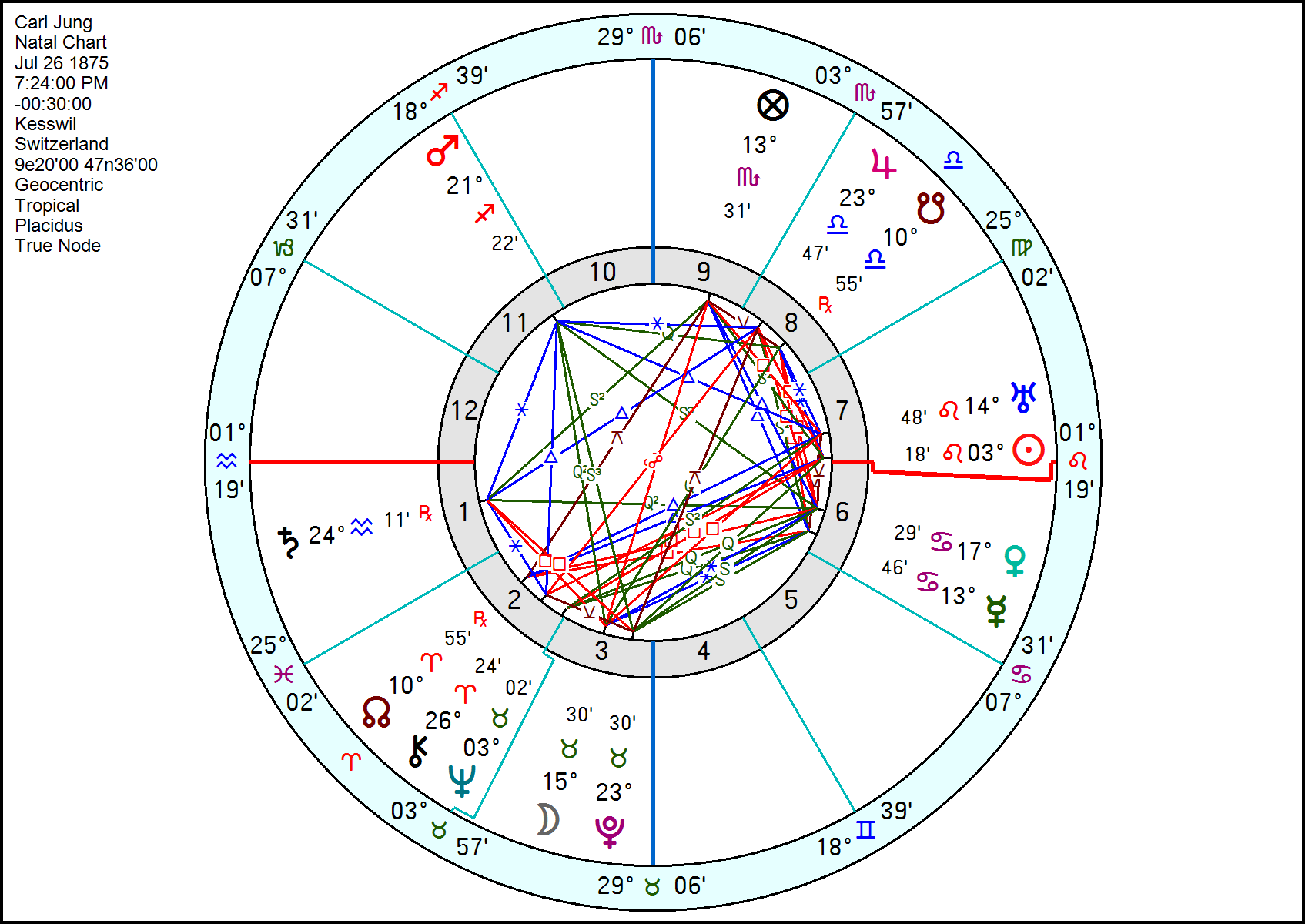
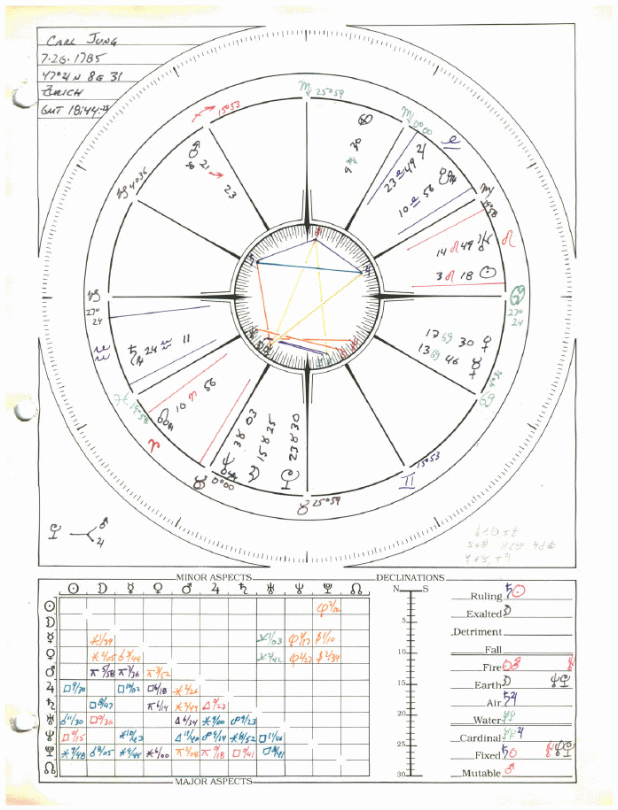
Carl Jung horoscope example
Saturn at Aquarius 25, intercepted in first house: identification with reflective consciousness as his primary ignorance; could not conceive of consciousness except as ego-consciousness
Opposite at Leo 25, representing consequences of this identity: uncompromising persistence in chosen course, self-sufficiency; but also feeling of isolation, inability to relate to other views
If you function, you must create karma; virtue and sin are their own reward
Past karma manifests in current chart placements; the opposite points seem to show karma being created
Jung's Saturn functioning in this life will determine Venus placement in next; discussion of other planets and aspects that might embody the karma
Another possibility: the first square to Taurus IC as crystallization of 1st-7th house dynamics; devotion to collective welfare of mankind via his theories, but surrendering his direct insights to collective world-view
How to alter karma?; pray
Does chart give indication of free will?; only if gurukula
BOOKS READ FROM OR REFERENCED:
F. L. Woodward (tr.), Some Sayings of the Buddha According to the Pali Cannon
Plotinus, The Enneads (MacKenna translation, 4th ed.)
Johannes Müller, William Baly (tr.), Elements of Physiology, 2 volumes
D.T. Suzuki, Zen and Japanese Culture
Paul Dahlke, Buddhism and Science
Paul Brunton, The Hidden Teaching Beyond Yoga
Marc Edmund Jones, The Astrology of Concepts
Marc Edmund Jones, The Sabian Symbols in Astrology
PLOTINUS QUOTES READ OR REFERENCED: I.1.7
SABIAN SYMBOLS: Taurus 25, Leo 25, Aquarius 25
DIAGRAMS and CHARTS appended to this transcript:
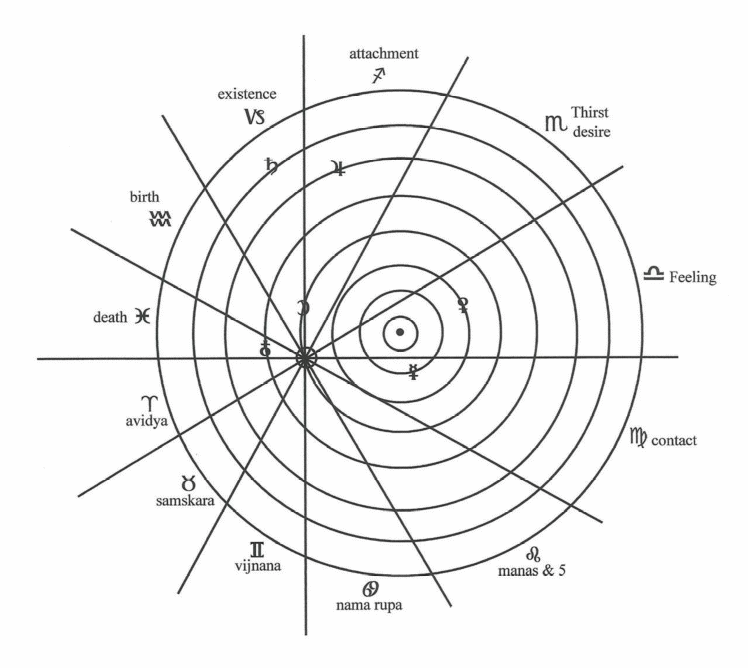
FIGURE AD Supp 6-digital. Nidana Chain with Geo- and Helio-centric Cosmos.
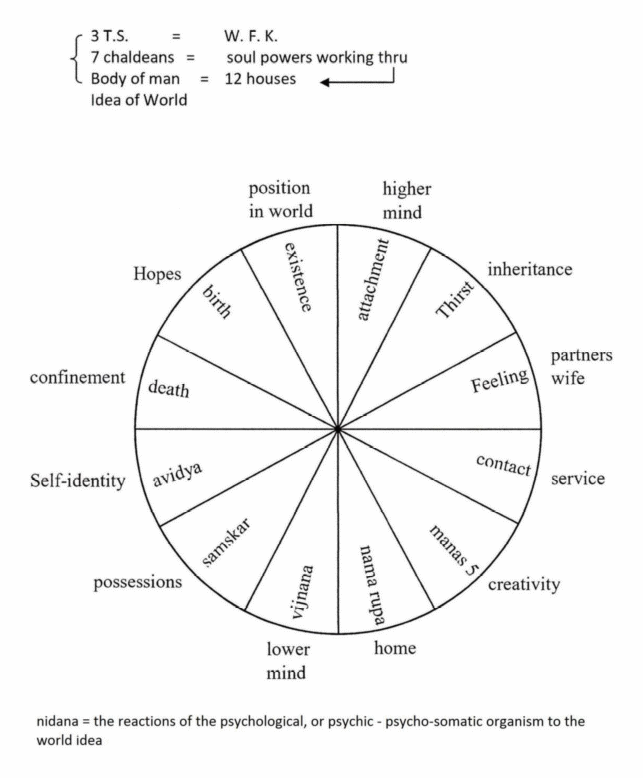
FIGURE AD Supp 10-digital. Nidana Chain and Astrological Houses.
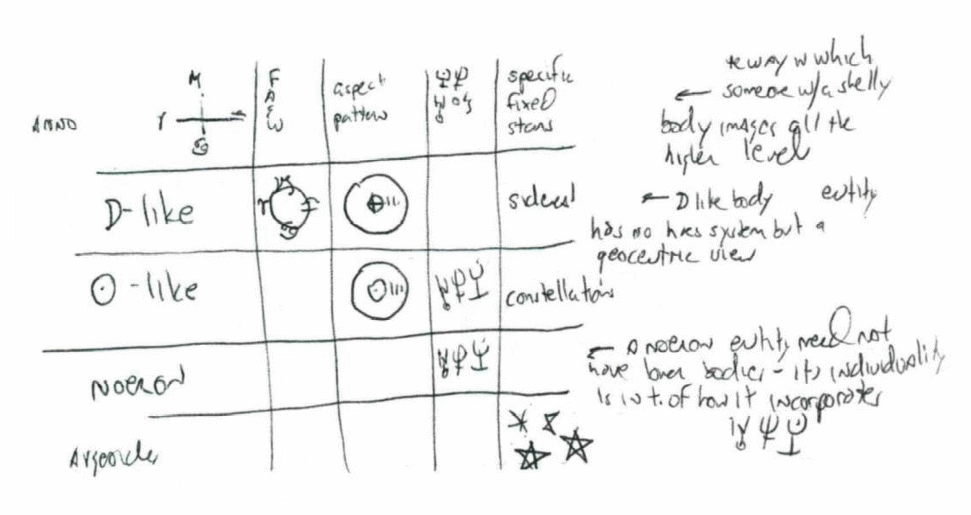
FIGURE 1982 1101a-3. Five Sheaths (Microcosm) correlated with Five Levels of Macrocosm and Astrological Terms.
FIGURE 1982 1101a-4. Carl Jung Natal Chart (astro.com).
FIGURE 1982 1101a-5. Carl Jung Natal Chart (WG version).
Other diagrams also referred to are not with this transcript version. [Transcriber note: [diagram] means the speaker is referencing a diagram as he or she is speaking. If someone is drawing or writing, with audible sounds of chalk on a blackboard, I indicate this by [drawing] or [writing].]
PAPER read in class:
- "The Nidana Chain and Astrology," by Tim Smith. Retyped as 1982 1101b V09M. Buddhism - Nidana Chain - Astrology.
NOTES:
This is 1982 11/01a, Buddhism; Nidana Chain; Astrology Evening Class, and the first entry associated with this date. 1982 11/01b = The Nidana Chain and Astrology Paper. 1982 11/01c = Buddhism; Nidana Chain; Astrology Afternoon Seminar, for which we have no audio, just JF notes.
Earlier 31-page partial transcript version exists.
This is a Monday night class, the usual night for Astrology.
TRANSCRIBED Verbatim by IT prior to 2018, reformatted by jf 2018. In 2023, IT updates prefatory matter, footer, and audio file name, expands Subsubjects, completes Book List and TOC, adds Plotinus quotes section, fixes errors/typos, adds new notes within transcript, adds five diagrams (including two new Jung charts) and references within transcript to these diagrams, reformats to accord with new conventions. Archival verbatim transcript with Paper– V12ap.
AUDIO FILES: 1982 1101a, 1982 1101b. [Note: "Tape" and "Side" refer to original audio cassette tapes that were later digitized into .MP3 Audio Files.]
1982 11/01a at Wisdom's Goldenrod
Buddhism; Nidana Chain; Astrology
[Audio File 1982 1101a Begins]
JC: [one/two words inaudible] 12 nidanas as what-- as we had them [one word inaudible] the 12 signs, although now I would add as related to the houses, you know, the ascendant as the ignorance, you know, the 1st house is ignorance, [student assents] and take the sign [one word inaudible] as saying something about that.
TS: Oh it's time for class, I'd be into that.
RG (simultaneously): I vote for that, I'll vote for that. (RG laughing, some laughter)
DB: All those in favor.
TS: That was easy.
JC: And the three animals in the middle that are related to thinking, willing, and feeling.
AD (simultaneously): The animals in the middle, what animals? (bit of laughter)
JC: The cock, the pig, and the snake.
AD (simultaneously): Oh, oh, oh.
JC: Yes. (bit of laughter, student words)
AD: I mean, that's a good addition to the zodiac. (AD laughing)
JC (simultaneously): Maybe you've forgotten about them but I haven't. Yeah [one/two words inaudible]
AD (simultaneously): The cock, the pig, and what?
JC: The pig, the cock, and the snake.
LR: Those are Uranus, Neptune, and Pluto?
S (simultaneously, faint): Pluto.
JC: Perverted maybe, thinking, willing, feeling perverted, or, you know, directed towards the body.
LR: Could you go through that again Jeff, just repeat [couple words inaudible]
JC (simultaneously): The snake is-- snake [one/two inaudible student words simultaneous with JC] is ignorance, right? The cock is willing, right? And the pig is--
AD: Eating. (laughter, student words)
JC (amidst laughter): Per-- perverted (feeling). (Feeling/Filling) the belly.
S: Feeling fullness.
AD (simultaneously): That's how I feed it.
JC: Anyway that's what I supposed and I don't know if it's right. [short pause with faint background student talking] And they-- oh, the monster that hangs over the nidana chain, the Dragon, that seemed very appropriate. That one-- that-- you know, the animal life that we're caught up in, you know.
LR: The six realms of being? You said--
JC: The six realms that are related to the six powers but they could be six astral realms or I don't know what, but anyway each power could be related to one of those realms. Like I put Jupiter with the gods, Saturn with the hells, Mars with the as-- the warlike beings. I put Moon with the ghost, the hungry ghost, and Mercury with man, the realm of the human, and Venus with the realm of the animals [few words inaudible]
AD: What do you mean Venus with the realm of the animal(s)?
JC (simultaneously): That was the hardest one to see, I, you know-- (laughter, student words)
AS: Animals such as--
DB: Like the animals in Danby.
JC (faint): Well animals like to eat so I just-- (laughter) No, but you know, then each one had to be-- you know, each function was purified in those realms. The Bodhisattva in each realm would represent the purified (functionings of) that function [couple very faint inaudible words, possibly another student] psyche (in this realm).
S: That would be David?
LR (simultaneously): You better [one/two words inaudible] Jeff, we didn't have to come here and talk about this all day.
JC: Well I don't know how it works in, you know, in actuality, I never tried it empirically. (bit of laughter)
S (very faint): Who (has/hasn't)?
S (faint): Hasn't tried it empiri-- (S laughing, laughter, student words)
JC: I worked it out but--
S (faint): You could look it up [one/two words inaudible]
S (simultaneously): You could have hungry ghosts and [couple words inaudible]
S (simultaneously, faint): And it's (a karma).
S: Right.
[short pause with faint background student talking]
TS: It threw me what we did this afternoon. I tried to write down a few of the ideas that we discussed this afternoon, but it's only more relevant one (TS laughs a bit) or cohesive ones. And then I thought we-- then we should try to apply it to a chart I think. That make sense?
S: Yes.
AD: It's a good way of sneaking in a Buddhist class, go right ahead.
S (very faint): Sneaking in a Buddhist class?
S (faint): Oh, we could do it from here.
S (very faint): No we were going to do it [TS simultaneously: No?] [one/two words inaudible] will be out there.
VM (faint): [few words inaudible]
S (faint): Yeah.
LR: Did you have something you thought we should do? (LR laughs a bit)
[10¼ second pause]
TS: What is it?
LR: Yeah?
AD: You know how important the subject is?
LR: Yeah.
AD: Sure. Turn to page 32, read a little bit from the "Ancient City," then page 34.
LR: It's called Some Sayings of the Buddha. "The Light of the World," Anthony?
AD: No, the next page.
LR: "City and the Ancient Road"?
AD: Yeah, "City and the Ancient Road".
[Transcriber note: I am using Some Sayings of the Buddha: According to the Pali Cannon, translated by F. L. Woodward, Oxford University Press, London, 1939.]
F. L. Woodward (tr.) [Some Sayings of the Buddha According to the Pali Cannon, Chapter II, The Early Order, The City and the Ancient Road, p. 33, LR reading]: "…(The Exalted One said:)
"'Formerly, brethren, before my enlightenment, when I was yet unenlightened but a Bodhisat, there came to me this thought: "Verily this world has fallen upon trouble."'"
AD: Even then. (bit of laughter)
[students assent]
F. L. Woodward (tr.) [Some Sayings of the Buddha According to the Pali Cannon, Chapter II, The Early Order, The City and the Ancient Road, p. 33, LR reading]: "'"There is getting born and growing old, and falling (from one state) and being re-born. And yet from this suffering escape is not understood, even from decay-and-death. [O] when shall escape from this suffering, even from decay-and-death, be made known?"
"Then to me, brethren, came this thought:
""What now being present, is there decay-and-death? What conditions decay-and-death?"
"Then to me, brethren, by rational thinking and by insight came the comprehension:"Where birth is, there also is decay-and-death: decay-and-death is conditioned by birth."
"Then to me, brethren, came this thought:
""What not being present, is there birth, becoming, grasping, craving, feeling, contact, the sixfold sphere of sense, mind-and-body? Conditioned by what is mind-and-body?"
"Then to me, brethren, by rational thinking and by insight came the comprehension:"Where consciousness is, there also is mind-and-body: mind-and-body is conditioned by consciousness."'"
AD: Alright, read a little from the next page, "The Law of Causation".
LR: "Coming-to-be. Coming-to-be."?
AD: Uh-hm.
LR: "Ceasing to be. Ceasing to be."? Oh, "The Law of Causation," I thought you said the next--
[short pause]
F. L. Woodward (tr.) [Some Sayings of the Buddha According to the Pali Cannon, Chapter II, The Early Order, The Law of Causation, p. 37, LR reading]: "'I will teach you, brethren, the Law of Causation. Do ye listen to it. Apply your minds. I will speak.' 'Even so, Lord,' replied the brethren. Then thus spake the Exalted One:
"'What is the Law of Causation, brethren? (It is this):—
"Actions are determined by Ignorance: by Actions is determined Consciousness: by Consciousness are determined Name-and-Shape: by Name-and-Shape are determined Sense: by Sense is determined Contact: by Contact is determined Feeling: by Feeling is determined Craving: by Craving is determined Grasping: by Grasping is determined Becoming: by Becoming is determined Birth: by Birth is determined Age-and-Death, Sorrow and Grief, Woe, Lamentation, and Despair. Such is the arising of all this mass of Ill.'"
[Note: See FIGURES AD Supp 6-digital, Nidana Chain with Geo- and Helio-centric Cosmos, and AD Supp 10-digital, Nidana Chain and Astrological Houses, appended to this transcript for the following. These diagrams are not from this class but are used as stand-ins to help follow along.]
AD: Ok now, put up yous-- your circle Tim on the board, spread the nidana chain open. [10¼ second pause] And I say unto you brethren, this is the nidana chain. [short pause] All the complexity and difficulty of trying to understand the causes, I think we will be able to show with the astrological chart. And that's why when the Buddha did-- did get enlightened and think about-- in thinking about this, he hesitated that he should teach this form because it was so complicated that he didn't think it was within the grasp of men. And the Lord Brahma came to him and pleaded with him to expound this so-called chain of ignorance. [44½ second pause with some faint background student talking while TS draws/writes] And then another name for that is the roulette wheel. [laughter/student words followed by pause, 15½ seconds] Well--
TS: Can I--
AD: Uh-hm.
S (faint): [couple words inaudible]
S (very faint): [few words inaudible]
[student assents, very faint]
S (faint): You mean red seven.
S (simultaneously): Red seven.
RG (simultaneously): Red seven. (RG laughs)
TS: Enlightenment [S simultaneously, faint: Right.] has a double [couple/three words inaudible]
RG (simultaneously): Right. (RG laughs)
S (faint): [few words inaudible]
S (simultaneously, very faint): [few words inaudible]
[14¾ second pause]
AD: Go ahead Tim.
TS: Well, see if this is-- this will get us started anyway, this will raise a number of issues if not [couple words inaudible]
[Transcriber note: The following is a paper by Tim Smith, which I have titled "The Nidana Chain and Astrology". It has also been retyped as 1982 1101b V09M. Buddhism - Nidana Chain - Astrology. I transcribe it just as TS reads it, including any changes made during re-reading.]
TS Paper ["The Nidana Chain and Astrology," TS reading]: "The nidana chain is the individual ego's reaction to the World-Idea and is the way we are making our own karma as well as our action according to our past karma. In general, the houses represent the general Idea of Man on this Earth into which the individual incarnate(s). We may speculate that this individual…"
RG (faint): Tim, slower, slower, please.
TS Paper ["The Nidana Chain and Astrology," TS reading]: "We may speculate that this individual is represented by the grand cross: the ascendant, nadir, descendent, midheaven. [TS: That axis.] The signs represent the Dragon and their interaction with the houses is how the animal in us reacts to the nidana chain. The planet…"
AD (simultaneously): No. No, the animal in us, insofar that it reacts to the Idea, the World-Idea, forges the nidana chain. It's the way we react to circumstances that determines, you know, our attachments, etc.
[short pause]
TS: So the animal in us reacting to the World-Idea creates the nidana chain.
AD (simultaneously): Yeah.
TS Paper ["The Nidana Chain and Astrology," TS reading]: "The planets then are the intermediaries between the signs and houses. As functions of the rational soul, they are how the individual understands this interaction with the World-Idea and the Dragon, and the planets also are the means he has for introducing a more rational process into the irrational."
[short pause]
TS (faint): Help me finish, I have-- Ok.
TS Paper ["The Nidana Chain and Astrology," TS reading]: "As well as the planets actually present in a house, there are also the planets that rule the signs on the cusps of the houses and also a varying number of parts in each house. These parts may indicate the innate presuppositions a person brings to the circumstances of that house, how much he understands of that specific link in the nidana chain. So the aspect pattern is an image of the rational soul, the cross is the body-thought or the presence of the light of the individual soul in the World-Idea, and the houses are the World-Idea and the basis of the nidana chain."
AD: Now let's discuss a little bit.
VM: I would appreciate it if you could just read the whole thing [S simultaneously: Me too.] [student assents, faint] over again slower.
S (faint): Yeah.
LR (faint): Yeah, me too.
AD: Well--
TS: Ok. This is a, I think, tentative summary, (say so).
S: Yeah.
TS Paper ["The Nidana Chain and Astrology," TS reading]: "The nidana chain is the individual ego's reaction to the World-Idea and is the way we are making our own karma as well as our actions according to our past karma. In general, the houses represent the race of man on Earth into which individuals incarnate. We may speculate that this individual is represented by the cross."
TS: The ascendant-midheaven cross.
AH: You say that's the body-thought as well as the presence of the light of the-- the soul?
TS: Individual soul.
AH: It's both.
TS: Well, there's two different ways we've thought about it that are not necessarily the same idea. Two different-- One thing that we're-- is-- kind of have to point out by the cross, you see, we're meaning just the ascendant degree, nadir point, descendent degree, midheaven degree. The house would be the full sector of degrees and whatever's in it. Ok, so there is a difference between the houses and that-- the angle, ok. But-- ok? What they both mean is not so clear yet.
TS Paper ["The Nidana Chain and Astrology," TS reading]: "The signs represent the Dragon, and their interaction with the houses is how the animal in us reacts to the World-Idea and so creates the nidana chain. The planets then are the intermediaries between the signs and the houses. As functions of the rational soul, they are how the individual understands this interaction with the World-Idea and the Dragon and the planets also are the means he has for introducing a more rational process into the irrational."
[short pause]
S (faint): Tim--
LC: The interactions of-- of the signs and the houses again [three words inaudible]
TS (simultaneously): Well that's a--
AH (faint): Misnomer.
TS: The interaction between the signs and houses is what we were saying creates the nidana chain but the houses is the way in which the individual participates in the World-Idea in the sense of the space-- the way I'm understanding the World-Idea here is that the space-time form of the evolution of man held in the Earth Soul, ok, I don't mean World-Idea in-- in the Intellectual-Principle.
S: Say that again.
TS: That here I understand the World-Idea to mean this-- the s-- what is the-- going to become the space-time form of the evolution of man held in the Earth Soul or the Earth Mind. And it's that which is the houses, you know, cars and trucks, wives and kids. And that's-- that's the sect-- section of the World-Idea of the Earth, that the Earth is evolving, that the individual participates in. Now when the Dragon and the animal, astral energies interact with that it seems like that's what we're saying gives rise to the nidana chain, and then that is associated with the houses themselves as we've done here [diagram]. [Note: See FIGURE AD Supp 10-digital, Nidana Chain and Astrological Houses, appended to this transcript.] Ok? And then the planets as some kind of-- carrying in them some rational soul function seem to interact with that nidana chain to understand it and also then sort of rationalize it.
BC: I didn't understand the quote that you were-- You say that the houses are this-- the general scheme that the individual's going to incarnate and you're calling the individual this cross? Did I understand that correctly? What do you mean by individual?
TS: Yes, um--
AD: Individual soul.
BC: You mean the life in the soul?
AD: Yeah, individual soul [BC: So when--] coming into incarnation, the cardinal cross and the 12 houses coincide.
BC: The cardinal cross.
AD: Yeah [one word inaudible]
BC (simultaneously): So the cardinal cross is something different--
AD: Huh?
BC: --than the houses.
AD: Yeah.
BC: Ok so, let me just-- This individual, like in the I.1.7 quote, this is the light-- [Note: See Plotinus, Enneads, I.1.7.]
AD: Uh-hm.
BC: --from the soul you're now calling the cross. Ok, and so that-- is that what you would say would-- what individuates the chart? Is that what-- I don't-- that seems to me to be limiting the individual to one aspect of the whole chart when you're looking at it.
AD: Well, here's the difficulty here. On the one hand we're saying that the houses, the 12 houses, represents the idea of the world for an individual, alright, because they're both together, the ego (in/and) the world. They exist together, you can't have one without the other. So if we say that the 12 houses represent the world, alright, and we have to locate an ego in that world--not a soul, alright, the soul is different, alright--when we try to locate the ego in that world then we will have to fall back 1) on the 1st house which is the identity of the ego, and 2) possibly the combination or the aspectual relationship of the planets. So this will give us, so to speak, the ego in the world, alright. But the other thing is not in the [one word inaudible] and that is that the soul coming in and using that-- in other words, if we think of the cardinal cross as an individual soul, alright, coming into the world, and where the cross coincides with the houses is like his insertion into the idea of the world. See but that's not necessary because, in the sense-- in speaking about the soul then you'll be speaking about the ego and his world. So, we're going to leave that alone now because that's speculative, the cardinal cross and the-- and the 12 houses coincide, you're not going to have one without other. But, we are going to say that the ego is part of the World-Idea, alright. And therefore as part of the World-Idea, his World-Idea, within that World-Idea he is going to, through his reactions, rational or irrational, to any given situation, that is, in terms of business relationships with a partner, or his position in the world, or the way he is at home, all this is going to be formative of karma, ok, or the nidana chain. And we're going to try to see if we can speculate a little bit about that and perhaps try or see how it works in the chart of individuals.
BC: So you're not-- you're concentrating now on an ego within the [AD simultaneously: World.] world-system but not an individual soul. You're not worried how we're connected to him.
AD (simultaneously): I'm not worried about the soul, no, I'm not worried about the soul now.
BC: Ok, just ego, ok.
AD: Ego, right. Now one of the ways we started off is by pointing out that 1st house or the 1st link of the chain they call avidya, ignorance or all that, is like the identification that's going to take place, the primary identification--you're going to identify with the 1st house. And that identification, alright, inevitably takes upon itself identifying with the samskaras that are inherent in the body. So if the 1st house represents the body you've identified with, which is part of the World-Idea, alright, then that body will have certain samskaras inherent in it. And the consequence of these two together is to produce an individual consciousness, the 3rd link in the nidana chain, ok? We're going to-- we're going to try going around the wheel like that way. It doesn't mean that that's the only way, I mean, we're doing it in a linear way, perhaps later on we'll find out that it operates simultaneously, that any of the 12 houses or all of them could be operating at one time. Ok so, let me just explore how we are creating and forging for ourselves the hell that is yet to come. (bit of laughter) I wanted you to have a pleasant evening. (some laughter, student words) Why should I be the only one to suffer?
[short pause]
DB: Which was the-- I wasn't sure which was the irrational part here (again).
AD (yelling from the back): Don't worry about rational part, let's get [DB simultaneously: No--] on with the problem of the nidana chain.
DB: No, well that-- no, not the rational part, the--
AD (simultaneously): Don't worry, we don't have any.
DB: --the irrational part, that's the part-- that's the one I--
AD (simultaneously): [possibly one/two words inaudible] gotcha, gotcha. (some laughter)
DB: Yeah I couldn't figure out whether it was the houses or signs or both or neither, I-- I just [S simultaneously: Both.] didn't know.
TS: Well, it seems like it's-- it's both.
DB: Both. So it would be the interaction of the two.
TS: Then it seems like well the interaction between the two is what seems to be the nidana chain itself, they're always together. It's like the prana-- the pranamaya kosha and the shelly body. (I don't know) if that's a good mix.
RG (simultaneously): That's a good combination. (RG laughing)
TS: Yeah right. (TS laughing)
JC: Why wouldn't you include the planets in that? I say if anything's irrational it's the motion of those planets whenever I have transits. (bit of laughter)
S (simultaneously): Try again Jeff.
S (simultaneously, faint): Come on, Jeff.
JC: Seems to me the transits indicate when the certain archetypes are getting clicked off and therefore indicating when the irrational forces are being activated. And I wouldn't exclude them from, you know, defining what this-- is what's composing the irrational impetus.
TS: Well I think-- well, the way I understand suggestion that's been given is that-- that the-- the houses and the signs exclusively mean something irrational. And once you have the cake baked as it were, everything that's above it, the-- the degrees, the aspects, the planets, the transits, those fixed stars, all those guys inside [diagram], are going to have reflections of themselves in the irrational processes as well, but they themselves may be referent to rational or super-rational activity. [Note: See FIGURE 1982 1101a-3, Five Sheaths (Microcosm) correlated with Five Levels of Macrocosm and Astrological Terms, appended to this transcript. This diagram is not from this class but is used as a stand-in to help follow along.] But it seems like when we're just trying to get to what is the bare irrationality of the chart, if it only functions irrationally then it seems like we get down to the houses and possibly the signs of the tropical zodiac, not the original zodiac or the sidereal but just as the tropes hovering around the Earth. So, surely the planets would have an irrational function but I don't know that they're exclusively irrational. Ok? So that's why I think we're sticking with just the houses or-- and how they unfold first as being exclusively irrational, seeing how then other things we've brought to that. Does that make sense?
JC: Uh-hm.
AH: These tropes, it's equatable to the notion of the Dragon?
TS: Yeah.
AH: Astral life-force.
AD: It's the life in the body. [student assents, faint] So I think the last time, how did we put it, the animal life was the-- the shelly body, right, and the one above it?
LR (faint): [one/two words inaudible]
TS: You know, is the life itself, life.
AD: The prana and the animal life. [student assents, faint] The shelly body [TS simultaneously: And then the one above it's (moon)?] and the moonlike body was the animal body, [TS assents] right?
TS: Yeah, those together.
AD: And in the body of any creature, of any animal, there are certain vasanas in that body.
AH: Now what's the-- what's the grand cross?
AD: Don't worry about the grand cross now, we're not interested in it. [AH simultaneously: I thought--] I'm not interested in the grand cross. I already assume that you've been crucified.
AH: So we call that the body in other words.
AD: No, I'm-- I'm not.
TS: He wants to do the houses.
AH: That seems clear.
TS: Ok. So you say that the individual body that a person-- like what Avery said this afternoon, it's like this person's born as Doctor Carl Jung and this-- Carl Jung's body is sitting there as part of the given World-Idea.
AD: It's part of the World-Idea.
TS: Yeah. He latches onto that in the 1st house, ok.
AD (simultaneously): Alright, we'll use that dualistic framework because it's easy, alright.
TS: [few words inaudible]
S (faint): Oh.
TS: Then that body has certain samskaras which are associated with it, alright. And--
AD (simultaneously): Yeah, he would call them archetypes, right, the very structure [TS assents] of the brain itself.
TS: And that will determine what kind of possibilities he has to evolve or-- or develop.
AD: The kind of mind he will function with, lower mind.
TS: Well, ok, yeah, that would be this then [FIGURE AD Supp 10-digital, third house].
AD: Yeah.
TS: Ok. And that-- in other words he-- the ways in which he's going to go about understanding things and [one word inaudible]
AD (simultaneously): It's already predetermined by the structure of the brain which has the samskaras and which has been pre-- which he previously identified with the body of.
TS (faint): Yes. Ok.
LR (faint): Every brain has a body.
TS: Yes.
AH (simultaneously): So-- so what's the life in the body? [short pause] Like you said he latched onto it when he's born, you know.
AD: Well, we're taking that cardinal cross to be the soul which is identifying with something. What does it identify with? The very 1st house.
AH (faint): Yeah.
AD: That's the peculiar kind of mistaken identity that he's going to start-- he's going to assume--"I am this." [student assents] That's the very first identity that must take place. And in mundane astrology we refer to that as the identity of the native. So the very first act of the native is to mistake himself as this body, ok, and from that is going to follow all the consequences. Come on [one words inaudible] we're just talking, speculating.
LR (simultaneously): [couple words inaudible]
TS: So we got him up to have his own kind of consciousness or understanding.
AD: Yeah, so if he has this individual consciousness of all-- alright.
TS: Now the next one seems always is hard for me but that doesn't--
AD: The next one would be-- would be the psychological womb. Psychological womb would be, alright, everything that he can possibly name or perceive.
S (very faint): It's impossible.
AD: Anything that you could perceive or conceive depends upon the fact of the three prior--the identity with the body, the samskaras operating in the body, and the individual consciousness which is a result of it. Now you've got, so to speak, a psychological womb from which every-- every possible form of conception and perception will arise. If you think otherwise, explain, I'll listen.
DB: So, would you-- would you say that it's from the 4th house there that the individual can begin to function and relate to the world he's been born into, but prior to that he's all involved in getting--
AD (simultaneously): No, no we can't say that. We're only going to work this thing linearly, you know, in a linear fashion until we complete it. Then when we complete it, you will not be able to do that because you will see that it extends in any and every direction. The only rea-- the only reason I'm doing it in this linear fashion is for the purposes of pedagogy, make it easier to understand.
AH: The fact that this psychological womb includes all possible conceptions and perceptions that--
AD (simultaneously): That you could have.
AH: That I could have, that doesn't alienate me from the realm of the archetypes. Like somehow that's something--
AD (simultaneously): No, the totality of names and forms that you operate with are the recognition of the archetypes coming from within you, [AH assents, very faint] the functioning of the archetype, the functioning of your brain. [couple words inaudible] the archetypes come from or the vasanas? What are you talking about? Are you talking about something concrete and empirical, or are you talking about abstractions?
AH: So each individual psychological womb, so to speak, would have access to a limited experience of that archetypal realm.
S: That--
AD (simultaneously): The psychological womb is the outcome of the functioning of that brain and samskaras.
LR: It's determined by the identity you take on and the body you take on. And that already would determine [AH: How--] a set pattern of forms that you're going to be [one/two words inaudible]
TS: In other words, given the samskaras you have and the-- [LR simultaneously: Right (one/two words inaudible)] the way in which you develop your understanding, those two together are going to give you a moment of thought that you're going to try to experience, maybe [couple/three words inaudible] see it [one/two words inaudible] Could follow that. And once you get that together then-- then one jumps out into the sense-experience.
AD: Well, yeah. If you notice, then you would have, so to speak, a mind and five senses.
TS: Then it seems to be--
AD: You can speak about the cerebral cortex, you know, and the five physical organs or s-- sense-functions. Now, each one of the sense-functions, if you remember your biology, has a very specific energy attached to it. Right, isn't that so?
BS: Is what?
S: What do you mean by specific (energy/energies)?
AD: Wasn't there a theory something about the specific energies of each of the senses, that each sense has a specific energy attached to it [one word inaudible] (with a) specific energy?
S: Yeah.
AB (simultaneously): Right, but Jung said that the function develops its own organ and the function--
AD: No, [AB simultaneously: No?] no I was thinking of something very specific, I think-- [one/two inaudible student words] I think it was by Müller, he spoke about the very specific sense energies? [Note: The law of specific nerve energies, first proposed by Johannes Peter Müller in 1835. See Elements of Physiology, 2 volumes, by Johannes Müller, M.D., translated from the German by William Baly, M.D.]
LR/S(?): Yes.
LR: And Avery is that the thing whether it's related to an animal, which one is related to an animal in particular?
TS: He's saying there's forces in Nature which are required to construct and manifest the specific sense-organs and their--
AD (simultaneously): Yeah, sense-organs needs v-- needs these energies of Nature, as you put it, alright, and given those energies of Nature, then it can function. In the exercising of its function, it develops a feeling. [short pause] I hate to be so brutal.
LR: No, you've got-- I mean this--
[short pause]
AD: Now do you notice if you exercise a certain sense-function and a feeling arises from functioning-- from that sense-functioning. Then there-- what happens is that the desire comes out of that feeling and the desire to repeat it. So if you taste good coffee, the desire, alright, is there, you know, the feeling arouses this desire and then the desire repeats itself. Now, the next thing that happens is you get attached to that desire. It's the 10th house that's interesting, the transformation that starts-- starts occurring because of this attachment you have for coffee. (some laughter, student words)
[short pause]
AH: Anthony, when you say that the s-- the sense experience leads to feeling, is-- the feeling can be thought of in the psychological sense here?
AD: The exercise of sense-functioning [AH: Yeah.] arouses feeling.
AH: Yes, and we can think of that feeling--
AD (simultaneously): You followed that?
AH: Yes, except I think it's a more primordial kind of feeling than what we normally discuss (and such).
AD (simultaneously): Alright, you could make distinctions, you could-- [AH assents] you could take a sharp knife and speak about these very primitive, primal feelings that you have when you exercise a certain sense-function.
VM: Hey Anthony, why did you skip contact, [student assents] did you mean to?
TS (faint): That's contact [one/two words inaudible] house [FIGURE AD Supp 10-digital, sixth house].
AD (simultaneously): Contact was this-- the energies of Nature. It must-- it must be conjoined to those energies of Nature in order for it to function. [S simultaneously, faint: Well does this (function)?] So, [VM simultaneously: Oh, sort of like the six-fold forces in this--] manas and the five senses conjoined with these energies can be exercised, in the very exercise of these so-called senses a feeling results.
TS (very faint): Ok.
RG (faint): Uh-hm.
AD: Ok?
VM (faint): Ok.
S (very faint): The actual functioning.
S (very faint): Ok.
TS: So we got [couple words inaudible]
AP (faint): Is like different energies for each sense?
AD: I think so. I think there's a-- As a matter of fact they even-- I don't remember of course, I went to school years ago but they-- there was a man by the name of Müller who showed that each of the sense-organs had a different energy that's very specific to itself [student assents, faint] and it was-- it was the specific energies of the sense-function. I don't remember, I mean, it might be outdated.
JC: Can you just say when?
LR (simultaneously): No-- yeah, and it-- tho-- those five, I mean, in that you're given those five to work with, you're already limiting what's going to be known.
AD: Yeah.
LR: I mean that is the mark of man, say, that these particular sense-function-- I mean you can imagine having all kinds of sense-functions and having a whole different kind of experience but the-- the s-- those particular sense-functions will very much determine what will be known.
AD: Uh-huh. Well of course they can evolve, I mean, [LR assents] seeing could become clairvoyant, [LR assents] can become clairvoyant perception, can become the third eye, I mean, all these possibilities are contained.
LR (simultaneously): Ok. But you'd start with that mark of five.
AD: Start with--
VM (faint): You('d) start with three.
AD: Just like your Dalai Lama said, you know, he advise people to try to understand what mind and the five senses is.
AP: Are they outgoing energies?
AD: Hm?
AP: Are they outgoing energies?
AD: I don't know what you mean outgoing.
AP: [few words inaudible] senses as exits-- exits and entrances?
AD: No don't think about those things. (laughter, student words) I'm going to keep it very simple here because what we're are-- what we are explaining and what we have to attempt to understand is the way we're making our future jail or our future cell blocks. This is your actual destiny that you're going to work out. Of course you may get the feeling after a while that there really is no destiny you're making (because) it's all already decided what your destiny is. But it's better not to tell a person that his destiny is decided because then that will rationalize every wrongdoing on the-- in the book.
DB: Yeah, is it--
AD: Hm?
RG: It wouldn't be his destiny.
AD: It wouldn't be his destiny.
TS (simultaneously): (Not) before he was--
RG: You have some doubt?
DB: Is it-- would this explain why some of us seem to have difficulty with meditation, because our thinking feels so good? I mean--
AD: No, you have difficulty with meditation because you are lazy
DB: Oh.
AD: And [few words inaudible] (laughter)
DB: No, I just-- I-- I was--
AD (simultaneously): That's the 13th house, Richard's famous 13th house. (laughter)
DB: No, but the manas is-- I mean the 5th house there is manas and the five senses. So would there be a specific energy associated with that which would also give rise to feeling and so forth?
AD (simultaneously): Which conjoined with the sense e-- with the energies gives rise to feeling, yeah.
DB: Right, I mean, I'm just curious if the same process goes on at-- at that level as well.
LH (very faint): The thought as well as senses.
AD: I'm sorry?
LH: The thought as well as senses. If manas [one/two words inaudible]
AD (simultaneously): I'm going to be a moron tonight, I'm going to stick to this linear straightforward attack on the nidana chain, exclude all the-- everything else until I get to the last one, death, and then we'll s-- we'll turn the wheel again.
AH: Anthony--
LR (simultaneously): Well, you know, you went on after death, you said sorrow, grief, woe, lamentation, and despair. (some laughter)
S: Decay.
AS (simultaneously): That's under death.
S (simultaneously): Decay, it's death and decay.
MW (simultaneously, faint): That's under death.
TS: Yeah.
AD (simultaneously): Yeah.
S (simultaneously): [couple words inaudible]
AD: The lamentation, woe, grief, that's all under the 12th house.
TS: Right, one for each planet there. (bit of laughter)
AH: Anthony, is this-- is this the process the Buddhists speak of as combustion? Like--
AD: Yeah, you can speak [AH assents] about it as combustion. But, you see, all these words that they use, you know, combined dependent origination, this that and the other thing, alright, is not going to tell you anything about what we're trying to do. We're trying to get very specific--how you are forging your destiny. Very specifically. So that we would look at a degree, you see how the outward manifestation of that degree is working and the consequences of that would be your karma. So we want to try to get specific and we want to see if we could see that in the chart of an individual. Look, they're all getting nervous, don't be [couple words inaudible] (bit of laughter)
S: Well you didn't do birth and death. (some laughter)
AD: Huh?
S: Birth and death.
AD: What about birth and death?
S (simultaneously): You-- no, you didn't-- [S simultaneously: No, wait a minute, you know (couple words inaudible)] you didn't do the 10th house [few words inaudible]
AD (simultaneously): Hey, the 10th house is transformation, after you drink the coffee you get transformed. (laughter, student words)
TS: Then you give birth to an idea.
AS (simultaneously): Tim had a good-- he had a good rap for that.
S (simultaneously): And how does it follow from attachment, now I'm--
AS: Tim had-- Tim had a good rap. Why don't you give that little rap on transformation now.
AD (simultaneously): Yeah, give that little rap. (laughter, student words)
AS: And he had a good-- do you have [few words inaudible] It's like-- sort of like [TS simultaneously: Well alright.] [one word inaudible] the difference [couple words inaudible]
TS: The thing I said?
AD: Well, you're attached to this coffee drinking, right? That's the 9th house, attachment. So the 10th house, the word that they have, 'bhava', and they very often use 'existence' but it don't make sense because existence [AS(?) simultaneously: Or 'becoming' if you want.] is in the 10th and the 11th is also existence, so Tim says that there's another meaning to the word 'bhava' which means transformation. Now--
TS (simultaneously): So the thought was that, you know, that if once the-- the attachment to the sam-- the desire has set in, if the atta-- attachment is-- is transformed, that's one thing, and through the transformation something new is given birth to, it give-- gives rise to a new birth or, you know, a new direction or a new idea, a new desire.
CDA: So wait--
TS: So--
S: You (got a/gotta) [one word inaudible]
CDA (simultaneously, faint): But very often a-- in traditional astrology the 8th house is associated with transformation, you know, purification, right, [S simultaneously: Transformation.] transformation. And I know you have some different meanings for it but I don't see--
TS: How.
BS: What do you mean by the attachment is transformed? We have to say a little more please.
[student assents, very faint]
[few seconds of faint inaudible background student talking]
TS: You want to know why the 8th house in astrology is called transformation and why we're calling the 10th house transformation.
BS: That's Carol.
TS: No wait, wait, I was trying to follow Carol.
BS: Oh yeah?
S (very faint): Don't worry Tim.
TS: Is that-- was that your question, Carol?
CDA: Yeah, I want to know what-- what you mean by--
TS: Desire?
CDA: How you mean transformation.
[in background while TS and CDA talk: student says something and AD says: Uh-hm.]
TS: How I mean transformation.
CDA: Yeah.
TS: Well, the way I've understood it is that you say that there's a-- there's an identity of the person that's formed because of the attachment they have to certain desires, that identity, when it actually is-- encounters the World-Idea, is going to become transformed, it's going to be changed. It'll always be changed, it-- but it'll be in constant transformation as long as the attachment is still there. But out of that transformation something new might come to birth, ok, because if it's truly transformed, if the transformation process is completed, then that means that what it was at the beginning of the process isn't-- is no more and something new is going to take its place, and that would mean that there's-- something new has come to birth.
CDA: So are you seeing the identity as being transformed or--
TS: The desires.
CDA: Your desire.
TS: The desires or [CDA simultaneously, faint: Desire.] the attachments to the desire.
CDA (faint): Ok.
TS: The attachments are being transformed and at the end-- conclusion of that process a new desire for something new has come to birth in the individual. That's [few words inaudible]
AP (simultaneously): Tim, but these-- But if you look at it that if you are attached to something, you-- you are forced to get to know that thing, and through the knowledge of it, there is a transformation taking place.
AD: Yes, there's many ways of [TS assents] looking at what will happen when you're attached to something. But basically there will be a transformation of the original premises that you were working with. That hardly required any explanation. [student assents, faint] Just take notice of what you're attached to and if you notice very carefully, you'll see the way it's changing you, the way you're being changed. You people want an exesis on this or maybe a commentary, (bit of laughter) an excursus, [S, faint: Yeah.] couple of volumes? You gotta be kidding me!
BS (faint): That's already a samskara that's being (played with).
[students assent, faint]
AD: No, we're not speaking about it that way, samskara will land us in the 10th-- in the 2nd house. [S simultaneously: I know (couple words inaudible)] Let's stick to the fact, what happens to you when you're attached to playing your piano!?
AB: Maybe you develop discipline or something like that and then that is incorporated into you and you're different. (Is that what you mean?)
AD (simultaneously): His basic identity will be changed somewhat, wouldn't it? And then because of that change of his basic identity, he comes to birth in a certain locus, that is, a certain environment comes with that. And then the result of that is a confinement to those original pre-- premises, whether good or bad doesn't matter, a jail or a palace. But in this case, it inevitably leads to woe, lamentation, decay, old age, and death, (bit of laughter) no matter how you twist and turn. That's just a linear way of looking at the chain of causes, ok. But the Buddha referred to it, and most Buddhists refer to this as combined dependent origination, so we don't have to assume that it follows precisely that order, 1, 2, 3, 4, 5. It's very possible that 1, 7, 4, 10, 3, 11 could be working all at one time. We won't worry about that now. Just get the feeling of the chain of ignorance that you're forging all the time, that the Buddha claims we're forging all the time.
[student assents, faint]
AD (faint): Yeah, um, Avery?
AS: Put on [one word inaudible] If I'm jumping just stop me but, in this context you're saying that all of the-- the interaction of all the things we spoke about, planets, signs, so on--
AD (simultaneously): You're jumping, you're jumping. We-- we just want to take a very cursory, you know, survey of this notion of the nidana chain.
TS: But-- so, would you say, cursing along, that [S, faint: Pluto.] you could take a certain specific form of ignorance in the individuals and that there would be some--
AD (simultaneously): Yeah, now you have to be more precise, you take a very specific form of body.
TS: Body, ok, for an individual, that-- that that-- See if I can do this. Say you take a-- a very choleric body--can I do this?--and that body as a very choleric body, very willful body will have certain samskaras which are inherent in it, certain impulsive samskaras. And then there would be a certain way of thinking or understanding that would be part of that choleric temperament. Is that-- is that following through the signs like that, is that--
LR: Except I don't think you started early enough, that the body would be a samskara.
TS: Well that's-- no, that's not(--/.)
LR: Isn't the [TS simultaneously: (one/two words inaudible) now.] body one of the samskaras?
AD: I'm sorry?
LR: Wouldn't you say the body was one of the samskaras?
TS: Yeah.
AD: No. No, the samskaras are very specific, we refer them to the samskaras of the actual structure [RG simultaneously, faint: Your brain.] of the brain, the (inherent/inherit) archetypes that we inherit, the inherited functioning of the brain, which is a very selective process, it is not a general thing. Every brain responds selectively to the environment in which it is placed.
LR: But isn't the brain part [S simultaneously: Or second-hand.] of the body? Or isn't the body--
(Side 1 of original cassette tape digitized as 1982 1101a Ends; Side 2 Begins)
LR: --chooses to limit it [student assents] (to a) [one word inaudible]
AD: Gets correlated with a specific body.
LR: To be prior to the body.
AD: Alright, prior to the body, now it's correlated with the body [LR simultaneously: Ok.] and operates through that body.
LR: Yeah.
AD: Ok, so?
LR: In other words, I'm just saying I think there's something prior to even that body which is the identity which is limiting to start out with. The avidya, insofar as he identifies himself with anything as-- as self-identical-- as self-identity, there's a limitation there which will then produce a certain body to go along with it. And I-- and I keep seeing that body as part of the 2nd house, the avidya as part of the 1st.
S (faint): But another thing is (in the) [one word inaudible]
S (very faint): Oh no I think it--
LR: And you're saying the body would be the 1st?
AD: Yeah.
RG (faint): Because we're starting from an individual chart.
LR: Yeah.
RG (faint): And it's just you're already positing body, a bodily structure in which all this happens. Therefore the 2nd house can't represent the body as a whole but that part of it would represent its predisposition, given a-- given a body that's already presented through the space-time form.
TS: Yeah, it seems like the very nature of the chart [couple words inaudible] you have an individual horoscope, it begins at the moment of the emergence of [RG assents] the physical body so it would seem like--
RG: We have to start there.
TS: You'd have to start there even from that point of view.
LDS (simultaneously): What about the "I" part?
AS (simultaneously): You're saying that he's at that point [LR/S(?) simultaneously, faint: Yeah. That's what I say.] identified [TS assents] with it. Insofar as he's in a space-time locus and he is an embodied individual, that's what he's identified with. So that's not his possession as it were, that is him. His possessions are what the bo-- what the body comes with, the samskaras [RG assents] that the body has.
LR (simultaneously): Right, but when you speak of the identity of the 1st house, I mean, when you look to things-- just mundane astrology, it's usually not the 1st house which affects the-- says something about the body but it's usually the 2nd house.
AD: No usually, [AS simultaneously: No, that's not true.] [RG simultaneously with AD and AS: That's not true. Usually it is the 1st house.] usually if you want to identify the native, you look at the ascendant [RG assents] and the 1st house.
TS: (It'll tell) you--
LR (simultaneously): To see the body?
TS: Yeah, the [RG assents] physiology of the body.
AD (simultaneously): To identify [S simultaneously: The body type.] the person.
RG (simultaneously): Yeah.
TS: The body type, shape.
LR (simultaneously): The ascendant (but) you're not calling the ascendant.
TS: Planets in the 1st house will tell you the body [RG assents] shape of the person--
LR: Just-- uh-huh.
AD: Alright, can we proceed? [TS simultaneously: That's what willing (one/two words inaudible)] Now that body has a brain and this brain has an inherited mode of function which is very specific. But of course you can get an operation when you're three years old, like a lobotomy, and certain archetypes can be cut out. But there is inherent in that body structure, alright, there is an inherited mode of functioning which we're calling the samskaras. These are very specific. All bodies do not have same samskaras. Go ahead Dickie.
RG: Can you just--
AD: I mean Dickie and I is a good example, the two bodies but (some laughter) nothing common with the archetypes. (some laughter)
RG: Can you unfold this meaning of brain which it equals 2nd house [couple/few words inaudible] (laughter, student words)
AD: I'm talk-- I'm talking about an empirical chart, I'm not going to move off that position.
RG: I know, what are you-- then what do you mean-- I'm talking about empirical chart too.
AD: Ok.
RG: What do you--
AD (simultaneously): Then what do-- what do I mean by the brain?
RG (simultaneously): Yeah. No, no, I don't mean it in a-- in a-- in that sense.
AD (simultaneously): I'm not taking about a subtle brain, I'm talking [RG simultaneously: I know.] about the actual physical brain that [RG simultaneously: I--] a surgeon imagines he's looking at.
RG: Ok good. (laughter) Let's talk about that brain, the one that we don't want to have operated on by an imaginary surgeon. (some laughter)
AD: Which is part of the World-Idea.
RG: Right.
AD: Just like the body is part of the World-Idea. If you have the World-Idea you have that body, if you got that body you got that World-Idea.
RG: Yeah, right. But the brain as in the 2nd hou-- related to the 2nd house, I don't quite see it. I don't quite get it.
AD: The brain as re-- No, the samskaras.
RG: It's the samskaras, it's not the brain.
AD: Not the brain.
RG: The brain--
AD: Specifically, very specifically, it's the peculiar [RG: Ok.] samskaras that are functioning in that body.
RG: Ok.
LR/S(?): In the brain.
AD: I would send it-- I would say it's more than the brain, [RG simultaneously: Ok, but you would inter--] the whole nervous-- this-- the whole central nervous system and the sympathe-- [RG simultaneously: Ok.] sympathetic nervous system.
RG: Ok.
TS: But I mean most of the-- the lower brain, like the--
AD: I can't be that specific, but you [RG simultaneously: Ok.] know like in the Kabbalah they say you got the invisible brain on the top and the right and the left side of the brain are the ones you work with. And one reflects the unity and the other one the-- reflects the diversity. Or maybe you're working with those samskaras.
RG: So when we look at the 2nd house traditionally and they say your abilities and your possessions, then these are-- these are what they mean. Now what we mean here is (not a) samskara.
AD: Well I think they're the most intimate-- among the most intimate possessions you have. I'm not saying that your-- the m-- the money you got in the stock isn't your possessions [RG: Right.] but I think this is more intimate. [short pause] Can we continue going? Do you get an individual consciousness out of this combination?
TS: We have an identity with a mind.
AD (simultaneously): A lower mind.
LR: Well not if-- we are going to have manas and the five senses so can you distinguish this kind of consciousness?
AD: Lower-- the lower mind, the lower consciousness.
LR: But isn't lower mind, mind?
AD: No, I'm sorry. Let's use the term they use and [LR simultaneously: Vijna--] 'consciousness' is the term I think, vijnana.
RG: (Vijnana.)
LR (simultaneously): Yeah because the manas that come-- seems to come with the five senses would be distinct from that.
AD: Uh-hm.
LR: So this consciousness would be the particular kind of consciousness generated by placing the body in a space-time situation you-- the way PB would speak about?
AD (simultaneously): And the operation of the brain or the samskaras in the brain.
LR: I-- and how do you distinguish that from manas and the five senses? 'Cause that's always been a problem for me.
AD: Well, if I try to do it physically I w-- I would imagine that the-- the selection of the samskaras that you're operating with plus the identity with the body, alright, is not the same, let's say, as the cerebral cortex and the five sense-functions, the five sense-organs.
[short pause]
RG: And yet it seems they more mean a given perception prior to the break-- broken up into the five sense qualities as vijnana [one word inaudible]
LR: It's less distinguished and less delimited?
RG (simultaneously): It's less dis-- (right/yeah), right, right.
TS: Or would you say that the certain kind of state of mind or self-understanding which is not yet re-- referring to a sense content or percept? [couple words inaudible] The 3rd house is, you know-- like I-- I would conceive of the-- what they say of the samskaras as exploding as consciousness, as individualized consciousness in the-- in the subject. It's the state of mind that the-- that the samskara carries with it.
LR: Or if there's a cer-- how about, you know, sneaking in something from the alchemical class, that the fixation or definition that happens there which we're calling consciousness, that you now have a body operating with samskaras, there's a certain definition to the identity. It's not operating with the manas yet but it has a certain general identity and consciousness which goes along with that. It's not-- it doesn't have the modalities yet to work with like the five senses.
[short pause]
DB: Thought machine.
[14½ second pause with faint background student talking]
AH: Are you attempting to describe the possibility of some individuated consciousness prior to that specific body and brains?
AD: No, no.
LR: I don't. Prior to the manas and five senses.
AD: We're going to stay at the animal level, [AS simultaneously: Can I-- think that just--] the shelly body and the prana body. We're staying at that level.
AS (simultaneously, faint): I think-- think that just is the bodily consciousness. You could talk about bodily consciousness. [student assents] [couple inaudible student words simultaneous with AS] Yeah, the brain consciousness before it is-- before it is separated into the manas-- into a specific channel with the mind.
AD: Very specifically then you're referring to the organic consciousness that's associated [AS simultaneously: With-- with the body.] with that body and that brain.
DB: That's the sympathetic nervous system.
S (simultaneously): [few words inaudible] right?
[students assent, very faint]
AD: I thought I forgot my bio-- biology, you people forgot it before you even took it. (some laughter)
S: [couple/three words inaudible]
LR (simultaneously): Would that be-- that bodily consciousness, would that be the kind of consciousness that goes along with the instinctual (prana/planet)?
AD: Yeah, organic consciousness.
LR: Ok, that makes sense 'cause that's brothers and sisters.
AD: Very good, made sense, fine. Let's--
LR: It makes sense [AS simultaneously: It makes sense in the 6th house.] after the 4th house, right.
RG: Didn't make any sense to me.
S (simultaneously): Why-- why is brothers and sisters, Linda?
LR: For the instinctual [AD simultaneously: Yeah, you--] energy.
S: Ok.
LR: You're not relating--
S (faint): [one/two words inaudible]
AD (simultaneously): If you think of a person that's senile, alright, where they have no more rational functioning, no more mental powers, they still have an organic consciousness associated with that body and that body alone. Don't think of vijnana here in the exalted sense, [RG: Ok.] you know, like one of the functions of buddhi.
TS (faint, possibly part of background): I guess so [few words inaudible]
AP: Is it the kind of consciousness that animals have [one/two words inaudible]
AD: That what?
AP: Animals.
AD: Animals, yeah. But it's an o-- it's a consciousness specifically related to that body and it's not of a logical nature or anything like that, we're speaking about a consciousness directly associated with the functioning of a central nervous system.
AH: That would be the ability to digest food, the ability to like-- we'd think of it more-- more as motor-- motor functions of the body.
AD: Motor functions, yeah, that'd be [AH assents] good, that'd be good.
AH: And we're going to speak of that as a kind of consciousness.
AD: Or if you take-- you know, the kind of person that's an absolute idiot-like, he doesn't have any rational processes or verbal processes, he still has an organic function, an organic consciousness associated with his body.
[student assents, very faint]
TS: Could you also add to that though, that-- I mean it-- when you speak about the samskaras in the 2nd house, I thought that that would include things like if the person had a talent as a musician, that would be a samskara, that might be a samskara in the 2nd house.
AD: Yeah.
TS: Ok. [student assents] And then if he then was to acti--
AD (simultaneously): Bodily disposition to be able to do that kind of thing.
TS: It's like say you're taking Nyiregyhazi or somebody, and then-- that when that samskara is activated, there's a certain knowing which is not really a-- an objective knowing but a knowing which goes along with that activation of that samskara. So that if he recalled his ability to-- to, say, perform music, that there would be a-- an ability to do that and there would be a kind of knowing of that [three/few words inaudible]
AD (simultaneously): Well I don't know if cog-- if knowing will be appropriate here because it's pre-cognitive.
TS: Well a consciousness of it.
AD (simultaneously): Remember like when we were reading about Einstein's way of trying to understand a problem, he would try to-- the recognition of certain muscular movements would give rise to a certain kind of understanding that was pre-cognitive and pre-conceptual? For instance, the sense of directions is primarily something that comes out of the very association with a body organism.
TS (faint): Oh, ok, I think.
[student assents, faint]
AH: Anthony, speaking (about--)
AD (simultaneously): Dickie we're going to st-- we're going to stick at the most organic level.
S (faint): I don't think that [couple words inaudible]
AH (simultaneously): Speaking of this organic level of consciousness, it seems that-- you said it's in some sense specific to a body but also seems to be that life that animates the body from the astra--
S (faint): That's [one word inaudible]
AH: Like, how is that--
AD (simultaneously): No, no.
AH: How is that organic consciousness--
AD (simultaneously): No, we're sticking to the two lowest realms that we have correlated. The lowest realm was the shelly body, the next realm above that was [S simultaneously: Prana.] the prana body. [AH: Yeah.] And then after that you had the manas body and then after that you had what? What was it, vijnana?
TS (simultaneously): Vijnana [one word inaudible]
AD: Vijnana body, and then after that the Augoeides, alright. [AH assents, faint] And what we're saying is in terms of the chart, alright, our analysis right now is just working on the two lowest levels, the shelly body and the prana body, that is, an animal body vitalized.
AH: May I just pursue it a minute? You (say/said)-- certainly that organic level of consciousness is associated with a specific body, but-- but I think you would also speak that at that level you would find the most uniformity from-- from one body to the next in terms of function. Like in some sense [AD, very faint: Uh-hm.] that [AD or student assents, faint] consciousness is similar for all of us, although manifest--
AD (simultaneously): Yeah, I'll agree with that, I'll agree with that and that's why I disagreed that it's not an astral consciousness.
AH: You call--
AD: As soon as you say astral, you're going to be bringing up images.
S: Right.
AH: I was thinking the life of the Dragon.
AD: Yeah, but I'm saying, your own life below-- below the imaginal level of your functioning, there's an organic functioning which does not depend on images. Images is the next level or the manas functioning which starts recognizing things through images, but this is prior to recognizing images. Your body does not have to have an image from the other part of the body telling it what's going on! [student assents] It's pre-conceptual.
AH: I was just wondering if that-- if that level of consciousness is equatable with any sense of the tropical.
LR: The whole thing's if-- in the tropical.
AH: Or is that-- would you say that was the life of the Dragon?
AD: Ok. The life which is vitalizing the body. Yeah. Yamantaka. Good.
TS: Name and Form.
AD (simultaneously): Four.
TS: So out of this [couple inaudible LR words] [couple inaudible AD words simultaneous with TS] (revitalized) consciousness-- ah, good. (bit of laughter)
AD: No wonder Buddha didn't want to teach the Doctrine.
LR (simultaneously): No, but that makes a lot of sense, out of that kind of instinctual consciousness the kind of psychological womb--
TS: It's [few words inaudible]
LR (simultaneously): --is direct out-- Yeah.
DB: Why?
S (faint): [few words inaudible]
TS (simultaneously): Where else is it going to go?
DB: Well, no, I mean but--
LR (simultaneously): Because the images are pre--
AD (simultaneously): Everything that you can perceive and can conceive, where will it come out of?
DB: I don't know. I mean a--
TS: If it doesn't come out of Gemini, where does it come out from?
AD: Comes out of you, boy.
S: Yeah.
DB: Ok. Now-- (bit of laughter)
AD: Comes out of you. Just alter that body function and you'll see it.
DB: Alright, now, see this is-- What-- to what--
AD: We should've had a biology course first.
DB: What-- the problem I have is what-- We have the body, we have the brain, we have this instinctual biological consciousness. Now-- then we have name and form, and it seems like that's the effect of something being added to that biological consciousness or that biological consciousness operating in a different way than it did in the 3rd house. And I-- I-- I don't-- I don't see the cause.
TS: Well I think here one way that he's speaking of is cumulatively. In other words, if you take-- the 3rd house is the natural efflux of the 1st and 2nd.
DB: Right.
TS: Then if you take the 1st, 2nd, and 3rd together, you get the 4th. You take that organic consciousness together with the samskaras now as its content, together with an identification with the body, and you have out of that the matrix of what the person is going to be able to perceive, and hence out of what he is capable of perceiving the conceptions that will arise in response to those perceptions, and that would be the basis of the psyche.
LR: It'd be like the blood almost. You know, they say the images are carried in the blood?
AD: Think of this as a process of the "I" actualizing itself from moment-to-moment. The "I" actualizing itself constantly from moment-to-moment.
AP (faint, possibly part of background): [one/two words inaudible] are different?
S (faint, possibly part of background): Yeah.
AP/S(?) (faint, possibly part of background): Richard--
DB: So, could you then speak of the specific samskaras that are in the 2nd house and their relationship to the instinctual consciousness in the 3rd house that's giving you these contents, everything that's perceivable and conceivable?
AD (simultaneously): It would be-- it would be the vehicle or the base from which can be developed perception and conception. Didn't they do that in the Sautrantika school?
S (faint): Anthony?
DB: Yeah, empowering that part.
S (faint): [couple words inaudible]
AH: Possible example of that level of conscious, I was recently reading that Essays on Japanese Culture [Note: D.T. Suzuki, Zen and Japanese Culture.] where he talks about the art of swordsmanship, [AD, faint: Yeah.] where the-- the swordsman is trained to function from that organic consciousness rather than from any image-making or--
AS (faint, possibly part of background): Anna was here.
AD: Yeah. Because there what they're doing is they're relating to the solar plexus. The power that's inherent in the solar plexus is the power that, so to speak, is in all living bodies. This is the innate knowledge that an animal operates with. That innate knowledge will tell you before the man strikes you. [short pause] Go ahead Avery.
AS: Something I don't understand about the 4th house but we u-- we've usually spoken of it as the totality of everything conceivable or perceivable.
AD: Yeah, that's the way I spoke about it. Everything [AS simultaneously: Now--] perceivable and conceivable must come from the three prior. [AS assents] This becomes the base.
AS: Now, why isn't that brain-- that seems that right there though you have brought in all imagery. Everything that's perceivable and conceivable seems to be at the level of all imagery.
AD: The basis of all imagery.
AS: But not the conceptions and perceptions but the-- what is conceivable and perceivable?
AD: I'm saying it's the basis of everything that's conceivable and perceivable. [AS: Ok.] We don't have anything perceivable and [AS simultaneously: I know.] conceivable yet.
AS: Ok.
JC: You're saying it's what you could conceive or perceive based on the (type of/conscious) body you have?
AD (simultaneously): No, I'm saying that first you have to be supplied with the biological material [JC assents] in order for there to arise out of it the possibility of being able to perceive.
JC: And you're saying it's the structure of that biological material [AD simultaneously: Yeah.] that's going to determine what you could conceive or perceive.
AD: And what you can perceive. The very organization of the body already tells-- tells us, in a sense, what is intelligible, what can be intelligible for this body. It's a nice straightforward linear progression, with no complications yet. And even when you have manas and the five senses you still don't perceive or conceive anything yet.
TS: You're saying that's simply the capacity for the person to-- it's almost like-- Does that-- would that be correlated to the potential for there being a productive imagination within the individual, the ability for them to form in-- to image forth perceptions?
AD: And again I'm being very empirical, manas here would be the cerebral cortex, which is the basis of the imagination for a human being in biological scheme of things. [TS: So the very--] And the physical senses would be the five senses that are listed there.
TS (faint): The brain.
DB: Yeah. Or-- and it would make--
AD: I'm dealing with Orchard Street quantities.
TS: So never in this whole cycle does one seem to actually-- each one of them seems to be a peculiar deflection of the World-Idea.
AD: Each one seems--
TS: To be a peculiar deflection, not actual-- actualization of the World-Idea. In other words, it seems to be something-- once you start-- buy into this thing with the ignorance or identification of that biological entity, it's like you never get back to that World-Idea. Through interacting with the World-Idea the ego seems bound to its own--
AD (simultaneously): Well I don't know about that Tim, that's something I think you'll have to discuss but I would say that the World-Idea, whatever-- whatever you do know of the World-Idea is going to be through that chain, [TS simultaneously: Do you think there is--] the totality of that chain.
TS: Ok, that's what I wondered then. So (is) that-- I wanted to ask that here because it seemed like this is the one that most-- gives rise to the most of that potential, in-- in that-- the first-- the other one-- the 4th one is the basis of what is-- can be drawn upon in terms of conceiving or perceiving things but here is the actual organs and nervous system by which perception of something in the world could take place. Right? There's been no sense of otherness until this one, nothing outside of the specific body itself, but here is the first place where the body is ready to contact something outside of itself, but it's potentially capable of functioning in reference to something other than its own process. (That--)
S (very faint whisper): Yes, I see (what you mean).
TS: That's what I'm asking, tried to ask. So-- There's some kind of outgoing push here, not in an-- not in an epistemological sense but in a biological sense. I guess not. (some laughter)
RG: Definitely not. (laughter)
TS (amidst laughter): Definitely not. (more laughter)
RG: But another--
AD (simultaneously): We're in [couple/few words inaudible] (laughter, student words)
RG (faint): [one/two words inaudible] starts with Tim. What do you think Linda?
AD: Hm?
RG (faint): What do you think Linda? Are you--
LR (simultaneously): He's talking about the houses before you got any planets in them.
RG: But, I mean--
AD (simultaneously): I'm sorry Dickie [couple/three words inaudible]
RG (simultaneously): --the relationship of the cerebral cortex to the 5th house escapes me.
AD: Well, if any damage is done to that there'll be a gaping hole in your imagined world.
RG (simultaneously): Yes-- yeah but there's also be a big gaping whole in every other house (some laughter) if there's damage to your cerebral cortex. (RG laughing)
AD: No, I'm just trying to point out that the correlation between the cerebral cortex and the imagination has been ascertained in physiology.
RG: Yeah. Right, and--
AD: I'm-- I'm deal-- I'm trying to think of these things in a very empirical [RG, faint: Ok.] physical way, [RG assents] the nidana chain, I'm trying to think of it. Because I-- what I'm-- what I'm going to say is that if the entirety of the psychosomatic organism is the concretion or the corporealization of our willing, feeling, and knowing, alright, [RG assents] then the result of that willing, feeling, and knowing is the kind of body we're going to be working through and working with.
RG: Ok.
S: Could-- can you say--
RG (simultaneously): And insofar that the self-expre-- I mean the self-expression we talk about as the 5th house.
AD: Well, you certainly express yourself through the mind and senses.
RG (simultaneously): Yeah right, there's an unfoldment through those faculties. In that sense it's related to the big biological process. Right. [AD simultaneously, very faint: Yeah.] It's through the-- I mean through manas and the organs that anything has to unfold.
AD (simultaneously): Yeah, I generally would agree with that, the mind would-- would be, let's say, important, you know, when you think of the creativity of the individual you're talking about. But I imagine the most basic creative act of the mind, alright, will be the exp-- the-- the perception of a world.
RG: Uh-hm. Uh-hm.
AD: Want to go through all the others?
S: Uh-hm.
S: Uh-hm.
AD: Continuing? With contact [ME simultaneously: Yeah, I always have a que--] [one/two words inaudible] want to get out that the sense-- Yeah, go ahead.
ME: I just have a question. When you lump the psychosomatic together in this diagram, it seems at least for me to create some confusion because it seems like what we're primarily talking about is to say the-- the psychic or pranic level. And then the-- the somatic, let's say, might-- seems like it might be precipitated in the 12th house alone rather than throughout the whole chart. I-- I don't know, it just seems from part of the conversation that everybody's always asking about the function of the organism. And it seems that's more like a pranic level rather than, let's say, the-- the structural shelly body type level we've mentioned. And it just seems to-- or like if he says cerebral cortex, certain associations come up. Really what you're talking about is a function of the cerebral cortex or how it's represented in some imaginal way and not really about the cerebral cortex itself except in a-- a functional way. I mean it seems like that's what we're-- or when you say the body there you're-- doesn't seem like you're talking about really a physical--
S (faint): Uh-hm.
LR: Not the perceived body.
ME: Yeah not the perceived body, right but, when you say shelly body you mean perceived body? I guess that would be my question.
AD: Yeah.
ME: You mean the perceived body?
AD (simultaneously): I'm talking about the perceived body.
RG (simultaneously): He is talking about the perceived body. See all this is-- is within the appearance.
ME: Yeah, so then what kind of body would you identify with in the 1st house if you say it's a perceived body, if your soul always can identify with your--
RG (simultaneously): The totality of it.
ME: (Of--/Oh.) But what's-- what would that body be shaped like? I mean [RG simultaneously: You have one.] you're saying it's actually perceived, it has dimensions?
AS/RG(?) (simultaneously, faint): [couple/three words inaudible]
S (faint): Definitely.
AD: That's the only body I'm talking about. I keep-- I keep stressing that. I'm only speaking about what we see and hear and touch and taste and smell.
ME: Alright, but then let's say the development of the body from say infancy or, I mean, at that level you'd have to talk even about the pre-- or a-- a conceptual state, how that body's going to evolve through a lifetime. I don't understand what it means to talk about a perceived body then in that sense. If it-- if you're talking about the body as, I mean, an ongoing continuum, it's not-- certainly it's not the same at any-- you know, it's going to be changing.
RG (simultaneously): No, it may change at every moment [ME assents] but at every moment you are identified with it.
LR: Right, but [RG simultaneously: If he make--] then Mike's saying it's not the perceived body.
ME (simultaneously): That's what I'm saying, it's not the p-- it might [RG simultaneously: Why?] be some kind of felt body.
LR: No, which perceived body, the one when you're 2 years old or the one when you're 30 years old?
RG (simultaneously): It change-- it doesn't ma-- it changes all the time, what's the difference? At every moment it changes and you change with it and you take yourself to be it.
LR (simultaneously): But isn't there something-- but isn't there the-- isn't there an idea or notion of that body which isn't tied to 2 year old or 30 year old or 40 year old?
TS (simultaneously): Yeah this [diagram].
LR: And isn't that this?
TS: Yeah, ok.
AH (simultaneously): What's this, what's this?
LR: Well, we're trying to just track--
TS (simultaneously): The nidana chain.
RG: The whole thing.
LR (simultaneously): --and-- as the nidana chain.
TS: That seems to be the continuity of--
AH (simultaneously): But what is the-- what's the shape of that body before there's images? What's the shape of that body before there's the concepts?
S (simultaneously): [one word inaudible]
LR: [couple words inaudible]
RG: We're [few inaudible student words simultaneous with RG] not talking about houses though if you ask that question, according to Anthony anyway. That question isn't appropriate for the consideration of what it means to be a hou-- a house.
ME: But if you say the houses are the World-Idea, right, and--
LR: For the individual.
RG: For [S simultaneously: For the individual.] the individual. His version of the World-Idea.
DB: Oh yeah.
ME: But [TS simultaneously: I'm looking.] then you're saying that you have-- I'm not going to understand it if you say it's, let's say, it's a functioning of or the samskaras are somehow-- they're the archetypes of what's going to unfold but not if you say that let's say it's the-- it's your actual digestive process. I mean it seems like the-- it's like the archetype for that. I just have a hard time understanding if you're saying it's, you know, my GI tract is the 2nd house. (some laughter) I can understand it's my functioning, you know. (some laughter)
RG (simultaneously): I agree with you, I agree with you, I have a hard time too! (RG laughing, some laughter)
TS: Well, I think it is. Anthony?
RG: I don't think it is.
TS: That's what-- that's what you're saying, isn't it?
ME: Yeah I know.
AD: I didn't hear him.
TS: He's-- Michael said that it's-- finds difficulty in conceiving of or thinking about the 2nd house as his ga-- gastro-intestinal system or the processes in it, [ME simultaneously: Wait--] but you're saying that.
AD: I'm saying that, [ME simultaneously: Yeah I know.] sure, [TS: Yeah.] oh yeah.
TS: That's what I thought.
AD: I'm saying you are those very functions. Absolutely Michael.
ME: Yeah.
AD: Absolutely. Every act, every deed we perform here and now, alright, puts us in possession of those functions and we are those functions. I said that we are this process, this actualization of our thought. So if you go out and you eat a dozen donuts every day, I mean the results are guaranteed. (some laughter) [intensely] And you can't say, "I didn't do it." (bit of laughter)
AH: But like we are that. But then at some point it's possible to think about what we are. And at that level we talk about the function of cerebral cortex? We have images about our gastro-- gastro-intestinal tract. We think about digesting our food and it makes us sick. (laughter)
S (amidst laughter): Yeah, talking about it does too. (more laughter, student words)
AH: We are all of that--
AD: Yeah!
AH (simultaneously): --it's [one word inaudible] a continuum.
AD: Yeah. The way you eat, the way you drink, the way you talk, all these things are you, in actuality, and you are actualizing that moment-by-moment. You people don't believe me when I said I'm talking Orchard Street quantities!
RG: But if you're talking Orchard Street quantities, it seems we're getting much more qualitative then in terms of functional consciousnesses, which seems to be the problem. I mean I think that's Michael's problem and it tends-- it tends to be my problem with it too.
AD: You have to elaborate a little bit, I don't think I caught it.
RG: If we stuck to Orchard Street quantities and discussed the houses as objective circumstances in the-- the most mundane-- even-- even as following upon [couple words inaudible]
AD (simultaneously): You can't see the two of them as part and parcel of each other?
RG: I can, until we bring in functional consciousnesses associated with those structures. For example, in the 2nd house, we speak of samskaras, and then we speak of them as embedded in the brain and then we speak of brain consciousness. Now it seems to me once you get to the level of brain consciousness, you're no longer talking about a house. You're talking about the planetary--
AD (passionately): But is that brain part of the World-Idea, is your body included [RG: Yes.] in part of the World-Idea? And is the brain which belongs to that body part of the World-Idea? So I'm speaking of the two of them at one time. But I'm speaking about the individual body as part of the World-Idea!
RG: Ok. But it-- ok, I understand that. But in speaking of the individual body as part of the World-Idea, do you also mean to imply the consciousness that is associated with that body or not?
AD (simultaneously): That'll come later as soon as we first lay down the biological framework and then we'll see how your mano-consciousness interferes, one way or another, rationally or irrationally, with that functioning.
RG: Good, ok, I agree with that. But-- but in the discussion so far, we have already brought in two or three types of consciousnesses that already seem to interfere with that process, from vijn--
AD: I'm sorry, I didn't follow you there. Two or three types of consciousness?
RG: Yeah, vijnana is one type of consciousness, manas is another type of consciousness.
AD (simultaneously): Well, we refer to that as the vegetative consciousness, the consciousness which is inherent in the very functioning of protoplasm. [RG assents, faint] It's a sub-human consciousness. It's not-- it can't be dignified by applying terms like 'conceptual' to it. [RG assents, faint] The only way we know it, true, is through the images that arise. A person gets sick, he dreams about a certain insect and the doctor says, "Well, you got such and such an illness, that insect represents that." But the organic consciousness itself doesn't have the form or the conceptuality that that animal or that creature in the dream consciousness arose-- arises in us. That's going to be the way the manas is going to interpret what's going on in the organic consciousness. [RG: Right.] That's why I said, I'm restricting my analysis to the two lower levels, the animal body, the shelly body and the prana body.
TS: So can we go back to six or you-- should we carry it all the way through then?
AD: Yeah, you've got to carry it all the way through because we said we were going to try to make an analysis in terms of the animal body, which included the shelly and the prana. Then we were going to try to bring in the manas body, which will be the planetary functioning. Then we were going to try to bring in the vijnana body, which will be the trans-Saturnian functions. [intensely] And this way we can see how one and the same cardinal cross is incarcerated in all four bodies at the same time, there aren't four different bodies, there's just one man living in this body.
RG (faint): Uh-hm.
TS (very faint): Ok, ok, so--
RG (faint): (Yeah/No).
AD (intensely): But I didn't think I had to repeat biology.
RG/S(?): Oh.
S (very faint in background): What was that [three/few very faint inaudible words]
TS (simultaneously): Repeat biology--
S: [few words inaudible]
AD (simultaneously, intensely): I never took biology too.
[student assents, very faint]
RG (faint): But--
S (faint): We digress.
S (simultaneously, faint): Well this--
TS: So, what does that mean?
AD (simultaneously, intensely): But even-- even just a general acquaintance with the world you're living, for heaven-- for heaven's sake, what are you Neanderthal!? [few inaudible student words] 20th century, you gotta read about these things in your newspaper if you read them nowhere else.
[3½ seconds of background student talking]
TS: So where do you want to go, do you want to take it around [couple words inaudible]
AD (simultaneously): Well what would contact be? You take food into your body, certain energies are released, these energies, alright-- What-- what do they do? They have a specific effect on different sense-functions. [TS simultaneously: Well, yeah, I was gonna--] So every time I can't see, I run, make carrot juice! (laughter) And I have the energy so I could see again. (laughter)
TS: I thought that here you'd even-- I thought that it would be simply the sheer--
LR/S(?) (simultaneously): You put food in the 6th house?
S: Physical act.
TS: --the sheer-- yeah, well, that's what I wa-- think 6th house is [one/two words inaudible] the [one word inaudible]
AD (simultaneously): And then what happens? I enjoy that I can see! I'm reading now, I really enjoy it, boy, I'm exercising the power of reading, you know, I can-- I mean the exe-- I'm exercising the power of seeing. A nice feeling comes up--I could read, I could see. Feeling. Aren't you intimate with your own biological function?
LR: So now we have carrot juice in the 6th house (laughter), we got coffee in the 8th [couple words inaudible] (laughter, student words)
AD: You know there is-- there is a star called the Ram, and one of your planets I'm sure is sitting on it. Mary and her little ram.
TS: Did you-- did you look up what degree that was?
AD: No.
TS: Mercury.
AD: Her Mercury is on that degree? That's so appropriate. (laughter)
VM (whispering in background): What degree is that, 23 Aries?
S (simultaneously): What degree is it?
AD (intensely): Mary and her little black ram. (some laughter) Or was it a red ram. (more laughter) So we got carrot in the 6th-- carrot juice in the 6th house. (laughter)
RG: The title of our new book.
AD: The 7th house we got feeling now, because of the exercise of that sense-function-- If you've ever been-- if you've ever been deprived of a sense-function even temporarily, you will see immediately how attached the feelings that [RG assents] are concerned with that. [LR: Yeah.] They're right there, [RG assents] that you can't have this feeling of seeing. Alright, so then that means that you have the desire and the natural consequence of that is the desire to see will persi-- will be a persistent one that's accompanying you all the time and the fact that you're attached to seeing goes without saying. But if you keep reading, alright, then a transformation takes place--[RG simultaneously: Yeah, you go blind.] you go blind. (laughter, student words)
LR: [couple/three words inaudible] (laughter) But, but besides carrot juice what else is in the 5th house?
AD: In the 10th?
RG/S(?): [one/two words inaudible]
LR (simultaneously): 6th.
AD: I would say, I [one/two inaudible student words simultaneous with AD] would say the different-- It's like the alchemists study, they try to understand the various energies that are released when you eat certain foods which benefit different organs of the body.
LR: But is this-- ok, but it sounds as if you're putting what's in the 6th house just beyond the body. Like once you're given five senses and (you--)
AD (simultaneously, intensely): Well it's no good if the food is on the table, it's gotta be in your stomach, it's got to be in your body.
LR: But that's what I'm asking. In other words, once you get to the 5th and now you have delineated, differentiated func-- sense-organs--
AD (simultaneously): You have five sense-functions, yeah.
LR: Then do you speak of the 6th in terms of what they will contact, I mean, is that why it's called con--
AD (simultaneously): No, no. I'm saying that the contact that we're speaking about here, the word 'contact' I would-- I would use the word 'conjoin'. These senses [LR: Senses.] and the mind has to be conjoined to these vital energies.
LR (faint): Ok.
DB: So the-- the vital--
AD (simultaneously): Which results in the ability for one-- to one to exercise those functions.
DB: Would the vital energies here be that aspect of the World-Idea which the individual hasn't been associated with yet and that's what the contact is with?
AD: Well, yes.
DB (simultaneously): Like for the Sun-- like for the eye--
AD (simultaneously): Yes, insofar, insofar that you say that included in the World-Idea are these va-- various energies which can be procured from the food you eat, [DB assents] alright, and bringing them into himself they can act-- they activate-- they activate the sense-function.
DB: Right. But, like I was-- like the-- with vision you'd have light, that would be like one of the vital forces that it is in contact with. Something like that?
AD: Uh-hm.
DB: Ok. 'Cause I-- I remember I was reading a book of-- a-- a magazine article about a woman who had been deaf all of her life and she had some surgery. She was able to hear music for the first time, and the first time-- I don't know what it was, but it completely devastated her, she-- you know, she just broke down, she'd never-- well she never heard anything but the-- the-- it's this objective energy that these-- these sense-functions are in contact with. Is that-- I mean it's not the-- it's not the objective object in itself, not like-- not like carrot or the-- the picture on the wall or whatever, it's some vital process or vital energy which has made that to be what it is, something like that.
AD (simultaneously): Well some day it would be interesting to go into and try to discuss the nature of what kind of-- kind of knowledge is brought into a person through sound, and it's really quite an astounding thing. It's unbelievable. But these energies which are operative in different sense-functions do produce certain consequences that are very very important for the knowledge that we have of the world. They're telling us something about the way the world is constructed. But because of the interference of the image-- imaginal world, alright, because of that interference we can't get directly to what the nature of the object is, that is, the essence of the object. The image is there blocking it. [short pause] Alright, this would be a kind of linear notion of the way the "I" is actualizing itself I think from moment-to-moment and someone mentioned that the Buddhists refer to this as the process of mental combustion. And, I think if you read your Dahlke book on Buddhism and Science you'll get a feeling for it. [Note: See Paul Dahlke, Buddhism and Science.] He actually goes through this with such nauseating, you know, precision that it reminds you of Schopenhauer, you know, the world is-- the world is my idea. And the way the world does become your idea is through the immovable spectacle that your body organism, as an organism, is for you. But it's an immovable spectacle in terms of structure and function, not in terms of substance, because in terms of substance it's being constantly replenished, it's never the same in that sense. But in terms of function, it's pretty much-- it's pretty much so as most of us who try to change our habits realize. Now, this is only a very superficial acquaintance with the nidana chain, very superficial.
LR: And, in or-- and we really aren't making it some kind of standard with-- pre-- pre-planet(s), which is why I think it's so difficult.
AD (simultaneously): Yeah, yeah.
LR: We're trying to subtract everything--
AD (simultaneously): Yeah, we're talking about things that are almost in a sense pre-l-- they're pre-logical, [LR assents] pre-conceptual. And all we could do is get inferences, hints, here and there. But then if you add the 3rd level now, you add in the manas level, you put the planets on a degree.
TS (very faint): Uh-oh.
AD (faint): Go ahead.
LR: Wouldn't that-- planets on the degree, wouldn't that be adding the mano and the vijnana level, I mean wouldn't it just--
AD (simultaneously): You'd be adding the manas, alright, to that whole animal life, (it's/its)--
LR: But the degrees, wouldn't that be also adding the vijnana level? The fourth-- planets on the degrees, [AD: Yeah.] we'd be adding the next--
AD (simultaneously): Well we're going to leave the trans-Saturnians out. [LR simultaneously: Yes, what--] But the degree of the Chaldeans.
LR (simultaneously): But the degrees, wouldn't that be adding the next two? In other words, planets is the third and degrees or reason-principles is the fourth?
AD (faint): No.
TS: Why don't-- we have talked about degrees [LR simultaneously: No?] two different ways. We've talked about degrees as tropes and we've also talked about them as reason-principles.
AD: Yeah, we're working off the basis that we're speaking about tropes, tropes in the living matter. [TS simultaneously: That's it.] We're not speaking about the archetypal zodiac.
LR: But isn't it reflected there?
AD: Yes, [TS simultaneously: They're reflected.] but that's not our concern now. Our concern now is that there have been and has been in the-- the Dragon itself, the entirety of all life-processes have been deposited in matter and that this living matter, alright, is going to be the basis in which you're going to say now you add the manas principle to it. After you add the manas principle to it, alright, you'll have on the one side, you'll have the concept and on the other side you'll have the percept.
TS: Oh dear.
LR: Say that again [one word inaudible] (bit of laughter)
AD: On the one side, on the one side, on the animal side, the two lower bodies, that will give you the percept, the organic basis for perception.
LR (faint): Oh I see.
AD: The manas principle is going to give you the conceptual basis for perception. And we pointed out last night when we were talking about the Buddhists, we made the remark that the sense in the sensible is not to be confused with the spiritual. The spiritual living in the psyche, the spiritual must have for residence a psychosomatic organism. That is what is the dominant reality in the psyche, although others would put it a-- put it a different way. They would say that it's-- what's dominant would be the psyche, the biological life. And that spirit takes residence in there only to be disappointed.
[short pause]
LR: So do you want to go on to try to add the planets now?
S: Uh-hm.
AD: Go ahead, sure.
TS: I think the dignities are-- is one way to approach it that we could-- might be constructive. And it would--
AD: Let's keep it very simple.
AP: Where--
TS (very faint): [one/two words inaudible] um--
AP: When you put manas and the five senses in the 5th house, it's the lower kind of manas in the [one word inaudible] and you have the planets now.
AD: Well, wait, let's discuss it in a general way, alright? [AP, faint: Yeah.] Don't get specific. [S: Ok.] What would be the general idea behind this? We're saying a planet is sitting on a degree which is located in fire, earth, air, or water. Right?
S: Yeah.
AD: And that would mean that you're introducing into this biological organism something which wasn't there before. What is it you're introducing?
TS: Imagery.
AD: Imagery, yeah. [student assents, faint] Mentality, could we say that, what we refer to as mentality?
TS: [one/two words inaudible] psychology into it.
AD: Psychology.
TS: Some kind of feeling subjectivity.
[short pause]
AD (faint): Alright(?/.)
[short pause]
AH: Generally you speak of it as a thinking process.
LR (simultaneously): Thinking, yeah.
AH: Process of making images and thoughts.
LR: Yeah we don't have that anywhere so far, [AH assents, faint] that wouldn't be given. Thought. Thought functioning.
AH: And coincident with that the functioning of a psychological subject.
AD: It's like almost like the manas is interpreting the biological activities that's going on?
AH: It's not interpreting them as much as it is in some way obstructing them or bouncing off them. Like--
[Audio File 1982 1101a Ends]
[Audio File 1982 1101b Begins]
AH: I'm sorry.
AD (simultaneously): Presenting you with an image of something that's going on. Now wouldn't you say that the mind will be presenting you with an image of something that's going on in the body?
AH: Yeah, the point I was driving at that that interpretation can be--
AD: It could be off, yeah.
S (simultaneously): Yes.
AH (simultaneously): Can be way off.
AD: Could be way off, [student assents, faint] sure. That's why you're going to have to pull in reason to get you to live through this.
AH: As a matter of fact it-- that interpretation can be-- the point I was getting at is it could be at odds with, in some sense.
AD (simultaneously): Yeah, yeah, yeah I agree with that, it could be at odds, sure. The image that's supplied could be quite misleading, sure, because there is no snakes trying to strangle me, it's only the blanket around my neck. But as far, you know, the psyche is concerned, it's the same thing, whether it's a snake or a blanket strangling you. But maybe the snake will wake you up whereas a blanket won't. Come on, try to think here a little bit.
AH: So is this-- is this process--
AD: Will you try to rebuild the whole thing for yourself please?
AH: This process of making images, whether they're right or whether they're wrong in relation to something organic, is-- is that a consequence of the organic? Is that like precipitated--
AD: Where do all these pictures come from?
AH: Yeah like-- They don't come out of the organic I--
LR (simultaneously): Yeah they do.
AD: Well where could they come out of?
AH: If you-- if you do something to the cortex, it may damage the imagined world but it doesn't damage the world at all.
LR: But this--
AD (simultaneously): As far as you're concerned it damaged your world.
LR: This is your world. This is your--
AD (simultaneously): Where do these pictures come from?
S: The image of the snake is also derived from the organic realm. That wakes you up. Right?
S: Go ahead.
AH: Perhaps the notion of the two imaginations would be helpful, that there's this--
AD: Well do you think it might be the fact that there's been so many reactions to a certain given stimuli that the sum total of these here eventually become a shape or a picture or an image.
S (very faint): Yeah I see what [one/two words inaudible]
AH: It's built up as--
AD: Mars went in Capricorn? Can't believe it.
S: [one word inaudible]
S (simultaneously): Takes-- [couple inaudible student words simultaneous with S] I can see it a number of--
S (faint): There's a--
AD: It must have went in backwards.
S (very faint): It's always going backwards.
[short pause]
AD: Through the back door maybe, huh? What do you think Vic? Went in through the back door?
RG: Yeah, it came in through a full moon in (my garage).
S (faint): Full Moon today.
AH: Anthony, it seems that at this level of-- of function and level of-- and image-making, it's possible to speak of the most differentiated and most individual level of experience, like it's very subjective, very particular to each apparatus.
AD: Uh-hm.
AH: Now, how can it have-- if that-- if that is so, if it is the most individuated, how can that have its origin-- It obviously has its origin in some organic--
AD: Functioning, yeah.
AH: --functioning. That individuation or that process is in some sense the samskaras function again. Now we've already allowed their function to be prerequisite to the whole process.
AD: I don't follow that, what you just said. The samskaras functioning-- I didn't follow.
AH (simultaneously): The samskara functions to create my body in a particular locus in this world.
AD (simultaneously): I-- What you were saying was that there was, because of all this functioning, alright, certain-- the accrual of certain sensations and responses to stimuli, the end result is some sort of imagery gradually getting shaped up or formed.
AH: Yes, and my question is, is that fun--
AD (simultaneously): And this will be very individual and peculiar to a body.
AH: Yes sir, (yeah).
AD: And that means that when you operate through the body, everything that you perceive of the world, alright, means that you never see the world as it is, you only see-- see the world as your body presents it to you or the functioning that's going on in the body.
AH (faint): Alright.
AD: That's all that you see. Then you understand that sentence from-- from PB? [student assents, faint] You remember the one I'm referring to?
VM: Immovable spectacles.
AD: Yeah, the immovable spectacles. I would enlarge that to mean-- to bring in the whole body. But, if we stick to that quotation, he said because you must see the world through the immovable spectacles of your sense-organs and your sense-functioning, alright, then what you will see will always be the result of the body's functioning, you will never and can never get to the reality through that. Well, even if we got one philosophic point in we-- we've got a good night.
AH: I think-- I think you answered my question. The-- the individual nature of that mental experience has its origin in that body.
AD: Yeah. The functioning of that body, exactly.
AH: Now in that body there also functions a level of organic consciousness that is non-individual.
AD: Let's say that that-- that's below, much further below. Because we're-- our-- we seem to be preoccupied more with functioning, so to speak, through the senses and we're hardly aware of when our stomach is telling us, "Stop throwing this junk down here!" (some laughter)
S: "More coffee!"
S: Yeah.
AB: Anthony, when-- if you bring in the-- the--
AD: Yeah you getting-- if you understand this, you got the pivotal point in the Hidden Teaching. You can't get to reality itself, no-how, not through the body. That's why it's absolutely imperative that the body gets cut off and the sense-functioning gets cut off in order for you to get a glimpse.
AH: In the sense that that reality must be non-individual and transpersonal.
AD: Yeah.
AH: And the body is like--
AD (simultaneously): It's not based on the body. [AH or another student assents, very faint] I'm sorry Alan, go ahead.
AB: Well you-- this-- we bring in the mental, the manomaya, or you-- we use the example of the dream, are we trying to say that there's something inherent or implicit in the organic functioning of the body, the psychosomatic organism, but it's not completely realized, and through that mental-- through that mentation something that's implicit there is pulled out and then made conscious, so then let's say you experience the fear.
AD: Yeah. Ok, so there's-- there's a sort of interpretation of the organic activities that are going on in the body, alright, and this becomes our conscious property and we try to deal with that. So we're at the third level now. We have, on the one hand, the shelly body, the prano body, and the manas. These [AB assents] three are together. So we have, together, we have the psychosomatic organism with these three.
AB: Right, now even though, because of the-- of the body as a vehicle you can't contact reality directly but only images or, you know, second remove, the mental functioning brings you closer in terms of knowledge to that reality, although it doesn't bring you closer in terms of contents.
AD: Well, yeah, in the beginning it might seem that you-- you can be misled, you know, you can be misled by images. But now if we do this here. Now, if we bring-- if we say we're bringing in the mental, alright, and we say that the psychical is represented by a planet on a degree, alright. So you take a hold of Jung's chart, you look up-- he's got Saturn in the 1st house intercepted in Aquarius, ok? You read the meaning of that degree and you apply it to the-- to the 1st house. [Note: See FIGURES 1982 1101a-4 and 1982 1101a-5, Carl Jung Natal Charts, appended to this transcript.]
[10 second pause with faint background student talking]
Marc Edmund Jones [The Astrology of Concepts, Aquarius 25, TS reading]: "A butterfly struggles to emerge from the chrysalis…"
AD: No, just read the keyword and the-- No, you've got to see, you've got to see what they're talking about, the nidana chain, right in the chart, otherwise the whole thing was wasted, all of your astrology is useless. If you can't see the greatest insight that the Buddha left as his heritage, alright, and tries to show you how we forge our own destiny, [slight pause] how we can't help it, alright, we can't help doing this, this is-- this is the part that's bothering us-- bothering me. If you read that degree, alright. Please?
Marc Edmund Jones [The Sabian Symbols in Astrology, Aquarius 25, TS reading]: "A man…"
TS: Let's see.
Marc Edmund Jones [The Sabian Symbols in Astrology, Aquarius 25, TS reading]: "…man's capacity to overcome any handicap imposed on him by the abnormalities which [at times] become [an inevitable] [TS reads: a] part of his own nature…"
AD: And then you read the opposite degree.
Marc Edmund Jones [The Sabian Symbols in Astrology, Leo 25, TS reading, jumping around out of order]: "…effective self-mobilization which the least of men may accomplish. …capacity to overcome [the] handicaps imposed on him by the normal limitations of the world…"
TS: Keyword of the degree it's on is UNIQUENESS. It's-- the positive of the degree it's on is--
Marc Edmund Jones [The Sabian Symbols in Astrology, Aquarius 25, TS reading]: "…the degree is a genius for turning deficiency into [a] real asset, and when negative [TS reads: negatively], unhappy and rebellious conceit."
AD: Now, could we see those two points interacting with the World-Idea? What will be the consequence?
S: [one word inaudible]
LR: Wouldn't the consequence, in the way you spoke about it, be the opposite? I mean you're talking about the nidana as the action and reaction [AD: Yeah.] you're building up.
AD: Well let's see, I think what you're suggesting Linda is you say let's read the planet on the degree, [LR: Yeah.] alright, and we take that to be the way he subjectively is.
LR: The action.
AD: The 7th house reading will be the objective consequences [LR: Yeah.] of that internal functioning, [LR and another student assent] so that-- In other words, we cou-- if I follow what you're suggesting, is you can actually see him making his karma.
LR: Yeah, I would think that's what the opposite side--
AD: Alright read the 1st and 7th again, read just the positive, the keyword and the positive meaning, and see if the opposite meaning is the karma he's creating.
TS: Ok.
S (faint): Yeah.
TS: The degree it's on is--
Marc Edmund Jones [The Sabian Symbols in Astrology, Aquarius 25, TS reading]: "…UNIQUENESS. …a genius for turning deficiency into [TS reads: to] [a real] asset."
TS: The opposite is--
Marc Edmund Jones [The Sabian Symbols in Astrology, Leo 25, TS reading]: "…ADEQUACY. …the degree is uncompromising persistence and uncomplaining self-expenditure in any course to be followed…"
[short pause]
AD: Come on Dickie. (God help), you've retired? (bit of laughter)
TS: So you're saying that the way-- that there should be some--
AD (simultaneously): Up!!
RG (faint): Nice, uh-hm.
S: (Ok.)
RG: Exactly. He just wants me to sit up, he wants you to talk. (RG laughing, laughter, student words)
TS (faint): It's easier for me to talk.
AD: I'm minding my own business, eating lunch, right, you people come over, you want to work these thing-- these problems out, well work!!
VM: You're minding your own business. (bit of laughter, student words)
RG: Well I can see the Saturn in Aquarius, I can't quite see the opposite as the karma he's creating. There's enough karma I think he's creating from the Saturn in Aquarius on itself, I mean, I don't understand [couple words inaudible]
AD (simultaneously): Well go ahead, elaborate.
LR: (Self) though, the outgoing, [AB simultaneously: Then we have to stay--] a large camel crossing the desert.
RG: That's the outcome [LR simultaneously: Solitary camel cross--] of taking himself to be a reflective consciousness?
LR: Well what did he do, what was his-- what was the result of his writing [RG: Yeah, but isn't--] 900 volumes on--
RG: But that isn't-- yeah, but do you think the write-- well was is that?
DB: What about the 1st house?
RG (simultaneously): Let's start--
LR (simultaneously): Can you-- alright, start with the one degree.
RG (simultaneously): Wait, can we start with the Saturn in Aquarius?
LR (simultaneously): The Saturn [AD to RG: Sure.] was an identification with reflective consciousness.
RG (simultaneously): His reflective consciousness. Right.
S (faint): That's the worst. (RG laughing)
RG: He took himself to be reflective consciousness, right?
TS: And that was his ignorance.
RG: That was his ignorance.
LR: And he limited himself by that notion [RG simultaneously: Right.] of himself as being just--
RG: Right.
AD: Yeah, and [LR simultaneously: But--] of course the remark he made where he stated that he couldn't even believe the possibility of the [LR simultaneously, faint: Consciousness.] existence of consciousness except as ego-consciousness.
LR (simultaneously, faint): Ego-consciousness.
RG: As reflective. That seems to be a very good definition for him, Saturn in the 1st house. Now, af-- that belief, you're saying, that belief that he was his own-- his reflective consciousness and could not experience consciousness without the reflecting organ of the ego creates-- creates a reaction. Ok? And you want to see that reaction in the opposite degree.
AD: Well, it might be the opposite degree. Let-- [RG simultaneously: Ok.] we just try, [RG simultaneously: Alright.] see-- see if that seems like [TS simultaneously: So are you saying that--] [LR simultaneously: It's going to create his (one/two words inaudible)] the karma that's he's making.
VM: Are you-- are you suggesting that the-- the degree-- that planet and the degree it's on is sort of like the karma you come into this life with and the opposite is the karma you've generated or (are) you unfolding?
AD (simultaneously): Yeah. The opposite seems to be the karma you're generating as you go along with that internal functioning.
AB: But don't we-- don't we also have to see-- you said how there's an interaction between the sign and the house, and then the planet is interpreting that and that's what results in a proje-- what's projected into the opposite?
RG: Alright, we have Saturn in Aquarius in the 1st house. So we discussed the Saturn in the 1st house part.
AB: Right, that was his self-identity [few words inaudible] reflective consciousness.
RG (simultaneously): He took himself to be a reflective consciousness. Well it seems the Aquarius part is the fact that he differentiated like one loka of existence out [TS simultaneously: (So for reflective--) that's right.] of reflective consciousness--[S simultaneously: Right, psyche.] psyche. Ok? [AB assents] So that seems to be the Aquarian part.
AB: That was the realm within that-- within which that psyche operated.
RG: Right.
AD: Now [student assents] what would be the consequences of that kind of thinking or identity?
RG: Well, it seems that the conse-- I mean in general term-- in general terms it seems you would take the psyche as reality, not-- neither-- not what was above it or below it but you would take the-- the psychic as real, but you could ever get to something beyond it as ideal, say, or that you could never know the body in itself. All you could know is images in your reflective consciousness.
AB: If you took that positively, within that realm you would have a tremendous self-sufficiency in an overcoming of obstacles within the realm of the psyche.
RG: Right, well--
S (faint): I think--
AD: Within the what, Alan?
AB: Within the realm of the psyche, because he took that to be his reality, he would have a tremendous self-sufficiency in overcoming of obstacles.
[students assent, faint]
TS (faint): That would suggest--
RG (simultaneously, faint): Right.
TS: That [LR simultaneously: That a--] speaks to the, you know, where he says--
RG (faint): Right.
Marc Edmund Jones [The Sabian Symbols in Astrology, Leo 25, TS reading, jumping around out of order]: "Here [TS reads: This degree] is a psychological integration of human character, revealing an effective self-mobilization… [TS: And similarly--] …of his underlying and basically inexhaustible endurance."
AD: Unexhaustible?
TS: Endur-- endurance. And it seems like that's the opposite degree that is accomplished by that sustained self-identity, that capacity to overcome obstacles or remain himself. Is it some kind of feeling that's created in him? Is this vedana, this house?
AD (simultaneously): (What) [LR simultaneously with TS and AD: Or, I mean it--] would be at the same time saying therefore that there is no way out, I mean, if you function, you must create karma, there is no way around that.
RG: Uh-hm.
AH: Like you're exhausting karma and creating new karma.
AD: Yeah.
AH: In the case of this karma, they say that it's not to be thought of so much as any kind of circumstance as the opposite degree but (as/a) certain mental tendency. And it's not like for the next life or anything, it's--
AD: You're doing it right now.
AH: It's actually coincident with--
AD: With the present functioning.
AH: With the present function, yeah.
LR (simultaneously): That's what kar-- that's what [AH assents] karma really means though, it's not something that you have to wait for in the next life but every moment is a result of this moment('s) function.
S: Yeah.
AH (simultaneously): So as that-- as that one degree Saturn functions, it's exhausting karma, creating karma, simultaneously.
AD: Uh-huh. Now, insofar that it creates, alright, we don't know when it'll get fulfilled, but it's being created right then and there. So we could say virtue is its own reward, sin is its own reward, because right then and there one is being rewarded, it's not going to happen ten years from now or in the next lifetime.
TS: So in this case would you say that because this man identified so firmly with self-reflective consciousness, self-perception, that there arose within him as a result of that a feeling, 7th house, a feeling of utter isolation, that he felt himself to be without support excepting from within himself? There's no sense of a community of kin-- kindred spirits that he could associate with?
AD (simultaneously): But wouldn't-- wouldn't that naturally follow from the fact that you accepted yourself as a psychosomatic organism or a body with a psyche? Doesn't that automatically close you off from everything else?
TS: Yeah, it seems to be in the opposite symbol here that what's implied is there's a kind of iso-- feeling of isolation that's generated and then that would be the case for Mr. Jung, he ne-- never was aware of himself as having a peer, you know, friends or relations which were really equals.
RG: But-- [LR simultaneously: I would add to that too--] but I think you also drew that from the degree itself.
LR: Well but-- but the--
TS: Well they are a pair.
LR: They're a pair.
RG: Yeah but I--
LR: And we're trying to see--
RG: Right, I don't-- yeah.
LR: --the two poles of the pair. But, just one thing I would add to that, something else in the degree is-- remember how we brought out in that 25 Aquarius degree this-- the abnormality which is presented there? You know, it's that abnormal butterfly functioning, that part of the meaning was that he will-- it-- that-- that sense of handicap or abnormality will be constantly presented to him as part of what, say the substances that that Saturn's presented with, and certainly that's what he was faced with all the time is how the-- was rationalizing the psyche. In the opposite degree he's talking about the kind of adequacy or self-seclusion--
AD (simultaneously): Of the Jupiter? The opposite of the Jupiter?
TS: No, no.
LR: No, the Saturn we're doing.
AD: The Saturn.
TS: Saturn degree is the [LR/S(?) simultaneously: Is--] butterfly with the right wing more [AD simultaneously: Uh-huh.] perfectly formed.
LR: They speak of abnormality in that symbol also, Jones does. Not just the Jupiter but the right wing more perfectly formed, overcoming any handicap imposed by abnormality which become an inevitable part of his nature.
AD: I missed your point, try again.
LR: Just that in that-- the opposite would have to be gaining adequacy, becoming able to function with any kind of abnormality (I think) or in other words, by rationalizing something of what is seen to be irrational one gains--
AD: What's she saying Tim?
LR: I'm not-- I'm not saying it very well. A certain kind of accomplishment or achievement.
AD: For the 1st-- the 1st house Saturn?
LR: As a result of its functioning.
TS: You're saying that the result of its constant effort to overcome obstacles is that it becomes adequate to-- to that task eventually. The person generates in them a feeling that they're adequate to every task which is-- [LR/S(?), faint: Tim--] which is presented to them.
LR: Yeah.
TS: Person may feel competent or feel adequate to handle any-- any problem that's presented to them, whether or not that feeling is justified or not. So that's a result of that.
LR (simultaneously): He says--
Marc Edmund Jones [The Sabian Symbols in Astrology, Leo 25, LR reading]: "His achievements in the face of the difficulties to be overcome are the real foundation of his self-refinement and ultimate self-discovery."
TS: That's the opposite.
LR (simultaneously): So that by rationalizing all the-- right, that's the opposite, by rationalizing all those so-called irrational or abnormal, he's actually building a basis for his own self-discovery, there's a certain adequacy or achievement in terms of understanding the psyche which is the result. I mean it's very sim-- I'm not saying anything complex here. But it seems implicit in the way Jones describes the opposite degree that that achievement or-- The degree is a solitary camel crossing the desert.
AB: Wouldn't the negative be that because he so firmly established himself in the subjective psychic point of view, he really couldn't understand any other point of view.
TS: That's what I meant by [one word inaudible] solitary, he couldn't [AB assents] even understand-- he couldn't even understand any other point of view of the psyche but his own.
AB: Right, so-- and that's the sense in which we said through the nidana chain you're creating your own cage that you live in.
TS: That's what I was trying to see if that was what was meant by looking at the opposite degree, that there's a feeling in him, there was a-- a restriction in his feeling consciousness to that sense of solitariness, that that would be the karma of that.
AB: And that would be an obstacle to knowledge at the same time as it was a vehicle to knowledge in one area.
AH: Tim, I'd like to ask question, say that-- these planets, are they-- are they creating the images or are they interpreting the image? Like we speak of the function of Saturn. Is that Saturn providing an image and simultaneously interpreting the meaning of that image?
TS: I think that it's actualizing the image that's inherent in the Dragon and providing meaning for it from within its own rational processes.
AH: Providing meaning to [couple inaudible TS words] and for-- for a subject that is the sum total of [TS: Well--] all those planets [TS: Whatever they are.] and transits, etc.
LR: Anthony--
DB (simultaneously): Excuse me but there's one thing I haven't quite understood Linda. What is being identified with? I mean, we spoke of the Saturn as being this reflective consciousness with which he was identified with-- with which he was identified. Now, does the Saturn, in virtue of the fact that it's in the 1st house, take itself to be-- I mean that being the focus of its identification is through the Saturn or is the Saturn structuring that identification in such and such a way so that-- I don't really understand [RG: Well, either way.] which or how. I mean, we'll speak of ea--
RG: Anything-- I mean anything in the 1st house you're going to identify with. Here he has Saturn, he's identified himself with his reflective consciousness.
DB: Ok, now, the 1st house is identification, right?
S: Right.
S: Yeah.
RG (simultaneously): Self-identity.
DB: Self-identity, right. Now that-- on one level we spoke of that as being--
TS: The body.
RG: The body.
DB (simultaneously): The body, right. Ok now, he's identified with the body. Right? He--
RG (simultaneously): In a peculiar way.
DB: Ok. Now that's-- I guess that's the part that I-- I haven't really understood. I mean, I can follow but to say--
AD (simultaneously): In the way that he qual-- the way Richard qualified it. He's identified with the body as a reflecting apparatus which gives him, you know, the feeling that this is really the "I", this re-- the fact that the body is a reflecting apparatus rather than the body per se.
DB: Ah, so then--
AD (simultaneously): Jung's preoccupation in terms of identity or what we would call-- what the Buddhists would say, "This is his ignorance" [DB: Uh-hm.]--he thinks he is that reflection that's going on in the body.
DB: Ok.
AD/S(?) (very faint): Yeah.
DB: Now would-- would you say that there would be a specific modification of that body in virtue of the Saturn being there which would make this possible?
AD: Oh of course, that goes-- that goes without saying.
DB: Ok.
S (faint): Yeah.
AD: Saturn's in the 1st house.
DB: So that the--
AD: Anytime you have a planet in the 1st house that means that there's a very strong tendency to identify with the subjective functioning that's going on there and to consider yourself more that than anything else.
DB (faint): Uh-hm.
RG (faint): Uh-hm.
AD: So if you go-- if you have a Mars there, you're going to think of yourself more like this, you know, person that has to drive himself. I'm not talking about you Vic.
VM: No, me either. (some laughter)
S: Well who are you [VM simultaneously, faint: It's somebody else.] talking about then? (S laughing)
VM: No, but Anthony, in regard to this--
AD: You've felt that, haven't you, before Saturn squared it?
[couple students at once, few words inaudible]
LR: Just once in a while.
VM: Well, you know when Jung (makes/made) such a big deal out of the second cosmogony?
AD: Yeah. Yeah, that's--
VM (simultaneously): I mean isn't this an exact [RG assents] [AD simultaneously: Yeah, yes. Yeah.] expression of that degree, where man's whole meaning--
AD (simultaneously): He says-- you remember he makes the remark, "Why did he take the trouble to build all these million-- millions of reflecting mirrors?" [VM: Right.] he told Neumann.
VM: Yeah.
AD: Exactly. Now, that's what we're saying is, on the one hand, that's his identity. He identifies with that very strongly and Richard tried to point that out. But the consequence of that is what we're trying to see which seems to run opposite in the 7th house. Because I have such an opinion of myself, then I'm going to react, you know, to the-- let's say, to the business world or my partners or my patients or my wife, I'm going to react according to the way that subjective functioning is organizing and structuralizing me.
LR (simultaneously): I think that's the psychological interpretations that he came out with.
AD: I'm sorry?
LR: Jones said-- I just-- Jones says for the-- for the Saturn degree "…functional integration of conscious existence…" "…functional integration [RG assents] of conscious existence…" And the opposite he says "…psychological integration of human character…" Well, I'm not trying to [few words inaudible] but--
RG (simultaneously): But he said, with the var-- it's "…the variations which constitute an individual remaining the basis of all self-knowing on every level of experience." Now doesn't he-- those were his interpretation too? (That like--)
LR (simultaneously): I'm just picking on this one thought [possibly one word inaudible]
RG: I know but it-- go ahead.
LR: Well, I mean, you could-- it's hard to read this [RG simultaneously: I--] whole thing all at once, you know?
RG (simultaneously): No, no, but I don't-- no, I'm picking out the-- this degree, I don't yet see the need to go to the opposite degree to understand the consequences. Seems you could very well understand the consequences from the degree itself. I don't-- I don't yet see why we're jumping to the opposite degree yet.
AD: But I'm really more interested in, is that 7th house, that opposite reading, is that the formation of karma? Is it a very specific formation, and not--
RG (simultaneously): Now what-- let me [LR simultaneously: He's just forming--] just ask you-- wait.
LR (simultaneously): Well, Dickie let me just finish what I was [RG simultaneously: Go ahead.] going to say about that symbol. [RG simultaneously, faint: Ok.] That in taking in those various kinds of experiences through an apparatus which he identified with, namely [RG assents] the Saturn, the formulation of a psychological theory was the result. I mean he didn't start out with the psychological theory, that was the resultant-- he formulated a psychological theory to explain all these experiences. Now that's a certain kind of karma because that-- that's a conceptual framework built up from identifying with the reflective consciousness over and over. [short pause] I mean that('s)--
RG (simultaneously): Yeah, right, good.
LR: That-- I could see that in the opposite degree.
RG: Ok. But Anthony your intent in looking at the opposite degree, wh-- why would you look fir-- why would you try to see the karma in the opposite degree rather than first trying to see it in the-- in the-- in the world of the degree itself, like in the house of the degree rather than in the house (of/and) the opposite degree?
AD: Well, I-- I think what I would-- the way I would put that would be, that's already determined karma, that's past karma. [LR assents] What I conceive of myself to be now, alright, [RG: Yeah.] that's already past karma. And as I'm working that out, I'm making future karma. [RG assents] So if I think myself to be such and such, alright, that's fine, that's the past karma, I'm living it out, I'm, so to speak, manifesting it and in the very process of manifesting hopefully see that I'm not that. But at the same time as I'm manifesting that, alright, I'm actualizing my behavior-- In other words, what I believe myself to be, alright, I'm acting that out in the world. In consequence, because of that action with the World-Idea, I'm creating more karma. And what I'm trying to get to, (is/here's) the karma I'm creating, I'm trying to see if it is very specifically formed karma. [S simultaneously: Yeah. I think (one/two words inaudible)] Karma has to be very specific to me, it can't be just say that I'm going to have karma in the future, I don't need you for that.
AH: I think it's possible to argue that it is because you say the degree and its opposite are the subjective and objective poles, you know. You say the objective pole is somehow the fruition of karma, [AD: Uh-hm.] it's happened or it is happening. Same time there's subjective response, and in the Buddhist terminology you create these like eddies of mental tendencies which is going to produce another objective circumstance which-- it's like a causal chain.
AD: Yeah. Now if we do that with all the planets, will we come up with the chain of ignorance?
LR: Do you see the houses, the opposite houses, in some way as that-- in other words, if we just looked at the 1st house as the illusion, the 7th house as free will. Can you look at the nidana in terms of pairs like that you think?
S: Isn't he--
AD (simultaneously): I-- I'm going to take a gamble and try a few ways.
LR: Yeah.
S: So--
AD: But, it-- it seems to be the opposite degree more than any other because it's the actual outer manifestation that you're looking at. I mean if I look at you and I see you acting in a certain way, I may not grasp the subjective functioning that's producing it but there's no doubt that I'm going to contact that objective manifestation that's going on and it's with that that I interact [LR: Right.] and the karma is created on both sides. But notice, all this is taking place in terms of the World-Idea at the same time.
RG: But, if it's taking place in terms of the World-Idea, why don't-- why isn't it mani-- manifesting the karma in the house it's in, that that's the place where the function is operating in the World-Idea?
AD: But it's the past karma that's manifesting in the house where the planet is now. [one/two inaudible RG words simultaneous with AD] It's my past karma that-- let's say if I was Jung, it's my past karma that's now manifesting itself in the 1st house, that is, me thinking myself to be this.
TS: So let me try and ask the question in terms of an example-- this example of Jung's Saturn again. You're saying that in the Saturn degree itself, we said that the degree is-- keyword is Uniqueness. So you're saying that in this restriction of his identity to self-apperception or reflective consciousness there was also some kind of knowing act of his own uniqueness that began to dawn on him through his life work of trying to think these things out, think out this experience of the psyche. Now if you say that the opposite link in the nidana chain is feeling, and where he talks about that as a-- "[The] keyword is ADEQUACY. …uncompromising persistence and uncomplaining self-expenditure in any course to be followed," are you saying that through that persistent restriction of himself to his self-apperceptive function, eventually there would be built into his anima a capacity to stay on course, to-- to function in an-- in a-- in a persistent way towards some specific activity?
AD (quietly): Why did you say anima?
S: [one/two words inaudible]
TS: For feeling.
RG (simultaneously, faint): For feeling.
AD (quietly): Feeling?
S (very faint): I didn't get it.
TS: In other words it's something-- that there's a vasana built into his feelings so that at another time--
AD: You got it.
[short pause with faint background student talking]
AD: That'll determine where your Venus is going to be next time, huh? [TS: Something like that.] and the kind of aspects it's going to have.
TS: Well I was thinking of the-- the char-- the structure of Einstein's Venus. We said that in him there was this feeling that-- in Einstein's Venus there was a capacity in this feeling to stay concentrated. His feelings were able [S simultaneously: Right (one/two words inaudible)] to sustain that, ok. [Note: See WG Class 1982 0803a for more on this.]
AD (simultaneously): Sustain that mood, yeah.
TS: And he was born with it. Now I'm thinking-- I was thinking that in light of these two degrees, that perhaps that was something that Jung might be building up as one of his potentials so that in another life or late in this one, he--
AD (simultaneously): Yeah, ok, that's the track that I want to follow, that we're actually making our chart now.
TS: There's only one other [AD: But--] totally wild [one word inaudible]
AD: Well wait, wait. Would-- would-- do we have the choice to operate differently? [S: that's--] If we don't have the choice to operate differently, in other words, alright, then our future karma is already predetermined as soon as we're born into this chart.
AB: Yeah but don't you have a choice about the timing? I mean, you could-- you could-- you have-- You don't have the choice about what you're going to actualize but you have the choice about how much work you do towards it so [student assents] if you-- if you're lazy then--
AD (simultaneously): So instead of-- instead of being born in the 21st century, you're born in the 22nd century, alright. Will that still be effective, will that [AB assents] still be operative?
AB: It'd be inevitable.
RG: Wait a minute. If you're born in-- (RG laughing) that's not true. If you're born at a different time it'd be a very different op-- operation.
AD: No, what I'm trying to-- what I'm trying to say is that, I wasn't think of-- I wasn't thinking of karma as the arrangements of-- the arrangement of external blocks in the world, that's not it. [RG assents] It's the way it reacts to me and the way I react to it, this is karma [RG assents] in the sense the pain, the pleasures, and the joys that I get out of the world, I'm looking at it this way. [RG assents] So that if-- if I follow up what--
LR: George. (laughter)
AD: Timothy-- what Timothy was saying, alright, he's saying like he was forming, [TS, faint: Front and center.] alright, he was forming this Venus.
RG: Forming Venus out of where, out of the Saturn?
S (faint): Out of feeling.
S (simultaneously): Yeah.
AD: Yeah.
S (simultaneously): I think [couple/few words inaudible]
RG: Because [AB simultaneously: 7th house.] it's going [S simultaneously, faint: It's this feeling which is arising out of--] into the 7th house which means feeling in the nidana chain of--
LR: Well, the 7th house is ruled by Venus.
S: Yeah.
AD: I'm trying to find very specific things.
LR (faint): It's pretty well put.
RG: I don't understand.
AD (simultaneously): If we say, if we say that the feeling, alright, that the outward manifestation of his functioning, (it's/is) got to be retained, alright, and it's in the 7th house, then I'm-- I can only think in terms of the feeling function, the anima function, Venus.
S: Oh.
S (simultaneously): Anthony, but you [few words inaudible]
RG (simultaneously): We have the planet Venus--
TS/S(?) (faint): Let him--
RG: Go ahead, I--
TS: [few words inaudible]
RG (simultaneously): Got [couple inaudible LR words simultaneous with RG] 28 different feeling functions there.
AD (simultaneously): No go ahead, (I'm--)
RG (simultaneously): No, go ahead, I'm listening, go ahead.
CDA: This feeling you're saying is still that result of the-- of the senses, the food or the energies?
AD (simultaneously): Oh no.
CDA: Wait a minute, [AD simultaneously: Oh--] but that's-- (some laughter)
S: But it-- that was two hours ago.
[many students speaking at once while AD speaks]
AD (simultaneously): Now you're bringing-- now you're bringing up-- yeah, but now you're bringing up-- you're bringing the two lower levels down into the psychic realm.
CDA (simultaneously): I'm sorry but you [RG simultaneously: But-- yeah.] said the three together, the two lower bodies and the manas were the psychosomatic entity. You bringing-- [RG: Ca--] you made such emphasis to bring the biological [AD simultaneously: Uh-huh.] level, you know--
AD: Yeah.
CDA (simultaneously): Now, what are you saying is feeling here? How-- anima?-- how-- I don't get it.
RG: Right, I-- [S simultaneously, faint: (You know, I--)] I support [VM simultaneously: But once he brought the planets and the degrees in--] Carol in this. The feeling, the feeling of vedana here as you described it seems very different than the kind of feeling that you would use to describe Venus. Isn't it?
VM: But Dickie, when we were describing feeling that way, it was prior to the planets and the degrees. [RG simultaneously: Right, right, but--] It's almost the organic base for feeling if you will.
RG: That may be but we'd still ha-- but if you say it's the anima Venus function then we don't have any distinction any more between the house and the planet.
AD: I'm sorry Dickie?
RG: Then what's the distinction between the house and a planet if you say that that karma going into the 7th house is the same quality as the psychic function [TS simultaneously: Well what if you said that--] of Venus then what-- I don't know what that means. I mean I don't know what do you do with that.
TS (simultaneously): Supposing you say that the Venus has to work with certain feelings.
AD: Look, let's go back. Let's read that opposite degree of the Saturn function.
TS (simultaneously, very faint): Uh-hm, yeah, [LR simultaneously: Ok.] now we're going to extremes.
LR (whispering to TS): I just look-- I just looked at it.
TS: Uh-hm. The opposite degree, the whole thing?
AD: Yeah, just the part where it suggest-- where the suggestion is that the consequence of this way of operating is to reproduce a certain type of feeling.
LR: What's it say?
Marc Edmund Jones [The Sabian Symbols in Astrology, Leo 25, TS reading]: "The keyword is ADEQUACY. When positive, [TS reads: Positively] the degree is uncompromising persistence and uncomplaining self-expenditure in any course to be followed…"
TS: I'm saying like that would be a specific kind of feeling that--
AD (simultaneously): A fixed feeling--
TS: --that would become [one word inaudible]
AD (simultaneously): --like Venus in Scorpio? [few inaudible student words simultaneous with AD] No, I-- look, I'm just speculating, I'm just trying to give the feeling of what I'm talking about. [student assents, faint] I'm talking about that the consequence of this has to be made permanent in some-- in some medium, alright, and then that will be represented in the next incarnation by a certain kind of functioning. [TS simultaneously: Yeah, the function--] Now, if you-- if you don't think of that as a kind of feeling, what do you think of it as, that outward manifestation of the Saturn function?
RG: Well, in that--
AD: Would you think of it as a kind of self-drive?
RG: No, I think of it as a kind of Saturn function, not a [student assents] kind of Venus function. It's the opposite degree of Saturn, it's not the opposite degree of Venus.
LD: Yeah, but what made him put supreme value on the Saturn function as reflective consciousness?
RG (simultaneously): His identity with the 1st house. [one word inaudible]
LD (simultaneously): Identity doesn't necessarily produce supreme values.
RG (simultaneously): Yes it-- in this view it does, we're saying whatever you're identified with in the 1st house is what [couple/three words inaudible]
AD (simultaneously): Well then, if I follow you, you got this-- this notion that the opposite degree of Saturn, then his next incarnation Saturn would be on the opposite degree.
RG (simultaneously): No, no, I don't believe that at all, no.
AD: Well why--
RG (simultaneously): I don't-- I don't make any claim to know what's going to happen.
AD: No, we're just speculating, [RG/S(?) simultaneously: No, no--] we're trying to see, how is this outer functioning going to be retained as the karma of this person?
RG (faint): Ok.
TS: Well, could it just be understood as some vasana or, you know, say, samskara?
AD (simultaneously): Fine, that's the retention of that functioning, alright, until he incarnates.
TS: Right. Now maybe when he incarnates his Venus or his values will be the one which draws on that vasana, or maybe--
AD (simultaneously): Well then a planet would have to be sitting [student assents] on that degree.
TS: Maybe-- but it would seem like that-- or a part or maybe it would be Mars, the self-drive might be organized according to that feeling-- feeling consciousness.
AD (simultaneously): Yes, I can see that as a Mars too, [TS simultaneously: So it seems like--] that persistence and that willing to expend all the energy, you know, like a Mars in Capricorn who'll just keep working and driving until he falls. But [TS simultaneously: So--] he'd have to have the Sun conjunct that.
TS: So, it seems like it's just here is a certain trace is being established. Now how it's going to be used, would that be up to a deeper level of the soul?
AD: Once more Tim.
TS: It seems like we could say here that in these oppo-- reading the opposite degrees, that there are s-- if the person functions rationally, first of all it'd seem like you have to function rationally, that would be the choice of the person, if you functioned rationally then the effect of that would be to produce these opposite degrees. Now what-- what the-- what those opposite degree meanings are put to work doing would seem to come from a deeper level of intelligence within the individual. It doesn't seem like that he-- otherwise you just bounce back and forth between two [RG simultaneously: Right, right.] horoscopes, I mean, you know he'd be--
AD: Yeah. [student(s) assenting] Yeah because it's-- it goes without saying, alright-- it-- it would go without saying, this is axiomatic in occultism, what's within must be thrown out, alright, and polished, refined, alright. What's without, the ideas, let's say, that you encounter in the world, have to be brought in and refined and polished. We're speaking about the development, the evolution of the ego which would take considerable time, so this-- all of this it has to go through. So what at one time is within at another time is without, and what is without at another time is within. So some way I have to see what-- if this is the degree the Saturn is functioning on, projects out into the 7th house, the way he relates to anything, the 7th house business, then that must be retained in some fashion or other and we('d) have to try to conceive of what planet or what aspect even, among planets, would retain that.
AB: So what you project outward in one life is the karma you're creating for the next.
AD: Yeah.
AB: And that would inwardly con-- you would inwardly conform to that the next time.
AD: Yeah. There must be-- [LR simultaneously: That doesn't mean--] there must be planetary configurations on those degrees.
AB: Well does it have to be that exact degree--
LR: It doesn't--
AD (simultaneously): No.
AB: --or would it have to correspond more to meaning of that degree?
AD (simultaneously): No, I think it's much more complicated than that, we're just trying to be as simple as possible to see if we can pick up [RG assents] a principle here and there.
RG: You know, for exa-- I could see it, I mean, if you want to go this way, that because he had Saturn in rulership there in Aquarius and it was-- I mean I think we agree it's-- it's the mo-- one of the most powerful planets in his chart, it could be the Sun that gets incarnated there the next time, and [LR simultaneously: Right but--] it rules Leo, it's fall in the 7th house, and there are a lot of ways to think about it. But the tendency of his reflective consciousness to be so crystallized could manifest as his ego, his real ego, eventually, that constant thinking of himself as reflective consciousness.
TS: As rational.
RG: Yeah.
LR: Or it could manife-- I mean, we shouldn't restrict it to one degree, right?
AD (simultaneously, faint, in response to RG): Uh-huh. That's possible.
LR: It could manifest--
AD (simultaneously): But you see what I'm thinking?
RG: Yeah, I see it [TS simultaneously: Yeah.] now how you're thinking about it.
TS: You know, another thing that [RG simultaneously: I'll play the game.] you see, the old folks like Lilly, used to say that the square was where the final-- [LR, faint: That's right.] (the animal) comes from.
AD: Where the final--
TS: The end result of an activity of something is not in its opposite but in the-- in the first square.
LR (simultaneously): In an aspect.
RG: Uh-hm.
TS: No, no, the-- the 4th always, so in other words [LR simultaneously: Oh.] like it would be 25 degrees Taurus.
AD: Yeah I've heard that too, the square represented some congealing of past activities.
TS: So I was just wondering if you-- I mean just because-- I know they always mention that, that if you want to really see the final outcome of something you look at the-- where that-- that first square point is and that'll tell you. And I was looking-- I looked at this one, I don't know if you want to explore that.
AD: Well go [RG simultaneously: Right, it happened to be, yeah.] ahead, yeah, dispense.
TS: And it happens to be his nadir, [RG simultaneously, faint: His nadir.] so, that's why--
RG: Right.
TS: So that the degree is--
Marc Edmund Jones [The Sabian Symbols in Astrology, Taurus 25, TS reading]: "When positive, [TS reads: Positively] the degree is a high devotion to the practical welfare of all people collectively…"
AD (simultaneously): What are you reading?
TS: 25 Taurus.
AD: That's square to the Saturn?
TS (simultaneously): Saturn.
AD: Ok, go ahead.
Marc Edmund Jones [The Sabian Symbols in Astrology, Taurus 25, TS reading, jumping around out of order]: "[When positive], the degree is [a] high devotion to the practical welfare of all people collectively, [and] when negative, [TS reads: negatively] [a] complete surrender of personality to mass judgments and transient superficialities. … This is a symbol of the everyday integrity of society at large, and of the…"
TS: Let's see here.
AD: Now, let's see Tim, the point that you're making is that the square is where there is crystallized out [TS simultaneously: The idea.] the effect between the Saturn [TS simultaneously: An idea.] and its opposite point?
TS: Yes. The en-- the fi-- what's really is the final fruit comes out of that, out of the struggle or the-- the-- through the process of objectifying itself through its opposite and refining it, the precipitate of that would be this-- the square.
AD (faint): (Alright/Ok).
RG: Well, he has a one degree square to Pluto there too.
TS (simultaneously): Yeah I know, it's a degree.
RG (simultaneously): In the degree prior, yeah. [one/two words inaudible] well--
AD (simultaneously): That sure-- that makes-- that makes a lot of sense, yeah. That nadir, that nadir seems to be crystallization out of the opposite degrees.
AB: How do you know which square to pick?
TS: First one.
S: To the first.
S (simultaneously, faint): First one.
TS (simultaneously): He said it's the first one.
[students assent, faint]
TS: That is, the 4th house one. In other words, it's 25 Taurus not 25 Scorpio.
RG: So the fact that he had a one degree square to Pluto right there would indicate a tremendous power to-- to actualize [TS: Yeah.] the thing.
LR (simultaneously): Or maybe that was destiny that [RG assents] he was going to-- he might get it out.
RG: Yeah.
AB: In fact he-- that the Pluto square there made it that he really had to build something for his future life in this incarnation [students assent] through that.
S: Or this life, I mean-- yeah.
LR (simultaneously): Even in this life that that was actually going to come to fruition.
TS: This is--
Marc Edmund Jones [The Sabian Symbols in Astrology, Taurus 25, TS reading]: "There is here an emphasis [LR simultaneously: Destiny.] on the common experience of mankind as [the] setting for [TS reads: forth] an individual's worth and achievement in [TS reads: of] their more characteristic lineaments, [and] for his consequent self-discovery and self-realization."
AD: Andrew, you see how difficult combined dependent origination is? It's not three words put together. It's really-- it's really something.
AH: Anthony, I wouldn't be able to stay in suspense until next week but I have to ask a question. Say how is it possible for an individual to change his karma?
AD: To chan-- to what?
AH: How is it possible to speak of an individual altering karma?
LR: He is karma, what do you mean altering it? Oh you mean, how could he get out of that?
AB: Maybe he wants to have it better next life.
AD (simultaneously): Pray.
RG: What?
AD: Pray.
LR: You gotta have a gurukola.
S: Pray.
AH: It seems that they'd have to-- the planets would have to stop functioning in order for there to be any alteration of karma.
AD: Well that's another problem, we won't have a seminar for that one though, [AH: Yeah.] how to get out of that karma.
AH: I mean if not-- if not, it's a self-perpetuating--
AD: It is self-perpetuating, thi-- [AH assents, faint] this-- the cosmic circuit is self-perpetuating. [student assents] As a matter of fact, I can't believe in free will as of now. As of now, I can't believe in free will the more I study this; the difficult-- the more difficult it becomes for me to believe that there is such a thing as free will, except as a possibility.
AH: So the pro-- the process--
TS (simultaneously): Even Jung seemed really conclusive, did you (know/notice)?
AD: He did. And I don't have Saturn in the 1st house, I don't know how that's possible. (AD laughing)
AB: Oh yeah. Didn't Jung say how a certain archetype, like in a particular person like he would have to become a criminal or someone would be preordained to commit suicide or that there would be a certain psychic constellation that you had to live out no matter what.
LR (simultaneously): But--
(Side 1 of original cassette tape digitized as 1982 1101b Ends; Side 2 Begins)
[laughter, student words]
TS: 25 Taurus, keyword (what)?
AD (simultaneously): Was it 25 Taurus? Go ahead, [TS assents] read it, yeah.
Marc Edmund Jones [The Sabian Symbols in Astrology, Taurus 25, TS reading]: "…high devotion to the practical welfare of all people collectively, [and] when negative, [TS reads: negatively] a complete surrender of personality to mass judgments and transient superficialities."
AD (simultaneously): Wouldn't you say that both operated simultaneously? Insofar that he was-- Let me explain it the way I understand it, alright? He-- if you read the first part I think you would agree that he was concerned with the welfare of mankind.
TS: Yeah.
AD: Read the second part.
Marc Edmund Jones [The Sabian Symbols in Astrology, Taurus 25, TS reading]: "…surrender of personality to mass judgments…"
AD: Did he do exactly that in order to do what he did?
TS: Yeah.
AD: Positive and negative operate simultaneously, it isn't that you-- you go from one to the other. It's that they're both working at the same [TS assents] time.
TS: In other words you're saying that in-- for-- he felt that in order to make what his insights accessible and digestible to the general public he had to cast it in a form of a-- the scientific jargon and [LR: Not give any (one word inaudible)] world-view of hi-- of his day, the problem not--
AD (simultaneously): But at the same time he was catering-- he-- [TS assents] the truth was no concern, he was catering to this fundamental demand [TS simultaneously: Yeah, he let go of the--] within the structure of the ego.
TS: Yeah.
AD: So the two of them, the positive and the negative, was functioning simultaneously.
TS: That I can see for him.
AD: Now what were we talking about before, everything changing?
TS (simultaneously): Free will.
S: [one/two words inaudible]
S (faint): Right.
LR: I said, could-- I--
AH (simultaneously): This process-- this process of imposing rationality upon the irrational--
AD: I'm sorry?
AH: We speak of is-- a process whereby rationality is imposed upon the irrational, you know, as--
AD: Yeah, but you know, [RG simultaneously: (Or) any rationality at all.] again, we were talking about does the chart give indication of free will, that a person could change his karma.
RG (possibly part of background): Or whatever [one/two words inaudible]
AH (simultaneously): Yeah, that's what I want to know.
AD: And I tended to be very negative about that, unless there's the gurukula in it.
RG (simultaneously): Right.
S: The gurukula?
S (faint): What is [RG simultaneously: Right?] that?
[few students talking at once, inaudible, laughter, few seconds; student talking continues on until the end]
AD: Well we better call it quits. (laughter, student words)
S: Whatever.
AD (simultaneously): Ask Tim, ask Tim, he knows about it.
LR (simultaneously): Turn in, save the diamond.
S: Guru--
S: Gurukula.
S: So we can all go to the bar then.
S: Is that like (gurukola/guru-cola)?
AD: Coca-cola [few words inaudible] (bit of laughter)
S: It didn't have (a box).
LR/S(?) (faint): Right.
LR (faint): I want to go home and drink some guru-cola.
RG: Right.
[student talking continues for few more seconds]
[Audio File 1982 1101b Ends]
1982 11/01a V12ap: CLASS: Buddhism; Nidana Chain; Astrology. Copyright 2023 Wisdom's Goldenrod p. iv