APPENDIX: AB CLASS NOTES FOR 1983 0502a
[Classnotes AB 1983 0502 Begin]
5/2/83 Napoleon
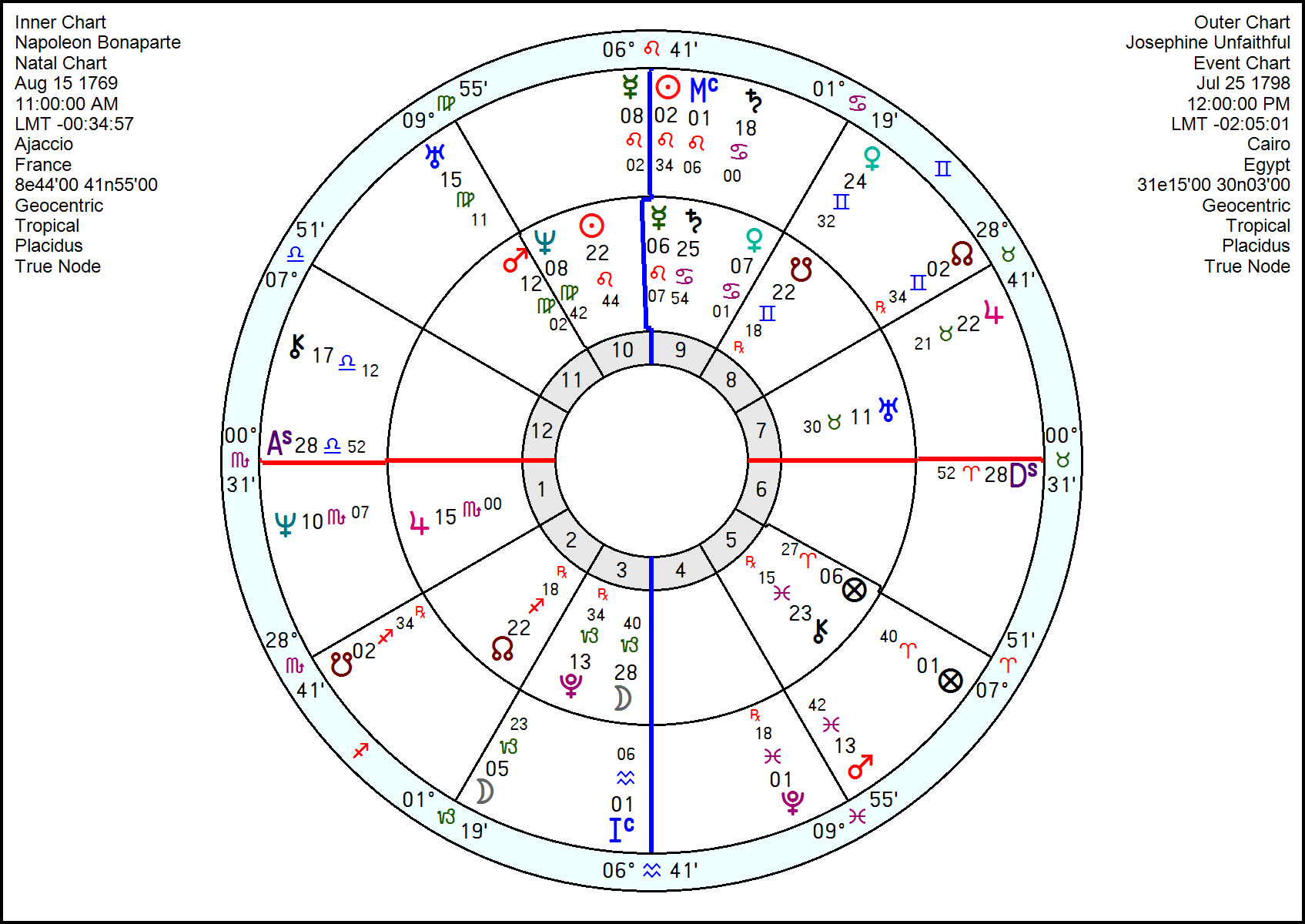
Napoleon -- Josephine unfaithful -- 7/25/1798:
Head 3 Gemini
Sun 3 Leo
Mercury 9 Leo
Venus 25 Gemini
Mars 14 Pisces
Jupiter 23 Taurus
Saturn 19 Cancer
Uranus 16 Virgo
Neptune 11 Scorpio
Pluto 2 Pisces
Jupiter square Sun -- apply Jupiter energy to his purpose.
Jupiter quincunx Head -- choice between directing libido within or without.
Mercury semi-sextile Neptune -- Mercury communicated something to him. Saw a new direction for himself, saw what Josephine really was.
Mars sextile Pluto -- choice of self-initiative.
Uranus sextile Jupiter -- Uranus -- archetypal relationship -- energy of Jupiter turned back onto himself.
All these planets are natally in aspect.
Pluto bi-quintile Saturn
Sun bi-septile Jupiter
Saturn tri-septile Head
Saturn septile Neptune
Pluto tri-septile Mercury
Jupiter quincunx Head -- choice to make the Head an inner or outer goal
Jupiter semi-sextile Tail -- empowering the past
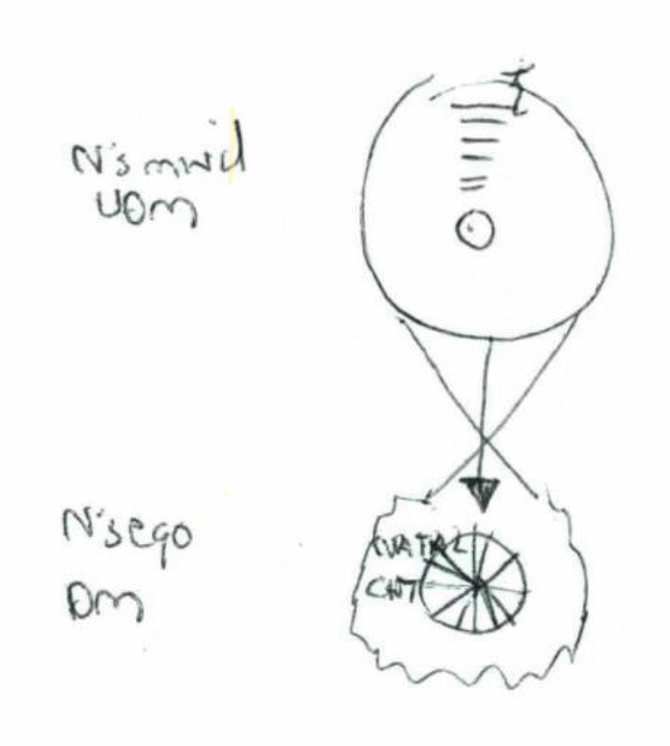
[FIGURE 1983 0502a-1-AB. Napoleon's Undivided Mind and Divided Mind. N's = Napoleon's; UDM = Undivided Mind; DM = Divided Mind. Facsimile scan from AB class notes.]
Venus, anima is what binds you to the dragon.
Venus = the feltness of the ego structure, which binds the undivided mind to the divided mind. Josephine was symbolic of the compulsion with which the undivided mind was attached to his ego. She was saying to him: "You're not identified with your higher mind." The feelings for life in the ego won out.
Pluto bi-quintile Saturn
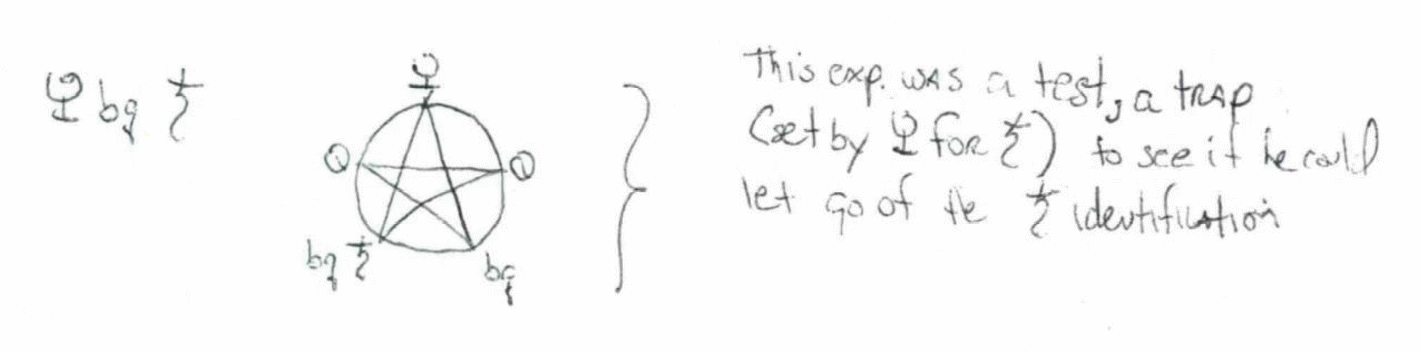
[FIGURE 1983 0502a-2-AB. Napoleon: Transiting Pluto Bi-Quintile Natal Saturn. Bq = Bi-quintile; Q = Quintile; Exp. = experience. Facsimile scan from AB class notes.]
This experience was a test, a trap (set by Pluto for Saturn) to see if he could let go of the Saturn identification.
Quintiles = buddhi vrittis -- right and wrong knowledge, etc. The knowledge the undivided mind has of the divided mind in looking at it -- the divided mind has right or wrong knowledge.
He abandoned the position of the undivided mind for that of the ego.
Pluto degree -- watchful squirrel away from hunters -- uncompromising loyalty to self-interest -- intelligent but not spiritual (a squirrel). [Pisces 2, "Almost as if possessed with man's intelligence a tiny squirrel remains watchful on a limb hidden from the hunters."]
Saturn -- cozy library. [Cancer 26, "The magnificent, luxurious library of some wealthy home is revealed; among the cushions several guests are reading."]
Pluto threw off or destabilized the secureness of the ego.
Pluto -- vritti of reminiscence, memory (reliving his past while in Egypt).
Obsession with practical self-interest -- Saturn self-apperception, reflected on his self-interest.
This degree is always quintile Saturn.
Pluto could stop (nirodha) the tendency for self-interest, or he could become obsessed with it. The Saturn held onto the habitual lower point of view.
Read septile and quintile according to the degree it is on.
Sun bi-septile Jupiter
Sun -- woman of middle years bobbing her hair, rebellion melts to surprised anticipation. [Leo 3, "A woman of middle years is bobbing her hair for the first time; a look of rebellion melts to surprised anticipation."]
Jupiter square Sun natally -- would try to embody Sun degree transit.
Human independence carried to extreme self-examination.
Self-mobilization for personal ambition (the message he got), inadequate appreciation of self's destiny.
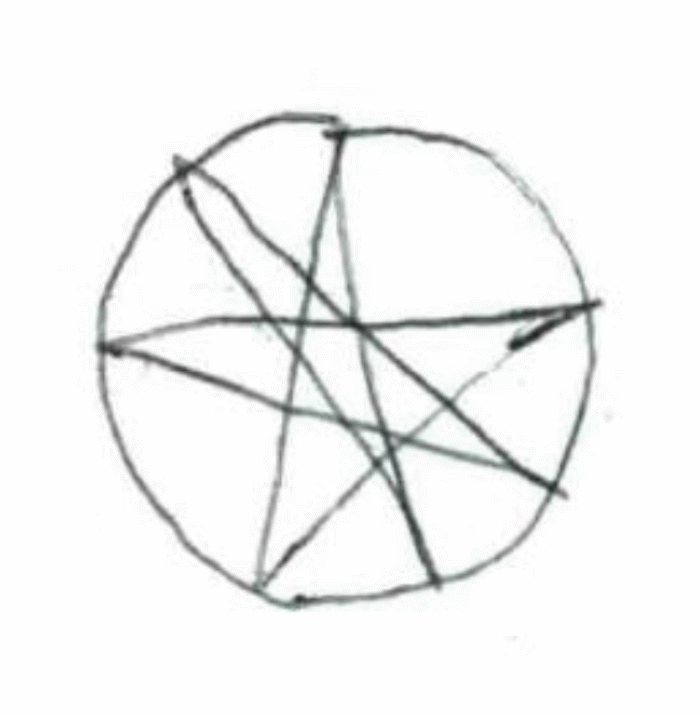
[FIGURE 1983 0502a-3-AB. Seven-Pointed Star in Circle. Facsimile scan from AB class notes.]
Uranus set up Jupiter transit sextile, Jupiter square Sun -- set up libidinal energy, direction was sprung by Sun septile Jupiter -- Sun septile Jupiter interpreted it selfishly.
The septiles provided the answer.
Saturn septile Neptune
The ideal offered by the rational soul -- Saturn degree -- ideal of a unified Europe.
19 Cancer Saturn degree -- fragile miss wed by a pompous priest to an eager youth of the new order. [Cancer 19, "A fragile miss, representative of proud old blood, is wed by a pompous priest to an eager youth of the new order."]
His service was in terms of Neptune -- social codes and orders (not going to India and conquering). This aspect returned him to this responsibility, his real job.
The Saturn was given the opportunity by Pluto which way to go. This was the solution offered by the higher. (Pluto bi-quintile Saturn was the problem to be overcome.)
Pluto tri-septile Mercury
Mercury = foresight, ability to penetrate into the raison d'être -- the Mercury told him about his Pluto -- that he had an over-valuation of self-interest.
The Pluto manifested the defect in his character -- over-evaluation of self. The Mercury showed what his problem was.
Sun bi-septile Jupiter
Point of decision to follow (or not follow) his destiny.
Answer given by the three septiles -- he could have seen his role in bringing Europe out of the feudal stage, and the defect in himself he would have to overcome, and an inadequate appreciation for his own destiny.
It's no test if your life isn't in danger.
Anthony had a test when the Dalai Lama was here.
Napoleon recapitulated his whole past before his Saturn return.
[Classnotes AB 1983 0502 End]
CHARTS FOR 1983 0502a
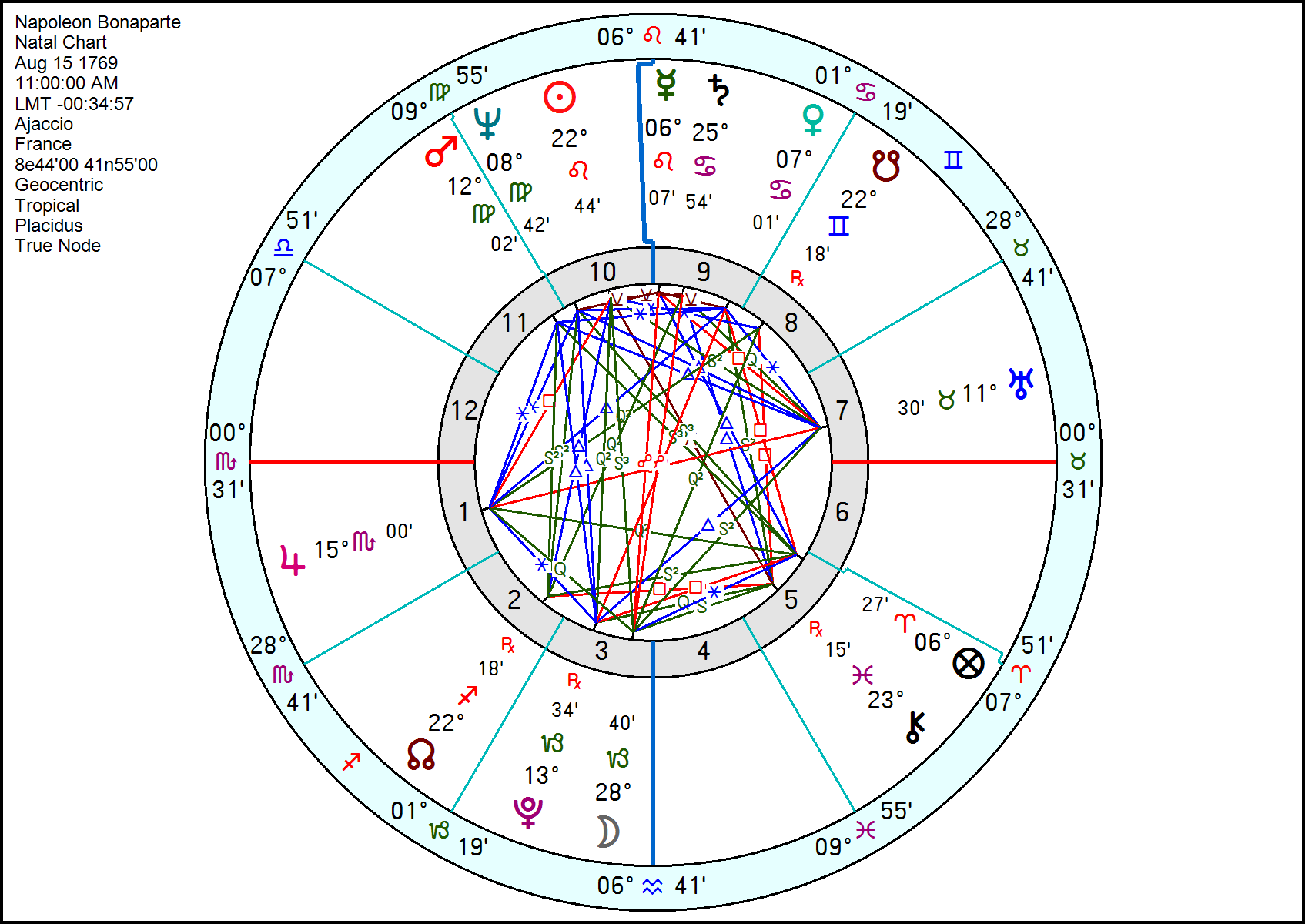
Class
Monday, May 2nd, 1983
Verbatim, unedited transcriptClick the series name to view more
CLASS at Wisdom's Goldenrod, Hector, NY
with Anthony Damiani (AD)
May 2a, 1983
ASTROLOGY; HOROSCOPE-NAPOLEON
with Appendix: Classnotes AB 1983 0502.
TOPIC: Astrology
SUBJECT: Horoscope-Napoleon
SUBSUBJECTS: Napoleon natal chart review, Transits (regular, quintile, septile) for "Josephine unfaithful" event, Anima
CONTENTS:
"Josephine unfaithful" event; destiny-altering decision made at this time
LR reads Napoleon paper which outlines Napoleon's natal Chaldeans and trans-Saturnians
Review of regular aspects for "Josephine unfaithful" event
Venus as feltness of ego structure, binds undivided mind to divided mind; Josephine symbolic of Napoleon's attachment to his ego
Knowledge of buddhi vrittis belong to Witness-I
Rational soul looking down makes a choice
Napoleon's soul committed itself to the lower–"I want to do what the ego wants"; legend of Narcissus
Transiting Pluto (Pisces 2) bi-quintile natal Saturn (Cancer 26): self-apperceptive functioning constantly preoccupied with self-interest; problem to be overcome; a test
It's always the higher that brings about a test, not the lower
This was a trap; he walked right into it
AD: There is a choice, but not easy; you may choose the good, not be able to follow it
Saturn function was being tested
Transiting Sun (Leo 3) bi-septile natal Jupiter (Scorpio 16): point of decision to follow or not follow his destiny
Transiting Saturn septile natal Neptune, transiting Pluto bi-quintile natal Saturn: Saturn given opportunity to conform to higher or lower
Transiting Saturn (Cancer 19) septile natal Neptune (Virgo 9): futuristic painting of the organization of society into an organic unity; ideal of unified Europe
Transiting Pluto (Pisces 2) tri-septile natal Mercury (Leo 7): Pluto manifested the defect in his character–over-evaluation of self, Mercury saw this clearly
Mercury, Leo 7: foresight, ability to penetrate into the raison d'être of why things are the way they are
Transiting septiles were the solution to his problem; he chose to follow the ego
When you're given a test you know it's a test; it's something you have to overcome in yourself; not a test if your life isn't in danger
AD had test when Dalai Lama came to WG
Napoleon recapitulated his whole past before Saturn return (from AB notes, not part of verbatim transcript)
Appendix: AB class notes
BOOKS READ FROM OR REFERENCED:
Marc Edmund Jones, The Astrology of Concepts
Marc Edmund Jones, The Sabian Symbols in Astrology
Ralph Waldo Emerson, The Complete Works of Ralph Waldo Emerson, v. 4, Representative Men
Paul Brunton, The Quest of the Overself
SABIAN SYMBOLS: Taurus 12, 13, 16, Cancer 8, 19, 26, 29, Leo 3, 7, 23, Virgo 9, 13, Scorpio 13, 16, Capricorn 8, 14, 26, 29, Aquarius 7, 23, Pisces 2, 13
DIAGRAMS and CHARTS appended to this transcript:
FIGURE 1983 0502a-1-AB. Napoleon's Undivided Mind and Divided Mind.
FIGURE 1983 0502a-2-AB. Napoleon: Transiting Pluto Bi-Quintile Natal Saturn.
FIGURE 1983 0502a-3-AB. Seven-Pointed Star in Circle.
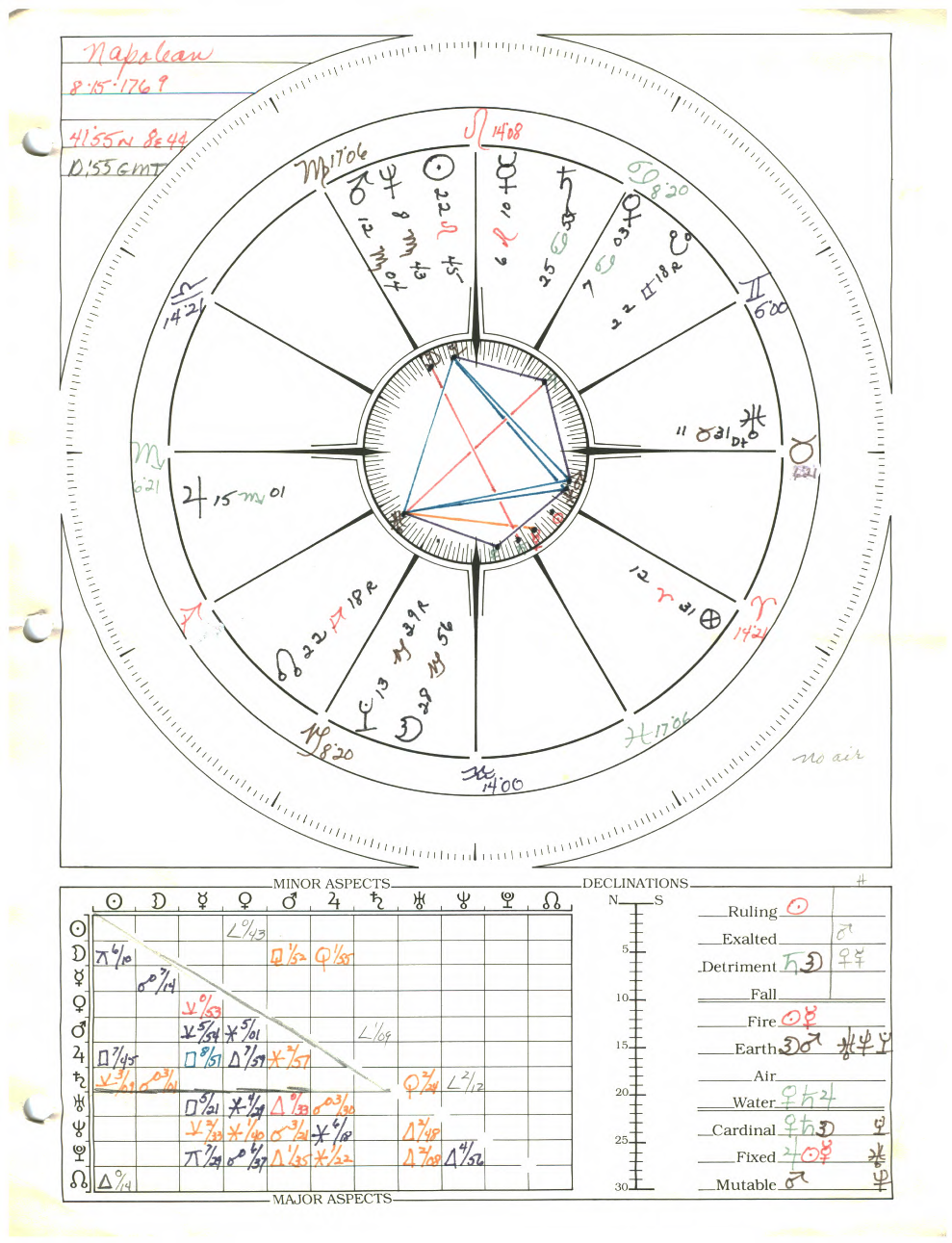
FIGURE 1983 0502a-4. Napoleon Natal Chart (WG version).
FIGURE 1983 0502a-5. Napoleon Natal Chart (astro.com).
FIGURE 1983 0502a-6. Suggested Transits for "Josephine Unfaithful" Event.
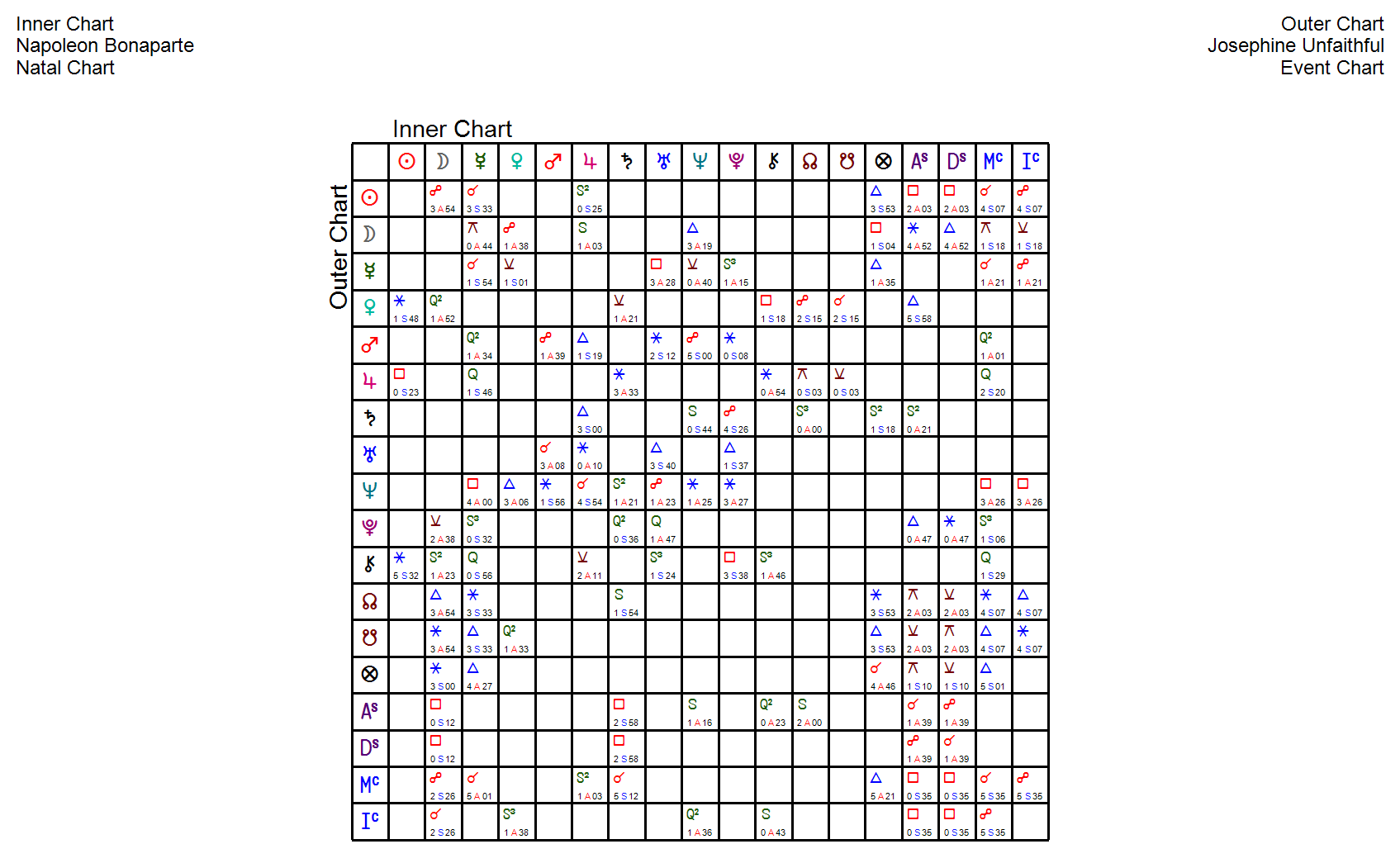
FIGURE 1983 0502a-7. Transit Grid for Napoleon Bonaparte/"Josephine Unfaithful" Event.
[Transcriber note: [diagram] means the speaker is referencing a diagram as he or she is speaking. If someone is drawing or writing, with audible sounds of chalk on a blackboard, I indicate this by [drawing] or [writing].]
PAPER read in class:
- "Napoleon's Natal Chart" by Linda Ruth (LR). Retyped as 1983 0502b V09MP. Astrology - Horoscope - Napoleon.
NOTES:
This is 1983 05/02a, Astrology; Horoscope-Napoleon class, and the first entry associated with this date. 1983 05/02b = paper on Napoleon's Natal Chart.
AB class notes have been appended because they contain diagrams that AD refers to and also because they contain a sentence at the end that was possibly spoken after the tape recorder was shut off. All spelling, capitalization, and punctuation corrected, all abbreviations, astrological glyphs, and one number spelled out in AB class notes.
TRANSCRIBED Verbatim by IT 2022. In 2025, IT removes appended Napoleon paper, which now stands alone, makes relevant changes in front matter and within transcript to indicate this change, updates audio file markers to match new REP audio. Archival verbatim transcript with Paper – V11ap.
AUDIO FILES: 1983 0502a, 1983 0502b, 1983 0502c. [Note: In 2025, REP Studio cuts dead air from files b, c, and equalizes sound.]
1983 05/02a at Wisdom's Goldenrod
Astrology; Horoscope-Napoleon
[Audio File 1983 0502a Begins]
TS: Order of events is we're going to go through a dossier of Mr. Napoleon's natal Chaldean structure. After our foray on Saturday, I'm going to back up and try something a little more coherent. So-- What it's trying to do is just refresh our memory by reviewing the Chaldean structure and the trans-Saturnian Chaldean structure of the chart. Then we picked out one date that we worked out this afternoon, uh--
LR: And, we're going to do it.
TS: Yeah.
LR (faint): I mean, same thing, right?
TS: Yeah [couple words inaudible]
AS (simultaneously): Yeah in fact we did this date.
TS: Ok, well--
LR (simultaneously): Yeah, of course we did, that's all (we're focusing on).
AS (simultaneously): You did-- you did the regular aspect.
TS: Ok well, we're going to add to the fairytale then, enrich the fairytale (bit of laughter) with septiles and quintiles for this event for when Josephine was unfaithful or when he got out. Which event was remarked by some people as being a turning point in his life, not so much in his relationship but just that he no long-- after that chose-- he said, "From this point forward, I'm only looking [student assents] out for myself." And, it seemed to be some indication that there was a decision made at that point in terms of how he was going to fulfill his soul.
LR (simultaneously): Well that's when he left his troops in Egypt and went back to (curry fame).
TS (faint): Yeah, he went af-- [one/two words inaudible]
LR: Went to-- for his own power.
TS: And since then, and if we get to it, I've worked out two more dates, when he proclaimed himself Emperor, and for the first battle in which he used cannon artillery, which is when he went from being a captain to a general, 'cause we're interested in seeing if we can see what was the situation, what was his attitude towards the situation, and what was the sol-- and if the septiles in particular will provide some kind of solution in a-- in their degrees. Now, for the one we did before, it's really amazing, it's-- I even believed it myself, well, it was-- (TS laughs a bit) it was really remarkable and when we get to the aspects of how that set it up. So, you want to do the-- I thought I had put it-- It was left I think.
[short pause, flipping of pages]
LR: (How would) you have heard this before? Was it twice?
TS (very faint): Twice?
AS: It was so nice we want to hear it again.
S: Yeah, please.
AD (very faint): Yes (you/we) do.
LR: This is that [RG, faint: Yeah.] wordy summary of the Chaldean planets in Napoleon's chart.
[short pause]
[Transcriber note: I am using LR's paper "Napoleon's Natal Chart" as found in Scan File ASL horoscope Napoleon P 11p.PDF (formerly ASL horoscope Napoleon P 7p.PDF). In the version below I transcribe it as LR reads it, noting any important discrepancies with the scanned version. This paper has a couple of AD handwritten edits in the first paragraph which are noted below. All quotes from Emerson and Napoleon are from The Complete Works of Ralph Waldo Emerson, v. 4, Representative Men, and have been made to conform to the quotes as published. This paper has also been retyped as 1983 0502b V09MP. Astrology - Horoscope - Napoleon.]
LR [Paper, "Napoleon's Natal Chart," LR reading]: "Since we do not have the sensible appearance, the vital atmosphere of Napoleon before our eyes, and yet wish to attempt astrologically the task of conjuring up the shade of the man -- how he moved through the world, how he thought and experienced himself and the times and culture onto which he would most vehemently make a mark -- we should first assume the Sun degree as the heart of the man, the imaginative texture of the mind, through which all the other functions will take their stance." [Note: AD has edited last part of sentence to read as follows: "…we should first assume the Sun degree as the heart of the man, the imaginative texture of the mind embodying this central purpose of his life which all other functions will reflectively unfold."]
LR: Can you hear? Oh, can you hear?
S: Yeah a [S simultaneously: Yeah.] little louder.
JC (very faint): It's fine, Linda.
LR [Paper, "Napoleon's Natal Chart," LR reading]: "This central posture -- 23° Leo -- the Apollonic consciousness, is doubly characterized as master: the Sun as the vital core of the being, and the bareback rider as the sensitively alert and balanced master of the beast on which it rides. Just as in the symbol, the artist reveals his achievement in dramatic and active performance of his art, Napoleon is thought to have revealed his selfhood through dynamic activity involving the careful balancing of all aspects of himself whilst poised for any slight change in direction. The demand is for adeptness, as revealed through a kind of persistent courageous concentration which can actualize its control and vision immediately from mind to hand at any moment of the process. Reflected in the opposite symbol is the inward ability to see first in the mind's eye every consequence of the action as or before it is performed. It seems it is to the Sun degree that Emerson's apt description of Napoleon applies:"He had a directness of action never before combined with so much comprehension. … He sees where the matter hinges, throws himself on the precise point of resistance, and slights all other considerations. He is strong in the right manner, namely by insight. … His principle means are [in] himself." And in Napoleon's own words, [LR: (Here's) a quote.] "My actions were as prompt as my thoughts", and, "As to moral courage…I mean unprepared courage; that which is necessary on an unexpected occasion, and which, in spite of the most unforeseen events, leaves full freedom of judgment and decision."
"If the Sun is the illuminating center of the imagination, Saturn should be its outer reflective [Note: Typed version has 'reflected'.] definition, the eyes which look back, and provide the quality of the ego's frame or [Note: Typed version has 'of'.] reification. Napoleon's Saturn at 26° Cancer is stable, comfortable and confident about the being it circumscribes. This ego is not in infancy and coming to be developed, but rather, its maturation was assured from the first; i.e. Napoleon was the conqueror. The symbolism of the fabulous library with guests reading suggests both full exposure to potential, and relaxed application, much as a cat is at once fully relaxed yet at every second ready to strike victorious. The opposite symbolism describes the attitude consequent upon this poised self-confidence: Spontaneity, restlessness, caution as exercised to continually assure transcendency over the ordinary or commonplace involvements of human nature. Napoleon had to see himself as constantly embodying an ideal rather than as participating in banality."Men of my stamp" he said, "do not commit crimes." … "I have always marched with the opinion of great masses and with events. Of what use then would crime be to me?" So speaks the self-reflective apperceptive mind. As inner to outer, it is not surprising that we should see an obvious harmony between the symbolism of the Sun and Saturn. Tied together in semi-sextile, the ego and central purpose are bound together in power.
"From the Mercury degree at 7° Leo we can understand some of what bred in Napoleon the conviction that he was in fact a man of destiny:"The night heavens are seen in their wonder as in the desert when the moon is dark; the constellations are at play." If Mercury describes the formulation of thought out of a formless substance, we could say that Napoleon saw all his thinking as cosmic in scope and ordination. Therefore could he constantly allude to his star and style himself a "child of destiny", speak of changing the face of the world, and have the perspective to incite his men in Egypt with "From the tops of those pyramids, forty centuries look down on you…" The realization of divine power in every one of his acts guaranteed Napoleon the self-assurance he seemed to exude. As Jones says of this degree, "his assurance lies in his own being and experience." Although much of his later actions may have distorted the revelation of the world-idea, the Mercury symbol guarantees the penetration into it and the recognition that a world-conqueror was needed. The opposite degree, "a child born of an eggshell" says that from the recognition of divined birth is born the promise of constant self-renewal in a temporal sequence. Jones speaks of this degree as unlimited resourcefulness, existence continually creating itself anew. Napoleon was in fact viewed this way: untiring, ceaselessly devising new and creative modes of execution of his plan, his destiny. His self-consciousness was being born of the instant, and yet he was capable with this degree of an unsurpassable concentration and self-absorption which won him the title "unconscious yogi".
"With Venus on the symbol for rabbits in dignified parade, 8° Cancer, we might assume that for Napoleon prime value lay in uplifting and aggrandizing the state of the common man or the state of the lower nature. In fact it was this intent which supposedly drove him to many of his conquests. Emerson is most fond of describing Napoleon as representative of the common man, emerging out of him, comprehending him, transcending him, and thus being capable of guiding him. Although falling a prey to power himself, he openly displayed his disdain for kings and aristocracy. Napoleon's idealism must at least have been born in part of this degree as well, as the symbolism does imply an appropriation of the garments of the higher ideal, perhaps, whether political or otherwise. This theme will be repeated in the trans-Saturnians. More inwardly, his value or own self-worth was conceived in terms of witness consciousness, which at all times he had to struggle for because of his position. The opposite degree speaks to his ability to actually install this ideal in the real circumstances of everyday life; the capacity to maneuver available resource, whatever is at hand, and make of imagination an established order or else be overwhelmed by the same imagination into what Jones calls"idle narcissism," which too had its role in Napoleon's character. Jones says of the opposite symbol, "here is the actual and impregnable independence of [the] individual, evident as at length he is able to make his world his own and call on all to share it with him."
"This image then flows naturally into the Mars symbol at 13° Virgo, representing the nature of desire or outward thrust of the individual. The intelligence here also endowed Napoleon with the ability to assert order and command over chaos, to effectively dramatize the potentiality of his desires. Here we barely have to look past the literal image for meaning:"A statesman stands before the mob; his strong hand can be seen in a transforming of hysteria into new enthusiasm." The power intended here is obvious but there is also the implication in the symbol that some function in the individual will be changed. (We have to see the mob as well as the statesman within the domain of his psyche.) Perhaps the full expenditure of the desire was in this life being supplanted, checked, given a new order; and perhaps Josephine, as never quite surrendering to the wants of Napoleon, not even in the vision on his death-bed, could stand to symbolize the transformation. There is also in the symbol the realization that one's destiny or karma was within one's hold, that is, actually belongs to the realm of individual responsibility; that only when we fully take command of our lives does the "making of history" come within our ken and affect anything outside ourselves.
"Born of this command, as the opposite symbol indicates, is a sharp discrimination -- the sword in the museum -- the treasure of intelligence, and one of the lasting marks of greatness. Jones says"thus wisdom becomes incarnate in the leadership to counsel confusion." So in many senses this was an empowerment of both intelligence and act.
"If we next look to Jupiter in the first house as the function Napoleon would have most identified with, we find, I think, a description of the kind of temperament he manifested which made his life so endearing to his followers. The other symbols of power and vision may have given him a cold and somewhat cruel nature but for the Jupiter at 16° Scorpio."A girl's face is revealed of fine and delicate aristocratic features; suddenly these break into a glorious smile." Here is the "magic of personality," the generous and rewarding quality of Napoleon's leadership. The nature here is described as gregarious and friendly, open and outward. And, if we were to interpret it in a more introverted language, we could say that Napoleon had a complete receptivity to the wisdom buried in the instincts. In that the instincts dictate preconceptual action, or immediate reaction to circumstances, communication with those instincts was unhampered and open, so that he was able to meet every "Toulon" and every new opportunity. The opposite symbol -- the old man trying vainly to reveal the mysteries to a motley group -- tells of the direct need to share as the promise of fulfillment born of this kind of receptivity. The vision must be dramatized or else it is only half-realized. If Napoleon fell short in other ways, we would at least have to say that he was always true to an inner essential selfhood -- whether lower or higher. He knew in what leadership consisted and how to seize it. Emerson says, "Bonaparte was the idol of common men because he had in transcendent degree the qualities and powers of common men. … He is so largely receptive, and is so placed, that he comes to be a bureau for all the intelligence, wit and power of the age and country. … He filled his troops with his spirit, and a sort of freedom and companionship grew up between him and them…", and in Napoleon's own words, "In all battles a moment occurs when the bravest troops, after having made the greatest efforts, feel inclined to run. That terror proceeds from a want of confidence in their own courage, and it only requires a slight opportunity, a pretence, to restore confidence to them. The art is, to give rise to the opportunity and to invent the pretence…to seize that moment of lassitude…" [Note: Published quote reads, "The art is, to give rise to the opportunity and to invent the pretence. … I seized that moment of lassitude…"] With this Jupiter, he was sensitively at one with the leadership he displayed.
"Finally, we should be able to see in the Moon a mirror reflection, a kind of summation of all the others in the brain consciousness, the moment to moment bearer of the stamp of the man."Afternoon tea is served in a gypsy parlor patronized by socialites and here a young lady reads the tea leaves." What better symbol for the bringing of the higher or invisible forces into the hub or mainstream of everyday life. For to Napoleon, these two realms were fused; i.e. the body could sense the celestial destinies in everyday circumstances. His body was the actual instrument -- like the tea leaves -- for things intuited or caught on the wing. His judgments were based on portents given to the body, not the reason, and herein lies a large margin of error. Jones calls it "signature", or "naïve insight", and in the opposite symbolism -- a muse weighing twins of [Note: Typed version has 'on', Jones has 'in'.] golden scales -- we can again sense the demand for balance of the celestial with the sensible, the union of the two in the bodily function. Intelligence and action over and over in all these symbols are made to unite in what Jones calls an "integrity of selfhood", or what we may call a unified psyche, an efficiently tuned vehicle of destiny.
"Criticisms of Napoleon's character and mistakes born of it may be justly lodged, yet it must also be seen from the symbols or reason-principles that his was a position of command efficiency, stationed between the mundane and spiritual, and ever poised toward action [in] an attempt to manifest the greater good."
[15¾ second pause]
LR (faint): I don't know, (can we) read this?
TS: No.
LR: Did we ever read the trans-Saturnian(s)?
S: No.
S (very faint): Uh-hm.
LR [Paper, "Napoleon's Natal Chart," LR reading]: "When we now turn to the trans-Saturnians, we find a peculiar familiarity. Functioning as the highest faculties of the man, super-reflective knowing, willing, and feeling as they have been called, Uranus, Neptune, and Pluto, seem to capture the essence of all the meanings investigated so far. In other words, rather than standing apart, over, or above the Chaldean symbols, they stand as their hyparxis, capturing the very heart of what the ego so laboriously was seeking.
"But perhaps this situation has in fact been stated incorrectly in reverse; i.e. perhaps these three are in reality universally prior; the ego functions, thinking themselves independent, but acting as reflections or specific revelations of the higher faculties of knowing, willing, and feeling, attempting to mirror them in a highly limited or circumscribed space; act here, being an attempt to return to conscious contemplation in [Note: Typed version has 'of'.] the source. If this is the case, then turning to Uranus Neptune and Pluto should reveal to us a broader consciousness than what any one segment of the ego could contain, albeit not unrelated to that modalized being.
"The meaning of the Uranus at 12° Taurus,"A quiet young couple is walking down a busy street, stopping to peer into every window with joyful eye," leans heavily on the side of imagination or the interior space of the mind. It must have been to the meaning of this symbol that the description of Napoleon as fighting his battles first in his mind, and only secondarily in the battlefield, was addressed. Jones says, "This is a symbol of human imagination as the real corrective for man's experience, enabling each individual to know in advance whether the choices he will make are in line with his desires." P.B. in the Quest of the Overself describes Napoleon as "flickerless in inward thought", and the symbol seems to imply that the unflickering mind of thought was able to penetrate to the heights of knowledge while the world kind of "flickered by"; that is, the world was like a stage for the airing of this higher penetration which came through the power of imagining, just as the window shopper witnesses, imagines, and enjoys, but indulges himself only mentally and not physically. The keyword is "visualization", the direct presentation of the "immediate potentials of human achievement." But in what way can we see in this functioning, the penetration by a higher order of reality, namely Uranus? In what way was this a faculty not of the lower mind, but of the higher? We must think of this imagination not as we attribute it to the Sun for instance, but as a "seeing" or inner vision leaning toward freedom; in Emerson's words, "Whatever appeals to the imagination, by transcending the ordinary limits of human ability, wonderfully encourages and liberates us."
"The Neptune at 9° Virgo, a futuristic artist whose work is unintelligible, powerfully directed this inner vision toward some collective good. Signifying social obligation or the function of higher feeling in us, we could perhaps speculate that for Napoleon the expansion of the psyche (Neptune's ACT) occurred through creative and original expression in action. Jones says that it is through"personal uniqueness that man is able to establish himself," and we may here add that the uniqueness of which he speaks was to come through an enlargement of the feelings which embodied future direction through experimentation of purpose. Through this were his feelings enlarged, or rather, in this process would Napoleon feel himself to be more than himself, that is, to be the powerful creator or conqueror. There is the implication in the symbolism here, that the work is unintelligible. Perhaps Napoleon was part of a scheme which couldn't be understood or grasped at all by his contemporary culture, or himself, a work whose true purpose would only be revealed in the future.
"Finally, the Pluto symbol describes the dharma or willed content of the life outside of the ego's conception of it, the connection of the ego to the embodied wisdom of the world."A vast pile of Mayan ruins in tropical America discloses a perfectly preserved bas-relief carved in granite." In living his life, Napoleon had a concrete sense that what he was doing was integrally connected to a world process, that he himself was a historical figure in the carrying out of the world-idea, and was to take his place among the Alexanders and other "greats". This indication is given by the Pluto symbol. Jones says that the present moment is "a recurrent manifestation of all that has ever been or that ever can be," and thus can man "capitalize on the opportunities brought to focus in himself and his world at large." The intelligence in the degree accedes to no limitation, and considering that Pluto is the dictator of what will be embodied by the will in the substance of the life, we may blame him, or rather the misappropriation of his power, for Napoleon's grand conceit, arrogance, and final undoing. He simply did not believe in humiliation or failure for men of his historical breed.
"Perhaps we should summarize: through the Neptune and Pluto, Napoleon was being expanded through feeling -- forced to operate towards and bring about some future unknown goal, while being made constantly aware of his important role as a giant figurehead of historical import. The"instant", the present, is critical in this chart. Only in the instant is the past of Pluto and future of Neptune embodied; so the instant here is represented by the power of an almost cosmic imagination, Uranus."
[9¼ second pause]
S (very faint): It's gone through phases.
S (very faint): What?
LR (very faint): Yeah.
[10¾ second pause]
TS: Ok, so-- [14¾ second pause] Maybe that'll give us some background to try to deal with some of these events. [9¾ second pause] When was this, (11/17/17)?
LR: July?
AB: 25th.
LR: July 25th?
TS (very faint): Oh.
AB: Between (17 and 8).
TS (faint): That will be why.
AB: '98. [Note: 1798.]
S (very faint): Ok.
[40 second pause while someone draws/writes; some faint background talking]
TS: Ok, um-- These are the aspects now. [Note: See first page of appended AB class notes for the following. See also FIGURE 1983 0502a-6, Suggested Transits, and FIGURE 1983 0502a-7, Transit Grid, appended to this transcript.] Do most of you remember the event or should I go over it again? Go over it again?
AD (faint): Over it.
TS: Very briefly, as far as the event itself is concerned, which we hope to see in these aspects here, the normal aspects. [Note: Normal = regular, does not include quintiles and septiles.] Napoleon's aide-de-camp [one word inaudible] got a letter from his wife mentioning that she heard some gossip that Josephine was unfaithful. So this wasn't exactly a direct [one/two words inaudible] by any means. But-- and then he happened to mention it to Napoleon. "Ah, I heard this must--" And immediately Napoleon took it for gossip. He didn't-- any question at all he just said-- he just took it be true. [S: (Happens.)] And he was in-- and, this was in the middle of the Egyptian campaign. And it was from that point forward that he decided that he was going to look out for his own political growth and power. And, within a year or so he got his way back to Paris, his troops sort of dropping off by the bubonic plague along the way. His troops died and most of them died. At this very time though, within a month of this time, which would include some of these slower-moving aspects, the Pluto aspects and Uranus aspects, this was the time when he first got to Egypt and he got all his people in front of the pyramids and said look, Europe is a molehill. He said, the great empires of the world have always been the empires of the East. And he really wanted to-- he started to have dreams about marching all the way to India and finishing what Alexander started. And he wanted to rewrite the Koran and bring the Koran back to Europe, 'cause he thought the Koran was a much more interestingly written scripture than the Bible. But he wanted to put a few (kinks in it) so-- So, this was-- he did use some new ideas in warfare also I think in terms of using artillery down at Brittany Point. That wasn't planned, it-- Such was the force of his personality at this point that when his troops did get bubonic plague, he went amongst them in the hospital tents and told them it was just the local food and-- (TS laughs a bit) [students assent] and shouldn't get worried. [student assents] And they believed him. 'Cause he didn't want them-- them to panic and desert. Of course they didn't have much of a place to go. (some laughter) So, it was-- In a lot of ways, it was around this time that he was stopped by his own thinking and his own bad judgment in a couple of incidents after this.
LR: Well, PB says this was (the terminal), [TS: Yeah.] this is his downfall, this-- this is when [TS simultaneously: He--] things changed.
TS: So we're going to try to see what it was that he was going through and what it was that changed, you know. If anything, where was there some kind of error of judgment or whatever, if we can see such a thing. So, you got those guys up there. This (look--) Well, I'll do that one last. It's the hard one. [student assents, very faint] Now we've been through these before, some of them. I think in terms of the event itself, certainly these two aspects are-- I think are very important. That is, the Mercury is-- Oh.
LR: Yeah, say-- say the--
TS: All of these aspects, Jupiter square the Sun-- he has a natal Sun Jupiter square, ok. Mercury semi-sextile Neptune, he has a natal Mercury Neptune semi-sextile. Mars sextile Pluto, he has a natal one degree Mars Pluto trine, and a natal Jupiter Uranus opposition. So all of these aspects [Note: Reference is to regular aspects.] are a reconfiguration of natal conditions. I'm not sure about the Jupiter Head. 15 to what?
RG (faint): Seven degrees.
TS (simultaneously): No. No it's seven degrees so that one's new. But all the rest of the ones, the ones among the-- the planets are all a reiteration or reconfiguration. There's nothing new, there's no new pair being brought together here. Now the-- one thinking that we had about this was that, the communication, transiting Mercury would represent some kind of communication, ok, and so that it would certainly seem to be that as far as getting a message of some kind and being aware of sort of what his real feelings were like would be coming off-- would be presented to him, this would be the occasion of some kind of communication, ok. Now, most of you know that, I mean, Josephine was-- this was hardly a change in character for her, this-- this information and he sort of built a somewhat of a-- an idealization of her and put a lot of energy into this relationship, which, when he was disillusioned he never engaged in any kind of emotional commitment to another individual after this. And I think that he has a Uranus Jupiter opposition from the seventh [house] to the first [house]. And I think that that would be the place where you say (so) the psychological basis for that-- that large investment, trying to see that Uranus at a kind of archetypal-- well, if you want to say it's a feeling or archetypal relationship, had a perfect relationship in the Uranus in the seventh house. And here it's being bent back onto the Jupiter. So, it started here and now it's come all the way (up--) Mind you, this fellow's 29 years old and he's just taken over most of Europe and is thinking about doing the rest of the world so, uh, (some laughter) you know--
S (faint): We believe it.
S (faint): Unbelievable.
S (faint): Yeah.
TS: It's not exactly your average fellow, I mean, so-- He had Uranus coming back. It was coming to a point where it was going to start trying to define itself in terms of this first house Jupiter. And we talked about the first house Jupiter as a kind of energy or leadership. You know, in Linda's summary, there's this idea of the Jupiter in the first house as being his ability to lead other people, draw them out and so forth, and that he was going to devote his energies towards this kind of leadership and towards being self-reliant, pulling his energies out of himself, ok, and that the-- he-- The amount of unconscious libido that Jupiter represents being projected onto this seventh house Uranus was sort of flung back at-- into him with the Uranus sextile Jupiter. So, we're saying that the projection on Josephine was broken, he saw through it and the energy from that projection was turned back towards himself, it wasn't then turned towards some other thing, but back towards himself.
LR: So you think he has an awful lot of libido to deal with.
TS: Yeah, he's all of a sudden got all this energy and, you know-- And all dressed up and no place to go.
LR (simultaneously): We'll try it. (laughter)
TS: Now he has a natal Jupiter Sun square. And so the Jupiter is now in Taurus in this-- in this event, and is squaring the Sun in the other direction. So again it would seem as though this energy which is being sort of released or intensified through this aspect of Uranus sextile Jupiter, they're now trying to actualize something of the Sun, some sense of the audacity, the sense of himself, purpose, his-- I would say the first focus of that Jupiter would be in terms of career, in terms of-- that's accomplishing or actualizing something of that Sun, that solar consciousness. So there's an opportunity here for him to take that energy and actualize his individuality a little more strongly and recognize this [one word inaudible] Now, last time I came up from-- I have no idea where I came up with this from but, we suggested that the Jupiter quincunx the Head, this being the upper quincunx, which would be Aries to Scorpio, that's what I mean by that, the relationship of Aries of Scorpio, that there was some choice here in terms of whether that direc-- that energy, this-- this libido was going to go inwardly or outwardly. Was he going to regenerate that libido by turning-- turning inward, or was he going to go for an outer kind of success, ok. And there seem-- seems to be a certain kind of strain or pressure or opportunity in this kind of focus of his energies as to what direction that, you know, it's going to go in, whether he's going to make that goal, the Head, an inner goal or an outer one, ok, um-- [short pause] This is just, you know-- so it's the same fairytale.
LR: Well, one-- one other thing we said was-- the last time we did it was that if it's quincunx the Head, [TS: It's also--] brings strain to the goal, it's also semi-sextile [TS: Right.] the Tail. [student assents, very faint] And, the Tail is this Emperor vasana, we would say. So, while it's bringing-- putting strain on the issues of what the achievement of the life should bring, it's giving him-- it's empowering the-- the past.
TS: Right. So there'll be a tendency to want to reiterate through or recapitulate the way in which the Tail is functioning. And I think here, if anywhere, in the Mars Pluto sextile, there's some idea of choice because usually Mars-- Mars is some kind of an initiation or-- and his self-initiative. I think of it sometimes as being a choice of-- and deciding to go this direction or that direction, it's a separation. You know, they say Mars divulses form from matter. And I see this as a way in which he's going to choose to define himself in terms of either the lower will, his desire for self-dramatization, just what the Mars degree talks about, or whether he's going to put himself on the foundation of a kind of a submission to this higher will, this world-transforming power that the Pluto has within him. So in some ways I think this is where the decision is being presented to him in terms of just the-- the-- the event itself. Now, do you want to discuss that?
AH: Can you say more about the inner and the outer choice? Is that-- is that's what you're describing now?
LR: It's more-- I think it's more the higher will represented by Pluto than the individual will represented by Mars. It's not [TS simultaneously: Yeah.] Pluto trine the-- it's not Pluto aspecting Mars, it's Mars aspecting the Pluto. And in some way, if it's been said that he makes a choice for his own ends at this point, it's the Mars which is deciding to take the lead rather than the Pluto.
TS: Well, and the other thing I was-- was that in terms of the Jupiter quincunx the Head was that, I guess-- in trying to understand what possibly might be meant by him making some kind of choice at this point, that-- and especially as again we work(ed) through this today, it didn't seem like it was wrong for him to go back to Europe. In fact, there was the implication that there was some real productivity in terms of him uniting Europe in some way. But I think it's a question of whether he united it according to satisfying an inner awareness of his position in history or trying to-- deciding to make sure that his outer encouragement was always there. In other words, like this. This is the first time (when/and) he did this again I believe in Russia, where he felt that because he was so far away from Paris that his power was weakening in Paris. And it was. And he was definitely under some-- his resources as-- were being weakened back at the home front. And, instead of having some kind of faith that if he followed an inner destiny that it would still be there when he got back, he decided no, he'd make his way back there himself and make damn sure that, you know, none of his power base was lost, ok. And the same thing happened again at the-- when he pulled out of Russia. The speed at which he came back was-- partly motivated the concern of losing his strength in Paris. So I was thinking that, in that sense that it's like, whether he personally takes responsibility for an (outer) confirmation that he's still got the power, or he would give that over to an inner kind of faith that that-- that-- well that energy would be available to him, that his stamp as a leader of Europe is not going to be endangered by, you know, the petty politics of, you know, the other-- the other French people. Of course-- (some laughter)
RG: Well, the other point of view.
S (very faint): That's right, yeah.
LDS (simultaneously): Champagne. Tim, you don't-- you didn't consider the opposition between Neptune and Uranus, you didn't-- that's not close enough?
TS (simultaneously): One degree only.
LDS: That's not one degree, 11?
TS (simultaneously): No. No. These are [LDS simultaneously: Oh ok.] one zero zero zero but-- I mean, if you let me off go, I'm sure you'll regret it. We bring in the one degree, two degree aspects, there's 36 of them or something in this-- in this event.
S (faint): Uh-hm.
AB: I just-- to bring in a little more to confirm what you just said. One of the other reasons he went back was because France was getting invaded by all sides, you know, by the Russians and the Turks and the English. And I guess as a general he felt he had to really be back here helping them out. And when he got back it turned out that one of the other generals had kind of resolved their military problem so that his original rea-- one of his original reasons for thinking he had to go back was no longer necessary when he got back. And when he got back there were a lot of political internal disorder problems that he did have to deal with but, his conscious decision to go back was based on certain assumptions which were not necessarily accurate.
TS: Uh-hm. Ok. Do we want to chew these aspects over some more, do we want to-- Or, that's it.
LR (simultaneously): What about Mercury semi-se--
TS: Ok. I don't really-- you know, other than thinking that-- well [few words inaudible] have to be.
LR: You did that one?
TS: Yeah. See it's-- that's the natal-- the Mercury's practically on his Mercury. But it isn't, I mean it's two degrees away, it's at-- it's on 8 degrees. Well we said that a semi-sextile is some kind of empowerment.
LR: Yeah I was just thinking that the Neptune represented new direction.
TS: Uh-hm. (Very interesting.)
LR (simultaneously): That the Mercury, you know, which had some kind of divine import or some of that, you know, that he was being guided, was putting that power into some new direction. (He/It) was-- he made a decision right then to change, to go in a different direction I believe.
TS: I guess we could say that in a sense that, as far as, you know, the set-up here, that, we say that the libido was brought back in to himself, that his intense involvement with Josephine was-- freed him up so he had a lot of energy, ok. And I could see in that sense that it was being set up so that he could see what would be a new direction to go in. Because, remember he came down to Egypt with all those scientists and Egyptologists and historians and so forth, ok. But I don't recollect that he went back to France with them. I don't know that-- yeah. He didn't-- he was in the middle of thinking about that stuff and I think-- I could see this as being-- that this communication could free him up towards going in a new direction which would be to submit more to what these bigger guys had in mind for him, Pluto, Uranus, and Neptune. That here was a chance for him to say ok, well, never mind my personal life, I'll go after what's-- you know, I'll be at service to-- to the community. I'll take care of what their needs are first, you know. It's like an a--
RG: (So), he didn't say that there.
TS: No, he didn't. But, I'm not sure that that-- that saying is in this situation here, in other words, this is just a-- this that-- I'm trying to see if we can delineate these aspects-- [Note: Regular aspects. See first page of appended AB class notes.]
LR (simultaneously): Poss-- as possibilities or something?
TS: Yeah, as possibilities, the question or the test which is being presented. And, then over here if we can see why he might-- the ideas that he brought to bear on this to interpret it. [Note: Reference is to transiting septiles. See first page of appended AB class notes.] I was thinking of the situation in Gandhi's life where he was-- he had finished his thing in--
LR (faint): South Africa.
TS: South Africa. He was on his way home, he hadn't seen his family and he was just going to go home and-- Then on the last night on-- they were throwing this farewell party for him and they told him "Look, we need you," and they-- this new (or/and) this act had just been passed and all these people begged him to stay. So, at-- he saw that he really was needed there and he really accepted that all his own druthers were to get back to India, that that wasn't what he should do. So he agreed to stay, he stayed for what, six months?
LR: Twenty years.
TS: No, no, he stayed for six months and then he went back and got his family.
LR (simultaneously): Oh.
TS: And he didn't stay for-- But he didn't immediately follow his own--
LR (simultaneously, faint): What a surprise.
TS: You know, he had his own druthers but I think he-- he submitted to some kind of sense of, you know, what his inner being wanted him to do. So I'm thinking that this-- these aspects here show that kind of presentation of a choice, what he-- which way do you go. I'm just thinking that. How would you interpret that?
S: Yeah.
RG: Yeah I think a lot of-- you can be real mislead from that aspect too, Mercury Neptune. You know, that your judgment could be kind of cloudy under that aspect.
TS: Well it's the natal aspect, you know, I mean-- He always had that aspect going for him so I hope not.
RG: [one/two words inaudible] Mercury Neptune, (Tim)?
LR: Yeah. (LR laughs a bit)
[Audio File 1983 0502a Ends]
[Audio File 1983 0502b Begins]
RG: --can accompany (him too).
AB (simultaneously): That one day (I think he'll call me). Yeah.
LR: Yeah, you know--
VM: But he made a good reason why [couple words inaudible] You say that well, it was only a flimsy sort of [AB simultaneously: That (one--)] rumor. And he just threw it all--
AB (simultaneously): He asked all the other generals and everything and they all confirmed it so-- so not only was it did he find this out, he found out that everyone else knew except himself.
VM: Ok.
TS: Well, he hadn't exactly paid attention to subtle little things like married woman with two kids, you know. She was-- she was what, ten years older than him, twelve?
VM: She was a bit older.
TS: And it was-- she was much more active and experienced in the court life than he was and he was in a whole different kind of world or social environment, and that both-- I mean, you know, it seemed to me that he was-- he persisted in narrow interpreting [student assents, faint] what [few words inaudible]
VM (simultaneously): He must have had a suspicion is all I was going to say.
TS: Yeah.
VM: Well, otherwise [LR: Yeah.] [one word inaudible] sets him up.
LR (simultaneously): Tim, he operated-- remember when we were doing Gandhi's ch-- I don't know whose chart actually, but, we were talking about this new position that we are the transiting planets, [TS: Yeah.] the rational soul is the transiting planets, and that in any given event you can choose to cling to the ego or be-- just be the rational soul [TS: Uh-hm.] as it's unfolding? And you did that cute little thing too.
TS: Uh-hm.
LR: Um--
TS: You want me to do it again?
LR: Well I'm wondering how that would look, I mean because the-- the things that are being transited are Neptune, Pluto, the Sun, and the Head.
TS: Alright, we'll try it. I-- I tried it this-- in my head this afternoon, I'm trying to--
LR: In (your head/the Head)?
S (faint): Uh-hm.
TS (simultaneously): Yeah. I mean I [LR simultaneously, faint: Ok.] tried to think it out. Yeah I would agree-- also I would agree with Vic but I think that-- In other words, obviously something in him knew because-- what I meant by making remarks about Josephine was that, I mean that he had-- must have had experiences, you know, prior to going down to Egypt, which when seen with a-- you know, it's like at some point that was going to have to break through to him, that what was-- where she was at, you know. So I think that, you know, that we-- he-- this was kind of an aspect that might have opened him up to realize a kind of accumulation of experiences, see well this is nice, you know, so it happened.
LR: No.
VM: But you know, let's look at it, I mean it seems like we haven't said much about the fact that Josephine in some ways, like all people, are an outer symbol for something that was going on [LR simultaneously: Yeah.] internally.
TS: Uh-hm.
LR (simultaneously): Yeah, that some--
VM (simultaneously): So in some ways he disavowed an allegiance if you like let's say to the anima or, I don't know, that's-- [TS assents] that's kind of dime store psychology but--
LR: Well and also she represent--
VM (simultaneously): You know what I'm saying, (try--)
LR: Well go on, I'm sorry Vic.
VM: Just-- I don't really have that much to say but somehow it seems like this is the-- the outer level, and it's one that one has to-- has to deal with. But somehow, there must have been some tremendous inner revolution that corresponded to this no longer giving allegiance let's say to personal relations, especially a member of the opposite sex and-- I don't know.
LR: Also she represented, I mean-- not just because she was a woman but she represented a real-- she was a real thorn in his side his entire life in that he-- he never could get. It was the one thing and the first thing he realized he couldn't conquer, no mat-- you know, he went on (to do) everything else but she would never submit to him, she would never give herself over to him, and, you know, like I tried to hint at in that paper, she-- he was having visions of her on his deathbed and she still wouldn't, you know, give herself (to/through) him, and those were his hallucinations at death. It was like it was always this thing that couldn't be conquered, you know, and, in some ways it was the humiliation of his-- it represented one of the only humiliations that he-- or one of the first that he had to experience.
VM: Ok if it's--
LR (simultaneously): He was quite puffed up.
VM: Yeah still but-- I guess I'm looking for some explanation, if it seems appropriate, of the meaning of Josephine as an inner figure.
LR (faint): Yeah.
S (simultaneously, very faint): Yeah.
VM: You know, I mean, I don't know if you want to just crudely say it's his soul that the ego always had to submit to and never could conquer, I mean that's too flaky, right?
RG: You know, as-- as Anthony pointed out the last time we did this, right, the giving up of Josephine externally really it-- he didn't give her up internally. [VM simultaneously: Yes, yeah.] And that all that negative energy somehow came back to him and sort of motivated him later. But it wasn't a real-- but it had--
LR (simultaneously): It wasn't like he saw through the whole thing.
RG: Right, it wasn't like he saw through a projection, he just got real turned off and then all that energy came streaming back into him in a negative way. All the jealousy that he had had, etc, etc. And then motivated him in his further dealings with [one/two words inaudible]
TS: Yeah, it's just like-- 'cause you were saying that she represented or carried for him the projection of something that was his own subjectivity almost. Because, another thing is, until he got divorced from her, even though they had been estranged, he said that he was always able to be-- to con-- control his impatience and his restlessness, but after the divorce, he was in Russia when the divorce came through, and then he just got a lot of, you know [couple words inaudible] But, from that point forward it was much more difficult for himself or for his assistants to sort of sit on him whenever he knew he was getting real impatient or real restless, you know. And he said she could always control him, his-- his bad judgment, it could always stop him, you know.
LR: Another thing Anthony said the last time was that a relationship born of possessiveness, which is what he projected, will come back as possessiveness. In other words--
RG: Right, that's what I mean.
TS: Uh-hm, [S simultaneously, very faint: Yeah.] right.
LR: The energy that came back into him was kind of a negative-- [TS: Possibility.] He had to assimilate a lot of his negative, yeah. Well--
TS: That's what I meant but I was trying to say by his subjectivity his own sense of his own immediate subjectivity was his own self-indulgence, and he said well, I'm going to do this for me, but by the "me" he meant here the-- the more immediate sense of "me", you know, not the one who said that power is my mistress, you know.
AH: You know what his principle aspects with her were?
LR/S(?) (very faint): That's a good question, (I don't know).
TS: We got them somewhere.
AH: Well I thought maybe it was some outstanding one.
TS: There might be. I don't remember it well.
AH: But I'd like to pursue Vic's comment, question, just a little. It seemed like I too would like to have like a way of understanding that event as we s-- as a psychic counterpart to the circumstance. You know, not on-- not only the fact that she was unfaithful and he divorced her, but, you know, what did she mean to him at the level of psychic reality.
TS: See what-- Yeah. As far as him, you know, being-- divorcing in that way (many) many years later [AH: Yeah.] [few words inaudible]
VM (simultaneously): But she-- he was emotionally divorced in that moment [TS simultaneously: Yeah.] and he could sense, where the divorce was a culmination, a finalization and so on.
TS: Well he did that basically 'cause she couldn't leave a heir.
VM (simultaneously): Couldn't bear sons either, [student assents, faint] children.
S (very faint): (Right/Yeah).
S (very faint): Uh-hm.
VM: That's a longstanding royal tradition.
[short pause]
AH: I don't need to, you know, demand an answer to that question but it does seem like an interesting--
AD: We could try.
VM: Yeah let's--
AD: Assuming that you remember a little bit of the epistemology we did. Maybe-- just for the purposes, you know, if we make a little picture. Can-- excuse me. [drawing] We said that this was the rational mind that we work with. [Note: See FIGURE 1983 0502a-1-AB, Napoleon's Undivided Mind and Divided Mind, appended to this transcript for the following.] [student assents, faint] In other words, tomorrow I have a Saturn, you know, Moon conjunction. So, I already know that tomorrow I'm going to be depressed, alright. Now, [VM simultaneously: Yeah, ok.] just make believe, ok? So then I would be saying this would be the planetary scheme, alright. [student assents] But instead of putting-- and this would be the Sun, [drawing] alright. You have-- you have your planets spread out this way. [RG assents, faint] Let's do something like this, let's take-- this is the-- one of the planets in it, alright, the Earth. [VM assents, faint] And we put the Dragon around. And we have his chart. I have to go through this explanation to make clear the point I think you're trying to-- Now if we want we could imagine something like this, alright. This is his mind [diagram]. This is the mind that he's working with. This is his ego [diagram], ok. Within the ego we have laid out the seven Chaldean planets. She gave a dossier on it, alright. I don't remember which-- what the-- Well we'll just make out [one/two words inaudible]
VM: Yeah, whatever it is, right.
AD: Oh, it's right there, ok. Alright. Why is it, why is it that there is this concern on the part of the undivided mind to always conceive of itself or think of itself as this ego?
S (very faint): Yeah.
VM: Why is there that compulsion within us or that propensity?
AD (simultaneously): Why is there that compulsion?
VM: Well that was--
AD: Could we say-- if we organized what we said, we said [drawing/writing] Saturn was self-apperception, alright, Jupiter the hierophant or the libidinal energy, alright, and Sun represented the empirical-- the imagination, the purpose of life in that imagination, [VM assents, faint] alright, and we put them down as the categories of the imagination. Venus was what?
TS: Anima, feelings [one word inaudible]
AD (simultaneously): What does that mean?
VM: That's the thing that drags him into the Dragon.
TS (simultaneously): (The mind/Divine), yeah.
S: The attachment.
VM: That's what puts him in the Dragon.
AD (simultaneously): You got it.
VM: Oh so that's-- that in some ways released him, or I don't know if it released him but, let's say, he had a re-evaluation of the entire world, or his involvement in the Dragon.
AD (simultaneously): Well, you just pointed out, you s-- you say-- you said that that Venus function was the felt-- feltness of the ego-structure. [student assents, very faint] It's that very thing that-- [VM: Proje--] the bou-- binded the greater mind to the ego-structure.
VM: Yeah, Jung spoke about it as that projection-making factor. [student assents, very faint] His projection that-- you invest the feeling, draw you into the world. So you say this event with Josephine then was connected somehow with a whole orientation to the world?
AD (simultaneously): Well, wasn't Josephine, wasn't Josephine symbolic, [VM simultaneously: Yes, yes, that's the point.] wasn't she symbolic of the very compulsion with which the undivided mind attached itself or identified itself with the Dragonic [VM: Sure.] personality.
VM: Sure.
AH: Symbolic in the sense that she was like a distillation of--
AD: She represented, I would think, she represented his attachment to his ego. The felt quality of that attachment that the undivided mind has for the ego personality, the anima represents that. And that's why Josephine was such a, you know, thorn in his side because she always, more or less, was saying to him, you know, as far as her appearance, she was more or less always telling him, "You're not really identified with your higher mind yet completely. There's still enough of you identified with this body."
VM (simultaneously, faint): I gotcha. [students assent, faint] That's nice.
AD: Hm?
S: Uh-hm.
AD: But I think that was an answer to your question, Andrew.
[short pause]
AH: But Anthony--
AD (simultaneously): But as far-- as far as the hallucinations at the end of his life, I wouldn't pay attention to them. I mean, that doesn't count, that's just the, you know, brain mechanism.
LR: Yeah well I mean he never finished with the problem, that's all.
AD: No, all I'm saying is don't go by those last years in a person's life when the brain is deteriorating and, you know, the possibility of arsenic poison and all that. So I wouldn't go by that but, to reinforce the argument because, when a person is dying very often there is a lot of that activity going on in the brain but it's not part of the personality structure in the sense that it's just the brain mechanism, the wheel is still rotating but there's no motivation behind him anymore. It's something from the past. This I think is more, you know, really to the point. And that's why I said, you know, Josephine really was telling him what was happening.
RG (faint): Right.
S: Are-- are you saying at this point that he really made the break or that he recognized the problem?
AD: He didn't recognize the problem in the sense-- Like when he said I'm going to be, you know, self-concerned, I'm going to be interested in Napoleon first and foremost, that is a corollary to the anima projection.
S (very faint): Yeah.
PD: How about the progressed Venus now Tim?
TS: That's all I brought. Oh boy.
AD: He-- you have to have that strong an anima function and be free to work with the undivided mind. It'll always be dragging you, the ego will always be dragging you down to its level.
AH: Anthony, when you say it's corollary to the anima function, like-- was it like almost narcissus-- narcissistic?
AD: Yeah, [S simultaneously: Yeah.] you could use that.
AH: It's kind of a [student assents] self-love?
AD: That's what the Greek myth is about, you know. Narcissus looks into the pool, pool here being the images, [student assents] the image of yourself in matter. And, you go-- go in, you dive in, you're identified and, in identifying with that ego structure, Narcissus drowned. It might be even worse than drowning when that happens, right?
AH: Yes but--
S: So he just sort of slid the problem aside and there's no-- Is that--
AD (simultaneously): No, it was a declaration, it was actually a declaration that the fascination, the glamour, the attachment, all these feelings that one can have, life in the ego, asserted itself [student assents] completely and victoriously.
S (faint): Yeah he embraced it.
S (very faint): Uh-hm.
AD: It doesn't matter that he was a great genius and that he had tremendous powers of concentration. That was all. That one thing was enough to trip him-- trip him up. [student assents, faint] It really-- it's the opposite of renunciation [student assents, faint] of the ego, the very opposite, just brings you right into the ego.
S: Yeah.
AD: Now I-- I think we ought to get on with the important points though.
TS: Ok.
AD: Important points are quintiles and septiles.
TS (faint): That's fair.
VM (faint, possibly part of background): (Did you want to?)
TS: In response (to--) just want to interpret but just be a little [one word inaudible] Progressed Venus was exactly semi-sextile his natal Mars.
S (very faint): That's good.
PD: What degree? You have the degree?
TS: What?
LR: What degree was that?
PD: What degree was that?
TS: I'm not sure, I have to go digging for it. But it's within a degree so-- [S, faint: Oh.] Ok, septiles and quintiles. You're going to--
VM: You're gonna love 'em.
TS: What?
VM: You're gonna love 'em.
TS: You're gonna love 'em. Can't leave home without 'em.
VM (simultaneously): How come you only got one quintile Tim, I thought you could do better than that.
TS: What? These are exact quintiles. This shows the unreal--
VM: Self-restraint that you're [TS: Right.] [S simultaneously with TS, faint: Yeah.] showing (is/it's) good.
LR (simultaneously): Well it shows that he wasn't receptive to the higher [TS assents] because he only had one quintile.
VM: Oh, I see. So he had (to do this).
TS: Barely rational. For those of us with less than one natally, uh-- (TS laughs a bit, bit of laughter)
S (faint): What if you have more? (bit of laughter)
S (very faint): Yeah.
VM (faint): He's gonna say enough (of/with) that.
TS: Ok now-- This aspect-- You want to do the quintile first?
S: Yeah.
AD: Yeah, sure, whatever you (think, Tim).
TS (simultaneously): Well, put them down here. This guy here is from-- [drawing] you put Pluto at the head of the star and that would put Saturn down here at this-- this leg of it, ok. [Note: See FIGURE 1983 0502a-2-AB, Napoleon: Transiting Pluto Bi-Quintile Natal Saturn, appended to this transcript.] Well it's the first-- it's also the lower permutation, ok. Now, the interpretation that we've given to quintiles is that they seem to have something to do with those well-known buddhi-vrittis. Otherwise, we've talked about them as some kind of ability to have right knowledge, wrong knowledge, imagination, reminiscence, or sleep, being forgetfulness.
AD: Can I-- can I put it a little different, Tim, because you have to start a little further back. We said that the-- the gnostic and the fabricative activity of the co-- of the planetary spheres represented the knowledge of the undivided mind. Now, if you were to take the position, if you were to take that position that you were this undivided mind, what kind of knowledge would you have, what would your knowledge be of? If you were the impersonal Witness, in other words, alright. It would consist of this: right knowledge, the way he just said, wrong knowledge, alright, sleep, the absence, etc, ok. Now, the analogy we use was, if you are a dream-- you're having a dream but you're conscious that you're having a dream, alright, that makes you the Witness-I. And you're looking at the dream and you could say of the representative dream self, you know, the dream character that's representing you, you could say it has right knowledge, it has wrong knowledge, it is sleeping, it is in the imagination, or it is operating by memory. You see the position you gotta take to appreciate [student assents, faint] the function of the buddhi-vritti. Now, if the rational soul, let's say, has this kind of knowledge and is looking down, then the rational soul will be making a choice. Because it already has this knowledge. In other words, the whole scenario is presented in front of it. It knows that scenario, it knows whether it has right knowledge, wrong knowledge. Now, he-- if you follow the point that's being made here, is the soul will commit itself to an action of inferior quality, or it can commit itself to an action of superior quality. His soul committed itself to a lower form of activity.
S (faint): Uh-hm.
RC: Would you say that it can have this knowledge of the fact that it had wrong knowledge? You mean like the higher mind can know that the thought that the lower mind is presented with is wrong?
AD: Wrong, yeah.
RC: And that's a state of knowing.
AD: Yeah. For that Witness-I.
RC: So like when he had-- when he was able to control his impatience before, he was probably aware that he was in a state of not-knowing, and so [couple/three words inaudible] is to wait. And that that seemed to change after this? He wasn't able to make that distinction of the thought that was in his mind? [students assent, very faint] An empirical subject's mind was not (knowledge/known)?
[short pause]
AD: I don't think I'd work with that example, Randy, because it's too vague, I'm-- I'm trying to-- I'm trying (to get 'em) a little more specific in the sense that, if you as the conscious dreamer can look at your dream, alright, and let's say the representative of yourself in the dream has knowledge of optics, you could say well, you know, his knowledge is correct. Or if you say his knowle-- and you can say his knowledge is wrong. Or you can see he's operating without knowledge, just memory, which is a big difference. Or you could say look, he's asleep, he's not even awake, alright, the absence of thought completely. That you can see and that example shows you very clearly that you have to be the Witness-I to recognize the absence. And the other one was the samskara. [RC assents] Now-- now I'm-- I'm saying if you could take this position that you are the rational soul and that you're looking upon the events of your wakeful consciousness, what's going on, alright, and you make a decision, you as soul make a decision to do this or that, [RC: Uh-hm. Yeah.] think of the consequences.
S: Yeah.
AB: Is the decision not to recognize that what you see-- in other words, let's say I happen to take--
AD (simultaneously): The decision was on the part of his rational soul to say, "I want to do what the ego wants."
S (faint): My ego right or wrong.
AB (simultaneously): Ok. So for instance if I'm going to say the wrong knowledge--
AD: Exactly. My ego right or wrong.
RC (faint): Uh-hm.
AB: If I'm in a state of wrong knowledge and I ignore that and take that knowledge to be true, then that would be abandoning the position of the rational soul.
AD (simultaneously): Soul, yeah. And that's exactly at that moment what was going on. He was going to abandon the position of the ra-- rational soul, immerse himself into the ego structure and consider itself as the ego. The legend of Narcissus.
S: Uh-hm.
S (very faint): (Yeah.)
S (very faint): Uh-hm.
AH: Is this--
AD (simultaneously): But--
AH: Is it--
AD: I think that's too-- too far ahead, I think [TS simultaneously: Yeah.] we ought to stay-- move over to the-- Read those two degrees, Tim, that are [TS simultaneously: Ok.] quintiling, alright.
TS: Yeah I don't think, I mean-- I wanted to object a little, I think that in this point here all that's happening is that-- in the bi-quintile I could see two possibilities. Possibility one is that-- Well let me read the 2 Pisces and--
S: Do it.
TS: (Gotta) introduce us to (Pisces). Pluto was at 2 degrees of Pisces.
Marc Edmund Jones [The Astrology of Concepts, Pisces 2, TS reading]: "Almost as if possessed with man's intelligence a tiny squirrel remains watchful on a limb hidden from the hunters."
TS: Um--
Marc Edmund Jones [The Sabian Symbols in Astrology, Pisces 2, TS reading]: "…an uncompromising loyalty to his own self-interest."
TS: This is Jones' interpretation, [VM assents, faint] ok? (bit of laughter) I mean, uh--
S (faint): Mr. Jones.
Marc Edmund Jones [The Sabian Symbols in Astrology, Pisces 2, TS reading]: "…high courage in refusing to enter any phase of experience where the risks are out of proportion to [TS adds: the] probable rewards."
TS (faint): Yeah, such (is the point).
Marc Edmund Jones [The Sabian Symbols in Astrology, Pisces 2, TS reading]: "A sense of illimitable self-adequacy is contingent on good judgment as the highest of human potentialities. [The] keyword is CAUTION. …an intelligent independence…"
TS: How do we-- You want to read it slightly differently.
Marc Edmund Jones [The Sabian Symbols in Astrology, Pisces 2, TS reading]: "…an intelligent [TS reads: intelligence]…"
AD (simultaneously): No [couple words inaudible] (read).
Marc Edmund Jones [The Sabian Symbols in Astrology, Pisces 2, AD reading]: "[When positive], the degree is an intelligent independence of spirit…"
TS: And you mean by that an intelligence independent of spirit.
S (very faint): Yeah.
AD: From spirit. It's a squirrel. It's not an angel. And you have met many brilliant intellects that are not at all spiritual. You can-- you can have a brilliant intellect, that doesn't make you spiritual.
S (very faint): Right.
[short pause]
TS: Yes, so-- It seems like that-- Now this was during this bi-quintile thing to his Saturn, which if you remember the Saturn degree was the one--
LR: Luxurious library. [Note: Cancer 26.]
TS (faint): Oh (yeah/good).
LR: Well we said that it-- it represented a certain complex in his ego.
TS: Now this, I mean-- seems like on the Saturn degree that there's this-- the keyword is REPOSE, that-- the way in which he saw himself ordinarily or comported himself was, he saw himself as able to handle practically [few words inaudible] You know, he has a certain comfort in his ego that he could sort of deal with any personal problem or challenge that came up. And it seems to me that this Pluto bi-quintiling the Saturn was, as it were, the higher soul, the witnessing soul, dislocating that sense of the ego and throwing him off base, that's the-- so that he felt that he had a crisis on his hands. And, I could see that as being a function of wrong knowledge, that is to say that it's-- that this uncompromising loyalty to his own self-interest, tendency to choose the intelligence rather than the spirit, that he-- the-- the crafty thing to do was to go back, to look after his most obvious political strengths rather than to have some kind of faith that he'd end up there no matter what, ok. And that this was in some ways override or mis-- produce a misjudgment in the comfort-- in that kind of ease that the ego always operated with. The other thing I could see was that, after all, he was in Egypt. And one of these quintiles, bi-quintiles is reminiscence, memory. And--
S (very faint): Which one is that?
S: Yeah.
VM: Which one?
LR (simultaneously): Well knowledge of course.
TS: What?
VM: Which bi-quintile is (this/that)? I mean can you map them to--
TS: Yeah, right, this is the lower one. This is Aries to [VM: No, no, but you want--] 24 Leo.
VM (simultaneously): Yeah. I didn't mean that but, do you have a label for this one [TS simultaneously: Yeah.] [couple words inaudible] (allow you to) distinguish it from the others? Or--
TS: Well the one I would like to call it is memory. I'm not-- you know, but it's [VM/S(?) simultaneously, faint: Oh ok.] been suggested alternatively (this form) called wrong knowledge, you know [one word inaudible]
VM: Some memories you shouldn't remember.
TS: Well-- Ok but that's-- I-- 'cause I was thinking, I mean this is Pluto sitting there dragging him [student assents] through Egypt. [student assents, faint] And it's not-- you know, that there are certain perhaps reminiscence of old habits. [VM: Yes, he had--] I mean he wasn't in Egypt-- I mean he wasn't in Germany, you know, or France when he was going through this, or-- but he was dragged into the [one word inaudible] and all these vasanas, all these desires of-- He could see himself riding on an elephant into India, you know, and he wanted to dress all of his men like Turkish soldiers and get them out of French uniforms, you know.
VM (simultaneously, faint): Ok [one/two words inaudible]
LR: Do you think this was going on for quite a long time, this aspect?
TS (simultaneously): Yes. For sure it was going on for at least a few-- you know, a couple of months but, you know, I don't know.
AS (simultaneously): It's over a year.
TS: What?
LR (faint): What?
AS: Yeah it'd be going on and off for two years.
RG/S(?) (simultaneously): That's (true/good), Avery.
TS: Yeah. So he was, you know-- I was thinking that this aspect would be throwing off that ego in the sense of possibly pulling up out of the past both in deeper rooted ambitions and perhaps deeper-rooted memories of-- (We should not walk here with me.) That's nothing to be [one word inaudible]
S (very faint): Uh-hm.
TS: So anyway, I was thinking that that's a simple way of looking at the-- two alternative ways of looking at the bi-quintile which, you know, bi-quintile, one is that this higher will is coming in and throwing the ego off center so that it's forced to sort of use a deeper part of itself to make this decision. 'Cause he already [couple words inaudible] himself of being open to it, or saying that a-- a kind of an evocation of a reminiscence of-- of the kind of roots of the ego structure were in some way bringing up a challenge within him as to what vasanas that were previously sort of laid down in this activity in Egypt, uh--
LR: Well in fact the Pluto degree is a bas-relief, isn't it? [Note: Capricorn 14.]
TS: Yeah, the natal Pluto degree is the bas-relief.
LR: I mean, that--
TS: An ancient Mayan ruins. So, that's just-- I just wanted to throw that out as kind of (a) [couple words inaudible]
AD: Yeah I follow you. But I mean, if we stuck with-- if we stuck with the fact that Pluto was on this degree, and this degree says--
Marc Edmund Jones [The Sabian Symbols in Astrology, Pisces 2, AD reading]: "…an uncompromising loyalty to his own [AD emphasizes following word] self-interest."
AD: And then he goes on.
Marc Edmund Jones [The Sabian Symbols in Astrology, Pisces 2, AD reading]: "…high courage in refusing to enter…"
AD: "High courage." I mean don't get carried away and--
Marc Edmund Jones [The Sabian Symbols in Astrology, Pisces 2, AD reading]: "…high courage in refusing to enter any phase of experience where the risks are out of proportion to [probable] rewards."
AD: I mean you could see the meaning of this degree with Pluto on it, and a continual, let's say, obsession or preoccupation with those kind of feelings, it's inevitable what he was going to choose.
TS: The question I have is the difference between-- Ok, you see, Pluto was making a septile from this degree to Mercury, ok. And, that Mercury we said was his-- his way of reading the stars, looking at the-- looking at some--
AD: Well-- I mean you're working with Pluto Saturn, right, bi-quintile?
TS: Yes, so--
AD: We're just trying to understand the aspectual relationship between those two?
TS: Yes. I don't see the-- I thought that we said that the decision-- that the idea coming in would come from the septile, I don't see-- You're saying that-- that this degree is producing some kind of situation of wrong knowledge in the ego structure?
AD: Well, if we say that Saturn represented self-apperception, alright, some kind of reflective thinking about one's own content, alright. Now, if Saturn is making a quintile to that degree, what is it going to reflect on? What will its content of reflection be mostly about?
RG: You mean the Pluto degree.
AD: Yeah.
RG: About the ego, about the self (receiving that).
AD (simultaneously): Well, I mean if we say that this is a-- we say this is a quintile, wouldn't you say that the aspectual relationship here guarantees that the self-apperceptive functioning of the Saturn is constantly preoccupied with its own interest.
S (faint): Uh-hm.
RG: I'm not sure I really see that because if you say it's the transiting Pluto, [S: Yeah.] and the tran-- and it represents somewhat of the higher will of the person, and the transiting Pluto you're supposed to identify with, and even in the quintile aspect which is the aspect that makes you aware of the Witness position, it would seem he would have an o-- a somewhat objective vision of the Saturn in some sense.
AD: Have an objective vision of the Saturn?
RG (simultaneously): Yeah, if he's identified with the Pluto, I mean, with the transiting Pluto, right, in a quintile, and the thesis being that if one can identify with the transits as the undivided mind mainly through the quintiles since that's the aspect of the rational soul, if he is identifying with the Pluto and admittedly Pluto's on the degree of self-superiority--
AD (simultaneously): Self-interest. Yeah, self-interest.
RG: How does-- how do you see that in relating to the Saturn? He-- it's sort of getting projected into the Saturn or through the Saturn?
AD: Not projected. Now I'm [RG simultaneously: Or--] saying that the preoccupation with the Saturn's self-reflective activity is going to be self-interest.
RG: But what about the Pluto part?
TS (faint): Well then maybe--
AD (simultaneously): But that's the Pluto, that's what the Pluto is, self-interest!
TS: Look at that. See if I can establish [student assents] a (third point). With this degree--
AD: Let's take a-- let's take a very obvious example. If Pluto is on you're ascendant, what do you think you're going to be preoccupied with?
RG: (Uh-uh.)
S (faint): Yeah.
S (very faint): Uh-hm.
TS: On surviving.
RG (simultaneously): [couple words inaudible] yeah. (RG laughs)
S: Body.
LR: Body.
S (simultaneously): Your appearance.
AB/S(?): It's also your [one word inaudible]
AS (simultaneously): And it's also your (appearance).
AD (simultaneously): Yeah, and it-- and the particular way, you know, that that degree is-- is describing your body.
S (very faint): (Uh-hm/Ok).
S (faint): Good work.
AD: Now if we-- if we forget everything theoretical, alright, and just-- just concentrate empirically on the-- on the aspects of these two, that's all. Just concentrate on these-- these two planets, these ideas the way they are aspectually related. Because, I think what's more important is that we get some feeling of what a quintile means.
AB: So you're saying that because of the degree that Pluto was on, he perceived himself in terms of his own self-interest. In this case it was the self-interest of the ego.
AD: Yeah. And I wouldn't say he perceived himself. I would say he reflected upon himself.
AB: Right.
AD: You know it's-- it's like when you want to stop a certain habit, you keep thinking about it, your chances of stopping it are nil.
AB: Uh-hm. And actually, I mean what he--
AD: How are you going to stop the ego if you keep thinking about it?
AB: Uh-hm.
S (faint): Well, (maybe) I'll be quiet then.
S (faint): (Any time.)
AB: It's what he did immediately after this was he picked-- he picked out like the prettiest French woman that was with all the troops and conducted an affair with her. I think that's just perfect fulfillment of what we're saying.
AD: Oh, come on Alan, that's so irrelevant.
S (simultaneously, very faint): (It really is.)
S (faint): Yeah.
AB: Sorry.
AS: This is a long aspect going on, this was going on for, you know, couple years.
TS: Trying a different irrelevancy, uh-- This degree, 2 Pisces--
AB (simultaneously): I hope it's a better one.
TS: If you'd look the natal Saturn it said that the natal Saturn is at whatever he has, 26 Cancer. Let me see if I can put it out. That if you take the natal Saturn and [drawing] make its quintile series, the as-- the degrees which are involved in constituting the kind of rational underlie of that degree, that Saturn structure-- In other words, this is 26 Cancer, ok.
AD: I'm not doing that, Tim, because that's theoretical yet.
TS: Well, let me finish my theory for a minute please. Because what I want to suggest is that, here you have the 2 Pisces. You know, that's-- that's always quintile, that's the degree that's part-- always quintile the Saturn. And we've talked about the transiting Pluto as nirodha, as a kind of stoppage. And we've also talked about it as a certain kind of obsession if you don't accept the stoppage. And my suggestion is that with-- built into his ego-structure is this tendency towards, you know, a loyalty to his own self-interest. That would be part of what gave him that ability to be totally at ease with the world, he knew who he's looking out for. And that with the Pluto sitting on that degree, that the--
AD: Reinforced it.
TS: Well it was reinforcing that and also presenting the opportunity for there being, if he was to identify with the undivided mind [one/two words inaudible] that here is a-- here is a crisis, 'cause this was only once in his whole life that he was going to have this aspect. In this period, that's it, because Pluto will never be on this degree again. So in some sense that quality of self-apperception was being presented with an opportunity to-- to be suppressed. But this was a native predilection. In other words, I'm trying to see [student assents] why-- what Pluto, I mean it wasn't Jupiter on that degree, it wasn't Uranus. What was Pluto bringing to it besides in a-- you know-- (In/And) our common interpretation would be that there would be a certain kind of obsessive concern with that. But I find it hard to carry over into thinking of Pluto as a function of the undivided mind. Where I can think of it as being--
AD: Well I-- I don't think of it as the function of the undivided mind, I just thought of it as manifesting that degree, that's all.
TS: I know. Well--
AD: I have no more (implications) than that.
TS: But which we-- you suggested that the quintile series is the function of the undivided mind.
AD: Yeah.
LR: And also that the--
AD (simultaneously): All this activity is going on there.
LR: And also that the transits [RG simultaneously: Right.] are the point of view of the undivided mind.
AD (very faint): Yeah.
LR: Ok s--
RG (simultaneously): So it would make a lot of sense that in a transiting quintile [AD simultaneously: But--] you would have access--
AD: But would Pluto be part of the undivided mind, would it be, so to speak, involved in that?
LR: Well it would [RG simultaneously: The transiting Pluto.] be involved and also come from--
AD (simultaneously): In other words, then the undivided mind consists of ten planets, not seven.
LR: It wouldn't be-- Put it this way, its principle would be prior, but it wouldn't be exempt from the undivided mind. Where-- where-- where are you going to put it?
AD: I'm not going to-- I'm not going to put it in-- as part of the undivided mind because it's not part of it! [VM simultaneously, faint: Well (couple words inaudible)] If we said that the undivided mind, if we said the rational powers of the soul are seven, alright, then Pluto is not one of them!
LR: Right, it comes from the next level, the [AS simultaneously: Noeron.] noeron you said.
AD: It comes from above, yeah.
LR: Comes from above.
AD: Uh-huh.
LR: But it descends, I mean it takes part in the rational soul.
TS: Or affects it.
LR: Or affects the rational.
AD (simultaneously): Affects it, yeah.
LR: Ok.
TS: So that's what I was saying, that as a-- that-- The Pluto as the nirodha parinama is the functioning of the noeron on the rational mind was trying to reformulate or (so--) [couple inaudible LR words simultaneous with TS] say stop the negative functioning of this--
LR: Comfortable ego.
TS: Yeah, this comfortable ego. I'm just trying to see add in the Pluto, meaning of Pluto to-- I can see the degree symbol but I don't see what the Pluto is doing to make the quintile.
S (faint): Yeah.
LR: Why?
RG/S(?) (simultaneously, faint): (Not really.)
S: Uh-hm.
RG: That's what I [few words inaudible]
AD/S(?) (simultaneously): (Wait.)
TS: Yeah I know, but that it's a-- (some laughter)
AS: I-- I don't know. Are you-- are you saying something like or could you say something like the-- the quin-- we said the quintile should refer to being able to take this point of view not of the ego necessarily but say it's the point of view of seeing that whole of the left circle [diagram], the Dragon, as a vritti. [RG assents] In some way those quintiles represent the five different ways that the whole of that ego can be formed where the regular aspects are like the content of what's being formed. Now, some way then the quintile should give him a perspective. Maybe what it's doing is it's the Saturn itself that is lifted up to this perspective. In other words, the Saturn for a while that the Pluto is aspecting, this quintile aspect, is lis-- lifted to this other point of view, you know, like the-- the fifth point of view, the notion of the quintile as sitting above that four-point psychology. [student assents, faint] But the-- what's conditioning that viewpoint is the compul-- the compulsion of Pluto is forcing the Saturn however to look at things according to that degree it's on, namely the squirrel looking, you know, out at the hunters and so on. So even though the Saturn is lifted to this point of view of the rational mind, the way it is forced to look at that, we said, even from the point of view of the rational mind, it can look at it and be guided by the higher or it can be still guided by the lower, by the ego. It seems that the view that's being forced upon that Saturn or [student assents] [AD simultaneously: Yes, otherwise it--] the view that the Saturn's being forced to take--
AD: Otherwise it would not constitute a test.
AS: Is-- the view that it's being forced to take is of-- He may be situated in the rational mind, but the way he's looking at it is through the point of view of the squirrel almost. He's looking at it at the lower, I mean looking towards the lower. So I'm just saying Tim that maybe the rational mi-- we say the quintile puts him in a-- the view of this rational soul but which planet is it that he's identified with there would still be Saturn. The Saturn as a rational soul function. The Pluto, the noeron, is conditioning the undivided mind. The Pluto is conditioning that Saturn function. It's conditioning it or constraining it according to-- conditioning it according to this particular degree that it's on. In that degree the-- the squirrel looking at the hunter is being imposed on that Saturn functioning.
RG: But where is the [one/two words inaudible]
LR (simultaneously): Couldn't you say that the--
AD: It'll always be the higher that brings a test upon you and not the lower, lower soul.
LR (simultaneously): Well couldn't you say that the ego was really being threatened in this situation? Just I mean the squirrel is watching the hunter presumably because the hunter is hunting.
AS: I think he feels threatened in this situation.
LR: Yeah. I mean I think it's so tough first of all because it's Pluto Saturn, the ego is threatened by something larger, and second of all because the degree that Pluto was on, that it's-- it's [AS simultaneously: Yeah, that's it.] finding a way to get out of danger in a sense.
AS: But I think that's the problem.
AD (simultaneously): Tim, I could-- I could summarize it in one sentence. This was a trap.
S (faint): Right.
AS: Yeah. The Saturn is complacent.
RG (simultaneously): That Pluto set for Saturn you mean.
AS: Yeah.
RG: Yeah [couple words inaudible] [TS simultaneously: Yeah I could see that (one word inaudible)] that Pluto set up for Saturn? The test to Saturn. And-- and he failed it [one word inaudible]
AD (simultaneously): (It was a) [one/two words inaudible] He walked right into it.
S: We're talking to somebody who chose it.
LR: I don't know, [AS simultaneously: But yeah.] I was hoping this way.
AD: I have-- [AS simultaneously: But the rational soul--] I have to go on believing there is a choice.
AS: The rational soul can identify or not.
S: Well you have to know too-- I mean I know-- (notice) every crisis (for) the Saturn cycle. Maybe the Saturn cycle [few words inaudible]
AD (simultaneously): When-- you have to remember too when we say that there is a choice, it doesn't mean that it'll be easy. You may choose the good, you may not be able to follow the good.
S (faint): Yeah.
AD: So, I choose the good but I'll go on doing the bad.
S (very faint): Yeah.
VM (faint): (It's not) a bad thing.
S: Yeah.
S (very faint): (Yes it is.)
RC: So could-- could you say more if you say like what-- what is being willed here is like a-- a self-perception of this particular image of the squirrel in the tree with the hunters? And that's like presented as these are the facts, this is the situation you're in? And that's all that's being done here, the reaction by another part of the psyche would be something different. But, the Saturn is being forced to perceive that this is the situation I'm in.
S (faint): Yeah.
S (very faint): Uh-hm.
AS: That's the viewpoint it has. The Pluto is giving the Saturn, putting the Saturn in this viewpoint, a) you're getting-- you have to s-- you have to worry, you know-- I don't know, whatever that meaning of that degree is with the squirrel looking out at the hunters, and the Saturn has to make a choice from that point of view, that--
RC: It would [couple inaudible student words simultaneous with RC] almost seem that like anywhere-- any part of that symbol could be what was identified with.
[short pause]
AS: Well it's funny, I mean it goes with that Saturn too, the Saturn is normally complacent, again I think that-- and it's put in a situation where--
RG: Right.
S (faint): Hang on.
S (faint): (Listen.)
AS (simultaneously): It has some reason to-- [S, very faint: I don't know.] say it has some reason to worry about that test.
TS: See I would say--
AD: What do you think is being tested? Wouldn't you say it's the Saturn function [TS: Yeah.] is being tested?
TS: It's almost like the Saturn is being pulled up out of its ordinary level of proficiency [student assents, faint] and-- but it seems like the degree itself was saying that it's able to maintain that psychological cleverness in the atmosphere of the rational soul. And there's-- the test is whether or not he's going to let go of that. Pluto is providing him with a chance, the degree that Pluto was on, it's like it's saying that there's a-- almost as possessed with man's intelligence, that the man's intelligence being the rational point hopefully, and that the squirrel, (it's) out on a limb, it's pulled up-- It's like the ego-- Saturn is being pulled up into the undivided mind but he's holding onto that lower level of his function.
AD: Let's try the septiles. Let's see what we're going to see.
S (faint whisper): Ok.
TS: Uh--
AD: Tim I'm only going to read the septiles or quintiles according to the actual degree the planets are sitting on. I'm not going to read the five or the seven degree.
S (faint): Yeah, (of course).
AD: In other words, [S: Yeah.] you know--
VM (faint): 'Cause it's too much, yeah.
AD: Just-- just those two degrees.
TS: Yeah, yeah, that's-- that's all I read here was-- What was I--
LR (faint): No he's being [one word inaudible]
AD: No, I just want-- I just don't want to go into reading all-- you know, all seven points of the septile. So if we start with the Sun bi-septile Jupiter.
TS: You want to?
RG: He doesn't.
MW: He said (forget them).
AD (simultaneously): I don't want to.
TS: Oh. Well--
AB: Keep going the way you're doing it.
TS: Ok. Well, ok, this is the one that's really fun. The Sun is bi-septile Jupiter now. We've all had those days, uh-- (bit of laughter)
S: Have we?
TS: The symbol is 3 Leo for the Sun. Now remember the Jupiter is square the Sun natally. I mean the transiting Jupiter is square the Sun so it seems like this is the-- that the-- that the energy with which the-- (we) say those Jupiters were the flow of the libido and it's trying to actuali-- actualize itself in his imagination or in the-- the way in which the-- his life purpose is embodying--
[Audio File 1983 0502b Ends]
[Audio File 1983 0502c Begins]
TS/S(?): He is (uh/a)--
Marc Edmund Jones [The Astrology of Concepts, Leo 3, LR reading]: "A woman of middle years is bobbing her hair for the first time; a look of rebellion melts to surprised anticipation."
Marc Edmund Jones [The Sabian Symbols in Astrology, Leo 3, TS reading]: "[This is] a symbol of human independence carried to a point of extreme self-examination… …effective…"
TS: This is when positive.
Marc Edmund Jones [The Sabian Symbols in Astrology, Leo 3, TS reading]: "…effective self-mobilization for the sake of personal ambition, and when negative [TS reads: negatively], wholly inadequate appreciation for [TS reads: of] the self and its destiny."
S (faint): Which one is that?
TS: 3 Leo.
LR: Getting a perm.
TS: His feelings are getting set. (TS laughs a bit)
S (laughing): Uh-huh.
S: Yeah, (uh-hm).
TS: And it seems like that degree is like very much one of the ideas that he's in-- Like he's saying also I have a choice to make here, seems like this degree, he's saying this is what this circumstance means to me, transiting Sun. Ok. This circumstance means that I should take this human independence to a point of, you know, all the way. Ok, and that-- that this idea of self-mobilization for the sake of personal ambition, that's the-- the tone that he's going to-- he already set to apply to being what was-- he is being told out of the situation as the message he's getting out of it.
[short pause]
S (very faint): Uh-hm.
VM/S(?): [one word inaudible] work, exactly.
TS: I mean that's-- I mean (that's) a--
LR: What is the nature of the septile?
TS: Well, I've lost it, I thought I understood quintiles this afternoon but--
VM: (You managed) to get them, right?
TS (faint): The-- well, I really-- (you) don't see anything here.
LR (simultaneously): I mean, you know, if you fall back on just the-- what you can get from textbooks, they say fatality.
TS: But that's (first/for)-- they don't say nothing about [one/two words inaudible]
RG (simultaneously): Transiting, right, or bi-septile. (RG laughs a bit)
LR: No, no, but just the nature of septiles too. But-- and in a sense with that symbol, the fata-- you know, that's exactly what happened, he decided to follow his own course and forget the-- forget being generous, kind, and whatever. He gave up a certain kind of ideal at this point. But, we [AD simultaneously: Maybe--] say it did something to the Jupiter.
AD: Maybe we'll get a feeling for the septiles and quintiles after we do a few of them. Definitions always come out at the end.
LR (faint): But I'm not asking for a definition (now).
AS: But-- but one thing that's been-- yeah, what (would) it do [one/two words inaudible]
LR (simultaneously): What did it do to the Jupiter, what did it--
AS (simultaneously): Well, you know, when we said something before, it seemed pretty clear, I said you-- this libido, his instinctual libido was redirected with that Uranus sextile, and that the Jupiter was being set up there in some way. [TS assents, faint] And now the Sun comes along, ping. I mean all he does, he reads one little sentence and ping, autom-- and this new-- I think new thing comes into the Jupiter, "Ah, here's where my libido is going to go now. It's going to go in the direction of this-- affirming my-- my own ambition."
VM (simultaneously, faint): [couple words inaudible] Sun.
AS: And now that's going to be the-- and it's the Sun too which is interesting. I mean his natal Sun is that bareback rider. The Sun is also this purpose, you know, that's [student assents, faint] coming in. This new purpose now or this ambition, that's giving him the-- the new dire-- new direction for this vacuum in the libidinal energy that's [TS simultaneously: Yeah.] been created by the Uranus.
LR (simultaneously, faint): That's what I was saying.
AS: And ping, there it goes.
TS: It's the idea that-- that you have the energy [AS simultaneously: That governing--] is provided by the Jupiter square Sun and the Uranus sextile Jupiter [AS simultaneously: Sure.] which is tremendous, yeah, , you know, receptivity.
AS (simultaneously): Yeah, you said that it's come-- that energy you said has come back on itself now. It's not-- in some ways that-- you know, that anima projection I think is-- all that energy of it is coming back towards himself as-- it hasn't gone away, he hasn't seen through it. It just needs a new place to go, it's going to go towards his ambition now. And the tenth house Su-- I mean his natal Sun is affected.
S (faint): Yeah.
LR: Yeah that's--
AS: He's going to have a lot of ambition. That's just going to be the direction for that libido. That one comes very [couple words inaudible] [short pause] Also they--
AD (simultaneously): Try-- try another-- try another one now. Tim? Try another one.
TS: Ok, the Saturn-- Ok, do-- do you want to try that next one, Saturn--
AD: The septile to Neptune?
LR: To the Head.
TS: To the Head.
S (very faint): (Want to do that?)
TS (faint): Well I--
AD (simultaneously): Let's do the planets first, leave the Head last.
TS (simultaneously): Ok. Now-- well this-- can-- you just asked me this question but I'll remark it in passing, that in this Saturn septile Neptune, the degree-- the Sabian symbol that Saturn is on is 9, the one which is this exact Sabian symbol of the one that is septile Neptune. Remember what we did on Saturday?
AD: Uh-hm.
TS: We wanted-- we-- we wanted to move it a degree to fall into the part of-- Ok, well this is the only one of all the situation where that occurs. Ok, so he-- we can read both or-- I just want to know now.
AD (simultaneously): No, read it on the degree it's at.
TS: Want it on the degree it's at, ok, which one is that?
LR: That's-- it's the 19 Cancer?
RG (simultaneously): The 19 Cancer.
TS (faint): Yeah, ok.
[short pause]
Marc Edmund Jones [The Astrology of Concepts, Cancer 19, LR reading]: "[A] fragile miss, representative of proud old blood, is wed by a pompous priest to an eager youth of the new order."
S (very faint): What degree is this?
LR/S(?) (very faint): 19 Cancer.
Marc Edmund Jones [The Sabian Symbols in Astrology, Cancer 19, LR reading]: "[This is a] symbol of the spiritual stewardship of man as expressed in [his] conscious concern for the integrity of human society… …genius for bringing various facets of life into organic unity…bondage to outer form."
[short pause]
TS: Let's see, uh, con--
Marc Edmund Jones [The Sabian Symbols in Astrology, Cancer 19, LR reading]: "…service to [the] established rituals…"
TS (faint): I think this-- let's just do the beginning, Linda.
LR (faint): Ok, (uh-hm).
Marc Edmund Jones [The Sabian Symbols in Astrology, Cancer 19, TS reading]: "…conscious concern for the integrity of human society and for the everyday institutions through which all racial ideals must have their continued [TS reads: continual] embodiment."
TS: You know, Anthony, what I thought about this was-- remember-- keeping in mind that the Neptune degree was that bizarre individual, that futuristic painting that-- It seemed to me that his idea-- like the Napoleonic codes and so forth, his service to Europe came (on) with the Neptune. And this Saturn septile Neptune threw him back on the course. In other words, that-- He was headed off for the-- he was off to conquer, you know, the Ottomans and head off into India. And in some ways, his real service to the world seemed to be in establishing some kind of new order in Europe. And I could see this crisis as-- one of the elements in the crisis and one of the more positive parts of it being that which threw him back onto what it was he was res-- his real responsibility was for, which was creating a new order back in Europe, which--
AD: But do you notice-- do you notice that (set of--) that Saturn septiles Neptune and the Pluto is bi-quintiling the Saturn. It is the Saturn which is being given the opportunity to conform either to the higher or to the lower.
TS: Yeah, it certainly seems to be the Saturn that's-- that's got the pressure on it.
VM: Are there any of these degrees, Tim, that have all three of the--
TS: No.
LR: Not like Gandhi. I mean it's interesting 'cause in Gandhi's it was Mars three times.
RG: Uh-hm.
LR: Was it?
S: Yeah.
TS: You mean are there any in his chart that are like that.
VM: No, at this event. No.
TS (simultaneously): No.
VM (faint): Ok but--
TS (faint): No.
VM (simultaneously): The-- and are there any in his chart?
TS: I think so but I couldn't remember where they are, I-I--
S (faint): He'll find out tomorrow.
TS: Yeah. Um-- So it seems like, I mean, it wasn't like the event was foredoomed to be another catastrophe but there were some real elements of trying to remind him of what it was his responsibilities were to 'cause it-- [student assents, faint] this was the time also when he was-- had the opportunity of bringing back some of that knowledge from Egypt to-- [VM simultaneously: Right, it--] I mean like the Rosetta stone.
AS: And in fact this Neptune degree might have seen a new original way to solve this problem of a new order in Europe, that the Saturn-- if that degree the Saturn was on, the wedding of the old, the new, was this idea of the new social order, the Saturn, maybe the Neptune was capable of seeing something of a solution to that, [TS simultaneously: It's all like--] that bizarre individual or the unique, a novel-- I mean--
LR: I'm not getting what you guys are saying.
AS: I'm saying that if-- if-- if the Neptune in him, which is some ki-- also some kind of a so-- you know, his higher feeling, if he's taking that point of view, and the Saturn is presenting that Neptune with this ideal, that it should-- it could-- that he could fulfill, the wedding of an old order to the new-- a new-- you know, a new social order for Europe, if-- if that Neptune could see that.
AS/S(?) (very faint): I don't know.
TS (simultaneously): In other words, here when it says--
Marc Edmund Jones [The Sabian Symbols in Astrology, Cancer 19, TS reading]: "…conscious concern for the integrity of human society [and for the] everyday institutions through which all racial ideals must have their continued embodiment."
TS: I'm thinking here that this is the European, (and that's the thing), he has a responsibility.
LR: You're saying that there's a path-- that Saturn's actually giving new direction.
TS: Uh-hm.
LR: It's bringing in the idea. And for that reason he had to turn [TS simultaneously: Back.] back and go back to Paris?
TS: Yeah, that he had a-- he had a job to do and this was telling him-- reminding him of what his job was.
AS: Or-- or which-- or maybe it's coming in here this idea of bringing a whole new social order to Europe.
AD(?) (faint): Read it, read (those degrees).
TS (simultaneously): Because this was-- you know, this is when he-- at the same time that he brought all those different folks down with him, I mean in his other campaigns he didn't do that.
LR: How about bringing a whole new social order to himself? I mean--
AD (simultaneously): Well then the Saturn septile Neptune was a solution.
TS: To this problem that Pluto quintile-- bi-quintile Saturn.
AD (simultaneously): Did the Saturn septile Neptune, would you say that that was a solution that was being offered by the higher?
TS: I think that's certainly part of it, yes.
RG (faint): Yeah.
LR: I mean this--
AD (simultaneously): And the Pluto bi-quintile the Saturn was the problem that he would have to overcome.
TS: That seems to be true too. I don't understand why the Sun degree-- Sun septile-- bi-septile Jupiter, that seems to be a problem also. I don't-- that's the only-- that obscure the issue (but--)
AS (simultaneously): No. Actually, maybe Tim you could look at it positively (is/as) the Sun transiting the Jupiter, if he's really gonna solve-- if that solution is really gonna work, (the/that) new social order, he is gonna have to start getting some kind of ambition. I mean the very ambition to become the leader of Europe is go-- what's going to help bring in the new social order.
TS: Yeah that's true, I could (see--)
AS (simultaneously): If he's gonna-- if that new social order is going to come in, he'd better have a lot of ambition towards conquering Europe and not towards, you know, something else.
TS: Well, yeah, like I remember now I was thinking that that was (where--)
VM (simultaneously): Right.
RG: I mean, you know, in that context you can interpret the Pluto in the quintile as that too positively, that [TS simultaneously: Ok.] he had to take himself to be so self-certitudinous that he could become the ruler of Europe.
TS: Well but we--
RG (simultaneously): And that had to come into his Saturn, that that complacency had to be taken over by even a-- an identification with himself as the higher will, if you have that Pluto quintile.
AS (faint): Ok.
VM: But Richard that degree that it's in.
AS (simultaneously): (A question) of degree, yeah.
VM (simultaneously): Yeah. I mean that degree is animal self-preservation, [RG simultaneously: No.] the squirrel-- the squirrel's trying to save its life.
S (faint): Well yeah.
S (simultaneously): It's--
RG: Yeah, right. [student assents, very faint] And he had to-- Well, his interpretation isn't quite that gross.
AS (simultaneously): But it-- but unfortunately, Richard, it's more like a--
VM (simultaneously): Well that's-- I mean if you look at the symbol just very straight-forward.
AS (simultaneously): But the meat-- see-- the solution-- if we say the solution's in the septiles, but the rational understanding of that solution, he could take it as well-- he could've taken it as say, well the Higher Self is going to take care of this and that's-- I don't-- you know, I don't have to use this certain animal cunning point of view to get it accomplished. Maybe the quintile is something like how the means-- how he's going to accomplish that solution. And somehow, he could've taken a more rational approach to the solution rather than, you know, what-- what seems that he's going to choose, this kind of an a-- this cunning rather than the--
RG (simultaneously): See I don't-- I don't think he could have. I mean [AS simultaneously: Yeah.] if you look-- if you even want to-- I mean you have the Pluto degree in a septile series as well.
TS (simultaneously): Yeah. Yeah well there's no way (he could do it).
RG (simultaneously): I don't think there's any way that he could have done any differently [AS assents] [couple/three words inaudible]
AS: But we didn't get to that [RG simultaneously: Alright, well--] one, you're right.
TS: Let's look at that one then 'cause it seems like we understand or agree on-- whether we understand it or not we agree on the meaning [RG simultaneously: We agree.] of the Saturn septile the Neptune. [RG, faint: We agree on--] That is a-- that's an interesting question for me too Richard, I mean he has this Pluto at the same degree of the squirrel but now [AS: In a sep--] making a tri-septile to the Mercury. Now, I don't-- well I (couldn't) follow this much, ok.
AD (very faint): Let's just look.
TS: The Mercury degree is--
S (faint): 7 Leo.
TS: Stars at night.
RG (faint): Uh-hm.
LR: No.
S (simultaneously, faint): 7 Leo? Is it?
LR: It's 9.
RG: It's 9?
LR: It's the glass-blowers.
TS (simultaneously): 7. No, no, no, no.
RG (simultaneously, faint): No, it's his natal.
TS (simultaneously): Natal.
LR (simultaneously): Oh I'm sorry. That's--
TS: Natally.
RG (simultaneously): 7 Linda.
LR: Natal. Sorry.
TS (simultaneously, faint): Yeah. (I know/Now) you want to get to the bottom of (Mars in Aries).
Marc Edmund Jones [The Astrology of Concepts, Leo 7, RG reading]: "The night heavens are seen in their wonder as on the desert when the moon is dark; [RG adds: and] the constellations are at play."
Marc Edmund Jones [The Sabian Symbols in Astrology, Leo 7, TS reading]: "…his assurance lies within his own being and experience. … [The] keyword is SURETY. …consistent effectiveness in understanding and self-ordering…"
LR: Yeah.
TS: Now that's the point of view that-- that the Mercury would have. It would be-- would provide him with. Now--
LR: (Big man.)
S (very faint): Uh-hm.
LR: It is but not [one/two words inaudible] that too.
TS: Perhaps. Ok that's-- that in-- I mean-- I mean supposing what you say is true, then you're s-- we're s-- we're concluding that even at the level of the septile that a kind of derailment is occurring, there's a kind-- some functioning taking place.
AD (very faint): The Sun-- where was Sun this whole time?
AS: Bi-septile.
RG: 3 Leo.
AD (simultaneously): Bi-septile?
AS: The Sun is at 3 Leo.
[9 second pause]
AB: Tim, weren't we-- archaeology, previously working with the septiles as the meaning and the quintiles as the way it was taken in and related to the circumstances?
TS: Yeah.
AB: So according to that, I mean then the bi-quintile to Saturn, the degree of, you know, the animal instinct, whatever we would interpret all the septiles as, that was understood by him and applied to the situation in terms of this personal self-preservation, or this taking the point of view of the ego.
LR (faint): Say it again Alan?
AB: I'm trying to--
RG: He interprets this Pluto differently for the tri-septile [AB simultaneously: Right.] and the bi-- How do you do that?
TS (faint): He's trying to.
AB (simultaneously): I'd interpret the degree differently.
RG: Well it's the same-- yeah, how do you get--
AB: Yeah, that's the problem.
RG: In one it's a problem, in one it's the solution.
S: Right.
VM: See, I wonder why it is that you don't ask for-- ask to see the problems down in the sublunar. In some ways, I'm surprised that the-- the fact that he chose the wrong course is not reflected more there rather than in the quintiles and the bi-quintile series, I mean in the septile series.
RG: That's [VM simultaneously: In some ways--] just the way the situation is set up.
LR (faint): What part of his [one/two words inaudible] (is really) I don't know.
TS: You see, [RG simultaneously: Oh no.] it seems there's-- the implication is that that part is mechanically going to roll on down the river no matter what.
VM (simultaneously): Which part? Sublunar, yeah.
TS: The sublunar.
RG (simultaneously): Yeah, [LR simultaneously: And Anthony said there's no knowledge there.] it's the rational [one word inaudible] (right/here), the rational.
TS (simultaneously): Yeah. It's going to be the rational as to what part of that whole process--
VM (simultaneously): So the pivot point of the whole thing then [RG simultaneously, faint: Rational soul.] is the-- is the rational. And that could look up or down, so to speak.
TS (faint): Yeah.
S: Yeah, well [couple words inaudible]
PD (simultaneously): So it might be interesting is the progressions there 'cause if-- if the Venus is about where you say it is Tim, that makes it square the Uranus near the midheaven and potentially square the transiting Neptune, which--
TS: You know, there's 38 progressions. No. No, no, I'm sorry there's about twelve more progressions exact. But we can get into them, I-- I worked them out, but that--
PD: But I mean in terms of the specific question that gets brought up as to, (well--)
VM (simultaneously): Well why doesn't-- yeah.
PD: I mean going back to what we spoke about before where the-- the anima function which released or jerked in the occasion of Josephine's rejection, so just trying to follow that thread is what influenced decision or judgment.
AD: Yeah. I think it makes sense what you're saying, the Venus squaring Uranus was like there was almost an opposition to the higher knower that was operative in him and the attachment for the lesser. [VM simultaneously: That makes some sense, yeah.] But if-- if we concentrate on those three on the right, [Note: Reference is to transiting septiles written on the right-hand side of the board.] alright, those three septiles, do you see the solution?
S (very faint): Uh-hm.
RG: I don't know.
LR: Well, does the solution have to mean right s--
AD (simultaneously): I don't think it could be made any clearer, you gotta be-- you gotta be blind not to see it.
RG (simultaneously): So-- so-- so well-- so what would--
LR (simultaneously): So say it 'cause I don't see it.
VM: Some people don't have any vision.
RG: We're pretty blind, so why don't you reveal it.
VM: Night vision or otherwise.
LR: Was it--
AD (simultaneously): I got no vision either. I can't see at all.
LR (simultaneously): Was the solution a right solution?
VM: No.
AD (simultaneously): Huh?
LR: Was it the right solution?
S (simultaneously): Yeah.
AD: The answer is right there.
RG: What is it!?
LR: The answer was that he was going to choose wrong.
AD: Alright, let's start again. Let's-- Tim, would you read them off, the Saturn septile Neptune?
TS: Ok, Saturn septile Neptune, Saturn is 19 Cancer.
S (very faint): That's it, uh-hm.
LR (faint): Solution was that he was going to choose the wrong solution.
S (faint): How many hours?
TS: No.
Marc Edmund Jones [The Astrology of Concepts, Cancer 19, TS reading]: "A fragile miss, representative of proud old blood, is wed by a pompous priest to an eager youth of the new order."
Marc Edmund Jones [The Sabian Symbols in Astrology, Cancer 19, TS reading]: "[This is a] symbol of the spiritual stewardship of man as expressed in his conscious concern for the integrity of human society and for the everyday institutions through which all racial ideals must have their continued embodiment [TS reads: their claim]."
AD: This is the ideal that was being offered to the rational soul, right? [student assents, faint] And the Neptune was the futuristic painting of cou-- the organization of society into an organic unity.
S (faint): Uh-hm. Yes.
AS: I think that still seems to make sense.
AD (simultaneously): You can't see that?
AS: Yeah, that's where he saw the-- [TS simultaneously: That I see, yeah.] that's where the ideal of seeing a unified Europe.
RG: Yeah. [AD simultaneously: Yeah. Alright.] See the transiting [AS simultaneously: That one's obvious.] Saturn is here so--
AS (simultaneously): And the Sun [AD simultaneously: Alright.] one is obvious too I think.
RG: Right, I [VM simultaneously: I don't know.] don't get the Pluto one.
AS: Yeah, the Pluto one is still hard.
AD (simultaneously): Now the Pluto which one?
AS: The Pluto tri-septile [VM simultaneously: Septile.] Mercury is the one that seems difficult.
AD (simultaneously): Now-- now the Pluto is on that squirrel degree?
RG: Uh-hm.
S: Yeah.
AD: And the Mercury is on the heavens?
RG: Uh-hm.
AD: Well what do you think he-- the Mercury was telling him about his Pluto?
S: It was really (divine).
RG (simultaneously): But the Merc-- I thought-- I don't--
AD: Well the most obvious thing, the Mercury represents almost that foresight.
RG: I thought the trans--
AD: It is-- the Mercury represents, if we said something about that Mercury, it was an-- an uncanny ability to penetrate into the raison d'etre of why things are the way they are.
RG: Uh-hm.
VM: Through the thinking.
AD: And Pluto, which was manifesting the problem that he had to rea-- he had to see what that was?
AS: He didn't see it.
RG: Well--
AD: In other words, with a Mercury like that, alright, you can't understand that the Pluto is-- that you have an over-evaluation of self-in-- the self, you know--
VM (faint): Self-interest.
AD: Preservation of-- of one's own self?
RG: Ok but that-- I could see that but that sounds more like the Mercury transiting the Pluto. I thought it's-- the transiting Pluto is delivering something to the Mercury.
AS: Yeah.
RG: The way you're--
AS (simultaneously): It's delivering to the Mercury the fact that he has an over-evaluation of his own ego. And the Mercury should be able to see right through that.
RG: It's the-- it's the transiting Pluto as far as a--
AD: The transiting Pluto [RG simultaneously: Isn't that delivering--] is on the degree that says "Look here, young man. We're going to ma--" the Pluto is saying "I'm going to manifest the defect in your character." In other person it might be money. In a third person it might be something else. In this person, it was an excessive evaluation of his own ego.
RG: So it was taking the Pluto bi-quintile Sa-- the Saturn and translating it?
AD (simultaneously): Well, the Pluto was tri-septiling the Mercury, [RG simultaneously: No I know.] I would say that the Mercury was see-- was show-- was showing precisely and very clearly what his problem was. The Saturn septiling Neptune again was showing again what the solution at the higher level was. [short pause] Try the Sun-- I can't see, the Jupiter [VM simultaneously: Septile Jupiter.] tri-septile? The Sun was the bareback rider, what was the Sun on?
RG: No.
TS: Sun is bi-quintile.
AS (simultaneously): No the transiting Sun.
AD: Transiting Sun? What was it at?
TS: 3 Leo.
LR (simultaneously): Leo.
RG (faint): We'll try it.
Marc Edmund Jones [The Sabian Symbols in Astrology, Leo 3, AD reading]: "The soul accepts every minor modification of itself in order to perfect the channels… The keyword is DECISION. [When positive], the degree is exceptionally effective self-mobilization for the sake of personal ambition, and…"
AD: If you don't read positive and negative you'll do yourself a great favor.
Marc Edmund Jones [The Sabian Symbols in Astrology, Leo 3, AD reading]: "…wholly inadequate appreciation for the self and its destiny."
AD: You can't see that right-hand side is telling you everything that-- the whole solution to the problem that he could've worked out? That wouldn't have been a moment of destiny in his life if that wasn't there. [student assents] Here-- we're saying on the one hand, there was a recognition that he could've been the leader of Europe and that would be secondary to bringing Europe out of the feudal state and into the modern age. [TS assents] That was number one, a futuristic, alright. The second one-- the second thing there was that the Pluto, alright, whatever it was in to the Mercury, that higher knower was revealing to him the defect in his character which would have to be overcome in order for this to be accomplished. [VM assents, faint] The Sun tri-septile [Note: Bi-septile.] Jupiter? [S, faint: Uh-hm.] And the Sun was on what degree, the 3?
TS: 3 Leo.
AS (simultaneously): (3 Leo), that's the one you just read, the--
TS: Decision.
AS: Decision.
AD: The decision?
TS/S(?): Overwhelming--
AD: An inadequate appreciation for his own destiny? You don't see those three as the solution to all-- all his problems? [RG simultaneously: Can you just go over (once more)?] And that he chose not to follow the right-hand side but the left-hand side. [Note: Reference is to transiting regular aspects written on the left-hand side of the board.]
RG (faint): Uh-hm.
TS: That I see. I see-- But see if this makes any sense at all, a slight--
AD: In other words, that the soul had chosen the lesser. Had acquiesced to the defect in his soul, alright, and followed that.
RG: You're basically interpreting the defect as Saturn?
AD: No, [LR simultaneously, faint: Pluto. Yeah.] Pluto as willing into manifestation that defect!
RG: Pluto is the defect?
LR (simultaneously): He's saying, Pluto is saying, "Look, I represent the defect of the ego, I'm going to present myself to your intent-- an intense Mercury function to show you what you could do about this. What I'm showing you is that you overvalue, like the-- the squirrel, you take yourself to be something you're not."
AD: Well, you're saying that the Mercury, about the Mercury and Pluto. [students assent, very faint] Yeah, and I'm also saying now in regard to that Pluto bi-quintiling Saturn, alright, [LR: Oh.] that the Pluto there was willing into manifestation that defect in his character [TS simultaneously: See right--] which he-- it's-- he saw very clearly.
RG: And the defect is which, that degree, the [TS simultaneously: Yeah.] 2 degrees--
AD (intensely): Yes, the squirrel!!
RG: Ok, then I agree with--
AD (simultaneously, intensely): How the hell does an animal operate!?
RG: Then I agree with Tim that that's really unfolding the Saturn 'cause it's part of the quintile series of the-- of the natal Saturn.
AD (simultaneously): It's unfolding the Saturn.
TS: Yeah. But that's-- let's see if I can make a question, that--
RG: Right. That's the only way it makes sense to me. (RG laughing)
TS: That the Pluto quintile the Saturn was the degree when applied to the bi-quintile the Saturn was revealing--
AD: I'm sorry Tim, again?
LR (laughing): Start over.
S (faint): (Heck) yes.
TS: With Pluto--
VM: Tim's-- Tim's one long sentence.
TS (simultaneously): --bi-quintile--
AD: The Saturn.
TS (simultaneously): --Saturn was revealing a defect within the Saturn structure [RG assents, faint] which was going to have to be overcome if he was going to accept the solution provided by these aspects on the right-hand column.
AD (simultaneously): Good, ok.
TS: That same degree when approached from-- when making the tri-septile to Mercury was not revealing a defect in the ego but was showing him that he would be preserved if he was willing to follow his own destiny. That the-- the positive meaning of the de-- the Pluto, the 2 Pisces, is a preservation or a protection. And it-- and as Alan mentioned that when he actually got back to Paris he found out that everything had been taken care of. And that if he had--
AD (simultaneously): And the Mercury degree?
TS: What?
AD: And the Mercury degree, he--
TS (simultaneously): Is the-- [S simultaneously: (English.)] the constellations at play. That [AD simultaneously: Yeah.] he was a-- if he was able to see his place in the world-order as fixed, I mean which that Pl-- the Mercury when working well gave him that ability to see, [AD simultaneously: Yeah.] "This is my place in the world-order." And I would say that when the Pluto is at its-- presenting that degree--
AD (simultaneously): Wouldn't it also shown what the de-- defect in his character was?
TS: Well, I know-- I know that's what-- I'm trying to say something else. I'm trying to say that the Pluto as making the bi-quintile to Saturn was showing that as a defect in the character in the rational structure of the ego or the self-apperception had to be suppressed or reformulated such that he could deal with the solution or take the--
AD: No, I wouldn't put it that way.
TS: I know.
AD (simultaneously): And I would say it wasn't showing him. It was testing him.
TS: Yes, ok, I-- I'm trying to say something--
AD (simultaneously): The showing was in the right-hand side.
TS (simultaneously): (Amazing), um--
S (very faint): Keep talking.
[short pause]
TS/S(?) (very faint): Want to try?
LR (faint): Could I try, Tim?
S (simultaneously): Yeah.
TS: Ok.
LR (simultaneously): Should I just say it? Tim's trying to say that in the septile the degree-- another aspect of that 2 degrees Pisces was coming in, namely the aspect that there is self-preservation, that you don't have to worry about-- you're not getting demolished. The squirrel in some way is preserved because it's got the intelligence to hide himself. So that Tim's saying, in the septile is a guarantee that if he does go ahead and follow his own destiny, he doesn't have to worry about protecting himself. That's taken care of already.
AS: Right. I would-- I follow that because it seems like you could also say the other way around though, that again-- that the decision or-- it should come from the quintile, the choice should be in the quintile of whether he's going to choose-- whether he's going to say ok, I know everything's going to be taken care of again, or whether he's going to jump and say uh-oh, I gotta watch out for myself, I'm going to go back to Europe. It seems it's the quintile that's-- where-- from where he-- the Saturn is making that decision.
TS: It seems-- yeah, the Saturn-- the quintile seems to be the decision, I'm just saying that in the-- take those three degrees, the Sun degree, the degree the Sun is on by septile is a point of decision: are you going to follow your destiny, are you not going to follow it. And that's going to stamp his libido as to where it's going to go, ok. He's got the Saturn septile the Neptune, we seem to see that there's a certain sense of him seeing that he had a responsibility to the Europe-- the order in Europe, of making a new Europe, and that he didn't have to go off conquering the East, ok. And he recognized he had to get back to Europe. He got that part of the message loud and clear, I mean he didn't try to then go on into the East. And the third thing was that, if he was to follow his destiny, ok, this is what I'm saying, is that if he was to follow his destiny that he would be protected from those people who were out-- you know, from-- his loss of power was going to be something that would not really disrupt his accomplishment of his goals, that that would be the Pluto degree applying to the Mercury, ok. Now that same-- but then when that Pluto is applied to-- so I'm saying that-- trying to see if I can look at those three Sabian symbols within the septile series as purely a rational or-- providing some kind of solution at the crisis or test as to whether he-- he looks upwards or downwards would then be found in that Pluto degree as the quintile 'cause that's the only quintile. [AS simultaneously: Yeah, sure.] So there the Pluto is operating [AS simultaneously: Yeah.] to say now, "This is a defect in your ego structure, the Saturn." [student assents, faint] Ok? But not that it was showing it-- you know, that-- and it would be hard to-- how can I say-- that, if you blend them all together it seems like part of following his destiny would be to let go of that cleverness that's in the ego structure and to have a more kind of spiritual independence which is the positive interpretation of that degree. That he doesn't view-- rely on his-- his cunning intelligence only. 'Cause he never really-- after this, I mean he has-- he brings all these guys down there, you know, but he never-- he was a materialist. He avowed himself to be a materialist after this point. (Mis--)
LR (simultaneously): There is-- he-- he did have an experience in the Pyramid which he had swore his men-- his men to secrecy about, remember that? He had some kind of thing happen in a Pyramid and he-- well he seems to accept-- he couldn't handle it I don't think. He never spoke about it. He swore his men to secrecy and-- It was probably around the same time, you know.
TS: Ok.
LR (simultaneously, faint): Just, you know what I'm saying.
TS: So Anthony what I was just-- I'm asking you, why you would see that in the tri-sep-- the Pluto tri-septile Mercury, that that would be a revelation of a defect in the character and not in the function of the-- that Pluto applied to the Saturn.
VM: Which-- which application?
TS: Pluto bi-quintile Saturn.
VM (simultaneously): Quintile.
TS: Pluto bi-quintile Saturn I could see the presentation of the defect in the ego-structure.
AD: Uh-hm.
TS: A test, this is a trap, he walked right into it. And he's going to try to solve it himself which is going to make things worse, ok. But, I don't see that same meaning applied to the-- the Mercury. That's where I fell off the horse, he-- Then I was trying to suggest an alternative meaning to that.
[short pause]
AD: Yeah I-- I see what you're doing although I consider it relatively and almost irrelevant the recompense or the guarantee of his future if he did what he had to do. I didn't-- I don't think of that at all as important.
TS: Well, ok, so you're saying that there's no real difference between the [AD simultaneously: If--] Pluto tri-septile Mercury--
AD (simultaneously): If the person-- if the person is intent upon following his destiny, alright, his higher destiny, whatever that may be, he won't worry about whether his ego's gonna be compensated for it.
TS: It's not compensation, I was thinking that-- In other words, here he was down in Egypt, his troops were fly-- dying like flies and he-- he had to get back. What? Yeah, they were right-- it was right within a few months of this that the-- that things-- that everything fell apart.
MW: Well--
AD: But, wouldn't you say that the Mercury septile and-- I mean Pluto septiling the Mercury was exactly showing him that, the-- that defect again in his character. Why'd he have to get back?
TS: Well see I-- no I don't see that.
AB (simultaneously): But that was a year later.
TS: I just don't see that.
AD (simultaneously): Huh?
AB (simultaneously): (Right) but--
CDA (simultaneously): Well--
TS: I really don't see that, I'm-- I-- it seems so clear the other things that I guess I'll give up but I-- It seems that you-- that we're now saying that the Pluto tri-septile that Mercury is showing exactly the same thing that the Pluto bi-quintile Saturn is showing. And I don't see why the redundancy is necessary if the-- that it seems like what is being said in terms of the Saturn is-- has (to be--)
AD (simultaneously): You think it's redundancy?
TS: What? Well I don't see any distinction between the way the Pluto Mercury aspect and the Pluto Saturn aspect are being deter-- delineated. I don't see why one is a tri-septile to Mercury and the other is a bi-quintile to Saturn, it seems like this-- you're saying the same meaning is being-- is coming out of both aspects, identical and-- and I'm trying to differentiate them in some way. That's all. I didn't catch any distinction between them, why-- what Mercury was doing there, why one is a tri-septile. We're saying the tri-septile is a solution is being offered. And, you're saying that the solution being offered is--
AD: Well, what I'm saying is that the defect in the soul was being brought into manifestation, alright, and that the Mercury will know that without any doubt.
RG: And that's the solution, knowing that.
AD: Huh?
S (faint): Yeah.
[short pause]
AS: Now he could choose to recognize that solution or not. You're saying the quintile is where he's situated, ok, and he-- he can rec-- his-- that self-apperception can recognize the solution, the Saturn which is being quintiled can recognize the solution or it can-- I don't know, you're almost saying it could ignore what the Mercury must know. If you're saying the Mercury must know that defect, that Mercury degree, those stars, must know, be aware of that defect, then you're saying almost the Saturn's ignoring it (now).
AD: Yeah.
AS: Is ignoring it. Well here's a defect but like (I'm/um)-- the rational soul does not need-- does-- has the choice of accepting that or not.
RG: But you know, with Pluto on that degree, [AS simultaneously: Again (few words inaudible)] and natal Saturn degree, I find it real hard to imagine that you couldn't possibly not identify with that-- the inflation that comes along with it from that degree.
VM (simultaneously): That's the problem. (We do.)
RG (simultaneously): Bi-quintiling that Saturn degree.
S: That's right.
RG: It seems it's built into that quintile relationship of even the [AD/S(?) simultaneously, faint: Yeah.] two degrees that Tim's pointing out.
AS: That's the funny thing though, Rich.
RG (simultaneously): It's in-- I don't-- I don't see that you could choose. I mean [AS simultaneously: Right.] Pluto you're obsessively identified with the degree and it's in--
AD: Well what the hell do you think a test is going to be, a picnic?
RG: No.
AS (simultaneously): That's-- that's the pro-- you're right, Richard.
RG: I'm just saying I--
AS (simultaneously): But that's all part of it. It's funny, it's too-- it's too bad but the--
RG (simultaneously): It's a test that's doomed to failure. I mean I don't see how from that quintile it could--
AD (simultaneously): What kind of a test is it if it's already guaranteed you're going to pass it?
RG: No, I agree, (bit of laughter) this is guaranteed at failing.
AS/S(?): [few words inaudible]
AD (simultaneously): Now you're going to be like Lenny Silver who was giving A's to everybody at the beginning of the term?
S (very faint): Right.
VM (laughing): Oh.
S (very faint): That was a difficult--
RG: Best course we ever took. (some laughter)
AD: The point-- the point here is that when you're given a test you're going to know it's a test.
S (very faint): Uh-hm.
RG/S(?) (faint): If you know it's a test?
AD: You know it. Yeah, you can close your mind to it after the information has been fed in. But you're going to know it. You're going to be told about it.
RG (faint): Right.
AD (intensely): And it's not going to be a test, you know, in the sense of the word, unless it's really something that you have to overcome in yourself. [RG: But he didn't even--] It's no test unless you do that. [RG, faint: Right.] If I love money, you know, like who was that Midas [AD pronounces: Madias]? Gold, gold, gold, gold. It's gold I'm going to be tested with. Not with a woman.
S: Uh-hm.
TS (very faint): (Not personally.)
RG: Right. Right.
S (faint): (The) person in our (class)?
RG/S(?) (faint): (Right, right.)
AD (simultaneously, intensely): And it's going to be a chance to make gold. Not a little thing like getting a ton of gold. (bit of laughter)
S (faint): (You mean--)
AD: You got some strange ideas about the soul and the way it's gotta work out its destiny.
TS: Yeah, Mrs. [one word inaudible]
S (simultaneously, faint): [couple words inaudible]
S (faint): I can't even--
AD (intensely): You almost make me feel as though some kind of, you know, game of hide and seek. We're told what's happening, we know what's happening.
AS: (Well) you gotta figure out his [LR simultaneously, faint: Can we go home now?] aspects let alone ours.
RG (simultaneously): Yes! (RG laughs)
AB: You know?
AS: What do you mean, we can't even [LR simultaneously: It's not going to help the case (one word inaudible)] figure out his aspects let alone our own.
RG (laughing): [three words inaudible] over [one/two words inaudible]
AB: You know within a week after this was when Nelson destroyed the fleet and was trapped there. And most of these were still doing that.
LR: Point is, we take this event, we already know he made all the wrong decisions. (AS laughs) You know? No but [student assents] does this say yes, you're going to make the wrong decisions or no, there's (just that--)
AS (simultaneously): No, it doesn't say either.
JA (simultaneously): But you didn't actually see that he had-- was also given the intelligence to recognize that he could make a wrong decision, I mean-- I mean that's what's-- I get (stuck) in all of this, is that in the very same-- embedded in the very same things the task and the intelligence to recognize it as a task.
RG: And the intelligence from the Mercury you mean?
LR: Yeah. What about the-- the seeing [TS simultaneously: Ok.] that it was the wrong knowledge? Bi-quintile.
TS (simultaneously): That's-- you're saying that was in the Mercury. Pluto tri-septile Mercury, [RG simultaneously: Right, he had to acknowledge that--] you say that he acknowledged or realized that he was going to-- that he was making the wrong decision.
RG: Yeah, from bi-quintile to Saturn.
JA: Yeah.
TS: From the event you're getting Saturn. Oh I see.
[short pause]
LR (faint): I'm ready.
TS (faint): Yeah.
AD: Hey, it's already 10:30, huh?
RG (faint): Yeah.
S (faint): It's bedtime for us.
AD: It's bedtime for us.
RG/S(?): Ok.
AD: What do you think, Timothy?
LR: I think you could go home.
TS (simultaneously): I think you pitched a shutout, yeah. (laughter)
RG: A lot-- a lot of curveballs.
AS: You pitched a shutout he said, you pitched a shutout.
AD: Well he even said that that's when he made the wrong decision, alright. Even if he had made the right decision, he would have had a tremendous struggle to carry it through. When you choose to do the right thing, it doesn't mean that it's done. You're going to have to fight just as hard as you ever fought. When the three hundred men at (Damapali) decided they were going to stay there, that meant their life. I mean that's what we're talking about. It's no test if your life isn't in danger.
AS: (Tim/Yeah), I wanted to-- On that point--
S (very faint): Yeah, see--
AS: You know, one of those degrees was something about courage, I don't remember which one. It seems like actually the choice, the road he chose, even though it seemed hard, was actually the easier choice. The other choice you're saying would have actually been even harder [AD: Yeah.] than the one that he a-- than he did choose.
AD: Because there he would have had to fight himself, (the beginning).
S (faint): I don't know.
S (very faint): And that would put [few words inaudible]
TS (very faint): Is that what we're trying here?
RG: Right.
TS/S(?) (faint): Or (more) like seizure. (bit of laughter)
S (laughing): [couple words inaudible]
VM (laughing): He-- Tim's discouraged here.
AD: Why should he be discouraged, [VM simultaneously: I don't know, ask him, he (wants--)] he's doing marvelous, for heaven's sakes, we're not-- we're not dealing with mass-level psychology, we're trying to penetrate the secrets of this darn thing. And I don't know that it's ever been done!
VM: I agree, it's hard.
AD: Every little clown writes a book on astrology and how many of them do you throw away? Every one that you buy.
S (faint): Every one you buy. (laughter)
VM: That's right.
TS (faint): He said in a week we will throw away the board. (bit of laughter)
AD: I know for-- I know for a fact that's what a test is. [short pause] You want to have some fun? Do the one when-- when the Dalai Lama was here. Do mine.
VM/S(?): Hurry up.
LR: Right now?
AD: No. (some laughter)
AS: At home.
AD: When I'm not here.
AS: In private. (VM laughs a bit)
VM: When he's not here.
LR (faint): (When he's not/But he's right) here.
AD: Thanks Tim.
S: Yeah.
LR (faint): Thanks Tim. (some laughter)
RG: Thanks Tim.
VM: Thanks Tim.
S: Thanks Tim.
TS (simultaneously, faint): Thank you [three words inaudible]
S (faint): For being (ama--) yeah.
AD (simultaneously): Discouragement belongs to the ego.
[Audio File 1983 0502c Ends]
1983 05/02a V11ap: CLASS: Astrology; Horoscope-Napoleon. Copyright 2022 Wisdom's Goldenrod p. iii