CHARTS FOR "READING A CHART" PAPER
Paper
Undated paperClick the series name to view more
Reading a Chart
by Anthony J. Damiani, Avery Solomon, Timothy J. Smith
Paper V09MP
3-LETTER CODE: ASL
TOPIC: Astrology
SUBJECT: Theory
SUBSUBJECT: Jung natal chart
ORIGINAL LOCATION & FILE NAME (of PDF used for typing): ASL Reading a Chart P 25p.PDF
CONTENTS:
Purpose: to place astrological interpretation on a sound philosophical basis
Philosophical proposal: three grades of subjectivity in man, astrology structured to reveal them
Astrological mandala: fragment of archaic wisdom; product of archetypal imagination; represents topography of subtle world
Assimilating reason-principles projected into circumstances to become higher knower
Chart joins subtle world processes with sensible world experiences; soul powers developed and refined until full understanding attained; World-Idea being manifested and known; identity of knowing and being
Native's unconscious presuppositions order both psychic and somatic elements of experience; indicated by natal chart
Origin of presuppositions in higher soul's vision of intelligible world; chart unfolded from within individual soul
Organization of soul coordinated with evolution of World-Idea; soul's vision imaged as sensible through World-Idea
Planets as soul powers, zodiacal degrees as reason-principles; chart given to soul at birth but unavailable to psyche; possibility of universalization of soul's outlook
Our concern with rational soul's intentions; rational soul itself not free from its own presuppositions
Three grades of subjectivity: empirical (natal Chaldeans), rational (transiting Chaldeans), intellectual (trans-Saturnians); always some fluidity
Trans-Saturnians adjust rational processes to higher soul's contemplative act; spiritual astrology provides ability to work with ideas brought in by trans-Saturnians
Symbolic vs. imageless grade of meaning; central act of correcting rational soul is through silence
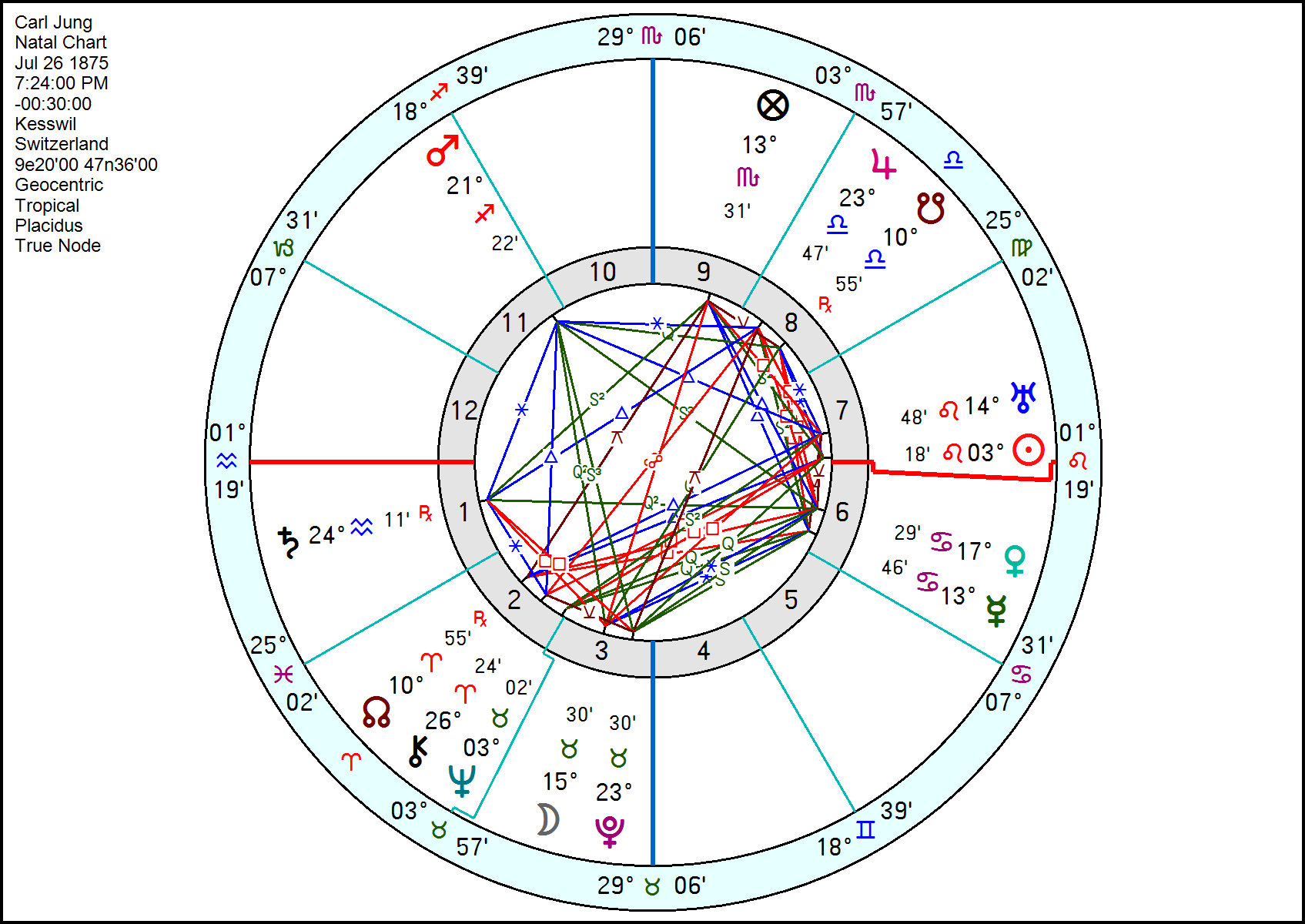
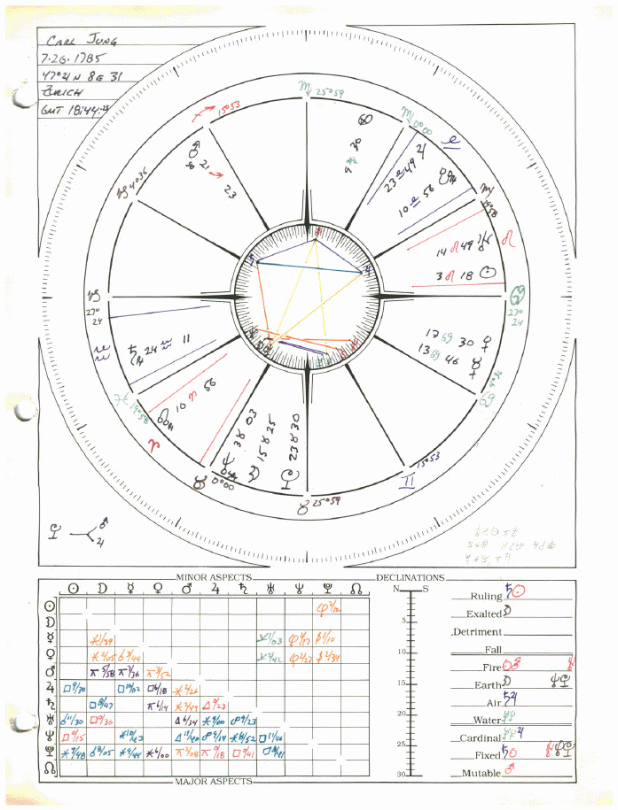
Jung's natal chart: two groups joined by quincunx, Sun unaspected
Saturn at Aquarius 25: Jung saw himself as able to understand and assimilate the unusual and abnormal contents of experience; through focus on rationality, senex grew beyond ordinary limits of empirical subject
Jupiter at Libra 24: fascination with abnormalities of nature; ability to recognize wisdom and intelligence in abnormal/pathological expressions of psyche
Saturn trine Jupiter: self-apperception able to investigate and assimilate flow of unusual contents from unconscious; self-apperception as instinct
Mars at Sagittarius 22: self-drive/shadow self-contained; ability to bring refined and wise self-drive into any new setting
Jupiter sextile Mars sextile Saturn: understood shadow's origin in instincts; self-apperception could understand and deal with shadow
Jupiter sextile Mars: ability to plunge into psychological processes
Saturn sextile Mars: respectful awareness of instincts part of his self-apperception; constant drive towards relating modern life and traditional thought
Moon at Taurus 16: deep recognition of wisdom and power of images locked up in body and ability to communicate this insight to others; psyche as resource of all wisdom; couldn't understand unembodied reason-principles
Mercury at Cancer 14: insight into endless nature of human understanding; birth of intuition into the mystery of man
Moon sextile Mercury: drive to understand the doctrine and desire to limit it to psyche
Venus at Cancer 18: strong attachment to empirical point of view; valuing of normalcy
Moon sextile Venus: defined understanding of common sensorium as embodied; recognition of psychic processes as primarily benign
Mercury conjunct Venus: belief that only what is empirically assimilated in the imagination can direct one to the greater meanings in life
Mars Jupiter Saturn group quincunx Moon Mercury Venus group: constant stress between self-knowledge and receptivity to processes in objective psyche; gave Jung's psychology its vital and open-ended quality
Sun at Leo 4: deep pride in individual being, objectification of animal consciousness in man; ability to civilize both conscious and unconscious processes; birth of Apollonic consciousness
Tail at Libra 11, eighth house: teacher in past with tendency to overlook his own presuppositions; first differentiated his ego structure through close attendance to his inner guide
Head at Aries 11: dedication to a higher form of subjectivity; sacrifice of personal life and goals to bring out truth of archetypes to Western world
Trans-Saturnians and transiting Chaldeans work together to bring about realization of the Head
Natal trans-Saturnians as image of potential for higher wisdom; potential effect indicated by aspects to natal Chaldeans
Uranus at Leo 15: recognition of archetypes
Uranus square Moon: receptive to insights given by Uranus and able to communicate them; higher soul's knowledge of life compelled ego to understand powers underlying imagery of body
Neptune at Taurus 4: guarantee that pathway towards rational soul will be revealed; enduring value of spiritual reality
Neptune square Sun: ultimate goal or reward for life is individuation process; constant intrusion of psychoid realm into life experiences
Pluto at Taurus 24: power
Pluto square Saturn: power to overcome his subjectivity
BOOKS QUOTED FROM OR REFERENCED:
Marc Edmund Jones, The Astrology of Concepts
Marc Edmund Jones, The Sabian Symbols in Astrology
C.G. Jung, Memories, Dreams, Reflections
SABIAN SYMBOLS: Aries 11, Taurus 4, 16, 24, Cancer 14, 18, Leo 4, 15, Libra 11, 24, Sagittarius 22, Aquarius 25
CHARTS appended to this paper:
FIGURE ASL - Reading a Chart - 1. Carl Jung Natal Chart (astro.com).
FIGURE ASL - Reading a Chart - 2. Carl Jung Natal Chart (WG version).
AD HANDWRITING: Typewriter typed, a few AD and student edits
COMPLETENESS: Almost full paper, missing one or two pages at the end
PUBLISHABILITY: Yes
ALTERNATE VERSIONS: 1982 0717P1-08R06.PDF, the partial transcript for WG Seminar 1982 0717a Astrology; Theory with extensive student and some AD handwritten edits that were incorporated into the version used as a basis for typing this paper
DATE ASSOCIATED WITH THIS PAPER: 7/17/82. Other dates also associated, see note below.
VERSION OF PAPER IN ASTRONOESIS, in "Astrology: The Topography of the Subtle World"
RETYPED AND REFORMATTED by IT 2022, proofread by HP 2022
NOTES:
RETYPED AD PAPER presented in class (V09MP).
This paper was written for a presentation by TS at an astrology conference connected with the Digicomp DR-70 Astrology Minicomputer. The first part (on astrology theory) was written by AD (Anthony Damiani) and AS; the second part (on Jung's chart) was written by AD and TS. For more on the DR-70, go to https://www.computerhistory.org/collections/catalog/102746921. See also Jeff Cox note in ASL AD's Introduction to True Lunar Nodes V09P.
This paper used to go by the name "Jung Paper".
An earlier version of paragraphs 2-4 can be found in Scan File ASN MASTER PRELUDE 16-30a.PDF (p. 30a).
This retyped paper incorporates student and AD handwritten edits. To see the actual handwritten edits please refer to the Scan Files.
All spelling and some punctuation and capitalization corrected, all numbers and astrological glyphs spelled out.
This paper is read and discussed in WG Class 1982 1009b Astrology; Theory, portions of its precursor are read and discussed in WG Astrology Seminar 1982 0717a, and it is also briefly discussed in WG Seminar 1983 0829b Astrology; Horoscope-Wagner.
Sabian degrees are from The Astrology of Concepts and Sabian degree interpretations are from The Sabian Symbols in Astrology, both by M.E. Jones.
READING A CHART
[File ASL Reading a Chart P 25p.PDF Begins]
The central purpose of this paper is to propose a specific viewpoint towards astrology and human nature. Basically we wish to put the interpretive art of astrology on a sound philosophic footing, rather than relying solely on the body of traditional empirical knowledge for our meanings. Hence this paper begins in the abstract and moves towards the concrete as a specific illustration of the abstract. The illustration has two parts, first an interpretation of Jung's natal chart, and then an exploratory look at a few major transits in Jung's life. The philosophical proposal basically is suggesting that there are three grades of subjectivity in man, one empirical, one perpetual and one eternal. These subjects are in all our experience and hence in the chart. In fact, the paper will suggest that astrology is uniquely structured to reveal these grades of subjectivity.
It is our belief that the astrological mandala is a fragment of an archaic wisdom, and was devised by the profoundly wise sages of the past. This mandala of the signs and planets is a rare instance of -- and product of -- the archetypal imagination; it presents the topography of the subtle world through the forms available in sensible becoming. This root symbol of astrology represents a formulation by reason principles of a symbolic method through which those very reason principles are being manifested. Reason principles are those living meanings or categories of thought that are the substantial aspect (forms) of the soul. Here we are stating that the totality of these categories of thought, or reason principles, are being arranged and combined in an indefinite variety of ways by the intermediary powers of the soul according to the ideas in the Zodiac. This perpetual act of the soul produces the invisible physical reason principles which are then "inserted" into matter and which evolve and develop into material species. These species will therefore inherently contain them and manifest those very reason principles in their perceived world. It is these reason principles projected into physical circumstances that are the very understanding one must assimilate in order to become the knower, the higher soul.
The astrological chart therefore attempts to join the processes going on in the subtle world with the experiences going on in the sensible world. These experiences have a compulsive nature which cannot be avoided and that forces the individual's attention towards understanding them. Through this process the individual soul powers are developed and refined until a full understanding is attained. This implies that along with the manifestation of the individual, the world idea as represented by these categories of thought is being manifested and known through this progressive, and individual unfoldment. Otherwise the commonality of experiences can't be explained. Here at this level is the instance of identity of knowing and being; that is, of those reason principles which are becoming the sensible being, which in turn is assimilating those reason principles.
This then is a bare outline of the meaning of soul-making and its expression in the symbolic language of astrology.
So, the next question is, what do we see when we look at a chart? We naturally assume that there is a significance and meaning to life; there is some sense to the sensible -- beyond that -- there are principles ordering that sense in the sensible, and these principles are the native's unconscious presuppositions. It's difficult to emphasize the magnitude of this point. Even with a sufficient maturity of philosophic understanding, we cannot stand aside from our presuppositions, or even recognize them. These presuppositions are behind both the perception of the world and the understanding of that perception; they underlie and order both the psychic and the somatic elements of experience. The structure of these presuppositions is indicated by the natal chart. The origin of these presuppositions is in the higher soul's vision of the intelligible world, or what Greeks call the Divine Mind; the horoscope is a reflection of that, and is part of the working out of that vision. So the chart is like a miniature of the metaphysical mandala we referred to earlier.
Each soul's development is unique; as is its vision of universal truth. Hence all that it expresses in the symbol of the chart is from within itself. So, as the mentalist points out, the entire unfolding of the chart including the chart itself is a projection from within the individual soul, and as such reflects the soul's unique vision of the Truth. This is quite different from thinking of the individual as some structureless innocent enshrouded by a clockwork cosmos. Rather there is an organized interiority to the subject, one which develops the powers of the individual soul. To be precise one must add that this organization of the soul is coordinated with the evolution of the world or the world idea -- and that it's through this same world idea that the soul manifests its vision of the intelligible world as sensible. The sensible image of the world idea is the cosmos itself -- the stars and the planets.
So we can see that it is these planets, these stars, and the 360° of the Zodiac within the Soul which image the totality of meaning unfolded into life. Let us call the seven Chaldean planets representative of the powers of the soul, and the degrees of the Zodiac representative of the reason principles, (or units of life-wisdom). These, taken together, are the basic meanings to be established in the native's life; these reason principles and soul powers are invisible potencies at birth, and will become actual perception drawn from the life itself. So at birth the chart is given to the soul, but is yet unavailable to the psyche; it indicates the meanings that the soul is going to try to assimilate through the life experiences. As meaningful experience always contains both functional and substantial aspects, in the chart we'll represent the substantial part by the degrees; and the functional part by the planets; that is, in a given life there is a development both of the powers of the soul as specific abilities -- and of reason principles as specific ideas. Ultimately there is the possibility of the universalization of the soul's outlook in the maturation of this development. This is tantamount to the soul's recognizing its original vision in the Divine Mind. So the refinement of the soul powers and the actualization of the reason principles are directed toward the goal of becoming a true knower. That our central concern is with the rational soul's intentions, not with the personality's interpretation of those intentions. What the Greeks call the rational soul might be explained as a permanent subjectivity, timeless, but containing time, alternatively aware of the eternal and of the transient; in fact, it is this subject which is itself the Ratio between eternity and time, and so takes its name as rational from this function. As we were saying, the fundamental meanings of the horoscope will always become understood by the rational soul of the native. On the other hand, whether the empirical personality will or can understand these meanings is a very difficult question. A more urgent difficulty, and one which emphasizes the importance of astrology, is that the rational soul itself is not free from its own presuppositions -- symbolized by the chart. These presuppositions of the rational soul will always affect its inquiry into Truth.
To review, there are three levels of subjectivity to be seen in the chart: the most immediate is the empirical subject; then there is the rational soul, and the highest is the intellectual soul. These are all levels or grades of the same individual, so they can't be entirely separated or distinguished from one another. Hence there's always some fluidity in their definition, as well as in our ability to distinguish them within ourselves. Nevertheless we shall try to understand these three levels of the soul, how and where they may be seen in a chart.
Let us begin by equating the natal Chaldean planet-pattern with the empirical, the rational soul powers with the transiting Chaldeans, and the Intellectual soul with the trans-Saturnians. The psychological subject has a given pattern of fixed functions; these functions are symbolized by the natal Chaldean planets. The transiting planets -- carrying with them their natal modifications -- represent those powers of the soul which will rationalize these fixed attitudes of the ego -- that is, the transits may make these psychic functions responsive to the unfoldment of the higher soul's vision.
These powers of the soul themselves have varying degrees of maturity and strength, since they are always evolving. For example one's understanding the meaning of truth changes and becomes increasingly open as one's spiritual awareness deepens. So, there must be something which organizes and adjusts these rational processes, communicating to them something of the higher soul's vision of the Truth. This higher order of functions is represented by the trans-Saturnians. It is this recognition of the original structure of the rational soul together with its mode of alignment with the higher soul's contemplative act that completes our understanding of the chart as it is the motive for spiritual discipline. Thus spiritual astrology is a tool through which one may become aware of what's required of him; that is, it may provide an understanding of and ability to work with the ideas being brought in by the trans-Saturnians. The trans-Saturnians not only inform the rational soul, they also work directly on the irrational soul -- using its structure as the material and medium for the expression of the Divine Mind's knowledge, and in so doing the trans-Saturnians actualize the world idea through the empirical subject.
There are those whose goal is to live a thoroughly symbolic life, who use symbolism -- dreams, astrology, synchronistic phenomena -- as the ground upon which to base the meanings of their life. Although this is undoubtedly fruitful, we're adding to this a view at once more profound and more immediate. That is, as there is a deeper significance to life, and in astrology we have an opportunity to see the horoscope as an embodiment of a deeper, imageless grade of meaning and purpose by which we may live our life. Indeed, the perceived world is enough of a symbol without making a symbol of a symbol. Beginning from common experience, when one becomes aware of the rationality within, one begins to be aware of the rational soul's presence in one's life. If we are alert to the possibility of recognizing this presence where there are transiting aspects to the natal positions, we are capable of assimilating its operation; and so succeed in becoming rational ourselves. Now, although the rational soul is permanent, in that it is evolving, it has the possibility of misunderstanding experience. So, the central act of correcting the rational soul's understanding is through the silence. In this silence there may arise intuitive guidance from the first, or intellective soul; this may objectify the person's presuppositions and perhaps free him from them.
Now we'll apply this approach to a natal chart, using Carl Jung for an example. We hope to give a brief sketch of the specific nature of each phase of subjectivity within the chart, as well as their interrelationships.
Let us begin with the most fixed element of the individual -- the psycho-somatic. This is constituted primarily by the Chaldean planets, the degrees they're on, and their aspect pattern. This is the image of the irrational soul included as part of the cosmic image. The cosmic image is the substratum of the empirical subject, in which he is grounded. In order to build up our perception of Jung's empirical subjectivity, we'll first look at each Chaldean planet and its Sabian symbol, then add it to the emerging groups of planets held together by aspects.
The seven natal Chaldean planets represent seven categories of the imagination: Saturn is self-apperception, Jupiter instinct, Mars will, Moon recognition, Venus evaluation, Mercury thought, and the Sun is the function of imagination. The degrees the planets are on represent the underlying structure of these categories, and the aspects reveal the energy patterns within the psyche.
In looking at Jung's chart we see there are seven aspects among the Chaldean planets which creates two groups and leaves the Sun unaspected. Saturn is one degree trine Jupiter, Mars is three degree sextile to both Jupiter and Saturn, and this forms the first group; while the Moon is sextile two degrees to Mercury, sextile three degrees to Venus, and Mercury conjuncts Venus at four degrees, and this forms the second group. These two subsidiary groups of Mars Jupiter Saturn and Moon Mercury Venus are joined through a four degree quincunx between Mars and Venus. The Sabian symbols for the Chaldeans are as follows. [Note: AD or student writes in left margin: "Show picture". AD or student writes in bottom right margin: "Say something about what symbols are? how they are used?"]
Saturn at 25 degrees Aquarius is "A butterfly struggles to emerge from the chrysalis, and it seems that the right wing is more perfectly formed." The Jupiter at 24 degrees Libra is "A marvelously coloured and figured butterfly is spread before the eyes; on its left side is an extra and third wing." Mars is at 22 degrees Sagittarius and is "A perfect bit of the old world is found in the new, a Chinese laundry has its shutters up and is now itself." The Moon, at 16 degrees Taurus is "An old man is attempting with a degree of success unsuspected by him to reveal the mysteries to a motley group." Mercury, at 14 degrees Cancer reads "A very old man, whose feebleness adds strangely to his dignity, stands alone facing a dark space to the northeast." Venus, at 18 degrees Cancer is "On all sides is the bustle of the barnyard, and in its old-fashioned and natural life a hen clucks among her chicks." Finally, the Sun, at 4 degrees Leo is "An elderly man in evening clothes, of poised and military bearing, stands alone before a lovely mounted moosehead."
So let us begin with Jung's Saturn, which is in dignity both by house and by sign, as well as being in the first house, and ruling his Capricorn ascendant. Saturn's Sabian symbol is "A butterfly struggles to emerge from the chrysalis and it seems that the right wing is more perfectly formed." Marc Edmund Jones says "This is a symbol of man's capacity to overcome any handicap imposed on him by the abnormalities which at times become an inevitable part of his own nature, and of his underlying stamina or psychological integrity." This symbol points to the organization of Jung's Saturn, whose function is that of self-apperception. From this we learn that Jung saw himself as able to understand and assimilate the unusual and abnormal contents of experience. Not only could he directly accept these contents -- whether they came from his own visions, his patients, or the region of the mythic and the occult -- he was able to rationally account for them and articulate his understanding of them. On the objective side Saturn represents the senex, or the archetype of the wise old man; the degree of Saturn's placement indicates that in Jung this senex has unusual flexibility, and through an extreme focus on rationality, it expanded and grew beyond the ordinary limits of the empirical subject. We might add that instead of restricting him as Saturn is so often wont to do, it's through this archetype that Jung was able to get free of his personality.
[Note: The following two paragraphs in brackets are found out of place on p. 1 of the scan. They were originally written by AD and AS and later rewritten by TS and used, in altered form, in the Jung chart portion of this essay. They correspond to the above, starting with "Now we'll apply this approach," bottom of p. 3.]
[One method of approaching Jung's chart is to delineate each of the three levels of subjectivity and their interrelation. We'll begin with the most fixed element of the individual -- the irrational soul, or psycho-somatic organism. As we suggested this subject is constituted primarily by the Chaldean planets, the degrees they're on, and their aspect pattern. This is the image of the irrational soul included as part of the primal image. To build our perception of this image first we'll look at each Chaldean planet and the degree that organizes it, then at the specific groups of planets brought together by aspect, and finally all the Chaldean planets as a unit of life endowed with certain meanings.
Jung's Chaldean planets are brought together by seven aspects; the closest being Saturn trine Jupiter. The Saturn in Jung's chart is quite prominent, being in dignity both by house and by sign; it's also in the first house and rules the first house. The Sabian symbol is "A butterfly struggles to emerge from the chrysalis and it seems that the right wing is more perfectly formed." Jones says, "This is a symbol of man's capacity to overcome any handicap imposed on him by the abnormalities which at times become an inevitable part of his own nature, and of his underlying stamina or psychological integrity." This symbol organized Jung's function of self-apperception (Saturn) in a specific way -- in its retrospection it can understand and assimilate unusual contents outside normal experience and rationally account for them. We could also say that the senex archetype is so structured that it has unusual flexibility, and through the extreme use of rationality, is permitted to expand and grow, in contradistinction to the usual characterization of Saturn as congealing and fixing.]
Jung's Jupiter, in one degree trine to Saturn, is also somewhat unusual -- as is indicated by its Sabian symbol, which reads "A marvelously coloured and figured butterfly is spread before the eyes; on its left side is an extra and third wing." Jones says "This is a symbol of man's real power in making his permanent impact on others, dramatized at each moment of issue and crisis by a completeness of the self's flow out and into every last ramification of the given experience. When positive, the degree is an idealistic originality, and a high facility in quick analysis, and when negative, an interest in the worthless or an obsession with the impossible and ridiculous." We'd like to add that this image also means there's a fascination with the abnormalities of nature; it is this fascination with the unusual that organized the vital energy of the chart. Even in childhood Jung expressed a tremendous curiosity about death and things under the earth. As he remarks on his early dream of an enthroned phallus, "I was initiated into the secrets of the earth… into the realm of darkness." (p. 15) [Note: See C.G. Jung, Memories, Dreams, Reflections.] There is in Jung the ability to recognize the wisdom and intelligence in even the most pathological expressions of the psyche. Consequently he did not dismiss the eruptions of unconscious contents into consciousness as so many do -- in fact he was drawn to them.
The one degree trine between Jupiter and Saturn brought these two functions, self-apperception and instinctual energy, into a relationship which constitutes a psychic complex in itself. Jung's self-apperception was able to investigate and assimilate the constant flow of unusual contents that his unconscious was attracted to without becoming possessed by them, and his Jupiter had the facility for understanding the rational pattern underlying these contents. It is from the experience of this trine that Jung came to the idea that self-apperception is being built up from the complexes in the unconscious, and it is how he came to see self-apperception as itself one of the instincts unique to man.
The next planet in this group is Mars, completing the triad of Mars-Jupiter-Saturn. Its Sabian symbol is "A perfect bit of the old world is found in the new, a Chinese laundry has its shutters up and is now itself." Jones says "This is a symbol of complete self-refinement through the unsuspected or even generally unaccepted activities of the community and of a consummation of the being through specialized interest." Mars represents the function of self-drive and the archetype of the shadow. This degree reading gives Jung's self-drive and shadow a tremendous self-containment and the ability to bring a refined and wise self-drive into any new setting. This allowed him to explore such things as alchemy, Christian symbolism, occult phenomena, and pathology. Jung was always able to keep to himself and carry his own viewpoint into any content that he investigated while still able to actually make contact with the subject. For example, one friend expressed constant surprise at how quickly Jung could be friendly and converse with Aborigines in their own primitive milieu. The degree reading also suggests that there is a certain age to the shadow-function, one wise to the ways of the world, grounded in life and able to keep to its own course.
Mars sits halfway between Jupiter and Saturn in a three degree sextile to both. The Jupiter Saturn trine represents Jung's rational understanding of unconscious contents; the Mars caught in a sextile to both will become defined and known by them. In other words Jung understood and respected that world-wise shadow of his, and its origins in the instincts, as well as its definition by the instincts. He had little use for a purely theoretical approach to the psyche -- for him to understand it was to confront it. At the same time the rationally-oriented self-apperception clearly understood and could deal with the shadow. With the exception of his relationship to Father White and his flight from India, Jung rarely allowed his resistance to block his investigations or his thinking, yet he was always aware of that presence. Taking the point of view of Mars we could say that in the Mars Jupiter sextile there is the ability to plunge into the psychological processes as there was an ability to enrich and strengthen his will through these contents. Finally, in the Mars Saturn sextile we see that a respectful awareness of the instincts was part of Jung's self-apperception -- this is what he saw himself as needing to emerge from. He knew himself to be somewhat explosive and temperamental, never seeing himself as free from psychological stresses, yet he wished to make himself over into a person ordered by their understanding, not their will. This Saturn Mars sextile also gave him a constant drive towards relating modern life and traditional thought. What other psychologist would dare bring such an anachronism as alchemy into the artificial light of twentieth century science? Combining all these aspects, the Saturn Jupiter trine, the Saturn Mars sextile and the Jupiter Mars sextile, we perhaps can sense that it was this "complex" which gave Jung the strength to endure his own confrontations with the unconscious, understanding them using only his own resources, and building a strong rational self-knowledge out of these encounters.
The second group of planets is constituted of Moon, Mercury, and Venus. Let's first look at the Moon degree, which is "An old man is attempting with a degree of success unsuspected by him to reveal the mysteries to a motley group." Jones says "This is a symbol of the need to share whatever may be the ultimate substance of selfhood, as here brought to a personal realization on the intellectual side. When positive, the degree is the uncompromising integrity of higher vision and an unshakeable determination to dramatize it, and when negative, a failure in accomplishment through a loss of touch with everyday practicality." This degree is a symbol of the underlying meaning which organizes Jung's exalted Moon in Taurus. Now, the Moon itself indicates that Jung had an objective knowledge of body-bound consciousness. Joined with the symbol meaning, there is here a deep recognition of the wisdom and power of the images locked up in the body itself and an ability to communicate that insight to others. These are the very images by which we understand our immediate sense data in that we do not usually experience bare percepts -- a sound, a shape, without the mind providing some image to which the sound can be related -- as Jung points out in the example of hearing a hissing noise -- first imagined to be a snake, then recognized as the radiator; hence we primarily experience images arising out of sense-data, not the sense data itself. As we can see that it's also from this Moon that Jung saw the psyche as the ultimate resource of all wisdom. He could understand embodied reason principles -- that is, meaning cloaked with form -- but not unembodied reason principles -- imageless meaning. For Jung spirituality and philosophy had to come from within the psyche. Although this Moon limited his outlook towards traditional philosophy, it also gave him the recognition that the body, as the treasure-house of images, is what the human soul depends upon in order to meaningfully experience the sense-world.
The second planet in this group is Mercury, whose symbol is "A very old man whose feebleness adds strangely to his dignity stands alone facing a vast dark space to the northeast." Jones interprets this as "a symbol of the immeasurable reaches of past experience as a strengthening of the human spirit for its immediate destiny, and of the eternal rebirth through which man may discover that present aspiration and future achievement are without the slightest limitation…. When positive, the degree is a highly effective enlistment of deeper and hidden elements of life for some momentary end, and when negative, lack of purpose and utter chaos in understanding." The agedness in this degree indicates that Mercury could dig into all the resources of its past experiences to connect Jung with the unknown, and provided him with an insight into the endless nature of human understanding. The other thing Mercury provided Jung with is a coming to birth of a very real intuition into the mystery of man himself, and an honest recognition of his inability to understand philosophy's teachings regarding the imageless realms of being. This of course is expressed in Jung's repeated claims of being only an empiricist, sure of the psychic experience of God yet unable to test the ontological status of God.
Joining Jung's Mercury to his Moon in Taurus, we see that on the one hand Jung's vision of philosophy was defined by -- and limited to -- his recognition of the mysteries of the body and common sensorium. On the other hand Jung was able to bring to life the unending and profound mysteries of the psyche, elevating the imagery of life to a new level. In the Moon Mercury sextile there is an intuition and assimilation of the wisdom and power inherent in the psyche, and a tendency to take it as the source of all wisdom. That is, the Mercury was able to elaborate the mysteriousness and wisdom inherent in the images of everyday experience. Yet in that Jung saw the lunar consciousness as defining the Mercury, his intuitions were held only to that psycho-physical realm. So in this Moon Mercury pair there is at once a drive to understand the doctrine and a desire to limit it to the psyche.
The third planet in this group is Venus, which is sextile Moon and conjunct Mercury. The Sabian symbol for Venus is "On all sides is the bustle of the barnyard and in its old-fashioned and natural life a hen clucks among her chicks." Jones adds that "This is a symbol of the maximum protection which life at large will provide for the individual…normalcy is exalted in the simple business of self-being. When positive, the degree is a marked capacity for meeting every demand for existence advantageously and with a persisting self-fulfillment, and when negative, idle bustle and unprofitable labour." Venus represents the native's values, and this degree, with its enthusiasm for normalcy shows that Jung was strongly attached to an empirical point of view, and that he was very active in pursuing it. It was this vital valuing of normalcy that aided Jung in his work as a therapist and kept much of his research work linked to the practical issues of the therapist. During his own confrontation with the unconscious this Venus degree's orientation towards the common and everyday may have been what kept him together.
Adding the Moon sextile to the Venus we can say that this aspect defined Jung's understanding of the common sensorium (or traces of life left in matter) as it is embodied. This attitude distinguishes him from those occultists who prefer to consider the subtle world only as a plane of reality unrelated to the empirical. Yet it's this same sextile that allowed Jung to directly face the problems the subtle world presented and to try to deal with them as they presented themselves, without bias. Since both Jung's third house Moon and sixth house Venus undoubtedly had a lot to do with his work as a therapist, the sextile between them gave him a natural talent for recognizing the processes of the psyche as primarily benign -- it gave him the ability to recognize the positive direction towards wholeness that was trying to emerge through his patients' dreams and fantasies.
The third aspect in this group is a four degree conjunction between Mercury and Venus. The conjunction indicates that these two functions, that of thought and feeling worked together; the four degree orb indicates that their interrelation was constantly being manifested. Mercury represents Jung's intuition into the mysteries of man, and the Venus represents his strong empiricism. Their union gave Jung his tendency to believe that only what is empirically assimilated in the imagination can direct one to the greater meanings in life, and an understanding at the empirical level which makes possible the recognition of higher truth.
These two groups, the Mars Jupiter Saturn and Moon Mercury Venus are united through a four degree quincunx from Mars in the first group to Venus in the second. We have seen that the first group, the Mars Jupiter Saturn complex gave Jung his strong personal drive to experience and bring rationality to the unconscious. This group has the sense of something personal, subjective, and yet very deliberate and rational. There is here a strongly willed transformation of unconscious contents into a foundation for independent and original thinking. One could hardly say that the theories of Jung were abstract or lacking a foundation in personal life. On the other side is his Moon Mercury Venus complex, which shows a more mediumistic receptivity to the mysterious and transcendent unknown lodged in common experience. Here is Jung's ability to recognize the common forms and functions available across the continents and centuries of man -- his talent for recognizing and translating the hidden movements of the collective unconscious. From the quincunx there is a constant stress between his own self-knowledge and his receptivity to the processes he recognized in the objective psyche. This quincunx was not a polarization but a continued compulsion to extend his understanding of the interrelationship between the subjective psyche and the collective unconscious. As we have seen, Jung's Mars was a defined drive towards self-containment; this is on the subjective side. Venus on the other side gave Jung his respect for empiricism and objectivity. So it's natural that there was constant reformulation of each of these in terms of the other; and his parallel development really gave Jung's view of psychology its vital and open-ended quality.
In light of this dynamism between the subjective and objective psyche, it's very interesting that the central Chaldean planet -- the Sun -- aspects neither group, but stands isolated, as its symbol indicates. This symbol M. E. Jones gives as "An elderly man in evening clothes, of poised and military bearing, stands alone before a lovely mounted moosehead." Jones adds "Formality becomes a magical ordering of the automations of lesser things, enlisting them in an enduring service to each individual's more outstanding talents. Positively, the degree is exceptional capacity for winning and holding the esteem of men; negatively, dependence on applause and playing to the gallery to get it." It is this meaning, joined to the function of imagination represented by the Sun, that provided Jung with the understanding of how the forms in the imagination give order and meaning to psychic processes. In other words, any psychic function -- anima, shadow, senex -- will endlessly operate in a cyclic manner, taking one through a roller-coaster series of circumstances; what Jung saw was that a recognition of the internal meaning of the psychic function itself reduced the compulsiveness and the chaos otherwise produced by these cycles. So, inherent in the organization of his imagination is a deep pride in individual being, and an objectification of the animal consciousness in man. The formality expressed in the symbol gave him the ability to civilize both conscious and unconscious processes, which resulted in the birth of Apollonic consciousness or what Jung would call the hero myth. The isolation and defined form is further emphasized by the fact that the Sun is unaspected by any of the Chaldeans which gave Jung an inner compulsion to project this development of inner meaning in to his life experience. Here we can also see why Jung was able to use the individual imagination as an objective tool for observing life.
Moving to the nodes, we should be able to see how the Tail degree (at 11° Libra) represents the distillation of past living as a base from which the present personality develops. Jung's Tail degree symbol is "A kindly old professor from his battered desk looks out over his eyeglasses at a class eagerly awaiting his words." Jones adds "This is a symbol of the naive self-confidence by which an individual is enabled to continue the role of superiority he has elected to play among his fellows. When positive the degree is a quiet mastery of events through a developed insight or depth of understanding, and when negative, a joy in depreciating others and compelling their subservience." This is the part of Jung's psyche brought in from the past and in the earlier part of the life; all the Chaldean planets may be seen as elaborating this residual impulse. As the Tail is in the eighth house along with Jupiter, one may presume that Jung was a teacher of some kind in the past, a teacher comfortable with a detached but benign attitude towards his personal students, and one with some tendency to overlook his own presuppositions. A complimentary interpretation is that Jung first differentiated his ego structure through close attendance to his inner guide. Perhaps we can say that the various psychic functions became differentiated and distinguished as he objectified this attitude, keeping the ego in the center of his attention. In that the Tail creates and maintains the wholeness of the empirical subject, the way Jung did this was to remain unexposed to his peers, staying in a rural environment, teaching himself and evolving himself mainly through an inner dialogue. It is this energy which stabilized him and began his psychological differentiation.
In contrast to this the Head (at 11° Aries) indicates the direction and goal towards which the life will evolve. It indicates the way in which the rational soul intends to organize and transform the empirical subject. Hopefully this process will render the psyche into some appropriate image of the rational soul.
For Jung the Head symbol is "The president of the republic or ruler of his country is revealed." Jones comments "Implicit here is the selection of such a role as will have maximum breadth of recognition, so that the player may be established in a reality which he would be quite unable to sustain by himself. Positively, the degree is the self-sacrifice required of anybody who would become the creative representative of eternal value, and when negative, an often well-meaning but usually destructive assertiveness or vain pretense." This is the future truth towards which Jung's life was directed; since the goal that the Head indicates is only accomplished as the life is lived out.
The degree almost literally indicates the dedication to a higher form of subjectivity which Jung was evolving towards -- what we earlier called the birth of Apollonic consciousness, or the Hero myth. The indication here is that Jung had to subordinate every other role or facet of his life to the part he had to play in developing Western thought. He wanted to, and was compelled to bring out one truth to the Western world -- the truth of the archetypes -- those most basic powers in the psyche. Of course others before him -- like Santayana -- had recognized something of the existence of these archetypes or tropes, but no other Western thinker really recognized or communicated either the intelligence or power contained in these life-patterning forms. So, to bring out this insight Jung had to sacrifice something of his personal life and goals. Of course this more impersonal outlook on his own life was not achieved, or even revealed to him until the trans-Saturnians had reworked the empirical personality and were incorporated into the psyche.
As the trans-Saturnians are incorporated by the empirical subject, the rational soul must also give some order to the psyche. This rationalization of the empirical subject is achieved primarily through the agency of the transiting Chaldeans. Both of these then, the trans-Saturnians and the rational soul powers, work together to bring about the realization of the Head. So the next level of the chart to look at is that of the trans-Saturnians.
In general the natal position of the trans-Saturnians are an image of the potential for higher wisdom in the empirical subject. This higher wisdom or intellective soul has three modes; they are knowing, feeling, and willing. These transcendent functions are represented by Uranus, Neptune, Pluto, respectively. So Uranus is a higher kind of knowing, Neptune a higher feeling, and Pluto a willing transcendent to the empirical. Each of these planets has a specific structure which is indicated by its Sabian symbol. More precisely, we can say that the way each of these functions is imaged in the rational and the irrational soul is through their Sabian symbols. In every natal chart the potential effect these higher powers will have is indicated by their aspects to the Chaldean planets.
So, looking at Jung's chart we see that each trans-Saturnian has a one degree square to a Chaldean. That is, Uranus is square the Moon, Neptune is square the Sun, and Pluto is square Saturn. Their Sabian symbols are: for Uranus, "The great American carnival, the Mardi Gras at New Orleans, is seen with a wealth of floats, decorations, and merriment"; Neptune is "The rainbow's pot of gold is revealed in the midst of a shower of sparkling and flashing colors"; and Pluto is "A mounted Indian brave rides proudly with human scalps as trophies at his belt."
So to begin with Uranus, as representing the cosmic or transcendental knower, its Sabian symbol is "The great American carnival, the Mardi Gras at New Orleans, is seen with a wealth of floats, decorations, and merriment." Jones says "This is a symbol of man's constant delight in exhibiting the fruits of his achievement, and of a naivete dramatized in the world of everyday through a very human pride in common works and cooperative accomplishment. When positive, the degree is an irresistible heightening of self-significance across the whole face of experience, and when negative, unconvincing claims and embarrassing self-assertion." We can add that this symbol gave Jung the recognition that the primal intelligences which appear as the Zodiacal animals are incorporated into the activities of living creatures. This wisdom in animal intelligence is what are called animal essences, and Uranus gave Jung the compulsion and power to recognize them. Not only does this appear in his ability to interpret dreams, but also it gave him his preoccupation with the archetypes.
Combining Uranus with the square to the Moon, we can see how he was able to integrate this preoccupation with the archetypes with his work as an analytic psychologist. It is through the transcendent intelligence of Uranus that Jung was given the insight into the archetypes; the life traces which repeatedly manifest themselves in human thought, art, and culture.
Now although Uranus is in every horoscope, not all individuals are equally equipped to recognize or assimilate its intuitions. In Jung's chart, however, the one degree square to the Moon, whose function is that of assimilation, certainly gave him this ability. The Sabian symbol of the Moon is "An old man is attempting with a degree of success unsuspected by him to reveal the mysteries to a motley group." So Jung was receptive to the insights Uranus gave him, able to recognize their mystery, and the square put him to work in communicating this to others. So this square from Uranus to the Moon means that the higher soul's knowledge of life compelled the ego to understand the powers underlying the imagery of the body.
Neptune's Sabian symbol is "The rainbow's pot of gold is revealed in the midst of a shower of sparkling and flashing colors." Jones says "There is always the promise of a treasure which at the end proves to be a gratifying complementation in physical tokens of whatever spirituality the self has brought into manifestation through its own efforts. When positive the degree is an inner assurance which enables man to hold steady in every course of his choosing, and when negative, a loss of all opportunity through futile expectation and an unintelligent wandering off in the quests of pure fancy." And as image of spiritual feeling this symbol is the guarantee that the pathway towards the rational soul would be revealed to Jung -- together with the enduring value of the spiritual reality. This experience came to him as he fulfilled his obligation to his higher soul, the obligation to become a channel for certain ideas (c.f. shit dream). This Neptune is like a promise to the ego which got fulfilled as the ego submitted itself to that sense of obligation. The ego was given a gift -- the gift of sacrificing its central role to that of the higher self -- the hint carried in the Head degree. Neptune by being one degree square the Sun gave Jung the presupposition that the ultimate goal, or reward for life was the individuation process. This square between spiritual obligation and psychic individuation, is an autonomous complex, there are no other aspects to these planets. We might say this complex feeds the whole chart; it indicates the constant intrusion of what Jung called the psychoid realm into his life experiences.
In contrast to the isolation of the Neptune square Sun, the third trans-Saturnian, Pluto, has aspects to nearly all the Chaldeans, including a one degree square to Saturn and a one degree quincunx to Jupiter. Pluto's Sabian symbol is "A mounted Indian brave rides proudly with human scalps as trophies at his belt," which Jones interprets as "a symbol of pride in personal prowess, and it suggests an exceptional capacity for gaining and administering authority among men. When positive, the degree is an unimpeachable control over life through a discipline of the self and its powers, and when negative, a ruthlessness, or complete inhumanity in dealing with others." Pluto, or cosmic will, is here imaged as tremendous personal power, or the will to power in the transcendent subject. This becomes the power of will within the psychosomatic organism; the power to achieve the goal already given him by the Saturn degree. The Saturn degree is "A butterfly struggles to emerge from the chrysalis and it seems that the right wing is more perfectly formed." This we understood as the commitment to an emergence from an emotional subjectivity. The square to Saturn from Pluto gave Jung the power to do this, the power to overcome his subjectivity. In fact this Pluto is so strong -- both by degree symbol, and by natal aspects -- that Jung was able to impose his goals on all the
[File ASL Reading a Chart P 25p.PDF Ends. We are missing the last one or two pages.]
V09MP: PAPER: Astrology; Theory; Reading a Chart. Copyright 2022 Wisdom's Goldenrod p. v